
Module Integration Manual
— EMBD1124 (Provisional FCC submission, Full Modular Approval)
Document title — Module Integration Manual for EMBD1124
Module model / FCC ID — EMBD1124 /2AOOW-RMD1124
Manufacturer (Grantee) — TOTO USA, Inc.,
5351 E. Jurupa St., Ontario, CA 91761 United states,
Mr Fernando Fernandez
Revision — Provisional (for FCC submission)
Date — 2026/03/18
Scope — This manual provides the integration instructions and limitations required for host
manufacturers to maintain compliance when installing the EMBD1124 module under FCC Part
15 Subpart C modular approval.
1. Revision history
Rev. — Date — Summary
Provisional —2026/03/18 — Draft for FCC submission; final values (FCC ID, measured RF
data, antenna dimensions) to be inserted after certification testing.
2. Module summary
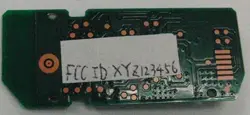
Module name / model — EMBD1124
FCC ID — 2AOOW-RMD1124
Radio type / functions — 2.4GHz Proprietary Function (IEEE 802.15.4 based)
Operating frequency range — 2.405~2.480MHz
Maximum conducted output power — 3dBm
Antenna type — PCB pattern antenna (printed on module PCB); fixed and non‑
removable; no external antenna connector.
Antenna gain — 2.14dBi
Approval type — Full Modular Approval (meets modular transmitter requirements of
47 CFR §15.212).
3. Regulatory compliance statements
Applicable rules — FCC Part 15 Subpart C (unlicensed intentional radiators) and modular
transmitter requirements per 47 CFR §15.212.
This device complies with part 15 of the FCC Rules. Operation is subject to the following two
conditions: (1) This device may not cause harmful interference, and (2) this device must
accept any interference received, including interference that may cause undesired operation.
Grantee responsibility — The module manufacturer (grantee) is responsible for the module’s
compliance and for providing accurate integration instructions to host manufacturers. Host
manufacturers must follow these instructions to preserve the module’s authorization.
4. Host manufacturer responsibilities and limitations
Do not modify the module RF circuitry, antenna pattern, or antenna feed. Any modification
voids the modular approval.
Antenna replacement — Not permitted. The EMBD1124 uses a fixed PCB pattern antenna
and must not be altered or replaced.

Antenna keep‑out — Maintain the antenna keep‑out area and clearances specified in Section
9. Failure to maintain the keep‑out may detune the antenna and cause non‑compliance.
Grounding and metal enclosure — Follow the recommended mounting and grounding
instructions; metal parts or shields must not overlap the antenna keep‑out.
Labeling and documentation — Host must apply required labeling and include the user
statements specified in Section 7.
5. Installation instructions
Mechanical mounting — Place EMBD1124 on the host PCB using the recommended land
pattern and solder all module pads per the mechanical drawing. Use mechanical fasteners only
where shown on the module drawing.
Antenna keep‑out — Keep all metal components, ground pours, and other RF circuitry
outside the antenna keep‑out polygon. As tested keep‑out: 5 mm radius from antenna
reference point.
Clearance to enclosure — Maintain minimum clearance between antenna and enclosure
interior. As tested clearance : 1 mm.
Power supply — Provide a regulated supply within the module’s recommended voltage range
and include recommended decoupling capacitors close to the module power pins.
I/O connections — Connect UART, GPIOs per the pinout in Section 10. Do not route external
antenna signals to RF pins.
EMC best practices — Route high‑speed traces away from the antenna area, add ferrite
beads or filters on long cables, and avoid large ground pours directly adjacent to the antenna.
6. RF exposure (SAR) and RF safety
RF exposure compliance — EMBD1124 was evaluated for RF exposure as part of the
modular approval. Host manufacturers must ensure the final product maintains the same
separation distances and usage conditions used during testing.
User information — Include this statement in the host user manual: “This device complies
with FCC radiation exposure limits. The device must be used with a minimum
separation of 20 cm from the human body.
7. Labeling and documentation requirements for host product
External labeling — Host product must display: “Contains FCC ID: 2AOOW-RMD1124” on
the exterior. If exterior placement is impractical, place the statement in the battery
compartment or another user‑accessible area.
User manual statements — Include: (a) the FCC ID and module manufacturer contact; (b)
the RF exposure statement from Section 6; (c) a statement that the antenna is a fixed PCB
pattern and must not be modified or replaced.
8. Final product testing and verification guidance
Verification scope — Host manufacturer must verify that the final product still meets FCC
radiated emission limits and that antenna integration did not increase emissions beyond
certified levels.
Recommended tests — Full‑product radiated emissions scan across applicable frequency
bands; conducted emissions if the host introduces mains or wired interfaces; RF exposure
verification if user proximity or usage conditions change.
When re‑testing is required — Re‑test when the host enclosure, antenna surroundings,
power levels, or intended use differ materially from the conditions used during module
certification.
9. Mechanical drawings and antenna details
Module outline drawing — See drawing EMBD1124‑MECH‑Dwg‑RevA (include dimensions,
mounting holes, and recommended land pattern).
Antenna layout — Antenna copper pattern, antenna reference point (ARP), and antenna
keep‑out polygon are shown on drawing EMBD1124‑ANT‑Dwg‑RevA. As‑tested antenna
keep‑out polygon and reference coordinates must be used without modification.
Mounting examples — Acceptable and unacceptable host placements are illustrated:
maintain the antenna area free of metal, large ground pours, and tall components.
10. Electrical specifications and pinout
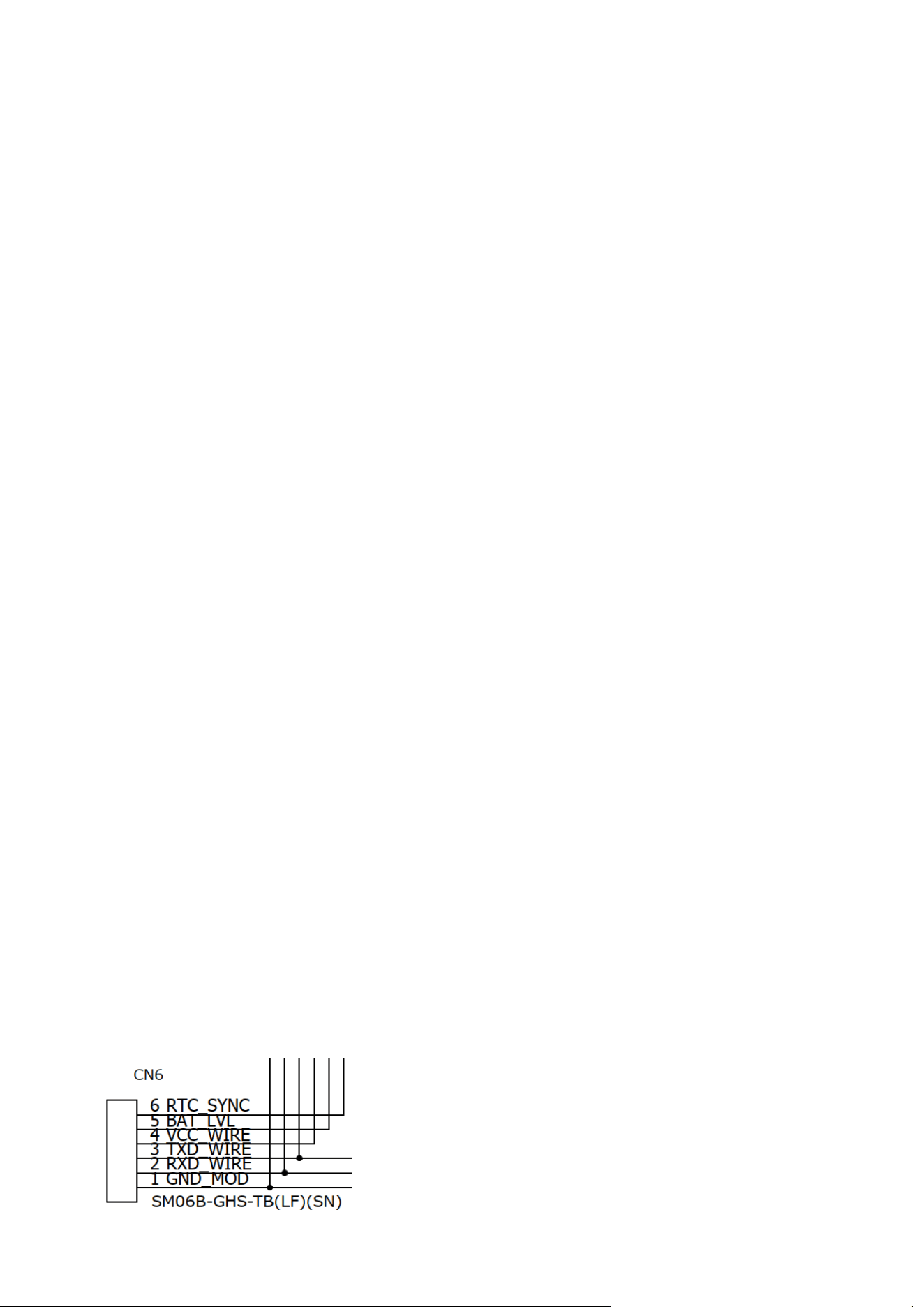
Pin diagram — See EMBD1124‑PINOUT for pin positions.
Pin function table — Each pin is listed with function, direction, voltage levels, and
recommended decoupling. Do not apply voltages outside the specified ranges.
Absolute maximum ratings — Supply voltage, IO voltage limits, and operating temperature
range are provided in the electrical specification sheet.
Recommended operating conditions — Normal supply voltage, typical current consumption
in idle and transmit modes, and RF transmit duty cycles used during testing.
11. EMC and antenna integration notes
Antenna detuning risks — Metal near the antenna or ground pours can detune the antenna
and increase emissions; strictly follow the keep‑out and clearance rules.
Cable routing — Keep cables, connectors, and battery packs away from the antenna area.
Long cables should be routed away from the antenna and include filtering where appropriate.
Shielding — If the host uses metal shielding, ensure it does not overlap the antenna keep‑out
polygon; shielding may require re‑verification of radiated emissions.
12. Integration checklist (for host manufacturer)
Module placed per recommended land pattern.
Antenna keep‑out maintained as specified.
Minimum enclosure clearance verified.
Power supply meets recommended specifications and decoupling applied.
Required labeling added to host product.
User manual includes RF exposure and antenna statements.
Final product radiated emissions verified and documented.
13. Declaration of conformity (sample text)
“The host manufacturer shall ensure that the final product complies with the applicable FCC
rules. The module manufacturer’s grant of equipment authorization applies only when the
module is installed and used in accordance with the instructions provided in this manual.”
EMBD1124‑PINOUT