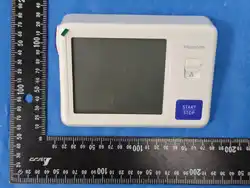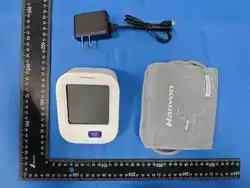
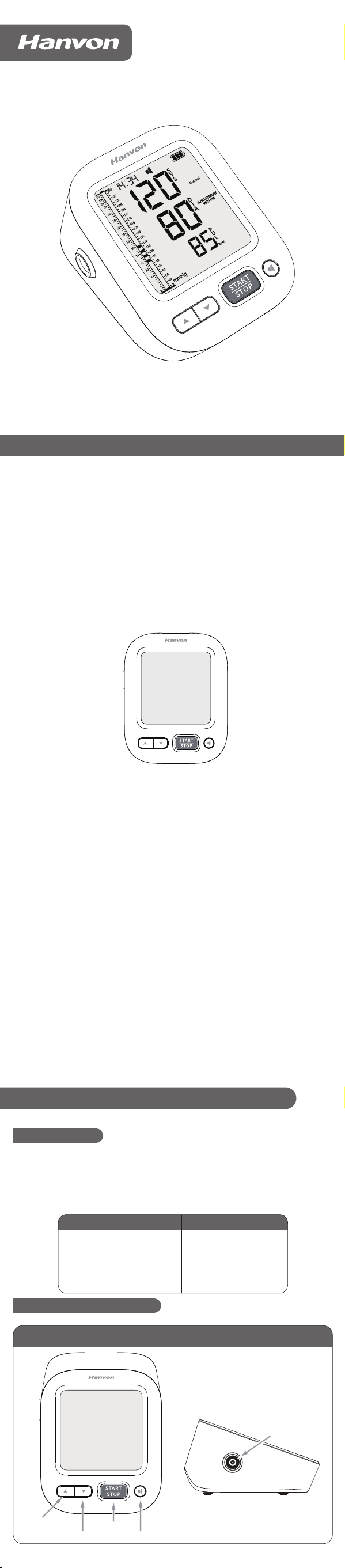
Korotkoff Sound Blood Pressure Monitor
User Manual
KSY3100 | KSY3100B | KSY3120 | KSY3120B | KSY3128B | KSY3100A
Beijing Hanvon Health Technology Co., Ltd.
● Thank you for purchasing Hanvon Korotkoff Sound Blood
Pressure Monitor.
● To ensure safe usage of this product, please read this user
manual carefully before use.
● After reading, please keep it carefully for future reference.
● This Blood Pressure Monitor utilizes the electronic Korotkoff
sound method for measurement.
● This product is suitable for scenarios such as families, hospitals,
and clinics, etc.
Intended purpose: The device is a digital monitor intended for
use in measuring the systolic pressure and diastolic pressure, as
well as the pulse rate of adults and adolescents via a non-invasive
auscultatory method in medical facilities or at home, with an
inflatable cuff wrapped around the upper arm for arm circumfer-
ences ranging from 22 to 42 cm. The measurement ranges of the
device are systolic pressure 40 ~ 280 mmHg (supported by
automatic mode for 40 to 210 mmHg and manual mode for 210 to
280 mmHg), diastolic pressure 20 ~ 220 mmHg, and pulse rate 40 ~
240 beats/min.
The device can detect Irregular Heart Beat(IHB) and Tachycardia.
Models KSY3128B and KSY3100A additionally support Atrial
Fibrillation detection.
Intended Patient: Adults and adolescents ( > 12 years)
Clinical Benefit: Patient’s blood pressure can be measured
non-invasively and simply in the home and clinical environment.
Contraindications:
DO NOT use this monitor on an injured arm or an arm under
medical treatment.
DO NOT apply the arm cuff on your arm while on an intravenous
drip or blood transfusion.
DO NOT use this monitor on infants, toddlers, children or persons
who cannot express themselves.
Structural Composition: It is composed of the main unit, the cuff,
and the AC adapter (optional).
1.2 Component Description
Main Unit (front) Main Unit (left)
1. Product Introduction
1.1 Packing List
All products are packed inside the packaging box. Open the box to check
whether the products are complete. The list of items included in the box is
shown in the table below. If you find any missing items, please contact the
after-sales service.
Packing List
Main Unit
1 unit
Cuff
1 piece
User Manual
Quick Operation Guide
1 copy
1 copy
Quantity
Air Tube Connector Socket
Backward Button
Forward Button
"Sta/Stop" Button
Volume Button
2.Safety Precautions
The terms "Warning" and "Caution" used in this manual pertain to the safety
of using this product, with the following specific meanings:
Warning: Failure to comply may result in personal injury or death.
Caution: Failure to comply may result in personal injury or damage to
property.
Main Unit(right) Main Unit (bottom)
Cuff
Air Tube Plug
Cuff's Air Tube
* This product only supports the dedicated cuff of Hanvon.
Explanation of Symbols
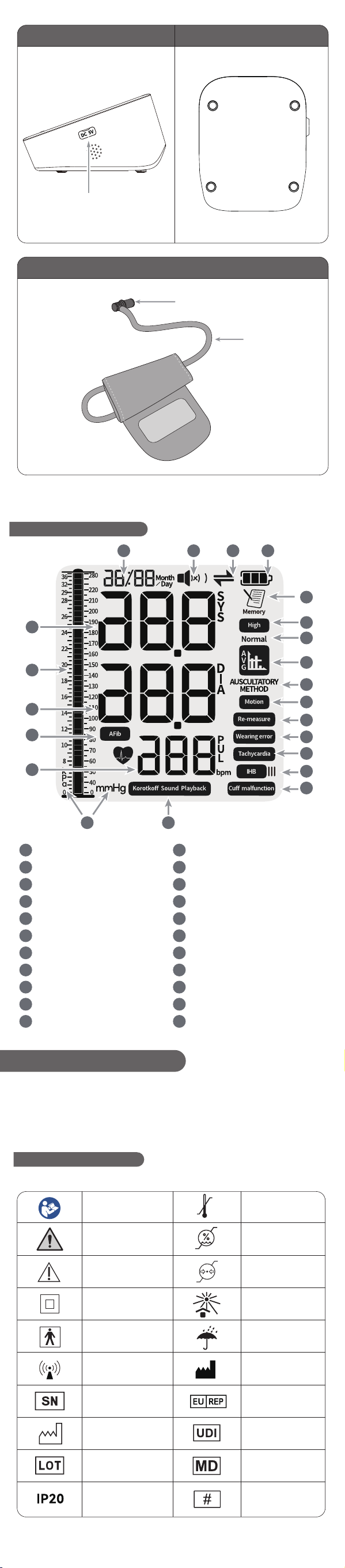
1.3 Function Introduction
Type-C Charging Po
Cuff Malfunction Prompt
Korotkoff Sound Playback Icon
Suggestive of Atrial Fibrillation (AFib) Prompt
Irregular Pulse Prompt
Diastolic Blood Pressure (DIA)
Time Display
Data Transmission Icon
Volume Icon
Battery Level Icon
Memory Icon
High Blood Pressure Prompt
Normal Blood Pressure Prompt
Measurement Method
Motion Prompt
Average Value Icon
Re-measure Prompt
Tachycardia Prompt
Inproper Wearing Prompt
1
2
3
4
5
6
7
8
9
10
11
12
13
14
15
16
Value Unit Icon
17
18
Pulse Rate
19
Electronic Mercury Column Icon
20
21
Systolic Blood Pressure (SYS)
22
4321
5
6
7
8
20
22
9
11
10
12
13
14
15
1617
18
19
21
Refer to instruction
manual/ booklet
Temperature limit
Humidity limitation
Atmospheric
pressure limitation
Keep away from
sunlight
Keep dry
Manufacturer
Authorized
representative in the
European Community
Unique Device
Identifier
Medical device
Model number
Warning
Caution
CLASS II equipment
Device classification:
Authorized EU
type BF applied part
Non-ionizing
electromagnetic
radiation
Serial number
Date of manufacture
LOT number
Ingress Protection
Rating

anesthetic gases mixed with air, oxygen, or nitrous oxide.
20. Do not use this device near televisions, microwave ovens, mobile
phones, X-ray equipment, or other sources of strong electromagnetic
fields, as these may interfere with measurements.
21. This Blood Pressure Monitor and cuff are not waterproof, so avoid
rain, sweat, and water. Do not use in damp or splash-prone areas.
22. This Blood Pressure Monitor is a precision instrument; avoid
excessive use in unsuitable environments such as high temperatures,
low temperatures, humidity, direct sunlight, vibration, or dust.
23. When the ambient temperature is 20℃, the Electronic Blood
Pressure Monitor requires a 4-hour stabilization period after being
moved from the minimum or maximum storage temperature before it
is ready for measurement.
24. Operating environment: Temperature: 5℃ - 40℃, relative humidity:
15% - 90%, non-condensing, atmospheric pressure: 700hPa - 1060hPa.
25. Transport and storage environment: Temperature: -20℃ - 55℃,
relative humidity: <93%, non-condensing, atmospheric pressure:
500hPa - 1060hPa.
26. If stored or used outside the manufacturer's specified temperature,
relative humidity, and atmospheric pressure ranges, the system may
not achieve the claimed performance specifications.
27. This device can be charged via a Type-C interface, charging input:
DC 5V 1A. Please use an AC adapter that complies with the require-
ments of IEC 60601-1 standard.
28. Non-transit- operable.
29. Cuff is the applied part.
30. This Blood Pressure Monitor has undergone clinical investigation in
accordance with the requirements of ISO 81060-2:2018+AMD
1:2020.
Warning
1. Do not frequently measure blood pressure unless medically
necessary. Excessive frequent measurements may injure the patient
due to blood flow interference, potentially leading to poor circula-
tion or bruising.
2. If symptoms such as skin irritation occur during use, discontinue
use and consult a physician; otherwise, symptoms may worsen.
3. If the Blood Pressure Monitor malfunctions or feels abnormal,
discontinue use and arrange for inspection and repair.
4. Do not use simultaneously with other medical electrical equip-
ment on the same limb. Cuff inflation may temporarily impair the
function of monitoring ME equipment used concurrently on the
same limb.
5. Do not apply the cuff to an arm with wounds or inflammation;
otherwise, symptoms may worsen.
6. Do not use this product on an arm where other catheters are
inserted, or on any limb undergoing intravascular intervention or
treatment, or an arteriovenous (A-V) shunt, as this may temporarily
interfere with blood flow and potentially injure the patient.
7. Do not use this device on the arm on the side of a mastectomy or
lymph node dissection.
8. Do not use simultaneously with other medical electrical equip-
ment, as there is a risk of this product malfunctioning.
9. Ensure (e.g., by observing the relevant limb) that this product
does not cause persistent damage to the patient's blood circula-
tion. Patients with circulatory disorders or blood diseases shall use
this product under medical supervision.
10. When measuring blood pressure, please note whether there is
continuous cuff pressure caused by internal tubing kinking; if so,
please stop the measurement.
11. Do not use in locations prone to fire or explosion, such as
environments with flammable gases or high concentrations of
oxygen.
12.Portable RF communications equipment (including peripherals
such as antenna cables and external antennas) should be used no
closer than 30 cm (12 inches) to any part of the Blood Pressure
Monitor, including cables specified by the manufacturer. Otherwise,
degradation of the performance of this equipment could result.
Caution
1. Please follow your doctor's instructions, do not self-diagnose or
treat based on measurement results
2. When AFib, irregular heartbeat, or tachycardia prompts appear, it
shall be confirmed after examination and diagnosis by a physician.
3. Measurements may be inaccurate in cases of common arrhythmias
(e.g., atrial or ventricular premature beats and atrial fibrillation),
arteriosclerosis, poor perfusion, diabetes, old age, pregnancy, pre-ec-
lampsia, kidney disease, patient movement, tremors, or shivering.
4. Not suitable for neonates. The effectiveness of blood pressure
measurement in pregnant women, including those with pre-eclamp-
sia, has not been determined. Intended operators include patients.
5. Do not place within reach of neonates or children. There is a risk of
neonates or children becoming entangled in the cuff air tube or AC
adapter, and component parts may cause choking if swallowed.
6. During measurement, do not use electromagnetic interfer-
ence-generating devices (e.g., mobile phones) near the device.
7. During measurement, keep the Blood Pressure Monitor and its
vicinity free from significant vibration.
8. Do not use components not provided by the manufacturer;
otherwise, measurement errors may occur.
9. Do not disassemble or modify the main unit or cuff of the Blood
Pressure Monitor yourself.
10. Do not use beyond the product's service life.
11. Used batteries, instruments, and components must not be
disposed of as general household waste; they shall be handled in
accordance with local regulations.
12. Any blood pressure measurement is affected by the measuring
site, posture, movement, and physiological condition of the
measured individual. If you have doubts about the measurement
results, rest for 5 minutes and remeasure, or consult a physician.
13. If an abnormality occurs during measurement (e.g., the cuff
remains excessively inflated), please remove the cuff; otherwise, the
arm may be compressed, leading to bruising or paralysis.
14. All functions of this product can be safely used by patients and
can be simply maintained according to the cleaning and mainte-
nance methods.
15. If there are contaminants such as dust or lint on the device
surface, clean it according to the cleaning and disinfection methods.
16. Do not use this product in the following environments: near
high-frequency surgical equipment, magnetic resonance imaging
(MRI) devices, or CT scanners; or in high-oxygen environments.
17. Do not use this product in moving vehicles such as cars or airplanes.
18. Do not place the device in a location where unplugging it is difficult.
19. Do not use the device in environments containing flammable

anesthetic gases mixed with air, oxygen, or nitrous oxide.
20. Do not use this device near televisions, microwave ovens, mobile
phones, X-ray equipment, or other sources of strong electromagnetic
fields, as these may interfere with measurements.
21. This Blood Pressure Monitor and cuff are not waterproof, so avoid
rain, sweat, and water. Do not use in damp or splash-prone areas.
22. This Blood Pressure Monitor is a precision instrument; avoid
excessive use in unsuitable environments such as high temperatures,
low temperatures, humidity, direct sunlight, vibration, or dust.
23. When the ambient temperature is 20℃, the Electronic Blood
Pressure Monitor requires a 4-hour stabilization period after being
moved from the minimum or maximum storage temperature before it
is ready for measurement.
24. Operating environment: Temperature: 5℃ - 40℃, relative humidity:
15% - 90%, non-condensing, atmospheric pressure: 700hPa - 1060hPa.
25. Transport and storage environment: Temperature: -20℃ - 55℃,
relative humidity: <93%, non-condensing, atmospheric pressure:
500hPa - 1060hPa.
26. If stored or used outside the manufacturer's specified temperature,
relative humidity, and atmospheric pressure ranges, the system may
not achieve the claimed performance specifications.
27. This device can be charged via a Type-C interface, charging input:
DC 5V 1A. Please use an AC adapter that complies with the require-
ments of IEC 60601-1 standard.
28. Non-transit- operable.
29. Cuff is the applied part.
30. This Blood Pressure Monitor has undergone clinical investigation in
accordance with the requirements of ISO 81060-2:2018+AMD
1:2020.
3. Product Charging and Setting
● This blood pressure monitor uses lithium battery power, please
ensure sufficient power when in use.
● When in use, if the icon appears, it indicates low battery
power, please charge the battery as soon as possible.
● Connect the AC adapter to the Type-C interface and power
supply for charging, the battery bar flashes during charging, and
is displayed after full charge.
● Please connect the AC adapter to the main unit's charging port
and a safe and reliable power outlet, ensuring a reliable connection
between the AC adapter and the outlet.
● After charging is complete, please disconnect the power prompt-
ly and unplug the charging adapter.
Battery Life
Under the conditions of the ambient temperature (25℃), 28cm arm
circumference, and a patient simulator set to 120/80mmHg
(16.0/10.6kPa) standard measurement mode, a set of fully charged
lithium batteries can perform approximately 300 measurements.
The actual number of measurements may vary depending on the
usage environment and the blood pressure level of the user.
Under standard test conditions (temperature: 23±2℃, humidity: ≤
75%RH, atmospheric pressure: 86-106kPa), the battery can undergo
approximately 300 charge-discharge cycles, the actual number of
cycles may vary due to different charging and discharging environ-
ments.
Precautions
● This device can be charged via a Type-C interface, charging
input: DC 5V 1A. Please use an AC adapter that complies with the
requirements of IEC 60601-1 standard.
● When the batteries are depleted, Setting will revert to factory
defaults, but stored measurement values will not be lost.
● Do not disassemble or replace the lithium battery, otherwise, it
may cause battery heating, leakage, rupture, etc., damaging the
blood pressure monitor's main unit.
● If the lithium battery's performance significantly degrades or it is
damaged, please contact after-sales service personnel.
● Do not place the device near a fire source.
● Do not subject the lithium battery to pressure from hard objects.
● If the device is not used for an extended period (more than 6
months), please charge the battery, otherwise, it may cause
over-discharge of the battery, damaging the device.
● Dispose of used batteries according to local environmental
protection regulations.
● During use, if the product has no charging icon prompt when
powered via USB cable, please contact the supplier promptly.
● Please use the original factory's legitimate AC adapter, discon-
nect the AC adapter from the power supply after the device is fully
charged.
● When unplugging the AC adapter, hold the plug itself, and do not
pull the AC adapter.
● When using the AC adapter, be careful to avoid damage. Do not
1. Please follow your doctor's instructions, do not self-diagnose or
treat based on measurement results
2. When AFib, irregular heartbeat, or tachycardia prompts appear, it
shall be confirmed after examination and diagnosis by a physician.
3. Measurements may be inaccurate in cases of common arrhythmias
(e.g., atrial or ventricular premature beats and atrial fibrillation),
arteriosclerosis, poor perfusion, diabetes, old age, pregnancy, pre-ec-
lampsia, kidney disease, patient movement, tremors, or shivering.
4. Not suitable for neonates. The effectiveness of blood pressure
measurement in pregnant women, including those with pre-eclamp-
sia, has not been determined. Intended operators include patients.
5. Do not place within reach of neonates or children. There is a risk of
neonates or children becoming entangled in the cuff air tube or AC
adapter, and component parts may cause choking if swallowed.
6. During measurement, do not use electromagnetic interfer-
ence-generating devices (e.g., mobile phones) near the device.
7. During measurement, keep the Blood Pressure Monitor and its
vicinity free from significant vibration.
8. Do not use components not provided by the manufacturer;
otherwise, measurement errors may occur.
9. Do not disassemble or modify the main unit or cuff of the Blood
Pressure Monitor yourself.
10. Do not use beyond the product's service life.
11. Used batteries, instruments, and components must not be
disposed of as general household waste; they shall be handled in
accordance with local regulations.
12. Any blood pressure measurement is affected by the measuring
site, posture, movement, and physiological condition of the
measured individual. If you have doubts about the measurement
results, rest for 5 minutes and remeasure, or consult a physician.
13. If an abnormality occurs during measurement (e.g., the cuff
remains excessively inflated), please remove the cuff; otherwise, the
arm may be compressed, leading to bruising or paralysis.
14. All functions of this product can be safely used by patients and
can be simply maintained according to the cleaning and mainte-
nance methods.
15. If there are contaminants such as dust or lint on the device
surface, clean it according to the cleaning and disinfection methods.
16. Do not use this product in the following environments: near
high-frequency surgical equipment, magnetic resonance imaging
(MRI) devices, or CT scanners; or in high-oxygen environments.
17. Do not use this product in moving vehicles such as cars or airplanes.
18. Do not place the device in a location where unplugging it is difficult.
19. Do not use the device in environments containing flammable
3.1 Product Charging
modify, forcefully bend, stretch, bundle, or pinch it, and do not
place heavy objects on it.
● Do not use damaged AC adapters or power plugs. Do not plug or
unplug the AC adapter with wet hands.
● When not in use for an extended period, please unplug the AC
adapter.
3. Product Charging and Setting
● This blood pressure monitor uses lithium battery power, please
ensure sufficient power when in use.
● When in use, if the icon appears, it indicates low battery
power, please charge the battery as soon as possible.
● Connect the AC adapter to the Type-C interface and power
supply for charging, the battery bar flashes during charging, and
is displayed after full charge.
● Please connect the AC adapter to the main unit's charging port
and a safe and reliable power outlet, ensuring a reliable connection
between the AC adapter and the outlet.
● After charging is complete, please disconnect the power prompt-
ly and unplug the charging adapter.
Battery Life
Under the conditions of the ambient temperature (25℃), 28cm arm
circumference, and a patient simulator set to 120/80mmHg
(16.0/10.6kPa) standard measurement mode, a set of fully charged
lithium batteries can perform approximately 300 measurements.
The actual number of measurements may vary depending on the
usage environment and the blood pressure level of the user.
Under standard test conditions (temperature: 23±2℃, humidity: ≤
75%RH, atmospheric pressure: 86-106kPa), the battery can undergo
approximately 300 charge-discharge cycles, the actual number of
cycles may vary due to different charging and discharging environ-
ments.
Precautions
● This device can be charged via a Type-C interface, charging
input: DC 5V 1A. Please use an AC adapter that complies with the
requirements of IEC 60601-1 standard.
● When the batteries are depleted, Setting will revert to factory
defaults, but stored measurement values will not be lost.
● Do not disassemble or replace the lithium battery, otherwise, it
may cause battery heating, leakage, rupture, etc., damaging the
blood pressure monitor's main unit.
● If the lithium battery's performance significantly degrades or it is
damaged, please contact after-sales service personnel.
● Do not place the device near a fire source.
● Do not subject the lithium battery to pressure from hard objects.
● If the device is not used for an extended period (more than 6
months), please charge the battery, otherwise, it may cause
over-discharge of the battery, damaging the device.
● Dispose of used batteries according to local environmental
protection regulations.
● During use, if the product has no charging icon prompt when
powered via USB cable, please contact the supplier promptly.
● Please use the original factory's legitimate AC adapter, discon-
nect the AC adapter from the power supply after the device is fully
charged.
● When unplugging the AC adapter, hold the plug itself, and do not
pull the AC adapter.
● When using the AC adapter, be careful to avoid damage. Do not
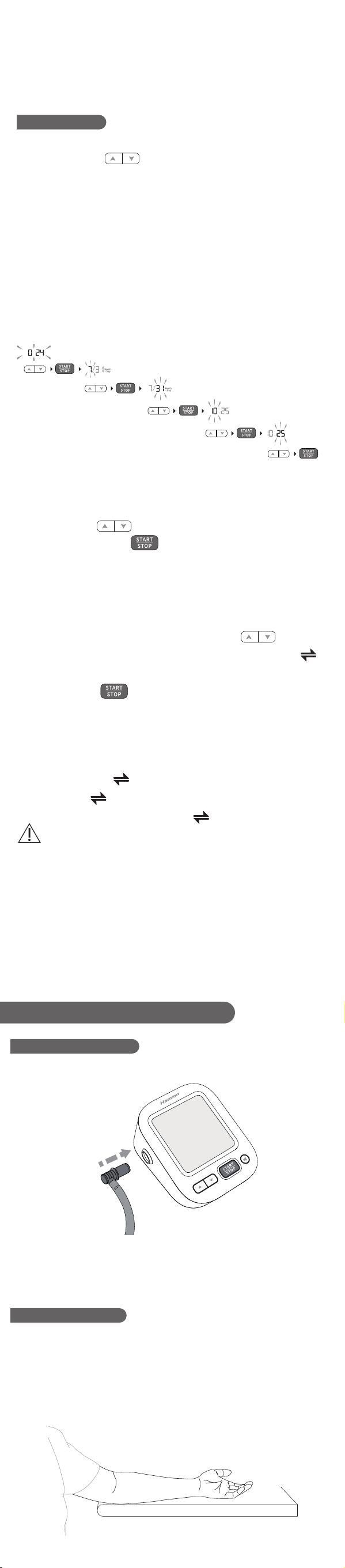
Insert the cuff air tube into the cuff interface on the main unit.
Note: If the cuff air tube is not pr operly connected, it may affect
measurements and cause a device to report an error. Please refer to
Section 4.13 "Common Issues" for adjustments.
3.2 Setup Menu
With the device powered off, press and hold both Forward and
Backward buttons simultaneously for more than 3 seconds
to enter the Setting menu.
In the Setting menu, configurable items include: Date and Time,
Pressure Unit, and Data Transmission Method.
Date and Time Setting:
Automatically synchronize network time and date after connecting
to Bluetooth, users can also manually set the device's time and
date.
Manual setting methods: Year Setting, Month Setting, Day Setting,
Hour Setting, and Minute Setting.
Pressure Unit Setting:
The device's default pressure unit is mmHg. Press the Forward or
Backward button to switch the pressure unit between mmHg
and kPa, and press the button to confirm the pressure unit
setting.
Data Transmissi on Setting:
KSY3100, KSY3120: no data transmission function.
KSY3100B, KSY3120B, KSY3128B, KSY3100A: Bluetooth is enabled by
default. Press the Forward or Backward button to switch
the network switch status. If the data transmission indicator is
displayed, the data transmission function is active; if not displayed,
it is off. Press the button to confirm the "Data Transmission"
setting.
When data transmission is turned off, blood pressure records will not
be uploaded.
When the device is powered on and communication is not connect-
ed, the screen icon is not displayed; when communication is
connected, the icon is continuously lit; when communication is
connected and data is being sent, the icon flashes.
Caution:
This product is a wireless device for low-power data communication
systems.
Do not use this product in locations where wireless devices are
restricted, such as airplanes or hospitals, and turn off the Bluetooth
communication function.
As wireless signals are used, they may be intentionally or uninten-
tionally received by third parties. Do not use for important matters
requiring confidentiality or for life-critical purposes.
4. Measuring Blood Pressure
4.1 Connecting the Cuff
1.Select the appropriate cuff.
2.The cuff is made of polyester and does not contain natural
latex.Place your arm flat on the tabletop with your palm facing up,
sit upright, and ensure that the center of the cuff is at the same
height as your heart.
4.2 Wearing the Cuff
Place your arm flat on the tabletop.
“Year”Flash
“Year”
Change
“Year”
Check
“Month”
Change
“Month”
Check
“Month”Flash
“Day”Flash
“Hour”Flash
“Minute”Flash
“Day”
Change
“Day”
Check
“Hour”
Change
“Hour”
Check
“Minute”
Change
“Minute”
Check
modify, forcefully bend, stretch, bundle, or pinch it, and do not
place heavy objects on it.
● Do not use damaged AC adapters or power plugs. Do not plug or
unplug the AC adapter with wet hands.
● When not in use for an extended period, please unplug the AC
adapter.
Incorrect measurement posture will result in inaccurate measure-
ment results. Please adhere to the following guidelines for measure-
ment posture and environment.
Correct measurement postures:
Sit in a comfortable position;
Please measure your blood pressure in a room with a comfortable
temperature, keeping your body relaxed and your sitting posture
natural;
Place both feet flat on the ground without crossing your legs;
Keep your back and arms supported;
Ensure that the middle of the cuff is at the level of the right atrium of
the heart;
Caution:
Do not take measurements immediately after eating, drinking
alcohol, smoking, exercising, or showering; wait at least 30 minutes
before starting the measurement;
Please empty your bladder before taking the measurement;
Please measure the blood pressure indoors at an appropriate
temperature;
Before the first measurement, sit quietly for 5 minutes and try to
relax as much as possible;
Do not move or speak during the measurement; keep your body
relaxed and your sitting posture natural. For consecutive measure-
ments, allow an interval of at least 2 minutes;
During normal use, the operator may be the patient themselves or
another individual. If the operator is the patient, they must follow
the above posture requirements; no special requirements apply to
other operators;
Ensure that the cuff connection tube is not compressed or restricted;
Rated range of cuff pressure: 0 - 299 mmHg (0 - 39.9 kPa).
Caution
(1) The cuff of this product contains sound wave sensors to collect
Korotkoff Sound signals. To ensure that the product can obtain
better Korotkoff Sound signals, it is advisable to leave a gap of one
finger's width between the lower edge of the cuff and the skin after
attachment. Excessive looseness or tightness may affect the accura-
cy of the measurement.
(2) The cuff is a consumable component. Based on an estimated
usage frequency of 6 times per day, it is recommended to replace
the cuff every two years.
(3) If the cuff is damaged, develops air leaks, or exhibits other
malfunctions, contact the after-sales service to purchase a replace-
ment.
(4) The cuff is designed to measure arm circumferences ranging from
22 to 42 cm (8.66 - 16.54 inch) (measured at the midpoint of the
upper arm). If the arm circumference falls outside this applicable
range, measurement accuracy cannot be guaranteed.
4.3 Correct Measurement Posture
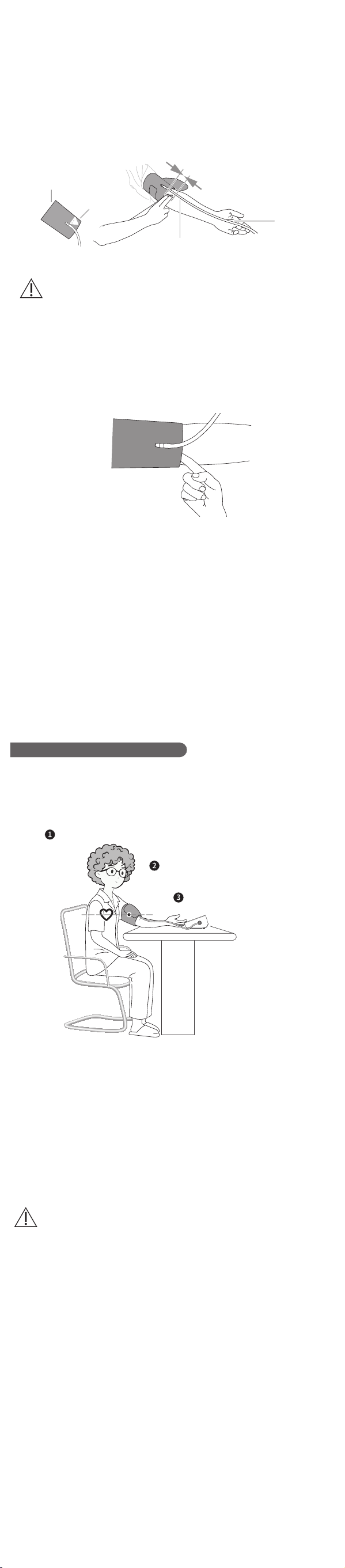
Following the wearing instructions on the cuff, place the cuff on the
upper arm to be measured, ensuring that the air tube is on the
inside of the upper arm and the tubing is aligned with your middle
finger. Make sure that the lower edge of the cuff is approximately 2
cm (0.79 inch) (about two fingers' width) above the elbow joint.
Tighten the free end of the cuff and secure the adhesive strip.
Palm Facing Up
Ensure the cuff's air tube is positioned
at the center of the arm
Ensure the lower edge of the cuff is
approximately 2 cm (about the width of two
fingers) away from the inner side of the
elbow joint
This Side Faces the
Shoulder
This Side Faces the
Hand
Shoulder
It is advisable to leave a space of about
one finger between the cuff and the arm.
Keep your back straight.
keep the center of the cuff at the
same level as your heart.
Relax with the palm facing upward.
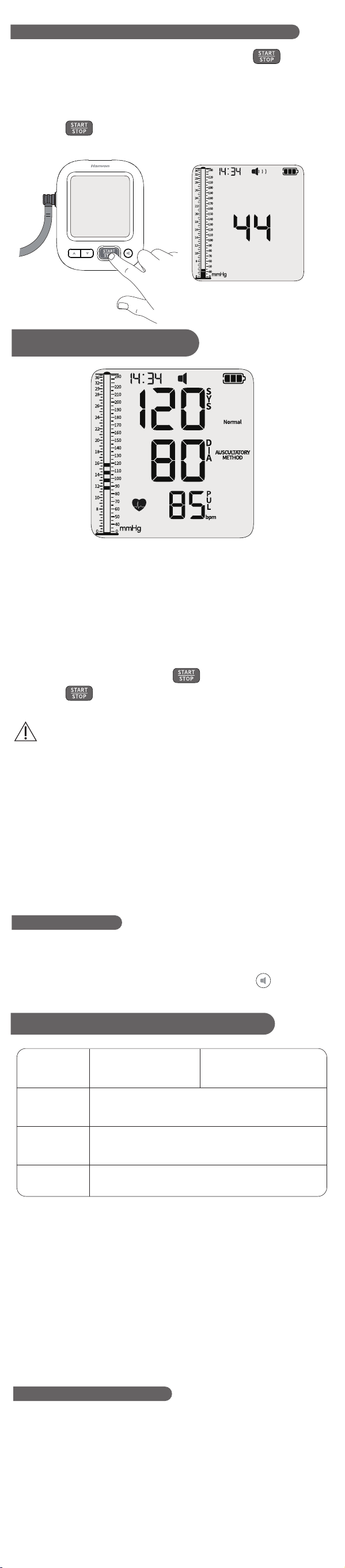
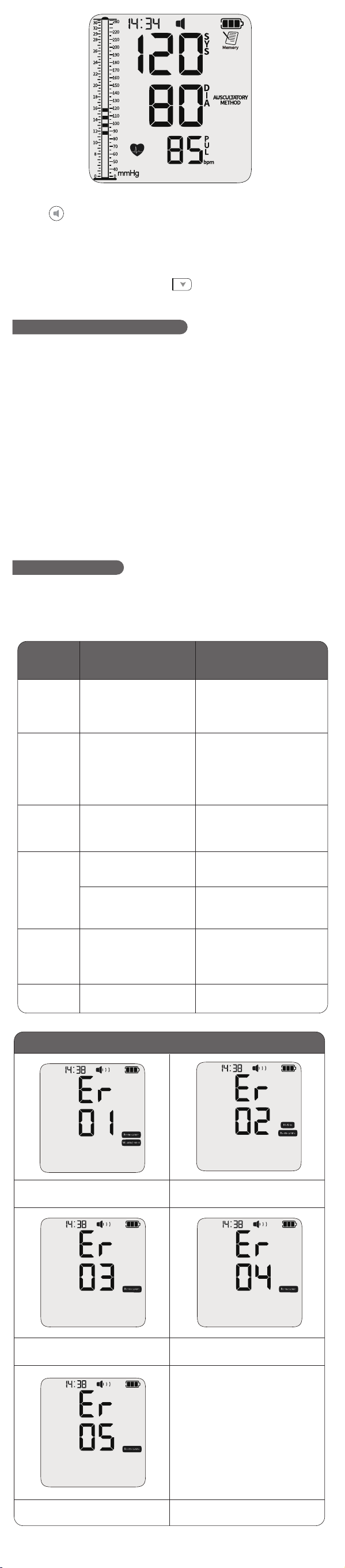
On the measurement results interface, the electronic mercury
column indicator can display pulse pressure, with one grid
representing 10mmHg. When the pulse pressure's single digit is
greater than or equal to 5mmHg and less than or equal to 9mmHg,
an additional single grid will be displayed at the bottom of the
mercury column; when the pulse pressure is greater than 60mmHg,
the mercury column will flash.
Remove the cuff and press the button to power off the
device. If is not pressed, the device will automatically shut
down after approximately 120 seconds.
Voice broadcast is available for measurement preparation,
measurement results, and blood pressure classification. In the
power-off state or during measurement, press the button to
turn off voice broadcast or adjust the voice broadcast volume.
When atrial fibrillation occurs during measurement, an "AFib"
indicator will be displayed in the measurement results; when an
AFib prompt appears, it needs to be confirmed after examination
and diagnosis by a physician. (Only KSY3128B, KSY3100A support
this function)
The blood pressure values obtained from measurements shall be
interpreted by a medical professional.
When the predicted systolic pressure exceeds 210mmHg (28.0kPa),
use the manual inflation function. Please refer to 4.10 Manual
Inflation.
Rated range for systolic pressure: 40mmHg (5.3kPa) - 280mmHg
(37.4kPa)
Rated range for diastolic pressure: 20mmHg (2.7kPa) - 220mmHg
(29.4kPa)
4.6 Voice Broadcast
4.8 Atrial Fibrillation Prompt
4.7 Blood Pressure Classification and Hypertension
4.4 Accurately Measuring Blood Pressure with One Click
Once the cuff is properly fastened, simply press the button to
start the blood pressure measurement. For effective blood pressure
management, it is recommended to take measurements at the same
time and in the same environment each day.
Press the button to start automatic accurate measurement,
and the display shows the real-time cuff inflation pressure value.
Caution:
Palm Facing Up
4.5 High-Definition Large Screen
Display of Measurement Results
*Individuals with Systolic BP and Diastolic BP in 2 categories
should be designated to the higher BP category.
BP indicates blood pressure (based on an average of ≥ 2
careful readings obtained on ≥ 2 occasions).
Source: ACC/AHA 2017 High Blood Pressure Clinical Practice
Guideline.
Note: Currently, there is no clear definition for hypotension. It
is generally considered that hypotension is categorized as a
systolic blood pressure < 90 mmHg or a diastolic blood
pressure < 60 mmHg.
BP Category
Normal
Elevated
120-129 mmHg and <80 mmHg
Hypertension
Stage 1
Stage 2
130-139 mmHg or 80-89 mmHg
≥ 140 mmHg or ≥ 90 mmHg
<120 mmHg and <80 mmHg
Systolic BP
Diastolic BP
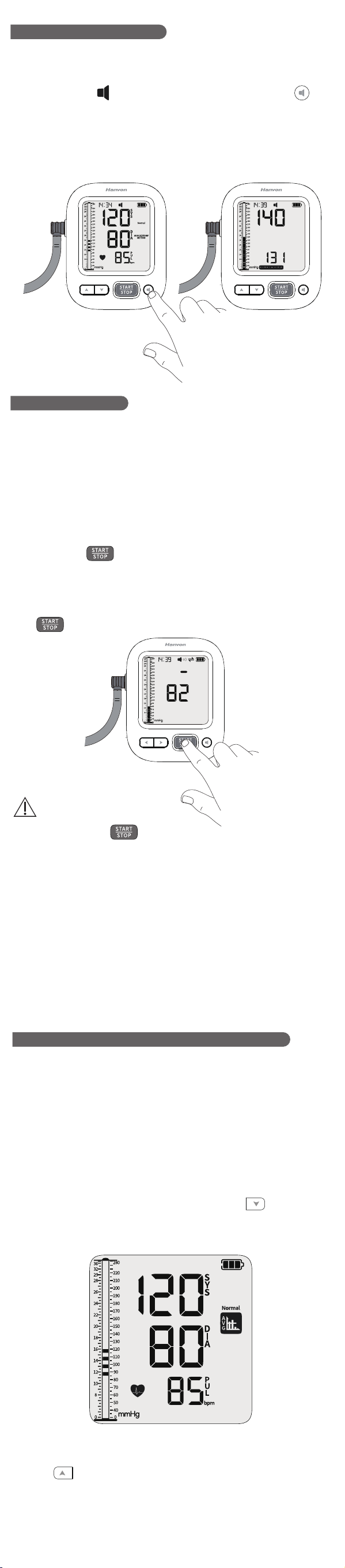
On the measurement results and measurement records interface,
data groups that can perform Korotkoff sound playback will display
an volume icon ; short-press the Voice Control button to
play back the recorded pulsatile wave vibrations of blood flow in the
brachial artery during this measurement, under the action of the
cuff, to listen to Korotkoff sounds and confirm whether the blood
pressure value is accurate.
This device defaults to automatic inflation mode.If your systolic
pressure is more than 210 mmHg or the screen displays Er02:
After the arm cuff starts to inflate, press and hold the [START/STOP]
button until the monitor inflates 20 to 30 mmHg higher than your
expected systolic pressure. Do not inflate above 299 mmHg.
Manual Inflation Operation:
During device inflation, when the screen displays the pressure value,
long-press the button, the device will automatically recognize
and initiate manual inflation; continue to hold the button until the
pressure value displayed is higher than the estimated maximum
blood pressure (20mmHg - 30mmHg (2.6kPa - 4.0kPa)), then release
the button, and the device will begin deflation and start the
measurement.
4.9 Korotkoff Sound Playback
4.10 Manual Inflation
Press and hold the button for 3 seconds or longer, and the
device will enter manual inflation mode; otherwise, the device will
power off.
If cuff pressure exceeds 299 mmHg/39.9 kPa, the device automatical-
ly deflates and displays 'Er03'.
WARNING: Do not keep the arm under systolic pressure for extended
periods, otherwise, it may cause acute internal bleeding. Once
manual inflation is enabled, continuously monitor the condition of
the arm being measured. (Measurement ranges: automatic mode
effective up to 210 mmHg systolic; manual mode up to 280 mmHg
systolic.)
Caution:
This blood pressure monitor automatically saves the date, time,
blood pressure value, and pulse rate during measurement. If the
date and time are not set, it will not be able to accurately memorize
the measurement date and time.
KSY3100, KSY3100B, KSY3120, KSY3120B, KSY3128B can save 100
sets of blood pressure measurements.
KSY3100A can save 200 sets of blood pressure measurements.
Viewing Average Value: From the power-off state/measurement
results interface, short-press the Backward button to display the
average value of the last 2 measurement data, and simultaneously
the average value icon illuminates.
Viewing Measurement Records: From the power-off state/mea-
surement results/average value interface, short-press the Forward
button to view the most recent measurement. Short-press the
Forward or Backward button to browse measurement records or
back to the average value interface.
4.11 Viewing Measurement Records and Average Value
Deleting Record Values:
In the record interface, long-press the
button for more than 3 seconds to delete all currently memorized
measurement data. This function can only delete all current data,
rather than specific data.
Viewing Software Version Number: From the power-off state,
long-press the Backward button for more than 20 seconds to
display the software version number.
When any of the following abnormal prompts appear on the
measurement results interface: ["AFib" (KSY3128B, KSY3100A), "Cuff
malfunction", "Motion/Re-measure", "Tachycardia", "IHB", "High",
"Wearing error"], the corresponding prompt text will flash on the
measurement results interface.
When the "Tachycardia" prompt appears, the pulse value on the
measurement result screen will also flash synchronously.
When systolic pressure (SYS) ≥130mmHg and/or diastolic pressure
(DIA) ≥80mmHg, in addition to the "High" prompt flashing on the
measurement result screen, the corresponding elevated blood
pressure values will also flash synchronously on the measurement
result screen.
When a system error occurs or affects measurement results, an error
report or prompt message will be given. Please check the error and
adjust promptly.
Cuff is worn too loosely;
Cuff connector is loose;
Cuff is leaking air;
Please wrap the cuff correctly;
Please check if the cuff connector is
securely plugged in;
If the above methods are ineffective,
please contact after-sales service;
During measurement, please remain
quiet and ensure that the arm and
body are still.
If there is no accidental movement,
and the same error recurs, please
use manual inflation for another
measurement.
When using the manual inflation
function, the maximum cuff pressure
shall not be too close to 299mmHg
(39.9kPa).
Please remain still with your arm and
body before measuring again.
Unable to detect pulse due to
movement of the arm or body
during measurement.
Before applying the cuff, overly
thick clothing was not
removed, or rolled-up sleeves
compressed the arm.
Measurement results exceed the
nominal measurement range.
Errors not listed in this table
occurred
Please contact customer service
Rated range for diastolic pressure:
20mmHg - 220mmHg (2.7kPa -
29.4kPa); Rated range for systolic
pressure: 40mmHg - 280mmHg
(5.3kPa - 37.4kPa).
Please remove overly thick clothing,
do not roll up your sleeves, and
re-apply the cuff for measurement.
During measurement, arm or
body movement causes
improper inflation or prevents
measurement
Pressure exceeds 299mmHg
(39.9kPa) during measurement.
4.12 Abnormal Situation Prompts
4.13 Common Issues
Error
Message
Cause of Error
Solution
Er01
Er02
Er03
Er04
Er05
Other errors
Error Message Examples
Er01 Er02
Er03 Er04
Er05

Deleting Record Values: In the record interface, long-press the
button for more than 3 seconds to delete all currently memorized
measurement data. This function can only delete all current data,
rather than specific data.
The Blood Pressure Monitor utilizes an intelligent inflation algorithm
and inflate the cuff using an air pump, then applies pressure to the
arterial blood vessel with the inflated cuff. As the cuff pressure rises,
the arterial vessel undergoes a process of fully open, semi-occluded,
and fully occluded states. After determining the complete occlusion
of the arterial vessel through pulse pressure fluctuations, cuff
inflation stops, and the cuff pressure slowly decreases. When the cuff
pressure drops to the systolic pressure, Korotkoff sounds are
generated. When the cuff pressure drops to the diastolic pressure,
Korotkoff sounds disappear. The Blood Pressure Monitor collects
Korotkoff sound signals via an acoustic sensor in the cuff and
measures air pressure values via a pressure sensor, applying a fixed
algorithm based on neural network, to intelligently determine the
user's blood pressure value. This blood pressure measurement
method is called the electronic Korotkoff method, also known as the
electronic auscultatory method. This new generation of Blood
Pressure Monitors, employing revolutionary measurement technol-
ogy, can accurately measure human blood pressure, elevating the
precision of blood pressure measurement to a new height and
setting a new benchmark for accurate blood pressure measurement.
This electronic Korotkoff blood pressure measurement method can
substitute the traditional measurement method of mercury sphyg-
momanometer.
5. Operating Principle
Electromagnetic Compatibility (This product complies with EMC
standards)
It will not emit electromagnetic interference noise beyond the
permissible limits to other nearby electronic devices, and the device
can function normally in an electromagnetic environment where
other electronic devices emit noise or similar interference.
1. This section provides specific guidance on electromagnetic
compatibility. The Electronic Blood Pressure Monitor shall be
installed and used in accordance with the electromagnetic compati-
bility information in this section.
2. Portable and mobile RF communication equipment may affect the
use of the Electronic Blood Pressure Monitor. During normal use of
the Monitor, it is recommended to keep it away from portable and
mobile RF communication equipment or ensure they are turned off.
3. Warning: Using accessories from other manufacturers, other than
those provided by our company, may lead to increased emissions
from the Electronic Blood Pressure Monitor or reduced immunity to
interference.
4. The Electronic Blood Pressure Monitor shall not be used in close
proximity to or stacked with other equipment that operates at the
same or similar frequencies. If proximity or stacking is necessary,
observation and verification shall ensure that it operates normally in
the configured setup.
5. The basic performance is as follows: Laboratory repeatability of
blood pressure measurement for the Blood Pressure Monitor is ≤
3mmHg (0.4kPa); within the temperature range of 5℃ - 40℃ and
relative humidity range of 15% - 90% (non-condensing), the
maximum error of cuff pressure measurement at any point within
the nominal measurement range shall be ≤±2mmHg
(±0.27kPa) or ±2% of the reading, whichever is greater.
6. When the Korotkoff Sound Blood Pressure Monitor is in normal
use, it may generate electromagnetic interference to other diagnos-
tic or therapeutic equipment. When in use, please maintain an
appropriate distance from other equipment and carefully observe
the correctness of data during the use of that equipment.
6. EMC Technical Data

7. To ensure the normal use of Korotkoff Sound Blood Pressure
Monitor functions normally and that its emissions are not increased,
and its immunity is not decreased, please use the cuff and related
accessories provided by our company.
Table 1: Electromagnetic Mission
Table 2: Electro magnetic Immunity 1
Immunity test
Electrostatic
discharge (ESD)
IEC 61000-4-2
Electrical fast
transient/burst
IEC 61000-4-4
Surge
IEC 61000-4-5
Voltage dips, short
interruptions and
voltage variations
on power supply
input lines
IEC 61000-4-11
Power frequency
(50/60 Hz)
magnetic field
IEC 61000-4-8
30A/m
30A/m
Contact:
±8 kV
Air:
±2 kV,±4 kV,
±8 kV,±15 kV
±2 kV for power
supply lines
±1 kV for input/out-
put lines
Differential mode:
±0.5 kV, ±1 kV
Common mode:
±0.5 kV, ±1 kV,
±2 kV
0 % UT
(100 % dip in UT)
for 0,5 cycle
0 % UT
(100 % dip in UT)
for 1 cycles
70 % UT
(30 % dip in UT)
for 25/30cycles
0 % UT
(100 % dip in UT)
for 250/300 cycles
0 % UT
(100 % dip in UT)
for 0,5 cycle
0 % UT
(100 % dip in UT)
for 1 cycles
70 % UT
(30 % dip in UT)
for 25/30cycles
0 % UT
(100 % dip in UT)
for 250/300 cycles
Mains power quality
should be that of a
typical commercial or
hospital
environment. If the user
of the Blood Pressure
Monitor requires
continued operation
during power mains
interruptions, it is
recommended that the
Blood Pressure Monitor
be powered from an
uninterruptible power
supply or a battery.
Power Frequency
Magnetic Field
Immunity should be at
levels characteristic of a
typical location in a
typical commercial or
hospital environment.
Differential mode:
±0.5 kV, ±1 kV
Common mode:
±0.5 kV, ±1 kV,
±2 kV
±2 kV for power
supply lines
±1 kV for input/out-
put lines
Mains power quality
should be that of a
typical commercial or
hospital
environment.
Mains power quality
should be that of a typical
commercial or hospital
environment.
Contact:
±8 kV
Air:
±2 kV,±4 kV,
±8 kV,±15 kV
Floors should be wood,
concrete or ceramic tile.
If floors are covered with
synthetic material, the
relative humidity should
be at least 30 %. If ESD
interfere with the
operation of equipment,
counter measurements
such as wrist strap,
grounding shall be
considered.
IEC 60601 test level
Compliance level
Electromagnetic
environment ‒guidance
Guidance and manufacturer´s declaration
‒ electromagnetic immunity
The Blood Pressure Monitor is intended for use in the electromagnetic environment
specified below. The customer or the user of the Blood Pressure Monitor should assure
that it is used in such an environment.
Guidance and manufacturer’s declaration
‒ electromagnetic emissions
The Blood Pressure Monitor is intended for use in the electromagnetic environment
specified below. The customer or the user of Blood Pressure Monitor should assure
that it is used in such an environment.
Emissions test
RF emissions CISPR 11
RF emissions CISPR 11
Compliance
Group 1
Class B
Harmonic emissions
IEC 61000-3-2
Voltage fluctuations/-
Voltage Fluctuations
and Flicker emissions
IEC 61000-3-3
Class A
Pass
The Blood Pressure Monitor uses
RF energy only for its internal
function. Therefore, its RF
emissions are very low and are not
likely to cause any interference in
nearby electronic equipment.
The Blood Pressure Monitor is
suitable for use in all establish-
ments, including domestic
establishments and those directly
connected to the public low-volt-
age power supply network that
supplies buildings used for
domestic purposes.
Electromagnetic
environment - guidance

Radiated RF
IEC 61000-4-3
3 V/m
80 MHz to 2,7 GHz
3V/m
80 MHz to 2,7 GHz
Proximity fields
from RF wireless
communications
equipment
IEC 61000-4-3
Table 9 of IEC
60601-1-2:2020
Table 9 of IEC
60601-1-2:2020
Proximity magnetic
fields
IEC 61000-4-39
Table 11 of IEC
60601-1-2:2020
Table 11 of IEC
60601-1-2:2020
d = 1.2 80 MHz to
800 MHz
d = 2.3 800 MHz to
2,7 GHz
where P is the
maximum output
power rating of the
transmitter in watts (W)
according to the
transmitter manufac-
turer and d is the
recommended
separation distance in
metres (m).
Field strengths from
fixed RF transmitters,
as determined by an
electromagnetic site
survey, should be less
than the compliance
level in each frequency
range.
Interference may occur
in the vicinity of
equipment marked
with the following
symbol:
Table 3: Electromagnetic Immunity 2
Immunity test
IEC 60601 test level
Compliance level
Electromagnetic
environment ‒guidance
Guidance and manufacturer’s declaration
‒ electromagnetic immunity
The Blood Pressure Monitor is intended for use in the environment specified below.
The customer or the user of the Blood Pressure Monitor should assure that it is used in
such an environment.
Conducted RF
IEC 61000-4-6
3 Vrms
150 kHz to 80 MHz
(6V in ISM bands
between 0.15MHz
and 80 MHz)
3 Vrms
150 kHz to 80 MHz
(6V in ISM bands
between 0.15MHz
and 80 MHz)
Portable and mobile
RF communications
equipment should be
used no closer to any
part of the Blood
Pressure Monitor,
including cables, than
the recommended
separation distance
calculated from the
equation applicable to
the frequency of the
transmitter.
Recommended
separation distance
d = 1.2
FCC Caution
This device complies with part 15 of the FCC Rules. Operation is
subject to the following two conditions: (1) This device may not
cause harmful interference, and (2) this device must accept any
interference received, including interference that may cause
undesired operation.
Any Changes or modifications not expressly approved by the party
responsible for compliance could void the user's authority to
operate the equipment.
Note: This equipment has been tested and found to comply with the
limits for a Class B digital device, pursuant to part 15 of the FCC
Rules. These limits are designed to provide reasonable protection
against harmful interference in a residential installation.
This equipment generates uses and can radiate radio frequency
energy and, if not installed and used in accordance with the instruc-
tions, may cause harmful interference to radio communications.
However, there is no guarantee that interference will not occur in a
particular installation. If this equipment does cause harmful interfer-
ence to radio or television reception, which can be determined by
turning the equipment off and on, the user is encouraged to try to
correct the interference by one or more of the following measures:
-Reorient or relocate the receiving antenna.
-Increase the separation between the equipment and receiver.
-Connect the equipment into an outlet on a circuit different from
that to which the receiver is connected.
-Consult the dealer or an experienced radio/TV technician for help.
The device has been evaluated to meet general RF exposure require-
ment. The device can be used in portable exposure condition
without restriction.
8.1 Cleaning and Maintenance
The Blood Pressure Monitor is a non-sterile medical device and must
be routinely cleaned by the operator before use.
Please keep the Blood Pressure Monitor clean. If the outer surface of
the main unit or cuff is contaminated, use a clean, soft cloth damp-
ened with approximately 75% medical-grade ethanol, wring it out
thoroughly, then gently wipe the surface twice. Allow it to air-dry for
8. Cleaning, Maintenance and Warranty
Model
KSY3100 None
None
100 None
None
None
None
Yes
Yes
Bluetooth
100
100
KSY3100B
KSY3120
Bluetooth
100
KSY3120B
Bluetooth
100
KSY3128B
Bluetooth
200
KSY3100A
Communication
Mode
Data Storage AFib Detection Appearance
Operating
Environment
Main Unit Weight
Main Unit
Dimensions
Cuff Size
Compatibility
Electric Shock
Protection
Transport and Storage
Conditions
Temperature: 5℃ - 40℃; Relative humidity: 15% - 90%,
non-condensing; Atmospheric pressure: 700 hPa - 1060 hPa
Temperature: -20℃ - 55℃; Relative humidity: ≤93%,
non-condensing; Atmospheric pressure: 500 hPa - 1060 hPa
Approximately 303g (KSY3100, KSY3100B, KSY3100A)
Approximately 316g (KSY3120, KSY3120B, KSY3128B)
Approximately 126mm (L) X 97mm (W) X 69mm (H)
Suitable for arm circumference: 22cm - 42cm, 22-36cm
(optional)
Class II device (internal power source when not using an
adapter); BF type applied part
Electromagnetic
Compatibility
IP Classification
Embedded Software
Release Version
Group 1, Class B Equipment
IP20
1
Service Life
Main Unit: 5 years from the date of manufacture (based on 6
uses per day). Cuff: 10,000 uses (recommended replacement
every 2 years as a consumable).Optional AC adapter: 5 years
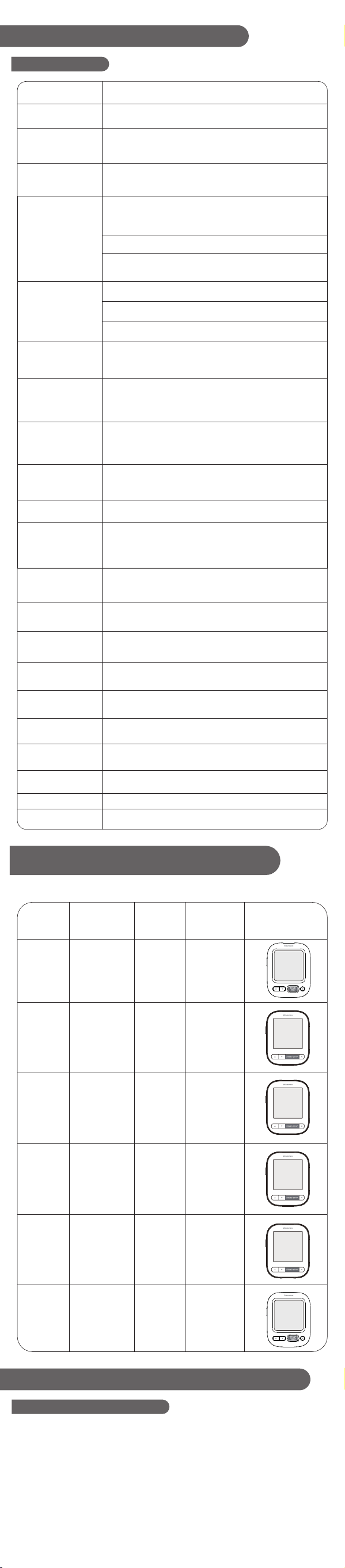
7.2 The differences among all models in this manual
are as follows
Blood Pressure
Measurement
Pulse
Measurement
Measurement range: 40 ~ 240 beats/min
Accuracy limit under environmental conditions: ±2
mmHg(±0.27 kPa)or ±2% of the reading, whichever is greater
Resolution: 1 mmHg (0.1 kPa)
Measurement and display range:
SYS: 40 mmHg (5.3 kPa) ~ 280 mmHg (37.4 kPa)
DIA: 2 0 mmHg (2.7 kPa) ~ 220 mmHg (29.4 kPa)
Resolution: 1 beat/min
Measurement accuracy: ±5%
Cuff pressure
display range
0 - 299 mmHg
Memory
Data
Transmission
Operating Mode
Power Source
Battery life
Approx. 300 measurements (using Lithium battery)
approximately 300 charge-discharge cycles.
(The actual number of cycles may vary depending on the
charge-discharge environment.)
Internal battery(1400mAh 3.7V)or optional AC adapter(IN-
PUT AC 100 - 240 V 50 - 60 Hz 0.3 A)
Continuous operation
Bluetooth/ No Transmission, see section 7.2 for specific
parameters.
Stores up to 100/200 readings, see section 7.2 for specific
parameters.
7.1 Specifications
7. Specifications and Warranty
Name
Model
Power Supply
Mode
LCD screen display
Lithium Battery (DC 3.7V)
KSY3100/KSY3100B/KSY3120/KSY3120B/KSY3128B/KSY3100A
Korotkoff Sound Blood Pressure Monitor
Display Mode

8.3 Calibration
8.2 Warranty
1. From the date of purchase, the main unit enjoys a three-year
warranty with a proof of purchase, excluding consumables.
2. From the date of purchase, the cuff enjoys a three-month free
warranty with a proof of purchase.
3. For malfunctions and damage caused by non-product quality
issues or user's personal reasons, free warranty service will not be
provided.
For example:
Damage caused by unauthorized disassembly, assembly, or modifi-
cation of the product;
Malfunctions caused by accidental drops during use or handling;
Malfunctions caused by lack of reasonable maintenance;
Damage to the device caused by not operating it correctly according
to the instruction manual;
Malfunctions caused by repairs performed by unauthorized repair
shops, etc.
4.Repair services outside the warranty scope will be subject to
charges in accordance with relevant regulations.
5. Before requesting repair service, please call the customer service
hotline for consultation.
6. When performing warranty service, if necessary, product circuit
diagrams and information on repairable components can be provid-
ed to qualified technicians recognized by us.
7. Damaged product components shall be repaired by trained
maintenance personnel.
● The Blood Pressure Monitor has been carefully tested at the
factory;
● It is generally recommended to having the unit inspected once a
year by the manufacturer, or manufacturer-authorized repair
centers;
● This unit has a pressure detection mode. Please consult our
customer service.
Beijing Hanvon Health Technology Co., Ltd.
Room 162, 1st Floor and Room 256, 2nd Floor, Hanwang Building,
Building 5, No.8 Dongbeiwangxi Road, Haidian District, Beijing
100193, China
TEL: +86400-810-8816
FAX: /
Website: https://www.hwbpm.com
E-mail: [email protected]om.cn
Warranty Card
Dealer's Stamp
Product Model:
Purchase Date:
Dealer Name:
Address:
Name:
Address:
Postal Code:
Contact Number:
YF-KSY31-EN-FDA-02-14
A/0
2024-8-26
3 minutes. It is recommended to clean the device once a month.
Caution: Do not allow any liquid to penetrate the main unit or cuff, as
this may cause damage.
If the device is used by multiple patients, ensure that it is cleaned
and disinfected before each subsequent use.
Caution:
● When a user is using, the device cannot be maintained or
serviced;
● Do not use high-pressure sterilization equipment or gas steriliza-
tion equipment; otherwise, the device may be damaged;
● Do not expose the device and accessories to high temperatures,
high humidity, excessive dust, or direct sunlight;
● This device is not waterproof. Do not let liquid penetrate the main
unit or cuff;
● Do not wipe with volatile oils, thinners, gasoline, etc.;
● Do not disassemble or repair this unit without authorization;
● Do not replace internal parts without authorization;
● If the device is not used for an extended period (more than 6
months), please charge the battery, otherwise it may cause over-dis-
charge of the battery, damaging the device.