
1
JUMP-STARTER WITH AIR COMPRESSOR
INSTRUCTION MANUAL
ARRANCADOR DE MOTOR CON
COMPRESOR DE AIRE
SAVE THIS INSTRUCTION MANUAL FOR FUTURE REFERENCE.
CONSERVE ESTE MANUAL PARA FUTURAS CONSULTAS.
© 2023 Baccus Global LLC
Boca Raton, FL 33487
1-877-571-2391
J15CF
BC
English page 5
Español pagina 11
2
FEATURES / CARACTERÍSTICAS
3
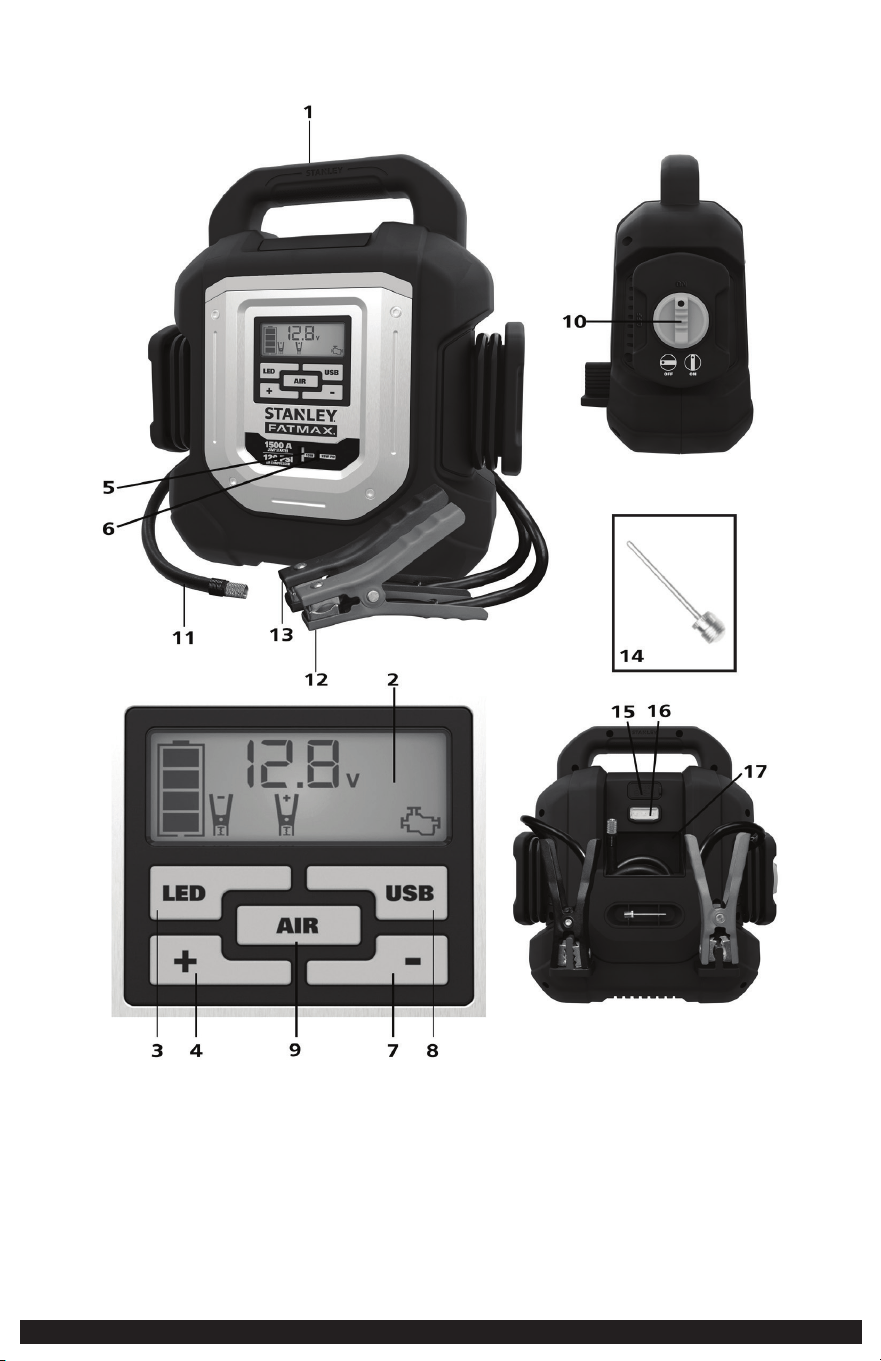
FEATURES
1. Handle
2. Backlit LCD Screen
3. Area Light Power Button
4. Compressor Pressure Control Button (+)
5. USB-A Port
6. USB-C Port
7. Compressor Pressure Control Button (–)
8. USB Power Button
9. Compressor Power Button
10. Jump Starter Power Switch
11. Air hose and Sure Fit® Nozzle
12. Positive (+) Red Clamp
13. Negative (–) Black Clamp
14. Nozzle Adapter
15. Charging Port (under protective cover)
16. LED Area Light
17. Air Hose Storage Compartment
CARACTERÍSTICAS
1. Mango
2. Pantalla LCD Retroiluminada
3. Botón de Encendido de Luz del Área LED
4. Botón de Control de Presión del Compresor (+)
5. Puerto USB-A
6. Puerto USB-C
7. Botón de Control de Presión del Compresor (–)
8. Botón de Encendido USB
9. Botón de Encendido del Compresor
10. Interruptor de Encendido del Arrancador Auxiliar
11. Manguera de aire y Boquilla Sure Fit®
12. Abrazadera Roja Positiva (+)
13. Abrazadera Negra Negativa (–)
14. Adaptador de Boquilla
15. Puerto de Carga (debajo de la cubierta protectora)
16. Luz del Área LED
17. Compartimento de Almacenamiento de la Manguera de Aire
This device complies with part 15 of the FCC rules. Operation is subject to the following two conditions: (1) this device may not cause harmful interference, and (2) this device must accept any interference received, including
interference that may cause undesired operation.
This equipment has been tested and found to comply with the limits for a Class B digital device, pursuant to part 15 of the FCC Rules. These limits are designed to provide reasonable protection against harmful interference
in a residential installation. This equipment generates, uses and can radiate radio frequency energy and, if not installed and used in accordance with the instructions, may cause harmful interference to radio communications.
However, there is no guarantee that interference will not occur in a particular installation. If equipment does cause harmful interference to radio or television reception, which can be determined by turning the equipment off
and on, the user is encouraged to try to correct the interference by one or more of the following measures:
• Reorient or relocate the receiving antenna.
• Increase the separation between equipment and receiver.
• Connect the equipment into an outlet on a circuit different from that to which the receiver is connected.
• Consult the dealer or an experienced radio/TV technician for help.
Changes or modifications not approved by the party responsible for compliance could void user’s authority to operate the equipment.
Este dispositivo cumple con la parte 15 de las normas de la Comisión Federal de Comunicaciones de Estados Unidos (FCC). La operación está sujeta a las dos condiciones siguientes: (1) este dispositivo no puede causar
interferencia perjudicial y (2) este mecanismo debe aceptar cualquier interferencia recibida, incluida la in-terferencia que puede provocar una operación no deseada.
Este equipo ha sido probado y se encontró que cumple con los límites para dispositivo digital Clase B, según la parte 15 de las normas de la FCC. Estos límites están diseñados para brindar protección razonable contra
interferencia perjudicial en una instalación residencial. Este equipo genera, usa y puede irradiar energía en frecuencia de radio y, si no se instala y se usa de acuerdo con las instrucciones, puede provocar interferencia perjudicial
en las comunicaciones de radio. Sin embargo, no hay garantía de que la interferencia no ocurra en una instalación en particular. Si el equipo provoca interferencia perjudicial en la recepción de radio o televisión, lo que se
puede determinar al apagar y encender el equipo, el usuario debe tratar de corregir la interferencia mediante una o más de las siguientes medidas:
• Cambiar la orientación o la ubicación de la antena de recepción.
• Aumentar la separación entre el equipo y el receptor.
• Conectar el equipo a un tomacorriente sobre un circuito diferente de aquel al que está conectado el receptor.
• Consultar al vendedor o pedir la ayuda de un técnico en radio y televisión con experiencia.
Los cambios o las modificaciones no aprobados por el partido responsable de conformidad podían anular la autoridad del usuario para funcionar el equipo.
4
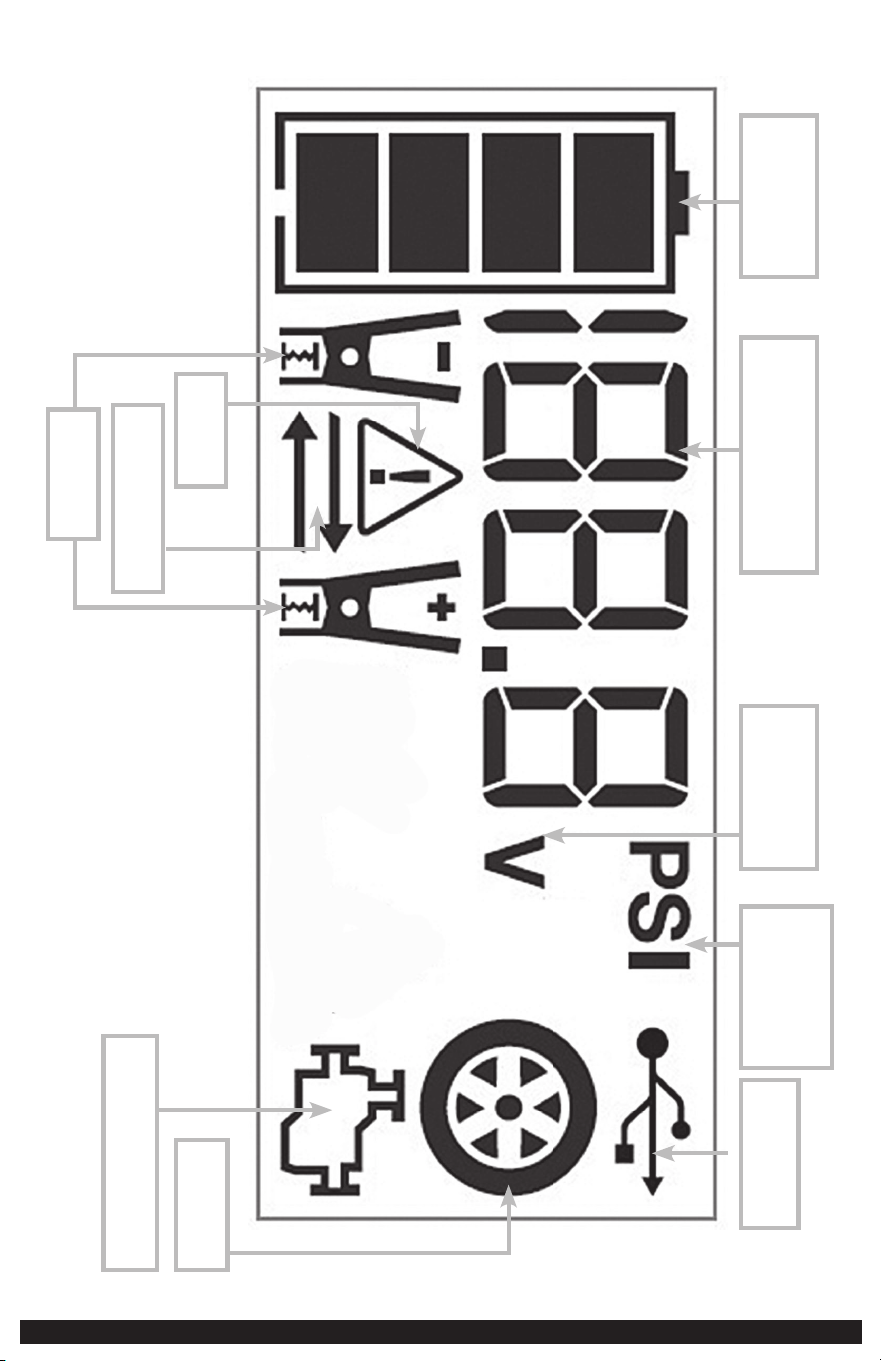
DIGITAL LCD SCREEN / PANTALLA DEL LCD DIGITAL
BATTERY STATUS ICON
ICONO DE ESTADO DE LA
BATERÍA
DIGITAL DISPLAY (VARIES BY FUNCTION)
INDICADOR DIGITAL (VARÍA DEPENDIENDO
DE LA FUNCIÓN)
ALARM ICON
ICONO DE ALARMA
REVERSE POLARITY ICONS
ICONOS DE POLARIDAD INVERSA
CLAMP ICONS
ICONOS DE PINZA
BATTERY VOLTAGE INDICATOR
INDICADOR DEL VOLTAJE DE
LA BATERÍA
COMPRESSOR PRESSURE
INDICATOR
INDICADOR DE PRESIÓN DEL
COMPRESOR
USB ICON
ICONO DE USB
COMPRESSOR ICON
ICONO DEL COMPRESOR
JUMP STARTER ICON
ICONO DEL PUENTE AUXILIAR DE ARRANQUE
5
SAFETY
GUIDELINES /
DEFINITIONS
DANGER: Indicates an imminently hazardous situation which, if not avoided,
will result in death or serious injury.
WARNING: Indicates a potentially hazardous situation which, if not avoided,
may result in death or serious injury.
CAUTION: Indicates a potentially hazardous situation which, if not avoided,
may result in injury.
Used without the word, indicates a safety related message.
NOTICE: Indicates a practice not related to personal injury which, if not avoided,
may result in property damage.
RISK OF UNSAFE OPERATION. When using tools or equipment, basic safety
precautions should always be followed to reduce the risk of personal injury.
Improper operation, maintenance or modification of tools or equipment could
result in serious injury and property damage. There are certain applications for
which tools and equipment are designed. Manufacturer strongly recommends that
this product NOT be modified and/or used for any application other than for which
it was designed. Read and understand all warnings and operating instructions
before using any tool or equipment.
READ ALL
INSTRUCTIONS
WARNING: Read and understand this instruction manual before using this
unit. Failure to follow all instructions listed below may result in electric shock, fire
and/or serious injury.
IMPORTANT
SAFETY
INSTRUCTIONS
GENERAL SAFETY WARNINGS AND INSTRUCTIONS
• This unit was designed for household use only.
WARNING – TO REDUCE THE RISK OF FIRE, ELECTRIC SHOCK, BURST HAZARD,
OR INJURY TO PERSONS OR PROPERTY:
• Avoid dangerous environments. Don’t use appliances in damp or wet locations.
Don’t use appliances in the rain.
• Keep children away. All visitors should be kept at a distance from work area.
• Dress properly. Do not wear loose clothing or jewelry. They can be caught in
moving parts. Rubber gloves and substantial, non-skid footwear are recommended
when working outdoors. Wear protective hair covering to contain long hair.
• Store idle appliance indoors. When not in use, appliances should be stored indoors
in dry, and high or locked-up place – out of reach of children.
• Don’t abuse cord. Never carry appliance by cord or yank it to disconnect from
receptacle. Keep cord from heat, oil, and sharp edges.
• Disconnect appliances. Disconnect the appliance from the power supply when not
in use, and when changing accessories.
• Ground Fault Circuit Interrupter (GFCI) protection should be provided on the
circuits or outlets to be used. Receptacles are available having built in GFCI
protection and may be used for this measure of safety.
• Use of accessories and attachments. The use of any accessory or attachment
not recommended for use with this appliance could be hazardous. Refer to the
accessory section of this manual for further details.
• Stay alert. Use common sense. Do not operate appliance when you are tired or
impaired.
• Check for damaged parts. Do not use if damaged in any way.
• Do not operate this appliance near flammable liquids or in gaseous or explosive
atmospheres. Motors in these tools normally spark, and the sparks might ignite
fumes.
• Never submerge this unit in water; do not expose it to rain, snow or use when
wet.
• To reduce risk of electric shock, disconnect the unit from any power source before
attempting maintenance or cleaning. Turning off controls without disconnecting
will not reduce this risk.
• This equipment employs parts (switches, relays, etc.) that produce arcs or sparks.
Therefore, if used in a garage or enclosed area, the unit MUST be placed not less
than 18 inches above the floor.
SPECIFIC SAFETY INSTRUCTIONS FOR CHARGING
THIS UNIT
• IMPORTANT: This unit is delivered in a partially charged state. Fully charge unit
with a household extension cord until the battery status icon shows 4 solid bars
before using for the first time. You cannot overcharge the unit using the AC
charging method.
• To recharge this unit, use only the supplied AC charger.
• All functions should be turned off when the unit is charging or not in use. Make
sure all functions are turned off before connection to a power source or load.
Extension Cords
WARNING: Use of improper extension cord could result in a risk of fire and
electric shock. When using an extension cord, make sure that the pins of the
extension cord are the same number, size and shape as those in the charger; and
be sure to use one heavy enough to carry the current your product will draw. An
undersized cord will cause a drop in line voltage resulting in loss of power and
overheating. The following table shows the correct size to use depending on cord
length and nameplate ampere rating. If in doubt, use the next heavier gauge. The
smaller the gauge number, the heavier the cord.
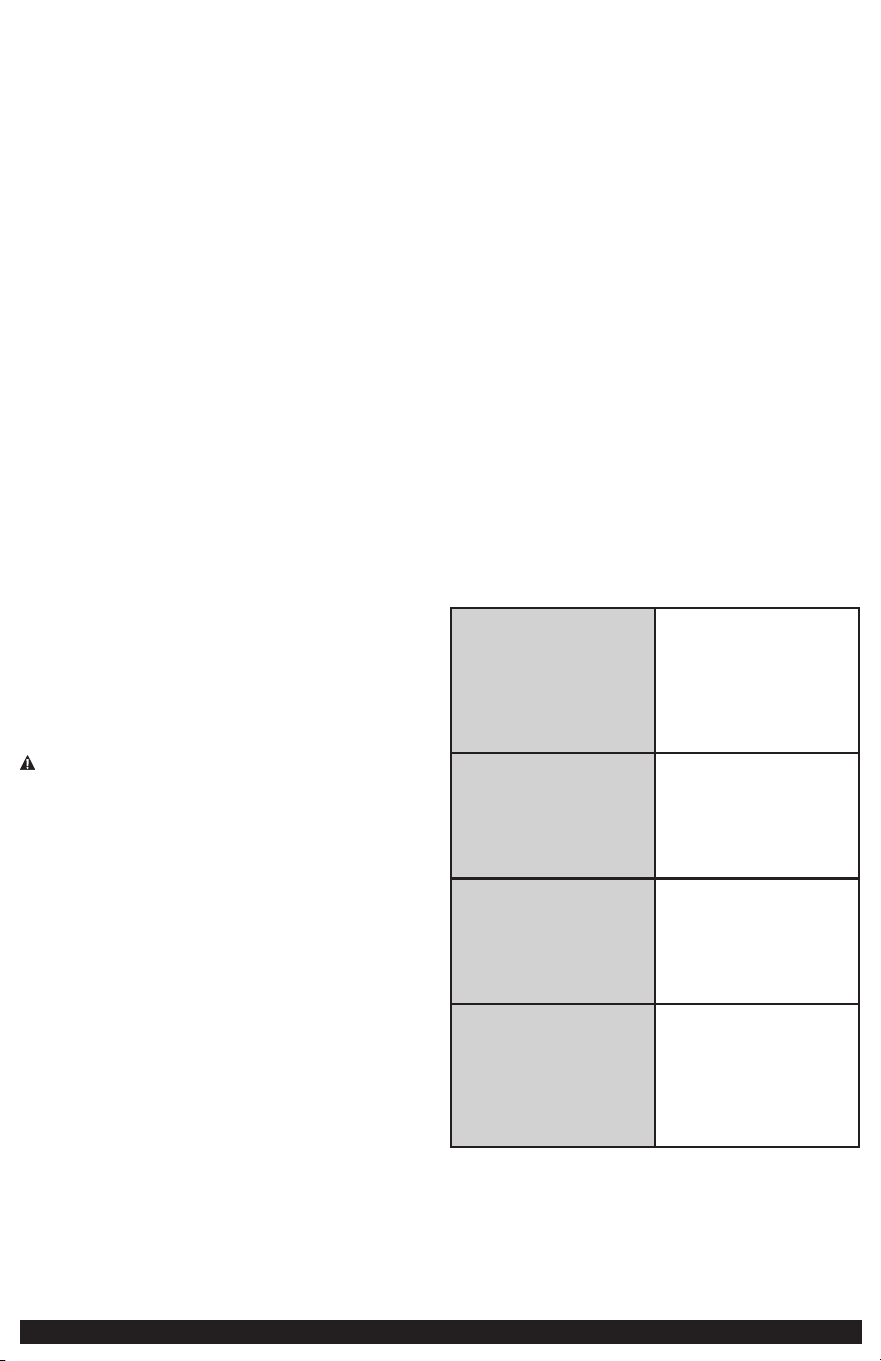
MINIMUM GAUGE FOR CORD SETS
Volts Total Length of Cord in Feet
120V 0-25 26-50 51-100 101-150
(0-7.6m) (7.6-15.2m) (15.2-30.4m) (30.4-45.7m)
240V 0-50 51-100 101-200 201-300
(0-15.2m) (15.2-30.4m) (30.4-60.9m) (60.9-91.4m)
Ampere Rating Extension Cord Length
More Not more
0’-25’ 26’-50’ 51’-100’ 101’-150’
Than Than American Wire Gauge (AWG)
0 - 6 18 16 16 14
6 - 10 18 16 14 12
10 - 12 16 16 14 12
12 - 16 14 12 Not Recommended
When an extension cord is used, make sure that:
a) the pins of extension cord are the same number, size and shape as those in
the charger,
b) the extension cord is properly wired and in good electrical condition,
c) the wire size is large enough for the AC rating of the charger.
CAUTION – TO REDUCE THE RISK OF INJURY OR PROPERTY DAMAGE: Pull
the extension cord by the plug rather than the cord when disconnecting from the
supplied AC Charger or the AC outlet.
SPECIFIC SAFETY INSTRUCTIONS FOR JUMP
STARTERS
WARNING: BURST HAZARD
Do not use the unit for charging dry-cell batteries that are commonly used with
home appliances. These batteries may burst and cause injury to persons and
damage property. Use the unit for charging/boosting a lead-acid battery only. It is
not intended to supply power to a low-voltage electrical system other than in a
starter-motor application.
• Use of an attachment not supplied, recommended or sold by manufacturer
specifically for use with this unit may result in a risk of electrical shock and injury
to persons.
WARNING: RISK OF EXPLOSIVE GASES
• Working in the vicinity of a lead acid battery is dangerous. Batteries generate
explosive gases during normal battery operation. For this reason, it is of the
utmost importance that each time before using the jump-starter you read this
manual and follow instructions exactly.
• To reduce the risk of battery explosion, follow these instructions and those
published by the battery manufacturer and manufacturer of any equipment you
intend to use in the vicinity of the battery. Review cautionary markings on these
products and on the engine.
CAUTION – TO REDUCE THE RISK OF INJURY OR PROPERTY DAMAGE:
6
• NEVER ATTEMPT TO JUMP-START OR CHARGE A FROZEN BATTERY.
• Vehicles that have on-board computerized systems may be damaged if vehicle
battery is jump-started. Before jump-starting, read the vehicle’s owner’s manual to
confirm that external-starting assistance is suitable.
• Never smoke or allow a spark or flame in vicinity of vehicle battery, engine or
power station.
• Be extra careful to avoid dropping a metal tool onto the battery. It might spark or
short-circuit the battery or another electrical part and could cause an explosion.
• Jump-start procedures should only be performed in a safe, dry, well-ventilated
area.
• Always store battery clamps when not in use. Never touch battery clamps together.
This can cause dangerous sparks, power arcing and/or explosion.
• When using this unit close to the vehicle’s battery and engine, stand the unit on a
flat, stable surface, and be sure to keep all clamps, cords, clothing and body parts
away from moving vehicle parts.
• Never allow red and black clamps to touch each other or another common metal
conductor — this could cause damage to the unit and/or create a sparking/
explosion hazard.
• Make sure to connect the clamps with correct polarity. Damage caused by
improper connection is not covered by the Warranty.
• Do not expose battery to fire or intense heat since it may explode. Before
disposing of the battery, protect exposed terminals with heavy-duty electrical tape
to prevent shorting (shorting can result in injury or fire).
• Place this unit as far away from the battery as cables permit.
• Never allow battery acid to come in contact with this unit.
• Do not operate this unit in a closed area or restrict ventilation in any way.
• This system is designed to be used only on vehicles with a 12 volt DC battery
system. Do not connect to a 6 volt or 24 volt battery system.
• This system is not designed to be used as a replacement for a vehicular battery. Do
not attempt to operate a vehicle that does not have a battery installed.
• Excessive engine cranking can damage a vehicle’s starter motor. If the engine
fails to start after the recommended number of attempts, discontinue jump-start
procedures and look for other problems that may need to be corrected.
• Do not use this jump starter on a watercraft. It is not qualified for marine
applications.
• Although this unit contains a non-spillable battery, it is recommended that unit be
kept upright during storage, use and recharging. To avoid possible damage that
may shorten the unit’s working life, protect it from direct sunlight, direct heat and/
or moisture.
SPECIFIC SAFETY INSTRUCTIONS FOR
COMPRESSORS
WARNING – BURST HAZARD: Bursting articles can cause serious injury.
• Carefully follow instructions on articles to be inflated.
• Never exceed the recommended pressure listed in instructions on articles to be
inflated. If no pressure is given, contact article manufacturer before inflating.
• Always monitor the pressure on the LCD Screen.
NOTICE – TO REDUCE THE RISK OF PROPERTY DAMAGE:
• Never leave the compressor unattended while in use.
• Do not operate compressor continuously for longer than approximately 10
minutes. This could damage the compressor. Follow the instructions in the
“Portable Compressor” section.
SPECIFIC SAFETY INSTRUCTIONS FOR THE USB
POWER PORTS
• Do not insert foreign objects into the USB Power Ports.
• Do not attach USB hubs or more than one personal electronic device to each USB
Power Port.
• Do not use this unit to operate appliances that require more than 15W when
using the USB-A port only; 25W when using the USB-C port only; up to 5V/15W
output on both the USB-A and USB-C when they are used simultaneously.
PERSONAL SAFETY
• When working with lead acid batteries, always make sure immediate assistance is
available in case of accident or emergency.
• Stay clear of fan blades, belts, pulleys, and other parts that can cause injury to
persons.
• Do not wear vinyl clothing when jump-starting a vehicle. Friction can cause
dangerous static-electrical sparks.
• Remove personal metal items such as rings, bracelets, necklaces and watches when
working with a lead acid battery. A lead acid battery can produce a short circuit
current high enough to weld a ring, or similar metal object, to skin, causing a
severe burn.
• Always have protective eyewear when using this product: contact with battery acid
may cause blindness and/or severe burns. Be aware of first aid procedures in case
of accidental contact with battery acid.
• Have plenty of fresh water and soap nearby in case battery acid contacts skin.
Skin: If battery acid contacts skin or clothing, wash immediately with soap and
water for at least 10 minutes. If redness, pain, or irritation occurs, seek immediate
medical attention.
Eyes: If battery acid comes in contact with eyes, flush eyes immediately, for a
minimum of 15 minutes and seek immediate medical attention.
LCD liquid crystal display: If liquid crystal comes in contact with your skin:
Wash area off completely with plenty of water. Remove contaminated clothing. If
liquid crystal gets into your eye: Flush the affected eye with clean water and then
seek medical attention. If liquid crystal is swallowed: Flush your mouth thoroughly
with water. Drink large quantities of water and induce vomiting. Then seek medical
attention.
SAVE THESE
INSTRUCTIONS
INTRODUCTION
Congratulations on purchasing your new Stanley
®
FatMax
®
Jump-Starter with Air
Compressor. Read this Instruction Manual and follow the instructions carefully
before using this unit.
OVERVIEW
Common Actions and Unit Responses
The following actions turn the unit on and activate the LCD Screen:
Press the LED Area Light Power Button.
(Refer to the “LED Area Light” section.)
The Area Light will turn on. The
backlight will turn on for 10 seconds
(only). The LCD Screen will continue
to display the Battery Status Icon and
Battery Voltage Indicator. The unit
remains on until the LED Area Light
Power Button is pressed again to
turn it off.
Press the USB Power Button. (Refer to
the “USB Ports” section.)
The Backlit LCD Screen will display
the Battery Status Icon and Battery
Voltage Indicator, as well as the USB
Icon, indicating the USB Ports are
available. The unit remains on until the
USB Power Button is pressed again to
turn it off.
Press the Compressor Power Button.
(Refer to the “Portable Compressor”
section.)
The Backlit LCD Screen will display the
Battery Status Icon, “XXX” PSI and the
Compressor Icon. If no further actions
are taken after 1 minute, the unit will
display the Battery Status Icon and
Battery Voltage Indicator for 10 seconds
before automatically turning off.
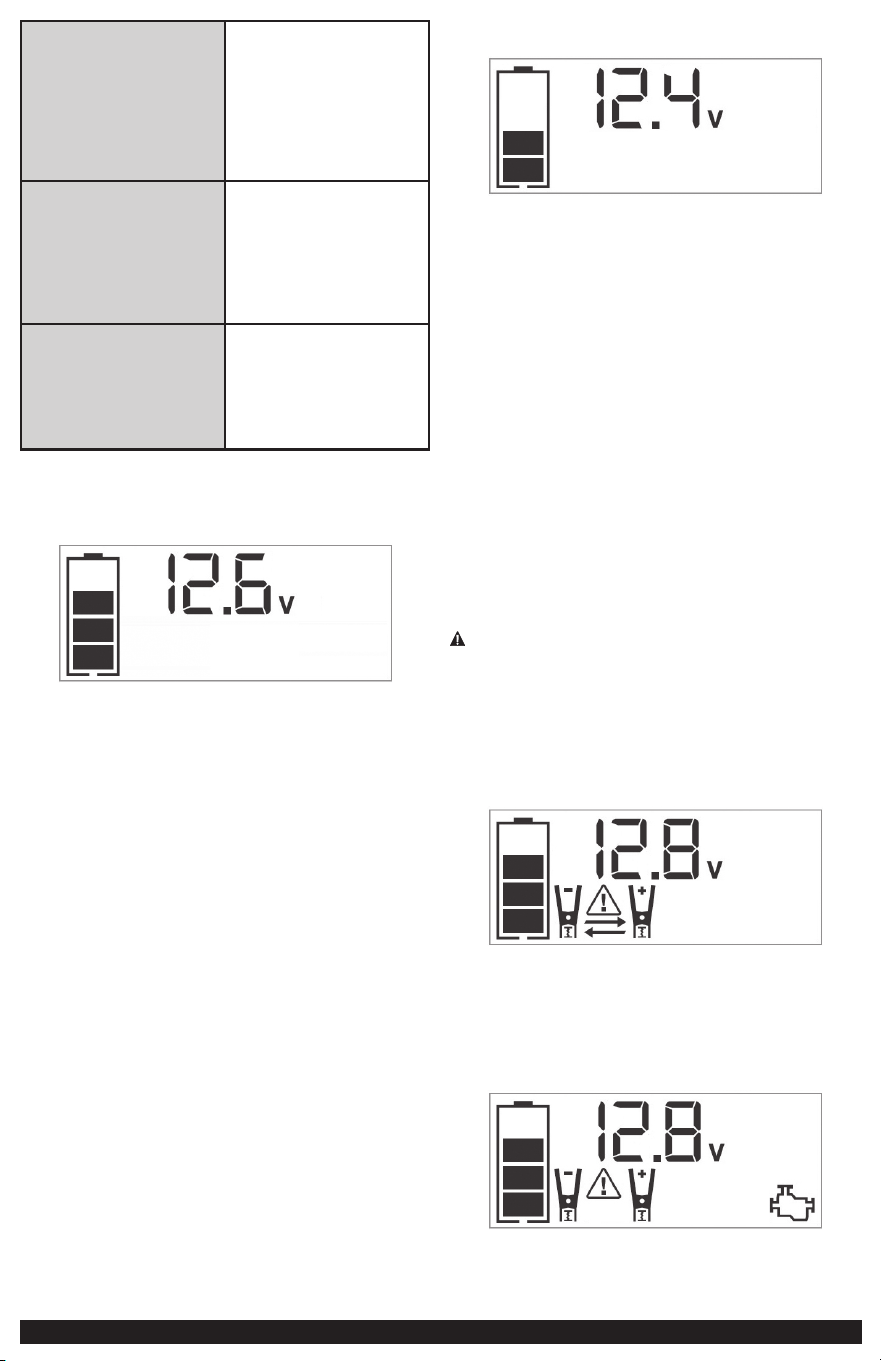
Whenever the clamps are properly
connected to a battery (refer to the
“Jump Starter” section) …
… a beep will sound and the Backlit
LCD Screen will display the Battery
Status Icon, Battery Voltage Indicator,
the Clamp Icons, and the “+” and ”–”
signs, as well as the flashing Jump
Starter Icon. The unit remains on until
the clamps are disconnected from the
battery.
7
If the Jump Starter Power Switch is
rotated to the on position and the
clamps are not connected to a battery
(refer to the “Jump Starter” section) …
... a two-second warning will sound
every 10 seconds. The Backlit LCD
Screen will display the Battery Status
Icon, Battery Voltage Indicator, the
Clamp Icons, and the “+” and ”–” signs.
The Alarm Icon and the Jump Starter
Icon will flash. The unit remains on
until the Jump Starter Power Switch is
switched off.
If the clamp connections to the
battery’s positive and negative
terminals are reversed (refer to the
“Jump Starter” section) …
… the Backlit LCD Screen will display
the Battery Status Icon, Battery Voltage
Indicator, and the Clamp Icons. The
Alarm Icon, the “+” and ”–” signs and
the Reverse Polarity Icons will flash
and the unit will sound a warning
continuously until the clamps are
disconnected from the battery.
When the unit is charging or
recharging using the supplied AC
Charger (refer to the “Charging/
Recharging” section) …
… the backlight will turn on for 10
seconds (only). The LCD Screen will
continue to display the Battery Status
Icon and Battery Voltage Indicator. The
bars on the Battery Status Icon will
change from empty to solid (bottom to
top) repeatedly.
Note:
The unit will automatically power off once ALL the functions are turned off.
VIEWING BATTERY STATUS
The Battery Status Icon and Battery Voltage Indicator indicate the battery charge
level as follows:
• If the battery charge level is at full capacity, four solid bars will display.
• If the battery is partially charged, two or three solid bars will display.
• If the battery is nearly empty, one solid bar will display. The unit should be
charged at this time.
• If the battery is completely empty, four blank bars will display. The unit MUST be
charged at this time or the unit’s built-in low voltage protection will activate.
CHARGING/RECHARGING
Lead-acid batteries require routine maintenance to ensure a full charge and long
battery life. All batteries lose energy from self-discharge over time and more
rapidly at higher temperatures. Therefore, batteries need periodic charging to
replace energy lost through self-discharge. When the unit is not in frequent use,
manufacturer recommends the battery should be recharged at least every 30 days
and after each use.
Notes:
This unit is delivered in a partially charged state – you must fully charge it before using it for the first
time. Initial AC charge should be for 30 hours or until the Battery Status Icon shows 4 solid bars.
Recharging the battery after each use will prolong battery life; frequent heavy discharges between
recharges and/or overcharging will reduce battery life.
The battery can be recharged using the supplied AC Charger.
Make sure all other unit functions are turned off during recharging, as this can slow the recharging
process.
NOTICE – RISK OF PROPERTY DAMAGE: Failure to keep the battery charged will
cause permanent damage and result in poor jump starting performance.
IMPORTANT: If you know the unit is discharged, but the Battery Icon displays four
solid bars as if the unit is fully charged when connected to a charging power source,
this may be due to the internal battery having high impedance. The manufacturer
suggests leaving the unit charging for a period of 40 hours using the supplied AC
charger before use.
Charging/Recharging Using the Supplied AC Charger
1. Lift the protective cover of the 12V DC Charging Port located on the back of
the unit (refer to the “Features” section to locate). Insert the barrel connector
of the AC charger into the Charging Port. Insert the plug end into a standard
120-volt AC wall outlet. When the unit is properly connected to an AC power
source, the LCD Screen will display the following:
The bars on the Battery Status Icon represent the charge level of the unit’s
internal battery. The bars on the Battery Status Icon will change from empty to
solid (bottom to top) repeatedly to indicate the unit is charging. The backlight
will turn on for 10 seconds (only).
2. Charge until the Battery Status Icon shows 4 solid bars.
3. When charging is complete, disconnect the AC charger – first unplug the
charger from the AC power source, then disconnect the barrel connector from
the unit.
JUMP-STARTER
This unit is equipped with a Jump Starter Power Switch that allows energy to flow
only when proper connections are made to battery and frame.
a) For negative-grounded systems, connect the Positive (Red) Clamp to the
positive ungrounded battery post and the Negative (Black) Clamp to the
vehicle chassis or engine block away from the battery. Do not connect the
clamp to the carburetor, fuel lines or sheet-metal body parts. Connect to a
heavy gauge metal part of the frame or engine block.
b) For positive-grounded systems, connect the Negative (Black) Clamp to the
negative ungrounded battery post and the Positive (Red) Camp to the vehicle
chassis or engine block away from the battery. Do not connect the clamp to
the carburetor, fuel lines or sheet-metal body parts. Connect to a heavy gauge
metal part of the frame or engine block.
IMPORTANT: Make sure the Compressor has been turned off before attempting to
use the unit as a Jump Starter.
WARNING – TO REDUCE THE RISK OF INJURY OR PROPERTY DAMAGE:
• FOLLOW ALL SAFETY INSTRUCTIONS FOUND IN THE “Specific safety instructions
for jump starters” section of this instruction manual.
• Never touch red and black clamps together – this can cause dangerous sparks,
power arcing, and/or explosion.
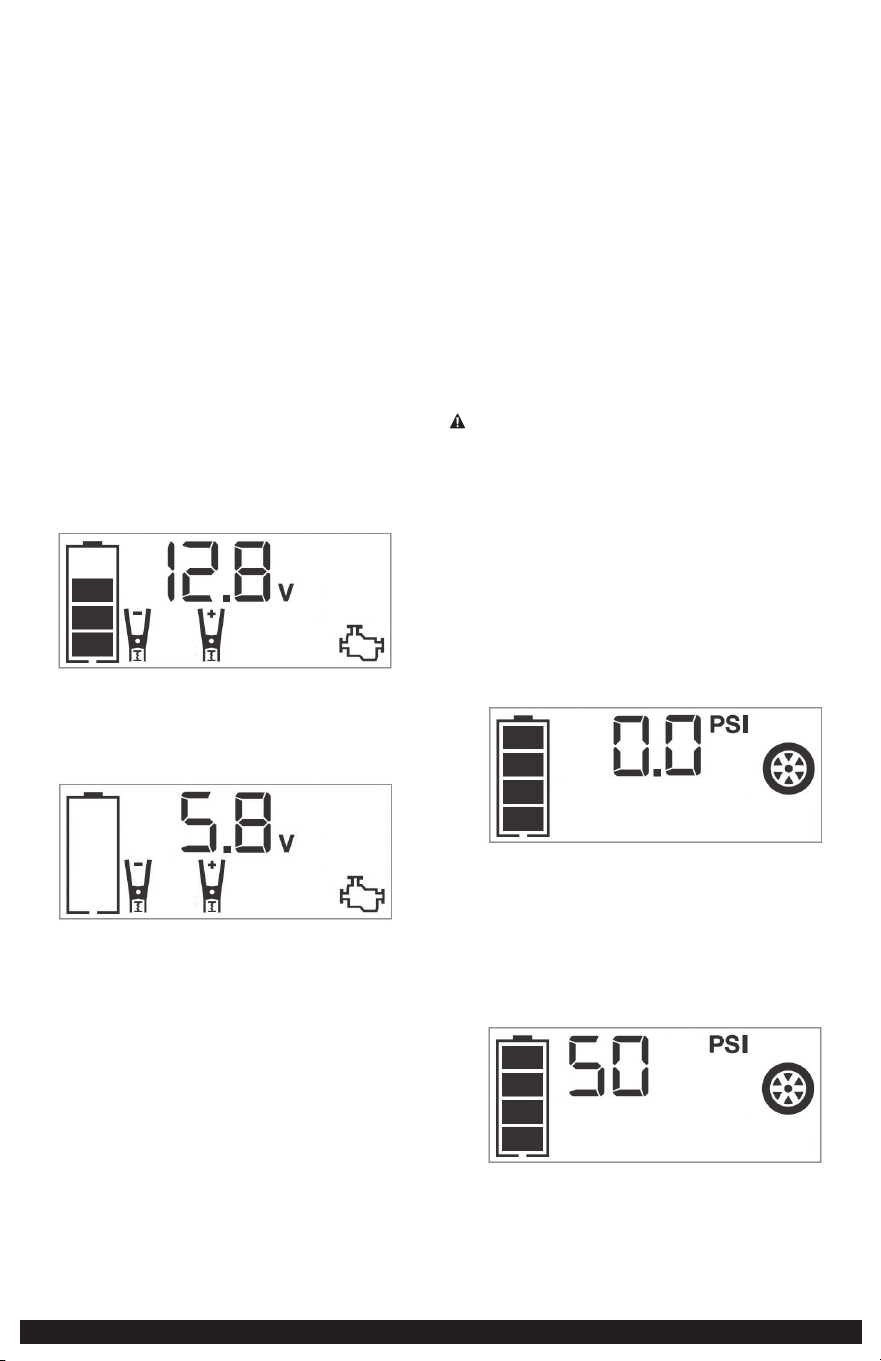
• If the clamps are connected incorrectly with regard to polarity, the unit will sound
a continuous alarm until the clamps are disconnected. The Backlit LCD Screen will
display the Battery Status Icon, the Battery Voltage Icon and the Clamp Icons. The
“+” and ”–” signs above the Clamp Icons, the Reverse Polarity Icons and the Alarm
Icon will flash. The Backlit LCD Screen will display the following:
NOTICE: The unit will suffer permanent damage if the Jump Starter Power
Switch is turned on while the clamps connected with reverse polarity. Disconnect
the clamps and reconnect to battery with correct polarity.
• If the Jump Starter Power Switch is turned on and the unit detects that the clamps
are not connected to a battery, a two-second warning will sound every 10 seconds.
The LCD Screen will display the Battery Status Icon, the Battery Voltage Indicator,
and the Clamp Icons with the “+” and ”–” signs. The Alarm Icon and the Jump
Starter Icon will flash. The Backlit LCD Screen will display the following:
Turn off the Jump Starter Power Switch; connect the clamps to the battery, making
sure the clamps are connected with correct polarity; then turn the Jump Starter Power
Switch back on.
8
• Always disconnect the Negative (Black) jumper Cable first, followed by the Positive
(Red) jumper Cable, except for positive grounded systems.
Procedure
Take the following steps, observing all cautions and warnings in the “Important
Safety Instructions” section at the front of this manual.
1. Turn off vehicle ignition and all accessories (radio, A/C, lights, connected cell
phone chargers, etc.). Place vehicle in “park” and set the emergency brake.
2. Make sure the Jump-Starter Power Switch is in the off position.
3. Remove jumper clamps from clamp tabs. Connect the red clamp first, then the
black clamp.
4. Procedure for jump-starting a NEGATIVE GROUNDED SYSTEM (negative battery
terminal is connected to chassis) (MOST COMMON)
4a. Connect Positive (+) red clamp to vehicle battery’s positive terminal.
4b. Connect negative (–) black clamp to chassis or a solid, non-moving, metal
vehicle component or body part. Never clamp directly to negative battery
terminal or moving part. Refer to the automobile owner’s manual.
5. Procedure for jump-starting POSITIVE GROUND SYSTEMS
Note:
In the rare event that the vehicle to be started has a Positive Grounded System (positive battery
terminal is connected to chassis), replace steps 4a and 4b above with steps 5a and 5b, then
proceed to step 6.
5a. Connect Negative (–) Black Clamp to vehicle battery’s negative terminal.
5b. Connect Positive (+) Red Clamp to vehicle chassis or a solid, non-moving,
metal vehicle component or body part. Never clamp directly to positive
battery terminal or moving part. Refer to the automobile owner’s
manual.
6. When the clamps are connected properly, the unit will automatically turn on in
jump-starter mode. The Backlit LCD Screen will display the following to indicate
the unit is ready to jump-start:
The Battery Status icon, Battery Voltage Indicator, Clamp Icons and the “+” and
”–” signs light solid. The Jump Starter Icon will flash to indicate the clamps are
properly connected.
7. Turn the Jump-Starter Power Switch on. Turn on the ignition and crank the
engine in 5-6 second bursts until engine starts. The Backlit LCD Screen will
display the following:
8. The Jump Starter Icon flashes, and the Battery Status Icon, the Battery Voltage
Indicator, Clamp Icons and the “+” and ”–” signs light solid to indicate the unit
is jump-starting.
9. Turn the Jump-Starter Power Switch off.
10. Disconnect the negative (–) engine or chassis clamp first, then disconnect the
Positive (+) battery Clamp.
NOTE: If the unit is malfunctioning after jump start procedure, please recharge the
unit with the supplied AC charger to reset the unit.
IMPORTANT: Always turn the unit off when not in use. Recharge this unit fully after
each use.
NOTICE – TO REDUCE THE RISK OF PROPERTY DAMAGE:
• Vehicles that have on-board computerized systems may be damaged if vehicle
battery is jump-started. Before jump-starting this type of vehicle, read the vehicle
manual to confirm that external-starting assistance is advised.
• Excessive engine cranking can damage the vehicle‘s starter motor. If the engine
fails to start after the recommended number of attempts, discontinue jump-start
procedure and look for other problems that need to be corrected.
• If vehicle fails to start, turn off the ignition, turn off the Jump-Starter Power
Switch, disconnect the jump-start system’s leads and contact a qualified technician
to investigate why the engine did not start.
PORTABLE COMPRESSOR
The built-in 12 volt DC compressor is the ultimate compressor for all vehicle tires,
trailer tires and recreational inflatables. A Nozzle Adapter is supplied that screws
onto the end of the Nozzle Adapter at the free end of the Air Hose. The Air
Hose with tire fitting is stored in the Air Hose Storage Compartment. Refer to the
“Features” illustration for locations of Air Hose. The Compressor Power Button and
Compressor Pressure Control Buttons are located on the control panel on the front
of the unit.
Before proceeding, check the unit’s battery status on the LCD Screen. Four solid
bars in the Battery Icon indicates a full battery. When the battery level is nearly
empty with only one solid bar, the unit MUST be recharged before use or the unit’s
built-in low voltage protection will activate, and the compressor will automatically
shut down.
The compressor may be used by removing the Air Hose from the Storage
Compartment and if required, fitting the Nozzle Adapter to the Air Hose. The
compressor is capable of inflating up to 120 pounds per square inch (psi) pressure.
The compressor can operate long enough to fill up to 3 average sized tires before
the battery must be recharged. Return Air Hose to the Storage Compartment after
use.
IMPORTANT: Make sure the Jump Starter Power Switch has been turned off before
attempting to use the unit as a Compressor.
WARNING – TO REDUCE THE RISK OF INJURY OR PROPERTY DAMAGE: Follow
all safety instructions found in the “Specific Safety Instructions For Compressors”
section of this instruction manual.
NOTICE – TO REDUCE THE RISK OF PROPERTY DAMAGE:
Do not operate compressor continuously for longer than 10 minutes as it may
overheat. This could damage the compressor. If the compressor must be operated
for longer periods: every 10 minutes press the Compressor Power Button to turn
the compressor off, then restart after a cooling down period of approximately 30
minutes.
In any event, the compressor will automatically shut down after operating
continuously for 10 minutes.
Inflating Tires or Products With Valve Stems
1. Screw the Nozzle Adapter onto the valve stem. Do not over tighten.
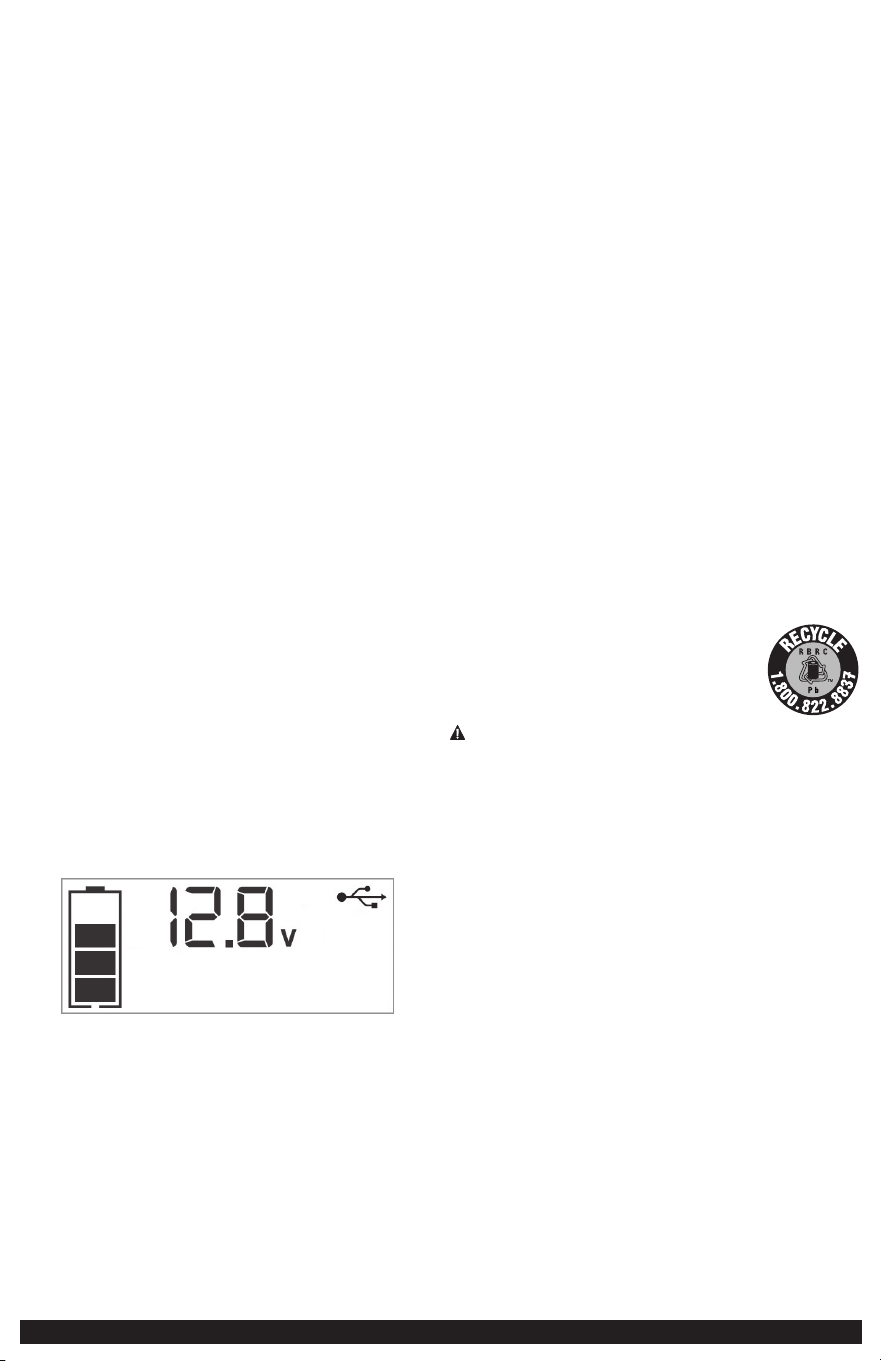
2. Press the Compressor Power Button. A beep will sound and the Backlit LCD
Screen will display the following:
The Compressor Icon will light and the Digital Display will alternately show
the flashing pre-set psi value (that was last set by the Compressor Pressure
Control Buttons) and the current pressure of the item being inflated (which
will light solid).
3. Press the “+” and “–” Pressure Control Buttons to set the desired pressure from
a range pre-set values (between 3 and 120), which will display on the Backlit
LCD Screen. The unit will sound a beep with each press of the buttons (holding
the button speeds up the upward or downward value selection). Once the
desired pressure has been entered, release the button and the flashing Digital
Display will show the new selected pressure, as follows:
The new selected value is now stored in the unit’s memory until it is manually
reset.
4. Press the Compressor Power Button once more to begin inflating. The
Compressor Icon will flash and the Digital Display will only show the current
pressure value (which will light solid) to indicate the compressor is activated.
Monitor the pressure on the LCD Screen.
9
IMPORTANT NOTE: To interrupt during inflation, press the Compressor Power
Button again.
5. When desired pre-set pressure is reached, the compressor will automatically
stop.
6. Press the Compressor Power Button again to turn off the unit.
7. Unscrew and remove the Nozzle Adapter from the valve stem.
8. Allow the unit to cool, then recharge before storing away.
9. Store the Air Hose and Nozzle Adapter in Storage Compartment.
Inflating Other Inflatables Without Valve Stems
Inflation of other items requires use of the Nozzle Adapter.
1. Screw the Nozzle Adapter into the Sure Fit® Nozzle. Do not over tighten.
2. Insert the Nozzle Adapter into item to be inflated.
3. Follow steps 2 through 4 of the “Inflating Tires or Products With Valve
Stems” section.
IMPORTANT: Small items such as volleyballs, footballs, etc. inflate very rapidly.
Keep this in mind when setting pressure. Take extra care not to over-inflate.
4. When the desired pressure is reached, the compressor will automatically stop.
Press the Compressor Power Button again to turn off the unit.
5. Disconnect the adapter from the inflated item.
6. Unscrew and remove the Nozzle Adapter from the Sure Fit® Nozzle.
7. Allow the unit to cool, then recharge before storing away.
8. Store the Air Hose, Nozzle Adapter and Nozzle Adapter in the Storage
Compartment.
USB PORTS
The USB Power Button and the USB Ports are located on the front of unit. Refer to
the “Features” section to locate.
IMPORTANT NOTES:
The USB-A Port provides up to 15W output power. The USB-C Port provides up
to PD 25W output power. The total output is up to 5V/15W when the USB-C and
USB-A are used simultaneously.
When the USB Ports are in use, the unit will monitor for the following USB fault
conditions on both the USB Ports: low battery voltage fault, overload and short
circuit.
The USB Ports will automatically shut down. Should this occur, disconnect the USB-
powered device and press the USB Power Button again to turn off the USB Ports
immediately. Make sure the unit does not need to be recharged. Allow the unit
to cool down for several minutes before attempting to use the USB Ports again.
If a fault occurs again, make sure that draw of the USB devices plugged into the
USB Ports do not exceed the maximum rating. If an individual USB device is within
specifications and the fault occurs, have the USB device checked for malfunction
and do not continue to use it with these USB Ports.
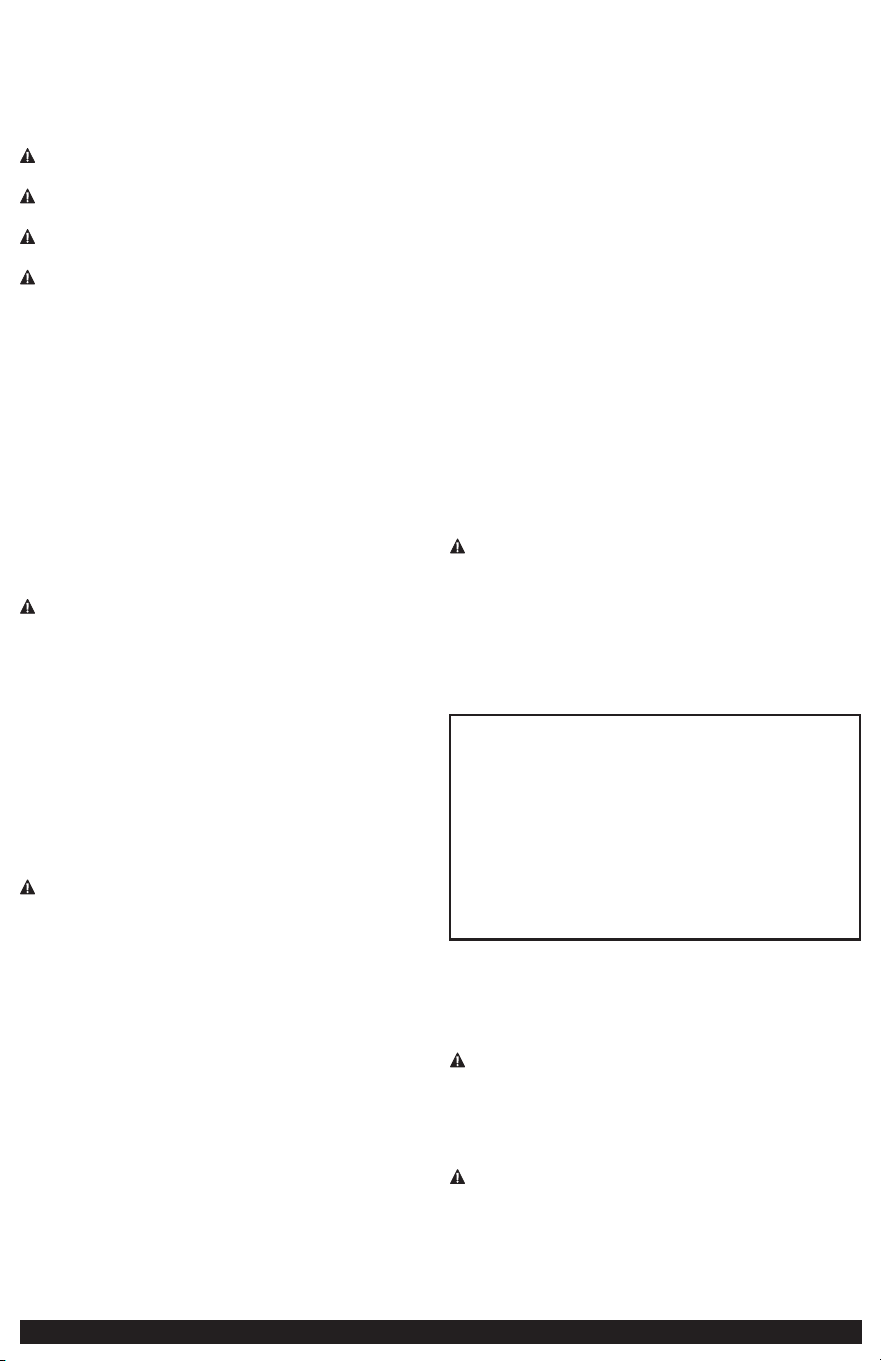
Using the USB Ports
1. Press the USB Power Button to turn on both USB Ports. A beep will sound, and
the LCD Screen will continuously display the following:
The Battery Status Icon and Battery Voltage Indicator will light solid, as well as
the USB Icon, indicating the USB Ports are ready to use.
2. Plug the USB-powered device into the USB power port(s) and operate normally.
3. Press the USB Power Button again to turn off the USB Ports.
Periodically check the unit’s battery status on the Backlit LCD Screen. Four solid bars
in the Battery Icon indicates a full battery. When the battery level is nearly empty
with only one solid bar or completely empty Battery Status Icon, the unit must be
recharged at this time or the unit’s built-in low voltage protection will activate. The
USB turns off automatically. The Battery Status Icon and Battery Voltage Indicator
will light for 10 seconds before the unit turns off automatically.
IMPORTANT: Make sure the USB Ports are turned off when the unit is being
recharged or stored.
Notes:
This unit’s USB Ports do not support data communication. They only provide power to external USB-
powered devices. Some household USB-powered electronics will not operate with this unit.
LED AREA LIGHT
The built-in LED Area Light is controlled by the Area Light Power Button on the
control panel (refer to the “Features” section to locate). Press the Area Light Power
Button once to turn the Area Light on. Press the Area Light Power Button again to
turn the Area Light off.
IMPORTANT: When the Area Light Power Button is pressed to turn it on, a beep
will sound. The Backlit LCD Screen will turn on for 10 seconds (only) and will then
continuously display the Battery Status Icon and the Battery Voltage Indicator.
Periodically check the unit’s battery status on the Backlit LCD Screen. Four solid bars
in the Battery Icon indicates a full battery. When the battery level is nearly empty
with only one solid bar or completely empty Battery Status Icon, the unit must be
recharged at this time or the unit’s built-in low voltage protection will activate.
The Area Light turns off automatically. The Battery Status Icon and Battery Voltage
Indicator will light for 10 seconds before the unit turns off automatically.
IMPORTANT: Make sure the Area Light is turned off when the unit is being
recharged or stored.
CARE AND MAINTENANCE
All batteries lose energy from self-discharge over time and more rapidly at higher
temperatures. When the unit is not in use, we recommend that the battery is
charged at least every 30 days.
Never submerge the unit in water. If the unit gets dirty, gently clean the outer
surfaces of the unit with a soft cloth.
There are no user-replaceable parts. This unit is non-servicable.
BATTERY
Please be advised that the battery is designed to last the service life of the unit and
is not replaceable, removable or serviceable. Service life is dependent on a number
of factors including but not limited to the number of recharge cycles, and proper
care and maintenance of the battery by the end user. Contact manufacturer for any
information you may need.
Safe Battery Disposal
Contains a maintenance-free, sealed, non-spillable, lead acid
battery, which must be disposed of properly. Recycling is
required. Failure to comply with local, state and federal
regulations can result in fines, or imprisonment.
Please recycle.
WARNINGS:
• Do not dispose of the battery in fire as this may result in an explosion.
• Before disposing of the battery, protect exposed terminals with heavy-duty
electrical tape to prevent shorting (shorting can result in injury or fire).
• Do not expose battery to fire or intense heat as it may explode.
TROUBLESHOOTING
Unit will not charge
• Make sure all of the unit’s functions are turned off.
• Make sure a suitable gauge extension cord is properly connected to both the unit
and a functioning AC outlet.
Unit fails to jump-start
• Make sure unit’s Jump Starter Power Switch is in the on position.
• Make sure a proper polarity cable connection has been established.
• Make sure the unit is not being operated in the Compressor mode.
• Check that the unit has a full charge. Recharge the unit if necessary.
Portable compressor will not inflate
• Make sure the Compressor Power Button has been pressed to turn the
compressor on.
• Make sure the unit is not being operated in the Jump Starter mode.
• Make sure the Sure Fit® Nozzle is securely screwed on to the valve stem when
attempting to inflate tires; or that the Nozzle Adapter is securely screwed into
the Sure Fit® Nozzle and is inserted properly into the item to be inflated on all
other inflatables.
• Check that the unit has a full charge. Recharge the unit if necessary.
USB power port will not power appliance
• Make sure the USB Power Button is pressed to turn the USB Ports on.
• A fault condition exists in one of the USB Ports. Refer to the Important Notes in
the “USB PORTS” section to remedy any faults.
• Make sure that the USB device plugged into the USB-A port does not exceed 15W;
the USB device plugged into USB-C port does not exceed PD 25W; or the total

10
drained power of the USB-A port and USB-C port do not exceed 15W when they
are used simultaneously.
• Some USB-powered household electronics will not operate with this USB charging/
power port. Check the manual of the corresponding electronic device to confirm
that it can be used with this type of USB charging/power port.
• Check that the unit has a full charge. Recharge the unit if necessary.
LED area light does not come on
• Make sure the Area Light Power Button is pressed to turn the Area Light on.
• Check that the unit has a full charge. Recharge the unit if necessary.
ACCESSORIES
Recommended accessories for use with your tool may be available from the
manufacturer. If you need assistance regarding accessories, please contact the
manufacturer at 1-877-571-2391.
The use of any accessory not recommended for use with this appliance could
be hazardous.
TECHNICAL ASSISTANCE
For Customer Service or Technical Assistance, contact the manufacturer at 1-877-
571-2391.
ONE-YEAR LIMITED MANUFACTURER’S WARRANTY
The manufacturer, Baccus Global LLC, warrants this product against defects in
materials and workmanship for a period of ONE (1) YEAR commencing from the
date of retail purchase by the original end-user purchaser or from the date of
delivery of the good, whichever occurs later (“Warranty Period”).
If there is a defect and a valid claim is received by the manufacturer within the
Warranty Period, the defective product can be replaced in the following ways: (1)
Return the product to the manufacturer for replacement. Proof of purchase may
be required by manufacturer. (2) Return the product to the retailer where product
was purchased for an exchange (provided that the store is a participating retailer).
Returns to retailer should be made within the time period of the retailer’s return
policy for exchanges only. Proof of purchase may be required. Please check with the
retailer for their specific return policy regarding returns that are beyond the time
set for exchanges.
This manufacturer’s warranty does not apply to accessories, bulbs, fuses and
batteries; defects resulting from normal wear and tear, accidents; damages sustained
during shipping; alterations; unauthorized use; neglect, misuse, abuse; and failure to
follow instructions for care and maintenance for the product.
This manufacturer’s warranty gives you, the original retail purchaser, specific legal
rights and you may have other rights which vary from state to state or province to
province. This product is not intended for commercial use. To register your product
with the manufacturer, please visit www.BaccusGlobal.com.
The photos in this manual may differ from the actual unit.
SPECIFICATIONS
Boost Ampere: 1500A peak battery
Battery type: Maintenance-free, sealed lead acid, 12VDC
AC input: 14.5VDC, 800mA
USB-C output: 5VDC 3A / 9VDC 2.77A (PD 25W Max.)
USB-A output: 5VDC, 15W Max.
USB-C & USB-A output simultaneously: 5VDC, 15W Max.
Compressor maximum pressure: 120 PSI
Sure Fit
®
is a registered trademark owned by Baccus Global, LLC.
STANLEY
®
AND THE STANLEY
®
LOGO ARE
REGISTERED TRADEMARKS OF STANLEY
BLACK + DECKER INC. OR ONE OF ITS AFFILIATES,
AND ARE USED UNDER LICENSE.
Imported by Baccus Global LLC,
621 NW 53rd St., Suite 450, Boca Raton, FL 33487
www.baccusglobal.com 1-877-571-2391
RD110823
11
INDICACIONES
DE SEGURIDAD /
DEFINICIONES
PELIGRO: Indica una situación de peligro inminente que, si no se evita,
provocará la muerte o lesiones graves.
ADVERTENCIA: Indica una situación potencialmente peligrosa que, si no se
evita, puede provocar la muerte o lesiones graves.
PRECAUCIÓN: Indica una situación potencialmente peligrosa que, si no se
evita, puede provocar lesiones.
Usado sin la palabra, indica un mensaje relacionado con la seguridad
AVISO: Indica una práctica no relacionada con lesiones personales que, si no se
evita, puede provocar daños a la propiedad.
RIESGO DE OPERACIÓN INSEGURA. Al usar herramientas o equipos, siempre
se deben seguir precauciones básicas de seguridad para reducir el riesgo de lesiones
personales. La operación, el mantenimiento o la modificación inadecuados de
herramientas o equipos podrían provocar lesiones graves y daños a la propiedad.
Hay ciertas aplicaciones para las cuales las herramientas y equipos están diseñados.
El fabricante recomienda encarecidamente que este producto NO se modifique ni se
utilice para ninguna aplicación distinta para la que fue diseñado. Lea y comprenda
todas las advertencias e instrucciones de funcionamiento antes de utilizar cualquier
herramienta o equipo.
LEA TODAS LAS
INSTRUCCIONES
ADVERTENCIA: Lea y comprenda este manual de instrucciones antes de
utilizar esta unidad. No seguir todas las instrucciones enumeradas a continuación
puede provocar una descarga eléctrica, un incendio y/o lesiones graves.
INSTRUCCIONES
DE SEGURIDAD
IMPORTANTES
ADVERTENCIAS E INSTRUCCIONES GENERALES DE
SEGURIDAD
• Esta unidad fue diseñada para uso doméstico únicamente.
ADVERTENCIA – PARA REDUCIR EL RIESGO DE INCENDIO, DESCARGA
ELÉCTRICA, RIESGO DE EXPLOSIÓN O LESIONES A PERSONAS O PROPIEDAD:
• Evite entornos peligrosos. No utilice aparatos eléctricos en lugares húmedos o
mojados. No utilice aparatos eléctricos bajo la lluvia.
• Mantenga alejados a los niños. Todas las personas ajenas deben mantenerse
alejadas del área de trabajo.
• Vístase apropiadamente. No use ropa suelta o joyas. Pueden quedar atrapados
en piezas móviles. Se recomiendan guantes de goma y calzado resistente y anti-
resbalante cuando se trabaja al aire libre. Use una cobertura protectora para el
cabello para contener el cabello largo.
• Guarde el aparato inactivo en interiores Cuando no estén en uso, los aparatos
eléctricos deben almacenarse en el interior, en un lugar seco y alto o bajo llave,
fuera del alcance de los niños.
• No abuse del cable. Nunca transporte el aparato por el cable ni tire de él para
desconectarlo del receptáculo. Mantenga el cable alejado del calor, el aceite y los
bordes afilados.
• Desconecte los aparatos. Desconecte el aparato de la fuente de alimentación
cuando no esté en uso y cuando cambie accesorios.
• •Se debe proporcionar protección con Interruptor de Circuito de Falla a Tierra
(GFCI por sus siglas en inglés) en los circuitos o tomacorrientes que serán utilizados.
Hay receptáculos disponibles que tienen protección GFCI incorporada y pueden
usarse para esta medida de seguridad.
• Uso de accesorios y aditamentos. El uso de cualquier accesorio o accesorio no
recomendado para este aparato podría ser peligroso. Consulte la sección de
accesorios de este manual para obtener más detalles.
• Manténgase alerta. Use el sentido común. No opere el aparato si no está
capacitado o cuando esté cansado.
• Compruebe si hay piezas dañadas. No lo utilice si está dañado de alguna manera.
• No opere este aparato cerca de líquidos inflamables o en atmósferas gaseosas o
explosivas. Los motores de estas herramientas normalmente producen chispas y las
chispas pueden encender los gases.
• Nunca sumerja esta unidad en agua; no la exponga a la lluvia, la nieve ni la use
cuando esté en un lugar mojado.
• Para reducir el riesgo de descarga eléctrica, desconecte la unidad de cualquier
fuente de alimentación antes de realizar tareas de mantenimiento o limpieza.
Apagar los controles sin desconectarlos no reducirá este riesgo.
• Este equipo emplea piezas (interruptores, relés, etc.) que producen arcos o chispas.
Por lo tanto, si se usa en un garaje o área cerrada, la unidad DEBE colocarse a no
menos de 18 pulgadas sobre el piso.
INSTRUCCIONES DE SEGURIDAD ESPECÍFICAS PARA
CARGAR ESTA UNIDAD
• IMPORTANTE: Esta unidad se entrega parcialmente cargada. Cargue
completamente la unidad con un cable de extensión doméstico hasta que el ícono
de estado de la batería muestre 4 barras sólidas antes de usarla por primera vez.
No puede sobrecargar la unidad utilizando el método de carga de CA.
• Para recargar esta unidad, utilice únicamente el cargador de CA suministrado.
• Todas las funciones deben apagarse cuando la unidad se está cargando o no está
en uso. Asegúrese de que todas las funciones estén apagadas antes de realizar la
conexión a una fuente de alimentación o carga.
Cables de Extensión
ADVERTENCIA: El uso de un cable de extensión inadecuado podría generar
riesgo de incendio y descarga eléctrica. Cuando utilice un cable de extensión,
asegúrese de que las clavijas del cable de extensión tengan el mismo número,
tamaño y forma que las del cargador; y asegúrese de utilizar uno lo suficientemente
robusto como para transportar la corriente que consumirá su producto. Un cable de
tamaño insuficiente provocará una caída en el voltaje de la línea, lo que provocará
pérdida de energía y sobrecalentamiento. La siguiente tabla muestra el tamaño
correcto a utilizar según la longitud del cable y el amperaje nominal de la placa
de identificación. En caso de duda, utilice el siguiente calibre más pesado. Cuanto
menor sea el número de calibre, más capacidad tendrá el cable.
CALIBRE MÍNIMO PARA SET DE CABLES
Voltio Longitud Total del Cable en Pies
120V 0-25 26-50 51-100 101-150
(0-7.6m) (7.6-15.2m) (15.2-30.4m) (30.4-45.7m)
240V 0-50 51-100 101-200 201-300
(0-15.2m) (15.2-30.4m) (30.4-60.9m) (60.9-91.4m)
Amperaje ELongitud del Cable de Extensión
Más No más
0’-25’ 26’-50’ 51’-100’ 101’-150’
que que Calibre de Cable Americano
0 - 6 18 16 16 14
6 - 10 18 16 14 12
10 - 12 16 16 14 12
12 - 16 14 12 No recomendada
Cuando se utiliza un cable de extensión, asegúrese de que:
a) las clavijas del cable de extensión tengan el mismo número, tamaño y forma
que las del cargador,
b) el cable de extensión esté correctamente cableado y en buenas condiciones
eléctricas,
c) la capacidad del cable es la suficiente para la clasificación de CA del cargador.
PRECAUCIÓN – PARA REDUCIR EL RIESGO DE LESIONES O DAÑOS A LA
PROPIEDAD: Tire del cable de extensión por el enchufe en lugar de por el cable
cuando lo desconecte del cargador de CA suministrado o de la toma de CA.
INSTRUCCIONES DE SEGURIDAD ESPECÍFICAS PARA
ARRANCADORES AUXILIARES
ADVERTENCIA: PELIGRO DE EXPLOSIÓN
No utilice la unidad para cargar baterías de celda seca que se usan comúnmente
con electrodomésticos. Estas baterías pueden explotar y causar lesiones a personas y
daños a la propiedad. Utilice la unidad únicamente para cargar/reforzar una batería
de plomo-ácido. No está destinada a suministrar energía a un sistema eléctrico de
bajo voltaje que no sea una aplicación de arranque de motor.
12
• El uso de un accesorio no suministrado, recomendado o vendido por el fabricante
específicamente para usar con esta unidad puede generar riesgo de descarga
eléctrica y lesiones a las personas.
ADVERTENCIA: RIESGO DE GASES INFLAMABLES
• Es peligroso trabajar cerca de una batería de plomo-ácido. Las baterías generan
gases explosivos durante el funcionamiento normal de la batería. Por esta razón,
es de suma importancia que cada vez que utilice el arrancador lea este manual y
siga las instrucciones exactamente.
• Para reducir el riesgo de explosión de la batería, siga estas instrucciones y las
publicadas por el fabricante de la batería y el fabricante de cualquier equipo que
desee utilizar cerca de la batería. Revise las indicaciones de precaución en estos
productos y en el motor.
PRECAUCIÓN – PARA REDUCIR EL RIESGO DE LESIONES O DAÑOS A LA
PROPIEDAD:
• NUNCA INTENTE ARRANCAR O CARGAR UNA BATERÍA CONGELADA.
• Los vehículos que tienen sistemas computarizados a bordo pueden sufrir daños
si se usa un arrancador auxiliar en la batería del vehículo. Antes de auxiliar con
un arrancador, lea el manual del propietario del vehículo para confirmar que la
asistencia de arranque externa es adecuada.
• Nunca fume ni permita que se produzcan chispas o llamas cerca de la batería, el
motor o la central eléctrica del vehículo.
• Tenga mucho cuidado y evite dejar caer una herramienta metálica sobre la batería.
Podría producir chispas o provocar un cortocircuito en la batería u otra pieza
eléctrica y provocar una explosión.
• Los procedimientos de arranque auxiliar sólo deben realizarse en un área segura,
seca y bien ventilada.
• Guarde siempre las abrazaderas de la batería cuando no las utilice. No permita
que se toquen entre sí las abrazaderas de la batería. Esto puede provocar chispas
peligrosas, arcos eléctricos y/o explosiones.
• Cuando utilice esta unidad cerca de la batería y el motor del vehículo, coloque
la unidad sobre una superficie plana y estable y asegúrese de mantener todas las
abrazaderas, cables, ropa y partes del cuerpo alejados de las partes móviles del
vehículo.
• Nunca permita que las abrazaderas rojas y negras se toquen entre sí o con otro
conductor metálico común; esto podría causar daños a la unidad y/o crear un
riesgo de chispas o explosión.
• Asegúrese de conectar las abrazaderas con la polaridad correcta. Los daños
causados por una conexión incorrecta no están cubiertos por la Garantía.
• No exponga la batería al fuego o al calor intenso ya que puede explotar. Antes de
desechar la batería, proteja los terminales expuestos con cinta aislante resistente
para evitar cortocircuitos (los cortocircuitos pueden provocar lesiones o incendios).
• Coloque esta unidad tan lejos de la batería como lo permitan los cables.
• Nunca permita que el ácido de la batería entre en contacto con esta unidad.
• No opere esta unidad en un área cerrada ni restrinja la ventilación de ninguna
manera.
• Este sistema está diseñado para usarse únicamente en vehículos con un sistema de
batería de 12 voltios CC. No lo conecte a un sistema de batería de 6 o 24 voltios.
• Este sistema no está diseñado para usarse como reemplazo de la batería de un
vehículo. No intente operar un vehículo que no tenga una batería instalada.
• El intento excesivo de arranque del motor puede dañar el motor de arranque de
un vehículo. Si el motor no arranca después del número recomendado de intentos,
suspenda los procedimientos de arranque auxiliar y busque otros problemas que
puedan necesitar ser corregidos.
• No utilice este arrancador en una embarcación. No está calificado para aplicaciones
marinas.
• Aunque esta unidad contiene una batería a prueba de derrames, se recomienda
mantenerla en posición vertical durante el almacenamiento, uso y recarga. Para
evitar posibles daños que puedan acortar la vida útil de la unidad, protéjala de la
luz solar directa, el calor directo y/o la humedad.
INSTRUCCIONES DE SEGURIDAD ESPECÍFICAS PARA
COMPRESORES
ADVERTENCIA – PELIGRO DE EXPLOSIÓN: Los artículos que explotan pueden
causar lesiones graves.
• Siga cuidadosamente las instrucciones de los artículos que se van a inflar.
• Nunca exceda la presión recomendada que figura en las instrucciones de los
artículos que se van a inflar. Si no se indica la presión, comuníquese con el
fabricante del artículo antes de inflarlo.
• Controle siempre la presión en la Pantalla LCD.
AVISO – PARA REDUCIR EL RIESGO DE DAÑOS A LA PROPIEDAD:
• Nunca deje el compresor desatendido mientras esté en uso.
• No haga funcionar el compresor de forma continua durante más de 10 minutos
aproximadamente. Esto podría dañar el compresor. Siga las instrucciones de la
sección “Compresor Portátil”.
INSTRUCCIONES DE SEGURIDAD ESPECÍFICAS PARA
LOS PUERTOS DE ALIMENTACIÓN USB
• No inserte objetos extraños en los puertos de alimentación USB.
• No conecte concentradores USB ni más de un dispositivo electrónico personal a
cada puerto de alimentación USB.
• No utilice esta unidad para operar aparatos que requieran más de 15 W cuando se
utiliza únicamente el puerto USB-A; 25 W cuando se utiliza únicamente el puerto
USB-C; hasta 5 V/15 W de salida tanto en USB-A como en USB-C cuando se utilizan
simultáneamente.
SEGURIDAD PERSONAL
• Cuando trabaje con baterías de plomo-ácido, asegúrese siempre de que haya
asistencia inmediata disponible en caso de accidente o emergencia.
• Manténgase alejado de las aspas del ventilador, correas, poleas y otras piezas que
puedan causar lesiones a las personas.
• No use ropa de vinilo cuando esté auxiliando un vehículo con un arrancador. La
fricción puede provocar peligrosas chispas eléctricas estáticas.
• Quítese los artículos metálicos personales como anillos, pulseras, collares y relojes
cuando trabaje con una batería de plomo-ácido. Una batería de plomo-ácido
puede producir una corriente de cortocircuito lo suficientemente alta como para
derretir un anillo u objeto metálico similar en la piel, provocando una quemadura
grave.
• Utilice siempre gafas protectoras cuando utilice este producto: el contacto con
el ácido de la batería puede provocar ceguera y/o quemaduras graves. Tenga en
cuenta los procedimientos de primeros auxilios en caso de contacto accidental con
el ácido de la batería.
• Tenga a mano abundante agua fresca y jabón en caso de que el ácido de la
batería entre en contacto con la piel.
Piel: Si el ácido de la batería entra en contacto con la piel o la ropa, lávese
inmediatamente con agua y jabón durante al menos 10 minutos. Si se produce
enrojecimiento, dolor o irritación, busque atención médica inmediata.
Ojos: Si el ácido de la batería entra en contacto con los ojos, enjuáguelos
inmediatamente durante un mínimo de 15 minutos y busque atención médica
inmediata.
Pantalla LCD de cristal líquido: Si el cristal líquido entra en contacto con
su piel: Lave completamente el área con abundante agua. Quítese la ropa
contaminada. Si el cristal líquido entra en contacto con los ojos: enjuague el ojo
afectado con agua limpia y luego busque atención médica. Si se ingiere cristal
líquido: Enjuáguese bien la boca con agua. Beba grandes cantidades de agua e
induzca el vómito. Luego busque atención médica.
GUARDE ESTAS
INSTRUCCIONES
INTRODUCCIÓN
Felicitaciones por la compra de su nuevo Arrancador Auxiliar Stanley® FatMax®
con Compresor de Aire. Lea este Manual de Instrucciones y siga las instrucciones
cuidadosamente antes de usar esta unidad.
DESCRIPCIÓN GENERAL
Acciones Comunes y Respuestas de la Unidad
Las siguientes acciones encienden la unidad y activan la Pantalla LCD:
Presione el Botón de Encendido de la
Luz de Área LED.
(Consulte la sección “Luz de Área LED”.)
La Luz del Área se encenderá. La luz
de fondo se encenderá durante 10
segundos (solamente). La Pantalla LCD
seguirá mostrando el Icono de Estado
de la Batería y el Indicador de Voltaje
de la Batería. La unidad permanece
encendida hasta que se presiona
nuevamente el Botón de Encendido de
Luz del Área LED para apagarla.
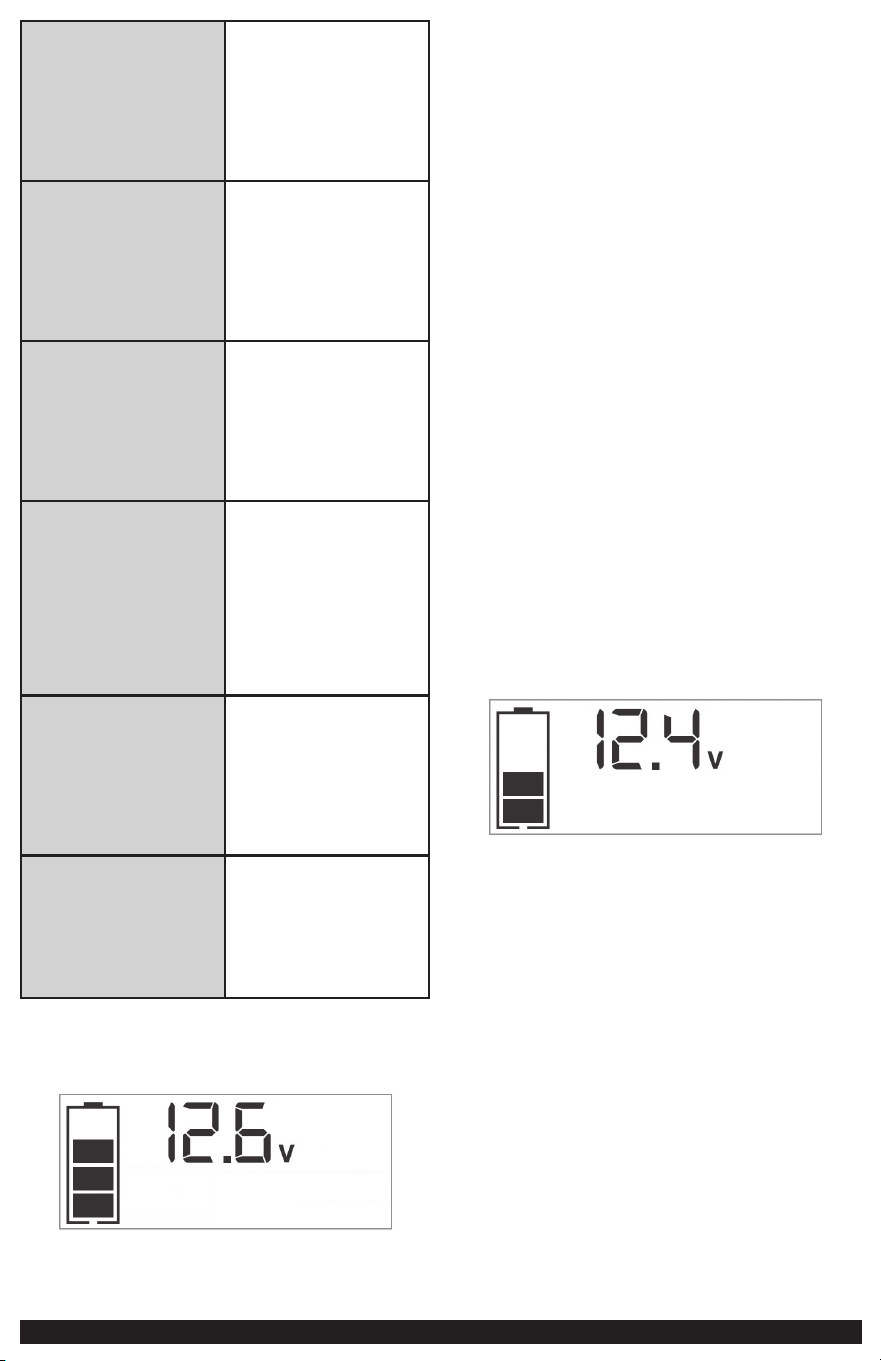
13
Presione el Botón de Encendido USB.
(Consulte la sección “Puertos USB”.)
La Pantalla LCD Retroiluminada
mostrará el Ícono de Estado de la
Batería y el Indicador de Voltaje de
la Batería, así como el Ícono USB, lo
que indica que los Puertos USB están
disponibles. La unidad permanece
encendida hasta que se presione
nuevamente el Botón de Encendido
USB para apagarlo.
Presione el Botón de Encendido
del Compresor. (Consulte la sección
“Compresor Portátil”)
La Pantalla LCD Retroiluminada
mostrará el Ícono de Estado de la
Batería, “XXX” PSI y el Ícono del
Compresor. Si no se realizan más
acciones después de 1 minuto, la
unidad mostrará el Ícono de Estado de
la Batería y el Indicador de Voltaje de la
Batería durante 10 segundos antes de
apagarse automáticamente.
Siempre que las abrazaderas estén
conectadas correctamente a una batería
(consulte la sección “Arrancador
Auxiliar”) …
… sonará un pitido y la Pantalla LCD
Retroiluminada mostrará el Ícono de
Estado de la Batería, el Indicador de
Voltaje de la Batería, los Íconos de
Abrazadera y los signos “+” y ”–”, así
como el Ícono de Arrancador Auxiliar
parpadeante. La unidad permanece
encendida hasta que se desconectan las
abrazaderas de la batería.
Si el Interruptor de Encendido del
Arrancador Auxiliar se gira a la posición
de encendido y las abrazaderas
no están conectadas a una batería
(consulte la sección “Arrancador
Auxiliar”) …
... cada 10 segundos sonará una
advertencia de dos segundos. La
Pantalla LCD Retroiluminada mostrará
el Ícono de Estado de la Batería, el
Indicador de Voltaje de la Batería, los
Íconos de Abrazadera y los signos “+”
y “–”. El Icono de Alarma y el Icono del
Arrancador parpadearán. La unidad
permanece encendida hasta que se
apaga el Interruptor de Encendido del
Arrancador.
Si las conexiones de las abrazaderas a
los terminales positivo y negativo de
la batería están invertidas (consulte la
sección “Arrancador Auxiliar”) …
… la Pantalla LCD Retroiluminada
mostrará el Ícono de Estado de la
Batería, el Indicador de Voltaje de la
Batería y los Íconos de Abrazadera.
El Ícono de Alarma, los signos “+” y
”–” y los Íconos de Polaridad Inversa
parpadearán y la unidad emitirá un
aviso continuamente hasta que las
pinzas se desconecten de la batería.
Cuando la unidad se está cargando o
recargando usando el cargador de CA
(consulte la sección “Carga/Recarga”) …
… la luz de fondo se encenderá
durante 10 segundos (solamente).
La Pantalla LCD seguirá mostrando
el Icono de Estado de la Batería y el
Indicador de Voltaje de la Batería.
Las barras en el Ícono de Estado de la
Batería cambiarán de vacías a sólidas
(de abajo hacia arriba).
Nota:
La unidad se apagará automáticamente una vez que TODAS las funciones estén apagadas.
VER EL ESTADO DE LA BATERÍA
El Icono de Estado de la Batería y el Indicador de Voltaje de la Batería indican el
nivel de carga de la batería de la siguiente manera:
• Si el nivel de carga de la batería está en su capacidad máxima, aparecerán cuatro
barras sólidas.
• Si la batería está parcialmente cargada, aparecerán dos o tres barras sólidas.
• Si la batería está casi agotada, aparecerá una barra sólida. La unidad debe cargarse
en este momento.
• Si la batería está completamente vacía, aparecerán cuatro barras en blanco. La
unidad DEBE cargarse en este momento o se activará la protección de bajo voltaje
incorporada en la unidad.
CARGAR/RECARGAR
Las baterías de plomo-ácido requieren un mantenimiento de rutina para garantizar
una carga completa y una larga vida útil. Todas las baterías pierden energía por
auto-descarga con el tiempo y más rápidamente a temperaturas más altas. Por lo
tanto, las baterías necesitan cargarse periódicamente para reemplazar la energía
perdida por la auto-descarga. Cuando la unidad no se utiliza con frecuencia, el
fabricante recomienda que la batería se recargue al menos cada 30 días y después
de cada uso.
Notas:
Esta unidad se entrega parcialmente cargada; debe cargarla completamente antes de usarla por
primera vez. La carga de CA inicial debe durar 30 horas o hasta que el Ícono de Estado de la
Batería muestre 4 barras sólidas.
Recargar la batería después de cada uso prolongará su vida útil; las descargas intensas y frecuentes
entre recargas y/o sobrecargas reducirán la vida útil de la batería.
La batería se puede recargar utilizando el cargador de CA suministrado.
Asegúrese de que todas las demás funciones de la unidad estén apagadas durante la recarga, ya que
esto puede ralentizar el proceso de recarga.
.
AVISO – RIESGO DE DAÑOS A LA PROPIEDAD: Si no se mantiene la batería
cargada, se producirán daños permanentes y se producirá un rendimiento deficiente
del arranque auxiliar.
IMPORTANTE: Si sabe que la unidad está descargada, pero el Ícono de la Batería
muestra cuatro barras sólidas como si la unidad estuviera completamente cargada
cuando se conecta a una fuente de alimentación de carga, esto puede deberse a
que la batería interna tiene alta impedancia. El fabricante sugiere dejar la unidad
cargando durante un período de 40 horas usando el cargador de CA suministrado
antes de usarla.
Carga/Recarga Utilizando el Cargador de CA Suministrado
1. Levante la cubierta protectora del puerto de carga de 12 V CC ubicado en la
parte posterior de la unidad (consulte la sección “Características” para ubicarlo).
Inserte el conector cilíndrico del cargador de CA en el puerto de carga. Inserte
el extremo en un toma corriente de pared de CA estándar de 120 voltios.
Cuando la unidad esté conectada correctamente a una fuente de alimentación
de CA, la pantalla LCD mostrará lo siguiente:
Las barras en el Ícono del Estado de la Batería representan el nivel de carga de
la batería interna de la unidad. Las barras en el Ícono del Estado de la Batería
cambiarán de vacías a sólidas (de abajo hacia arriba) repetidamente para
indicar que la unidad se está cargando. La luz de fondo se encenderá durante
10 segundos (solamente).
2. Cargue hasta que el Ícono del Estado de la Batería muestre 4 barras sólidas.
3. Cuando se complete la carga, desconecte el cargador de CA; primero
desenchufe el cargador de la fuente de alimentación de CA, luego desconecte
el conector cilíndrico de la unida.
ARRANCADOR
Esta unidad está equipada con un Interruptor de Encendido del Arranque que
permite que la energía fluya solo cuando se realizan las conexiones adecuadas a la
batería y a la estructura.
a) Para sistemas con conexión negativa a tierra, conecte la abrazadera positiva
(roja) al borne positivo sin conexión a tierra de la batería y la abrazadera
negativa (negra) al chasis del vehículo o al bloque del motor lejos de la batería.
No conecte la abrazadera al carburador, a líneas de combustible o a partes
de la chapa del cuerpo. Conéctelo a una parte metálica de gran calibre de la
estructura o del bloque del motor.
b) Para sistemas con conexión positiva a tierra, conecte la abrazadera negativa
(negra) al borne negativo sin conexión a tierra de la batería y el campo
positivo (rojo) al chasis del vehículo o al bloque del motor alejado de la
batería. No conecte la abrazadera al carburador, a líneas de combustible o a
partes de la chapa del cuerpo. Conéctelo a una parte metálica de gran calibre
de la estructura o del bloque del motor.
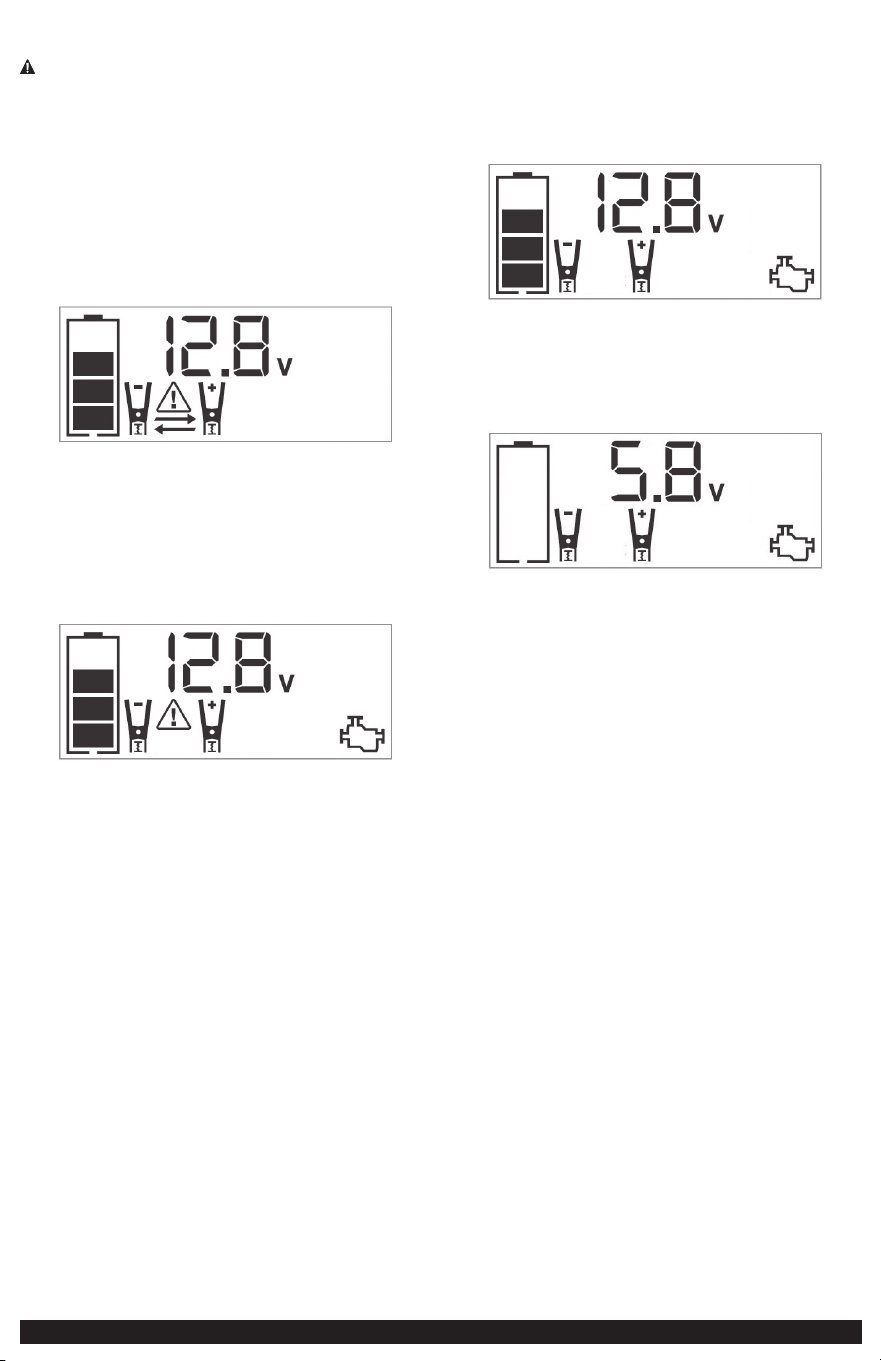
14
IMPORTANTE: Asegúrese de que el compresor esté apagado antes de intentar
utilizar la unidad como Arrancador Auxiliar.
ADVERTENCIA – – PARA REDUCIR EL RIESGO DE LESIONES O DAÑOS A LA
PROPIEDAD:
• SIGA TODAS LAS INSTRUCCIONES DE SEGURIDAD QUE SE ENCUENTRAN EN LA
sección “Instrucciones de Seguridad Específicas para Arrancadores Auxiliares” de
este manual de instrucciones.
• Nunca permita que se toquen las abrazaderas (pinzas) roja y negra juntas; esto
puede causar chispas peligrosas, arcos eléctricos y/o explosiones.
• Si las pinzas o abrazaderas están conectadas incorrectamente con respecto a la
polaridad, la unidad hará sonar una alarma continua hasta que las pinzas se
desconecten. La pantalla LCD retroiluminada mostrará el Ícono de Estado de la
Batería, el Icono de Voltaje de la Batería y los Iconos de las Abrazaderas. Los signos
“+” y “–” encima de los Iconos de Abrazaderas, los Iconos de Polaridad Inversa
y el Icono de Alarma parpadearán. La pantalla LCD retroiluminada mostrará lo
siguiente:
AVISO: La unidad sufrirá daños permanentes si el Interruptor de Encendido del
Arrancador se enciende mientras las abrazaderas o pinzas están conectadas con
polaridad inversa. Desconecte las abrazaderas y vuelva a conectarlas a la batería
con la polaridad correcta.
• Si el Interruptor de Encendido del Arrancador está encendido y la unidad detecta
que las pinzas no están conectadas a una batería, sonará una advertencia de dos
segundos cada 10 segundos. La pantalla LCD mostrará el Icono de Estado de la
Batería, el Indicador de Voltaje de la Batería y los Iconos de las Abrazaderas con
los signos “+” y “–”. El Icono de Alarma y el Icono del Arrancador parpadearán. La
pantalla LCD retroiluminada mostrará lo siguiente:
Apague el interruptor de encendido del arrancador; conecte las pinzas a la batería,
asegurándose de que las pinzas estén conectadas con la polaridad correcta; luego
vuelva a encender el interruptor de alimentación del arrancador auxiliar.
• Siempre desconecte primero el cable puente negativo (negro), seguido del cable
puente positivo (rojo), excepto en sistemas con conexión a tierra positiva.
Procedimiento
Siga los siguientes pasos, observando todas las precauciones y advertencias en la
sección “Instrucciones de Seguridad Importantes” al principio de este manual.
1. Apague el encendido del vehículo y todos los accesorios (radio, aire
acondicionado, luces, cargadores de teléfonos celulares conectados, etc.).
Coloque el vehículo en “Park” (detenerse / estacionarse) y ponga el freno de
emergencia.
2. Asegúrese de que el Interruptor de Encendido del Arrancador Auxiliar esté en
la posición de apagado.
3. Retire las abrazaderas o pinzas del puente de las abrazaderas. Conecte primero
la abrazadera roja y luego la abrazadera negra.
4. Procedimiento para arrancar un SISTEMA CON PUESTA A TIERRA NEGATIVA (el
terminal negativo de la batería está conectado al chasis) (MÄS COMÚN).
4a. Conecte la abrazadera roja positiva (+) al terminal positivo de la batería
del vehículo.
4b. Conecte la abrazadera negra negativa (–) al chasis o a un componente
metálico sólido e inmóvil del vehículo o a una parte de la carrocería.
Nunca sujete directamente al terminal negativo de la batería o a una
pieza móvil. Consulte el manual del propietario del automóvil.
5. Procedimiento para la puesta en marcha de SISTEMAS POSITIVOS DE TIERRA.
Nota:
En el raro caso de que el vehículo que se va a arrancar tenga un sistema positivo a tierra (el
terminal positivo de la batería está conectado al chasis), reemplace los pasos 4a y 4b anteriores
con los pasos 5a y 5b, luego continúe con el paso 6.
5a. Conecte la abrazadera negra negativa (–) al terminal negativo de la
batería del vehículo.
5b. Conecte la abrazadera roja positiva (+) al chasis del vehículo o a un
soporte sólido, inmóvil y metálico del vehículo o a parte de la carrocería.
Nunca la sujete directamente al terminal positivo de la batería o a una
pieza móvil. Consulte el manual del propietario del automóvil.
6. Cuando las abrazaderas estén conectadas correctamente, la unidad se
encenderá automáticamente en modo de arranque. La pantalla LCD
retroiluminada mostrará lo siguiente para indicar que la unidad está lista para
arrancar:
El Icono del Estado de la Batería, el Indicador de Voltaje de la Batería, los
Iconos de las Abrazaderas y los signos “+” y “–” se iluminarán de manera fija.
El Icono del Arrancador parpadeará para indicar que las abrazaderas están
conectadas correctamente.
7. Active el Interruptor de Encendido del Arrancador. Use el encendido y arranque
el motor en ráfagas de 5 a 6 segundos hasta que arranque. La pantalla LCD
retroiluminada mostrará lo siguiente:
8. El Ícono del Arrancador parpadea y el Ícono de Estado de la Batería, el
Indicador de Voltaje de la Batería, los Íconos de Abrazaderas y los signos “+” y
”–” se iluminan de manera fija para indicar que la unidad está arrancando.
9. Apague el Interruptor de Encendido del Arrancador.
10. Desconecte primero la abrazadera negativa (–) del motor o del chasis, luego
desconecte la abrazadera positiva (+) de la batería.
NOTA: Si la unidad no funciona correctamente después del procedimiento de
arranque auxiliar, recárguela con el cargador de CA suministrado para restablecerla.
IMPORTANTE: Apague siempre la unidad cuando no esté en uso. Recargue esta
unidad completamente después de cada uso.
AVISO – PARA REDUCIR EL RIESGO DE DAÑOS A LA PROPIEDAD:
• Los vehículos que tienen sistemas computarizados a bordo pueden sufrir daños
si se arranca la batería del vehículo. Antes de arrancar este tipo de vehículo, lea
el manual del vehículo para confirmar si se recomienda asistencia de arranque
externa.
• Un esfuerzo de arranque excesivo del motor puede dañar el motor de arranque
del vehículo. Si el motor no arranca después del número recomendado de intentos,
interrumpa el procedimiento de arranque auxiliar y busque otros problemas que
deban corregirse.
• Si el vehículo no arranca, apague el encendido, apague el interruptor de
alimentación del arrancador, desconecte los cables del sistema de arranque y
comuníquese con un técnico calificado para investigar por qué el motor no
arrancó.
COMPRESOR PORTÁTIL
El compresor incorporado de 12 voltios CC es el compresor definitivo para todos
los neumáticos de vehículos, neumáticos de remolques e inflables recreativos. Se
suministra un Adaptador de Boquilla que se atornilla al extremo del Adaptador
de Boquilla en el extremo libre de la Manguera de Aire. La Manguera de Aire con
conector para neumáticos se guarda en el compartimento de almacenamiento de la
manguera de aire. Referirse a ilustración de “Características” para la ubicación de la
Manguera de Aire. El Botón de Encendido del Compresor y los Botones de Control
de Presión del Compresor están ubicados en el panel de control en la parte frontal
de la unidad.
Antes de continuar, verifique el estado de la batería de la unidad en la pantalla
LCD. Cuatro barras sólidas en el Ícono de la Batería indican que la batería está
cargada. Cuando el nivel de la batería está casi vacío con solo una barra sólida, la
unidad DEBE recargarse antes de usarla o se activará la protección de bajo voltaje
incorporada de la unidad y el compresor se apagará automáticamente.
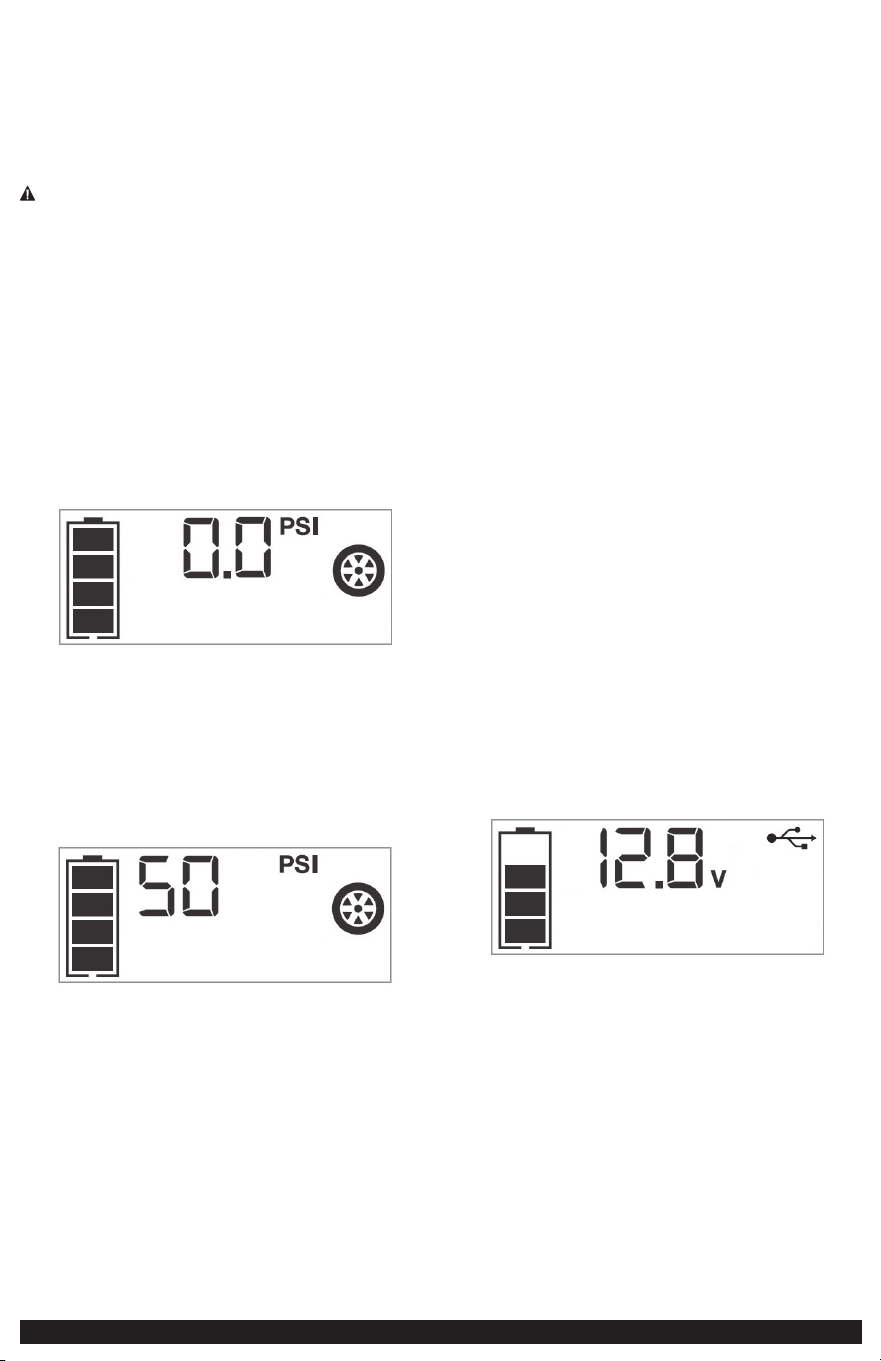
15
El compresor se puede usar quitando la manguera de aire del compartimiento
de almacenamiento y, si es necesario, colocando el Adaptador de Boquilla en la
Manguera de Aire. El compresor es capaz de inflar hasta 120 libras por pulgada
cuadrada (psi) de presión. El compresor puede funcionar el tiempo suficiente para
llenar hasta 3 neumáticos de tamaño medio antes de que sea necesario recargar
la batería. Devuelva la Manguera de Aire al compartimento de almacenamiento
después de su uso.
IMPORTANTE: Asegúrese de que el Interruptor de Encendido del Arrancador auxiliar
esté apagado antes de intentar usar la unidad como Compresor.
ADVERTENCIA – PARA REDUCIR EL RIESGO DE LESIONES O DAÑOS A LA
PROPIEDAD: Siga todas las instrucciones de seguridad que se encuentran en la
sección “Instrucciones de Seguridad Específicas para Compresores” de este manual
de instruccionesl.
AVISO – PARA REDUCIR EL RIESGO DE DAÑOS A LA PROPIEDAD:
No opere el compresor continuamente por más de 10 minutos ya que podría
sobrecalentarse. Esto podría dañar el compresor. Si el compresor debe funcionar
durante períodos más prolongados: cada 10 minutos presione el Botón de
Encendido del Compresor para apagarlo y luego reinícielo después de un período
de enfriamiento de aproximadamente 30 minutos.
En cualquier caso, el compresor se apagará automáticamente después de funcionar
continuamente durante 10 minutos.
Inflar Neumáticos o Productos con Vástagos de Válvula
1. Enrosque el Adaptador de Boquilla al Vástago de la Válvula. No apriete
demasiado.
2. Presione el Botón de Encendido del Compresor. Sonará un pitido y la pantalla
LCD retroiluminada mostrará lo siguiente:
El Ícono del Compresor se iluminará y la Pantalla Digital mostrará
alternativamente el valor psi preestablecido parpadeante (que fue configurado
por última vez con los Botones de Control de Presión del Compresor) y la
presión actual del artículo que se está inflando (que se iluminará fijamente).
3. Presione los Botones de Control de Presión “+” y “–” para configurar la
presión deseada entre un rango de valores preestablecidos (entre 3 y 120), que
se mostrará en la pantalla LCD retroiluminada. La unidad emitirá un pitido
cada vez que presione los botones (mantener presionado el botón acelera la
selección de valores hacia arriba o hacia abajo). Una vez que se haya ingresado
la presión deseada, suelte el botón y la pantalla digital parpadeante mostrará
la nueva presión seleccionada, de la siguiente manera:
El nuevo valor seleccionado ahora se almacena en la memoria de la unidad
hasta que se reinicie manualmente.
4. Presione el Botón de Encendido del Compresor una vez más para comenzar a
inflar. El Icono del Compresor parpadeará y la pantalla digital solo mostrará
el valor de presión actual (que se iluminará de forma fija) para indicar que el
compresor está activado. Controle la presión en la pantalla LCD.
NOTA IMPORTANTE: Para interrumpir durante el inflado, presione nuevamente
el Botón de Encendido del Compresor.
5. Cuando se alcance la presión preestablecida deseada, el compresor se detendrá
automáticamente.
6. Presione nuevamente el Botón de Encendido del Compresor para apagar la
unidad.
7. Desenrosque y retire el Adaptador de Boquilla del vástago de la válvula.
8. Deje que la unidad se enfríe y luego recárguela antes de guardarla.
9. Guarde la Manguera de Aire y el Adaptador de Boquilla en el compartimiento
de almacenamiento.
Inflar otros Inflables sin Vástagos de Válvula
El inflado de otros artículos requiere el uso del adaptador de boquilla.
1. Enrosque el Adaptador de Boquilla en la Boquilla Sure Fit®. No apriete
demasiado.
2. Inserte el Adaptador de Boquilla en el artículo que desea inflar.
3. Siga los pasos 2 a 4 de la sección “Inflado de Neumáticos o Productos con
Vástagos de Válvula”..
IMPORTANTE: Los artículos pequeños como pelotas de voleibol, balones de
fútbol, etc. se inflan muy rápidamente. Tenga esto en cuenta al ajustar la
presión. Tenga especial cuidado de no inflar demasiado.
4. Cuando se alcance la presión deseada, el compresor se detendrá
automáticamente. Presione nuevamente el botón de encendido del compresor
para apagar la unidad.
5. Desconecte el adaptador del artículo inflado.
6. Desenrosque y retire el Adaptador de Boquilla de la boquilla Sure Fit®.
7. Deje que la unidad se enfríe y luego recárguela antes de guardarla.
8. Guarde la Manguera de Aire, el Adaptador de Boquilla y el Adaptador de
Boquilla de la manguera en el compartimento de almacenamiento.
PUERTOS USB
El Botón de Encendido USB y los Puertos USB están ubicados en la parte frontal de
la unidad. Consulte la sección “Características” para localizarlo.
NOTAS IMPORTANTES:
El puerto USB-A proporciona hasta 15 W de potencia de salida. El puerto USB-C
proporciona hasta 25 W de potencia de salida PD. La salida total es de hasta 5 V/15
W cuando se utilizan USB-C y USB-A simultáneamente.
Cuando los puertos USB están en uso, la unidad monitoreará las siguientes
condiciones de falla USB en ambos puertos USB: falla de voltaje de batería baja,
sobrecarga y cortocircuito.
Los puertos USB se apagarán automáticamente. Si esto ocurre, desconecte el
dispositivo alimentado por USB y presione el botón de encendido USB nuevamente
para apagar los puertos USB inmediatamente. Asegúrese de que no sea necesario
recargar la unidad. Deje que la unidad se enfríe durante varios minutos antes de
intentar utilizar los puertos USB nuevamente.
Si vuelve a ocurrir una falla, asegúrese de que el consumo de los dispositivos USB
conectados a los puertos USB no exceda la clasificación máxima. Si un dispositivo
USB individual está dentro de las especificaciones y se produce la falla, haga que
revisen el dispositivo USB para ver si funciona mal y no continúe usándolo con estos
puertos USB.
Usar los Puertos USB
1. Presione el Botón de Encendido USB para encender ambos puertos USB. Sonará
un pitido y la pantalla LCD mostrará continuamente lo siguiente:
El Ícono de Estado de la Batería y el Indicador de Voltaje de la Batería se
iluminarán de manera fija, así como el ícono USB, lo que indica que los puertos
USB están listos para usarse.
2. Conecte el dispositivo que funciona con poder por USB a los puertos que
proveen poder a través de un USB y opere normalmente.
3. Presione nuevamente el Botón de Poder de USB para apagar los puertos USB.
PVerifique periódicamente el Estado de la Batería de la unidad en la pantalla LCD
retroiluminada. Cuatro barras sólidas en el ícono de la batería indican que la batería
está llena. Cuando el nivel de la batería está casi vacío con solo una barra sólida o
el Icono de Estado de la Batería completamente vacío, la unidad debe recargarse en
ese momento o se activará la protección de bajo voltaje incorporada de la unidad.
El USB se apaga automáticamente. El Icono de Estado de la Batería y el Indicador de
Voltaje de la Batería se iluminarán durante 10 segundos antes de que la unidad se
apague automáticamente.
IMPORTANTE: Asegúrese de que los puertos USB estén apagados cuando la unidad
se esté recargando o cuando esté almacenada.
Notas:
Los puertos USB de esta unidad no admiten comunicación de datos. Solo proporcionan energía a
dispositivos externos alimentados por USB Algunos aparatos electrónicos domésticos alimentados por
USB no funcionarán con esta unidad.

16
LUZ DE ÁREA LED
La Luz de Área LED incorporada se controla mediante el Botón de Encendido de
la Luz de Área en el Panel de Control (consulte la sección “Características” para
ubicarla). Presione el Botón de Encendido de la Luz de Área una vez para encender
la Luz de Área. Presione el Botón de Encendido de la Luz de {Area nuevamente
para apagar la luz de área.
IMPORTANTE: Cuando se presiona el Botón de Encendido de la Luz de Área para
encenderla, sonará un pitido. La pantalla LCD retroiluminada se encenderá durante
10 segundos (solamente) y luego mostrará continuamente el Icono de Estado de la
Batería y el Indicador de Voltaje de la Batería.
Verifique periódicamente el Estado de la Batería de la unidad en la pantalla LCD
retroiluminada. Cuatro barras sólidas en el Icono de la Batería indican que la batería
está llena. Cuando el nivel de la batería está casi vacío con solo una barra sólida o el
Icono de Estado de la Batería esté completamente vacío, la unidad debe recargarse
en ese momento o se activará la protección de bajo voltaje incorporada de la
unidad. La Luz del Area se apaga automáticamente. El Icono de Estado de la Batería
y el Indicador de Voltaje de la Batería se iluminarán durante 10 segundos antes de
que la unidad se apague automáticamente.
IMPORTANTE: Asegúrese de que la Luz del Área esté apagada cuando la unidad se
esté recargando o cuando esté almacenada.
CUIDADO Y MANTENIMIENTO
Todas las baterías pierden energía por auto descarga con el tiempo y más
rápidamente a temperaturas más altas. Cuando la unidad no esté en uso,
recomendamos cargar la batería al menos cada 30 días.
Nunca sumerja la unidad en agua. Si la unidad se ensucia, limpie suavemente las
superficies exteriores de la unidad con un paño suave.
No hay piezas reemplazables por el usuario. Esta unidad no es reparable.
BATERÍA
Tenga en cuenta que la batería está diseñada para durar toda la vida útil de la
unidad y no es reemplazable, extraíble ni reparable. La vida útil depende de una
serie de factores que incluyen, entre otros, el número de ciclos de recarga y el
cuidado y mantenimiento adecuados de la batería por parte del usuario final.
Póngase en contacto con el fabricante para cualquier información que pueda
necesitar.
Eliminación Segura de la Bateríal
Contiene una batería de plomo-ácido, sellada y a prueba de derrames, que no
requiere mantenimiento y que debe desecharse adecuadamente.
Se requiere reciclaje. El incumplimiento de las regulaciones
locales, estatales y federales puede resultar en multas o prisión.
Por favor recicle.
ADVERTENCIAS:
• No arroje la batería al fuego, ya que esto podría provocar una explosión.
• Antes de desechar la batería, proteja los terminales expuestos con cinta aislante
resistente para evitar cortocircuitos (los cortocircuitos pueden provocar lesiones o
incendios).
• No exponga la batería al fuego ni al calor intenso, ya que podría explotar.
SOLUCIÓN DE PROBLEMAS
Si la unidad no carga
• Asegúrese de que todas las funciones de la unidad estén apagadas.
• Asegúrese de que un cable de extensión de calibre adecuado esté correctamente
conectado tanto a la unidad como a una toma de CA que funcione.
Si la unidad no logra arrancar
• Asegúrese de que el interruptor de encendido del arrancador auxiliar de la unidad
esté en la posición de encendido.
• Asegúrese de que se haya establecido una conexión de cable con la polaridad
adecuada.
• Asegúrese de que la unidad no esté funcionando en el modo Compresor.
• Verifique que la unidad tenga carga completa. Recargue la unidad si es necesario.
Si el compresor portátil no infla
• Asegúrese de que se haya presionado el Botón de Encendido del Compresor para
encender el compresor.
• Asegúrese de que la unidad no esté funcionando en el modo Arrancador Auxiliar.
• Asegúrese de que la boquilla Sure Fit® esté bien atornillada al vástago de la
válvula cuando intente inflar neumáticos; o que el Adaptador de la Boquilla
esté bien atornillado a la boquilla Sure Fit® y esté insertado correctamente en el
artículo que se va a inflar en todos los demás inflables.
• Verifique que la unidad tenga carga completa. Recargue la unidad si es necesario.
Si el Puerto de Proveer Energía USB no hace funcionar el aparato
• Asegúrese de que el Botón de Dar Poder USB esté presionado para encender los
puertos USB.
• Existe una condición de falla en uno de los puertos USB. Consulte las Notas
importantes en la sección “PUERTOS USB” para solucionar cualquier falla.
• Asegúrese de que el dispositivo USB conectado al puerto USB-A no supere los 15
W; que el dispositivo USB conectado al puerto USB-C no supere los 25W PD; o que
el total de la energía consumida del puerto USB-A y del puerto USB-C no supere
los 15 W cuando se utilizan simultáneamente.
• Algunos aparatos electrónicos domésticos alimentados por USB no funcionan
con este puerto de carga/alimentación USB. Consulte el manual del dispositivo
electrónico correspondiente para confirmar que se puede utilizar con este tipo de
puerto de carga/alimentación USB.
• Verifique que la unidad tenga carga completa. Recargue la unidad si es necesario.
Si la Luz LED de Área no se enciende
• Asegúrese de que el botón de encendido de la luz de área esté presionado para
encender la luz de área.
• Verifique que la unidad tenga carga completa. Recargue la unidad si es necesario.
ACCESORIOS
Los accesorios recomendados para usar con su herramienta pueden estar disponibles
del fabricante. Si necesita ayuda con respecto a los accesorios, comuníquese con el
fabricante al 1-877-571-2391.
El uso de cualquier accesorio no recomendado para este aparato podría ser peligroso.
ASISTENCIA TÉCNICAE
Para Servicio al Cliente o Asistencia Técnica, comuníquese con el fabricante al 1-877-571-2391.
GARANTÍA LIMITADA DEL FABRICANTE DE UN AÑO
El fabricante, Baccus Global LLC, garantiza este producto contra defectos de
materiales y mano de obra por un período de UN (1) AÑO a partir de la fecha
de la compra minorista por parte del comprador usuario final original o desde la
fecha de entrega del bien, cualquiera que sea la fecha de compra. ocurre más tarde
(“Período de Garantía”).
Si hay un defecto y el fabricante recibe un reclamo válido dentro del Período de
Garantía, el producto defectuoso se puede reemplazar de las siguientes maneras: (1)
Devolver el producto al fabricante para su reemplazo. Es posible que el fabricante
solicite un comprobante de compra. (2) Devolver el producto al minorista donde lo
compró para un cambio (siempre que la tienda sea un minorista participante).
Las devoluciones al vendedor minorista deben realizarse dentro del período de
tiempo de la política de devolución del minorista para cambios únicamente. Es
posible que se requiera prueba de compra. Consulte con el minorista su política
de devolución específica con respecto a las devoluciones que superan el tiempo
establecido para los cambios.
La garantía de este fabricante no se aplica a accesorios, bombillas, fusibles y
baterías; defectos resultantes del desgaste normal, accidentes; daños sufridos
durante el envío; alteraciones; uso no autorizado; negligencia, mal uso, abuso; y el
incumplimiento de las instrucciones de cuidado y mantenimiento del producto.
Esta garantía del fabricante le otorga a usted, el comprador minorista original, derechos
legales específicos y usted puede tener otros derechos que varían de un estado a otro o
de una provincia a otra. Este producto no está diseñado para uso comercial. Para registrar
su producto con el fabricante, visite www.BaccusGlobal.com.
Las fotografías de este manual pueden diferir de la unidad real.
ESPECIFICACIONES
Aumento de Amperaje: Batería máxima de 1500A
Tipo de batería: Ácido de plomo sellado, sin
mantenimiento, 12 VCC
Entrada de CA: 14.5VDC, 800mA
Salida de USB-C: 5VDC 3A / 9VDC 2.77A (PD 25W Max.)
Salida de USB-A: 5VDC, 15W Max.
USB-C y USB-A Salida simultánea: 5VDC, 15W Max.
Presión máxima de compresor: 120 PSI
Sure Fit® es una marca registrada propiedad de Baccus Global, LLC.
STANLEY® Y EL LOGOTIPO DE STANLEY® SON MARCAS REGISTRADAS DE STANLEY BLACK + DECKER INC. O
UNA DE SUS AFILIADAS, Y SE UTILIZAN BAJO LICENCIA.
Imported by Baccus Global LLC,
621 NW 53rd St., Suite 450, Boca Raton, FL 33487
www.baccusglobal.com 1-877-571-2391
RD110823