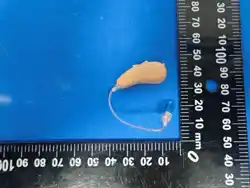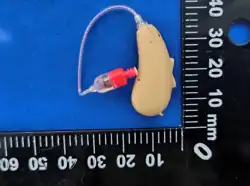
User Manual
Digital Rechargeable BTE Hearing Aids
Warnings
WARNING: If you are younger than 18, do not use this.
You should go to a doctor, preferably an ear-nose-throat doctor (an ENT), because your
condition needs specialized care. Over-the-counter hearing aids are only for users who are age
18 or older.
This hearing aid is for users who are 18 and older.People who are younger than 18 with
hearing loss should see a doctor, preferably an ENT, because they may need medical testing and
management.Hearing loss can affect speech and learning, so professional fitting and continuing
care are also important.
WARNING: When to See a Doctor
If you have any of the problems listed below, please see a doctor, preferably an ear-nose-throat
doctor (an ENT).
·Your ear has a birth defect or an unusual shape. Your ear was injured or deformed in an
accident.
·You saw blood, pus, or fluid coming out of your ear in the past 6 monthsYour ear feels painful
or uncomfortable.
·Your ear feels painful or uncomfortable.
·You have a lot of ear wax, or you think something could be in your ear.
·You get really dizzy or have a feeling of spinning or swaying (called vertigo).
·Your hearing changed suddenly in the past 6 months.
·Your hearing changes: it gets worse then gets better again.
·You have worse hearing in one ear.
·You hear ringing or buzzing in only one ear.
WARNING: This hearing aid should not cause pain when inserting it.
Remove this device from your ear if it causes pain or discomfort when you insert or place it.
To try again, make sure to follow the instructions. If you feel pain or discomfort again, contact
the manufacturer. If your pain or discomfort doesn't go away, contact your hearing healthcare
professional. You can also report this to FDA as an adverse event according to the instructions
that appear later.
These PRECAUTIONS point out situations which could cause minor or moderate injuries to
the user or to the hearing aid.
· You should familiarize yourself fully with the entire contents of this user manual before
FCC ID:2A445FAIP916-DW
using the hearing aid to ensure personal safety and correct use. Contact the manufacturer for
support if you experience unexpected operations or performance.
·Do not attempt to modify the shape of the hearing aid or slim tube yourself.
These WARNINGS point out situations which could cause serious injuries to the user or to
the hearing aid.
·In some acoustic environments, over amplification can cause discomfort and damage to the
patient’s hearing.
·A hearing aid should only be used as directed by your physician or hearing healthcare provider.
· Do not use your hearing aid in explosive or oxygen-enriched areas. Allergic reactions to
hearing aids are unlikely. However, if you experience itching, redness, soreness,
inflammation, or a burning sensation in or around your ears, inform your hearing healthcare
provider and contact your physician.
·You may notice accelerated accumulation of earwax when using your hearing aid. This is
normal, but see your hearing healthcare provider if you continue to have difficulty.
·In the unlikely case that any parts remain in the ear canal after the removal of the hearing aid,
contact a physician immediately. Report the event to your hearing healthcare provider as soon
as possible.
·Remove your aids for CT and MRI scans or for other electromagnetic procedures.
·Never leave your hearing aids or batteries where small children and pets can reach them. If
batteries are swallowed or inhaled, contact the local poison control center immediately.
·If you feel pain in or behind your ear, if it is inflamed, if skin irritation or accumulations of ear
wax occur, please check with your hearing healthcare provider or physician.
·Your hearing aids have been adjusted for your hearing needs; please do not share your hearing
device with other people.
Caution and notices for users
Caution: This is not hearing protection.
You should remove this device if you experience overly loud sounds, whether short or
long-lasting. If you're in a loud place, you should use the right kind of hearing protection
instead of wearing this device. In general, if you would use ear plugs in a loud place, you
should remove this device and use ear plugs.
Caution: The sound output should not be uncomfortable or painful
You should turn down the volume or remove the device if the sound output is uncomfortably
loud or painful. If you consistently need to turn the volume down, you may need to further
adjust your device.
Caution: You might need medical help if a piece gets stuck in your ear.
If any part of your hearing aid, like the eartip, gets stuck in your ear, and you can't easily
remove it with your fingers, get medical help as soon as you can.You should not try to use
tweezers or cotton swabs because they can push the part farther into your ear, injuring your
eardrum or ear canal, possibly seriously.
Note: If you remain concerned, consult with a professional.
If you try this device and continue to struggle with or remain concerned about your hearing,
you should consult with a hearing healthcare professional.
Note: What you might expect when you start using a hearing aid.
A hearing aid can benefit many people with hearing loss. However, you should know it will
not restore normal hearing, and you may still have some difficulty hearing over noise. Further,
a hearing aid will not prevent or improve a medical condition that causes hearing loss.
People who start using hearing aids sometimes need a few weeks to get used to them.
Similarly, many people find that training or counseling can help them get more out of their
devices.
If you have hearing loss in both ears, you might get more out of using hearing aids in both,
especially in situations that make you tired from listening-for example, noisy environments.
Note: Tell FDA about injuries, malfunctions, or other adverse events.
To report a problem involving your hearing aid, you should submit information to FDA as
soon as possible after the problem. FDA calls them "adverse events," and they might include:
skin irritation in your ear, injury from the device (like cuts or scratches, or burns from an
overheated battery), pieces of the device getting stuck in your ear, suddenly worsening hearing
loss from using the device, etc.
Instructions for reporting are available at https://www.fda.gov/Safety/MedWatch, or call
1-800-FDA-1088. You can also download a form to mail to FDA.
Dear customer
:
Thank you for choosing our
The hearing aid is a very sophisticated electronic equipment which is used for hearing
compensation for the one who has hearing impaired .
This manual will introduce you some basic use methods of hearing aid and the solutions of
common problems to help you use hearing aid better. Please read it carefully and regard it as a
user guide.
With any question, please be free to contact the customer service center.
Digital Rechargeable BTE Hearing Aids!

1. Overview
This Digital
(Hearing Aid for below items) has been passed the strictly
quality inspection to make sure the device in perfect performance.
a) Product Feature
Digital
R
echargeable BTE
H
earing aid is equipped with digital intelligent function,
multiple processing channels, intelligent adaptive noise reduction management system and
efficient adaptive feedback suppression function etc.
This product is not only suitable for listening in a quiet environment but also suitable for
a noisy environment. Product appearance design shows a new trend of the BTE hearing aid
correspond with human body engineering principle, wearing comfortable and big power.
Softwave Description:
Embedded sound processing softwave based on low-power DSP.
b) Main Application and Scope
The hearing aids are a pair of air conduction hearing aids intended for use by individuals 18
years and older with perceived mild to moderate hearing impairment.
c) Product Model
FAIP916-DW
d) Environment and Conditions
Working environments
Temperature: 0℃
~
+40℃ (32°F ~ 104°F)
Humidity:0
﹪
RH
~
80
﹪
RH
Voltage:
Storage environments
Temperature:-20℃
~
+50℃ (-4°F ~ 122°F)
Humidity: 0
﹪
RH
~
93
﹪
RH
Atmospheric pressure: 86KPa
~
106KPa.
Storage conditions: Room temperature, clean, dark, no corrosive gas and well ventilated
room.
Transportation conditions: The packaged hearing aids can be transported by general cargo
Rechargeable
BTE
Hearing
Aids
Hearing aid: DC 3.6V from battery or DC 5V from Charging case
Charging case: DC 5V from adapter or DC 3.7V from battery

transportation method, and shall be protected from rain, exposure and collision during
transportation.
e) Impact on the Environment
The Hearing aid is built in the rechargeable Lithium battery, please dispose of the used
battery regarding of local regulations to protect the environment.
f) Safety
Danger: To avoid being swallowed by children in accident, please keep the hearing aid away
from children.
Those who have undergone ear canal surgery are not recommended to buy this product
directly. They should go to the hearing center to consult with an audiologist or a doctor
before purchasing.
A hearing aid should not be applied to both ears at the same time. Because the hearing loss
of the right or left ear is different.
In case of battery leakage, please stop using the hearing aid and contact the customer
service center.
To avoid remove the hearing aid ear dome leaving it in the ear, wear and remove hearing
aids gently.
Hearing aid designed in a way that users cannot be unintentionally exposed to a SPL above
the fitted OSPL90 in normal condition.
For hearing aids, the patient is also the operator.
2.Structural Characteristics and Operating Principle
The product is mainly composed of microphone, signal amplification and processing circuit,
receiver, volume control circuit, lithium battery, shell and embedded software.
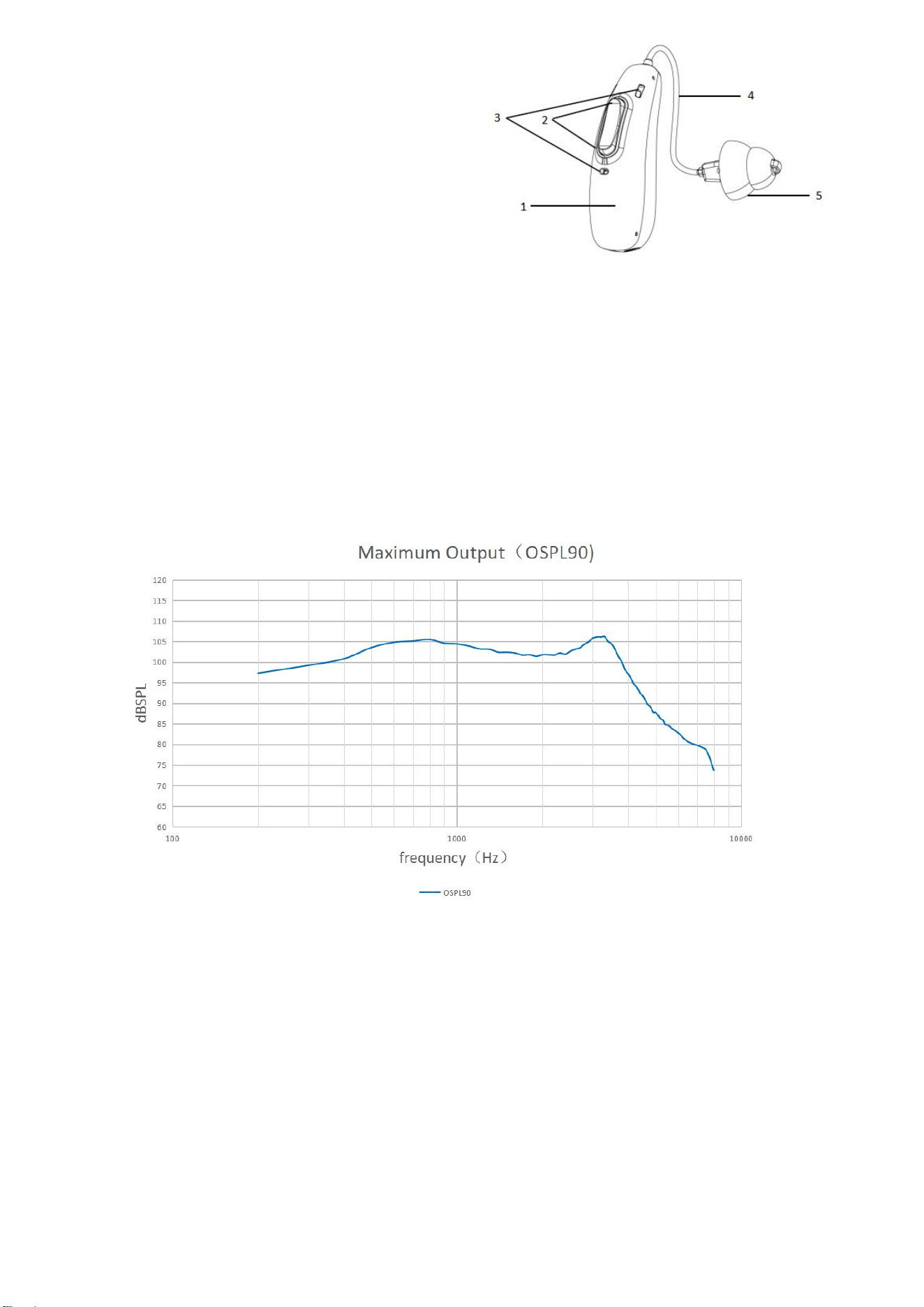
1. Shell
2. Volume Control/Program Switch
3. Microphone
4. Receiver
5. Ear Dome (The appearance shall be subject to the actual situation)
3.Technical Specification
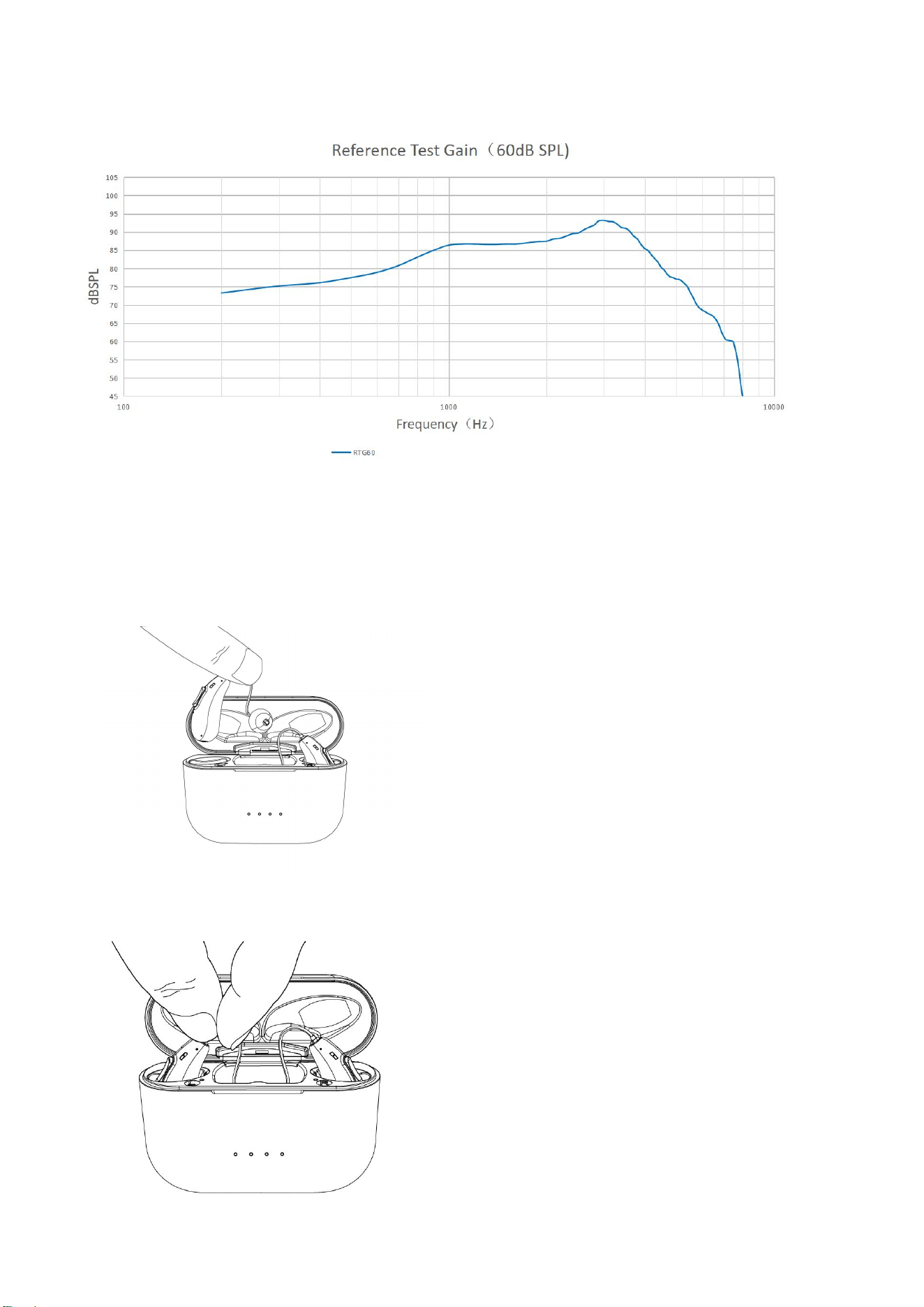
Response curve
4.Steps for Wearing Hearing Aid and Use
a) Power ON/OFF
Power ON: Take the hearing aid out of the charging box and it will turn on automatically.
Power OFF: The hearing aid will turn off automatically when it is put into the charging box.
Note: Both ends of the charging line are connected with the power adapter and the charging box.
Battery life
The hearing aids can work for more than 16H when the battery is fully charged. The full
charging boxes can charge hearing aids 3 times.
Hearing aids: battery:3.6V, 42mAh, 0.15Wh.
Charging box: FAC061, Input:DC5V⎓ 1A, Output:DC5V⎓ 30mA,
Battery:DC3.7V 500mAh 1.85Wh.
Power Adapter: Input:100-240V~50/60Hz, 0.35A
, Output:DC5V⎓ 1A.
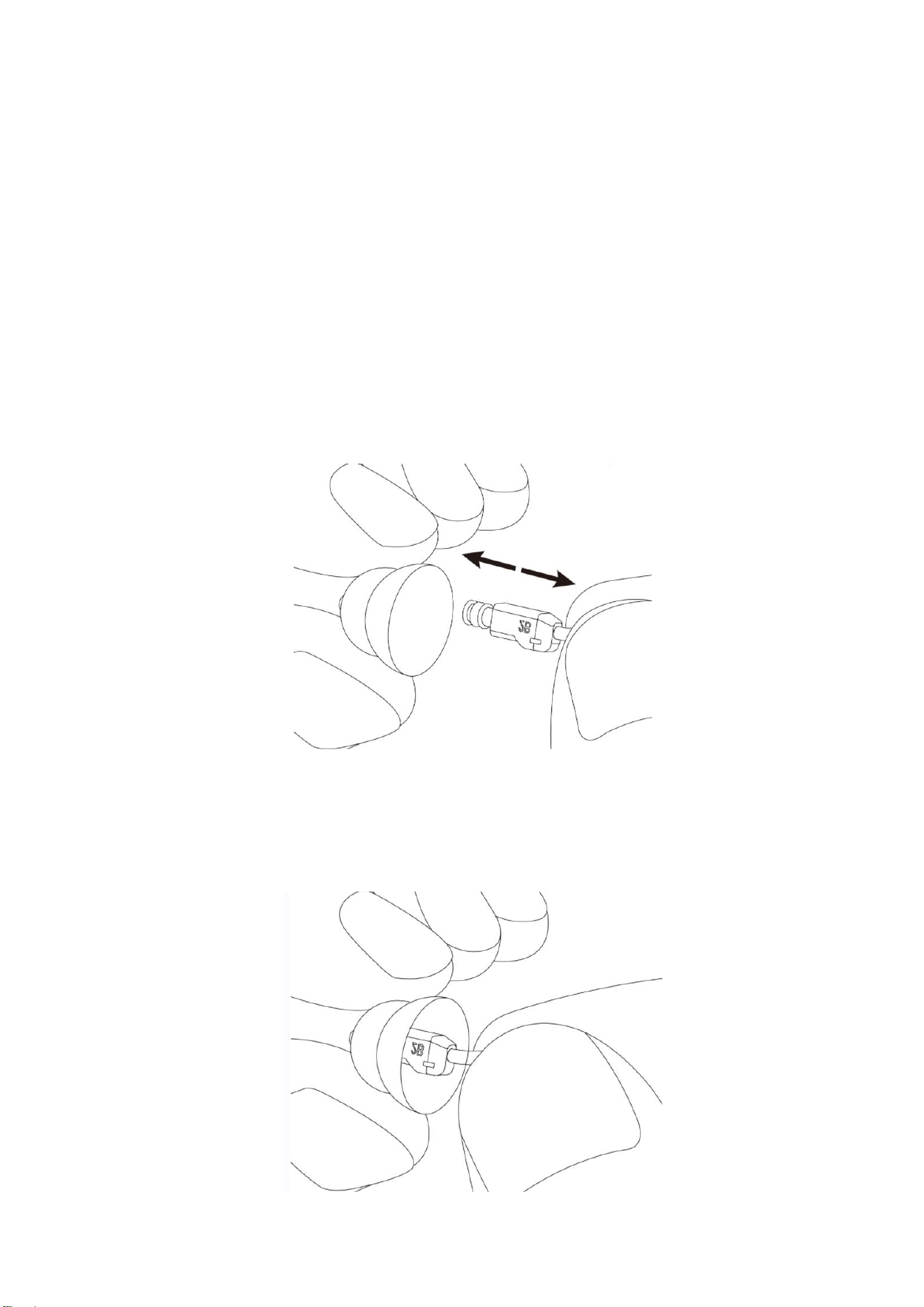
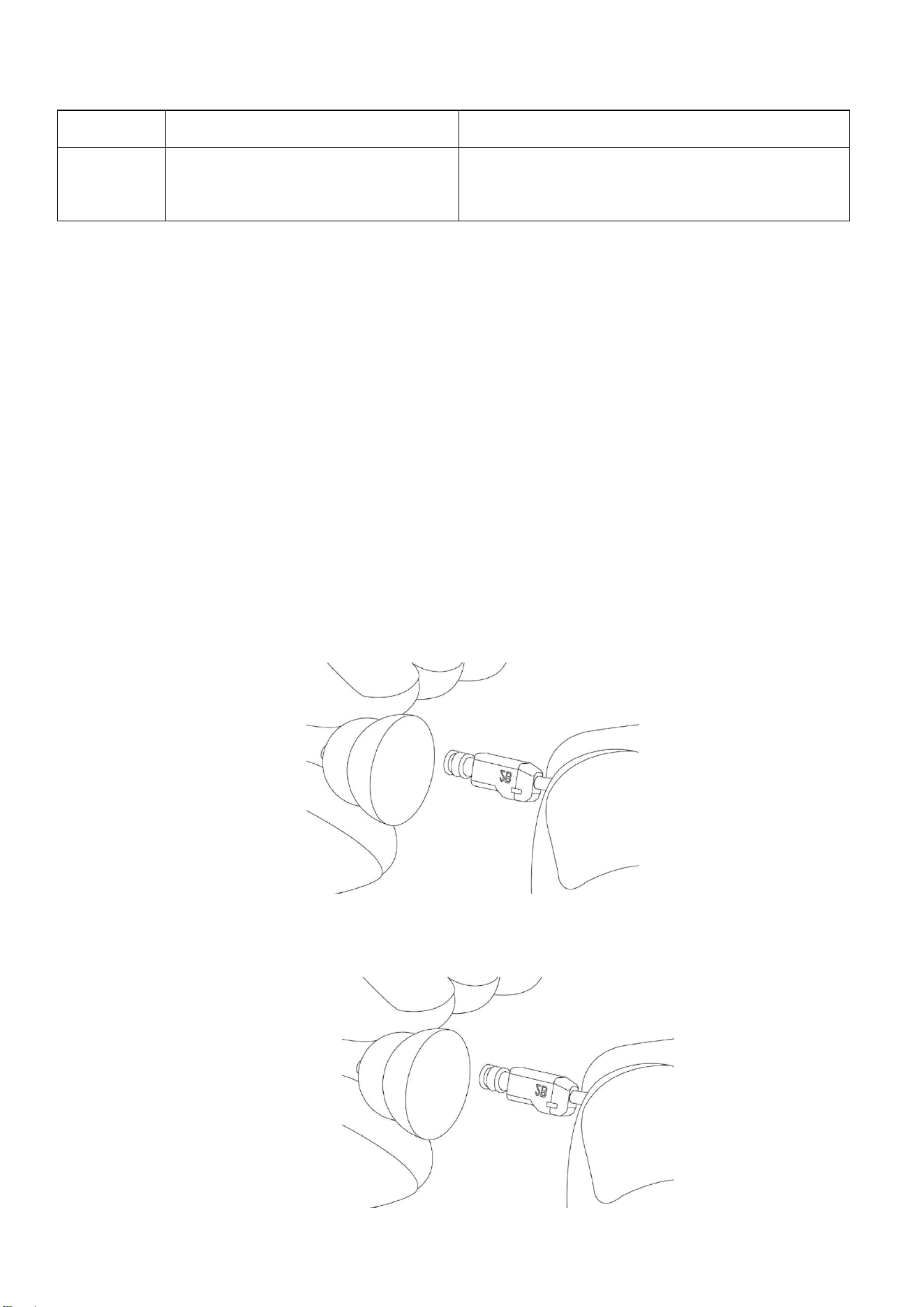
b) Fit Ear Dome
Remove Earplugs: Pinch the earplug with your thumb, index finger and middle finger to separate
the earplug from the connector.
Fit Earplugs: Select appropriate earplug according to the size of the ear canal, hold the earplug
and fit it into the connector of the hearing aid. It is required to be fitted in place.
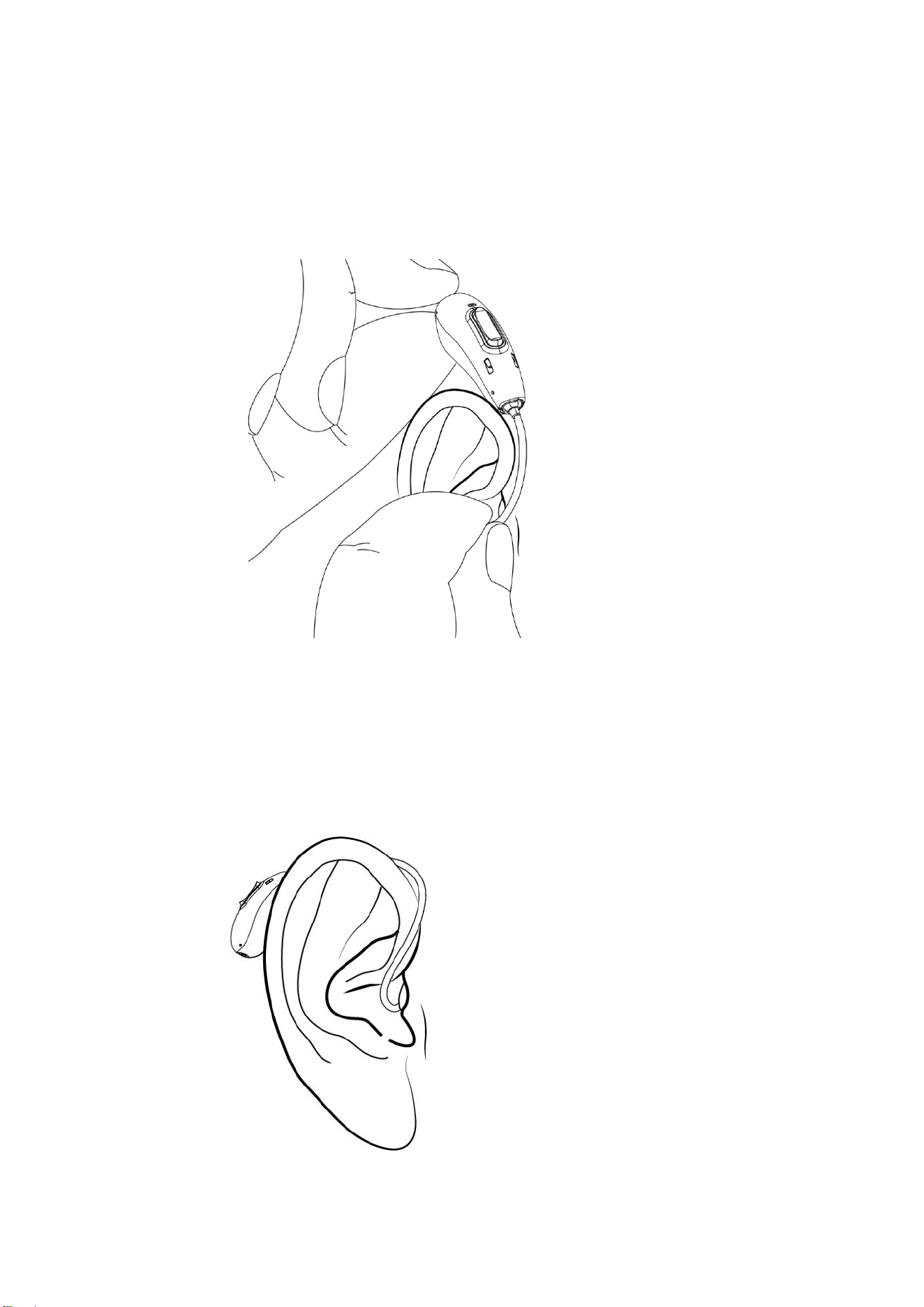
c) Wear Hearing Aid
Steps:
Hold the bottom of the tube with your fingers and gently push the earplug into the ear canal.
Put the hearing aid behind the ear, and close to the head and comfortably over the pinna.
If it feels like the dome is falling out of your ear, it means that the dome is most likely too small
for your ear. Try changing your dome to one that is a size larger.
If it feels like you have to squeeze or force the dome into your ear, it means that the dome is
most likely too large for your ear. Try changing your dome to one that is a size smaller.
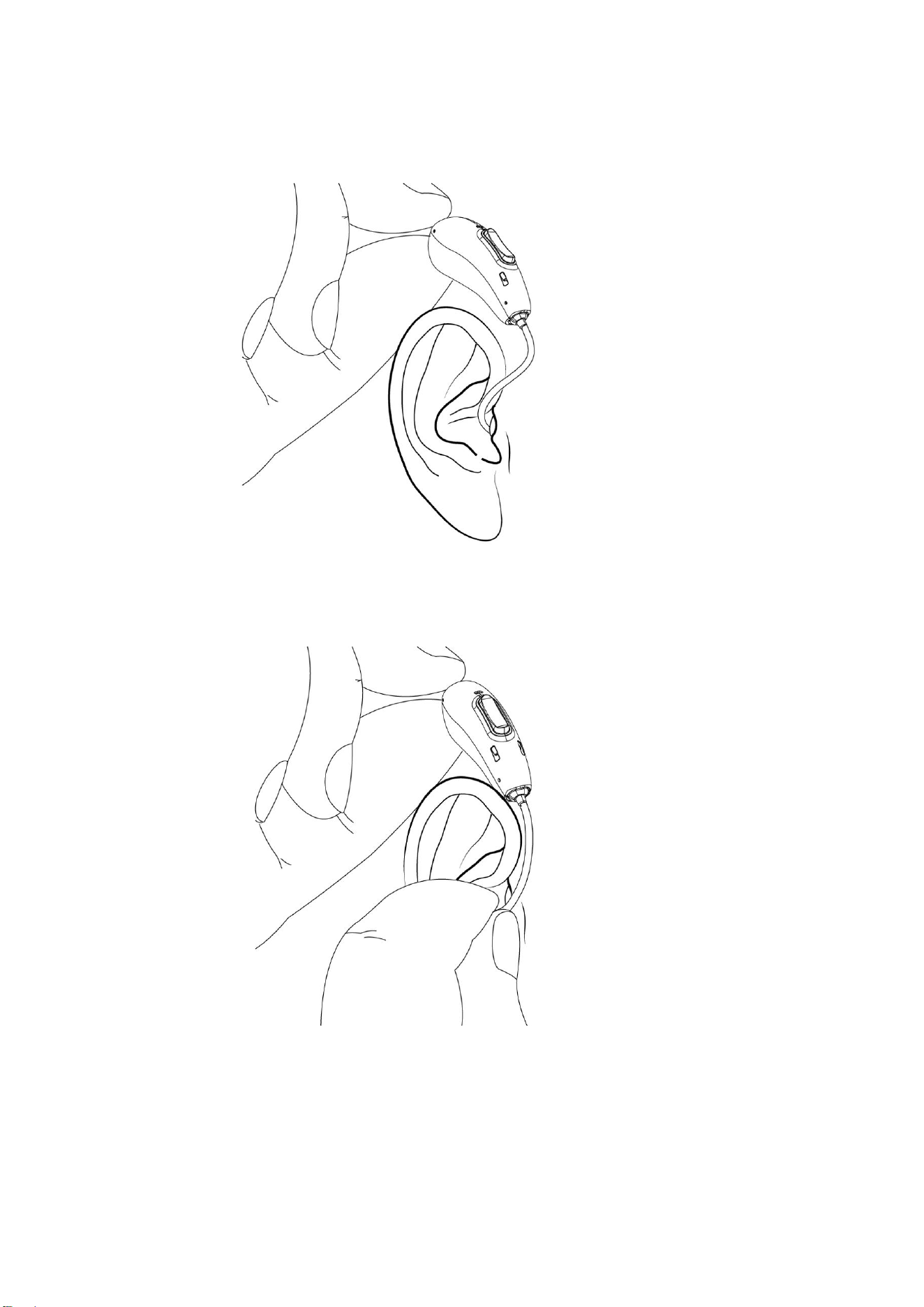
d) Remove Hearing Aid
1. Take off the hearing aid behind the ear.
2. Hold the bottom of the sound tube and pull it gently. After the earplug is loose, take it out and
take it off together with the hearing aid.
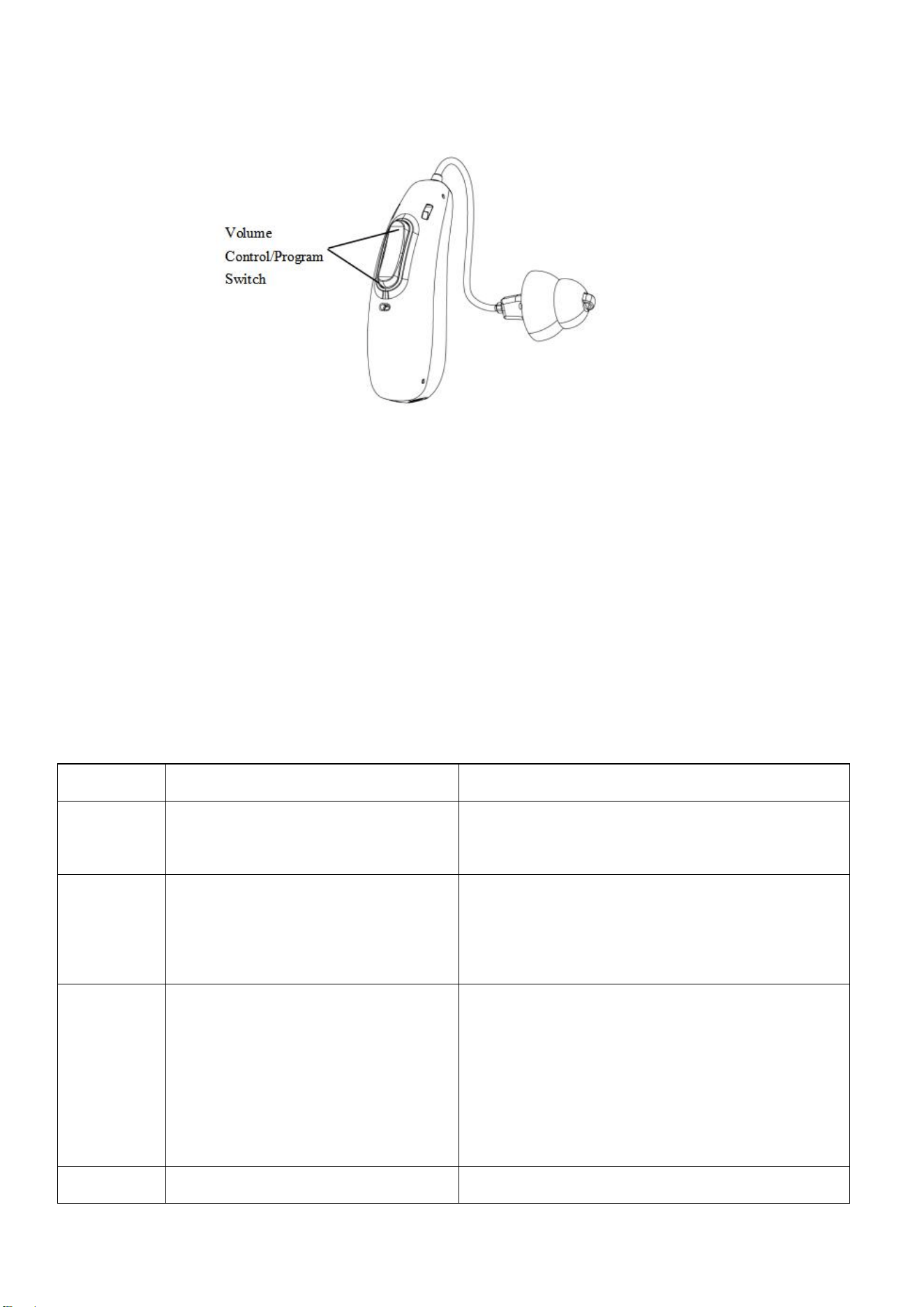
e) Volume Control/Program Switch
Volume Control/Program Switch
Volume Control: Push“+” to increase the volume and push“-”to reduce the volume.
Program Switch: Push Volume Control “+”or “-”more than 2 seconds, program switching
automatically. Kindly explain that user push “+” to make program switch in positive cycle and user push “-” to
make program switch in reverse cycle.
Sleeping Mode or Power ON : Pressing the button for 5 seconds is a sleeping mode, and the hearing
aid has no sound output. Press the button for 3 seconds again to wake up the hearing aid and restore normal
operation.
5.Troubleshooting
Failure Cause Solution
Whistling Hearing aid is not worn correctly
Too much earwax
Wear it correctly again
Clean earwax
Silent Power off
Low battery or no power
Dirt blocks the earplug or the tube
Turn it on
Charging the hearing aid
Clean the earplug or the sound tube
Small Sound Low volume
Low battery power
Hearing aid is damped
Dirt blocking the sound tube or the
earplugs
Turn up the volume
Charge the hearing aid
Dehumidify it with a dry box
Clean the sound tube or the earplug
High Power Hearing aid is still on when not in use Please turn it off when hearing aid is not in use
Consumption Hearing aid is damped Dehumidify it with a dry box
Intermittent
Sound
Dirt blocks the sound tube
Dirt blocks the earplugs
Clean the sound tube
Clean the earplugs
If the above methods still cannot solve the problem, please contact the customer service center of our company
directly.
6.Maintenance of hearing aids and charging boxes
During the use of hearing aid, earwax (cerumen) produced by the ears will accumulate in the ear canal and the
sound hole of the hearing aid. A large amount of accumulated earwax will affect the use effect of the hearing
aid, so please clean your ear canal and maintain the hearing aid regularly. please clean and maintain the
charging boxes regularly.
a) Clean Ear Dome
Remove the ear dome from the hearing aid.
Clean the earwax with a cleaning cloth or wash the ear dome with clean water.
Please wipe the ear dome dry and make sure there is no water droplets left. If there are tools
like a blowing balloon, you can use a blowing balloon to dry the water droplets.
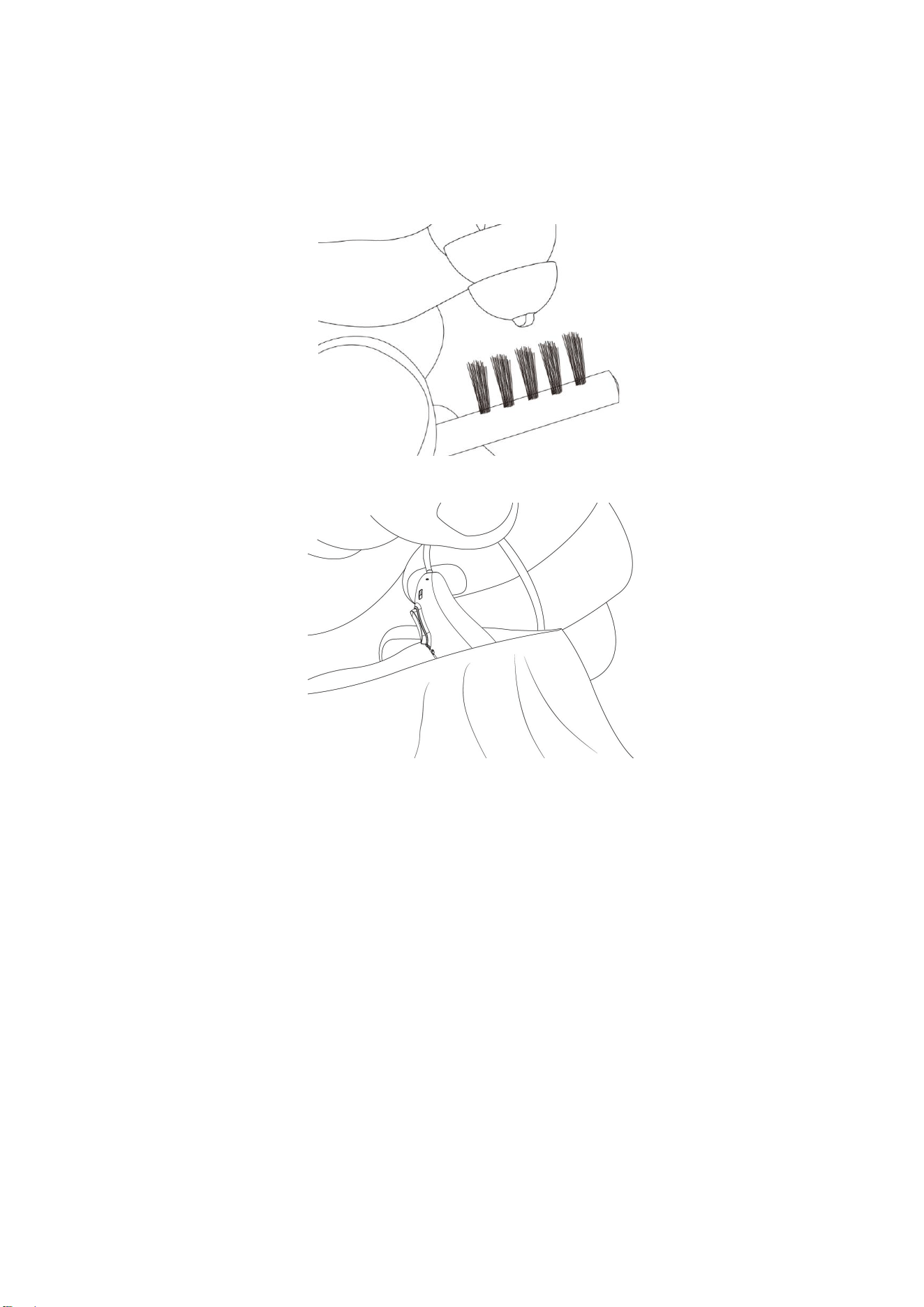
b) Clean Hearing Aid and charging box
Use the small brush delivered in the packing box to clean the earwax at the sound outlet
of the hearing aids.
Please clean your hearing aid and charging box with a dry soft cloth.
Wipe or clean the hearing aids and charging box on a soft desktop (e.g. a soft towel can be
padded on the desktop) to avoid damage caused by accidental falling of the hearing aids and
charging box.
☆ Remember: Do not use any liquid to clean the hearing aids and charging box.
c) Anti-Vibration
If you don’t use them when going out, please put the hearing aid in the shockproof box or
shockproof bags.
7.Precautions for Hearing Aid
a) Dehumidification
Any form of moisture is influential for hearing aid, dehumidification can extend the
life of the hearing aid. Avoid using or storage in humid environment, and please dry the
hearing aid on a regular basis.
b) Water Prevention
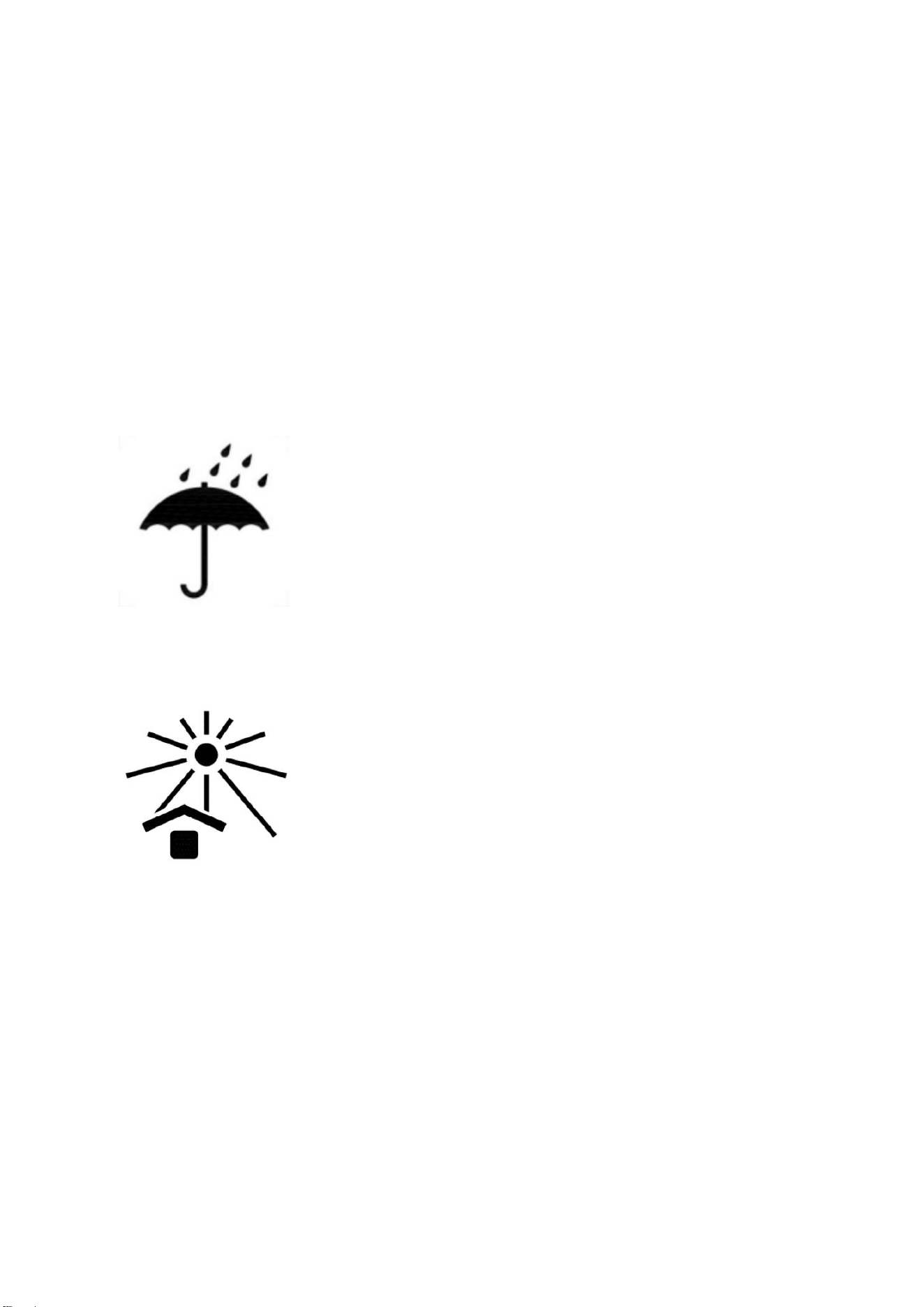
Do not immerse the hearing aids in any liquid. Remove the hearing aids in advance and
keep it properly when swimming, bathing, washing hair, washing face, etc Please wait until
the ear canal is dry before wearing your hearing aids. after swimming and showering. In
case the hearing aid falls into the water accidentally, do not dry it in the microwave oven or
any dryer. You can dry it with soft and clean cotton cloth and dry it naturally in a ventilated
environment. If there is any fault, please contact the fitting center where you purchased the
hearing aid or directly contact the customer service center of our company.
c) High Temperature Prevention
Never exposing hearing aid on extreme temperatures or prolonged exposure to sunlight.
d) Falling Prevention
Please do not drop your hearing aid or knock them against hard surfaces.
e) Precautions for Electromagnetic Compatibility
Classification by anti electric shock type: Internal power supply equipment.
Classification according to the degree of protection against electric shock: Type B
application part.
Classification by operation mode: Continuous operation equipment.
This product will not restore normal hearing and will not prevent or improve hearing
impairment resulting from organic conditions. This product is designed to help you make
greater use of your remaining hearing. You should keep in mind that it can take time to
become accustomed to hear new sounds.
For best results, using the hearing aids as much as possible. In most of time, infrequent use
of the hearing aids doesn’t permit you to attain full benefit from them.
The use of a hearing aid is only part of hearing rehabilitation and may need to be
supplemented by auditory training and instruction in lipreading.
8.Unpack and Check
After unpacking, please check the actual category and quantity of accessories.
Check the model marked on the manual is consistent with the model of hearing aid.
9.Contraindication
Patients with acute otitis external, tympanitis, chronic suppurative otitis media (in the period of
purulent infection), acute suppurative otitis media and allergic to this material. Fitting hearing
aid shall be undergone professional hearing test and fitting, and be used under the professional
guidance of a doctor or a audiologist.
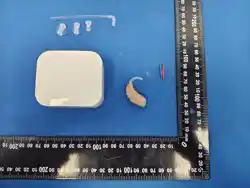
10.Accessories list
Accessories List Number Unit
Ear domes
1 PC
User manual
1 PC
Charger boxes 1 PC
Type-C cable 1 PC
Cleaning tool
1 PC
Cerumen cap suit
1 PC
f) Others
The button should be used correctly and pressed gently as far as possible to avoid excessive
force.
The hearing aid professional for RECD measured to correct target of fitted OSPL90.
Only to connect to equipment that conforms with international safety standards, if externally
connected.
Adapter
1 PC
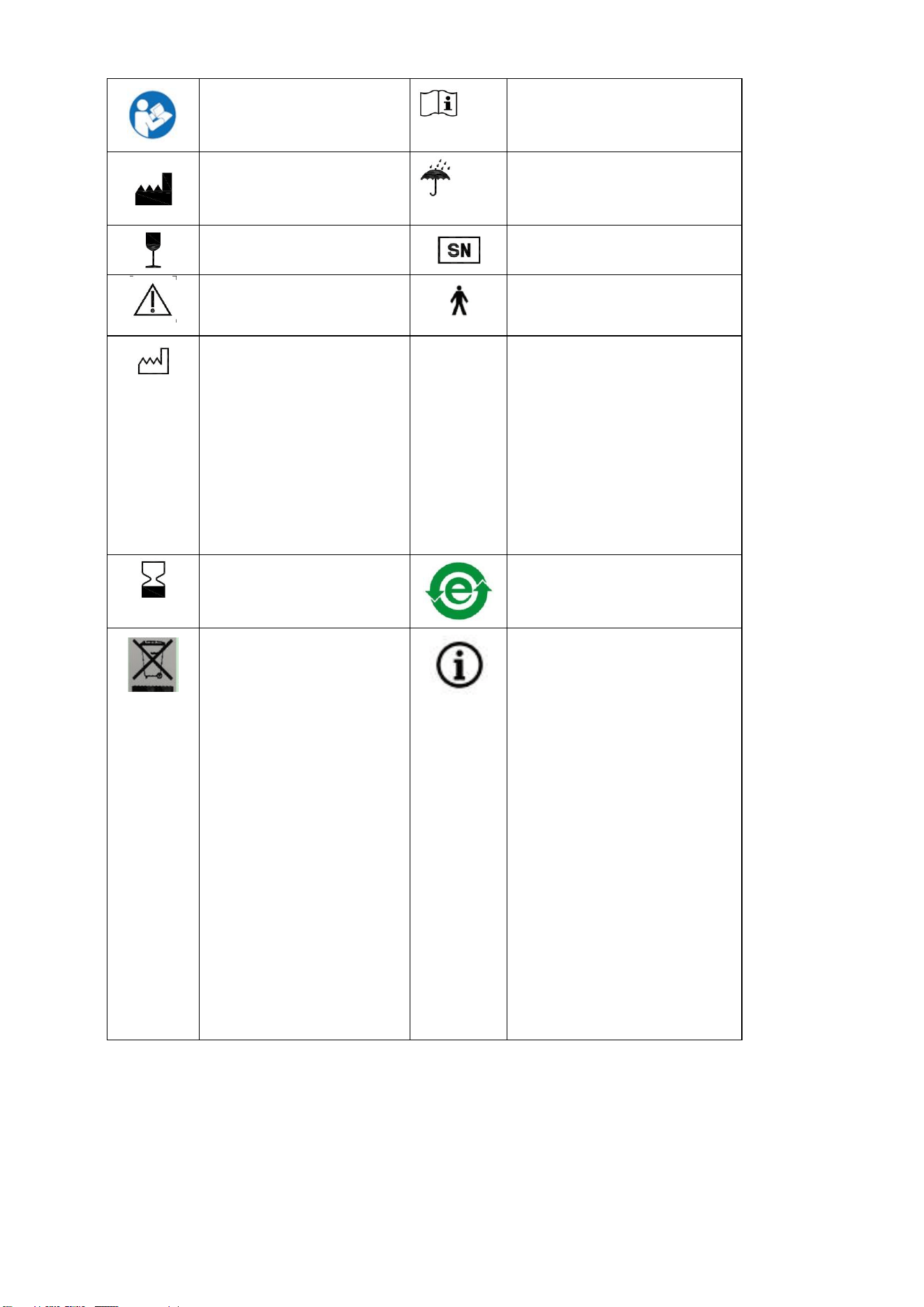
11.Symbol Information
Symbol for “User Guide
must be read”
Symbol for “Consult
instructions for use”
Symbol for
“Manufacturer”
Symbol for “Keep dry”
Symbol for “Fragile,
handle with care”
Symbol for “Serial number”
Symbol for “Caution and
warning”
Type B Applied Part
Symbol for “Date of
manufacture”
IP22
IP22: The first number 2:
Protected against solid
foreign objects of 12,5
mm Ф and greater. The
second number: Protected
against vertically falling
water drops when enclosure
titled up to 15º.
Symbol for “Use-by date” The harmful substances in
the product meet the
limited requirements.
This marking shown on
the product or its
literature, indicates that
it should not be disposed
of, with other household
wastes at the end of its
working life. To prevent
possible harm to the
environment or human
health from uncontrolled
waste disposal, please
separate this from other
types of wastes and
recycle it responsibly to
promote the sustainable
reuse of material
resources.
Symbol for “Note”
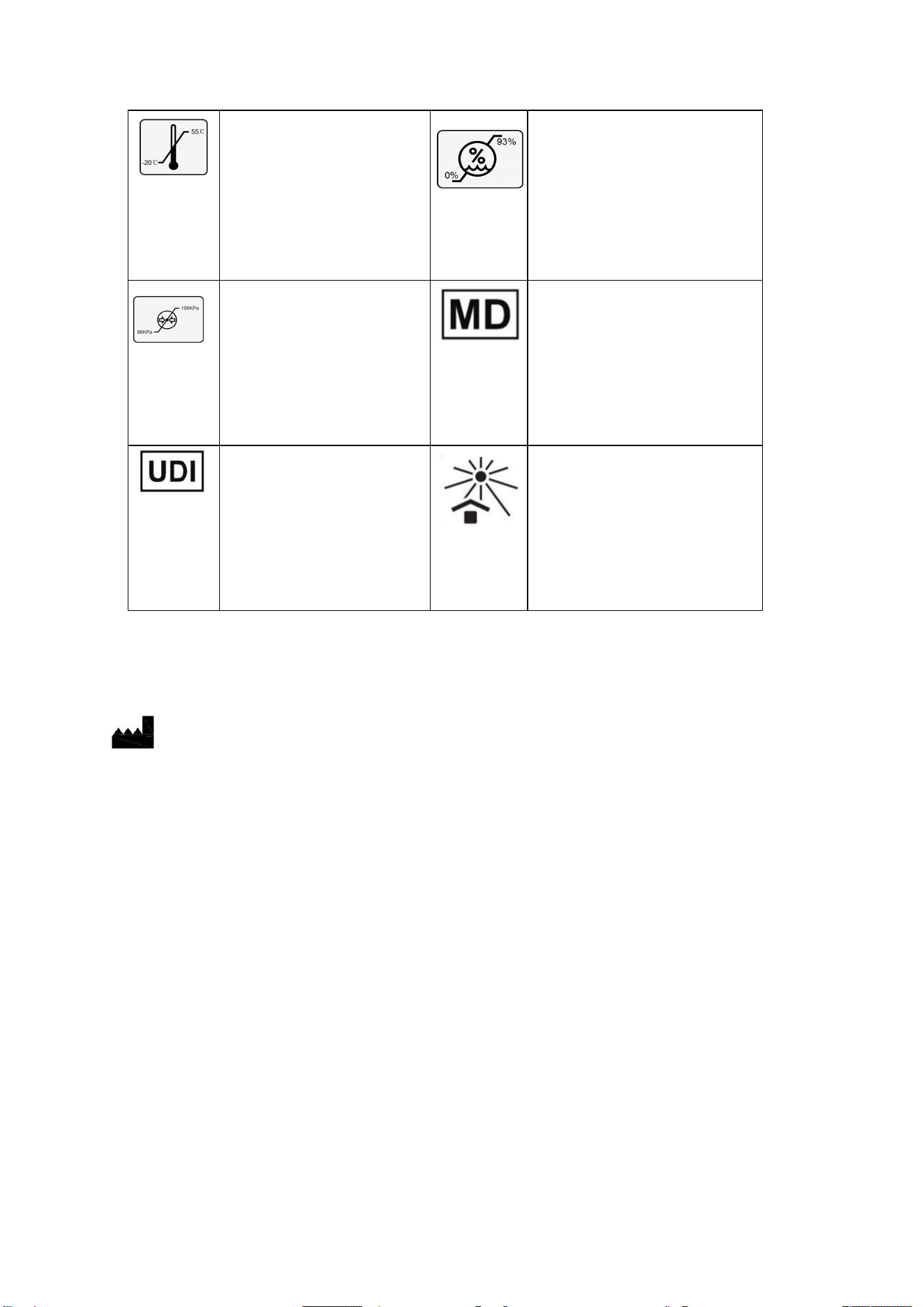
During transport or
storage, the temperature
should not exceed the
limit values of -20° to 55°
Celsius for a long period
of time.
During transport or storage,
the relative humidity should
not exceed the limit values
of 0% to 93% for a long
period of time.
The air pressure range
between 86 and 106 KPa
is appropriate.
Indicates the device is a medical
device
Indicates a carrier that
contains unique device
identifier information
Indicates a medical device that
needs protection from light
sources
Manufacture: Austar Hearing Science and Technology (Xiamen) Co., Ltd.
Address: B8, Biomedical Industrial Park, No.2064 Wengjiao West Road, Haicang Dist.
Xiamen, Fujian, China
Post code: 361028
Tel: +86-0592-5900230
Fax: +86-0592-5621123

FCC Statement:
Any Changes or modifications not expressly approved by the party responsible for compliance
could void the user’s authority to operate the equipment.
This device complies with part 15 of the FCC Rules. Operation is subject to the following two
conditions:
(1) This device may not cause harmful interference, and
(2) This device must accept any interference received, including interference that may cause
undesired operation.
The device has been evaluated to meet general RF exposure requirement. The device can be used
in portable exposure condition without restriction.
Note: This equipment has been tested and found to comply with the limits for a Class B digital
device, pursuant to part 15 of the FCC Rules. These limits are designed to provide reasonable
protection against harmful interference in a residential installation. This equipment generates,
uses and can radiate radio frequency energy and, if not installed and used in accordance with the
instructions, may cause harmful interference to radio communications. However, there is no
guarantee that interference will not occur in a particular installation. If this equipment does cause
harmful interference to radio or television reception, which can be determined by turning the
equipment off and on, the user is encouraged to try to correct the interference by one or more of
the following measures:
—Reorient or relocate the receiving antenna.
—Increase the separation between the equipment and receiver.
—Connect the equipment into an outlet on a circuit different from that to which the receiver is
connected.
—Consult the dealer or an experienced radio/TV technician for help.