Shanghai Neardi Technology Co., Ltd.
www.neardi.com
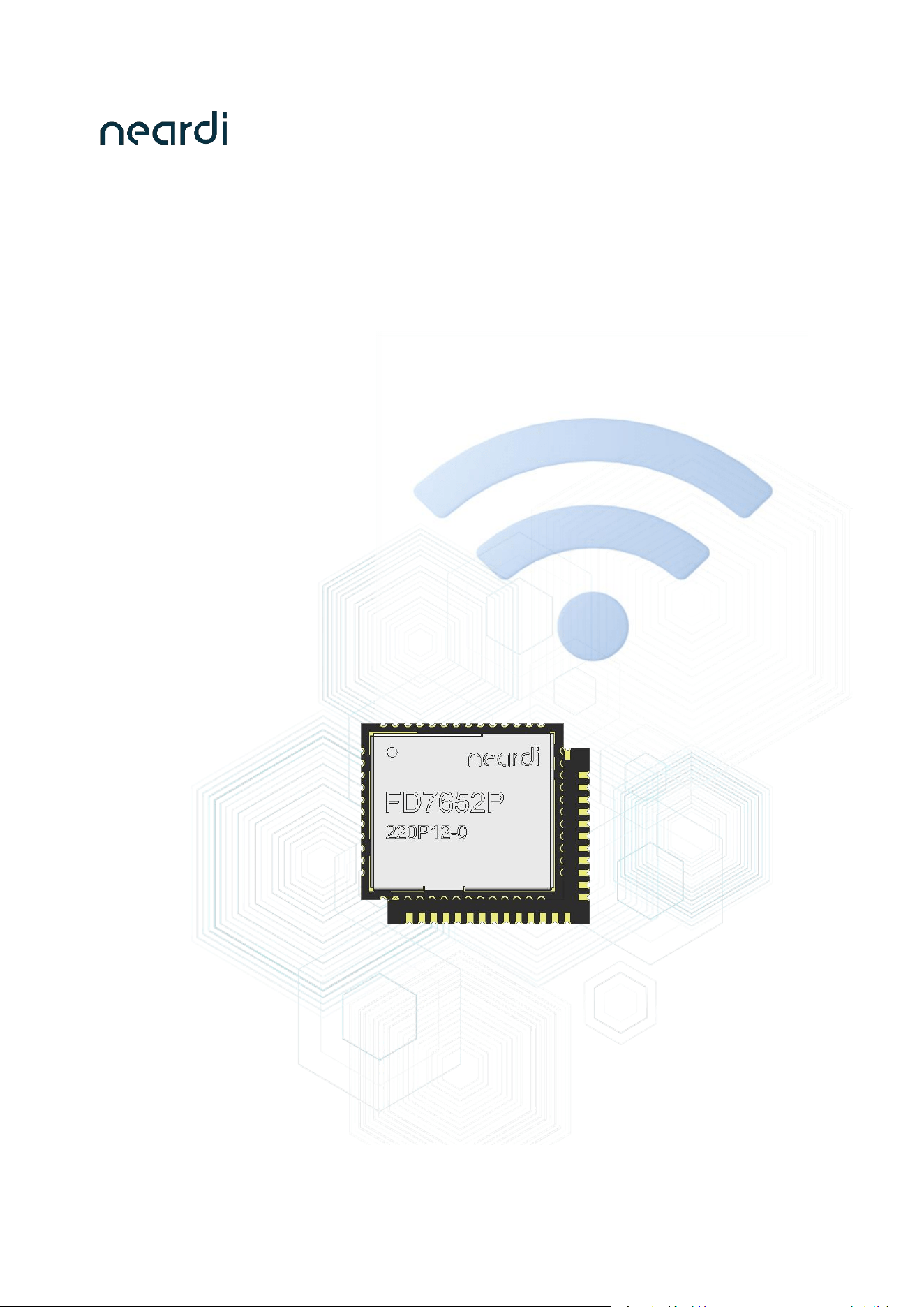
FD7652P WIFI Module
220P12-0
Datasheet
V1.0

FD7652P
Neardi Technology www.neardi.com
1
/
27
Shanghai Neardi Technology Co., Ltd. (referred to as "Neardi Technology") always adheres to the customer-first service
tenet and provides customers with fast and efficient support services. If you have any needs, please feel free to contact our
company, the contact information is as follows:
Shanghai Neardi Technology Co., Ltd.
www.neardi.com
Tel: +86 21 20952021
Email: s[email protected]
Introduction
Neardi Technology provides this document for customers to use as a reference for product design and terminal applications.
It is recommended that customers confirm the specifications and parameters provided in the document in detail, and
confirm whether it can meet the design or application of the required products. At the same time, it is strongly
recommended that customers do detailed tests in actual application scenarios based on the samples provided by our
company to ensure that they meet the end use requirements. Neardi Technology is not responsible for any damages
suffered due to the use of documents, materials and product functions.
The relevant parameters or design charts in this document are only examples, and customers should base their own
independent analysis, evaluation and judgment when designing or using terminal products. Before customers use any
design or service guided by this document, please read this statement carefully, understand and agree that although Neardi
Technology has taken reasonable commercial efforts to provide the best possible experience, this document and its
contents are Provided to you on an “as available” Basis. The information in this document is subject to change without
notice.
Agreement
Unless specifically authorized by Neardi Technology, the recipient of the product documentation, hardware reference
drawings, software descriptions and other materials provided by our company must keep the received content confidential
and shall not use it for any other purpose other than the implementation and development of this project.
Copyright Statement
Documents and information provided by our company may not be obtained, used or disclosed to third parties, or such
copyrighted materials may be copied, reproduced, plagiarized, published, displayed, translated, distributed or merged,
modified or created derivative works unless obtain prior written consent. Neardi Technology has exclusive rights to
copyrighted materials and does not grant or convey a license to any patent, copyright, trademark or service mark rights,
and no purchase of any kind shall be deemed to be the grant of a license. Neardi Technology has the right to pursue legal
responsibility for any illegal infringements that violate confidentiality, use without authorization or maliciously use the
documents and information in other illegal forms.
© 2025 Shanghai Neardi Technology Co., Ltd. All Rights Reserved.
Version History
Version
Date
Illustrate
V1.0
2025/10/21
Initial Version

FD7652P
Neardi Technology www.neardi.com
2
/
27
Contents
Contents..........................................................................................................................................................................2
1 Product Overview
..................................................................................................................................................... 3
1.1 Product Introduction
..................................................................................................................................... 4
1.2 Wi-Fi Characteristics
.................................................................................................................................... 4
1.3 Bluetooth Characteristics
.............................................................................................................................5
1.4 Block Diagram
............................................................................................................................................... 5
1.5 Parameters
.....................................................................................................................................................6
2 Pin Definition
............................................................................................................................................................. 7
2.1 Pin Number
.................................................................................................................................................... 7
2.2 Pin Description
.............................................................................................................................................. 7
3 Mechanical Specifications
.......................................................................................................................................9
3.1 Mechanical Dimensions
...............................................................................................................................9
3.2 Recommended PCB Layout Footprint
...................................................................................................... 9
4 Electrical Performance and Reliability
................................................................................................................ 10
4.1 Recommended Operation Conditions
..................................................................................................... 10
4.2 Power On/Off Sequence
............................................................................................................................10
4.3 Reliability
...................................................................................................................................................... 10
5 Interface Timing Parameters
................................................................................................................................ 11
5.1 PCM Interface Timing
.................................................................................................................................11
6 RF Characteristics
..................................................................................................................................................12
6.1 2.4GHZ Wi-Fi Radio Frequency (RF) Characteristics
..........................................................................12
6.2 5GHZ Wi-Fi RF Characteristics
................................................................................................................13
6.3 Bluetooth Radio Frequency (RF) Characteristics
..................................................................................14
7 Hardware Design Guide
........................................................................................................................................16
7.1 Power Design Notice
..................................................................................................................................16
7.2 Interface Design Notice
..............................................................................................................................16
8 Antenna Design
...................................................................................................................................................... 18
8.1 Summarize
................................................................................................................................................... 18
8.2 List of applicable FCC rules
...................................................................................................................... 18
8.3 Specific Operational Use Conditions-Antenna Placement Within the Host Platform
......................19
8.4 Limited Module Procedures
...................................................................................................................... 19
8.5 Trace Antenna Designs
..............................................................................................................................19
8.6 RF Exposure Considerations
....................................................................................................................20
8.7 Antenna Type and Gain
............................................................................................................................. 20
8.8 End Product Labelling Compliance Information
.................................................................................... 21
8.9 Information on Test Modes and Additional Testing Requirements
..................................................... 21
8.10 Additional testing, Part 15 Subpart B Disclaimer
................................................................................ 21
8.11 Manual Information to The End User
.....................................................................................................22
8.12 How to Make Changes - Important Note
.............................................................................................. 22
9 Ordering,Storage,Production and Packaging
....................................................................................................23
9.1 Ordering Model
............................................................................................................................................23

FD7652P
Neardi Technology www.neardi.com
3
/
27
9.2 Storage Conditions
..................................................................................................................................... 23
9.3 Production Welding
.....................................................................................................................................23
9.4 Packing Specifications
............................................................................................................................... 24
FD7652P
Neardi Technology www.neardi.com
4
/
27
1 Product Overview
1.1 Product Introduction
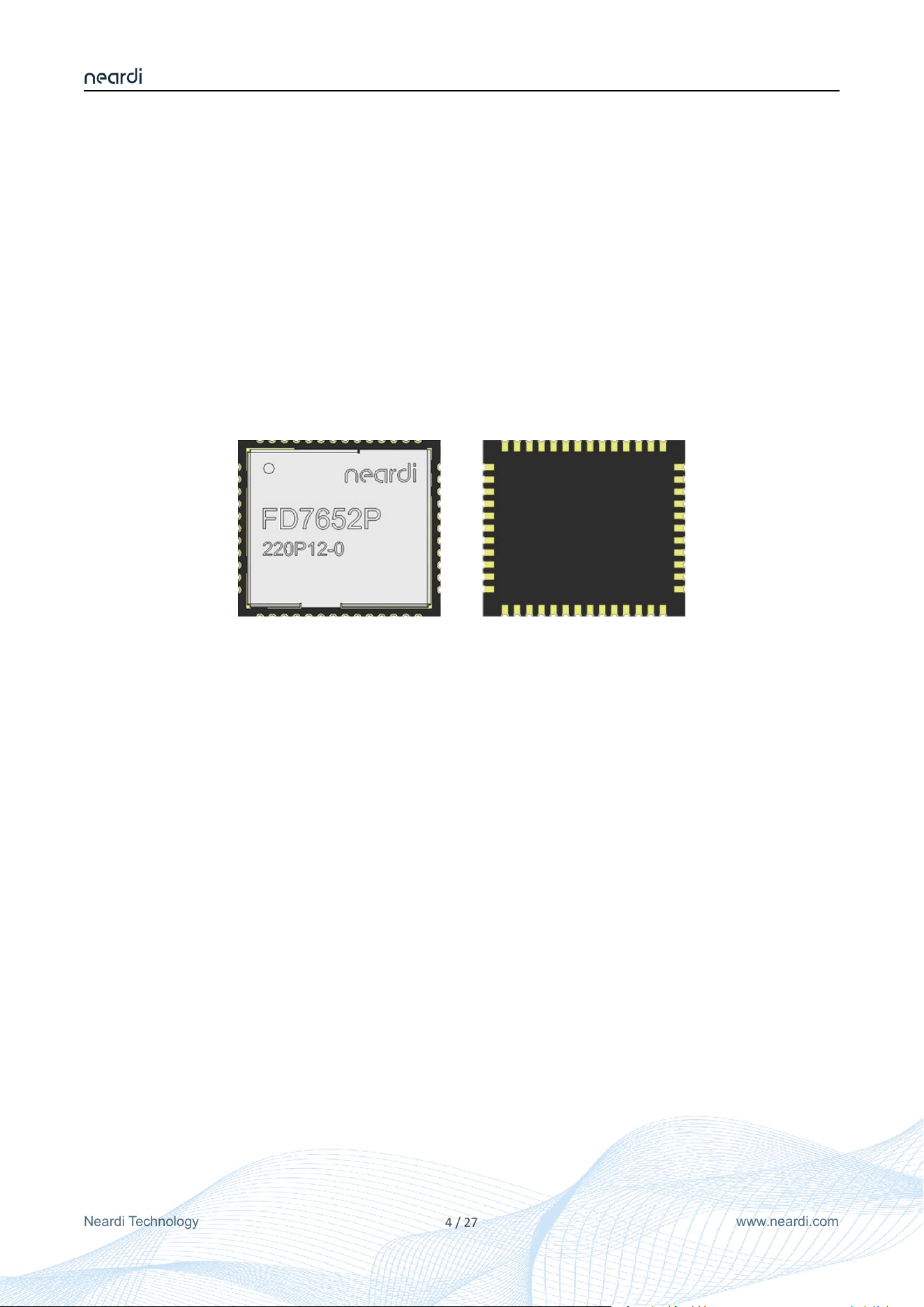
FD7652P is a highly integrated, low-cost combo module with high-performance and low-power. It supports
Wi-Fi 6 and BLE protocol, supports Wi-Fi MAC of the final version of Wi-Fi 6 Wave2 protocol, Wi-Fi Baseband
of 2T2R, and high-performance RF. It also supports PCIE, HS-UART and PCM interfaces for connection with
the Host. This module also supports BLE and Wi-Fi to work in coexistence mode. It is suitable for consumer
electronics such as IPC, tablet and IOT, and can also be used in fields with high reliability requirements such as
industrial interconnection.
1.2 Wi-Fi Characteristics
IEEE 802.11a/b/g/n/ac/ax (supports wave-2) wireless LAN communication protocol
IEEE 802.11 d/e/h/i/k/mc/r/v/w
2.4G Phy rate up to 572.4Mbps, 5G Phy rate up to 1.2Gbps;Throughput 1Gbps
Multiple modes such as Wi-Fi STA, AP, and P2P
Support DBDC、DBSC
2.4G 40MHZ, 5G 80MHz bandwidth, 2T/2R
Up to 1024QAM modulation, supports LDPC and STBC
UL/DL OFDMA, UL/DL MU-MIMO
QoS, WFA WMM, WMM PS
RSSI and CSI Reporting
Beamformee and 4*2 Tx Beamforming、2*2/2*1 Tx Beamforming
WPA, WPA2, WPA3 encryption and decryption, WAPI and WPS2.0
ER, DCM to improve transceiver gain
FD7652P
Neardi Technology www.neardi.com
5
/
27
20in40/80, 80 HE PPDU, Partial band MU MIMO to improve air interface utilization
BSS Color, Spatial Reuse to improve air interface utilization
TWT, to optimize dynamic power consumption in multi-BSS environment
1.3 Bluetooth Characteristics
Support BLE features
PCIE interface for BLE data transmission
PCM/IIS interface for audio transmission
LE 1M
Support sco and esco link
SSP/Secure Connection
Low power mode (sniff, sniff sub-rating)
Support BLE/Wi-Fi coexistence
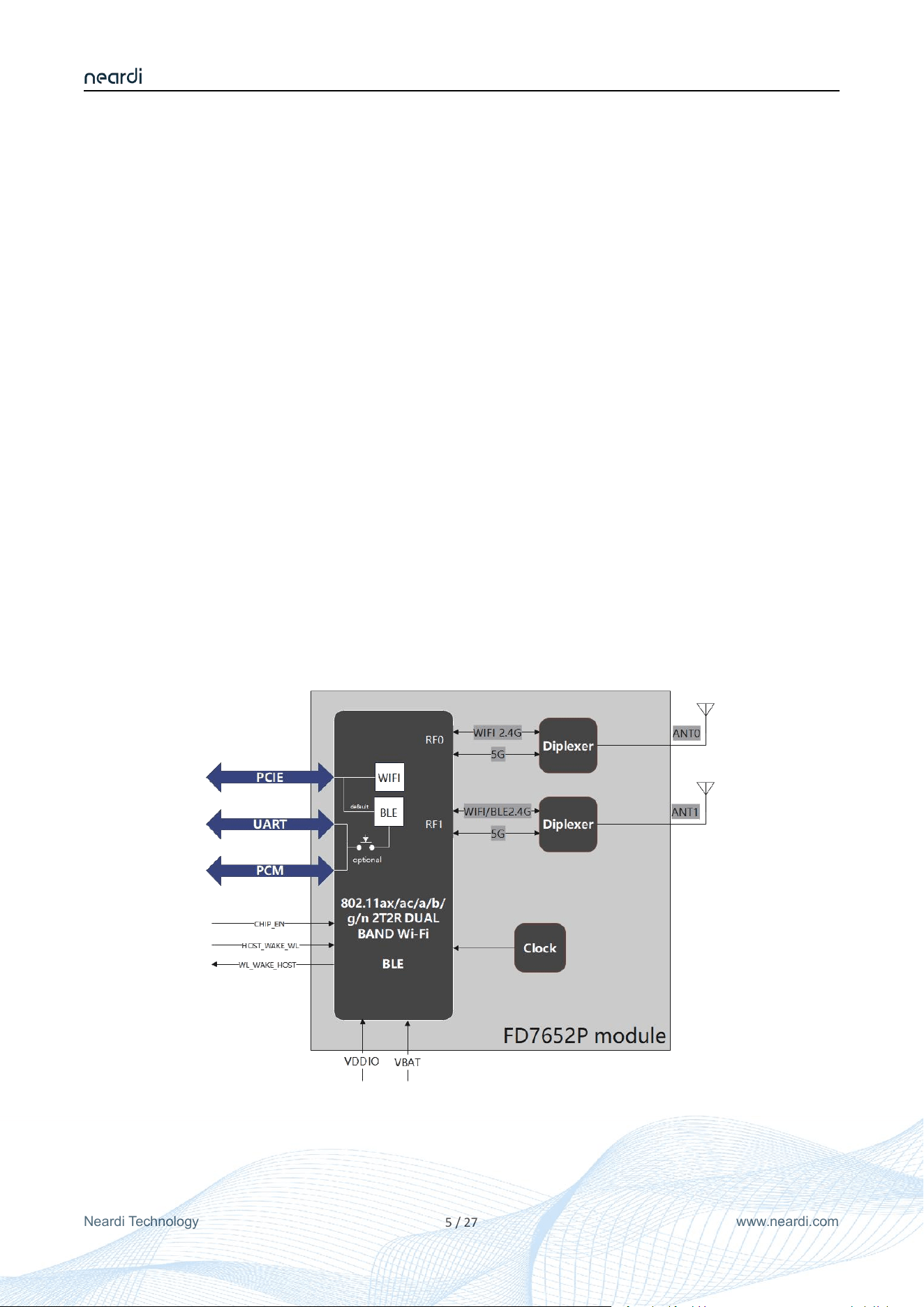
1.4 Block Diagram
Note:In the default configuration, Bluetooth UART control data and PCM audio data are multiplexed over the
SDIO interface. This configuration is adequate under typical or low-traffic operating conditions. However, when
Wi-Fi and Bluetooth audio operate concurrently, bandwidth contention and timing constraints on the SDIO bus
may lead to instability in the Bluetooth audio stream.For systems requiring high real-time performance of
FD7652P
Neardi Technology www.neardi.com
6
/
27
Bluetooth audio, it is recommended to route the PCM audio channel independently and interface it with the
host processor through a dedicated PCM/I2S bus to ensure a stable and reliable audio path.
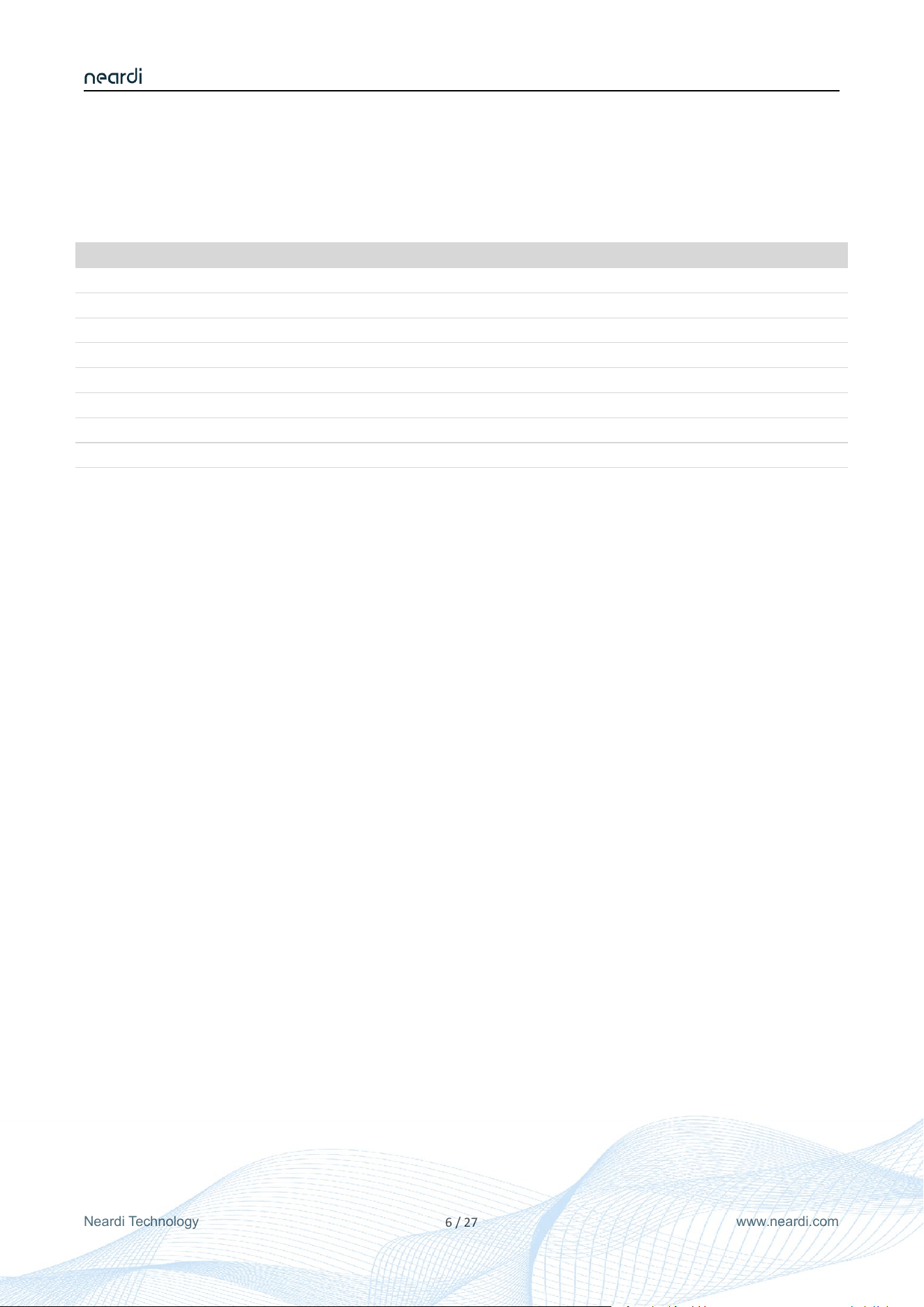
1.5 Parameters
Product Name
FD7652P
Product description
802.11ax/ac/a/b/g/n 2T2R dual band Wi-Fi and BLE comb module
Dimension
15.0(±0.1) mm*13.0(±0.1) mm*1.8(±0.2) mm
Power supply
VBAT:3.0~3.6V;VDDIO:1.62V~1.92V/3.0V~3.6V
Host interface
PCIE2.0 + UART + PCM
Footprint
LCC 50pin
Operating temperature
-30°C to 70°C
Operating humidity
10% to 90% (Non-Condensing)
Storage temperature
-40°C to 85°C
FD7652P
Neardi Technology www.neardi.com
7
/
27
2 Pin Definition
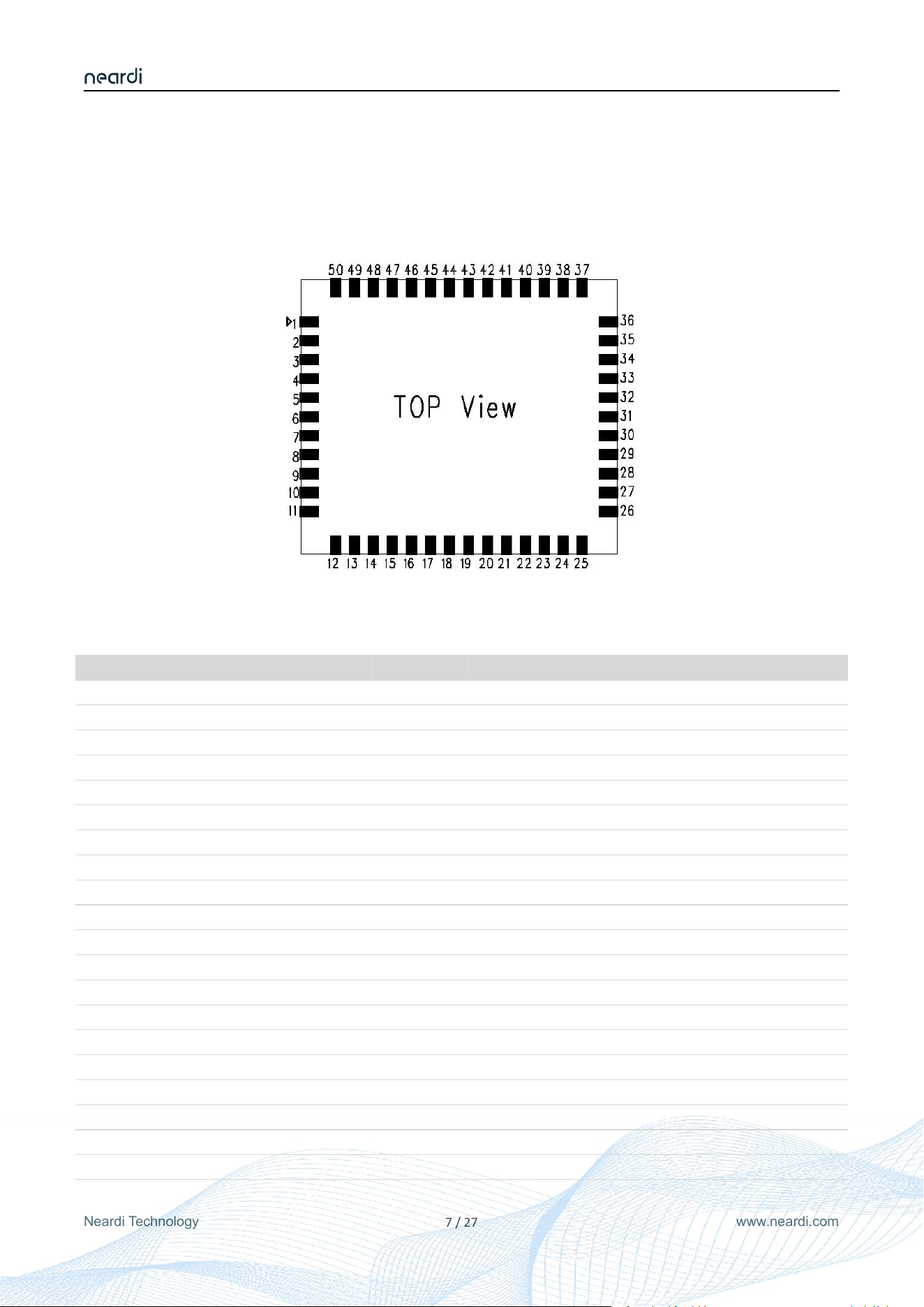
2.1 Pin Number
2.2 Pin Description
Pin Number
Pin Name
Pin Type
Pin Description
1
GND
G
Ground connections
2
WL_S1
RF
Wi-Fi & BLE antenna I/O port
3
GND
G
Ground connections
4
GND
G
Ground connections
5
GND
G
Ground connections
6
GND
G
Ground connections
7
GND
G
Ground connections
8
GND
G
Ground connections
9
WL_S0
RF
Wi-Fi antenna I/O port
10
GND
G
Ground connections
11
GND
G
Ground connections
12
PE_RST_N
I
PCle host indication to reset the device
13
NC
-
Floating (Don’t connected to ground)
14
NC
-
Floating (Don’t connected to ground)
15
CHIP_EN
I
Module enable signal
16
WL_WAKE_HOST
I/O
Wake up signal with auto negotiation
17
NC/U1TXD
-
Floating (Don’t connected to ground)
18
NC/ U1RXD
-
Floating (Don’t connected to ground)
19
PCM_OUT
O
PCM Data output
20
PCM_IN
I
PCM data input
FD7652P
Neardi Technology www.neardi.com
8
/
27
21
PCM_SYNC
I/O
PCM sync signal
22
PCM_CLK
I/O
PCM clock
23
GND
G
Ground connections
24
PE_WAKE_N
I/O
PCIE wake-up signal
25
NC
-
Floating (Don’t connected to ground)
26
NC
-
Floating (Don’t connected to ground)
27
GND
G
Ground connections
28
VDDIO
P
I/O Voltage supply input
29
NC
-
Floating (Don’t connected to ground)
30
GND
G
Ground connections
31
NC
-
Floating (Don’t connected to ground)
32
GND
G
Ground connections
33
REFCLKP
I
PCIe differential clock input-Positive
34
NC
-
Floating (Don’t connected to ground)
35
REFCLKN
I
PCIe differential clock input-Negative
36
VBAT
P
Main power voltage source input
37
PE_CLKREQ_N
I/O
PCIe clock request
38
NC
-
Floating (Don’t connected to ground)
39
GND
G
Ground connections
40
UART_TXD
I/O
UART TX signal
41
UART_RXD
I/O
UART RX signal
42
UART_RTS
I/O
UART DCE request to send signal
43
UART_CTS
I/O
UART DEC clear to send signal
44
PCIE_RX_N
I
PCIe receive data-Negative
45
PCIE_RX_P
I
PCIe receive data-Positive
46
PCIE_TX_N
O
PCIe transmit data-Negative
47
PCIE_TX_P
O
PCIe transmit data-Postive
48
NC
-
Floating (Don’t connected to ground)
49
HOST_WAKE_WL
I/O
Wake up signal with auto negotiation
50
BT_WAKE_HOST
I/O
Wake up signal
FD7652P
Neardi Technology www.neardi.com
9
/
27
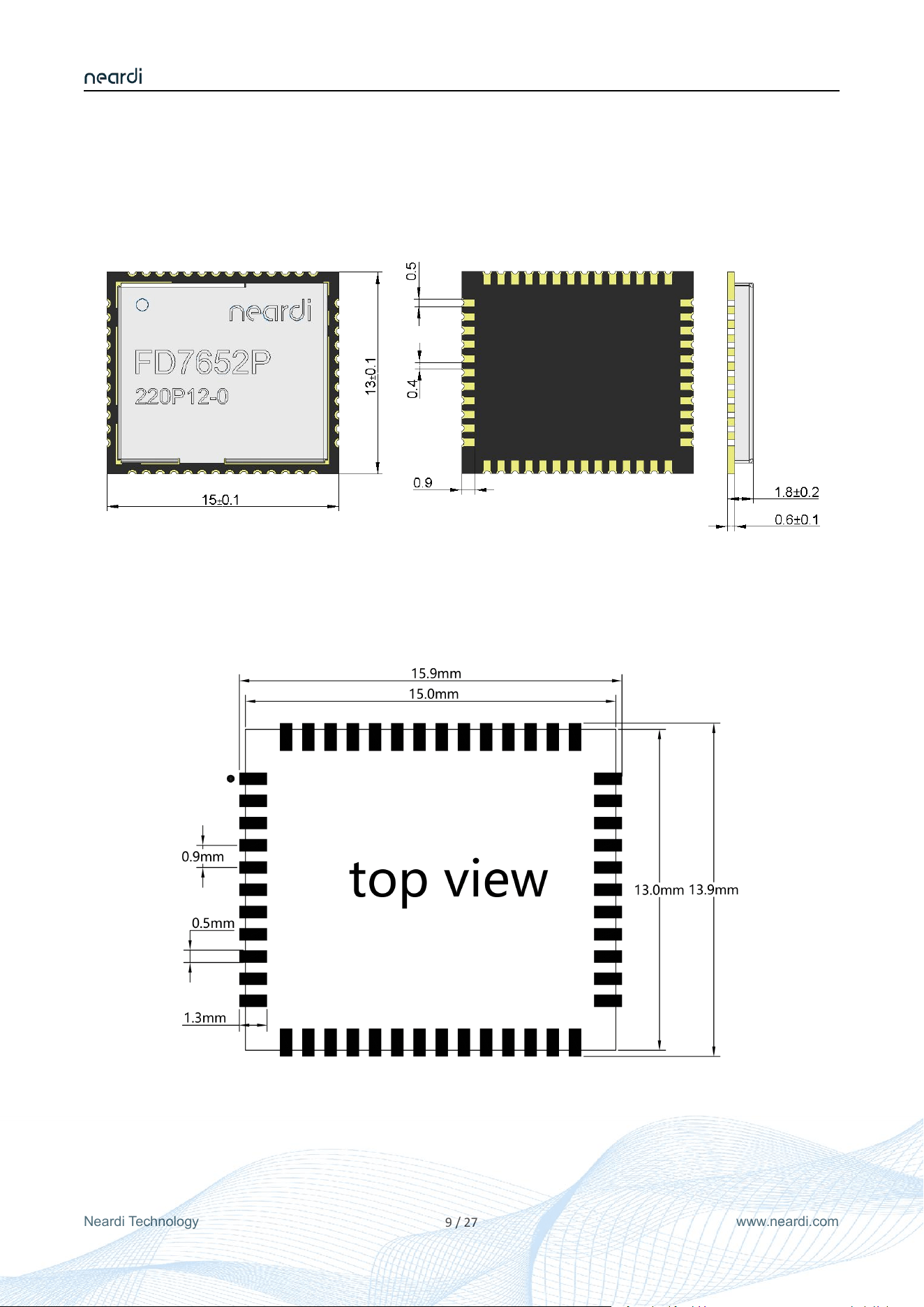
3 Mechanical Specifications
3.1 Mechanical Dimensions
3.2 Recommended PCB Layout Footprint
FD7652P
Neardi Technology www.neardi.com
10
/
27
4 Electrical Performance and Reliability
4.1 Recommended Operation Conditions
Symbol
Description
Min
Type
Max
Unit
Ta
Ambient Operating Temperature
-30
25
70
℃
Antenna
External Antenna VSWR
1.92:1
2:01
VBAT
Power Supply Voltage
3
3.3
3.6
V
Power Supply Current
-
-
2
A
VDDIO
Digital I/O Voltage
1.62
1.8
1.92
V
3
3.3
3.6
V
Supply Current
-
-
150
mA
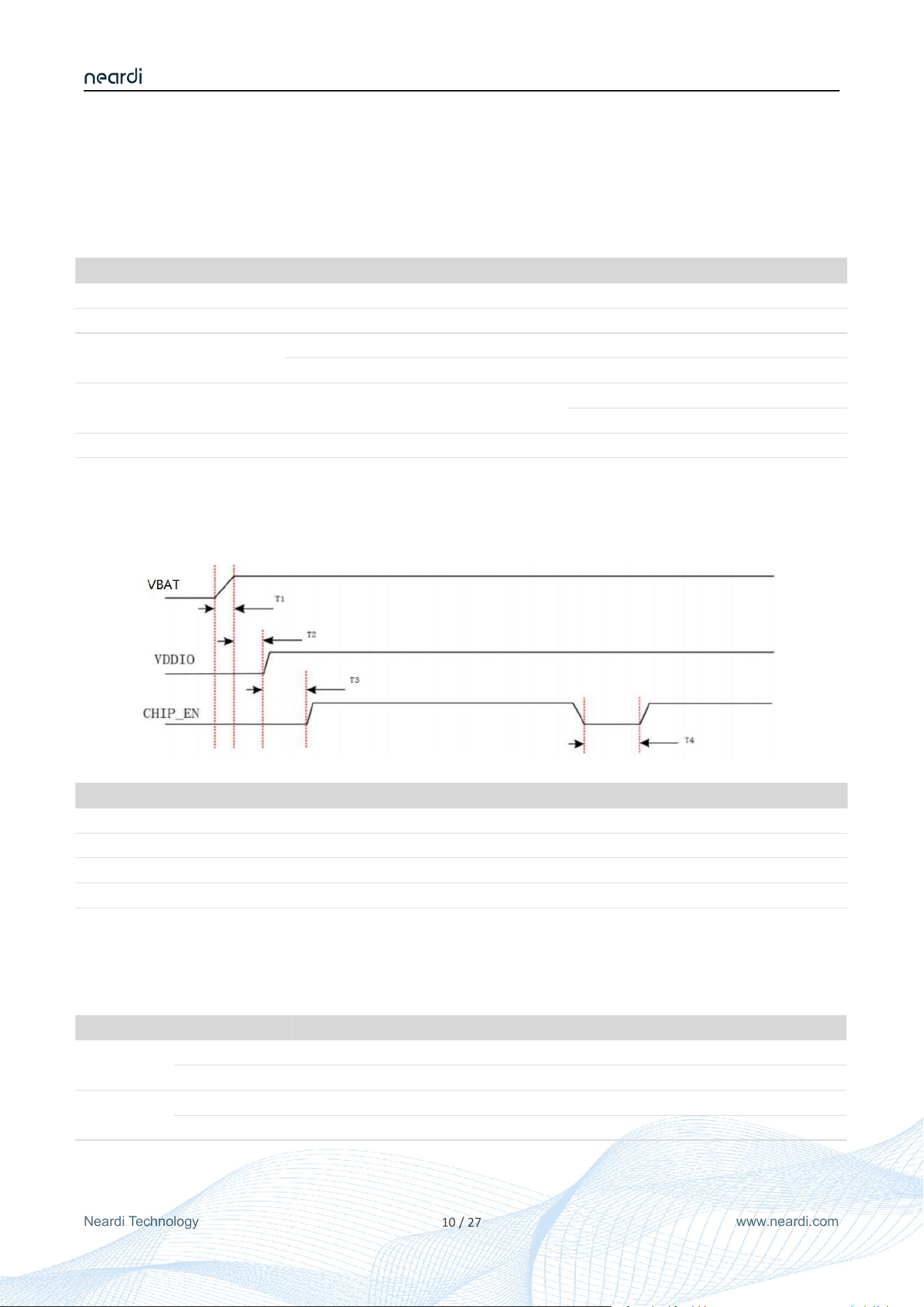
4.2 Power On/Off Sequence
Symbol
Description
Min
Type
Max
Unit
1
VBAT Ramp up time
0.2
0.5
-
mS
2
VDDIO should be powered on after VBAT is powered on
0
-
-
mS
3
CHIP_EN should be powered on after VDDIO is powered on
0
-
-
mS
4
CHIP_EN reset time
50
-
-
mS
4.3 Reliability
Item
Test Model
Class
Level
Criteria
ESD
HBM
2
2000V
ANSI/ESDA/JEDEC JS-001-2017
CDM
C2a
500V
ANSI/ESDA/JEDEC JS-002-2018
Latch-up
Current
II A
200mA
JEDEC STANDARD NO.78F JANUARY 2022
Voltage
II A
1.5xVmax
JEDEC STANDARD NO.78F JANUARY 2022
FD7652P
Neardi Technology www.neardi.com
11
/
27
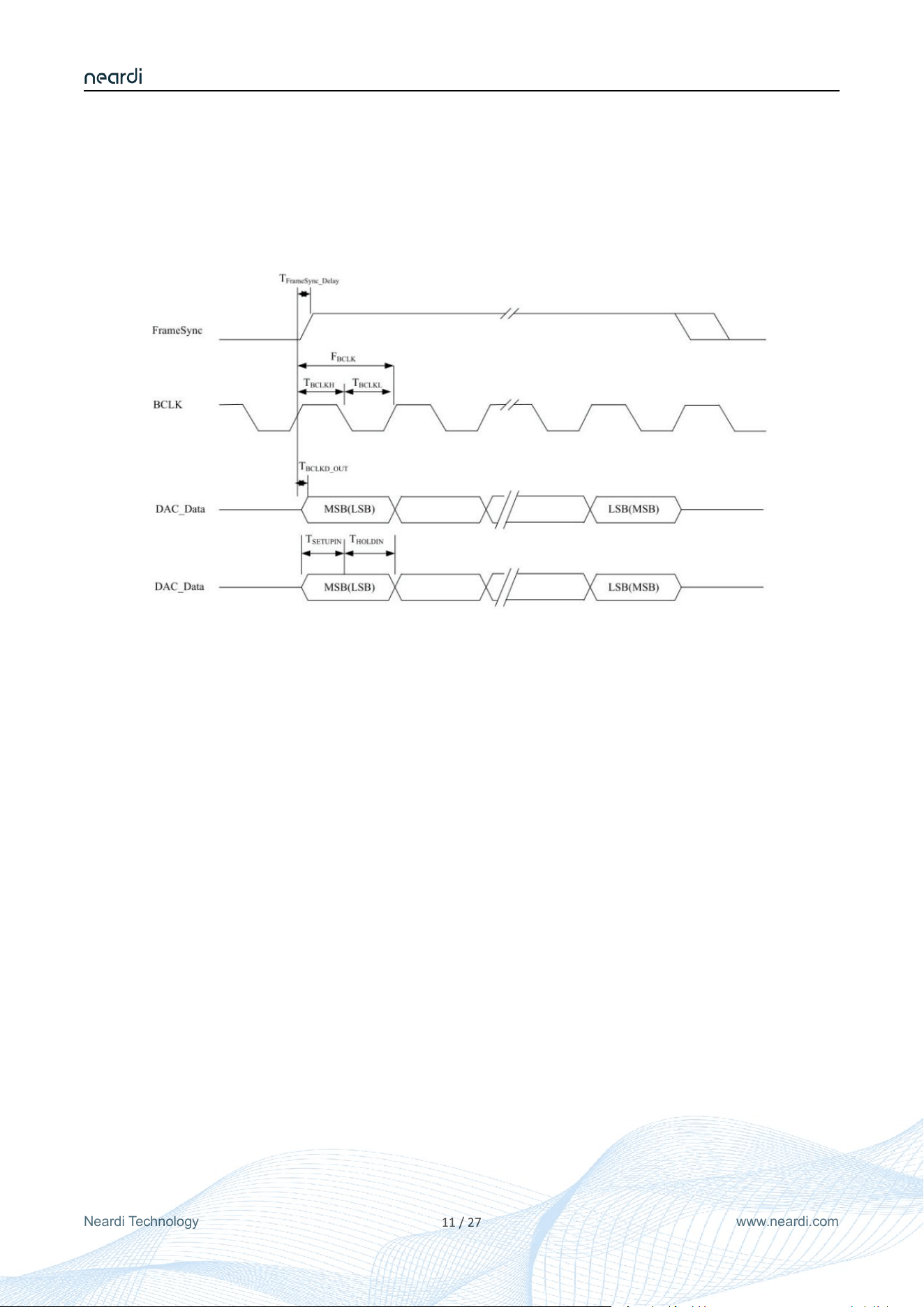
5 Interface Timing Parameters
5.1 PCM Interface Timing
PCM Bus Timing
FD7652P
Neardi Technology www.neardi.com
12
/
27
6 RF Characteristics
6.1 2.4GHZ Wi-Fi Radio Frequency (RF) Characteristics
Features
Description
Wi-Fi Standard
IEEE 802.11b/g/n/ac/ax
Frequency Range
2.4~2.4835GHz(2.4GHz ISM Band)
Channels
Ch1~Ch11
Modulation
802.11b (DSSS): CCK, DQPSK, DBPSK;
802.11g (OFDM): BPSK, QPSK, QAM16, QAM64;
802.11n (OFDM): BPSK, QPSK, QAM16, QAM64;
802.11ax (OFDMA): BPSK, BPSK_DCM, QPSK, QPSK_DCM, QAM16, QAM16_DCM,
QAM64, QAM256, QAM1024;
Date Rate
802.11b: 1, 2, 5.5, 11Mbps;
802.11g: 6, 9, 12, 18, 24, 36, 48, 54Mbps;
802.11n (HT20): MCS0~MCS7 6.5~72.2Mbps;
802.11n (HT40): MCS0~MCS7 13.5~150Mbps;
802.11ax (HE20): MCS0~MCS11 8~143.4Mbps;
802.11ax (HE40): MCS0~MCS11 16~286.8Mbps;
Frequency
Tolerance
≤±5ppm
2.4G Transmitter Specifications
Modulation
TX Rate
TX EVM
(
dB
)
TX Mask
802.11b
1Mbps
≤35%
PASS
802.11b
11Mbps
≤35%
PASS
802.11g
6Mbps
≤-5
PASS
802.11g
54Mbps
≤-25
PASS
802.11n
HT20 MCS0
≤-5
PASS
802.11n
HT20 MCS7
≤-27
PASS
802.11n
HT40 MCS0
≤-5
PASS
802.11n
HT40 MCS7
≤-27
PASS
802.11ax
HE20 MCS0
≤-5
PASS
802.11ax
HE20 MCS11
≤-35
PASS
802.11ax
HE40 MCS0
≤-5
PASS
802.11ax
HE40 MCS11
≤-35
PASS
2.4G Receiver Specifications
Modulation
RX Rate
Min Input Level
(
dBm
)
Max Input Level
(
dBm
)
PER
802.11b
1Mbps
≤-96
-20
8%
FD7652P
Neardi Technology www.neardi.com
13
/
27
802.11b
11Mbps
≤-87
-20
8%
802.11g
6Mbps
≤-92
-20
10%
802.11g
54Mbps
≤-75
-20
10%
802.11n
HT20 MCS0
≤-92
-20
10%
802.11n
HT20 MCS7
≤-72
-20
10%
802.11n
HT40 MCS0
≤-89
-20
10%
802.11n
HT40 MCS7
≤-70
-20
10%
802.11ax
HE20 MCS0
≤-92
-20
10%
802.11ax
HE20 MCS11
≤-60
-20
10%
802.11ax
HE40 MCS0
≤-89
-20
10%
802.11ax
HE40 MCS11
≤-58
-20
10%
6.2 5GHZ Wi-Fi RF Characteristics
Conditions: VBAT=3.3V; VDDIO=1.8V; Ta:25℃
Features
Description
Wi-Fi Standard
IEEE 802.11a/n/ac/ax
Frequency Range
5.15~5.25GHz; 5.25~5.35GHz; 5.47~5.73GHz; 5.735~5.835GHz (5GHz ISM Band)
Channels
Ch36,Ch40, Ch44, Ch48; Ch52~Ch64; Ch100~Ch140; Ch149~Ch165
Modulation
802.11a (OFDM): BPSK, QPSK, QAM16, QAM64;
802.11n (OFDM): BPSK, QPSK, QAM16, QAM64;
802.11ac (OFDM): BPSK, QPSK, QAM16, QAM64, QAM256;
802.11ax (OFDMA): BPSK, BPSK_DCM, QPSK, QPSK_DCM, QAM16, QAM16_DCM,
QAM64, QAM256, QAM1024;
Date Rate
802.11a: 6, 9, 12, 18, 24, 36, 48, 54Mbps;
802.11n (HT20): MCS0~MCS7: 6.5~72.2Mbps;
802.11n (HT40): MCS0~MCS7: 13.5~150Mbps;
802.11ac (VHT20): MCS0~MCS8: 6.5~86.7Mbps;
802.11ac (VHT40): MCS0~MCS9: 13.5~200Mbps;
802.11ac (VHT80): MCS0~MCS9: 29.3~433.3Mbps;
802.11ax (HE20): MCS0~MCS11: 8~143.4Mbps;
802.11ax (HE40): MCS0~MCS11: 16~286.8Mbps;
802.11ax (HE80): MCS0~MCS11: 34~600.5Mbps;
Frequency
Tolerance
≤±5ppm
5G Transmitter Specifications
Modulation
TX Rate
TX EVM
(
dB
)
TX Mask
802.11a
6Mbps
≤-5
PASS
802.11a
54Mbps
≤-25
PASS
802.11n
HT20 MCS0
≤-5
PASS
802.11n
HT20 MCS7
≤-27
PASS
FD7652P
Neardi Technology www.neardi.com
14
/
27
802.11n
HT40 MCS0
≤-5
PASS
802.11n
HT40 MCS7
≤-27
PASS
802.11ac
VHT20 MCS0
≤-5
PASS
802.11ac
VHT20 MCS8
≤-30
PASS
802.11ac
VHT40 MCS0
≤-5
PASS
802.11ac
VHT40 MCS9
≤-32
PASS
802.11ac
VHT80 MCS0
≤-5
PASS
802.11ac
VHT80 MCS9
≤-32
PASS
802.11ax
HE20 MCS0
≤-5
PASS
802.11ax
HE20 MCS11
≤-35
PASS
802.11ax
HE40 MCS0
≤-5
PASS
802.11ax
HE40 MCS11
≤-35
PASS
802.11ax
HE80 MCS0
≤-5
PASS
802.11ax
HE80 MCS11
≤-35
PASS
5G Receiver Specifications
Modulation
RX Rate
Min Input Level
(
dBm
)
Max Input Level
(
dBm
)
PER
802.11a
6Mbps
-91
-20
10%
802.11a
54Mbps
-74
-20
10%
802.11n
HT20 MCS0
-91
-20
10%
802.11n
HT20 MCS7
-71
-20
10%
802.11n
HT40 MCS0
-88
-20
10%
802.11n
HT40 MCS7
-69
-20
10%
802.11ac
VHT20 MCS0
-91
-20
10%
802.11ac
VHT20 MCS8
-67
-20
10%
802.11ac
VHT40 MCS0
-88
-20
10%
802.11ac
VHT40 MCS9
-63
-20
10%
802.11ac
VHT80 MCS0
-85
-20
10%
802.11ac
VHT80 MCS9
-59
-20
10%
802.11ax
HE20 MCS0
-91
-20
10%
802.11ax
HE20 MCS11
-60
-20
10%
802.11ax
HE40 MCS0
-89
-20
10%
802.11ax
HE40 MCS11
-58
-20
10%
802.11ax
HE80 MCS0
-86
-20
10%
802.11ax
HE80 MCS11
-53
-20
10%
6.3 Bluetooth Radio Frequency (RF) Characteristics
Conditions: VBAT=3.3V; VDDIO=1.8V; Ta:25℃
Features
Description
FD7652P
Neardi Technology www.neardi.com
15
/
27
Bluetooth Standard
BLE
Frequency Range
2.4~2.4835GHz
Channels
Bluetooth Classic: Ch0~Ch78 (For 1MHz Channels);
Bluetooth Low Energy: Ch0~Ch39 (For 2MHz Channels);
Modulation
LE_1Mbps: GFSK (Uncoded);
Bluetooth Transmitter Specifications
Item
TX Power
(
dBm
)
Min
Type
Max
6
8
10
LE_1M
Bluetooth Receiver Specifications
Item
Sensitivity
(
dBm
)
Max Input Level
(
dBm
)
Input Level (Typ)
BER
Input Level (Typ)
BLE
<-88
30.80%
-20dBm
FD7652P
Neardi Technology www.neardi.com
16
/
27
7 Hardware Design Guide
7.1 Power Design Notice
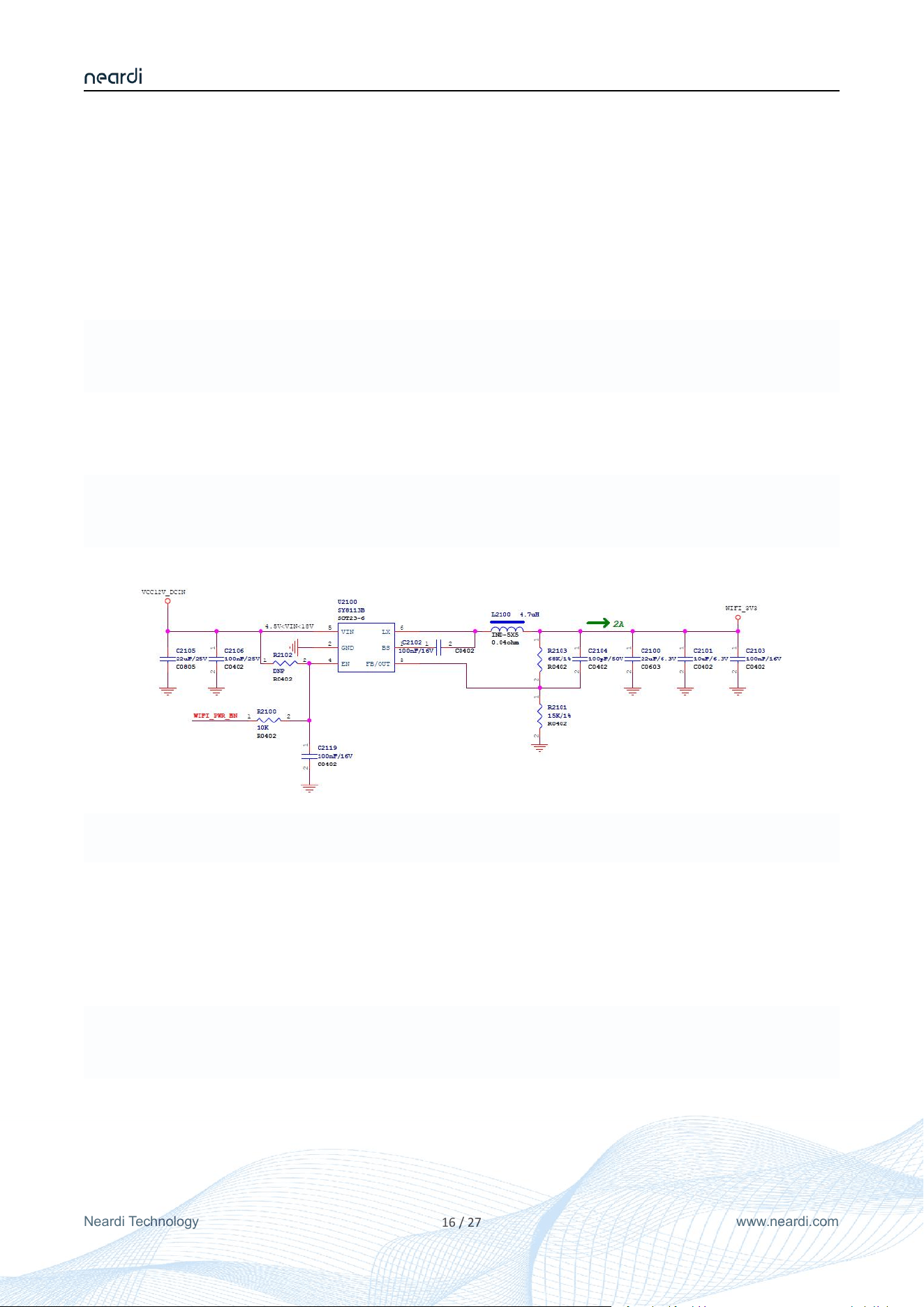
7.1.1 Voltage Requirement
The main power supply (VBAT) input range of the module is 3.3V+/-10%, and the interface VDDIO supports
two level ranges, 1.8V+/-10% or 3.3V+/-10%. Due to the ripple of the main power can affect the RF
performance of Wi-Fi and Bluetooth, therefore the power supply ripple VPP is required to be less than 50mV.
7.1.2 Current/Power Supply Reference Requirement
Under different standards, when Wi-Fi transmits continuously, The 3.3V power converter must be able to
provide 2.0A current and fast transient response (when the transient current change rate is 80mA/us, the
voltage drop is less than 100mV).
For the power on/off sequence of the module, please refer to the requirements in the "4.3 Power On/Off
Sequence" chapter.
7.2 Interface Design Notice
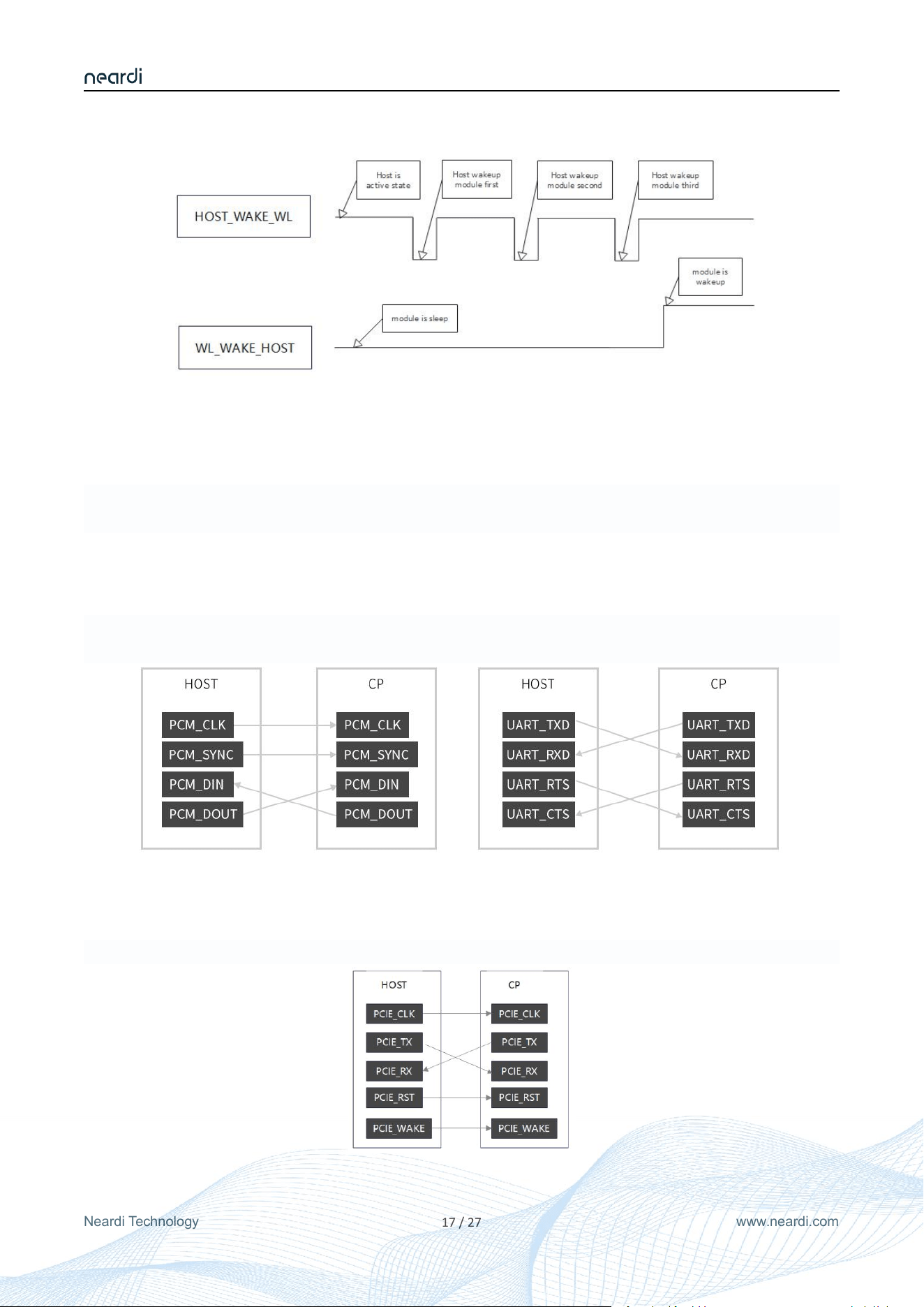
7.2.1 Wake-up Signals
This module require two GPIOs as handshake signals with the host controller. As default, for example, WL_
WAKE_ HOST is the output signal "CP wakes up the Host", and HOST_ WAKE_ WL is the input signal "Host
wakes up CP". Wi-Fi and Bluetooth use the same handshake signal. The working mechanism is as follows.
FD7652P
Neardi Technology www.neardi.com
17
/
27
7.2.2 HCI Commend Interface
The Bluetooth supports PCIE and HS-UART (4Mbps) as HCI (Host Controller Interface). PCIE is used as HCI
by default, which means the HS-UART port does not need in the HOST controller.
7.2.3 PCM and UART Interface
As shown in the figure below, the PCM bus and UART bus and data lines between the Host and the module
need to be cross-connected.
7.2.4 PCIe Interface
PCIe data lines need to be cross-connected between HOST and CP.

FD7652P
Neardi Technology www.neardi.com
18
/
27
8 Antenna Design
8.1 Summarize
This device complies with part 15 of the FCC Rules. Operation is subject to the following two conditions:
(1) This device may not cause harmful interference, and
(2) this device must accept any interference received, including interference that may cause undesired
operation.
This equipment has been tested and found to comply with the limits for a Class B digital device, pursuant to
part 15 of the FCC Rules. These limits are designed to provide reasonable protection against harmful
interference in a residential installation. This equipment generates, uses and can radiate radio frequency
energy and, if not installed and used in accordance with the instructions, may cause harmful interference to
radio communications. However, there is no guarantee that interference will not occur in a particular installation.
If this equipment does cause harmful interference to radio or television reception, which can be determined by
turning the equipment off and on, the user is encouraged to try to correct the interference by one or more of the
following
measures:
- Reorient or relocate the receiving antenna.
- Increase the separation between the equipment and receiver.
- Connect the equipment into an outlet on a circuit different from that to which the receiver is connected.
- Consult the dealer or an experienced radio/TV technician for help.
This modular has been tested and found to comply with part 15 requirements for Modular
Approval.
- FCC Caution: Any changes or modifications not expressly approved by the party responsible for compliance
could void the user's authority to operate the equipment. This transmitter must not be co-located or operating in
conjunction with any other antenna or
transmitter.
- Integration instructions for host product manufacturers according to KDB 996369 D03
OEM Manual v01r01
8.2 List of applicable FCC rules
CFR 47 FCC Part 15 Subpart C and Subpart F has been investigated. It is applicable to the modular transmitter
FD7652P
Neardi Technology www.neardi.com
19
/
27
8.3 Specific Operational Use Conditions-Antenna Placement Within the Host Platform
The module is tested for standalone mobile RF exposure use condition.
● The antenna must be installed such that 20cm is maintained between the antenna and
users,
● The transmitter module may not be co-located with any other transmitter or antenna.In the event that these
conditions cannot be met (for example certain laptop configurations or co-location with another transmitter),
then the FCC authorization is no longer considered valid and the FCC ID cannot be used on the final product.
In these
circumstances, the OEM integrator will be responsible for re-evaluating the end product (including the
transmitter) and obtaining a separate FCC authorization.
8.4 Limited Module Procedures
Not applicable
8.5 Trace Antenna Designs
Users should connect antennas to half hole pad through copper tube structure or FP types of RF trace and the
trace impedance must be controlled in 50Ω.recommends that the total insertion loss between the antenna pads
and antennas should meet
the following requirements:
Frequency
Loss
2400MHz-2500MHz
<0.6dB
5150MHz-5850MHz
<1.2dB
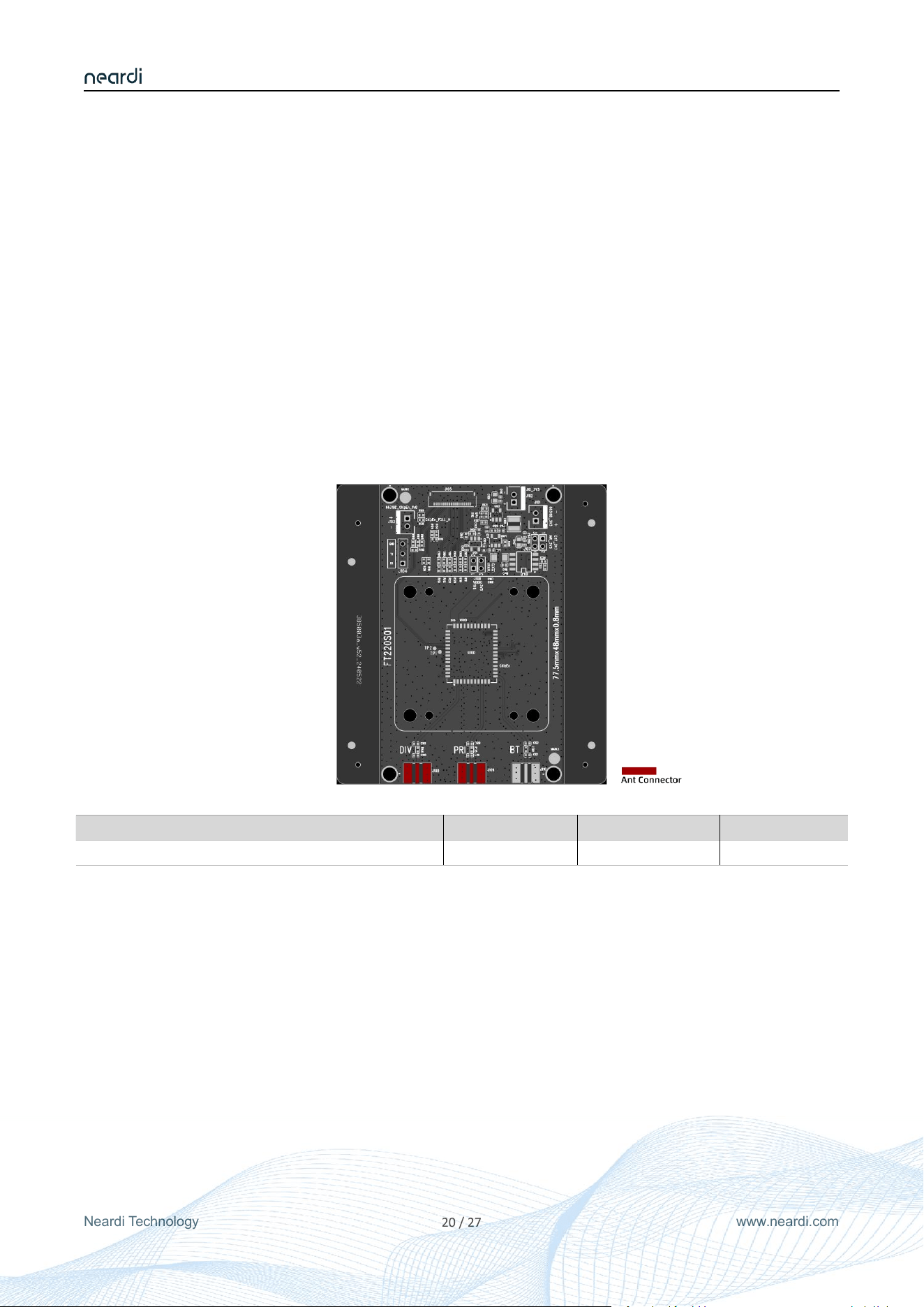
To facilitate the antenna tuning and certification test, a RF connector and an antenna matching circuit should be
added. The following figure is the recommended circuit.
FD7652P
Neardi Technology www.neardi.com
20
/
27
The module needs to be attached to the PCB board and connected to the external antenna
through the solder joint of the circuit on the PCB. The gain of the external antenna is 2dB(i Max.),the internal
structure is copper tube structure or FPC. A resistance of 0R is added between the module and the antenna at
C1003 to ensure that the impedance of the connection between the module and the antenna reaches 50R.The
J0800 position on the PCB is where the external antenna is connected.
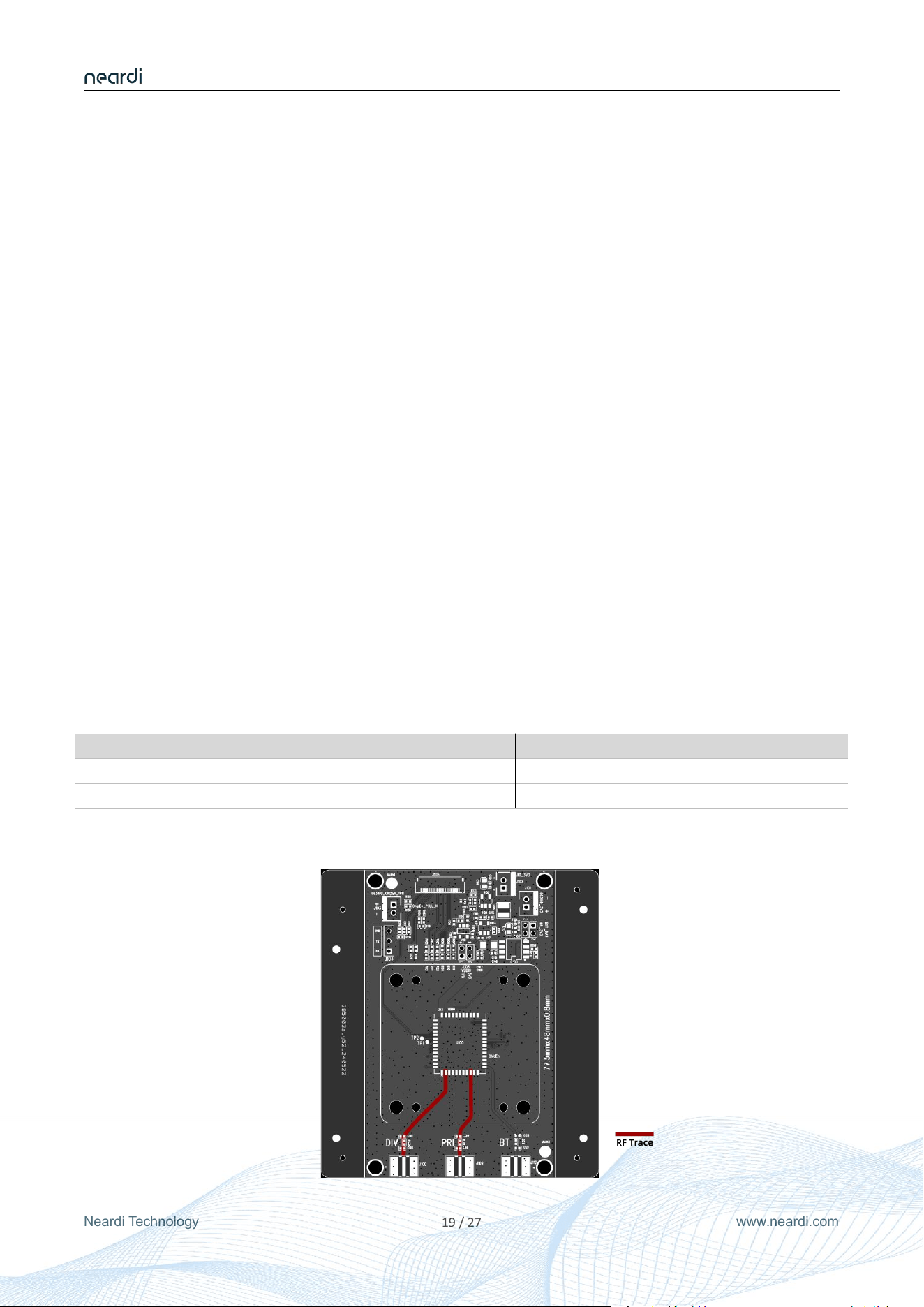
RF traces layout
1.Keep the RF trace from module ant pin to antenna as short as possible
2.RF trace should be 50 Ω either on the top layer or in the inner layer
3.RF trace should be avoided right angle and sharp angle.
4.Put enough GND vias around RF traces.
5.RF trace should be far away from other high speed signal lines.
External Antenna VSWR
8.6 RF Exposure Considerations
This device complies with FCC radiation exposure limits set forth for an uncontrolled environment. This
equipment should be installed and operated with minimum distance 20cm between the radiator & your body
8.7 Antenna Type and Gain
The following antennas have been certified for use with this module.
Only antennas of the same type with equal or lower gain may also be used with this module.
Parameters
Min
Typ
Max
External Antenna VSWR
1
1.6
2.0

FD7652P
Neardi Technology www.neardi.com
21
/
27
Other types of antennas and/or higher gain antennas may require the additional authorization for operation.
Antenna Specification list below:
Model
Type
Connector
Peak gain ( dBi )
2400-2483.5
MHz
5150-5250
MHz
5250-5350
MHz
5470-5725
MHz
5725-5850
MHz
FD7652P
External
Antenna
/
2.00dBi
2.00dBi
2.00dBi
2.00dBi
2.00dBi
8.8 End Product Labelling Compliance Information
When the module is installed in the host device, the FCC ID label must be visible through a window on the final
device or it must be visible when an access panel, door or cover is easily removed. If not, a second label must
be placed on the outside of the final device
that contains the following text: “Contains FCC ID: 2BFAK-FD220S”. The FCC ID can be
used only when all FCC compliance requirements are met
8.9 Information on Test Modes and Additional Testing Requirements
This transmitter is tested in a standalone mobile RF exposure condition and any co-located or simultaneous
transmission with other transmitter(s) class II permissive change re-evaluation or new FCC authorization.
Host manufacturer installed this modular with single modular approval should perform the
test of radiated emission and spurious emission according to FCC part 15C, Part 15E,
15.209, 15.207 requirement, only if the test result comply with FCC part 15C, Part 15E,
15.209, 15.207 requirement, then the host can be sold legally.
8.10 Additional testing, Part 15 Subpart B Disclaimer
This transmitter modular us tested as a subsystem and its certification does not cover the FCC Part 15 Subpart
B rules requirement applicable to the final host. The final host will still need to be reassessed for compliance to
this portion of rules requirements if applicable.
As long as all conditions above are met, further transmitter test will not be required. However, the OEM
integrator is still responsible for testing their end-product for any additional compliance requirements required
with this modular installed.

FD7652P
Neardi Technology www.neardi.com
22
/
27
8.11 Note EMI Considerations
The OEM integrator has to be aware not to provide information to the end user regarding how to install or
remove this RF module in the user’s manual of the end product which integrates this module.
The host integrator must follow the integration instructions provided in this document and ensure that the
composite system end product complies with the requirements by a technical assessment or evaluation to the
rules and to KDB Publication 996369.
The host integrator installing this module into their product must ensure that the final composite product
complies with the requirements by a technical assessment or evaluation to the rules, including the transmitter
operation and should refer to guidance in KDB Publication 996369.
OEM/Host Manufacturer Responsibilities
OEM/Host manufacturers are ultimately responsible for the compliance of the Host and Module. The final
product must be reassessed against all the essential requirements of the FCC rule such as FCC Part 15
Subpart B before it can be placed on the US market.
This includes reassessing the transmitter module for compliance with the Radio and RF Exposure essential
requirements of the FCC rules.
8.12 How to Make Changes - Important Note
In the event that these conditions cannot be met (for example certain laptop configurations or co-location with
another transmitter), then the FCC authorization is no longer considered valid and the FCC ID cannot be used
on the final product. In these circumstances, the OEM integrator will be responsible for re-evaluating the end
product (including the transmitter) and obtaining a separate FCC authorization.

FD7652P
Neardi Technology www.neardi.com
23
/
27
9 Ordering,Storage,Production and Packaging
9.1 Ordering Model
The ordering information for the mentioned Wi-Fi modules is as follows:
Product
Model
Interface
Storage Temperature
Size
FD7652P
220P12-0
PCIE
-40
℃
~85
℃
13mm*15mm
9.2 Storage Conditions
FD7652P module is 3 (MSL3) and packed in a vacuum-sealed bag when shipped, the recommended
storage temperature is 25±5°C, and the relative humidity is 35%~60%. Under this condition, the module
can be stored for 12 months.
The Module shall be stored without opening the packing. After the packing opened, the module shall be
completed the patch soldering within 24 hours.
FD7652P module can be stored for no more than 168 hours in a workshop environment with a
temperature of 25±5°C, a relative humidity below 60% and in compliance with IPC/JEDEC J-STD-033. It is
not recommended to expose the module unpacked to the air for a long time. If not immediately patch
soldering, it is recommended to store the module in a moisture-proof cabinet with a relative humidity of
less than 10% to keep the module dry.
If the module is not stored according to the above recommended method, it needs to be baked at high
temperature (120±5°C) for 8 hours. The re-baked module shall be patched within 24 hours.
Please pay attention to ESD protection when unpacking and handling modules.
9.3 Production Welding
During the production welding process, please do not use any organic solvents (such as alcohol, isopropanol,
acetone, trichloroethylene, etc.) to wipe the shield of the FD7652P module, otherwise it may cause the shield to
rust. Please do not ultrasonically clean the module, it may cause damage to the crystal inside the module.
Please make sure that the spray material used will not chemically react with the module shield or PCB and will
not flow into the module when spraying modules.
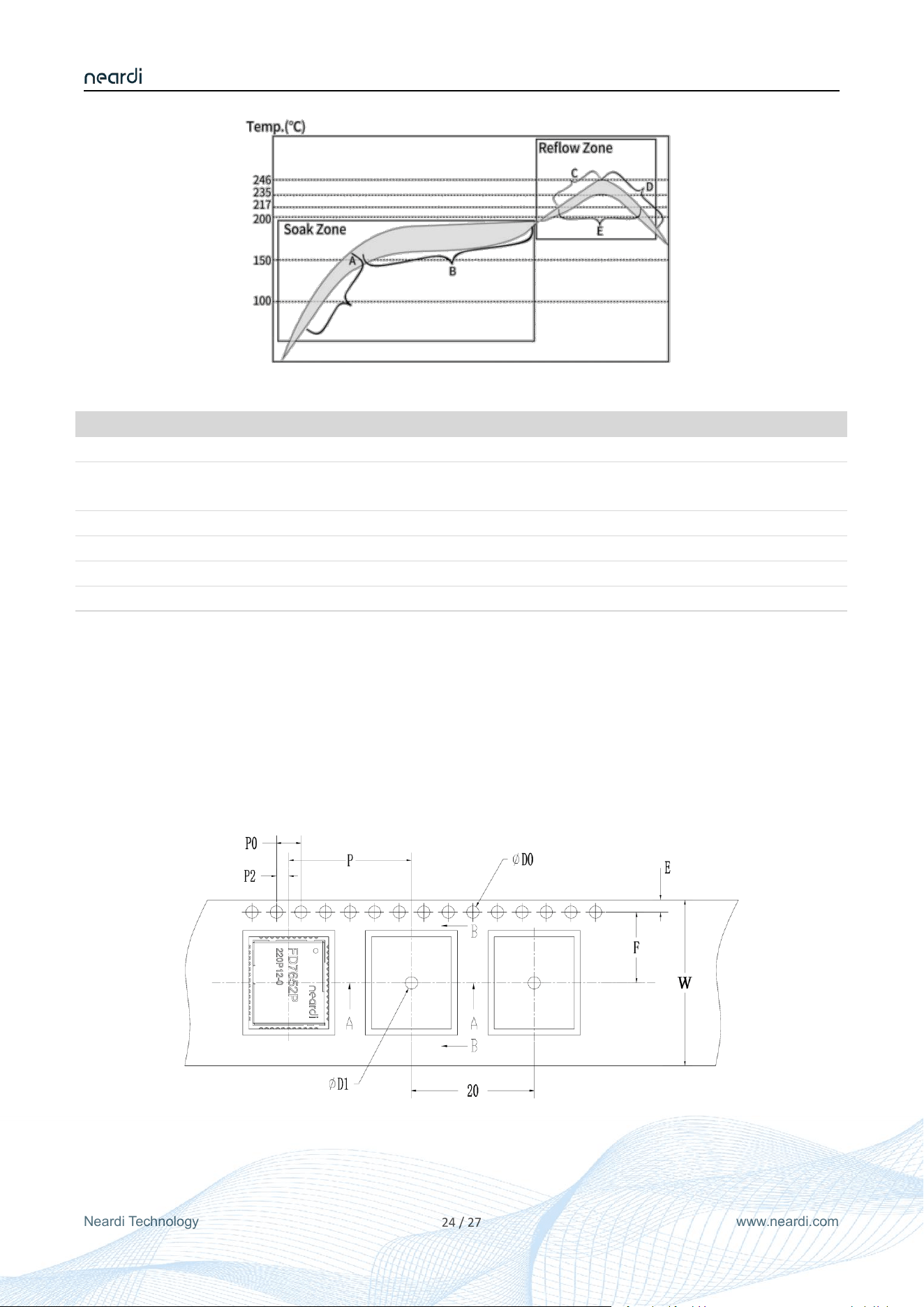
In order to ensure the welding quality and reliability of the FD7652P module, the thickness of the printed stencil
is recommended to be 0.15~0.18mm; the recommended reflow curve is as follows:
FD7652P
Neardi Technology www.neardi.com
24
/
27
Recommended reflow curve
Item
Description
Value
Endothermic Zone Heating Rate
Interval A
≤3
℃
/s
Soak time
From the end of interval A to the beginning of
interval B
60~120s
Reflow Zone Heating Rate
Interval C
≤3 ℃/s
Maximum Temperature
Highest point of the curve
246℃(+5/-0℃)
Cooling Rate
Interval D
<6 ℃/s
Reflow Time
Interval E
60~150 seconds
9.4 Packing Specifications
The key parameters and packaging processes described in this chapter are for reference only. The
appearance and structure of the specific packaging materials are subject to actual delivery.
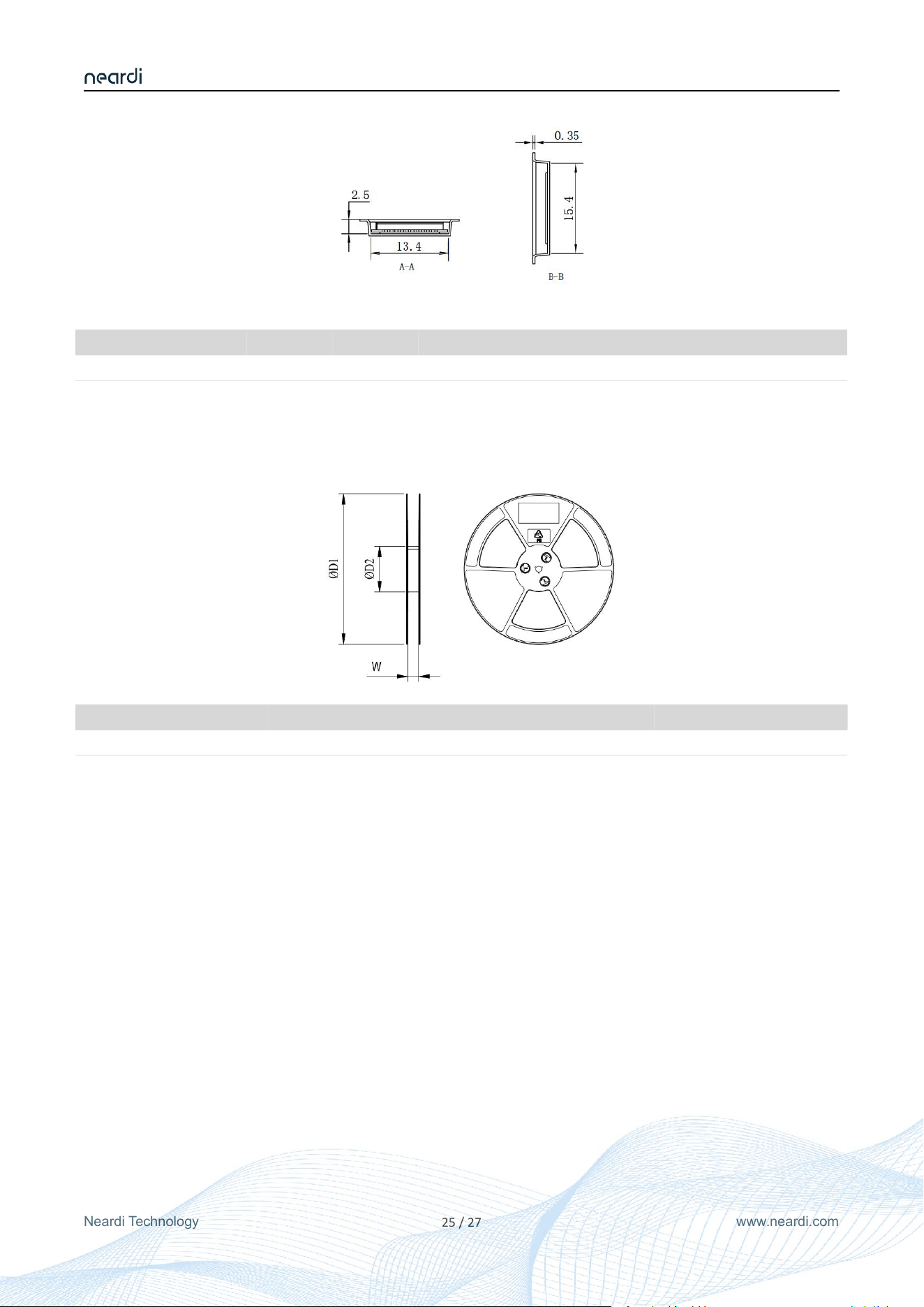
9.4.1 Tape Dimensions
FD7652P
Neardi Technology www.neardi.com
25
/
27
Tape dimensions
W
P
P0
P2
D0
D1
F
E.
Unit
24
20
4.0
2.0
1.5
1.5
11.5
1.75
mm
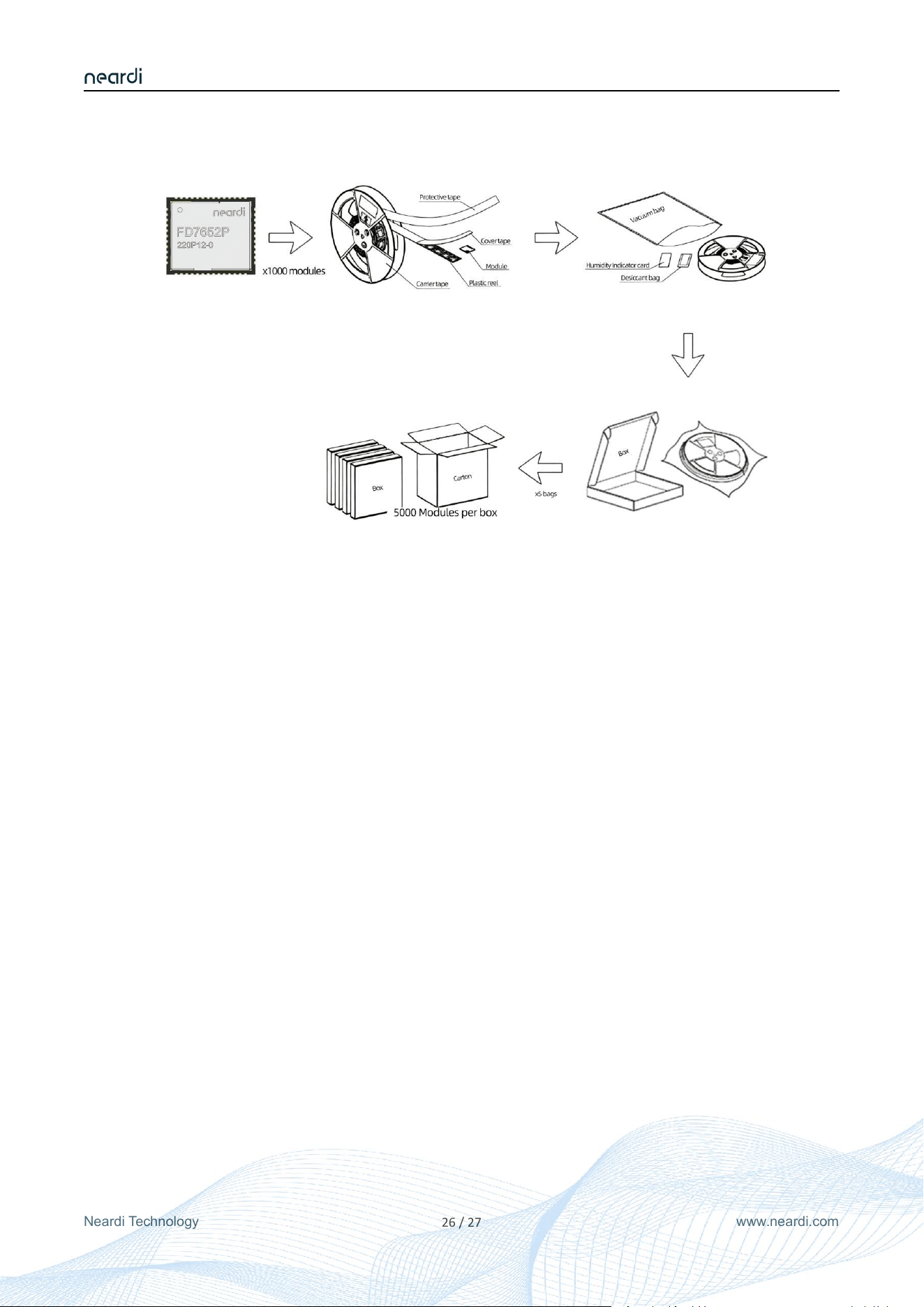
9.4.2 Plastic Reel Dimensions
ΦD1
φD2
W
unit
330
100
24
mm
FD7652P
Neardi Technology www.neardi.com
26
/
27
9.4.3 Packaging Process
Package specification