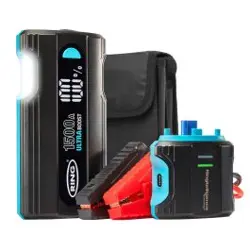
Emergency Jump Starter
with USB Charging
User Manual
This jump starter is designed for use only with 12V vehicle lead-acid
batteries. Do not use with other types of batteries. Read all safety
instructions before use. Failure to follow the safety instructions may
result in property damage, personal injury or re.
76952 Manual v1
6/23
IMPORTANT SAFETY INSTRUCTIONS -
KEEP MANUAL FOR FUTURE REFERENCE
MADE IN CHINA/HECHO EN CHINA
Distributed by Jasco Products Company LLC,
10 E. Memorial Rd., Oklahoma City, OK 73114.
This Jasco product has a 5-year limited warranty.
Visit www.byjasco.com for warranty details.
Questions? Contact our U.S.-based Consumer
Care at 1-800-654-8483, M-F, 7AM-8PM Central Time.
For product patent information,
visit www.byjasco.com/patents.
Thank you for your purchase!
Instructions
made easy
Register your
product
Discover charging
cables and other mobile
device accessories at
www.byjasco.com
Like our product?
Leave a review
on your favorite
retailer website or
amazon.com.
Having problems?
Let us know how
we can help.
Call 1-800-654-8483,
M-F, 7AM-8PM
Central Time.
Read instructions or watch
an easy-to-follow video.
Scan code or visit
byjasco.com/76952i
Receive exclusive deals and
register your product.
Scan code or visit
byjasco.com/deals
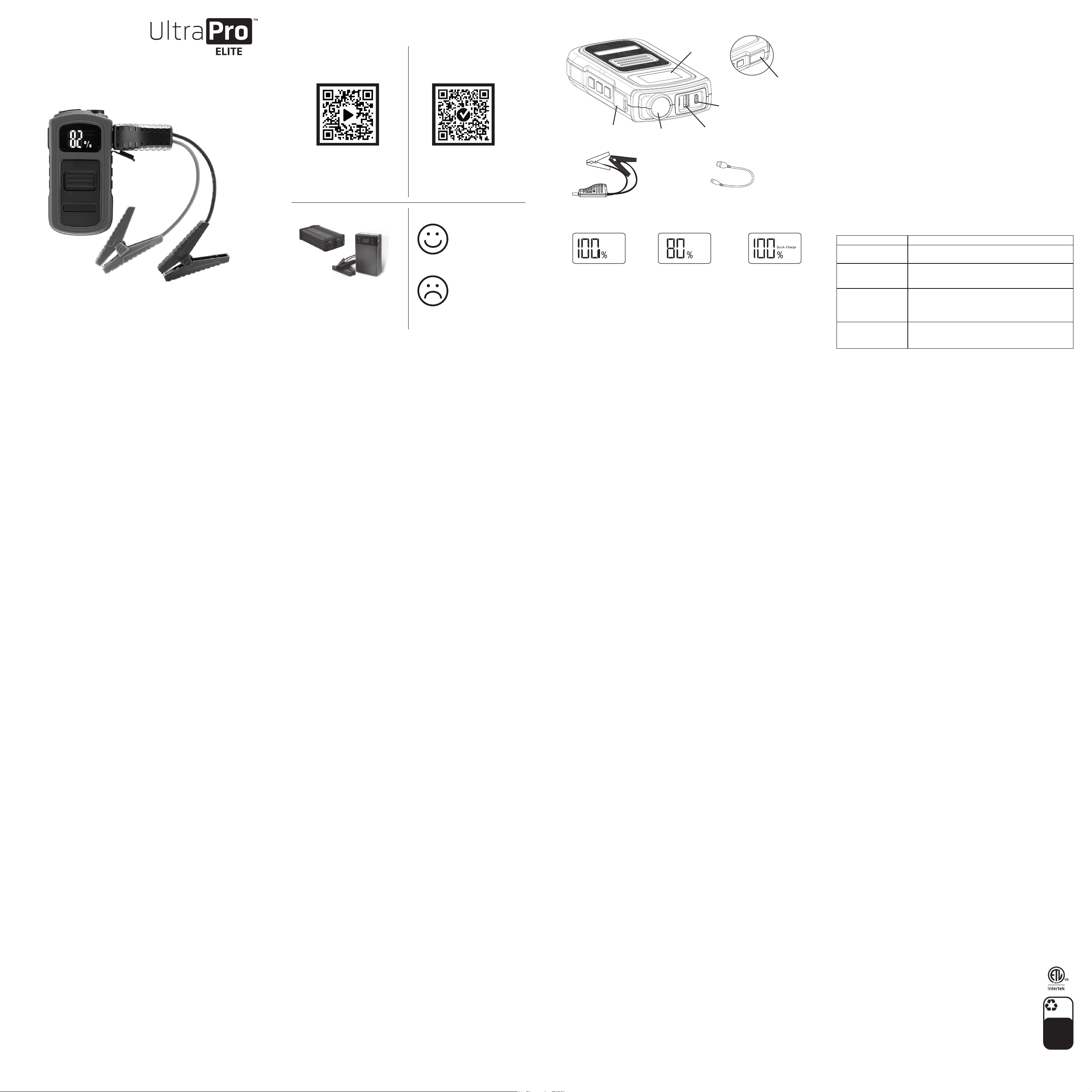
Jump starter components
LCD Display
Charging the jump starter
1. Connect the included USB cable to a USB-A power
supply (not included) and the jump starter’s USB-C port.
2. When charging, the LCD panel displays “USB-C IN” and
the jump starter’s battery level.
Jump-starting a 12V vehicle
1. Before beginning, verify the battery you wish to jump is a
12V lead-acid battery.
2. Press and release the power button to turn on the power
pack. The power pack will automatically turn off following
inactivity.
3. Insert the jumper cable plug into the jump starter.
4. Connect the battery clamps based on the vehicle’s
ground system:
a. Negative-ground system (common) – Connect the
red clamp to the vehicle’s positive battery terminal.
Then, connect the black clamp to the negative battery
terminal or a stationary area of the vehicle chassis.
b. Positive-ground system (rare) – Connect the black
clamp to the vehicle’s negative battery terminal. Then,
connect the red clamp to the positive battery terminal
or a stationary area of the vehicle chassis.
5. Check the LED indicator chart below to ensure the cable
connection is correct before proceeding.
6. Start the vehicle.
7. Allow the engine to run and remove the battery clamps
based on the vehicle’s ground system:
a. Negative-ground system (common) – Disconnect
the black clamp followed by the red clamp from the
vehicle battery.
b. Positive-ground system (rare) – Disconnect the red
clamp followed by the black clamp from the vehicle
battery.
8. If your vehicle does not start after four attempts, stop the
jump-starting process and contact a qualied technician
for assistance.
NOTE: The jump starter battery slowly loses its charge, even
when not in use. Charge the jump starter every three months
to ensure it is ready when needed.
Low-voltage batteries and boost feature
The jump starter has safety features to ensure a proper
connection before supplying power. If the LED indicator
blinks green or does not display after connecting the jump
starter, battery voltage is too low to detect. If this occurs,
follow the instructions below to use the boost button on the
jumper cables to jump-start your vehicle.
WARNING: Exercise extreme caution. Using the boost
button disables key safety features.
Using the boost button:
1. Properly connect the battery clamps to the jump starter
and your vehicle battery per the instructions under Jump-
starting a 12V vehicle. Ensure the clamps are correctly
connected to the battery per the LED indicator chart
included in that section of the manual.
2. Once a correct connection is conrmed, press the boost
button and attempt to start the vehicle.
CAUTION
NEVER press the boost button before connecting the
battery clamps to the vehicle battery. This can cause
dangerous sparks when connecting the clamps to the
battery or if the clamps contact each other. ONLY press the
boost button after properly connecting the battery clamps
to your vehicle battery.
Use the boost mode with extreme caution. If you are
uncomfortable, contact a qualied technician for assistance.
Charging cell phones or tablets
1. Connect your mobile device to the Quick Charge USB-A
or USB-C output port using a USB cable.
2. USB-C charging will begin once your device is connected
to the jump starter. To begin USB-A charging, press and
release the power button to turn on the jump starter. The
battery pack will automatically turn off after charging is
complete.
LED task light
1. Press and hold the power button for two seconds to turn
on the LED task light.
2. Press and release the power button again to select strobe
mode, then press and release it again to select SOS mode.
3. Press and hold the power button for four seconds after
the SOS mode to turn off the task light. The LCD display
panel will automatically turn off after inactivity.
Care and maintenance
Charge the jump starter every three months and inspect the
condition of the jumper cables and battery clamps. Do not
use the jump starter or cables if they are damaged. Clean
the device with a soft, dry cloth.
Battery disposal
The jump starter contains a lithium polymer battery. Follow
all applicable state and federal laws for battery disposal and
recycling. Do not dispose of the jump starter in the garbage.
LCD display
Jumper cable socket
LED task and
SOS light
Quick Charge
output port
PD 30W
input/output port
LED light & mode
selection button
Intelligent
jumper cable
USB-A to
USB-C cable
Battery level
“USB-C” indicates
USB-C port is in use
“Quick Charge”
indicates USB-A
port is in use
FCC NOTE: The manufacturer is not responsible for any radio
or TV interference caused by unauthorized modifications to this
equipment. Such modifications could void the user’s authority to
operate the equipment.
FCC STATEMENT:
Suppliers Declaration of Conformity | Model #: 76952 | Jasco
Products Co., 10 E. Memorial Rd., Oklahoma City, OK 73114,
www.byjasco.com
This device complies with Part 15 of the FCC rules. Operation
is subject to the following two conditions: (1) this device may
not cause harmful interference, and (2) this device must accept
any interference received, including interference that may cause
undesired operation.
NOTE: This equipment has been tested and found to comply with
the limits for a Class B digital device, pursuant to Part 15 of the FCC
Rules. These limits are designed to provide reasonable protecton
against harmful interference in a residential installation. This
equipment generates, uses and can radiate radio frequency energy
and, if not installed and used in accordance with the instructions,
may cause harmful interference to radio communications. However,
there is no guarantee that interference will not occur in a particular
installation. If this equipment does not cause harmful interference
to radio or television reception, which can be determined by
turning the equipment o and on, the user is encouraged to try to
correct the interference by one or more of the following measures:
• Reorient or relocate the receiving antenna.
• Increase the separation between the equipment and receiver.
• Connect the equipment into an outlet on a circuit dierent from
that to which the receiver is connected.
• Consult the dealer or an experienced radio/TV technician
for help.
INSTRUCTIONS PERTAINING TO RISK OF FIRE,
ELECTRIC SHOCK OR INJURY TO PERSONS
IMPORTANT SAFETY INSTRUCTIONS
WARNING – When using this product, basic precautions should
always be followed.
1. Read all instructions before using the product.
2. To reduce the risk of injury, close supervision is necessary when
the product is used near children.
3. Do not put fingers or hands in the product.
4. Use of an attachment not recommended or sold by the power
pack’s manufacturer may result in a risk of fire, electric shock
or injury. Use only the battery clamps provided with this jump
starter.
5. To reduce risk of damage to the jumper cable plug and cord,
grasp the plug rather than the cord when disconnecting the
power pack.
6. Do not use a power pack or appliance that is damaged
or modified. Damaged or modified batteries may exhibit
unpredictable behavior resulting in fire, explosion or risk
of injury.
7. Do not operate the power pack with a damaged cord, plug
or output cable.
8. Do not disassemble the power pack. Take it to a qualified
service technician when service or repair is required. Incorrect
reassembly may result in a risk of fire or electric shock.
9. To reduce the risk of electric shock, unplug the power pack
from the outlet before attempting any instructed servicing.
10. Store the jump starter indoors when not in use. This device
is intended for temporary use outdoors, and reasonable care
should be exercised in wet conditions.
11. Do not place the power pack in areas exceeding temperatures
of 60 C (140 F). Avoid prolonged exposure to direct sunlight.
12. Charge the device within the temperature range of 5–45 C
(41–113 F).
13. Do not expose the power pack to extreme heat or fire.
14. Do not jump-start a vehicle or use other functions of the power
pack while the device is charging.
15. Disconnect the power pack from the vehicle battery within 30
seconds after the vehicle starts.
16. Do not use the power pack as a vehicle battery replacement.
17. To avoid overheating or other damage to the power pack, do
not try to jump-start your vehicle more than four consecutive
times.
18. This power pack is only for use with 12V vehicle lead-acid
batteries. Do not use with other types of batteries.
19. Do not drop the unit. If the unit receives a sharp blow or is
otherwise damaged, consult a qualified technician.
20. Never allow the red and black clamps to touch each other or
other common metal objects.
21. Determine whether the vehicle has a positive or negative
grounding system to dictate the order of disconnecting and
connecting the clamps per the instructions under Jump-starting
a 12V vehicle.
WARNING – RISK OF EXPLOSIVE GASES
1. WORKING IN THE VICINITY OF A LEAD-ACID BATTERY IS
DANGEROUS. BATTERIES GENERATE EXPLOSIVE GASES
DURING NORMAL BATTERY OPERATION. FOR THIS REASON,
IT IS OF THE UTMOST IMPORTANCE THAT YOU FOLLOW THE
INSTRUCTIONS EACH TIME YOU USE THE POWER PACK.
2. To reduce risk of battery explosion, follow these instructions
and those published by the battery manufacturer and the
manufacturer of any equipment you intend to use in the vicinity
of the battery. Review cautionary markings on these products
and on the vehicle’s engine.
a. The device shall be stored indoors and protected from the
elements.
b. This unit shall not be charged outdoors.
c. When in use, steps should be taken to reduce exposure to
rain, sleet, snow and the like.
PERSONAL PRECAUTIONS
1. When working near a lead-acid battery, consider having
someone nearby to come to your aid, if needed.
2. Have plenty of fresh water and soap nearby in case battery
acid contacts skin, clothing or eyes.
3. Wear complete eye protection and clothing protection. Avoid
touching eyes while working near the battery.
4. If battery acid contacts skin or clothing, wash immediately
with soap and water. If acid enters eye, immediately flood eye
with running cold water for at least 10 minutes and get medical
attention immediately.
5. NEVER smoke or allow a spark or flame in the vicinity of the
battery or engine.
6. Be extra cautious to reduce risk of dropping a metal tool onto
the battery. It might spark or short-circuit the battery or other
electrical part, which may cause an explosion.
7. Remove personal metal items, such as rings, bracelets,
necklaces and watches when working with a lead-acid battery.
A lead-acid battery can produce a short-circuit current high
enough to weld a ring, or the like, to metal, causing a severe
burn.
8. When charging the internal battery, work in a well-ventilated
area and do not restrict ventilation in any way.
9. Under abusive conditions, liquid may be ejected from the
battery; avoid contact. If contact accidentally occurs, flush with
water. If liquid contacts eyes, additionally seek medical help.
Liquid ejected from the battery may cause irritation or burns.
10. Do not expose a power pack to fire or excessive temperature.
Exposure to fire or temperatures above 130 C (265 F) may
cause an explosion.
11. Have servicing performed by a qualified repair technician using
only identical replacement parts. This will ensure that the safety
of the product is maintained.
12. Attach output cables to a battery and chassis as indicated in the
operating instructions. Never allow the output clamps to touch
one another.
100%
recyclable
Separate
paper
from plastic
before
recycling
byjasco.com/recycle
paper made from 25%
post consumer waste
USB-C
LED indicator
Solid green LED
Red LED and buzzing
Blinking green LED
No lights and no
buzzing
Operation
The connection is correct and working.
You can safely power the engine.
The polarity connection is reversed. Correct
the polarity and wait for the solid green LED
before powering the vehicle.
The vehicle battery power is too low.
Press the “BOOST” button next to indicator lights,
then wait for the solid green LED. Once the LED is
solid, turn on the engine within 30 seconds.
Ensure the clamp connection is correct. Then, press the
“BOOST” button next to indicator lights. If the LED is
solid green, turn on the engine within 30 seconds.
Arranque auxiliar de
emergencia con carga USB
Manual del usuario
Este arranque auxiliar está diseñado para usarse solo con baterías
de plomo-ácido de vehículos de 12 V. No lo use con otros tipos de
baterías. Lea todas las instrucciones de seguridad antes de usar. El
incumplimiento de estas instrucciones de seguridad puede provocar
daños a la propiedad, lesiones personales o incendio.
76952 Manual v1
6/23
INSTRUCCIONES IMPORTANTES DE SEGURIDAD
GUARDE EL MANUAL PARA FUTURAS CONSULTAS
¡Gracias por su compra!
Instrucciones
fáciles
Registre su
producto
Descubra cables de carga y
otros accesorios para
dispositivos móviles en
www.byjasco.com
¿Le gusta nuestro
producto?
Deje una reseña en el
sitio web de su
distribuidor favorito o
en amazon.com.
¿Tiene algún
problema?
Díganos cómo
podemos ayudar.
Llame al 1-800-654-8483,
de lunes a viernes, de 7 a. m.
a las 8 p. m., hora central.
Lea las instrucciones o mire el
video con el paso a paso.
Escanee el código o visite
byjasco.com/76952i
Recibe ofertas exclusivas y
registra tu producto.
Escanee el código o visite
byjasco.com/deals
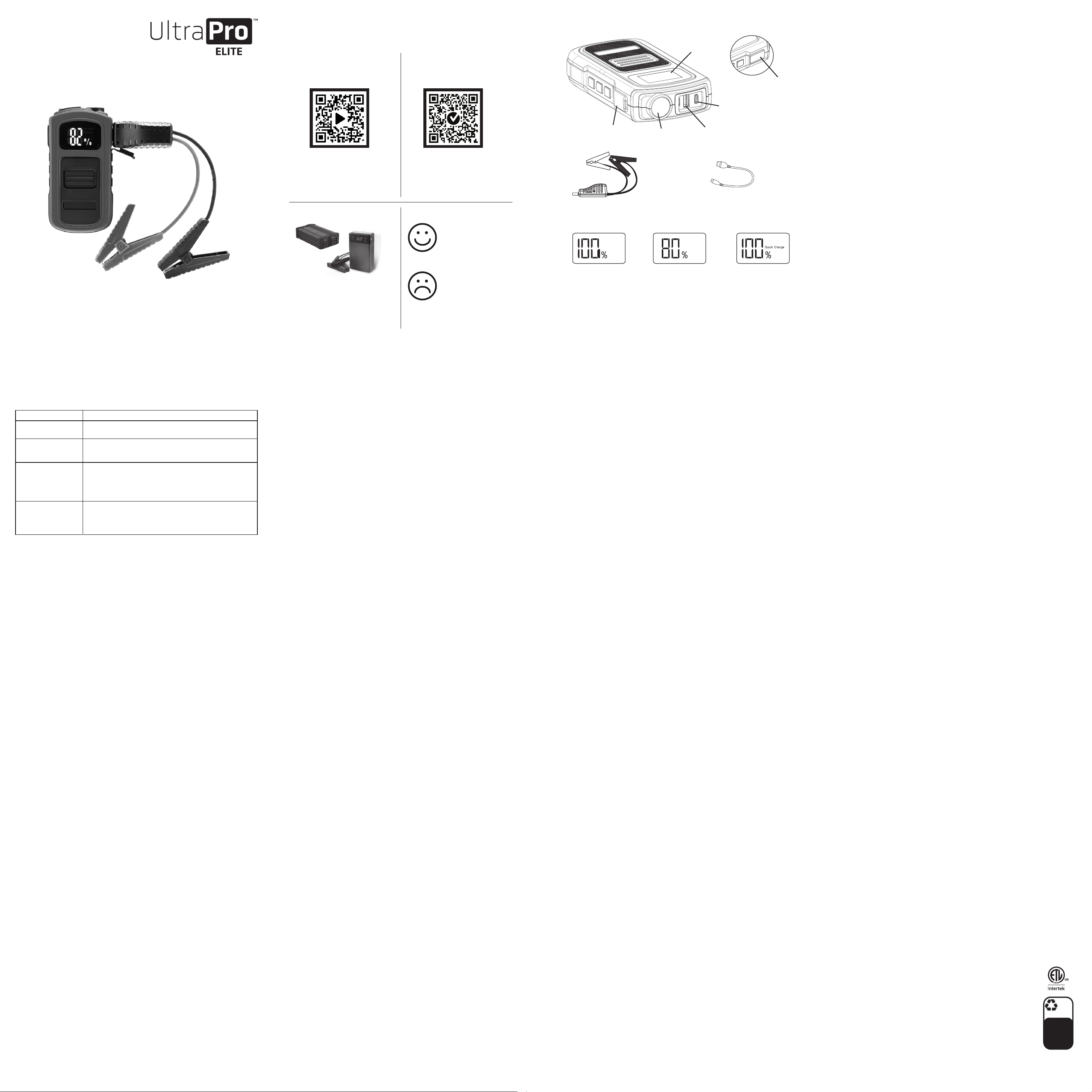
Componentes del arrancador
Pantalla LCD
Carga del arranque auxiliar
1. Conecte el cable USB provisto a una fuente de
alimentación USB-A (no incluida) y al puerto UBS-C del
arranque auxiliar.
2. Durante la carga, el panel LCD muestra “USB-C IN” y el
nivel de batería del arranque auxiliar.
Arrancar un vehículo de 12 V
1. Antes de comenzar, verique que la batería que desea
arrancar sea una batería de plomo-ácido de 12 V.
2. Presione y suelte el botón de encendido para encender
la fuente de alimentación. La fuente de alimentación se
apagará automáticamente después de inactividad.
3. Inserte el enchufe de los cables de puente en el
arrancador auxiliar.
4. Conecte las pinzas para batería según el sistema de tierra
del vehículo:
a. Sistema de conexión a tierra negativa (común):
conecte la pinza roja al terminal positivo de la batería
del vehículo. Luego, conecte la pinza negra al terminal
negativo de la batería o a un área estacionaria del
chasis del vehículo.
b. Sistema de conexión a tierra positiva (infrecuente):
conecte la pinza negra al terminal negativo de la
batería del vehículo. Luego, conecte la pinza roja al
terminal positivo de la batería o a un área estacionaria
del chasis del vehículo.
5. Revise la tabla de indicadores LED a continuación para
asegurarse de que la conexión del cable sea correcta
antes de continuar.
6. Arranque el vehículo.
7. Deje el motor encendido y retire las abrazaderas de la
batería según el sistema de tierra del vehículo:
a. Sistema de conexión a tierra negativa (común):
desconecte la pinza negra seguida de la pinza roja de
la batería del vehículo.
b. Sistema de conexión a tierra positiva (infrecuente):
desconecte la pinza roja seguida de la pinza negra de
la batería del vehículo.
8. Si su vehículo no arranca después de cuatro intentos,
detenga el proceso de arranque auxiliar y comuníquese
con un técnico calicado para obtener ayuda.
NOTA: La batería del arranque auxiliar pierde lentamente su
carga, incluso cuando no está en uso. Cargue el arranque
cada tres meses para asegurarse de que esté listo cuando
lo necesite.
Baterías de bajo voltaje y función de refuerzo
El arranque auxiliar tiene características de seguridad para
garantizar una conexión adecuada antes de suministrar
energía. Si el indicador LED parpadea en verde o no se
muestra después de conectar el arranque auxiliar, es
indicación de que el voltaje de la batería es demasiado bajo
para detectarlo. Si esto sucede, siga las instrucciones a
continuación para usar el botón de refuerzo en los cables de
puente para arrancar su vehículo.
ADVERTENCIA: Extreme las precauciones. El uso del
botón de refuerzo desactiva las funciones clave de
seguridad.
Uso del botón de refuerzo:
1. Conecte correctamente las pinzas para batería al
arranque auxiliar y a la batería de su vehículo según las
instrucciones en Arrancar un vehículo de 12 V. Asegúrese
de que las pinzas estén correctamente conectadas a la
batería según la tabla de indicadores LED incluida en esa
sección del manual.
2. Una vez que se conrme una conexión correcta, presione
el botón de refuerzo e intente arrancar el vehículo.
PRECAUCIÓN
NUNCA presione el botón de refuerzo antes de conectar
las pinzas para batería a la batería del vehículo. Esto
puede provocar chispas peligrosas al conectar las pinzas
a la batería o si las pinzas entran en contacto entre sí.
SOLAMENTE presione el botón de refuerzo después de
conectar correctamente las pinzas para batería a la batería
de su vehículo.
USE el modo de refuerzo con extrema precaución. Si no se
siente cómodo, comuníquese con un técnico calicado para
que lo ayude.
Carga de celulares o tabletas
1. Conecte su dispositivo móvil al puerto de salida Quick
Charge USB-A o USB-C con un cable USB.
2. La carga USB-C comenzará una vez que el dispositivo
esté conectado al arrancador. Para iniciar la carga USB-A,
presione y suelte el botón de encendido para encender
el arrancador. La batería se apagará automáticamente
cuando haya nalizado la carga.
Luz de trabajo LED
1. Mantenga presionado el botón de encendido durante tres
segundos para encender la luz de trabajo LED.
2. Presione y suelte el botón de encendido nuevamente
para seleccionar el modo estroboscópico, luego, presione
y suelte nuevamente para seleccionar el modo SOS.
3. Presione y suelte el botón de encendido una vez más
después del modo SOS para apagar la luz de trabajo. El
panel de visualización LCD se apagará automáticamente
después de la inactividad.
Cuidado y mantenimiento
Cargue el arranque auxiliar cada tres meses e inspeccione
el estado de los cables de puente y las pinzas para batería.
No utilice el arranque auxiliar ni los cables si están dañados.
Limpie el dispositivo con un paño suave seco.
Eliminación de la batería
El arranque auxiliar contiene una batería de polímero de litio.
Cumpla todas las leyes estatales y federales aplicables para
Pantalla LCD
Cable puente
Luz LED de
trabajo y SOS
Puerto de salida
de carga rápida
PD 30W puerto
de entrada/salida
Luz LED y botón de
selección de modo
Cable puente
inteligente
Cable USB-A
a USB-C
Nivel de batería
“USB-C” indica que
el puerto USB-C está
en uso
“Quick Charge”
(Carga rápida) indica
que el puerto USB-A
está en uso
la eliminación y reciclaje de baterías. No deseche el arranque
auxiliar en la basura.
FCC NOTE: El fabricante no se hace responsable de ninguna
interferencia de radio o TV ocasionada por modificaciones no
autorizadas efectuadas a este equipo. Dichas modificaciones
podrían anular la autoridad del usuario para utilizar el equipo.
FCC STATEMENT:
DECLARACIÓN DE LA COMISIÓN FEDERAL DE
COMUNICACIONES (FCC) Declaración de conformidad del
proveedor | Modelo #: 76952 | Jasco Products Co., 10 E. Memorial
Rd., Oklahoma City, OK 73114, www.byjasco.com
Este dispositivo cumple con las Especificaciones del apartado 15
de las normas de la FCC y con las especificaciones de las normas
radioeléctricas (RSS) del Ministerio de Industria de Canadá
aplicables a aparatos exentos de licencia. El funcionamiento está
sujeto a las siguientes dos condiciones: (1) este dispositivo no
debe provocar interferencia perjudicial, y (2) este dispositivo debe
aceptar toda interferencia que reciba, incluso la que pudiera causar
un funcionamiento no deseado.
NOTE: Este equipo ha sido probado y cumple con los límites para
aparatos digitales de Clase B, de conformidad con el apartado
15 de las normas de la FCC. Estos límites están diseñados para
proveer protección razonable contra interferencias perjudiciales
en una instalación residencial. Este equipo genera, usa y puede
irradiar energía de radiofrecuencias y, si no se instala y usa según
las instrucciones, puede provocar interferencia perjudicial a las
radiocomunicaciones. No obstante, no hay garantías de que no
ocurrirá interferencia en una instalación en particular. Si este equipo
provoca interferencia perjudicial a la recepción de radio o televisión,
lo que puede determinarse encendiendo y apagando el equipo,
se recomienda que el usuario intente corregir la interferencia
por medio de la implementación de una o más de las siguientes
medidas:
• Reorientar o reubicar la antena receptora.
• Incrementar la separación entre el equipo y el receptor.
• Conectar el equipo a un tomacorriente de un circuito diferente
del circuito al que está conectado el receptor.
• Consultar al distribuidor o a un técnico con experiencia en radio/
televisión para solicitar asistencia.
INSTRUCCIONES RELATIVAS AL RIESGO DE
INCENDIO, DESCARGA ELÉCTRICA O LESIONES
PERSONALES
INSTRUCCIONES IMPORTANTES DE SEGURIDAD
ADVERTENCIA – Cuando utilice este producto, siempre respete las
precauciones básicas, incluidas las siguientes:
1. Lea todas las instrucciones antes de usar el producto.
2. A fin de reducir el riesgo de lesiones, debe supervisar a los niños
cuando usa un producto cerca de ellos.
3. No introduzca los dedos ni las manos en el producto.
4. El uso de un accesorio no recomendado o vendido por el
fabricante de la fuente de alimentación puede provocar
un riesgo de incendio, descarga eléctrica o lesiones. Utilice
únicamente las pinzas para batería provistas con este arranque
auxiliar.
5. Para reducir el riesgo de daños en el enchufe y el cable del
puente, sujete el enchufe en lugar del cable cuando desconecte
la fuente de alimentación.
6. No utilice una fuente de alimentación o un aparato que esté
dañado o modificado. Las baterías dañadas o modificadas
pueden presentar un comportamiento impredecible que resulte
en un incendio, explosión o riesgo de lesiones.
7. No opere la fuente de alimentación con un cable, enchufe o
cable de salida dañado.
8. No desarme la fuente de alimentación. Llévela a un técnico de
servicio calificado cuando se requiera servicio o reparación. El
reensamblaje incorrecto puede provocar un riesgo de incendio
o descarga eléctrica.
9. Para reducir el riesgo de descarga eléctrica, desenchufe la
fuente de alimentación de la toma de corriente antes de intentar
realizar cualquier servicio indicado.
10. Guarde el arranque auxiliar en interiores cuando no esté en uso.
Este dispositivo está diseñado para uso temporal al aire libre, y
se debe tener un cuidado razonable en condiciones húmedas.
11. No coloque la fuente de alimentación en áreas donde las
temperaturas superen los 60 C (140 F). Evite la exposición
prolongada a la luz solar directa.
12. Cargue el dispositivo dentro del rango de temperatura de 5–45
C (41–113 F).
13. No exponga la fuente de alimentación al calor extremo o al
fuego.
14. No arranque un vehículo con puente ni utilice otras funciones
de la fuente de alimentación mientras el dispositivo se está
cargando.
15. Desconecte la fuente de alimentación de la batería del vehículo
dentro de los 30 segundos posteriores al arranque del vehículo.
16. No utilice la fuente de alimentación como reemplazo de la
batería del vehículo.
17. Para evitar el sobrecalentamiento u otros daños a la fuente de
alimentación, no intente arrancar su vehículo con puente más de
cuatro veces consecutivas.
18. Esta fuente de alimentación es para uso exclusivo con baterías
de plomo-ácido de vehículos de 12 V. No la use con otros tipos
de baterías.
19. No deje caer la unidad. Si la unidad recibe un golpe fuerte o se
daña de otra manera, consulte a un técnico calificado.
20. Nunca permita que las pinzas roja y negra se toquen entre sí o
con otros objetos metálicos comunes.
21. Determine si el vehículo tiene un sistema de conexión a tierra
positiva o negativa para definir el orden de desconexión y
conexión de las pinzas según las instrucciones en Arrancar un
vehículo de 12 V.
ADVERTENCIA: RIESGO DE GASES EXPLOSIVOS
1. TRABAJAR EN LAS PROXIMIDADES DE UNA BATERÍA DE
PLOMO-ÁCIDO ES PELIGROSO. LAS BATERÍAS GENERAN
GASES EXPLOSIVOS DURANTE EL FUNCIONAMIENTO
NORMAL DE LA BATERÍA. POR ESTA RAZÓN, ES DE LA
MAYOR IMPORTANCIA QUE SIGA LAS INSTRUCCIONES CADA
VEZ QUE UTILICE LA FUENTE DE ALIMENTACIÓN.
2. Para reducir el riesgo de explosión de la batería, siga estas
instrucciones y las publicadas por el fabricante de la batería y el
fabricante de cualquier equipo que pretenda utilizar cerca de la
batería. Revise las marcas de precaución en estos productos y
en el motor del vehículo.
a. El dispositivo se debe almacenar bajo techo y protegido de
la intemperie.
b. Esta unidad no debe cargarse al aire libre.
c. Cuando esté en uso, se deben tomar medidas para reducir la
exposición a la lluvia, aguanieve, nieve y similares.
PRECAUCIONES PERSONALES
1. Cuando trabaje cerca de una batería de plomo-ácido, considere
tener a alguien cerca para que lo ayude, si es necesario.
2. Tenga cerca suficiente agua fresca y jabón en caso de que el
ácido de la batería entre en contacto con la piel, la ropa o los
ojos.
3. Use protección completa para los ojos y ropa de protección.
Evite tocarse los ojos mientras trabaja cerca de la batería.
4. Si el ácido de la batería entra en contacto con la piel o la ropa,
lávese inmediatamente con agua y jabón. Si el ácido entra en
el ojo, enjuáguelo inmediatamente con abundante agua fría
durante al menos 10 minutos y obtenga atención médica de
inmediato.
5. NUNCA fume ni permita que haya chispas o llamas cerca de la
batería o del motor.
6. Tenga mucho cuidado para reducir el riesgo de dejar caer una
herramienta de metal sobre la batería. Podría provocar una
chispa o un cortocircuito en la batería u otra parte eléctrica, lo
que podría causar una explosión.
7. Quítese los artículos personales de metal, como anillos, pulseras,
collares y relojes cuando trabaje con una batería de plomo-
ácido. Una batería de plomo-ácido puede producir una corriente
de cortocircuito lo suficientemente alta como para soldar
un anillo, u objetos similares, al metal, con una consecuente
quemadura grave.
8. Cuando cargue la batería interna, trabaje en un área bien
ventilada y no restrinja la ventilación de ninguna manera.
9. En condiciones de uso indebido, es posible que salga líquido de
la batería; evite el contacto. Si ocurre contacto accidentalmente,
enjuague con agua. Si el líquido entra en contacto con los
ojos, busque además ayuda médica. El líquido expulsado de la
batería puede causar irritación o quemaduras.
10. No exponga la fuente de alimentación al fuego ni a
temperaturas excesivas. La exposición al fuego o temperaturas
superiores a 130 C (265 F) puede causar una explosión.
11. Entregue a un técnico de reparación calificado para que realice
el servicio utilizando solo piezas de repuesto idénticas. Esto
asegurará que se mantenga la seguridad del producto.
12. Conecte los cables de salida a la batería y al chasis como se
indica en las instrucciones de funcionamiento. Nunca permita
que las pinzas de salida se toquen entre sí.
100%
recyclable
Separate
paper
from plastic
before
recycling
byjasco.com/recycle
paper made from 25%
post consumer waste
HECHO EN CHINA
Distribuido por Jasco Products Company LLC,
10 E. Memorial Rd., Oklahoma City, Oklahoma 73114.
Este producto de Jasco tiene una garantía limitada
de 5 años. Visite www.byjasco.com para conocer los
detalles de la garantía.
¿Tiene preguntas? Comuníquese con nuestro servicio de
atención al consumidor de EE. UU. al 1-800-654-8483,
de lunes a viernes, de 7AM a 8PM (hora central).
Visite www.byjasco.com/patents para información sobre
la patente del producto.
USB-C
Indicador LED
LED verde
sólido
LED rojo
y zumbido
LED verde
parpadeante
Sin luces y sin
zumbidos
Funcionamiento
La conexión es correcta y funciona. Puede
alimentar el motor de forma segura.
La conexión de polaridad está invertida.
Corrija la polaridad y espere hasta ver el LED
verde sólido antes de encender el vehículo.
La energía de la batería del vehículo es demasiado
baja. Presione el botón “BOOST” (Refuerzo) junto a las
luces indicadoras, luego, espere a que se encienda el
LED verde sólido. Una vez que el LED sea de un color
sólido, encienda el motor dentro de 30 segundos.
Asegúrese de que la conexión de la pinza sea correcta.
Luego, presione el botón “BOOST” (Refuerzo) al lado de
las luces indicadoras. Si el LED es de color verde sólido,
encienda el motor dentro de 30 segundos.