Technical Manual
Powersports Batteries
Consumer Products
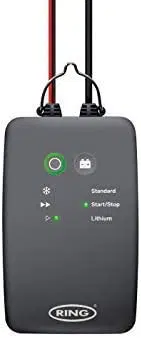
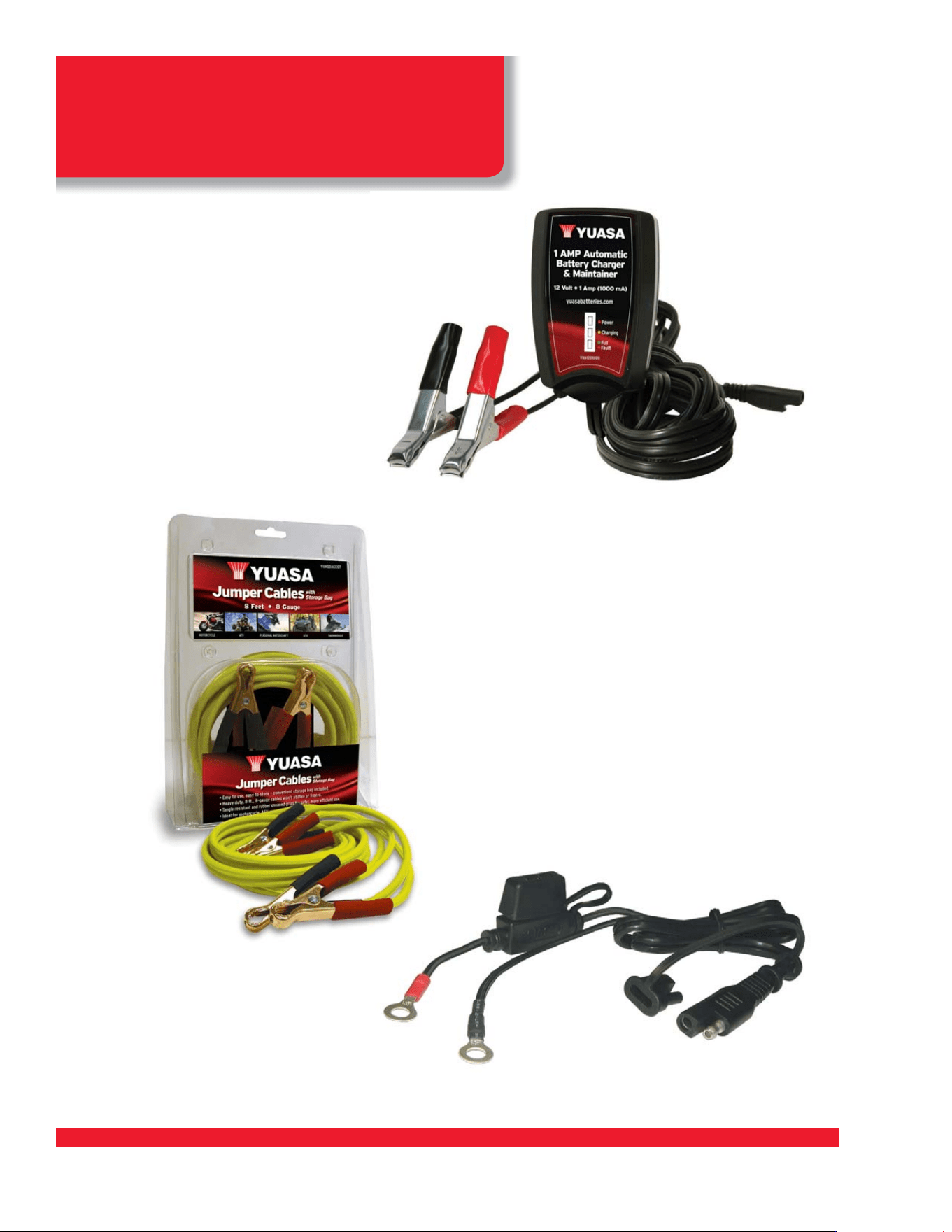
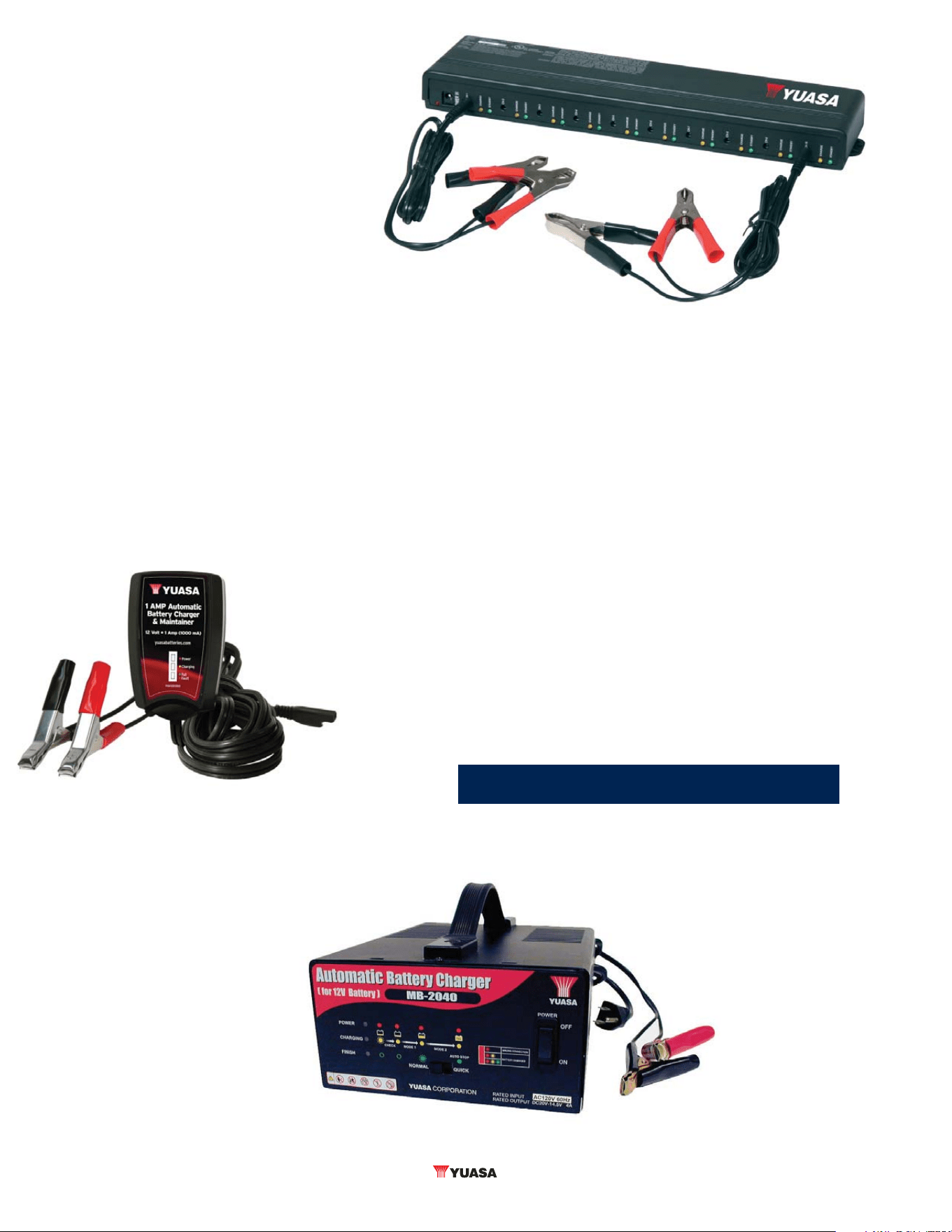
Yuasa 12V, 1 AMP Automatic
Battery Charger & Maintainer
Part No. YUA1201000
Jumper Cables
Part No. YUA00ACC07
Battery Charger Lead
Part No. YUA00ACC04
s 3 stage charge cycle
s Easy-to-use, simply attach to battery & plug it in
s Charges and maintains your battery
s 3 color LED displays your charge status at a glance
s Reaches 14.4 volt peak then automatically switches to
maintenance mode
s Designed to prevent overcharging
s Includes quick connect adapter and alligator clips
s Easy to use, easy to store
s Convenient storage bag
s Heavy duty, 8 ft., 8-gauge cables won’t stiffen or freeze
s Tangle resistant, encased rubber grips for safer use
s Simple, bolt-on connection with fuse
s Can be used with Yuasa’s chargers for applications ranging
from motorcycles, automobiles and personal watercraft to
ATVs, snowmobiles and riding mowers

3
Table of Contents
1 . About . . . . . . . . . . . . . . . . . . . . . . . . . . . . . . . . . . . . . . . . . . . . . . . . . . . . . . . 4
2 . Battery Basics & Safety . . . . . . . . . . . . . . . . . . . . . . . . . . . . . . . . . . . . . . . . . . . . 5
The Lead Acid Battery . . . . . . . . . . . . . . . . . . . . . . . . . . . . . . . . . . . . . . . . . . . . . 5
What Does a Battery Do? . . . . . . . . . . . . . . . . . . . . . . . . . . . . . . . . . . . . . . . . . 5
Battery Construction and Chemistry. . . . . . . . . . . . . . . . . . . . . . . . . . . . . . . . . . . 6
Battery Safety . . . . . . . . . . . . . . . . . . . . . . . . . . . . . . . . . . . . . . . . . . . . . . . 7
Battery Types. . . . . . . . . . . . . . . . . . . . . . . . . . . . . . . . . . . . . . . . . . . . . . . . . . 8
AGM Batteries . . . . . . . . . . . . . . . . . . . . . . . . . . . . . . . . . . . . . . . . . . . . . . . 8
Conventional Batteries . . . . . . . . . . . . . . . . . . . . . . . . . . . . . . . . . . . . . . . . . . 9
Battery Ratings . . . . . . . . . . . . . . . . . . . . . . . . . . . . . . . . . . . . . . . . . . . . . 10
3 Battery Discharging & Charging . . . . . . . . . . . . . . . . . . . . . . . . . . . . . . . . . . . . . . 11
Battery Discharging . . . . . . . . . . . . . . . . . . . . . . . . . . . . . . . . . . . . . . . . . . . . . 11
Reasons for Self-Discharge . . . . . . . . . . . . . . . . . . . . . . . . . . . . . . . . . . . . . . . 11
Battery Charging . . . . . . . . . . . . . . . . . . . . . . . . . . . . . . . . . . . . . . . . . . . . . . . 12
Charging a Deeply Discharged Battery . . . . . . . . . . . . . . . . . . . . . . . . . . . . . . . . . 13
4 Battery Selection & Activation . . . . . . . . . . . . . . . . . . . . . . . . . . . . . . . . . . . . . . . 14
About Sensors . . . . . . . . . . . . . . . . . . . . . . . . . . . . . . . . . . . . . . . . . . . . . . . . 14
Activating a Battery . . . . . . . . . . . . . . . . . . . . . . . . . . . . . . . . . . . . . . . . . . . . . 15
Choosing a Battery Charger . . . . . . . . . . . . . . . . . . . . . . . . . . . . . . . . . . . . . . . . . 15
Activating AGM Batteries . . . . . . . . . . . . . . . . . . . . . . . . . . . . . . . . . . . . . . . . . . 16
Activating Conventional Batteries . . . . . . . . . . . . . . . . . . . . . . . . . . . . . . . . . . . . . . 18
5 Installation, Testing & Maintenance. . . . . . . . . . . . . . . . . . . . . . . . . . . . . . . . . . . . 20
Battery Installation . . . . . . . . . . . . . . . . . . . . . . . . . . . . . . . . . . . . . . . . . . . . . 20
Inspecting a Battery . . . . . . . . . . . . . . . . . . . . . . . . . . . . . . . . . . . . . . . . . . . . . 20
Battery Testing — Hydrometer. . . . . . . . . . . . . . . . . . . . . . . . . . . . . . . . . . . . . . . . 21
Battery Testing — Voltmeter . . . . . . . . . . . . . . . . . . . . . . . . . . . . . . . . . . . . . . . . . 22
Charging System Quick Check . . . . . . . . . . . . . . . . . . . . . . . . . . . . . . . . . . . . . 22
Battery Load Testing . . . . . . . . . . . . . . . . . . . . . . . . . . . . . . . . . . . . . . . . . . . . . 22
Yuasa Digital Powersports Battery Tester . . . . . . . . . . . . . . . . . . . . . . . . . . . . . . . . . . 23
Battery Maintenance. . . . . . . . . . . . . . . . . . . . . . . . . . . . . . . . . . . . . . . . . . . . . 23
Battery Storage . . . . . . . . . . . . . . . . . . . . . . . . . . . . . . . . . . . . . . . . . . . . . 23
Sulfation and Freezing . . . . . . . . . . . . . . . . . . . . . . . . . . . . . . . . . . . . . . . . . 24
6 Glossary . . . . . . . . . . . . . . . . . . . . . . . . . . . . . . . . . . . . . . . . . . . . . . . . . . . . 25

4
1 About
About Yuasa
Yuasa Battery, Inc. has been producing batteries in the U.S.A.
to uncompromisingly high standards since
1979. Today
Yuasa Battery is one of the largest American manufacturers,
distributors and original equipment (OE) suppliers of batteries
for motorcycles, all-terrain & utility vehicles, snowmobiles
and personal watercraft in North America. Yuasa supplies
batteries to more powersports OE manufacturers than all other
competitors combined.
Most of the large capacity powersports batteries are
manufactured in our Laureldale, Pennsylvania plant. All other
powersports batteries are produced in a Yuasa state-of-the-
art manufacturing facility in various countries throughout
the world. Each Yuasa facility follows the same rigorous
manufacturing processes to ensure the high quality standards
set by Yuasa are met.
We provide our customers world-class quality products and
services through ISO-
9000 (International Organization for
Standardization) registration at all Yuasa manufacturing
facilities. Through employee involvement, teamwork,
design/process innovation, waste elimination and supplier
partnerships Yuasa’s commitment to quality is an on-going
process. At Yuasa we are proud of our products and customer
support. More information about Yuasa can be found at
yuasabatteries.com or by calling 800-431-4784.
About This Manual
Working on all types of powersports vehicles, technicians and
owners are often faced with battery related questions: how do
I activate a new battery, how do I charge a battery, what type
of battery charger should I use, what’s the difference between
AGM and Conventional batteries, how do I test or install a
battery and more.
Whether you are a professional technician working in a
motorcycle dealership, or an avid powersports enthusiast,
Yuasa’s Technical Manual will provide you with in-depth
information on how a battery operates, new battery activation,
maintenance, installation tips and how to get maximum power
and life from Yuasa batteries. We’ll take a close look at battery
charging and chargers, as well as several methods to accurately
test a battery and determine its state-of-health. Throughout
this manual information that is highlighted in Bold Text is
especially noteworthy. In addition, at the end of each section
Important Points to Remember
are listed as bullet points. If
you, or your customers need information about Yuasa’s battery
line and its powersports applications, or if you have questions
regarding Yuasa battery chargers and testers, this manual will
provide the answers you’re looking for.
5
Battery Basics and Safety 2
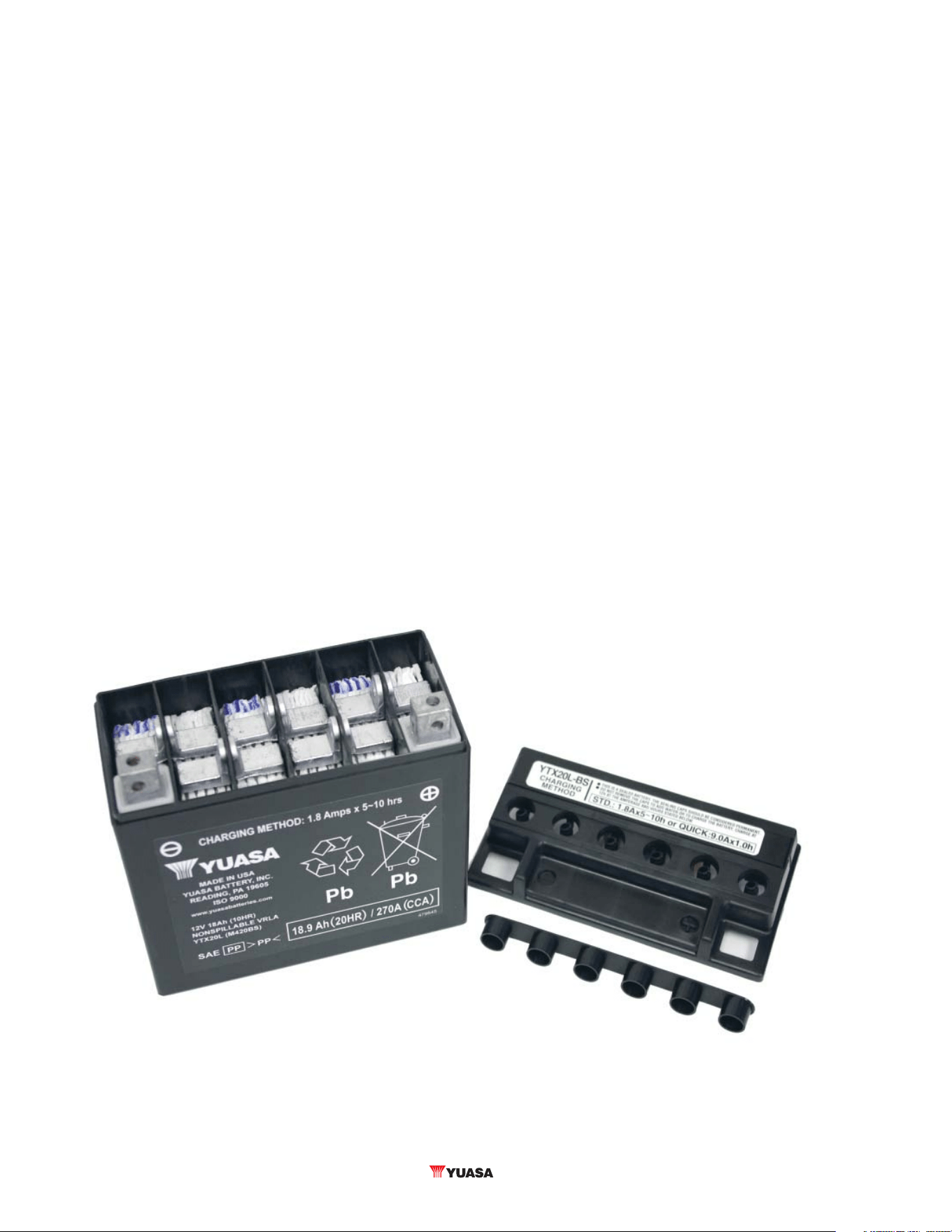
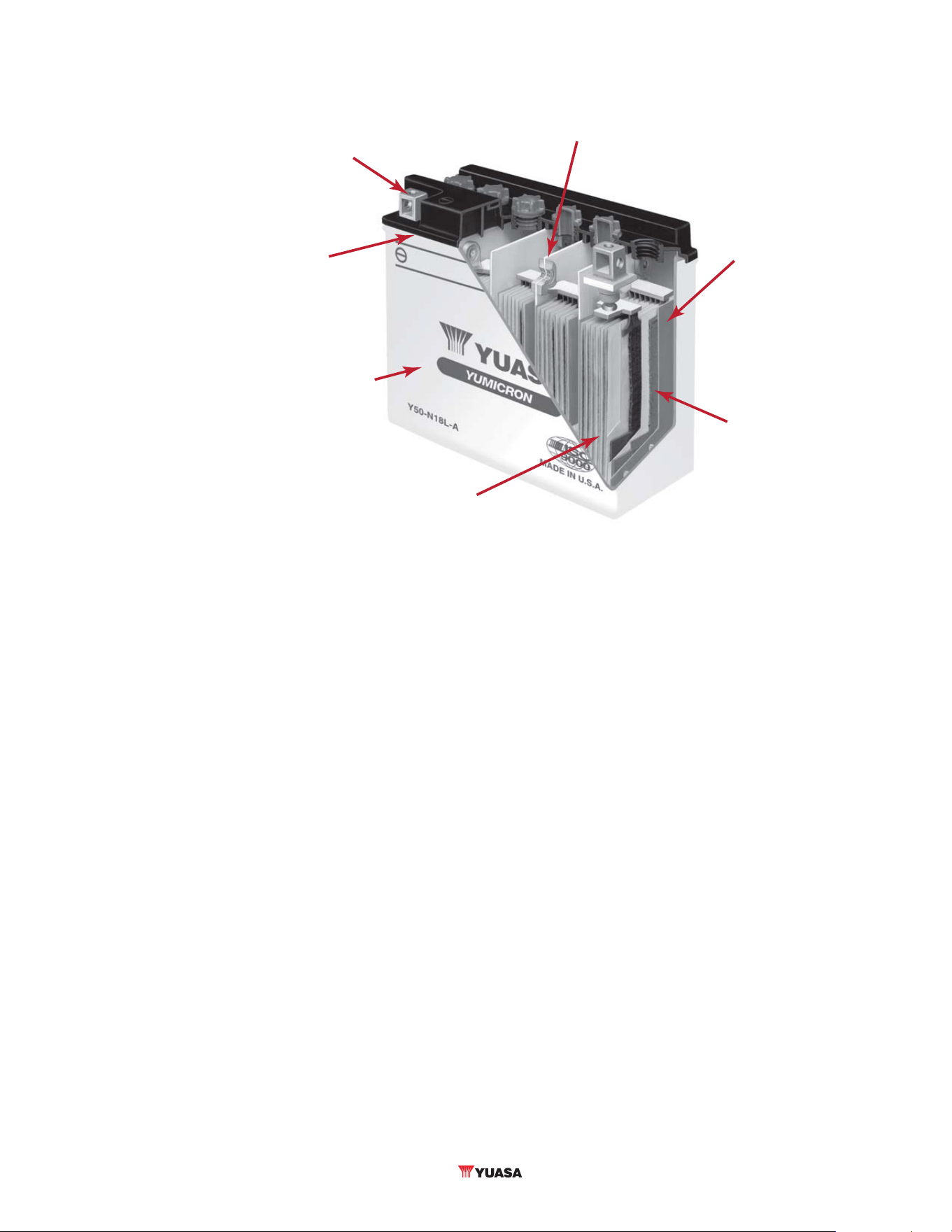
Patented Sealed Post
prevents acid seepage,
reduces corrosion,
extends battery life
Special Active
Material
compounded to
withstand vibration,
prolong battery life
and dependability
Special Grid Design
withstands severe
vibration, assures
maximum
conductivity
Special Separator
makes the battery spill-proof. Valve regulated design
eliminates water loss and the need to refill with acid
Polypropolyene Cover and Container
assures reserve electrolyte capacity for
cooler operating temperatures;
provides greater resistance to gas and
oil; withstands higher impact in
extreme weather conditions.
Heat Sealed Case To Cover
bonded unit provides greater
strength; protects against
seepage and corrosion.
Safety Valve/Flame
Arrestor
relieves excess
pressure
Thru-Partition Construction
provides shorter current path with less resistance
than “over the partition” construction to get more
cranking power when you need it
The Lead Acid Battery
What Does a Battery Do?
Powersports—depending on your interests, the term can bring
to mind many vehicles. Street-ridden motorcycles, off-road
bikes, sport & utility ATVs or watercraft—all very different but
all with one thing in common—they all have a battery. Most
enthusiasts don’t give the battery in their vehicle much thought
until the engine won’t start—then the battery becomes the
center of attention. We’ll take a close look at the how and why
of batteries, but fi rst it’s easier to understand how a battery
works if you know what it is supposed to accomplish. Batteries
have three jobs:
1. To provide electrical power to start the engine.
A battery’s primary job is engine starting. Engine size,
or displacement is the determining factor for amperage
requirements and battery capacity for a specifi c application.
A battery’s capacity is rated in two ways; amp-hour (AH)
and cold cranking amps (CCA). The amp-hour rating is the
battery’s ability to deliver current for an extended period of
time. Cold cranking amps is the battery’s ability to produce
current in low temperatures. A battery’s CCA rating for a
specifi c application is directly proportional to engine size
which determines the minimum level of amperage for
starting. CCA must be met or exceeded by the battery’s
capacity. Batteries with less capacity are capable of starting
a large displacement engine, but they may not do so reliably,
especially in colder climates. How batteries are rated is
covered later in this manual.
2. To supply additional current when the charging
system can’t keep up with electrical demand. A
battery’s second job is to supply current when the charging
system is overworked. This usually occurs (though not
always) when the engine is being run at lower than normal
operating speeds. Electrical components including: lights,
fuel pump, ignition & fuel injection systems use most of
the charging system’s capacity. If aftermarket electrical
accessories have been added (heated clothing or extra
lighting for example) the charging system may not keep up
with the added electrical demand and the battery supplies
the additional current to power these components.
3. To act as a voltage stabilizer for the charging system.
The third job of a battery is to act as a voltage stabilizer
for the charging system. Powersports charging systems
need something to
push
against to keep from producing
excessive voltage. In addition, high voltage spikes may be
produced when turning on, or off certain electrical circuits.
These fl uctuations in voltage are partially absorbed by the
battery, which protects solid-state components, including
computers and ignitions systems from damage.
6
water, sometimes called battery acid. When an electrical load
is placed across the battery’s terminals, a chemical process
starts inside the battery that produces electrical energy.
Battery Capacity. The size and number of plates within each
cell have a direct relationship to battery capacity, or its ability
to start engines of various sizes. Cranking current capacity (or
fl ow of electrical energy) increases as the plate surface area
increases. Directly related to plate size, is the amount of active
material on each plate (lead peroxide on the positive plate
and metallic sponge lead on the negative plate). The battery’s
current producing capacity is directly related to the amount of
active material on its plates.
Battery Chemistry. Batteries are constantly either discharging
or charging, and during either process, ions (both positively
or negatively charged) are transferred from the positive and
negative groups of cell plates. The plates are insulated from each
other with a permeable, non-conductive material which allows
this transfer of ions. At the same time as the ions are moving
from one plate to another, the ratio of battery acid to water is
changing as well. However, as the battery discharges, the ratio of
acid to water changes so that there is less sulfuric acid and more
water; thus, the specifi c gravity (SG) of the electrolyte solution is
lowered as well. SG can be used to measure a battery’s state-of-
charge. For example, an SG of
1.160 indicates a battery with only a
50% charge. The process is reversed when the battery is charged.
Battery Construction and Chemistry
Technically speaking, a battery is a device that converts
chemical energy to electrical energy. It’s important to
understand that a battery does not “store” energy, or electricity,
it stores a series of chemicals, and through a chemical reaction
electricity is produced.
What’s Inside the Battery Case? To understand the process of
chemical to electrical energy conversion, let’s take a look inside a
battery. The battery case is divided in sections called cells with a
12-
volt battery having six cells that produce
2.2 volts each (depending
on battery type) for a total of
13.2 volts. A 6-volt battery has only
three cells with a total voltage of just over
6 volts.
How Battery Cells Work. The cells consist of lead plates,
half of which have a positive charge and the other half with
a negative charge. Within each of the cells the plates are
stacked alternately: negative, positive, negative. Insulators or
separators (usually made from fi berglass or treated paper) are
placed between the plates to prevent contact. The alternating
plates in each cell are connected at the top to form two groups,
one positive and one negative. Each cell’s groups of plates are
then connected in series (positive to negative) to those in the
next cell. The “active material” in these positively and negatively
charged groups of plates produce electricity when immersed
in an electrolytic solution that is made up of sulfuric acid and
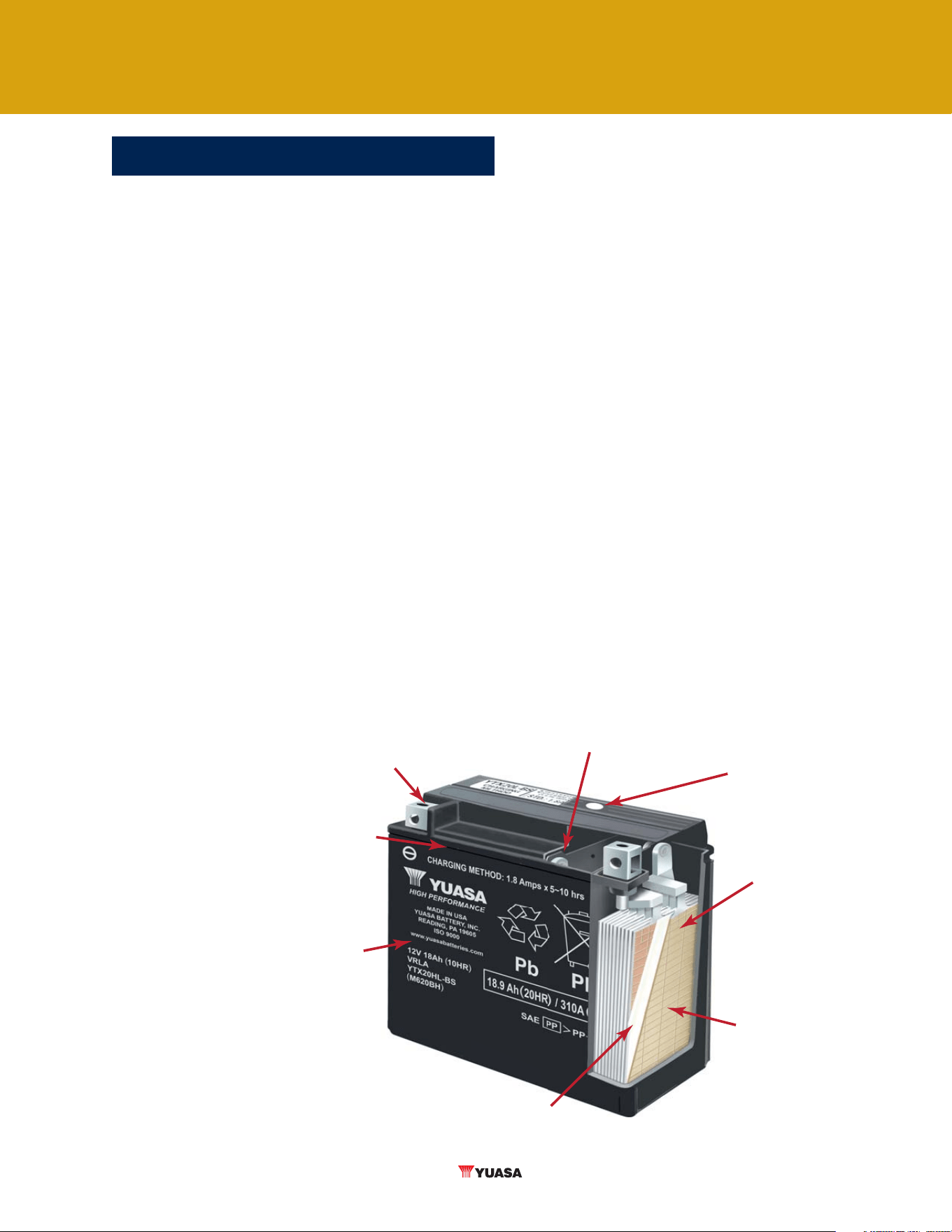
Here is what an AGM Yuasa battery looks like with the cover removed. The case is divided into 6 cells each, containing plates and separators.
Cells are inner connected by lead lugs on top of each cell. With the cover in place, only the positive terminal (right side) and negative terminal
are visible. At the lower right is the strip of sealing caps that will be installed when the battery is fi lled with electrolyte. Once installed, never
remove the sealing caps to add water or electrolyte to the battery during its service life.

7
The SG becomes higher as the ratio of acid to water changes
back to mostly acid. Measuring SG can only be performed on a
Conventional battery because it has fi ller caps that allow access
to the electrolyte. Other types of batteries without fi ller caps
require a different method to determine state-of-charge.
When a battery discharges, and the SG changes to more
water and less acid, a chemical by-product called lead sulfate
is produced and starts the process of coating the cell plates
reducing the surface area over which chemical reactions
producing current occur. This is the reason that an engine’s
starter motor can’t be cranked indefi nitely, as well as other
electrical loads left on for long periods of time without the
battery going dead. Although this process is normal within
the battery during discharge, a timely recharge is required to
reverse the process and increase the usable surface area of the
plates. Without battery charging, the lead sulfate will continue
to develop and it becomes diffi cult, if not impossible, to break
down. If the battery becomes too discharged, total failure of
the battery is likely as the lead sulfate cannot be removed no
matter how much the battery is charged.
Corrosion and Freezing. Besides sulfation concerns, many
other detrimental actions are taking place inside the battery
while in a discharged condition. The corrosive effect, caused
by acid on the lead plates and connections within the battery,
is greatly increased due to the reduced specifi c gravity of the
electrolyte. In addition, the corrosion of the plates can result
in a gradual reduction in battery performance over time.
Corroded connectors may have suffi cient integrity to support
low drain accessories such as lights and instruments, but may
lack the necessary strength to provide a pathway for the high
discharge current required to start an engine. If the corrosion
is bad enough, it may cause the inter-cell connectors and the
connecting welds to fail. This creates an open circuit within the
battery resulting in sudden battery failure. Another condition
that frequently occurs in a discharged battery is freezing of the
electrolyte. In a deeply discharged battery, the electrolyte has
a reduced specifi c gravity resulting in a higher percentage of
water than sulfuric acid. During this condition, the battery may
freeze at temperatures as high as
32° F (0° C). The electrolyte
in a fully charged battery will not freeze in temperatures well
below
0° F, even down to -75° F. In fact Yuasa batteries have a
suggested operating temperature range between:
14° F to 140°
F (-10° C to 60° C).
Battery Safety
Any device that stores energy can be dangerous. There is a lot of
explosive power in a gallon of gasoline, but when handled with
some knowledge its use can be made relatively safe. Batteries
are no different in that with the proper precautions and safety
practices, they can be handled in a safe manner. Working with
batteries poses two hazards: potentially explosive gases that
are given off during discharging and charging, and sulfuric acid,
which is highly corrosive. The following is an 8-point safety list
that will help keep these two hazards under control:
1. ABSOLUTELY NO SMOKING, SPARKS (FROM STATIC
ELECTRICITY OR OTHER SOURCES) OR OPEN FLAMES
AROUND OR NEAR BATTERIES. Batteries can produce
hydrogen gas that is highly fl ammable when combined with
oxygen; if these gases ignite the battery case can rupture
or explode.
2. On Conventional batteries, loosen vent caps when
charging and ventilate the entire charging area. A
build-up of hydrogen and oxygen levels within the battery, or
in the area where it’s being charged, can create a fi re hazard.
3. If a battery feels hot to the touch during charging, stop
charging and allow it to cool before resuming. Excessive
heat damages the plates, and a battery case that’s too hot
during charging can rupture.
4. On Conventional batteries, REMOVE THE RED SEALING
CAP FROM THE VENT ELBOW. Never put the red sealing
cap back on the battery once it is removed. If sealing cap is
left on, gases trapped inside the battery can explode. For
the same reason, make sure the vent tube isn’t kinked or
blocked. See illustration on page
15.
5. Properly connect battery chargers leads to the battery:
positive to positive, negative to negative. Unplug the
charger, or turn it off before connecting or disconnecting
the leads. This will minimize the chance of creating sparks
when connecting or removing the leads from the battery.
6. Always wear eye protection, protective gloves and
protective clothing when handling a battery.
7. Clean up acid spills immediately, using a water and baking
soda solution to neutralize battery acid (
1 lb. baking soda in
1 gal. water).
8. Make sure battery acid fi ll containers are clearly marked
and work areas are well lighted. If sulfuric acid is
swallowed or splashed in the eyes, take immediate
action. Sulfuric acid in the eyes can cause blindness. While
the diluted sulfuric acid used as electrolyte can burn the
skin, this type of injury is generally less serious. Ingesting,
or swallowing sulfuric acid can cause serious internal
injuries or death.
Remedies for contact with sulfuric acid:
■ External – fl ush with water
■ Internal – drink large quantities of milk or water, followed
by milk of magnesia, vegetable oil or raw, beaten eggs. Call
a poison control center or doctor immediately
■ Eyes – fl ush for several minutes with water, get immediate
medical attention
8
Yuasa’s AGM battery does not vent gasses to the atmosphere
during the charge/discharge process. The construction of the
AGM battery causes internal freed gas to recombine inside the
battery so no vent tube is required. This technology is referred
to as valve regulated lead acid (VRLA) or a sealed VRLA battery.
The terms, AGM and VRLA are sometimes used interchangeably
however in this manual AGM will be used. An AGM battery can
be sealed because inside the battery the negative plates are
never fully charged and therefore don’t produce hydrogen gas.
The positive plates create oxygen during the discharge process
but instead of the oxygen being forced out a vent
tube, it reacts with the charged
active material on the plates
to become water until the
battery is charged and
the water is transformed
into acid. This process
is called recombinant
technology and this
design is what makes
Yuasa’s AGM batteries
unique.
Inside an AGM battery,
the separators between
the negative and
positive plates are
made of a special fi ber
that is resistant to heat
and acid. This design
makes the AGM battery
less prone to spilling acid in
that there is less liquid acid contained inside
the battery. In addition, an internal safety valve is used in
case of accidental overcharging. The safety valve opens if gas
pressures inside the battery reach a critical point venting the
gasses to the outside. The valve also includes a fl ame arrestor
disk that minimizes the risk of explosion. Some of the benefi ts
of an AGM battery include:
■ No topping off with water or having to check the acid level
■ Reduced self-discharge because the plate grids are
manufactured from a special lead-calcium alloy that holds a
charge longer than other battery types
■ Easy, instant activation using the “one-push” electrolyte
acid container
Most Yuasa AGM batteries are available either “factory
activated” or as a dry battery with an acid pack. A “factory
activated” battery does not require fi lling before installation.
An extensive activation process ensures complete absorption
of the electrolyte so no liquid acid is contained within the
battery. This process allows these batteries to be shipped from
the factory ready to install. The GYZ and YTZ series batteries
are only available as “factory activated”.
Battery Types
Each Yuasa line of batteries has its unique features that account
for differences in price and performance. We’ll take a closer look
at the two basic types of batteries that Yuasa manufactures.
These two battery types are: Conventional and Absorbed Glass
Mat, or AGM. Conventional batteries have fi ller caps that allow
distilled water to be added to the battery periodically. AGM
batteries do not have fi ller caps and are sometimes referred
to as maintenance-free batteries or VRLA (valve regulated lead
acid) batteries. In this manual, AGM will refer to all types of
these non-Conventional batteries.
AGM Batteries
AGM batteries look different than
other battery types. They are
more compact because there is
no free electrolyte making them
more “volume effi cient” in that
they take up less space for their
energy storing capacity. Because
they are fi lled with electrolyte
only one time during activation
there are no fi ller caps. Instead
a sealing plug permanently
covers the fi ller ports. Also there
is no vent tube. AGM batteries
are ideal for long term storage
on vehicles that include: riding
mowers, personal watercraft,
scooters and motorcycles that are
not ridden in winter. In addition, an
AGM battery is an excellent choice for u s e
in vehicles where acid spills could occur (ATVs, watercraft and
motorcycles).
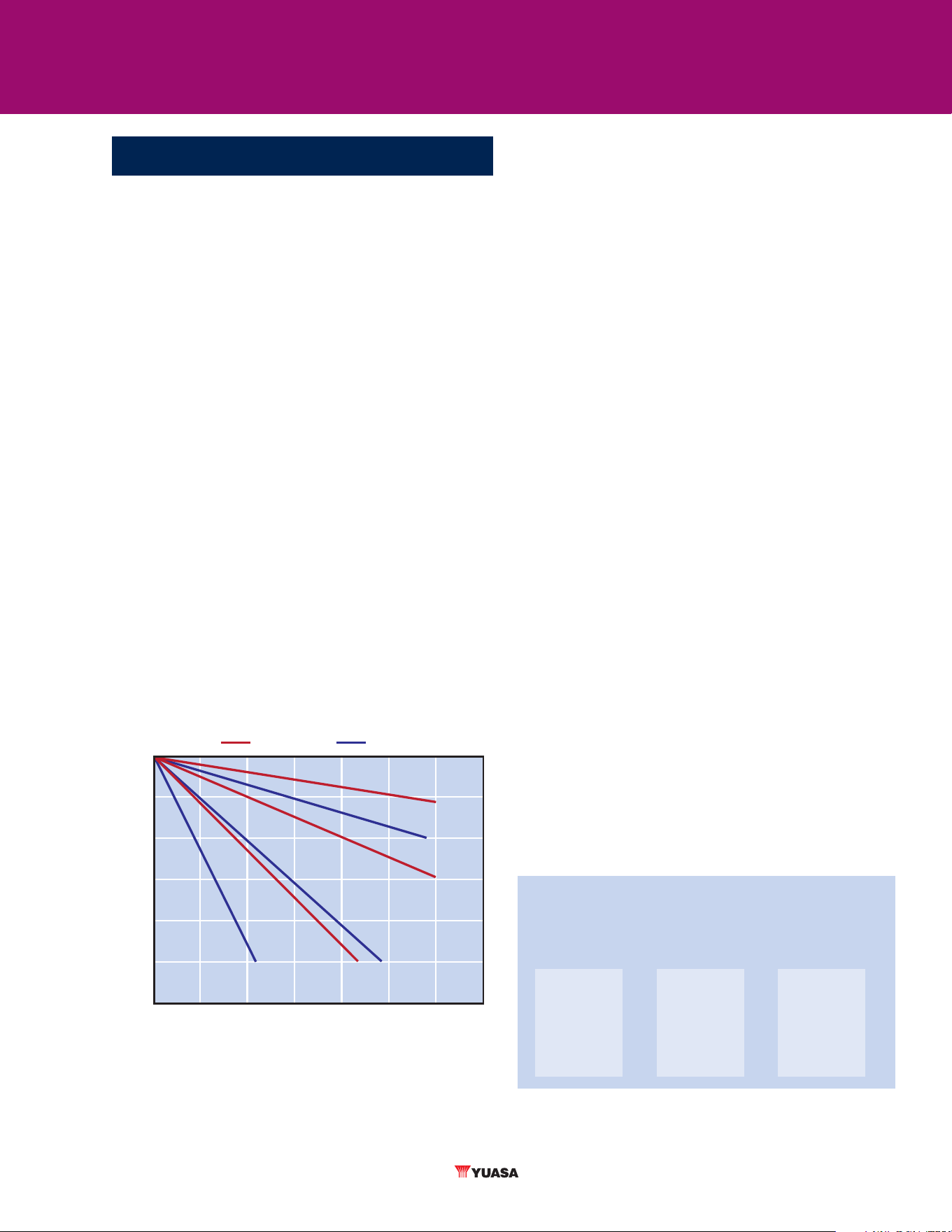
Cold Cranking Amps
0
50
100
200
300
400
High Performance AGM
AGM
YuMicron
Conventional
150
250
350
Battery Capacity (AH)
5 9 10 12 14 16 18 20 21
Battery design as well as materials used in construction give each
type of Yuasa battery different performance ratings. This chart shows
the relationship between battery capacity in amp hours and cold
cranking amps.
9
longevity but at a lower price point. Yuasa manufactures
several designs of these batteries: Conventional (YuMicron)
and High Performance Conventional batteries (YuMicron CX).
They have features in common that Yuasa uses for all their
batteries. Sealed posts to resist corrosion, tough polypropylene
covers and containers and heat sealed construction for a
strong, bonded unit. In addition, they share design features,
like special separators and through-partition construction.
Yuasa YuMicron batteries have more cranking power (up to
30%) for their physical size than a standard Conventional
battery. The plate surface area in the YuMicron is increased
by the use of thin, high-tech separators that make room for
extra plates within each cell. The YuMicron batteries also use a
special inter-cell connector that minimizes internal resistance
and further maximizes starting capacity, plus a special glass
mat that resists vibration damage. The difference between
the YuMicron and the YuMicron CX is the material used in the
plates. Conventional and YuMicron batteries both use lead-
antimony plates while the YuMicron CX uses lead-calcium.
The use of lead-calcium technology provides increased cold
cranking amps, reduced water loss (up to
66% when compared
to a Conventional design) and has reduced self-discharge
properties resulting in a battery that will hold a charge longer.
Do all the features offered by the YuMicron design make
it a better choice than a Yuasa Conventional battery? Not
necessarily as it depends on the vehicle and application. While
a Conventional battery is an ideal choice for a lawn tractor
it may not be for an ATV, watercraft or motorcycle. Space
limitations, engine vibration, terrain (on-the-water vs. off-road
Patented Sealed Post
prevents acid seepage,
reduces corrosion,
extends battery life
Special Active
Material
compounded to
withstand vibration,
prolong battery life
and dependability
Special Grid Design
withstands severe
vibration, assures
maximum
conductivity
Special Separator
provides high cranking power
Polypropolyene Cover and Container
gives greater resistance to gas and oil;
withstands higher impact in extreme
weather conditions.
Heat Sealed Case To Cover
bonded unit provides greater
strength; protects against
seepage and corrosion.
Thru-Partition Construction
provides shorter current path with less resistance
than “over the partition” construction to get more
cranking power when you need it
Yuasa batteries are also available as a dry battery with an acid
pack. The part numbers for these batteries end with “-BS” to
signify “bottle supplied” (i.e. YTX
14-BS, YTX20HL-BS). Because
the battery is shipped dry, it has an indefi nite shelf life before it
is activated as long as the foil covering the cells remains intact,
undamaged and air-tight.
Because AGM batteries are different than Conventional
batteries, it is important to keep these points in mind:
1. There are important differences in the activation
of an AGM battery versus a Conventional battery. Be
sure to follow the instructions for activating AGM batteries.
2. While Yuasa AGM batteries dramatically reduce
the need for maintenance, they do need periodic
charging. It’s important to remember this and use the
correct charging method and battery charger.
3. When considering upgrading to an AGM battery
that was not original equipment on a vehicle, check
to make sure the charging system has a regulated
output between
14.0 and 14.8 volts. In general, older
vehicles have a charging rate that produces lower voltages
and a Conventional battery will be the only battery option
for these vehicles.
Conventional Batteries
Unlike AGM batteries, Yuasa’s Conventional designs have fi ller
caps and vent tubes. Not all vehicles require an AGM battery
and the Conventional batteries offer good performance and
10
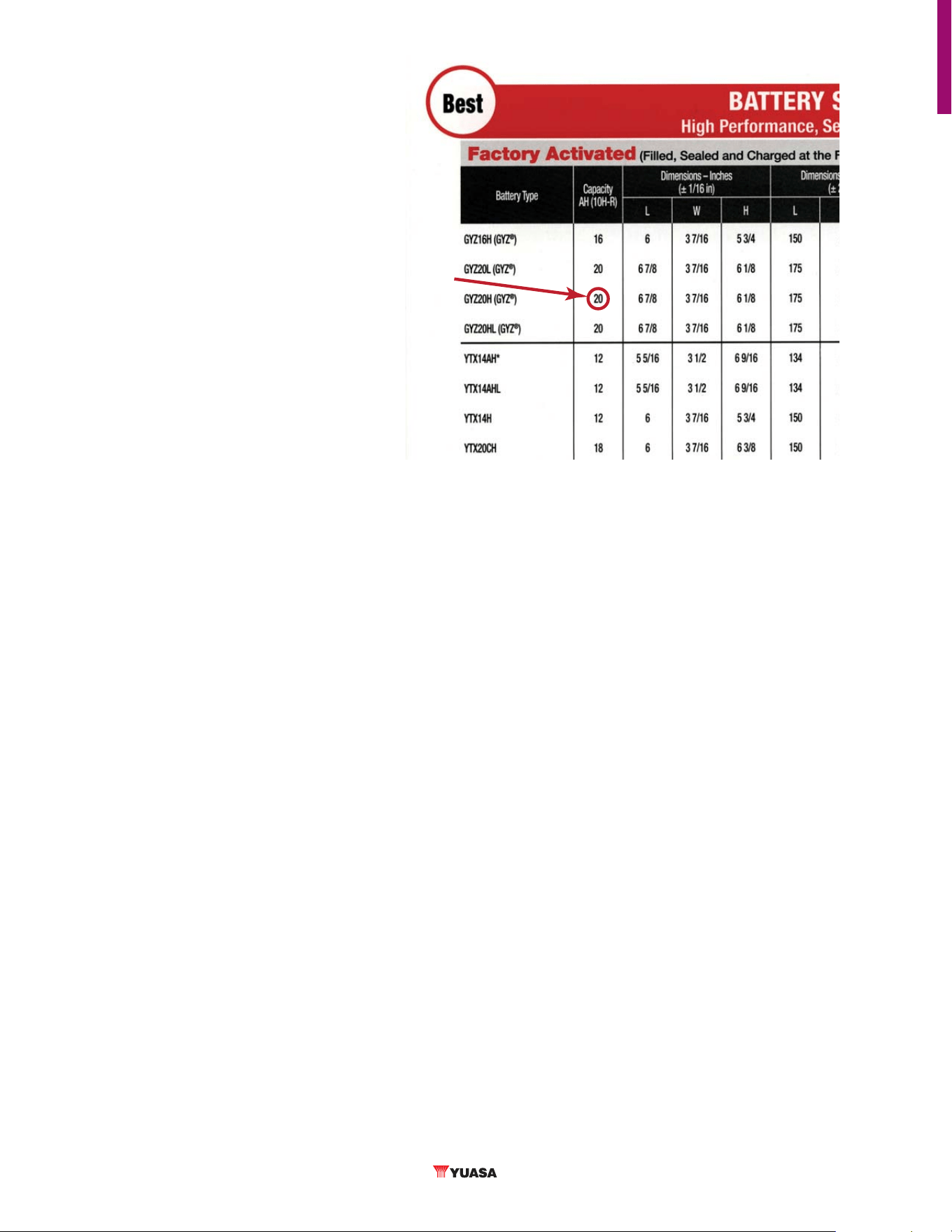
Rated
Capacity
The Yuasa Battery Specifi cations & Applications guide lists
information including: Battery Type, Dimensions and Capacity in
Amp Hours (AH).
vs. mowing the lawn) all affect battery choice and
how well a battery will perform over its lifetime.
Battery Ratings
Because a battery’s basic job is to power the starter
motor while maintaining suffi cient voltage to also
run the ignition and fuel systems, there has to
be a way to rate its ability to perform these jobs.
Powersports batteries are rated in ampere-hours
(AH) and/or cold cranking amps (CCA). A battery’s
ability to discharge a given amount of current
over a specifi c length of time is the AH rating.
The AH rating is based on a fully charged battery
with an open circuit voltage of
13.0 that is
considered fully discharged when the voltage
reaches
10.5 volts at 77° F (25° C). The Amp Hour
ratings are printed on the battery case in two ways:
10 hour and 20 hour ratings. The following is an
example of the
10-hour rating designation for a
battery that has an
18 AH rating.
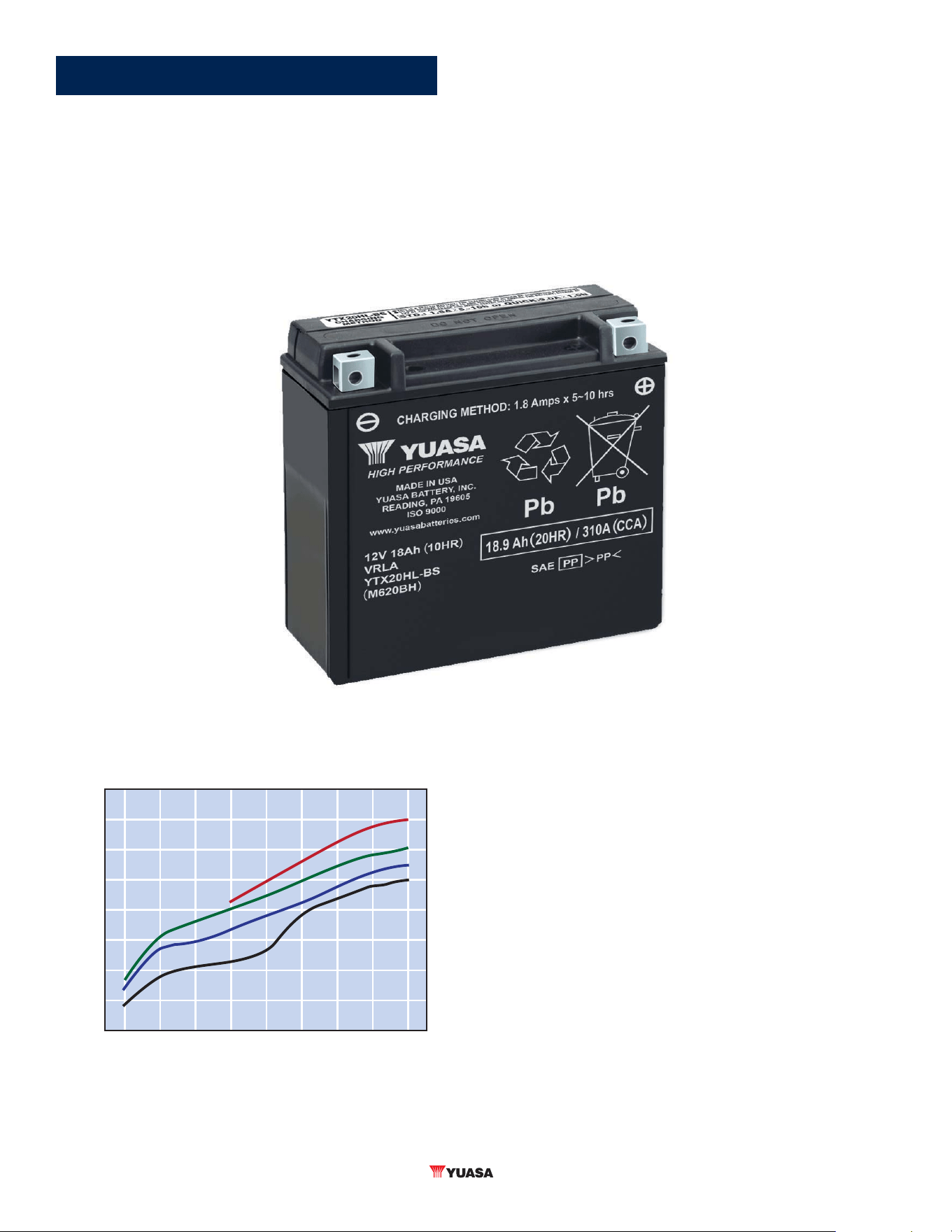
Printed on the front of the battery case is
18
Ah
(
10
HR)
. This means that the battery can be discharged at a rate
of
1.8 amps for 10 hours (18/10 = 1.8) before it becomes fully
discharged.
The larger the battery plate area, the greater the ampere-hour
rating. Temperature also has an effect on AH because low
temperatures slow down the chemical reaction inside a battery.
A battery will have a lower AH capacity in cold temperatures
than in warm ones.
CCA rates how well a battery can be expected to produce
current at low temperatures. Just like AH, the CCA rating
depends on the number of plates and their total surface area.
CCA represents the discharge load in amps that a new, fully-
charged battery at
0° F can continuously deliver for 30 seconds
while maintaining
7. 2 volts. In general, as engine size increases
so does the starter motor cranking current required to start
the engine and thus CCA battery requirements. For example, a
battery with a CCA rating of
270 will start a large displacement
engine under most conditions. A battery with a rating of
310
CCA, and used in the same application, would start the engine
more reliably especially in cold weather. Because starter motor
requirements differ by year, make and model of vehicle it’s best
to check the Yuasa Battery Specifi cations & Applications guide
to select the correct original equipment replacement battery.
If a special application demands higher cranking power, select
an appropriate upgraded battery from the Yuasa battery line.
Try to match battery features to vehicle requirements. For
example, a cold start rating is important in a snowmobile but
not on a lawn tractor—unless it’s used to plow snow.
POINTS TO REMEMBER
■ A battery converts chemical energy to electrical energy
■ Each cell has approximately 2 volts: a 12-volt battery has 6
cells; a
6-volt battery has 3 cells
■ Inside each cell are electrically charged positive and
negative lead plates, isolated from each other by separators
■ Current, or amperage is the fl ow of electricity
■ Always ventilate battery charging area
■ On Conventional batteries, always remove the red sealing
cap from the vent elbow and discard it
■ Charging produces fl ammable gasses—no smoking, sparks
or fl ames
■ Always wear safety glasses, or face shields when working
with batteries
■ Battery acid in eyes, or swallowed requires immediate
antidotes and medical care
■ Battery safety considerations are important… review them
frequently
11
deposits on the plates is the reason that a battery can’t supply
energy indefi nitely. For example, lights left on for several days
or extensive cranking of the starter motor.
In fact, prolonged
discharge causes harmful sulfation and the battery may
not recover no matter how long it’s charged.
Besides not being able to produce enough current to start an
engine, a dead battery is also prone to freezing in cold
temperatures because the battery’s electrolyte is mostly
water instead of acid. When temperatures drop below freezing
the electrolyte may freeze and permanently damage the
battery. A charged battery won’t freeze until the temperature
drops well below
-75° F. The suggested operating temperature
range for all Yuasa Batteries is
14° F to 140° F (-10° C to 60° C).
Battery Self-Discharge. It’s a fact that a battery’s ability to
produce electricity will decrease from just sitting around. Self-
discharge is always taking place even if the battery is not connected
to anything. How rapidly batteries self-discharge depends on
ambient temperature and battery type. At temperatures above
130° F self-discharge is even more rapid. These temperatures
can be reached if the battery is stored in a garage or shed in hot
weather.
Speaking of discharging, a common misconception about
battery storage is that if one is left on a concrete fl oor it will
self-discharge rapidly. This was true over thirty-fi ve years ago,
when battery cases were made of hard rubber—the moisture
from concrete caused this type of battery to discharge directly
into the concrete fl oor. However, modern battery cases are
made of polypropylene plastic and can be stored on concrete
without any concern for excessive self-discharge.
Reasons for Self-Discharge
Short Charging Time. Low state-of-charge can be caused by
short trips that aren’t long enough for the vehicle’s charging
system to recharge the battery. Engine operation of less than
15
or
20 miles and occasional use of a vehicle only a couple of times
Battery Discharging
One of two chemical processes is always occurring inside a
battery at any given time—discharging or charging. Here is how
the discharge process works. The electrolyte solution contains
charged atomic particles called ions, made up of sulfate and
hydrogen. The sulfate ions are negatively charged, while the
hydrogen ions have a positive charge. When an electrical load
is placed across a battery’s terminals (starter motor, headlight,
horn, etc.) the sulfate ions travel to the negative plates and
give up their negative charge, causing the battery to discharge
or produce electrical energy. This excess electron fl ow out of
the negative side of the battery, through the electrical device,
and back to the positive side of the battery is what creates DC
current. Once the electrons arrive back at the positive battery
terminal, they travel back into the cells and re-attach themselves
to the positive plates. The discharge process continues until the
battery is dead and there is no more chemical energy left.
Discharge Chemistry. In addition to the electron fl ow within
the battery as it discharges, the ratio of sulfuric acid to water
in the electrolyte solution is also changing to more water and
less acid. A chemical byproduct of this process is lead sulfate
that coats the battery plates within each cell reducing its surface
area. With less area available on the cells to produce electrical
energy, the production of amperage, or current is also reduced.
If the discharge process continues, even more lead sulfate is
deposited on the cell plates and eventually the chemical process
that produces current is no longer possible. The lead sulfate
Battery Discharging and Charging 3
100
Remaining Capacity (percent)
80
90
60
70
40
50
012
Storage Period (month)
34567
32°F (0°C)
32°F (0°C)
77°F (25°C)
77°F (25°C)
104°F (40°C)104°F (40°C)
AGM
Conventional
Current Drain (Y50-N18L-A)
Discharging
Ampere
Days From
100% Charged to
50% Discharged
Days From
100% Charged to
100% Discharged
7 mA
10 mA
15 mA
20 mA
30 mA
60 Days
42 Days
28 Days
21 Days
14 Days
119 Days
83 Days
56 Days
42 Days
28 Days
This chart illustrates how temperature and type of battery effects
battery capacity. Colder storage temperatures are best for long-term
storage. For example, an AGM battery stored at 32ºF holds 90% of its
capacity for about 6 months. The same battery stored at 104ºF loses
50% of its capacity in 4 months. These temperatures can be reached
if the battery is stored in garage or shed in hot weather.
On-board computers, clocks and other accessories can drain a
battery over time. This chart shows the amperage draw in milliamps
and the number of days until the battery is 50% to 100% discharged.

12
per week may not keep the battery charged enough to start the
engine. The vehicle’s charging system will not be able to keep up
with the use of the starter motor and electrical accessories (lights,
ignition, fuel injection) over time. To keep the battery’s capacity
high enough to operate the starter it will have to be charged with
a battery charger when the vehicle is not in use—about once per
month for a Conventional battery depending on temperature. An
AGM battery will discharge at a slower rate than a Conventional
battery and does not need to be recharged as often.
Battery Charging
Chemistry. Charging a battery reverses the chemical process
that occurred during discharge. The sulfate and hydrogen ions
basically switch places. The electrical energy used to charge a
battery is converted back to chemical energy and stored inside the
battery. Battery chargers, including alternators and generators,
produce a higher voltage (higher “electrical pressure”) than the
battery’s open circuit voltage. For example if a battery charger
that outputs
14-volts is connected to a 12-volt battery, current
fl ow will be from the charger into the battery. This high electrical
pressure, or voltage, is required to push electrical current back
into the battery, overcoming its open circuit voltage and thus
providing charging current. The charging device (alternator,
generator, or battery charger) produces excess electrons at the
negative battery plates where positive hydrogen ions are then
attracted to them. The hydrogen ions combine to form sulfuric
acid and lead, which
ultimately reduces the
amount of water in the
electrolytic solution and
increases the battery’s
specifi c gravity during
the charging process.
How Many Amps?
Applying a charging
current to a battery,
without overheating it,
is called the “natural
absorption rate.”
Because of their smaller
size, when compared
to automotive types of
batteries, powersports
batteries are more
sensitive to how much
current they can safely
absorb. When charging
a motorcycle or
other small battery,
the battery charger
should not exceed
3
amps. Most automotive
types of battery
chargers are not suitable
for charging a motorcycle battery because they output current
above
3 amps. For the correct charge rate a rule of thumb is
to divide the battery’s amp hour rating by
10. For example a
14 AH battery should be charged at 1.4 amps (14AH ÷ 10 = 1.4
amps). See the section on “Choosing a Battery Charger” for
more details.
When charging amperage exceeds the level of the natural
absorption rate, the battery may overheat, causing the
electrolyte solution to bubble creating fl ammable hydrogen
gas. Hydrogen gas, when combined with oxygen from the
air, is highly explosive and can easily be ignited by a spark.
Consequently, always remember to turn the power off
before connecting or disconnecting a battery charger
to prevent a spark at the battery terminals! Many
“Smart” solid-state battery chargers, that are designed for use
with small batteries, have a “no spark” feature, when being
connected or disconnected from the battery. In addition to
excessive out gassing during charging, a battery that has been
rapidly discharging (cranking an engine over until it’s dead for
instance) may also produce excessive hydrogen gas.
Checking a Battery. A routine should be established by
which a battery is checked for state-of-charge and charged
if necessary. Because access to the battery may be diffi cult
on some vehicles, a permanent, quick connect/disconnect
connector can be installed allowing the battery charger to be
connected to the vehicle’s battery externally. When charging
Charging Times
State of
Charge YB14 YB30L YTX14
Battery Types
Approximate Charge Times (Hours) Using a 1 Amp Taper Charger
Approximate Charge Times (Hours) Using a 1 Amp Constant Current Charger
Approximate Charge Times (Hours) Using a “Trickle” (0.25 Amp) Charger
YTX20HL YIX30L GYZ20L
75%
50%
25%
0%
18
35
53
70
38
75
113
150
15
30
45
60
23
45
68
90
38
75
113
150
25
50
75
100
75%
50%
25%
0%
8
14
20
27
17
30
42
56
7
13
18
23
10
18
25
33
17
30
42
56
11
20
28
37
75%
50%
25%
0%
4
9
13
18
9
19
28
38
4
8
11
15
6
11
17
23
9
19
28
38
6
13
19
25
The relative charging times are shown for several types of batteries using three types of battery chargers; Trickle,
Taper and Constant Current.

13
a battery, always refer to the instructions that came with the
battery charger. While maintaining a battery at its full state-of-
charge will insure optimum life, overcharging may signifi cantly
reduce it. Any of the Yuasa automatic “smart” chargers will
maintain both Conventional and AGM types of batteries without
overcharging them. Use the following guidelines for charging
AGM and Conventional batteries. Always verify battery state-
of-charge before charging, and
30 minutes after charging. a
battery charger has been disconnected from the battery for one
to two hours, a fully charged Conventional battery should read
12.6 volts (12.8 volts with Sulfate Stop) or higher. AGM batteries
may have slightly higher voltage readings after a full charge
Do Not Overcharge. Because of the characteristics of an AGM
battery, too much of a boost charge, or overcharge will decrease
the volume of electrolyte. The longer the overcharge time, the
greater the drop in electrolyte and starting power. Because the
battery is sealed, water can’t be added to make up the difference
in the loss of electrolyte. In addition, overcharging can warp
cell plates making future charging diffi cult or impossible. To
prevent over charging, track charging times carefully, or ideally,
use one of Yuasa’s Automatic Chargers. Always stop charging if
the battery case becomes too hot to touch. Let it cool down
6 to 12 hours and resume charging. Charging times will vary
depending on type of charger and the size of the battery.
Caution: Always wear safety glasses when handling
batteries and charge them in a well-ventilated area.
Charging a Deeply Discharged Battery
Batteries with an open circuit voltage below 11. 5 volts may
require a special charger and procedures to recharge. Deeply
discharged batteries will have high internal resistance, making
normal battery charging diffi cult. It may be necessary to use a
charging voltage higher than normal to get the battery to accept
a charge. The Yuasa Automatic
12V 4 Amp Battery Charger is
capable of charging at a rate of
20 volts and has two current
settings. With either charger, charge the battery for
30 minutes
and then measure the open circuit voltage. If the voltage reading
has not increased (indicating that charging has taken place) the
battery must be replaced. If the battery is accepting a charge,
continue charging. During this process the battery’s case
temperature should be checked for excessive heat. If the case
temperature becomes too high (about
140° F) charging should
be stopped or charging current should be reduced. The process
of charging a deeply discharged battery may take up to
20 hours
or more.
POINTS TO REMEMBER
■ Prolonged discharge causes harmful sulfation and may
damage a battery
■ Discharged (dead) batteries are prone to freezing in cold
temperatures
■ Short trips may not provide enough battery charging time
■ Always verify the state of charge 30 minutes after charging
■ Storing batteries in high temperatures will cause damage to
the battery
■ Never exceed 3 amps when charging a motorcycle, or other
small battery
100%
Percent of Charge (%)
Time Required to Charge (hours)
50%
75% 3-6
5-11
13-2025%
0%
Voltage (volts)
11.5 11.9 12.3 12.7 13
The approximate charging times are shown using a constant current
charger (smart charger) at the amps specifi ed on the battery.
14
There is no Conventional battery
for this application. Two of these
batteries have an asterisk (*) at
the end of the part number. In the
guide, this refers to the Battery
Supplier Cross Reference charts
where other branded batteries may
be substituted for the Yuasa battery part number. Which battery
is the best for this application? Any of these batteries are a
good choice for the Magna, however here are some things to
consider. If the engine has been modifi ed, higher compression
or larger displacement, a battery with more starting capacity
like the High Performance AGM would work well. If the bike will
not be operated for long periods of time the AGM or YuMicron
batteries are a good choice. If there is any question about
which battery is best for a specifi c application consult the
Yuasa website (
www.yuasabatteries.com) or contact Yuasa
toll-free at
800-431-4784.
About Sensors
Many powersports vehicles that use Conventional batteries
come equipped from the factory with battery sensors. The
sensors indicate battery electrolyte level by fl ashing a warning
light on the vehicle’s instruments panel—similar to a low fuel
warning light. When the battery sensor light fl ashes it’s time to
add water to the battery. Battery sensors are matched to each
Selecting a Battery
Selecting the right battery is an
important decision as it will
ultimately affect customer
satisfaction. Often times
battery issues, or problems
are caused by the wrong battery f o r
a specifi c application. There are two
sources to fi nd the correct type, size
and capacity battery for an application.
1. Yuasa Battery Specifi cations &
Applications guide (also online at
www.
yuasabatteries.com
)
2. The original equipment (OE) microfi che or online
parts look up data.
Be careful just matching a new battery with what’s installed
in the vehicle—make sure that it is the correct battery or the
same “problem” may be repeated causing the battery to be
replaced over again.
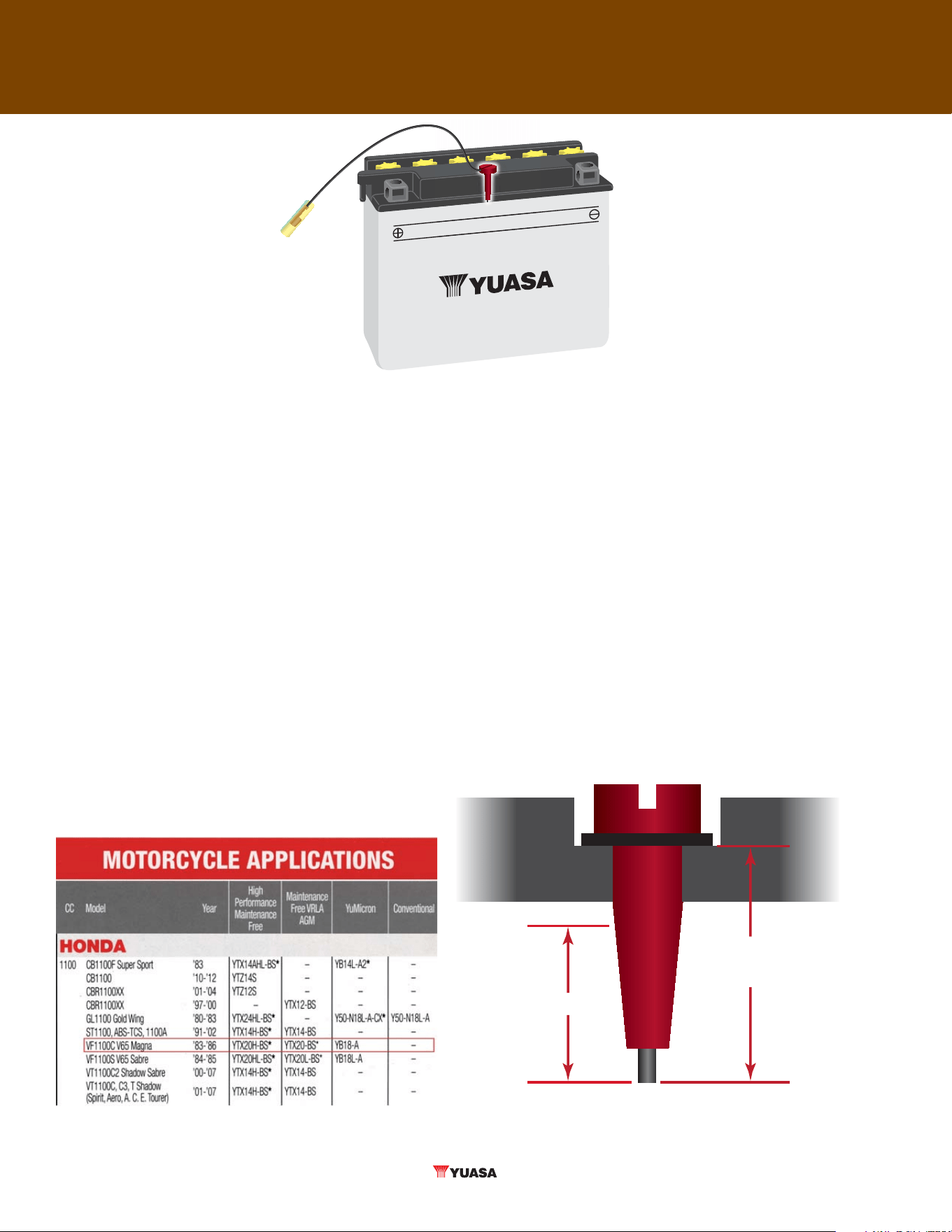
Yuasa may list more than on battery for a specifi c vehicle. For
example, this page from the Yuasa Battery Specifi cations and
Applications guide shows battery replacement information
for a
1983 to 1986 Honda, V65 Magna. Here is how to read
the chart. First fi nd the Motorcycle Applications section and
then Honda. Find the engine size (
110 0 cc). Look through the
list until the VF
110 0 C V65 Magna ’83-‘86 is located. There are
three battery selections for this motorcycle:
■ High Performance AGM—YTX20H-BS*
■ AGM—YTX20-BS*
■ YuMicron—YB18-A
4 Battery Selection & Activation
Battery sensors indicate low
electrolyte level inside a battery via a
warning light. When the light comes
on, it’s time to top off the battery with
distilled water. AGM batteries do not
use battery sensors.
Yuasa’s Battery Specifi cations & Applications guide shows that three
types of batteries are available for a mid-’80s Honda V65 Magna.
Length
Of
Sensor
Acid Level
Max.
Cover
Min.
The length of the sensor is important because it determines when
it turns on the low battery water level warning light. Sensors are
specifi c for each battery and cannot be interchanged.

15
battery and are not interchangeable. Even if the battery
sensor is original equipment (OE) it must be changed
when replacing the battery because it may not match
the new battery. This is true even if the replacement battery
is the same brand as the OE battery. Sensor plugs that are
installed into one of the battery’s cells come in many different
lengths and diameters. A sensor plug that’s too long can
cause electrical system problems. If the plug is too short, the
warning light will fl ash when the electrolyte level is not low.
Yuasa’s sensor batteries are not interchangeable as they have
different vent locations, sensor wire lengths and diameters.
When replacing a battery always replace the sensor.
The correct sensor and battery can be determined by using the
Yuasa Battery Specifi cations & Applications guide.
Activating a Battery
Yuasa batteries come from the factory in one of two ways:
Factory Activated (FA) where the battery is fi lled with
electrolyte, sealed and charged at the factory. These batteries
must be used within a period of time and cannot be stored
indefi nitely. The other type of battery is shipped dry and
can be either a Conventional or AGM type of battery. These
batteries are sometimes referred to as Bottle Supplied (BS)
because they are shipped with the electrolyte stored in a
plastic container. The battery is fi lled with electrolyte from
the container when it’s ready to be activated. These types of
factory sealed, dry batteries have an indefi nite shelf life as long
as they remain sealed (fi ller caps and red sealing cap in place
on a Conventional battery and foil sealing strip in place on an
AGM battery). Once it’s unsealed, a battery should be activated,
charged and installed. The plates of an unsealed battery will
begin to oxidize making it more diffi cult to charge later.
Choosing a Battery Charger
A battery charger brings a new battery, or a battery that has
been discharged, to full capacity. Battery chargers send direct
current (DC) into the battery fl owing in the opposite direction
of current when the battery discharges. In addition, charging
a battery reverses the destructive chemical process that
takes place as the battery is discharged. The lead plates and
electrolyte, which transform into lead sulfate and water during
discharge are changed back to lead antimony (Conventional
battery), or lead calcium (AGM battery). The charging process
reverts the lead sulfate and water to its original state.
Types of Battery Chargers. There are three types of battery
chargers that are commonly used for powersports-sized
batteries.
1. Trickle or Taper Chargers. The least effective are the
“trickle” and automatic taper types of battery chargers. Both
are similar in that their charging voltage is fi xed. The taper
charger reduces charging current while the trickle charger
keeps both voltage and current constant. These types of
chargers are slow in charging even moderately discharged
batteries and are not safe to leave connected to a battery
for long periods of time as they can over charge the battery
possibly causing damage.
2. Constant Current Charger. By contrast, a professional-
quality Constant Current Battery Charger makes charging
simple. It maintains a constant supply of current to the
battery at all levels of charging. As the battery’s internal
voltage increases with the amount of charge, the charger
automatically increases the charging voltage to maintain
the current output.
Smart Battery Charger. The best chargers combine both
types of designs. The strong charging characteristics of a
constant-current charger are used to initially charge the
battery; then the charger automatically switches to a constant
voltage mode to fl oat-charge or maintain the battery. This type
of charger is also known as a Smart Battery Charger because
they use a micro-chip (computer) in their circuits to determine
when to switch from charging mode to maintenance, or “fl oat”
modes of charging.
Smart chargers monitor the battery’s state-of-charge and will
automatically start charging when the battery falls below a
specifi c voltage. This smart technology is also used to keep
batteries from being over-charged, causing excessive water
loss in Conventional batteries. Yuasa Smart chargers can be
left on an AGM battery indefi nitely, but cannot be left
for extended periods of time on a Conventional battery
without checking water levels. In addition, these chargers
are capable of reaching
12.8 or more volts required to activate
AGM batteries. Some smart chargers have diagnostic features
that indicate if a battery is worn out and needs replacing. In
addition to these features, many smart chargers will not spark
when connected to a battery and will indicate that they are
connected backwards (reverse polarity).
The current output of a battery charger, used to provide
a maintenance charge for powersports-sized batteries,
should not exceed
3 amps. Automotive or high-rate types
of battery chargers should not be used as they can overcharge
and damage small batteries. Always match Conventional or
AGM batteries to the correct battery charger. The wrong type
of charger, or a charger that outputs too much amperage, can
cause poor performance or even permanent damage. Do not
use a high-amperage charger to reduce charging time as
it will void the battery warranty.
Current Output. To fi nd the recommended charger current
output in amps for a specifi c battery, divide the battery amp
hour rating by
10. For example a 14 AH battery should be
charged at
1.4 amps (14 AH ÷ 10 = 1.4 amp current). Select a
battery charger that comes closest to the value of that fi gure.
Yuasa AGM batteries have the amp hours printed on the front
of the battery case. If unsure about a battery’s rating, refer
16
to the Yuasa Battery Specifi cations & Applications guide.
Yuasa offers a complete line of chargers to activate and
maintain batteries to factory specifi cations and all of
them are discussed in the next section.
1 AMP Automatic Battery
Charger & Maintainer
D e s i g n e d fo r l o ng te r m u s e , Yu a s a’s 1 AMP Automatic
Battery Charger & Maintainer uses “smart” battery
charger technology, is fully automatic and features
a three level charge cycle. These include:
■ Bulk Charge—concentrated charging power in the
constant current mode
■ Float Charge—maintains a fully charged battery
■ Pulse Mode—peaks battery capacity which enhances
battery life
When the initial charging mode reaches
14.4 volts the charger
switches to fl oat mode. If a load is applied to the battery
(turning on the vehicles ignition or lighting) during charging,
the charger automatically switches back to “charge” mode, then
to a maintenance fl oat charge. The
1 AMP Automatic Battery
Charger & Maintainer is designed for use with both AGM and
Conventional types of batteries,
plus it will not overcharge
even if left connected for long
periods of time. It also features
an AC power LED indicator,
full charger indicator,
battery fault indicator,
reverse
polarity
protection
and spark-free
operation. The
c h a r g e r plugs directly into
a wall outlet and comes with a
12-foot
output cord, battery accessory lead and fused ring connector.
The charger has a
5-year warranty. (For more information, see
page 2.)
Automatic 12V 4 Amp Battery Charger
The Yuasa Automatic 12V 4 Amp Battery
Charger can charge up to
20-volts to
aid in recovering deeply discharged,
sulfated batteries. It features a “Quick
Mode” for faster vehicle setup and
“Normal Mode” for smaller batteries.
The diagnostic function provides
information indicating that the battery
is damaged and will not accept a charge.
In addition, a reverse polarity connection
is indicated on the panel. (For more information, see page 27.)
10-Bank Battery Maintainer
For shop use where multiple batteries have to be maintained
the Yuasa
10-Bank Battery Maintainer is ideal. It will charge
and maintain
10 batteries (both Conventional and AGM) at
one time. The charger uses a
5-stage maintenance/fl oat charge
cycle that includes:
■ Pre-Qualifi cation—determines battery condition
■ Bulk Charge—concentrated charging power
■ Absorption—equalizes battery’s cell charge
■ Float Mode—safely maintains proper charge condition
■ 28-Day Charge Recycle—re-evaluates battery status for
long term storage
It also features a built-in timer for extra battery protection.
Each charging port has LED indicators for charging status. (For
more information, see page 27.)
Activating AGM Batteries
Activating an AGM battery is a simple process and differs
from activating a Conventional battery (covered later in this
section). Un-activated, AGM batteries can be stored
for long periods of time as long as they are kept in
a cool, dry location and out of direct sunlight. Also
the foil sealing strip covering the
fi ller ports should not be removed
until the battery is ready to
be activated. Use only the
electrolyte container
that comes with
the battery for
fi lling the cells
as it has a higher
concentration of
sulfuric acid than the acid
used for Conventional batteries.
g
uide.
and
l
o
f
r
in
the
17
All AGM battery electrolyte
containers are not the same.
Each contains the proper
amount of electrolyte
for its specifi c battery.
Before fi lling, read the electrolyte handling instructions and
precautions on the label. Do not smoke when activating a
battery or handling battery acid. Always wear plastic gloves
and protective eyewear and be sure to read the Battery Safety
section in this manual. The following seven steps should be
used to activate an AGM battery:
1. The battery must be out of the vehicle and placed on a level
surface.
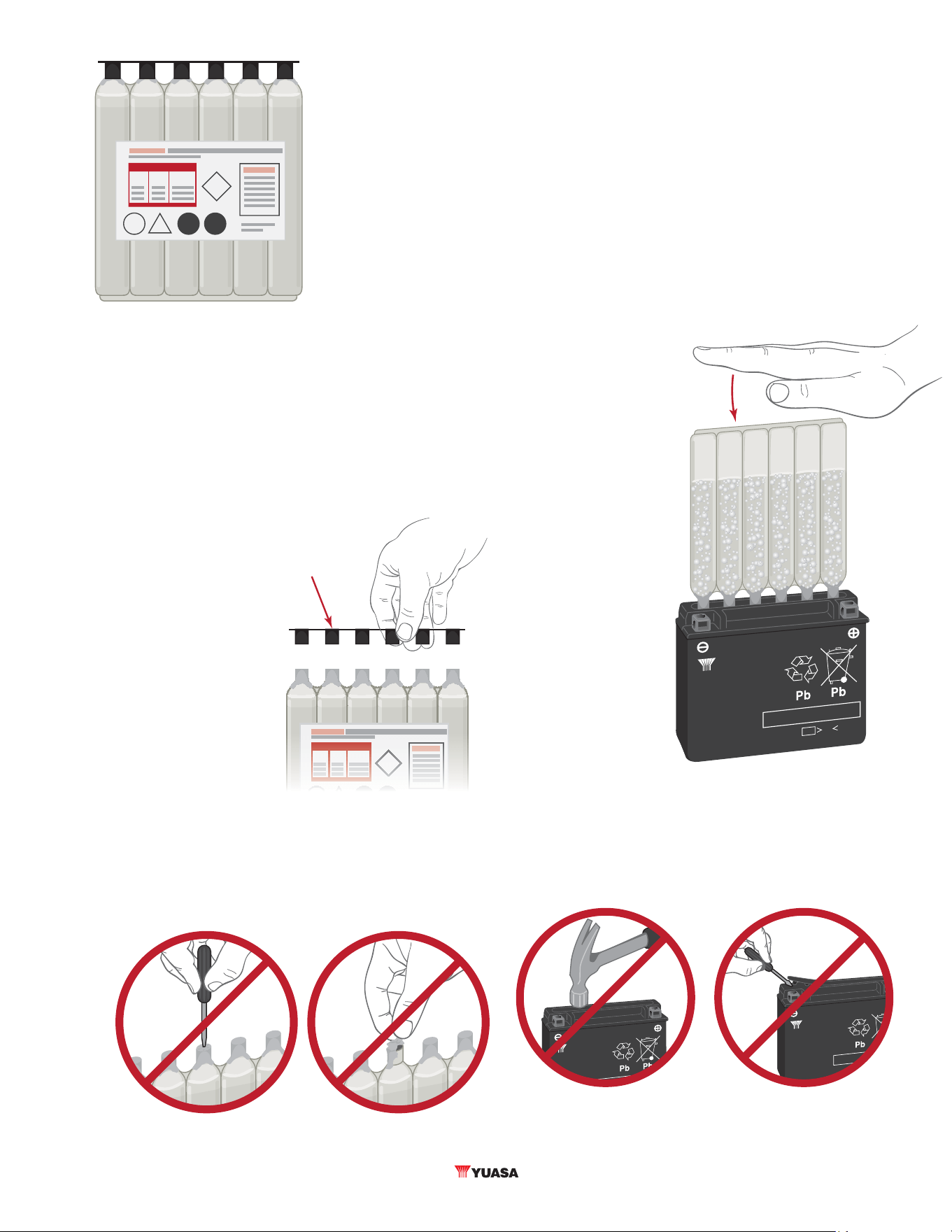
2. Remove electrolyte
container from
the plastic storage
bag. Remove the
strip of caps. Put
the strip aside
as you will use it
later to seal the
battery cells. For
battery fi lling use
only the dedicated
acid container
that comes with
the battery as
it contains the
proper amount of
electrolyte for that
specifi c battery. This is important to service life and battery
performance. Do not pierce, or otherwise open the foil
seals on the electrolyte container. Do not attempt to
separate the individual electrolyte containers.
3. Place the electrolyte container with the foil seals facing
down into the cell fi ller ports on the battery. Hold the
container level and push down to break the foil seals.
Electrolyte will start to fl ow into the battery and air
bubbles will be seen inside the container. Do not tilt the
electrolyte container.
4. Check the electrolyte fl ow. Keep the container in place
for
20 minutes or longer until it empties completely.
If no air bubbles are coming up from the fi ller ports, or if
container cells haven’t emptied completely after
20 minutes,
tap the container and/or battery case a few times to cause
the electrolyte to fl ow into the battery. Do not remove the
acid container from
the battery until
it is completely
empty. The battery
requires all of the
electrolyte from
the container for
proper operation.
5. Remove the empty electrolyte container from the battery.
Fully insert the strip of sealing caps (previously removed
from the electrolyte container) into the battery fi lling ports.
Make sure the strip of caps is fully inserted and fl ush with
the top of the battery. Insert the caps by hand, do not use
Keep this strip
The electrolyte container that
is shipped with a dry AGM
battery contains the correct
amount of battery acid and
is more concentrated that
the electrolyte used in a
conventional battery.
Do not puncture the foil seal or remove it prior to fi lling a dry AGM battery.
Gently tap
electrolyte
container
MADE IN USA
YUAS
A
B
ATTER
Y
, INC.
READING, PA
19605
ISO 9000
PPPPSAE
12V 18Ah 10HR
VRLA
YTX20HL-BS
M620BH
CHARGING METHOD: 1.8 Amps x 5~10 hrs
www.yuasabatteries.com
HIGH PERFORMANCE
(
)
()
18.9 Ah 20HR / 310A CCA
( )
( )
Bubbles will appear as the
electrolyte container fi lls
the battery indicating the
fl ow of battery acid. Tap
the container periodically
to keep the electrolyte
fl owing until the container
is completely empty.
Never puncture the top
of the acid container
to speed up the fi lling
process.
After fi lling, the sealing caps should be installed using hand
pressure only. The sealing cap should never be removed once the
battery is activated.
R
MADE IN USA
YUASA BATTERY, INC.
READING, PA 19605
ISO 9000
CHARGING METHOD: 1.8 Amps x 5~10 hrs
www.yuasabatteries.com
HIGH PERFORMANCE
)
18 9 Ah 20HR / 310A CCA
( )
( )
SAE
12V 18Ah 10HR
VRLA
YTX20HL-BS
M620BH
YUE-094 REV_A
()
MADE IN USA
YUASA BATTERY, INC.
READING, PA 19605
ISO 9000
PP
PP
CHARGING METHOD: 1.8 Amps x 5~10 hrs
www.yuasabatteries.com
HIGH PERFORMANCE
(
)
18.9 Ah 20HR / 310A CC
( )
(
18
a hammer or excessive force. Never remove the strip
of caps or add water or electrolyte to the battery
during its service life.
6. For batteries with ratings of less than 18 AH, let the
battery stand for
20 to 60 minutes. For batteries with
higher AH ratings, and/or having the High Performance
rating (designated by an “H” in the part number/
name) allow the battery to stand for
1 to 2 hours.
Yuasa AGM batteries have the amp hour (AH) printed on
the front of the battery case. The stand, or rest period,
allows the electrolyte to permeate into the plates for
optimum performance.
7. Newly activated AGM batteries require an initial
charge. After adding electrolyte, a new battery is
approximately
75-80% charged. After the “stand” period
(step
6), charge the battery to bring it to a full state-of-
charge. The battery charger used for initial charging should
be able to charge at
12.8+-volts for an AGM battery. All Yuasa
battery chargers are capable of reaching this minimum
voltage and initializing/activating an AGM battery.
Activating Conventional Batteries
Sealed at the factory, a new Yuasa Conventional battery has
an indefi nite shelf life as long as it remains sealed (fi ller caps
and red vent cap installed) and is stored at room temperature.
Once the battery is unsealed, it should be activated and
put into service. The cell plates on an unsealed, uncharged
battery will oxidize making charging diffi cult and reducing the
service life of the battery. The following eight steps explain
the process of activating Yuasa’s Conventional, YuMicron and
YuMicron CX batteries:
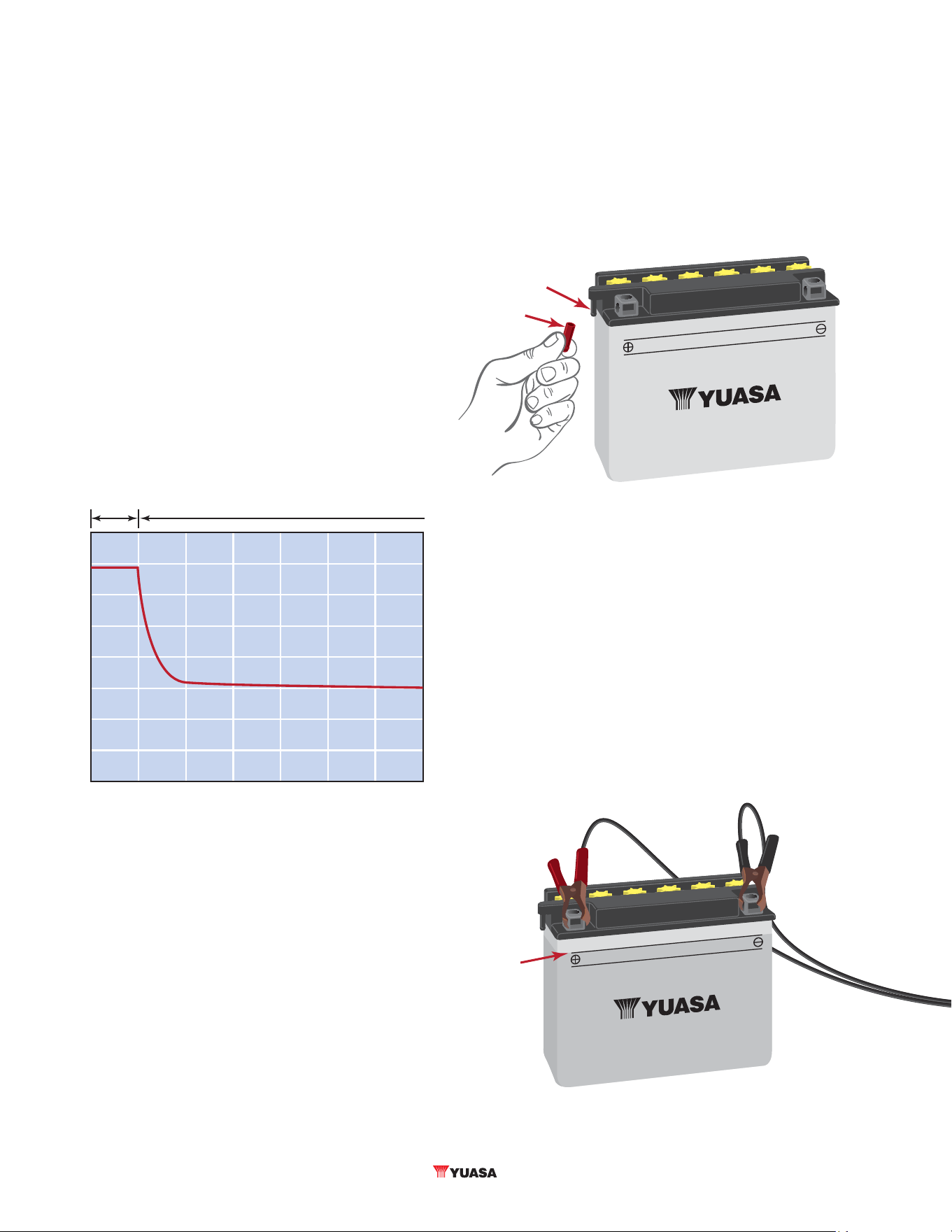
18
Charge Open Circuit Ambient Temperature 77°F/25°C
16
17
15
14
Terminal Voltage (volts)
12
13
11
10
01020
Ela
p
sed Time
(
minutes
)
30 40 50 60
During the initial charging period, battery voltage may reach over
16-volts. Open circuit voltage should be checked after the battery is
allowed to stand between 1 and 2 hours.
1. The battery must be out of the vehicle and placed on a level
surface. Remove fi lling caps (red, yellow or green colored
battery caps).
2. REMOVE THE RED SEALING CAP FROM THE VENT
ELBOW. If the battery has a red cap on the vent elbow
remove it and throw it away. Never put this cap back on the
battery after it is fi lled with acid as the buildup of internal
gas pressure can cause the battery case to rupture.
3. If using the acid bottle supplied with the battery, place the
container upright on a fl at surface. Carefully cut off the tip
of the bottle’s spout and attach the short tube provided.
Caution, Do not squeeze the bottle when cutting the
fi ll tip.
4. Fill the battery with electrolyte supplied with the battery
or from a bulk container. Do not use water or any other
liquid to activate a battery. Electrolyte should be between
60° F and 86° F before fi lling. If electrolyte is stored in a
cold area, it should be warmed to room temperature before
Elbow
Sealing
Cap
Electrolyte
full after
charging
Always remove the red sealing cap from the vent elbow before fi lling
and activating the battery.
Make sure that the acid level is to the upper mark after the battery is
initially charged. If the level is low fi ll with electrolyte.

19
fi lling. Fill to the UPPER LEVEL as indicated on the battery.
NOTE: Never fi ll/activate a battery installed in a vehicle as
electrolyte spillage can cause damage.
5. Fill each battery cell slowly and carefully to the highest level
line.
6. Let the battery stand for at least 30 minutes after fi lling.
Move or gently tap the battery so that any air bubbles
between the plates will be expelled. If the acid level has
fallen, refi ll with acid to upper level.
7. Filling a Conventional battery with electrolyte will bring it
to
75-80% of a full charge. A battery must be charged
to
100% before putting it into service. To fi nd
recommended charging current requirements in amps for
a specifi c battery, divide battery ampere-hour capacity
rating by
10. For example a 14 AH battery should be charged
at
1.4 amps (14 AH ÷ 10 = 1.4 amps). The specifi c gravity of
the electrolyte should rise to at least
1.260 on 12N series
batteries. On all High Performance batteries (YB Series) a
minimal reading of
1.270 should be observed.
During initial charging check to see if the electrolyte level
has fallen, and if so, fi ll with acid to the UPPER LEVEL. After
adding acid, charge for another hour at same rate as above
to mix the water and acid together. Note: This is the last time
electrolyte should be added to the battery. If the level is low
during use, distilled water should be added as required.
8. When charging is complete, replace fi ller cap plugs and
tighten by hand—do not use a screwdriver or pliers. Wash
off spilled acid with a water and baking soda solution,
paying particular attention that any acid is washed off the
terminals. Dry the battery case and install the battery.
POINTS TO REMEMBER
■ Newly activated AGM and Conventional batteries require an
initial charge before being placed into service
■ Yuasa Smart Battery Chargers use constant current and
pulse technology and can activate, charge and maintain all
Yuasa batteries
■ High-rate, automotive types of chargers can cause damage
to powersports batteries
■ High performance batteries (designated by an “H” in the
part number) must stand
1 to 2 hours after initial charging
■ Never remove the strip of caps on an AGM battery to add
water or electrolyte during its service life
■ Before activation of Conventional batteries remove the red
sealing cap from the vent elbow and discard it
Post-Fill Stand Time
Amp-Hour Stand Time
<18
>18
High Performance
30-60 minutes
1-2 hours
1-2 hours
20
Battery Installation
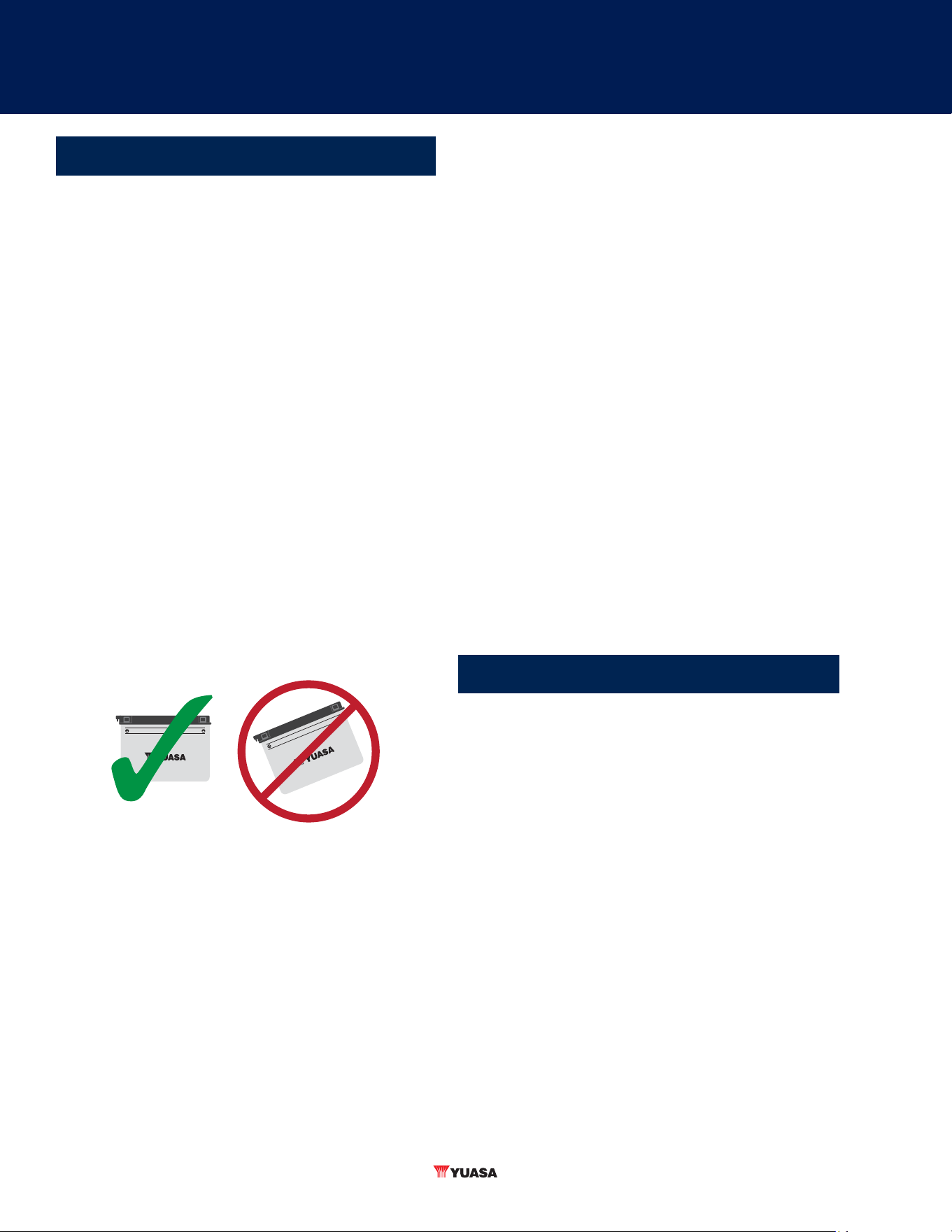
In most applications, batteries should be installed in an
upright position, If there is any question regarding a particular
vehicle/battery/installation please contact us for our specifi c
recommendations before installation.
Yuasa AGM batteries that come with separate acid packs that
are used to fi ll and activate the battery should not be installed
in any position other than upright, as possible electrolyte
leakage may occur. Also, Conventional and YuMicron
batteries should never be installed in any position
other than upright as their liquid electrolyte will leak
from the battery case causing damage to the vehicle.
Disclaimer:
Yuasa batteries are to be mounted in a position identical
to the position in which they were mounted in the
vehicle by the manufacturer. Any position other than
the “
O°” position (upright) requires a “non-spillable”
“Factory Activated” battery.
Yuasa Battery assumes no responsibility for damages and/or
injuries incurred due to a battery being mounted in a position
other than what was originally used in the vehicle by the
manufacturer. All “-BS” and Conventional “Flooded” batteries
are to be mounted in the “
O°” (upright) normal/center position.
POINTS TO REMEMBER
■ The Yuasa Battery Specifi cations & Applications guide and
OE microfi che, or online parts look up data are the best
sources for battery applications information
■ When replacing a battery that uses an original equipment
sensor, always replace the sensor
■ Conventional and YuMicron batteries should never be
installed in any position other than upright as their liquid
electrolyte will leak from the battery case causing damage
to the vehicle
■ Yuasa batteries are to be mounted in a position identical to
the position in which they were mounted in the vehicle by
the manufacturer
Any position other than the “O°” position (upright) requires a
“non-spillable” “Factory Activated” battery While it may seem
obvious that testing a battery before replacing it would be
a good idea, often times a battery is unnecessarily replaced
only to fi nd that the charging system, or a loose battery cable
connection is the reason for the discharged battery. For
example, a motorcycle’s battery is discharged, or dead. The
owner (or dealer) replaces the battery and the engine easily
starts. The battery must have been the problem as bikes
starts consistently for a week. Eventually the battery becomes
discharged again and the owner is facing the same problem. If
the charging system on the motorcycle is weak, or there is a
loose connection in the electrical system, the new battery only
temporarily solved the discharge problem. Batteries should be
tested to avoid unnecessary replacement.
There are several methods used to test a battery. Measuring
state-of-charge after charging a battery can determine if the
battery is good. For Conventional batteries, a hydrometer can be
used to measure specifi c gravity and thus state-of-charge. For
both Conventional and AGM batteries, a voltmeter can measure
state-of-charge. Load testing is another method to determine if a
battery is good. All of these tests require that the battery be fully
charged before testing. The only method that does not require
a fully charged battery is using the Yuasa Digital Powersports
Battery Tester. This tool will be covered later in this section.
Inspecting a Battery
Battery testing should begin with an inspection of the battery
using the following steps:
1. Make sure the top of the battery case is clean and
dry. If the case of a battery is dirty it can cause the battery to
discharge through the grime on top of the case. Use a soft brush
and water and soap or a solution of baking soda and water to
clean the battery case or terminals. On a Conventional battery,
make sure fi ller cap plugs are fi nger tight so cleaning materials
will not enter the cells and neutralize the acid.
2. Inspect battery terminals, screws, clamps and cables
for problems including: breakage, corrosion or loose
connections. Clean the terminals and clamps with a wire
brush. Once battery cables are installed, dielectric grease
(available at most auto parts stores) or clear lacquer from a
spray can applied to the terminals will help prevent oxygen
from causing corrosion on the battery terminals.
3. Inspect the battery case for obvious damage such
as cracks or leaks; look for discoloration, warping or
raised battery case top, which may indicate that battery has
overheated or been overcharged.
5 Installation, Testing and Maintenance
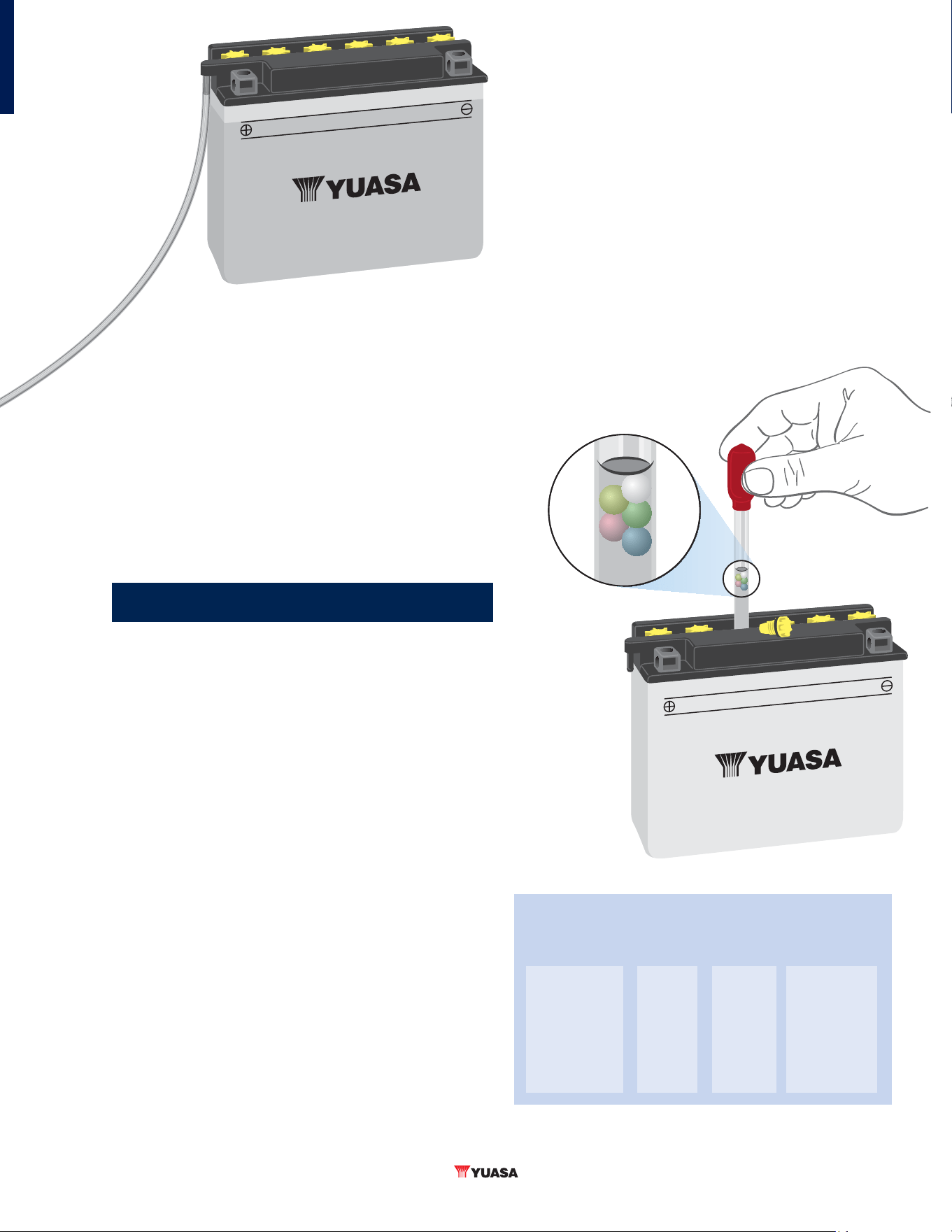
21
4. For Conventional batteries, check electrolyte level
and add distilled water if necessary. Don’t add acid—
only distilled water. Before any testing, charge the
battery so the water and acid mix.
5. If equipped, check the battery vent tube. Make sure
it’s not kinked, pinched or otherwise obstructed. On
a motorcycle, it should exit away from the drive chain and
from below the swing arm. Small cuts in the tube near the
battery vent are OK; they form an emergency escape for
trapped gas in case the vent tube becomes obstructed.
Battery Testing — Hydrometer
Because Conventional batteries have fi ller caps their state-
of-charge can be checked using a hydrometer by measuring
specifi c gravity. If after charging, the battery’s specifi c gravity
does not increase to indicate a full charge, the battery should
be replaced.
A hydrometer measures the ratio of sulfuric acid to water, or the
specifi c gravity (SG) of the electrolyte. The SG for pure water is
1.000 and sulfuric acid has an SG of 1.835. Combined, their SG is
between
1.265 to 1.280. In general, an SG reading between 1.265
to
1.280 indicates a fully charged battery. A reading of 1.230 to
1.260 indicates the battery should be charged before testing.
Yuasa YuMicron batteries use Sulfate Stop, a chemical additive
that increases battery life by reducing sulfate buildup. Sulfate
Stop may cause a slight increase in SG readings for these types
of batteries. A battery’s specifi c gravity changes with
temperature. Ideally, readings should be taken at
77° F. If the
temperature is much colder, or hotter a conversion factor can
be used to obtain an accurate reading. Add
.001 to the SG for
every
3° F above 77° F and subtract .001 from the SG for every
degree below
77° F. SG has a direct relationship to battery cell
voltage. By adding
.84 to the SG number, the cell voltage can
be calculated. For example, an SG of
1.265 + .84 = 2.105 volts.
Multiply
2.205 volts x 6 (six cells for a 12-volt battery) and the
result is
12.63 volts—indicating a fully charged battery.
There are two types of hydrometers used to measure SG:
calibrated fl oat and fl oating ball. The calibrated fl oat provides
an exact SG reading, however due to the amount of electrolyte
needed to cause the fl oat to rise inside the hydrometer they are
impractical for use on small powersports batteries. The fl oating
ball type hydrometer is much smaller in size and easy to use
on small batteries. Instead of reading specifi c gravity directly,
it uses colored balls to indicate state-of-charge. After drawing
in enough electrolyte to cover the balls inside the hydrometer,
the number that fl oat are counted. One fl oating ball equals
25% charge, two balls—50%, three balls—75% and four balls
indicate
100% state-of-charge (see chart page 19). Again, if
after charging, the battery’s specifi c gravity does not increase
to indicate a full charge, the battery should be replaced as it
may have an open/shorted cell or excessive sulfation.
Methods of Checking Battery Condition
State of
Charge
Syringe
Hydrometer
Digital
Voltmeter
5-Ball
Hydrometer
100% Charged
(w/Sulfate Stop)
100% Charged
75% Charged
50% Charged
25% Charged
0% Charged
1.280
1.265
1.210
1.160
1.120
< 1.100
12.80v
12.60v
12.40v
12.10v
11.90v
< 11.80v
5 Balls Floating
4 Balls Floating
3 Balls Floating
2 Balls Floating
1 Balls Floating
0 Balls Floating
Three methods of determining state-of-charge are shown; Syringe
Hydrometer, Digital Voltmeter and 5-Ball Hydrometer.
This hydrometer,
used to test
state-of-charge,
shows 5 balls
fl oating in the
electrolyte inside
the hydrometer
indicating that
the battery is
100% charged.

22
Battery Testing — Voltmeter
Unlike Conventional batteries, AGM types cannot be tested
using a hydrometer because they are sealed. Instead a
voltmeter can be used to perform an open circuit voltage test.
The test can be used for both Conventional and AGM batteries.
The test is used to determine the following: battery state-of-
charge, ability to hold a charge and shorted or open battery
cells. It is possible that a battery can pass the open circuit
voltage test and still be unable to start a vehicle and battery
load testing will be required to determine if the battery needs
replacement. Before performing an open circuit voltage
test the battery must be fully charged.
Charging a battery using the vehicle’s charging system or a
battery charger creates a “surface” charge across the battery’s
cells. The surface charge needs to be removed before an
accurate test for open circuit voltage can be performed. To
remove the surface charge, turn on the ignition key for about
three minutes then turn it off. Now let the battery sit for about
10 minutes. This step is not necessary if the battery has been
sitting for 1 hour after charging is complete. Connect a digital
voltmeter to the battery, red lead to positive and black lead to
the negative battery terminals. Open circuit voltage indicates
what percent of charge the battery has reached after charging.
Open circuit voltage for a fully,
100% charged AGM battery is
12.8 to 13.0 volts. AGM batteries that are 75% to 100% charged
will measure
12.5 to 12.8 volts. Conventional batteries have
slightly lower open circuit voltages:
12.6 volts (12.8 volts with
Sulfate Stop) for
100 % charge and 12.4 for 75% charge..
If after charging, and the open circuit voltage indicates that
the battery is less than
75% charged, the battery is probably no
good and should be replaced. Before the battery is condemned,
try charging it again. If the battery is still not close to
100%
charged it needs to be replaced. The open circuit voltage test
is not conclusive. It is possible to have a
100% charged battery
as indicated by the open circuit voltage test that will not start
a powersport vehicle reliably. A load test must be performed to
determine actual battery performance after charging.
Charging System Quick Check
A quick check of a powersport vehicle’s charging system can be
performed using a digital voltmeter. Connect the voltmeter leads
directly to the battery (red to positive and black to the negative
terminals). Read the open circuit voltage and start the engine.
Operate the engine between
3000 to 4000 rpm while watching
the reading on the voltmeter. If the vehicle’s charging system
maintains voltage between
13.0 and 14.5 volts, the charging
system is probably working properly. If voltage is the same as
open circuit voltage (usually less than
13 volts) the charging
system is not working and further diagnosis will have to be
performed. Installing a new battery in a powersports vehicle with
a faulty charging system will eventually result in a dead battery
and an unhappy customer. Always use the OE service manual as
a guide for further testing and diagnosis of the charging system.
Battery Load Testing
Once the battery is charged and passes the open circuit voltage
test its time to determine if it can really perform its main job—
starting the engine. It might seem obvious that if the starter
button is pressed and the engine starts, the battery must be
OK. While a marginal battery might start an engine a few
times, it may not reliably start it in the future—especially in
cold weather.
There are two tools that can be used for load testing: a dedicated
battery load tester, or a digital voltmeter. The load tester can
be used when the battery is not installed in a vehicle. The load
tester simulates the electrical load of a starter motor to load-
test the battery. These testers are usually used by dealerships
and are able to adjust the load applied to the battery under
test. Always follow the instructions that apply to the specifi c
battery load tester. In general, apply a load of three times the
ampere-hour rating. After
10 seconds check the battery voltage
with the load still applied. A good
12-volt battery will not drop
below
9.5 volts (ambient temperature of 70° F). A 6-volt battery
should drop no more than
5.25 volts. If the voltage reading is
below these minimums replace the battery.
As an alternative to the load tester, the vehicles starter
motor can be used to provide the load to test the battery.
To load test the battery, cranking voltage must be measured.
Low cranking voltage will indicate that the battery is getting
tired and should be replaced. Following are the steps for
performing a battery load test using a digital voltmeter and
the vehicle’s starter motor.
Connect a digital voltmeter directly to the battery—red lead
to the positive terminal and black lead to negative. While
watching the voltmeter, press the start button and crank
the engine’s starter (it’s OK if the engine starts). Just before
the engine starts, note the voltmeter reading. As the starter
motor places an electrical load on the battery, cranking
voltage will normally drop. If battery voltage drops below
9.5 volts (at 70° F) while the engine is cranking over,
the battery needs to be replaced. If the engine starts too
quickly to read cranking voltage, the ignition or fuel injection
computer fuse can be removed. This will allow the starter
motor to operate (without the engine starting) and cranking
voltage can be measured.
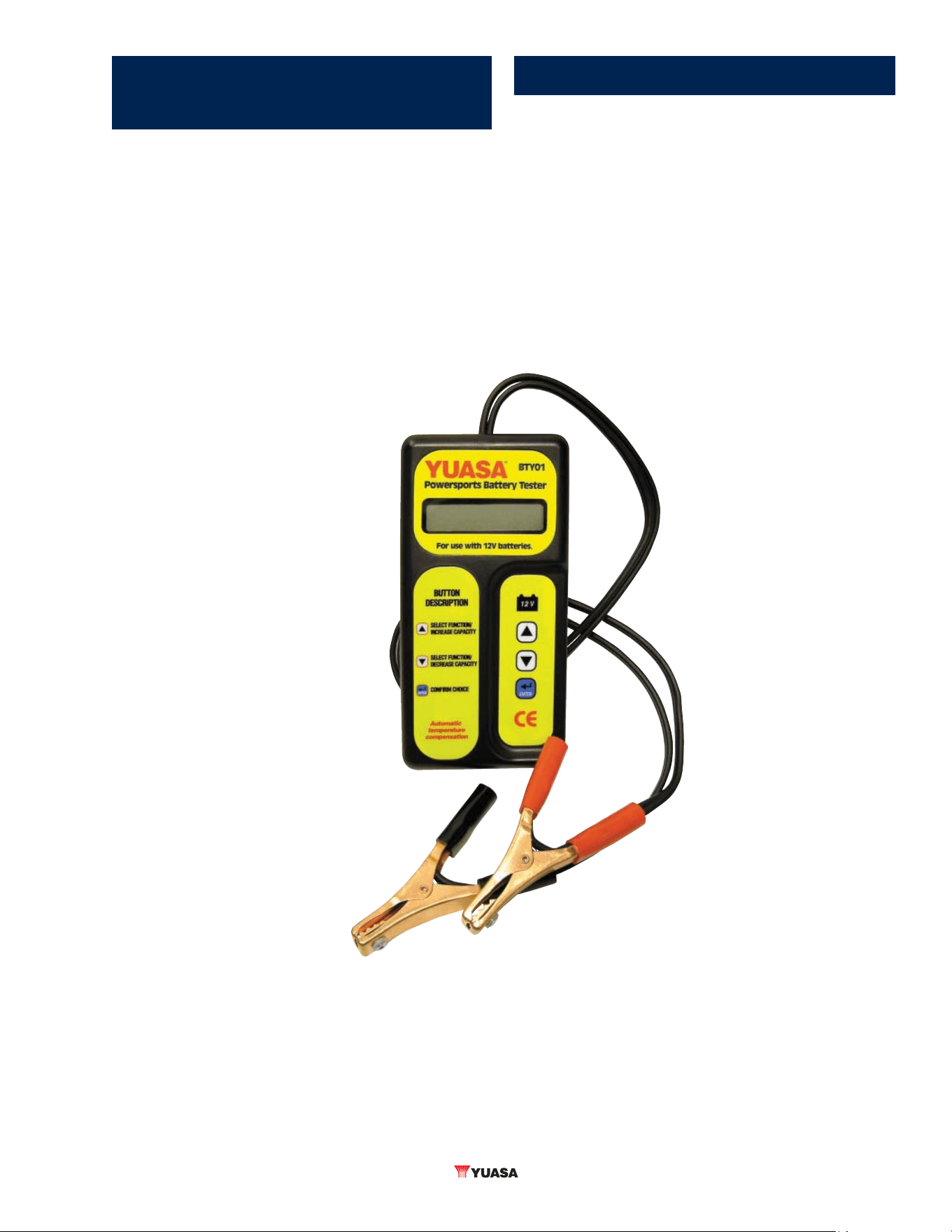
23
Yuasa Digital Powersports
Battery Tester
The previous battery testing methods required the battery to be
fully charged before testing. Yuasa’s Digital Powersports Battery
Tester (part number YUA
00BTY01) can test a battery, in or out of
the vehicle even if the battery is discharged. The tester measures
a battery’s internal resistance regardless of its state-of-charge.
Internal resistance is an indication of a battery’s ability to
deliver current, or amperage. The more capacity a battery has to
produce current, the lower its internal resistance.
Yuasa’s digital tester uses single load dynamic resistance
technology to calculate battery performance. A modifi ed DC
load is momentary applied to the battery while measuring
the instantaneous voltage drop across all cells. The load
is then removed and voltage across the cells is measured
again after a recovery period. These analog
measurements are converted into digital
information—the tester calculates the
dynamic internal resistance in order to
evaluate overall battery condition. The
entire process takes about two seconds and
current drain on the battery is minimized.
The tester provides information on open
circuit voltage, state-of-charge and battery
health and condition. This tester can also
test a partially charged or fully discharged
battery on or off a vehicle.
To use the tester:
1. Connect it directly to the battery
terminals. When the connection is
made battery voltage will be displayed.
2. Program what type of battery you are
testing. There are three selections—
VRLA/MF/AGM/SLA (valve regulated lead acid/
maintenance free/absorbed glass mat (AGM)
lead acid) or SLI (starting, lighting and
ignition) and Conventional batteries.
3. “SET CAPACITY” is displayed and
arrow keys are used to select the
amp hour rating of the battery
being tested.
4. Press the “ENTER” button to begin testing. In less than
two seconds the open circuit voltage is displayed with
test results that include: Good & Pass, Good & Recharge,
Recharge & Retest, Bad & Replace and Bad Cell & Replace.
5. After testing, pressing the up/down arrow keys displays
State-of-Charge and Battery Health, both listed as a
percentage.
Battery Maintenance
AGM Batteries. AGM batteries do not have to be checked as often
as Conventional batteries—about every three months, or three
months from the date of battery activation at the factory if stored
at room temperature. Higher storage temperatures cause faster self-
discharge and and requires that batteries be checked more often.
The battery will last longer if it is
100% charged most of the time
and any of the Yuasa automatic chargers will maintain a battery for
optimum performance and long service life. AGM batteries have
a predetermined quantity of electrolyte added at the factory or
in the fi eld specifi ed for the battery. Once activated, the battery is
permanently sealed and must never be opened. The addition of water
is never required for an AGM battery. The single most important
aspect to maintaining an AGM battery is to not let it
sit discharged for long periods of time—keep it
fully charged for peak performance.
Conventional Batteries. Conventional
batteries should be checked for state-
of-charge about once per month if not
used on a regular basis. Recharging
may be required if the vehicle is not
used for more than two weeks or if the
starter turns slower than usual when
starting the engine. A Conventional
battery requires the periodic addition
of distilled water when the electrolyte
level becomes low. Water loss is normal
in these batteries through the process
of electrolysis and evaporation. Low
electrolyte levels that expose the
lead plates to the air will result
in permanent damage to the
battery. Maintain the electrolyte
levels above the minimum fi ll
lines on the battery and at or
below the maximum line. Clean
terminals and connectors as
necessary and make sure the vent
tube is free of kinks or clogs. Always
replace fi ller caps and fi nger-tighten only.
Battery Storage
If the vehicle is in storage or used infrequently, disconnect
the battery cable to eliminate current drain from electrical
equipment. Check the battery every month (for Conventional
types) and every three months for AGM batteries. If open
circuit voltage indicates a low state-of-charge, charge the
battery. Temperatures below
60° F or above 80° F may
require more frequent inspections and/or charging.

24
Sulfation and Freezing
The two most common reasons that batteries can become damaged
are sulfation and freezing. These are not a problem if the battery is
properly charged, and for Conventional batteries the water level is
maintained. Battery sulfation takes place for two reasons: continuous
discharging, or low electrolyte levels. When a battery discharges the
lead in the plates turn into lead sulfate. The lead sulfate is actually
a crystal which grows larger when the discharge is continuous and
uninterrupted. In a Conventional battery, low electrolyte levels
expose the cell plates to air causing the lead material to oxidize and
form sulfates. In either case it doesn’t take long before the battery
won’t hold a charge. Low electrolyte levels cause another problem
because the acid in the electrolyte becomes more concentrated,
causing the active material
to corrode and fall to the
bottom of the battery case.
If this conditions takes
place over a long enough
time period the process
will internally short out the
battery.
For added protection,
YUASA’s YuMicron and
AGM batteries are treated
with a special chemical
formula called “Sulfate
Stop.” This dramatically
reduces sulfate crystal
buildup on cell plates
resulting in longer
battery life. For example,
Yuasa conducted a test on two batteries; one with Sulfate Stop,
and the other without. Both batteries were under the constant
discharge of a
10-watt bulb for a week. The battery with Sulfate
Stop was charged with a
90% recover rate. The untreated battery
could not be charged enough to put it back into service.
Freezing is not a problem with a fully charged battery.
However if the battery becomes discharged (and the acid in
the electrolyte turns into mostly water) the electrolyte will
freeze. Freezing can cause a condition called “mossing” which is
indicated by small red lines on the battery plates. Freezing can
also crack the battery case and buckle the plates permanently
damaging the battery. A fully-charged battery can be stored at
subfreezing temperatures with no damage. As the chart on this
page indicates a fully charged battery will not freeze unless
the temperature drops below
-75° F. By contrast a discharged
(dead) battery will freeze at only
27° F. That’s a difference
of more than
100 degrees between the low temperatures a
charged and discharged battery can withstand.
Electrolyte Freezing Points
Specific Gravity
of Electrolyte
Freezing
Point
1.265
1.225
1.200
1.150
1.100
1.050
-75°F
-35°F
-17°F
+5°F
+18°F
+27°F
A battery that is fully charged can be
stored at low temperatures without
freezing. This chart shows that as
specifi c gravity (state-of-charge)
decreases, the battery will freeze at a
higher temperature.
POINTS TO REMEMBER
■ Inspect battery terminals, screws and cables for breakage,
corrosion or loose connections
■ Inspect the battery case for damage including cracks or
leaks
■ Check electrolyte level on Conventional batteries and add
water if necessary
■ Never add water to an AGM battery
■ State-of-Charge can be tested on a fully charged battery
using a voltmeter
■ A vehicle’s starter motor can be used for battery load testing
■ For peak performance never let a battery sit discharged for
long periods of time

25
Acid—Sulfuric acid, used to describe
the electrolyte or liquid contained in a
battery’s cells. Pages
6, 7.
Active Materials—Materials in a
battery that react chemically to produce
electrical energy; lead peroxide
(positive plates) and sponge lead
(negative plates).
Activation—Adding electrolyte to a dry
battery. Pages
8, 14, 23.
AGM—Absorbed glass mat. Page
6, 8, 9,
14, 16.
AGM Battery—A battery that does
not contain any liquid electrolyte. The
electrolyte is absorbed in glass mat
material located in each of the battery’s
cells. AGM and VRLA (Valve Regulated
Lead Acid) batteries are the same
design. Page
8, 16.
Ampere—The amount of electrical that
a battery produces. Page
10, 11.
Ampere-Hour—A measure of the
volume of electricity (one amp per
hour). Pages
10, 19.
Ampere-Hour Capacity—The number
of ampere-hours that can be delivered
by a battery under specifi c conditions.
Page
19.
Antimony—A hard, brittle, silver-white
metal with a high luster from the arsenic
family. Pages
9, 15.
Cadmium—A metallic element
highly resistant to corrosion used
as a protective plating on battery
components.
Capacity Test—A test that discharges
a battery using a constant current at
room temperature until voltage drops to
1.75 per cell.
Charged—A battery cell’s maximum
ability to deliver current (amps). The
positive plates contain a maximum
of lead oxide and a minimum of lead
sulfate, and the negative plates contain
a maximum of sponge lead and a
minimum of sulfate. The electrolyte is
at maximum specifi c gravity. Pages
6, 8,
10, 11, 12.
Charged and Dry—A battery
assembled with dry, charged plates and
no electrolyte.
Charged and Wet—A fully charged
battery containing electrolyte (ready to
be installed).
Charging—The process of converting
electrical energy to stored chemical
energy. Pages
5, 6, 7, 9, 11.
Charging Rate—The current (amps) in
amperes at which a battery is charged.
Page
9.
Cold Cranking Amps—The number of
amps a battery can produce at
0° F for
30 seconds without cell voltage falling
below
7. 2 volts. Pages 5, 8, 10.
Constant Current Charge—A battery
charger that produces a constant
current (amps) during the charging
process. Pages
12, 13, 15.
Conventional Battery—Same as a
standard battery or any YuMicron or
YuMicron CX battery. Page
7, 9, 13, 14,
15, 18.
Current—The fl ow of electrical energy
normally expressed as amperes or
amps. Pages
5, 6, 7 , 10, 11, 12.
Deep Discharge—Removal of up
to
80% of the rated capacity of a
battery’s cell.
Discharge—Conversion of a battery’s
chemical energy into electrical energy.
Pages
6, 7, 8, 10, 11.
Discharge Rate—Any specifi ed
amperage rate at which a battery is
discharged.
Dry Charged—Battery cell plates
that have been subjected to the dry
charging process.
Electrolyte—In a battery electrolyte
is a diluted solution of sulfuric acid and
water. Pages
6, 7, 8, 11, 12, 14, 15, 17,
18, 20.
Float Charge—Recharge voltage rate
that is slightly higher than the open circuit
voltage of a battery. Pages
15, 16.
Glass Mat—Fabric made from glass
fi bers with a polymeric binder such as
styrene or acrylic which is used to help
retain positive active material. Glass
mats also absorb electrolyte in an AGM
battery. Pages
8, 9.
Hydrometer—A device used to
measure specifi c gravity of electrolyte
in a battery. Pages
20, 21.
Lead—Sometimes listed as Pb is a
chemical element used in lead acid
batteries. Pages
5, 6, 7, 8, 15 .
Lead Antimony—A commonly used
alloy in battery castings or plates.
Pages
15.
Lead Calcium—A lead base alloy that is
sometimes used for battery components
in place of antimonial lead alloys. Also
know as lead calcium. Pages
8, 9, 15.
Lead Oxide—A general term for any
of the lead oxides used to produce
battery plates.
Lead Peroxide—A brown lead oxide
which is the positive material in a fully
formed positive battery plate. Page
6.
Lead Sponge—The chief component
of the active material of a fully-charged
negative battery cell plate.
Glossary 6

26
Lead Sulfate—A compound that results
from the chemical action of sulfuric acid
on oxides of lead within a battery cell.
Pages
7, 11, 15, 24.
MF—Maintenance-Free, VRLA sealed
absorbed glass mat battery and AGM are
all the same type of battery and do not
have fi ll caps, nor do they need to be
fi lled with water. Page
8.
Milliampere—One thousandth of an
ampere or amp.
Modifi ed Constant Voltage
Charge—A charge in which charging
voltage is held constant while a fi xed
resistance is inserted in the battery
charging circuit causing a rising voltage
as charging progresses.
Negative Plate—The grid and active
material that current fl ows to from
the external circuit when a battery is
discharging. Pages
6, 8, 11.
Negative Terminal—The battery
terminal from which current fl ows
through an external circuit to the
positive terminal when a battery
discharges. Pages
6, 22.
Open Circuit Voltage—The voltage at
a battery’s terminals when no current is
fl owing. Pages
10, 12, 13, 18, 22.
Positive Terminal—The battery
terminal that current fl ows toward in
an external circuit when the battery is
discharging. Pages
6, 22.
Rated Capacity—Amp hours of
discharge that can be removed from
a fully-charged battery at a specifi c,
constant discharge rate. Page
10.
Self-Discharge—Gradual loss of
electrical energy when a battery is
stored. Pages
8, 9, 11, 23.
Sponge Lead—A porous mass of
lead crystals and the chief material
contained in a fully-charged negative
battery plate. Page
6.
Standard Battery—Any
conventional, YuMicron or YuMicron
CX battery.
State-of-Charge—The amount of
electrical energy contained in a battery.
Pages
7, 11, 12, 15, 20.
Sulfation—Formation of lead sulfate
on a battery’s plates as a result of
discharge. Pages
7, 11, 21, 24.
Sulfuric Acid—The principal acid
compound of sulfur, sulfuric acid in
diluted form is the electrolyte of a lead
acid battery. Pages
6, 7, 11, 12, 16.
Trickle Charge—A low-rate continuous
charge approximately equal to a
battery’s internal losses and capable of
maintaining a battery in a fully-charged
state. Page
15.
Vent Plug or Vent Cap—The seal for
the vent and fi lling well of a cell cover
or a small hole for the escape of gases.
Pages
7, 18.
Volt—The unit of measure of
electromotive force or the electrical
pressure of a circuit or battery.
Pages
6, 9, 10, 12, 13, 15, 21, 22.
Voltage—The difference in electrical
potential that exists between the
terminals of a battery or any two points in
an electrical circuit. Pages
20, 21, 22.
Voltmeter—Instrument used for
measuring voltage. Pages
20, 21, 22, 24.
VRLA—Valve Regulated Lead Acid. Sealed
batteries which feature a safety valve
vent system designed to release excessive
internal pressure while maintaining
suffi cient pressure for recombination
of oxygen and hydrogen into water.
VRLA and AGM refer to the same type of
battery design. Pages
8, 17.
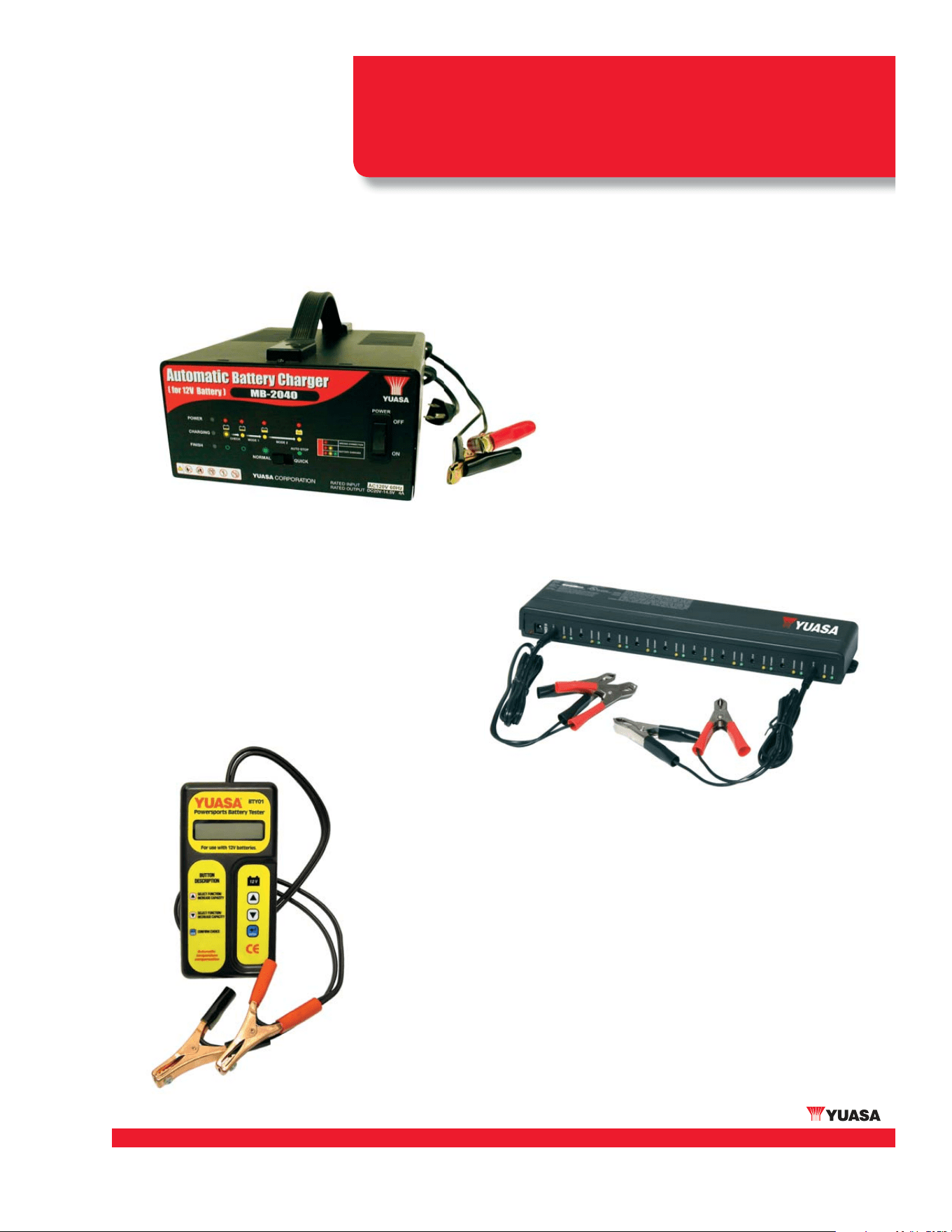
With Protective Rubber Boot
and Amp Hr Guide
s
High Output charging current (4 amps)
s
High Voltage capable (20 volts) – designed to improve
recovery of sulfated batteries
s
Switchable Mode operation
– “ Fast Mode” – for quick vehicle set-up
– “ Normal Mode” – ideal for smaller batteries, initial
activation, and deeply discharged batteries
s
Commercial Grade – perfect for Dealer / Shop use
s
Suitable for all battery types – Conventional, as well as
MF (AGM),including YTZ
s
Automatic Shut-Off
s
Reverse Polarity Protection /
Spark-free Operation (UL / CUL) approved)
s
Durable construction for longer life
s
3 year limited warranty
Yuasa MB-2040 Battery Charger
Part No. YUA1202040
Digital Battery Tester
Part No. YUA00BTY01
s
Developed exclusively for the Powersports industry
s
Determines accurate battery status in seconds
s
Single load, dynamic resistance technology minimizes
battery drain during test
s
Tests both charged and discharged batteries accurately
s
1 year limited warranty
10-Bank Battery Maintainer
Part No. YUA120027 - Battery Maintainer with 3 Ft. Leads
Part No. YUA122500 - Battery Maintainer with 25ft Leads
Part No. YUA00AC25F - 10 Pack of 25 Ft. Leads
s
Maintain up to 10 batteries at a time
s
5-stage maintenance / float charge
s
Prequalification battery test
s
Built-in timer for battery protection
s
250 mA per channel
s
1 year warranty
Professional Shop Products

2901 Montrose Avenue, Laureldale, PA 19605-2752
Phone: 610.929.5781 Fax: 610.929.1295
yuasabatteries.com