Accessories
4
Inserting the batteries
5
Operating range of the remote control unit
5
Part names and functions
6
Front panel
6
Rear panel
8
Remote control unit
10
Connections
Connecting speakers
16
Speaker A/B connection
17
Bi-wiring connection
18
Subwoofer connection
19
Connecting a playback device
20
Connecting a recording device
21
Connecting to a device with digital audio output connectors
22
Connecting devices with remote control connectors
23
Performing operations by RC on this unit without visual contact
23
Remotely connecting Marantz audio devices
23
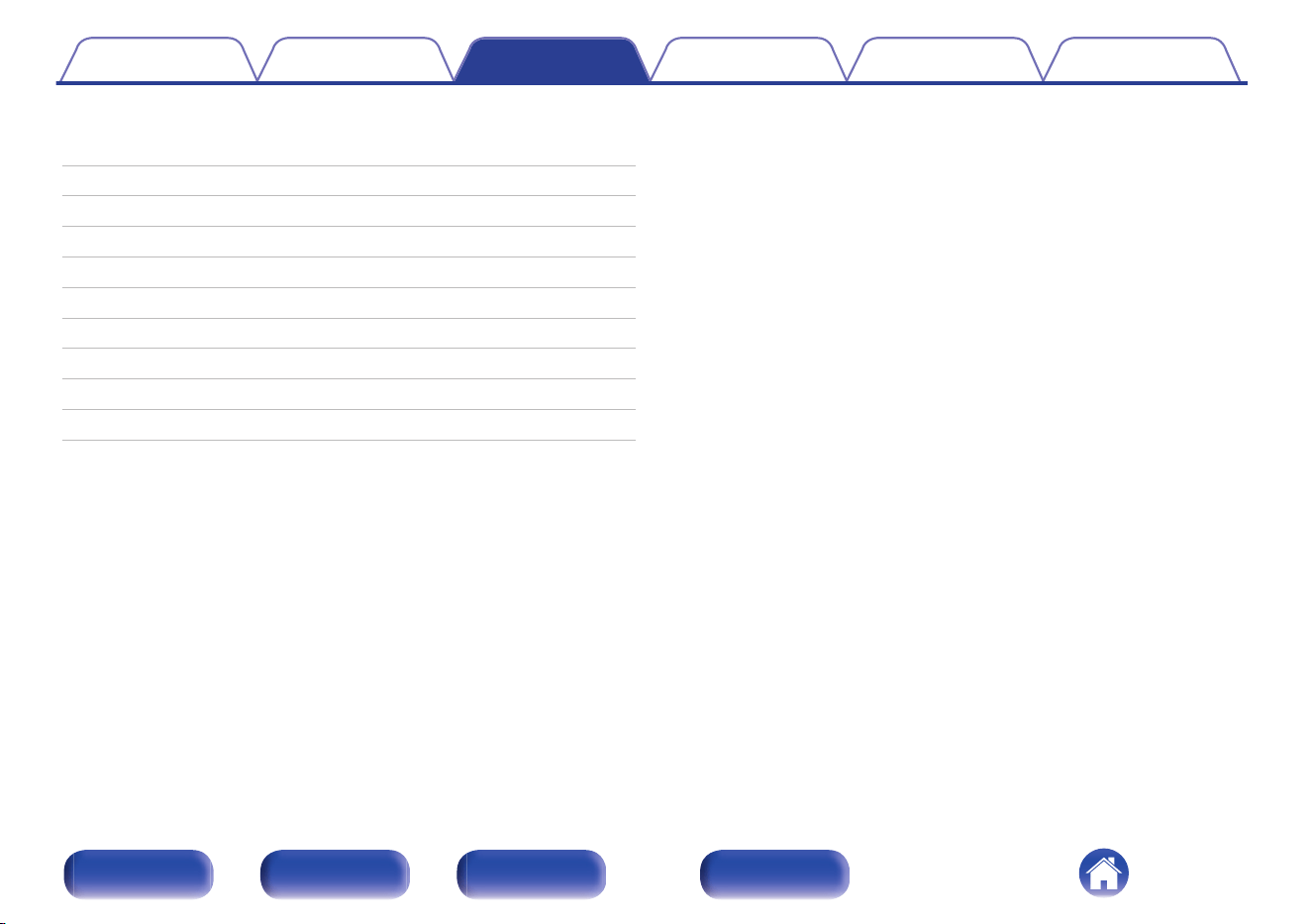
Connecting the power cord
24
Playback
Turning the power on
26
Switching the power to standby
26
Selecting the speakers for audio output
27
Selecting the input source
27
Adjusting the volume
27
Turning off the sound temporarily (Muting)
27
Adjusting the tone and balance
28
Playing CDs
28
Connecting and playing back from a digital device (Coaxial/
Optical)
29
Recording
30
Contents Connections Playback Settings Tips Appendix
2
Front panel Rear panel
Remote control
unit
Index
Settings
Setting the Auto Standby mode
32
Setting the remote signal receiving function
33
Disabling the remote signal receiving function of the remote
control unit
33
Enabling the remote signal receiving function of the remote
control unit
33
Setting remote control codes
34
Setting remote control codes for the remote control
35
Setting remote control codes for the main unit
35
Tips
Tips
37
Troubleshooting
38
Power does not turn on / Power is turned off
39
Operations cannot be performed through the remote control unit
40
No sound comes out
41
Desired sound does not come out
41
Sound is interrupted or noise occurs
42
FILTER 1・2 indicator does not light
42
Appendix
D/A converter
43
Explanation of terms
43
Trademark information
44
Specifications
45
Index
48
Contents Connections Playback Settings Tips Appendix
3
Front panel Rear panel
Remote control
unit
Index
Thank you for purchasing this Marantz product.
To ensure proper operation, please read this owner’s manual carefully before using the product.
After reading this manual, be sure to keep it for future reference.
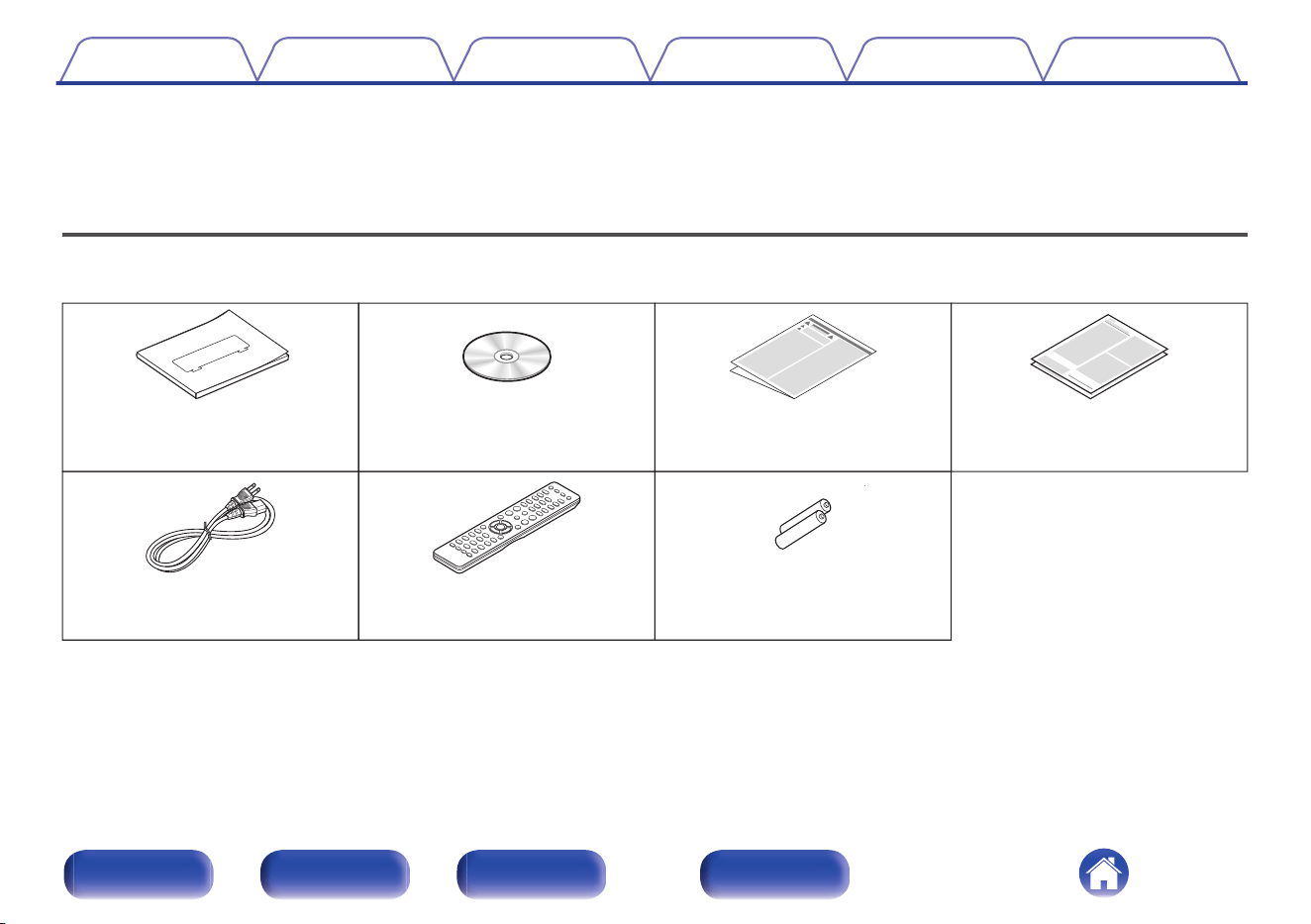
Accessories
Check that the following parts are supplied with the product.
.
Quick Start Guide
Safety Instructions
R03/AAA batteries
Power cord
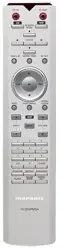
Remote control unit
(RC004PMCD)
CD-ROM
(Owner’s Manual)
Warranty
(for USA/for CANADA)
Contents Connections Playback Settings Tips Appendix
4
Front panel Rear panel
Remote control
unit
Index
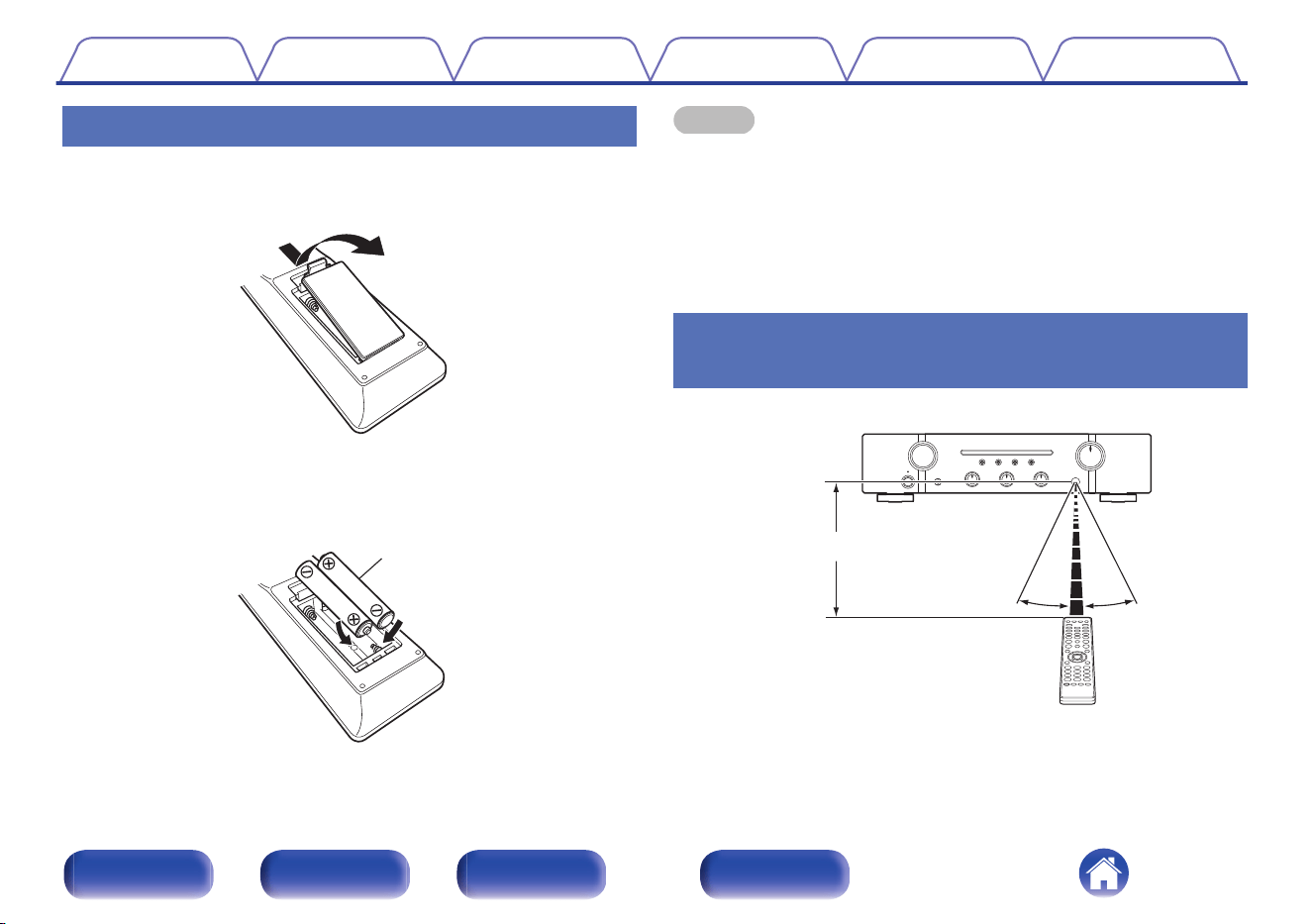
Inserting the batteries
1
Remove the rear lid in the direction of the arrow and
remove it.
.
2
Insert two batteries correctly into the battery
compartment as indicated.
.
Batteries
3
Put the rear lid back on.
NOTE
0
To prevent damage or leakage of battery fluid:
0
Do not use a new battery together with an old one.
0
Do not use two different types of batteries.
0
Remove the batteries from the remote control unit if it will not be in use for long
periods.
0
If the battery fluid should leak, carefully wipe the fluid off the inside of the battery
compartment and insert new batteries.
Operating range of the remote control
unit
Point the remote control unit at the remote sensor when operating it.
.
Approx. 23 ft/7 m
30° 30°
Contents
Connections Playback Settings Tips Appendix
5
Front panel Rear panel
Remote control
unit
Index
.
uQ2 Q3o
Q
0
Q1iy
reqw t
A
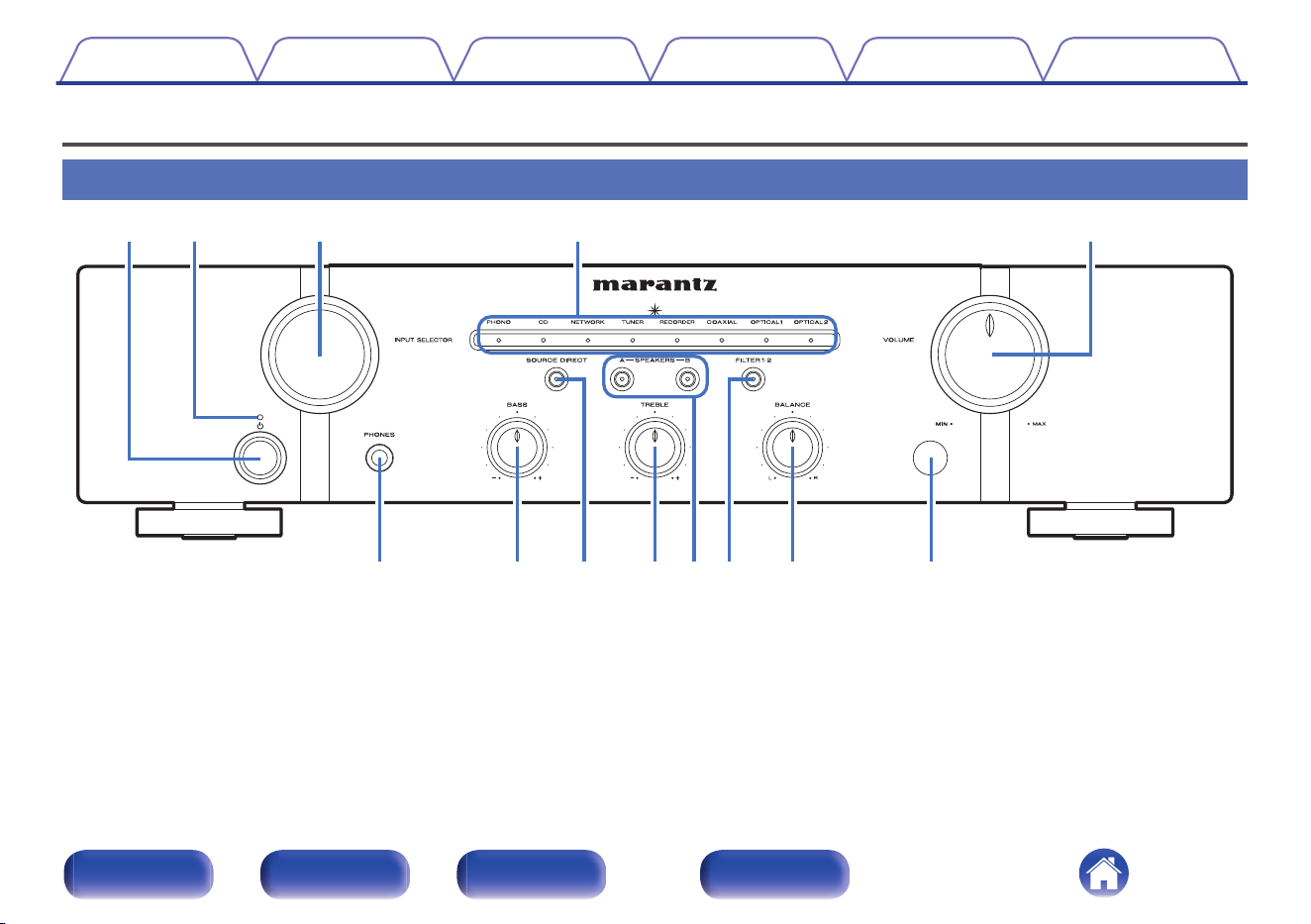
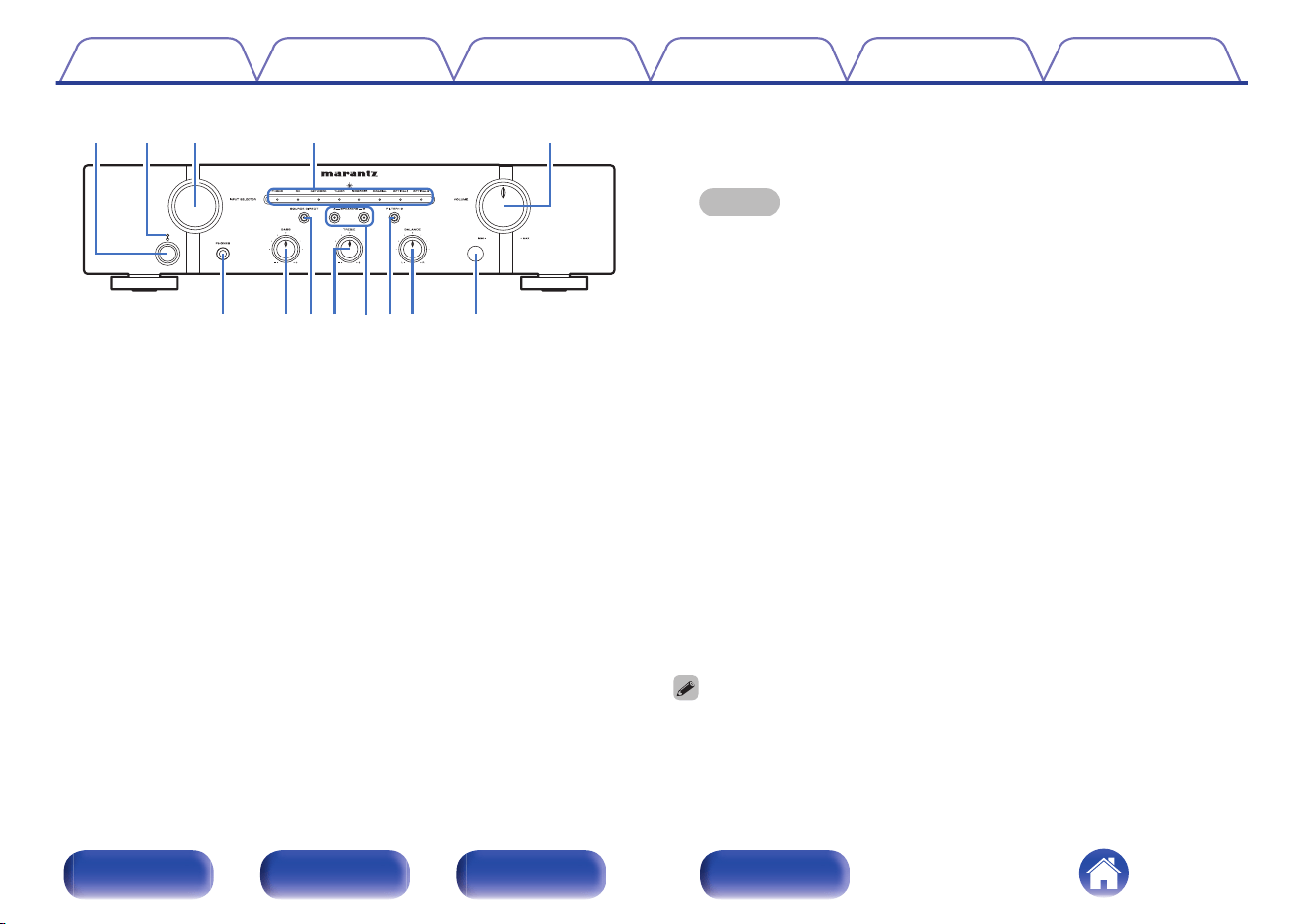
Power operation button (X)
This turns the power on/off. (v p. 26)
B
Power indicator
This is lit as follows according to the power status:
0
Power on : Off
0
Standby : Red
0
Power off : Off
C
INPUT SELECTOR knob
This selects the input source. (v p. 27)
D
Input indicators (v p. 27)
E
VOLUME knob
These adjust the volume level. (v p. 27)
F
Headphones jack (PHONES)
Used to connect headphones.
Turn off speaker output when using headphones. (v p. 27)
NOTE
0
To prevent hearing loss, do not raise the volume level excessively when using
headphones.
G
BASS control knob
This setting adjusts the volume level for the bass. (v p. 28)
H
SOURCE DIRECT button/indicator
This turns source direct mode on/off. (v p. 28)
I
TREBLE control knob
This setting adjusts the volume level for the treble. (v p. 28)
J
Speaker switching buttons/indicators (SPEAKERS A/B)
These select the speaker for audio output. (v p. 27)
K
FILTER 1・2 button/indicator
Switches the filter characteristics when digital audio is input.
(v p. 29)
L
BALANCE control knob
This adjusts the balance of the volume output from the left and right
speakers. (v p. 28)
M
Remote control sensor
This receives signals from the remote control unit. (v p. 5)
0
7, 9 and b can be adjusted when 8 is off (Source direct mode is off).
Contents Connections Playback Settings Tips Appendix
7
Front panel Rear panel
Remote control
unit
Index
.
qw e try
uio
A
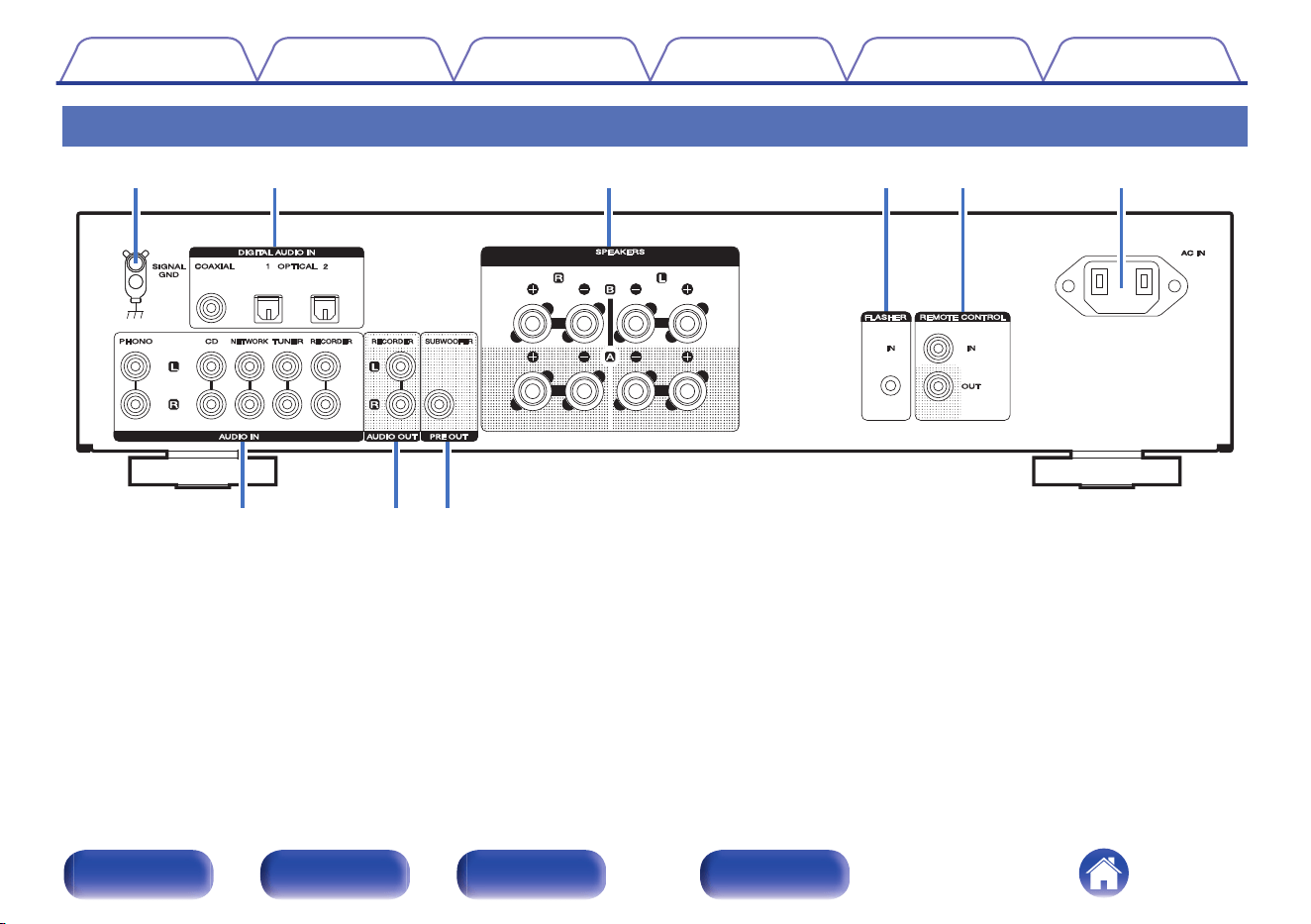
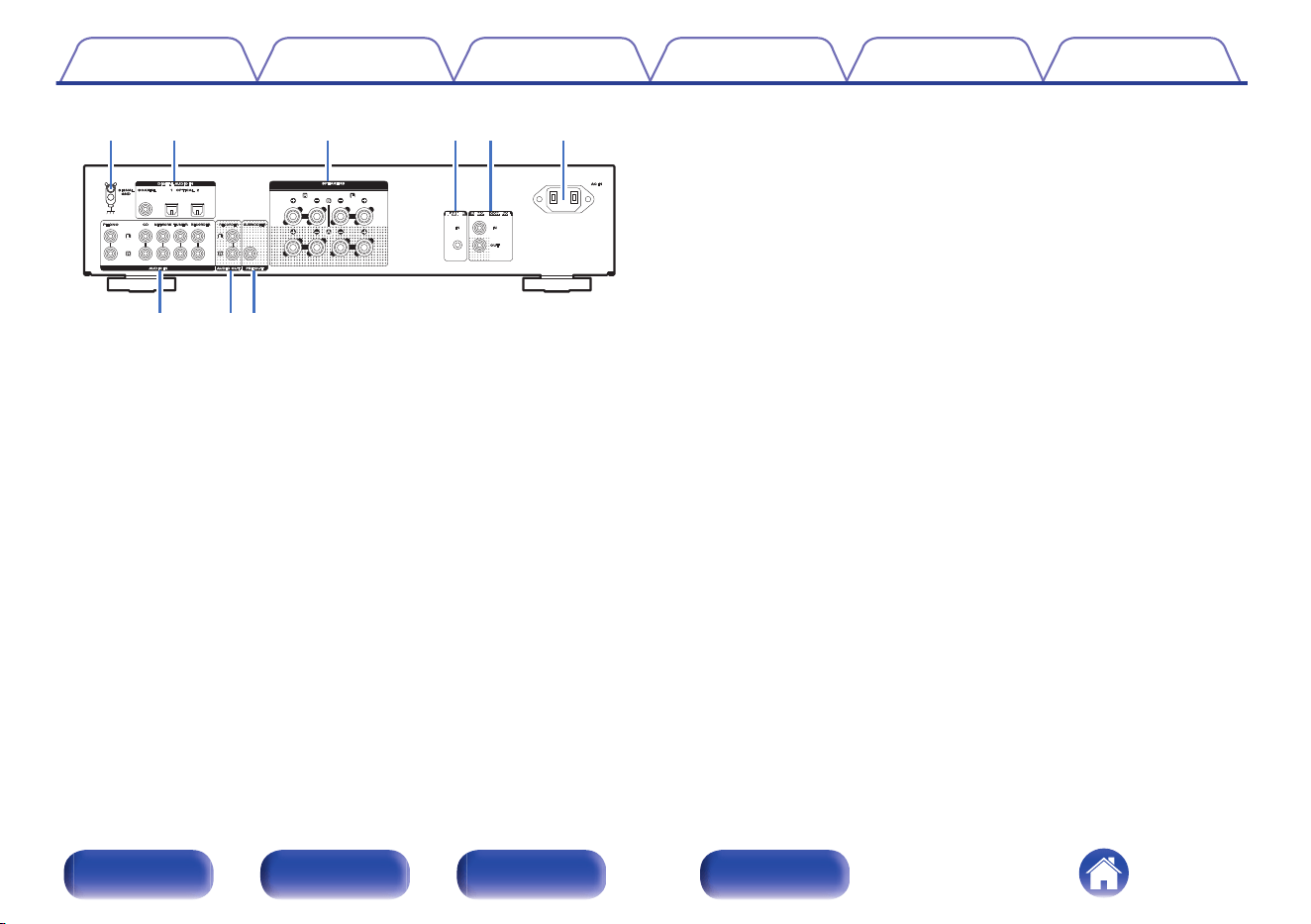
SIGNAL GND terminal
Used to connect a turntable. (v p. 20)
B
Digital audio input connectors (DIGITAL AUDIO IN)
Used to connect devices equipped with digital audio output connectors.
(v p. 22)
C
Speaker terminals (SPEAKERS)
Used to connect speakers. (v p. 16)
D
FLASHER IN jack
Used when using a control BOX or other such control devices to control
this unit.
E
Remote control input/output connectors (REMOTE CONTROL)
Used to connect to a Marantz audio device that is compatible with the
remote control function. (v p. 23)
F
AC inlet (AC IN)
Used to connect the power cord. (v p. 24)
G
Analog audio input connectors (AUDIO IN)
Used to connect devices equipped with analog audio output
connectors.
0
“Connecting a playback device” (v p. 20)
0
“Connecting a recording device” (v p. 21)
H
AUDIO OUT connectors (RECORDER)
Used to connect the input connector of a recorder. (v p. 21)
I
PRE OUT connector (SUBWOOFER)
Used to connect a subwoofer with a built-in amplifier. (v p. 19)
Contents
Connections Playback Settings Tips Appendix
9
Front panel Rear panel
Remote control
unit
Index
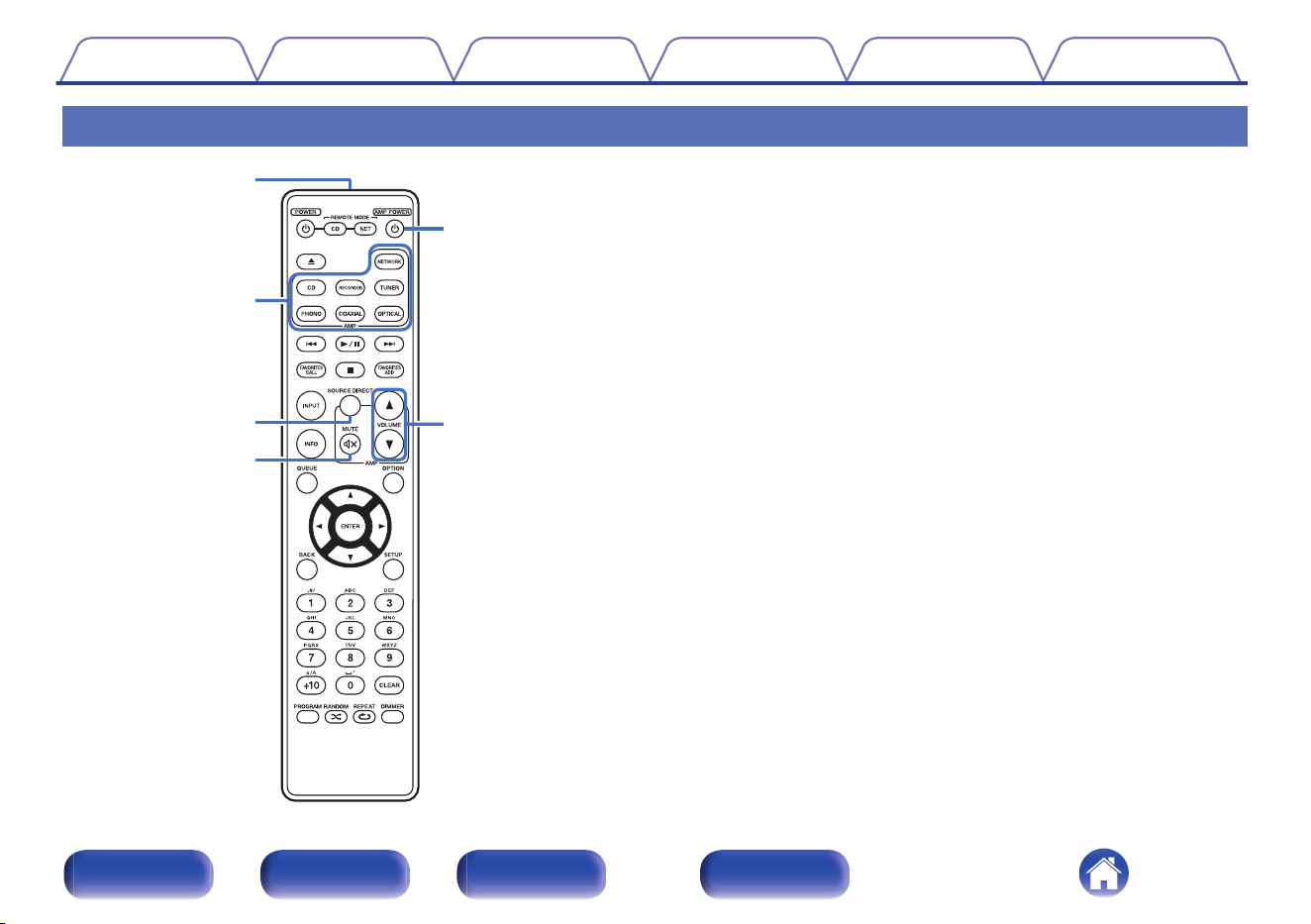
Remote control unit
.
t
y
r
e
w
q
The remote control provided with this unit can control a network audio
player in addition to a Marantz CD player.
0
“CD player operations” (v p. 11)
0
“Network audio player operations” (v p. 13)
o
Operating this unit
A
Remote control signal transmitter
This transmits signals from the remote control unit. (v p. 5)
B
Input source select buttons
This selects the input source. (v p. 27)
C
SOURCE DIRECT button
This turns source direct mode on/off. (v p. 28)
D
MUTE button (:)
This mutes the output audio. (v p. 27)
E
Power operation button (AMP POWER X)
This turns the power on/off (standby). (v p. 26)
F
VOLUME buttons (df)
These adjust the volume level. (v p. 27)
Contents Connections Playback Settings Tips Appendix
10
Front panel Rear panel
Remote control
unit
Index
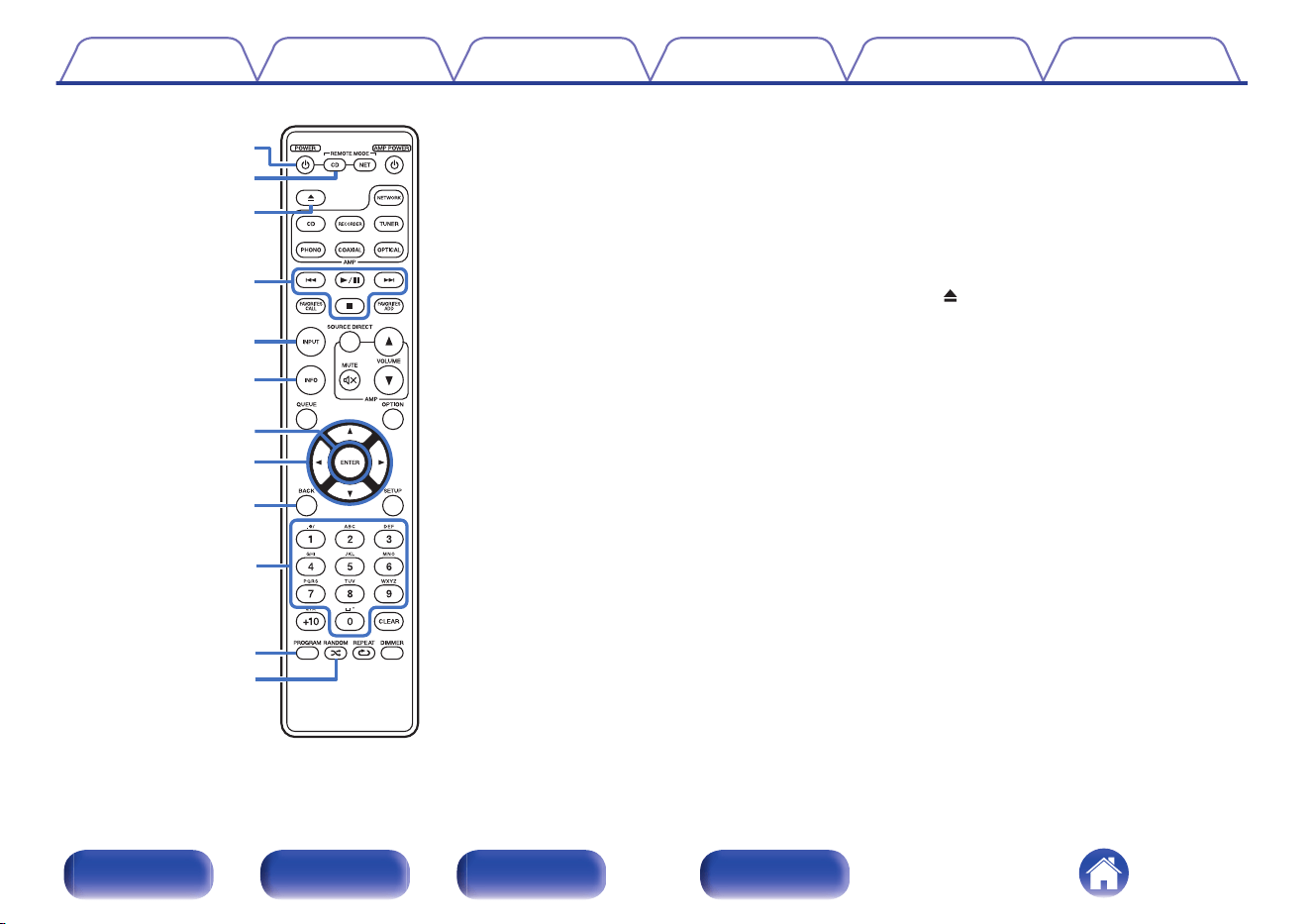
.
w
q
e
r
o
i
u
y
t
Q2
Q0
Q1
o
CD player operations
You can operate a Marantz CD player. To operate a Marantz CD
player, press the REMOTE MODE CD button to switch the remote
control to the CD player operation mode.
0
REMOTE MODE CD button lights for approximately two seconds.
A
Power operation button (POWER X)
B
Remote mode select button (REMOTE MODE CD)
C
Disc tray open/close button (
)
D
System buttons
E
Media mode select button (INPUT)
F
Information button (INFO)
G
ENTER button
H
Cursor buttons (uio p)
I
BACK button
J
Number buttons (0 – 9)
K
PROGRAM button
L
RANDOM button (P)
Contents
Connections Playback Settings Tips Appendix
11
Front panel Rear panel
Remote control
unit
Index
Q5
Q6
Q7
Q3
Q4
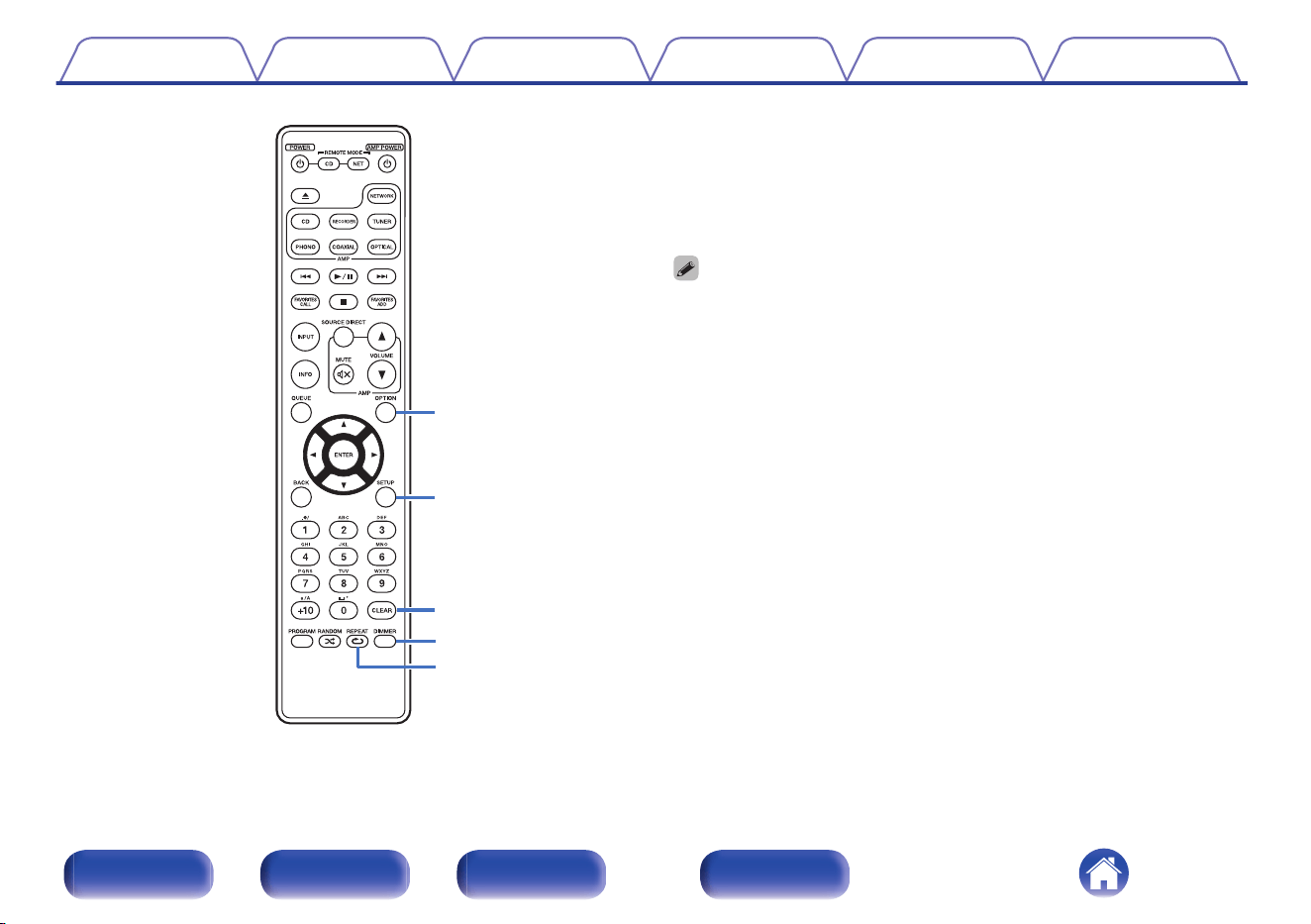
M
OPTION button
N
SETUP button
O
CLEAR button
P
DIMMER button
Q
REPEAT button (L)
0
The remote control may not operate some products.
0
The amp can be operated with the amp operation buttons even when the remote
control operation mode is set to CD.
Contents Connections Playback Settings Tips Appendix
12
Front panel Rear panel
Remote control
unit
Index
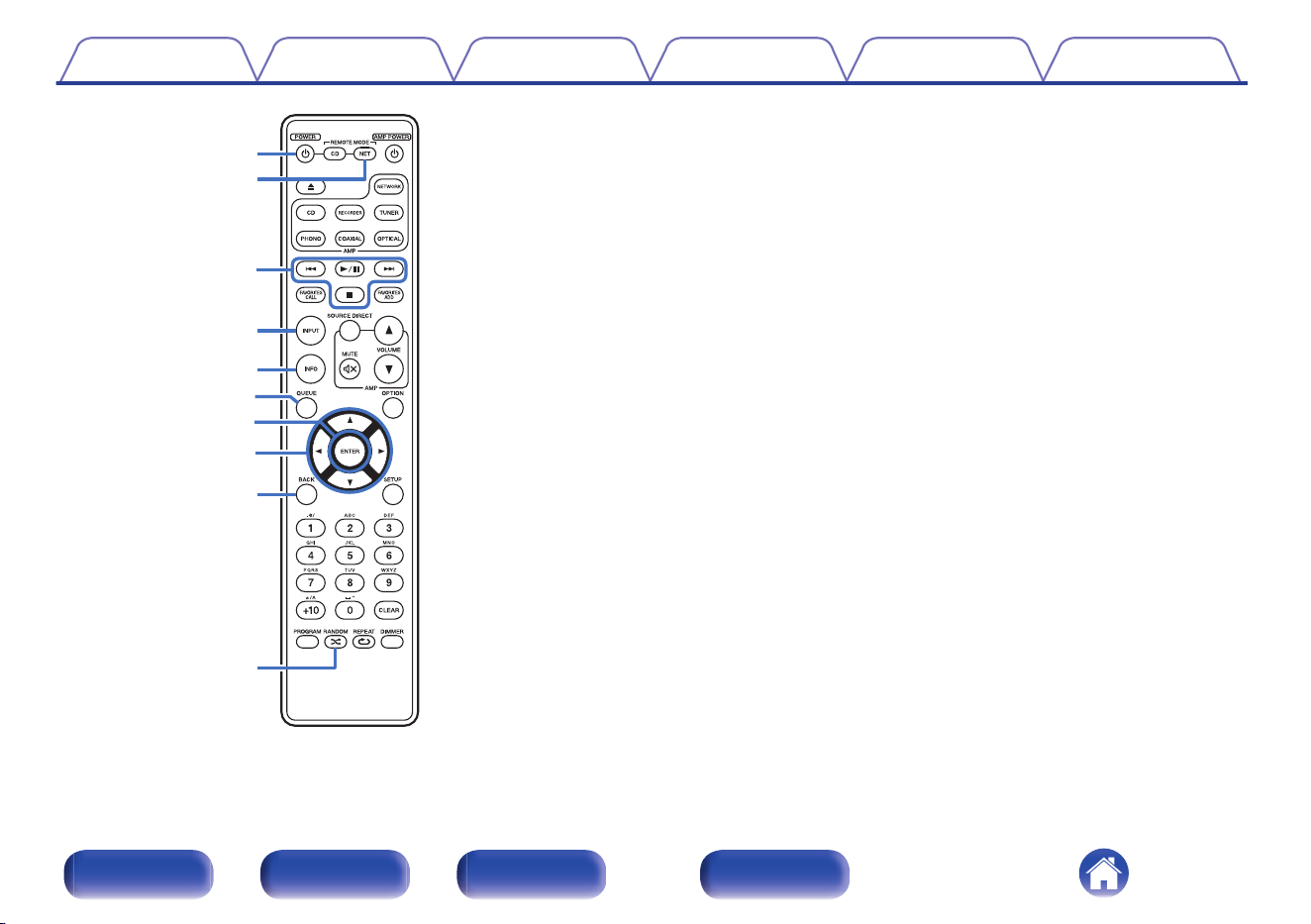
.
w
e
q
t
r
o
i
u
y
Q0
o
Network audio player operations
You can operate a Marantz network audio player. To operate a
Marantz network audio player, press the REMOTE MODE NET button
to switch the remote control to the network audio player operation
mode.
0
REMOTE MODE NET button lights for approximately two seconds.
A
Power operation button (POWER X)
B
Remote mode select button (REMOTE MODE NET)
C
System buttons
D
Input source select button (INPUT)
E
Information button (INFO)
F
QUEUE button
G
ENTER button
H
Cursor buttons (uio p)
I
BACK button
J
RANDOM button (P)
Contents Connections Playback Settings Tips Appendix
13
Front panel Rear panel
Remote control
unit
Index
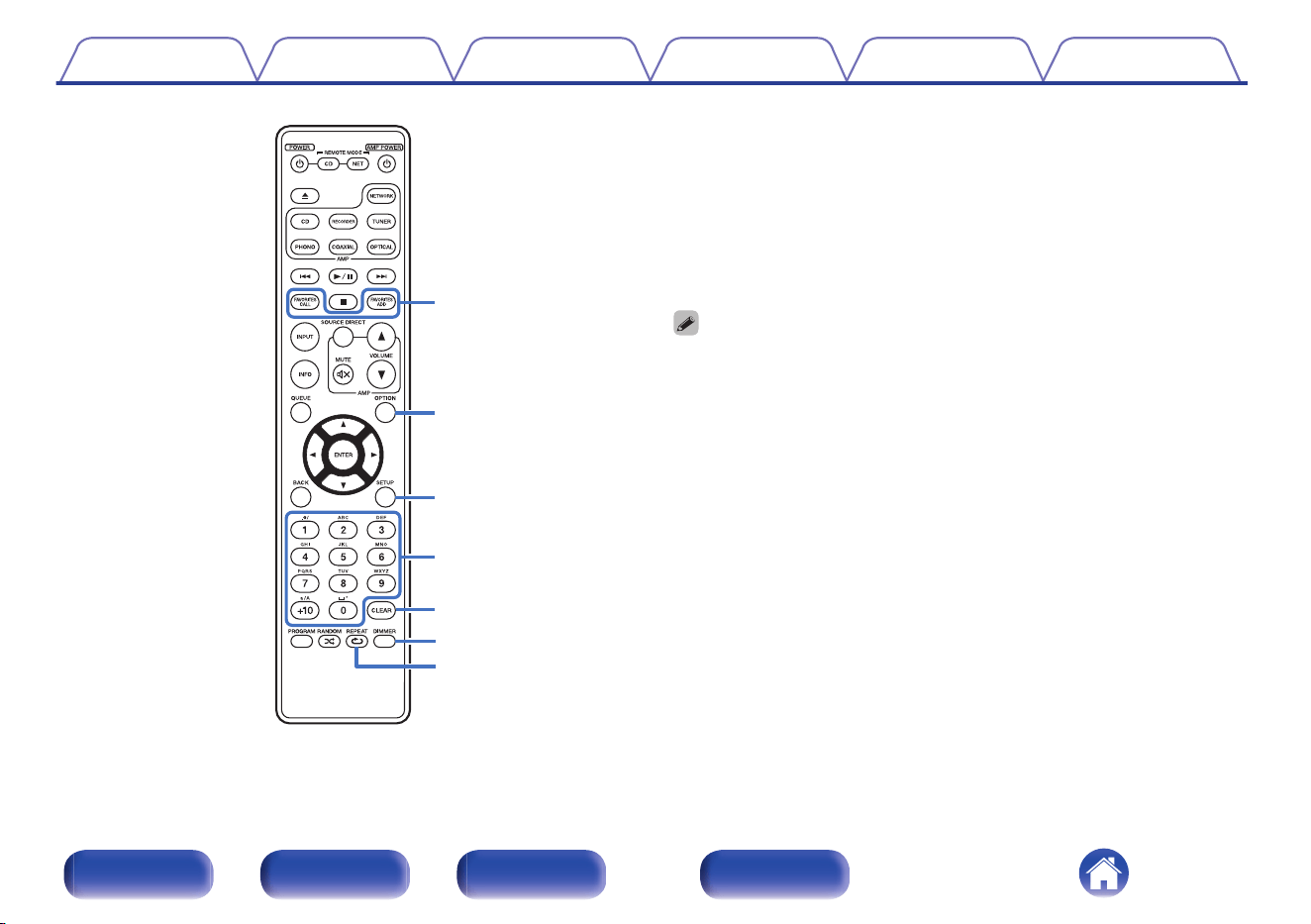
Q2
Q1
Q3
Q5
Q4
Q6
Q7
K
FAVORITES ADD / CALL buttons
L
OPTION button
M
SETUP button
N
Number/letter buttons (0 – 9, +10)
O
CLEAR button
P
DIMMER button
Q
REPEAT button (L)
0
The remote control may not operate some products.
0
The amp can be operated with the amp operation buttons even when the remote
control mode is NET.
Contents Connections Playback Settings Tips Appendix
14
Front panel Rear panel
Remote control
unit
Index
o
Contents
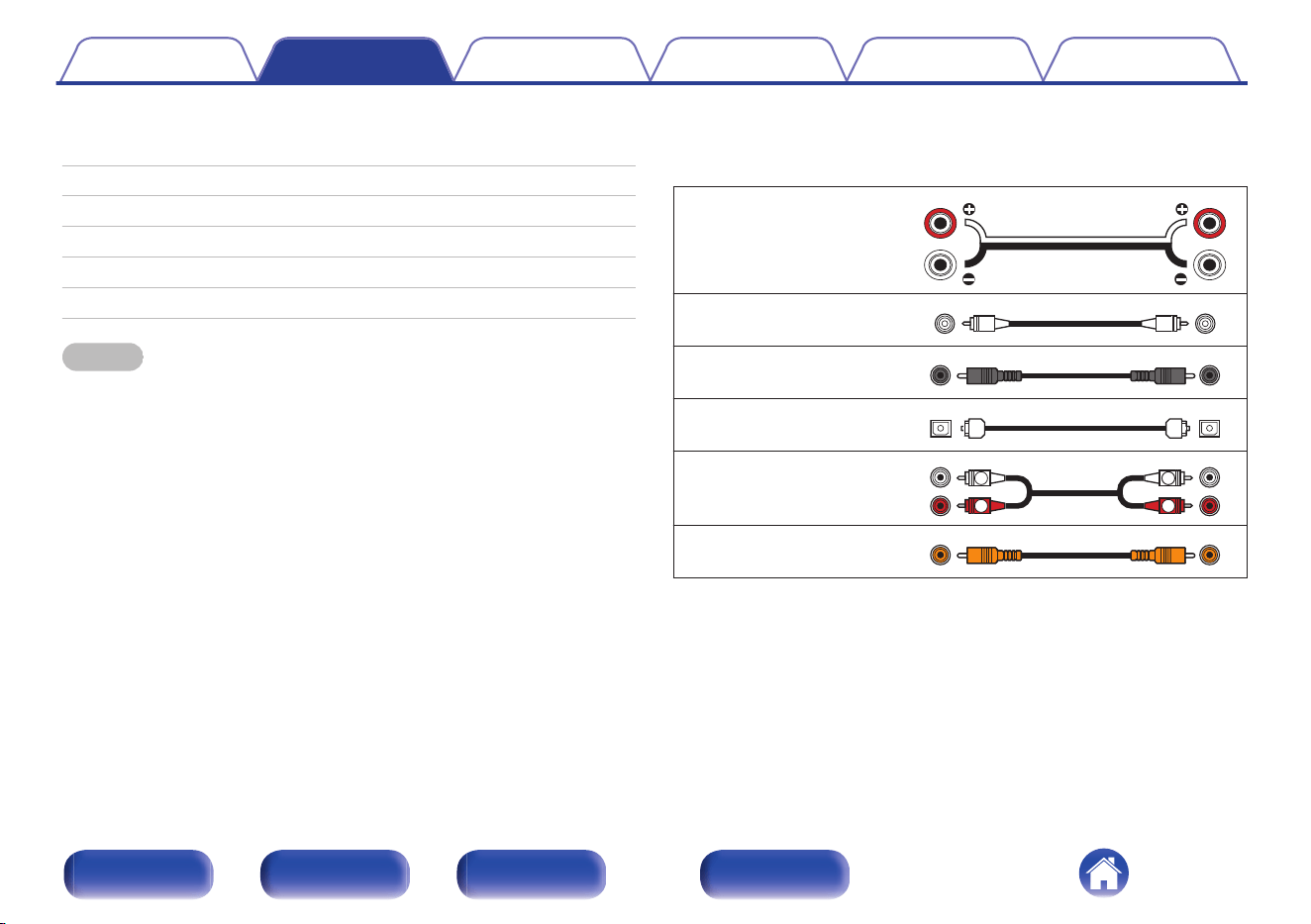
Connecting speakers 16
Connecting a playback device 20
Connecting a recording device 21
Connecting to a device with digital audio output connectors 22
Connecting devices with remote control connectors 23
Connecting the power cord 24
NOTE
0
Do not plug in the power cord until all connections have been completed.
0
Do not bundle power cords together with connection cables. Doing so can result in
humming or noise.
o
Cables used for connections
Provide necessary cables according to the devices you want to
connect.
Speaker cable
.
Subwoofer cable
.
Coaxial digital cable
.
Optical cable
.
Audio cable
.
R
L
R
L
Remote connector cable
.
Contents Connections Playback Settings Tips Appendix
15
Front panel Rear panel
Remote control
unit
Index
Connecting speakers
NOTE
0
Disconnect this unit’s power plug from the power outlet before connecting the
speakers.
0
Connect so that the speaker cable core wires do not protrude from the speaker
terminal. The protection circuit may be activated if the core wires touch the rear
panel or if the + and - sides touch each other. (“Protection circuit” (v p. 43))
0
Never touch the speaker terminals while the power cord is connected. Doing so
could result in electric shock.
0
Use speakers with impedances within the ranges shown below to suit how they
are used.
Speaker terminals
used on this unit
No. of connected
speakers
Speaker
Impedance
SPEAKERS A
(Standard
connection)
2 (one set) 4 – 16 Ω/ohms
SPEAKERS B
2 (one set) 4 – 16 Ω/ohms
SPEAKERS A and
SPEAKERS B
4 (two sets) 8 – 16 Ω/ohms
SPEAKERS A and
SPEAKERS B
(Bi-wiring
connection)
2 (one set) 4 – 16 Ω/ohms
o
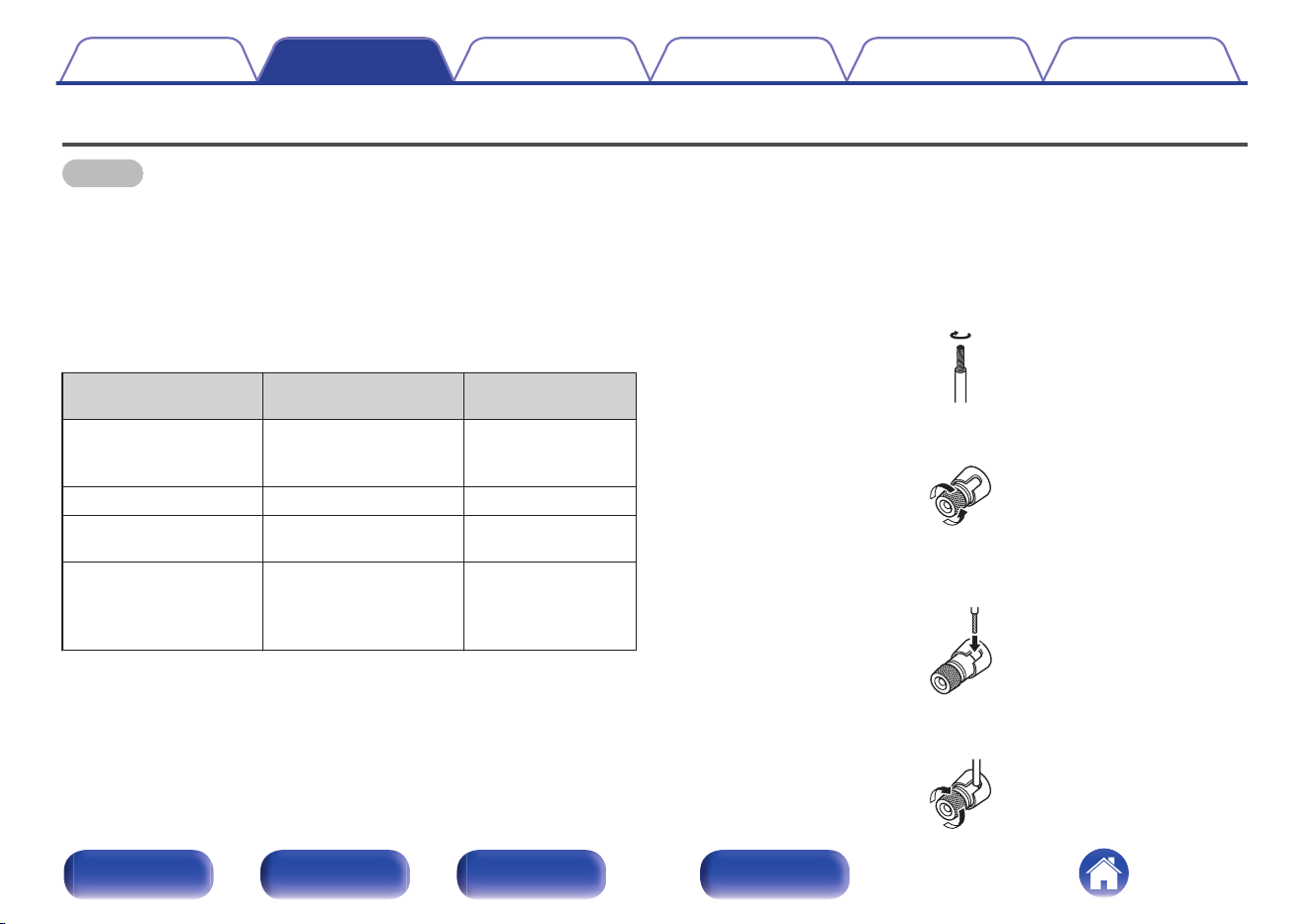
Connecting the speaker cables
Carefully check the left (L) and right (R) channels and + (red) and –
(black) polarities on the speakers being connected to this unit, and be
sure to connect the channels and polarities correctly.
1
Peel off about 3/8 inch (10 mm) of sheathing from the tip of the
speaker cable, then either twist the core wire tightly or terminate it.
.
2
Turn the speaker terminal counterclockwise to loosen it.
.
3
Insert the speaker cable’s core wire to the hilt into the
speaker terminal.
.
4
Turn the speaker terminal clockwise to tighten it.
.
Contents
Connections Playback Settings Tips Appendix
16
Front panel Rear panel
Remote control
unit
Index
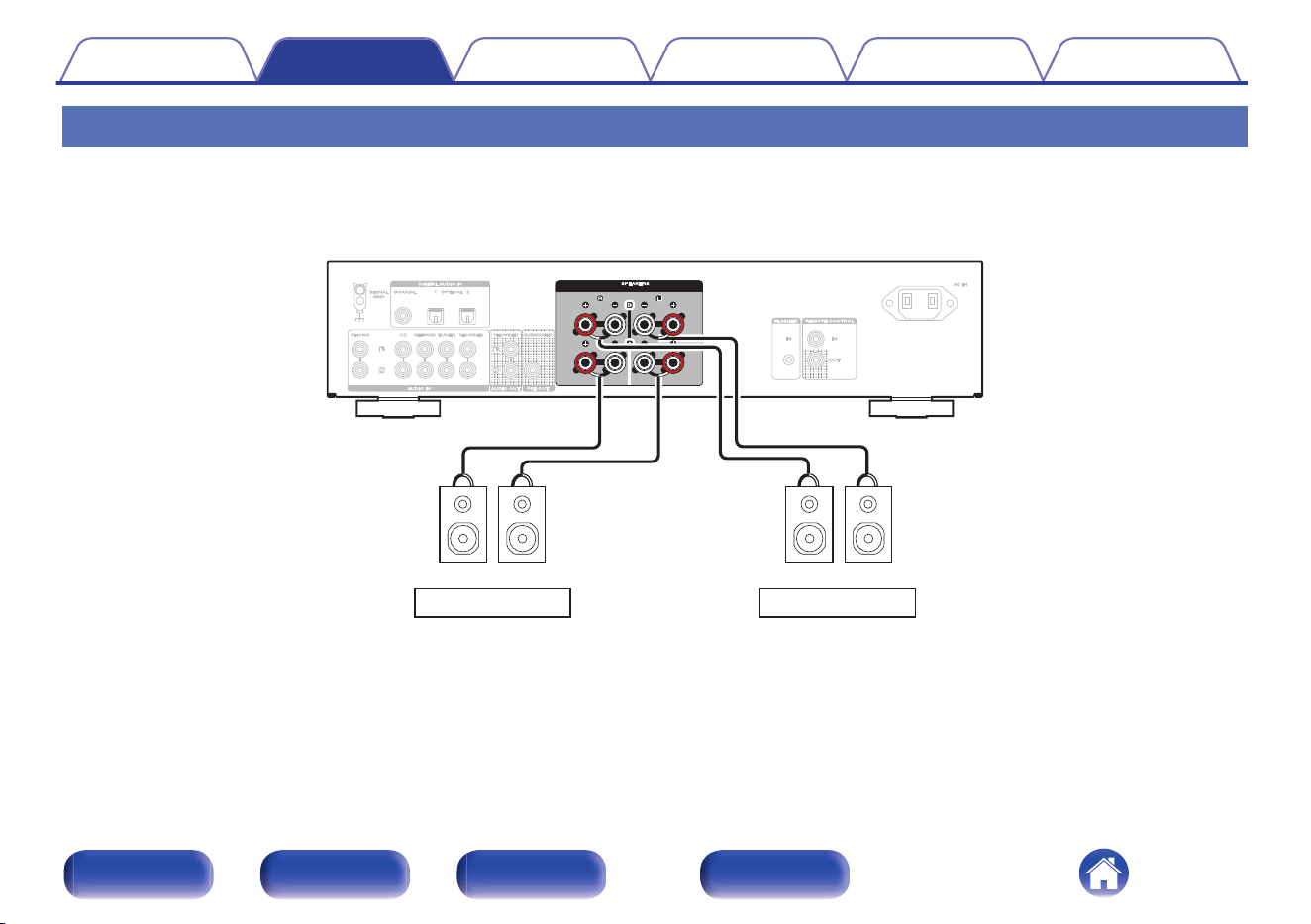
Speaker A/B connection
This unit is equipped with two sets of speaker terminals (SPEAKER A and SPEAKER B). One set of speakers can be connected to each set of terminals,
and a total of two sets of speakers can be connected.
The same signal is output from the SPEAKERS A and SPEAKERS B terminals.
When only one set of speakers is to be connected, use either the SPEAKERS A or SPEAKERS B terminals.
.
wqwq wqwq
SPEAKERS A
SPEAKERS B
(R) (L)
(R) (L)
Contents
Connections Playback Settings Tips Appendix
17
Front panel Rear panel
Remote control
unit
Index
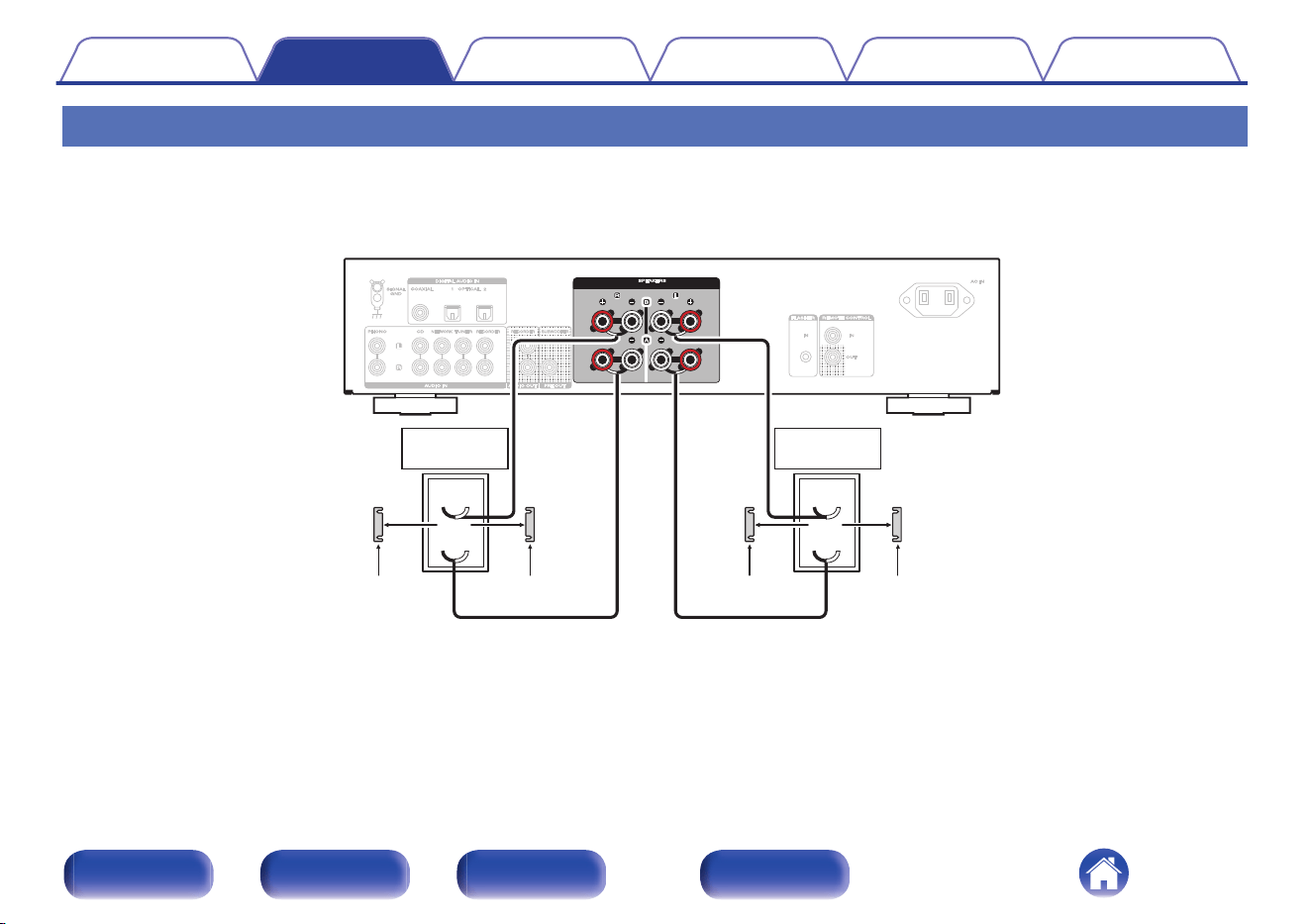
Bi-wiring connection
This connection limits the effects of signal interference between the high range speakers (tweeters) and low range speakers (woofers), allowing you to
enjoy high quality playback.
When bi-wiring with bi-wireable speakers, connect the mid and high range terminals to SPEAKERS B (or SPEAKERS A), the low range terminals to
SPEAKERS A (or SPEAKERS B).
.
wq
wq
HIGH
LOW
wq
wq
HIGH
LOW
Speaker
(R)
Speaker
(L)
Remove shorting bar
Remove shorting bar Remove shorting bar
Remove shorting bar
Contents
Connections Playback Settings Tips Appendix
18
Front panel Rear panel
Remote control
unit
Index
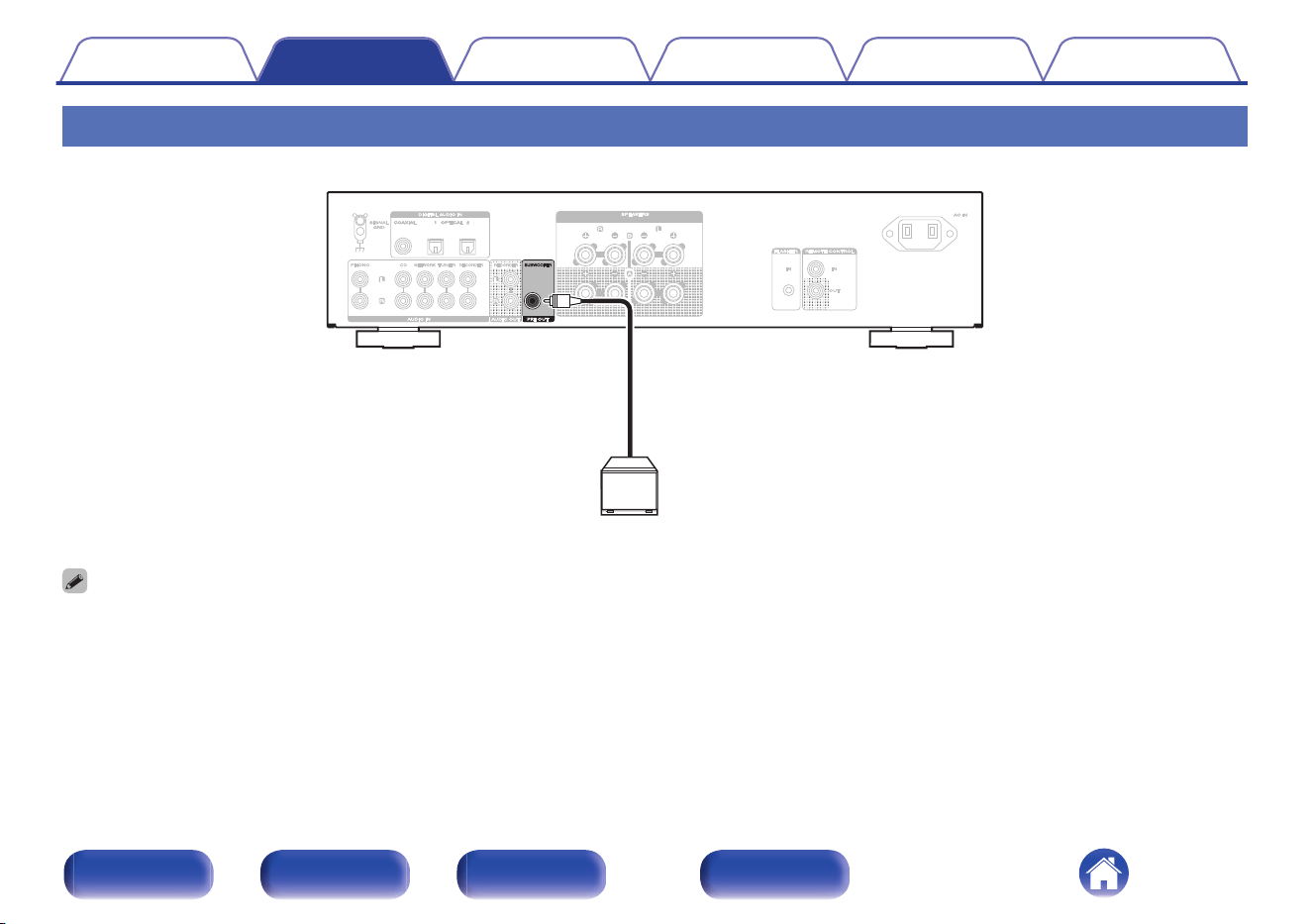
Subwoofer connection
Use a subwoofer cable to connect the subwoofer.
.
Subwoofer
0
The subwoofer volume is linked to the Speaker A volume.
0
This unit does not output to the subwoofer when not set to output audio from the SPEAKERS A terminal. (v p. 27)
Contents Connections Playback Settings Tips Appendix
19
Front panel Rear panel
Remote control
unit
Index
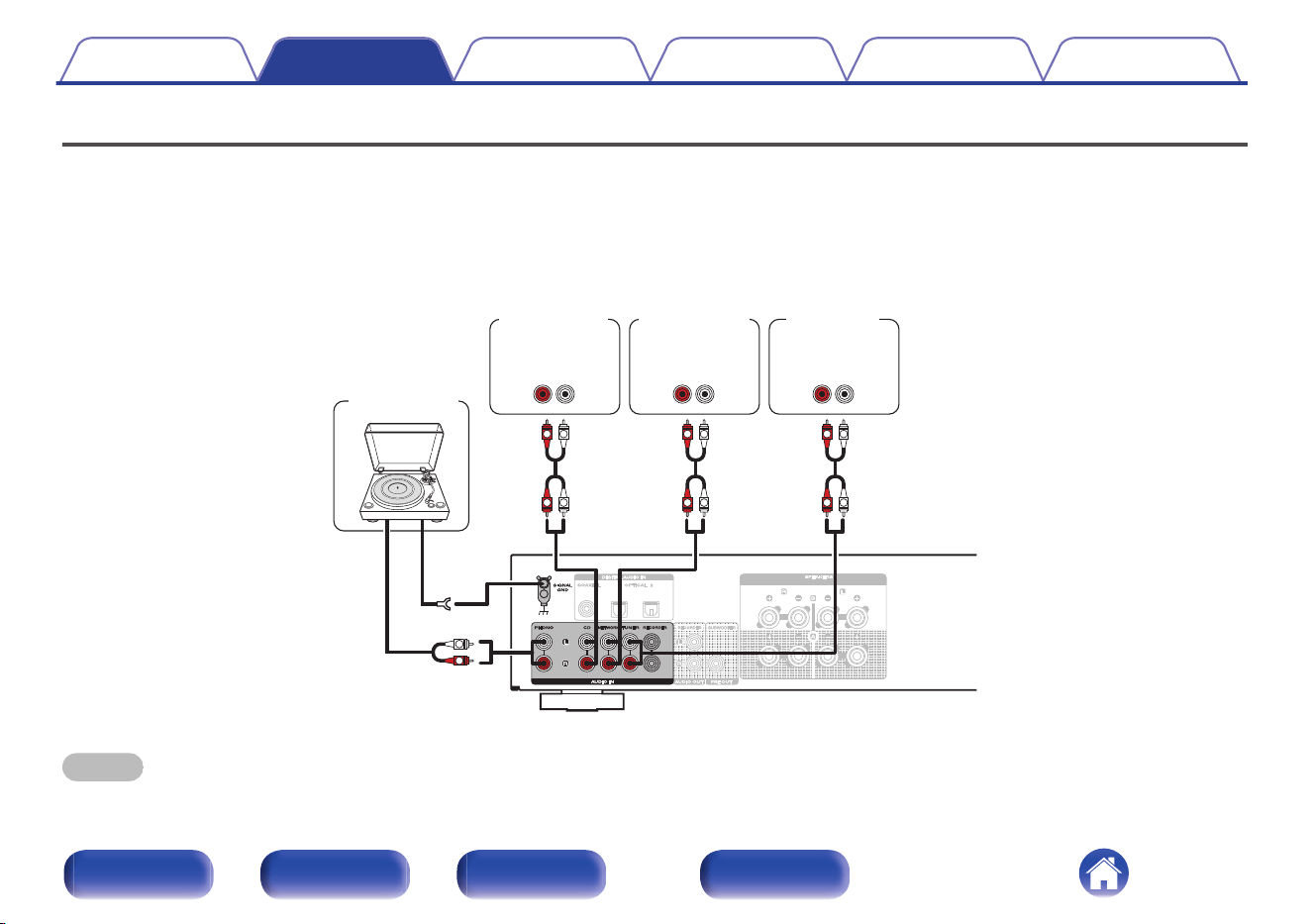
Connecting a playback device
You can connect turntables, CD players, network audio players and tuners to this unit.
This unit is compatible with turntables equipped with a moving magnet (MM) phono cartridge. When you connect to a turntable with a low output moving
coil (MC) cartridge, use a commercially available MC head amp or a step-up transformer.
If you set this unit’s input source to “PHONO” and you accidentally increase the volume without having a turntable connected, you may hear a hum noise
from the speakers.
.
GND
AUDIO
OUT
L
R
AUDIO
OUT
LR
AUDIO
OUT
LR
AUDIO
OUT
LR
L
L
R
R
L
L
R
R
L
L
R
R
Tu n e r
Turntable
CD player
Network audio
player
NOTE
0
The earth terminal (SIGNAL GND) of this unit is not for safety grounding purposes. If this terminal is connected when there is a lot of noise, the noise can be reduced. Note
that depending on the turntable, connecting the ground line may have the reverse effect of increasing noise. In this case, it is not necessary to connect the ground line.
Contents Connections Playback Settings Tips Appendix
20
Front panel Rear panel
Remote control
unit
Index
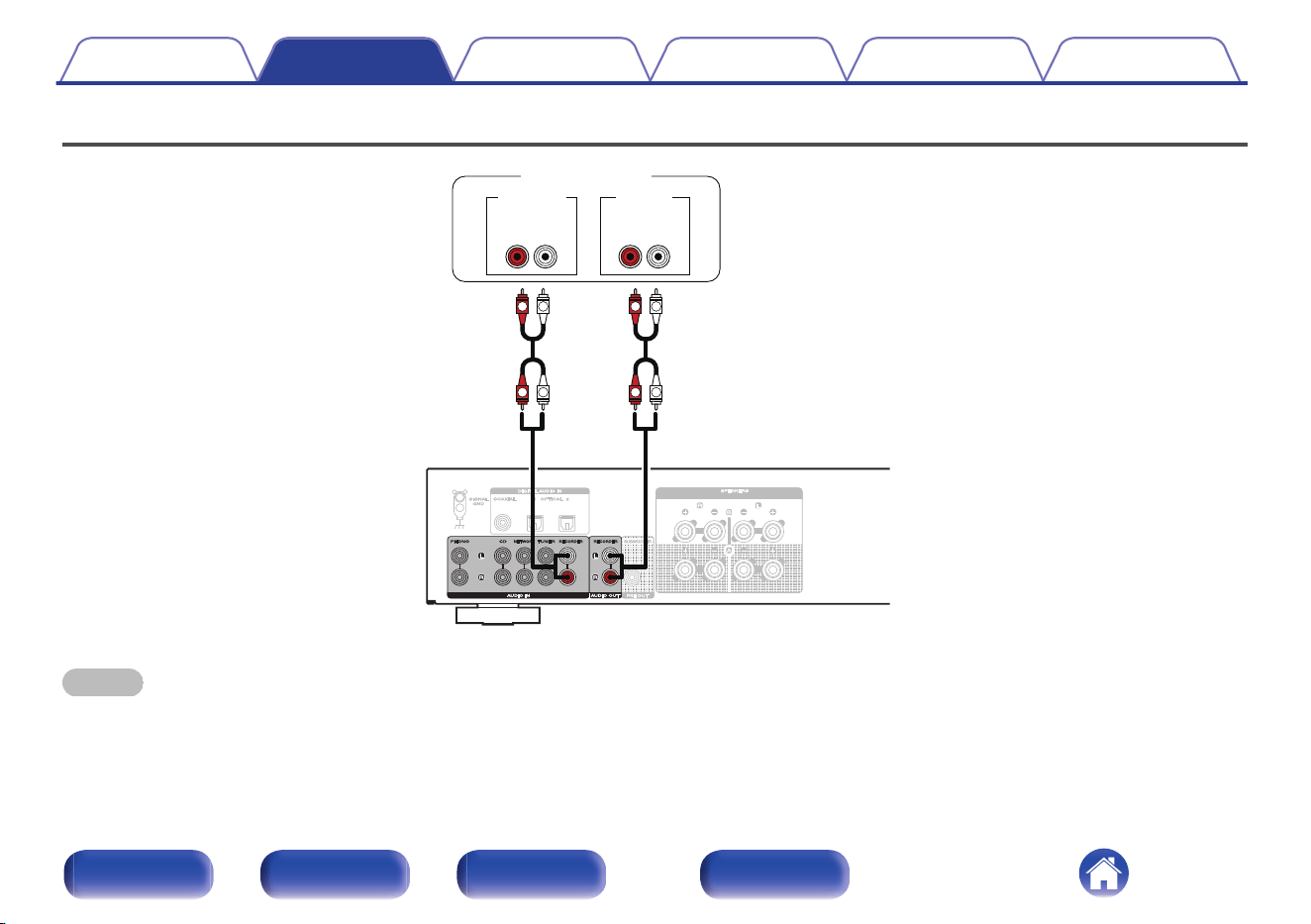
Connecting a recording device
.
LR
L
L
R
R
L
L
R
R
LR
AUDIO INAUDIO OUT
Recording device
NOTE
0
Never insert the short-circuiting pin plug into the recording output connectors (AUDIO OUT RECORDER). Doing so could result in damage.
Contents Connections Playback Settings Tips Appendix
21
Front panel Rear panel
Remote control
unit
Index
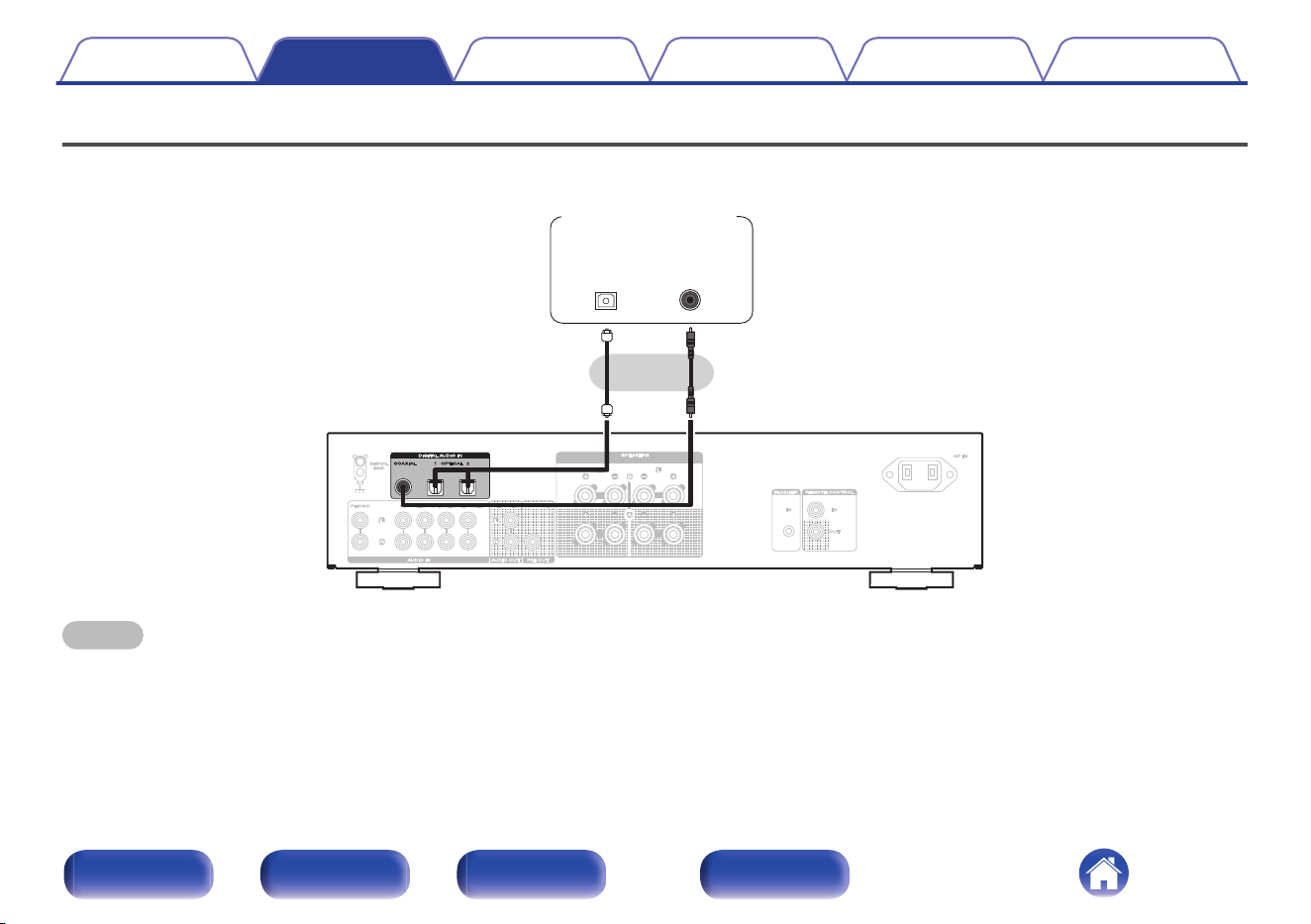
Connecting to a device with digital audio output connectors
Use this connection to input digital audio signals to this unit, and convert the signals for playback using the D/A converter of this unit. (v p. 29)
.
or
OPTICAL
OUT
COAXIAL
OUT
TV /
Satellite receiver etc.
NOTE
0
Linear PCM signals with a sampling frequency of 32 kHz, 44.1 kHz, 48 kHz, 88.2 kHz, 96 kHz, 176.4 kHz, or 192 kHz can be input into this unit.
0
Do not input non-PCM signals, such as Dolby Digital, DTS and AAC. This causes noise and could damage the speakers.
Contents Connections Playback Settings Tips Appendix
22
Front panel Rear panel
Remote control
unit
Index
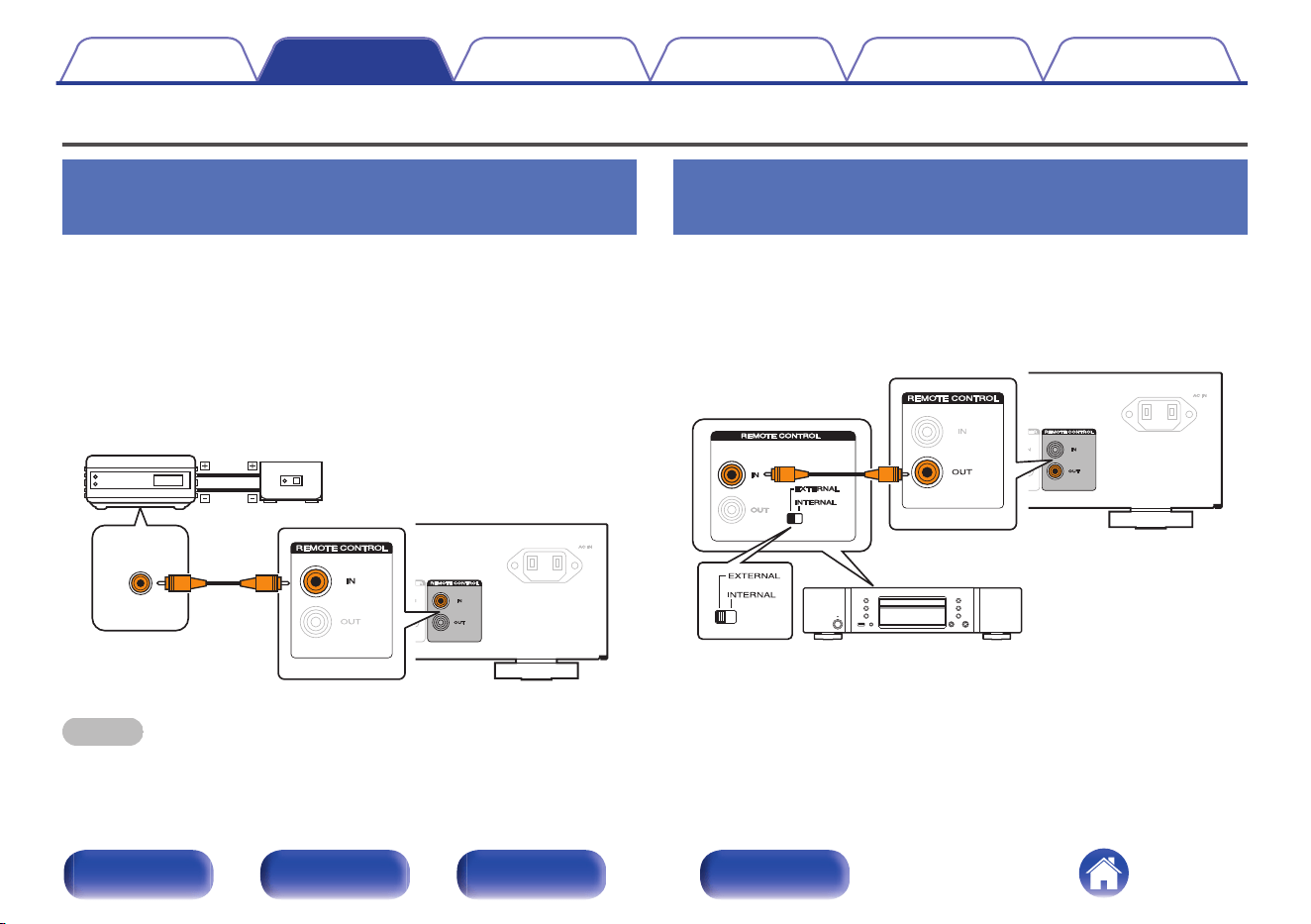
Connecting devices with remote control connectors
Performing operations by RC on this
unit without visual contact
You can connect an external IR receiver to the REMOTE CONTROL
connectors to perform operations on this unit with the supplied remote
control unit without visual contact. This might be necessary if the unit is
hidden in a cupboard or corner, so you can’t directly point with the remote
control unit to the device.
To do this, disable the remote control signal receiving function “Setting the
remote signal receiving function” (v p. 33).
.
RC OUT
Infrared
retransmitter
Infrared
sensor
NOTE
0
When a remote control receiver unit is not connected, be sure to enable the
remote control signal receiving function. Operations cannot be performed with the
remote control if this function is disabled.
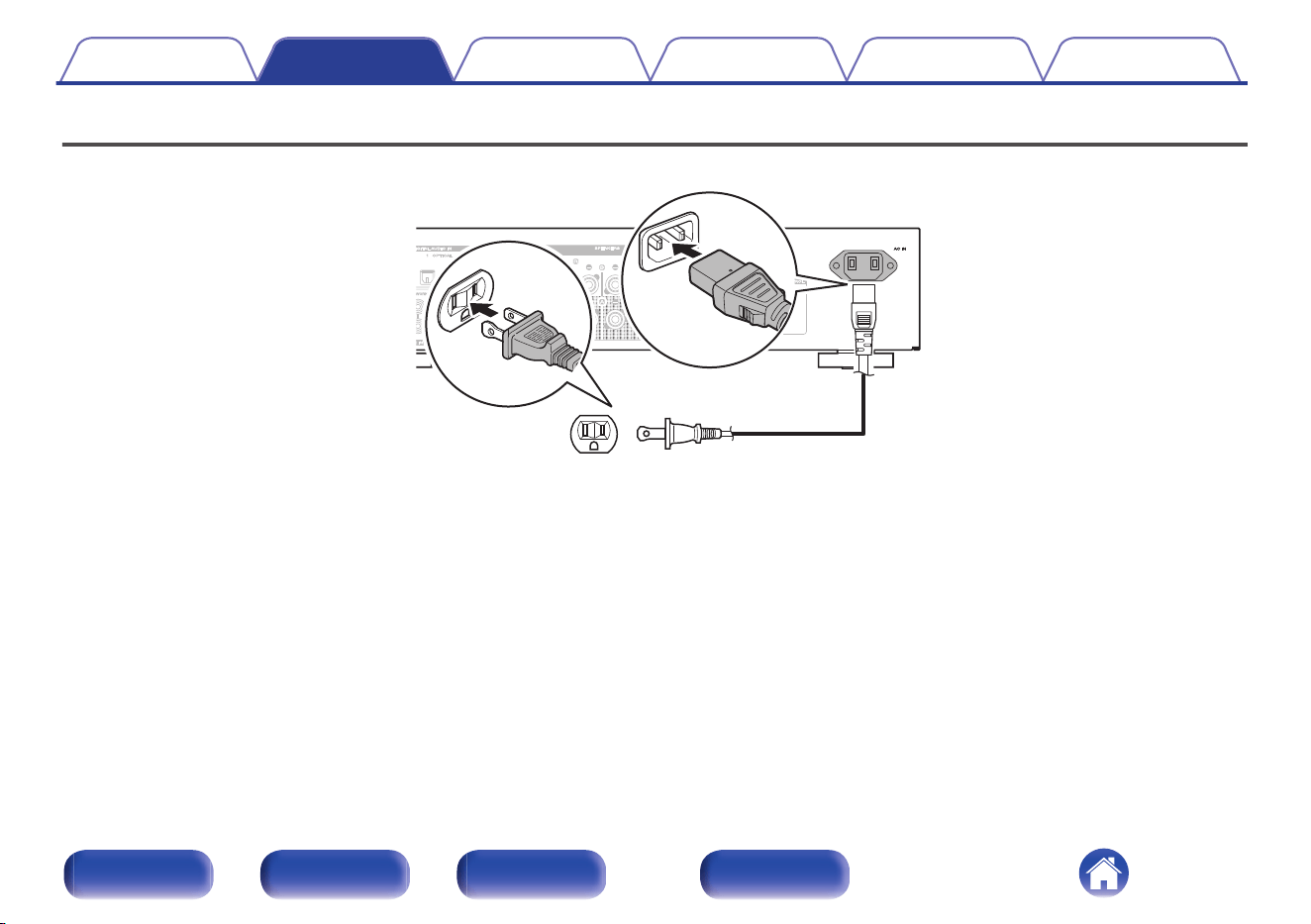
Remotely connecting Marantz audio
devices
You can transmit remote control signals simply by connecting a Marantz
audio device to the REMOTE CONTROL IN/OUT connectors using the
remote connection cable provided with the device.
Set the remote control switch located on the rear panel of the connected
audio component to “EXTERNAL” to use this feature.
.
Contents
Connections Playback Settings Tips Appendix
23
Front panel Rear panel
Remote control
unit
Index
o
Contents
Turning the power on 26
Switching the power to standby 26
Selecting the speakers for audio output 27
Selecting the input source 27
Adjusting the volume 27
Turning off the sound temporarily (Muting) 27
Adjusting the tone and balance 28
Playing CDs 28
Connect and playback from a digital device (Coaxial/Optical) 29
Recording 30
Contents Connections Playback Settings Tips Appendix
25
Front panel Rear panel
Remote control
unit
Index
.
VOLUME
SOURCE
DIRECT
AMP POWER
X
df
MUTE
Input source
select buttons
.
VOLUMEBALANCETREBLEBASS
SPEAKERS
A/B
INPUT
SELECTOR
FILTER 1
・
2
X
SOURCE
DIRECT
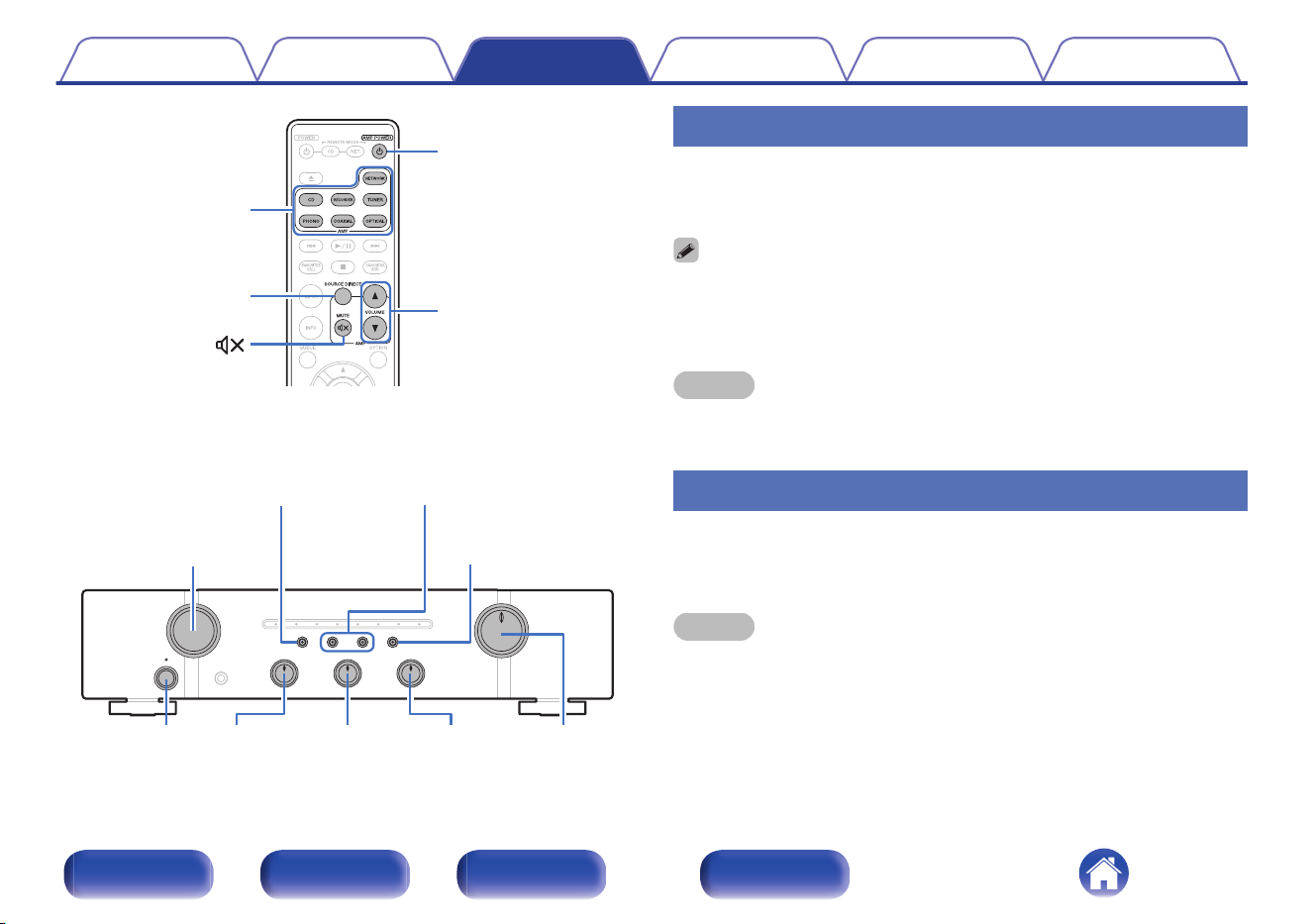
Turning the power on
1
Press X on the main unit to turn the power on.
Input indicator for the selected source lights in blue.
0
Press AMP POWER X on the remote control unit to turn on power from standby
mode.
0
You can also turn the INPUT SELECTOR on the main unit when the unit is in
standby mode to turn on the power.
NOTE
0
Turn VOLUME on the main unit to adjust the volume to the lowest level before
turning on the power.
Switching the power to standby
1
Press AMP POWER X on the remote control.
The power indicator lights in red.
NOTE
0
Power continues to be supplied to some of the circuitry even when the power is in
the standby mode. When leaving home for long periods of time or when going on
vacation, either press X on the main unit to turn off the power, or unplug the power
cord from the power outlet.
Contents Connections Playback Settings Tips Appendix
26
Front panel Rear panel
Remote control
unit
Index
Selecting the speakers for audio output
1
Use SPEAKERS A/B on the main unit to select the
speaker system to be used for playback.
The indicator of the selected speakers lights.
0
When using headphones, press SPEAKERS A/B to turn off all of the indicators and
turn audio output from the speaker terminals off.
Selecting the input source
1
Press the input source select button to be played back.
The indicator of the selected input source lights in blue.
0
You can also select the input source by turning INPUT SELECTOR on the main
unit.
Adjusting the volume
1
Use VOLUME df to adjust the volume.
0
You can also adjust the master volume by turning VOLUME on the main unit.
Turning off the sound temporarily
(Muting)
1
Press MUTE :.
The indicator of the currently set input source lights in red.
0
To cancel mute, press MUTE : again.
Contents Connections Playback Settings Tips Appendix
27
Front panel Rear panel
Remote control
unit
Index
Adjusting the tone and balance
1
Press SOURCE DIRECT to turn off source direct mode.
The SOURCE DIRECT indicator turns off.
2
Turn the BASS, TREBLE and BALANCE on the main
unit to adjust the tone and balance.
Playing CDs
This section uses playback from a CD as an example.
1
Press X on the main unit to turn the power on.
2
Press the input source select button (CD) to switch the
input source to “CD”.
The “CD” input indicator lights in blue.
3
Playback the CD.
4
Use VOLUME df to adjust the volume.
o
Playback in source direct mode
The signal does not pass through the tone adjustment circuitry (BASS,
TREBLE and BALANCE), resulting in playback of a higher sound
quality.
1
Press SOURCE DIRECT to turn on source direct mode.
The SOURCE DIRECT indicator lights.
Contents Connections Playback Settings Tips Appendix
28
Front panel Rear panel
Remote control
unit
Index
Connecting and playing back from a
digital device (Coaxial/Optical)
1
Connect digital device to this unit. (v p. 22)
2
Press the input source select button (COAXIAL or
OPTICAL) to switch the input source to COAXIAL,
OPTICAL 1 or OPTICAL 2.
The indicator of the selected input source lights in blue.
0
Pressing OPTICAL changes the input source to “OPTICAL 1” or “OPTICAL
2”.
3
Start playback of the digital device connected to this
unit.
0
The “COAXIAL”, “OPTICAL 1” or “OPTICAL 2” input indicator flashes in
blue if this unit cannot detect the sampling frequency of the input signal.
4
Use VOLUME df to adjust the volume.
o
Switching the filter characteristics
This unit is equipped with a sound quality adjusting function which
allows users to enjoy the desired playback sound quality. This function
only works when a digital audio signal is input.
1
Press FILTER 1・2.
This unit switches between Filter 1 and Filter 2 each time the button
is pressed.
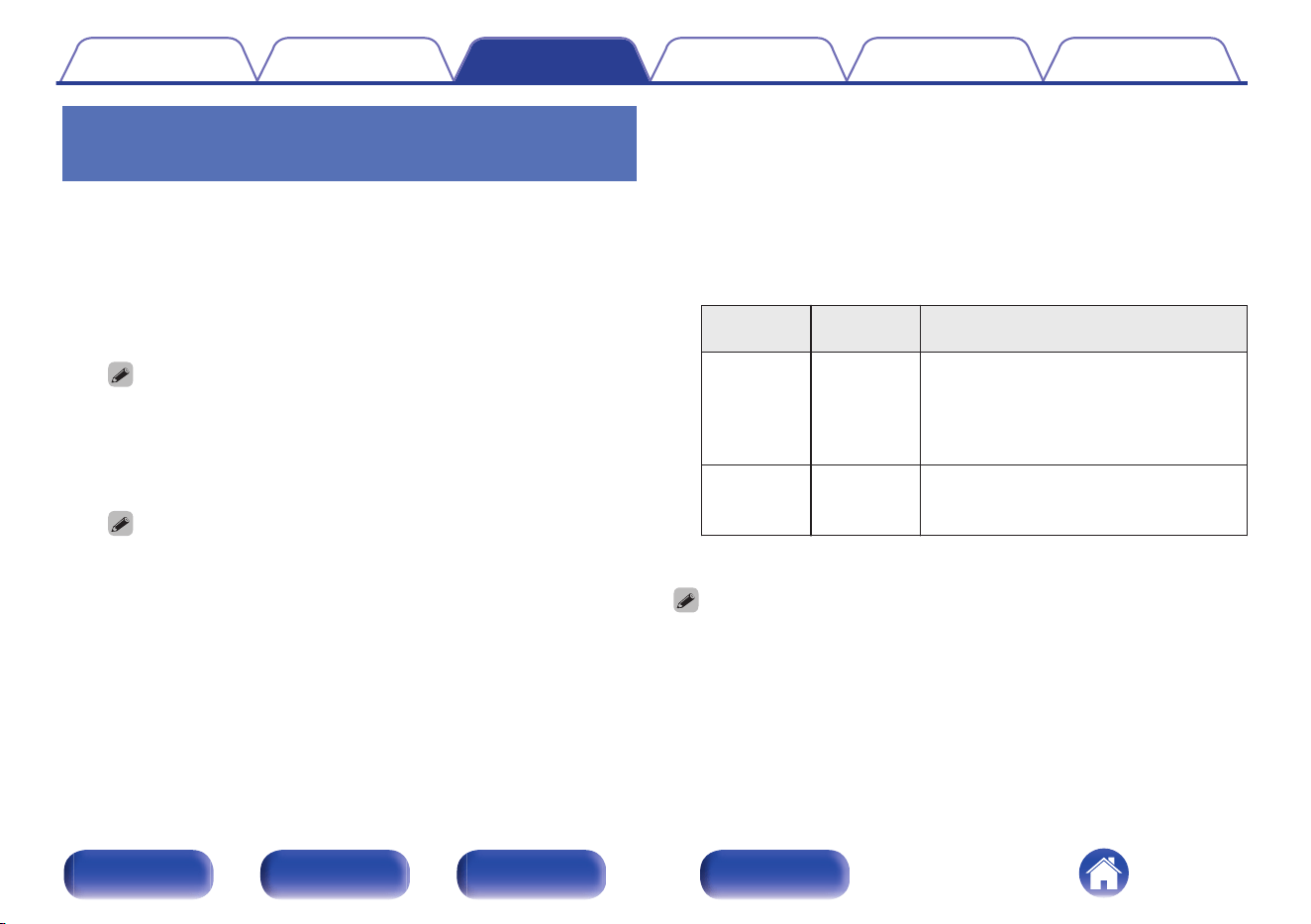
Filter Type
FILTER 1・2
indicator
Features
Filter 1
(Default)
Lights blue
Offers a short impulse response for both
pre-echo and post-echo. Large amount
of audio information clearly reproduces
deep stereo imaging and the relative
position of the sound source.
Filter 2 Lights purple
Both pre-echo and post-echo are slightly
longer. The sound characteristics is edge
and powerful.
0
The FILTER 1・2 indicator lights only when the input source is “COAXIAL”,
“OPTICAL 1” or “OPTICAL 2”.
Contents Connections Playback Settings Tips Appendix
29
Front panel Rear panel
Remote control
unit
Index
o
Specifications of supported audio formats
See “D/A converter” (v p. 43).
0
If the sampling frequency switches, the sound may be cut for 1–2 seconds.
NOTE
0
Do not input non-PCM signals, such as Dolby Digital, DTS and AAC. This causes
noise and could damage the speakers.
Recording
Audio signals input into this unit can be output to an external recording
device. When recording audio from a playback device connected to this
unit, audio can be recorded with the playback device still connected to this
unit.
1
Press X on the main unit to turn the power on.
2
Press the input source select button to switch to the
input source from which you want to record.
The indicator of the selected input source lights in blue.
3
Recording starts.
0
For information on operations, see the owner’s manual of the
recording device.
Contents Connections Playback Settings Tips Appendix
30
Front panel Rear panel
Remote control
unit
Index
Setting the Auto Standby mode
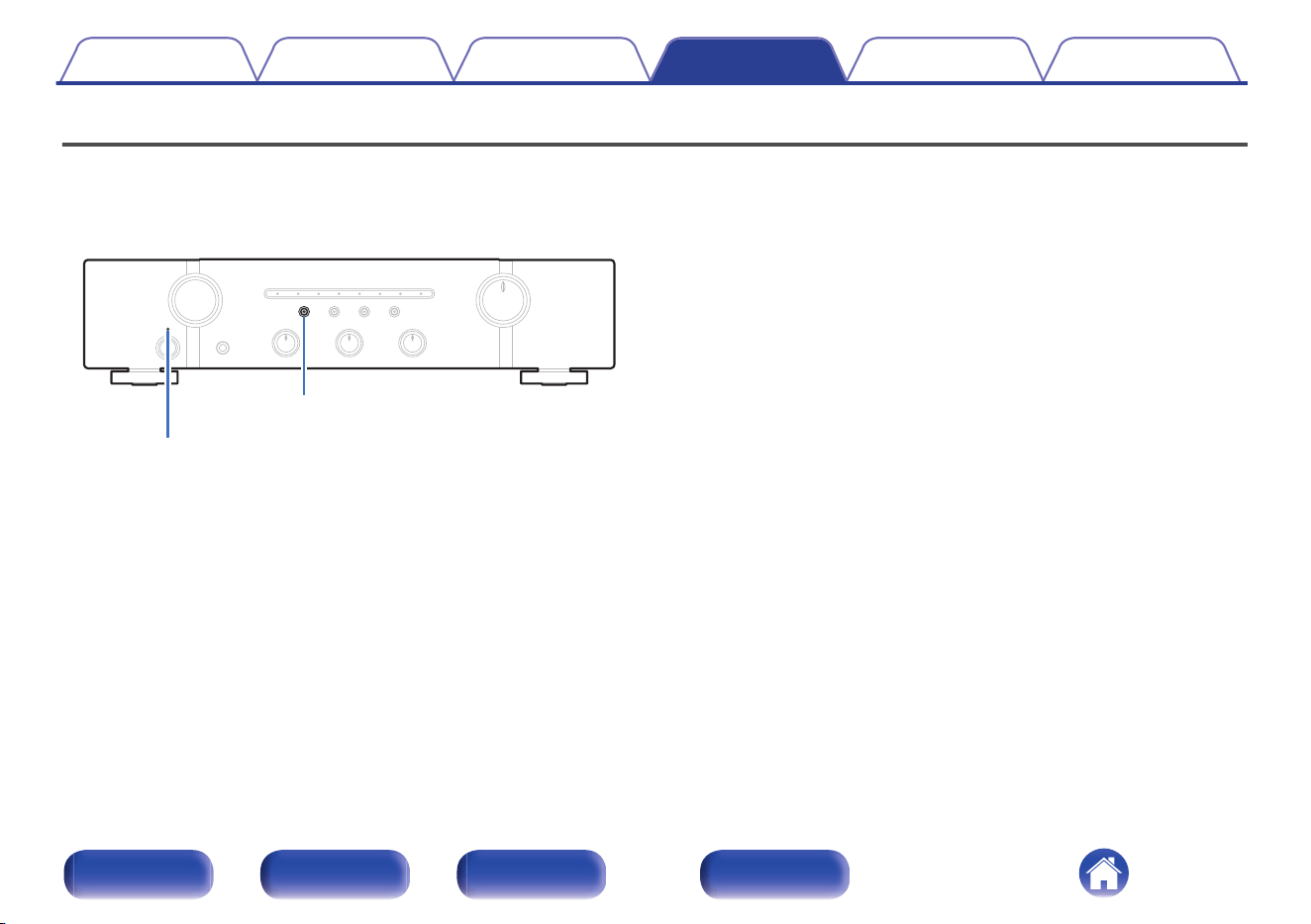
You can set the unit to automatically switch to standby mode if the unit is
not operated for 30 minutes when there is no audio input (Auto Standby
mode).
Auto Standby mode is set to off by default.
.
SOURCE DIRECT
Power indicator
1
Press and hold SOURCE DIRECT for 5 seconds or more
to switch it on and off.
The power indicator changes as follows each time it is switched on
and off.
0
When auto standby mode is on: The power indicator blinks in red
three times.
0
When auto standby mode is off: The power indicator blinks in red
once.
Contents Connections Playback Settings Tips Appendix
32
Front panel Rear panel
Remote control
unit
Index
Setting the remote signal receiving function
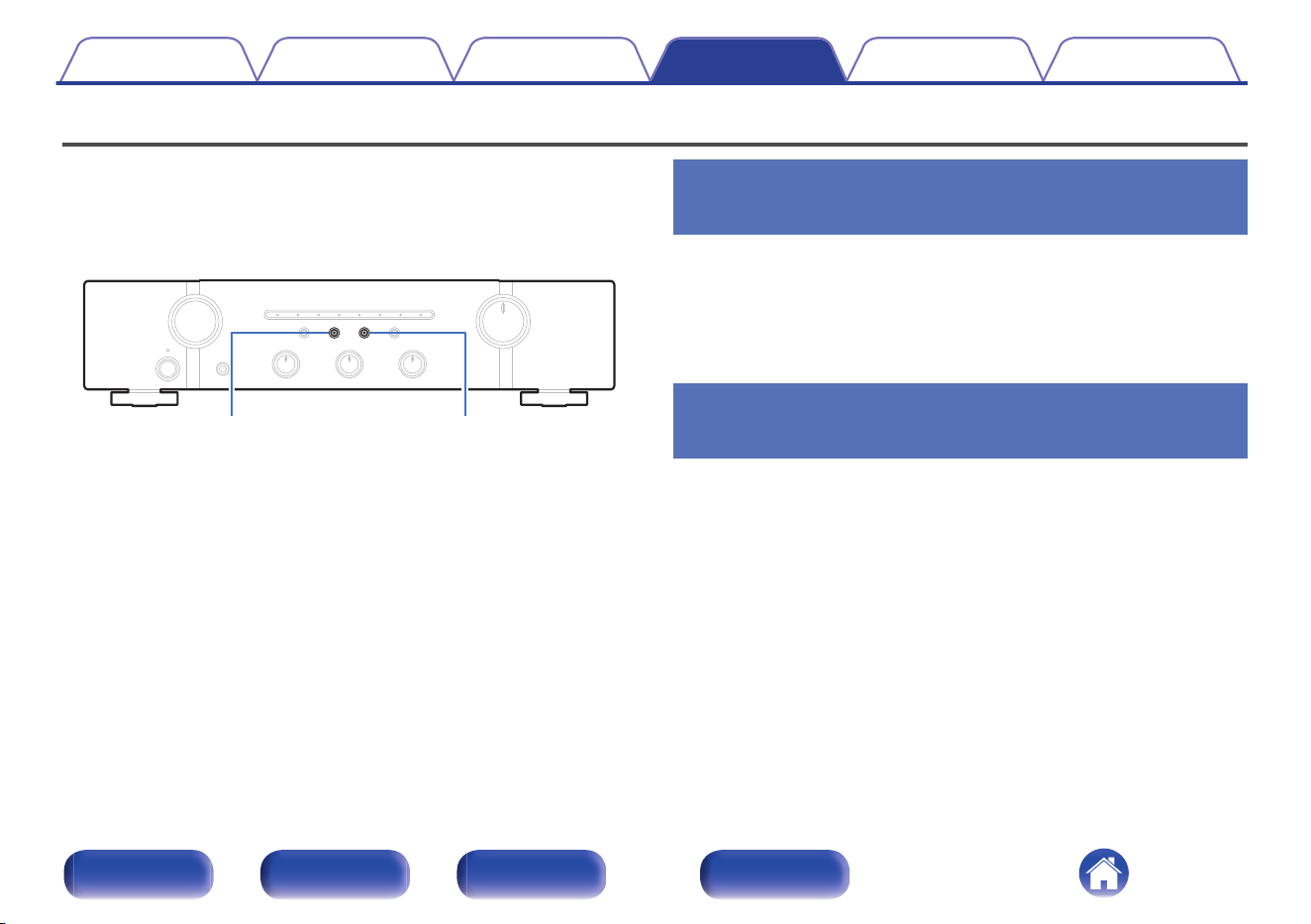
When you connect a IR receiver (sold separately) to the REMOTE
CONTROL IN connector of this unit, use the following procedure to
disable the remote signal receiving function of this unit. When the function
is enabled, you can not perform operations with the remote control unit.
By default, this function is enabled.
.
SPEAKERS A SPEAKERS B
Disabling the remote signal receiving
function of the remote control unit
1
Press SPEAKERS B for approximately 5 seconds to
disable the remote control signal receiving function.
The indicator of the currently set input source flashes in red three
times.
Enabling the remote signal receiving
function of the remote control unit
1
Press SPEAKERS A for approximately 5 seconds to
enable the remote control signal receiving function.
The indicator of the currently set input source flashes in blue three
times.
Contents Connections Playback Settings Tips Appendix
33
Front panel Rear panel
Remote control
unit
Index
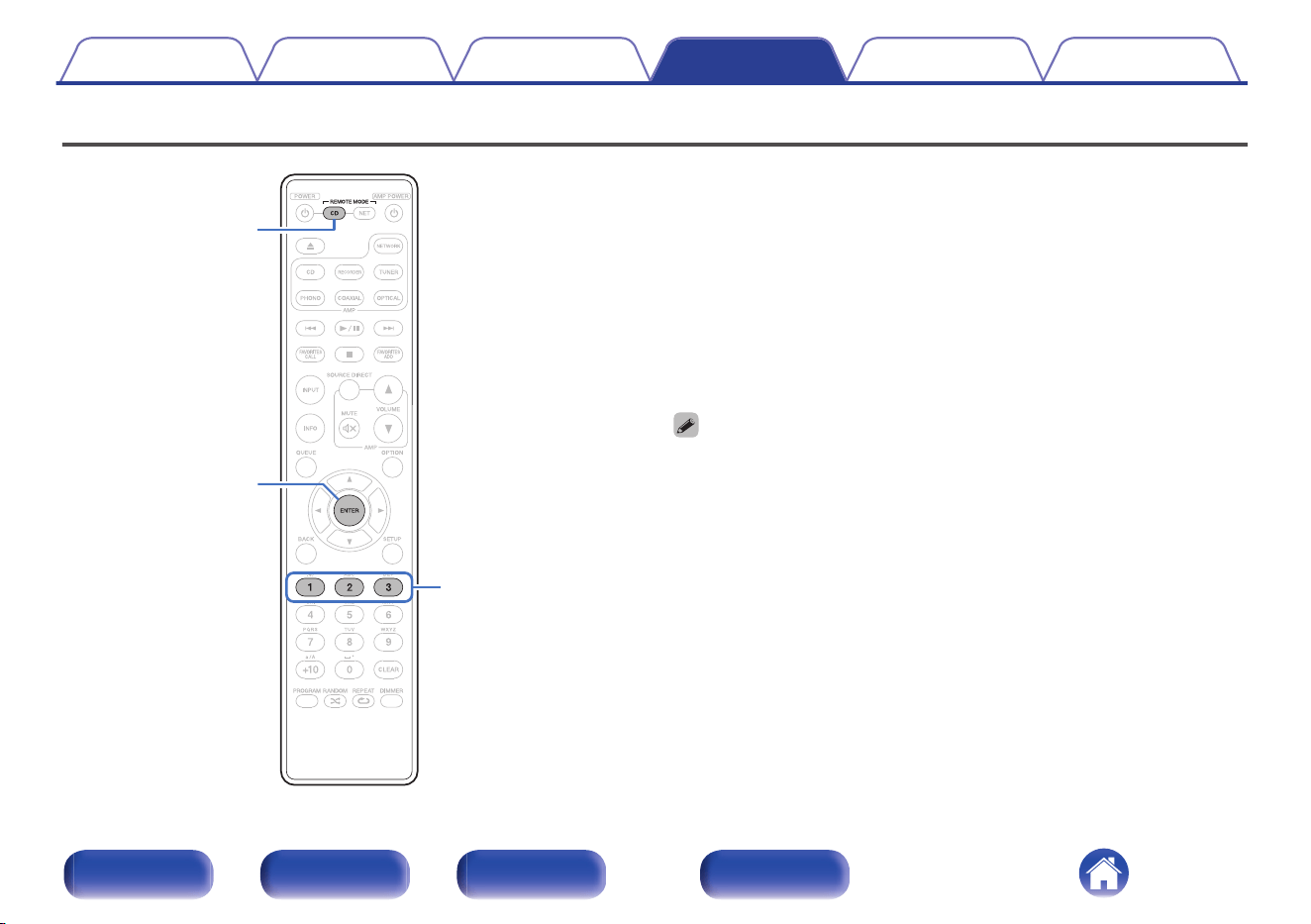
Setting remote control codes
.
ENTER
REMOTE
MODE CD
1 - 3
Remote control codes are set between this unit and the supplied remote
control. You can select one of the three types of remote control codes, and
the remote control can be used to control the unit when the same remote
control code is used. If three of these units are used in the same location,
all three units can be controlled simultaneously using one remote control
in the default settings. By setting individual remote control codes between
a unit and the remote control, the remote control can be used to control
only the unit that has the same remote control code.
Be sure to check the operation of each unit after setting the remote control
codes.
The default setting is “AMP1”.
0
Set the remote control cord to “AMP 1” when controlling this unit from a Marantz
network audio player or other device connected using a remote connection cable
to this unit. (v p. 23)
Contents Connections Playback Settings Tips Appendix
34
Front panel Rear panel
Remote control
unit
Index
Setting remote control codes for the
remote control
o
To set the remote control codes to AMP1,
AMP2 or AMP3
1
Hold down REMOTE MODE CD and one of the number
1, 2 or 3 buttons for more than 5 seconds.
0
Set the remote control code to AMP1, AMP2 or AMP3 according
to the selected number button.
NOTE
0
The remote control codes returns to the default settings when the batteries are
removed. Set the remote control codes again after replacing the batteries.
Setting remote control codes for the
main unit
1
Point the remote control for which the remote control
code was set at the main unit, and press REMOTE
MODE CD and ENTER.
The input indicators on the main unit flash as shown below
according to the set remote control code.
Remote control
codes
Input indicator
AMP 1 PHONO indicator flashes in red three times
AMP 2 CD indicator flashes in red three times
AMP 3 NETWORK indicator flashes in red three times
Contents Connections Playback Settings Tips Appendix
35
Front panel Rear panel
Remote control
unit
Index
o
Contents
Tips
I want to play TV audio at higher quality 37
I want to adjust the tone myself 37
I want sound playback that is faithful to the original sound 37
I want to switch the filter to change the desired sound quality 37
I want to use bi-wiring compatible speakers 37
I want to operate a Marantz CD player or network audio player
using the remote control of this unit 37
I want to use more than one unit in one location 37
Troubleshooting
Power does not turn on / Power is turned off 39
Operations cannot be performed through the remote control unit 40
No sound comes out 41
Desired sound does not come out 41
Sound is interrupted or noise occurs 42
FILTER 1・2 indicator does not light 42
Contents Connections Playback Settings Tips Appendix
36
Front panel Rear panel
Remote control
unit
Index
Tips
I want to play TV audio at higher quality
0
Connect the digital audio output connector of the TV to the digital audio input connector (COAXIAL, OPTICAL 1 or OPTICAL 2) of this unit, and switch
the input source to the connected (COAXIAL, OPTICAL 1 or OPTICAL 2) connector. (v p. 22)
0
Only 2-channel linear PCM can be input as the digital audio signal to this unit.
I want to adjust the tone myself
0
Use the BASS, TREBLE and BALANCE knobs to adjust the sound as desired. (v p. 28)
I want sound playback that is faithful to the original sound
0
Set the source direct mode on. (v p. 28)
I want to switch the filter to change the desired sound quality
0
Switch the filter characteristics. (v p. 29)
I want to use bi-wiring compatible speakers
0
This unit is compatible with bi-wiring connections. Enjoy high quality playback by using bi-wiring connections. (v p. 18)
I want to operate a Marantz CD player or network audio player using the remote control of this unit
0
Switch the remote control operating mode. (“CD player operations” (v p. 11), “Network audio player operations” (v p. 13)) Also refer to the CD
player or network audio player instruction manuals.
I want to use more than one unit in one location
0
Set individual remote control codes for each combination of devices and remote control. (v p. 35)
Contents
Connections Playback Settings Tips Appendix
37
Front panel Rear panel
Remote control
unit
Index
Troubleshooting
If a problem should arise, first check the following:
1. Are the connections correct?
2. Is the set being operated as described in the owner’s manual?
3. Are the other devices operating properly?
If this unit does not operate properly, check the corresponding symptoms in this section.
If the symptoms do not match any of those described here, consult your dealer as it could be due to a fault in this unit. In this case, disconnect the power
immediately and contact the store where you purchased this unit.
Contents Connections Playback Settings Tips Appendix
38
Front panel Rear panel
Remote control
unit
Index
Power does not turn on / Power is turned off
Power is not turned on.
0
Check whether the power plug is correctly inserted into the power outlet. (v p. 24)
Power automatically turns off.
0
The Auto Standby mode is on. When approx. 30 minutes pass with no audio input and no operations on the unit, this unit automatically enters the
standby mode. To turn off the Auto Standby mode, press the SOURCE DIRECT button for 5 seconds or longer. (v p. 32)
The power turns off and the power indicator shows one long blink and two short blinks in red.
0
This unit’s amplifier circuit has failed. Unplug the power cord and contact our customer service center.
The power turns off and the power indicator shows one long blink and three short blinks in red.
0
This unit’s power circuit has failed. Unplug the power cord and contact our customer service center.
The power turns off and the power indicator shows one long blink and four short blinks in red.
0
The protection circuit has been activated due to a rise in temperature within this unit. Turn the power off, wait about an hour until this unit cools down
sufficiently, and then turn the power on again.
0
Please re-install this unit in a place having good ventilation.
0
Stop playback on the playback device, and then turn the power off and on again.
The power turns off and the power indicator shows one long blink and five short blinks in red.
0
Check the speaker connections. The protection circuit may have been activated because speaker cable core wires came in contact with each other or a
core wire was disconnected from the connector and came in contact with the rear panel of this unit. After unplugging the power cord, take corrective
action such as firmly re-twisting the core wire or taking care of the connector, and then reconnect the wire. (v p. 16)
0
Turn down the volume and turn on the power again.
0
Stop playback on the playback device, and then turn the power off and on again.
0
If the problem is not solved by turning the power off and on again, this unit’s amplifier circuit or power circuit has failed. Unplug the power cord and
contact our customer service center.
Contents
Connections Playback Settings Tips Appendix
39
Front panel Rear panel
Remote control
unit
Index
Operations cannot be performed through the remote control unit
Operations cannot be performed through the remote control unit.
0
Batteries are worn out. Replace with new batteries. (v p. 5)
0
Operate the remote control unit within a distance of about 23 ft/7 m from this unit and at an angle of within 30°. (v p. 5)
0
Remove any obstacle between this unit and the remote control unit.
0
Insert the batteries in the proper direction, checking the q and w marks. (v p. 5)
0
The set’s remote control sensor is exposed to strong light (direct sunlight, inverter type fluorescent bulb light, etc.). Move the set to a place in which the
remote control sensor will not be exposed to strong light.
0
When using a 3D video device, the remote control unit of this unit may not function due to effects of infrared communications between units (such as TV
and glasses for 3D viewing). In this case, adjust the direction of units with the 3D communications function and their distance to ensure they do not
affect operations from the remote control unit of this unit.
0
Enable the remote signal receiving function. (v p. 33)
0
The remote control code between this unit and the remote control is different. Set this unit and the remote control to the same remote control code.
(v p. 34)
Contents
Connections Playback Settings Tips Appendix
40
Front panel Rear panel
Remote control
unit
Index
No sound comes out
No sound comes out of speakers.
0
Check the connections for all devices. (v p. 15)
0
Insert connection cables all the way in.
0
Check that input connectors and output connectors are not reversely connected.
0
Check cables for damage.
0
Check that speaker cables are properly connected. Check that cable core wires come in contact with the metal part on speaker terminals. (v p. 16)
0
Securely tighten the speaker terminals. Check speaker terminals for looseness. (v p. 16)
0
Check that the proper input source is selected. (v p. 27)
0
The volume is set to the minimum level. Adjust the volume to a suitable level. (v p. 27)
0
Cancel the muting mode. (v p. 27)
0
Check the settings of the SPEAKERS A/B buttons. (v p. 27)
The COAXIAL, OPTICAL 1 or OPTICAL 2 input indicator is flashing.
0
Check the connection of the Coaxial digital cable or Optical cable. (v p. 22)
0
Set the Digital Audio output signal of the connected device to 2 channel linear PCM. (v p. 43)
Desired sound does not come out
No sound comes out of a specific speaker.
0
Check that speaker cables are properly connected. (v p. 16)
0
Adjust the BALANCE control knob. (v p. 28)
The left and right of stereo sound is reversed.
0
Check whether the left and right speakers are connected to the correct speaker terminals. (v p. 17)
Contents
Connections Playback Settings Tips Appendix
41
Front panel Rear panel
Remote control
unit
Index
Sound is interrupted or noise occurs
When playing a record, the sound is distorted.
0
Adjust to a proper needle pressure.
0
Check the tip of the needle.
0
Replace the cartridge.
When playing a record, a humming noise comes out of the speakers.
0
Check that the turntable is connected correctly. (v p. 20)
0
If there is a TV or AV device near the turntable, such devices may affect the playback sound. Install the turntable in a location as far away as possible
from the TV or other AV devices.
When playing a record, a humming noise comes out of the speakers when the volume is high. (Howling phenomenon)
0
Install the turntable and speakers as far from each other as possible. (v p. 20)
0
The vibrations from the speakers are being transmitted to the player through the floor. Use cushions, etc., to absorb the speakers’ vibrations.
FILTER 1・2 indicator does not light
FILTER 1・2 indicator does not light.
0
The FILTER 1・2 indicator lights only when the input source is “COAXIAL”, “OPTICAL 1” or “OPTICAL 2”. Switch the input source to “COAXIAL”,
“OPTICAL 1” or “OPTICAL 2”. (v p. 29)
Contents
Connections Playback Settings Tips Appendix
42
Front panel Rear panel
Remote control
unit
Index
D/A converter
o
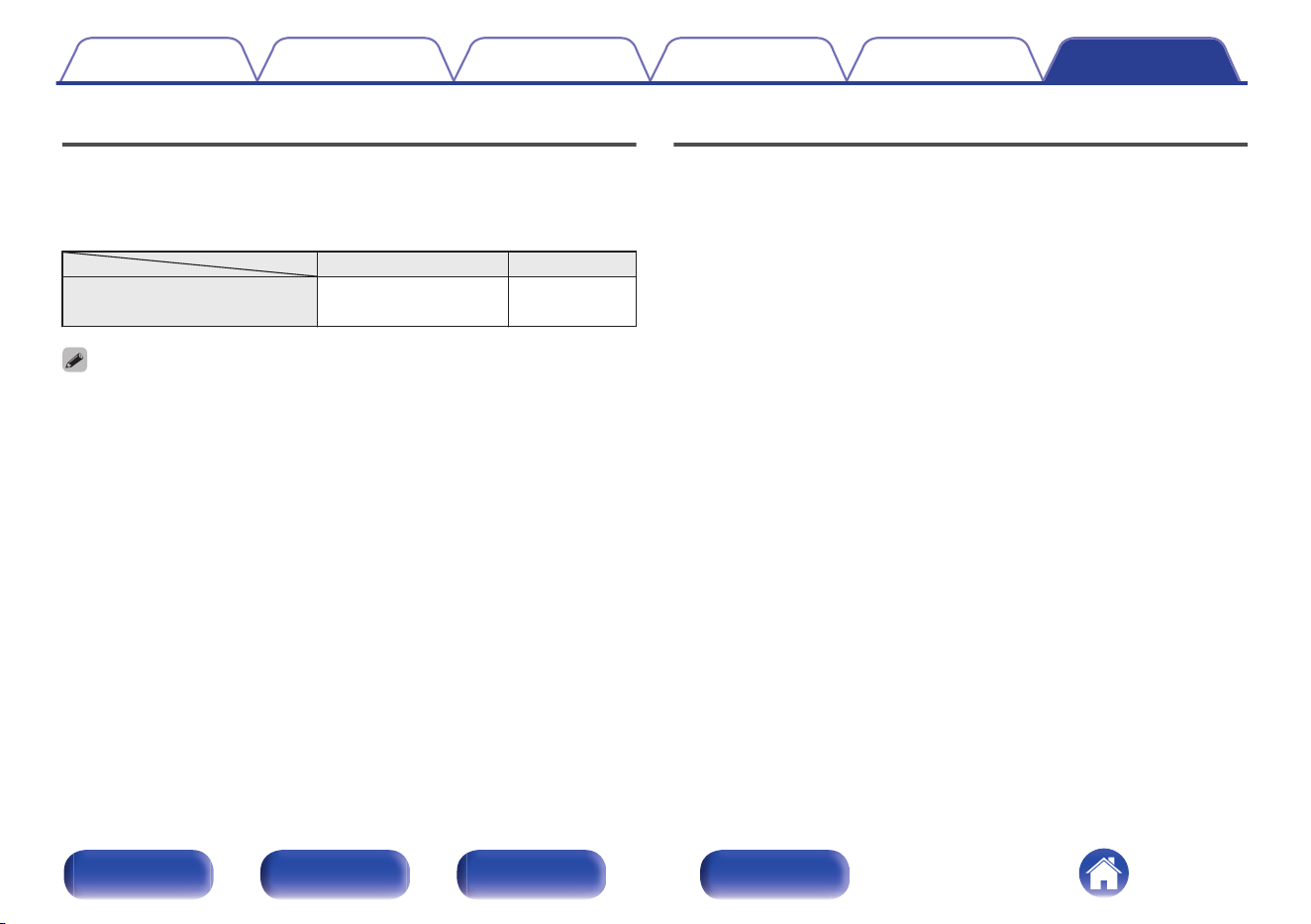
Specifications of supported audio formats
n
Coaxial/Optical 1/Optical 2
Sampling frequency Bit length
Linear PCM
(2-channel)
32/44.1/48/88.2/96/
176.4/192 kHz
16/24 bits
0
When a digital sound signal that has a sampling frequency that is not supported by
this unit is input, the input indicator (COAXIAL, OPTICAL 1 or OPTICAL 2) flashes.
Explanation of terms
Sampling frequency
Sampling involves taking a reading of a sound wave (analog signal) at
regular intervals and expressing the height of the wave at each reading in
digitized format (producing a digital signal).
The number of readings taken in one second is called the “sampling
frequency”. The larger the value, the closer the reproduced sound is to the
original.
Speaker impedance
This is an AC resistance value, indicated in Ω (ohms).
Greater power can be obtained when this value is smaller.
Source direct
Playback with higher fidelity to the source becomes possible, as input
audio signals are output by bypassing the audio quality-control circuits
(BASS/TREBLE/BALANCE).
Protection circuit
This is a function to prevent damage to devices within the power supply
when an abnormality such as an overload, excess voltage occurs or over
temperature for any reason.
Contents
Connections Playback Settings Tips Appendix
43
Front panel Rear panel
Remote control
unit
Index
Specifications
0
RMS Power output (20 Hz – 20 kHz simultaneous drive of both
channels) :
45 W x 2 (8 Ω/ohms load)
60 W x 2 (4 Ω/ohms load)
0
Total harmonic distortion (20 Hz – 20 kHz simultaneous drive of
both channels, 8 Ω/ohms load) :
0.08 %
0
Output band width (8 Ω/ohms load, 0.06 %) : 10 Hz – 50 kHz
0
Frequency response (CD, 1 W, 8 Ω/ohms load) : 10 Hz – 70 kHz +0 dB, –1 dB
0
Damping factor (8 Ω/ohms load, 40 Hz – 20 kHz) : 100
0
Input sensitivity/Input impedance
PHONO (MM) :
2.2 mV/47 kΩ/kohms
CD, TUNER, NETWORK, RECORDER :
200 mV/20 kΩ/kohms
0
Output voltage
SUBWOOFER OUT :
2.8 V (200 mV input, Volume MAX)
0
Maximum allowable PHONO input level (1 kHz) MM : 100 mV
0
RIAA deviation (20 Hz – 20 kHz) : ±1.0 dB
0
S/N (IHF-A, 8 Ω/ohms load)
PHONO (MM) :
83 dB (5 mV input, 1 W output)
CD, TUNER, NETWORK, RECORDER :
102 dB (2 V input, Rated output)
0
Headphone output: 50 mW/32 Ω/ohms
Contents Connections Playback Settings Tips Appendix
45
Front panel Rear panel
Remote control
unit
Index
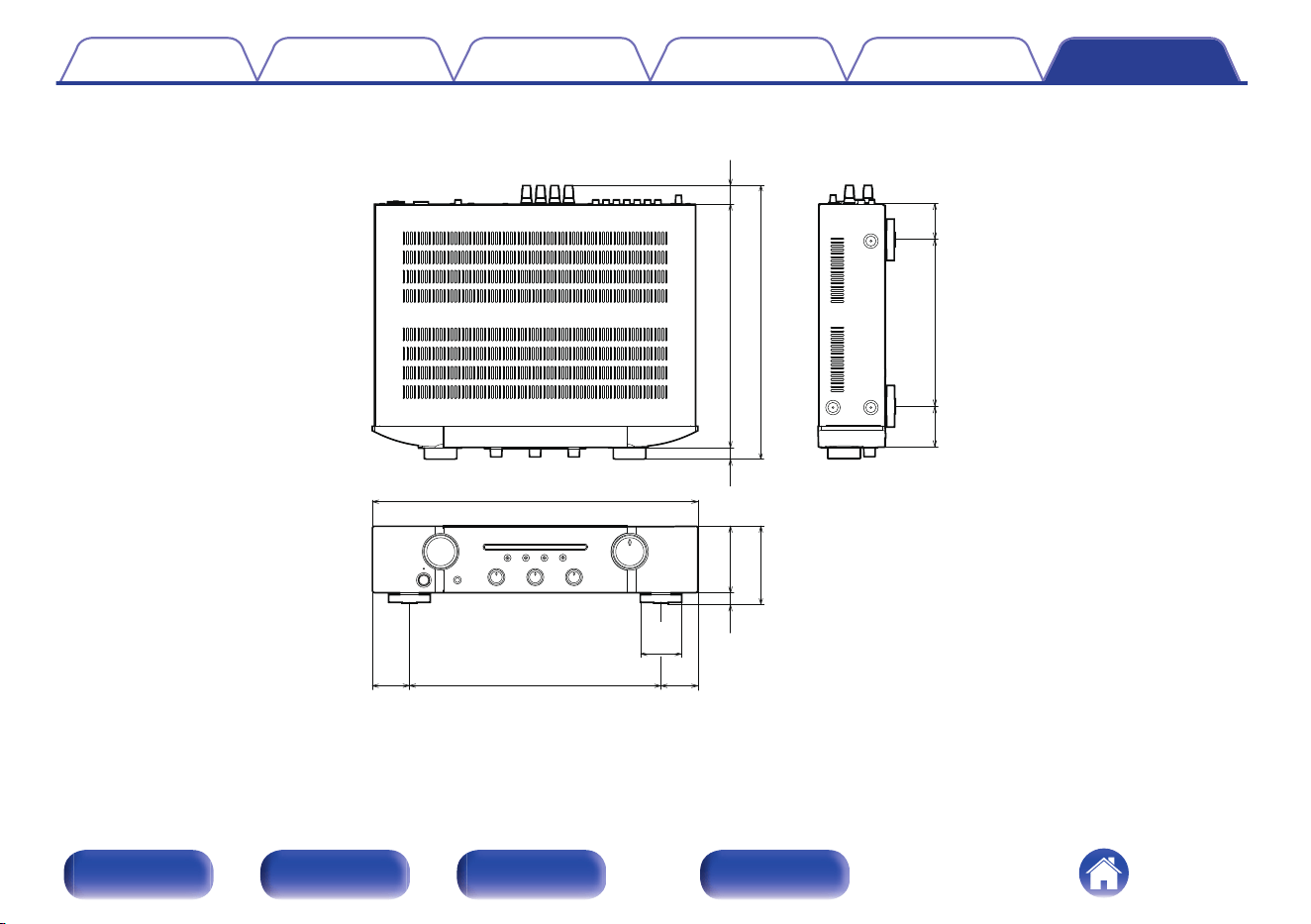
0
Tone Control
BASS (50 Hz) :
±10 dB
TREBLE (15 kHz) :
±10 dB
0
Digital input
Coaxial :
0.5 Vp-p
Optical :
–27 dBm or later
0
Operating temperature: +5 ℃ - +35 ℃
0
Power supply : AC 120 V, 60 Hz
0
Power consumption : 155 W
0
Power consumption in standby mode : 0.3 W
For the purpose of improvement, the specifications and design are subject to change without notice.
Contents
Connections Playback Settings Tips Appendix
46
Front panel Rear panel
Remote control
unit
Index
Index
v A
Auto Standby mode ........................................ 32
v B
BALANCE ...................................................... 28
BASS ............................................................. 28
v C
CD player ................................................. 20, 28
v I
Input source ................................................... 27
v M
Muting ............................................................ 27
v N
Network audio player ..................................... 20
v P
Protection circuit ............................................ 43
v R
Recording device ........................................... 21
Remote control ............................................... 23
Remote control codes settings ....................... 35
Remote control unit ........................................ 10
v S
Source direct ............................................ 28, 43
Speaker impedance ....................................... 43
Speakers ........................................................ 16
Speaker (Bi-wiring) connection ...................... 18
v T
Tips ................................................................ 37
Tone ............................................................... 28
TREBLE ......................................................... 28
Troubleshooting ............................................. 38
Tuner .............................................................. 20
Turntable ........................................................ 20
v V
Volume ........................................................... 27
Contents
Connections Playback Settings Tips Appendix
48
Front panel Rear panel
Remote control
unit
Index
.
3520 10763 00AM
© 2020 Sound United. All Rights Reserved.
49