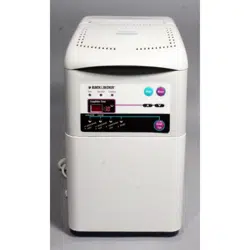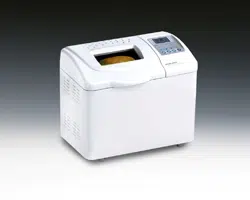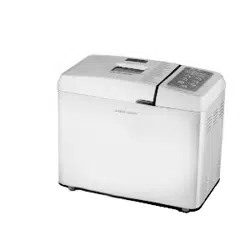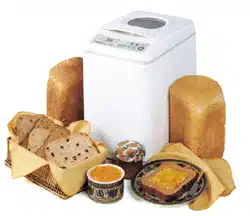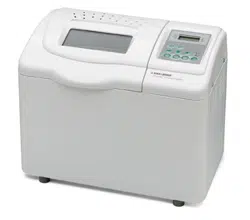
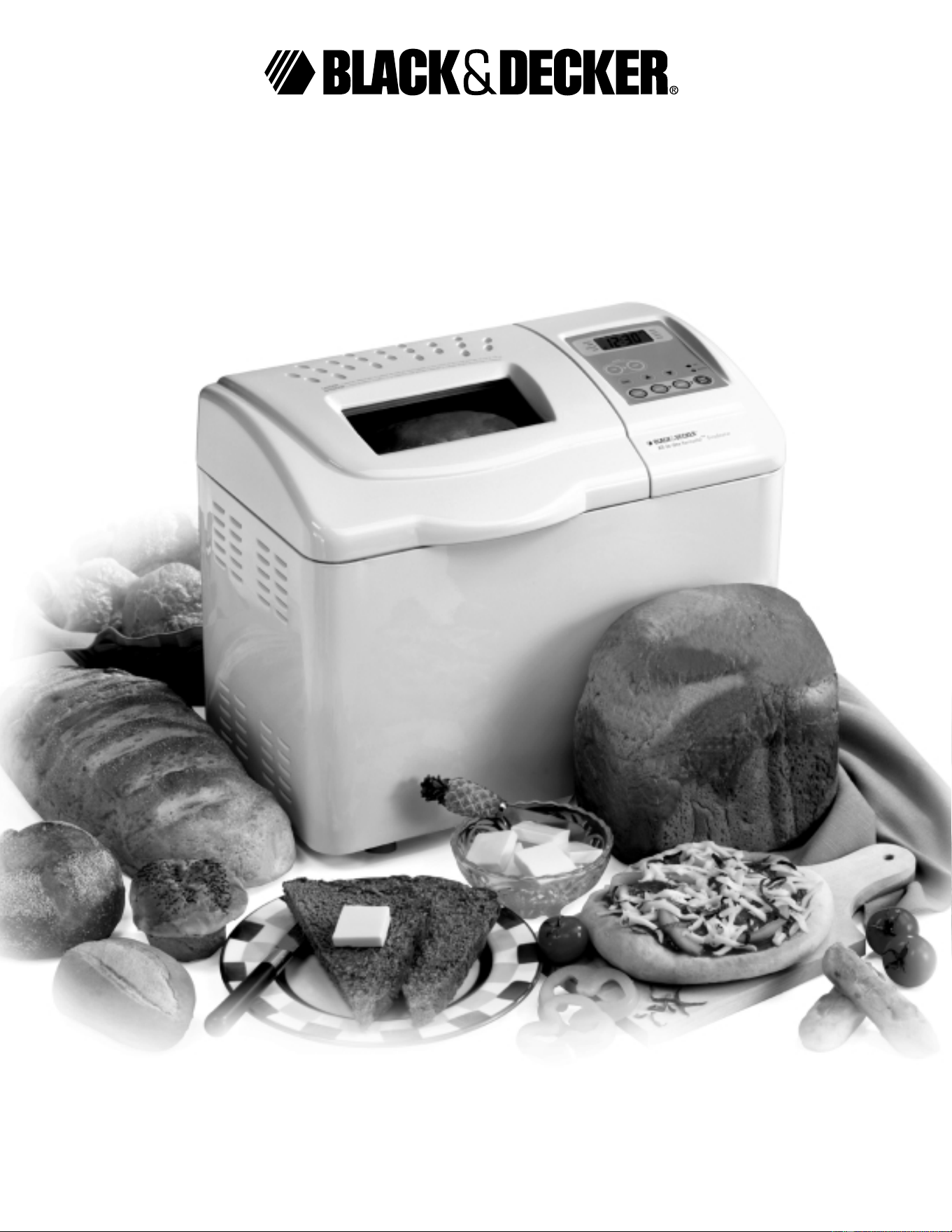
All-In-One Horizontal
™
Automatic Breadmaker
Operating Instructions & Cookbook
Delicious Home Baked Bread At A Press of A Button!
B2000
Questions? Please call us Toll Free!
1-800-231-9786
*
W
hen using electrical appliances, basic
safety precautions should always be
followed, including the following:
Read all instructions.
● Do not touch hot surfaces. Use handles or
oven mitts.
● To protect against a risk of electric shock, do
not immerse cord, plug, or other parts of this
Breadmaker in water or other liquid, except
the Mixing Paddle, which may be immersed
when removed from the Baking Pan for
cleaning.
● Close supervision is necessary when any
appliance is used by or near children.
● Unplug from outlet when not in use and before
cleaning. Allow to cool before cleaning, putting
on, or taking off parts.
● Do not operate any appliance with a damaged
cord or plug or after the appliance malfunctions
or has been dropped or damaged in any
manner. If the product requires attention within
the warranty period, call the toll free number on
the cover of this manual for information on
examination, repair, or adjustment.
● The use of accessory attachments not
recommended by the appliance manufacturer
may cause injuries.
● Do not use outdoors.
● Do not allow cord to touch hot surfaces or hang
over the edge of table or counter.
● Do not place on or near a hot gas or electric
burner, a heated oven, or on top of a microwave
oven.
● Extreme caution must be used when moving an
appliance containing hot contents or liquids.
● To turn off, disconnect from outlet by grasping
the plug. Do not yank on cord.
● Do not use Breadmaker for other than intended
use.
● Do not use Breadmaker for storage purposes
nor insert any utensils as they may create a risk
of fire or electric shock.
● Avoid contact with moving parts.
● Do not remove the Baking Pan during
operation. Press START/RESET and hold until
you hear a beep if you need to stop operation.
● Do not pour any ingredients directly into the
Breadmaker—only into the Baking Pan. It is
important to remove the Baking Pan from the
unit before putting ingredients into the Pan
(except when using the “Add-Ingredient”
function, see pg. 10) to avoid accidentally
spilling ingredients into the oven chamber.
● Place the Breadmaker out from under cabinet
and at least 2 inches (5 cm) away from any walls
to allow for steam from vents.
● Do not cover the Breadmaker with towels or
other material that may prevent steam from
escaping. Some steaming from vents is normal.
● Do not clean with scouring pads. The Baking
Pan and Mixing Paddle have a non-stick
coating. Refer to the “Care and Cleaning”
section of this book.
● Do not operate in the presence of explosive
and/or flammable fumes.
● This product is intended for household use
only and not for commercial or industrial use.
Use for anything other than intended will void
the warranty.
● To avoid damaging the machine, do not place
the Baking Pan or any other object on top of the
unit.
● Only use with provided Baking Pan.
Save These Instructions
2
Important Safeguards
Things You Should Know
About Your Breadmaker
POLARIZED PLUG
This appliance has a polarized plug—one
blade is wider than the other. To reduce the
risk of electric shock, this plug will fit into a
polarized outlet only one way. If the plug
does not fit fully into the outlet, reverse it. If it
still does not fit, contact a qualified
electrician. Do not attempt to defeat this
safety feature by modifying the plug in any
way.
TAMPER-RESISTANT SCREWS
This appliance is equipped with tamper-resistant
screws to prevent removal of the outer cover. To
reduce the risk of fire or electric shock,
do not
attempt to remove the outer cover
. There are no
user-serviceable parts inside. Repair should be
done
only by authorized service personnel (see
insert for a list of Black & Decker Company-Owned
or Authorized Service Centers).
ELECTRICAL CORD
The cord length of this appliance was selected to
reduce safety hazards that may occur with a longer
cord. If more cord length is needed, an extension
cord with a polarized plug may be used. It should be
rated not less than 10 amperes, 120 Volts, and have
Underwriters Laboratories (U.L.) or Canadian
Standards Association (CSA) listing, depending on
the country. When using a longer cord, be sure it
does not drape over a working area or dangle where
it could be pulled on or tripped over. Handle cord
carefully for longer life; avoid jerking or straining it
at outlet and appliance connections.
Product may vary slightly from what is illustrated.
BEFORE FIRST USE
There’s nothing like the aroma of fresh-baked bread.
With the Black & Decker All-In-One Horizontal
™
Breadmaker, you can have the old-fashioned good-
ness of homemade bread with today’s automatic
convenience. That’s because the All-In-One
Horizontal
™
Breadmaker does the work for you.
Even if you’ve never made homemade bread before,
you’ll rise to the occasion with this Breadmaker.
Please take a few minutes to read this Use & Care
Instruction/Cookbook and to find a place to keep it
handy for reference. Pay particular attention to the
safety instructions provided for your protection.
Review the product warranty and service statements
and fill out and mail in the owner registration form.
Carefully unpack the Breadmaker and remove
all packaging materials. To remove any dust that
may have accumulated during packing, wipe the
Baking Pan, Mixing Paddle, and outside surface of
the Breadmaker with a clean, damp cloth. Do not
use scouring pads or any abrasives on any part of
the Breadmaker.
3
Important Safeguards

Important Safeguards . . . . . . . . . . . . . . . . . . . . . . . . . . . . . . . . . . . . . . . . . . . . . . . . . . . . 2
Polarized Plug . . . . . . . . . . . . . . . . . . . . . . . . . . . . . . . . . . . . . . . . . . . . . . . . . . . . . . . . .3
Tamper-Resistant Screws . . . . . . . . . . . . . . . . . . . . . . . . . . . . . . . . . . . . . . . . . . . . . . . 3
Electrical Cord . . . . . . . . . . . . . . . . . . . . . . . . . . . . . . . . . . . . . . . . . . . . . . . . . . . . . . . . . 3
Before First Use . . . . . . . . . . . . . . . . . . . . . . . . . . . . . . . . . . . . . . . . . . . . . . . . . . . . . . . .3
Getting To Know Your Breadmaker . . . . . . . . . . . . . . . . . . . . . . . . . . . . . . . . . . . . . . . . 5
Quick Tips . . . . . . . . . . . . . . . . . . . . . . . . . . . . . . . . . . . . . . . . . . . . . . . . . . . . . . . . . . . . . 5
Names of Parts . . . . . . . . . . . . . . . . . . . . . . . . . . . . . . . . . . . . . . . . . . . . . . . . . . . . . . . . . . . 5
Control Panel Settings & Functions . . . . . . . . . . . . . . . . . . . . . . . . . . . . . . . . . . . . . . . . 6
Bread Type Setting Descriptions . . . . . . . . . . . . . . . . . . . . . . . . . . . . . . . . . . . . . . . . . . . 6
How to Use Your Breadmaker . . . . . . . . . . . . . . . . . . . . . . . . . . . . . . . . . . . . . . . . . . . . . 7
Using the “Add-Ingredient” Function . . . . . . . . . . . . . . . . . . . . . . . . . . . . . . . . . . 10
Setting the Timer . . . . . . . . . . . . . . . . . . . . . . . . . . . . . . . . . . . . . . . . . . . . . . . . . . . . . 10
Troubleshooting . . . . . . . . . . . . . . . . . . . . . . . . . . . . . . . . . . . . . . . . . . . . . . . . . . . . . . 11
Troubleshooting Guide . . . . . . . . . . . . . . . . . . . . . . . . . . . . . . . . . . . . . . . . . . . . . . . 12
Slicing & Storing Bread . . . . . . . . . . . . . . . . . . . . . . . . . . . . . . . . . . . . . . . . . . . . . . . 13
Care & Cleaning . . . . . . . . . . . . . . . . . . . . . . . . . . . . . . . . . . . . . . . . . . . . . . . . . . . . . . . .13
Storing the Unit . . . . . . . . . . . . . . . . . . . . . . . . . . . . . . . . . . . . . . . . . . . . . . . . . . . . . . 13
Service or Repair . . . . . . . . . . . . . . . . . . . . . . . . . . . . . . . . . . . . . . . . . . . . . . . . . . . . . . . . 14
Full One-Year Warranty . . . . . . . . . . . . . . . . . . . . . . . . . . . . . . . . . . . . . . . . . . . . . . . 14
COOKBOOK SECTION
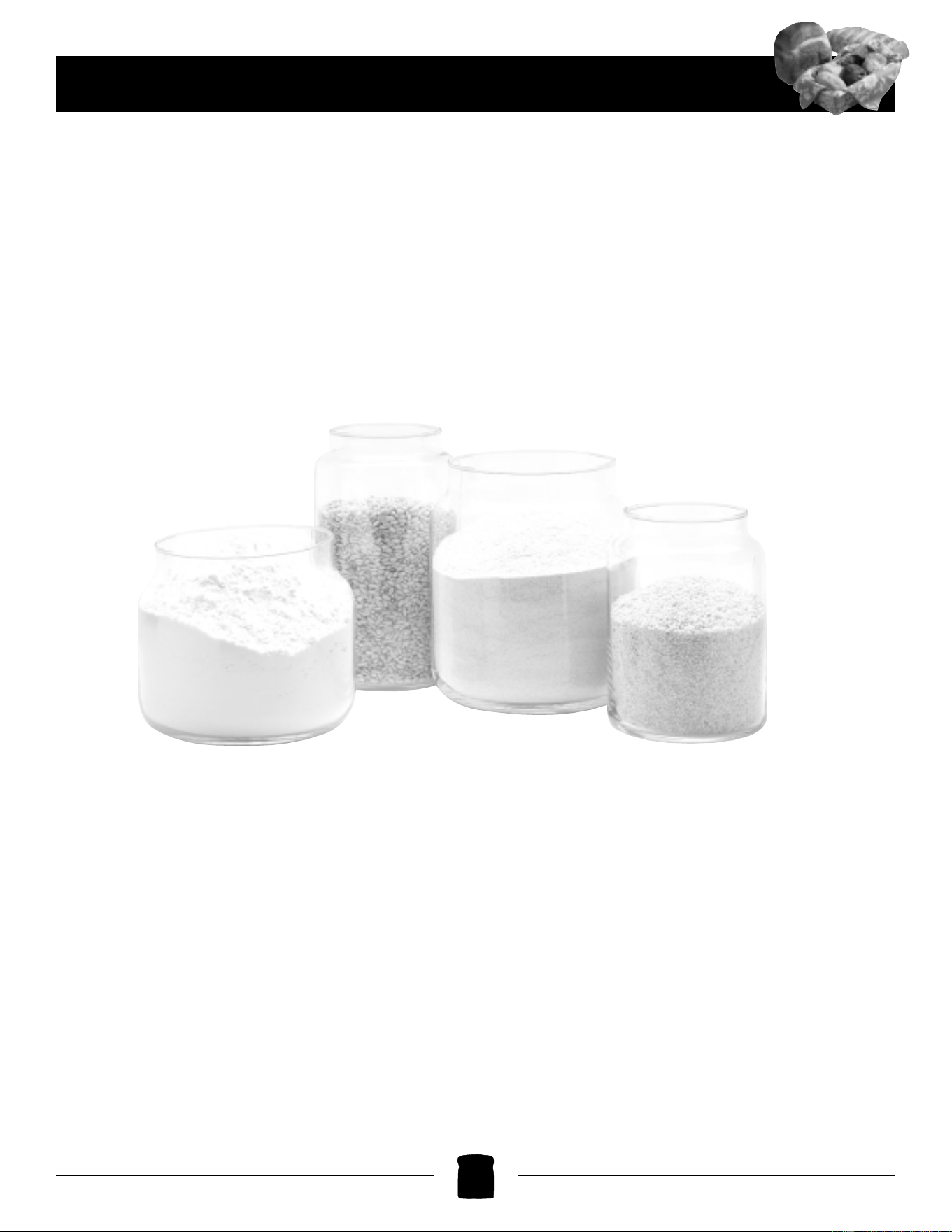
Bread and Dough Ingredients . . . . . . . . . . . . . . . . . . . . . . . . . . . . . . . . . . . . . . . . . . . 16
Tips for Getting the Best Results . . . . . . . . . . . . . . . . . . . . . . . . . . . . . . . . . . . . . . . 17
Tips for Handling Dough . . . . . . . . . . . . . . . . . . . . . . . . . . . . . . . . . . . . . . . . . . . . . 17
Recipe Index . . . . . . . . . . . . . . . . . . . . . . . . . . . . . . . . . . . . . . . . . . . . . . . . . . . . . . . . . . . . 18
Recipes . . . . . . . . . . . . . . . . . . . . . . . . . . . . . . . . . . . . . . . . . . . . . . . . . . . . . . . . . . . . . . . . . 19
Need Help? (Questions and Answers) . . . . . . . . . . . . . . . . . . . . . . . . . . . . . . . . . . . . 30
4
Table Of Contents
Quick Tips
● Your breadmaker makes large 2 lb (900 g) loaves
of bread.
● There are six settings including one for
DOUGH and BAKE only.
● The SUPER RAPID bake setting can produce
variations of white bread in 70 minutes.
This setting can only be used with recipes
supplied (see pg. 21).
You cannot use the
timer
with this selection. This setting cannot
handle heavier recipes such as whole grain
because of its shortened rising cycle.
● Depending on the recipe you select, the
DOUGH setting will let you produce dough
that can be shaped into cinnamon rolls,
pizza, long loaves, pretzels, or more.
Consult the Cookbook section of this manual.
● The Crust Control function lets you choose
REGULAR or DARK crust on the BASIC, SUPER
RAPID bake, or SWEET settings. It cannot be
used on the GRAIN or DOUGH settings.
● The “Keep Warm” function begins automatically
after bread is baked. It keeps baked bread
warm up to an hour after the baking is done.
This function stops after 60 minutes or when
the unit is unplugged, or the Start/Reset button
is pressed.
● An “Add-Ingredient” function signals with
beeps when it’s time to add ingredients
such as fruits or nuts to recipes used with any
setting except SUPER RAPID bake. A beep
signals before kneading is completed to let you
know when to add ingredients. This feature
helps keep fruit or nuts whole (See “Add-
Ingredient Function” pg. 10 for more details).
If you use the TIMER to delay baking, you may
add all ingredients at once and bypass this
function, however, your fruit or nuts may get
“chopped” and blended into the bread.
● Do not cover the breadmaker with towels
or other material that may prevent steam from
escaping. Some steaming from vents is normal.
Because of escaping steam, you should keep the
breadmaker several inches away from cabinets
while making bread.
● Do not place any objects on top of the
breadmaker.
● IMPORTANT: Add ingredients in the order they
are specified in the recipe. For best results,
accurate measuring of ingredients is very
important.
Do not put larger quantities than
recommended into the Baking Pan as it may
produce poor results and may damage the
breadmaker.
5
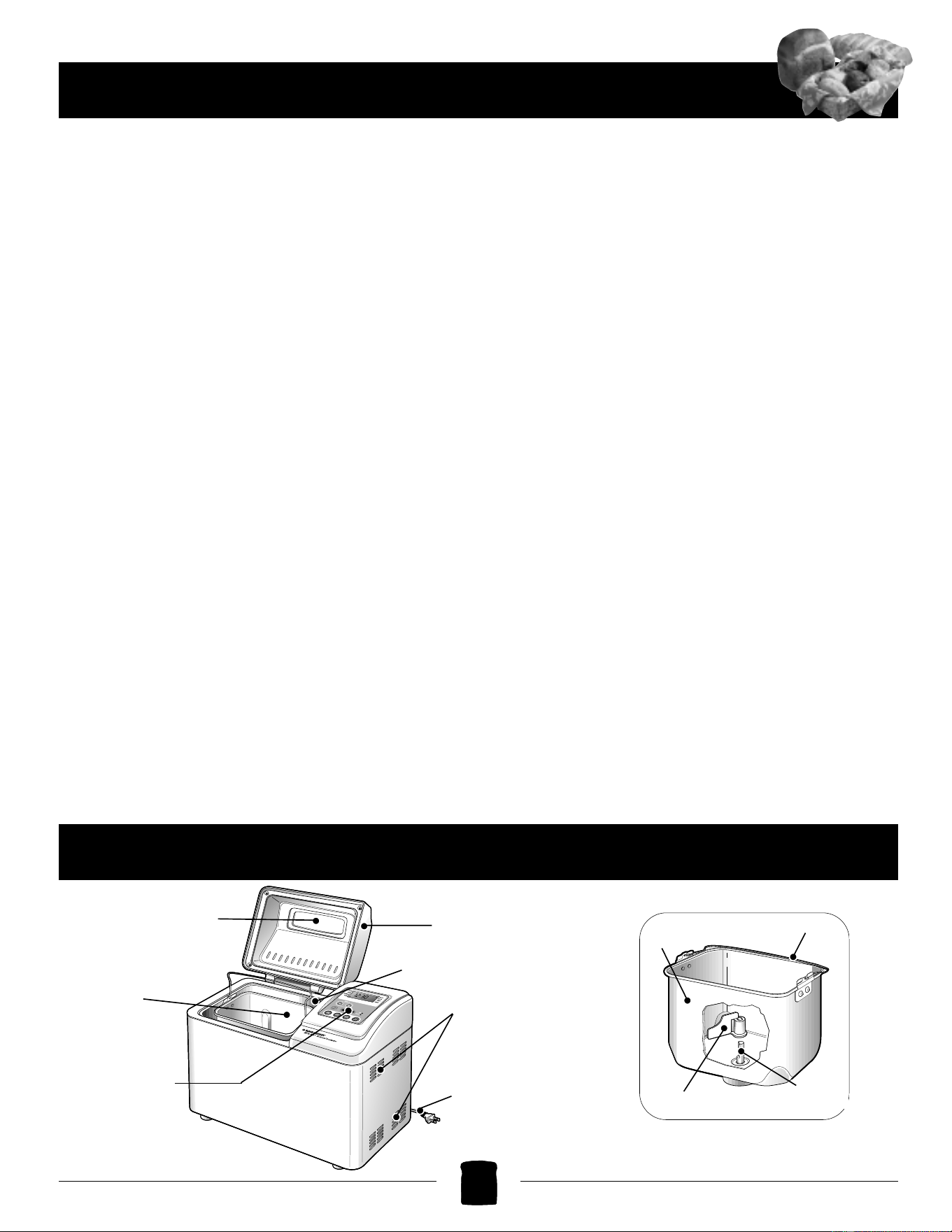
Getting To Know Your Breadmaker
Names Of Parts
Lid
Vents
Power Supply Cord
Viewing Window
Baking Pan (Installed in Case)
with Wire Handle
Oven Chamber
Control Panel
Wire Handle
Baking
Pan
Mixing Paddle
Rotating
Shaft
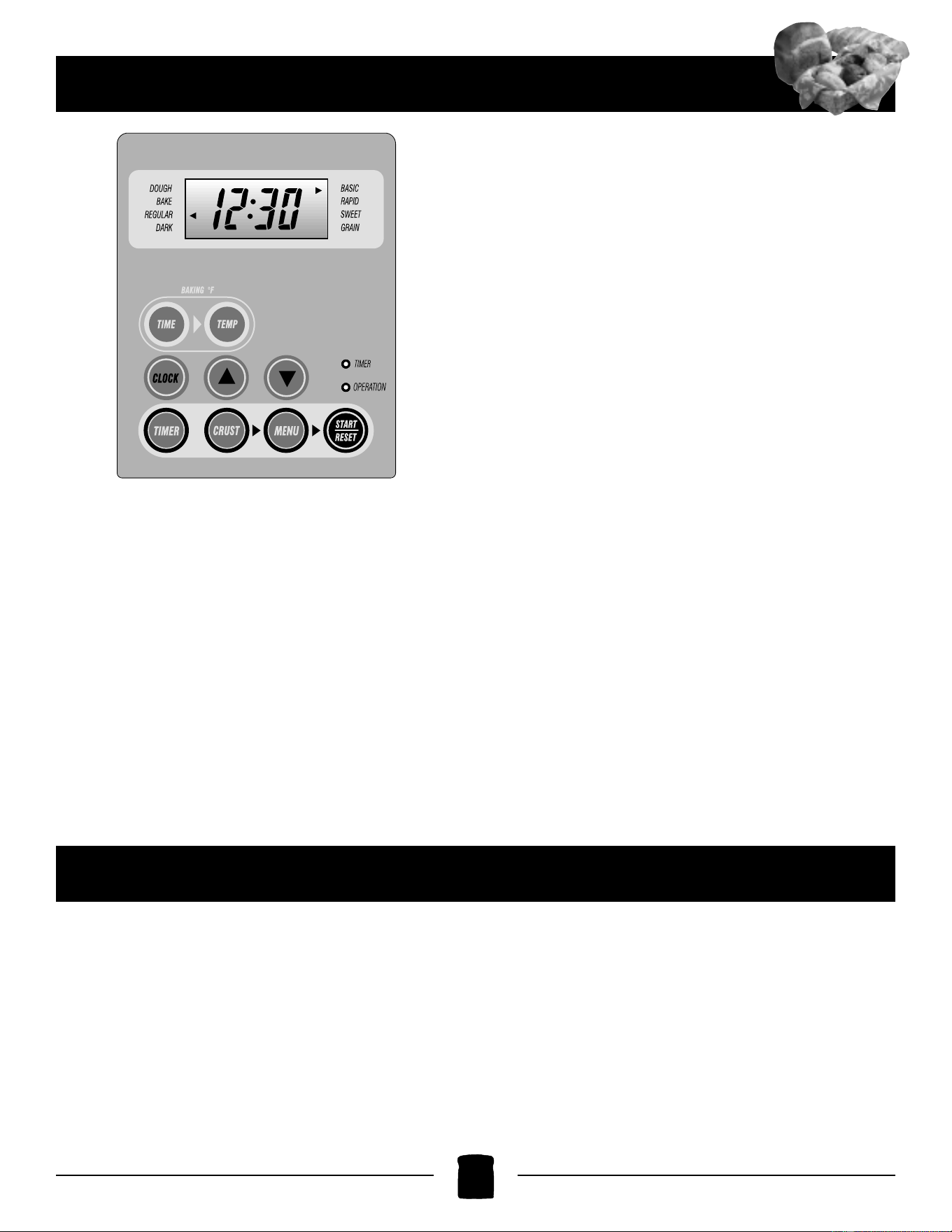
NOTE: When using the touch pad control, be sure to
press the pad until you hear a beep.
1. Digital Display Window
● The black arrow at the right side of the display
indicates your bread setting choice; the left side
arrow indicates the DOUGH, BAKE only settings,
and CRUST color choices.
● When set, the digital clock will show either the
current time of day, or, when the breadmaker is
operating, the time it will take for your bread to
be completed under the selected setting.
● Shows minute-by-minute time countdown.
● Indicates troubleshooting message in the
Window (see “Troubleshooting” pg. 11)
2. Clock Button
Use when setting the current time of day.
● The CLOCK button is used with the “Up” and
“Down” arrows to set the clock.
3. Timer Button
Use when setting the TIMER to delay baking.
● The TIMER button is used with the “Up” and
“Down” arrows to set the time you wish your
bread to be complete (up to 13 hour delay).
4. Start/Reset Button
● Press to start operation and to display the time it
will take for your bread to be completed under
the selected setting.
● Press and hold to cancel the breadmaking
operation. The red “on” light goes out & unit
beeps (DO NOT press when you are just check-
ing the progress of your bread or you will cancel
your program).
5. Indicator Lights
● The red “operation ” light indicates that the
breadmaking operation has started. When the
cycle is complete, the red light will flash for 60
minutes in its “Keep Warm” cycle. If you do not
remove the bread after 60 minutes, it will simply
remain on to show you that the unit is still
plugged in.
● The green “timer” light indicates that the timer
function is on. When the actual breadmaking
operation begins, the green light will go off, and
the red light will come on.
Control Panel Settings & Functions
Bread Type Setting Descriptions
NOTE: The number in parentheses following each
setting description represents the total baking time.
Each setting begins with a preheat period which
delays the mixing cycle until the desired
temperature is reached within the oven chamber.
The preheat cycle is included in the overall cycle
time.
BASIC BREAD/REGULAR Crust or DARK Crust
(3:50 hours)
This setting is used for breads which primarily use
white flour, though some recipes may include small
amounts of whole wheat flour as well. In the U.S.,
be sure to use Bread Flour; in Canada, you may use
Canadian All-Purpose Flour or Bread Flour. Follow
recipes carefully. Basic Bread/Regular Crust will
produce good results when you are using
ingredients such as cheese, nuts, or cornmeal as
they tend to brown easily. Choose Basic Bread/Dark
Crust, to produce a loaf with a darker crust without
lengthening the baking time.
6
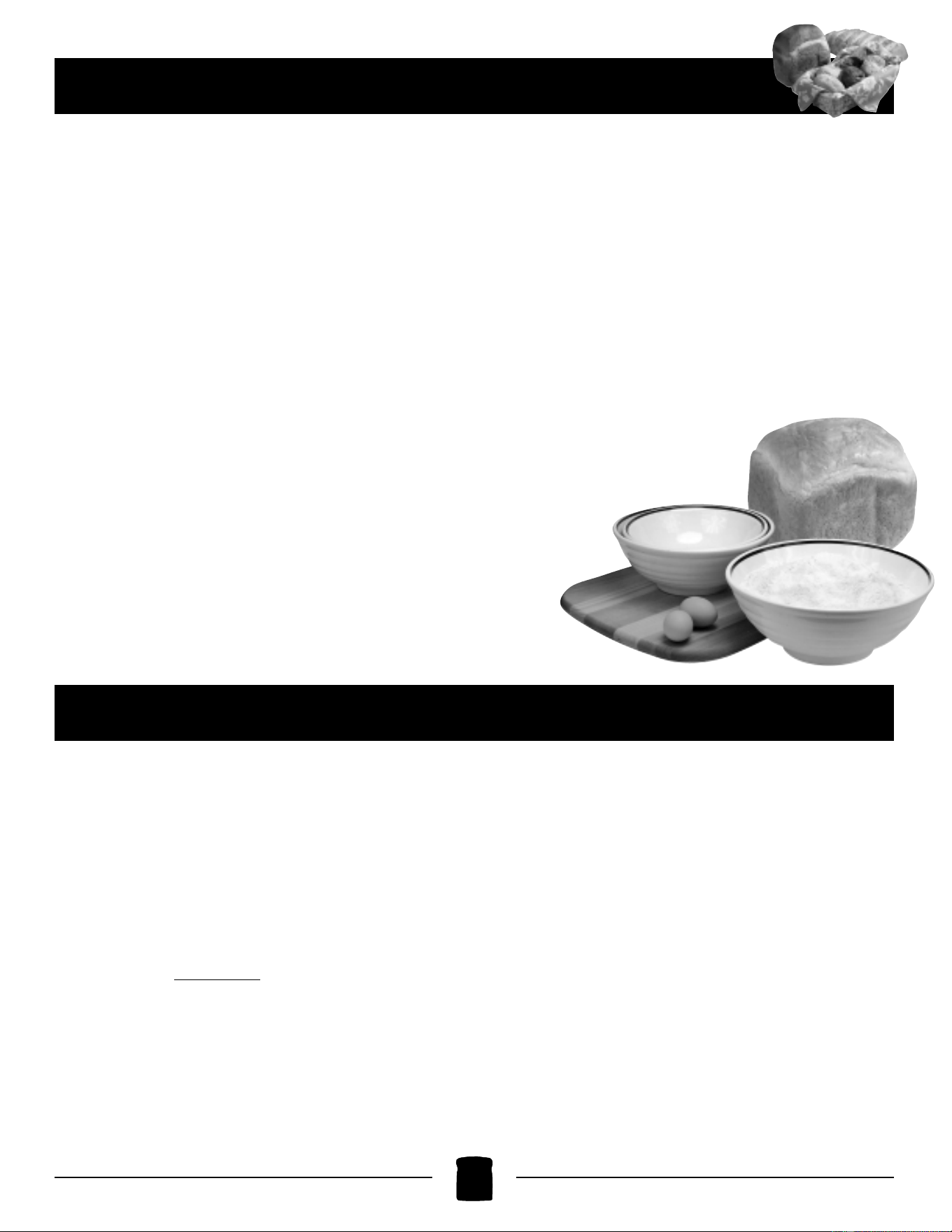
SUPER RAPID BAKE /REGULAR Crust or
DARK Crust (1:10 hours)
This setting is used only to make selected recipes
quickly whether you choose a REGULAR or DARK
crust.
Refer to the recipe section of this booklet for
a complete list of all recipes that can be used with
this setting.
This setting cannot be used successfully
to make breads other than those specified due to
the shorter rising time of this cycle.
SWEET/REGULAR Crust or DARK Crust
(3:50 hours)
Use this setting for recipes that use fruit juice, large
amounts of sugar, cheese, or added sweet
ingredients such as raisins, dried fruit, or chocolate.
Baking temperature is lower to prevent burning.
GRAIN (4:10 hours)
This setting is used for recipes with significant
amounts of whole wheat or rye flour, oats,
or bran. This setting has a longer rise cycle
and preheat cycle to allow heavier grains
to expand. Generally, whole wheat/multi-grain
breads are shorter and denser than Basic or Sweet
breads.
You cannot use the CRUST color selections
with this setting.
DOUGH (2:00 hours)
This setting makes bread-style dough. Dough can
be shaped to make pizza, rolls, bread sticks, long
loaves or braids that must then be baked in a con-
ventional oven.
BAKE (30 min - 1:30 hours)
This setting is for quick breads (non-yeast breads)
and may be used with some cake recipes by lower-
ing the manufacturer’s recommended temperature
setting by 50° F (10°C) and increasing the time.
Some experimentation may be nesessary.
Temperature ranges between
300° F - 420° F (154°C - 216°C).
You don’t need to use the paddle.
This setting is good for frozen
and thawed doughs.
Bread Type Setting Descriptions
How To Use Your Breadmaker
T
he bread making settings in this unit will
combine ingredients, knead, and bake bread
from start to finish – automatically.
The DOUGH setting makes dough for a variety of
recipes but you must shape and bake the dough
yourself in a conventional oven. To delay comple-
tion, the automatic TIMER may be programmed to
make bread while you are at work or asleep.
(See “Setting the Timer” pg. 10)
The Cookbook section of this book includes recipes
that have been thor
oughly tested in Black & Decker’s
own test kitchen to ensure best results in both the
United States and Canada. Flours, cornmeal, and a
few other ingredients vary widely between
the two countries.
NOTE: The term, “All-Purpose Flour” for example, is
applied to two totally different types of flour
depending on whether it is purchased in the U.S. or
Canada. Canadian “All-Purpose Flour” will produce
good to excellent results in this Breadmaker; whereas
American “All-Purpose Flour” will produce poor
results.
Most North American national brand flours and
yeasts will produce good results. Keep in mind that
the recipes included here have been created by our
Home Economists specifically for this automatic
breadmaker and may not produce acceptable
results in other similar breadmakers.
7
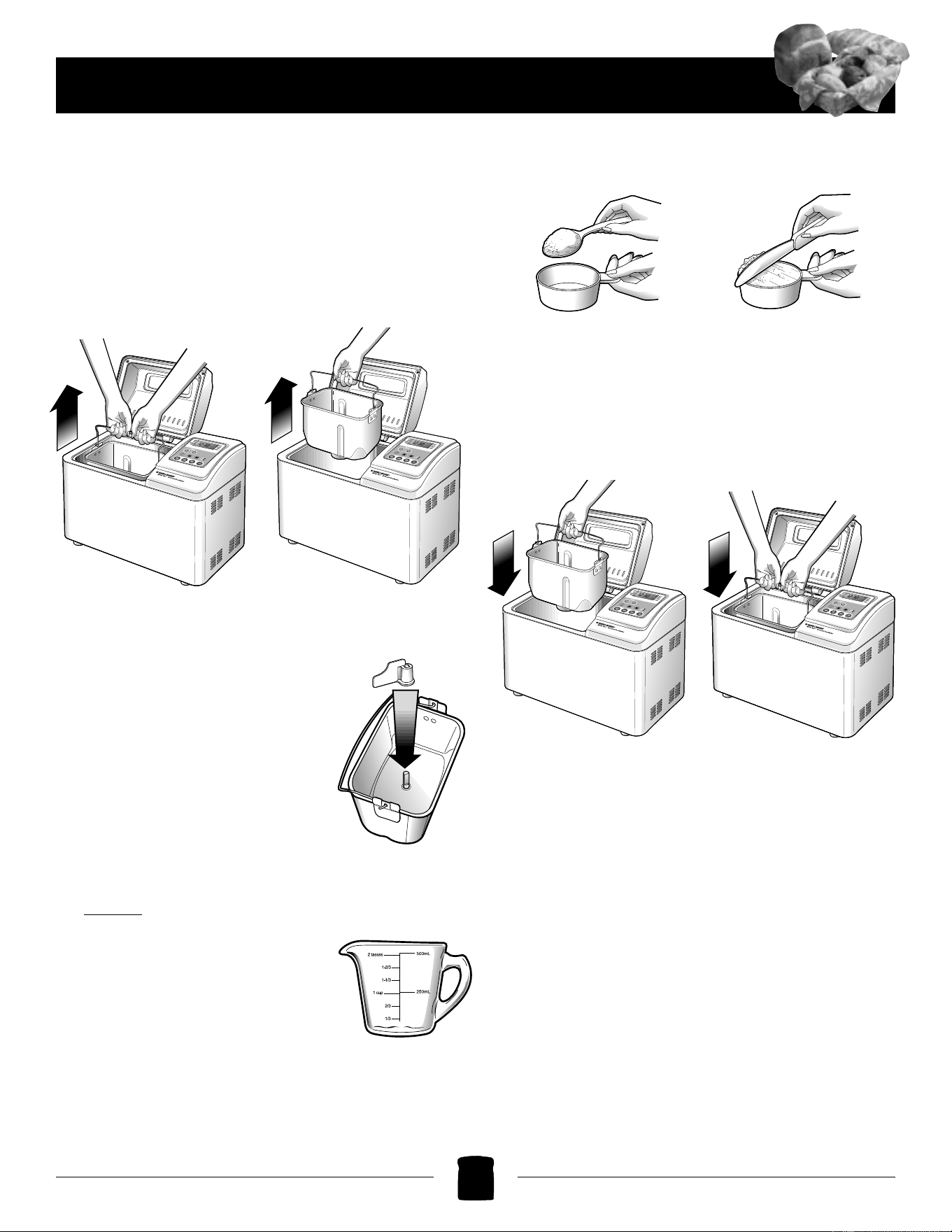
For all SETTINGS
(including DOUGH) follow these
instructions:
1
Open the lid, grasp the wire handle with two
hands, and remove the Baking Pan by pulling
straight up and out. It is important to remove the
Baking Pan from the unit rather than add ingredi-
ents into the Pan while it is in place to avoid acci-
dentally spilling ingredients into
the oven chamber.
2
Attach the Mixing Paddle onto
the shaft inside the Baking Pan
by lining up the flat side of the
Paddle with the flat side on the
shaft. Gently push the Paddle onto
the shaft.
3
Select a recipe from the
Cookbook section of this booklet. When follow-
ing the recipe:
● Always add ingredients into the Baking Pan in
the order they are listed.
● Measure ingredients carefully
& accurately. To measure
liquids, use a see-through
measuring cup and check the
measurement at eye level.
● When measuring dry ingredients, use standard
dry measuring cups or
measuring spoons and level off the ingredients
with the straight-edge of a knife or metal
spatula.
Inaccurate measurements, even if only slightly
off, can make a difference in results.
● Yeast is always added last. Be sure that the
yeast does not touch the liquid ingredients, salt
or shortening.
4
Place the Baking Pan straight down into the unit
until it is seated firmly.
How To Use Your Breadmaker
8
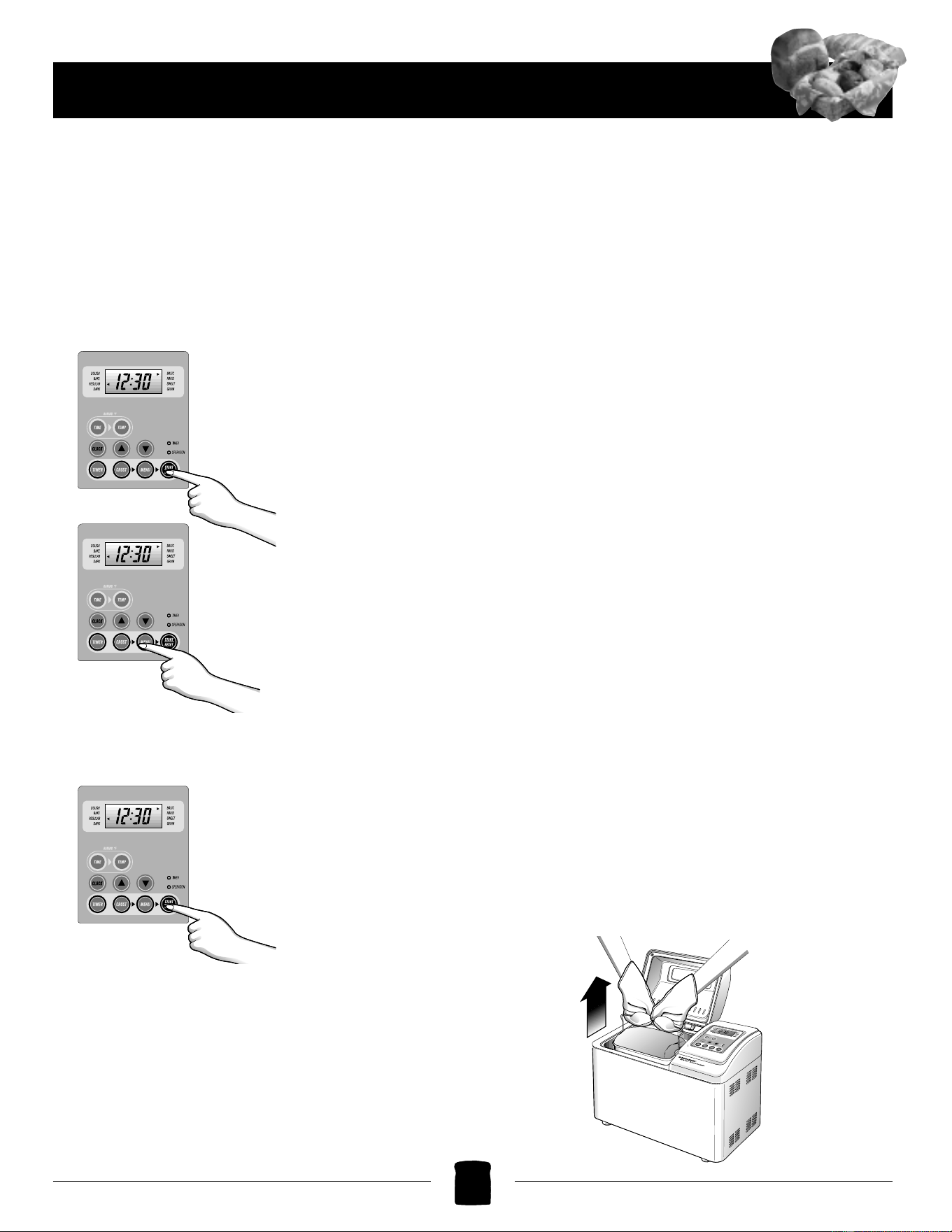
5
Close the lid and plug into an outlet (120 volt). Two
ARROWS will come up in the display window indi-
cating BASIC bread type with a Regular Crust and
12:00 a.m. will flash in the display window. If you wish
to use the TIMER to delay baking, you will first have to
set the correct time of day. However, if you want to
start the breadmaking operation now, it is not neces-
sary to set the CLOCK.
6
To bake a Basic loaf of bread with a Regular
Crust, simply press the START/RESET Button.
However, you can choose a dif-
ferent setting for your recipe by
pressing the MENU button on
the pad. Each time you press
MENU, the arrow in the display
window will point to
the next selection (i.e.
RAPID bake, SWEET
bread, etc.) If you are
using a recipe that
calls for the BASIC,
RAPID bake, or SWEET bread set-
ting, choose a crust color by
pressing the CRUST
button until the arrow
in the window lines up
with either REGULAR
or DARK.
7
Press the
START/RESET
Button once until it beeps and the red “operation”
indicator light comes on. The
flashing 12:00
a.m.
will be
replaced by the baking time for
that setting, for example, 3:50, if
you chose a recipe for the BASIC
bread setting (regard-
less of whether you
chose REGULAR or
DARK crust). It will
count down the
remaining time in one-minute intervals (3:49, 3:48,
etc.) until the bread is done. When the baking is
complete, several beeps will sound to alert you that
the bread is ready and the red indicator light will
begin flashing. In addition, a flashing 12:00
a.m.
will
reappear in the display screen.
8
This Breadmaker is designed with a Keep Warm
function that automatically begins when baking
is complete. The red “operation” light will continue
to flash for up to 60 minutes after baking is com-
plete and will keep bread warm during that time. At
the end of the hour, the
Keep Warm cycle will end
and the light will remain on constantly, indicating
the unit is still plugged in. The bread should then be
removed as soon as possible to avoid getting soggy.
You may remove the Baking Pan any time during
the
Keep Warm cycle. To turn off the Keep Warm
feature before the 60 minutes are up, simply press
the START/RESET button and hold it until the dis-
play time clears.
NOTE: The Keep Warm feature does not function for
the DOUGH setting since baking is not involved in
this program. If you leave finished dough in the unit
over a period of time, it may over-rise and produce
poor results. For best results, remove dough at the
end of the program and follow the recipe
directions for shaping, rising, and baking.
9
This unit has a convenient Viewing Window so
that you may watch the progress of the bread as
it is mixed, kneaded, and baked. Occasionally, some
moisture may form in the window during the rising
cycle. If moisture forms, you may lift the lid to look
inside during the mixing and kneading stages,
however, DO NOT OPEN THE LID DURING THE
BAKING CYCLE (approximately the last hour) as
this may cause the bread to underbake. Most of the
moisture should disappear during the baking cycle.
10
To remove the Baking Pan, use pot holders or
oven mitts, grasp the wire handle with both
hands and pull straight up on the Baking Pan. Fold
and lock the wire handle down. Turn the pan on its
side and gently shake the bread out onto a wire
cooling rack. The Baking Pan and Mixing Paddle
have a non-stick coated finish so that the bread
should come out easily. Do not use metal utensils to
remove bread as they may scratch the non-stick
coating. If you have difficulty removing bread from
How To Use Your Breadmaker
9
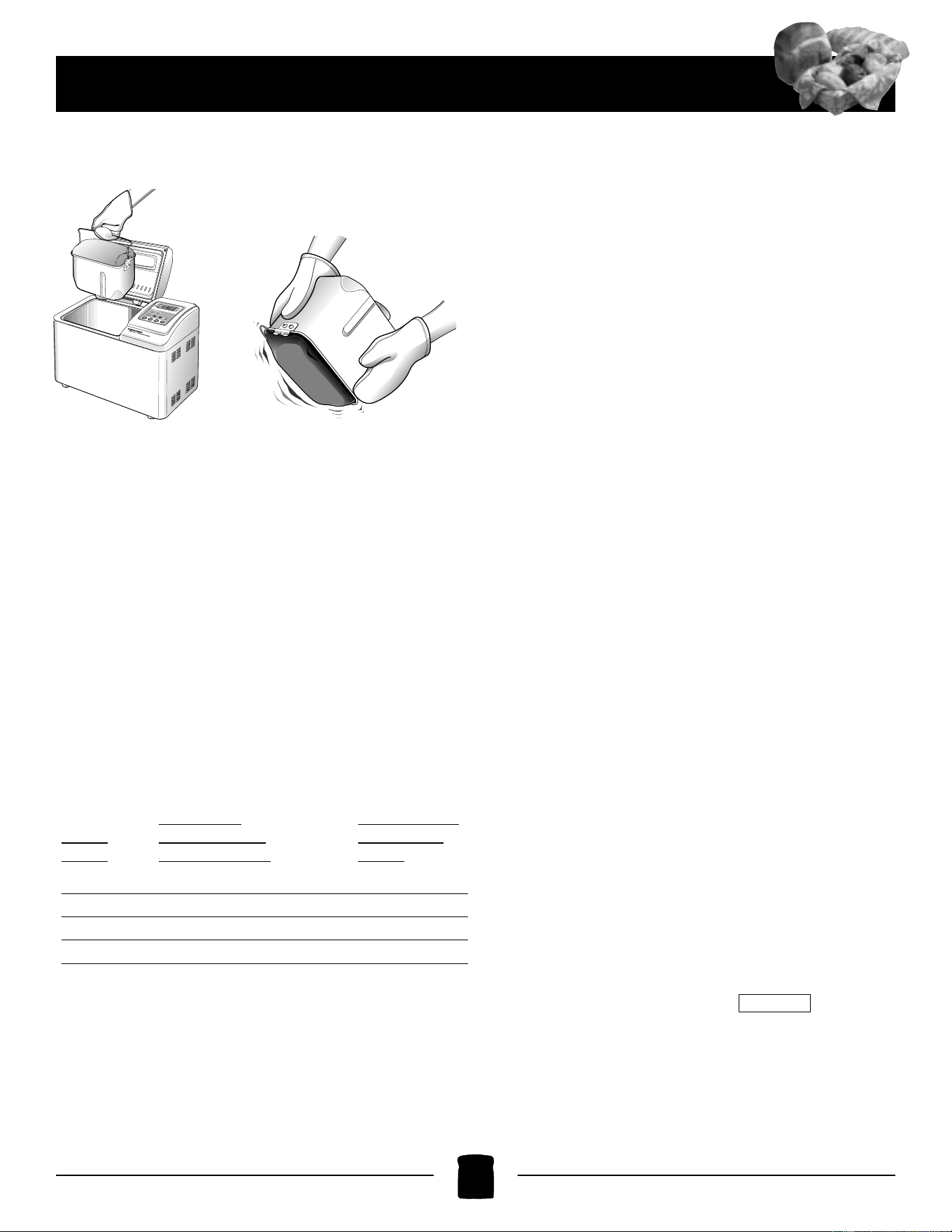
the Baking Pan, slide a flat rubber or plastic spatula
along the sides of the pan to loosen the loaf. Turn
the pan over and shake the loaf out. Allow the bread
to cool before slicing. If the
Mixing Paddle remains in the
bottom of your loaf, allow the loaf to cool then use a
plastic spoon or rubber spatula to remove the pad-
dle. Do not use a knife or other sharp metal object
as this will scratch the non-stick coating on the
Mixing Paddle.
Using The “Add-Ingredient”
Function
1
All settings, except for RAPID bake, have a built-
in “Add-Ingredient” function which signals with
beeps when it’s time to add ingredients such as
fruits or nuts. The beeps sound before kneading is
complete to let you know it’s time to add the
ingredients. The actual time of the beeps can vary
up to 5 minutes depending on the room tempera-
ture at the time when you started the bread making
program. The following chart can be used for refer-
ence:
2
This function lets you add ingredients so that
they don’t get chopped up by the Mixing Paddle
and blended into your loaf. If you are using the
TIMER to delay baking (perhaps while you are asleep
or away from home), you may bypass this function
by ignoring the signal and adding ingredients in the
order called for in the recipe, however, you may end
up with somewhat broken pieces.
3
To add ingredients, raise the lid and carefully
pour the ingredients into the Baking Pan.
CAUTION: It is important to avoid spilling
ingredients into the oven chamber.
Setting The Timer
(For Delayed Completion)
Use the TIMER when you would like to delay the
completion of your bread or dough. This feature
allows you to delay bake time for up to 13 hours.
For example, it lets you set the TIMER at 7 p.m. one
evening so that you can wake to fresh bread by 8
a.m. the following morning.
NOTE: The TIMER
cannot be used with the Super Rapid Bake setting.
To set the TIMER, follow these instructions:
NOTE: Be sure you have followed the “How to Use
Your Breadmaker”
steps 1-6 in preparing the
ingredients in the Baking Pan and selected a MENU.
It is not recommended that you use the “Delayed
Completion” function and TIMER with recipes that
call for fresh ingredients that might spoil such as eggs,
fresh milk, buttermilk, or cheese.
1
To use the TIMER, you must first set the digital
clock to the correct time of day. To change the
flashing 12:00
a.m.,
first press the CLOCK button.
While the “Hour” is flashing, immediately press the
“Up” and “Down” arrows to change the time in 1 hour
intervals. Make sure the “a.m.” or “p.m.” displayed is
appropriate.
While the correct hour is flashing in the
display, press the CLOCK button again to set the min-
utes. If the hour display has stopped flashing before
the minutes have been set, press the CLOCK button
twice.
While the “00”is flashing, the minutes can be
set by pressing the “Up” and “Down” arrows. You may
hold either arrow to rapidly change the time in
5-minute intervals, or press and release to change
1 minute at a time.
2
Once the clock is set, the TIMER can easily be set
following similar steps. To wake up to the aroma
of fresh baked bread at 8:30 a.m. for example, press
and hold the TIMER button until appears
on the display, and the hour flashes as it did when
setting the clock above.
While the “hour”is flashing,
press the “Up” or “Down” arrows to reach “8”, check-
ing to make sure “a.m.” is displayed. To set the min-
utes, press the TIMER button
while the hour setting
is flashing.
If the hour setting has stopped flashing
How To Use Your Breadmaker
When to add Time Displayed
Setting Ingredients after when Beeper
Signals Starting Program Signals
Basic Bread 30-35 minutes into program 3:15-3:20
Sweet Bread 30-35 minutes into program 3:15-3:20
Grain 37-42 minutes into program 3:28-3:33
Dough 40-45 minutes into program 1:15-1:20
10
TIMER
11
How To Use Your Breadmaker
before the minutes have been set, press and hold the
TIMER button. With the hour setting flashing again,
immediately press the TIMER button to set the min-
utes.
While the “00”is flashing, the minutes can be
set to “30” using the “Up” or “Down” arrows. When
the “30” stops flashing and the current time is dis-
played, the timer is set.
3
To start the delayed completion timer, press the
TIMER button. The completion time will flash
briefly and be replaced by the current time in the dis-
play, and the green TIMER light will come on. It is not
necessary to press the START/RESET button. If the
green light does not come on, and
“13 Hr ” appears on the display, you
have set the TIMER for longer than the maximum
13 hour delay. To reset the TIMER hold the TIMER
button until the hour setting flashes, and the time can
be changed using the “Up” and “Down” arrows.
If the green light does not come on, and
“0 Hr ” appears, the TIMER has
been set for a delayed completion time which is
shorter than the actual bake time (for example 3:50 is
the bake time for SWEET bread). Reset the TIMER for
a longer delayed completion time.
4
To cancel the TIMER function, press the TIMER
button and the green light will go out.
5
To check the completion time while the green
TIMER light is on, press the TIMER button twice.
6
When the actual breadmaking operation begins,
the green “timer” light will go out, the red “opera-
tion” light will come on, and total bake time (3:50 for
SWEET bread) will appear on the display. The bake
time will count down in one-minute intervals. When
the end of the countdown is reached, a beeping sig-
nal will sound and your bread is complete. The red
light will now begin flashing to show the Breadmaker
has automatically activated the 60-minute
“Keep Warm” function.
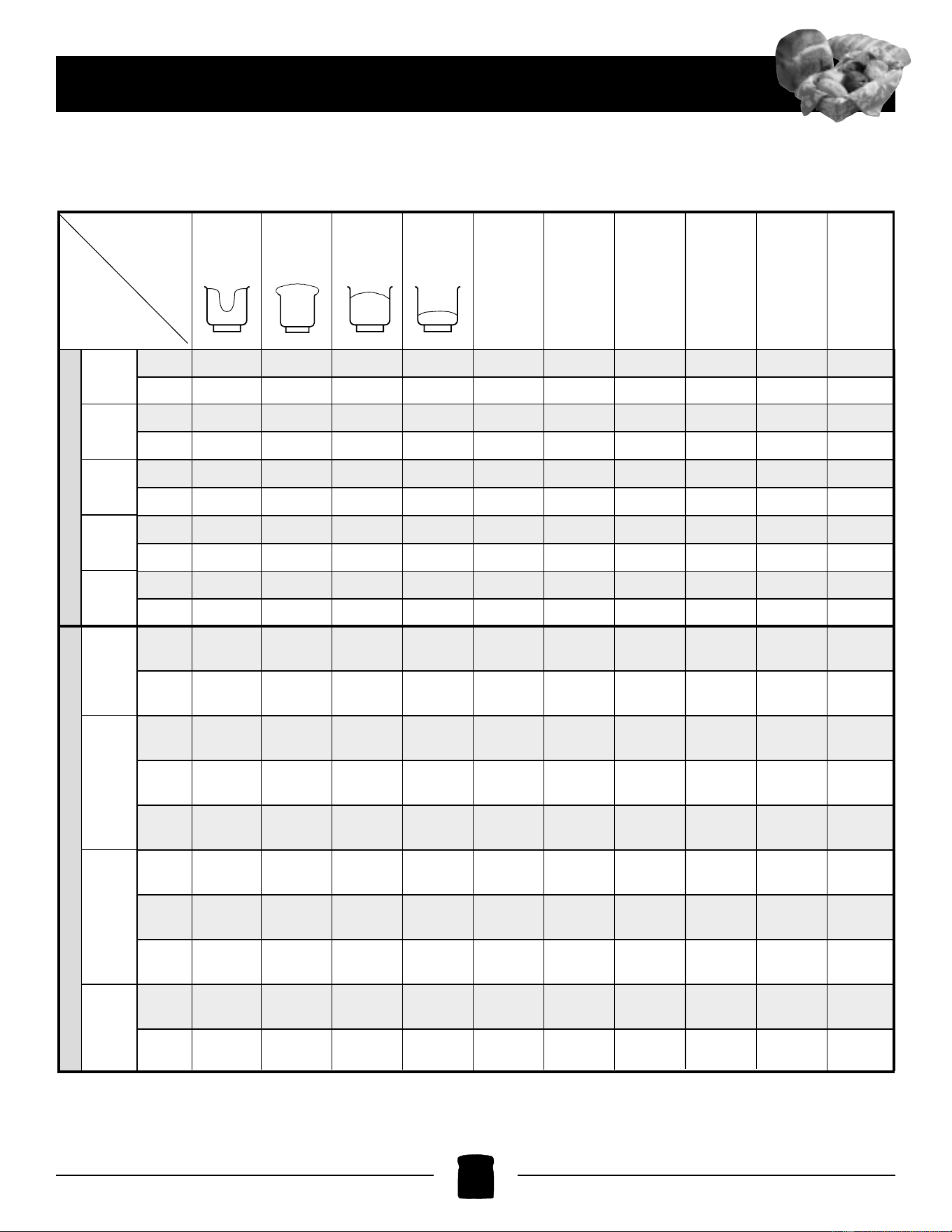
Troubleshooting
Specific questions about the breadmaker functions
and problems with ingredients or recipes are
addressed in the “Need Help?” section beginning on
pg. 30.
● If there is an operational problem with the unit,
you may see a hyphen, colon, double hyphen
(- : --) message in the display window.
This means there is an operational/mechanical
malfunction. DO NOT USE THE UNIT. Unplug
the unit and contact your local service center for
repair. Call the toll-free number on the cover of
this booklet to ask for the location of the Black &
Decker service center nearest you.
● If the START/RESET button is pressed and the
word “HOT” appears in the display window, it
indicates that the unit has not cooled sufficiently
after baking to use immediately again. Open the
lid, remove the Baking Pan and allow the inside
of the unit to cool. Once the unit has cooled suffi-
ciently, pressing the START/RESET button will
immediately start the breadmaking operation.
● For specific problems with Bread/Dough results,
see the Troubleshooting guide on the next page:
TIMER
ERR
TIMER
ERR
Loaf Rises
Then Falls
“Cratered
Loaf”
Loaf Rises
Too High
“Mushroom
Loaf”
Loaf Does
Not Rise
Enough
Flat Loaf
Little To No
Rising
Crust
Too Dark
Uncooked Or
Partially
Cooked
Not Mixed
Or Partially
Mixed
Gnarly
Knotted Top
Loaf Core
Texture
Heavy &
Dense
High
Altitude
Adjustment
12
Troubleshooting Guide
MEASUREMENT
INGREDIENT
FLOUR
SALT
SUGAR
OR
HONEY
WATER
OR
MILK
YEAST
➜
Liquid
Too Hot Or
Too Cold
Low In
Gluten
Content
None Was
Added
Used Fresh
(Wrong Type)
SALT
WATER
OR
MILK
FLOUR
YEAST
Too Much
➜➜
2 Tbsp. 2 Tbsp. 2 Tbsp.
1/4 tsp. 1/4 tsp.
1/4 tsp.
1 tsp. 1 tsp.
1 tsp. 1 tsp.
2 Tbsp. 2 Tbsp.
2 Tbsp. 2 Tbsp. 2 Tbsp. 2 Tbsp.
1/4 tsp. 1/4 tsp.
1/4 tsp. 1/4 tsp. 1/4 tsp.
✔✔✔
✔✔
✔
✔
✔✔
See Page 17
See Page 16 See Page 16
See Page 16 See Page 16 See Page 16
See Page 16
See Pages
16 & 17
See Pages
16 & 17
See Pages
16 & 17
See Pages
16 & 17
RESULTS
POSSIBLE
SOLUTIONS
➜
Increase Amount
Decrease Amount
➜
NOTE: The number one cause for poor results is improper measurement of ingredients (see page 8). The checklist
below offers several possible solutions. Try one adjustment at a time and only make one change per loaf.
If results do not improve with the first adjustment, move to the next possible solution.
➜➜➜➜➜
Not Enough
Water
Or Milk
Too Old
Too Fine
Out of Date
Code
Forgotten
➜
➜➜
Slicing & Storing Bread
For best results, allow loaves to cool on a wire rack
15 to 30 minutes before slicing. You may use an
electric knife (such as the Black & Decker Slice
Right
™
Electric Knife Model EK300) for even slices.
Otherwise, use a sharp knife with a serrated blade.
Store bread tightly covered (resealable style bags or
plastic containers work well) at room temperature
up to three days. If weather is hot and humid, store
in the refrigerator. For longer storage (up to one
month), place bread in a tightly covered container in
the freezer. If you store the bread in the refrigerator,
leave it out to bring it to room temperature before
serving. Since homemade bread has no preserva-
tives, it tends to dry out and become stale faster
than commercially-made bread.
Leftover slightly hardened bread may be cut into
1/2”(1.27 cm) or 1” (2.54 cm) cubes and used in
favorite recipes to make croutons, bread pudding, or
stuffing.
How To Use Your Breadmaker
CAUTION: To avoid electric shock, unplug the unit
and allow the Breadmaker to cool before cleaning.
For best performance and maintenance, it is
recommended to clean the breadmaker after each
use as follows:
Outer Body and Oven Chamber:
Wipe the outer body of the unit with a damp cloth
or slightly dampened sponge. Use a damp sponge
or cloth to wipe out any flour, crumbs, or other
materials from the oven chamber.
Lid
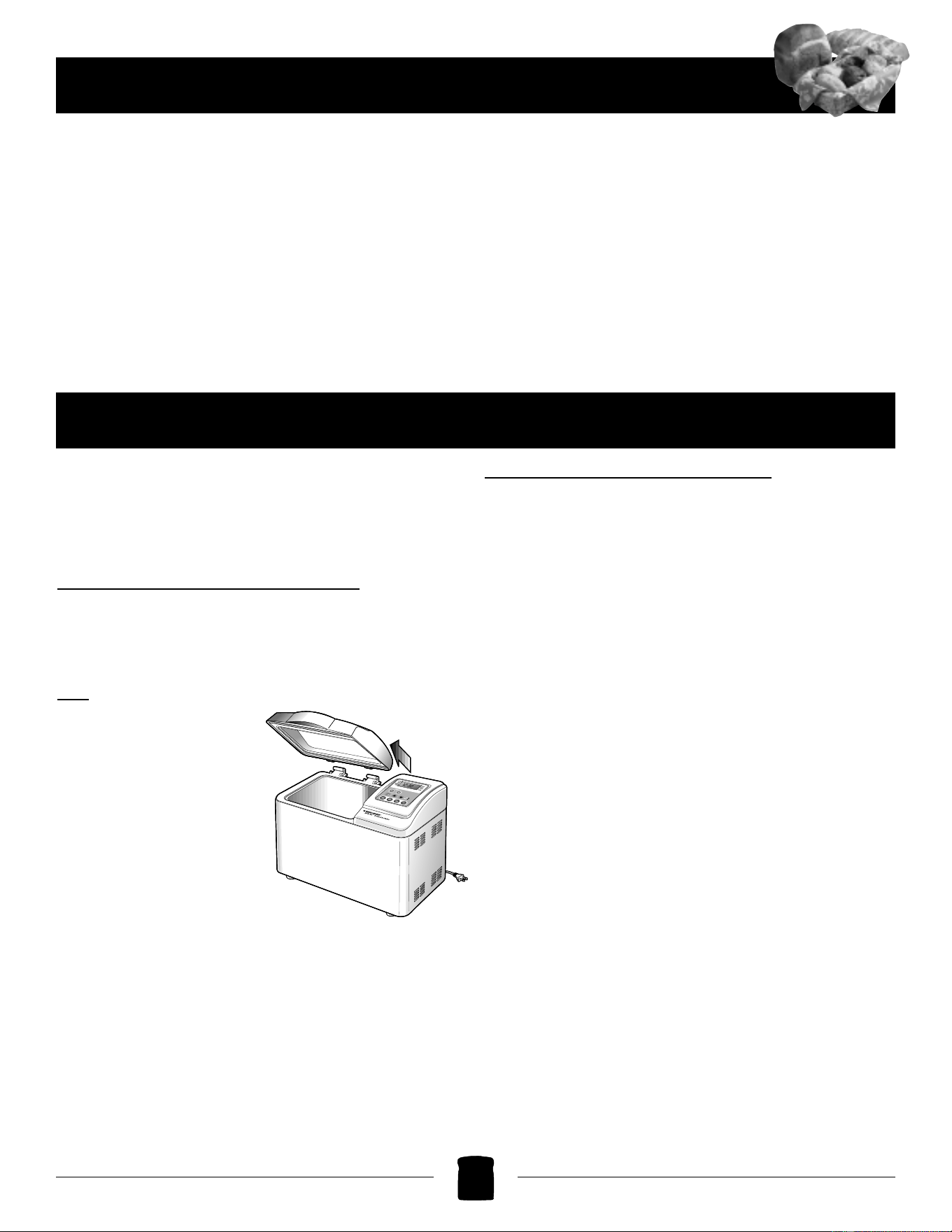
This unit has a removable
Lid for easy cleaning.
Open the Lid halfway and
pull it out towards you.
Wipe it with a damp cloth
or slightly dampened
sponge. DO NOT
IMMERSE THE LID in liq-
uid. Clean the viewing
window with a moist soft
cloth (not paper towel),
then be sure to wipe it dry.
CAUTION: DO NOT clean
window with a commercial glass cleaner!
When reinstalling the lid, be sure the posts on the lid
are fully inserted into the slots on the hinge of the
Breadmaker. This will prevent damage when
closing the lid. If you feel resistance when you try to
close the lid, stop immediately and reposition it.
The lid should close easily without any force being
applied.
B
aking Pan and Mixing Paddle
Both the Baking Pan and Mixing Paddle have a non-
stick coated surface. Do not use any harsh cleaners
or utensils on these parts as scratching may occur.
Over time, the non-stick surface may change in
color due to moisture and steam. This is normal
and has no effect on its use or quality.
Remove the Baking Pan and Mixing Paddle from the
oven chamber before cleaning. Wipe the outside of
the Baking Pan with a damp cloth. Be careful not to
damage the rubber seal under the shaft. NEVER
TOTALLY IMMERSE THE BAKING PAN in water.
You can hand wash the inside of the Baking Pan
with soapy water. The Mixing Paddle should be
removed from the shaft and the depressed area
under the Paddle cleaned. If the Mixing Paddle is
hard to remove from the Baking Pan after baking, fill
the Pan with hot water and let soak for 30 minutes
to an hour. Next, pour out the water, turn the Pan
over and wiggle the Paddle loose while holding the
winged coupling on the bottom of the Pan. Using a
toothpick or soft kitchen brush, clean out any dough
left in the hole of the Paddle.
CAUTION: None of the breadmaker parts are
dishwasher-safe. DO NOT place the Baking Pan,
Removable Lid, or Mixing Paddle in the dishwasher.
Storing The Unit
Be sure to dry all parts before storing and wipe any
moisture from the Viewing Window. To prevent loss,
you may want to store the Mixing Paddle on the
shaft. Close the Lid and do not store anything on
top of the Lid.
Care & Cleaning
13
Service Or Repair
For service, repair, or any questions regarding your
appliance, call the appropriate “800” number on the
cover of this book. Do NOT return the product to
the place of purchase. Do NOT mail the product
back to the manufacturer nor bring it to a service
center. You may also want to consult the website
listed on the cover of this manual.
Full One-Year Warranty
Applica warrants this product against any defects
that are due to faulty material or workmanship
for a one-year period after the original date of
consumer purchase. This warranty does not include
damage to the product resulting from accident,
misuse, or repairs performed by unauthorized
personnel.
If the product should become defective within the
warranty period, or you have questions regarding
warranty or service, call Consumer Assistance
and Information toll free at: 1-800-231-9786.
This warranty gives you specific legal rights, and you
may also have other rights which vary from state to
state or province to province.
Answers to any questions regarding warranty or
service locations may be obtained by calling or by
writing:
In the U.S.A. or C
anada
Consumer Assistance and Information
Applica Consumer Products, Inc.
6 Armstrong Road
Shelton, Connecticut 06484
1-800-231-9786
120 V, 60 Hz, AC Only, 600 Watts
Listed for use in Canada and the U.S.A. by Underwriters
Laboratories, Inc.
and Canadian Standards Association
Copyright ©1998-2000 Applica Consumer Products, Inc.
Pub No. 174598-00-RV01
Printed in People’s Republic of China
14
Applica Consumer Products, Inc.
* is a trademark of The Black & Decker Corporation, Towson, Maryland, USA
*
15
For Black & Decker Breadmaker
Model B2000
*

Some ingredients differ between Canada and the
United States. Cheese, confectioner’s (icing) sugar,
and cornmeal are just a few ingredients that vary
between the two countries. The major difference is
in flour.
Flours
Canadian flours are milled from harder wheats so
breads can be successfully made from national
brands of both
All-Purpose Flour and Bread Flour.
U.S. “All-Purpose Flour” will produce poor results
and should not be used with this unit. In the U.S., it
is important to use
“Bread Flour” for even-textured
loaves.
● Bread flour is processed from hard wheat and is
high in the protein substance called gluten.
When mixed and kneaded, the gluten stretches
and incorporates air bubbles to produce a light,
fine-textured loaf. The stretchy resilience of
gluten makes this kind of flour most tolerant to
high temperatures, altitude, or high humidity.
● Canadian “All-Purpose Flour”is easy to find
and has been extensively tested with the recipes
included in this book with good results.
Canadian Bread Flour may also be used with
good results.
● Whole wheat and multi-grain flours contain
the bran and germ of the grain. Although higher
in fiber, these flours are lower in gluten than
bread flour. Rye flour does not contain any
gluten and therefore, must be used in combina-
tion with other flours. Whole wheat, multi-grain
and rye flour typically produce shorter, denser
loaves. Whole wheat flours vary greatly between
the United States and Canada and from one
brand to another. The recipes have been devel-
oped and tested using nationally available
brands of flour.
Fat
● Butter, margarine or vegetable shortening are
often interchangeable in most bread recipes.
Vegetable oil should not be substituted for
shortening, butter or margarine (fat adds flavor
and tenderness to the dough).
Low-fat (diet)
margarines are high in water content but may
be substituted with acceptable results for people
on a low fat diet.
Salt
● In very small amounts, salt adds flavor and
controls the rising action of the yeast, allowing
the dough to rise evenly. In high altitude areas,
additional salt may be needed to improve bread
results, however, keep in mind that too much
salt may prevent the bread from rising.
L
iquid
● Milk—whole, 1% or 2% fat, skim, buttermilk, or
reconstituted (powdered) dry milk, and water
are the most commonly used liquids in bread
recipes. Milk provides a soft crust, and gives
bread a velvety texture. If your recipe calls for
powdered milk and you prefer to use fresh milk,
simply substitute the milk for the water and
powder. Water makes a crisper crust.
S
weeteners
● Natural sweeteners, such as white or brown
sugar, honey, and molasses help the yeast in a
recipe to grow. Sugar serves as food for the
yeast. Without sugar, the yeast will not grow and
the bread will not rise. The balance of sugar, salt,
and yeast is a very important part of the bread
making process. Sweeteners enhance the bread
flavor and the browning process. If you prefer to
use a sugar substitute, your baking results may
vary with the type and amount of sugar
substitute used.
Y
east
● Yeast is a heat-sensitive plant that feeds on the
sugar in dough. Too much heat will kill the
yeast, too little will slow the yeast action. Check
the expiration date to be sure the yeast is fresh.
The recipes in this cookbook have been tested
with Traditional Dry yeast but you may also use
Bread Machine yeast.
*See the test for yeast freshness on the next page.
16
Bread & Dough Ingredients
● Use only fresh ingredients.
● In the U.S.:
Use Bread Flour; I
n Canada: Use
All-Purpose Flour or Canadian Bread Flour.
● Use lukewarm water – not cold water.
● Measure ingredients accurately and level off
dry ingredients with the flat side of a knife or
metal spatula. (See page 8 for measuring
techniques).
● When recipes call for a “lightly floured surface,”
use about 1 to 2 tablespoons flour on the
surface. You may want to lightly flour your
fingers or rolling pin for easy dough
manipulation.
● Recipes referring to a “greased/oiled” bowl call
for about 1 tablespoon oil or soft vegetable
shortening spread on the bottom and sides of
the bowl. You may prefer to use a non-stick
vegetable spray to “grease” the bowl to cut down
on added fats and calories.
● When you let dough “rest” and “rise” according
to a recipe, place it in a warm, draft-free area.
For best results, cover the dough with waxed
paper and a clean, dry towel. If the dough does
not double in size, it may not produce a tender
product.
● Dough may be wrapped in plastic and stored in
a freezer for later use. Bring the dough to room
temperature before using.
Bread & Dough Ingredients
* The following test can be used to determine
whether your yeast is stale and inactive:
A) Place 1/2 cup of lukewarm water into a
small cup or bowl.
B) Stir 1 tsp. of sugar into the water then
sprinkle 2 tsp. of yeast over the surface.
C) Place bowl or cup in a warm area and allow
to sit for 10 minutes undisturbed.
D) The mixture should foam and produce a
strong yeast aroma. If this does not occur,
fresh yeast should be purchased.
Tips For Getting The Best Results
Tips For Handling Dough
17
18
Recipe Index
Basic
Basic White . . . . . . . . . . . . . . . . . . . . . . . . . . . . . . . . . . . . . . . . . . . . . . . . . . . . . . . . . . . . . . . . . . . . . . . . . . . . . . . . . . . . 19
White Bread Variations . . . . . . . . . . . . . . . . . . . . . . . . . . . . . . . . . . . . . . . . . . . . . . . . . . . . . . . . . . . . . . . . . . . . . . . . . 19
Bran Muffin Bread . . . . . . . . . . . . . . . . . . . . . . . . . . . . . . . . . . . . . . . . . . . . . . . . . . . . . . . . . . . . . . . . . . . . . . . . . . . . . . 19
Irish Soda Bread . . . . . . . . . . . . . . . . . . . . . . . . . . . . . . . . . . . . . . . . . . . . . . . . . . . . . . . . . . . . . . . . . . . . . . . . . . . . . . . 20
Corn Bread . . . . . . . . . . . . . . . . . . . . . . . . . . . . . . . . . . . . . . . . . . . . . . . . . . . . . . . . . . . . . . . . . . . . . . . . . . . . . . . . . . . . . 20
Breadmaker Sour Dough Bread . . . . . . . . . . . . . . . . . . . . . . . . . . . . . . . . . . . . . . . . . . . . . . . . . . . . . . . . . . . . . . . . . 20
Sour Dough Starter . . . . . . . . . . . . . . . . . . . . . . . . . . . . . . . . . . . . . . . . . . . . . . . . . . . . . . . . . . . . . . . . . . . . . . . . . . . . . 21
Super Rapid Bake
Super Rapid Basic White . . . . . . . . . . . . . . . . . . . . . . . . . . . . . . . . . . . . . . . . . . . . . . . . . . . . . . . . . . . . . . . . . . . . . . . . 21
Super Rapid Lemon Poppy Seed . . . . . . . . . . . . . . . . . . . . . . . . . . . . . . . . . . . . . . . . . . . . . . . . . . . . . . . . . . . . . . . . . 21
Super Rapid Italian Herb . . . . . . . . . . . . . . . . . . . . . . . . . . . . . . . . . . . . . . . . . . . . . . . . . . . . . . . . . . . . . . . . . . . . . . . 22
Sweet
Tangy Ginger Bread . . . . . . . . . . . . . . . . . . . . . . . . . . . . . . . . . . . . . . . . . . . . . . . . . . . . . . . . . . . . . . . . . . . . . . . . . . . . . 22
Raisin Cinnamon Bread . . . . . . . . . . . . . . . . . . . . . . . . . . . . . . . . . . . . . . . . . . . . . . . . . . . . . . . . . . . . . . . . . . . . . . . . . 23
Cheesy Cheese Bread . . . . . . . . . . . . . . . . . . . . . . . . . . . . . . . . . . . . . . . . . . . . . . . . . . . . . . . . . . . . . . . . . . . . . . . . . . . . 23
Aloha Bread . . . . . . . . . . . . . . . . . . . . . . . . . . . . . . . . . . . . . . . . . . . . . . . . . . . . . . . . . . . . . . . . . . . . . . . . . . . . . . . . . . . . 23
Chocolate Bread . . . . . . . . . . . . . . . . . . . . . . . . . . . . . . . . . . . . . . . . . . . . . . . . . . . . . . . . . . . . . . . . . . . . . . . . . . . . . . . . 23
Grain
100% Whole Wheat Bread . . . . . . . . . . . . . . . . . . . . . . . . . . . . . . . . . . . . . . . . . . . . . . . . . . . . . . . . . . . . . . . . . . . . . . . 24
Cracked Wheat Bread . . . . . . . . . . . . . . . . . . . . . . . . . . . . . . . . . . . . . . . . . . . . . . . . . . . . . . . . . . . . . . . . . . . . . . . . . . . 24
Oatmeal Nut Bread . . . . . . . . . . . . . . . . . . . . . . . . . . . . . . . . . . . . . . . . . . . . . . . . . . . . . . . . . . . . . . . . . . . . . . . . . . . . . 24
Caraway Rye Bread . . . . . . . . . . . . . . . . . . . . . . . . . . . . . . . . . . . . . . . . . . . . . . . . . . . . . . . . . . . . . . . . . . . . . . . . . . . . . 25
Hearty Pumpernickel Bread . . . . . . . . . . . . . . . . . . . . . . . . . . . . . . . . . . . . . . . . . . . . . . . . . . . . . . . . . . . . . . . . . . . . . 25
Dough
Foccacia (Italian Flat Bread) . . . . . . . . . . . . . . . . . . . . . . . . . . . . . . . . . . . . . . . . . . . . . . . . . . . . . . . . . . . . . . . . . . . . . 26
Baked Pretzels . . . . . . . . . . . . . . . . . . . . . . . . . . . . . . . . . . . . . . . . . . . . . . . . . . . . . . . . . . . . . . . . . . . . . . . . . . . . . . . . . . 26
Pizza Dough . . . . . . . . . . . . . . . . . . . . . . . . . . . . . . . . . . . . . . . . . . . . . . . . . . . . . . . . . . . . . . . . . . . . . . . . . . . . . . . . . . . 27
Sweet Dough . . . . . . . . . . . . . . . . . . . . . . . . . . . . . . . . . . . . . . . . . . . . . . . . . . . . . . . . . . . . . . . . . . . . . . . . . . . . . . . . . . . 27
Traditional Sour Dough . . . . . . . . . . . . . . . . . . . . . . . . . . . . . . . . . . . . . . . . . . . . . . . . . . . . . . . . . . . . . . . . . . . . . . . . . 28
Bake
Banana Nut Bread . . . . . . . . . . . . . . . . . . . . . . . . . . . . . . . . . . . . . . . . . . . . . . . . . . . . . . . . . . . . . . . . . . . . . . . . . . . . . . 29
Caramel Monkey Bread . . . . . . . . . . . . . . . . . . . . . . . . . . . . . . . . . . . . . . . . . . . . . . . . . . . . . . . . . . . . . . . . . . . . . . . . . 29
19
Basic
*In Canada, use either bread flour or all-purpose flour;
in U.S., use bread flour.
These are the recipes you will bake time after time. Try these recipes first.
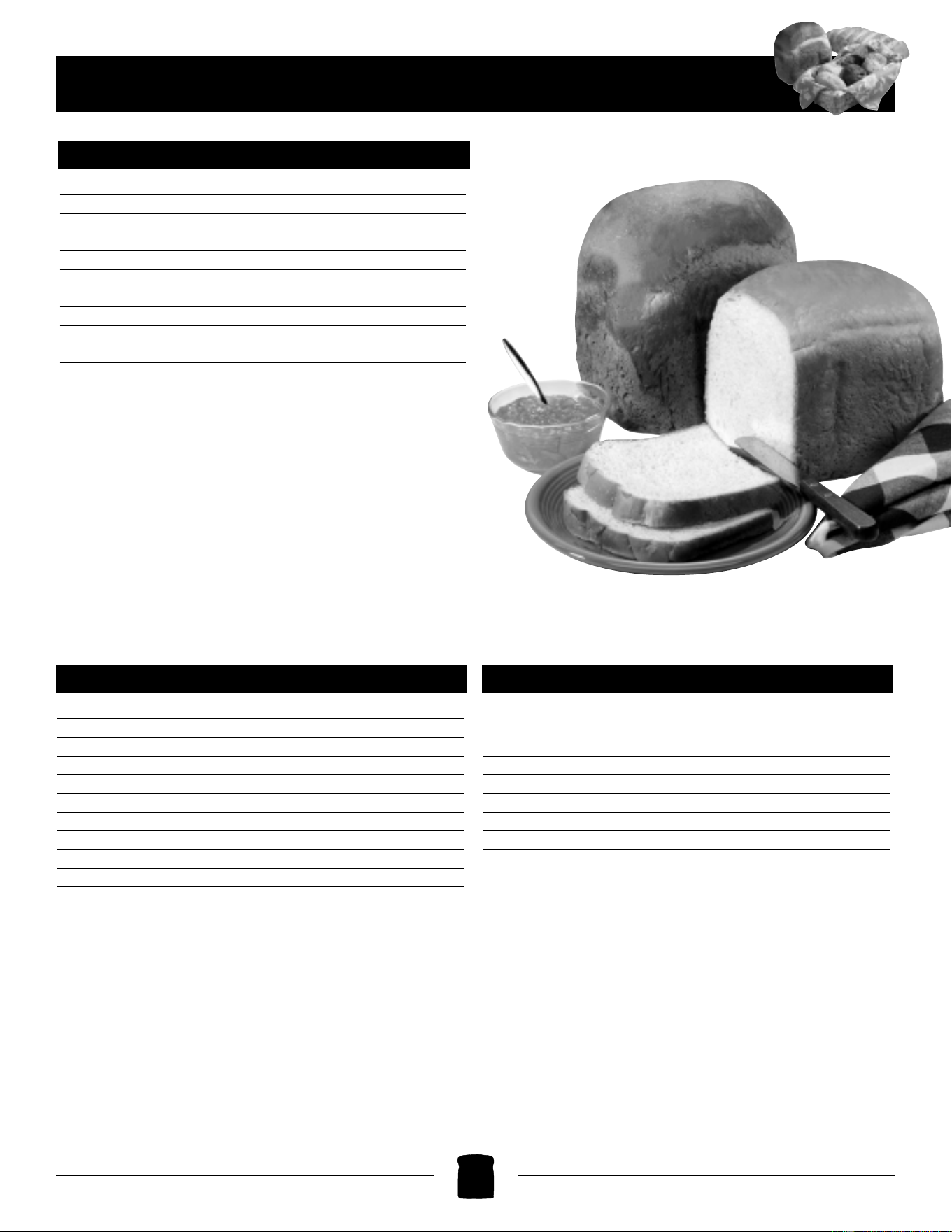
BASIC WHITE
BRAN MUFFIN BREAD
1-1/3 cups lukewarm water
2 tablespoons powdered milk
1-1/2 teaspoons salt
1 tablespoon sugar
2 tablespoons butter or margarine
3-3/4 cups white flour*
1 teaspoon yeast
1. Measure ingredients in the order listed into Baking Pan.
2. Insert Baking Pan securely into unit; close lid.
3. Select BASIC setting and REGULAR or DARK crust.
4. Push Start button. There will be a 15-minute preheat delay
before mixing begins.
5. The Complete Signal will sound when bread is done.
6. Using pot holders, remove Baking Pan from the unit and care-
fully turn bread out of Baking Pan. (Mixing paddle may
remain in bread. Remove paddle when loaf is cool.)
7. Allow to cool before slicing.
Time: 3:50 hours
1. Measure first 7 ingredients in the order listed into Baking Pan.
2. Insert Baking Pan securely into unit; close lid.
3. Select BASIC setting and REGULAR or DARK crust.
4. Push Start button. There will be a 15-minute preheat delay
before mixing begins.
5. At Add Ingredient beep, add raisins.
6. The Complete Signal will sound when bread is done.
7. Using pot holders, remove Baking Pan from the unit and care-
fully turn bread out of Baking Pan. (Mixing paddle may remain
in bread. Remove paddle when loaf is cool.)
8. Allow to cool before slicing.
Time: 3:50 hours
WHITE BREAD VARIATIONS
For Breadsticks:
Prepare White Bread recipe and use Dough setting.
Divide dough into 24 equal pieces.
Shape each piece into a narrow 8-inch (20 cm) long rope.
Place on greased baking sheets.
Brush with milk and sprinkle with dried onion flakes or garlic powder.
Cover and let rise 40 - 50 minutes, or until doubled in size. Place a pan of
hot water on lower rack of oven.
Bake in preheated 375°F (191°C) oven for about 20 minutes.
For Crusty Rolls:
Prepare White Bread recipe as above.
Divide dough into 16 equal pieces.
Shape each piece into a 2-inch (5 cm) ball and place on greased
baking sheet.
Cover and let rise 50 - 60 minutes, or until doubled in size. Place a pan of
hot water on lower rack of oven.
Bake in a preheated 375°F (191°C) oven for 17 - 20 minutes.
For Butter-top Rolls:
Prepare White Bread recipe as above.
Divide dough into 16 equal pieces.
Shape each piece into a 3-inch (7.6 cm) oval.
Place on greased baking sheet.
With a sharp knife, partially slit top making a 1/4-inch (.64 cm) deep cut.
Brush tops with butter and sprinkle with cornmeal.
Cover and let rise 50 - 60 minutes.
Place a pan of hot water on lower rack of oven.
Bake in a preheated 375°F (191°C) oven for 17 - 20 minutes.
Poppy Pan Rolls:
Prepare White Bread recipe as above.
Divide dough into 24 equal pieces.
Shape each piece into a 2-inch (5 cm) ball.
Dip top into melted butter and then into poppy seeds. Place in greased
muffin pans.
Cover and let rise for about 60 minutes, or until doubled in size.
Bake in a preheated 375°F (191°C) oven for 17 - 20 minutes.
1-1/4 cups lukewarm water
3 tablespoons molasses
2 teaspoons sugar
2 tablespoons butter
1 teaspoon salt
3 cups white flour*
1/2 cup bran cereal
1-1/4 teaspoons yeast
Add Ingredient: 1/2 cup raisins
*In Canada, use either bread flour or all-purpose flour;
in U.S., use bread flour.
Basic
IRISH SODA BREAD
1-1/3 cups milk
2 tablespoons butter or margarine
2 teaspoons sugar
2 teaspoons caraway seeds
1/2 teaspoon salt
1/2 teaspoon baking soda
3-1/3 cups white flour*
1 teaspoon yeast
Add Ingredient: 1/3 cup raisins
1. Measure first 8 ingredients in the order listed into Baking Pan.
2. Insert Baking Pan securely into unit; close lid.
3. Select BASIC setting and REGULAR or DARK crust.
4. Push Start button. There will be a 15-minute preheat delay
before mixing begins.
5. At Add Ingredient beep, add raisins.
6. The Complete Signal will sound when bread is done.
7. Using pot holders, remove Baking Pan from the unit and care-
fully turn bread out of Baking Pan. (Mixing paddle may remain
in bread. Remove paddle when loaf is cool.)
8. Allow to cool before slicing.
Time: 3:50 hours
20
CORN BREAD
1 cup lukewarm water
2 tablespoons powdered milk
1/4 cup honey
3 tablespoons butter or margarine
1 teaspoon salt
3 cups white flour*
1/2 cup cornmeal
1-1/4 teaspoons yeast
Add Ingredient: 1/2 cup frozen corn kernels
1. Measure first 8 ingredients in the order listed into Baking Pan.
2. Insert Baking Pan securely into unit; close lid.
3. Select BASIC setting and REGULAR or DARK crust.
4. Push Start button. There will be a 15-minute preheat delay
before mixing begins.
5. At Add Ingredient beep, add frozen corn.
6. The Complete Signal will sound when bread is done.
7. Using pot holders, remove Baking Pan from the unit and care-
fully turn bread out of Baking Pan. (Mixing paddle may
remain in bread. Remove paddle when loaf is cool.)
8. Allow to cool before slicing.
Time: 3:50 hours
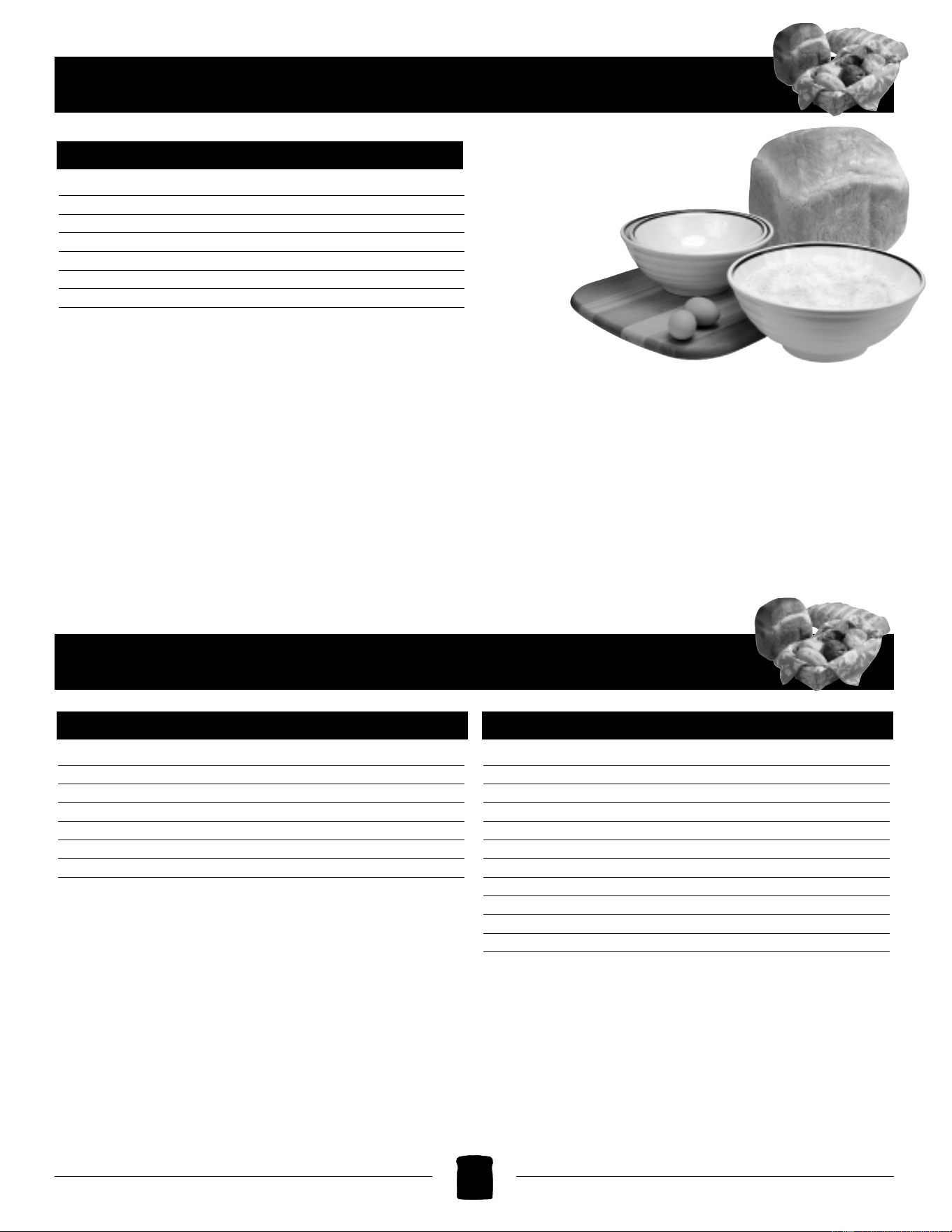
BREADMAKER SOUR DOUGH BREAD
(Bakes in the Baking Pan)
2/3 cup lukewarm water**
1-1/2 teaspoons salt
1-1/2 teaspoons sugar
3-1/2 cups white flour*
1-3/4 cups Sour Dough Starter (
see recipe on page 21)
2-1/2 teaspoons yeast
1. Measure all ingredients in the order listed into Baking Pan.
2. Insert Baking Pan securely into unit; close lid.
3. Select BASIC setting and REGULAR or DARK crust.
4. Push start button. There will be a 15-minute preheat delay before
mixing begins.
5. The Complete Signal will sound when the bread is done.
6. Using a pot holder, remove Baking Pan from the unit and care-
fully turn bread out of Baking Pan. (Mixing paddle may remain
in bread. Remove paddle when loaf is cool.)
7. Allow to cool before slicing.
Time: 3:50 hours
** When using American bread flour, use 1/2 cup water instead of 2/3 cup.
Note: For traditional Sour Dough Bread, which bakes in an
oven, see page 28.
Basic
21
1. Heat the milk (do not boil) and add 1 cup water. Allow liquid mixture to cool to lukewarm. Pour into a large glass or ceramic bowl.
2. Add sugar, salt and flour and beat until well blended.
3. Cover with a clean towel and allow to sit in a draft-free place for 3 to 4 days. (The mixture should become bubbly.)
4. Heat 1/2 cup water to about 100°F (43°C). and dissolve yeast in the water. Pour yeast mixture into starter and mix until well blended.
5. Cover with a clean towel and leave at room temperature for 5 to 7 days. Mixture may separate; stir each day if desired.
6. Store completed starter in refrigerator.
7. To use starter, bring to room temperature and allow it to bubble.
8. To replenish starter (this should be done after each use), add 1-1/2 cups all-purpose flour and 1-1/2 cups lukewarm water
to the remaining starter. Mix well.
9. Refrigerate starter until ready to use again.
Note: Do not be concerned if your starter does not bubble a great deal. It may still be used in the bread and the
bread will have a mild sour dough flavor.
SOUR DOUGH STARTER
1 cup skim milk
1 cup lukewarm water
1 tablespoon sugar
1 teaspoon salt
2 cups all-purpose white flour
1/2 cup water
2-1/4 teaspoons yeast
Super Rapid Bake
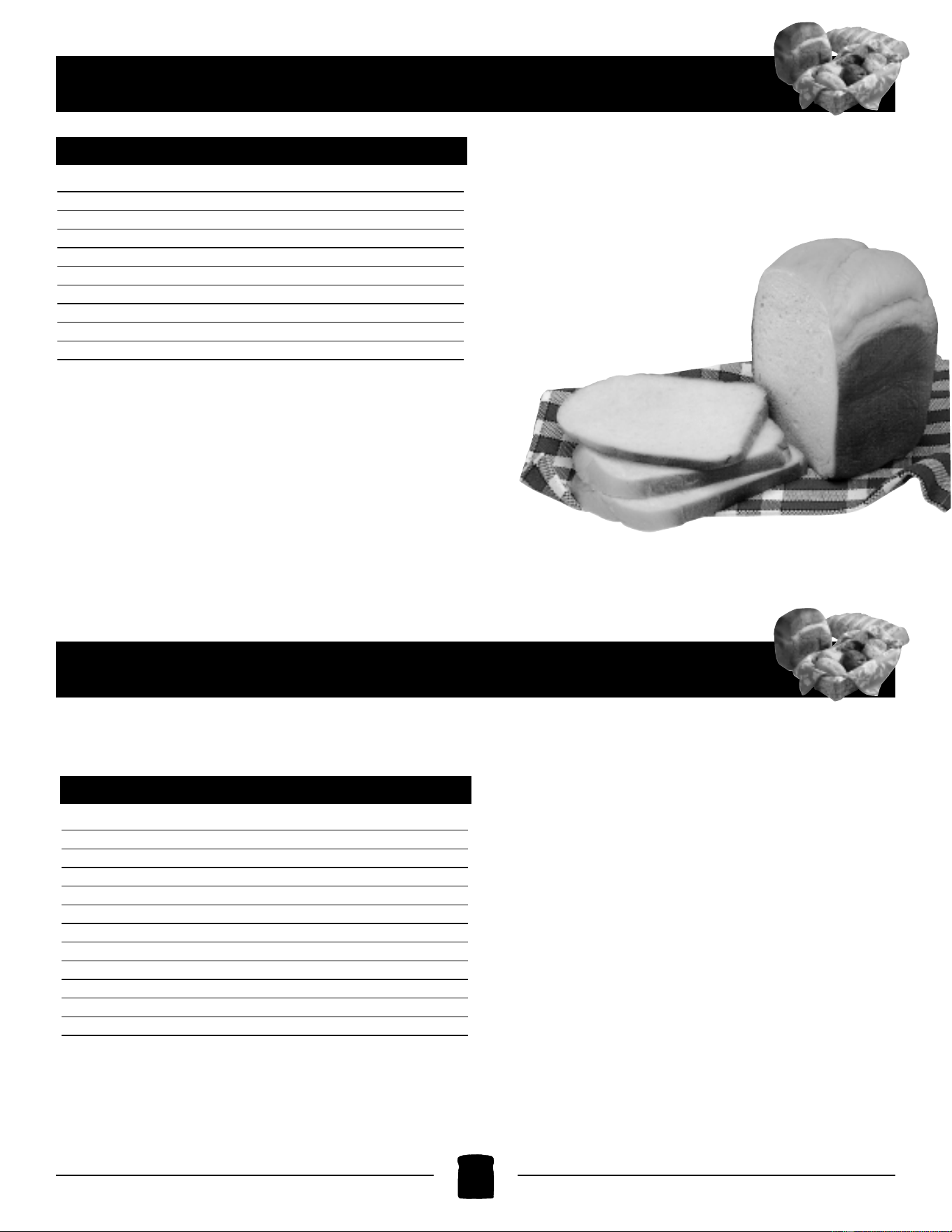
SUPER RAPID BASIC WHITE
1-1/4 cups lukewarm water
3 tablespoons powdered milk
1/2 teaspoon salt
3 tablespoons sugar
3 tablespoons butter or margarine
3-1/4 cups white flour*
4 teaspoons yeast
1. Measure ingredients in the order listed into Baking Pan.
2. Insert Baking Pan securely into unit; close lid.
3. Select RAPID setting and REGULAR or DARK crust.
4. Push Start button.
Mixing begins immediately.
5. The Complete Signal will sound when bread is done.
6. Using pot holders, remove Baking Pan from the unit and
carefully turn bread out of Baking Pan. (Mixing paddle may
remain in bread. Remove paddle when loaf is cool.)
7. Allow to cool before slicing.
Time: 1:10 hours
SUPER RAPID LEMON POPPY SEED
1-1/4 cups lukewarm water
1-1/2 teaspoons lemon juice, freshly squeezed
2 tablespoons powdered milk
3/4 teaspoons salt
2 tablespoons sugar
2 tablespoons butter or margarine
3 cups white flour*
1/2 teaspoon nutmeg
2 teaspoons lemon rind, freshly grated
2 tablespoons poppy seeds
4 teaspoons yeast
1. Measure ingredients in the order listed into Baking Pan.
2. Insert Baking Pan securely into unit; close lid.
3. Select RAPID setting and REGULAR or DARK crust.
4. Push Start button. Mixing begins immediately.
5. The Complete Signal will sound when bread is done.
6. Using pot holders, remove Baking Pan from the unit and careful-
ly turn bread out of Baking Pan. (Mixing paddle may remain in
bread. Remove paddle when loaf is cool.)
7. Allow to cool before slicing.
Time: 1:10 hours
*In Canada, use either bread flour or all-purpose flour;
in U.S., use bread flour.
Super Rapid Bake
22
Sweet
1. Measure ingredients in the order listed into Baking Pan.
2. Insert Baking Pan securely into unit; close lid.
3. Select RAPID setting and REGULAR or DARK crust.
4. Push Start button. Mixing begins immediately.
5. The Complete Signal will sound when bread is done.
6. Using pot holders, remove Baking Pan from the unit and
carefully turn bread out of Baking Pan. (Mixing paddle may
remain in bread. Remove paddle when loaf is cool.)
7. Allow to cool before slicing.
Time: 1:10 hours
SUPER RAPID ITALIAN HERB
1-1/3 cups lukewarm water
3 tablespoons powdered milk
1/2 teaspoon salt
3 tablespoons sugar
3 tablespoons butter or margarine
3-2/3 cups white flour*
1-1/2 teaspoons dried basil
1-1/2 teaspoons dried marjoram
1-1/2 teaspoons dried thyme
4 teaspoons yeast
TANGY GINGER BREAD
1 cup lukewarm water
1 large egg, slightly beaten
1/4 cup packed brown sugar
2 tablespoons powdered milk
2 tablespoons butter or margarine
1-1/2 tablespoons molasses
3 teaspoons grated orange rind
1-1/2 teaspoons ground ginger
1 teaspoon cinnamon
1 teaspoon salt
3-1/4 cups white flour*
3/4 teaspoon yeast
1. Measure ingredients in the order listed into Baking Pan.
2. Insert Baking Pan securely into unit.; close lid.
3. Select SWEET setting, and REGULAR or DARK crust.
4. Push Start button. There will be a 15-minute delay before
mixing begins.
5. The Complete Signal will sound when bread is done.
6. Using pot holders, remove Baking Pan from the unit and
carefully turn bread out of Baking Pan. (Mixing paddle may
remain in bread. Remove paddle when loaf is cool.)
7. Allow to cool before slicing.
Time: 3:50 hours
*In Canada, use either bread flour or all-purpose flour;
in U.S., use bread flour.
Enjoy these recipes for a change of pace!
Sweet
RAISIN CINNAMON BREAD
1 egg
water, lukewarm
2 tablespoons packed brown sugar
2 tablespoons powdered milk
1-1/4 teaspoons salt
2 tablespoons butter or margarine
3-3/4 cups white flour*
1 teaspoon cinnamon
1-1/4 teaspoons yeast
Add Ingredient: 1/2 cup raisins
1. Add egg to measuring cup. Fill to 1-1/4 cups mark with
lukewarm water.
2. Add to Baking Pan, along with next 6 ingredients, in the
order listed.
3. Insert Baking Pan securely into unit; close lid.
4. Select SWEET setting, and REGULAR or DARK crust.
5. Push Start button. There will be a 15-minute delay before
mixing begins.
6. At Add Ingredient beep, add raisins
7. The Complete Signal will sound when bread is done.
8. Using pot holders, remove Baking Pan from the unit and
carefully turn bread out of Baking Pan. (Mixing paddle may
remain in bread. Remove paddle when loaf is cool.)
9. Allow to cool before slicing.
Time: 3:50 hours
ALOHA BREAD
1-1/4 cups milk
2 tablespoons butter or margarine
2 tablespoons sugar
1 teaspoon salt
1 teaspoon vanilla or coconut extract
3-1/3 cups white flour*
1/2 cup sweetened coconut flakes
1-3/4 teaspoons yeast
1. Measure ingredients in the order listed into Baking Pan.
2. Insert Baking Pan securely into unit; close lid.
3. Select SWEET setting, and REGULAR or DARK crust.
4. Push Start button. There will be a 15-minute delay before
mixing begins.
5. The Complete Signal will sound when bread is done.
6. Using pot holders, remove Baking Pan from the unit and
carefully turn bread out of Baking Pan. (Mixing paddle may
remain in bread. Remove paddle when loaf is cool.)
7. Allow to cool before slicing.
Time: 3:50 hours
CHOCOLATE BREAD
1 cup milk
1 large egg, beaten
2 tablespoons butter or margarine
2 tablespoons sugar
1 tablespoon cocoa powder
1 teaspoon salt
3-1/3 cups white flour*
1/2 cup chocolate chips
2 teaspoons yeast
1. Measure ingredients in the order listed into Baking Pan.
2. Insert Baking Pan securely into unit; close lid.
3. Select SWEET setting, and REGULAR or DARK crust.
4. Push Start button. There will be a 15-minute delay before
mixing begins.
5. The Complete Signal will sound when bread is done.
6. Using pot holders, remove Baking Pan from the unit and
carefully turn bread out of Baking Pan. (Mixing paddle may
remain in bread. Remove paddle when loaf is cool.)
7. Allow to cool before slicing.
Time: 3:50 hours
CHEESY CHEESE BREAD
3/4 cup lukewarm water
1/2 cup creamed cottage cheese
1/2 cup shredded Swiss cheese
3 tablespoons grated Parmesan Cheese
2 tablespoons sugar
1 tablespoon butter or margarine
1-1/2 teaspoons salt
3 cups white flour*
2 teaspoons yeast
1. Measure ingredients in the order listed into Baking Pan.
2. Insert Baking Pan securely into unit; close lid.
3. Select SWEET setting, and REGULAR or DARK crust.
4. Push Start button. There will be a 15-minute delay before
mixing begins.
5. The Complete Signal will sound when bread is done.
6. Using pot holders, remove Baking Pan from the unit and
carefully turn bread out of Baking Pan. (Mixing paddle may
remain in bread. Remove paddle when loaf is cool.)
7. Allow to cool before slicing.
Time: 3:50 hours
23
*In Canada, use either bread flour or all-purpose flour;
in U.S., use bread flour.
24
Grain
*In Canada, use either bread flour or all-purpose flour;
in U.S., use bread flour.
100% WHOLE WHEAT
1-1/2 cups lukewarm water
2 tablespoons powdered milk
1-1/2 teaspoons salt
2 tablespoons honey
2 tablespoons molasses
2 tablespoons butter or margarine
3-3/4 cups whole wheat flour
1-3/4 teaspoons yeast
1. Measure ingredients in the order listed into Baking Pan.
2. Insert Baking Pan securely into unit; close lid.
3. Select GRAIN setting.
4. Push Start button. There will be a 25-minute preheat delay
before mixing begins.
5. The Complete signal will sound when the dough is done.
6. Using pot holders, remove Baking Pan from the unit and care-
fully turn bread out of Baking Pan. (Mixing paddle may
remain in bread. Remove paddle when loaf is cool.)
7. Allow to cool before slicing.
Time: 4:10 hours
1-1/4 cups lukewarm water
2 tablespoons powdered milk
1-1/4 teaspoons salt
2 tablespoons honey
2 tablespoons butter or margarine
1 cup whole wheat flour
1-1/2 cups white flour*
3/4 cup cracked wheat (bulgar)
1-1/4 teaspoons yeast
CRACKED WHEAT
1. Measure ingredients in the order listed into Baking Pan.
2. Insert Baking Pan securely into unit; close lid.
3. Select GRAIN setting.
4. Push Start button. There will be a 25-minute preheat
delay before mixing begins.
5. The Complete signal will sound when the dough is done.
6. Using pot holders, remove Baking Pan from the unit and
carefully turn bread out of Baking Pan. (Mixing paddle
may remain in bread. Remove paddle when loaf is cool.)
7. Allow to cool before slicing.
Time: 4:10 hours
1-1/3 cups lukewarm water
2 tablespoons powdered milk
1-1/4 teaspoons salt
2 tablespoons molasses
2 tablespoons butter or margarine
1 cup whole wheat flour
2 cups white flour*
1/3 cup oatmeal, quick cooking
2 teaspoons yeast
Add Ingredient: 1/2 cup chopped walnuts or pecans
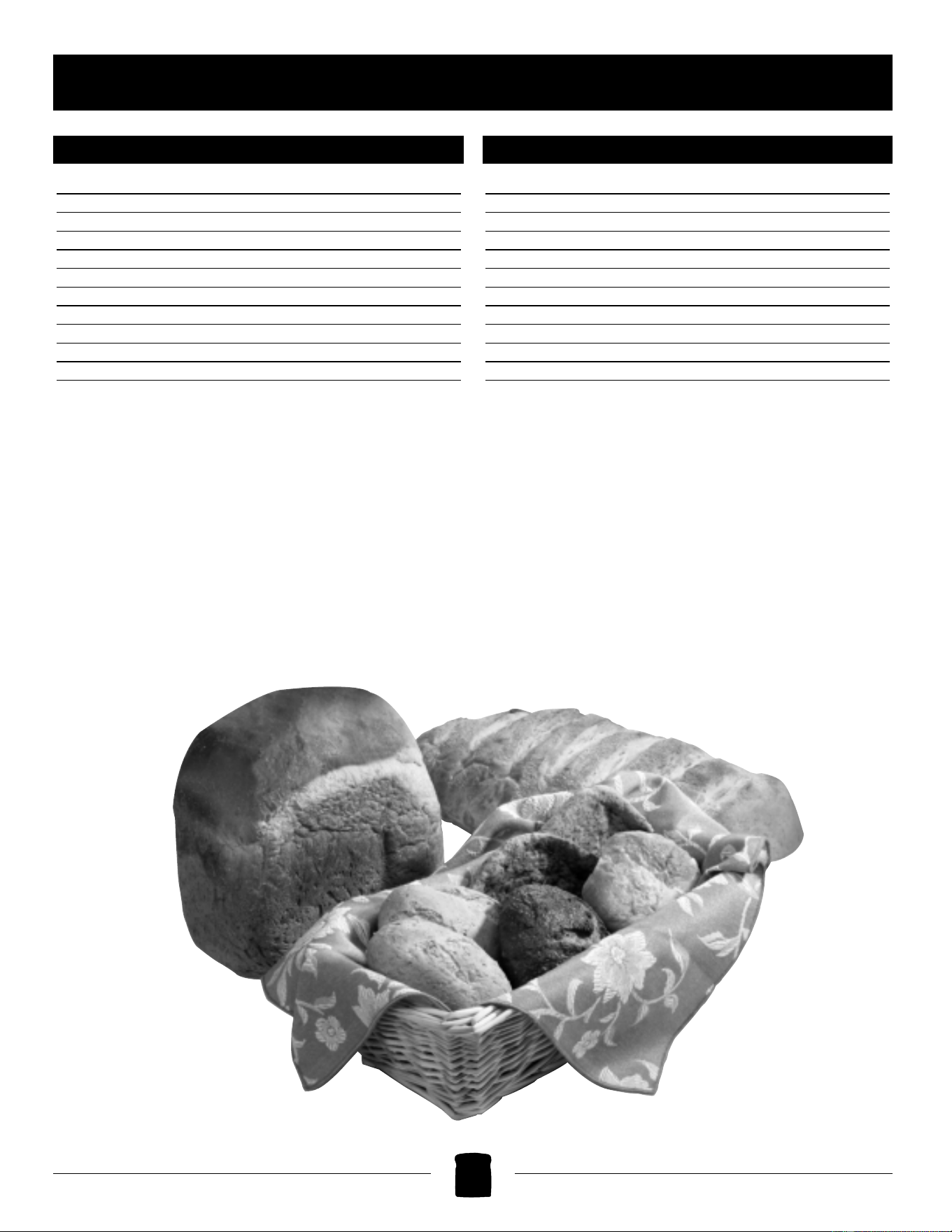
OATMEAL NUT
1. Measure first 10 ingredients in the order listed into Baking Pan.
2. Insert Baking Pan securely into unit; close lid.
3. Select GRAIN setting.
4. Push Start button. There will be a 25-minute preheat delay
before mixing begins.
5. At Add Ingredient beep, add nuts.
6. The Complete signal will sound when the dough is done.
7. Using pot holders, remove Baking Pan from the unit and care-
fully turn bread out of Baking Pan. (Mixing paddle may
remain in bread. Remove paddle when loaf is cool.)
8. Allow to cool before slicing.
Time: 4:10 hours
25
Grain
*In Canada, use either bread flour or all-purpose flour;
in U.S., use bread flour.
CARAWAY RYE
1. Measure ingredients in the order listed into Baking Pan.
2. Insert Baking Pan securely into unit; close lid.
3. Select GRAIN setting and 2.0 lb. loaf setting.
4. Push Start button. There will be a 25-minute preheat delay
before mixing begins.
5. The Complete Signal will sound when bread is done.
6. Using pot holders, remove Baking Pan from the unit and care-
fully turn bread out of Baking Pan. (Mixing paddle may
remain in bread. Remove paddle when loaf is cool.)
7. Allow to cool before slicing.
Time: 4:10 hours
1-1/4 cups lukewarm water
2 tablespoons powdered milk
1 teaspoon salt
2 tablespoons brown sugar
2 tablespoons molasses
2 tablespoons butter or margarine
3/4 cup whole wheat flour
1-3/4 cups white flour*
3/4 cup rye flour
1 tablespoon caraway seeds
1-3/4 teaspoons yeast
HEARTY PUMPERNICKEL
1. Measure ingredients in the order listed into Baking Pan.
2. Insert Baking Pan securely into unit; close lid.
3. Select GRAIN setting and 1.5 lb. loaf setting.
4. Push Start button. There will be a 25-minute preheat delay
before mixing begins.
5. The Complete Signal will sound when bread is done.
6. Using pot holders, remove Baking Pan from the unit and care-
fully turn bread out of Baking Pan. (Mixing paddle may
remain in bread. Remove paddle when loaf is cool.)
7. Allow to cool before slicing.
Time: 4:10 hours
1-1/4 cups lukewarm water
1/3 cup molasses
2 tablespoons cocoa powder
1-1/2 tablespoons vegetable oil
1 tablespoon caraway seeds
1-1/2 teaspoons instant coffee crystals
1-1/2 teaspoons salt
1-1/2 cups white flour*
1 cup + 2 tablespoons whole wheat flour
1 cup + 1 tablespoon rye flour
3 teaspoons yeast
26
*In Canada, use either bread flour or all-purpose flour;
in U.S., use bread flour.
FOCCACIA (Italian Flat Bread)
1 cup lukewarm water
1/4 cup coarsely chopped fresh basil
1/4 cup coarsely chopped chives
2 tablespoons butter or margarine
2 tablespoons chopped garlic
1 teaspoon salt
3 cups white flour*
2 teaspoons yeast
3 tablespoons olive oil, divided
1. Measure first 8 ingredients in the order listed into Baking Pan.
(Not olive oil.)
2. Insert Baking Pan securely into unit; close lid.
3. Select
DOUGH setting and push start button. There will be a
25-minute preheat delay before mixing begins.
4. The Complete Signal will sound when the dough is done.
5. Using a pot holder, remove Baking Pan from the unit and care-
fully turn dough out of Baking Pan and place in a bowl coated
with 1 tablespoon olive oil. Turn dough to coat evenly.
6. Cover and let rest 30 minutes.
7. Divide dough in half, place each half on a 14 x 10-inch
(36 x 25 cm) baking sheet, and roll into 8 x 9-inch (20 x 23
cm) rectangles. Desired thickness is 1/2-inch (1.27 cm).
(All the dough may be rolled onto one larger baking sheet if
desired or rolled into any shape desired.)
8. Brush dough with remaining olive oil (more may be used if
desired).
9. Bake in preheated 425°F (218°C) oven for 20 minutes or until
lightly browned.
10. Allow to cool for 10 minutes and cut into squares.
Time: 2 hours (for dough)
Serving Suggestion:
Great for hors d’oeuvres or with dinner!
BAKED PRETZELS
1 cup beer or water
1 tablespoon butter
2 tablespoons sugar
1 teaspoon salt
2-3/4 cups white flour*
3/4 teaspoon yeast
1 egg, lightly beaten
1 tablespoon water
coarse salt or sesame seeds
1. Measure first 6 ingredients in the order listed into Baking Pan.
2. Insert Baking Pan securely into unit; close lid.
3. Select DOUGH setting.
4. Push the start button. There will be a 25-minute preheat delay
before mixing begins.
5. The Complete Signal will sound when bread is done.
6. Using pot holders, remove Baking Pan from the unit and carefully
turn dough out of Baking Pan onto lightly floured surface. If nec-
essary, knead in enough flour to make dough easy to handle.
7. Roll into a 14 x 9-inch (36 x 23 cm) rectangle.
8. With a sharp knife, cut into eighteen 14 x 1/2-inch (36 x 1.27 cm)
strips.
9. Gently pull each strip into a rope 16 inches (40 cm) long.
10. To shape pretzels, curve ends of each rope to make a circle;
cross ends at top. Twist ends once and lay over bottom of circle.
Place on greased baking sheets. Do not let rise.
11. Combine egg and water; brush on pretzels.
12. Sprinkle with coarse salt or sesame seeds.
13. Place pan of hot water on lower rack of oven.
14. Bake in a preheated 350°F (177°C) oven for 20 - 22 minutes,
or until done.
Time: 2 hours (for dough)
Dough
*In Canada, use either bread flour or all-purpose flour;
in U.S., use bread flour.
Dough
1. Measure first 6 ingredients in the order listed into Baking Pan.
2. Insert Baking Pan securely into unit; close lid.
3. Select DOUGH setting and push start button. There will be a
25-minute preheat delay before mixing begins.
4. The Complete Signal will sound when the dough is done.
5. Using a pot holder, remove Baking Pan from the unit.
6. Remove dough from Baking Pan to a lightly floured surface. If
necessary, knead in enough flour to make dough easy to handle.
7. Grease 12-inch (30 cm) pizza pans and sprinkle with cornmeal
(optional). Divide dough into thirds.
8. Roll out one piece of dough and place on pan or pat in pan.
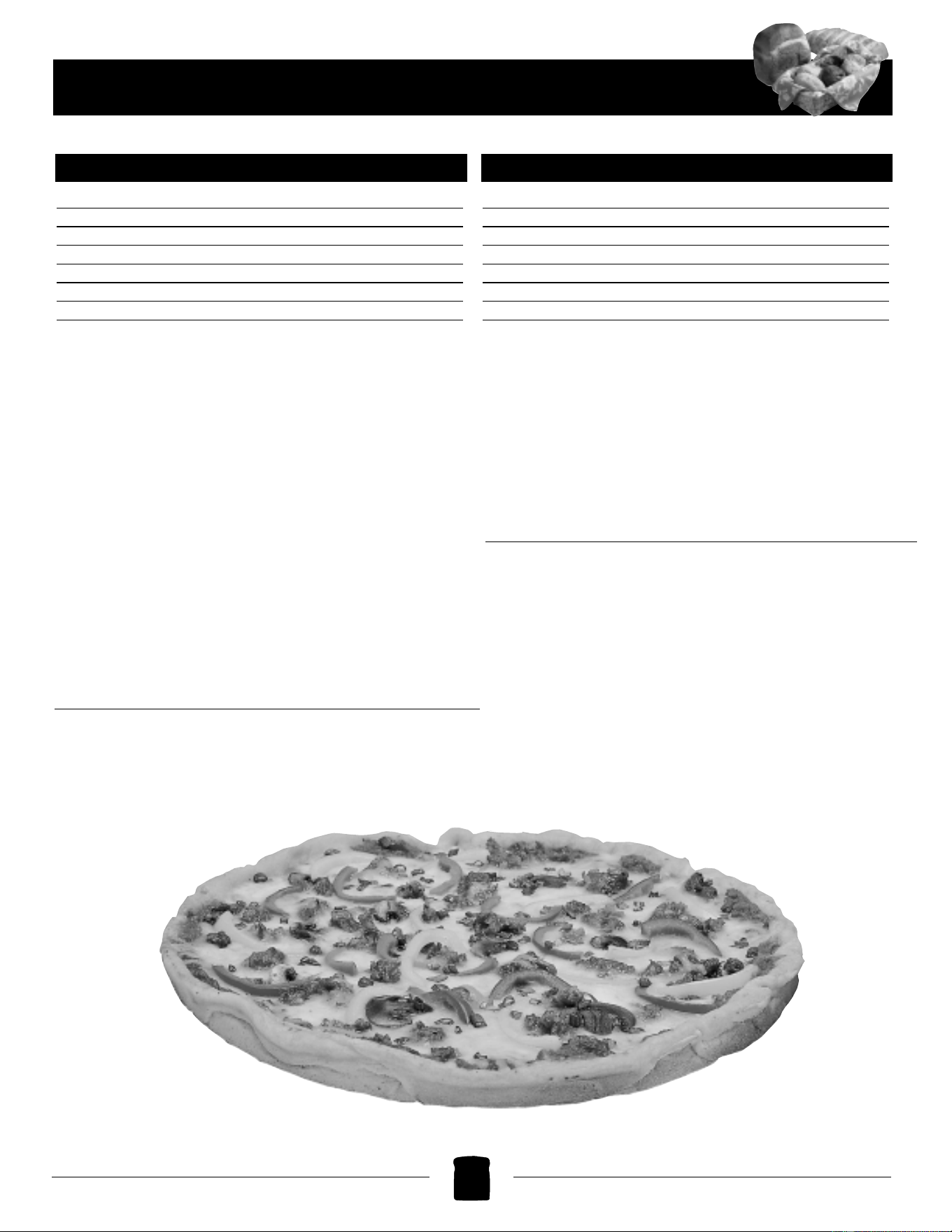
9. Top each pizza with desired pizza topping ingredients, such as
tomato sauce, meat, vegetables and cheese.
10. Bake in preheated 425°F (218°C) oven for 15 to 25 minutes, or
until done. Pizza is done when edges of crust are golden and
cheese is bubbly.
Time: 2 hours (for dough)
Pizza Dough Variation :
For individual pizzas, divide dough into 8 equal pieces.
Roll each piece out to form a 7 - 8 inch (18-20 cm) circle.
Transfer to greased baking sheets.
Top as desired and bake as above.
PIZZA DOUGH
1-1/2 cups beer or water
1-1/2 teaspoons salt
1 tablespoon sugar
2 tablespoons butter or margarine
4-1/4 cups white flour*
2 teaspoons yeast
Pizza Topping Ingredients
1. Measure all ingredients in the order listed into Baking Pan.
2. Insert Baking Pan securely into unit; close lid.
3. Select DOUGH setting and push start button. There will be a
25-minute preheat delay before mixing begins.
4. The Complete Signal will sound when the dough is done.
5. Using a pot holder, remove Baking Pan from the unit and place
dough on lightly floured surface.
6. Let dough rest 10 minutes.
7. Shape as desired and use in favorite sweet dough recipes.
For Cinnamon Rolls:
1. Roll dough into a 9 X 14-inch (23 x 36 cm) rectangle.
2. Brush with melted butter and sprinkle with a cinnamon/sugar
mixture.
3. Roll up jelly roll style, starting with long end.
4. Cut into 1-inch (2.54 cm) slices.
5. Place into greased 9 X 13-inch (23 x 33 cm) pan.
6. Cover and let rise 45 minutes, or until doubled in size.
7. Bake in preheated 350°F (177°C) oven for 20 to 25 minutes, or
until lightly browned.
Time: 2 hours (for dough)
SWEET DOUGH
1/2 cup milk
1 egg, slightly beaten
1/4 cup sugar
2 tablespoons butter or margarine
1/2 teaspoon salt
2-1/2 cups white flour*
2-1/4 teaspoons yeast
27
28
*In Canada, use either bread flour or all-purpose flour;
in U.S., use bread flour.
Dough
TRADITIONAL SOUR DOUGH
(Bakes in the oven)
See pages 20 & 21 for ingredients for Breadmaker Sour Dough Bread
& Sour Dough Starter
1/4 cup cornmeal
1 teaspoon cornstarch
1/2 cup water
1. Measure Breadmaker Sour Dough Bread ingredients in the order listed into Baking Pan.
2. Insert Baking Pan securely into unit; close lid.
3. Select DOUGH setting.
4. Push start button. There will be a 25-minute preheat delay before mixing begins.
5. The Complete Signal will sound when the dough is done.
6. Using a pot holder, remove Baking Pan from the unit and carefully remove dough from Baking Pan onto a floured surface.
7. Shape into a large oval.
8. Place loaf on an ungreased baking sheet; sprinkle with cornmeal and cover with a clean towel.
9. Allow to rise in a warm place for about 45 minutes or until doubled in size.
10. Preheat oven to 400°F (204°C). Fill a 9x13-inch (23 x 33 cm) baking pan with 1/4-inch (.64 cm) hot water and place on
bottom oven rack.
11. In small saucepan, combine cornstarch and water. Bring to a boil while stirring frequently.
12. Remove towel from loaf. Using a sharp knife, cut 1/2-inch (1.27 cm) deep diagonal slashes on the top of the loaf.
13. Brush loaf with cornstarch mixture.
14. Bake in preheated oven and brush with the cornstarch mixture during baking period.
15. Bake for 35 to 45 minutes, or until bread sounds hollow when tapped.
Time: 2 hours (for dough)
*In Canada or the U.S. use all-purpose flour.
Bake
29
1. Add vinegar to measuring cup. Fill to 1/4 mark with milk.
Set aside for 5 minutes.
2. Using a food processor with knife blade in place, add sugar,
butter or margarine and bananas to processor bowl.
3. Process to blend.
4. Add dry ingredients and milk mixture; process to blend.
5. Stop and stir down sides of bowl if necessary and process for
5 more seconds.
6. Add half of batter to Baking Pan. (Remember, since the bat-
ter is already mixed, it’s not necessary to use the mixing
paddle.)
7. Sprinkle half the nuts over batter. Repeat layers.
8. Insert Baking Pan securely into unit; close lid.
9. Select the BAKE setting. Then enter 300°F (154°C) for the
temperature and 1:00 for the time.
10. The Complete Signal will sound when the bread is done.
11. Using a pot holder, remove Baking Pan from the unit and
allow bread to cool in pan for 30 minutes. Then carefully
turn bread out of Baking Pan.
12. Allow to cool before slicing.
Time: 1 hour
BANANA NUT BREAD
1 tablespoon white vinegar
milk
3/4 cup sugar
1/3 cup butter or margarine
2 medium ripe bananas,
each cut into 1-inch (2.54 cm) pieces
2 cups all-purpose flour*
1 teaspoon baking powder
1/2 teaspoon baking soda
1/2 teaspoon salt
1/2 cup chopped walnuts
1. In medium mixing bowl, combine walnuts or pecans, butter,
sugar and cinnamon. Stir to blend.
2. Rolls biscuit quarters into small balls and drop into butter
mixture, about 15 - 20 at a time.
3. Stir to coat and transfer to Baking Pan, arranging evenly in
pan. (Remember, there’s no need to use the mixing paddle.)
4. Continue this process until all biscuit quarters have been used
and are arranged evenly in pan.
5. Scrape any remaining butter mixture over top of biscuits.
6. Insert Baking Pan securely into unit; close lid.
7. Select BAKE setting. Then enter 300°F (154°C) for the
temperature and 1:10 for the time.
8. The Complete Signal will sound when the bread is done.
9. Using a pot holder, remove Baking Pan from unit. Let cool
about 3 - 5 minutes. Then, carefully turn bread out of
Baking Pan.
10. Serve warm.
Time: 1:10 hours
**In the U.S., use 3 cans (7.5 oz/228 g each)
refrigerated buttermilk biscuits.
CARAMEL MONKEY BREAD
1 cup chopped walnuts or pecans
3/4 cup butter, melted
3/4 cup sugar
2 teaspoons cinnamon
2 cans refrigerated country biscuits,
(12 oz./340 g each) each biscuit cut into quarters**

30
Need Help?
Questions About The Breadmaker :
Q1:
What do I do if the mixing paddle stays in the loaf? Is
this normal? How do I remove the paddle?
The mixing paddle may stay in the loaf when the bread is removed
from the bread pan. This happens because the crust forms around
the paddle during the baking process. Allow the loaf to cool before
removing the mixing paddle (the inside of the loaf is VERY HOT-
you may burn yourself if you try to remove the paddle too soon.)
When the loaf has cooled, use a plastic spoon or rubber spatula to
remove the paddle. Gently insert the spoon/spatula into the bot-
tom of the loaf and loosen the crust from the paddle. Pull the pad-
dle out. DO NOT use a sharp object (knife, metal utensil) as it will
scratch the non-stick coating on the mixing paddle.
Q2:
What do I do if the mixing paddle is hard to remove
from the Baking Pan after baking?
Remove the Baking Pan from the unit and fill with hot water allowing it
to soak for 30 minutes to an hour. Next, pour out the water, turn the Pan
over and wiggle the Paddle loose while holding the winged coupling on
the bottom of the Pan. Using a toothpick or soft kitchen brush clean out
any dough left in the hole of the Paddle.
Q3:
Is there any time that I should not
use the delayed start
feature?
Yes, when the recipe calls for perishable ingredients such as milk,
cheese, buttermilk, or eggs. These foods should not stay at room
temperature for an extended period of time. With some recipes,
you may substitute powdered milk.
Q4:
Can I open the lid while the breadmaker is operating?
This breadmaker is designed with a window in the lid to let you
watch your bread’s progress. Quick checks are fine in the early
stages of operation and of course to add ingredients when the beep-
er sounds. However, don’t open the lid too frequently during opera-
tion as the change in air temperature may cause the loaf to fall.
Avoid opening the lid once the baking period begins—the last hour
of the cycle. Sometimes condensation forms on the window after
initial mixing and kneading. It usually disappears once the baking
cycle starts so you should be able to get a clear view of your rising
loaf.
Q5:
Where is the OFF button?
Since the breadmaker shuts off its “processing” automatically once
the bread or dough cycle is complete and the “Keep Warm” cycle
ends, there is no OFF button. However, the power light will remain
on until the unit is unplugged or the Start/Reset button is pressed
and held.
Q6:
If the power goes out while I’m in the middle of a bread-
making cycle, will my Breadmaker continue to process
my bread once the power comes back on?
The breadmaker will only finish making bread if the power returns
within 20 seconds. Unfortunately, if your power outage is longer,
you will have to discard the unfinished bread and start the process
from the beginning.
Q7:
What is the maximum time a cycle can be delayed?
You can delay baking for a maximum of 13 hours for any bread type
setting except rapid bake. The rapid bake setting is designed to
bake bread in under 2 hours.
Q8:
When do I add raisins, nuts, etc. to the bread?
This breadmaker has an “Add-Ingredient” function that signals with
an audible tone to let you know when you may add raisins, nuts,
caraway seeds, etc. (
NOTE:
The time of the tone varies from one
setting to another. Consult the “Add-Ingredient” chart on page 10.)
The “Add-Ingredient” feature helps reduce the breaking up of added
foods . If you are using the Timer and it is more convenient, you
may add ingredients at the start.
Q9:
May I use a sugar substitute in place of sugar?
Sugar is necessary for the yeast to produce a light loaf with a good
height. Results may vary with the type and amount of sugar substi-
tute used. If you are going to use an artificial sweetener choose one
that is aspartame based rather than saccharin based.
Q10:
May I omit the salt or sugar from the recipe?
No, both the sugar and salt play an important role in the bread mak-
ing process. Salt prevents the yeast from over-reacting and the
bread from over-rising. The combination of sugar, salt, and yeast is
a very important part of the bread making process. Remember that
the total sugar and salt amounts are divided among all the slices, so
the amount of sugar and salt per serving is small.
Questions About Ingredients/Recipes :

Need Help?
Q11:
When I make dough, it is very sticky and difficult to
work with. How can I handle it more easily?
Dough may be somewhat sticky at the end of the dough cycle. This
is normal. For best results, turn it out of the Baking Pan onto a
floured surface, cover it and let it rest for 10 minutes. Lightly flour
the board and your hands when handling the dough. This will
make it easier to shape and divide. Once shaped, the dough must
then be baked in a conventional oven.
Q12:
Can I bake products formed from doughs in my
microwave oven?
No, once shaped, the dough must be baked in a conventional oven.
Q13:
How do I know when dough is ready to bake?
Dough should have doubled in size.
Q14:
What is gluten?
Gluten is the protein in flour that makes dough elastic and allows it
to stretch and expand. It gives your bread structure. The amount
of gluten varies from one flour to another. See the “Flours” section.
Q15:
Why do the loaves vary in height and weight? The
whole wheat and multi-grain breads are frequently
shorter. Am I doing something wrong?
No, it is normal for whole wheat and multi-grain breads to be
shorter and denser than basic white breads.Whole wheat and rye
flours are heavier than white flour, therefore, they don’t rise as
much during the bread making process.They also typically have
added ingredients, such as oats, bran, nuts and raisins, which con-
tribute to the shorter height and denser texture.
Q16:
Why is my bread lopsided?
Sometimes when mixing stops, the ball of dough ends up at one
extreme side of the Baking Pan. That’s because in a horizontal
Baking Pan, the Mixing Paddle may bat the dough off to one side.
During the rising cycle, the dough may not have time to spread
evenly throughout the Pan. Though the results may look a little
odd, and you’ll have slices of different sizes, the bread will be just as
delicious as an evenly shaped loaf.
Q17:
Can I use my favorite bread recipes in my bread
machine?
Yes, but you will need to experiment to get the right proportion of
ingredients. Become familiar with the unit and make several
loaves of bread before you begin experimenting. Never exceed a
total amount of 4-1/4 cups of dry ingredients (that includes flours,
oats, cornmeal, bran cereal, cracked wheat, etc.). Use the recipes in
this book to help determine the ratio of dry ingredients to liquid
and amounts of yeast, sugar, salt, and butter/margarine to use.
Q18:
Why does some flour occasionally stick to the side of
the bread?
There are many factors that may affect whether a dough mixes
completely or ingredients stick to the sides:
• Dough may be too dry (ingredients may have been
measured incorrectly).
• Mixing Paddle was not placed correctly in the Baking
Pan. Be sure it is pushed securely onto the shaft.
• Baking Pan is not placed in the unit correctly.
Be sure to “lock”the Pan into place.
• Ingredients were not added in the recommended order.
Sometimes during the initial mixing period, small amounts of flour
and dry ingredients may get stuck to the sides of the Baking Pan.
When the loaf rises and bakes, the dry ingredients may stick to the
bread. Once the loaf is removed from the Baking Pan and has
cooled 10-15 minutes, the dry ingredients may be scraped off the
loaf easily with a knife.
Q19:
Can I make cakes and quick breads (breads that do not
use yeast) in my breadmaker?
Yes, using the “Bake” cycle. Mix the cakes/quick breads in a bowl
and follow manufacturer’s instructions on packaged mixes (except
for baking time and temperature). Remove the Mixing Paddle and
transfer your batter to the Baking Pan. Use the “Bake” setting. The
time and temperature will have to be adjusted. Start with 300°F
(154°C) for 1:30 hrs. check periodically. When done, allow to cool in
the Pan for approximately 30 minutes before removing.
Q20:
Why does my bread rise and then collapse or form
craters?
Your bread may be rising too fast. To decrease the rate of rising, try
reducing the amount of sugar, increasing the amount of salt slight-
ly, or reducing the amount of yeast. Refer to the “Trouble Shooting
Guide” on pg. 12 for correct adjustments.
Q21:
Is it important for ingredients to be at room
temperature before adding them to the Baking Pan?
No, as long as ingredients are not extremely cold or hot. Milk, eggs,
butter/margarine, and yeast can be added directly from the refrig-
erator with good results. When a recipe calls for water, use luke-
warm water since it’s easy to get from the tap.
Q22:
Which kind of yeast is the best to use?
Yeast specially packaged for Bread Machines and Traditional Dry
Yeasts can all be used with good results. The most important thing
is to be sure the expiration date is not up. All the recipes in this
cookbook were developed using Traditional Dry Yeast.
31

32
Need Help?
Q23:
Sometimes when I cut my bread, it’s too sticky and it
falls apart or it starts to mash down and won’t slice
cleanly. What can I do?
If your bread is sticky or mashes down, it may be too hot! Be sure
to allow 15 to 30 minutes for your bread to cool before slicing.
Place finished bread on a wire cooling rack to let air circulate
around it. You may want to try using an electric knife to slice bread
instead of cutting it manually. An electric knife has blades that
slide back and forth to let you slice straight through bread and
avoid mashing it down by putting pressure on the top of the loaf.
Q24:
Why did I end up with a short, dense, doughy bread?
Why didn’t the bread rise?
The most common reason for unrisen bread is the yeast. Maybe
you forgot to add the yeast. Perhaps the yeast was bad or expired
(always check expiration dates). Also, if the mixing wasn’t com-
plete, you may have rising problems. Did you check to see if the
mixing paddle started moving once the preheat period was fin-
ished?
Q25:
What will happen if I leave the bread in the Baking Pan
after baking?
This unit has a 60-minute “Keep Warm” cycle that lets you leave the
bread in the pan for up to an hour after baking is completed. Once
that warming cycle is over, it’s best to remove the bread immediate-
ly or the bottom of your loaf will absorb moisture and become
soggy. The soggy part of the bread will not be as tasty when it dries
out and it will go stale quickly. The sides of the bread may also
become moist and mushy.
Q26:
Can the recipe be cut in half?
No, it is not recommended.The ingredient proportions work better
in the full amounts.
Q27:
How can bread mixes be used in the machine and at
what setting?
The package instructions will list the amount of water and amount
of yeast to use. Be sure to add liquid, then dry ingredients,
followed by yeast. Remember not to allow the yeast to sit in the
liquid.The bread type setting is dependent upon the type of bread
mix being used. i.e.White bread uses the Basic Bread setting; Sweet
Bread setting is for use with dried fruit , cheese or nuts; Whole
wheat or multi-grain should use the Whole Grain setting. Crust
setting either Regular or Dark, is a personal preference.
Other Questions?
Please Call Us Toll Free!
1-800-231-9786
http://www.householdproductsinc.com