Instruction
& Recipe
Booklet
For your safety and continued enjoyment of this product, always
read the instruction book carefully before using.
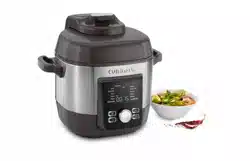
12-in-1 Multicooker
CPC-900 SERIES

2
IMPORTANT
SAFEGUARDS
When using electrical appliances, especially
when children are present, basic safety
precautions should always be taken,
including the following:
1. Read all instructions.
2. Always attach plug to appliance first, before
plugging into wall outlet. To disconnect,
turn unit off, then remove plug from outlet.
3. Do not place the multicooker in a heated
oven or on any stovetop.
4. Do not touch hot surfaces of multicooker.
Use handles only.
5. This appliance should not be used by or near
children or individuals with certain disabilities.
6. NEVER ATTEMPT TO OPEN LID WHILE
THE UNIT IS OPERATING. Do not open the
multicooker until the unit has cooled and all
internal pressure has been released. If lid is
difficult to rotate, this indicates that the cooker
is still pressurized. Do not force it to open.
Any pressure in the multicooker can be
hazardous. See Instructions for Use, page 6.
7. Extreme caution must be used when moving
a multicooker containing hot liquids or foods.
8. Do not use the multicooker for other than its
intended use.
9. This appliance cooks under pressure. Improper
use may result in scalding injury. Make certain
unit is properly closed before operating.
10. Do not fill unit over the Max Fill line (16 cups).
When cooking foods that expand during cooking,
such as dried vegetables, do not fill the unit more
than 12 cups.
NOTE: This includes legumes, beans, and
grains. Overfilling may cause a risk of clogging
the pressure limit valve and developing excess
pressure.
11. To protect against electric shock, do not
immerse cord, plugs, or outer vessel in water
or other liquids.
12. Unplug from outlet when not in use and before
cleaning. Allow to cool before putting on or
removing parts.
13. Do not operate any appliance with a
damaged cord or plug or after the appliance
malfunctions or has been damaged in any
manner. Return appliance to the nearest
authorized service facility for examination,
repair, or electrical or mechanical adjustment.
14.
Do not let cor
d hang over edge of table
or counter, or touch hot surfaces.
15.
Use of accessories not specifically
recommended by Cuisinart may cause
damage to unit.
16.
Do not use outdoors.
17.
Do not use under hanging cabinets; steam
from pressure release may cause damage.
18.
Be awar
e that certain foods, such as
applesauce, cranberries, pearl barley, oatmeal
and other cereals, split peas, noodles, macaroni,
rhubarb, or spaghetti can foam, froth and
sputter, and clog the pressure release devices.
These foods should not be cooked in a
multicooker. NOTE: Your Instruction Booklet
may contain recipes that use the above
ingredients. You must follow recipe exactly
as written.
19.
Always check the pr
essure release devices
for clogging before use.
20.
Do not use this multicooker for pr
essure
frying oil.
21.
Do not operate your appliance in an appliance
garage or under a wall cabinet. When storing
in an appliance garage, always unplug the
unit from the electrical outlet. Not doing so
could create a risk of fire, especially if the
appliance touches the walls of the garage
or the door touches the unit as it closes.
22.
T
o prevent risk of explosion and injury,
replace seal ring as recommended by the
manufacturer. See Operating Instructions.
23.
Intended for countertop use only
.
WARNING:
Spilled food can cause serious burns. Keep
appliance and cord away from children. Never drape
cord over edge of counter, never use outlet below
counter, and never use with an extension cord.
1
2
11
3
4
5
9
8
7
6
13
12
15
14
16
10
17
5
3
SAVE THESE
INSTRUCTIONS
FOR HOUSEHOLD
USE ONLY
SPECIAL CORD SET
INSTRUCTIONS
A short power-supply cord is used to reduce the risk
resulting from it being grabbed by children, becoming
entangled in, or tripping over a longer cord.
CONTENTS
Important Safeguards...........................................2
Special Cord Set Instructions ..............................3
Parts and Features ............................................... 3
Getting to Know Your Control Panel .................... 4
Start-Up Screen ...................................................5
Before First Use ...................................................6
Instructions for Use .............................................. 6
Multicooker Functions .......................................... 6
Operating Instructions .......................................... 8
Safety Features ....................................................9
Cleaning and Maintenance .................................. 9
Troubleshooting .................................................. 11
Warranty ............................................................. 12
Tips and Hints .................................................... 13
Cooking Guide ................................................... 14
Recipes ............................................................... 17
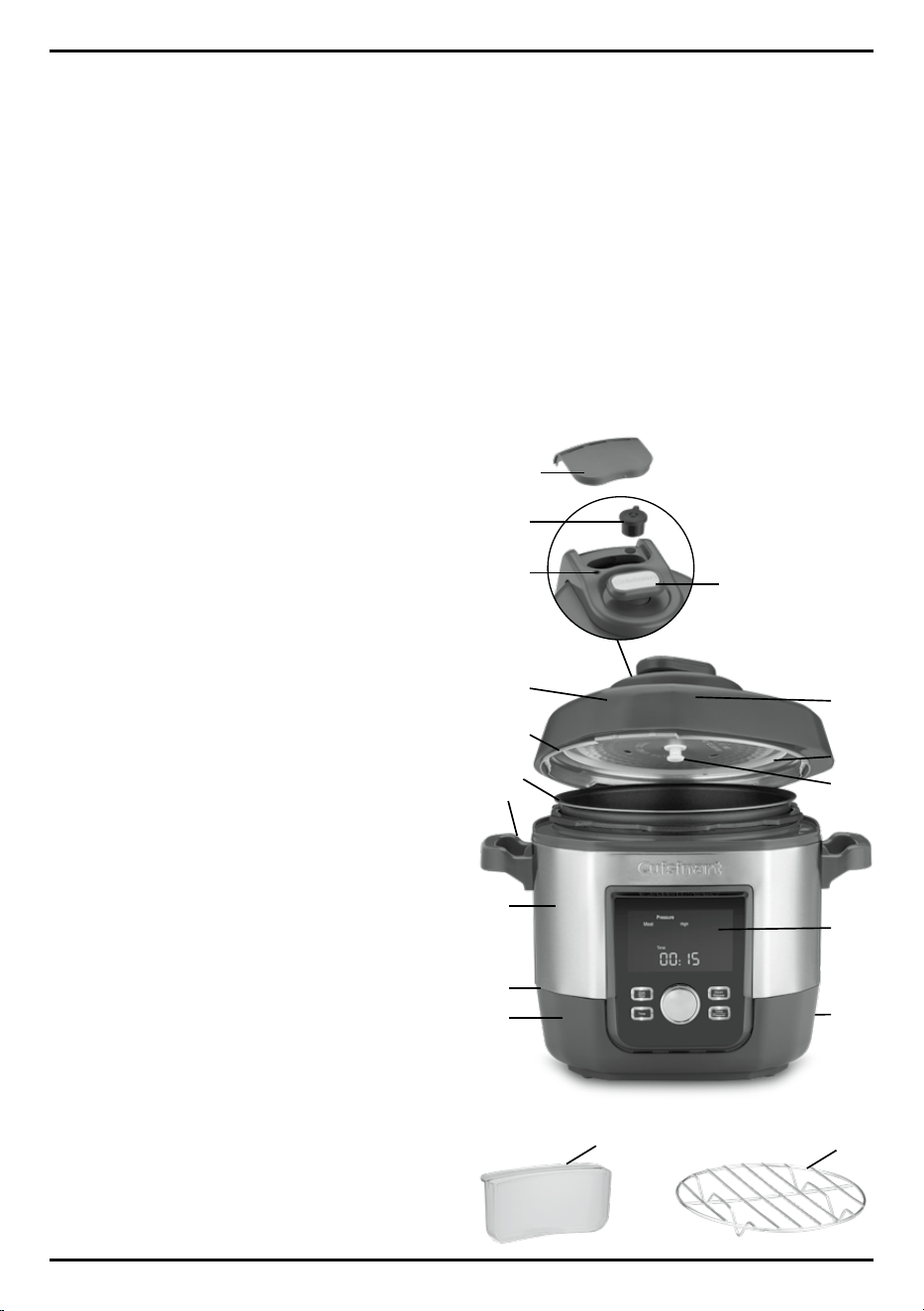
PARTS AND FEATURES
1. Pressure Limit Valve
2. Red Float Valve (Pressure Indicator)
3. Sealing Ring Assembly
4. Cooking Pot
5. Condensation Collector
6. Unit Handle
7. Outer Body
8. Heating Plate (not shown)
9. Base
10. Power Cord (not shown)
11. Steam Cover
12. Lid Handle
13. Lid
14. Rubber Grommet
15. Upper Ring
16. Control Panel
17. Trivet/Rack – Used for some recipes such
as desserts. See Recipe Booklet.
4
GETTING TO KNOW YOUR CONTROL PANEL
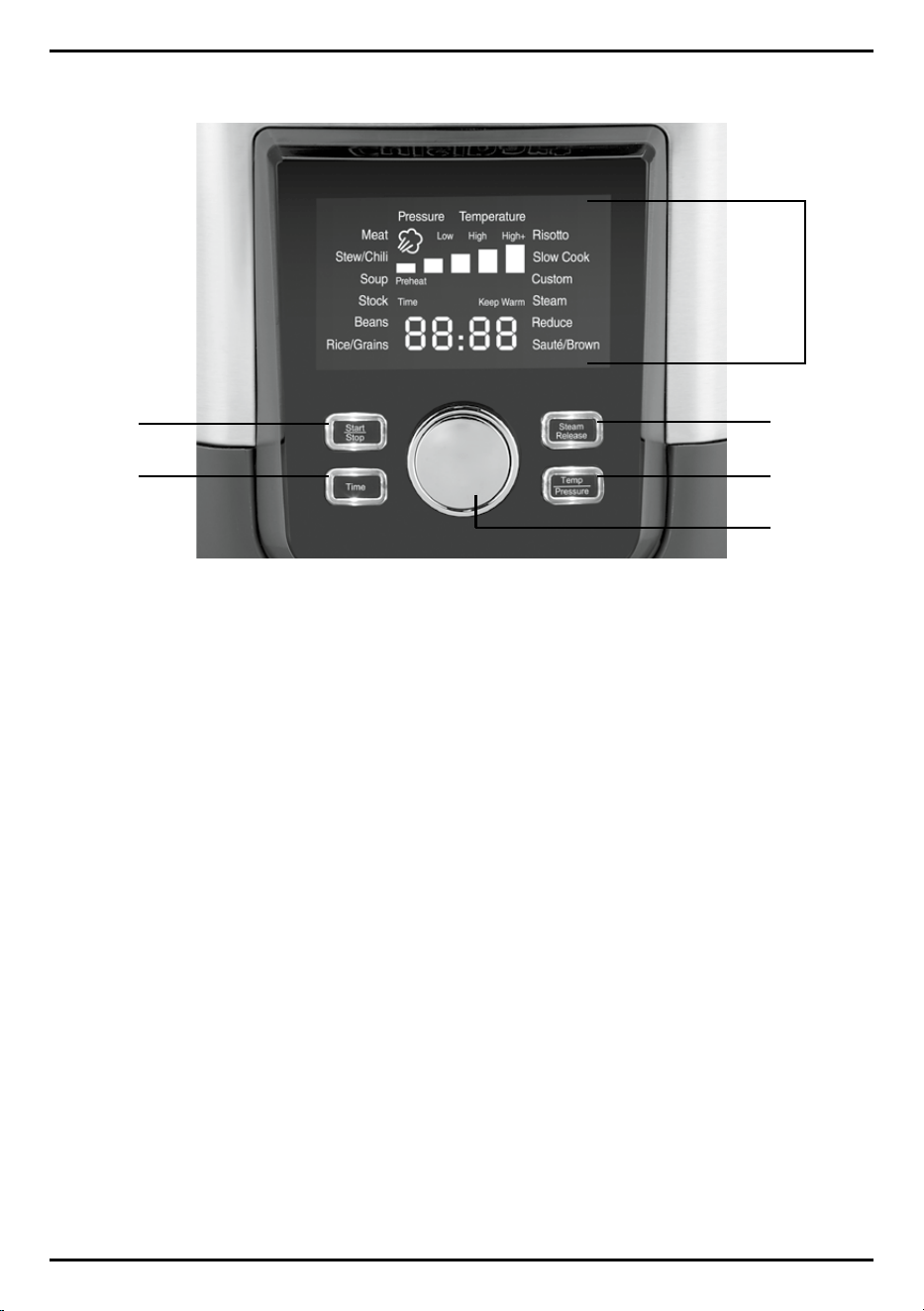
1. START/STOP Button
Press to start and stop cooking.
2. Time Button
Press to change the cooking time.
3. Steam Release Button
Press and hold to automatically open
the pressure release valve and release
steam.
4. Temp/Pressure
Press to change the cooking temperature
or pressure setting.
5. Select and Confirm Dial
Use to select cooking function. Set the
temperature and the timer. Use dial to
increase temperature or pressure setting
and time, then press dial to confirm
your settings.
6. Large LCD
The backlit LCD screen is easy to read;
it displays the Cooking Function(s),
Temperature, Pressure Setting, Timer,
Preheat, the Preheat Bars, Keep Warm,
and Steam Release icon.
1. 3.
6.
2. 4.
5.
1.
5
START-UP SCREEN
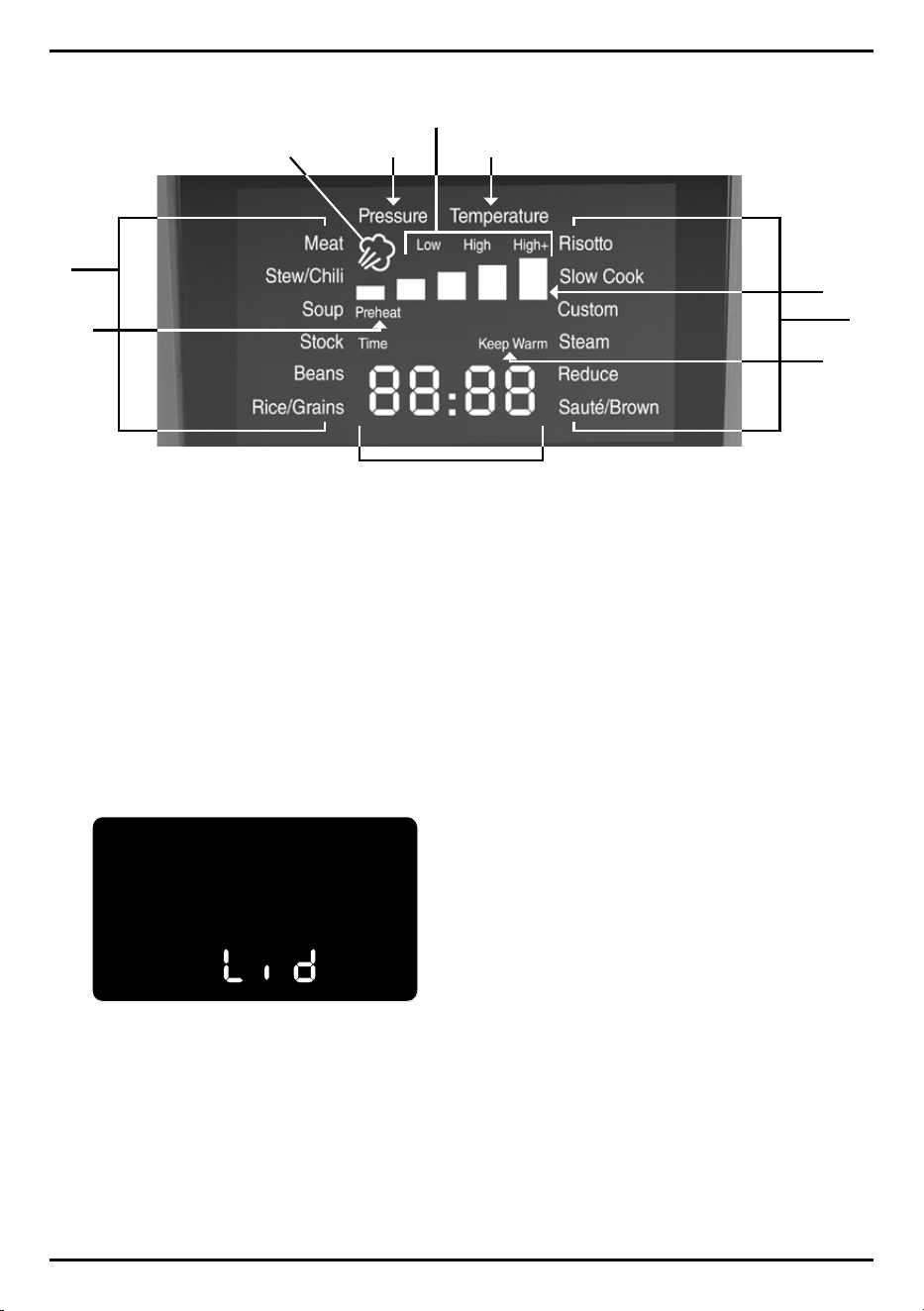
A. Cooking Functions
Pressure cooking functions: Meat, Stew/
Chili,
Soup, Stock, Beans, Rice/Grains, Risotto,
Custom, Steam.
Non-Pressure cooking functions: Slow
Cook, Reduce, Sauté/Brown, Keep Warm.
B. Time Display
Timer keeps track of your cooking time. The
time display will also indicate when the lid is
open or closed incorrectly by displaying the
word LID
(see figure 1).
C. Pressure/Temperature Settings
Low, High, and High+ pressure settings. Low
and High temperature settings.
D. Pressure
Indicates you are cooking with
a pressure cooking function.
E. Temperature
Indicates you are cooking with a
non-pressure cooking function.
F. Preheat
Appears in the LCD when the unit is
preheating.
G. Preheat Bars
Appear when, in temperature mode, to show
heat-up progress. When pressure cooking,
the preheat bars appear to show progress as
pressure builds, and decrease as pressure is
being released.
H. Keep Warm
Appears when the cooking time is complete,
on most functions, and the unit has entered
Keep Warm mode. Can also be used to keep
cooked food warm for serving.
I. Steam Release Icon
Appears when the Steam Release button is
pressed and steam is being released from
the unit.
A.
B.
A.
H.
G.
F.
C.
D. E.I.
3.
4.
5.
6.
2.
1.
6
BEFORE FIRST USE
Remove any packing materials and promotional
labels from your electric multicooker.
Be sure all parts have been included before
discarding any packing materials. You may want
to keep the box and packing materials for use
at a later date.
Before using your Cuisinart
®
Electric Multicooker
for the first time, remove any dust from shipping
by wiping clean with a damp cloth. Thoroughly
clean the cooking pot and sealing ring assembly
in the dishwasher or with warm, soapy water.
Rinse, towel dry, or air-dry, and place in the
multicooker.
1. Place the multicooker on a clean,
flat surface.
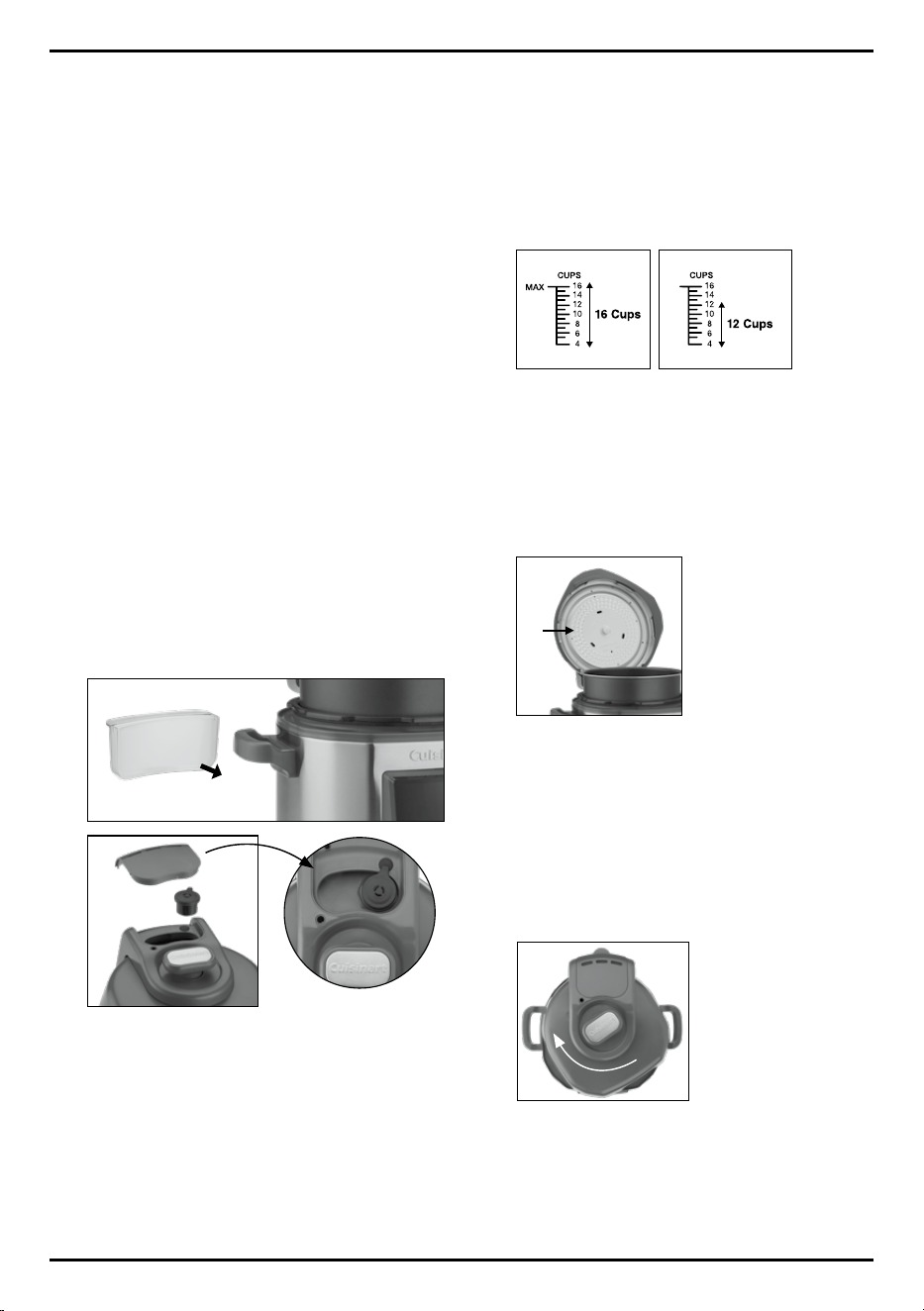
2. Ensure the condensation collector in
rear of the unit is in place (as shown below
in figure 1; and #5 on diagram, page 3).
3. Remove the Steam Cover (#11 on diagram).
Ensure the pressure limit valve on the hinge
area of the lid is in place, as shown in figure
2. NOTE: The pressure limit valve does not
click or lock into place. Even though it will
have a loose fit, it is safely secured.
INSTRUCTIONS FOR USE
1. To open lid, grasp handle, turn
counterclockwise. Lift to open the lid.
The unit will beep two times when turning
the handle and two times when the lid
is raised.
2. Add food and liquids to the cooking pot as
the recipe directs. NOTE: The total volume of
food and liquid must not exceed 16 cups/
Max Fill line of the cooking pot (figure 3).
For foods such as dried vegetables and
beans, or rice and grains, the total volume
must not exceed 12 cups (figure 4).
NOTE: Overfilling may clog the pressure limit
valve, which can cause excess pressure to
develop. Always use at least ½ cup liquid
when pressure cooking.
3. If sealing ring assembly has been removed
from lid, check to ensure flexible ring is
securely in place on the metal plate. Then,
holding the knob on the metal plate, place
the assembly over the center post of inner lid
and press down firmly to secure (figure 5).
BE SURE KNOB FACES OUT.
4. To close the lid, remove any food residue
from upper rim of cooking pot to ensure a
proper seal. Lower the lid, then turn the lid
handle clockwise to close into place (figure
6). The unit will beep two times when turning
the handle and two times when the lid is
lowered. NOTE: If the lid is not closed
correctly, scalding may result. LID will appear
flashing in the LCD and the unit will beep.
5. Position the pressure limit valve (located on
hinge area of the lid) as directed in figure 2.
The float in handle area must be fully down
to properly seal the pot before cooking.

7
MULTICOOKER FUNCTIONS
Pressure Cooking Functions
1. Meat – This preset is programmed for
larger pieces or chunks of meat, such as
brisket and pork, as well as the perfect
setting for cooking a whole chicken.
The default is High+ pressure for 35 minutes,
but High and Low pressures are available
as well. The time is adjustable from 1 minute
to 4 hours. In most cases Natural Pressure
Release should be used. The Sauté/Brown
function can be used to brown meats prior
to cooking to add more flavor, and the
Reduce function can be used to simmer the
cooking liquid into a flavorful sauce after
removing the meat from the cooking pot.
2. Stew/Chili – Whether cooking a hearty beef
or lamb stew, or a flavorful ground turkey
chili, this is the best setting to use. Be sure
to use the Sauté/Brown function to brown
the meat prior to cooking, especially if using
ground meat. The default is High pressure
for 30 minutes, but High+ and Low are
available as well. The time is adjustable from
1 minute to 4 hours. In most cases Natural
Pressure Release should be used.
3. Soup – This preset can be used to prepare
very flavorful soups in a fraction of the time
it takes to cook on the stovetop. Place the
meat (if using), vegetables and other
ingredients into the cooking pot, add enough
liquid to cover. Most recipes will require High
pressure, but Low and High+ are also
available. The default cooking time is 10
minutes.
4. Stock – When preparing richer, longer-
cooking stocks, use the Stock preset.
This is for poultry, meat, and vegetable
stocks. Expert Tip: Save vegetable scraps
throughout the week (or month), wrap well
and store in the freezer. When you’re ready
to make a stock, take out those scraps that
would otherwise be headed for the garbage
or compost, and instead use them to flavor
a delicious stock.
Add ingredients (bones, meat, vegetables,
herbs) plus enough water to cover, being
sure not to exceed the Maximum Fill line. The
default is High pressure for 30 minutes, but
both Low and High+ pressure
are available. For richer stocks, cook for 1
hour 30 minutes. Always use Natural
Pressure Release to achieve the best results.
5. Beans – This preset can be used to prepare
dried beans quicker and tastier than on the
stovetop or in the oven. Add beans and other
ingredients to cooking pot. Add enough
liquid to cover beans by one inch. The
default is High pressure for 30 minutes, but
be sure to use our Cooking Guide to select
the best cooking time for the specific beans
that are being prepared.
6. Rice/Grains – Cook a variety of rice
and grains using this preset. Use the
Cooking Guide on page 16 to determine
the appropriate amount of water, as well as
cooking pressure and time. Most items use
High pressure and Quick Pressure Release.
The default is High pressure for 5 minutes.
7. Risotto – This preset offers a (mostly)
hands-off approach to risotto. After using
the Sauté/Brown function to sauté aromatics
and toast the rice, the liquid is added, the lid
is closed and, once under pressure, it is only
5 minutes to achieve perfect risotto. Use the
Steam Release button to quickly release
pressure to ensure the risotto stays nice
and creamy. The default is High pressure
and the time is 5 minutes.
8. Custom – This preset is to allow full
flexibility when pressure cooking. This is
perfect for foods that do not fit within the
preset programs, such as vegetables,
desserts, and other dishes. The default
is Low pressure for 1 minute.
9. Steam – A unique program that allows
you to steam foods while under pressure.
This cuts down the cooking time of most
steaming tasks, while retaining important
nutrients. This setting only has one
temperature, so it is not adjustable.
The default time is 20 minutes, but it is
adjustable from 1 minute to 2 hours.
This program does NOT go into Keep
Warm after cooking is complete.
Non-Pressure Cooking Functions
1. Slow Cook – Treat this program like
you would any slow cook. It has the option
to cook with a Low or High slow-cook
temperature, with a timing of 30 minutes to
20 hours. When using the Low temperature,
cooking times will usually be on the higher

8
side, 8 to 20 hours. When using the High
temperature, cooking times are shorter,
usually 2 to 6 hours. The default for this
program is High for 4 hours. NOTE: In some
rare cases, pressure can build in the unit
while using the Slow Cook function.
If pressure does build during Slow Cook,
simply press the Steam Release button to
release pressure.
2. Reduce – This program is primarily
used at the end of a pressure cooking or
slow cooking task to thicken sauces and
reduce liquids. It can also be used to thicken
a soup. There is only one temperature and it
is not adjustable. The default time is 10
minutes, but is adjustable from 1 minute up
to 2 hours.
3. Sauté/Brown – Sometimes recipes call
for sautéing vegetables and aromatics before
cooking, and other times you may want to
brown meat before pressure cooking.
This program has both of those options.
There are two temperatures, Low for sautéing
and High for browning. There is a timer, but
unlike other programs, it does not need to
be programmed. Sautéing/Browning reduces
the time it takes full pressure to build and
pressure cooking to begin. This program
is to be used without closing the lid.
NOTE: Use a wooden spoon to scrape
up brown bits. DO NOT use metal utensils.
4. Automatic Keep Warm – All cooking
functions, except for Steam, Reduce and
Sauté/Brown will automatically go into a
Keep Warm program, but this can also be
used separately to keep already hot foods
warm for serving. This program is NOT
to be used to reheat foods. There is one
temperature, it is not adjustable, and can
be programmed between 30 minutes
and 4 hours.
OPERATING INSTRUCTIONS
Plug your multicooker into an electrical outlet.
The LCD will illuminate.
Select Cooking Function:
With the unit turned on and the LCD displayed,
rotate the Select and Confirm dial to select the
desired cooking function. The function will flash.
To confirm the cooking function, press the Select
and Confirm dial. The selected function is now
confirmed and no longer flashing.
Once the cooking function is confirmed, the
START/STOP, TIME and TEMP/PRESSURE
buttons will flash. At this time you can start
cooking by pressing the START/STOP button
or change the default temperature and time.
Set Temperature:
Each cooking function has a default cooking
temperature (Low, High) or pressure setting
(Low, High, and High+). To change the default
temperature or pressure setting, press the
TEMP/PRESSURE button. The default
temperature will flash. Rotate the Select
and Confirm dial to the desired temperature/
pressure setting. To confirm the temperature/
pressure setting, press the Select and Confirm
dial.
Set Time:
Each cooking function has a default cooking
time. To change the default time, press the TIME
button. The default time will flash. Rotate the
Select and Confirm dial to increase or decrease
the time. To confirm the time, press the Select
and Confirm dial.
Once you have confirmed the cooking function,
temperature and time, press the START/STOP
button to begin cooking. The first preheat bar
and the word Preheat will appear in the LCD.
NOTE: Preheat and the preheat bars will not
appear for Slow Cook, Steam, Reduce
or Sauté/Brown.
Changing Settings:
To change any of your settings (cooking function,
temperature and time) at any time during use,
follow these instructions.
To change the Cooking Function – Press and
hold the START/STOP button. Rotate the Select
and Confirm dial to select the desired cooking
function. The function will flash. To confirm the
cooking function, press the Select and Confirm
dial. The selected function is now confirmed
and no longer flashing. Press the START/STOP
button to continue cooking.
To change the Temperature – Press and hold
the TEMP/PRESSURE button until the current
temperature begins to flash. Rotate the Select
and Confirm dial to the desired temperature /
pressure setting. The temperature will flash.
To confirm the temperature / pressure setting,
press the Select and Confirm dial, and the unit
will continue cooking.

9
To change the Time – Press and hold the TIME
button until the current time begins to flash.
Rotate the Select and Confirm dial to the desired
time setting. The time will flash. To confirm the
time setting, press the Select and Confirm dial,
and the unit will continue cooking.
To stop cooking and return to the start-up
screen, press and hold the START/STOP button.
YOU SHOULD NEVER ATTEMPT TO OPEN
THE LID WHILE PRESSURE COOKING.
NOTE: During pressure cooking, when the unit
has reached full pressure, it is normal to see a
small gap between the lid and the housing.
KEEP WARM
Automatic Keep Warm Feature
When timer reaches 00:00, the multicooker
automatically shifts to Keep Warm mode.
Keep Warm will appear in the LCD and unit
will beep 4 times to indicate cooking is complete.
The timer will count up to show how long the
unit has been in Keep Warm.
Independent Keep Warm Feature
Use to keep cooked food warm for serving.
1. Open the lid and place prepared hot
ingredients into the cooking pot to be
kept warm.
2. Close the lid. NOTE: There is no need to
rotate lid to the closed position.
3. Power on the unit.
4. Rotate the Select and Confirm dial until Keep
Warm is flashing. Press the Select and
Confirm dial to confirm, then press the
START/STOP button to start Keep Warm.
5. To adjust the 2-hour default Keep Warm time,
press the TIME button and use the Select
and Confirm dial to adjust time from 30
minutes up to 4 hours. Press the Select
and Confirm dial to confirm the desired time,
then press the START/STOP button to start
Keep Warm. Timer will begin counting down.
NOTE: Keep Warm time can be adjusted at
any time by repeating step 5.
NOTE: The Keep Warm setting should not be
used for more than 12 hours. The quality or
texture of the food will begin to change after
1 hour on Keep Warm. In the Keep Warm
setting, a little condensation in the upper ring
is normal.
PRESSURE RELEASE
To Open the Lid
When pressure cooking cycle is finished, the unit
will automatically switch to the Keep Warm mode.
At this point, you may choose to release pressure
in one of three ways – Natural Pressure Release,
Quick Pressure Release, or a combination of
both. The choice will be dictated by the particular
food being cooked and indications in the recipe.
If adapting your own recipe for pressure cooking,
find a similar recipe in our recipe booklet and use
that as a guide.
1. Natural Pressure Release – Allow the unit to
remain on Keep Warm. The pressure will
begin to drop – time for pressure to drop will
depend on the amount of liquid in the
multicooker and the length of time that
pressure was maintained. As pressure is
being released, the preheat bars will count
down. Natural Pressure Release could take
from 20 to 80 minutes. During this time,
cooking continues, so it is not recommended
for certain cuts of meats and some desserts.
When pressure is fully released, the unit will
beep once, all preheat bars will disappear
from the screen and the lid will unlock to
open.
2. Quick Pressure Release – Following
pressure cooking you will hear 4 beeps
indicating the process is finished. Press and
hold the Steam Release button. The Steam
Release icon will appear in the LCD and
steam will immediately begin to release
through the hinge area of the lid. Keep face
and hands away from steam as it is released.
Do not release pressure under hanging
cabinets, which can be damaged by steam.
As pressure is being released, the preheat
bars will count down. When pressure is fully
released, the unit will beep once and all
preheat bars will disappear from the screen,
the pressure indicator will drop and the lid will
unlock to open. Using Quick Pressure
Release stops the pressure cooking
immediately. If further cooking is necessary,
the unit may be returned to Pressure.
3. Combination Natural Pressure Release and
Quick Pressure Release – Some recipes use
a combination of Natural Pressure Release
and Quick Pressure Release. Allow Natural
Pressure Release for the time indicated in the
8.
7.
10
recipe (food will continue to cook slightly),
followed by Quick Pressure Release.
SAFETY FEATURES
There are six safety devices installed in the
multicooker to assure its reliability.
1. Open-and-Close Lid Safety Device
The appliance will not start pressurizing until
the lid is closed and locked properly. The lid
cannot be opened if the appliance is filled
with pressure.
2. Pressure Control Device
The correct pressure level is automatically
maintained during the cooking cycle.
3. Pressure Limit Valve
The pressure limit valve will release air
automatically when the pressure inside
exceeds
the preset temperature.
NOTE: Overfilling the multicooker (see
Instructions for Use) may clog the pressure
limit valve, which can cause excess pressure
to develop.
4. Pressure Relief Device
When the multicooker reaches the maximum
allowable pressure and temperature, the
cooking pot will move down until lid
separates from the sealing ring, releasing air
pressure.
5. Thermal Control
The power will automatically shut off when
the cooking pot temperature reaches the
preset value, or the multicooker is heating
without any food inside.
6. Thermal Fuse
The circuit will be opened when the
multicooker reaches the maximum
temperature.
CLEANING AND
MAINTENANCE
1. Unplug the power cord before cleaning.
2. Clean the outer body with a soft cloth, such
as a paper towel or microfiber cloth. Do not
immerse the outer body in water or pour
water into it.
3. Remove the sealing ring assembly from the
inside of the lid by grasping the knob and
pulling. Set aside.
4. Ensure red float valve is clean and moves
freely.
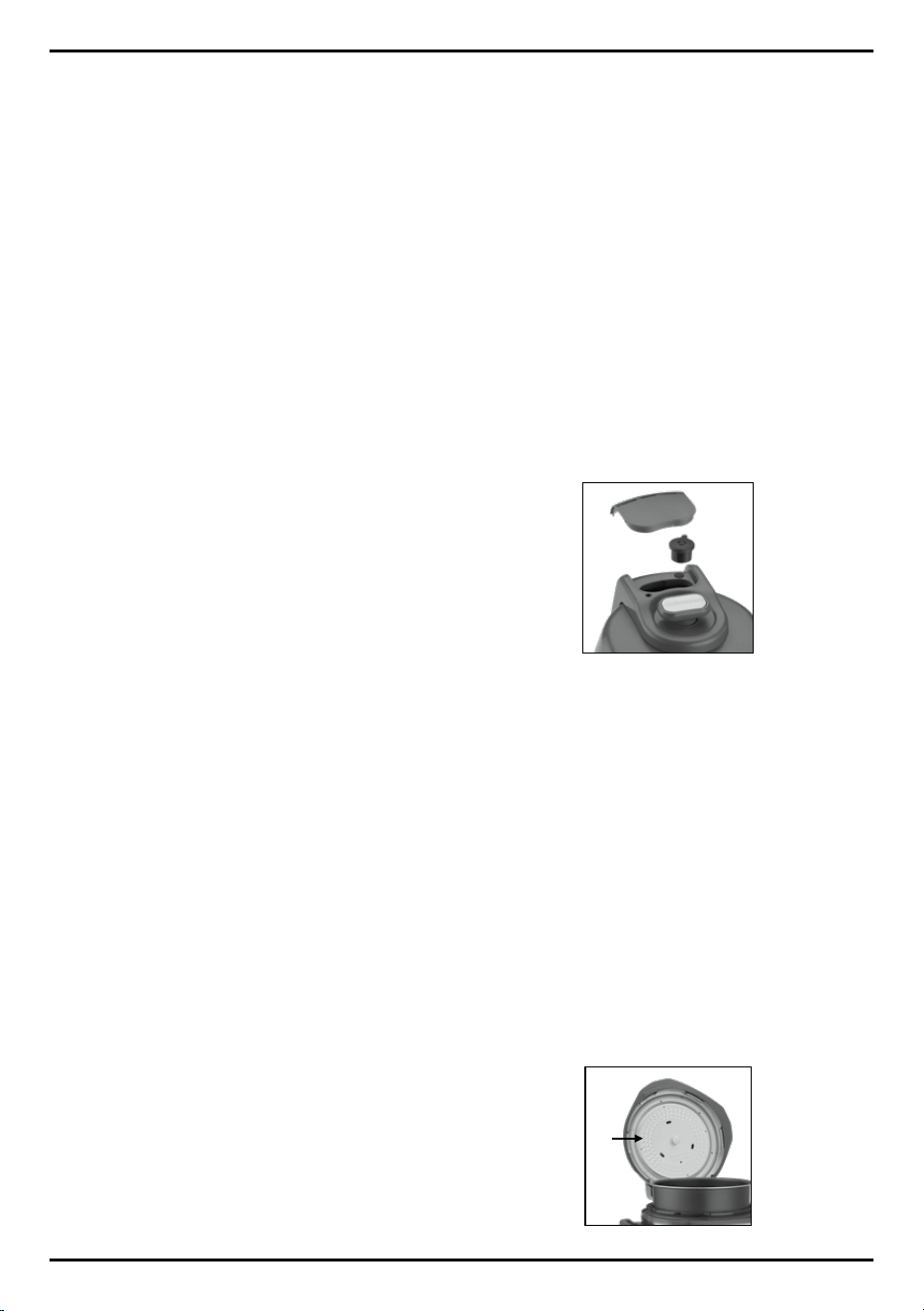
5. Remove the Steam Cover and then the
pressure limit valve (figure 7) by gripping and
pulling firmly upward. Rinse with warm water
and dry.
6. Clean the upper and underside of the lid with
a cloth and warm water, including all areas
on the underside. Dry completely, and
replace pressure limit valve.
7. To clean sealing ring assembly, carefully
remove flexible sealing ring and clean in the
dishwasher or with a dampened cloth or
microfiber cloth. Do not use chemical
cleaners. Wash metal plate in the dishwasher
or with warm water, dry thoroughly and
replace sealing ring.
8. To clean the rubber grommet in center of
sealing ring assembly, carefully remove it,
clean it, and replace it.
9. Replace sealing ring assembly in lid. BE
SURE KNOB FACES OUT (figure 8).
9.
11
10. Cooking pot is dishwasher safe. To hand-
clean the pot, use a soft cloth or sponge
and wipe. Be careful not to damage the
inside coating. Never use harsh chemicals
or scouring pads.
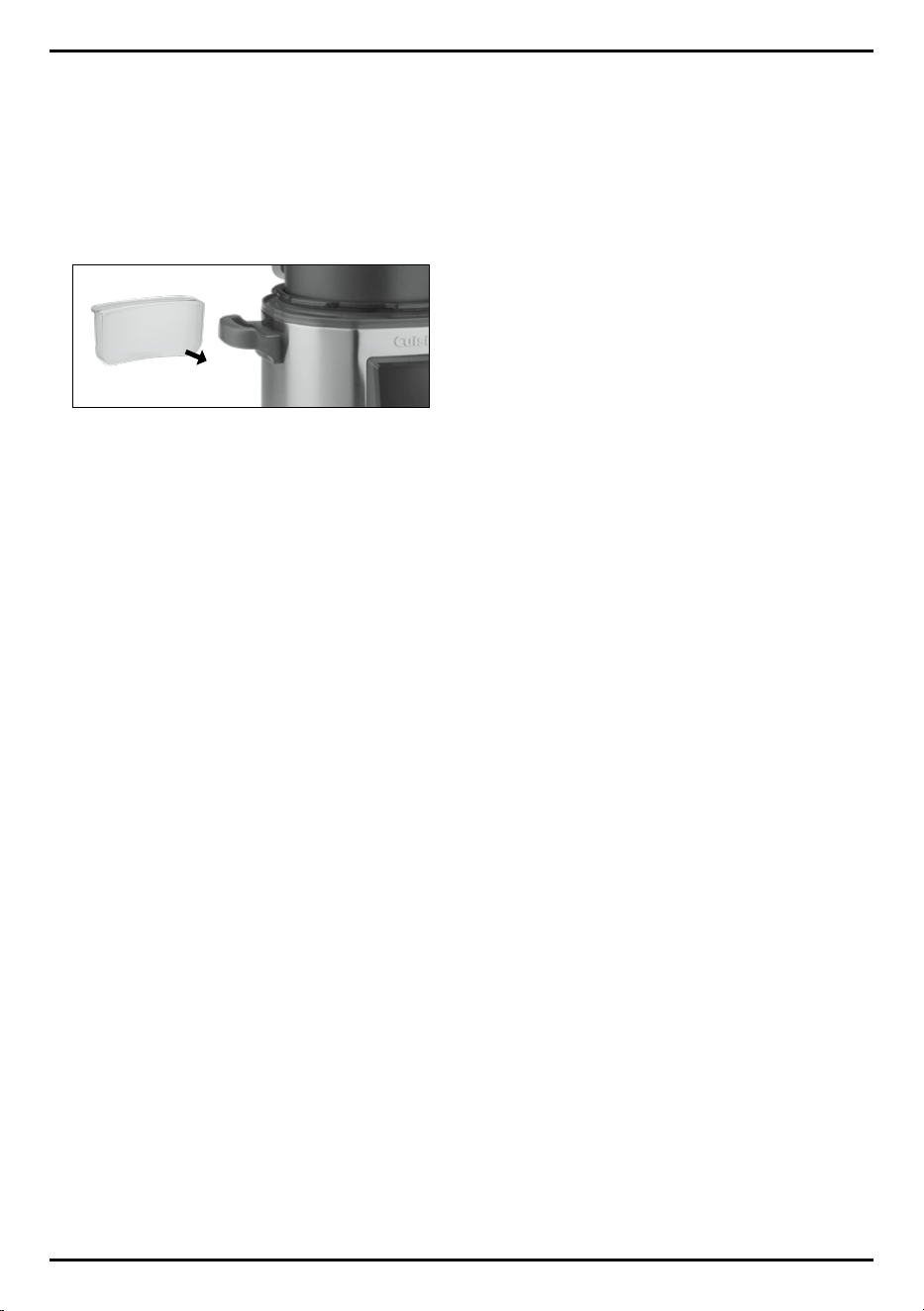
11. To clean the condensation collector, remove
and clean it with warm, soapy water, then
reinstall it (figure 9).
12. Any other servicing should be performed by
an authorized service representative.
NOTE: If scouring is necessary, use a
nonabrasive cleaner or liquid detergent with
nylon pad or brush.

12
TROUBLESHOOTING
SYMPTOM POSSIBLE REASONS SOLUTIONS
Lid does not lock.
The sealing ring assembly is not
properly installed in lid.
Re-install the sealing ring assembly
as instructed in INSTRUCTIONS
FOR USE, page 6.
Cannot open the lid after
releasing the pressure.
The red float valve is still up.
Press the steam release
button again.
A
ir escapes from the
rim of the lid.
N
o sealing ring was installed. Install the sealing ring.
Food residue on sealing ring. Clean sealing ring.
Sealing ring is worn out. Replace the sealing ring.
Air continuously escapes from
the red float valve.
F
ood stuck on the sealing ring of
the red float valve.
Clean the sealing ring.
The sealing ring on the float valve
is worn out.
Replace the sealing ring.
The red float valve will not rise.
The pressure limit valve is not
placed properly.
See Before First Use, #3, page 6.
Not enough water. Check recipe for proper quantities.
Air escaping from the rim of the lid
and/or the pressure limit valve.
Call our Consumer Service Center
toll free at 1-800-726-0190.
The red float valve could be stuck. Clean the sealing ring.
Unit shuts off when
START is pressed to begin
p
ressure cooking.
Sauté/Brown function was
just used and temperature in
unit is higher than pressure
cooking temperature, so safety
shutoff occurs.
After Sauté/Brown, let unit cool
down for 2 or 3 minutes before you
start pressure cooking, or add ½
cup more liquid to the unit.
The word LID appears in LCD. The lid is not closed properly.
Turn the lid handle clockwise to
close the lid into place.
The Steam Release
icon is flashing.
T
here is still pressure
inside the unit.
Refer to Tips and Hints on pg. 13.
It is difficult to close the lid.
The cooking pot is still hot,
causing steam to push the
lid open.
A
llow contents to cool down for
several minutes before fully
engaging the lid.
Air is escaping from
the steam cover.
T
he pressure limit valve is
not properly positioned.
Remove the steam cover and
ensure the pressure limit valve is
properly installed.
LCD displays “E1”
and beeps 10 times.
T
hermal control malfunction
Call our Consumer Service Center
toll free at 1-800-726-0190.
LCD displays “E2”
and beeps 10 times.
T
hermal control malfunction
Call our Consumer Service Center
toll free at 1-800-726-0190.

13
TROUBLESHOOTING
SYMPTOM POSSIBLE REASONS SOLUTIONS
Lid does not lock.
The sealing ring assembly is not
properly installed in lid.
Re-install the sealing ring assembly
as instructed in INSTRUCTIONS
FOR USE, page 6.
Cannot open the lid after
releasing the pressure.
The red float valve is still up.
Press the steam release
button again.
A
ir escapes from the
rim of the lid.
N
o sealing ring was installed. Install the sealing ring.
Food residue on sealing ring. Clean sealing ring.
Sealing ring is worn out. Replace the sealing ring.
Air continuously escapes from
the red float valve.
F
ood stuck on the sealing ring of
the red float valve.
Clean the sealing ring.
The sealing ring on the float valve
is worn out.
Replace the sealing ring.
The red float valve will not rise.
The pressure limit valve is not
placed properly.
See Before First Use, #3, page 6.
Not enough water. Check recipe for proper quantities.
Air escaping from the rim of the lid
and/or the pressure limit valve.
Call our Consumer Service Center
toll free at 1-800-726-0190.
The red float valve could be stuck. Clean the sealing ring.
Unit shuts off when
START is pressed to begin
p
ressure cooking.
Sauté/Brown function was
just used and temperature in
unit is higher than pressure
cooking temperature, so safety
shutoff occurs.
After Sauté/Brown, let unit cool
down for 2 or 3 minutes before you
start pressure cooking, or add ½
cup more liquid to the unit.
The word LID appears in LCD. The lid is not closed properly.
Turn the lid handle clockwise to
close the lid into place.
The Steam Release
icon is flashing.
T
here is still pressure
inside the unit.
Refer to Tips and Hints on pg. 13.
It is difficult to close the lid.
The cooking pot is still hot,
causing steam to push the
lid open.
A
llow contents to cool down for
several minutes before fully
engaging the lid.
Air is escaping from
the steam cover.
T
he pressure limit valve is
not properly positioned.
Remove the steam cover and
ensure the pressure limit valve is
properly installed.
LCD displays “E1”
and beeps 10 times.
T
hermal control malfunction
Call our Consumer Service Center
toll free at 1-800-726-0190.
LCD displays “E2”
and beeps 10 times.
T
hermal control malfunction
Call our Consumer Service Center
toll free at 1-800-726-0190.
WARRANTY
Limited Three-Year Warranty
(U.S. and Canada only)
This warranty is available only to U.S. consumers
who purchase products directly from Cuisinart or
an authorized Cuisinart
®
reseller. You are a
consumer if you own a Cuisinart
®
12-in-1
Multicooker that was purchased at retail for
personal, family or household use. Except as
otherwise required under applicable law, this
warranty is not available to retailers or other
commercial purchasers or owners or consumers
who purchase from unauthorized Cuisinart®
resellers. We warrant that your Cuisinart
®
12-in-1
Multicooker will be free of defects in materials
and workmanship under normal home use for 3
years from the date of original purchase.
We recommend that you visit our website,
https://cuisinart.registria.com for a fast,
efficient way to complete your product
registration. However, product registration does
not eliminate the need for the consumer to
maintain the original proof of purchase in order
to obtain the warranty benefits. In the event that
you do not have proof of purchase date, the
purchase date for purposes of this warranty will
be the date of manufacture.
CALIFORNIA RESIDENTS ONLY
California law provides that for In-Warranty
Service, California residents have the option of
returning a nonconforming product (A) to the
store where it was purchased or (B) to another
retail store that sells Cuisinart products of the
same type. The retail store shall then, according
to its preference, either repair the product, refer
the consumer to an independent repair facility,
replace the product, or refund the purchase price
less the amount directly attributable to the
consumer’s prior usage of the product. If neither
of the above two options results in the
appropriate relief to the consumer, the consumer
may then take the product to an independent
repair facility, if service or repair can be
economically accomplished. Cuisinart and not
the consumer will be responsible for the
reasonable cost of such service, repair,
replacement, or refund for nonconforming
products under warranty. California residents
may also, according to their preference, return
nonconforming products directly to Cuisinart for
repair or, if necessary, replacement by calling our
Consumer Service Center toll-free at 1-800-726-
0190. Cuisinart will be responsible for the cost of
the repair, replacement, and shipping and
handling for such nonconforming products
under warranty.
HASSLE-FREE REPLACEMENT WARRANTY
Your ultimate satisfaction in Cuisinart products
is our goal, so if your Cuisinart
®
12-in-1
Multicooker should fail within the generous
warranty period, we will repair it or, if necessary,
replace it at no cost to you. To obtain a return
shipping label, please visit us at
https://www.cuisinart.com/customer-care/
product-assistance/product-inquiry.. Or call
our toll-free customer service department at
1-800-726-0190 to speak with a representative.
Your Cuisinart
®
High 12-in-1 Multicooker has
been manufactured to the strictest specifications
and has been designed for use only in 120-volt
outlets and only with authorized accessories and
replacement parts. This warranty expressly
excludes any defects or damages caused by
attempted use of this unit with a converter, as
well as use with accessories, replacement parts
or repair service other than those authorized by
Cuisinart. This warranty does not cover any
damage caused by accident, misuse, shipment
or other than ordinary household use. This
warranty excludes all incidental or consequential
damages. Some states do not allow the
exclusion or limitation of these damages, so
these exclusions may not apply to you. You may
also have other rights, which vary from state to
state.
Important: If the nonconforming product is to be
serviced by someone other than Cuisinart’s
Authorized Service Center, please remind the
servicer to call our Consumer Service Center at
1-800-726-0190 to ensure that the problem is
properly diagnosed, the product is serviced with
the correct parts, and to ensure that the product
is still under warranty.

14
TIPS AND HINTS
• Many family favorites can be easily adapted
for preparation in your Cuisinart
®
High Pressure
Electric Multicooker – soups, stews, side
dishes and more.
• The amount of liquid needed when pressure
cooking is much less than for traditional
cooking methods.
• Never exceed the Maximum Fill amount of
the multicooker.
• Make sure the lid is on firmly and tightly,
and moved as far clockwise as it will go to
allow proper locking.
• Hot foods/liquids will come to pressure more
quickly than cold foods/liquids.
• When pressure cooking is completed, follow
recipe instructions for releasing pressure.
For Quick Pressure Release, it is important to
begin immediately upon completion of pressure
cooking; otherwise foods will continue to cook,
and may overcook.
• Do not store multicooker with lid on tightly.
This saves on gasket wear and tear.
• More nutrients are preserved during pressure
cooking than with traditional cooking methods,
as less liquid is used and thus fewer nutrients
are lost to evaporation.
• Always use at least ½ cup of liquid when
pressure cooking.
• To adapt your own recipes, find a similar one
in our recipe booklet and use it as a guide.
In general, cooking time will be at least one-
third to one-half of the traditional cooking time.
Reduce your cooking liquid by at least half –
you may need to “play” with your recipe to
get it right. You may wish to add vegetables
at the end of cooking to avoid overcooking. You
can also use the cooking charts provided as a
guide.
• Power loss protection – in the event there is a
power outage while using your multicooker,
the following will occur:
Power loss for less than 3 minutes: Unit will
turn on and cooking will resume.
Power loss for more than 3 minutes: Unit will
turn on and Steam Release button will flash,
indicating the unit is still under pressure. Press
the Steam Release button to release pressure
and follow operating instructions to finish
cooking.
COOKING GUIDE:
Poultry and Meats .............................................. 14
Vegetables .......................................................... 15
Rice and Grains .................................................. 16
Dried Beans ........................................................ 16
Recipes ............................................................... 17
PRESSURE HEAT-UP TIMES
When pressure cooking, remember that it will
take approximately 5 to 40 minutes (depending
on the starting temperature and recipe) for
pressure to build and pressure cooking to begin.
SUGGESTED COOKING TIMES
FOR POULTRY AND MEATS
Be sure to add at least 1 cup of liquid when
pressure cooking meats for 45 minutes or less,
and 1½ cups if cooking for longer amounts
of time. Be sure to add vegetables, such as
chopped onions, carrots and celery, and
aromatic herbs such as garlic, parsley, thyme,
etc., for added flavor. Most items are cooked
on High pressure unless otherwise indicated.
For best results and flavor, most poultry and
meats benefit from browning first. Cooking times
will vary slightly due to individual size of pieces
and starting temperatures.

15
POULTRY AND MEATS
FOOD COOKING TIME PRESSURE RELEASE METHOD
CHICKEN
Whole, up to 4 pounds
25 to 30 minutes
Quick Pressure Release
Chicken Breast, bone in,
3 pounds
8 t
o 10 minutes Quick Pressure Release
Boneless Chicken Breast,
2 pounds
5 t
o 6 minutes Quick Pressure Release
Thighs/Legs, bone in 9 to 12 minutes Quick Pressure Release
Thighs/Legs, boneless 8 to 10 minutes Quick Pressure Release
BEEF
Pot Roast, Bottom Round,
3 to 3½ pounds
60 to 90 minutes Natural Pressure Release
Brisket, 2½ to 3 pounds 55 minutes Natural Pressure Release
Corned Beef Brisket 60 to 90 minutes Natural Pressure Release
Short Ribs, 2 to 3 inches thick 50 minutes Natural Pressure Release
Stew – 1½- to 2-inch cubes 20 to 30 minutes
Natural Pressure Release
(see recipe for Beef Stew for times
w
ith vegetables)
LAMB
Shanks, four, 12 ounces each 25 to 30 minutes Natural Pressure Release
Shoulder cubes for stew,
about 1½ inches
20 t
o 25 minutes Natural Pressure Release
PORK
Chops, Loin, bone in,
¾ to 1 inch thick
4 t
o 5 minutes, brown first Quick Pressure Release
Boneless Shoulder Roast,
about 3 pounds
5
0 to 55 minutes Natural Pressure Release
Spareribs, cut into 2 to
3 rib pieces
20 t
o 30 minutes Quick Pressure Release
VEAL
Boneless Shoulder Roast
10 minutes per pound (weight is
important to avoid overcooking)
Natural Pressure Release
Cubes for stew, 1½ to 2 inches 15 to 20 minutes Natural Pressure Release

16
VEGETABLES
Vegetables should be well washed and peeled if necessary. Vegetables cook very quickly – be sure to press
STOP and use Quick Pressure Release immediately after audible beep sounds. If vegetables require more
cooking, turn multicooker off, and cover to steam the vegetables until preferred texture is reached. Add ½ cup
water or liquid for cooking. If pressure cooking frozen vegetables, 1 to 2 minutes additional cooking time and
longer steaming time may be needed. When cooking vegetables, it is always best to undercook, then allow
additional time to steam – to avoid overcooking. All cooking is on High pressure unless otherwise indicated.
FOOD COOKING TIME PRESSURE RELEASE METHOD
Artichokes, 4 medium/large,
8 to 10 ounces each
1
0 to 12 minutes Quick Pressure Release
Beans, Green or Yellow Waxy,
1½ pounds, cut into 2-inch lengths
1 to 2 minutes Quick Pressure Release
Beets, medium-large 15 to 20 minutes Quick Pressure Release
Broccoli, cut into large florets 2 to 3 minutes Quick Pressure Release
Cauliflower, cut into large florets 2 to 3 minutes Quick Pressure Release
Carrots, cut into 2-inch lengths –
or “baby cut”
5 minutes Quick Pressure Release
Carrots, ½-inch slices 2 to 3 minutes Quick Pressure Release
Corn, 4 to 6 ears (use trivet/rack) 2 to 3 minutes Quick Pressure Release
Greens, collards, kale, cut into
1-inch strips
5 to 7 minutes Quick Pressure Release
Onions, baby, peeled 2 to 4 minutes Quick Pressure Release
Parsnips, peeled, cut into
2-inch pieces
3 t
o 4 minutes Quick Pressure Release
Parsnips, ½-inch slices 1 to 2 minutes Quick Pressure Release
POTATOES
White, medium, quartered 5 to 7 minutes Quick Pressure Release
Red, new (2 to 3 oz. each) 5 to 8 minutes Quick Pressure Release
Sweet, 2-inch cubes 4 to 5 minutes Quick Pressure Release
SQUASH
Acorn, halved and seeded 6 to 8 minutes Quick Pressure Release
Butternut, peeled and sliced 3 to 4 minutes Quick Pressure Release
Spaghetti, halved 10 to 12 minutes Quick Pressure Release
Squash, Yellow Crookneck or
Zucchini, cut into ½-inch slices
1 to 2 minutes Quick Pressure Release

17
RICE AND GRAINS
DRIED BEANS
• Before cooking dried beans, pick over and discard any broken or shriveled beans or bits of dirt and debris.
Rinse beans and drain.
• Beans may be soaked overnight, but the multicooker allows you to cook beans without presoaking.
• Onions, garlic, celery, sprigs of fresh herbs or a bay leaf may be added for additional flavor. Do not salt before
cooking, as salt inhibits cooking.
• Cook beans in large batches (1 pound beans + 8 cups water + seasonings + onion, garlic, herbs to taste) and
freeze in 1-cup amounts to add to other dishes.
• Never fill multicooker more than half full when cooking beans.
• Add 2 teaspoons oil per cup of beans to prevent foaming.
• After cooking beans, clean lid, gasket, pressure limit valve, and red float valve carefully.
• When cooking unsoaked beans, use High pressure and Natural Pressure Release.
• When cooking soaked beans, use High pressure and a combination of Natural Pressure Release for 10 minutes
and then Quick Pressure Release.
• If beans are not completely cooked (this is partially dependent on the age of the dried beans, something you
will have no control over), select Reduce and allow the beans to simmer until cooked tender. As with
vegetables, it is better to undercook and allow to simmer to complete cooking.
GRAINS (1 CUP)
COOKING TIME
MINUTES
(HIGH PRESSURE)
LIQUID NEEDED
PRESSURE RELEASE
METHOD
Barley (pearl) 20 to 25 3 cups Quick
Brown Rice 20 2 cups Natural
Bulgur 6 2 cups Quick
Farro (whole grain) 18 3 cups Quick
Quinoa 5 1½ cups Quick
Steel-Cut Oats 5 3 cups Natural
White Rice (long grain) 4 to 6 1½ cups Quick
Wild Rice 22 3 to 4 cups Quick
BEANS (1 CUP)
(+ 8 CUPS WATER)
COOKING TIME
(SOAKED OVERNIGHT)
COOKING TIME (UNSOAKED) YIELD
Black Beans 5 minutes 10 minutes 2 cups
Cannellini 4 minutes 10 minutes 2 cups
Chickpeas
(Garbanzo Beans)
5 minutes 15 minutes 2½ cups
Great Northern 4 minutes 10 minutes 2¼ cups
Lentils N.A. 8 to 10 minutes 2 cups
Pinto 5 minutes 10 minutes 2¼ cups
Navy Beans 5 minutes 10 minutes 2 cups
Red Beans 5 minutes 10 minutes 2 cups
Split Peas N.A. 8 to 10 minutes 2 cups

18
Recipes
Steel-Cut Oats ........................................................17
Mixed Grain Breakfast Porridge .......................... 18
Oatmeal Breakfast Bowl ....................................... 18
French Toast Strata ...............................................18
Breakfast Bread Pudding ...................................... 19
Frittata ......................................................................20
Hard-Boiled Eggs ................................................... 20
Deviled Eggs ............................................................20
Macaroni and Cheese ............................................ 21
Mashed Potatoes .................................................... 21
Sautéed Kale ..........................................................22
“Braised” Collards .................................................22
White Bean Dip ...................................................... 22
Chickpeas with Sausage and Kale....................23
Baked Beans ........................................................... 23
Artichokes with Three Sauces ........................... 24
Green Beans with Shallots and Pine Nuts .....25
Italian Farro and Arugula Salad ......................... 25
Tabbouleh ................................................................ 26
Chicken Stock ....................................................... 26
Vegetable Stock ..................................................... 27
Mushroom Stock ................................................... 27
Brown Beef Stock ..................................................28
Seafood Stock ........................................................ 28
Bone Broth ..............................................................29
Quick Chicken Soup .............................................29
Chicken Tortilla Soup ...........................................29
Udon Soup...............................................................30
Pho ............................................................................30
Pasta e Fagioli .........................................................31
Lentil Soup .............................................................. 32
Vegetarian Bean Chili ........................................... 32
Mushroom Risotto ................................................. 33
Spring Pea Risotto ................................................. 33
Seafood Risotto .....................................................34
Black Beans and Rice ...........................................34
Marinara Sauce ......................................................35
Meatballs in Sauce................................................ 35
“Baked” Ziti .............................................................36
Quick Turkey Chili .................................................. 36
Traditional Brisket .................................................36
Lamb Shanks with Olives and Prunes ............ 37
Chicken and Dumplings .......................................38
Honey-Glazed Salmon .........................................39
Arroz con Pollo ......................................................39
Simple Chicken ......................................................40
Carne Mechada ......................................................40
Asian-Style Pork Ribs ............................................ 41
Chicken Tikka Masala ............................................41
Chicken Adobo .......................................................42
Chicken Tinga .........................................................43
Carne con Chili ......................................................43
Thai-Style Green Curry Vegetables ..................44
Pineapple Chipotle Pulled Pork .........................45
Creamy Rice Pudding ...........................................45
Dulce de Leche ...................................................... 45
Chocolate Pudding ................................................46
Black and White Cheesecake.............................46
“Baked” Apples ...................................................... 47
Cherry Chocolate-Chip Bread Pudding ...........48
Pear “Sauce” ...........................................................48
Steel-Cut Oats
Traditionally, steel-cut oats take care, time
and a watchful eye, but in the multicooker
it’s a hands-off, quick task for perfectly
cooked, creamy oats.
Makes about 7 cups
2 cups steel-cut oats (not quick cooking)
2 cinnamon sticks
2 tablespoons pure maple syrup
¾ cup dried fruit
2 pinches ground nutmeg
Pinch kosher salt
6 cups water
1. Put all of the ingredients into the cooking
pot of the Cuisinart
®
Multicooker. Secure
the lid and select Rice/Grains. Set the
pressure to High, the time for 5 minutes,
and press Start. When the tone sounds,
allow pressure to release naturally.

19
2. Once pressure has released completely,
remove lid and remove the cinnamon sticks.
3. Stir to combine and serve immediately.
Nutritional information per serving (½ cup):
Calories 131 (26% from fat) • carb. 22g • pro. 3g
fat 4g • sat. fat 2g • chol. 0mg • sod. 20mg
calc. 8mg • fiber 3g
Mixed Grain
Breakfast Porridge
A hearty, healthy, and filling way
to start the day.
Makes about 6 cups
1 cup steel-cut oats (not quick cooking)
½ cup short-grain brown rice
½ cup quinoa
2
⁄
3
cup chopped unsalted pecans
²⁄
³
cup dried fruit
¼ cup unsweetened shredded coconut
2 cinnamon sticks
2 to 4 tablespoons pure maple syrup
2 tablespoons coconut oil
2 pinches ground nutmeg
Pinch kosher salt
5 cups water
1. Put all of the ingredients into the cooking
pot of the Cuisinart
®
Multicooker. Secure the
lid and select Rice/Grains. Set the pressure
to High, set the time for 10 minutes, and
press Start. When the tone sounds, allow
pressure to release naturally.
2. Once pressure is completely released, open
the lid and remove the cinnamon sticks.
3. Stir to combine and serve immediately.
Nutritional information per serving (1 cup):
Calories 390 (32% from fat) • carb. 61g • pro. 8g
fat 14g • sat. fat 5g • chol. 0mg • sod. 32mg
calc. 45mg • fiber 7g
Oatmeal Breakfast Bowl
Cooking oats in larger batches allows you to
be creative with breakfast in the morning.
Top warm oats with whatever you have on
hand, but we think the mix of yogurt, jam,
and fruit is a winning combination.
Makes 4 servings
2 cups cooked steel-cut oats, warm
¼ cup seedless raspberry jam
¼ cup plain Greek yogurt (any fat variety)
½ cup fresh raspberries
¼ cup chopped pecans
1 teaspoon chia seeds
Divide the oatmeal among four serving bowls.
Swirl an even amount of raspberry jam
and yogurt into each bowl. Top with the
fresh raspberries, pecans, and chia seeds.
Nutritional information per serving (about 1 cup):
Calories 271 (26% from fat) • carb. 44g • pro. 8g
fat 8g • sat. fat 1g • chol. 0mg • sod. 16mg
calc. 39mg • fiber 6g
French Toast Strata
French toast without standing over the stove.
It can be prepped the night before, and then
just put into the Cuisinart
®
Multicooker to be
ready for a house full of guests.
Makes 8 servings
4 large eggs
2 cups whole milk*
1 cup heavy cream*
1
⁄
3
cup pure maple syrup
1 tablespoon pure vanilla extract
2 teaspoons ground cinnamon
1 teaspoon ground nutmeg
¼ teaspoon kosher salt
1 loaf challah or brioche bread
(about 1 pound), cut into 2-inch pieces
Nonstick cooking spray
1. Put the eggs, milk, cream, maple syrup,
vanilla extract, spices, and salt into a large
bowl. Whisk to combine.
2. Add the bread pieces to the large bowl
and stir to completely coat – press down
the bread so each piece is fully
submerged. Cover the bowl with plastic
wrap and refrigerate for a minimum of 3
hours, or up to overnight.
3. Thirty minutes prior to cooking the strata,
remove from the refrigerator and allow to
rest at room temperature.
4. Lightly coat a 2-quart ceramic baking dish,
no larger than 7 inches in diameter, with
nonstick cooking spray. Transfer the
soaked bread mixture to the baking dish.
Cover with aluminum foil that has also
been coated with nonstick cooking spray.
5. Put the rack into the cooking pot of the
Cuisinart
®
Multicooker with 2 cups of
water. Cut a piece of aluminum foil that is

20
about 24 inches long. Fold in half
lengthwise, then fold in half again two
more times to create a strip about 24
inches in length and 2 inches wide to
make a cradle.
6. Put the filled baking dish in the center of
the foil strip and then carefully lift and
transfer to the rack in the cooking pot.
7. Secure the lid and select Custom. Set the
pressure to Low, the time for 45 minutes,
and press Start.
8. When the tone sounds, press the
Steam Release button to quickly
release pressure.
9. Once pressure is completely released,
open lid and, using potholders, carefully
lift the foil cradle and baking dish out of
the cooking pot, and serve immediately.
*The whole milk and cream can be
substituted in equal amounts with any
dairy-free milk alternative.
Nutritional information per serving:
Calories 376 (44% from fat) • carb. 40g • pro. 10g
fat 18g • sat. fat 10g • chol. 168mg • sod. 368mg
calc. 156mg • fiber 2g
Breakfast Bread Pudding
For the savory breakfast lovers out there,
this recipe is very versatile. You can
substitute bacon, pancetta, or leave the
meat out entirely and pack it full
of vegetables.
Makes 8 servings
2 links (about 6 ounces) breakfast
sausage, fresh or precooked
1 tablespoon olive oil
1 small shallot, finely chopped
2 garlic cloves, finely chopped
6 large eggs
1 cup whole milk
1 cup heavy cream
½ teaspoon kosher salt
¼ teaspoon paprika
2 pinches freshly ground black pepper
1 loaf challah or brioche bread (about 1
pound), cut into 2-inch pieces
1 cup (about 3 ounces) shredded Gruyère
Nonstick cooking spray
1. If using fresh sausage, remove casings. If
using precooked sausage, cut into ¼-inch
slices; reserve.
2. Put the oil into the cooking pot of the
Cuisinart
®
Multicooker. Select Sauté/
Brown. Set the temperature to High, set
the time for 10 minutes, and press Start.
3. Once the unit is preheated and the oil is
hot, add the sausage. Cook until browned,
breaking up fresh sausage, if using.
Remove and reserve cooked sausage.
4. Add the shallot and garlic and cook until
softened, about 30 seconds. Press Stop.
5. Put the eggs, milk, cream, salt, paprika,
and pepper in a large mixing bowl. Whisk
to completely combine.
6. Add the bread pieces to the large bowl
and stir to completely coat – press down
the bread so each piece is fully
submerged. Stir in the browned sausage,
shallot, garlic, and shredded cheese. Cover
the bowl with plastic wrap and refrigerate
for a minimum of 3 hours, or up to
overnight.
7. Thirty minutes prior to cooking bread
pudding, remove from the refrigerator and
allow to rest at room temperature.
8. Lightly coat a 2-quart ceramic baking dish,
no larger than 7 inches in diameter, with
nonstick cooking spray. Transfer the
soaked bread mixture to the baking dish.
Cover with aluminum foil that has also
been coated with nonstick cooking spray.
9. Put the rack into the cooking pot of the
Cuisinart
®
Multicooker with 2 cups of
water. Cut a piece of aluminum foil that is
about 24 inches long. Fold in half
lengthwise, then fold in half again two
more times to create a strip about 24
inches in length and 2 inches wide to
make a cradle.
10. Put the filled baking dish in the center of
the foil strip and then carefully lift and
transfer to the rack in the cooking pot.
11. Secure the lid and select Custom. Set the
pressure to Low, the time for 45 minutes,
and press Start.
12. When the tone sounds, press the
Steam Release button to quickly
release pressure.
13. Once pressure is completely released,
open lid and, using potholders, lift the foil
cradle and casserole out of the cooking
pot. Serve immediately.

21
Nutritional information per serving:
Calories 460 (58% from fat) • carb. 30g • pro. 17g
fat 29g • sat. fat 14g • chol. 238mg • sod. 565mg
calc. 223mg • fiber 1g
Frittata
The Cuisinart
®
Multicooker really can do it
all. Be sure to have potholders on hand when
inverting the frittata onto a serving plate.
Makes 6 servings
1 tablespoon olive oil
¼
to ½ medium leek, thinly sliced
¼ teaspoon kosher salt, divided
Pinch freshly ground black pepper
8 large eggs
½ cup milk (any fat variety)
Nonstick cooking spray
½ cup shredded cheese
1 tablespoon thinly sliced chives
1. Put the olive oil in the cooking pot of the
Cuisinart
®
Multicooker. Select Sauté/
Brown. Set the temperature to Low, the
time for 5 minutes, and press Start.
2. Once the unit is preheated and the oil is
hot, add the leek with a pinch each of the
salt and pepper. Sauté until the leek is
softened, but does not pick up any color.
Remove and cool slightly.
3. Put the eggs, milk, and remaining salt into
a large mixing bowl. Whisk until combined.
4. Lightly coat a round ceramic baking/
casserole dish, no larger than 7 inches in
diameter, with the nonstick cooking spray.
Add the egg mixture and then stir in the
sautéed leek. Top with the cheese and
chives. Cover with aluminum foil that
has also been coated with nonstick
cooking spray.
5. Put the rack into the cooking pot of the
Cuisinart
®
Multicooker with 2 cups of
water. Cut a piece of aluminum foil that is
about 24 inches long. Fold in half
lengthwise, then fold in half again two
more times to create a strip about 24
inches in length and 2 inches wide to
make a cradle.
6. Put the filled baking dish in the center of
the foil strip and then carefully lift, and
transfer to the rack in the cooking pot.
7. Secure the lid and select Custom. Set the
pressure to Low, the time for 10 minutes,
and press Start.
8. Once the tone sounds, press the
Steam Release button to quickly
release pressure.
9. When pressure is completely released,
carefully open lid and, using potholders,
lift the foil cradle and casserole out of the
cooking pot. Uncover and invert frittata
onto a serving plate and serve
immediately.
Nutritional information per serving:
Calories 164 (64% from fat) • carb. 4g • pro. 6g
fat 12g • sat. fat 4g • chol. 257mg • sod. 252mg
calc. 113mg • fiber 0g
Hard-Boiled Eggs
The timing in this recipe is for a true hard-
boiled egg. To have it a little less done, just
reduce the time slightly, about 4 minutes for
a medium-cooked egg.
Makes 6 hard-boiled eggs
1 cup water
6 large eggs
Ice bath (bowl of water filled
with ice cubes)
1. Insert the rack into the cooking pot of the
Cuisinart
®
Multicooker and add the water.
2. Using a safety pin, pierce a small hole in
the bottom (the larger part) of each egg.
Place the eggs on the rack.
3. Secure the lid and select Custom. Set the
pressure to Low, the time for 6 minutes,
and press Start.
4. Once the tone sounds, press the Steam
Release button to quickly release pressure.
5. When the pressure is completely released,
carefully open the lid and remove the
eggs. Immediately place the cooked eggs
into the ice bath to prevent overcooking.
6. If not using or consuming the eggs
immediately, store in refrigerator until
ready to serve.
Nutritional information per egg:
Calories 72 (62% from fat) • carb. 0g • pro. 6g
fat 5g • sat. fat 2g • chol. 186mg • sod. 71mg
calc. 28mg • fiber 0g

22
Deviled Eggs
One cannot make hard-boiled eggs without
thinking up a great deviled egg recipe. This has
the classic flavors, but we encourage topping
with bacon bits, chives, or spices to finish.
Makes 12 servings
6 hard-boiled eggs
3 tablespoons mayonnaise
1 tablespoon olive oil
1 teaspoon Dijon mustard
1 teaspoon fresh lemon juice
1 to 2 dashes hot sauce
2 pinches kosher salt
Pinch freshly ground black pepper
1 tablespoon fresh herbs
Paprika, for garnish
1. Peel and carefully slice eggs in half
lengthwise.
2. Remove the yolks and put into the work
bowl of a Cuisinart
®
Food Processor fitted
with the metal chopping blade. Process
until smooth. Pulse in the remaining
ingredients, except for the herbs and
paprika, and then process again until
smooth. Pulse in the herbs to roughly
chop and incorporate. Taste and adjust
seasoning as desired. (This mixture can
also be mashed with a fork if a food
processor is not available.)
3. Spoon or pipe the yolk filling into the
center of each egg white. Sprinkle with
paprika before serving.
Nutritional information per serving:
Calories 71 (80% from fat) • carb. 0g • pro. 3g
fat 6g • sat. fat 1g • chol. 96mg • sod. 86mg
calc. 15mg • fiber 0g
Macaroni and Cheese
If your kids live on boxed macaroni
and cheese, you can duplicate here with this
simple recipe. We will be surprised if they
can notice a difference!
Makes 11 cups
1 pound dry macaroni (or another
similar, small-cut pasta)
4 cups water
1 teaspoon kosher salt
2 cups whole milk
8 ounces cream cheese, room
temperature
1 teaspoon dry mustard
1 pound shredded cheese, a mixture of
your favorite, good melting cheeses,
such as Cheddar, Monterey Jack,
Colby, Gouda, etc.
1. Put the pasta, water, and salt into the
cooking pot of the Cuisinart
®
Multicooker.
2. Secure the lid and select Custom. Set the
pressure to High, the time for 4 minutes,
and press Start.
3. Once the tone sounds, press the Steam
Release button to quickly release pressure.
4. When the pressure is completely released,
carefully open the lid and first stir in half
of the cream cheese and half of the milk.
Select Sauté/Brown, set the temperature
to Low and stir well. Once those are
incorporated, stir in the remaining cream
cheese and milk, dry mustard and finish
with the shredded cheese.
5. Taste and adjust seasoning as desired.
Nutritional information per serving (1 cup):
Calories 410 (49% from fat) • carb. 34g • pro. 17g
fat 22g • sat. fat 13g • chol. 69mg • sod. 567mg
calc. 373mg • fiber 1g
Mashed Potatoes
Everyone is fighting for oven and stove space
during the holidays, so why not move one of
those dishes to the Cuisinart
®
Multicooker?
Makes 5 cups
2 pounds Yukon Gold potatoes, peeled
and cut into 1- to 2-inch pieces
½ cup water
4 to 6 tablespoons unsalted butter
¾ cup whole milk
½ teaspoon kosher salt
¼ teaspoon freshly ground black pepper
1. Put all of the ingredients into the cooking
pot of the Cuisinart
®
Multicooker.
2. Secure the lid and select Custom. Set the
pressure to High, the time for 8 minutes,
and press Start.
3. Once the tone sounds, press the
Steam Release button to quickly
release pressure.

23
4. When the pressure is completely released,
carefully open the lid and transfer to a
serving bowl. Mash to desired consistency,
taste and adjust seasoning to taste.
Nutritional information per serving (½ cup):
Calories 228 (40% from fat) • carb. 30g • pro. 4g
fat 10g • sat. fat 6g • chol. 28mg • sod. 273mg
calc. 59mg • fiber 4g
Sautéed Kale
Having a side dish be cooked in 2 minutes
is a small miracle. Here we prove that it
is possible!
Makes about 3 cups
1 tablespoon olive oil
1 garlic clove, smashed
¼ teaspoon kosher salt, divided
1 bunch curly kale, stems removed and
roughly chopped (about 8 to
10 cups, chopped)
½ cup chicken broth, low sodium
Pinch crushed red pepper
1. Put the olive oil into the cooking pot of
the Cuisinart
®
Multicooker.
2. Select Sauté/Brown. Set the temperature
to Low and press Start.
3. Once the unit is preheated and the oil is
hot, add the garlic and a pinch of the salt.
Sauté until fragrant and softened.
4. Stir in the kale, broth, remaining salt,
and the crushed red pepper. Stir to
combine. Press Stop.
5. Secure the lid and select Custom. Set the
pressure to High, the time for 2 minutes,
and press Start.
6. Once the tone sounds, press Stop and
then press the Steam Release button to
quickly release pressure.
7. When the pressure is completely released,
carefully open the lid and transfer to a
serving bowl. Taste and adjust seasoning
as desired.
Nutritional information per serving (½ cup):
Calories 180 (36% from fat) • carb. 21g • pro. 8g
fat 7g • sat. fat 2g • chol. 34mg • sod. 575mg
calc. 56mg • fiber 4g
“Braised” Collards
A standard side for most Southern
barbecues, the Cuisinart
®
Multicooker seals
in the flavor in very little time.
Makes about 4 cups
2 slices thick-cut bacon (extra smoky in
flavor, if possible), chopped
1 shallot, thinly sliced
1 head collard greens, thick
stems removed and sliced (about 8
cups, sliced)
Pinch kosher salt
2 tablespoons cider vinegar
¾ cup chicken broth, low sodium
1. Select Sauté/Brown, set the temperature
to High, and press Start.
2. Once the unit is preheated, add the bacon
to the cooking pot of the Cuisinart
®
Multicooker. Brown the bacon until it is
crispy. Once the bacon is nicely cooked,
add the shallot and sauté until softened,
about 2 minutes.
3. Add the collards, salt, and vinegar. Stir to
combine. Press Stop.
4. Secure the lid and select Custom. Set the
pressure to High, the time for 6 minutes,
and press Start.
5. When the tone sounds, press the Steam
Release button to quickly release pressure.
6. Once the pressure is completely released,
carefully open the lid and transfer to a
serving bowl. Taste and adjust seasoning
as desired.
Nutritional information per serving (½ cup):
Calories 47 (63% from fat) • carb. 2g • pro. 2g
fat 3g • sat. fat 1g • chol. 5mg • sod. 141mg
calc. 53mg • fiber 1g
White Bean Dip
The instructions are for soaked beans,
which makes for a slightly creamier dip. If
times does not permit to soak the beans, the
beauty of a multicooker is that they can cook
without soaking. The cooking time will need
to be adjusted to 10 minutes.
Makes about 3½ cups
½ pound white beans, preferably a
softer variety like Great Northern,
dried and preferably soaked overnight

24
8 cups water
1 teaspoon fresh rosemary
1 garlic clove, crushed
½ teaspoon grated lemon zest
1 tablespoon fresh lemon juice
2 tablespoons olive oil
¾ cup water
Pinch crushed red pepper
½ teaspoon kosher salt
1. Drain and rinse the soaked beans. Put the
beans and the water into the cooking pot of
the Cuisinart
®
Multicooker. Secure the lid.
2. Select Beans. Set the time for 4 minutes,
and press Start.
3. Once the tone sounds, allow the pressure
to release naturally for 10 minutes, and
then press the Steam Release button to
quickly release pressure.
4. When the pressure is completely released,
carefully open the lid and drain the beans.
5. Allow the beans to cool for about 10
minutes, until they are still warm, but not
hot. Transfer the beans to the bowl of a
food processor fitted with the chopping
blade. Add the remaining ingredients and
processuntil smooth.
6. Taste and adjust seasoning as desired.
Nutritional information per serving (¼ cup):
Calories 132 (13% from fat) • carb. 22g • pro. 8g
fat 2g • sat. fat 0g • chol. 0mg • sod. 242mg
calc. 70mg • fiber 7g
Chickpeas with Sausage and Kale
This is hearty enough to be served as a main
dish when served over rice.
Makes about 6 cups
1 tablespoon olive oil
2 garlic cloves, thinly sliced
2 links precooked chicken
sausage, sliced*
1 tablespoon white wine
1 bunch Lacinato (flat) kale, chopped
into small pieces (4 to 5 cups,
chopped)
2 cups cooked chickpeas**
½ cup chicken broth, low sodium
1. Put the oil into the cooking pot of the
Cuisinart
®
Multicooker. Select Sauté/
Brown, set the temperature to Low, and
press Start.
2. Once the unit is preheated and the oil is
hot, add the garlic and sausage and cook
until the sausage is nicely browned. Stir in
the wine and cook until completely
reduced. Press Stop.
3. Add the kale, chickpeas, and broth. Secure
the lid and select Custom. Set the
pressure to Low, the time for 1 minute,
and press Start.
4. When the tone sounds, press the Steam
Release button to quickly release pressure.
5. Once the pressure is completely released,
carefully open the lid and transfer to a
serving bowl. Taste and adjust seasoning
as desired.
*We used the precooked sausage, which is
easily sliced. You can also use raw
sausage; just take it out of the casings and
crumble while cooking. Be sure to cook
through until no longer pink.
**If using chickpeas that were previously
cooked in the Multicooker, cook them on
the slightly firm side so they hold up well
in this dish.
Nutritional information per serving (1 cup):
Calories 180 (36% from fat) • carb. 21g • pro. 8g
fat 7g • sat. fat 2g • chol. 34mg • sod. 575mg
calc. 56mg • fiber 4g
Baked Beans
No summer party is complete without a big
pot of baked beans.
Makes about 7 cups
1 pound dried navy beans
8 cups water
8 ounces thick-cut bacon, chopped
1 onion, finely chopped
1 garlic clove, finely chopped
3 cups chicken broth, low sodium
1
⁄
3
cup pure maple syrup
¼ cup packed light brown sugar
2 tablespoons Dijon mustard
2 tablespoons tomato paste
½ teaspoon kosher salt
¼ teaspoon freshly ground black pepper
1. Put the beans and water into the cooking
pot of the Cuisinart
®
Multicooker.
2. Select Beans. Set the time for 8 minutes.
Press Start.

25
3. When the tone sounds, press the Steam
Release button to quickly release
pressure. Press Stop.
4. Once the pressure is completely released,
carefully open the lid. Drain the beans and
reserve. NOTE: These beans are only
partially cooked at this step. They will finish
cooking with the remaining ingredients.
5. Select Sauté/Brown, set the temperature
to High, and press Start.
6. When the unit is preheated, add the bacon
and onion to the cooking pot. Brown the
bacon until it is crispy and the onion is
golden and softened, about 15 minutes.
Press Stop.
7. Add the remaining ingredients, including
the reserved beans. Secure the lid and
select Beans. Set the time to 1 hour and
press Start.
8. When the tone sounds, allow the pressure
to release naturally.
9. Once the pressure is completely released,
carefully open the lid. Stir to combine.
Taste and adjust seasoning as desired. If
the mixture is too thin to your liking, press
Stop and select Reduce. Simmer until
mixture is thickened to desired taste.
Nutritional information per serving (½ cup):
Calories 226 (31% from fat) • carb. 30g • pro. 10g
fat 8g • sat. fat 2g • chol. 11mg • sod. 399mg
calc. 67mg • fiber 8g
Artichokes with
Three Sauces
Perfect artichokes, ready in just 10 minutes!
The best part is that these can be made in
advance and served at room temperature
with any one of our suggested sauces.
Makes 4 artichokes
1 cup water
1 lemon, halved
4 medium artichokes
1. Put water and the juice of lemon half into the
cooking pot of the Cuisinart
®
Multicooker.
2. Prepare artichokes by cutting the stem off
at the base to make an even, flat surface.
Cut one-third off the top, and trim the
outer layers of tough leaves.
3. Rub the cut parts of the artichoke with the
remaining lemon half. Place artichokes into
the pot. Secure the lid and select Custom.
Set the pressure to High, the time for 10
minutes, and press Start. When the tone
sounds, use Quick Pressure Release.
4. Once pressure has completely released,
remove lid.
5. Serve immediately with melted butter or
one of our suggested dipping sauces.
Nutritional information per serving (one artichoke):
Calories 76 (2% from fat) • carb. 17g • pro. 5g
fat 0g • sat. fat 0g • chol. 0mg • sod. 152mg
calc. 71mg • fiber 9g
Garlic-Chile Oil
A simple oil for the artichokes, any leftovers
can be used for dipping bread.
Makes ½ cup
½ cup olive oil
4 garlic cloves, thinly sliced
Pinch kosher salt
Pinch freshly ground black pepper
Pinch red pepper flakes
Put the oil and garlic in a small saucepan set
over medium heat. Cook until garlic is
fragrant, but has not picked up any color,
3 to 5 minutes. Remove from the heat,
add the remaining ingredients and allow to
cool. Cover and steep for 1 hour. Strain
into a jar or small serving/dipping bowl
(discard the garlic).
The oil can be stored at room temperature
for 24 hours, or in the refrigerator for up
to 1 week (bring to room temperature
before serving).
Nutritional information per serving (2 teaspoons):
Calories 82 (98% from fat) • carb. 0g • pro. 0g
fat 9g • sat. fat 1g • chol. 0mg • sod. 12mg
calc. 2mg • fiber 0g
Lemon-Thyme Butter
The melted butter coats the artichoke leaves
perfectly, and the hint of lemon brightens up
this delicious dipping sauce.
Makes about ½ cup
8 tablespoons (1 stick) unsalted butter
2 tablespoons fresh lemon juice
2 teaspoons fresh thyme leaves

26
½ teaspoon grated lemon zest
Pinch kosher salt
Put the butter in a small saucepan to melt.
Remove from heat and cool slightly. Add
the remaining ingredients and stir to
combine. Serve warm.
Nutritional information per serving (1 teaspoon):
Calories 67 (99% from fat) • carb. 0g • pro. 0g
fat 7g • sat. fat 5g • chol. 20mg • sod. 24mg
calc. 1mg • fiber 0g
Hollandaise
This classic sauce can be made in a blender,
food processor, or by hand, but we have
found in our testing that the hand blender is
the quickest and most foolproof way to
prepare it.
Makes 1½ cups
4 large egg yolks
1 tablespoon fresh lemon juice
¾ teaspoon kosher salt
½ pound (2 sticks) unsalted butter,
melted and kept slightly warm (not hot)
Warm water, as needed
1. Put the egg yolks, lemon juice, and salt
into the blending cup of a hand blender (or
a tall, shatterproof cup would work well).
Slowly pour the warm butter into the cup,
carefully leaving any white milk solids on
the bottom of the pot behind. Allow to
rest for about 1 minute.
2. Insert the blending shaft into the blending
cup so that the blade guard touches the
bottom of the cup. Blend, using Low speed
if available, keeping the blade on the
bottom. Once the ingredients thicken and
start to emulsify, continue processing, using
a gentle up-and-down motion, until thick
and all the ingredients are incorporated.
3. If sauce is too thick, blend in warm water,
1 teaspoon at a time, until desired
consistency is achieved (approximately 2
tablespoons water total).
4. Taste and adjust seasoning as desired.
Serve immediately or transfer to a double
boiler to keep warm.
Nutritional information per serving (1 tablespoon):
Calories 115 (97% from fat) • carb. 0g • pro. 1g
fat 12g • sat. fat 7g • chol. 76mg • sod. 109mg
calc. 6mg • fiber 0g
Green Beans with Shallots
and Pine Nuts
This side dish is elegant enough for a dinner
party, yet simple enough to make every day.
Makes about 8 cups
1
⁄
3
cup pine nuts
2 tablespoons unsalted butter
1 medium to large shallot (about 3
ounces), peeled and thinly sliced
¾ teaspoon kosher salt
24 ounces green beans, trimmed
2 tablespoons fresh lemon juice
1 cup water
1. Put the pine nuts into the cooking pot of
the Cuisinart
®
Multicooker. Select Sauté/
Brown. Set the temperature to Low and
press Start.
2. The pine nuts will cook rather quickly, so
be sure to continually stir until they are
lightly toasted, about 5 minutes.
3. Add the butter to the pot with the shallot
to slightly sauté and soften.
4. Sprinkle with salt and then add the green
beans, lemon juice, and water. Press Stop.
5. Secure lid and select Custom. Set the
pressure to High, the time for 1 minute,
and press Start.
6. When the tone sounds, press the Steam
Release button to quickly release pressure.
7. Once the pressure is completely released,
carefully open the lid and stir together,
taste, and adjust seasoning as desired.
Nutritional information per serving (½ cup):
Calories 64 (73% from fat) • carb. 4g • pro. 2g
fat 5g • sat. fat 1g • chol. 4mg • sod. 151 mg
calc. 17mg • fiber 1g
Italian Farro
and Arugula Salad
A showstopper of a salad served
either warm or cold.
Makes about 4 cups
1½ cups dried farro
2¼ cups water
2 cups baby arugula
1 cup artichoke hearts, quartered
or halved

27
1 cup thinly sliced radicchio (about ¼
average head)
¼ cup extra virgin olive oil
1 to 2 teaspoons fresh lemon juice
¼ teaspoon kosher salt
1
⁄
8
teaspoon freshly ground black pepper
2 tablespoons shaved Parmesan
1. Put the farro and water into the cooking
pot of the Cuisinart
®
Multicooker. Select
Rice/Grains. Set the pressure to High and
the time for 18 minutes. Secure the lid and
press Start.
2. When the tone sounds, press the Steam
Release button to quickly release pressure.
3. Once the pressure is completely released,
drain and then transfer the farro to a
large serving bowl. Add the remaining
ingredients, except for the Parmesan, and
toss to combine. Top with the shaved
Parmesan and serve immediately.
Nutritional Information per serving (½ cup):
Calories 156 (43% from fat) • carb. 19g • pro. 4g
fat 6g • sat. fat 1g • chol. 1mg • sod. 200mg
calc. 21mg • fiber 4g
Tabbouleh
This recipe is great for entertaining.
Makes about 6 cups
1 cup bulgur wheat
2 cups water
2 cups fresh parsley, chopped
½ cup fresh mint, chopped
2 cups grape tomatoes, halved
3 green onions, thinly sliced
2 tablespoons extra virgin olive oil
¼ cup fresh lemon juice
¼ teaspoon kosher salt
¼ teaspoon freshly ground black pepper
Pinch ground cumin
1. Put the bulgur and water in the cooking
pot of the Cuisinart
®
Multicooker. Secure
the lid and select Rice/Grains. Set the
pressure to High, the time for 6 minutes,
and press Start.
2. When the tone sounds, press the Steam
Release button to quickly release pressure.
3. Once all of the pressure is completely
released, carefully open the lid and add
the remaining ingredients; toss to
combine.
4. Taste and adjust seasoning and serve
immediately.
Nutritional information per serving (½ cup):
Calories 88 (41% from fat) • carb. 12g • pro. 2g
fat 4g • sat. fat 1g • chol. 0mg • sod. 54mg
calc. 41mg • fiber 3g
Chicken Stock
This nourishing stock has many uses. Sip it
plain, use it as a base for soups and stews,
or store it in 1-cup containers to cook with,
or to warm up meals.
Makes about 10 cups
4 pounds chicken parts with bones
3 carrots, cut into 2-inch pieces
2 celery stalks, cut into 2-inch pieces
1 medium onion, cut into about
2-inch chunks
1 garlic clove, peeled
15 parsley stems
3 thyme sprigs
2 teaspoons black peppercorns
2 bay leaves
7 to 8 cups water (being sure not to go
above the maximum fill line in the
cooking pot)
1. Put all of the ingredients into the cooking
pot of the Cuisinart
®
Multicooker. Secure
the lid and select Stock. Set the pressure
to High, the time for 1 hour 20 minutes,
and press Start. When the tone sounds,
allow pressure to release naturally.
2. Once pressure is completely released,
carefully remove lid and strain stock
through a fine mesh strainer.
3. Cool strained stock to room temperature
before transferring to the refrigerator to
complete the cooling process. When ready
to use or serve, use a spoon to discard the
solid fat that sits on top of the stock.
Stock may be stored for 7 days in the
refrigerator and up to 6 months in the
freezer.
NOTE: If time is short, stock can be prepared
in 30 minutes – the flavor deepens the
longer it cooks.
Nutritional information per serving (1 cup):
Calories 86 (7% from fat) • carb. 1g • pro. 6g
fat 3g • sat. fat 1g • chol. 0mg • sod. 343mg
calc. 0mg • fiber 0g

28
Vegetable Stock
While this recipe uses whole vegetables,
scraps can also be added. Store carrot peels,
celery leaves and ends, onion skins,
mushroom stems, and herbs in an airtight
container in the freezer. Add to the veggie
stock ingredients to enhance a flavorful,
vegetarian stock.
Makes about 9 cups
1 tablespoon olive oil
8 ounces sliced mushrooms
2 carrots, cut into 2-inch pieces
2 celery stalks, cut into 2-inch pieces
1 leek, cleaned well, trimmed and cut
into 2-inch pieces
1 onion, quartered
2 garlic cloves, peeled
2 teaspoons black peppercorns
10 parsley stems
2 thyme sprigs
2 bay leaves
7 to 8 cups water (being sure not to go
above the maximum fill line in the
cooking pot)
1. Put the oil into the cooking pot of the
Cuisinart
®
Multicooker and select Sauté/
Brown. Set the temperature to Low and
press Start.
2. Once the oil is hot, add the mushrooms.
Cook until the edges of the mushrooms
are brown, about 5 minutes. Press Stop.
3. Add the remaining ingredients. Secure the
lid and select Stock. Set the pressure to
High, the time for 30 minutes, and press
Start. When the tone sounds, allow
pressure to release naturally.
4. Once pressure has completely released,
open the lid and strain through a fine
mesh strainer. Discard vegetables.
5. Vegetable stock may be used immediately
or allow it to cool to room temperature
and refrigerate; it may be stored for 7 days
in the refrigerator and up to 6 months in
the freezer.
Nutritional information per serving (1 cup):
Calories 39 (3% from fat) • carb. 9g • pro. 1g
fat 0g • sat. fat 8g • chol. 0mg • sod. 56mg
calc. 39mg • fiber 2g
Mushroom Stock
We love this as a base for a number of
different Asian-style soups, but it is also a
great flavor booster in risottos or even
beef stews.
Makes about 7 cups
2 tablespoons unsalted butter
1½ pounds mixed mushrooms
½ cup dry white wine
1 leek, trimmed, cleaned and cut into
2-inch pieces
2 celery stalks, cut into 2-inch pieces
2 carrots, cut into 2-inch pieces
1 ounce dried porcini (optional – for a
richer tasting stock)
10 parsley sprigs
8 thyme sprigs
2 teaspoons black peppercorns
7 to 8 cups water (being sure not to go
above the maximum fill line in the
cooking pot)
1. Put the butter into the cooking pot of the
Cuisinart
®
Multicooker. Select Sauté/
Brown. Set the temperature to High, the
time for 20 minutes, and press Start.
2. Once the unit has preheated and the
butter is melted, add the mushrooms. Stir
to coat and then allow to cook until nicely
caramelized and brown, about 20 minutes,
stirring occasionally. Press Stop.
3. Add the remaining ingredients. Secure lid
and select Stock. Set the pressure to High,
the time for 30 minutes, and press Start.
4. When the tone sounds, allow pressure to
release naturally.
5. Once pressure is completely released,
open lid and strain through a fine mesh
strainer. Discard solids.
6. Mushroom stock may be used immediately
or allow it to cool to room temperature
and refrigerate; it may be stored for 7 days
in the refrigerator and up to 6 months in
the freezer.
Nutritional information per serving (1 cup):
Calories 91 (32% from fat) • carb. 9g • pro. 4g
fat 3g • sat. fat 2g • chol. 9mg • sod. 38mg
calc. 43mg • fiber 2g

29
Brown Beef Stock
For a deeper-flavored beef stock, roast the
bones before adding to the Multicooker. If
short on time, skip this step.
Makes about 8 cups
2 pounds beef chuck, short ribs or shank
2 pounds beef bones
2 large carrots, cut into 2-inch pieces
2 celery stalks, cut into 2-inch pieces
1 large onion, quartered
1 tablespoon olive oil
2 garlic cloves, peeled
1 teaspoon black peppercorns
10 parsley stems
4 thyme sprigs
1 bay leaf
7 to 8 cups water (being sure not to go
above the maximum fill line in the
cooking pot)
1. Preheat oven to 425°F. Arrange beef,
bones, carrots, celery, and onion in a
shallow roasting pan. Drizzle with oil and
toss to coat. Roast in oven for about 40
minutes, turning ingredients halfway
through roasting time. Ingredients on tray
should be nicely browned.
2. Put contents of roasting pan minus any
excess oil into the cooking pot of the
Cuisinart
®
Multicooker. Add the garlic,
peppercorns, herbs, and bay leaf, and then
cover ingredients with water. Secure the
lid and select Stock. Set the pressure to
High, the time for 1 hour 15 minutes, and
press Start.
3. When the tone sounds, allow pressure to
release naturally.
4. Once pressure is completely released,
open lid and strain stock through a fine
mesh strainer. Reserve any meat, discard
bones and vegetables.
5. Cool strained stock to room temperature
before transferring to the refrigerator to
complete the cooling process. When ready to
serve, use a spoon to discard the solid fat
that sits on top of the stock before using.
Stock may be stored for 7 days in the
refrigerator and up to 6 months in the freezer.
Nutritional information per serving (1 cup):
Calories 17 (2% from fat) • carb. 1g • pro. 3g
fat 0g • sat. fat 0g • chol. 0mg • sod. 893mg
calc. 12mg • fiber 0g
Seafood Stock
A good seafood stock can take seafood-
based dishes to the next level. If you cannot
find good, fresh seafood, just using frozen
shrimp (defrosted) is definitely acceptable,
and universally available.
Makes about 7½ cups
2 pounds seafood in their shells
(shrimp, lobster, crab)
1 teaspoon olive oil
1 onion, roughly chopped
1 celery stalk, cut into 1-inch pieces
2 garlic cloves, smashed
¼ cup dry white wine
1 bay leaf
7 to 8 cups water (being sure not to go
above the maximum fill line in the
cooking pot)
1. Remove the seafood from their shells and
set the shells aside. Wrap seafood and
reserve for a separate use.
2. Put the olive oil into the cooking pot of
the Cuisinart
®
Multicooker. Select Sauté/
Brown. Set the temperature to High and
press Start.
3. Once the unit is preheated and the oil is
hot, add the seafood shells and cook,
while stirring, until they are red/bright
pink, about 3 minutes. Add the onion,
celery, and garlic, and stir to coat. Add the
wine and cook until completely reduced.
Press Stop.
4. Add the remaining ingredients and select
Stock. Set the pressure to High, the time
for 30 minutes, and press Start.
5. When the tone sounds, allow pressure to
release naturally.
6. Once pressure is completely released,
open lid and strain through a fine mesh
strainer. Discard solids.
7. Seafood stock may be used immediately
or allow it to cool to room temperature
and refrigerate; it may be stored for 3 days
in the refrigerator and up to 3 months in
the freezer.
Nutritional information per serving (1 cup):
Calories 19 (29% from fat) • carb. 0g • pro. 0g
fat 1g • sat. fat 0g • chol. 0mg • sod. 27mg
calc. 14mg • fiber 0g

30
Bone Broth
Bone broth can be made using a variety of
meat and poultry bones, or just one type.
Here we focus on poultry (chicken, turkey,
and/or duck bones) and allow it to cook for 3
hours under pressure. If using beef bones,
only cook the mixture for 2 hours.
Makes about 12 cups
4 pounds poultry bones (chicken,
turkey, duck)
2 carrots, cut into 2-inch pieces
2 celery stalks, cut into 2-inch pieces
1 medium onion or leek, cut into about
2-inch chunks
1 garlic clove, peeled
10 parsley stems
3 thyme sprigs
2 teaspoons black peppercorns
2 bay leaves
7 to 8 cups water (being sure not to go
above the maximum fill line in the
cooking pot)
1. Put all of the ingredients into the cooking
pot of the Cuisinart
®
Multicooker. Secure
the lid and select Stock. Set the pressure
to High, the time for 3 hours, and press
Start. When the time expires, allow
pressure to release naturally.
2. Once pressure is completely released,
carefully remove lid and strain broth
through a fine mesh strainer.
3. Cool strained broth to room temperature
before transferring to the refrigerator to
complete the cooling process. When ready
to serve, use a spoon to discard the solid
fat that sits on top of the broth before
using. Broth may be stored for 7 days in
the refrigerator and up to 6 months in
the freezer.
Nutritional information per serving (1 cup):
Calories 86 (7% from fat) • carb. 1g • pro. 6g
fat 3g • sat. fat 1g • chol. 0mg • sod. 343mg
calc. 0mg • fiber 0g
Quick Chicken Soup
The Cuisinart
®
Multicooker makes it
possible to achieve a flavorful chicken soup
in 25 minutes with no flavor enhancers like
salty bouillon cubes.
Makes about 14 cups
3 to 4 pounds boneless, skinless chicken
thighs, cut into small pieces
8 cups chicken stock*
1½ teaspoons kosher salt
¼ teaspoon freshly ground black pepper
6 carrots, halved and thinly sliced
3 celery stalks, halved and thinly sliced
2 thyme sprigs
1 bay leaf
Chopped herbs, for garnish (parsley,
cilantro, basil, etc.)
½ lemon, for finishing
1. Put the chicken and stock into the cooking
pot of the Cuisinart
®
Multicooker. Secure
the lid and select Soup. Set the pressure
to High, the time for 20 minutes, and
press Start.
2. When the tone sounds, allow pressure to
release naturally.
3. Once pressure is completely released,
open the lid. Add the salt, pepper, carrots,
celery, thyme, and bay leaf to the cooking
pot. Secure the lid and select Soup. Set
temperature to High, the time for 3
minutes, and press Start.
4. When the tone sounds, press the Steam
Release button to quickly release
pressure. Remove lid and discard the
thyme sprigs. Taste and adjust seasoning
as desired. Finish with a squeeze of lemon
and chopped parsley before serving.
* Using a homemade chicken stock will make
for a heartier soup, but if a lighter soup is
desired, use store-bought broth.
NOTE: For chicken noodle soup, add 1 cup of
egg noodles with the sliced veggies and
increase cooking time to 5 minutes.
Nutritional information per serving (1 cup):
Calories 137 (26% from fat) • carb. 3g • pro. 21g
fat 4g • sat. fat 1g • chol. 81mg • sod. 701mg
calc. 22mg • fiber 1g

31
Chicken Tortilla Soup
We encourage you to load on the fixings with
this popular Mexican-inspired soup.
Makes about 16 cups
1 teaspoon olive oil
1 onion, finely chopped
1 jalapeño, seeded and finely chopped
1 garlic clove, finely chopped
1 teaspoon chili powder
¼ teaspoon ground cumin
1
⁄
8
teaspoon ground coriander
1 teaspoon kosher salt
1 can (13 to 14 ounces)
diced tomatoes, drained
8 cups chicken stock*
4 pounds boneless, skinless chicken
thighs, cut into small pieces
Cilantro, for serving
Diced avocado, for serving
Tortilla strips, for serving
Lime wedges, for serving
1. Put the oil in the cooking pot of the
Cuisinart
®
Multicooker. Select Sauté/
Brown. Set the temperature to Low and
press Start.
2. Once the unit is preheated and the oil is
hot, add the onion, jalapeño, and garlic.
Sauté until fragrant and softened, about 5
minutes. Add the spices and salt, stir to
combine. Add the drained tomatoes, stock,
and chicken pieces. Press Stop.
3. Secure the lid and select Soup. Set the
pressure to High, the time to 10 minutes,
and press Start.
4. When the tone sounds, allow pressure to
release naturally.
5. Once pressure is completely released,
open the lid.
6. When serving the soup, top each individual
bowl with about a teaspoon each of
cilantro leaves, diced avocado, and tortilla
strips. Squeeze the lime over each bowl
and serve.
* Using a homemade chicken stock will make
for a heartier soup, but if a lighter soup is
desired, use store-bought broth.
Nutritional information per serving (1 cup):
Calories 157 (32% from fat) • carb. 2g • pro. 24g
fat 5g • sat. fat 1g • chol. 94mg • sod. 588mg
calc. 17mg • fiber 1g
Udon Soup
Making fresh mushroom stock for this soup
really enriches the flavor, but if you are short
on time, a good quality vegetable or chicken
stock can be used.
Makes about 10 cups
8 cups mushroom stock
1 1-inch piece fresh ginger, peeled and
thinly sliced
2 garlic cloves, thinly sliced
10 ounces mixed mushrooms, sliced
1 cup cubed kabocha squash (or a
similar squash, such as butternut
or buttercup)
2 tablespoons yellow miso
1 tablespoon rice vinegar
1 piece kombu (edible kelp – found in
the Asian section of most grocery
stores)
1 teaspoon ground turmeric
1 pinch red chili flakes
3 ounces udon noodles (when
purchasing udon noodles, they are
packaged in 3-ounce bundles)
Sliced scallions, for serving
Chopped cilantro, for serving
1. Put all ingredients, except for the noodles
and garnishes, into the cooking pot of the
Cuisinart
®
Multicooker. Select Soup. Set
the pressure to High, the time for 30
minutes, and press Start.
2. When the time expires, allow pressure to
release naturally.
3. Once pressure is completely released,
carefully open the lid. Press Stop.
4. Select Sauté/Brown, set the temperature
to High and press Start. Add the noodles
and allow them to cook through, about 5
minutes.
5. Transfer the soup into individual serving
bowls and top each with the scallions
and cilantro.
Nutritional information per serving (2 cups):
Calories 92 (6% from fat) • carb. 16g • pro. 8g
fat 1g • sat. fat 0g • chol. 0mg • sod. 912mg
calc. 32mg • fiber 2g

32
Pho
Traditional Vietnamese pho simmers for
hours and is constantly skimmed to create a
deep-flavored, clear broth. Our version is
lighter, but takes a fraction of the time and is
just as comforting.
Makes about 12 cups
Broth:
2 pounds beef bones
2 pounds mix of beef shank and short rib
1 onion, halved
2 carrots, cut into 2-inch pieces
1 2-inch piece ginger, unpeeled
2 cinnamon sticks
4 star anise pods
3 garlic cloves, peeled
½ bunch cilantro
7 to 8 cups water (being sure not to go
above the maximum fill line in the
cooking pot)
Soup:
¼ cup fish sauce
1 pound flank steak, very thinly sliced
Ingredients for serving:
8 ounces rice noodles, cooked
Fresh basil
Fresh cilantro
Fresh mint
Mung beans
Green onions, thinly sliced
Fresh lime juice
Fish sauce, optional
Chili sauce, optional
Hoisin sauce, optional
1. Add the broth ingredients into the cooking
pot of the Cuisinart
®
Multicooker. Secure
the lid and select Soup. Set the pressure
to High, the time for 1 hour and 30
minutes, and
press Start.
2. When the tone sounds, allow pressure to
release naturally.
3. Once pressure is completely released,
open the lid. Cool stock and then strain
through cheesecloth or fine mesh strainer.
Beef may be shredded and used in the
soup, or reserved for another use. Discard
bones, vegetables, and aromatics.
4. When strained stock reaches room
temperature, transfer it to the refrigerator.
The fat will rise to the top and solidify.
Make the soup:
1. When ready to serve, discard the solidified
fat with a spoon, add remaining stock to
the cooking pot and select Reduce. Set
the temperature to High and press Start.
Bring stock to a simmer while preparing
individual bowls for serving: Put 1 cup
cooked rice noodles, 5 hand-torn basil
leaves, 1 tablespoon hand-torn cilantro
leaves, 5 hand-torn mint leaves, 1
tablespoon mung beans, and 1 teaspoon
green onions in each bowl.
2. Just before serving, add the fish sauce
and the sliced flank steak to the
simmering stock. Once meat is just
cooked through, press Stop. Select Keep
Warm (unit will stay in Keep Warm mode
for 2 hours, or until Stop is pressed).
3. To serve, add about 2 cups of the hot
stock, with the cooked steak, to each
prepared bowl with a squeeze of lime
juice. If desired, stir in a dash of fish
sauce, chili sauce, and/or hoisin sauce.
Taste and adjust seasoning as desired.
Serve immediately.
Nutritional information per serving (2½ cups):
Calories 777 (36% from fat) • carb. 50g • pro. 68g
fat 29g • sat. fat 14g • chol. 98mg • sod. 536mg
calc. 60mg • fiber 3g
Pasta e Fagioli
Try our hearty and healthy vegetarian version
of this classic Italian soup.
Makes about 15 cups
1 tablespoon olive oil
1 onion, cut into ½-inch dice
1 carrot, cut into ½-inch dice
1 celery stalk, cut into ½-inch dice
3 garlic cloves, chopped
1 teaspoon dried oregano
1 teaspoon dried basil
1 pound dried cannellini or
white beans, rinsed
1 bay leaf
6 cups water
2 cans (14 ounces each) diced tomatoes
with juice
1½ teaspoons kosher salt
1½ cups tubetti, small macaroni, or small
shell pasta

33
3 cups vegetable stock (or broth)
Chopped fresh parsley, for serving
Freshly grated Parmesan, for serving
1. Put the olive oil into the cooking pot of
the Cuisinart
®
Multicooker and select
Sauté/Brown. Set the temperature to Low
and press Start.
2. Once the unit is preheated and the oil is
hot, add the onion, carrot, celery, and
garlic and sauté until fragrant and soft,
about 5 minutes. Press Stop.
3. Add the oregano, basil, beans, bay leaf,
and water. Secure the lid and select
Beans. Set the time for 8 minutes, and
press Start.
4. When the tone sounds, allow pressure to
release naturally.
5. Once pressure is completely released,
press Stop and carefully open the lid. Add
the diced tomatoes, salt, pasta, and broth,
being sure not to exceed the max fill line.
Secure the lid again and select Soup. Set
the pressure to High, the time for 5
minutes, and press Start.
6. When the tone sounds, press the Steam
Release button to quickly release pressure.
7. Taste and adjust seasoning as desired.
Serve with chopped fresh parsley and
grated Parmesan.
Nutritional information per serving (1 cup):
Calories 190 (14% from fat) • carb. 36g • pro. 9g
fat 2g • sat. fat 0g • chol. 0mg • sod. 463mg
calc. 77mg • fiber 8g
Lentil Soup
Simple, yet satisfying. This cool
weather favorite is ready in no time with
the Multicooker!
Makes about 10 cups
1 tablespoon olive oil
1 medium onion, finely chopped
1 medium celery stalk, finely chopped
1 medium carrot, peeled and cut into
¼-inch dice
2 garlic cloves, smashed
¼ teaspoon ground cumin
¼ teaspoon freshly ground black pepper
¾ teaspoon kosher salt, divided
1 pound dried brown lentils
6 cups vegetable or chicken broth
1 bay leaf
1 can (15.5 ounces) crushed tomatoes
1 tablespoon fresh lemon juice
1. Put the oil into the cooking pot of the
Cuisinart
®
Multicooker. Select Sauté/
Brown. Set the temperature to Low and
press Start.
2. Once the unit is preheated and the oil is
hot, add the onion, celery, carrot, garlic,
cumin, pepper, and a pinch of the salt. Stir
vegetables and cook until soft and
fragrant, about 5 minutes. Press Stop.
3. Add the lentils, broth, bay leaf, and
crushed tomatoes. Secure lid and select
Soup. Set the pressure to High, the time
for 12 minutes, and press Start.
4. When the tone sounds, allow pressure to
release naturally.
5. Once pressure is completely released,
carefully open the lid and add the
remaining salt and lemon juice. Discard
the bay leaf. Taste and adjust seasoning
as desired.
6. If the soup is too thick for your liking, stir in
additional broth while unit is on Keep Warm.
Nutritional information per serving (1 cup):
Calories 204 (9% from fat) • carb. 33g • pro. 14g
fat 2g • sat. fat 0mg • chol. 0mg • sod. 606mg
calc. 49mg • fiber 15g
Vegetarian Bean Chili
The smokiness of the chipotle not only adds
a lot of flavor (and some heat), but an
unexpected richness to the dish, making this
a filling, but healthy, chili.
Makes about 7 cups
2 cups dried beans, soaked overnight,
then drained (a mixture of beans
works well for this dish – black,
kidney, navy, adzuki, garbanzo, etc.)
1 tablespoon olive oil
1 ½-inch piece fresh ginger, peeled and
finely chopped
2 garlic cloves, finely chopped
1 small onion, finely chopped
1 teaspoon kosher salt, divided
¼ teaspoon freshly ground
black pepper, divided

34
1 bell pepper (yellow or green preferably,
for color), cored, seeded and diced
2 teaspoons chili powder
¼ teaspoon ground cumin
¼ teaspoon ground cinnamon
1 can (28 ounces)
diced tomatoes, drained
2 tablespoons tomato paste
1 chipotle in adobo sauce, puréed with
additional 1 teaspoon adobo sauce
2 cups vegetable broth
Shredded Cheddar or Monterey Jack,
for serving
Fresh cilantro, for serving
1. Put the olive oil into the cooking pot of
the Cuisinart
®
Multicooker. Select Sauté/
Brown. Set the temperature to Low, and
press Start.
2. Once the unit is preheated and the oil is
hot, add the ginger, garlic, and onion
with a pinch each of the salt and pepper.
Cook until softened and the onion is
translucent, about 2 to 3 minutes. Add the
bell pepper and the spices and cook to
meld the flavors, about 3 to 4 minutes.
Add the drained beans, tomatoes, tomato
paste, chipotle and sauce, broth, and
remaining salt and pepper. Stir
to combine.
3. Secure the lid and select Beans. Set the
time for 20 minutes and press Start.
4. When the tone sounds, allow pressure to
release naturally.
5. Once the pressure is completely released,
carefully open the lid.
6. Taste and adjust seasoning as desired.
Nutritional information per serving (1 cup):
Calories 271 (34% from fat) • carb. 31g • pro. 13g
fat 10g • sat. fat 6g • chol. 27mg • sod. 389mg
calc. 183mg • fiber 2g
Mushroom Risotto
Fresh mushrooms star in this simple
yet flavorful risotto.
Makes about 8 cups
1 tablespoon olive oil
1 tablespoon unsalted butter
1 medium leek, cleaned well
and finely chopped
1 teaspoon kosher salt, divided
¼ teaspoon freshly ground black pepper
1 pound sliced mushrooms
3 sprigs fresh thyme
2 cups Arborio rice
½ cup dry white wine
4 cups mushroom stock*
½ cup frozen peas, not thawed
½ cup shredded fontina
(about 1¼ ounces)
1. Put the oil and butter into the cooking pot
of the Cuisinart
®
Multicooker and select
Sauté/Brown. Set the temperature to Low
and press Start.
2. Once the unit is preheated and the oil is
hot and butter melted, add the leek with
½ teaspoon of the salt and pepper. Stir
and cook until soft and fragrant. Add the
sliced mushrooms and thyme, and cook
until soft and browned at the edges, about
4 to 5 minutes.
3. Add the rice and stir to evenly coat with
the other ingredients. Cook until the outer
edges are translucent, but the middle is
still opaque. Add the wine and stir until
the wine evaporates and the pot is just
about dry, about 1 to 2 minutes. Press
Stop. Add stock and remaining salt.
4. Secure the lid and select Risotto. Set the
time for 3 minutes and press Start.
5. When the tone sounds, press the Steam
Release button to quickly release pressure.
6. Once pressure is completely released,
carefully open lid and stir in the peas
and cheese.
7. Remove thyme sprigs, taste and adjust
seasoning as desired. Serve immediately.
*If mushroom stock is not available, low-
sodium chicken stock or broth may be used.
Nutritional information per first-course
serving (½ cup):
Calories 152 (16% from fat) • carb. 26g • pro. 6g
fat 3g • sat. fat 1g • chol. 4mg • sod. 342mg
calc. 19mg • fiber 2g

35
Spring Pea Risotto
Bright and fresh tasting, this risotto stands up
nicely on its own, but it can easily be adapted
by adding chopped prosciutto or ham.
Makes about 7 cups
1½ tablespoons unsalted butter
½ medium onion, finely chopped
1 garlic clove, finely chopped
1¼ teaspoons kosher salt, divided
¼ teaspoon freshly ground black pepper
2 cups Arborio rice
½ cup dry white wine
4 cups chicken broth, low sodium
2 sprigs fresh thyme
2 cups frozen peas, not thawed
¼ cup grated Pecorino Romano
2 tablespoons chopped fresh parsley
1 teaspoon grated lemon zest
1 teaspoon fresh lemon juice
Pea shoots and/or microgreens,
for serving
1. Put the butter in the cooking pot of
the Cuisinart
®
Multicooker and select
Sauté/Brown. Set the temperature to Low
and press Start.
2. Once the unit is preheated and the butter
is melted, add the onion, garlic, and a
pinch of salt and the pepper. Sauté until
softened, about 2 minutes. Add the rice
and stir to evenly coat with the other
ingredients. Cook until the outer edges are
translucent, but the middle is still opaque.
Add the wine and stir until the wine
evaporates and the pot is just about dry,
about 1 to 2 minutes. Press Stop. Add
broth, thyme, and remaining salt.
3. Secure the lid and select Risotto. Set the
time for 3 minutes and press Start.
4. When the tone sounds, press the Steam
Release button to quickly release pressure.
5. Once pressure is completely released,
carefully open lid. Remove the thyme
sprigs, stir in the peas, cheese, parsley,
lemon zest, and juice.
6. Divide the risotto into serving bowls
and top with a pinch of pea shoots and/
or microgreens.
Nutritional information per
first-course serving (½ cup):
Calories 201 (10% from fat) • carb. 35g • pro. 9g
fat 1g • sat. fat 1g • chol. 5mg • sod. 524mg
calc. 3mg • fiber 5g
Seafood Risotto
This dish will make you feel like you are
relaxing by the seaside. A crisp, dry white
wine is a wonderful accompaniment.
Makes about 10 cups
3 tablespoons unsalted butter, divided
½ pound large shrimp, shells removed
½ pound scallops, tough muscle removed
1 shallot, finely chopped
1 teaspoon kosher salt, divided
¼ teaspoon freshly ground
black pepper, divided
2 cups Arborio rice
Pinch saffron
½ cup dry white wine
4 cups seafood stock
½ pound mussels, cleaned, scrubbed
and de-bearded
Chopped parsley, for serving
1. Put 2 tablespoons of the butter into the
cooking pot of the Cuisinart
®
Multicooker
and select Sauté/Brown. Set the
temperature to High and press Start.
2. Once the butter is melted, season the
shrimp and scallops with a pinch each of
the salt and pepper, and then brown on
both sides (this will need to be done in
batches to be sure not to overcrowd the
pot). Remove and reserve.
3. Add the additional tablespoon of butter
and once it is melted, add the shallot.
Sauté until softened, about 1 minute.
4. Add the rice and saffron and stir to evenly
coat with the other ingredients. Cook until
the outer edges of the rice are
translucent, but the middle is still opaque.
Add the wine and stir until the wine
evaporates and the pot is just about dry,
about 1 to 2 minutes.Press Stop. Add stock
and remaining salt and pepper.
5. Secure the lid and select Risotto. Set the
time for 2 minutes and press Start.

36
6. When the tone sounds, press Stop and
then press the Steam Release button to
quickly release pressure.
7. Once pressure is completely released,
carefully open lid, and add the reserved
browned seafood and the mussels.
8. Select Custom. Set the pressure to High,
the time for 1 minute, and press Start.
9. When the tone sounds, press the Steam
Release button to quickly release pressure.
10. Stir well and sprinkle with chopped
parsley. Serve immediately.
Nutritional information per
first-course serving (½ cup):
Calories 108 (17% from fat) • carb. 16g • pro. 6g
fat 2g • sat. fat 1g • chol. 21mg • sod. 315mg
calc. 9mg • fiber 0g
Black Beans and Rice
A quick version of the classic Cuban side dish.
Makes 8 cups
1 cup dried black beans,
soaked overnight
1 tablespoon olive oil
1 jalapeño, seeded and chopped
2 garlic cloves, finely chopped
½ teaspoon ground cumin
4 cups chicken broth, low-sodium, divided
1 bay leaf
2 cups long-grain white rice
1 teaspoon kosher salt
1. Drain and rinse soaked beans; reserve.
2. Put the olive oil into the cooking pot of
the Cuisinart
®
Multicooker. Select Sauté/
Brown. Set the temperature to Low and
press Start.
3. When the unit is preheated and the oil is
hot, add the jalapeño and garlic and cook
until soft and fragrant, about 3 minutes.
Stir in the cumin and rinsed beans with 2
cups of broth and the bay leaf. Press Stop.
4. Secure the lid and select Beans. Set the
time for 15 minutes and press Start.
5. When the tone sounds, press the Steam
Release button to quickly release pressure.
6. Once the pressure is completely released,
press Stop. Carefully open the lid and add
the remaining chicken broth, rice and salt.
Stir well and select Beans again, setting the
time for an additional 3 minutes. Press Start.
7. When the time expires, allow the pressure
to release naturally.
8. Once all the pressure has been released,
carefully open the lid and stir together. Taste
and adjust seasoning as desired and serve.
Nutritional information per serving (1 cup):
Calories 265 (7% from fat) • carb. 52g • pro. 9g
fat 2g • sat. fat 0g • chol. 0mg • sod. 553mg
calc. 73mg • fiber 4g
Marinara Sauce
This sauce tastes like it has been simmering
on the stove all day.
Makes about 5 cups
2 tablespoons olive oil
1 tablespoon unsalted butter
4 garlic cloves, finely chopped
1½ teaspoons kosher salt, divided
½ teaspoon freshly ground
black pepper, divided
2 cans (28 ounces each) whole
tomatoes, with juices
1 onion, halved on the root end
½ teaspoon dried oregano
1 sprig fresh basil
¼ teaspoon crushed red pepper
1. Put the olive oil and butter into the
cooking pot of the Cuisinart
®
Multicooker.
Select Sauté/Brown. Set the temperature
to Low, and press Start.
2. Once the unit is preheated and the oil is
hot, add the garlic with a pinch of the salt.
Cook until fragrant and softened, but
where the garlic has picked up no color,
about 2 to 3 minutes. Add the remaining
ingredients, secure the lid and select
Custom. Set the pressure to High, the
time for 20 minutes, and press Start.
3. When the tone sounds, allow pressure to
release naturally.
4. Once the pressure is completely released,
carefully open the lid. Press Stop.
5. Select Reduce and allow to cook until
slightly thickened, about 15 minutes.
6. Remove the onion and basil. Mash the
sauce together, taste, and adjust
seasoning as desired.

37
Nutritional information per serving (½ cup):
Calories 70 (51% from fat) • carb. 7g • pro. 1g
fat 4g • sat. fat 1g • chol. 3mg • sod. 686mg
calc. 30mg • fiber 1g
Meatballs in Sauce
Another family favorite cooked in minutes.
Fresh sauce is the way to go for a true,
homemade taste, but jarred sauce is a great
way to get this on the table even quicker.
Makes about 12 meatballs
1 pound ground beef
½ teaspoon kosher salt
¼ teaspoon freshly ground black pepper
1
⁄
3
cup Italian-seasoned breadcrumbs
1 garlic clove, finely chopped
2 tablespoons grated Parmesan
5 cups prepared marinara sauce (use
the preceding recipe or store-bought)
1. Put all of the ingredients, except for the
sauce, in a large mixing bowl. Using your
hands, combine gently, but well, so the
ingredients are evenly dispersed. Form into
12 golf ball-sized rounds; reserve.
2. Put the sauce into the cooking pot of the
Cuisinart
®
Multicooker. Add the meatballs.
Secure the lid and select Custom. Set the
pressure to High, the time for 5 minutes,
and press Start.
3. When the time expires, press the Steam
Release button to quickly release pressure.
4. Once the pressure is completely released,
carefully open the lid and serve.
Nutritional information per meatball:
Calories 155 (51% from fat) • carb. 9g • pro. 10g
fat 9g • sat. fat 3g • chol. 27mg • sod. 792mg
calc. 51mg • fiber 1g
“Baked” Ziti
A great way not to heat up your kitchen,
especially on hot days. And who knew that a
multicooker could make pasta? You will
continue to discover so many shortcuts to
dinner when using this product.
Makes about 8 cups
1 pound dried ziti
2 cups marinara sauce, divided
2½ cups water
1 cup ricotta
8 ounces mozzarella (2 cups shredded)
¼ cup grated Parmesan
5 large basil leaves, thinly sliced
1. Put the ziti, 1 cup of the sauce, and water
into the cooking pot of the Cuisinart
®
Multicooker. Secure the lid and select
Custom. Set the pressure to High, the
time for 5 minutes, and press Start.
2. When the tone sounds, press the Steam
Release button to quickly release pressure.
3. Once the pressure is completely released,
carefully open the lid and stir in the
remaining ingredients, including the
additional cup of sauce.
4. Taste and adjust seasoning as desired.
Serve warm.
Nutritional information per serving (1 cup):
Calories 271 (34% from fat) • carb. 31g • pro. 13g
fat 10g • sat. fat 6g • chol. 27mg • sod. 389mg
calc. 183mg • fiber 2g
Quick Turkey Chili
A healthier alternative to beef does not mean
that you need to skimp on flavor!
Makes about 8 cups
½ pound dried kidney beans*, rinsed
6 cups water
1 tablespoon olive oil
1 pound ground turkey
1 onion, finely chopped
1 bell pepper, any color variety,
finely chopped
2 garlic cloves, finely chopped
1 jalapeño, seeded and finely chopped
½ teaspoon kosher salt
1 tablespoon chili powder
½ teaspoon ground cumin
¼ teaspoon ground coriander
¼ teaspoon dried oregano
¼ teaspoon ground cinnamon
1 bay leaf
1 tablespoon tomato paste
1 can (13–14 ounces) diced tomatoes,
with juice
½ cup water
1. Put the beans and water into the
cooking pot of the Cuisinart
®
Multicooker.
Select Beans. Set the time for 10 minutes
and press Start. When the tone sounds,
allow the pressure to release naturally.

38
2. Once the pressure is completely released,
press Stop and carefully open the lid,
drain and rinse the beans and reserve.
3. Return the cooking pot to the unit and add
the olive oil. Select Sauté/Brown. Set the
temperature to High and press Start.
4. When the unit is preheated and the oil is
hot, add the ground turkey, in batches if
necessary so not to overcrowd, and brown
evenly. Remove and reserve. Add the
onion, pepper, garlic, and jalapeño, with a
pinch of the salt. Sauté until softened and
fragrant, about 3 to 4 minutes. Press Stop.
5. Add the rest of the salt and remaining
ingredients, with the reserved beans and
turkey. Secure the lid and select Stew/
Chili. Set the pressure to High, the time
for 10 minutes, and press Start.
6. When the tone sounds, allow the pressure
to release naturally.
7. Once the pressure is completely released,
carefully open the lid, stir, taste and
adjust seasoning as desired.
*Dried beans that have been soaked
overnight can also be used. If using soaked
beans, decrease the cooking time in step 1
to 5 minutes.
Nutritional information per serving (1 cup):
Calories 220 (27% from fat) • carb. 23g • pro. 19g
fat 7g • sat. fat 1g • chol. 39mg • sod. 199mg
calc. 70mg • fiber 9g
Traditional Brisket
A holiday favorite, ready in a fraction of the
time, thanks to the Cuisinart
®
Multicooker.
Makes 10 servings
1 brisket, about 3½ pounds
1 teaspoon kosher salt
½ teaspoon freshly ground black pepper
2 teaspoons olive oil
2 onions, sliced
2 garlic cloves, finely chopped
1 cup dry white wine
2 tablespoons tomato paste
2 medium carrots, sliced
1 cup beef stock
1. Cut the brisket across the grain into 2
pieces. Season the brisket on both sides
with the salt and pepper.
2. Put the olive oil into the cooking pot of
the Cuisinart
®
Multicooker and select
Sauté/Brown. Set the temperature to High
and press Start.
3. When the unit is preheated and the oil is
hot, brown the brisket, one piece at a
time, about 5 minutes on each side.
4. Once both pieces of the brisket are well
browned, remove and reserve. Add the
onions and garlic to the pot. Stir well to
scrape up any brown bits that may remain
on the bottom of the pot. Sweat onions and
garlic until soft and fragrant, about 6
minutes. Once soft, add wine and reduce
until almost completely evaporated. Stir in
the tomato paste and then add the brisket
and any accumulated juices back to the pot
with the carrots and beef stock. Press Stop.
5. Secure the lid and select Meat. Set the
pressure to High+, the time for 1 hour 30
minutes, and press Start.
6. When the tone sounds, allow pressure to
release naturally. Once all of the pressure
is completely released, carefully open lid
and then remove meat; let it rest for at
least 10 minutes, tented with aluminum
foil. Degrease the sauce by carefully
blotting top with layered paper towels.
Taste and adjust seasoning as desired.
NOTE: If time allows, and for best results,
refrigerate brisket and liquid overnight
before slicing and serving.
7. Slice the brisket against the grain so
that the meat does not fall apart. Serve
with sauce.
Nutritional information per serving:
Calories 488 (68% from fat) • carb. 5g • pro. 30g
fat 36g • sat. fat 14g • chol. 144mg • sod. 407mg
calc. 36mg • fiber 1g
Lamb Shanks with Olives
and Prunes
The rich flavors in this dish come together
best a day after cooking. If time allows, plan
accordingly; you will be happy once you hear
the rave reviews.
Makes about 4 to 6 servings
4 lamb shanks (about 3 pounds)
1¼ teaspoons kosher salt, divided
½ teaspoon freshly ground black pepper
2 teaspoons olive oil

39
1 onion, chopped
4 garlic cloves, finely chopped
1 carrot, sliced
½ cup dry white wine
¼ cup tomato paste
2 cups chicken or beef broth,
low sodium
1 cup green olives, pitted
1 cup prunes, pitted and chopped
1 teaspoon grated lemon zest
Chopped parsley
1. Season the lamb shanks on both sides with
1 teaspoon of the salt and the pepper.
2. Put the olive oil into the cooking pot of
the Cuisinart
®
Multicooker. Select Sauté/
Brown, set the temperature to High, and
press Start.
3. Once the unit is preheated and the oil is
hot, brown the lamb, in 2 batches, about 8
minutes per side. Remove and reserve. Stir
in the onion and garlic. Cook until onion
and garlic are soft and fragrant, about 2 to
3 minutes. Stir in the carrot and cook for
an additional 2 minutes, to allow the
carrot to pick up flavor. Add the white
wine and, using a heatproof, nonmetal
utensil, scrape up the bottom, removing
any brown bits that may have been left
behind. Cook until the wine reduces by
about half, about 1 to 2 minutes. Stir in
the tomato paste and cook over the heat
for 1 minute before stirring in the broth.
Add the shanks back to the pot with the
olives, prunes, and remaining salt.
Press Stop.
4. Secure the lid and select Meat. Set the
pressure to High+, the time for 40
minutes, and press Start.
5. When the tone sounds, allow pressure to
release naturally. Once the pressure is
completely released, carefully open the lid.
6. Stir in lemon zest and parsley. Taste and
adjust seasoning as desired.
Nutritional information per serving
(based on 6 servings):
Calories 594 (50% from fat) • carb. 24g • pro. 45g
fat 33g • sat. fat 13g • chol. 163mg • sod. 919mg
calc. 39mg • fiber 3g
Chicken and Dumplings
A homey dish that never goes out of style,
the versatility of the Cuisinart
®
Multicooker
makes this family favorite a breeze.
NOTE: If a food processor is not available for
making the dumplings, the dough can be
prepared by hand.
Makes about 8 servings
2 tablespoons unsalted butter
1 onion, finely chopped
2 celery stalks, finely chopped
2 carrots, finely chopped
1 teaspoon kosher salt, divided
¼ teaspoon freshly ground black
pepper, divided
1 teaspoon fresh thyme
2 tablespoons unbleached,
all-purpose flour
½ cup dry white wine
2 pounds boneless, skinless
chicken thighs
1 medium sweet potato, peeled
and cubed
1 medium to large Yukon Gold potato,
peeled and cubed
2½ cups chicken broth, low sodium
2 tablespoons chopped fresh parsley
1 bay leaf
1 cup frozen pearl onions, defrosted
½ cup frozen peas, defrosted
Dumplings:
¼ cup fresh parsley leaves
2 teaspoons fresh thyme leaves
2 cups unbleached, all-purpose flour
1 tablespoon baking powder
½ teaspoon kosher salt
5 tablespoons unsalted butter,
cold and cubed
½ cup buttermilk
1 large egg
1. Put the butter into the cooking pot of the
Cuisinart
®
Multicooker and select Sauté/
Brown. Set the temperature to Low and
press Start.
2. Once the unit has preheated and the
butter has melted, add the chopped onion,
celery, and carrots and stir to combine.
Season with a pinch each of the salt and
pepper and add the fresh thyme. Sauté

40
until vegetables are softened and onions
are translucent. Stir in the flour and cook
for 1 minute. Add the wine and cook until
evaporated, about an additional minute.
Press Stop.
3. Add the chicken, potatoes/yam, broth,
parsley, and bay leaf. Stir to combine.
4. Secure the lid and select Soup. Set the
pressure to High, the time for 20 minutes,
and press Start.
5. While the mixture is cooking, prepare the
dumplings. Put the parsley in the bowl of
a Cuisinart
®
Food Processor fitted with
the metal chopping blade. Pulse to chop.
Add the thyme, flour, baking powder, and
salt and process on Low (if available) until
combined. Add the butter and pulse until
the butter is the size of peas. Combine the
buttermilk and egg and then add to the
dumpling mixture. Pulse a few times to
combine. Turn dumpling dough onto a
clean surface and gently bring together.
Divide into 8 pieces. Reserve.
6. When the tone sounds, press Stop. Press
the Steam Release button to quickly
release pressure. Carefully open the lid
and stir in the pearl onions and peas.
Select Reduce, set the temperature to
High, and press Start. Once mixture
comes to a strong simmer, add the
dumplings. Close the lid, but do not turn
to lock into place. Cook for 10 to 15
minutes, or until the dumplings are cooked
through.
Nutritional information per serving:
Calories 427 (33% from fat) • carb. 38g • pro. 29g
fat 16g • sat. fat 8g • chol. 152mg • sod. 804mg
calc. 93mg • fiber 3g
Honey-Glazed Salmon
While the Cuisinart
®
Multicooker may cook
food very quickly, its Low pressure setting is
gentle enough for delicate items such as fish.
In this recipe, salmon cooks perfectly in just
a few minutes. Plus, a touch of sweetness
and Asian flavors will appeal to even the
pickiest eaters.
Makes 2 to 3 servings
1 pound salmon fillet, about 1½ inches
thick, skin removed, cut into 2 to
3 pieces
¼ teaspoon kosher salt
Pinch freshly ground black pepper
½ cup water
2 tablespoons honey
1½ tablespoons reduced-sodium soy sauce
1 garlic clove, smashed
1 1-inch piece ginger, peeled
and thinly sliced
1 green onion, thinly sliced, for serving
1. Season salmon with the salt and pepper
and place into the cooking pot of the
Cuisinart
®
Multicooker. In a small bowl,
whisk together the water, honey, soy
sauce, garlic, and ginger and pour over the
salmon fillets. Secure lid and select
Custom. Set the pressure to Low, the time
for 2 minutes, and press Start.
2. When the tone sounds, press Stop, and
then press the Steam Release button to
quickly release pressure.
3. Once pressure is completely released,
carefully open the lid and transfer salmon
to a serving plate, flesh side up. Select
Reduce and press Start. Reduce cooking
liquid until it thickens slightly. Spoon over
salmon and sprinkle with sliced green onion.
Nutritional information per serving
(based on 3 servings):
Calories 278 (30% from fat) • carb. 15g • pro. 33g
fat 9g • sat. fat 2g • chol. 68mg • sod. 414mg
calc. 64mg • fiber 0g

41
Arroz con Pollo
A perfect one-pot meal, in only
30 minutes, total.
Makes about 6 servings
4 pounds boneless,
skinless chicken thighs
1½ teaspoons kosher salt, divided
½ teaspoon freshly ground black pepper
1 teaspoon extra virgin olive oil
1 onion, chopped
1 red pepper, chopped
4 garlic cloves, chopped
2 plum tomatoes, cut into ½-inch dice
¼ teaspoon smoked paprika
2 cups long-grain white rice
3 cups chicken broth, low sodium
1
⁄
8
teaspoon saffron threads
1 bay leaf
1. Season the chicken on both sides
with 1 teaspoon of the salt and the
pepper, reserve.
2. Put the oil into the cooking pot of the
Cuisinart
®
Multicooker. Select Sauté/Brown.
Set the temperature to Low and press
Start. Once the unit is preheated and the oil
is hot, add the chopped onion, red pepper
and garlic. Sauté vegetables until fragrant,
about 3 minutes. Add the tomatoes with
remaining salt and smoked paprika, cook for
a couple of minutes to caramelize, and then
stir in the rice. Press Stop.
3. Add the reserved chicken, broth, saffron,
and bay leaf. Stir together. Secure the lid
and select Custom. Set the pressure to
High, the time for 15 minutes, and
press Start.
4. When the time expires, press the Steam
Release button to quickly release
pressure. Once all the pressure is
completely released, carefully open the
lid, stir ingredients together and serve
immediately.
Nutritional information per serving:
Calories 397 (13% from fat) • carb. 52g • pro. 32g
fat 6g • sat. fat 1g • chol. 108mg • sod. 935mg
calc. 71mg • fiber 2g
Simple Chicken
An easy way to make a tasty and moist
whole chicken for the family any night of
the week.
Makes 4 to 6 servings
1 whole chicken (3½ to 4 pounds)
1 teaspoon kosher salt
½ teaspoon freshly ground black pepper
2 teaspoons olive oil
2 rosemary sprigs
2 thyme sprigs
2 garlic cloves, smashed
1 bay leaf
½ lemon
1 cup chicken broth, low sodium
1. Season chicken on both sides with salt
and pepper.
2. Put 2 teaspoons olive oil into the cooking
pot of the Cuisinart
®
Multicooker. Select
Sauté/Brown. Set the temperature to High
and press Start.
3. Once the unit is preheated and the oil is
hot, add the chicken, breast down. Brown
well on both sides, about 5 minutes per
side. Press Stop and add the herbs, garlic
and bay leaf to the pot. Squeeze the
lemon into the pot and add the lemon
with the broth.
4. Secure the lid and select Meat. Set the
pressure to High, the time for 30 minutes,
and press Start.
5. When the tone sounds, press the Steam
Release button to quickly release pressure.
6. Once pressure is completely released,
carefully open the lid and place chicken
on a cutting board. Allow chicken to rest
for about 10 minutes, then carve
and serve.
Nutritional information per serving
(based on 6 servings):
Calories 150 (31% from fat) • carb. 1g • pro. 24g
fat 5g • sat. fat 1g • chol. 77mg • sod. 573mg
calc. 26mg • fiber 0g

42
Carne Mechada
A Venezuelan shredded beef dish that is
traditionally served alongside rice, beans and
plantains. It is also quite tasty in a taco!
Makes about 6 cups
Carne:
3 pounds flank or hanger steak
1 teaspoon kosher salt
½ teaspoon freshly ground black pepper
1 teaspoon vegetable oil
1 onion, sliced
6 garlic cloves, crushed
1 large bay leaf
½ cup Worcestershire sauce
2 cups beef broth, low sodium
Sofrito:
1 teaspoon vegetable oil
1 onion, finely chopped
6 garlic cloves, finely chopped
2 red peppers, cut into thin, 1½-inch-
long julienne strips
2 chipotle peppers, puréed
¼ cup Worcestershire sauce
½ cup tomato sauce
1½ cups reserved beef cooking liquid
1. Season the beef on both sides with the
salt and pepper, cut in half if necessary
for browning. Put oil into the cooking pot
of the Cuisinart
®
Multicooker and select
Sauté/Brown. Set the temperature to High
and press Start.
2. When the unit is preheated and the oil is
hot, add the meat in batches to brown,
about 3 to 5 minutes per side. Once meat
is browned, remove and reserve. Add the
onion and garlic to the pot; with a wooden
spoon, scrape up any browned bits that
may remain on the bottom of the pot.
Cook until soft and fragrant. Stir in the
bay leaf, Worcestershire, and beef broth,
then add the reserved browned meat back
to the pot. Press Stop.
3. Secure lid and select Meat. Set the
pressure to High, the time for 1 hour 15
minutes, and press Start.
4. When the tone sounds, let pressure
release naturally.
5. Once pressure is completely released,
carefully open the lid. Remove the meat
and allow to cool before shredding. For
maximum flavor, allow meat to chill in
refrigerator in the cooking liquid overnight.
Before using, shred meat into 1½- to
2-inch-long shreds with a fork or hands.
6. Once the meat has rested and is
shredded, make the sofrito. In a clean
cooking pot, add the oil and select Sauté/
Brown. Set the temperature to High and
press Start. When the unit is preheated
and the oil is hot, briefly brown the beef
(again), in batches, about 3 to 4 minutes
per batch. Reserve the meat and add the
onion, garlic, and peppers to the pan,
scraping up any brown bits that may
remain on the bottom. Stir in the chipotle
and then the Worcestershire, tomato
sauce, and cooking liquid. Add reserved
meat back to pot. Secure lid and select
Meat. Set the pressure to High, the time
for 3 minutes, and press Start.
7. When the tone sounds, press the Steam
Release button to quickly release
pressure. Once pressure is completely
released, remove lid. Taste and adjust
seasoning as desired.
Nutritional information per serving (½ cup):
Calories 213 (40% from fat) • carb. 6g • pro. 25g
fat 9g • sat. fat 3g • chol. 74mg • sod. 377mg
calc. 42mg • fiber 1g
Asian-Style Pork Ribs
Instead of a slow braise in the oven, using the
Multicooker makes these sweet and savory
ribs fall-off-the-bone tender in no time.
Makes 1 rack, or 3½ to 4 cups shredded meat
1 cup hoisin sauce
½ cup soy sauce, low sodium
1 tablespoon yuzu juice*
or fresh lime juice
1 tablespoon mirin
1 tablespoon fish sauce
1 1- to 2-inch piece of ginger, peeled
and roughly chopped
2 garlic cloves, peeled
½ cup packed light brown sugar
¼ cup plus 1 teaspoon grapeseed or
canola oil, divided
1 rack bone-in pork ribs (about 2 to 3
pounds), cut into individual ribs
1 cup water

43
1. Put the hoisin, soy sauce, yuzu juice,
mirin, fish sauce, ginger, garlic, brown
sugar, and ¼ cup oil in the jar of a blender
in the order listed. Blend on high until
completely homogenous.
2. Put ribs in a glass or stainless steel bowl
and coat completely with the marinade.
Cover the bowl tightly with plastic wrap
and chill in the refrigerator overnight.
3. Take the meat from the refrigerator and
remove as much marinade from each
individual rib as possible. Combine 1 cup
of the leftover marinade with 1 cup of
water and set aside.
4. Add the remaining teaspoon of oil to the
cooking pot of the Cuisinart
®
Multicooker.
Select Sauté/Brown. Set the temperature
to High and press Start. When the unit is
preheated and the oil is hot, add the ribs,
about 4 to 5 at a time, until browned on
all sides, about 1 to 2 minutes per side.
Remove and repeat with remaining ribs.
5. Once all meat is browned, scrape up any
burnt or dark bits from the bottom of the
pot and remove. Press Stop. Return all the
ribs to the cooking pot and add the
marinade/water mixture and secure the
lid. Select Meat, set the pressure to High+,
the time for 30 minutes, and press Start.
6. When the tone sounds, allow pressure to
release naturally. Once pressure is
completely released, carefully open the
lid. Serve the ribs with the cooking liquid
drizzled on top.
*Yuzu is a Japanese citrus fruit that is quite
sour. Yuzu juice can be found in the Asian
aisle of many grocery stores, as well as
Japanese specialty stores.
Nutritional information per serving
(based on 4 servings):
Calories 353 (57% from fat) • carb. 14g • pro. 24g
fat 22g • sat. fat 7g • chol. 78mg • sod. 145mg
calc. 40mg • fiber 0g
Chicken Tikka Masala
Slow cooking lends itself to this classic
Indian favorite – spices mingle into a
beautifully layered sauce.
Makes 6 servings
2 pounds boneless, skinless, chicken
thighs, cut into 2-inch pieces
1½ teaspoons kosher salt, divided
Pinch freshly ground black pepper
1 tablespoon ghee or a neutral oil, such
as grapeseed oil
1 onion, thinly sliced
4 garlic cloves, finely chopped
1 2-inch piece ginger, peeled
and finely chopped
1 serrano chile, stemmed
and finely chopped
2 teaspoons ground cumin
2 teaspoons garam masala
1 teaspoon hot curry powder
2 teaspoons ground coriander
1 teaspoon paprika
1 teaspoon ground turmeric
¼ teaspoon cayenne pepper
3 tablespoons tomato paste
1 cup plain, whole yogurt, whisked
well (this will prevent the sauce from
breaking/curdling when it is cooked)
1 can (14.5 ounces) fire-roasted
crushed tomatoes
1
⁄
3
cup light cream
Cooked rice, for serving
Fresh cilantro, for garnish
1. Pat the chicken dry with paper towels and
season on both sides with 1 teaspoon of
salt and freshly ground black pepper.
2. Put the ghee into the cooking pot of the
Cuisinart
®
Multicooker. Select Sauté/
Brown and set the temperature to High.
Once the unit is preheated and the ghee is
hot, start to brown the chicken, 3 to 4
minutes per side, dividing it into three
batches, to not overcrowd the pot.
Remove and reserve as you go. Add the
onion to the pot and cook until
translucent, 3 to 4 minutes, stirring
occasionally. Add the garlic, ginger, and
serrano chile to the pot and cook until
fragrant and just starting to caramelize,
another 1 to 2 minutes. Add the reserved
chicken and drippings back to the pot.
Mix in the spices and the tomato paste.
Add the whisked yogurt and crushed
tomatoes, and allow mixture to come to a
simmer. Press Stop.
3. Secure the lid and select Slow Cook. Set
the temperature to High, the time for 2
hours, and press Start. When there are 30
minutes remaining, open the lid and mix in
the cream. Secure the lid again and
continue to cook for the remaining time.

44
4. When the tone sounds, open the lid, taste,
and adjust seasoning as desired. Serve
over rice with fresh cilantro.
Nutritional information per serving:
Calories 294 (39% from fat) • carb. 11g • pro. 33g
fat 13g • sat. fat 4g • chol. 140mg • sod. 1092mg
calc. 108mg • fiber 2g
Chicken Adobo
This sweet and tangy dish is a Filipino staple
and it’s super easy to make!
Makes 4 servings
4 whole chicken legs, split
1 teaspoon kosher salt
1 tablespoon neutral oil, such as canola
or grapeseed
¾ cup reduced-sodium soy sauce
½ cup distilled white vinegar
2 teaspoons brown sugar
10 garlic cloves, crushed
3 to 4 serrano chiles, stemmed
and thinly sliced
4 bay leaves
½ teaspoon whole black peppercorns
White rice, for serving
1. Pat the chicken with paper towels and
season with 1 teaspoon salt.
2. Put the oil into the cooking pot of the
Cuisinart
®
Multicooker. Select Sauté/
Brown and set the temperature to High.
Once the unit is preheated and the oil is
hot, add half of the chicken pieces to the
pot and brown on each side, 3 to 5
minutes. Remove and reserve. Continue
with the remaining pieces. Add the
reserved chicken and drippings back to
the pot. Add the remaining ingredients
and allow the mixture to come to a
simmer. Press Stop.
3. Secure the lid and select Slow Cook. Set
the temperature to High, the time for 2
hours and 30 minutes, and press Start.
4. When the tone sounds, press Stop and
carefully open the lid. Transfer the chicken
into a bowl. Select Reduce, the time for 15
minutes, and press Start. Simmer sauce
until it thickens. Discard the bay leaves.
Strain, if desired, to discard peppercorns.
Add the chicken back to the pot with
sauce and stir to coat. Serve over rice.
Nutritional information per serving:
Calories 213 (36% from fat) • carb. 6g • pro. 27g
fat 8g • sat. fat 2g • chol. 104mg • sod. 740mg
calc. 30mg • fiber 1g
Chicken Tinga
This saucy Mexican shredded chicken is the
perfect filling for your next taco night!
Makes 4 to 6 servings
2 pounds whole chicken legs
1 teaspoon kosher salt
1 tablespoon olive oil
1 small onion, chopped
3 large garlic cloves, finely chopped
4 Roma (plum) tomatoes,
cored and chopped
2 tomatillos, waxy skin
removed, chopped
2 chipotle peppers in adobo sauce,
plus 1 tablespoon additional sauce
½ teaspoon dried Mexican oregano,
crumbled
Pinch dried thyme
Pinch dried marjoram
1 cup chicken broth, low sodium
2 tablespoons apple cider vinegar
Corn tortillas, for serving
Fixings: torn fresh cilantro, minced
onion, cotija cheese, avocado and
lime wedges
1. Pat the chicken with paper towels and
season with 1 teaspoon salt.
2. Put the oil into the cooking pot of the
Cuisinart
®
Multicooker. Select Sauté/
Brown, set the temperature to High, and
press Start. Once the unit is preheated
and the oil is hot, add half the chicken
pieces to the pot and brown on each side,
3 to 5 minutes. Remove and continue with
the remaining pieces. Reserve chicken.
Add the onion to the pot and cook for 3 to
5 minutes, stirring occasionally until
translucent. Add the garlic and cook until
fragrant, 2 to 3 minutes.
Add the reserved chicken and drippings
back to the pot, along with the remaining
ingredients. Mix well. Bring to a simmer
and end the function.
3. Secure the lid and select Slow Cook. Set
the temperature to High, the time for 2
hours and 30 minutes, and press Start.
When the time expires, press Stop and

45
carefully open the lid. Remove the chicken
from the pot and allow to rest until it is
cool enough to touch.
4. While the chicken is cooling, select
Reduce. Set the time for 15 minutes
and press Start. Allow sauce to simmer
until thickened.
5. Once chicken is cool, shred, discarding
skin and bones. Add the chicken back to
the reduced sauce. Press Stop and select
Keep Warm, if desired. Mix well and
season to taste.
6. Serve in corn tortillas topped with
prepared fixings.
Nutritional information per serving
(based on 6 servings):
Calories 155 (38% from fat) • carb. 5g • pro. 19g
fat 6g • sat. fat 1g • chol. 69mg • sod. 1072mg
calc. 25mg • fiber 1g
Carne con Chili
(Chili con Carne)
A take on true Texan beef chili with serious
depth of flavor.
Makes 6 to 8 servings
3 pounds beef chuck roast, cut into 1½-
to 2-inch pieces
2 teaspoons kosher salt, divided
½ teaspoon freshly ground black pepper
2 tablespoons olive oil
1 onion, chopped
2 jalapeños, stemmed, seeded,
and chopped
1 poblano chile, stemmed and chopped
4 garlic cloves, finely chopped
1 tablespoon Ancho chili powder
1 tablespoon New Mexican chili powder
1 teaspoon ground cumin
1 teaspoon Mexican oregano, crumbled
1 teaspoon dried marjoram
1 tablespoon masa harina
1 can (14.5-ounce) fire-roasted,
crushed tomatoes
2 bay leaves
8 ounces dark lager-style beer
2 ounces (¼ cup) brewed espresso, or
strong coffee
½ ounce unsweetened chocolate,
roughly chopped
Lime wedges and warm flour tortillas,
for serving
1. Season the meat on both sides with 1
teaspoon of salt and freshly ground
black pepper. (TIP: For optimal browning,
pat meat dry with paper towels
before seasoning.)
2. Put the olive oil into the cooking pot of
the Cuisinart
®
Multicooker. Select Sauté/
Brown. Set the temperature to High and
press Start. Once the unit is preheated
and the oil is hot, start to brown the
meat, 3 to 4 minutes per side, working in
batches, not to overcrowd the pot.
Remove and reserve. Add the onion to the
pot and cook, stirring occasionally for 2 to
3 minutes. Stir in the jalapeños, poblano,
and garlic, cooking another 2 to 3 minutes,
until fragrant. Add the reserved meat,
along with drippings, back to pot. Add the
chili powders, cumin, oregano, marjoram,
and masa harina and mix to coat the meat
and vegetables. Add the remaining
ingredients, including the remaining
teaspoon of salt, and allow the mixture to
come to a simmer. Once the mixture
comes to a simmer, press Stop.
3. Secure the lid and select Stew/Chili. Set
the pressure to High, the time for 35
minutes, and press Start.
4. When the tone sounds, allow the pressure
to release naturally. Once all of the
pressure is completely released, carefully
open the lid. Remove and discard the bay
leaves and stir to fully mix. Taste and
adjust the seasoning as desired. Serve
with lime wedges and warm tortillas for
sopping up the sauce!
Nutritional information per serving
(based on 8 servings):
Calories 390 (55% from fat) • carb. 8g • pro. 35g
fat 24g • sat. fat 10g • chol. 119mg • sod. 891mg
calc. 49mg • fiber 2g
Thai-Style Green
Curry Vegetables
A perfect curry in a hurry for any weekday
night, and hearty enough to please non-
vegetarians. This dish can easily be made
vegan by omitting the fish sauce.
Makes 6 servings
1 tablespoon coconut oil
1 onion, thinly sliced
1½ tablespoons finely chopped ginger,

46
plus 1-inch piece cut into matchsticks
2 to 3 garlic cloves, finely chopped
1 Thai (green) chile, finely chopped
¼ cup Thai green chile paste
1 can (13 to 14 ounces) unsweetened
coconut milk, not “lite”
½ cup vegetable broth, low sodium
½ lime, juiced
1 teaspoon fish sauce (omit for true
vegetarian/vegan recipe)
1 stalk lemongrass, tough outer leaves
and bulb removed, cut into 2½- to
3-inch pieces
1 teaspoon kosher salt
1 young Chinese eggplant, or 2 smaller
varieties, quartered lengthwise and
cut into ½-inch slices
1 red bell pepper, cut into strips
1 zucchini, about 8 ounces, sliced into
½-inch rounds
8 ounces green beans, stems trimmed
½ cup packed Thai basil (or regular basil
if the Thai variety is not available), cut
into chiffonade
Jasmine rice, for serving
Roasted nuts (cashews or peanuts),
chopped, for serving
1. Put the coconut oil into the cooking pot of
the Cuisinart
®
Multicooker. Select Sauté/
Brown. Set the temperature to Low and
press Start. Once the unit is preheated
and the oil is hot, add the onion and cook
until translucent. Add the chopped ginger,
garlic, and chopped chile and cook until
fragrant, stirring continuously, 3 to 5
minutes. Stir in the green chile paste and
cook an additional 1 to 2 minutes. Add the
coconut milk, broth, lime juice, fish sauce
(if using), and lemongrass. Allow mixture
to come to a simmer. Once mixture is
simmering, press Stop.
2. Add the salt, ginger matchsticks, eggplant,
red pepper, zucchini, and green beans to
the pot. Secure the lid and select Custom.
Set the pressure to High, the time for 1
minute, and press Start. When the tone
sounds, press Stop and then the Steam
Release button to quickly release
pressure.
3. Once all of the pressure is completely
released, carefully open the lid and stir in
the basil. Taste and adjust seasoning as
desired. Ladle the curry over warm rice.
Top with nuts for a pleasing crunch,
if desired.
Nutritional information per serving:
Calories 239 (63% from fat) • carb. 19g • pro. 3g
fat 17g • sat. fat 10g • chol. 0mg • sod. 936mg
calc. 60mg • fiber 6g
Pineapple Chipotle
Pulled Pork
Cutting the pork into smaller pieces before
cooking speeds up the cooking time and
guarantees each bite will melt in your mouth.
Makes about 4 cups
2 pounds pork butt, cut into
2-inch chunks
1 teaspoon kosher salt
1 teaspoon chili powder
½ teaspoon ground cumin
3 garlic cloves, smashed
1 cinnamon stick
¾ cup pineapple juice
¼ cup water
1
⁄
3
cup ketchup
1 chipotle, finely chopped
For serving:
Taco shells
Red cabbage, thinly sliced
Diced pineapple (fresh, not canned)
Radish, cut into thin matchsticks
Cilantro, roughly chopped
Lime, cut into wedges
1. Season the pork with the salt, chili
powder, and cumin. Add the pork and
garlic to the cooking pot of the Cuisinart
®
Multicooker and stir together with the
cinnamon stick. Combine the pineapple
juice, water, ketchup and chipotle; add to
the cooking pot with the pork. Mix all
ingredients together well.
2. Secure the lid and select Meat. Set the
pressure to High+, the time for 1 hour 15
minutes, and press Start.
3. When the tone sounds, let pressure
release naturally.
4. Once the pressure is completely released,
carefully open the lid and transfer the
pork to a large mixing bowl; shred with 2
forks or your hands (gloves are
recommended). Taste and adjust
seasoning as desired.*

47
5. Serve approximately 1 tablespoon pulled
pork with each taco shell, thinly sliced red
cabbage, diced fresh pineapple, radish
matchsticks, chopped cilantro, and lime.
*For added flavor, the strained cooking liquid
may be reduced into a sauce and added to
the shredded pork, tablespoon by
tablespoon. This can be done on the
Reduce function.
Nutritional information per serving (one taco):
Calories 76 (58% from fat) • carb. 4g • pro. 5g
fat 5g • sat. fat 2g • chol. 16mg • sod. 159mg
calc. 6mg • fiber 0g
Creamy Rice Pudding
Not rich enough for you? Top with
sweetened whipped cream and some
chopped nuts before serving.
Makes 4½ cups
3 cups Arborio or Carnaroli rice
4 cups whole milk
2 cups heavy cream
2 cups water
1 cup granulated sugar
1 tablespoon plus 1 teaspoon
ground cinnamon
1 tablespoon pure vanilla extract
½ teaspoon kosher salt
3 pinches ground nutmeg
1. Put rice, milk, cream, water, sugar,
cinnamon, vanilla extract, salt, and
nutmeg into the cooking pot of the
Cuisinart
®
Multicooker.
2. Secure the lid and select Custom. Set the
pressure to Low, the time for 15 minutes,
and press Start.
3. When the tone sounds, press the Steam
Release button to quickly release
pressure. Once the pressure is completely
released, carefully open the lid and stir
well. Serve warm.
Nutritional information per serving (½ cup):
Calories 304 (35% from fat) • carb. 43g • pro. 6g
fat 12g • sat. fat 7g • chol. 42mg • sod. 98mg
calc. 83mg • fiber 1g
Dulce de Leche
Keep this on hand to drizzle over ice cream
sundaes, waffles, or really anything! It is easy
and delicious!
Makes 2 cups
2 cans sweetened condensed milk
Pinch kosher salt
½ teaspoon baking soda
1. Put the trivet into the cooking pot of the
Cuisinart
®
Multicooker. Add 3 cups of
water to the pot.
2. Cut a piece of aluminum foil that is about
24 inches long. Fold in half lengthwise,
then fold in half again two more times to
create a strip about 24 inches in length
and 2 inches wide to make a cradle.
3. Put the ingredients into an oven-safe
casserole dish that is no wider than 7
inches. Stir to combine. Cover with foil.
4. Put the filled baking dish in the center of
the foil strip and then carefully lift and
transfer to the rack in the cooking pot.
5. Secure the lid and select Custom. Set the
pressure to High, the time for 40 minutes,
and press Start.
6. When the tone sounds, press the Steam
Release button to quickly release
pressure. Once the pressure is completely
released, carefully open the lid and stir.
Serve warm.
Nutritional information per serving (2 tablespoons):
Calories 80 (24% from fat) • carb. 13g • pro. 2g
fat 2g • sat. fat 1g • chol. 8mg • sod. 56mg
calc. 70mg • fiber 0g
Chocolate Pudding
This pudding is best eaten warm, but can
also be chilled overnight; note that the
texture will be denser and thicker when
served cold.
Makes about 3 cups
6 ounces semisweet chocolate
4 tablespoons unsalted butter
1½ cups heavy cream
½ cup whole milk
4 large egg yolks
1
⁄
3
cup granulated sugar
2 teaspoons pure vanilla extract
¼ teaspoon kosher salt

48
1. Put the chocolate and butter into a
heatproof, medium-size mixing bowl.
2. In a saucepan set over medium heat, bring
the cream and milk to a strong simmer.
Pour over the chocolate and let rest for a
minute, then stir until the chocolate and
butter are completely melted. Reserve and
cool slightly.
3. In a separate bowl, combine the egg
yolks and sugar; whisk until lightened in
color and no longer grainy in texture.
Add about ¼ cup of the warm chocolate
mixture to the eggs and whisk well, then
gradually add an additional ½ cup and,
again, whisk until smooth. Add the egg
mixture to the remaining chocolate
mixture, along with the vanilla extract
and salt. Whisk until smooth.
4. Transfer the mixture to an ovenproof
casserole dish no wider than 7 inches.
Cover with foil.
5. Put the trivet into the cooking pot of the
Cuisinart
®
Multicooker. Add 3 cups of
water to the pot.
6. Cut a piece of aluminum foil that is about
24 inches long. Fold in half lengthwise,
then fold in half again two more times to
create a strip about 24 inches in length
and 2 inches wide to make a cradle.
7. Put the filled baking dish in the center of
the foil strip and then carefully lift and
transfer to the rack in the cooking pot.
8. Secure the lid and select Custom. Set the
pressure to Low, the time for 15 minutes,
and press Start.
9. When the tone sounds, allow the pressure
to release naturally.
10. Once all of the pressure is completely
released, press Stop and carefully open
the lid. Divide into serving dishes and top
with a dollop of whipped cream if desired.
Nutritional information per serving (
1
⁄
3
cup):
Calories 335 (71% from fat) • carb. 22g • pro. 3g
fat 28g • sat. fat 17g • chol. 152mg • sod. 91mg
calc. 58mg • fiber 1g
Black and White Cheesecake
No finicky water baths to worry about when
using your Multicooker to bake a cheesecake.
You’ll never bake it in the oven again after
trying this foolproof method!
Makes one 7-inch cheesecake, 6 to
8 servings
Melted butter or nonstick
cooking spray
8 chocolate sandwich cookies (or 1 cup
chocolate cookie crumbs)
1 tablespoon unsalted butter, melted
Pinch kosher salt
1 pound regular cream cheese
(2 standard packages), cut into 1-inch
pieces, room temperature
½ cup granulated sugar
¼ teaspoon kosher salt
2 large eggs
1½ teaspoons pure vanilla extract
¼ cup sour cream
½ cup chopped chocolate
sandwich cookies
1. Lightly coat a 7-inch round, by 3-inch high
springform pan with melted butter or
nonstick cooking spray. Place a sheet of
plastic wrap (about 16 x 16 inches) on top
of a sheet of aluminum foil the same size.
Place the springform pan in the center
and wrap the exterior tightly.
2. Put the chocolate sandwich cookies in a
Cuisinart
®
Food Processor fitted with the
metal chopping blade. Pulse a few times
to break up, and then process until finely
ground. Add the butter and pinch of salt
and pulse to combine.* Transfer to the
prepared pan and turn to dust the sides of
the pan. Press the remainder onto the
bottom of the pan. Reserve.
3. Put cream cheese, sugar, and salt in the
work bowl of a food processor fitted with
the metal chopping blade (this can also be
done with an electric hand or stand mixer
fitted with the mixing beaters/paddle
attachment. Mix on a low speed, being
careful not to incorporate too much air
into the batter). Process until smooth,
about 15 to 20 seconds. Add the eggs, and
vanilla extract. Process until combined,
about 10 seconds. Scrape down the bowl
and process for another 5 seconds. Add
the sour cream and pulse to combine.

49
Pour the batter into the prepared pan. Add
the chopped cookies and stir with a small
spatula. Cover cheesecake with a piece of
aluminum foil that has been brushed with
butter or sprayed with nonstick cooking
spray. Make the sides tight, but allow
room for the cheesecake to expand.
4. Put the rack into the cooking pot of the
Cuisinart
®
Multicooker with 2 cups of
water. Cut a piece of aluminum foil that is
about 24 inches long. Fold in half
lengthwise, then fold in half again two
more times to create a strip about 24
inches in length and 2 inches wide to
make a “cradle.” Put the filled springform
pan in the center of the foil strip and then
carefully lift, and transfer to the rack in
the cooking pot.
5. Secure the lid and select Custom. Set the
pressure to low and the time for 25
minutes. When the tone sounds, allow
pressure to release naturally.
6. Once the pressure is completely
released, press Stop and open the lid.
Carefully lift the springform pan out of
the Multicooker using the foil cradle.
Remove foil and plastic wrap. If moisture
has accumulated on the top, dab gently
with a paper towel to remove. Let cool
to room temperature, then cover and
refrigerate to fully chill. Before serving,
remove from springform pan.
*If using already processed cookie crumbs,
simply combine the cookie crumbs and 1
tablespoon melted butter in a small bowl.
Nutritional information per serving
(based on 8 servings):
Calories 489 (50% from fat) • carb. 33g • pro. 7g
fat 28g • sat. fat 15g • chol. 116mg • sod. 405mg
calc. 21mg • fiber 1g
“Baked” Apples
These are perfect when served on their own,
but even more decadent with a dollop of
whipped cream or a scoop of vanilla ice cream.
Makes 4 servings
2 tablespoons old-fashioned, rolled oats
2 tablespoons pecans
2 tablespoons unbleached,
all-purpose flour
¼ cup packed light brown sugar
½ teaspoon pure vanilla extract
1 teaspoon ground cinnamon
¼ teaspoon ground nutmeg
Pinch ground cardamom
Pinch kosher salt
4 tablespoons unsalted butter,
cold and cubed
4 medium to large apples,
a sweet-tart variety
½ cup water
½ cup packed light brown sugar
1. Put the first 9 ingredients (through the
salt) into the bowl of a Cuisinart
®
Food
Processor or chopper fitted with the
chopping blade. Process until combined.
Add the cold butter and pulse until
combined – the mixture should resemble
an uneven crumb. Reserve in the
refrigerator until ready to stuff the apples.
2. Prepare the apples by coring each, but
being careful to keep the bottom intact.
The easiest way to do this is to first use a
paring knife to cut about a ½- to 1-inch
circle out of the
top of the apple. Then,
using a melon baller, scoop out the
remainder of the core as best you can,
down to just the bottom of the apple (you
will want to be sure to remove all of the
seeds), making sure the apple remains
intact. Repeat with each apple.
3.
F
ill each apple cavity with the crumb
topping, packing it in as firmly as possible.
4.
P
ut the ½ cup of water and ½ cup of
brown sugar into the cooking pot of the
C
uisinart
®
Multicooker. Stir to combine.
Place the apples into the pot so that they
are standing straight up.
5.
S
ecure the lid and select Custom. Set the
pressure to Low, the time to 5 minutes,
and press Start.
6.
W
hen the tone sounds, let pressure
release naturally.
7
.
O
nce pressure is completely released,
carefully open the lid and serve warm.
Nutritional information per apple:
Calories 285 (28% from fat) • carb. 53g • pro. 2g
fat 9g • sat. fat 5g • chol. 20mg • sod. 26mg
calc. 16mg • fiber 5g

50
Cherry Chocolate-Chip
Bread Pudding
This can be prepared a day in advance and
then cooked while you and your family are
eating dinner, making it a quick way to have a
f
resh dessert on a weeknight.
Makes 12 servings
3 cups milk*
4
l
arge eggs
¼ cup granulated sugar
¼
t
easpoon kosher salt
1
t
easpoon pure vanilla extract
1
p
ound challah bread, cut into
1-inch pieces
¾
c
up chocolate chips
¾
c
up dried cherries
M
elted butter or nonstick
cooking spray
1
.
P
ut the milk, eggs, sugar, salt, and vanilla
extract into a large mixing bowl. Whisk
until well combined (to the point where
the sugar has dissolved; this can be done
by hand, with a hand mixer or even in a
blender). Add the bread pieces, chocolate
chips, and dried cherries and stir well, so
the bread is fully coated. Cover with
plastic wrap and allow to rest in the
refrigerator for a minimum of 3 hours or up
to overnight. Bring to room temperature
for 30 minutes before cooking.
2.
L
ightly coat a 2-quart ceramic baking dish,
no larger than 7 inches in diameter, with
melted butter or nonstick cooking spray.
Transfer the soaked bread mixture to the
baking dish. Cover with aluminum foil that
has also been coated with nonstick
cooking spray.
3.
P
ut the rack into the cooking pot of the
Cuisinart
®
Multicooker with 2 cups of
water. Cut a piece of aluminum foil that is
about 24 inches long. Fold in half
lengthwise, then fold in half again two
more times to create a strip about 24
inches in length and 2 inches wide to make
a cradle.
4.
P
ut the filled baking dish in the center of
the foil strip and then carefully lift and
transfer to the rack in the cooking pot.
5.
S
ecure the lid and select Custom. Set the
pressure to Low, the time for 45 minutes,
and press Start.
6.
W
hen the tone sounds, press the Steam
Release button to quickly release pressure.
7.
O
nce pressure is completely released,
open lid and, using potholders, lift the foil
cradle and casserole out of the cooking
pot. Serve warm.
*In place of the milk, you may substitute
nondairy milk, such as almond or rice, for
the full amount of milk.
Nutritional information per serving:
Calories 339 (43% from fat) • carb. 40g • pro. 8g
fat 16g • sat. fat 9g • chol. 112mg • sod. 246mg
calc. 95mg • fiber 2g
Pear “Sauce”
While applesauce may be the popular
snack and condiment, pears offer a nice
c
hange. We used pears that were on the
medium-firm side, but any type can be used
– adjust cooking time accordingly.
Makes about 3½ cups
6
m
edium-firm pears (about 3 pounds),
peeled, cored and quartered
¼
c
up water
1
c
innamon stick, halved
1 tablespoon brown sugar
P
inch kosher salt
1. Put all ingredients in the cooking pot of
the Cuisinart
®
Multicooker.
2. Secure the lid and select Custom. Set the
pressure to Low, the time for 8 minutes,
and press Start.
3. When the tone sounds, allow pressure to
release naturally. Once the pressure is
completely released, open lid, strain the
mixture, transfer the cooked pears to a
separate mixing bowl (discard the
cinnamon stick halves) and cover with
plastic wrap. Allow to sit for 5 minutes.

51
4. After pears have rested, uncover and
mash to desired consistency, adding more
liquid (warm water works well) if needed.
Serve as is, warm or cold, or serve as a
condiment with grilled or broiled pork
chops.
Nutritional information per serving (½ cup):
Calories 95 (2% from fat) • carb. 25g • pro. 1g
fat 0g • sat. fat 0g • chol. 0mg • sod. 22mg
calc. 15mg • fiber 5g

52
NOTES

53
NOTES

©2023 Cuisinart
Glendale, AZ 85307
Printed in China
23CE089202
IB-16232-ESP-D
INSTRUCCIONES
& LIBRO DE
RECETAS
Para su seguridad y para disfrutar plenamente de este producto,
siempre lea atentamente las instrucciones antes del uso.
Olla multifunción 12 en 1
®
SERIE CPC-900
ALL IMAGES ARE FOR PLACEMENT ONLY

2
MEDIDAS DE
SEGURIDAD
IMPORTANTES
Al usar aparatos eléctricos, especialmente en presencia
de niños, siempre debe tomar precauciones básicas de
seguridad, entre ellas las siguientes:
1. Lea todas las instrucciones.
2. Siempre conecte el cable al aparato antes de
enchufarlo en la toma de corriente. Siempre
apague (“OFF”) el aparato antes de
desenchufarlo.
3. No ponga el aparato en un horno caliente o en
la estufa.
4. No toque las superficies calientes del aparato;
emplee las asas solamente.
5. Este aparato no debe ser usado por o cerca de
niños o personas con ciertas discapacidades.
6. NO INTENTE ABRIR LA TAPA DURANTE LA
COCCIÓN. Permita que la olla se enfríe y que
todo el vapor interno se escape antes de abrir la
tapa. Si resulta difícil abrir la tapa, esto significa
que la olla aún está bajo presión. No intente
forzar la apertura. Cualquier presión en la olla
puede ser peligrosa. Véase las instrucciones de
uso en la página 6.
7. Tenga sumo cuidado al mover un aparato que
contenga líquidos o alimentos calientes.
8. No use el aparato para ningún fin que no sea el
indicado.
9. Este aparato cocina con presión. Su uso
inadecuado puede causar quemaduras graves.
Cerciórese de que la tapa está debidamente
cerrada antes del uso.
10. No llene la olla más allá de la línea “MAX”
(16 tazas/3.75 L). Cuando cocina alimentos que
pueden expandirse durante la cocción, tales
como vegetales deshidratados, no llene la olla a
más de 12 tazas (2.85 L).
NOTA: esto incluye legumbres, frijoles, granos y
cereales. Sobrellenar la olla puede atascar la válvula
reguladora de presión y provocar una peligrosa
acumulación de presión dentro de la olla.
11. Para reducir el riesgo de descarga eléctrica, no
sumerja el cable, el enchufe ni ninguna otra parte
del aparato en agua ni en ningún otro líquido.
12. Desenchufe el aparato cuando no está en uso y
antes de limpiarlo. Permita que se enfríe antes de
instalar/sacar piezas.
13. No utilice este aparato si el cable o el
enchufe están dañados, después de un mal
funcionamiento, después de que se haya caído
o si está dañado; devuélvalo a un centro de
servicio autorizado para su revisión, reparación
o ajuste.
14. No permita que el cable cuelgue del borde de la
encimera o de la mesa, ni que tenga contacto
con superficies calientes.
15. El uso de accesorios no recomendados por
Cuisinart puede dañar el aparato.
16. No lo utilice en exteriores.
17. No haga funcionar el aparato debajo de un
armario/gabinete; el vapor puede dañarlo.
18. Tenga presente que algunos alimentos, tales
como la compota de manzana, los arándanos, la
cebada perlada, la avena y otros cereales, los
guisantes partidos, fideos, macarrones, ruibarbo
y espaguetis, echan espuma y barbotean durante
la cocción, obstruyendo la válvula reguladora de
presión. Estos alimentos no deben cocinarse en
una olla multifunción. NOTA: puede que el libro
de recetas incluya recetas con los ingredientes
anteriores; de ser así, debe seguir la receta al pie
de la letra.
19. Compruebe que la válvula reguladora de presión
está libre de obstrucciones antes de cada uso.
20. No utilice esta olla multifunción para freír.
21. No haga funcionar el aparato debajo o dentro de
un armario/gabinete. Siempre desenchufe el
aparato antes de guardarlo en un armario/
gabinete. Dejar el aparato enchufado representa
un riesgo de incendio, especialmente si este toca
las paredes o la puerta del armario/gabinete
cuando cierra.
22. Para evitar el riesgo de explosión y lesiones,
sustituya solo el anillo de sellado según las
recomendaciones del fabricante (véase las
instrucciones de operación).
23. Diseñado para la cocción en la encimera
solamente.
ADVERTENCIA:
Los alimentos derramados pueden causar
quemaduras graves. Mantenga el aparato y el
cable alejados de los niños. Nunca permita que el
cable cuelgue del borde de la encimera, nunca
enchufe el aparato en una toma de corriente por
debajo la encimera y nunca utilice este aparato
con una extensión.
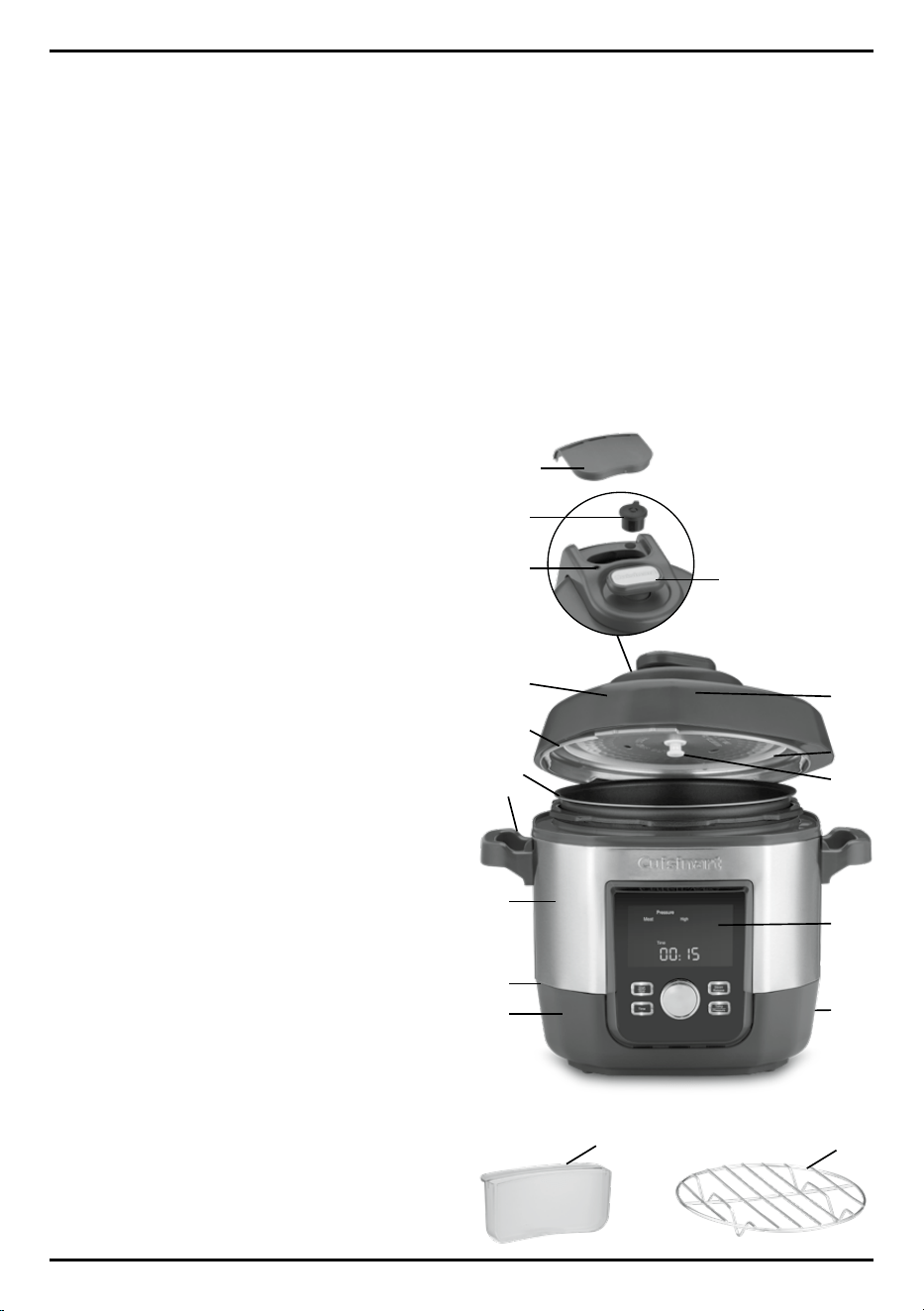
3
GUARDE ESTAS
INSTRUCCIONES
PARA USO DOMÉSTICO
SOLAMENTE
USO DE EXTENSIONS
El cable provisto con este aparato es corto, para
reducir el riesgo de que alguien se enganche o tropiece
con un cable más largo.
ÍNDICE
Medidas de seguridad importantes .....................2
Uso de extensiones ..............................................3
Piezas y características ........................................3
Panel de control ................................................... 4
Pantalla de inicio .................................................. 5
Antes del primer uso ............................................ 6
Instrucciones de uso ............................................6
Funciones ............................................................ 6
Instrucciones de operación ..................................8
Mecanismos de seguridad ...................................9
Limpieza y mantenimiento ................................ 10
Resolución de problemas ..................................11
Garantía ..............................................................12
Consejos y sugerencias ..................................... 13
Guía de cocción ................................................. 14
Recetas ..............................................................17
PIEZAS Y CARACTERÍSTICAS
1. Válvula reguladora de presión
2. Válvula indicadora de presión (indicador rojo)
NOTA: la válvula indicadora de presión solo es
visible cuando se mira directamente hacia abajo
desde la parte superior de la unidad.
3. Anillo sellador
4. Olla
5. Depósito de condensación
6. Asa
7. Carcasa
8. Placa calentadora (no ilustrada)
9. Base
10. Cable (no ilustrado)
11. Cubierta de la válvula
12. Asa de la tapa
13. Tapa
14. Ojal de caucho
15. Aro superior
16. Panel de control
17. Rejilla de cocción al vapor – Usada para
cocinar algunas recetas, tales como postres.
véase el libro de recetas)
NOTA: la rejilla de
cocción al vapor ha sido diseñada especialmente
para esta olla y no dañará el revestimiento
antiadherente, siempre que siga cuidadosamente
las instrucciones.
1
2
11
3
4
5
9
8
7
6
13
12
15
14
16
10
17
5
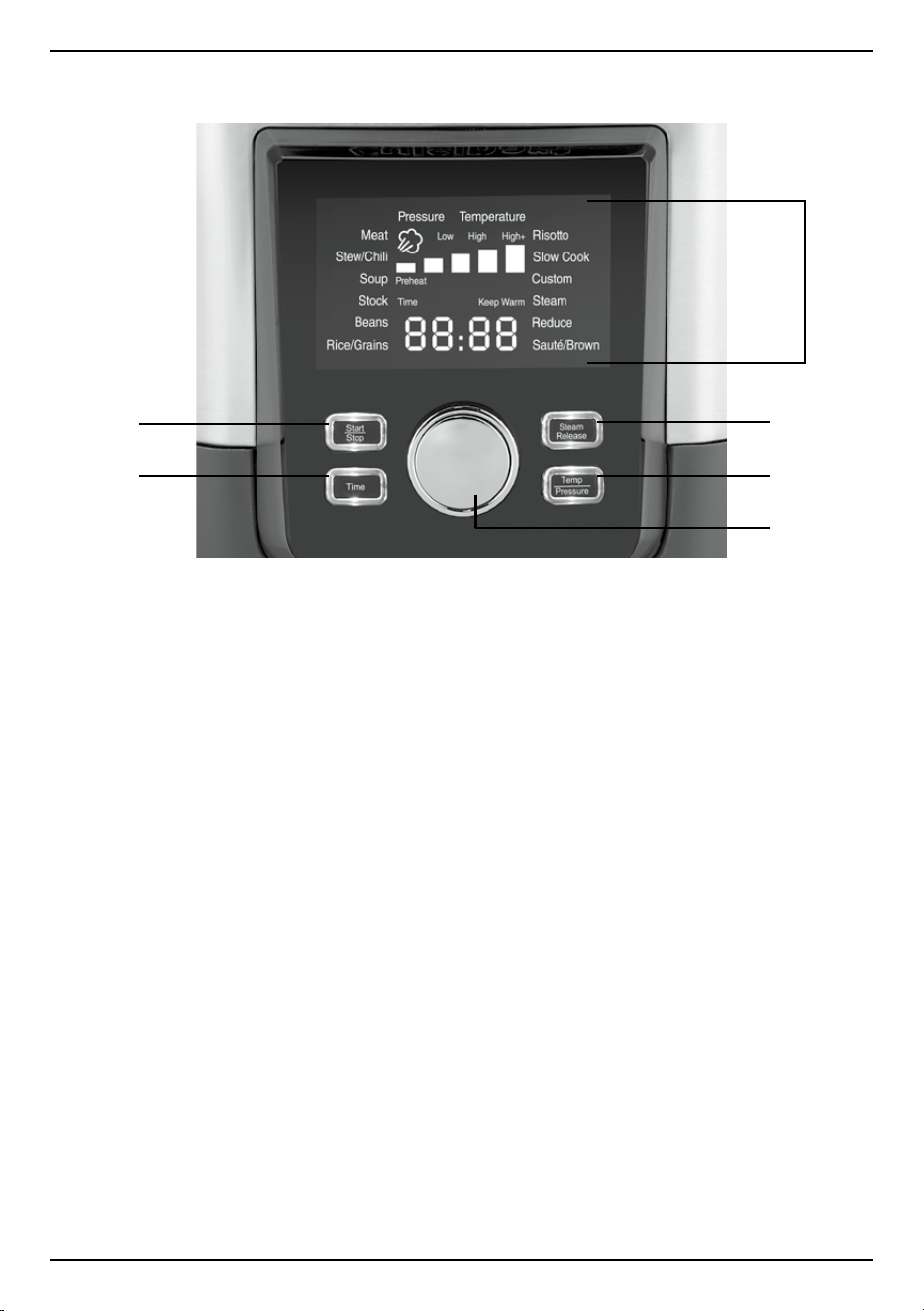
4
PANEL DE CONTROL
1. Botón START/STOP (encendido/apagado)
Oprímalo para empezar/detener la cocción.
2. Botón TIME (tiempo)
Oprímalo para ajustar el tiempo de cocción.
3. Botón STEAM RELEASE (liberación del
vapor)
Manténgalo oprimido para abrir la válvula
reguladora de presión y despresurizar la olla.
4. Botón TEMP/PRESSURE
(temperatura/presión)
Oprímalo para cambiar la temperatura de
cocción o el ajuste de presión.
5. Perilla de selección
Permite elegir el modo de cocción, la
temperatura y el tiempo. Utilice la perilla
para incrementar la temperatura, la presión
y el tiempo.
6. Pantalla LCD grande
Pantalla con retroiluminación fácil de leer.
Muestra el modo de cocción, la temperatura,
el ajuste de presión, el tiempo, el indicador y
las barras de precalentamiento, el indicador
de “mantener caliente” y el icono de
liberación del vapor.
1. 3.
6.
2. 4.
5.
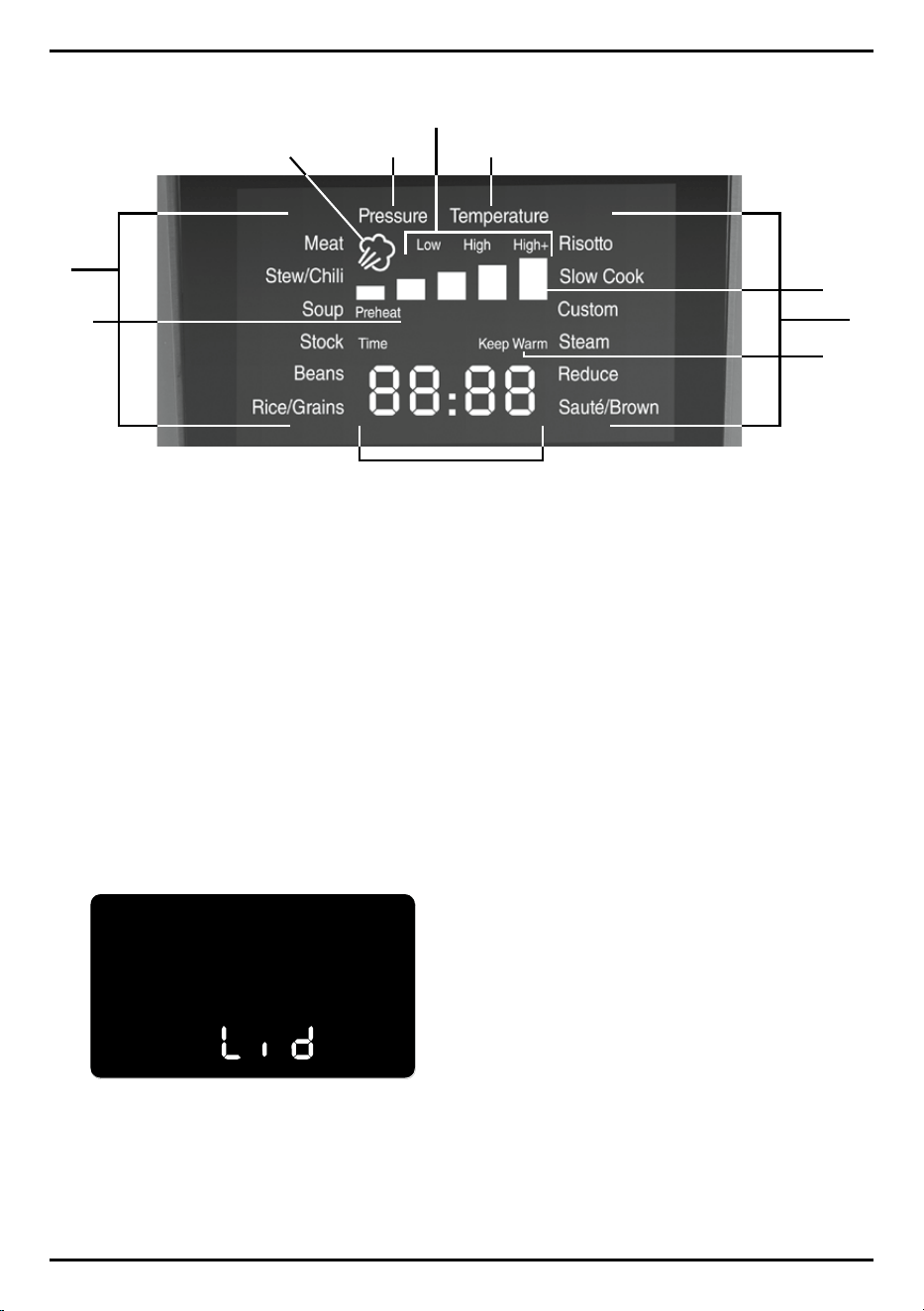
5
PANTALLA DE INICIO
A. Modos de cocción
Modos de cocción a presión: “MEAT”
(carne), “STEW/CHILI” (estofado/chile),
“SOUP” (sopa), “STOCK” (caldo), “BEANS”
(frijoles), “RICE/GRAINS” (arroz/granos),
“RISOTTO” (risotto), “CUSTOM” (cocción a
presión a medida), “STEAM” (cocción al
vapor).
Modos de cocción sin presión: “SLOW
COOK” (cocción a fuego lento), “REDUCE”
(reducir), “SAUTÉ/BROWN” (saltear/dorar),
“KEEP WARM” (mantener caliente).
B. “TIME” (pantalla del temporizador)
El temporizador de cuenta regresiva registra
el tiempo de cocción. El mensaje “LID”
(tapa) aparece en la pantalla cuando la tapa
está abierta o mal cerrada (Fig. 1).
C. Ajustes de temperatura/presión
Tres opciones de presión: “LOW” (alta),
“HIGH” (alta) y “HIGH+” (ultra alta). Dos
opciones de temperatura: “LOW” (baja) y
“HIGH” (alta).
D. “PRESSURE” (indicador de presión)
Indica que está usando un modo de
cocción
a presión.
E. “TEMPERATURE” (indicador de
temperatura)
Indica que está usando un modo
de cocción sin presión.
F. “PREHEAT” (indicador de
precalentamiento)
Aparece en la pantalla LCD cuando
la unidad se está precalentando.
G. Barras de precalentamiento
Muestran el progreso del precalentamiento.
Cuando cocina a presión, las barras de
precalentamiento contarán hacia arriba a
medida que se acumule la presión, y hacia
abajo a medida que se libera la presión.
H. “KEEP WARM” (indicador “mantener
caliente”)
Aparece al final de la cocción, con la
mayoría de las funciones, cuando la unidad
ingresa al modo “mantener caliente”.
El modo “mantener caliente” también puede
activarse manualmente para mantener los
alimentos cocinados calientes
para servir.
I. Icono de vapor
Aparece cuando oprima el botón STEAM
RELEASE (liberación del vapor) y mientras
la unidad se está despresurizando.
A.
B.
A.
H.
G.
F.
C.
D. E.I.
1.
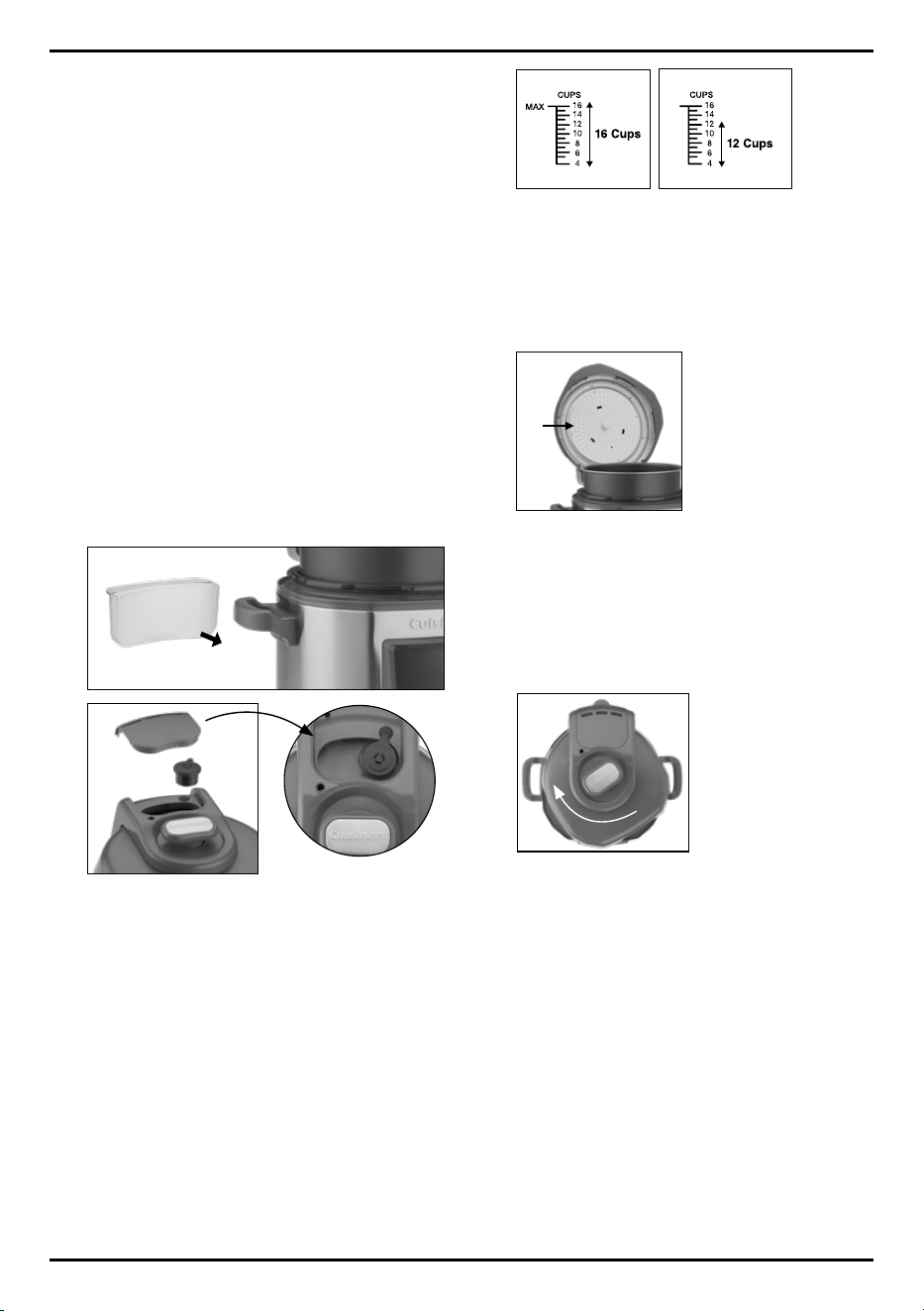
6
ANTES DEL PRIMER USO
Quite el material de embalaje y las etiquetas
promocionales pegadas al aparato.
Cerciórese de que todas las piezas están incluidas.
Le aconsejamos que guarde el material de embalaje
para uso futuro.
Antes de usar el aparato por primera vez, límpielo con
un paño humedecido para quitar el polvo acumulado
durante el transporte. Lave la olla y el anillo sellador en
agua jabonosa tibia, o en el lavavajillas. Enjuague y
seque la olla antes de colocarla en la base.
1. Coloque el aparato sobre una superficie
limpia y seca.
2. Instale el depósito de condensación (pieza
n.° 5 en la página anterior) en la parte trasera del
aparato, según se indica a continuación.
3. Quite la cubierta de la válvula (pieza n.° 11).
Cerciórese de que la válvula reguladora de
presión está en su sitio en la tapa, según se
indica en la figura 2. NOTA: la válvula no se
bloquea; simplemente reposa sobre el poste.
INSTRUCCIONES DE USO
1. Para abrir la tapa, agarre el asa y gire en sentido
antihorario. Levante la tapa para abrirla. La
unidad emitirá dos pitidos al girar el asa, y otros
dos pitidos al levantar la tapa.
2. Siga la receta al pie de la letra, usando la
cantidad de alimentos y líquidos recomendada.
NOTA: el volumen total de ingredientes no debe
exceder 16 tazas (3.75 L), o la línea “MAX” (Fig.
3). En el caso de vegetales/legumbres
deshidratados, frijoles, arroz, granos y cereales,
el volumen de ingredientes no debe exceder 12
tazas (2.8 L) (Fig. 4). NOTA: sobrellenar la olla
puede atascar la válvula reguladora de presión y
causar una peligrosa acumulación de presión
dentro de la olla. Siempre agregue ½ taza (120
ml) o más de líquido junto con los ingredientes.
3. Si el anillo sellador ha sido quitado de la tapa,
cerciórese de que el aro flexible está
debidamente puesto en la placa de metal. Luego,
agarre la placa de metal por la perilla y colóquela
en el eje central dentro de la tapa, presionando
firmemente para sujetar (Fig. 5). ASEGÚRESE DE
QUE LA PERILLA APUNTA HACIA ARRIBA.
4. Antes de cerrar la tapa, limpie la orilla de la olla.
Cierre la tapa, y luego gire el asa en sentido
horario para asegurarla (Fig. 6). La unidad emitirá
dos pitidos al cerrar la tapa, y otros dos pitidos al
girar el asa. NOTA: si la tapa no se cierra
correctamente, puede quemarse. El mensaje
“LID” aparecerá, parpadeando, en la pantalla
LCD, y la unidad emitirá pitidos.
5. Posicione la válvula reguladora de presión en su
sitio (en el área de la bisagra de la tapa), según
se indica en la figura 2. Oprima válvula indicadora
de presión en el área del asa para asegurarse de
que la olla está debidamente sellada.
FUNCIONES
Modos de cocción a presión
1. “MEAT” (carne) – Este modo es ideal para
presas/pedazos más grandes de carne, tales
como falda y cerdo. También es perfecto para
cocinar pollo entero. El ajuste de presión por
defecto es “HIGH+” (ultra alta) y el tiempo por
defecto es 35 minutos, pero también puede usar
los ajustes “HIGH” (alta) y “LOW” (baja). Nota: el
tiempo puede ajustarse desde 1 minuto hasta 4
horas. En la mayoría de los casos, se debe usar
3.
4.
5.
6.
2.
1.

7
el método de descompresión natural al final de la
cocción. Nota: la función “SAUTÉ/BROWN”
(saltear/dorar) puede usarse para dorar las carnes
antes de cocinarlas para darle más sabor. La
función “REDUCE” (reducir) puede usarse para
cocinar el líquido de cocción a fuego lento para
convertirlo en una sabrosa salsa.
2. “STEW/CHILI” (estofado/chile) – Este modo es
perfecto para cocinar tanto un sustancioso
estofado de res o de cordero como chile de
pavo. Cerciórese de dorar la carne molida,
usando la función “SAUTÉ/BROWN” (saltear/
dorar), antes de cocinarla. El ajuste de presión
por defecto es “HIGH” (alta) y el tiempo por
defecto 30 minutos, pero también puede usar los
ajustes de presión “HIGH+” (ultra alta) y “LOW”
(baja). Nota: el tiempo puede ajustarse desde 1
minuto hasta 4 horas. En la mayoría de los casos,
se debe usar el método de descompresión
natural al final de la cocción.
3. “SOUP” (sopa) – Este modo puede usarse para
preparar sopas sabrosas en una fracción del
tiempo que tomaría hacerlo en la estufa. Coloque
los ingredientes en la olla y cubra con líquido. La
mayoría de las recetas requieren usar el ajuste
“HIGH” (alta), pero también puede usar los
ajustes de presión “HIGH+” (ultra alta) y “LOW”
(baja). El tiempo de cocción por defecto es de
10 minutos.
4. “STOCK” (caldo) – Este modo sirve para
preparar caldos más ricos que requieren
cocinarse por más tiempo. Es perfecto para
preparar caldo de pollo, carne o vegetales.
Consejo de experto: guarde las peladuras de
vegetales durante toda la semana (o el mes),
envolviéndolas bien y congelándolas. Cuando
esté lista/o para preparar caldo, saque las
peladuras (que de otra manera estarían
destinadas a la basura o al abono), y úselas para
darle sabor a un caldo delicioso. Agregue los
ingredientes (huesos, carne, vegetales, hierbas) y
suficiente agua para cubrirlos, cerciorándose de
no pasar la línea “MAX”. El ajuste de presión por
defecto es “HIGH” (presión alta) y el tiempo por
defecto es 30 minutos, pero también puede usar
los ajustes de presión “HIGH+” (ultra alta) y
“LOW” (baja). Para preparar caldos aún más
ricos, cocine los ingredientes por 1 hora y 30
minutos. Para resultados óptimos, siempre use el
método de descompresión manual.
5. BEANS (frijoles) – Este modo es perfecto para
preparar platos que lleven frijoles secos más
rápidamente y con resultados más sabrosos que
los métodos tradicionales (estufa y horno).
Simplemente coloque los frijoles en la olla.
Agregue suficiente líquido como para cubrir los
frijoles con 1 pulgada (2.5 cm) de líquido. El
ajuste de presión por defecto es “HIGH” (alta) y el
tiempo por defecto es 30 minutos, pero
cerciórese de consultar nuestra guía de cocción
para elegir el tiempo perfecto para el tipo de frijol
que está usando.
6. “RICE/GRAINS” (arroz/granos) – Este modo es
perfecto para cocinar una variedad de arroz y
granos/cereales. Consulte la guía de cocción en
la página 16 para determinar la cantidad de agua,
el ajuste de presión y el tiempo adecuados. La
mayoría de las recetas usan el ajuste “HIGH”
(alta) y el método de descompresión rápido. El
ajuste de presión por defecto es “HIGH” (alta) y el
tiempo por defecto es 5 minutos.
7. “RISOTTO” (risotto) – Este modo permite
preparar risotto fácilmente, casi sin intervención
manual. Primero use la función “SAUTÉ/BROWN”
(saltear/dorar) para saltear los ingredientes
aromáticos y tostar el arroz. Luego, agregue el
líquido y cierre la tapa. Una vez que la olla
alcance la presión necesaria, necesita solo 5
minutos para cocinar el risotto perfecto. Oprima
el botón STEAM RELEASE (liberación del vapor)
para despresurizar rápidamente la olla, para que
el risotto conserve su textura cremosa. El ajuste
de presión por defecto es “HIGH” (alta) y el
tiempo por defecto es 5 minutos.
8. “CUSTOM” (cocción a presión a medida)
– Este modo proporciona máxima flexibilidad. Es
perfecto para cocinar alimentos que no pueden
cocinarse con los demás modos, tales como los
vegetales, los postres y otras recetas. El ajuste
de presión por defecto es “LOW” (baja) y el
tiempo por defecto es 1 minuto.
9. “STEAM” (cocción al vapor) – Programa único
que permite cocinar al vapor, bajo presión. Esto
reduce el tiempo de cocción mientras conserva
los nutrientes. Nota: cuando cocina al vapor, la
temperatura no es ajustable. El tiempo por
defecto es 20 minutos, pero puede ajustarse
desde 1 minuto hasta 2 horas. Cuando usa este
programa, la olla NO ingresa el modo
“mantener caliente” al final de la cocción.
Modos de cocción sin presión
1. “SLOW COOK” (cocción lenta) – Este
programa proporciona máxima flexibilidad para
cocinar a fuego lento. La temperatura puede
ajustarse en “LOW” (baja) o “HIGH” (alta) y el
tiempo puede ajustarse desde 30 minutos hasta
20 horas. Cuando usa temperatura baja, el
tiempo de cocción es más largo, por lo general
de 8 a 20 horas. Cuando usa temperatura alta, el
tiempo de cocción es más corto, por lo general
de 2 a 6 horas. La temperatura por defecto de
este programa es “HIGH” (alta) y el tiempo por
defecto es de 4 horas. NOTA: en algunos casos
raros, presión puede acumularse en la olla
durante la cocción lenta. Si esto ocurre,

8
simplemente oprima el botón STEAM RELEASE
(liberación del vapor) para despresurizar la olla.
2. “REDUCE” (reducir) – Este programa se
utiliza principalmente al final de la cocción a
presión o cocción lenta para espesar salsas y
reducir líquidos. También puede usarse para
espesar sopas. Nota: la temperatura no es
ajustable. El tiempo por defecto es 10 minutos,
pero puede ajustarse desde 1 minuto hasta
2 horas.
3. “SAUTÉ/BROWN” (saltear/dorar) – Este
programa es perfecto para saltear los vegetales o
los ingredientes aromáticos antes de cocinar, y
dorar la carne antes de cocinarla a presión. Nota:
el mismo programa permite saltear y dorar. Tiene
dos opciones de temperatura: “LOW” (baja) para
saltear y “HIGH” (alta) para dorar. También tiene
un temporizador, pero a diferencia de los demás
programas, no requiere programarse. Usar el
modo “SAUTÉ/BROWN” (saltear/dorar) antes de
cocinar a presión permite que la olla alcance el
nivel de presión adecuado más rápidamente.
Importante: este programa debe usarse con la
tapa abierta. NOTA: use un cucharón de madera
para raspar el fondo de la olla y despegar los
residuos de alimentos. NO utilice utensilios
metálicos.
4. “KEEP WARM” (mantener caliente) – Al
final de todos los programas de cocción a
presión, la olla ingresará automáticamente el
modo “mantener caliente”. También puede usar
este modo independientemente para mantener
calientes los alimentos cocinados. Importante:
este programa NO debe usarse para recalentar
alimentos. La temperatura no es ajustable. El
tiempo puede ajustarse de 30 minutos a 4 horas.
INSTRUCCIONES
DE OPERACIÓN
Elija el modo de cocción deseado:
Después de encender el aparato, gire la perilla de
selección para elegir el modo de cocción deseado;
el modo seleccionado empezará a parpadear.
Para confirmar su selección, oprima la perilla de
selección; el modo seleccionado dejará de parpadear.
Después de confirmar el modo de cocción, oprima el
botón START/STOP; el botón TEMP/PRESSURE
empezará a parpadear. Entonces, oprima el botón
START/STOP otra vez para empezar la cocción, o
ajuste la temperatura y tiempo de cocción.
Elija la temperatura deseada:
Cada modo de cocción tiene un ajuste de temperatura
por defecto (baja o alta) y un ajuste de presión por
defecto (baja, alta o ultra alta). Para cambiar la
temperatura o el ajuste de presión, oprima el botón
TEMP/PRESSURE; el ajuste de temperatura por
defecto empezará a parpadear. Gire la perilla de
selección hasta que el ajuste deseado aparezca en la
pantalla; Para confirmar el ajuste, oprima la perilla de
selección.
Para cambiar el tiempo de cocción:
Cada modo de cocción tiene un tiempo de cocción
por defecto. Para cambiar el tiempo, oprima el botón
TIME; el tiempo por defecto empezará a parpadear.
Gire la perilla de selección para aumentar o disminuir
el tiempo. Para confirmar el tiempo, oprima la perilla
de selección.
Después de confirmar el modo de cocción, el ajuste de
temperatura/presión y el tiempo, oprima el botón
START/STOP para empezar la cocción. La primera
barra de precalentamiento y el indicador “PREHEAT”
(precalentando) aparecerán en la pantalla LCD.
NOTA: el indicador “PREHEAT” y las barras de
precalentamiento no aparecen cuando se usan los
modos “SLOW COOK” (cocción lenta), “STEAM”
(cocción al vapor), “REDUCE” (reducir) y “SAUTÉ/
BROWN” (saltear/dorar).
Cómo cambiar los ajustes:
Para cambiar el modo de cocción, el ajuste de
temperatura o el tiempo en cualquier momento, sigas
las instrucciones a continuación.
Para cambiar el modo de cocción
–
Mantenga
oprimido el botón START/STOP. Gire la perilla de
selección hasta que el modo de cocción deseado
aparezca en la pantalla; el modo seleccionado
empezará a parpadear. Para confirmar su selección,
oprima la perilla de selección; el modo seleccionado
dejará de parpadear. Oprima el botón START/STOP
para seguir cocinando.
Para cambiar el ajuste de temperatura
–
mantenga
oprimido el botón TEMP/PRESSURE hasta que el
ajuste de temperatura actual empiece a parpadear. Gire
la perilla de selección hasta que el ajuste deseado
aparezca en la pantalla; la temperatura parpadeará.
Para confirmar el ajuste, oprima la perilla de selección;
la unidad seguirá cocinando.
Para cambiar el tiempo
–
mantenga oprimido el
botón TIME hasta que el ajuste de tiempo actual
empiece a parpadear. Gire la perilla de selección para
elegir el tiempo deseado; el tiempo parpadeará. Para
confirmar el tiempo, oprima la perilla de selección; la
unidad seguirá cocinando.
Para pausar la cocción y regresar a la pantalla de
inicio, mantenga oprimido el botón START/STOP.
NUNCA INTENTE ABRIR LA TAPA DURANTE
LA COCCIÓN.
NOTA: durante la cocción a presión, después de que la
unidad alcance la presión máxima, es normal ver un
pequeño espacio entre la tapa y la carcasa.

9
FUNCIÓN “KEEP WARM”
(MANTENER CALIENTE)
Función “mantener caliente” automática
Al final de la cocción, cuando el tiempo llegue a
“00:00”, la unidad ingresará automáticamente al modo
“mantener caliente”. La unidad emitirá 4 pitidos para
indicar que ha terminado la cocción, y el indicador
“KEEP WARM” aparecerá en la pantalla. El
temporizador contará para mostrar cuánto tiempo la
unidad ha estado en el modo “mantener caliente”.
Función “mantener caliente” manual
El modo “mantener caliente” puede activarse
manualmente para mantener los alimentos cocinados
calientes para servir.
1. Abra la tapa y coloque los ingredientes calientes
en la olla.
2. Cierre la tapa. NOTA: no es necesario girar
la tapa.
3. Encienda la unidad.
4. Gire la perilla de selección hasta que el indicador
“KEEP WARM” esté parpadeando. Oprima la
perilla de selección para confirmar, y, luego
oprima el botón START/STOP para empezar a
mantener caliente.
5. El tiempo por defecto del modo “KEEP WARM”
es de 2 horas. Para ajustar el tiempo, oprima el
botón TIME y use la perilla para ajustar el tiempo,
desde 30 minutos hasta 4 horas. Oprima la perilla
de selección para confirmar el tiempo, y luego
oprima el botón START/STOP para empezar a
mantener caliente; el temporizador empezará la
cuenta regresiva. NOTA: puede volver a ajustar el
tiempo en cualquier momento, repitiendo el paso
5.
NOTA: la función KEEP WARM (mantener
caliente) no debe usarse por más de 12 horas.
La textura y el sabor de los alimentos empezarán
a cambiar después de 1 hora. Puede que
condensación aparezca en el aro superior;
esto es normal.
CÓMO ABRIR LA TAPA
Al final de la cocción, la olla mantendrá la comida
caliente automáticamente. Antes de abrir la tapa,
deberá eliminar la presión acumulada en la olla, usando
uno de los métodos de descompresión indicados a
continuación. El método de descompresión dependerá
del tipo de alimentos cocinados. Nuestras recetas
indican cuál método usar. Si su receta no lo indica,
busque una receta similar y siga las instrucciones de
la receta.
1. Descompresión natural – Deje que la unidad
ingrese el modo “KEEP WARM” (mantener
caliente) después de la cocción. La presión
disminuirá naturalmente poco a poco (el tiempo
de descompresión depende de la cantidad de
líquido en la olla y del tiempo de cocción). A
medida que se libera la presión, las barras de
precalentamiento desaparecen. El método de
descompresión natural puede demorar entre 20 y
80 minutos. Durante este tiempo, la cocción
continúa; por eso, se desaconseja usar este
método después de cocinar ciertos cortes de
carne y postres. Al final de la descompresión, la
unidad emitirá un pitido, las barras de
precalentamiento desaparecerán de la pantalla y
la tapa se desbloqueará.
2. Descompresión rápida – Al final de la cocción
(indicado por cuatro pitidos), oprima el botón
STEAM RELEASE (liberación del vapor). El icono
del vapor aparecerá en la pantalla LCD y el vapor
empezará a salir por el área de la bisagra de la
tapa. Mantenga el rostro y las manos alejadas del
vapor durante la descompresión. No libere el
vapor bajo gabinetes/armarios de cocina, ya que
el vapor los puede dañar.
A medida que se libera la presión, las barras de
precalentamiento desaparecen. Al final de la
descompresión, la unidad emitirá un pitido, las
barras de precalentamiento desaparecerán de la
pantalla, el indicador de presión volverá a su
posición original y la tapa se desbloqueará. La
cocción terminará al instante. Si los alimentos
necesitan cocinarse más, será necesario volver a
encender el aparato y esperar hasta que la
presión alcance el nivel adecuado otra vez.
3. Método combinado – En algunas de nuestras
recetas, usamos un método combinado (natural/
rápido) de descompresión, para que los alimentos
sigan cocinándose por un tiempito más. Para usar
el método combinado, permita que el vapor salga
naturalmente durante el tiempo indicado, y luego
abra la válvula.
MECANISMOS DE SEGURIDAD
Para su seguridad y mayor fiabilidad, su olla a presión
cuenta con seis mecanismos de seguridad.
1. Tapa con bloqueo de seguridad
La presurización no empezará hasta que la tapa
esté debidamente cerrada y bloqueada. La tapa
no podrá abrirse hasta el final de la
descompresión.
2. Dispositivo de control de la presión
Mantiene automáticamente la presión al nivel
adecuado durante toda la cocción.
3. Válvula reguladora de presión
Libera aire automáticamente cuando la presión
dentro de la olla excede la temperatura
programada.
NOTA: sobrellenar la olla puede atascar la válvula
reguladora de presión y provocar una peligrosa
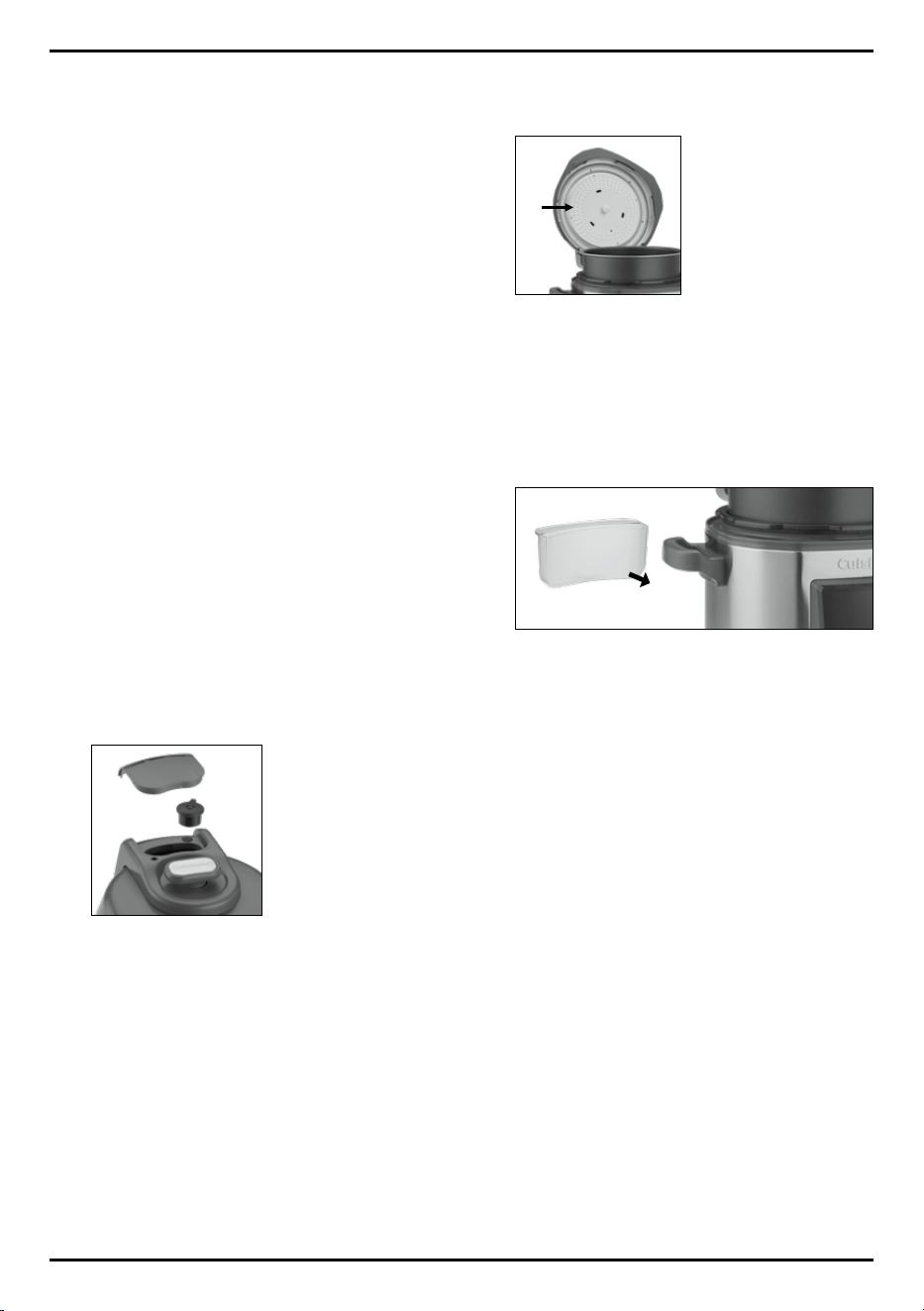
10
acumulación de presión dentro de la olla (véase
la sección “INSTRUCCIONES DE USO”).
4. Mecanismo de descompresión automática
En caso de que la unidad llegue a exceder la
presión o la temperatura máxima, la olla bajará
ligeramente para romper el sello del anillo
sellador, liberando así aire.
5. Monitoreo térmico
El aparato se apagará automáticamente en caso
de que la olla alcance el nivel máximo de
temperatura, o si no hay alimentos dentro de la
olla.
6. Dispositivo de protección térmica
Corta la corriente cuando la olla alcance el nivel
máximo de temperatura.
LIMPIEZA Y MANTENIMIENTO
1. Desenchufe el aparato antes de limpiarlo.
2. Limpie la carcasa del aparato con un paño suave,
tal como un paño de microfibra o una toallita de
papel humedecida. No sumerja la carcasa del
aparato en agua, ni vierta agua en ella.
3. Retire el anillo sellador de la tapa, agarrando la
perilla y jalando. Déjelo a un lado.
4. Compruebe que la válvula indicadora de presión
(indicador rojo) esté limpia y se mueva
libremente.
5. Retire cubierta de la válvula, y luego la válvula
reguladora de presión (Fig. 7), agarrándola y
jalando con fuerza hacia arriba. Enjuague con
agua tibia y seque.
6. Limpie el exterior y el interior de la tapa con un
paño y agua tibia, incluyendo todas las áreas de
la parte inferior. Seque bien y regrese la válvula
reguladora de presión en su sitio.
7. Para lavar el anillo sellador, quite
cuidadosamente el aro flexible y límpielo con un
paño humedecido o un paño de microfibra. No
utilice limpiadores químicos. Limpie la placa de
metal con agua tibia, seque bien y vuelva a
instalar el anillo sellador.
8. Para limpiar el ojal de caucho en el centro del
anillo sellador, retírelo cuidadosamente, lávelo y
vuelva a colocarlo en su sitio.
9. Vuelva a colocar el anillo sellador en la tapa.
ASEGÚRESE DE QUE LA PERILLA APUNTA
HACIA ARRIBA (Fig. 8).
10. La olla es apta para lavavajillas. Para lavarla a
mano, restriéguela con una esponja o un paño
suave. Tenga cuidado de no dañar el
revestimiento antiadherente. Nunca utilice
productos químicos fuertes o estropajos.
11. Para limpiar el depósito de condensación, retírelo
y lávelo en agua jabonosa tibia. Después, vuelva
a instalarlo (Fig. 9).
12. Cualquier otro servicio debe ser realizado por un
técnico autorizado.
NOTA: si es necesario restregar la olla, utilice un
cepillo o un estropajo de nylon y detergente no
abrasivo.
8.
9.
7.

11
RESOLUCIÓN DE PROBLEMAS
PROBLEMA POSIBLES CAUSAS SOLUCIONES
La tapa no se cierra
El anillo sellador no está
debidamente instalado.
Vuelva a instalar el anillo sellador,
según se describe en el punto n.° 6
de la sección “INSTRUCCIONES
DE USO”.
La tapa no se puede abrir aún
después de la descompresión.
El indicador de presión no
ha bajado.
Oprima el botón STEAM RELEASE
(liberación del vapor) otra vez.
Aire se está escapando por la
orilla de la tapa
El anillo sellador no está puesto. Instale el anillo sellador.
Hay residuos de alimentos en el
anillo sellador.
Limpie el anillo sellador.
El anillo sellador está desgastado. Cambie el sello.
Aire se escapa continuamente de
la válvula indicadora de presión
(indicador rojo).
Hay residuos de alimentos en
el sello de la válvula indicadora
de presión.
Limpie el sello.
El sello de la válvula indicadora de
presión está desgastado.
Cambie el sello.
La válvula indicadora de presión
(indicador rojo) no sube.
La válvula reguladora de presión no
está bien puesta.
Véase el punto n.° 3 de la sección
“ANTES DEL PRIMER USO”.
No hay suficiente agua en la olla.
Compruebe las cantidades
indicadas en la receta.
Aire se está escapando por
la tapa y/o la válvula reguladora
de presión.
Llame a nuestro servicio posventa
al 1-800-726-0190.
La unidad se apaga al oprimir el
botón START para empezar la
cocción
Se acaba de usar el modo “SAUTÉ/
BROWN” (saltear/dorar) y la
temperatura de la olla está más alta
que la temperatura de cocción.
Después de saltear/dorar, permita
que la olla se enfríe por 2 a 3
minutos antes de empezar la
cocción, o agregue ½ taza (120 ml)
de líquido a la olla.
El mensaje “LID” aparece en la
pantalla LCD.
La tapa está mal cerrada.
Gire el asa de la tapa en sentido
horario para asegurar la tapa.
El icono de liberación del vapor
está parpadeando.
La unidad sigue bajo presión.
Véase la sección “Consejos y
sugerencias” en la página 13.
La tapa no se cierra fácilmente
La olla aún está caliente, y el vapor
empuja la tapa hacia arriba.
Empuje ligeramente la tapa hacia
abajo para cerrarla.
Permita que el contenido se enfríe
por varios minutos antes de
bloquear la tapa.
Aire se está escapando
de la tapa.
La válvula reguladora de presión no
está en su sitio.
Abra la tapa y cerciórese de que la
válvula reguladora de presión está
debidamente posicionada.
El mensaje “E1” aparece en la
pantalla y la unidad emite 10
pitidos.
Mal funcionamiento del
control térmico
Llame a nuestro servicio posventa
al 1-800-726-0190.
El mensaje “E2” aparece en
la pantalla y la unidad emite
10 pitidos.
Mal funcionamiento del
control térmico
Llame a nuestro servicio posventa
al 1-800-726-0190.

12
GARANTÍA
Garantía limitada de tres años
Esta garantía es para los consumidores que residen
en los EE.UU. solamente. Usted es un consumidor
si posee un Olla multifunción 12 en 1
®
que fue
comprado en una tienda para uso personal, familiar
o casero. A menos que la ley aplicable exija lo
contrario, esta garantía no es para los minoristas u
otros consumidores/compradores comerciales.
Cuisinart garantiza este producto contra todo
defecto de materiales o fabricación durante 3 años
después de la fecha de compra original, siempre
que el aparato haya sido usado para uso doméstico
y según las instrucciones.
Le aconsejamos que llene el formulario de registro
disponible en https://cuisinart.registria.com a fin
de facilitar la verificación de la fecha de compra
original. Sin embargo, no es necesario registrar el
producto para recibir servicio bajo esta garantía. En
ausencia del recibo de compra, el período de
garantía será calculado a partir de la fecha de
fabricación.
RESIDENTES DE CALIFORNIA
La ley del estado de California ofrece dos opciones
bajo el período de garantía. Los residentes del
estado de California pueden regresar el producto
defectuoso (A) a la tienda donde lo compraron o (B)
a otra tienda que venda productos Cuisinart
®
de
este tipo. La tienda podrá, a su elección, reparar el
producto, referir el consumidor a un centro de
servicio independiente, sustituir el producto, o
reembolsar al consumidor el precio de compra
menos la cantidad directamente atribuible al uso
anterior del producto por el consumidor. Si estas
dos opciones no satisfacen al consumidor, podrá
llevar el aparato a un centro de servicio
independiente, siempre que se pueda arreglar o
reparar el aparato de manera económica. Cuisinart
(no el consumidor) será responsable por los gastos
de servicio, reparación, sustitución o reembolso de
los productos defectuosos bajo garantía. Los
residentes de California también pueden, si así lo
desean, mandar el aparato defectuoso directamente
a Cuisinart para que sea reparado o sustituido. Para
esto, deben llamar a nuestro servicio de atención al
cliente al 1-800-726-0190. Cuisinart será
responsable por los gastos de reparación,
reemplazo, manejo y envío de los productos
defectuosos durante el período de garantía.
GARANTÍA DE REEMPLAZO SIN DIFICULTADES
Su máxima satisfacción es nuestra prioridad, así que
si este producto Cuisinart
®
falla dentro del generoso
período de garantía, lo repararemos o, de ser
necesario, lo reemplazaremos, sin costo alguno para
usted. Para obtener una etiqueta de devolución,
visítenos en https://www.cuisinart.com/customer-
care/product-assistance/product-inquiry. o
llamando sin cargo a nuestro servicio de atención al
cliente, al 1-800-726-0190, para hablar con un
representante.
Este producto satisface las más altas exigencias de
fabricación y ha sido diseñado para uso sobre
corriente de 120 V, usando accesorios y piezas de
repuesto autorizados solamente. Esta garantía
excluye expresamente los defectos o daños
causados por accesorios, piezas o reparaciones no
autorizados por Cuisinart, así como los defectos o
daños causados por el uso de un convertidor de
voltaje. Esta garantía no cubre el uso comercial o
industrial del producto, y no es válida en caso de
daños causados por mal uso, negligencia o
accidente. Esta garantía excluye todos los daños
incidentales o consecuentes. Algunos Estados no
permiten la exclusión o limitación de daños
incidentales o consecuentes, de modo que las
limitaciones mencionadas pueden no regir para
usted. Usted puede tener otros derechos que varían
de un Estado a otro.
Importante: Si debe llevar el producto defectuoso a
un centro de servicio no autorizado, por favor
informe al personal del centro de servicio que deben
llamar al servicio Cuisinart, al 1-800-726-0190, a fin
de diagnosticar el problema correctamente, usar las
piezas correctas para repararlo y asegurarse de que
el producto aún está bajo garantía.

13
CONSEJOS Y SUGERENCIAS
• Puede adaptar muchas de sus recetas favoritas,
p. ej., sopas, estofados, acompañamientos y
mucho más, para cocinarlas en su olla de alta
presión multifunción Cuisinart
®
.
• Tenga presente que este método de cocción
requiere mucho menos líquido que los métodos
de cocción tradicionales.
• Nunca pase la línea “MAX”.
• Asegúrese de que la tapa está debidamente
cerrada, girándola en sentido horario lo más que
pueda.
• Los alimentos/líquidos alcanzarán el nivel de
presión adecuado más rápido que los
alimentos/líquidos fríos.
• Después de la cocción, siempre emplee el
método de descompresión indicado en la
receta. El método de descompresión rápido
debe emplearse inmediatamente después de la
cocción, a fin de evitar que los alimentos sigan
cocinándose.
• No guarde el aparato con la tapa cerrada; esto
evitará que el sello se desgaste.
• La cocción a presión conserva más nutrientes
que los métodos de cocción tradicionales, ya
que reduce la evaporación de los nutrientes
junto con el agua de cocción.
• Para adaptar sus recetas favoritas, busque una
receta similar en nuestro libro de recetas y úsela
como guía. El tiempo de cocción es
generalmente 30 a 50% más rápido que el
tiempo de cocción con un método de cocción
tradicional. Reduzca el líquido de cocción a la
mitad o más (la experiencia le ayudará a
encontrar las proporciones perfectas). Le
aconsejamos que añada los vegetales al final de
la cocción, para evitar que se cocinen en
exceso. Consulte las tablas de referencia a
continuación.
• Protección en caso de falla eléctrica – en caso
de falla eléctrica/corte de energía durante la
cocción, ocurrirá lo siguiente:
Interrupción de la alimentación por menos de 3
minutos: la unidad se volverá a encender y la
cocción continuará.
Interrupción de la alimentación por más de 3
minutos: la unidad se volverá a encender y el
botón STEAM RELEASE parpadeará, indicando
que la unidad sigue bajo presión. Oprima el
botón STEAM RELEASE para liberar la presión,
y vuelva a encender/programar la unidad para
terminar de cocinar.
GUÍA DE COCCIÓN:
Pollo y carnes ..................................................... 14
Vegetales ............................................................ 15
Arroz y cereales .................................................. 16
Frijoles secos ..................................................... 16
Recetas .............................................................. 17
TIEMPO PARA ALCANZAR EL
NIVEL DE PRESIÓN
ADECUADO
Recuerde que la cocción no empezará hasta que
la olla alcance el nivel de presión máximo, lo que
puede demorar desde 5 hasta 40 minutos,
dependiedo de la temperatura inicial de los
alimentos y de la receta.
TIEMPOS DE COCCIÓN
SUGERIDOS PARA POLLO/
AVES Y CARNES
Si el tiempo de cocción es inferior a 45 minutos,
agregue por lo menos 1 taza (235 ml) de líquido.
Si el tiempo de cocción es más largo, agregue 1½
tazas (355 ml) de líquido. Añada vegetales (p. ej.,
cebollas zanahorias y apio), así como hierbas
aromáticas (ajo, perejil, tomillo, etc.) para dar más
sabor a sus platos. Salvo indicación contraria en
la receta, la mayoría de los alimentos se cocinan
a presión alta. Se recomienda dorar las carnes
antes de la cocción para conservar su textura y
realzar su sabor. El tiempo de cocción variará
según el tamaño y la temperatura inicial de los
alimentos.

14
POLLO Y CARNES
ALIMENTO TIEMPO DE COCCIÓN MÉTODO DE DESCOMPRESIÓN
POLLO
Entero
– hasta 4 libras (1.8 kg)
25 a 30 minutos
Rápido
Pechuga con hueso – 3 libras 8 a 10 minutos Rápido
Pechuga deshuesada – 2 libras
(910 g)
5 a 6 minutos Rápido
Muslos/Piernas, con hueso 9 a 12 minutos Rápido
Mulsos/Piernas, deshuesados 8 a 10 minutos Rápido
RES
Paleta/Pulpa contra (“bottom
round”) – 3 a 3½ libras (1.35 a
1.6 kg)
60 a 90 minutos Natural
Falda (“brisket”)
– 2½ a 3 libras
(1.1 a 1.35 kg)
55 minutos Natural
Cecina de res 60 a 90 minutos Natural
Costillas cargadas (“short ribs”)
de 2 a 3 pulgadas (5 a 7.5 cm) de
espesor
50 minutos Natural
Carne para guisar – cubos de 1½
a 2 pulgadas (4 a 5 cm)
20 a 30 minutos
Natural (ver la receta de estofado
de carne para el tiempo de cocción
con verduras)
CORDERO
Brazuelos/Piernas – cuatro, de 12
onzas (340 g) cada uno
25 a 30 minutos Natural
Paleta – cubos de 1½ pulgadas
(4 cm)
20 a 25 minutos Natural
CERDO
Chuletas
, con hueso, de ¾ a 1
pulgada (2 a 2.5 cm) de espesor
4 a 5 minutos, después de dorar Rápido
Paleta asada – 3 libras (1.35 kg) 50 a 55 minutos Natural
Costillas, cortadas en 2 o 3 piezas 20 a 30 minutos Rápido
TERNERA
Paleta, deshuesada
10 minutos por libra (el peso es
importante, para no cocinar la
carne demasiado)
Natural
Carne para guisar – cubos de 1½
a 2 pulgadas (4 a 5 cm)
15 a 20 minutos Natural

15
VEGETALES
Siempre lave y pele (de ser necesario) los vegetales antes de cocinarlos. Los vegetales se cocinan muy
rápidamente; recuerda oprimir el botón START/STOP y liberar el vapor, empleando el método de descompresión
rápido, inmediatamente después de escuchar el pitido que indica el final de la cocción. Si los vegetales requieren
cocinarse más, apague la unidad y cierre la tapa; seguirán cocinándose al vapor. Siempre agregue ½ taza (120 ml)
de líquido para cocinar vegetales. Si usa vegetales congelados, deberá añadir 1 a 2 minutos de cocción y
posiblemente más tiempo de cocción a vapor. Le recomendamos que cocine los vegetales menos de lo necesario,
y que termine de cocinarlos al vapor; esto evitará que se cocinen en exceso. Salvo indicación contraria, la mayoría
de los vegetales se cocinan a presión alta.
ALIMENTO TIEMPO DE COCCIÓN
MÉTODO DE
DESCOMPRESIÓN
Alcachofas
4, de 8 a 10 onzas (240 a 300 g) cada una
10 a 12 minutos Rápido
Habichuelas/Judías verdes o amarillas 1
½
libras (680 g), en pedazos de 2 pulgadas
(5cm)
1 a 2 minutos Rápido
Remolachas, medianas A grandes 15 a 20 minutos Rápido
Brécol, dividido en cogollos grandes 2 a 3 minutos Rápido
Coliflor, dividida en cogollos grandes 2 a 3 minutos Rápido
Zanahorias, en trozos de 2 pulgadas (5 cm),
o zanahorias “baby”
5 minutos Rápido
Zanahorias, en rodajas gruesas 2 a 3 minutos Rápido
Maíz, 4 a 6 mazorcas
(utilizar la rejilla de cocción al vapor)
2 a 3 minutos Rápido
Verduras de hoja,
repollo, col rizada, en tiras
de 1 pulgada (2.5 cm)
5 a 7 minutos Rápido
Cebollas “baby”, peladas 2 a 4 minutos Rápido
Chirivías, peladas y cortadas en trozos 3 a 4 minutos Rápido
Chirivías, en rodajas gruesas 1 a 2 minutos Rápido
PAPAS
Papas blancas, medianas,
cortadas en cuartos
5 a 7 minutos Rápido
Papas rojas,
de 2 a 3 onzas (60 a 90 g)
cada una
5 a 8 minutos Rápido
Batata/Camote
, en cubos 4 a 5 minutos Rápido
CALABAZA
Calabaza de bellota (“acorn squash”),
partidas en dos y sin semillas
6 a 8 minutos Rápido
Calabaza moscada (“butternut squash”),
pelada y cortada en rodajas
3 a 4 minutos Rápido
Calabaza de cabello de ángel/alcayota
(“spaghetti squash”), partida a la mitad
10 a 12 minutos Rápido
Calabaza, zapallo, calabacín/calabacita
(“zucchini”), en rodajas
1 a 2 minutos Rápido

16
ARROZ Y CEREALES
FRIJOLES SECOS
• Antes de cocinar frijoles secos, descarte los frijoles rotos o arrugados y las piedritas y otras suciedades.
Enjuague y escurra los frijoles.
• Los frijoles pueden ser remojados durante una noche, pero la olla a presión permite cocinar los frijoles secos,
sin necesidad de remojarlos.
•
Agregue cebollas, ajo, apio, hierbas frescas o laurel para dar más sabor al plato. No añada sal, la cual inhibe la
cocción de los frijoles.
• Cocine altas cantidades de frijoles (1 libra/455 g de frijoles + 8 tazas/1.9 L de agua + sazón + cebolla, ajo,
hierbas) y congele los frijoles cocinados en porciones de 1 taza (175 g) para utilizar en otras recetas.
• Nunca llene la olla a más de la mitad de su capacidad.
• Añada 2 cucharaditas de aceite por cada taza (150 g) de frijoles para evitar que hagan espuma.
• Después de la cocción, limpie cuidadosamente la tapa, el sello, la válvula reguladora de presión y la válvula roja
indicadora de presión.
• Cocine los frijoles secos (no remojados) a presión alta (“HIGH”) y emplee el método de descompresión natural
para liberar el vapor.
• Cocine los frijoles remojados a presión alta (“HIGH”) y emplee el método de descompresión combinado por 10
minutos para liberar el vapor.
• Si los frijoles no están completamente cocinados (lo que depende parcialmente de la edad de los frijoles, algo
que usted no puede controlar), termine de cocinarlos a fuego lento, usando el modo “SIMMER”. Es preferible
cocinar de menos los frijoles y terminar de cocinarlos a fuego lento.
GRANOS
(1 taza/aprox. 200 g)
TIEMPO DE COCCIÓN
(minutos, a presión alta)
LÍQUIDO
MÉTODO DE
DESCOMPRESIÓN
Cebada (perlada) 20 a 25 3 tazas (710 ml) Rápido
Arroz integral 20 2 tazas (475 ml) Natural
Bulgur 6 2 tazas (475 ml) Rápido
Farro (grano entero) 18 3 tazas (710 ml) Rápido
Quinua 5 1½ tazas (355 ml) Rápido
Avena escocesa 5 3 tazas (710 ml) Natural
Arroz blanco
(grano largo)
4 a 6 1½ tazas (355 ml) Rápido
Arroz salvaje 22 3 a 4 tazas (710 a 945 ml) Rápido
FRIJOLES (1 TAZA)
+ 8 TAZAS (1.9 L) DE
AGUA
TIEMPO DE COCCIÓN
(REMOJADOS POR LA
NOCHE)
TIEMPO DE COCCIÓN (SECOS) RINDE
Frijoles negros 5 minutos 10 minutos 2 tazas
Frijoles Cannellini 4 minutos 10 minutos 2 tazas
Garbanzos 5 minutos 15 minutos 2½ tazas
Frijoles “Great
Northern”
4 minutos 10 minutos 2¼ tazas
Lentejas No aplicable 8 a 10 minutos 2 tazas
Frijoles pintos 5 minutos 10 minutos 2¼ tazas
Frijoles blancos 5 minutos 10 minutos 2 tazas
Frijoles rojos 5 minutos 10 minutos 2 tazas
Arvejas partidas No aplicable 8 a 10 minutos 2 tazas

17
Recetas
Avena escocesa ..............................................17
Crema de granos mixtos para el .............. 18
Bol de avena para el desayuno ................ 18
Budín de pan Jalá ........................................ 18
Budín de pan para el desayuno ............... 19
Frittata ............................................................ 20
Huevos duros ................................................ 20
Huevos rellenos ............................................ 21
Macarrones con queso .............................. 21
Puré de papas ...............................................22
Col rizada salteada ......................................22
Repollo “estofado” .......................................22
Crema para mojar de frijoles blancos ....23
Garbanzos con salchicha y col rizada ....23
Frijoles horneados ........................................24
Alcachofas con tres salsas ........................ 24
Habichuelas con chalotes y piñones ......25
Ensalada de farro y rúcula .........................26
“Tabbouleh” (tabulé) ....................................26
Caldo de pollo ...............................................27
Caldo de vegetales .......................................27
Caldo de setas ..............................................28
Caldo de res asado ......................................28
Caldo de mariscos .......................................29
Caldo de hueso .............................................29
Sopa de pollo rápida .................................. 30
Sopa de pollo con tortilla ......................... 30
Sopa de fideos Udon ................................... 31
“Pho” ................................................................32
“Pasta e Fagioli”” ..........................................32
Sopa de lentejas ........................................... 33
Chile de frijoles vegetariano ......................34
Risotto de setas ............................................34
Risotto de primavera con arvejas ............35
Risotto de mariscos ..................................... 35
Arroz con frijoles negros ............................36
Salsa marinara ..............................................37
Albóndigas en salsa ..................................... 37
Pasta Ziti “al horno” ....................................37
Chile de pavo rápido ...................................38
Falda tradicional ...........................................38
Piernas de cordero con aceitunas y
ciruelas pasas ...............................................39
Pollo con ravioles chinos .......................... 40
Salmón glaseado con miel ........................ 41
Arroz con pollo ............................................. 41
Pollo simple ...................................................42
Carne mechada .............................................42
Costillas de cerdo al estilo asiático ........43
Pollo Tikka Masala ....................................... 44
Pollo en adobo ............................................. 44
Tinga de pollo ................................................45
Chile con carne ............................................ 46
Curry verde de vegetales al
estilo tailandés............................................. 46
Cerdo desmenuzado con
piña y chipotle ...............................................47
Budín de arroz .............................................. 48
Dulce de leche ............................................. 48
Budín de chocolate ..................................... 49
Tarta de queso blanca y negra ................ 49
Manzanas “al horno” .................................. 50
Budín de pan de cerezas con chispas
de chocolate .................................................. 51
Compota de pera.......................................... 51
Avena escocesa
Tradicionalmente, la preparación de la avena
escocesa toma tiempo y dedicación, pero con la
olla multifunción Cuisinart
®
, la preparación es
fácil y rápida, para que disfrute de una avena
perfectamente cocinada, cremosa y deliciosa.
Rinde aprox. 7 tazas (1.65 L)
5
2
∕
3
tazas (1.35 L) de agua
2 tazas (160 g) de copos de avena
escocesa (no utilice avena
instantánea)
1 cucharada (15 ml) de aceite de coco
1½ palitos de canela
¼ taza + 2 cucharadas (25 g) de coco
rallado sin azúcar
2 cucharadas de jarabe de
arce/maple puro
¾ taza (90 g) de frutas secas
2 pizcas de nuez moscada rallada
1 pizca de sal kosher
1. Colocar todos los ingredientes en la olla.
Cerrar la tapa y elegir el modo “RICE/
GRAINS” (arroz/granos). Fijar la
temperatura en “HIGH” (alta) y el tiempo
en 5 minutos, y oprimir el botón START/
STOP. Cuando suene el tono, emplear el

18
método de descompresión natural para
liberar el vapor.
2. Después de la descompresión, abrir la
tapa y quitar los palitos de canela.
3. Revolver y servir inmediatamente.
Información nutricional por porción de ½ taza (120 ml):
Calorías 131 (26% de grasa) • Carbohidratos 22g
Proteínas 3g • Grasa 4g • Grasa saturada 2g
Colesterol 0mg • Sodio 20mg • Calcio 8mg • Fibra 3g
Crema de granos mixtos
para el desayuno
Una receta sustanciosa, saludable y
energética para comenzar el día.
Rinde aprox. 7 tazas (1.65 L)
1 taza (80 g) de copos de avena
escocesa (no utilice avena
instantánea)
½ taza (90 g) de arroz integral
de grano corto
½ taza (90 g) de quinua
2
⁄
3
taza (65 g) de pacanas sin sal picadas
2
⁄
3
taza (100 g) de pasas
¼ taza (20 g) de coco rallado sin azúcar
2 palitos de canela
2 a 4 cucharadas de jarabe de
arce/maple puro
2 cucharadas de aceite de coco
¾ taza (90 g) de frutas secas
2 pizcas de nuez moscada rallada
1 pizca de sal kosher
4 tazas (945 ml) de agua
1. Colocar todos los ingredientes en la olla.
Cerrar la tapa y elegir el modo “RICE/
GRAINS” (arroz/granos). Fijar la
temperatura en “HIGH” (alta) y el tiempo
en 10 minutos, y oprimir el botón START/
STOP. Cuando suene el tono, emplear el
método de descompresión natural para
liberar el vapor.
2. Después de la descompresión, abrir la
tapa y quitar los palitos de canela.
3. Revolver y servir inmediatamente.
Información nutricional por porción de 1 taza (235 ml):
Calorías 390 (32% de grasa) • Carbohidratos 61g
Proteínas 8g • Grasa 14g • Grasa • saturada 5g
Colesterol 0mg • Sodio 32mg • Calcio 45mg
Fibra 7g
Bol de avena para el desayuno
Cocinar avena en grandes cantidades le
permite ser creativa/o con el desayuno en la
mañana. Sirva la avena tibia con lo que tenga
a mano, pero pensamos que la mezcla de
yogur, mermelada y fruta es una combinación
ganadora.
Rinde 4 porciones
4 tazas (945 ml) de avena escocesa/
irlandesa cocinada, tibia
¼ taza (60 ml) de mermelada de
frambuesa sin semillas
¼ taza (60 ml) de yogur griego natural
(cualquier variedad)
½ taza (70 g) de frambuesas frescas
¼ taza (40 g) de pacanas picadas
1 cucharadita de semillas de chía
Dividir la avena entre cuatro cuencos. Añadir
mermelada de frambuesa y yogur; revolver.
Cubrir con frambuesas frescas, pacanas y
semillas de chía.
Información nutricional por porción de 1 taza (235 ml):
Calorías 271 (26% de grasa) • Carbohidratos 44g
Proteínas 8g • Grasa 8g • Grasa saturada 1g
Colesterol 0mg • Sodio 16mg • Calcio 39mg
Fibra 6g
Budín de pan Jalá
Tostadas francesas sin esfuerzo. La mezcla
se puede preparar la noche anterior, y luego
simplemente ponerse en la olla para que el
budín esté listo para una casa llena
de huéspedes.
Rinde 8 porciones
4 huevos grandes
2 tazas (475 ml) de leche entera
1 taza (235 ml) de crema líquida para
batir (“heavy cream”)
1
⁄
3
taza (80 ml) de jarabe de
arce/maple puro
1 cucharada de extracto
natural de vainilla
2 cucharaditas de canela en polvo
1 cucharadita de nuez moscada rallada
¼ cucharadita de sal kosher
1 barra de pan Jalá (“Challah”) o de
“brioche” de aprox. 1 libra (455 g), en
pedazos de 2 pulgadas (5 cm)
Spray vegetal

19
1. Colocar los huevos, la leche, la crema, el
jarabe de arce/maple, la vainilla, las
especias y la sal en un tazón grande.
Revolver, batiendo.
2. Agregar el pan y revolver, presionando el pan
hacia abajo de manera que cada pedazo
quede completamente sumergido. Cubrir
con papel film/plástico y refrigerar por un
mínimo de 3 horas, o hasta por la noche
3. Treinta minutos antes de cocinar el budín,
sacarlo del refrigerador y dejarlo reposar a
temperatura ambiente.
4. Engrasar ligeramente una fuente de horno
de cerámica de 2 L y de no más de 7
pulgadas (18 cm) de diámetro con spray
vegetal. Verter la mezcla de pan en la
fuente. Cubrir con papel de aluminio
engrasado con spray vegetal.
5. Colocar la rejilla de cocción al vapor en la
olla y agregar 2 tazas (475 ml) de agua.
Cortar una hoja de papel de aluminio de
aprox. 24 pulgadas (60 cm) de largo.
Doblar por la mitad, a lo largo, cuatro
veces, hasta conseguir una tira de 24 x 2
pulgadas (60 x 5 cm).
6. Colocar la fuente en el centro de la tira de
papel de aluminio y levantarla con cuidado
para colocarla sobre la rejilla.
7. Cerrar la tapa y elegir el modo “CUSTOM”
(cocción a presión a medida). Fijar la
temperatura en “LOW” (baja) y el tiempo en
45 minutos, y oprimir el botón START/STOP.
8. Cuando suene el tono, oprimir el botón
STEAM RELEASE para liberar rápidamente
el vapor.
9. Después de la descompresión, abrir la
tapa y, usando guantes para horno/
manoplas, agarrar las “asas” de aluminio y
retirar cuidadosamente la fuente de la
olla. Servir inmediatamente.
*Puede sustituir alternativas vegetales a la
leche entera y a la crema.
Información nutricional por porción:
Calorías 376 (44% de grasa) • Carbohidratos 40g
Proteínas 10g • Grasa 18g • Grasa • saturada 10g
Colesterol 168mg • Sodio 368mg • Calcio 156mg
Fibra 2g
Budín de pan para
el desayuno
Para los amantes de los desayunos salados,
esta receta es muy versátil. Puede sustituir
tocino, pancetta e inclusivo vegetales por la
salchicha.
Rinde 8 porciones
6 onzas (170 g) de salchicha para el
desayuno frescas o precocinadas
1 cucharada de aceite de oliva
1 chalote pequeño, finamente picado
2 dientes de ajo, finamente picados
6 huevos grandes
1 taza (235 ml) de leche entera
1 taza (235 ml) de crema líquida para
batir (“heavy cream”)
½ cucharadita de sal kosher
¼ cucharadita de páprika
2 pizcas de pimienta negra recién molida
1 barra de pan Jalá (“Challah”) o de
“brioche” de aprox. 1 libra (455 g), en
pedazos de 2 pulgadas (5 cm)
1 taza (85 g) de Gruyère rallado
Spray vegetal
1. Quitar la tripa de la salchicha. Cortar las
salchichas en rodajas de ¼ de pulgada
(5 mm); reservarlas.
2. Colocar el aceite en la olla. Elegir el modo
“SAUTÉ/BROWN” (saltear/dorar). Fijar la
temperatura en “HIGH” (alta) y el tiempo en
10 minutos, y oprimir el botón START/STOP.
3. Cuando el aceite esté caliente, agregar la
salchicha. Cocinar hasta que estén doradas,
rompiendo las salchichas con un cucharón
de madera. Retirar de la olla y reservar.
4. Colocar el chalote y el ajo a la olla;
cocinar por aprox. 30 segundos, hasta
suavizarse. Oprimir el botón START/STOP.
5. Colocar los huevos, la leche, la crema,
la sal y la páprika en un tazón grande.
Batir para mezclar.
6. Agregar el pan y revolver, presionando el
pan hacia abajo de manera que cada
pedazo quede completamente sumergido.
Agregar la salchicha dorada, la mezcla de
chalote/ajo y el queso rallado. Cubrir con
papel film/plástico y refrigerar por un
mínimo de 3 horas, o hasta por la noche
7. Treinta minutos antes de cocinar el budín,
sacarlo del refrigerador y dejarlo reposar a
temperatura ambiente.

20
8. Engrasar ligeramente una fuente de horno
de cerámica de 2 L y de no más de 7
pulgadas (18 cm) de diámetro con spray
vegetal. Verter la mezcla de pan en la
fuente. Cubrir con papel de aluminio
engrasado con spray vegetal.
9. Colocar la rejilla de cocción al vapor en la
olla y agregar 2 tazas (475 ml) de agua.
Cortar una hoja de papel de aluminio de
aprox. 24 pulgadas (60 cm) de largo.
Doblar por la mitad, a lo largo, cuatro
veces, hasta conseguir una tira de 24 x 2
pulgadas (60 x 5 cm).
10. Colocar la fuente en el centro de la tira de
papel de aluminio y levantarla con cuidado
para colocarla sobre la rejilla.
11. Cerrar la tapa y elegir el modo “CUSTOM”
(cocción a presión a medida). Fijar la
temperatura en “LOW” (baja) y el tiempo en
45 minutos, y oprimir el botón START/STOP.
12. Cuando suene el tono, oprimir el botón
STEAM RELEASE para liberar rápidamente
el vapor.
13. Después de la descompresión, abrir la
tapa y, usando guantes para horno/
manoplas, agarrar las “asas” de aluminio y
retirar la fuente de la olla. Servir
inmediatamente.
Información nutricional por porción:
Calorías 460 (58% de grasa) • Carbohidratos 30g
Proteínas 17g • Grasa 29g • Grasa • saturada 14g
Colesterol 238mg • Sodio 565mg • Calcio 223mg
Fibra 1g
Frittata
¡La olla multifunción Cuisinart
®
realmente
puede hacerlo todo! Cerciórese de tener
guantes para horno/manoplas a mano para
invertir la frittata en un plato para servir.
Rinde 6 porciones
1 cucharada de aceite de oliva
¼ a ½ puerro mediano, finamente rebanado
¼ cucharadita de sal kosher
1 pizca de pimienta negra recién molida
8 huevos grandes
½ taza (120 ml) de leche (cualquier tipo)
Spray vegetal
½ taza (55 g) de queso rallado
1 cucharada de cebollinos (“chives”)
finamente rebanados
1. Colocar el aceite de oliva en la olla. Elegir
el modo “SAUTÉ/BROWN” (saltear/dorar).
Fijar la temperatura en “LOW” (baja) y el
tiempo en 5 minutos, y oprimir el botón
START/STOP.
2. Cuando el aceite esté caliente, agregar el
puerro, junto con una pizca de la sal y de
la pimienta. Saltear hasta que el puerro
esté suave, pero no dorado. Retirar y dejar
enfriar ligeramente.
3. Colocar los huevos, la leche y la sal
restante en un tazón grande.
Revolver, batiendo.
4. Engrasar ligeramente una fuente de horno
de cerámica de 2 L que no tenga más de 7
pulgadas (18 cm) de diámetro con spray
vegetal. Verter la mezcla de huevo y el
puerro en la fuente; revolver. Cubrir con
queso y cebollinos.
5. Colocar la rejilla de cocción al vapor en la
olla y agregar 2 tazas (475 ml) de agua.
Cortar una hoja de papel de aluminio de
aprox. 24 pulgadas (60 cm) de largo.
Doblar por la mitad, a lo largo, cuatro
veces, hasta conseguir una tira de 24 x 2
pulgadas (60 x 5 cm).
6. Colocar la fuente en el centro de la tira de
papel de aluminio y levantarla con cuidado
para colocarla sobre la rejilla.
7. Cerrar la tapa y elegir el modo “CUSTOM”
(cocción a presión a medida). Fijar la
temperatura en “LOW” (baja) y el tiempo en
10 minutos, y oprimir el botón START/STOP.
8. Cuando suene el tono, oprimir el botón
STEAM RELEASE para liberar rápidamente
el vapor.
9. Después de la descompresión, abrir la
tapa
y, usando guantes para horno/manoplas,
agarrar las “asas” de aluminio y retirar la
fuente de la olla. Invertir la frittata sobre
un plato y servir inmediatamente.
Información nutricional por porción:
Calorías 164 (64% de grasa) • Carbohidratos 4g
Proteínas 6g • Grasa 12g • Grasa saturada 4g
Colesterol 257mg • Sodio 252mg • Calcio 113mg
Fibra 0g

21
Huevos duros
El tiempo de cocción en esta receta es para
conseguir verdaderos huevos duros. Si le
gustan los huevos menos cocinados, reduzca
ligeramente el tiempo, a aprox. 4 minutos,
para huevos “mollet”.
Rinde 6 huevos duros
1 taza (235 ml) de agua
6 huevos grandes
Baño de hielo (un tazón de agua con
cubitos de hielo)
1. Colocar la rejilla de cocción al vapor en la
olla y agregar el agua.
2. Usando un alfiler, perforar un pequeño
agujero en la parte inferior (la parte más
ancha) de cada huevo. Colocar los huevos
en la rejilla.
3. Cerrar la tapa y elegir el modo “CUSTOM”
(cocción a presión a medida). Fijar la
temperatura en “LOW” (baja) y el tiempo en
6 minutos, y oprimir el botón START/STOP.
4. Cuando suene el tono, oprimir el botón
STEAM RELEASE para liberar rápidamente
el vapor.
5. Después de la descompresión, abrir la
tapa y retirar los huevos con cuidado.
Colocarlos inmediatamente en el baño de
hielo para evitar que se recuezan.
6. Si no va a usar/comer los huevos
enseguida, guardarlos en el refrigerador
hasta el momento de servir.
Información nutricional por huevo:
Calorías 72 (62% de grasa) • Carbohidratos 0g
Proteínas 6g • Grasa 5g • Grasa • saturada 2g
Colesterol 186mg • Sodio 71mg • Calcio 28mg
Fibra 0g
Huevos rellenos
Uno no puede hacer huevos duros sin pensar
en huevo rellenos. Esta receta tiene los
sabores clásicos, pero le animamos que los
cubra con tocino picado, cebollín o especias.
Rinde 12 porciones
6 huevos duros
3 cucharadas de mayonesa
1 cucharada de aceite de oliva
1 cucharadita de mostaza de Dijon
1 cucharadita de jugo de limón fresco
1 a 2 pizcas de salsa picante
2 pizcas de sal kosher
1 pizca de pimienta negra recién molida
1 cucharada de hierbas frescas
Páprika, para decorar
1. Pelar y cortar cuidadosamente los huevos
por la mitad, a lo largo.
2. Sacar las yemas y colocarlas en el bol de
una procesadora de alimentos Cuisinart
®
equipada con cuchilla de metal. Procesar
hasta obtener una mezcla suave. Agregar
los ingredientes restantes, excepto las
hierbas y la paprika, pulsando, y luego
procesar hasta conseguir una mezcla
suave. Agregar las hierbas y pulsar para
picar/incorporar. Probar y ajustar la sazón
al gusto. Nota: si no tiene procesadora de
alimentos, puede aplastar la mezcla con
un tenedor.
3. Rellenar el centro de cada clara con la
mezcla de yema, usando una cuchara o
una manga pastelera. Rociar con páprika
antes de servir.
Información nutricional por porción:
Calorías 71 (80% de grasa) • Carbohidratos 0g
Proteínas 3g • Grasa 6g • Grasa • saturada 1g
Colesterol 96mg • Sodio 86mg • Calcio 15mg
Fibra 0g
Macarrones con queso
Si sus hijos viven de macarrones con queso,
puedes duplicarlos con esta sencilla receta.
¡Dudamos que noten la diferencia!
Rinde 11 tazas (2.6 L)
1 libra (455 g) de macarrones secos (u
otro tipo de pasta pequeña)
4 tazas (945 ml) de agua
1 cucharadita de sal kosher
2 tazas (475 ml) de leche entera
8 onzas (225 g) de queso crema, a
temperatura ambiente
1 cucharadita de mostaza seca
1 libra (455 g) de queso Cheddar rallado
o de una mezcla de sus quesos para
fundir favoritos, p. ej., Cheddar,
Monterrey Jack, Colby, Gouda, etc.
1. Colocar la pasta, el agua y la sal en la
olla.
2. Cerrar la tapa y elegir el modo “CUSTOM”
(cocción a presión a medida). Fijar la
temperatura en “HIGH” (alta) y el tiempo

22
en 4 minutos, y oprimir el botón START/
STOP.
3. Cuando suene el tono, oprimir el botón
STEAM RELEASE para liberar rápidamente
el vapor.
4. Después de la descompresión, abrir la
tapa con cuidado y agregar la mitad del
queso crema y la mitad de la leche. Elegir
el modo “SAUTÉ/BROWN” (saltear/dorar) y
fijar la temperatura en “LOW” (baja);
revolver bien. Cuando el queso crema y la
leche estén incorporados, agregar el queso
crema y la leche restantes. Luego, agregar
la mostaza seca y el queso.
5. Probar y ajustar la sazón al gusto.
Información nutricional por porción de 1 taza (235 ml):
Calorías 410 (49% de grasa) • Carbohidratos 34g
Proteínas 17g • Grasa 22g • Grasa • saturada 13g
Colesterol 69mg • Sodio 567mg • Calcio 373mg
Fibra 1g
Puré de papas
Todo el mundo está peleando por el horno
y la estufa durante las fiestas, así que ¿por
qué no preparar uno de esos platos con la
olla multifunción?
Rinde 5 tazas (1.2 L)
2 libras (910 g) de papas Yukon Gold,
peladas y en pedazos
½ taza (120 ml) de agua
4 a 6 cucharada (55 a 85 g) de mantequilla
sin sal
¾ taza (175 ml) de leche entera
½ cucharadita de sal kosher
¼ cucharadita de pimienta negra
recién molida
1. Colocar todos los ingredientes en la olla.
2. Cerrar la tapa y elegir el modo “CUSTOM”
(cocción a presión a medida). Fijar la
temperatura en “HIGH” (alta) y el tiempo en
8 minutos, y oprimir el botón START/STOP.
3. Cuando suene el tono, oprimir el botón
STEAM RELEASE para liberar rápidamente
el vapor.
4. Después de la descompresión, abrir la
tapa con cuidado. Colocar los alimentos
en un bol para servir. Machacar hasta
obtener la consistencia deseada. Probar y
ajustar la sazón al gusto.
Información nutricional por porción de ½ taza (120 ml):
Calorías 228 (40% de grasa) • Carbohidratos 30g
Proteínas 4g • Grasa 10g • Grasa • saturada 6g
Colesterol 28mg • Sodio 273mg • Calcio 59mg
Fibra 4g
Col rizada salteada
Cocinar un acompañamiento en tan solo dos
minutos es un pequeño milagro. ¡Aquí
demostramos que es posible!
Rinde aprox. 3 tazas
1 cucharada de aceite de oliva
1 diente de ajo, machacado
¼ cucharadita de sal kosher
1 manojo de col rizada, sin los tallos
duros, picada gruesa (aprox. 8 a 10
tazas de col picada)
½ taza (120 ml) de caldo de pollo bajo
en sodio
1 pizca de hojuelas de pimiento rojo
1. Colocar el aceite de oliva en la olla.
2. Elegir el modo “SAUTÉ/BROWN” (saltear/
dorar). Fijar la temperatura en “LOW”
(baja) y oprimir el botón START/STOP.
3. Cuando el aceite esté caliente, agregar el
ajo una pizca de la sal. Saltear hasta que
esté fragante y suave.
4. Agregar la col rizada, el caldo, la sal
restante y las hojuelas de pimiento rojo.
Revolver para mezclar. Oprimir el botón
START/STOP.
5. Cerrar la tapa y elegir el modo “CUSTOM”
(cocción a presión a medida). Fijar la
temperatura en “HIGH” (alta) y el tiempo en
2 minutos, y oprimir el botón START/STOP.
6. Cuando suene el tono, oprimir el botón
STEAM RELEASE para liberar rápidamente
el vapor.
7. Después de la descompresión, abrir la
tapa con cuidado. Colocar los alimentos
en un bol para servir. Probar y ajustar la
sazón al gusto.
Información nutricional por porción de ½ taza:
Calorías 180 (36% de grasa) • Carbohidratos 21g
Proteínas 8g • Grasa 7g • Grasa • saturada 2g
Colesterol 34mg • Sodio 575mg • Calcio 56mg
Fibra 4g

23
Repollo “estofado”
La olla multifunción sella el sabor de este
plato acompaña la mayoría de las barbacoas
sureños en muy poco tiempo.
Rinde aprox. 4 tazas
2 lonchas de tocino grueso (si es
posible, con sabor extra ahumado),
picado
1 chalote, en rodajas finas
1 cabeza de repollo (quitar los tallos
duros y rebanar las hojas; rinde aprox.
8 tazas de repollo rebanado)
1 pizca de sal kosher
2 cucharadas de vinagre de sidra
de manzana
¾ taza (175 ml) de caldo de pollo
bajo en sodio
1. Elegir el modo “SAUTÉ/BROWN” (saltear/
dorar), fijar la temperatura en “LOW”
(baja) y oprimir el botón START/STOP.
2. Al final del precalentamiento, colocar el
tocino en la olla y dorarlo hasta que esté
crujiente. Cuando el tocino esté bien
cocinado, agregar el chalote y saltear por
2 aprox. 2 minutos, hasta que esté suave.
3. Agregar el repollo, la sal y el vinagre.
Revolver para mezclar. Oprimir el botón
START/STOP.
4. Cerrar la tapa y elegir el modo “CUSTOM”
(cocción a presión a medida). Fijar la
temperatura en “HIGH” (alta) y el tiempo en
6 minutos, y oprimir el botón START/STOP.
5. Cuando suene el tono, oprimir el botón
STEAM RELEASE para liberar rápidamente
el vapor.
6. Después de la descompresión, abrir la
tapa con cuidado y colocar los alimentos
en un bol para servir. Probar y ajustar la
sazón al gusto.
Información nutricional por porción de ½ taza:
Calorías 47 (63% de grasa) • Carbohidratos 2g
Proteínas 2g • Grasa 3g • Grasa • saturada 1g
Colesterol 5mg • Sodio 141mg • Calcio 53mg
Fibra 1g
Crema para mojar de frijoles
blancos
En esta receta, remojamos los frijoles, para
un resultado más cremoso. Pero si el tiempo
no lo permite, la olla multifunción permite
cocinar frijoles secos. Solo necesitará ajustar
el tiempo de cocción a 45 minutos.
Rinde aprox. 3½ tazas (820 ml)
½ libra (225 g) de sus frijoles blancos
secos favoritos (preferiblemente una
variedad más suave tal como “Great
Northern”), remojados en agua por la
noche
8 tazas (1.9 L) de agua
1 cucharadita de romero fresco
1 diente de ajo, machacado
½ cucharadita de ralladura de limón
1 cucharada de jugo de limón fresco
2 cucharadas de aceite de oliva
¾ taza (175 ml) de agua
1 pizca de hojuelas de pimiento rojo
½ cucharadita de sal kosher
1. Escurrir y enjuagar los frijoles remojados.
Colocar los frijoles y el agua en la olla.
Cerrar la tapa.
2. Elegir el modo “BEANS” (frijoles). Fijar el
tiempo en 33 minutos y oprimir el botón
START/STOP.
3. Cuando suene el tono, emplear el método de
descompresión natural para liberar el vapor.
4. Después de la descompresión, abrir la
tapa con cuidado y escurrir los frijoles.
5. Dejar enfriar los frijoles por aprox. 10
minutos, hasta que estén tibios.
Colocar los frijoles el bol de una
procesadora de alimentos equipada con
cuchilla de metal.
Agregar el resto de los ingredientes y
procesar hasta obtener una mezcla suave.
6. Probar y ajustar la sazón al gusto.
Información nutricional por porción de ¼ de taza (60 ml):
Calorías 132 (13% de grasa) • Carbohidratos 22g
Proteínas 8g • Grasa 2g • Grasa • saturada 0g
Colesterol 0mg • Sodio 242mg • Calcio 70mg
Fibra 7g

24
Garbanzos con salchicha
y col rizada
Este sustancioso plato puede servirse como
plato principal con arroz.
Rinde aprox. 6 tazas
1 cucharada de aceite de oliva
2 dientes de ajo, finamente rebanados
2 ristras de salchichas de pollo
precocidas, en rodajas*
1 cucharada de vino blanco
1 manojo de col rizada “Lacinato”,
picada en pedazos pequeños (aprox. 4
a 5 tazas de col picado)
2 tazas (400 g) de garbanzos
cocinados**
½ taza (120 ml) de caldo de pollo bajo
en sodio
1. Colocar el aceite en la olla. Elegir el modo
“SAUTÉ/BROWN” (saltear/dorar), fijar la
temperatura en “LOW” (baja) y oprimir el
botón START/STOP.
2. Cuando el aceite esté caliente, agregar el
ajo y la salchicha, y cocinar hasta que la
salchicha esté bien dorada. Agregar el vino
y seguir cocinando hasta que se haya
evaporado completamente.
Oprimir el botón START/STOP.
3. Agregar la col, los garbanzos y el caldo.
Cerrar la tapa y elegir el modo “CUSTOM”
(cocción a presión a medida). Fijar la
temperatura en “LOW” (baja) y el tiempo
en 1 minuto, y oprimir el botón START/
STOP.
4. Cuando suene el tono, oprimir el botón
STEAM RELEASE para liberar rápidamente
el vapor.
5. Después de la descompresión, abrir la
tapa con cuidado y colocar los alimentos
en un bol para servir. Probar y ajustar la
sazón al gusto.
*Las salchichas precocidas son fáciles de
rebanar. Si usa salchichas crudas, quitar
las tripas y aplastar las salchichas con un
cucharón de madera durante la cocción
para desmenuzar. Cerciórese de cocinarlas
hasta que ya no estén rosadas.
**Si cocina los garbanzos en la olla
multifunción, cocinarlos hasta que estén
ligeramente suaves, de manera que no se
deshagan en este plato.
Información nutricional por porción de 1 taza (235 ml):
Calorías 180 (36% de grasa) • Carbohidratos 21g
Proteínas 8g • Grasa 7g • Grasa • saturada 2g
Colesterol 34mg • Sodio 575mg • Calcio 56mg
Fibra 4g
Frijoles horneados
Ninguna fiesta de verano está completa sin
una gran olla de frijoles horneados.
Rinde aprox. 7 tazas
1 libra (455 g) de frijoles negros secos
8 tazas (945 ml) de agua
8 onzas (225 g) de tocino grueso, picado
1 cebolla, finamente picada
1 diente de ajo, finamente picado
3 tazas (710 ml) de caldo de pollo bajo
en sodio
1
⁄
3
taza(80ml)dejarabede
arce/maple puro
¼ taza llena (50 g) de azúcar rubia
(azúcar de caña integral)
2 cucharadas de mostaza de Dijon
2 cucharadas de concentrado de tomate
½ cucharadita de sal kosher
¼ cucharadita de pimienta negra
recién molida
1. Colocar los frijoles y el agua en la olla.
2. Elegir el modo “BEANS” (frijoles). Fijar el
tiempo en 10 minutos. Oprimir el botón
START/STOP.
3. Cuando suene el tono, oprimir el botón
STEAM RELEASE para liberar rápidamente
el vapor. Oprimir el botón START/STOP.
4. Después de la descompresión, abrir la
tapa con cuidado. Escurrir los frijoles y
reservarlos. NOTA: los frijoles solo están
parcialmente cocinados en este paso.
Terminarán de cocinarse con el resto de
los ingredientes.
5. Elegir el modo “SAUTÉ/BROWN” (saltear/
dorar), fijar la temperatura en “LOW”
(baja) y oprimir el botón START/STOP.
6. Después del precalentamiento, colocar el
tocino y la cebolla en la olla. Dorar por
aprox. 15 minutos, hasta que el tocino esté
crujiente y que la cebolla esté dorada y
suave. Oprimir el botón START/STOP.
7. Agregar los ingredientes restantes,
incluyendo los frijoles. Cerrar la tapa y elegir
el modo “BEANS” (frijoles). Fijar el tiempo
en 1 hora y oprimir el botón START/STOP.

25
8. Cuando suene el tono, emplear el método de
descompresión natural para liberar el vapor.
9. Después de la descompresión, abrir la
tapa con cuidado. Revolver para mezclar.
Probar y ajustar la sazón al gusto. Si le
gusta la salsa más espesa, oprimir el
botón START/STOP y elegir el modo
“REDUCE” (reducir). Cocinar hasta que la
salsa se espese al gusto.
Información nutricional por porción de ½ taza:
Calorías 226 (31% de grasa) • Carbohidratos 30g
Proteínas 10g • Grasa 8g • Grasa saturada 2g
Colesterol 11mg • Sodio 399mg • Calcio 67mg
Fibra 8g
Alcachofas con
tres salsas
¡Alcachofas perfectas, en tan solo 10
minutos! Lo mejor es que se pueden preparar
con anticipación y servirse a temperatura
ambiente con cualquiera de las salsas
sugeridas.
Rinde 4 porciones
1 taza (235 ml) de agua
1 limón, cortado a la mitad
4 alcachofas medianas
1. Colocar el agua y el jugo de un limón
en la olla.
2. Preparar las alcachofas, cortando el tallo
para obtener una superficie plana y
uniforme. Cortar el tercio superior y quitar
las capas externas de hojas duras.
3. Frotar la parte cortada de las alcachofas
con la mitad de limón restante. Colocar las
alcachofas en la olla. Cerrar la tapa y elegir
el modo “CUSTOM” (cocción a presión a
medida). Fijar la temperatura en “HIGH”
(alta) y el tiempo en 10 minutos, y oprimir el
botón START/STOP. Cuando suene el tono,
emplear el método de descompresión
rápido para liberar el vapor.
4. Después de la descompresión, abrir la tapa.
5. Servir inmediatamente con mantequilla
derretida o con una de las salsas para
mojar a continuación.
Información nutricional por porción (1 alcachofa):
Calorías 76 (2% de grasa) • Carbohidratos 17g
Proteínas 5g Grasa 0g • Grasa saturada 0g
Colesterol 0mg • Sodio 152mg • Calcio 71mg Fibra
9g
Aceite con ajo-chile
Un aceite simple para las alcachofas; si
sobra, se puede usar para mojar el pan
Rinde ½ taza (120 ml)
½ taza (120 ml) de aceite de oliva
4 dientes de ajo, finamente rebanados
1 pizca de sal kosher
1 pizca de pimienta negra recién molida
1 pizca de hojuelas de pimiento rojo
Poner el aceite y el ajo a calentar a fuego
medio, en una cacerola mediana. Cocinar por 3
a 5 minutos, hasta que el ajo esté fragante,
pero no dorado. Retirar del fuego, agregar el
resto de los ingredientes y dejar enfriar. Cubrir
y dejar reposar por 1 hora. Colar en un frasco o
en un tazón pequeño para servir o remojar
(desechar el ajo).
El aceite puede guardarse a temperatura
ambiente durante 24 horas, o en el
refrigerador por hasta 1 semana (llevar a
temperatura ambiente antes de servir).
Información nutricional por porción (2 cucharaditas):
Calorías 82 (98% de grasa) • Carbohidratos 0g
Proteínas 0g • Grasa 9g • Grasa • saturada 1g
Colesterol 0mg • Sodio 12mg • Calcio 2mg • Fibra 0g
Mantequilla de
limón-tomillo
La mantequilla derretida cubre a la
perfección las hojas de alcachofa, y el toque
de limón realza el sabor de esta deliciosa
salsa.
Rinde aprox. ½ taza (120 ml)
8 cucharadas (115 g) de mantequilla
sin sal
2 cucharadas de jugo de limón fresco
2 cucharaditas de tomillo fresco
½ cucharadita de ralladura de limón
1 pizca de sal kosher
Derretir la mantequilla en una cacerola
pequeña. Retirar del fuego y dejar enfriar
ligeramente. Agregar los ingredientes restantes
y revolver para mezclar. Servir tibio.
Información nutricional por porción (1 cucharadita):
Calorías 67 (99% de grasa) • Carbohidratos 0g
Proteínas 0g • Grasa 7g • Grasa • saturada 5g
Colesterol 20mg • Sodio 24mg • Calcio 1mg
Fibra 0g

26
Salsa holandesa
Esta salsa clásica se puede hacer en una
licuadora, procesadora de alimentos o a
mano, pero con una licuadora de mano es la
forma más rápida e infalible de prepararla.
Rinde 1½ tazas (355 ml)
4 yemas de huevo grande
1 cucharada de jugo de limón fresco
¾ cucharadita de sal kosher
½ libra (225 g) de mantequilla sin sal,
derretida y a temperatura ambiente
Agua tibia, a gusto
1. Colocar las yemas, el jugo de limón y la
sal en el vaso de mezcla de una batidora
de mano (o un vaso inastillable alto).
Agregar lentamente la mantequilla tibia,
teniendo cuidado de no incluir la espuma
blanca (los sólidos de la leche). Dejar
reposar por 1 minuto.
2. Introducir la varilla en el vaso de manera
que el protector de cuchillas toque el fondo
del vaso. Licuar a velocidad baja,
manteniendo la cuchilla en el fondo del
vaso. Cuando los ingredientes empiecen a
espesarse, licuar normalmente, usando un
movimiento suave hacia arriba y abajo, hasta
obtener una mezcla espesa y homogénea.
3. Si la salsa está demasiado espesa, agregar
agua tibia, 1 cucharadita a la vez, hasta
conseguir la consistencia deseada (aprox.
2 cucharadas de agua en total).
4. Probar y ajustar la sazón al gusto. Servir
inmediatamente, o mantener caliente (a
baño María) hasta el momento de servir.
Información nutricional por porción de 1 cucharada:
Calorías 115 (97% de grasa) • Carbohidratos 0g
Proteínas 1g • Grasa 12g • Grasa • saturada 7g
Colesterol 76mg • Sodio 109mg • Calcio 6mg
Fibra 0g
Habichuelas con chalotes
y piñones
Este plato de acompañamiento es
lo suficientemente elegante como para una
fiesta, pero tan simple que puede prepararlo
todos los días.
Rinde aprox. 8 tazas
1
⁄
3
taza (45 g) de piñones 2 cucharadas
(30 g) de mantequilla sin sal
1 chalote mediano, pelado y cortado
en rodajas
¾ cucharadita de sal kosher
24 onzas (680 g) de habichuelas/judías
verdes, limpias
2 cucharadas de jugo de limón fresco
1 taza (235 ml) de agua
1. Colocar los piñones en la olla. Elegir el
modo “SAUTÉ/BROWN” (saltear/dorar).
Fijar la temperatura en “LOW” (baja) y
oprimir el botón START/STOP.
2. Dorar los piñones, revolviéndolos
constantemente, por aprox. 5 minutos,
hasta que estén ligeramente dorados.
3. Agregar la mantequilla y el chalote, y
saltear ligeramente hasta que el chalote
empiece a suavizarse.
4. Rociar con sal y luego agregar las
habichuelas/judías, el jugo de limón y el
agua. Oprimir el botón START/STOP.
5. Cerrar tapa y elegir el modo “CUSTOM”
(cocción a presión a medida). Fijar la
temperatura en “HIGH” (alta) y el tiempo
en 1 minuto, y oprimir el botón START/
STOP.
6. Cuando suene el tono, oprimir el botón
STEAM RELEASE para liberar rápidamente
el vapor.
7. Después de la descompresión, abrir la
tapa con cuidado y revolver. Probar y
ajustar la sazón al gusto.
Información nutricional por porción de ½ taza:
Calorías 64 (73% de grasa) • Carbohidratos 4g
Proteínas 2g • Grasa 5g • Grasa • saturada 1g
Colesterol 4mg • Sodio 151mg • Calcio 17mg
Fibra 1g
Ensalada de farro
y rúcula
Una ensalada espectacular, perfecta tibia o
fría.
Rinde aprox. 4 tazas
1½ tazas (225 g) de farro seco
2¼ tazas (530 ml) de agua
2 tazas (120 g) de rúcula/rúgula/
arúgula tierna
1 taza (200 g) de corazones de
alcachofa, partidos en cuartos o a la
mitad

27
1 taza (75 g) de achicoria roja finamente
rebanada
¼ taza (60 ml) de aceite de oliva virgen
extra
1 a 2 cucharaditas de jugo de limón fresco
¼ cucharadita de sal kosher
1
⁄
8
cucharadita de pimienta negra
recién molida
2 cucharadas de hojuelas de
queso Parmesano
1. Colocar el farro y el agua en la olla. Elegir
el modo “RICE/GRAINS” (arroz/granos).
Fijar la temperatura en “HIGH” (alta) y el
tiempo en 18 minutos. Cerrar la tapa y
oprimir el botón START/STOP.
2. Cuando suene el tono, oprimir el botón
STEAM RELEASE para liberar rápidamente
el vapor.
3. Después de la descompresión, abrir la
tapa con cuidado y colocar los alimentos
en un tazón para servir grande. Agregar el
resto de los ingredientes, excepto el queso
Parmesano, y revolver. Cubrir con hojuelas
de queso Parmesano y servir
inmediatamente.
Información nutricional por porción de ½ taza (120 ml):
Calorías 156 (43% de grasa) • Carbohidratos 19 g
Proteínas 4g • Grasa 6g • Grasa • saturada 1g
Colesterol 1mg • Sodio 200mg • Calcio 21mg
Fibra 4g
“Tabbouleh” (tabulé)
Esta receta es fantástica cuando tiene
invitados.
Rinde aprox. 6 tazas
1 taza (140 g) de trigo bulgur
2 tazas (475 ml) de agua
2 tazas (120 g) de perejil fresco picado
½ taza (30 g) de menta fresca, picada
2 tazas (300 g) de tomates de pera
3 cebolletas (“green onions”),
finamente rebanadas
2 cucharadas de aceite de oliva
virgen extra
¼ taza (60 ml) de jugo de limón fresco
¼ cucharadita de sal kosher
¼ cucharadita de pimienta negra
recién molida
1 pizca de comino en polvo
1. Colocar el Bulgur y el agua en la olla. Cerrar
la tapa y elegir el modo “RICE/GRAINS”
(arroz/granos). Fijar la temperatura en
“HIGH” (alta) y el tiempo en 6 minutos.
Oprimir el botón START/STOP.
2. Cuando suene el tono, oprimir el botón
STEAM RELEASE para liberar rápidamente
el vapor.
3. Después de la descompresión, abrir la
tapa con cuidado y agregar los
ingredientes restantes; revolver.
4. Probar y ajustar la sazón al gusto. Servir
inmediatamente.
Información nutricional por porción de ½ taza:
Calorías 88 (41% de grasa) • Carbohidratos 12g
Proteínas 2g • Grasa 4g • Grasa • saturada 1g
Colesterol 0mg • Sodio 54mg • Calcio 41mg
Fibra 3g
Caldo de pollo
Este caldo nutritivo tiene muchos usos.
Puede tomarlo solo, usarlo como base para
sopas y guisos o estofados, o puede
guardarlo en recipientes pequeños para luego
usarlo para cocinar o calentar comidas en él.
Rinde aprox. 10 tazas (2.35 L)
4 libras (1.8 kg) de presas de pollo,
con hueso
3 zanahorias, en trozos
2 ramas de apio, en trozos de
2 pulgadas (5 cm)
1 cebolla mediana, en pedazos
1 diente de ajo, pelado
15 ramitas de perejil
3 ramitas de tomillo
2 cucharadita de granos de pimienta
2 hojas de laurel
7 a 8 tazas (1.65 a 1.9 L) de agua
(cerciorándose de no pasar la
línea “MAX”)
1. Colocar todos los ingredientes en la olla.
Cerrar la tapa y elegir el modo “STOCK”
(caldo). Fijar la temperatura en “HIGH”
(alta) y el tiempo en 1 hora 20 minutos, y
oprimir el botón START/STOP. Cuando
suene el tono, emplear el método de
descompresión natural para liberar el
vapor.
2. Después de la descompresión, abrir la
tapa con cuidado y colar el caldo con un
colador de malla fina.

28
3. Después de colar el caldo, dejarlo enfriar a
temperatura ambiente antes refrigerarlo
para completar el proceso en
enfriamiento. Antes de usar el caldo,
quitar (con una cuchara) la grasa formada
encima del mismo. El caldo se puede
conservar hasta 7 días en el refrigerador, y
hasta 6 meses en el congelador.
NOTA: si no tiene mucho tiempo, el caldo se
puede preparar en 30 minutos, pero el sabor
es mejor mientras más se cocine.
Información nutricional por porción de 1 taza (235 ml):
Calorías 86 (7% de grasa) • Carbohidratos 1g
Proteínas 6g • Grasa 3g • Grasa • saturada 1g
Colesterol 0mg • Sodio 343mg • Calcio 0mg
Fibra 0g
Caldo de vegetales
En esta receta, usamos vegetales enteros,
pero puede usar pedazos de vegetales o
peladuras. Congele (en un recipiente
hermético) las peladuras de zanahoria, restos
de apio, piel de cebolla, tallos de
champiñones y hierbas. Agréguelos para
realzar el sabor de este caldo
de vegetales.
Rinde 9 tazas (2 L)
1 cucharada de aceite de oliva
8 onzas (225 g) de setas, en rodajas
2 zanahorias, en trozos de 2 pulgadas
(5 cm)
2 ramas de apio, en trozos de
2 pulgadas (5 cm)
1 puerro, limpio, en trozos de
2 pulgadas (5 cm)
1 cebolla, en cuartos
2 dientes de ajo
2 cucharadita de granos de pimienta
10 ramitas de perejil
2 ramitas de tomillo
2 hojas de laurel
7 a 8 tazas (1.65 a 1.9 L) de agua
(cerciorándose de no pasar la línea
“MAX”)
1. Colocar el aceite en la olla y elegir el
modo “SAUTÉ/ BROWN” (saltear/dorar).
Fijar la temperatura en “LOW” (baja) y
oprimir el botón START/STOP.
2. Cuando el aceite esté caliente, agregar las
setas. Cocinar por aprox. 5 minutos, hasta
que las orillas de las setas estén doradas.
Oprimir el botón START/STOP.
3. Agregar el resto de los ingredientes. Cerrar
la tapa y elegir el modo “STOCK” (caldo).
Fijar la temperatura en “HIGH” (alta) y el
tiempo en 30 minutos, y oprimir el botón
START/STOP. Cuando suene el tono,
emplear el método de descompresión
natural para liberar el vapor.
4. Después de la descompresión, abrir la tapa
y colar el caldo con un colador de malla
fina. Tirar los vegetales.
5. Usar el caldo inmediatamente, o dejar
enfriar a temperatura ambiente y
refrigerar. El caldo se puede conservar en
el refrigerador por hasta 7 días, o en el
congelador por hasta 6 meses.
Información nutricional por porción de 1 taza (235 ml):
Calorías 39 (3% de grasa) • Carbohidratos 9g
Proteínas 1g • Grasa 0g • Grasa • saturada 8g
Colesterol 0mg • Sodio 56mg • Calcio 39mg
Fibra 2g
Caldo de setas
Nos encanta este caldo como base para
varias sopas al estilo asiático, pero también
es un gran potenciador de sabor en risottos o
incluso estofados de res.
Rinde aprox. 7 tazas (1.65 L)
2 cucharadas (30 g) de mantequilla
sin sal
1½ libras (680 g) de setas mixtas
½ taza (120 ml) de vino blanco seco
1 puerro limpio, en trozos de 2 pulgadas
(5 cm)
2 ramas de apio, en trozos de
2 pulgadas (5 cm)
2 zanahorias, en trozos de 2 pulgadas
(5 cm)
1 onzas (30 g) de setas porcini secas
(opcional, para un caldo más rico)
10 ramitas de perejil
8 ramitas de tomillo
2 cucharadita de granos de pimienta
7 a 8 tazas (1.65 a 1.9 L) de agua
(cerciorándose de no pasar
la línea “MAX”)
1. Colocar la mantequilla en la olla. Elegir el
modo “SAUTÉ/BROWN” (saltear/dorar).
Fijar la temperatura en “HIGH” (alta) y el
tiempo en 20 minutos, y oprimir el botón
START/STOP.

29
2. Al final del precalentamiento y cuando la
mantequilla esté derretida, agregar las
setas. Revolver para cubrir y cocinar por
aprox. 20 minutos, revolviendo
ocasionalmente, hasta que estén
caramelizadas y bien doradas. Oprimir el
botón START/STOP.
3. Agregar el resto de los ingredientes. Cerrar
tapa y elegir el modo “STOCK” (caldo).
Fijar la temperatura en “HIGH” (alta) y el
tiempo en 30 minutos, y oprimir el botón
START/STOP.
4. Cuando suene el tono, emplear el método de
descompresión natural para liberar el vapor.
5. Después de la descompresión, abrir tapa y
colar el caldo con un colador de malla
fina. Tirar los sólidos.
6. Usar el caldo inmediatamente, o dejar
enfriar a temperatura ambiente y
refrigerar. El caldo se puede conservar en
el refrigerador por hasta 7 días, o en el
congelador por hasta 6 meses.
Información nutricional por porción de 1 taza (235 ml):
Calorías 91 (32% de grasa) • Carbohidratos 9g
Proteínas 4g • Grasa 3g • Grasa • saturada 2g
Colesterol 9mg • Sodio 38mg • Calcio 43mg
Fibra 2g
Caldo de res asado
Para un caldo con sabor más intenso, asar
los huesos a 425 °F (220 °C) de 40 a 45
minutos antes de agregarlos a la olla
multifunción.
Rinde aprox. 8 tazas (1.9 L)
2 libras (910 g) de carne de res, costillas
o brazuelos
2 libras (910 g) de huesos de res
2 zanahorias grandes, peladas y cortadas
en trozos de 2 pulgadas (5 cm)
2 ramas de apio, en trozos de
2 pulgadas (5 cm)
1 cebolla grande, en cuartos
1 cucharada de aceite de oliva
2 dientes de ajo
1 cucharadita de granos de pimienta
10 ramitas de perejil
4 ramitas de tomillo
1 hoja de laurel
7 a 8 tazas (1.65 a 1.9 L) de agua (cerciorándose
de no pasar la línea “MAX”)
1. Precalentarelhornoa425°F(220°C).
Colocar la carne, los huesos, la zanahoria,
el apio y la cebolla en una bandeja para
asar poco profunda. Rociar con aceite y
revolver para cubrir. Asar por aprox. 40
minutos, volteando los ingredientes a la
mitad del tiempo. Los ingredientes deben
quedar bien dorados.
2. Colocar los ingredientes asados (sin el
aceite) en la olla. Agregar el ajo, la
pimienta, las hierbas y la hoja de laurel.
Luego, cubrir con 7 a 8 tazas (1.65 a 1.9 L)
de agua, cerciorándose de no pasar la
línea “MAX. Cerrar la tapa y elegir el modo
“STOCK” (caldo). Fijar la temperatura en
“HIGH” (alta) y el tiempo en
1 hora 15 minutos, y oprimir el botón
START/STOP.
3. Cuando suene el tono, emplear el método de
descompresión natural para liberar el vapor.
4. Después de la descompresión, abrir tapa y
colar el caldo con un colador de malla
fina. Reservar la carne; desechar los
huesos y los vegetales.
5. Después de colar el caldo, dejarlo enfriar a
temperatura ambiente antes refrigerarlo
para completar el proceso en
enfriamiento. Antes de usar el caldo,
quitar (con una cuchara) la grasa formada
encima del mismo. El caldo se puede
conservar hasta 7 días en el refrigerador, y
hasta 6 meses en el congelador.
Información nutricional por porción de 1 taza (235 ml):
Calorías 17 (2% de grasa) • Carbohidratos 1g
Proteínas 3g Grasa 0g • Grasa saturada 0g
Colesterol 0mg • Sodio 893mg • Calcio 12mg
Fibra 0g
Caldo de mariscos
Un buen caldo de mariscos puede llevar los
platos a base de mariscos al siguiente nivel.
Si no encuentra mariscos buenos y frescos,
puede usar camarones congelados
(descongelados).
Rinde aprox. 7½ tazas (1.75 L)
2 libras (910 g) de mariscos (camarones,
langostas, cangrejos) en sus
caparazones
1 cucharadita de aceite de oliva
1 cebolla, picada gruesa
1 rama de apio, en trozos

30
2 dientes de ajo, machacados
¼ taza (60 ml) de vino blanco seco
1 hoja de laurel
7 a 8 tazas (1.65 a 1.9 L) de agua
(cerciorándose de no pasar
la línea “MAX”)
1. Quitar los caparazones de los mariscos
(reservarlos). Envolver los mariscos y
reservarlos para otro uso.
2. Colocar el aceite de oliva en la olla. Elegir
el modo “SAUTÉ/BROWN” (saltear/dorar).
Fijar la temperatura en “HIGH” (alta) y
oprimir el botón START/STOP.
3. Al final del precalentamiento y cuando el
aceite esté caliente, agregar los
caparazones y cocinarlos por aprox. 3
minutos, revolviendo, hasta que estén
rojo/rosado vivo. Agregar la cebolla, el apio
y el ajo; revolver para cubrir. Agregar el
vino y cocinar hasta que se haya
evaporado completamente. Oprimir el
botón START/STOP.
4. Agregar el resto de los ingredientes y elegir
el modo “STOCK” (caldo). Fijar la
temperatura en “HIGH” (alta) y el tiempo en
30 minutos. Oprimir el botón START/STOP.
5. Cuando suene el tono, emplear el método de
descompresión natural para liberar el vapor.
6. Después de la descompresión, abrir tapa y
colar el caldo con un colador de malla
fina. Tirar los sólidos.
7. Usar el caldo inmediatamente, o dejar
enfriar a temperatura ambiente y
refrigerar. El caldo se puede conservar en
el refrigerador por hasta 3 días, o en el
congelador por hasta 3 meses.
Información nutricional por porción de 1 taza (235 ml):
Calorías 19 (29% de grasa) • Carbohidratos 0g
Proteínas 0g • Grasa 1g • Grasa • saturada 0g
Colesterol 0mg • Sodio 27mg • Calcio 14mg
Fibra 0g
Caldo de hueso
El caldo de hueso se puede preparar con
varios tipos de huesos de carne y de ave, o con
solo un tipo de huesos. En esta receta
incluimos huesos de aves de corral (pollo, pavo
y/o pato) y dejamos que se cocinen a baja
presión por 3 horas. Si usa huesos de res,
cocine el caldo solamente por 2 horas.
Rinde aprox. 12 tazas (2.8 L)
4 libras (1.8 kg) de huesos de aves de
corral (pollo, pavo y/o pato)
2 zanahorias, en trozos de
2 pulgadas (5 cm)
2 ramas de apio, en trozos de
2 pulgadas (5 cm)
1 cebolla o un puerro medianos, en
pedazos de 2 pulgadas (5 cm)
1 diente de ajo, pelado
10 ramitas de perejil
3 ramitas de tomillo
2 cucharadita de granos de pimienta
2 hojas de laurel
7 a 8 tazas (1.65 a 1.9 L) de agua
(cerciorándose de no pasar
la línea “MAX”)
1. Colocar todos los ingredientes en la olla.
Cerrar la tapa y elegir el modo “STOCK”
(caldo). Fijar la temperatura en “HIGH”
(alta) y el tiempo en 3 horas, y oprimir el
botón START/STOP. Al final del tiempo,
emplear el método de descompresión
natural para liberar el vapor.
2. Después de la descompresión, abrir la
tapa con cuidado y colar el caldo con un
colador de malla fina.
3. Dejar enfriar el caldo a temperatura
ambiente antes de refrigerarlo para
completar el proceso en enfriamiento.
Antes de usar el caldo, quitar (con una
cuchara) la grasa formada encima del
caldo. El caldo se puede conservar hasta 7
días en el refrigerador, y hasta 6 meses en
el congelador.
Información nutricional por porción de 1 taza (235 ml):
Calorías 86 (7% de grasa) • Carbohidratos 1g
Proteínas 6g • Grasa 3g • Grasa • saturada 1g
Colesterol 0mg • Sodio 343mg • Calcio 0mg
Fibra 0g
Sopa de pollo rápida
La olla multifunción Cuisinart
®
permite
preparar una base sabrosa para sopa de
pollo en tan solo 25 minutos, sin usar
potenciadores de sabor, tales como cubos
de caldo salados.
Rinde aprox. 14 tazas (3.25 L)
3 libras (1.35 kg) de muslos de pollo
deshuesados y sin piel, en
pedazos pequeños

31
8 tazas (1.9 L) de caldo de pollo*
1½ cucharaditas de sal kosher
¼ cucharadita de pimienta negra
recién molida
6 zanahorias, cortadas a la mitad
y luego en rodajas finas
3 rama de apio, cortada a la mitad y
luego en rodajas finas
2 ramitas de tomillo
1 hoja de laurel
Hierbas picadas (perejil, cilantro,
albahaca, etc.), para decorar
½ limón, para servir
1. Colocar el pollo y el caldo en la olla.
Cerrar la tapa y elegir el modo “SOUP”
(sopa). Fijar la temperatura en “HIGH”
(alta) y el tiempo en 20 minutos, y oprimir
el botón START/STOP.
2. Cuando suene el tono, emplear el método de
descompresión natural para liberar el vapor.
3. Después de la descompresión, abrir la
tapa. Agregar la sal, la pimienta, las
zanahorias, el apio, el tomillo y la hoja de
laurel. Cerrar la tapa y elegir el modo
“SOUP” (sopa). Fijar temperatura en
“HIGH” (alta) y el tiempo en 3 minutos, y
oprimir el botón START/STOP.
4. Al final del tiempo, emplear el método de
descompresión rápido para liberar el vapor.
Abrir la tapa y tirar las ramitas de tomillo.
Probar y ajustar la sazón al gusto. Rociar
con jugo de limón y perejil antes de servir.
*Usar caldo de pollo casero hará que la sopa
sea más sabrosa, pero si desea una sopa más
ligera, use caldo comprado en tienda.
NOTA: para preparar sopa de pollo con fideos,
agregar 1 taza (150 g) de fideos de huevo junto
con los vegetales rebanados, e incrementar el
tiempo de cocción a 5 minutos.
Información nutricional por porción de 1 taza (235 ml):
Calorías 137 (26% de grasa) • Carbohidratos 3g
Proteínas 21g • Grasa 4g • Grasa • saturada 1g
Colesterol 81mg • Sodio 701mg • Calcio 22mg
Fibra 1g
Sopa de pollo con tortilla
¡No dude en cargar esta popular sopa de
inspiración mexicana con guarniciones!
Rinde aprox. 16 tazas (3.75 L)
1 cucharadita de aceite de oliva
1 cebolla, finamente picada
1 jalapeño, sin semillas, finamente picado
1 diente de ajo, finamente picado
1 cucharadita de chile en polvo
¼ cucharadita de comino en polvo
1
⁄
8
cucharadita de semillas de cilantro
en polvo
1 cucharadita de sal kosher
1 lata de 13 a 15 onzas (415 a 425 g) de
tomates picados, escurridos
8 tazas (1.9 L) de caldo de pollo*
4 libras (1.8 kg) de muslos de
pollo deshuesados y sin piel, en
pedazos pequeños
Cilantro fresco, para servir
Cubos de aguacate, para servir
Tiras de chips/totopos de maíz,
para servir
Pedazos de lima/limón verde
para servir
1. Colocar el aceite en la olla. Elegir el modo
“SAUTÉ/BROWN” (saltear/dorar). Fijar la
temperatura en “HIGH” (alta) y oprimir el
botón START/STOP.
2. Después del precalentamiento y cuando el
aceite esté caliente, agregar la cebolla, el
jalapeño y el ajo. Saltear por aprox. 5
minutos, hasta que estén suaves y
fragantes. Agregar las especias y la sal,
revolver para mezclar. Agregar los tomates
escurridos, el caldo y los pedazos de pollo.
Oprimir el botón START/STOP.
3. Cerrar la tapa y elegir el modo “SOUP”
(sopa). Fijar la temperatura en “HIGH”
(alta) y el tiempo en 10 minutos, y oprimir
el botón START/STOP.
4. Cuando suene el tono, emplear el método de
descompresión natural para liberar el vapor.
5. Después de la descompresión, abrir la tapa.
6. Servir la sopa en cuencos individuales, con
cilantro, cubos de aguacate y tiras de
chips/totopos de maíz. Rociar con jugo de
lima/limón verde antes de servir.

32
*Usar caldo de pollo casero hará que la sopa
sea más sabrosa, pero si desea una sopa más
ligera, use caldo comprado en tienda.
Información nutricional por porción de 1 taza (235 ml):
Calorías 157 (32% de grasa) • Carbohidratos 2g
Proteínas 24g • Grasa 5g • Grasa • saturada 1g
Colesterol 94mg • Sodio 588mg • Calcio 17mg
Fibra 1g
Sopa de fideos Udon
Hacer caldo de setas fresco para esta sopa
realmente enriquece el sabor, pero si el tiempo
no lo permite, también puede usar caldo de
vegetales o de pollo de buena calidad.
Rinde aprox. 10 tazas (2.35 L)
8 tazas (1.9 L) de caldo de setas
1 trozo de 1 pulgada (2.5 cm) de jengibre
fresco, pelado y en rodajas finas
2 dientes de ajo, finamente rebanados
10 onzas (285 g) de setas, en rodajas
1 taza de cubos de calabaza kabocha (u
otro tipo de calabaza similar, tal como
calabaza moscada)
2 cucharadas de miso amarillo
1 cucharada (15 ml) de vinagre de arroz
1 pedazo de “kombu” (alga marina
comestible, disponible en la sección
asiática de la mayoría de los
supermercados)
1 cucharadita de cúrcuma en polvo
1 pizca de hojuelas de chile rojo
3 onzas (85 g) de fideos Udon secos
Cebolletas (“scallions”) finamente
rebanadas, para servir
Cilantro picado, para servir
1. Colocar todos los ingredientes, excepto el
fideo y la guarnición, en la olla. Elegir el
modo “SOUP” (sopa). Fijar la temperatura
en “HIGH” (alta) y el tiempo en 30
minutos, y oprimir el botón START/STOP.
2. Al final del tiempo, emplear el método de
descompresión natural para liberar el vapor.
3. Después de descompresión, abrir la tapa
con cuidado. Oprimir el botón START/STOP.
4. Elegir el modo “SAUTÉ/BROWN” (saltear/
dorar), fijar la temperatura en “LOW”
(baja) y oprimir el botón START/STOP.
Agregar los fideos y dejar que se cocinen
por aprox. 5 minutos.
5. Servir la sopa en cuencos individuales, con
cebolletas y cilantro.
Información nutricional por porción de 2 tazas (475 ml):
Calorías 92 (6% de grasa) • Carbohidratos 16g
Proteínas 8g • Grasa 1g • Grasa • saturada 0g
Colesterol 0mg • Sodio 912mg • Calcio 32mg
Fibra 2g
“Pho”
Este plato tradicional de la cocina vietnamita
se cocina a fuego lento por horas, y su
preparación da como resultado un caldo
claro con un sabor intenso característico.
Nuestra versión es más ligera y toma
de reconfortante.
Rinde aprox. 12 tazas (2.8 L)
Caldo:
2 libras (910 g) de huesos de res
2 libras (910 g) de combinación de
brazuelo y costilla de res
1 cebolla, partida a la mitad
2 zanahorias, en trozos de 2 pulgadas (5 cm)
1 trozo de 2 pulgadas (5 cm) de
jengibre, sin pelar
2 palitos de canela
4 estrellas de anís estrellado
3 dientes de ajo
½ manojo de cilantro fresco
7 a 8 tazas (1.65 a 1.9 L) de agua
(cerciorándose de no pasar
la línea “MAX”)
Sopa:
¼ taza (60 ml) de salsa de pescado
1 libra (455 g) de bistec de falda/
arrachera/entraña (“flank steak”),
finamente cortado
Ingredientes para servir:
8 onzas (225 g) de fideos de
arroz, cocidos
Albahaca fresca
Cilantro fresco
Menta fresca
Porote chino
Cebolletas (“green onions”),
en rodajas finas
Jugo de lima/limón verde fresco
Salsa de pescado (opcional)
Salsa de chile (opcional)
Salsa Hoisin (opcional)

33
1. Colocar los ingredientes del caldo en la
olla. Cerrar la tapa y elegir el modo
“SOUP” (sopa). Fijar la temperatura en
“HIGH” (alta) y el tiempo en 1 hora 30
minutos, y oprimir el botón START/STOP.
2. Cuando suene el tono, emplear el método de
descompresión natural para liberar el vapor.
3. Después de la descompresión, abrir la tapa.
Dejar enfriar el caldo y colarlo con un
colador de tela o un colador de malla fina.
Nota: puede desmenuzar la carne y usarla
en la sopa o reservarla para otro uso. Tirar
los huesos, los vegetales y las hierbas.
4. Cuando el caldo llegue a temperatura
ambiente, refrigerarlo. La grasa subirá a la
superficie y se solidificará.
Preparación de la sopa:
1. Antes de usar el caldo, quitar (con una
cuchara) la grasa formada encima del
mismo, verter el caldo en la olla y elegir el
modo “SAUTÉ/BROWN” (saltear/dorar).
Fijar la temperatura en “HIGH” (alta) y
oprimir el botón START/STOP. Calentar
hasta que hierva, mientras prepara los
cuencos para servir: En cada cuenco,
colocar 1 taza de fideos de arroz cocidos,
5 hojas de albahaca cortadas con la mano,
1 cucharada de cilantro cortado con la
mano, 5 hojas de menta cortadas con la
mano, 1 cucharada de porote chino y 1
cucharada de cebolletas.
2. Justo antes de servir, agregar la salsa de
pescado y el bistec de falda/arrachera/
entraña al caldo. Cuando la carne esté justo
cocida, oprimir el botón START/STOP. Elegir
el modo “KEEP WARM” (mantener caliente).
Nota: la unidad permanecerá en el modo
“mantener caliente” por dos horas, o hasta
que oprima el botón START/STOP.
3. Para servir, verter aprox. 2 tazas (475 ml)
de caldo con bistec en cada cuenco y
rociar con jugo de lima/limón verde. Si
desea, puede agregar una pizca de salsa
de pescado, salsa de chile o salsa Hoisin.
Probar y ajustar la sazón al gusto. Servir
inmediatamente.
Información nutricional por porción de 2½ tazas (590 ml):
Calorías 777 (36% de grasa) • Carbohidratos 50g
Proteínas 68g • Grasa 29g • Grasa • saturada 14g
Colesterol 98mg • Sodio 536mg • Calcio 60mg
Fibra 3g
“Pasta e Fagioli”
Pruebe esta sustanciosa y saludable versión
vegetariana de la famosa sopa italiana.
Rinde aprox. 15 tazas (3.5 L)
1 cucharada de aceite de oliva
1 cebolla, en cubitos de ½
pulgada (1.5 cm)
1 zanahoria, en cubitos de
½ pulgada (1.5 cm)
1 rama de apio, en cubitos de
½ pulgada (1.5 cm)
3 dientes de ajo, picados
1 cucharadita de orégano seco
1 cucharadita de albahaca seca
1 libra (455 g) de frijoles Cannellini o
frijoles blancos, lavados
1 hoja de laurel
6 tazas (1.4 L) de agua
2 latas de 14 onzas (400 g) de tomates
picados, con jugo
1½ cucharaditas de sal kosher
1½ tazas (150 g) de Tubetti, macarrones u
otra pasta pequeña
3 tazas (710 ml) de caldo de vegetales
Perejil picado para decorar
Queso Parmesano finamente rallado,
para servir
1. Colocar el aceite en la olla y elegir el
modo “SAUTÉ/ BROWN” (saltear/dorar).
Fijar la temperatura en “LOW” (baja) y
oprimir el botón START/STOP.
2. Después del precalentamiento y cuando el
aceite esté caliente, agregar la cebolla, la
zanahoria, el apio y el ajo y saltear por
aprox. 5 minutos, hasta que estén suaves
y fragantes. Oprimir el botón START/STOP.
3. Agregar el orégano, la albahaca, los frijoles,
el laurel y el agua. Cerrar la tapa y elegir el
modo “BEANS” (frijoles). Fijar la temperatura
en “HIGH” (alta) y el tiempo en 30 minutos,
y oprimir el botón START/STOP.
4. Cuando suene el tono, emplear el método de
descompresión natural para liberar el vapor.
5. Después de descompresión, oprimir el
botón START/STOP y abrir la tapa con
cuidado. Agregar los tomates, la sal, la
pasta y el caldo, cerciorándose de no
pasar la línea “MAX”. Volver a cerrar la
tapa y elegir el modo “SOUP” (sopa). Fijar
la temperatura en “HIGH” (alta) y el

34
tiempo en 5 minutos, y oprimir el botón
START/STOP.
6. Cuando suene el tono, oprimir el botón
STEAM RELEASE para liberar rápidamente
el vapor.
7. Probar y ajustar la sazón al gusto.
Servir con perejil fresco picado y queso
Parmesano rallado.
Información nutricional por porción de 1 taza (235 ml):
Calorías 190 (14% de grasa) • Carbohidratos 36g
Proteínas 9g • Grasa 2g • Grasa • saturada 0g
Colesterol 0mg • Sodio 463mg • Calcio 77mg
Fibra 8g
Sopa de lentejas
Simple, pero sustanciosa. ¡Este favorito de
clima frío estará listo en un abrir y cerrar de
ojos con la olla multifunción!
Rinde aprox. 10 tazas (2.35 L)
1 cucharada de aceite de oliva
1 cebolla mediana, finamente picada
1 rama mediana de apio,
finamente picada
1 zanahoria mediana, pelada y picada
en cubos
2 dientes de ajo, machacados
¼ cucharadita de comino en polvo
¼ cucharadita de pimienta negra
recién molida
¾ cucharadita de sal kosher
1 libra (455 g) de lentejas marrones secas
6 tazas (1.4 L) de caldo de vegetales
o de pollo
1 hoja de laurel
1 lata de 15.5 onzas (410 g) de
tomates machacados
1 cucharada de jugo de limón fresco
1. Colocar el aceite en la olla. Elegir el modo
“SAUTÉ/BROWN” (saltear/dorar). Fijar la
temperatura en “HIGH” (alta) y oprimir el
botón START/STOP.
2. Después del precalentamiento y cuando el
aceite esté caliente, agregar la cebolla, el
apio, la zanahoria, el ajo, el comino, la
pimienta y una pizca de la sal. Revolver y
cocinar por aprox. 5 minutos, hasta que
los vegetales estén tiernos y fragantes.
Oprimir el botón START/STOP.
3. Agregar las lentejas, el caldo, la hoja de
laurel y los tomates. Cerrar la tapa y elegir
el modo “SOUP” (sopa). Fijar la temperatura
en “HIGH” (alta) y el tiempo en 12 minutos, y
oprimir el botón START/STOP.
4. Cuando suene el tono, emplear el método de
descompresión natural para liberar el vapor.
5. Después de la descompresión, abrir la
tapa con cuidado y agregar la sal restante
y el jugo de limón. Quitar y tirar la hoja de
laurel. Probar y ajustar la sazón al gusto.
6. Si le gusta la sopa más líquida, agregar un
poco de caldo mientras la unidad está en
el modo “mantener caliente”.
Información nutricional por porción de 1 taza (235 ml):
Calorías 204 (9% de grasa) • Carbohidratos 33g
Proteínas 14g • Grasa 2g • Grasa • saturada 0mg
Colesterol 0mg • Sodio 606mg • Calcio 49mg
Fibra 15g
Chile de frijoles vegetariano
El sabor ahumado del chipotle no solo le da
a este chile mucho sabor (y algo de calor),
sino también una “riqueza” inesperada que lo
convierte en un plato sustancioso,
pero saludable.
Rinde aprox. 7 tazas (1.65 L)
2 tazas (200 g) de frijoles secos (usar
una mezcla de frijoles negros, rojos,
blancos, porotos adzuki, garbanzos,
etc.) remojados por la noche
y escurridos
1 cucharada de aceite de oliva
1 trozo de ½ pulgada (1.5 cm) de
jengibre, pelado y finamente picado
2 dientes de ajo, finamente picados
1 cebolla mediana, finamente picada
1 cucharadita de sal kosher
¼ cucharadita de pimienta negra
recién molida
1 pimiento dulce (de preferencia
amarillo o verde), sin semillas y
picado en cubitos
2 cucharaditas de chile en polvo
¼ cucharadita de comino en polvo
¼ cucharadita de canela en polvo
1 lata de 28 onzas (795 g) de tomates
picados, sin jugo
2 cucharadas de concentrado de tomate
1 chipotle en adobo, licuado, más 1
cucharadita de adobo
2 tazas (475 ml) de caldo de vegetales
Queso Cheddar o Monterey Jack

35
rallado, para servir
Cilantro fresco, para servir
1. Colocar el aceite de oliva en la olla. Elegir
el modo “SAUTÉ/BROWN” (saltear/dorar).
Fijar la temperatura en “LOW” (baja) y
oprimir el botón START/STOP.
2. Después del precalentamiento y cuando el
aceite esté caliente, agregar el jengibre, el
ajo, la cebolla, y una pizca de la sal y de la
pimienta. Cocinar por aprox. 2 a 3 minutos,
hasta que la cebolla esté suave y
translúcida. Agregar el pimiento dulce y
las especias, y cocinar por aprox. 3 a 4
minutos para combinar los sabores.
Agregar los frijoles escurridos, los
tomates, el concentrado de tomate, el
chipotle y el adobo, el caldo, y la sal/
pimienta restantes. Revolver para mezclar.
3. Cerrar la tapa y elegir el modo “BEANS”
(frijoles). Fijar la temperatura en “HIGH”
(alta) y el tiempo en 20 minutos, y oprimir
el botón START/STOP.
4. Cuando suene el tono, emplear el método de
descompresión natural para liberar el vapor.
5. Después de la descompresión, abrir la
tapa con cuidado.
6. Probar y ajustar la sazón al gusto.
Información nutricional por porción de 1 taza (235 ml):
Calorías 271 (34% de grasa) • Carbohidratos 31g
Proteínas 13g • Grasa 10g • Grasa • saturada 6g
Colesterol 27mg • Sodio 389mg • Calcio 183mg
Fibra 2g
Risotto de setas
Las setas frescas son la estrella de este
risotto simple, pero sabroso
Rinde aprox. 8 tazas
1 cucharada de aceite de oliva
1 cucharada (15 g) de mantequilla sin sal
1 puerro mediano, bien lavado y
finamente picado
1 cucharadita de sal kosher
¼ cucharadita de pimienta
negra recién molida
1 libra (455 g) de champiñones,
rebanados
3 ramitas de tomillo fresco
2 tazas (370 g) de arroz Arborio
½ taza (120 ml) de vino blanco seco
4 tazas (945 ml) de caldo de setas bajo
en sodio*
½ taza (70 g) de arvejas congeladas
(no descongeladas)
½ taza (35 g) de queso Fontina rallado
1. Colocar el aceite y la mantequilla en la olla
y elegir el modo “SAUTÉ/ BROWN” (saltear/
dorar). Fijar la temperatura en “LOW” (baja)
y oprimir el botón START/STOP.
2. Después del precalentamiento y cuando el
aceite esté caliente y la mantequilla se
haya derretido, agregar el puerro, junto
con ½ cucharadita de la sal y de la
pimienta. Revolver y cocinar hasta que
esté suave y fragante. Agregar las setas y
el tomillo, y cocinar por aprox. 4 a 5
minutos, hasta que las setas estén suaves
y que sus orillas estén doradas.
3. Agregar el arroz y revolver. Cocinar hasta
que las puntas del arroz estén
translúcidas, pero el centro siga opaco.
Agregar el vino y cocinar, revolviendo, por
aprox. 1 a 2 minutos, hasta que el líquido
se haya evaporado casi por completo.
Oprimir el botón START/STOP. Agregar el
caldo y la sal restante.
4. Cerrar la tapa y elegir el modo “RISOTTO”
(risotto). Fijar la temperatura en “HIGH”
(alta) y el tiempo en 3 minutos, y oprimir
el botón START/STOP.
5. Cuando suene el tono, oprimir el botón
STEAM RELEASE para liberar rápidamente
el vapor.
6. Después de la descompresión, abrir tapa
con cuidado y agregar las arvejas y el queso.
7. Quitar las ramitas de tomillo, probar y
ajustar la sazón al gusto. Servir
inmediatamente.
*Si no tiene caldo de setas, puede usar caldo
de pollo.
Información nutricional por porción de ½ taza (120 ml):
Calorías 152 (16% de grasa) • Carbohidratos 26g
Proteínas 6g • Grasa 3g • Grasa • saturada 1g
Colesterol 4mg • Sodio 342mg • Calcio 19mg
Fibra 2g

36
Risotto de primavera
con arvejas
Fresco y colorido, este risotto es delicioso
solo, pero se puede adaptar fácilmente
añadiendo jamón de Parma (prosciutto) o
jamón picado.
Rinde aprox. 7 tazas
1½ cucharadas (25 g) de
mantequilla sin sal
½ cebolla mediana, finamente picada
1 diente de ajo, finamente picado
1¼ cucharaditas de sal kosher
¼ cucharadita de pimienta negra
recién molida
2 tazas (370 g) de arroz Arborio
½ taza (120 ml) de vino blanco seco
4 tazas (945 ml) de caldo de pollo
bajo en sodio
2 ramitas de tomillo fresco
2 tazas (280 g) de arvejas congeladas
(no descongeladas)
¼ taza (20 g) de queso Pecorino
Romano rallado
2 cucharadas de perejil fresco picado
1 cucharadita de ralladura de limón
1 cucharadita de jugo de limón fresco
Brotes de arvejas y/o microvegetales
para servir
1. Colocar la mantequilla la olla y elegir el
modo “SAUTÉ/ BROWN” (saltear/dorar).
Fijar la temperatura en “LOW” (baja) y
oprimir el botón START/STOP.
2. Después del precalentamiento y cuando la
mantequilla esté derretida, agregar la
cebolla, el ajo y una pizca de la sal la
pimienta. Saltear por aprox. 2 minutos,
hasta que esté suave. Agregar el arroz y
revolver con los otros ingredientes.
Cocinar hasta que las puntas del arroz
estén translúcidas, pero el centro siga
opaco. Agregar el vino y cocinar,
revolviendo, por aprox. 1 a 2 minutos,
hasta que el líquido se haya evaporado
casi por completo. Oprimir el botón
START/STOP. Agregar el caldo, el tomillo y
la sal restante.
3. Cerrar la tapa y elegir el modo “RISOTTO”
(risotto). Fijar la temperatura en “HIGH”
(alta) y el tiempo en 3 minutos, y oprimir
el botón START/STOP.
4. Cuando suene el tono, oprimir el botón
STEAM RELEASE para liberar rápidamente
el vapor.
5. Después de descompresión, abrir tapa con
cuidado. Quitar las ramitas de tomillo y
agregar las arvejas, el queso, el perejil, la
ralladura y el jugo de limón.
6. Servir el risotto en cuencos, con una pizca
de brotes de arvejas y/o microvegetales.
Información nutricional por porción de 1 taza:
Calorías 201 (10% de grasa) • Carbohidratos 35g
Proteínas 9g Grasa 1 g • Grasa saturada 1g
Colesterol 5mg • Sodio 524mg • Calcio 3mg
Fibra 5g
Risotto de mariscos
Este plato le hará sentir como si estuviera
relajándose a la orilla del mar. Un vino blanco
seco y fresco es un acompañamiento
maravilloso.
Rinde aprox. 10 tazas
3 cucharadas (45 g) de mantequilla
sin sal
½ libra (225 g) de camarones pelados
½ libra (225 g) de vieiras limpias
(quitar el músculo lateral)
1 chalote, finamente picado
1 cucharadita de sal kosher
¼ cucharadita de pimienta negra
recién molida
2 tazas (370 g) de arroz Arborio
1 pizca de azafrán
½ taza (120 ml) de vino blanco seco
4 tazas (945 ml) de caldo de mariscos
½ libra (220 g) de mejillones, limpios,
restregados y desbarbados
Perejil picado, para servir
1. Colocar 2 cucharadas (30 g) de la
mantequilla en la olla y elegir el modo
“SAUTÉ/ BROWN” (saltear/dorar). Fijar la
temperatura en “HIGH” (alta) y oprimir el
botón START/STOP.
2. Cuando la mantequilla esté derretida,
sazonar los camarones y las vieiras con
una pizca de sal y un a piza de pimienta y
dorarlos por ambos lados (deberá hacer
esto en tandas). Retirar y reservar.
3. Agregar la mantequilla restante. Cuando
esté derretida, agregar el chalote. Saltear
por aprox. 1 minuto, hasta que esté suave.

37
4. Agregar el arroz y el azafrán, y revolver
con los otros ingredientes. Cocinar hasta
que las puntas del arroz estén
translúcidas, pero el centro siga opaco.
Agregar el vino y cocinar, revolviendo, por
aprox. 1 a 2 minutos, hasta que el líquido
se haya evaporado casi por completo.
Oprimir el botón START/STOP. Agregar el
caldo y el resto de la sal y de la pimienta.
5. Cerrar la tapa y elegir el modo “RISOTTO”
(risotto). Fijar la temperatura en “HIGH”
(alta) y el tiempo en 2 minutos, y oprimir
el botón START/STOP.
6. Cuando suene el tono, oprimir el botón
STEAM RELEASE para liberar rápidamente
el vapor.
7. Después de la descompresión, abrir tapa
con cuidado y agregar los mariscos
dorados reservados y los mejillones.
8. Elegir el modo “RICE/GRAINS” (arroz/
granos). Fijar la temperatura en “HIGH”
(alta) y el tiempo en 1 minuto.
9. Cuando suene el tono, oprimir el botón
STEAM RELEASE para liberar rápidamente
el vapor.
10. Revolver bien y espolvorear con perejil
picado. Servir inmediatamente.
Información nutricional por porción de ½ taza:
Calorías 108 (17% de grasa) • Carbohidratos 16g
Proteínas 6g • Grasa 2g • Grasa • saturada 1g
Colesterol 21mg • Sodio 315mg • Calcio 9mg
Fibra 0g
Arroz con frijoles negros
Una versión rápida del clásico
acompañamiento cubano.
Rinde 8 tazas
1 taza (150 g) de frijoles negros secos,
remojados por la noche
1 cucharada de aceite de oliva
1 jalapeño, sin semillas, picado
2 dientes de ajo, finamente picados
½ cucharadita de comino en polvo
4 tazas (945 ml) de caldo de pollo
bajo en sodio
1 hoja de laurel
2 tazas (370 g) de arroz blanco
de grano largo
1 cucharadita de sal kosher
1. Escurrir y enjuagar los frijoles; reservar.
2. Colocar el aceite de oliva en la olla. Elegir
el modo “SAUTÉ/BROWN” (saltear/dorar).
Fijar la temperatura en “LOW” (baja) y
oprimir el botón START/STOP.
3. Después del precalentamiento y cuando el
aceite esté caliente, agregar el jalapeño y
el ajo, y saltear por aprox. 3 minutos,
hasta que estén suaves y fragantes.
Agregar el comino, los frijoles, 2 tazas (475
ml) de caldo y la hoja de laurel. Oprimir el
botón START/STOP.
4. Cerrar la tapa y elegir el modo “BEANS”
(frijoles). Fijar la temperatura en “HIGH”
(alta) y el tiempo en 15 minutos, y oprimir
el botón START/STOP.
5. Cuando suene el tono, oprimir el botón
STEAM RELEASE para liberar rápidamente
el vapor.
6. Después de la descompresión, oprimir el
botón START/STOP. Abrir la tapa con
cuidado y agregar el resto del caldo, el
arroz y la sal; revolver bien. Elegir el modo
“BEANS” (frijoles) otra vez, y fijar la
temperatura en “HIGH” (alta) y el
tiempo en 3 minutos. Oprimir el botón
START/STOP.
7. Al final del tiempo, emplear el método de
descompresión natural para liberar el vapor.
8. Después de la descompresión, abrir la
tapa con cuidado y revolver. Probar y
ajustar la sazón al gusto; servir.
Información nutricional por porción de 1 taza (235 ml):
Calorías 265 (7% de grasa) • Carbohidratos 52g
Proteínas 9g • Grasa 2g • Grasa • saturada 0g
Colesterol 0mg • Sodio 553mg • Calcio 73mg
Fibra 4g
Salsa Marinara
Esta salsa sabe como si hubiera estado
hirviendo a fuego lento todo el día.
Rinde aprox. 5 tazas (1.2 L)
2 cucharadas de aceite de oliva
1 cucharada (15 g) de mantequilla sin
sal
4 dientes de ajo, finamente picados
1½ cucharaditas de sal kosher
½ cucharadita de pimienta negra
recién molida
2 latas de 28 onzas (795 g) de tomates
picados, con jugo

38
1 cebolla, cortada a la mitad, dejando la
raíz intacta
½ cucharadita de orégano seco
1 ramita de albahaca fresca
¼ cucharadita de hojuelas de
pimiento rojo
1. Colocar el aceite de oliva en la olla. Elegir
el modo “SAUTÉ/BROWN” (saltear/dorar).
Fijar la temperatura en “LOW” (baja) y
oprimir el botón START/STOP.
2. Después del precalentamiento y cuando el
aceite esté caliente, agregar el ajo una
pizca de la sal. Cocinar por aprox. 2 a 3
minutos, hasta que el ajo esté fragante,
pero no dorado. Agregar el resto de los
ingredientes, cerrar la tapa y elegir el
modo “CUSTOM” (cocción a presión a
medida). Fijar la temperatura en “HIGH”
(alta) y el tiempo en 20 minutos, y oprimir
el botón START/STOP.
3. Cuando suene el tono, emplear el método
de descompresión natural para liberar
el vapor.
4. Después de la descompresión, abrir la tapa
con cuidado. Oprimir el botón START/STOP.
5. Elegir el modo “REDUCE” (reducir) y
cocinar por aprox. 15 minutos, hasta que
se espese ligeramente.
6. Quitar la cebolla y la albahaca Triturar la
salsa, probar y ajustar la sazón al gusto.
Información nutricional por porción de ½ taza (120 ml):
Calorías 70 (51% de grasa) • Carbohidratos 7g
Proteínas 1g • Grasa 4g • Grasa • saturada 1g
Colesterol 3mg • Sodio 686mg • Calcio 30mg
Fibra 1g
Albóndigas en salsa
Otro plato familiar favorito, listo en minutos.
Usar salsa fresca es preferible para obtener
un verdadero sabor casero, pero usar salsa
en frasco es una excelente manera de
tenerlo listo en aún menos tiempo.
Rinde aprox. 12 albóndigas
1 libra (455 g) de carne de res molida
½ cucharadita de sal kosher
¼ cucharadita de pimienta
negra recién molida
1
⁄
3
taza (40 g) de pan rallado sazonado
1 diente de ajo, finamente picado
2 cucharadas de queso
Parmesano rallado
5 tazas (1.2 L) de salsa Marinara (usar la
receta anterior o salsa comprada)
1. Colocar todos los ingredientes, excepto la
salsa, en un tazón grande. Con las manos,
combinar suave y uniformemente los
ingredientes. Formar 12 albóndigas del
tamaño de bolas de golf; reservar.
2. Colocar la salsa en la olla. Agregar las
albóndigas. Cerrar la tapa y elegir el modo
“CUSTOM” (cocción a presión a medida).
Fijar la temperatura en “HIGH” (alta) y el
tiempo en 5 minutos, y oprimir el botón
START/STOP.
3. Al final del tiempo, oprimir el botón
STEAM RELEASE para liberar rápidamente
el vapor.
4. Después de la descompresión, abrir la
tapa con cuidado y servir.
Información nutricional por albóndiga:
Calorías 155 (51% de grasa) • Carbohidratos 9g
Proteínas 10g • Grasa 9g • Grasa • saturada 3g
Colesterol 27mg • Sodio 792mg • Calcio 51mg
Fibra 1g
Pasta Ziti “al horno”
Una excelente manera de no calentar su
cocina, especialmente en días calurosos.
¿Quién sabía que una olla multifunción podía
hacer pasta? La olla multifunción Cuisinart
®
le hará descubrir muchos atajos, para cenas
más rápidas.
Rinde aprox. 8 tazas
1 libra (455 g) de pasta Ziti seca
2 tazas (475 ml) de salsa Marinara
2½ tazas (590 ml) de agua
1 taza (245 g) de queso ricota/requesón
8 onzas (225 g) de queso
Mozzarella rallado
¼ taza (30 g) de queso Parmesano rallado
5 hojas grandes de albahaca fresca,
finamente rebanadas
1. Colocar la pasta, la salsa y el agua en la
olla. Cerrar la tapa y elegir el modo
“CUSTOM” (cocción a presión a medida).
Fijar la temperatura en “HIGH” (alta) y el
tiempo en 5 minutos, y oprimir el botón
START/STOP.

39
2. Cuando suene el tono, oprimir el botón
STEAM RELEASE para liberar rápidamente
el vapor.
3. Después de la descompresión, abrir la
tapa con cuidado y agregar el resto de
los ingredientes, incluyendo la salsa
restante; revolver.
4. Probar y ajustar la sazón al gusto. Servir tibio.
Información nutricional por porción de 1 taza:
Calorías 271 (34% de grasa) • Carbohidratos 31g
Proteínas 13g • Grasa 10g • Grasa • saturada 6g
Colesterol 27mg • Sodio 389mg • Calcio 183mg
Fibra 2g
Chile de pavo rápido
¡Una alternativa más saludable a la carne de
res, sin escatimar en sabor!
Rinde aprox. 8 tazas
1 libra (455 g) de frijoles blancos*
secos, lavados
6 tazas (1.4 L) de agua
1 cucharada de aceite de oliva
1 libra (455 g) de pavo molido
1 cebolla, finamente picada
1 pimiento dulce (cualquier color),
finamente picado
2 dientes de ajo, finamente picados
1 jalapeño, sin semillas, finamente
picado
½ cucharadita de sal kosher
1 cucharada de chile en polvo
½ cucharadita de comino en polvo
¼ cucharadita de semillas de
cilantro en polvo
¼ cucharadita de orégano seco
¼ cucharadita de canela en polvo
1 hoja de laurel
1 cucharada de concentrado de tomate
1 lata de 13 a 14 onzas (415 a 425 g) de
tomates picados, con jugo
½ taza (120 ml) de agua
1. Colocar los frijoles y el agua en la olla.
Elegir el modo “BEANS” (frijoles). Fijar la
temperatura en “HIGH” (alta) y el tiempo
en 30 minutos, y oprimir el botón START/
STOP. Cuando suene el tono, emplear el
método de descompresión natural para
liberar el vapor.
2. Después de la descompresión, oprimir el
botón START/STOP y abrir la tapa con
cuidado. Escurrir y enjuagar los frijoles;
reservar.
3. Volver a colocar la olla en la unidad y
agregar el aceite de oliva. Elegir el modo
“SAUTÉ/BROWN” (saltear/dorar). Fijar la
temperatura en “HIGH” (alta) y oprimir el
botón START/STOP.
4. Después del precalentamiento y cuando el
aceite esté caliente, agregar el pavo
molido (en tandas) y cocinar hasta que
esté uniformemente dorado. Retirar y
reservar. Agregar la cebolla, el pimiento
dulce, el ajo, el jalapeño y una pizca de la
sal. Saltear por aprox. 3 a 4 minutos,
hasta que estén tiernos y fragantes.
Oprimir el botón START/STOP.
5. Agregar la sal restante y el resto de los
ingredientes, incluyendo los frijoles y el
pavo. Cerrar la tapa y elegir el modo “STEW/
CHILI” (estofado/chile). Fijar la temperatura
en “HIGH” (alta) y el tiempo en 10 minutos, y
oprimir el botón START/STOP.
6. Cuando suene el tono, emplear el
método de descompresión natural para
liberar el vapor.
7. Después de la descompresión, abrir la
tapa con cuidado y revolver. Probar y
ajustar la sazón al gusto.
*También puede usar frijoles remojados por
la noche. Si usa frijoles remojados,
reducir el tiempo de cocción en la etapa 1
a 8 minutos.
Información nutricional por porción de 1 taza:
Calorías 220 (27% de grasa) • Carbohidratos 23g
Proteínas 19g • Grasa 7g • Grasa • saturada 1g
Colesterol 39mg • Sodio 199mg • Calcio 70mg
Fibra 9g
Falda tradicional
Un favorito de las fiestas, listo en una
fracción de tiempo, gracias a la olla
multifunción Cuisinart
®
.
Rinde 10 porciones
1 falda de aprox. 3½ libras (1.5 kg)
1 cucharadita de sal kosher
½ cucharadita de pimienta
negra recién molida
2 cucharaditas de aceite de oliva
2 cebollas, en rodajas
2 dientes de ajo, finamente picados
1 taza (235 ml) de vino blanco seco

40
2 cucharadas de concentrado de tomate
2 zanahorias medianas, en rodajas
1 taza (235 ml) de caldo de res
1. Cortar la falda en contra del grano en
dos pedazos. Sazonar por ambos lados
con sal y pimienta.
2. Colocar el aceite en la olla y elegir el
modo “SAUTÉ/ BROWN” (saltear/dorar).
Fijar la temperatura en “HIGH” (alta) y
oprimir el botón START/STOP.
3. Después del precalentamiento y cuando el
aceite esté caliente, dorar la falda, un
pedazo a la vez, durante 5 minutos por
cada lado.
4. Cuando cada pedazo de falda esté bien
dorado, retirar y reservar. Colocar la
cebolla y el ajo en la olla. Raspar el fondo
de la olla con un cucharón de madera para
despegar los residuos. Rehogar la cebolla
y el ajo por aprox. 6 minutos, hasta que
estén tiernos y fragantes. Cuando estén
suaves, agregar el vino y cocinar,
revolviendo, hasta que se haya evaporado
casi por completo. Agregar el concentrado
de tomate, y luego la falda (junto con el
jugo acumulado), las zanahorias y el caldo
de res. Oprimir el botón START/STOP.
5. Cerrar la tapa y elegir el modo “MEAT”
(carne). Fijar la temperatura en “HIGH”
(alta) y el tiempo en 1 hora 30 minutos, y
oprimir el botón START/STOP.
6. Cuando suene el tono, emplear el método
de descompresión natural para liberar el
vapor. Después de la descompresión,
abrir la tapa con cuidado y sacar la carne.
Cubrir sin apretar con aluminio, y dejar
reposar por un mínimo de 10 minutos.
Quitar la grasa de la salsa, colocando
cuidadosamente capas de toallas de
papel en la parte superior. Probar y
ajustar la sazón al gusto.
NOTA: si el tiempo lo permite, refrigerar la
falda y el líquido de cocción por la noche
antes de cortar y servir.
7. Cortar la falda contra el grano para que la
carne no se deshaga. Servir con salsa.
Información nutricional por porción:
Calorías 488 (68% de grasa) • Carbohidratos 5g
Proteínas 30g • Grasa 36g • Grasa • saturada 14g
Colesterol 144mg • Sodio 407mg • Calcio 36mg
Fibra 1g
Piernas de
cordero con aceitunas
y ciruelas pasas
Los ricos sabores de este plato son aún
mejores al día siguiente. Si el tiempo lo
permite, planee en consecuencia. ¡Le
alegrarán las críticas favorables!
Rinde aprox. 4 a 6 porciones
4 piernas de cordero; aprox.
3 libras (1.35 kg)
1¼ cucharaditas de sal kosher
½ cucharadita de pimienta negra
recién molida
2 cucharaditas de aceite de oliva
1 cebolla, picada
4 dientes de ajo, finamente picados
1 zanahoria, en rodajas
½ taza (120 ml) de vino blanco seco
¼ taza (60 ml) de concentrado de
tomate
2 tazas (475 ml) de caldo de pollo o de
res bajo en sodio
1 taza (150 g) de aceitunas
verdes deshuesadas
1 taza (150 g) de ciruelas pasas picadas
1 cucharadita de ralladura de limón
Perejil fresco picado
1. Sazonar el cordero por ambos lados con 1
cucharadita de la sal y la pimienta.
2. Colocar el aceite de oliva en la olla. Elegir
el modo “SAUTÉ/BROWN” (saltear/dorar),
fijar la temperatura en “LOW” (baja) y
oprimir el botón START/STOP.
3. Después del precalentamiento y cuando el
aceite esté caliente, dorar el cordero por
aprox. 8 minutos por lado (hacer esto en
dos veces). Retirar y reservar. Colocar la
cebolla y el ajo en la olla. Cocinar por
aprox. 2 a 3 minutos, hasta que estén
tiernos y fragantes. Agregar la zanahoria y
cocinar por 2 minutos adicionales. Agregar
el vino blanco y raspar los residuos en el
fondo de la olla con un cucharón de
madera. Cocinar por aprox. 1 a 2 minutos,
hasta reducir el vino a aprox. la mitad.
Agregar el concentrado de tomate y

41
cocinar por 1 minuto adicional antes de
agregar el caldo. Volver a colocar las
piernas en la olla, junto con las aceitunas,
las ciruelas pasas y la sal restante.
Oprimir el botón START/STOP.
4. Cerrar la tapa y elegir el modo “MEAT”
(carne). Fijar la temperatura en “HIGH”
(alta) y el tiempo en 40 minuto, y oprimir
el botón START/STOP.
5. Cuando suene el tono, emplear el método
de descompresión natural para liberar el
vapor. Después de la descompresión, abrir
la tapa con cuidado.
6. Agregar la ralladura y el perejil; revolver.
Probar y ajustar la sazón al gusto.
Información nutricional por porción
(basada en 6 porciones):
Calorías 594 (50% de grasa) • Carbohidratos 24g
Proteínas 45g • Grasa 33g • Grasa • saturada 13g
Colesterol 163mg • Sodio 919mg • Calcio 39mg
Fibra 3g
Pollo con ravioles chinos
Un plato casero que nunca pasa de moda,
listo más rápido que nunca gracias a la
versátil olla multifunción Cuisinart
®
.
NOTA: si no tiene procesadora de alimentos,
puede preparar la masa de los ravioles
chinos a mano.
Rinde aprox. 8 porciones
2 cucharadas (30 g) de
mantequilla sin sal
1 cebolla mediana, finamente picada
2 ramas de apio, finamente picadas
2 zanahorias medianas,
finamente picadas
1 cucharadita de sal kosher
¼ cucharadita de pimienta
negra recién molida
1 cucharadita de tomillo fresco
2 cucharadas (15 g) de harina común
½ taza (120 ml) de vino blanco seco
2 libras (910 g) de muslos de pollo,
deshuesados y sin piel
1 camote/batata/ñame mediano, pelado
y cortado en cubitos
1 papa Yukon Gold mediana, pelada y
cortada en cubitos
2½ tazas (590 ml) de caldo de
pollo bajo en sodio
2 cucharadas de perejil fresco picado
1 hoja de laurel
1 taza (150 g) de cebollas cambray
(“pearl onions”) congeladas,
descongeladas
½ taza (70 g) de arvejas congeladas,
descongeladas
Ravioles chinos:
¼ taza (15 g) de perejil fresco
2 cucharaditas de tomillo fresco
2 tazas (250 g) de harina común
1 cucharada de polvo de hornear
½ cucharadita de sal kosher
5 cucharadas (55 g) de mantequilla sin
sal, en pedacitos
½ taza (125 g) de suero de leche
(“buttermilk”)
1 huevo grande
1. Colocar la mantequilla en la olla y elegir el
modo “SAUTÉ/ BROWN” (saltear/dorar).
Fijar la temperatura en “LOW” (baja) y
oprimir el botón START/STOP.
2. Al final del precalentamiento y cuando la
mantequilla esté derretida, agregar la
cebolla, al apio y las zanahorias; revolver.
Agregar una pizca de sal, una pizca de
pimienta y el tomillo fresco. Saltear los
vegetales hasta que la cebolla esté suave
y translúcida. Agregar la harina, revolver y
cocinar por 1 minuto. Agregar el vino y
cocinar por aprox. 1 minuto adicional,
hasta que se haya evaporado por
completo. Oprimir el botón START/STOP.
3. Agregar el pollo, el camote, la papa,
el caldo, el perejil y la hoja de laurel.
Revolver para mezclar.
4. Cerrar la tapa y elegir el modo “SOUP”
(sopa). Fijar la temperatura en “HIGH”
(alta) y el tiempo en 20 minutos, y oprimir
el botón START/STOP.
5. Mientras la mezcla se está cocinando,
preparar los ravioles chinos. Colocar el
perejil en el bol de una procesadora de
alimentos Cuisinart
®
equipada con cuchilla
de metal. Pulsar para picar. Agregar el
tomillo, la harina, la levadura y la sal;
procesar a velocidad baja hasta conseguir
una mezcla homogénea. Agregar la
mantequilla y pulsar hasta que la
mantequilla forme bolitas del tamaño de
arvejas. Combinar el suero de leche y los
huevos, y agregar la mezcla a la masa.
Pulsar varias veces para mezclar. Colocar

42
la masa en una superficie limpia y amasar
suavemente con las manos. Dividir en 8
pedazos. Reservar.
6. Cuando suene el tono, oprimir el botón
START/STOP. Oprimir el botón STEAM
RELEASE para liberar rápidamente el
vapor. Abrir la tapa con cuidado y agregar
la cebolla perlada y las arvejas. Elegir el
modo “SAUTÉ/BROWN” (saltear/dorar),
fijar la temperatura en “LOW” (baja) y
oprimir el botón START/STOP. Cuando la
mezcla esté hirviendo, agregar los ravioles
chinos. Cerrar la tapa, sin bloquearla.
Cocinar por 10 a 15 minutos, hasta que los
ravioles estén cocinados.
Información nutricional por porción:
Calorías 427 (33% de grasa) • Carbohidratos 38g
Proteínas 29g • Grasa 16g • Grasa • saturada 8g
Colesterol 152mg • Sodio 804mg • Calcio 93mg
Fibra 3g
Salmón glaseado
con miel
Si bien la olla multifunción Cuisinart
®
puede
cocinar rápidamente, la presión baja es ideal
para cocinar los alimentos delicados, tales
como el pescado. En esta receta, el salmón
se cocina a la perfección en solo minutos. Y
el toque dulce de los sabores asiáticos le
gustará incluso al paladar más exigente.
Rinde 2 a 3 porciones
1 libra (455 g) de filete de salmón de
aprox. 1½ pulgadas (4 cm) de grosor,
sin piel, cortado en 2 a 3 pedazos
¼ cucharadita de sal kosher
1 pizca de pimienta negra recién molida
½ taza (120 ml) de agua
2 cucharadas de miel
1½ cucharadas de salsa de soya
baja en sodio
1 diente de ajo, machacado
1 trozo de 1 pulgada (2.5 cm) de
jengibre fresco, pelado y cortado en
rodajas finas
1 cebolleta (“green onion”), en rodajas
finas, para servir
1. Sazonar el salmón con sal y pimienta y
colocarlo en la olla. Colocar el agua, la
miel, la salsa de soya, el ajo y el jengibre
en un tazón pequeño; batir para revolver.
Verter la mezcla sobre los filetes de
salmón. Cerrar tapa y elegir el modo
“CUSTOM” (cocción a presión a medida).
Fijar la temperatura en “LOW” (baja) y el
tiempo en 2 minutos, y oprimir el botón
START/STOP.
2. Cuando suene el tono, oprimir el botón
STEAM RELEASE para liberar rápidamente
el vapor.
3. Después de descompresión, abrir la tapa
con cuidado y colocar el salmón en un
plato para servir, el lado con piel hacia
abajo. Elegir el modo “REDUCE” (reducir) y
oprimir el botón START/STOP. Reducir el
líquido de cocción hasta que se espese
ligeramente. Verter el líquido sobre el
salmón con una cuchara, rociar con
cebolleta y servir.
Información nutricional por porción
(basada en 3 porciones):
Calorías 278 (30% de grasa) • Carbohidratos 15g
Proteínas 33g • Grasa 9g • Grasa • saturada 2g
Colesterol 68mg • Sodio 414mg • Calcio 64mg
Fibra 0g
Arroz con pollo
Una comida completa perfecta, lista en tan
solo 30 minutos.
Rinde aprox. 6 porciones
4 libras (1.8 kg) de muslos de pollo,
deshuesados y sin piel
1½ cucharaditas de sal kosher
½ cucharadita de pimienta negra
recién molida
1 cucharadita de aceite de
oliva virgen extra
1 cebolla, picada
1 pimiento rojo, picado
4 dientes de ajo, picados
2 tomates italianos, en cubitos
¼ cucharadita de páprika ahumada
2 tazas (370 g) de arroz blanco
de grano largo
3 tazas (710 ml) de caldo de
pollo bajo en sodio
1
∕
8
cucharadita de hebras de azafrán
1 hoja de laurel
1. Sazonar el pollo por ambos lados con
1 cucharadita de la sal y con la
pimienta; reservar.
2. Colocar el aceite en la olla. Elegir el modo
“SAUTÉ/BROWN” (saltear/dorar). Fijar la

43
temperatura en “LOW” (baja) y oprimir el
botón START/STOP. Después del
precalentamiento y cuando el aceite esté
caliente, agregar la cebolla, el pimiento
rojo y el ajo. Saltear por aprox. 3 minutos,
hasta que estén fragantes. Agregar los
tomates, la sal restante y la páprika;
cocinar por un par de minutos, y luego
agregar el arroz; revolver. Oprimir el botón
START/STOP.
3. Agregar el pollo reservado, el caldo, el
azafrán y la hoja de laurel; revolver.
Cerrar la tapa y elegir el modo “CUSTOM”
(cocción a presión a medida). Fijar la
temperatura en “HIGH” (alta) y el
tiempo en 15 minutos, y oprimir el botón
START/STOP.
4. Al final del tiempo, oprimir el botón
STEAM RELEASE para liberar rápidamente
el vapor. Después de la descompresión,
abrir la tapa con cuidado, revolver y servir
inmediatamente.
Información nutricional por porción:
Calorías 397 (13% de grasa) • Carbohidratos 52g
Proteínas 32g • Grasa 6g • Grasa • saturada 1g
Colesterol 108mg • Sodio 935mg • Calcio 71mg
Fibra 2g
Pollo simple
Una manera fácil de preparar un delicioso y
jugoso pollo entero para toda la familia en
cualquier momento de la semana.
Rinde 4 a 6 porciones
1 pollo de 3½ a 4 libras (1.6 a 1.8 kg)
1 cucharadita de sal kosher
½ cucharadita de pimienta
negra recién molida
2 cucharaditas de aceite de oliva
2 ramitas de romero
2 ramitas de tomillo
2 dientes de ajo, machacados
1 hoja de laurel
½ limón
1 taza (235 ml) de caldo de pollo
bajo en sodio
1. Sazonar el pollo por ambos lados con sal
y pimienta.
2. Poner 2 cucharaditas del aceite de oliva en
la olla. Elegir el modo “SAUTÉ/BROWN”
(saltear/dorar). Fijar la temperatura en
“HIGH” (alta) , y oprimir el botón START/STOP.
3. Después del precalentamiento y cuando el
aceite esté caliente, colocar el pollo en la
olla, la pechuga hacia abajo. Dorar por
aprox. 5 minutos por cada lado. Oprimir el
botón START/STOP y agregar las hierbas y
la hoja de laurel. Exprimir el limón en la
olla, y luego agregar el limón exprimido y
el caldo.
4. Cerrar la tapa y elegir el modo “MEAT”
(carne). Fijar la temperatura en “HIGH”
(alta) y el tiempo en 30 minutos, y oprimir
el botón START/STOP.
5. Cuando suene el tono, oprimir el botón
STEAM RELEASE para liberar rápidamente
el vapor.
6. Después de descompresión, abrir la tapa
con cuidado y sacar el pollo, colocándolo
en una tabla de cortar. Dejar reposar por
aprox. 10 a 15 minutos antes de cortar
y servir.
Información nutricional por porción
(basada en 6 porciones):
Calorías 150 (31% de grasa) • Carbohidratos 1g
Proteínas 24g • Grasa 5g • Grasa • saturada 1g
Colesterol 77mg • Sodio 573mg • Calcio 26mg
Fibra 0g
Carne mechada
Este plato venezolano típico se sirve
tradicionalmente con arroz, frijoles y plátano
frito. ¡También es delicioso en tacos!
Rinde aprox. 6 tazas
Carne:
3 libras (1.35 kg) de bistec de falda/
arrachera/entraña (“flank steak”)
1 cucharadita de sal kosher
½ cucharadita de pimienta
negra recién molida
1 cucharadita de aceite vegetal
1 cebolla, en rodajas
6 dientes de ajo, machacados
1 hoja grande de laurel
½ taza (120 ml) de salsa Worcestershire
2 tazas (475 ml) de caldo de pollo
bajo en sodio
Sofrito:
1 cucharadita de aceite vegetal
1 cebolla, finamente picada
6 dientes de ajo, finamente picados
2 pimientos rojos, en juliana (tiras delgadas)

44
2 chipotles, en puré
¼ taza (60 ml) de salsa de
Worcestershire
½ taza (120 ml) de salsa de tomate
1½ tazas (355 ml) del líquido de cocción
de la res
1. Sazonar la carne por ambos lados con la
sal y la pimienta, y cortarla si fuera
necesario para dorarla. Colocar el aceite
en la olla y elegir el modo “SAUTÉ/
BROWN” (saltear/dorar). Fijar la
temperatura en “HIGH” (alta) , y oprimir el
botón START/STOP.
2. Después del precalentamiento y cuando el
aceite esté caliente, agregar la carne
(hacer esto en tandas) y dorar por aprox. 3
a 5 minutos por lado. Retirar y reservar.
Agregar la cebolla y el ajo, y raspar el
fondo de la olla con un cucharón de
madera para despegar los pedacitos de
carne. Cocinar hasta que estén suaves y
fragantes. Agregar la hoja de laurel, la
salsa Worcestershire, el caldo de res y la
carne dorada reservada. Oprimir el botón
START/STOP.
3. Cerrar tapa y elegir el modo “MEAT”
(carne). Fijar la temperatura en “HIGH”
(alta) y el tiempo en 1 hora 15 minutos, y
oprimir el botón START/STOP.
4. Cuando suene el tono, emplear el méto
el vapor.
5. Después de descompresión, abrir la tapa
con cuidado. Retirar la carne y dejar
enfriar antes desmenuzar. Para maximizar
el sabor, dejar reposar la carne en su jugo,
en el refrigerador, por una noche. Antes de
usar, desmenuzar la carne con un tenedor
o con las manos.
6. Cuando la carne esté desmenuzada,
preparar el sofrito. Colocar el aceite en la
olla limpia y elegir el modo “SAUTÉ/
BROWN” (saltear/dorar). Fijar la
temperatura en “HIGH” (alta) y oprimir el
botón START/STOP. Después del
precalentamiento y cuando el aceite esté
caliente, agregar la carne desmenuzada,
en tandas, y dorarla ligeramente por
aprox. 3 a 3 minutos. Retirar la carne y
reservarla. Colocar la cebolla, el ajo y el
pimiento en la olla, raspando el fondo
para despegar los pedacitos de carne.
Agregar el chipotle, y luego la salsa
Worcestershire, la salsa de tomate y el
líquido de cocción. Volver a colocar la
carne en la olla. Cerrar tapa y elegir el
modo “MEAT” (carne). Fijar la temperatura
en “HIGH” (alta) y el tiempo en 3 minutos,
y oprimir el botón START/STOP.
7. Cuando suene el tono, oprimir el botón
STEAM RELEASE para liberar rápidamente
el vapor. Después de la descompresión,
quitar la tapa. Probar y ajustar la sazón
al gusto.
Información nutricional por porción de ½ taza (120 ml):
Calorías 213 (40% de grasa) • Carbohidratos 6g
Proteínas 25g • Grasa 9g • Grasa • saturada 3g
Colesterol 74mg • Sodio 377mg • Calcio 42mg
Fibra 1g
Costillas de cerdo al estilo
asiático
En vez de guisar la carne a fuego lento
en la estufa, utilice la olla multifunción y
verá como estas deliciosas costillas dulces y
saladas se desprenden fácilmente del hueso
en muy poco tiempo.
Rinde 1 costilla o 3½ a 4 tazas
de carne desmenuzada
1 taza (235 ml) de salsa Hoisin
½ taza (120 ml) de salsa de soya
baja en sodio
1 cucharada de jugo de Yuzu* o de jugo
de lima/limón verde fresco
1 cucharada de Mirín
(vino de arroz japonés)
1 cucharada de salsa de pescado
1 trozo de 1 a 2 pulgadas (1.5 a 2.5 cm)
de jengibre, pelado y picado grueso
2 dientes de ajo
½ taza (100 g) llena de azúcar rubia
(azúcar de caña integral)
¼ taza + 1 cucharadita (65 ml) de
aceite de semilla de uva o aceite de
colza/canola
2 a 3 libras (910 g a 1.4 kg) de costillas de
cerdo con hueso, cortadas en costillas
individuales
1 taza (235 ml) de agua
1. Colocar la salsa Hoisin, la salsa de soya, el
jugo de Yuzu, el Mirín, la salsa de pescado,
el jengibre, el ajo, el azúcar rubio y ¼ de
taza (60 ml) del aceite en la jarra de una
licuadora en el orden mencionado. Licuar

45
a velocidad alta hasta obtener una mezcla
homogénea.
2. Colocar las costillas en un tazón de vidrio
o de acero inoxidable y cubrir con la
mezcla. Cubrir con papel film/plástico y
refrigerar por una noche.
3. Sacar del refrigerador y escurrir las
costillas una por una para eliminar la
marinada. Mezclar 1 taza (235 ml) de la
marinada con 1 taza (235 ml) de agua
y reservar.
4. Poner la cucharadita de aceite restante en
la olla. Elegir el modo “SAUTÉ/BROWN”
(saltear/dorar). Fijar la temperatura en
“HIGH” (alta) y oprimir el botón START/
STOP. Después del precalentamiento y
cuando el aceite esté caliente, agregar las
costillas de a pocos (4 a 5 pedazos a la
vez) y dorarlas por todos lados (1 a 2
minutos por lado). Retirar y repetir con el
resto de las costillas.
5. Cuando todas las costillas estén doradas,
raspar el fondo de la olla con un cucharón
de madera para despegar los residuos;
retirar los residuos. Oprimir el botón
START/STOP. Colocar de nuevo las
costillas en la olla y agregar la mezcla de
la marinada con agua. Elegir el modo
“MEAT” (carne), fijar la temperatura en
“HIGH+” (ultra alta) y el tiempo en 30
minuto; oprimir el botón START/STOP.
6. Cuando suene el tono, emplear el método
de descompresión natural para liberar el
vapor. Después de descompresión, abrir la
tapa con cuidado. Servir, con salsa rociada
por encima.
*El yuzu es un cítrico japonés bastante agrio.
El jugo de yuzu está disponible en la
sección asiática de la mayoría de
los supermercados, así como en las
tiendas japonesas.
Información nutricional por porción
(basada en 4 porciones):
Calorías 353 (57% de grasa) • Carbohidratos 14g
Proteínas 24g • Grasa 22g • Grasa • saturada 7g
Colesterol 78mg • Sodio 145mg • Calcio 40mg
Fibra 0g
Pollo Tikka Masala
La cocción lenta se presta a este plato indio
clásico favorito. Las especias se mezclan en
una salsa rica y sabrosa.
Rinde 6 porciones
2 libras (910 g) de muslos de pollo
deshuesados y sin piel, en pedazos
1½ cucharaditas de sal kosher
1 pizca de pimienta negra recién molida
1 cucharadita de ghi (mantequilla
clarificada) o de un aceite vegetal sin
sabor, tal como el aceite de semilla
de uva
1 cebolla, en rodajas finas
4 dientes de ajo, finamente picados
1 trozo de 2 pulgadas (5 cm) de
jengibre, pelado y finamente picado
1 chile serrano, sin semillas y
finamente picado
2 cucharaditas de comino en polvo
2 cucharaditas de Garam Masala
1 cucharaditas de curry picante
en polvo
2 cucharaditas de semillas de cilantro
en polvo
1 cucharadita de páprika
1 cucharadita de cúrcuma en polvo
¼ cucharadita de pimienta de Cayena
3 cucharadas de concentrado de tomate
1 taza (235 ml) de yogur natural de
leche entera, batido (esto evitará que
la salsa se cuaje al cocinarse)
1 lata de 14.5 onzas (840 g) de tomates
asados al fuego machacados
1
⁄
3
taza (80 ml) de crema líquida ligera
Arroz cocido, para servir
Cilantro fresco, para decorar
1. Secar el pollo con papel absorbente y
sazonar ambos lacos con una cucharadita
de sal y pimienta recién molida.
2. Colocar el ghi en la olla. Elegir el modo
“SAUTÉ/BROWN” (saltear/dorar) y fijar la
temperatura en “HIGH” (alta). Después del
precalentamiento y cuando el ghi esté
caliente, empezar a dorar el pollo, 3 a 4
minutos por lado (hacer esto en tres
veces). Retirar y reservar. Agregar la
cebolla a la olla y cocinar, revolviendo
ocasionalmente, por aprox. 3 a 4 minutos,
hasta que esté translúcida. Agregar el ajo,
el jengibre y el chile serrano; cocinar por 1
a 2 minutos, hasta que estén fragantes y

46
empiecen a caramelizarse. Agregar el pollo
reservado (junto con el jugo). Agregar las
especias y los tomates. Agregar el yogur
batido y los tomates machacados. Cocinar
hasta que la mezcla empiece a hervir.
Oprimir el botón START/STOP.
3. Cerrar la tapa y elegir el modo “SLOW
COOK” (cocción lenta). Fijar la
temperatura en “HIGH” (alta) y el tiempo
en 2 horas, y oprimir el botón START/STOP.
Treinta minutos antes del final de la
cocción, abrir la tapa y agregar la crema.
Volver a cerrar la tapa continúa y terminar
de cocinar.
4. Cuando suene el tono, abrir la tapa y
ajustar la sazón al gusto. Servir con arroz
y cilantro fresco.
Información nutricional por porción:
Calorías 294 (39% de grasa) • Carbohidratos 11g
Proteínas 33g • Grasa 13g • Grasa • saturada 4g
Colesterol 140mg • Sodio 1092mg • Calcio 108mg
Fibra 2g
Pollo en adobo
¡Este clásico filipino dulce y picante es
súper fácil de preparar!
Rinde 4 porciones
4 piernas de pollo, partidas
1 cucharadita de sal kosher
1 cucharada de un aceite vegetal sin
sabor, tal como aceite de colza o de
semilla de uva
¾ taza (175 ml) de salsa de soya
baja en sodio
½ taza (120 ml) de vinagre
blanco destilado
2 cucharaditas de azúcar moreno
10 dientes de ajo, machacados
3 a 4 chiles serranos, sin semillas y
finamente rebanados
4 hojas de laurel
½ cucharadita de granos de pimienta
Arroz blanco cocido, para servir
1. Secar el pollo con papel absorbente y
sazonar con 1 cucharadita de sal.
2. Colocar el aceite en la olla. Elegir el modo
“SAUTÉ/BROWN” (saltear/dorar) y fijar la
temperatura en “HIGH” (alta). Después del
precalentamiento y cuando el aceite esté
caliente, colocar la mitad del pollo en la
olla y dorar por 3 a 5 minutos por lado.
Retirar y reservar. Repetir con el resto del
pollo. Agregar el pollo reservado (junto
con el jugo). Agregar el resto de los
ingredientes y cocinar hasta que la
mezcla empiece a hervir. Oprimir el botón
START/STOP.
3. Cerrar la tapa y elegir el modo “SLOW
COOK” (cocción lenta). Fijar la temperatura
en “HIGH” (alta) y el tiempo en 2 hora 30
minutos, y oprimir el botón START/STOP.
4. Cuando suene el tono, oprimir el botón
START/STOP y abrir la tapa con cuidado.
Colocar el pollo en un cuenco. Elegir
“REDUCE” (reducir), fijar el tiempo en 15
minutos y oprimir el botón START/STOP.
Dejar que la salsa se cocine a fuego lento
hasta que se espese. Tirar las hojas de
laurel. Colar si desea para eliminar los
granos de pimienta. Volver a colocar el
pollo en la olla y revolver para cubrir.
Servir con arroz.
Información nutricional por porción:
Calorías 213 (36% de grasa) • Carbohidratos 6g
Proteínas 27g • Grasa 8g • Grasa • saturada 2g
Colesterol 104mg • Sodio 740mg • Calcio 30mg
Fibra 1g
Tinga de pollo
¡Este pollo desmenuzado en salsa es el
relleno perfecto para su próxima noche
de tacos!
Rinde 4 a 6 porciones
2 libras (910 g) de piernas de pollo
1 cucharadita de sal kosher
1 cucharada de aceite de oliva
1 cebolla pequeña, picada
3 dientes de ajo grandes,
finamente picados
4 tomates italianos, descarozados
y picados
2 tomatillos, sin piel, picados
2 chipotle en adobo + 1 cucharada
adicional de adobo
½ cucharadita de orégano mexicano
seco, triturado
1 pizca de tomillo seco
1 pizca de mejorana seca
1 taza (235 ml) de caldo de pollo
bajo en sodio
2 cucharadas de vinagre de sidra
de manzana

47
Tortillas de maíz, para servir
Guarnición: cilantro fresco picado,
cebolla picada, queso Cotija, aguacate
y pedazos de lima/limón verde
1. Secar el pollo con papel absorbente y
sazonar con 1 cucharadita de sal.
2. Colocar el aceite en la olla. Elegir el modo
“SAUTÉ/BROWN” (saltear/dorar), fijar la
temperatura en “LOW” (baja) y oprimir el
botón START/STOP. Después del
precalentamiento y cuando el aceite esté
caliente, colocar la mitad pollo en la olla y
dorar por 3 a 5 minutos por lado. Retirar y
repetir con el resto del pollo. Reservar el
pollo. Agregar la cebolla a la olla y cocinar,
revolviendo ocasionalmente, por aprox. 3 a
5 minutos, hasta que esté translúcida.
Agregar el ajo y cocinar por 2 a 3 minutos,
hasta que esté fragante. Agregar el pollo
reservado (junto con el jugo) en la olla.
Revolver bien. Cuando la salsa empiece a
hervir, oprimir el botón START/STOP.
3. Cerrar la tapa y elegir el modo “SLOW
COOK” (cocción lenta). Fijar la
temperatura en “HIGH” (alta) y el tiempo
en 2 horas 30 minutos. Al final del tiempo,
oprimir el botón START/STOP y abrir la
tapa con cuidado. Sacar el pollo de la olla
y dejar descansar hasta que esté lo
suficientemente frío como para tocarlo.
4. Mientras el pollo se está enfriando, elegir
el programa “REDUCE” (reducir). Fijar el
tiempo en 15 minutos y oprimir el botón
START/STOP. Dejar que la salsa se cocine
a fuego lento hasta que se espese.
5. Cuando el pollo esté frío al tacto,
desmenuzarlo (tirar la piel y los huesos).
Agregar el pollo desmenuzado a la salsa
reducida. Revolver bien y sazonar al gusto.
6. Servir en tortillas de maíz, con las
guarniciones preparadas.
Información nutricional por porción
(basada en 6 porciones):
Calorías 155 (38% de grasa) • Carbohidratos 5g
Proteínas 19g • Grasa 6g • Grasa • saturada 1g
Colesterol 69mg • Sodio 1072mg • Calcio 25mg
Fibra 1g
Chile con carne
Un verdadero chile tejano con un sabor intenso.
Rinde 6 a 8 porciones
3 libras (1.35 kg) de aguja/paleta de res,
en pedazos
2 cucharaditas de sal kosher
½ cucharadita de pimienta
negra recién molida
2 cucharadas de aceite de oliva
1 cebolla, picada
2 jalapeños, sin semillas, picados
1 chile poblano, sin semillas y picado
4 dientes de ajo, finamente picados
1 cucharada de chile ancho en polvo
1 cucharada de chile de Nuevo México/
chile del norte en polvo
1 cucharadita de comino en polvo
1 cucharadita de orégano
mexicano triturado
1 cucharadita de mejorana seca
1 cucharada de masa harina
1 lata de 14.5 onzas (840 g) de tomates
asados al fuego machacados
2 hojas de laurel
8 onzas (235 ml) de cerveza rubia o
clara
2 onzas (60 ml) de café expreso o de
café fuerte
½ onza (15 g) de chocolate amargo,
picado grueso
Pedazos de lima/limón verde y
tortillas de harina tibias, para servir
1. Sazonar la carne por ambos lados con 1
cucharadita de la sal y pimienta recién
molida. (CONSEJO: para que la carne se
dore mejor, secarla con papel absorbente
antes de sazonarla).
2. Colocar el aceite de oliva en la olla. Elegir el
modo “SAUTÉ/BROWN” (saltear/dorar), fijar
la temperatura en “HIGH” (alta) y oprimir el
botón START/STOP. Después del
precalentamiento y cuando el aceite esté
caliente, dorar la carne (hacer esto en varias
veces), 3 a 4 minutos por lado. Retirar y
reservar. Colocar la cebolla en la olla y
cocinar por 2 a 3 minutos, revolviendo de
ocasionalmente. Agregar los jalapeños, el
chile poblano y el ajo; revolver y cocinar por
2 a 3 minutos, hasta que esté fragante.
Volver a colocar la carne reservada, junto
con su jugo, en la olla. Agregar los chiles en
polvo, el comino, el orégano, la mejorana y
la masa harina; revolver para cubrir la carne
y los vegetales. Agregar el resto de los
ingredientes, incluyendo la cucharadita de
sal restante, y cocinar hasta que la mezcla

48
empiece a hervir. Cuando la mezcla empiece
a hervir, optima el botón START/STOP.
3. Cerrar la tapa y elegir el modo “STEW/
CHILI” (estofado/chile). Fijar la temperatura
en “HIGH” (alta) y el tiempo en 35 minutos,
y oprimir el botón START/STOP.
4. Cuando suene el tono, emplear el método
de descompresión natural para liberar el
vapor. Después de la descompresión, abrir
la tapa con cuidado. Quitar y tirar la hoja de
laurel y revolver bien para mezclar. Probar y
ajustar la sazón al gusto. Servir con pedazos
de lima/limón verde y tortillas de harina
tibias para mojar en la salsa.
Información nutricional por porción
(basada en 8 porciones):
Calorías 390 (55% de grasa) • Carbohidratos 8g
Proteínas 35g • Grasa 24g • Grasa • saturada 10g
Colesterol 119mg • Sodio 891mg • Calcio 49mg
Fibra 2g
Curry verde de vegetales al
estilo tailandés
Un curry perfecto en un apuro para cualquier
noche entre semana, y lo suficientemente
sustancioso como para complacer a los no
vegetarianos. Este plato se puede hacer
fácilmente vegano omitiendo la salsa
de pescado.
Rinde 6 porciones
1 cucharada (15 ml) de aceite de coco
1 cebolla, en rodajas finas
1½ cucharaditas de jengibre finamente
rallado + un pedazo de 1 pulgada
(2.5 cm) cortado en palitos
2 a 3 dientes de ajo, finamente picados
1 chile tailandés verde, finamente picado
¼ taza (60 ml) de pasta de chile
verde tailandés
1 lata de 13 a 14 onzas (385 a 415 ml)
de leche de coco sin azúcar (no usar
leche “ligera”)
½ taza (120 ml) de caldo de vegetales
bajo en sodio
½ lima/limón verde, exprimido
1 cucharadita de salsa de pescado (omitir
para una receta vegetariana/vegana)
1 tallo de hierba de limón/zacate limón
(“lemongrass”) (quitar las hojas
exteriores duras y el bulbo), en trozos
de 2½ a 3 pulgadas (6 a 8 cm)
1 cucharadita de sal kosher
1 berenjena china (o 2 berenjenas
pequeñas de otra variedad), cortada
longitudinalmente en cuartos, y luego
en rodajas de ½ pulgada (1.5 cm)
1 pimiento dulce rojo mediano, en tiras
1 calabacín/calabacita (“zucchini”) de
aprox. 8 onzas (225 g), en rodajas de
½ pulgada (1.5 cm)
8 onzas (225 g) de habichuelas/judías
verdes, limpias
½ taza llena (30 g) de albahaca
tailandesa (o de albahaca regular),
cortada en “chiffonade”
Arroz jazmín, para servir
Nueces (anacardos/acajús/marañones/
castañas de cajú o maní) tostadas y
picadas, para servir
1. Colocar el aceite de coco en la olla. Elegir
el modo “SAUTÉ/BROWN” (saltear/dorar),
fijar la temperatura en “LOW” (baja) y
oprimir el botón START/STOP. Después del
precalentamiento y cuando el aceite esté
caliente, agregar la cebolla y cocinar,
revolviendo, hasta que esté translúcida.
Agregar el jengibre picado, el ajo y el chile
picado; cocinar por 3 a 5 minutos,
revolviendo constantemente, hasta que
estén fragantes. Agregar la pasta de chile
verde y cocinar por 1 a 2 minutos
adicionales. Agregar la leche de coco, el
caldo, el jugo de lima/limón verde, la salsa
de pescado (si usa) y la hierba limón.
Cocinar hasta que la mezcla empiece a
hervir. Cuando la mezcla empiece a hervir,
oprimir el botón START/STOP.
2. Agregar la sal, los palitos de jengibre, la
berenjena, el pimiento rojo, el calabacín y
las habichuelas. Cerrar la tapa y elegir el
modo “CUSTOM” (cocción a presión a
medida). Fijar la temperatura en “HIGH”
(alta) y el tiempo en 1 minuto, y oprimir el
botón START/STOP. Cuando suene el tono,
oprimir el botón STEAM RELEASE para
liberar rápidamente el vapor.
3. Después de la descompresión, abrir la
tapa con cuidado, agregar la albahaca y
revolver. Probar y ajustar la sazón al gusto.
Servir con arroz caliente. Si desea, salpicar
con nueces para un crujido agradable.

49
Información nutricional por porción:
Calorías 239 (63% de grasa) • Carbohidratos 19 g
Proteínas 3g • Grasa 17g • Grasa • saturada 10g
Colesterol 0mg • Sodio 936mg • Calcio 60mg
Fibra 6g
Cerdo desmenuzado
con piña y chipotle
Cortar la carne de cerdo en pedazos
pequeños antes de cocinarla no solo reduce
el tiempo de cocción, sino también garantiza
que cada bocado se derrita en su boca.
Rinde aprox. 4 tazas
2 libras (910 g) de pierna de cerdo,
en pedazos
1 cucharadita de sal kosher
1 cucharadita de chile en polvo
½ cucharadita de comino en polvo
3 dientes de ajo, machacados
1 palito de canela
¾ taza (175 ml) de jugo de piña
¼ taza (60 ml) de agua
1
⁄
3
taza (80 ml) de salsa de tomate
1 chipotle, finamente picado
Para servir:
Tortillas para taco
Col roja, finamente cortada
Piña cortada en cubitos
(fresca, no de lata)
Rábanos, cortados en palitos finos
Cilantro fresco, picado grueso
Pedazos de lima/limón verde
1. Sazonar el cerdo con la sal, el chile en
polvo y el comino. Agregar el cerdo, el ajo
y el palito de canela en la olla; revolver.
Mezclar el jugo de piña, el agua, la salsa
de tomate y el chipotle y agregar la
mezcla en la olla junto con el cerdo.
Revolver bien.
2. Cerrar la tapa y elegir el modo “MEAT”
(carne). Fijar la temperatura en “HIGH”
(alta) y el tiempo en 1 hora 15 minutos, y
oprimir el botón START/STOP.
3. Cuando suene el tono, emplear el método
de descompresión natural para liberar
el vapor.
4. Después de la descompresión, abrir la
tapa con cuidado y colocar el cerdo en un
tazón grande; desmenuzar con dos
tenedores o con las manos (se recomienda
usar guantes). Probar y ajustar la sazón
al gusto.*
5. Servir aprox. 1 cucharada de carne de cerdo
desmenuzada en cada tortilla y agregar col
roja, piña en cubitos, palitos de rábano,
cilantro y jugo de lima/limón verde.
*Para que tenga más sabor, el líquido de
cocción se puede reducir hasta obtener
una salsa que se puede agregar a la carne
desmenuzada, al gusto. Para hacer esto,
utilizar el modo “REDUCE” (reducir)
Información nutricional por porción (1 taco):
Calorías 76 (58% de grasa) • Carbohidratos 4g
Proteínas 5g • Grasa 5g • Grasa • saturada 2g
Colesterol 16mg • Sodio 159mg • Calcio 6mg
Fibra 0g
Budín de arroz
¿Cree que le falta algo? ¡Agréguele crema
batida dulce y algo de nueces picadas antes
de servir!
Rinde 4½ tazas (1 L)
3 tazas (555 g) de arroz Arborio o
Carnaroli
4 tazas (945 ml) de leche entera
2 tazas (475 ml) de crema líquida para
batir (“heavy cream”)
2 tazas (475 ml) de agua
1 taza (200 g) de azúcar granulada
1 cucharada + 1 cucharadita de canela
en polvo
1 cucharada de extracto
natural de vainilla
½ cucharadita de sal kosher
3 pizcas de nuez moscada rallada
1. Colocar el arroz, la leche, la crema para
batir, el agua, la canela, la vainilla, la sal y
la nuez moscada en la olla.
2. Cerrar la tapa y elegir el modo “CUSTOM”
(cocción a presión a medida). Fijar la
temperatura en “LOW” (baja) y el tiempo en
15 minutos, y oprimir el botón START/STOP.
3. Cuando suene el tono, oprimir el botón
STEAM RELEASE para liberar rápidamente
el vapor. Después de la descompresión,
abrir la tapa con cuidado y revolver bien.
Servir tibio.
Información nutricional por porción de ½ taza (120 ml):
Calorías 304 (35% de grasa) • Carbohidratos 43g
Proteínas 6g • Grasa 12g • Grasa • saturada 7g
Colesterol 42mg • Sodio 98mg • Calcio 83mg
Fibra 1g

50
Dulce de leche
¡Mantenga esto a mano para rociar sobre
helados, waffles/gofres o cualquier otra cosa!
¡Es fácil de preparar y delicioso!
Rinde 2 tazas (475 ml)
2 cucharadas de leche condensada
1 pizca de sal kosher
½ cucharadita de bicarbonato de sodio
1. Colocar la rejilla de cocción al vapor en la olla.
Verter 3 tazas (710 ml) de agua en la olla.
2. Cortar una hoja de papel de aluminio de
aprox. 24 pulgadas (60 cm) de largo.
Doblar por la mitad, a lo largo, cuatro
veces, hasta conseguir una tira de 24 x 2
pulgadas (60 x 5 cm).
3. Colocar los ingredientes en una fuente de
horno que no tenga más de 7 pulgadas (17
cm) de ancho. Revolver para mezclar.
Cubrir con aluminio.
4. Colocar la fuente en el centro de la tira de
papel de aluminio y levantarla con cuidado
para colocarla sobre la rejilla.
5. Cerrar la tapa y elegir el modo “CUSTOM”
(cocción a presión a medida). Fijar la
temperatura en “HIGH” (alta) y el tiempo en
40 minutos, y oprimir el botón START/STOP.
6. Cuando suene el tono, oprimir el botón
STEAM RELEASE para liberar rápidamente el
vapor. Después de la descompresión, abrir la
tapa con cuidado y revolver. Servir tibio.
Información nutricional por porción (2 cucharadas):
Calorías 80 (24% de grasa) • Carbohidratos 13g
Proteínas 2g • Grasa 2g • Grasa • saturada 1g
Colesterol 8mg • Sodio 56mg • Calcio 70mg
Fibra 0g
Budín de chocolate
Este pudín es mejor caliente, pero también
se puede enfriar durante la noche; tenga en
cuenta que la textura será más densa y
espesa una vez que esté frío.
Rinde aprox. 3 tazas (710 ml)
6 onzas (170 g) de chocolate semidulce
4 cucharadas (55 g) de mantequilla
sin sal
1½ tazas (355 ml) de crema líquida para
batir (“heavy cream”)
½ taza (120 ml) de leche entera
4 yemas de huevo grande
1
⁄
3
taza(65g)deazúcargranulada
2 cucharaditas de extracto natural
de vainilla
¼ cucharadita de sal kosher
1. Colocar el chocolate y la mantequilla en
un tazón mediano resistente al calor.
2. Colocar la crema y la leche en una
cacerola y calentar hasta que hierva.
Verter la mezcla sobre la mezcla de
chocolate/mantequilla y dejar descansar
hasta que el chocolate y la mantequilla
estén completamente derretidos. Reservar
y dejar enfriar ligeramente.
3. Colocar las yemas y el azúcar en otro
tazón; batir que la mezcla adquiera un
color claro y ya no tenga una textura
granular. Agregar aprox. ¼ de taza (60 ml)
de chocolate derretido y batir bien. Luego,
agregar otra ½ taza (120 ml) de chocolate
y batir hasta obtener una mezcla suave.
Agregar la mezcla de huevo a la mezcla de
chocolate restante, junto con la vainilla y
la sal. Batir hasta obtener una mezcla
suave.
4. Verter la mezcla en una fuente de horno
que no tenga más de 7 pulgadas (17 cm)
de ancho. Cubrir con aluminio.
5. Colocar la rejilla de cocción al vapor en la
olla. Verter 3 tazas (710 ml) de agua en la
olla.
6. Cortar una hoja de papel de aluminio de
aprox. 24 pulgadas (60 cm) de largo.
Doblar por la mitad, a lo largo, cuatro
veces, hasta conseguir una tira de 24 x 2
pulgadas (60 x 5 cm).
7. Colocar la fuente en el centro de la tira de
papel de aluminio y levantarla con cuidado
para colocarla sobre la rejilla.
8. Cerrar la tapa y elegir el modo “CUSTOM”
(cocción a presión a medida). Fijar la
temperatura en “LOW” (baja) y el tiempo
en 15 minutos, y oprimir el botón START/
STOP.
9. Cuando suene el tono, emplear el método
de descompresión natural para liberar el
vapor.
10. Después de la descompresión, oprimir el
botón START/STOP y abrir la tapa con
cuidado. Servir con una cucharada de
crema batida fresca si desea.

51
Información nutricional por porción de 1⁄ 3 taza (120 ml):
Calorías 335 (71% de grasa) • Carbohidratos 22g
Proteínas 3g • Grasa 28g • Grasa saturada 17g
Colesterol 152mg • Sodio 91mg • Calcio 58mg
Fibra 1g
Tarta de queso
blanca y negra
No hay que preocuparse por complicados
baños de agua cuando se usa la olla
multifunción Cuisinart
®
. ¡Nunca más volverá a
hornear tarta de queso en el horno después de
probar este método infalible!
Rinde 6 a 8 porciones (una tarta mediana)
Mantequilla a temperatura ambiente o
spray vegetal para engrasar el molde
8 “sándwiches de chocolate” picados o 1
taza (150 g) de migajas de galletas de
chocolate
1 cucharada (15 g) de mantequilla
sin sal, derretida
1 pizca de sal kosher
1 libra (455 g) de queso crema, en
pedazos, a temperatura ambiente
½ taza (100 g) de azúcar granulada
¼ cucharadita de sal kosher
2 huevos grandes
1½ cucharaditas de extracto natural de vainilla
¼ taza (60 ml) de crema agria
½ taza (75 g) de “sándwiches de
chocolate” picados
1. Engrasar ligeramente un molde
desmontable redondo de 7 x 3 pulgadas (18
x 8 cm) con spray vegetal. Poner una hoja de
papel film/plástico de 16 x 16 pulgadas (40 x
40 cm) encima de una hoja de papel de
aluminio del mismo tamaño.
Colocar el molde en el centro y envolver
cuidadosamente el exterior del mismo.
2. Poner las galletas en el bol de una
procesadora de alimentos Cuisinart
®
equipada
con picados cuchilla de metal. Pulsar varias
veces para romper, y luego procesar
continuamente hasta que estén finamente
molidas. Agregar la mantequilla y una piza de
sal; pulsar para mezclar*. Espolvorear el
interior del molde con la mezcla, hasta cubrir
los lados. Comprimir el resto de la mezcla en
el fondo del molde. Reservar.
3. Colocar el queso crema, el azúcar y la sal
en el bol de una procesadora de alimentos
equipada con una cuchilla picadora (también
puede usar una batidora eléctrica de pie o
de mano equipada con batidores o un
batidor plano. Mezclar a velocidad baja,
teniendo cuidado de no incorporar
demasiado aire). Procesar por 15 a 20
segundos, hasta obtener una mezcla suave.
Agregar los huevos y la vainilla. Procesar por
10 segundos. Raspar el bol y procesar por 5
segundos adicionales. Agregar la crema
agria; pulsar para mezclar. Verter la mezcla
en el molde. Agregar las galletas picadas y
revolver con una espátula pequeña.
Engrasar una hoja de papel aluminio con
spray vegetal y cubrir la tarta, apretando los
lados, pero dejando espacio arriba para que
la tarta suba.
4. Colocar la rejilla de cocción al vapor en la olla
y agregar 2 tazas (475 ml) de agua. Cortar una
hoja de papel de aluminio de aprox. 24
pulgadas (60 cm) de largo. Doblar por la
mitad, a lo largo, cuatro veces, hasta
conseguir una tira de 24 x 2 pulgadas (60 x 5
cm). Colocar el molde en el centro de la tira
de papel de aluminio y levantarlo con cuidado
para ponerlo en la olla.
5. Colocar el molde sobre la rejilla. Cerrar la
tapa y elegir el modo “LOW PRESSURE”
(presión baja). Fijar el tiempo en 25 minutos.
Cuando suene el tono, emplear el método
de descompresión natural para liberar
el vapor.
6. Después de descompresión, oprimir el botón
START/STOP y abrir la tapa. Con cuidado,
retirar el molde usando la tira de papel de
aluminio. Quitar el papel de aluminio y el
papel film/plástico. De ser necesario, pasar
suavemente una toallita de papel encima de
la tarta para quitar la condensación
acumulada durante la cocción. Dejar enfriar
a temperatura ambiente, y luego cubrir y
refrigerar. Antes de servir, desmoldar la
tarta.
*Si usa migajas de galleta procesadas
anteriormente, revolverlas con una
cucharada de mantequilla derretida en un
tazón pequeño.
Información nutricional por porción
(basada en 8 porciones):
Calorías 489 (50% de grasa) • Carbohidratos 33g
Proteínas 7g • Grasa 28g • Grasa saturada 15g
Colesterol 116mg • Sodio 405mg • Calcio 21mg
Fibra 1g

52
Manzanas “al horno”
Perfectas para servir solas, pero son aún
más exquisitas servidas con crema batida o
helado de vainilla.
Rinde 4 porciones
2 cucharadas de copos de avena
tradicionales
2 cucharadas de pacanas
2 cucharadas (20 g) de harina común
¼ taza (50 g) de azúcar rubia (azúcar de
caña integral)
½ cucharadita de extracto natural
de vainilla
1 cucharadita de canela en polvo
¼ cucharadita de nuez moscada rallada
1 pizca de cardamomo rallado
1 pizca de sal kosher
4 cucharadas (55 g) de mantequilla sin
sal, en pedacitos
4 manzanas medianas a grandes de
sabor dulce-agrio
½ taza (120 ml) de agua
½ taza (100 g) llena de azúcar rubia
(azúcar de caña integral)
1. Colocar los primeros 9 ingredientes
(hasta la sal) en el bol de una procesadora
de alimentos (equipada con cuchilla
picadora) o de una picadora Cuisinart
®
.
Procesar hasta obtener una mezcla
homogénea. Agregar la mantequilla y
pulsar para mezclar. Refrigerar hasta el
momento de rellenar las manzanas.
2. Quitar el corazón de las manzanas,
dejando la base intacta. La manera más
fácil de hacer esto es usar un cuchillo
mondador/pelador y hacer un círculo de ½
a 1 pulgada (1.5 a 2.5 cm) en la parte
superior de la manzana y cortar una parte.
Luego, con un sacabolas, quitar lo que
quede del corazón y las semillas, sin llegar
a cortar la parte de abajo de la manzana.
Hacer lo mismo con las demás manzanas.
3. Rellenar firmemente cada manzana con la
mezcla preparada.
4. Poner ½ taza (120 ml) del agua y ½ taza
(100 g) del azúcar rubio en la olla. Revolver
para mezclar. Colocar las manzanas en la
olla de manera que queden paradas.
5. Cerrar la tapa y elegir el modo “CUSTOM”
(cocción a presión a medida). Fijar la
temperatura en “LOW” (baja) y el tiempo en
5 minutos, y oprimir el botón START/STOP.
6. Al final del tiempo, emplear el método de
descompresión natural para liberar el vapor.
7. Después de descompresión, abrir la tapa
con cuidado y servir tibio.
Información nutricional por manzana:
Calorías 285 (28% de grasa) • Carbohidratos 53g
Proteínas 2g • Grasa 9g • Grasa • saturada 5g
Colesterol 20mg • Sodio 26mg • Calcio 16mg
Fibra 5g
Budín de pan de cerezas con
chispas de chocolate
Esta receta se puede preparar con un día de
anticipación, y luego se puede cocinar
mientras usted y su familia están cenando, o
en otra ocasión, y así tener de forma rápida
un postre fresco al momento.
Rinde 12 porciones
3 tazas (710 ml) de leche*
4 huevos grandes
¼ taza (50 g) de azúcar granulada
¼ cucharadita de sal kosher
1 cucharadita de extracto
natural de vainilla
1 libra (455 g) de pan Jalá, en pedazos
de 1 pulgada (2.5 cm)
¾ taza (130 g) de chispas de chocolate
¾ taza (90 g) de cerezas secas
Mantequilla a temperatura ambiente o
spray vegetal para engrasar el molde
1. Colocar la leche, los huevos, el azúcar, la
sal y la vainilla en un tazón grande. Batir y
mezclar bien (hasta que el azúcar se haya
disuelto). Nota: puede usar una batidora
de mano, una licuadora o batir a mano.
Agregar el pan, las chispas de chocolate y
las cerezas pasas; revolver bien para
cubrir completamente el pan. Cubrir con
papel film/plástico y refrigerar por un
mínimo de 3 horas, hasta un máximo de
una noche. Dejar entibiar a temperatura
ambiente antes de cocinar.
2. Engrasar ligeramente una fuente de horno
de cerámica de 2 L que no tenga más de 7
pulgadas (18 cm) de diámetro con
mantequilla derretida. Verter la mezcla de
pan en la fuente. Cubrir con papel de
aluminio engrasado con spray vegetal.

53
3. Colocar la rejilla de cocción al vapor
en la olla y agregar 2 tazas (475 ml) de
agua. Cortar una hoja de papel de aluminio
de aprox. 24 pulgadas (60 cm) de largo.
Doblar por la mitad, a lo largo, cuatro
veces, hasta conseguir una tira de 24 x 2
pulgadas (60 x 5 cm).
4. Colocar la fuente en el centro de la tira de
papel de aluminio y levantarla con cuidado
para colocarla sobre la rejilla.
5. Cerrar la tapa y elegir el modo “CUSTOM”
(cocción a presión a medida). Fijar la
temperatura en “LOW” (baja) y el tiempo en
45 minutos, y oprimir el botón START/STOP.
6. Cuando suene el tono, oprimir el botón
STEAM RELEASE para liberar rápidamente
el vapor.
7. Después de la descompresión, abrir la
tapa y, usando guantes para horno/
manoplas, agarrar las “asas” de aluminio y
retirar la fuente de la olla. Servir tibio.
*En lugar de la leche entera, puede utilizar
leche vegetal (p. ej., de almendra o de
arroz), usando la misma cantidad.
Información nutricional por porción:
Calorías 339 (43% de grasa) • Carbohidratos 40g
Proteínas 8g • Grasa 16g • Grasa • saturada 9g
Colesterol 112mg • Sodio 246mg • Calcio 95mg
Fibra 2g
Compota de pera
Puede que la compota de manzana sea más
popular, pero las peras ofrecen un agradable
cambio. Utilizamos peras medio-firmes, pero
puede utilizar cualquier tipo de pera;
simplemente ajuste el tiempo de cocción
en consecuencia.
Rinde aprox. 3½ tazas (820 ml)
6 peras medianas medio-firmes,
peladas, descarozadas y cortadas
en cuartos
¼ taza (60 ml) de agua
1 palito de canela, partido a la mitad
1 cucharada de azúcar moreno
1 pizca de sal kosher
1. Colocar todos los ingredientes en la olla.
2. Cerrar la tapa y elegir el modo “CUSTOM”
(cocción a presión a medida). Fijar la
temperatura en “LOW” (baja) y el tiempo en
8 minutos, y oprimir el botón START/STOP.
3. Cuando suene el tono, emplear el método
de descompresión natural para liberar el
vapor. Después de la descompresión, abrir
la tapa, colar la mezcla (tirar los palitos
de canela) y colocar las peras en un tazón;
cubrir con papel film/plástico. Dejar
reposar por 5 minutos.
4. Después de que las peras hayan
descansado, majarlas hasta obtener la
consistencia deseada, agregando más
líquido (agua tibia funciona bien) si es
necesario. Servir la salsa tibia o fría, o
usarla como condimento para costillas
de cerdo asadas.
Información nutricional por porción de ½ taza (120 ml):
Calorías 95 (2% de grasa) • Carbohidratos 25g
Proteínas 1g Grasa 0g • Grasa saturada 0g
Colesterol 0mg • Sodio 22mg • Calcio 15mg
Fibra 5g

©2023 Cuisinart
Glendale, AZ 85307
Printed in China
23CE089202
IB-16232-ESP-D