06/2020© 2020 Menard, Inc., Eau Claire, WI 54703
To Reduce The Risk Of Injury, User Must Read And
Understand Operator’s Manual. Save These Instructions For Future Reference.
OPERATOR’S MANUAL
242-1457
CAUTION:
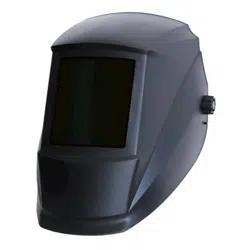
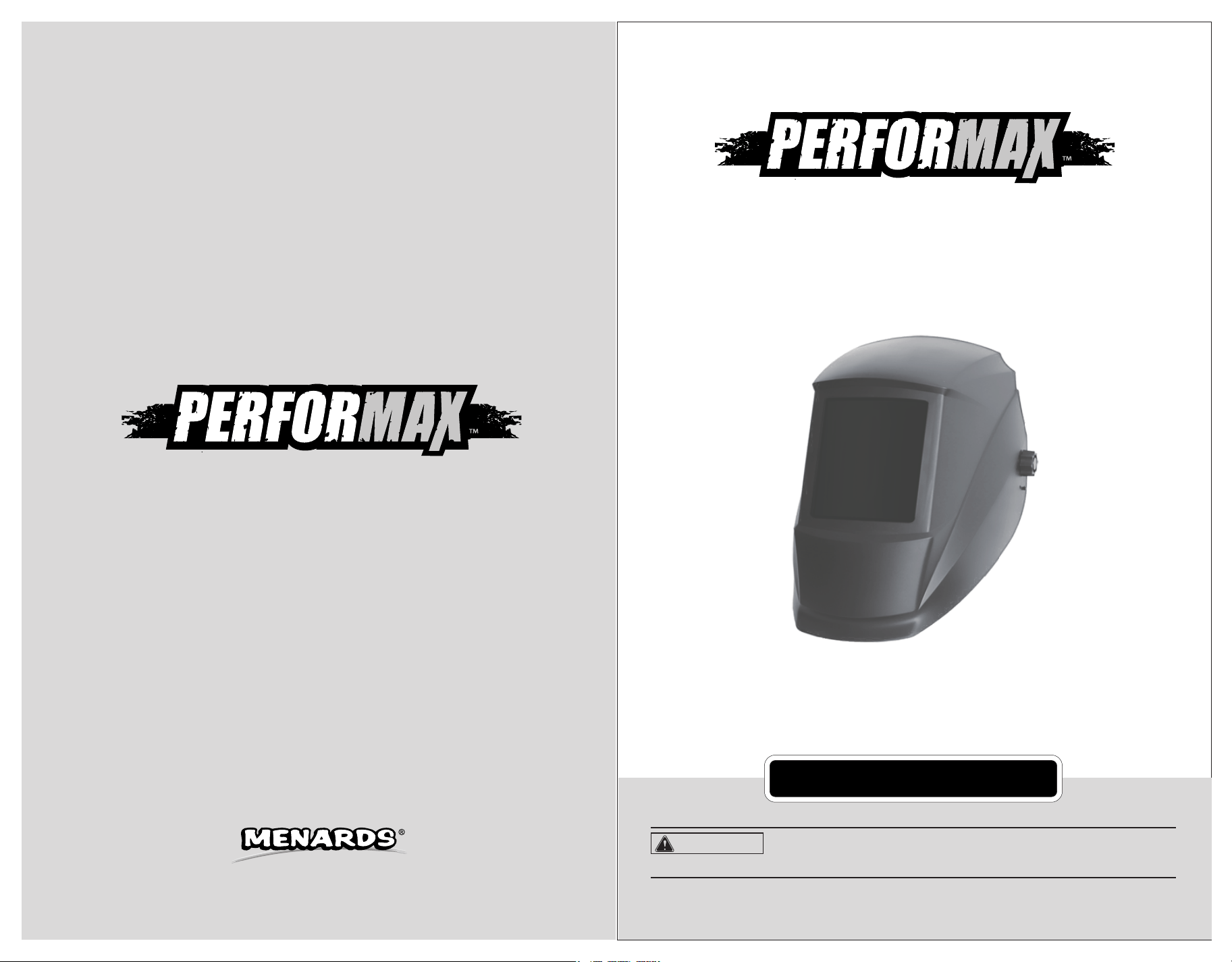
Passive Welding Helmet
Customer Service: 1-855-692-6872 Distributed by Menard, Inc. Eau Claire, WI 54703
Page 1
Page 3
Page 4
Page 4
Page 6
TABLE OF CONTENTS
SAFETY SYMBOLS
OVERVIEW
OPERATION
MAINTENANCE
Page 5
TEMAINTENANCE
INSPECTION
Page 1
SAFETY SYMBOLS
Indicates a potentially hazardous situation that, if not avoided, COULD result
in death or serious injury.
WARNING:
Indicates an imminently hazardous situation that, if not avoided, WILL result
in death or serious injury.
DANGER:
Indicates a potentially hazardous situation that, if not avoided, MAY result in
minor or moderate injury.
CAUTION:
Indicates important information, which if not followed, MAY cause damage to
equipment.
NOTICE:
Read and understand this entire instruction manual before attempting to assemble,install, operate
or maintain this tool. Failure to comply with the instructions may result in serious personal injury
and/or property damage!
The following signal words are used to emphasize safety warnings that must be followed when
using this tool:
IMPORTANT SAFETY INSTRUCTIONS
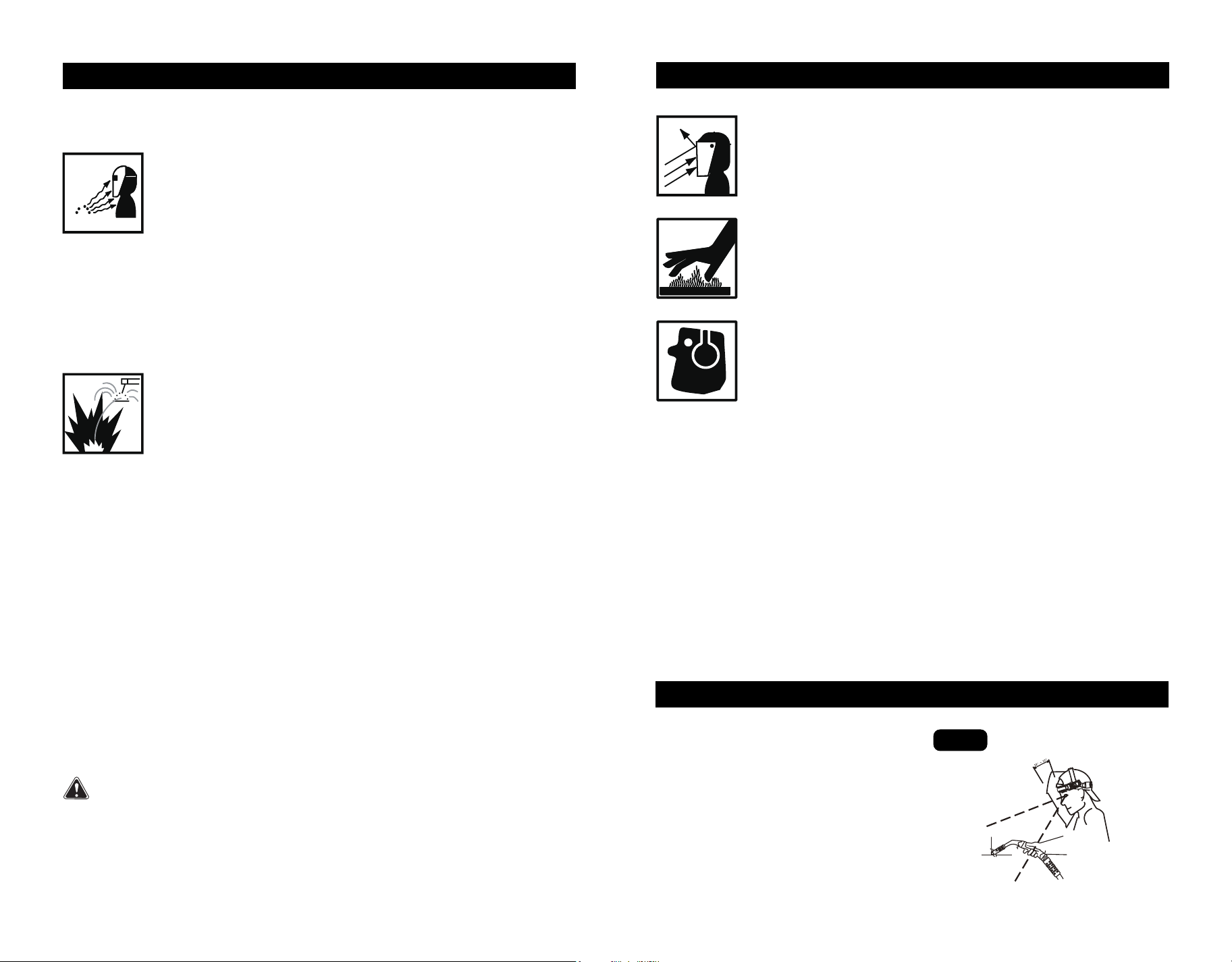
FUMES AND GASES can be hazardous !
Welding produces fumes and gases that are hazardous to your health.
• Keep your head out of the fumes. Do not breathe in the fumes.
•
If inside, ventilate the area and/or use exhaust at the arc to remove welding
fumes and gases.
• If ventilation is poor, use an approved air-supplied respirator.
• Read the manufacturer’ s instructions for metals, consumables, coatings, cleaners, and
degreasers.
• Work in a confined space only if it is well ventilated, or while wearing an air-supplied respirator.
Always have a trained watchperson nearby. Welding fumes and gases can displace air and
lower the oxygen level causing injury or death. Be sure the breathing air is safe.
• Do not weld in locations near degreasing cleaning, or spraying operations. The heat and rays
of the arc can react with vapors to form highly toxic and irritating gases.
• Do not weld on coated metals, such as galvanized, lead, or cadmium plated steel, unless the
coating is removed from the weld area, the area is well ventilated, and if necessary, while
wearing an air-supplied respirator.The coatings and any metals containing these elements can
give off toxic fumes if welded.
SAFETY SYMBOLS
OPERATION
HOT PARTS can cause severe burns !
• Never touch hot parts bare handed.
• Allow adequate cooling period before touching work piece.
NOISE can damage hearing !
• Noise from some processes or equipment can damage hearing.
• Wear approved ear protection if noise level is high.
FLYING METAL can injure eyes !
• Wear ANSI approved safety glasses with side shields under your welding
helmet.
• Welding, chipping, wire brushing, and grinding cause sparks and flying metal.
As welds cool, they can throw off slag.
GENERAL INFORMATION
The Passive Welding Helmet DOES NOT
protect against severe impact hazards, such
as broken grinding wheels or abrasive discs,
explosive devices or corrosive liquids.
Machine guards or eye splash protection
must be used when these hazards are
present.
The Passive Welding Helmet is suitable for
all Arc welding processes such as MIG,
MAG,TIG, SMAW, Plasma Arc, and Carbon
Arc.
The Passive Welding Helmet is NOT
recommended for “Overhead” welding
applications,Laser welding or Laser cutting
applications.
Protection will be seriously impaired if
unapproved modifications are made.always
be used with original inner and outer cover
lenses.
ADJUST THE WELDING HELMET
ACCORDING TO YOUR
INDIVIDUAL REQUIREMENTS.
The headband should be adjusted both in
circumference and height.
The angle between face and helmet should
also be adjusted and recommended
to be 10°-12°.(Fig.1).
Fig.1
Page 2 Page 3
SAFETY SYMBOLS
Never look at arc welding without proper eye protection. Arc rays from the
welding process produce intense visible and invisible (ultraviolet and infrared)
rays that can burn eyes and Skin, Hot sparks fly off from the weld and can burn
eyes and skin.
Wear a welding helmet fitted with a proper shade of filter to protect your
face and eyes when welding or watching.
• Wear approved safety glasses with side shields under your helmet.
• Use protective screens or barriers to protect others from flash and glare, warn others in the area
not to watch the arc.
• Wear protective clothing made from durable, flame resistant materials, leather welding gloves
and full foot protection.
• Always keep a fire extinguisher readily available and watch for fire.
• Protect yourself and others from flying sparks and hot metal.
• Do not weld where flying sparks can strike flammable material.
• Remove all flammable materials from the welding area. If this is not possible, tightly cover them
with approved covers.
• Be alert that welding sparks and hot materials from welding can easily go through small cracks
and openings to adjacent areas.
• Be aware that welding on a ceiling ,floor, bulkhead, or partition can cause fire on the hidden
side.
• Do not weld on closed containers such as tanks, drums, or pipes; unless they are properly
prepared according to AWS F4.1 standards.
• Connect work cable to the work as close to the welding area as practical to prevent welding
current from traveling long, possibly unknown paths and causing electric shock and fire
hazards.
• Never use arc welder to thaw frozen pipes.
• Remove electrode from holder when not in use.
• Wear oil-free protective garments such as leather gloves, heavy shirt, trousers with no cuffs,
high shoes, and a cap.
• Remove any combustibles, such as butane lighters or matches, from yourself and the
surroundings near the welding location before doing any welding.
• Welding or cutting equipment produces fumes or gases which contain chemicals known to the
State of California to cause birth defects and, in some cases, cancer. (California Health & Safety
Code Section 25249.5 et seq.)
California Proposition 65 Warnings !
ARC RAYS can burn eyes !
Welding on closed containers, such as tanks, drums, or pipes, can cause
them to explode.Sparks can fly off from the welding arc. The flying sparks,
hot work piece, and hot equipment can cause fires and burns, Accidental
contact of electrode to metal objects can cause sparks, explosion,
overheating,or fire. Check and be sure the area is sale before doing any
welding.
WELDING can cause fire or explosion !
OVERVIEW
MAINTENANCE
TE
MAINTENANCE
WARNING:
NOTICE:
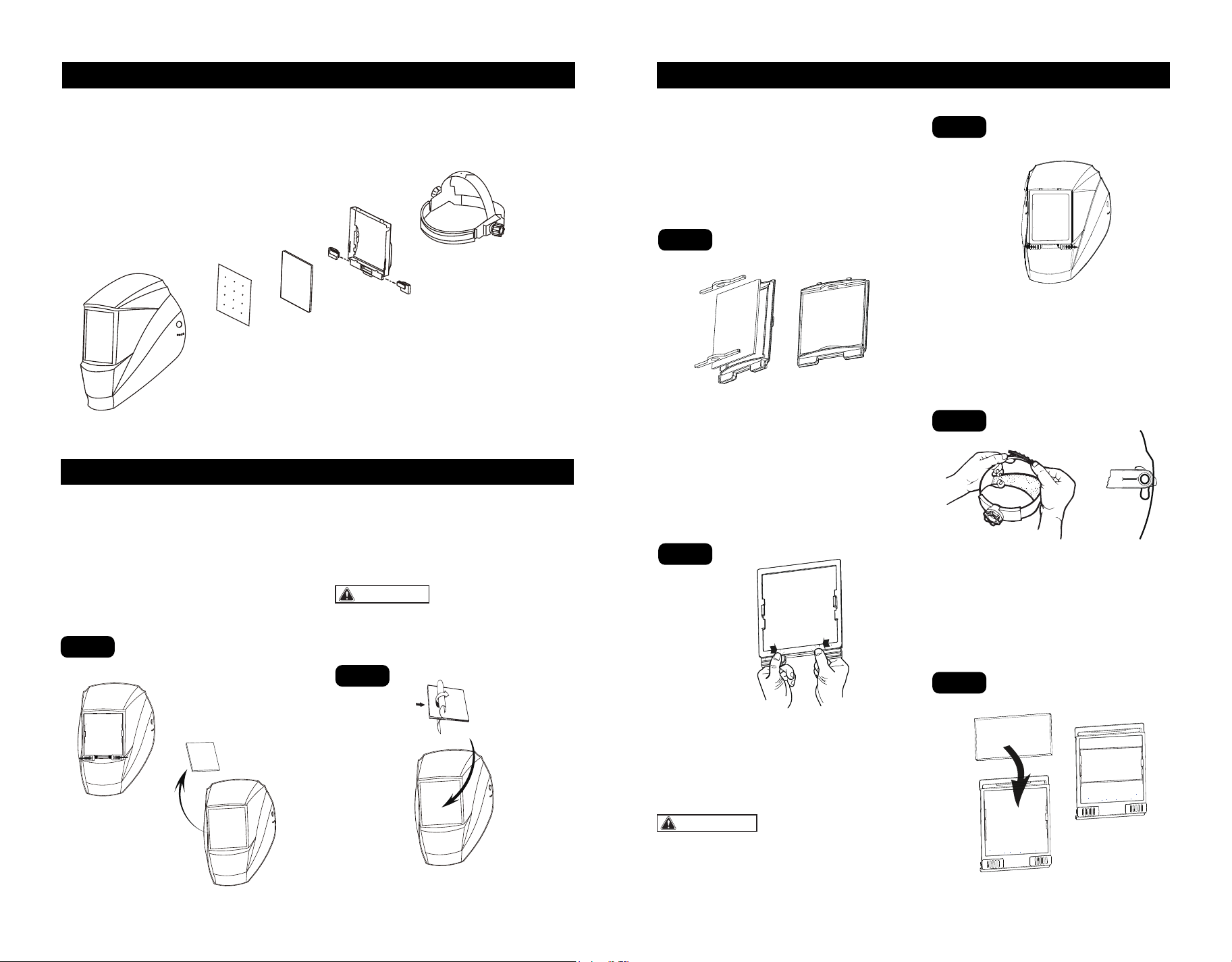
REPLACEMENT OF FRONT COVER
LENS.
Remove the front lens by pulling out the
retaining frame. (Fig.2)
Take out the old cover lens.
Make sure that the protective film is removed
from the new cover lens. Place the new cover
lens in the recess at the front of the helmet.
(Fig.3)
REPLACEMENT OF FILTER PLATE
Remove the mounting brackets from both
sides of the filter plate. Replace the old filter
plate and install a new filter plate in the front
lens retaining frame. Re install mounting
brackets (Fig.4).
INSTALL
Insert tabs of the front lens retaining frame
under the two slots of the back lens retaining
frame. Push the two corners on front lens
retaining frame until it snaps into place.
(Fig.5)
OPERATION
Insert the magnifying lens
Adjust headband per personal preference.
Adjust helmet’s headband stop to get desired
viewing angle. (Fig.7)
Insert tabs of the back lens retaining frame
under the two slots of the helmet. Push the
locking mechanism until it snaps into place.
(Fig.6)
1)Magnifying lens is sold separately.
2)Insert the magnifying lens into the slot from
the top to the bottom(Fig.8).
Fig.2
Fig.3
Fig.4
Fig.5
Fig.7
Fig.8
Fig.6
Page 4 Page 5
PARTS LIST
5
Adjustable Headband
4
Lens Retaining Frame
3
Glass Lens Shade
2
Front Cover Lens
1
Helmet Shell
DO NOT use the helmet without the
cover lens in place.
DO NOT use the helmet and lens
unless they are fully assembled.

INSPECTION
1.Carefully inspect your Passive Welding
Helmet.
2.Replace cracked, pitted or scratched filter
plate or cover lens to avoid injury to eyes.
3.Inspect the helmet frequently and replace
worn or damaged parts.
CLEANING AND DISINFECTION
Clean the helmet with mild soap and
lukewarm water.
Clean the welding filter with a clean lint-free
tissue or cloth.
DO NOT immerse in water.
DO NOT use solvents.
Page 6 Page 7
NOTES
NOTES
SAVE YOUR RECEIPTS
THIS WARRANTY IS VOID WITHOUT THEM
2-YEAR LIMITED WARRANTY
WARRANTY
Passive
Welding Helmet
The passive welding helmets are warranted against defects in materials and
workmanship for a period of two (2) years from date of purchase.
This warranty is limited to the repair or replacement of items which are not in compliance
with this warranty. This warranty does not extend to any item subject to unauthorized
repair, alteration, tampering, improper storage or operation, inadequate maintenance,
accident, misuse, abuse or negligent handling. This warranty is not transferrable from the
original purchaser to any subsequent purchaser.
Seller shall in no event be liable or responsible for any injury, damage or loss resulting
either directly or indirectly from, the use or misuse of this product.
This limited warranty is the exclusive remedy of purchaser and the sole obligation of
Seller in connection with any claim, whether in contract,negligence, strict liability, tort or
otherwise.
Do not use these items unless you are trained and experienced in the proper use and
maintenance. Please read the instruction manual carefully to avoid certain situations
which may void this limited warranty.
Customer Service: 1-855-692-6872
Distributed by Menard, Inc. Eau Claire, WI 54703
Page 8 Page 9
NOTES