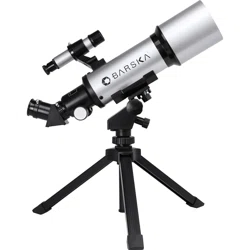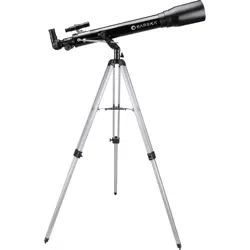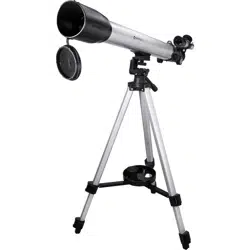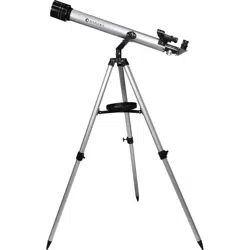
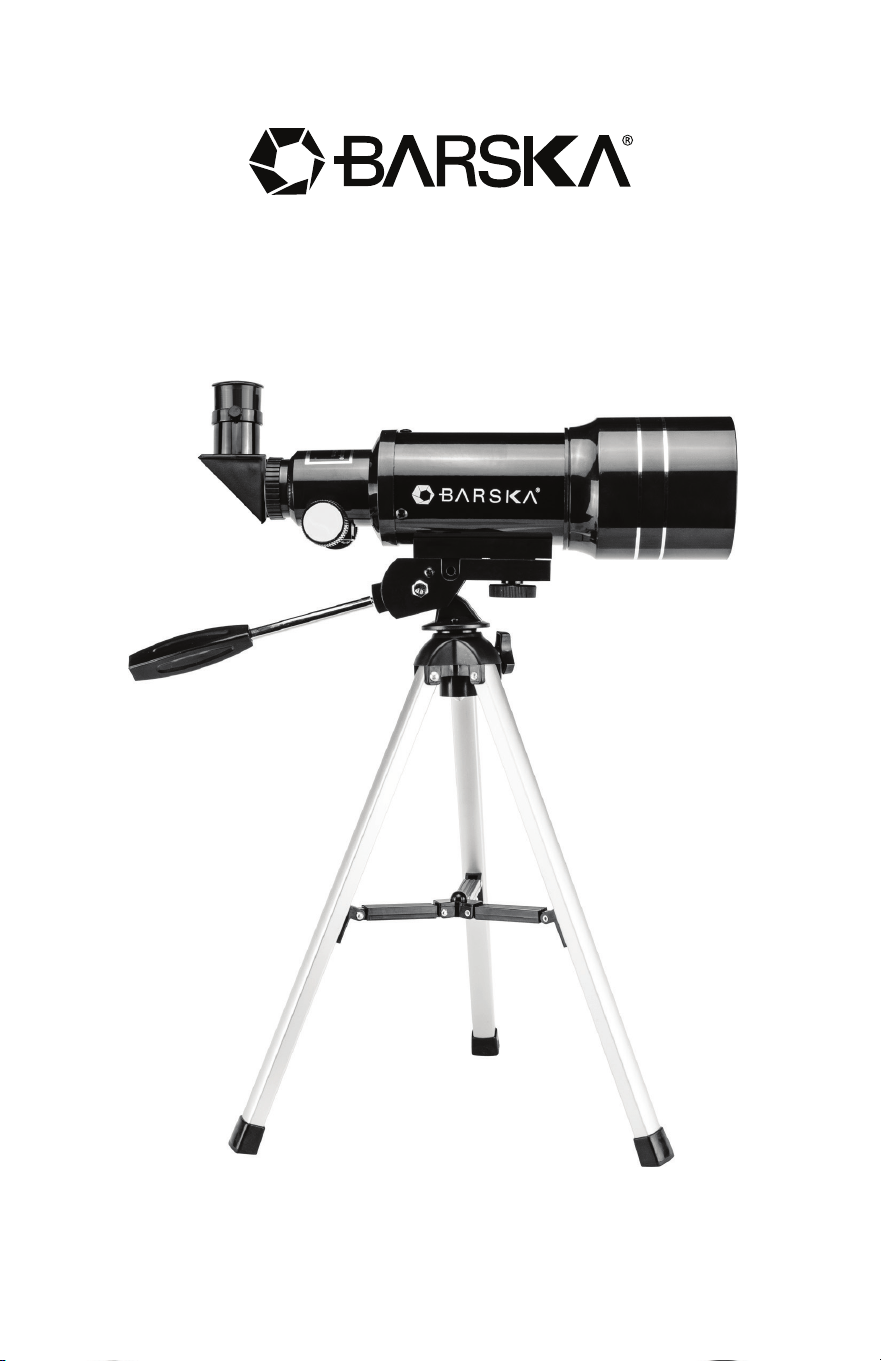
30070 - 225 Power
Starwatcher Telescope
©2017 BARSKA® | Pomona, CA 91767 USA
www.barska.comBC527 4/17

2
NOTES ON VIEWING
WARNING
CAUTION: DO NOT LOOK DIRECTLY AT THE SUN VIEWING THE SUN
OR ANY LIGHT SOURCE WITH THIS OPTICAL DEVICE CAN CAUSE
PERMANENT EYE DAMAGE.
Looking at or near the sun will cause instant and irreversible damage to your
eye(s). Eye damage is often painless, there is no warning to the observer that the
damage has occurred until it is too late. Do not point the telescope at or near the
sun. Children should always have an adult supervising when using this optical
product While observing through the telescope avoid touching the eyepiece
or placing the tripod on uneven ground. Vibrations can cause the image in the
telescopic eld of view to move.
When observing at night allow a few minutes for your eyes to become “dark
adapted” prior to observations. Use a red-ltered ashlight to protect your night
vision when reading star maps, or inspecting components of the telescope.
Allow your telescope a chance to reach the surrounding temperature before
observing.
Avoid setting up the telescope inside a room and observing through an open
window. Temperature differences between inside and outside air may result in
images appearing blurred or distorted due to temperature differences between
inside and outside air.
Avoid looking across objects that produce heat waves, such as asphalt parking
lots during the day. Images viewed may appear blurry or distorted
ROTATION OF THE EARTH
Please note if you are observing a celestial object (a planet, the Moon, a star,
etc.) the object is in a rather slow but continuous motion through the telescopic
eld of view. This motion or movement is caused by the rotation of the Earth on
its axis which results in an apparent motion of the object in the telescope’s eld
of view for example a planet, the Moon, a star, for practical purposes, are xed
in their positions during any 2 or 3 hour observing period, the stand on which the
telescope is sitting (the Earth) rotates once every 24 hours underneath these
xed objects. To keep astronomical objects centered in the eld, simply move
the telescope on one or both of its axes (vertical and/or horizontal) as needed.
At lower powers, astronomical objects will seem to move through the eld slowly
through the telescopic eld of view. At higher powers, astronomical objects will
seem to move through the telescopic eld more rapidly.
3
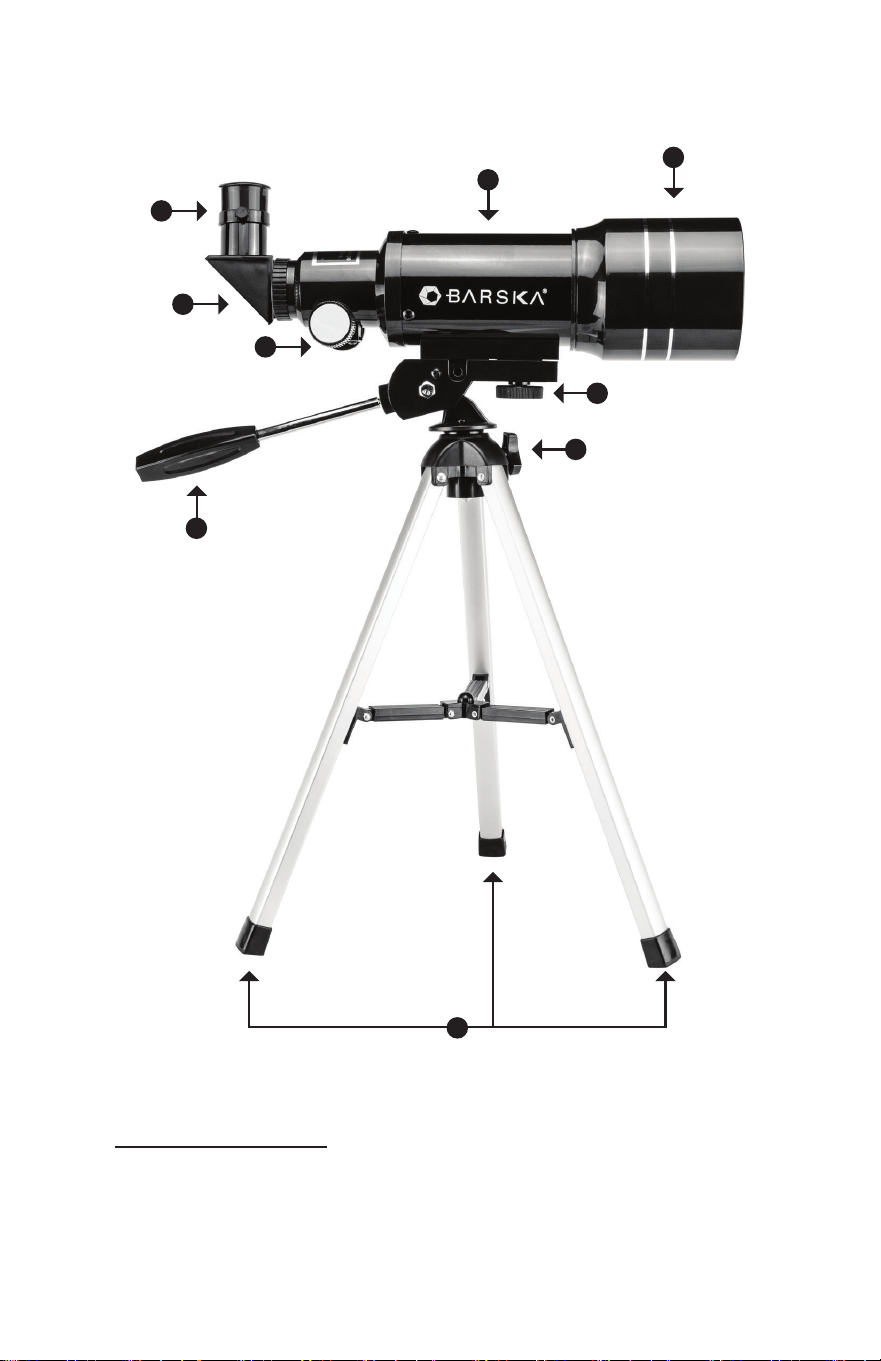
Parts of the Telescope
A. Telescope Optical Tube
B. Objective Lens
C. Eyepiece - 2 Included
D. Diagonal
E. Focus Knob
F. Mounting Plate and Screw
G. Mounting Adjustment Handle
H. Tripod Legs
I. Horizontal Motion Lock
C
D
E
A
B
F
I
H
G
4
Assembly
Unpack and lay out all of the parts in a large, clear area where you will have
room to assemble the pieces.
Initial Setup
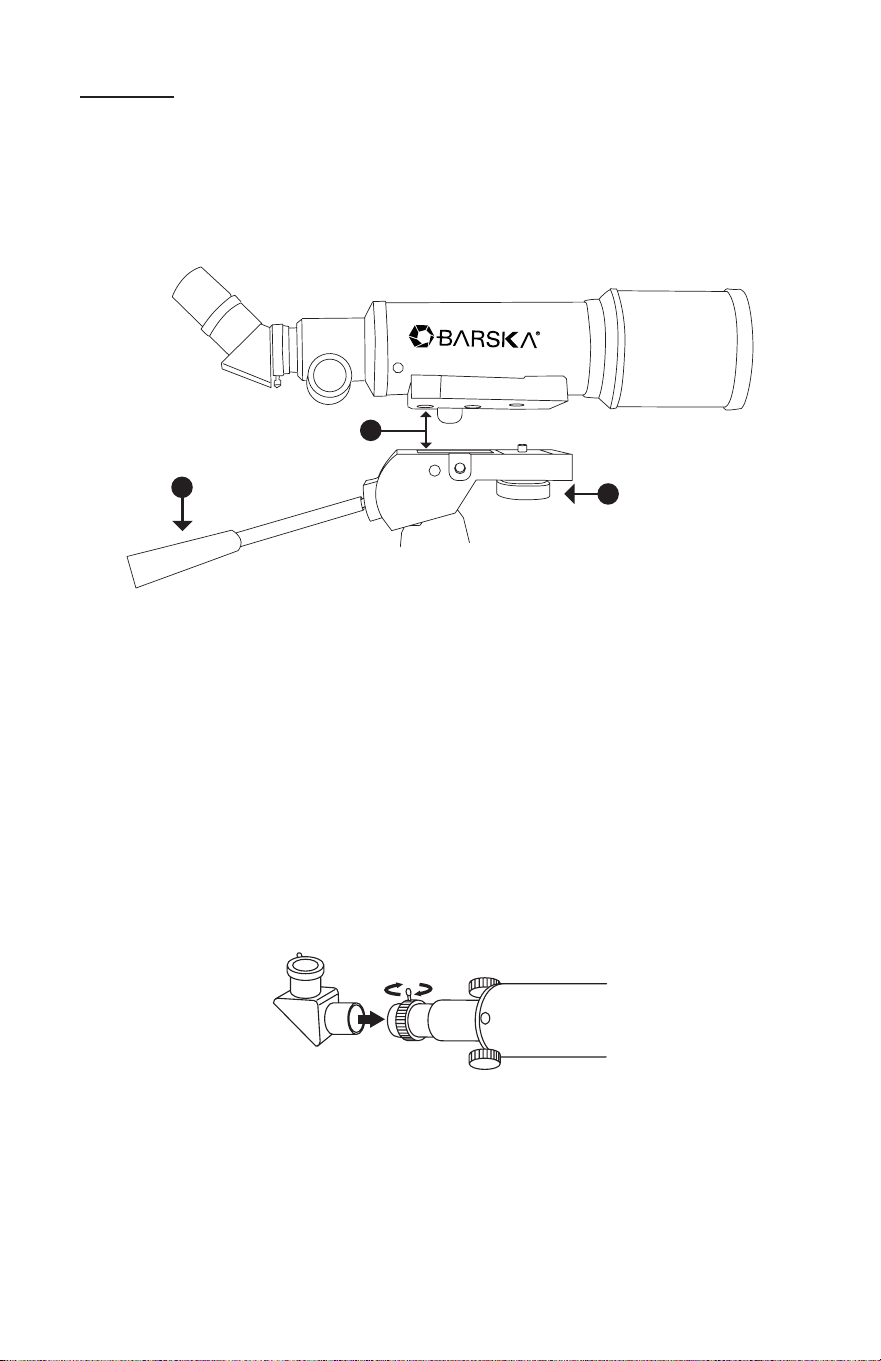
1. Fully extend the legs of the tripod apart.
2. Under the plate of the tripod head is locking screw for the tripod head. See
image above.
3. Place the telescope tube on the mount so that the screw in the mounting
platform lines up with the holes in the telescope.
4. Screw mounting adjustment handle into the threaded socket at the rear of
the mount.
5. Insert the diagonal into the end of the telescope tube.
6. Remove the dust cap from the large end of the telescope.
7. The telescope is now ready for use.
Attaching the Accessories
Diagonal
1. Remove the caps from the focus tube and the diagonal
2. Insert the chrome end of the diagonal into the focuser and lock into place by
tightening the thumb screws on the focus tube. See image above.
3
2
4
5
Eyepiece
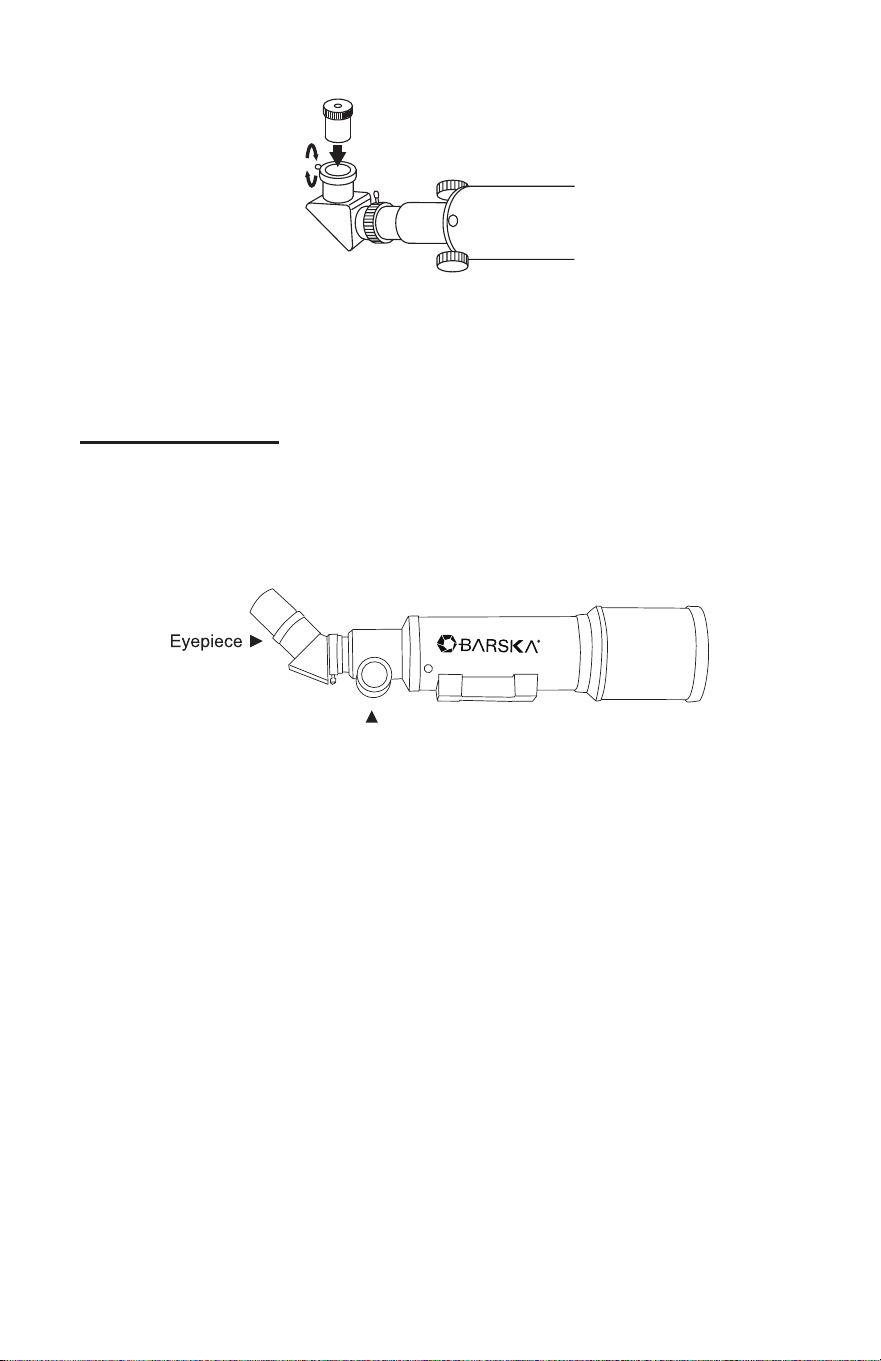
Included with the telescope are H4 mm and H20 mm eyepieces.
1. Select an eyepiece, place it into the diagonal. Lock the eyepiece it into place
with the thumb screw. See image above.
Using The Telescope
With the telescope assembled as described above, you are ready to begin
observations.
Finding Objects
Focusing
Knob
Look through the eyepiece of the telescope and center the object in telescope’s
view. If necessary adjust the horizontal adjustment, vertical adjustment and
mounting plate adjustment to re-position the telescope so that the desired object
can be centered. See Notes on Viewing page 7 Note: When viewing through the
telescope, items will appear right side up
Note: Depending on the desired object you may or may not need to change the
eyepieces and or use the Barlow lens. When changing pieces on the telescope
try not to move the telescope or tripod, the telescope may become misaligned.
Focusing
Once you have found an object in the telescope, turn the focusing knob in either
direction until the image is sharp.
Note: When focusing, the tube will either extend or retract from the eye piece of
the telescope.

6
Image Orientation
When observing with a diagonal, the image will be right side up
Magnication
The magnication (or power) of a telescope varies depending upon the focal
length of the eyepiece being used and the focal length of the telescope.
The low power (H20) eyepiece is the best eyepiece to use for the initial nding
and centering of an object. It presents a bright, wide eld of view, ideal for
terrestrial and general astronomical observing. The higher power (H4) eyepiece
for lunar and planetary viewing. If the image starts to get out of focus decrease
the magnication back down to a lower power.
The required magnication depends on the object being observed. The following
general guideline is recommended for this purpose: Ideal viewing conditions
are obtained if the magnication is not more than 15x - 20x the diameter of the
objective lens, i.e. an optimal magnication of 100x -125x can be expected
with 60mm diameter objective lens to observe most celestial objects. A lower
magnication power is advisable for the observation of stars.
The eld of view is wider so that the object for observation is more easily
localized. The highest magnication power should only be used for particularly
clear observations of the moon an object that is relatively close and exceptionally
bright, so that good detail resolution is achieved at high magnication ratios.
Magnication within any telescope has its limits. These limits are determined
by the laws of optics and the nature of the human eye. Most viewing will be
done in the range of 30x to 100x. Higher powers are used mainly for lunar and
sometimes planetary observing where you can greatly enlarge the image and the
atmospheric conditions are near perfect. The images at extremely high powers
magnify the image, but the contrast will be very low due to the high magnication.
For the brightest images with the most contrast, start by using the lower power
eyepiece with a smaller image scale.
The formula used to calculate the magnication of a telescope is:
Focal length of the telescope in mm / Focal length of the eyepiece in mm =
Magnication
Example: 300mm Focal length telescope / 4mm Focal length of eyepiece = 75x
magnication
The following magnication levels can be achieved when using the included H4
or H20 eyepiece and in conjunction with the 3x Barlow lens:
Telescope
Focal Length (FL)
Eyepiece
Focal Length (FL)
Magnication
Magnication with
3x Barlow Lens
300mm H4 4mm 75x 225x
300mm H20 20mm 15x 45x
7
Barlow Lens
The included 3x Barlow lens triples the magnifying power of each eyepiece. The
highest magnication power of the Barlow lens should only be used for large and
bright objects such as the moon and the brightest planets, as well as for nights
with optimal observation conditions.
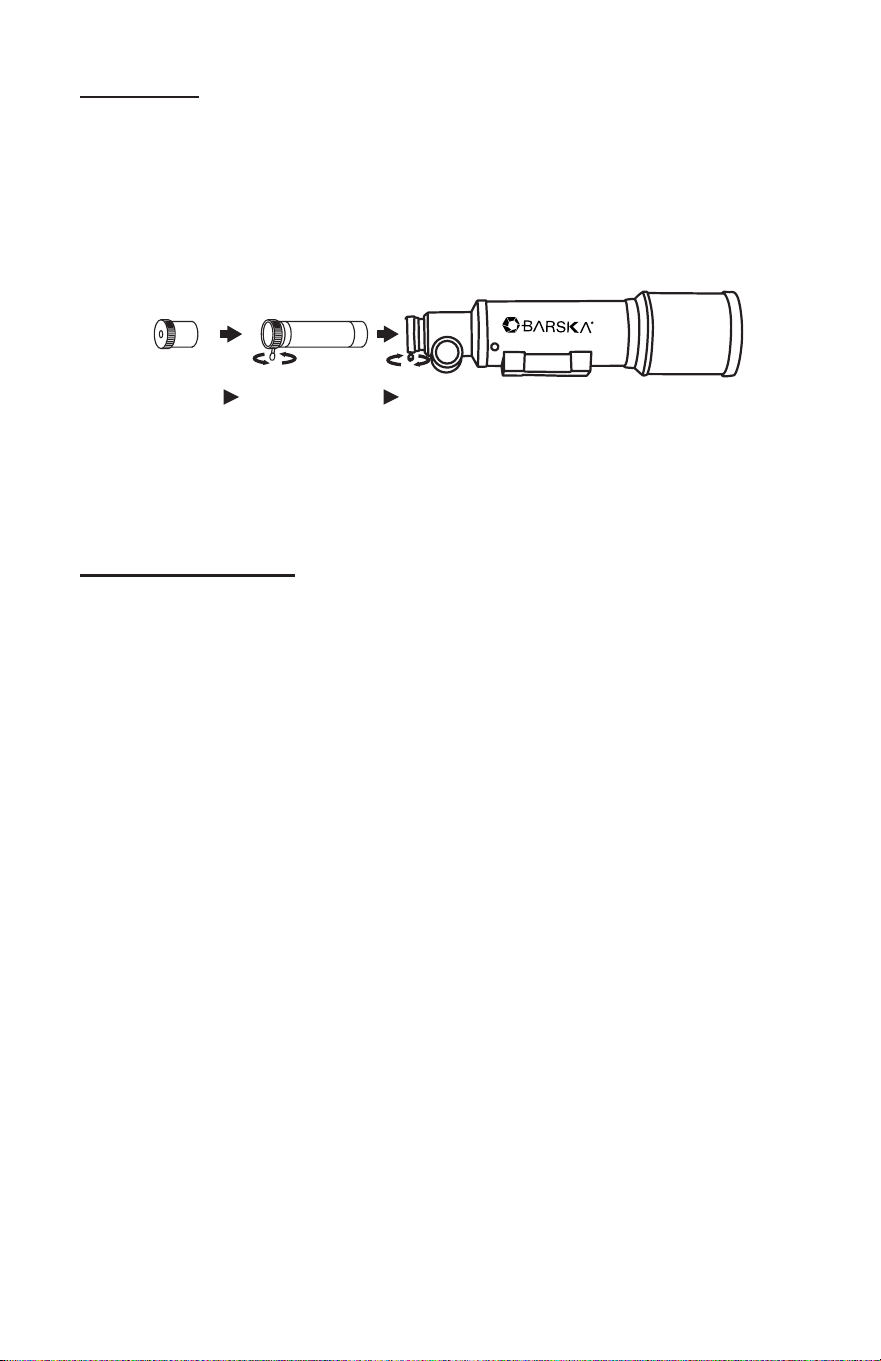
Attaching and Using the Barlow Lens
Eyepiece
Barlow Lens
1. Remove the Diagonal from telescope (the image will be upside down)
2. Insert the Barlow lens directly into telescope and tighten screw on telescope.
3. Loosen the screw of the Barlow lens and start by using the H20 eyepiece, and
insert it directly into the Barlow lens and tighten the thumb screw.
CARE AND CLEANING
With proper care, your telescope should rarely need any maintenance work.
To maintain your telescope in the best possible condition, observe the follow
suggestions:
NEVER attempt to clean the telescope internally or try to take it apart.
When not in use, replace all covers to keep dust and contaminants off the optical
surfaces. Store in a cool, dry place
Blow away any dust or debris on the lens (or use a soft lens brush)
To remove dirt or ngerprints, clean with a soft cotton cloth rubbing in a circular
motion. Use of a coarse cloth or unnecessary rubbing may scratch the lens
surface and eventually cause permanent damage.
For a more thorough cleaning, photographic lens tissue and photographic-type
lens cleaning uid or isopropyl alcohol may be used.
Always apply the uid to the cleaning cloth never directly on the lens.
Do not expose telescope to moisture
Avoid banging and dropping

1 YEAR LIMITED WARRANTY
TELESCOPES
BARSKA® Optics, as manufacturer, warrants this new precision optical product
to be by this warranty. This warranty does not include damage caused by abuse,
improper handling, installation, maintenance, normal wear-and-tear, unauthorized
repairs purchaser and is not transferable.
This warranty applies only to products purchased in the United States of America.
In the event of a defect within 30 days, the consumer must return the defective
unit to the BARSKA dealer (the place of purchase) at his/her own expense.
Beyond 30 days, BARSKA products should be sent to the following address for
warranty repairs. Products must be packed carefully and sturdily to prevent
damage in transit, and returned freight prepaid to:
BARSKA® OPTICS
855 Towne Center Drive
Pomona, CA 91767
For additional and updated information
please visit our website at www.barska.com
Please email [email protected] or call 1.888.666.6769 for Return
Merchandise Number (RMA#) before any returns. NOTE: All merchandise
received without a valid RMA # will be returned to shipper at his/her own
expense.
Please include all of the following when returning BARSKA products for service
and/or replacement:
1. Please write your complete details (Name, Address, Telephone #, E-mail
address, RMA#, etc.)
2. Purchase receipt or Proof of Purchase. (Original/Copy)
3. A brief explanation of the defect.
4. A Check/Money Order of $25.00 cover inspection, shipping and handling.
*Please allow 6-8 weeks for delivery.
This product will either be replaced or repaired at the discretion of the warrantor.
If it’s a discontinued item, we will replace the product with an equivalent product.
Should the repair not be covered by this warranty, an estimate will be sent for
your approval. Non-warranty repairs or refurbishing of your optical products are
always provided at a reasonable cost.
BARSKA® shall not be liable for any consequential, incidental and/or contingent
damages whatsoever. We will not pay shipping, insurance or transportation
charges from you to us, or any import fees, duties and or taxes. This warranty
supersedes all previous BARSKA warranties.