
User Guide
SUMMARY
This guide provides basic information for using and upgrading this product, including topics such as
components, features, networks, and HP resources.

Legal information
© Copyright 2021-2025 HP Development
Company, L.P.
Bluetooth is a trademark owned by its
proprietor and used by HP Inc. under license.
Intel, Celeron, Pentium, and Thunderbolt
are trademarks of Intel Corporation in the
U.S. and/or other countries. Microsoft and
Windows are either registered trademarks
or trademarks of Microsoft Corporation in
the United States and/or other countries.
USB Type-C and USB-C are registered
trademarks of USB Implementers Forum.
DisplayPort™ and the DisplayPort™ logo are
trademarks owned by the Video Electronics
Standards Association (VESA) in the United
States and other countries. Miracast® is a
registered trademark of Wi-Fi Alliance.
The information contained herein is subject
to change without notice. The only
warranties for HP products and services are
set forth in the express warranty statements
accompanying such products and services.
Nothing herein should be construed as
constituting an additional warranty. HP shall
not be liable for technical or editorial errors
or omissions contained herein.
Sixth Edition: January 2025
First Edition: July 2021
Document Part Number: M86009-006
Product notice
This guide describes features that are
common to most products. Some features
might not be available on your computer.
Not all features are available in all
editions or versions of Windows. Systems
may require upgraded and/or separately
purchased hardware, drivers, software
or BIOS update to take full advantage
of Windows functionality. Windows is
automatically updated, which is always
enabled. High-speed internet and Microsoft
account required. ISP fees may apply and
additional requirements may apply over time
for updates. See
http://www.windows.com.
If your product ships with Windows in S
Mode: Windows in S Mode works exclusively
with apps from the Microsoft Store within
Windows. Certain default settings, features,
and apps cannot be changed. Some
accessories and apps that are compatible
with Windows may not work (including some
antivirus, PDF writers, driver utilities, and
accessibility apps), and performance may
vary, even if you switch out of S Mode. If you
switch to Windows, you cannot switch back
to S Mode. Learn more at Windows.com/
SmodeFAQ.
To access the latest user guides, go to
http://www.hp.com/support, and follow the
instructions to find your product. Then select
Setup & User Guides.
To help us improve this document, please
send any suggestions, comments, or errors
to
mailto:hp.doc.feedback@hp.com. Include
the document part number when submitting
your feedback.
Software terms
By installing, copying, downloading, or
otherwise using any software product
preinstalled on this computer, you agree
to be bound by the terms of the HP End
User License Agreement (EULA). If you
do not accept these license terms, your
sole remedy is to return the entire unused
product (hardware and software) within 14
days for a full refund subject to the refund
policy of your seller.
For any further information or to request
a full refund of the price of the computer,
please contact your seller.

Safety warning notice
Reduce the possibility of heat-related injuries or of overheating the computer by following the practices
described.
WARNING! To reduce the possibility of heat-related injuries or of overheating the computer, do not
place the computer directly on your lap or obstruct the computer air vents. Use the computer only on a
hard, flat surface. Do not allow another hard surface, such as an adjoining optional printer, or a soft
surface, such as pillows or rugs or clothing, to block airflow. Also, do not allow the AC adapter to come
into contact with the skin or a soft surface, such as pillows or rugs or clothing, during operation. The
computer and the AC adapter provided by HP comply with the user-accessible surface temperature
limits defined by applicable safety standards.
iii

Processor configuration setting (select products only)
Important information about processor configurations.
IMPORTANT: Select products are configured with an Intel® Pentium® N35xx/N37xx series or a
Celeron® N28xx/N29xx/N30xx/N31xx series processor and a Windows® operating system. If your
computer is configured as described, do not change the processor configuration setting in
msconfig.exe from 4 or 2 processors to 1 processor. If you do so, your computer will not restart. You will
have to perform a factory reset to restore the original settings.
iv Processor configuration setting (select products only)

Table of contents
1 About this guide.....................................................................................................................................................................................................................................1
2 Getting started...................................................................................................................................................................................................................................... 2
Best practices................................................................................................................................................................................................................................. 2
Caring for your safety and comfort................................................................................................................................................................................. 2
Advantages of flicker-free technology (select products only)..........................................................................................................3
Adjusting low blue light mode (select products only)..............................................................................................................................3
Restoring monitor brightness to factory default (select products only)................................................................................... 4
Getting information.....................................................................................................................................................................................................................4
3 Getting to know your computer................................................................................................................................................................................................6
Locating hardware.......................................................................................................................................................................................................................6
Locating software.........................................................................................................................................................................................................................6
Setting up your computer.......................................................................................................................................................................................................6
Identifying USB ports..................................................................................................................................................................................................................7
Using a wireless phone charger (select products only)....................................................................................................................................8
Shutting down (turning off) the computer ..................................................................................................................................................................9
4 Connecting to a network .............................................................................................................................................................................................................11
Connecting to a wireless network ..................................................................................................................................................................................11
Using the wireless controls.......................................................................................................................................................................................11
Airplane mode key ................................................................................................................................................................................................11
Operating system controls ............................................................................................................................................................................11
Connecting to a WLAN ................................................................................................................................................................................................ 12
Using HP Mobile Broadband (select products only)............................................................................................................................... 12
Locating mobile operator settings .......................................................................................................................................................... 12
Connecting with HP Mobile Broadband...............................................................................................................................................13
Using eSIM (select products only).......................................................................................................................................................................13
Using GPS (select products only).........................................................................................................................................................................13
Using Bluetooth wireless devices (select products only)...................................................................................................................13
Connecting Bluetooth devices...................................................................................................................................................................14
Connecting to a wired network—LAN (select products only) ......................................................................................................................14
5 Enjoying entertainment features...........................................................................................................................................................................................16
Using audio......................................................................................................................................................................................................................................16
Connecting speakers...................................................................................................................................................................................................16
Connecting headphones...........................................................................................................................................................................................16
Connecting a microphone.........................................................................................................................................................................................16
Connecting headsets ..................................................................................................................................................................................................16
Using sound settings.....................................................................................................................................................................................................17
Sound settings........................................................................................................................................................................................................17
v

Audio settings..........................................................................................................................................................................................................17
Using video.......................................................................................................................................................................................................................................17
Connecting a DisplayPort device using a USB Type-C cable (select products only)......................................................17
Connecting a Thunderbolt device using a USB Type-C cable (select products only) ...................................................18
Connecting video devices by using a VGA cable (select products only)................................................................................19
Connecting video devices using an HDMI cable (select products only)................................................................................20
Connecting a high-definition TV or monitor using HDMI........................................................................................................20
Setting up HDMI audio...................................................................................................................................................................................... 21
Turn on HDMI audio.................................................................................................................................................................................. 21
Return audio to computer speakers........................................................................................................................................... 21
Connecting digital display devices using a Dual-Mode DisplayPort cable (select products only)..................... 22
Discovering and connecting to Miracast-compatible wireless displays (select products only).......................... 23
Using data transfer...................................................................................................................................................................................................................23
Connecting devices to a USB Type-C port (select products only).............................................................................................. 23
6 Navigating the screen.................................................................................................................................................................................................................. 25
Using touch gestures (select products only)......................................................................................................................................................... 25
Using the keyboard and mouse....................................................................................................................................................................................... 25
Using the action keys or hot keys........................................................................................................................................................................ 25
Action keys...............................................................................................................................................................................................................26
7 Maintaining your computer.......................................................................................................................................................................................................28
Improving performance........................................................................................................................................................................................................28
Using Disk Defragmenter ......................................................................................................................................................................................... 28
Using Disk Cleanup.......................................................................................................................................................................................................28
Using HP 3D DriveGuard (select products only) ...................................................................................................................................... 28
Identifying HP 3D DriveGuard status....................................................................................................................................................29
Updating programs and drivers......................................................................................................................................................................................29
Updating both programs and drivers...............................................................................................................................................................29
Updating programs only............................................................................................................................................................................................ 29
Updating drivers only...................................................................................................................................................................................................29
Cleaning your computer.......................................................................................................................................................................................................30
Enabling HP Easy Clean (select products only)........................................................................................................................................30
Removing dirt and debris from your computer.........................................................................................................................................30
Cleaning your computer with a disinfectant................................................................................................................................................31
Caring for wood veneer (select products only)........................................................................................................................................ 32
Traveling with or shipping your computer................................................................................................................................................................ 32
8 Securing your computer and information.....................................................................................................................................................................34
Computer security features..............................................................................................................................................................................................34
9 Troubleshooting................................................................................................................................................................................................................................36
Computer does not start......................................................................................................................................................................................................36
Power...................................................................................................................................................................................................................................................37
Monitor (select products only)...........................................................................................................................................................................................37
Keyboard and mouse (with cable)..................................................................................................................................................................................38
vi

Keyboard and mouse (wireless)......................................................................................................................................................................................38
Speakers and sound................................................................................................................................................................................................................39
Internet access ...........................................................................................................................................................................................................................39
Software troubleshooting....................................................................................................................................................................................................40
10 Using HP PC Hardware Diagnostics................................................................................................................................................................................43
Using HP PC Hardware Diagnostics Windows (select products only)................................................................................................43
Using an HP PC Hardware Diagnostics Windows hardware failure ID code.......................................................................43
Accessing HP PC Hardware Diagnostics Windows..............................................................................................................................43
Accessing HP PC Hardware Diagnostics Windows from HP Support Assistant.................................................43
Accessing HP PC Hardware Diagnostics Windows from the Start menu (select products only)............44
Downloading HP PC Hardware Diagnostics Windows........................................................................................................................44
Downloading the latest HP PC Hardware Diagnostics Windows version from HP.............................................44
Downloading the HP PC Hardware Diagnostics Windows from the Microsoft Store.......................................44
Downloading HP Hardware Diagnostics Windows by product name or number (select products
only) ...............................................................................................................................................................................................................................44
Installing HP PC Hardware Diagnostics Windows.................................................................................................................................. 45
Using HP PC Hardware Diagnostics UEFI................................................................................................................................................................ 45
Using an HP PC Hardware Diagnostics UEFI hardware failure ID code..................................................................................45
Starting HP PC Hardware Diagnostics UEFI...............................................................................................................................................45
Starting HP PC Hardware Diagnostics UEFI through HP Hotkey Support software (select products
only)...........................................................................................................................................................................................................................................46
Downloading HP PC Hardware Diagnostics UEFI to a USB flash drive...................................................................................46
Downloading the latest HP PC Hardware Diagnostics UEFI version..............................................................................47
Downloading HP PC Hardware Diagnostics UEFI by product name or number (select products
only) ................................................................................................................................................................................................................................47
Using Remote HP PC Hardware Diagnostics UEFI settings (select products only)....................................................................47
Downloading Remote HP PC Hardware Diagnostics UEFI................................................................................................................47
Downloading the latest Remote HP PC Hardware Diagnostics UEFI version..........................................................47
Downloading Remote HP PC Hardware Diagnostics UEFI by product name or number.................................47
Customizing Remote HP PC Hardware Diagnostics UEFI settings............................................................................................48
11 Backing up, restoring, and recovering............................................................................................................................................................................. 49
Backing up information and creating recovery media...................................................................................................................................49
Using Windows tools for backing up.................................................................................................................................................................49
Using the HP Cloud Recovery Download Tool to create recovery media (select products only).........................49
Restoring and recovering your system......................................................................................................................................................................50
Creating a system restore ......................................................................................................................................................................................50
Restoring and recovery methods.......................................................................................................................................................................50
Recovering using HP Recovery media............................................................................................................................................................50
Changing the computer boot order ................................................................................................................................................................... 51
Using HP Sure Recover (select products only)........................................................................................................................................... 51
12 Using Secure Erase or HP Disk Sanitizer (select products only) ............................................................................................................... 52
When to use Secure Erase or HP Disk Sanitizer.................................................................................................................................................52
Using Secure Erase or HP Disk Sanitizer................................................................................................................................................................. 52
13 Operating specifications.........................................................................................................................................................................................................53
vii

14 Electrostatic discharge.............................................................................................................................................................................................................54
15 Availability of repair services and replacement parts.......................................................................................................................................55
16 Accessibility ......................................................................................................................................................................................................................................56
HP and accessibility.................................................................................................................................................................................................................56
Finding the technology tools you need...........................................................................................................................................................56
The HP commitment.....................................................................................................................................................................................................56
International Association of Accessibility Professionals (IAAP)...................................................................................................57
Finding the best assistive technology..............................................................................................................................................................57
Assessing your needs ......................................................................................................................................................................................57
Accessibility for HP products......................................................................................................................................................................57
Standards and legislation ...................................................................................................................................................................................................58
Standards.............................................................................................................................................................................................................................58
Mandate 376 – EN 301 549 ............................................................................................................................................................................58
Web Content Accessibility Guidelines (WCAG).............................................................................................................................58
Legislation and regulations.....................................................................................................................................................................................59
Useful accessibility resources and links ..................................................................................................................................................................59
Organizations....................................................................................................................................................................................................................59
Educational institutions.............................................................................................................................................................................................59
Other disability resources .......................................................................................................................................................................................60
HP links...................................................................................................................................................................................................................................60
Contacting support..................................................................................................................................................................................................................60
17 Support information......................................................................................................................................................................................................................61
How to get help.............................................................................................................................................................................................................................61
Customer support for repairs ..........................................................................................................................................................................................62
Before upgrading your hardware ...................................................................................................................................................................................62
Index................................................................................................................................................................................................................................................................63
viii
About this guide1
This guide provides basic information for using and upgrading this product.
WARNING! Indicates a hazardous situation that, if not avoided, could result in serious injury or death.
CAUTION: Indicates a hazardous situation that, if not avoided, could result in minor or moderate
injury.
IMPORTANT: Indicates information considered important but not hazard-related (for example,
messages related to property damage). Warns the user that failure to follow a procedure exactly as
described could result in loss of data or in damage to hardware or software. Also contains essential
information to explain a concept or to complete a task.
NOTE: Contains additional information to emphasize or supplement important points of the main text.
TIP: Provides helpful hints for completing a task.
This product incorporates HDMI® technology.
About this guide
1

Getting started2
This computer is a powerful tool designed to enhance your work and entertainment. Read this chapter
to learn about best practices after you set up your computer, fun things to do with your computer, caring
for your safety and comfort, and where to find additional HP resources.
Best practices
After you set up and register the computer, HP recommends the following steps to get the most out of
your smart investment.
● Back up your hard drive by creating recovery media. See Backing up, restoring, and recovering on
page 49.
● If you haven’t already done so, connect to a wired or wireless network. See details in Connecting to a
network on page 11.
● Become familiar with the computer hardware and software. For more information, see Getting to
know your computer on page 6 and Enjoying entertainment features on page 16.
● Access HP Support Assistant app—For quick online support, open the HP Support Assistant
app (select products only). HP Support Assistant optimizes computer performance and resolves
problems using the latest software updates, diagnostic tools, and guided assistance. Select the
Search icon in the taskbar, type support in the search box, and then select HP Support Assistant.
Caring for your safety and comfort
HP is committed to providing high-quality products that will last for years to come. HP is also concerned
about your safety and comfort. To avoid eye strain and to relax muscle tension and fatigue, take a break
every hour when using your computer.
1. Let your arms relax at your side.
2. Bend your head forward slightly to stretch the neck.
3. Hold for 5 seconds.
4. Keep your arms relaxed at your side.
5. Turn your head to one side and hold for 5 seconds.
6. Repeat for the other side.
7. Keep your arms relaxed at your side.
8. While looking forward, lean your head toward your right shoulder and hold for 5 seconds.
9. Look down as you slowly move your head to center. Roll your head toward your left shoulder while
still looking forward.
10. Repeat for the other side.
2
Chapter 2 Getting started

To learn about other ways to care for your safety and comfort read the
Safety & Comfort Guide
, located
on the web at http://www.hp.com/ergo.
Advantages of flicker-free technology (select products only)
Monitors with flicker-free display technology help protect your eyes from fatigue, dryness, itchiness, or
irritation. This technology allows you to work on spreadsheets, play games, or watch videos comfortably.
Adjusting low blue light mode (select products only)
Your HP computer offers either a hardware or software solution to decrease the blue light emitting from
the monitor.
Low blue light hardware solution
Your computer monitor is shipped from the factory in low blue light mode for improved eye comfort and
safety. The monitor automatically adjusts blue light emissions when you use the computer at night or in
a low-light setting. A monitor with a low blue light panel follows TÜV Rheinland compliance regulation for
the factory default setting mode.
Low blue light software solution
Decreasing the blue light emitting from the monitor reduces the blue light exposure to your eyes. HP
computers provide a setting to reduce blue light output and create a more relaxing and less stimulating
image while you read content on the screen. Select one of the following apps to adjust your monitor to a
comfortable viewing light.
● HP Display Control App (Select Products Only)
1. Open the HP Display Control app.
2. Select a setting:
– Low Blue Light: Reduces the blue light for improved eye comfort (TÜV certified).
– Low Blue Light Models: Low Blue Light (select products only)
– Default: Optimized for color vibrancy
– Web (sRGB): Optimized for web browsing
– Printing and Imagine (Adobe RGB): Optimized for images using Adobe RGB
– Photos and Videos (DCI-P3): Optimized for photos and movie viewing and editing
– Native: No optimization applied
– Night: Adjusts to the lowest blue light and reduces the impact on sleep.
– Reading: Optimizes blue light and brightness for indoor viewing.
● myHP App
1. Open the myHP app.
2. Select Display Controls.
Advantages of flicker-free technology (select products only)
3

3. Select On or Off to reduce the blue light emitting from the display.
WARNING! To reduce the risk of serious injury, read the
Safety & Comfort Guide
, located on the web
at http://www.hp.com/ergo. The guide describes proper workstation setup, and proper posture, health,
and work habits for computer users. It also provides important electrical and mechanical safety
information.
Restoring monitor brightness to factory default (select products only)
You can use the HP Display Control application to recover the original monitor brightness setting that
was set at the factory.
To restore the default brightness setting, follow the next steps.
1. Open the HP Display Control app.
2. Select Advanced.
3. Select Support.
4. Select Factory Reset.
Getting information
To locate resources that provide product details, how-to information, and additional instructions, use this
table.
Table 2-1
Getting information
Tasks Instructions
● Set up your computer Find help using either of these methods:
● See the
Setup Instructions
or
Quick Setup
poster.
● See Getting to know your computer on page 6.
● Connect to the internet See Connecting to a network on page 11.
● Recover factory settings See Backing up, restoring, and recovering on page 49.
● See how-to videos about using the
features of your computer
Go to http://www.hp.com/supportvideos (English only).
● Learn how to use the Windows®
operating system
● Find Windows password information
● Find links to driver updates
● Read frequently asked questions
Get Help app:
■
Select the Start button, select All apps, and then select the Get Help app.
● Troubleshoot the most common
computer hardware and software
issues
See Troubleshooting on page 36.
● Find electronic user guides and
specifications for your computer model
To access the latest user guides or manuals for your product, go to http://www.hp.com/
support, and follow the instructions to find your product. Then select Setup & User Guides.
4 Chapter 2 Getting started

Table 2-1 Getting information (continued)
Tasks Instructions
● Order parts and find additional
troubleshooting help
● Upgrade or replace components of
your computer
● Connect to a TV (select products only)
For HP support, go to http://www.hp.com/support.
● Get up-to-date information and help
from the Windows community
Go to http://www.hp.com/support/consumer-forum.
● Maintain your computer HP Support Assistant maintains your computer performance and resolves problems quickly
by using automated updates, diagnostic tools, and guided assistance. Open HP Support
Assistant using any of these methods:
● Select the Search icon in the taskbar, type support in the search box, and then select
the
HP Support Assistant app.
● Select the question mark icon in the taskbar.
● See Maintaining your computer on page 28.
● Find safety and regulatory notices
Regulatory, Safety, and Environmental Notices
To access this document:
■
Select the Search icon in the taskbar, type HP Documentation in the search box, and
then select HP Documentation.
● Find ergonomic information
Safety & Comfort Guide
To access this guide, use one of these methods:
● Select the Search icon in the taskbar, type HP Documentation in the search box, and
then select HP Documentation.
● Go to http://www.hp.com/ergo.
IMPORTANT: You must be connected to the internet to access the latest version of the
user guide.
● Find computer warranty information
Limited Warranty
*
To access this document, use one of these methods:
● Select the Search icon in the taskbar, type HP Documentation in the search box, and
then select HP Documentation.
● Go to http://www.hp.com/go/orderdocuments.
IMPORTANT: You must be connected to the internet to access the latest version of the
user guide.
*You can find your HP Limited Warranty located with the user guides on your product and/or on the CD
or DVD provided in the box. In some countries or regions, HP might provide a printed warranty in the box.
For countries or regions where the warranty is not provided in printed format, you can request a copy
from http://www.hp.com/go/orderdocuments. For products purchased in Asia Pacific, you can write to HP
at POD, PO Box 161, Kitchener Road Post Office, Singapore 912006. Include your product name, and your
name, phone number, and postal address.
Getting information
5

Getting to know your computer3
Your computer features top-rated components. This chapter provides details about your components,
where they are located, and how they work.
IMPORTANT: If your computer has a magnetic dust filter, be sure that the filter is installed. If the filter
has been removed, install the filter before using the computer.
Locating hardware
To find out what hardware is installed on your computer, select the Search icon in the taskbar, type
device manager in the search box, and then select the Device Manager app.
For information about system hardware components and the system BIOS version number, press
fn+esc (select products only).
Locating software
Software can vary by product. To find out what software is installed on your computer, right-click the
Start button, and then select Installed Apps.
Setting up your computer
Follow these steps to set up the computer.
WARNING! To reduce the risk of electrical shock or damage to your equipment:
● Place the computer in a location away from water, dust, moisture, and soot. These environmental
factors can increase the temperature inside your computer or cause fire or electrocution.
● Do not disable the power cord grounding pin. The grounding pin is an important safety feature.
● Plug the power cord into an AC outlet that is easily accessible at all times.
● Disconnect power from the equipment by unplugging the power cord from the AC outlet.
● To prevent direct exposure to the laser beam, do not try to open the enclosure of the CD or DVD
drive.
● The power supply is preset for the country or region where you purchased your computer. If you
move, check the voltage requirements for your new location before plugging the computer into an
AC outlet.
To reduce the risk of serious injury read the
Safety & Comfort Guide
. To access this guide, go to
http://www.hp.com/ergo.
To shut down your computer, follow these steps:
6
Chapter 3 Getting to know your computer

1. Place the computer so that all ventilation openings are unobstructed and cabling is not in a
walkway or where it can be stepped on or damaged by placing furniture on it.
NOTE: The glossy monitor might cause unwanted reflection. Adjust the monitor position, lighting
condition, or viewing direction to reduce the reflection.
2. When connecting all power cords from the monitor, computer, and accessories to an
uninterruptible power supply (UPS), HP recommends that you use a power surge protection device.
If the computer has a television tuner, a modem connection, or a telephone connection, protect
the computer by using surge protection with these signal inputs as well. Connect the television
cable or the telephone line cord to the surge protection device, and then connect the device to the
computer.
3. Be sure that the master power switch is on (select products only).
4. Turn on the computer, and then follow the on-screen instructions.
5. To access the latest user guides or manuals for your product, go to http://www.hp.com/support, and
follow the instructions to find your product. Then select Setup & User Guides.
6. Look in the computer box for additional printed details or updates.
After you complete the initial computer setup, you might want to install additional hardware devices or
software. Check the operating system, memory, and other requirements listed for these items before
purchasing them for your computer. Follow the software manufacturer's directions to install the new
software.
NOTE: Use only licensed original software. Installing copied software could be illegal and might result
in an unstable installation or infect the computer with a virus.
Identifying USB ports
Your computer might have one or more of the listed types of USB ports.
NOTE: Your icons might look slightly different from the illustrations in this section.
Table 3-1
USB ports and descriptions
Component Description
USB port Connects a USB device, provides data transfer, and (for select products) charges small
devices (such as a smartphone) when the computer is on or in Sleep mode.
NOTE: Use a standard USB Type-A charging cable or cable adapter (purchased
separately) when charging a small external device.
USB port with HP
Sleep and Charge
Connects a USB device, provides high-speed data transfer, and charges small devices
(such as a smartphone), even when the computer is off.
NOTE: Use a standard USB Type-A charging cable or cable adapter (purchased
separately) when charging a small external device.
USB port Connects a USB device, provides high-speed data transfer, and (for select products)
charges small devices (such as a smartphone) when the computer is on or in Sleep mode.
NOTE: Use a standard USB Type-A charging cable or cable adapter (purchased
separately) when charging a small external device.
Identifying USB ports 7
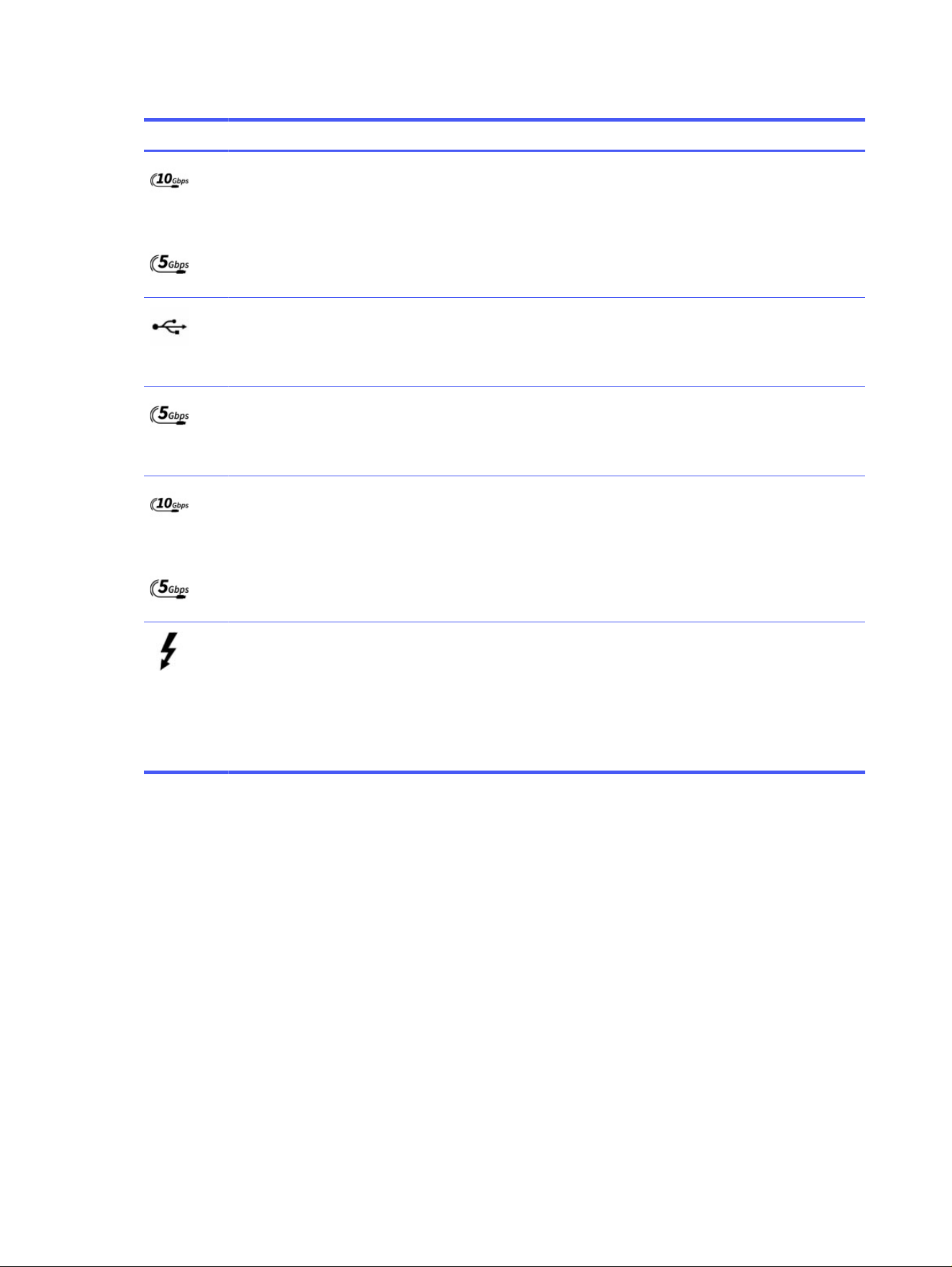
Table 3-1 USB ports and descriptions (continued)
Component Description
– or –
USB port Connects a USB device, provides high-speed data transfer, and (for select products)
charges small devices (such as a smartphone) when the computer is on or in Sleep mode.
NOTE: Use a standard USB Type-A charging cable or cable adapter (purchased
separately) when charging a small external device.
USB Type-C® port Connects a USB device, provides data transfer, and (for select products) charges small
devices (such as a smartphone) when the computer is on or in Sleep mode.
NOTE: Use a standard USB Type-C charging cable or cable adapter (purchased
separately) when charging a small external device.
USB Type-C port Connects a USB device, provides high-speed data transfer, and (for select products)
charges small devices (such as a smartphone) when the computer is on or in Sleep mode.
NOTE: Use a standard USB Type-C charging cable or cable adapter (purchased
separately) when charging a small external device.
– or –
USB Type-C port Connects a USB device, provides high-speed data transfer, and (for select products)
charges small devices (such as a smartphone) when the computer is on or in Sleep mode.
NOTE: Use a standard USB Type-C charging cable or cable adapter (purchased
separately) when charging a small external device.
USB Type-C
Thunderbolt™ port
with HP Sleep and
Charge
Connects a USB device, provides high-speed data transfer, and charges small devices
(such as a smartphone), even when the computer is off.
– and –
Connects a display device that has a USB Type-C connector, providing DisplayPort™ output.
NOTE: Use a standard USB Type-C charging cable or cable adapter (purchased
separately) when charging a small external device.
Using a wireless phone charger (select products only)
Your computer might contain a wireless phone charger as part of the base. You can use this wireless
charger to charge a phone or tablet that contains wireless charging technology.
Depending on your model, the wireless charging feature might be enabled or disabled in some or all
power states. To enable or disable the wireless charging feature, use the BIOS or OSD method:
● BIOS
1. Turn off the computer.
2. Turn on the computer and immediately press f10.
3. Continue pressing f10 until the BIOS Configuration screen is displayed.
4. Use the arrow keys on your keyboard to navigate to the Power tab, and then select Hardware
Power Management.
8
Chapter 3 Getting to know your computer

5. Set Wireless Charging in S4/S5 to Enable.
6. Press f10 to save the changes and exit.
– or –
1. Turn off the computer.
2. Turn on the computer and immediately press f10.
3. Continue pressing f10 until the BIOS Configuration screen is displayed.
4. Use the arrow keys on your keyboard to navigate to the Configuration tab.
5. Change the wireless charging option to enabled.
● OSD
1. Press the OSD button on the bottom edge of the monitor.
2. After the main menu is displayed, press the OSD button again to open the OSD menu.
3. Select Power.
4. Under Power mode, select Full-Feature.
5. Under Wireless Charging, select On to enable wireless charging.
– or –
1. Press the OSD button on the back cover to open the OSD menu.
2. Select Power, and then select Wireless Charging.
3. Select On to enable wireless charging.
– or –
1. Press the OSD button on the right side of the back of the computer.
2. Select the menu icon to open the OSD menu.
3. Select Power, and then select Wireless Charging.
4. Select On to enable wireless charging or Off to disable wireless charging.
Shutting down (turning off) the computer
Although you can turn off the computer with the power button, HP recommends that you use the
Windows Shut down command.
IMPORTANT: Unsaved information is lost when the computer shuts down. Be sure to save your work
before shutting down the computer.
The Shut down command closes all open programs, including the operating system, and then turns off
the display and computer.
Shutting down (turning off) the computer
9

Shut down the computer under any of the following conditions:
● When you need to access components inside the computer
● When you are connecting an external hardware device that does not connect to a USB or video port
or to a headphone or microphone jack
● When the computer will be unused and disconnected from external power for an extended period
NOTE: If the computer is in the Sleep state or in Hibernation, first exit Sleep or Hibernation by briefly
pressing the power button.
To shut down your computer, follow these steps:
1. Save your work and close all open programs.
2. Select the Start button, select the Power icon, and then select Shut down.
If the computer is unresponsive and you cannot use the preceding shutdown procedures, try the
following emergency procedures in the sequence provided:
● Press ctrl+alt+delete, select the Power icon, and then select Shut down.
● Press and hold the power button for at least 10 seconds.
● Disconnect the computer from external power.
10
Chapter 3 Getting to know your computer

Connecting to a network4
Your computer can travel with you wherever you go. But even at home, you can explore the globe and
access information from millions of websites by using your computer and a wired or wireless network
connection. This chapter helps you get connected to that world.
Connecting to a wireless network
Your computer might be equipped with one or more wireless devices.
● WLAN device—Connects the computer to wireless local area networks, which are commonly
referred to as Wi-Fi networks, wireless LANs, or WLANs. These connections typically occur in
corporate offices, your home, and public places such as airports, restaurants, coffee shops, hotels,
and universities. The WLAN device in your computer communicates with a wireless router or a
wireless access point.
● HP Mobile Broadband Module—Gives you wireless connectivity over a wireless wide area network
(WWAN), a much larger area. Mobile network operators install base stations (similar to cell phone
towers) throughout large geographic areas, effectively providing coverage across entire states,
regions, or even countries.
● Bluetooth® device—Creates a personal area network (PAN) to connect to other Bluetooth-enabled
devices such as computers, phones, printers, headsets, speakers, and cameras. In a PAN, each
device communicates directly with other devices, and devices must be relatively close together—
typically within 10 m (approximately 33 ft) of each other.
Using the wireless controls
You can control the wireless devices in your computer using one or both of these features.
● Airplane mode key (also called
wireless button
or
wireless key
)
● Operating system controls
Airplane mode key
The computer might have an airplane mode key, one or more wireless devices, and one or two wireless
lights. All the wireless devices on your computer are enabled at the factory.
The wireless light indicates the overall power state of your wireless devices, not the status of individual
devices.
Operating system controls
The Network and Sharing Center allows you to set up a connection or network, connect to a network,
and diagnose and repair network problems.
To use operating system controls, on the taskbar, right-click the network status icon, and then select
Network and Internet settings.
Connecting to a network
11

Connecting to a WLAN
Before you can connect to a WLAN with this procedure, you must first set up internet access.
NOTE: When you are setting up internet access in your home, you must establish an account with an
internet service provider (ISP). To purchase internet service and a modem, contact a local ISP. The ISP
will help set up the modem, install a network cable to connect your wireless router to the modem, and
test the internet service.
1. Be sure that the WLAN device is on.
2. On the taskbar, select the network status icon to open the Quick Settings menu. Select the arrow
next to the wireless icon, and then connect to one of the available networks.
If the WLAN is a security-enabled WLAN, you are prompted to enter a security code. Enter the code,
and then select Next to complete the connection.
NOTE: If no WLANs are listed, you might be out of range of a wireless router or access point.
NOTE: If you do not see the WLAN that you want to connect to:
1. On the taskbar, right-click the network status icon, and then select Network and Internet
settings.
2. Select Wi-Fi, and then select Show available known networks.
3. Connect to one of the available networks.
3. Follow the on-screen instructions to complete the connection.
After the connection is made, right-click the network status icon at the far right of the taskbar to verify
the name and status of the connection.
NOTE: The functional range (how far your wireless signals travel) depends on WLAN implementation,
router manufacturer, and interference from other electronic devices or structural barriers such as
walls and floors.
Using HP Mobile Broadband (select products only)
Your HP Mobile Broadband computer has built-in support for mobile broadband service. Your new
computer, when used with a mobile operator’s network, gives you the freedom to connect to the internet,
send email, or connect to your corporate network without the need for Wi-Fi hotspots.
You might need the HP Mobile Broadband Module IMEI number, MEID number, or both to activate mobile
broadband service. The number might be printed on a label located on the bottom of your computer,
inside the battery bay, under the service door, or on the back of the display.
Locating mobile operator settings
To locate mobile operator settings:
1. On the taskbar, right-click the network status icon.
2. Select Network and Internet settings.
3. Under the Network & Internet section, select Cellular, and then, under More cellular settings select
Mobile operator settings.
12
Chapter 4 Connecting to a network

Some mobile network operators require the use of a subscriber identity module (SIM) card. A SIM card
contains basic information about you, such as a personal identification number (PIN), as well as network
information. Some computers include a SIM card that is preinstalled. If the SIM card is not preinstalled, it
might be included with the HP Mobile Broadband documents provided with your computer, or the mobile
network operator might provide it separately from the computer.
Connecting with HP Mobile Broadband
To connect with HP Mobile Broadband:
1. On the taskbar, select the network icon to open the Quick Settings menu.
2. Select the arrow next to the signal bars icon to connect.
For information about HP Mobile Broadband and how to activate service with a preferred mobile
network operator, see the HP Mobile Broadband information included with your computer.
Using eSIM (select products only)
Your computer might be equipped with an eSIM. An eSIM is a programmable version of the commonly
used SIM that you can use to download different profiles from selected carriers.
An eSIM lets you connect to the internet over a cellular data connection. With an eSIM, you do not need
to get a SIM card from your mobile operator, and you can quickly switch between mobile operators
and data plans. For example, you might have one cellular data plan for work and a different plan with
another mobile operator for personal use. If you travel, you can connect in more places by finding mobile
operators with plans in that area.
You can implement eSIMs using these methods:
● Embed the eSIM chip (eUICC). The notebook then operates as a dual SIM, one as eUICC and the
second as standard micro or nano SIM card on a SIM card tray. Only one SIM can be active at a time.
● Place a removable physical eSIM on a SIM card tray, the same as a standard micro or nano SIM card.
In this case, the eSIM is not limited to a single carrier (physical blank eSIM).
You must add an eSIM profile to connect to the internet using cellular data. To add a profile, manage
SIM profiles, and learn how to use an eSIM, go to https://www.support.microsoft.com , and type Use an
eSIM in the search bar.
Using GPS (select products only)
Your computer might be equipped with a Global Positioning System (GPS) device. GPS satellites deliver
location, speed, and direction information to GPS-equipped systems.
To enable GPS, be sure that location is enabled under the Location setting.
1. Select the Search icon in the taskbar, type location in the search box.
2. Select Location privacy settings, and then make sure that location services are enabled.
Using Bluetooth wireless devices (select products only)
A Bluetooth device provides short-range wireless communications that replace the physical cable
connections that traditionally link electronic devices.
● Computers (desktop, notebook)
Connecting with HP Mobile Broadband
13

● Phones (cellular, cordless, smartphone)
● Imaging devices (printer, camera)
● Audio devices (headset, speakers)
● Mouse
● External keyboard
Connecting Bluetooth devices
Before you can use a Bluetooth device, you must establish a Bluetooth connection.
1. In the taskbar, select the Search icon, type bluetooth in the search box, and then select
Bluetooth and other devices settings.
2. Enable Bluetooth, if it is not already enabled.
3. Select Add device, and then in the Add device dialog box, select Bluetooth.
4. Select your device from the list, and then follow the on-screen instructions.
NOTE: If the device requires verification, a pairing code is displayed. On the device that you are
adding, follow the on-screen instructions to verify that the code on your device matches the pairing
code. For more information, see the documentation provided with the device.
NOTE: If your device does not appear in the list, be sure that Bluetooth on that device is turned on.
Some devices might have additional requirements; see the documentation provided with the device.
Connecting to a wired network—LAN (select products only)
Use a LAN connection to connect the computer directly to a router in your home (instead of working
wirelessly) or to connect to an existing network at your office.
If there is no RJ-45 (network) port on the computer, connecting to a LAN requires a network cable and a
network jack or an optional docking device or expansion product.
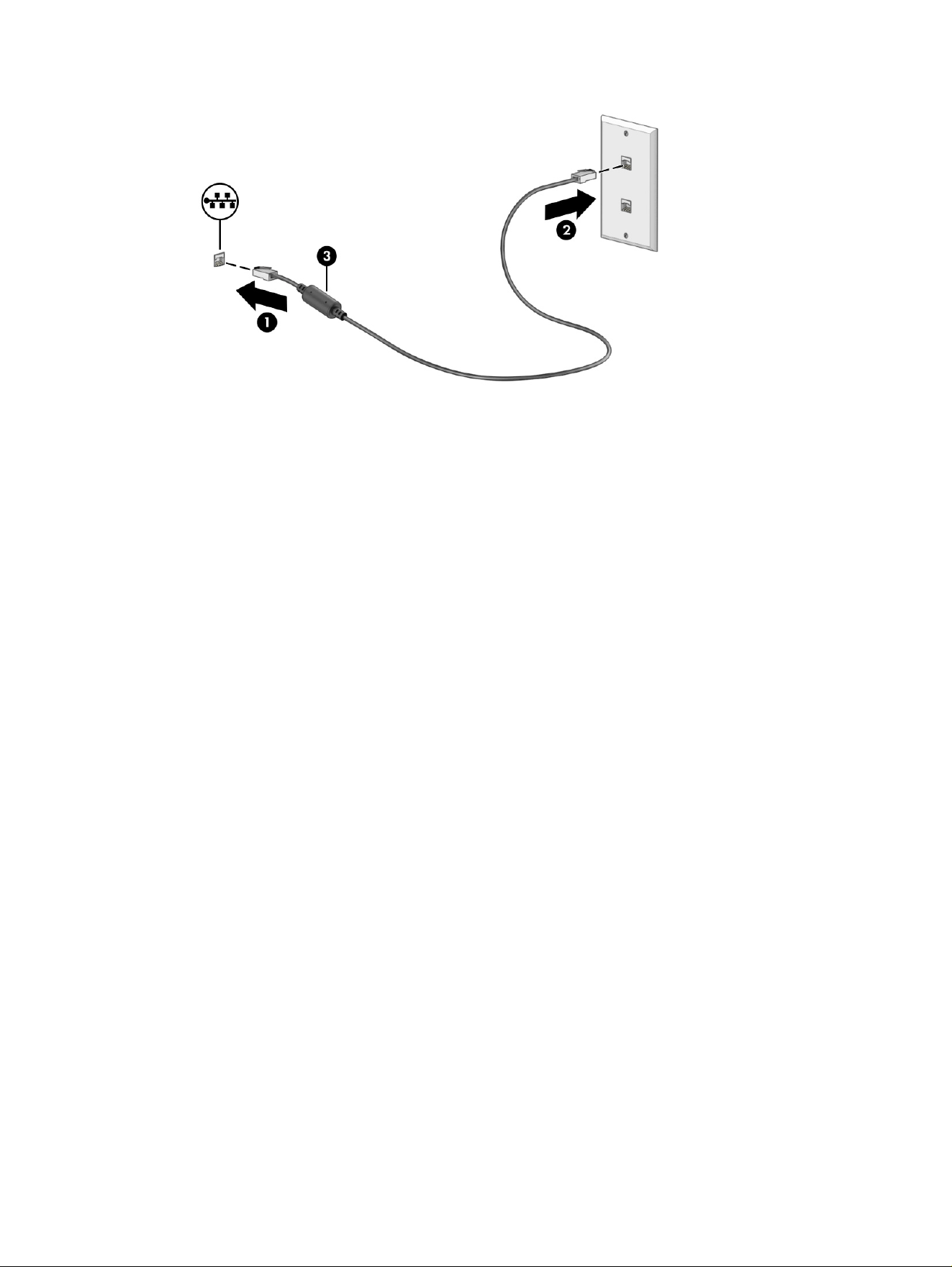
To connect the network cable, follow these steps:
1. Plug the network cable into the network jack (1) on the computer.
2. Plug the other end of the network cable into a network wall jack (2) or router.
NOTE: If the network cable contains noise suppression circuitry (3), which prevents interference
from TV and radio reception, orient the circuitry end of the cable toward the computer.
14
Chapter 4 Connecting to a network
Connecting to a wired network—LAN (select products only) 15

Enjoying entertainment features5
Use your HP computer as an entertainment hub to enjoy and manage your music, and download and
watch movies. Or, to make your computer an even more powerful entertainment center, connect external
devices like a monitor, projector, TV, speakers, or headphones.
Using audio
You can download and listen to music, stream audio content (including radio) from the web, record audio,
or mix audio and video to create multimedia. You can also play music CDs on the computer (on select
products) or attach an external optical drive to play CDs.
To enhance your listening enjoyment, attach external audio devices such as speakers or headphones.
Connecting speakers
You can attach wired speakers to your computer by connecting them to a USB port or to the audio-out
(headphone)/audio-in (microphone) combo jack on your computer or on a docking station.
To connect wireless speakers to your computer, follow the device manufacturer's instructions. To
connect high-definition speakers to the computer, see Setting up HDMI audio on page 21. Before
connecting speakers, lower the volume setting.
Connecting headphones
You can connect wired headphones to the headphone jack or to the audio-out (headphone)/audio-in
(microphone) combo jack on your computer.
WARNING! To reduce the risk of personal injury, lower the volume setting before putting on
headphones, earbuds, or a headset. For additional safety information, see the
Regulatory, Safety, and
Environmental Notices
.
To access this document:
■
Select the Search icon in the taskbar, type HP Documentation in the search box, and then select
HP Documentation.
To connect wireless headphones to your computer, follow the device manufacturer's instructions.
Connecting a microphone
To record audio, connect a microphone to the microphone jack on the computer. For best results when
recording, speak directly into the microphone, and record sound in a setting free of background noise.
Connecting headsets
Headphones combined with a microphone are called
headsets
. You can connect wired headsets to the
audio-out (headphone)/audio-in (microphone) combo jack on your computer.
WARNING! To reduce the risk of personal injury, lower the volume setting before putting on
headphones, earbuds, or a headset. For additional safety information, see the
Regulatory, Safety, and
Environmental Notices
.
16
Chapter 5 Enjoying entertainment features

To access this document:
■
Select the Search icon in the taskbar, type HP Documentation in the search box, and then select
HP Documentation.
To connect wireless headsets to your computer, follow the device manufacturer's instructions.
Using sound settings
Use sound settings to adjust system volume, change system sounds, or manage audio devices.
Sound settings
To view or change sound settings, follow these steps.
1. Select the Search icon in the taskbar, type control panel in the search box, and then select
Control Panel.
2. Select Hardware and Sound, and then select Sound.
Audio settings
Your computer might include an advanced sound system by HyperX or Poly Studio. As a result, your
computer might include advanced audio features that you can control through myHP Audio Control.
Using video
Your computer is a powerful video device that enables you to watch streaming video from your favorite
websites and download video and movies to watch on your computer when you are not connected to a
network.
To enhance your viewing enjoyment, use one of the video ports on the computer to connect an external
monitor, projector, or TV.
IMPORTANT: Be sure that the external device is connected to the correct port on the computer, using
the correct cable. Follow the device manufacturer's instructions.
For information about using your USB Type-C features, go to http://www.hp.com/support, and follow the
instructions to find your product.
Connecting a DisplayPort device using a USB Type-C cable (select products only)
To see video or high-resolution display output on an external DisplayPort device, connect the
DisplayPort device according to the instructions.
NOTE: To connect a USB Type-C DisplayPort (DP) device to your computer, you need a USB Type-C
cable, purchased separately.
1. Connect one end of the USB Type-C cable to the USB Type-C port and DisplayPort connector on the
computer.
NOTE: Your connector icon might look slightly different from the illustration in this section.
Using sound settings
17
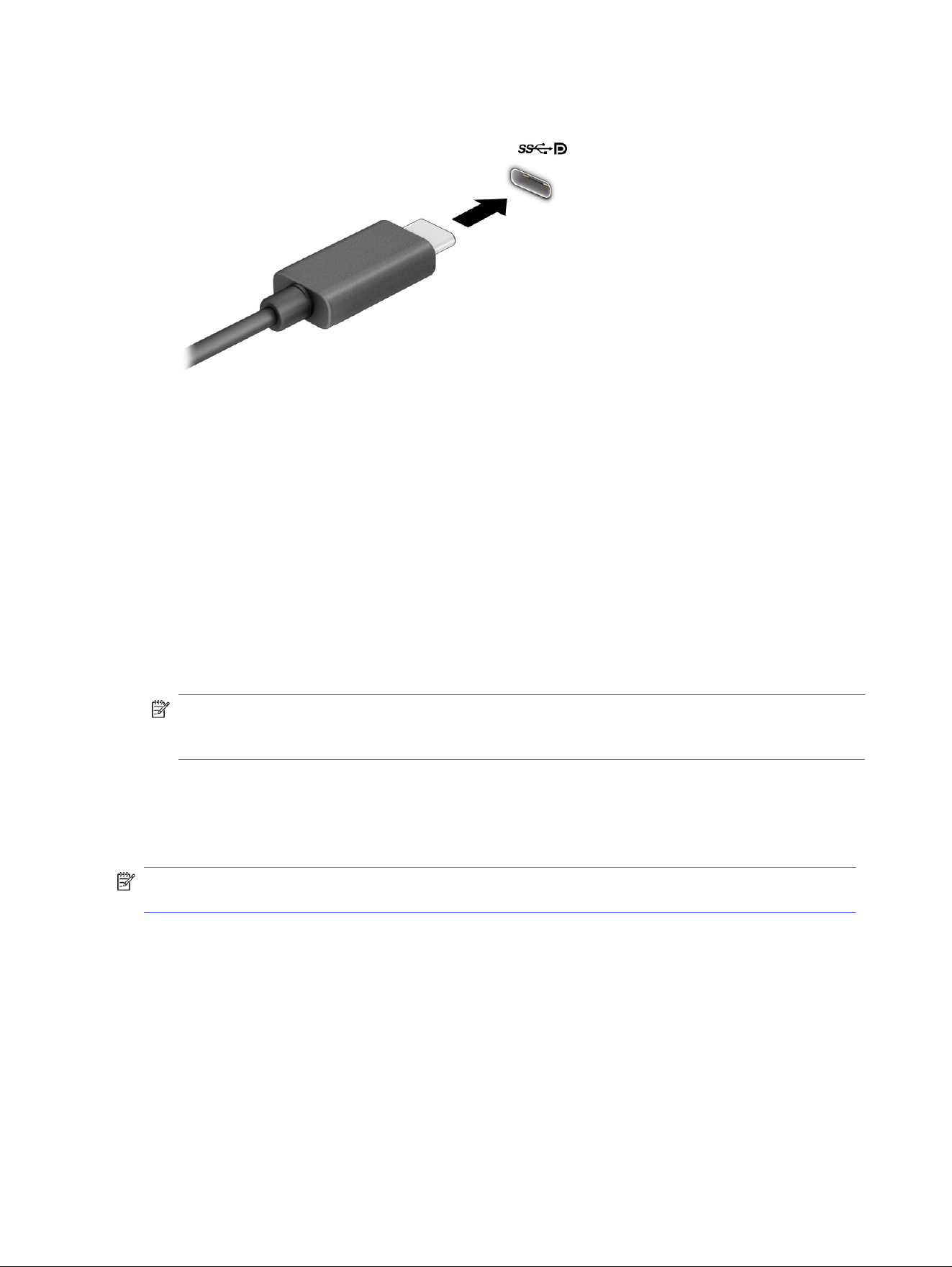
2. Connect the other end of the cable to the external DisplayPort device.
3. Press the Windows key + p to cycle through one of four display states:
● PC screen only: View the screen image on the computer only.
● Duplicate: View the screen image simultaneously on both the computer and the external
device.
● Extend: View the screen image extended across both the computer and the external device.
● Second screen only: View the screen image on the external device only.
Each time you press the Windows key + p, the display state changes.
NOTE: For best results, especially if you choose the Extend option, increase the screen resolution
of the external device, as follows. Select the Start button, select Settings, and then select System.
Under Display, select the appropriate resolution, and then select Keep changes.
Connecting a Thunderbolt device using a USB Type-C cable (select products only)
To see video or high-resolution display output on an external Thunderbolt™ device, connect the
Thunderbolt device according to the instructions.
NOTE: To connect a USB Type-C Thunderbolt device to your computer, you need a USB Type-C cable,
purchased separately.
18
Chapter 5 Enjoying entertainment features
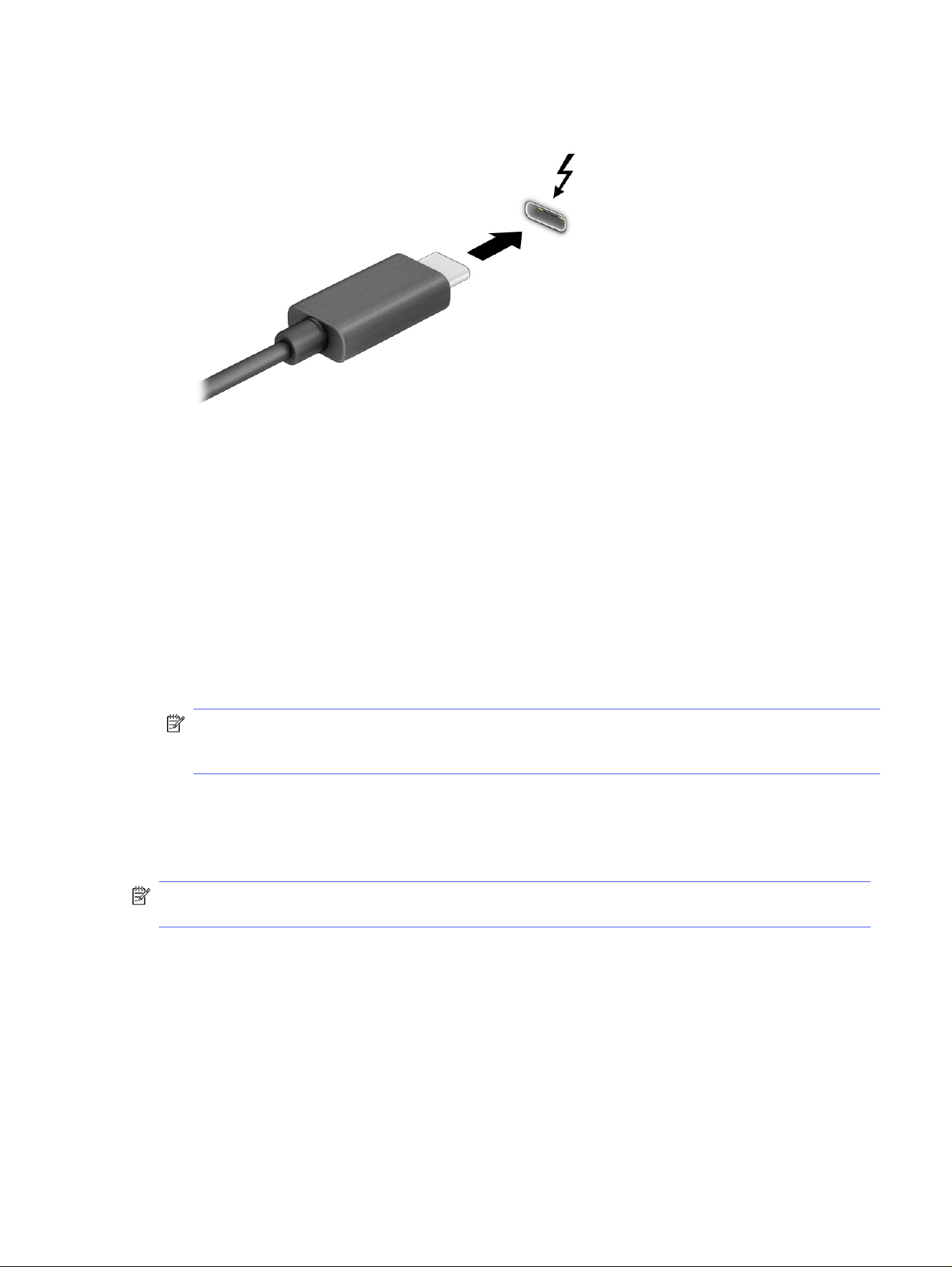
1. Connect one end of the USB Type-C cable to the USB Type-C Thunderbolt port on the computer.
2. Connect the other end of the cable to the external Thunderbolt device.
3. Press the Windows key + p to cycle through one of four display states:
● PC screen only: View the screen image on the computer only.
● Duplicate: View the screen image simultaneously on both the computer and external device.
● Extend: View the screen image extended across both the computer and external device.
● Second screen only: View the screen image on the external device only.
Each time you press the Windows key + p, the display state changes.
NOTE: For best results, especially if you choose the Extend option, increase the screen resolution
of the external device, as follows. Select the Start button, select Settings, and then select System.
Under Display, select the appropriate resolution, and then select Keep changes.
Connecting video devices by using a VGA cable (select products only)
To see the computer screen image on an external VGA monitor or projected for a presentation, connect
a monitor or projector to the computer's VGA port.
NOTE: To connect a VGA video device to your computer, you need an VGA cable, purchased
separately.
Connecting video devices by using a VGA cable (select products only)
19
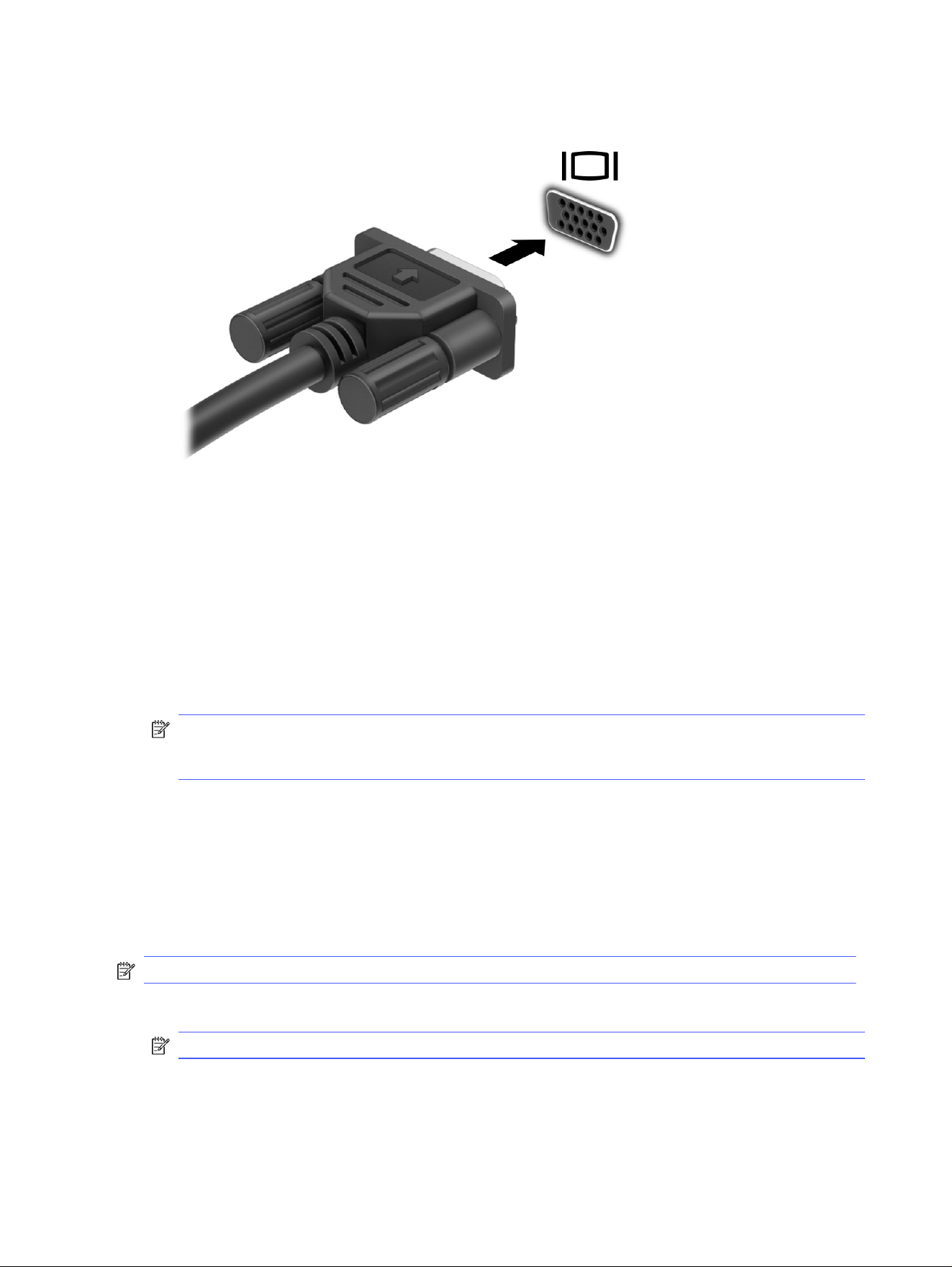
1. Connect the VGA cable from the monitor or projector to the VGA port on the computer as shown.
2. Press the Windows key + p to cycle through one of four display states:
● PC screen only: View the screen image on the computer only.
● Duplicate: View the screen image simultaneously on both the computer and the external
device.
● Extend: View the screen image extended across both the computer and the external device.
● Second screen only: View the screen image on the external device only.
Each time you press the Windows key + p, the display state changes.
NOTE: For best results, especially if you choose the Extend option, increase the screen resolution
of the external device, as follows. Select the Start button, select Settings, and then select System.
Under Display, select the appropriate resolution, and then select Keep changes.
Connecting video devices using an HDMI cable (select products only)
To connect an HDMI device to your computer, you need an HDMI cable, purchased separately.
Connecting a high-definition TV or monitor using HDMI
To see the computer screen image on a high-definition TV or monitor, connect the high-definition device
according to the instructions.
NOTE: To connect an HDMI device to your computer, you need an HDMI cable, purchased separately.
1. Connect one end of the HDMI cable to the HDMI port on the computer.
NOTE: HDMI port shape can vary by product.
20
Chapter 5 Enjoying entertainment features
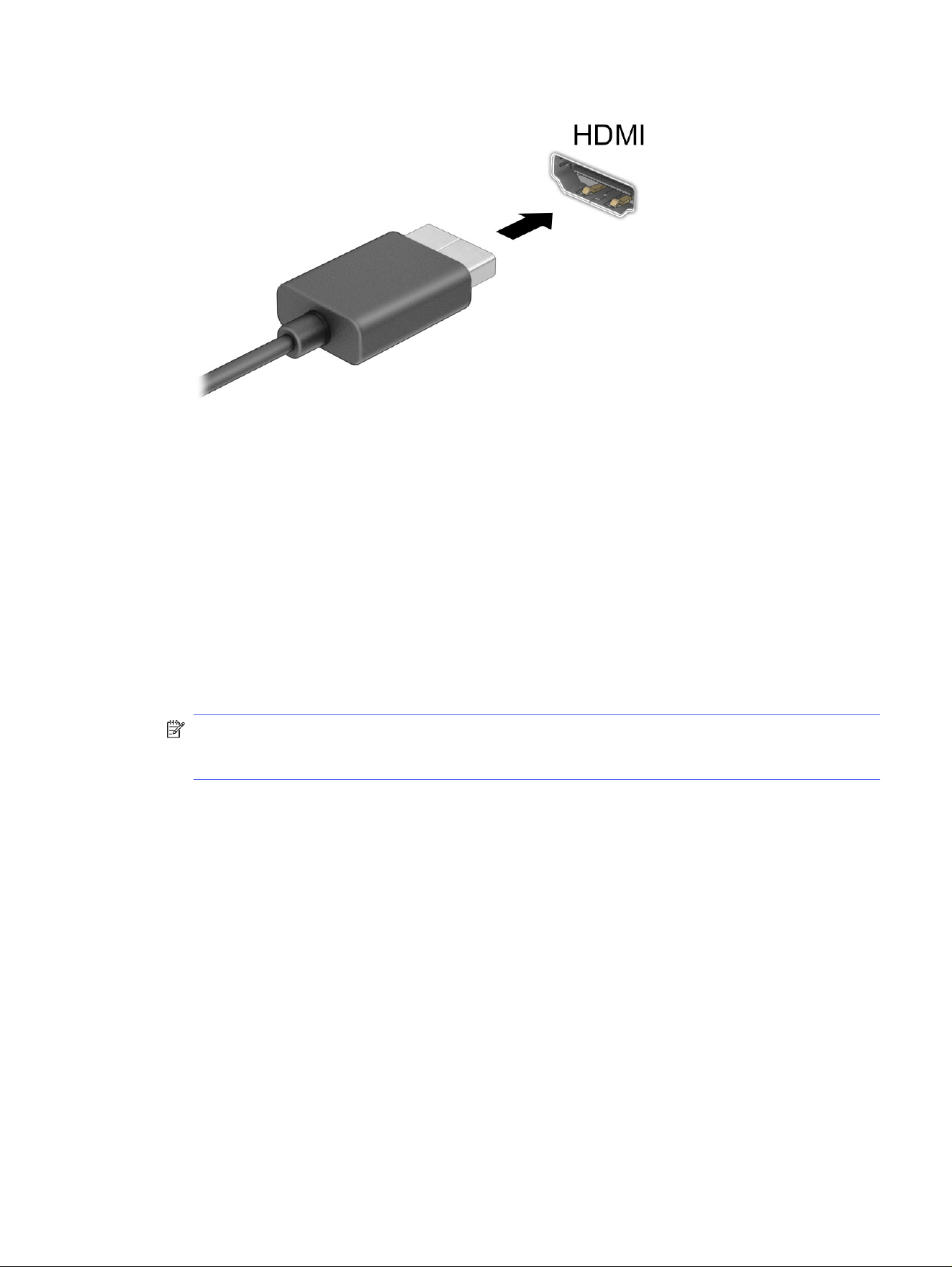
2. Connect the other end of the cable to the high-definition TV or monitor.
3. Press the Windows key + p to cycle through one of four display states:
● PC screen only: View the screen image on the computer only.
● Duplicate: View the screen image simultaneously on both the computer and the external
device.
● Extend: View the screen image extended across both the computer and the external device.
● Second screen only: View the screen image on the external device only.
Each time you press the Windows key + p, the display state changes.
NOTE: For best results, especially if you choose the Extend option, increase the screen resolution
of the external device, as follows. Select the Start button, select Settings, and then select System.
Under Display, select the appropriate resolution, and then select Keep changes.
Setting up HDMI audio
HDMI is the only video interface that supports high-definition video and audio.
Turn on HDMI audio
After you connect an HDMI TV to the computer, you can then turn on HDMI audio by following this
procedure.
1. Right-click the Speakers icon in the notification area, at the far right of the taskbar, and then select
Sounds.
2. On the Playback tab, select the name of the digital output device.
3. Select Set Default, and then select OK.
Return audio to computer speakers
Follow these steps to return the audio stream to the computer speakers.
Setting up HDMI audio
21
1. Right-click the Speakers icon in the notification area, at the far right of the taskbar, and then select
Sounds.
2. On the Playback tab, select Speakers.
3. Select Set Default, and then select OK.
Connecting digital display devices using a Dual-Mode DisplayPort cable (select
products only)
The Dual-Mode DisplayPort connector connects a digital display device such as a high-performance
monitor or projector. Dual-Mode DisplayPort delivers higher performance than VGA and improves digital
connectivity.
NOTE: To connect a digital display device to your computer, you need a Dual-Mode DisplayPort (DP-to-
DP) cable, purchased separately.
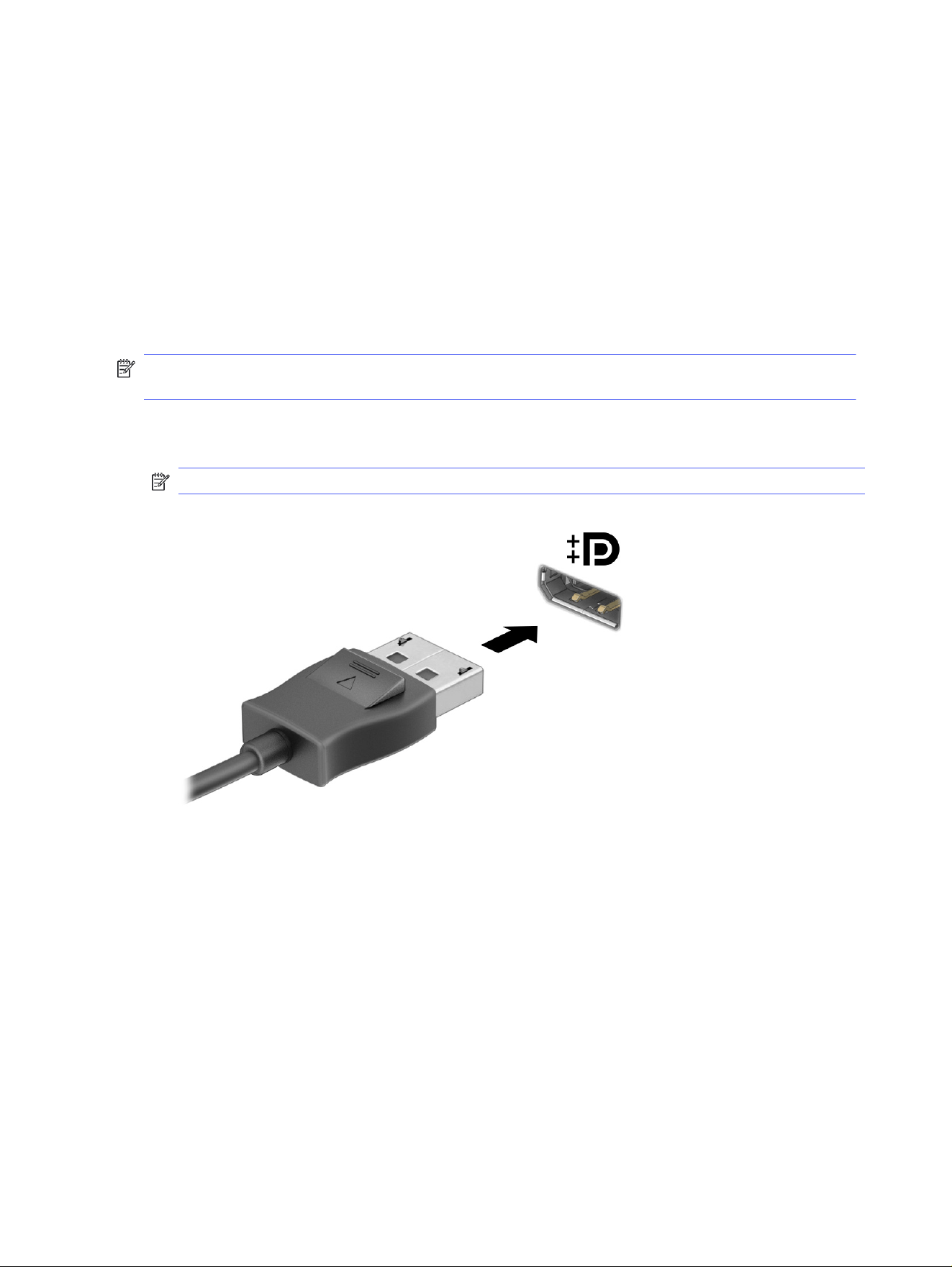
1. Connect one end of the Dual-Mode DisplayPort cable to the Dual-Mode DisplayPort connector on
the computer.
NOTE: Your connector might look slightly different from the illustration in this section.
2. Connect the other end of the cable to the digital display device.
3. Press the Windows key + p to cycle through one of four display states:
● PC screen only: View the screen image on the computer only.
● Duplicate: View the same screen image simultaneously on both the computer and the external
device.
● Extend: View the screen image extended across both the computer and the external device.
● Second screen only: View the screen image on the external device only.
22
Chapter 5 Enjoying entertainment features

Each time you press the Windows key + p , the display state changes.
NOTE: For best results, especially if you choose the Extend option, increase the screen resolution
of the external device, as follows. Select the Start button, select Settings, and then select System.
Under Display, select the appropriate resolution, and then select Keep changes.
Discovering and connecting to Miracast-compatible wireless displays (select
products only)
Follow these steps to discover and connect to Miracast-compatible wireless displays without leaving
your current apps.
1. Select the Search icon in the taskbar, type connect in the search box, and then select Connect to
a wireless display.
2. Under Display, select Connect to a wireless display.
3. Select a setting, and then follow the on-screen instructions.
Using data transfer
Your computer is a powerful entertainment device that enables you to transfer photos, videos, and
movies from your USB devices to view on your computer.
To enhance your viewing enjoyment, use one of the USB Type-C ports on the computer to connect a
USB device, such as a cell phone, camera, activity tracker, or smartwatch, and transfer the files to your
computer.
IMPORTANT: Be sure that the external device is connected to the correct port on the computer, using
the correct cable. Follow the device manufacturer's instructions.
For information about using your USB Type-C features, go to http://www.hp.com/support, and follow the
instructions to find your product.
Connecting devices to a USB Type-C port (select products only)
To connect a USB Type-C device to your computer, you need a USB Type-C cable, purchased separately.
Discovering and connecting to Miracast-compatible wireless displays (select products only)
23
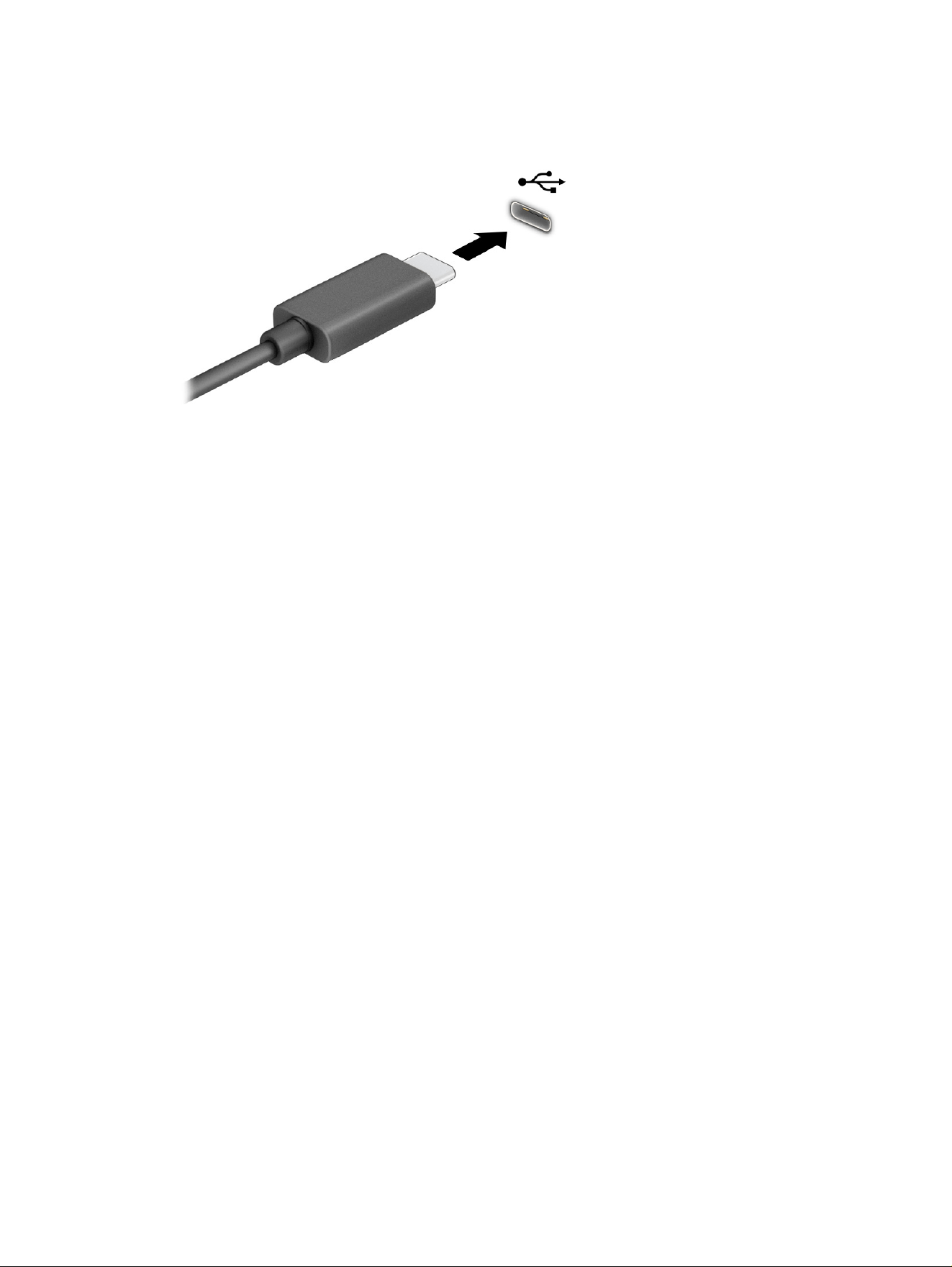
1. Connect one end of the USB Type-C cable to the USB Type-C port on the computer.
2. Connect the other end of the cable to the external device.
24
Chapter 5 Enjoying entertainment features

Navigating the screen6
You can navigate the computer screen by using touch gestures (select products only) and by using the
keyboard and mouse.
Select computer models have special action keys or hot key functions on the keyboard to perform
routine tasks.
Using touch gestures (select products only)
You can customize the touch gestures by changing settings, button configurations, click speed, and
pointer options.
Select the Search icon in the taskbar, type control panel in the search box, and then select Control
Panel. Select Hardware and Sound. Under Devices and Printers, select Mouse.
NOTE: Touch gestures are not supported in all apps.
Using the keyboard and mouse
The keyboard and mouse allow you to type, select items, scroll, and perform the same functions as you
do using touch gestures. With the keyboard, you can use action keys and hot keys to perform specific
functions.
TIP: The Windows key on the keyboard allows you to quickly return to the Start screen from an open
app or the Windows desktop. Press the key again to return to the previous screen.
TIP: Copilot in Windows requires Windows 11. Some features require a neural processing unit. The
timing of feature delivery and availability varies by market and device. You must have a Microsoft
account to use the Copilot feature. Where the Copilot feature is not available, pressing the Copilot key
opens the Bing search engine. See http://aka.ms/WindowsAIFeatures.
NOTE: Depending on the country or region, the keys and keyboard functions of your keyboard might
be different from those discussed in this section.
Using the action keys or hot keys
You can quickly access information or perform functions by using certain keys and key combinations.
● Action keys perform an assigned function. The icons on the function keys at the top of the keyboard
illustrate the assigned function for each key.
To use an action key, press and hold the key.
● Hot keys are a combination of the fn key and another key.
To use a hot key, briefly press the fn key, and then briefly press the second key of the combination.
Navigating the screen
25
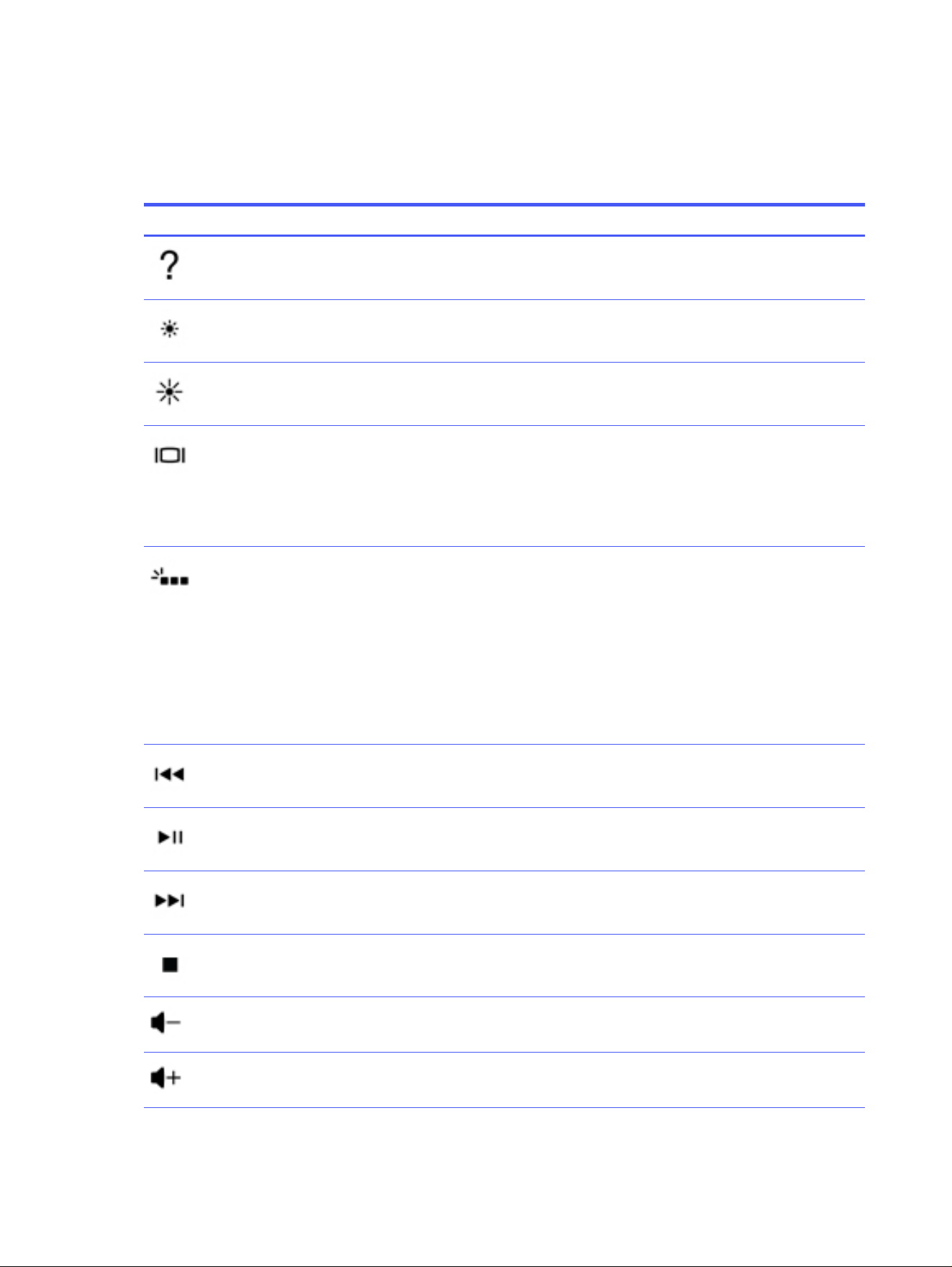
Action keys
Depending on the keyboard model, your keyboard might support the keys that are described in the next
table.
Table 6-1 Action keys
Icon Description
Opens the “How to get help in Windows”
webpage.
Decreases the screen brightness incrementally
as long as you hold down the key.
Increases the screen brightness incrementally
as long as you hold down the key.
Switches the screen image between display
devices connected to the system. For example,
if a monitor is connected to the computer,
repeatedly pressing this key alternates the
screen image from the computer display to the
monitor display to a simultaneous display on
both the computer and the monitor.
Turns the keyboard backlight off or on. On select
products, you can adjust the brightness of the
keyboard backlight. Press the key repeatedly
to adjust the brightness from high (when you
first start up the computer), to low, to off. After
you adjust the keyboard backlight setting, the
backlight will revert to your previous setting
each time you turn on the computer. The
keyboard backlight will turn off after 30 seconds
of inactivity. To turn the keyboard backlight back
on, press any key. To conserve battery power,
turn off this feature.
Plays the previous track of an audio CD or the
previous section of a DVD or a Blu-ray Disc (BD).
Starts, pauses, or resumes playback of an audio
CD, a DVD, or a BD.
Plays the next track of an audio CD or the next
section of a DVD or a BD.
Stops audio or video playback of a CD, a DVD, or
a BD.
Decreases speaker volume incrementally while
you hold down the key.
Increases speaker volume incrementally while
you hold down the key.
26 Chapter 6 Navigating the screen

Table 6-1 Action keys (continued)
Icon Description
Mutes or restores speaker sound.
Turns the wireless feature on or off.
NOTE: A wireless network must be set up
before a wireless connection is possible.
Turns the airplane mode and wireless feature on
or off.
NOTE: The airplane mode key is also referred
to as the wireless button.
NOTE: A wireless network must be set up
before a wireless connection is possible.
Action keys 27

Maintaining your computer7
Performing regular maintenance keeps your computer in optimal condition. This chapter explains how to
use tools like Disk Defragmenter and Disk Cleanup. It also provides instructions for updating programs
and drivers, steps to clean the computer, and tips for traveling with (or shipping) the computer.
Improving performance
You can improve the performance of your computer by performing regular maintenance tasks with tools
such as Disk Defragmenter and Disk Cleanup.
Using Disk Defragmenter
HP recommends using Disk Defragmenter to defragment your hard drive at least once a month.
NOTE: It is not necessary to run Disk Defragmenter on solid-state drives.
To run Disk Defragmenter:
1. Connect the computer to AC power.
2. Select the Search icon in the taskbar, type defragment in the search box, and then select
Defragment and Optimize Drives.
3. Follow the on-screen instructions.
For additional information, access the Disk Defragmenter software Help.
Using Disk Cleanup
Use Disk Cleanup to search the hard drive for unnecessary files that you can safely delete to free up
disk space and help the computer run more efficiently.
To run Disk Cleanup:
1. Select the Search icon in the taskbar, type disk in the search box, and then select Disk Cleanup.
2. Follow the on-screen instructions.
Using HP 3D DriveGuard (select products only)
HP 3D DriveGuard protects a hard drive by parking the drive and halting data requests under some
conditions.
● You drop the computer.
● You move the computer with the display closed while the computer is running on battery power.
28
Chapter 7 Maintaining your computer

A short time after one of these events, HP 3D DriveGuard returns the hard drive to normal operation.
NOTE: Only internal hard drives are protected by HP 3D DriveGuard. A hard drive installed in an
optional docking device or connected to a USB port is not protected by HP 3D DriveGuard.
NOTE: Because solid-state drives (SSDs) lack moving parts, HP 3D DriveGuard is unnecessary for
these drives.
Identifying HP 3D DriveGuard status
The hard drive light on the computer changes color to show that the drive in a primary hard drive bay,
the secondary hard drive bay (select products only), or both are parked.
Updating programs and drivers
HP recommends that you update your programs and drivers on a regular basis. Updates can resolve
issues and bring new features and options to your computer. For example, older graphics components
might not work well with the most recent gaming software. Without the latest driver, you do not get the
most out of your equipment.
Updating both programs and drivers
Use this procedure to update both programs and drivers.
1. Use one of these options:
● Select the Search icon in the taskbar, type support in the search box, and then select the HP
Support Assistant app.
● Select the question mark icon in the taskbar.
2. Under My notebook, select Updates. The Software and Drivers window opens, and Windows checks
for updates.
3. Follow the on-screen instructions.
Updating programs only
Use this procedure to update programs only.
1. Select Start, and then select Microsoft Store.
2. Select the dots next to your profile picture in the top-right corner, and then select Downloads and
updates.
3. On the Downloads and updates page, select Get updates, and then follow the on-screen
instructions.
Updating drivers only
Use this procedure to update drivers only.
1. Select the Search icon in the taskbar, type windows update settings in the search box, and
then select Windows Update settings.
Identifying HP 3D DriveGuard status
29

2. Select Check for updates, and then follow the on-screen instructions.
NOTE: If Windows does not find a new driver, go to the device manufacturer's website, and follow
the instructions.
Cleaning your computer
Cleaning your computer regularly removes dirt and debris so that your device continues to operate at its
best. Use the following information to safely clean the external surfaces of your computer.
Enabling HP Easy Clean (select products only)
HP Easy Clean helps you to avoid accidental input while you clean the computer surfaces. This software
disables devices such as the keyboard, touch screen, and touchpad for a preset amount of time so that
you can clean all computer surfaces.
1. Start HP Easy Clean in one of the following ways:
● Select the Start menu, and then select HP Easy Clean.
● Select the HP Easy Clean icon in the taskbar.
● Select Start, and then select the HP Easy Clean tile.
2. Now that your device is disabled for a short period, see Removing dirt and debris from your
computer on page 30 for the recommended steps to clean the high-touch, external surfaces
on your computer. After you remove the dirt and debris, you can also clean the surfaces with a
disinfectant. See Cleaning your computer with a disinfectant on page 31 for guidelines to help
prevent the spread of harmful bacteria and viruses.
Removing dirt and debris from your computer
Here are the recommended steps to clean dirt and debris from your computer.
For computers with wood veneer, see Caring for wood veneer (select products only) on page 32.
1. Wear disposable gloves made of latex (or nitrile gloves, if you are latex-sensitive) when cleaning the
surfaces.
2. Turn off your device and unplug the power cord and other connected external devices. Remove any
installed batteries from items such as wireless keyboards.
CAUTION: To prevent electric shock or damage to components, never clean a product while it is
turned on or plugged in.
3. Moisten a microfiber cloth with water. The cloth should be moist, but not dripping wet.
IMPORTANT: To avoid damaging the surface, avoid abrasive cloths, towels, and paper towels.
4. Wipe the exterior of the product gently with the moistened cloth.
IMPORTANT: Keep liquids away from the product. Avoid getting moisture in any openings. If liquid
makes its way inside your HP product, it can cause damage to the product. Do not spray liquids
directly on the product. Do not use aerosol sprays, solvents, abrasives, or cleaners containing
hydrogen peroxide or bleach that might damage the finish.
30
Chapter 7 Maintaining your computer

5. Start with the display (if applicable). Wipe carefully in one direction, and move from the top of the
display to the bottom. Finish with any flexible cables, like power cord, keyboard cable, and USB
cables.
6. Be sure that surfaces have completely air-dried before turning the device on after cleaning.
7. Discard the gloves after each cleaning. Clean your hands immediately after you remove the gloves.
See Cleaning your computer with a disinfectant on page 31 for recommended steps to clean the
high-touch, external surfaces on your computer to help prevent the spread of harmful bacteria and
viruses.
Cleaning your computer with a disinfectant
The World Health Organization (WHO) recommends cleaning surfaces, followed by disinfection, as a
best practice for preventing the spread of viral respiratory illnesses and harmful bacteria.
After cleaning the external surfaces of your computer using the steps in Removing dirt and debris from
your computer on page 30, Caring for wood veneer (select products only) on page 32, or both, you
might also choose to clean the surfaces with a disinfectant. A disinfectant that is within HP’s cleaning
guidelines is an alcohol solution consisting of 70% isopropyl alcohol and 30% water. This solution is also
known as rubbing alcohol and is sold in most stores.
Follow these steps when disinfecting high-touch, external surfaces on your computer:
1. Wear disposable gloves made of latex (or nitrile gloves, if you are latex-sensitive) when cleaning the
surfaces.
2. Turn off your device and unplug the power cord and other connected external devices. Remove any
installed batteries from items such as wireless keyboards.
CAUTION: To prevent electric shock or damage to components, never clean a product while it is
turned on or plugged in.
3. Moisten a microfiber cloth with a mixture of 70% isopropyl alcohol and 30% water. The cloth should
be moist, but not dripping wet.
CAUTION: Do not use any of the following chemicals or any solutions that contain them, including
spray-based surface cleaners: bleach, peroxides (including hydrogen peroxide), acetone, ammonia,
ethyl alcohol, methylene chloride, or any petroleum-based materials, such as gasoline, paint thinner,
benzene, or toluene.
IMPORTANT: To avoid damaging the surface, avoid abrasive cloths, towels, and paper towels.
4. Wipe the exterior of the product gently with the moistened cloth.
IMPORTANT: Keep liquids away from the product. Avoid getting moisture in any openings. If liquid
makes its way inside your HP product, it can cause damage to the product. Do not spray liquids
directly on the product. Do not use aerosol sprays, solvents, abrasives, or cleaners containing
hydrogen peroxide or bleach that might damage the finish.
5. Start with the display (if applicable). Wipe carefully in one direction, and move from the top of the
display to the bottom. Finish with any flexible cables, like power cord, keyboard cable, and USB
cables.
6. Be sure that surfaces have completely air-dried before turning the device on after cleaning.
Cleaning your computer with a disinfectant
31

7. Discard the gloves after each cleaning. Clean your hands immediately after you remove the gloves.
Caring for wood veneer (select products only)
Your product might feature high-quality wood veneer. As with all natural wood products, proper care is
important for best results over the life of the product. Because of the nature of natural wood, you might
see unique variations in the grain pattern or subtle variations in color, which are normal.
● Clean the wood with a dry, static-free microfiber cloth or chamois.
● Avoid cleaning products containing substances such as ammonia, methylene chloride, acetone,
turpentine, or other petroleum-based solvents.
● Do not expose the wood to sun or moisture for long periods of time.
● If the wood becomes wet, dry it by dabbing with an absorbent, lint-free cloth.
● Avoid contact with any substance that might dye or discolor the wood.
● Avoid contact with sharp objects or rough surfaces that might scratch the wood.
See Removing dirt and debris from your computer on page 30 for the recommended steps to clean
the high-touch, external surfaces on your computer. After you remove the dirt and debris, you can also
clean the surfaces with a disinfectant. See
Cleaning your computer with a disinfectant on page 31 for
sanitizing guidelines to help prevent the spread of harmful bacteria and viruses.
Traveling with or shipping your computer
If you must travel with or ship your computer, follow these tips to keep your equipment safe.
● Prepare the computer for traveling or shipping:
– Back up your information to an external drive.
– Remove all discs and all external media cards, such as memory cards.
– Turn off and then disconnect all external devices.
– Shut down the computer.
● Take a backup of your information. Keep the backup separate from the computer.
● When traveling by air, carry the computer as hand luggage; do not check it with the rest of your
luggage.
IMPORTANT: Avoid exposing a drive to magnetic fields. Security devices with magnetic fields
include airport walk-through devices and security wands. Airport conveyer belts and similar
security devices that check carry-on baggage use X-rays instead of magnetism and do not
damage drives.
● If you plan to use the computer during a flight, listen for the in-flight announcement that tells you
when you can use your computer. In-flight computer use is at the discretion of the airline.
● If you are shipping the computer or a drive, use suitable protective packaging and label the package
“FRAGILE.”
32
Chapter 7 Maintaining your computer

● The use of wireless devices might be restricted in some environments. Such restrictions might apply
aboard aircraft, in hospitals, near explosives, and in hazardous locations. If you are uncertain of the
policy that applies to the use of a wireless device in your computer, ask for authorization to use your
computer before you turn it on.
● If you are traveling internationally, follow these suggestions:
– Check the computer-related customs regulations for each country or region on your itinerary.
– Check the power cord and adapter requirements for each location in which you plan to use the
computer. Voltage, frequency, and plug configurations vary.
WARNING! To reduce the risk of electric shock, fire, or damage to the equipment, do not
attempt to run the computer from a voltage converter kit that is sold for appliances.
Traveling with or shipping your computer
33

Securing your computer and information8
Computer security is essential for protecting the confidentiality, integrity, and availability of your
information.
Standard security solutions provided by the Windows operating system, HP applications, the Setup
Utility (BIOS), and other third-party software can help protect your computer from a variety of risks, such
as viruses, worms, and other types of malicious code.
Computer security features
Your computer includes features that help protect the integrity of your system and its data from
unauthorized access. Review these features to ensure proper use.
Table 8-1
Computer risks and security features
Computer risk Computer feature
Unauthorized use of the computer or
user account
User password
A
password
is a group of characters that you choose to authorize access to your computer
information.
‒ or –
Windows Hello (select products only)
On products equipped with a fingerprint reader or an infrared camera, Windows Hello allows you to
enroll your fingerprint, your facial ID, and set up a PIN. After enrollment, you can use your fingerprint
reader, facial ID, or PIN to sign in to Windows.
To set up Windows Hello:
1. Select the Start button, select Settings, select Accounts, and then select Sign-in options.
2. If you do not have a password set up, you must add one before you can use other sign-in
options. Select Password, and then select Add.
3. Select Windows Hello Fingerprint or Windows Hello Face, and then select Set up.
4. Select Get started, and then follow the on-screen instructions to enroll your fingerprint or facial
ID and set up a PIN.
IMPORTANT: To prevent fingerprint logon issues, make sure when you register your fingerprint
that all sides of your finger are registered by the fingerprint reader.
NOTE: The PIN is not limited in length. The default setting is for numbers only. To include
alphabetic or special characters, select the include letters and symbols check box.
Unauthorized access to Setup Utility,
BIOS settings, and other system
identification information
Administrator password
Computer viruses Antivirus software
The free trial antivirus software that is preinstalled on your computer can detect most viruses,
remove them, and, in most cases, repair damage caused by viruses. For protection against new
viruses beyond the trial period, purchase an extended service contract.
34 Chapter 8 Securing your computer and information

Table 8-1 Computer risks and security features (continued)
Computer risk Computer feature
Unauthorized access to data and
ongoing threats to the computer
Your computer has these additional features to protect against external threats:
● Firewall software
– Windows includes firewall software preinstalled on the computer.
– The antivirus software, which is preinstalled on the computer, includes firewall software.
● Windows critical security updates
● Updates to the Windows operating system
Computer security features 35

Troubleshooting9
The following tables present some issues you might encounter while installing, starting up, or using your
computer and suggest possible solutions.
For more information or for additional troubleshooting options, go to http://www.hp.com/support, and
follow the instructions to find your product.
NOTE: If you have problems using any peripheral devices such as a monitor or a printer with your
computer, see the documentation provided by the product manufacturer for more extensive
troubleshooting.
Computer does not start
If your computer does not start, refer to the following table for possible solutions.
Table 9-1
Computer symptoms and solutions
Symptom Possible solution
Error message: hard
drive error
1. Restart the computer.
a. Press ctrl+alt+delete.
b. Complete one of these tasks:
● Select the Power icon, and then select Restart.
● Press and hold the power button on the computer for 10 or more seconds to turn off the computer,
and then press the button again to turn on the computer.
2. If Windows opens, immediately back up all important data to a backup hard drive.
3. Contact support, regardless of whether Windows started or not.
Computer will not
turn on or start
● Be sure that the cables connecting the computer to the AC outlet are plugged in properly. The green power
supply light on the computer should be on. If it is not, try a different AC outlet. If you are still having trouble,
contact support.
● Be sure that the operating voltage of the AC outlet is appropriate for the electrical voltage of the computer.
● Test the AC outlet by plugging a different electrical device into it.
● If possible, remove any outlet filters and stabilizers, and then insert the power plug directly into the AC outlet.
● Disconnect all peripheral devices. Press and hold the power button down for at least 15 seconds until the
computer turns off. Then press the power button again to turn on the computer.
● If the monitor screen is blank, the monitor might not be properly connected. Connect the monitor to the
computer, plug the power cord into an AC outlet, and then turn the monitor on. See Monitor (select products
only) on page 37.
36
Chapter 9 Troubleshooting

Table 9-1 Computer symptoms and solutions (continued)
Symptom Possible solution
Computer is not
responding
1. Press ctrl+alt+delete.
2. Select Task Manager.
3. Select any programs that are not responding, and then select End task.
If closing programs does not resolve the problem, restart the computer.
1. Press ctrl+alt+delete.
2. Complete one of these tasks:
● Select the Power icon, and then select Restart.
● Press and hold the power button on the computer for 10 or more seconds to turn off the computer, and
then press the button again to turn on the computer.
Error message:
Invalid system disk or
Non-System disk or
Disk error
When drive activity stops, remove the optical disc inside the optical drive, and then press the spacebar on the
keyboard.
Power
If your computer has power problems, refer to the following table for possible solutions.
Table 9-2
Power symptoms and solutions
Symptom Possible solution
Computer does not
turn off when the
power button is
pressed
Press and hold the power button until the computer turns off. Then turn the computer on again.
Computer shuts
down automatically
● The computer might be in an exceedingly hot environment. Let it cool down.
● Be sure that computer air vents are not blocked.
NOTE: If your computer has an internal fan, be sure that the internal fan is running.
Monitor (select products only)
If you have monitor problems, refer to the following table for possible solutions.
NOTE: In addition to the information listed here, see the documentation that came with your monitor.
Table 9-3
Monitor symptoms and solutions
Symptom Possible solution
Screen is blank, and
monitor power light is off
● Reconnect the power cable to the back of the monitor and to the AC outlet.
● Press the power button on the monitor.
Power 37

Table 9-3 Monitor symptoms and solutions (continued)
Symptom Possible solution
Screen is blank ● Press the space bar on the keyboard or move the mouse to redisplay the screen image.
● Press the Sleep button (select products only) or esc to resume from Sleep mode.
● Press the power button to turn on the computer.
● Inspect the monitor cable for bent pins.
– If any of the pins are bent, replace the monitor cable.
– If no pins are bent, reconnect the monitor cable to the computer.
Images on the screen are
too large or too small, or
the images are fuzzy
Adjust the monitor resolution setting in Windows.
■
Select the Start button, select Settings, and then select System. Under Display, select the appropriate
resolution, and then select Keep changes.
Keyboard and mouse (with cable)
If you have wired keyboard and mouse problems, refer to the following table for possible solutions.
Table 9-4
Keyboard and mouse (with cable) symptoms and solutions
Symptom Possible solution
Keyboard commands and
typing are not recognized
by the computer
Use the mouse to turn off the computer. Disconnect and reconnect the keyboard to the back of your computer,
and then restart your computer.
Mouse (with cable) does
not work or is not
detected
● Disconnect and reconnect the mouse cable to your computer.
● If the mouse is still not detected, turn off the computer, disconnect and reconnect the mouse cable, and
then restart the computer.
Cursor does not respond
to the arrow keys on the
number keypad
Press num lock on the keyboard to turn off num lock, so that the arrow keys on the number keypad can be used.
Cursor does not respond
to mouse movement
1. Press alt+tab to navigate to an open program.
2. Press ctrl+s to save your changes in the selected program (ctrl+s is the keyboard shortcut for the Save
command on most—not all—programs).
3. Repeat step 1 and step 2 to save changes in all open programs.
4. Press the power button to turn off the computer.
5. After the shutdown is complete, disconnect and reconnect the mouse cable to the back of your computer,
and then restart your computer.
Keyboard and mouse (wireless)
If you have wireless keyboard and mouse problems, refer to the following table for possible solutions.
38
Chapter 9 Troubleshooting

Table 9-5 Keyboard and mouse (wireless) symptoms and solutions
Symptom Possible solution
Wireless keyboard or
mouse does not work or
is not detected
● Be sure that you are using the wireless keyboard or wireless mouse within range of the transceiver,
approximately 10 meters (32 feet) for normal use, and within 30 cm (12 inches) during initial setup or for
resynchronization.
● Be sure that the mouse is not in Suspend mode, which occurs after 20 minutes of inactivity. Click the left
mouse button to reactivate the mouse.
● Replace the batteries in the keyboard, mouse, or both.
Speakers and sound
If you have speaker and sound problems, refer to the following table for possible solutions.
Table 9-6
Speaker symptoms and solutions
Symptom Possible solution
Volume is very low or
unsatisfactory
Be sure that you connected the speakers to the audio-out (black) jack on the back of the computer. (Additional
audio jacks are used for multiple-channel speakers.) Detached nonpowered speakers (speakers without a
separate power source, such as batteries or a power cord) do not produce satisfactory sound. Replace the
nonpowered speakers with powered speakers.
No sound is produced
1. Select the Search icon in the taskbar, type control panel in the search box, select Control Panel, and
then select System and Security.
2. Under Security and Maintenance, select Troubleshoot common computer problems, and then select
Additional troubleshooters.
3. Under Additional troubleshooters, select Playing audio.
● Be sure that you connected powered speakers and that they are turned on.
● Turn off your computer, and then disconnect and reconnect the speakers. Be sure that the speakers are
connected to an audio jack, not a microphone or headphone jack.
● To resume from Sleep mode, press the Sleep button (select products only), or press esc.
● Unplug headphones if they are connected to your computer (or speaker system).
Internet access
If you have internet access problems, refer to the following table for possible solutions.
Speakers and sound
39

Table 9-7 Internet access symptoms and solutions
Symptom Possible solution
Cannot connect to the
internet
● Run the network troubleshooting wizard.
1. Right-click the network status icon in the notification area, at the far right of the taskbar.
2. Select Troubleshoot problems.
● Verify that you are using the proper cables for your internet connection type. Your computer might have a
dial-up modem and an Ethernet network adapter, which is also called a network interface card, or NIC. A
modem uses a standard telephone cable, while the network adapter uses a network cable, to connect to a
local area network (LAN). Do not connect a telephone cable to the network adapter, and do not connect a
network cable to a telephone line; doing so might damage the network adapter.
● Run the wireless setup wizard.
1. Select the Search icon in the taskbar, type control panel in the search box, and then select
Control Panel. Select Network and Internet, and then select Network and Sharing Center.
2. In the Network and Sharing Center window, select Set up a new connection or network to open the
wizard, and then follow the on-screen instructions.
● If your system has an external antenna, try moving the antenna to a better position. If the antenna is
internal, try moving the computer.
● Try to connect again later, or contact your ISP for assistance.
Cannot connect to the
internet but there is no
error message
1. Right-click the network status icon in the notification area, at the far right of the taskbar.
2. Select Troubleshoot problems.
No network connection
icon in the notification
area
1. Select the Search icon in the taskbar, type repair in the search box, and then select Fix problems with
your computer.
2. Follow the on-screen instructions.
Software troubleshooting
If you have software problems, refer to the following table for possible solutions.
Table 9-8
Software symptoms and solutions
Symptom Possible solution
To resolve general
software problems,
try these methods:
● Turn the computer off completely, and then turn it on again.
● Update the drivers. See “Updating device drivers” in this table.
● Restore your computer to a configuration that was in use before the software was installed. See "Microsoft
System Restore" in this table.
● Reinstall the software program or hardware driver. See “Software program and hardware driver reinstallation” in
this table.
● Erase and reformat the hard drive, and then reinstall the operating system, programs, and drivers. This process
erases all the data files that you have created. See Backing up, restoring, and recovering on page 49.
40 Chapter 9 Troubleshooting

Table 9-8 Software symptoms and solutions (continued)
Symptom Possible solution
Software programs
are slow to respond
● Close unnecessary software programs.
● Run virus scans and other system tools when the computer is not in use.
● Stop startup applications, such as messaging software and multimedia applications, from loading.
1. Select the Search icon in the taskbar, type msconfig in the search box, and then select System
Configuration.
NOTE: If you are prompted for an administrator password or confirmation, type the password or provide
confirmation.
2. From the General tab, select Selective startup.
3. Select the Startup tab, and then select Open Task Manager.
4. Select the startup items that you want to prevent from loading, and then select Apply.
NOTE: If you are unsure about an item, do not disable it.
5. If prompted, select Restart to restart the computer.
NOTE: To enable a program to load at startup, restart the computer and reverse these steps.
● Disable nonessential graphics capabilities.
1. Select the Search icon in the taskbar, type file explorer in the search box, and then select File
Explorer.
2. Right-click This PC, and then select Properties.
3. Select Advanced system settings.
NOTE: If you are prompted for an administrator password or confirmation, type the password or provide
confirmation.
4. From the Advanced tab under Performance, select Settings.
5. From the Visual Effects tab, select Adjust for best performance, and then select OK.
Updating device
drivers
Complete the following procedure to update a driver or to revert to an earlier version of the driver if the new one does
not solve your problem.
1. Select the Search icon in the taskbar, type device manager in the search box, and then select Device
Manager.
2. Select the arrow to expand the list of the type of device you want to update or roll back, for example, DVD/CD-
ROM drives.
3. Double-click the specific item, for example, HP DVD Writer 640b.
4. Select the Driver tab.
5. Perform one of these tasks:
● To update a driver, select Update Driver, and then follow the on-screen instructions.
● To revert to an earlier version of a driver, select Roll Back Driver, and then follow the on-screen instructions.
Software troubleshooting
41

Table 9-8 Software symptoms and solutions (continued)
Symptom Possible solution
Microsoft System
Restore
● If you have a problem that might be caused by software that you have installed on your computer, use System
Restore to return the computer to a previous restore point. You can also set restore points manually.
IMPORTANT: Always use this System Restore procedure before you use the System Recovery procedure.
● For more information and steps, see the Get Help app.
■
Select the Start button, select All apps and then select the Get Help app.
Software program
and hardware driver
reinstallation
● Before you uninstall a program, be sure that you have a way to reinstall it. Confirm that it is still available from the
original source, for example, discs or the internet.
NOTE: Some features might not be available on systems that are shipped without a version of Windows.
● For information and steps to uninstall a program, see the Get Help app.
■
Select the Start button, select All apps and then select the Get Help app.
42 Chapter 9 Troubleshooting

Using HP PC Hardware Diagnostics10
You can use the HP PC Hardware Diagnostics utility to determine whether your computer hardware
is running properly. The three versions are HP PC Hardware Diagnostics Windows, HP PC Hardware
Diagnostics UEFI (Unified Extensible Firmware Interface), and (for select products only) Remote HP PC
Hardware Diagnostics UEFI, a firmware feature.
Using HP PC Hardware Diagnostics Windows (select products
only)
HP PC Hardware Diagnostics Windows is a Windows-based utility that allows you to run diagnostic tests
to determine whether the computer hardware is functioning properly. The tool runs within the Windows
operating system to diagnose hardware failures.
If HP PC Hardware Diagnostics Windows is not installed on your computer, you must download and
install it. To download HP PC Hardware Diagnostics Windows, see Downloading HP PC Hardware
Diagnostics Windows on page 44.
Using an HP PC Hardware Diagnostics Windows hardware failure ID code
When HP PC Hardware Diagnostics Windows detects a failure that requires hardware replacement, a
24-digit failure ID code is generated for select component tests. For interactive tests, such as keyboard,
mouse, or audio and video palette, you must perform troubleshooting steps before you can receive a
failure ID.
You have several options after you receive a failure ID:
● Select Next to open the Event Automation Service (EAS) page, where you can log the case.
● Scan the QR code with your mobile device, which takes you to the EAS page, where you can log the
case.
● Select the box next to the 24-digit failure ID to copy your failure code and send it to support.
Accessing HP PC Hardware Diagnostics Windows
After HP PC Hardware Diagnostics Windows is installed, you can access it from HP Support Assistant or
the Start menu.
Accessing HP PC Hardware Diagnostics Windows from HP Support Assistant
After HP PC Hardware Diagnostics Windows is installed, follow these steps to access it from HP Support
Assistant:
1. Complete one of the following tasks:
● Select the Search icon in the taskbar, type support in the search box, and then select the HP
Support Assistant app.
● Select the question mark icon in the taskbar.
2. Select Fixes & Diagnostics.
Using HP PC Hardware Diagnostics
43

3. Select Run hardware diagnostics, and then select Launch.
4. When the tool opens, select the type of diagnostic test that you want to run, and then follow the
on-screen instructions.
NOTE: To stop a diagnostic test, select Cancel.
Accessing HP PC Hardware Diagnostics Windows from the Start menu (select products only)
After HP PC Hardware Diagnostics Windows is installed, follow these steps to access it from the Start
menu:
1. Select the Start button, and then select All apps.
2. Select HP PC Hardware Diagnostics Windows.
3. When the tool opens, select the type of diagnostic test that you want to run, and then follow the
on-screen instructions.
NOTE: To stop a diagnostic test, select Cancel.
Downloading HP PC Hardware Diagnostics Windows
The HP PC Hardware Diagnostics Windows downloading instructions are provided in English only. You
must use a Windows computer to download this tool because only .exe files are provided.
Downloading the latest HP PC Hardware Diagnostics Windows version from HP
To download HP PC Hardware Diagnostics Windows from HP, follow these steps:
1. Go to http://www.hp.com/go/techcenter/pcdiags. The HP PC Diagnostics home page is displayed.
2. Select Download HP Diagnostics Windows, and then select the specific Windows diagnostics
version to download to your computer or a USB flash drive.
The tool downloads to the selected location.
Downloading the HP PC Hardware Diagnostics Windows from the Microsoft Store
You can download the HP PC Hardware Diagnostics Windows from the Microsoft Store:
1. Select the Microsoft Store app on your desktop or select the Search icon in the taskbar, and then
type Microsoft Store in the search box.
2. Type HP PC Hardware Diagnostics Windows in the Microsoft Store search box.
3. Follow the on-screen directions.
The tool downloads to the selected location.
Downloading HP Hardware Diagnostics Windows by product name or number (select products
only)
You can download HP PC Hardware Diagnostics Windows by product name or number.
NOTE: For some products, you might have to download the software to a USB flash drive by using the
product name or number.
44
Chapter 10 Using HP PC Hardware Diagnostics

1. Go to http://www.hp.com/support.
2. Select Software and Drivers, select your type of product, and then enter the product name or
number in the search box that is displayed.
3. In the Diagnostics section, select Download, and then follow the on-screen instructions to select
the specific Windows diagnostics version to be downloaded to your computer or USB flash drive.
The tool downloads to the selected location.
Installing HP PC Hardware Diagnostics Windows
To install HP PC Hardware Diagnostics Windows, navigate to the folder on your computer or the USB
flash drive where the .exe file downloaded, double-click the .exe file, and then follow the on-screen
instructions.
Using HP PC Hardware Diagnostics UEFI
HP PC Hardware Diagnostics Unified Extensible Firmware Interface (UEFI) allows you to run diagnostic
tests to determine whether the computer hardware is functioning properly. The tool runs outside the
operating system so that it can isolate hardware failures from issues that are caused by the operating
system or other software components.
NOTE: For some products, you must use a Windows computer and a USB flash drive to download and
create the HP UEFI support environment because only .exe files are provided. For more information,
see Downloading HP PC Hardware Diagnostics UEFI to a USB flash drive on page 46.
If your PC does not start in Windows, you can use HP PC Hardware Diagnostics UEFI to diagnose
hardware issues.
Using an HP PC Hardware Diagnostics UEFI hardware failure ID code
When HP PC Hardware Diagnostics UEFI detects a failure that requires hardware replacement, a 24-digit
failure ID code is generated.
For assistance in solving the problem, complete one of these tasks:
● Select Contact HP, accept the HP privacy disclaimer, and then use a mobile device to scan the
failure ID code that appears on the next screen. The HP Customer Support - Service Center
page appears with your failure ID and product number automatically filled in. Follow the on-screen
instructions.
● Contact support, and provide the failure ID code.
Starting HP PC Hardware Diagnostics UEFI
To start HP PC Hardware Diagnostics UEFI, follow this procedure.
1. Turn on or restart the computer, and quickly press esc.
2. Press f2.
The BIOS searches three places for the diagnostic tools, in the following order:
Installing HP PC Hardware Diagnostics Windows
45

a. Connected USB flash drive
NOTE: To download the HP PC Hardware Diagnostics UEFI tool to a USB flash drive, see
Downloading the latest HP PC Hardware Diagnostics UEFI version on page 47.
b. Hard drive
c. BIOS
3. When the diagnostic tool opens, select the type of diagnostic test that you want to run, and then
follow the on-screen instructions.
Starting HP PC Hardware Diagnostics UEFI through HP Hotkey Support software
(select products only)
This section describes how to start HP PC Hardware Diagnostics UEFI through HP Hotkey Support
software.
NOTE: You must disable fast boot to access HP PC Hardware Diagnostics UEFI from the HP System
Information application.
To disable fast boot:
1. Turn on or restart the computer, and when the HP logo appears, press f10 to enter Computer Setup.
2. Select Advanced, and then select Boot Options.
3. Clear Fast Boot.
4. Select Save Changes and Exit, and then select Yes.
To start HP PC Hardware Diagnostics UEFI through HP Hotkey Support software, follow this procedure:
1. From the Start menu, open the HP System Information Application or press fn+esc.
2. In HP System Information screen, select Run System Diagnostics, select Yes to run the application,
and then select Restart.
IMPORTANT: To prevent loss of data, save your work in all open apps before restarting your computer.
NOTE: When the restart is complete, the computer opens the HP PC Hardware Diagnostics UEFI
Application. Proceed with the troubleshooting tests.
Downloading HP PC Hardware Diagnostics UEFI to a USB flash drive
Downloading HP PC Hardware Diagnostics UEFI to a USB flash drive can be useful in some situations.
● HP PC Hardware Diagnostics UEFI is not included in the preinstallation image.
● HP PC Hardware Diagnostics UEFI is not included in the HP Tool partition.
● The hard drive is damaged.
NOTE: The HP PC Hardware Diagnostics UEFI downloading instructions are provided in English only,
and you must use a Windows computer to download and create the HP UEFI support environment
because only .exe files are provided.
46
Chapter 10 Using HP PC Hardware Diagnostics

Downloading the latest HP PC Hardware Diagnostics UEFI version
To download the latest HP PC Hardware Diagnostics UEFI version to a USB flash drive, follow this
procedure:
1. Go to http://www.hp.com/go/techcenter/pcdiags. The HP PC Diagnostics home page is displayed.
2. Select Download HP Diagnostics UEFI, and then select Run.
Downloading HP PC Hardware Diagnostics UEFI by product name or number (select products
only)
You can download HP PC Hardware Diagnostics UEFI by product name or number (select products only)
to a USB flash drive.
NOTE: For some products, you might have to download the software to a USB flash drive by using the
product name or number.
1. Go to http://www.hp.com/support.
2. Enter the product name or number, select your computer, and then select your operating system.
3. In the Diagnostics section, follow the on-screen instructions to select and download the specific
UEFI Diagnostics version for your computer.
Using Remote HP PC Hardware Diagnostics UEFI settings
(select products only)
Remote HP PC Hardware Diagnostics UEFI is a firmware (BIOS) feature that downloads HP PC Hardware
Diagnostics UEFI to your computer. It can then run the diagnostics on your computer, and it might upload
results to a preconfigured server.
For more information about Remote HP PC Hardware Diagnostics UEFI, go to
http://www.hp.com/go/techcenter/pcdiags, and then select Find out more.
Downloading Remote HP PC Hardware Diagnostics UEFI
Remote HP PC Hardware Diagnostics UEFI is also available as a SoftPaq that you can download to a
server.
Downloading the latest Remote HP PC Hardware Diagnostics UEFI version
You can download the latest Remote HP PC Hardware Diagnostics UEFI version to a USB flash drive.
1. Go to http://www.hp.com/go/techcenter/pcdiags. The HP PC Diagnostics home page is displayed.
2. Select Download Remote Diagnostics, and then select Run.
Downloading Remote HP PC Hardware Diagnostics UEFI by product name or number
You can download Remote HP PC Hardware Diagnostics UEFI by product name or number.
NOTE: For some products, you might have to download the software by using the product name or
number.
1. Go to http://www.hp.com/support.
Downloading the latest HP PC Hardware Diagnostics UEFI version
47

2. Select Software and Drivers, select your type of product, enter the product name or number in the
search box that is displayed, select your computer, and then select your operating system.
3. In the Diagnostics section, follow the on-screen instructions to select and download the Remote
UEFI version for the product.
Customizing Remote HP PC Hardware Diagnostics UEFI settings
Using the Remote HP PC Hardware Diagnostics setting in Computer Setup (BIOS), you can perform
several customizations.
● Set a schedule for running diagnostics unattended. You can also start diagnostics immediately in
interactive mode by selecting Execute Remote HP PC Hardware Diagnostics UEFI.
● Set the location for downloading the diagnostic tools. This feature provides access to the tools
from the HP website or from a server that has been preconfigured for use. Your computer does
not require the traditional local storage, such as a hard drive or USB flash drive, to run remote
diagnostics.
● Set a location for storing the test results. You can also set the user name and password that you use
for uploads.
● Display status information about the diagnostics run previously.
To customize Remote HP PC Hardware Diagnostics UEFI settings, follow these steps:
1. Turn on or restart the computer, and when the HP logo appears, press f10 to enter Computer Setup.
2. Select Advanced, and then select Settings.
3. Make your customization selections.
4. Select Main, then select Save Changes and Exit to save your settings.
Your changes take effect when the computer restarts.
48
Chapter 10 Using HP PC Hardware Diagnostics

Backing up, restoring, and recovering11
You can use Windows tools or HP software to back up your information, create a restore point, reset
your computer, create recovery media, or restore your computer to its factory state. Performing these
standard procedures can return your computer to a working state faster.
IMPORTANT: If you are performing recovery procedures on a tablet, the tablet battery must be at
least 70% charged before you start the recovery process.
IMPORTANT: For a tablet with a detachable keyboard, connect the tablet to the keyboard base before
beginning any recovery process.
Backing up information and creating recovery media
These methods of creating recovery media and backups are available on select products only.
Using Windows tools for backing up
HP recommends that you back up your information immediately after initial setup. You can do this task
either using Windows Backup locally with an external USB drive or using online tools.
IMPORTANT: Windows is the only option that allows you to back up your personal information.
Schedule regular backups to avoid information loss.
NOTE: If computer storage is 32 GB or less, Microsoft® System Restore is disabled by default.
Using the HP Cloud Recovery Download Tool to create recovery media (select
products only)
You can use the HP Cloud Recovery Download Tool to create HP Recovery media on a bootable USB
flash drive.
For details:
■
Go to http://www.hp.com, search for HP Cloud Recovery, and then select the result that matches the
type of computer that you have.
NOTE: If you cannot create recovery media yourself, contact support to obtain recovery discs. Go to
http://www.hp.com/support, select your country or region, and then follow the on-screen instructions.
IMPORTANT: HP recommends that you follow the Restoring and recovery methods on page 50 to
restore your computer before you obtain and use the HP recovery discs. Using a recent backup can
return your machine to a working state sooner than using the HP recovery discs. After the system is
restored, reinstalling all the operating system software released since your initial purchase can be a
lengthy process.
Backing up, restoring, and recovering
49

Restoring and recovering your system
You have several tools available to recover your system both within and outside of Windows if the
desktop cannot load.
HP recommends that you attempt to restore your system using the Restoring and recovery methods on
page 50.
Creating a system restore
System Restore is available in Windows. The System Restore software can automatically or manually
create restore points, or snapshots, of the system files and settings on the computer at a particular
point.
When you use System Restore, it returns your computer to its state at the time you made the restore
point. Your personal files and documents should not be affected.
Restoring and recovery methods
After you run the first method, test to see whether the issue still exists before you proceed to the next
method, which might now be unnecessary.
1. Run a Microsoft System Restore.
2. Run Reset this PC.
NOTE: The options Remove everything and then Fully clean the drive can take several hours to
complete and leave no information on your computer. It is the safest way to reset your computer
before you recycle it.
3. Recover using HP Recovery media. For more information, see Recovering using HP Recovery media
on page 50.
For more information about the first two methods, see the Get Help app:
■
Select the Start button, select All apps, select the Get Help app, and then enter the task you want to
perform.
NOTE: You must be connected to the internet to access the Get Help app.
Recovering using HP Recovery media
You can use HP Recovery media to recover the operating system and drivers that were installed at the
factory. On select products, you can create recovery media on a bootable USB flash drive using the HP
Cloud Recovery Download Tool.
For details, see Using the HP Cloud Recovery Download Tool to create recovery media (select products
only) on page 49.
NOTE: If you cannot create recovery media yourself, contact support to obtain recovery discs. Go to
http://www.hp.com/support, select your country or region, and then follow the on-screen instructions.
To recover your system:
50
Chapter 11 Backing up, restoring, and recovering

■
Insert the HP Recovery media, and then restart the computer.
NOTE: HP recommends that you follow the Restoring and recovery methods on page 50 to restore
your computer before you obtain and use the HP recovery discs. Using a recent backup can return your
machine to a working state sooner than using the HP recovery discs. After the system is restored,
reinstalling all the operating system software released since your initial purchase can be a lengthy
process.
Changing the computer boot order
If your computer does not restart using the HP Recovery media, you can change the computer boot
order, which is the order of devices listed in BIOS for startup information. You can select an optical drive
or a USB flash drive, depending on the location of your HP Recovery media.
IMPORTANT: For a tablet with a detachable keyboard, connect the tablet to the keyboard base before
beginning these steps.
To change the boot order:
1. Insert the HP Recovery media.
2. Access the system Startup menu.
● For computers or tablets with keyboards attached, turn on or restart the computer or tablet,
quickly press esc, and then press f9 for boot options.
● For tablets without keyboards, turn on or restart the tablet, and then quickly press and hold one
of the following buttons:
– Volume up
– Volume down
Then select f9.
3. Select the optical drive or USB flash drive from which you want to boot, and then follow the
on-screen instructions.
Using HP Sure Recover (select products only)
Select computer models are configured with HP Sure Recover, a PC operating system (OS) recovery
solution built into the hardware and software. HP Sure Recover can fully restore the HP OS image
without installed recovery software.
Using HP Sure Recover, an administrator or user can restore the system and install:
● Latest version of the operating system
● Platform-specific device drivers
● Software applications, in the case of a custom image
To access the latest documentation for HP Sure Recover, go to http://www.hp.com/support. Follow the
on-screen instructions to find your product and locate your documentation.
Changing the computer boot order
51

Using Secure Erase or HP Disk Sanitizer
(select products only)
12
Secure Erase and HP Disk Sanitizer are tools you can use to permanently remove data from a hard drive
or solid-state drive.
● Secure Erase: Works on solid-state drives and hard drives.
● HP Disk Sanitizer: Works only on hard drives. It permanently deletes data from the hard drive and is
not available for solid-state drives.
When to use Secure Erase or HP Disk Sanitizer
Use Secure Erase or HP Disk Sanitizer in the following situations.
CAUTION: Before using either of these tools, back up your local data. The deleted information cannot
be recovered. For more information about backing up your data, see Backing up, restoring, and
recovering on page 49.
● HP PC Hardware Diagnostics UEFI cannot find an error on the hard drive after it displayed an error
during operating system installation.
● You want to permanently remove or delete all data from your hard drive or solid-state drive.
Using Secure Erase or HP Disk Sanitizer
Use Secure Erase or HP Disk Sanitizer depending on whether you have a hard drive or solid-state drive.
You can access both tools through the BIOS.
1. Disconnect any external storage devices.
2. Turn on or restart the computer.
3. While the display is blank, press the f10 key repeatedly to enter the BIOS settings menu.
NOTE: On some computers, you might need to press f2 or f6.
4. Select Security.
5. Select Hard Drive Utilities or Hard Drive Tools.
6. Select Secure Erase or Disk Sanitizer to open the tool.
7. Follow the on-screen instructions to permanently remove the data.
52
Chapter 12 Using Secure Erase or HP Disk Sanitizer (select products only)

Operating specifications13
To determine the exact electrical ratings of your computer, see the computer ratings label, located on
the outside of the computer.
Table 13-1 Operating specifications
Factor Metric U.S.
Operating temperature 5°C to 35°C 41°F to 95°F
Storage temperature -20°C to 60°C -22°F to 149°F
Operating humidity 15% to 80% @ 26°C 15% to 80% @ 78°F
Operating altitude 0 m to 2000 m 0 ft to 6561 ft
Storage altitude 0 m to 4572 m 0 ft to 15000 ft
Gamma correction (select products only) 2.2 2.2
Operating specifications 53

Electrostatic discharge14
Electrostatic discharge is the release of static electricity when two objects come into contact—for
example, the shock you receive when you walk across the carpet and touch a metal door knob.
A discharge of static electricity from fingers or other electrostatic conductors can damage electronic
components.
IMPORTANT: To prevent damage to the computer, damage to a drive, or loss of information, observe
these precautions:
● If removal or installation instructions direct you to unplug the computer, first be sure that it is
properly grounded.
● Keep components in their electrostatic-safe containers until you are ready to install them.
● Avoid touching pins, leads, and circuitry. Handle electronic components as little as possible.
● Use nonmagnetic tools.
● Before handling components, discharge static electricity by touching an unpainted metal surface.
● If you remove a component, place it in an electrostatic-safe container.
54
Chapter 14 Electrostatic discharge

Availability of repair services and
replacement parts
15
Depending on your computer model, the following components are available for repair services or
replacement parts.
See https://www.youtube.com/@HPSupport for information about replacing these parts:
● Solid-state drive
● Hard drive
● Optical drive
● Memory module
● PCB system/system board
● Coin cell battery
● Fan/cooling radiator
● External/internal PSU
Availability of repair services and replacement parts
55

Accessibility16
HP's goal is to design, produce, and market products, services, and information that everyone
everywhere can use, either on a standalone basis or with appropriate third-party assistive technology
(AT) devices or applications.
HP and accessibility
Because HP works to weave diversity, inclusion, and work/life into the fabric of the company, it is
reflected in everything HP does. HP strives to create an inclusive environment focused on connecting
people to the power of technology throughout the world.
Finding the technology tools you need
Technology can unleash your human potential. Assistive technology removes barriers and helps you
create independence at home, at work, and in the community. Assistive technology helps increase,
maintain, and improve the functional capabilities of electronic and information technology.
For more information, see Finding the best assistive technology on page 57.
The HP commitment
HP is committed to providing products and services that are accessible for people with disabilities.
This commitment supports the company's diversity objectives and helps ensure that the benefits of
technology are available to all.
The HP accessibility goal is to design, produce, and market products and services that can be effectively
used by everyone, including people with disabilities, either on a standalone basis or with appropriate
assistive devices.
To achieve that goal, this Accessibility Policy establishes seven key objectives to guide HP actions. All
HP managers and employees are expected to support these objectives and their implementation in
accordance with their roles and responsibilities:
● Raise the level of awareness of accessibility issues within HP, and provide employees with the
training they need to design, produce, market, and deliver accessible products and services.
● Develop accessibility guidelines for products and services, and hold product development groups
accountable for implementing these guidelines where competitively, technically, and economically
feasible.
● Involve people with disabilities in the development of accessibility guidelines and in the design and
testing of products and services.
● Document accessibility features, and make information about HP products and services publicly
available in an accessible form.
● Establish relationships with leading assistive technology and solution providers.
● Support internal and external research and development that improves assistive technology
relevant to HP products and services.
56
Chapter 16 Accessibility

● Support and contribute to industry standards and guidelines for accessibility.
International Association of Accessibility Professionals (IAAP)
IAAP is a not-for-profit association focused on advancing the accessibility profession through
networking, education, and certification. The objective is to help accessibility professionals develop and
advance their careers and to better enable organizations to integrate accessibility into their products
and infrastructure.
As a founding member, HP joined to participate with other organizations to advance the field of
accessibility. This commitment supports HP’s accessibility goal of designing, producing, and marketing
products and services that people with disabilities can effectively use.
IAAP will make the profession strong by globally connecting individuals, students, and
organizations to learn from one another. If you are interested in learning more, go to
http://www.accessibilityassociation.org to join the online community, sign up for newsletters, and learn
about membership options.
Finding the best assistive technology
Everyone, including people with disabilities or age-related limitations, should be able to communicate,
express themselves, and connect with the world using technology. HP is committed to increasing
accessibility awareness within HP and with our customers and partners.
Whether it’s large fonts that are easy on the eyes, voice recognition that lets you give your hands a rest,
or any other assistive technology to help with your specific situation—a variety of assistive technologies
make HP products easier to use. How do you choose?
Assessing your needs
Technology can unleash your potential. Assistive technology removes barriers and helps you create
independence at home, at work, and in the community. Assistive technology (AT) helps increase,
maintain, and improve the functional capabilities of electronic and information technology.
You can choose from many AT products. Your AT assessment should allow you to evaluate several
products, answer your questions, and facilitate your selection of the best solution for your situation.
You will find that professionals qualified to do AT assessments come from many fields, including those
licensed or certified in physical therapy, occupational therapy, speech/language pathology, and other
areas of expertise. Others, while not certified or licensed, can also provide evaluation information.
You will want to ask about the individual's experience, expertise, and fees to determine if they are
appropriate for your needs.
Accessibility for HP products
These links provide information about accessibility features and assistive technology, if applicable and
available in your country or region, that are included in various HP products. These resources will help
you select the specific assistive technology features and products most appropriate for your situation.
● HP Aging & Accessibility: Go to http://www.hp.com, type Accessibility in the search box. Select
Office of Aging and Accessibility.
● HP computers: For Windows products, go to http://www.hp.com/support, type Windows
Accessibility Options in the Search our knowledge library search box. Select the appropriate
operating system in the results.
● HP Shopping, peripherals for HP products: Go to http://store.hp.com, select Shop, and then select
Monitors or Accessories.
International Association of Accessibility Professionals (IAAP)
57

If you need additional support with the accessibility features on your HP product, see Contacting
support on page 60.
Additional links to external partners and suppliers that may provide additional assistance:
● Microsoft Accessibility information (Windows and Microsoft Office)
● Google Products accessibility information (Android, Chrome, Google Apps)
Standards and legislation
Countries worldwide are enacting regulations to improve access to products and services for persons
with disabilities. These regulations are historically applicable to telecommunications products and
services, PCs and printers with certain communications and video playback features, their associated
user documentation, and their customer support.
Standards
The US Access Board created Section 508 of the Federal Acquisition Regulation (FAR) standards to
address access to information and communication technology (ICT) for people with physical, sensory, or
cognitive disabilities.
The standards contain technical criteria specific to various types of technologies, as well as
performance-based requirements which focus on functional capabilities of covered products. Specific
criteria cover software applications and operating systems, web-based information and applications,
computers, telecommunications products, video and multimedia, and self-contained closed products.
Mandate 376 – EN 301 549
The European Union created the EN 301 549 standard within Mandate 376 as an online toolkit for public
procurement of ICT products. The standard specifies the accessibility requirements applicable to ICT
products and services, with a description of the test procedures and evaluation methodology for each
requirement.
Web Content Accessibility Guidelines (WCAG)
Web Content Accessibility Guidelines (WCAG) from the W3C's Web Accessibility Initiative (WAI) helps
web designers and developers create sites that better meet the needs of people with disabilities or
age-related limitations.
WCAG advances accessibility across the full range of web content (text, images, audio, and video)
and web applications. WCAG can be precisely tested, is easy to understand and use, and allows web
developers flexibility for innovation. WCAG 2.0 has also been approved as ISO/IEC 40500:2012.
WCAG specifically addresses barriers to accessing the web experienced by people with visual, auditory,
physical, cognitive, and neurological disabilities, and by older web users with accessibility needs. WCAG
2.0 provides characteristics of accessible content:
● Perceivable (for instance, by addressing text alternatives for images, captions for audio, adaptability
of presentation, and color contrast)
● Operable (by addressing keyboard access, color contrast, timing of input, seizure avoidance, and
navigability)
● Understandable (by addressing readability, predictability, and input assistance)
● Robust (for instance, by addressing compatibility with assistive technologies)
58
Chapter 16 Accessibility

Legislation and regulations
Accessibility of IT and information has become an area of increasing legislative importance.
The HP policy landscape website provides information about key legislation, regulations, and standards
in the following locations:
● United States
● Canada
● Europe
● Australia
Useful accessibility resources and links
These organizations, institutions, and resources might be good sources of information about disabilities
and age-related limitations.
NOTE: This is not an exhaustive list. These organizations are provided for informational purposes
only. HP assumes no responsibility for information or contacts you encounter on the internet. Listing on
this page does not imply endorsement by HP.
Organizations
These organizations are a few of the many that provide information about disabilities and age-related
limitations.
● American Association of People with Disabilities (AAPD)
● The Association of Assistive Technology Act Programs (ATAP)
● Hearing Loss Association of America (HLAA)
● Information Technology Technical Assistance and Training Center (ITTATC)
● Lighthouse International
● National Association of the Deaf
● National Federation of the Blind
● Rehabilitation Engineering & Assistive Technology Society of North America (RESNA)
● Telecommunications for the Deaf and Hard of Hearing, Inc. (TDI)
● W3C Web Accessibility Initiative (WAI)
Educational institutions
Many educational institutions, including these examples, provide information about disabilities and
age-related limitations.
● California State University, Northridge, Center on Disabilities (CSUN)
● University of Wisconsin - Madison, Trace Center
Legislation and regulations
59

● University of Minnesota computer accommodations program
Other disability resources
Many resources, including these examples, provide information about disabilities and age-related
limitations.
● ADA (Americans with Disabilities Act) Technical Assistance Program
● ILO Global Business and Disability network
● EnableMart
● European Disability Forum
● Job Accommodation Network
● Microsoft Enable
HP links
These HP-specific links provide information that relates to disabilities and age-related limitations.
HP comfort and safety guide
HP public sector sales
Contacting support
HP offers technical support and assistance with accessibility options for customers with disabilities.
NOTE: Support is in English only.
● Customers who are deaf or hard of hearing who have questions about technical support or
accessibility of HP products:
– Use TRS/VRS/WebCapTel to call (877) 656-7058 Monday through Friday, 6 a.m. to 9 p.m. Mountain
Time.
● Customers with other disabilities or age-related limitations who have questions about technical
support or accessibility of HP products:
– Call (888) 259-5707 Monday through Friday, 6 a.m. to 9 p.m. Mountain Time.
60
Chapter 16 Accessibility

Support information17
HP support can help you get the most from your computer. You will find what you need with tools located
on your computer and with information available on the web, by phone, or through your local retailer.
How to get help
You might need to get professional help for your computer. Before you contact HP support, collect the
following information.
● Model number
● Product number
● Serial number
● Software build number
● Operating system
● Purchase date
The operation system and purchase date should already be available to you. To locate the model
number, product number, serial number, and software build number, you can find them in the HP Support
Assistant.
To open the assistant, complete one of these tasks.
● Select the Search icon in the taskbar, type support in the search box, and then select the HP
Support Assistant app.
● Select the question mark icon in the taskbar.
Write down your product information for future reference. Also, be sure to register at
http://www.hp.com/apac/register.
After you have gathered the required information about your computer, use these resources to find help.
● Use the Get Help app for help with hardware and software questions. Select the Start button, select
All apps, and then select the Get Help app.
● Use HP Support Assistant by completing one of these tasks:
– Select the Search icon in the taskbar, type support in the search box, and then select the HP
Support Assistant app.
– Select the question mark icon in the taskbar.
HP Support Assistant provides useful troubleshooting and diagnostics information and includes:
– Online chat with an HP technician
– Support telephone numbers
Support information
61

– HP service center locations
● For help online, go to http://www.hp.com/support.
Customer support for repairs
If your computer needs to be repaired or to have parts replaced, you have two choices.
● Replace the part yourself. This is the fastest method of repair, because many times HP can send
the part directly to your home or business in a few days. This option might not be available in all
countries or regions.
● Have a technician replace the part or repair the computer. If such a service is necessary, HP
support will make arrangements to repair your computer.
These services are covered during the warranty period.
There are some limitations and exclusions to the warranty, as well as some important details, which are
described in the
HP Worldwide Limited Warranty and Technical Support
guide.
Before upgrading your hardware
If you intend to upgrade any of your hardware, do it only after you set up your new computer.
For instructions on setting up your computer, see the
Setup Instructions
or
Quick Setup
poster or
Getting to know your computer on page 6. If you have any problems setting up your system and turning
it on, immediately contact HP support using the procedures given earlier in this chapter. You must solve
these types of problems before attempting to upgrade your system.
By breaking the security seal on the back of the computer, you confirm that the computer was working
properly before you attempted to upgrade your system. After the security seal has been broken, your
computer is then, to the extent allowed by local law, covered under the terms and conditions listed in the
HP Worldwide Limited Warranty and Technical Support
.
62
Chapter 17 Support information

Index
A
accessibility 56, 57, 59, 60
accessibility needs
assessment 57
action keys 25
keyboard backlight 26
airplane mode 11
airplane mode key 11, 26
assistive technology (AT)
finding 57
purpose 56
AT (assistive technology)
finding 57
purpose 56
audio 16
HDMI audio 21
headphones 16
headsets 16
microphones 16
sound settings 17
speakers 16
B
backup, creating 49
backups 49
best practices 2
Bluetooth device 11, 13
boot order, changing 51
C
caring for your computer 30
cleaning your computer 30
caring for wood veneer 32
disinfecting 31
HP Easy Clean 30
removing dirt and debris 30
computer
security features 34
setup 6
shutdown 9
troubleshooting 36
connecting to a network 11
connecting to a wireless
network 11
connecting to a WLAN 12
connecting to LAN 14
corporate WLAN connection 12
customer support,
accessibility 60
D
damage to equipment
preventing 6
data transfer 23
Disk Cleanup software 28
Disk Defragmenter software 28
display states 17-20, 22
DisplayPort devices
connecting 17
Dual-Mode DisplayPort
connector 22
E
electrical shock
preventing 6
electrostatic discharge 54
eSIM 13
F
fingerprints, registering 34
flicker-free technology 3
fn key 25
G
GPS 13
H
hardware information
locating 6
headphones, connecting 16
headsets, connecting 16
help and support 4, 61
high-definition devices,
connecting 20, 22, 23
hot keys 25
HP 3D DriveGuard 28
HP Assistive Policy 56
HP Disk Sanitizer, using 52
HP Mobile Broadband
activating 12, 13
IMEI number 12
MEID number 12
HP PC Hardware Diagnostics UEFI
downloading 46
failure ID code 45
HP Hotkey Support
software 46
starting 45, 46
using 45
HP PC Hardware Diagnostics
Windows
accessing 43, 44
downloading 44
failure ID code 43
installing 45
using 43
HP Recovery media
recovery 50
HP Sure Recover 51
I
IMEI number 12
International Association of
Accessibility Professionals 57
K
keyboard backlight action key 26
keys
airplane mode 26
L
locating information
hardware 6
software 6
low blue light mode, adjusting 3
M
maintenance
Disk Cleanup 28
Disk Defragmenter 28
updating programs and
drivers 29
MEID number 12
microphone, connecting 16
Miracast 23
mobile broadband
activating 12, 13
IMEI number 12
MEID number 12
Index
63

mobile operator settings
locating 12
monitor brightness default,
restoring 4
N
navigating the screen 25
O
operating specifications 53
operating system controls 11
P
ports
Dual-Mode DisplayPort
connector 22
HDMI 20
USB 7, 8
USB port and DisplayPort
connector 17
USB port with HP Sleep and
Charge 7
USB Type-C 8, 23
USB Type-C Thunderbolt 18
USB Type-C Thunderbolt™ port
with HP Sleep and
Charge 8
VGA 19
ports, identifying 7
preventing electrical shock and
equipment damage 6
public WLAN connection 12
R
recovery 49, 50
discs 50
media 50
USB flash drive 50
recovery media 49
creating using HP Cloud
Recovery Download
Tool 49
creating using Windows
tools 49
reducing risk of electrical shock
and equipment damage 6
Remote HP PC Hardware
Diagnostics UEFI settings
customizing 48
using 47
repair services, availability 55
replacement parts, availability 55
resources, accessibility 59
restoring 49
restoring and recovery
methods 50
S
safety and comfort 2
screen
navigating 25
Section 508 accessibility
standards 58
Secure Erase, using 52
security features 34
setting up computer 6
shipping the computer 32
shutdown 9
software
Disk Cleanup 28
Disk Defragmenter 28
HP Disk Sanitizer 52
Secure Erase 52
software information
locating 6
sound
See
audio
sound settings, using 17
speakers
connecting 16
standards and legislation,
accessibility 58
support 61
system restore 50
system restore point, creating 49
T
Thunderbolt devices,
connecting 18
Thunderbolt port with HP Sleep
and Charge, identifying USB
Type-C 8
transfer data 23
traveling with the computer 32
troubleshooting
computer does not start 36
computer is not
responding 36
display (monitor) 37
error message: hard drive
error 36
error message: invalid system
disk or Non-System disk or
Disk error 36
internet access 39
keyboard and mouse
(wireless) 38
keyboard and mouse (with
cable) 38
power 37
software 40
speakers and sound 39
turning off the computer 9
U
unresponsive system 9
updating drivers 29
updating programs 29
updating programs and
drivers 29
USB port with HP Sleep and
Charge, identifying 7
USB port, identifying 7, 8
USB Type-C devices,
connecting 23
USB Type-C port, identifying 8
USB Type-C Thunderbolt port with
HP Sleep and Charge,
identifying 8
using the keyboard and
mouse 25
using touch gestures 25
V
video
DisplayPort device 17
Dual-Mode DisplayPort
connector 22
HDMI port 20
Thunderbolt device 18
USB Type-C 23
VGA port 19
wireless displays 23
video devices
connecting 19
video, using 17
W
Windows
backup 49
recovery media 49
system restore point 49
Windows Hello
using 34
Windows tools, using 49
wired network (LAN) 14
wireless button 11
wireless controls
button 11
operating system 11
64
Index