www.CoyoteOutdoor.com
Model Numbers: C1PZ30HMBLP, C1PZ30HRLP, C1PZ30HYLP, C1PZ30HMBNG, C1PZ30HRNG, C1PZ30HYNG
Conforms to ANSI STD Z21.89:2017 Ed.5
Certified to CSA STD 1.18:2017 Ed.5
Outdoor Cooking Specialty Gas Appliance
FOR OUTDOOR USE ONLY
IMPORTANT: Read and obey all instructions and warnings before using this product! Use of this
product, as with any similar outdoor cooking appliances, will involve risks from hot temperatures
and from exposure to smoke and fumes. Please exercise caution and common sense.
To Installer or Person Assembling Oven: Leave this manual with the oven for future reference.
To Consumer: Keep this manual for future reference as it contains important Warnings and
Instructions.
Proposition 65: CALIFORNIA PROPOSITION 65 - WARNING: This product can expose you to Carbon
Monoxide, which is on the list of substances known by the state of California to cause cancer, birth
defects or reproductive harm. For more information go to: www.p65warnings.ca.gov. California law
requires businesses to warn customers of potential exposure to such substances. To minimize
exposure to these substances, always operate this unit according to the Use and Care Manual,
ensuring you provide good ventilation when cooking with gas.
COYOTE OUTDOOR LIVING, INC.
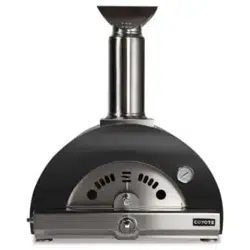
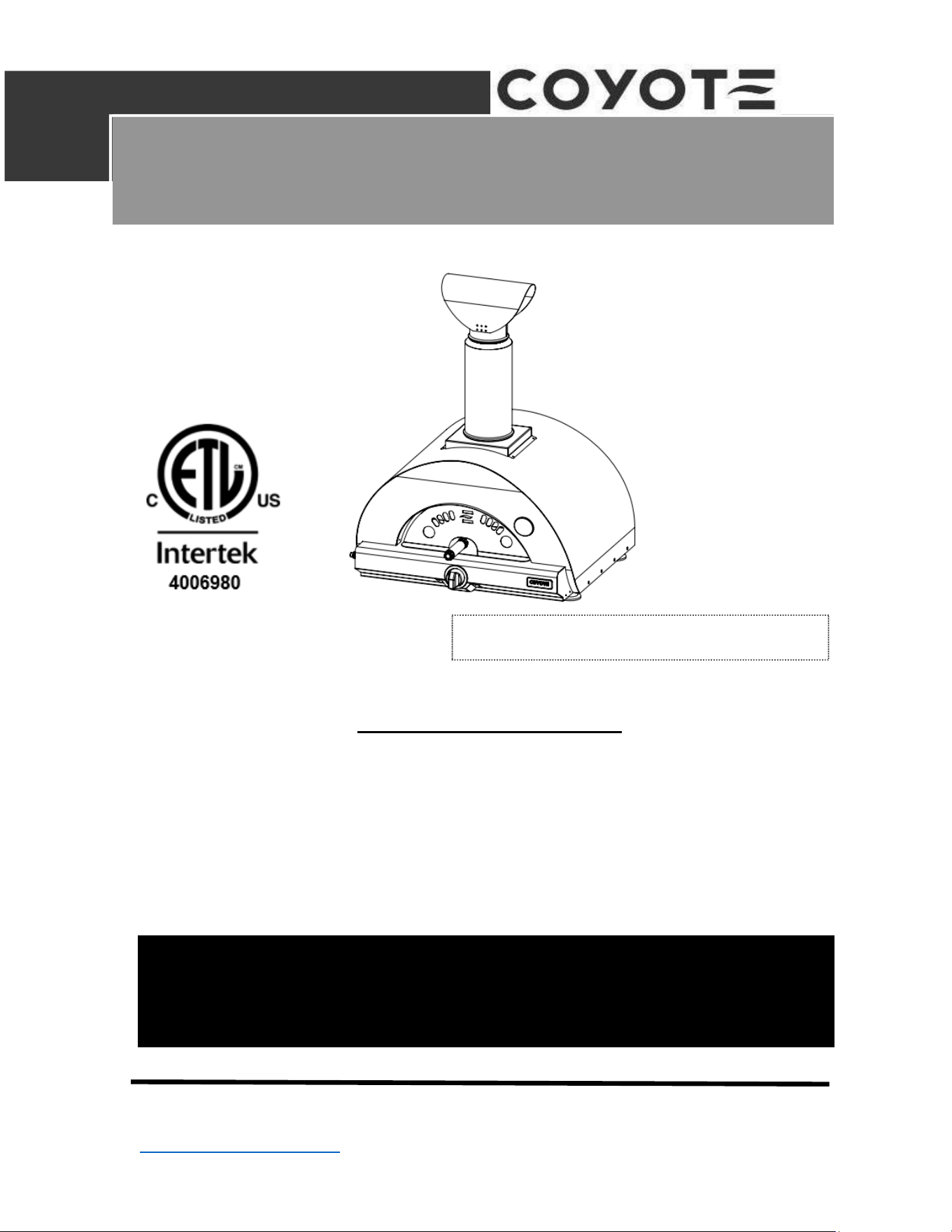
30” Hybrid Multi-Fuel Outdoor
Pizza Oven
PUT SERIAL NUMBER LABEL HERE

2
Welcome and Congratulations
Congratulations on your purchase of our new 30” Hybrid Multi-Fuel Outdoor Pizza Oven by Coyote
Outdoor Living. With Coyote, you can be confident you have chosen a high quality, innovative and
stylish product from a company that cares about you.
We encourage you to, please take a moment to register your 30” Hybrid Multi-Fuel Outdoor Pizza
Oven at: www.CoyoteOutdoor.com. If you have any questions, please call Customer Support at 855-
520-1559.
Please read this manual carefully to understand all the instructions for how to install, operate, and
maintain your oven for safety and for optimum performance and longevity.
We know you will enjoy your new Coyote oven and we thank you for choosing our product.
Welcome to the Coyote family!
Scan this QR code for additional information on the 30” Hybrid Multi-Fuel Outdoor Pizza Oven by
Coyote Outdoor Living.
Read and save these instructions.
Obey all warnings and instructions.
This manual provides specific operating instructions for your oven model. Use your oven only as
instructed in this manual. These instructions are not meant to cover every condition or situation
that may occur. Consumers must practice common sense and caution when installing, operating,
and maintaining their appliances. If you lose this manual, download a replacement copy from our
website at www.CoyoteOutdoor.com or call Customer Support at 855-520-1559.

3
Table of Contents
Welcome and Congratulations ............................................................................................................... 2
Safety Symbols ............................................................................................................................... 4
Before You Start ..................................................................................................................................... 5
How to Guide for Removing the Crate ........................................................................................... 5
Installation Guide ................................................................................................................................... 6
Product Dimensions ....................................................................................................................... 6
Location .......................................................................................................................................... 6
General Safety Instructions .................................................................................................................... 8
Fire Safety ............................................................................................................................................... 9
Gas Requirements ................................................................................................................................ 10
Liquid Propane Gas Supply ........................................................................................................... 10
Large Capacity Propane Tanks ...................................................................................................... 14
Natural Gas Supply ....................................................................................................................... 15
Using The Oven ..................................................................................................................................... 17
Accessories ................................................................................................................................... 17
How to Light the Gas Burner ........................................................................................................ 18
Wood Lighting .............................................................................................................................. 20
How to Extinguish Wood Fire ....................................................................................................... 20
How to Manage the Temperature (Wood) .................................................................................. 20
Maintenance and Cleaning ................................................................................................................... 21
Instructions for removing bricks from the oven:.......................................................................... 21
Stainless steel care and maintenance .......................................................................................... 21
Troubleshooting ................................................................................................................................... 22
Limited Warranty.................................................................................................................................. 23
Parts Listing .......................................................................................................................................... 25
4
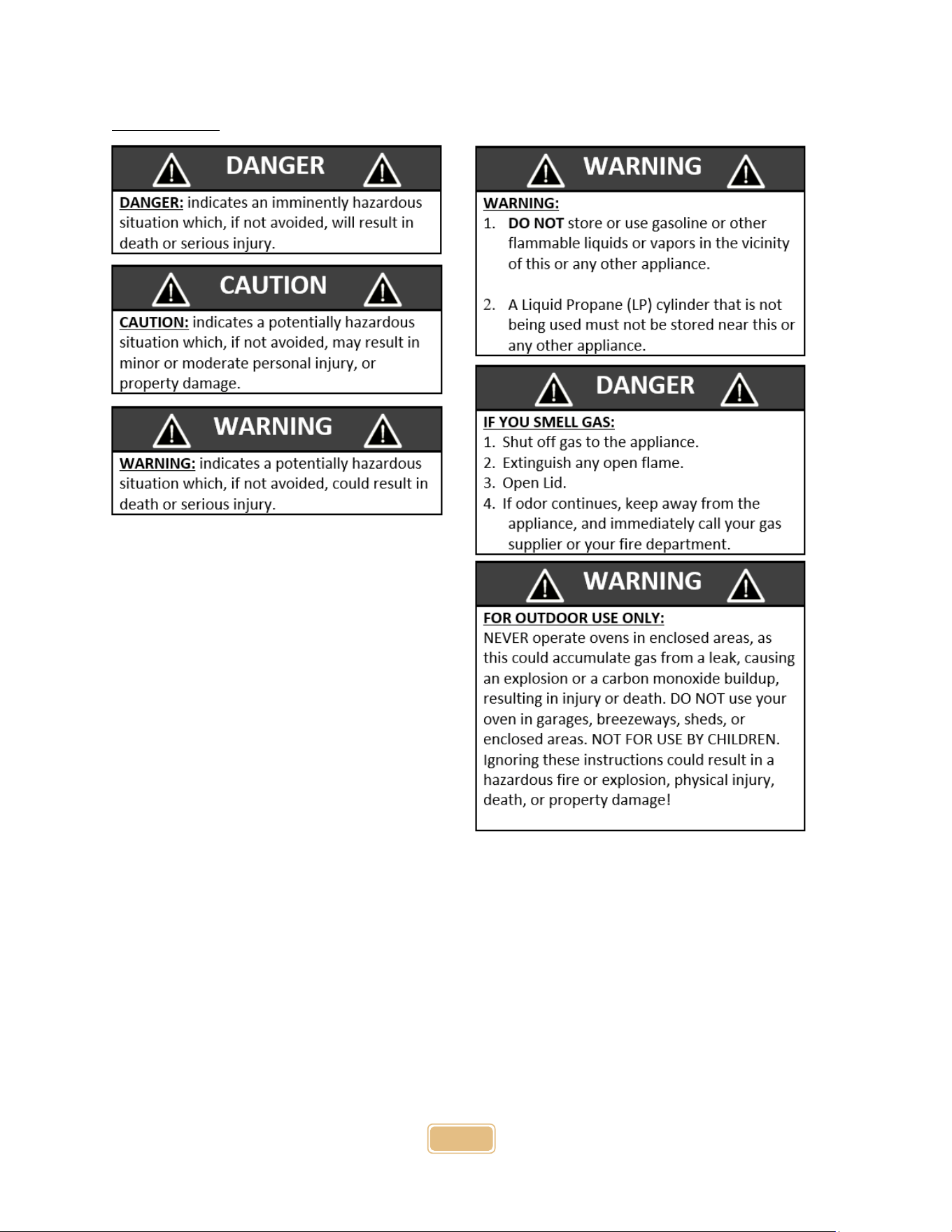
Safety Symbols
5
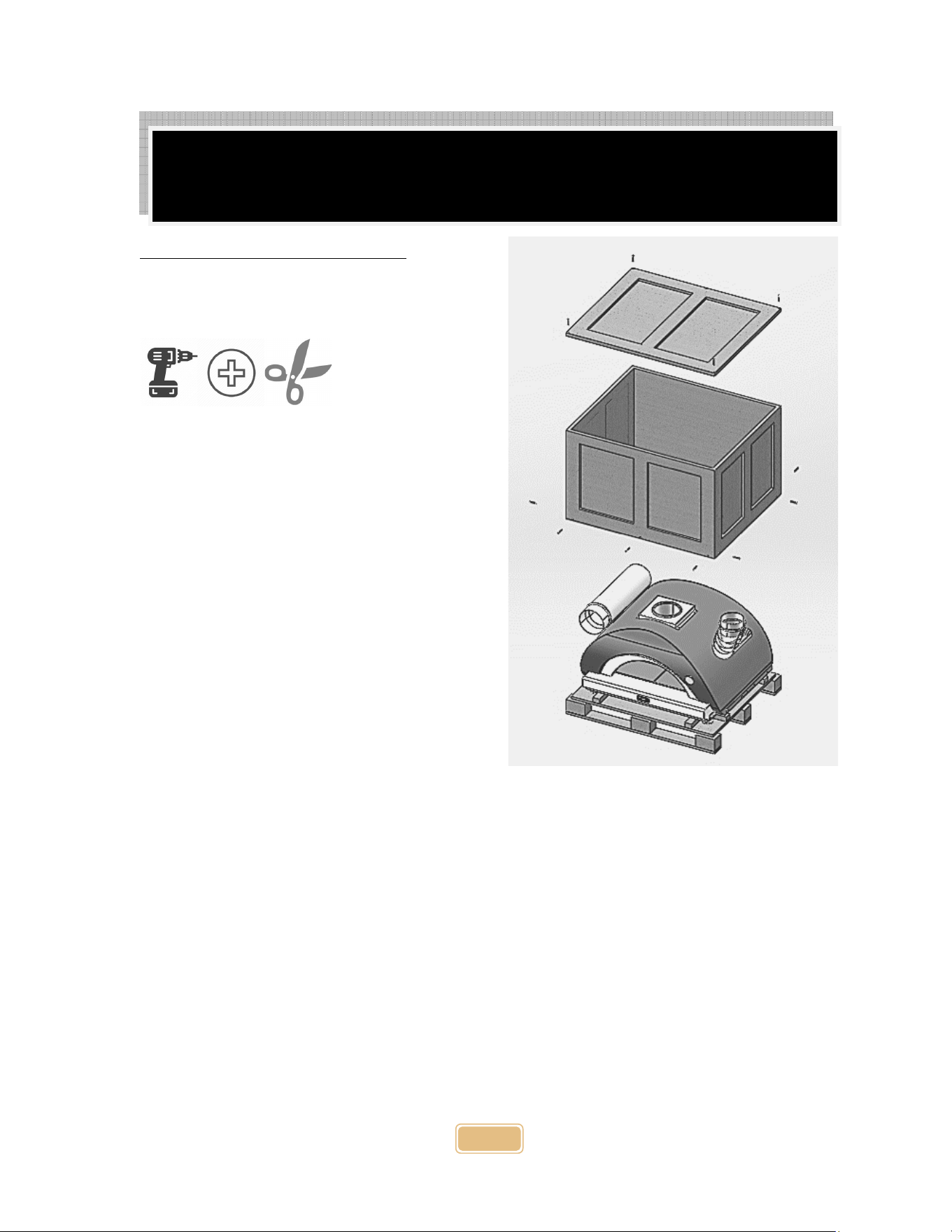
How to Guide for Removing the Crate
To uncrate the oven you will need: a Power Drill,
Philips Head bit, and a cutting tool.
Instructions:
• Using a cutting tool, carefully cut the
straps that wrap the crate.
• Remove the screws from the top cover
using a power drill with a Phillips head bit.
Once the screws are removed the top will
be free to lift.
• Next, remove the sides of the crate by
removing the remaining screws located on
the bottom area of the side walls. Once
the screws are removed the crate will be
free to lift.
Tips:
Keep these points in mind when removing the
crate and installing the oven:
• We recommend using two people to remove the oven from the pallet.
• Be very careful not to place any items directly on the surface of the dome. This part cannot
be replaced if it gets damaged.
• Mark the specific area you want to place the oven. This will help with minimal lifting and
adjusting of the oven.
You should have received the following items in your packaging:
☐ Oven (including 3 bricks)
☐ Door
☐ Chimney
☐ Chimney Cap
☐ 4 Piece Tool Set
☐ Gas Regulator
☐ Owner’s Manual
☐ Ash Guard
☐ Burner Cover
(Note: AAA battery required for the igniter is not included.)
Before You Start
6
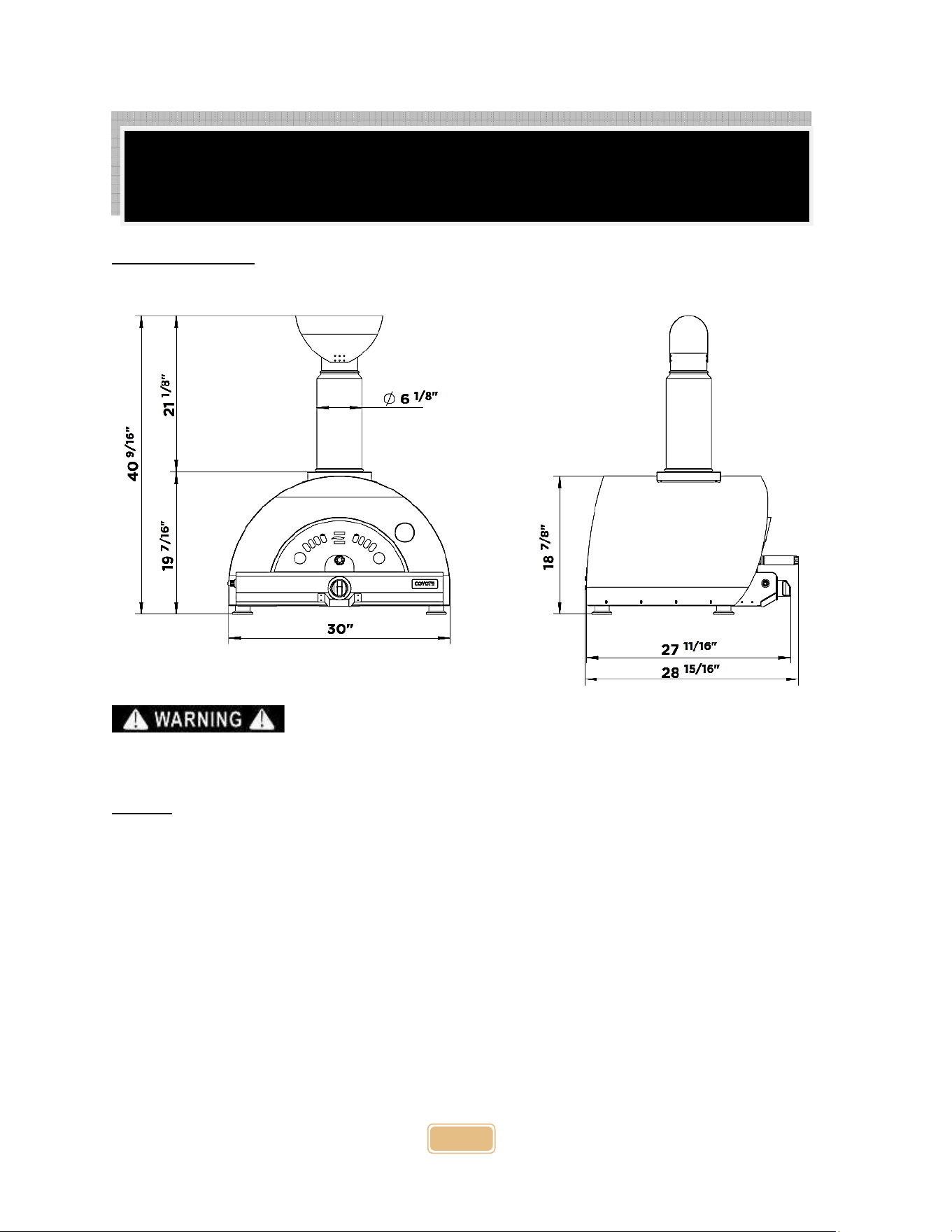
Product Dimensions
The following dimensions are intended for you to use as a reference for installation.
The following guidelines are for reference only. You must consult local
building and fire regulations regarding the safe distance from buildings, partitions, and coverings
such as pergolas and roofs.
Location
Place the oven on a flat, level, and stable surface away from combustible materials.
• If you install the oven on an island, the countertop must be stone, concrete, or any other
non-combustible material.
• Any cabinet that supports the oven and has a gas connection must have at least two vents,
each with a minimum size of 20 square inches, to allow fresh air circulation.
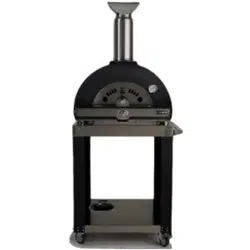
• If you need the oven to be mobile, please log onto www.coyoteoutdoor.com for the
compatible cart model # C1PZHCART.
Installation Guide
7
Overhead Obstruction and Surroundings
• This multi-fuel oven is for outdoor use only in a well-ventilated area. Do not install it for use
indoors or in any enclosed area.
• Do not install your oven where smoke will infiltrate your home or homes nearby.
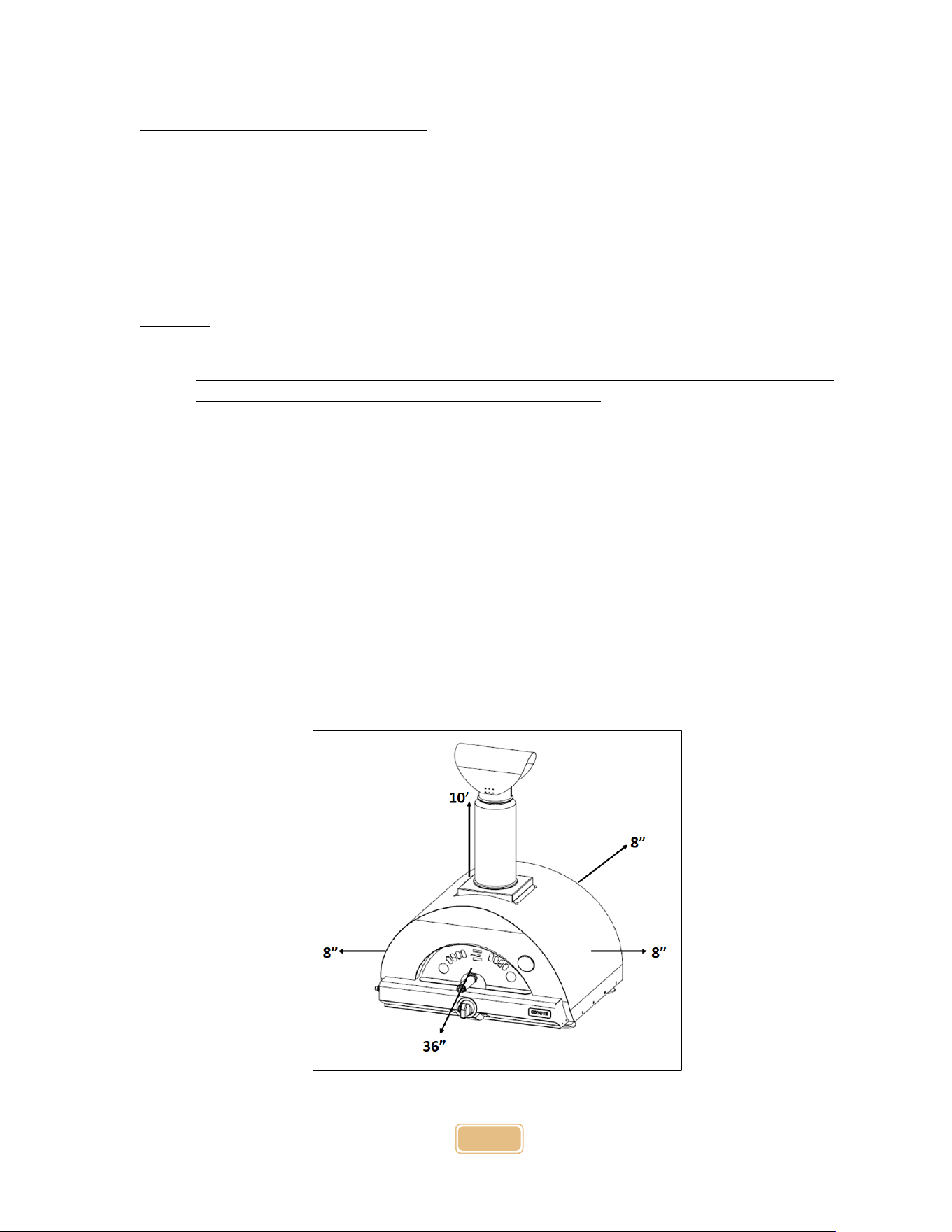
• Ensure nothing is within 10' of the chimney cap's top to block the exhaust.
• Check to see if your nearby surroundings have any elements that may impact the airflow or
draw such as wind patterns and nearby obstructions that may reduce your oven’s draw.
Clearance
• The minimum clearance from the sides and rear of the oven to any combustible material is
36". The outer dome can reach temperatures greater than 120°F. All combustible material
must be kept at least 36" from the oven while it is in use.
• The oven should not be located under combustible material at any height.
• Combustible materials include, but are not limited to, wood or treated wood decks, patios,
and porches.
• The minimum clearance from the sides and rear of the oven to non-combustible materials is
8", and the minimum clearance from the mouth of the oven is 36".
• The minimum clearance from the chimney pipe to non-combustible materials is 20”.
• The oven must be positioned on a flat, level surface, away from strong winds. Please remove
all flammable materials from around the oven to avoid any potential hazards as sparks can
fly out of the oven.
Non-Combustible
Front View
8
PLEASE READ AND FOLLOW ALL SAFETY WARNINGS
AND INSTRUCTIONS IN THIS MANUAL
TO AVOID PERSONAL INJURY OR PROPERTY DAMAGE.
• Carefully read the instructions for installation, operation, and maintenance before installing
or servicing this equipment. Incorrect installation, adjustment, alteration, service,
maintenance, or use can cause damage to property or injury.
• Do not use or store gasoline, or other accelerant vapors or liquids in the vicinity of this or
any other appliance. Also, always keep the area under and around this appliance free and
clear of all combustible materials.
• Do not use this multi-fuel oven in any enclosed room unless properly vented and meets all
local building codes and approvals.
• Gas leaks have the potential to cause fire, explosions, and significant damage to both
property and person.
General Safety Instructions
1. This oven is meant for outdoor use only. Do not use it indoors.
2. Before using the oven, make sure to remove all protective films.
3. Avoid using plastic dishes or containers in the oven, as the high temperatures may cause
them to melt and damage the oven.
4. Always use utensils designed to withstand high temperatures when cooking.
5. Always place the oven on a flat surface away from high winds.
6. Keep children and pets away from the oven while the oven is in use.
7. Use the turning peel to add more wood instead of throwing logs into the oven.
8. Keep the oven adequately cleaned and maintained.
9. Always make sure the oven knob is off before turning on the gas supply.
10. Do not touch the external surface of the dome or chimney while the oven is in use.
11. Do not move the oven while it is in use or still hot.
12. Do not pour water on the bricks or use water to extinguish the flame.
13. If you are not using the gas oven, close the gas supply valve.
14. Keep unused gas cylinders away from the oven.
15. Treat empty LP tanks the same as a full tank.
16. Do not disconnect the gas connections while the oven is in use.
General Safety Instructions
9
1. Please adhere to the installation instructions in this manual and comply with the local fire
safety regulations.
2. Keep the oven a safe distance from any combustible materials.
3. Never leave the oven unattended; sparks can escape from the chimney and oven mouth.
4. Never use combustible liquids, including but not limited to gasoline, kerosene, or lighter
fluid, to start or boost a fire. Keep all such liquids away from the oven while it is in use.
5. Never use unapproved fuel in your oven. The oven is only safe to use with wood or gas.
6. Never store, use, or place flammable liquids or objects in or near the oven.
7. Never leave the oven unattended while it is in use or still hot.
8. Do not overfire the oven. If the flames spill out of the oven mouth, you are overfiring. Close
the door tightly to avoid a fire hazard.
9. Do not exceed the temperature limit of 1000 degrees Fahrenheit.
10. Never vacuum or throw away embers that are still burning.
11. Remove ashes using a metal shovel and metal container.
12. When lighting the gas burner, the oven door must be removed.
13. Always use kiln-dried natural hardwood.
14. Keep a wood and gas rated fire extinguisher near the oven.
15. Never extinguish the flame with water.
16. When using the oven, always wear heat-resistant oven gloves.
17. Never touch the oven door while in use. Always use the handle.
18. For safety reasons, keeping the oven door closed for at least 30 minutes after extinguishing
a wood fire is recommended. Be cautious when opening the door, as the sudden oxygen
influx can reignite the flames quickly.
19. Before you light the oven, make sure the chimney is free of any blockages.
20. If a grease fire occurs, turn off the gas and place the door on the oven until the fire is
extinguished.
Fire Safety
• Gas leaks may result in fire or explosion and cause
severe personal injury, death, or property damage.
• If you smell gas, turn off the gas supply, extinguish any
flames, remove the oven door, and contact a gas
professional to leak-test the gas connections.
10
Never attach an unregulated gas line to the appliance. Connection to an
unregulated gas line can cause excessive heat or fire and the risk of
property damage, bodily injury, or death.
IMPORTANT: Before connecting the oven to a gas source, make sure the oven control knob is in the
“OFF” position.
• Verify the type of gas supply to be used, either natural gas or liquid propane, and make sure
the marking on the appliance rating label agrees with that of the gas supply. Do not
connect a Coyote liquid propane gas oven to a natural gas supply, and do not connect a
Coyote natural gas oven to a liquid propane gas supply.
• All pipe sealants must be an approved type and resistant to the actions of LP gas.
Never use pipe sealant on flare fittings.
• The installation of this appliance must conform with local codes or, in the absence of local
codes, with either National Fuel Gas Code, ANSI Z223.1/ NFPA 54, Natural Gas and Propane
Installation Code, CSA B149.1, or Propane Storage and Handling Code, B149.2, or the
Standard for Recreational Vehicles, ANSI A 119.2/ NFPA 1192M, and CSA Z240 RV Series,
Recreational Vehicle Code, as applicable.
Gas valves are preset at the factory to operate on liquid propane or
natural gas. If you wish to convert, be sure to contact your oven
dealer FIRST!
Always check the rating plate to make sure the gas supply to which you connect the oven is the gas
type for which the oven is manufactured. A Coyote liquid propane (LP) gas oven is designed to
operate on propane gas ONLY, at a pressure regulated at 11” (279.4mm) water column (W.C.) when
equipped with the correct propane orifices on the valves and a propane regulator on the supply line
regulated at the residential meter. A Coyote liquid propane gas oven comes with a propane
regulator that is designed to be used with a standard 20 lb. propane cylinder and those cylinders
must be constructed and marked in accordance with specifications of the US Department of
Transportation for propane gas cylinders.
Gas Requirements
Liquid Propane Gas Supply
11
• Liquid propane (LP) gas is flammable and hazardous if handled improperly. Know its
characteristics before using any propane products.
• Propane characteristics include flammable, explosive under pressure, heavier than air and
settles in pools and low areas.
• In its natural state, propane has no odor. For your safety, an odorant is typically added.
• ALWAYS purchase or refill your propane tanks from a reputable propane gas supplier.
• Contact with propane can cause freezing burns to the skin.
• NEVER use a propane cylinder with a damaged body, valve, collar, or footing.
• A dented or rusted propane cylinder may be hazardous.
• Always keep LP cylinder in an upright position.
• Never connect an unregulated propane gas cylinder to the oven.
• NEVER subject (expose) propane cylinders to excessive heat.
• Never store an LP gas cylinder inside a building or in the vicinity of any gas-burning
appliance.
Cylinder Specifications
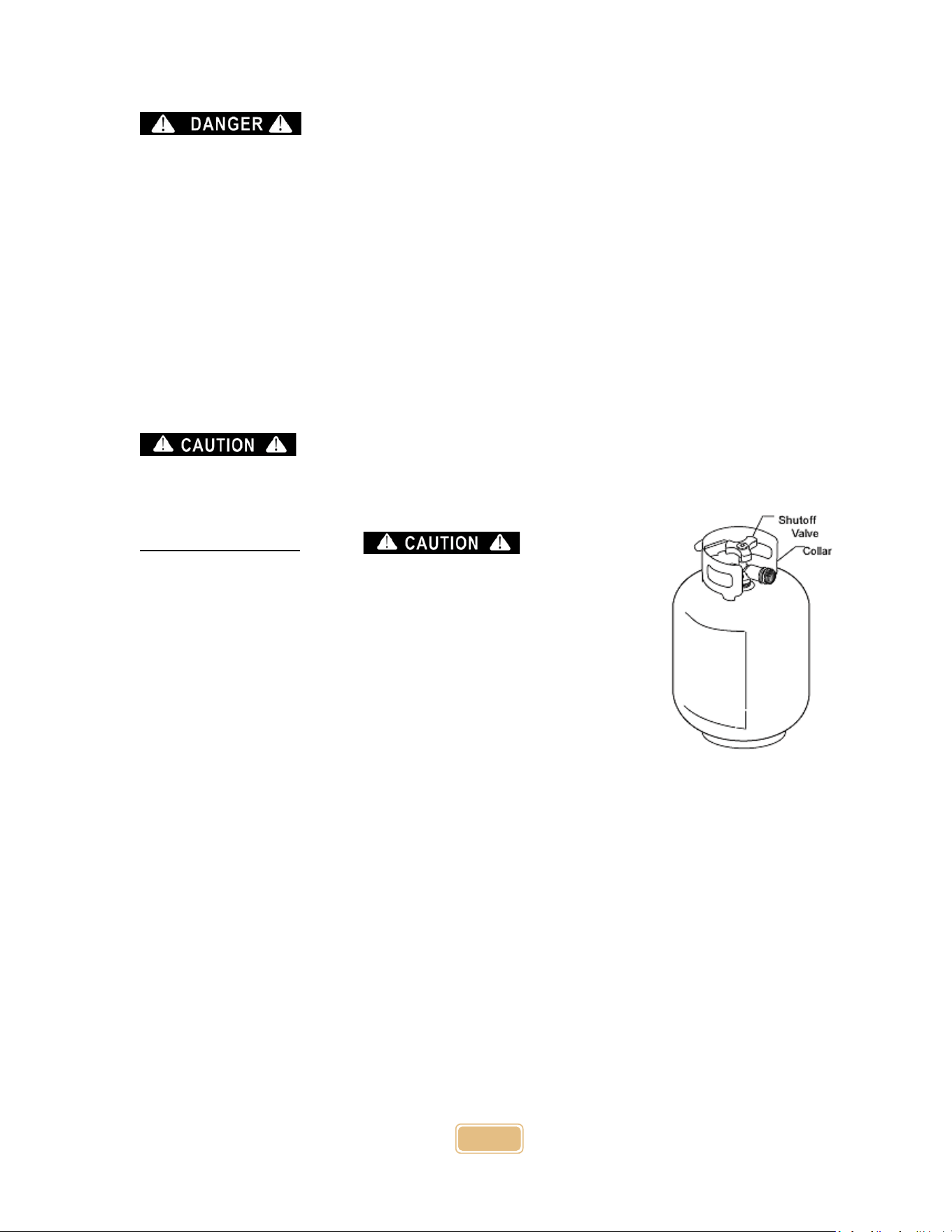
• Any LP gas supply cylinder used with this oven must be
approximately 12 inches in diameter and 18 inches high. The
maximum fuel capacity is 80% and is approximately 20 pounds
of propane.
• The LP cylinder must have a shut-off valve (see picture)
terminating in a Type 1 LP.
• A Type 1 compatible cylinder with a Type 1 cylinder valve has a
back-check valve which does not permit gas flow, until a
positive seal has been obtained.
• The cylinder must be arranged for vapor withdrawal. It must
also include a collar to protect the cylinder valve. A safety relief device having direct
communication with the vapor space of cylinder must be provided. This will expel high
pressure gas if the cylinder is overfilled or overheated which could result in fire or explosion.
• All LP. gas cylinders used with this appliance shall be constructed and marked in accordance
with the specifications for LP. gas cylinders of the U. S. Department of Transportation (DOT)
or the National Standard of Canada, CAN/CSA-B339, Cylinders, Spheres and Tubes for
Transportation of Dangerous Goods; and Commission, as applicable; and shall be provided
with a listed overfilling prevention device.
• Allow only qualified LP. gas dealers to fill or repair your LP. gas supply cylinder.
• After filling, have the gas dealer check for leaks and to see that the relief valve remains
effective and in good repair.
• Read labels on the L.P. Gas Supply Cylinder.
• New cylinders are always shipped empty for safety.
• Allow only qualified L.P. gas dealers to fill or repair your L.P. gas supply cylinder.
• Inform the gas dealer if it is a new or used cylinder to be filled.
• After filling, have the gas dealer check for leaks and to see that the relief valve remains effective
and in good repair.
12
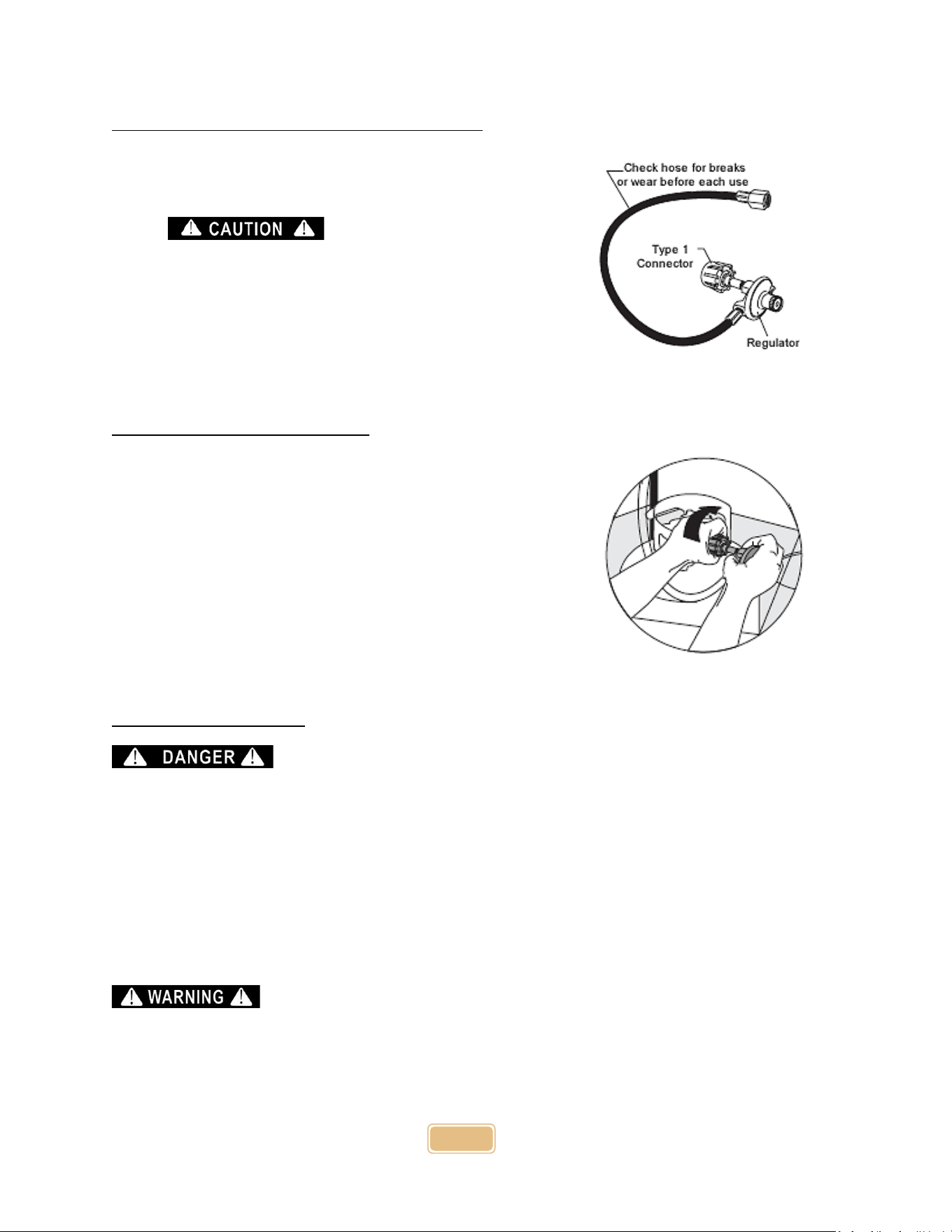
Hose and Regulator (Comes standard with the oven)
The Type 1 connection system has the following features:
• The system will not allow gas to flow until a positive
connection has been made.
• The cylinder control valve must be
turned off before any connection is made or removed.
• The system has a thermal element that will shut off the
flow of gas in the event of a fire.
• The system has a flow limiting device which, when
activated, will limit the flow of gas to 10 cubic feet per
hour.
• NEVER use the oven without leak testing this connection.
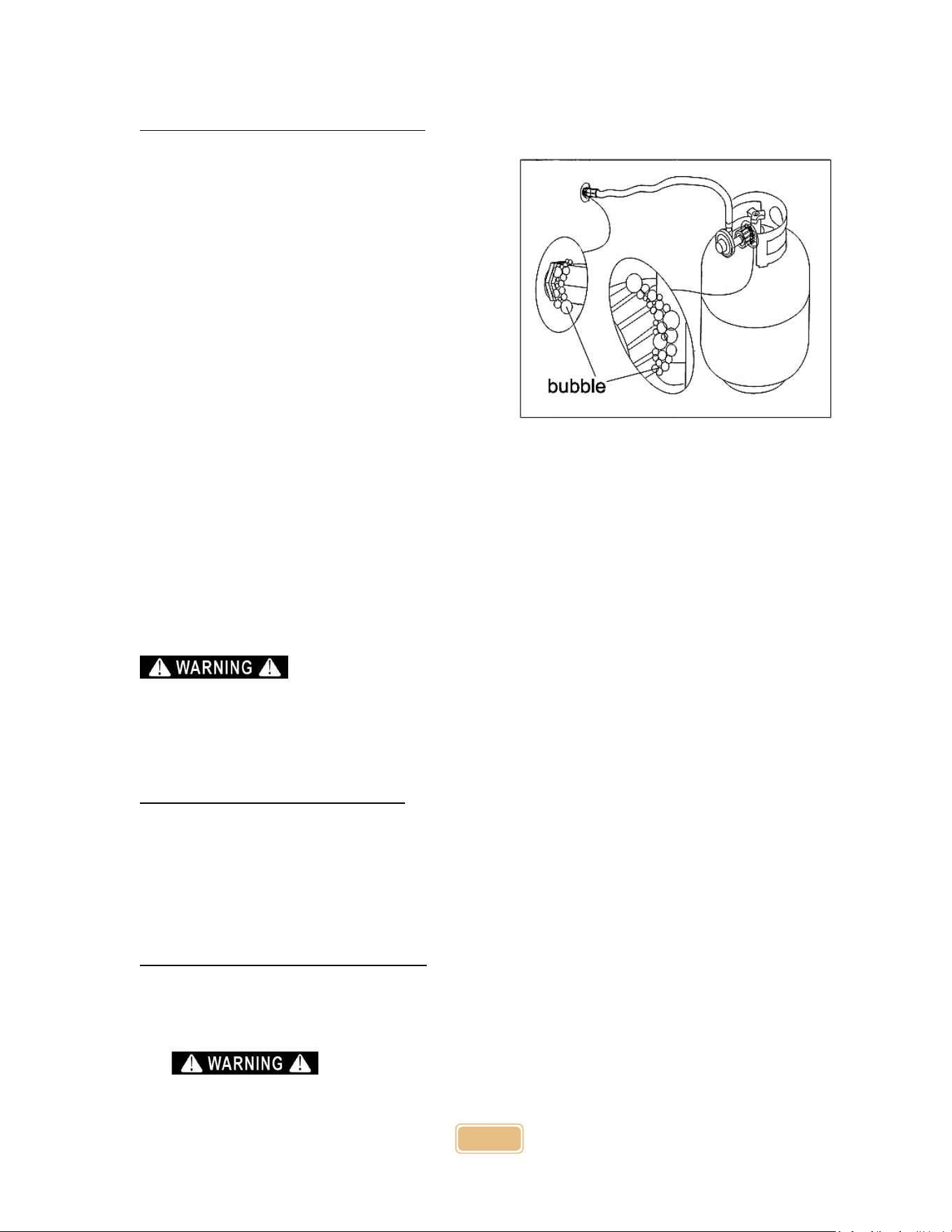
LP (Propane) Gas Supply Connection
1. The tank valve should be in the “OFF” position. If not, turn
the knob clockwise until it stops.
2. Make sure the burner knob is in the “OFF” position.
3. Always connect the gas supply regulator as follows:
• Insert the regulator inlet into the tank valve and turn
the coupling nut clockwise until the coupler tightens up
(see picture). Do not overtighten the coupler.
• Turn the tank valve on and turn the burner control valve
on the unit to the “spark” position then press the knob
for about 15 seconds to allow the air in the system to
purge before attempting to light the burner.
Pre-Operation Leak Testing
1. Do not insert any tool into the valve outlet or safety relief valve. You may damage the valve
and cause a leak. Leaking propane may result in explosion, fire, severe personal injury, or
death.
2. If a leak is detected at any time, or you cannot stop a gas leak, immediately close the tank’s
shut-off valve (gas supply from LP tank to the Oven) and call LP gas supplier or your fire
department!
3. Check all gas supply fittings before each use and each time the gas supply cylinder is
connected to the regulator. Have a qualified service technician leak test the oven any time a
part of the gas system is replaced.
Never attempt to attach this oven to the self-contained LP gas system. Do not use the oven until
leak testing has been completed.
13
Leak Testing Valves, Hose and Regulator
1. NEVER smoke while leak testing.
2. Extinguish all open flames. Never leak test
with an open flame.
3. Mix a solution of equal parts mild detergent
or liquid soap and water.
4. Turn the oven control knob OFF.
5. Ensure that the connections from the
regulator to the oven and tank are tight and
secure (see picture).
6. Completely open LP tank valve by turning
cylinder valve knob counterclockwise (right
to left). If you hear a rushing sound, turn
the gas off immediately. There is a major leak in the connection. Correct before proceeding
by contacting a gas professional.
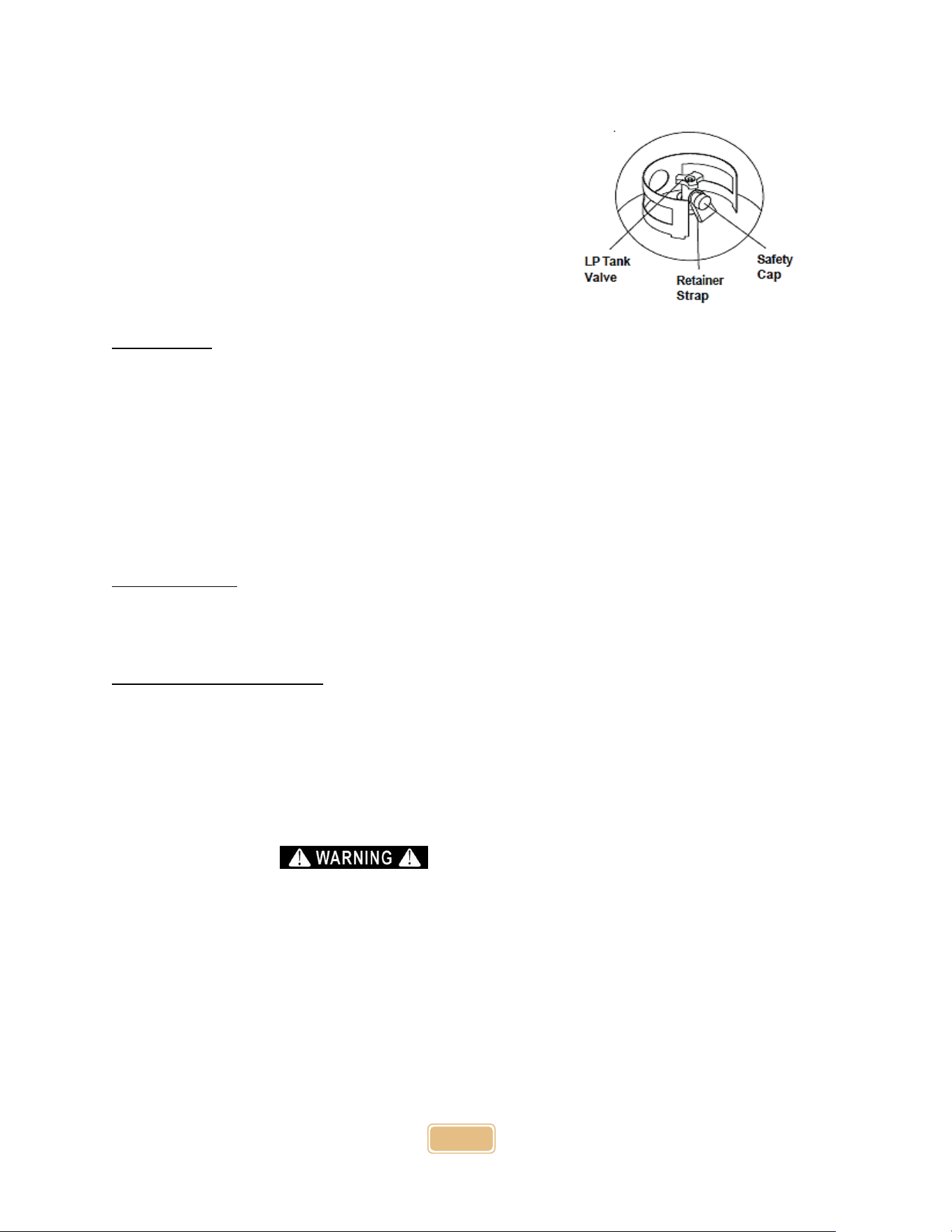
7. If there is no rushing sound, brush soapy solution onto areas where bubbles are shown in LP
tank (see picture).
8. If “growing” bubbles appear, there is a leak. Close LP tank valve immediately and retighten
connections. If leaks cannot be stopped, do not try to repair the regulator, or tank valve, by
yourself and contact a gas professional.
9. Always close LP tank valve after performing leak test by turning cylinder valve knob
clockwise.
NOTE: When leak testing this appliance, make sure to test and tighten all loose connections. A slight
leak in the system can result in a low flame, or a hazardous condition that could result in a fire or
explosion.
LP Gas Supply Cylinder Disconnection
To disconnect the LP tank from the oven:
1. Turn the burner valve off.
2. Turn the tank valve off. (Turn shut-off clockwise to stop).
3. Detach the regulator assembly from the tank valve by turning the quick coupling nut
counterclockwise.
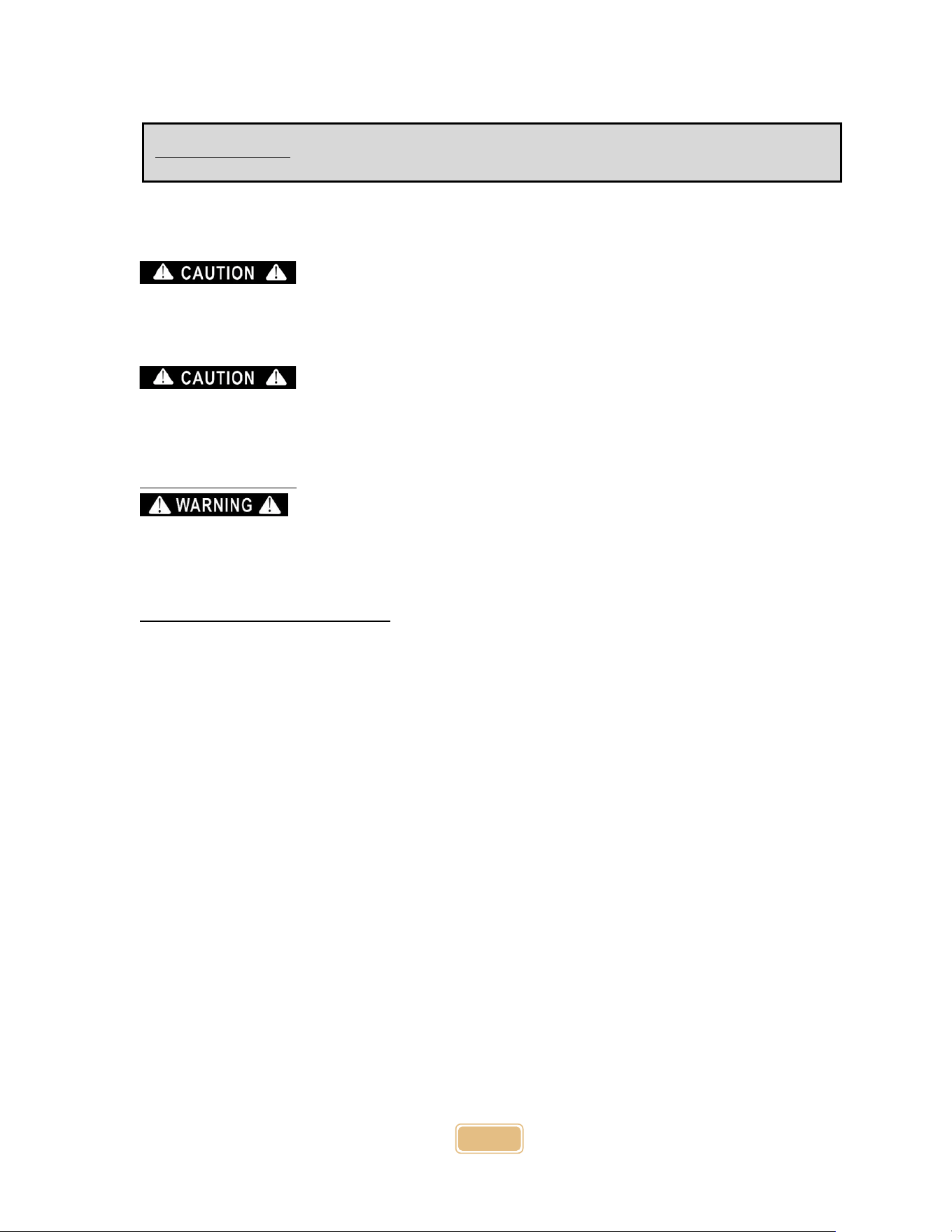
LP Tank Removal, Transport and Storage
• Turn OFF the control knob and LP tank valve. Turn coupling nut counterclockwise by hand
only - do not use tools to disconnect. Install safety cap onto LP tank valve. Always use cap
and strap supplied with valve.
Failure to use safety cap as directed may result in serious personal
injury and/or property damage.
14
• A disconnected LP tank in storage or being transported
must have a safety cap installed (as shown).
• Never leave an LP tank inside a motor vehicle. (Heating
of the vehicle could cause an increase in the gas
pressure which may open the release value allowing gas
to escape resulting in a serious risk of fire or explosion.)
• Do not store an LP tank in enclosed spaces such as a
carport, garage, porch, covered patio, or other building.
• Do not store LP tanks in an area where children play.
LP Tank Filling
• Use only licensed and experienced LP dealers.
• LP dealer must purge tank before filling.
• Dealers should NEVER fill LP tank more than 80% of LP tank volume. The volume of
propane in the tank will vary by temperature.
• A frosty regulator indicates gas overfill. If frosty, immediately close the LP tank valve and
call the local LP gas dealer for assistance.
• Do not release liquid propane (LP) gas into the atmosphere. This is a hazardous practice.
• To remove gas from LP tank, contact an LP dealer or call a local fire department for
assistance.
LP Tank Exchange
• Exchange your Type 1 cylinder for OPD safety feature-equipped replacement tank ONLY.
• Always keep new and exchanged LP tanks in upright position during use, transit, or storage.
Leak tests new and exchanged LP tanks BEFORE connecting to oven.
Large Capacity Propane Tanks
• If your entire house is plumbed for propane gas use, and you have an exterior connection
for such use, then a standard LP oven from Coyote can be connected to such outdoor
propane connection, but you must be aware of the following:
o Coyote does not supply any gas fittings or lines, other than the regulator needed
within the oven box.
o All Coyote LP Ovens come with a 20lb tank regulator. This regulator cannot be used
or modified to work on any other setup.
If you are running off a large capacity tank (more than
20lbs), then an “in-line” LP regulator is needed, which can be purchased
from any Coyote authorized dealer (Part # CINLNREG), or plumbing supply
company. However, it is the responsibility of the owner/installer to verify
that the correct regulator is purchased for the intended application and that
it is installed properly.
o As codes vary from state to state, it is the responsibility of the owner/installer to
ensure that all county, state, and federal codes are followed for any gas installation.
15
Always check the rating plate to make sure the gas supply to which you connect the oven is the gas
type the oven is manufactured for.
A Coyote natural gas (NG) oven is designed to operate on natural gas ONLY,
at a pressure regulated at 4” (101.6mm) water column (W.C.) when
equipped with the correct natural gas orifices on the valves and a natural gas regulator on the
supply line regulated at the residential meter.
Never connect the oven to an unregulated gas supply.
NATURAL GAS CONNECTIONS MUST BE PERFORMED BY A LICENSED CONTRACTOR OR A LOCAL GAS
COMPANY REPRESENTATIVE.
Natural Gas Regulator
NEVER use the oven without leak testing this connection.
• Gas pressure: 4” (101.6mm)
• Maximum rate working pressure: 1/2 Psi.
Natural Gas Supply and Connection
1. Make sure all burner valves are in the “OFF” position.
2. All NG units need to have a regulator and shut-off valve on the supply line.
3. All Pipe threads need to have proper, gas-rated, outdoor-rated thread sealant. Flare ends do
not need or utilize pipe sealant.
4. Your NG Coyote oven comes with a ½” regulator.
A. The pressure regulator has a directional arrow indicating the direction in which the gas
must travel. The arrow should be pointing in the direction of the oven.
B. Attach gas connection hose to the “in” side of the NG regulator (it is also ½” MIP)
a. We suggest using ½” stainless steel corrugated hoses for all NG ovens.
b. Make sure that you purchase a hose of adequate length and capacity for the
intended application.
C. Connect the other end of this hose to the shut-off valve.
a. Depending on your choice of hose and shut-off, the nipple going into the shut-
off valve may vary.
D. Test all connections for leaks with a soap and water solution.
Coyote is not responsible for the selection or performance of the contractor or installer who
performs the connection of the natural gas supply to the oven.
Natural Gas Supply

16
Leak Testing Valves, Hose and Regulator
1. NEVER smoke while leak testing.
2. Extinguish all open flames. Never leak test with an open flame.
3. Mix a solution of equal parts mild detergent or liquid soap and water.
4. Turn the oven control knob to OFF.
5. Ensure that the connections from the regulator to the oven and tank are tight and secure.
6. Completely open the shut-off valve. If you hear a rushing sound, turn the gas off
immediately. There is a major leak in the connection. Correct before proceeding by calling
the Coyote Customer Service line at 855-520-1559.
7. If there is no rushing sound, brush soapy solution onto all connection points.
8. If “growing” bubbles appear, there is a leak. Close the shut-off valve immediately and
retighten connections. If leaks cannot be stopped, do not try to repair the regulator, or shut-
off valve, by yourself and contact the Coyote Customer Service line at 855-520-1559.
NOTE: When leak testing this appliance, make sure to test and tighten all loose connections. A slight
leak in the system can result in a low flame, or a hazardous condition that could result in a fire or
explosion.
Conversion kits are available for purchase. Please visit www.CoyoteOutdoor.com or call 855-520-
1559 to order.
17
Accessories
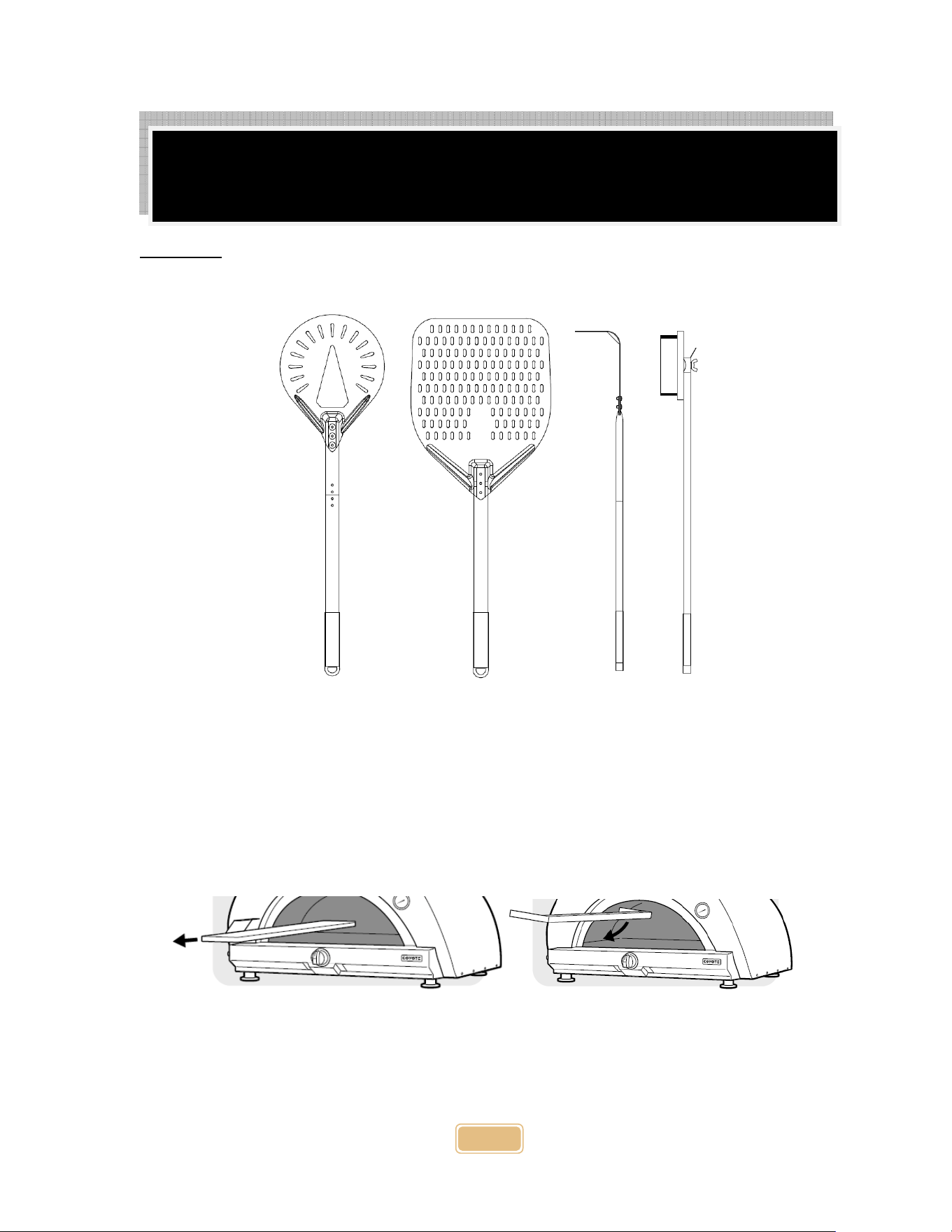
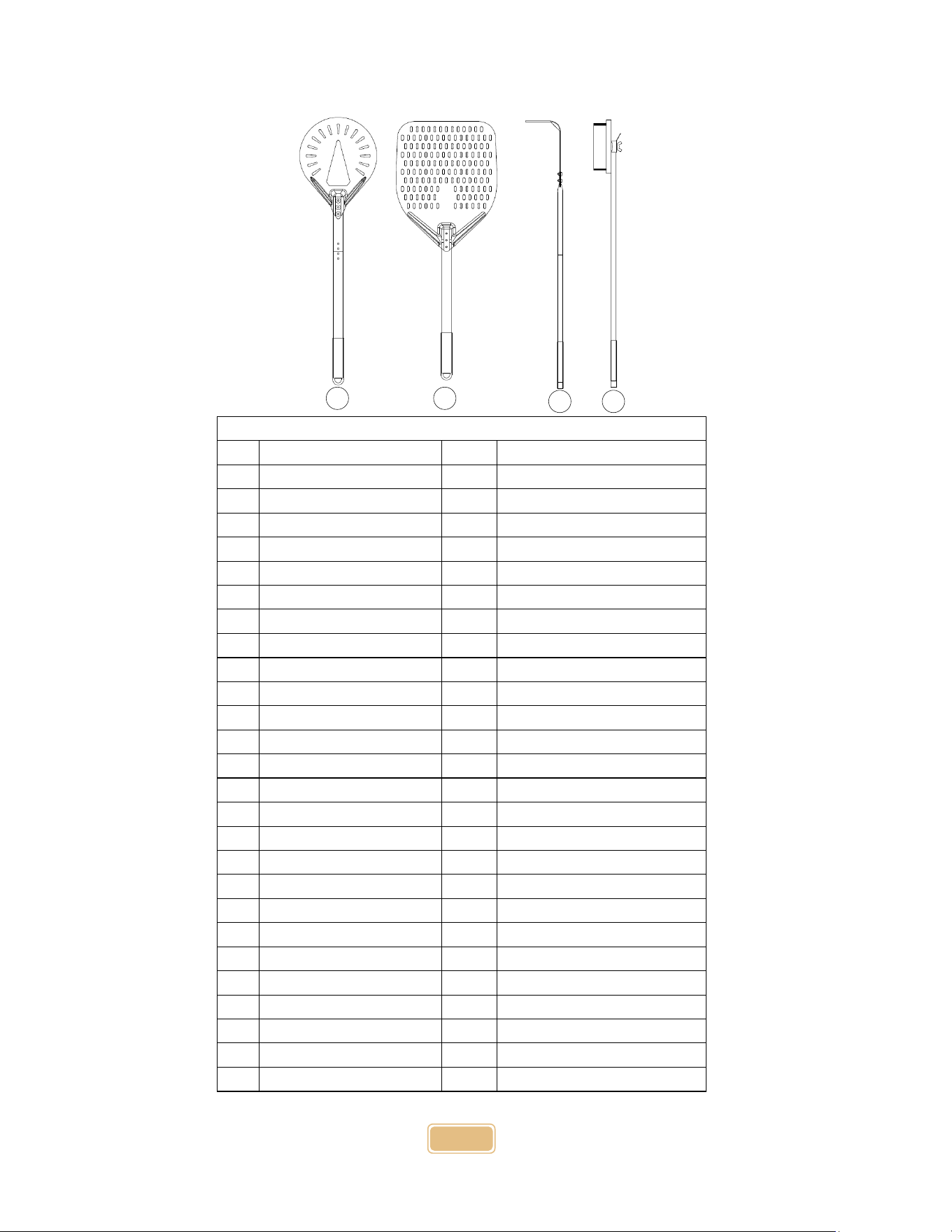
Four Piece Tool Set
Turning Peel – Used to turn the pizza while baking.
Pizza Peel – Used to place pizzas in the oven and remove them once they are cooked.
Ash Rake – Used to move wood and ash inside of the oven.
Ash Brush – Used to clean ash or food from bricks.
Burner Cover Ash Guard
Burner Cover – When using wood in the oven, install the burner cover to prevent ash from getting in
the burner. The burner cover is made of stone to expand the cooking area.
Ash Guard – When using the gas burner, install the ash guard to prevent food from getting into the
burner when cleaning the bricks.
Using The Oven
18
• Before lighting the oven, ensure you have read and have adhered to all safety instructions in
this manual. If you are unsure, do not use the oven. Please call Customer Support at 855-
520-1559.
• When firing the oven for the first time you may need to prime the burner for up to 30
seconds.
• When firing the oven for the first time, it is important to slowly bring the oven up to
temperature. This will help to drive out any moisture in the bricks or insulation.
• Use only dried hardwood such as alder, apple, ash, hickory, maple, mesquite, pecan, or oak
for your oven. Oak is the most popular and widely available hardwood.
• Do not use any soft wood such as pine, fir, and cedar. Do not use painted or stained wood,
or any plywood or engineered wood. These types of wood have high sap or oil contents that
can create excess soot, coating the oven and chimney flue with creosote.
• Do not overload the oven. Overloading is dangerous and can cause excessive smoke and
flames. There should never be flames coming out of the oven mouth or up from the
chimney. If this happens, close the oven door, and wait for the fire to become manageable.
•
Check the temperature of the cooking floor with an infrared thermometer. When it has
reached the desired temperature, your oven is ready to bake pizza.
How to Light the Gas Burner
19
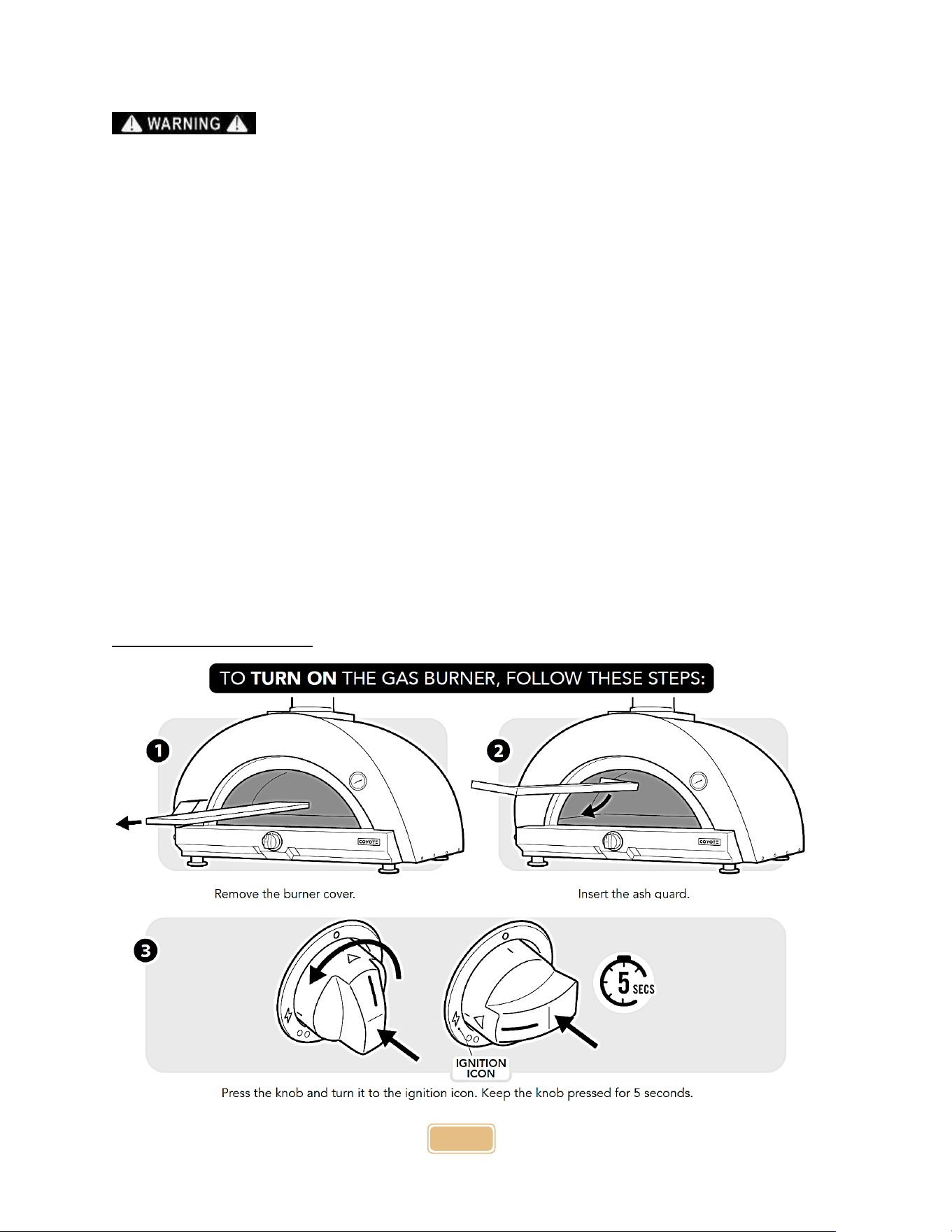
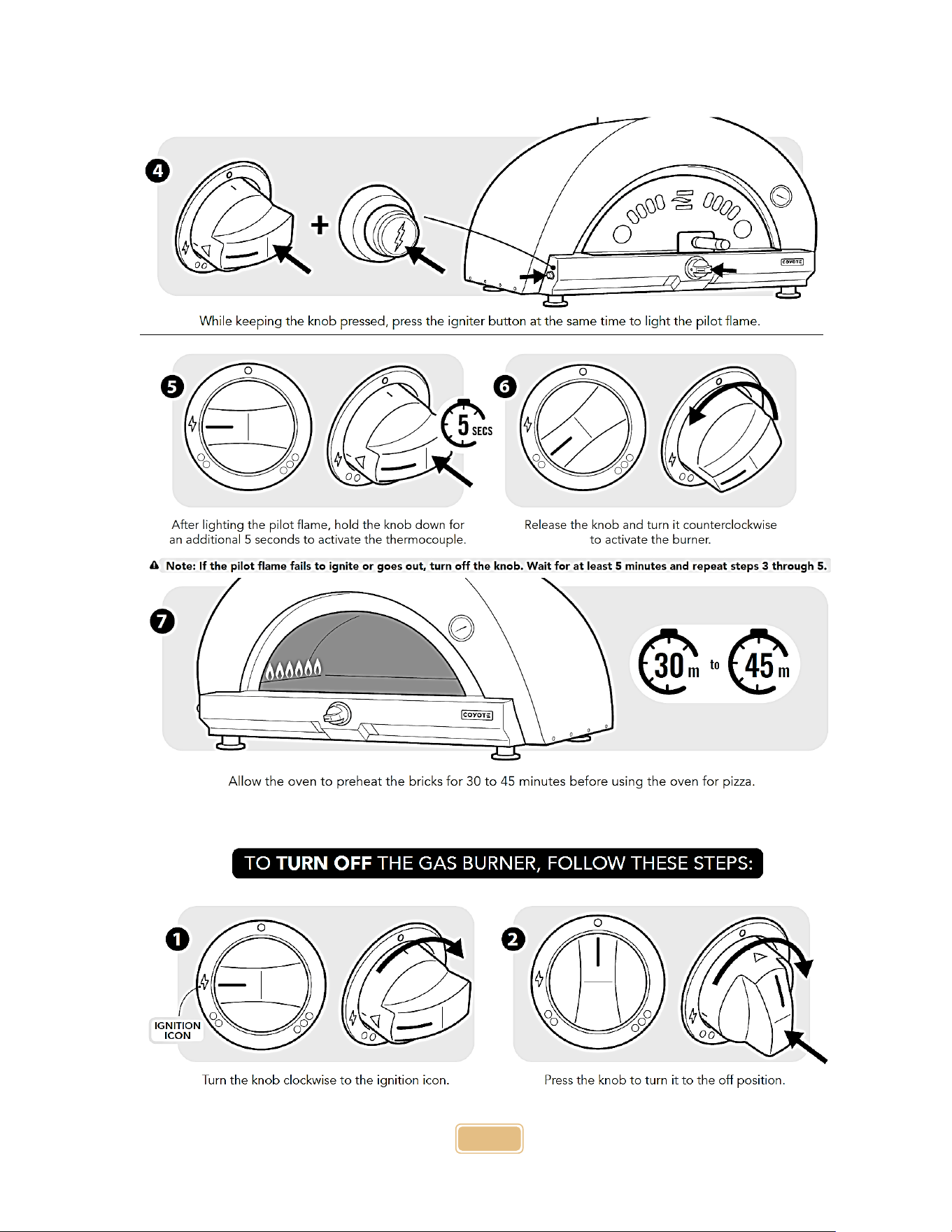
To turn off the burner, follow these steps:

20
Wood Lighting
1. Install the burner cover.
2.
Build a tower of 2 to 3 rows of dried and small kindling wood in the center of the oven floor.
3.
Use a natural fire starter to get the fire going such as paper or kindling. Never
use gasoline, kerosene, lighter fluid, or similar flammable substances.
4. After the fire has started, add 1-2 pieces of wood on the top.
5.
Continue adding wood as needed. After 15 - 20 minutes of continuous fire, you should begin
to see orange flames from the logs on top of a pile of embers. The fire is well established
now.
6.
When the oven reaches approximately 650°F on the cooking floor, you can move the
embers to the right side of oven using the supplied ash rake.
7.
Add wood gradually. Avoid adding too many at a time so that you do not suffocate the
flames. Use only kiln dried logs with water content of less than 20%.
8.
Sweep the cooking floor with the brush that comes with your oven.
9. Check the cooking floor's temperature with an infrared thermometer before baking.
How to Extinguish Wood Fire
1.
When you are done using the oven, close the door tightly and let the fire go out on its own.
2. When the fire is out, and the oven has cooled down for 60 minutes or longer. You can
confirm the coals have cooled down and you can remove the ashes into a fire safe metal ash
can.
3.
Never pour water in the oven. This will damage the oven and void your warranty.
How to Manage the Temperature (Wood)
•
When you are using your oven, it is important to remember that it is insulated and
designed to store heat. However, some heat will be lost while you cook, and the door is
open. To maintain temperature control, it is recommended that you use small-sized
pieces of wood that are 3-5 inches in diameter once the fire has burned well. This will
help you easily add more wood, when necessary, as larger pieces take longer to ignite
and can cause uneven heating.
• The thermometer in your Coyote Oven gives a general guide of ambient temperature
inside the oven. However, the temperature at the bottom and top of the oven may
differ from the thermometer.
• Use an infrared thermometer to check the cooking floor temperature. Read the
instructions of your infrared thermometer to get the correct readings.
• When it is cold or windy outside, heating and cooking times may take a bit longer. On
the other hand, if it is hot, cooking times might be shorter. Additionally, the size of the
dish or food being cooked can also affect cooking times.
• Do not exceed the temperature limit of 1000 degrees Fahrenheit.

21
The 30” Hybrid Multi-Fuel Outdoor Pizza Oven by Coyote is a self-cleaning oven that allows for easy
removal of any cheese or toppings that may fall off a pizza or sauce from other dishes. To use this
feature, simply move some of the embers and fire with the included ash rake to the affected area
and let it burn for a few minutes. Then, push the fire back into place on the left side of the oven
using the ash brush and sweep the hearth as usual. For gas turn the burner on high to burn off any
debris and brush the bricks.
Once the oven has fully cooled down, it is safe to remove the cold ashes. Always use a fire-resistant
bin to hold the ashes. Before disposing of them, make sure the ashes are completely cold.
Periodically, you can remove the firebricks and use an outdoor shop vac to vacuum the ashes from
the cooking floor.
If grease spills inside the oven, remove the bricks, and clean up any grease before you continue
using the oven.
Instructions for removing bricks from the oven:
Always make sure the oven is completely cool before removing the bricks.
1. Remove the burner cover or ash guard if installed.
2. From the left side in front of the burner, lift the first long brick out.
3. Next, lift the second long brick out from the left side of the burner.
4. Then, lift the short brick out.
5. Reinstall the bricks in reverse order after cleaning.
• Place a towel on the oven shelf to avoid any potential scratches.
• Do not slide the bricks.
Stainless steel care and maintenance
To maintain stainless steel and painted surfaces, avoid using abrasive products. The best way to
clean them is to use a soft cloth and a solution of soap and water.
The chimney and cap can be washed with soapy water or power spray with a garden hose. Make
sure the chimney and cap are completely dried before reinstalling them back on the oven.
When your oven is not in use, make sure the door is tightly placed onto the oven mouth to prevent
water getting inside. If your oven is not used for an extended period, we recommend that you use a
Coyote approved cover which can be found at www.CoyoteOutdoor.com.
Maintenance and Cleaning

22
Black smoke
• Smoke is a byproduct of incomplete combustion. Make sure the wood is
dry. Do not use soft wood or birch with bark on.
• The bark of some varieties of wood can also release a lot of smoke and
ash when burned. If you are using the right type of hardwood but still
experiencing excessive amount of smoke, you may want to remove the
bark from your wood.
• Make sure you have robust flames.
Flames come out
of the oven
mouth
• Avoid overloading the oven. Only add hardwood logs as needed to
maintain the temperature and keep the flames going.
• Place the oven door near the oven mouth and leave a gap for airflow.
Oven not burning
hot
• Make sure you are using hardwood, and the logs are kiln dried with less
than 20% moisture content.
• Give the oven enough time to heat up. With the proper amount of
hardwood, your Coyote over can reach 800°F in about 30 minutes.
Uneven cooking
• A nicely cooked pizza requires heat from three sources: conductive heat
from the cooking floor, radiant heat from flames, and convection heat
from the dome. If the crust is charred but the toppings do not have
leopard spots, it indicates the oven needs healthy flames. You can add a
few small logs or turn the burner high to quickly start the fire and go
across the dome and over the pizza.
• On the other hand, if the toppings are charred but the crust is not fully
cooked, it is an indication that the floor has not reached the cooking
temperature. It is recommended that the cooking floor be at least 650°F
to make a pizza.
• For thicker dough, after preheating the oven, you can turn the burner
down to allow the dough time to bake, then turn it back on to finish.
Gas burner is not
igniting
• Make sure the gas supply is properly connected to the oven and turned
on.
• Press the knob in for 5 to 10 seconds to prime the burner before
pressing the igniter.
• Make sure the burner cover is removed from the burner.
Igniter does not
work
• Make sure the AAA battery is good and installed correctly.
• The + side of the battery should point towards the cap.
Smell gas
• If you smell gas, turn off the gas supply, extinguish any flames, open the
oven door, and contact a gas professional to leak-test the gas
connections.
Troubleshooting

23
TO THE MAXIMUM EXTENT PERMITTED BY LAW, THIS LIMITED WARRANTY AND THE REMEDIES SET
FORTH BELOW ARE EXCLUSIVE AND IN LIEU OF ALL OTHER WARRANTIES, REMEDIES, AND
CONDITIONS, WHETHER ORAL OR WRITTEN, EXPRESS, OR IMPLIED. TO THE MAXIMUM EXTENT
PERMITTED BY LAW, COYOTE OUTDOOR LIVING, INC. ALSO SPECIFICALLY DISCLAIMS ANY AND ALL
IMPLIED WARRANTIES, INCLUDING, WITHOUT LIMITATION, WARRANTIES OF MERCHANTABILITY
AND FITNESS FOR A PARTICULAR PURPOSE.
Coyote Outdoor Living, Inc. issues this limited warranty to the original purchaser at the original site
of delivery with proof of purchase and specifically warrants that the Coyote Outdoor Living 30”
Hybrid Multi-Fuel Outdoor Pizza Oven, when subject to normal residential use, will be free from
defects in workmanship and materials for a period of TWO YEARS. This limited warranty is not
transferable and specifically excludes any oven used in a commercial setting where anyone other
than the original purchaser (homeowner) would be using and maintaining the oven. This limited
warranty specifically excludes all issues that may arise from surface corrosion, scratches, and
discoloration during regular use. This limited warranty does NOT COVER LABOR OR LABOR RELATED
CHARGES, and there will be shipping and handling charges for the delivery of part(s).
This limited warranty does not cover any failures or operating difficulties due to accidents, abuse,
misuse, alteration, misapplication, vandalism, improper installation, maintenance, or service, or
damages caused by flashback fire or grease fire. This limited warranty does not cover scratches,
dents, corrosion, or discoloration caused by weather, heat, abrasive and chemical cleaners, pool, or
spa chemicals, and/or any tools used in the assembly or installation of this unit. This limited
warranty does not cover paint loss, surface rust, corrosion, or stainless-steel discoloration, which is
considered normal wear and tear. This limited warranty does not cover the cost of any
inconvenience, personal injury, or property damage due to improper use or product failure.
Deterioration or damage due to severe weather conditions such as hail, hurricanes, earthquakes,
tsunamis, tornadoes, terrorism, discoloration due to exposure to chemicals either directly or in the
atmosphere, Acts of God/forces of Nature are not covered by this limited warranty.
Coyote Outdoor Living, Inc.’s obligation under this limited warranty is limited solely to repair or
replacement, at our option, of the pertinent component during the warranty period, and the extent
of any liability of Coyote Outdoor Living, Inc. under this warranty is limited to repair or replacement.
This limited warranty does not cover normal wear of parts or damage resulting from any of the
following: negligent use or misuse of the product, use of an improper fuel supply, use contrary to
operating instructions, or alteration by any person other than a factory service center. The above
warranty periods are not extended by any repair or replacement.
Limited Warranty

24
Warranty Exceptions
Warranty on the 30” Hybrid Multi-Fuel Outdoor Pizza Oven by Coyote is considered void in the
following circumstances:
1. The oven was NOT installed properly or NOT used properly.
2. The oven was damaged or tampered with either voluntarily and/or involuntarily.
3. The oven, for whatever reasons, was physically altered and is no longer in the same
condition it was in when it left the factory.
4. Combustible material other than wood or gas was used to light fires in the oven.
5. Damage to the oven from chemical products inside or outside of the oven.
6. If appropriate precautions have not been taken during fires.
7. The warranty, unless otherwise specified, refers only to household use.
8. The warranty does not cover normal wear and tear of the product.
9. The warranty does not cover micro veins, minor cracks or breaks on refractory bricks as
these are the intrinsic characteristics of the refractory material itself.
WARRANTY CLAIM PROCEDURE: If you require service or parts for your Coyote Oven, please
contact Coyote Outdoor Living Customer Support Team for direct factory assistance. Our hours of
operation are 8 am to 4:30 pm CST. The phone number is 855-520-1559, and the email address is
support@coyoteoutdoor.com. You may also fill out warranty claims online at
www.coyoteoutdoor.com. Please have your model number, serial number, and proof of purchase
available for any warranty claim.
25
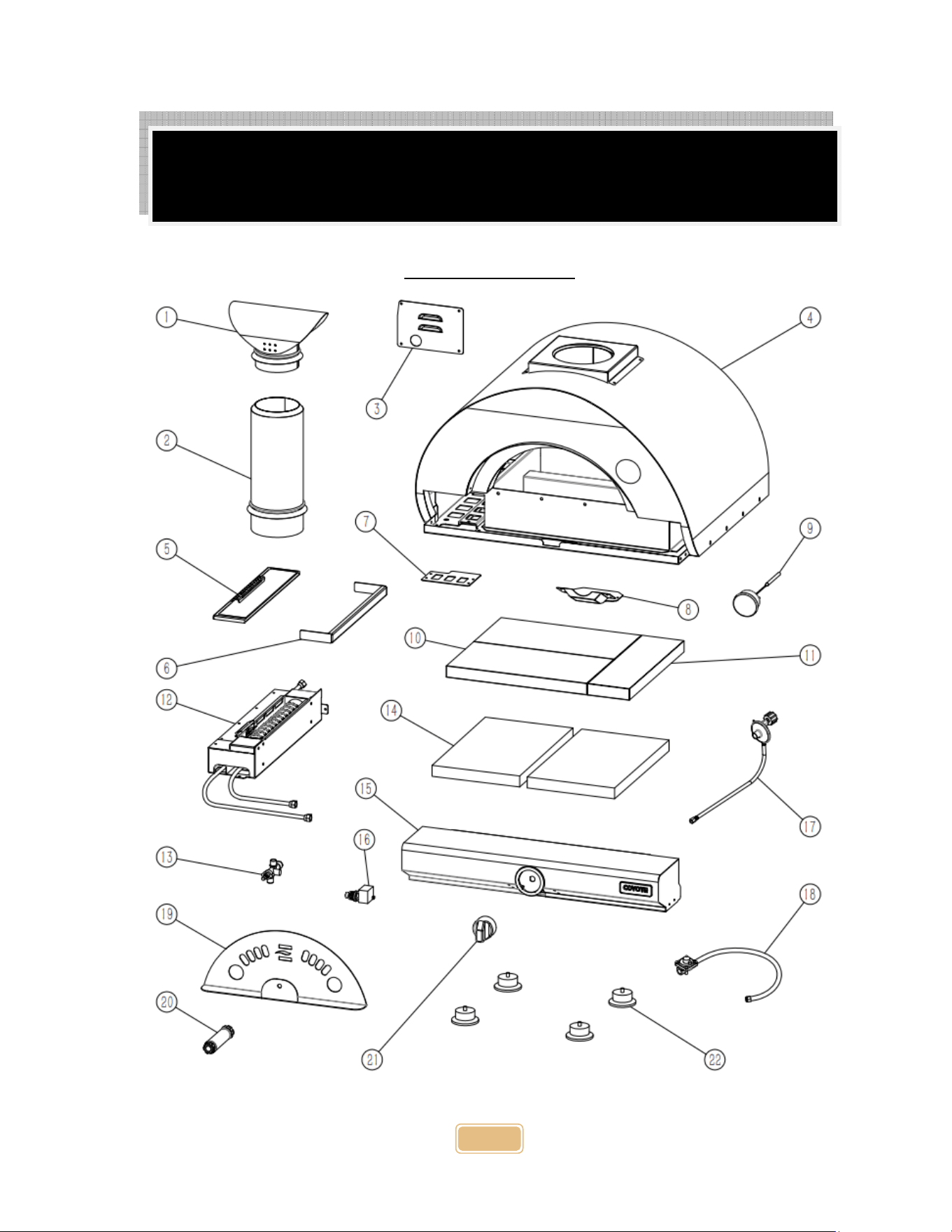
Exploded Parts List
Parts Listing
26
C1PZ30H Parts Listing
No.
Description
Qty
Model
1
Chimney Cap
1
C1PZH0001
2
Chimney Pipe
1
C1PZH0002
3
Rear Burner Cover
1
C1PZH0003
4
Dome
1
C1PZH0004
5
Burner Cover
1
C1PZH0005
6
Ash Guard
1
C1PZH0006
7
Burner Support Bracket
1
C1PZH0007
8
Valve Cover
1
C1PZH0008
9
Temp Guage
1
C1PZH0009
10
Long Brick
2
C1PZH0010
11
Short Brick
1
C1PZH0011
12
Burner
1
C1PZH0012
13
Valve
1
C1PZH0013
14
Insulation Board
2
C1PZH0014
15
Oven Shelf
1
C1PZH0015
16
Igniter
1
C1PZH0016
17
LP Regulator
1
CWLP0038
18
NG Regulator
1
CWNG0030
19
Door
1
C1PZH0019
20
Door Handle
1
C1PZH0020
21
Knob
1
C1PZH0021
22
Feet
4
C1PZ00009
24
Turning Peel
1
CPZHTPEEL
25
Peel
1
CPZHPEEL
26
Ash Rake
1
CPZHRAKE
27
Ash Brush
1
CPZHBRUSH
24
25
26
27