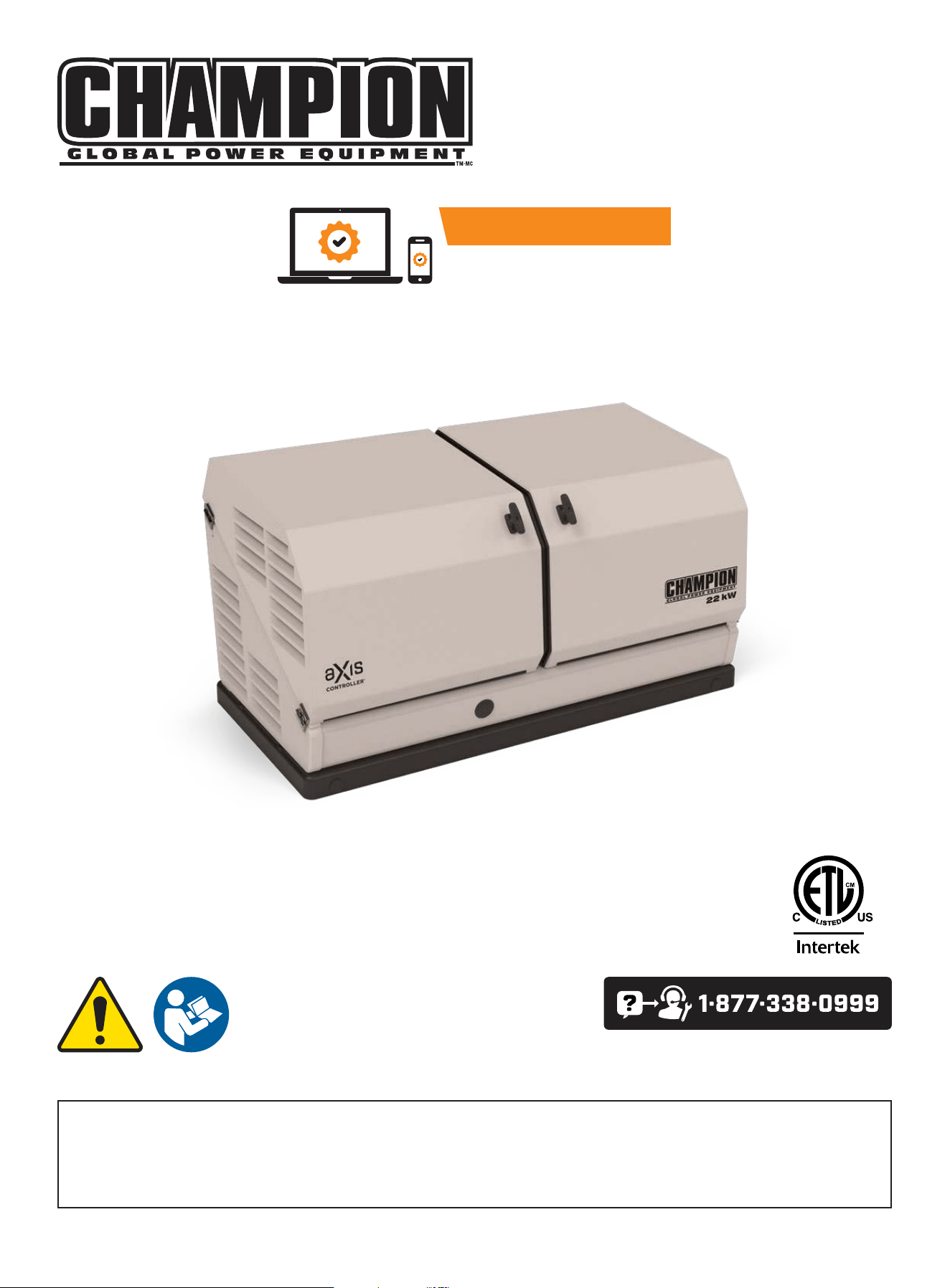
INSTALLATION MANUAL
HOME STANDBY GENERATOR
Model 100515 (14 kW)
Model 100304 (22 kW)
Champion Power Equipment, Inc.
or visit championpowerequipment.com
SAVE THESE INSTRUCTIONS. This manual contains important safety precautions which should be read and understood before operating the product. Failure to do
so could result in serious injury. This manual should remain with the product.
Specifications, descriptions and illustrations in this manual are as accurate as known at the time of publication, but are subject to change without notice.
No part of this publication may be reproduced or used in any form by any means – graphic, electronic or mechanical, including photocopying, recording, taping or
information storage and retrieval systems – without the written permission of Champion Power Equipment (CPE).
REV 20250603
ACTIVATE YOUR WARRANTY
by registering your product:
championpowerequipment.com

Have questions or need assistance?
Do not return this product to the store!
WE ARE HERE TO HELP!
Visit our website:
www.championpowerequipment.com
for more info:
Product Info & Updates
Frequently Asked Questions
– or –
Call our Customer Care Team Toll-Free at:
1-877-338-0999
Tech Bulletins
Product Registration
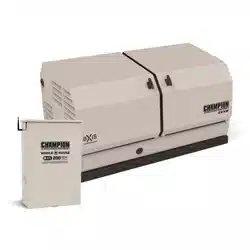
* We are always working to improve our products. Therefore, the enclosed product may differ slightly from the image on the cover.

HOME STANDBY GENERATOR- ALL aXis CONTROLLER
®
MODELS
TABLE OF CONTENTS
3
TABLE OF CONTENTS
Introduction
................................................... 4
Home Standby Generator
...............................4
Parts Included ..................................................... 4
Safety ............................................................5
Safety Definitions ................................................. 5
Important Safety Instructions .......................6
Carbon Monoxide Hazards ........................................ 6
Installation Hazards ............................................... 7
Before Starting .................................................... 7
Operation Hazards ................................................ 7
Accidental Starting ................................................ 8
Electrical Shock Hazards ......................................... 8
Fuel Safety ........................................................ 8
Burn Hazards ...................................................... 9
Entanglement Hazards ............................................ 9
Battery Hazards ................................................... 9
Safety Symbols ................................................... 10
Safety Labels and Hang Tags ....................... 12
Safety, Serial/Model, Nameplate Label Locations .............. 14
Specifications .............................................. 15
14-kW (Model 100515) Specifications .......................... 15
22-kW (Model 100304) Specifications .......................... 16
14-kW (Model 100515) Engine Torque Specifications .......... 17
22-kW (Model 100304) Engine Torque Specifications ......... 17
Master Mixing Assembly Jets (Carburetor System) -
Both models ...................................................... 17
Alternator Overview .............................................. 18
Unpacking .................................................... 18
Installation
.................................................. 19
Placement & Installation Guidelines for Champion Home Standby
Generators to Reduce the Risk of Fire........................... 19
Intertek Group PLC Label ........................................ 20
Site Selection, Preparation and Placement ..................... 21
Installation Preparation .......................................... 24
Battery Charger .................................................. 33
Surge protection ................................................. 37
AVR = Automatic Voltage Regulator ............................. 37
Engine Relay Module ............................................. 38
Exterior Warning LED ............................................ 39
Generator ON/OFF Switch ....................................... 39
Microswitch ......................................................40
aXis Controller
®
..................................................40
Wi-Fi Setup Method ..............................................44
ATS and HSB Status Using WIFI .................................46
Programming aXis Controller
®
...................................46
Automatic Transfer Switch (ATS) ................................ 48
aXis Controller
®
Module .........................................48
ATS Installation ...................................................48
Commissioning the ATS .......................................... 49
HSB Test .......................................................... 49
Checking Automatic Operation .................................. 51
Installing Standby Generator to non-aXis Controller
®
ATS ..... 52
Customer Familiarization Summary ............................. 52
Maintenance ................................................ 52
102006, 102007, 102008, 102009, 102010 ATS
Wiring Diagram ................................................... 53
Troubleshooting HSB ...................................54
HSB, ATS Model & Serial Reference ATS Back-up Circuits .....56

HOME STANDBY GENERATOR- ALL aXis CONTROLLER
®
MODELS
INTRODUCTION
4
HOME STANDBY GENERATOR
This home standby generator is intended exclusively for outdoor
installation. This generator will operate using either liquified
petroleum gas (LPG) or natural gas (NG).
This generator is designed to supply typical home load such as:
Induction motors – sump pumps, refrigerators, air conditioners,
furnaces
Electronic items – televisions, computers
Household lighting
Microwaves
This generator is not intended for use in critical life support
applications.
Proper sizing of the generator is required to ensure safe operation
of appliances. Some appliances require additional wattage to start
and must be considered in the sizing of the generator.
Parts Included
Your HSB ships with the following:
Operators Manual
Installation Manual
Oil Drain Pan (14 kW [Model 100515] only)
Flexible Fuel Line
HSB Enclosure Keys
Battery Series Cable
LPG Low-speed and Main Converting Jets (14 kW [Model
100515] only)
Jet Change Tool (14 kW [Model 100515] only)
Jet Block Tool for changing NG to LPG - 4 mm allen wrench
(14 kW [Model 100515, 100304)
Master Mixer Assembly (22 kW [Model 100304] only)
Battery Hardware (14 kW [Model 100515] only)
4 pieces - lock nut M6
4 pieces - washer, Ø6 mm
4 pieces - flange bolt, M6 x 1.0-15
Hurricane Pad Hardware (22 kW [Model 100304] only)
4 pieces - washer, Ø0.984 x Ø0.402 x 0.106-in USS
4 pieces - flange bolt, 0.375-16 x 2.00-in
INTRODUCTION
Congratulations on your purchase of a Champion Power Equipment
(CPE) product. CPE designs, builds, and supports all of our
products to strict specifications and guidelines. With proper
product knowledge, safe use, and regular maintenance, this
product should bring years of satisfying service.
Every effort has been made to ensure the accuracy and
completeness of the information in this manual at the time of
publication, and we reserve the right to change, alter and/or
improve the product and this document at any time without prior
notice.
CPE highly values how our products are designed, manufactured,
operated, and serviced as well as providing safety to the operator
and those around the generator. Therefore, it is IMPORTANT to
review this product manual and other product materials thoroughly
and be fully aware and knowledgeable of the assembly, operation,
dangers and maintenance of the product before use. Fully
familiarize yourself, and make sure others who plan on operating
the product fully familiarize themselves too, with the proper safety
and operation procedures before each use. Please always exercise
common sense and always err on the side of caution when
operating the product to ensure no accident, property damage,
or injury occurs. We want you to continue to use and be satisfied
with your CPE product for years to come.
When contacting CPE about parts and/or service, you will need to
supply the complete model and serial numbers of your product.
Transcribe the information found on your product’s nameplate
label to the table below
CPE TECHNICAL SUPPORT TEAM
1-877-338-0999
MODEL NUMBER
SERIAL NUMBER
DATE OF PURCHASE
PURCHASE LOCATION

HOME STANDBY GENERATOR- ALL aXis CONTROLLER
®
MODELS
SAFETY
5
SAFETY
Safety Definitions
The purpose of safety symbols is to attract your attention to
possible dangers. The safety symbols, and their explanations,
deserve your careful attention and understanding. The safety
warnings do not by themselves eliminate any danger. The
instructions or warnings they give are not substitutes for proper
accident prevention measures.
DANGER
DANGER indicates a hazardous situation which, if not avoided,
will result in death or serious injury.
WARNING
WARNING indicates a hazardous situation which, if not
avoided, could result in death or serious injury.
CAUTION
CAUTION indicates a hazardous situation which, if not avoided,
could result in minor or moderate injury.
NOTICE
NOTICE indicates information considered important, but not
hazard-related (e.g., messages relating to property damage).
HOME STANDBY GENERATOR- ALL aXis CONTROLLER
®
MODELS
IMPORTANT SAFETY INSTRUCTIONS
6
IMPORTANT SAFETY INSTRUCTIONS
WARNING
Cancer and Reproductive Harm – www.P65Warnings.ca.gov
Carbon Monoxide Hazards
DANGER
Generator exhaust contains carbon monoxide (CO), a colorless,
odorless, poisonous gas. Breathing carbon monoxide (CO) will
cause nausea, dizziness, fainting or death. If you start to feel
dizzy or weak, get to fresh air immediately.
GENERATOR MUST BE INSTALLED AND OPERATED
OUTDOORS ONLY.
Carbon monoxide (CO) poisoning symptoms include but are not
limited to the following:
Lightheadedness, dizziness, blurred vision
Physical fatigue, weakness in joints and muscles
Mental fatigue, sleepiness, inability to concentrate or
speak clearly,
Stomachache, vomiting, nausea
In the event of carbon monoxide (CO) poisoning:
Seek fresh air immediately
DO NOT sit, lie down or fall asleep.
Alert others to the possibility of carbon monoxide (CO)
poisoning.
If the affected person does not improve within minutes
of breathing fresh air, call 911 immediately for medical
assistance.
DANGER
Carbon Monoxide (CO) is a colorless, odorless, poisonous
gas. Breathing carbon monoxide will cause nausea, dizziness,
fainting or death.
Generator must be installed and operated outdoors only.
NEVER allow exhaust fumes to enter a confined area through
windows, doors, air intake vents or other openings of the
building.
ALWAYS avoid breathing exhaust fumes when near an
operating generator.
NEVER alter the generator or modify the exhaust system
thereby creating noncompliance with Federal and State
emissions regulations, local applicable codes, standards and
laws.
NEVER allow blockage of the engine’s air intake cooling
ventilation system. Doing so can seriously affect performance
and safe operation of the generator.
WARNING
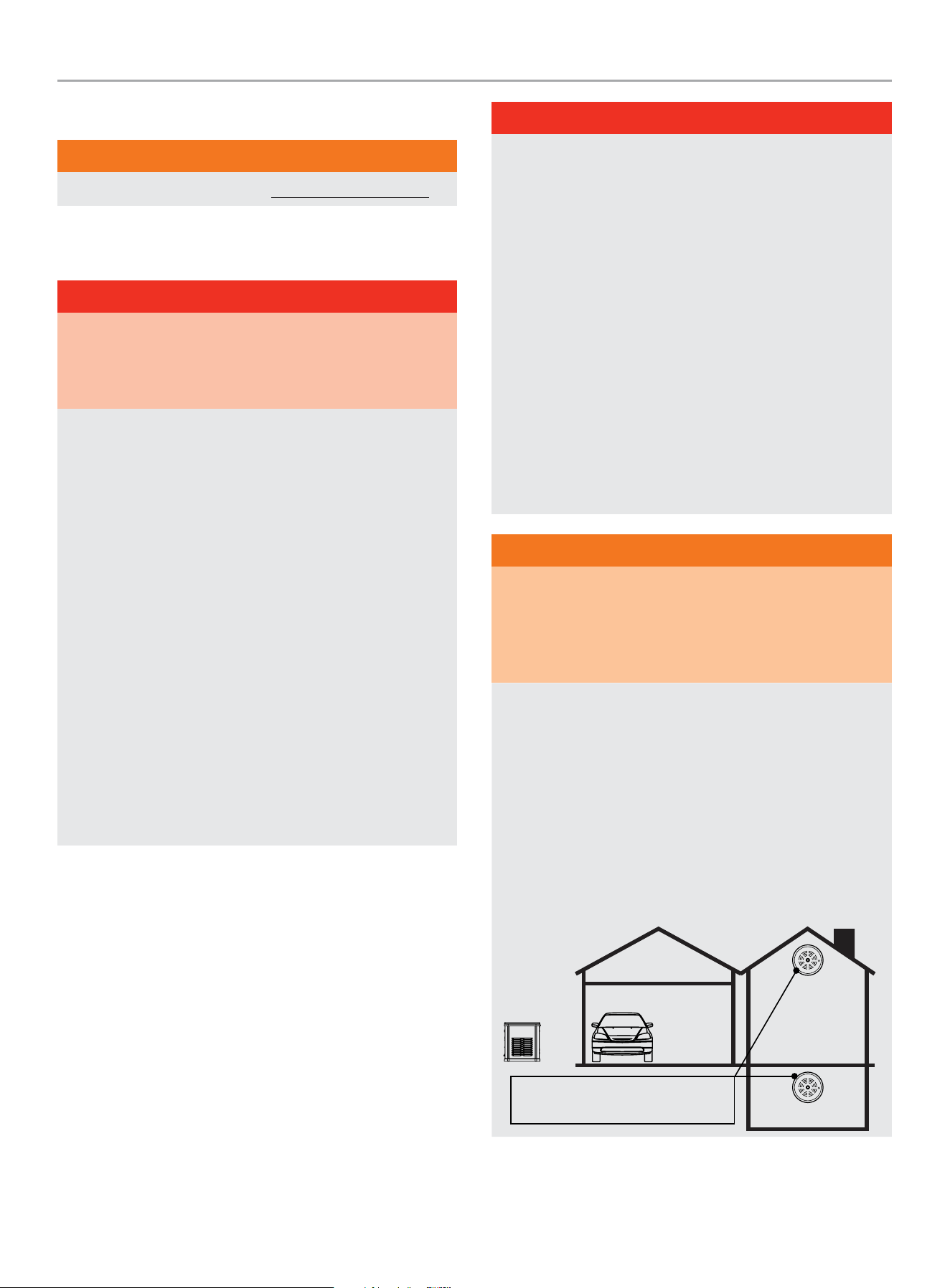
Always install a battery-operated Carbon Monoxide (CO)
detector on each level of any building or home dwelling
adjacent to the generator location following the Carbon
Monoxide (CO) detector manufacturer’s installation
instructions.
In many U.S. States and Canadian Provinces, it is required by
law to have a Carbon Monoxide (CO) detector installed on each
level of an occupied building or home dwelling.
The Carbon Monoxide (CO) detector is a device that detects
elevated levels of poisonous Carbon Monoxide (CO) gas and
will alert the occupants by flashing a visual light indicator and
an audible alarm.
The Carbon Monoxide (CO) detector alarm will not sense
smoke, fire, or any other poisonous gas other than carbon
monoxide.
Carbon Monoxide (CO) detectors
located only in living spaces.

HOME STANDBY GENERATOR- ALL aXis CONTROLLER
®
MODELS
IMPORTANT SAFETY INSTRUCTIONS
7
WARNING
Smoke alarms cannot detect Carbon Monoxide (CO) gas.
To better educate yourself about all carbon monoxide risks, go
to www.takeyourgeneratoroutside.com
WARNING
Do not use generator for medical life support uses.
In case of emergency, call 911 immediately.
NEVER use this product to power life support devices or life
support appliances.
Inform your electricity provider immediately if you or anyone in
your household depends on electrical equipment to live.
Inform your electrical provider immediately if a loss of power
would cause you or anyone in your household to experience a
medical emergency.
Installation Hazards
WARNING
Always have a qualified electrician or installation technician
who are familiar with applicable safety codes, standards and
regulations to install and service the generator.
ALWAYS comply with local, state and national electrical and
building codes when installing the generator.
NEVER alter the recommended installation in a way that would
render the unit non compliant with these codes.
ALWAYS comply with regulations that Occupational Safety and
Health Administration (OSHA) has established.
ALWAYS follow the generator manufacturer’s instructions.
Before Starting
WARNING
Before operation, read and understand the features and
controls of the generator, including the safety and maintenance
sections of this manual.
The owner/operator is responsible for all periodic maintenance.
Complete all scheduled maintenance in a timely manner.
Correct any issue before operating the generator.
The owner/operator is responsible for the safe operation of this
generator.
If any portion of this manual is not understood, contact
your Champion dealer for assistance before operating the
generator.
For service or parts assistance, contact your Champion dealer
if repairs are needed.
Operation Hazards
WARNING
ALWAYS operate the generator following the manufacturer’s
instructions. Operating the generator improperly or neglecting
maintenance can result in serious injury or possible death.
DO NOT allow children or unqualified persons to operate or
service the generator.
NEVER operate the generator with the covers open. Only
operate the generator with the covers closed and secured in
place.
NEVER leave the generator covers unlocked.
NEVER work on the generator when physically or mentally
fatigued. Remain alert at all times when working on the
generator.
NEVER operate the generator while under the influence of
alcohol or drugs.
NEVER climb or step on any part or components of the
generator. Doing so may result in personal injury and cause
damage to the exhaust system and/or create leakage to the
fuel system.

HOME STANDBY GENERATOR- ALL aXis CONTROLLER
®
MODELS
IMPORTANT SAFETY INSTRUCTIONS
8
Accidental Starting
WARNING
ALWAYS prevent the generator from starting while the covers
are open. The generator may crank and start at any time
without notice. Follow these steps in order:
1. Pull fuse from aXis Controller
®
panel and secure with tape
to the panel.
2. Disconnect the NEGATIVE, NEG or (-) battery cable first,
and then remove the POSITIVE, POS or (+) battery cable.
To return the generator to service, follow these steps in order:
1. Connect the POSITIVE, POS or (+) battery cable first, and
then connect the NEGATIVE, NEG or (-) battery cable.
2. Remove taped fuse from the panel and reinstall into the
aXis Controller
®
.
Electrical Shock Hazards
WARNING
The generator produces dangerous voltage. Use extreme
caution when near the generator while it is operating.
Avoid contact with bare wires, terminals and connections while
the generator is operating.
ALWAYS stand on an insulated dry surface to reduce shock
hazard if work must be done on an operating generator.
NEVER wear jewelry that can conduct electricity when working
on the generator.
NEVER handle any kind of electrical device while hands or feet
are wet, while standing in water or while barefoot.
Proper earth grounding of the frame and external electrical
conductive components is required by the National Electrical
Code (NEC). State and local codes for proper grounding may
also apply.
Avoid direct contact with an electric shock victim. Immediately
shut down the source of electrical power. If this is not possible,
attempt to free the victim from the live conductor using a
nonconducting item such as a dry board or rope. If the victim
is unconscious, apply first aid and call 911 immediately.
Fuel Safety
DANGER
PROPANE AND NATURAL GAS ARE HIGHLY FLAMMABLE
AND EXPLOSIVE.
Fire or explosion can cause severe burns or death.
Propane/LPG (liquified petroleum gas) and LPG Vapors:
LPG is a hydrocarbon gas that exists in a liquified form and
it’s vapors are highly flammable and explosive.
LPG and it’s vapors are under pressure and can cause a
fire or explosion if ignited.
LPG vapors are heavier than air and will settle in low
places while dissipating.
LPG itself is odorless and tasteless. For safety, a chemical
is added to give it an odor to help detect leaks quickly.
If a leak is detected, IMMEDIATELY turn OFF the gas
supply.
In the event of an LPG fire and only when safe to do so,
first close the regulator valve OFF and then use a dry
powder extinguisher to put out the fire. This is because if
a fire is extinguished before the regulator valve is closed
OFF, then an explosion hazard condition could be created.
Always keep the LPG cylinder in an upright position.
LPG is a skin irritant and can cause severe cold burns
similar to frostbite.
Always wear proper protective gloves when connecting to
and disconnecting from a propane bottle.
Always keep LPG away from sparks, open flames, pilot
lights, heat and other sources of ignition.
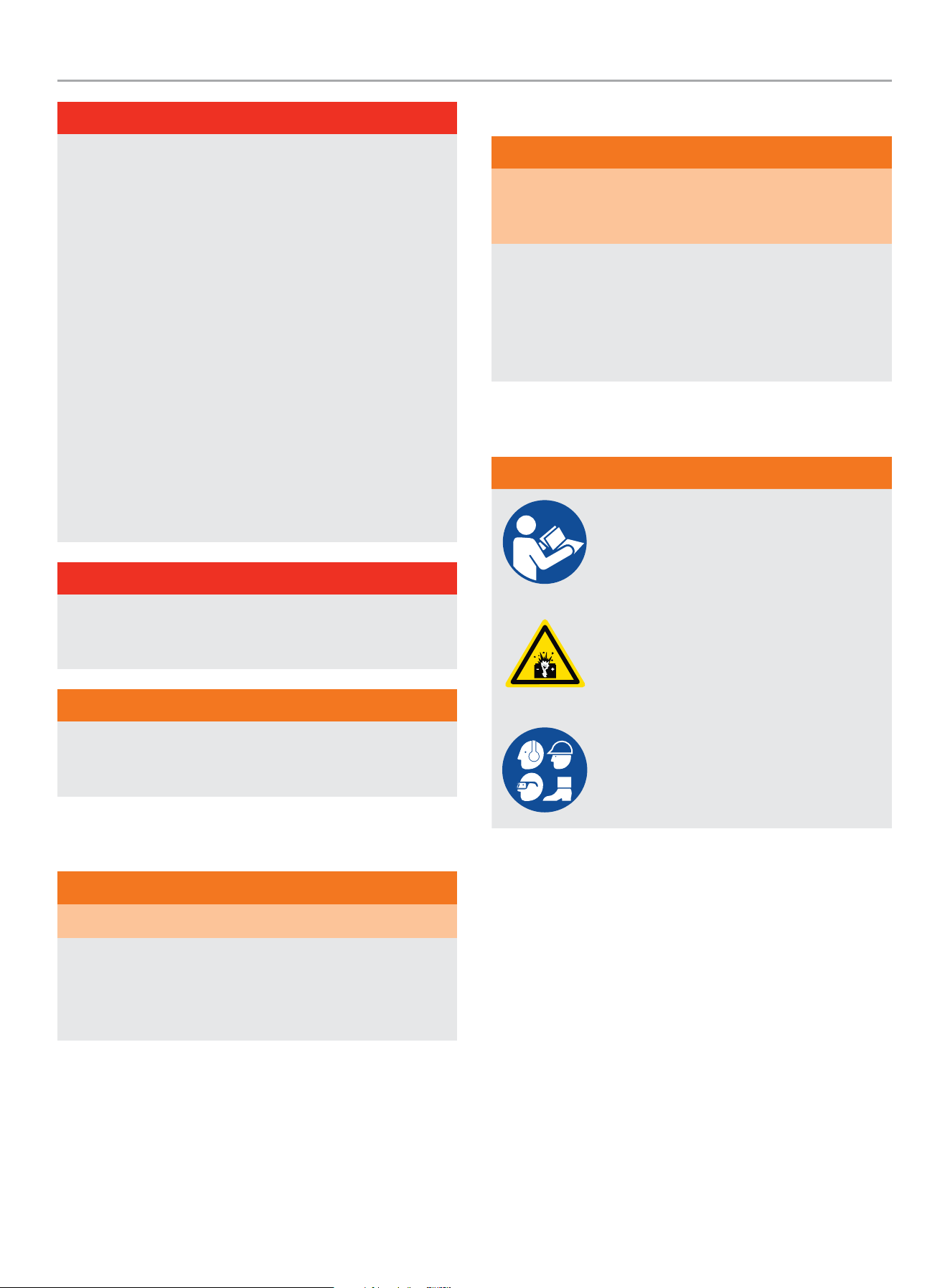
DANGER
NG (natural gas) and NG Vapors:
NG vapors are highly flammable and explosive.
NG vapors can cause a fire or explosion if ignited.
NG itself is odorless and tasteless. For safety, a chemical
is added to give it an odor to help detect leaks quickly.
NG is lighter than air and will collect in higher areas.
If a leak is detected, IMMEDIATELY turn OFF the gas
supply.
HOME STANDBY GENERATOR- ALL aXis CONTROLLER
®
MODELS
IMPORTANT SAFETY INSTRUCTIONS
9
DANGER
NEVER allow any flames or smoke near the fuel system.
Wipe up any oil spills immediately.
NEVER allow any combustible materials to be near the
generator or to be left in the generator compartment.
ALWAYS keep the surrounding area near the generator clean
and free of debris.
Be sure to properly purge the fuel lines and leak-test according
to applicable codes before placing the generator in service.
Be sure to regularly inspect the fuel system for leaks. For
safety, a chemical is added to Propane/LPG/NG to give it an
odor to help detect leaks quickly. Never operate the generator
if a fuel leak is present.
Install a fire extinguisher near the generator. Keep it properly
charged and be familiar with its use. An ABC rated National
Fire Protection extinguisher is appropriate for use on standby
electric systems. Contact your local fire department with any
questions concerning the fire extinguisher.
DANGER
NEVER place a gasoline container, gasoline tank, LPG cylinder
or any combustible material in the path of the exhaust stream
during operation of the generator.
WARNING
Never use a remote or external fuel supply tank or flexible fuel
hose, or any other fuel component that is broken, cut, torn or
damaged.
Burn Hazards
WARNING
DO NOT touch hot surfaces.
ALWAYS avoid contact with hot exhaust components and
gases. Running engines produce heat. Severe burns can occur
on contact.
ALWAYS allow hot surfaces to cool to the touch.
Entanglement Hazards
WARNING
Use extreme caution when near rotating parts. Rotating parts
can entangle hands, feet, hair, clothing and/or accessories.
Traumatic amputation or severe laceration can result.
Keep hands and feet away from rotating parts.
Tie up long hair and remove jewelry.
Operate equipment with guards in place.
DO NOT wear loose-fitting clothing, dangling drawstrings or
items that could become caught.
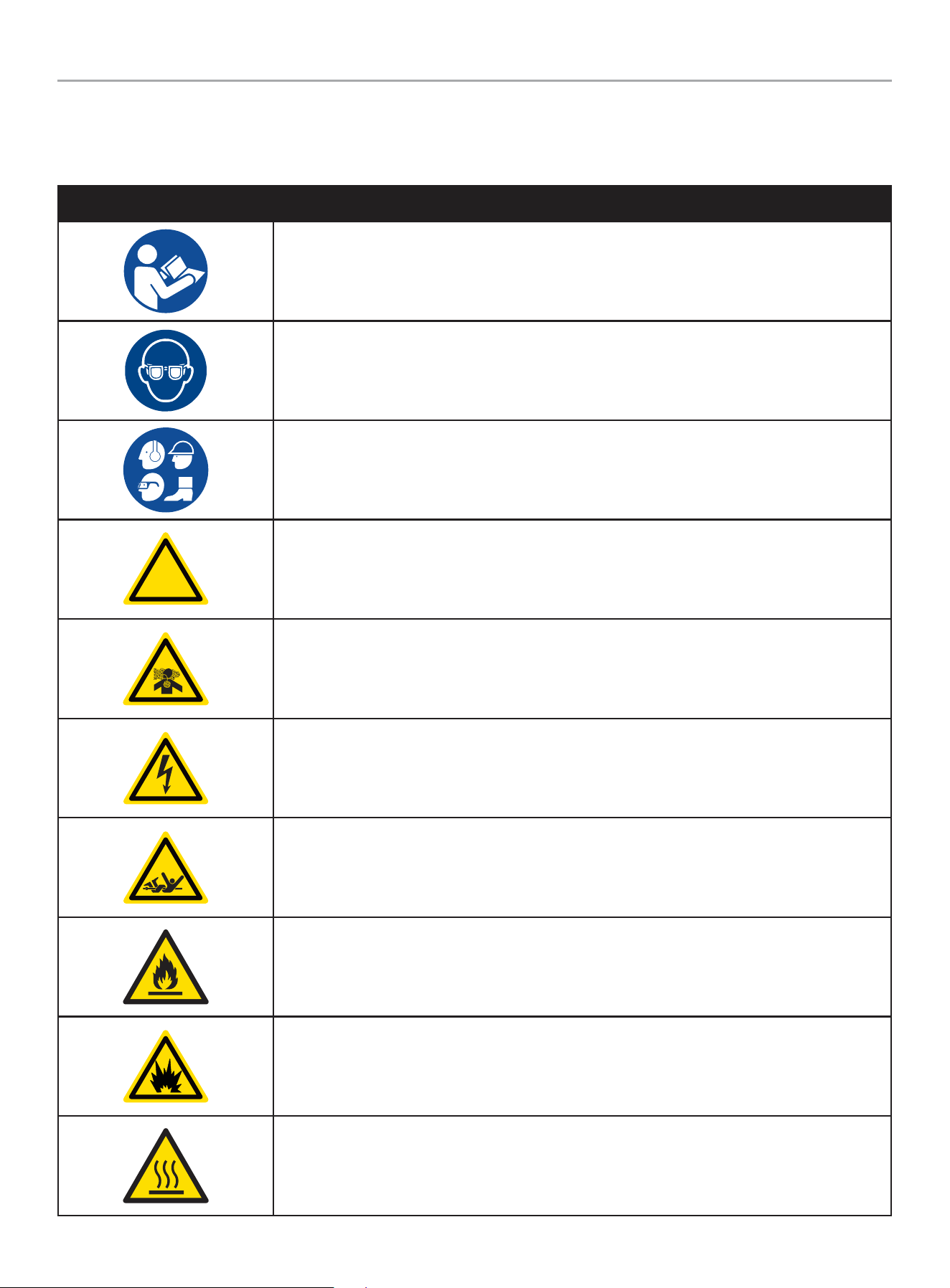
Battery Hazards
WARNING
Always read and comply with the battery
manufacturer’s recommendations for
procedures concerning proper battery use
and maintenance.
Batteries contain sulfuric acid and generate
explosive mixtures of hydrogen and oxygen
gases. Keep any device that may cause
sparks or flames away from the battery to
prevent explosion.
Always wear protective glasses or goggles
and protective clothing when working
with batteries. Always follow the battery
manufacturer’s instructions on safety,
maintenance and installation procedures.
HOME STANDBY GENERATOR- ALL aXis CONTROLLER
®
MODELS
IMPORTANT SAFETY INSTRUCTIONS
10
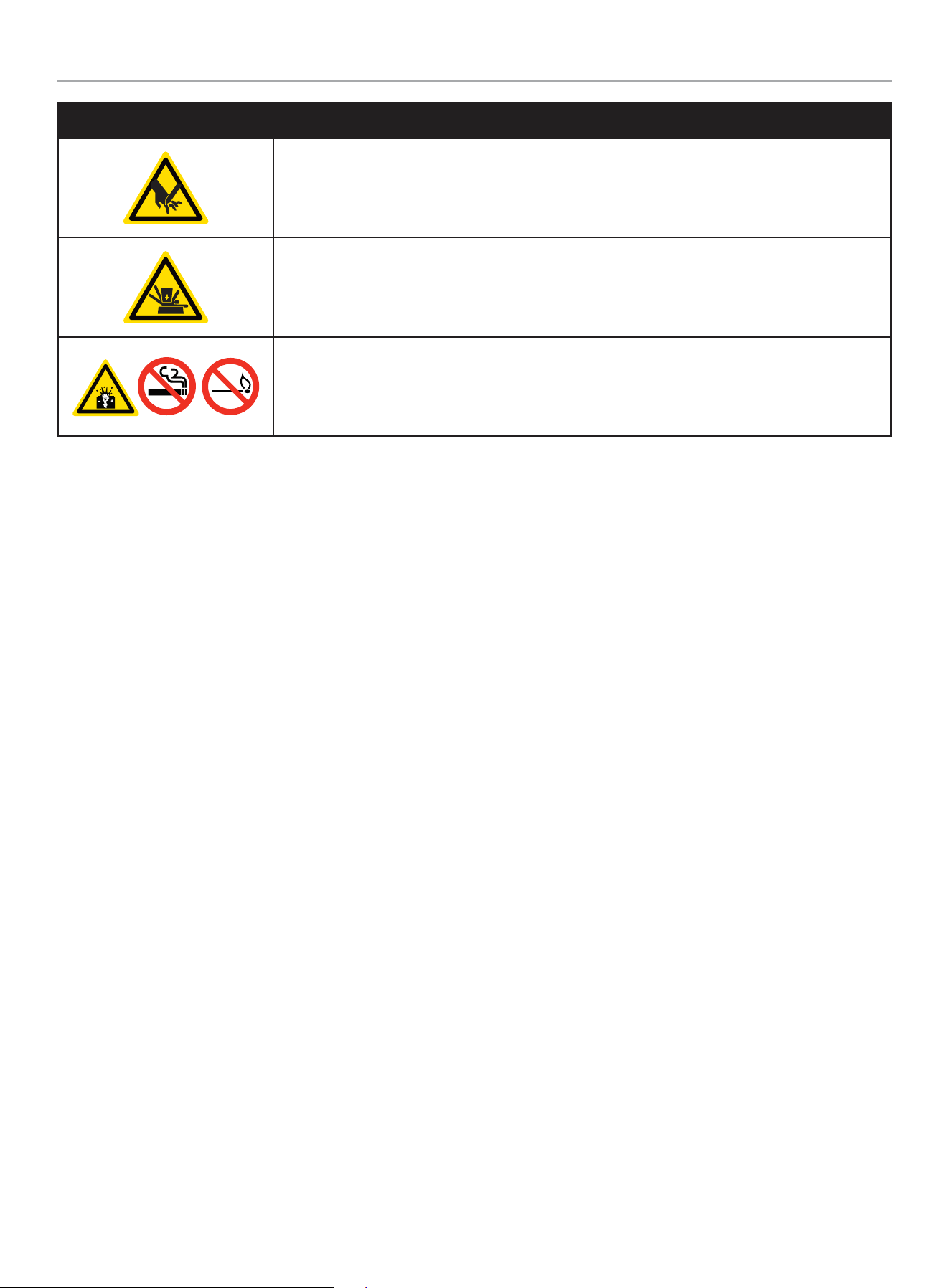
Safety Symbols
Some of the following symbols may be used on this product. Please study them and learn their meaning. Proper interpretation of these
symbols will allow you to more safely operate the product.
SYMBOL MEANING
Read Operator’s Manual. To reduce the risk of injury, user must read and understand operator’s
manual before using this product.
Eye protection. Always wear eye protection with side shields marked to comply with ANSI Z87.1
Wear personal protective equipment
!
Safety alert symbol
Asphyxiation hazard
Electrical shock hazard
Entanglement hazard
Fire hazard
Fire/Explosion. Fuel and its vapors are extremely flammable and explosive. Fire or explosion can
cause severe burns or death.
Hot Surface. To reduce the risk of injury or damage, avoid contact with any hot surface.
HOME STANDBY GENERATOR- ALL aXis CONTROLLER
®
MODELS
IMPORTANT SAFETY INSTRUCTIONS
11
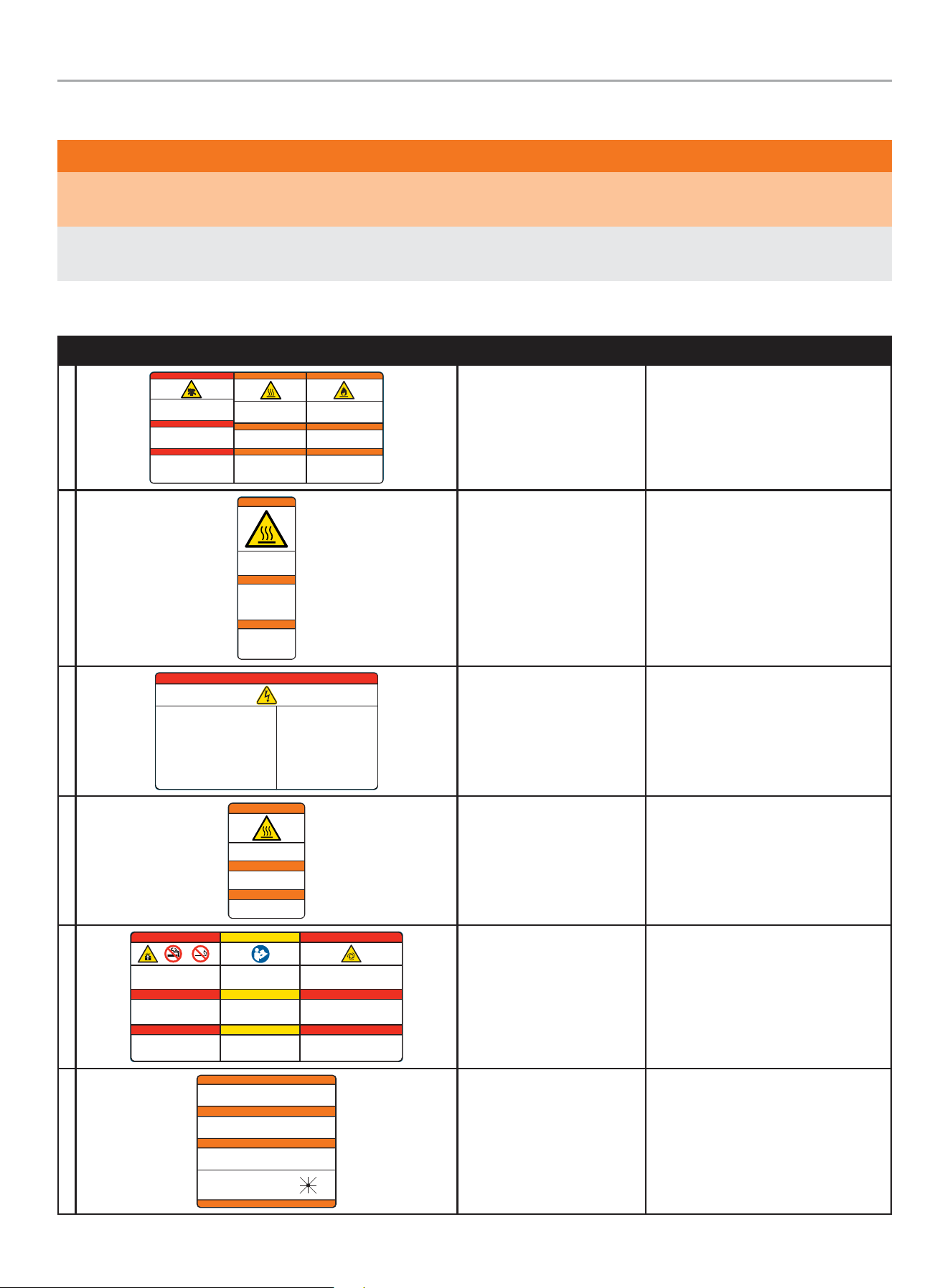
SYMBOL MEANING
Sever hazard (rotating blade)
Crush hazard (top)
Explosion Hazard. Battery gases are explosive. Keep sparks and flames away from the battery
compartment.
HOME STANDBY GENERATOR- ALL aXis CONTROLLER
®
MODELS
SAFETY LABELS AND HANG TAGS
12
SAFETY LABELS AND HANG TAGS
WARNING
DO NOT operate the generator if there are missing or badly worn safety labels. Safety labels must be legible to alert personnel of safety
hazards.
Replace any illegible or missing label immediately. Missing safety labels must be replaced in their original position before the generator
is operated.
Labels
LABEL DESCRIPTION PART NO.
A
Poisonous Gas Hazard - Generator exh aust contain s carbon
monoxide, a colorless, odorless, poisonous gas. Breathing
carbon m onoxide will cau se nausea, dizz iness, fainti ng or
death. I f you start to fe el dizzy or weak, g et to fresh air
immediately.
Risque d’empoisonnement par le gaz - Les gaz
d'échappement de la génératrice contiennent du monoxyde de
carbon e, un gaz toxique i ncolore et inod ore. L'inhal ation de
monoxy de de carbone pro voque des nausée s, des
étourdissements, des évanouissements ou la mort. Si vous
commenc ez à vous sentir ét ourdi ou faible, r endez-vous
immédiatement à l'air frais.
Riesgo d e gas venen oso - Los gases de es cape del
generador contienen monóxido de carbono, un gas incoloro,
inodoro y venenoso. Respirar monóxido de carbono provoca
náusea s, mareos, desm ayos o la muerte. S i empieza a
sentir se mareado o débi l, busque aire fr esco inmediat amente.
DANGER
PELIGRO
2510-L-SF-E
Fire Haz ard - ALWAYS keep the sur rounding area
near gene rator clean and f ree of debr is and/or dry
vegeta tion. Th e generator may create sparks while
operating.
Risque d’incendie - Nettoyez TO UJOURS la sur face
à proximi té du grou pe électr ogène et enlevez le s
débris e t/ou la veg étation sèche. L e groupe
électrogène peut générer des étincelles pendant
son fonctionnement.
Riesgo d e incendi o - SIEMPRE mant enga el área
circund ante cerca del gen erador limpia y libre de
escombros y/o veget ación seca. El ge nerador p uede
crear chispas mientras está en funcionamiento.
WARNING
ADVERTENCIA
Burn Haz ard - DO NOT t ouch hot surfac es.
Avoid con tact with exhaust compon ents
and gases.
Risque de brûlure - NE touchez PAS le s
surfa ces chaudes. Evitez le cont at avec les
composants et les gaz d’échappement.
Riesgo de quemaduras - NO toque las
super ficies cal ientes. Evite el c ontacto con
los compo nentes de escape y g ases.
WARNING
ADVERTENCIA
DANGER
AVERTISSEMENT
AVERTISSEMENT
Poison, Burn and Fire
Warning
2510 -L-S F
B
2483-L-SF-C
Burn Hazard - DO NOT touch
hot surfaces. Allow the
engine and alternator to cool
to the touch before servicing.
Riesgo de quemaduras -
NO toque las superficies
calientes. Deje que el motor
y el alternador se enfríen
para tocarlos antes de
realizarles el mantenimiento.
WARNING
ADVERTENCIA
Danger de brulure - NE
TOUCHEZ PAZ les surfaces
chaudes. Laissez le moteur
et l’alternateur devenir froid
au toucher avant d’intervenir.
AVERTISSEMENT
Burn Warning 24 83- L-SF
C
Electrical Shock - ALWAYS close and lock
the generator covers before operating.
The generator produces dangerous voltage.
Riesgo de descarga eléctrica - SIEMPRE
cierre y trabe las tapas del generador antes
de ponerlo en funcionamiento. El generador
produce un voltaje peligroso.
Risque de choc électrique - Fermez et
verrouillez TOUJOURS les capots de groupe
électrogène avant d’utiliser le groupe. Le
groupe électrogène génère des tensions
dangereuses.
PELIGRO DANGER DANGER
Electrical Shock Hazard - Do not remove this
access panel. The panel should only be removed by
an authorized Service Dealer or a qualified electrician;
high voltage inside.
Riesgo de descarga eléctrica - No remueva este
tablero de acceso. El tablero sólo deberá ser removido
por un distribuidor de servicio autorizado o un
electricista calificado; alto voltaje al interior.
Risque de choc électrique - N’enlevez pas ce
panneau d’accès. Le panneau ne devrait être enlevé
que par un concessionnaire d’entretien agréé ou un
électricien qualifié; haute tension à l´’intérieur.
4622-L-SF-A
Electrocution Warning 4622-L-SF
D
2473-L-SF-C
Burn Hazard - DO NOT touch hot surfaces.
Avoid contact with exhaust components
and gases.
Risque de brûlure - NE touchez PAS les
surfaces chaudes. Evitez le contat avec les
composants et les gaz d’échappement.
Riesgo de quemaduras - NO toque las
superficies calientes. Evite el contacto con
los componentes de escape y gases.
WARNING
ADVERTENCIA
AVERTISSEMENT
Burn Warning 247 3-L- SF
E
Explosion Hazard - Batter y gases are
explosive. Keep sparks and flames away from
the battery compar tment.
Risque d’explosion - Les gaz dégagés par la
batterie peuvent exploser. Ecar tez les
étincelles et les flammes du compar timent
batterie.
Riesgo de explosión - Los gases de las
baterías son explosivos. Mantenga las
chispas y llamas alejadas del compartimento
de las baterías.
PELIGRO
Read Operator’s Manual - Read,
understand and follow all safety messages
in Intallation and Operator’s manuals.
Lisez le manuel d’utilisation - Lisez
comprenez bien et respectez tous les
messages de sécurité dans les manuels
d’installation et d’utilisation.
Lea el manual del operador - Lea,
comprenda y siga todos los mensajes de
seguridad en los manuales de instalación
y del operador.
CAUTION
PRECAUCIÓN
4413-L-SF-E
Starting Hazard - The generator may crank and start
without notice. Prevent the generator from accidental
star ting while the covers are open. See the safety
section of the operator’s manual for fur ther detail.
Riesgo de inicio - El generador puede encenderse y
ponerse en marcha sin previo aviso. Evite que el
generador se ponga en marcha accidentalmente
mientras las tapas están abiertas. Vea la sección de
seguridad en el manual del operador para más detalles.
PELIGRO
DANGER
MISE EN GARDE
DANGER
Risque au démarrage - Le groupe électrogène peut
tourner et démarrer sans préavis. Empêcher le
démarrage accidentel du génératrice lorsque le
couvercle est ouvert. Consultez la section sécurité du
manuel d’utilisation pour plus de détail.
DANGER DANGER
Explosion Warning, Read
OM, Starting Warning
4 413 -L- SF
F
4642-L-SF-B
ALTERNATE POWER SOURCE AVAILABLE -
STANDBY GENERATOR ON PREMISES.
AUTRE SOURCE DE COURANT DISPONIBLE -
GENERATEUR SUR SITE.
FUENTE DE CORRIENTE ALTERNA DISPONIBLE -
GENERADOR DE RESERVA EN EL SITIO.
GENERATOR LOCATION:
UBICACIÓN DEL GENERADOR:
EMPLACEMENT DU GENERATEUR:
NW
W E
N NE
SW S SE
ATTENTION
ATENCIÓN
ATTENTION
DO NOT REMOVE \ NO REMUEVA \ NE PAS ENLEVER
Alternate Power Source 4642-L-PR
HOME STANDBY GENERATOR- ALL aXis CONTROLLER
®
MODELS
SAFETY LABELS AND HANG TAGS
13
Hang Tags
HANG TAG DESCRIPTION PART NO.
1681-T-SF-B
ATTENTION
ALTERNATE POWER SOURCE AVAILABLE -
STANDBY GENERATOR ON PREMISES.
ATTENTION
AUTRE SOURCE DE COURANT DISPONIBLE -
GENERATEUR SUR SITE.
ATENCIÓN
FUENTE DE CORRIENTE ALTERNA DISPONIBLE -
GENERADOR DE RESERVA EN EL SITIO.
GENERATOR LOCATION:
UBICACIÓN DEL GENERADOR:
EMPLACEMENT DU GENERATEUR:
DO NOT REMOVE \ NO REMUEVA \ NE PAS ENLEVER
NW
W E
N NE
SW S SE
Alternate Power Source 1681-T-PR
HOME STANDBY GENERATOR- ALL aXis CONTROLLER
®
MODELS
SAFETY LABELS AND HANG TAGS
14
Safety, Serial/Model, Nameplate Label Locations
The safety labels have specific placement and must be replaced if they are unreadable, damaged or missing.
If a label comes off or becomes hard to read, contact Technical Support Team for possible replacement.
C
D
D
A
B
F
F
A. Serial number location
B. Nameplate
C. NFPA 37 Compliance
D. Oil hang tag
E. Alternate Power Source Hang tag and Label (not shown – in the Operator’s
Manual bag)
F. Flexible Fuel Line Hang tag
22-kW (Model 100304)
14-kW (Model 100515)
A
B
C
HOME STANDBY GENERATOR- ALL aXis CONTROLLER
®
MODELS
SPECIFICATIONS
15
SPECIFICATIONS
14-kW (Model 100515) Specifications
Home Standby Generator
Maximum continuous power, LPG 14 kW
Maximum continuous power, NG 12.5 kW
Rated voltage 120/240
Amps 116.6/58.3 LPG (propane), 104/52 NG (natural gas)
Harmonic distortion Less than 5%
Main line circuit breaker 65 amp
Phase Single
Frequency 60 Hz
Unit weight 438.7 lb. (199 kg)
Size (L x W x H) 49 x 28 x 28 in. (124.5 x 71 x 71 cm)
Engine
Type Milwaukee Series OHV Commercial V-Twin
No. of cylinders 2
Displacement 754 cc
Cylinder block Aluminum with cast iron sleeves
Ignition system Solid state – magneto
Spark plug F7RTC (NGK BPR7ES)
Governor Mechanical
Starter Electric 24V DC
Oil capacity- At manufacturing 1.6 US qt (1.5 L)
Oil capacity- When draining oil and replacing oil filter 1.0 US qt (0.9 L)
Oil Type 0W-40 Full Synthetic*
RPM 3600
Controls
Mode switch auto Auto start on utility failure
Mode switch manual Starts on demand
Mode switch off Stops unit/control and charger active
Ready to run/maintenance messages Standard
Programmable start delay Standard
Engine start sequence Standard
Starter lockout Standard
Battery charger/low battery indicator Standard
Charger fault Standard
AVR over voltage protection Standard
Low oil protection Standard
Safety fused Standard
Overcrank/overspeed/underspeed protection Standard
* Serial Number Y2212150069+: Unit comes with oil pre-filled in unit.
Serial Number < Y2212150069: Unit does not come with oil. You must ADD OIL before starting the unit.
After 5 hours, change oil per maintenance schedule. The recommended oil type for typical use is 0W-40 full synthetic oil. However, using the listed conventional oils shown
in the “Recommended Engine Oil Type” chart may be used for typical use. If running generator in extreme temperatures, refer to the “Recommended Engine Oil Type” chart.
HOME STANDBY GENERATOR- ALL aXis CONTROLLER
®
MODELS
SPECIFICATIONS
16
22-kW (Model 100304) Specifications
Home Standby Generator
Maximum continuous power, LPG 22 kW
Maximum continuous power, NG 19.8 kW
Rated voltage 120/240
Amps 183.4/91.7 LPG (propane), 165/82.5 NG (natural gas)
Harmonic distortion Less than 5%
Main line circuit breaker 100 amp
Phase Single
Frequency 60 Hz
Unit weight 590.4 lb. (267.8 kg) (no battery and oil)
Size (L x W x H) 53 x 28.2 x 28.4 in. (134.7 x 71.6 x 72.1 cm)
Engine
Type Milwaukee Series OHV Commercial V-Twin
No. of cylinders 2
Displacement 999 cc
Cylinder block Aluminum with cast iron sleeves
Ignition system TCI (Transistorised Coil Ignition)
Spark plug K7RTC (NGK BKR7ES-11)
Governor Electronic
Starter Electric 24V DC
Oil capacity- At manufacturing 3 US qt (2.8 L)
Oil capacity- When draining oil and replacing oil filter 2.0 US qt (1.9 L)
Oil Type 0W-40 Full Synthetic*
RPM 3600
Controls
Mode switch auto Auto start on utility failure
Mode switch manual Starts on demand
Mode switch off Stops unit/control and charger active
Ready to run/maintenance messages Standard
Programmable start delay Standard
Engine start sequence Standard
Starter lockout Standard
Battery charger/low battery indicator Standard
Charger fault Standard
AVR over voltage protection Standard
Low oil protection Standard
Safety fused Standard
Overcrank/overspeed/underspeed protection Standard
* After 5 hours, change oil per maintenance schedule. The recommended oil type for typical use is 0W-40 full synthetic oil. However, using the listed conventional oils shown
in the “Recommended Engine Oil Type” chart may be used for typical use. If running generator in extreme temperatures, refer to the “Recommended Engine Oil Type” chart.

HOME STANDBY GENERATOR- ALL aXis CONTROLLER
®
MODELS
SPECIFICATIONS
17
14-kW (Model 100515) Engine Torque Specifications
Crankcase Cover Bolts
...........................27 Nm (20 lbf-ft)
Connecting Rod Bolts ............................. 12 Nm (9 lbf-ft)
Rocker Cover Screws .............................. 10 Nm (7 lbf-ft)
Cylinder Head Bolts ........................... 40 Nm (29.5 lbf-ft)
Intake Manifold Screws .......................... 9.5 Nm (7 lbf-ft)
Carburetor to Intake Manifold .................... 9.5 Nm (7 lbf-ft)
Blower Housing ................................... 9 Nm (6.6 lbf-ft)
Flywheel Nut ................................... 196 Nm (145 lbf-ft)
Ignition Coil Bolts ................................. 9.5 Nm (7 lbf-ft)
Starter Motor Bolts .............................24.4 Nm (18 lbf-ft)
Spark Plug ......................................18 Nm (13.3 lbf-ft)
Air Cleaner box to Carb ........................... 9 Nm (6.6 lbf-ft)
Exhaust pipe nuts ..............................18 Nm (13.3 lbf-ft)
22-kW (Model 100304) Engine Torque Specifications
Crankcase Cover Bolts .......................... 24 Nm (17.8 lbf-ft)
Connecting Rod Bolts ............................. 16 Nm (12 lbf-ft)
Rocker Cover Screws ............................. 15 Nm (11 lbf-ft)
Cylinder Head Bolts ............................ 40 Nm (29.5 lbf-ft)
Intake Manifold Screws ......................... 24 Nm (17.8 lbf-ft)
Carburetor to Intake Manifold ................... 10 Nm (7.4 lbf-ft)
Blower Housing ....................................10 Nm (7.4lbf-ft)
Flywheel Nut ................................... 28 Nm (20.7 lbf-ft)
Ignition Coil Bolts ................................. 10 Nm (7.4 lbf-ft)
Starter Motor Bolts .............................. 24 Nm (17.8 lbf-ft)
Spark Plug .......................................18 Nm (13.3 lbf-ft)
Air Cleaner box to Carb .......................... 10 Nm (7.4 lbf-ft)
Exhaust pipe nuts .............................. 22 Nm (16.3 lbf-ft)
Master Mixing Assembly Jets (Carburetor System) - Both models
Idle/low-speed Jet .............................. 1.9 Nm (1.4 lbf-ft)
Main Jet ......................................... 3.9 Nm (2.9 lbf-ft)
Fuel Inlet Chamber Screws .................... 2.9 Nm (2.1 lbf-ft)

HOME STANDBY GENERATOR- ALL aXis CONTROLLER
®
MODELS
UNPACKING
18
Alternator Overview
The alternator is made up with the following major components;
1. Brush holder assembly
2. Rear bearing carrier
3. 2 pole rotor (all copper wire)
4. Stator assembly (all copper wire)
5. Engine adapter
ROTOR ASSEMBLY
The alternator has a 2-pole rotor, which means the rotor has a
single south magnetic pole and a single north magnetic pole.
As the rotor spins, its magnetic field passes through the stator
assembly windings and voltage is induced into the stator windings.
This is known as induction. The rotor shaft has a negative (-) slip
ring and a positive (+) slip ring, with the negative (-) nearest the
bearing carrier. The rotor shaft is held in place with single through
bolt.
STATOR ASSEMBLY
The stator houses, AC power windings and excitation windings.
It is held in place with 4 bolts that pass through the bearing
carrier and engine adapter, then attached to the engine mounting
flange. In combination with the rotor assembly, they generate the
electrical out-put of the HSB.
BRUSH HOLDER AND BRUSHES
The brush holder is a component that holds the brushes in a
stationary position enabling them to maintain contact with the
rotating surface commutator rings on the rotor. The brush holder
is attached to the rear bearing carrier by means of a M5 x 20 bolt
and a location tab. A negative (-) brush and a positive (+) brush
are retained in the brush holder. The negative (-) brush rides on
the slip ring nearest the bearing carrier. The brushes are spring
loaded to maintain contact.
A RED wire connects to the positive (+) brush and a BLACK wire to
the negative (-) brush. Rectified and regulated excitation current,
as well as current from the field boost circuit, are delivered to the
rotor windings via the RED wire, and the positive (+) brush and
slip ring. The excitation and field boost current passes through the
windings and to the frame ground via the negative (-) slip ring and
brush, and the BLACK wire.
The current flow creates a magnetic field around the rotor having
a flux concentration that is proportional to the amount of current
flow.
UNPACKING
WARNING
The HSB weighs more than 500 lbs. (227 kg).
Use the aid of additional assistants and exercise caution during
installation.
Inspect the generator for damaged or loose parts. DO NOT operate
the generator if any components are damaged or loose. Contact
your dealer for assistance.
1. Cut banding straps.
2. Remove top lid.
3. Remove center cardboard supporting rib.
4. Lift cardboard housing and set aside.
5. Remove plastic covering and set aside.
6. Remove 4 securing clamps. Save if going to use anchor bolts
to secure to concrete pad (not supplied).
7. Insert 2 lifting rods (not supplied) into lifting holes at each end
of the base.
8. Discard all shipping materials and recycle if possible.
NOTICE
If you know the length of run for wires you may want to install
the ATS voltage wires now before setting unit to industry 17.7
in. from fire rated wall and when code permits. Also, install the
wires, some of the gas delivery pipes and flex hose now while
you have ample room at tailgate height before the generator is
put in its permanent location. Use cardboard when kneeling.
HOME STANDBY GENERATOR- ALL aXis CONTROLLER
®
MODELS
INSTALLATION
19
INSTALLATION
Placement & Installation Guidelines for Champion Home Standby Generators to Reduce the
Risk of Fire
NATIONAL FIRE PROTECTION ASSOCIATION (NFPA)
STANDARD NFPA 37 REQUIREMENTS AND TESTING
Requirements:
NFPA 37 2010, section 4.1.4, Engines Located Outdoors.
Engines, and their weatherproof housings if provided, that are
installed outdoors shall be located at least 1.5 m (5 ft.) from
openings in walls and at least 1.5 m (5 ft.) from structures having
combustible walls. A minimum separation shall not be required
where either of the following conditions exist:
1. The adjacent wall of the structure has a fire resistance rating
of at least 1 hour.
2. The weatherproof enclosure is constructed of noncombustible
materials and has been demonstrated that a fire within the
enclosure will not ignite combustible materials outside the
enclosure.
Annex A Explanatory Material
A.4.1.2 (2) Means of demonstrating compliance are by means of
full-scale fire tests or by calculating procedures, such as those
given in NFPA 555, Guide on Methods for Evaluating Potential for
Room Flashover.
To comply with condition 2 the weatherproof enclosure has
been constructed of non-combustible materials and full-scale
fire tests have been performed to demonstrate that a fire within
the enclosure will not ignite combustible materials outside the
enclosure.
Based on this testing and the requirements of NFPA 37, Sec.
4.1.4, the guidelines for installation of the Champion home
standby generator are changed to 17.7 inches (45 cm) from the
backside of the generator to a combustible wall. All other location
and distances remain the same as noted in the Operators and
Installation manuals.
These guidelines are based upon fire testing of the generator
enclosure and Champion’s requirement for air flow for proper
operation. Local codes may be different and more restrictive.
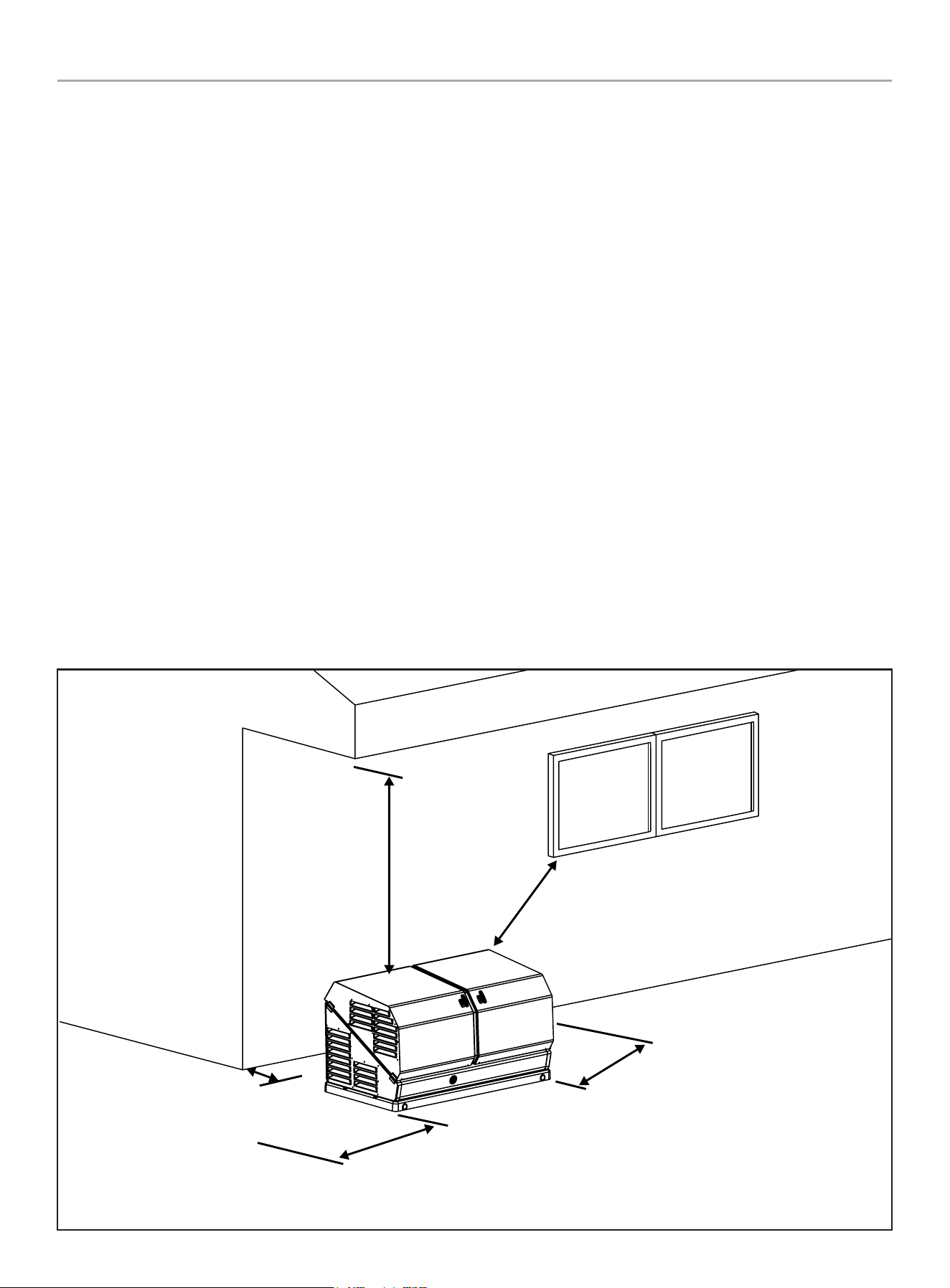
Minimum 17.7 in.
from any buildings
Minimum 5 ft. clearance
beyond exhaust end
14 kW (Model 100515) - 18 in. (1.5 ft.)
for door clearance
22 kW (Model 100304) - 36 in. (3 ft.)
for alternator end and 18 in. (1.5 ft.)
for door clearance
Minimum 5 ft.
from any windows
Minimum 5 ft.
vertical clearance
HOME STANDBY GENERATOR- ALL aXis CONTROLLER
®
MODELS
INSTALLATION
20
Intertek Group PLC Label
Located inside the generator, near the serial number or nameplate label.
NFPA® 37 Standard for the Installation and Use of Stationary Combustion Engines and Gas Turbine
The National Fire Protection Association (NFPA) standard NFPA 37 establishes criteria for minimizing the hazard of fire during the
installation and operation of stationary combustion engines. NFPA 37 limits the spacing of an enclosed generator from openings in walls,
structures and combustible materials outside the enclosure.
NFPA 37 (2015): Section 4.1.4 stipulates that engines installed outdoors shall be located at least 5 ft. (1.5 m) from structures having
combustible walls. Further, a minimum separation shall not be required where the following conditions exist:
All walls of the structure that are closer than 5 ft. from the engine enclosure have a fire resistance rating of at least 1 hr., or
The weatherproof engine enclosure is constructed of noncombustible materials, and it has been demonstrated that a fire within the
enclosure will not ignite combustible materials outside the enclosure.
Intertek Group PLC performed a full-scale fire test under a worst-case fire scenario within the stationary generator enclosure to determine
the ignitability of combustible material near the stationary generator. The enclosure is made of non-combustible materials and the results
and conclusions of the test indicate that a fire within the enclosure would not pose any risk of ignition to nearby combustible materials
or structures. Intertek Group PLC is certifying that this model complies with clause (2) of Section 4.1.4 of NFPA 37 when installed at a
minimum distance of 450 mm (17.7 in.) from a combustible wall.
14-kW (Model 100515)
1193-L-PR-A
ID: 170800364HZH-001
Conforms to / Conforme à:
NFPA 37 4.1.4 CL. 2
22-kW (Model 100304)
4537-L-PR-A
ID: 230200228HZH-001
Conforms to / Conforme à:
NFPA 37 4.1.4 CL. 2

HOME STANDBY GENERATOR- ALL aXis CONTROLLER
®
MODELS
INSTALLATION
21
Champion HSB units have been run and tested at the factory prior
to shipment. They do not require any type of break-in period.
Site Selection, Preparation and Placement
These items are important to the overall performance of the HSB
generator. Many items covered in this section are not optional and
are requirements under Federal, State and Local codes. As with
all generators, your generator must be installed in accordance
with current NFPA-37, NFPA 54, NFPA 58 and NFPA-70 standards.
Contact your local electrical inspector or city hall to insure you
are aware of all codes and regulations. Install the equipment in
compliance with the National Electric Code (NEC). For Canada
installations, refer to Canadian Electrical Code (CEC). Contact your
natural gas supplier to verify that increased BTU gas demand can
be handled with the existing NG meter. The same should done for
LPG fueled generators. This generator in the enclosure is designed
to be installed outdoors only.
Champion HSB units are run and tested at the factory prior to
being shipped. They do not require any type of break-in period.
SUGGESTED SITE SELECTION
The installation of the HSB must comply strictly with NFPA 37,
NFPA 54, NFPA 58 and NFPA 70 standards.
Always install your generator within 20 feet of the NG meter, the
closer the better. This will reduce expensive costs of running fuel
line. In some cases longer runs of fuel line, when not properly
sized may cause inadequate fuel delivery. This could result in
poor starting, lower outputs and diminished overall performance
of the unit. The Champion HSB is shipped from the factory set
up for natural gas (NG) fuel. The HSB can be converted to LPG
if required. Orifices in the master mixer assembly (carburetor)
MUST be changed. The LPG orifices are shipped with the unit and
include installation instructions.
Install the unit in a location where the sump pump discharge,
rain gutter downspouts, roof run off, landscape irrigation, natural
ponding or water sprinklers will not flood the unit or spray the
enclosure entering any inlet or outlet opens.
Position the unit in an area where prevailing winds will carry
the exhaust gas away from any potentially occupied building or
structure.
Install the unit where leaves, grass, snow, ect., will not obstruct
air inlet and outlet openings. If prevailing winds cause blowing or
drifting, you may consider building a windbreak, planting trees or
shrubs within the guidelines and codes applicable.
Watch out for roof overhangs. Snow, ice or rain shouldn’t be
permitted to accumulate on the roof and then cascade onto the
unit.
DANGER
Engine exhaust from the unit is hot, poisonous and dangerous.
Exhaust must be allowed to dissipate into a free air zone as
listed in the applicable codes with no obstructions.
Direct the HSB exhaust away from or parallel to the building or
structure. DO NOT direct the HSB exhaust toward a potentially
occupied building, structure, windows, doors, ventilation intakes,
soffit vents, crawl spaces, open garage doors or other openings
where exhaust gas could accumulate and enter inside or be drawn
into potentially occupied buildings or structures.
Install the unit on higher ground where water levels will not rise
and endanger it. This unit shouldn’t be operated in standing water.
DO NOT place HSB waterproof enclosure under a deck or other
type of structure that may confine or restrict airflow. Operate
HSB only outdoors, where adequate ventilation and air movement
is available. Avoid installations under decks, inside garages or
carports, in basements, along home exterior within 5 feet (1.5m)
of home vent, roof overhang vents, a window that can be opened,
or other such home invasion points. Use the same precautions
when installing HSB at property line, close to a neighbor’s home,
or any building or structure that houses animals.
DANGER
Running engines give off carbon monoxide, an odorless,
colorless, invisible, poison gas.
Breathing carbon monoxide will cause fatigue, headache,
dizziness, vomiting and in prolonged conditions, even death.
Carbon monoxide detectors MUST be installed and maintained
indoors according to the manufacturer’s instructions/
recommendations. Smoke alarms cannot detect carbon
monoxide gas.
The back of the HSB locates the fuel and wire entry points. When
placement/mounting is done this side generally faces the closest
point to each of those sources.
It is always recommended to prepare a drawing showing location
of HSB, typical gas utility approach, circuit connections and full
load connections.
Similar considerations should be given to the location of the ATS
(automatic transfer switch) in relationship to the HSB generator.
The closer to both the fuel meter and the main utility panel
the better. The key point here is, the closer to fuel meter is the
suggested direction to go, wire is cheaper to run and more flexible.
HOME STANDBY GENERATOR- ALL aXis CONTROLLER
®
MODELS
INSTALLATION
22
SUGGESTED PREPARATION
A concrete pad can be poured or purchased through Champion
and the HSB secured to it. In some areas a concrete pad is
required due to high wind potential. Check local codes to see what
type of mounting base is required. If a concrete pad is required,
all federal, state and local codes should be followed. Unless
mandated by federal, state or local code, a concrete pad is not
required.
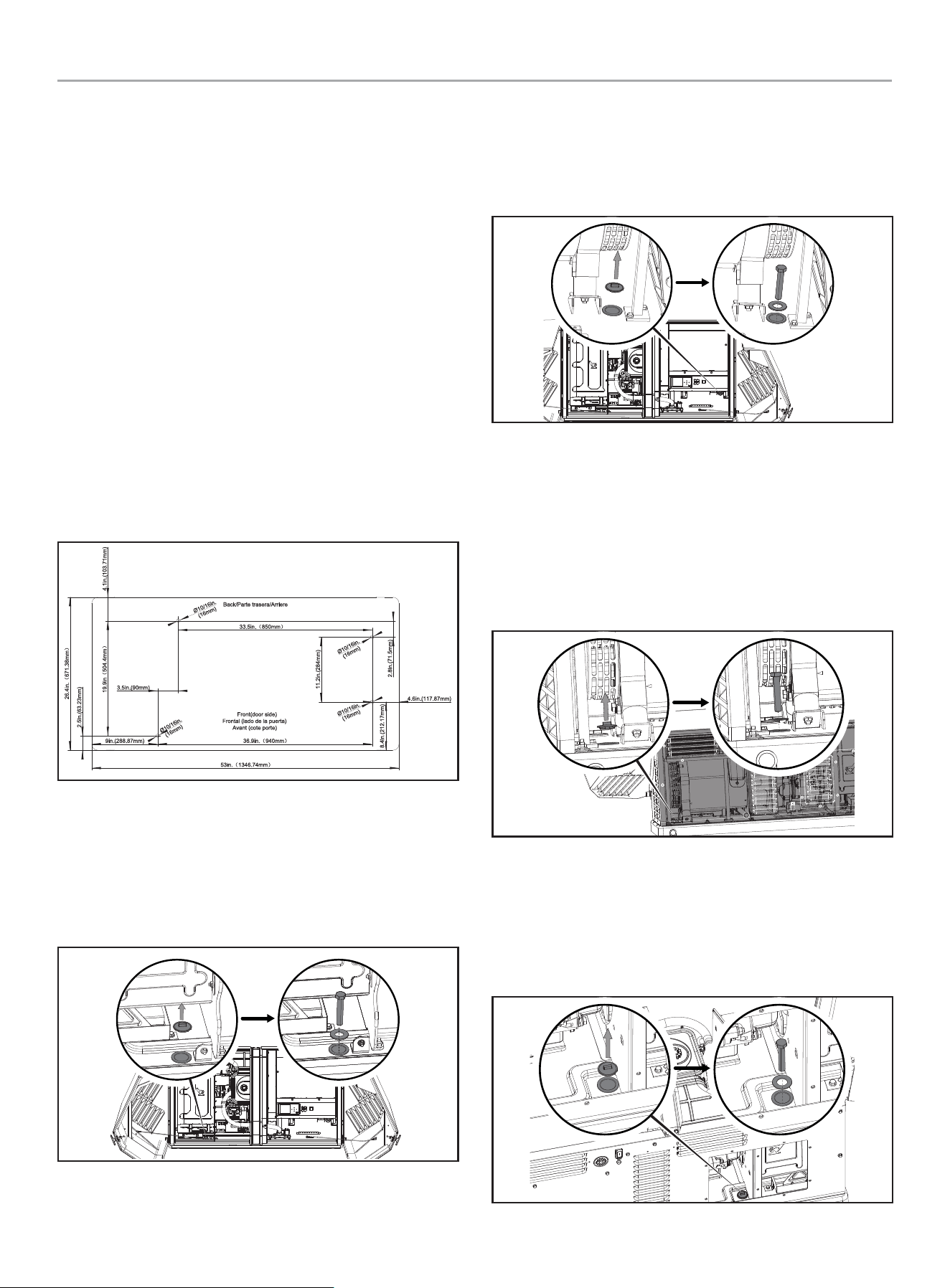
22-KW (MODEL 100304)
1. Below template is found on the inside top cover of your home
standby to help assist you in 1:1 drilling your own holes into
your concrete pad if you are not choosing the approved pad.
2. This template shows the outline of the plastic base on
your home standby.
3. The bolts and washers which tie your home standby to the
concrete pad are included for the approved pad only. If you
choose your own hardware, they must meet hurricane ratings
and fit into the home standby properly. Pay attention to
proper torque values noted.
Front
1. Open left door, access hurricane bushing near front muffler
side as shown. Remove bushing cap, and install washer
and bolt as shown. Bolt and washer will tighten inside the
hurricane bushing below the home standby pan. Torque to 3.2
Nm (2.4 lbf-ft) or hand tight and ⅛ turn more.
2. Open right door, access hurricane bushing near front
alternator side as shown. Remove bushing cap, and install
washer and bolt as shown. Bolt and washer will tighten inside
the hurricane bushing below the home standby pan. Torque to
3.2 Nm (2.4 lbf-ft) or hand tight and ⅛ turn more.
Back
3. From the front side, underneath the alternator, remove
bushing cap, and install washer and bolt as shown. Lineart
shows visual through the back housing. Remove bushing cap,
and install washer and bolt as shown. Bolt and washer will
tighten inside the hurricane bushing below the home standby
pan. Torque to 3.2 Nm (2.4 lbf-ft) or hand tight and ⅛ turn
more.
4. From the back side, through the access panel, access
hurricane bushing near back muffler side as shown. Remove
bushing cap, and install washer and bolt as shown. Bolt and
washer will tighten inside the hurricane bushing below the
home standby pan. Torque to 3.2 Nm (2.4 lbf-ft) or hand tight
and ⅛ turn more.
HOME STANDBY GENERATOR- ALL aXis CONTROLLER
®
MODELS
INSTALLATION
23
If no concrete pad is being used, Champion recommends using a
mixture of pea gravel and sand or crushed stone for placement of
the mounting pad. The mounting pad MUST be level. The gravel
mixture or crushed stone is to permit water runoff, drainage and
reduce ponding of water around the HSB.
Dig an area 5 inches (12.7 cm) deep that is 6 inches (15.2 cm)
longer and wider than the foot print of the HSB. See Specifications
section for L x W dimensions.
Cover the dugout area with a weed barrier or landscape cloth if
desired.
Fill the area with pea gravel and sand mixture or crushed stone.
Final stone level must be 2 or 3 inches (5.1 or 7.6 cm) higher than
the original ground level to ensure water run-off and drainage.
Compact the fill, this is to provide a firm base for the HSB.
Remember the final stone level must be 2 or 3 inches (5.1 or
7.6 cm) higher than the original ground level to ensure water run-
off and drainage.
Tools required
1. General SAE and Metric hand tools, wrenches, sockets and
screwdrivers.
2. Standard electrician’s hand tools, drill and bits.
3. Monometer (for checking fuel pressures).
4. Meter capable of measuring AC/DC Voltage and Frequency
5. Safety apparel
Inspect the unit. Carefully inspect the HSB for any damage
that may have occurred during shipment and delivery. If loss
or damage is noted at the time of delivery, have the person(s)
making delivery note all damage on the freight bill and affix their
signature under the consignor’s memo of loss or damage. If loss
or damage is noted after delivery, separate the damaged materials
and contact the carrier for claims procedures. Parts damaged in
shipping are not covered under Champion warranty.
Unbox the unit, by removing the exterior shipping carton. The ATS
is included, remove the packaging and lift it out. Remove the 4
shipping brackets, 2 on each end that hold the HSB to the wood
shipping pallet. This pallet is for shipping/transportation only and
cannot be used as a mounting pad in any form. Exercise caution
when removing the HSB from the wood pallet, dragging it off the
wood pallet will damage the HSB base. The HSB must be lifted
from the wood pallet to separate.
Contact your natural gas (NG) supplier about the meter size. Most
meters must be replaced with a larger BTU size, due to a larger
demand of BTU’s from the HSB and appliances during operation
(utility outage). This also applies to HSB utilizing LPG.
SUGGESTED PLACEMENT
WARNING
HSBs weigh approximately 300-500 lbs (136-227 kg)
depending on the model. Proper tools, equipment and qualified
personnel should be used in all phases of handling and moving
the HSB. Do not lift or move the HSB without assistance. Do
not lift the unit by the roof structure or any other enclosure
component as damage to the HSB may occur, including
possible injury of persons when handling and or moving the
HSB in this manner.
The Site Selection has been completed, all federal, state and local
codes have been reviewed and applied as mandated by the NFPA
standards and all other related codes/standards.
Preparation has been completed and everything has been properly
prepared to place the HSB.
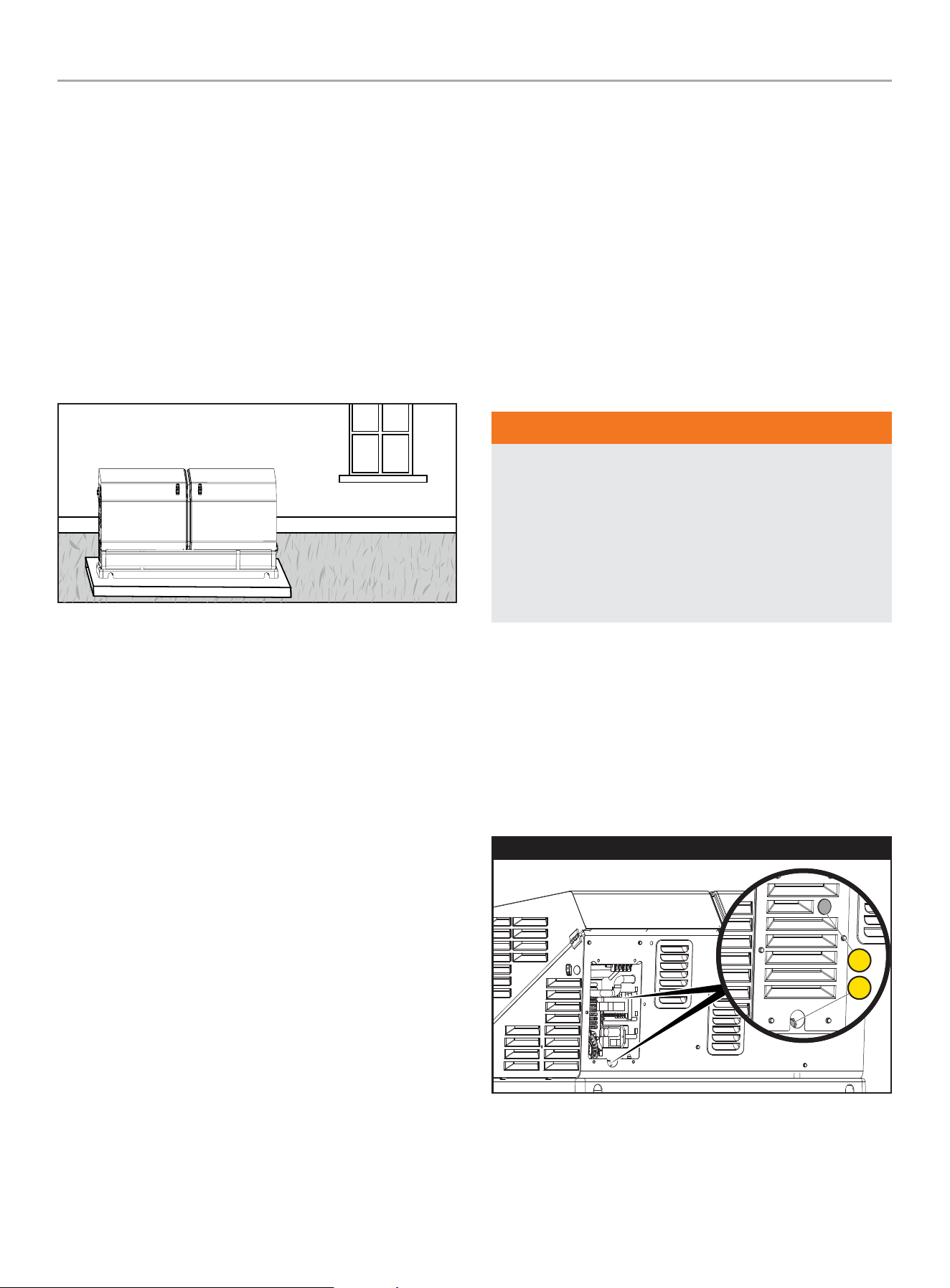
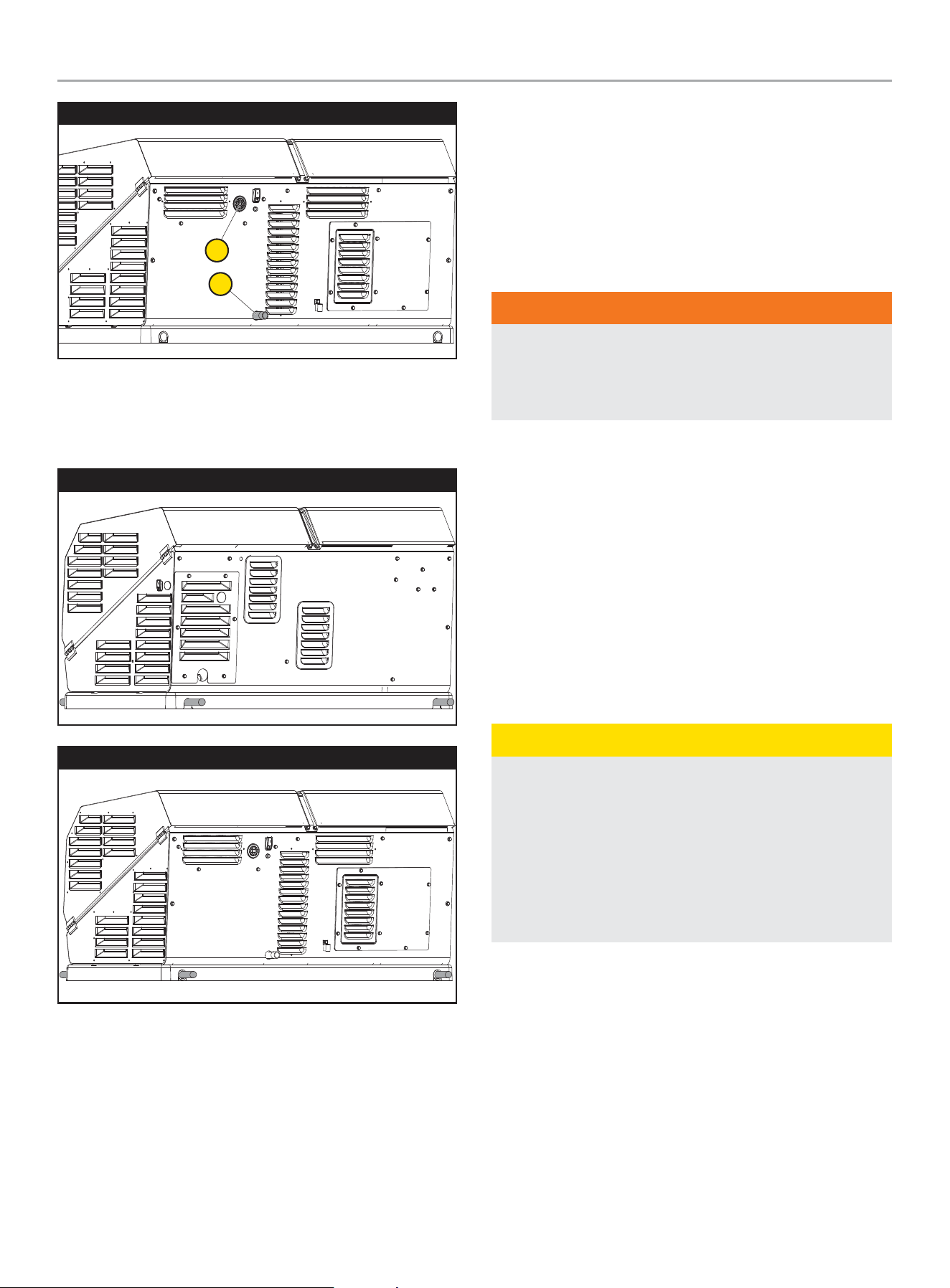
The rear right side of the HSB locates the fuel (A) and electrical (B)
entry points. When placement is done this side generally faces the
closest point to each of those sources for fuel and electrical entry.
14-kW (Model 100515)
B
A
HOME STANDBY GENERATOR- ALL aXis CONTROLLER
®
MODELS
INSTALLATION
24
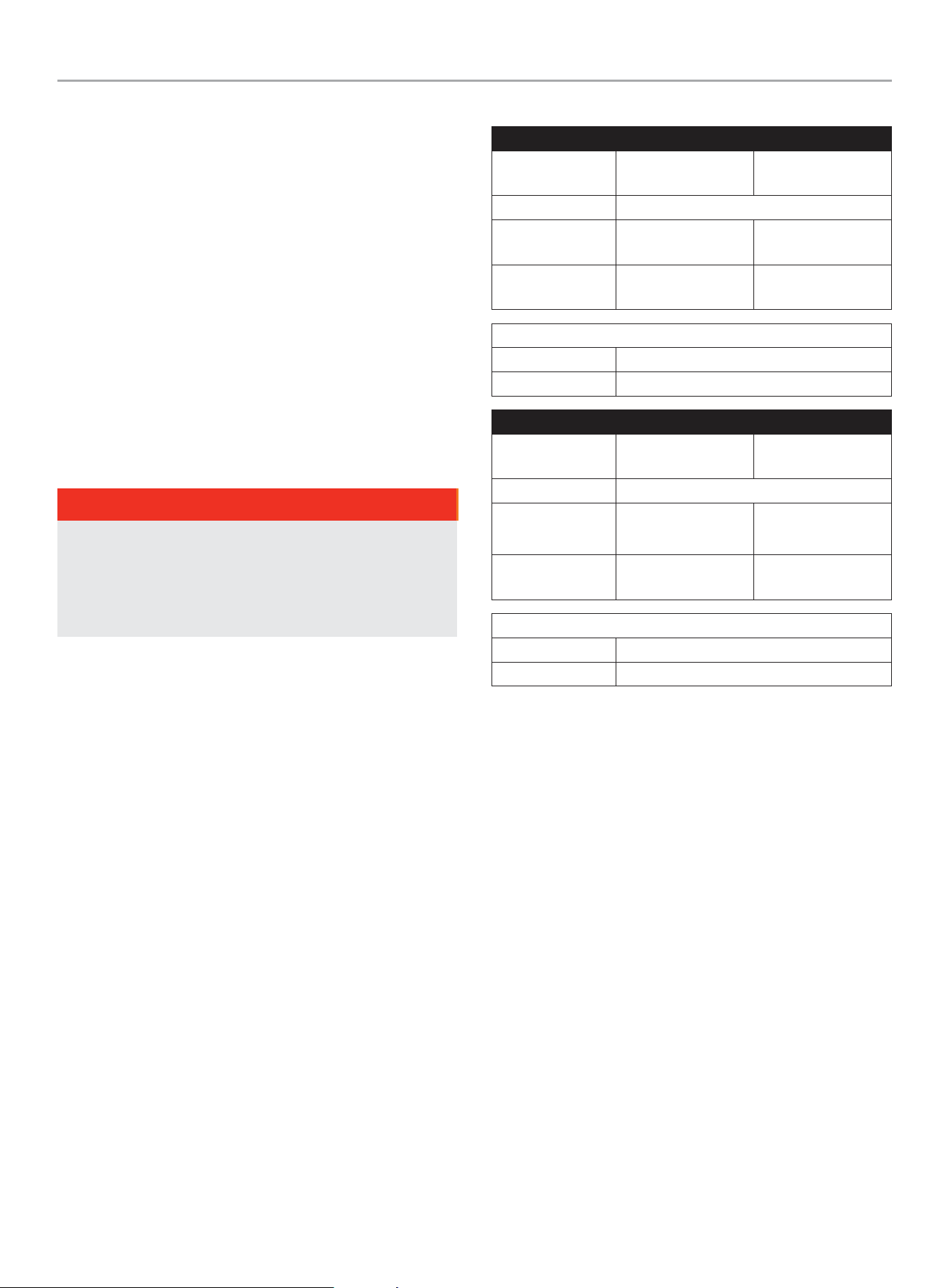
22-kW (Model 100304)
B
A
Two (2) 5 feet (1.5 m) lengths of 3/4 inch (1.9 cm) steel pipe
(supplied by the installer), are required to lift the HSB. Insert the
steel pipes through the lifting holes located near the HSB base in
the composite pad, on each end.
14-kW (Model 100515)
22-kW (Model 100304)
You may also lift the HSB using a properly rated strap, lift, hook
and hoist procedure attached to both steel lifting pipes, provided
that you use spreader bars to ensure that the belts, chains or
cables DO NOT touch/contact the HSB.
Once the HSB has been placed, check to make sure it is level. If it
isn’t, make adjustments prior to installation procedures start.
Installation Preparation
WARNING
Improper installation can result in personal injury and damage
to the generator. It may also result in the warranty being
suspended or voided. All the instructions must be followed
including location clearances and pipe size.
Once Site Selection, Preparation and Placement has been
completed, you can proceed to Installation Preparation. Without
these in place you may encounter problems moving forward.
There are a number of key items that MUST be addressed prior
to the physical installation of the HSB. The installation of the HSB
must comply strictly with all applicable codes, standards and
regulations (NFPA 37, NFPA 54, NFPA 58, and NFPA 70).
Check and confirm that the aXis Controller
®
is in the “OFF”
position. It is recommended to pull the control module fuse located
on the front panel and turn the circuit breaker to the OFF position.
Champion HSB units have been run and tested at the factory prior
to being shipped. They do not require any type of break-in period.
CAUTION
Check oil level, add oil if required. Add oil to full capacity as
stated in the specification section before starting the HSB.
Never operate the HSB with the engine oil level below the
“ADD” mark on the dipstick, doing so could damage the
engine. Check the oil level and add the appropriate viscosity
and amount indicated on the oil dipstick full line. The
recommended oil type for typical use is 0W-40 full synthetic
oil.
The following will be covered;
1. Fuel Requirements and Recommendations
2. Fuel Consumption
3. NG Pipe Sizing, flexible fuel line
4. LPG Vapor Pipe Sizing, flexible fuel line
5. Converting to LPG
6. Full Flow Shut Off Valve
7. Sediment Trap
8. Checking Pressure with a Manometer
9. Battery Requirements, Installation & Service
HOME STANDBY GENERATOR- ALL aXis CONTROLLER
®
MODELS
INSTALLATION
25
10. Wiring of the HSB
1. FUEL REQUIREMENTS AND RECOMMENDATIONS
The following NG and LPG fuel information is provided to assist
the fuel installer. This information should not be deemed to be
all inclusive or to conflict with local dry fuel codes. Consult your
local fuel supplier or Fire Marshall for guidance on proper local
codes and installations. Local codes will mandate correct routing
of gaseous fuel line piping around gardens, shrubs and other
landscaping to prevent any damage.
Special considerations should be given when installing the
HSB where local conditions include might flooding, tornadoes,
hurricanes, earthquakes and unstable ground. These are
considerations for the flexibility and strength of piping and their
connections.
NG is lighter than air and will collect in high areas. LPG is heavier
than air and will settle in low areas.
DANGER
Gaseous fuels such as NG and LPG are highly explosive.
Even the slightest spark can ignite such fuels and cause an
explosion, which could cause burns, fire or explosion resulting
in serious injury, property damage or even death. NO leakage
is permitted.
Recommended fuels should have a BTU content of at least 1,000
BTU’s per cubic foot for NG, or at least 2,500 BTU per cubic foot
for LPG. Ask the fuel supplier for the BTU content of the fuel.
Before NG fuel lines plans are made, call your NG supplier, provide
them information on the amount cubic feet/hour and the BTU’s/
hour that the HSB will use, and ask if the NG meter and primary
regulator can accommodate the addition of the NG generator. NG
companies have different meters for increased BTU demands.
Utilize the “Fuel Consumption (BTU) Chart” contained in this
manual or the Installation Manual for your specific HSB model.
Verify that the current gas meter is capable of providing enough
fuel flow to include household appliances and other loads
including the addition of the HSB. Check the NG primary regulator,
connected at the NG meter output. The correct primary regulator
is set at 5 to 7 inches water column. The existing primary
regulator may be undersized once the HSB is added.
The HSB engine can run on either NG or LPG. The HSB comes
equipped from the factory to run on NG. If your installation
requires the engine to run on LPG, orifices in the master mixer
assembly (carburetor) MUST be changed. The LPG orifices are
shipped with HSB. Refer to “Converting to LPG” in this manual or
the “Installation Manual” for your specific HSB model.
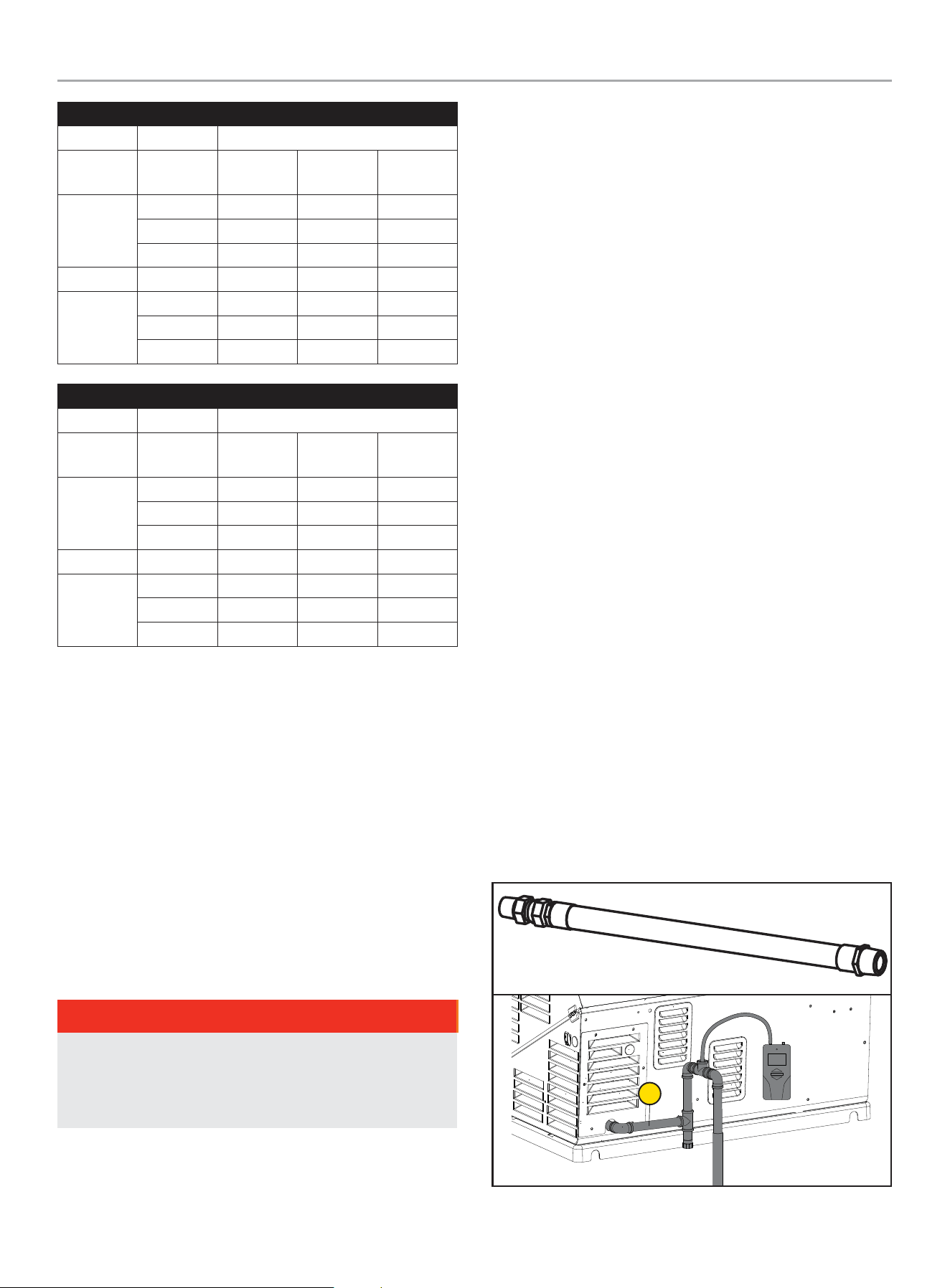
Fuel System Requirements
14-kW (Model 100515)
Fuel System
Requirements
LPG NG
Fuel Supply Inlet 3/4 in. NPT
Fuel Supply
Pressure
10 – 12 inch-H20
(2.5 – 3.0 kPa W.C.)
5 – 7 inch-H2O
(1.2 – 1.7 kPa W.C.)
Maximum flow
rate @ 14kW
10.1 l/hr 5.3 m
3
/hr
Nominal Fuel Rating
LPG 2500 BTU/ft
3
NG 1000 BTU/ft
3
22-kW (Model 100304)
Fuel System
Requirements
LPG NG
Fuel Supply Inlet 3/4 in. NPT
Fuel Supply
Pressure
10 – 12 inch-H20.
(2.5 – 3.0 kPa W.C.)
5 – 7 inch-H2O
(1.2 – 1.7 kPa W.C.)
Maximum flow
rate @ 22kW
13.7 l/hr 7.7 m
3
/hr
Nominal Fuel Rating
LPG 2500 BTU/ft
3
NG 1000 BTU/ft
3
Install the fuel system in accordance with NEC and local codes.
The HSB is EPA Phase 3 certified for LPG and NG fuels.
2. FUEL CONSUMPTION
Air density is less at high altitudes, resulting in less available
engine power. Engine power will decrease 3.5% for each 1,000
feet (300 m) above sea level and 1% for each 10° F (5.5° C) above
77° F (25° C). Make sure these factors are considered when
determining total HSB load.
The gas supply and pipe MUST be sized at 100% load BTU rating.
Understand that as a specific fuel supply line pipe diameter is
extended in length, its ability to carry the volume of gas diminishes
in direct proportion. Improper fuel pipe sizing is the number one
reason for poor operating performance (hard starting, output).
Required fuel pressure for NG is 5 – 7 inches water column.
Required fuel pressure for LPG vapor is 10 – 12 inches water
column. These are estimated fuel supply requirements listed.
Refer to “Fuel Consumption Chart” above.
HOME STANDBY GENERATOR- ALL aXis CONTROLLER
®
MODELS
INSTALLATION
26
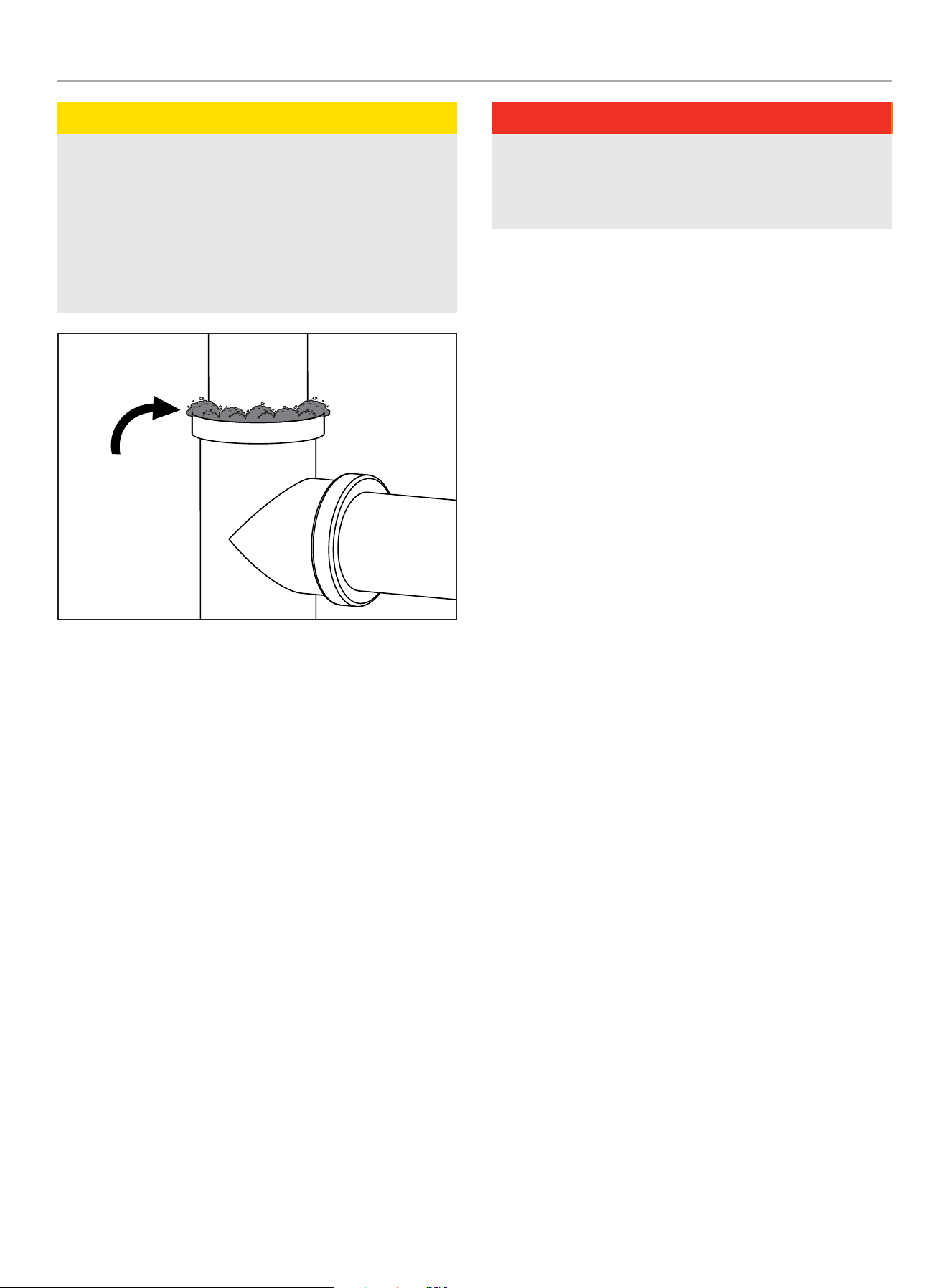
14-kW (Model 100515)
Consumption
Fuel
Type
Percent
Load
L/hr gal/hr BTU/hr
LPG
0% 3.1 0.8 74,729
50% 5.9 1.6 143,412
100% 9.9 2.6 239,665
m
3
/hr ft
3
/hr BTU/hr
NG
0% 1.8 63.6 63,566
50% 3.3 116.5 116,538
100% 5.1 180.1 180,105
22-kW (Model 100304)
Consumption
Fuel
Type
Percent
Load
L/hr gal/hr BTU/hr
LPG
0% 6.1 1.6 147,76 5
50% 7.6 2.0 182,590
100% 13.7 3.6 332,048
m
3
/hr ft
3
/hr BTU/hr
NG
0% 3.8 134.5 134,549
50% 4.9 173.4 173,395
100% 7.7 270.2 270,157
3. NG PIPE SIZING
The HSB leaves the factory set up for NG, no changes or alteration
need to be made if NG is the fuel source you are going to use
The following NG fuel information is provided to assist the fuel
installer. This information should not be deemed to be all inclusive
or to conflict with local dry fuel codes. Consult your local fuel
supplier or Fire Marshall for guidance on proper local codes and
installations. All piping must comply with NFPA 54 and related
codes. Gas line connections should be made by a certified
plumber familiar with local codes.
Always use AGA approved gas pipe and a quality pipe sealant or
joint compound. The piping should conform to federal and local
codes, rigidly mounted and protected from vibration. Piping should
be black iron or steel to avoid reacting with the sulfur in the fuel.
DANGER
NG is highly explosive. Even the slightest spark can ignite and
cause an explosion, which could cause burns, fire or explosion
resulting in serious injury, property damage or even death. NO
leakage is permitted. Safety is important.
Gas pipe sizing is critical to the proper operation of the HSB. The
HSB fuel inlet size has no bearing on the proper gas pipe size
running to the HSB. Gas supply and pipe MUST be sized at 100%
load BTU rating. Understand that as a specific fuel supply line pipe
diameter is extended in length, its ability to carry the volume of
gas is diminished in direct proportion.
Pipe sizes are measured by inside diameter (ID) to include any
fittings, valves, elbows, tees or angles. Add 2.5 feet (.76 m) per
bend, tee or angle in the pipe line to the overall distance, for each
90 degree elbow, add 8 feet (2.4 m) to the measurement. Use a
pipe sealant or joint compound approved for use with LPG/NG on
all threaded fittings to assure zero leakage.
A dedicated NG fuel supply line pipe and primary gas regulator is
mandatory for proper operation. A minimum of one (1) approved,
external manual full flow shutoff gas valve must be installed in the
fuel supply line pipe leading to the HSB. This line must be easily
accessible.
FLEXIBLE FUEL LINE
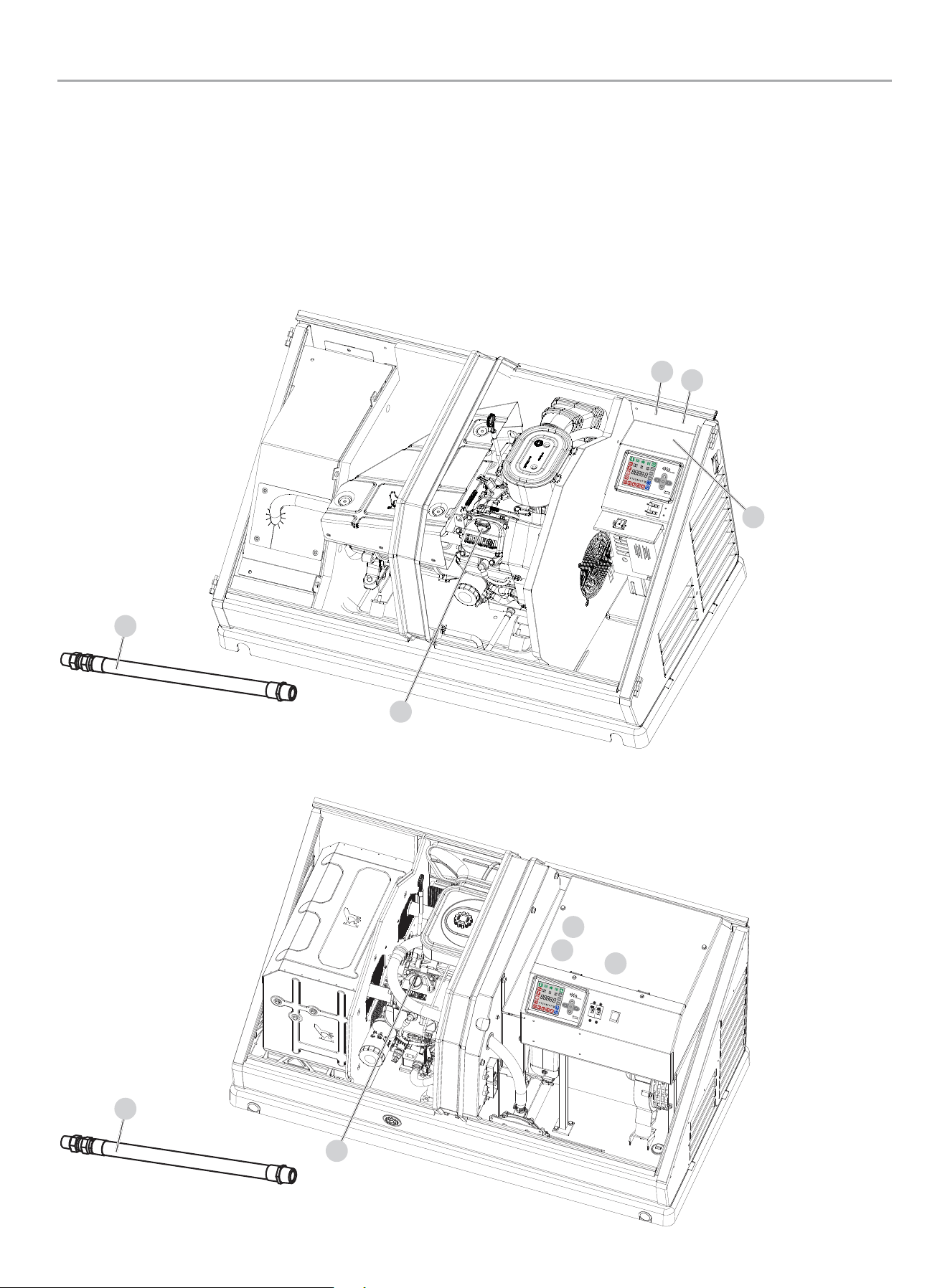
A flexible fuel line (1) is to be installed between the stationary fuel
supply line pipe and the fuel inlet pipe to the HSB. This flexible
fuel line is included with the HSB. The purpose of the flexible fuel
line is to ensure that vibration from the HSB does not cause a gas
leak at one of the connection points. The flexible fuel line is not
to be installed underground, in contact with any enclosure parts
or contact with the ground. The entire flexible fuel line must be
visible for periodic inspection and must not be concealed within
nor contact nor run through any wall, floor, partition or fence.
Never bend flexible fuel line to avoid using an elbow. Bending
the flexible fuel line decreases its ability to absorb vibrations
and could restrict the actual fuel flow. Because a HSB engine is
prone to vibration, a flexible piping connection to the gas supply
is required. Connect the HSB to the gas supply piping with an
approved flexible gas line according to local codes. The flexible
gas line also protects against settlement between the HSB pad
and the ridged gas supply piping.
1
HOME STANDBY GENERATOR- ALL aXis CONTROLLER
®
MODELS
INSTALLATION
27
CAUTION
Check for leaks by spraying all connection points with a soap
solution made of dishwashing liquid and water. If you see
bubbles, this indicates a leak and the connection should be
corrected. Check each connection point, there should not be
a visible bubbling when soap solution applied. Installed piping
must be properly purged and leak tested, in accordance with
applicable codes and standards. A sediment trap should be
placed in the fuel supply pipe line to drain any condensation.
Bubble
indicates leak
Bubbles
indicate leak
Refer to the “Fuel Pipe Sizing Chart” contained in this manual.
Champion HSB units have been run and tested at the factory prior
to shipment. They do not require any type of break-in period.
4. LPG VAPOR PIPE SIZING
The HSB leaves the factory set up for NG. If you are going to fuel
the HSB with LPG you MUST change the Master Mixer Assembly
(carburetor system) for LPG usage. The HSB will not perform on
LPG if the carburetor system is not changed from NG to LPG. Refer
to “Converting to LPG” in this manual. If your installation requires
the engine to run on LPG, a set of orifices in the Master Mixer
Assembly (carburetor system) MUST be changed for 14-kW (Model
100515). The LPG set of orifices are enclosed (shipped) with the
HSB.
22-kW (Model 100304) only requires to change the entire
mixer assembly jet block. The jet block is enclosed (shipped) with
the HSB.
The following LPG information is provided to assist the fuel
installer. This information should not be deemed to be all inclusive
or to conflict with local dry fuel codes. Consult your local fuel
supplier or Fire Marshall for final answers on proper local codes
and installation. All piping must comply with NFPA 54 and related
codes. Gas line connections should be made by a certified
plumber familiar with local codes.
DANGER
LPG is highly explosive. Even the slightest spark can ignite and
cause an explosion, which could cause burns or fire resulting
in serious injury, property damage or even death. No leakage
is permitted. Safety is important.
Gas pipe sizing is critical to the proper operation of the HSB. The
HSB fuel inlet size has no bearing on the proper gas pipe size
running to the HSB. Gas supply and pipe MUST be sized at 100%
load Btu rating.
Pipe sizes are measured by inside diameter (ID) to include any
fittings, valves, elbows, tees or angles. Add 2.5 feet (.76 m) per
any bend, tee or angle in the pipe to the overall distance. For each
90 degree elbow, add 8 ft. (2.4m) to the measurement. Use a pipe
sealant or joint compound for use with LPG/NG on all threaded
fitting to assure zero leakage.
The LPG must be a vapor withdrawal system. The HSB will not
work on a liquid withdrawal system. Gas line connections should
be made by a certified plumber familiar with local codes.
New LPG tanks and existing LPG tanks already located at the
installation site, have a primary fuel regulator set and intended for
home heating and cooking. This regulator might not be properly
sized to accommodate the addition of the HSB. Contact the local
LPG supplier to properly size the fuel regulator.
Make sure the tank is sized large enough to provide the required
Btu’s for the HSB and all connected appliances.
The LPG fuel tank must have a dedicated primary fuel regulator
mounted at the tank fuel outlet point and set for 6 ounce pressure,
10 -12 inch water column. A direct, dedicated fuel line connected
directly to the HSB mounted secondary regulator, also set at
6 ounce pressure, 10 -12 inch water column. When sizing the
secondary regulator for LP applications be sure to note the
maximum individual load capabilities. This could impact HSB
starting performance if sized to small. It is not recommended to
reduce the fuel supply line pipe exiting the secondary regulator
unless to accommodate the flexible fuel line required to install and
shipped with the unit. The may result in starting or performance
issues with the HSB.
Make sure fuel supply line pipe includes an on/off external manual
full flow shut off gas valve at both the LPG tank and at the point of
connection to the HSB.
A sediment trap should be installed into the fuel supply pipe line to
drain any condensation.
HOME STANDBY GENERATOR- ALL aXis CONTROLLER
®
MODELS
INSTALLATION
28
FUEL PIPE SIZING CHART
NOTICE
Reduced pipe size will affect fuel delivery and performance.
Measure the pipe length from the generator fuel inlet to the
primary gas pressure regulator.
Pipe Length* NG LPG
25 ft (8 m) 3/4 in. NPT 3/4 in. NPT
50 ft (15 m) 1 in. NPT 3/4 in. NPT
100 ft (30 m) 1 in. NPT 1 in. NPT
150 ft (46 m) 1-1/4 in. NPT 1 in. NPT
200 ft (61 m) 1-1/4 in. NPT 1 in. NPT
* Add 2.5 ft (0.76 m) per bend, tee or angle in the pipe line to overall distance, for
each 90 degree elbow, add 8 feet (2.4 m) to the overall measurement.
5. CONVERTING TO LPG
Jet Change Procedures - 14-kW (Model 100515)
The engine is fitted with a dual Master Mixer Assembly (carburetor
system), which allows the HSB to run on either NG or LPG. It has
been configured at the factory to run on NG. If your installation
requires to run on LPG, orifices or jets in the Master Mixer
Assembly (carburetor system) must be changed. The LPG orifices
or jets are shipped with the HSB. Place a rag in the valley of the
engine to prevent damaging other components from any dropped
parts.
Tools Required:
- 4 mm hex bit socket or 4 mm T-Handle hex key - 4 mm allen
wrench is included.
- Ratchet Wrench for bit socket
- 10mm wrench or ratchet
- Torque wrench
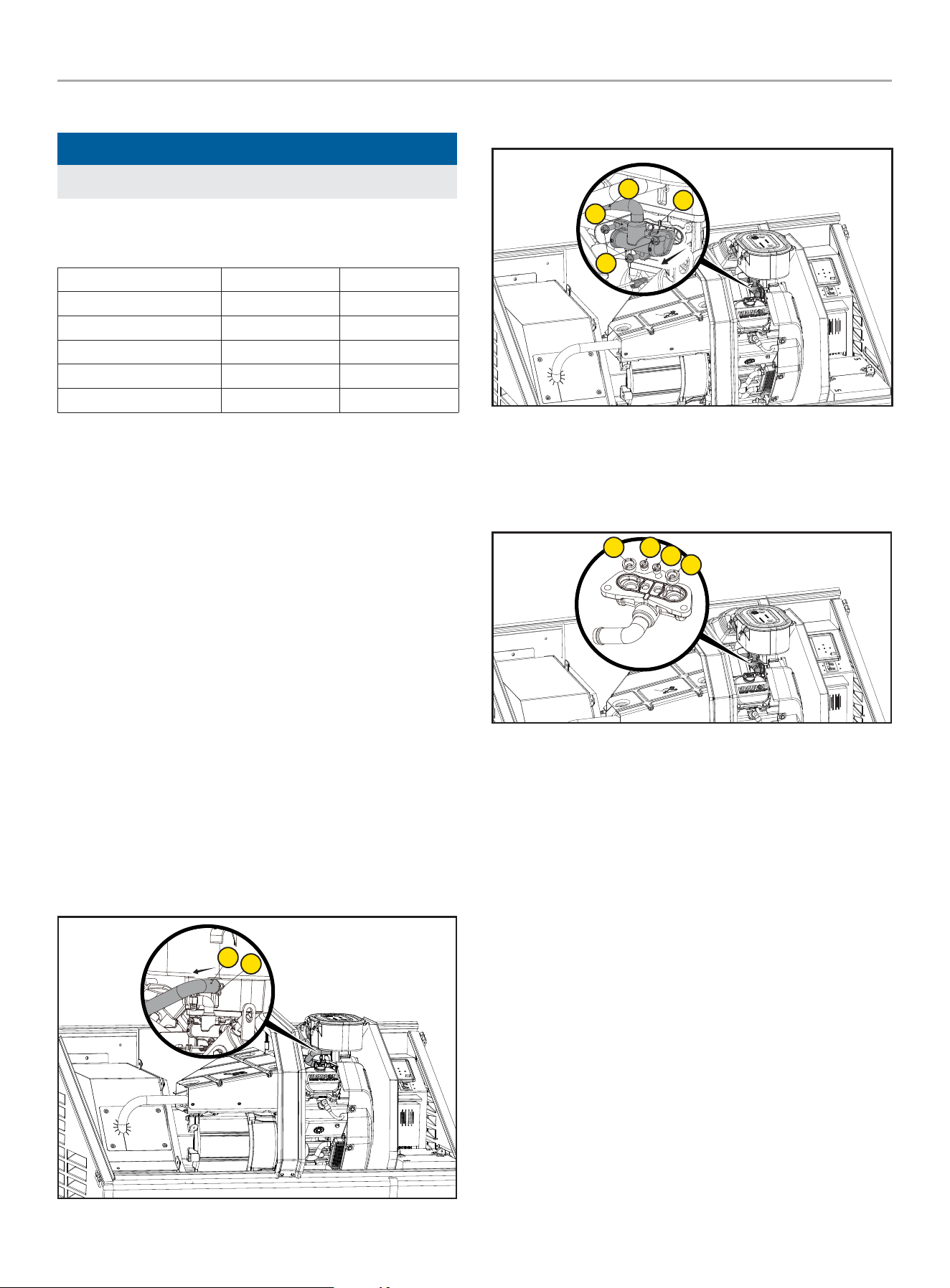
1. Remove breather tube (1) by loosening breather tube clamp
(2).
1
2
2. Remove fuel inlet chamber screws (3). Remove fuel inlet
chamber (4) along with fuel hose (5) and gasket (6).
6
5
4
3
3. Remove left side main jet (7), right side main jet (8), left side
slow jet (9) and right side slow jet (10). Recommend tool
for removing main jet: Special Tool (Part number 100908).
Recommend tool for removing slow jet: Driver Bit, 7/32 Slot -
Flat Head
9
10
8
7 9
8
10
4. Install LPG jets and gasket (6) to fuel inlet chamber.
Left side main jet: Size #410 (11)
Right side main jet: #430 (12)
Left side slow jet: Size #130* (13)
Right side slow jet: #120* (14)
Main Jet Tightening Torque: 34.7 lb.-in (3.92Nm)
Slow Jet Tightening Torque: 17.3 lb.-in (1.96Nm)
* No slow jet required for NG.
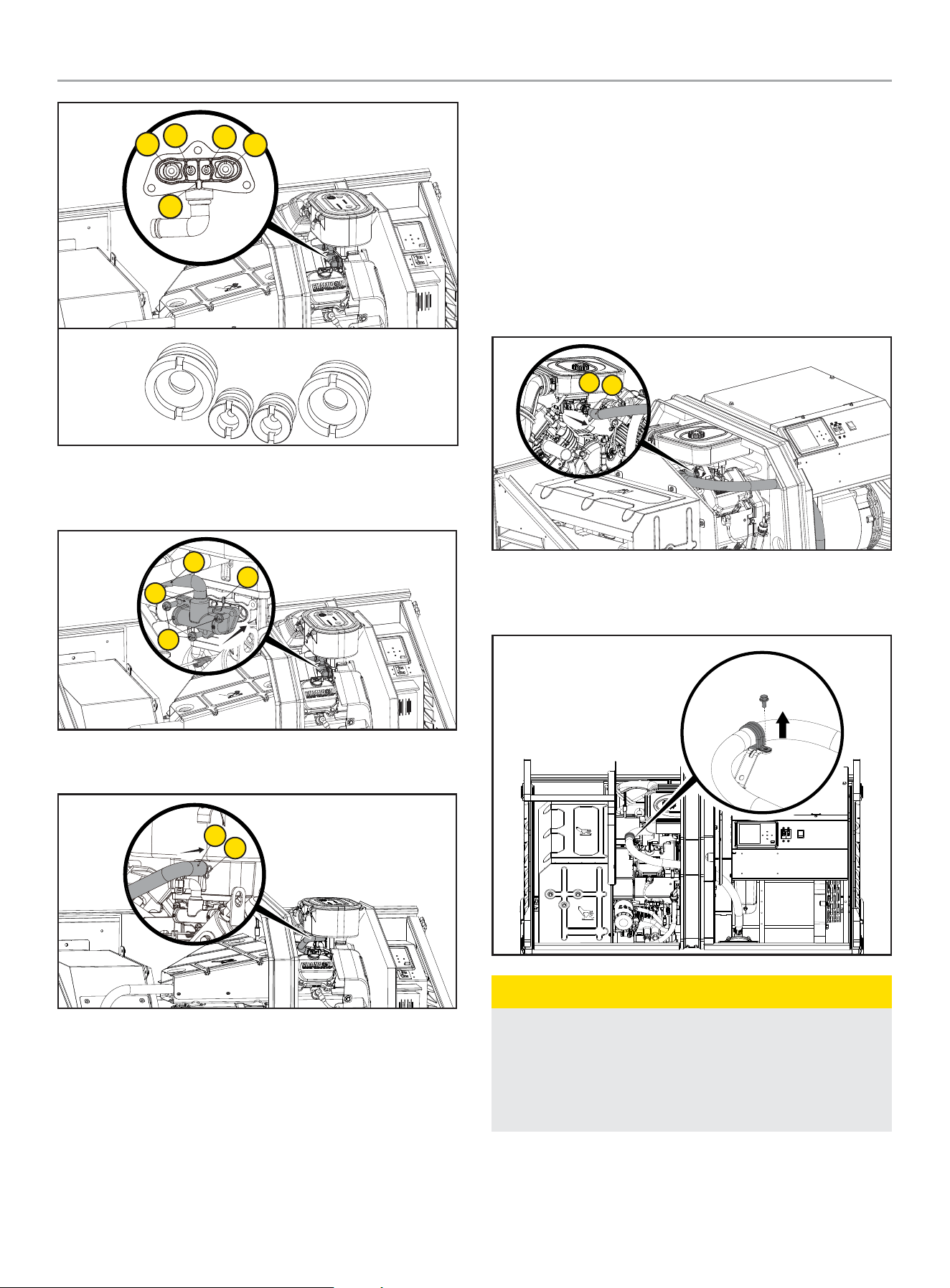
HOME STANDBY GENERATOR- ALL aXis CONTROLLER
®
MODELS
INSTALLATION
29
6
11
13
14
12
6
11
13
14
12
5. Install fuel inlet chamber to mixer body. Tighten fuel inlet
chamber screws (3). Screw Tightening Torque: 26.0 lb.-in.
(2.94Nm).
4
5
6
3
3
4
5
6
6. Connect breather tube (1) to breather port and put clamp (2)
on breather tube.
1
2
1
2
Mixer Change procedures - 22-kW (Model 100304)
The engine is fitted with a dual Master Mixer Assembly (carburetor
system), which allows the HSB to run on either NG or LPG. It has
been configured at the factory to run on NG. If your installation
requires to run on LPG, you need to exchange the Master Mixer
Assembly (carburetor system). This Master Mixer Assembly is
included for LPG conversion. Place a rag in the valley of the engine
to prevent damaging other components from any dropped parts.
After removing the air cleaner base, place a rag around the base
of the mixer assembly in case an o-ring, gasket or screw drops.
Tools Required:
- 4 mm hex bit socket or 4 mm T-Handle hex key - 4 mm allen
wrench is included.
- Ratchet Wrench for bit socket
- 10mm wrench or ratchet
- Torque wrench
1. Remove fuel hose (1) by loosening the fuel hose clamp (2).
2
1
2
1
2. Remove P clamp by removing M10 bolt. This will give you
easier access to remove and install the Master Mixer
Assembly.
CAUTION
Before removing the air cleaner base, place a rag in the intake
to prevent any parts from falling inside the engine.
After removing the air cleaner base, place a rag around the
base of the mixer assembly in case an o-ring, gasket or screw
drops.
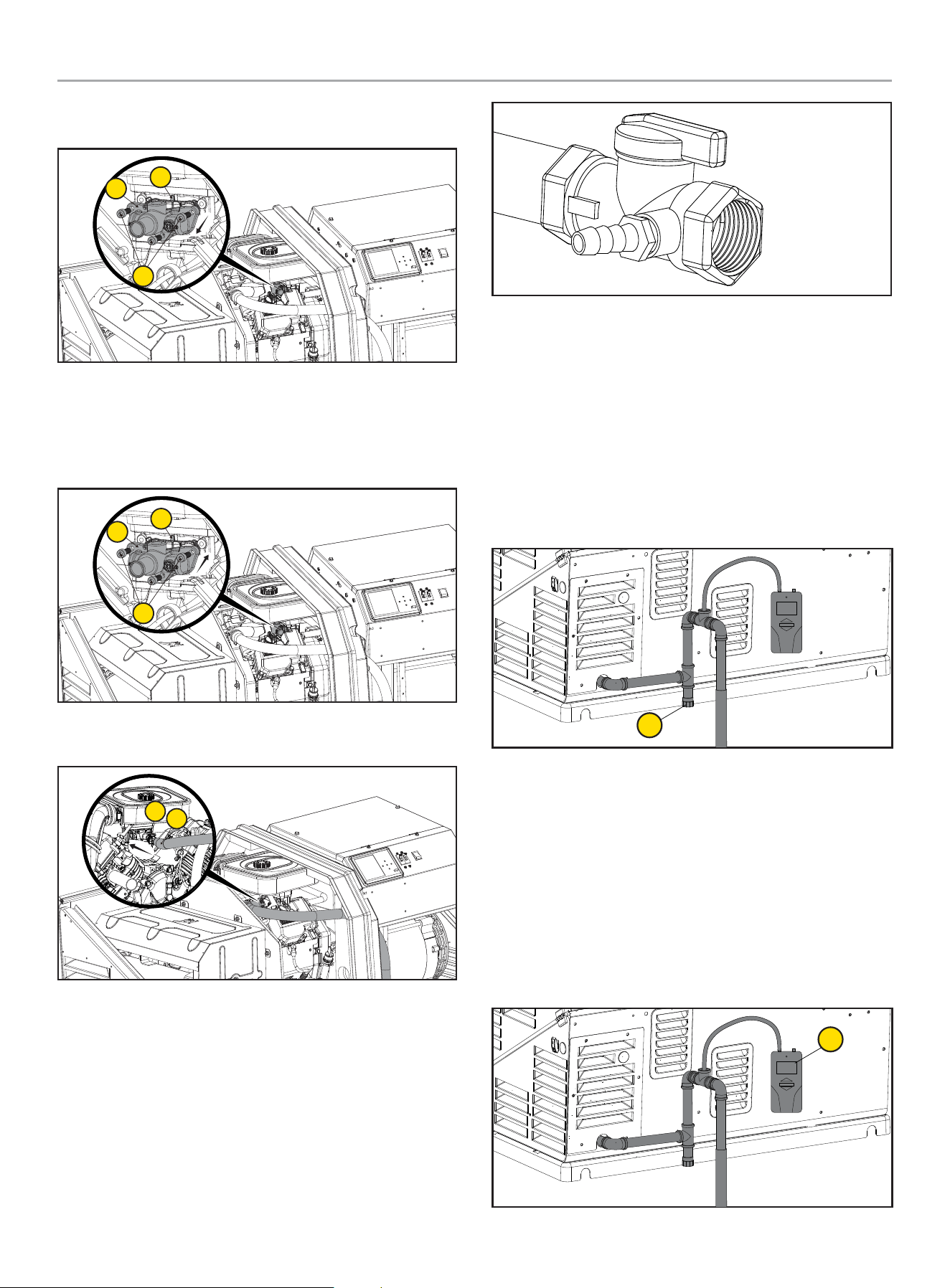
HOME STANDBY GENERATOR- ALL aXis CONTROLLER
®
MODELS
INSTALLATION
30
3. Remove fuel inlet chamber screws (3). Remove Master Mixer
Assembly (4) along with the gasket (5).
4
5
3
5
4
3
4. Install Master Mixer Assembly (4) with the green dot (this
indicates LPG) to mixer body. Make sure the gasket (5) is
installed on the fuel inlet chamber side. Tighten Master Mixer
Assembly screws (3). Screw Tightening Torque: 26.0 lb.-in
(2.94Nm).
4
5
3
3
4
5
5. Connect fuel hose (1) to master mixer assembly and put
clamp (2) on fuel hose.
2
1
1
2
6. FULL FUEL SHUT OFF
A minimum of one accessible, approved manual full fuel shutoff
valve shall be installed in the fuel supply line of the HSB. A manual
full fuel shut off valve should be installed inside the building, for
those locations with inside gas meters. The full flow shut off valve
should be installed in accordance with all applicable codes and
standards.
7. SEDIMENT TRAP
A sediment trap should be installed into the fuel supply line
pipe when using either NG or LPG to drain any condensation.
Always make sure the HSB is completely in the OFF position and
the full flow fuel shut off valve is closed before removing the
sediment trap for drainage. Use a pipe sealant or joint compound
approved for use with LPG/NG on all threaded fittings to reduce
the possibility of leakage. Install a sediment trap (1) downstream
of the HSB shut-off valve as close to the inlet as possible in
accordance with local codes.
1
8. CHECKING PRESSURE WITH A MANOMETER
This check should only be done when the HSB and ATS have been
installed, properly inspected and ready for testing.
A Manometer is a general term for any device that measures
pressure. A gas manometer (1) measures gas pressure. It’s
important to make sure the correct amount of fuel is being
delivered to the HSB when it starts and at full load usage, the
Manometer provides the ability to check the fuel pressure
throughout the operation of the HSB. A Manometer port should be
placed in the fuel supply pipe line.
1
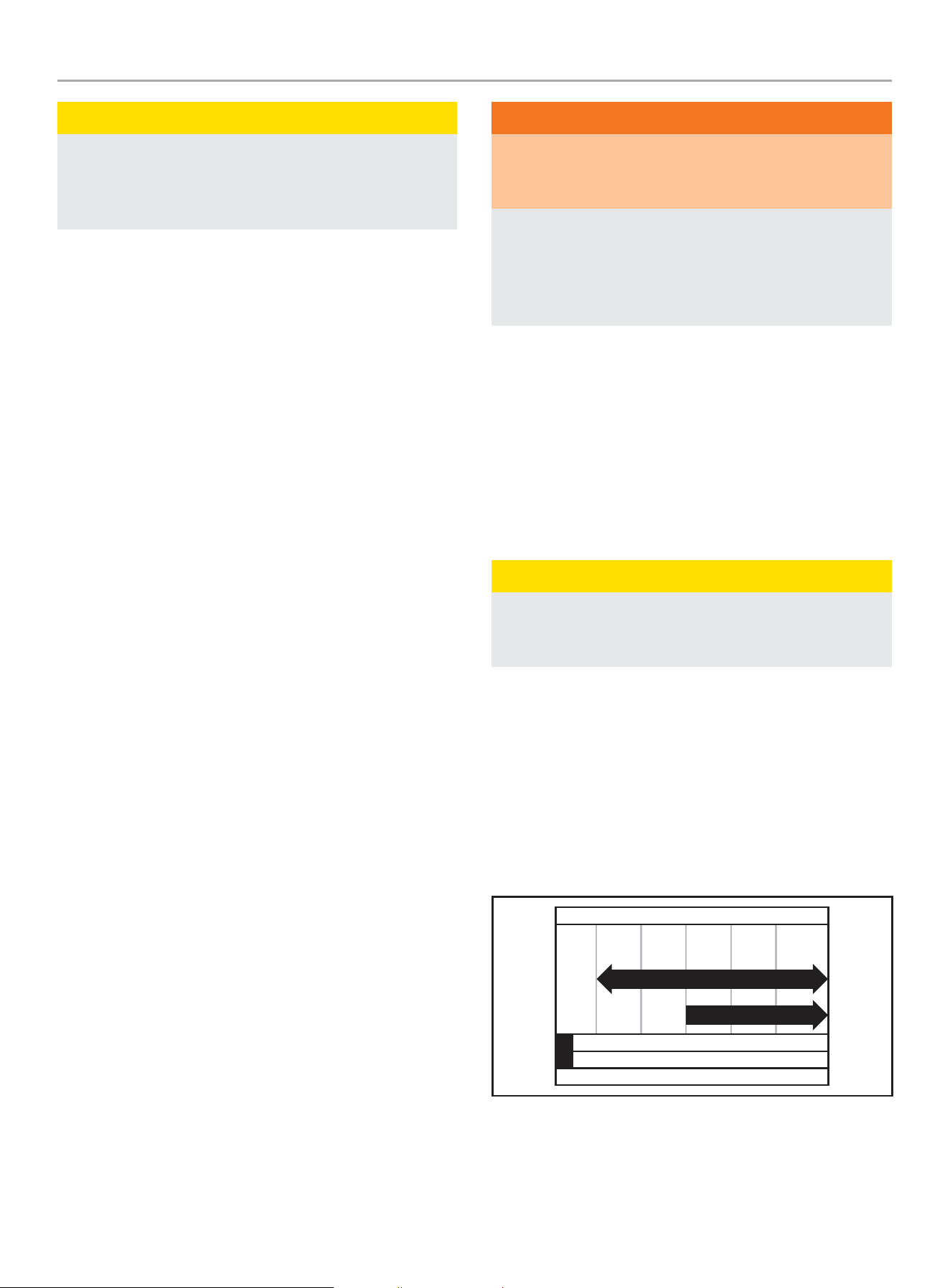
HOME STANDBY GENERATOR- ALL aXis CONTROLLER
®
MODELS
INSTALLATION
31
CAUTION
Remove the plug, install the Manometer. Open the gas
supply valve check to make sure the pressures are within the
specified values for NG or LPG. This is always a good starting
point for evaluations related to poor performance.
After all appliances have been turn on, start the HSB. If the
Manometer stays within 5 -7 inches of water column for NG,
10 -12 inches of water column for LP, with full load applied to a
proper running HSB, the installation is good.
If the Manometer reading falls below the listed inches of water
column for either specific gas rating while the HSB engine is
starting or running. It may be an indication that the gas meter or
primary regulator is undersized.
If the Manometer reading stays within the specific gas rated
inches water column, but the HSB engine will not start, run erratic,
it may indicate insufficient fuel volume due to long fuel supply pipe
line, incorrect full pipe diameter. Recheck you initial calculations to
ensure where the problem might exist. Champion HSB units have
been run and tested at the factory. They do not require any type of
break-in period.
9. BATTERY REQUIREMENTS, INSTALLATION & SERVICE
Battery sizing is a topic that is discussed and debated for a
number of reasons. The battery size, cold cranking amps (CCA),
starting cycle or deep cycle are all items for consideration. The
following will assist you to better understand the battery, the
codes and the purpose of the battery. It is extremely important
to follow all cautions and warnings per the battery manufacturer
concerning installation, service, maintenance and replacement
procedures.
Battery Council International (BCI) is an association of battery
industry companies whose members establish policy and
standards for the industry.
Battery Size is the physical dimensions of a battery. BCI assigns
letters and numbers for North American battery size types.
Cold Cranking Amps (CCA) is a rating that is used to define
the batteries ability to start an engine under low-temperature
conditions. BCI defines it as “the number of amps a lead-acid
battery at 0 degrees F can deliver for 30 seconds”.
Starting (cranking) Cycle Battery is designed to deliver large
bursts of power for a short time, as needed to start an engine.
Starting batteries are intended to have a low depth of discharge on
each use.
WARNING
The starting system is a 24-volt DC system. The two 12-volt
batteries MUST be wired in series to achieve the correct
voltage.
Damage will result if the battery connections are made in
reverse, refer to owner manual or installation manual for
typical installation. Dielectric grease should be applied on
battery posts to aid in prevention of corrosion. Cables supplied
with the HSB.
This HSB is equipped with an automatic float type battery trickle
charger powered by utility power, to maintain full battery power
while in standby (non-running) mode. This trickle charger will not
recharge a fully discharged or defective battery.
When doing any work on the batteries always make sure the HSB,
ATS and transfer switch from utility are in the “OFF” position
or sparking may occur at the battery posts as the cables are
attached and cause an explosion.
Battery Requirements
CAUTION
For battery installation, maintenance, and safety requirements
refer to battery manufacturer’s battery installation and safety
manual.
14-kW (Model 100515)
Two (2) 12-volt Group U1L batteries with maximum overall
dimensions of 7 3/4 x 5 3/16 x 7 5/16 inches (196 x 131 x 185
mm) L x W x H. Purchase batteries locally.
The recommended battery type for typical use is 350 CCA. This
is based on testing in extreme cold and heat -22° F (-30° C) to
104° F (40° C). However, a 300 CCA shown in the “Recommended
Battery Type” chart may be used for typical use, if in regularly
warmer climates.
-40 -4 32 68 104+
Ambient temperature
Recommended Battery Type
-40
°F
°C
-20 0 20 40+
300 CCA min
350 CCA min
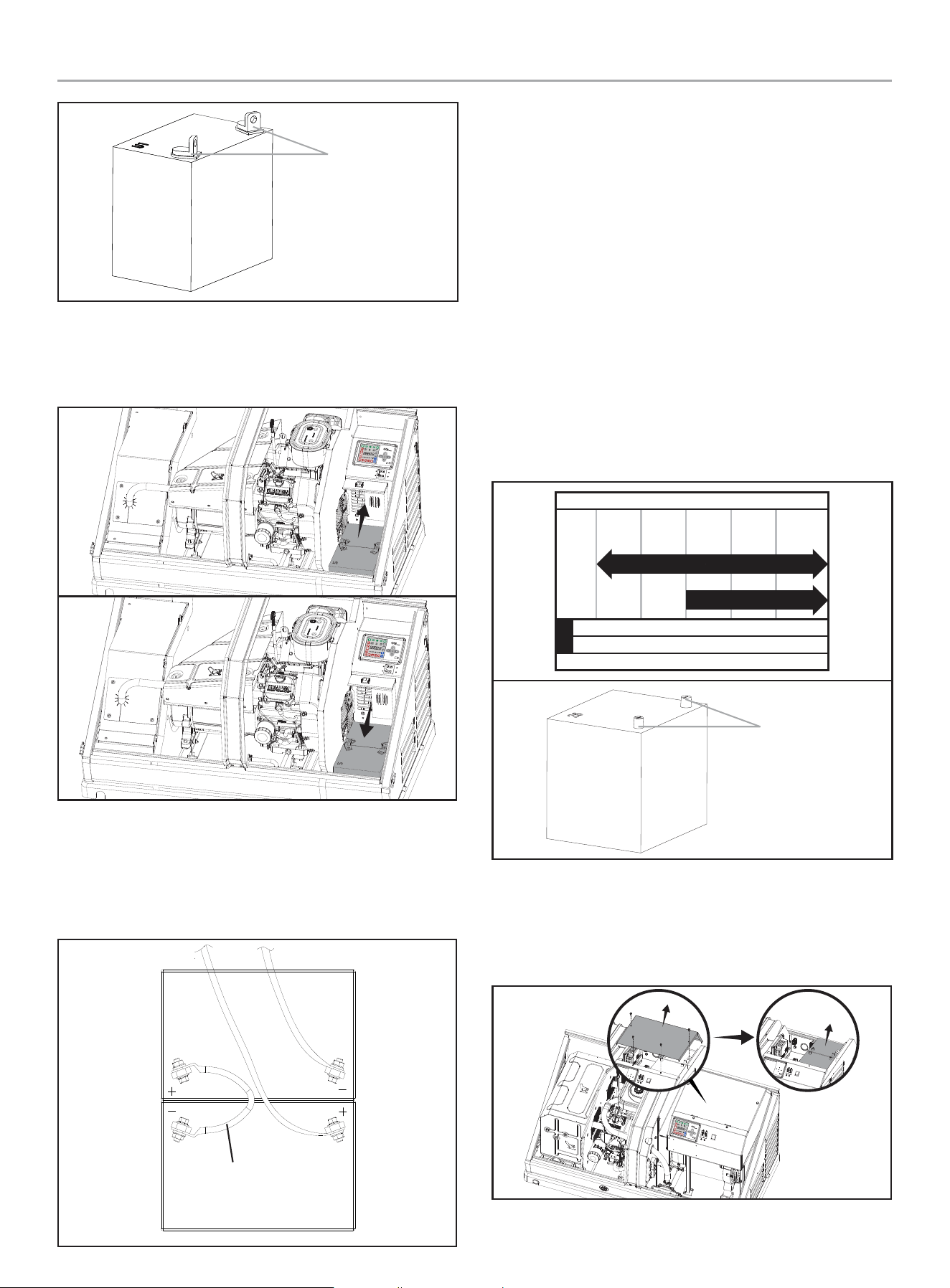
HOME STANDBY GENERATOR- ALL aXis CONTROLLER
®
MODELS
INSTALLATION
32
U1L Battery
Post Style
1. Place the batteries in the front right corner of the HSB
enclosure. Features on the floor of the enclosure locate
batteries. If replacing existing batteries, disconnect wiring
and remove old batteries.
2. Install positive cable first.
3. Install the battery series cable from the positive (+) terminal
of one battery to the negative (–) terminal of the other
battery. Always connect the positive (+) battery cable to the
generator (starter) first.
To start er
To groun d
to starter
to ground
Battery Series Cable
4. Dielectric grease should be applied on the battery
connections to aid in the prevention of corrosion.
5. Install both battery post covers.
6. Inspect, clean or re-grease battery connections every two
months.
22-kW (Model 100304)
Install two (2) 12 volt Group 26 batteries with maximum overall
dimension of 8 3/16 x 6 13/16 x 7 3/4 inches (208 x 173 x
197 mm) L x W x H with an Automotive (A) post or terminal
configuration. Purchase batteries locally.
The recommended battery type for typical use is 540 CCA (Cold
Cranking Amps). However, a 525 CCA battery shown in the
“Recommended Battery Type” chart may be used for typical use,
if in regularly warmer climates.
Alternatively, you may also use two (2) 12 volt Group 26R, but both
batteries must be 26R.
-40 -4 32 68 104+
Ambient temperature
Recommended Battery Type
-40
°F
°C -20 0 20 40+
525 CCA min
540 CCA min
Automotive Post
Style
Group size 26
1. Place the batteries under the cover behind the aXis
Controller
®
. Remove four M6 x 12 bolts using a 10mm wrench
(not included) and place the batteries in the battery tray. If
replacing existing batteries, disconnect wiring and remove old
batteries.
2. Install positive cable first.
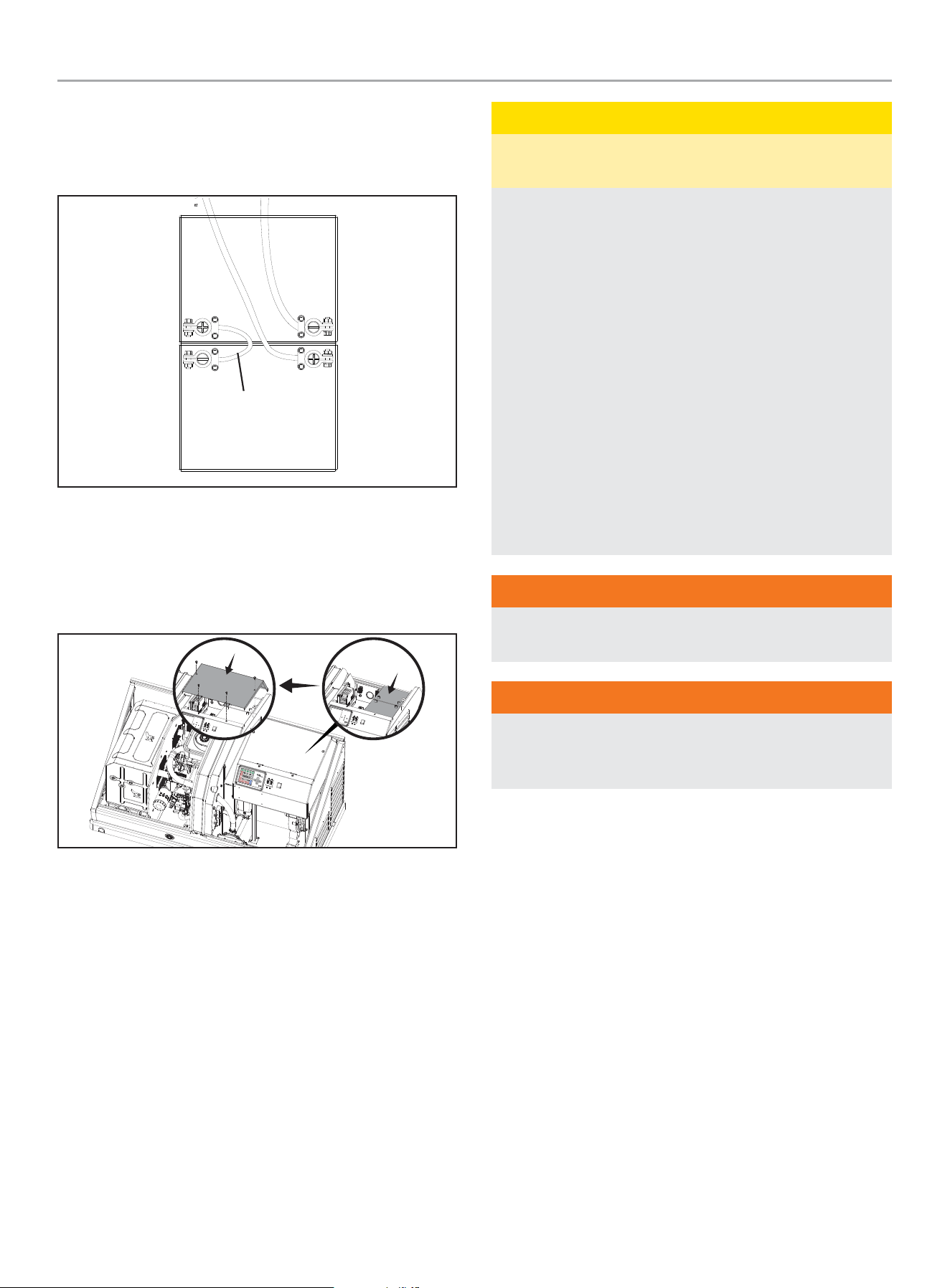
HOME STANDBY GENERATOR- ALL aXis CONTROLLER
®
MODELS
INSTALLATION
33
3. Install the battery series cable from the positive (+) terminal
of one battery to the negative (–) terminal of the other
battery. Always connect the positive (+) battery cable to the
generator (starter) first.
To groun d
T
o st art er
to starter
to ground
Battery Series Cable
4. Dielectric grease should be applied on the battery
connections to aid in the prevention of corrosion.
5. Install both battery post covers.
6. After connecting the batteries, reinstall the cover four M6 x
12 bolts using a 10mm wrench (not included).
7. Inspect, clean or re-grease battery connections every two
months.
CAUTION
A battery presents a risk of electrical shock and high short
circuit current.
The following precautions are to be observed when working on
batteries:
1. Remove watches, rings, or other metal objects,
2. Use tools with insulated handles,
3. Wear rubber gloves and boots,
4. Do not lay tools or metal parts on top of the battery
5. Disconnect charging source prior to connecting or
disconnecting battery terminals,
6. Determine the battery is inadvertently grounded. When
inadvertently grounded, remove source of ground. Contact
with any part of a grounded battery is capable of resulting
in electrical shock. The risk of such a shock is reduced
when such grounds are removed during installation and
maintenance (applicable to a generator not having a
grounded supply circuit.
WARNING
Do not dispose of battery or batteries in a fire. The battery is
capable of exploding.
WARNING
Do not open or mutilate the battery or batteries. Released
electrolyte has been known to be harmful to the skin and eyes
and can be toxic.
Vented Batteries
The installation of the engine generator shall provide enough
ventilation to ensure that all gases generated by vented batteries
during charging, or caused by equipment malfunction are
removed.
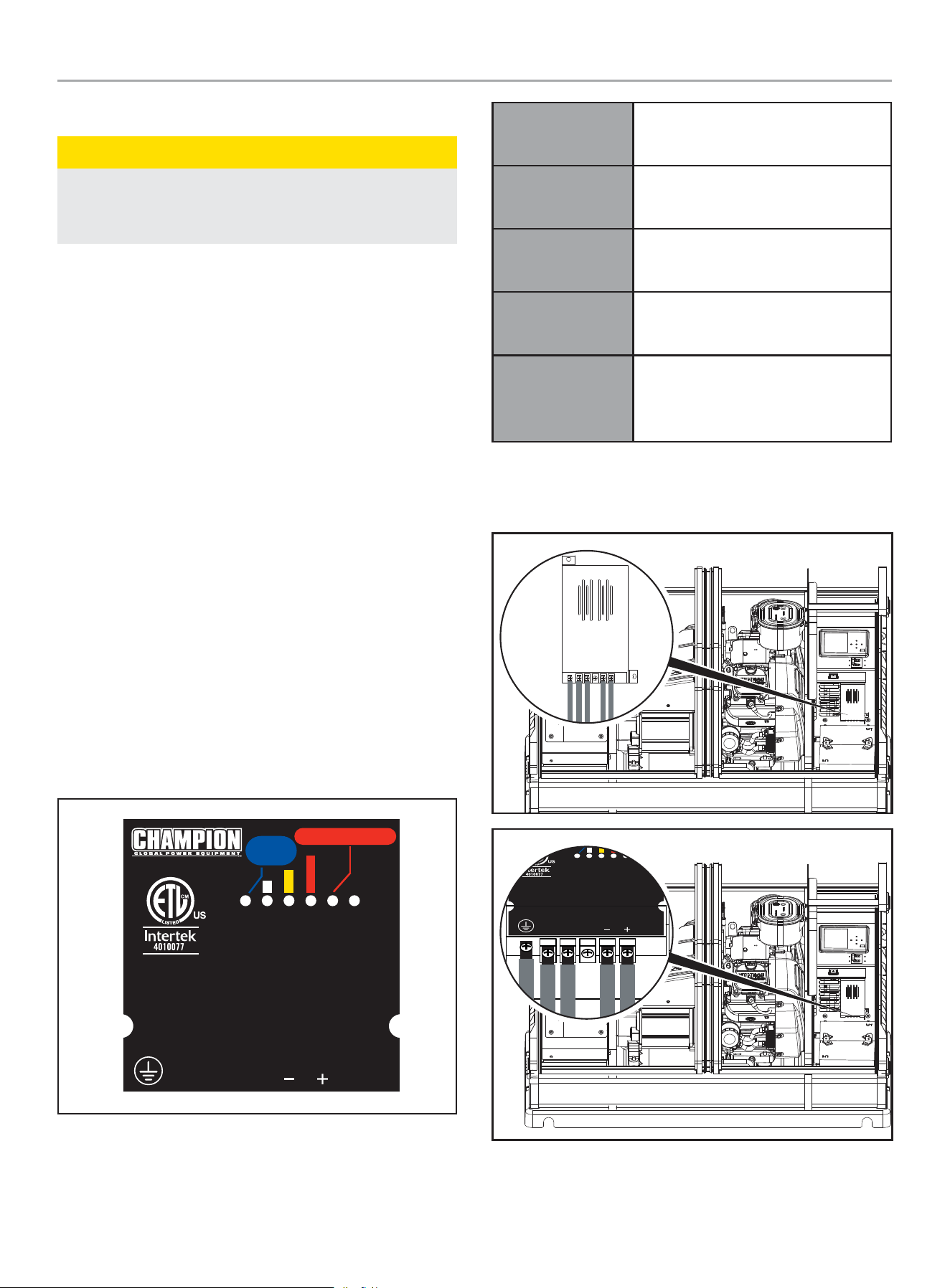
HOME STANDBY GENERATOR- ALL aXis CONTROLLER
®
MODELS
INSTALLATION
34
Battery Charger
CAUTION
For battery installation, maintenance, and safety requirements
refer to battery manufacturer’s battery installation and safety
manual.
This automatic battery charger is an intelligent module which
maintains lead acid batteries at a full charge, when the HSB has
been properly installed. Continual monitoring and maintenance
will promote long battery life. In accordance with the principle of
high efficiency, at Full Load, >85% of efficiency is achieved. This
charger is a maintenance battery charger. If the battery voltage
falls below 6V, the charger will not re-change the batteries.
To properly maintain battery efficiency, you must follow the
battery manufacturers; safety instructions, warnings and proper
maintenance procedures.
The battery(s) might be discharged to a level that is too low to
recharged with this charger (battery voltage below 6V). If this
is the case, the batteries will need to be charged individually.
Remove all battery cables from the batteries and follow the
battery manufacturers’ instructions on properly servicing/charging
the batteries.
Be careful to avoid corrosion on the battery post(s). Corrosion
can have the effect of creating an insulation between the post(s)
and the cable(s), this will severely affect the performance of the
battery.
14-KW (MODEL 100515)
The LEDs on the battery charger indicate the state of the battery’s
charge level. Battery charger rating 24 Vdc 1.6A.
NO CHARGE / PAS DE CHARGE /
SIN CARGA
AUTOMATIC BATTERY CHARGER /
CHARGE AUTOMATIQUE DE BATTERIE /
CARGADOR DE BATERÍA AUTOMÁTICO
Output: 24 Vdc 1.6 A
Producción: 24 V C.C. 1,6 A
Sortie : 24 V c.c. 1,6 A
Power: 80-125 Vac 1.0 A 50 / 60 Hz
Potencia: 80 - 125 V C.A. 1,0 A 50 / 60 Hz
Alimentation : 80-125 V c.a. 1,0 A 50 / 60 Hz
L N ADJ
E. O.
V
POWER / ALIMENTATION /
POTENCIA
OUTPUT / SORTIE /
PRODUCCIÓN
POWER
ALIMENTATION
POTENCIA
Conforms to UL
Std. 1236
RECOGNIZED
COMPONENT
For use with lead acid (LA/SLA), AGM, or Gel batteries. Not for use with Lithium-ion batteries.
Pour une utilisation avec des batteries au plomb-acide (LA/SLA), AGM ou gel. Ne pas utiliser
avec des batteries au lithium-ion.
Para uso con baterías de plomo ácido (LA/SLA), AGM o gel. No para uso con las baterías de iones de litio.
Power
Lit to indicate the battery is fully
charged.
Small Bar
Lit to indicate the battery is receiving a
trickle charge
Middle Bar
Lit to indicate current output is near
50%.
Large Bar
Lit to indicate the charger is operating
above 50% capacity.
No Charge
Lit to indicate a battery charging
problem. If this LED is lit, the LED on the
aXis Controller
®
, “LOW BATTERY” will
also be lit.
A 120 VAC circuit must be installed for battery charging. From ATS
fuse block or distribution panel install 120V circuit to the terminal
block L and N.
L N ADJ
V
POWER / ALIMENTATION /
POTENCIA
OUTPUT / SORTIE /
PRODUCCIÓN
Pour une utilisation avec des batteries au plomb-acide (LA/SLA), AGM ou gel. Ne pas utiliser
avec des batteries au lithium-ion.
Para uso con baterías de plomo ácido (LA/SLA), AGM o gel. No para uso con las baterías de iones de litio.
AUTOMATIC BATTERY CHARGER /
CHARGE AUTOMATIQUE DE BATTERIE /
CARGADOR DE BATERÍA AUTOMÁTICO
Output: 24 Vdc 1.6 A
Producción: 24 V C.C. 1,6 A
Sortie : 24 V c.c. 1,6 A
Power: 80-125 Vac 1.0 A 50 / 60 Hz
Potencia: 80 - 125 V C.A. 1,0 A 50 / 60 Hz
Alimentation : 80-125 V c.a. 1,0 A 50 / 60 Hz
E. O.
Conforms to UL
Std. 1236
COMPONENT
For use with lead acid (LA/SLA), AGM, or Gel batteries. Not for use with Lithium-ion batteries.
Pour une utilisation avec des batteries au plomb-acide (LA/SLA), AGM ou gel. Ne pas utiliser
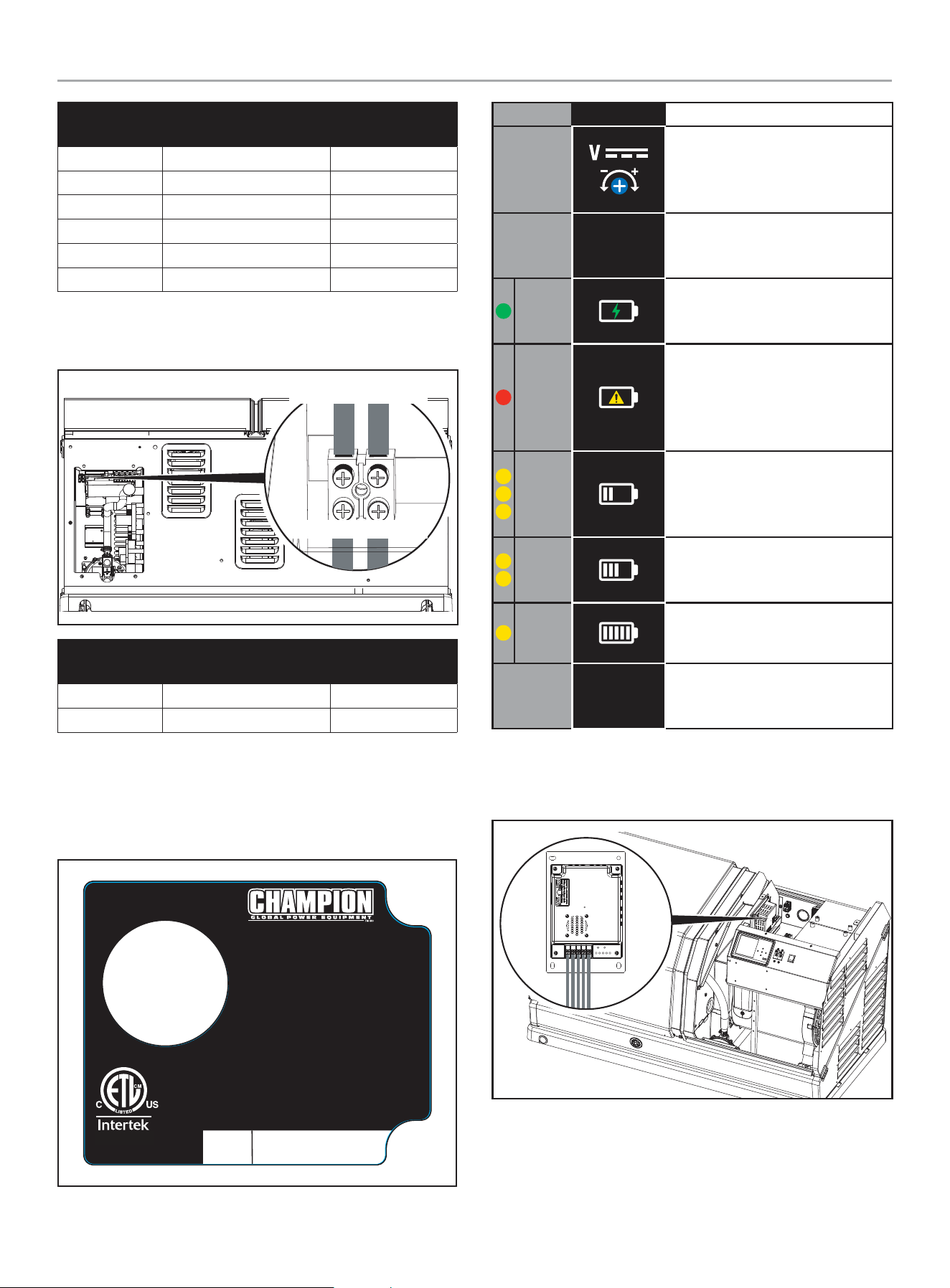
HOME STANDBY GENERATOR- ALL aXis CONTROLLER
®
MODELS
INSTALLATION
35
Wire Land
Points
Function Wire Color
Wire land #1 Ground G (green)
Wire land #2 L1 P (pink)
Wire land #3 N W (white)
Wire land #4 Not Connected- Empty
Wire land #5 B- B (black)
Wire land #6 B+ R (red)
A 120VAC circuit must be installed for battery charging. From ATS
fuse block or distribution panel install L1 and N to Wire land # 1
and #2 respectively.
INPUT 120V - N/L
OUTPUT - CHARGER
Wire Land
Points
Function Wire Color
Wire land #1 N W (white)
Wire land #2 L P (pink)
22-KW (MODEL 100304)
The LEDs on the battery charger indicate whether the charger has
120VAC power, if there is a battery fault and the charger state.
Battery charger rating 24 VDC 7 A.
RECOGNIZED
COMPONENT
5027556
Certified to CSA Std. C22.2 NO.107.2
Conforms to UL Std.1236
4324-L-PR-B
AUTOMATIC BATTERY CHARGER
CHARGE AUTOMATIQUE DE BATTERIE
CARGADOR DE BATERÍA AUTOMÁTICO
For use with lead acid (LA/SL A), AGM, or Gel batteries.
Not for use with Lithium-ion batteries.
Pour une utilisation avec des batteries au
plomb-acide (LA / SLA), AGM ou gel.
Ne pas utiliser avec des batteries au lithium-ion.
Para uso con baterías de plomo ácido (LA/SLA), AGM o gel.
No para uso con las baterías de iones de litio.
INPUT: 80 - 125 VAC MAX 4.4 A 50/60 Hz
ENTRÉE : 80 - 125 VCA MAX 4,4 A 50 / 60 Hz
ENTRADA: 80 - 125 VCA MAX 4.4 A 50/60 Hz
OUTPUT: 24 VDC 7 A
SORTIE : 24 VCC 7 A
SALIDA: 24 VCC 7 A
SERIAL NO.
NO. DE SERIE
N° DE SÉRIE
MODEL / MODÈLE / MODELO #102652
XXXXXXXXXXXX
LED SYMBOL DESCRIPTION
DC Voltage Adjustment - Preset
from the factory for proper DC
charger output. No adjustments
necessary.
E. O.
Enforced Output - Press to charge
battery at maximum amperage for
a short period.
Green
Power - Lit to indicate the charger
is receiving 120 VAC and is ready
to charge.
Red
Fault or No Charge - Lit to indicate
a battery charging problem. If this
LED is lit, the LED on the fLex
Controller
®
, “LOW BATTERY” will
also be lit.
Yellow
High Charge - Lit to indicate the
charger is operating above 50%
capacity. Trickle charge and mid
charge LED will also be lit.
Yellow
Mid Charge - Lit to indicate the
charger is near 50% capacity.
Trickle charge LED will also be lit.
Yellow
Trickle Charge - Lit to indicate the
battery is receiving a trickle charge.
No Yellow
Low Trickle Charge - When no
yellow LEDs are lit, the charger is in
low trickle charge state.
A 120 VAC circuit must be installed for battery charging. From ATS
fuse block or distribution panel install 120V circuit to the terminal
block L and N.
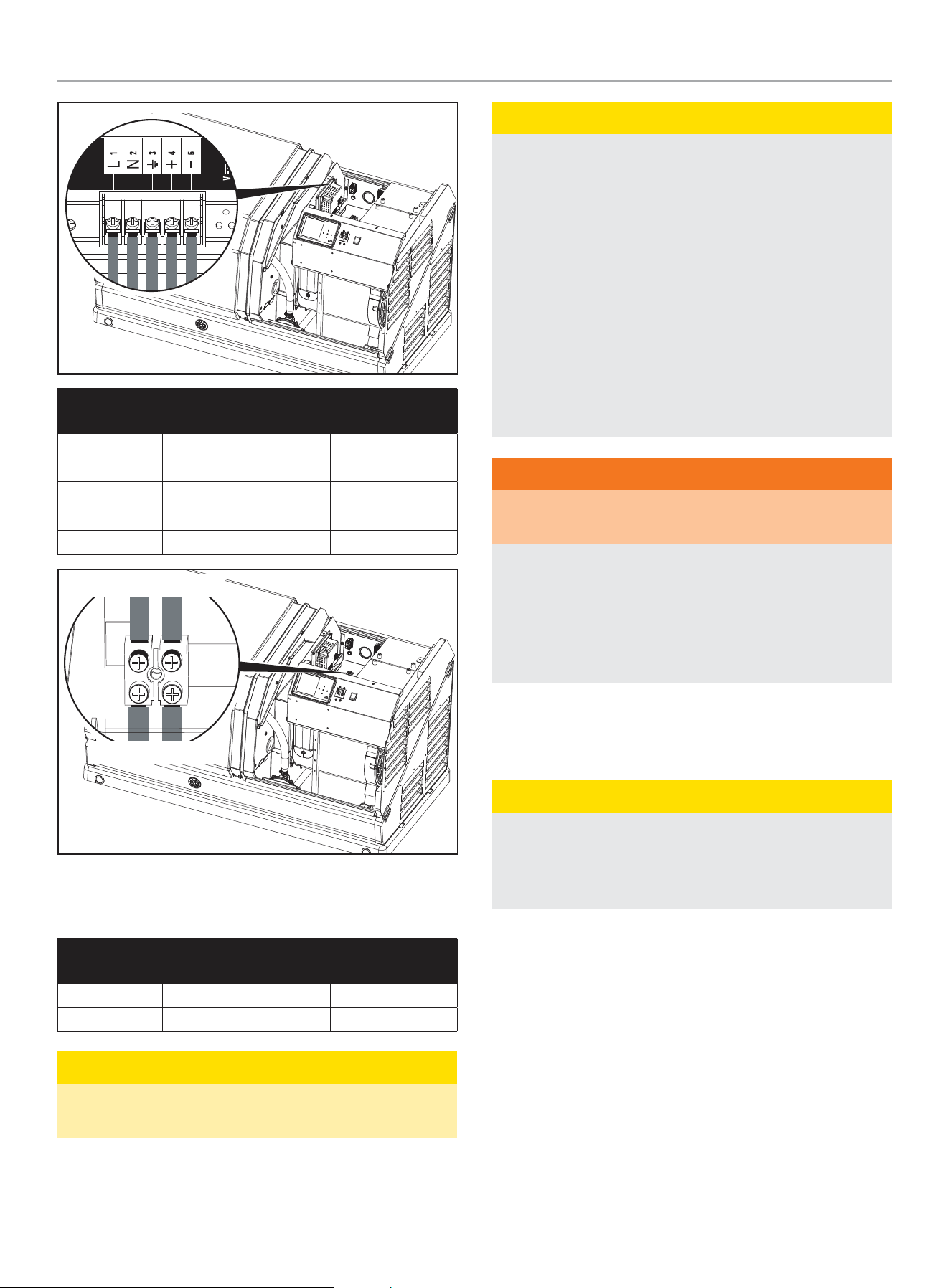
HOME STANDBY GENERATOR- ALL aXis CONTROLLER
®
MODELS
INSTALLATION
36
Wire Land
Points
Function Wire Color
Wire land #1 L1 R (Red)
Wire land #2 N W (white)
Wire land #3 Ground G (Green)
Wire land #4 + R (Red)
Wire land #5 - B (black)
INPUT 120V - N/L
OUTPUT - CHARGER
The terminal block is prewired by the factory to the charger L1 and
N. A 120 VAC circuit must be installed for battery charging from
the ATS or another 120VAC circuit.
Wire Land
Points
Function Wire Color
Wire land #1 L R (Red)
Wire land #2 N W (white)
CAUTION
The electrolyte is a diluted sulfuric acid that is harmful to the
skin and eyes. It is electrically conductive and corrosive.
CAUTION
The following procedures are to be observed:
1. Wear full eye protection and protective clothing,
2. Where electrolyte contacts the skin, wash it immediately
with water,
3. Where electrolyte contacts the eyes, flush thoroughly and
immediately with water and seek medical attention, and
40 Spilled electrolyte is to be washed down with an acid
neutralizing agent. A common practice is to use a solution
of one pound (500 grams) bicarbonate of soda to one
gallon (4 liters) of water. The bicarbonate of soda is to be
added until the evidence of reaction (foaming) has ceased.
The resulting liquid is to be flushed with water and the
area dried.
WARNING
Lead-acid batteries present a risk of fire because they
generate hydrogen gas.
The following procedures are to be followed:
1. DO NOT SMOKE when near batteries.
2. DO NOT cause flame or spark in battery area, and
3. Discharge static electricity from body before touching
batteries by first touching a grounded metal surface.
10. WIRING OF THE HSB
Wire Sizing
CAUTION
Use a torque wrench to tighten conductors, being sure not to
overtighten, or damage to the switch base could occur. If not
tightened properly, a loose connection would result, causing
excess heat which could damage the switch base.
All installations must comply with National, State and Local codes.
It is the responsibility of the installer to perform an installation that
will pass the final electrical inspection. Conductor wire sizes must
be adequate to handle the maximum current to which they will be
subjected. The installation must comply fully with all applicable
codes, standards, and regulations.
All power cables must enter the enclosure through the knockouts
provided. If not using knockouts, conduit entry into the enclosure
must be at or below knockouts to maintain the Type 3R rating.
NEMA 3R enclosures are rated and tested for outside installation,
they are waterproof enclosures and only come with knockouts on
the bottom side of the enclosure. If a NEMA 3R enclosure in used
for an inside installation, a greenlee type punch will be required to
make a knockout(s) on the side or top of the enclosure.
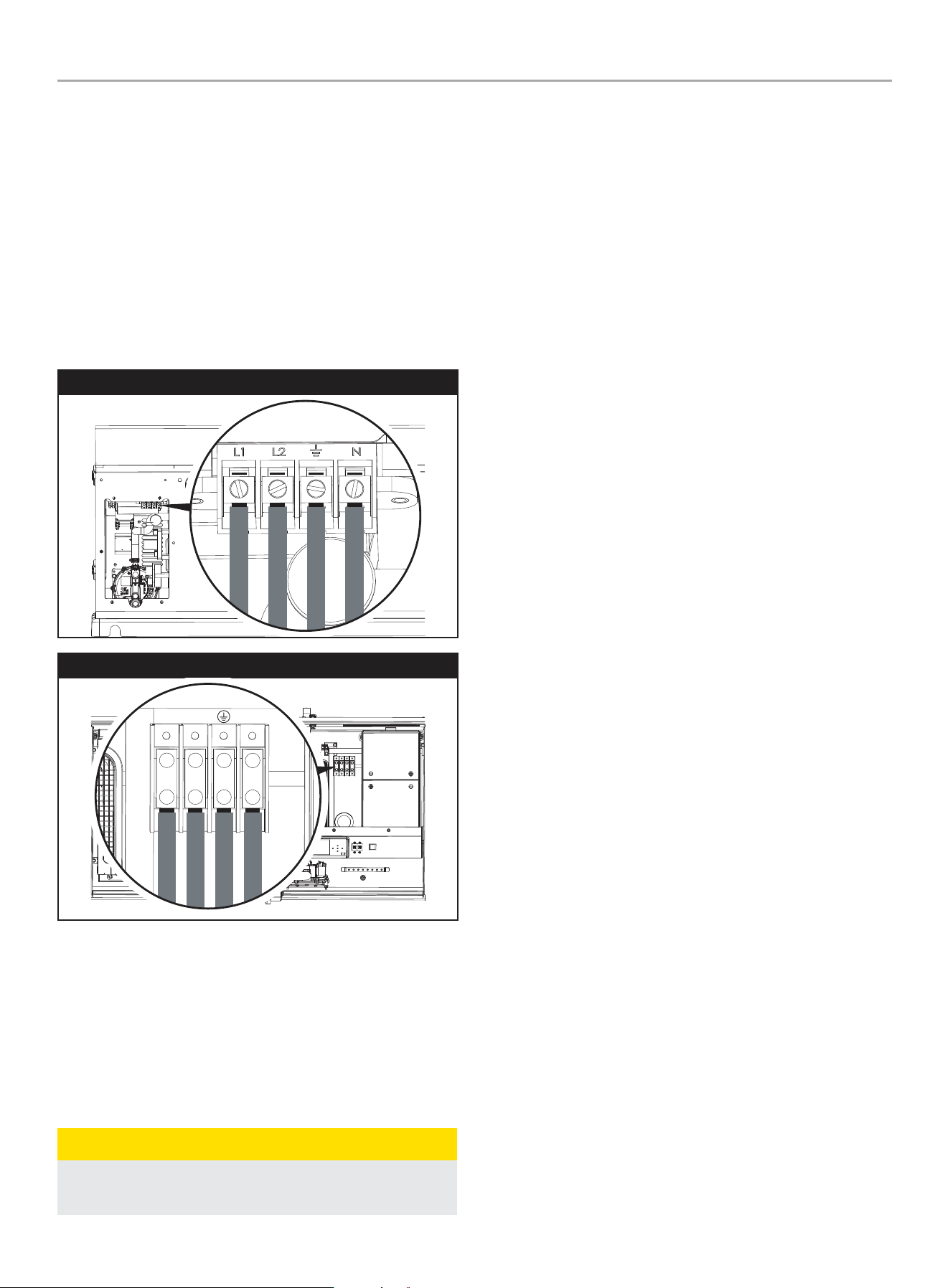
HOME STANDBY GENERATOR- ALL aXis CONTROLLER
®
MODELS
INSTALLATION
37
Conduits should be arranged to provide separation between
the Utility Source and HSB Source supply conduits inside the
enclosure. Conductor wires must be properly supported, of
approved insulated qualities, protected by approved conduit and
of the correct wire gauge size in accordance with all applicable
codes.
Final inspection may require the installation of an emergency
shut down switch, installed and located where Home Standby
Generator Engine (prime mover) can be shut down instantly.
Verify that the (4) pre-installed 14-2 conductor lugs are free of
corrosion and are fully fastened and spaced properly. Make sure
conductor wires are labeled and/or marked accordingly.
14-kW (Model 100515)
22-kW (Model 100304)
NL2L1
Utility Circuit and Generator Power Connections
Conductor sizes must be adequate to handle the maximum current
to which they will be subjected to, based on the 75 degrees
C column of tables, charts, etc. used to size conductors. The
installation must comply fully with all applicable codes standards
and regulations.
Surge protection
CAUTION
Voltage fluctuation may impair the proper functioning of
sensitive electronic equipment.
Electronic devices, including computers and many programmable
appliances use components that are designed to operate within a
narrow voltage range and may be affected by momentary voltage
fluctuations. While there is no way to prevent voltage fluctuations,
you can take steps to protect sensitive electronic equipment.
Install UL1449, CSA-listed, plug-in surge suppressors on the
outlets feeding your sensitive equipment. Surge suppressors come
in single or multi-outlet styles. They’re designed to protect against
virtually all short-duration voltage fluctuations.
AVR = Automatic Voltage Regulator
The AVR is an electrical or electronic device that maintains the
voltage of a power source within predetermined limits. AVR is a
regulator that automatically keeps voltage within the prescribed
range required by the electrical equipment that will be provided
power by the HSB. The AVR uses solid-state semiconductor
devices to smooth out variations in the flow of current.
The AVR monitors the output voltage and controls the input
voltage to the exciter of the generator. By increasing or decreasing
the generator control voltage, the output voltage of the generator
increases or decreases accordingly. The AVR calculates how
much voltage has to be sent to exciter numerous times a second,
therefore stabilizing the output voltage to a predetermined set
point.
There are 3 connectors that come from the AVR. For reference we
have numbered them 1, 2, and 3 when viewed right to left.
1. Connector #1 (far left), has 4 leads. The 2 leads on the right
side of the connector (top & bottom) are BLUE. They run to
the excitation windings on the stator. The 2 leads on the left
side of the connector (top & bottom) are GREEN (top) and
WHITE (bottom), they run to the sampling windings of the
stator.
2. Connector #2 (center), has 2 leads. The top lead is BROWN,
when connected it runs to pre-boost/magnetized pin #7 on
the Engine Controller Module. The bottom lead is GREEN and
runs to ground.
3. Connector #3 (far right connector), has 2 leads. A RED lead
(top) that runs to the positive side of the brush assembly, and
a BLACK lead (bottom) that runs to the negative side of the
brush assembly. The brush assembly provides flow through
of excitation current to the rotating rotor. Brushes are made
of long lasting material that seldom wear out or fail. The
contact points of the brush assembly are with two slip rings
attached to the rotor. These slip rings can become tarnished
or exhibit a glaze, which can create a resistance to the flow
of electricity. This can occur when the HSB is not exercised or
ran over long periods of storage.
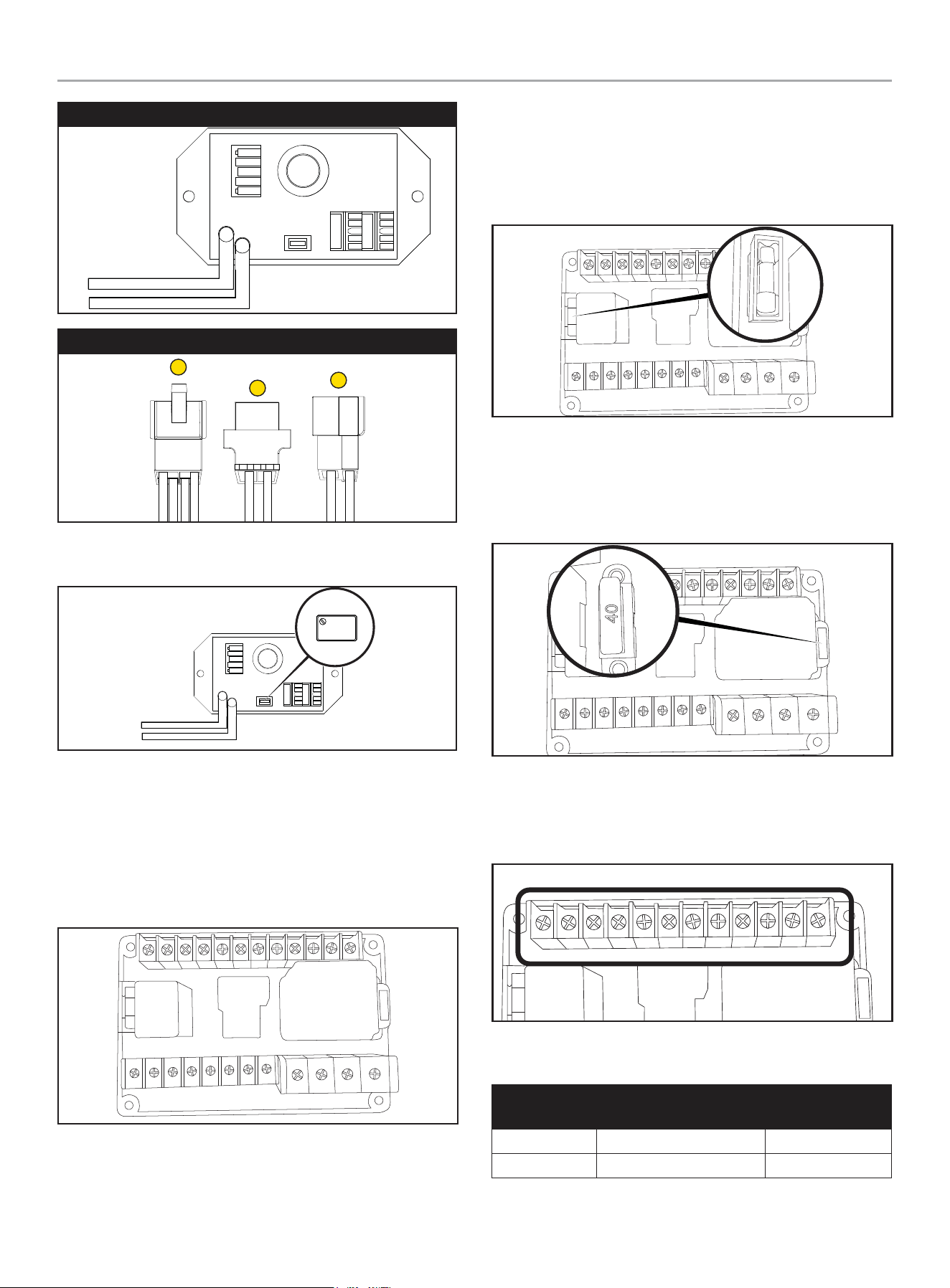
HOME STANDBY GENERATOR- ALL aXis CONTROLLER
®
MODELS
INSTALLATION
38
AVR
CONNECTORS
1
2
3
Slotted potentiometer is factory set to the correct voltage and
should not require adjustment.
H 102
3028
Engine Relay Module
14-KW (MODEL 100515)
This module is the interface between the Engine Controller, ATS
Controller, alternator, hour meter and battery charger. It is the
interface for all on board communications in the HSB.
FREQ FREQ ATS IN.1 WATR OIL ALT FUEL
START STOP B+ B-
FREQ FREQ ATS IN.1 WATR OIL ALT FUEL S
40A FUSE
5A FUSE
100417
22-KW (MODEL 100304)
The module has two (2) fuses built into the board.
1. A 250VAC 5A mini fuse protecting the system from an over
voltage between the alternator and the relays. Remove
plastic FUSE cover to access.
100417
40A FUSE
5A FUSE
FREQ FREQ ATS IN.1 WATR OIL ALT FUEL
START STOP B+ B-
FREQ FREQ ATS IN.1 WATR OIL ALT FUEL S
2. An automotive style fuse, 40A (Orange), which protects the
system from an excessive transfer voltage output when
the ATS relays transfer between utility and generator and
generator to utility modes. Remove plastic FUSE cover to
access.
100417
40A FUSE
5A FUSE
FREQ FREQ ATS IN.1 WATR OIL ALT FUEL
START STOP B+ B-
FREQ FREQ ATS IN.1 WATR OIL ALT FUEL S
TOP ROW
There are 12 wire land points in the top row, the connection points
are all the same size.
FREQ FREQ ATS IN.1 WATR OIL ALT FUEL START S
TOP B+ B-
40A FUSE
5A FUSE
The following are the wire land points, function and wire color, left
to right.
Wire Land
Points
Function Wire Color
Position #1 Frequency R (Red)
Position #2 Frequency B (BLACK)
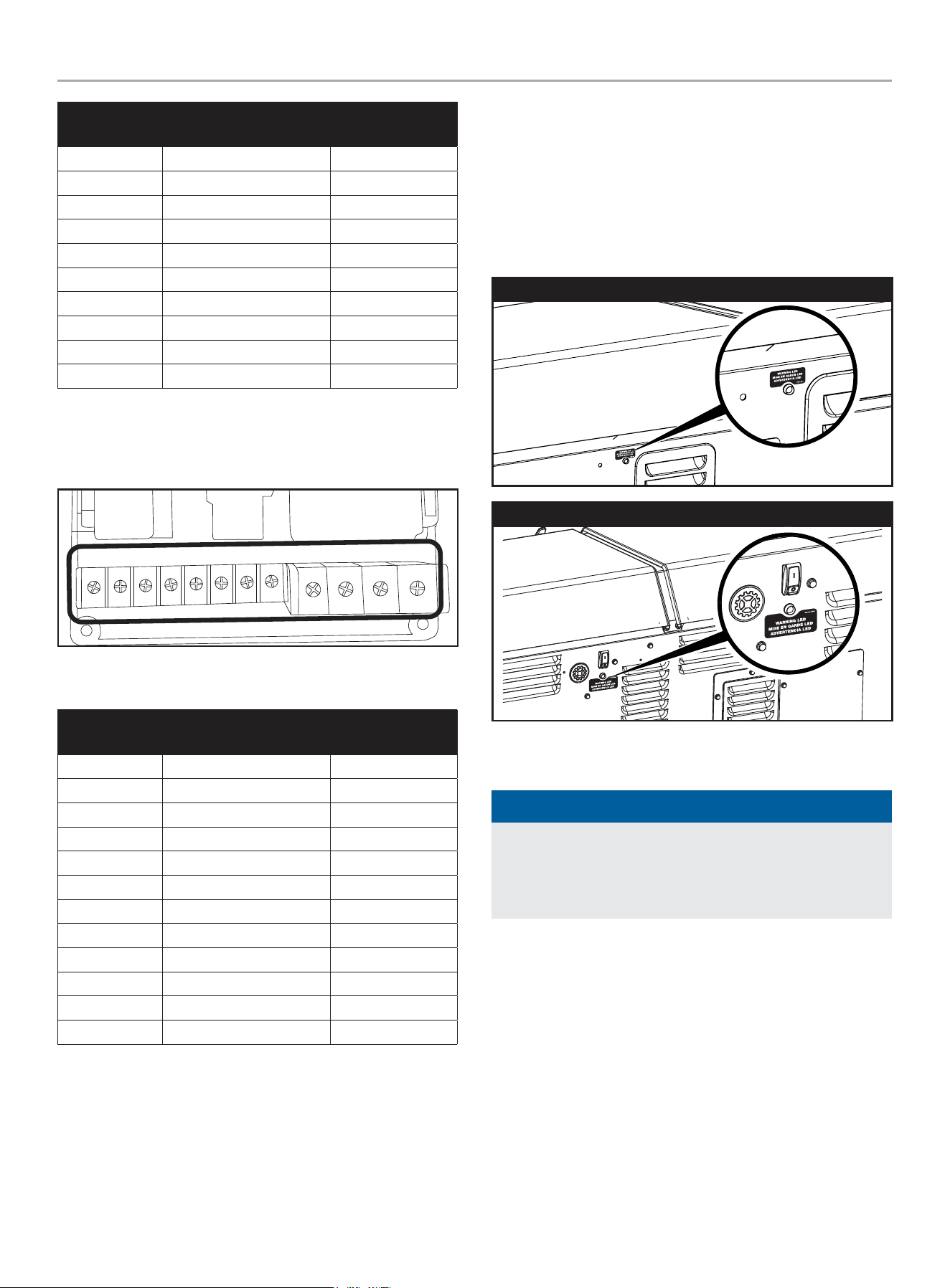
HOME STANDBY GENERATOR- ALL aXis CONTROLLER
®
MODELS
INSTALLATION
39
Wire Land
Points
Function Wire Color
Position #3 Not connected Empty
Position #4 Not connected Empty
Position #5 High engine temperature BR (brown)
Position #6 Low oil level/pressure Y (yellow)
Position #7 Not connected Empty
Position #8 Fuel supply valve G/B (green/black)
Position #9 Starter B/W (black/white)
Position #10 Stop L/B (blue/black)
Position #11 B+ W (white)
Position #12 B- G (green)
BOTTOM ROW
There are 12 wire land points in the bottom row, 8 are the same
size, the remaining 4 points are larger, viewed left to right.
100417
FREQ FREQ ATS IN.1 WATR OIL ALT FUEL START STOP B+ B-
40A FUSE
5A FUSE
The following are the wire land points, function and wire color,
viewed left to right.
Wire Land
Points
Function Wire Color
Position #1 Frequency R (red)
Position #2 Frequency B (black)
Position #3 Not connected Empty
Position #4 Not connected Empty
Position #5 High Engine Temperature BR (brown)
Position #6 Low oil level/pressure Y (yellow)
Position #7 Not connected Empty
Position #8 Fuel supply valve G/B (green/black)
Position #9 Starter B/W (black/white)
Position #10 Stop L/B (blue/black)
Position #11 B+ W (white)
Position #12 B- G (green)
Exterior Warning LED
The exterior of the generator enclosure includes a Warning LED
that illuminates RED when a fault has occurred
The Warning LED provides a visual indicator to homeowners
and service technicians that a fault has occurred, and service is
needed.
The warning LED is located on the back-exterior of the HSB.
14-kW (Model 100515)
22-kW (Model 100304)
Generator ON/OFF Switch
NOTICE
When maintenance or service work is performed on the
generator or the home’s electrical system, to prevent
accidental startup pull out the fuse from the aXis Controller
®
panel and disconnect the batteries.
This generator has ON/OFF switches that when turned off, will
shut down the HSB (if running) and deactivate the aXis controller
®
preventing future starts. These switches should be used in
instances where the HSB needs to stay off regardless of utility
power presence. When either switch is in the OFF position, the
HSB will not exercise or start for any reason.
When both of the switches are in the ON position, the aXis
controller
®
will be energized and the HSB will be controlled by the
programming of the aXis controller
®
. Both switches need to be in
the ON position in order for the HSB to operate in AUTO mode.
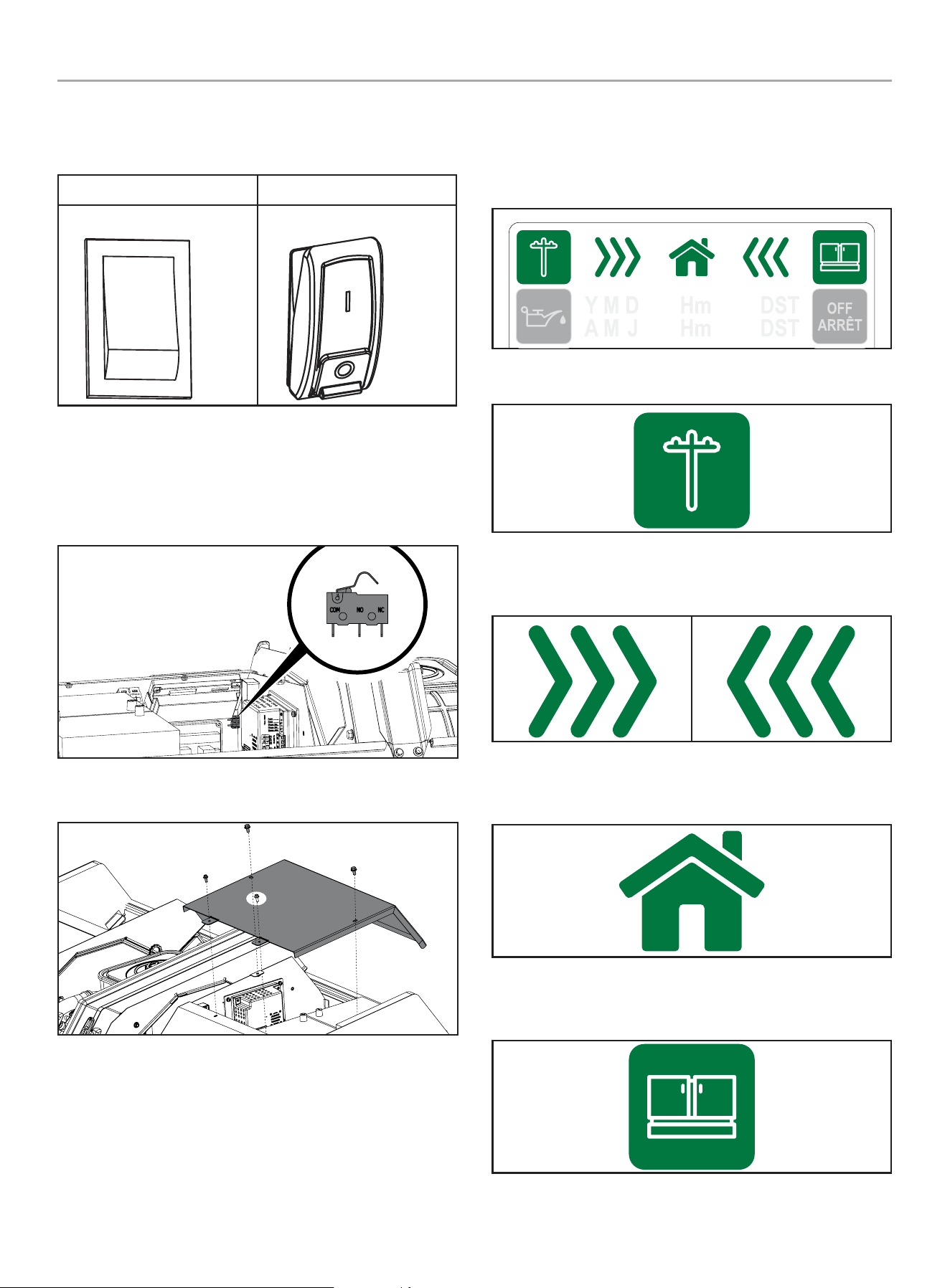
HOME STANDBY GENERATOR- ALL aXis CONTROLLER
®
MODELS
INSTALLATION
40
OTE: N Both switches need to be in the ON position to place the
aXis Controller
®
in the AUTO mode and in order to exercise
the HSB.
Inside Back / Side
ON
OFF
ON
OFF
Microswitch
There is a microswitch located behind aXis Controller
®
panel. This
microswitch prevents accidental starting while accessing this
area.
To access this microswitch, remove four M6 x 12 bolts from the
cover using a 10mm wrench (not included).
Swing the aXis Controller
®
panel forward after removing the top
cover, HSB starting will be disabled.
Close and secure the aXis Controller
®
panel, then the top cover
with four M6 x 12 bolts using a 10mm wrench (not included) to
start the generator. Once closed, the microswitch will allow the
HSB to start.
aXis Controller
®
aXis CONTROLLER
®
STATUS ICONS
The status icons are located at the top of the aXis Controller
®
.
Utility Pole
The utility pole icon will indicate utility is the source of power.
Transfer Power Direction
Shows the direction of power
House
Icon for house receiving power
HSB
The HSB icon will indicate power when the generator is the source
of power
HOME STANDBY GENERATOR- ALL aXis CONTROLLER
®
MODELS
INSTALLATION
41
aXis CONTROLLER
®
INFORMATION ICONS
The information icons are located at the bottom right side of aXis
Controller
®
icon touch pad.
Hour Meter
The hour meter keeps track of all running time of the HSB. This
includes run time during a utility power outage and during the
weekly exercise cycle. This provides the owner with a record
of operating time which is useful in keeping track of scheduled
maintenance intervals. Refer to the scheduled maintenance chart.
The hour meter can’t be reset. The initial time registered on the
meter when first started up (installed) will reflect the factory test
time, this is a normal industry standard. The hour meter only
reflects hours, it does not reflect RPMs or any other function.
Exercise Icon
The BLUE icons will be lit when the HSB is performing the exercise
period. Refer to “Setting Exercise Time” to establish the weekly
exercise period. When the exercise period is complete the icon will
turn off and the HSB will resume its standby monitoring.
aXis CONTROLLER
®
FAULT ICONS
Low Oil Pressure Shutdown
The RED icon will be lit when the engine oil pressure drops below
a safe operating level. When this fault is detected, the HSB will
shut down and re-start will be disabled. RED icon on the controller
module and exterior LED will be lit.
Check the oil level. The oil level should be at the FULL mark, if
necessary, add oil. DO NOT overfill. Inspect the unit for a possible
oil leak, if a leak is discovered, contact Champion or your nearest
Authorized Champion Dealer. Follow the FAULT CODE RESET
instructions to clear the fault after service.
High Engine Temperature
The RED icon will be lit if the engine operating temperature
exceeds the factory preset limits. If excessive operating
temperature is detected, the HSB will shut down and re-start will
be disabled. The RED icon on the aXis Controller
®
and exterior
enclosure LED will be lit.
This failure could be the result of an excessive load or high
ambient temperatures. Should this fault occur do the following;
1. Open the enclosure doors to increase air flow throughout the
unit
2. Check oil level add oil if required
3. Inspect the interior and exterior of the enclosure for debris,
leaves, etc., and remove them to increase air flow around and
inside the unit.
4. Once the engine temperature falls into the normal operating
range, generally 30 minutes, follow the FAULT CODE RESET
instructions to clear the fault after service.
5. Close the enclosure doors and the unit is ready to run.
HOME STANDBY GENERATOR- ALL aXis CONTROLLER
®
MODELS
INSTALLATION
42
Over crank
The RED icon will be lit if the engine does not start. This prevents the generator from damaging itself or other related components. When
the fault is detected, the generator will shut down and re-start will be disabled. RED icon on the controller module and exterior LED will be
lit.
STARTER CRANK CYCLE TIMES - If the generator fails to start, the “OVER CRANK” icon will flash on the aXis Controller
®
and a steady
lit exterior warning LED on the backside of the generator. Below outlines the crank cycle differences depending on the mode selected.
Please note there is a 120 second lockout or rest period after the cycles for each mode listed to allow the starter to properly cool.
Follow the FAULT CODE RESET instructions by pushing the OFF button to reset and clear the fault. Regardless of when you press OFF, you
will need to allow the timer to count down to zero (0) before proceeding with another start procedure. The lockout time remaining is not
shown on the screen.
MODE
ON
(seconds)
OFF
(seconds)
CYCLES
LOCKOUT
(seconds)
AUTO
The generator is in the ready position. The aXis Controller
®
must be in the
AUTO mode in order to exercise.
9 10 5 120
MAN
The generator will start in MANUAL mode.
10 10 2 120
EXERCISE (PLC)
The generator is connected to a Champion Automatic Transfer Switch.
8 30 3 120
EXERCISE (2-wire)
The generator is connected to a non-Champion Automatic Transfer Switch.
9 10 5 120
This failure could be the result of insufficient fuel supply. Check the in-line fuel shut off valves and make sure they are in the ON/ OPEN
position. Position them in the correct position, follow the FAULT CODE RESET instructions to clear the fault after service. If they are in
the correct position and the HSB shows a fault light again, it’s recommended to perform a Manometer pressure check by an Authorized
Champion Dealer or installer. This will make sure the correct amount of fuel is being delivered to the HSB when it starts.
Insufficient battery output could result in poor cranking cycles, not permitting the engine starter to reach optimum starting RPM to start
the engine. This can be verified by checking the Battery Charger icon, NO CHARGE. If this occurs, the individual battery voltages must be
checked to determine if the batteries are properly charged or if they have failed. It is extremely important to follow all the cautions and
warnings per the battery manufacturer concerning installation, service, maintenance and replacement procedures.
HOME STANDBY GENERATOR- ALL aXis CONTROLLER
®
MODELS
INSTALLATION
43
Hz Over speed/Under speed
The RED icon will be lit if the engine was operating above or below
its preset speed limits. These limits are factory set to protect the
HSB and the circuits connected to the generator output circuits.
When this fault occurs, the HSB will shut down, light the RED icon,
shut down and re-start will be disabled. The exterior warning LED
on the back of the HSB enclosure will be activated and lit.
If this failure occurs, contact Champion or your Authorized
Champion Dealer. The RED icon will remain lit until the failure has
been corrected, the HSB will not attempt to transfer or run.
Line Over Voltage
The RED icon will be lit if the HSB generator output power exceeds
preset limits of 257 VAC.
When this fault occurs, the HSB will light the RED icon, shut down
and re-start will be disabled. The exterior warning LED on the
back of the HSB enclosure will be activated and lit. Check and
adjust AVR. Set Voltage to 240 VAC.
Line Under Voltage
The RED icon will be lit if the HSB Generator output power is
below preset limits.
When this fault occurs, the HSB will light the RED icon, shut down
and re-start will be disabled. The exterior warning LED on the
back of the HSB enclosure will be activated and lit. Check and
adjust AVR. Set Voltage to 240 VAC.
Low Battery
The RED icon will be lit if the battery voltage falls below 21.0
volts for at least 5 seconds while the engine is running. If the
battery voltage rises above 22 volts, the icon will turn off. Battery
voltage is NOT monitored when the engine is cranking, just when
the engine is running. If the RED icon comes on it will not shut
the HSB off, it will remain lit until the battery condition meets the
required output.
When the icon remains lit, the battery charging should be checked
and the condition of the batteries. Follow the FAULT CODE RESET
instructions to clear the fault after service.
Requires Maintenance
The RED icon will be lit if the HSB generator is ready for
maintenance.
The maintenance hour meter counts from 100 hours to 0. You
need to reset when the hour meter reaches 0. Refer to the
scheduled maintenance chart.
Refer to “Resetting the maintenance hour meter” for instructions
after performing maintenance.
FAULT PROTECTION
In all cases when the icon is RED, this is an indicator that the
HSB has registered a fault and must be corrected. Only the “LOW
BATTERY” and “MAINTENANCE” icons will not latch out or shut
down the HSB. ALL other RED icon faults will latch out, shut down,
disable starting and light the RED icon on the aXis Controller
®
and
the exterior warning LED on the backside of the HSB.
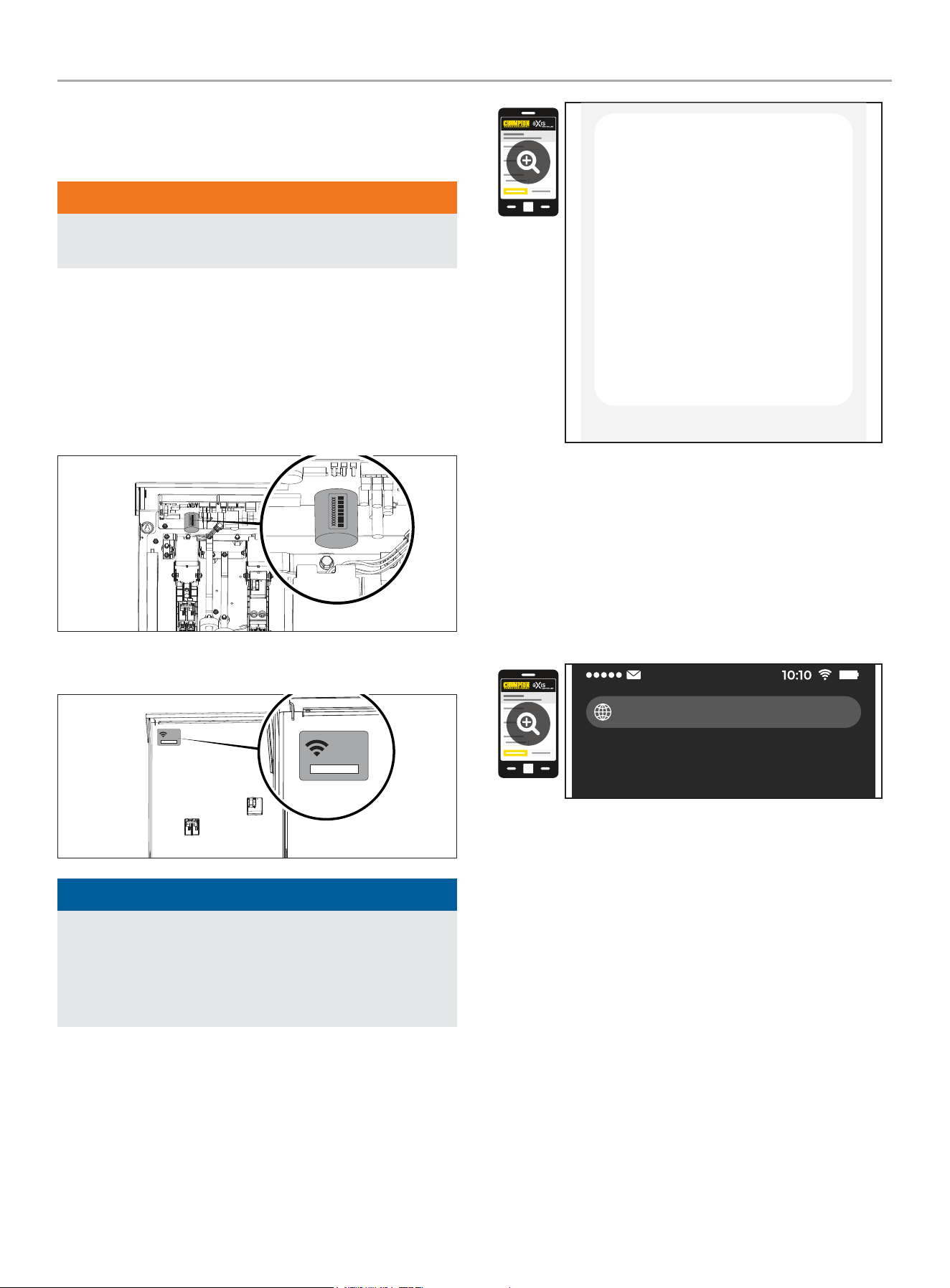
HOME STANDBY GENERATOR- ALL aXis CONTROLLER
®
MODELS
INSTALLATION
44
FAULT CODE RESET
In the event a fault has occurred push OFF button to reset then
AUTO button to re-arm.
WARNING
All faults should be taken seriously and corrected before reset
process is performed.
Wi-Fi Setup Method
1. Use a Wi-Fi enabled device (laptop, smart phone, tablet, etc.)
in near proximity to the ATS.
2. Search and connect to network name (SSID) “Champion
XXXX” where XXXX will match the last four digits of the serial
number that is printed on the control board.
2a. The password for the network is located on a label on the
dead front of the ATS.
PASSWORD
CONTRASEÑA
MOT DE PASSE
12345678
PASSWORD
CONTRASEÑA
MOT DE PASSE
12345678
NOTICE
During the setup your device will disconnect from the internet.
The Champion Wi-Fi is a direct connection between your
device (laptop, smart phone, tablet, etc.) and the ATS, and it
does not connect to the internet. Some Android devices may
show the following screen – Choose “Connect only this time.”
Internet may not be available.
If you want to connect this network without
internet access, you can connect only this
time or you can set your phone to always
connect to it even if internet isn’t available.
You can change this in Settings >
Connections > Wi-fi > ADVANCED >
Switch to mobile data > Network
exceptions
Connect only this time
Allow switch
Stay connected
3. After connecting Wi-Fi, open your device’s web browser. In
the browser address change the address to 192.168.0.90 and
begin search. This will direct your browser to the Champion
aXis Controller
®
Home Standby Generator Settings page
located on the ATS. If your device’s web browser does not
load the Champion aXis Controller
®
Home Standby Generator
Settings Page but rather stays connected to the internet, turn
off mobile data on the device (if applicable) and make sure
the device is not connected to any other networks.
192.168.0.90
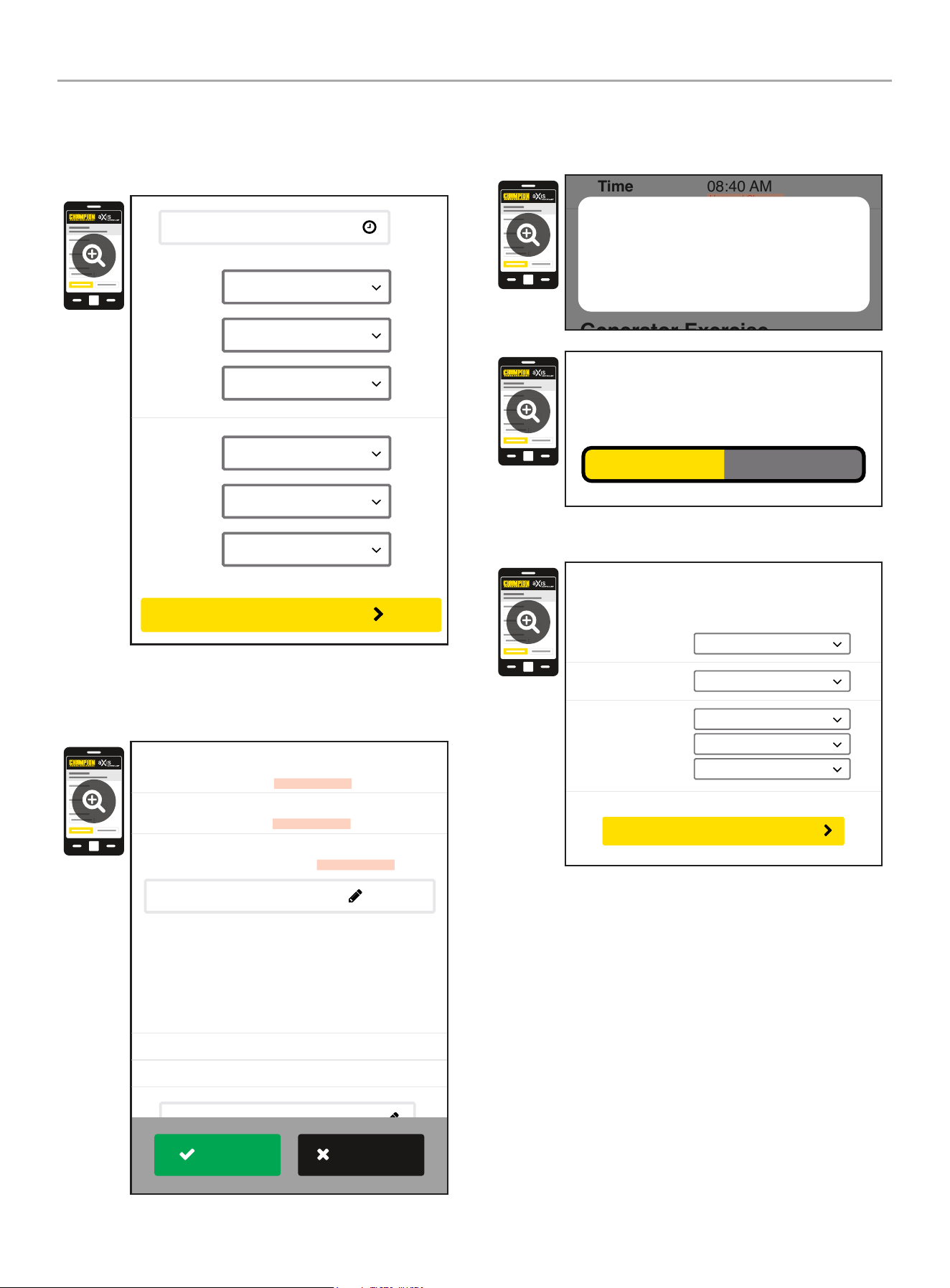
HOME STANDBY GENERATOR- ALL aXis CONTROLLER
®
MODELS
INSTALLATION
45
4. On the Champion aXis Controller
®
Home Standby Generator
Settings Page, set the date and time. Use either the dropdown
boxes or the “USE THIS DEVICE DATE & TIME” button to set
the time and date.
USE DEVICE DATE & TIME
Date:
Choose Month...
Choose Date...
Choose Year...
Time:
Choose Hour...
Choose Minute...
Choose AM/PM...
CONFIRM DATE & TIME
5. Confirm and apply the settings before continuing. If you do
not apply immediately, the clock will be later than actual.
Unsaved changes are highlighted.
Generator Exercise
Every Week
Friday
09:00 AM
Frequency:
Day:
Time:
March 22, 2022
08:40 AM
On
Date
Time
Day Light Saving
Generator Date and Time
EDIT DATE & TIME
(Automated Maintenance Running)
EDIT EXERCISE FREQUENCY
Unsaved Changes
Unsaved Changes
Unsaved Changes
APPLY
REVERT
6. Some operating systems will require additional steps to
confirm update, accept all pop-up windows until progress bar
is seen on screen.
Generator Exercise
Friday
09:00 AM
March 22, 2022
08:40 AM
On
Time
Day Light Saving
EDIT DATE & TIME
(Automated Maintenance Running)
Unsaved Changes
Unsaved Changes
Are your sure to save the changes?
Cancel OK
Saving...
7. Set the HSB exercise frequency and schedule.
Freq:
Day:
Time:
Choose Mode...
Choose Day...
Choose Hour...
Choose Minute...
Choose AM/PM...
Generator Exercise
(Automated Maintenance Running)
CONFIRM EXERCISE FREQUENCY
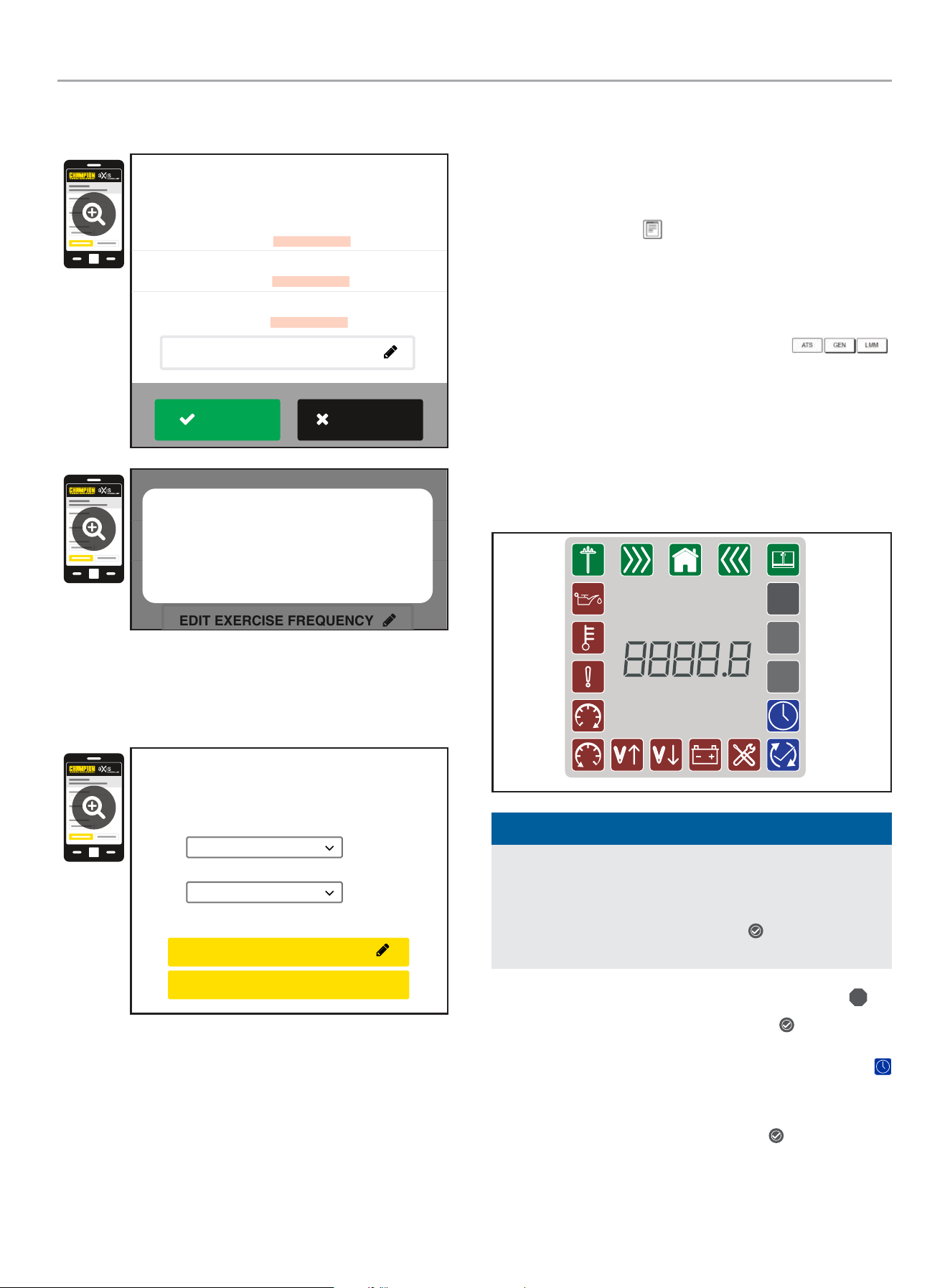
HOME STANDBY GENERATOR- ALL aXis CONTROLLER
®
MODELS
INSTALLATION
46
8. Confirm and apply the settings before continuing. Unsaved
changes are highlighted.
Every Week
Thursday
01:00 PM
Frequency
Day
Time
Unsaved Changes
Unsaved Changes
Unsaved Changes
Generator Exercise
(Automated Maintenance Running)
EDIT EXERCISE FREQUENCY
APPLY
REVERT
Every Week
Thursday
01:00 PM
Frequency
Day
Time
Unsaved Changes
Unsaved Changes
Unsaved Changes
(Automated Maintenance Running)
EDIT EXERCISE FREQUENCY
Are your sure to save the changes?
Cancel OK
9. Wireless network settings are not used at this time. The
default values (shown below) should not be adjusted.
Adjustment of this factory settings will require a certified
electrician to correct.
Wireless Network
Internet Service:
Web Page Mode:
Direct Connect
AP Mode
CONFIRM NETWORK SETTINGS
CANCEL SETTINGS
AP Mode IP : 192. 168. 0. 90
10. The time, date, and exercise information have now been
setup for the aXis ATS and HSB. You can close your browser
and disconnect from the ATS Wi-Fi, or skip to step 2 in the
next section “ATS and HSB STATUS USING WI-FI”
ATS and HSB Status Using WIFI
1. Using a WIFI enabled device, connect to the “Champion HSB”
WIFI network following steps 1, 2, and 3 from WIFI Setup
Method.
2. After loading the Home Standby Generator Settings page,
locate and click the icon at the bottom right corner of the
page.
3. You are now viewing the ATS and HSB status page. Items
such as voltage, frequency, current, etc. can all be viewed for
both utility and HSB power. All of the information is live. There
are three tabs located at the top of the page.
ATS, GEN, and LMM. Each tab will display the status for
the Transfer Switch, Home Standby Generator, or Load
Management Module(s) respectively.
4. When finished viewing the status of the ATS, Generator, and
LMM, close your browser and disconnect from the WIFI.
Programming aXis Controller
®
1234567
WEEK
SEM
Y M D
A M J
Hm
Hm
DST
DST
OFF
ARRÊT
AUTO
MAN
NOTICE
Setting values are not autosaved. You must press OFF to save
the changes and exit the programming.
Please wait for the decimal point to stop flashing before
moving on to the next function. If you hit too soon while the
decimal point is still flashing, it does not save the change.
1. To begin programming, disable AUTO by selecting OFF
OFF
ARRÊT
.
2. After the HSB is set to OFF, press and hold until the screen
changes (decimal point will flash) to enter programming
mode. The display will show YA for year and the clock icon
will illuminate.
Please wait for the decimal point to stop flashing before
moving on to the next function. If you hit
too soon while
the decimal point is still flashing, it doesn’t save the change.
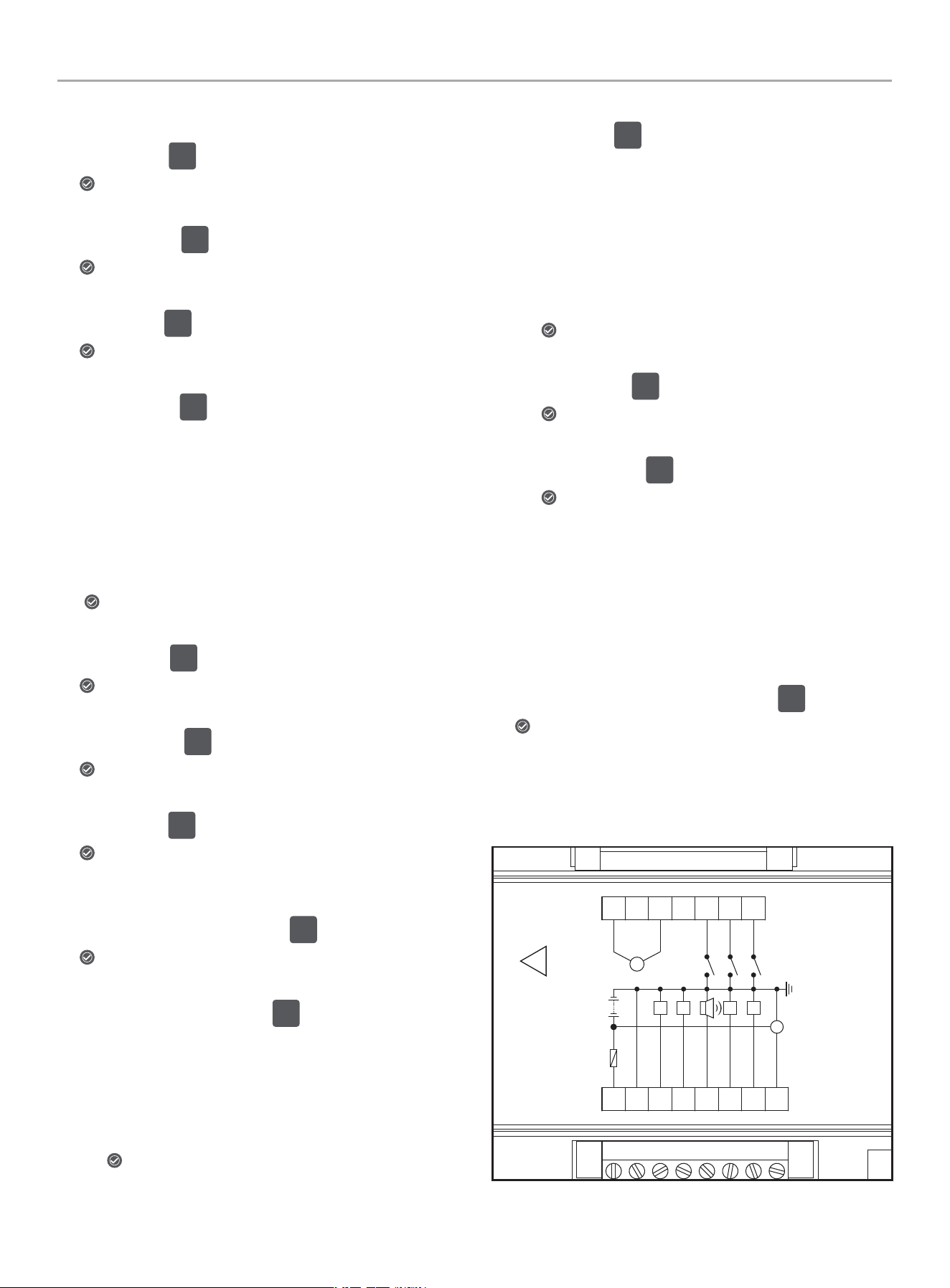
HOME STANDBY GENERATOR- ALL aXis CONTROLLER
®
MODELS
INSTALLATION
47
3. Year (Y) - choose current year (example 2021 would be 21)
with 18 to 47.
Set year using
MODE
for next
4. Month (M) - choose January to December with 1-12.
Set month using
MODE
for next
5. Day (D) - choose the day from 1 to 31.
Set day using
MODE
for next
6. Week Day - choose week day from 1 to 7.
Set week using
MODE
1= Monday
2= Tuesday
3= Wednesday
4= Thursday
5= Friday
6= Saturday
7= Sunday
for next
7. Hour (H) - choose hours in military time 0 - 23.
Set hour using
MODE
for next
8. Minute (m) - choose the minute from 0-59.
Set minute using
MODE
for next
9. Daylight Saving Time (DST) - choose DST on (1) or off (0).
Set DST using
MODE
for next
10. Maintenance Hour Meter (H) - Factory setting is 100 hours.
View current hours and reset as needed.
Set maintenance hour meter using
MODE
for next
11. Exercise
Set exercise schedule using
MODE
0= no exercise
1= 1 time per month (12 times annually)
2= 2 times per month (24 times annually)
3= 4 times per month (48 times annually)
4= weekly (52 times annually)
for next
Week Day (exercise) - choose week day from 1 to 7.
Set week using
MODE
1= Monday
2= Tuesday
3= Wednesday
4= Thursday
5= Friday
6= Saturday
7= Sunday
for next
Hour (exercise) - choose hours in military time 0 - 23.
Set hour using
MODE
for next
Minute (exercise) - choose the minute from 0-59.
Set minute using
MODE
for next
12. Brownout -
14-kW (Model 100515) Does not have this setting.**
22-KW (Model 100304) See below.
Allows you to adjust the settings of the aXis Controller
®
to delay start up of the HSB during a brownout or partial,
temporary reduction in system voltage or total system
capacity from your utility.
You can cycle through these to select using
MODE
for next
13. When finished, press OFF to save all changes.
PIN LOCATIONS
(On backside of the controller)
CRANKFQ2
I_AUX
I_LOP
I_HWT
FQ1
B-
ALARM
STOP
PREHEAT
FUEL
CHARGER
(D+)
B+
~
Rated Supply:
8~36 VDC (5A Max,)
(Terminal 13 and 15)
MAX WORKING
VOLTAGE
300 VAC
!
1
9151011
12
1314
8765432
ON
91108765432
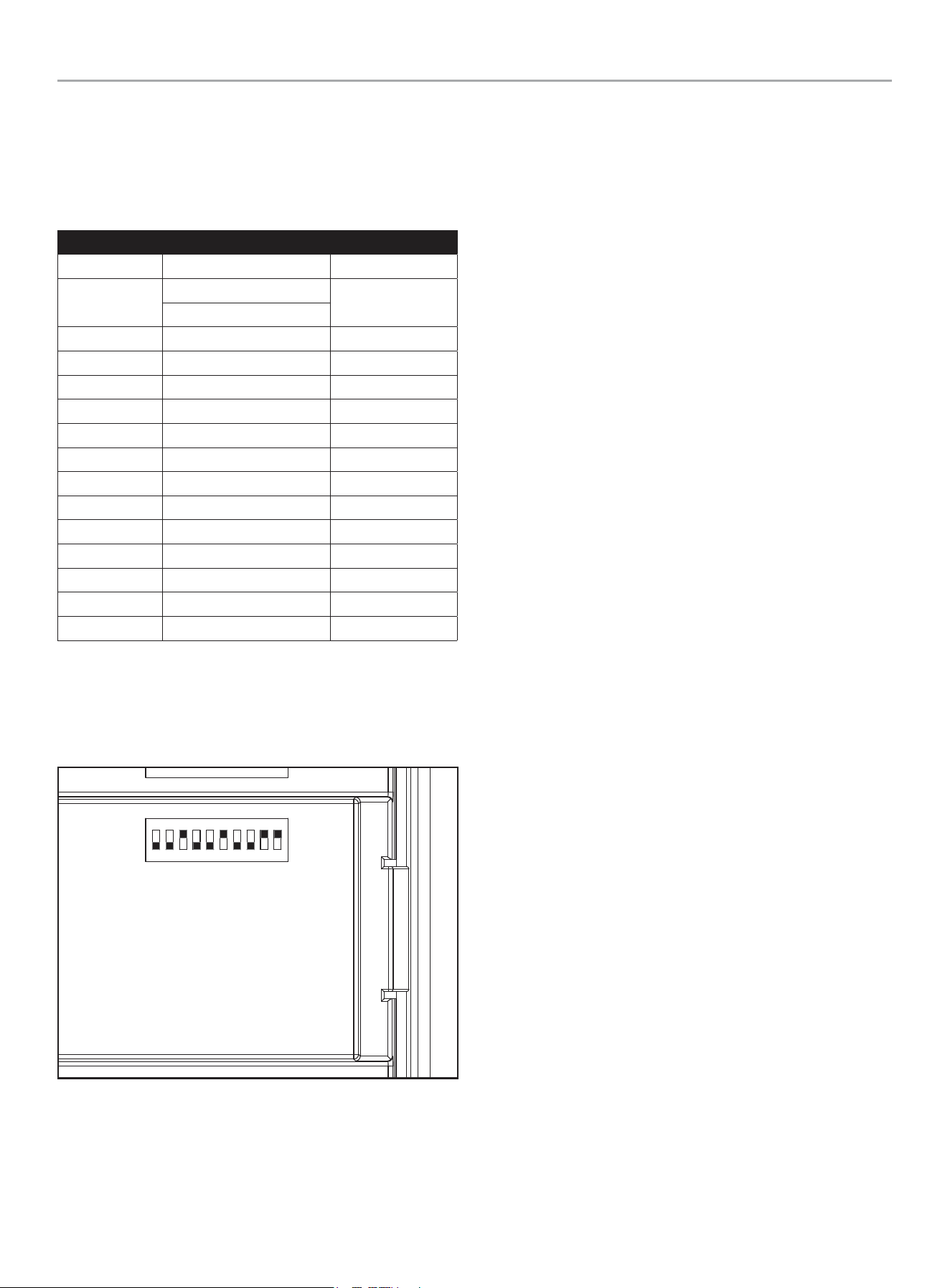
HOME STANDBY GENERATOR- ALL aXis CONTROLLER
®
MODELS
INSTALLATION
48
The pins relate to a function of the aXis Controller
®
. These
functions control the operation of the HSB aXis Controller
®
module. There are 15 pin locations. Remember the icons on the
front side of the module are only indicators of a run (GREEN) or
fault (Red). These are the designated pin locations, function and
wire colors for reference;
Pin Location Function Wire Color
Pin 1 B+ W(White)
Pin 2
B-
G (Green)
Used for two-wire start
Pin 3 Motor start signal B/W (Black/White)
Pin 4 Fuel valve G/B (Green/Black)
Pin 5 Alarm L/B (Blue/Black)
Pin 6 Stop L (Blue)
Pin 7 Signal to alternator R/B (Red/Black)
Pin 8 Not Connected
Pin 9 Engine High Temp Br (Brown)
Pin 10 Low Oil Pressure Y (Yellow)
Pin 11 Used for two-wire start
Pin 12 Not Connected
Pin 13 Frequency Over/Under R (Red)
Pin 14 Not Connected
Pin 15 Frequency Over/Under B (Black)
DIP Switches (Bottom side of aXis Controller
®
)
The 10 DIP switches relate to a program function of the aXis
Controller
®
. These functions control the operation of the HSB.
The figure below shows the designated factory switch settings for
reference.
CRANKFQ2
I_AUX
I_LOP
I_HWT
FQ1
B-
ALARM
STOP
PREHEAT
FUEL
CHARGER
(D+)
B+
~
Rated Supply:
8~36 VDC (5A Max,)
(Terminal 13 and 15)
MAX WORKING
VOLTAGE
300 VAC
!
DIP1_ENGINE STOP TIME
DIP2_ENGINE STOP TIME
DIP3_SYSTEM FREQUENCY
DIP4_OIL PRESSURE SWITCH TYPE
DIP5_AVR BOOST
DIP6_ENGINE COOLING TIME
vDIP7_ENGINE COOLING TIME
DIP8_IDLE OR PREHEAT
DIP9_PLC ACTIVE
DIP10_STARTER MOTOR STOP RPM
1
9151011
12
1314
8765432
ON
91108765432
Automatic Transfer Switch (ATS)
The most reliable and convenient method to transfer power is with
an automatic transfer switch (ATS). The ATS will automatically
disconnect the home from the utility power prior to the HSB
functioning (see NEC 700, 701 and 702). Failure to disconnect the
home from the utility with an approved UL listed ATS can result
in damage to the HSB and can also cause injury or death to utility
power workers who may receive electrical back-feed from the
HSB.
ATS includes sensors to detect when a power failure (utility lost)
occurs. These sensors trigger the ATS to disengage the home from
the utility power. When the HSB reaches the proper voltage and
frequency, the ATS will automatically transfer generator power to
the home.
The ATS module continues to monitor the utility source for the
return of utility power. When the utility power returns, the ATS
disengages the home from generator power and re-transfers the
home to utility power. The HSB is now off line and will shut down-
returning to the standby mode.
NEMA 3R – This type of enclosed ATS is similar to the indoor box,
except that it is a weatherproof enclosure and required for exterior
installations by code. The enclosure has knockouts on the bottom
and side, and requires water tight connections when installed
outside per code. This enclosure can also be used inside.
aXis Controller
®
Module
This standby generator is designed to communicate with the ATS
using the integrated aXis Controller
®
. In order to utilize features
such as load management, wifi programming, wireless exercise
programming, etc., it is necessary that the ATS contains aXis
Controller
®
electronics.
While it is possible to connect this standby generator to a
non-aXis Controller
®
ATS using the two-wire connection shown
in this manual, it will reduce the functionality of the standby
generator significantly. If the standby generator is being controlled
with the two-wire connection, the standby generator will turn
on and off based on the two-wire signal. Full power will still be
provided through the circuit breaker however will lose functionality
of the ATS (like day, date, time, excercise settings).
ATS Installation
Refer to the ATS instruction guide enclosed with each ATS
for information related to the installation, operation, service,
troubleshooting, and warranty.
After Performing Installation of Champion ATS with aXis
Controller
®
, complete the following steps to finish the installation
of this standby generator.
OTE: N If a non-aXis Controller
®
ATS was installed, please skip
to section “Installing Standby Generator to non-aXis
Controller
®
ATS” on page 41 to finish installation.
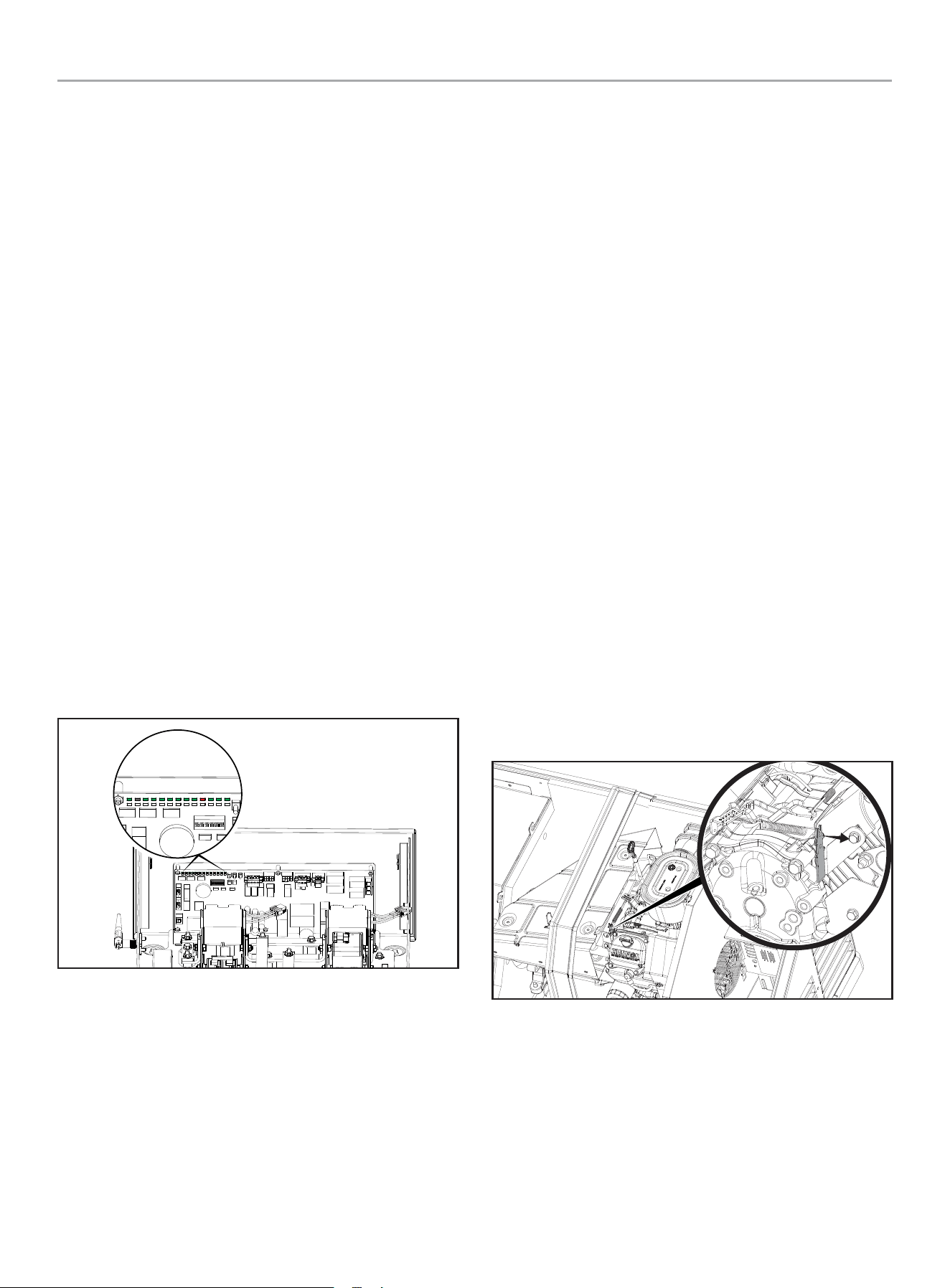
HOME STANDBY GENERATOR- ALL aXis CONTROLLER
®
MODELS
INSTALLATION
49
FULL SYSTEM CHECK
1. Open Utility breaker for full system test, close breaker after
confirming all systems working.
2. After Utility breaker opens engine will start automatically.
3. aXis ATS control panel will reboot on Generator power and
control switching of latching relays.
4. Home is now powered by Generator. If Load Management
modules (LMM) have been installed, please allow 5 minutes
for LMM and AC1/AC2 to become active.
5. Perform Load Learning through ATS panel at this time. LMM
units will be dropped and reacquired in order.
6. Close Utility breaker.
7. System is now fully functional.
Commissioning the ATS
1. Put the aXis Controller
®
in the OFF position.
2. With door and deadfront removed from the ATS cabinet,
confirm Generator and Utility circuit breakers are in the “OFF”
position.
3. Re-enable the Utility power to ATS.
4. At ATS panel switch Utility circuit breaker to the “ON”
position. Allow at least 6 minutes for all ATS functions to
resume on controller.
5. Confirm ATS controller in ATS panel has fully booted and
LED’s indicate proper operating condition.
NO
1 2 3 4 5 6 7 8 9 10 11 12
NO
1 2 3 4 5 6 7 8 9 10 11 12
6. Switch Generator circuit breaker to the “ON’ position.
7. Replace the deadfront by sliding it from the bottom up
into the cabinet; panel should index into the door latch
protrusions. Secure it to the deadfront bracket with included
nut and stud.
8. Replace the door and secure with included hardware. It is
recommended to secure the door with a lock.
9. Return to HSB and press the controller to the “AUTO”
position. Confirm icons indicate Utility power is active, Utility
side relay is closed, and home is receiving power.
10. Close and lock HSB hoods return keys to customer.
NEMA 1 – This type of enclosed ATS is for indoor installations
only.
NEMA 3R – This type of enclosed ATS is similar to the indoor box,
except that it is a weatherproof enclosure and required for exterior
installations by code. The enclosure only has knockouts on the
bottom side for the enclosure, requires water tight fasteners/
grommets when installed outside per code. This enclosure can
also be used inside.
HSB Test
SPEED SETTING NO LOAD - 14-KW (MODEL 100515)
Do NOT move forward until the HSB generator AC output voltage
and frequency are correct and within the stated limits.
1. If the no-load voltage is correct but no-load frequency is
incorrect, the engine governed speed requires adjustment.
1a. Engine speed is normally set to 3750 RPM (62.5 HZ) high
speed no load (HSNL)
1b. Set engine speed with no electrical load on the generator
1c. Use long needle nose pliers, or a long screw driver, to
bend the spring anchor on the fixed speed controls.
i. To increase engine speed HSNL bend the spring
anchor tang on the fixed speed controls away from the
governor lever to increase spring tension.
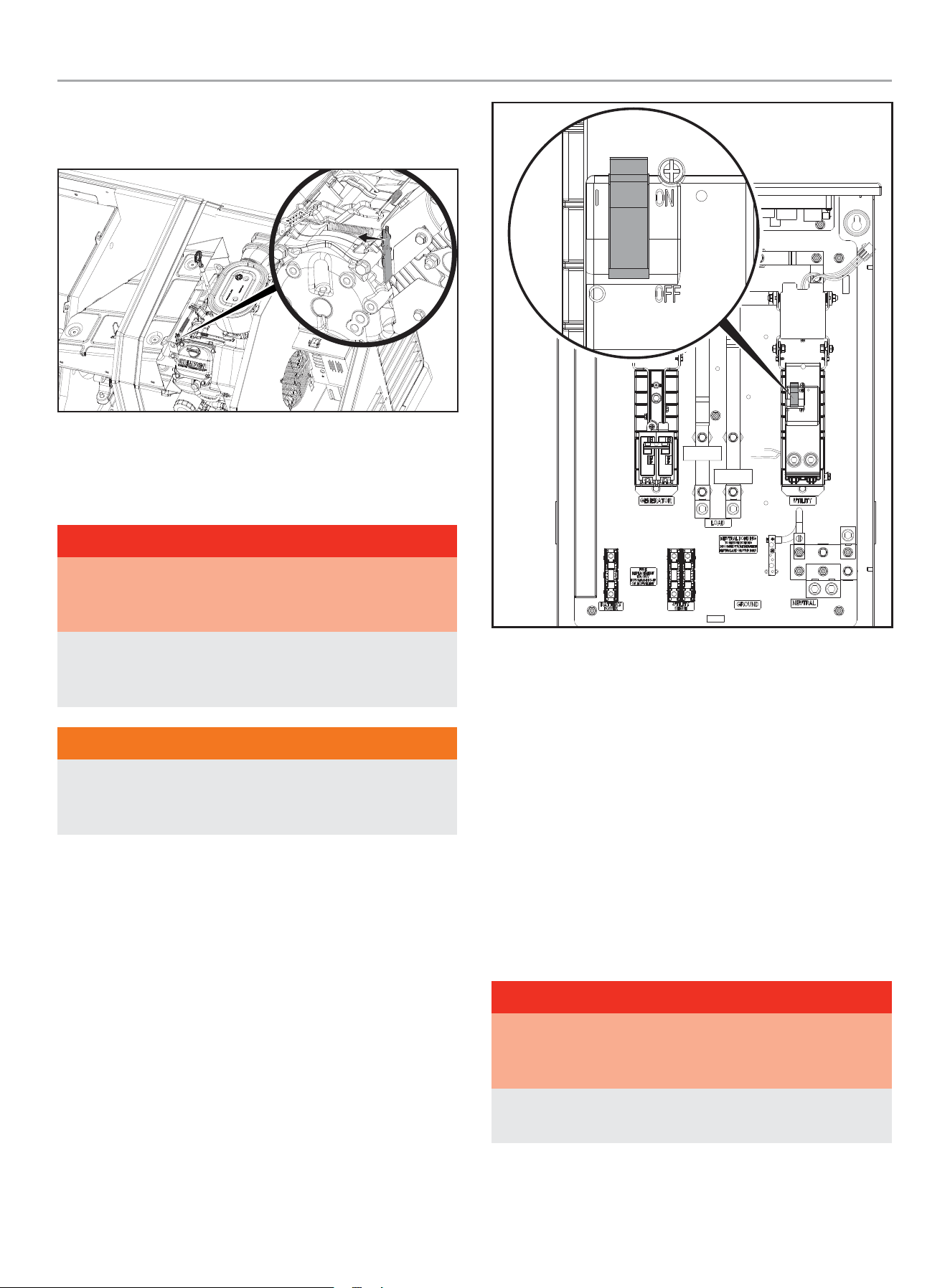
HOME STANDBY GENERATOR- ALL aXis CONTROLLER
®
MODELS
INSTALLATION
50
ii. To decrease engine speed HSNL bend the spring
anchor tang on the fixed speed controls toward the
governor lever to decrease spring tension.
SPEED SETTING NO LOAD - 22-KW (MODEL 100304)
No speed adjustments are necessary as it’s governed by an
electronic speed controller.
DANGER
Proceed with caution. Once the Utility Power is turned ON, the
ATS is now electrically hot. The feeder lines and terminals are
now live.
Contact with these connections will result in extremely
hazardous and possibly fatal electrical shock. Use the correct
procedures as described in national electrical codes.
WARNING
The manufacturer recommends that a licensed electrician or
an individual with complete knowledge of electricity perform
these procedures.
ATS door opened and dead front removed as well as the HSB hood
and electrical access panel removed for the following sections
1. Place aXis Controller
®
in the OFF position and remove aXis
Controller
®
fuse.
2. Turn ON the utility power supply to the ATS.
3. With an AC voltmeter, check for the correct voltage.
Single-phase utility power supply. Measure across the
UTILITY SUPPLY ATS terminal lugs L1 and L2. Also check L1
to NEUTRAL and L2 to NEUTRAL.
4. The utility supply voltage should be correct and compatible
with the ATS ratings.
5. Turn OFF the utility power supply to the ATS.
6. The Control Panel MAIN CIRCUIT BREAKER must be in the
OFF position.
7. Set the aXis Controller
®
in the MANUAL mode. The HSB
will crank and start. Let the HSB warm up at no load for 5
minutes to stabilize performance.
8. Set the Control Panel MAIN CIRCUIT BREAKER in the ON
position.
DANGER
Proceed with caution. HSB generator output voltage is now
being delivered to the ATS and is electrically hot. The feeder
lines and terminals are now live.
Contact with these connections will result in extremely
hazardous and possibly fatal electrical shock
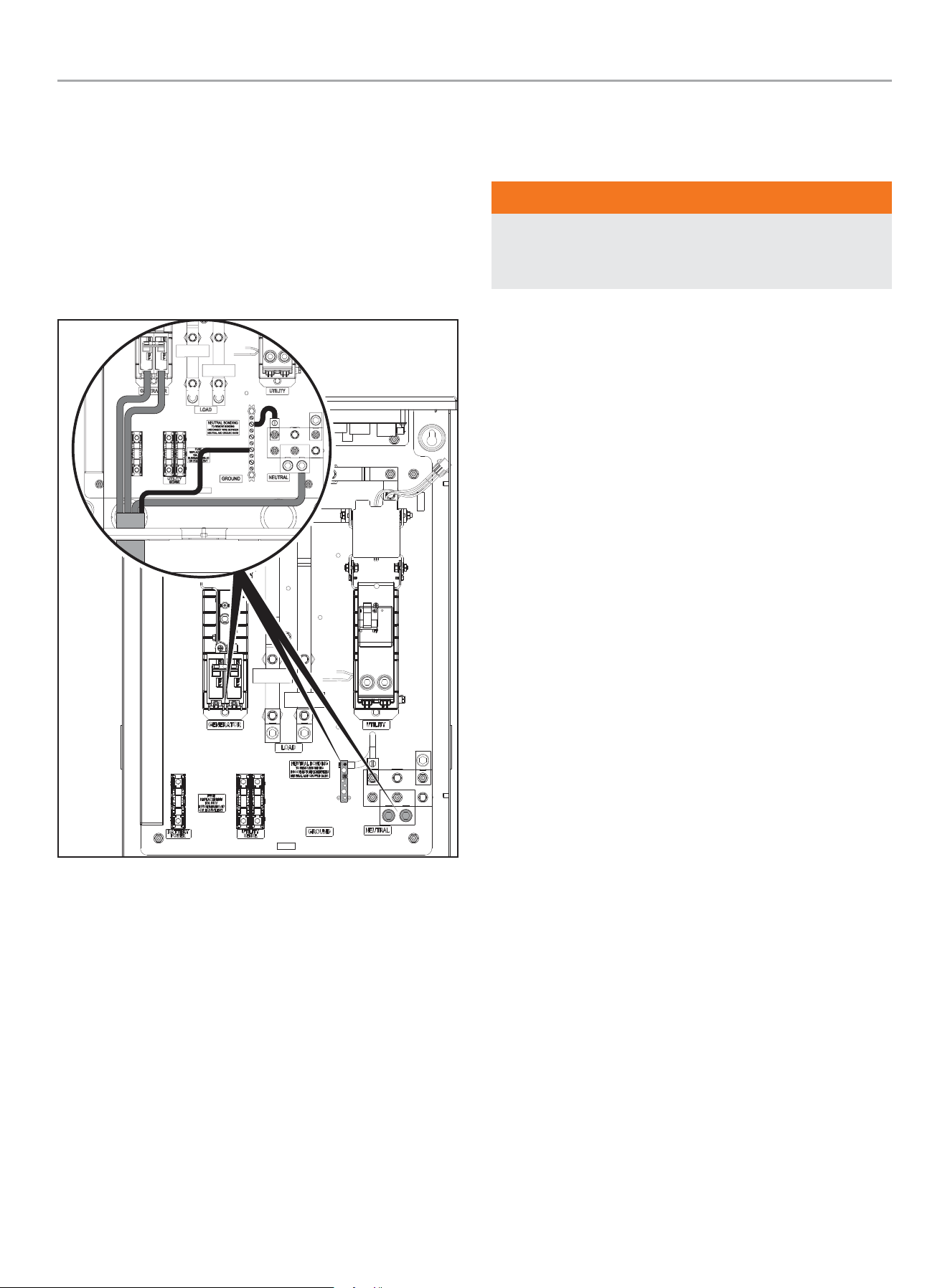
HOME STANDBY GENERATOR- ALL aXis CONTROLLER
®
MODELS
INSTALLATION
51
9. With an AC voltmeter, check the correct voltage. Single-phase
generator supply.
10. Measure across GENERATOR SUPPLY ATS lugs L1 and L2.
Also check L1 to NEUTRAL. These are factory, no load, pre-
set limits.
Frequency .................................................................. 62.5 Hertz
Terminals L1 to L2 ..........................................................240 VAC
Terminals L1 to NEUTRAL ...............................................120 VAC
Terminals L2 to NEUTRAL...............................................120 VAC
L1 L2
L1 L2
N
G
11. Set the HSB generator MAIN CIRCUIT BREAKER to its OFF
position.
12. Set the aXis Controller
®
to the OFF position. This will shut off
the HSB.
HSB TESTS UNDER LOAD
During this test you DO NOT need to turn off any circuit
breakers in the Utility Main Distribution Panel, HSB Control
Panel or the ATS.
This procedure will verify load Voltage and frequency output. Prior
to starting the test you can place a Manometer in line to check
fuel flow when the HSB is near rated load.
1. Remove ATS dead front.
2. Assure DIP switch #9 (TEST WITH LOAD is in the ON position.
3. Press TEST button.
4. The engine will start and the ATS will transfer.
5. The aXis Controller
®
screen will indicate that the generator is
now suppling power to the home.
WARNING
The manufacturer recommends that a licensed electrician or
an individual with complete knowledge of electricity perform
these tests.
6. With rated load applied, check voltage and frequency across
ATS GENERATOR SUPPLY terminals L1 and L2. Voltage must
be greater than 216 Volts.
7. Frequency should be greater than 58 Hertz.
8. Verify that the gas pressure remains within the acceptable
parameters as listed in the manual, provided that you placed
a Manometer in line prior to starting this test.
9. In test mode, the HSB will run under load for 15 minutes at
which time it will conclude the test and shut off automatically.
With the unit running listen for unusual noises, inspect for
vibrations or other unusual items that might reflect a problem.
10. To stop the test prior to automatic shut off, press the Test
Button in the ATS a second time.
11. The HSB will run through a cool down cycle, shut down and
return to standby mode.
The test is now complete and the system is in standby mode.
Checking Automatic Operation
To check the HSB system for proper automatic operation, proceed
as follows:
1. Turn the ATS utility side breaker OFF.
2. Engine will start and the ATS will transfer.
3. Allow the system to go through a complete cycle.
(Approximately 7 minutes)
4. To conclude Automatic Operation Check, turn the ATS utility
side breaker ON.
5. The HSB will run through a cool down cycle, shut off, and
return to standby mode.
6. Replace covers on ATS and HSB that were removed for HSB
Test and Checking Automatic Operation. This check is now
complete.
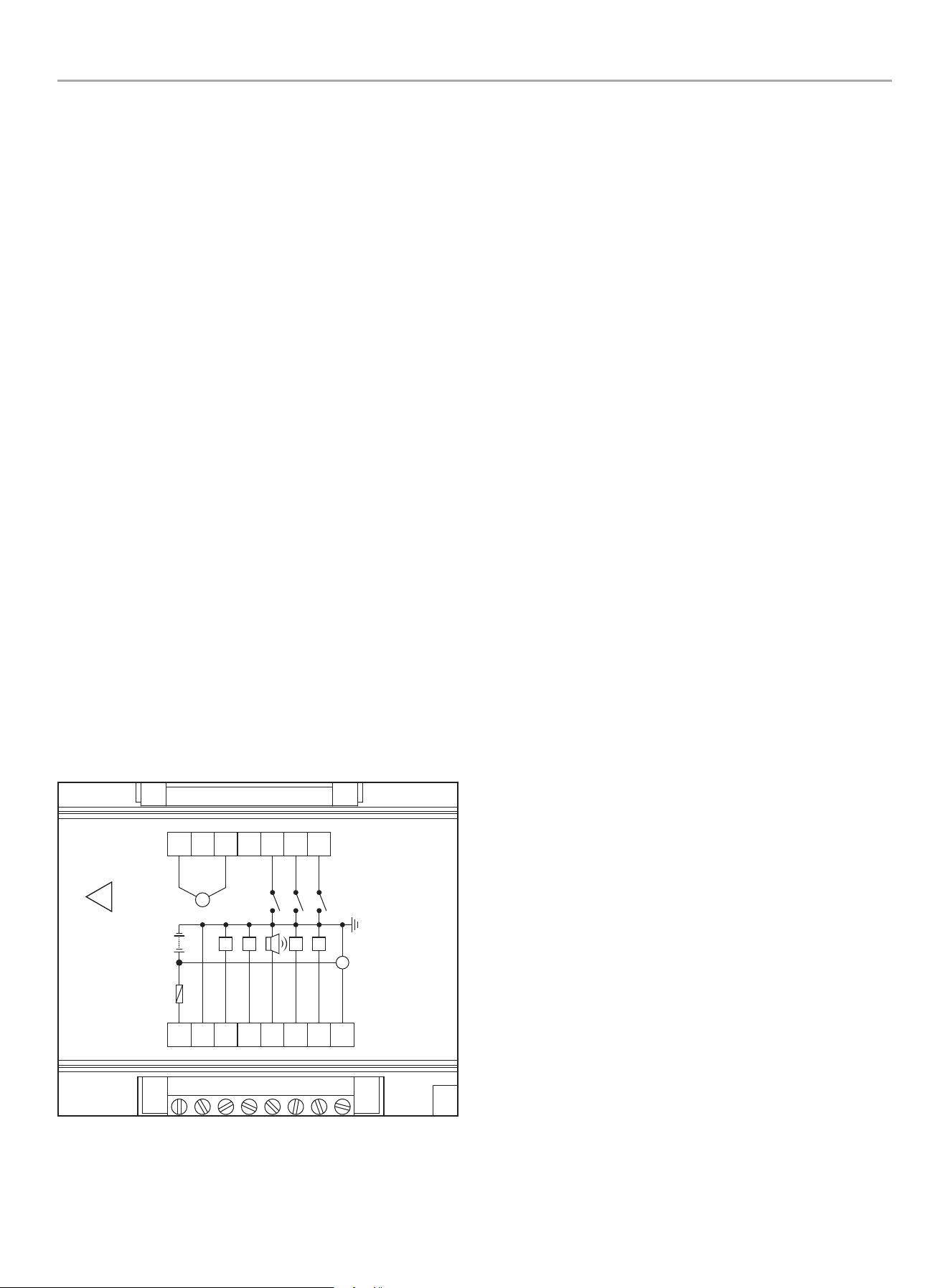
HOME STANDBY GENERATOR- ALL aXis CONTROLLER
®
MODELS
MAINTENANCE
52
Installing Standby Generator to non-aXis
Controller
®
ATS
OTE: N This section is only for those looking to install their
aXis Controller
®
HSB to a non-aXis Controller
®
ATS that
supports a two-wire HSB start/stop signal. Please refer to
the ATS installation manual for instructions on how to wire
the ATS.
If the aXis Controller
®
HSB is being connected to a
non-aXis Controller
®
ATS, it will be necessary to use a two-wire
connection shown below to control the on/off operation of this
HSB. Note that this will disable some of the aXis Controller
®
features such as load management, WiFi connectivity, and
wireless exercise programming.
TWO-WIRE CONNECTION
A two-wire connection refers to a signal circuit that runs between
the non-aXis Controller
®
ATS and the HSB. When installed in this
configuration, the HSB will turn on and off based on the signal it is
receiving from the ATS.
The aXis Controller
®
HSB uses pin 2 and pin 11 on the back of
the aXis Controller
®
to control two-wire starting. When pin 11
(normally 5VDC) is connected to pin 2 (ground), the generator will
start and will continue to run until pin 11 is disconnected from pin
2 (ground). When pin 11 is disconnected from pin 2 (ground), the
HSB will start the cool-down cycle and stop.
To wire the HSB to be controlled by the two-wire start signal, tap
into the wires for pin 2 and pin 11 on the HSB and run them to a
relay (not provided) that will close the circuit when the ATS wants
the generator to run. Refer to the ATS instructions for the ATS
logic on how to create the circuit.
CRANKFQ2
I_AUX
I_LOP
I_HWT
FQ1
B-
ALARM
STOP
PREHEAT
FUEL
CHARGER
(D+)
B+
~
Rated Supply:
8~36 VDC (5A Max,)
(Terminal 13 and 15)
MAX WORKING
VOLTAGE
300 VAC
!
1
9151011
12
1314
8765432
ON
91108765432
Customer Familiarization Summary
It’s important to educate the home owner on proper maintenance,
operation and service call procedures. A properly educated home
owner can reduce unnecessary service trips and phone calls.
Ensure that the installation of the HSB and ATS has been correctly
performed as outlined by the manufacturer and that it meets all
applicable codes.
Test and confirm proper operation of the HSB and ATS system as
outlined in the appropriate installation and owner’s manuals.
Educate the home owner on the location and operation of;
Full flow shutoff valve
Automatic operation of the HSB system
Battery Charger and LED indicators
Exterior warning LED on the backside of the HSB
ATS operation
Exercise scheduled time of operation
Scheduled Maintenance
Fill out and provide the customer a copy of the HSB, ATS
model & serial number reference. This information is extremely
important for part purchases and service information, these
numbers are specific to each HSB and ATS.
MAINTENANCE
Before performing maintenance procedures, review SAFETY
section of your operator’s manual.
Ensure that the ATS and generator ON/OFF switches (depending
on model) are in the OFF position before performing any
maintenance or cleaning.
Refer to “Resetting the maintenance hour meter” in the HSB
operator manual for instructions after performing maintenance.
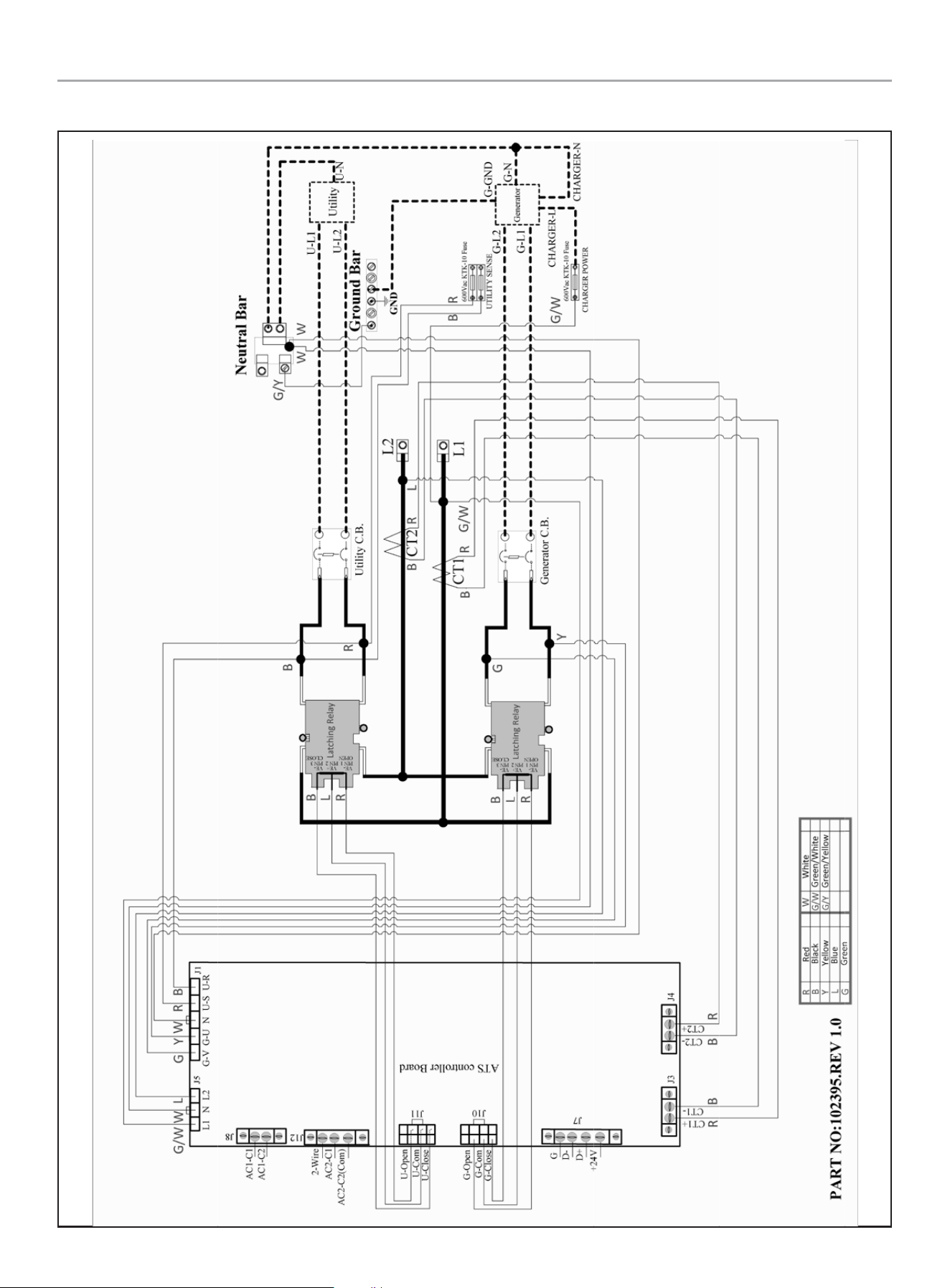
HOME STANDBY GENERATOR- ALL aXis CONTROLLER
®
MODELS
MAINTENANCE
53
102006, 102007, 102008, 102009, 102010 ATS Wiring Diagram
Latching Relay
PIN 2
VE+ VE-
PIN 3
VE-
PIN 1
OPEN CLOSE
Latching Relay
PIN 2
VE+ VE-
PIN 3
VE-
PIN 1
OPEN CLOSE
Utility C.B.
Utility
Generator C.B.
Generator
L2
L1
CT2
CT1
U-L1
U-L2
G-L2
G-L1
U-N
G-N
R
B
Y
Red
Black
L
Yellow
Blue
G
W
Green
White
G/W
Green/White
PART NO:102395.REV 1.0
G
Y
B
R
B
R
L
B
L
R
R
WW
G/W
L
B
R
W
Y
G
R
B
R
B
B
R
B
Neutral Bar
Ground Bar
G-GND
CHARGER POWER
600Vac KTK-10 Fuse
UTILITY SENSE
600Vac KTK-10 Fuse
CHARGER-L
CHARGER-N
R
B
G/W
ATS controller Board
J5
L1 N L2
J1
G-V G-U N U-S U-R
J8
J12
AC2-C2(Com)
AC2-C1
AC1-C2
AC1-C1
J3
CT1+
CT1-
J11
U-Close
U-Com
U-Open
J10
G-Close
G-Com
G-Open
J7
G
D-
D+
+24V
2-Wire
J4
CT2+
CT2-
L
W
G/W
G/Y
GND
G/Y
Green/Yellow
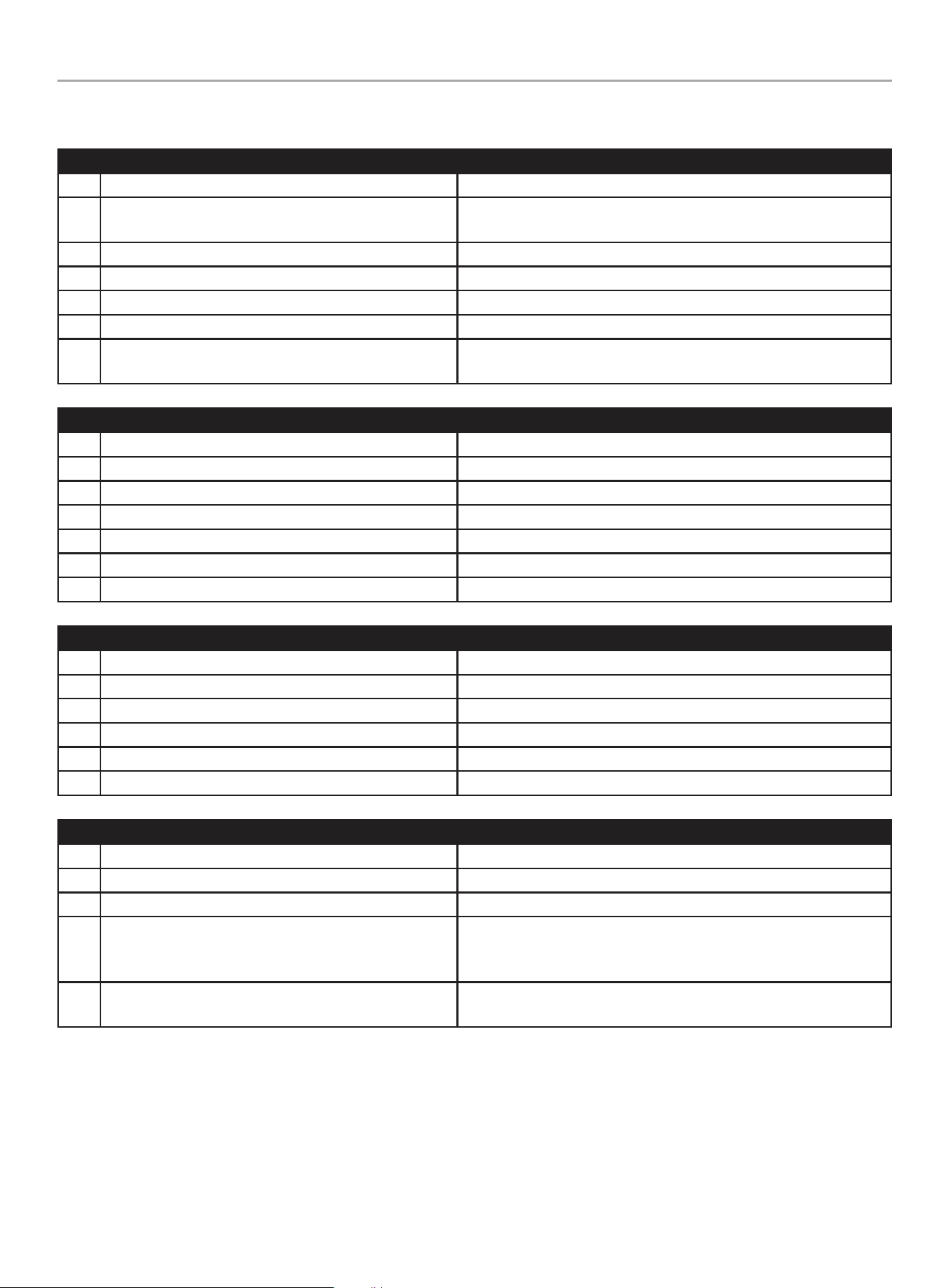
HOME STANDBY GENERATOR- ALL aXis CONTROLLER
®
MODELS
TROUBLESHOOTING HSB
54
TROUBLESHOOTING HSB
Engine will not crank/turn over
1 HSB set in “OFF” mode. Place the HSB controllers in the AUTO position.
2 Battery not connected or loose, corroded posts or wires
Connect the batteries according to owner’s manual, clean and tighten
the battery connections
3 Battery(s) not charged or low charge. Recharge or replace battery(s).
4 Check for active fault code. Identify fault code, correct and reset.
5 Defective starter solenoid *
6 Defective starter *
7 Generator ON/OFF switch is in the OFF position.
Check either single or dual generator ON/OFF switches are in the ON
position (inside on 100515 and 100304, on the back for 100304).
Generator will crank/turn over but will not start
1 Check for active fault code. Identify fault code, correct and reset.
2 Fuel valve(s) turned off. Turn on fuel supply.
3 Fuel pressure insufficient*. Manometer check, confirm fuel pressure to fuel regulator*.
4 Weak battery(s). Recharge or replace battery(s)
5 Low oil level. Check for oil leaks. Check the oil level and add oil if necessary.
6 Spark plug wire is disconnected. Connect spark plug wire.
7 Defective fuel solenoid/regulator. *
Engine starts, runs rough
1 Fuel pressure insufficient*. Manometer check, confirm fuel pressure to fuel regulator*.
2 Wrong fuel jets. Check jets for NG or LPG, change to correct Master Mixer fuel jets.
3 Faulty spark plug, loose spark plug wire. Change spark plug, set gap, connect wire.
4 Plugged air cleaner Clean or replace air cleaner.
5 Generator overloaded*. Remove one or more loads*.
6 Shorted circuit *
HSB starts, then suddenly stops
1 Check for active fault code. Identify fault code, correct and reset.
2 Fuel supply insufficient* Manometer check, confirm fuel pressure to fuel regulator*.
3 Low oil, pressure shut down Check for oil leaks. Check the oil level and add oil if necessary.
4 Generator over loaded
Turn off standby circuits for house, reset fault, place unit back into
AUTO and ATS mode. Turn on standby circuits for house. If problem
returns contact Champion or Champion service dealer*.
5 Engine high/over temperature shut down
Check all intake and exhaust ventilation around the HSB, remove all
debris. Let HSB sit for 30 minutes to cool down.
HOME STANDBY GENERATOR- ALL aXis CONTROLLER
®
MODELS
TROUBLESHOOTING HSB
55
No AC output
1 Circuit breaker in “OFF” position Turn on breaker.
2 Main circuit breaker in “OFF” position. Turn on breaker.
3 Transfer switch breaker in “OFF” position. Turn on breaker.
4 Standby breakers set in “OFF” position. Turn on breaker.
5 Line circuit tripping breaker because of short circuit *
6 Line circuit tripping breaker because of overload *
7 Poor wiring connections*
8 ATS problems*
LED Indicators
In all cases when the GREEN icons are lit, this is an indicator that the HSB is performing properly.
In all cases when the RED icons are lit, this is an indicator that the HSB has registered a fault and must be corrected. Only the “LOW
BATTERY” and “MAINTENANCE” icons will not latch out or shut down the HSB. All other RED icon faults will latch out, shut down, disable
starting and light the RED icons on the aXis Controller
®
and the exterior warning LED on the backside of the HSB.
Reset fault code(s)
There is an exterior warning LED located on the back of the enclosure. This should be checked weekly to make sure there are no active
fault codes.
The fault code(s) can be reset by placing the aXis Controller
®
in the OFF position for 10 seconds and then put the aXis Controller
®
in
the previous position (either MANUAL or AUTO for example). This will reset fault icon, however if a fault code(s) re-occurs it must be
addressed.
BATTERY(S) NO OR LOW LEVEL CHARGED, BATTERY(S) DEAD, NEEDS REPLACEMENT, THE EXERCISE TIME MUST BE RESET ONCE
THE BATTERY(S) HAVE BEEN DISCONNECTED.
* *Contact Champion Power Equipment, Technical Service toll free 1-877-338-0999, tech@championpowerequipment.com or your nearest Champion dealer.
www.championpowerequipment.com

HOME STANDBY GENERATOR- ALL aXis CONTROLLER
®
MODELS
TROUBLESHOOTING HSB
56
HSB, ATS Model & Serial Reference ATS Back-up Circuits
HSB Model Number
HSB Serial Number
Fuel Type LPG NG
ATS Model Number
ATS Serial Number
ATS circuits powered
Date Installed
Dealer/Installer
Address
Phone
Cell
Purchased from

10 YEAR LIMITED WARRANTY*
Basic Warranty Provisions
Champion Air-Cooled 8.5kW – 22kW Home
Standby Units USA and Canadian Models
For a period of 10 years or 2000 hours (whichever occurs first)
from successful activation by an Authorized Champion Home
Standby Dealer, Champion Power Equipment will, at its option,
repair or replace any part(s) which upon examination, inspection
and testing by Champion Power Equipment or an Authorized
Champion Home Standby Dealer is found to be defective under
normal use and service, in accordance with the Warranty
Schedule set forth below.
Any equipment that the purchaser/owner claims to be defective
must be examined by the nearest Authorized/Certified Champion
Home Standby Service Dealer. This warranty applies only to
Champion Power Equipment automatic standby generators used
in “Standby” applications as Champion has defined Standby.
Scheduled Maintenance, as outlined by the generator owner’s
manual is required. This Scheduled Maintenance should be
performed by a knowledgeable, experience operator or an
Authorized/Certified Champion Home Standby Service Dealer.
WARRANTY SCHEDULE
Years 1 and 2 – Limited comprehensive coverage on mileage,
labor and parts
Years 3 through 10 – Limited comprehensive coverage on
parts only
GUIDELINES:
– Warranty begins upon the successful activation of the unit.
– Unit should be Registered and Proof of Purchase and
Maintenance must be available.
– Warranty is transferable between ownership of original
installation site.
– Warranty only applies to permanently wired and mounted
units.
– Any and all warranty repairs and/or concerns must be
performed and/or addressed by an Authorized/Certified
Champion Home Standby Service Dealer. Repairs or
diagnostics performed by individuals other than Authorized/
Certified Champion Home Standby Service Dealers not
authorized in writing by Champion Power Equipment will not be
covered.
– A Champion approved Transfer Switch is highly recommended
to be used in conjunction with the generator set. The
Champion Transfer Switch is covered under its own, separate
warranty listed in the Transfer Switch Instruction Manual and
is not covered under this warranty schedule.
– If a Non-Champion approved Transfer Switch is substituted
for use and directly causes damage to the generator set, no
warranty coverage shall apply.
– Steel enclosures are warranted against rusting for the first
year of ownership only. Damage caused after receipt of
generator is the responsibility of the owner and is not covered
by this warranty. Nicks, scrapes, dents or scratches to the
painted enclosure should be repaired promptly by the owner.
– All warranty expense allowances are subject to the conditions
defined in Champion Power Equipment “Home Standby”
Warranty Policy and Procedures Manual.
THIS WARRANTY SHALL NOT APPLY TO THE
FOLLOWING:
– Original installation or start-up costs
– Champion Home Standby generators that utilize non-Champion
Power Equipment replacement parts
– Costs of normal maintenance (i.e. tune-ups, associated part(s),
adjustments, loose/leaking clamps, installation and start-up)
– Units sold, rated or used for “Prime Power”, “Trailer Mounted”
or “Rental Unit” applications
– Damage to generator system (including transfer switch)
caused by improper installation or costs necessary to correct
installation
– Units used for Prime Power in place of existing utility power
(where utility power is present) or in place of utility power
where utility power service does not normally exist. Prime
power includes any application that does not use the utility
grid for electric power (example: Solar power)
– Fuel connections other than conventional utility company
supplied natural gas systems or conventional LP vapor
withdrawal systems
– Any failure caused by contaminated fuels, oils or lack of proper
fuels, oils or failure to perform scheduled maintenance and
service the air filter
– Steel enclosures that are rusting due to the improper
installation, location in a harsh or saltwater environment or
scratched where integrity of paint applied is compromised
– Failures due, but not limited, to normal wear and tear,
accident, misuse, abuse, negligence or improper installation.
As with all mechanical devices, the Champion engines need
periodic part(s) service and fluid replacement to perform as
designed.
– Failures caused by any external cause or act of God, such as
collision, theft, vandalism, riot or wars, nuclear holocaust,
fire, freezing, lightning, earthquake, windstorm, hail, volcanic
eruption, water or flood, tornado or hurricane
– Damage related to rodent and/or insect infestation
– Covered warranty labor rates are based on normal working
hours. Overtime, holiday, or emergency labor costs for repairs
outside of normal business hours will be the responsibility of
the customer

– Any incidental, consequential or indirect damages caused by
defects in materials or workmanship, or any delay in repair or
replacement of the defective part(s)
– Failure due to misapplication to provide sufficient cooling air
and to regularly exercise the generator under load
– Telephone, cellular phone, facsimile, internet access or other
communication expenses
– Living or travel expenses of person(s) performing service,
except as specifically included within the terms of a specific
unit warranty period
– Expenses related to “customer instruction” or troubleshooting
where no manufacturing defect is found
– Rental equipment used while warranty repairs are being
performed and/or overnight freight costs for replacement
part(s)
– Costs incurred for equipment used for removal and/or
reinstallation of generator, (i.e.: cranes, hoists, lifts, etc.)
– Planes, ferries, railroad, buses, helicopters, snowmobiles,
snow-cats, off-road vehicles or any other mode of transport
deemed abnormal
– Starting batteries, fuses, light bulbs, engine fluids, and spark
plugs
THIS WARRANTY AND THE ATTACHED U.S. EPA WARRANTY
ARE IN LIEU OF ALL OTHER WARRANTIES, EXPRESS OR
IMPLIED, INCLUDING WARRANTIES OF MERCHANTABILITY OR
FITNESS FOR A PARTICULAR PURPOSE.
Any implied warranties which are allowed by law, shall be limited
in duration to the terms of the express warranty provided herein.
Some states do not allow limitations on how long an implied
warranty lasts, so the above limitation may not apply to purchaser/
owner.
CHAMPION POWER EQUIPMENT’S ONLY LIABILITY SHALL BE
THE REPAIR OR REPLACEMENT OF PART(S) AS STATED ABOVE.
IN NO EVENT SHALL CHAMPION POWER EQUIPMENT BE
LIABLE FOR ANY INCIDENTAL, OR CONSEQUENTIAL DAMAGES,
EVEN IF SUCH DAMAGES ARE A DIRECT RESULT OF CHAMPION
POWER EQUIPMENT’S NEGLIGENCE.
Some states do not allow the exclusion or limitation of incidental
or consequential damages, so the above limitations may not apply
to purchaser/owner. Purchaser/owner agrees to make no claims
against Champion Power Equipment based on negligence. This
warranty gives purchaser/owner specific legal rights. Purchaser/
owner also may have other rights that vary from state to state.
To obtain warranty service or your nearest Champion Home
Standby Dealer call Champion Power Equipment Customer Service
toll free 1-877-338-0999.
Contact Information
Address
Champion Power Equipment, Inc.
Customer Service
6370 S Pioneer Way, Unit 101
Las Vegas, NV 89113 USA
www.championpowerequipment.com
Customer Service and Techinical Support
Toll Free: 1-877-338-0999
hsb@cpeauto.com
Fax no.: 1-562-236-9429
*Except as otherwise stipulated in any of the following enclosed Emission Control System Warranties (when applicable) for the Emission Control System: U.S. Environmental Protection Agency
(EPA) and/or California Air Resources Board (CARB).