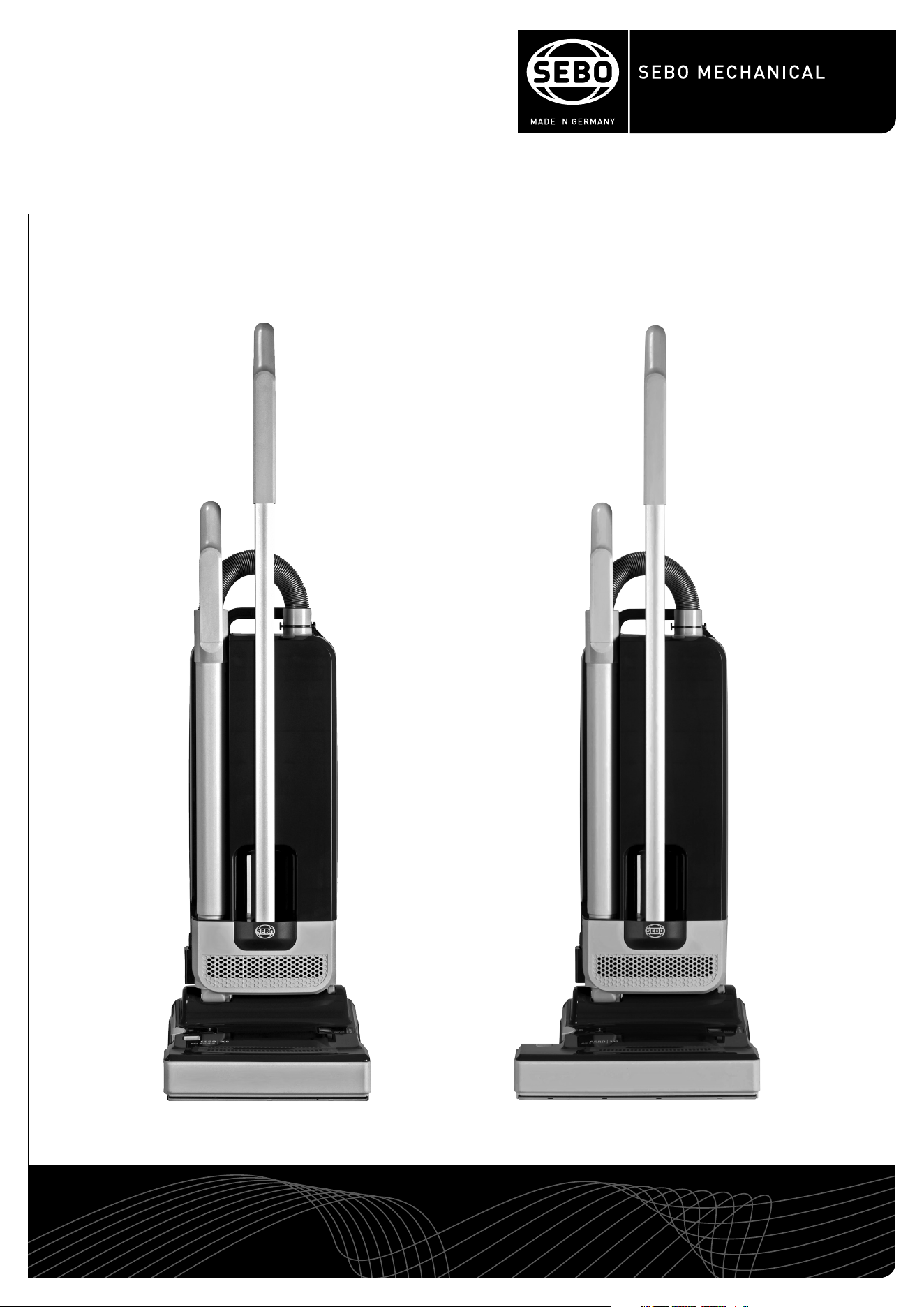
OWNER’S MANUAL
For Household Use Only

TABLE OF CONTENTS
TECHNICAL DETAILS
2
Vacuum Motor 1000 Watts
Suction 225 mbar (2300 mm WS)
Air Flow 50 l/s
Filter Bag 1.4 gal. (5,3 liters), 3-layer
Working width 300mm/360mm
Brush strip Replaceable
Brush drive Non-slip drive belt
Cord length 39 feet
Weight 8.2/8.3/8.7 kg
Protection Double insulated
Technical Details 2
How To Contact SEBO 2
Important Safety Instructions 3
SEBO MECHANICAL Product Features 4
Brush Roller Obstruction – Auto Shut-Off 4
Bag Full or Clog Warning 4
Standard Features of All SEBO Vacuums 5
S-Class Filtration 5
Optional Attachments, Accessories, Bags & Filters 6
Identification of Parts 7
Standard Attachments 7
Assembly 7
Operating Instructions 8
Starting the Machine 8
Operating Positions 8
Using the Cleaning Wand, Hose & Attachments 9
The Check Brush Display 9
The Brush Height Adjustment Button 9
Maintenance 10
Changing the Filter Bag 10
Changing the Pre-motor Microfilter 10
Changing the Exhaust Microfilter 10
Changing the Brush Strip 10
Clog Removal 11
Clogs in the Airflow Pathway 11
Clogs in the Attachment Hose 11
Clogs in the Cleaning Wand 11
Clogs in Entrance to Filter Bag 11
Clogs in the Swivel Neck 11
Trouble-Shooting Guide 12
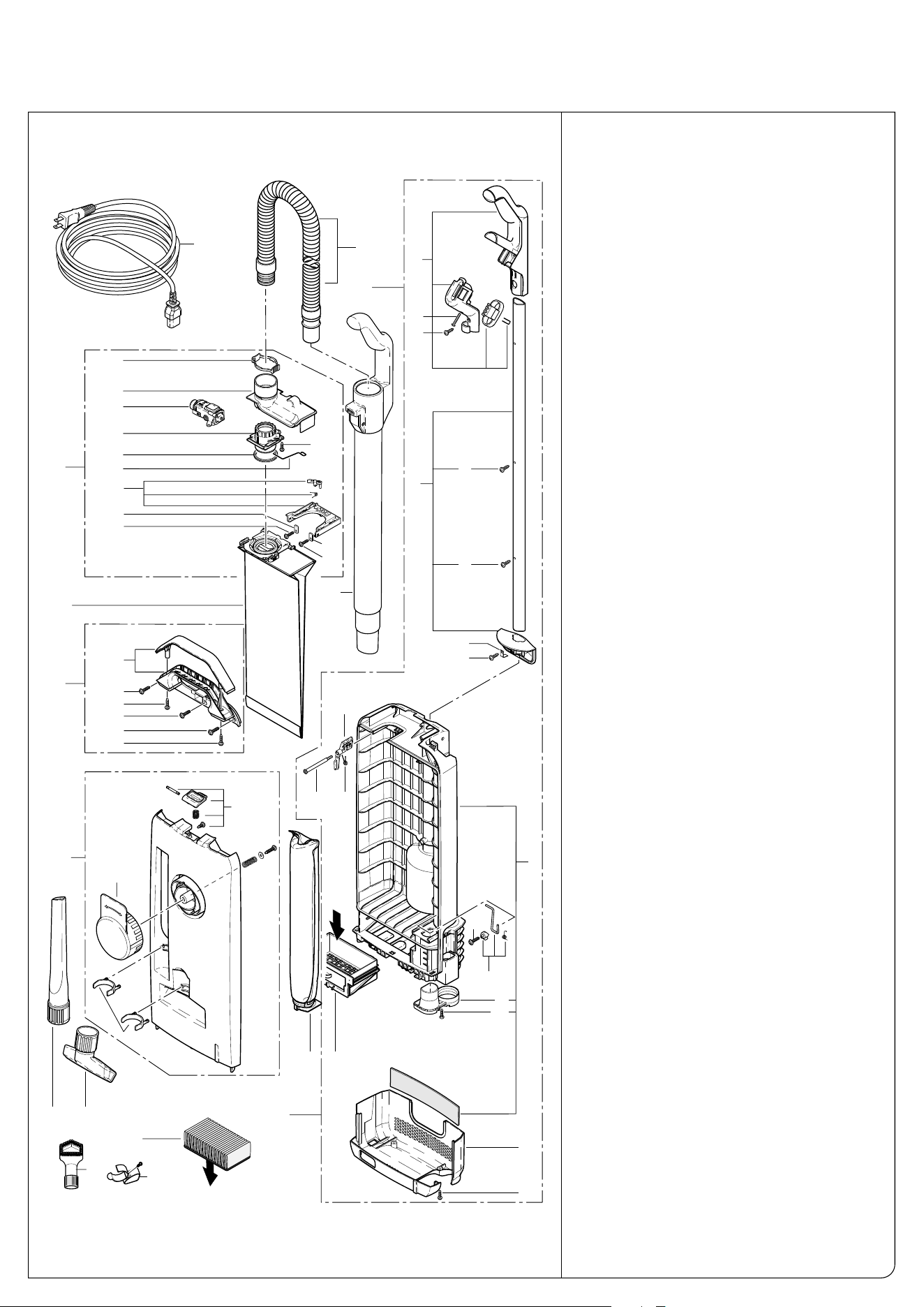
300 | 350 MECHANICAL Bag Housing and Handle Schematic and Part Numbers 13
300 MECHANICAL Power Head Schematic and Part Numbers 14
350 MECHANICAL Power Head Schematic and Part Numbers 15
To contact SEBO in the United States of America:
SEBO America, LLC
Telephone: (800) 334-6614
Fax: (303) 792-9196
Website: www.sebo.us
For warranty coverage details please refer to your
Warranty Card included with your SEBO vacuum cleaner.
To contact SEBO in Canada:
SEBO Canada
Telephone: (877) 258-5005
Fax: (800) 270-4807
Website: www.sebocanada.ca
For warranty coverage details and to register your
SEBO vacuum cleaner, go to www.sebocanada.ca
HOW TO CONTACT SEBO
Values determined to EN 60335-2-69:
Sound pressure level LpA 76 dB(A)
Uncertainty KpA 2 dB(A)
Hand-arm vibration value < 2.5 m/s2
Uncertainty K 0.2 m/s2

1. Do not leave vacuum while plugged in. Unplug from
outlet when not in use and before servicing.
2. Do not use outdoors or on wet surfaces.
3. Do not use near small children or pets. Do not allow
to be used as a toy. Use of this product by children
should always be supervised by an adult.
4. Use only as described in this manual. Use only
manufacturer-recommended attachments.
5. Do not use with a damaged cord or plug. If vacuum is
not working as it should, has been dropped, damaged,
left outdoors, or dropped into water, contact a SEBO
service center.
6. Do not pull or carry by cord, use cord as a handle,
close a door on cord, or pull cord around sharp
edges or corners. Do not run vacuum over cord.
Keep cord away from heated surfaces.
7. Do not unplug by pulling on cord. To unplug, grasp
the plug – not the cord.
8. Do not plug in if switch is in the ON position.
9. Do not use outlets above counters to plug in vacuum –
damage to items in the surrounding area could
occur.
10. Always carry the vacuum over steps and sills.
11. Do not handle plug or vacuum handle with wet hands.
12. Do not put any object into vacuum openings. Do not use
machine with any openings blocked. Keep openings
free of lint, hair, and anything that may reduce air flow.
13. Do not re-use filter bags or wash the filters.
14. Do not remove any screws from vacuum.
15. Do not vacuum up anything that is burning or
smoking, such as cigarettes, matches, or hot ashes.
16. Do not use vacuum without filter bag and/or filters in
place.
17. Turn off all machine controls before unplugging.
18. Use extra care when cleaning on stairs.
19. Do not use machine to vacuum up flammable or
combustible liquids such as gasoline or use in areas
where they may be present.
20. Machines can cause a fire when operated near
flammable vapors or materials. Do not operate this
vacuum near flammable fluids, dust or vapors.
21. Maintenance and repairs must be done by authorized
personnel.
22. Use only original SEBO replacement parts.
23. Do not use vacuum as a step.
24. If vacuum is used on plush carpet or carpet with thick
padding, do not leave machine standing in one place
with machine turned on.
25. Do not use the operator’s handle, which inserts into the
top of the bag housing, to carry the machine. Use the
carrying handle located on the backside of the
machine’s bag housing or the front cover.
26. Keep hair, loose clothing, fingers, and all parts of body
away from vacuum openings and moving parts. Do not
place fingers or other body parts under vacuum unless
it is unplugged.
27. Do not place the power head over rug or carpet edges.
28. The vacuum motor has a manual reset thermal protec-
tor. The protector is reset by switching off the vacuum.
The thermal protector needs some time to cool down
after switching off! Check the vacuum for air blockages
or mechanical failures before switching on.
29. The brush motor has a manual reset electronic protec-
tor. If the brush roller is jammed, the machine will shut
down automatically. Turn the machine off and unplug it
before removing the obstruction. Once the obstruction
is removed you may plug it in and turn on the vacuum.
30. Store the vacuum in a dry place at room temperature.
When the vacuum is not in use, you should wrap the
cord on the cable hooks.
31. Avoid picking up sharp objects.
IMPORTANT SAFETY INSTRUCTIONS
READ ALL INSTRUCTIONS BEFORE USING THIS MACHINE
3
When using an electrical appliance, basic precautions must always be followed.
To reduce the risk of electric shock, this vacuum cleaner has a polarized plug; one blade is wider than
the other. This plug will fit in a polarized outlet only one way. If the plug does not fit fully in the outlet, reverse the
plug. If it still does not fit, contact a qualified electrician to install the proper outlet. Do not change the plug in any
way. Connect only to the outlet type specified on the serial number plate underneath the machine.
SAVE THESE INSTRUCTIONS.
WARNING: To reduce the risk of fire, electric shock, or injury:
!
SEBO MECHANICAL PRODUCT FEATURES
4
Designed for Carpets – The heavy-duty SEBO MECHANICAL
300 and 350, are designed to provide many years of trouble-
free operation and feature an aggressive power head with
manual brush height adjustment and a convenient instant-use
cleaning wand and suction hose. In addition, the vacuums fea-
ture a mechanical controller that not only alerts the user to
problems such as clogs, a full bag and brush obstructions, but
it also automatically shuts off the brush roller when it is
jammed to protect the motor and belt from damage. These are
perfect vacuums for large carpeted areas.
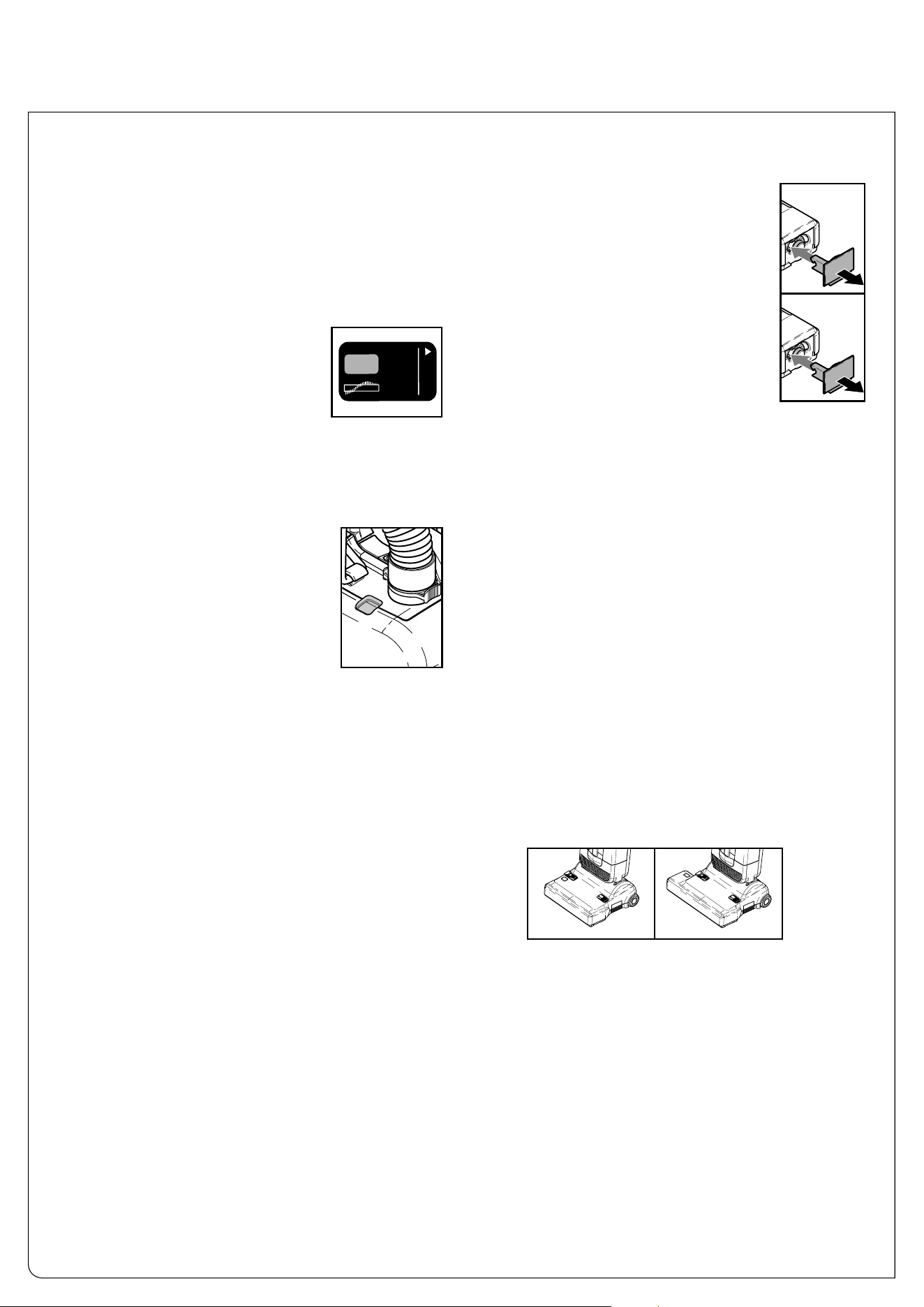
Brush Obstruction Indicator & Auto Shut-
Off – If an obstruction becomes jammed in
the brush, a warning indicator will quickly
show, the brush will immediately stop
spinning and the power head will shut off.
This prevents the belt from breaking and
protects the motor from damage. The user should switch the
vacuum off, unplug the machine and immediately remove the
obstruction. If the user restarts the machine without removing
the obstruction, the machine will again shut off immediately
and the orange “CHECK BRUSH” indicator will show.
Bag Full or Clog Indicator – SEBO MECHAN-
ICAL vacuums have a bag full or clog indica-
tor located on top of the bag housing. It
changes from white to orange indicating
reduced air flow if the filter bag is full or a
clog occurs in the air flow pathway of the
machine. The machine will continue working
but not as powerfully. If the orange indicator
reaches the right-hand side of the indicator
window, the machine should be switched off and checked for a
full bag or clog. If the orange indicator still shows up after
inserting a new bag, check for a clog and remove it. See page
10 for details about maintenance or page 11 for clog removal.
NOTE: Vacuuming fine dust may require an earlier filter bag
change even though the filter bag is not full; however, loose,
fluffy material may over fill the bag.
Four-level Manual Brush Height Adjustment – The brush
height can be manually adjusted up or down for optimal clean-
ing effectiveness.
Easy Brush Strip Removal and Cleaning –
Cleaning hair or debris from the brush strip or
replacing it when the bristles are worn is quick
and easy. This feature ensures consistently
effective brush agitation of the carpet pile. The
SEBO 300 and 350 have a brush roller with a
replaceable brush strip. This is part of the
heavy-duty sealed brushing mechanism, which
provides extra rugged durability.
Thirty-nine-foot Cord – A 39-foot cord saves time because it
minimizes the number of electrical outlets needed during use.
Durable Heavy-duty Belts - The reinforced toothed belts do not
slip or stretch, resulting in a more efficient use of power, and
they should last the life of the machine.
Instant-use Wand and Suction Hose – The integrated instant-
use wand or suction hose is always ready. Just pull out either
tool, or both together, to clean hard-to-reach corners, edges
and crevices. The wand and hose together have an eight-foot
reach. The suction hose is ideal for cleaning furniture. And an
optional nine-foot extension hose is available, which creates a
total hose length of 15 feet, perfect for cleaning stairs. Choose
from a range of optional attachments that can be fitted to the
wand or hose.
A Flat-to-the-floor, 5.5-inch Profile – Such a low profile
makes cleaning under furniture and beds easy!
Wide Power Head with One-sided Edge Cleaning – Side-edge
cleaning and two widths to choose from makes these vacuums
perfect for smaller to larger homes. The L-shape on the SEBO
350 provides excellent maneuverability around furniture and
under cabinets.
CHECK
BRUSH
ON/OFF
C
H
E
C
K
B
R
U
S
H
O
N
/
OF
F
2
C
H
E
C
K
B
R
U
S
H
O
N
/
O
F
F
2
STANDARD FEATURES OF ALL SEBO VACUUMS
55
Designed and Manufactured in Germany – Legendary quality,
reliability and performance make SEBO vacuums the first
choice of cleaning professionals throughout the world.
World’s Best Pet Vacuums – Because of superior power-head
and brush-roller technology, SEBO vacuums are the world’s
best for pet hair removal!
Tightly Sealed Vacuums Ensure Effective Filtration – Dirty air,
which flows through a vacuum, can only be filtered completely
if it does not escape into the room through seams or seals in
the machine. This is why all SEBO vacuums have tight seals
throughout.
Many vacuum companies with high-filtration claims are actu-
ally quoting specifications made by the manufacturer of the fil-
ter material, as measured in the laboratory, not the filtration
effectiveness of the vacuum itself while operating. Whether or
not dirty air can escape through leaks in the body of the
machine is not considered. The filtration effectiveness of SEBO
vacuums is tested while they operate.
Reliable, Commercial-grade Components – All SEBO vacu-
ums are constructed with thick, reinforced, ABS plastic, alu-
minum and metal parts, steel axles and bearings, and high-
end, quality motors. Therefore, SEBO users own reliable, long-
lasting vacuum cleaners. Competing vacuums are made with
thin, flimsy, inexpensive, plastic materials, none of which are
reinforced, and typically have useful lifespans of one or two
years.
Rubber Wheels and Soft Bumpers Protect Homes – Smooth-
gliding, rubber wheels protect hard floors and provide excep-
tional maneuverability. In addition, the bumpers that surround
the power heads and the soft AIRBELT bumpers that surround
SEBO’s canisters protect furniture, walls, and vacuum hous-
ings from incurring scuffs and scratches during use.
Advanced, Brush-Roller Technology – SEBO’s brush rollers
are uniquely designed to funnel hair and debris into the power
head’s airflow channel, which improves vacuum cleaning per-
formance on all flooring surfaces.
Changing Bags is Easy and Clean – SEBO filter bags can be
changed in just a few seconds, and a hygiene cap keeps dust
sealed inside during removal and disposal.
Save Money! SEBO Vacuums Last for Years and Extend
Carpet Life! – If properly maintained, SEBO vacuums save
ordinary, residential users hundreds of dollars, by providing
excellent performance for ten to fifteen years or more, and
their deep-cleaning, power-brush technology extends the life
of carpets. Typical vacuums perform poorly, even when new,
and usually do not last beyond two years. So six or seven “dis-
posable vacuums” must be purchased during the average life
expectancy of just one SEBO machine.
Incredible Warranty Coverage – All SEBO models include a
FREE seven-year warranty on the motor and five-years on non-
wear parts and labor charges.
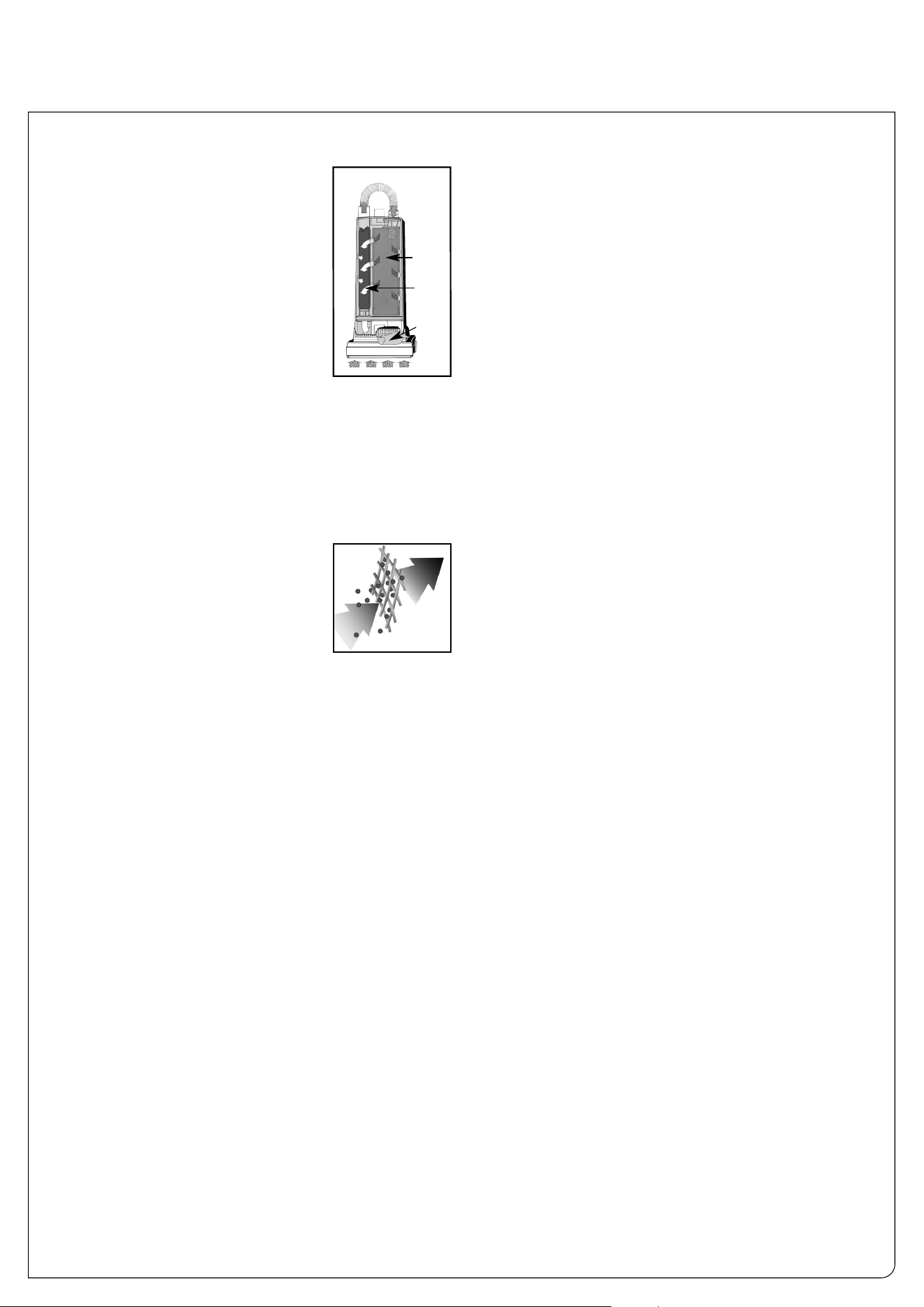
SEBO’s FILTRATION SYSTEM:
Bagged vs. Bagless . . . Bags are Better! –
Top-fill, three-layer AeraPure™ Bags are
an integral part of SEBO’s filtration system
because they hold virtually all the dirt cap-
tured by the vacuum, which improves the
effectiveness and useful life of the microfil-
ters. They also ensure continuously strong
suction because dirt enters from the top,
deposits at the bottom, accumulates
upward, and air exits through the sides,
which allows unimpeded airflow as they fill
to capacity. And they can be tightly sealed
with a hygiene cap when full, so no dust can
escape into the air during bag removal and disposal.
In contrast, without bags to hold nearly all the captured dirt, the
microfilters on bagless vacuums quickly clog from excessive
dirt build-up and must be replaced often, or a loss of suction
and cleaning effectiveness will occur. In addition, dust becomes
airborne when emptying bagless dirt containers. Lastly, bag-
less vacuum microfilters are expensive, usually costing more
than a multi-year supply of SEBO filter bags.
S-class, Pre-motor and/or Exhaust
Microfilters – S-class, Pre-motor and
Exhaust Microfilters (S=“Schwebstoff”= air-
borne particles) are made from electrosta-
tically charged, micro-fiber material, which
attracts and captures dust particles from
the airflow of the vacuum before and after it
passes over the motor to cool it. Cooling the motor with super-
clean air increases motor life and reduces the possibility of
maintenance, even after many years of use. Also, the exhaust
air is cleaned to the highest level before being emitted from the
machine. The S-class Standard requires filters to absorb
greater than 99.9% of particles down to 0.3 microns in diame-
ter. For comparison, 100 microns is the diameter of a human
hair. Their advantages are a relatively open texture that allows
smoother airflow for better suction performance, a longer life
expectancy, and they cost less than HEPA filters.
HEPA, Pre-motor and/or Exhaust Microfilters (Optional) –
HEPA Microfilters (“High Efficiency Particulate Air”) remove a
minimum of 99.97% of all airborne particulate matter down to
0.3 microns in diameter. Because these filters use small, grid-
like structures to capture dust particles, dirt build-up clogs the
airflow pathway sooner than what is expected from S-class
microfilters. However, SEBO’s HEPA microfilters are sold
along with three-layer AeraPure™ bags, which provide highly
effective filtration before the airflow goes through the HEPA
microfilter, greatly increasing life expectancy and reducing the
potential of diminished air flow.
Step
One
Step
Two
Step
Three
6
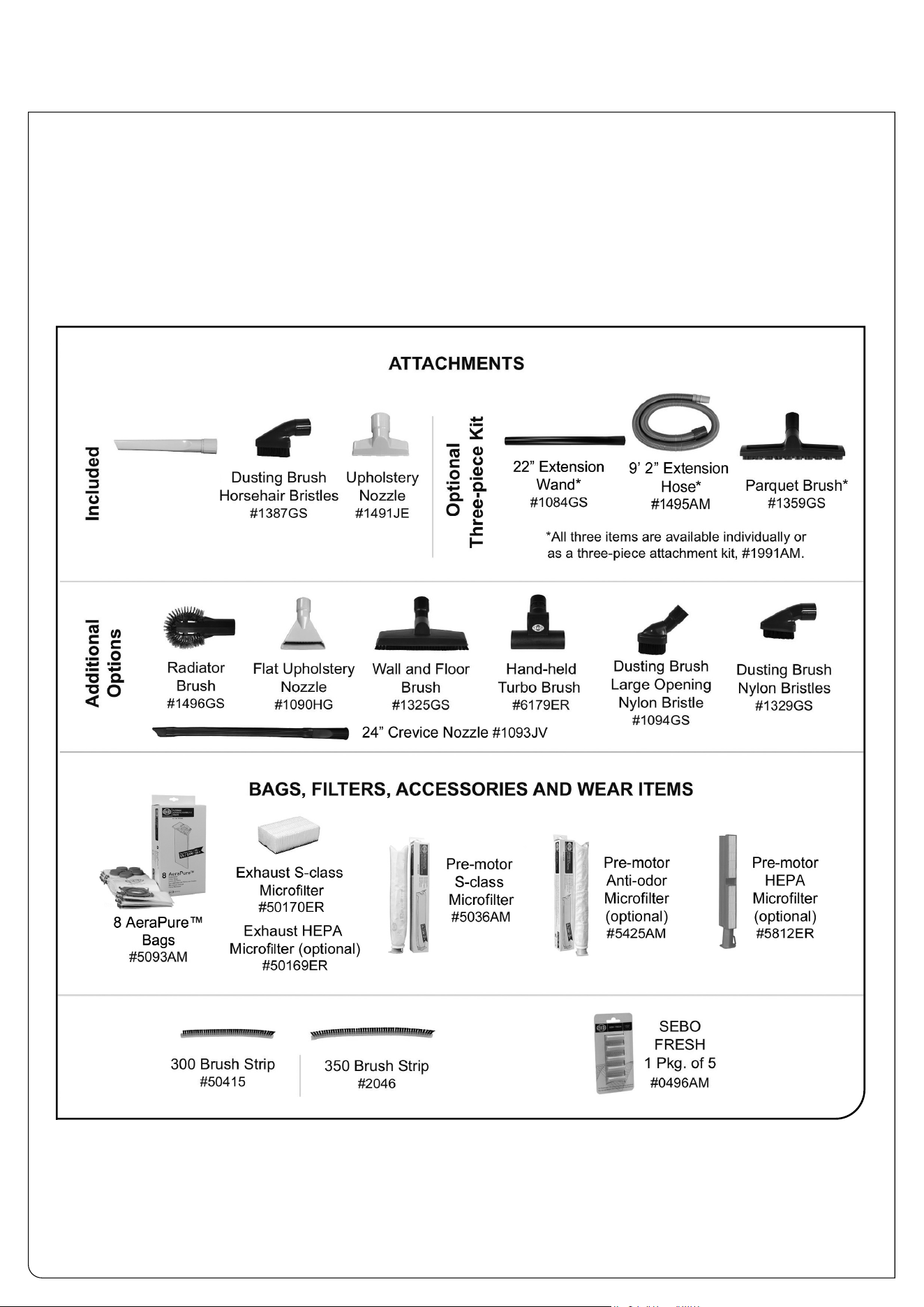
OPTIONAL ATTACHMENTS, ACCESSORIES, BAGS & FILTERS
In addition to the standard on-board tools, a variety of optional
attachments are available. The 9’ 2” extension hose (extends
suction hoses) and the 22” extension wand (extends instant-
use wands) are very popular because they create useful tools
for cleaning stairs and out-of-reach areas. These two items
are sold separately or as part of multiple item attachment kits.
Another popular attachment is the hand-held Turbo brush for
removing pet hair from upholstery.
SEBO AeraPure™ filter bags can be purchased in boxes of
eight and filters are sold separately. SEBO bags, filters and
accessories are reasonably priced and widely available.
To create a fresh scent while vacuuming, “SEBO FRESH” is
available. To use, deposit a scented stick in the filter bag.
Crevice Nozzle
#1092JE
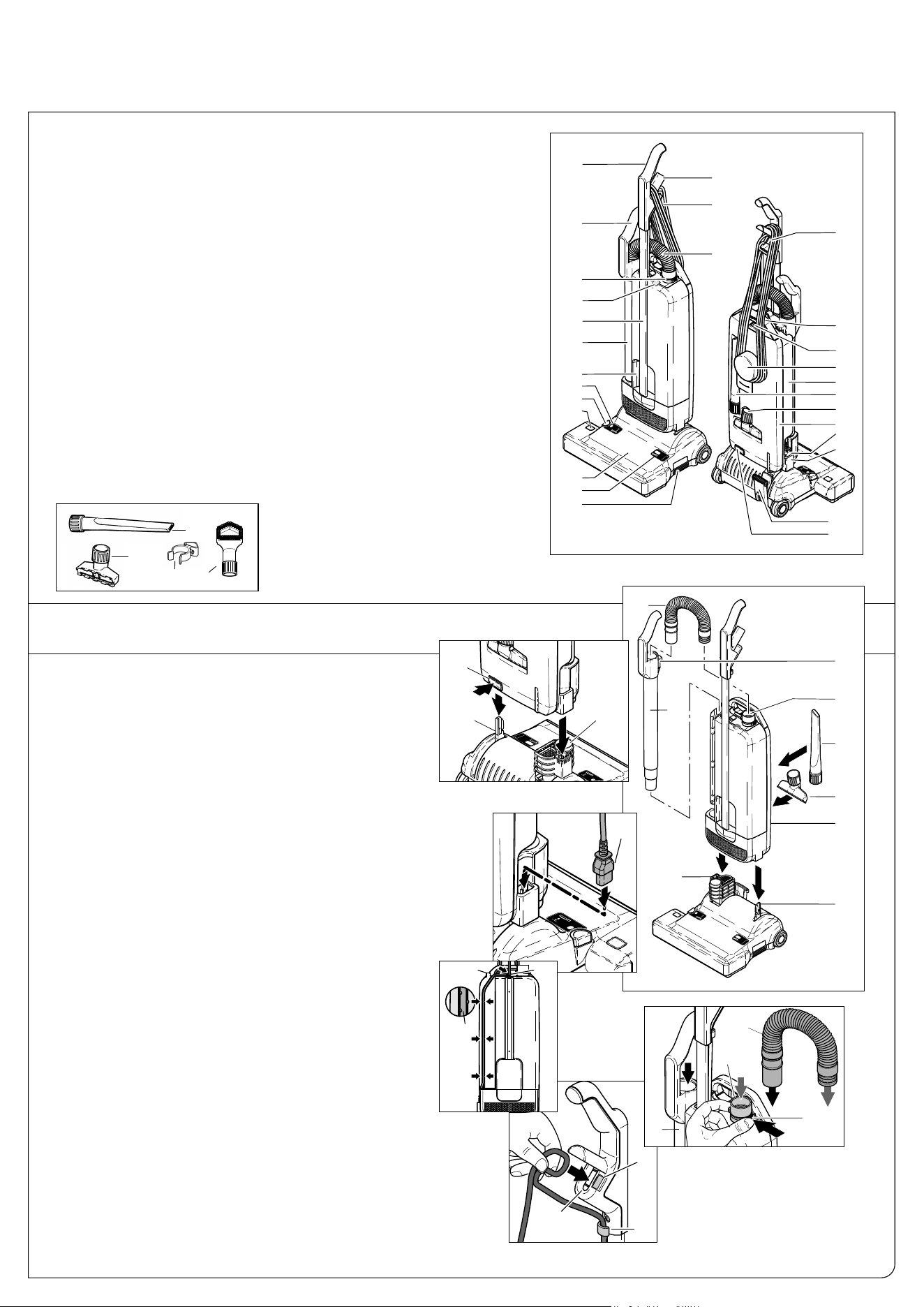
IDENTIFICATION OF PARTS
ASSEMBLY
1. Handle grip
2. Cleaning wand handle
3. Retaining ring
4. Bag full indicator
5. Handle Tube
6. Cleaning wand (active wand)
7. Recessed carrying grip
8. Brush height display panel
9. Brush height adjustment button
10. Brush release button
11. Power head with brush
12. Display panel
13. On/Off switch
14. Upper cable (cord) reel
15. Cable (cord)
16. Attachment hose
17. Cable release button
18. Carrying handle
19. Cover release button
20. Lower cable (cord) reel
1. Place the power head (11) on the floor with the sup-
port lever (31) and the swivel neck (32) upright (figure
1). Hold the bag housing (21) vertically and place it over
the swivel neck (32) and support lever (31). Push firm-
ly and evenly down until the release button (28) locks.
To dismantle, press the release button (28) and lift the
bag housing (21) from the power head (11).
2. Attach the power cable (15) to the machine. Push the
rubber cable plug (25) into the cable plug socket (26) on
the side of the vacuum (figure 2). Ensure the rubber
plug is fully inserted down into the socket. Fit the cable
into the groove (34 - figure 3) located in the cleaning
wand recess on the front of the machine. Attach to the
cable hooks on the top of the bag housing (35 - figure
3) and on the rear of the handle (36 - figure 4). Finally,
loop the cable as shown in figure 4 and insert it into the
cable cleat (37). You will hear a “click” when the cable
is fully inserted. To remove the cable, push the cable
release button (17) next to the cable cleat (37) and
remove the cable.
3. Push the black end of the attachment hose (16) into
the connecting tube (39) so that it clicks into place.
Insert the cleaning wand (6) into the swivel neck open-
ing and seat the handle (2) over the protruding tab (33 -
figure 3). To remove the hose, squeeze the retaining
ring (3) and pull the hose out of the connecting tube.
IF THE MACHINE DOES NOT WORK, THEN THE STEPS
ABOVE HAVE NOT BEEN EXECUTED CORRECTLY.
PLEASE ENSURE THE PARTS ARE PROPERLY CONNECT-
ED, ESPECIALLY THE CABLE PLUG AND SWIVEL NECK.
Standard Attachments
22. Crevice nozzle
23. Upholstery nozzle
29. Dusting brush clamp
30. Dusting brush
C
H
E
CK
B
R
U
S
H
O
N
/
O
F
F
2
17
18
19
20
21
22
23
24
25
26
27
28
7
C
H
E
C
K
B
R
U
S
H
O
N
/
O
F
F
2
2
P
U
SH
1
2
3
4
5
6
7
8
9
10
11
12
13
14
15
16
38
39
22
23
24
31
16
2
C
H
EC
K
B
RU
S
H
ON
/OF
F
2
P
U
S
H
28
Figure 1
Figure 4
Figure 3
Figure 2
25
32
6
Figure 5
26
6
31
32
34
33
17
35
36
37
16
39
3
23
22
29
30
21. Bag housing
22. Crevice nozzle
23. Upholstery nozzle
24. Bag housing cover
25. Cable plug
26. Cable plug socket
27. Foot Pedal
28. Release button
29. Dusting brush clamp
30. Dusting brush
31. Support lever
32. Swivel neck
33. Projection tab
34. Cable groove
35. Cable hook
36. Cable hook
37. Cable cleat
38. Hose release button
39. Connecting tube
8
OPERATING INSTRUCTIONS
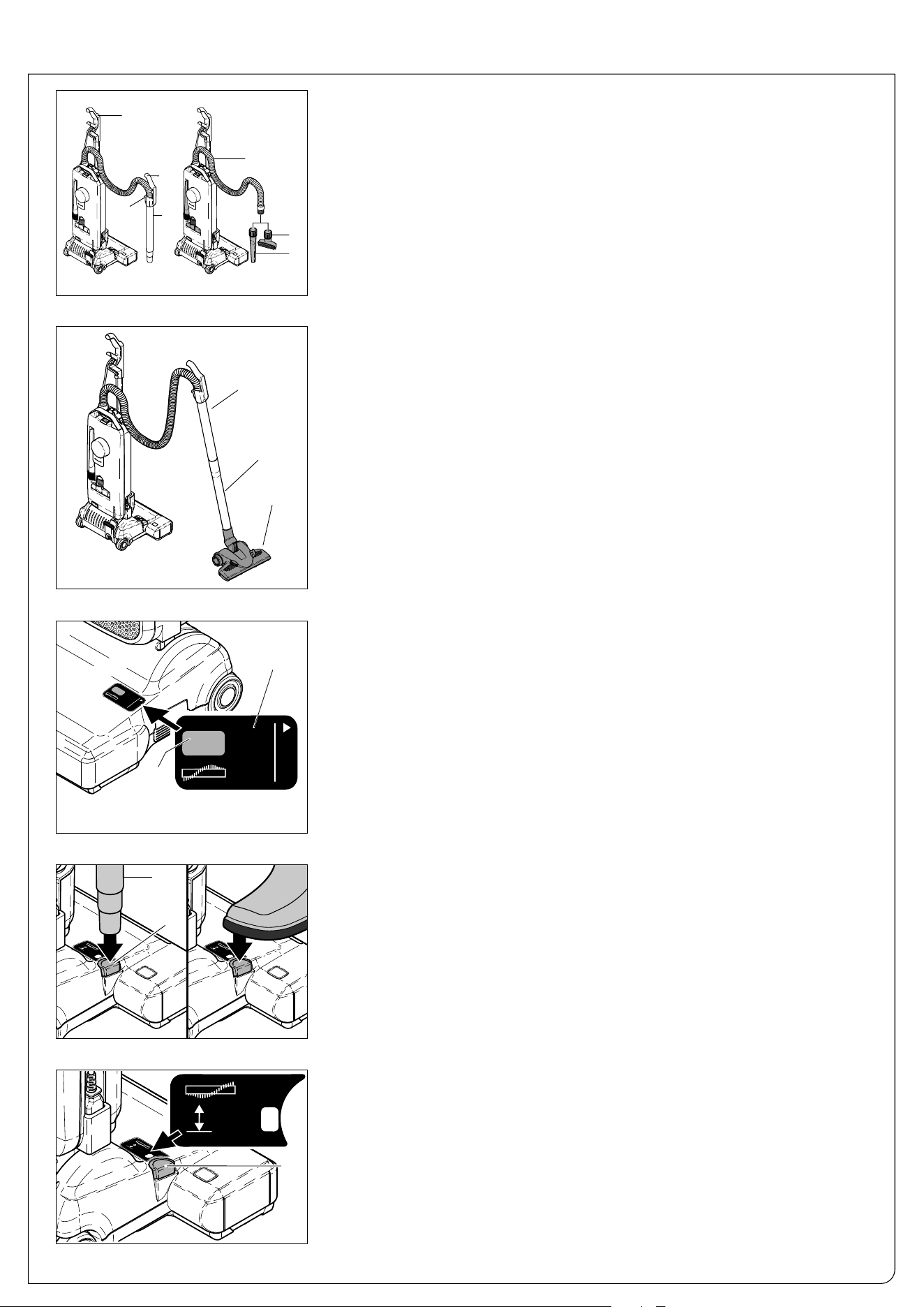
Starting The Machine
- Figures 6 & 7
Before turning on your vacuum cleaner, make sure that the vacuum handle is in
its upright locked position and that you have a firm hold on the handle grip to keep
the machine from moving forward.
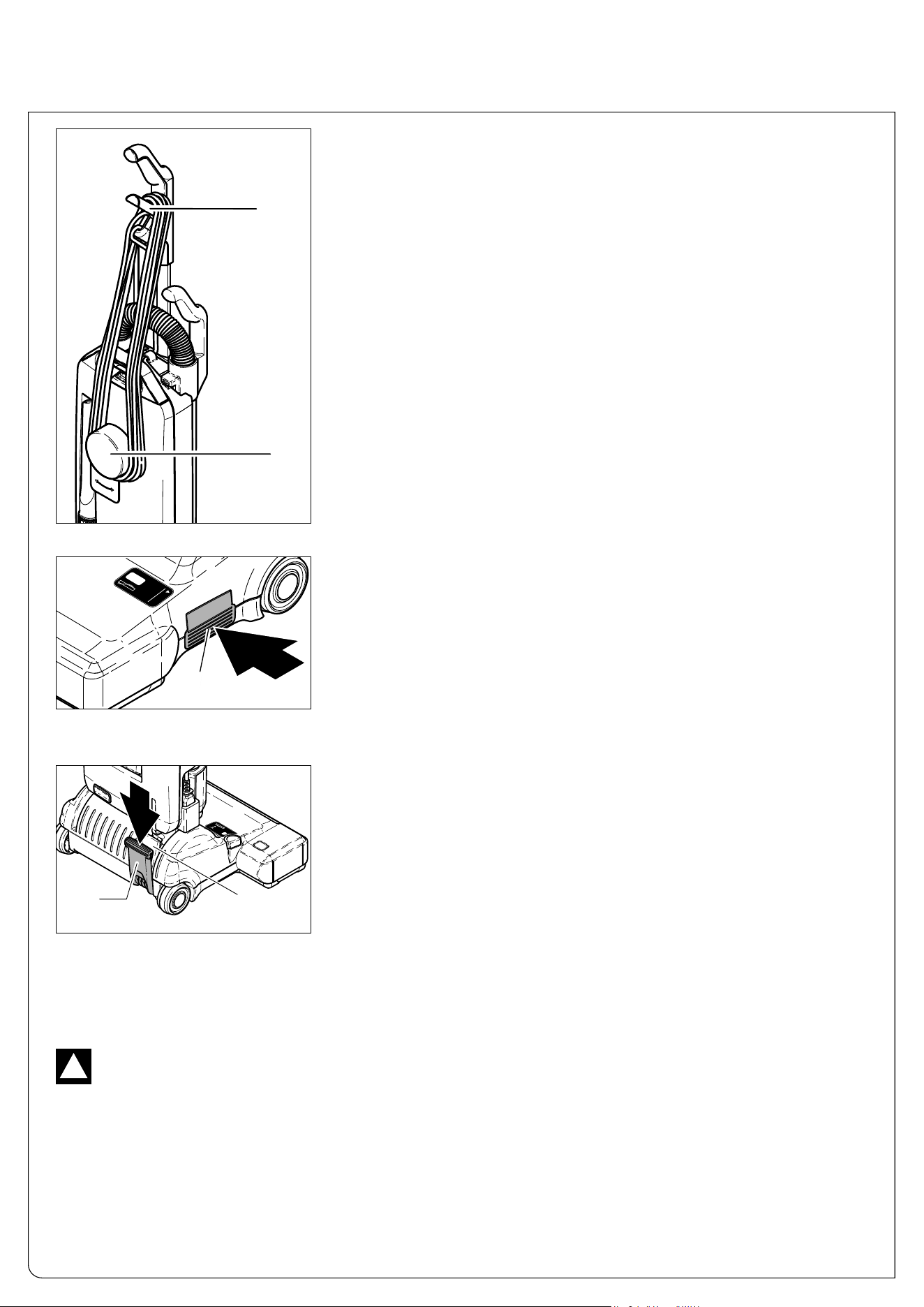
1. Turn the quick-release lower cable reel (20) to the up position by moving
it to the left or right (figure 6).
2. Release the power cord plug from the power cord and lift the cord off of
the upper cable reel (14).
3. With the orange on/off switch (13) in the OFF position (figure 7), plug the
polarized power cord into a 120 volt outlet located near the floor.
4. Turn the machine on by gently tapping the on/off switch (13) with your
foot or hand. To switch the vacuum off, tap it again, and the switch will
pop out to the off position.
P
U
S
H
2
Operating Positions
- Figure 8
5. The foot pedal latch (40) locks the machine in the upright position. To
release the vacuum from the upright locked position, press down on the
foot pedal (27) and lower the handle into the normal operating position.
WARNING! The quality, condition, coating, texture, age and manufacturing technique of all floor surfaces vary. There-
fore, upright vacuums with rotating brushes, including your SEBO, may damage some floor coverings or surfaces. Some
types of high-gloss hardwood floors, cushion vinyl, berber carpets, long shag, and delicate or hand-woven carpets are particu-
larly vulnerable to damage by rotating brushes. When possible, consult the materials supplied by your floor’s manufacturer for
information on proper upkeep and cleaning. To ensure that your new SEBO vacuum cleaner is compatible with your floor,
please test the vacuum cleaner on each type of flooring surface in a small inconspicuous area to determine if any dam-
age occurs. If damage occurs, stop using the vacuum cleaner immediately!
Care must be taken to ensure that the bottom of the machine does not contact the floor.
If this happens, damage to the floor could occur.
If damage occurs, stop using the vacuum cleaner immediately!
!
Figure 6
Figure 8
C
HE
C
K
B
R
U
SH
O
N
/
OF
F
Figure 7
14
20
13
40
27
9
2
P
US
H
2
P
U
S
H
2
P
U
S
H
2
2
CH
ECK
B
R
U
S
H
O
N
/
O
FF
CHECK
BRUSH
ON/OFF
The Brush Height Adjustment Button - Figures 13 & 14
The brush height adjustment button (9) has 4 brush height settings. Setting 1 is the
lowest brush setting and setting 4 is the highest brush setting. When starting the
vacuum, always start with the button set at 4, then lower button settings until the
brush reaches the proper height.
The brush height adjustment can be changed by foot or with the cleaning wand.
To use the cleaning wand, put the machine into the upright position, then lift the
tube from the machine. The end of the cleaning wand (6) fits into the groove of the
brush height adjustment button (9).
The Check Brush Display - Figure 12
If the brush is jammed or overloaded, the machine will automatically switch off
and the orange indicator (43) will show on the Check Brush display (12). If this
occurs, unplug the machine and clear the obstruction.
Figure 9
Figure 10
Figure 11
Figure 12
Figure 13
41
42
1
38
16
6
Using the Cleaning Wand, Hose & Attachments -
Figures 9, 10 & 11
The cleaning wand (6) is useful for vacuuming corners and hard-to-reach areas.
The handle grip (1) should be in the upright, locked position (as shown in figure
9). Grip the cleaning wand handle (2), pull it up and away from the machine and
stretch out the hose (16) until it locks to the back of the tube (this locking action
will prevent the hose from retracting back into the cleaning wand while it is in
use). Various attachments may be inserted onto the end of the tube. After use,
remove attachment and re-insert the cleaning wand into the back of the machine.
Be sure that the cleaning wand handle (2) is inserted over the protruding tab
(see #33, page 7). If the cleaning wand handle is properly seated over the pro-
truding tab, the hose will automatically retract and you may resume vacuuming.
There is no need to turn off the vacuum while switching from upright vacuuming
to using the cleaning wand or hose.
To use the hose without the cleaning wand (as shown in figure 10), pull the hose out
of the cleaning wand while the tube is still attached to the machine and securely
seated over the protruding tab (33). Insert an attachment tool, if desired, onto the
end of the flexible hose. You may also release the hose while the cleaning wand is
disengaged from the machine by pressing the hose release button (38) at the base
of the handle (2).
While using attachment tools, you may keep the brush roller off the carpet by
placing the handle (1) in its upright locked position and lowering the handle with
one hand to raise the brush roller off of the floor. Operate attachment accessories
with the other hand. Or, with the handle in the upright locked position, the
machine may be tipped backward so that it rests on the back side of the bag hous-
ing (21), and the power head is locked in a perpendicular position to the floor.
Ensure that no children or pets can come into contact with the spinning brush
roller.
To vacuum walls, under beds, or higher-reach areas, etc., the SEBO 300 and 350
vacuums can be fitted with an additional straight tube (41) and the Kombi nozzle
(42), the wall and floor brush or parquet brush (see optional attachments on page
6). The machine will then perform as a canister vacuum (as shown in figure 11).
6
6
23
22
2
12
43
9
1
1
Figure 14
9
10
MAINTENANCE
Figure 15
Figure 18
Figure 19
Figure 21
Always unplug vacuum from outlet before dismantling any part of the machine!
!
AeraPure™ Filter Bag
Part# 5093AM
Pre-motor
Microfilter
Part# 5036ER
Exhaust Microfilter
Part# 50170ER
Brush Strip for SEBO 300
Part# 50415
Brush Strip for SEBO 350
Part# 2046
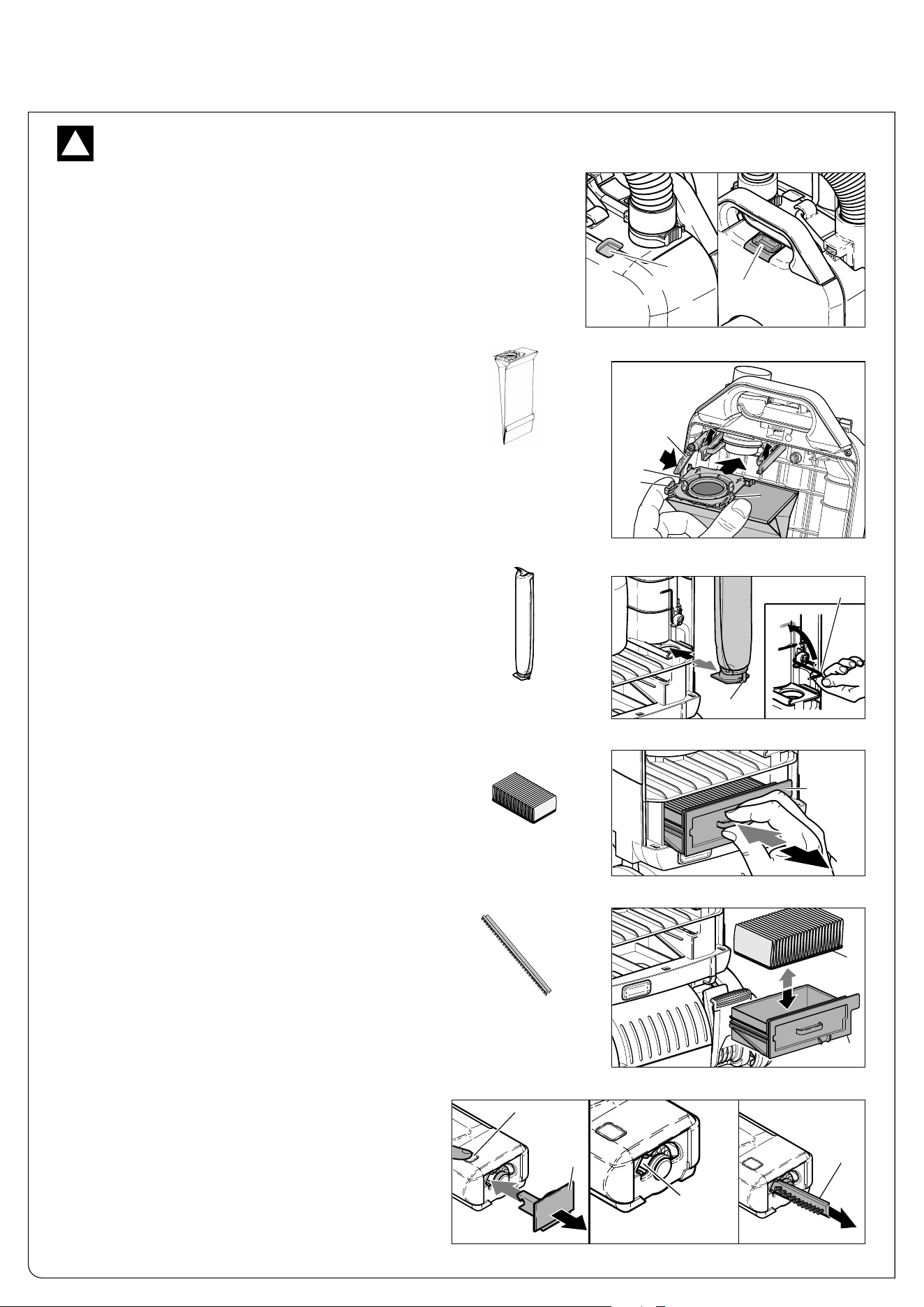
Changing the Filter Bag - Figures 15-17
When the “bag full” warning indicator (4 - figure 15) turns
orange, and there is not a clog, change the filter bag. To
remove the filter bag, push the cover release button (19 -
figure 16) and lift the cover (24) up to remove. Push the
lever over to the right (44 - figure 17). Squeeze the clamps
(45) on both sides of the filter bag sealing plate (46), slide
the plate from the holder and push the cap on to seal the
bag. Slide the sealing plate (46) of a new bag into the hold-
er and push it in until it locks into place. You may find it
convenient to store the bag cap inside the bag housing
below the filter bag. Make sure the bag is tucked in at the
bottom. To replace the cover, insert the projections on
each side of the bottom of the cover into the correspon-
ding slots at the base of the housing. Close the cover
ensuring that the cover “clicks” shut.
Changing the Pre-motor Microfilter -
Figure 18
The pre-motor microfilter needs to be changed when it
becomes extremely dirty or clogged with dust, or after
approximately 20 filter bags have been used. To change
the microfilter, remove the bag housing cover (24) by
pushing the cover release button (19 - figure 16) and lift-
ing the cover up and out. Grasp the loop (47 - figure 18) at
the bottom of the filter and slide the filter out. To replace,
lift the metal bar (48 - figure 18 inset) and slide the new
filter in using the tracks as guides. Replace the cover and
snap it in place.
Changing the Exhaust Microfilter -
Figures 19 & 20
After 20 bags have been used, change the exhaust filter.
To change the exhaust filter, remove the bag housing
cover (24) by pressing the cover release button (19) and
lifting the cover up and out. Grasp the handle on the
orange filter holder (49 - figure 19) and pull it out. Pull
the filter out of the holder. Insert the new filter rubber-
gasket-side-down (50 - figure 20) into the holder and re-
insert the holder. Replace the bag housing cover and
snap it in place.
Changing the Brush Strip - Figures 21-23
To replace the brush strip, push the brush release button
(10), remove the side plate (51 - figure 21), turn the brush
roller until the end of the brush strip can be accessed at
the notch (52 - figure 22). Grasp the brush strip (53) from
the underside of the power head and push it out through
the notch far enough to be grasped and pulled out. Insert
the new brush strip and press the side plate (51) back
into place, making sure that the plate is firmly seated.
Figure 20
Figure 16
4
19
47
48
49
50
49
Figure 22 Figure 23
10
51
52
53
24
Figure 17
44
46
45
45
11
CLOG REMOVAL
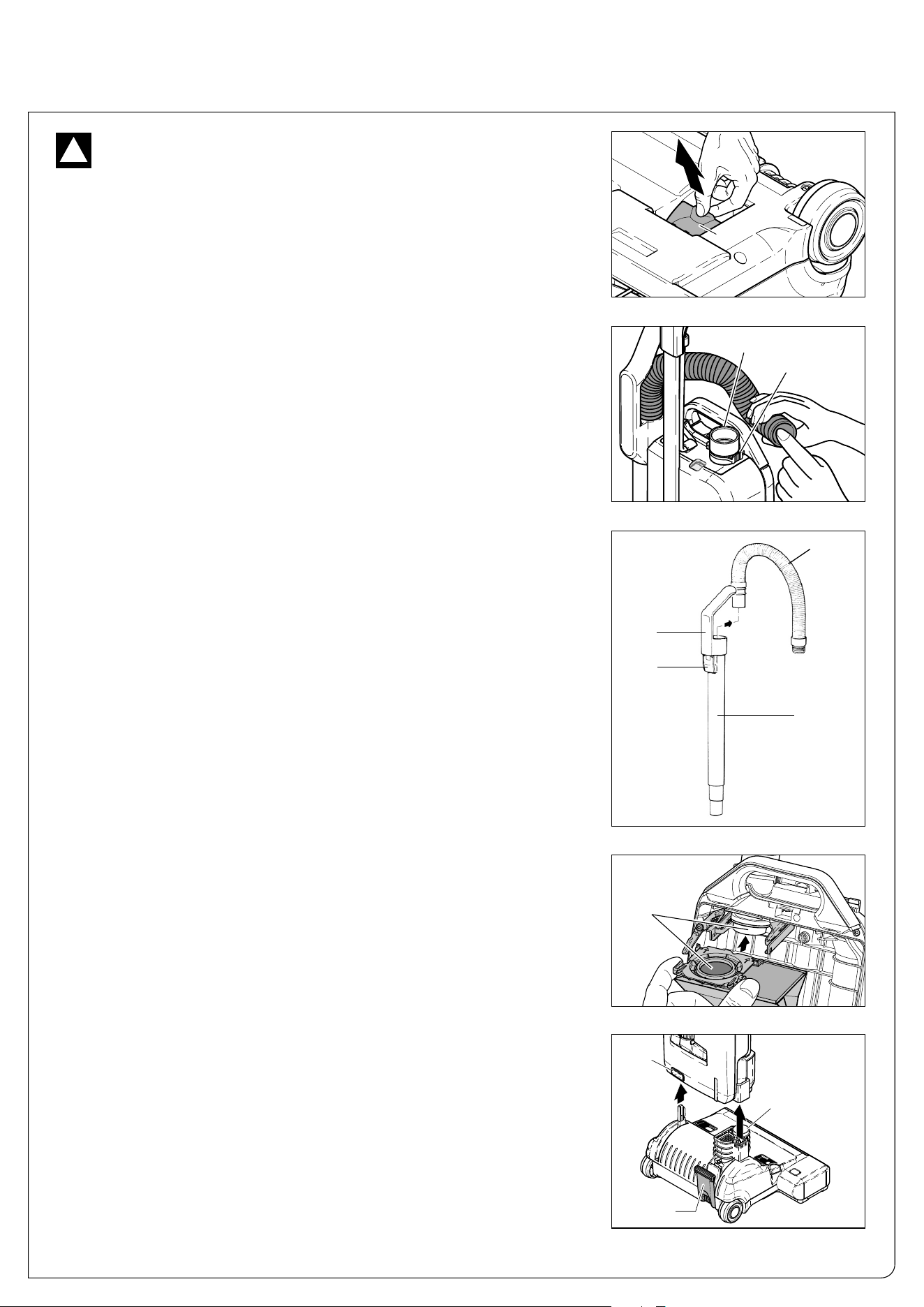
Clogs in the Airflow Pathway - Figure 24
Most clogs can be removed by accessing the airflow pathway via the orange
colored access door (54) located on the underside of the power head. However,
other clogs may only be removed by accessing the airflow pathway by disas-
sembling the machine in the opposite sequence of the machine’s original
assembly (see assembly, page 7).
Clogs in the Attachment Hose - Figure 25
Blockages in the hose can be cleared by removing the attachment hose (16)
from the machine by squeezing the retaining ring (3) and inserting the opposite
end of the hose in the connecting tube (39). Hold the hose upright with one hand
blocking the top end and switch on the machine. If necessary, quickly lift your
hand on and off the end of the hose. If this procedure does not clear the clog, a
straight wire can be inserted into the hose to push out the clog. Take care not
to puncture the hose with the wire.
Clogs in the Cleaning Wand - Figure 26
Remove attachment hose (16) from the cleaning wand (6) by pressing the hose
release button (38). Then, grip cleaning wand handle (2) and remove tube from
the machine. A straight wire can be inserted into the tube to push out the clog.
Clogs in Entrance to Filter Bag - Figure 27
Remove the attachment hose (16) from vacuum cleaner (see figure 26) and
remove the bag housing cover (24). Clean out the connecting tube and/or entrance
to bag (55).
Clogs in the Swivel Neck - Figure 28
Remove the bag housing from the power head by pressing the release button
(28). Lift upward firmly and evenly to properly remove the bag housing. Then,
release the foot pedal (27), lower the swivel neck (32) and clean out the path-
way.
2
C
H
EC
K
B
RUS
H
O
N
/
O
F
F
Figure 28
Figure 25
Figure 24
Always unplug vacuum from outlet before removing
any clogs!
!
Figure 27
Figure 26
16
6
2
38
54
3
39
55
28
32
27
12
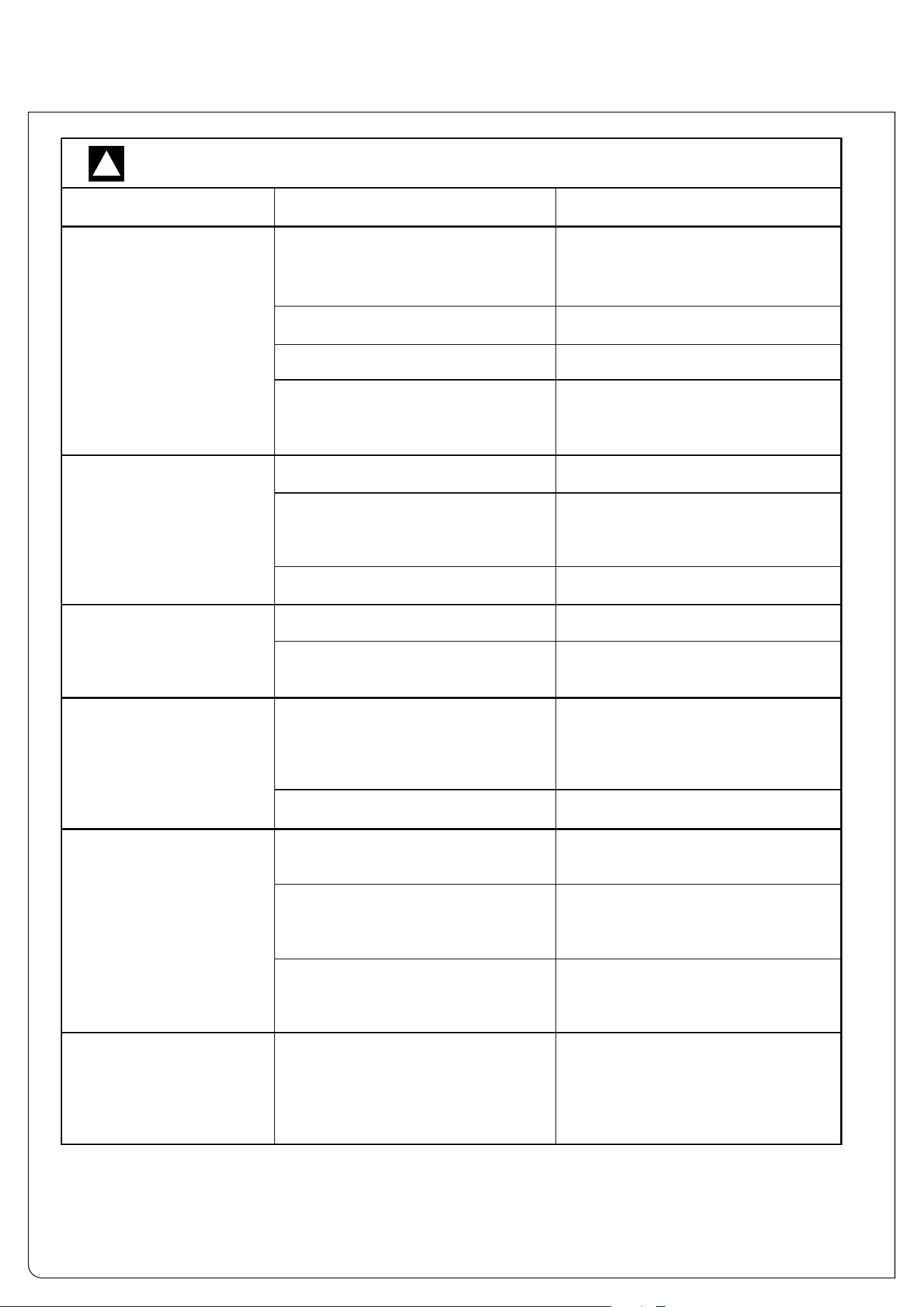
TROUBLE-SHOOTING GUIDE
PROBLEM
Does not turn on
or machine shuts off
intermittently
Orange bag full or clog
indicator showing
(see page 4)
Orange Check Brush
indicator showing &
machine shuts off
(see page 4)
Does not pick up
Front bag door won’t
fully close
Hose doesn’t retract
after cleaning wand is
inserted
REASON
1. Cable plug not fully inserted into the
cable plug socket, causing a faulty
connection.
2. Not plugged into good outlet.
3. Cable worn.
4. Bag housing (21) not seated
fully into proper “locked” position
on top of power head.
1. Filter bag full.
2. Clog in airflow pathway, attach-
ment hose, cleaning wand, swivel
neck or entrance to filter bag.
3. Pre-motor microfilter dirty.
1. Brush jammed or clogged.
2. Brush is too low for the surface
being vacuumed.
1. Cleaning wand not correctly
inserted.
2. Front cover not closed.
1. Cover not fully closed.
2. Bag not inserted properly.
3. Pre-motor microfilter or exhaust
filter not properly inserted.
1. Cleaning wand not properly
inserted.
SOLUTION
1. Push cable plug down into the
socket firmly. See page 7.
2. Use another outlet.
3. Replace cable.
4. Ensure that the release button (28)
is in locked position. See page 7.
1. Replace bag. See page 10.
2. See Clog Removal on page 11.
3. Replace filter. See page 10.
1. Clear jam. See page 11.
2. Raise the brush.
1. Reinsert cleaning wand, making
sure lower end of tube is in the
lower hole and handle is properly
seated over the protruding tab (33).
2. See below.
1. Reinsert bag. Lock the cover
down firmly.
2. Reinsert bag. See page 10.
3. Reinsert filter making sure filter is
properly seated and cover is fully
closed. See page 10.
1. Reinsert making sure top of handle
is pointing back and tube is fully
seated on the protruding tab (33)
on top of the bag housing.
See page 7.
Always unplug vacuum from outlet before dismantling any part of the machine!
!
5
2
3
3
4
3
7
9
10
12
19
P
USH
X
5
0
1
5
0
13
11
8
20
19
2831
19
14
6
3
32
1
1
1
1
29
20
19
18
30
3433
23
22
21
24
25
19
26
19
27
19
19
19
19
15
16 17
37
38
39
35
36
13
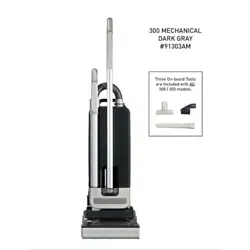
300 | 350 MECHANICAL SCHEMATIC AND PARTS LIST
#91303AM 300 MECHANICAL, #91313AM 350 MECHANICAL
Dark Gray/Light Gray Machines
Pos. Part # Description
1 50100SE Bag housing cpl.
2 50145SE Handle tube incl. tube cover
3 0127 Screw M4 x 10k, taptite
4 50147ER Clamp
5 50214HGER Handle cpl.
6 0104 Screw C3.9 x 25 DIN 7981
7 50200GS Bag housing
8 50165HG Cleaning wand
9 50105HG Connection tube
10 0107 Screw C2.9 x 13
11 501843 Cable w/US- plug, gray black, 13m
12 50118HG Bag housing bumper base
13 5040SB Hose cpl., silver
14 50205ER Filter safety catch cpl.
15 50122OR Filter bag lever
16 50123ER Axle
17 50124ER Return spring
18 50125ER Bag holder
19 01036 Screw 4 x 14
20 2014 Axle clamp
21 50209ER Filter indicator
22 5424GS1 Retaining ring
23 50130HG Recessed grip
24 50131HG Fitting
25 5289 Seal
26 50142ER Anti-static wire
27 50143GSER Carry handle
28 50216OR Box for exhaust filter
29 50215GS Back cover
30 50170ER Exhaust microfilter
50169ER Optional HEPA exhaust microfilter
31 5036AM Pre-motor microfilter
32 5093AM AeraPure™ filter bag
33 1092JE Crevice nozzle, light gray
34 1491JE Upholstery nozzle
35 1387GS Dusting brush
36 1081GS Mounting clip w/screw for Mechanical
37 50221HGER Locking latch cover, light gray
38 50220HGER Cable hook EV, light gray
39 1823HG Attachment clip, light gray
Bag Housing and Handle
#91303AM 300 MECHANICAL - Dark Gray/Light Gray
#91313AM 350 MECHANICAL - Dark Gray/Light Gray
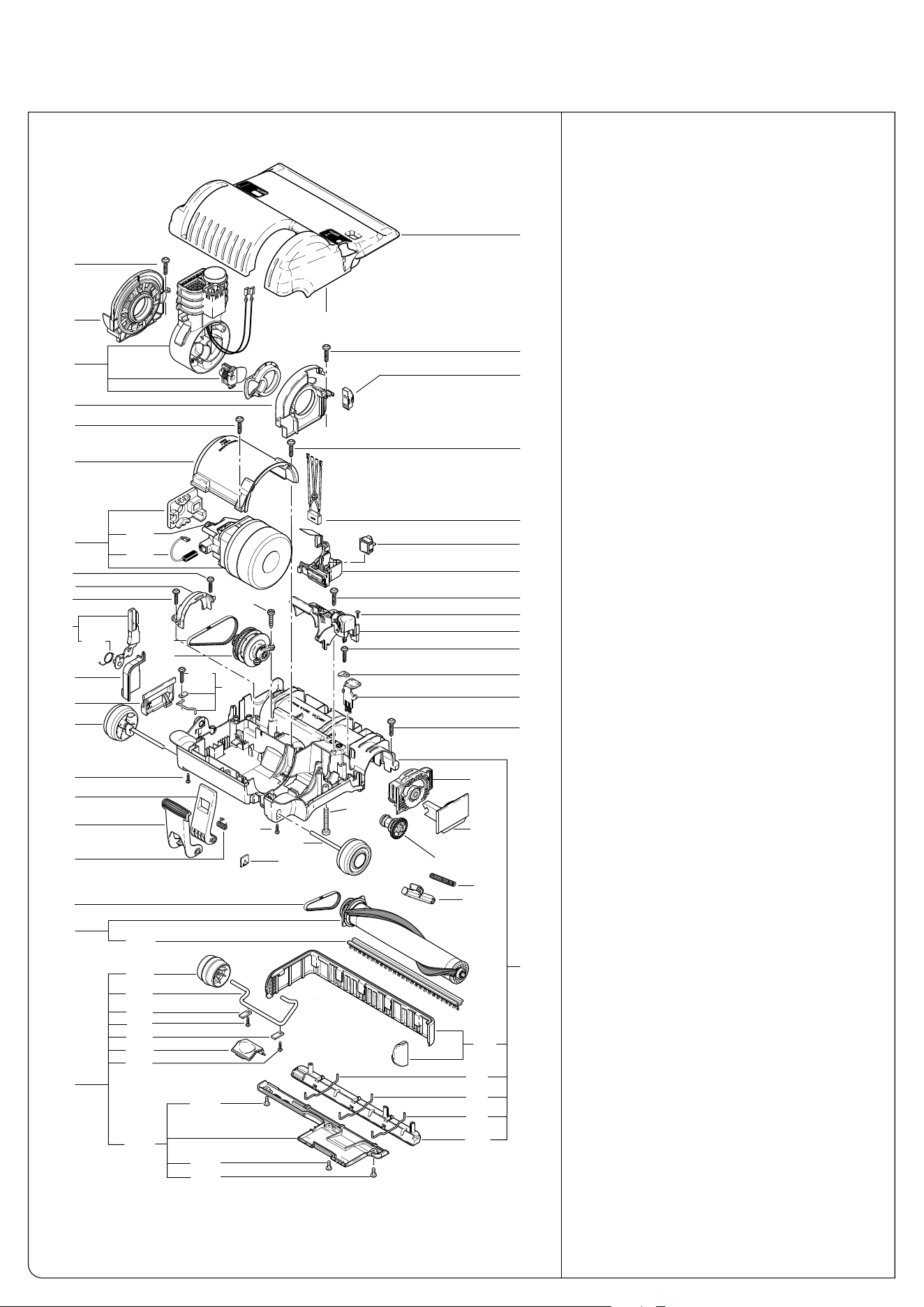
300 MECHANICAL SCHEMATIC AND PARTS LIST
#91303AM 300 MECHANICAL Dark Gray/Light Gray
Pos. Part # Description
100 50401GSAM Power head cover 300
101 1013ER Suppressor kit
102 50414HGER Chassis 300
103 50313HG Bumper
104 05112WI Switch cpl.
105 50443UL Switching unit
106 50308ER Air channel cover
107 2856 Clamp
108 50403HGER Brush roller release 300
109 50356HG Bearing block r.h.
110 50367HG Position cams
111 2833 Thrust member
112 50352HG Brush strip cover
113 2834 Thrust member
114 50404HGER Front bottom plate
115 2849 Axle clamp
116 50310HGER Rear bottom plate 300
117 2868OR Access door
118 2861 Pile adjustment axle
119 5174HG Pile adjustment wheel
120 50415 Brush strip
121 50470ER Brush roller 300
122 5110 Belt 219 3M HTDII- 6
123 50332ER Spring
124 2869HG Rubbing plate
125 50348HGER Axle w/wheel
126 50330OR Foot pedal
127 50331HG Catch pedal
128 50334SW Motor pulley cover
129 50306OR Power switch button
130 50371ER Switch rod
131 5379 Belt 312 3M HTDII- 6
132 50445ER Sensor
133 5107-1 Support spring
134 50438HGER Support lever w/spring
135 50355HG Bearing block l.h.
136 50465ER Motor 1000 W/120V
137 05117S Carbon brush set (100/120V)
138 5117/1 Sensor pulley
139 50441UL Motor cover
140 50440ER Swivel neck support r.h.
141 50448HG Swivel neck cpl. 2- wire
142 50439ER Swivel neck support l.h.
143 0102 Screw F 3.9 x 13
144 0197 Screw M 4 x 12 Z1
145 01016 Screw STS 4 x 16 T20
146 01010 Screw AM 4 x 16 DIN 7985
147 0104 Screw C 3.9 x 25 DIN 7981
148 0176 Screw AM 4 x 30
149 01042 Screw 4 x 10
150 2867 Spring
151 20115 Wire tie
150
C
H
E
C
K
B
R
U
S
H
O
N
/
O
F
F
121
119
118
120
127
126
117
123
122
100
102
102
136
143
143
145
133
139
141
140
142
137
138
108
106
104
105
145
145
107
145
109
145
116
114
113
128
129
125
125
124
115
143
115
146
144
144
144
112
110
148
130
132
147
134
101
145
145
145
103
131
145
135
145
111
149
151
151
151
Power Head
14
#91303AM 300 MECHANICAL - Dark Gray/Light Gray
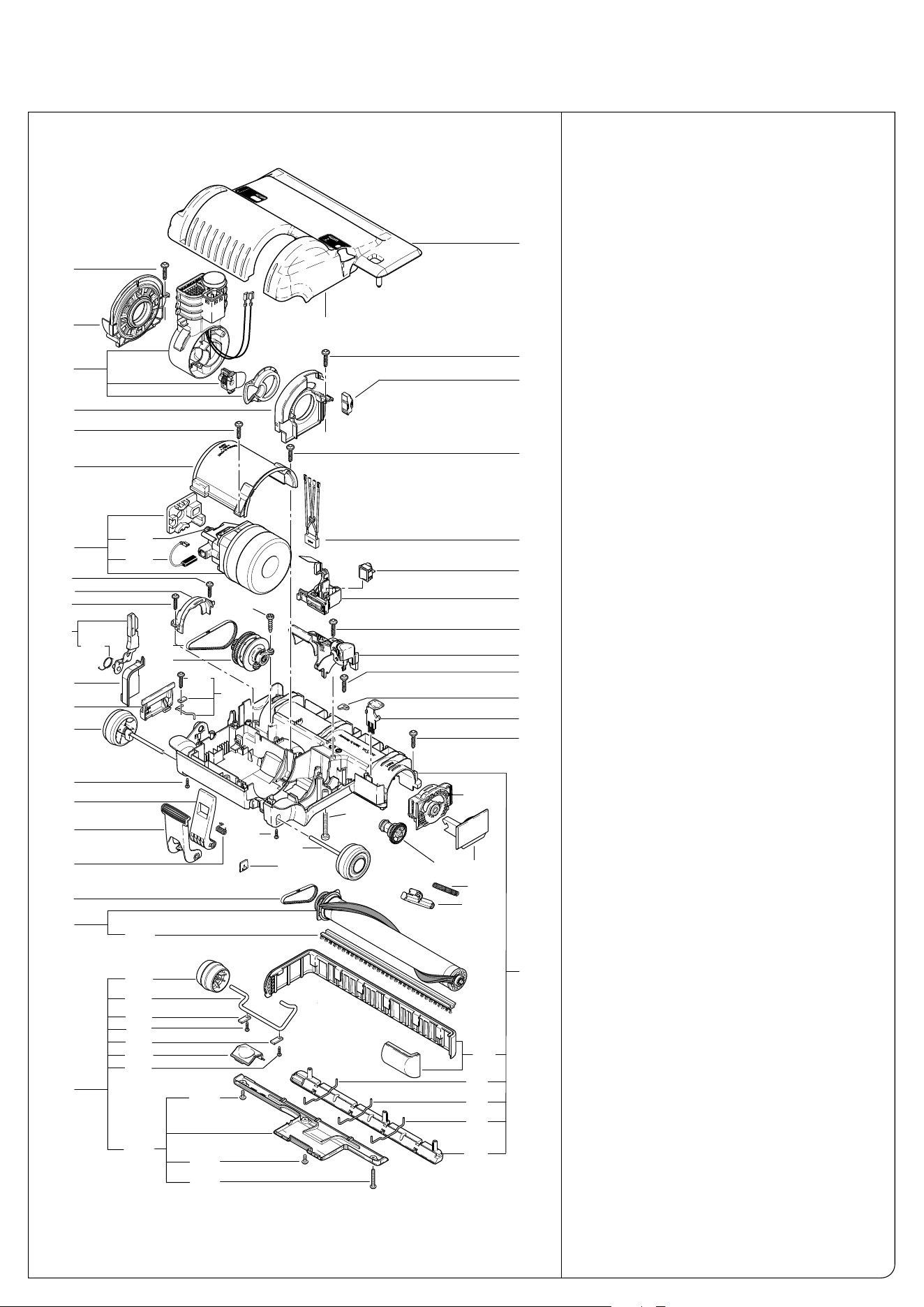
350 MECHANICAL SCHEMATIC AND PARTS LIST
15
#91313AM 350 MECHANICAL Dark Gray/Light Gray
Pos. Part # Description
100 50431GSAM Power head cover 350
101 1013ER Suppressor kit
102 50444HGER Chassis 350
103 50314HG Bumper
104 05112WI Switch cpl.
105 50443UL Switching unit
106 50308ER Air channel cover
107 2856 Clamp
108 50433HGER Brush roller release 350
109 50356HG Bearing block r.h.
110 50367HG Position cams
111 2833 Thrust member
112 50352HG Brush strip cover
113 2834 Thrust member
114 50434HGER Front bottom plate 350
115 2849 Axle clamp
116 50311HGER Rear bottom plate 350
117 2868OR Access door
118 2861 Pile adjustment axle
119 5174HG Pile adjustment wheel
120 2046 Brush strip
121 50471ER Brush roller 350
122 5110 Belt 219 3M HTDII- 6
123 50332ER Spring
124 2869HG Rubbing plate
125 50348HGER Axle w/wheel
126 50330OR Foot pedal
127 50331HG Catch pedal
128 50334SW Motor pulley cover
129 50306OR Power switch button
130 50371ER Switch rod
131 5379 Belt 312 3M HTDII- 6
132 50445ER Sensor
133 5107-1 Support spring
134 50438HGER Support lever w/spring
135 50355HG Bearing block l.h.
136 50465ER Motor 1000 W/120V
137 05117S Carbon brush set (100/120V)
138 5117/1 Sensor pulley
139 50441UL Motor cover
140 50440ER Swivel neck support r.h.
141 50448HG Swivel neck cpl. 2- wire
142 50439ER Swivel neck support l.h.
143 0102 Screw F 3.9 x 13
144 0197 Screw M 4 x 12 Z1
145 01016 Screw STS 4 x 16 T20
146 01010 Screw AM 4 x 16 DIN 7985
147 0104 Screw C 3.9 x 25 DIN 7981
148 0176 Screw AM 4 x 30
149 2867 Spring
150 20115 Wire tie
121
119
118
120
127
126
117
123
122
100
102
CH
E
C
K
B
R
U
S
H
O
N
/
O
FF
102
136
143
143
145
133
139
141
140
142
137
138
108
106
104
105
145
145
107
145
109
112
145
116
114
113
128
129
125
125
124
115
143
115
146
144
148
144
111
110
148
130
132
147
134
101
145
145
145
103
131
145
135
145
149
150
150
150
Power Head
#91313AM 350 MECHANICAL - Dark Gray/Light Gray

NOTES