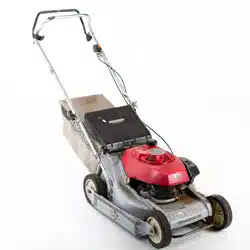

Thank you for purchasing a Honda mower.
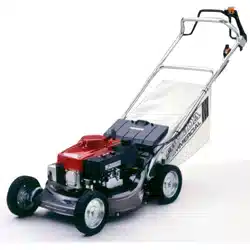
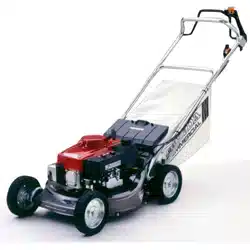
This manual covers operation and maintenance of the Honda HRA216
rotary mower. All information in this publication is based on the latest pro-
duct information available at the time of printing.
Honda HRA216 mowers meet CPSC blade safety requirements for walk-
behind rotary power mowers. Honda Motor Co., Ltd. reserves the right to
make changes at any time without notice and without incurring any
obligation.
No part of this publication may be reproduced without written permission.
This manual should be considered a permanent part of the mower and re-
main with the mower when sold.
Pay special attention to statements preceded by the following words;
ADANGER: Indicates severe personal injury or loss of life will result if in-
structions are not followed.
EMm
Indicates a strong possibility of severe personal injury or loss of
life if instructions are not followed.
CAUTION: Indicates a possibility of personal injury or equipment damage
if instructions are not followed.
NOTE: Gives helpful information.
l
Honda rotary mowers are designed to give safe and dependable service
if operated according to instructions and intended use: mowing (cutting)
grass, and bagging cut grass when equipped with the grass bag. Any
other use could be dangerous.
l
Read and understand this Owner’s Manual before operating the mower.
Failure to do so could result in personal injury or equipment damage.
0
“It is illegal in some areas to operate an engine without a USDA-
qualified spark arrester. Check local laws and regulations before
operating. An optional spark arrester is availables from your authorized
HONDA lawn mower dealer.”
If a problem should arise, of if you have any questions about the mower,
consult an authorized Honda lawn mower dealer.
HONDA MOTOR CO., LTD. 1986, ALL RIGHTS RESERVED
1
CONTENTS
CONTENTS
1. SAFETY INSTRUCTIONS
.......................................................
3
2. COMPONENT IDENTIFICATION
..............................................
6
3. CONTROLS
.........................................................................
8
4. PRE-OPERATION CHECKS
.....................................................
10
5. OPERATION
........................................................................
14
.
Starting the Engine
............................................................
14
l
Mowing
..........................................................................
16
l
Flooded Engine
.................................................................
18
l
Stopping the Engine ..........................................................
18
.
High altitude operation
.......................................................
19
.
Cutting Height Adjurstment
................................................
20
l
Grass Bag
........................................................................
21
6. TRANSPORTING/STORAGE
...................................................
22
7. MAINTENANCE ...................................................................
26
8. TROUBLESHOOTING
............................................................
38
9. SPECIFICATIONS
.................................................................
39
10. WARRANTY SERVICE ...........................................................
40
2
1. SAFETY INSTRUCTIONS
Ewwl
To ensure safe operation-
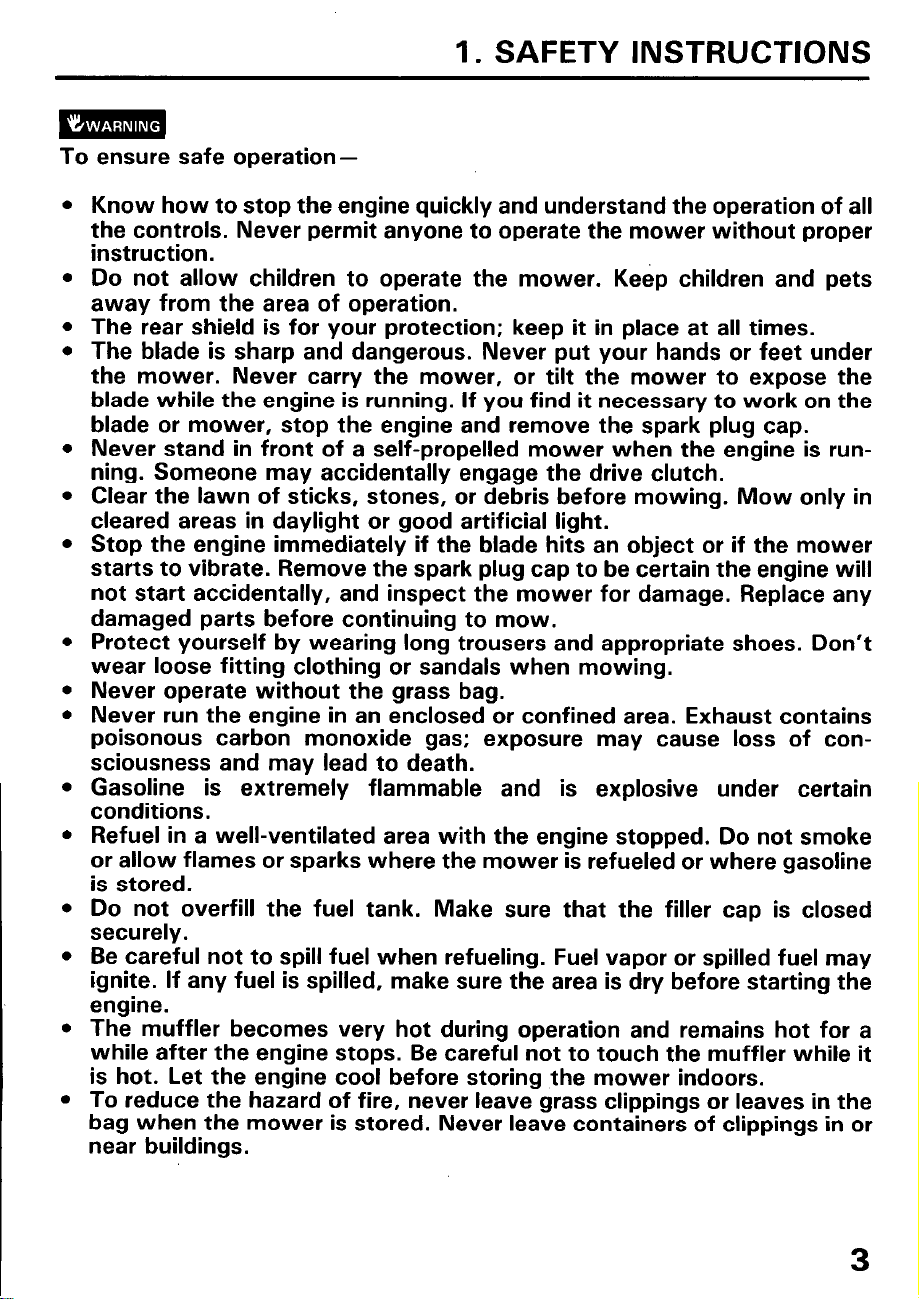
Know how to stop the engine quickly and understand the operation of all
the controls. Never permit anyone to operate the mower without proper
instruction.
Do not allow children to operate the mower. Keep children and pets
away from the area of operation.
The rear shield is for your protection; keep it in place at all times.
The blade is sharp and dangerous. Never put your hands or feet under
the mower. Never carry the mower, or tilt the mower to expose the
blade while the engine is running. If you find it necessary to work on the
blade or mower, stop the engine and remove the spark plug cap.
Never stand in front of a self-propelled mower when the engine is run-
ning. Someone may accidentally engage the drive clutch.
Clear the lawn of sticks, stones, or debris before mowing. Mow only in
cleared areas in daylight or good artificial light.
Stop the engine immediately if the blade hits an object or if the mower
starts to vibrate. Remove the spark plug cap to be certain the engine will
not start accidentally, and inspect the mower for damage. Replace any
damaged parts before continuing to mow.
Protect yourself by wearing long trousers and appropriate shoes. Don’t
wear loose fitting clothing or sandals when mowing.
Never operate without the grass bag.
Never run the engine in an enclosed or confined area. Exhaust contains
poisonous carbon monoxide gas; exposure may cause loss of con-
sciousness and may lead to death.
Gasoline is extremely flammable and is explosive under certain
conditions.
Refuel in a well-ventilated area with the engine stopped. Do not smoke
or allow flames or sparks where the mower is refueled or where gasoline
is stored.
Do not overfill the fuel tank. Make sure that the filler cap is closed
securely.
Be careful not to spill fuel when refueling. Fuel vapor or spilled fuel may
ignite. If any fuel is spilled, make sure the area is dry before starting the
engine.
The muffler becomes very hot during operation and remains hot for a
while after the engine stops. Be careful not to touch the muffler while it
is hot. Let the engine cool before storing the mower indoors.
To reduce the hazard of fire, never leave grass clippings or leaves in the
bag when the mower is stored. Never leave containers of clippings in or
near buildings.
3
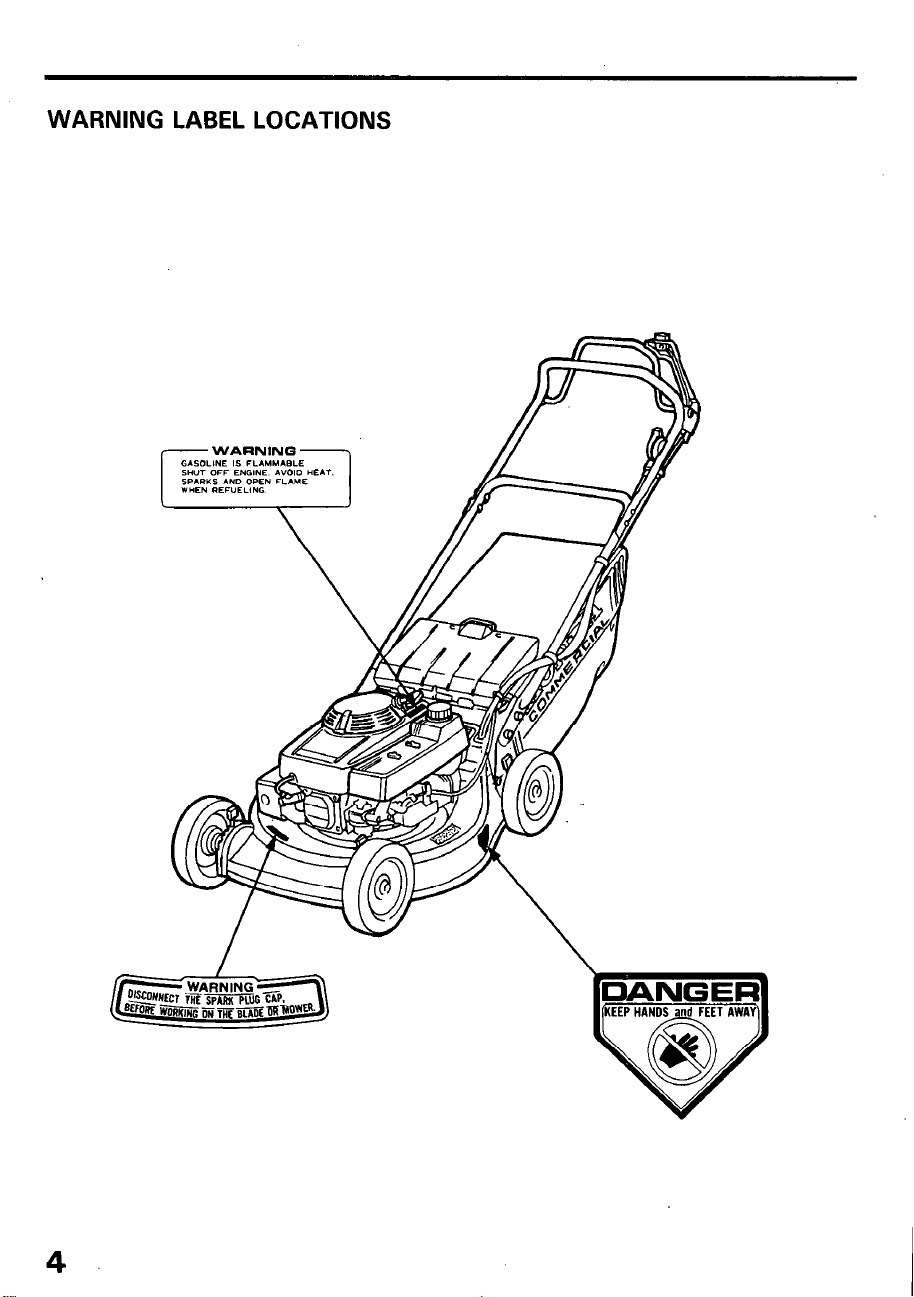
WARNING LABEL LOCATIONS
\
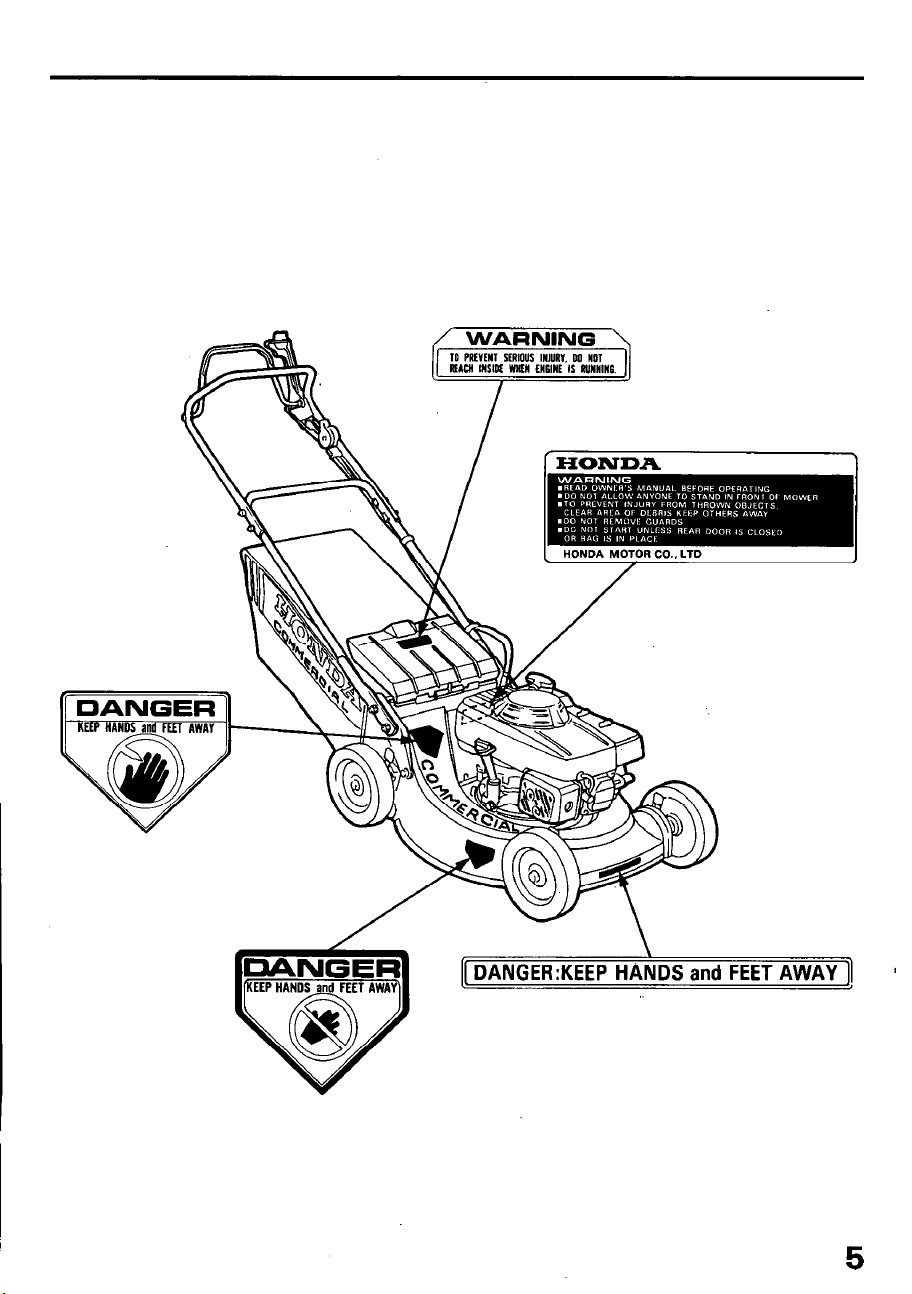
DANGER:KEEP HANDS and FEET AWAY ]] I
5
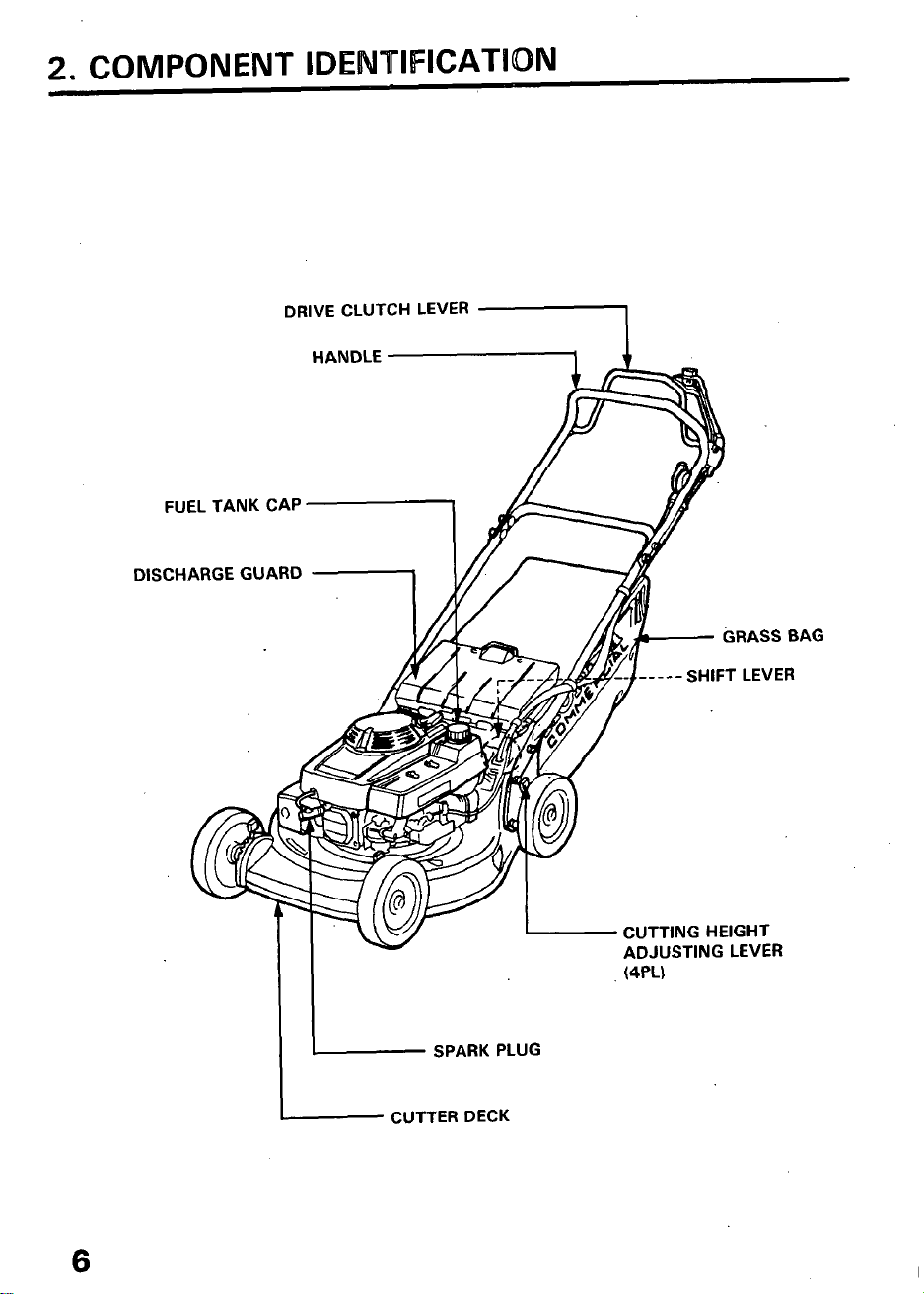
2. COlVlPONENT IDENTIFICATION
DRIVE CLUTCH LEVER
HANDLE 1
FU
DISCH
IARGE GUARD
-----SHIFT LEVER
- CUTTING HEIGHT
ADJUSTING LEVER
(4PL1
SPARK PLUG
I
CUTTER DECK
6
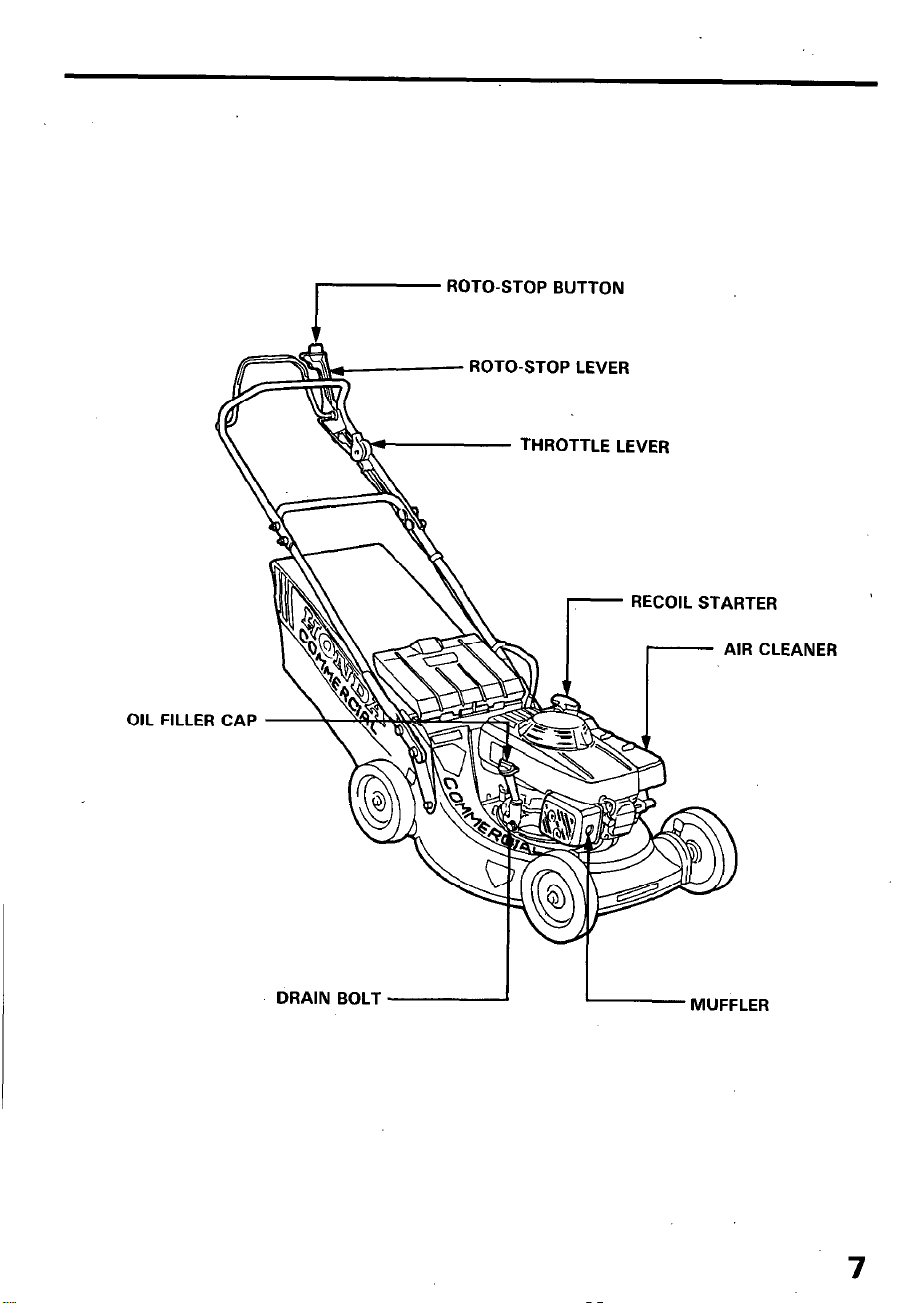
OIL FILI
1
ROTO-STOP BUTTON
ROTO-STOP LEVER
THROTTLE LEVER
RECOIL STARTER
r,
AIR CLEANER
DRAIN BOLT
7
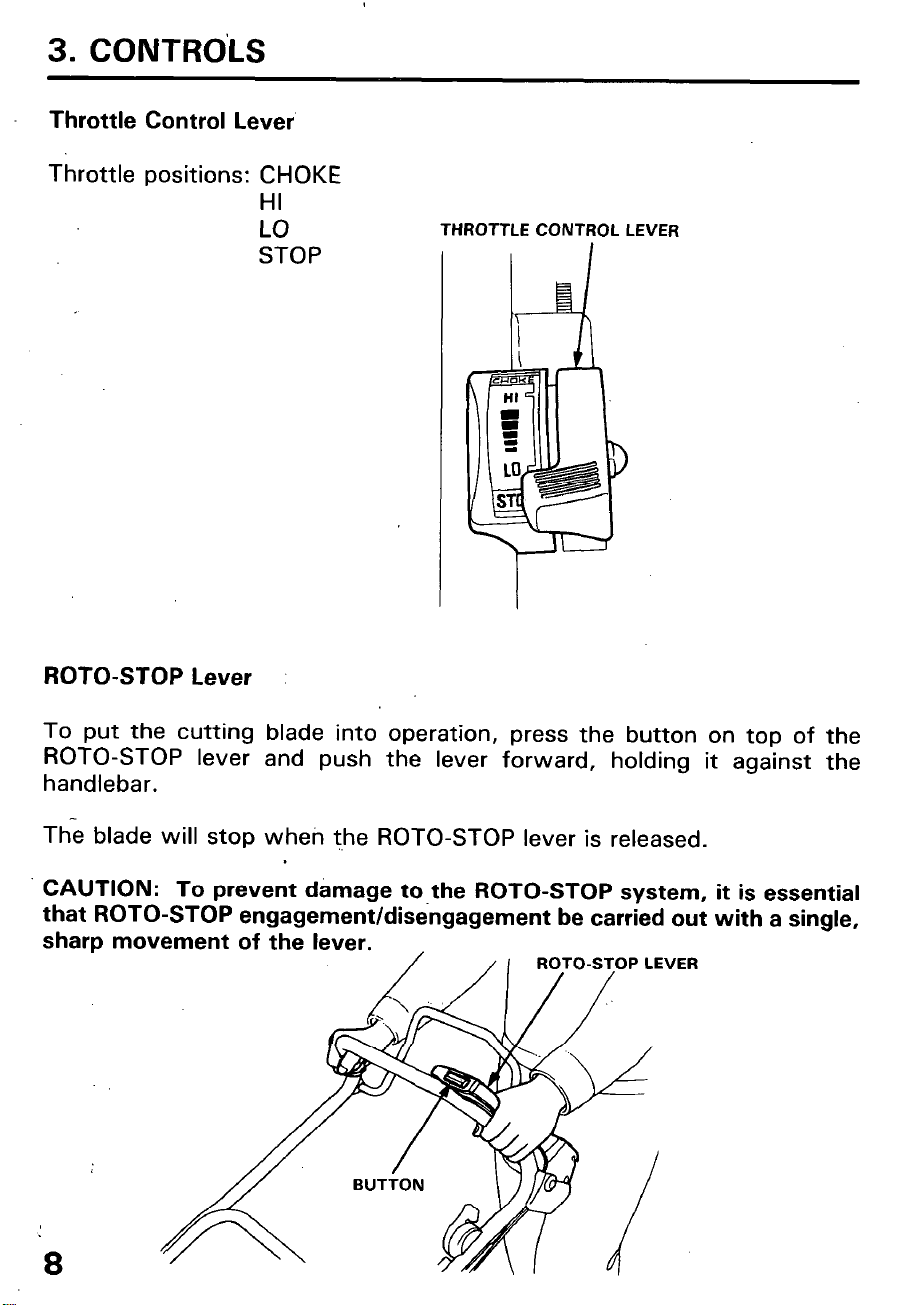
3. CONTRO‘LS
Throttle Control Lever
Throttle positions: CHOKE
HI
LO
STOP
ROTO-STOP Lever
THROTTLE CONTROL LEVER
To put the cutting
ROTO-STOP lever
handlebar.
blade into operation, press the button on top of the
and push the lever forward, holding it against the
The blade will stop
wheh the ROTO-STOP lever is released.
CAUTION: To prevent damage to the ROTO-STOP system, it is essential
that ROTO-STOP engagement/disengagement be carried out with a single,
sharp movement of the lever.
8
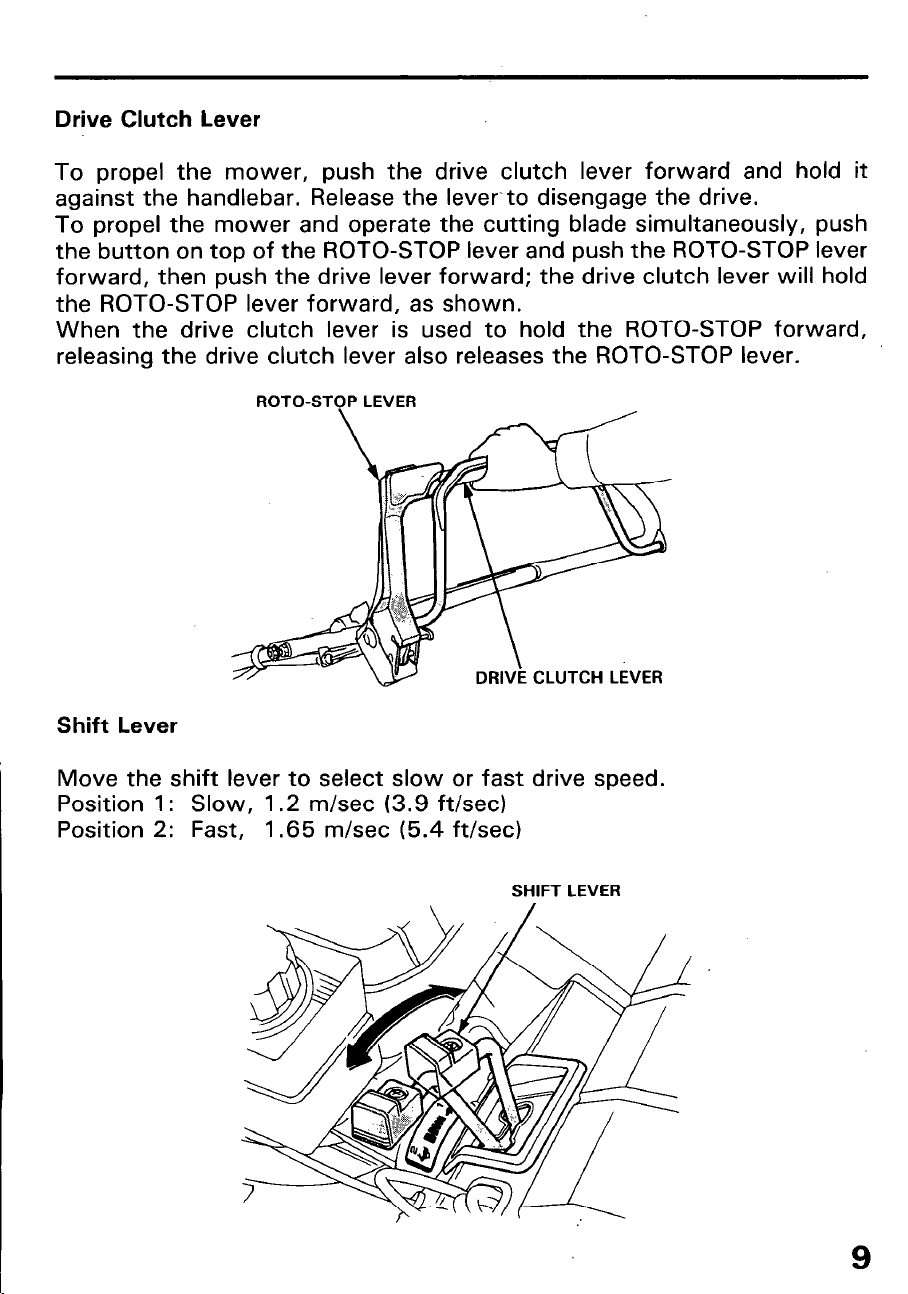
Drive Clutch Lever
To propel the mower, push the drive clutch lever forward and hold it
against the handlebar. Release the lever-to disengage the drive.
To propel the mower and operate the cutting blade simultaneously, push
the button on top of the ROTO-STOP lever and push the ROTO-STOP lever
forward, then push the drive lever forward; the drive clutch lever will hold
the ROTO-STOP lever forward, as shown.
When the drive clutch lever is used to hold the ROTO-STOP forward,
releasing the drive clutch lever also releases the ROTO-STOP lever.
ROTO-STOP LEVER
DRIVE CLUTCH LEVER
Shift Lever
Move the shift lever to select slow or fast drive speed.
Position 1: Slow, 1.2 m/set (3.9 ftlsec)
Position 2: Fast, 1.65 m/set (5.4 ft/sec)
SHIFT LEVER
9
I
4. PRE-OPERATION CHECKS
,
1. Check the engine oil level.
CAUTION:
l
Engine oil is a major factor affecting engine performance and service life.
Non-detergent and 2-stroke engine oils are not recommended.
l
Running the engine with insufficient oil can cause serious engine
damage.
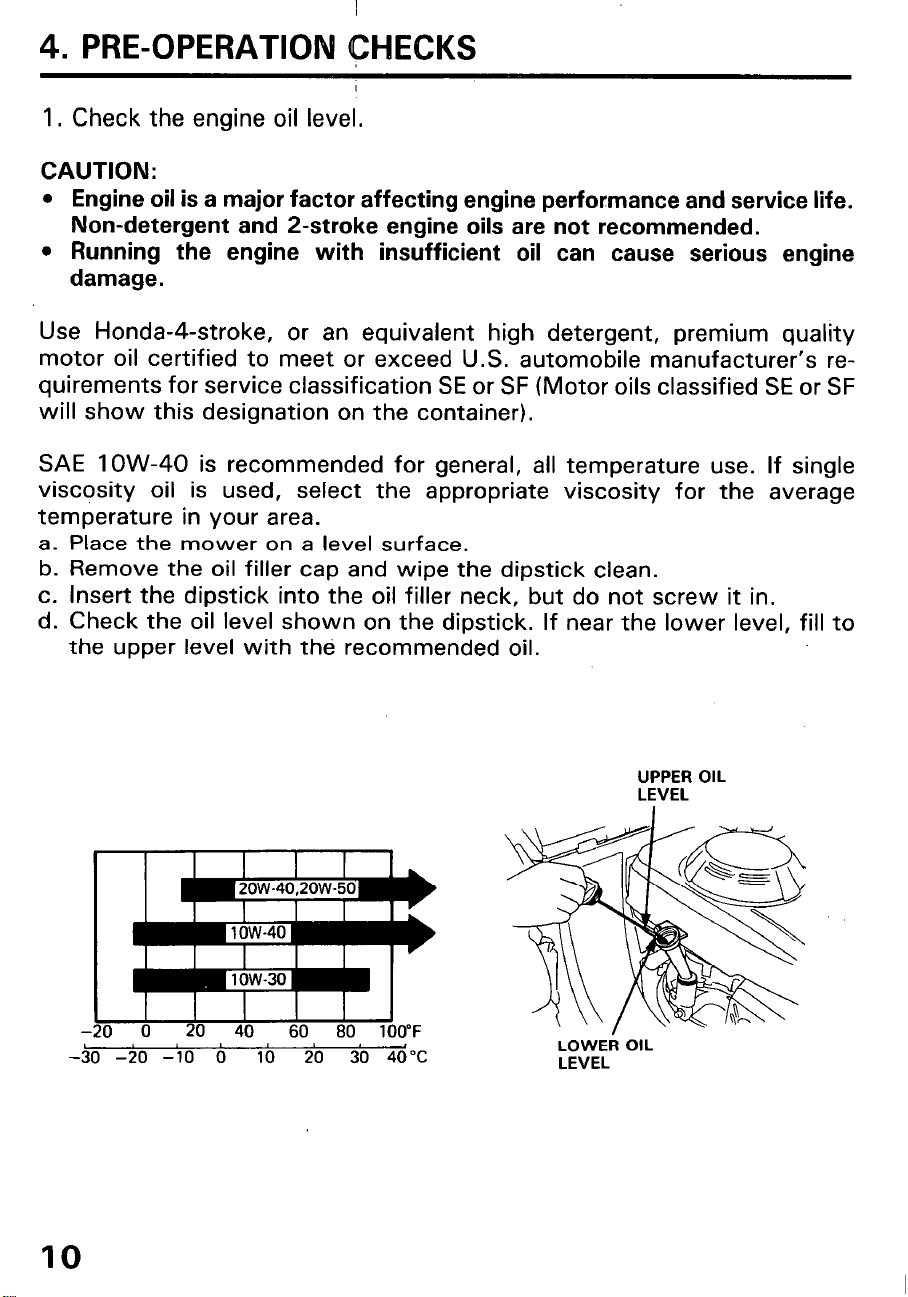
Use Honda-4-stroke, or an equivalent high detergent, premium quality
motor oil certified to meet or exceed U.S. automobile manufacturer’s re-
quirements for service classification SE or SF (Motor oils classified SE or SF
will show this designation on the container).
SAE low-40 is recommended for general, all temperature use. If single
viscosity oil is used, select the appropriate viscosity for the average
temperature in your area.
a. Place the mower on a level surface.
b. Remove the oil filler cap and wipe the dipstick clean.
c. Insert the dipstick into the oil filler neck, but do not screw it in.
d. Check the oil level shown on the dipstick. If near the lower level, fill to
the upper level with the recommended oil.
UPPER OIL
LEVEL
-20
0 20 40 60 80
100°F
I
,
-30
-20 -10 0 10 20 30
40°C
LOWER OIL
LEVEL
10
2. Check the fuel level.
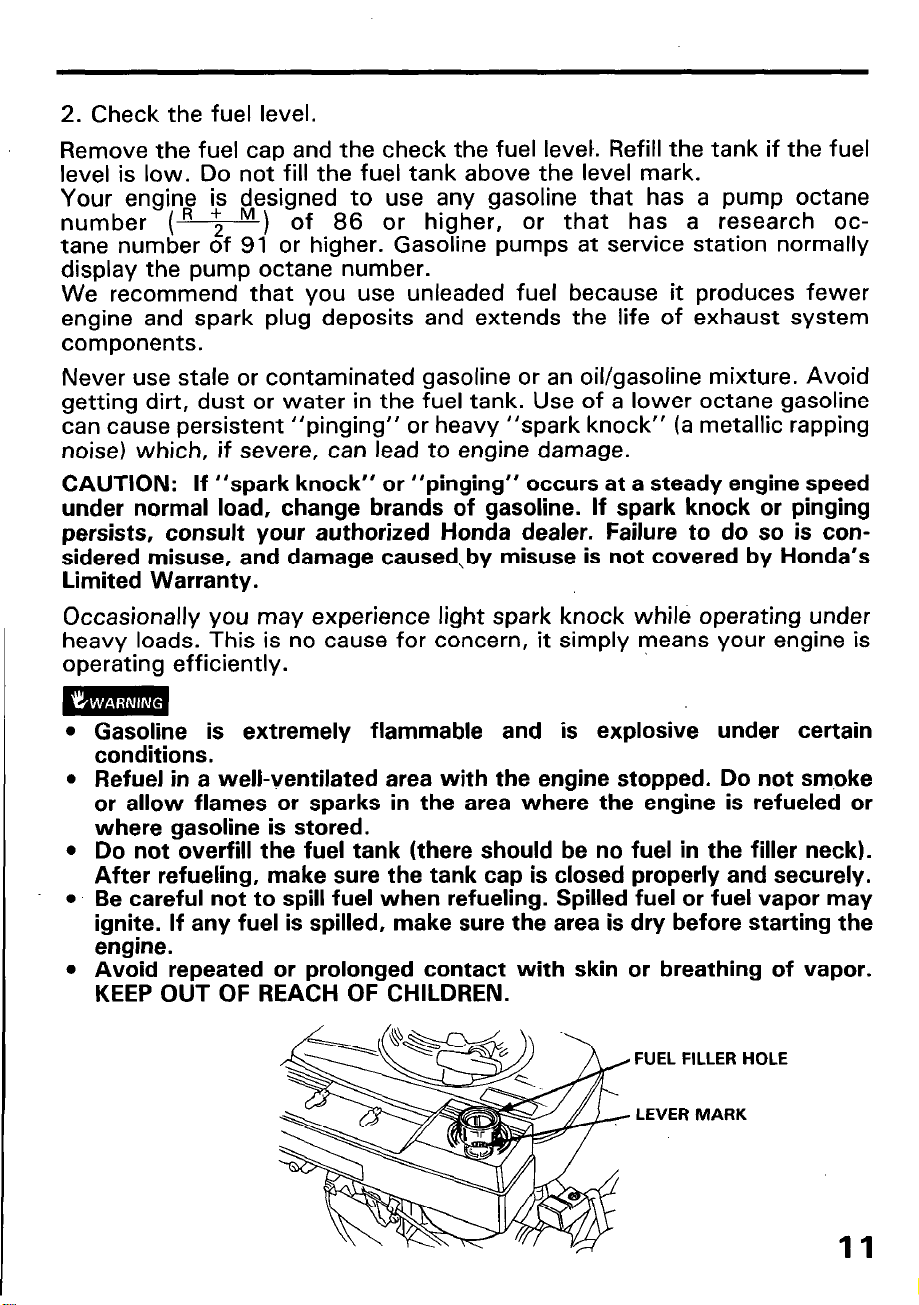
Remove the fuel cap and the check the fuel level-. Refill the tank if the fuel
level is low. Do not fill the fuel tank above the level mark.
Your engine is designed to use any gasoline that has a pump octane
number (
’ ‘2 M ) of 86 or higher,
or that has a research oc-
tane number of 91 or higher. Gasoline pumps at service station normally
display the pump octane number.
We recommend that you use unleaded fuel because it produces fewer
engine and spark plug deposits and extends the life of exhaust system
components.
Never use stale or contaminated gasoline or an oil/gasoline mixture. Avoid
getting dirt, dust or water in the fuel tank. Use of a lower octane gasoline
can cause persistent “pinging” or heavy “spark knock” (a metallic rapping
noise) which, if severe, can lead to engine damage.
CAUTION: If “spark knock” or “pinging” occurs at a steady engine speed
under normal load, change brands of gasoline. If spark knock or pinging
persists, consult your authorized Honda dealer. Failure to do so is con-
sidered misuse, and damage caused,by misuse is not covered by Honda’s
Limited Warranty.
Occasionally you may experience light spark knock while operating under
heavy loads. This is no cause for concern, it simply means your engine is
operating efficiently.
l
Gasoline is extremely flammable and is explosive under certain
conditions.
. Refuel in a well-ventilated area with the engine stopped. Do not smoke
or allow flames or sparks in the area where the engine is refueled or
where gasoline is stored.
l
Do not overfill the fuel tank (there should be no fuel in the filler neck).
After refueling, make sure the tank cap is closed properly and securely.
l
Be careful not to spill fuel when refueling. Spilled fuel or fuel vapor may
ignite. If any fuel is spilled, make sure the area is dry before starting the
engine.
l
Avoid repeated or prolonged contact with skin or breathing of vapor.
KEEP OUT OF REACH OF CHILDREN.
FUEL FILLER HOLE
LEVER MARK
11
GASOLINES CONTAINING ALCOHOL
If you decide to use a gasoline containing alcohol (gasohol), be sure it’s oc-
tane rating is at least as high as that recommended by Honda. There are
two types of “gasohol”: one containing ethanol, and the other containing
methanol. Do not use gasohol that contains more than 10% ethanol. Do
not use gasoline containing methanol (methyl or wood alcohol) that does
not also contain cosolvents and corrosion inhibitors for methanol. Never
use gasoline containing more than 5% methanol, even if it has cosolvents
and corrosion inhibitors.
NOTE:
l
Fuel system damage or engine performance problems resulting from the
use of fuels that contain alcohol is not covered under the warranty.
Honda cannot endorse the use of fuels containing methanol since
evidence of their suitability is as yet incomplete.
l
Before buying fuel from an unfamiliar station, try to find out if the fuel
contains alcohol, if it does, confirm the type and percentage of alcohol
used. If you notice any undesirable operating symptoms while using a
gasoline that contains alcohol, or one that you think contains alcohol,
switch to a gasoline that you know does not contain alcohol.
12
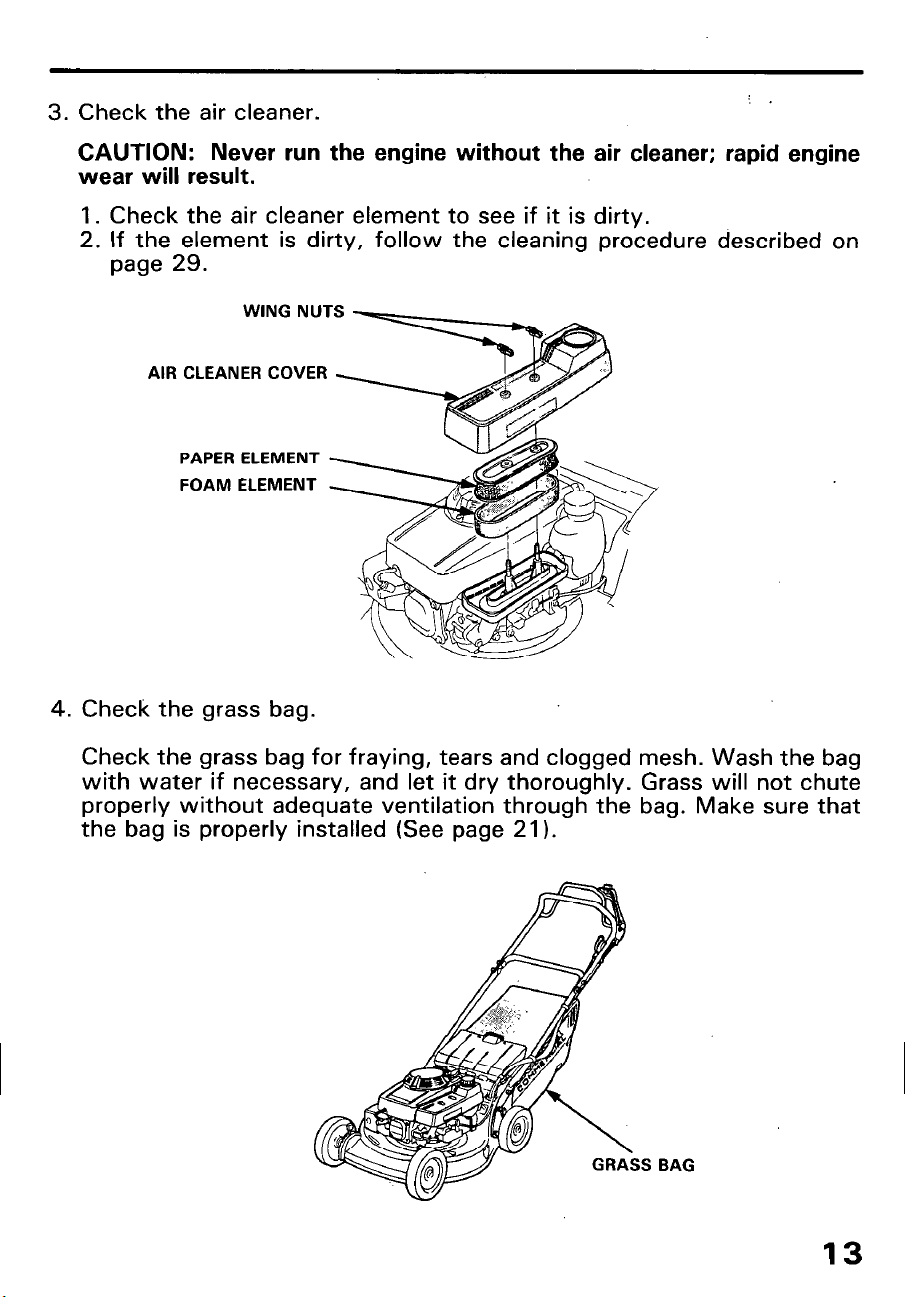
3. Check the air cleaner.
:
CAUTION: Never run the engine without the air cleaner; rapid engine
wear will result.
1. Check the air cleaner element to see if it is dirty.
2. If the element is dirty, follow the cleaning procedure described on
page 29.
WING NUTS
AIR CLEANER COVER
PAPER ELEMENT
FOAM ELEMENT
4.
Check the grass bag.
Check the grass bag for fraying, tears and clogged mesh. Wash the bag
with water if necessary, and let it dry thoroughly. Grass will not chute
properly without adequate ventilation through the bag. Make sure that
the bag is properly installed (See page 21).
GRASS BAG
13
5. OPERATION
Starting the Engine
rmml
Exhaust gas contains poisonous carbon monoxide. Never run
the mower in an enclosed area. Be sure to provide adequate ventilation.
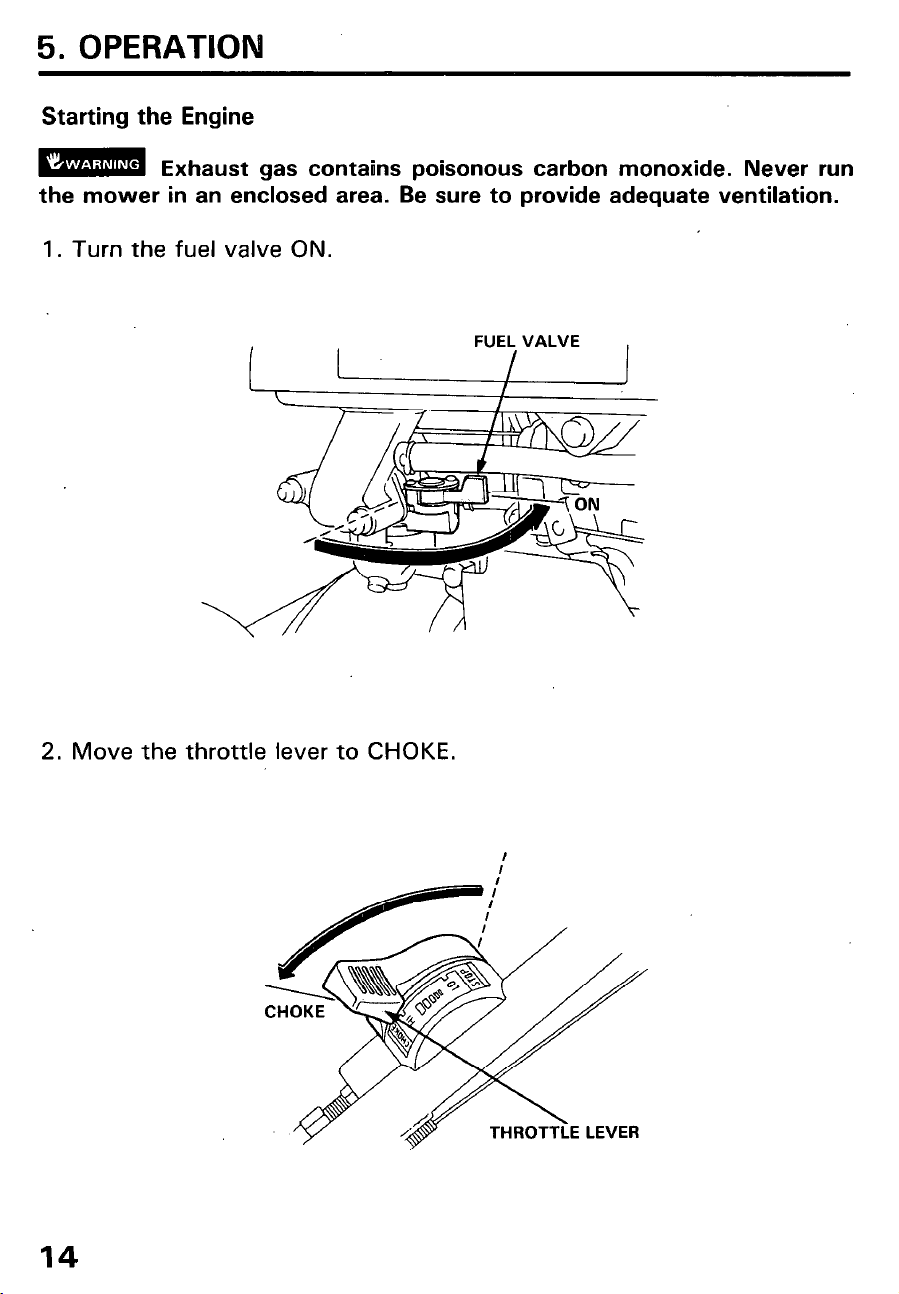
1. Turn the fuel valve ON.
2. Move the throttle lever to CHOKE.
14
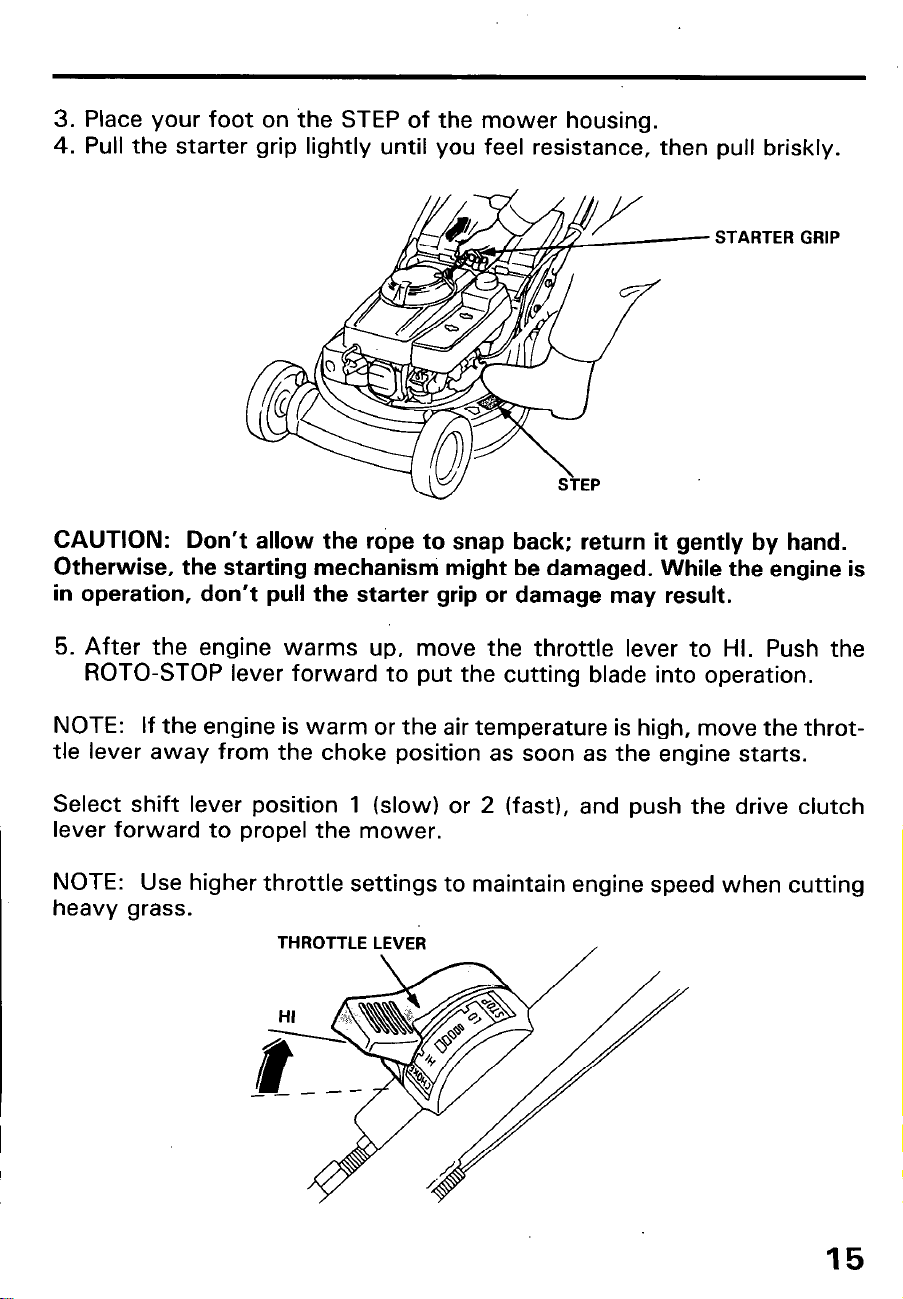
3. Place your foot on the STEP of the mower housing.
4. Pull the starter grip lightly until you feel resistance, then pull briskly.
STARTER GRIP
CAUTION: Don’t allow the rope to snap back; return it gently by hand.
Otherwise, the starting mechanism might be damaged. While the engine is
in operation, don’t pull the starter grip or damage may result.
5. After the engine warms up, move the throttle lever to HI. Push the
ROTO-STOP lever forward to put the cutting blade into operation.
NOTE:
If the engine is warm or the air temperature is high, move the throt-
tle lever away from the choke position as soon as the engine starts.
Select shift lever position 1 (slow) or 2 (fast), and push the drive clutch
lever forward to propel the mower.
NOTE: Use higher throttle settings to maintain engine speed when cutting
heavy grass.
THROTTLE LEVER
15
Mowing
This MOWER should be used with the grass bag.
The following suggestions and rules are intended to help you operate your
Honda HRA216 under the safest conditions possible. Be alert and exercise
the same care using the mower as you would using any other power tool.
l
Be especially careful when mowing uneven or rough ground. The mower
may tilt, exposing the blade, and hidden objects could be thrown by the
blade. Keep all four wheels on the ground.
l
Mow
across slopes. Do not mow excessively steep slopes.
CAUTION:’ Use extra care when mowing around objects to keep the blade
from striking them. Never deliberately mow over any object.
NOTE: Do not use the drive clutch when maneuvering around trees, etc.
Release the clutch and push the mower for better directional control.
Control Systems
CAUTION:
l
Be sure to squeeze the roto-stop lever and drive clutch lever securely.
Never squeeze them halfway.
l
Be sure to securely move the shift lever by hand.
16
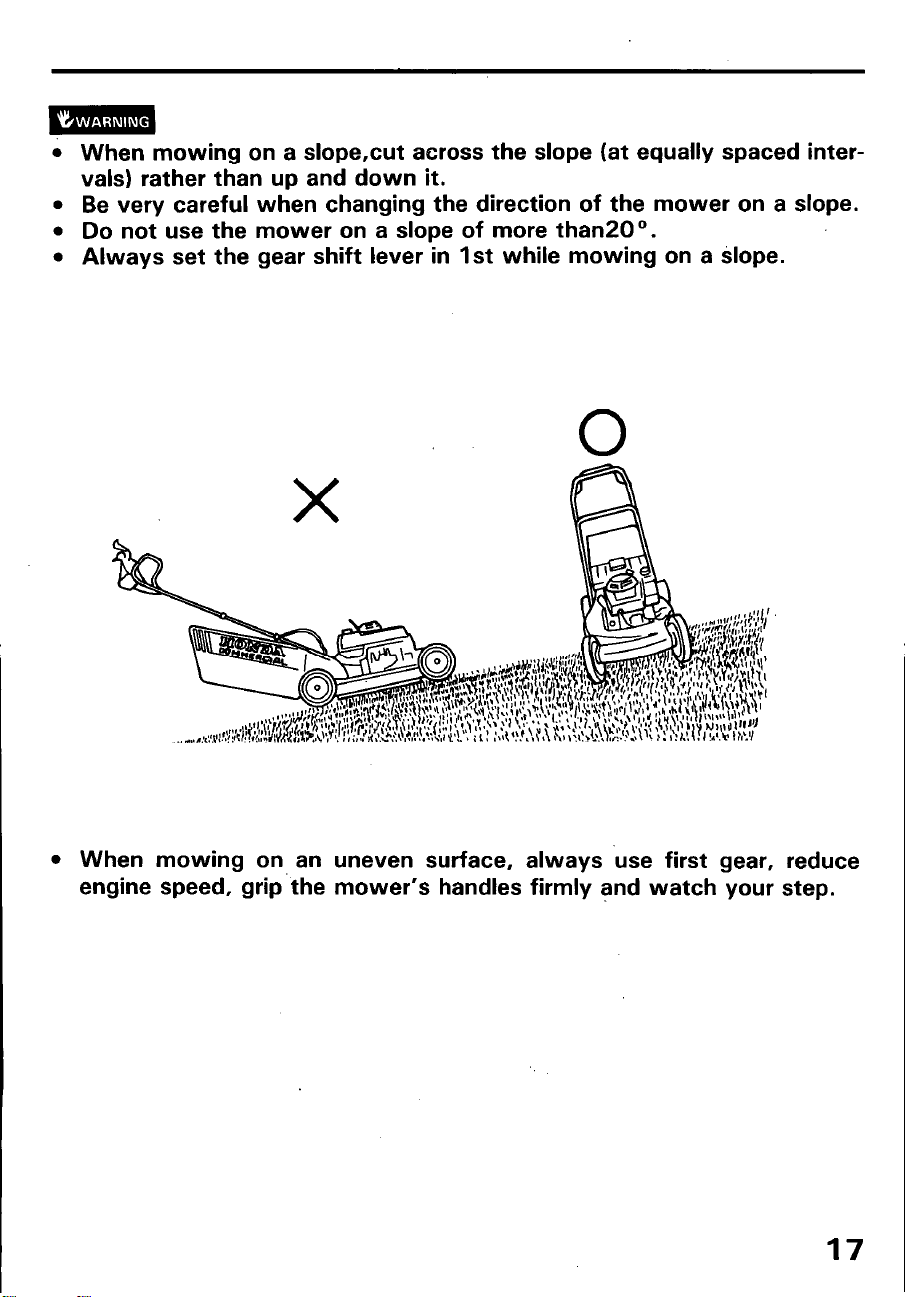
When mowing on a slope,cut across the slope (at equally spaced inter-
vals) rather than up and down it.
l
Be very careful when changing the direction of the mower on a slope.
l
Do not use the mower on a slope of more than20”.
l
Always set the gear shift lever in 1st while mowing on a slope.
X
l
When mowing on an uneven surface, always use first gear, reduce
engine speed, grip the mower’s handles firmly and watch your step.
17
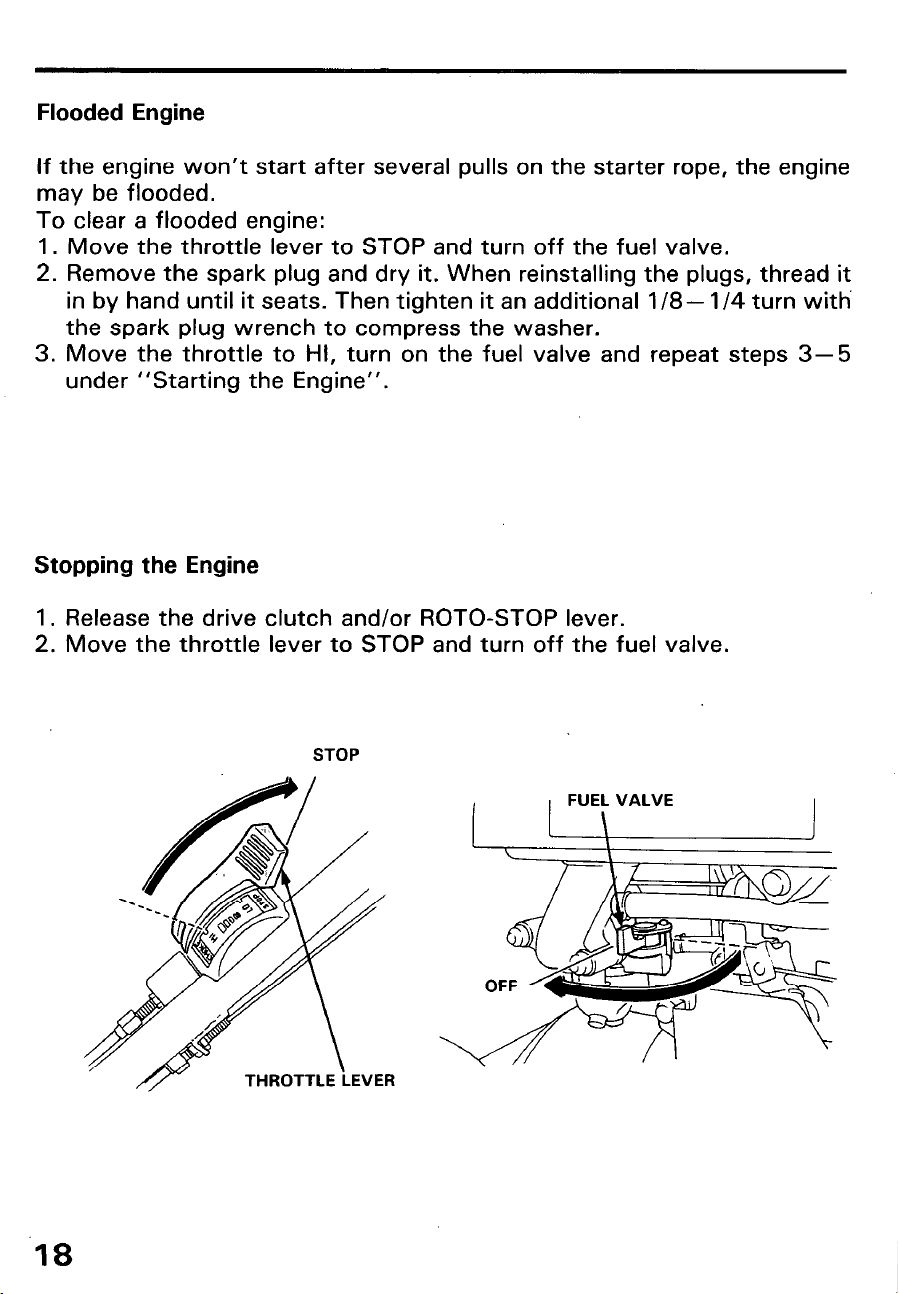
Flooded Engine
If the engine won’t start after several pulls on the starter rope, the engine
may be flooded.
To clear a flooded engine:
1. Move the throttle lever to STOP and turn off the fuel valve.
2. Remove the spark plug and dry it. When reinstalling the plugs, thread it
in by hand until it seats. Then tighten it an additional l/8- l/4 turn with
the spark plug wrench to compress the washer.
3. Move the throttle to HI, turn on the fuel valve and repeat steps 3-5
under “Starting the Engine”.
Stopping the Engine
1. Release the drive clutch and/or ROTO-STOP lever.
2. Move the throttle lever to STOP and turn off the fuel valve.
STOP
FUEL VALVE
\
I
L
\
18
High altitude operation
At high altitude, the standard carburetor air-fuel mixture will be excessively
rich. Performance will decrease, and fuel consumption will increase.
High altitude performance can be improved by installing a smaller diameter
main fuel jet in the carburetor and readjusting the pilot screw. If you always
operate the rotary mower at altitudes higher than 6,000 feet above sea
level, have your authorized Honda Rotary Mower dealer perform these car-
buretor modifications.
Even with suitable carburetor jetting, engine horsepower will decrease ap-
proximately 3.5% for each 1,000 foot increase in altitude. The affect of
altitude on horsepower will be greater than this if no carburetor modifica-
tion is made.
CAUTION: Operation of the mower at an altitude lower than the carburetor
is jetted for may result in reduced performance, overheating, and serious
engine damage caused by an excessively lean air/fuel mixture.
19
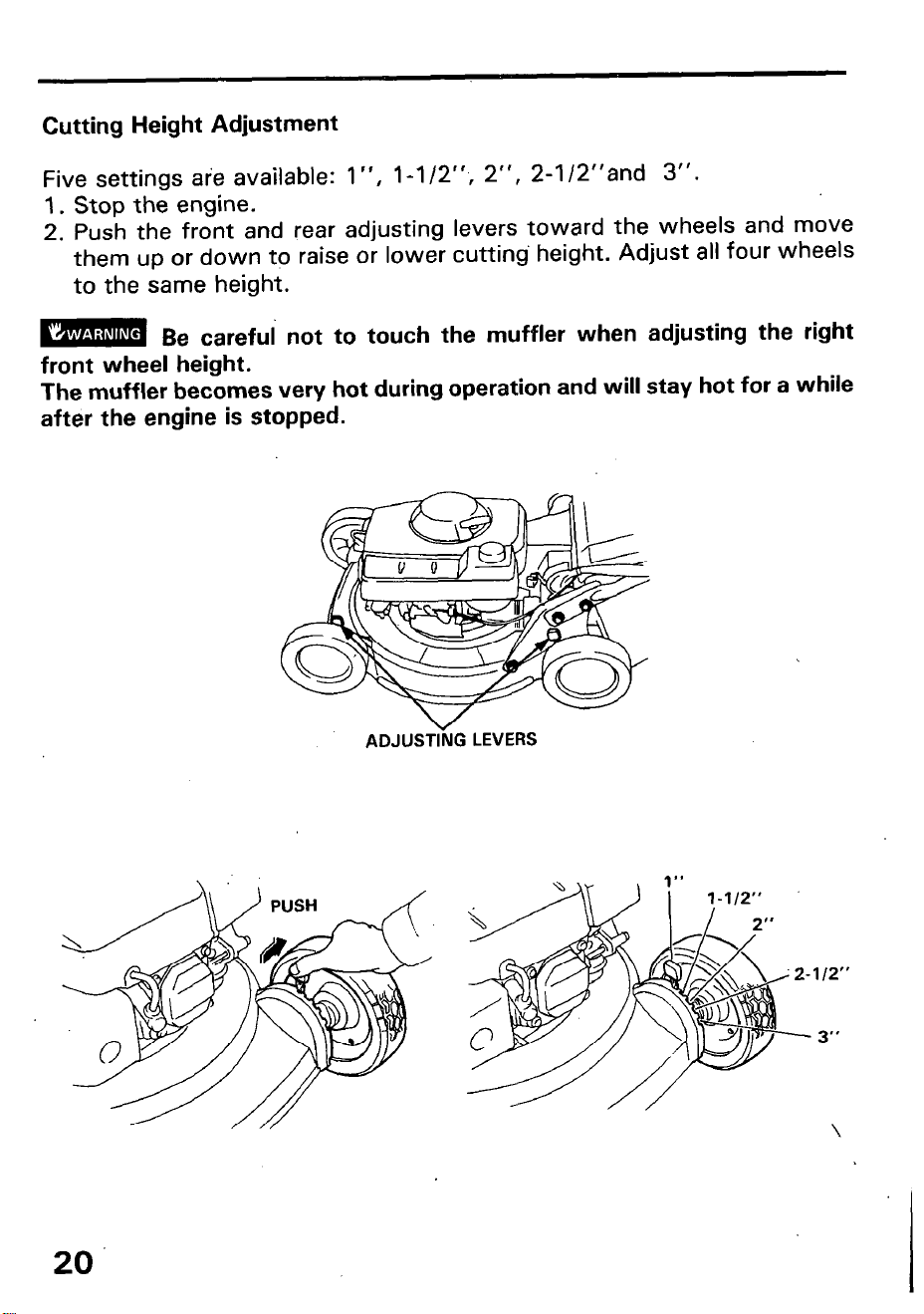
Cutting Height Adjustment
Five settings are available: I“, l-l/2”, 2”, 2-1/2”and 3”.
1. Stop the engine.
2. Push the front and rear adjusting levers toward the wheels and move
them up or down to raise or lower cutting’ height. Adjust all four wheels
to the same height.
m Be careful not to touch the muffler when adjusting the right
front wheel height.
The muffler becomes very hot during operation and will stay hot for a while
after the engine is stopped.
ADJUST&G LEVERS
20
Grass Bag
The bag is subject to wear under normal usage; check frequently for fray-
ing and tears. Replace deteriorated bags only with Honda replacement
bags or their equivalent. When the bag needs cleaning wash it with water
and make sure it is dry before using it.
Clogged mesh will result in poor grass cutting and a wet bag will clog
quickly.
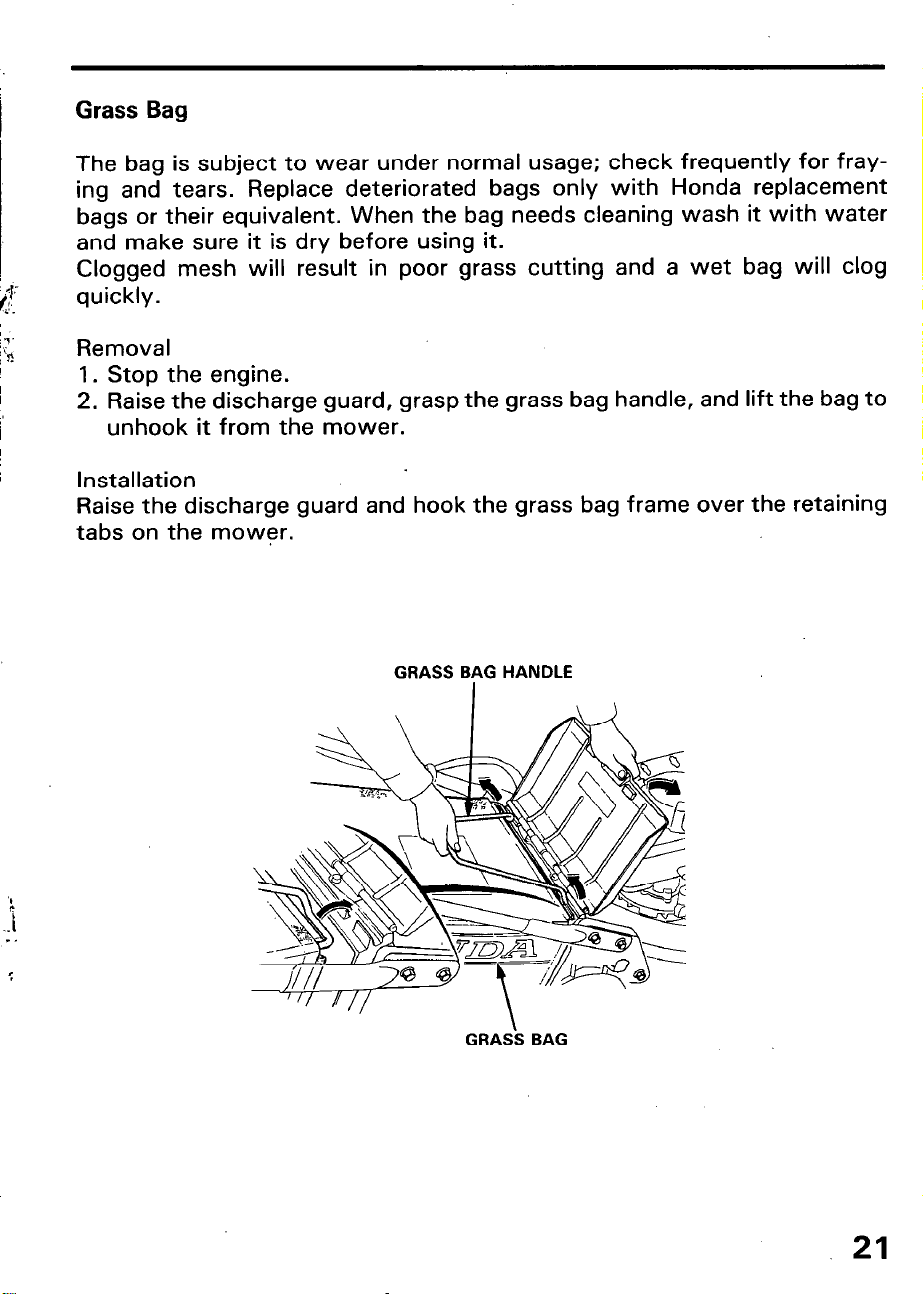
Removal
1. Stop the engine.
2. Raise the discharge guard, grasp the grass bag handle, and lift the bag to
unhook it from the mower.
Installation
Raise the discharge guard and hook the grass bag frame over the retaining
tabs on the mower.
GRASS BfG HANDLE
GRAS’s BAG
21
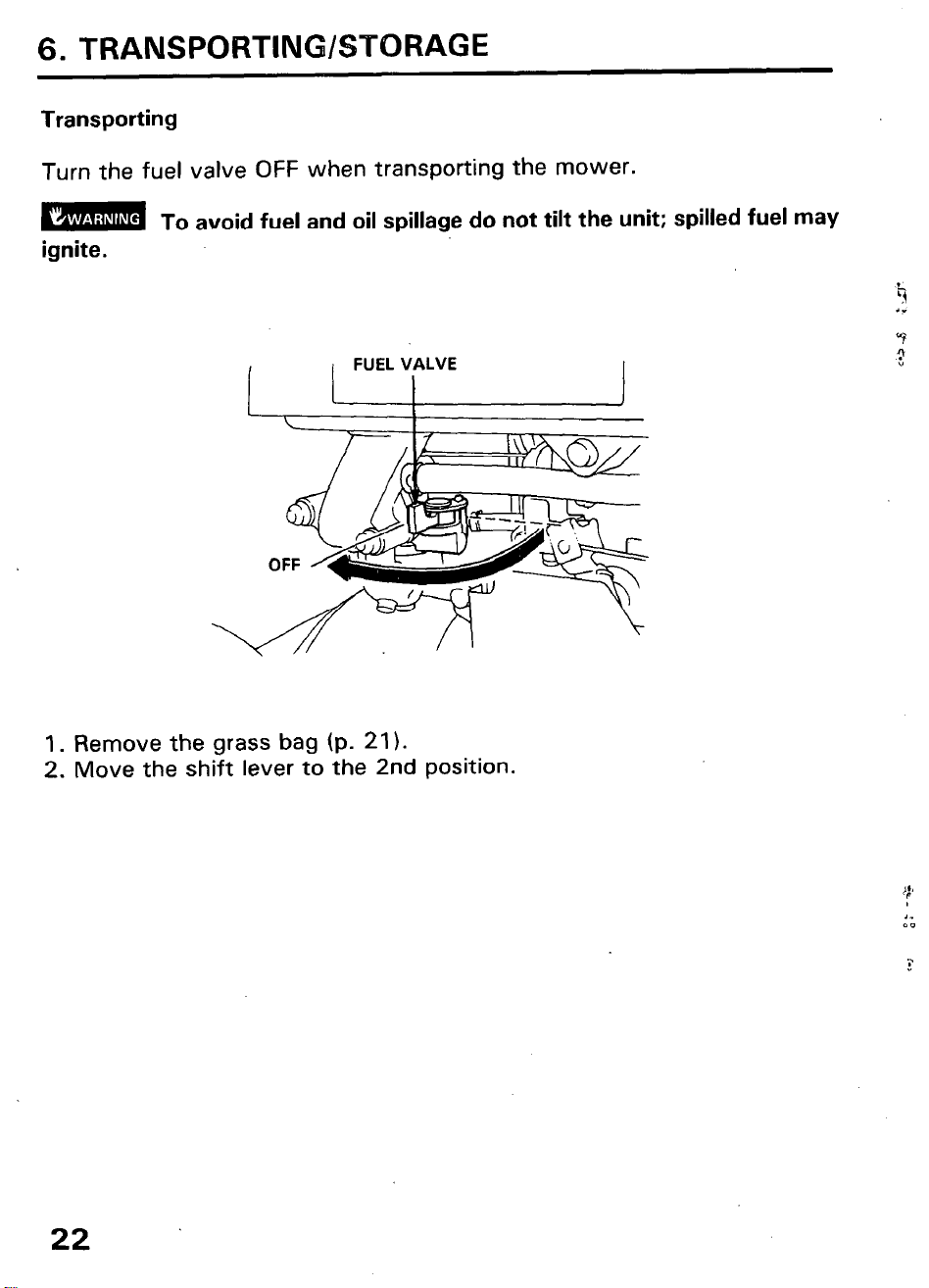
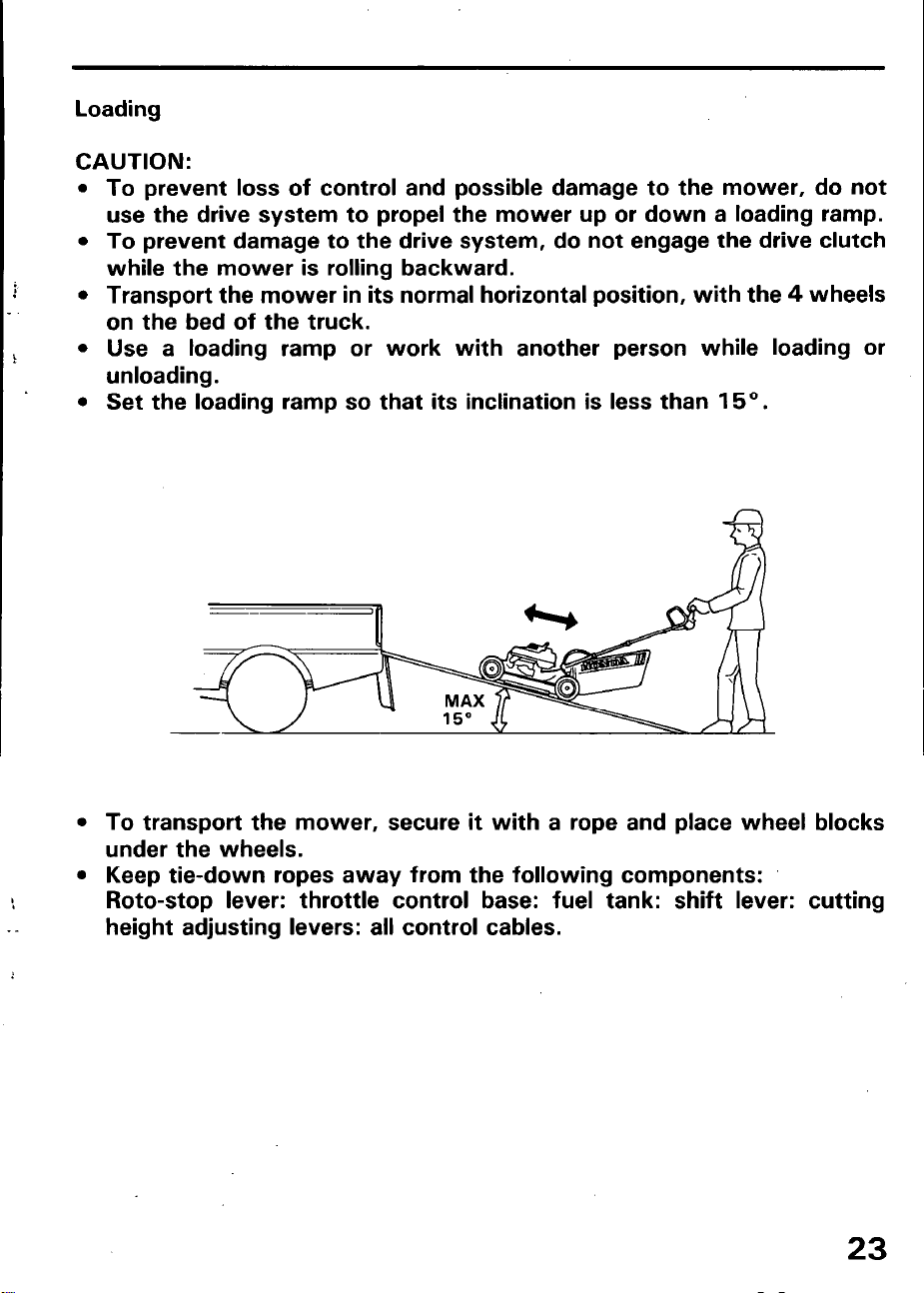
Loading
CAUTION:
l
To prevent loss of control and possible damage to the mower, do not
use the drive system to propel the mower up or down a loading ramp.
l
To prevent damage to the drive system, do not engage the drive clutch
while the mower is rolling backward.
l
Transport the mower in its normal horizontal position, with the 4 wheels
on the bed of the truck.
l
Use a loading ramp or work with another person while loading or
unloading.
l
Set the loading ramp so that its inclination is less than 15’.
l
To transport the mower, secure it with a rope and place wheel blocks
under the wheels.
l
Keep tie-down ropes away from the following components:
Roto-stop lever: throttle control base: fuel tank: shift lever: cutting
height adjusting levers: all control cables.
23
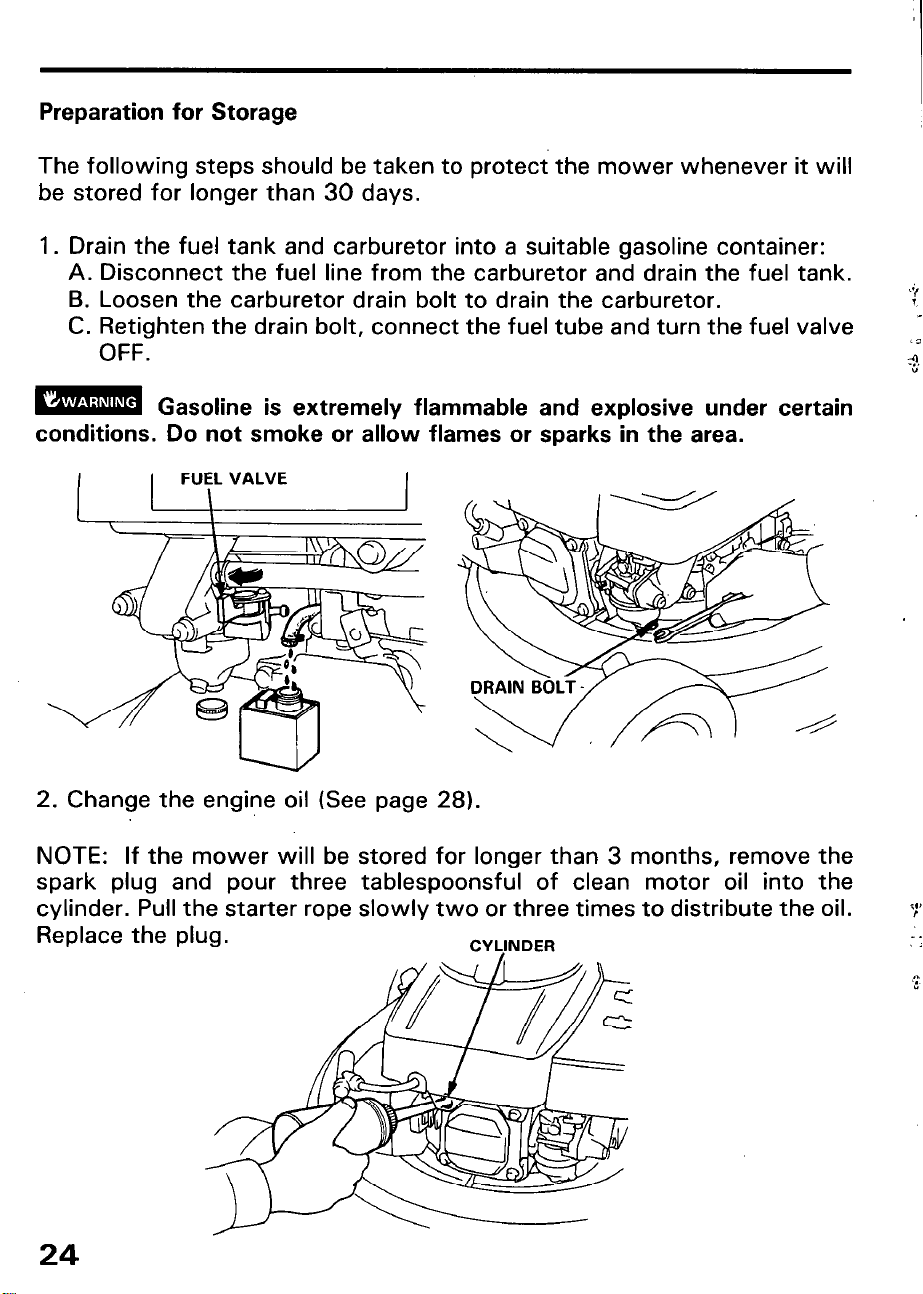
Preparation for Storage
The following steps should be taken to protect the mower whenever it will
be stored for longer than 30 days.
1. Drain the fuel tank and carburetor into a suitable gasoline container:
A. Disconnect the fuel line from the carburetor and drain the fuel tank.
B. Loosen the carburetor drain bolt to drain the carburetor.
C. Retighten the drain bolt, connect the fuel tube and turn the fuel valve
OFF.
cmm
Gasoline is extremely flammable and explosive under certain
conditions. Do not smoke or allow flames or sparks in the area.
FUEL VALVE
2. Change the engine oil (See page 28).
NOTE: If the mower will be stored for longer than 3 months, remove the
spark plug and pour three tablespoonsful of clean motor oil into the
cylinder. Pull the starter rope slowly two or three times to distribute the oil.
Replace the plug.
CYLINDER
24
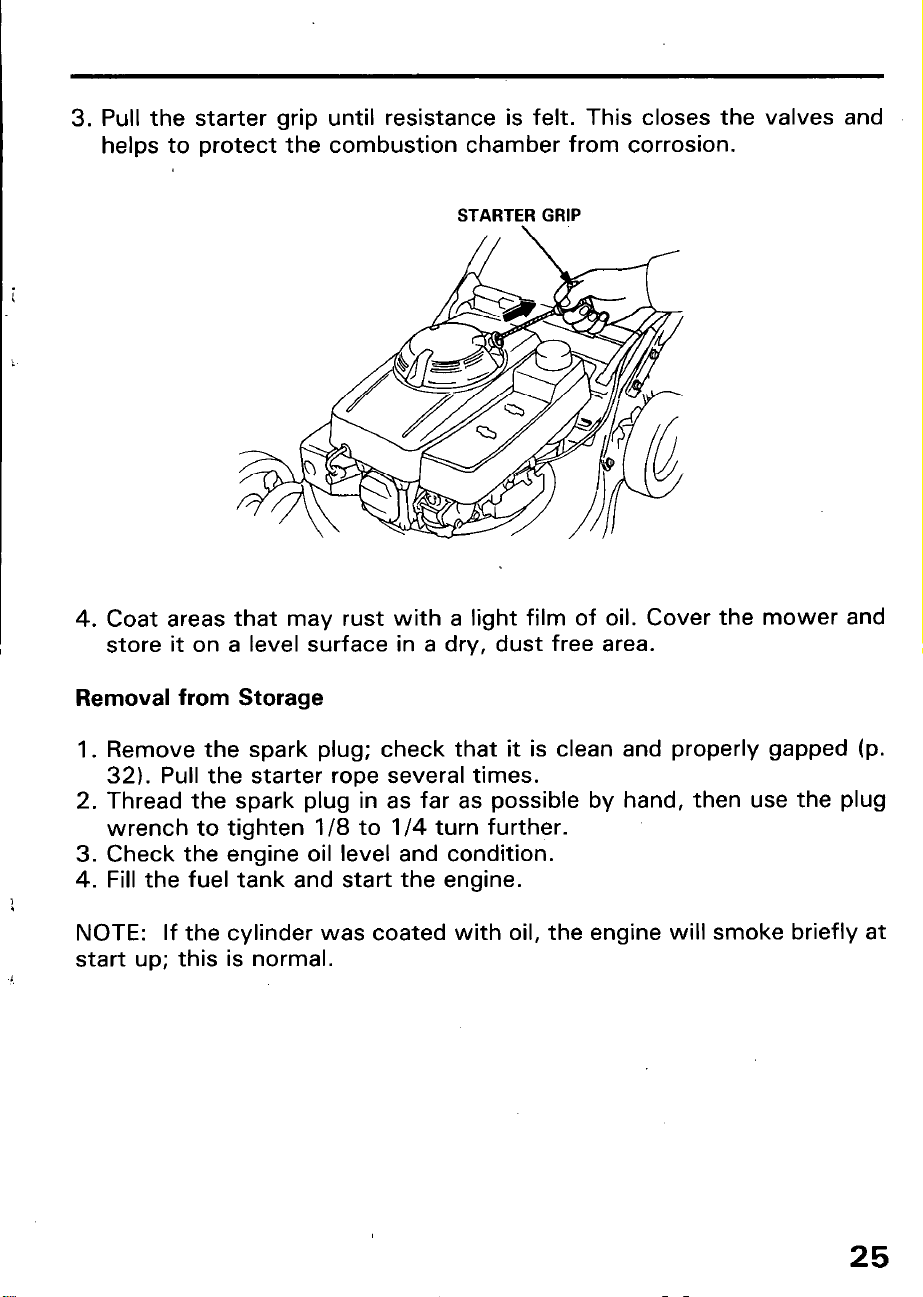
3. Pull the starter grip until resistance is felt. This closes the valves and
helps to protect the combustion chamber from corrosion.
STARTER GRIP
i
4. Coat areas that may rust with a light film of oil. Cover the mower and
store it on a level surface in a dry, dust free area.
Removal from Storage
1. Remove the spark plug; check that it is clean and properly gapped (p.
32). Pull the starter rope several times.
2. Thread the spark plug in as far as possible by hand, then use the plug
wrench to tighten l/8 to l/4 turn further.
3. Check the engine oil level and condition.
4. Fill the fuel tank and start the engine.
NOTE: If the cylinder was coated with oil, the engine will smoke briefly at
start up; this is normal.
25
7. MAINTENANCE
w
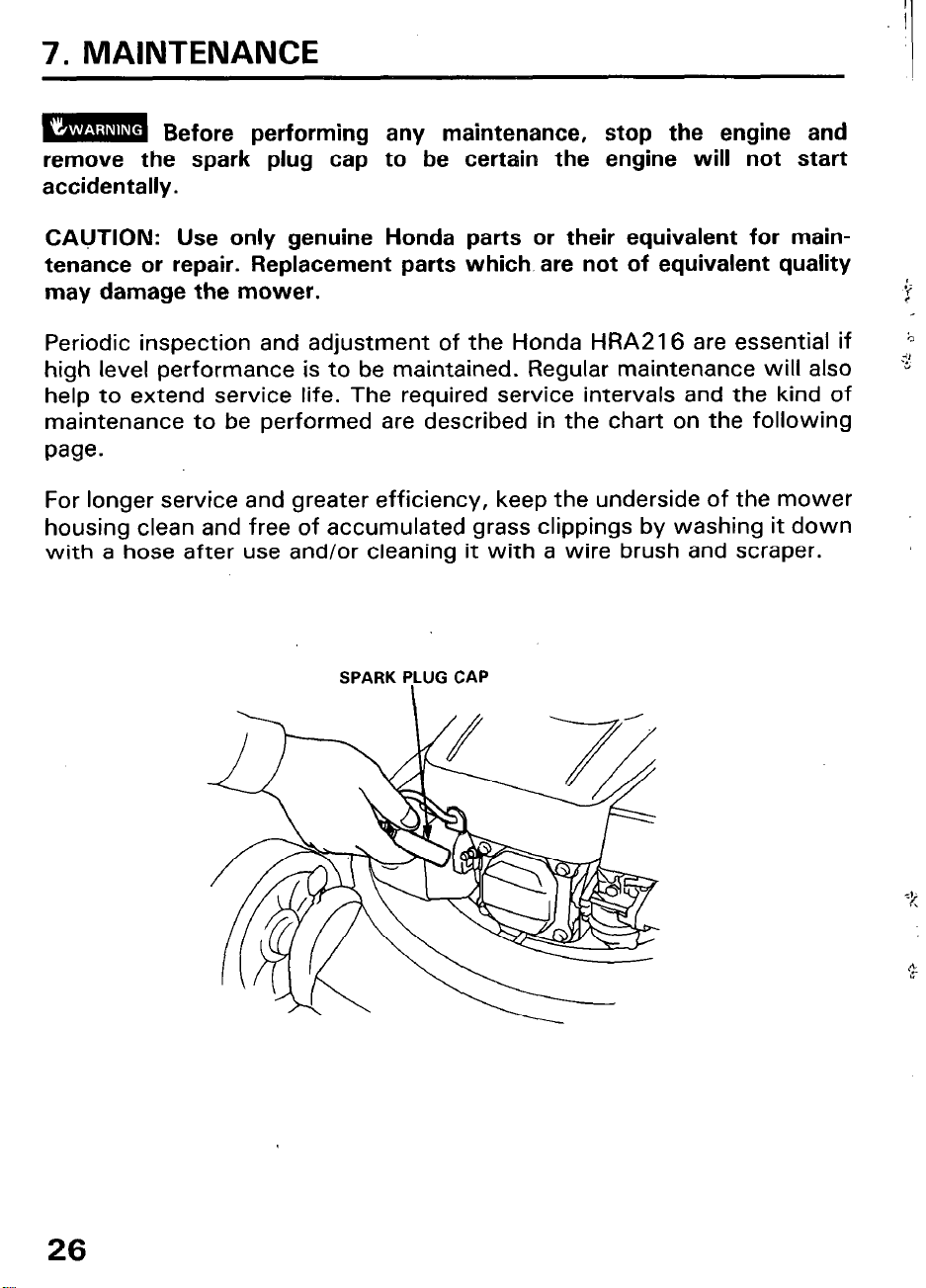
Before performing any maintenance, stop the engine and
remove the spark plug cap to be certain the engine will not start
accidentally.
CAUTION: Use only genuine Honda parts or their equivalent for main-
tenance or repair. Replacement parts which are not of equivalent quality
may damage
the mower.
‘i
,
Periodic inspection and adjustment of the Honda HRA216 are essential if
high level performance is to be maintained. Regular maintenance will also
help to extend service life. The required service intervals and the kind of
maintenance to be performed are described in the chart on the following
page.
For longer service and greater efficiency, keep the underside of the mower
housing clean and free of accumulated grass clippings by washing it down
with a hose after use and/or cleaning it with a wire brush and scraper.
SPARK PLUG CAP
I
26
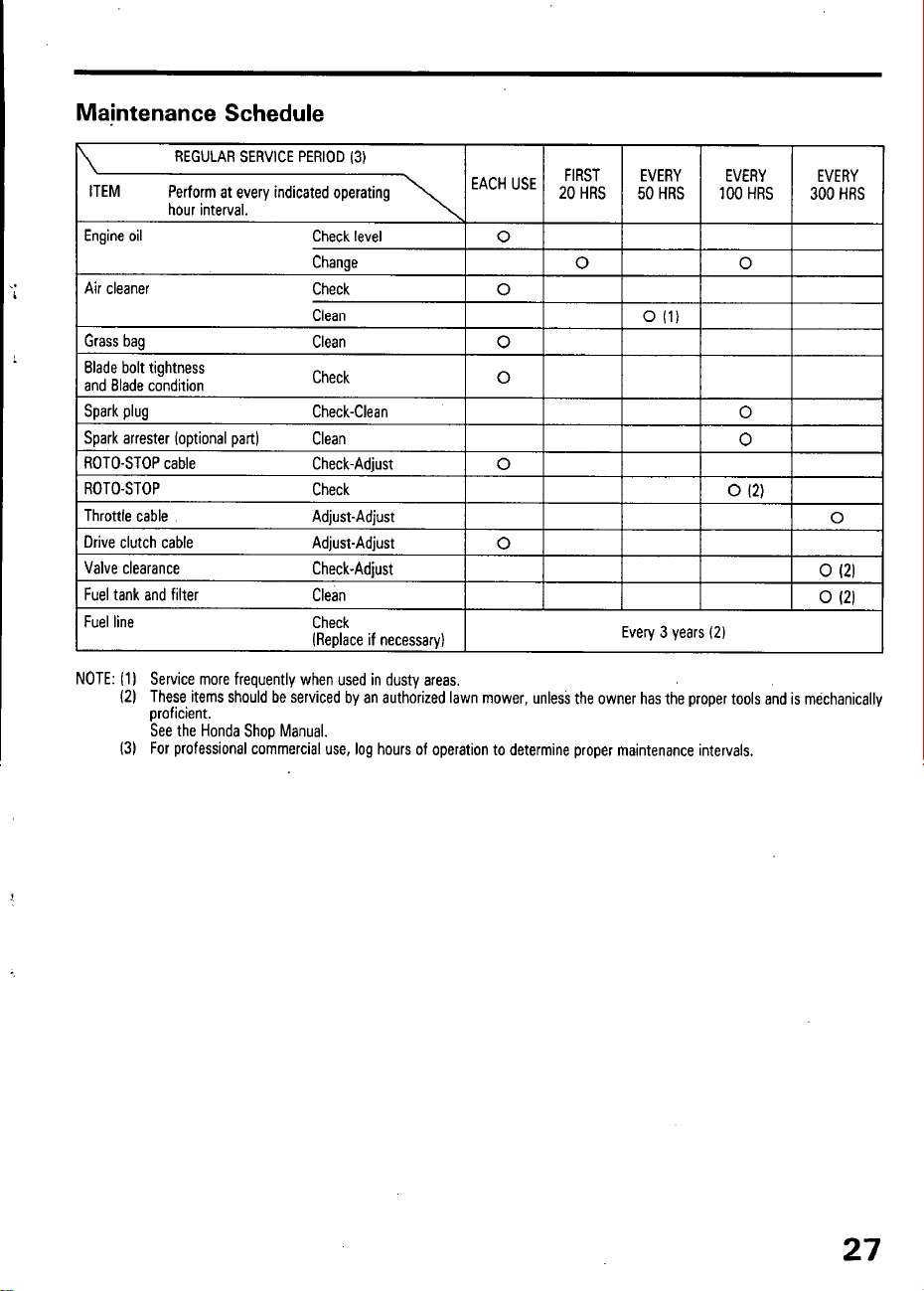
Majntenance Schedule
ITEM Perform at every indicated operating
NOTE: Ill
Service more frequently when used in dusty areas,
(21
These items should be serviced by an authorized lawn mower, unless the owner has the proper tools and is mechanically
proficient.
See the Honda Shop Manual.
(3)
For professional commercial use, log hours of operation to determine proper maintenance intervals.
27
Engine Oil Change
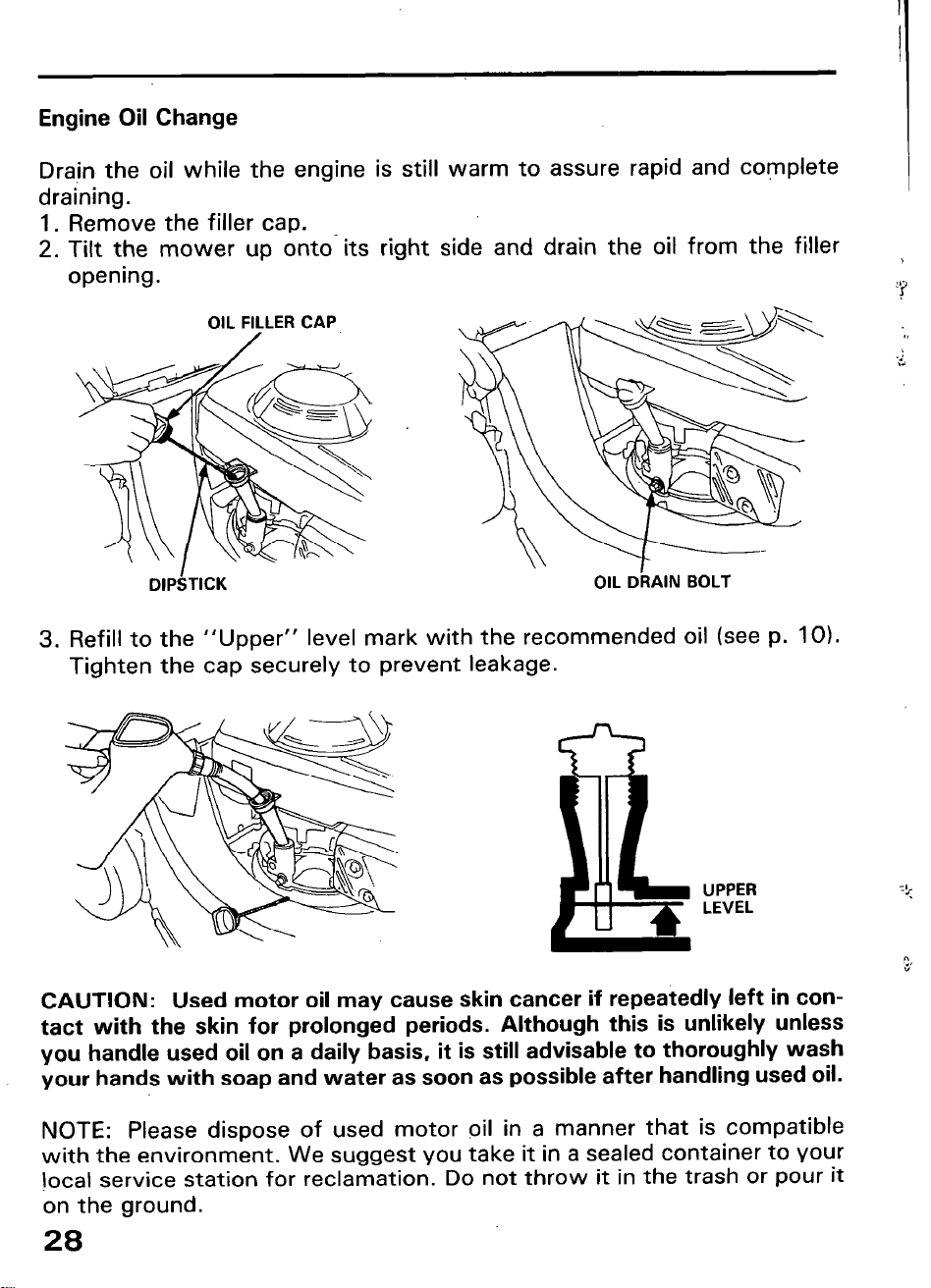
Drain the oil while the engine is still warm to assure rapid and complete
draining.
1. Remove the filler cap.
2. Tilt the mower up onto- its right side and drain the oil from the filler
opening.
DlPhTlCK
OIL DkAlN
BOLT
3. Refill to the “Upper” level mark with the recommended oil (see p. 10).
Tighten the cap securely to prevent leakage.
UPPER
LEVEL
CAUTION:
Used motor oil may cause skin cancer if repeatedly left in con-
tact with the skin for prolonged periods. Although this is unlikely unless
you handle used oil on a daily basis, it is still advisable to thoroughly wash
your hands with soap and water as soon as possible after handling used oil.
NOTE: Please dispose of used motor oil in a manner that is compatible
with the environment. We suggest you take it in a sealed container to your
!ocal service station for reclamation. Do not throw it in the trash or pour it
on the ground.
28
Throttle Control Cable Adjustment
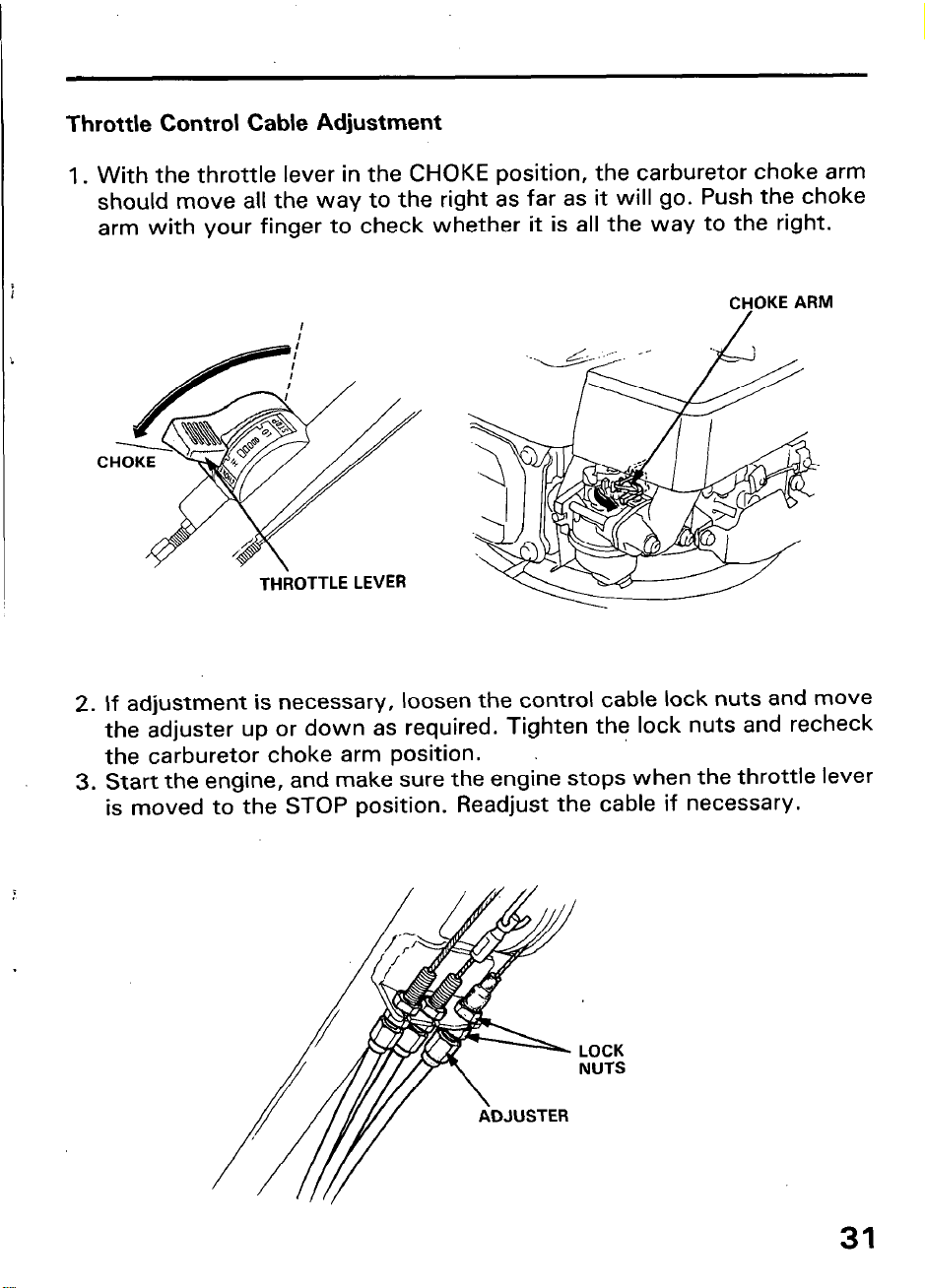
1. With the throttle lever in the CHOKE position, the carburetor choke arm
should move all the way to the right as far as it will go. Push the choke
arm with your finger to check whether it is all the way to the right.
CHOKE ARM
THROTTLE LEVER
2. If adjustment is necessary, loosen the control cable lock nuts and move
the adjuster up or down as required. Tighten the lock nuts and recheck
the carburetor choke arm position.
3. Start the engine, and make sure the engine stops when the throttle lever
is moved to the STOP position. Readjust the cable if necessary.
LOCK
NUTS
31
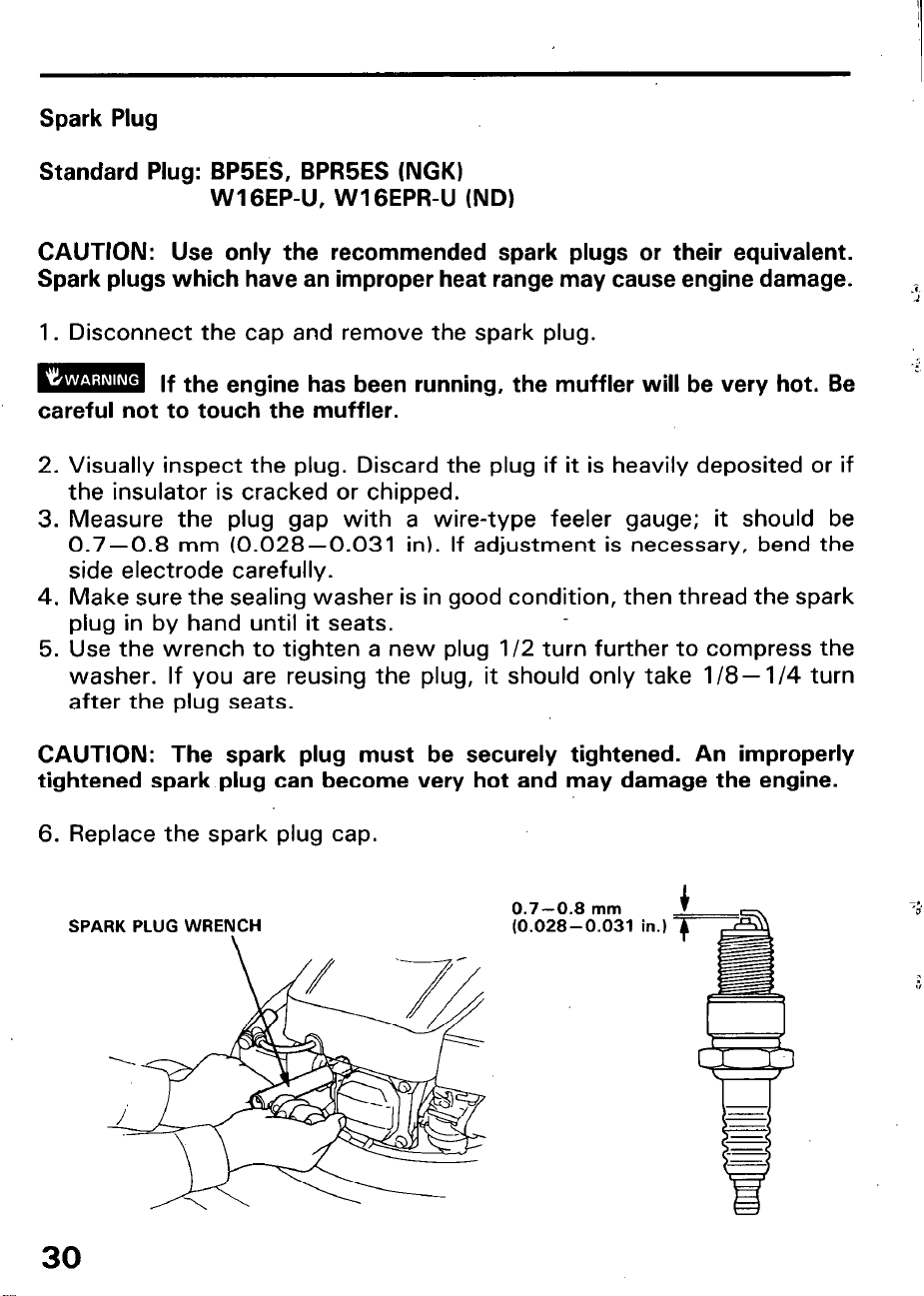
Spark Plug
Standard Plug: BPSES, BPR5ES (NGK)
WI GEP-U, WI GEPR-U (ND)
CAUTION: Use only the recommended spark plugs or their equivalent.
Spark plugs which have an improper heat range may cause engine damage.
3
1
1. Disconnect the cap and remove the spark plug.
cwm
.;
If the engine has been running, the muffler will be very hot. Be
careful not to touch the muffler.
2. Visually inspect the plug. Discard the plug if it is heavily deposited or if
the insulator is cracked or chipped.
3. Measure the plug gap with a wire-type feeler gauge; it should be
0.7-0.8 mm (0.028-0.031 in). If adjustment is necessary, bend the
side electrode carefully.
4. Make sure the sealing washer is in good condition, then thread the spark
plug in by hand until it seats.
5. Use the wrench to tighten a new plug l/2 turn further to compress the
washer. If you are reusing the plug, it should only take l/8- l/4 turn
after the plug seats.
CAUTION: The spark plug must be securely tightened. An improperly
tightened spark plug can become very hot and may damage the engine.
6. Replace the spark plug cap.
SPARK PLUG WRENCH
0.7-0.8 mm
(0.028-0.031 in.)
:*
3
.
3
30
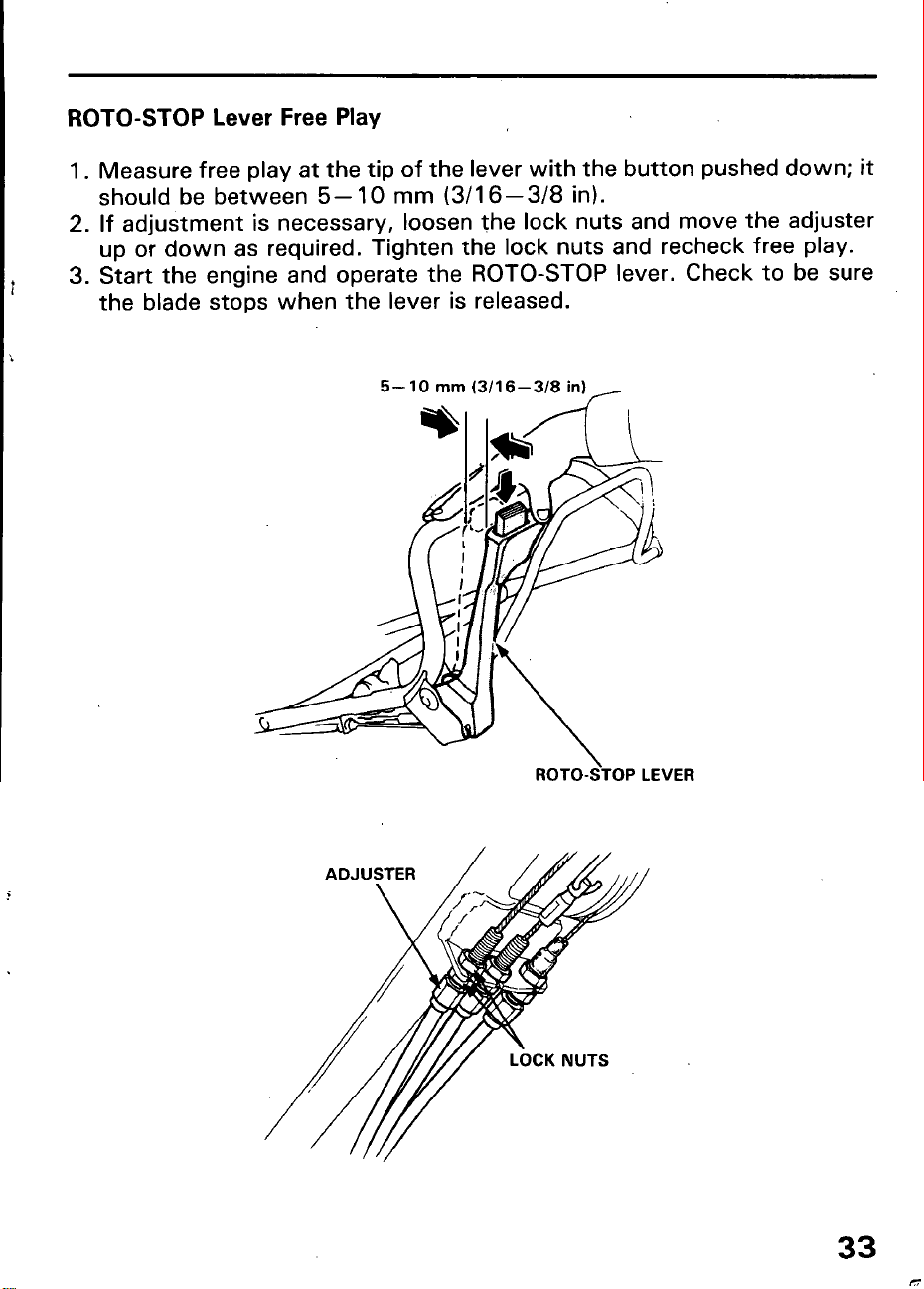
ROTO-STOP Lever Free Play
1. Measure free play at the tip of the lever with the button pushed down; it
should be between 5-10 mm (3/16-3/8 in).
2. If adjustment is necessary, loosen the lock nuts and move the adjuster
up or down as required. Tighten the lock nuts and recheck free play.
1
3. Start the engine and operate the ROTO-STOP lever. Check to be sure
the blade stops when the lever is released.
5-10 mm (3/16-3/8 inI/
ROTO-STOP LEVER
.
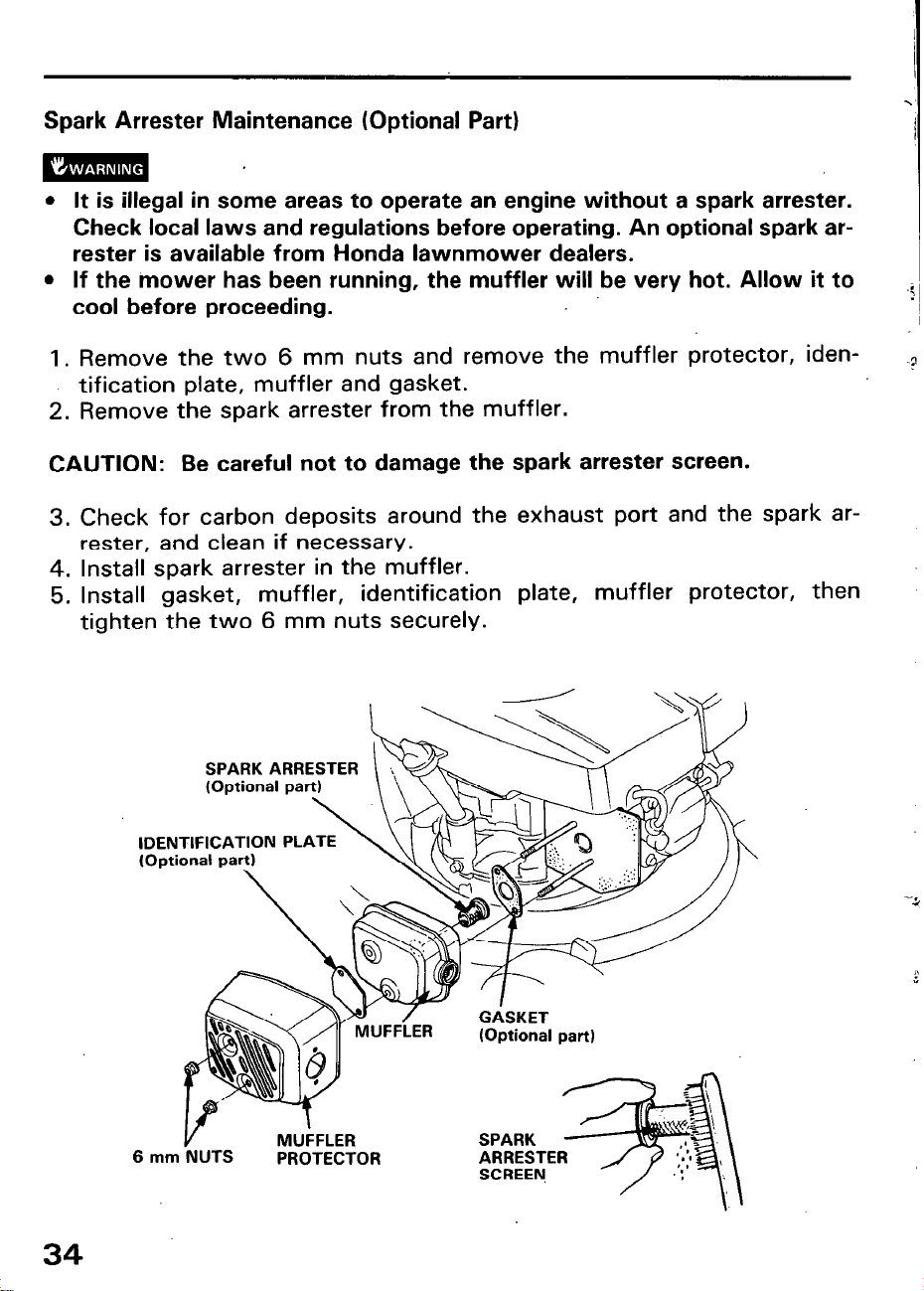
Spark Arrester Maintenance (Optional Part)
l
It is illegal in some areas to operate an engine without a spark arrester.
Check local laws and regulations before operating. An optional spark ar-
rester is available from Honda lawnmower dealers.
l
If the mower has been running, the muffler will be very hot. Allow it to
.-
cool before proceeding.
1. Remove the two 6 mm nuts and remove the muffler protector, iden-
.$
tification plate, muffler and gasket.
2. Remove the spark arrester from the muffler.
CAUTION: Be careful not to damage the spark arrester screen.
3. Check for carbon deposits around the exhaust port and the spark ar-
rester, and clean if necessary.
4. Install spark arrester in the muffler.
5. Install gasket, muffler, identification plate, muffler protector, then
tighten the two 6 mm nuts securely.
(Optional part)
IDENTIFICATION PLATE
(Optional part)
V
MUFFLER SPARK -
6 mm NUTS
PROTECTOR ARRESTER
^^____.
/? 2)’
34
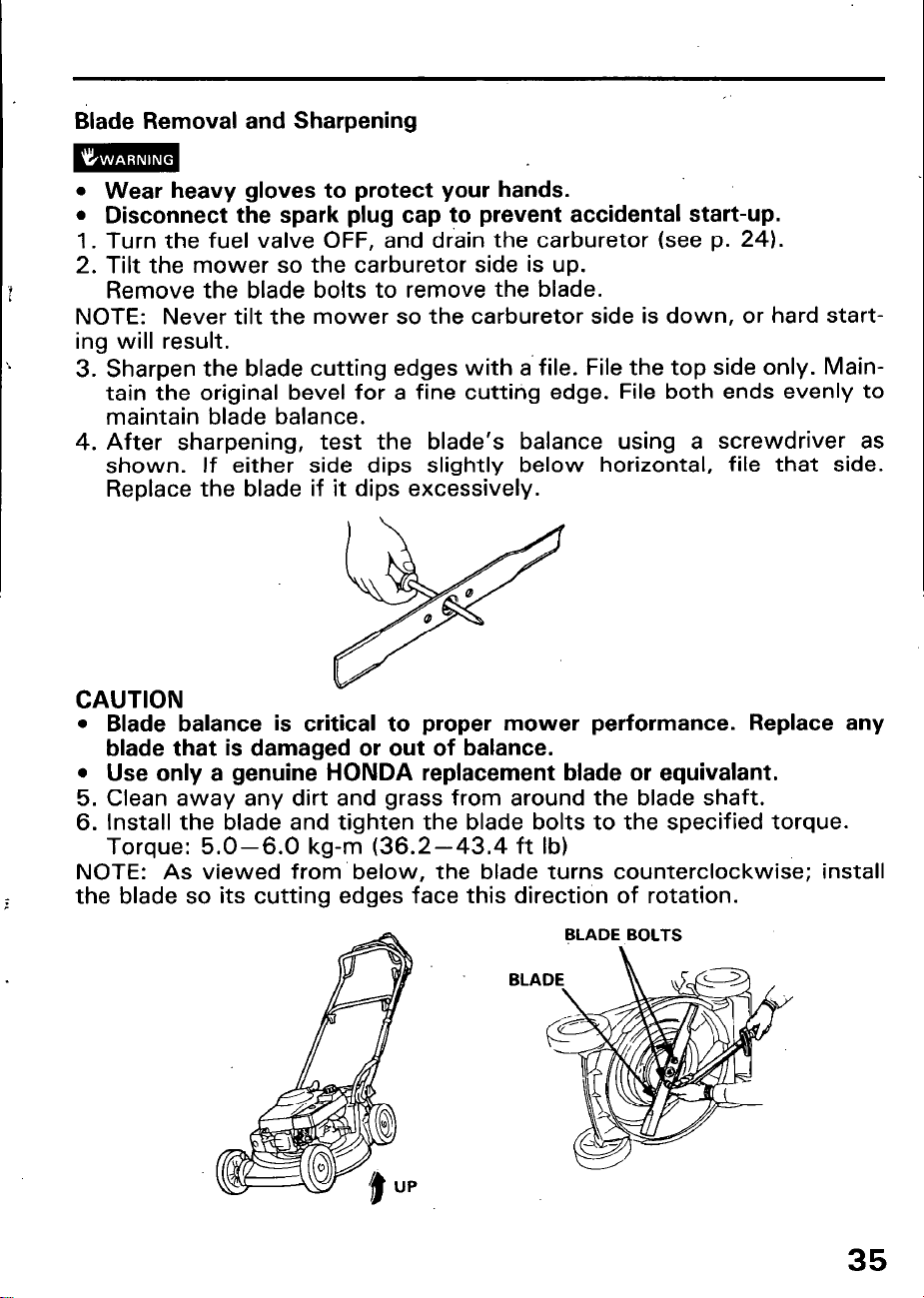
Blade Removal and Sharpening
m!ml
l
Wear heavy gloves to protect your hands.
l
Disconnect the spark plug cap to prevent accidental start-up.
1. Turn the fuel valve OFF, and drain the carburetor (see p. 24).
2. Tilt the mower so the carburetor side is up.
Remove the blade bolts to remove the blade.
NOTE: Never tilt the mower so the carburetor side is down, or hard start-
ing will result.
3. Sharpen the blade cutting edges with a.file. File the top side only. Main-
tain the original bevel for a fine cutting edge. File both ends evenly to
maintain blade balance.
4. After sharpening, test the blade’s balance using a screwdriver as
shown. If either side dips slightly below horizontal, file that side.
Replace the blade if it dips excessively.
CAUTION
l
Blade balance is critical to proper mower performance. Replace any
blade that is damaged or out of balance.
l
Use only a genuine HONDA replacement blade or equivalant.
5. Clean away any dirt and grass from around the blade shaft.
6. Install the blade and tighten the blade bolts to the specified torque.
Torque: 5.0-6.0 kg-m (36.2-43.4 ft lb)
NOTE: As viewed from’below, the blade turns counterclockwise; install
the blade so its cutting edges face this direction of rotation.
35
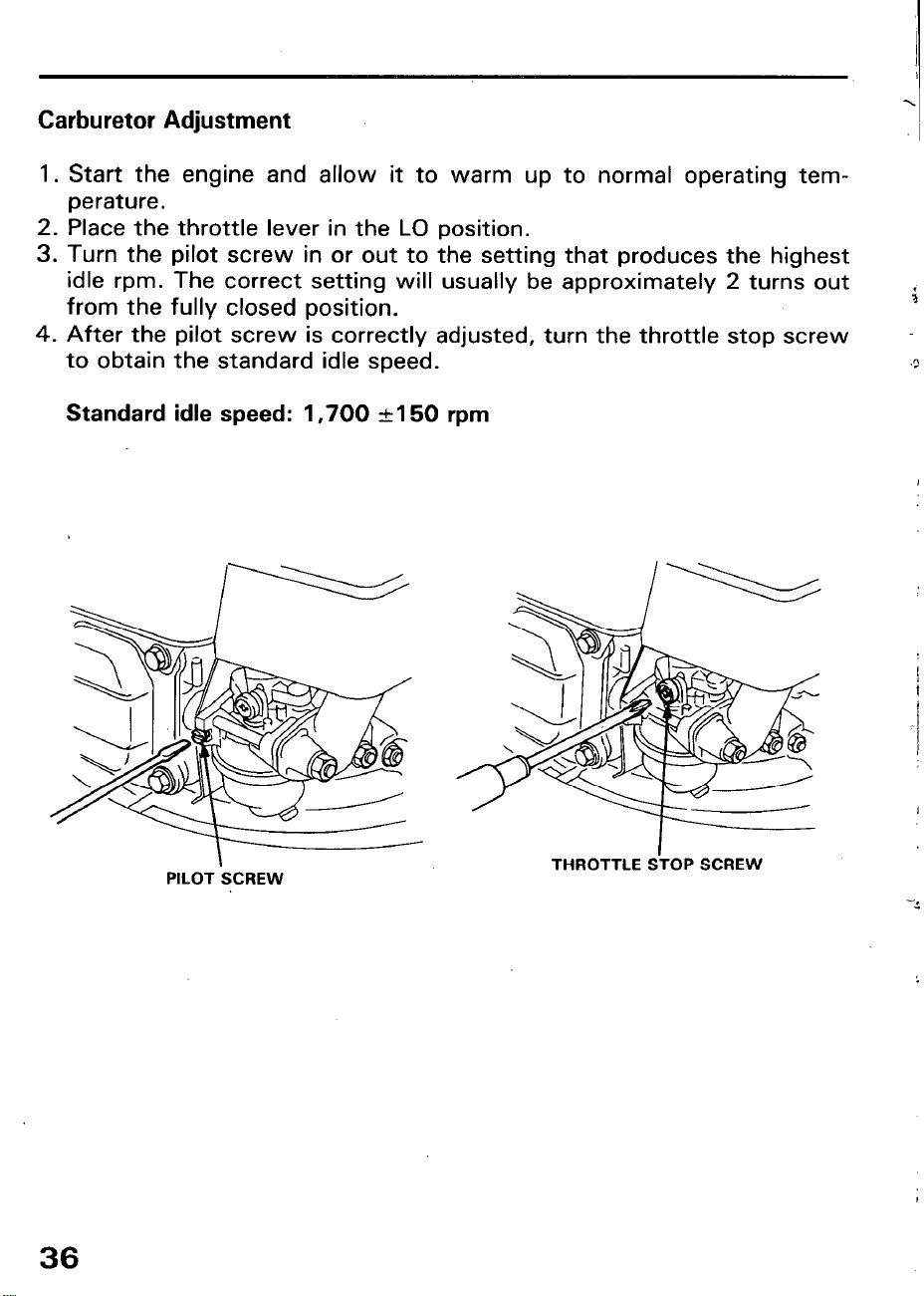
Carburetor Adjustment
I, Start the engine and allow it to warm up to normal operating tem-
perature.
2. Place the throttle lever in the LO position.
3. Turn the pilot screw in or out to the setting that produces the highest
idle rpm. The correct setting will usually be approximately 2 turns out
from the fully closed position.
4. After the pilot screw is correctly adjusted, turn the throttle stop screw
to obtain the standard idle speed.
Standard idle speed: 1,700 +150 rpm
THROTTLE SiOP SCREW
PILOT SCREW
36
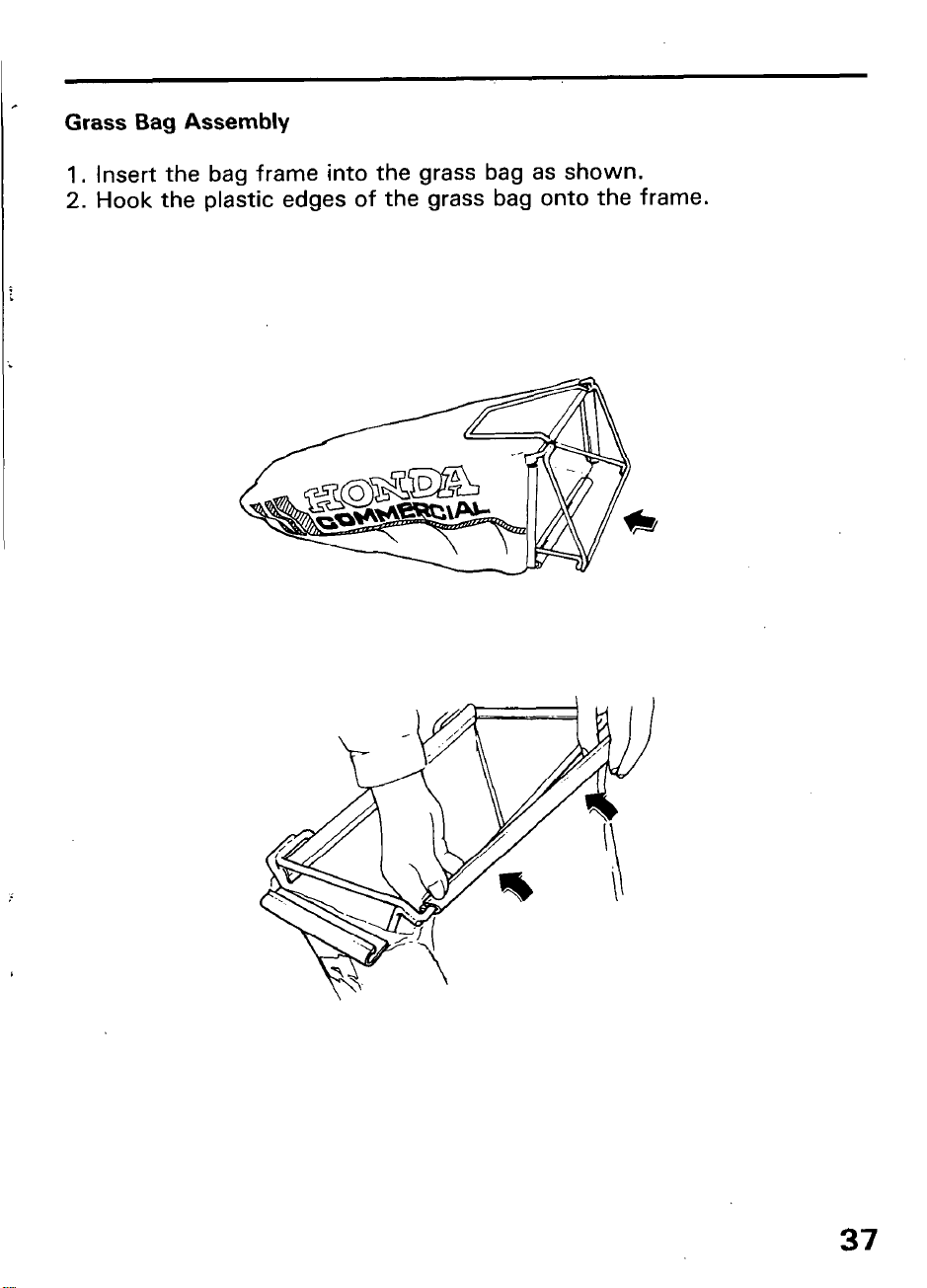
Grass Bag Assembly
1. Insert the bag frame into the grass bag as shown.
2. Hook the plastic edges of the grass bag onto the frame.
37
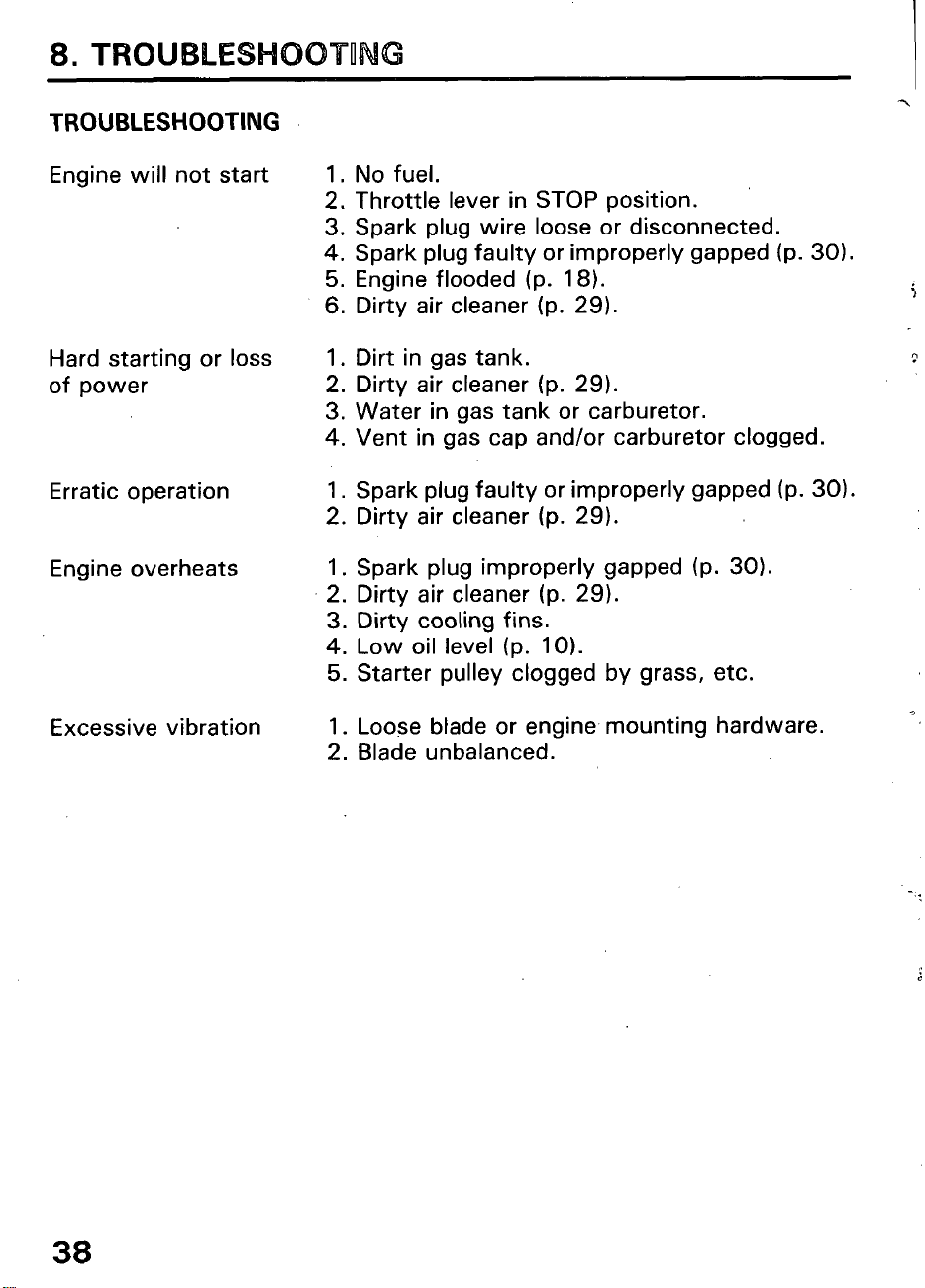
TROUBLESHOOTING
Engine will not start
Hard starting or loss
of power
Erratic operation
Engine overheats
Excessive vibration
1. No fuel.
2. Throttle lever in STOP position.
3. Spark plug wire loose or disconnected.
4. Spark plug faulty or improperly gapped (p. 30).
5. Engine flooded (p. 18).
6. Dirty air cleaner (p. 29).
1. Dirt in gas tank.
?
2. Dirty air cleaner (p. 29).
3. Water in gas tank or carburetor.
4. Vent in gas cap and/or carburetor clogged.
i
1. Spark plug faulty or improperly gapped (p. 30).
2. Dirty air cleaner (p. 29).
1. Spark plug improperly gapped (p. 30).
2. Dirty air cleaner (p. 29).
3. Dirty cooling fins.
4. Low oil level (p. IO).
5. Starter pulley clogged by grass, etc.
1. Loose blade or engine mounting hardware.
2. Blade unbalanced.
t
38
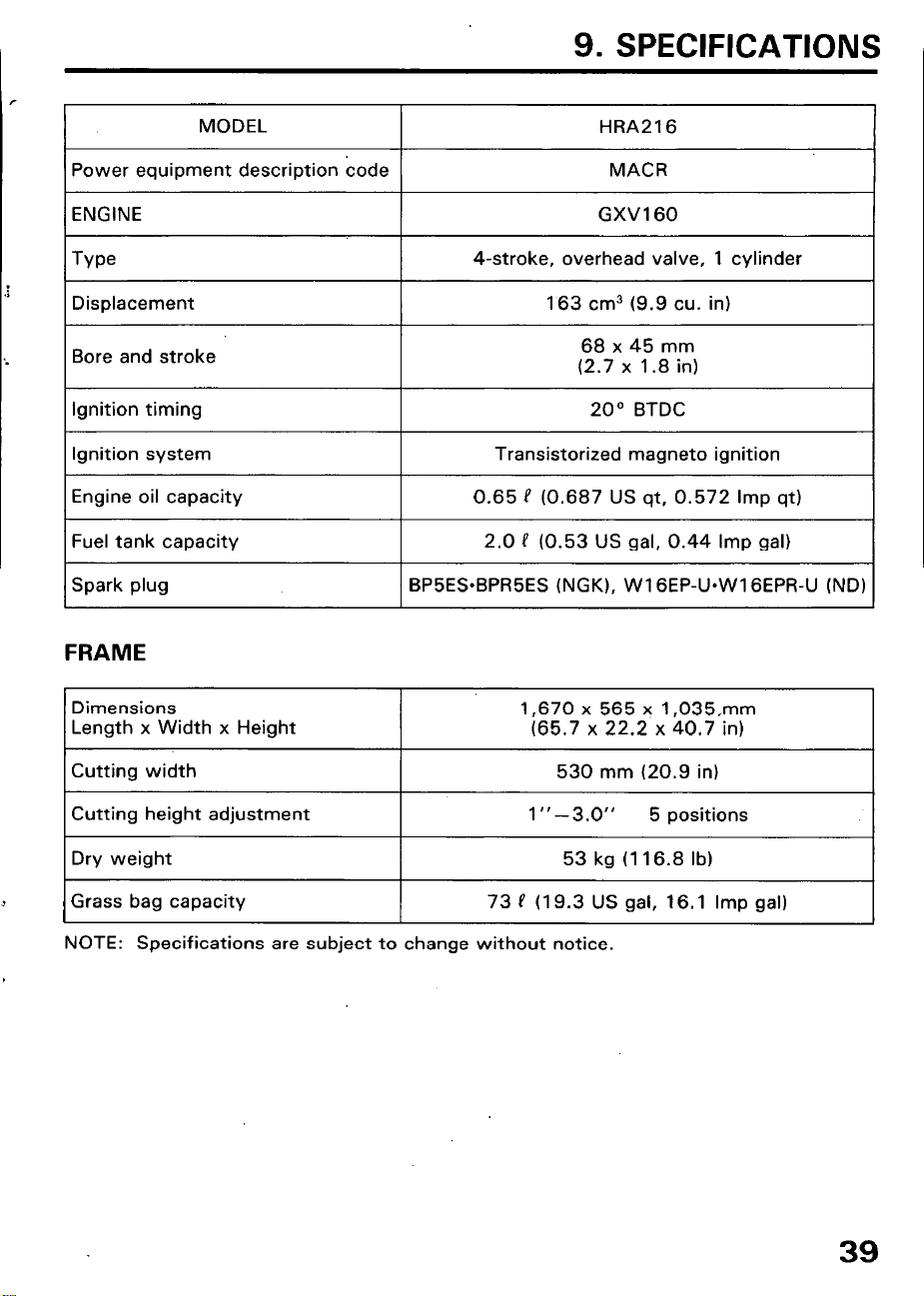
9. SPECIFICATIONS
MODEL HRA216
Power equipment description code
MACR
ENGINE GXVI 60
Type
4-stroke, overhead valve, 1 cylinder
Displacement
Bore and stroke
163 cm3 (9.9 cu. in)
68 x 45 mm
(2.7 x 1.8 in)
Ignition timing
Ignition system
Engine oil capacity
Fuel tank capacity
Spark plug
20” BTDC
Transistorized magneto ignition
0.65 P (0.687 US qt. 0.572 Imp qt)
2.0 P (0.53 US gal, 0.44 Imp gal)
BP5ESBPR5ES (NGK), Wl GEP-U-W1 GEPR-U (ND)
FRAME
Dimensions
Length x Width x Height
Cutting width
Cutting height adjustment
1,670 x 565 x 1,035,mm
(65.7 x 22.2 x 40.7 in)
530 mm (20.9 in)
l”-3.0”
5 positions
Dry weight
Grass bag capacity
53 kg (116.8 lb)
I
73 P II 9.3 US gal, 16.1 Imp gal)
I
NOTE: Specifications are subject to change without notice.
39
10. WARRANTY SERVICE
Owner Satisfaction
Your satisfaction and goodwill are important to your dealer and to us. All
Honda warranty details are explained in the Distributor’s Limited Warranty.
Normally, any problems concerning the product will be handled ‘by your
dealer’s service department. If you have a warranty problem that has not
been handled to your satisfaction, we suggest you take the following
action:
l
Discuss your problem with a member of dealership management. Often
complaints can be quickly resolved at that level. If the problem has
already been reviewed with the Service Manager, contact the owner of
the dealership or the General Manager.
l
If your problem still has not been resolved to your satisfaction, contact
the Power Equipment Customer Relations Department of American
Honda Motor Co., Inc.
American Honda Motor Co., Inc.
Power Equipment Customer Relations Department
P.O. Box 50
Gardena, California 90247-0805
Telephone: (2 13) 604-2400
We will need the following information in order to assist you:
- Your name, address, and telephone number
- Product model and serial number
- Date of purchase
- Dealer name and address
- Nature of the problem
-.
After reviewing all the facts involved, you will be advised of what action
can be taken. Please bear in mind that your problem will likely be resolved
at the dealership, using the dealer’s facilities, equipment, and personnel, so
it is very important that your initial contact be with the dealer.
Your purchase of a Honda product is greatly appreciated by both your
dealer and American Honda Motor Co., Inc. We want to assist youin every
way possible to assure your complete satisfaction with your purchase.
40

Current customer service contact information:
United States, Puerto Rico, and U.S. Virgin Islands:
Honda Power Equipment dealership personnel are trained professionals. They should
be able to answer any question you may have. If you encounter a problem that your
dealer does not solve to your satisfaction, please discuss it with the dealership's
management. The Service Manager or General Manager can help. Almost all problems
are solved in this way.
If you are dissatisfied with the decision made by the dealership's management, contact
the Honda Power Equipment Customer Relations Office. You can write:
American Honda Motor Co., Inc.
Power Equipment Division
Customer Relations Office
4900 Marconi Drive
Alpharetta, GA 30005-8847
Or telephone: (770) 497-6400 M-F, 8:30 am - 7:00 pm EST
When you write or call, please provide the following information:
• Model and serial numbers
• Name of the dealer who sold the Honda power equipment to you
• Name and address of the dealer who services your equipment
• Date of purchase
• Your name, address, and telephone number
• A detailed description of the problem