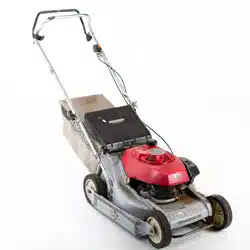

Thank you for purchasing a Honda lawn mower.
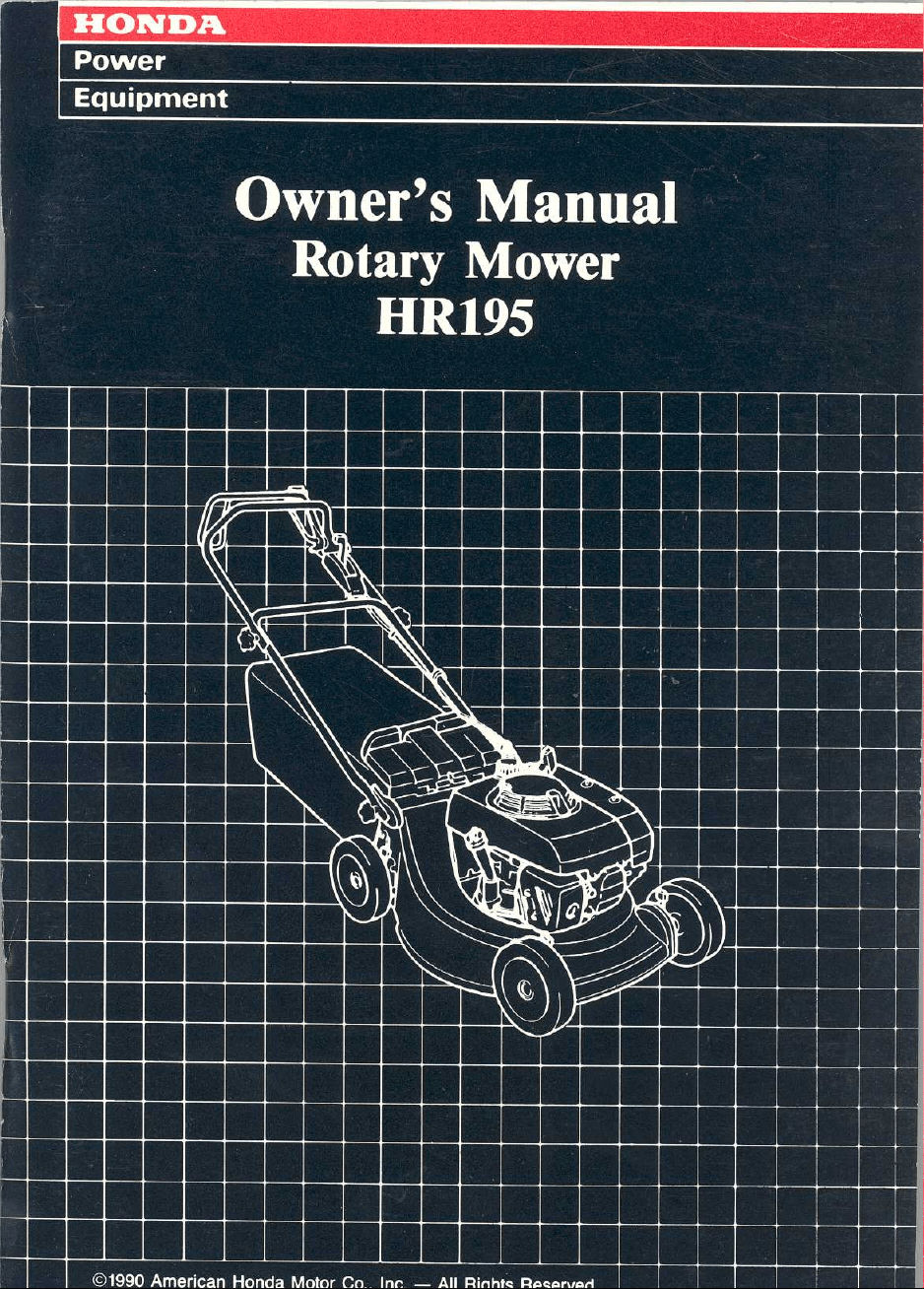
This manual describes operation and maintenance of Honda HR 195SXA rotary
mowers. All information in this publication is based on the latest product
information available at the time of printing. Honda Power Equipment Mfg.,
Inc. reserves the right to make changes at any time without notice and without
incurring any obligation.
No part of this publication may be reproduced without written permission.
This manual is a permanent part of the mower, and it must stay with the mower
if resold.
Honda HI3195 mowers meet CPSC blade safety requirements for walk-behind
rotary mowers.
Honda HR 195 mowers are not factory-equipped with spark arresters. In some
areas, it is illegal to operate an engine without a USDA qualified spark arrester.
Check local laws and regulations before operating. An optional spark arrester
is available from authorized Honda lawn mower dealers.
READ THIS OWNER’S MANUAL CAREFULLY. Pay special attention to these
symbols and any instructions that follow:
B
Indicates serious injury or death WILL result if instructions
are not followed.
B
Indicates a strong possibility that serious personal injury or
death may result if instructions are not followed.
m
Indicates a possibility that equipment or property damage
could result if instructions are not followed.
1 NoTlCE 1 Indicates that equipment or property damage could result if
instructions are not followed.
NOTE: Gives helpful information.
Honda rotary mowers are designed to give safe and dependable service if
operated according to instructions. Operating this mower requires special effort
on your part to ensure your safety and the safety of others.
B
Careless operation or misuse may cause injury or property
damage. Read and understand this owner’s manual before operating the mower.
w
Using this product for a purpose not intended may cause
injury or property damage. Use only for mowing (cutting) grass, and for bagging
cut grass when equipped with the grass bag.
If a problem should arise, or if you have any questions about your mower,
see an authorized Honda lawn mower dealer.
01990
American Honda Motor
Co., Inc. - All Rights Reserved
1
CONTENTS
1. SAFETY..
.........................................
4
Safety Label Locations
...............................
4
Safety Information
...................................
5
Important Message to Parents
..........................
7
2. COMPONENT IDENTIFICATION. . . . . . . . . . . . . . . . . . . . . . . . . . . 8
3. CONTROLS
........................................
10
Fuel Valve
........................................
10
Throttle Lever
.....................................
10
ROTO-STOP Lever.
..................................
11
Drive Clutch Lever
..................................
12
Shift Lever.
.......................................
13
Handlebar Locking Knobs
.............................
13
Cutting Height Adjustment Levers
.......................
14
4. ATTACHMENTS
......................................
15
Grass Bag (standard)
................................
15
Side-Discharge Chute (optional)
.........................
16
5. PRE-OPERATION CHECK
..............................
17
Blade
.........................................
..17
Grass Bag
........................................
18
Engine Oil
........................................
19
Fuel
..........................................
..2 0
Air Cleaner
.......................................
22
SHandlebar Height
....................................
23
Cutting Height.
....................................
23
6. OPERATION . . . . . . . . . . . . .
..........................
24
Starting the Engine . . . . . .
..........................
24
Clearing a Flooded Engine. .
..........................
26
Mower Operation . . . . . . . .
..........................
28
Stopping the Engine . . . . . .
..........................
29
High Altitude Operation . . .
..........................
30
2
CONTENTS
7.
MOWING RECOMMENDATIONS. . . . . . . . . . . . . . . . . . . . . . . . . 31
8. ,TRANSPORTING . . . . . . . . . . . . . . . . . . . . . . . . . . . . . . . . . . . .34
9. MAINTENANCE
...................................
.35
Maintenance Schedule
..............................
35
Engine Oil Change
..................................
36
Air Cleaner Service
................................
38
Spark Plug Service
...............................
.40
Spark Arrester Maintenance (optional equipment)
...........
41
ROTO-STOP Cable Adjustment
.......................
.42
Drive Clutch Cable Adjustment
........................
43
Throttle Cable Adjustment
...........................
44
Shift Cable Adjustment
.............................
45
Carburetor Adjustment
..............................
46
Grass Bag Cleaning and Replacement
...................
47
Blade Removal and Installation
........................
48
10. STORAGE
......................................
..5 0
Preparation for Storage
.............................
50
Storage
......................................
..5 2
Removal from Storage
..............................
53
11. TROUBLESHOOTING. . . . . . . . . . . . . . . . . . . . . . . . . . . . . . . . . 54
12. SPECIFICATIONS . . . . . . . . . . . . . . . . . . . . . . . . . . . . . . . . . . . 56
13. WARRANTY SERVICE. . . . . . . . . . . . . . . . . . . . . . . . . . . . . . . . 57
3
1. SAFETY
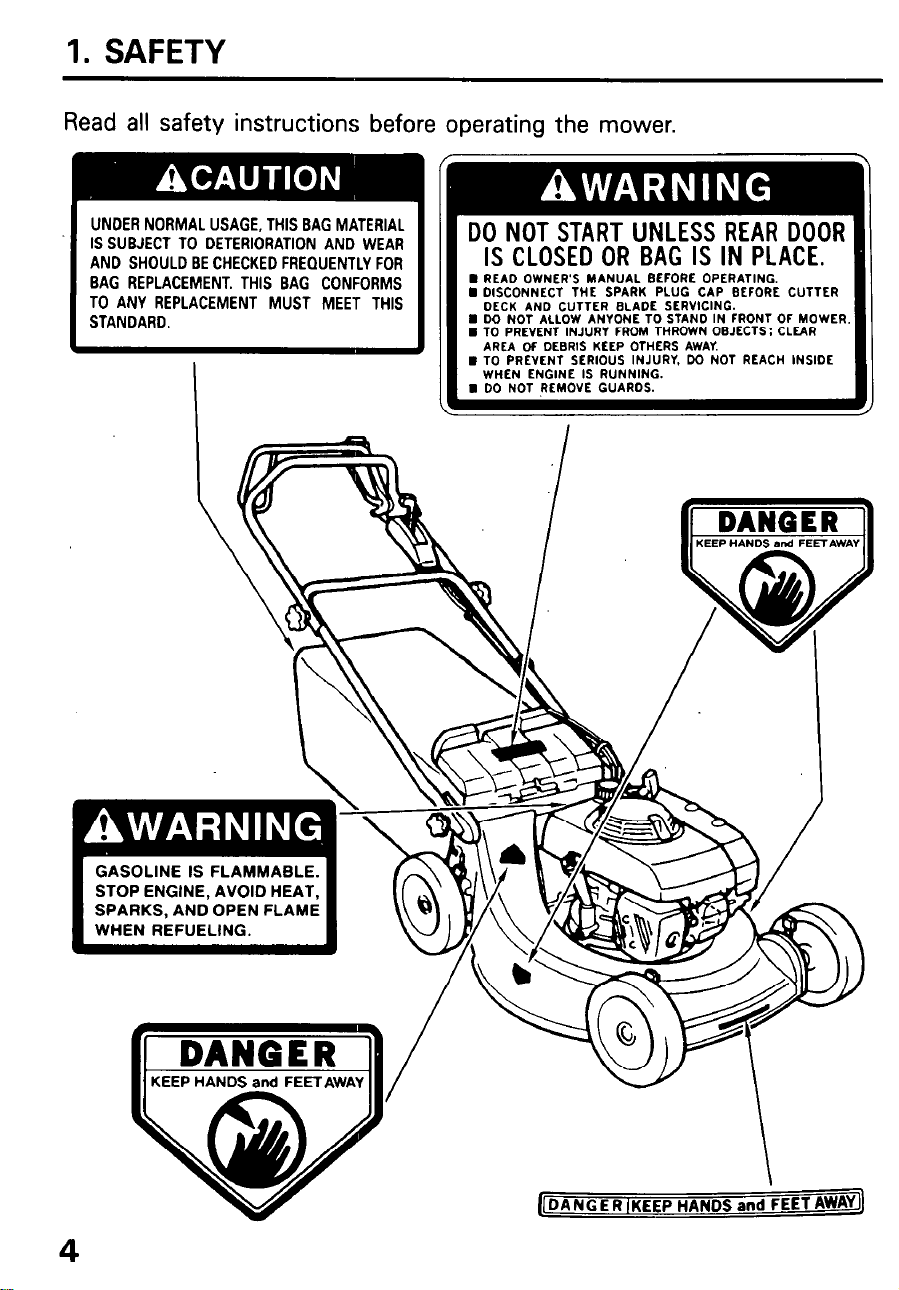
Read all safety instructions before operating the mower.
UNDER NORMAL USAGE, THIS BAG MATERIAL
IS SUBJECT TO DETERIORATION AND WEAR
DO NOTSTART UNLESS REAR DOOR
AND SHOULD BE CHECKED FREQUENTLY FOR
IS CLOSED OR BAG ISIN PLACE.
BAG REPLACEMENT. THIS BAG CONFORMS
n READ OWNER’S MANUAL BEFORE OPERATING.
TO ANY REPLACEMENT MUST MEET THIS
STANDARD.
I DISCONNECT THE SPARK PLUG CAP BEFORE CUTTER
DECK AND CUTTER BLADE SERVICING.
l DO NOT ALLOW ANYONE TO STAND IN FRONT OF MOWER.
. TO PREVENT INJURY FROM THROWN OBJECTS: CLCAR
.
AREA OF DEBRIS KEEP OTHERS AWAY.
I
. TO PREVENT SERIOUS INJURY. W NOT REACH INSIDE
WHEN ENGINE IS RUNNING.
. DO NOT REMOVE GUARDS.
9
1. SAFETY
SAFETY INFORMATION
For your safety and the safety of others, pay special attention to these
precautions:
Operator Responsibility
l
Know how to stop the engine quickly in case of emergency. Understand
the use of all controls.
l
Be sure that anyone who operates the lawn mower receives proper
instruction. Allowing anyone, especially children, to operate the mower
without proper instruction may result in serious injury.
l
Wear long pants and protective footwear. Operating the mower while
barefoot or wearing sandals would increase the risk of injury.
l
Keep all persons and pets away from the mowing area.
Blade Hazards
The blade is sharp, and it turns at high speed. Accidental contact can cause
serious injury.
l
If the mower tilts or overturns, the blade will be exposed; that will increase
the risk of injury from blade contact and from thrown objects.
l
Keep your hands and feet away from the cutter deck while the engine is
running.
l
Stop the engine before adjusting cutting height, or performing any inspection
or maintenance.
l
Wear heavy gloves to protect your hands from the blade when cleaning
out the mower deck, or when inspecting or replacing the blade. Disconnect
the spark plug cap to prevent any possibility of accidental starting.
Thrown Object Hazards
Objects hit by the blade can be thrown with great force. Thrown objects may
cause serious injury or property damage.
l
Before mowing, clear the lawn of sticks, stones, dog bones, and other litter
and loose objects. Mow only in daylight, so you can see and avoid objects
in the grass.
l
Before starting the mower, be sure that the grass bag or side-discharge
chute is in place, or that the discharge guard is closed.
l
Release the ROTO-STOP lever to stop the blade before reaching areas with
gravel, loose stones, or landscaping material.
l
Broken pieces thrown from a worn or damaged blade can cause serious
injury. Always inspect the blade before using the mower.
5
1. SAFETY
Fire and Burn Hazards
Gasoline is extremely flammable, and gasoline vapor can explode. Use extreme
care when handling gasoline. KEEP OUT OF REACH OF CHILDREN.
l
Refuel in a well-ventilated area with the engine stopped. Keep flames and
sparks away, and do not smoke in the area.
l
Refuel carefully to avoid spilling fuel. Avoid overfilling the fuel tank (there
should be no fuel in the filler neck). After refueling, tighten the filler cap
securely. If any fuel is spilled, make sure the area is dry before starting the
engine.
l
After use, turn the fuel valve OFF, and store the mower on a level surface.
Be sure the storage area is well-ventilated, and away from appliances, such
as water heaters and clothes dryers.
Dry grass and leaves are flammable.
l
Always empty the grass bag when you’ve finished mowing, even if it’s not
full. Stored lawn clippings are a fire hazard.
l
Honda HR195 mowers are not factory-equipped with spark arresters. It is
illegal in some areas to operate an engine without a USDA qualified spark
arrester. Check local laws and regulations. An optional spark arrester is
available from authorized Honda lawn mower dealers.
The engine and exhaust system become very hot during operation and remain
hot for a while after stopping. Contact with hot engine components can cause
burns and may ignite some materials.
l
Avoid touching a hot engine or exhaust system.
l
Allow the engine to cool before performing maintenance, transporting the
mower, or storing the mower indoors.
Carbon Monoxide, Poisoning Hazard
Exhaust contains poisonous carbon monoxide, a colorless and odorless gas.
Breathing exhaust can cause loss of consciousness and may lead to death.
l
If you run the engine in an area that is confined, or even partially enclosed,
the air can become contaminated with a dangerous amount of exhaust gas.
To keep exhaust gas from building up, provide adequate ventilation.
6
1. SAFETY
IMPORTANT MESSAGE TO PARENTS
YOUR CHILDREN’S SAFETY IS VERY IMPORTANT to Honda. That’s why we
urge you to read this message before letting your youngster operate this lawn
mower. Lawn mowers are tools, not toys. As with any equipment, bad
judgments can result in serious injuries. You can help prevent accidents by
making good decisions about
it
when, and how your youngster operates this
equipment.
The first question you’ll need to ask is whether your youngster is capable of
operating this mower safely. Remember, young people vary widely, and AGE
IS NOT THE ONLY FACTOR.
Physically, a youngster must be LARGE ENOUGH AND STRONG ENOUGH to
easily start the mower and control its direction. The youngster also needs
enough size, strength, and coordination to comfortably reach and operate the
controls.
Another, tougher question you need to ask is if your youngster has enough
MATURITY AND RESPONSIBILITY to safely operate this mower. Does the
young person think through problems and come to logical solutions ? Be honest
! Anyone who takes unnecessary risks and doesn’t obey rules should not
operate this lawn mower.
If you decide that your son or daughter can handle the mower safely,
CAREFULLY READ THE OWNER’S MANUAL with your youngster. Make sure
you both understand all instructions and warnings. Also, be sure your youngster
wears sturdy shoes and other protective clothing when operating or handling
the mower.
SUPERVISION is also very important. Walk with your youngster during the first
few minutes of mowing. Even after the youngster has become confident with
the mower, do not let the young person use the mower without good adult
supervision. An adult should also be present during refueling and maintenance.
In fact, it’s up to parents to make sure that the mower is properly maintained
and kept in safe operating condition.
By always placing safety first, your youngster will acquire useful skills and a
sense of accomplishment. And you’ll both get the best results from your lawn
mower.
2. COMPONENT IDENTIFICATION
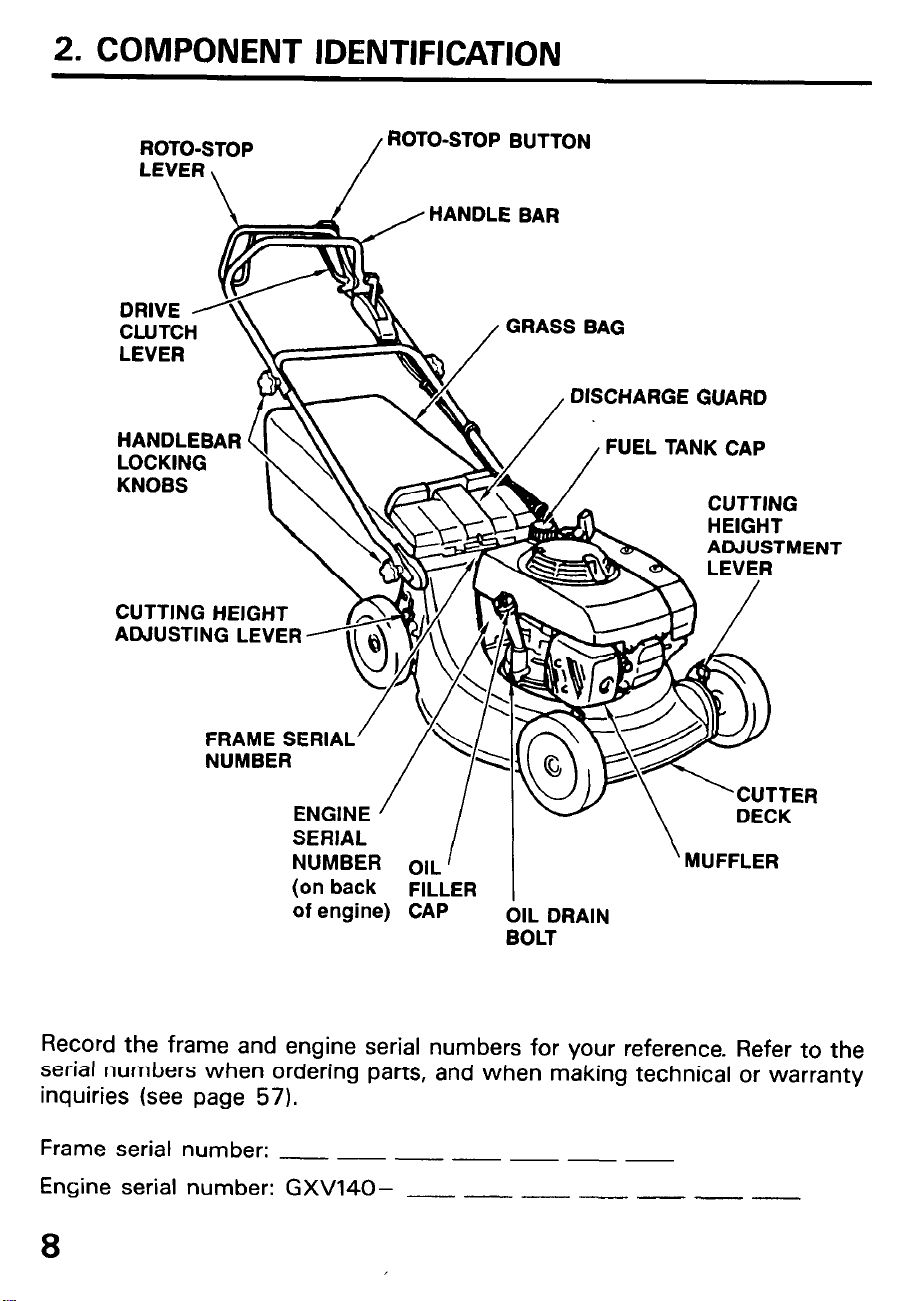
ROTO-STOP
LEVER
\
/
ROTO-STOP BUTTON
\
/
m”“““’ BAR
DISCHARGE GUARD
FUEL TANK CAP
CUTTING HEIGHT
ADJUSTING LEVER
FRAME SERIAL
NUMBER
SERIAL
NUMBER OIL
I
\
MUFFLER
(on back FILLER
of engine) CAP
OIL DRAIN
BOLT
Record the frame and engine serial numbers for your reference. Refer to the
serial numbers when ordering parts, and when making technical or warranty
inquiries (see page 57).
Frame serial number: - - -
Engine serial number: GXV140- __ - __ __ - - -
2. COMPONENT IDENTIFICATION
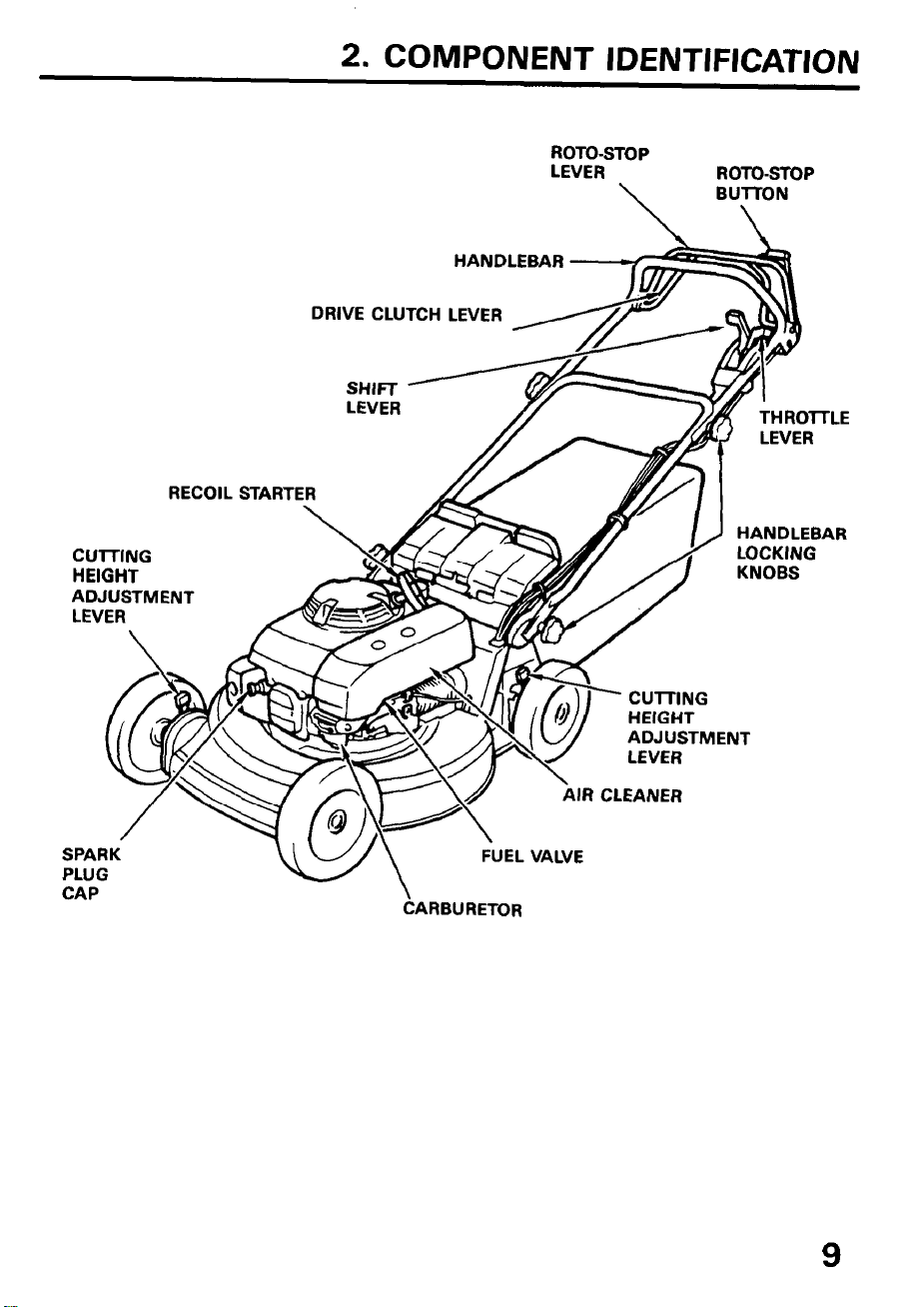
ROTO-STOP
LEVER
\
ROM-STOP
RI Il-rnN
HANDLEBAR
DRIVE CLUTCH
SHIFT
LEVER
’ iHR07-r~~
,,“, L
RECOIL STARTER
CUlTlNG
HEIGHT
ADJUSTMENT
LEVER
LEVER
WI
/
J
HANDLEBAR
ADJUSTMENT
AIR CLEANER
SPARK
PLUG
FiJEL VALVE
CAP
\
CARBURETOR
9
3. CONTROLS
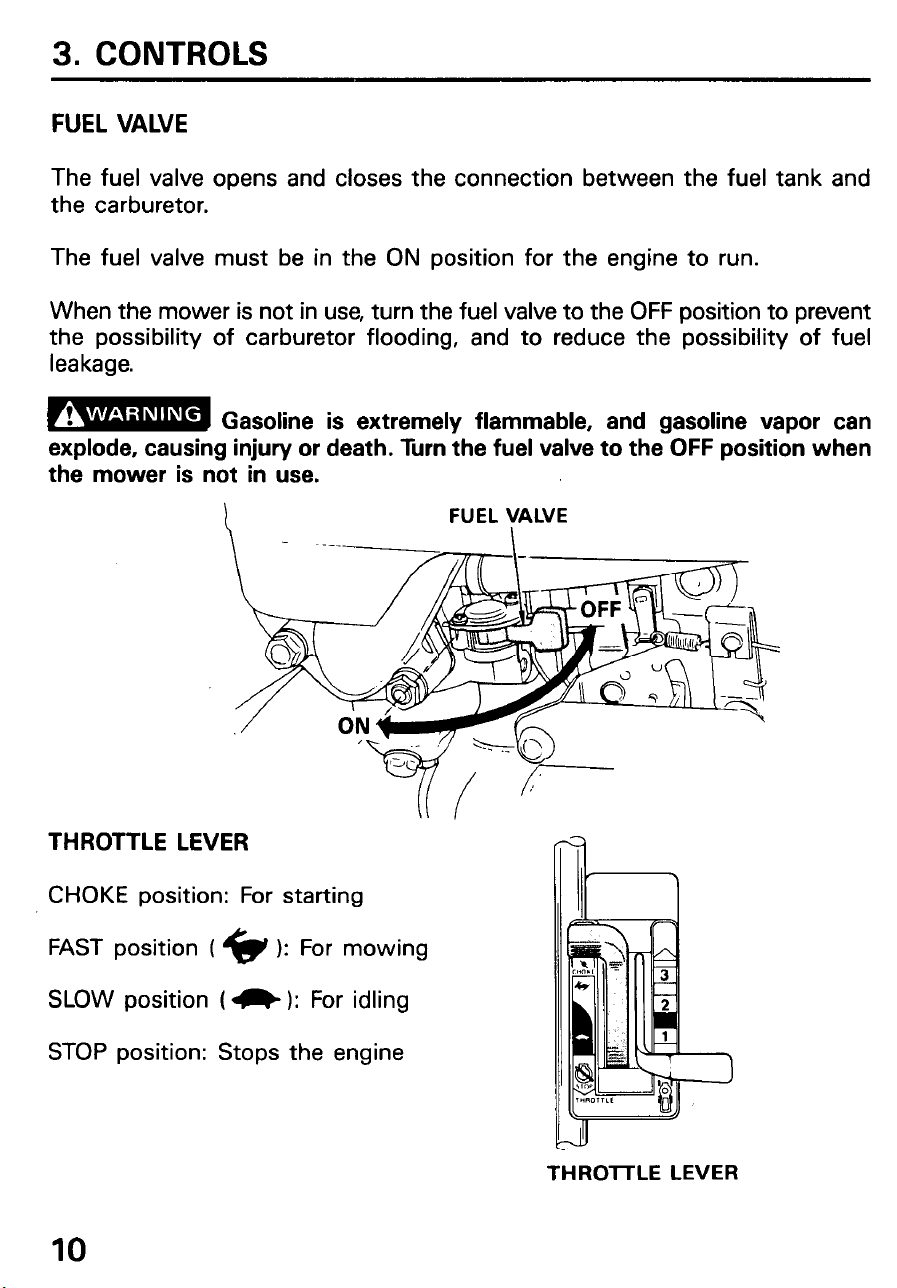
FUEL VALVE
The fuel valve opens and closes the connection between the fuel tank and
the carburetor.
The fuel valve must be in the ON position for the engine to run.
When the mower is not in use, turn the fuel valve to the OFF position to prevent
the possibility of carburetor flooding, and to reduce the possibility of fuel
leakage.
M
Gasoline is extremely flammable, and gasoline vapor can
explode, causing injury or death. Turn the fuel valve to the OFF position when
the mower is not in use.
FUEL VALVE
THROTTLE LEVER
CHOKE position: For starting
FAST position ( * 1: For mowing
SLOW position (L 1: For idling
STOP position: Stops the engine
ILJJ
THROlTLE LEVER
10
3. CONTROLS
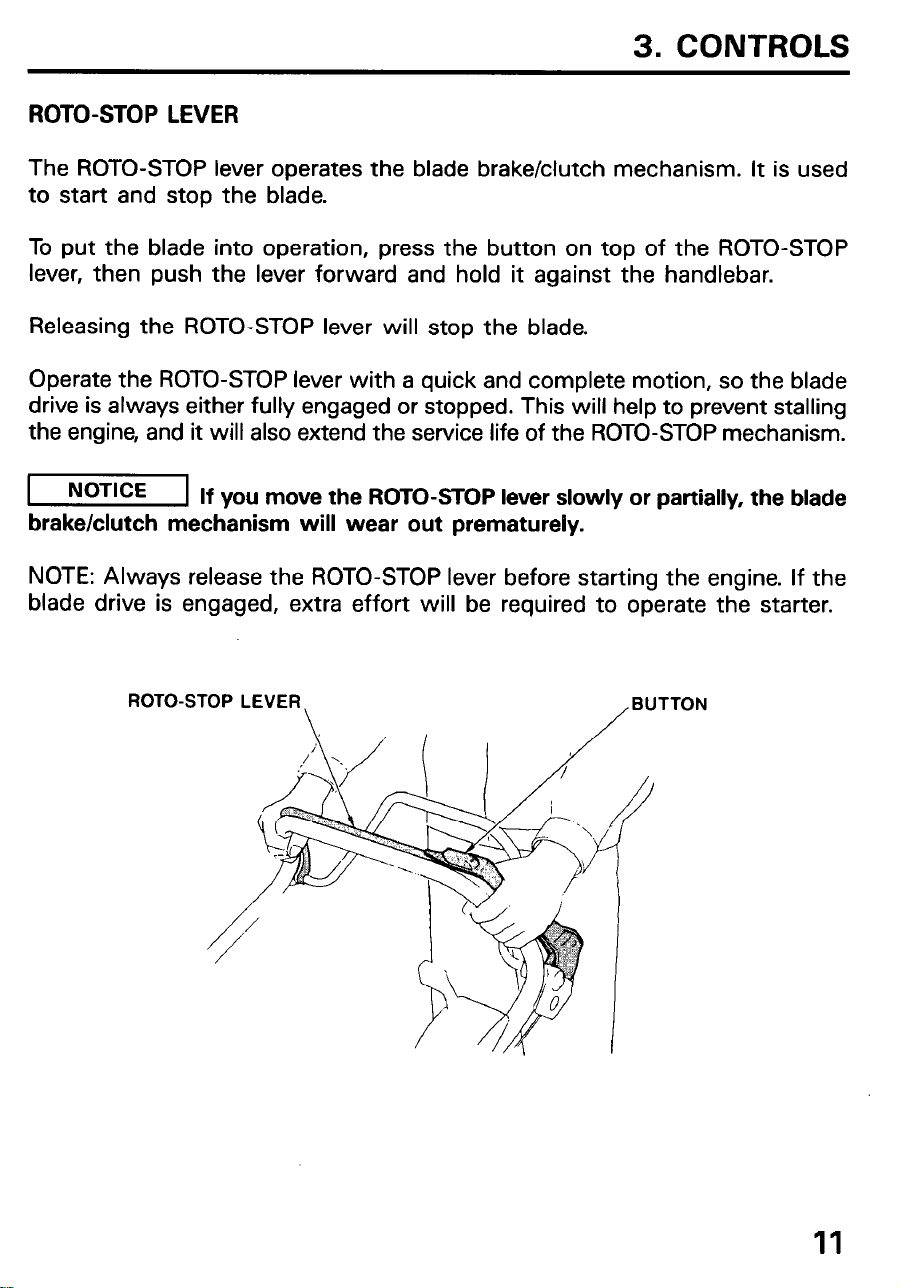
ROTO-STOP LEVER
The ROTO-STOP lever operates the blade brake/clutch mechanism. It is used
to start and stop the blade.
To put the blade into operation, press the button on top of the ROTO-STOP
lever, then push the lever forward and hold it against the handlebar.
Releasing the ROTO-STOP lever will stop the blade.
Operate the ROTO-STOP lever with a quick and complete motion, so the blade
drive is always either fully engaged or stopped. This will help to prevent stalling
the engine, and it will also extend the service life of the ROTO-STOP mechanism.
1 NoTKE 1 If you move the ROTO-STOP lever slowly or partially, the blade
brake/clutch mechanism will wear out prematurely.
NOTE: Always release the ROTO-STOP lever before starting the engine. If the
blade drive is engaged, extra effort will be required to operate the starter.
ROTO-STOP LEVER
\
/
BUTTON
11
3. CONTROLS
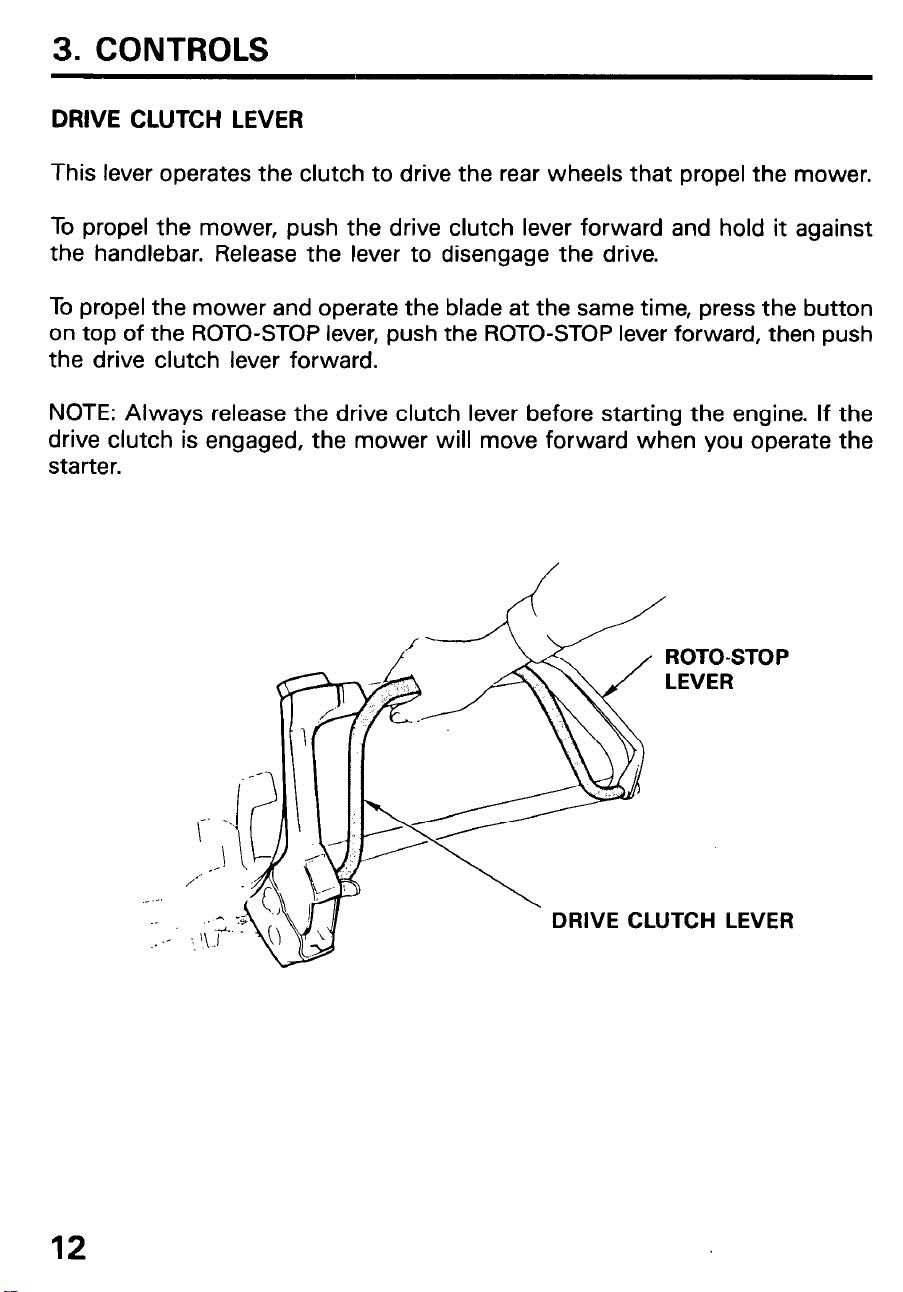
DRIVE CLUTCH LEVER
This lever operates the clutch to drive the rear wheels that propel the mower.
To propel the mower, push the drive clutch lever forward and hold it against
the handlebar. Release the lever to disengage the drive.
To propel the mower and operate the blade at the same time, press the button
on top of the ROTO-STOP lever, push the ROTO-STOP lever forward, then push
the drive clutch lever forward.
NOTE: Always release the drive clutch lever before starting the engine. If the
drive clutch is engaged, the mower will move forward when you operate the
starter.
ROTO-STOP
LEVER
_-.
DRIVE CLUTCH LEVER
._ ‘-
12
3. CONTROLS
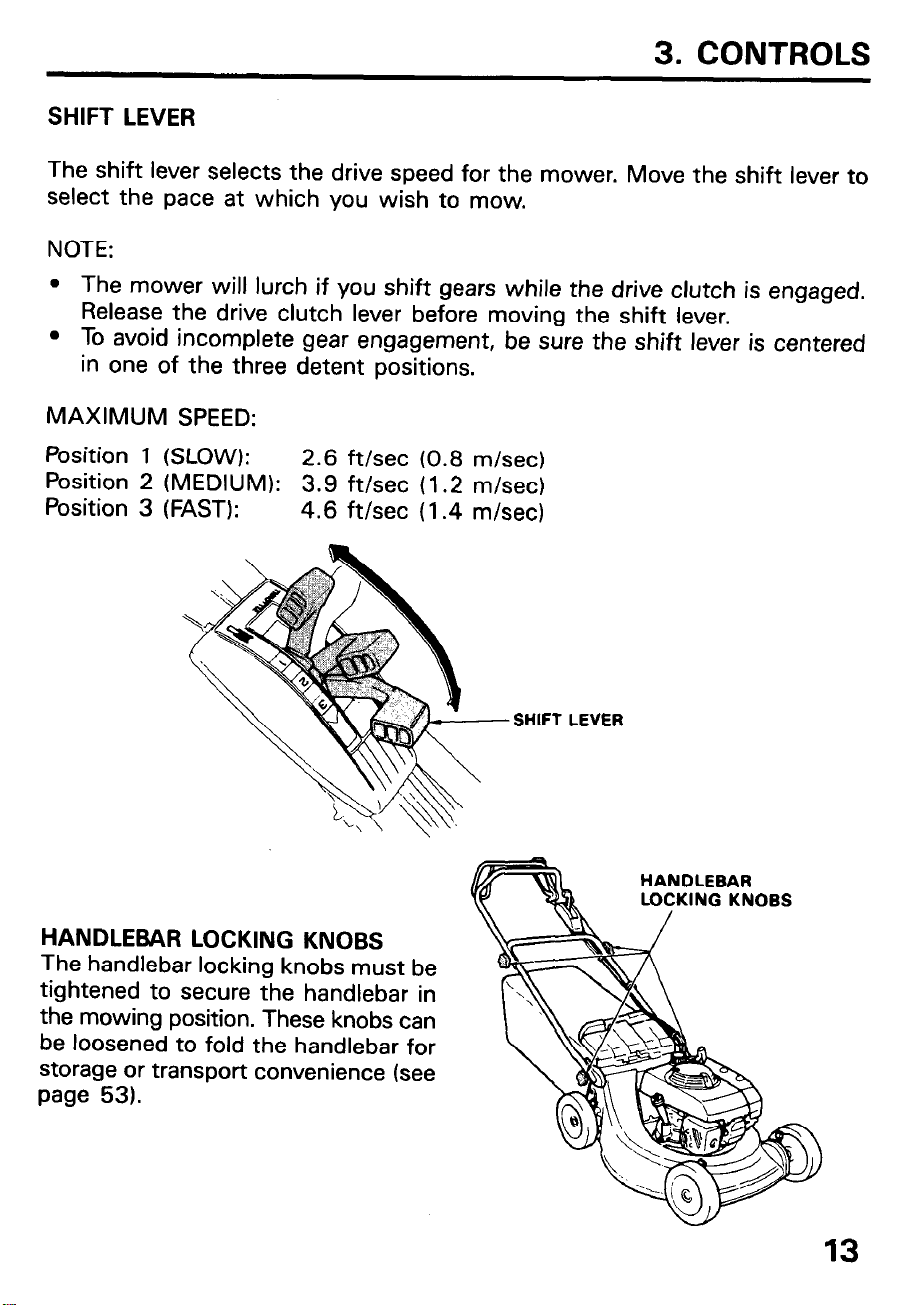
SHIFT LEVER
The shift lever selects the drive speed for the mower. Move the shift lever to
select the pace at which you wish to mow.
NOTE:
l
The mower will lurch if you shift gears while the drive clutch is engaged.
Release the drive clutch lever before moving the shift lever.
l
To avoid incomplete gear engagement, be sure the shift lever is centered
in one of the three detent positions.
MAXIMUM SPEED:
Position
1
(SLOW):
2.6
f?/sec
(0.8 m/set)
Position
2
(MEDIUM):
3.9 ft/sec (1.2 m/set)
Position 3
(FAST): 4.6
ft/sec
(1.4 m/set)
SHIFT LEVER
HANDLEBAR
KING KNOBS
HANDLEBAR LOCKING KNOBS
The handlebar locking knobs must be
tightened to secure the handlebar in
the mowing position. These knobs can
be loosened to fold the handlebar for
storage or transport convenience (see
page 53).
3. CONTROLS
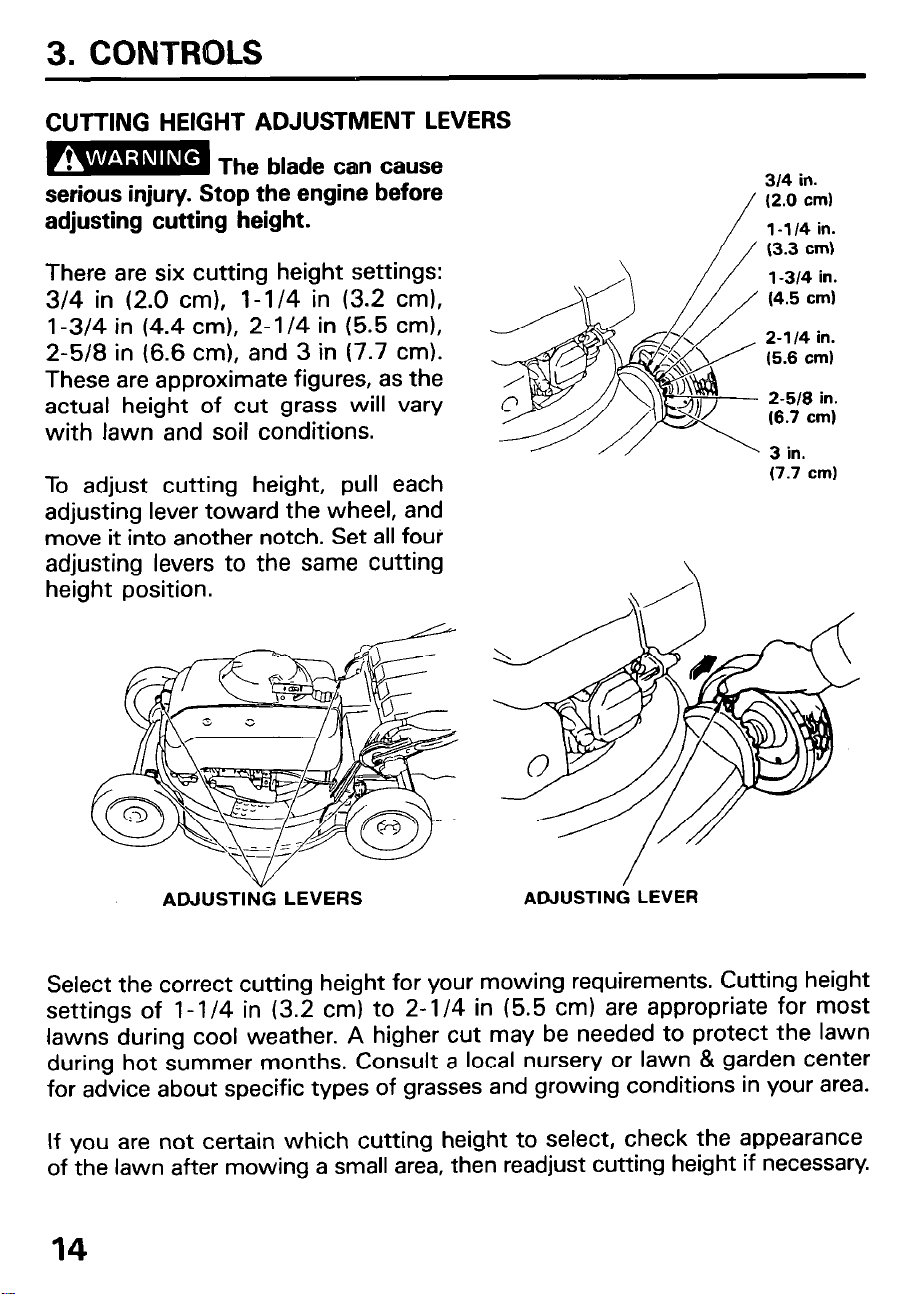
CUTTING HEIGHT ADJUSTMENT LEVERS
serious injury. Stop the engine before
adjusting cutting height.
There are six cutting height settings:
3/4
in (2.0 cm), l-1/4 in (3.2 cm),
l-3/4 in (4.4 cm), 2- l/4 in (5.5 cm),
2-5/8 in (6.6 cm), and 3 in (7.7 cm).
These are approximate figures, as the
actual height of cut grass will vary
with lawn and soil conditions.
To adjust cutting height, pull each
adjusting lever toward the wheel, and
move it into another notch. Set all foui
adjusting levers to the same cutting
height position.
314
in.
/i
(2.0
cm)
l-114
in.
/ (3.3
cm)
/ / l-314 in.
(4.5
cm)
2-114
in.
(5.6
cm)
2-5/B
in.
(6.7
cm)
3
in.
(7.7
cm)
ADJUSTING LEVERS
ADJUSTINdl LEVER
Select the correct cutting height for your mowing requirements. Cutting height
settings of l-l /4 in (3.2 cm) to 2-l /4 in (5.5 cm) are appropriate for most
lawns during cool weather. A higher cut may be needed to protect the lawn
during hot summer months. Consult a local nursery or lawn 81 garden center
for advice about specific types of grasses and growing conditions in your area.
If you are not certain which cutting height to select, check the appearance
of the lawn after mowing a small area, then readjust cutting height if necessary.
14
1.
2.
4. ATTACHMENTS
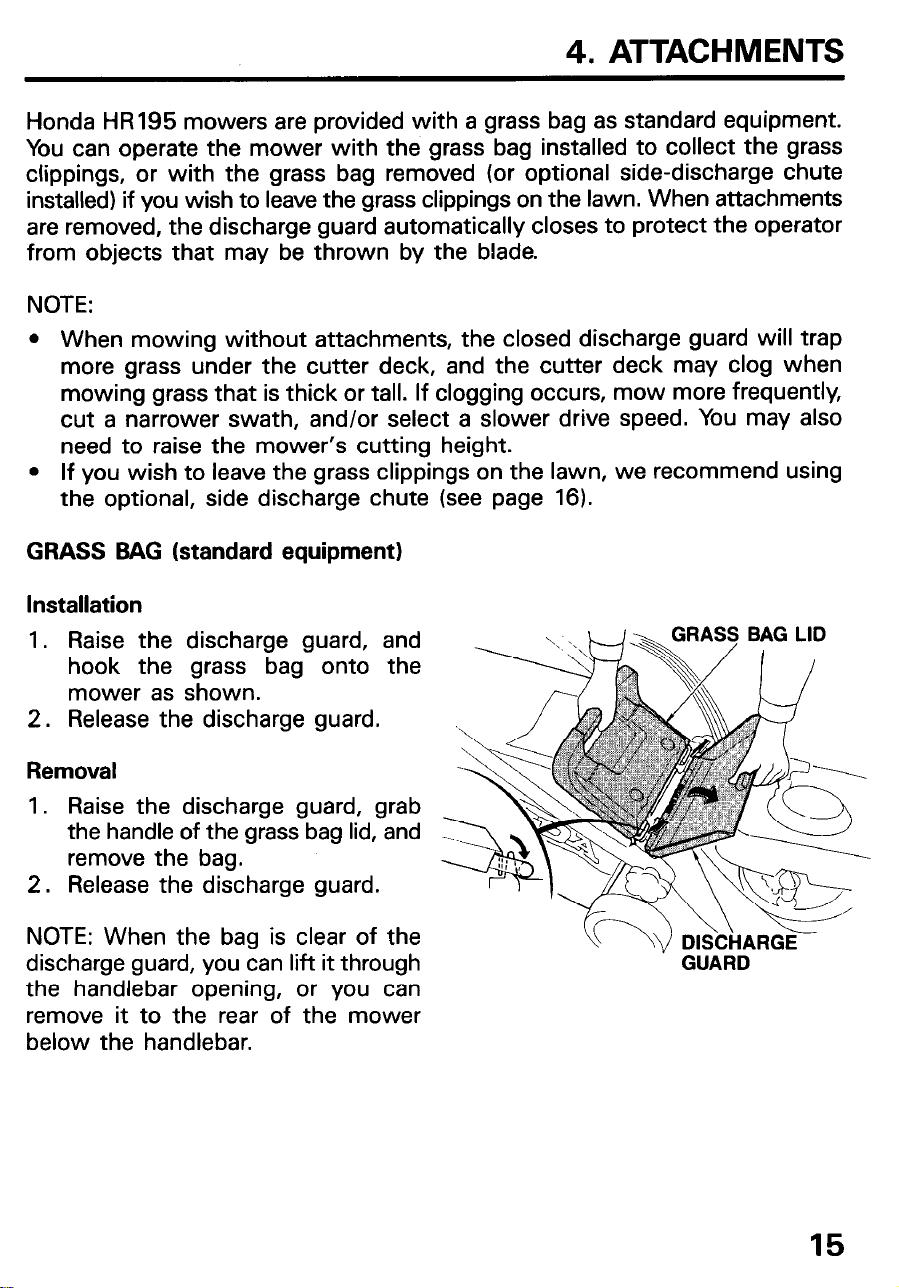
Honda HR195 mowers are provided with a grass bag as standard equipment.
You can operate the mower with the grass bag installed to collect the grass
clippings, or with the grass bag removed (or optional side-discharge chute
installed) if you wish to leave the grass clippings on the lawn. When attachments
are removed, the discharge guard automatically closes to protect the operator
from objects that may be thrown by the blade.
NOTE:
l
When mowing without attachments, the closed discharge guard will trap
more grass under the cutter deck, and the cutter deck may clog when
mowing grass that is thick or tall. If clogging occurs, mow more frequently,
cut a narrower swath, and/or select a slower drive speed. You may also
need to raise the mower’s cutting height.
l
If you wish to leave the grass clippings on the lawn, we recommend using
the optional, side discharge chute (see page 16).
GRASS BAG (standard equipment)
Installation
Raise the discharge guard, and
hook the grass bag onto the
mower as shown.
Release the discharge guard.
ASS BAG LID
/
Removal
1. Raise the discharge guard, grab
the handle of the grass bag lid, and
remove the bag.
2. Release the discharge guard.
NOTE: When the bag is clear of the
discharge guard, you can lift it through
the handlebar opening, or you can
remove it to the rear of the mower
below the handlebar.
GUARD
15
4. ATTACHMENTS
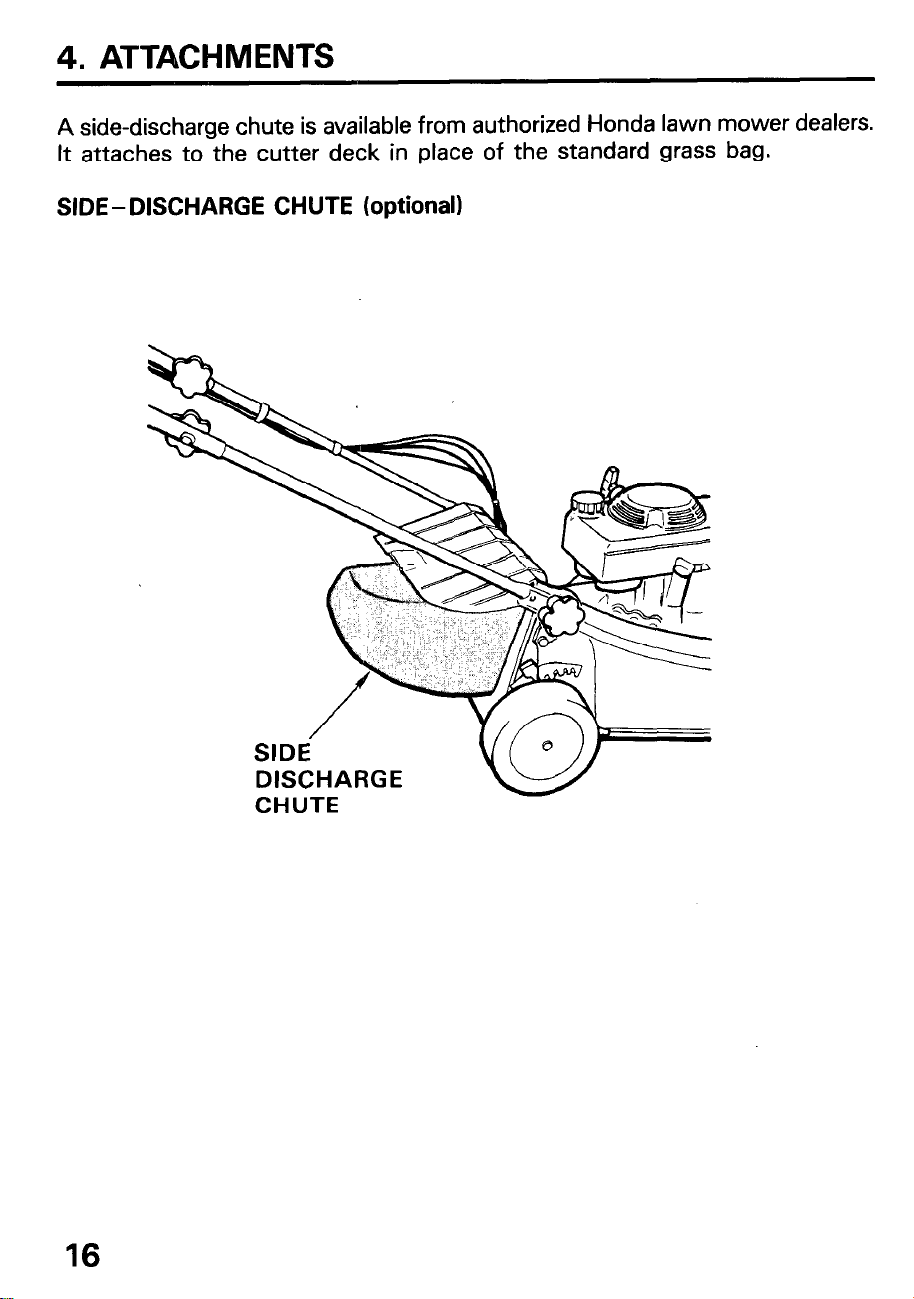
A side-discharge chute is available from authorized Honda lawn mower dealers.
It attaches to the cutter deck in place of the standard grass bag.
SIDE-DISCHARGE CHUTE (optional)
CHUTE
16
5. PRE-OPERATION CHECK
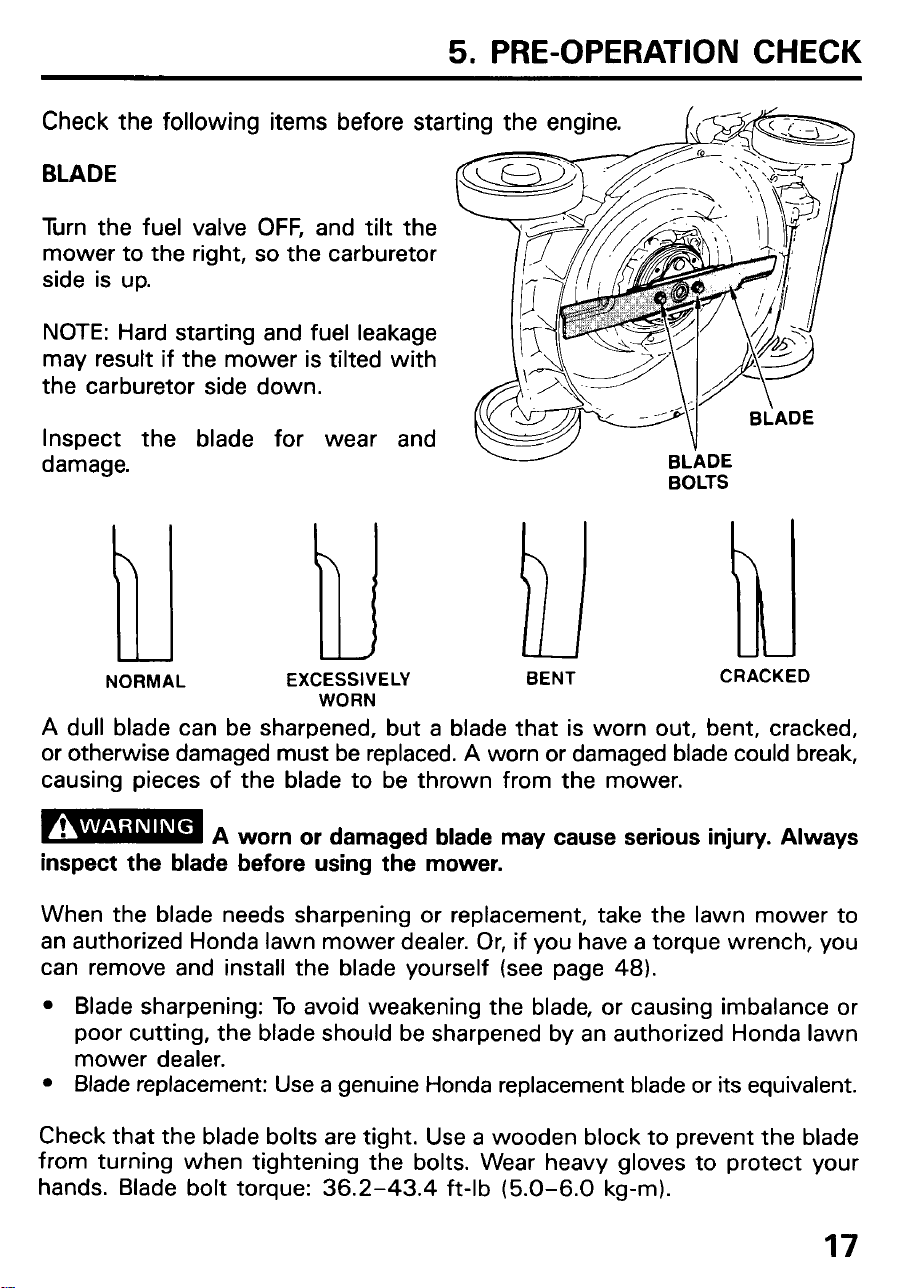
BLADE
Turn the fuel valve OFF, and tilt the
mower to the right, so the carburetor
side is up.
NOTE: Hard starting and fuel leakage
may result if the mower is tilted with
the carburetor side down.
Inspect the blade for wear and
damage.
Check the following
items
before starting the engine.
BLhDE
BOLTS
NORMAL
EXCESSIVELY
WORN
BENT
A dull blade can be sharpened, but a blade that is worn out, bent, cracked,
or otherwise damaged must be replaced. A worn or damaged blade could break,
causing pieces of the blade to be thrown from the mower.
m
A worn or damaged blade may cause serious injury. Always
inspect the blade before using the mower.
When the blade needs sharpening or replacement, take the lawn mower to
an authorized Honda lawn mower dealer. Or, if you have a torque wrench, you
can remove and install the blade yourself (see page 48).
l Blade sharpening: To avoid weakening the blade, or causing imbalance or
poor cutting, the blade should be sharpened by an authorized Honda lawn
mower dealer.
l Blade replacement: Use a genuine Honda replacement blade or its equivalent.
Check that the blade bolts are tight. Use a wooden block to prevent the blade
from turning when tightening the bolts. Wear heavy gloves to protect your
hands. Blade bolt torque: 36.2-43.4 ft-lb (5.0-6.0 kg-m).
17
5. PRE-OPERATION CHECK
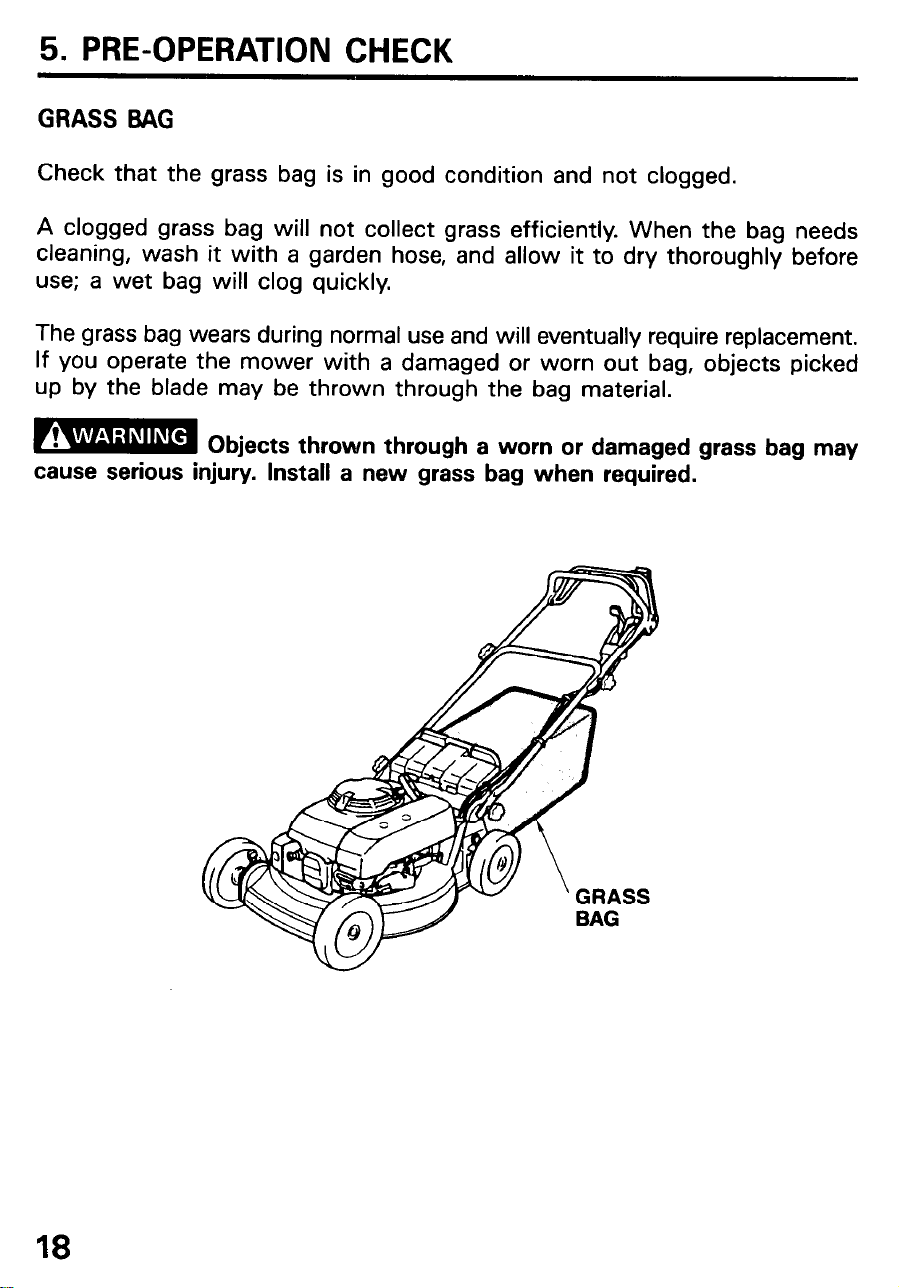
GRASS BAG
Check that the grass bag is in good condition and not clogged.
A clogged grass bag will not collect grass efficiently. When the bag needs
cleaning, wash it with a garden hose, and allow it to dry thoroughly before
use; a wet bag will clog quickly.
The grass bag wears during normal use and will eventually require replacement.
If you operate the mower with a damaged or worn out bag, objects picked
up by the blade may be thrown through the bag material.
m
Objects thrown through a worn or damaged grass bag may
cause serious injury. Install a new grass bag when required.
18
5. PRE-OPERATION CHECK
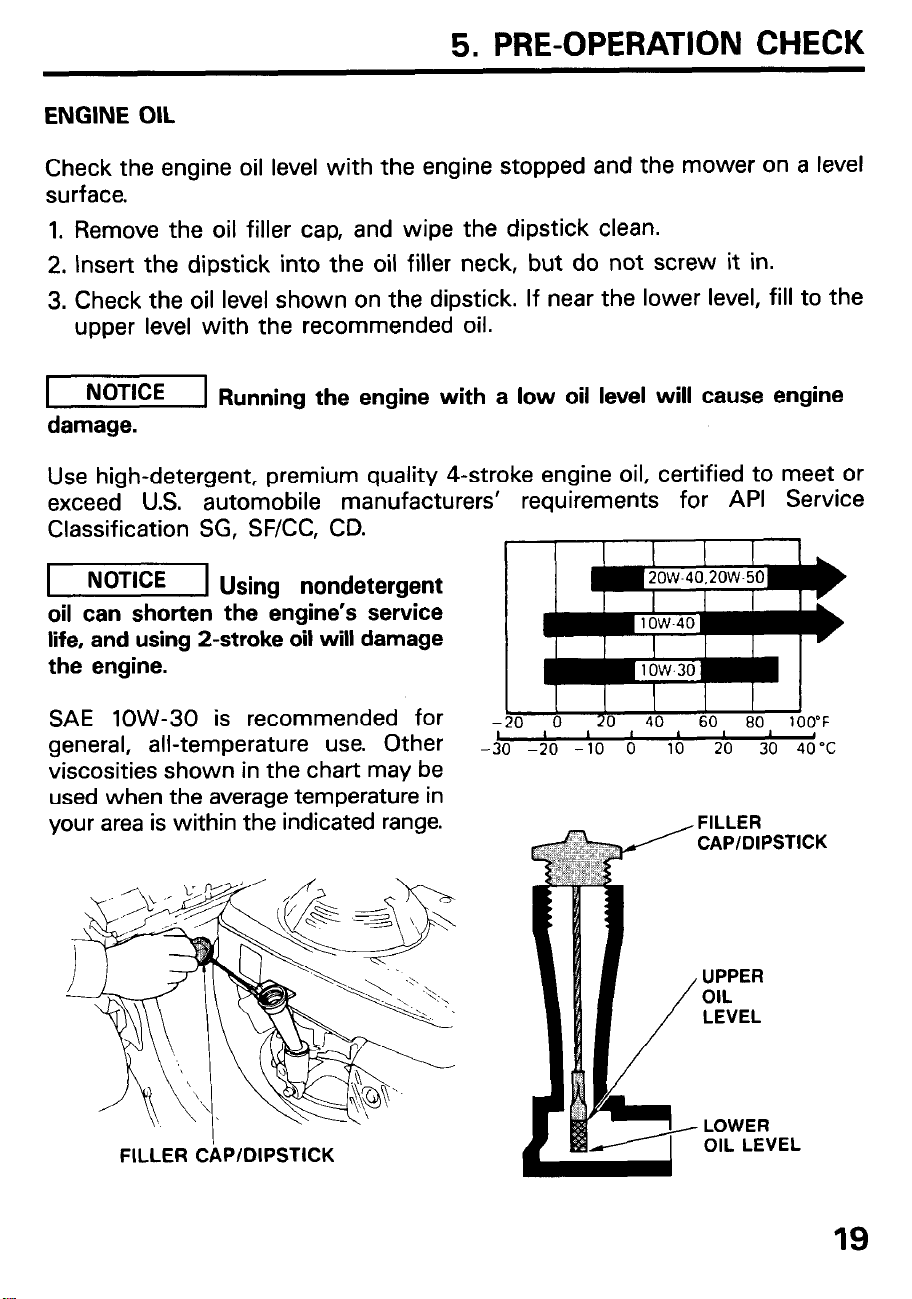
ENGINE OIL
Check the engine oil level with the engine stopped and the mower on a level
surface.
1. Remove the oil filler cap, and wipe the dipstick clean.
2. insert the dipstick into the oil filler neck, but do not screw it in.
3. Check the oil level shown on the dipstick. If near the lower level, fill to the
upper level with the recommended oil.
r3eiEq
Running the engine with a low oil level will cause engine
damage.
Use high-detergent, premium quality 4-stroke engine oil, certified to meet or
exceed U.S. automobile manufacturers’ requirements for API Service
Classification SG, SF/CC, CD.
pzEiEq
Using nondetergent
oil can shorten the engine’s service
life, and using 2-stroke oil will damage
the engine.
SAE low-30 is recommended for
_
general, all-temperature use. Other
1
I
I 1
1
4
-30 -20 -10 0 10 20
30 4O'C
viscosities shown in the chart may be
used when the average temperature in
your area is within the indicated range.
FILLER
CAP/DIPSTICK
UPPER
OIL
LEVEL
LOWER
FILLER CAP/DIPSTICK
OIL LEVEL
19
5. PRE-OPERATION CHECK
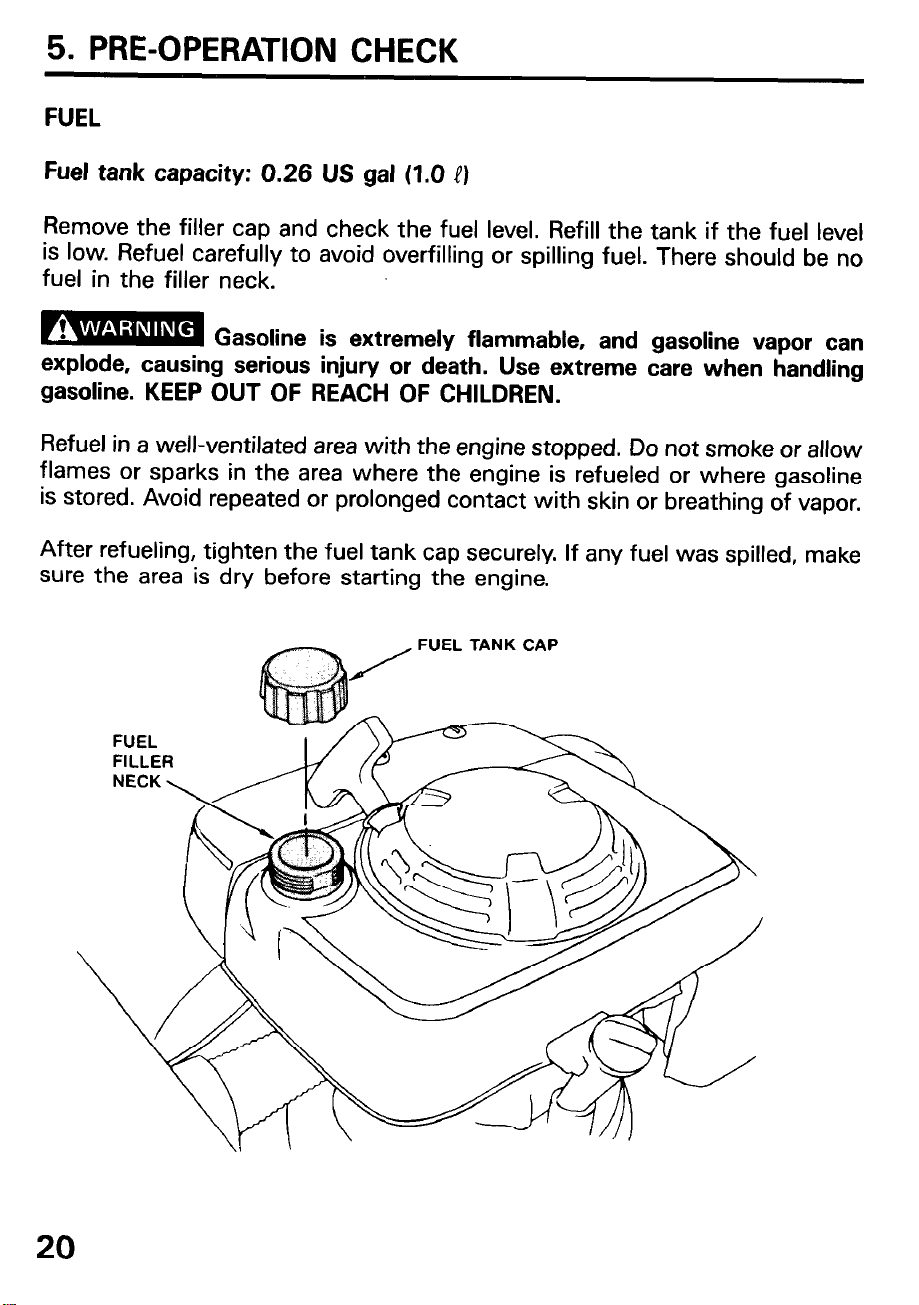
FUEL
Fuel tank capacity: 0.26 US gal (1.0 e)
Remove the filler cap and check the fuel level. Refill the tank if the fuel level
is low. Refuel carefully to avoid overfilling or spilling fuel. There should be no
fuel in the filler neck.
B
Gasoline is extremely flammable, and gasoline vapor can
explode, causing serious injury or death. Use extreme care when handling
gasoline. KEEP OUT OF REACH OF CHILDREN.
Refuel in a well-ventilated area with the engine stopped. Do not smoke or allow
flames or sparks in the area where the engine is refueled or where gasoline
is stored. Avoid repeated or prolonged contact with skin or breathing of vapor.
After refueling, tighten the fuel tank cap securely. If any fuel was spilled, make
sure the area is dry before starting the engine.
, FUEL TANK CAP
FUEL
-.. --
20
5. PRE-OPERATION CHECK
Fuel Recommendation
Pump octane rating: 86 or higher.
We recommend unleaded fuel because it produces fewer engine and spark
plug deposits and extends exhaust system life.
Never use stale or contaminated gasoline or an oil/gasoline mixture. Avoid
getting dirt or water in the fuel tank.
Occasionally you may hear light “spark knock” or “pinging” (metallic rapping
noise) while operating under heavy loads. This is no cause for concern.
If spark knock or pinging occurs at a steady engine speed, under normal load,
change brands of gasoline. If spark knock or pinging persists, see an authorized
Honda lawn mower dealer.
(1
Running the engine with persistent spark knock or pinging can
cause engine damage.
NOTE: Running the engine with persistent spark knock or pinging is considered
misuse, and the Distributor’s Limited Warranty does not cover parts damaged
by misuse.
GASOLINES CONTAINING ALCOHOL
If you decide to use a gasoline containing alcohol (gasohol), be sure its pump
octane rating is 86 or higher. There are two types of “gasohol”: one containing
ethanol, and the other containing methanol.
1 NoTtCE 1 Using gasohol that contains more than 10% ethanol, or
gasoline containing methanol (methyl or wood alcohol) that does not also
contain cosolvents and corrosion inhibitors for methanol, can cause serious
fuel system damage and poor engine performance.
Never use gasoline containing more than 5% methanol, even if it has cosolvents
and corrosion inhibitors.
Honda does not endorse the use of fuels containing methanol, since evidence
of their suitability is as yet incomplete.
NOTE: Fuel system damage, or engine performance problems resulting from
the use of fuels that contain alcohol, is not covered under the warranty.
Before buying fuel from an unfamiliar station, first determine if the fuel contains
alcohol; if it does, find out the type and percentage of alcohol used.
NOTE: If you notice any undesirable operating symptoms while using a gasoline
that contains alcohol, or one that you think contains alcohol, switch to a
gasoline that you know does not contain alcohol.
21
5. PRE-OPERATION CHECK
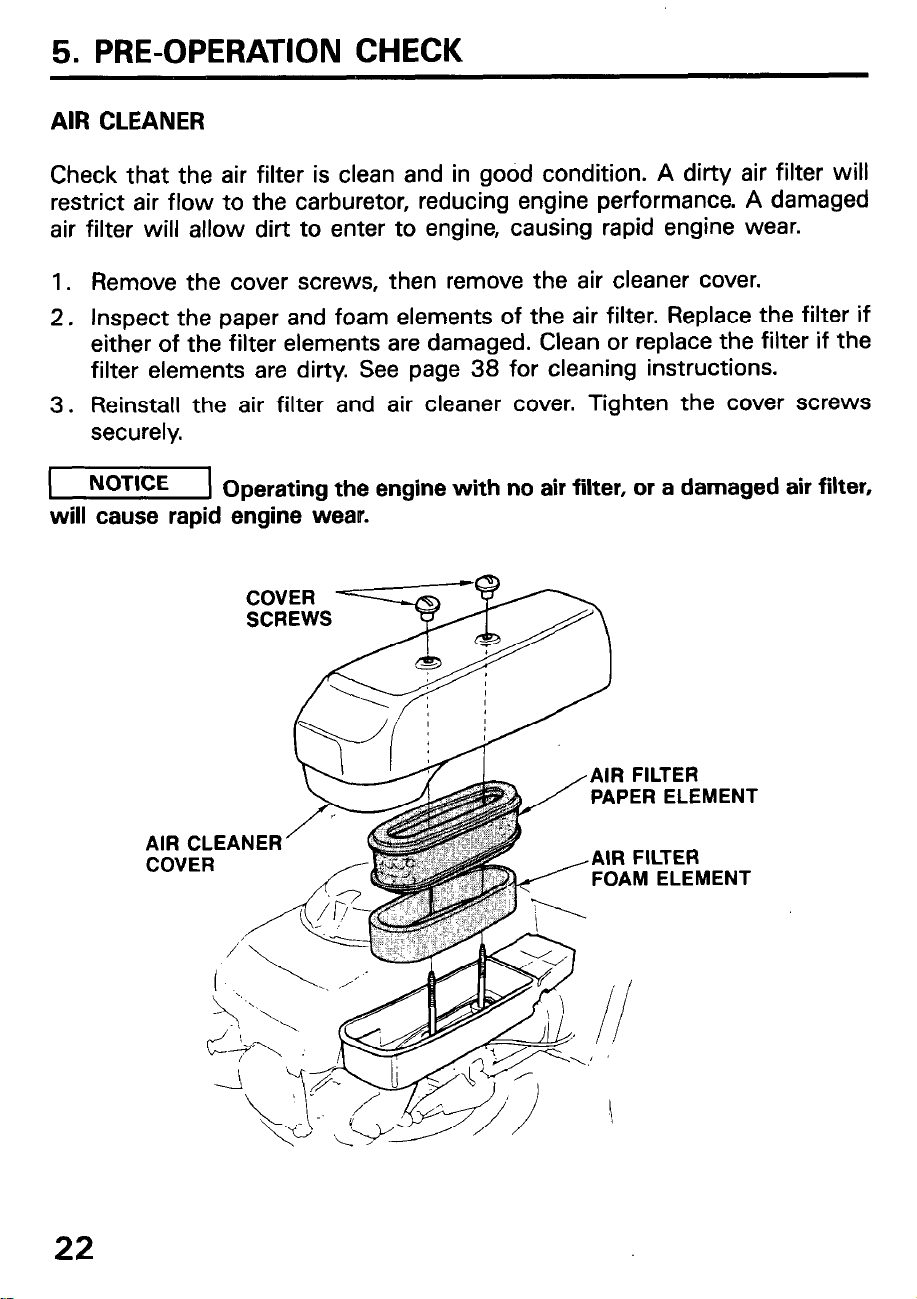
AIR CLEANER
Check that the air filter is clean and in good condition. A dirty air filter will
restrict air flow to the carburetor, reducing engine performance. A damaged
air filter will allow dirt to enter to engine, causing rapid engine wear.
1. Remove the cover screws, then remove the air cleaner cover.
2.
Inspect the paper and foam elements of the air filter. Replace the filter if
either of the filter elements are damaged. Clean or replace the filter if the
filter elements are dirty. See page 38 for cleaning instructions.
3. Reinstall the air filter and air cleaner cover. Tighten the cover screws
securely.
1
NOTICE
1 Operating the engine with no air filter, or a damaged air filter,
will cause rapid engine wear.
COVER -
SCREWS
AIR CLEANER
/
COVER
P
/- :
22
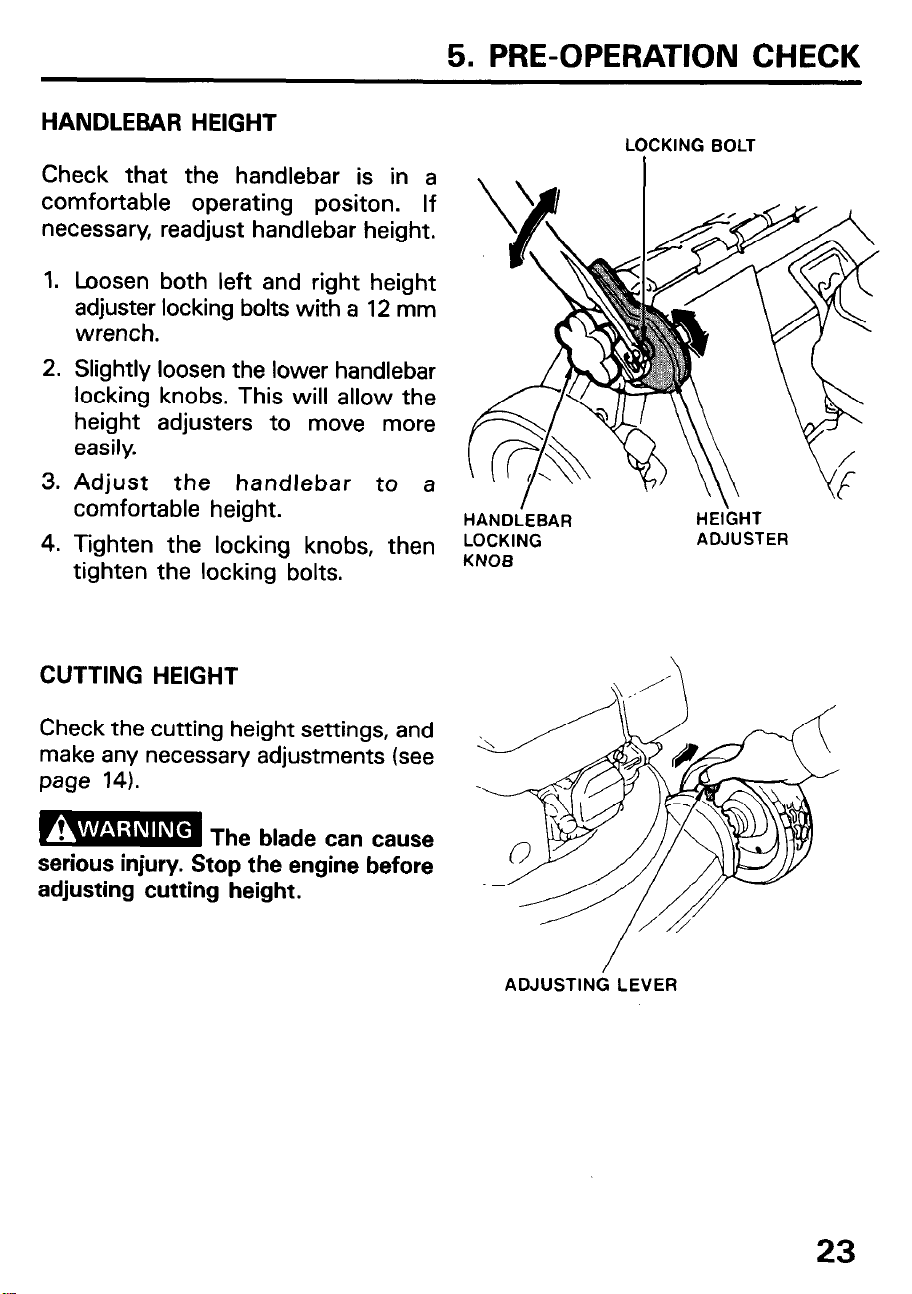
HANDLEBAR HEIGHT
Check that the handlebar is in a
comfortable operating positon. If
necessary, readjust handlebar height.
1. Loosen both left and right height
adjuster locking bolts with a 12 mm
wrench.
2. Slightly loosen the lower handlebar
locking knobs. This will allow the
height adjusters to move more
easily.
3. Adjust the handlebar to a
comfortable height.
4. Tighten the locking knobs, then
tighten the locking bolts.
CUTTING HEIGHT
Check the cutting height settings, and
make any necessary adjustments (see
page 14).
serious injury. Stop the engine before
adjusting cutting height.
LOCKING BOLT
HANDiEBAR
HEIGHT
LOCKING
ADJUSTER
KNOB
ADJUSTING LEVER
23
6. OPERATION
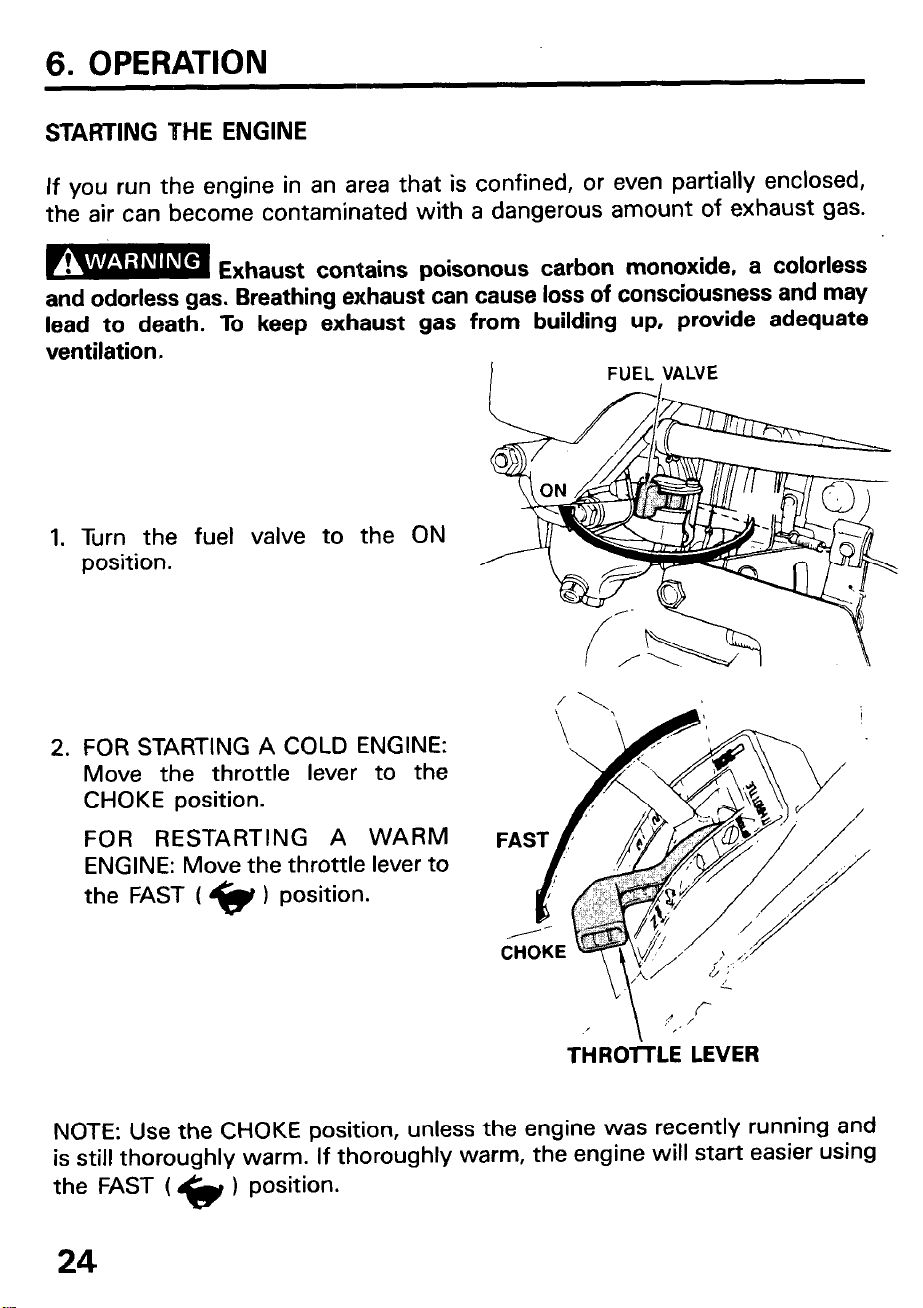
STARTING THE ENGINE
If you run the engine in an area that is confined, or even partially enclosed,
the air can become contaminated with a dangerous amount of exhaust gas.
B
Exhaust contains poisonous carbon monoxide, a colorless
and odorless gas. Breathing exhaust can cause loss of consciousness and may
lead to death. To keep exhaust gas from building up, provide adequate
ventilation.
I
FUEL VALVE
1.
2.
Turn the fuel valve to the ON
position.
FOR STARTING A COLD ENGINE:
Move the throttle lever to the
CHOKE position.
FOR RESTARTING A WARM
ENGINE: Move the throttle lever to
the FAST ( * 1 position.
NOTE: Use the CHOKE position, unless the engine was recently running and
is still thoroughly warm. If thoroughly warm, the engine will start easier using
the FAST (
%iY
) position.
24
6. OPERATION
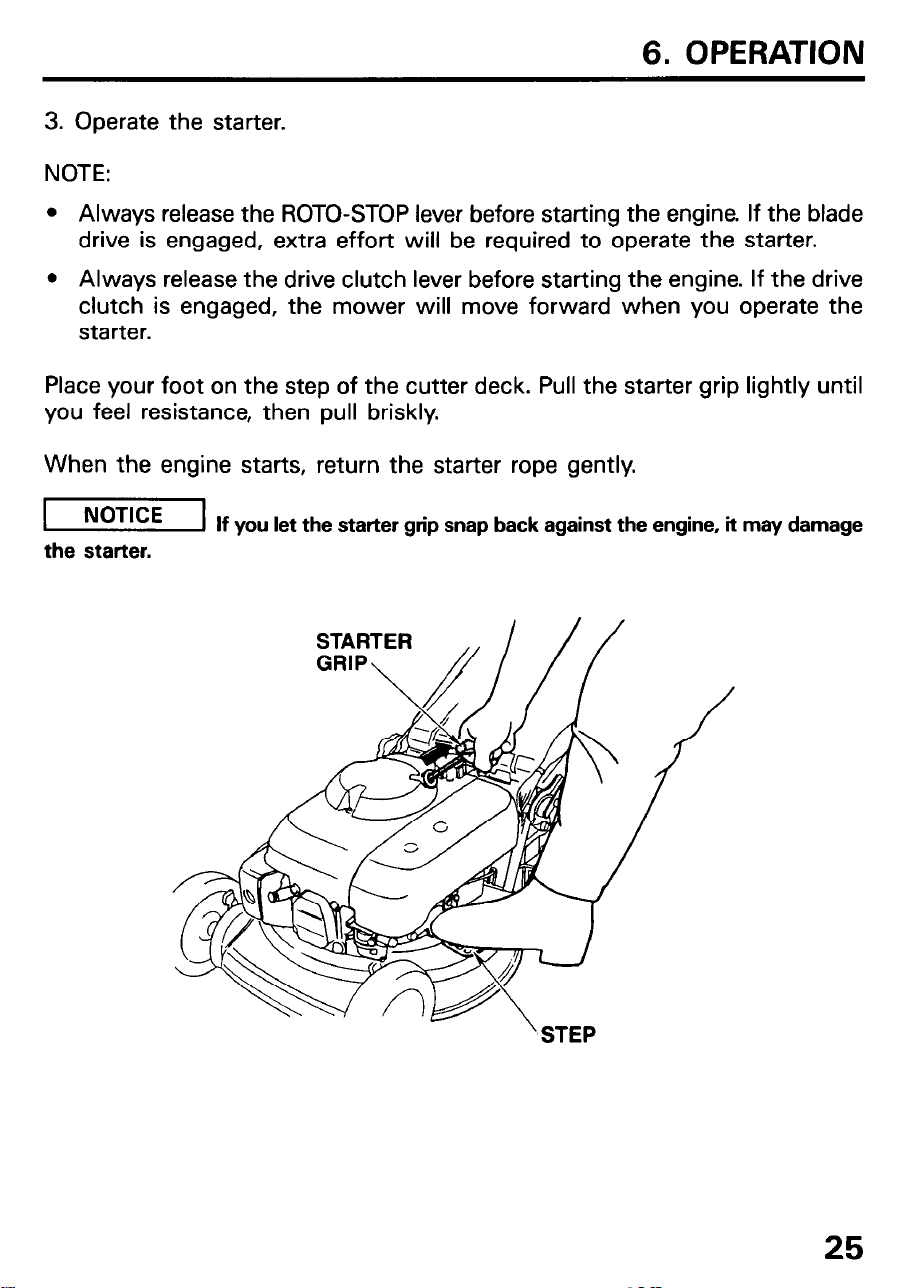
3. Operate the starter.
NOTE:
l
Always release the ROTO-STOP lever before starting the engine. If the blade
drive is engaged, extra effort will be required to operate the starter.
l
Always release the drive clutch lever before starting the engine. If the drive
clutch is engaged, the mower will move forward when you operate the
starter.
Place your foot on the step of the cutter deck. Pull the starter grip lightly until
you feel resistance, then pull briskly.
When the engine starts, return the starter rope gently.
pi%icq
If you let the starter grip snap back against the engine, it may damage
the starter.
25
6. OPERATION
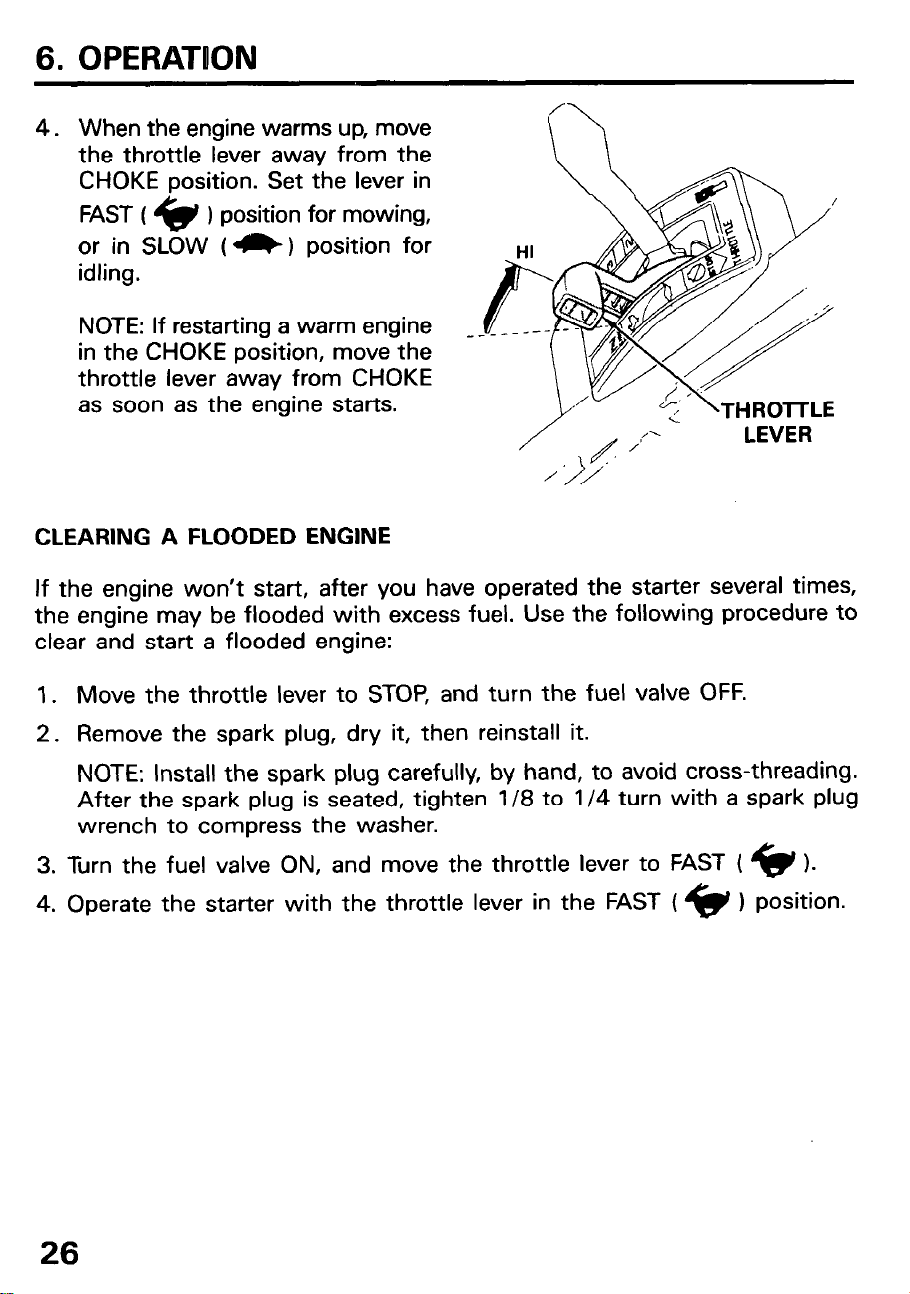
4. When the engine warms up, move
the throttle lever away from the
CHOKE position. Set the lever in
FAST ( * ) position for mowing,
or in SLOW ( C,) position for
idling.
NOTE: If restarting a warm engine
_
in the CHOKE position, move the
throttle lever away from CHOKE
as soon as the engine starts.
CLEARING A FLOODED ENGINE
If the engine won’t start, after you have operated the starter several times,
the engine may be flooded with excess fuel. Use the following procedure to
clear and start a flooded engine:
1. Move the throttle lever to STOP, and turn the fuel valve OFF.
2. Remove the spark plug, dry it, then reinstall it.
NOTE: Install the spark plug carefully, by hand, to avoid cross-threading.
After the spark plug is seated, tighten l/8 to l/4 turn with a spark plug
wrench to compress the washer.
3. Turn the fuel valve ON, and move the throttle lever to FAST ( * 1.
4. Operate the starter with the throttle lever in the FAST ( * ) position.
26
6. OPERATION
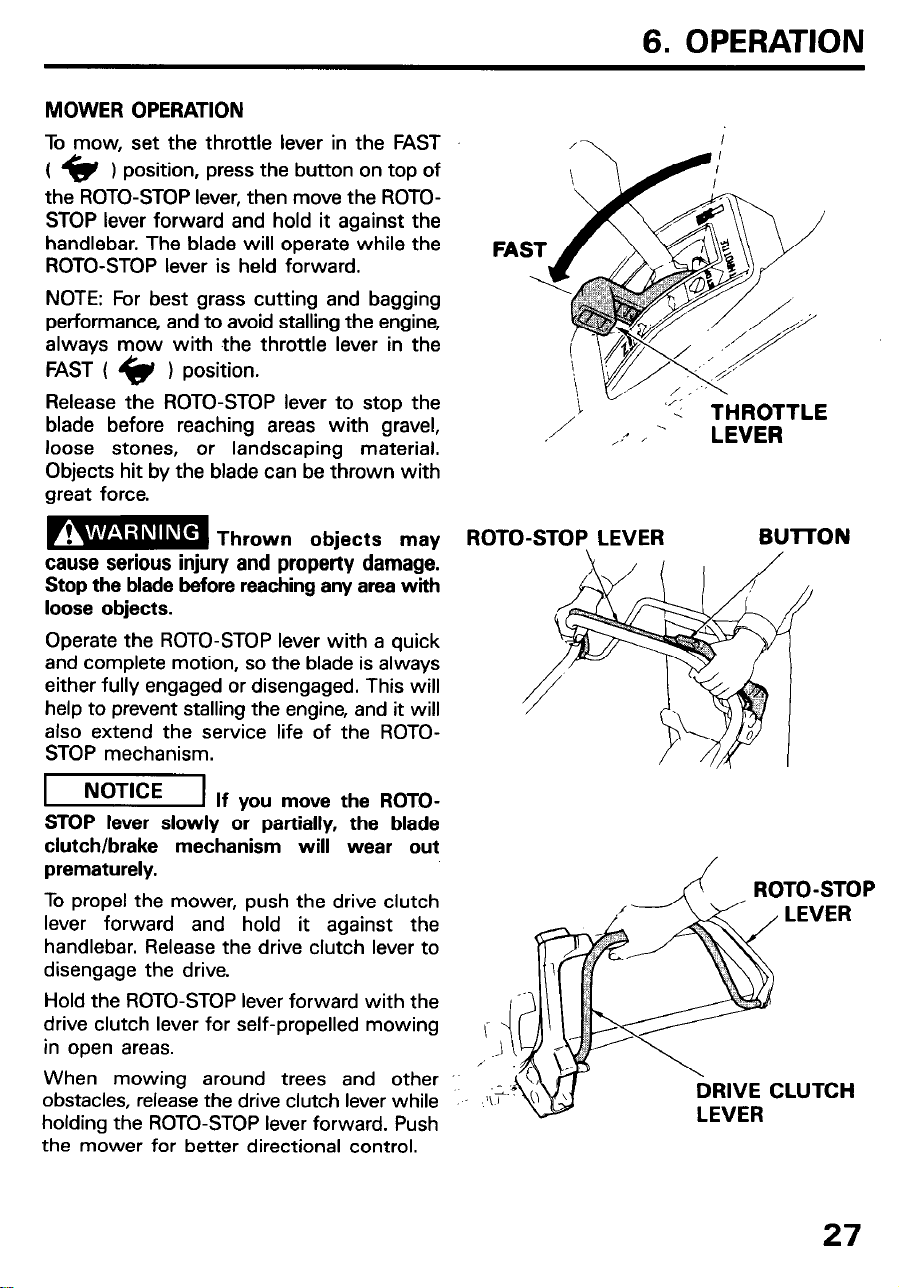
MOWER OPERATION
To mow, set the throttle lever in the FAST
( * 1 position, press the button on top of
the ROTO-STOP lever, then move the ROTO-
STOP lever forward and hold it against the
handlebar. The blade will operate while the
ROTO-STOP lever is held forward.
NOTE: For best grass cutting and bagging
performance, and to avoid stalling the engine,
always mow with the throttle lever in the
FAST ( 6) 1 position.
Release the ROTO-STOP lever to stop the
blade before reaching areas with gravel,
loose stones, or landscaping material.
Objects hit by the blade can be thrown with
great force.
THROTTLE
LEVER
cause serious injury and property damage.
Stop the blade before reaching any area with
loose objects.
Operate the ROTO-STOP lever with a quick
and complete motion, so the blade is always
either fully engaged or disengaged. This will
help to prevent stalling the engine, and it will
also extend the service life of the ROTO-
STOP mechanism.
1 NOTICE 1
If you move the ROTO-
STOP lever slowly or partially, the blade
clutch/brake mechanism will wear out
prematurely.
To propel the mower, push the drive clutch
lever forward and hold it against the
handlebar. Release the drive clutch lever to
disengage the drive.
Hold the ROTO-STOP lever forward with the
drive clutch lever for self-propelled mowing
in open areas.
When mowing around trees and other
obstacles, release the drive clutch lever while
holding the ROTO-STOP lever forward. Push
the mower for better directional control.
ROTO-STOP LEVER
BUITON
27
6. OPERATION
B
If the mower tilts or overturns, the blade will be exposed;
that will increase the risk of injury from blade contact and from thrown objects
and debris. For your safety, keep all four wheels on the ground, and be careful
not to lose your footing and your control of the mower.
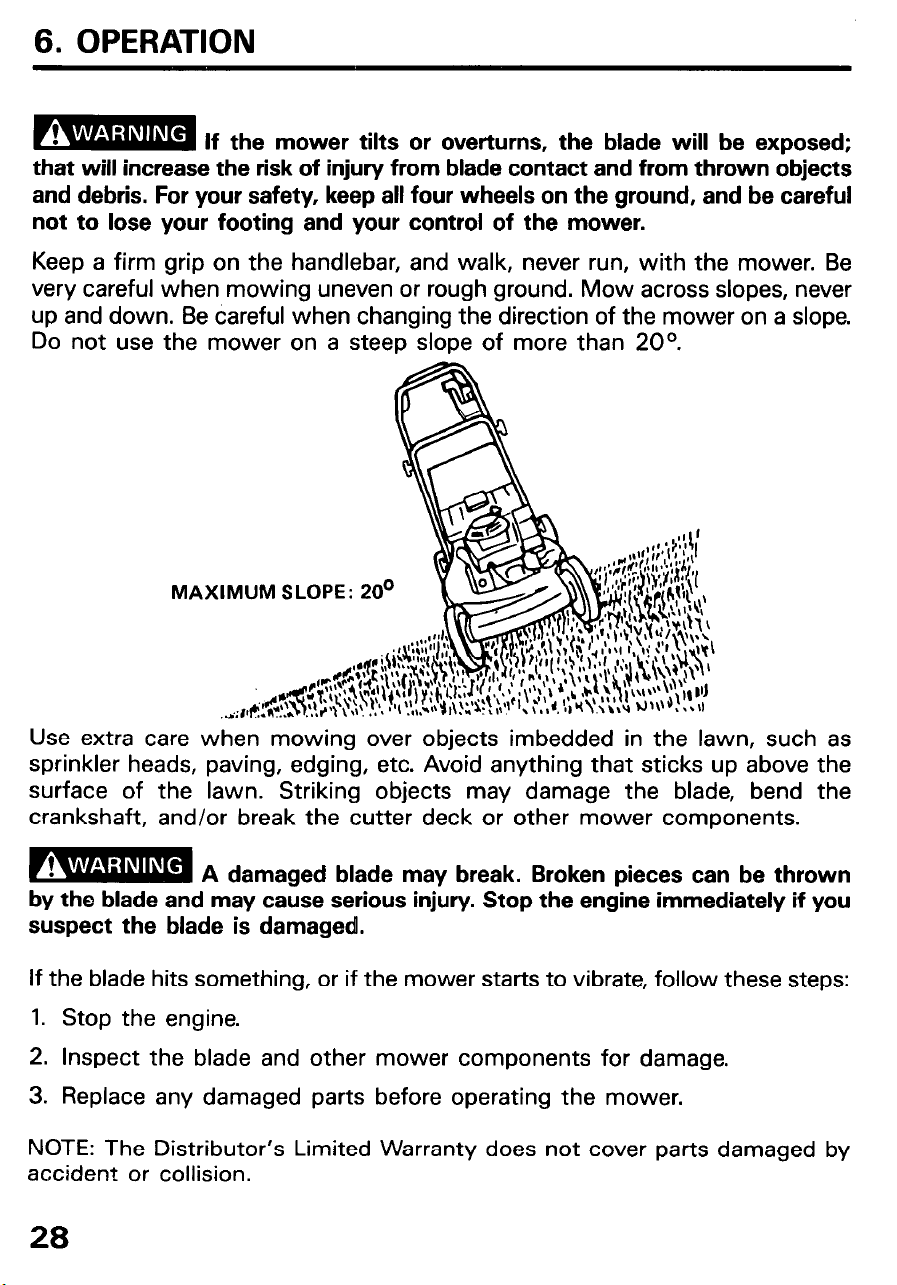
Keep a firm grip on the handlebar, and walk, never run, with the mower. Be
very careful when mowing uneven or rough ground. Mow across slopes, never
up and down. Be careful when changing the direction of the mower on a slope.
Do not use the mower on a steep slope of more than 20°.
MAXIMUM SLOPE: 20’
Use extra care when mowing over objects imbedded in the lawn, such as
sprinkler heads, paving, edging, etc. Avoid anything that sticks up above the
surface of the lawn. Striking objects may damage the blade, bend the
crankshaft, and/or break the cutter deck or other mower components.
M
A damaged blade may break. Broken pieces can be thrown
by the blade and may cause serious injury. Stop the engine immediately if you
suspect the blade is damaged.
If the blade hits something, or if the mower starts to vibrate, follow these steps:
1. Stop the engine.
2. Inspect the blade and other mower components for damage.
3. Replace any damaged parts before operating the mower.
NOTE: The Distributor’s Limited Warranty does not cover parts damaged by
accident or collision.
28
6. OPERATION
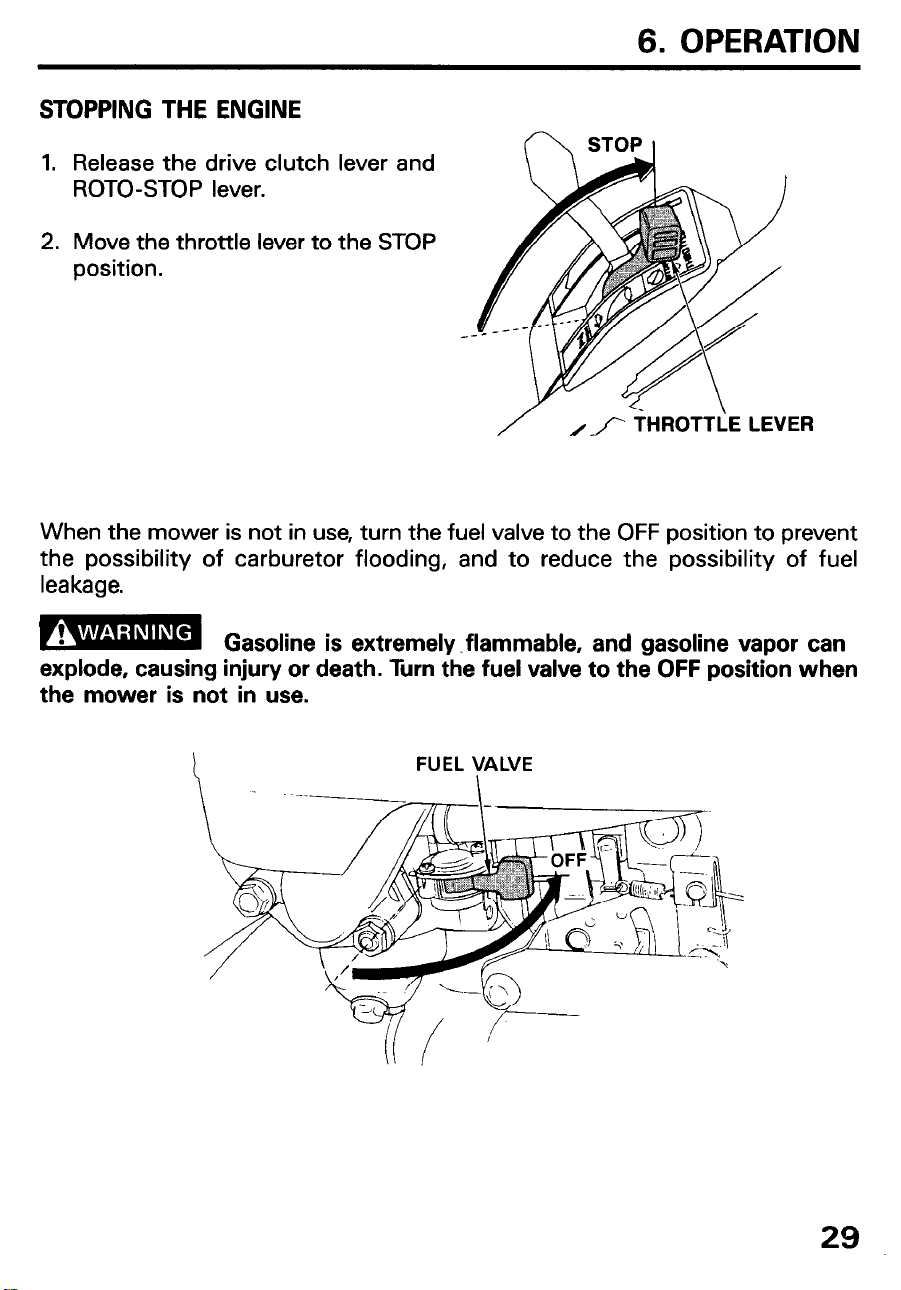
STOPPING THE ENGINE
1.
2.
Release the drive clutch lever and
ROTO-STOP lever.
Move the throttle lever to the STOP
position.
/
// THROTTLE LEVER
When the mower is not in use, turn the fuel valve to the OFF position to prevent
the possibility of carburetor flooding, and to reduce the possibility of fuel
leakage.
w
Gasoline is extremely.flammable, and gasoline vapor can
explode, causing injury or death. Turn the fuel valve to the OFF position when
the mower is not in use.
i
FUEL VALVE
29
6. OPERATION
HIGH ALTITUDE OPERATION
At high altitude, the standard carburetor air-fuel mixture will be too rich.
Performance will decrease, and fuel consumption will increase. A very rich
mixture may also foul the spark plug and cause hard starting.
High altitude performance can be improved by installing a smaller diameter
main fuel jet in the carburetor and readjusting the pilot screw. If you always
operate the mower at altitudes higher than 6,000 feet above sea level, have
an authorized Honda lawn mower dealer perform this carburetor modification.
Even with carburetor modification, engine horsepower will decrease about 3.5%
for each 1,000 foot increase in altitude. The effect of altitude on horsepower
will be greater than this if no carburetor modification is made. A reduction in
engine horsepower will reduce mowing performance.
When the carburetor is modified for good high altitude operation, the air/fuel
mixture will be too lean at low altitude. Performance will decrease, and the
engine will overheat.
To avoid an excessively lean air/fuel mixture and engine damage, reinstall the
standard main fuel jet and readjust the pilot screw for operation at altitudes
lower than 6,000 feet above sea level.
30
7. MOWING RECOMMENDATIONS
A cutting height of l-l /4 in (3.2 cm) to 2-l /4 in (5.5 cm) is appropriate for
most lawns during cool weather. A higher cut may be needed to protect the
lawn during hot summer months. Consult a local nursery or lawn & garden
center for advice about specific types of grasses and growing conditions in
your area.
Most grasses should be mowed when they have grown half an inch to an inch
above the recommended height. If allowed to grow too tall, and then cut back
to the stems, the grass may not recover well, and the lawn will have brown
patches.
As a general rule, do not cut off more than a third of the total height of the
grass in one mowing. If tall grass is reduced in height a little at a time, and
is allowed to recover between mowings, the grass will be healthier, and the
lawn mower will work better and will leave a better lawn finish.
For good mowing conditions, the grass should be relatively dry, but the ground
should not be so dry that the mower stirs up a lot of dust. Too much dust
will clog the carburetor air filter, reducing engine performance.
If dust is a problem, water your lawn the day before mowing, allowing the
grass to dry while the soil remains moist.
Always wait for wet grass to dry. Wet grass may clog the cutter deck, and
it does not bag well.
Grass clippings may be left on the lawn, or removed, whichever you prefer.
Clippings return nutrients to the soil, but they don’t look neat when left on
the lawn. Heavy clumps of clippings should always be removed; grass must
remain uncovered to grow properly.
If you wish to leave the grass clippings on the lawn, we recommend using
the optional, side-discharge chute (see page 16).
Mowing without the grass bag or other attachments will leave the grass
clippings on the lawn, but the closed discharge guard will trap more grass under
the cutter deck, and the cutter deck may clog when mowing grass that is thick
or tall. If clogging occurs, mow more frequently, cut a narrower swath, and/or
use a slower forward speed. You may also need to raise the mower’s cutting
height.
If you must clean out a clogged cutter deck, turn the fuel valve OFF, and tilt
the mower so the carburetor side is up. Hard starting and fuel leakage may
result if the mower is tilted with the carburetor side down.
31
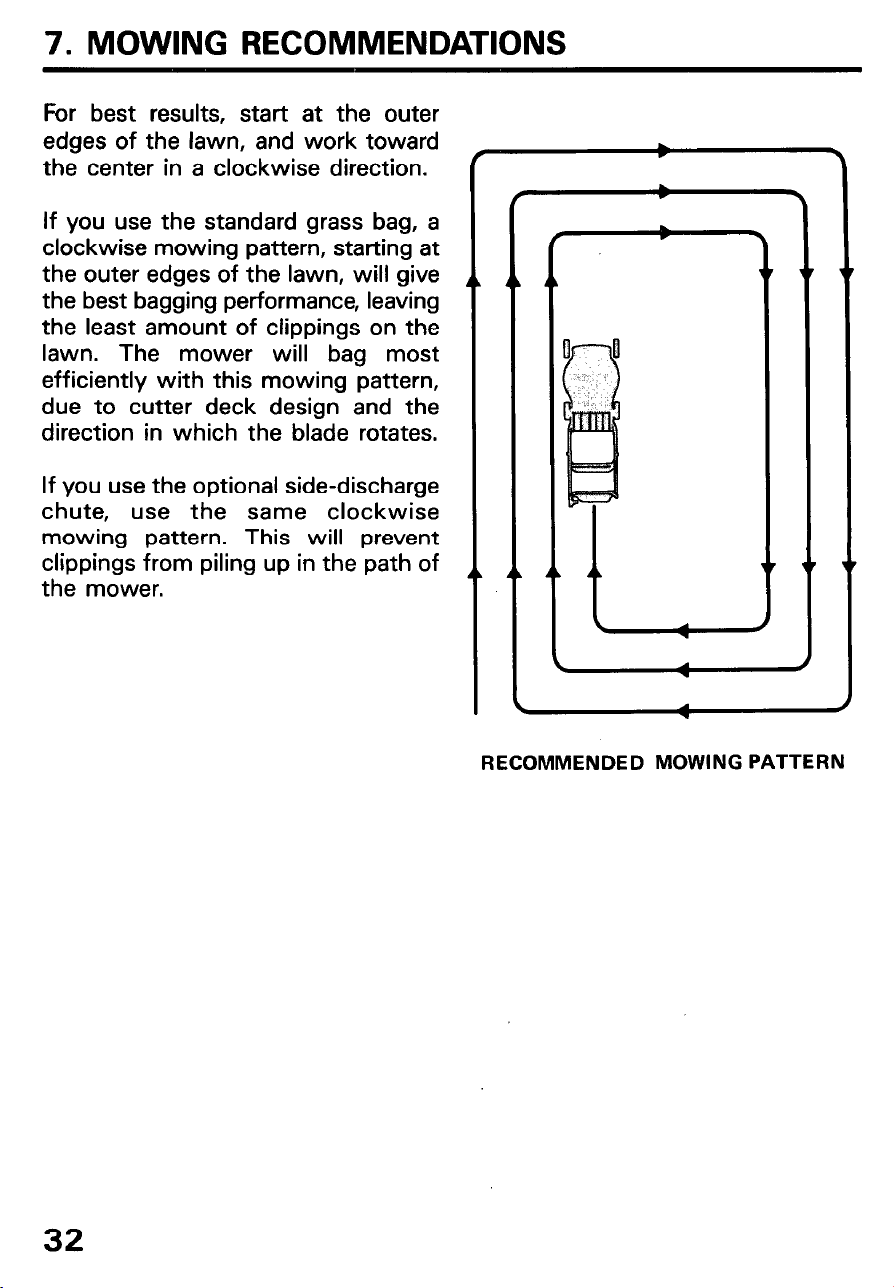
For best results, start at the outer
edges of the lawn, and work toward
the center in a clockwise direction.
If you use the standard grass bag, a
clockwise mowing pattern, starting at
the outer edges of the lawn, will give
the best bagging performance, leaving
the least amount of clippings on the
lawn. The mower will bag most
efficiently with this mowing pattern,
due to cutter deck design and the
direction in which the blade rotates.
If you use the optional side-discharge
chute, use the same clockwise
mowing pattern.
This will prevent
clippings from piling up in the path of
the mower.
.
RECOMMENDED MOWING PATTERN
32
If the grass is not very thick or tall, you can mow a wide swath, and/or you
can move the shift lever to select a fast drive speed. Keep the wheels close
to the swath line for maximum cutting width.
If the grass is very thick or tall, cutting a wide swath may slow or stall the
engine, clog the cutter deck, and cause poor bagging performance. For thick
or tall grass, cut a narrower swath, and/or push the mower more slowly or
move the shift lever to select a slower drive speed. If necessary, mow twice;
first with a high cut, then at final cutting height
For best grass cutting and bagging
performance, the blade must spin very
fast. Always use the FAST ( * )
throttle setting when mowing, and
keep the engine running at or near
maximum rpm. If you hear engine
speed decrease, that means you
should mow a narrower swath, and/or
use a slower forward speed. You may
also need to raise the mower’s cutting
height.
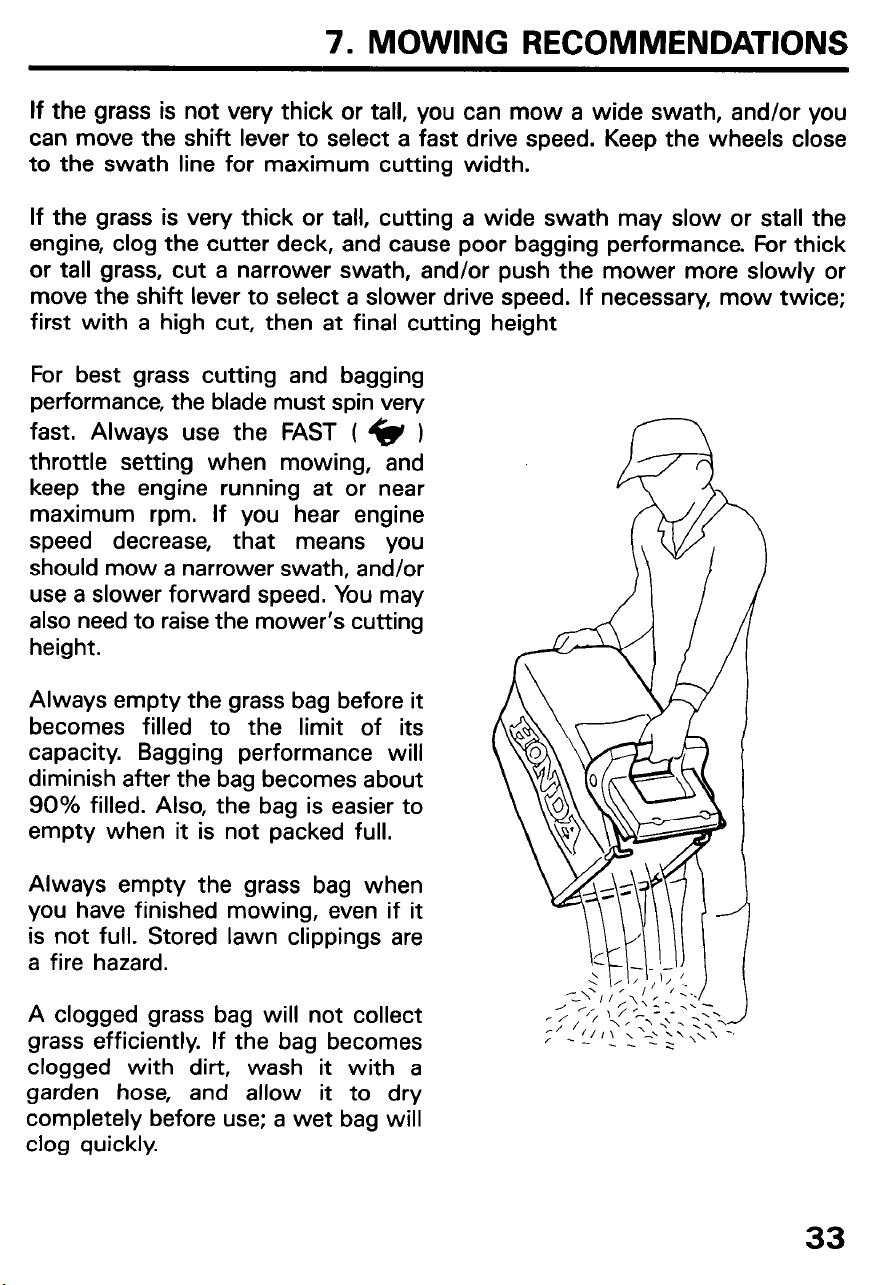
Always empty the grass bag before it
becomes filled to the limit of its
capacity. Bagging performance will
diminish after the bag becomes about
90% filled. Also, the bag is easier to
empty when it is not packed full.
Always empty the grass bag when
you have finished mowing, even if it
is not full. Stored lawn clippings are
a fire hazard.
A clogged grass bag will not collect
grass efficiently. If the bag becomes
clogged with dirt, wash it with a
garden hose, and allow it to dry
completely before use; a wet bag will
clog quickly.
33
8. TRANSPORTING
B
The engine and exhaust system become hot during operation
and remain hot for a while after stopping. Contact with hot engine components
can cause burns and can ignite some materials.
Avoid touching the engine or exhaust system for at least 15 minutes after the
engine has stopped. Allow the engine to cool before transporting the mower.
Before Loading
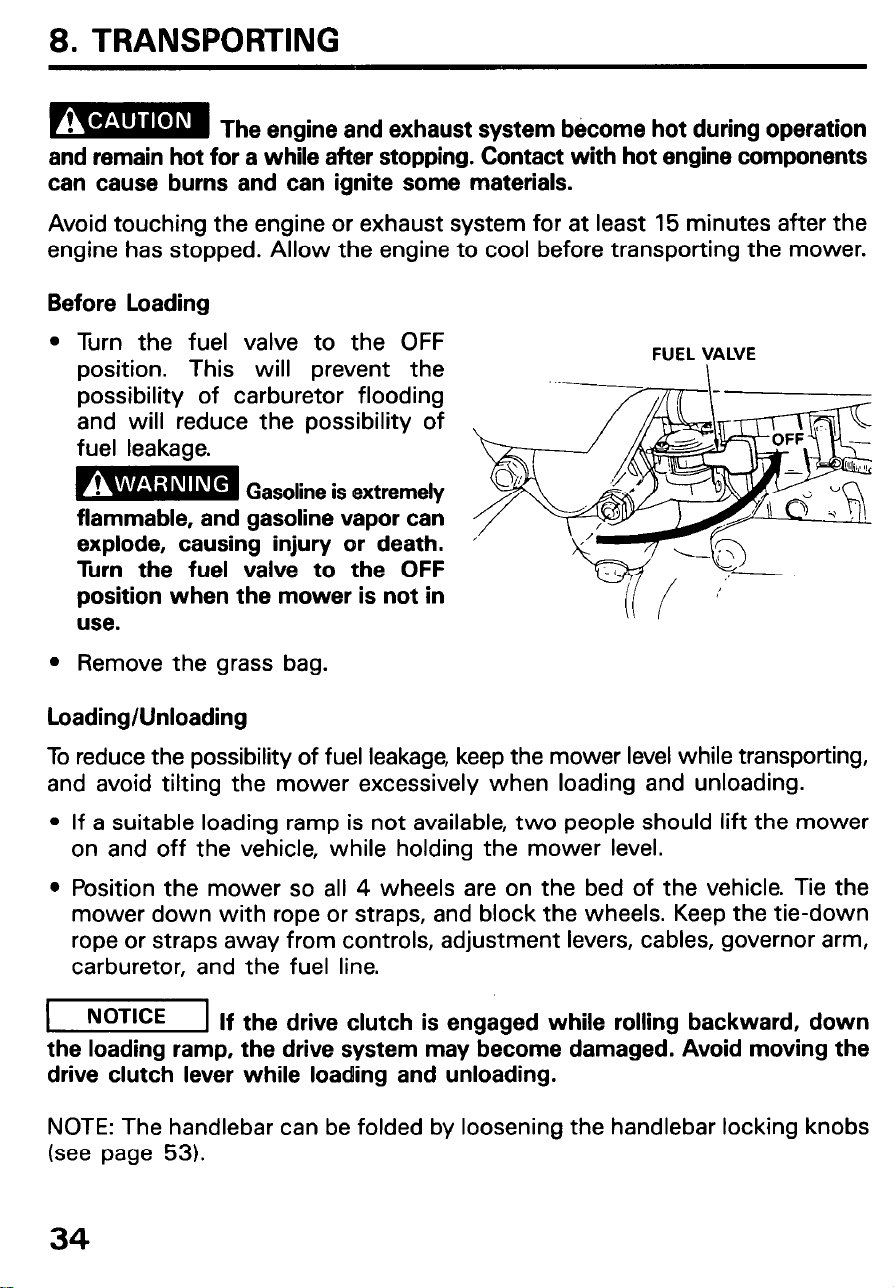
Turn the fuel valve to the OFF
position. This will prevent the
FUEL VALVE
possibility of carburetor flooding
and will reduce the possibility of
fuel leakage.
w
Gasoline is extremely
flammable, and gasoline vapor can
explode, causing injury or death. ’
Turn the fuel valve to the OFF
position when the mower is not in
use.
Remove the grass bag.
Loading/Unloading
To reduce the possibility of fuel leakage, keep the mower level while transporting,
and avoid tilting the mower excessively when loading and unloading.
l
If a suitable loading ramp is not available, two people should lift the mower
on and off the vehicle, while holding the mower level.
l
Position the mower so all 4 wheels are on the bed of the vehicle. Tie the
mower down with rope or straps, and block the wheels. Keep the tie-down
rope or straps away from controls, adjustment levers, cables, governor arm,
carburetor, and the fuel line.
pzEiEq
If the drive clutch is engaged while rolling backward, down
the loading ramp, the drive system may become damaged. Avoid moving the
drive clutch lever while loading and unloading.
NOTE: The handlebar can be folded by loosening the handlebar locking knobs
(see page 53).
34
9. MAINTENANCE
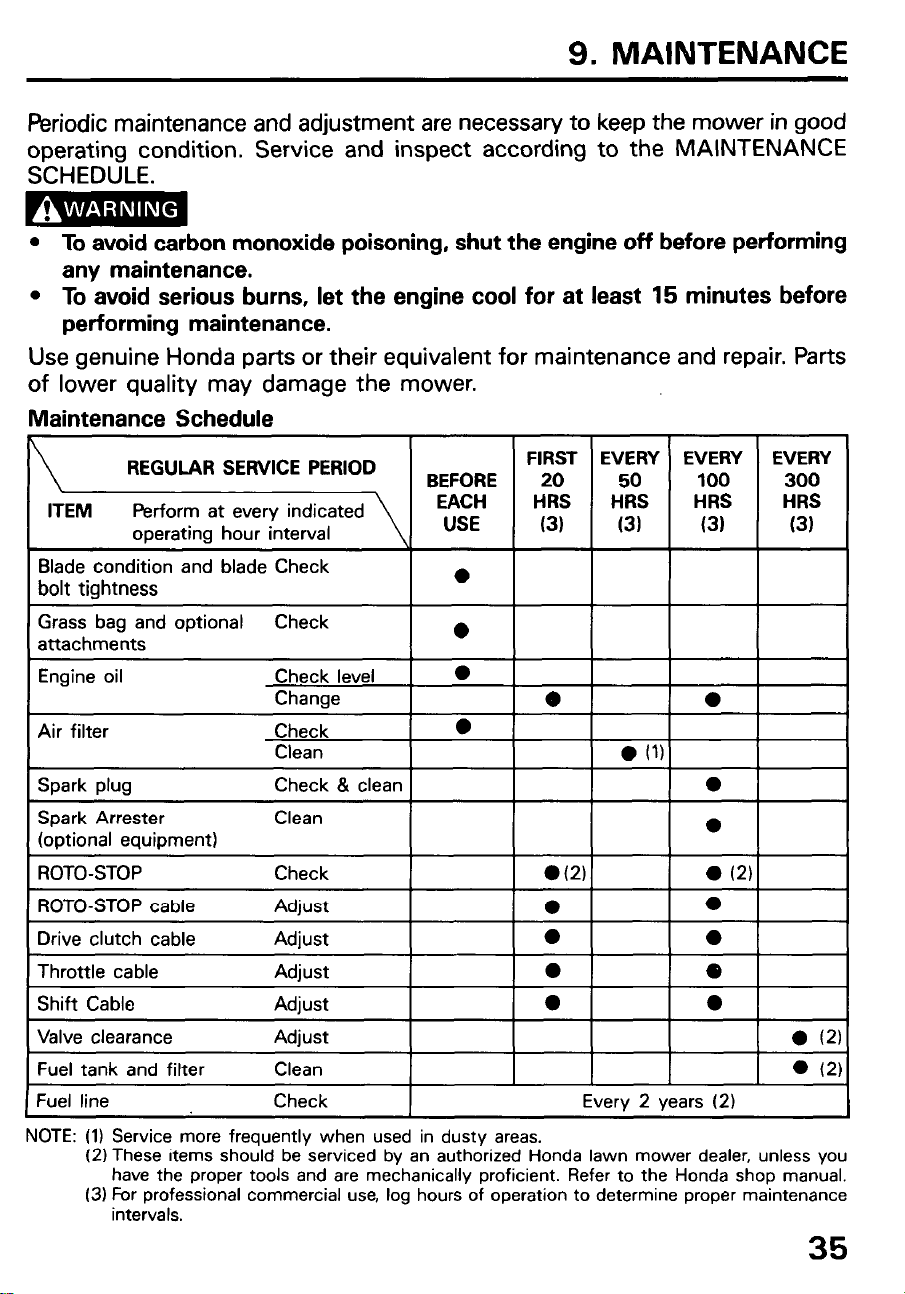
Periodic maintenance and adjustment are necessary to keep the mower in good
operating condition. Service and inspect according to the MAINTENANCE
SCHEDULE.
l
To avoid carbon monoxide poisoning, shut the engine off before performing
any maintenance.
l
To avoid serious burns, let the engine cool for at least 15 minutes before
performing maintenance.
Use genuine Honda parts or their equivalent for maintenance and repair. Parts
of lower quality may damage the mower.
Maintenance Schedule
NOTE: (1) Service more frequently when used in dusty areas.
(2) These items should be serviced by an authorized Honda lawn mower dealer, unless you
have the proper tools and are mechanically proficient. Refer to the Honda shop manual.
(3) For professional commercial use, log hours of operation to determine proper maintenance
intervals.
35
9. MAINTENANCE
ENGINE OIL CHANGE
Engine oil capacity: 0.63 US qt (0.6 k’)
Drain the oil while the engine is warm to assure rapid and complete draining.
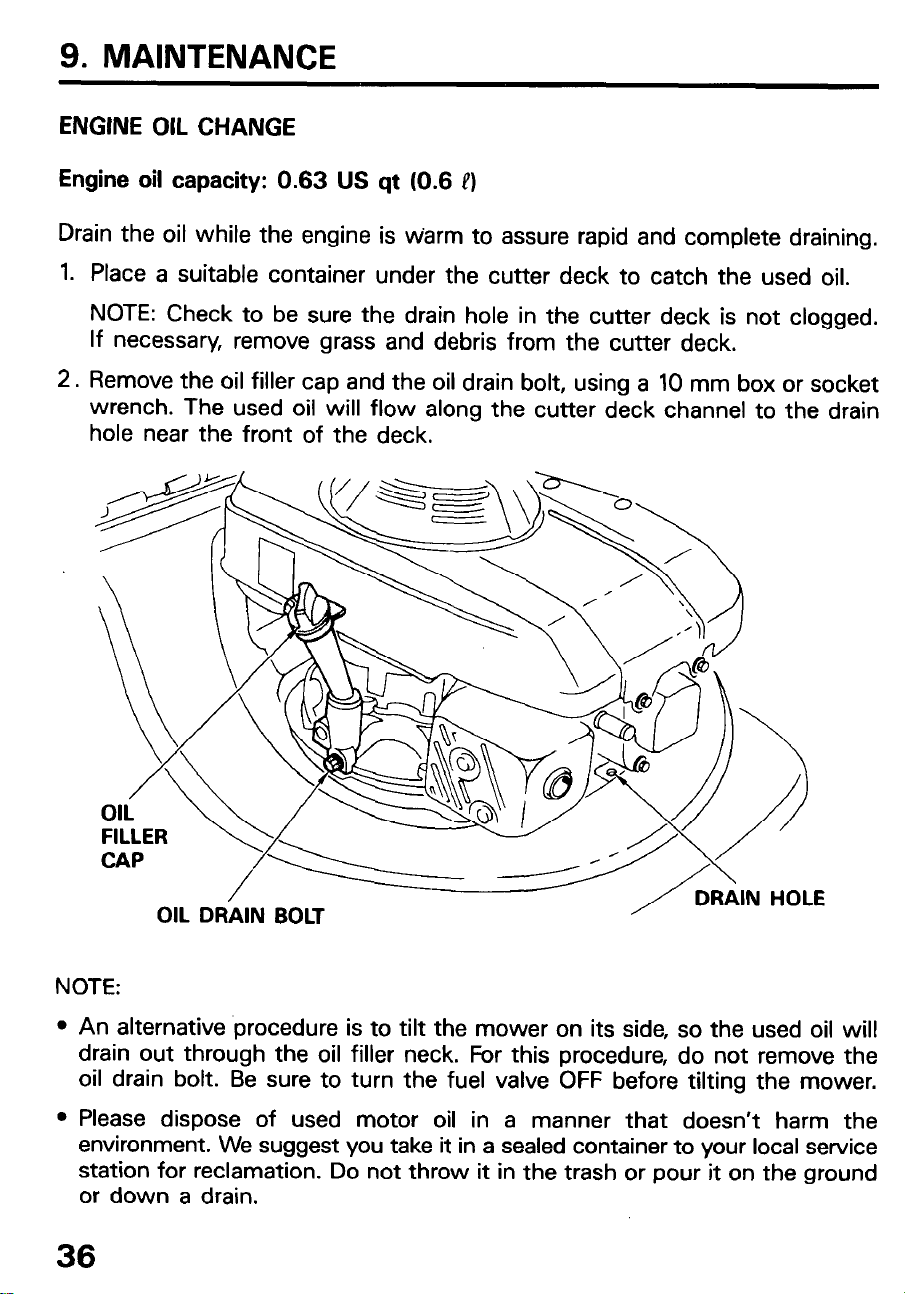
1. Place a suitable container under the cutter deck to catch the used oil.
NOTE: Check to be sure the drain hole in the cutter deck is not clogged.
If necessary, remove grass and debris from the cutter deck.
2. Remove the oil filler cap and the oil drain bolt, using a 10 mm box or socket
wrench. The used oil will flow along the cutter deck channel to the drain
hole near the front of the deck.
OIL DRAIN BOLT
NOTE:
l
An alternative procedure is to tilt the mower on its side, so the used oil will
drain out through the oil filler neck. For this procedure, do not remove the
oil drain bolt. Be sure to turn the fuel valve OFF before tilting the mower.
l
Please dispose of used motor oil in a manner that doesn’t harm the
environment. We suggest you take it in a sealed container to your local service
station for reclamation. Do not throw it in the trash or pour it on the ground
or down a drain.
36
3.
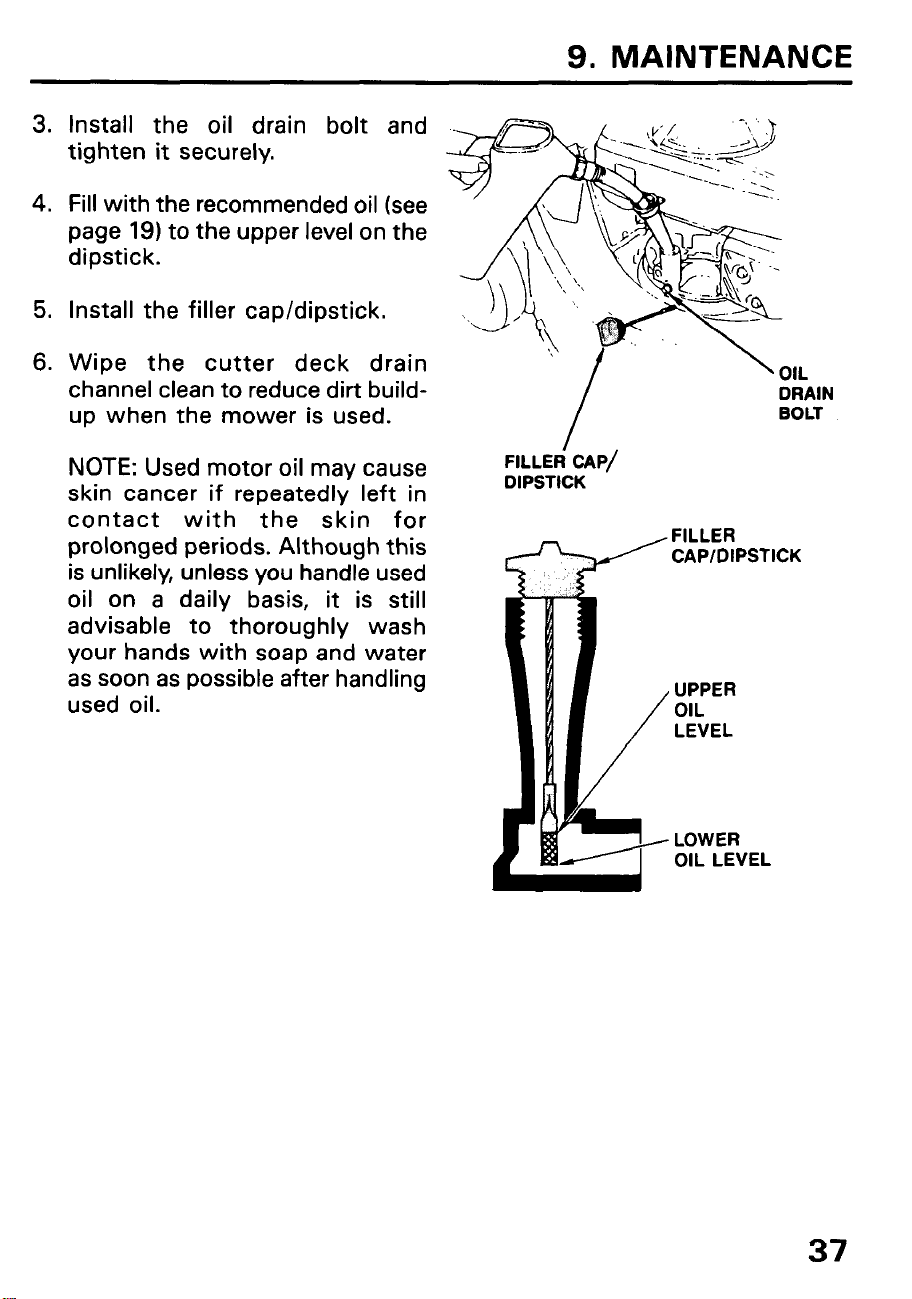
Install the oil drain bolt and
tighten it securely.
4. Fill with the recommended oil (see
page 19) to the upper level on the
dipstick.
5. Install the filler cap/dipstick.
6.
Wipe the cutter deck drain
channel clean to reduce dirt build-
up when the mower is used.
DRAIN
BOLT
NOTE: Used motor oil may cause
skin cancer if repeatedly left in
contact with the skin for
prolonged periods. Although this
DIPSTICK
FILLER
CAP/DIPSTICK
is unlikely, unless you handle used
oil on a daily basis, it is still
advisable to thoroughly wash
your hands with soap and water
as soon as possible after handling
used oil.
UPPER
OIL
LEVEL
LOWER
OIL LEVEL
37
9. MAINTENANCE
AIR CLEANER SERVICE
A dirty air filter will restrict air flow to the carburetor, reducing engine
performance. If you operate the mower in very dusty areas, clean the air filter
more often than specified in the MAINTENANCE SCHEDULE.
r--iEq
Operating the engine with no air filter, or a damaged air filter,
will cause rapid engine wear.
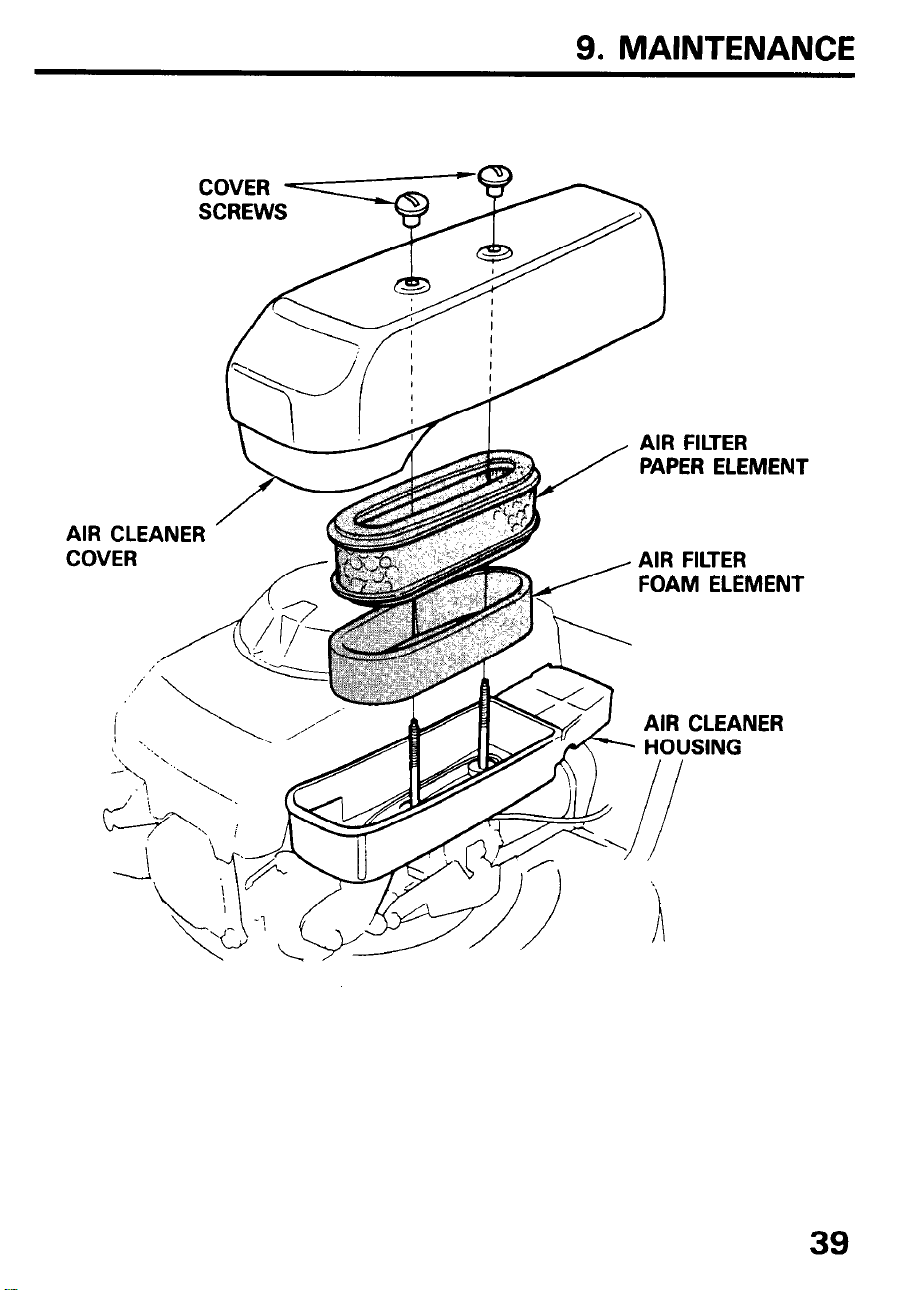
1. Remove the two cover screws, then remove the air cleaner cover. Remove
the air filter, and separate the filter elements. Carefully check both elements
for holes or tears, and replace the filter if damaged.
2. Foam element: Clean in warm soapy water, rinse, and allow to dry thoroughly.
Or clean in nonflammable solvent and allow to dry. Dip the element in clean
engine oil and squeeze out all excess oil. The engine will smoke during initial
running if too much oil is left in the foam.
B
Using gasoline or flammable solvent to clean the filter
element can lead to a fire or explosion. Use only soapy water or
nonflammable solvent.
3. Paper element: Tap the element several times on a hard surface to remove
excess dirt, or blow compressed air (not exceeding 30 psi) through the filter
from the inside. Never try to brush off dirt; brushing will force dirt into the
fibers.
4. Wipe dirt from the inside of the air cleaner housing and cover, using a moist
rag. Be careful to avoid dropping dirt into the air cleaner duct that leads
to the carburetor.
5. Reinstall the air filter and cover.
38
SCREWS
---WA
COVER \ Im
-
AIR CLEANER
’
COVER
/---
AIR FILTER
PAPER ELEMENT
AIR FILTER
FOAM ELEMENT
AIR CLEANER
39
9. MAINTENANCE
SPARK PLUG SERVICE
Recommended spark plugs: NGK BPR5ES
ND 16EPR-U
CHAMPION RN12Y
pEiEq
Spark plugs of the wrong heat range can cause engine
damage.
For good performance, the spark plug must be properly gapped and free of
deposits.
1.
2.
3.
Disconnect the spark plug cap, and remove any dirt from around the spark
plug area.
B
Touching the engine or exhaust system while hot can
cause burns. Let the engine cool before servicing.
Remove the spark plug with a spark plug wrench.
Inspect the spark plug. Replace it if the electrodes are worn, or if the insulator
is cracked or chipped. Clean the spark plug with a wire brush if you are
going to reuse it.
4.
5.
6.
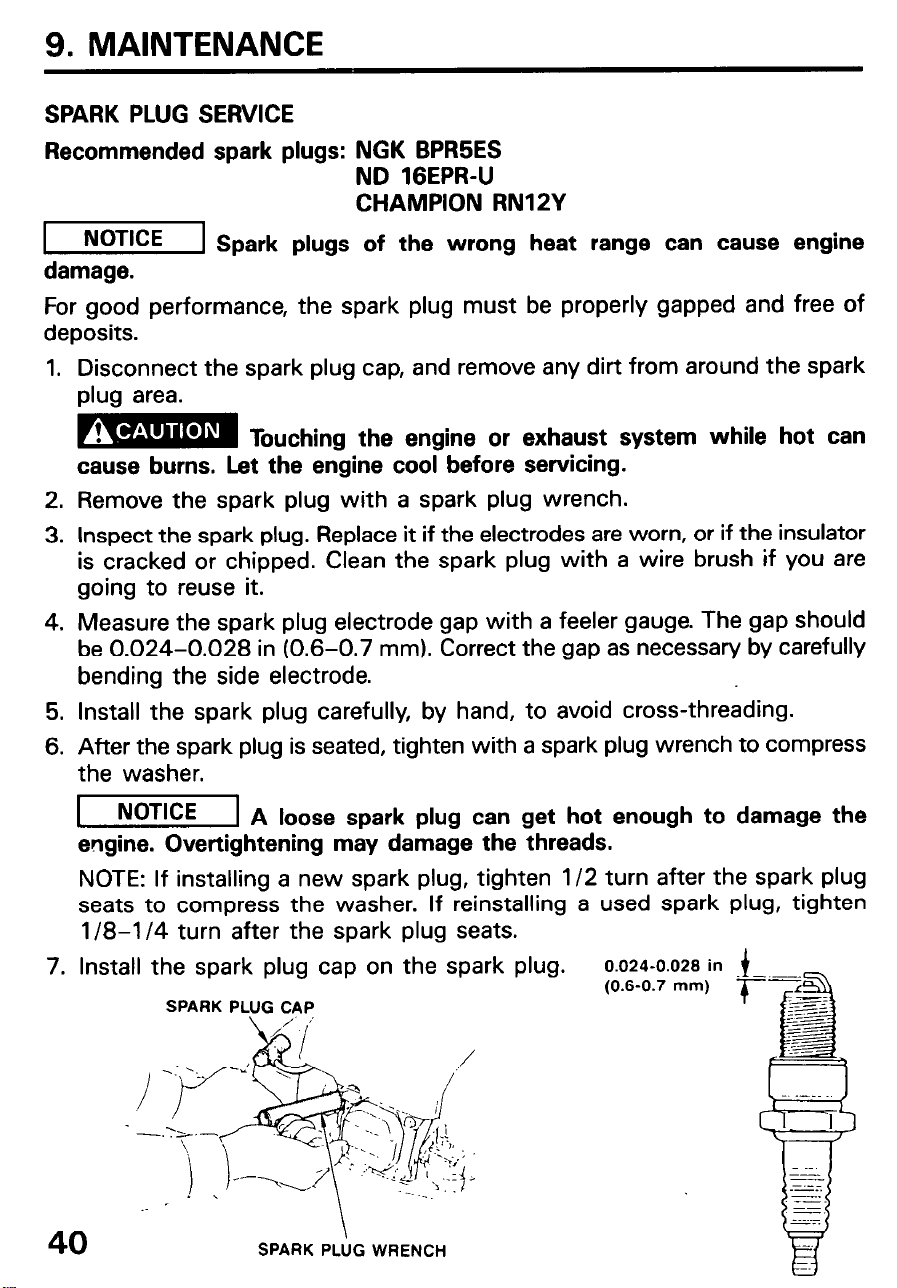
Measure the spark plug electrode gap with a feeler gauge. The gap should
be 0.024-0.028 in (0.6-0.7 mm). Correct the gap as necessary by carefully
bending the side electrode.
Install the spark plug carefully, by hand, to avoid cross-threading.
After the spark plug is seated, tighten with a spark plug wrench to compress
the washer.
1 NOTICE
1 A loose spark plug can get hot enough to damage the
engine. Over-tightening may damage the threads.
NOTE: If installing a new spark plug, tighten l/2 turn after the spark plug
seats to compress the washer. If reinstalling a used spark plug, tighten
l/8-1 /4 turn after the spark plug seats.
7.
Install the spark plug cap on the spark plug.
40
SPARK PLUG CAP
/-
-.
SPARK PLliJG WRENCH
0.024-0.026
in
(0.6-0.7
mm)
SPARK ARRESTER MAINTENANCE (optional equipment)
The spark arrester must be serviced every 100 hours to keep it functioning
as designed.
B
Touching the engine or exhaust system while hot can cause
burns. Let the engine cool before servicing.
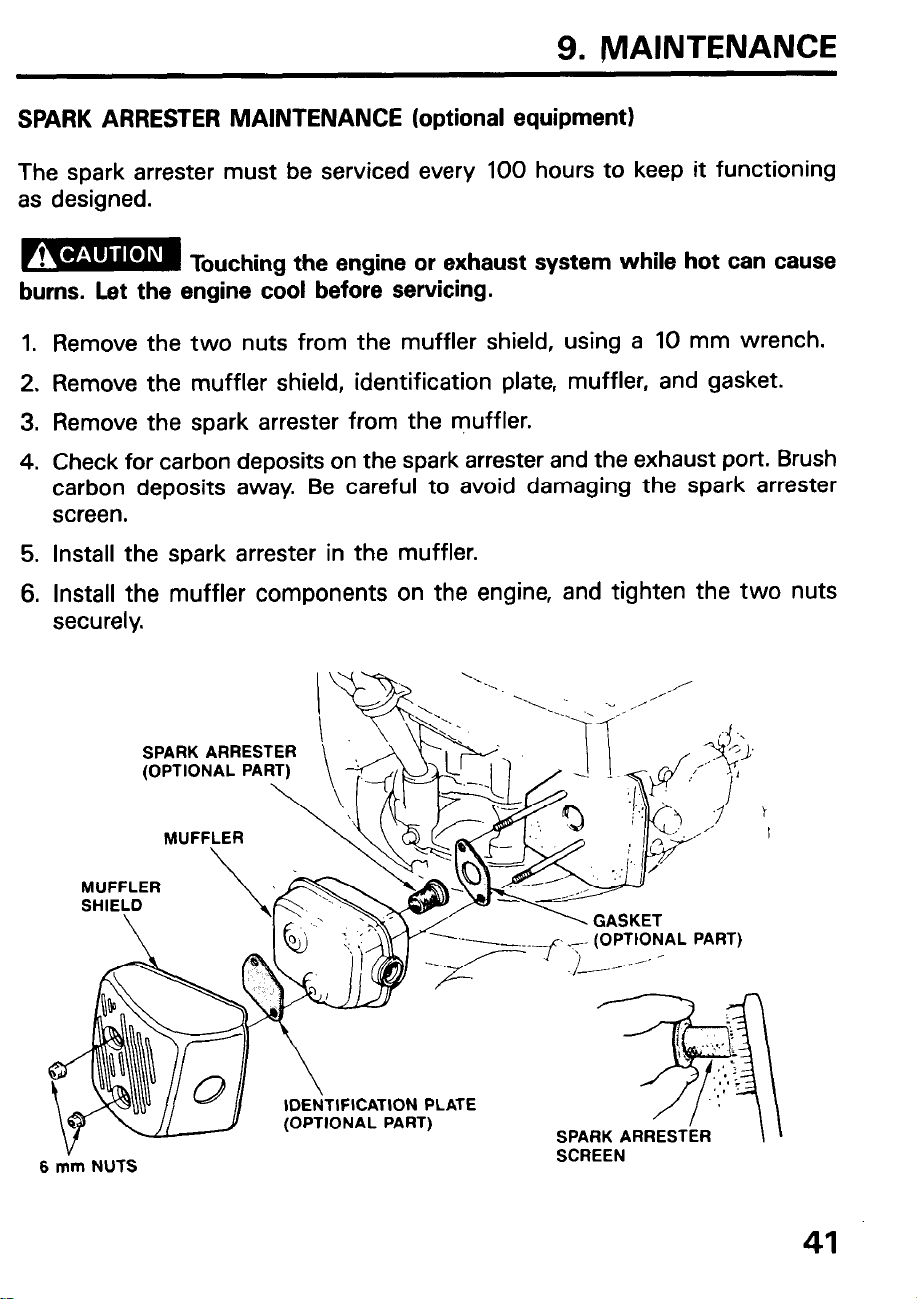
1. Remove the two nuts from the muffler shield, using a 10 mm wrench.
2. Remove the muffler shield, identification plate, muffler, and gasket,
3. Remove the spark arrester from the muffler.
4. Check for carbon deposits on the spark arrester and the exhaust port. Brush
carbon deposits away. Be careful to avoid damaging the spark arrester
screen.
5. Install the spark arrester in the muffler.
6. Install the muffler components on the engine, and tighten the two nuts
securely.
SPARK ARRESTER
(OPTIONAL PART)
MUFFLER
MUFFLER
SHIELD
(OPTIONAL PART)
SPARK ARRESTER
6
mm
NUTS
SCREEN
41
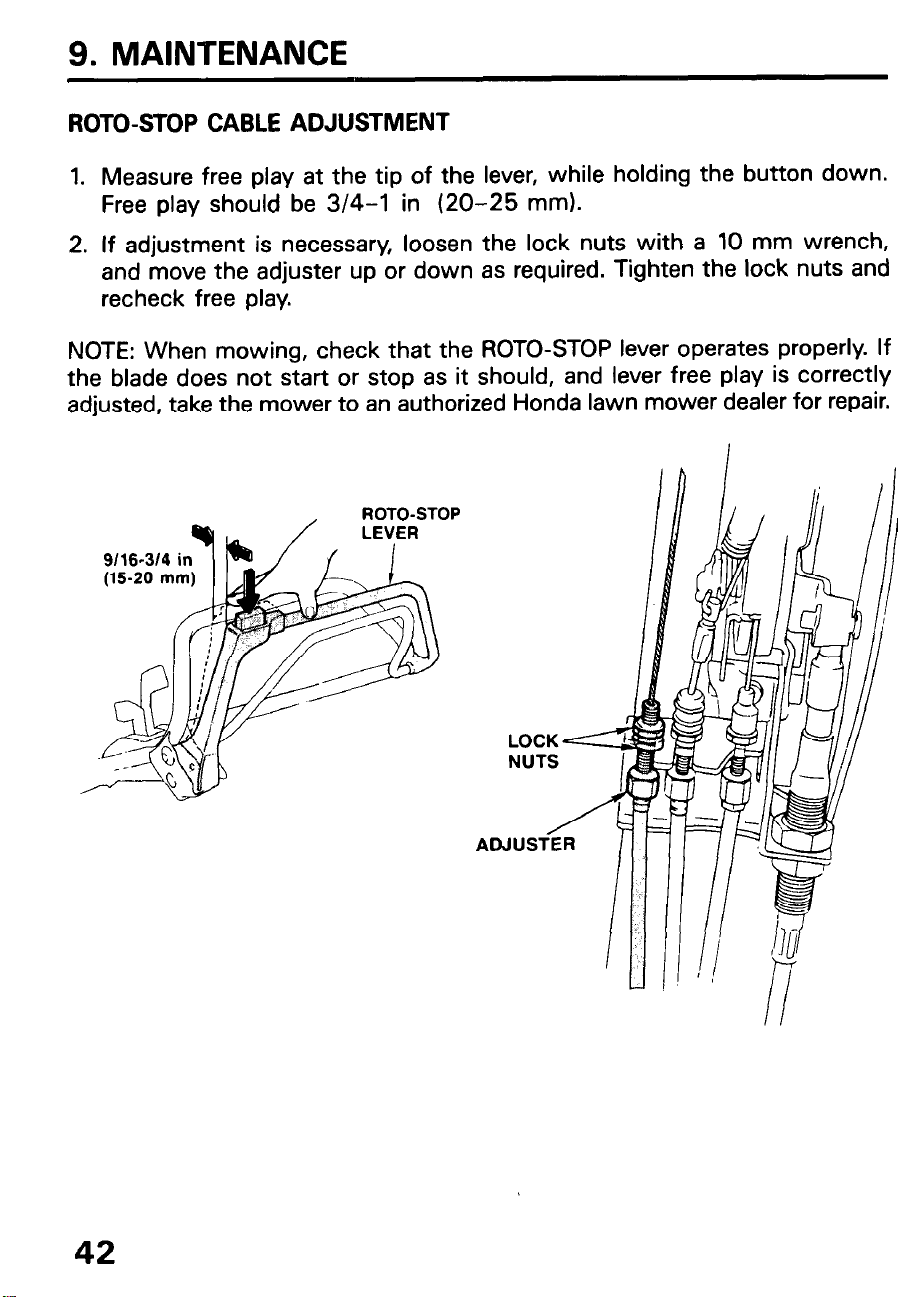
9. MAINTENANCE
ROTO-STOP CABLE ADJUSTMENT
1. Measure free play at the tip of the lever, while holding the button down.
Free play should be 3/4-l in (20-25 mm).
2. If adjustment is necessary, loosen the lock nuts with a 10 mm wrench,
and move the adjuster up or down as required. Tighten the lock nuts and
recheck free play.
NOTE: When mowing, check that the ROTO-STOP lever operates properly. If
the blade does not start or stop as it should, and lever free play is correctly
adjusted, take the mower to an authorized Honda lawn mower dealer for repair.
ROTO-STOP
42
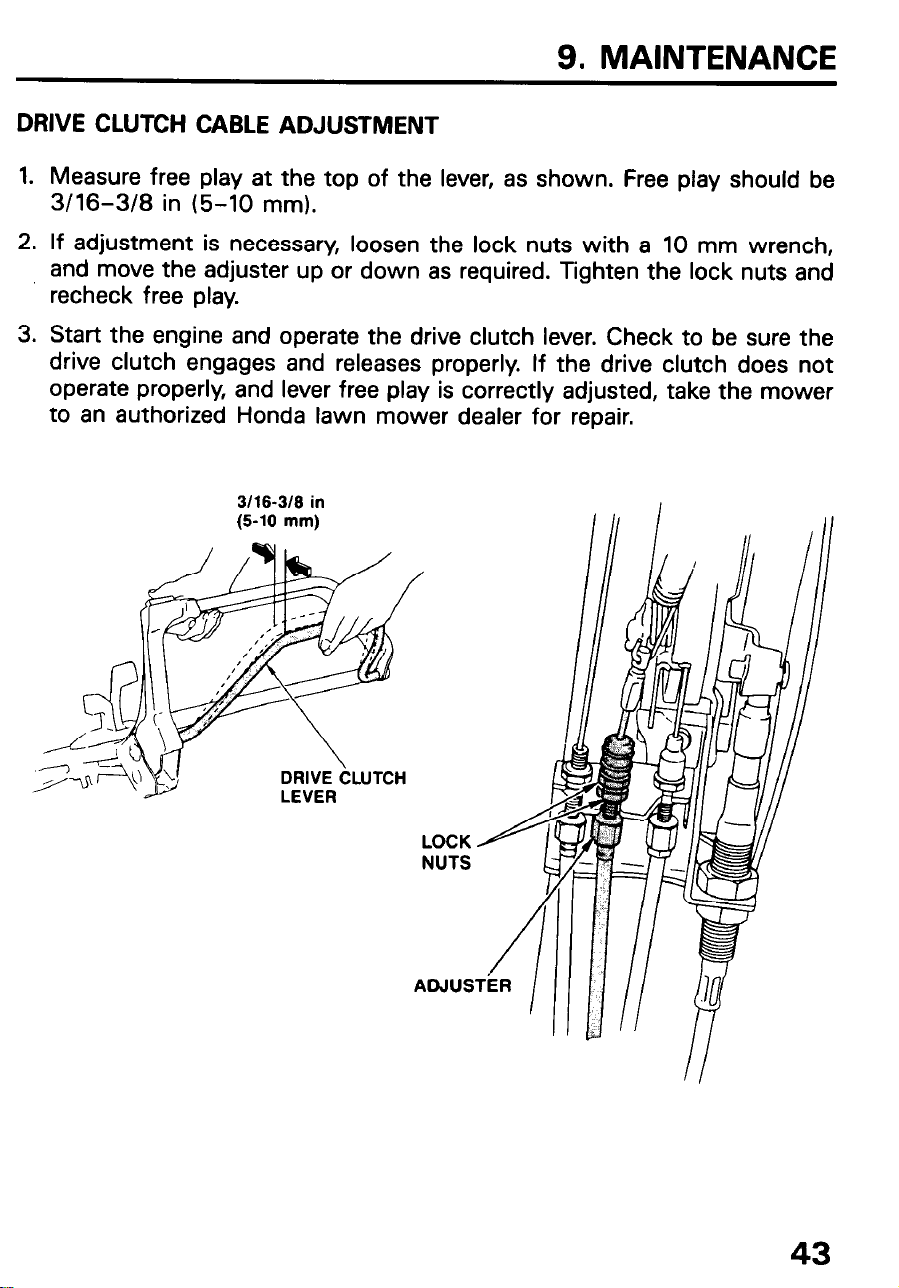
9. MAINTENANCE
DRIVE CLUTCH CABLE ADJUSTMENT
1. Measure free play at the top of the lever, as shown. Free play should be
3/16-3/8 in (5-10 mm).
2. If adjustment is necessary, loosen the lock nuts with a 10 mm wrench,
and move the adjuster up or down as required. Tighten the lock nuts and
recheck free play.
3. Start the engine and operate the drive clutch lever. Check to be sure the
drive clutch engages and releases properly. If the drive clutch does not
operate properly, and lever free play is correctly adjusted, take the mower
to an authorized Honda lawn mower dealer for repair.
DRIVE CLUTCH
43
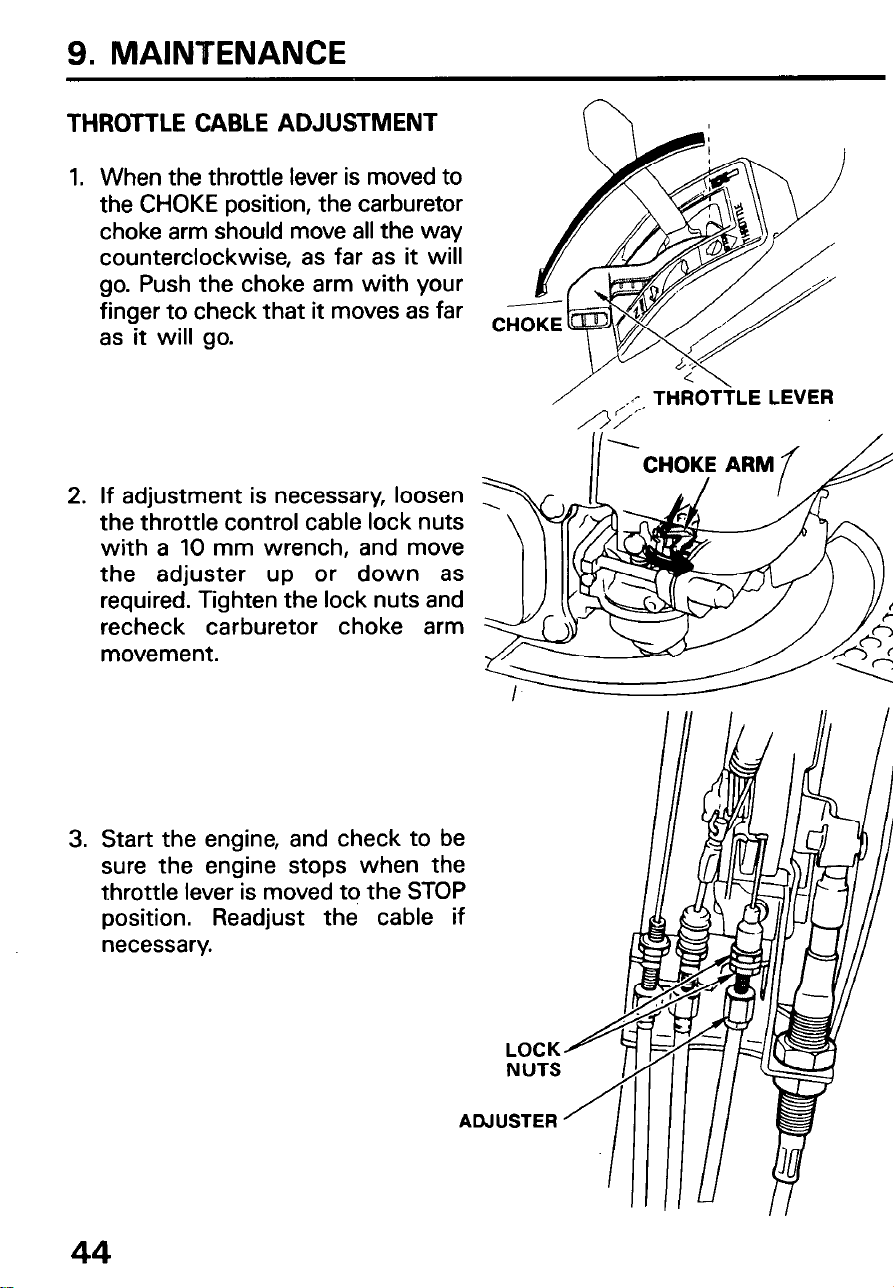
9. MAINTENANCE
THROTTLE CABLE ADJUSTMENT r--Y
1.
2.
When the throttle lever is moved to
the CHOKE position, the carburetor
choke arm should move all the way
counterclockwise, as far as it will
go. Push the choke arm with your
finger to check that it moves as far
as it will go.
/
/;, THROTiLE LEVER
A/
If adjustment is necessary, loosen
the throttle control cable lock nuts
with a 10 mm wrench, and move
the adjuster up or down as
required. Tighten the lock nuts and
recheck carburetor choke arm
movement.
3. Start the engine, and check to be
sure the engine stops when the
throttle lever is moved to the STOP
position. Readjust the cable if
necessary.
LOCK
NUTS
ADJUSTER
44
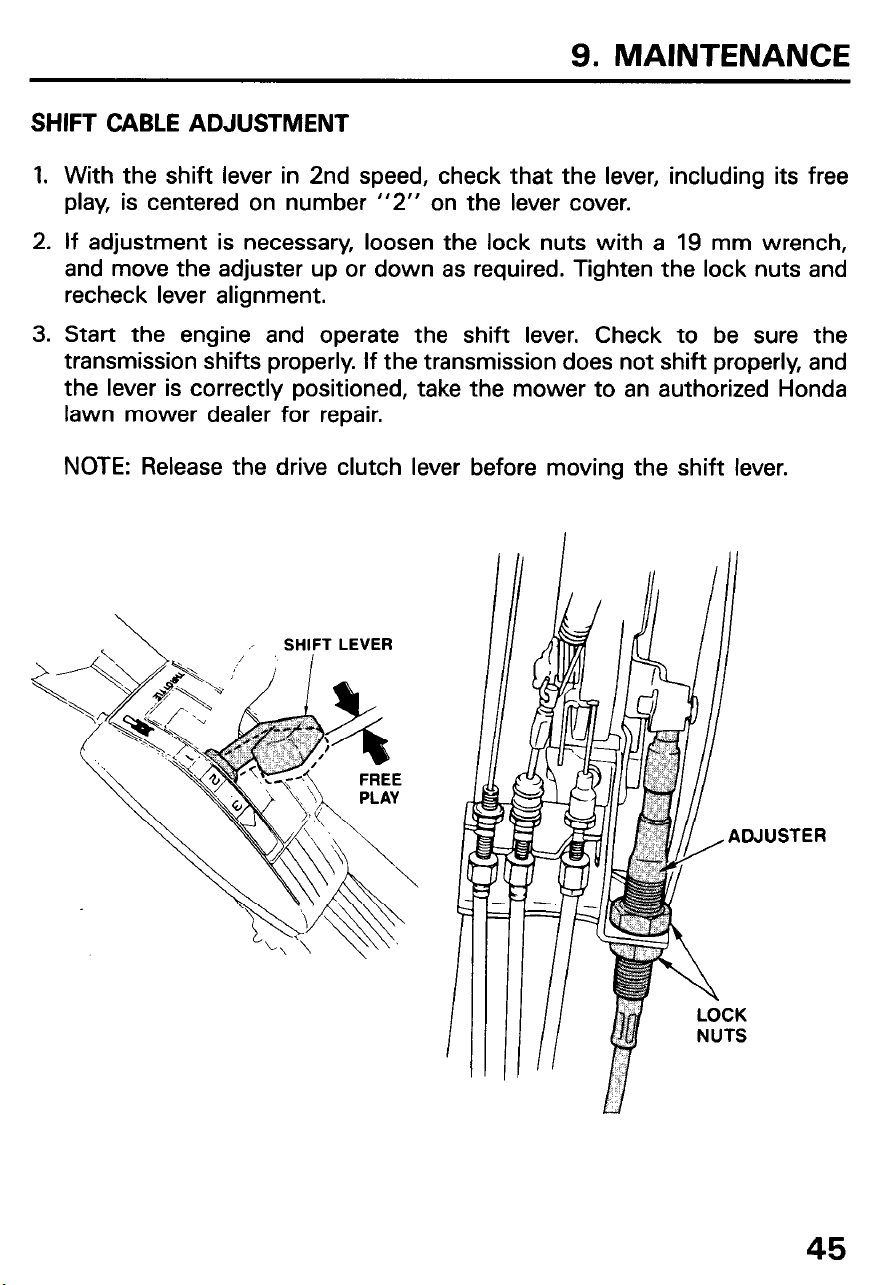
9. MAINTENANCE
SHIFT CABLE ADJUSTMENT
1. With the shift lever in 2nd speed, check that the lever, including its free
play, is centered on number “2” on the lever cover.
2. If adjustment is necessary, loosen the lock nuts with a 19 mm wrench,
and move the adjuster up or down as required. Tighten the lock nuts and
recheck lever alignment.
3. Start the engine and operate the shift lever. Check to be sure the
transmission shifts properly. If the transmission does not shift properly, and
the lever is correctly positioned, take the mower to an authorized Honda
lawn mower dealer for repair.
NOTE: Release the drive clutch lever before moving the shift lever.
45
9. MAINTENANCE
CARBURETOR ADJUSTMENT
1. Start the engine outdoors, and allow it to warm up to normal operating
temperature.
m
Exhaust contains poisonous carbon monoxide, a
colorless and odorless gas. Breathing exhaust can cause loss of
consciousness and may lead to death. To keep exhaust gas from building
up, provide adequate ventilation.
2. Set the throttle lever in the SLOW ( -1 position.
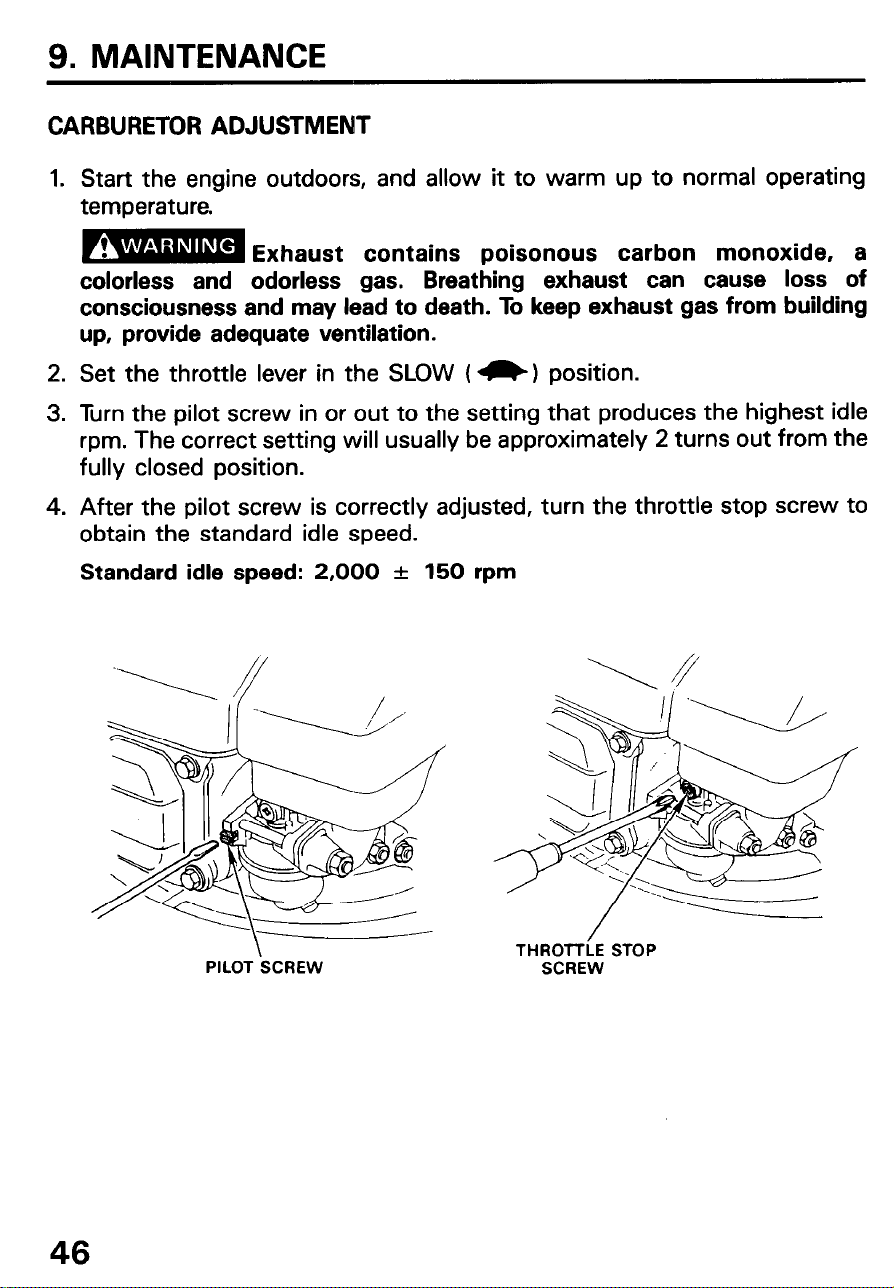
3. Turn the pilot screw in or out to the setting that produces the highest idle
rpm. The correct setting will usually be approximately 2 turns out from the
fully closed position.
4. After the pilot screw is correctly adjusted, turn the throttle stop screw to
obtain the standard idle speed.
Standard idle speed: 2,000 f 150 rpm
PILOT SCREW
SCREW
46
9. MAINTENANCE
GRASS BAG CLEANING AND REPLACEMENT
When the bag needs cleaning, wash
it with a garden hose, and allow it to
dry completely before use; a wet grass
bag will clog quickly.
Replace a frayed, torn, or deteriorated
bag with a Honda replacement bag or
its equivalent.
BAG REMOVAL
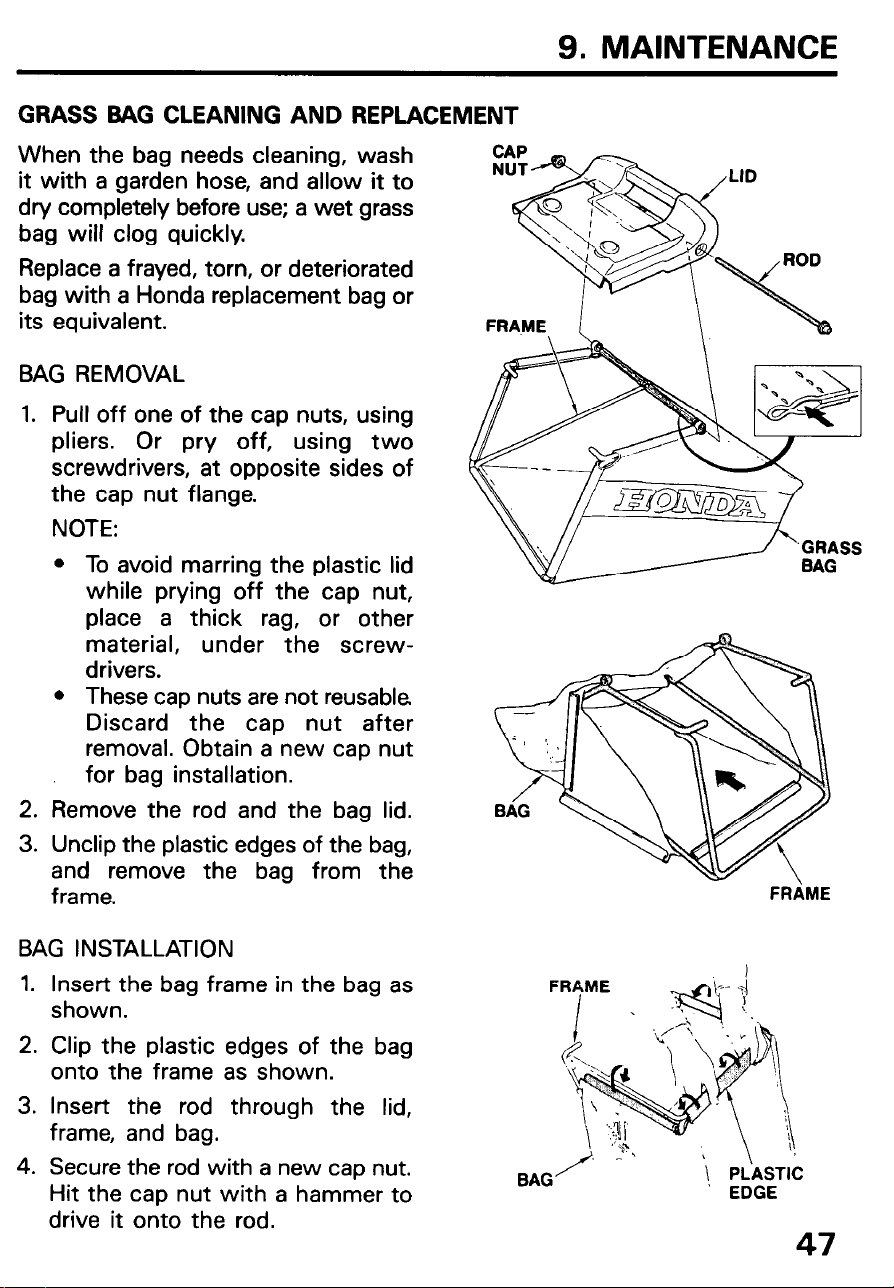
1. Pull off one of the cap nuts, using
pliers. Or pry off, using two
screwdrivers, at opposite sides of
the cap nut flange.
NOTE:
l
To avoid marring the plastic lid
while prying off the cap nut,
place a thick rag, or other
material, under the screw-
drivers.
l
These cap nuts are not reusable
Discard the cap nut after
removal. Obtain a new cap nut
for bag installation.
2. Remove the rod and the bag lid.
3. Unclip the plastic edges of the bag,
and remove the bag from the
frame.
BAG INSTALLATION
1.
2.
3.
4.
Insert the bag frame in the bag as
shown.
Clip the plastic edges of the bag
onto the frame as shown.
Insert the rod through the lid,
frame, and bag.
Secure the rod with a new cap nut.
Hit the cap nut with a hammer to
drive it onto the rod.
FRAME
9. MAINTENANCE
BLADE REMOVAL AND INSTALLATION
When the blade needs sharpening or replacement, take the lawn mower to
an authorized Honda lawn mower dealer. Or, if you have a torque wrench, you
can remove and install the blade yourself. Wear heavy gloves to protect your
hands.
l
Blade sharpening: To reduce the possibility of weakening the blade, or causing
imbalance or poor cutting performance, have the blade sharpened by an
authorized Honda lawn mower dealer.
l
Blade replacement: Use a genuine Honda replacement blade or its equivalent.
Blade Removal
1. Turn the fuel valve OFF, and rest the mower on its right side, so the carburetor
side is up.
NOTE: Hard starting and fuel leakage may result if the mower is placed with
the carburetor side down.
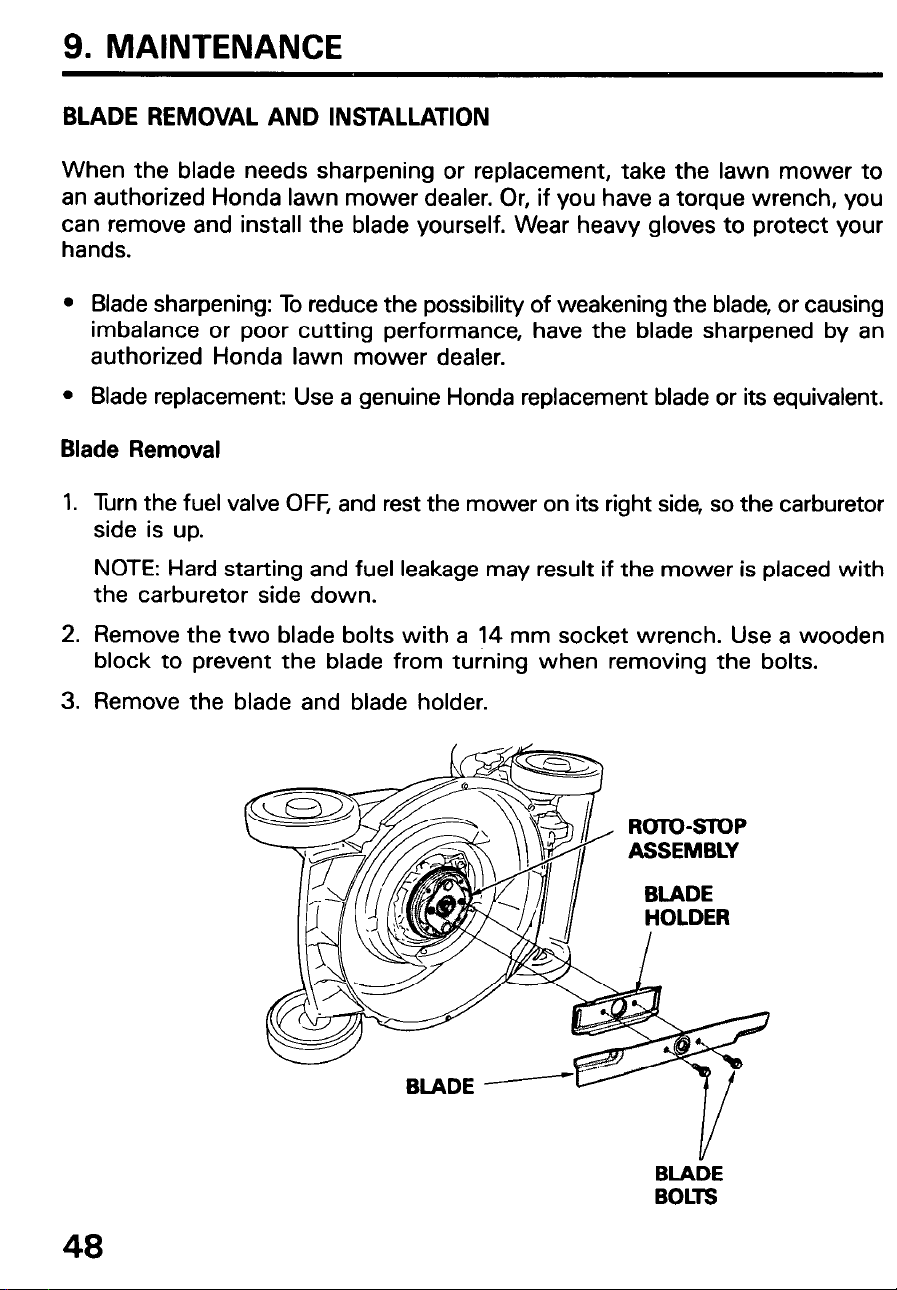
2. Remove the two blade bolts with a 14 mm socket wrench. Use a wooden
block to prevent the blade from turning when removing the bolts.
3. Remove the blade and blade holder.
BLkE
BOLTS
48
9. MAINTENANCE
Blade Installation
1. Clean dirt and grass from the blade mounting area.
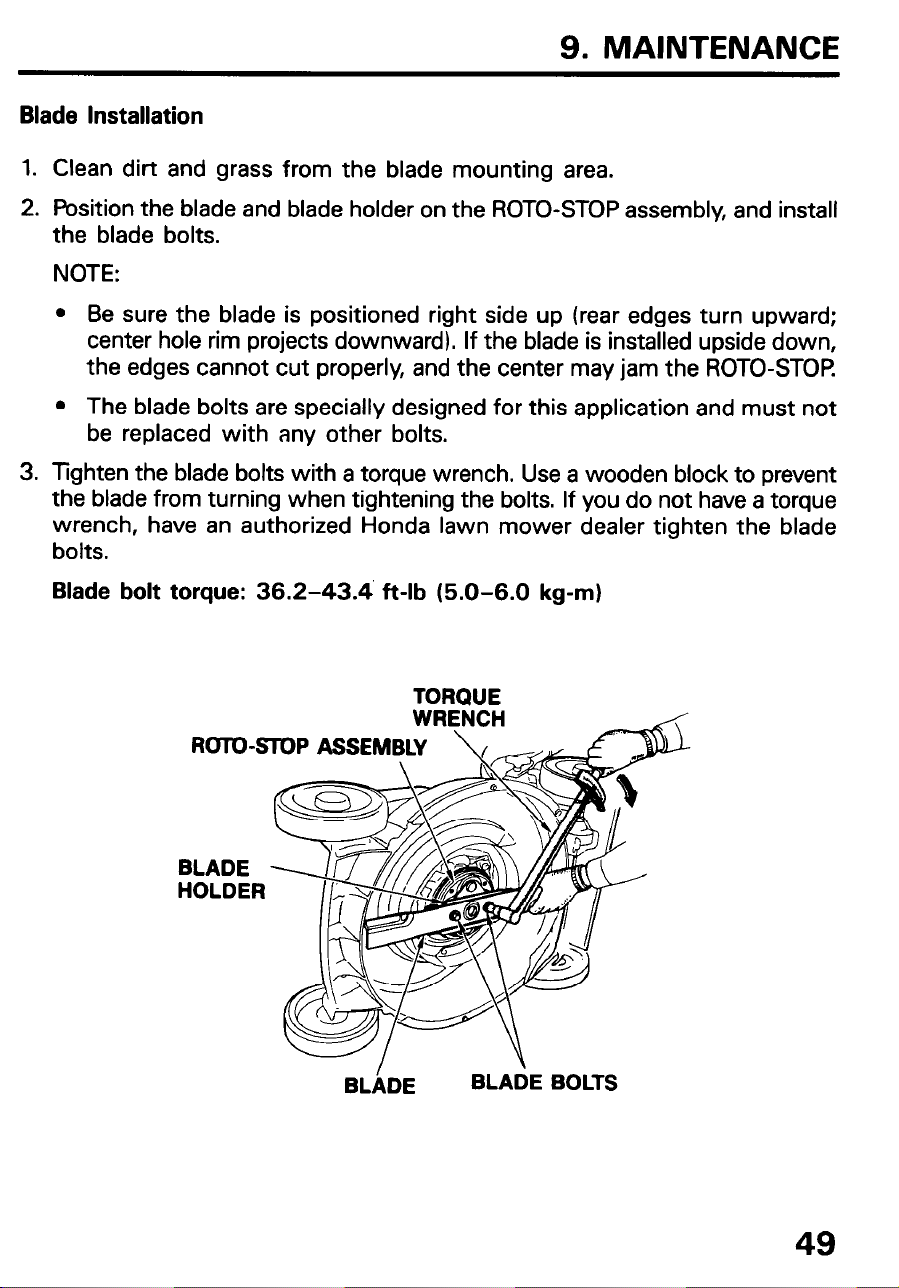
2. Position the blade and blade holder on the ROTO-STOP assembly, and install
the blade bolts.
NOTE:
l
Be sure the blade is positioned right side up (rear edges turn upward;
center hole rim projects downward). If the blade is installed upside down,
the edges cannot cut properly, and the center may jam the ROTO-STOP
l
The blade bolts are specially designed for this application and must not
be replaced with any other bolts.
3. Tighten the blade bolts with a torque wrench. Use a wooden block to prevent
the blade from turning when tightening the bolts. If you do not have a torque
wrench, have an authorized Honda lawn mower dealer tighten the blade
bolts.
Blade bolt torque: 36.2-43.4 ft-lb (5.0-6.0 kg-m)
TORQUE
WRENCH
ROTC)-STOP ASEM
BLADE
HOLDER
BLADE
BLADE BOLTS
49
10. STORAGE
Preparation for Storage
When the mower will not be used for one month or longer, proper storage
preparation will help to prevent rust and corrosion, and will make it easier to
start the engine when the mower is removed from storage.
1. Clean all surfaces of the mower, including the area underneath the cutter
deck. Wear heavy gloves to protect your hands.
NOTE: Before cleaning under the cutter deck, turn the fuel valve OFF, and
rest the mower on its right side, so the carburetor side is up. Hard starting
and fuel leakage may result if the mower is placed with the carburetor side
down.
If you use a garden hose to wash the mower, observe the following
precautions:
l
If the mower has been running, allow the engine to cool for at least half
an hour before spraying water on it. Never spray water on hot engine.
l
Wash the mower using low water pressure, and keep water away from
controls, cable ends, wheel hubs, and all other places that are difficult
to dry if water enters.
l
After washing, start the engine outdoors, and let it run until it reaches
normal operating temperature to evaporate any water remaining on the
engine . Operate the ROTO-STOP lever 4 or 5 times to expel water from
the ROTO-STOP mechanism; allow the blade to spin for several minutes
to ensure that no water remains.
l
Stop the engine, turn the fuel valve OFF, and allow the engine to cool
before placing the mower in storage.
2. Wash the grass bag, and allow it to dry completely.
1
NoTlCE 1 Stored lawn clippings are a fire hazard. Always empty the
grass bag after use.
3. Coat areas that may rust with a light film of oil. lubricate all control cable
cores with a silicone spray lubricant.
50
10. STORAGE
4. For prolonged storage, perform these additional steps:
For storage of 1 or 2 months:
For storage of 1 or 2 months, be sure the fuel tank is full. If partially filled,
air in the tank will promote fuel oxidation and deterioration, resulting in bad
fuel that may cause hard starting. Deteriorated fuel may also clog carburetor
passages, requiring carburetor repair or replacement.
NOTE: The Distributor’s Limited Warranty does not cover fuel system
damage or engine performance problems resulting from neglected storage
preparation.
a. Fill the fuel tank with fresh gasoline, and add a gasoline conditioner,
such as HONDA FUEL STABILIZER, which is formulated to extend fuel
storage life.
b. Run the engine outdoors for 10 minutes to be sure that treated gasoline
has replaced the untreated gasoline in the carburetor.
c. Stop the engine, turn the fuel valve OFF, and allow the engine to cool
before placing the mower in storage.
For storage of more than 2 months:
a. Change the engine oil (see page
36).
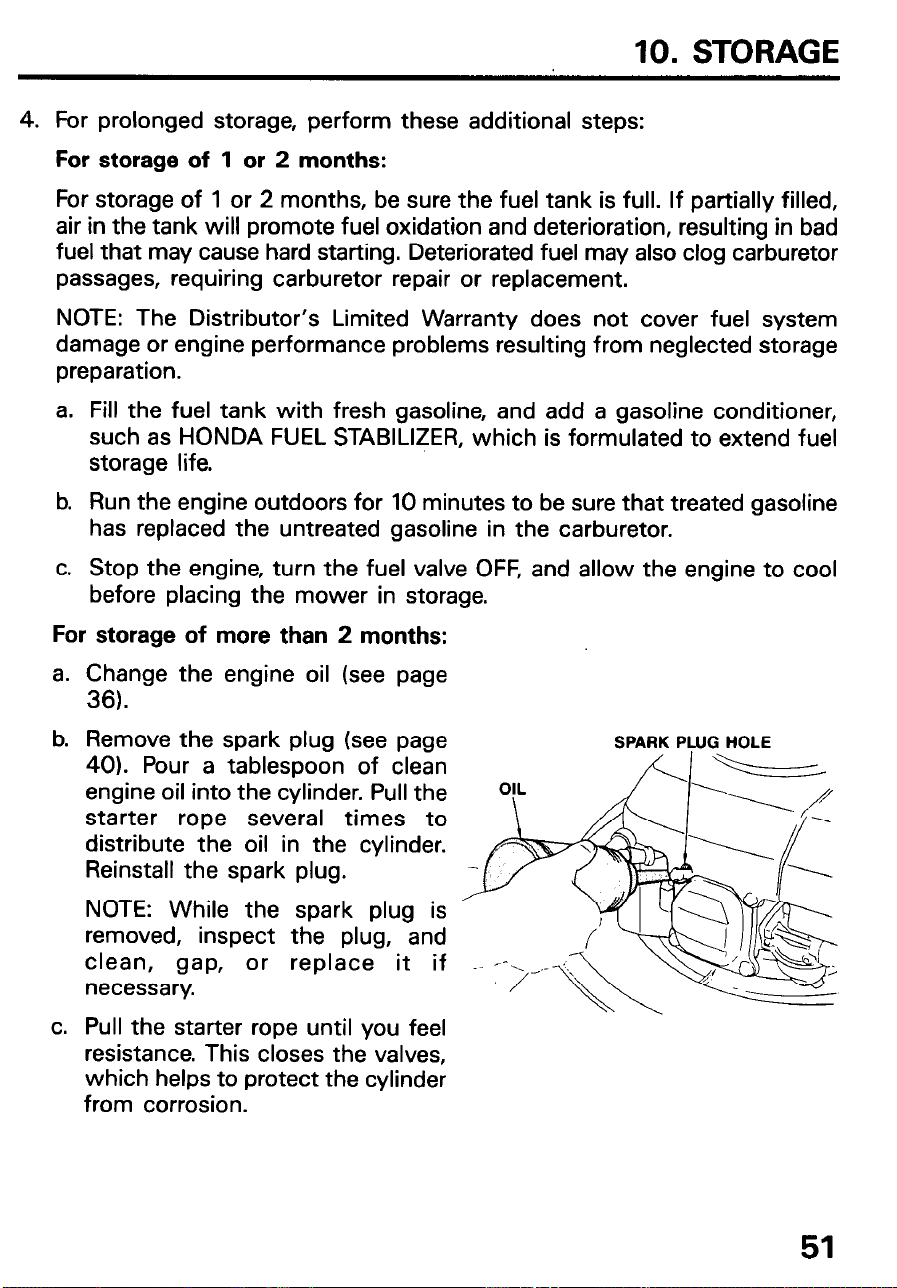
b. Remove the spark plug (see page
40). Pour a tablespoon of clean
engine oil into the cylinder. Pull the
starter rope several times to
distribute the oil in the cylinder.
Reinstall the spark plug.
o
SPARK PLUG HOLE
NOTE: While the spark plug is
removed, inspect the plug, and
clean, gap, or replace it if .- :-)-.
necessary.
c. Pull the starter rope until you feel
resistance. This closes the valves,
which helps to protect the cylinder
from corrosion.
51
10. STORAGE
For storage of more than 2 months (continued):
d.
e.
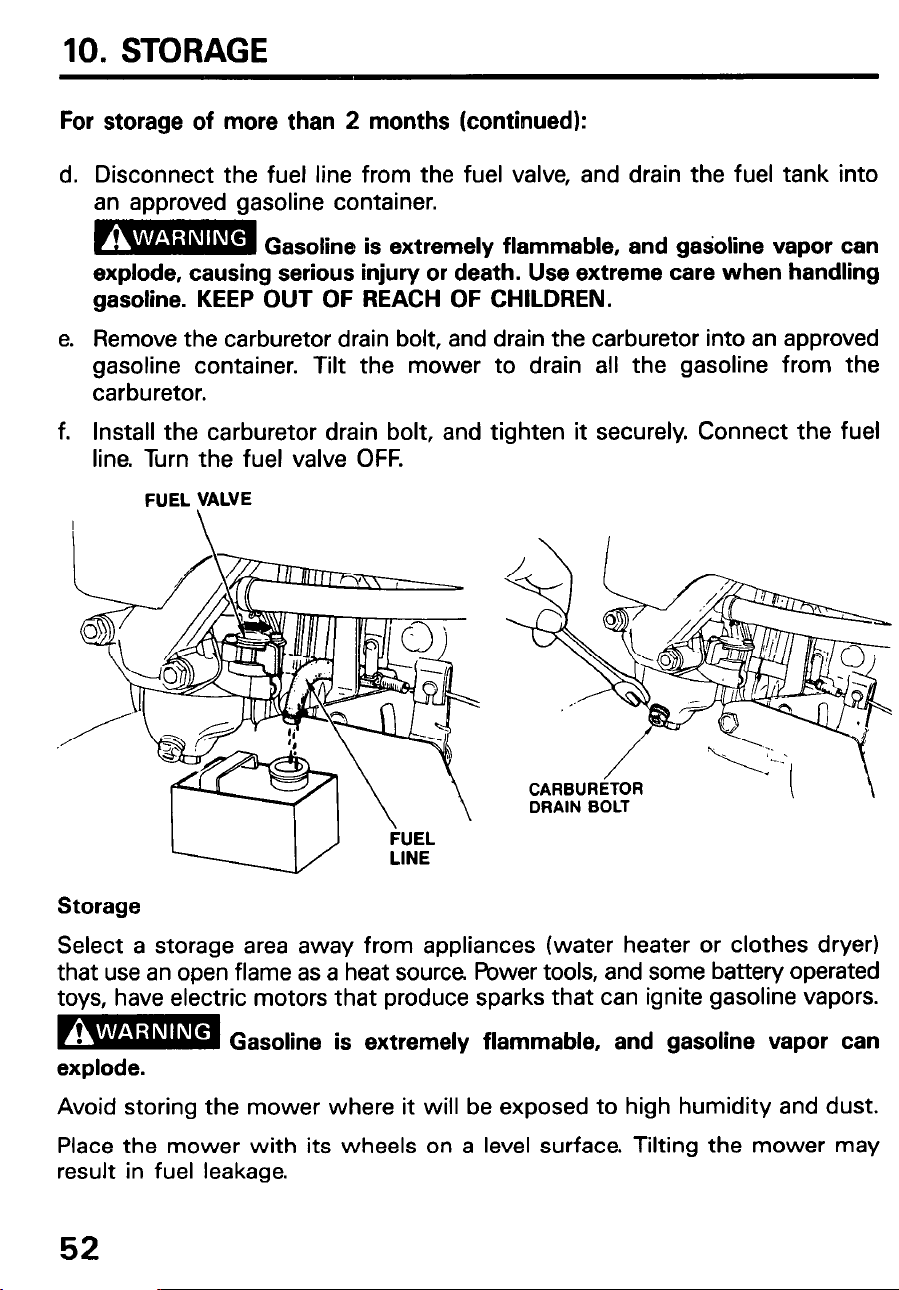
Disconnect the fuel line from the fuel valve, and drain the fuel tank into
an approved gasoline container.
m
Gasoline is extremely flammable, and gaioline vapor can
explode, causing serious injury or de&h. Use extreme c&e when handling
gasoline. KEEP OUT OF REACH OF CHILDREN.
Remove the carburetor drain bolt, and drain the carburetor into an approved
gasoline container. Tilt the mower to drain all the gasoline from the
carburetor.
Install the carburetor drain bolt, and tighten it securely. Connect the fuel
line. Turn the fuel valve OFF.
FUEL VALVE
Storage
CARBURiTOR
DRAIN BOLT
Select a storage area away from appliances (water heater or clothes dryer)
that use an open flame as a heat source Power tools, and some battery operated
toys, have electric motors that produce sparks that can ignite gasoline vapors.
B
Gasoline is extremely flammable, and gasoline vapor can
explode.
Avoid storing the mower where it will be exposed to high humidity and dust.
Place the mower with its wheels on a level surface. Tilting the mower may
result in fuel leakage.
52
10. STORAGE
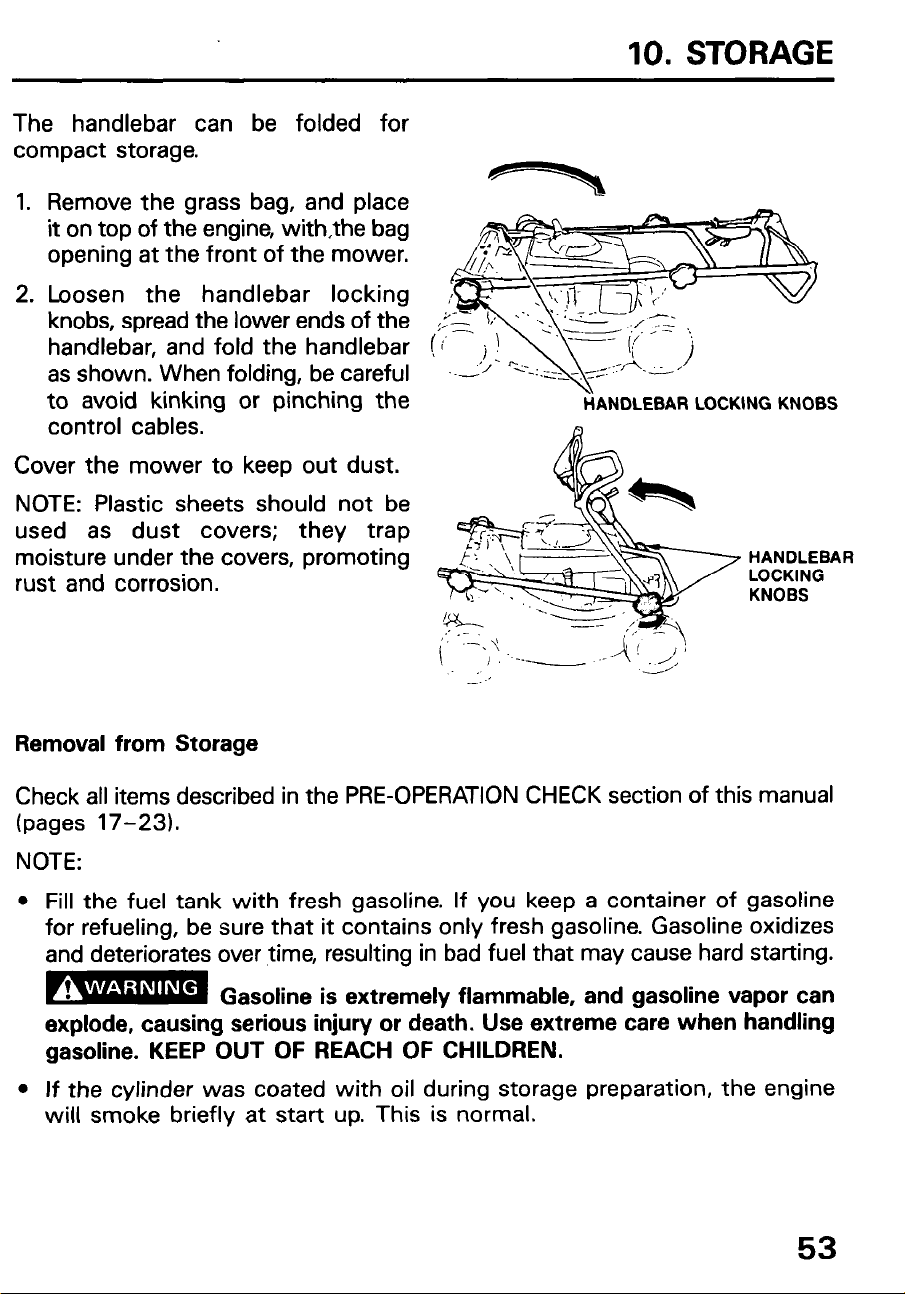
The handlebar can be folded for
comoact storaae.
1.
2.
Remove the grass bag, and place
-=-%
it on top of the engine, with,the bag
opening at the front of the mower.
Loosen the handlebar locking
knobs, spread the lower ends of the
handlebar, and fold the handlebar !;
as shown. When folding, be careful
to avoid kinking or pinching the
control cables.
HANDLEBAR LOCKING KNOBS
A
Cover the mower to keep out dust.
NOTE: Plastic sheets should not be
used as dust covers; they trap
moisture under the covers, promoting
rust and corrosion.
HANDLEBAR
LOCKING
KNOBS
Removal from Storage
Check all items described in the PRE-OPERATION CHECK section of this manual
(pages 17-23).
NOTE:
l
Fill the fuel tank with fresh gasoline. If you keep a container of gasoline
for refueling, be sure that it contains only fresh gasoline. Gasoline oxidizes
and deteriorates over time, resulting in bad fuel that may cause hard starting.
B -
Gasoline is extremely flammable, and gasoline vapor can
explode, causing serious injury or de&h. Use extreme c&e when handling
gasoline. KEEP OUT OF REACH OF CHILDREN.
l
If the cylinder was coated with oil during storage preparation, the engine
will smoke briefly at start up. This is normal.
53
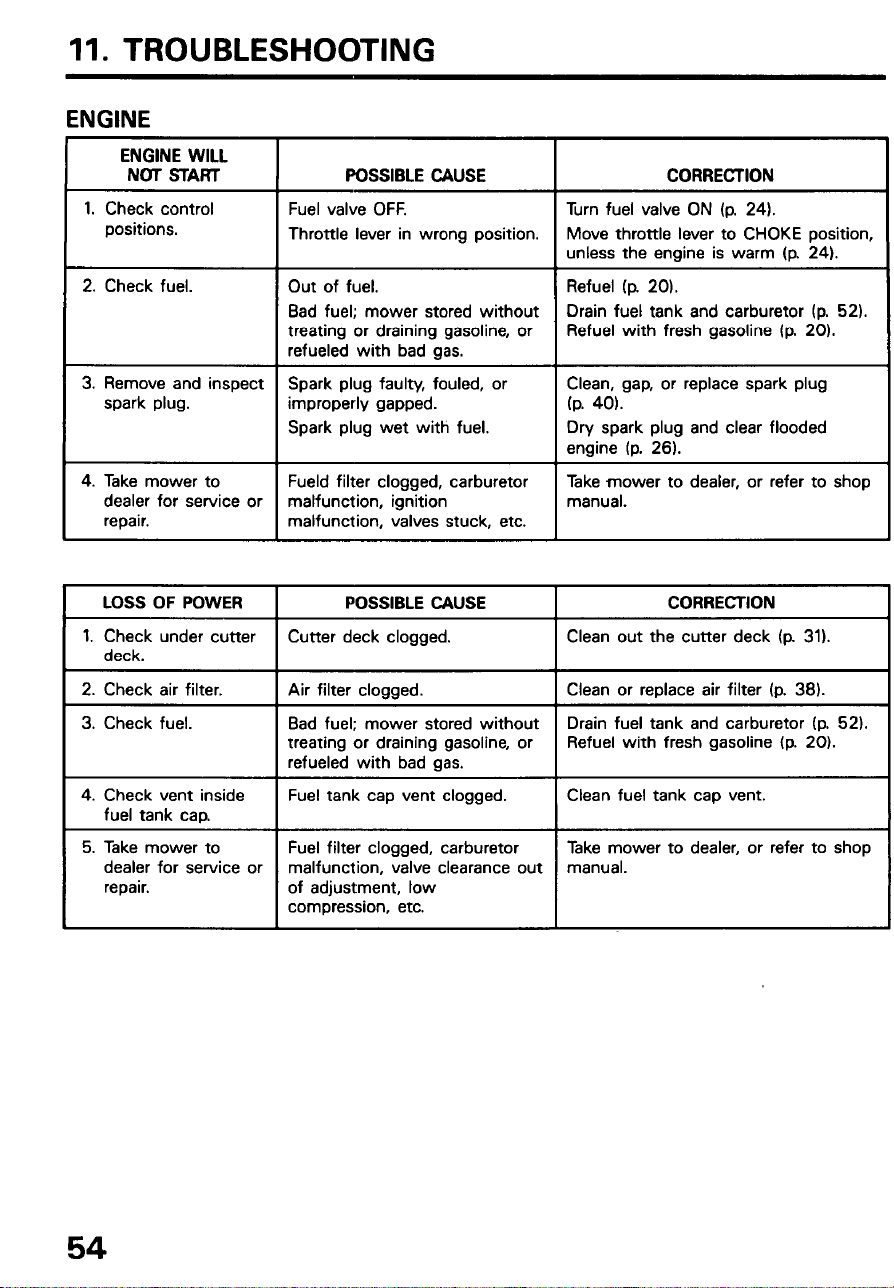
11. TROUBLESHOOTING
ENGINE
(
1. Check control
positions.
1 2. Check fuz
3. Remove and inspect
spark plug.
4. Take mower to
Fueld filter clogged, carburetor
dealer for service or malfunction, ignition
repair.
malfunction, valves stuck, etc.
I
LOSS OF POWER
1. Check under cutter
deck.
2. Check air filter.
3. Check fuel.
I
4. Check vent inside
fuel tank cap
5. Take mower to
dealer for service or
repair.
POSSIBLE CAUSE CORRECTION
Fuel valve OFF. Turn fuel valve ON (p. 24).
Throttle lever in wrong position. Move throttle lever to CHOKE position,
unless the engine is warm (p. 24).
Out of fuel. Refuel fp 201.
Bad fuel; mower stored without Drain fuel tank and carburetor fp. 52).
treating or draining gasoline, or
Refuel with fresh gasoline (p. 20).
refueled with bad gas.
Spark plug faulty, fouled, or
improperly gapped.
Spark plug wet with fuel.
Clean, gap, or replace spark plug
(P.
40).
Dry spark plug and clear flooded
engine fp. 26).
Take mower to dealer, or refer to shop
manual.
POSSIBLE CAUSE
I
CORRECTION
Cutter deck clogged. Clean out the cutter deck (p. 31).
Air filter clogged. Clean or replace air filter (p. 38).
Bad fuel; mower stored without
Drain fuel tank and carburetor fp. 52).
treating or draining gasoline, or
Refuel with fresh gasoline (p. 20).
refueled with bad gas.
Fuel tank cap vent clogged. Clean fuel tank cap vent.
Fuel filter clogged, carburetor Take mower to dealer, or refer to shop
malfunction, valve clearance out manual.
of adjustment, low
compression, etc.
54
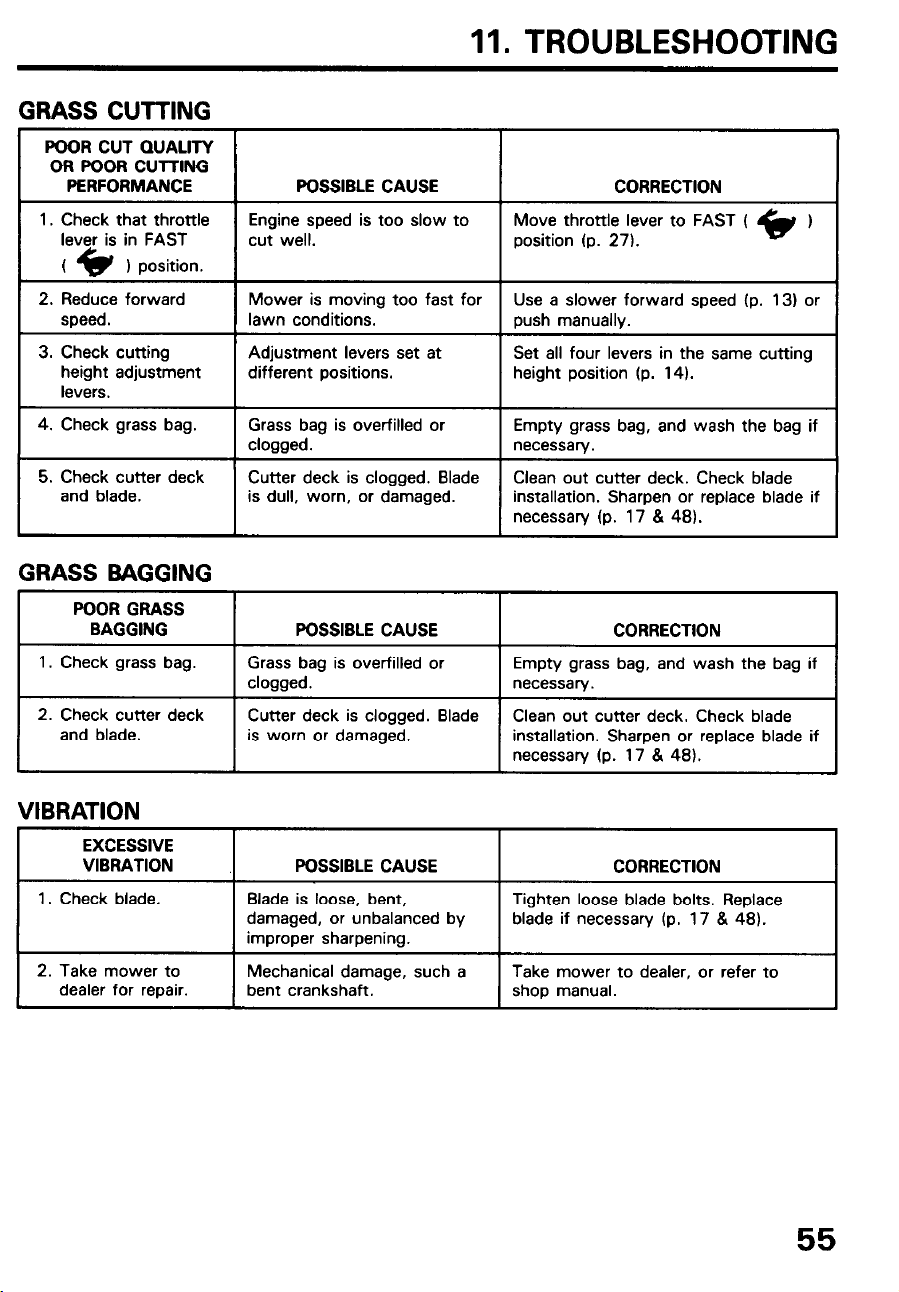
11. TROUBLESHOOTING
GRASS CUTTING
POOR CUT QUALITY
OR POOR CUTTING
PERFORMANCE POSSIBLE CAUSE
CORRECTION
1. Check that throttle
Engine speed is too slow to
Move throttle lever to FAST (
lever is in FAST cut well. position fp. 27).
b’
1 * 1 position.
2. Reduce forward Mower is moving too fast for Use a slower forward speed (p. 13) or
speed. lawn conditions.
push manually.
3. Check cutting Adjustment levers set at
Set all four levers in the same cutting
height adjustment different positions. height position (p. 14).
levers.
4. Check grass bag.
5. Check cutter deck
and blade.
Grass bag is overfilled or
clogged.
Cutter deck is clogged. Blade
is dull, worn, or damaged.
Empty grass bag, and wash the bag if
necessary.
Clean out cutter deck. Check blade
installation. Sharpen or replace blade if
necessary fp. 17 & 48).
GRASS BAGGING
POOR GRASS
BAGGING
1. Check grass bag.
POSSIBLE CAUSE
Grass bag is overfilled or
cloaaed.
CORRECTION
Empty grass bag, and wash the bag if
necessarv.
2. Check cutter deck
and blade.
Cutter deck is clogged. Blade Clean out cutter deck. Check blade
is worn or damaged. installation. Sharpen or replace blade if
necessary fp. 17 & 48).
VIBRATION
EXCESSIVE
VIBRATION
POSSIBLE CAUSE
CORRECTION
1. Check blade. Blade is loose, bent, Tighten loose blade bolts. Replace
damaged, or unbalanced by blade if necessary fp. 17 & 48).
improper sharpening.
2. Take mower to Mechanical damage, such a
dealer for repair. bent crankshaft.
Take mower to dealer, or refer to
shop manual.
55
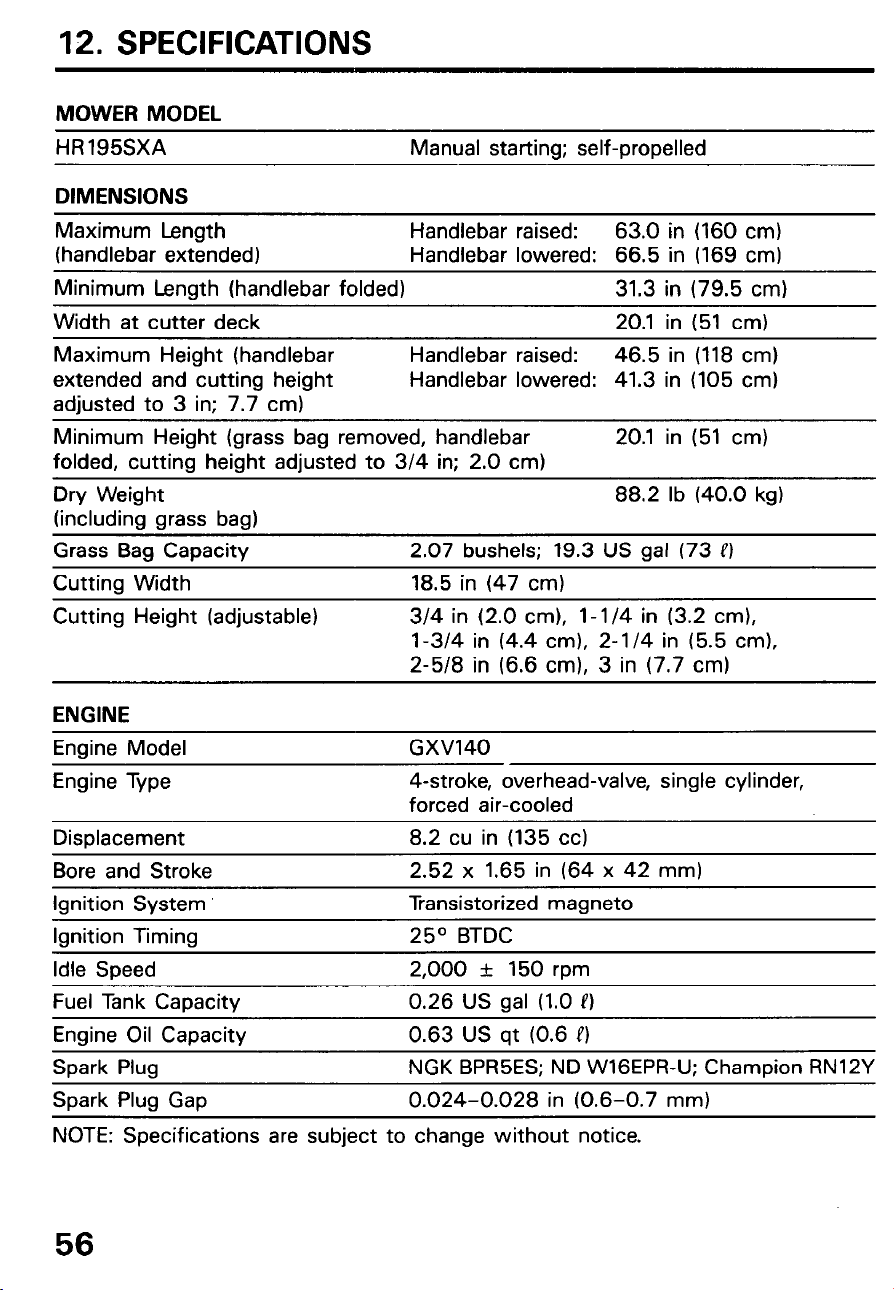
12. SPECIFICATIONS
MOWER MODEL
HR 195SXA
Manual starting; self-propelled
DIMENSIONS
Maximum length
(handlebar extended)
Handlebar raised: 63.0 in (160 cm)
Handlebar lowered: 66.5 in (169 cm)
Minimum Length (handlebar folded)
31.3 in (79.5 cm)
Width at cutter deck
Maximum Height (handlebar
extended and cutting height
adjusted to 3 in; 7.7 cm)
20.1 in (51 cm)
Handlebar raised: 46.5 in (118 cm)
Handlebar lowered: 41.3 in (105 cm)
Minimum Height (grass bag removed, handlebar 20.1 in (51 cm)
folded, cutting height adjusted to 3/4 in; 2.0 cm)
Dry Weight 88.2 lb (40.0 kg)
(including grass bag)
Grass Bag Capacity 2.07 bushels; 19.3 US gal (73 PI
Cutting Width 18.5 in (47 cm)
Cutting Height (adjustable) 3/4 in (2.0 cm), l-l /4 in (3.2 cm),
l-3/4 in (4.4 cm), 2-l /4 in (5.5 cm),
2-5/8 in (6.6 cm), 3 in (7.7 cm)
ENGINE
Engine Model
Engine Type
GXV140
4-stroke, overhead-valve, single cylinder,
forced air-cooled
Displacement
Bore and Stroke
8.2 cu in (135 cc)
2.52 x 1.65 in (64 x 42 mm)
Ignition System
Transistorized magneto
Ignition Timing
Idle Speed
Fuel Tank Capacity
25O BTDC
2,000 + 150 rpm
0.26 US gal (1.0 PI
Engine Oil Capacity
Spark Plun
0.63 US qt (0.6 PI
NGK BPR5ES; ND WlGEPR-U; Champion RNl2Y
Spark Plug Gap
0.024-0.028 in (0.6-0.7 mm)
NOTE: Specifications are subject to change without notice.
56
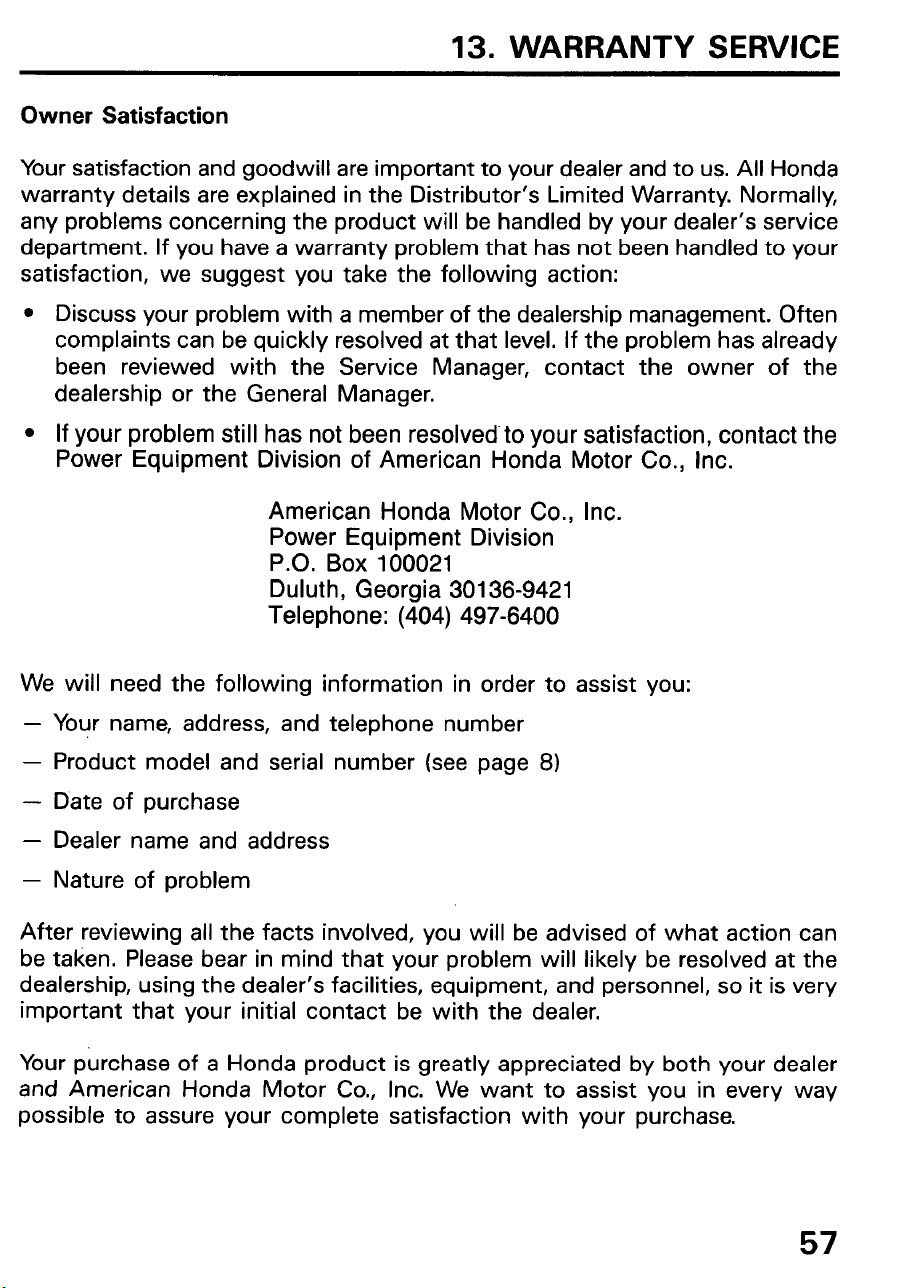
13. WARRANTY SERVICE
Owner Satisfaction
Your satisfaction and goodwill are important to your dealer and to us. All Honda
warranty details are explained in the Distributor’s Limited Warranty. Normally,
any problems concerning the product will be handled by your dealer’s service
department. If you have a warranty problem that has not been handled to your
satisfaction, we suggest you take the following action:
Discuss your problem with a member of the dealership management. Often
complaints can be quickly resolved at that level. If the problem has already
been reviewed with the Service Manager, contact the owner of the
dealership or the General Manager.
If your problem still has not been resolved to your satisfaction, contact the
Power Equipment Division of American Honda Motor Co., Inc.
American Honda Motor Co., Inc.
Power Equipment Division
P.O. Box 100021
Duluth, Georgia 30136-9421
Telephone: (404) 497-6400
We will need the following information in order to assist you:
- Your name, address, and telephone number
- Product model and serial number (see page 8)
- Date of purchase
- Dealer name and address
- Nature of problem
After reviewing all the facts involved, you will be advised of what action can
be taken. Please bear in mind that your problem will likely be resolved at the
dealership, using the dealer’s facilities, equipment, and personnel, so it is very
important that your initial contact be with the dealer.
Your purchase of a Honda product is greatly appreciated by both your dealer
and American Honda Motor Co., Inc. We want to assist you in every way
possible to assure your complete satisfaction with your purchase.
57

Current customer service contact information:
United States, Puerto Rico, and U.S. Virgin Islands:
Honda Power Equipment dealership personnel are trained professionals. They should
be able to answer any question you may have. If you encounter a problem that your
dealer does not solve to your satisfaction, please discuss it with the dealership's
management. The Service Manager or General Manager can help. Almost all problems
are solved in this way.
If you are dissatisfied with the decision made by the dealership's management, contact
the Honda Power Equipment Customer Relations Office. You can write:
American Honda Motor Co., Inc.
Power Equipment Division
Customer Relations Office
4900 Marconi Drive
Alpharetta, GA 30005-8847
Or telephone: (770) 497-6400 M-F, 8:30 am - 7:00 pm EST
When you write or call, please provide the following information:
• Model and serial numbers
• Name of the dealer who sold the Honda power equipment to you
• Name and address of the dealer who services your equipment
• Date of purchase
• Your name, address, and telephone number
• A detailed description of the problem