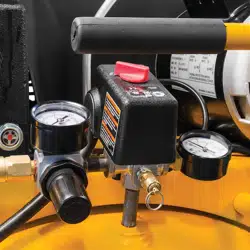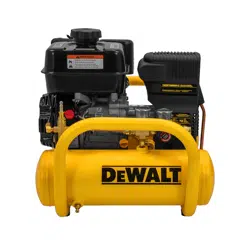
DXCMTB5590856
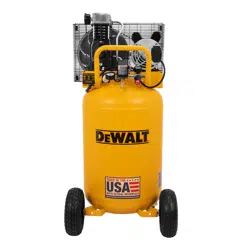
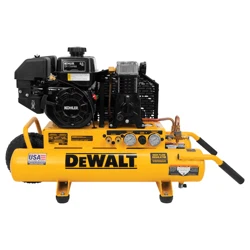
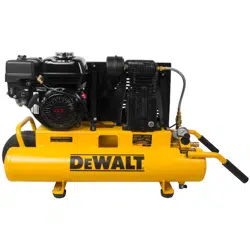
160cc, Gas Wheeled Portable Air Compressor
160cc, gaz roues de compresseur portatif
160cc, gas ruedas de compresor portátil
INSTRUCTION MANUAL
GUIDE D'UTILISATION
MANUAL DE INSTRUCCIONES
INSTRUCTIVO DE OPERACIÓN, CENTROS DE SERVICIO Y PÓLIZA
DE GARANTÍA. ADVERTENCIA: LÉASE ESTE INSTRUCTIVO ANTES
DE USAR EL PRODUCTO.
If you have questions or comments, contact us.
Pour toute question ou tout commentaire, nous contacter.
Si tiene dudas o comentarios, contáctenos.
1-888-895-4549 • www.dewalt.com
MAT Industries, LLC, Long Grove, IL 60047
(JUNE15) Part No. 200-3013 DXCMTB5590856 Copyright © 2007, 2008, 2009, 2010 DEWALT
2
English
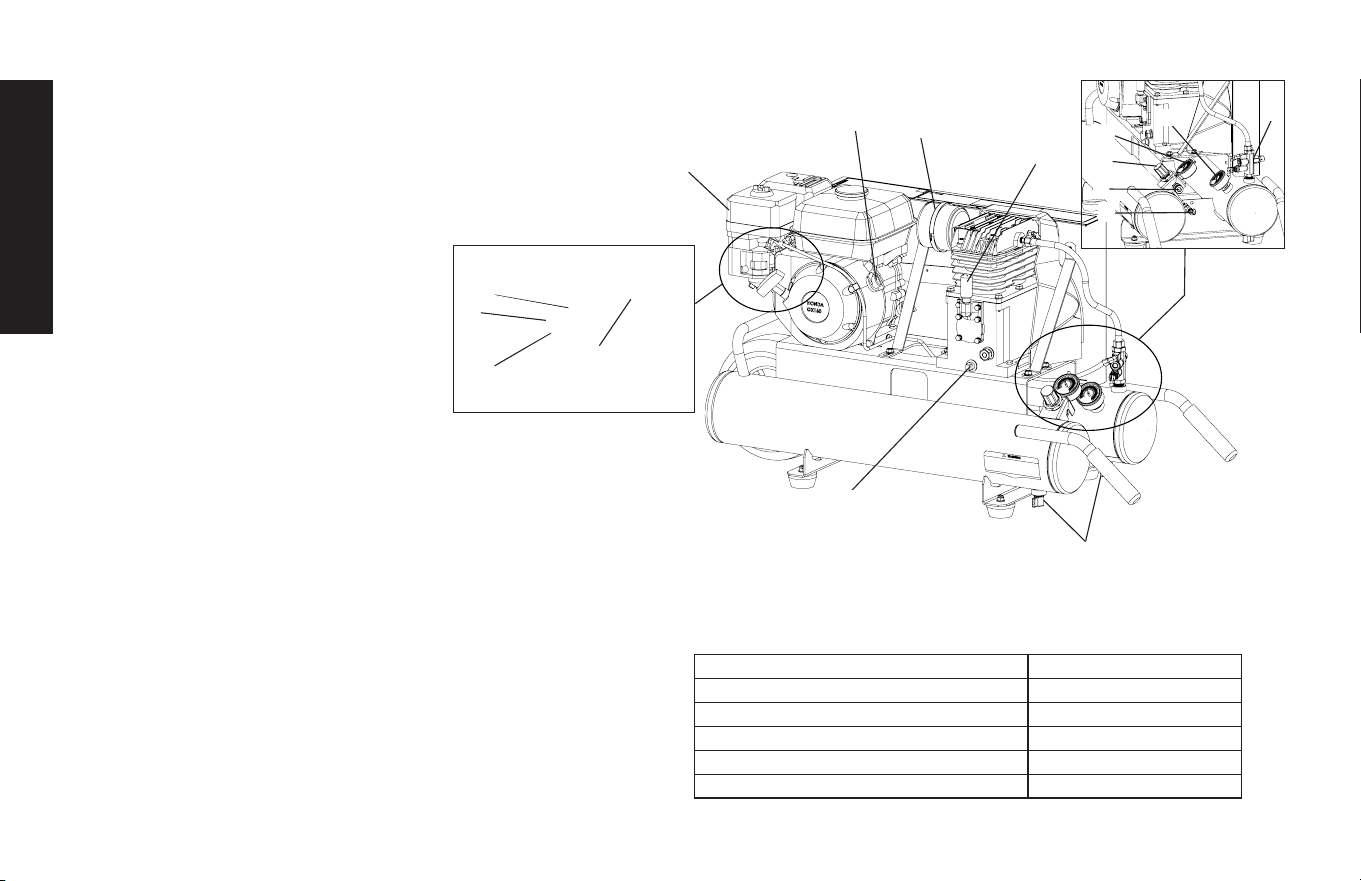
Air Compressor
A. Pump Air Intake Filter
B. Engine Air Filter
C. Engine On/Off Switch
D. Air Tank Pressure Gauge
E. Regulated Pressure Gauge
F. Pressure Regulator
G. Air Outlet
H. Unloader Valve
I. Safety Valve
J. Air Tank Drain Valve(s)
K. Pump Oil Dipstick/Oil Fill Plug
L. Pump Oil Drain Plug
M. Fixed Throttle
N. Choke Control
O. Fuel Valve Lever
P. Starter Grip
Pump Specications
Inline, vertical twin cylinder
Single stage
Oil lubricated
Cast iron crankcase and cylinder
Weight: 49 lbs. (22.2 kg)
Oil Capacity: 16 oz. (473 mL)
Engine Specications
Honda 160 cc
Internal Combustion
4-stroke
High RPM 2000-3600
Idle RPM 1250-1600
Specications
MODEL DXCMTB5590856
WEIGHT 168 lbs. (76.2 kg)
HEIGHT 24.14" (536.9 mm)
WIDTH 17.26" (438.4 mm)
LENGTH 44.65" (1134.1 mm)
AIR TANK CAPACITY 8 gallons (30.3 liters)
M
N
O
P
J
B
L
C
FIG. 1
K
A
Actual unit may vary slightly.
E
D
F
G
I
H
3
English
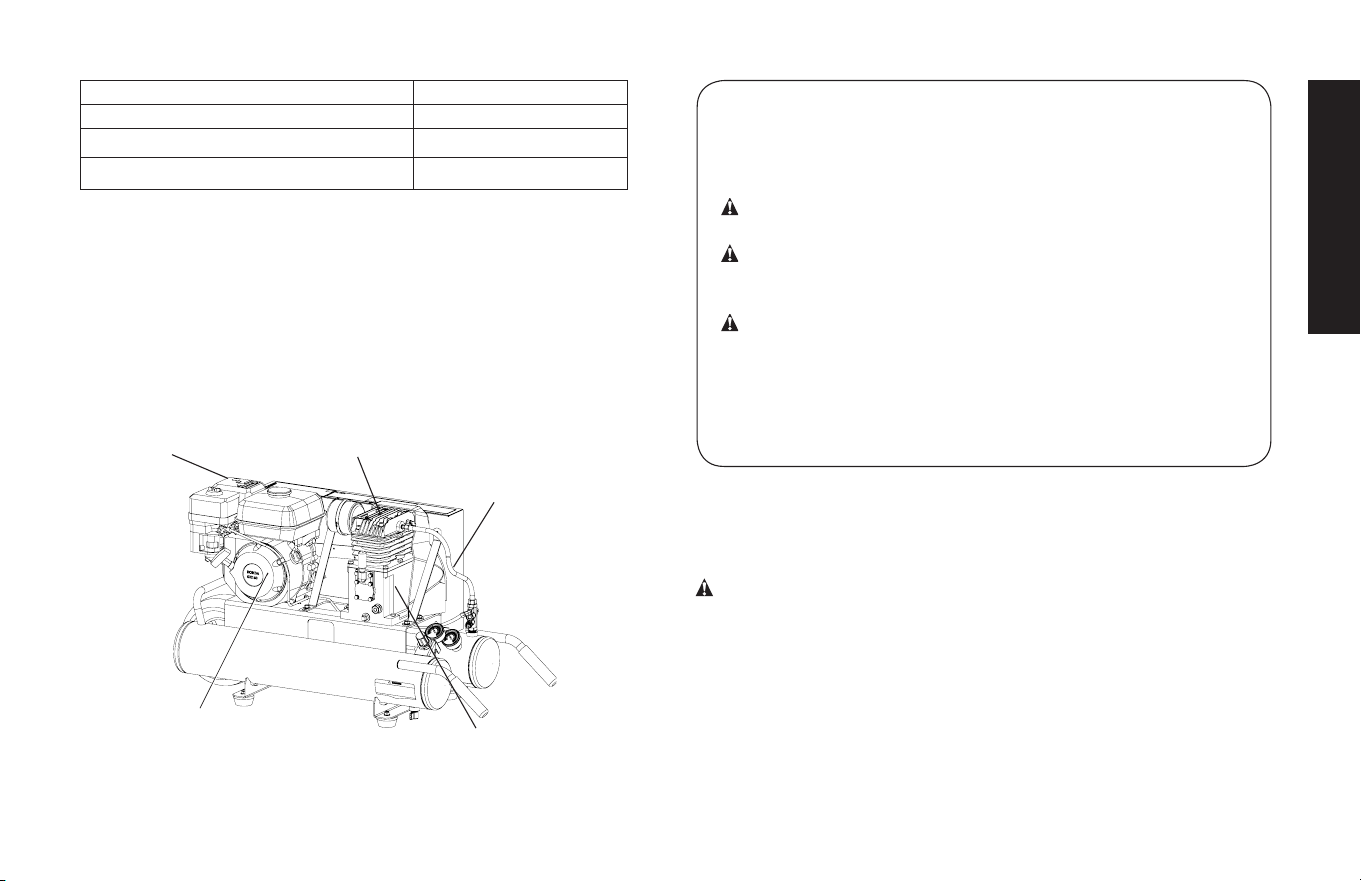
Hot Surfaces
MODEL DXCMTB5590856
APPROX. BLOW OFF PRESSURE
150 psi
SCFM @ 100 PSI 9.9 *
* Tested per ISO 1217
Denitions: Safety Guidelines
The definitions below describe the level of severity
for each signal word. Please read the manual and pay
attention to these symbols.
DANGER: Indicates an imminently hazardous situation
which, if not avoided, will result in death or serious injury.
WARNING: Indicates a potentially hazardous
situation which, if not avoided, could result in death or
serious injury.
CAUTION: Indicates a potentially hazardous
situation which, if not avoided, may result in minor or
moderate injury.
NOTICE: Indicates a practice not related to personal injury
which, if not avoided, may result in property damage.
IF YOU HAVE ANY QUESTIONS OR COMMENTS ABOUT
THIS OR ANY D
e
WALT TOOL, CALL US TOLL FREE AT:
1-888-895-4549
Important Safety Instructions
DANGER: Carbon Monoxide. Using an engine indoors can
kill you in minutes. Engine exhaust contains high levels of
carbon monoxide (CO), a poisonous gas you cannot see or
smell. You may be breathing CO even if you DO NOT smell
engine exhaust.
OUTLET TUBE
ENGINE
MUFFLER
GASOLINE
ENGINE
COMPRESSOR
CYLINDER & HEAD
PUMP
CRANKCASE
FIG. 2

4
English
• NEVER use an engine inside homes, garages, crawlspaces,
or other partly enclosed areas. Deadly levels of carbon mon-
oxide can build up in these areas. Using a fan or opening
windows and doors does NOT supply enough fresh air.
• ONLY use outdoors and far away from open windows, doors
and vents. These openings can pull in engine exhaust.
• Even when the engine is used correctly, CO may leak into
your home. ALWAYS use a battery-powered or battery
backup CO alarm (not supplied) in the home. Read and fol-
low all directions for CO alarm before using. If you start to
feel sick, dizzy or weak at anytime, move to fresh air imme-
diately. See a doctor. You could have carbon monoxide
poisoning.
WARNING: Do not operate this unit until you read this
instruction manual and the engine instruction manual for safety,
operation and maintenance instructions.
WARNING: This product may not be equipped with a spark-
arresting muffler. If the product is not equipped and will be used
around flam ma ble ma teri als or on land covered with materials such
as agricultural crops, forest, brush, grass or other similar items,
then an ap proved spark arrester must be installed and is legally
required in the state of California. It is a violation of California statutes
section 130050 and/or sec tions 4442 and 4443 of the California
Public Re sourc es Code, unless the engine is equipped with a spark
arrester, as defined in section 4442, and maintained in ef fec tive
work ing order. Spark arresters are also required on some U.S.
For est Service land and may also be legally required under other
statutes and or di nanc es.
WARNING: This product contains chemicals known to the
State of California to cause cancer, and birth defects or other
reproductive harm. Wash hands after handling.
WARNING: Some dust contains chemicals known to the State
of California to cause cancer, birth defects or other reproductive
harm such as asbestos and lead in lead based paint.
WARNING: The engine exhaust from this product contains
chemicals known to the State of California to cause cancer, birth
defects or other reproductive harm.
SAVE THESE INSTRUCTIONS
DANGER: RISK OF EXPLOSION OR FIRE
WHAT CAN HAPPEN HOW TO PREVENT IT
• Spilledgasolineandit’s
vapors can be come ignited
from cigarette sparks, elec-
trical arcing, exhaust gas es
and hot engine compo-
nents such as the muffler.
• Shutoffengineandallowit
to cool before adding fuel to
the tank.
• Usecareinfillingtankto
avoid spill ing fuel. Move unit
away from fueling area before
starting en gine.
• Heatwillexpandfuelinthe
tank which could result in
spillage and pos si ble fire or
explosion.
• Keepmaximumfuellevel
1/2" (12.7 mm) be low
bottom of filler neck
to allow for expansion.

5
English
• Combustiblematerials
which come into contact
with hot engine parts can
become ignited.
• Addfueloutdoorsinawell
ventilated area. Make sure
there are no sources of igni-
tion, such as cigarettes near
refueling location.
• Operatecompressorin
a clean, dry, well venti-
lated area a minimum of 48"
(1.22 m) from any building,
object or wall. Do not operate
unit indoors or in any con-
fined area.
• Operatecompressorinan
open area away from dry
brush, weeds or other com-
bustible materials.
• Improperlystoredfuelcould
lead to acciden tal ignition.
Fuel im prop er ly secured
could get into the hands of
children or oth er un qual i fied
persons.
• StorefuelinanOSHA-ap-
proved con tain er, in a se cure
location away from work
area.
• Unattendedoperationof
this product could result in
personal injury or property
damage. To reduce the
risk of fire, do not allow
the compressor to operate
unattended.
• Alwaysremaininattendance
with the product when it is
operating.
DANGER: RISK TO BREATHING (ASPHYXIATION)
WHAT CAN HAPPEN HOW TO PREVENT IT
• Breathingexhaustfumes
will cause se ri ous injury
or death! En gine exhaust
con tains carbon mon ox-
ide, an odorless and deadly
gas.
• Alwaysoperateair
compressor outside in a
clean, well ventilated area.
Avoid enclosed areas such
as garages, basements,
storage sheds, which lack a
steady exchange or air. Keep
children, pets and others away
from area of operation.
• Thecompressedairdirectly
from your compressor is not
safe for breathing. The air
stream may contain carbon
monoxide, toxic vapors,
or solid particles from the
air tank. Breathing these
contaminants can cause
serious injury or death.
• Neveruseairobtained
directly from the compressor
to supply air for human
consumption. The
compressor is not equipped
with suitable filters and in-line
safety equipment for human
consumption.

6
English
• Exposuretochemicals
in dust created by
power sanding, sawing,
grinding, drilling and other
construction activities
may be harmful.
• Sprayedmaterialssuchas
paint, paint solvents, paint
remover, insecticides,
weed killers, may contain
harmful vapors and
poisons.
• Workinanareawithgood
cross ventilation. Read
and follow the safety
instructions provided on
the label or safety data
sheets for the materials you
are spraying. Always use
certified safety equipment:
NIOSH/OSHA respiratory
protection or properly fit-
ting face mask designed
for use with your specific
application.
WARNING: RISK OF BURSTING
Air Tank: On February 26, 2002, the U.S. Consumer Product
Safety Commission published Release # 02-108 concerning air
compressor tank safety:
Air compressor receiver tanks do not have an infinite life. Tank
life is dependent upon several factors, some of which include
operating conditions, ambient conditions, proper installations,
field modifications, and the level of maintenance. The exact
effect of these factors on air receiver life is difficult to predict.
If proper maintenance procedures are not followed, internal
corrosion to the inner wall of the air receiver tank can cause the
air tank to unexpectedly rupture allowing pressurized air to sud-
denly and forcefully escape, posing risk of injury to consumers.
Your compressor air tank must be removed from service by the
end of the year shown on your tank warning label.
The following conditions could lead to a weakening of the air
tank, and result in a violent air tank explosion:
WHAT CAN HAPPEN HOW TO PREVENT IT
• Failuretoproperlydrain
condensed water from
air tank, causing rust and
thinning of the steel air tank.
• Drainairtankdailyorafter
each use. If air tank develops
a leak, replace it immediately
with a new air tank or replace
the entire compressor.
• Modificationsorattempted
repairs to the air tank.
• Neverdrillinto,weldormake
any modifications to the air
tank or its attachments. Never
attempt to repair a damaged
or leaking air tank. Replace
with a new air tank.
• Unauthorizedmodifications
to the unloader valve,
safety valve, or any other
components which control
air tank pressure.
• Theairtankisdesigned
to withstand specific
operating pressures. Never
make adjustments or
parts substitutions to alter
the factory set operating
pressures.

7
English
• Excessivevibrationcan
weaken the air tank and
cause rupture or explosion.
Excessive vibration will
occur if the compressor is
not properly mounted or
if engine operates above
recommended RPM.
• Donotremovethestiffener
bar connecting the
compressor pump to the
engine, except to adjust belt
tension. Then securely tighten
the stiffener bar bolts. This bar
controls unit vibration.
Attachments & accessories:
• Exceedingthepressure
rating of air tools, spray
guns, air operated
accessories, tires and other
inflatables can cause them
to explode or fly apart, and
could result in serious injury.
• Followtheequipment
manufacturers
recommendation and never
exceed the maximum
allowable pressure rating
of attachments. Never use
compressor to inflate small
low pressure objects such
aschildren’stoys,footballs,
basketballs, etc.
Tires:
• Over inflation of tires could
result in serious injury and
property damage.
• Useatirepressuregauge
to check the tires pressure
before each use and while
inflating tires; see the tire
sidewall for the correct tire
pressure.
NOTE: Air tanks, compressors
and similar equipment used to
inflate tires can fill small tires
very rapidly. Adjust pressure
regulator on air supply to no
more than the rating of the
tire pressure. Add air in small
increments and frequently use
the tire gauge to prevent over
inflation.
8
English
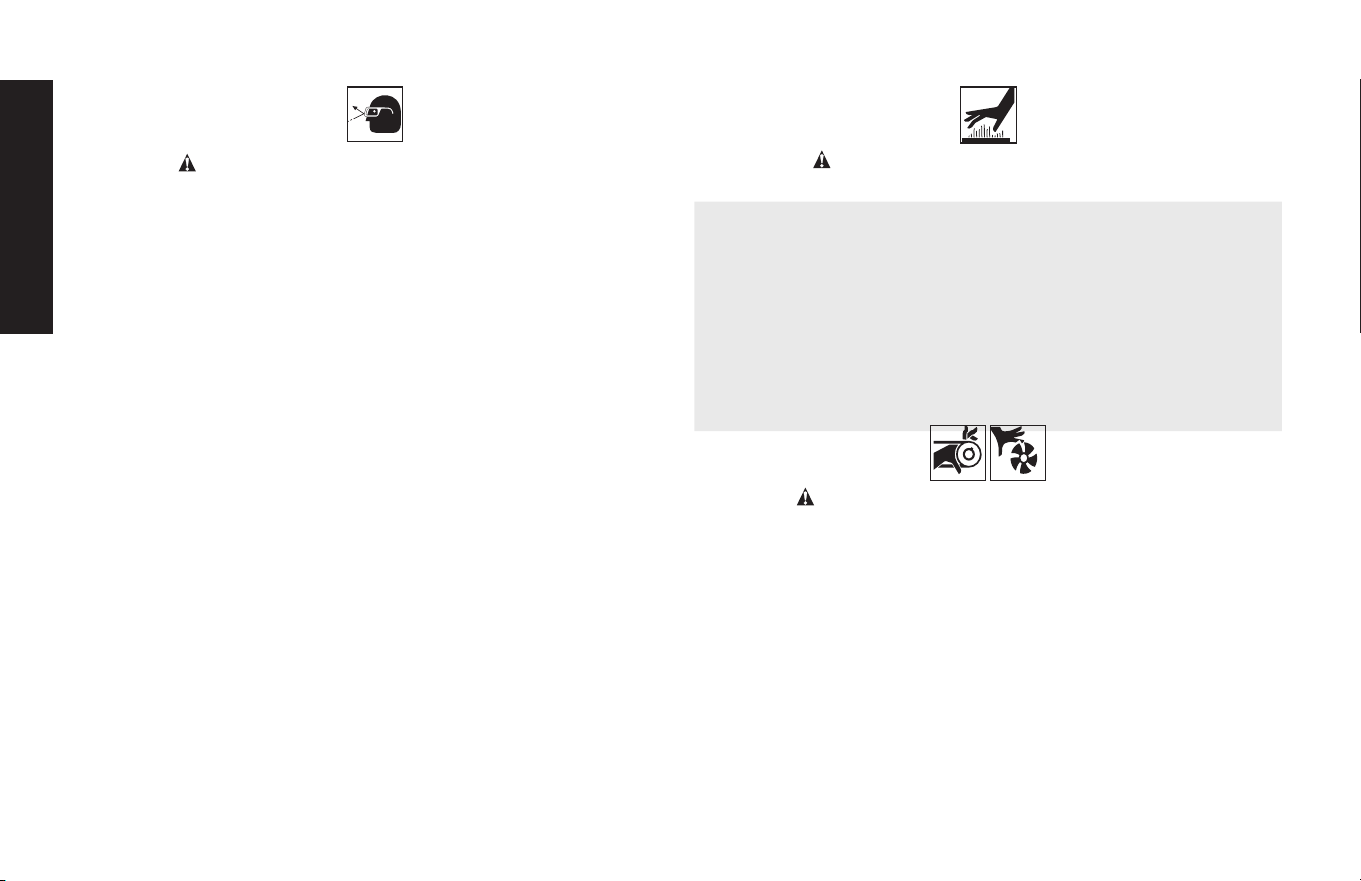
WARNING: RISK FROM FLYING OBJECTS
WHAT CAN HAPPEN HOW TO PREVENT IT
• Thecompressedairstream
can cause soft tissue
damage to exposed skin and
can propel dirt, chips, loose
particles and small objects
at high speed, resulting in
property damage or personal
injury.
• Always wear certified safety
equipment: ANSI Z87.1 eye
protection (CAN/CSA Z94.3)
with side shields when using
the compressor.
• Neverpointanynozzleor
sprayer toward any part of
the body or at other people or
animals.
• Alwaysturnthecompressor
off and bleed pressure
from the air hose and air
tank before attempting
maintenance, attaching tools
or accessories.
WARNING: RISK OF HOT SURFACES
WHAT CAN HAPPEN HOW TO PREVENT IT
• Touchingexposedmetal
such as the compressor
head, engine head, engine
exhaust or outlet tubes, can
result in serious burns.
• Nevertouchanyexposed
metal parts on compressor
during or immediately after
operation. Compressor
will remain hot for several
minutes after operation
• Donotreacharound
protective shrouds or attempt
maintenance until unit has
been allowed to cool.
WARNING: RISK FROM MOVING PARTS
WHAT CAN HAPPEN HOW TO PREVENT IT
• Theenginecanstart
accidentally if the flywheel is
turned by hand or moved by
pulling on the starter rope.
• Alwaysdisconnectthespark
plug and bleed pressure from
the air tank before performing
maintenance.

9
English
• Movingpartssuchasthe
pulley, flywheel, and belt can
cause serious injury if they
come into contact with you
or your clothing.
• Neveroperatethecompressor
with guards or covers which
are damaged or removed.
• Keepyourhair,clothingand
gloves away from moving
parts. Loose clothes, jewelry
or long hair can be caught in
moving parts.
• Airventsmaycovermoving
parts and should be avoided
as well.
• Attemptingtooperate
compressor with damaged
or missing parts or
attempting to repair
compressor with protective
shrouds removed can
expose you to moving parts
and can result in serious
injury.
• Anyrepairsrequiredonthis
product should be performed
by a D
eWALT factory
service center or a DeWALT
authorized service center.
WARNING: RISK OF UNSAFE OPERATION
WHAT CAN HAPPEN HOW TO PREVENT IT
• Unsafeoperationofyourair
compressor could lead to
se ri ous in ju ry or death to you
or others.
• Reviewandunderstandall
instructions and warnings in
this manual.
• Becomefamiliarwiththeoper-
a tion and con trols of the air
compressor.
• Keepoperatingareaclear
of all persons, pets, and
obstacles.
• Keepchildrenawayfromthe
air compressor at all times.
• Donotoperatetheproduct
when fatigued or under the
influence of alcohol or drugs.
Stay alert at all times.
• Neverdefeatthesafetyfea-
tures of this prod uct.
• Equipareaofoperationwitha
fire extinguisher.
• Donotoperatemachinewith
missing, broken, or un au tho-
rized parts.
• Neverstandonthe
compressor.
10
English
WARNING: RISK FROM NOISE
WHAT CAN HAPPEN HOW TO PREVENT IT
• Undersomeconditionsand
duration of use, noise from
this product may contribute
to hearing loss.
• Alwayswearcertifiedsafety
equipment: ANSI S12.6
(S3.19) hearing protection.
WARNING:
RISK OF
INJURY FROM LIFTING
WHAT CAN HAPPEN HOW TO PREVENT IT
• Seriousinjurycanresult
from attempting to lift too
heavy an object.
• Thecompressoristooheavy
to be lifted by one person.
Obtain assistance from oth-
ers before lifting.
WARNING: RISK OF INJURY OR PROP ER TY DAMAGE WHEN
TRANSPORTING OR STORING
WHAT CAN HAPPEN HOW TO PREVENT IT
• Oilcanleakorspilland
could result in fire or
breathing hazard; serious
injury or death can result. Oil
leaks will damage carpet,
paint or other surfaces in
vehicles or trailers.
• Alwaysplacecompressor
on a protective mat when
transporting to protect against
damage to vehicle from leaks.
Remove compressor from
vehicle immediately upon
arrival at your destination.
Always keep compressor level
and never lie on its side.
SAVE THESE INSTRUCTIONS
FOR FUTURE USE
11
English
FEATURES
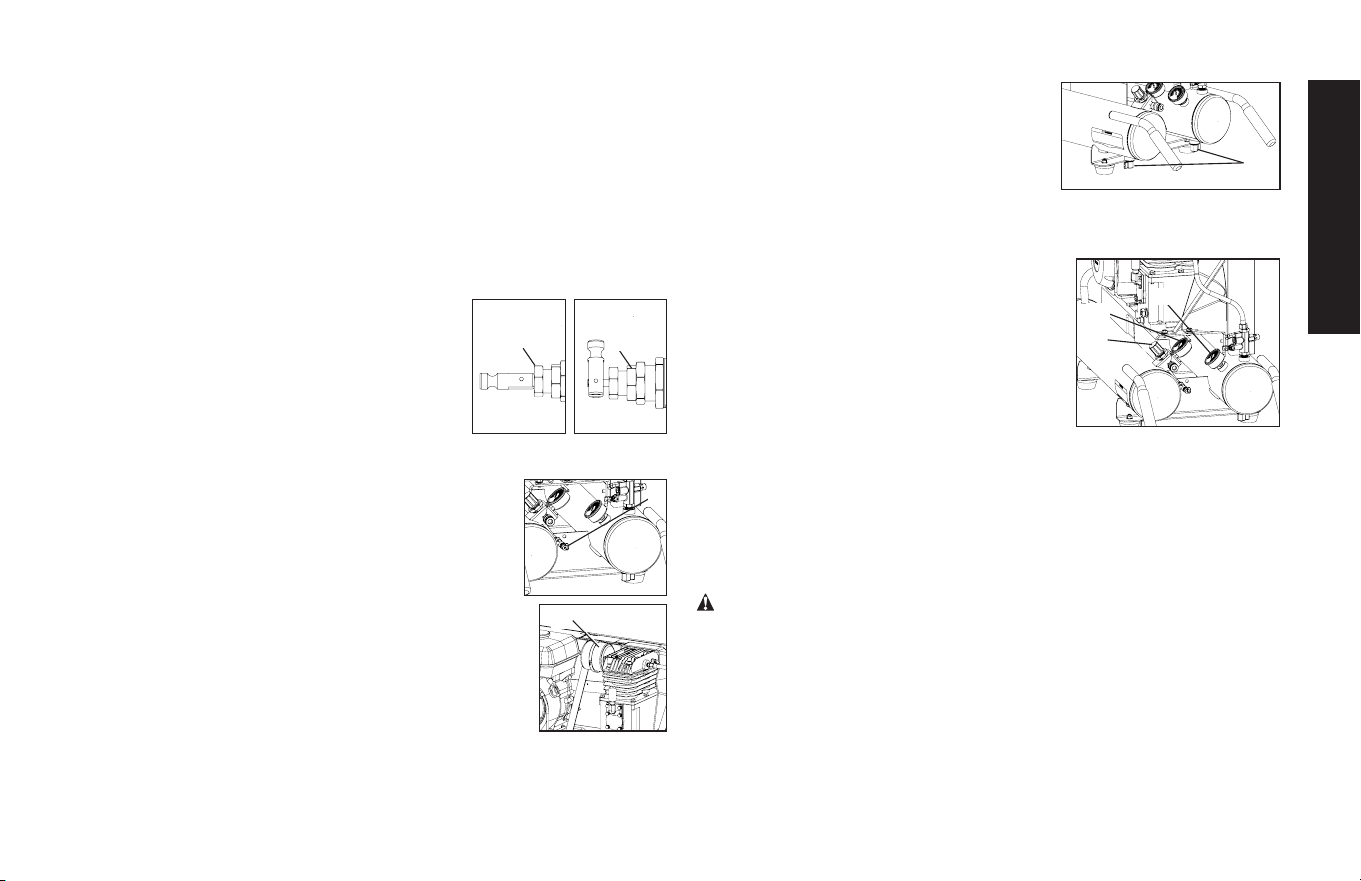
UNLOADER VALVE
When the maximum air tank pressure is obtained, the unloader
valve (H) will blow-off. This will cause the compressor to exhaust
the air to the atmosphere and not the tank. The valve is preset by
the manu facturer and must not be removed or modified in any way.
Manual Lock: The manual lock allows you to manually unload the
compressor with air pressure in the air tank. To operate the manual
lock:
Rotate the manual lock unloader lever to the
OPEN
F
CLOSED
F
open position to prevent air tank pressure
buildup. Rotate manual lock unloader lever
to the closed position after starting the
engine to allow air tank pressure to build.
NOTE: Air will not build in tank when manual
lock unloader lever in the open position.
SAFETY VALVE
This valve (I) is designed to prevent system failures
I
by relieving pressure from the system when the
compressed air reaches a predeter mined level.
The valve is preset by the manu facturer and must
not be removed or modified in any way.
AIR INTAKE FILTER
The filter (A) is designed to clean air entering the
A
pump. To ensure the pump continually receives a
clean, cool, and dry air supply the filter must always
be clean and the filter intake must be free from
obstructions.
AIR TANK DRAIN VALVES
The drain valve (J) is used to remove
J
moisture from the air tank after the air
compressor is shut off.
AIR TANK PRESSURE GAUGE
The air tank pressure gauge (D) indicates air pressure in the air tank.
REGULATED PRESSURE GAUGE
The regulated pressure gauge (E) indicates
E
D
F
the air pressure available at the outlet side
of the regulator. This pressure is controlled
by the regulator and is always less or equal
to the air tank pressure.
REGULATOR
The regulator knob (F) controls the air
pressure coming from the air tank.
To Adjust Regulator:
1. Pull regulator knob (F) out to unlock.
2. Turn knob clockwise to increase regulated pressure and
counterclockwise to decrease regulated pressure.
3. When desired pressure is shown on the regulated pressure
gauge push knob in to lock.
WARNING: Risk of Bursting. Too much air pressure causes a
hazardous risk of bursting. Check the manufacturer’s maximum
pressure rating for air tools and accessories. The regulator
outlet pressure must never exceed the maximum pressure
rating.
THROTTLE CONTROL
When maxi mum air tank pres sure is reached and the unloader
valve vents air, it activates the throttle control on the engine.

12
English
This gas saving feature holds the engine at a factory-set idling
speed until air pressure in the air tank drops to reset pressure.
The unloader valve then reactivates the throttle control and
accelerates the engine to full throttle.
LOW OIL SHUT DOWN SENSORS
The air compressor engine is equipped with low oil shutdown
sensors. These are safety devices designed to protect your
engine from damage in the event the oil level in the crankcase is
below minimum.
If the oil in engine gets low while the air compressor is running it
will automatically shut down the engine and will not restart until
oil is added to the engine. If the oil is low before start-up, the
engine will not start until oil is added.
NOTE: The low oil shutdown sensors are very sensitive. You
must fill the engine to the full mark on the dipstick to inactivate
this safety device.
INSTALLATION
Assembly (Fig. 1)
INSTALLING HOSES
WARNING: Risk of unsafe operation. Firmly grasp hose in hand
when installing or disconnecting to prevent hose whip.
1. Ensure regulated pressure gauge reads 0 psi.
2. Apply sealant tape to hose threads.
3. Assemble hose to air outlet (G).
NOTICE: Do not assemble splitters directly to the air
outlet (G).
NOTE: Assembling quick connect bodies to air outlet (G)
and quick connect plugs to hose ends make connecting and
disconnecting hoses simple and easy. Quick connect bodies
and plugs are available for purchase from your local dealer or
authorized service center.
DISCONNECTING HOSES
WARNING: Risk of unsafe operation. Firmly grasp hose in hand
when installing or disconnecting to prevent hose whip.
1. Ensure regulated pressure gauge reads 0 psi.
2. Remove hose(s) from air outlet(s) (G).
Lubrication and Oil
ENGINE
1. The engine was filled WITH oil at the manufacturer. Check
engine oil level before operating unit. If necessary, fill engine
to the appropriate level with recommended oil, see engine's
instruction manual supplied by engine manufacturer for
correct procedure.
2. Add fuel to engine. See engine's instruction manual supplied
by engine manufacturer for correct procedure.
WARNING: Risk of explosion or fire. Gasoline vapor is highly
flammable. Refuel outdoors preferably, or only in well-ventilated
areas. Do not refuel or check gasoline level while the engine is
running. Do not store, spill, or use gasoline near an open flame,
a source of sparks (such as welding), or near operating electrical
equipment.
AIR COMPRESSOR
The air compressor pump was filled WITH oil at the manufacturer.
Check air compressor pump oil level before operating unit. See
Compressor Pump Oil under Maintenance.
Compatibility
Air tools and accessories that are run off the compressor must
be compatible with petroleum based products. If you suspect
13
English
that a material is not compatible with petroleum products, an air
line filter for removal of moisture and oil vapor in compressed air
is required.
NOTICE: Always use an air line filter to remove moisture and oil
vapor when spraying paint.
Location
DANGER:
Risk of breathing. Exhaust from the gasoline engine
contains deadly carbon monoxide, which is odorless and toxic.
Operate engine only in well ventilated areas.
NOTICE: Risk of property damage. In order to avoid damaging
the air compressor, do not allow the unit to be tilted more than
10º when operating.
Place air compressor at least 4 feet (1.2 m) away from obstacles
that may prevent proper ventilation. Keep unit away from areas
that have dirt, vapor and volatile fumes in the atmosphere
which may clog and gum up the intake filter and valves, causing
inefficient operation.
HUMID AREAS
In frequently humid areas, moisture may form in the pump and
produce sludge in the oil, causing running parts to wear out
prematurely. Excessive moisture is especially likely to occur if
the unit is located in an unheated area that is subject to large
temperature changes. Two signs of excessive humidity are
external condensation on the pump when it cools down and
a “milky” appearance in compressor oil. You may be able
to prevent moisture from forming in the pump by increasing
ventilation or operating for longer intervals.
NOISE CONSIDERATIONS
Consult local officials for information regarding acceptable noise
levels in your area. To reduce excessive noise, use vibration
mounts or silencers, relocate the unit or baffle walls. Contact a
D
e
WALT service center or call 1-888-895-4549 for assistance.
TRANSPORTING
WARNING: Risk injury from lifting. Unit weighs more than 168
lbs. (76.2 kg) Do not move or lift without assistance.
NOTICE: Risk of property damage. The wheels and handle do
not provide adequate clearance, stability or support for pulling
the unit up and down stairs or steps. The unit must be lifted, or
pushed up a ramp.
NOTICE:
Risk of property damage.
Place engine fuel valve lever
(O) in the OFF position before moving or transporting unit.
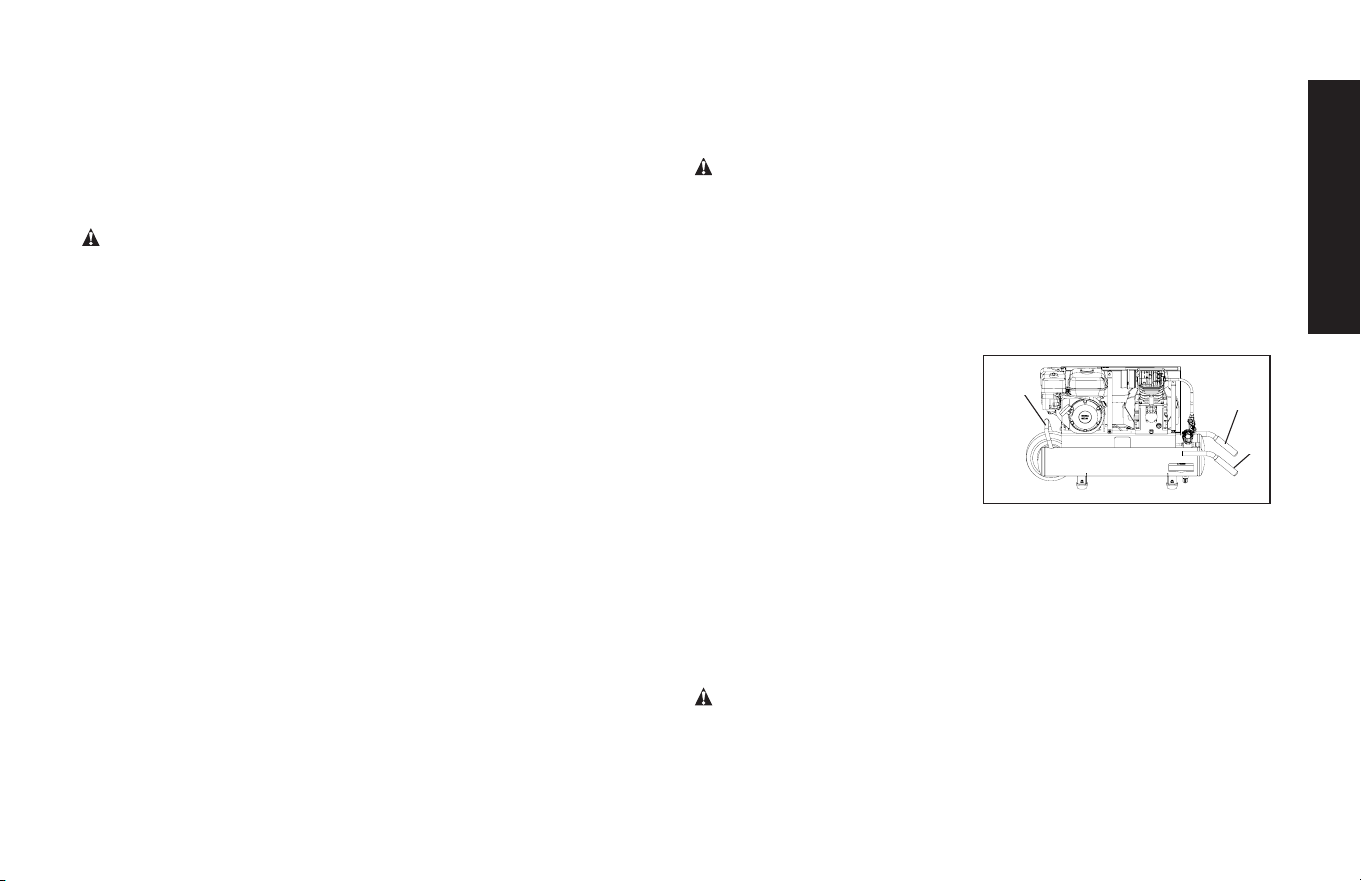
When transporting the
Q, R
S
Q, R
compressor in a vehicle, trailer,
etc. ensure that the air tank is
drained and the unit is secured
and placed on a protective mat
on a flat horizontal surface.
DO NOT store in a standing
position.
NOTE: Use recommended tie down points (Q) when transporting.
Use care when driving so to avoid tipping the unit over in the
vehicle. Damage can occur to the unit or surrounding items if unit
is tipped. Use a ramp if loading or unloading the unit from a height
of more than 12" (30.5 cm).
LIFTING
Always lift from the recommended lift points (R).
WARNING: Risk injury from lifting. Unit weighs more than 168
lbs. (76.2 kg) Do not move or lift without assistance.
NOTICE:
Risk of property damage.
Place engine fuel valve lever
(O) in the OFF position before moving or transporting unit.

14
English
MOVING
1. Grasp handle (S) of compressor, and lift compressor high
enough so unit can be rolled on the front tire(s).
WARNING: Risk of unsafe operation. Ensure proper footing
and use caution when rolling compressor so that unit does not
tip or cause loss of balance.
NOTICE:
Risk of property damage.
Place engine fuel valve lever
(O) in the OFF position before moving or transporting unit.
2. When location is reached slowly lower rear of compressor to
ground. Always store compressor in a horizontal position. DO
NOT store in a standing position.
NOTE: Should the unit tip over, hard starting and smoking will
occur due to oil spillage.
PREPARATION FOR USE
Pre-Start Checklist (Fig. 1)
1. Ensure engine ON/OFF switch (C) is in the OFF position.
2. Ensure air tank is drained, see Draining Air Tank under
Maintenance.
3. Ensure the drain valve (J) is closed.
4. Ensure safety valve (I) is functioning properly, see Checking
Safety Valve under Maintenance.
5. Check pump oil level, see Compressor Pump Oil under
Maintenance.
NOTICE:
Do not operate without oil or with inadequate oil. DeWALT
is not responsible for compressor failure caused by inadequate oil.
6. Check engine's oil and fuel level, see engine's instruction
manual for correct procedures.
7. Visually inspect drive belt. Replace belt if frayed, cracked, or
worn. NOTE: Outer belt cover must be removed to inspect
drive belt.
8. Ensure all guards, covers, and labels are in place, legible (for
labels) and securely mounted. Do not use compressor until all
items have been verified.
Initial Set-up
(Fig. 1)
WARNING: Do not operate this unit until you read and
understand this instruction manual and the engine instruction
manual for safety, operation and maintenance instructions.
BREAK-IN PROCEDURE
NOTICE:
Risk of property damage. Serious damage may result if
the following break-in instructions are not closely followed.
This procedure is required:
• Beforetheaircompressorisusedforthefirsttime.
• Whentheunloadervalvehasbeenreplaced.
• Whenthecompressorpumphasbeenreplaced.
The procedure:
1. Follow Pre-Start Checklist under Preparation for Use.
2. Rotate the unloader's manual lock to the open position to
prevent air tank pressure buildup.
3. Open the pressure regulator. Pull regulator knob (F) out and
rotate clockwise until it stops.
WARNING: Do not operate this unit until you read and under-
stand the engine instruction's manual for safety, operation and
maintenance instructions.
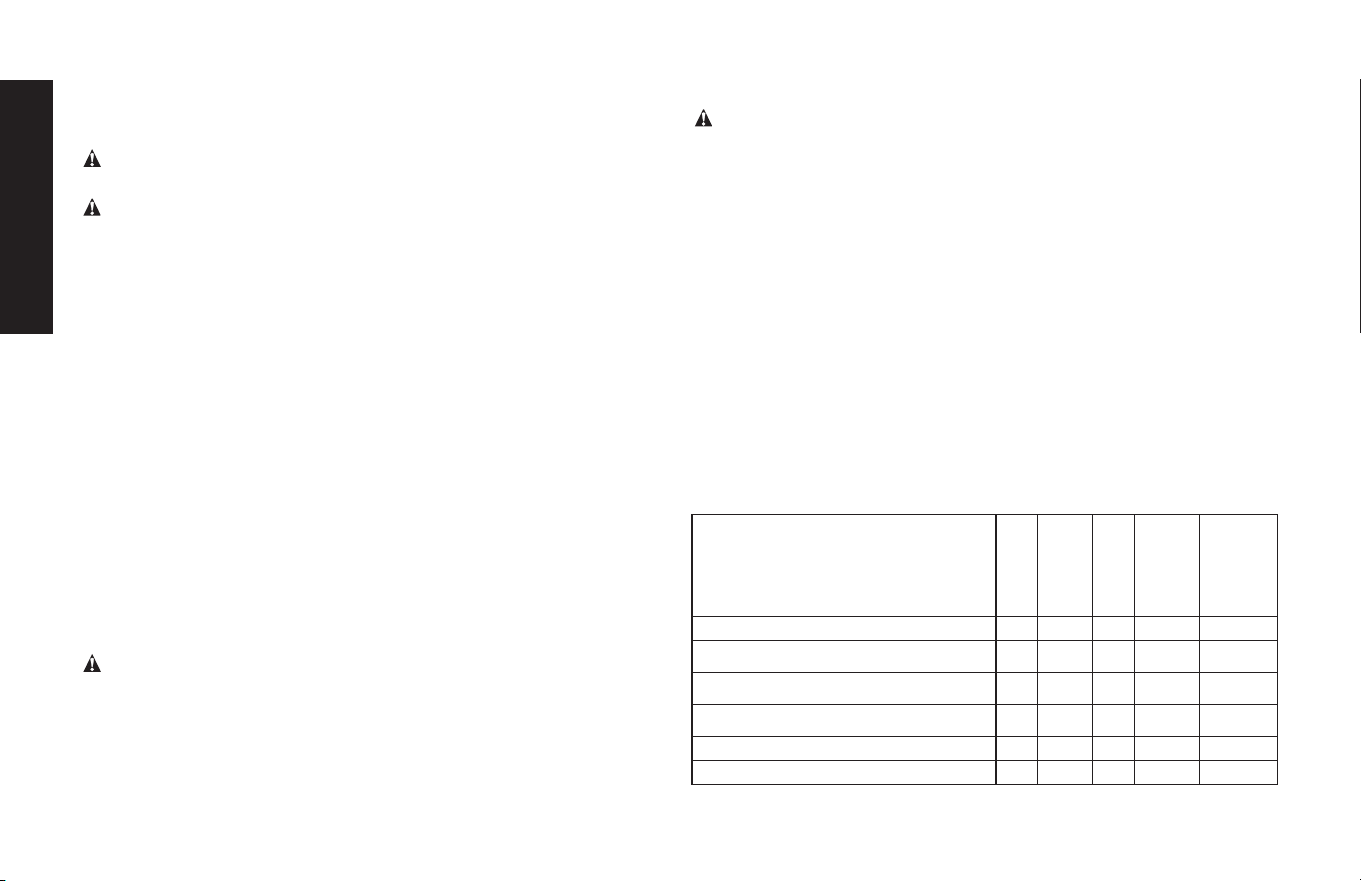
4. Prepare engine for first time use,
OPEN
CLOSED
N
O
OFF
ON
see engine's instruction manual
for correct procedure.
5. Turn the engine ON/OFF switch
(C) to the ON position.
6. Place the fuel valve lever (O) in
the ON postion.

15
English
7.
If the engine is cold, move the choke (N) to the CLOSED
position as shown. If the engine is hot, move the choke to the
OPEN position.
WARNING: Risk of unsafe operation. Pull starter grip slowly
until resistance is felt. Then pull starter grip (P) rapidly to avoid
kickback and prevent hand or arm injury.
NOTICE: Do not allow the starter grip to snap back. Return it
gently by hand.
NOTE: If the engine does not start, check the oil level and add
oil as needed.
NOTE: To ensure maximum oil lubrication, place the unit on a
level surface.
8. As the engine warms up, move the choke to the OPEN posi-
tion.
9. Run the air compressor for 30 minutes to seat the rings and
lubricate all the internal surfaces. Ensure there is no pressure
build up in the air tank by observing the reading on the air tank
pressure gauge.
10. Rotate the manual lock on the unloader valve into the closed
position so the air tank pressure can build.
11. Close the pressure regulator. Rotate the regulator knob (F)
counterclockwise to its built-in stop and push knob in to lock
in place. This will allow air to build pressure in the air tank.
12. Compressed air will be available from the hose air outlet until
it is used up or bled off.
OPERATING PROCEDURES
Start-up (Fig. 1)
1. Follow Pre-Start Checklist under Preparation for Use.
2. Pull out and turn regulator knob (F) counterclockwise until fully
closed. Push in to lock. Regulated pressure gauge should read
0 psi.
3. Rotate the manual lock unloader lever to the open position to
assist with start up.
4. Turn the engine ON/OFF switch (C) to the ON position.
5. Place the fuel valve lever (O) in the ON postion.
6.
If the engine is cold, move the choke (N) to the CLOSED
position as shown. If the engine is hot, move the choke to the
OPEN position.
WARNING: Risk of unsafe operation. Pull starter grip slowly
until resistance is felt. Then pull starter grip (P) rapidly to avoid
kickback and prevent hand or arm injury.
NOTICE: Do not allow the starter grip to snap back. Return it
gently by hand.
NOTE: If the engine does not start, check the oil level and add
oil as needed.
NOTE: To ensure maximum oil lubrication, place the unit on a
level surface.
7. As the engine warms up, move the choke to the OPEN posi-
tion.
8. Rotate manual lock unloader lever to the closed position to
allow air tank pressure to build. NOTE: Pump will not operate
with the manual lock unloader lever in the open position.
9. Allow compressor to pump up to blow off pressure.
WARNING: Risk of unsafe operation. If any unusual noise
or vibration is noticed, stop the compressor and refer to the
troubleshooting section.
NOTE: The air compressor pump is capable of running continuously.
16
English
To prolong the air compressor's life, it is recommended to run at
high throttle 50-75% of the run time and idle for 25% of the run time
10. Attach hose and accessory.
WARNING: Risk of unsafe operation. Firmly grasp air hose in
hand when installing or disconnecting to prevent hose whip.
WARNING:
Risk of unsafe operation. Do not use damaged or
worn accessories.
NOTICE: Risk of property damages. Compressed air from the unit
may contain wa ter condensation and oil mist. Do not spray un fil-
tered air at an item that could be damaged by moisture. Some air
op er ated tools or de vic es may require filtered air. Read the in struc-
tions for the air tool or device.
11. Adjust regulator (F) to desired setting. See Regulator under
Features.
Shut-down
1. Place the engine ON/OFF switch (C) to the OFF Position.
2. Place the fuel valve lever (O) in the OFF postion.
NOTE: If finished using compressor, follow Steps 3–7.
3. Turn regulator knob (F) counterclockwise until fully closed.
Ensure regulated pressure gauge reads 0 psi.
4. Remove hose and accessory.
5. Drain the air tank.
See Draining Air Tank under Maintenance
.
NOTICE:
Risk of property damage.
Place engine fuel valve lever
(O) in the OFF position before moving or transporting unit.
WARNING: Risk of bursting. Drain air tank daily. Water will
condense in air tank. If not drained, water will corrode and weaken
the air tank causing a risk of air tank rupture.
6. Allow the compressor to cool down.
7. Wipe air compressor clean and store in a safe, non freezing
area.
MAINTENANCE
WARNING:The following procedures must be followed when
maintenance or service is performed on the air compressor.
1. Ensure engine ON/OFF switch (C) is in the OFF position.
2. Disconnect spark plug wire.
3. Drain air tank.
4. Allow air compressor to cool down before starting service
NOTE: All compressed air systems contain maintenance parts (e.g.
oil, filters, separators) that are periodically replaced. These used
parts may contain substances that are regulated and must be
disposed of in accordance with local, state, and federal laws and
regulations.
NOTE: Take note of the positions and locations of parts during
disassembly to make reassembly easier.
NOTE: Any service operations not included in this section should
be performed by a D
eWALT factory service center or a DeWALT
authorized service center.
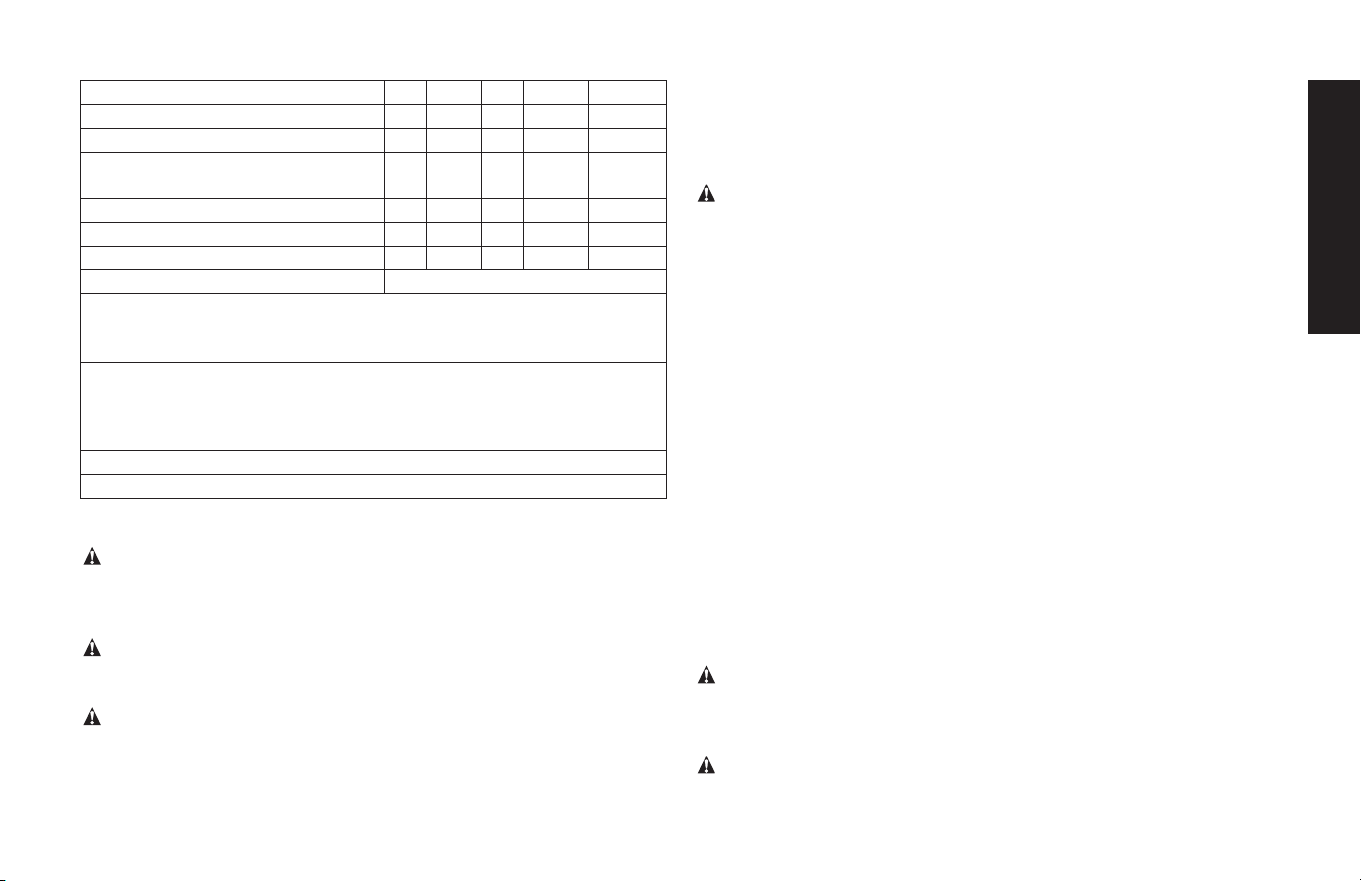
Maintenance Chart
Procedure
Daily
Weekly
Monthly
1 year or
200 Hours
See tank
warning
label
Check safety valve
X
Inspect air filter
X
+
Drain air tank
X
Check pump oil level
X
Change pump oil
X
**
+
Oil leak inspection
X
17
English
Inspect drive belt
X
Check drive belt tension
X
Check pulley/flywheel alignment
X
Check for unusual noise/vibra-
tion
X
Check for air leaks
X
*
Clean compressor exterior
X
Remove tank from service
X
++
Engine
See engine instruction manual.
* To check for air leaks apply a solution of soapy water around
joints. While compressor is pumping to pressure and after
pressure cuts out, look for air bubbles to form.
** The pump oil must be changed after the first 20 hours or operation.
Thereafter, when using
DeWALT
synthetic compressor oil, change
oil every 200 hours of operation or once a year, whichever comes
first.
+ Perform more frequent in dusty or humid conditions.
++
For more information, call 1-888-895-4549
Checking Safety Valve (Fig. 1)
WARNING: Hot surfaces. Risk of burn. Aftercooler, pump
head, and surrounding parts are very hot, do not touch (see the
Hot Surfaces identified in Fig. 2). Allow compressor to cool prior
to servicing.
WARNING: Risk of bursting. If the safety valve does not work
properly, over-pressurization may occur, causing air tank rupture
or an explosion.
WARNING: Risk from flying objects. Always wear certified safety
equipment: ANSI Z87.1 eye protection (CAN/CSA Z94.3) with side
shields when using the compressor.
Before starting compressor, pull the ring on the safety valve to
make sure that the safety valve operates freely. If the valve is
stuck or does not operate smoothly, it must be replaced with the
same type of valve.
Checking Air Filter Element (Fig. 1)
WARNING: Hot surfaces. Risk of burn. Aftercooler, pump head,
and surrounding parts are very hot, do not touch (see the Hot
Surfaces identified in Fig. 2). Allow compressor to cool prior to
servicing.
1. Ensure engine ON/OFF switch (C) is in the OFF position.
2. Allow unit to cool.
3. Remove filter (A) top from filter base by turning filter counter-
clockwise about 5 degrees.
4. Separate filter top from base.
5. Remove element from filter base.
6. If element needs cleaning, blow out with air. Replace if need-
ed. Purchase replacement parts from your local dealer or
authorized service center. Always use identical replacement
parts.
7. Place element back in filter base.
8. Reconnect filter top to filter base. While pushing in, rotate
clockwise 5 degrees.
NOTICE: Risk of unsafe operation. Do not operate without air
inlet filter.
Draining Air Tank (Fig. 1)
WARNING: Risk of unsafe operation. Risk from noise. Air
tanks contain high pressure air. Keep face and other body parts
away from outlet of drain. Use eye protection [ANSI Z87.1 (CAN/
CSA Z94.3)] when draining as debris can be kicked up into face.
WARNING: Risk from noise. Use ear protection [ANSI S12.6
(S3.19)] as air flow noise is loud when draining.

18
English
NOTE: All compressed air systems generate condensate that
accumulates in any drain point (e.g., tanks, filter, aftercoolers,
dryers). This condensate contains lubricating oil and/or
substances which may be regulated and must be disposed of in
accordance with local, state, and federal laws and regulations.
1. Ensure engine ON/OFF switch (C) is in the OFF position.
2. Place a suitable container under the drain valve to catch
discharge.
3. Grasp black lever on drain valve.
WARNING: Risk of bursting. Drain air tank daily. Water will con-
dense in air tank. If not drained, water will corrode and weaken
the air tank causing a risk of air tank rupture.
NOTICE: Risk of property damage. Drain water from air tank may
contain oil and rust, which can cause stains.
4. Slowly rotate lever to gradually bleed air from air tank.
5. When air tank pressure gauge reads 10 psi, rotate valve to the
fully open position.
6. Close drain valve when finished.
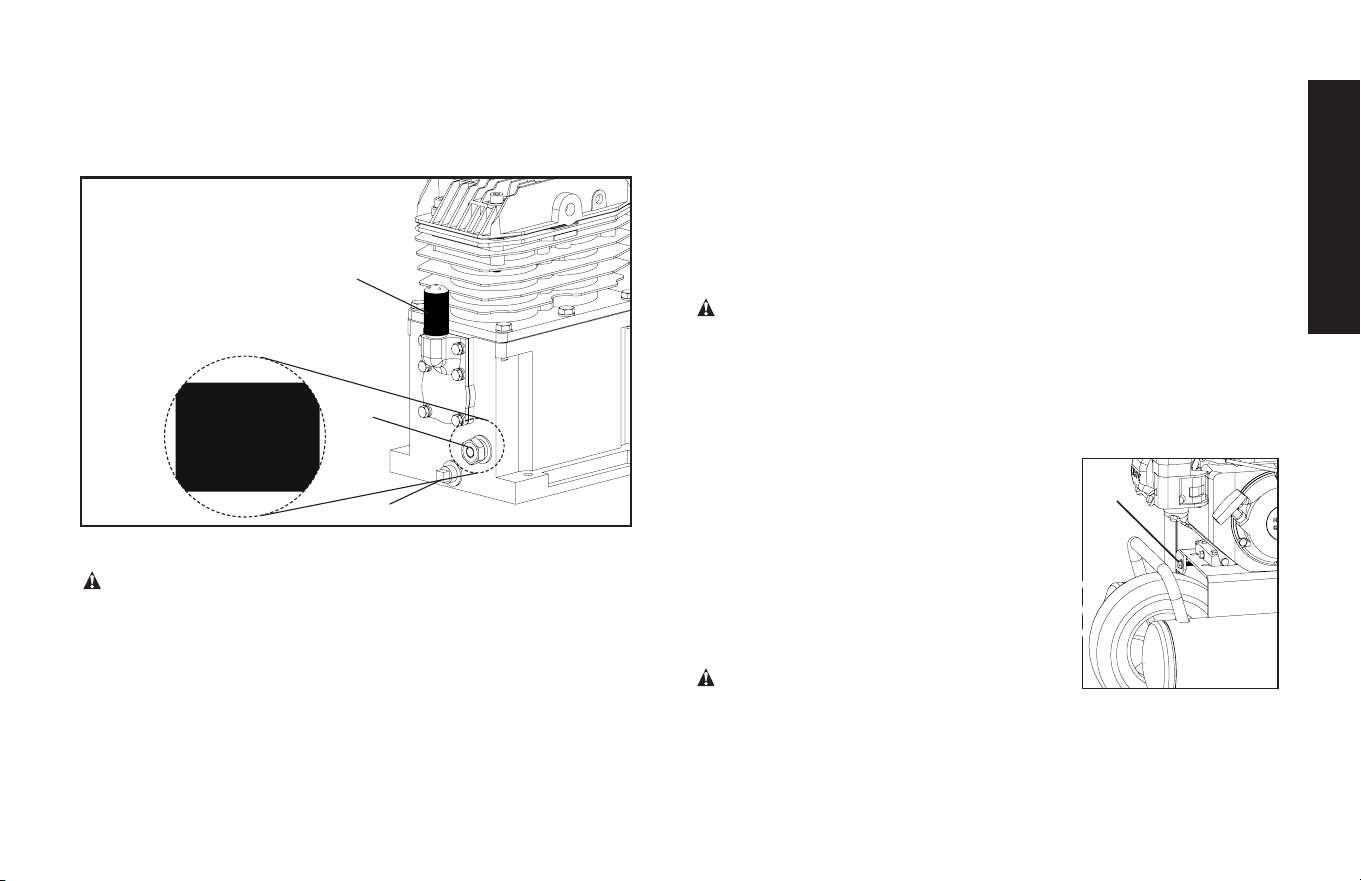
Compressor Pump Oil (refer to Fig. 4)
WARNING: Hot surfaces. Risk of burn. Tubes, pump head,
and surrounding parts are very hot, do not touch (see the Hot
Surfaces identified in Fig. 2). Allow compressor to cool prior to
servicing.
NOTICE: Risk of property damage. Use air compressor oil only.
Multi-weight automotive engine oils like 10W30 should not be used
in air compressors. They leave carbon deposits on critical compo-
nents, thus reducing performance and compressor life.
NOTE: Use synthetic blend non-detergent air compressor oil.
NOTE: Crankcase oil capacity is approximately 16 fluid ounces
(473 ml).
Checking
1. Ensure engine START/RUN/OFF switch (C) is in the OFF
Position.
2. The oil level should be to the middle of the sight glass (V).
3. If needed remove oil fill plug (K) and slowly add oil until it
reaches the middle of the sight glass.
Changing
WARNING: Hot surfaces. Risk of burn. Tubes, pump head,
and surrounding parts are very hot, do not touch (see the Hot
Surfaces identified in Fig. 2). Allow compressor to cool prior to
servicing.
WARNING: Drain tank to release air pressure before removing
the oil fill cap or oil drain plug.
1. Ensure engine START/RUN/OFF switch (C) is in the OFF
position.
2. Allow the unit to cool.
3. Disconnect spark plug wire.
4. Drain air tank.
5. Remove the oil fill plug (K).
6. Remove the oil drain plug (L) and drain oil into a suitable con-
tainer.
7. Replace the oil drain plug (L) and tighten securely
8. Slowly add compressor oil until it reaches the middle of the
sight glass (V). NOTE: When filling the crankcase, the oil flows
very slowly into the pump. If the oil is added too quickly, it will
overflow and appear to be full.
CAUTION: Overfilling with oil will cause premature compressor
failure. Do not overfill.
9. Replace oil fill plug (K) and tighten securely.
19
English
10. Reconnect spark plug wire.
NOTE: Pump oil contains substances that are regulated and must
be disposed of in accordance with local, state and federal laws and
regulations.
V
K
L
T = Full
U = Add
L = Oil drain plug
V = Oil level sight glass
K = Oil fill plug
FIG. 4
Checking Belt Tension (Fig. 1)
WARNING: Hot surfaces. Risk of burn. Aftercooler, pump head,
and surrounding parts are very hot, do not touch (see the Hot
Surfaces identified in Fig. 2). Allow compressor to cool prior to
servicing.
1. Ensure engine ON/OFF switch (C) is in the OFF position.
2. Allow the unit to cool.
3. Disconnect spark plug wire.
4. Drain air tank.
5. Remove belt guard.
6. Measure belt tension. Proper tension is achieved when a
three (3) pound (1.36 kg) weight or equivalent finger pressure
applied midway between the motor pulley and compressor
flywheel causes a 1/4" (6.35 mm) deflection of the belt. If
adjustment is needed see Adjusting Belt Tension under
Maintenance.
7. Replace belt guard.
8. Reconnect spark plug wire.
Adjusting Belt Tension
WARNING: Hot surfaces. Risk of burn. Aftercooler, pump head
and surrounding parts are very hot, do not touch (see the Hot
Surfaces identified in Fig. 2). Allow compressor to cool prior to
servicing.
1. Follow procedures 1-6 in Checking Belt Tension under
Maintenance.
2. Scribe a mark at the base of the engine on the deck to be
used as a reference.
3. Loosen but do not remove four engine
W
mounting nuts.
4. Loosen but do not remove bolt secur-
ing stiffener bracket to engine.
5. Move the engine to the new mark by
turning the belt tensioning bolt (W)
clockwise until the engine is moved to
the desired postion.
WARNING: Risk of moving parts. Use
caution when rolling belt onto flywheel,
fingers can get caught between the belt and flywheel.
6. Check the belt tension again. See Step 6 in Checking Belt
Tension under Maintenance.
7. When tension is correct, torque four engine mounting nuts
20
English
(engine torque to 10– 20 ft.-lbs./13.5–27.1 Nm), stiffener
bracket bolt (Torque to 10–20 ft.- lbs./13.5–27.1 Nm).
8. Replace belt guard.
9. Reconnect spark plug wire.
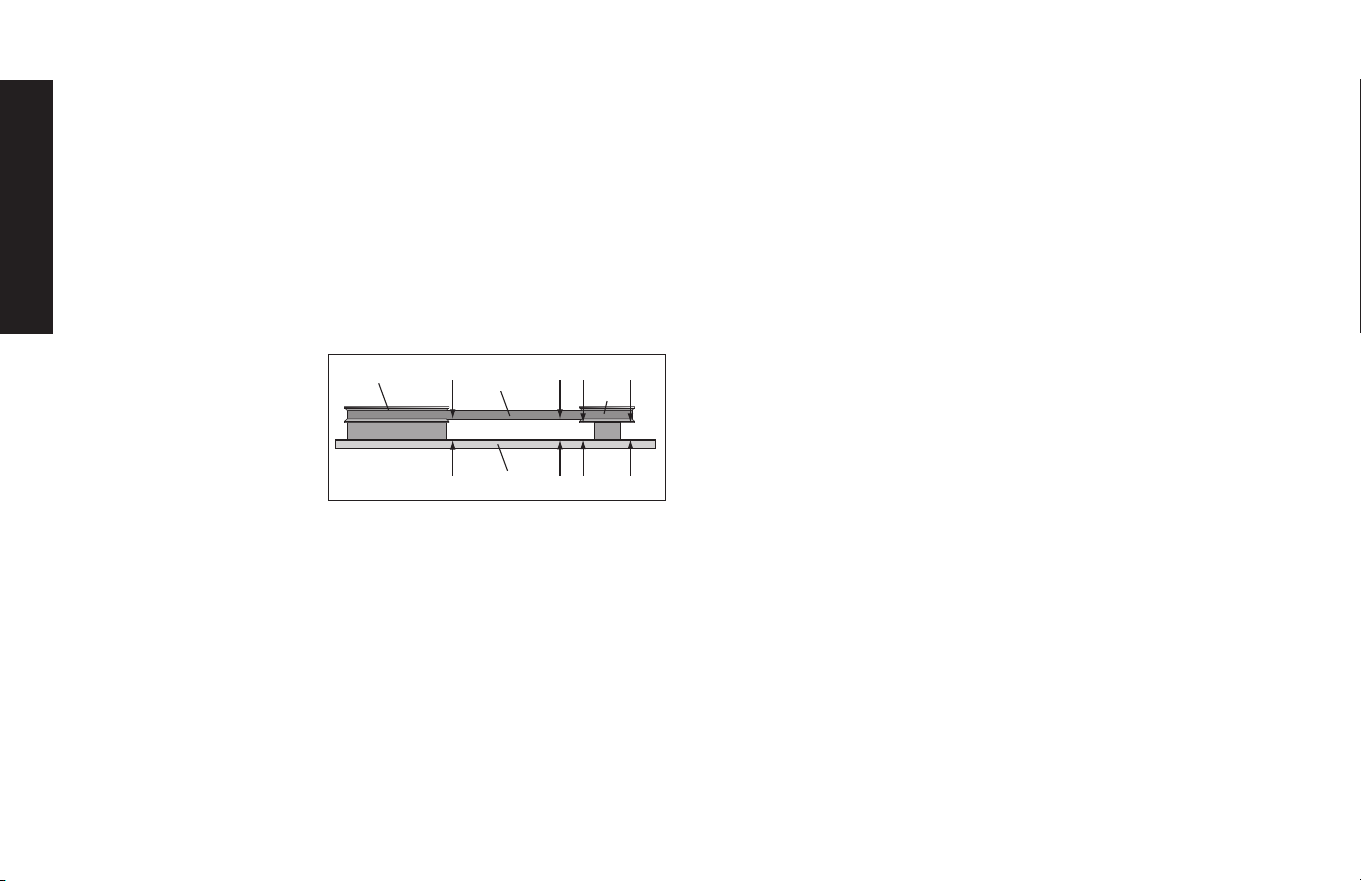
Pulley and Fly wheel Alignment
The air compressor flywheel and engine pulley must be in-line
(in the same plane) within 1/16" (1.6 mm) to ensure belt retention
within flywheel belt grooves. To check alignment:
1. Ensure engine ON/OFF switch (C) is in the OFF Position.
2. Allow the unit to cool.
3. Disconnect spark plug wire.
4. Drain air tank.
5. Remove belt guard.
6. Place a straightedge
Z
X
Y
A1
A1
A2
A2 B1 B2
B1 B2
AA
(X) against the outside
of the flywheel (Y) and
the engine drive pulley
(Z).
7. Measure the distance between the edge of the belt (AA)
and the straightedge at points A1 and A2 in Figure. The
difference between mea sure ments should be no more than
1/16" (1.6 mm).
8. If the difference is greater than 1/16" (1.6 mm), loosen the
setscrew holding the engine drive pulley to the shaft and
adjust the pulley's position on the shaft until the A1 and A2
mea sure ments are within 1/16" (1.6 mm) of each other.
9. Tighten the engine drive pulley setscrew. Torque to 145–180 in.-
lbs. (16.4 – 20.3 Nm).
10. Visually inspect the engine drive pulley to verify that it is
perpendicular to the drive motor shaft. Points B1 and B2
of Figure should appear to be equal. If they are not, loos en
the setscrew of the engine drive pulley and equal ize B1 and
B2, using care not to disturb the belt align ment per formed in
Step 8.
11. Retighten the engine drive pulley set screw. Torque to
145– 180 in.-lbs. (16.4–20.3 Nm).
12. Reinstall belt guard.
13. Reconnect spark plug wire.
Air Compressor Pump Intake and Exhaust
Valves
Once a year have a Trained Service Technician check the air com-
pressor pump intake and exhaust valves.
Inspect Air Lines and Fittings for Leaks
1. Ensure engine START/RUN/OFF switch (C) is in the OFF
Position.
2. Allow the unit to cool.
3. Disconnect spark plug wire.
4. Apply a soap solution to all air line fittings and connections/pip-
ing.
5. Correct any leaks found.
6. Reconnect spark plug wire.
IMPORTANT: Even minor leaks can cause the air compressor

21
English
to overwork, resulting in premature breakdown or inadequate
performance.
Air compressor Head Bolts - Torquing
The air compressor pump head bolts should be kept properly
torqued. Check the torques of the head bolts after the first five
hours of operation. Torque to 32-37ft.-lbs. (43.4-50.2 Nm).
Additional Service
Disassembly or service of the air compressor beyond what is cov-
ered in this manual is not recommended. If additional service is
required, contact your nearest Authorized Warranty Service Center.
Accessories
Recommended accessories for use with your tool are available
for purchase from your local dealer or authorized service center.
If you need assistance in locating any accessory for your tool,
please call 1-888-895-4549 or visit our website www.dewalt.com.
WARNING: The use of any other accessory not recommended
for use with this tool could be hazardous. Use only accessories
rated equal to or higher than the rating of the air compressor.
Service Information
Please have the following information available for all service calls:
Model Number ____________ Serial Number ___________
Date and Place of Purchase ____________________________
Repairs
To assure product SAFETY and RELIABILITY, repairs, maintenance
and adjustment should be performed by a D
e
WALT factory service
center, a D
e
WALT authorized service center or other qualified
service personnel. Always use identical replacement parts.
Limited Warranty
DEWALT Industrial Tools are warranted from date of purchase.
2 Year – Limited warranty on oil-lubricated air compressor
pumps.
1 Year – Limited warranty on all other air compressor
components. This warranty is not transferable to
subsequent owners.
DEWALT will repair or replace, without charge, at DEWALT’s
option, any defects due to faulty materials or workmanship.
For further detail of warranty coverage and warranty repair
information, call 1-(888)-895-4549 or visit dewalt.com. This
warranty does not apply to accessories or damage caused where
repairs have been made or attempted by others. This warranty
also does not apply to merchandise sold by DEWALT which has
been manufactured by and identied as the product of another
company, such as gasoline engines. Such manufacturer’s
warranty, if any, will apply. ANY INCIDENTAL, INDIRECT OR
CONSEQUENTIAL LOSS, DAMAGE OR EXPENSE THAT MAY
RESULT FROM ANY DEFECT, FAILURE OR MALFUNCTION OF
THE PRODUCT IS NOT COVERED BY THIS WARRANTY. Some
states do not allow the exclusion of limitation of incidental or
consequential damages, so the above limitation or exclusion may
not apply to you. IMPLIED WARRANTIES, INCLUDING THOSE
OF MERCHANTABILITY OR FITNESS FOR A PARTICULAR
PURPOSE, ARE LIMITED TO ONE YEAR FROM THE DATE OF
ORIGINAL PURCHASE. Some states do not allow limitations on
how long an implied warranty lasts, so the above limitations may
not apply to you.
What the Company Will Do: (the company) will cover parts
and labor to remedy substantial defects due to materials
and workmanship during the rst year of ownership, with the

22
English
exceptions noted below. Parts used in repair of whole goods or
accessories are warranted for the balance of the original warranty
period.
What is not covered Under This Warranty? Failures by the
original retail purchaser to install, maintain, and operate said
equipment in accordance with standard industry practices.
Modications to the product, or tampering with components,
or failure to comply with the specic recommendations of the
Company set forth in the owner’s manual, will render this warranty
null and void. The Company shall not be liable for any repairs,
replacements, or adjustments to the equipment, or any costs for
labor performed by the purchaser without the Company’s prior
written approval. The effects of corrosion, erosion, surrounding
environmental conditions, cosmetic defects, and routine
maintenance items, are specically excluded from this warranty.
Routine maintenance items such as: oil, lubricants, and air lters,
as well as changing oil, air lters, belt tensioning, etc… fall under
the owner’s responsibility. Additional exclusions include: freight
damage, failures resulting from neglect, accident, or abuse,
induction motors when operated from a generator, oil leaks, air
leaks, oil consumption, leaky ttings, hoses, petcocks, bleeder
tubes, and transfer tubes.
• Thefollowingcomponentsareconsiderednormalwear
items and are not covered after the rst year of
ownership: Belts, sheaves, ywheels, check valves,
pressure switches, air unloaders, throttle controls,
electric motors, brushes, regulators, o-rings, pressure
gauges, tubing, piping, ttings, fasteners, wheels, quick
couplers, gaskets, seals, air lter housings, piston rings,
connecting rods, and piston seals.
• Labor,servicecalls,andtravelcharges,arenotcovered
after the rst year of ownership on stationary
compressors (compressors without handles, or wheels).
Repairs requiring overtime, weekend rates, or any other
charges beyond the standard shop labor rate are not
covered.
• Timerequiredfororientationtrainingfortheservice
center to gain access to the product, or additional time
due to inadequate egress.
• Damagecausedbyincorrectvoltage,improperlywired,
or failure to have a certied licensed electrician install
the compressor, will render this warranty null and void.
• Damagecausedfrominadequateltermaintenance.
• Pumpwearorvalvedamagecausedbyusingoilnot
specied.
• Pumpwearordamagecausedbyanyoilcontamination.
• Pumpwearorvalvedamagecausedbyfailuretofollow
proper maintenance guidelines.
• Operationbelowproperoilleveloroperationwithoutoil.
• GasEngines,ifproductisequippedwithagasengine,
see engine manual for specic engine manufacturer’s
warranty coverage.
Parts purchased separately: The warranty for parts purchased
separately such as: pumps, motors, etc., are as follows:
From Date of Purchase
• Allsingle&twostagepumps 1year
• Electricmotors 90days
• Universalmotor/pump 30days
• Allotherparts30days

23
English
• Noreturnauthorizationwillbeissuedforelectrical
components once items are installed.
How do You Get Service? In order to be eligible for service under
this warranty you must be the original retail purchaser, and provide
proof of purchase from one of the Company’s dealers, distributors,
or retail outlet stores. Portable compressors or components must
be delivered, or shipped, to the nearest Authorized Service Center.
All associated freight costs and travel charges must be borne by
the consumer. Please call our toll free number 1-888-895-4549 for
assistance.
THIS WARRANTY GIVES YOU SPECIFIC LEGAL RIGHTS, AND
YOU MAY ALSO HAVE OTHER RIGHTS WHICH VARY FROM
STATE TO STATE.
THE COMPANY MAKES NO OTHER WARRANTY OR
REPRESENTATION OF ANY KIND WHATSOEVER,
EXPRESSED OR IMPLIED, EXCEPT THAT OF TITLE. ALL
IMPLIED WARRANTIES, INCLUDING ANY WARRANTY OF
MERCHANTABILITY AND FITNESS FOR PARTICULAR PURPOSE
ARE HEREBY DISCLAIMED. LIABILITY FOR CONSEQUENTIAL
AND INCIDENTAL DAMAGES UNDER ANY AND ALL
WARRANTIES, OTHER CONTRACTS, NEGLEGENCE, OR
OTHER TORTS IS EXCLUDED TO THE EXTENT EXCLUSION IS
PERMITTED BY LAW.
GLOSSARY
CFM: Cubic feet per minute.
SCFM: Standard cubic feet per minute; a unit of measure of air
delivery.
PSI: Pounds per square inch; a unit of measure of pressure.
Code Certification: Products that bear one or more of the fol-
lowing marks: UL
®
*, CUL, ETL
®
*, CETL, have been evaluated by
OSHA certified independent safety laboratories and meet the
applicable Standards for Safety.
* UL
®
is a registered trademark of Underwriters Laboratories and
ETL
®
is a registered trademark of Electrical Testing Laboratories.
California Code: Unit may comply with California Code 462 (l)
(2)/(M) (2). Specification/model label is on the side of the air tank
on units that comply with California Code.
Unloader Blow-Off Pressure: All models are continuous running
units controlled by air tank pressure. When the maximum air
tank pressure is obtained, the unloader valve will blow-off. This
will cause the compressor to exhaust the air to the atmosphere
and not the tank. This decreases the load on the engine and
allows it to run at a near no-load condition.
Unloader Reset Pressure: When the air tank pressure drops to
a predetermined point, the unloader valve closes. The air tank
pressure will now increase until it reaches the unloader blow-off
pressure.

24
English
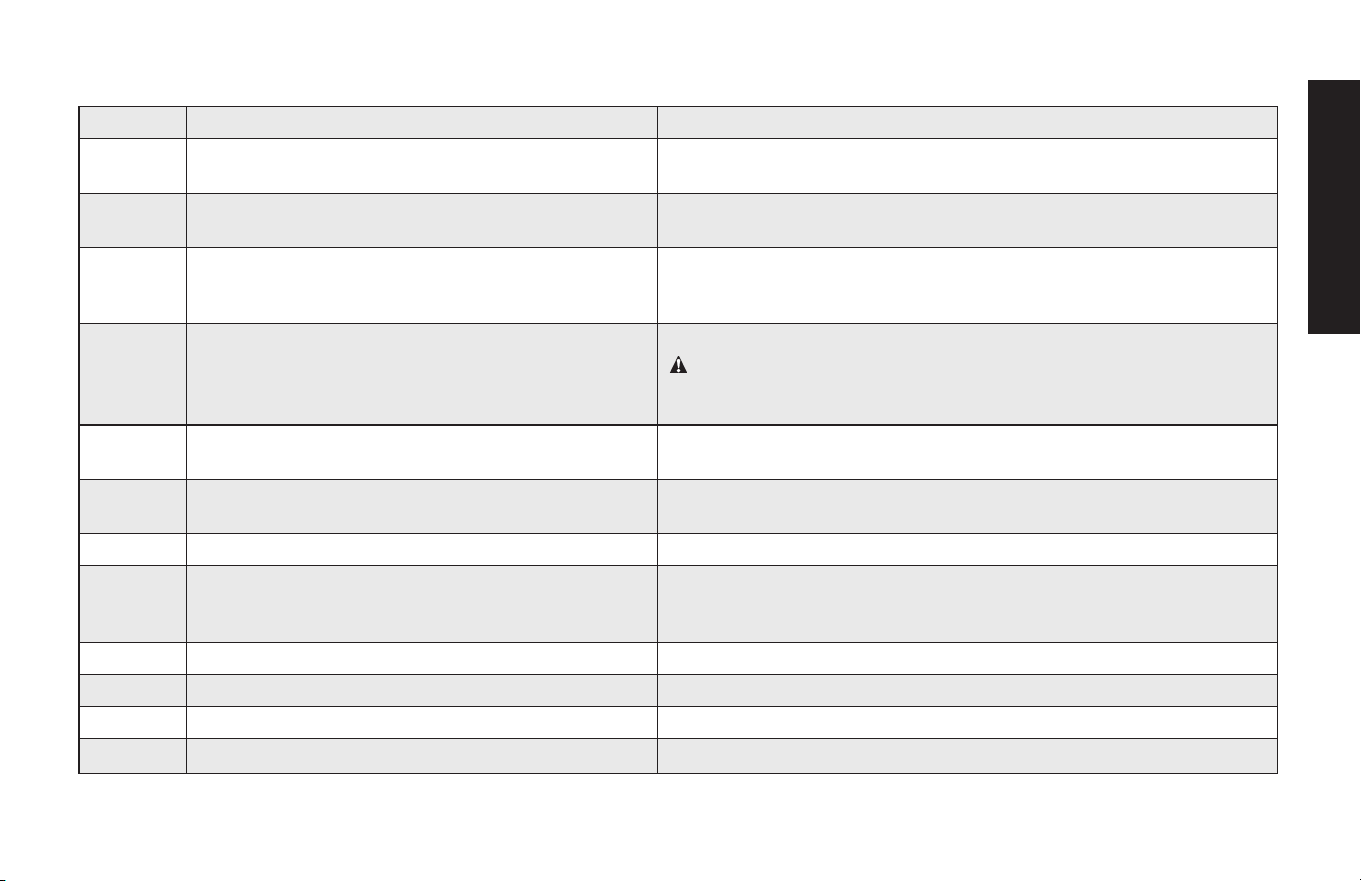
Troubleshooting Guide
This section provides a list of the more frequently encountered malfunctions, their causes and corrective actions. The operator or
maintenance personnel can perform some corrective actions, and others may require the assistance of a qualified D
eWALT technician
or your dealer.
Problem Code
Excessive air tank pressure-safety valve pops off ...................................................................1
Air leaks ...................................................................................................................................2
Continuous air leak at unloader valve. .................................................................................... 3
Air leaks in air tank or at air tank welds .................................................................................. 4
Air leaks between head and valve plate
.................................................................................5
Air leaks from safety valve .......................................................................................................6
Compressor is not supplying enough air to operate accessories ......................................... 2, 7, 8, 9, 10, 12, 13
Restricted air intake. ................................................................................................................12
Excessive vibration
...................................................................................................................14, 15
Problem
..........................................................................................................................................Code
Knocking Noise .........................................................................................................................6, 13, 14, 15, 16, 17, 18, 19
Excessive belt wear ..................................................................................................................13,14,16,19,20
Squealing sound ....................................................................................................................... 13
Engine will not run
.................................................................................................................... 21, 22, 23, 34
Pressure reading on the regulated pressure gauge drops when an accessory is used ......24
Regulator knob has continuous air leak..................................................................................25
Regulator will not shut off air outlet ........................................................................................25
Moisture in pump crankcase
...................................................................................................2, 5, 11, 26, 27, 28, 29, 30, 31
Pump will not run ......................................................................................................................32
Air tank pressure will not build ................................................................................................32, 33
25
English
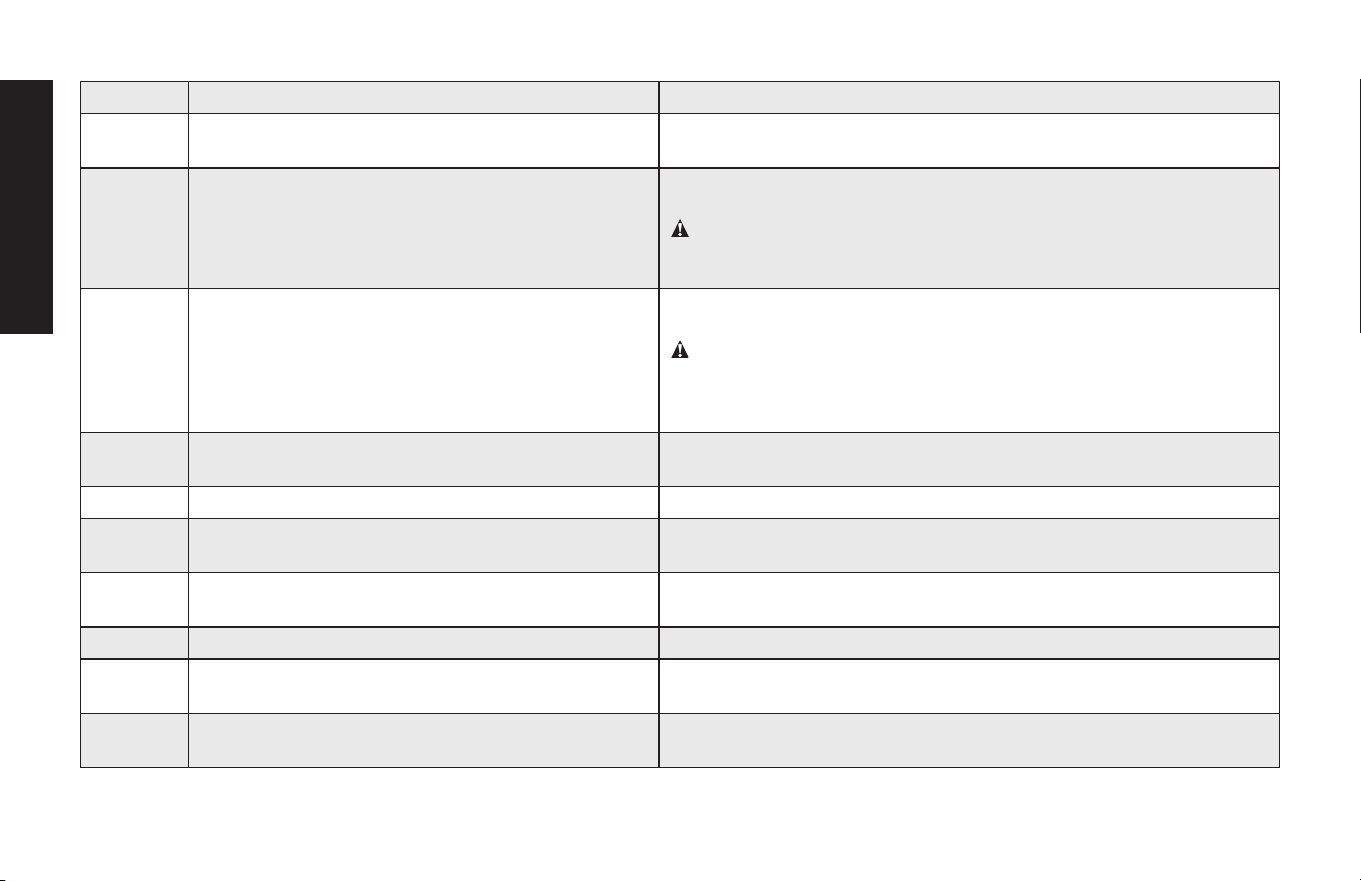
Troubleshooting Codes
CODE POSSIBLE CAUSE POSSIBLE SOLUTION
1 Unloader valve does not release pressure when
air tank reaches blow-off pressure
Unloader valve must be replaced. Contact a D
e
WALT factory
service center or a D
e
WALT authorized service center.
2 Fittings are not tight Tighten fittings where air can be heard escaping. Check fittings
with soapy water solution. DO NOT OVERTIGHTEN.
3 Defective unloader valve Turn off engine, rotate manual lock unloader lever to the closed
perpendicular position. If air leaks out of air tank through
unloader valve, replace unloader valve.
4 Defective air tank Air tank must be replaced. Do not repair the leak.
WARNING: Risk of bursting. Do not drill into, weld or otherwise
modify air tank or it will weaken. The air tank can rupture or
explode.
5 Leaking seals Contact a D
eWALT factory service center or a D
e
WALT authorized
service center.
6 Defective safety valve Operate safety valve manually by pulling on ring. If valve still
leaks, it must be replaced.
7 Prolonged excessive use of air Decrease amount of air usage.
8 Compressor is not large enough for accessory Check the accessory air requirement. If it is higher than the
SCFM or pressure supplied by your air compressor, a larger
compressor is needed to operate accessory.
9 Hole in air hose Check and replace air hose, if required.
10 Unloader valve restricted Remove, clean or replace.
11 Unit operating in damp or humid conditions Move unit to a dry well ventilated area.
12 Restricted air intake filter Clean or replace air intake filter.
26
English
CODE POSSIBLE CAUSE POSSIBLE SOLUTION
13 Loose belt Check belt tension, see Adjusting Belt Tension under
Maintenance.
14
Engine mount ing bolts are loose Tighten mounting screws. Torque engine mounting bolts to
10– 20 ft.-lbs. (13.5–27.1 Nm).
WARNING: Risk of bursting. Excessive vibration could weaken
the air tank and cause it to rupture or explode. Mounting screws
must be kept tightened.
15 Pump stiffener bracket bolt is loose Check bolt and tighten if required. Torque pump stiffener bracket
bolt to 10– 20 ft.-lbs. (13.5–27.1 Nm).
WARNING: Risk of bursting. Excessive vibration could weaken
the air tank and cause it to rupture or explode. Stiffener bracket
bolt must be kept tightened. Never operate the unit unless
equipped with the stiffener bracket.
16
Loose pulley Tighten pulley set screw, torque to 145–180 in.-lbs. (16.4– 20.3
Nm).
17
Loose flywheel Tighten flywheel screw, torque to 22–26 ft.-lbs. (29.8–35.3 Nm).
18
Carbon build-up in pump Contact a D
e
WALT factory service center or a D
e
WALT authorized
service center.
19
Belt to tight Check belt tension, see Adjusting Belt Tension under
Maintenance.
20
Pulley misalignment See Motor Pulley/Flywheel Alignment under Maintenance.
21
Air tank pressure is too high Open the regulator and reduce air tank pressure to less than
40 psi.
22
Engine problem Contact a D
e
WALT factory service center or a D
e
WALT authorized
service center.
27
English
CODE POSSIBLE CAUSE POSSIBLE SOLUTION
23
Engine or pump oil is low Add D
e
WALT synthetic compressor oil to pump. See Compressor
Pump Oil under Maintenance.
24
It is normal for some pressure drop to occur If there is an excessive amount of pressure drop when the
accessory is used, adjust the regulator as instructed in
Regulator under Features.
NOTE: Adjust the regulated pressure under flow conditions while
accessory is being used.
25
Damaged regulator Replace.
26
Detergent type oil being used in pump Drain oil and refill pump with D
e
WALT synthetic compressor oil.
27
Extremely light duty cycles Run unit for longer duty cycles. It is recommended to run at high
throttle 50-75% of the run time and idle for 25% of the run time.
28
Piston rings damaged or worn Contact a D
e
WALT factory service center or a D
e
WALT authorized
service center.
29
Cylinder or piston damaged or worn Contact a D
e
WALT factory service center or a D
e
WALT authorized
service center.
30
Compressor cylinder finish worn Contact a DeWALT factory service center or a D
e
WALT authorized
service center.
31
Water in pump oil Drain oil and refill pump with D
e
WALT synthetic compressor oil.
32
Manual lock unloader lever in open position Rotate manual lock unloader lever to the closed perpendicular
position.
33
Regulator open Rotate the regulator knob counterclockwise to its built-in stop and
push knob in to lock in place.
34
Engine fuel tank empty Add gasoline, see engine's instruction manual for correct
procedure.

28
English
FREE WARNING LABEL REPLACEMENT: If your warning labels become illegible or are missing, call 1-888-895
-
4549 for a free
replacement.
For product, service or warranty information contact us at:
Para el producto, servicio o información sobre la garantía contacte con nosotros en:
Pour les produits, services ou informations sur la garantie nous contracter à:
1-888-895-4549
www.DEWALT.com
MAT Industries, LLC, Long Grove, IL 60047
Under license from D
EWALT Industrial Tool Co.
Bojo licencia de D
EWALT Industrial Tool Co.
Sous licence de D
EWALT Industrial Tool Co.
The following are trademarks for one or more DEWALT power tools: thee yellow and black color scheme; the “D” shaped air intake grill; the array of pyramids on the handgrip;
the kit box configuration; and the array of lozenge shape humps on the surface of the tool.
Las siguientes son características únicas de una o más herramientas eléctricas y accesorios de DEWALT: El esquema de color amarillo y negro, la parrilla de admisión de aire
en “D”, la formación de pirámides en el mango, la configuración de la caja de herramientas y la formación de rombos en la superficie de la herramienta.
Vous trouverez ci-après les marques de commerce d’un ou plusieurs outils électriques et accessoires DEWALT. L’agencement de couleurs jaune et noir, la grille d’admission
d’air en forme de “D”, la distribution de pyramides sur la poignée, le format du boîter et la matrice complexe de bosses en forme de losanges sur la surface de l’outil.