Pulse Oximeter Model: 21600
FCC Statement
This device complies with Part 15 of the FCC Rules. Operation is subject
to the following two conditions :
(1) this device may not cause harmful interference.
(2) this device must accept any interference received,including interference that
may cause undesired operation.
NOTE: This equipment has been tested and found to comply with the limits
for a Class B digital device, pursuant to Part 15 of the FCC Rules. These limits
are designed to provide reasonable protection against harmful interference in
a residential installation. This equipment generates, uses and can radiate
radio frequency energy and, if not installed and used in accordance
with the instructions, may cause harmful interference to radio communications.
However, there is no guarantee that interference will not occur in a particular
installation. If this equipment does cause harmful interference to radio or
television reception, which can be determined by turning the equipment off
and on, the ser is encouraged to try to correct the interference by one or more
of the following measures:
● Reorient or relocate the receiving antenna.
● Increase the separation between the equipment and receiver.
●Connect the equipment into an outlet on a circuit different from that to
which the receiver is connected.
●Consult the dealer or an experienced radio/TV technician for help.
Warning: Changes or modifications to this unit not expressly approved by the
party responsible for compliance could void the user’s authority to operate
the equipment.
Precautions
Do not attempt to maintain the Oximeter unless you are professional
engineers. Only professionals with maintenance qualification are allowed
to perform interior maintenance as necessary.
Periodically change the contact position between the Oximeter probe
and the finger for a measurement that lasts a long time. Adjust the
position of the probe before the measurement lasts two hours, and
check the integrity of skin, the blood circulation condition of the finger as
well as the position of the finger.
This product is not applicable to the examination of newborn babies.
Seek for medical care in time if the measured value goes beyond the
normal range while you are sure that the instrument does not
malfunction.
Do not directly expose your eyes to light-emitting components of the
Oximeter, as that could cause harm to your eyes.
For details about clinical limitations and contraindications, please
carefully consult relevant medical literatures.
The following factors may cause disturbance to or affect the accuracy of
examination:
◆ This product is used in an environment involving high-frequency devices,
such as high-frequency electric knives and CT apparatuses.
◆ The probe of the Oximeter is placed on the same body part or limb as
with blood pressure cuff arterial duct or intravenous injection.
◆ The user suffers from hypotension, severe vascular atrophy, severe
anemia, or low oxygen.
◆ The user is in sudden cardiac arrest or shock state.
◆ The finger with nail polish or a fake fingernail may cause wrong readings
of pulse oxygen saturation.
Warnings
Warning: Do not use the Oximeter in an environment with any inflammable gases,
inflammable anesthetic, or other inflammable substances.
Warning: Do not attempt to charge any common dry battery, as that could cause
leakage, fire disaster, or even explosion. Dispose of exhausted batteries in
accordance with environment protection regulations.
Warning: Do not use the Oximeter in an MRI or CT environment.
Warning:Do not operate the Oximeter when it is damp with overflow or water
vapor condensation. Avoid moving the Oximeter from an excessively-cold
environment to a high-temperature moist environment.
Symbol Conventions
Symbol
Description
Type BF applied part
Caution: Please see this manual.
%SpO2
Symbol of oxygen saturation
bpmPR
Symbol of pulse rate
No SpO
2
alarms.
Bluetooth symbol
When end users abandon this product, they must send the
product to the collection place for recycling.
Overview
Oxygen saturation is the percentage of oxyhemoglobin (HbO2) that is combined
with oxygen against all combinable hemoglobin (Hb). It is an important physiological
parameter involved in respiration and circulation. The oxygen saturation of arterial
blood in a normal human body is 98%. Oxygen saturation is an important indicator
of the oxygen condition in the human body. In general, the normal values of oxygen
saturation shall not be lower than 94%. If the measured value of oxygen saturation
is lower than 94%, an insufficient supply of oxygen is considered.
The pulse rate is the number of pulse beats per minute. Normally, the pulse rate is
consistent with the heart rate. In general, the pulse rate of every people is 60 to 90
beats per minute.
The Perfusion Index (PI) usually reflects the limb perfusion status of an examined
patient, and shows the detection precision of the instrument as well; that is,
examination can still be performed even in the low or weak perfusion condition.The
PI of a normal human body is 3% or greater.
Working Principles, Expected Usage, and Applicable Scope
Based on full digital technology, the Finger Pulse Oximeter non-invasively measures
the actual content (oxygen saturation) of oxyhemoglobin (HbO2) in arterial blood
using the optical transmittance method.
The Finger Pulse Oximeter measures the blood oxygen saturation and pulse rate of
a human body via finger artery. It is applicable to a wide range of fields, such as
families, hospitals (including operation rooms of the departments of internal
medicine and surgery, the department of anesthesiology, the department of
paediatrics, and intensive care rooms), oxygen bars, social medical care institutions,
and sports & health. Use this instrument for measurement before or after sports.
You are not advised to use this instrument during sports activities. Do not use it for
continuous care for patients.
Appearance of the structure
Screen Display
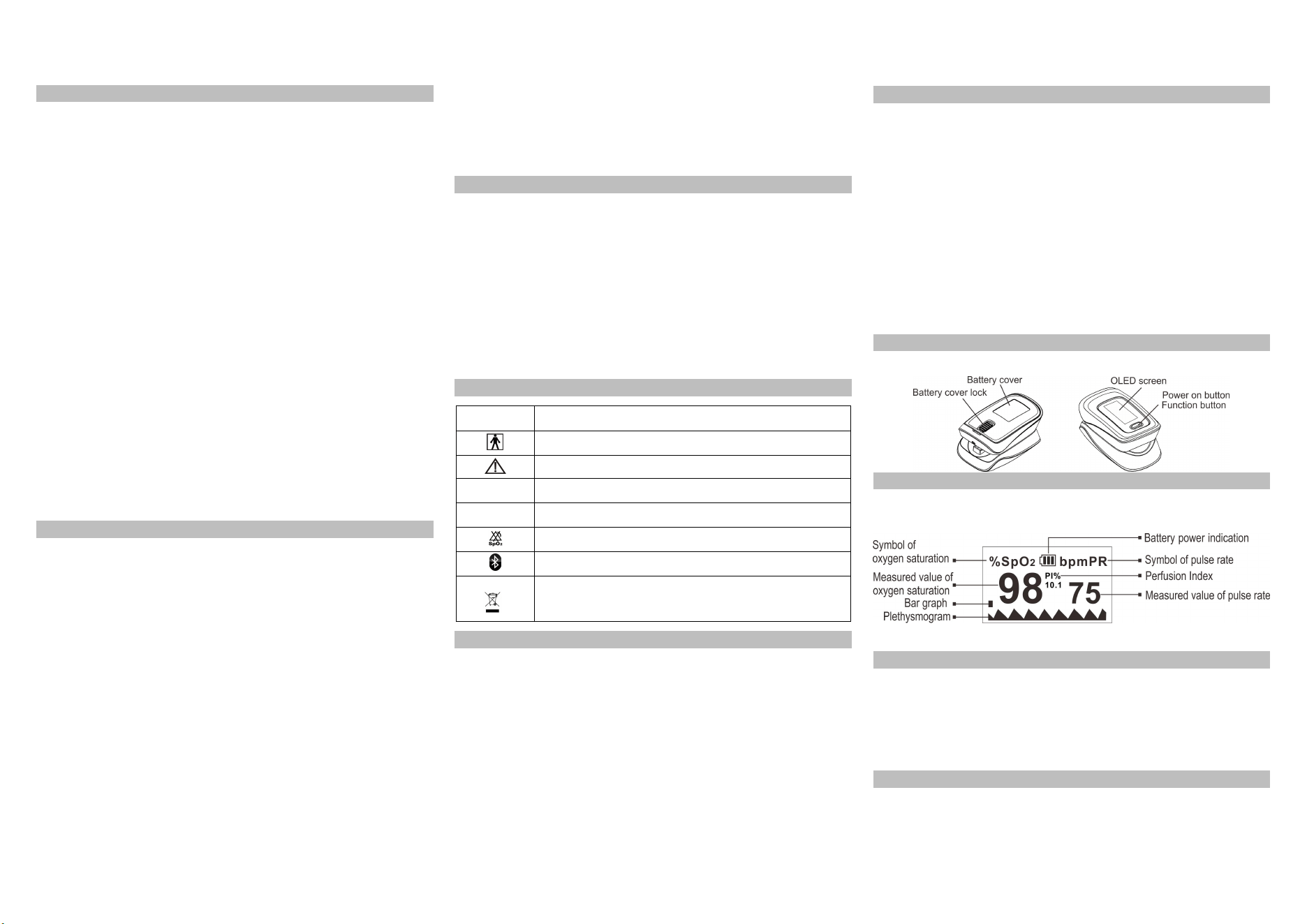
The following figure shows the information display on the OLED screen of the
Oximeter in normal detection state:
Note: Battery power indication and bluetooth symbol will alternately displayed.
Power-On button/Functional button Operations
Press and release the button to turn on, hold the button for about one second. The
Oximeter shows a parameter setting interface. Press or hold the button to perform
corresponding operations. Hold it to set an item, or press it to switch an option or
switch the display mode. Press means no more than 0.5 seconds, while Hold means
more than 0.5 seconds.
Alert Sound Setting
Hold the functional button while the Oximeter is in powered-on state. Parameter
setting interface 1 is displayed, as shown in the following figure. Move "*" to the
corresponding option, and hold the functional button to set Alm to on and set Beep
to off. When Alm is set to on and the measured values of the blood oxygen
saturation and pulse rate go beyond the upper limit or lower limit, the Oximeter
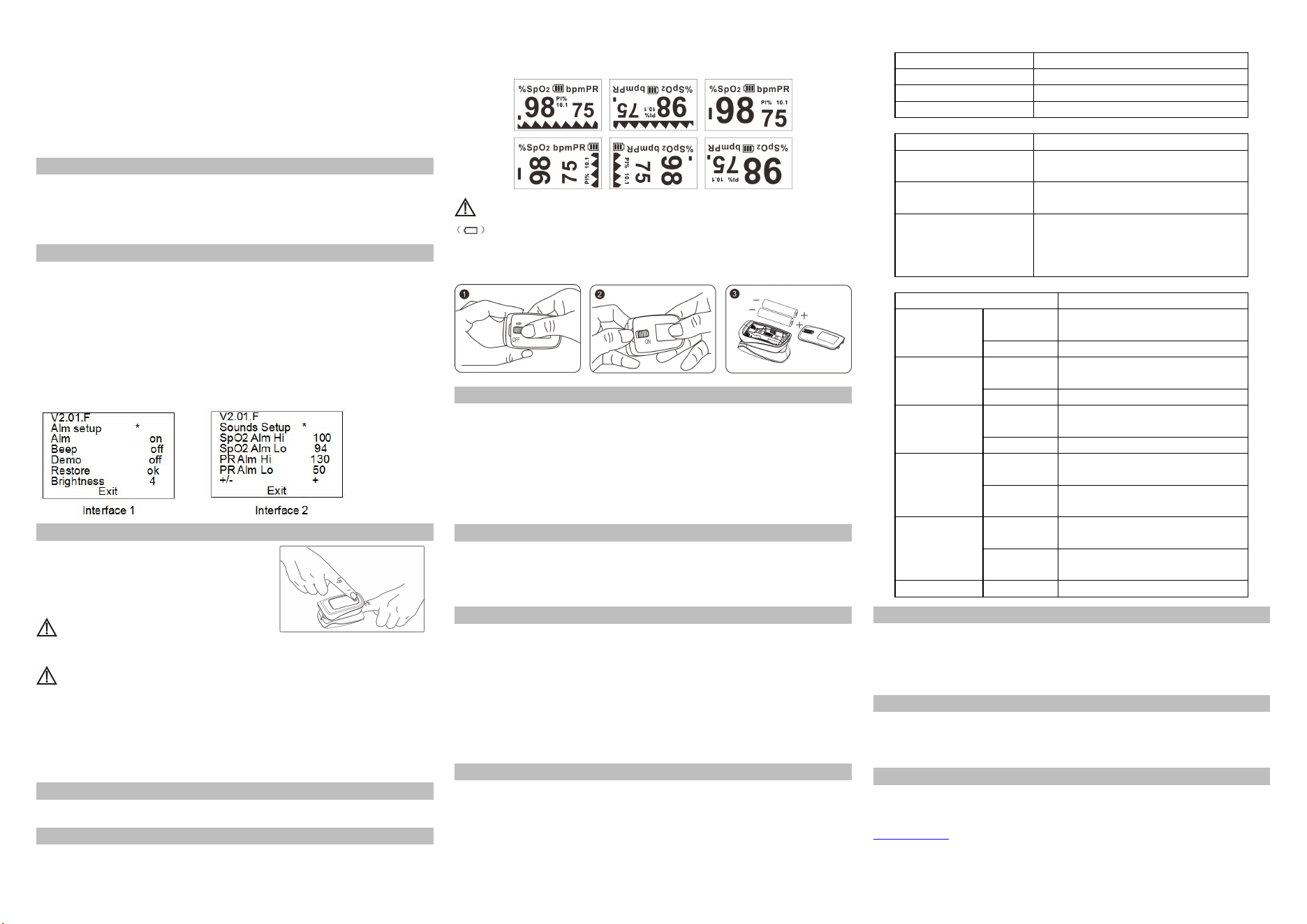
gives off an alert sound. When Alm is set to off and the measured values go beyond
the limit, the Oximeter will not give any alert sound. When Beep is set to on, a tick
will be heard along with pulse beats during pulse rate measurement. When Beep is
set to off, no sound will be output along with pulse beats during pulse rate
measurement. While the "*" symbol stays on the Restore option, hold the
functional button to restore factory settings.
Brightness Setting
On parameter interface 1, press the functional button to select the Brightness
option and then hold the functional button to set the brightness to a value ranging
from 1 to 5. The greater the value, the greater the brightness of the screen.
Alert Range Setting
On parameter interface 2, press the functional button to switch between options.
On this interface, you can set the upper limit and lower limit of SpO2 Alm and PR
Alm. While the "*" symbol stays on the +/- option, hold the functional button to set
the option to + or -. In + mode, select the corresponding option and hold the
functional button to increment the upper or lower limit; in - mode, hold the
functional button to decrement the upper or lower limit. Move "*" to the Exit
option, and hold the functional button to return to the monitoring interface.
Operation Guide
Stick one finger completely into the measuring
parts of the Oximeter, keep the fingernail
surface upward, and release the clip. Then press
the power button to power on the Oximeter.
If you do not yet completely insert your
finger into the cavity, the measurement result may be inaccurate.
Do not vibrate your finger during measurement. Preferably, ensure that your
body does not move. After the readings become stable, read the measured values
of oxygen saturation and the pulse rate on the screen.
NOTE:The Oximeter will automatically shut down 10 seconds later after your finger
leaves away.
Connecting the Instrument to a Mobile Phone via Bluetooth
Note: For details on specific operations, see the APP operation instructions.
About the Display
Continuously press the functional button in the monitoring process. The monitored
data and the display mode will be cyclically displayed on the OLED screen in two
different ways (large fonts and plethysmogram) and four directions, as shown in the
following figure.
Replace the batteries when the battery capacity is insufficient and the symbol
flickers on the screen.
Open the battery cover with your fingers, you can replace the batteries according
to the correct battery polarity.
Cleaning
Power off the instrument and remove the batteries before cleaning. Ensure that
the appearance of the instrument is neat, dust-free, and dirt-free. Clean the outer
surface of the instrument (including the OLED screen) using 75% medical alcohol
and a piece of dry soft cloth.
Caution: Avoid liquid flowing into the instrument during cleaning.
Caution: Do not immerse any part of the instrument into any liquid.
Disinfection
Before measurement with the instrument, wipe the rubber finger pad using a piece
of dry soft cloth dipped with 75% medical alcohol. Clean the finger to be measured
using the medical alcohol for disinfection purposes before and after use.
Maintenance
Remove the batteries from the battery slot and properly store them if you do
not plan to use the Oximeter for a long period of time.
Avoid using the Oximeter in an environment with inflammable gases or using it
in an environment where the temperature or humidity is excessively high or
low.
Check the accuracy of the oxygen saturation and pulse rate readings by using
an appropriate calibration apparatus.
Technical Specifications
1. Dimensions: 62.0 mm (Width) × 37.0 mm (Depth) × 32.0 mm (Height)
Weight: 42.5 g (including the height of the two AAA dry batteries)
2. Peak wavelength range of the light emitted from the probe: red light 660 nm ±
3; infrared light 905 nm ± 5.
3. Maximum optical output power of the probe: 1.2 mW for infrared light (905
nm).
4. Bluetooth module: 4.0
5. Normal working condition
Working Temperature
5C to 40C (41F to 104F)
Relative Humidity
15% to 80%, non-condensing
Atmospheric Pressure
70 kPa to 106 kPa
Rated Voltage
DC 3.0 V
6. Default values and conditions of alert
Parameter
Value
Oxygen saturation
Upper limit: 100
Lower limit: 94
Pulse rate
Upper limit: 130
Lower limit: 50
Alert condition
When the alert switch is on and the
actual measured value goes beyond the
preset alert parameter range, the
Oximeter gives an alert sound.
7. Technical parameters
Parameter
Value
Display range
Oxygen
saturation
35% to 100%
Pulse rate
25 bpm to 250 bpm
Resolution
Oxygen
saturation
1%
Pulse rate
1 bpm
Measurement
precision
Oxygen
saturation
±2% (70% to 100%)
No requirement (≤ 69%)
Pulse rate
±2 bpm
Alert range
Oxygen
saturation
Upper limit: 50% to 100%
Lower limit: 50% to 100%
Pulse rate
Upper limit: 25 bpm to 250 bpm
Lower limit: 25 bpm to 250 bpm
Alert error
Oxygen
saturation
± 1% of the preset value
Pulse rate
The greater of ±10% of the preset
value and ±5 bpm
PI
Weak PI
Min. 0.2%
Safety Type
Anti-electric-shock type: internal power supply device
Anti-electric-shock degree: Type BF applied part
Running mode: continuous working
Waterproof grade: IP22
Storage and Transportation
Temperature : –10C - 50C(14℉-122℉)
Relative humidity : 10%-93% (no condensation)
Atmospheric pressure : 50kPa–106 kPa.
Contact Information
Zewa, Inc.
12960 Commerce Lakes Dr. # 29
Fort Myers, FL 33913
www.zewa.com
Toll Free Customer Service: 1-888-993-3592