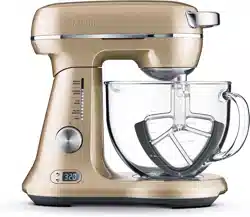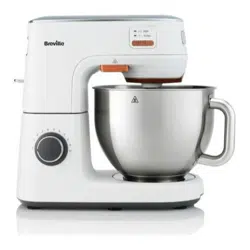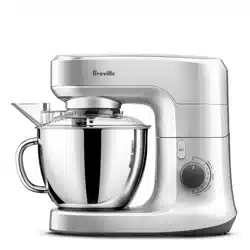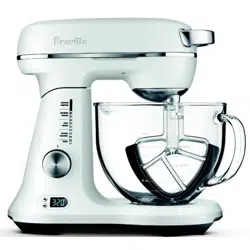
the Bakery Chef
™
Hub
Instruction Book – LEM750

2
IMPORTANT
SAFEGUARDS
READ ALL
INSTRUCTIONS BEFORE
USE AND SAVE FOR
FUTURE REFERENCE
• Carefully read all
instructions before
operating the Breville
bench mixer for the first
time and save for future
reference.
• Remove and safely
discard any packaging
material and promotional
labels before using the
bench mixer for the first
time.
• To eliminate a choking
hazard for young children,
remove and safely discard
the protective cover fitted
to the power plug of this
bench mixer.
Contents
BREVILLE
RECOMMENDS
SAFETY FIRST
At Breville we are very safety
conscious. We design and
manufacture consumer
products with the safety of you,
our valued customer, foremost
in mind. In addition, we ask
that you exercise a degree
of care and adhere to the
following precautions.
2 Breville Recommends Safety First
9 Components
11 Assembly
14 Functions
18 Care, Cleaning & Storage
19 Tips
23 Troubleshooting
24 Recipes

3
• Do not place the bench
mixer near the edge of
a bench or table during
operation. Ensure the
surface is level, clean and
free of water and other
substances. Vibration
during operation may
cause the bench mixer to
move.
• Do not use the bench
mixer on a sink drain
board.
• Do not place the bench
mixer on or near a hot gas
or electric burner or where
it could touch a heated
oven.
• Always ensure the
bench mixer is properly
assembled before
operating. Follow the
instructions provided in
this book.
• Do not operate the bench
mixer with wet hands.
• Ensure the speed control
dial is in the OFF position,
the bench mixer is
switched off at the power
outlet and the power
cord is unplugged before
attaching the mixing bowl
or any mixing accessories
(scraper beater, whisk
and dough hook) or any
hub attachments (sold
separately).
• Do not use accessories
other than those provided
with the bench mixer. Use
only the accessories, and
mixing bowl supplied with
the bench mixer.
• Do not operate the dough
hook, scraper beater
or whisk on the bench
mixer when attaching
hub attachments ( sold
separately ) on the bench
mixer to avoid injury or
damage to the appliance.
• Do not use hub
attachments (sold
separately) other than
those specifically designed
for this bench mixer.

4
• Do not operate this bench
mixer continuously on
heavy loads for more than
3 minutes at a time. None
of the recipes in this book
are considered a heavy
load.
• The bench mixer can be
used for mixing yeast
dough. When doing
this, fill the mixing bowl
with a mass of flour not
exceeding 35% of the
bowls’ maximum capacity.
• Handle the bench
mixer, accessories and
attachments with care.
Never place your fingers
inside the mixing bowl
or near the accessories or
hub attachments during
operation.
• Keep hands, hair, clothing
as well as spatulas and
other utensils away
from the accessories
and mixing bowl during
operation to reduce the
risk of injury to persons
and / or damage to the
bench mixer.
• Should an object, such as
a spoon or spatula fall into
the bowl while mixing,
immediately switch the
bench mixer to the OFF
position on the speed
control dial, turn off at the
power outlet and remove
the cord from the power
outlet, then remove the
object.
• Be careful when handling
the bench mixer that the
attachment hub cover
on the front of the motor
head does not become
dislodged and fall into the
bowl during operation.
• Do no place hands in
the mixing bowl unless
the bench mixer is
disconnected from the
power outlet.
• Ensure the motor and
the mixing accessory
(or hub attachment)
has completely stopped
before disassembling.

5
• Always remove the
accessory (or hub
attachment) from the
bench mixer before
cleaning. Care should be
taken when removing
the food from the mixing
bowl by ensuring the
motor and the accessory
have completely stopped
before disassembling.
• Ensure the speed control
dial is in the OFF position,
the bench mixer is
switched off at the power
outlet and unplugged
before tilting the bench
mixer motor head into the
diagonal (open) position.
The mixing accessory
should be released from
the mixer head before
attempting to remove
food from the mixer bowl
and the accessory.
• Ensure the bench mixer
head is locked into
the horizontal (closed)
position when not in use
and before storing.
• Always ensure the speed
control dial is in the OFF
position, the power is
switched off at the power
outlet before attempting
to move the bench mixer,
before assembling or
disassembling the bench
mixer, when the bench
mixer is not in use and
before cleaning or storing.
• Always switch OFF
the bench mixer and
disconnect from the
power outlet before
removing any hub
attachment, changing
accessories or
approaching parts that
move in use.
• Do not move the bench
mixer whilst in operation.
• Do not cover the air vents
on the mixer head and
mixer stand to avoid
overheating.
• The use of any
mixing accessory or
hub attachment not
recommended by Breville
may cause injuries.

6
• Do not leave the bench
mixer unattended when in
use.
• Do not place any part of
the bench mixer except
the mixing bowl in the
dishwasher.
• Do not place the bench
mixer in direct sunlight.
Colour fading and
discolouration may occur
when the bench mixer is
consistently exposed to
UV light.
• Keep the bench mixer
clean. Follow the Care,
Cleaning and Storage
instructions provided in
this book.
CAUTION
In order to avoid a hazard
due to inadvertent reset-
ting of the thermal cut-out,
this bench mixer must not
be supplied through an
external switching device,
such as a timer, or connect-
ed to a circuit that is reg-
ularly switched on and off
by the utility.
IMPORTANT
SAFEGUARDS FOR
ALL ELECTRICAL
APPLIANCES
• Fully unwind the power
cord before use.
• Connect only to a 230V or
240V power outlet.
• The appliance must
be used on a properly
grounded outlet. If it is
not sure, please consult a
qualified electrician.
• Do not, under any
circumstances, modify the
power plug or use a power
plug adapter.
• Do not place this appliance
on or near a heat source,
such as hot plate, oven or
heaters.
• Position the appliance at
a minimum distance of
20cm away from walls,
curtains and other heat or
steam sensitive materials
and provide adequate
space above and on all
sides for air circulation.

7
• Do not let the power cord
hang over the edge of
a bench or table, touch
hot surfaces or become
knotted.
• This appliance is for
household use only. Do
not use this appliance
for anything other than
its intended use. Do not
use in moving vehicles
or boats. Do not use
outdoors. Misuse may
cause injury.
• The appliance is not
intended for use by
persons (including
children) with reduced
physical, sensory or
mental capabilities,
or lack of experience
and knowledge, unless
they have been given
supervision or instruction
concerning use of the
appliance by a person
responsible for their
safety.
• Children should be
supervised to ensure that
they do not play with the
appliance.
• Always turn the appliance
to the OFF position,
switch off at the power
outlet and unplug at the
power outlet when the
appliance is not in use.
• Before cleaning, always
turn the appliance to the
OFF position, switch off at
the power outlet, unplug
at the power outlet and
remove the power cord,
if detachable, from the
appliance and allow all
parts to cool.
• To protect against electric
shock, do not immerse
the power cord, power
plug or appliance in water
or any other liquid or
allow moisture to come
in contact with the parts,
unless it is recommended
in the cleaning
instructions.

8
• Any maintenance other
than cleaning should
be performed at an
authorised Breville
Service Centre.
• It is recommended to
regularly inspect the
appliance. To avoid a
hazard, do not use the
appliance if power cord,
power plug or appliance
becomes damaged in
any way. Return the
entire appliance to
the nearest authorised
Breville Service Centre
for examination and/or
repair.
• The installation of
a residual current
device (safety switch)
is recommended to
provide additional safety
protection when using
electrical appliances.
It is advisable that a
safety switch with a rated
residual operating current
not exceeding 30mA be
installed in the electrical
circuit supplying the
appliance. See a qualified
electrician for professional
advice.
• During electrical storms,
the appliance should be
disconnected from the
power source at the wall
socket to prevent any
electrical surges that may
arise during the storm and
which may inadvertently
cause damage to the
appliance and its
electronic componentry.
FOR HOUSEHOLD USE ONLY
SAVE THESE INSTRUCTIONS
9
Components
O
A
J
L
M
N
K
H
B
D
F
G
E I
P Q
C

10
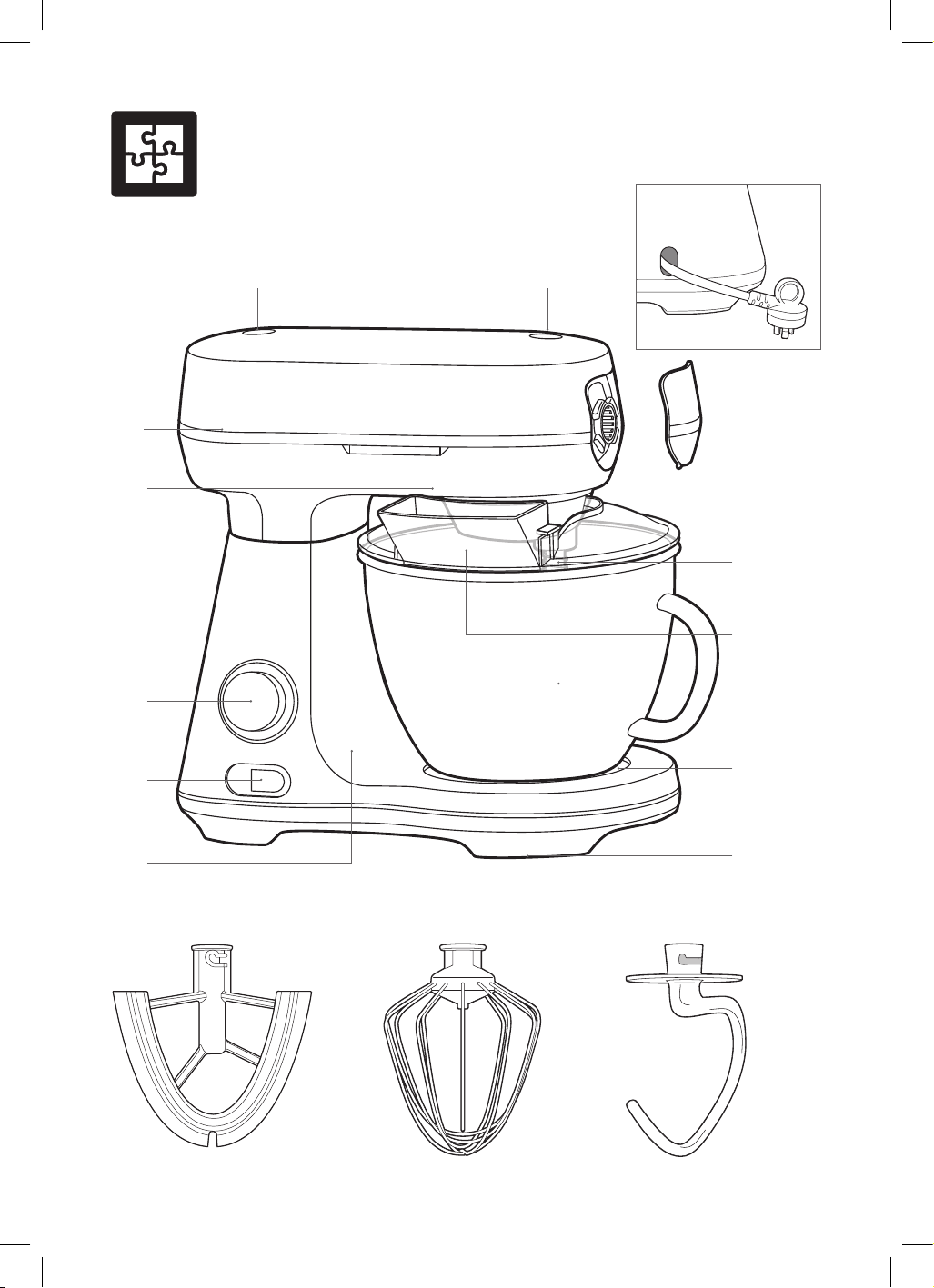
A. Mixer motor head
Powerful motor for all your mixing needs.
B. Bowl illumination light
Helps to illuminate contents of the bowl
while mixing.
C. Mixer stand with cord storage
Push the cord in up to the Breville assist
power plug to store.
D. 7 speed illuminated control dial with push
to pause
Adjust speed and handy press to pause
feature to pause mixing.
E. Tilt release button
Spring release for the mixer motor head
to tilt and lock in an upward (diagonal) or
downward (horizontal) position.
F. Timer display
Counts up when mixing starts, or use the
arrow buttons to set timer to count down.
G. Motor overload protection system
Prevents the motor from overheating.
H. Hub attachments drive with
magnetic cover
Removable, magnetic hub cover for access to
the hub drive when using attachments (sold
separately).
I. Hub attachment release button
Releases the lock on the hub attachment
once attached to the mixer.
J. Motor spindle
For attaching the accessories, scraper beater,
whisk and dough hook, to complete various
mixing tasks.
K. Two piece splash guard with pouring spout
Minimises splattering and allows ingredients
to be added while mixing without removal.
Components
L. Stainless steel mixing bowl
4.8L bowl with handle for lifting and
scraping the bowl with greater ease.
M. Bowl locking recess
Locks the mixing bowl in place during all
mixing tasks.
N. Non-slip feet
Increased stability when mixing.
INCLUDED MIXING ACCESSORIES
O. Scraper Beater
For a variety of mixing tasks.
P. Whisk
For incorporating air into mixtures.
Q. Dough Hook
For mixing and kneading yeast-based
dough.
NOTE
Always begin mixing at a low speed to
prevent splattering. Once the ingredients are
combined, increase to the required speed.
11
TILTING AND LOWERING
THE MOTOR HEAD
1. The mixer motor head has spring assisted
elevation. The mixer motor head should
always be locked in the horizontal position
when lifting and moving. The mixer motor
head should be tilted upwards when
attaching or removing the mixing bowl
or any mixing accessories, excluding hub
attachments.
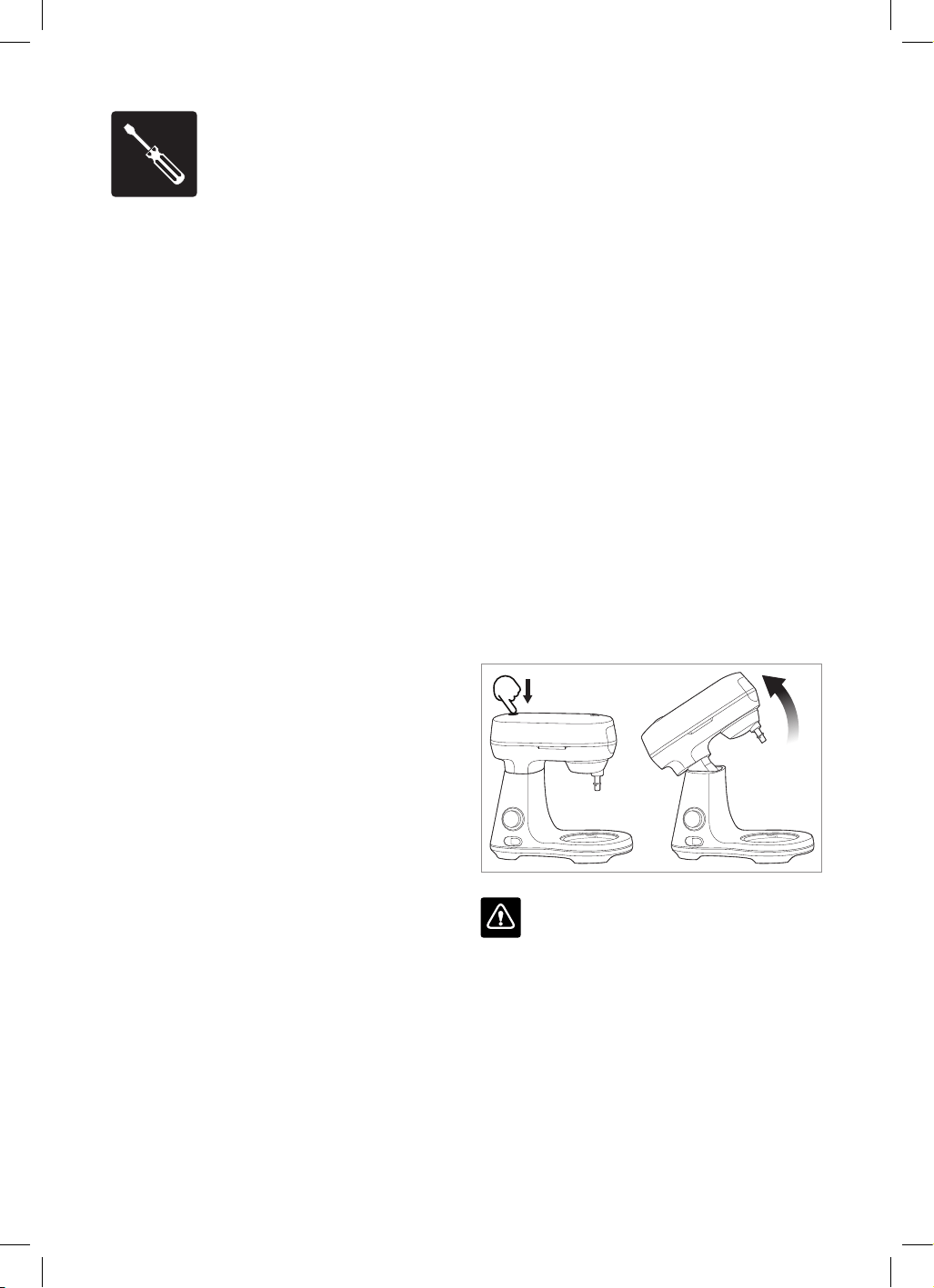
2. Place the mixer on a dry level surface. To
tilt the mixer motor head, with one hand
holding the front of the motor head to help
control the assent (near the attachment
hub), use the other hand to press firmly on
the tilt release button. Tilt the motor head
back and upwards until it is fully elevated
and is locked into place. (Fig. 1)
Fig. 1
IMPORTANT
Always use one hand to control the tilting and
lowering of the motor head.
It is important that the mixing accessory is
securely and correctly locked into position
on the mixer spindle to ensure that the mixer
operates correctly.
3. Attach the bowl and mixer accessory
required before returning the motor head to
the horizontal position.
BEFORE FIRST USE
Before using your mixer for the first time,
remove any packaging material and
promotional labels. Ensure all parts and
accessories are accounted for before disposing
of the packaging.
When assembling or removing any parts on the
mixer, always ensure the speed control dial is
in the OFF (0) position, the mixer is switched
off at the power outlet and the power cord is
unplugged.
Wash the mixing bowl and all mixing
accessories in warm soapy water with a soft
cloth. Rinse and dry thoroughly.
The mixing bowl can be washed in the
dishwasher.
When first using your mixer, you may notice an
odour coming from the motor. This is normal
and will dissipate with use.
Assembly
12
4. To lower the mixer motor head, hold the
front of the mixer head with one hand
to assist with lowering, and press the tilt
release button with the other. Lower the
mixer motor head back to the horizontal
position until it locks in place.
ATTACHING AND REMOVING
THE MIXING BOWL
1. Ensure the motor head is tilted upwards into
a diagonal position and locked into place
before attaching or removing the mixer
bowl. The mixing bowl should be in place
before attaching any mixing accessories.
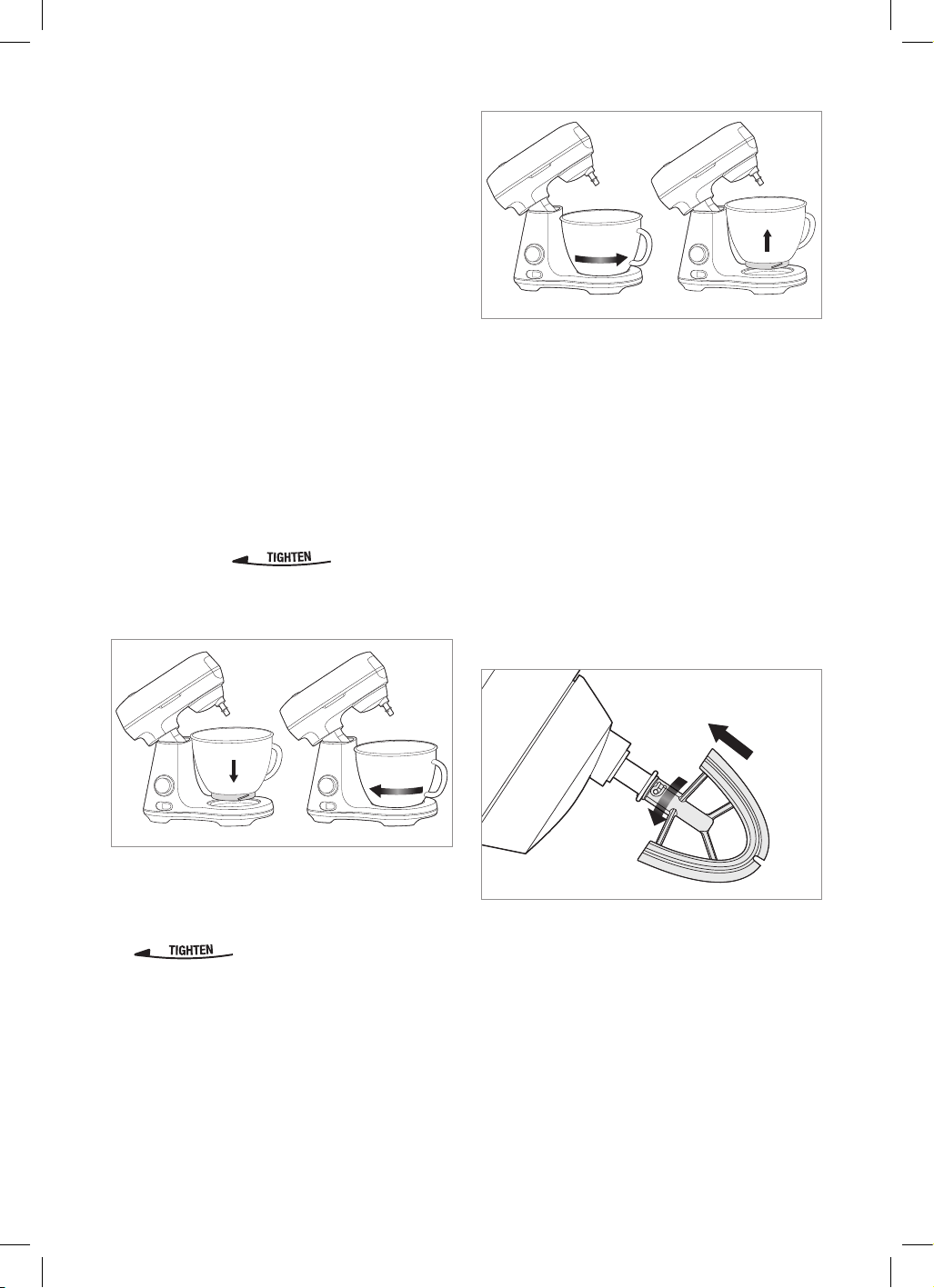
2. With the motor head tilted upwards and
holding the mixing bowl by the handle,
insert the base of the bowl into the bowl
locking recess by aligning the notches on
the bowl and the grooves on the mixer base.
Turn the bowl in a clockwise direction,
following the line found on
the base of the mixer, to securely lock the
bowl in place.
3. To remove the bowl, with the motor head
tilted upwards and holding the mixing
bowl by the handle, turn the bowl in an
anti-clockwise direction, turning against the
line until the bowl notches
align with the grooves on the mixer base.
Lift the bowl from the mixer.
ATTACHING AND REMOVING THE
MIXING ACCESSORIES
1. Ensure the motor head is titled into a
diagonal position and locked into place
and the bowl is secured in place before
attaching or removing any mixing
accessories.
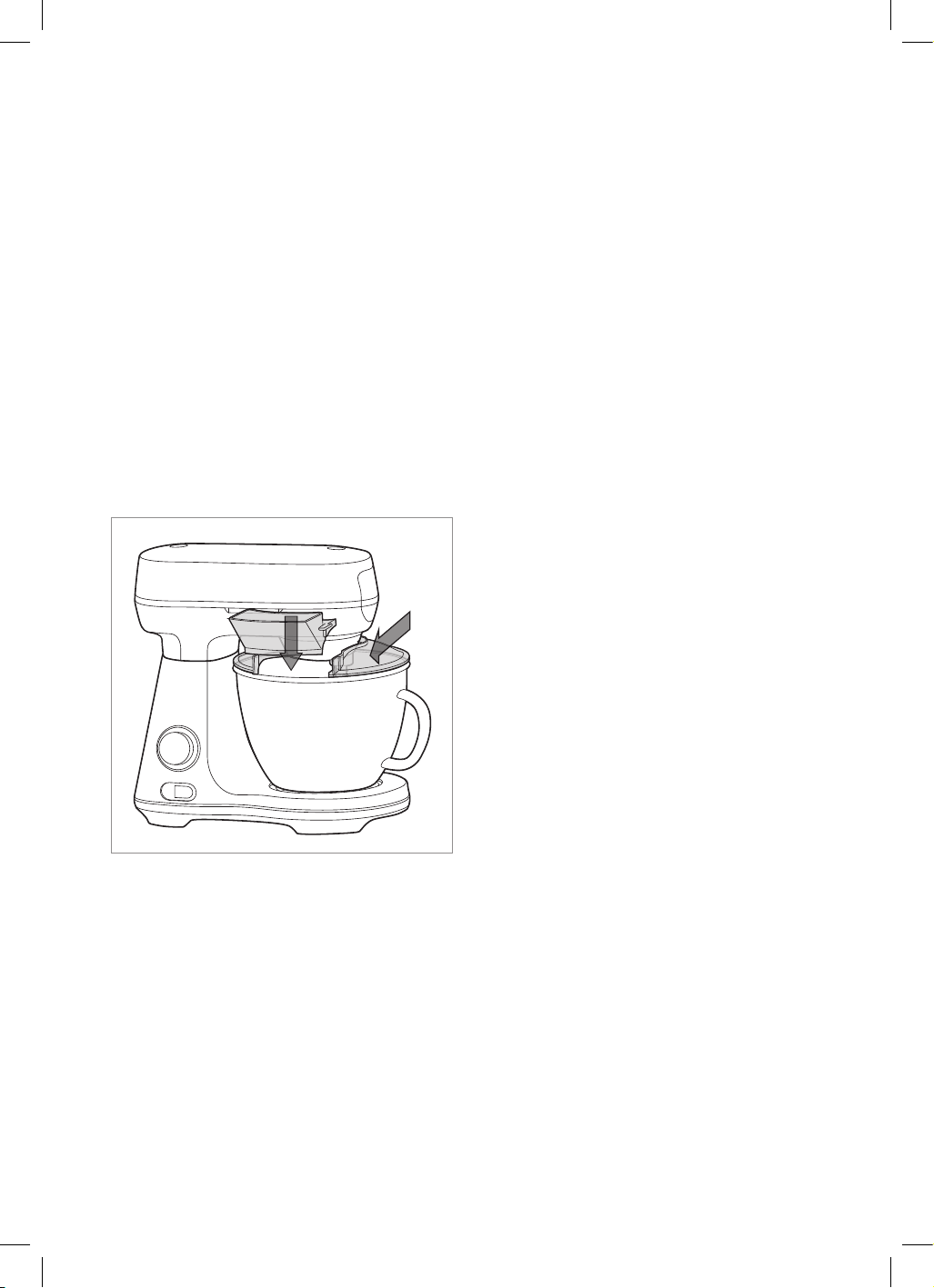
2. Align the groove in the top of the selected
accessory with the notch found on the
mixer spindle.
3. Push the accessory upwards onto the
spindle and rotate the accessory anti-
clockwise to secure. Pull the accessory
downwards to lock into position.
4. To remove, push upwards on the accessory
towards the motor head and turn clockwise
on the spindle until the groove and notch
are aligned.
5. Pull downwards on the accessory to release
from the motor spindle.
13
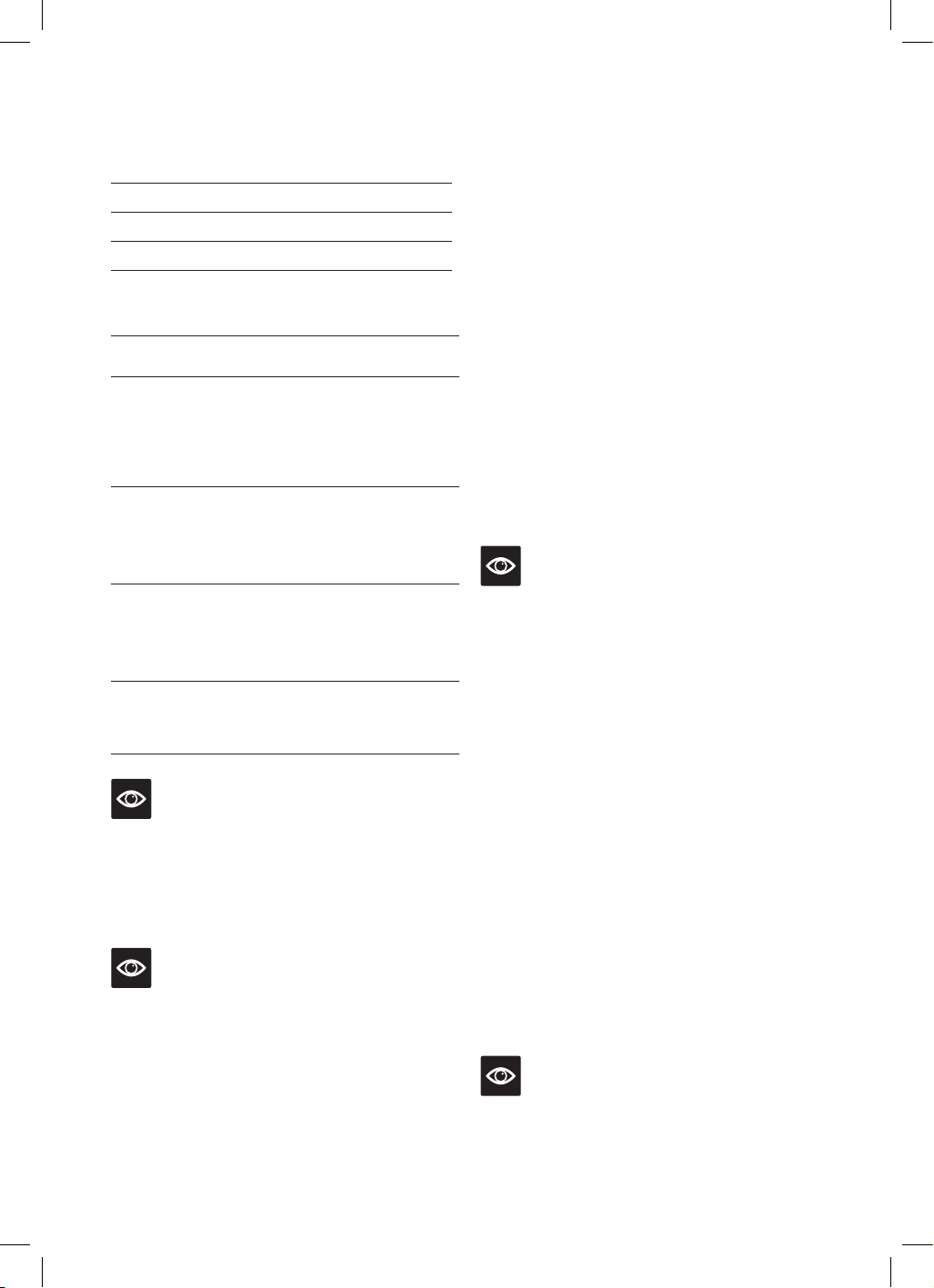
ASSEMBLING THE SPLASH GUARD
Attach the splash guard to minimise
splattering and splashing of ingredients while
in operation. The splash guard also has a
handy pouring spout so ingredients can be
added while mixing.
1. To attach the splash guard, ensure the
speed control dial is set to the OFF (0)
position, the mixing bowl is securely locked
into place and the mixer motor head is
horizontal with the appropriate mixing
accessory already in place.
2. Slide the splash guard over the mixing bowl
so that it fits around the motor spindle with
accessory. Once on the mixing bowl, slide
the pouring spout into the grooves on the
splash guard until it is securely in place.
3. The mixer is now ready to operate.

14
SCRAPER BEATER TABLE
MIXTURE MIXING
TASK
APPROX.
MIXING TIME
Butter &
Sugar
Creaming 3—4 minutes (or until
mixture is light and
creamy)
Cake, biscuit
& muffin
batters
Incorporating
wet and dry
ingredients
30—40 seconds (or
until all ingredients
are combined)
Thin/light
batters (i.e.
Pancakes)
Incorporating
wet and dry
ingredients
20-30 seconds
(or until batter is
smooth)
Icing
Incorporating
wet and dry
ingredients
40—50 seconds
(or until all icing is
smooth)
Frosting
Creaming
butter
1—2 minutes (or until
butter is smooth and
creamy)
Combining
icing sugar,
butter
& liquid
ingredients
50—60 seconds (or
until mixture is light
and fluffy)
The Wire Whisk
A vital accessory for incorporating air into
mixtures to make them light and fluffy and is
best suited for:
− Eggs
− Egg whites
− Cream
− Sponge, chiffon or angel food cakes
− Meringues and pavlovas
− Sauces and dressings
The Dough Hook
A handy accessory that takes the hard work out
of combining and kneading yeast-based dough
to make:
− Breads
− Rolls
− Pizzas
− Focaccias
– Sweet buns
OPERATING THE MIXER
Planetary Mixing Action
Planetary mixing action is similar to the
mixing action used by commercial mixers
in bakeries and patisseries with 360 degree
beater-to-bowl coverage. This is achieved by
the counter-clockwise motion of the mixer
head combined with the clockwise sweep of
the accessory. The result is thoroughly mixed
ingredients without the need for a rotating
bowl.
Attach the appropriate accessory for the
mixing task required, using the following
guide.
The Scraper Beater
The double-sided scraper beater with its
soft edges has been specifically designed to
repeatedly scrape around the bowl during
mixing, better incorporating ingredients
throughout the entire mixture. It is the perfect
accessory for creaming butter and sugar,
mixing sticky ingredient or folding egg whites
to make:
− Frosting and icing
− Cheesecakes
− Flavoured butters
− Muffin batters
− Creaming butter and sugar
– Light to medium cake batters
Additionally, due to the efficient mixing action
of the Scraper Beater, the mixing time of many
recipes may be reduced. Refer to the Scraper
Beater table for approximate mixing times.
These are a guide only. Longer mixing times
may be required for larger quantities.
Functions
15
SPEED GUIDE
SPEED MIXER ATTACHMENT
1-4
Dough Hook
1-6
Scraper Beater
1-7
Wire Whisk
SPEED MIXING
SETTING
FOR
OFF
Mixer Not
Operating
1-4
Folding and
Kneading
Recipes that require a LOW
speed
Combining dry ingredients
Incorporating ingredients
Pasta dough, Bread dough,
Heavy batters
3-4
Light Mixing Recipes that require a
MEDIUM speed
Cake batters, Biscuit dough
Bread dough
Pastry dough
4-5
Beating &
Creaming
Recipes that require a HIGH
speed
Butter & sugar
Eggs
Icing
6-7
Whipping &
Aerating
Recipes that require a HIGH
speed
Egg whites, Eggs, Meringue,
Sponge cake, Cream
NOTE
The above table is a guide only. Speed may
need to be adjusted when operating based on
the volume and density of ingredients used.
If the mixer starts to shake or move during
operation, reduce the speed.
NOTE
If the speed control dial is on a setting other
than OFF (0) when first turned on at the power
outlet, the bench mixer will not start mixing,
but will remain in a pause position until the
speed dial is turned back to OFF (0), then
turned to a speed setting.
1. Ensure the speed control dial is set to the
OFF (0) position.
2. Using the tilt release button, tilt the mixer
motor head into a diagonal position and
lock into place.
3. Secure the mixing bowl into place on the
mixer recess base.
4. Attach the required mixing accessory for
the task.
5. If using the attachment hub, refer to the
‘Using the Attachment Hub’ section of this
book for more details.
6. Place all ingredients into the mixing bowl
as listed in the recipe.
7. Using the tilt release button, tilt the mixer
motor head into a horizontal position and
lock into place. Attach the splash guard, if
desired.
NOTE
If the attachment hub is not being used, ensure
the hub cover remains securely in place before
mixing begins.
8. Insert the power cord into a 230V or 240V
power outlet and switch the power on at the
power outlet. The mixer is ready to use in
standby mode.
9. Commence mixing by turning the speed
control dial in a clockwise direction to the
setting outlined in the recipe. The light will
illuminate with the corresponding setting,
and the mixing will start automatically.
Although the mixer is equipped with a
controlled soft start, it is still recommended
to start any mixing task on a lower speed to
prevent splattering, then increase the speed
as required.
10. If required, occasionally stop the mixer
during operation and scrape any mixture on
the sides of the mixing bowl with a spatula.
NOTE
Turn the speed control dial to the OFF (0)
position or press the speed control dial inward
to PAUSE, then tilt the mixer motor head to the
diagonal position if you need to scrape down
the mixing bowl during use.

16
11. When mixing is complete, turn the speed
control dial to the OFF (0) position, switch
the mixer off at the power outlet and remove
the power cord from the outlet.
12. Remove the mixing bowl and mixing
accessory from the mixer body.
WARNING
After mixing, remove the mixing accessory
with care as it may be hot after use.
COUNT-UP TIMER
The count-up timer is for gauging mixing time,
making it easier to repeat the results.
The timer will automatically begin counting up
as soon as the dial is turned to one of the speed
settings.
When the dial is pushed to PAUSE, the current
mixing time will flash on the until mixing is
resumed or 5 minutes, whichever comes first.
When the dial is turned to OFF (0), the timer
display will reset back to 0:00.
The maximum count up time is 60 minutes.
When the timer goes beyond 9:59, it counts
in whole minutes. Turn the speed control dial
back to the OFF (0) position to reset.
COUNT-DOWN TIMER
The count-down timer is for any recipe that
specifies the length of time ingredients should
be mixed. The maximum count-down time is
60 minutes.
To set the count-down timer, press the up or
down arrows until the desired mixing time is
displayed on the timer display screen. Press
and hold to scroll more quickly.
Rotate the speed control dial to select the
desired speed and begin mixing. When the
timer has finished counting down, it will beep,
the mixer will automatically turn off and the
timer will flash 'OFF'.
The control dial must to be rotated to the OFF
(0) position to reset the timer and to continue
mixing.
CONTROLLED SOFT START
This bench mixer is equipped with a controlled
soft start feature, even when using PAUSE
mode. The mixing action on any speed setting
will start in a controlled manner before moving
to the chosen speed.
It is still recommended to first start mixing on
a lower speed, then increase the speed control
dial when operating.
PRESS TO PAUSE - PRESSING THE
SPEED CONTROL DIAL
At any stage during mixing (either count-up
or count-down), press the speed control dial
inward once to pause. This will pause the mixer
and hold the current time on the timer. The
light on the timer will flash.
Add additional ingredients as needed. To
continue operation, simply press inward on the
control dial again. The timer will continue to
count up or down, depending on the selection.
Turn the dial to the OFF (0) position to reset
the timer.
PAUSE MODE - TILTING UP THE
MIXER HEAD
The mixer will pause automatically whenever
the mixer head is lifted. To resume mixing,
place the motor head down within 5 minutes
and move the dial up or down one speed and
the mixer will continue operation, with the
timer continuing to count up or down.
If the mixer head is lifted for over 5 minutes
before returning to horizontal, the mixer will
reset the timer to 0:00. Turn the speed control
dial to the OFF (0) position to reset.
OVERLOAD PROTECTION SYSTEM
The motor in this bench mixer is protected
from burning out by a manual reset cut-out
switch. If the bench mixer is overloaded or
operated continuously for too long, the motor
may overheat and stop.
Turn the speed control dial back to the OFF
(0) position, switch the mixer off at the power
outlet and unplug it.
17
Allow the mixer to cool for approximately
30 minutes. Once the motor is fully cooled,
the overload protection device will reset. The
mixer will be ready to use again when it powers
back into standby mode. Do not operate the
mixer continuously with an excessive load
for more than 3 minutes. To reduce the risk of
overloading, remove some of the mixture and
process in smaller batches.
USING THE ATTACHMENT HUB
IMPORTANT
Attachments that require the use of the
hub for this mixer are sold separately. Only
attachments specifically designed for this
mixer (Model LEM750) may be used.
Never use accessories and hub attachments
(sold separately) other than those specifically
designed or specified with this bench mixer.
NOTE
Never operate any of the hub attachments
whilst using the bench mixer accessories at the
same time.
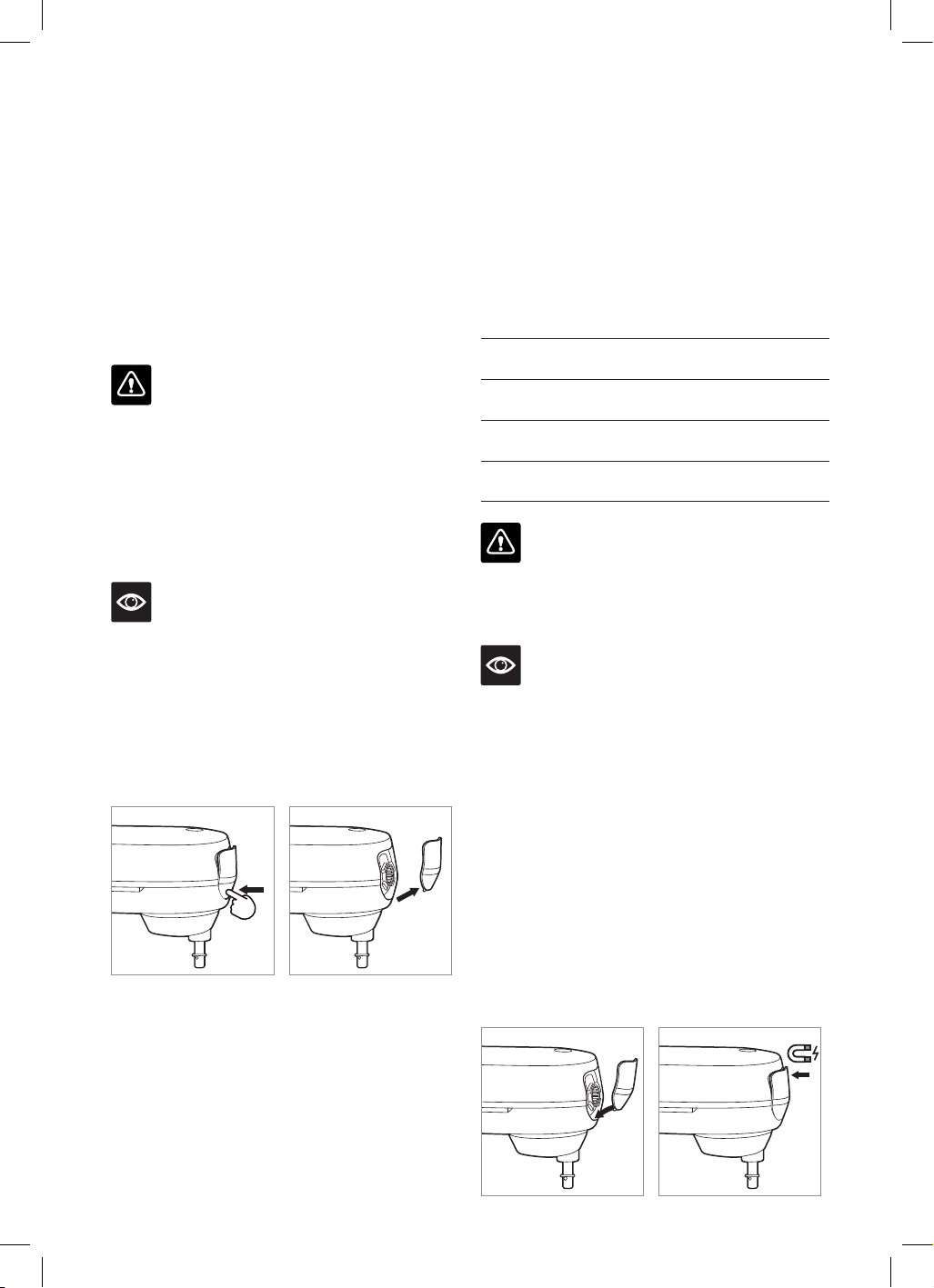
1. To remove the magnetic attachment hub
cover, push on the bottom half of the cover
so that the top half pops out, then remove
and store safely.
2. Ensure the chosen attachment is fully
assembled before connecting to the
attachment hub. Refer to the individual
attachment instruction booklet for how to
assemble and attach to the bench mixer
attachment hub, as each hub attachment
may be different.
3. Once the attachment is fully assembled on
the attachment hub, refer to the individual
hub attachment instruction booklet for food
preparation, functions and operation. Turn the
speed control dial to the appropriate setting,
based on the attachment used, or found in the
table titled ‘Hub Attachments’ following:
Hub Attachments
COMPATIBLE
ATTACHMENTS
Speed/Setting
on Control Dial
LEM012 – the Pasta Chef™
Roller Attachment
1-4
LEM013 – the Spiralizer
Chef™ Attachment
1-4
LEM014 – the Food
Processor Chef™ Attachment
1-4
LEM016 – the Grinder Chef™
Attachment
1-4
WARNING
Do not operate the hub attachments exceeding
speed 4 to avoid vigorous vibration during
operation, injury or damage to the appliance.
NOTE
After use, always remove the hub attachment,
clean and store separately.
4. Once the task is complete, turn the speed
control dial to the OFF (0) position. Press the
hub attachment release button to remove the
attachment from the mixer hub.
5. Refer to the individual attachment instruction
booklet for information on assembling,
disassembling, the attachment, care, cleaning
and storage.
6. Replace the attachment hub cover by aligning
the bottom grooves of the attachment hub
cover with the bottom of the attachment hub
and lightly push the cover in. The magnetic
pull will secure the attachment cover in place.

18
MIXING ACCESSORIES AND
SPLASH GUARD
1. Wash the accessory used and splash guard
with warm soapy water using a soft cloth or
soft bristle brush. Rinse and dry thoroughly.
2. Do not place any of the accessories or the
splash guard into the dishwasher. The heat
may cause damage to these parts.
HUB ATTACHMENTS
As each attachment hub attachment is
different, refer to the specific hub attachment
instruction booklet for care, cleaning and
storage details.
STORAGE
1. Store your mixer on the kitchen bench or
standing upright in an accessible cupboard.
2. Always ensure that the speed control dial
is in the OFF (0) position and the mixer
is unplugged from a power outlet when
storing.
3. Using the cord storage feature, push
the power cord into the cord storage
compartment until just the Breville assist
plug is showing.
4. Store the mixing bowl in the locked position
in the bowl recess with all accessories inside
the bowl and with the mixer motor head
locked in the horizontal position. Store
any hub attachments in their original box
when not in use. Always remove any hub
attachment from the mixer after use.
Before cleaning, ensure that the speed control
dial is in the OFF (0) position, the power is
switched off and power cord is removed from
the power outlet.
Ensure the mixing bowl, splash guard, mixing
accessories and attachments (if used) have all
been removed from the mixer body.
MIXER BODY
1. Wipe clean with a soft, damp cloth then dry
thoroughly. Wipe any excess food particles
from the power cord.
2. Do not allow any water or other liquids to
enter the gear system as this may cause
damage.
WARNING
Never immerse the mixer, power cord or power
plug in water or any other liquids.
3. Avoid using any abrasive scouring pads
or cleaners when cleaning any part of the
mixer as these may cause damage to the
surface of these parts.
MIXING BOWL
1. Wash the bowl with warm, soapy water
using a soft cloth or soft bristle brush. Rinse
and dry thoroughly.
2. The mixing bowl can be washed in the
dishwasher on a standard wash cycle.
3. Do not soak the mixing bowl in water
for extended periods of time as this may
damage the metal finish.
Care, Cleaning
& Storage

19
Tips
TIPS FOR BETTER BREAD MAKING
• Check the ingredients and read the recipe
before starting to bake.
• Measure ingredients accurately. Weighing
is more accurate than measuring by volume.
To accurately measure water please note that
1ml water = 1g.
• Don’t use hot water or liquids as this can kill
the yeast. Water and liquids should be added
at a tepid temperature.
• Don’t use self-raising flour to make yeasted
bread unless recipe states otherwise.
• If the weather is hot and humid, reduce the
yeast by ¼ teaspoon to avoid over rising of
the dough.
• Flour properties can alter on a seasonal or
storage basis, so it may be necessary to adjust
the water and flour ratio. If the dough is too
sticky, add extra flour 1 tablespoon at a time
if the dough is too dry, add extra water 1
teaspoon at a time. A few minutes is needed
for these extra ingredients to be absorbed.
Dough with the correct amount of flour and
water should form into a smooth, round ball
that is damp to the touch but not sticky.
Warm area for rising
• Yeast, either when sponging or in the dough,
requires warmth to rise. To create a ‘warm
area’ for dough to rise, place baking tray over
a bowl of fairly warm water, place prepared
dough item on baking tray, cover loosely with
lightly greased thicker-style plastic wrap or
a tea towel. Ensure kitchen is warm and free
of draughts. Allow the dough to rise until
doubled in size.
VITAL INGREDIENTS FOR BREAD MAKING
Flour is the most important ingredient used for
bread making. It provides food for the yeast and
gives structure to the loaf. When mixed with
liquid, the protein in the flour starts to form
gluten. Gluten is a network of elastic strands
that interlock to trap the gases produced by
yeast. This process increases as the dough
continues kneading and provides the structure
required to produce the weight and shape of the
baked bread.
White wheat flour sold as baker’s bread flour
or plain flour may be used. Plain flour is most
readily available; however, best results are
obtained with flour at least 11% protein content.
Wholemeal wheat flour contains the bran, germ
and flour of the wheat grain. Although breads
baked with this type of flour will be higher in
fibre, the loaf may be heavier in texture. Lighter
textured bread can be achieved by replacing
160g of wholemeal flour with white bread flour.
Rye flour popular for bread making, is low
in protein so it is essential to combine rye
flour with bread flour to make the bread rise
successfully.
Gluten flour is made by extracting the gluten
portion from the wheat grain. Adding gluten
flour can improve the structure and quality
of bread when using low-protein, plain, stone
ground and wholemeal flour.
Bread mixes contain flour, sugar, milk, salt, oil
and other ingredients such as bread improver.
Usually only the addition of water and yeast is
required.
Bread improvers are available in supermarkets.
The ingredients in a bread improver are usually
a food acid such as ascorbic acid (Vitamin C)
and other enzymes (amylases) extracted from
wheat flours. Adding a bread improver will help
strengthen the dough resulting in a loaf that is
higher in volume, softer in texture, more stable
and has improved shelf life qualities.

20
Sugar provides sweetness and flavour, browns
the crust and produces food for the yeast.
White sugar, brown sugar, honey and golden
syrup are all suitable to use. When using
honey or golden syrup it must be counted as
additional liquid.
Powdered milk and milk products enhance the
flavour and increase the nutritional value of
bread. Powdered milk is convenient and easy
to use.
Salt is an important ingredient in bread
making. In the dough, salt increases water
absorption, improves kneading, strengthens
the gluten development and controls
fermentation of the yeast which results in
improved loaf shape, crumb structure, crust
colour, flavour and keeping qualities. As salt
inhibits the rising of bread be accurate when
measuring.
Fat adds flavour and retains the moisture.
Vegetable oils such as sunflower, canola,
etc. can be used. Butter or margarine can be
substituted for oil in recipes but may give a
yellow coloured crumb.
Yeast is used as the raising agent for the breads
and requires liquid, sugar and warmth to grow
and rise. Before using dried yeast always check
the use by date, as stale yeast will prevent the
bread from rising.
Water If using water in cold climates or from
the refrigerator, allow water to come to room
temperature. Extremes of hot or cold water will
prevent the yeast activating.
Eggs can be used in some bread recipes and
provide liquid, aid rising and increase the
nutritional value of the bread. They add flavour
and softness to the crumb and are usually used
in sweeter types of bread.
Other ingredients such as fruit, nuts, chocolate
chips, etc., required to remain whole in the
baked bread, should be suspended in the
dough. These ingredients should be gradually
added during the kneading and before the
dough rises for the first time.
TIPS FOR BETTER CAKE &
PASTRY MAKING
• Check the ingredients and read the recipe
before starting to bake.
• Measure ingredients accurately. Weighing is
more accurate than measuring by volume.
• Preheat oven before starting recipe
preparation, this will ensure the correct
temperature is achieved before baking starts.
• Temperature and cooking times may vary
with some ovens so adjust accordingly.
If using a fan forced oven, reduce the
temperatures in the recipes by 10–20°C.
• When mixing, start the mixer at a lower speed
then gradually increase to the recommended
speed in the recipe especially when adding
dry ingredients.
• When using smaller quantities turn off the
mixer from time to time and scrape the bowl
with a spatula.
• Ensure beaters and mixing bowl are clean,
dry and free of fats when whipping egg
whites as these will impede aeration.
• Lightly grease trays and cake pans with
melted butter, oil or an oil spray and line
with non-stick baking paper; this will make
removing your baked goods easier.
• Butter should be softened to room
temperature to make creaming butter and
sugar easier.
• Keep surfaces and ingredients chilled when
making, handling or rolling out pastry. Butter
for pastry making should be kept refrigerated.
• Avoid stretching pastry when rolling out as
it will shrink when baking. Use light, even
strokes in one direction and avoid pressing
down hard on the rolling pin. Where possible,
rest pastry in the refrigerator before baking.
• Eggs and egg whites should be at room
temperature. Adding room temperature eggs
to cake mixes will also prevent curdling of the
butter mixture.
• Separate eggs individually into another
container before adding to other ingredients
to avoid potential spoilage.

21
• Separate egg whites carefully to avoid
inclusion of egg yolks. Egg yolks contain fat
and will prevent successful whipping of egg
whites.
• Rinse beaten egg residue from beater and
mixing bowl or other utensils with cold water
immediately after use. Using hot water will
set the egg and make cleaning difficult.
• Test if cakes are cooked 5 minutes before end
of recommended cooking time by inserting a
metal or wooden skewer into the centre of the
cake. The skewer should come out clean or
with small dry crumbs on it.
• For crisper results when baking biscuits,
remove the baking trays from the oven
and place directly onto wire racks. Move
the biscuits slightly away from their baked
position on the trays and cool completely
before removing.
VITAL INGREDIENTS FOR CAKE &
PASTRY MAKING
Flour such as plain, self-raising and wholemeal,
used for cake and pastry making should be
lower in protein (gluten) than flour used for
bread making.
Plain flour has a lower protein (gluten) content
than bread flour, and gives baked products,
such as cakes, muffins, pastries, scones and
pancakes, a softer texture.
Self-raising flour is a blend of plain flour and
raising agents such as baking powder. Self-
raising flour can be used in recipes to replace
plain flour and baking powder. To make 1 cup
self-raising flour sift together 1 cup plain flour
and 2 teaspoons baking powder.
Wholemeal flour contains more parts of the
whole wheat grain – flour, bran and wheat germ
– and can be used in muffins, breads and pie
cases but will have a denser texture.
Cornflour is traditionally made from maize
(corn) and is used in some baked products to
give a finer texture and can also be used as a
starch to thicken sauces and desserts.
Rice flour is derived from rice and is used to
give a finer texture in baked products such as
shortbread biscuits.
Baking powder is a mixture of cream of tartar
and bicarbonate of soda and is used as a
raising agent in baking.
Bicarbonate of soda, also known as baking
soda, is an ingredient in baking powder and
can be used as an additional raising agent .
Butter will give particular flavour and soft
texture to baked products. Margarine can
replace butter to give a similar result. Oil can
be used in some baking to replace butter
but will give texture and flavour differences.
If using oil, use a light flavoured oil like
vegetable, sunflower or grapeseed oil. Using
stronger flavoured oils, like nut and olive oils,
will affect the flavour of the cake.
Eggs should be at room temperature to
give better volume when making cakes and
sponges.
Milk should be full cream unless specified.
Light, low fat or skim milk can be used but will
give texture and flavour differences.
Sugar (white crystal sugar) is used to give
flavour, texture and colour to baked products.
Caster sugar is often used in baking as it is
easier to dissolve when creaming butter and
sugar.
Brown sugar is also easy to dissolve and can
be used to give a different flavour and texture.
The large crystals of raw sugar are slower to
dissolve and can be suitable for baked products
such as muffins.

22
MEASURING & WEIGHING
The accuracy of measurements can affect the
critical balance of the recipe. Use accurate and
appropriate measuring equipment to ensure
the best results.
Dry measuring cups & spoons
For dry ingredients, use nested plastic or metal
dry measuring cups and spoons. Do not use
tableware cups or spoons.
It is important to spoon or scoop the dry
ingredients loosely into the cup. Do not tap the
cup or pack the ingredients into the cup unless
otherwise directed (e.g. packed brown sugar).
The extra amount gained from packing or
tapping down ingredients can affect the critical
balance of your recipe. Level the top of the cup
by sweeping the excess with the back of a knife.
When using measuring spoons for either liquid
or dry ingredients such as yeast, sugar, salt, dry
milk or honey, measurements should be level,
not heaped.
Liquid measuring cups
For liquid ingredients, use transparent plastic
or glass liquid measuring cups with the
measurements marked clearly on the side.
Measuring cup must be on a flat and horizontal
surface. An inaccurate measurement can affect
the critical balance of the recipe.
Units of measurement
Some units of measurement are different in
different countries. Please consider the guide
below if using recipes, or equipment, from
international sources.
Cups
250ml for Australia & New Zealand
Tablespoons
20ml for Australia
15ml for New Zealand
Teaspoons
5ml

23
PROBLEM EASY SOLUTION
Mixer will not work when switched ON
•
Check the power cord is correctly plugged into the
outlet and the outlet is on.
•
Always ensure the speed control dial is in the
OFF (0) position before starting.
•
Ensure the motor head is locked into a
horizontal position.
•
Ensure the Pause feature has not been engaged.
•
The temperature overload protection (manual reset
cut-out switch ) device has not fully reset; allow more
time for the motor to cool down.
Cannot set the time on the count-down timer
•
Always ensure the speed control dial is in the OFF (0)
position before trying to set the count-down time.
Mixer suddenly switches off during mixing
•
The mixer has been stressed by overloading or
stalling. The mixer will automatically activate the
overload protection and the unit will switch off. The
“E1”, "E2" or "E3" error message is flashing on the timer
display. If this happens, turn the speed control dial
back to the OFF (0) position. Turn the mixer off at the
power outlet and unplug it for at least 30 minutes. The
overload protection device will reset, and the mixer
will be ready to use again when it powers back into
standby mode.
Noise is heard when scraper beater is mixing.
•
When ingredients are in the mixing bowl, the scraper
beater may make a slight noise as it scrapes the sides
and bottom of the bowl. This is normal and should
not cause concern. Do not turn the mixer on with the
scraper beater in place if the mixing bowl is empty.
This will cause the scraper beater to make a loud noise
as it scrapes the bowl.
Troubleshooting

24
Dough Hook
Recipe
Cheese and bacon BBQ rolls
Preparation time – 1 hour 30 minutes
Cooking time – 30 minutes
Makes 6 rolls
Ingredients
375ml warm water
60ml olive oil
1 tsp. caster sugar
1 tsp. salt
600g bread flour
2 tsp. dried yeast
3 tbsp. barbeque sauce
1 cup diced bacon
1 cup grated tasty cheese
Method
1. Place the water, olive oil, sugar, salt, flour
and yeast into the mixing bowl of the bench
mixer with the dough hook attached.
2. Turn the speed control dial to speed 1 and
mix for 30 seconds until the ingredients are
combined. Increase to speed 4 and knead
for 4 minutes.
3. Shape the dough into a ball, return the ball
to the mixing bowl, cover with cling wrap
and place in a warm, draught free place
to rise for 1 hour or until the dough has
doubled in size.
4. Pre-heat a fan-forced oven to 180°C and line
a baking tray with baking paper.
5. Place the mixing bowl back onto the bench
mixer with the dough hook attached and
knead on speed 1 for 2 minutes.
6. Divide the dough into 6 and roll into balls.
Place the 6 balls onto the lined baking tray
about 5cm apart and allow the dough balls
to rest for 20 minutes.
7. Generously brush each ball with the
barbeque sauce and top each of the balls
with the bacon and cheese.
8. Place into the oven and bake for 20
minutes.

25
Scraper Beater
Recipe
Peach and strawberry crumble tray cake
Preparation time – 30 minutes
Cooking time – 30 minutes
Makes one 20x30cm cake
Ingredients
Crumble top
½ cup plain flour
L cup light brown sugar
¼ tsp. cinnamon
Pinch salt
¼ cup almond meal
¼ cup desiccated coconut
75g butter cold
L cup oats
Cake
125g unsalted butter, room temperature
¾ cup caster sugar
3 eggs
1 tsp. vanilla paste
½ cup milk
2 cups self-raising flour
2 large strawberries, sliced
100g tinned peach slices
Method
Crumble top
1. Place the flour, brown sugar, cinnamon, salt,
almond meal, coconut and butter into a food
processor and process until the ingredients
are combined. Remove the mixture from the
food processor and stir the oats through.
Put aside until ready.
Cake
2. Pre-heat a fan-forced oven to 175°C and
line a 20cm x 30cm deep baking tray with
baking paper.
3. Place the butter and sugar into the mixing
bowl of the bench mixer with the scraper
beater attached.
4. Turn the speed control dial to speed 1 and
mix until the ingredients are combined.
Increase to speed 6 and beat for 3 minutes.
Reduce to speed 3 and add the eggs one at a
time, beating well between each addition.
5. Reduce to speed 1 and add the milk and
flour alternately.
6. Place the cake batter into the prepared
baking tray and scatter the strawberries
and peach slices evenly over the top.
7. Sprinkle the crumble topping evenly over
the top and place into the oven and bake
for 30 minutes or until a skewer comes out
clean when inserted into the centre of the
cake. Allow to cool slightly before serving
warm or cool.

26
NotesNotes

27
Notes

Breville, the Breville logo, Master Every Moment, and Bakery Chef
are trademarks of Breville Pty. Ltd. A.B.N. 98 000 092 928.
Copyright Breville Pty. Ltd. 2020.
Due to continued product improvement, the products illustrated/photographed
in this brochure may vary slightly from the actual product.
LEM750 ANZ – B20
Web: www.breville.comWeb: www.breville.com
Australian Customers
Phone: 1300 139 798
New Zealand Customers
Phone: 0800 273 845
Breville Customer Service Centre