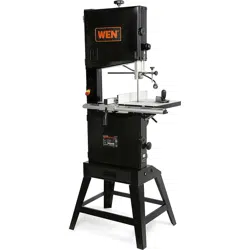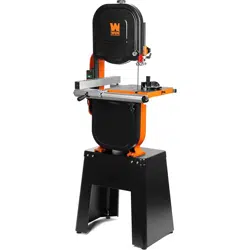
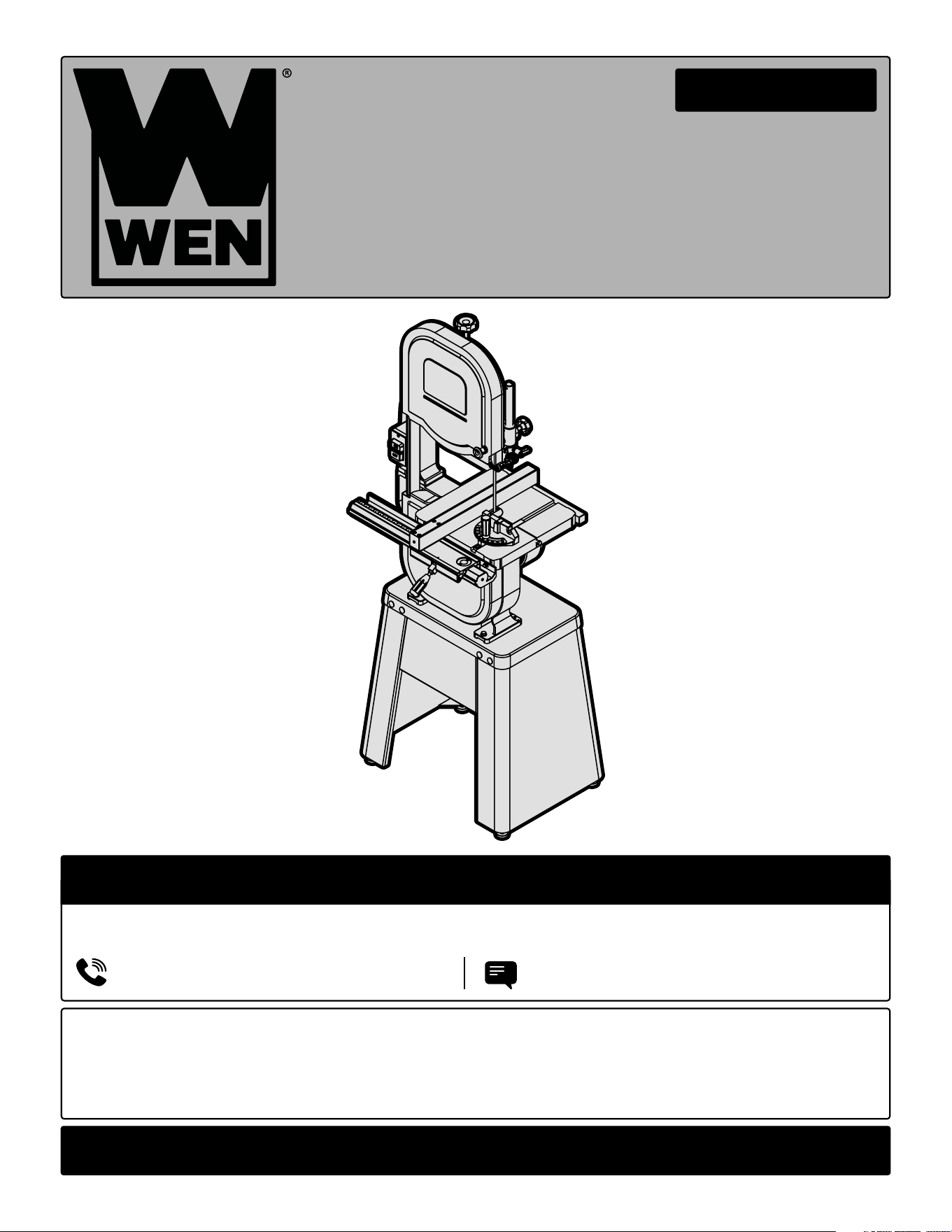
14-INCH TWO-SPEED
BAND SAW
Instruction Manual
IMPORTANT: Your new tool has been engineered and manufactured to WEN’s highest standards for dependability,
ease of operation, and operator safety. When properly cared for, this product will supply you years of rugged,
trouble-free performance. Pay close attention to the rules for safe operation, warnings, and cautions. If you use
your tool properly and for its intended purpose, you will enjoy years of safe, reliable service.
NEED HELP? CONTACT US!
Have product questions? Need technical support? Please feel free to contact us:
TECHSUPPOR[email protected]1-800-232-1195 (M-F 8AM-5PM CST)
For replacement parts and the most up-to-date instruction manuals, visit WENPRODUCTS.COM
MODEL BA1411

CONTENTS
WELCOME 3
Introduction ......................................................................................................3
Specifications ................................................................................................... 3
SAFETY 4
General Safety Rules ........................................................................................ 4
Specific Rules for Your Bandsaw ..................................................................... 6
Electrical Information ....................................................................................... 8
10
Unpacking & Packing List .............................................................................. 10
Know Your Bandsaw ...................................................................................... 11
Assembly & Adjustments ............................................................................... 12
BEFORE OPERATING
OPERATION & MAINTENANCE 20
Operation ....................................................................................................... 20
Maintenance ....................................................................................................21
Exploded View & Parts List ............................................................................ 22
Warranty Statement ....................................................................................... 30
To purchase accessories for your tool, visit WENPRODUCTS.COM
2
Bandsaw Blades (Models BB9312, BB9325, BB9337, BB9350)
Heavy Duty 500-Pound Capacity Universal Mobile Base (Model MB500)
INTRODUCTION
Thanks for purchasing the WEN Band Saw. We know you are excited to put your tool to work, but first, please
take a moment to read through the manual. Safe operation of this tool requires that you read and understand this
operator’s manual and all the labels affixed to the tool. This manual provides information regarding potential safety
concerns, as well as helpful assembly and operating instructions for your tool.
NOTE: The following safety information is not meant to cover all possible conditions and situations that may occur.
WEN reserves the right to change this product and specifications at any time without prior notice.
At WEN, we are continuously improving our products. If you find that your tool does not exactly match this manual,
please visit wenproducts.com for the most up-to-date manual or contact our customer service at 1-800-232-1195.
Keep this manual available to all users during the entire life of the tool and review it frequently to maximize
safety for both yourself and others.
SAFETY ALERT SYMBOL: Indicates danger, warning, or caution. The safety symbols and the explanations
with them deserve your careful attention and understanding. Always follow the safety precautions to reduce the
risk of fire, electric shock or personal injury. However, please note that these instructions and warnings are not
substitutes for proper accident prevention measures.
SPECIFICATIONS
Model Number BA1411
Motor 110-120V / 220-240V, 60 Hz, 11 / 5.5A
Table Size 14 in. x 14 in.
Table Height 43-5/16 in.
Working Capacity 6 in. x 13-1/2 in.
Blade Size 93-1/2 in. x 3/8 in. x 0.025 in., 6 TPI
Blade Speed 1700 FPM / 3000 FPM
Dust Port Size 4 Inches
Miter Gauge Range Left 60°, Right 60°
Table Bevel Left 15°, Right 45°
Product Dimensions 20-1/2 in. x 26-3/8 in. x 66-1/2 in.
Product Weight 178 Pounds
3

GENERAL SAFETY RULES
WORK AREA SAFETY
1. Keep work area clean and well lit. Cluttered or dark
areas invite accidents.
2. Do not operate power tools in explosive atmo-
spheres, such as in the presence of flammable liq-
uids, gases or dust. Power tools create sparks which
may ignite the dust or fumes.
3. Keep children and bystanders away while operat-
ing a power tool. Distractions can cause you to lose
control.
ELECTRICAL SAFETY
1. Power tool plugs must match the outlet. Never
modify the plug in any way. Do not use any adapter
plugs with earthed (grounded) power tools. Unmodi-
fied plugs and matching outlets will reduce risk of elec-
tric shock.
2. Avoid body contact with earthed or grounded sur-
faces such as pipes, radiators, ranges and refrigera-
tors. There is an increased risk of electric shock if your
body is earthed or grounded.
3. Do not expose power tools to rain or wet condi-
tions. Water entering a power tool will increase the risk
of electric shock.
4. Do not abuse the cord. Never use the cord for car-
rying, pulling or unplugging the power tool. Keep cord
away from heat, oil, sharp edges or moving parts.
Damaged or entangled cords increase the risk of elec-
tric shock.
5. When operating a power tool outdoors, use an ex-
tension cord suitable for outdoor use. Use of a cord
suitable for outdoor use reduces the risk of electric
shock.
6. If operating a power tool in a damp location is
unavoidable, use a ground fault circuit interrupter
(GFCI) protected supply. Use of a GFCI reduces the risk
of electric shock.
PERSONAL SAFETY
1. Stay alert, watch what you are doing and use com-
mon sense when operating a power tool. Do not use a
power tool while you are tired or under the influence
of drugs, alcohol or medication. A moment of inatten-
tion while operating power tools may result in serious
personal injury.
2. Use personal protective equipment. Always wear
eye protection. Protective equipment such as a respi-
ratory mask, non-skid safety shoes and hearing protec-
tion used for appropriate conditions will reduce the risk
of personal injury.
3. Prevent unintentional starting. Ensure the switch is
in the off-position before connecting to power source
and/or battery pack, picking up or carrying the tool.
Carrying power tools with your finger on the switch or
energizing power tools that have the switch on invites
accidents.
4. Remove any adjusting key or wrench before turning
the power tool on. A wrench or a key left attached to a
rotating part of the power tool may result in personal
injury.
5. Do not overreach. Keep proper footing and balance
at all times. This enables better control of the power
tool in unexpected situations.
6. Dress properly. Do not wear loose clothing or jew-
elry. Keep your hair and clothing away from moving
parts. Loose clothes, jewelry or long hair can be caught
in moving parts.
Safety is a combination of common sense, staying alert and knowing how your item works. The term “power tool”
in the warnings refers to your mains-operated (corded) power tool or battery-operated (cordless) power tool.
SAVE THESE SAFETY INSTRUCTIONS.
WARNING! Read all safety warnings and all instructions. Failure to follow the warnings and instructions
may result in electric shock, fire and/or serious injury.
4

GENERAL SAFETY RULES
7. If devices are provided for the connection of dust
extraction and collection facilities, ensure these are
connected and properly used. Use of dust collection
can reduce dust-related hazards.
POWER TOOL USE AND CARE
1. Do not force the power tool. Use the correct power
tool for your application. The correct power tool will
do the job better and safer at the rate for which it was
designed.
2. Do not use the power tool if the switch does not turn
it on and off. Any power tool that cannot be controlled
with the switch is dangerous and must be repaired.
3. Disconnect the plug from the power source and/or
the battery pack from the power tool before making
any adjustments, changing accessories, or storing
power tools. Such preventive safety measures reduce
the risk of starting the power tool accidentally.
4. Store idle power tools out of the reach of children
and do not allow persons unfamiliar with the power
tool or these instructions to operate the power tool.
Power tools are dangerous in the hands of untrained
users.
5. Maintain power tools. Check for misalignment or
binding of moving parts, breakage of parts and any
other condition that may affect the power tool’s opera-
tion. If damaged, have the power tool repaired before
use. Many accidents are caused by poorly maintained
power tools.
6. Keep cutting tools sharp and clean. Properly main-
tained cutting tools with sharp cutting edges are less
likely to bind and are easier to control.
7. Use the power tool, accessories and tool bits, etc.
in accordance with these instructions, taking into ac-
count the working conditions and the work to be per-
formed. Use of the power tool for operations different
from those intended could result in a hazardous situa-
tion.
8. Use clamps to secure your workpiece to a stable
surface. Holding a workpiece by hand or using your
body to support it may lead to loss of control.
9. KEEP GUARDS IN PLACE and in working order.
SERVICE
1. Have your power tool serviced by a qualified repair
person using only identical replacement parts. This
will ensure that the safety of the power tool is main-
tained.
CALIFORNIA PROPOSITION 65 WARNING
Some dust created by power sanding, sawing, grinding,
drilling, and other construction activities may contain
chemicals, including lead, known to the State of Califor-
nia to cause cancer, birth defects, or other reproductive
harm. Wash hands after handling. Some examples of
these chemicals are:
• Lead from lead-based paints.
• Crystalline silica from bricks, cement, and other
masonry products.
• Arsenic and chromium from chemically treated
lumber.
Your risk from these exposures varies depending on
how often you do this type of work. To reduce your ex-
posure to these chemicals, work in a well-ventilated area
with approved safety equipment such as dust masks
specially designed to filter out microscopic particles.
Safety is a combination of common sense, staying alert and knowing how your item works. The term “power tool”
in the warnings refers to your mains-operated (corded) power tool or battery-operated (cordless) power tool.
SAVE THESE SAFETY INSTRUCTIONS.
WARNING! Read all safety warnings and all instructions. Failure to follow the warnings and instructions
may result in electric shock, fire and/or serious injury.
5

SAW BLADE SAFETY
1. Always wear protective gloves when handling saw
blades.
2. Only use blades with correct size and type for both
your band saw and your workpiece.
3. See the blade specifications.
Make sure the blade is installed in the proper direction.
4. Never use damaged or deformed saw blades. Only
use sharp blades.
5. Install the saw blade in the correct orientation indi-
cated in the instructions.
6. Keep hands out of path of saw blade. Never use your
hands to remove sawdust or scrap wood. Use a brush
at all times.
7. Never reach around saw blade or reach in back of the
saw blade.
8. The use of accessories or attachments not recom-
mended by the manufacturer may result in a risk of per-
sonal injury.
PERSONAL SAFETY
1. Operate in a well ventilated area. Keep the floor area
around the band saw level and free of slippery sub-
stances or other tripping hazards.
2. Wear ANSI Z87.1-approved safety goggles to protect
your eyes from saw dust. Use hearing protection to pro-
tect yourself from hearing loss.
3. People with pacemakers should consult their
physician(s) before use. Electromagnetic fields in close
proximity to pacemakers could cause pacemaker inter-
ference or pacemaker failure.
4. Wear work gloves when handling saw blades. DO
NOT wear gloves, neckties, jewelry, or loose clothing
while operating the saw.
5. Saw dust is harmful to your health. Use NIOSH-ap-
proved dust masks or other respiratory protection dur-
ing operation and cleaning.
6. Always turn off and unplug the band saw before mak-
ing any adjustments or repair tasks. Never adjust the
band saw or the workpiece while the saw is running.
7. Only use the band saw to cut wood.
PREPARING THE BAND SAW
1. When transporting the band saw, never carry the de-
vice by its guards or its accessories.
2. Examine the band saw for any damaged or missing
parts. Replace or repair damaged parts before opera-
tion. Periodically check that all nuts, bolts and other fas-
teners are properly tightened.
SECURE YOUR WORKPIECE
1. To avoid blade binding or loss of control, always se-
cure the workpiece to a stable platform, ensuring that
body exposure is minimized.
2. Ensure that work is correctly supported. Supports
must be placed under the workpiece on both sides,
close to the line of cut and near the edge of the work-
piece.
3. For accuracy of cut, and to avoid blade binding, al-
ways use a rip fence or straight edge guide.
4. Use extra caution with very large, very small, or awk-
wardly-shaped workpieces. Small pieces should be se-
cured with clamps. Do not hold small pieces with your
hand because your fingers might go under the blade
guard.
5. Never hand-hold a workpiece that is too small to be
clamped, as it can be launched away and cause inju-
ry. Use proper support and guides to secure the small
workpiece.
6. Support round work properly (use a V block or press
it against the miter gauge) to prevent it from rolling and
the blade from biting.
7. Plan intricate or small work carefully to avoid pinch-
ing the blade. Avoid awkward operations and hand posi-
tions to prevent accidental contact with the blade.
SPECIFIC RULES FOR YOUR BANDSAW
WARNING! Do not operate the power tool until you have read and understood the following instructions
and the warning labels.
6

DURING CUTTING OPERATIONS
1. Always stand to one side when operating the saw.
Never have any part of the body in line with the path of
the saw. Never hold a workpiece in your hand or across
your legs while cutting.
2. Ensure hands are away from the cutting area and
blade.
3. Feed work into the blade against the direction of rota-
tion of the blade only.
4. If you are interrupted when operating the saw, com-
plete the process and switch the saw off before looking
up.
5. Power tools must always be held by the insulated
gripping surfaces when performing an operation, en-
suring protection if the cutting tool makes contact with
its own cord or hidden wiring. Contact with a ‘live’ wire
will make exposed metal parts of the power tool ‘live’
and shock the operator if the insulated gripping surfac-
es are not used.
6. Do not use the band saw unless all guards are in
place. Do not operate with any guard disabled, dam-
aged, or removed. Moving guards must move freely and
close instantly.
7. Blade guide, supports, bearings, and blade tension
must be properly adjusted to avoid accidental blade
contact and to minimize blade breakage. To maximize
blade support, always adjust the upper blade guide and
blade guard so that it barely clears the workpiece.
8. Turn on the band saw and let it reach full speed, then
slowly slide the workpiece into the blade. This will help
produce safer and cleaner cuts.
9. Never cut more than one piece at a time. Do not stack
workpieces together. Do not attempt to cut material
thicker than specified on page 3 of this manual. Adjust
the upper blade guide to suit the thickness of the work-
piece.
10. If a cut does not extend to the edge of the work-
piece, or if the blade binds in the cut, allow the blade
to come to a complete stop and lift the workpiece away
from the blade.
11. Turn off tool and wait for saw blade to stop before
moving workpiece or changing settings. Do not slow
or stop a blade with a piece of wood or by hand. Let
the blade come to rest naturally. Do not attempt to free
a jammed blade while the machine is still running and
connected to power.
12. Always adjust the upper blade guide to cover the
blade after use.
SPECIFIC RULES FOR YOUR BANDSAW
WARNING! Do not operate the power tool until you have read and understood the following instructions
and the warning labels.
7
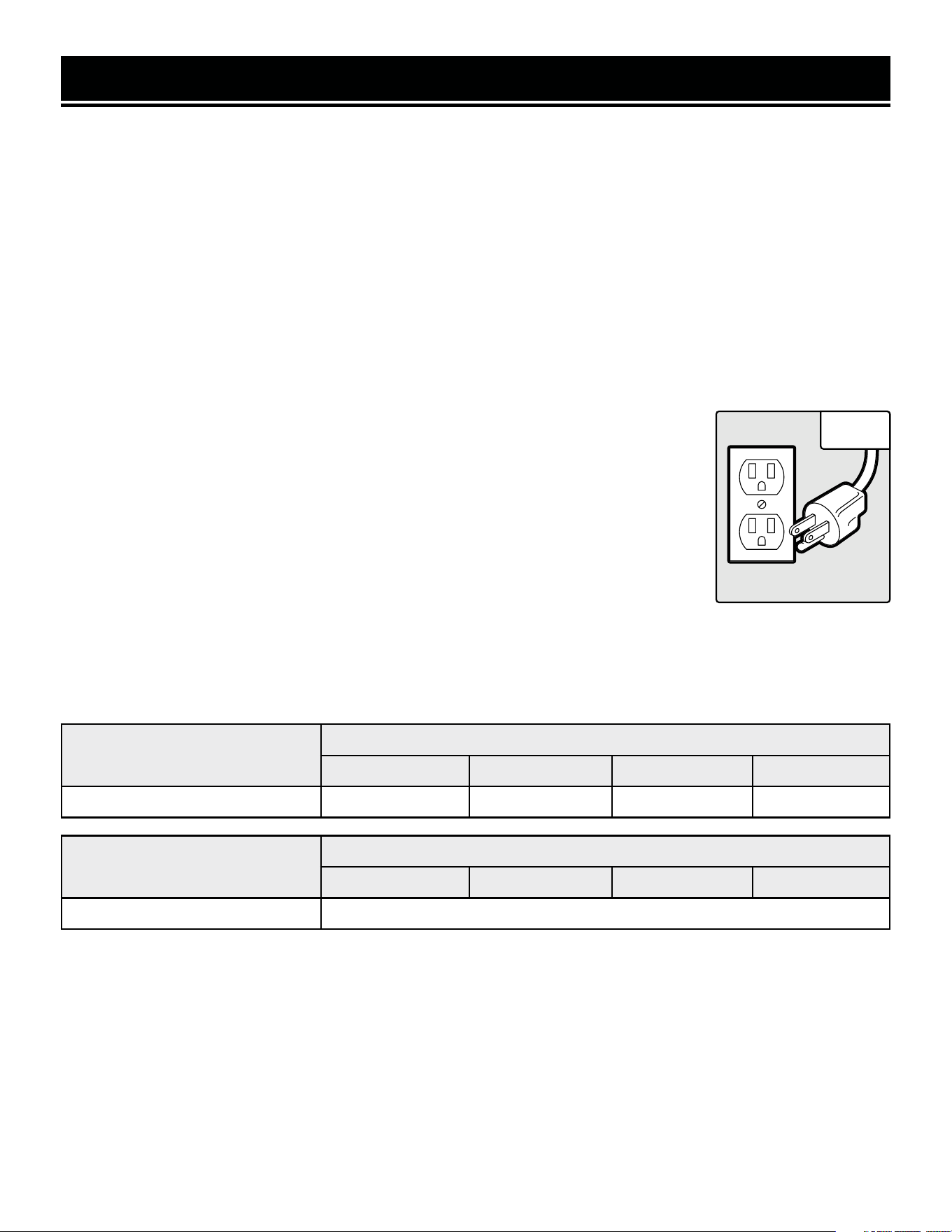
ELECTRICAL INFORMATION
AMPERAGE
REQUIRED GAUGE FOR EXTENSION CORDS
25 ft. 50 ft. 100 ft. 150 ft.
11A (110V - 120V Operation) 16 gauge 16 gauge 14 gauge 12 gauge
3. Check with a licensed electrician or service personnel if you do not completely under-
stand the grounding instructions or whether the tool is properly grounded.
4. Use only three-wire extension cords that have three-pronged plugs and outlets that
accept the tool’s plug. Repair or replace a damaged or worn cord immediately.
CAUTION! In all cases, make certain the outlet in question is properly grounded. If you
are not sure, have a licensed electrician check the outlet.
GUIDELINES AND RECOMMENDATIONS FOR EXTENSION CORDS
GROUNDING INSTRUCTIONS
In the event of a malfunction or breakdown, grounding provides the path of least resistance for an electric current
and reduces the risk of electric shock. This tool is equipped with an electric cord that has an equipment grounding
conductor and a grounding plug. The plug MUST be plugged into a matching outlet that is properly installed and
grounded in accordance with ALL local codes and ordinances.
1. Do not modify the plug provided. If it will not fit the outlet, have the proper outlet installed by a licensed electri-
cian.
2. Improper connection of the equipment grounding conductor can result in electric shock. The conductor with the
green insulation (with or without yellow stripes) is the equipment grounding conductor. If repair or replacement
of the electric cord or plug is necessary, DO NOT connect the equipment grounding conductor to a live terminal.
1. Examine extension cord before use. Make sure your extension cord is properly wired and in good condition.
Always replace a damaged extension cord or have it repaired by a qualified person before using it.
2. Do not abuse extension cord. Do not pull on cord to disconnect from receptacle; always disconnect by pulling
on plug. Disconnect the extension cord from the receptacle before disconnecting the product from the extension
cord. Protect your extension cords from sharp objects, excessive heat and damp/wet areas.
3. Use a separate electrical circuit for your tool. This circuit must not be less than a 12-gauge wire and should
be protected with a 15A time-delayed fuse. Before connecting the motor to the power line, make sure the switch
is in the OFF position and the electric current is rated the same as the current stamped on the motor nameplate.
Running at a lower voltage will damage the motor.
Fig. 1
When using an extension cord, be sure to use one heavy enough to carry the current your product will draw. An
undersized cord will cause a drop in line voltage resulting in loss of power and overheating. The table below shows
the correct size to be used according to cord length and ampere rating. When in doubt, use a heavier cord. The
smaller the gauge number, the heavier the cord.
AMPERAGE
REQUIRED GAUGE FOR EXTENSION CORDS
25 ft. 50 ft. 100 ft. 150 ft.
5.5A (220V - 2240V Operation) Not Recommended
8
ELECTRICAL INFORMATION
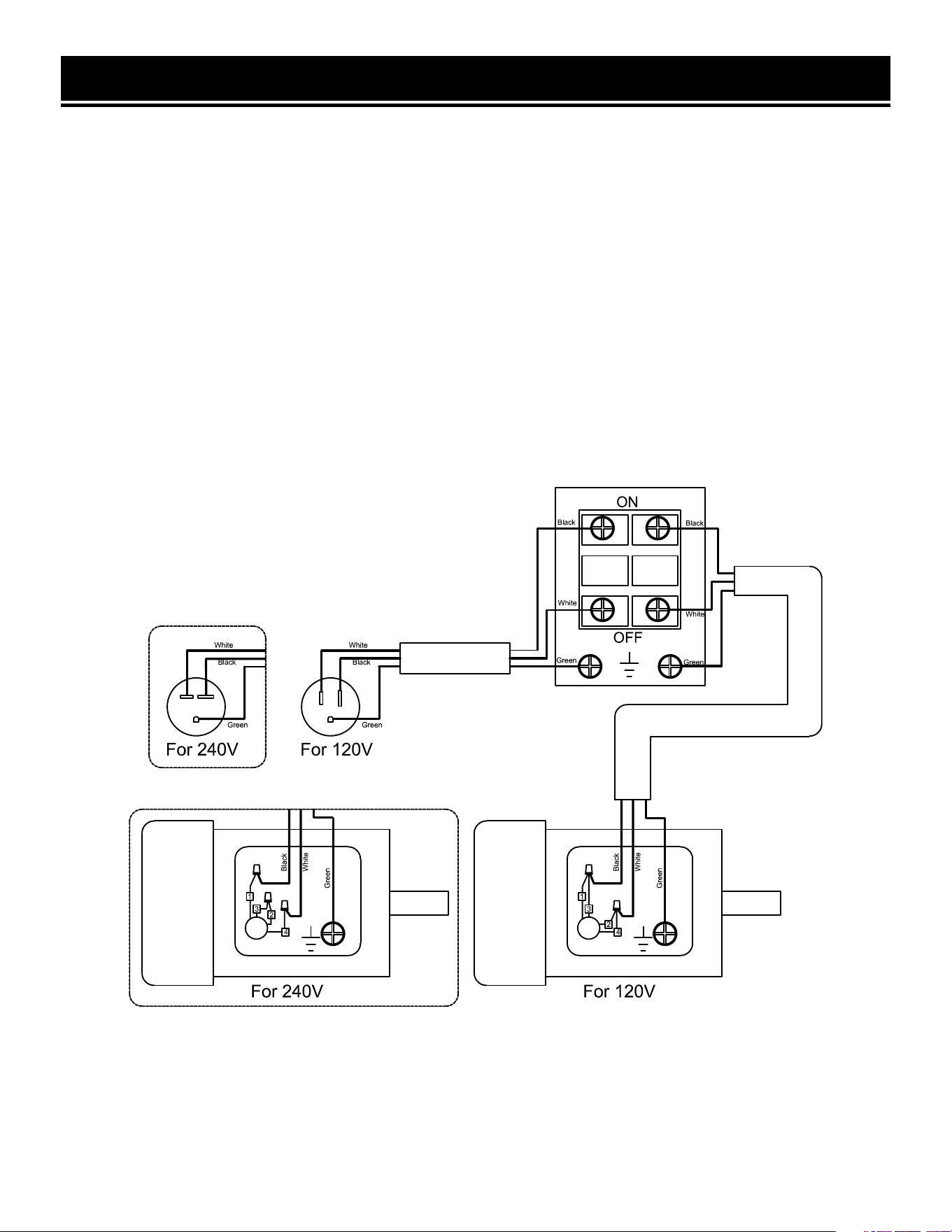
VOLTAGE CONVERSION
This machine is prewired for operation on a 110V - 120V, 60Hz circuit, but can be converted to operate on a
properly-grounded, 220V - 240V, 60Hz AC circuit, rated for not less than 15 amps. The voltage conversion MUST
be performed by a licensed professional electrician according to the instructions here.
To perform the conversion, remove the existing plug, install a new plug, and rewire the motor according to the
wiring diagram provided below. The motor wiring is located in the junction box on the side of the motor.
To convert the machine:
1. Disconnect the machine from power.
2. Replace the NEMA 5-15P plug on the power cord with a NEMA 6-15P plug (not included).
3. Re-wire the motor as shown in the wiring diagram below.
4. Verify that all connections are correct and secure.
5. Connect the machine to a properly-wired NEMA 6-15R receptacle. DO NOT use an extension cord when the
machine is running off 220V - 240V power.
WIRING DIAGRAM
9
Wires 2 and 3 connected.W ires 1 & 2 connected; wires 3 and 4 connected.
UNPACKING
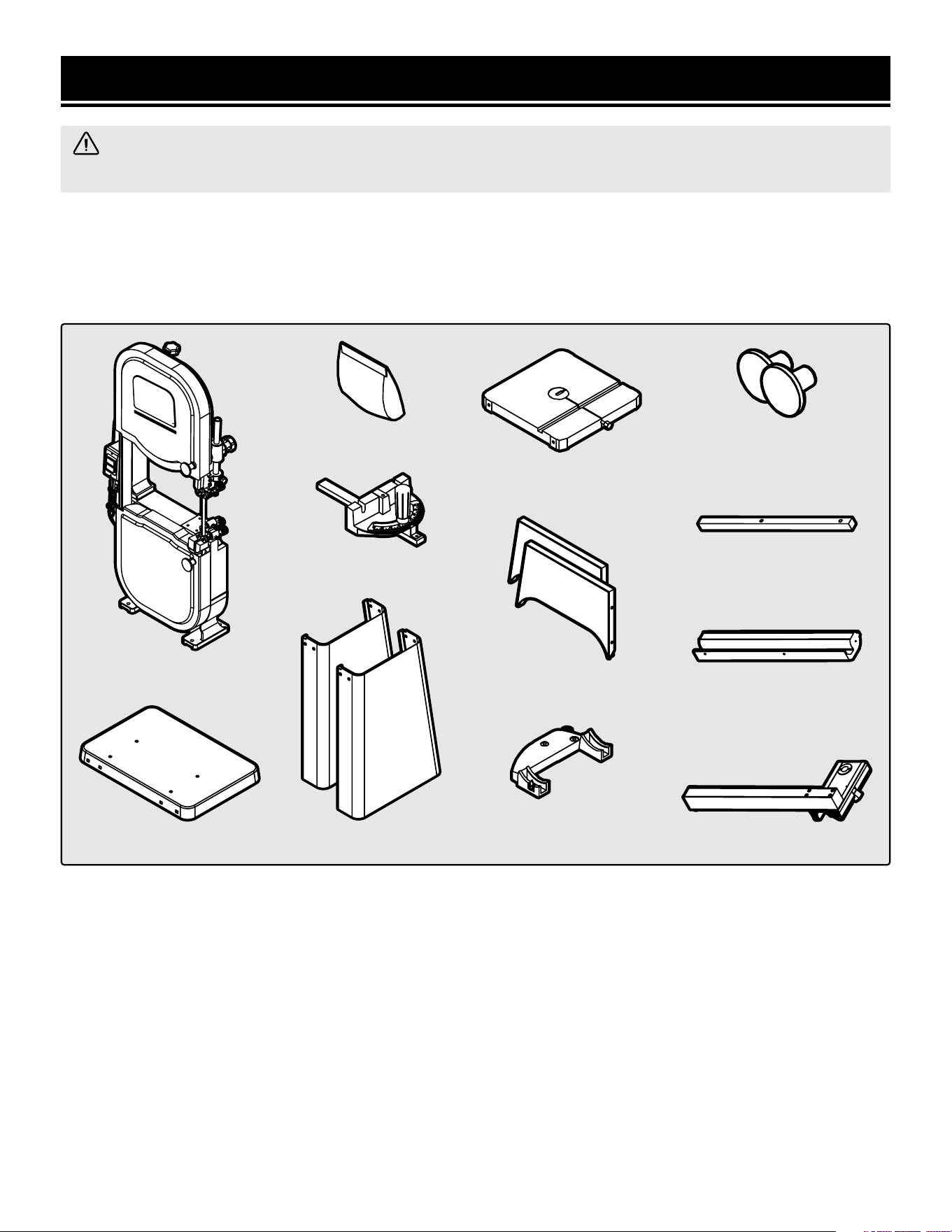
With the help of a friend or trustworthy foe, carefully remove the band saw from the packaging. Make sure to take
out all contents and accessories. Do not discard the packaging until everything is removed. Check the packing list
below to make sure you have all of the parts and accessories. If any part is missing or broken, please contact our
customer service at 1-800-232-1195 (M-F 8-5 CST), or email [email protected].
UNPACKING & PACKING LIST
WARNING! Do not plug in or turn on the tool until it is fully assembled according to the instructions. Failure
to follow the safety instructions may result in serious personal injury.
Stand Hardware
1. M6x16 Hex Bolts (8)
2. 6mm Flat Washers (8)
3. M6 Flange Nuts (8)
4. M8x16 Carriage Bolts (8)
5. M8 Flange Nuts (8)
Stand Feet Hardware
1. Stand Feet (4)
2. Hex Nuts (8)
3. Flat Washers (8)
Bandsaw Hardware
1. M8x35 Hex Bolts (4)
2. 8mm Flat Washers (8)
3. 8mm Lock Washers (4)
4. M8 Hex Nuts (4)
Trunnion Hardware
1. M8x30 Hex Bolts (2)
2. 8mm Lock Washers (2)
Positive Stop Hardware
1. M8x80 Hex Bolt (1)
2. M8 Hex Nut (1)
Fence Hardware
1. M6x20 Fence Stand-Off (1)
2. M8x20 Lock Handle (1)
3. M6x16 Cap Screws (2)
4. M6x20 Hex Bolts (2)
5. 6mm Lock Washers (2)
6. 6mm Flat Washers (2)
7. M8 Hex Nut (1)
8. M6 Hex Nut (1)
Stand Top (1)
Bandsaw (1)
Stand Braces (2)
Bandsaw Table (1)
Table Trunnion
Support Bracket (1)
Table Lock Knobs (2)
Front Fence Rail (1)
Rear Fence Rail (1)
Fence Assembly (1)Stand Legs (2)
Miter Gauge (1)
Hardware Bags (2)
10
KNOW YOUR BANDSAW
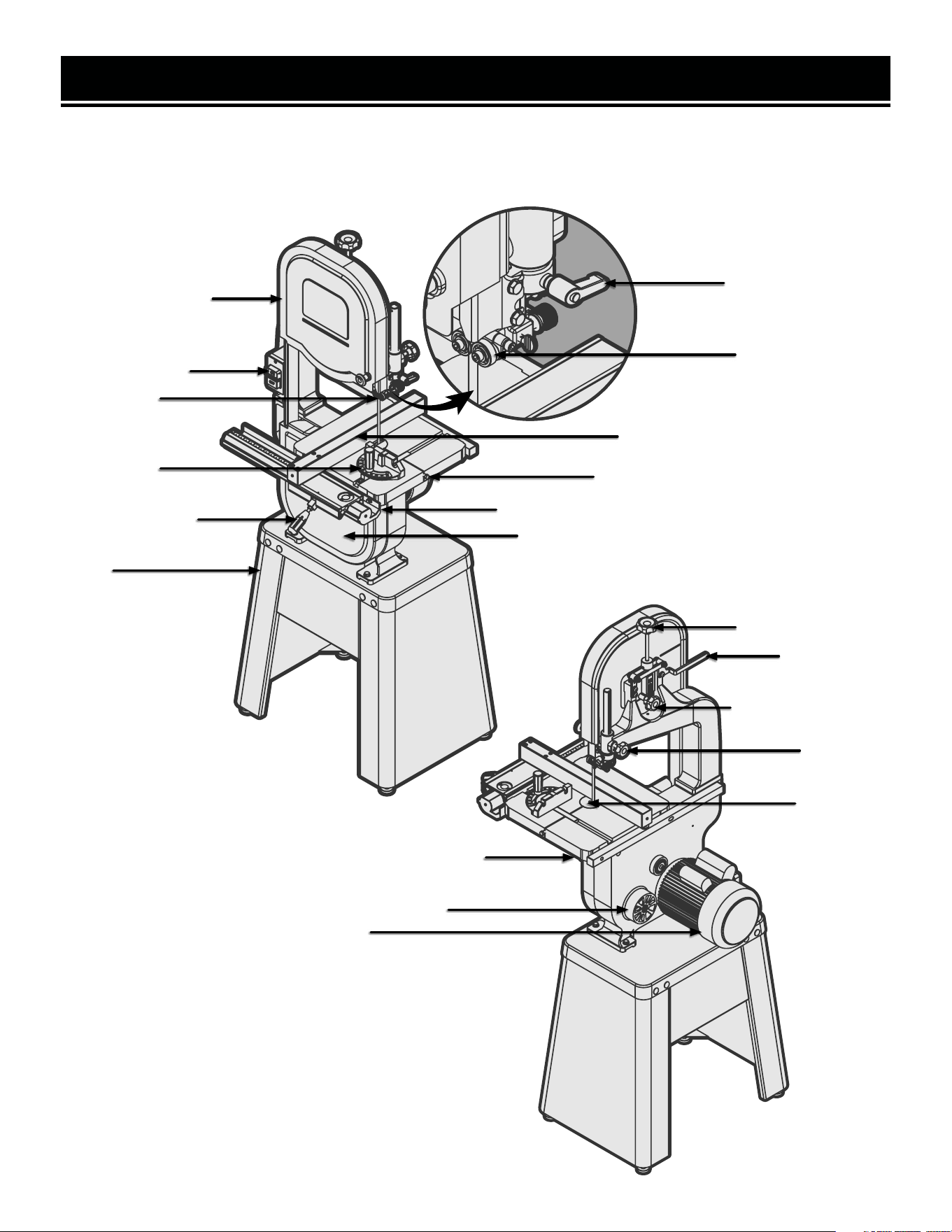
TOOL PURPOSE
Make continuous and precise cuts with your WEN Band Saw. Refer to the following diagrams to become familiar-
ized with all the parts and controls of your band saw. The components will be referred to later in the manual for
assembly and operation instructions.
Upper Wheel Cover
ON / OFF Switch
Fence
Blade Guard
Upper Blade Guides
Table Pin
Miter Gauge
Lower Wheel Cover
Fence Lock Lever
Front Table Lock Knob
Stand
Blade Tension Knob
Blade Tension
Quick Release Lever
Blade Tracking Knob
Guide Post
Lock Knob
Table Insert
Rear Table Lock Knob
4-Inch Dust Port
Motor
Assembly Lock Lever
11
ASSEMBLY & ADJUSTMENTS
WARNING! Do not plug in or turn on the tool until it is fully assembled according to the instructions. Read
through and become familiarized with the following procedures of handling and adjusting your tool. Failure to
follow the safety instructions may result in serious personal injury.
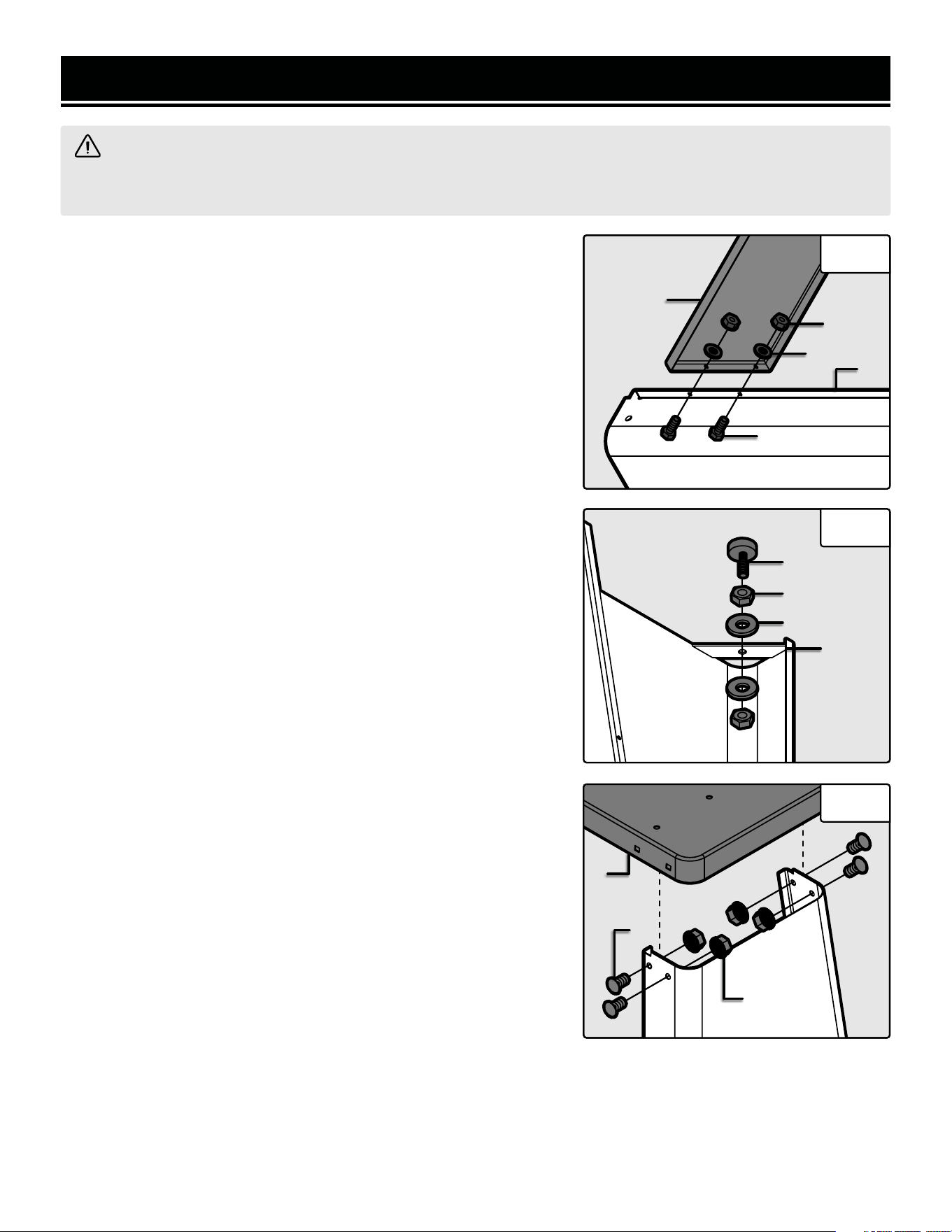
ASSEMBLING THE STAND
Tools Needed (Not Included):
• 10mm Socket or Combination Wrench (2)
• 13mm Socket or Combination Wrench (2)
• 9/16 or 14mm Combination Wrench (1)
• Bubble Level (1)
1. Lay one stand leg (Fig. 1 - 1) flat on a level surface. Attach the two
stand braces (Fig. 1 - 2) to the stand leg using four M6x16 hex bolts
(Fig. 1 - 3), four 6mm flat washers (Fig. 1 - 4), and four M6 flange
nuts (Fig. 1- 5).
NOTE: Hand tighten the stand fasteners only. Once the stand is com-
pletely assembled, you can then fully tighten the stand fasteners.
2. Repeat step 1 to attach the remaining stand leg to the other sides
of the two stand braces.
3. Flip the stand over so that the four feet brackets (Fig. 2 - 1) are fac-
ing up. Place a hex nut (Fig. 2 - 2) and a flat washer (Fig. 2 - 3) onto
the threaded end of a stand foot (Fig. 2 - 4) before placing the foot
through the foot bracket. Secure the foot to the foot bracket using a
flat washer and a hex nut as shown in Fig. 2.
4. Repeat step 3 for the remaining three feet.
5. Flip the stand to the upright position so that the feet are on the floor.
Attach the stand top (Fig. 3 - 1) to the stand legs using eight M8x16
Carriage Bolts (Fig. 3 - 2) and eight M8 hex nuts (Fig. 3 - 3).
6. Place a level (not included) on the stand top and adjust the stand
feet as necessary. Make sure that both hex nuts on the feet are tight
against the stand. Make sure to level the stand from both front to back
and side to side.
Fig. 1
Fig. 2
Fig. 3
5
4
3
1
2
4
2
3
1
1
3
2
12
ASSEMBLY & ADJUSTMENTS
MOUNTING THE BANDSAW TO THE STAND
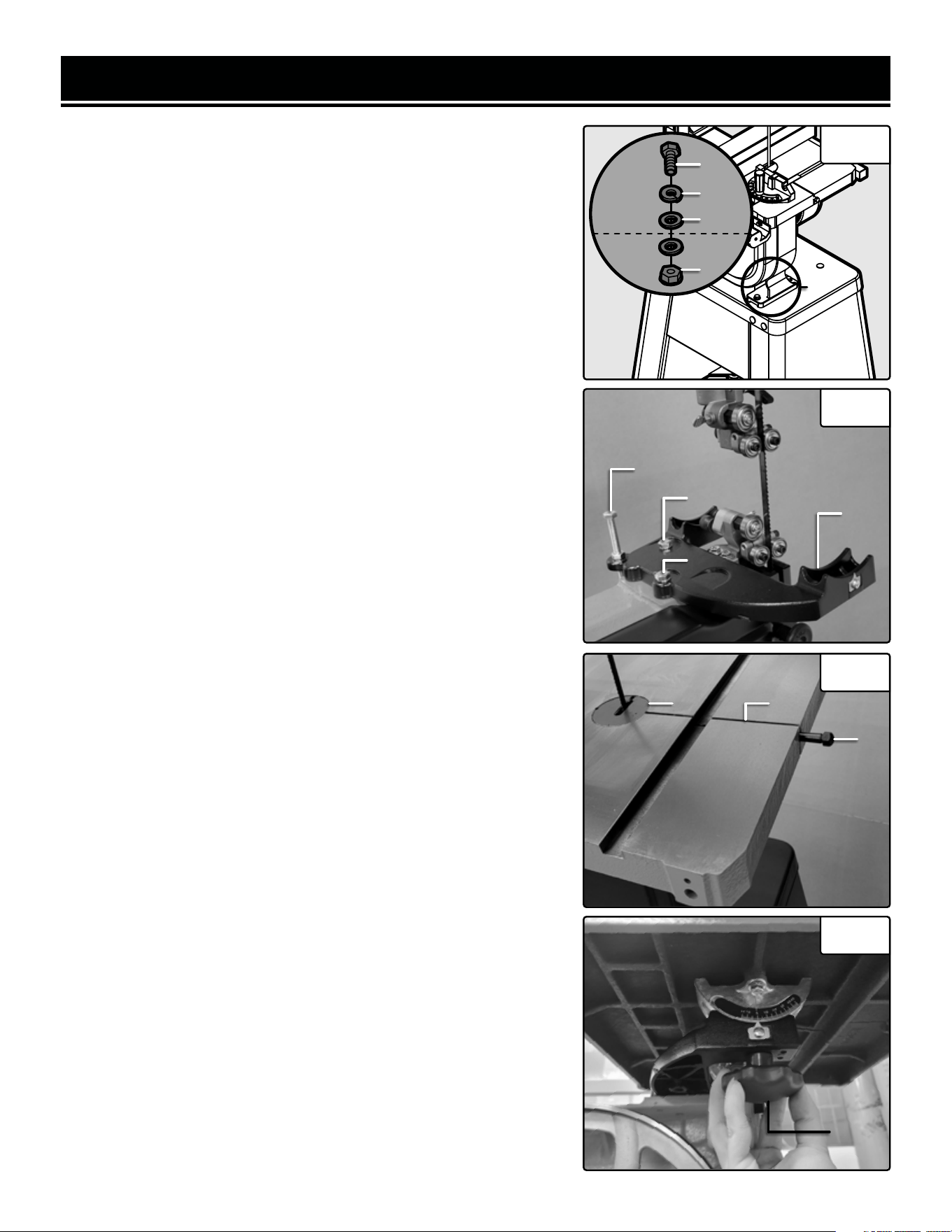
1. Locate the four mounting holes on the top of the stand. With the
help of a friend, or trustworthy foe, carefully lift the bandsaw onto the
stand and align the four holes with the four mounting bracket holes
(Fig. 4 - 1) on the saw.
2. Place an 8mm lock washer (Fig. 4 - 2) and an 8mm flat washer (Fig.
4 - 3) onto the threaded end of a M8x35 hex bolt (Fig. 4 - 4) before fit-
ting it through the mounting bracket and stand mounting hole. Secure
the hex bolt with a flat washer and an M8 hex nut (Fig. 4 - 5) as shown
in Fig. 4. Do not tighten mounting fasteners fully yet.
3. Repeat step 2 for the remaining three mounting holes.
4. Align the band saw so it is square to the base, then tighten all
mounting fasteners.
ASSEMBLING THE BANDSAW TABLE
NOTE: The table comes with a protective coating to prevent rust. To
remove this coating, while wearing gloves, wipe off the coating with a
rag, then apply a small amount of acetone (nail polish remover) to a
shop towel and clean the table. Apply a coat of good-quality paste wax
to the table to protect it from rust.
1. Position the table trunnion (Fig. 5 - 1) onto the bandsaw as shown
in Fig. 5. Secure the trunnion to the bandsaw using two M8x30 hex
bolts and two 8mm lock washers (Fig. 5 - 2).
2. Place an M8 hex nut onto the threaded end of the M8x80 positive
stop hex bolt (Fig. 5 - 3). Thread the bolt into the trunnion, leaving
about two inches visible above the trunnion, as shown in Fig. 5. Once
the table is installed, it will rest level on the positive stop hex bolt.
3. Remove the table insert (Fig. 6 - 1) and the table pin (Fig. 6 - 2).
4. Align the blade with the table slot (Fig. 6 - 3) and carefully slide it
into the center of the table. Turn the table 90º counterclockwise and
set it on the trunnions, so that the two mounting bolts protrude down-
ward through the trunnions.
5. Secure the table by installing the two table lock knobs (Fig. 7 - 1)
onto the two protruding trunnion bolts as shown in Fig. 7.
6. Replace the table insert and table pin. Make sure the table insert
sits flush with the table top.
1
2
4
3
5
Fig. 5
Fig. 4
Fig. 6
Fig. 7
1
2
2
3
1
2
3
1
13
ASSEMBLY & ADJUSTMENTS
ASSEMBLING THE FENCE
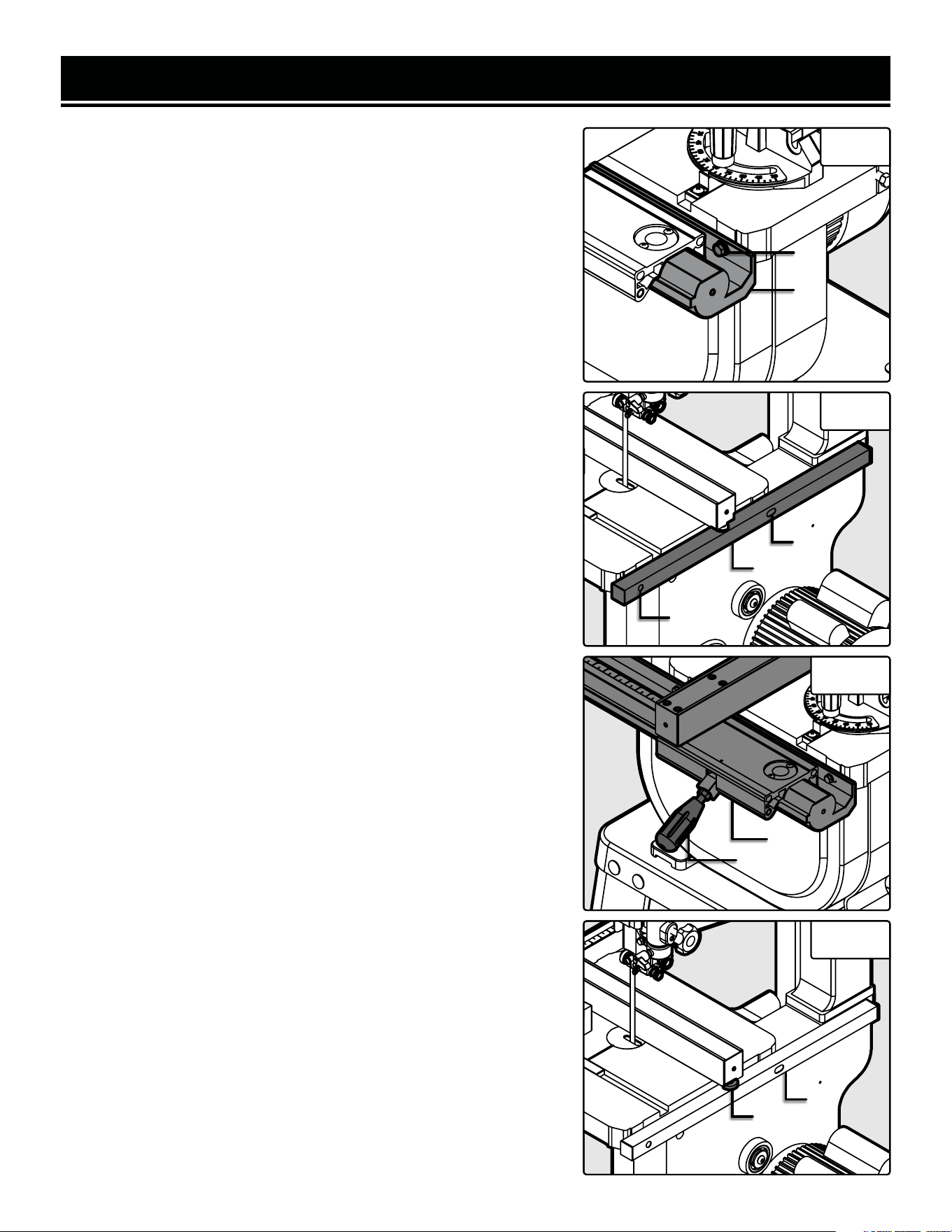
1. Install the front fence rail (Fig. 8 - 1) on the front side of the table
using two M6x20 hex bolts, two 6mm lock washers, and two 6mm
flat washers (Fig. 8 - 2).
NOTE: There are two sets of threaded holes on the front of the table.
Install the bolts in the lower set of holes.
NOTE: Do not fully tighten the hardware until the front fence rail is
completely installed. Position the rail evenly along the table before
fully tightening the hardware.
2. Install the rear fence rail (Fig. 9 - 1) on the rear side of the table
using two M6x16 cap screws (Fig. 9 - 2). Secure them using the in-
cluded hex wrench.
3. Place the M8 hex nut onto the threaded end of the fence lock handle
(Fig. 10 - 1). Attach the fence lock handle to the fence (Fig. 10 - 2) and
secure it by tightening the hex nut against the fence.
4. Make sure that the fence lock handle is in the UP (unlocked) posi-
tion. Position the fence between the blade and column as shown in
Fig. 11 and place it on the front fence rail. Push the lock handle DOWN
to the locked position to secure the fence to the rail.
5. Place the M6 hex nut onto the fence stand-off (Fig. 11 - 1) and
thread it into the underside of the fence so that it rests on the rear
fence rail (Fig. 11 - 2). Make sure that the fence is level all the way
across. Tighten the hex nut against the fence to secure the stand-off
in place.
NOTE: The fence may not be perfectly flush against the table when it
is leveled. This is normal.
Fig. 10
Fig. 8
2
1
Fig. 9
2
2
1
Fig. 11
1
2
1
2
14
SAW BLADE TENSION & TRACKING
Before initial cutting and after every blade change, check and adjust
blade tracking so that the blade runs on the center of the wheels.
1. Turn off the band saw and unplug it from the power source. Make
sure that the blade is not moving, then adjust the upper and lower
blade guides away from the blade. See "BLADE GUIDES ADJUST-
MENT" section on the next page.
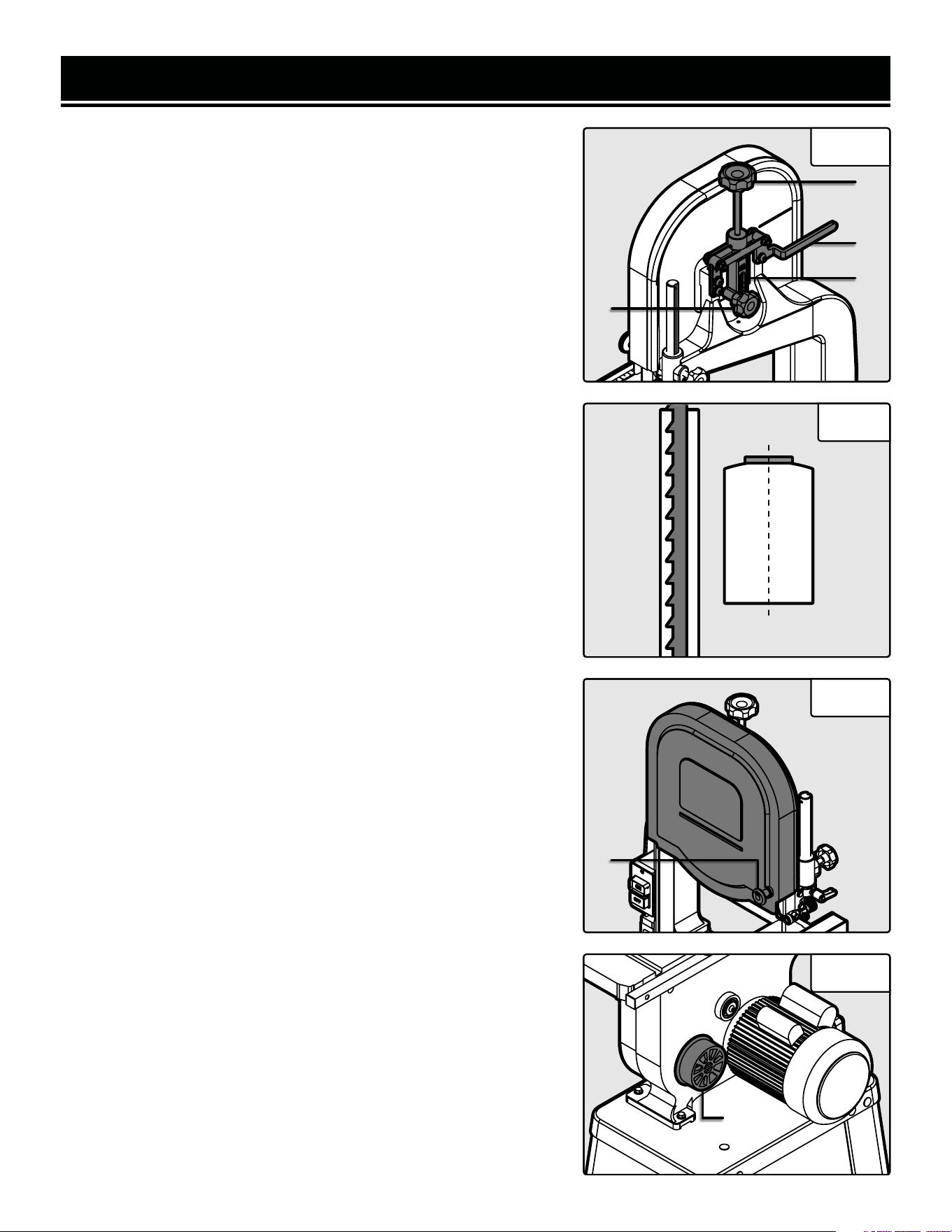
2. Push the blade tension quick release lever (Fig. 12 - 1) to the UP
(unlocked) position. Use the blade tension adjustment knob (Fig. 12
- 2) to move the red indication arrow on the blade tension scale (Fig.
12 - 3) to the correct setting for the width of blade being used.
3. To tension the blade, pull the blade tension quick release lever to
the DOWN (locked) position.
4. Open the upper wheel cover (Fig. 13 - 1). Carefully rotate the upper
wheel manually for at least three rotations (making sure not to touch
the blade) and watch the blade travel.
If the blade sits in the center of the tire: (Fig. A):
The bandsaw is tracked properly and you do not need to make any
other adjustments.
If the blade is veering off to either side of the tire:
Follow the next steps to adjust the blade tracking.
5. Loosen the wing nut on the blade tracking knob (Fig. 12 - 4). Con-
tinue to rotate the wheel, and slowly turn the blade tracking knob in
the desired direction until the blade is centered over the wheels. As
viewed from the right side of the band saw, turning the blade tracking
knob towards you shifts the blade to the left, and turning it away from
you shifts the blade to the right.
NOTE: When adjusting the tracking knob, make small adjustments at
a time. This will make the process much easier.
6. Once you have the blade centered, tighten the wing nut on the blade
tracking adjustment knob and close the upper wheel cover.
CONNECTING TO DUST COLLECTION
Connect your band saw to the dust collection system of your choice
(not included) using the dust port (Fig. 14 - 1) on the back of the unit.
The dust port diameter is four inches. Hose adapters or hose clamps
(not included) may be needed depending on the size of your dust
hose.
NOTE: Always operate in a well-ventilated area and always use a dust-
collection system. Failure to do so will cause sawdust to build up
inside the machine, possibly damage the machine, and void the war-
ranty.
ASSEMBLY & ADJUSTMENTS
Fig. 12
Fig. 13
Fig. 14
1
2
4
3
1
1
Fig. A
Blade
Centered
on
Tire
Blade
Centered
on Peak
of Crown
15
BLADE GUIDE BEARING ADJUSTMENT
The blade guide bearings need to be readjusted after every blade
change or blade tracking adjustment.
1. Upper Thrust Bearing:
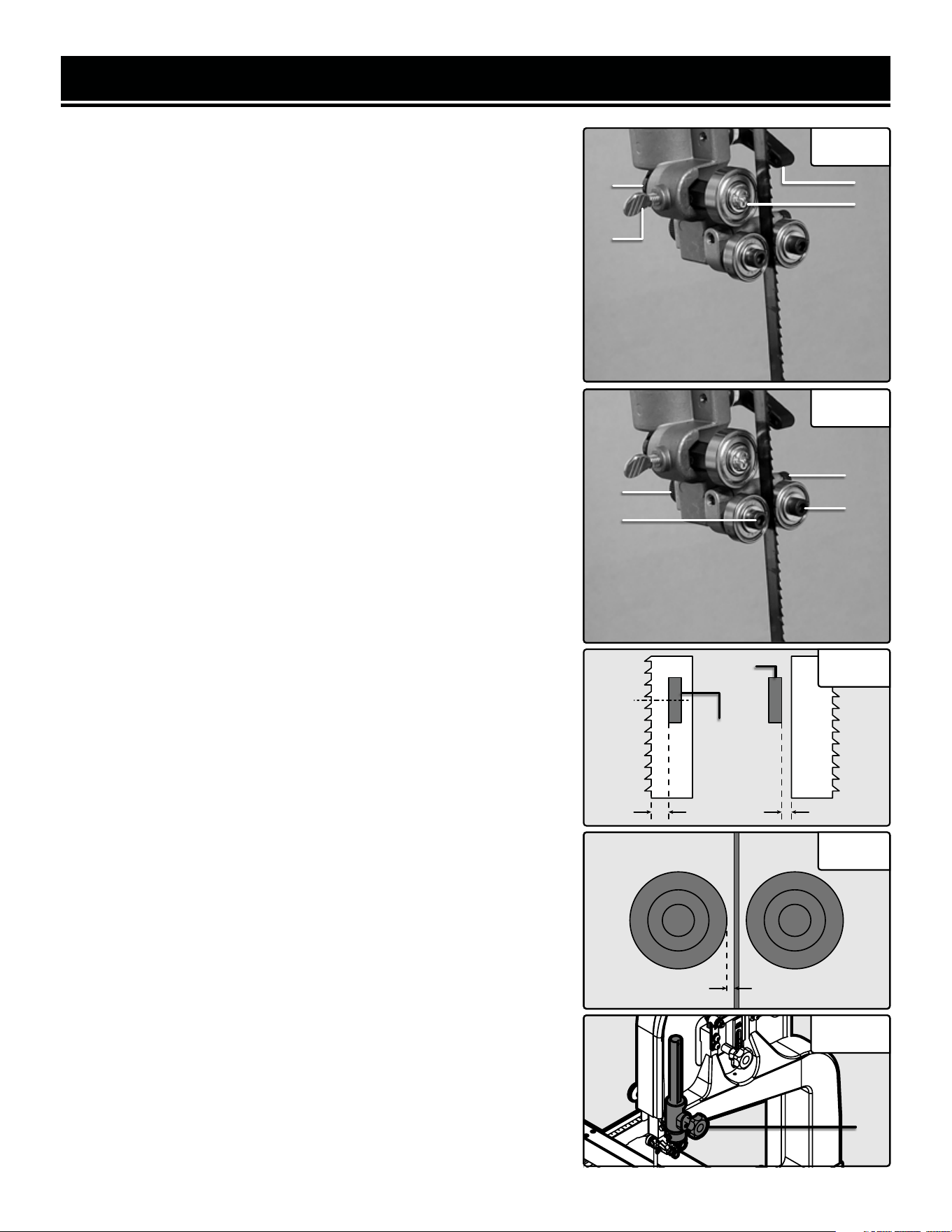
1. Loosen the assembly lock lever (Fig. 15 - 1) and ensure that the
blade guide assembly is perpendicular to the blade. Retighten the as-
sembly lock lever.
2. Loosen the thumbscrew to the left of the thrust bearing (Fig. 15 -
2) and use the knurled knob (Fig. 15 - 3) to adjust the position of the
thrust bearing (Fig. 15 - 2) running along the back of the blade. The
bearing should be positioned 0.5 mm from the back of the blade (Fig.
B). Retighten the thumbscrew.
2. Upper Side Bearings:
1. Loosen the thumb screw to the right of the side bearings. Use the
knurled knob (Fig. 16 - 1) to adjust the side bearings laterally so that
the bearing faces are just behind the teeth of the blade (Fig. B). Re-
tighten the thumbscrew.
2. Use the included hex wrench to loosen the guide bearing lock screw
(Fig. 16 - 3), then use it to rotate the adjustment cap screws (Fig. 16
- 2). The side bearings should be positioned 0.25 mm away from the
blade (Fig. C). Retighten the lock screw.
LOWER BLADE GUIDE ADJUSTMENT
The lower blade guide bearings also need to be readjusted after every
blade change or blade tracking adjustment. The lower blade guide
bearing assembly is located below the table. The adjustments are the
same as the upper blade guide bearings.
TIP: Remove the table insert for better visibility when adjusting the
lower blade guide bearings.
BLADE GUARD ADJUSTMENT
The height of the upper blade guard should be adjusted prior to every
operation to accommodate the height of the workpiece.
NOTE: The bottom of the blade guard should be no more than 1/8 inch
above the upper face of the workpiece.
1. Loosen the guide post lock knob (Fig. 17 - 1) to adjust the entire
assembly up or down. Make sure that the lock knob is tight before
beginning operation.
ASSEMBLY & ADJUSTMENTS
Fig. 15
Fig. 16
Fig. 17
3
4
2
1
2
1
2
1
3
Fig. B
Fig. C
Side
Bearing
Thrust
Bearing
1-2mm 0.5mm
Side Bearing
0.3mm
16
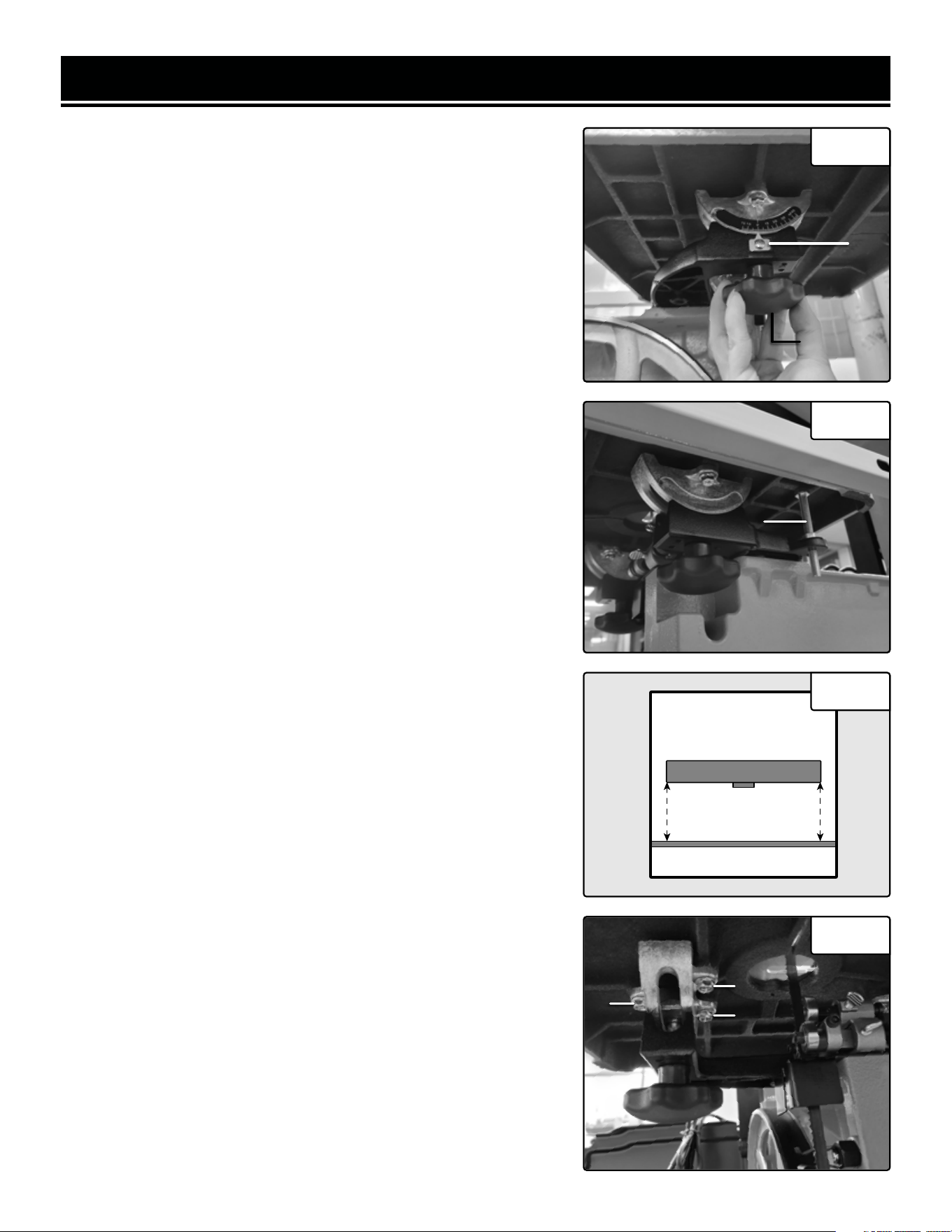
TILTING THE TABLE
1. Unlock the two table lock knobs (Fig. 18 - 1). Use the bevel scale
indicator (Fig. 18 - 2) to adjust the table to the correct angle. The table
can be beveled to the right 45° and to the left 15°.
2. If tilting the table to the left, the positive stop bolt will need to be
lowered. Follow the directions below to reset the positive stop bolt.
To set the positive stop bolt:
1. Make sure that the tool is OFF and disconnected from the power
source.
2. Make sure that the blade is properly tensioned. Refer to the " SAW
BLADE TENSION & TRACKING" section.
3. Unlock the two table lock knobs and loosen the hex nut on the posi-
tive stop bolt.
4. Raise the blade guard by unlocking the guide post lock knob (Fig.
17 - 1).
5. Place a machinist's square (not included) flat on the table against
the blade. Raise or lower the positive stop bolt (Fig. 19 - 1) until the
table is level and square with the blade. Retighten the hex nut on the
positive stop bolt.
6. Rest the table on the positive stop bolt and retighten the table lock
knobs. Check that the bevel scale indicator is pointing to "0" on the
bevel scale. If not, loosen the bevel scale indicator screw (Fig. 18 - 2)
and reposition it to point to "0". Retighten the screw.
ALIGNING THE TABLE
When first installing the table, it is important to make sure that the
blade is parallel to the miter gauge slot on the table.
1. Make sure that the tool is OFF and disconnected from the power
source.
2. Make sure that the blade is properly tensioned. Refer to the " SAW
BLADE TENSION & TRACKING" section.
3. Place a straight edge along the blade. The straight edge should be
lightly touching the front and back of the blade (Fig. 20).
4. Measure from both ends of the straight edge to the miter gauge
slot. If the measurements are the same, the blade and table are paral-
lel and no further adjustments are needed. If the measurements are
not the same, continue on to step 5.
5. Loosen the six flange bolts (Fig. 21 - 1) (3 of 6 shown) that secure
the table to the trunnion brackets.
6. Adjust the table until both measurements are equal.
7. Retighten the six flange bolts.
ASSEMBLY & ADJUSTMENTS
Fig. 18
1
2
Fig. 19
1
Fig. 21
1
1
1
Fig. 20
Top
View
Table
Blade
Miter Gauge Slot
Straight Edge
17
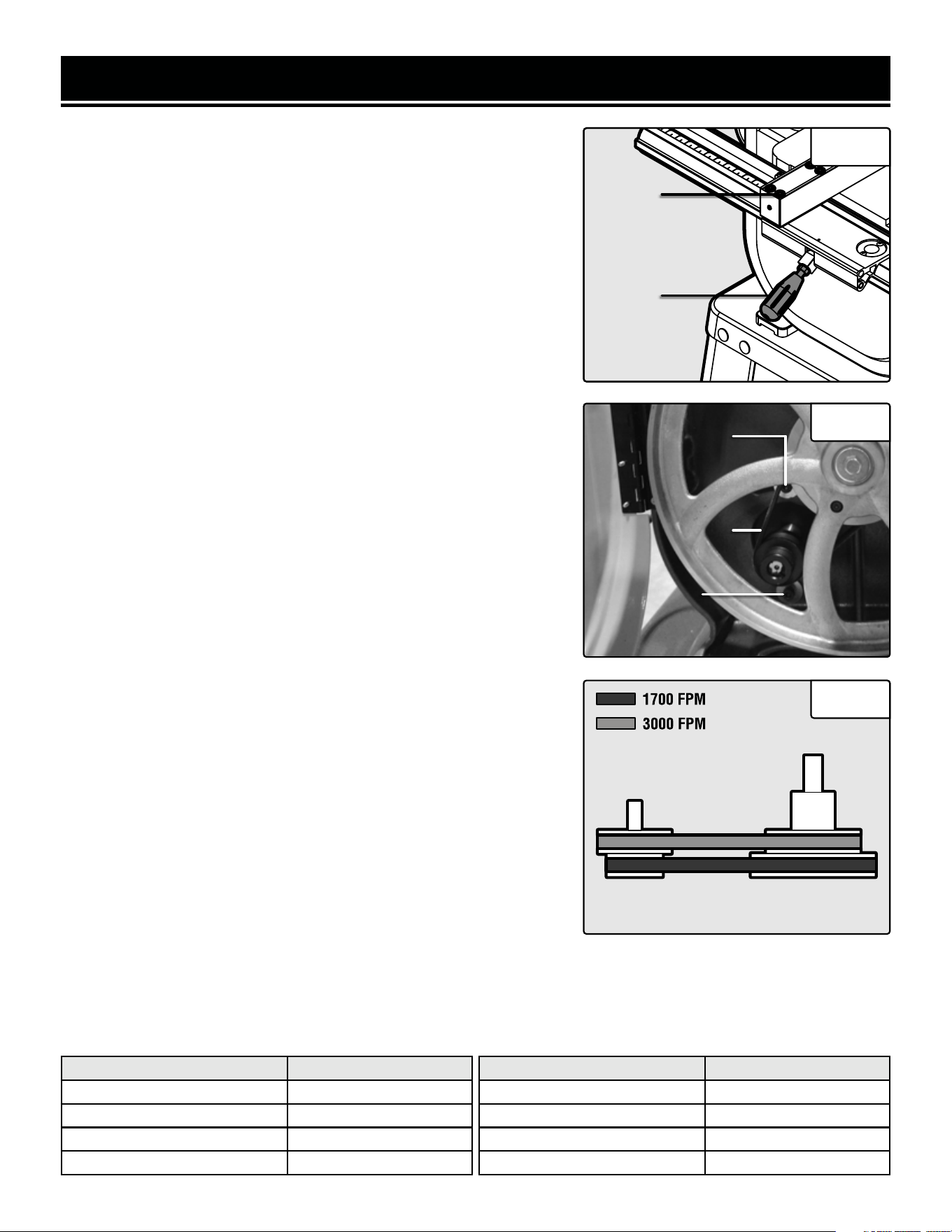
ALIGNING THE FENCE
1. Make sure that the tool is OFF and disconnected from the power
source.
2. Make sure that the table is aligned with the blade. See "ALIGNING
THE TABLE".
3. Install the fence on the right side of the blade and align it against
the miter gauge slot. Lock the fence in place using the fence lock lever
(Fig. 22 - 1).
4. If the fence is parallel with the miter gauge slot, no further adjust-
ments are needed. If the fence is not parallel with the miter gauge slot,
continue on to step 5.
5. Loosen the four fence adjustment cap screws (Fig. 22 - 2) and
adjust the fence parallel to the miter gauge slot. Retighten the fence
adjustment cap screws.
ADJUSTING THE BLADE SPEED
Your band saw can run with blade speeds of either 1700 or 3000 FPM.
Use the chart below to determine which speed setting is correct for
your operation:
To adjust the blade speed:
1. Make sure that the tool is OFF and disconnected from the power
source.
2. Open the lower wheel cover and loosen the motor mount adjust-
ment cap screw (Fig. 23 - 1).
3. Adjust the motor so that the motor adjustment cap screw slides to
the right of the slot. The tension on the ribbed v-belt (Fig. 23 - 2) will
be released.
NOTE: If the motor is difficult to move, loosen the pivot cap screw
(Fig. 23 - 3) slightly.
4. Place the v-belt on the pulleys based on your desired speed (Fig.
24). Make sure that the v-belt is properly seated in the grooves of the
pulleys before beginning operation.
ASSEMBLY & ADJUSTMENTS
Fig. 22
2
1
Fig. 23
Fig. 24
MOTOR WHEEL
1
3
2
Cutting Operation Blade Speed (FPM)
Most Species of Wood 3000
Dense Hardwood 1700
Fast or Average Feed Rate 3000
Slow Feed Rate 1700
Cutting Operation Blade Speed (FPM)
Rough Edges Acceptable 3000
Requires Smooth Edges 1700
Quick Cuts 3000
Detailed Cuts 1700
5. Reposition the motor so that the motor adjustment cap screw slides to the left of the slot, then tighten the screw
to secure tension on the belt. Lightly press the belt with a finger; it should deflect about 1/8" (3mm). If adjustments
are needed, repeat step 5.
6. Make sure all screws are tightened and the belt is properly tightened, then close the lower wheel cover.
18

REMOVING & REPLACING THE BLADE
Removing the blade:
1. Make sure that the tool is OFF and disconnected from the power source.
2. Push the blade tension quick release lever to the UP position to release the tension on the blade.
3. Move the blade guard all the way up by loosening the blade guide locking knob.
4. Remove the fence, miter gauge, table insert, and table pin from the table.
5. Open the upper and lower wheel covers.
6. Only handle the blade when wearing protective gloves. Carefully remove the blade from the wheels, rotate the
blade 90º, and slip it out from the table through the table slot.
Replacing the blade:
1. Make sure that the tool is OFF and disconnected from the power source.
2. Only handle the blade when wearing protective gloves. Position the blade so that the teeth are pointing right and
down toward the table. Rotate the blade 90º and place it over the wheels while making sure that it's fitted between
the blade guides.
3. Use the blade tension adjustment knob to tension the blade. See "SAW BLADE TENSION & TRACKING". Pull the
blade tension quick release lever DOWN to lock the tension.
4. Check and adjust the blade tracking. See "SAW BLADE TENSION & TRACKING".
5. Check and adjust blade guide bearings. See "BLADE GUIDE BEARING ADJUSTMENT".
6. Close the wheel covers, replace the table pin, insert, miter gauge, and fence.
ASSEMBLY & ADJUSTMENTS
WARNING! The blade is extremely sharp. Only handle the blade when wearing protective gloves.
19
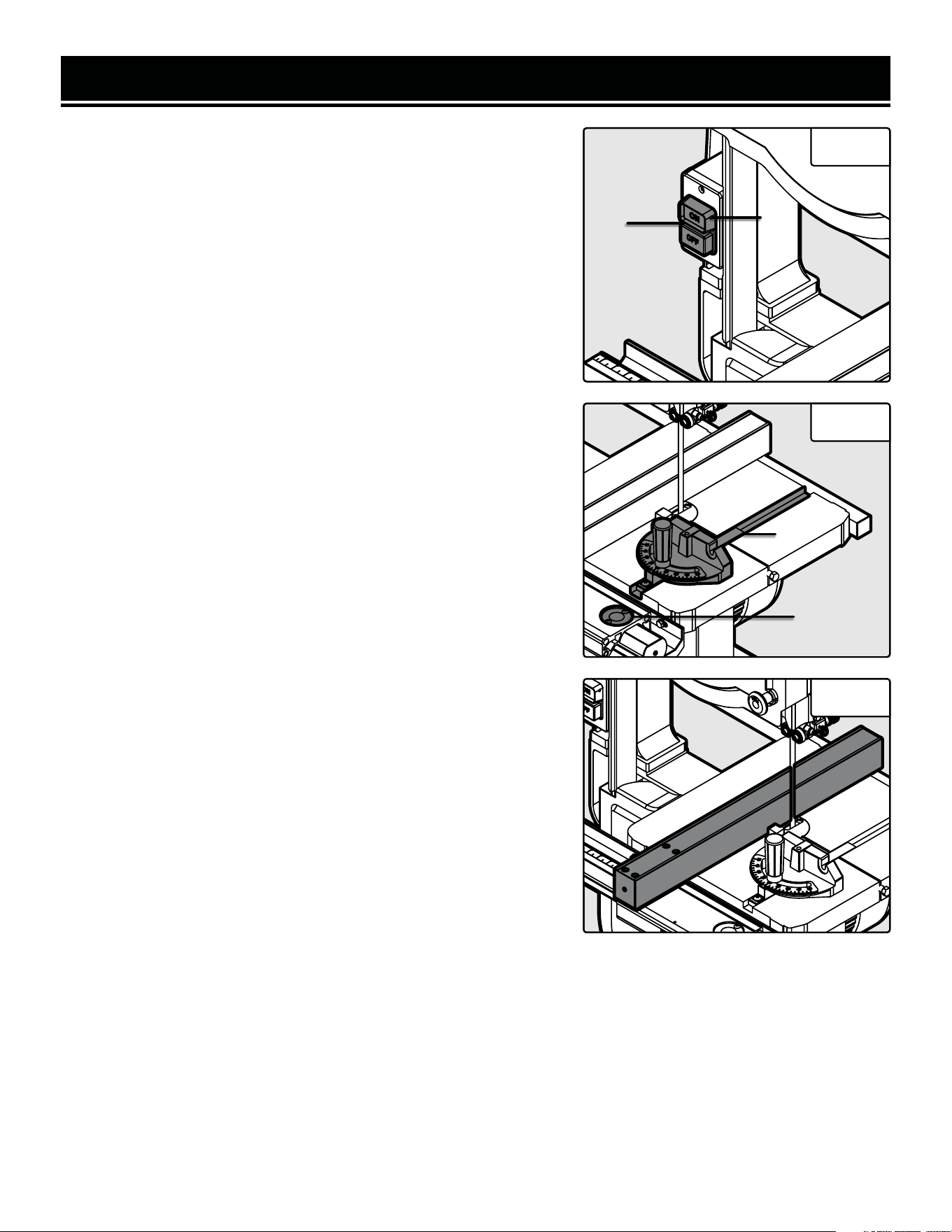
TURNING THE SAW ON / OFF
The bandsaw can be powered ON and OFF by pressing the ON / OFF
switch (Fig. 25 - 1).
The ON / OFF switch can also be disabled and locked by inserting a
padlock through the hole in the ON button (Fig. 25 - 2). This prevents
accidental start-ups by unauthorized operators. The padlock should
have a shaft diameter of 0.12" - 0.15".
USING THE MITER GAUGE
1. Place the miter gauge into the slot on the table (Fig. 26 - 1).
2. Loosen the knob on the gauge to set a new miter angle (between 0
and 60 degrees).
3. Tighten the knob firmly before cutting begins.
NOTE: A 0° cut is a straight cut that is perpendicular to the blade.
USING THE FENCE (FIG. 27)
The fence acts as a guide for making straight cuts. Position the fence
onto the work table with the side face parallel to the blade. Adjust the
distance of the fence to the blade depending on the length you would
like to cut. Make sure the fence is locked down before operation.
ADJUSTING THE FENCE POINTER
The fence pointer can be adjusted if it does not indicate zero. Set the
side face of the fence against the blade, and ensure the pointer is
aligned with the "0" mark on the fence scale. If it is not, loosen the two
Phillips-head mounting screws (Fig. 26 - 2), adjust the pointer, and
tighten the screws.
OPERATION
Fig. 25
1
2
Fig. 26
Fig. 27
1
2
20
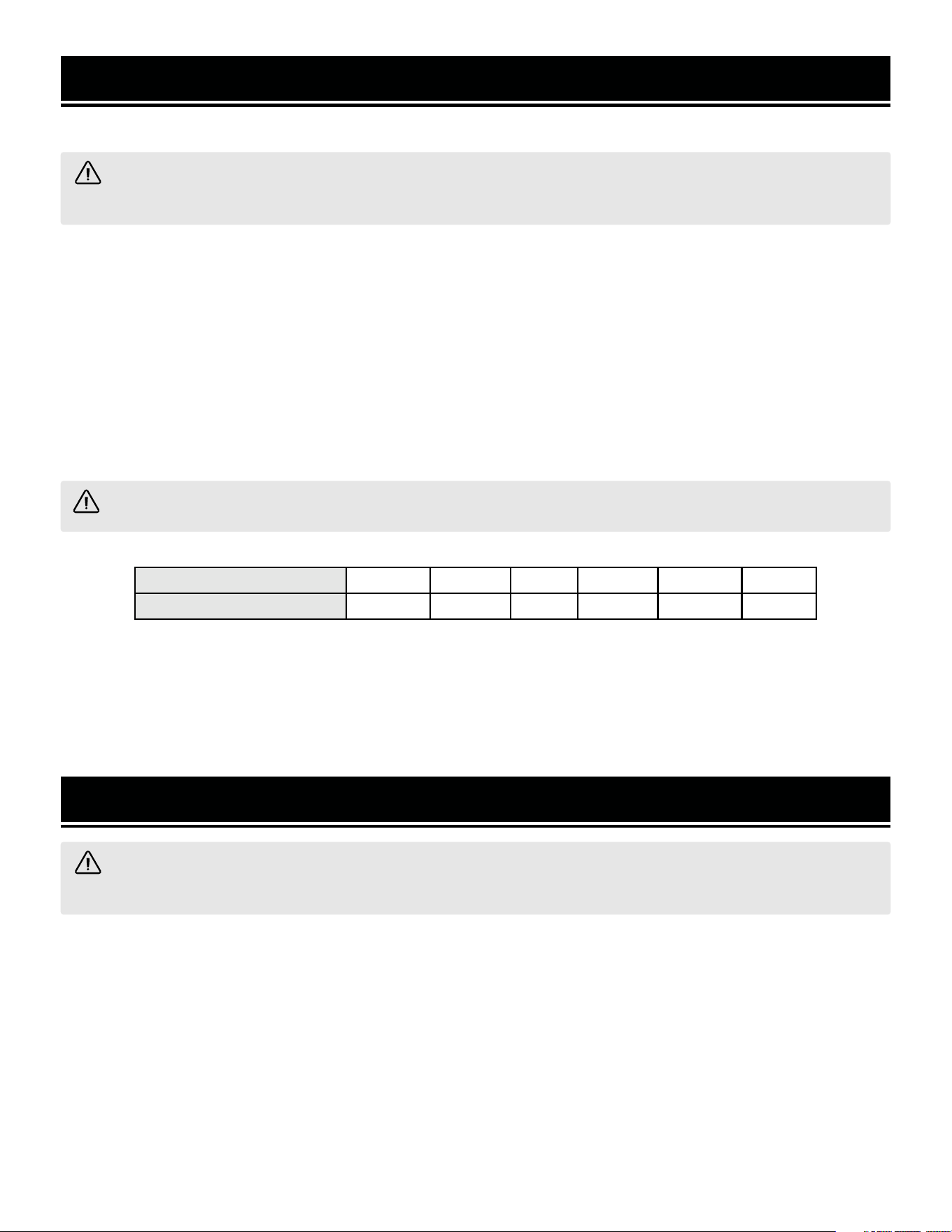
BLADE WIDTH 1/8 in. 3/16 in. 1/4 in. 3/8 in. 1/2 in. 3/4 in.
MINIMUM RADIUS 3/16 in. 5/16 in. 5/8 in. 1-1/2 in. 2-1/2 in. 5-1/2 in.
OPERATION
GENERAL CUTTING
NOTE: Before cutting the actual workpiece, it’s best to use a scrap piece of lumber to check the settings and to get
the feel of operating the band saw.
1. Your band saw should now have been properly set up and tuned according to the Assembly & Adjustments
instructions. Position the workpiece on the table and adjust the upper blade guard so that it barely clears the work-
piece. The bottom of the blade guard should be no more than 1/8 inch above the upper face of the workpiece. Do
not turn the power on until all adjustments have been made.
2. Use the band saw for straight line operations such as cross-cutting, ripping, miter cutting, beveling, compound
cutting, and resawing. To avoid twisting the blade, do not turn sharp corners; instead, saw around corners. A band
saw is not capable of doing intricate inside cutting as can be done with a scroll saw. Refer to the Circle Cutting
Guide for the minimum radius you can cut based on the width of the blade installed on your band saw.
WARNING! Operating a band saw involves a certain amount of risk. Make sure to read all the instructions
and plan your work before cutting a workpiece. Wear safety goggles to protect your eyes from possible injury.
WARNING! Do not use this band saw to cut any kind of metals.
CIRCLE CUTTING GUIDE
3. Slowly feed the workpiece into the saw blade. Light contact permits easier cutting and prevents unwanted fric-
tion and heating of the blade. Steadily move the workpiece through the blade without forcing it against the blade.
Never position your hand in line with the cut. Always keep your hand at a safe distance from the saw blade. Use a
push stick to assist cutting small workpieces.
4. When the cutting operation is complete, turn off the machine and wait for the blade to come to a complete stop
before leaving the work area.
MAINTENANCE
1. Clean off the pitch and dust which accumulates on the table, blade guides, and bearings.
2. Remove pitch and dust from the upper and lower wheels using a stiff brush. Do not use solvents.
3. Routinely remove the sawdust from the inside of the housing. Blow out the sawdust from the motor.
NOTE: Always use a dust collection system. Failure to do so can cause dust to build up inside the saw, possibly
damaging it and voiding the warranty.
4. Periodically check the table top to see if the coat of paste wax applied during initial setup has worn. Re-apply a
thin coat if needed to seal the table, prevent rust, and provide a smooth surface.
5. Regularly inspect the machine for any damaged or missing parts. Replace blades and the wheel tires when worn.
Replace the power cord immediately if it is worn, cut, or damaged in any way. Release tension on the blade if the
saw will not be used for longer than a week.
WARNING! For your own safety, turn the switch OFF and remove the plug from the electrical outlet before
performing maintenance or lubricating the band saw.
21
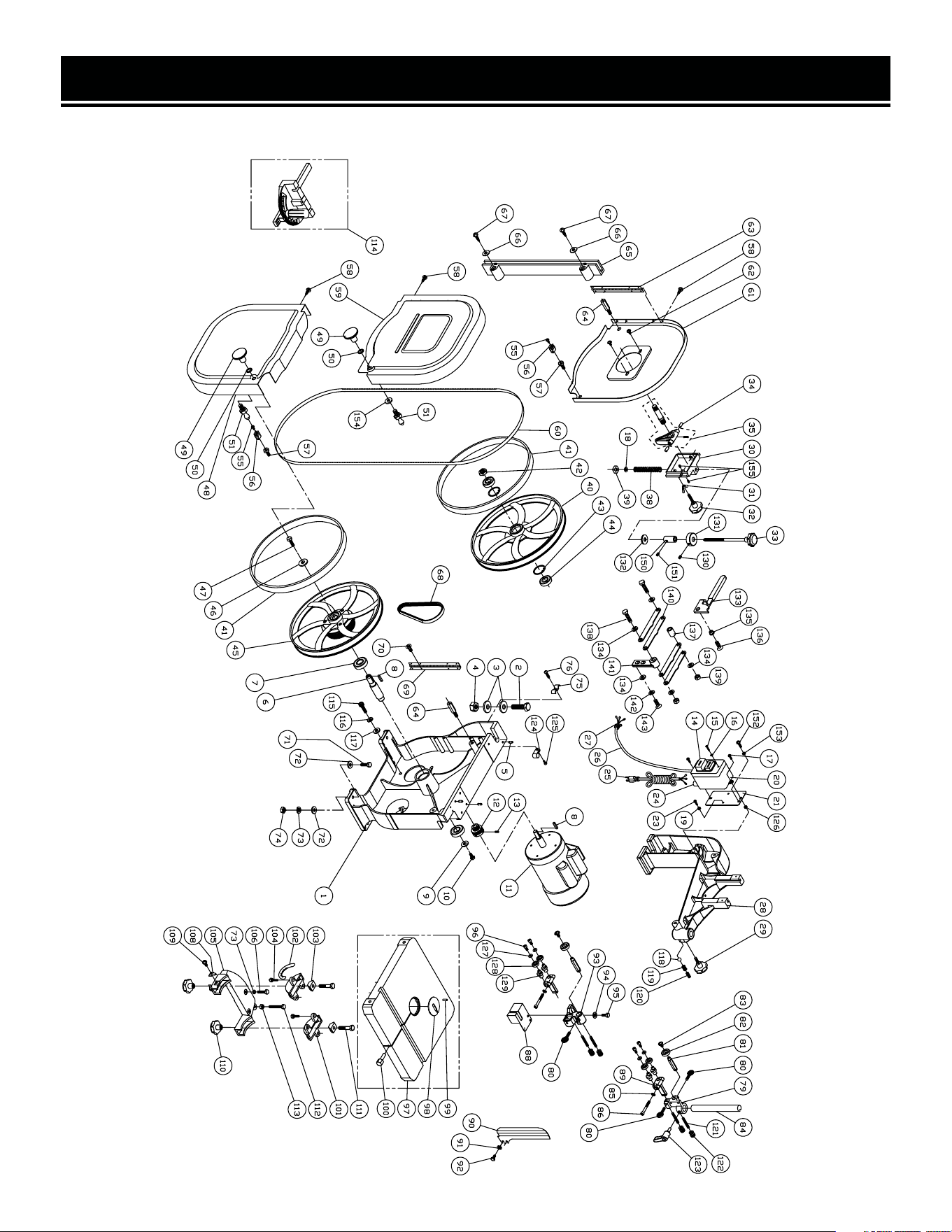
EXPLODED VIEW & PARTS LIST
22
BANDSAW
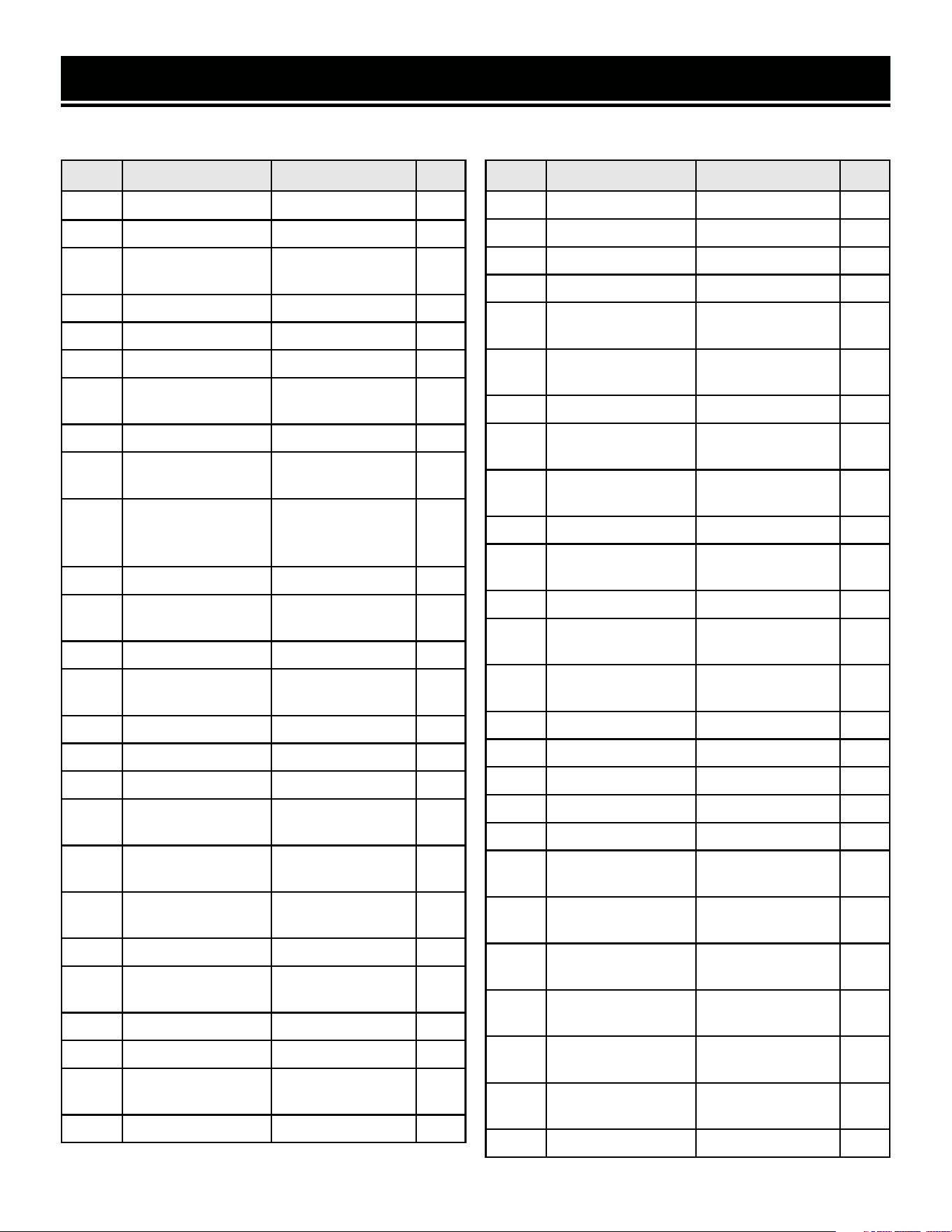
EXPLODED VIEW & PARTS LIST
23
No. Part No. Description Qty.
1 BA1411-1001 Base 1
2 BA1411-1002 Hex Bolt, M6x55 1
3 BA1411-1003
Flat Washer, 16mm
x 40
2
4 BA1411-1004 Nut, M16 1
5 BA1411-1005 Pin 4
6 BA1411-1006 Lower Wheel Shaft 1
7 BA1411-1007
Ball Bearing,
6204LLU
2
8 BA1411-1008 Key, 5x5x25 2
9 BA1411-1009
Flat Washer, 8mm
x 30
1
10 BA1411-1010
Socket Head
Button Screw,
M8x16
1
11 BA1411-1011 Motor 1
N.P. BA1411-1011.4
Start Capacitor,
200uF 250VAC
1
N.P. BA1411-1011.6 Centrifugal Switch 1
N.P. BA1411-1011.11
Run Capacitor,
20uF 250VAC
1
12 BA1411-1012 Motor Pulley 1
13 BA1411-1013 Set Screw, M6x12 2
14 BA1411-1014 Power Switch 1
15 BA1411-1015
Self-tapping Screw,
M3.5x12
2
16 BA1411-1016
Flat Washer, 4mm
x 8
2
17 BA1411-1017
Phillips Head
Screw, M5x16
2
18 BA1411-1018 Tension Indicator 1
19 BA1411-1019
Toothed Washer,
5mm
2
20 BA1411-1020 Switch Housing 1
21 BA1411-1021 Switch Plate 1
23 BA1411-1023
Phillips Head
Screw, M5x6
2
24 BA1411-1024 Strain Relief 2
No. Part No. Description Qty.
25 BA1411-1025 Power Cord 1
26 BA1411-1026 Motor Cord 1
27 BA1411-1027 Strain Relief 1
28 BA1411-1028 Upper Frame 1
29 BA1411-1029
Upper Guard Knob,
M10x30
1
30 BA1411-1030
Upper Wheel
Bracket
1
31 BA1411-1031 Wing Nut, M8 1
32 BA1411-1032
Tracking Knob,
M8x45
1
33 BA1411-1033ASM
Tension Knob
Assembly
1
34 BA1411-1034 Steel Pin 2
35 BA1411-1035ASM
Upper Wheel Shaft
Hinge Assembly
1
35.1 BA1411-1035.1 Upper Wheel Shaft 1
35.2 BA1411-1035.2
Spring Pin,
4x24mm
1
35.3 BA1411-1035.3
Upper Wheel Shaft
Hinge
1
38 BA1411-1038 Tension Spring 1
39 BA1411-1039 Square Nut, M10 1
40 BA1411-1040 Upper Wheel 1
41 BA1411-1041 Wheel Tire 2
42 BA1411-1042 Nut, M12-1.25 1
43 BA1411-1043
Retaining Ring,
35mm
2
44 BA1411-1044
Ball Bearing,
6202LLU
2
45 BA1411-1045ASM
Lower Wheel
Assembly
1
46 BA1411-1009
Flat Washer, 8mm
x 30
1
47 BA1411-1047
Hex Bolt, M8x20
(LH)
1
48 BA1411-1048
Lower Wheel
Guard
1
49 BA1411-1049 Door Knob, M8 2
BANDSAW
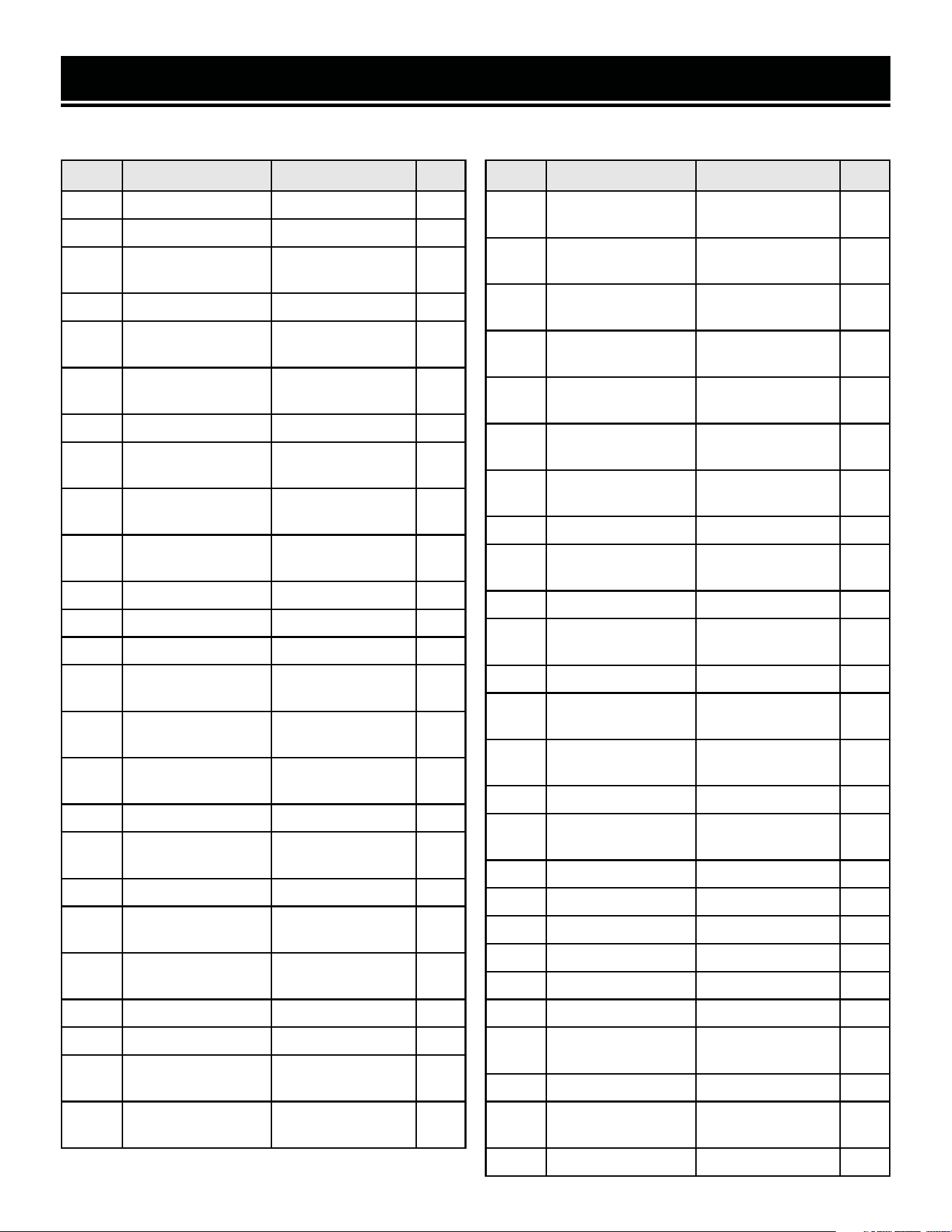
EXPLODED VIEW & PARTS LIST
BANDSAW
No. Part No. Description Qty.
50 BA1411-1050 Star Washer, 8mm 2
51 BA1411-1051 Door Latch Stud 2
55 BA1411-1055
Phillips Head
Screw, M5x12
2
56 BA1411-1056 Catch 2
57 BA1411-1057
Alignment Bolt,
M5x27
2
58 BA1411-1058
Self-tapping Screw,
M4x8
12
59 BA1411-1059 Upper Door 1
60 BB9337
Blade, 93.5" x 3/8"
x 0.025", 6 TPI
1
61 BA1411-1061
Upper Wheel
Housing
1
62 BA1411-1062
Flange Screw,
M5x8
2
63 BA1411-1063 Upper Hinge 1
64 BA1411-1064 Spacer 2
65 BA1411-1065 Left Blade Guard 1
66 BA1411-1066
Flange Washer,
4mm
2
67 BA1411-1067
Self-Tapping
Screw, M3.5x16
2
68 BA1411-1068
Ribbed V-Belt,
200J5
1
69 BA1411-1069 Lower Hinge 1
70 BA1411-1070
Countersunk Head
Bolt, M5x10
4
71 BA1411-1071 Hex Bolt, M8x35 4
72 BA1411-1072
Flat Washer, 8mm
x 18
8
73 BA1411-1073
Spring Washer,
8mm
6
74 BA1411-1074 Nut, M8 4
75 BA1411-1075 Cord Clamp 1
76 BA1411-1076
Phillips Head
Screw, M5x12
1
79 BA1411-1079
Upper Blade Guide
Support Block
1
No. Part No. Description Qty.
80 BA1411-1080
Thumb Screw,
M6x16
4
81 BA1411-1081
Upper Thrust
Bearing Post
2
82 BA1411-1082
Ball Bearing,
6000ZZ
2
83 BA1411-1083
Flange Screw,
M6x8
2
84 BA1411-1084
Upper Blade Guide
Rod
1
85 BA1411-1085
Spring Washer,
5mm
2
86 BA1411-1086
Socket Head Cap
Screw, M5x40
2
88 BA1411-1088 Lower Blade Guard 1
89 BA1411-1089
Upper Roller
Bearing Bracket
2
90 BA1411-1090 Right Blade Guard 1
91 BA1411-1091
Flat Washer, 6mm
x 13
2
92 BA1411-1092 Hex Bolt, M6x8 2
93 BA1411-1093
Lower Blade Guide
Support Block
1
94 BA1411-1091
Flat Washer, 6mm
x 13
2
95 BA1411-1095 Hex Bolt, M6x20 2
96 BA1411-1096
Socket Head Cap
Screw, M5x12
4
97 BA1411-1097 Table 1
98 BA1411-1098 Table Insert 1
99 BA1411-1099 Spring Pin, 3 x 8 1
100 BA1411-1100 Table Pin 1
101 BA1411-1101 Table Trunnion 2
102 BA1411-1102 Scale Label 1
103 BA1411-1103
Trunnion Clamping
Nut
2
104 BA1411-1104 Hex Bolt, M6x12 6
105 BA1411-1105
Trunnion Support
Bracket
1
106 BA1411-1106 Hex Bolt, M8x30 2
24
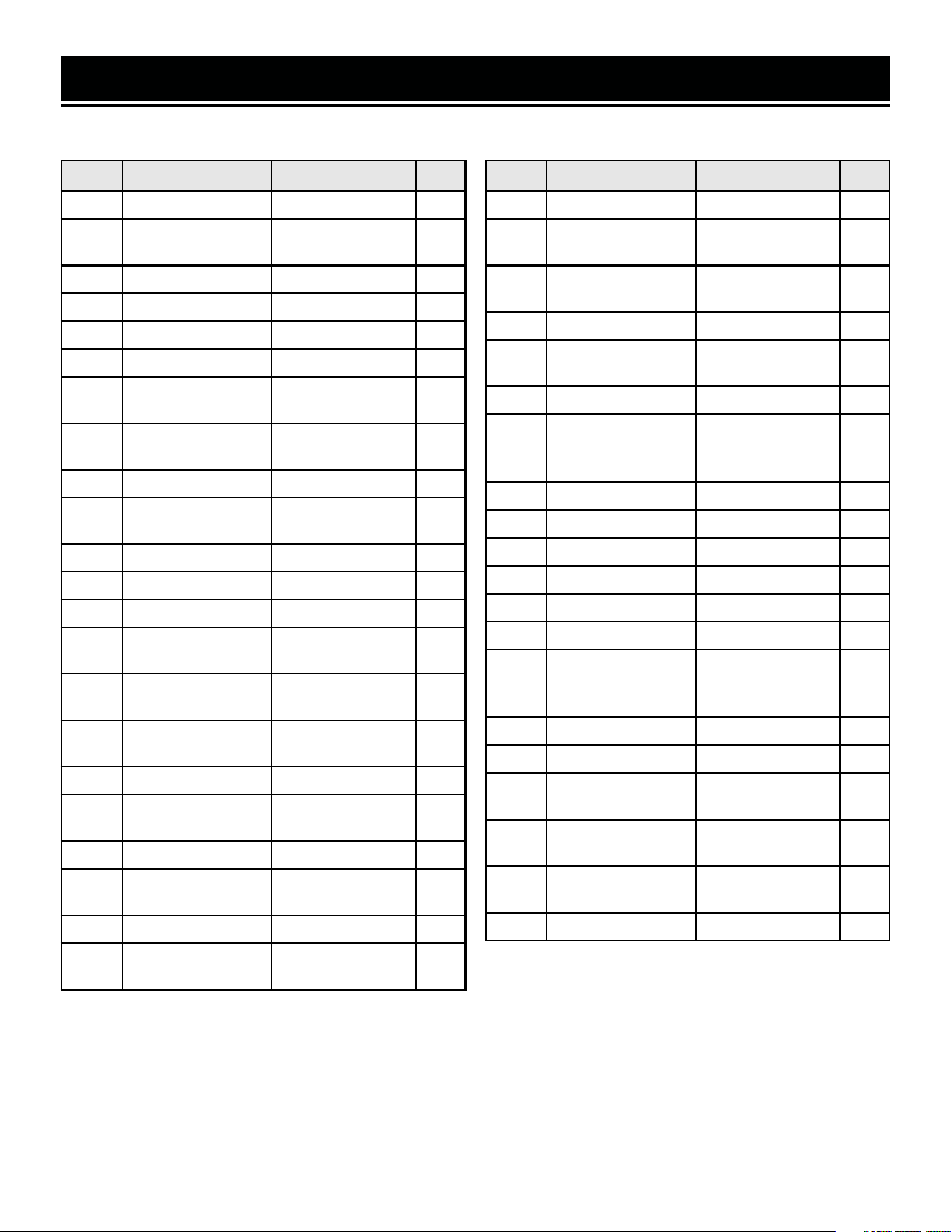
EXPLODED VIEW & PARTS LIST
BANDSAW
No. Part No. Description Qty.
108 BA1411-1108 Pointer 1
109 BA1411-1109
Flange Screw,
M5x6
1
110 BA1411-1110 Table Knob, M10 2
111 BA1411-1111 Hex Bolt, M10x50 2
112 BA1411-1112 Hex Bolt, M8x80 1
113 BA1411-1113 Nut, M8 1
114 BA1411-1114ASM
Miter Gauge
Assembly
1
115 BA1411-1115
Socket Head Cap
Screw, M8x25
2
116 BA1411-1116 Lock Washer, 8mm 2
117 BA1411-1009
Flat Washer, 8mm
x 30
2
118 BA1411-1118 Steel Ball, 8mm 1
119 BA1411-1119 Spring 1
120 BA1411-1120 Set Screw, M10x10 1
121 BA1411-1121
Set Screw, M8-
1.0x35
4
122 BA1411-1122
Micro-Adjustment
Knob
4
123 BA1411-1123
Quick-Release
Handle
1
124 BA1411-1124 Cord Clamp 1
125 BA1411-1125
Phillips Head
Screw, M5x12
1
126 BA1411-1126 Lock Nut, M4 2
127 BA1411-1127
Flat Washer, 5mm
x 12
4
128 BA1411-1128 Ball Bearing, 608ZZ 4
129 BA1411-1129
Roller Bearing Cam
Shaft
4
No. Part No. Description Qty.
130 BA1411-1130 Set Screw, M5x10 1
131 BA1411-1131
Upper Tension
Block
1
132 BA1411-1132
Flat Washer, 10mm
x 20
1
133 BA1411-1133 Tension Lever 1
134 BA1411-1134
Flat Washer, 8mm
x 18
6
135 BA1411-1135 Bushing 1
136 BA1411-1136
Socket Head
Button Screw,
M8x20
1
137 BA1411-1137 Bushing 1
138 BA1411-1138 Hex Bolt, M8x40 2
139 BA1411-1139 Lock Nut, M8 2
140 BA1411-1140 Tension Arm 4
141 BA1411-1141 Pivot Arm 1
142 BA1411-1142 Lock Washer, 8mm 2
143 BA1411-1136
Socket Head
Button Screw,
M8x20
2
150 BA1411-1150 Tension Post 1
151 BA1411-1151 Set Screw, M5x5 1
152 BA1411-1152
Phillips Head
Screw, M5x12
1
153 BA1411-1019
Toothed Washer,
5mm
1
154 BA1411-1154
Flat Washer, 8mm
x 18
1
155 BA1411-1155 SET SCREW, M5X8 2
25
NOTE: Not all parts may be available for purchase. Parts and accessories that wear
down over the course of normal use are not covered under the warranty.
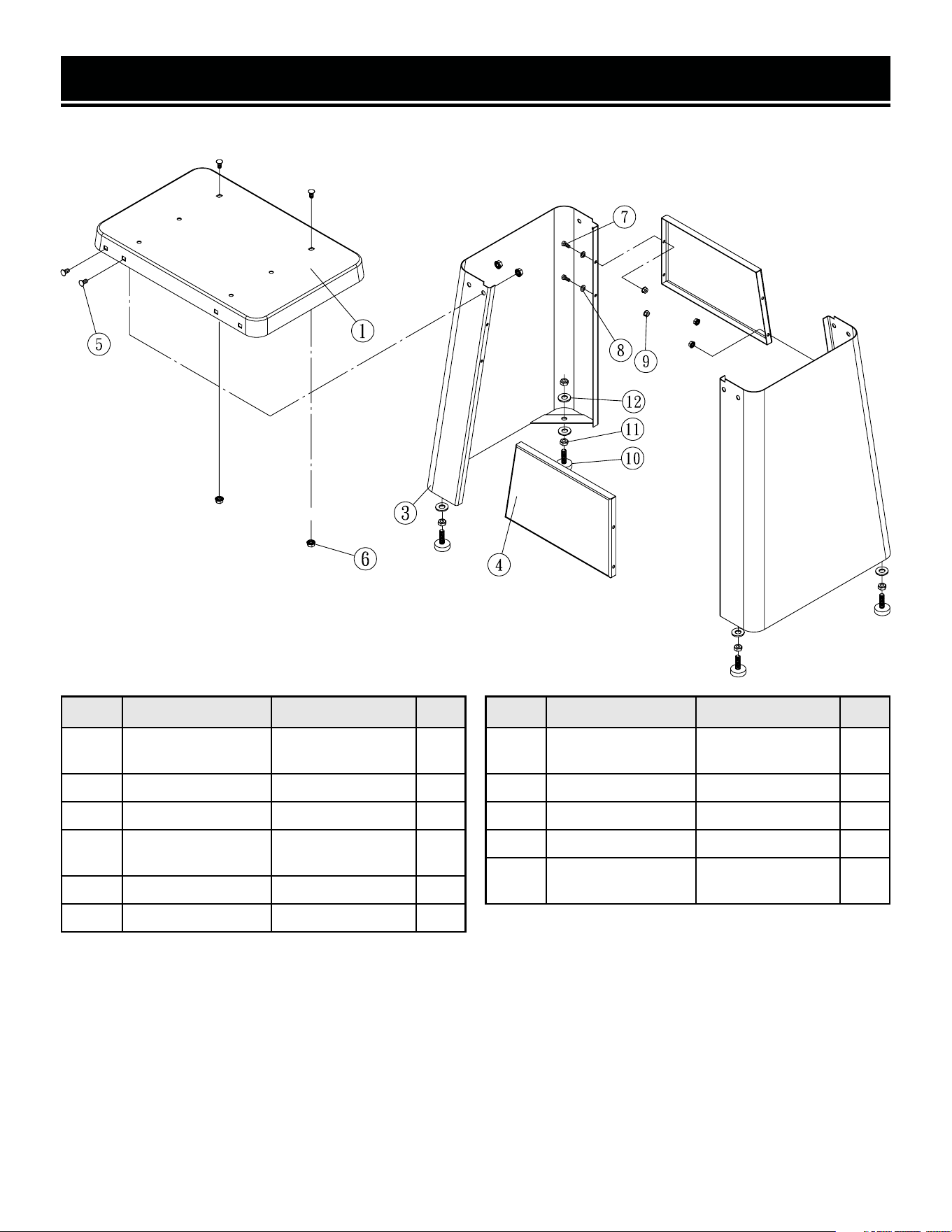
EXPLODED VIEW & PARTS LIST
STAND
No. Part No. Description Qty.
1 BA1411-2001
Top Panel with
Cross Braces
1
3 BA1411-2003 Large Side Panel 2
4 BA1411-2004 Small Side Panel 2
5 BA1411-2005
Carriage Bolt,
M8x16
10
6 BA1411-2006 Flanged Nut, M8 10
7 BA1411-2007 Hex Bolt, M6x16 8
No. Part No. Description Qty.
8 BA1411-2008
Flat Washer, 6mm
x 13
8
9 BA1411-2009 Flanged Nut, M6 8
10 BA1411-2010 Foot 4
11 BA1411-2011 Nut, 3/8"-16 UNC 8
12 BA1411-2012
Flat Washer, 10mm
x 20
8
26
NOTE: Not all parts may be available for purchase. Parts and accessories that wear
down over the course of normal use are not covered under the warranty.
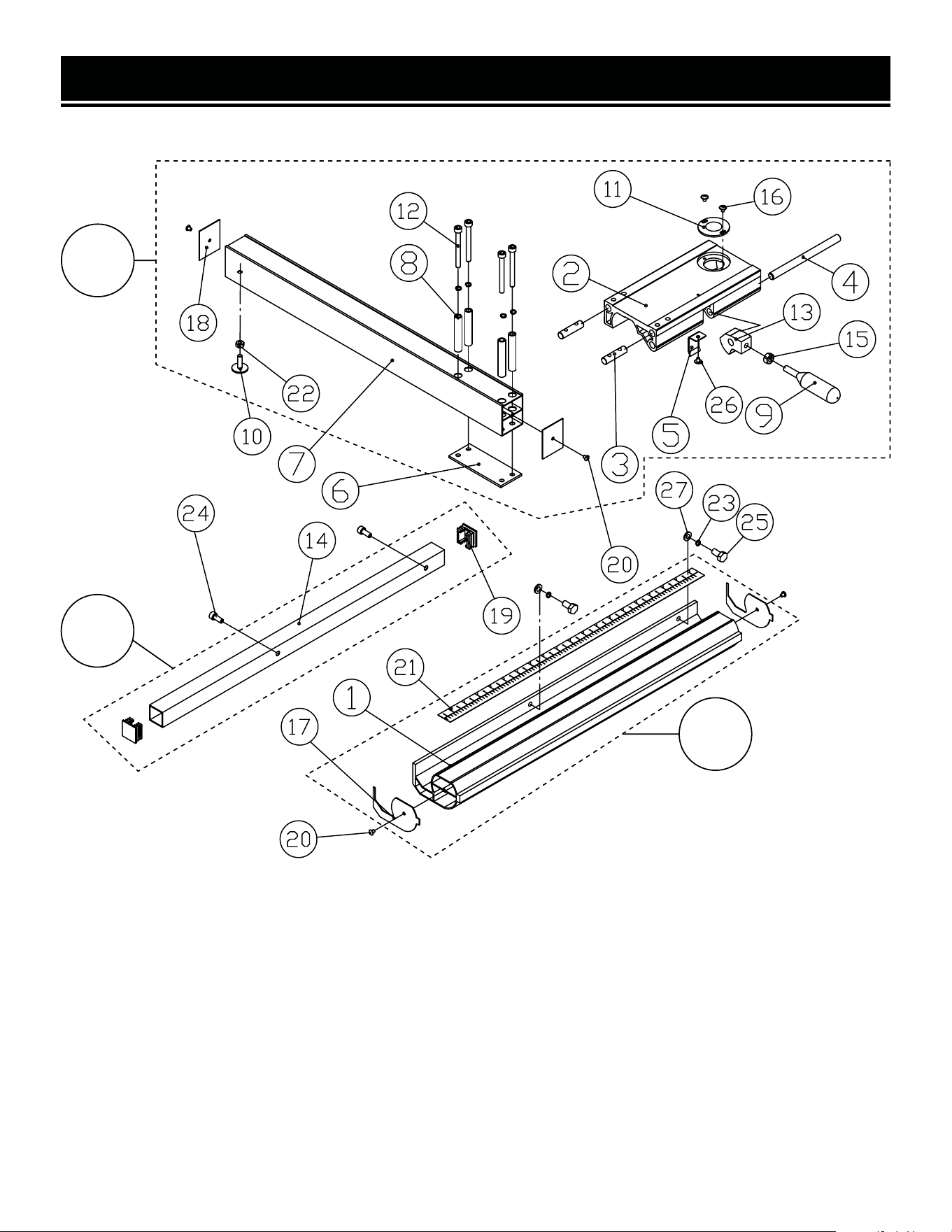
EXPLODED VIEW & PARTS LIST
FENCE & RAIL
ASM-3
ASM-1
ASM-2
27
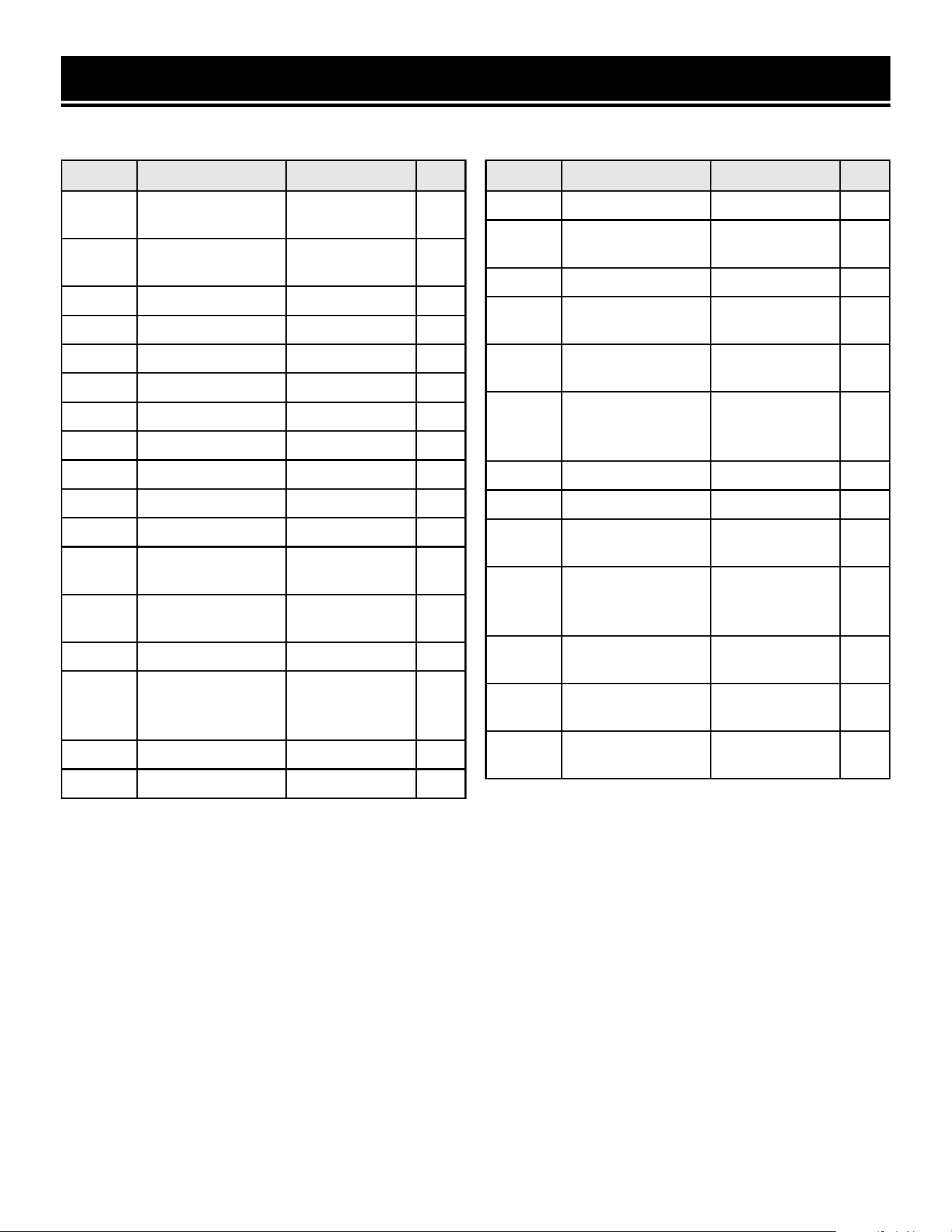
EXPLODED VIEW & PARTS LIST
FENCE & RAIL
No. Part No. Description Qty.
ASM-1 BA1411-3012ASM
Fence
Assembly
1
ASM-2 BA1411-3013ASM
Fence Rail
Assembly
1
ASM-3 BA1411-4001 Square Tube 1
1 BA1411-3013.1 Fence Rail Base 1
2 BA1411-3012.2 Fence Base 1
3 BA1411-3012.3 Fence Rod 2
4 BA1411-3012.4 Lock Axle 1
5 BA1411-3012.5 Spring Plate 1
6 BA1411-3012.6 Spacer Plate 1
7 BA1411-3012.7 Fence 1
8 BA1411-3012.8 Bushing 4
9 BA1411-3012.9
Lock Handle,
M8
1
10 BA1411-3012.10
Fence Support
Foot
1
11 BA1411-3012.11 Scale Pointer 1
12 BA1411-3012.12
Socket Head
Cap Screw,
M6x60
4
13 BA1411-3012.13 Lock Cam 1
14 BA1411-4014 Fence Rail Tube 1
No. Part No. Description Qty.
15 BA1411-3012.15 Nut, M8 1
16 BA1411-3012.16
Phillips-head
Screw, M4x6
2
17 BA1411-3013.17 Rail End Cover 2
18 BA1411-3012.18
Fence End
Cover
2
19 BA1411-3012.19
Rail Tube End
Cover
2
20 BA1411-3012.20
Self-tapping
Screw, M3.5-
0.6x12
4
21 BA1411-3013.21 Scale Label 1
22 BA1411-3012.22 Nut, M6 1
23 BA1411-4023
Lock Washer,
6mm
2
24 BA1411-4024
Socket Head
Cap Screw,
M6x16
2
25 BA1411-4025
Hex Bolt,
M6x20
2
26 BA1411-3013.26
Phillips-head
Screw, M4x8
1
27 BA1411-2008
Flat Washer,
6mm x 13
2
28
NOTE: Not all parts may be available for purchase. Parts and accessories that wear
down over the course of normal use are not covered under the warranty.
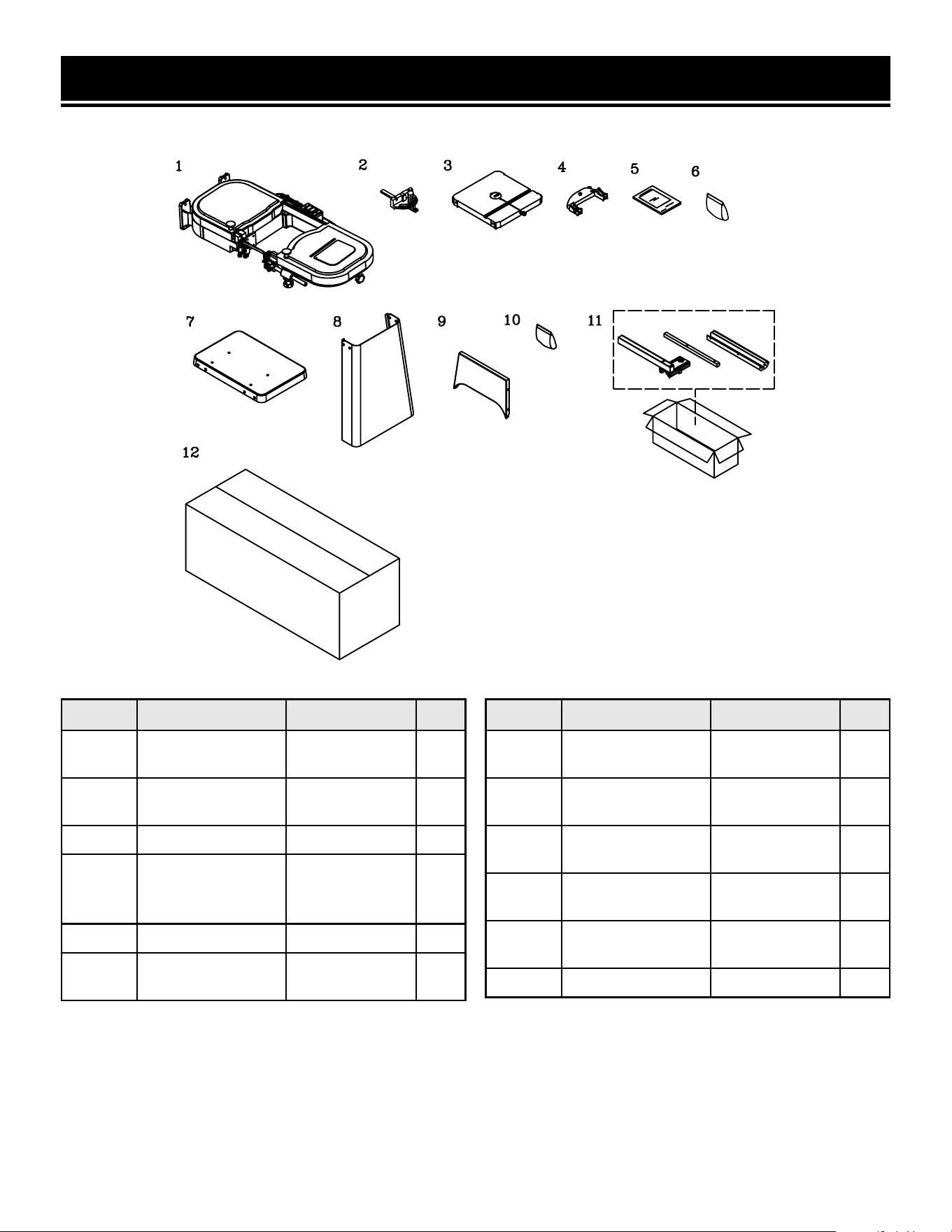
EXPLODED VIEW & PARTS LIST
PACKING LIST
No. Part No. Description Qty.
1 BA1411-3001ASM
Saw Body
Assembly
1
2 BA1411-1114ASM
Miter Gauge
Assembly
1
3 BA1411-3003ASM Table Assembly 1
4 BA1411-1105
Trunnion
Support
Bracket
1
5 BA1411-3005 Manual 1
6 BA1411-3006
Hardware Bag,
Saw
1
No. Part No. Description Qty.
7 BA1411-2001
Top Panel with
Cross Braces
1
8 BA1411-2003
Large Side
Panel
1
9 BA1411-2004
Small Side
Panel
1
10 BA1411-3010
Hardware Bag,
Stand
1
11 BA1411-3012ASM
Fence, Rail, and
Tube
1
12 BA1411-3011 Carton 1
29
NOTE: Not all parts may be available for purchase. Parts and accessories that wear
down over the course of normal use are not covered under the warranty.

WARRANTY STATEMENT
WEN Products is committed to building tools that are dependable for years. Our warranties are consistent with this
commitment and our dedication to quality.
LIMITED WARRANTY OF WEN PRODUCTS FOR HOME USE
GREAT LAKES TECHNOLOGIES, LLC (“Seller”) warrants to the original purchaser only, that all WEN consumer
power tools will be free from defects in material or workmanship during personal use for a period of two (2) years
used for professional or commercial use. Purchaser has 30 days from the date of purchase to report missing or
damaged parts.
SELLER’S SOLE OBLIGATION AND YOUR EXCLUSIVE REMEDY under this Limited Warranty and, to the extent per-
mitted by law, any warranty or condition implied by law, shall be the replacement of parts, without charge, which are
defective in material or workmanship and which have not been subjected to misuse, alteration, careless handling,
misrepair, abuse, neglect, normal wear and tear,
improper maintenance, or other conditions adversely affecting the
Product or the component of the Product, whether by accident or intentionally, by persons other than Seller. To
make a claim under this Limited Warranty, you must make sure to keep a copy of your proof of purchase that clearly
-
dor of Great Lakes Technologies, LLC. Purchasing through third party vendors, including but not limited to garage
sales, pawn shops, resale shops, or any other secondhand merchant, voids the warranty included with this product.
Contact [email protected] or 1-800-232-1195 with the following information to make arrangements:
your shipping address, phone number, serial number, required part numbers, and proof of purchase. Damaged or
defective parts and products may need to be sent to WEN before the replacements can be shipped out.
-
turning a product for warranty service, the shipping charges must be prepaid by the purchaser. The product must
be shipped in its original container (or an equivalent), properly packed to withstand the hazards of shipment. The
product must be fully insured with a copy of the proof of purchase enclosed. There must also be a description of the
will be returned and shipped back to the purchaser at no charge for addresses within the contiguous United States.
THIS LIMITED WARRANTY DOES NOT APPLY TO ITEMS THAT WEAR OUT FROM REGULAR USAGE OVER TIME,
INCLUDING BELTS, BRUSHES, BLADES, BATTERIES, ETC. ANY IMPLIED WARRANTIES SHALL BE LIMITED IN
DURATION TO TWO (2) YEARS FROM DATE OF PURCHASE. SOME STATES IN THE U.S. AND SOME CANADIAN
PROVINCES DO NOT ALLOW LIMITATIONS ON HOW LONG AN IMPLIED WARRANTY LASTS, SO THE ABOVE LIMI-
TATION MAY NOT APPLY TO YOU.
IN NO EVENT SHALL SELLER BE LIABLE FOR ANY INCIDENTAL OR CONSEQUENTIAL DAMAGES (INCLUDING
BUT NOT LIMITED TO LIABILITY FOR LOSS OF PROFITS) ARISING FROM THE SALE OR USE OF THIS PRODUCT.
SOME STATES IN THE U.S. AND SOME CANADIAN PROVINCES DO NOT ALLOW THE EXCLUSION OR LIMITATION
OF INCIDENTAL OR CONSEQUENTIAL DAMAGES, SO THE ABOVE LIMITATION OR EXCLUSION MAY NOT APPLY
TO YOU.
THIS LIMITED WARRANTY GIVES YOU SPECIFIC LEGAL RIGHTS, AND YOU MAY ALSO HAVE OTHER RIGHTS
WHICH VARY FROM STATE TO STATE IN THE U.S., PROVINCE TO PROVINCE IN CANADA AND FROM COUNTRY
TO COUNTRY.
THIS LIMITED WARRANTY APPLIES ONLY TO ITEMS SOLD WITHIN THE UNITED STATES OF AMERICA, CANA-
DA AND THE COMMONWEALTH OF PUERTO RICO. FOR WARRANTY COVERAGE WITHIN OTHER COUNTRIES,
CONTACT THE WEN CUSTOMER SUPPORT LINE. FOR WARRANTY PARTS OR PRODUCTS REPAIRED UNDER
WARRANTY SHIPPING TO ADDRESSES OUTSIDE OF THE CONTIGUOUS UNITED STATES, ADDITIONAL
SHIPPING
CHARGES MAY APPLY.
30

NOTES
31

THANKS FOR
REMEMBERING
V. 2022.07.12