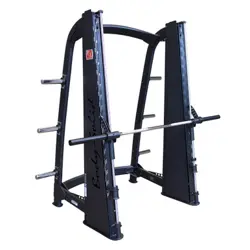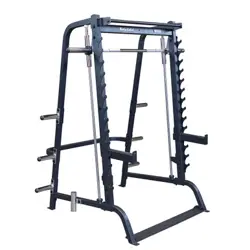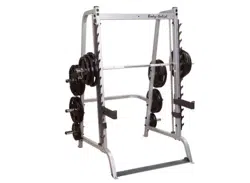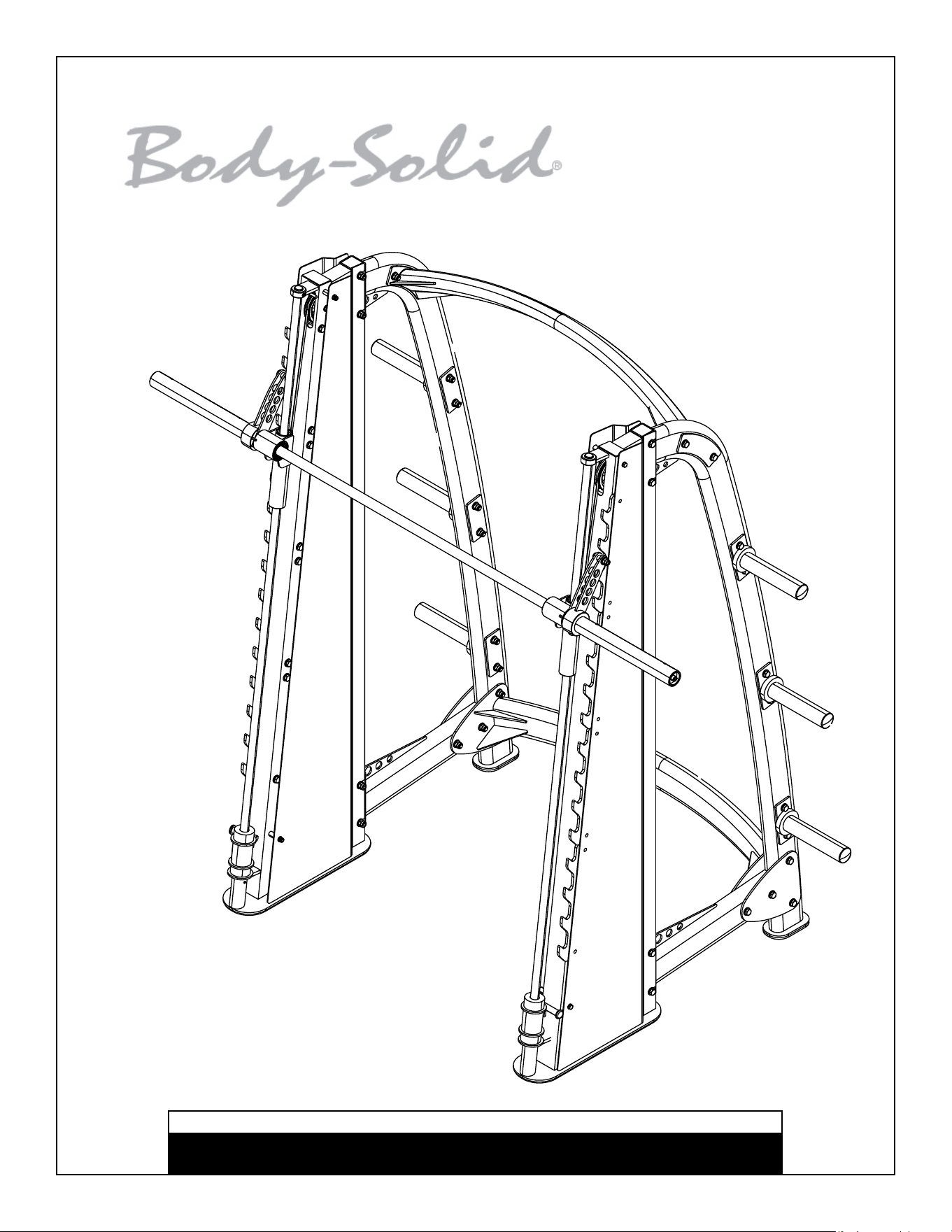
OWNER’S MANUAL
Assembly Instructions
&
SCB1000
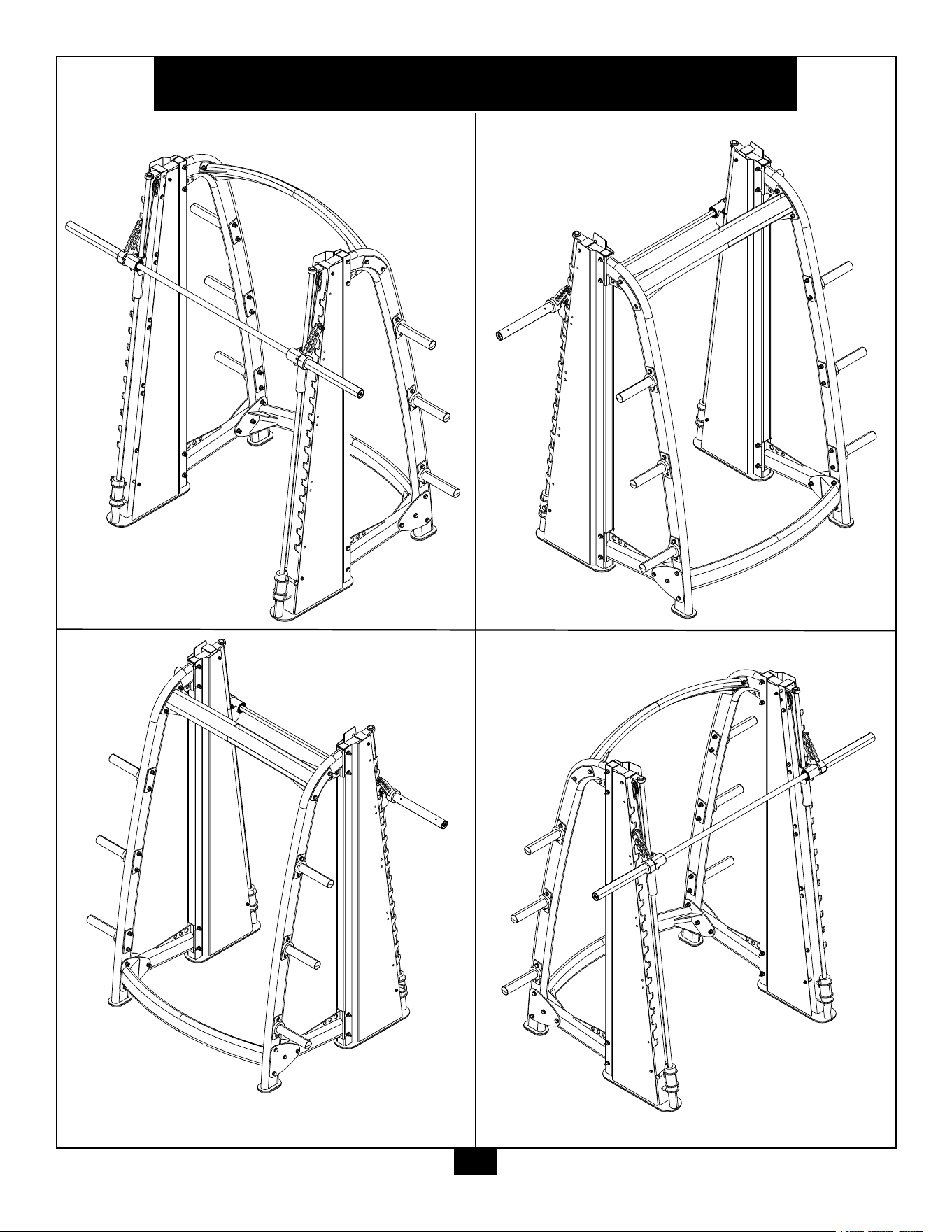
SCB1000
Reference Drawings
Note: Due to continuing product improvements, speci! cations and designs are subject to change
without notice.
Even though we have prepared this manual with extreme care, neither the publisher nor the
author can accept responsibility for any errors in, or omission from, the information given.
2
Important Safety Instructions
B e fore beginning any ! tness program, you should obtain a complete physical examination from your physician.
Il est conseille de subir un examen medical complet avant d’entreprendre tout programme d’exercise. Si vous
avez des etourdissements ou des faiblesses, arretez les exercices immediatement.
Antes de comenzar cualquier programma de ejercicios, deberias tener un examen ! sico con su doctor.
When using exercise equipment, you
should always take basic precautions,
including the following:
• Read all instructions before using the SCB1000. These
instructions are written to ensure your safety and to
protect the unit.
• Do not allow children on or near the equipment.
• Use the equipment only for its intended purpose as
described in this guide. Do not use accessory
attachments that are not recommended by the
manufacturer. Such attachments might cause injuries.
• Wear proper exercise clothing and shoes for your
workout, no loose clothing.
• Use care when getting on or off the unit.
• Do not overexert yourself or work to exhaustion.
• If you feel any pain or abnormal symptoms, stop your
workout immediately and consult your physician.
• Never operate unit when it has been dropped or
damaged. Return the equipment to a service center
for examination and repair.
• Never drop or insert objects into any opening in the
equipment.
• Always check the unit and its cables before each
use. Make sure that all fasteners and cables are
secure and in good working condition.
• Do not use the equipment outdoors or near water.
Personal Safety During Assembly
• It is strongly recommended that a quali! ed dealer
assemble the equipment. Assistance is required.
• Before beginning assembly, please take the time to
read the instructions thoroughly.
• Read each step in the assembly instructions and
follow the steps in sequence. Do not skip ahead. If
you skip ahead, you may learn later that you have to
disassemble components and that you may have
damaged the equipment.
• Assemble and operate the SCB1000 on a solid, level
surface. Locate the unit a few feet from the walls or
furniture to provide easy access.
The SCB1000 is designed for your enjoyment. By
following these precautions and using common
sense, you will have many safe and pleasurable hours
of healthful exercise with your Body-Solid SCB1000.
After assembly, you should check all functions to
ensure correct operation. If you experience problems,
! r st recheck the assembly instructions to locate any
possible errors made during assembly. If you are unable
to correct the problem, call the dealer from whom
you purchased the machine or call 1-800-556-3113
for the dealer nearest you.
Obtaining Service
Please use this Owner’s Manual to make sure that all
parts have been included in your shipment. When
ordering parts, you must use the part number and
description from this Owner’s Manual. Use only
Body-Solid replacement parts when servicing this
machine. Failure to do so will void your warranty and
could result in personal injury.
For information about product operation or service,
check out the of! cial Body-Solid website at
www.bodysolid.com or contact an authorized
Body-Solid dealer or a Body-Solid factory-authorized
service company or contact Body-Solid customer
service at one of the following:
Toll Free: 1-800-556-3113
Phone: 1-708-427-3555
Fax: 1-708-427-3556
Hours: M-F 8:30-5:00 CST
E-mail: [email protected]
Or write to: Body-Solid, Inc.
Service Department
1900 S. Des Plaines Ave.
Forest Park, IL 60130 USA
Retain this Owner’s Manual for future
reference. Part numbers are required when
ordering parts.
3
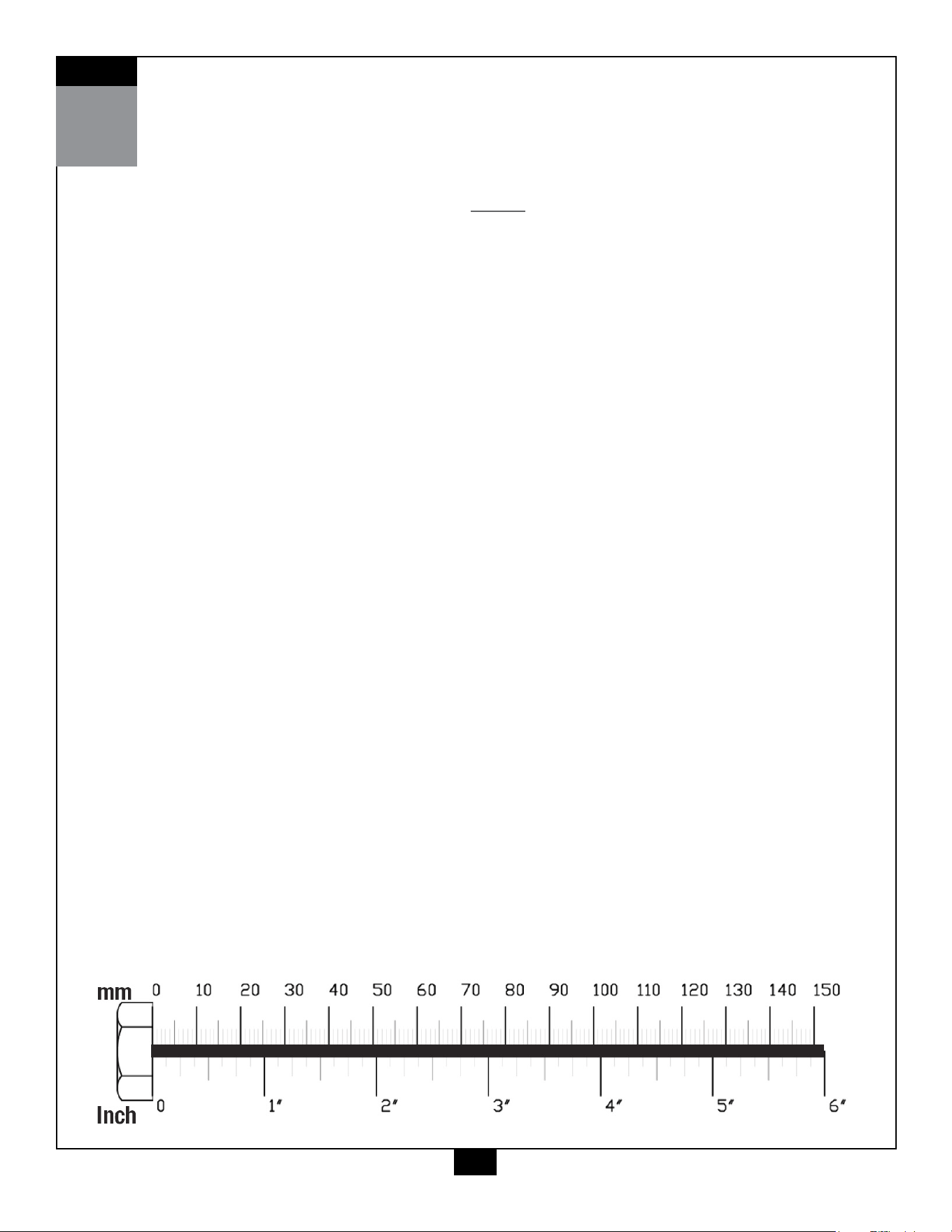
4
1
STEP
Be careful to assemble all components
in the sequence they are presented.
NOTE:
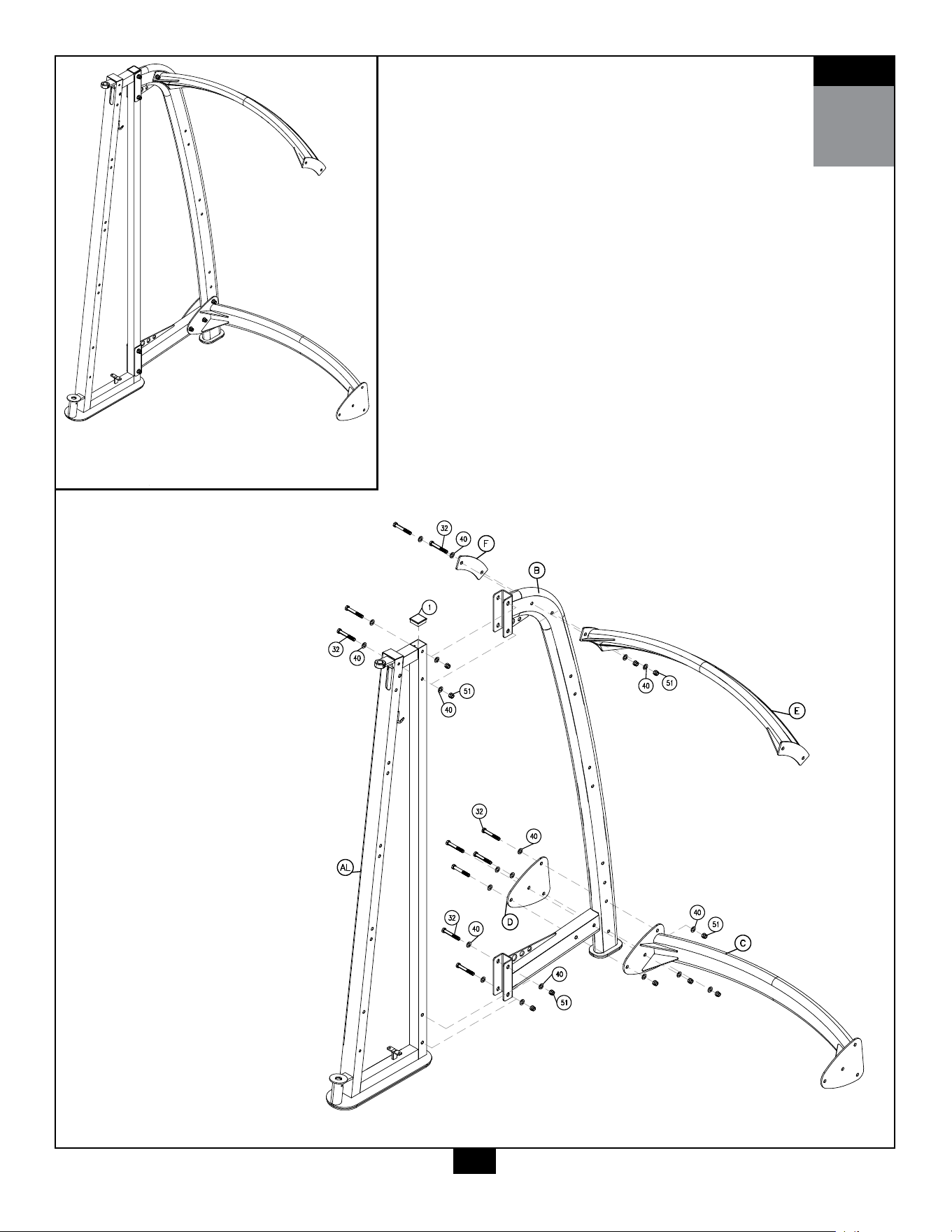
Finger tighten all hardware in this step. Do Not wrench tighten until end of step 6.
A. Connect Left Front Support Tube (AL) to Rear Support Tube (B) by using:
Four 32 (M12x85 hex head bolt)
Eight 40 (M12 washer)
Four 51 (M12 nylon lock nut)
B. Insert Square End Cap (1) into Left Front Support Tube (AL).
C. Attach Bottom Connect Tube (C) and Connect Plate (D) to Rear Support Tube (B) by using:
Four 32 (M12x85 hex head bolt)
Eight 40 (M12 washer)
Four 51 (M12 nylon lock nut)
D. Attach Upper Connect Tube (E) and Connect Plate (F) to Rear Support Tube (B) by using:
Two 32 (M12x85 hex head bolt)
Four 40 (M12 washer)
Two 51 (M12 nylon lock nut)
1
STEP
5
Above shows STEP 1 assembled and completed.
6
2
STEP
Be careful to assemble all components
in the sequence they are presented.
NOTE:
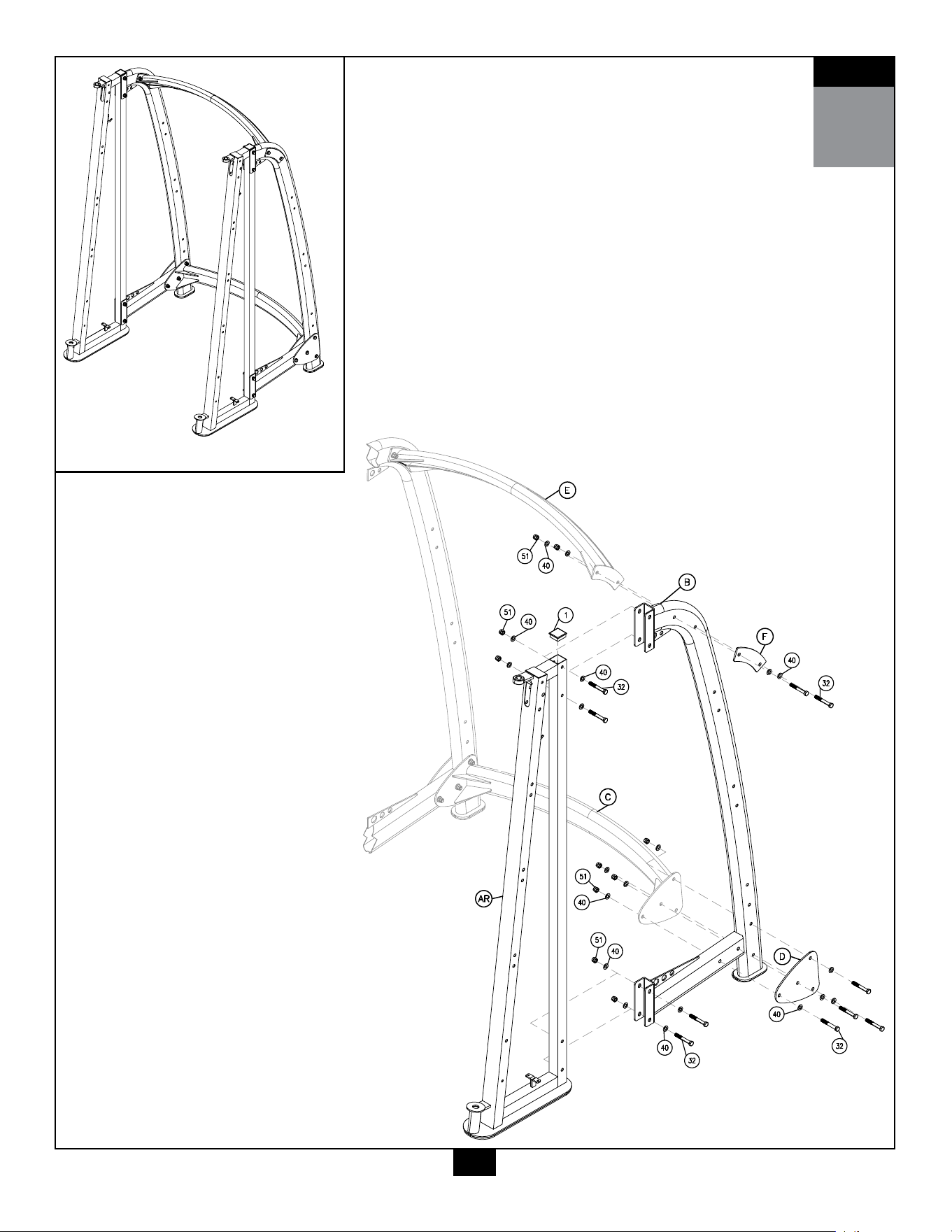
Finger tighten all hardware in this step. Do Not wrench tighten until end of step 6.
A. Connect Right Front Support Tube (AR) to Rear Support Tube (B) by using:
Four 32 (M12x85 hex head bolt)
Eight 40 (M12 washer)
Four 51 (M12 nylon lock nut)
B. Insert Square End Cap (1) into Front Support Tube Right (AR).
C. Connect Bottom Connect Tube (C) and Connect Plate (D) to Rear Support Tube (B) by using:
Four 32 (M12x85 hex head bolt)
Eight 40 (M12 washer)
Four 51 (M12 nylon lock nut)
D. Connect Upper Connect Tube (E) and Connect Plate (F) to Rear Support Tube (B) by using:
Two 32 (M12x85 hex head bolt)
Four 40 (M12 washer)
Two 51 (M12 nylon lock nut)
2
STEP
7
Above shows STEP 2 assembled and completed.
8
3
STEP
Be careful to assemble all components
in the sequence they are presented.
NOTE:
Finger tighten all hardware in this step. Do Not wrench tighten until end of step 6.
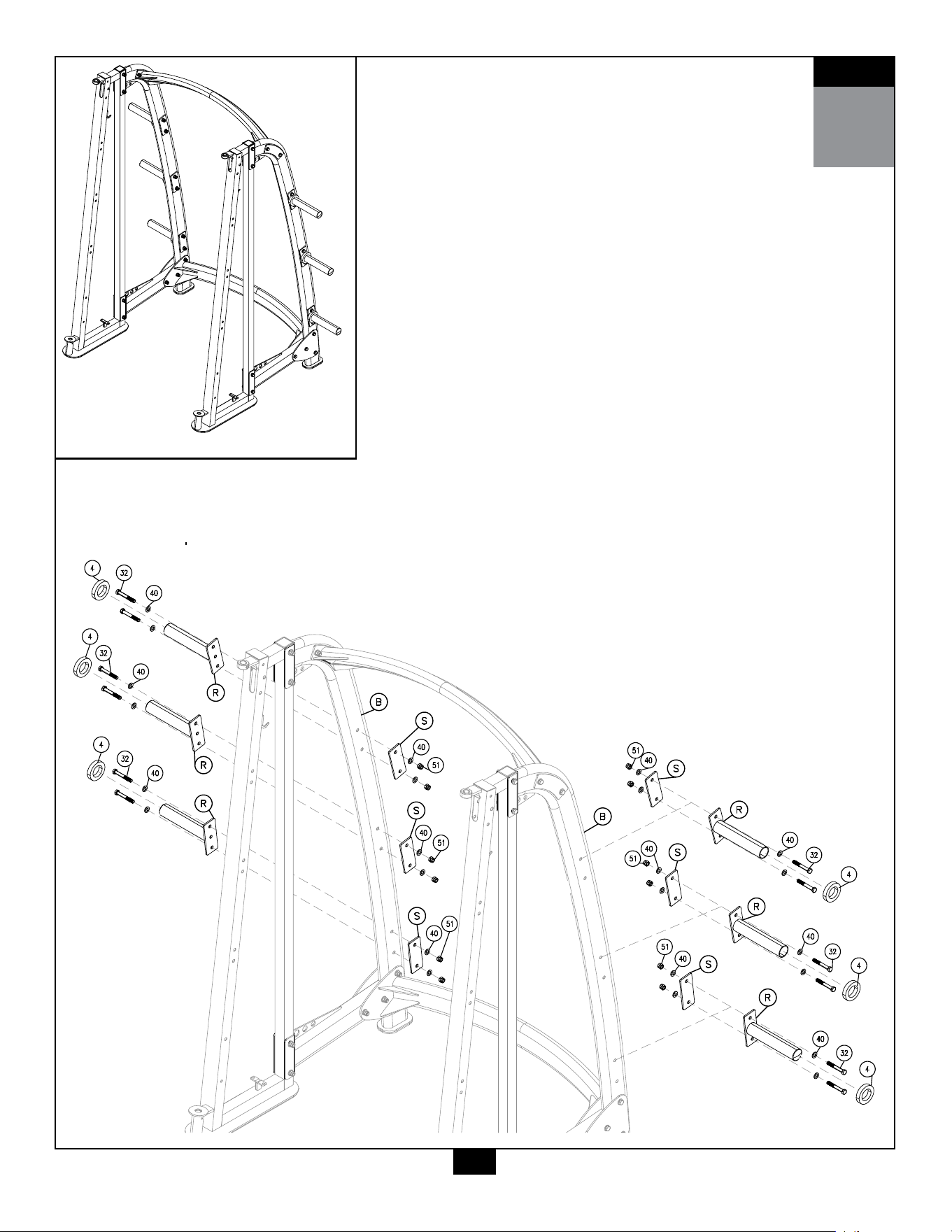
A. Connect Weight Plate Support Tube (R) and Connect Plate (S) to Rear Support Tube (B)* as shown
in the diagram by using:
Twelve 32 (M12x85 hex head bolt)
Twenty-four 40 (M12 washer)
Twelve 51 (M12 nylon lock nut)
B. Slide Rubber Stopper B (4) onto Weight Plate Support Tube (R).
*NOTE: Use silicon spray to install “Rubber Stoppers” on Support Tube and Slide Bar.
3
STEP
9
Above shows STEP 3 assembled and completed.
10
4
STEP
Be careful to assemble all components
in the sequence they are presented.
NOTE:
Finger tighten all hardware in this step. Do Not wrench tighten until end of step 6.
Some or all components may be pre-installed.
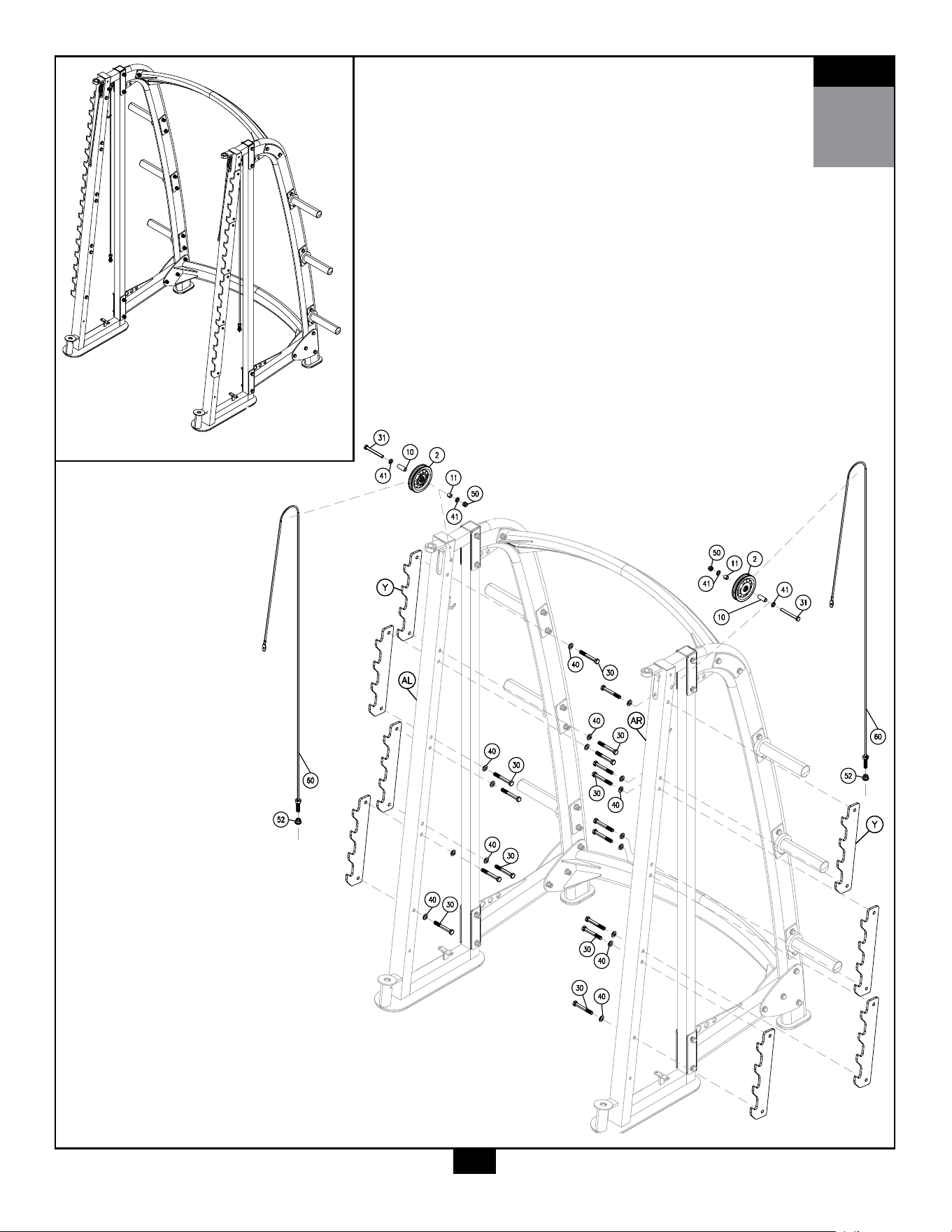
A. Connect Hanger Plate (Y) to Left Front Support Tube (AL) and Right Front Support Tube (AR) as
shown in the diagram by using:
Twelve 30 (M12x90 hex head bolt)
Twelve 40 (M12 washer)
B. Install Pulleys (2) to Left Front Support Tube (AL) and Right Front Support Tube (AR) by using:
Two 31 (M10x90 hex head bolt)
Four 41 (M10 washer)
Two 10 (spacer)
Two 11 (spacer)
Two 50 (M10 nylon lock nut)
C. Route Guide Cable (60) around pulleys as shown in the diagram.
D. Thread Nylon Lock Nut (52) onto the end of Guide Cable (60).
4
STEP
11
Above shows STEP 4 assembled and completed.
12
5
STEP
Be careful to assemble all components
in the sequence they are presented.
NOTE:
Finger tighten all hardware in this step. Do Not wrench tighten until end of step 6.
A. Slide Right Slide Tube (H) and Left Slide Tube (J) into Bar (G).
B. Raise Slide Bar (P) and slide the bar assembly up.
C. Connect Guide Cable (60) to Left Slide Tube (J) and Right Slide Tube (H) and tighten using
Round Allen Head Bolt (36), and insert Washer (14) right side and left side onto bar.
D. Connect Right Loading Tube (M) and Left Loading Tube (N) to Right Slide Tube (H) and
Left Slide Tube (J) respectively and secure by tightening Hex Head Bolt (34).
E. Secure Right Loading Tube (M) and Left Loading Tube (N) to Bar (G) using:
Two 38 (M10x25 allen head bolt)
Two 46 (M10 spring washer)
Two 19 (big washer)
F. Insert Tube (15) into Right Loading Tube (M) and Left Loading Tube (N) and secure using:
Two 51 (M12 nylon lock nut)
Four 40 (M12 washer)
Two 35 (M12x45 hex head bolt)
Bring assembly up and af! x to Hanger Plate (Y).
G. Slide Rubber Stopper (3), Right Adjust Tube (K) and Left Adjust Tube (L) up Slide Bar (P) as shown
in the diagram.
H. Lower Slide Bar (P) into slots and secure using Hex Head Bolt (33).
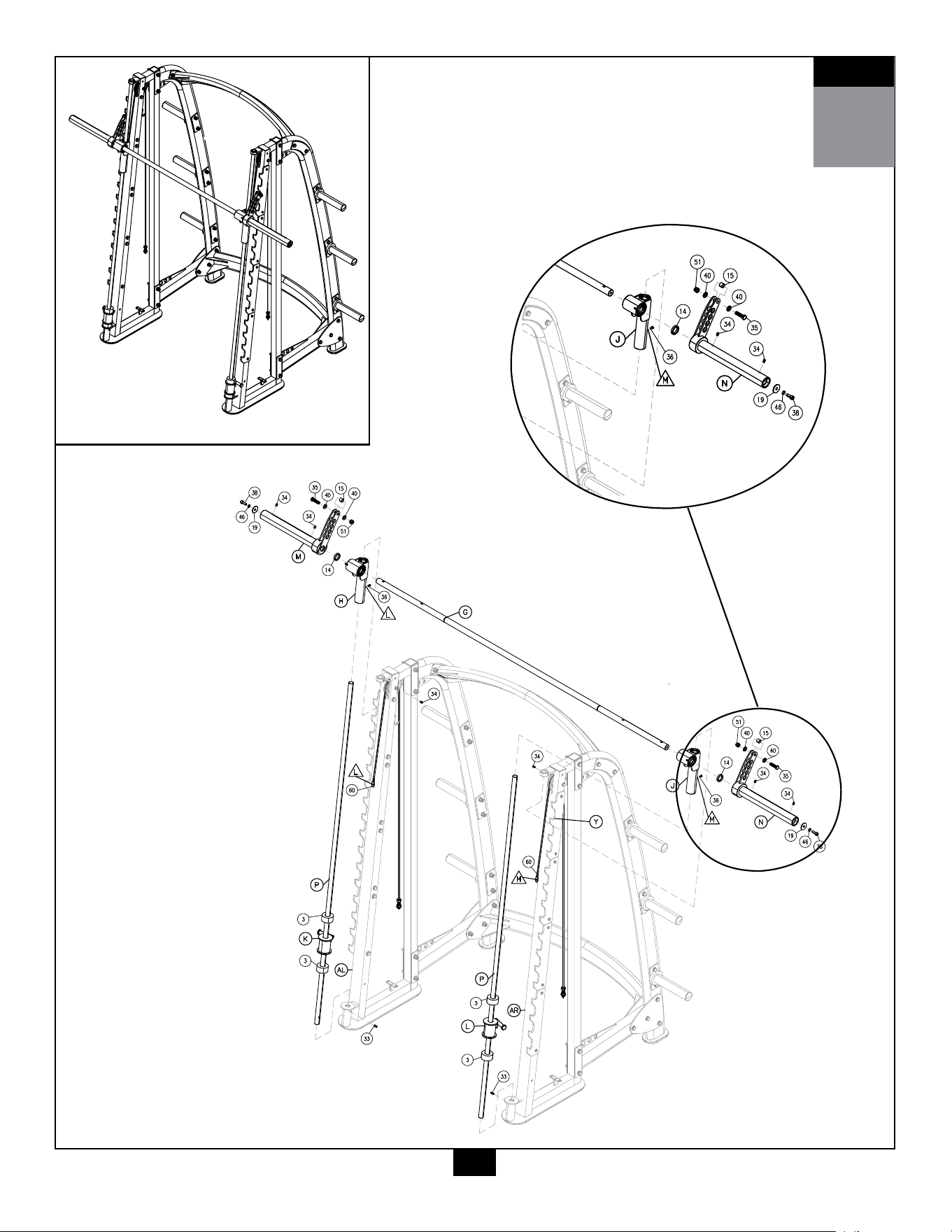
5
STEP
13
Above shows STEP 5 assembled and completed.
14
6
STEP
Be careful to assemble all components
in the sequence they are presented.
NOTE:
Finger tighten all hardware in this step. Do Not wrench tighten until end of step 6.
A. Attach both Weight Plates (Q) to Guide Cable (61) and secure using nut (18).
B. Connect Outer Cover (T) and Inner Cover (U) by sliding into position as shown in the diagram
and secure using:
Two 37 (M8x130 hex head bolt)
Four 42 (M8 washer)
Two 54 (M8 nylon lock nut
Tighten the remaining pre-installed bolts.
C. Connect Outer Cover (W) and Inner Cover (V) by sliding into position as shown in the diagram
and secure using:
Two 37 (M8x130 hex head bolt)
Four 42 (M8 washer)
Two 54 (M8 nylon lock nut
Tighten the remaining pre-installed bolts.
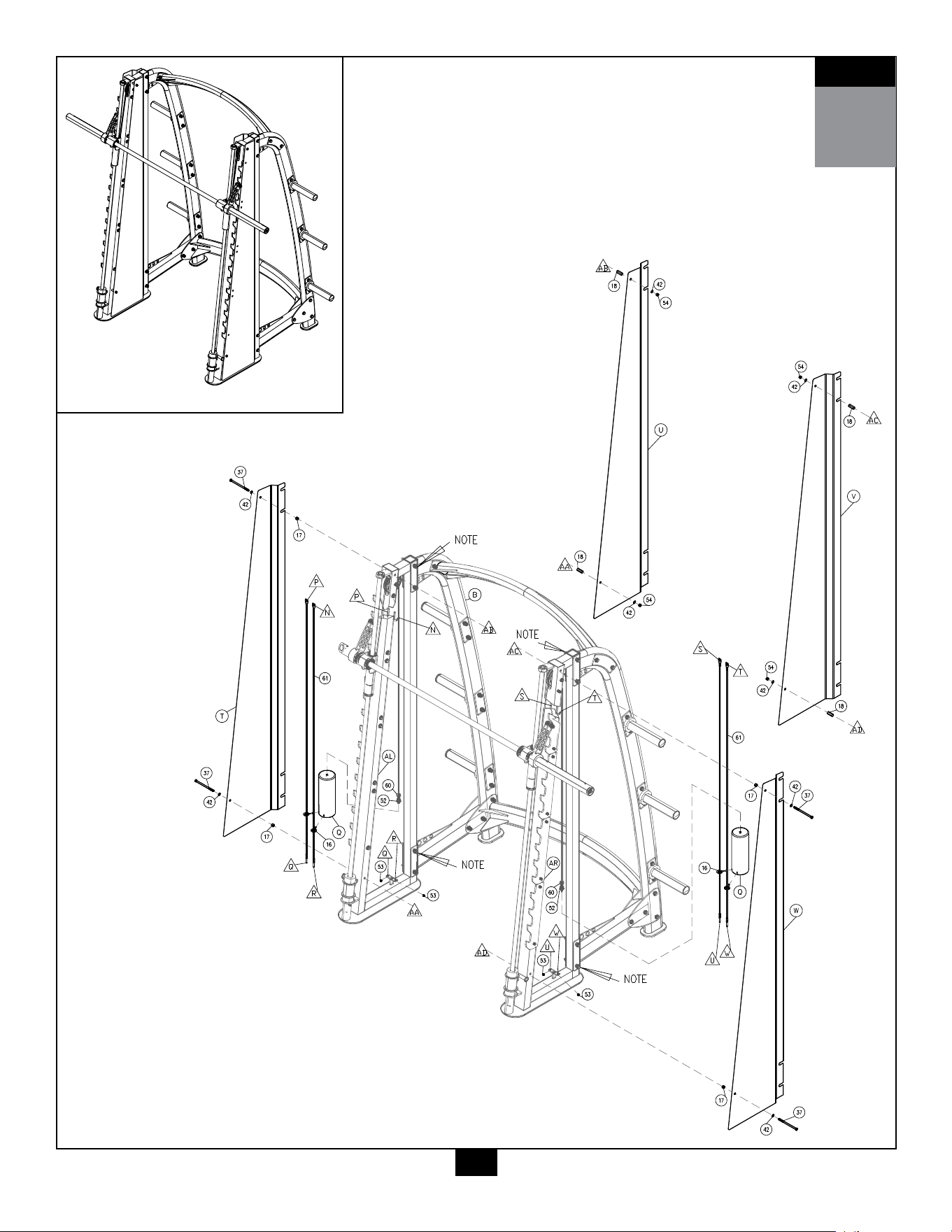
6
STEP
15
Note: Do not wrench tighten bolts
until the end of this step.
Above shows STEP 6 assembled and completed.
16
Warnings, Safety & Maintenance
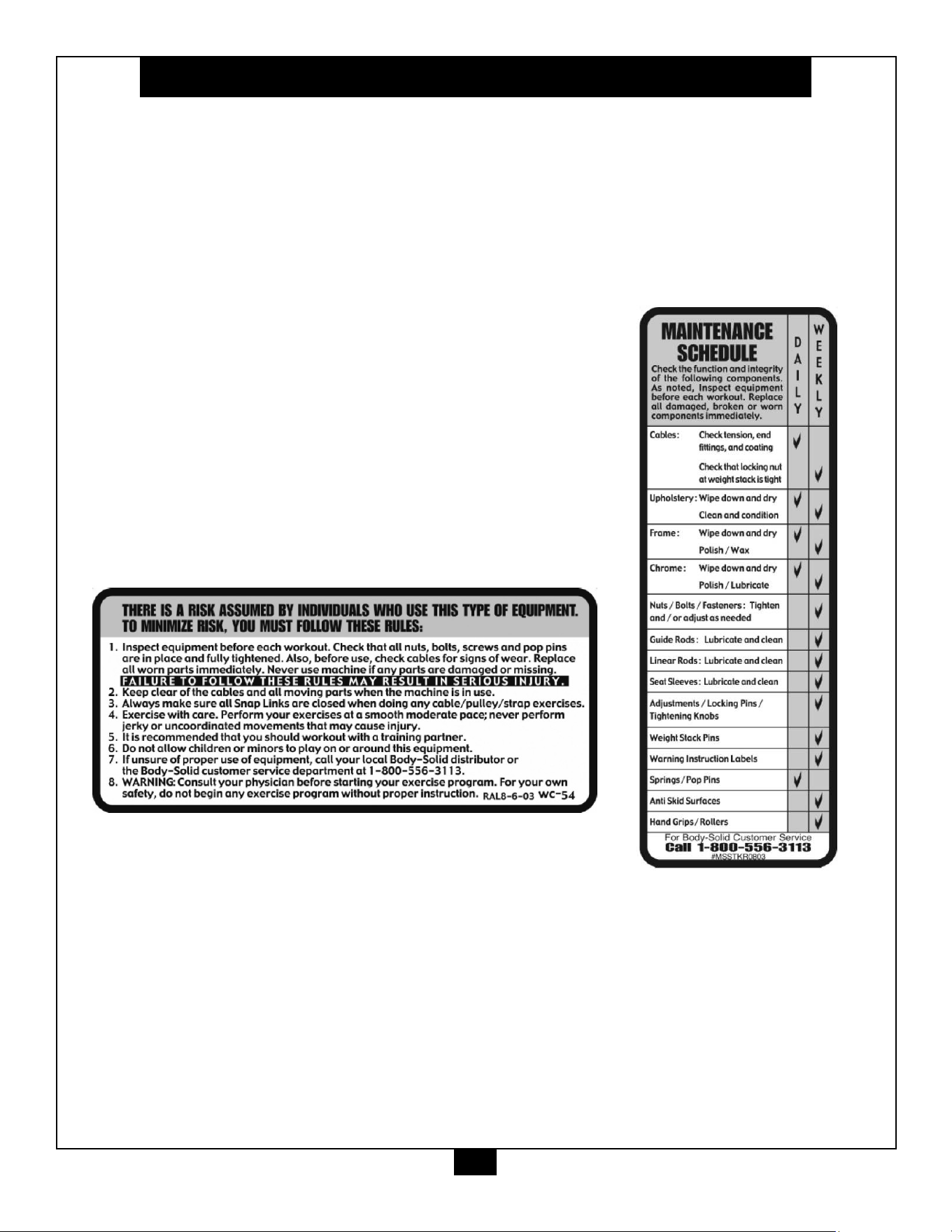
Be sure that all users carefully read and understand all
warning, safety and maintenance labels on the
machine before each use. Failure to do so may result
in serious injury. It is imperative that you retain this
Owner’s Manual and be sure all warning labels are
legible and intact. Replacement Owner’s Manuals and
labels are available from your local Body-Solid dealer.
If you have any questions about the operation, set up
or maintenance of this machine please call our customer
service department at 1 (800) 556-3113
#DWRULE-4
Warning Label for Rules
#DWSM-5
Warning Label for Maintenance

17
Warnings, Safety & Maintenance
Precision craftsmanship assures Body-Solid’s ability to
consistently deliver products of the highest standards. Our
products have been carefully designed to ensure safe, ef-
! c ient long term operation.
However, it must be realized that safe use of this equip-
ment requires that owners carefully read and follow the
Body-Solid use recommendations, warnings, and mainte-
nance guidelines in this Owners Manual.
Routine inspection and maintenance is of critical impor-
tance to ensure the maximum safety and performance of
the SCB1000. Body-Solid uses the highest quality materi-
als available, but wear is inevitable. Therefore, you must
carefully inspect your equipment as outlined in the Mainte-
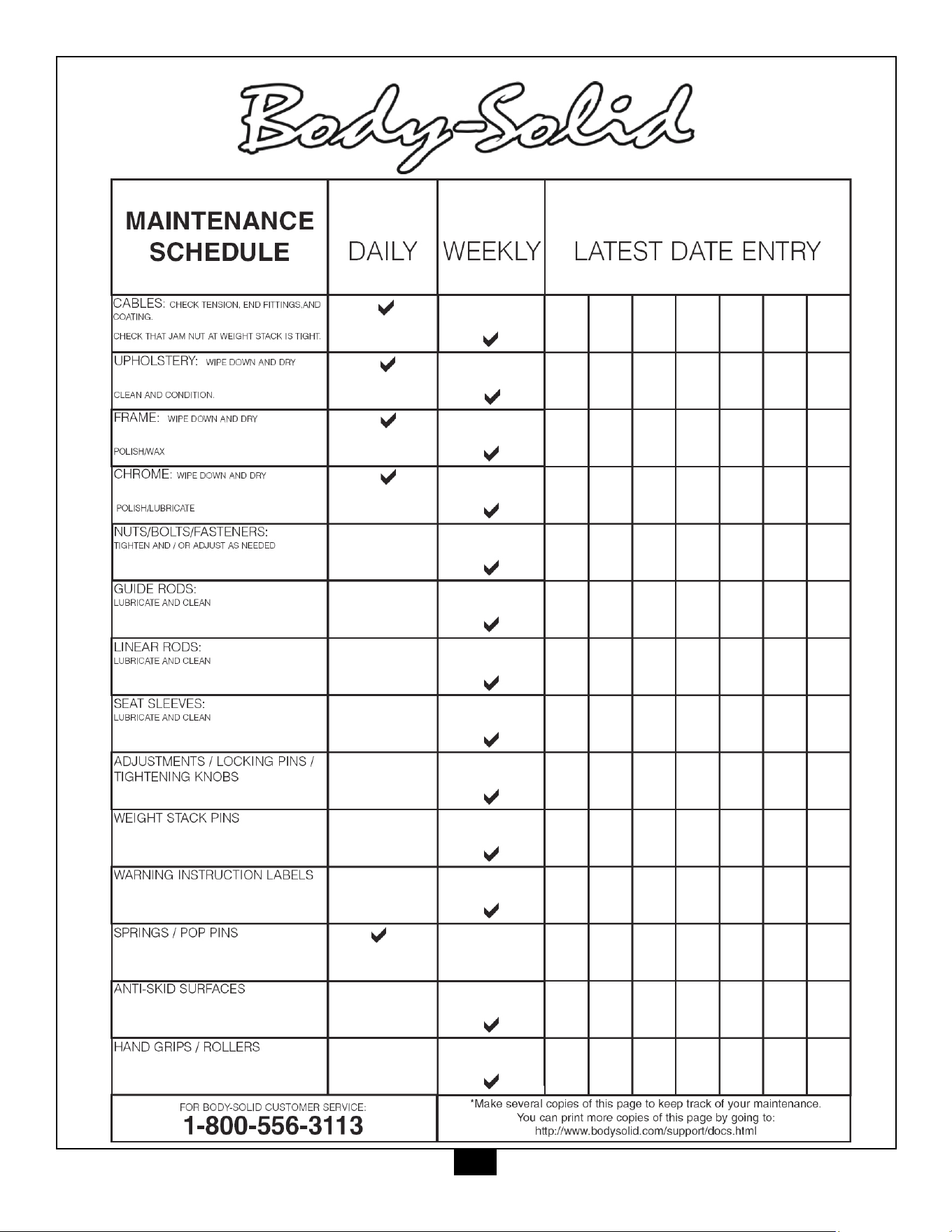
nance Schedule on the next page.
Be advised that dangerous conditions can arise even
during a warranty period. A warranty does not negate the
owner’s responsibility to thoroughly, carefully and daily
inspect the machine.
Including maintaining the equipment the owner’s responsi-
bility is also to:
l Be sure to always provide adequate
supervision to all end-users.
l Be sure to instruct all end-users of
proper usage.
l Be sure all supervisors and personal
trainers who instruct end-users on
equipment are properly trained and
know the function and importance of
every adjustment and setting.
Also, be sure these trainers provide
proper instruction to end-users on the
fundamentals of strength training.
CABLES:
l While the machine is not in use. Carefully run
your ! ngers along the cable to feel for
thinning or bulging areas. Replace cables
immediately at the ! rst sign of damage or
wear. Do not use equipment until damaged
cable has been replaced.
l Visually inspect the cables for fraying,
cracking, peeling or discoloration.
l Check slack in cables and re-adjust cable
tension if needed. See pages 38-39.
l Check that jam nut at Weight Stack is tight.
UPHOLSTERY:
l Wipe down after every workout.
l Periodically take the time to use a mild soap
or a mild vinyl upholstery cleaner. Avoid using
any abrasive cleaner not intended for use on
vinyl.
l Keep sharp or pointed objects out of your
pockets and clear of all upholstery.
NUTS/BOLTS/FASTENERS:
l Periodically inspect all nuts and bolts.
Tighten if needed. If bolts seem to loosen
periodically, use Loctite 242 for a long-term
cure.
l Go through a re-tightening sequence
periodically to ensure that all hardware is
properly tensioned.
GUIDE RODS:
l Wipe clean with a dust free rag. Lubricate
with a Silicon or Te" on based lubricant.
ADJUSTMENTS / LOCKING PINS /
TIGHTENING KNOBS:
l Check all pieces for signs of visible wear or
damage.
l Check springs in Snap Links and Pop Pins
for proper tension and alignment.
l If the spring sticks or has lost its rigidity,
replace it immediately.
ANTI-SKID SURFACES:
l Replace if they appear worn or become
slippery.
WARNING INSTRUCTION LABELS:
l Inspect and familiarize yourself with all safety
warnings and other user information on
decals.
18
19
BEGINNER’S GUIDELINES
•Work out at least two times a week.
•Include six to eight exercises that train major muscle groups.
•Perform two or three sets of at least eight to 12 repetitions.
AEROBIC
Exercise that primarily uses oxygen to burn fuel at low to moderate levels of intensity. Running
and jogging are examples of aerobic exercise.
ANAEROBIC
Exercise that primarily uses the body’s stored fuel for energy. Intense weightlifting is an
example of an anaerobic exercise.
ATROPHY
Decrease of a muscle caused by the decrease in the size of its cells because of inactivity.
BALLISTIC STRETCHING
A stretching technique that involves a bouncing or bobbing movement during the stretch. The
final position is not held. This is not
a recommended stretching technique.
BREATHING
Never hold your breath during any part of an exercise. Holding your breath may cause severe
intra-thoracic pressure and raise blood pressure leading to dizziness, blackout or other
complications. The rule of thumb is to exhale on exertion and inhale on the return part of the
exercise.
CARDIOVASCULAR
Referring to the heart, lungs, and other periphery systems involved in the transport of oxygen
throughout the body.
CHALLENGE YOUR MUSCLES
All strength training should progress gradually, using increases in weight until your goals are
reached. Then, change your workout to include increased reps or a higher weight resistance.
Alter the order of your exercises, perform multiple sets or different exercises to maintain results
or reach new goals.
CHANGE ROUTINE
Beginner’s please note: If you want to make changes in the exercise routine that you do, wait
until about the six to eight week point. Advanced lifters may want to change routines to avoid
plateus in gaining size or strength.
CIRCUIT TRAINING
Exercise stations that consist of various combinations of weight training, flexibility, calisthenics,
and aerobic exercise.
CONCENTRIC MUSCLE ACTION
The muscle shortens while contracting against resistance.
ECCENTRIC MUSCLE ACTION
The muscle lengthens while contracting against resistance.
EXERCISE FREQUENCY
Exercise each muscle group 2-3 times per week. Allow a minimum of 48 hours rest for each
muscle group worked. If you are doing a total-body workout, three training sessions per week,
performed on every second day, is adequate.
EXERCISE LARGE MUSCLES FIRST
You should work your large muscle groups first (ie. squat, bench press, lat pulldown) before
you exercise your small muscle groups (ie. bicep curls, tricep pressdowns, lateral raises).
EXERCISE PROGRAM DURATION
A weight training routine should take anywhere from 45 minutes to one hour to complete. Add
another 20 to 60 minutes when you include stretching, warm-up, aerobics and cool-down.
GIVE YOUR MUSCLES A REST
You’ll get the most out of strength training if you give your muscles at least 48 hours rest to
recover and rebuild between strength training workouts.
HYPERTROPHY
Enlargement of a muscle caused by an increase in the size of its cells in response to weight
training.
INTENSITY
The degree to which the body is worked during exercise.
ISOKINETIC EXERCISE
Resistance is given at a fixed velocity of movement with accommodating intensity. A machine
that moves you through an entire range of motion at a preset speed and will not change no
matter how much pressure is put forth by the individual.
ISOMETRIC EXERCISE
Contracts the muscle statically without changing its length. Example: Attempting to lift a weight
heavier than you can handle, but cannot move.
ISOTONIC EXERCISE
Shortens and lengthens the muscle through a complete range of motion. This defines weight
training with full range of motion.
MUSCLE FAT IGUE
Fatigue is when you can’t possibly do another rep without sacrificing form.
MUSCULAR ENDURANCE
The ability to perform repetitive muscular contractions against some resistance.
MUSCULAR STRENGTH
The maximum force that can be applied by a muscle during a single maximum contraction.
OSTEOPOROSIS
A decrease in bone density.
PLYOMETRIC EXERCISE
A technique that includes specific exercises which encompass a rapid stretch of a muscle
eccentrically, followed immediately by a rapid concentric contraction of that muscle for the pur-
pose of facilitating and developing a forceful explosive movement over a short period of time.
Examples of these are using medicine balls for upper extremity and depth jumping for lower
extremity.
PHRASES, TERMS, TIPS
& GUIDELINES
20
STARTING RESISTANCE LEVEL
If you begin weight training at too high a level, you risk serious injury. You will also develop poor form,
which will hinder your efforts and discourage you. Use this as a guideline: if you cannot lift the weight
eight times with proper form, the weight is too heavy. Similarly, don’t choose too light a weight; the
last two or three repetitions of your set should
be difficult.
POWER
Power is the rate of performing work. Power during a repetition is defined as the weight lifted
times the vertical distance the weight is lifted divided by the time to complete the repetition.
Power during a repetition can be increased by lifting the same weight the same vertical distance
in a shorter period of time. Power can also be increased by lifting a heavier resistance the
same vertical distance in the same period of time as a lighter resistance.
PROGRESS GRADUALLY
Increase reps before increasing resistance. Reduce rest intervals between sets to increase
intensity.
PROGRESSIVE RESISTANCE
The principle of continually adding more weight to a specific exercise as your muscles
become stronger to adapt to the heavier weights.
PROPER FORM
Focus on the proper motion of the exercise and concentrate on the specific muscles being
used. Do not sacrifice proper form to lift heavier weight or to perform more repetitions. Proper
form also means lifting in a smooth, fluid motion. If you feel strain elsewhere, you should
re-evaluate the amount of weight you are lifting or have aqualified professional critique your
exercise motion.
PROPER POSTURE
Maintaining proper posture will greatly reduce chances of injury and maximize exercise
benefit. When standing always keep your feet shoulder-width apart. Do not lock your knees.
Locking your knees can put unnecessary strain on them. Keep your back flat and straight,
making sure not to twist or arch it in order to complete a repetition.
PROPER TECHNIQUE
To get the most out of strength training and to reduce the chance of injury, use proper weight
training techniques. These include working your muscles through their full range of motion
(but not locking any joints), lifting at a speed at which you can control the weight and stop
easily if necessary.
RANGE OF MOTION
Moving through a complete range of motion (ROM) allows the muscles to stretch before
contraction and increases the number of muscle fibers being recruited. This produces
maximum contraction and force. By working the full ROM, flexibility will be maintained and
possibly increased.
REPETITION
A repetition is one complete movement of an exercise. It normally consists of two phases: the
concentric muscle action, or lifting of the resistance, and the eccentric muscle action, or
lowering of the resistance.
REPETITION MAXIMUM (RM)
This is the maximum number of repetitions per set that can be performed at a given
resistance with proper lifting technique. Thus, a set at a certain RM implies the set is
performed to momentary voluntary fatigue. 1RM is the heaviest resistance that can be used
for one compete repetition of an exercise. 10 RM is a lighter resistance that allows completion
of 10 (but not 11) repetitions with proper exercise technique.
REST INTERVAL
Allow a brief pause between sets to give your muscles a chance to partially recover before
working them again. For power and muscle size development allow a 3 to 4 minute rest
interval between sets. For muscular endurance and definition allow a 30 second rest interval.
For strength training allow a 60 to 90 second rest interval.
RISK SHOULD NOT EXCEED BENEFIT
If the risk of a specific exercise exceeds its potential benefit, it is best to stay on the
conservative side. There are several ways to work specific muscle groups. Choose those that
provide minimal risk. Ask a fitness professional for guidance.
ROUTINE
The specific exercises, sets, reps and weight for a specific body part.
SET
This is a group of repetitions performed continuously without stopping. While a set can be
made up of any number of repetitions, sets typically range from 1 to 15 repetitions.
SMALL MUSCLE GROUP EXERCISE
Single joint movement and isolation exercises (i.e. bicep curls, tricep pressdowns and leg
extensions).
SPEED OF MOVEMENT
Strength training movements should be slow and controlled. Do not use momentum to complete
an exercise movement. Momentum puts unnecessary stress on tendons, ligaments and joints.
Using momentum in your exercise movements does not develop increased strength.
STATIC STRETCHING
A stretching technique that involves holding a specific muscle or muscle group at a desired
length for a certain period of time. This type of stretching is highly recommended.
STOP TRAINING IF YOU FEEL PAIN
If you feel pain during a specific exercise stop immediately. Any continuation may aggravate
an existing injury. Re-evaluate your routine to make sure that you are doing a proper warm up.
Decrease the amount of weight you are lifting. Talk to a qualified personal trainer, health
professional or your doctor.
STRENGTH
Strength is the maximal amount of force a muscle or muscle group can generate in a
specified movement pattern at a specified velocity of movement.
WARM UP
This cannot be stressed enough. Many workout-related injuries can be avoided by a proper
warm up routine. Try to do a total body warm up before you start training. A good example of
a total body warm up is using a stationary bike, treadmill, elliptical, rowing or skiing machine.
It is especially important to warm up specific muscle groups you are going to be using. Your
muscles need a 5 to 15 minute warm up as well as a brief cool down. This can be as simple
as performing a warm up set of high repetitions and light weight (25% to 50% of your training
weight) for each exercise.
WORKOUT
The routine, specific exercises, weights, sets, and reps for one or more body parts.
PHRASES, TERMS, TIPS
& GUIDELINES
21
Good nutrition is a diet in which foods are eaten in
proper quantities and with the needed distribution of
nutrients to maintain good health. Malnutrition, on the
other hand, is the result of a diet in which there is an
under consumption, over consumption, or unbalanced
consumption of nutrients that leads to disease or an
increased susceptibility to disease. What is stated in
the above definitions is the fact that proper nutrition is
essential to good health. A history of poor nutritional
choices will eventually lead to poor health conse-
quences.
There are many substances necessary for the proper
functioning of the body. Nutrients are the substances
that the body requires for the maintenance of health,
growth, and to repair tissues. Nutrients can be divided
into six classes: carbohydrates, fats, proteins, vitamins,
minerals and water. Carbohydrates, or "carbs", are
nutrients that are composed of carbon, hydrogen and
oxygen, and are essential sources of energy in the
body. Grains, vegetables, and fruits are excellent
sources of carbohydrates. It is recommended that at
least 55% to 60% of the total number of calories con-
sumed come from carbohydrates (American Diabetes
Association, Diabetes & Exercise, 1990). It is further
recommended that 10% or less of the total calories
consumed come from simple sugars like a candy bar.
One of the many benefits of consuming foods that are
high in complex carbohydrates, such as rice, pasta,
and whole grain breads, is that they also typically con-
tain dietary fiber. Dietary fiber is a term used when
referring to substances found in plants that cannot be
broken down by the human digestive system. Although
fiber cannot be digested, it is important in helping to
avoid cancers of the digestive system, hemorrhoids,
constipation, and diverticular disease because it helps
food move quickly and easily through the digestive sys-
tem. It is recommended that people consume 20 to 30
grams of fiber per day (American Diabetes Association,
Diabetes & Exercise, 1990). Excellent sources of
dietary fiber are grains, vegetables, legumes, and fruit.
Fats are an essential part of a healthy diet and serve
vital functions in the human body. Among the functions
performed by fats are temperature regulation, protec-
tion of vital organs, distribution of some vitamins,
energy production, and formation of component parts
of cell membranes. Like carbohydrates, fats are
composed of carbon, hydrogen, and oxygen. However,
their chemical structure is different.
Both animals and plants provide sources of fat.
Saturated fats come primarily from animal sources and
are typically solid at room temperature. Plant sources of
saturated fats are palm oil, coconut oil, and cocoa
butter. A high intake of saturated fats is directly related
to increased cardiovascular disease. Unsaturated fats
are typically liquid at room temperature. Corn, peanut,
canola, and soybean oil are sources of unsaturated
fats. It is recommended that no more than 30% of one’s
diet be composed of fats. Ten percent or less of the
total calories consumed should come from saturated
fats. One way to reduce saturated fat intake would be
to substitute margarine for butter.
Proteins are substances composed of carbon, hydrogen,
oxygen, and nitrogen. Proteins are made by combining
amino acids. Amino acids are nitrogen-containing build-
ing blocks for proteins that can be used for energy.
Amino acids can combine in innumerable ways to form
proteins, and it is estimated that tens of thousands of
different types of proteins exist in the body. It is the
ordering of the amino acids that provides the unique
structure and function of proteins.
There are proteins in both meat products and plant
products. Animal sources of protein such as milk, meat
and eggs contain the eight essential amino acids
(amino acids that the body cannot synthesize and
therefore must be ingested). Plant sources of protein
such as beans, starchy vegetables, nuts, and grains do
not always contain all eight amino acids. Because of
this, vegetarians must consume a variety of protein-
containing foods. It is recommended that proteins
make up 10% to 15% of one’s daily calories. This will
ensure adequate protein for growth, maintenance, and
the repair of cells. Protein requirements for adults are
not as high as those recommended for infants,
children, and young adults. Note: individuals who are
training intensely will have an increase in their protein
requirements.
Vitamins are organic substances that are essential to
the normal functioning of the human body. Although
vitamins do not contain energy to be used by the body,
these substances are essential in the metabolism of
fats, carbohydrates and proteins. Because of the
critical role vitamins play, it is necessary that they exist
in proper quantities in the body.
Minerals are inorganic molecules that serve a variety of
functions in the human body. The minerals that appear
in the largest quantities (calcium, phosphorus, potassi-
um, sulfur, sodium, chloride, and magnesium) are often
called macrominerals. Other minerals are also essential
to normal functioning of the body, but because they
exist in smaller quantities (chromium, iron, copper, fluo-
ride, iodine, manganese, molybdenum, selenium, and
zinc) they are called microminerals.
A mineral that is often consumed in inadequate
amounts by Americans is calcium. Calcium is a
mineral important in the mineralization of bone, muscle
contraction, and the transmission of nerve impulses.
Osteoporosis is a disease characterized by a decrease
in the total amount of bone mineral in the body and by
a decrease in strength of the remaining bone. This
condition is most common in the elderly but may also
exist in younger people who have diets inadequate in
calcium or vitamin D or both.
Iron is another mineral that is often under consumed by
Americans. This is especially true of women. The
oxygen-carrying properties of hemoglobin (blood)
depend on the presence of iron. Anemia is a condition
characterized by a decreased capacity to transport
oxygen in the blood, and is also common in those
lacking a sufficient amount of iron intake. Red meat and
eggs are excellent sources of iron. Additionally
spinach, lima and navy beans, and prune juice are
excellent vegetarian sources of iron.
Sodium, on the other hand, is a mineral that many
Americans over-consume. High sodium intake has been
linked with hypertension, as well as high blood pressure.
People can substantially reduce their sodium intake by
limiting consumption of processed foods and decreas-
ing the amount of salt added to foods when cooking.
In conclusion...don’t forget hydration. Water is consid-
ered an essential nutrient because of its vital role in the
normal functioning of the body. Water contributes
approximately 60% of the total body weight and is
essential in creating an environment in which all
metabolic processes occur. Water is necessary to reg-
ulate temperature and to transport substances through-
out the body.
FOLLOW THESE BASIC NUTRITIONAL GUIDELINES
FOR GAINS IN STRENGTH AND LEAN MUSCLE MASS:
1. Choose your foods carefully. Try getting your
carbohydrates from sources such as rice,
vegetables, beans,whole grains, pasta and fruit.
Good protein sources include fish, chicken, turkey,
lean meat and low-fat or nonfat dairy products.
2. Minimize your fat intake.
3. Drink a minimum of 10 eight-ounce glasses of
water each day.
4. Eat four to six small meals a day,about three
hours apart. Small meals are more easily digested
and result in greater nutrition absorption.
5. Avoid eating junk food and fast food.
6. Time your protein intake of 40-55 grams
approximately 75 minutes after your workout.
7. Immediately following your workout, replenish
your glycogen stores with approximately
50-75 grams of carbohydrates.
For more information on nutrition visit your local library
or book store. There are many excellent books avail-
able.
NUTRITION
22
Sets
Sets are defined as a combination of any number of reps of one exercise. The number
of sets used in a workout is directly related to training results. Typically, two to three sets
are used by intermediate and advanced lifters to achieve optimum gains in strength.
Experts agree that multiple-set systems work best for the development of strength and
muscular endurance. Gains will be made at a faster rate by using a multiple-set system
than gains achieved through a single-set system. The use of a single set of an exercise is
recommended and very effective for individuals who are untrained or just beginning a
resistance training program. One-set programs might also be used for simple mainte-
nance once you are in shape. It is important to note that low-volume set programs will
increase strength in untrained individuals, but more complex physiological adapta-
tions, such as gains in muscle mass, tone, size, and performance usually requires
higher-volume set training for the best results. Multiple sets of an exercise present a
more intense training stimulus to the muscles during each set. Once your desired
initial fitness level has been achieved, multiple-set performances of the exercise using
the proper resistance (with specific rest periods between sets) will take you to the next
level of strength training, endurance, and muscular development.
Resistance Used
The amount of resistance used for a specific exercise is probably the most important
variable in resistance training. When designing a resistance training program, a weight
for each exercise must be chosen. The use of repetition maximums (RM): the exact
resistance that allows only a specific number of repetitions to be performed, is probably
the easiest method for determining a resistance. Typically, one uses a training RM target
or a RM target zone. Example: If your RM zone is 8 to 12 repetitions and you cannot lift
the weight at least 8 times using proper form, the weight is too heavy. On the other hand,
if you can easily lift the weight 12 times, the weight is too light. In either case, the weight
needs to be changed. As the strength level of the lifter changes over time, the resistance
is adjusted so a true RM target or target zone resistance is used.
Rest Periods Between Sets and Exercises
One frequently overlooked variable in exercise prescription is the length of the rest
period between sets and between different exercises. Your desired fitness goals will
normally determine the amount of time you allow your body to rest. Exercises involving
high repetitions (15 to 20) and a high number of sets (3 to 4) with short rest periods (30
seconds) between sets will raise metabolic demands. This in turn will burn excess body
fat and increase muscular endurance. Short rest periods are a characteristic of circuit
weight training, and the resistances used are typically lighter. This type of workout is
best for trimming body fat and toning muscle. Exercises with heavier resistance and
fewer sets usually have a longer resting period between sets. The results of using this
method are normally increased muscular strength and mass. If the desired outcome is
to gain overall muscle mass, your exercise prescription should lean toward a higher
weight resistance doing 2 to 6 repetitions per set, with a rest period of 3 to 4 minutes
between each set.
Rest Periods Between Workouts
The amount of rest between training sessions depends on the recovery ability of the
individual. Most experts agree that three workouts per week with one day of rest between
sessions allows adequate recovery, especially for the beginner. If the resistance train-
ing is not excessive, only moderate amounts of delayed muscular soreness should be
experienced one day after the session. As the lifter advances and his or her body is
better able to tolerate and recuperate from the resistance exercise sessions, the
frequency of training can be increased. Well-conditioned athletes may be capable of,
and need training frequencies of 4 to 5 days in a row to improve significantly and
achieve their desired goals. When consecutive-training-day sequences are used, it is
usually beneficial to do different exercises for the same muscle groups and use different
resistances for the exercises. When training is performed on consecutive days, it often
involves the use of a split routine (different body parts exercised each day), or a split
program (different exercises for the same body part performed each day). There are
many books available at the library or your local book store for the intermediate and
advanced weight training enthusiast. It is also recommended that you work with a qual-
ified personal trainer to achieve your ultimate goals.
Order of Exercise
Leaders in the field of strength and conditioning believe that working the larger muscle
groups first (chest, back, legs), should take priority over training the smaller muscle
groups (biceps, triceps, deltoids, calves). The reason behind this exercise order is that
the exercises performed in the beginning of the workout are the ones that are going to
require the greatest amount of muscle mass to perform. Hence, exercising the smaller
muscle groups first will deplete the body of the energy necessary to stimulate the larger
muscle groups. Arm-to-leg ordering allows for some recovery of the arm muscles while
the leg muscles are exercised. “Stacking” exercises is a common practice among body
builders as a way to attempt to bring about muscle hypertrophy. Stacking is loading
up different exercises on the same muscle group (ie. standing bicep curls, preacher
curls, one arm concentration curls). The exercise order will have a significant impact on
the training stimulus stress level in a training session.
Scheduling Training
Finding the time to do it is one of the most difficult aspects of a training program. Once
you have established a time to workout you should plan a training routine based on
what muscles to involve on which day. As previously discussed, the larger muscle
groups such as the chest, back, and legs should take priority over working the smaller
muscle groups. Give your muscles at least 48 hours (but no more than 72 hours) of rest
in between sessions.
EXERCISE
PRESCRIPTION
23
TRAINING TIPS
FOR BEGINNER’S
As a beginner, one of the most common mistakes is doing
too much. Because beginners often make good gains
quickly, many fall into the trap of thinking that more is better.
This may be true later in the training equation, but not for the
novice. Some of the most common injuries occur as a result
of taking on too much, too soon.
One of the questions most frequently asked is, “How much
weight should I use?” Determining the weight for each
exercise will vary from person to person. The weight for each
exercise will be lifted in sets and repetitions. Repetition
is defined as one execution of any exercise. A set is a
combination of any number of repetitions of one exercise.
Experimentation at each exercise station is a good technique
for determining the starting weight for an individual. Take the
chest press exercise for example. Performing this exercise
with a weight that can be pressed 30 times with ease will
not help you achieve any particular goals. Adding the
appropriate amount of weight that will allow you to perform
a maximum of 8 to 12 repetitions will help you obtain the
results you desire.
On the other hand, if you put too much weight on the press
bar and press it 4 or 5 times, then common sense will tell
you to reduce the weight, wait a few minutes, then try again.
Remember, never sacrifice perfect form just for the sake of
lifting heavier weight. This is a sure-fire, one-way trip down
the road to injury. Making muscles work hard, with proper
form is the name of the game.
Now that you understand how to test each station for your
starting amount of resistance, you should know which muscles
to train first. Training the large muscles groups first, such as your
chest, legs, and back, should be done before training your
small muscle groups like the arms, shoulders, and calves.
Starting with the large muscle groups will help you achieve
and maintain quicker gains. The large muscles groups will
require more stimulation and a higher intensity level than the
smaller muscle groups. Training your arms with all-out
intensity and training your chest immediately afterwards will
not leave you with enough energy necessary to properly
stimulate the muscle fibers in your chest. Moreover,
because the triceps are required in chest press movements,
your arm muscles will fail much more quickly than your
chest muscles, which will also hold back your chest training.
As a beginner, you will find that your gains will come quickly.
The excitement and enthusiasm that comes with these gains
may cause you to spend even more time on your gym. Take
it easy! Remember, just as too little exercise won’t stimulate
muscle growth...too much exercise won’t either. You need to
give your body plenty of rest, especially if you’re still sore
from the last workout. This will keep you fresh and growing
stronger.
NEVER TRAIN A BODY PART THAT IS
STILL SORE FROM THE PREVIOUS WORKOUT.
Performing some flexibility exercises is a good way to keep
the blood flowing through the sore area, but do not train
these muscles again until you are feeling recovered.
Speaking of soreness, there is something else that you, as a
beginner, should be aware of: If you work out - your muscles
will
get sore. The majority of muscle soreness comes from
microtears and a build up of lactic acid in the muscle fibers.
This is the result of intense exercise. Muscle soreness can
become a problem when the body is pushed too fast and
too quickly. As a beginner, tendons, ligaments, joints and
tissues have not yet developed the ability necessary to
recover from high intensity exercise. A general warm up of
stretching and light calisthenics prior to exercise can
possibly reduce the amount of post-exercise muscle
soreness. A good cool down of stretching and cardio work
may also decrease muscle soreness.
Now that we have laid a good foundation of the “do’s and
don’ts”, let’s get into something a little more specific.
The Beginner’s Strength Tr aining Program. One of the best
beginner’s programs is the three-days-a-week routine. For
example, do a whole-body workout on Monday, Wednesday
and Friday. Use the other days for rest and recuperation. As
previously discussed, you want to start with the large
muscle groups first, then move on to the small muscle
groups. Perform one exercise per muscle group that
consists of 2 or 3 sets of 8 to 12 repetitions. Follow this
routine for at least six to eight weeks in order for your body
to establish the proper stimulation for growth.
One or two exercises per muscle group may not sound like
enough to produce any results, but if you’re a beginner - it
most definitely will. As you continue to train and your body
adapts to your exercise routine and recuperative demands
you place upon it, you’ll be able to add more sets and
exercises to your routine.
Another point that is highly recommended is the assistance
of a personal trainer. Through the use of a personal trainer
you can learn the mechanics and techniques of exercise, how
to use proper form to avoid injury and details on proper
nutrition. A good trainer will also provide MOTIVATION.
When choosing a personal trainer, here are some tips:
Choose an individual that is certified through an accredited
association. This is a good way to ensure that he or she is
qualified to give you what you need. Also, take a look
at what kind of shape they are in. If you want to be in
great shape, look for a trainer who is in great shape.
They will know what it takes to get results. Here are a few
recommended organizations:
• National Strength & Conditioning (719) 632-6722
•American College of Sports Medicine (317) 637-9200
• National Academy of Sports Medicine (312) 929-5101
SAMPLE WORKOUT ROUTINE WHEN
TRAINING FOR STRENGTH
Exercises
Reps Sets
Leg Press / Squat 8 to 12 2 or 3
Leg Extension8 to 12 2 or 3
Leg Curl 8 to 12 2 or 3
Calf Raise 8 to 12 2 or 3
Bench / Chest Press 8 to 12 2 or 3
Incline Press 8 to 12 2 or 3
Incline Pec Fly 8 to 12 2 or 3
Lat Pulldown 8 to 12 2 or 3
Seated Row 8 to 12 2 or 3
Military Press 8 to 12 2 or 3
Upright Row 8 to 12 2 or 3
Bicep Curl 8 to 12 2 or 3
Tricep Pressdown 8 to 12 2 or 3
Tricep Extension 8 to 12 2 or 3
Resistance Ab Crunch 20 to 30 2 or 3
Resistance Oblique Crunch 20 to 30 2 or 3
Rest period between sets should be about 60 to 90 seconds.
ARE YOU A “BEGINNER”?
A beginner can be classified as someone who has never touched a weight, may have lifted for a while,
but has taken a substantial amount of time off, or has not consistently trained over the last six months.
If you happen to fall into any of these categories, pay close attention, because the following information
will be detrimental to the start of your training program.
24
COMMON TRAINING
MISTAKES
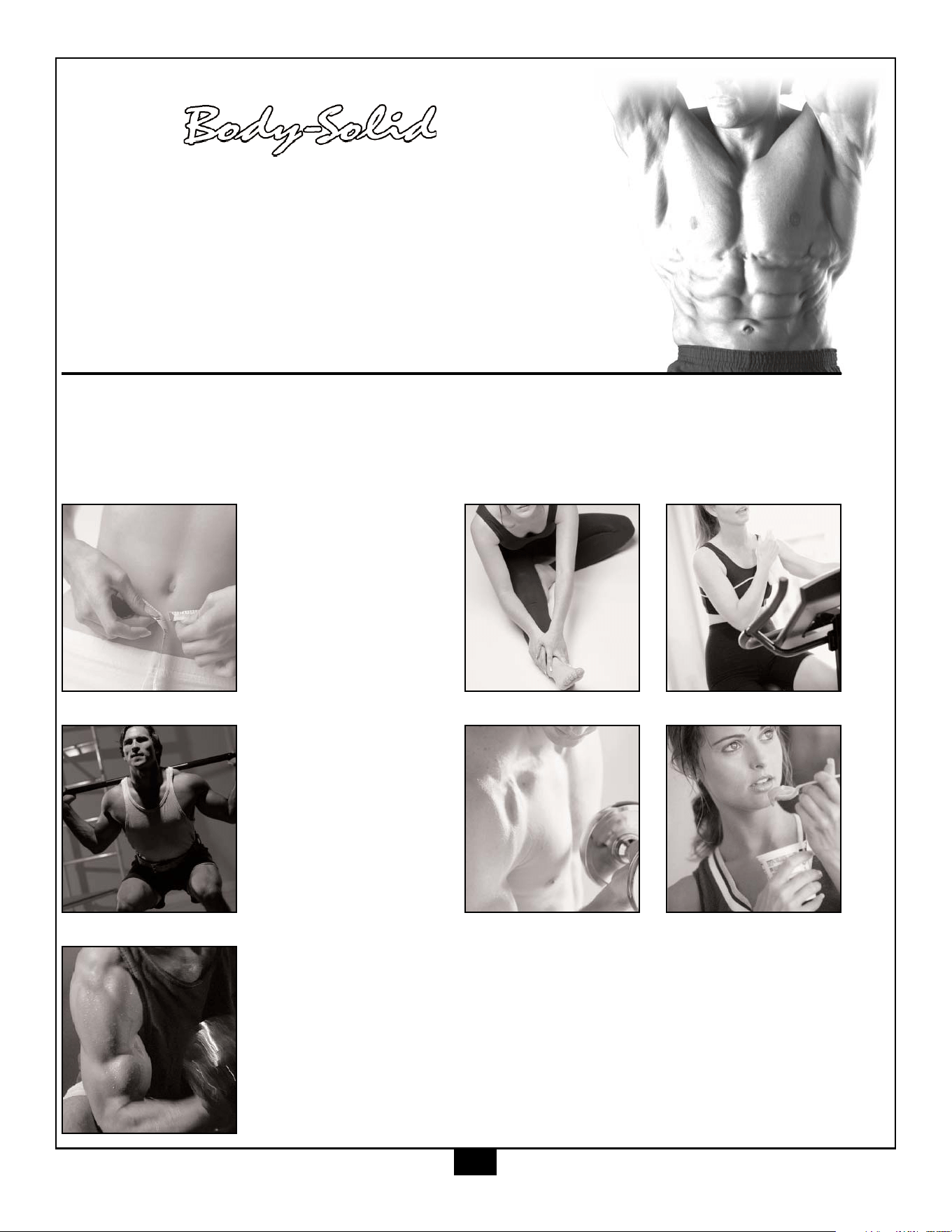
1. Lack of Adequate Warm-Up and Inadequate Flexibility
A warmed muscle is a more flexible muscle that’s better able to lift heavier weights and work in a full range of motion.
Those warmed muscles also greatly reduce your chance of training injuries.
2. Improper Form
The use of improper form is a good way to keep you out of the gym. Not only does improper form cause injuries,
it also doesn’t allow for adequate muscle-fiber stimulation.
3. Too Much Weight
Overloading the muscles is a good way to promote muscular growth, but packing on too much weight can cause a
snowball effect of improper form, injuries, and down time from your routine.
4. Not Enough Weight
Not lifting enough weight will prohibit the stimulation necessary for muscular growth. Keep challenging yourself to lift
heavier weights on a progressive basis always maintaining proper form.
5. Not Enough Rest Between Workouts
If you’re still sore from your previous workout, you don’t have to go back at it just because it’s your scheduled day.
Give your body an extra day off to fully recover so when you return you will be able to give 100%.
6. Overtraining
It’s not how much time you spend working out, but what you accomplish that really matters. Try to keep your
resistance workouts within 45 to 60 minutes per session.
7. Poor Diet and Supplementation
Eating the right combination of foods, along with good supplementation, will greatly promote your success. Make your
diet 50 percent carbohydrate, 35 percent protein, 15 percent fat, and take a good multivitamin and protein/carbohydrate
supplement. Don’t forget the water- at least 80 ounces a day! Hydration is critical.
8. Stale Routines
Your body adapts very quickly to the demands placed upon it. That’s why you should have a variety of exercises and
routines that you can do. To keep your body growing, you’ve got to keep it off-guard. Changing your exercises and
routines is a sure way to do it.
25
SETTING UP YOUR
PERSONAL PROGRAM
It is important to first establish specific
and realistic goals. You should determine
your long term goal and then set a
series of short term goals that will
help you attain your long term goal.
The most common goals are:
Once you have determined your personal goals, you will need to set up a schedule
that helps you attain them. Set up a schedule that includes the number of workouts
per week, the type of workout activity, the time of day for each workout, and the actual
workout program. Don’t forget to factor in the warm up and cool down periods. You
may have to modify your current lifestyle to accommodate your new schedule. It’s very
important to include the following basic components to achieve successful results:
Muscular Endruance & Definition
Increase Power & Muscle Mass
Increase Strength
Stretching
Weight Training
Aerobic Exercise
Nutrition
If your personal goals
involve losing a
considerable amount
of body fat you will
need to focus more
on aerobic exercise
and weight training
for muscular
endurance and
definition.If your
goals involve a large
increase in muscle
size you will need to
focus on power and
muscle mass weight
training. Depending
on your goals, you
will have different
nutritional
requirements.
26
FIRST:
You need to decide which of the above training methods is best
suited to accomplish your personal goals.
SECOND:
Study the exercise poster that came with your Body-Solid
machine and select one or two exercises per body part (body
parts are listed to the left of the exercise pictures). Be sure to
include exercises for all
body parts. If you leave out certain
body parts your exercise routine and your body will not be
balanced. If you are trying to increase muscle mass or
increase strength to a muscle group it is alright to add extra
exercises to the area you are particularly concerned about.
THIRD:
Coordinate your body part exercise program and your
personal schedule. If you select one exercise per body part
you can normally do your entire routine in the same workout.
If you choose to do more than 12 exercises you may decide
to divide your workout routine into upper and lower body
exercises. You can split your schedule to work upper body
one day and lower body the next day. Remember to rest each
particular muscle group 48 hours before working it again.
FOURTH:
Order the exercises in your routine so you are working the
large muscle groups first and the small muscle groups last.
FIFTH:
Keep a record! Write down the exercises, number of sets,
number of reps and the amount of resistance (weight).
BEGINNER’S SAMPLE WORKOUT ROUTINE
WHEN TRAINING FOR DEFINITION
Exercise Reps Sets
Bench / Chest Press 15 to 20 3 or 4
Lat Pulldown 15 to 20 3 or 4
Shoulder Press 15 to 20 3 or 4
Tricep Pressdown 15 to 20 3 or 4
Bicep Curl 15 to 20 3 or 4
Leg Press/Squat 15 to 20 3 or 4
Leg Extension 15 to 20 3 or 4
Leg Curl 15 to 20 3 or 4
Calf Raise 15 to 20 3 or 4
Ab Crunch 20 to 30 3 or 4
Rest period between sets should be about 30 seconds.
There are three basic types of weight
training methods:
1. Training for muscular
endurance and definition
2. Training for strength
3. Training for power and
muscle mass
You should select a training method
that reflects both your present fitness
level and your long term goals. You
should begin carefully and with proper
professional guidance. You can always
move from one training method to
another as you progress.
If you are beginner, you should start
slowly and carefully, gradually increasing
the frequency and intensity of your
training. Always play it safe – be realistic
about your goals and your schedule.
Realistic goals are safer and easier to
follow.
Which is the right training method
for you? First, take a look at your
present physique and determine your
objectives. Do you want a trim, toned,
well-defined body? Are you involved in
a sport where speed, strength and
power are most important? Maybe you
want bulging muscles and a terrific
V-shape torso so you look great on the
beach. Once you make a decision on
what the final results should be, you
can set up your personal program
using the proper training method to
achieve your goals.
Which training method is right for you?
DESIGNING YOUR PERSONAL ROUTINE
FOR MUSCULAR
ENDURANCE & DEFINITION
This training method incorporates
achieving and maintaining a high
cardiovascular (heart) rate and helps
burn away excess fatty tissue. It also
adds muscle definition and muscular
endurance to your entire body.
Exercises are most commonly
performed for 15 to 20 repetitions and
3 to 4 sets using a light to moderate
weight. The rest period between sets
should be about 30 seconds. These
short rest intervals will help maintain an
elevated heart rate and prevent the
muscles from cooling down.
FOR STRENGTH
This type of training is the most
popular of the three and is designed
specifically for increasing strength
throughout the muscle and the
muscle-tendon junction. This type of
training is especially important for
athletes. Normally, exercises are
performed using moderate to heavy
weight for 8 to 12 repetitions and 2 to 3
sets. The rest period between sets
should be from 60 to 90 seconds. This
allows a degree of muscle recovery
before you hit them again.
FOR POWER
AND MUSCLE MASS
This is the method most often used by
bodybuilders and is recommended
only for the intermediate and
advanced lifter. The weights used are
heavy — this shocks the muscles and
stimulates a more rapid increase in
muscle size. Usually exercises are
performed for 2 to 6 repetitions and
3 to 4 sets using very heavy weight.
The rest period between sets should
be from 3 to 4 minutes. The prolonged
rest periods allow ample time for
recovery between sets.
DETERMINE YOUR
TRAINING METHOD
27
EXERCISETIPS
CHEST
This powerful muscle group is the
cornerstone of a well-developed upper
body. To most thoroughly work your
pecs, include both pressing and fly
movements and vary the angle of the
bench from decline to flat to incline.
BENCH / CHEST PRESS
INCLINE PRESS
DECLINE PRESS
PEC FLY
INCLINE FLY
DECLINE FLY
CABLE CROSSOVER
DIPS
SHOULDERS
The shoulder joint, which has the
greatest range of motion of all joints in
the body, is best worked by training all
three deltoid heads. Include a pressing
movement followed by a raise for each
of the three heads.
SHOULDER PRESS
BEHIND THE NECK PRESS
FRONT DELTOID RAISE
LATERAL (SIDE) DELTOID RAISE
BENT-OVER LATERAL DELTOID RAISE
REVERSE PEC-FLY
UPPER BACK
A powerful upper back is marked by
both middle-back thickness and width
(the sought-after V-taper). This is
best achieved by combining various
rows with pull-downs and pull-ups.
Remember to vary your grip to slightly
change the stimulus.
PULL UP
UPRIGHT ROW
LAT PULLDOWN
SEATED ROW
BENT OVER ROW
HIGH ROW
REVERSE GRIP PULLDOWN
TRAPS
A signature muscle of a strong upper
back, well-developed traps help prevent
neck injury. Shrug movements should
be done with heavy weights in a straight
up-and-down motion.
S
TRAIGHT BAR SHRUG
DUMBBELL SHRUG
BEHIND THE BACK SHRUG
UPRIGHT ROW
LOWER BACK
Important not only for spinal protection
but also because it’s the seat of power
for many exercises. If you spend a great
deal of time crunching for abs, you need
to balance your training for complete
development and muscular balance.
PULL UP
UPRIGHT ROW
LAT PULLDOWN
SEATED ROW
BENT OVER ROW
HIGH ROW
REVERSE GRIP PULLDOWN
TRICEPS
This three-headed muscle on the back
of your arm is involved in extension of
the elbow. Like the biceps, the triceps
cross the elbow and shoulder joints.
Because of this, you can and should work
the triceps through a variety of angles
to ensure complete development.
LYI NG TRICEPS EXTENSION
CABLE TRICEPS EXTENSION
CABLE TRICEPS PRESSDOWN
CLOSE-GRIP BENCH PRESS
REVERSE-GRIP PRESSDOWN
TRICEPS PRESS
DIPS
BICEPS / FOREARMS
A two-headed muscle, the biceps’
primary focus is to flex your elbow and
supinate your wrist. The ability to build
your biceps peak is largely genetic,
but exercises that maximally stress the
short head will help.
BICEPS
STANDING BICEP CURL
SEATED BICEP CURL
INCLINE CURL
PREACHER CURL
CONCENTRATION CURL
ONE-ARM CABLE CURL
FOREARMS
WRIST CURL
REVERSE WRIST CURL
ABDOMINALS
The rectus abdominus has upper and
lower regions, but you can’t isolate one
area over the other. Still, include both
upper and lower ab movement to more
strongly emphasize those areas, and
do twisting movements to work the
obliques for complete development.
UPPER AB REGION
CABLE AB CRUNCH
DECLINE BENCH CRUNCH
LOWER AB REGION
REVERSE CRUNCH
HANGING KNEE RAISE
HIP THRUST
OBLIQUES
CABLE SIDE BEND
OBLIQUE CRUNCH
THIGHS / GLUTES
The main muscles of the thighs are the
quadriceps which are composed of four
muscles. You have several others near
the hip joint, including the body’s largest
muscle group, the gluteal. Multijoint
movements (in which action occurs at
both the hip and knee joints) are your
best choice to work these muscles.
BACK SQUAT
FRONT SQUAT
LEG PRESS
LUNGE
REVERSE LUNGE
STEP-UP
LEG EXTENSION
(does not work glutes)
HAMSTRINGS
On the back of the thighs, the
hamstrings balance the quads and
allow for a wide range of movement.
Good exercise choices include those
that work the hamstrings and both the
hip and knee joints.
DEADLIFT
STIFF-LEGGED DEADLIFT
GOOD MORNING
LYI NG LEG CURL
SEATED LEG CURL
ONE-LEGGED STANDING LEG CURL
CALVES
Calves consist of two major muscles,
the gastrocnemius and soleus. The
latter is best worked when the knee is
flexed, as in the seated calf raise.
STANDING CALF RAISE
SEATED CALF RAISE
DONKEY CALF RAISE
LEG PRESS CALF RAISE
HACK SQUAT CALF RAISE
Listed below are Body-Solid’s picks of the best exercises you can do for each body part. These exercises can be
done using free weights, machines and multi-station gyms. Learn to do each exercise in proper form. You can
make substitutions in your training and try variations of each using different Body-Solid grips, cable attachments and
accessories to slightly change the emphasis of a particular exercise. Note: Many movements, especially multijoint
exercises, work more than one muscle group. For example, your front deltoids and triceps are stimulated during
bench / chest pressing movements.
28
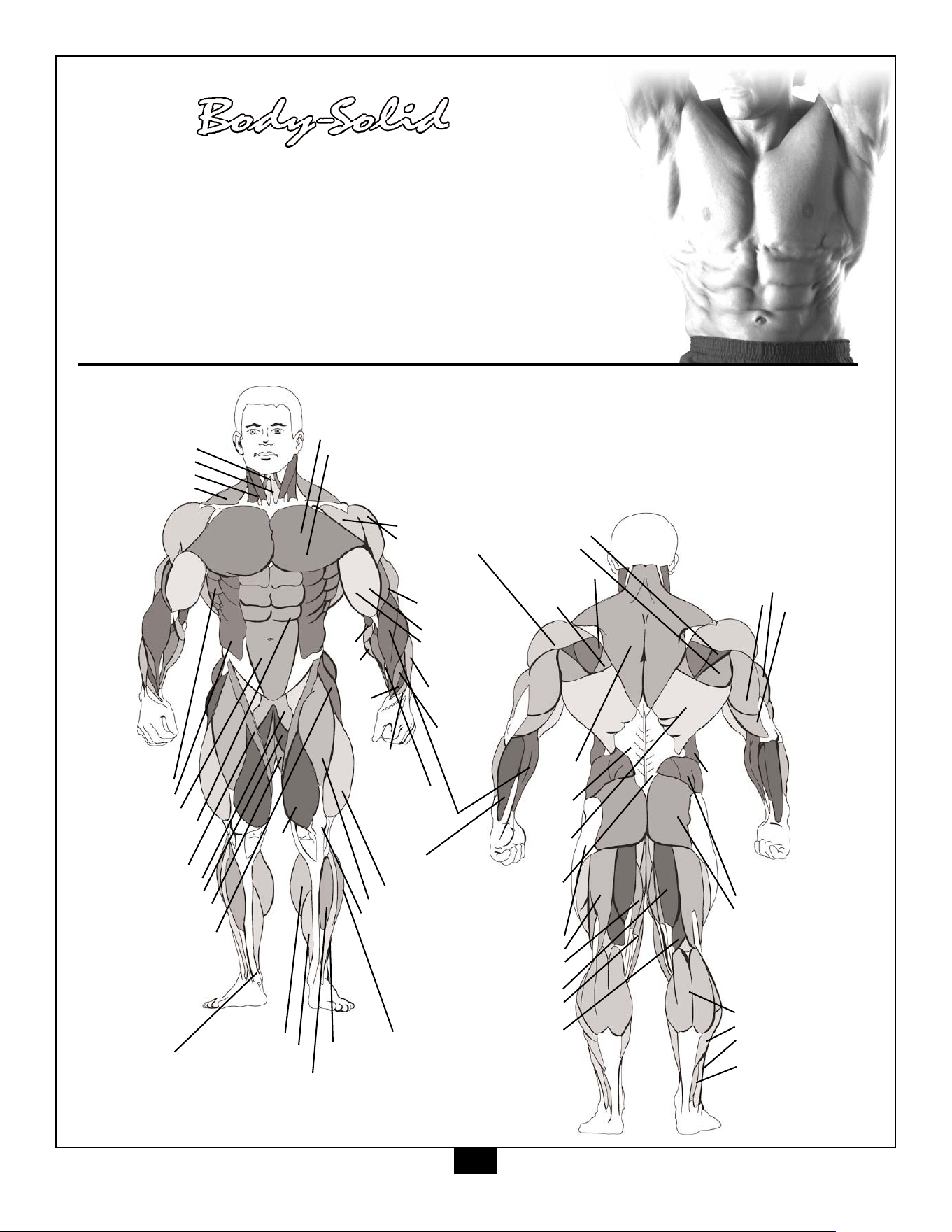
ANATOMY
CHART
FRONT VIEW
Note: These illustrations depicting exaggerated musculature are
not in the textbook anatomical position. As such, they are inexact
for medical purposes but are useful for a general understanding.
BACK VIEW
Neck
Omohyoid
Sternohyoid
Sternocleidomastoid
Trapezius
Chest
Pectoralis Major
Pectoralis Minor
(beneath major)
Shoulders
Deltoid
anterior head
middle head
posterior head
Back
Teres Minor
Teres Major
Infraspinatus
Rhomboid Major
Biceps
Brachialis
Biceps Brachii
long head
short head
Calves
Gastrocnemius
Soleus
Peroneus Brevis
Flexor Hallucis Longus
Glutes
Gluteus Medius
Gluteas Maximus
Abs
External
Oblique
Triceps
Triceps Brachii
lateral head
longhead
medial head
Hamstrings
Iliotibial Band
Biceps Femoris
Adductor Magnus
Semitendinosus
Gracilis
Semimembranosus
Abs
Serratus Anterior
External Oblique
Rectus Abdominis
Tendinous Inscriptions
Thighs
Sartorius
Pectineus
Adductor Longus
Gracilis
Tensor Fasciae Latae
Calves
Gastrocnemius Peroneus Longus
Tibia (bone) Soleus Extensor Digitorum Longus
Tibialis Anterior
Pronator
Teres
Palmaris
Longus
Extensor
Pollicis
Brevis
Extensor
Pollicis Longus
Flexor Carpi Radialis
Brachioradialis
Flexor
Carpi
Ulnaris
Vastus Lateralis
Rectus Femoris
Patella (kneecap)
Trapezius
Erector Spinae
(deep)
Latissimus
Dorsi
Thoracolumbar
Fascia
Vastus
Medialis
Forearms
Extensor
Carpi Ulnaris
Abductor
Pollicis
Longus
•
•
•
•
•
•
•
•
•
•
•
•
•
•
•
•
•
•
•
•
•
•
•
•
•
•
•
•
•
•
•
•
•
•
•
•
•
•
•
•
•
•
•
•
•
•
•
•
•
•
•
•
•
•
•
•
•
•
•
•
•
•
•
•
29
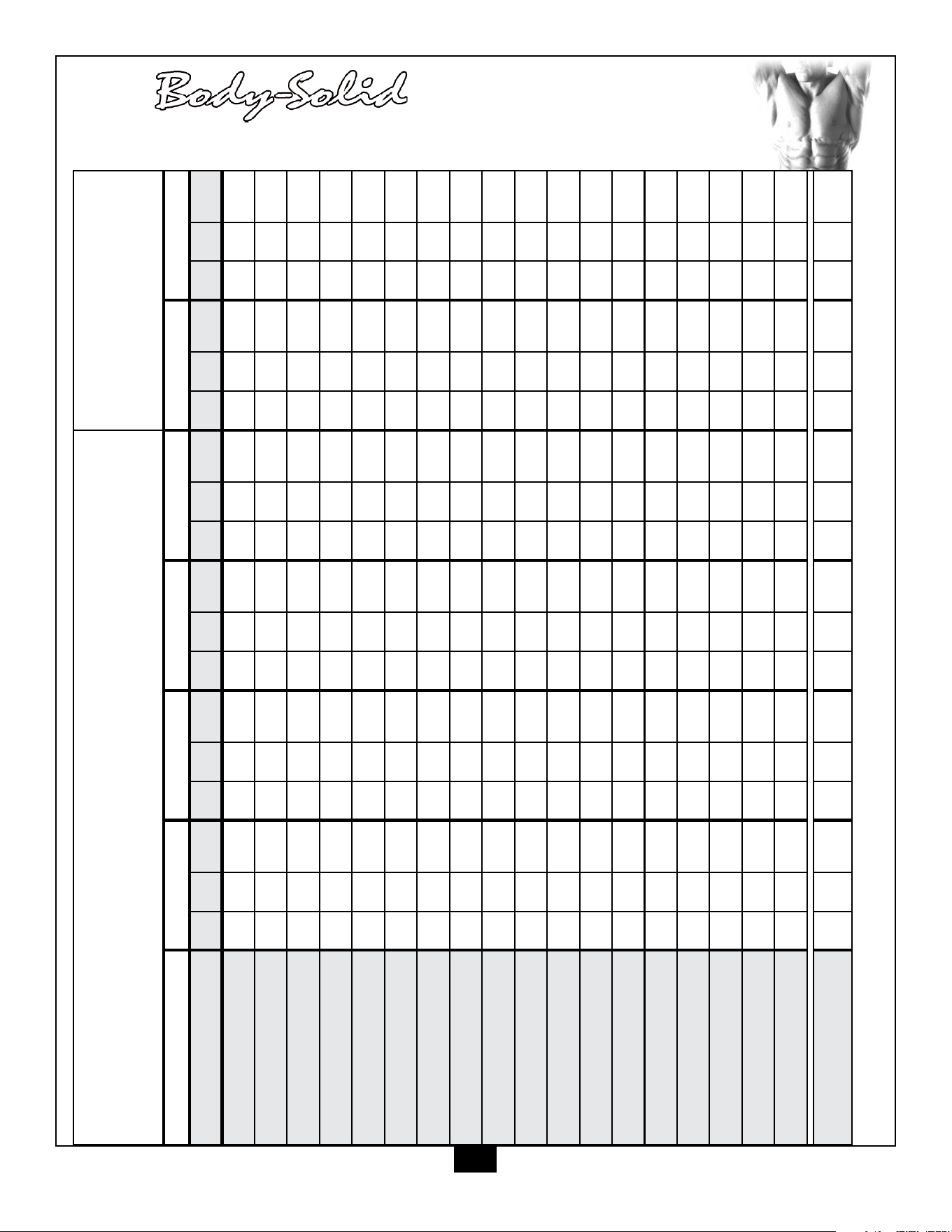
SHORT-TERM GOALS
Date Set
Date Accomplished
Goal
Reward
**
Date Set Date Accomplished
Goal
Reward
**
Date Set Date Accomplished
Goal
Reward
**
LONG-TERM GOALS
Goal
Reward!
*Make several copies of this page to keep track of your goals and accomplishments.
You can print more copies of this page by going to http://www.bodysolid.com/support/docs.html
** Don’t forget to reward yourself for a job well-done!
FITNESS GOALS
*
30
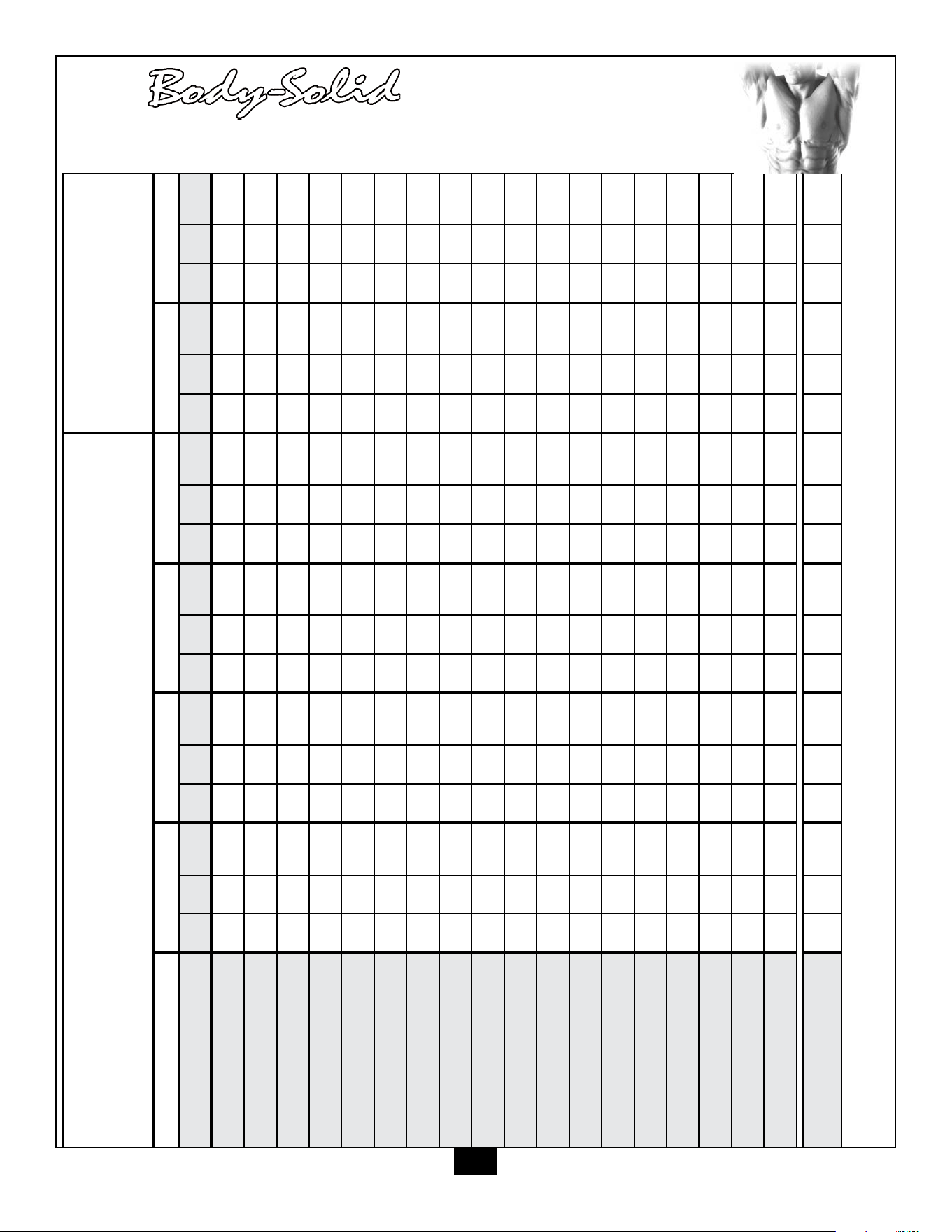
WEIGHT TRAINING EXERCISE LOG
BEGINNER’S SAMPLE WORKOUT ROUTINE
Keep track of your changes and improvements. It’s a great motivational tool!*
S=Sets
R=Repetitions per set
W=Weight used
* Make several copies of this page to keep track of your progress.
You can print more copies of this page by going to http://www.bodysolid.com/support/docs.html
Date
Exercise
BENCH / CHEST PRESS
LAT PULLDOWN
SHOULDER PRESS
TRICEP PRESSDOWN
BICEP CURL
LEG PRESS / SQUAT
LEG EXTENSION
LEG CURL
CALF RAISE
AB CRUNCH
TOTALS
SR W SR W SR W SR W SR W SR W
31
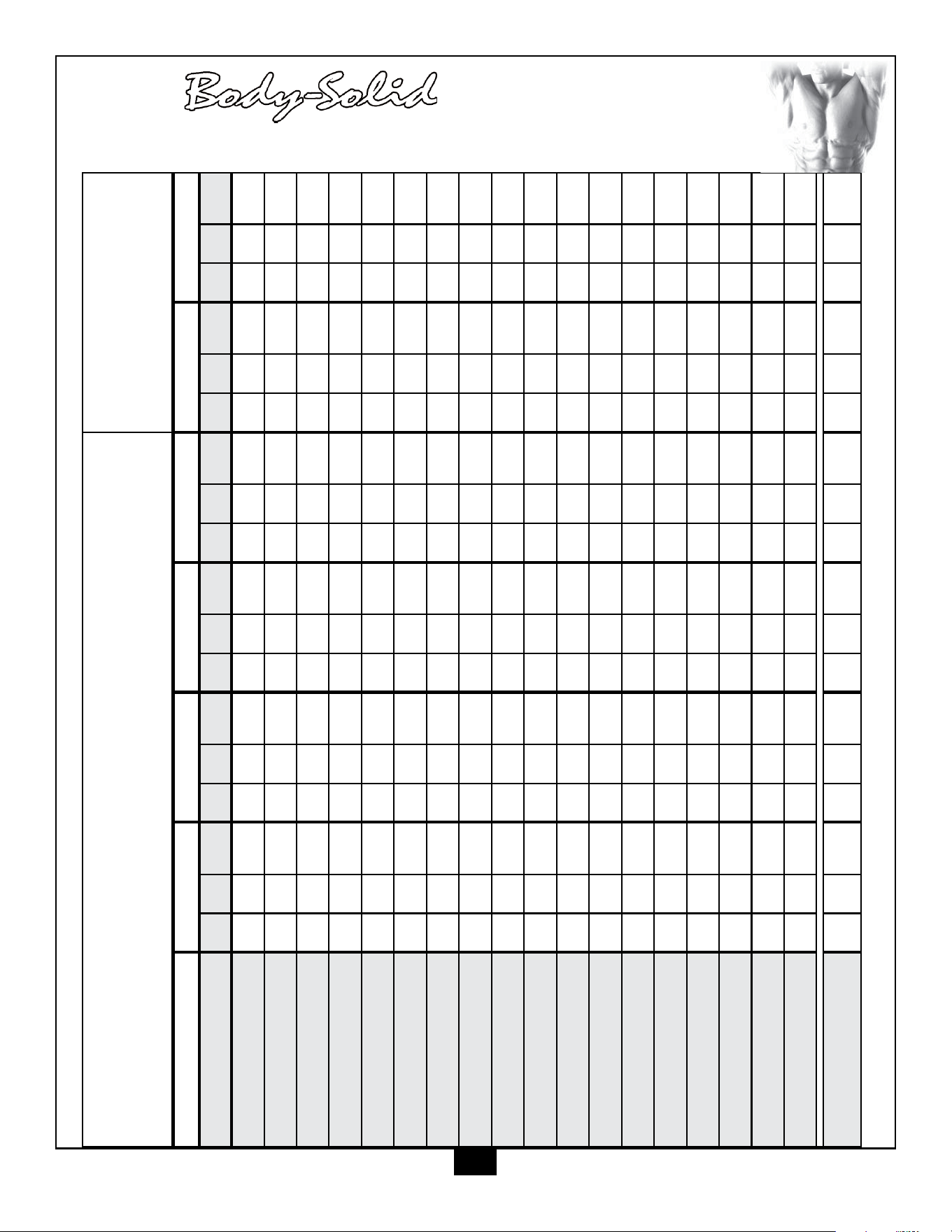
SAMPLE WORKOUT ROUTINE WHEN TRAINING FOR STRENGTH
Keep track of your changes and improvements. It’s a great motivational tool!*
S=Sets
R=Repetitions per set
W=Weight used
* Make several copies of this page to keep track of your progress.
You can print more copies of this page by going to http://www.bodysolid.com/support/docs.html
Date
Exercise
LEG PRESS / SQUAT
LEG EXTENSION
LEG CURL
CALF RAISE
BENCH / CHEST PRESS
INCLINE PRESS
INCLINE PEC FLY
LAT PULLDOWN
SEATED ROW
MILITARY PRESS
UPRIGHT ROW
BICEP CURL
TRICEP PRESSDOWN
TRICEP EXTENSION
RESISTANCE AB CRUNCH
RESISTANCE OBLIQUE CRUNCH
TOTALS
SR W SR W SR W SR W SR W SR W
WEIGHT TRAINING EXERCISE LOG
32
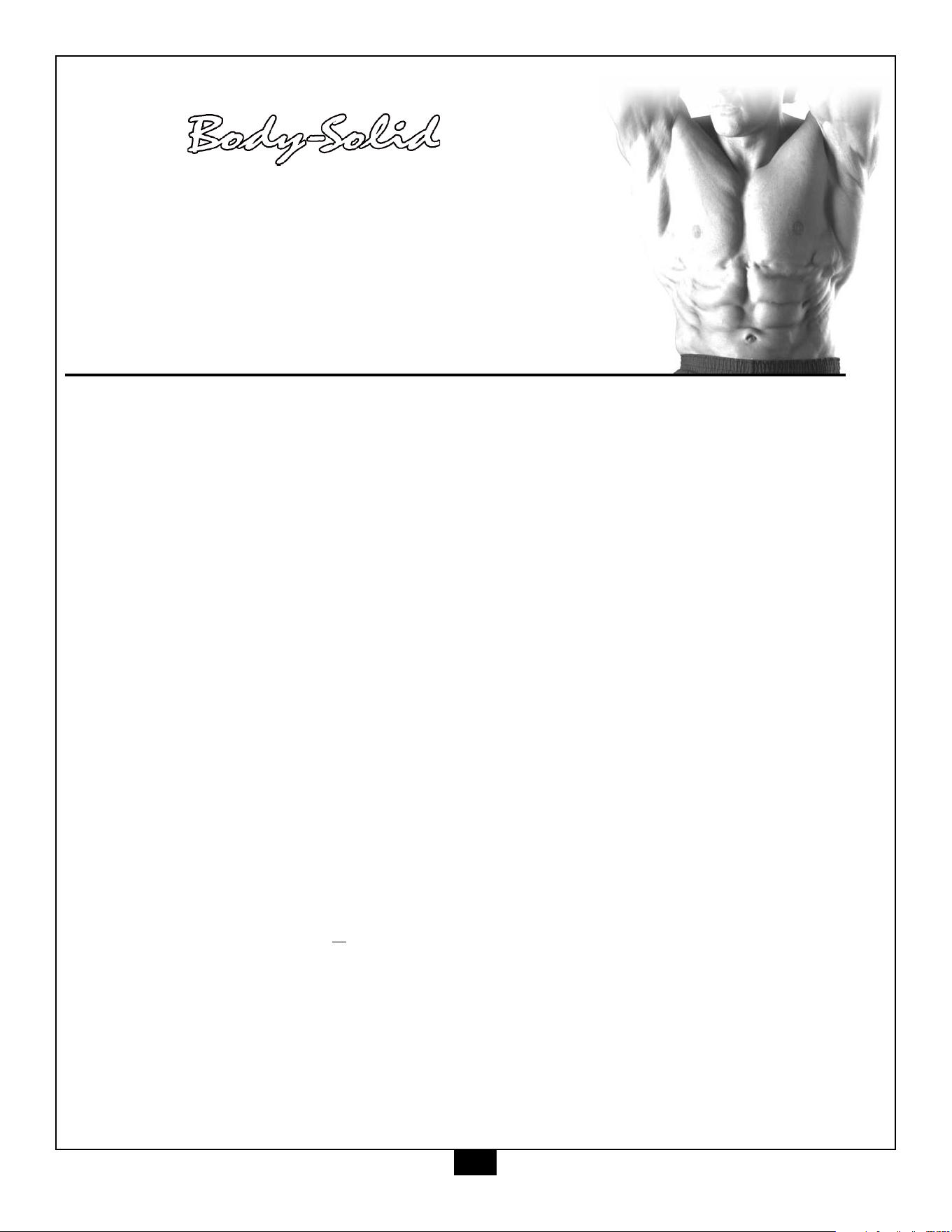
INTERMEDIATE AND ADVANCED LIFTERS...
Design your personal strength training program.
Keep track of your changes and improvements. It’s a great motivational tool!*
S=Sets
R=Repetitions per set
W=Weight used
* Make several copies of this page to keep track of your progress.
You can print more copies of this page by going to http://www.bodysolid.com/support/docs.html
Date
Exercise
TOTALS
SR W SR W SR W SR W SR W SR W
WEIGHT TRAINING EXERCISE LOG
33
STRETCHING
& FLEXIBILITY
Flexibility is an important component of physical fitness and needs to be addressed
in a resistance training program. The two main purposes for stretching are injury
prevention and a faster rate of recovery from exercise. Stretching should be
performed in both the warm up and cool down phases of a training session. A good
general guideline is that each workout session should be preceded by 5 to 15 minutes
of general warm up, followed by 8 to 12 minutes of stretching, and concluded with 4 to 5
minutes of post-exercise stretching.
A regular stretching program will loosen muscle tissue, allowing an increased range
of motion. This helps prevent microtears at the muscle-tendon junction. Almost 90%
of all injuries from muscle strain occur at the muscle-tendon junction. Repeated
injury at this junction can lead to a build-up of scar tissue, which impedes range of
motion and adds stress to the joints.
Begin by stretching the major muscle groups first. Move in and out of your stretches
with smooth, slow, controlled motion. Hold the stretch for at least 10 seconds when
you feel you have reached your muscle’s maximum distance. Do not use fast,
hurried or reckless motions when stretching. Fast and bouncy motions will increase
the risk of injury.
The most common and most popular type of stretching is the
static stretching
technique. This form of stretching involves voluntary, complete relaxation of the
muscles while they are elongated. A static stretch is a constant, steady stretch in
which the end position is held for 10 to 30 seconds. This technique is popular
because it is easy to learn, effective, and accompanied by minimal soreness with
the least risk of injury.
Ballistic stretching
involves a bouncing or bobbing movement during the stretch.
The final position in the movement is not held. Ballistic stretching is unpopular
because of the increased amount of delayed muscle soreness and the possibility of
injury during the stretching exercise. Ballistic stretching is not recommended.
A dynamic stretch involves flexibility during sport specific movements.
Dynamic
stretching
is similar to ballistic stretching in that it utilizes movement, but dynamic
stretching includes movements that may be specific to a sport or movement
pattern. Dynamic stretching is most common among track and field athletes, but is
also used in other sports, such as basketball and volleyball. An example of dynamic
stretching would be a track sprinter performing high knees with an emphasis on
knee height and arm action, not on horizontal speed.
The following
pages show
illustrations with
descriptions of
static stretching
for warm up and
post-exercise
cool down.
Remember...
stretch your
large muscle
groups first and
do all stretches
in a smooth,
slow,controlled
manner.
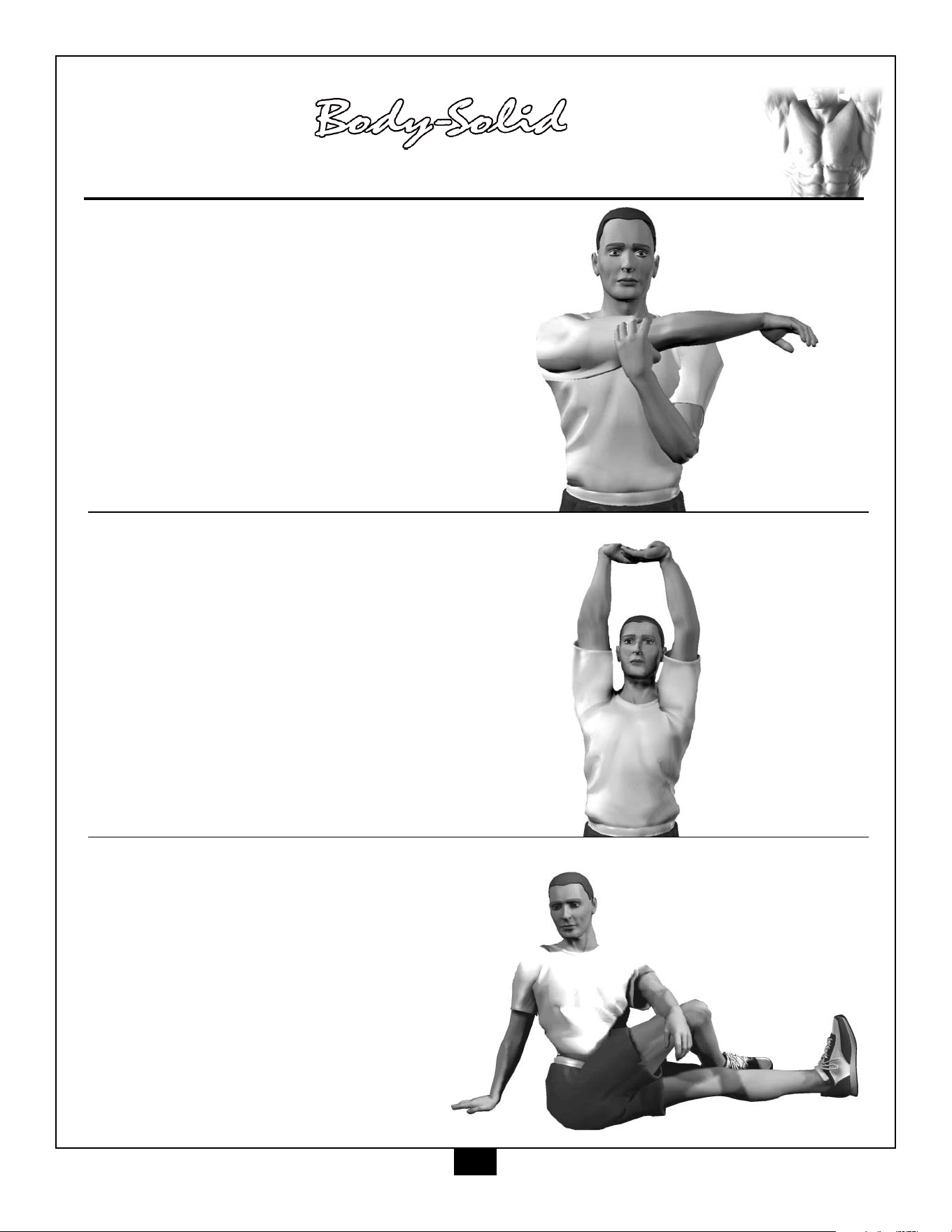
34
UPPER BACK
Cross Arm in Front of Chest
MUSCLE(S) AFFECTED: latissimus dorsi and teres major
1. Stand or sit with the right arm slightly flexed (15° to 30°) and
adducted across the chest.
2. Grasp the upper arm just above the elbow, placing the left hand
on the posterior side of the upper arm.
3. Pull the right arm across the chest (toward the left) with the left
hand.
4. Hold for 10 seconds.
5. Repeat with the left arm.
UPPER BACK
Arms Straight Up Above Head (Pillar)
MUSCLE(S) AFFECTED: latissimus dorsi and wrist flexors
1. Stand with arms in front of torso, fingers interlocked with palms
facing each other.
2. Slowly straighten the arms above the head with palms up.
3. Continue to reach upward with hands and arms.
4. While continuing to reach upward, slowly reach slightly backward.
5. Hold for 10 seconds.
LOWER BACK
Spinal Twist (Pretzel)
MUSCLE(S) AFFECTED: internal oblique, external oblique and spinal erectors
1. Sitting with legs straight and upper body nearly vertical, place
right foot on left side of left knee.
2. Place back of left elbow on right side of right knee, which is now
bent.
3. Place right palm on floor 12 to 16 inches behind hips.
4. Push right knee to the left with left elbow while turning shoulders
and head to the right as far as possible. Try to look behind the
back.
5. Hold for 10 seconds.
6. Repeat with left leg.
Stretching the
upper back
Stretching the
shoulders, chest
and upper back
Stretching
the low back
and sides
STRETCHING
WARM-UP/COOL-DOWN
STRETCHING
WARM-UP/COOL-DOWN
STRETCHING
WARM-UP/COOL-DOWN
STRETCHING
WARM-UP/COOL-DOWN
STRETCHING
WARM-UP/COOL-DOWN
STRETCHING
WARM-UP/COOL-DOWN
STRETCHING
WARM-UP/COOL-DOWN
STRETCHING
WARM-UP/COOL-DOWN
STRETCHING
WARM-UP/COOL-DOWN
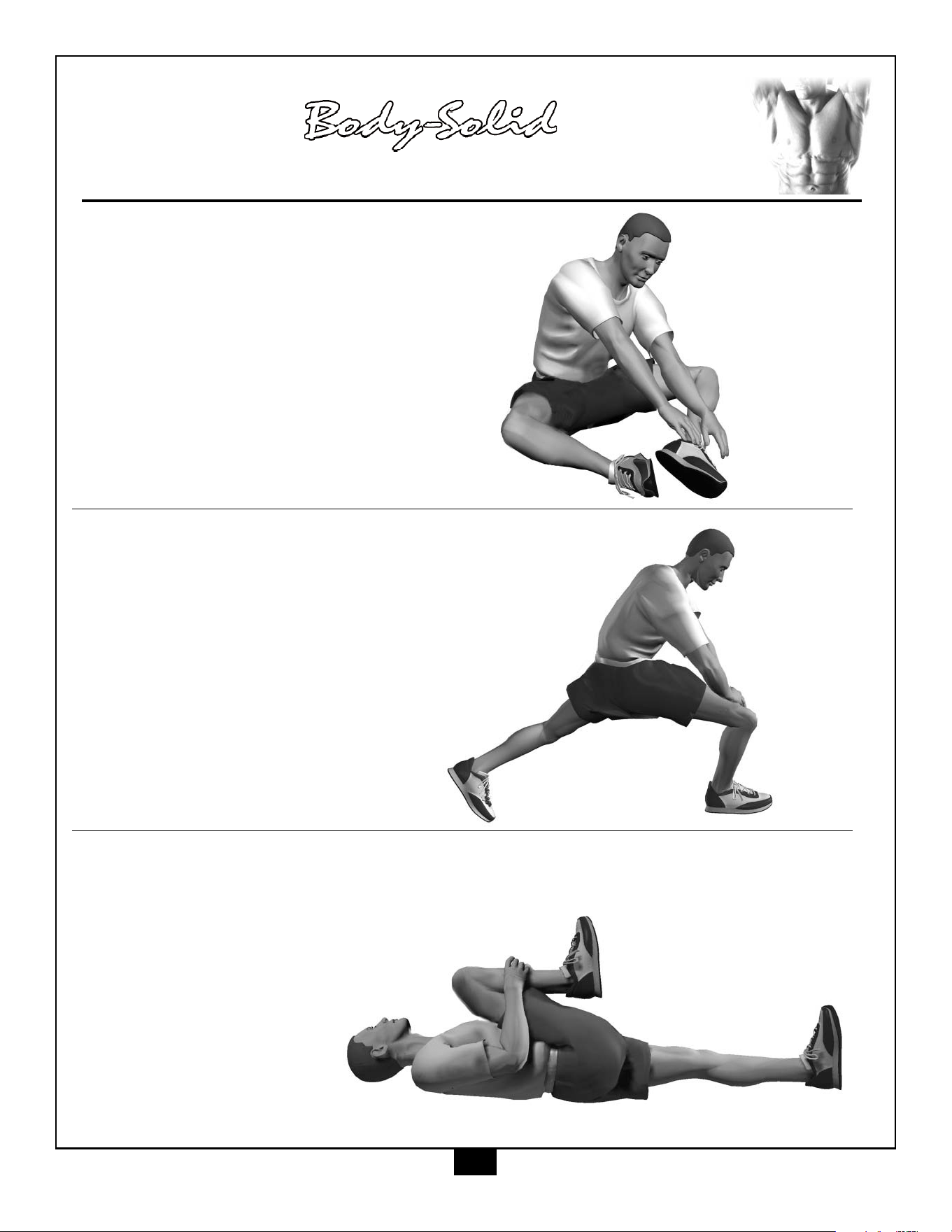
35
LOWER BACK
Semi-Leg Straddle
MUSCLE(S) AFFECTED: spinal erectors
1. Sitting, knees flexed 30 to 50 degrees, let the legs totally relax.
2. Point the knees outward; the lateral side of the knees may or may
not touch the floor.
3. Lean forward from waist and reach forward with extended arms.
Hold position for 10 to 15 seconds.
4. Bending and relaxing legs decreases hamstring involvement and
increases lower back stretch.
HIPS
Forward Lunge (Fencer)
MUSCLE(S) AFFECTED: iliopsoas, rectus femoris
1. Standing, take a long step forward (as with the lunge) with the
right leg and flex the right knee until it is directly over the right foot.
2. Keep right foot flat on floor.
3. Keep back leg straight.
4. Keep back foot pointed in same direction as front foot; it is not
necessary to have heel on floor.
5. Keep torso upright and rest hands on hips or front leg.
6. Slowly lower hips forward and downward.
7. Hold for 10 to 15 seconds.
8. Repeat with the left leg.
HIPS
Supine Knee Flex
MUSCLE(S) AFFECTED: hip extensors (gluteus maximus and hamstrings)
1. Lie on back with legs straight.
2. Flex right leg and lift knee toward chest.
3. Place both hands below knee and continue to
pull knee toward chest.
4. Hold for 10 to 15 seconds.
5. Repeat with left leg.
Stretching the
low back from
seated position
Stretching the
hip flexors
Stretching
the gluteals
and hamstrings
STRETCHING
WARM-UP/COOL-DOWN
STRETCHING
WARM-UP/COOL-DOWN
STRETCHING
WARM-UP/COOL-DOWN
STRETCHING
WARM-UP/COOL-DOWN
STRETCHING
WARM-UP/COOL-DOWN
STRETCHING
WARM-UP/COOL-DOWN
STRETCHING
WARM-UP/COOL-DOWN
STRETCHING
WARM-UP/COOL-DOWN
STRETCHING
WARM-UP/COOL-DOWN
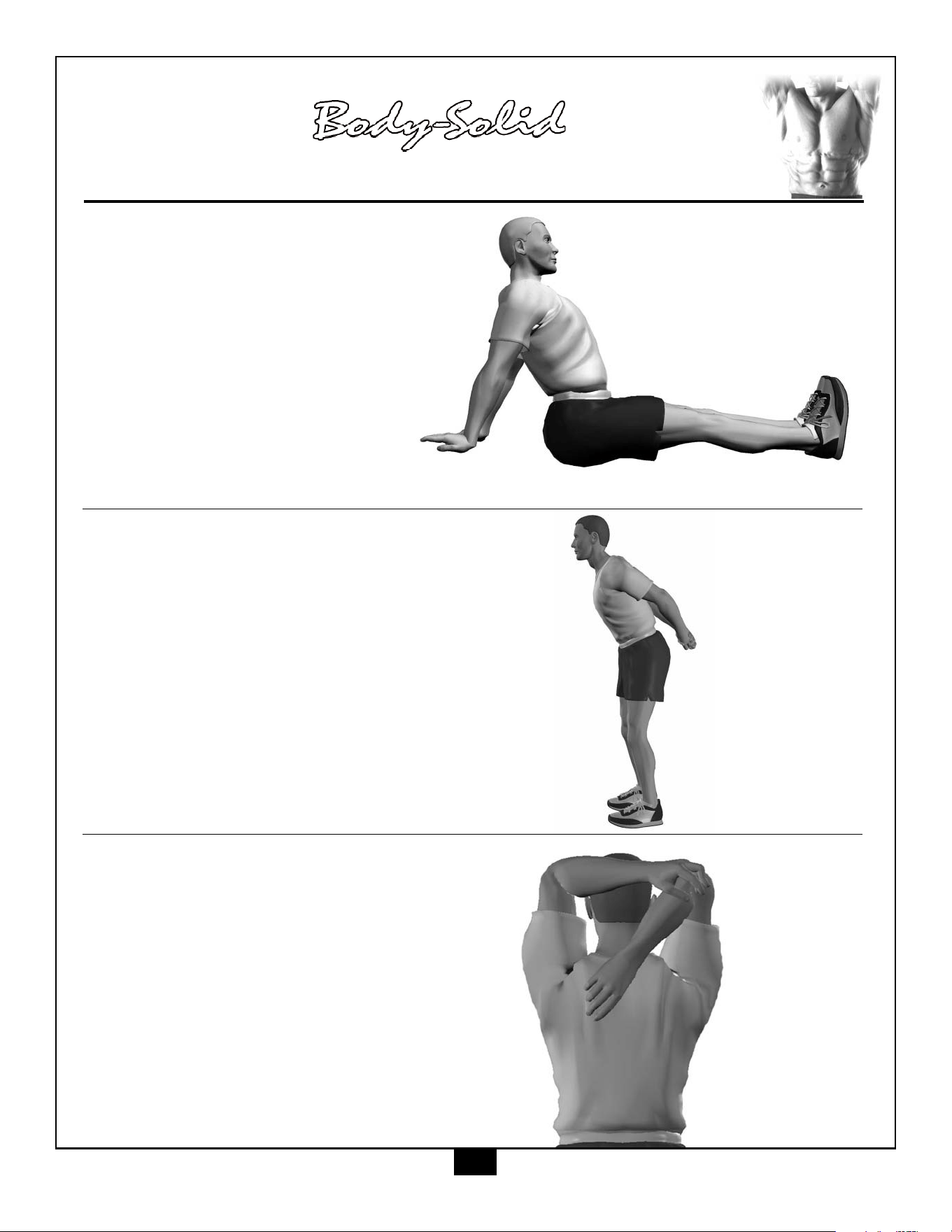
36
SHOULDER
Seated Lean-Back
MUSCLE(S) AFFECTED: deltoids and pectoralis major
1. Sitting with legs straight and arms extended, place palms on floor
about 12 inches behind hips.
2. Point fingers away (backward) from body.
3. Slide hands backward and lean backward.
4. Hold for 10 seconds.
CHEST
Straight Arms Behind Back
MUSCLE(S) AFFECTED: deltoids and pectoralis major
1. Standing, place both arms behind back.
2. Interlock fingers with palms facing each other.
3. Straighten arms fully.
4. Slowly raise the straight arms.
5. Hold for 10 to 15 seconds.
6. Keep head upright and neck relaxed.
POSTERIOR OF UPPER ARM
Behind-Neck Stretch (Chicken Wing)
MUSCLE(S) AFFECTED: triceps and latissimus dorsi
1. Standing or sitting, flex right arm and raise elbow above head.
2. Reach the right hand down toward the left scapula.
3. Grasp right elbow with left hand.
4. Pull elbow behind head with left hand.
5. Hold for 10 seconds.
6. Repeat with left arm.
Stretching shoulder
joints—sitting
Stretching the chest
Stretching
the triceps
STRETCHING
WARM-UP/COOL-DOWN
STRETCHING
WARM-UP/COOL-DOWN
STRETCHING
WARM-UP/COOL-DOWN
STRETCHING
WARM-UP/COOL-DOWN
STRETCHING
WARM-UP/COOL-DOWN
STRETCHING
WARM-UP/COOL-DOWN
STRETCHING
WARM-UP/COOL-DOWN
STRETCHING
WARM-UP/COOL-DOWN
STRETCHING
WARM-UP/COOL-DOWN
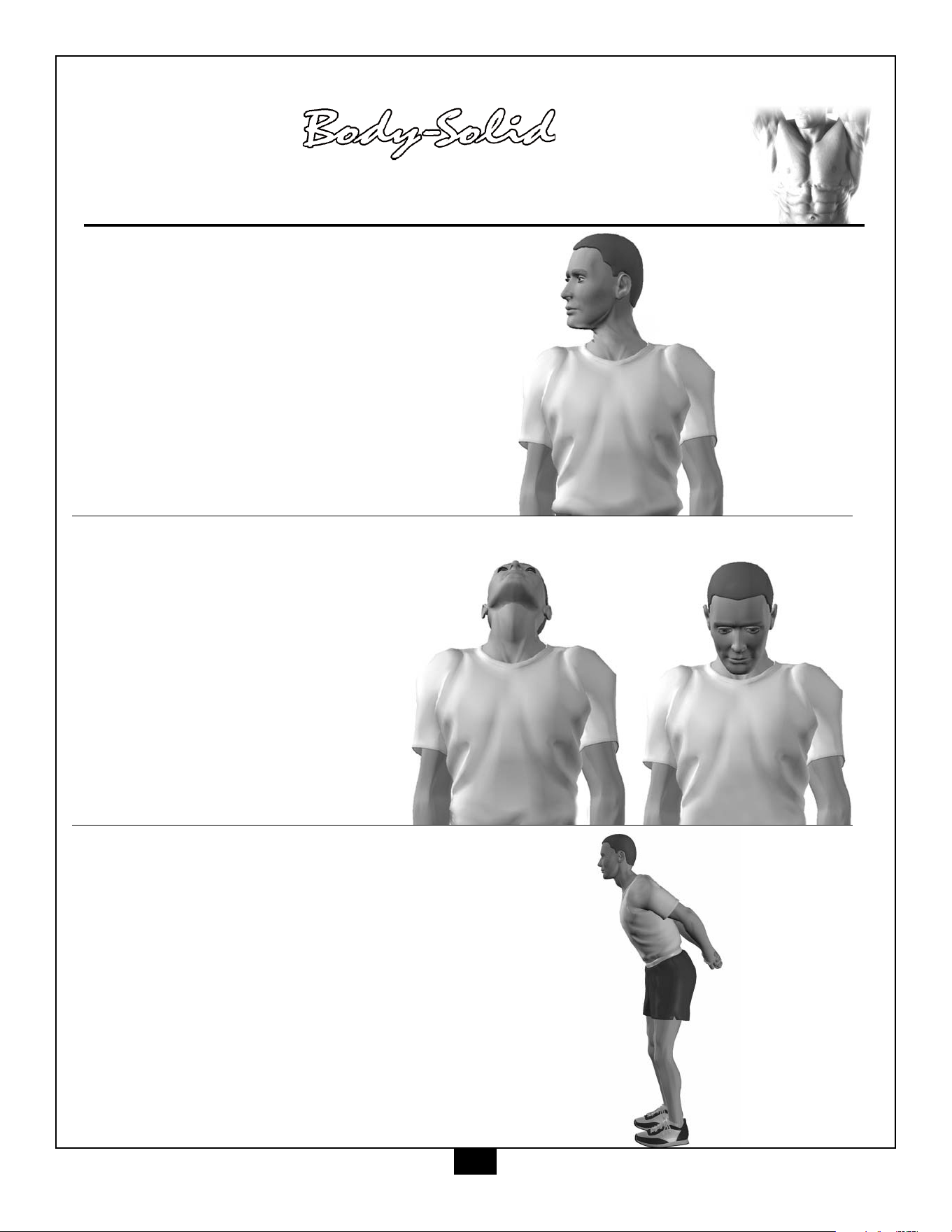
37
NECK
Look Right and Left
MUSCLE(S) AFFECTED: sternocleidomastoid
1. Stand or sit with head and neck upright.
2. Turn head to the right using a submaximal concentric contraction.
Hold for 10 seconds.
3. Turn head to the left using a submaximal concentric contraction.
Hold for 10 seconds.
NECK
Flexion and Extension
MUSCLE(S) AFFECTED: sternocleidomastoid, suboccipi-
tals and splenii
1. Standing or sitting with head and neck upright, flex neck anteriorly
(forward) by tucking chin in toward the chest; hold for 10 seconds.
2. If the chin touches the chest, try to touch lower on the chest with
the chin.
3. Extend neck posteriorly (backward) by trying to touch the head to
the trapezius; hold for 10 seconds.
SHOULDER
Straight Arms Behind Back
MUSCLE(S) AFFECTED: deltoids and pectoralis major
1. Standing, place both arms behind back.
2. Interlock fingers with palms facing each other.
3. Straighten arms fully.
4. Slowly raise the straight arms.
5. Hold for 10 to 15 seconds.
6. Keep head upright and neck relaxed.
Rotational flexion
of the neck
Neck flexionNeck extension
Stretching shoulder
joints—standing
STRETCHING
WARM-UP/COOL-DOWN
STRETCHING
WARM-UP/COOL-DOWN
STRETCHING
WARM-UP/COOL-DOWN
STRETCHING
WARM-UP/COOL-DOWN
STRETCHING
WARM-UP/COOL-DOWN
STRETCHING
WARM-UP/COOL-DOWN
STRETCHING
WARM-UP/COOL-DOWN
STRETCHING
WARM-UP/COOL-DOWN
STRETCHING
WARM-UP/COOL-DOWN
38
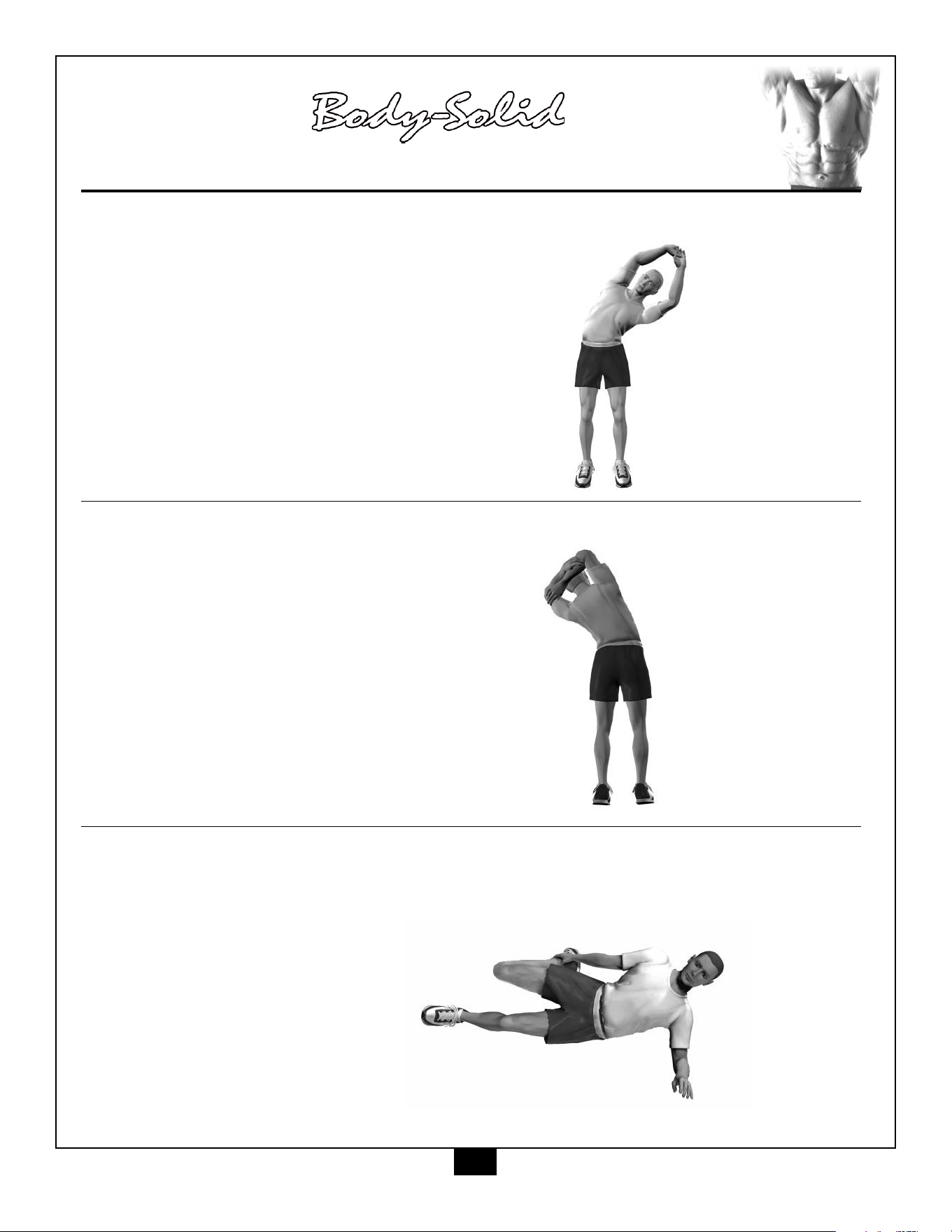
SIDES
Side Bend with Straight Arms
MUSCLE(S) AFFECTED: external oblique, latissimus dorsi and serratus anterior
1. Stand with feet 14 to 16 inches apart.
2. Interlace the fingers with palms facing each other.
3. Reach upward with straight arms.
4. Keeping arms straight, lean from waist to left side.
Do not bend knees.
5. After moving as far as possible, hold for 10 seconds.
6. Repeat to the left side.
SIDES
Side Bend with Bent Arm
MUSCLE(S) AFFECTED: external oblique, latissimus dorsi, serratus anterior and triceps
1. Stand with feet 14 to 16 inches apart.
2. Flex right arm and raise elbow above head.
3. Reach the right hand down toward the left shoulder.
4. Grasp the right elbow (just above the elbow) with the left hand.
5. Pull the elbow behind head.
6. Keeping arm bent, lean from waist to left side.
7. Do not bend knees.
8. After moving as far as possible, hold for 10 to 15 seconds.
9. Repeat with the left arm.
ANTERIOR OF THIGH AND HIP FLEXOR
Side Quadriceps Stretch
MUSCLE(S) AFFECTED: quadriceps and iliopsoas
1. Lie on left side with both legs straight.
2. Place left forearm flat on floor and upper arm perpendicular to floor.
3. Place left forearm at 45° angle with torso.
4. Flex right leg with heel of right foot moving toward buttocks.
5. Grasp front of ankle with right hand and pull toward buttocks.
WARNING: Do not pull on ankle so hard that pain or discomfort is felt in knee.
6. Move knee backward and slightly upward. The stretch occurs not so
much from the excessive flexion of the knee but from moving the knee
back and slightly up.
7. Hold for 10 to 15 seconds.
8. Repeat with the left leg.
Stretching
the sides, upper
back and shoulders
Stretching
the sides, triceps
and upper back
Stretching the
quadriceps
on side
STRETCHING
WARM-UP/COOL-DOWN
STRETCHING
WARM-UP/COOL-DOWN
STRETCHING
WARM-UP/COOL-DOWN
STRETCHING
WARM-UP/COOL-DOWN
STRETCHING
WARM-UP/COOL-DOWN
STRETCHING
WARM-UP/COOL-DOWN
STRETCHING
WARM-UP/COOL-DOWN
STRETCHING
WARM-UP/COOL-DOWN
STRETCHING
WARM-UP/COOL-DOWN
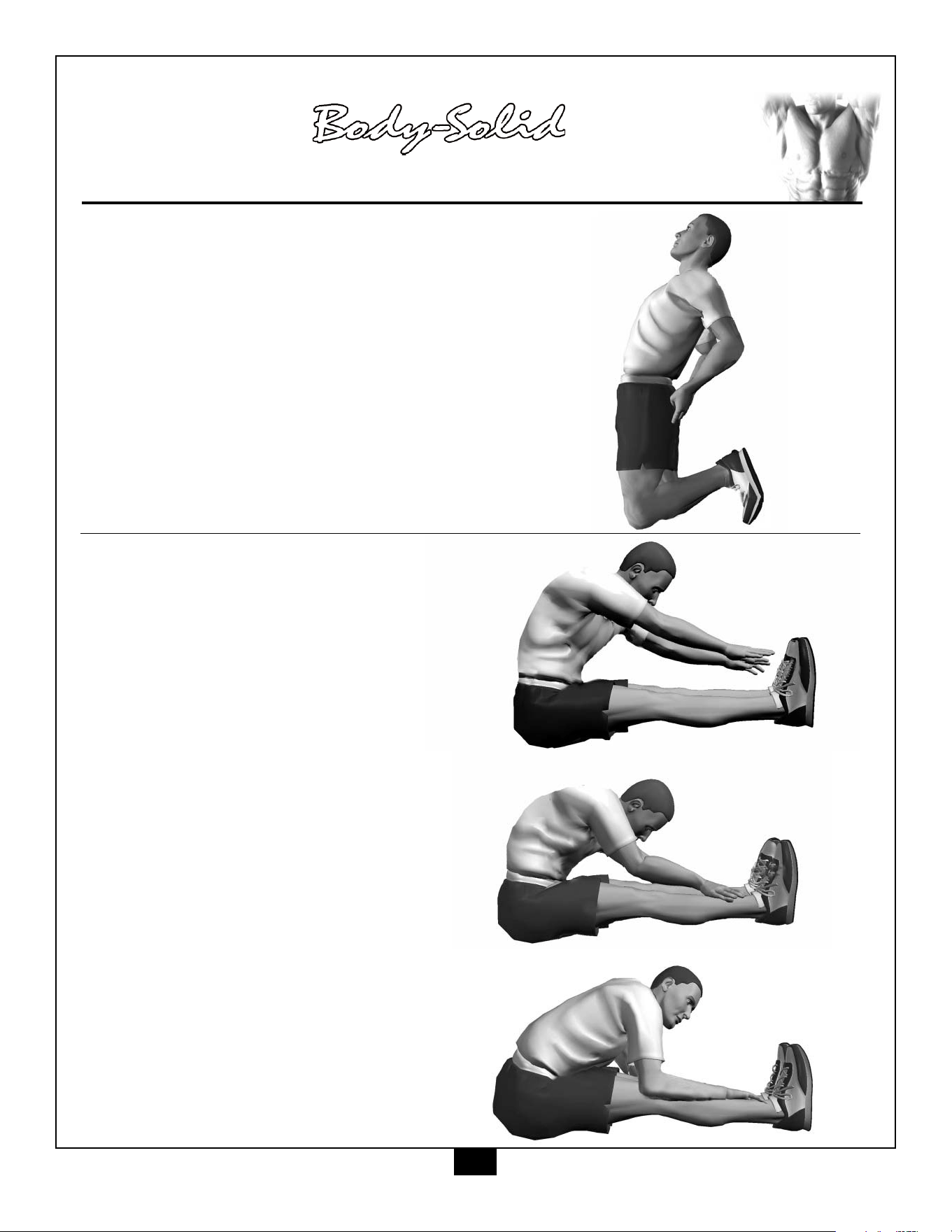
39
Stretching the hamstrings with
emphasis on insertion of the
hamstrings and calves.
Stretching the hamstrings with
emphasis on the middle portion.
Stretching the hamstrings
with emphasis on the
upper portion.
ANTERIOR OF THIGH AND HIP FLEXOR
Kneeling Quadriceps Stretch
MUSCLE(S) AFFECTED: quadriceps
1. Kneel with the balls of the feet on the ground.
2. Keep hips straight (upper leg and torso should be in a straight line).
3. Place palms of hands on buttocks and push slightly forward.
4. With a straight body, lean slightly backward until developmental
stretch is felt in quadriceps.
5. Hold for 10 to 15 seconds.
POSTERIOR OF THIGH
Sitting Toe Touch
MUSCLE(S) AFFECTED: hamstrings, spinal erectors and gastrocnemius
1. Sit with the upper body nearly vertical and legs straight.
2. Lean forward from waist and grasp toes with each hand, slightly
pull toes towards the upper body, and pull chest towards leg.
(If you are very stiff, try to grasp the ankles.) Hold for 10 seconds.
3. Release toes and relax foot.
4. Grasp ankles and continue to pull chest towards legs. Hold for 10
seconds.
5. Still grasping the ankles, point away from body and continue to
pull chest towards legs. Hold for 10 seconds.
Stretching the
quadriceps
kneeling
STRETCHING
WARM-UP/COOL-DOWN
STRETCHING
WARM-UP/COOL-DOWN
STRETCHING
WARM-UP/COOL-DOWN
STRETCHING
WARM-UP/COOL-DOWN
STRETCHING
WARM-UP/COOL-DOWN
STRETCHING
WARM-UP/COOL-DOWN
STRETCHING
WARM-UP/COOL-DOWN
STRETCHING
WARM-UP/COOL-DOWN
STRETCHING
WARM-UP/COOL-DOWN
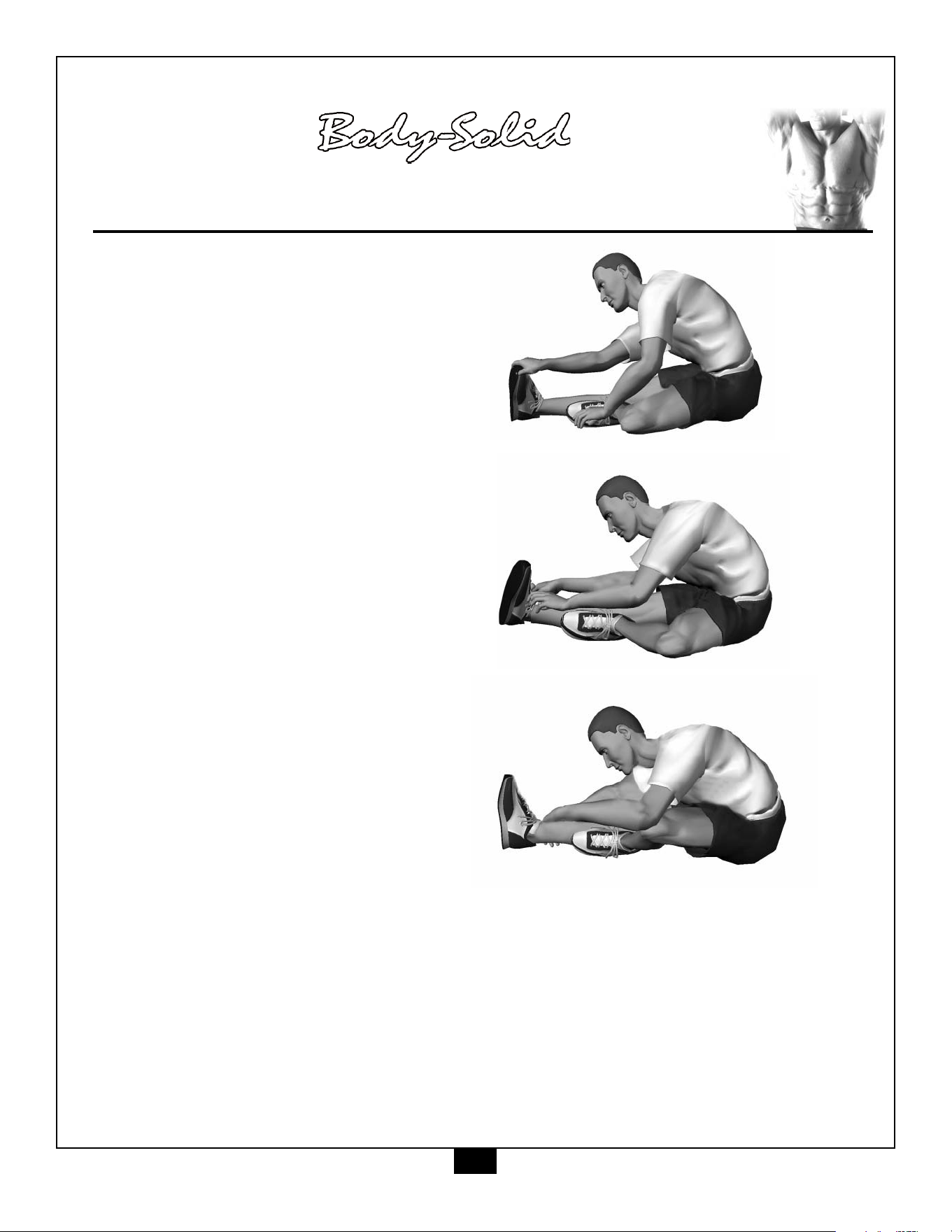
40
Stretching the hamstrings with
emphasis on insertion of the
hamstrings and calves
Stretching the hamstrings
with emphasis on the
middle portion
Stretching the hamstrings
with emphasis on the
upper portion
POSTERIOR OF THIGH
Semistraddle (Figure Four)
MUSCLE(S) AFFECTED: gastrocnemius, hamstrings and spinal erectors
1. Sit with the upper body nearly vertical and legs straight.
2. Place sole of left foot on left side of right knee. The lateral side of
left leg should be resting on the floor.
3. Lean forward from the waist and grasp toes with right hand and
slightly pull toes toward the upper body as the chest is also pulled
toward right leg. Hold for 10 seconds.
4. Release toes and relax foot.
5. Grasp ankle and continue to pull chest toward right leg. Hold for
10 seconds.
6. Point toes away from body and continue to pull chest toward right
leg. Hold for 10 seconds.
7. Repeat with the left leg.
Remember... do all stretches in a
smooth,slow, controlled manner.
STRETCHING
WARM-UP/COOL-DOWN
STRETCHING
WARM-UP/COOL-DOWN
STRETCHING
WARM-UP/COOL-DOWN
STRETCHING
WARM-UP/COOL-DOWN
STRETCHING
WARM-UP/COOL-DOWN
STRETCHING
WARM-UP/COOL-DOWN
STRETCHING
WARM-UP/COOL-DOWN
STRETCHING
WARM-UP/COOL-DOWN
STRETCHING
WARM-UP/COOL-DOWN
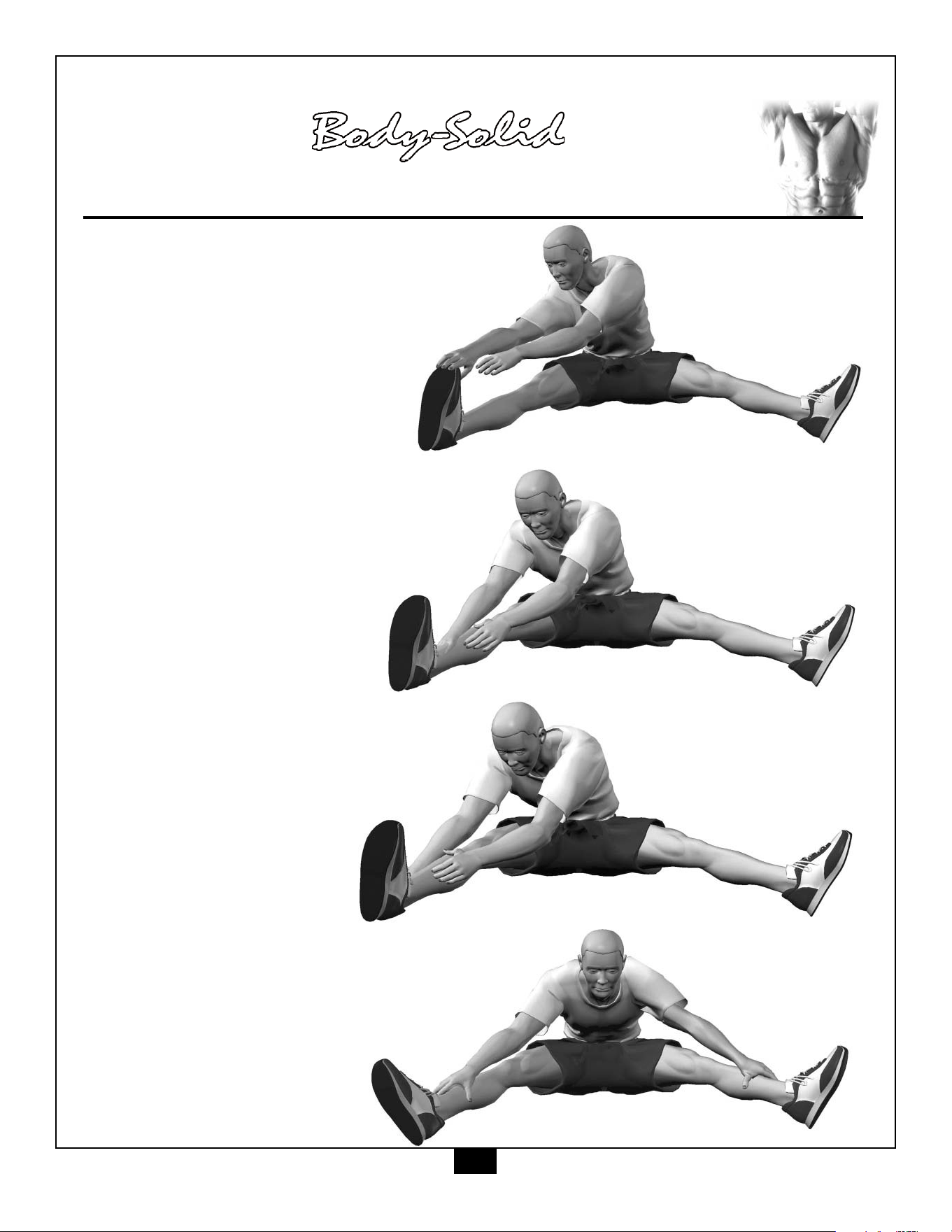
41
Stretching the hamstrings and groin
with emphasis on insertion of
the hamstrings and calves
Stretching the hamstrings and groin
with emphasis on the middle portion
Stretching the hamstrings and groin
with emphasis on the upper portion
Stretching the groin, low
back and hamstrings
GROIN
Straddle (Spread Eagle)
MUSCLE(S) AFFECTED: gastrocnemius, hamstrings,spinal erectors,
adductors and sartorius
1. Sit with the upper body nearly vertical and legs straight, and
spread legs as far as possible.
2. With right hand, grasp toes of right foot and pull on toes slightly,
while pulling chest toward right leg. Hold for 10 seconds.
3. Release toes and relax foot.
4. Grasp ankle and continue to pull chest toward right leg. Hold for
10 seconds.
5. Point toes away from body and continue to pull chest toward right
leg. Hold for 10 seconds.
6. Repeat process with the left leg.
7. Repeat process by grasping right toes with right hand and left
toes with left hand. Move the torso forward and toward the ground.
STRETCHING
WARM-UP/COOL-DOWN
STRETCHING
WARM-UP/COOL-DOWN
STRETCHING
WARM-UP/COOL-DOWN
STRETCHING
WARM-UP/COOL-DOWN
STRETCHING
WARM-UP/COOL-DOWN
STRETCHING
WARM-UP/COOL-DOWN
STRETCHING
WARM-UP/COOL-DOWN
STRETCHING
WARM-UP/COOL-DOWN
STRETCHING
WARM-UP/COOL-DOWN
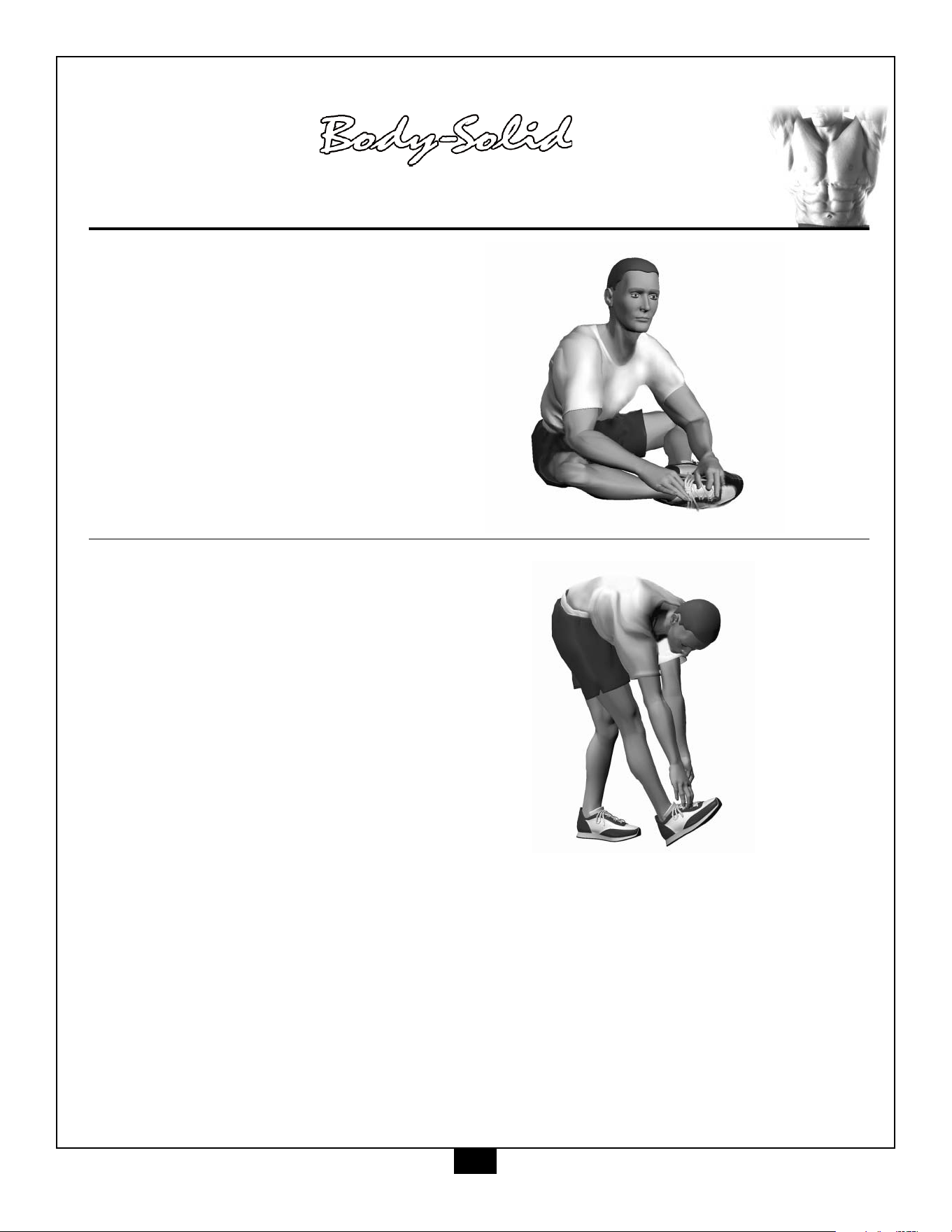
42
GROIN
Butterfly
MUSCLE(S) AFFECTED: adductors and sartorius
1. Sitting with the upper body nearly vertical and legs straight, flex
both knees as the soles of the feet come together.
2. Pull feet toward body.
3. Place hands on feet and elbows on legs.
4. Pull torso slightly forward as elbows push legs down.
5. Hold for 10 to 15 seconds.
POSTERIOR OF LOWER LEG
Bent-Over Toe Raise
MUSCLE(S) AFFECTED: gastrocnemius and soleus
1. Stand with heel of right foot 6 to 8 inches in front of left foot.
2. Flex right foot toward shin (dorsi-flexion) with heel in contact with
floor.
3. Lean forward and try to touch right leg with chest while both legs
are straight.
4. Continue to lean downward with upper body as the foot is
dorsi-flexed near maximal toward the shin.
5. Hold for 10 to 15 seconds.
6. Repeat with the left leg.
Stretching the groin
Stretching calves
without a step
STRETCHING
WARM-UP/COOL-DOWN
STRETCHING
WARM-UP/COOL-DOWN
STRETCHING
WARM-UP/COOL-DOWN
STRETCHING
WARM-UP/COOL-DOWN
STRETCHING
WARM-UP/COOL-DOWN
STRETCHING
WARM-UP/COOL-DOWN
STRETCHING
WARM-UP/COOL-DOWN
STRETCHING
WARM-UP/COOL-DOWN
STRETCHING
WARM-UP/COOL-DOWN
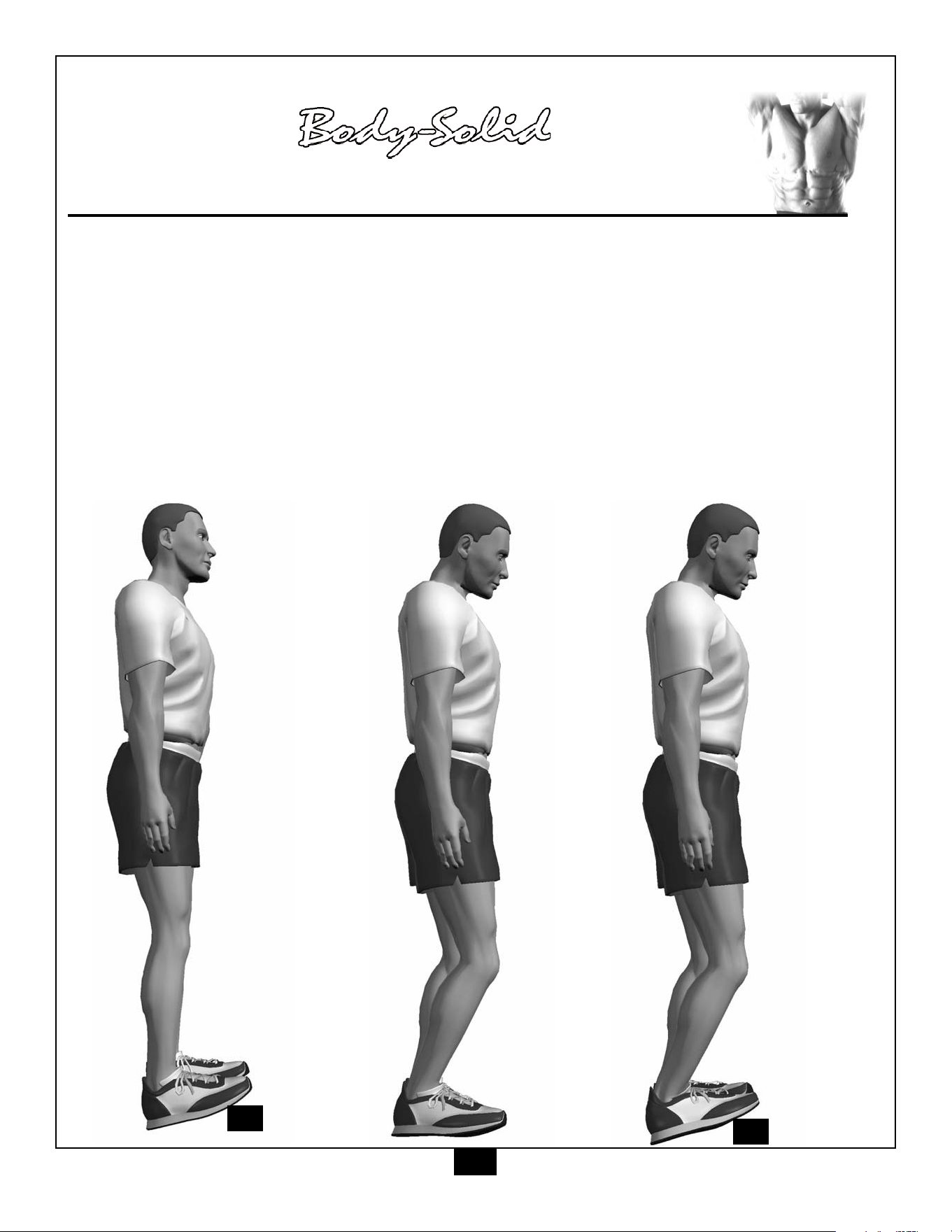
43
Stretching the calves
standing on a step
Preparing to stretch
the achilles tendon by
slightly bending the knee
POSTERIOR OF LOWER LEG
Step Stretch
MUSCLE(S) AFFECTED: gastrocnemius and soleus; also,achilles tendon
1. Have ready a step or board 3 to 4 inches high.
2. Place balls of both feet on the step or board, 1 inch from its edge.
3. With straight legs, lower heels as far as possible.
4. Hold for 10 to 15 seconds.
5. To stretch achilles tendon, raise heels slightly. Slightly flex the
knees and then lower the heels. This stretch will be felt in the
achilles tendon.
6. Hold for 10 to 15 seconds.
7. For a more intense and individualized stretch, perform this stretch
with one leg at a time.
Stretching the
achilles tendon by
lowering the heel
STRETCHING
WARM-UP/COOL-DOWN
STRETCHING
WARM-UP/COOL-DOWN
STRETCHING
WARM-UP/COOL-DOWN
STRETCHING
WARM-UP/COOL-DOWN
STRETCHING
WARM-UP/COOL-DOWN
STRETCHING
WARM-UP/COOL-DOWN
STRETCHING
WARM-UP/COOL-DOWN
STRETCHING
WARM-UP/COOL-DOWN
STRETCHING
WARM-UP/COOL-DOWN

SCB1000 Mainframe Parts List
PART# QTY DESCRIPTION
Part numbers are required when ordering parts.
44
AL 1 Left Front Support Tube
AR 1 Right Front Support Tube
B 2 Rear support tube
C 1 Bottom Connect Tube
D 2 Connect Plate A
E 1 Upper Connect Tube
F 2 Connect Plate B
G 1 Bar
H 1 Right Slide Tube
J 1 Left Slide Tube
K 1 Right Adjust Tube
L 1 Left Adjust Tube
M 1 Right Loading Tube
N 1 Left Loading Tube
P 2 Slide Bar
Q 2 Weight plate
R 6 Weight plate support tube
S 6 Connect Plate C
T 1 Outer cover A
U 1 Inner cover A
V 1 Inner cover B
W 1 Outer cover B
Y 8 Hanger plate

45
SCB1000 Hardware List
Part numbers are required when ordering parts.
1 2 50 x 50 x 2.0 Square End Cap
2 2 Pulley
3 4 Rubber Stopper A
4 6 Rubber Stopper B
5 2 Big Rubber Stopper
6 2 Small Rubber Stopper
10 2 f15 x f10.5 x 37 Tube
11 2 f15 x f10.5 x 12 Tube
12 4 Shaft
13 4 6006 Shaft
14 2 f40 x f30.5 x 7.0 Washer
15 2 f18 x f12.5 x 15 Tube
16 4 Fix Hanger
17 4 f15 x f10.5 x 10 Washer
18 4 f15 x f10.5 x 30 Nut
19 2 f39 x f10.5 x 3.0 Big washer
30 16 M12 x 90 Hex Head Bolt
PART# QTY DESCRIPTION

46
SCB1000 Hardware List
Part numbers are required when ordering parts.
31 2 M10 x 90 Hex Head Bolt
32 32 M12 x 85 Hex Head Bolt
33 2 M8 x 16 Allen Bolt
34 6 M8 x 12 Allen Bolt
35 2 M12 x 45 Hex Head Bolt
36 2 M6 x 12 Round Allen Head Bolt
37 4 M8 x 130 Hex Head Bolt
38 2 M10 x 25 Allen Head Bolt
40 84 f12 Washer
41 4 f10 Washer
42 8 f8 Washer
43 2 f30 Spring Ring
44 4 f40 Spring Ring
45 4 f55 Spring Ring
46 2 f10 Spring washer
50 2 M10 Nylon Nut
51 34 M12 Nylon Nut
52 2 M12 Nylon Nut
53 4 M6 Nylon Nut
54 4 M8 Nylon Nut
60 2 Counterbalance Weight Cable (2000 mm)
61 4 Guide Cable (1640 mm)
PART# QTY DESCRIPTION
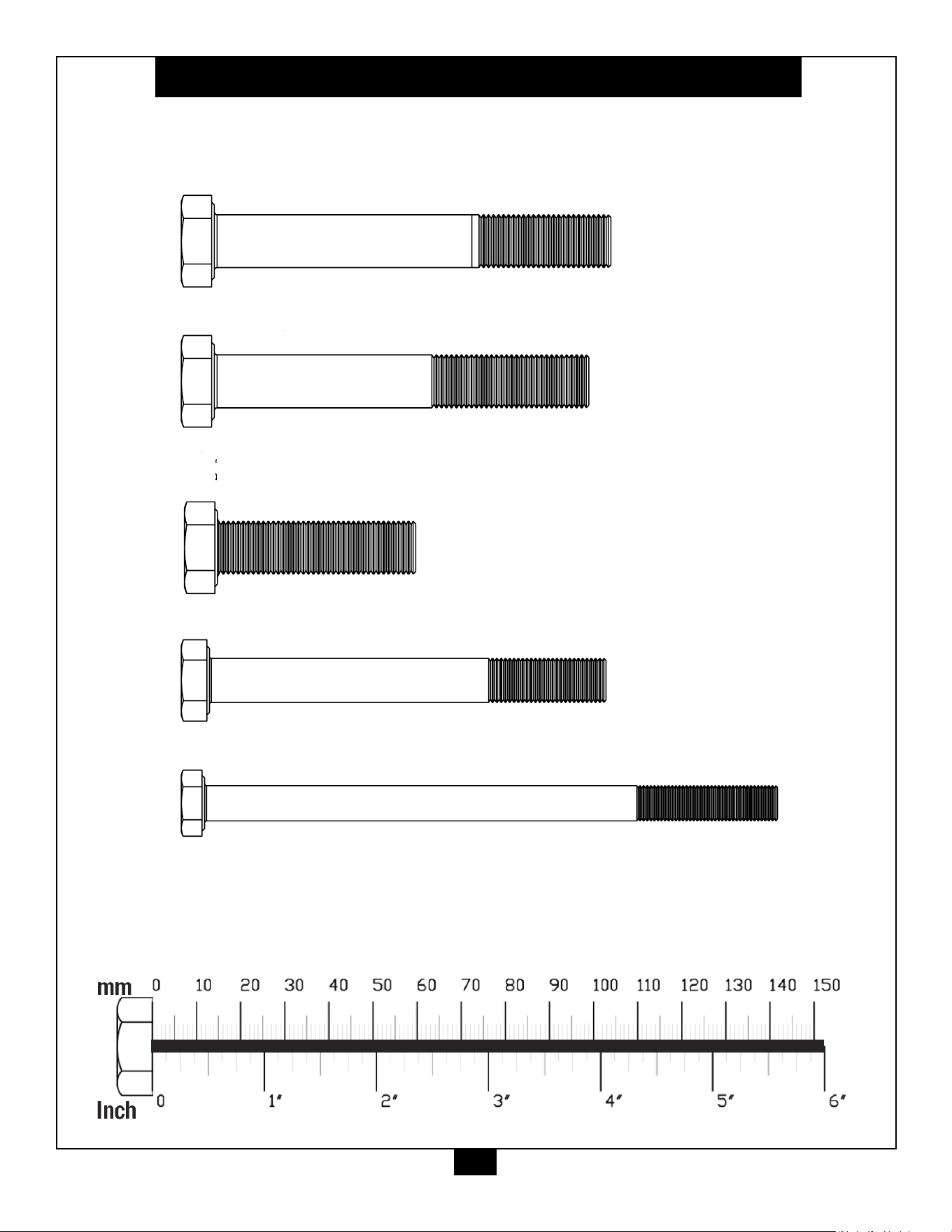
SCB1000 Hardware
(Actual Size Shown)
47
PART #30
f
12x90 HEX HEAD BOLT
PART #32
f
12x85 HEX HEAD BOLT
PART #35
f
12x45 HEX HEAD BOLT
PART #31
f
10x90 HEX HEAD BOLT
PART #37
f
8x130 HEX HEAD BOLT
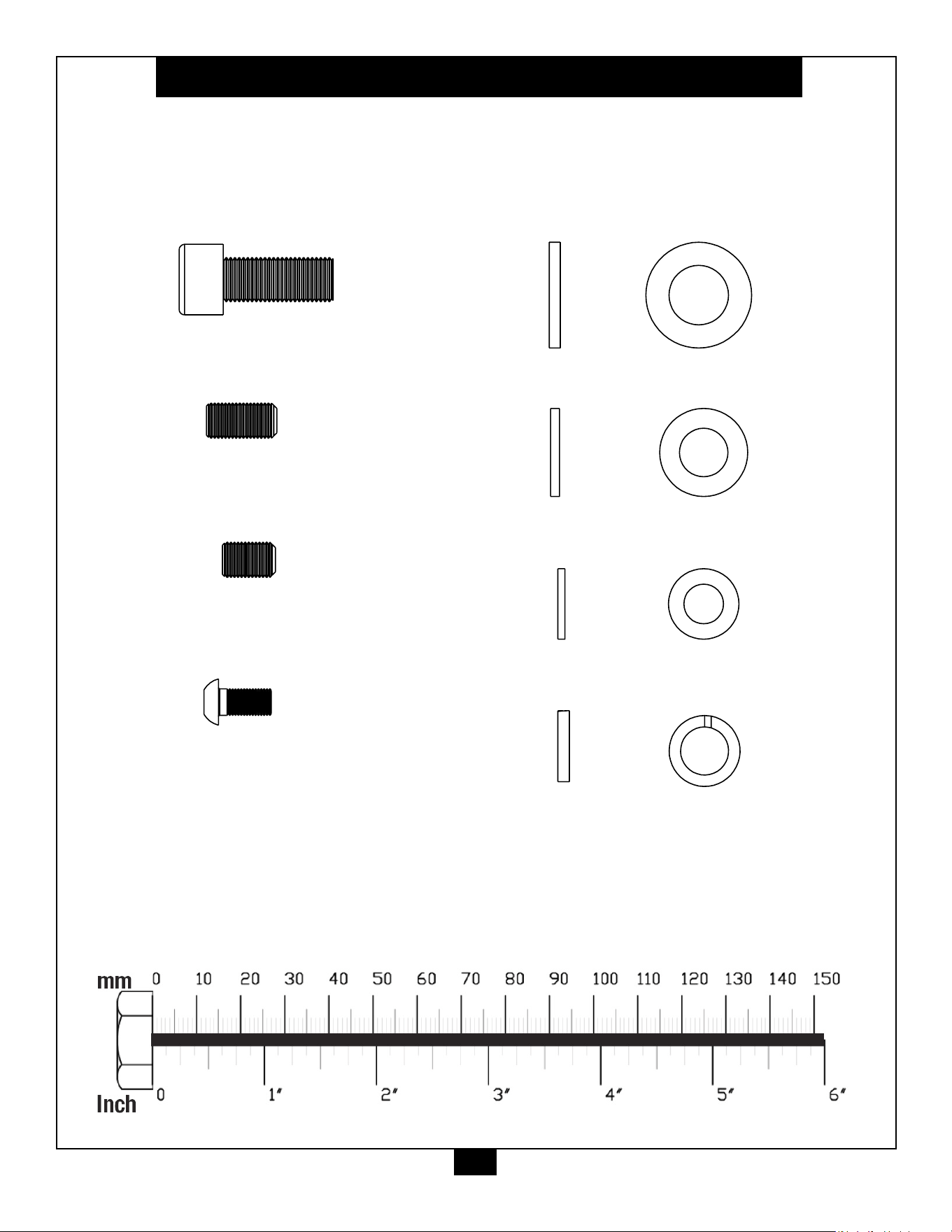
SCB1000 Hardware
(Actual Size Shown)
48
PART #38
f
10x25 ALLEN HEAD BOLT
PART #33
f
8x16 ALLEN BOLT
PART #34
f
8x12 ALLEN BOLT
PART #36
f
6x12 ALLEN HEAD BOLT
PART #40
f
12 WASHER
PART #41
f
10 WASHER
PART #42
f
8 WASHER
PART #46
f
10 SPRING WASHER
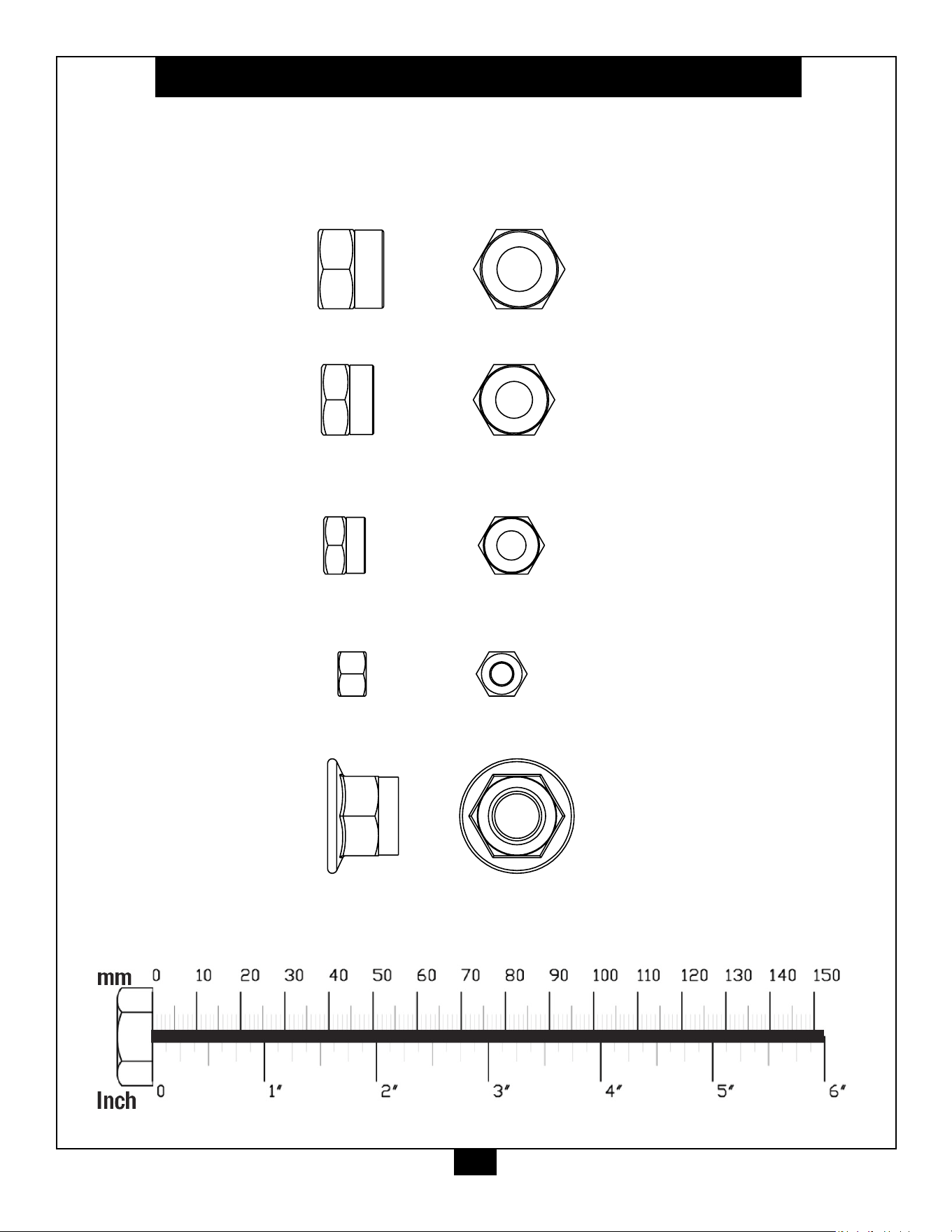
SCB1000 Hardware
(Actual Size Shown)
49
PART #51
f
12 NYLON LOCK NUT
PART #50
f
10 NYLON LOCK NUT
PART #54
f
8 NYLON LOCK NUT
PART #53
f
16 NYLON LOCK NUT
PART #52
f
12 NYLON LOCK NUT
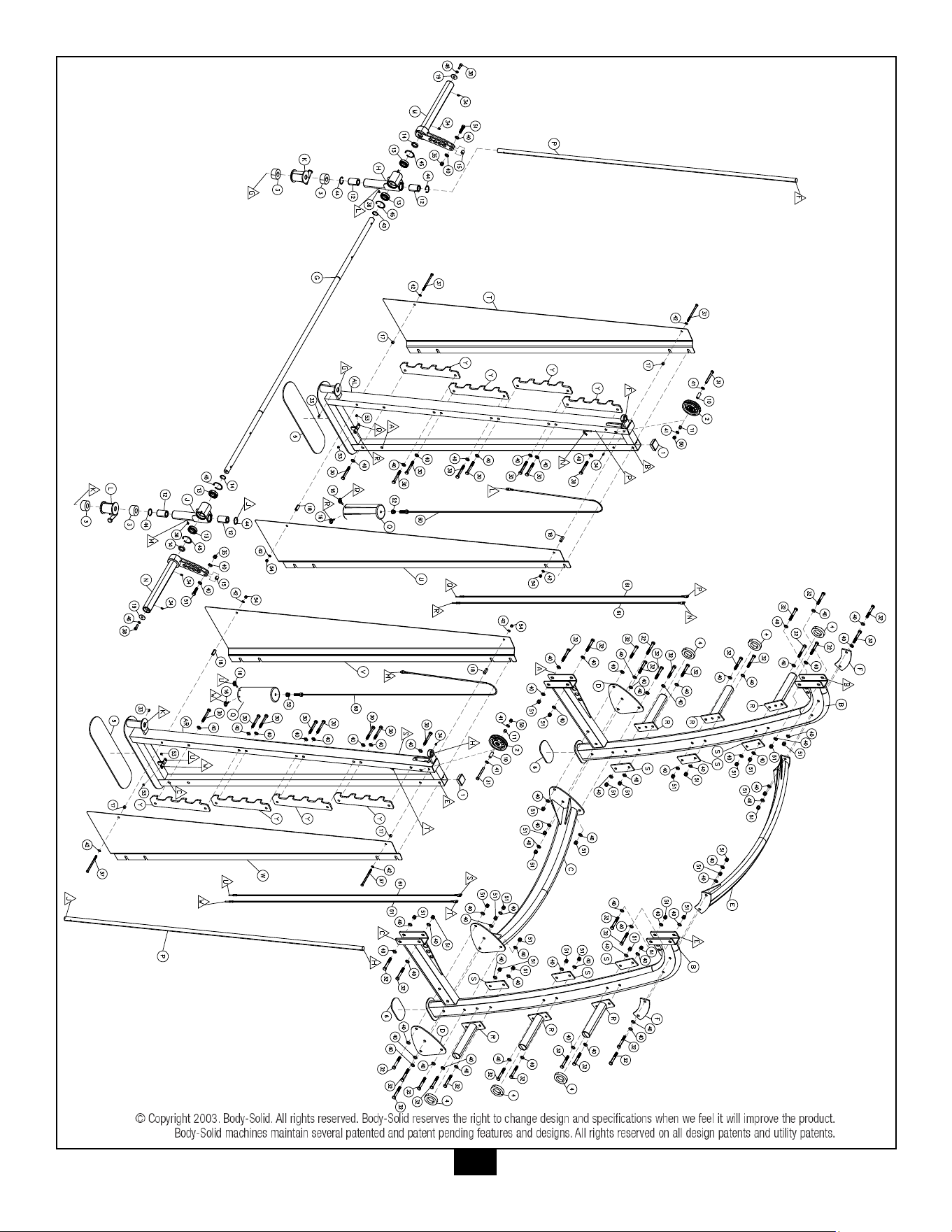
50
EXPLODED VIEW
DIAGRAM