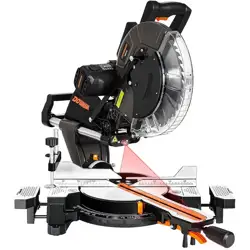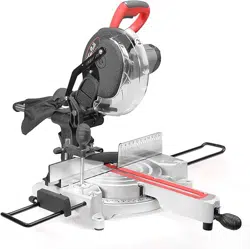
MITER SAW 10 IN
ITEM: SKU
50124
OWNER'S MANUAL AND SAFETY INSTRUCTIONS
SAVE THIS MANUAL: KEEP THIS MANUAL FOR SAFETY WARNINGS, PRECAUTIONS, ASSEMBLY,
OPERATING, INSPECTION, MAINTENANCE AND CLEANING PROCEDURES. WRITE THE PRODUCT'S
SERIAL NUMBER ON THE BACK OF THE MANUAL NEAR THE ASSEMBLY DIAGRAM (OR MONTH
AND YEAR OF PURCHASE IF PRODUCT HAS NO NUMBER}
FOR QUESTIONS PLEASE CALL OUR CUSTOMER SUPPORT: (909) 628 0880 MON-FRI 9AM TO 3PM PST

Read the entire
operating
instructions
prior
to
the
assembly and operation of
the tool.
These operating instructions are
intended
to make it
easier for you lo gel familiar with , your tool and
maximize
its tool.
The
operating
instructions contain
important
notes
on
how to work safely, property and economically
w�h
your
machine
and
how
to
avoid
dangers, save
repair
costs, reduce downtime,
and
increase
the reliability
and
working life of
the
machine.
In
addition
to the safety regulations
contained herein,
you
must
in any
case
comply with the
applicable
regulations
of
your
country
with respect to the
operation
of the
machine.
Put the operating instructions
in
a
clear
plastic folder to protect
them
from dirt and humidity, and
store them near the machine. The mstruct1ons must be
read and carefully 01:>served by each operator prior
to
starting
the work. Only persons who have been
trained in the use of the machine and have been
informed
on
its
related
dangers and risks are allowed to
use the machine. The required minimum
age
must be
met
in
addition
to
the
safety
notes
contained
the
present
operating
instructions
and
the
special regulations
of
your count
ry
.
the
generally recognized technical rules
for the operation of wood working machines must be
observed
Attention!
Read and understand
all
instructions before using this tool.
Wear hearing protection
Wear eye protection.
Wear breathing
protection.
Technical data
Size of saw blade:
No load
speed:
Number
of teeth:
Mitre stops
Rated Power:
Frequency:
Rated
Current:
255 mm/10'
6000 RPM
36T
45•,
30•, 22,5•, 15•,
o·.
15
°
, 22,5•, 30•, 45•
1800W
50/60Hz
13A
Subject to technical modifications.
The height of
the
work piece must
be
at least 3 mm.
Make sure that the work piece is
always
secured with
the clamping device.
General notes
• After unpacking, check all parts for any transport damage.
Inform the supplier
immediately of
any
faults. Make sure the delivery is complete.
• Before
putting
into
operation,
familiarize
yourself with
the
machine by carefully reading these
instructions.
• Use only original accessories, wearing or replacement parts
• When ordering,
include
our
item
number
and the type
and
year
of construction of the machine.
SAFETY INFORMATION

TABLE OF CONTENTS
■ Introduction
..................................................................................................................................................................... 2
■ General Safety Rules .................................................................................................................................................... 3-4
■ Specific Safety Rules .................................................................................................................................................... 4-5
■ Symbols ........................................................................................................................................................................ 6-7
■ Electrical .......................................................................................................................................................................... 8
■ Glossary of Terms ............................................................................................................................................................ 9
■ Features .................................................................................................................................................................... 10-12
■ Tools Needed ................................................................................................................................................................. 12
■ Loose Parts List ............................................................................................................................................................. 13
■ Assembly .................................................................................................................................................................. 14-21
■ Operation .................................................................................................................................................................. 22-31
■ Adjustments .............................................................................................................................................................. 32-33
■ Maintenance .................................................................................................................................................................. 34
■ Parts Ordering
I
Service ................................................................................................................................................ 36
INTRODUCTION
This tool has many features for making its use more pleasant and enjoyable. Safety, performance, and dependability have
been given top priority in the design
of
this product making it easy to maintain and operate.
2

GENERAL SAFETY RULES
WARNING:
Read and understand all instructions. Failure to follow
all instructions listed below, may result in electric shock,
fire and/or serious personal injury.
READ ALL INSTRUCTIONS
■
KNOWYOUR POWER TOOL.
Read the operator's manual
carefully. Learn the applications and limitations as well
as the specific potential hazards related to this tool.
■
GUARD AGAINST ELECTRICAL SHOCK BY PREVENT-
ING BODY CONTACT WITH GROUNDED SURFACES.
For example: pipes, radiators, ranges, refrigerator enclo-
sures.
■
KEEP GUARDS IN PLACE
and in good working
order.
■
REMOVE ADJUSTING
KEYS
AND WRENCHES.
Form
habit of checking to see that keys and adjusting wrenches
are
removed from tool before turning it on.
■
KEEPWORKAREA CLEAN.
Cluttered areas and benches
invite accidents.
DO NOT
leave tools or pieces of wood
on the tool while it is in operation.
■
DO NOT USE IN DANGEROUS ENVIRONMENTS.
Do
not use power tools in damp or wet locations or expose
to rain. Keep the work area well lit.
■
KEEP CHILDREN AND VISITORS AWAY.
All
visitors
should
wear safety glasses and
be
kept a safe
distance from work area. Do not let visitors
contact
tool or extension cord while operating.
■
MAKE WORKSHOP CHILDPROOF
with padlocks,
master switches, or by removing starter keys.
■
DON'T FORCE THE TOOL.
It will do the
job
better
and
safer
at
the feed rate
for
which
it
was designed.
■
USE THE RIGHT TOOL.
Do not force the tool or attach-
ment to do a job for which it was not designed.
■
USE THE PROPER EXTENSION CORD.
Make sure your
extension cord is in good condition. Use only a
cord
heavy
enough to carry the current your product will draw. An
undersized cord will cause a drop in line voltage result-
ing in loss of power and overheating. A wire gauge size
(A.W.G.) of at least 14 is recommended for an extension
cord 25 feet or less in length. If in doubt, use the next
heavier gauge. The smaller the gauge number, the heavier
the cord.
■
DRESS PROPERLY.
Do not wear loose clothing,
neckties, or jewelry that can get caught and draw you into
moving parts. Rubber gloves and nonskid footwear are
recommended when working outdoors. Also wear protec-
tive
hair
covering to
contain long hair.
■
ALWAYS WEAR SAFETY GLASSES WITH SIDE
SHIELDS.
Everyday eyeglasses have only impact-
resistant lenses, they are
NOT
safety glasses.
3
■
SECURE WORK.
Use clamps or a vise to hold work
when practical, it is safer than using your hand and frees
both hands to operate the tool.
■
DO NOT OVERREACH.
Keep
proper
footing and
balance at all times.
■
MAINTAIN TOOLS WITH CARE.
Keep tools
sharp
and clean for better and safer performance. Follow
instructions for lubricating and changing accessories.
■
DISCONNECT TOOLS.
When not in use, before
servicing, or when changing attachments, blades, bits,
cutters, etc., all tools should be disconnected from power
source.
■
AVOID ACCIDENTAL STARTING.
Be sure switch is off
when plugging in any tool.
■
USE RECOMMENDED ACCESSORIES.
Consult the
operator's
manual
for
recommended accessories. The
use of improper accessories may result in injury.
■
NEVER STAND ON TOOL.
Serious injury could
occur if
the tool is tipped.
■
CHECK DAMAGED PARTS.
Before further use of the
tool, a guard or other part that is damaged should be
carefully checked to determine that it will operate properly
and perform its intended function. Check for alignment
of moving parts, binding of moving parts, breakage of
parts, mounting and any other conditions that may affect
its operation. A guard or other
part
that is damaged must
be properly repaired or replaced by an authorized service
center to avoid risk of personal injury.
■
USE THE RIGHT DIRECTION OF FEED.
Feed work into
a blade, cutter, or sanding spindle against the direction
or rotation of the blade, cutter, or sanding spindle only.
■
NEVER LEAVE TOOL RUNNING UNATTENDED. TURN
THE POWER OFF.
Don't leave tool until it comes to a
complete stop.
■
PROTECT YOUR LUNGS.
Wear a face or dust mask if
the cutting operation is dusty.
■
PROTECT YOUR HEARING.
Wear hearing protection
during extended periods of operation.
■
DO NOT ABUSE CORD.
Never carry tool by the cord or
yank it to disconnect from receptacle. Keep cord from
heat, oil, and sharp edges.
■
USE OUTDOOR EXTENSION CORDS.
When tool
is used outdoors, use only extension cords with
approved ground connection that are intended for
use
outdoors and so marked.
■
KEEP BLADES CLEAN, SHARP, AND WITH
SUFFICIENT SET.
Sharp blades minimize stalling
and kickback.
■
BLADE COASTS AFTER BEING TURNED OFF.

GENERAL
SAFETY
RULES
NEVER USE IN AN EXPLOSIVE ATMOSPHERE.
Normal sparking of the motor could ignite fumes.
INSPECT
TOOL CORDS PERIODICALLY.
If
damaged, have repaired bya qualified
service
technician at
an authorized service facility. Theconductorwith insulation
having an outer surface that is green with or without yellow
stripes is the equipment-grounding conductor. If repair
or replacement of the electric cord or plug is necessary,
do not connect the equipment-grounding conductor to a
live terminal. Repair or replace a damaged or worn cord
immediately. Stay constantly aware of cord location and
keep it well away from the rotating blade.
INSPECT EXTENSION CORDS PERIODICALLY
and
replace if damaged.
GROUND ALL TOOLS.
If tool is equipped with three-
prong
plug,
it should be plugged into a three-hole electri-
cal receptacle.
CHECK WITH A QUALIFIED ELECTRICIAN
or service
personnel if the grounding instructions are not completely
understood or if in doubt as to whether the tool is properly
grounded.
USE ONLY
CORRECT ELECTRICAL DEVICES:
3-wire
extension cords that have 3-prong grounding plugs and
3-pole receptacles that accept the tool's plug.
DO NOT MODIFY
the plug provided. If it will not fit the
outlet, have the proper outlet installed by a qualified
electrician.
KEEP TOOL DRY, CLEAN, AND FREE FROM OIL AND
GREASE.
Always use a clean cloth when cleaning. Never
use brake fluids, gasoline, petroleum-based products, or
any solvents to clean tool.
STAY ALERT AND EXERCISE CONTROL.
Watch what
you are doing and use common sense. Do not operate
tool when you are tired. Do not rush.
DO NOT USE TOOL IF SWITCH DOES NOT TURN IT
ON AND OFF.
Have defective switches replaced by an
authorized service center.
USE ONLY CORRECT BLADES. Do not
use blades with
incorrect size holes. Never use blade washers or blade
bolts that are defective or incorrect. The maximum blade
capacity of your saw is 10 in.
■
BEFORE MAKING A CUT, BE SURE ALL ADJUST-
MENTS ARE SECURE.
■
BE SURE BLADE PATH IS FREE OF NAILS.
Inspect for
and remove all nails from lumber before cutting.
NEVER TOUCH BLADE
or other moving parts during
use.
NEVER START A TOOL WHEN ANY ROTATING COM-
PONENT IS IN CONTACT WITH THE WORKPIECE.
■
DO NOT OPERATE A TOOL WHILE UNDER THE
INFLUENCE OF DRUGS, ALCOHOL, OR ANY
MEDICATION.
■
WHEN SERVICING
use only identical replacement parts.
Use
of
any other parts may create a hazard or cause
product damage.
USE ONLY RECOMMENDED ACCESSORIES
listed
in this manual or addendums. Use of accessories
that
are not listed may cause the risk of personal injury.
Instructions for safe use of accessories are included
with the accessory.
■
DOUBLE CHECK ALL SETUPS.
Make sure blade is
tight and not making contact with saw or workpiece
before connecting to power supply.
SPECIFIC SAFETY RULES
FIRMLY CLAMP OR BOLT
the tool
to
a workbench
or
table at approximately hip height.
KEEP
HANDS
AWAY
FROM
CUTTING AREA.
Do
not
reach underneath work or in blade cutting path with hands
and
fingers for any reason. Always turn the power off.
ALWAYS SUPPORT LONG WORKPIECES
while cutting
to minimize risk of blade pinching and kickback. Saw
may
slip, walk or
slide
while cutting long or
heavy boards.
ALWAYS USE A CLAMP
to secure the workpiece when
possible.
BE SURE THE BLADE CLEARS THE WORKPIECE.
Never start the saw with the blade touching the
workpiece. Allow
motor to come
up
to
full
speed
before
starting
cut.
4
■
MAKE SURE THE MITER TABLE AND SAW ARM
(BEVEL FUNCTION) ARE LOCKED IN POSITION
BEFORE OPERATING YOUR SAW.
Lock the miter
table by securely tightening the miter lock levers. Lock
the saw arm (bevel function) by securely tightening the
bevel lock lever.
■
NEVER USE A LENGTH STOP ON THE FREE SCRAP
END OF A CLAMPED WORKPIECE. NEVER
hold onto
or bind the free scrap end of the workpiece in any opera-
tion. If a work clamp and length stop are used together,
they must both be installed on the same side
of
the saw
table to prevent the saw from catching the loose end and
kicking up.
NEVER
cut
more
than one piece at a time.
DO NOT
STACK
more than one workpiece on the saw table at a
time.

SPECIFIC SAFETY RULES
■
NEVER PERFORM ANY OPERATION FREEHAND.
Always place the workpiece to be cut on the miter table
and position it firmly against the fence as a backstop.
Always use the fence.
■
NEVER
hand hold a workpiece that is too small to be
clamped. Keep hands clear of the cutting area.
■
NEVER
reach behind, under, or within three inches of the
blade and its cutting path with hands and fingers for any
reason.
■
NEVER
reach to pick up a workpiece, a piece of scrap,
or anything else that is in or near the cutting path of the
blade.
■
NEVER
move the workpiece or make adjustment to any
cutting angle while the saw is running and the blade is
rotating. Any slip can result in contact with the blade
causing serious personal injury.
■
AVOID AWKWARD OPERATIONS AND HAND
POSITIONS
where a sudden slip could cause your
hand to move into the blade.
ALWAYS
make sure you
have good balance.
NEVER
operate the miter saw
on the floor or in
a
crouched position.
■
NEVER
stand or have any part of the body in line with
the path of the saw blade.
■
ALWAYS
release the power switch and allow the saw blade
to stop rotating before raising it out of the workpiece.
■
DO NOT TURN THE MOTOR SWITCH ON AND OFF
RAPIDLY.
This could cause the saw blade to loosen
and could create a hazard. Should this ever occur,
stand clear and allow the saw blade to come to a
complete stop. Disconnect your saw from the power
supply and securely retighten the blade bolt.
■
IF ANY PART OF THIS MITER SAW IS MISSING
or
should break, bend, or fail in any way, or should any
electrical component fail to perform properly, shut off
the power switch, remove the miter saw plug from the
power source
and
have
damaged,
missing, or failed parts
replaced before resuming operation.
■
ALWAYS STAY ALERT!
Do not allow familiarity (gained
from frequent
use of the
saw)
to cause a careless
mistake.
ALWAYS REMEMBER
that a careless frac-
tion of a second is sufficient to inflict severe injury.
5
■
IF THE POWER SUPPLY CORD IS DAMAGED,
it must
be replaced only by the manufacturer or by an authorized
service center to avoid risk.
■
MAKE SURE WORK AREA HAS AMPLE LIGHTING
to
see the work and that no obstructions will interfere with
safe operation
BEFORE
performing any work using the
saw.
■
ALWAYS TURN OFF THE SAW
before disconnecting it
to avoid accidental starting when reconnecting to power
supply.
NEVER
leave the saw unattended while connected
to a power source.
■
RELEASE THE
SWITCH
TRIGGER
and allow
the
saw
blade to stop rotating before raising the blade out of
workpiece.
■
THIS TOOL
should have the following markings:
a) Wear eye protection.
b) Keep hands out of path of saw blade.
c) Do not operate saw without guards in place.
d) Do not perform any operation freehand.
e) Never reach around saw blade.
f) Turn off tool and wait for saw blade to stop before
moving workpiece or changing settings.
g) Disconnect power (or unplug tool
as
applicable)
before changing blade or servicing.
h) No load speed.
■
ALWAYS MAKE SURE THE SAW BLADE HAS CLEAR-
ANCE OF ALL OBSTRUCTIONS BEFORE TURNING
THE SAW ON.
■
MAKE SLIDING CUTS
by pushing the saw blade down
on top of the workpiece then sliding it back toward the
rear of the saw. DO NOT pull the saw toward you while
making a cut.
■
ALWAYS
carry the tool only by the carrying handle.
■
AVOID
direct eye exposure when using the laser guide.
■
THIS SAW CAN TIP OVER
if the saw head is
released
suddenly and the saw is not secured to a work sur-
face. ALWAYS secure this saw to a stable work sur-
face before any use to avoid serious personal injury.
■
SAVE THESE INSTRUCTIONS.
Refer to them
frequently and use to instruct other users. If you loan
someone this tool, loan them these instructions also.
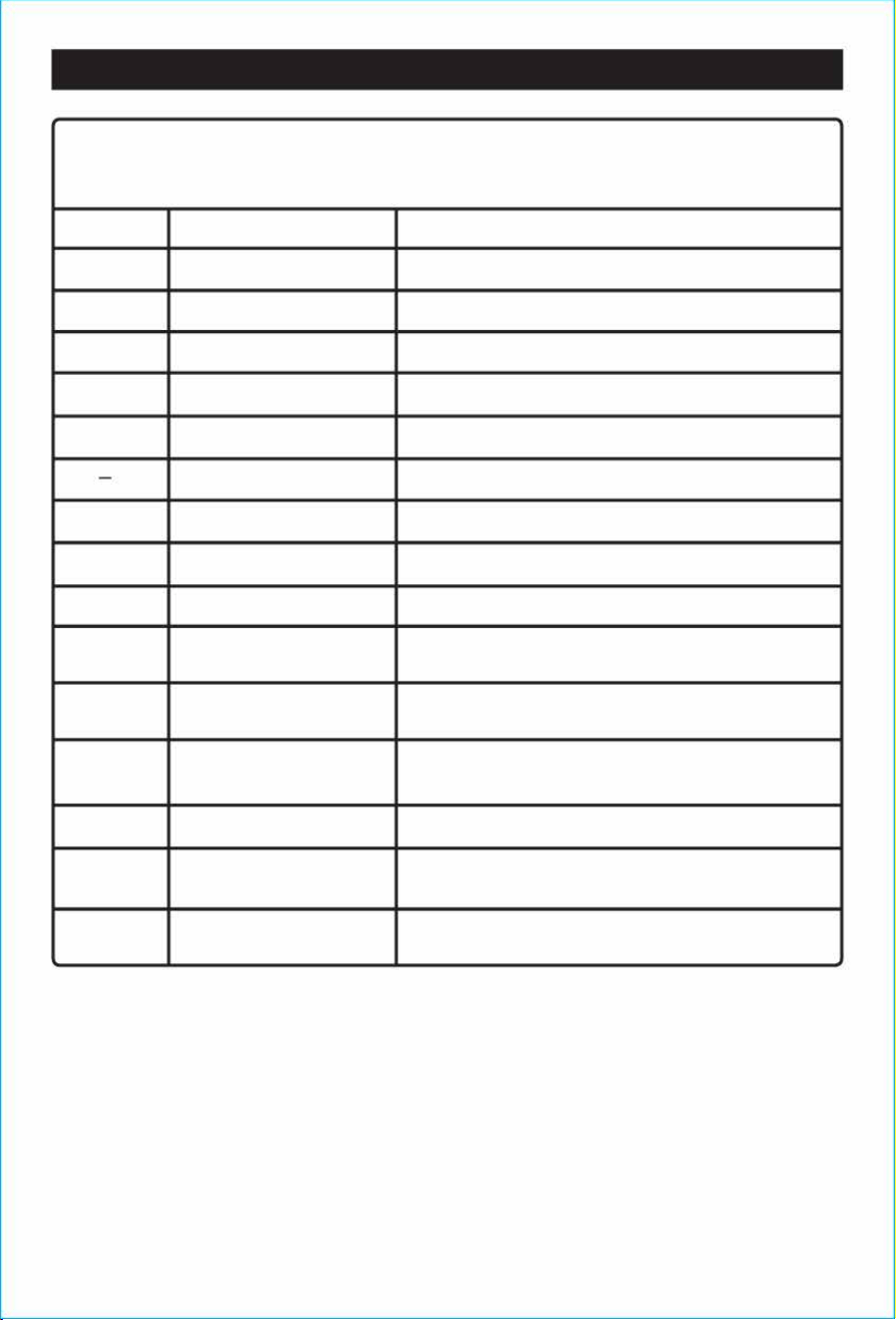
SYMBOLS
Some of the following symbols may be used on this tool. Please study them and learn their meaning. Proper
interpretation of these symbols will allow you to operate the tool better and safer.
SYMBOL
NAME DESIGNATION/EXPLANATION
V
Volts Voltage
A Amperes Current
Hz
Hertz Frequency (cycles per second)
w
Watt Power
min Minutes Time
'v
Alternating Current
Type of current
---
Direct Current Type or a characteristic of current
no
No Load Speed Rotational speed, at no load
[Q]
Class II Construction Double-insulated construction
..
Per Minute Revolutions, strokes, surface speed, orbits etc., per minute
Wet Conditions Alert Do not expose to rain or use in damp locations.
Read The Operator's Manual
To reduce the risk of injury, user must read and understand opera
tor's manual before using this product.
Eye Protection
Always wear safety goggles or safety glasses with srde shields and,
as necessary, a full face shield when operating this product.
Safety Alert
Precautions that involve your safety.
No Hands Symbol
Failure to keep your hands away from the blade will result in
serious personal injury.
Hot Surface
To reduce the risk of injury or damage, avoid contact with any
hot
surface.
6
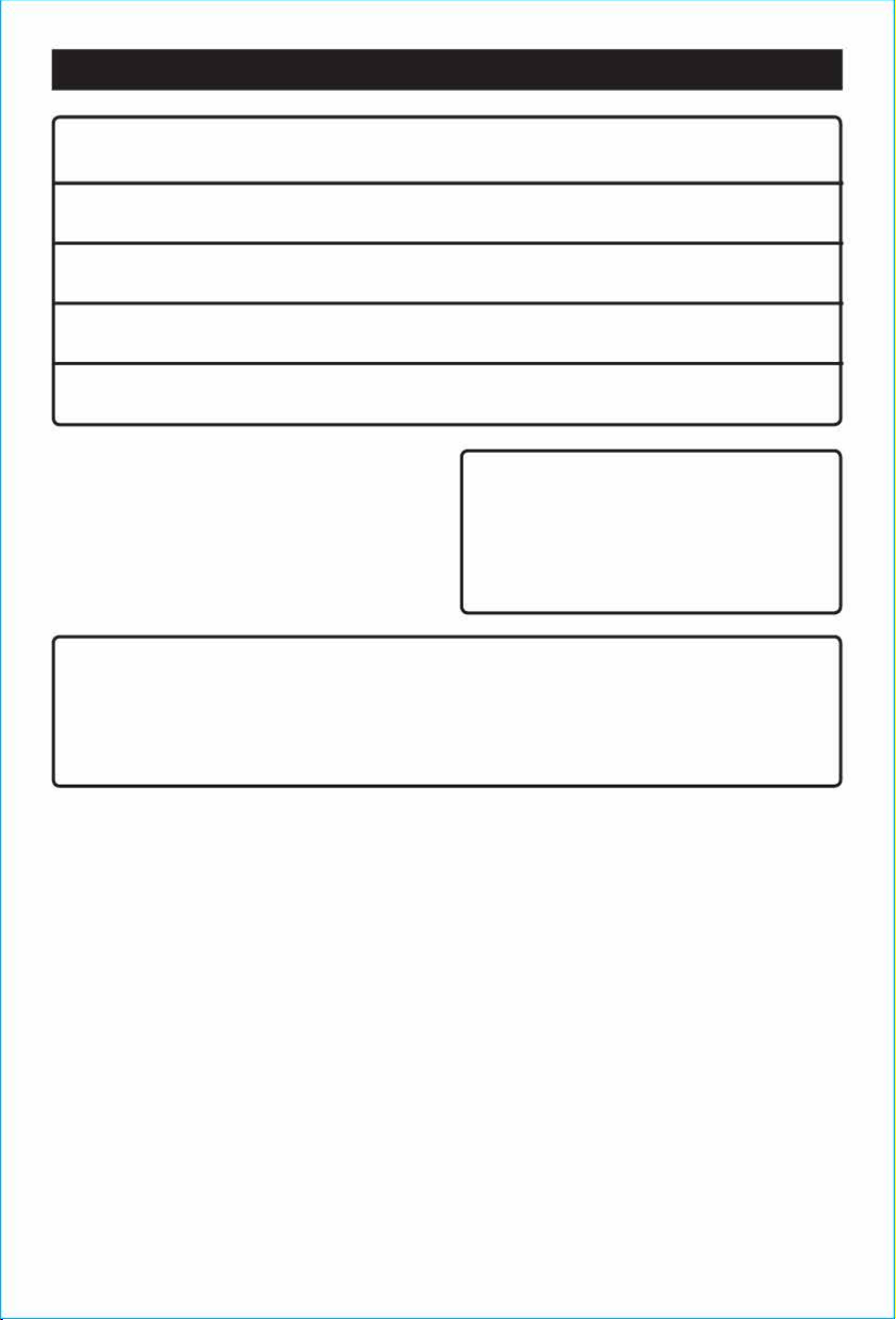
SYMBOLS
The following signal words and meanings are intended to explain the levels of risk associated with this product.
SIGNAL
MEANING
DANGER:
Indicates an imminently hazardous situation, which, if not avoided, will result
in death or serious injury.
WARNING:
Indicates
a
potentially hazardous situation, which, if not avoided,
could
result
in death or serious injury.
CAUTION:
Indicates a potentially hazardous situation, which, if not avoided, may result in
minor or moderate injury.
CAUTION:
(Without Safety Alert Symbol} Indicates a situation that may result in property
damage.
SERVICE
Servicing requires extreme care and knowledge and should
be performed only by a qualified service technician. For
service we suggest you return the product to the nearest
AUTHORIZED SERVICE CENTER
for repair. When servic-
ing, use only identical replacement parts.
WARNING:
To avoid serious personal injury, do not attempt to use this
product until you read thoroughly and understand com-
pletely the operator's manual. If you do not understand
the warnings and instructions in the operator's manual,
do not use this product. Call customer service for
assistance.
WARNING:
The operation of any power tool c
an result in foreign objects being thrown into your eyes, which can result in
severe eye damage. Before beginning power tool operation, always wear safety goggles or safety glasses with side
s
hields and, when needed, a full face shield. We recommend Wide Vision Safety Mask for use over eyeglasses or
standard safety glasses with side shields. Always use eye protection which is marked to comply with ANSI Z87.1.
SAVE
THESE INSTRUCTIONS
7
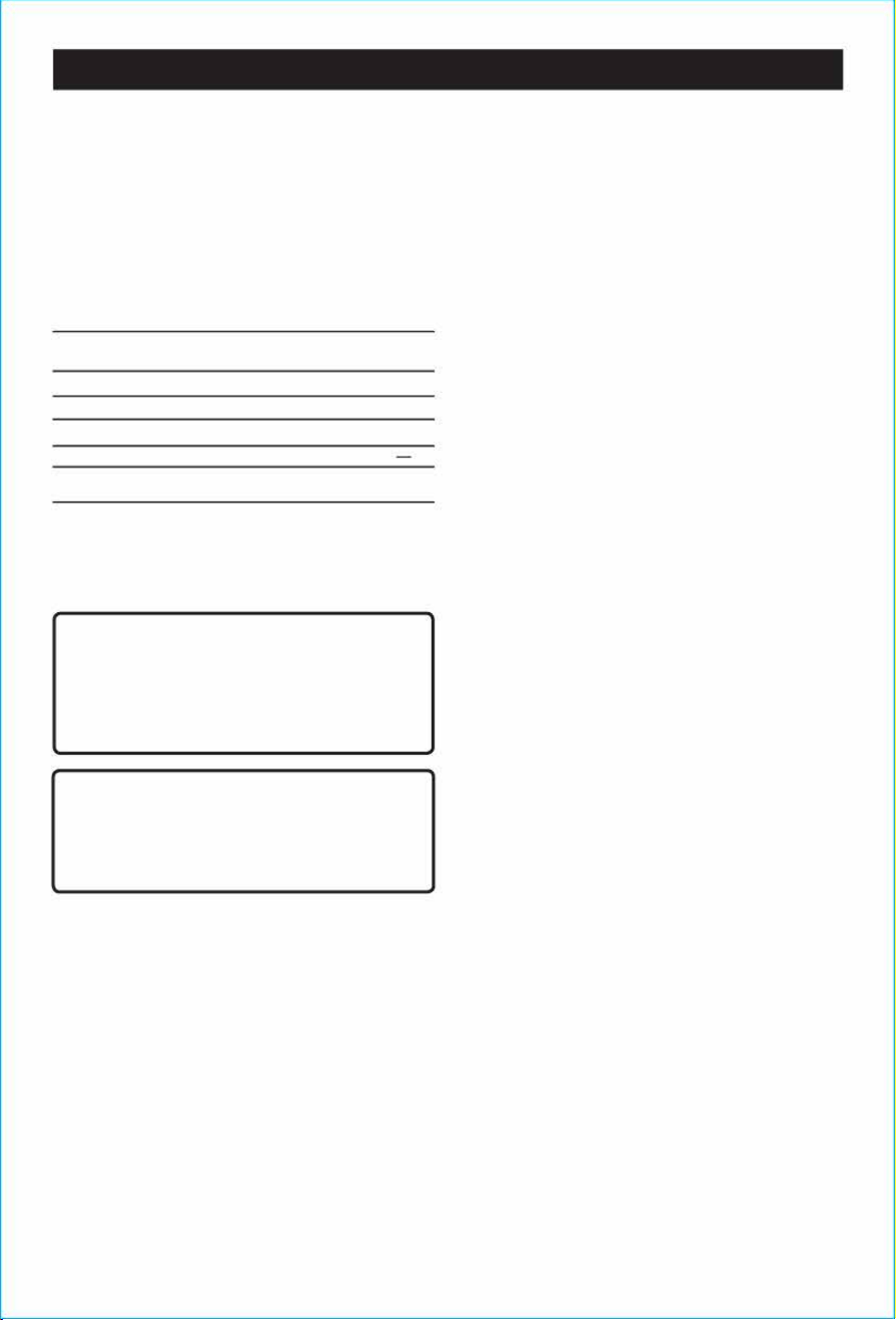
ELECTRICAL
EXTENSION CORDS
Use only 3-wire extension cords that have 3-prong ground-
ing plugs and 3-pole receptacles that accept the tool's plug.
When using a power tool at a considerable distance from the
power source, use an extension cord heavy enough to carry
the current that the tool will draw. An undersized extension
cord will cause a drop in line voltage, resulting in a loss of
power
and causing the motor
to
overheat. Use the chart
provided below
to
determine the minimum wire size required
in an extension cord. Only round jacketed cords listed by
Underwriter's Laboratories
(UL)
should be used.
""Ampere rating (on tool
data
plate)
0-2.0 2.1-3.4 3.5-5.0 5.1-7.0 7.1-12.0 12.1-16.0
Cord Length
25' 16
50'
16
100'
16
Wire Size (A.W.G.)
16 16 16 14
16 16 14
14
16 14
12
10
... Used on 12 gauge
- 20
amp circuit.
NOTE: AWG = American Wire
Gauge
14
12
When working with the tool outdoors, use an extension cord
that is designed for outside use. This is indicated by the
letters "WA" on the cord's jacket.
Before using an extension cord, inspect it for loose or
exposed wires and cut or worn insulation.
WARNING:
Keep the extension cord clear of the working area.
Position the cord
so
that it will not get caught on lumber,
tools or other obstructions while you are working with a
power tool. Failure to do so can result in serious personal
injury.
WARNING:
Check extension cords before each use. If damaged
replace immediately. Never use tool with a damaged cord
since touching the damaged area could cause electrical
shock resulting in serious injury.
ELECTRICAL CONNECTION
This tool is powered by a precision built electric motor. It
should be connected to a
power supply that is 120
V,
AC
only, 60 Hz, (normal household current).
Do not operate
this tool on direct current (DC). A substantial voltage drop
will cause a loss of power and the motor will overheat. If the
saw does not operate when plugged into an outlet, double
check the power supply.
8
SPEED AND WIRING
The no-load speed of this tool is approximately 4,500
RPM. This speed is not constant and decreases under
a load
or
with lower voltage. For voltage, the wiring in a
shop is as important as the motor's horsepower rating. A
line intended only for lights cannot
properly
carry
a
power
tool motor. Wire that is heavy enough for a short distance
will be too light for a greater distance. A line that can
support one power tool may not be able to support two
or three tools.
GROUNDING INSTRUCTIONS
In the event of a malfunction or breakdown, grounding
provides a path of least resistance for electric current to
reduce the risk of electric shock. This tool is equipped with
an electric cord having an equipment-grounding conduc-
tor
and a grounding plug. The plug
must
be plugged into a
matching outlet that is
properly
installed and grounded in
accordance with all local codes and ordinances.
Do
not
modify the plug provided. If it will not fit the outlet,
have the proper outlet installed by a qualified electrician.
Improper
connection of the equipment-grounding conduc-
tor can result in a risk of electric shock. The conductor with
insulation having an outer surface that is green with or with-
out yellow stripes is the equipment-grounding conductor. If
repair or replacement of the electric cord or plug is neces-
sary, do not connect the equipment-grounding conductor
to a live terminal.
Check with a qualified electrician or service personnel if the
grounding instructions are not completely understood, or if
in doubt as to whether the tool is properly grounded.
Repair or replace a damaged or worn cord immediately.

GLOSSARY OF
TERMS
Anti-Kickback Pawls (radial arm and table saws)
A device which, when properly installed and maintained,
is designed to stop the workpiece from being kicked back
toward the front of the saw during a ripping operation.
Arbor
The shaft on which a blade or cutting tool is mounted.
Bevel Cut
A cutting operation made with the blade at any angle other
than
go
0
to the table surface.
Chamfer
A cut removing a wedge from a block so the end (or part of
the end) is angled rather than at go
0
•
Compound Cut
A cross cut made with both a
miter
and a bevel angle.
Cross Cut
A cutting or shaping operation made across the grain or the
width of the workpiece.
Cutter Head (planers and jointer planers)
A rotating cutterhead with adjustable blades or knives. The
blades or knives remove material from the workpiece.
Dado Cut
A non-through cut which produces a square-sided notch or
trough
in the workpiece (requires a special blade).
Featherboard
A device used to help control the workpiece by guiding
it securely against the table or fence during any ripping
operation.
FPM orSPM
Feet per minute (or strokes per minute), used in reference
to
blade movement.
Freehand
Performing
a cut
without the workpiece being guided by a
fence, miter gauge, or other aids.
Gum
A
sticky, sap-based residue from
wood
products.
Heel
Alignment of the blade to the fence.
Kerf
The material removed by the blade in a through cut or the
slot produced by the blade in a non-through or partial cut.
Kickback
A hazard
that
can occur when the blade binds or stalls,
throwing the workpiece back toward operator.
Leading End
The end of the workpiece pushed into the tool first.
Miter Cut
A cutting operation made with the workpiece at any angle
to the
blade
other than go
0
•
9
Non-Through Cuts
Any cutting operation where the blade does not extend
completely through the thickness of the workpiece.
Push Blocks (for jointer planers)
Device used to feed the workpiece over the jointer planer
cutterhead during any operation. This aid helps keep the
operator's hands well away from the cutterhead.
Push Blocks and Push Sticks (for table saws)
Devices used to feed the workpiece through the saw blade
during cutting operations. A push stick (not a push block)
should be used for narrow ripping operations. These aids
help keep the operator's hands well away from the blade.
Pilot Hole (drill presses)
A small hole drilled in a workpiece that serves as a guide for
drilling large holes accurately.
Resaw
A cutting operation to reduce the thickness of the workpiece
to make thinner pieces.
Resin
A sticky, sap-based substance that has hardened.
Revolutions Per Minute (RPM)
The number of turns completed
by
a spinning object in one
minute.
Ripping or Rip Cut
A cutting operation along the length of the workpiece.
Riving Knife/Spreader/Splitter (table saws)
A metal piece, slightly thinner than the blade, which helps
keep the kerf open and also helps to prevent kickback.
Saw Blade Path
The area
over,
under, behind, or in
front of
the blade.
As it
applies
to the workpiece, that area which will be or has been
cut by the blade.
Set
The distance that the tip of the saw
blade
tooth is bent (or
set)
outward from the
face of
the blade.
Snipe (planers)
Depression made at either end of a workpiece by cutter
blades when the workpiece is
not
properly supported.
Through Sawing
Any cutting operation where the blade extends completely
through the thickness of the workpiece.
Throw-Back
The throwing back of a workpiece usually caused by the
workpiece being dropped into the blade or being placed
inadvertently in contact with the blade.
Workpiece or Material
The item on which the operation is being done.
Worktable
Surface where the workpiece rests while performing a
cutting, drilling, planing, or sanding operation.
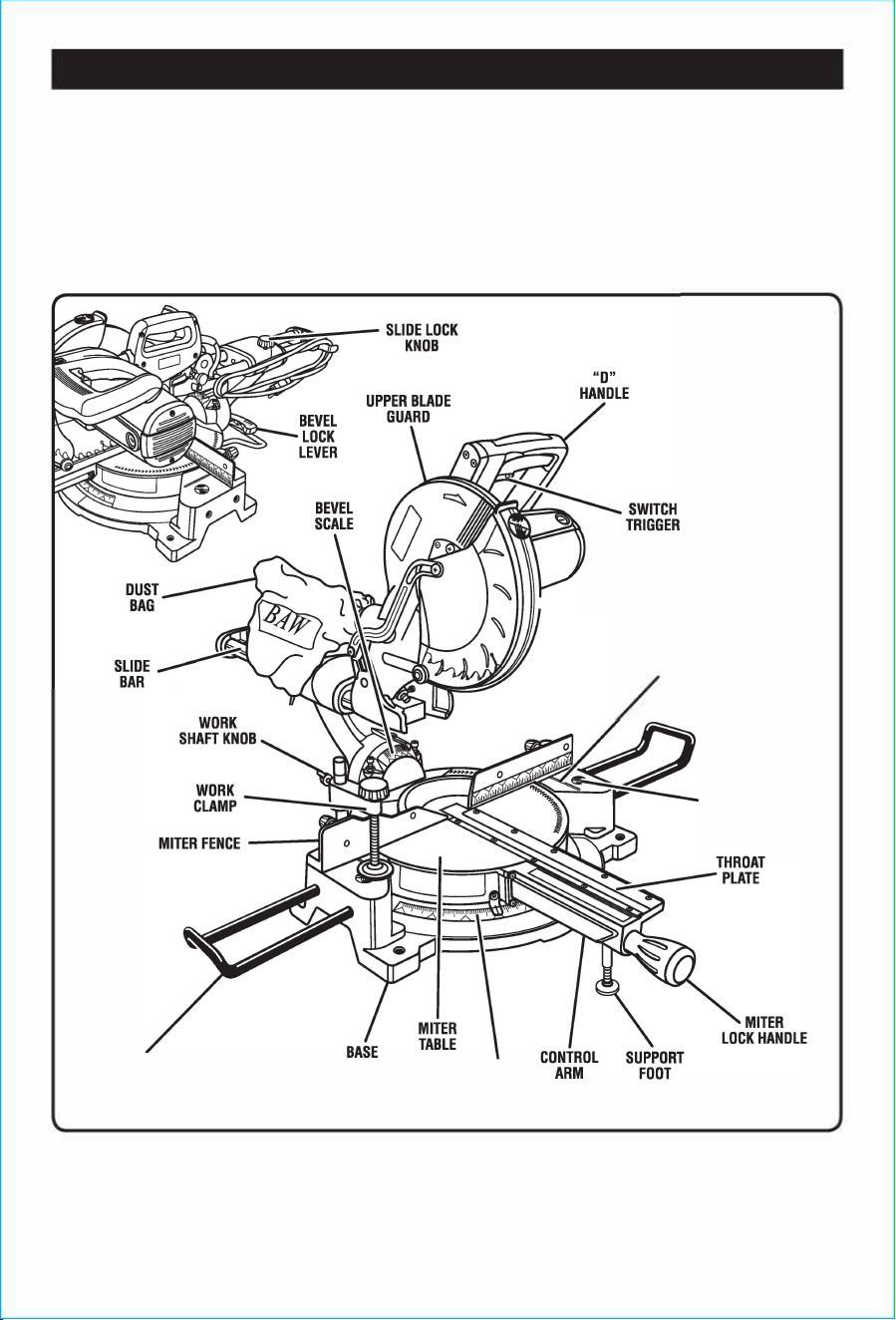
FEATURES
PRODUCT SPECIFICATIONS
Blade Arbor .............................................................. 5/8 in.
Blade Diameter
.......................................................... 1
O
in.
No Load Speed .................................... 4,500 r/min. (RPM)
Input ....................................... 220 V,
AC only, 50
Hz, 13 A
TABLE
EXTENSION
Cutting Capacity with Miter at 0
°
/ Bevel 0
°
:
Maximum nominal lumber sizes: ............................ 2 x 12
Cutting Capacity with Miter at 45'/Bevel 0
°
:
Maximum nominal
lumber
sizes:
.............................. 2 x 8
Cutting Capacity with Miter at O'/Bevel 45':
Maximum nominal lumber sizes: ............................ 2 x 12
Cutting Capacity with Miter at 45'/Bevel 45':
Maximum nominal lumber sizes: .............................. 2 x 8
10
MITER
SCALE
LOWER BLADE
1-----
GUARD
"NO HANDS ZONE"
BOUNDARY LINE
"NO HANDS
ZONE" LABEL
Fig.
2
FEATURES
KNOW YOUR COMPOUND MITER SAW
See Figure 2.
The
safe
use of this product requires an understanding of
the information on the tool and in this operator's manual as
well as a knowledge of the project you are attempting. Before
use of this product, familiarize yourself with all operating
features and safety rules.
10 in. BLADE
A 10 in. blade is included with the compound miter saw. It
will cut materials up to 2 in. thick or 6 in. wide, depending
upon the angle at which the cut is being made.
13AMP MOTOR
The saw has a powerful 13 amp motor with sufficient power
to handle tough
cutting
jobs. It is made
with
all ball bear-
ings, and has externally accessible brushes for ease of
servicing.
BEVEL LOCK LEVER
The bevel lock lever securely locks your compound
miter
saw at desired bevel angles. The bevel lock lever
is spring
loaded and is released by pulling the
lever away
from the
saw housing and ratcheting the lever.
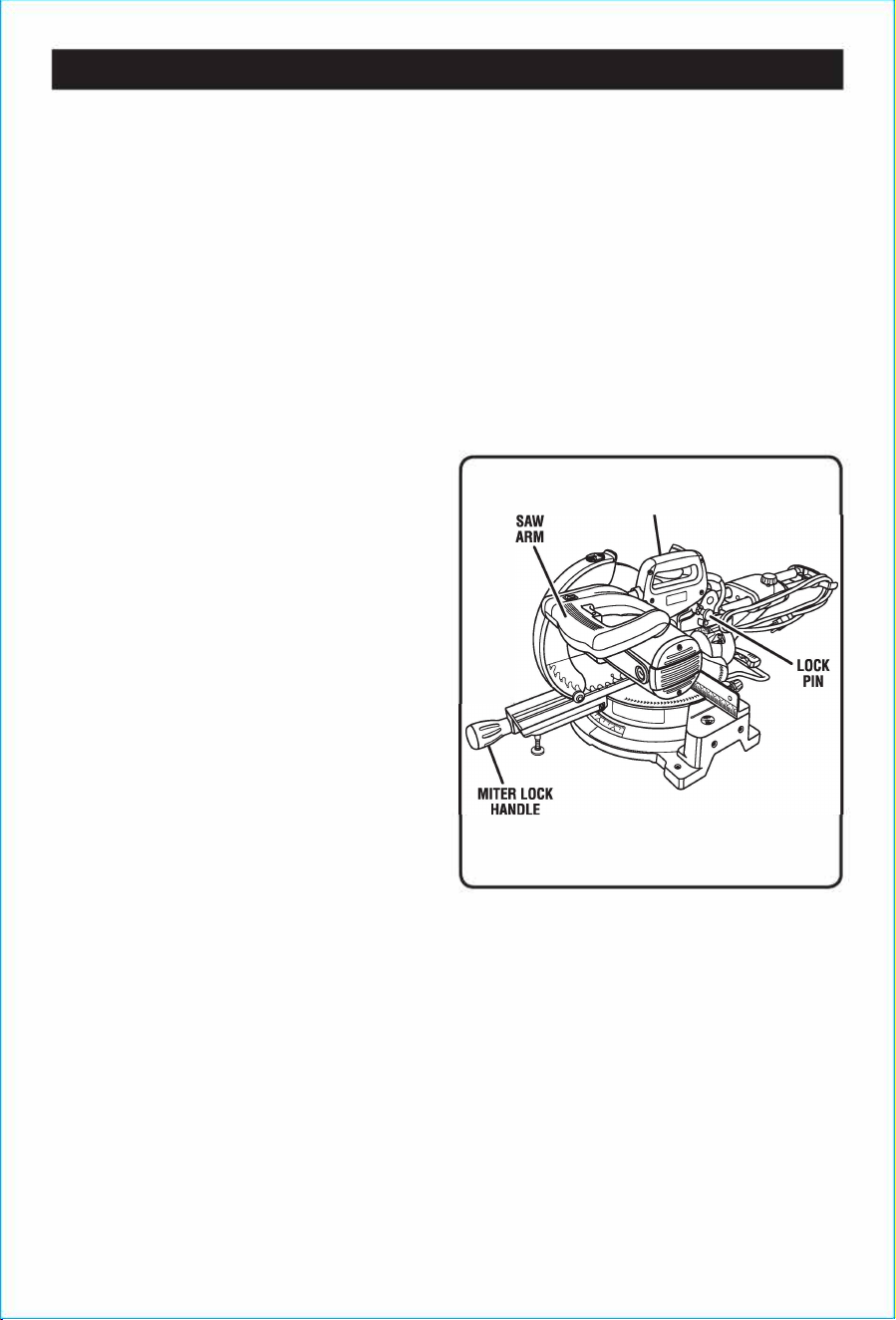
CARRYING HANDLE
See Figure 3.
For convenience when carrying or transporting the miter
saw from one place to another, a carrying handle has been
provided on top of the saw arm. To transport, turn off and
unplug the
saw,
then lower the
saw
arm
and
lock it in the
down position by pulling the lock pin away from the saw
housing and rotating
it
until
it
clicks into the slot.
ELECTRIC BRAKE
An electric brake has been provided to quickly stop blade
rotation after the switch is released.
LASER GUIDE
For more accurate cuts, a laser guide is included with the
miter saw. When used properly, the laser guide makes
accurate, precision cutting simple and easy.
MITER FENCE
The miter fence on the compound miter saw has been
provided to hold your workpiece securely against when
making all cuts. The left side is larger providing additional
support.
MITER LOCK HANDLE
See
Figure
2.
The miter lock handle securely locks the saw
at
desired
miter angles.
11
MITER SCALE
The miter scale has index points provided at 0
°
, 15
°
, 22.5
°
,
31.6
°
, 45
°
, and 60.
0
POSITIVE STOPS ON MITER TABLE
Positive stops have been provided at 0
°
, 15
°
, 22.5
°
, 30
°
, and
45
°
on both the left and
right
side of the
miter
table.
SELF-RETRACTING LOWER BLADE GUARD
The lower blade guard is made
of
shock-resistant, see-through
plastic that provides protection from each side of the blade.
It retracts over the upper blade guard as the saw is lowered
into the workpiece.
SLIDE BAR
When unlocked, the saw arm will glide forward and backward
the length of the slide bar for cutting various workpiece
widths.
CARRYING
HANDLE
SAW ARM LOCKED IN DOWN POSITION
Fig. 3
FEATURES
SLIDE LOCK KNOB
The slide lock knob locks and unlocks the sliding feature
of this tool.
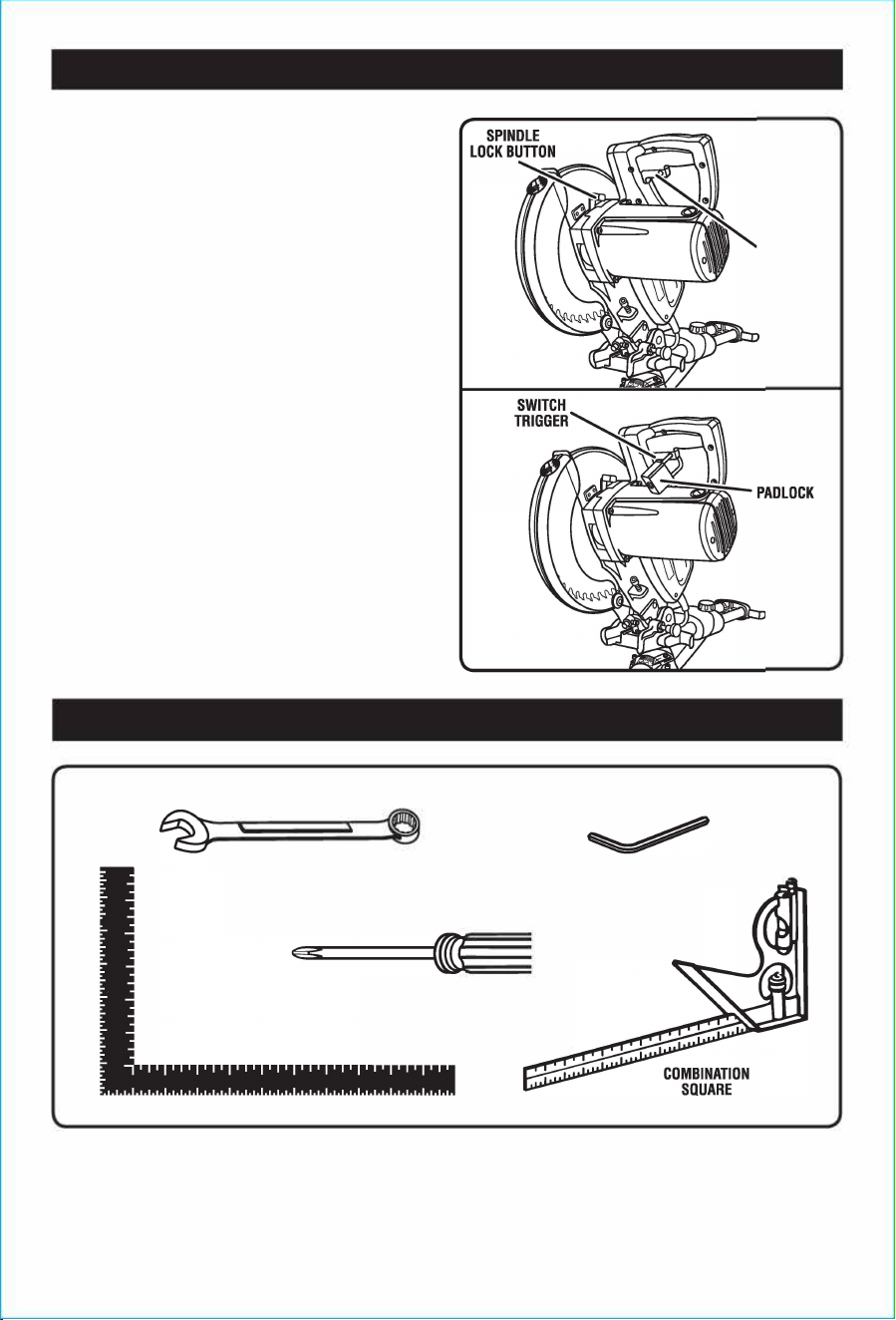
SPINDLE LOCK BUTTON
See Figure 4.
The spindle lock button locks the spindle and stops the
blade from rotating. Depress and hold the lock button while
installing, changing, or removing blade.
SWITCH TRIGGER
See Figure 5.
To prevent unauthorized use of the compound miter saw,
disconnect it from the power supply and lock the switch in
the off position. To lock the switch, install a padlock (not
included) through the hole in the switch trigger. A lock with
a long shackle up to 9/32 in. diameter may be used. When
the lock is installed and locked, the switch is inoperable.
Store the padlock key in another location.
TOOLS NEEDED
The following tools (not included) are needed for making adjustments or installing the blade:
COMBINATION WRENCHES (2)
(10 mm, 12 mm)
PHILLIPS SCREWDRIVER
FRAMING SQUARE
12
HEX KEYS (3)
(3 mm, 5 mm, 6 mm)
{I
SWITCH
TRIGGER
Fig. 4
Fig. 5
Fig. 6
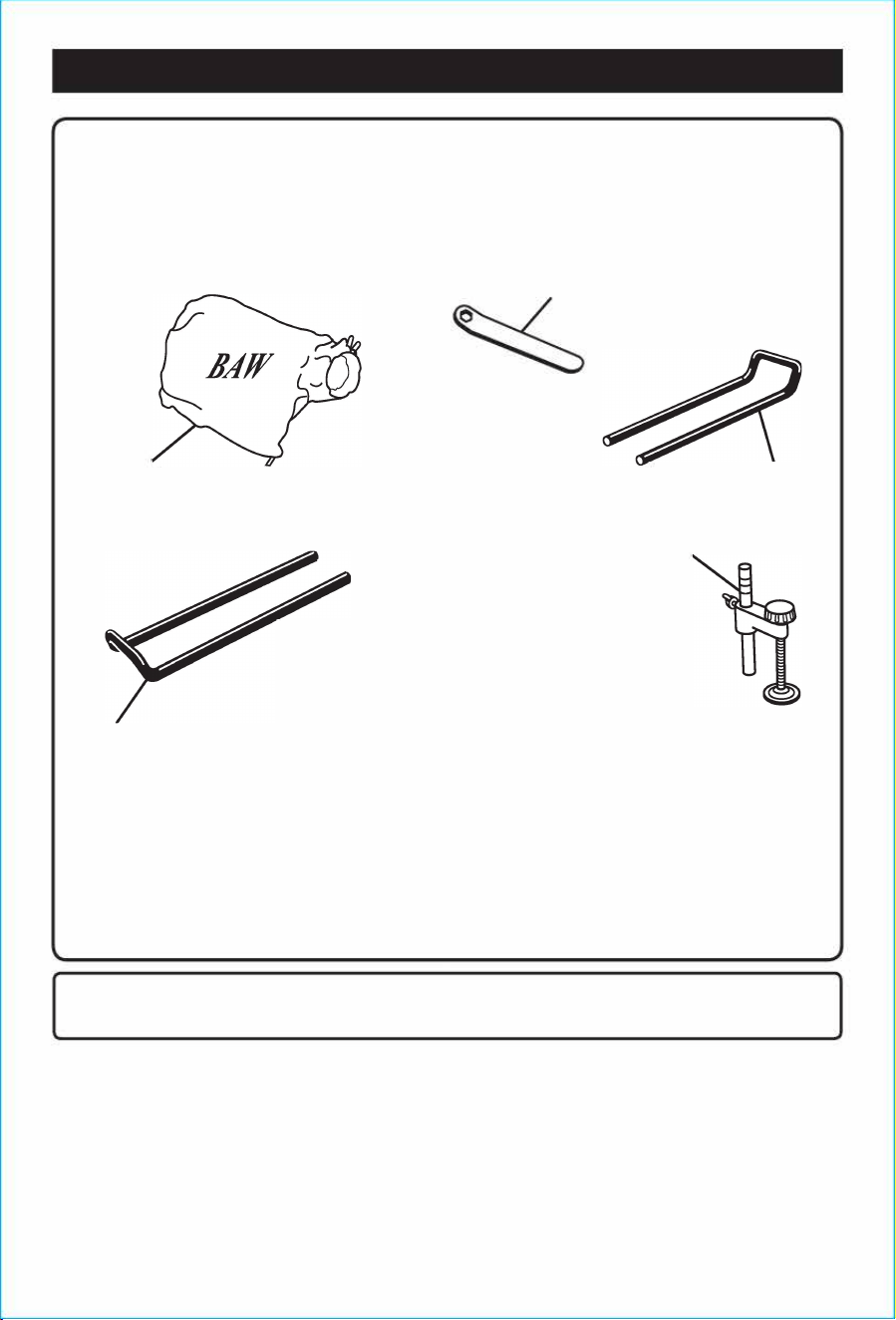
LOOSE PARTS LIST
The following items are included with your Compound Miter Saw:
Dust Bag
Work Clamp
Clamp Brackets (2)
Blade Wrench
Clamp Bracket Screws (2)
Table Extensions (2)
DUST
BAG
CLAMP
TABLE
BRACKETS
EXTENSION
/
CLAMP BRACKET
SCREWS
Operator's Manual
BLADE
WRENCH
WORK
CLAMP
TABLE
EXTENSION
Fig.
7
WARNING:
The use of attachments or accessories not listed might be hazardous and could cause serious personal injury.
13
ASSEMBLY
UNPACKING
This product
requires assembly.
■ Carefully lift saw from the carton by the carrying handle and
the saw base, and place it on a level work surface.
NOTE:
This tool is heavy.
To
avoid back injury, lift with your
legs, not your back, and get help when needed.
■ This saw has been shipped with the saw arm secured in the
down position. To release the saw arm, push down on the
"D" handle, cut the tie-wrap, and pull out on the lock pin.
■
Lift the
saw arm by
the handle.
Hand pressure should remain
on the "D" handle to prevent sudden rise upon release of
the tie wrap.
■ Inspect the tool carefully to make sure no breakage or dam-
age occurred during
shipping.
■
Do not discard the packing material until you have carefully
inspected and satisfactorily operated the product.
■
The saw is factory setfor accurate cutting. After assembling
it, check for accuracy. If shipping has influenced the settings,
refer to specific procedures explained in this manual.
■ If any parts are damaged or missing, please call
1-800-525-2579 for assistance.
WARNING:
If any parts are damaged or missing do not operate thi
s
product until the parts are replaced. Failure to heed this
warning could result in serious personal injury.
WARNING:
Do not attempt to modify this product or create accessories
not recommended for use with this tool. Any such alteration
or modification is misuse and could result in a hazardous
condition leading to possible serious personal injury.
WARNING:
Do not connect to power supply until assembly is
complete. Failure to comply could result in accidental start-
ing and possible serious personal injury.
TRACE HOLES
AT THESE LOCATIONS
FOR HOLE PATTERN
WARNING:
Do not start the compound miter saw without c
hecking for
interference between the blade and the miter fence. Serious
personal injury or damage to the blade could result if it
strikes the miter fence during operation of the saw.
WARNING:
This saw can tip over
if
the saw head is released suddenly
and
the
saw
is
not secured to a work surface.
ALWAYS
secure this saw to a stable work surface before any use to
avoid serious personal injury.
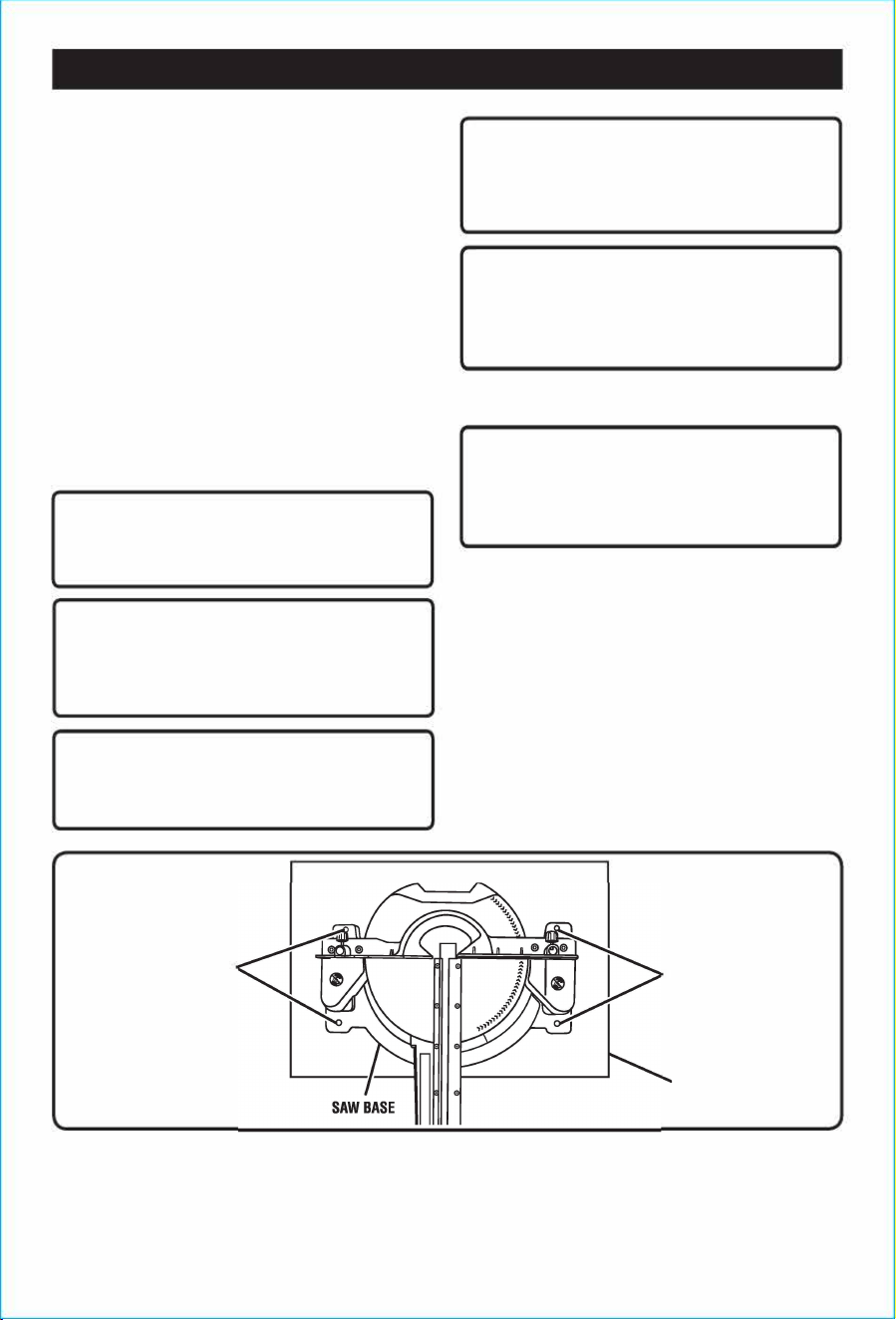
MOUNTING HOLES
See Figure 8.
WARNING:
Always make sure the compound miter saw is
securely mounted to a workbench or an approved
work stand. Failure to heed this warning can result
in serious personal injury.
The compound miter saw should be mounted to a firm
supporting surface such as a workbench. Four bolt holes
have been provided
in the
saw base for
this
purpose. Each
of the four mounting holes should be bolted securely using
3/8 in. machine bolts, lock washers, and hex nuts (not
included). Bolts should be of sufficient length to accommodate
the saw base, lock washers, hex nuts, and the thickness of the
workbench. Tighten all four bolts securely.
The hole pattern for mounting to a workbench is shown in
figure 8. Carefully check the workbench after mounting to make
sure that no movement can occur during use. If any tipping,
sliding, or walking is noted, secure the workbench to the floor
before operating.
14
TRACE HOLES
ATTHESE LOCATIONS
FOR HOLE PATTERN
MOUNTING
SURFACE
Fig. 8
ASSEMBLY
NOTE: Many
of
the illustrations in this manual show only
portions of the compound miter saw. This is intentional
so that we can clearly show points being made in the
illustrations. Never operate the saw without all guards
securely in place and in good operating condition.
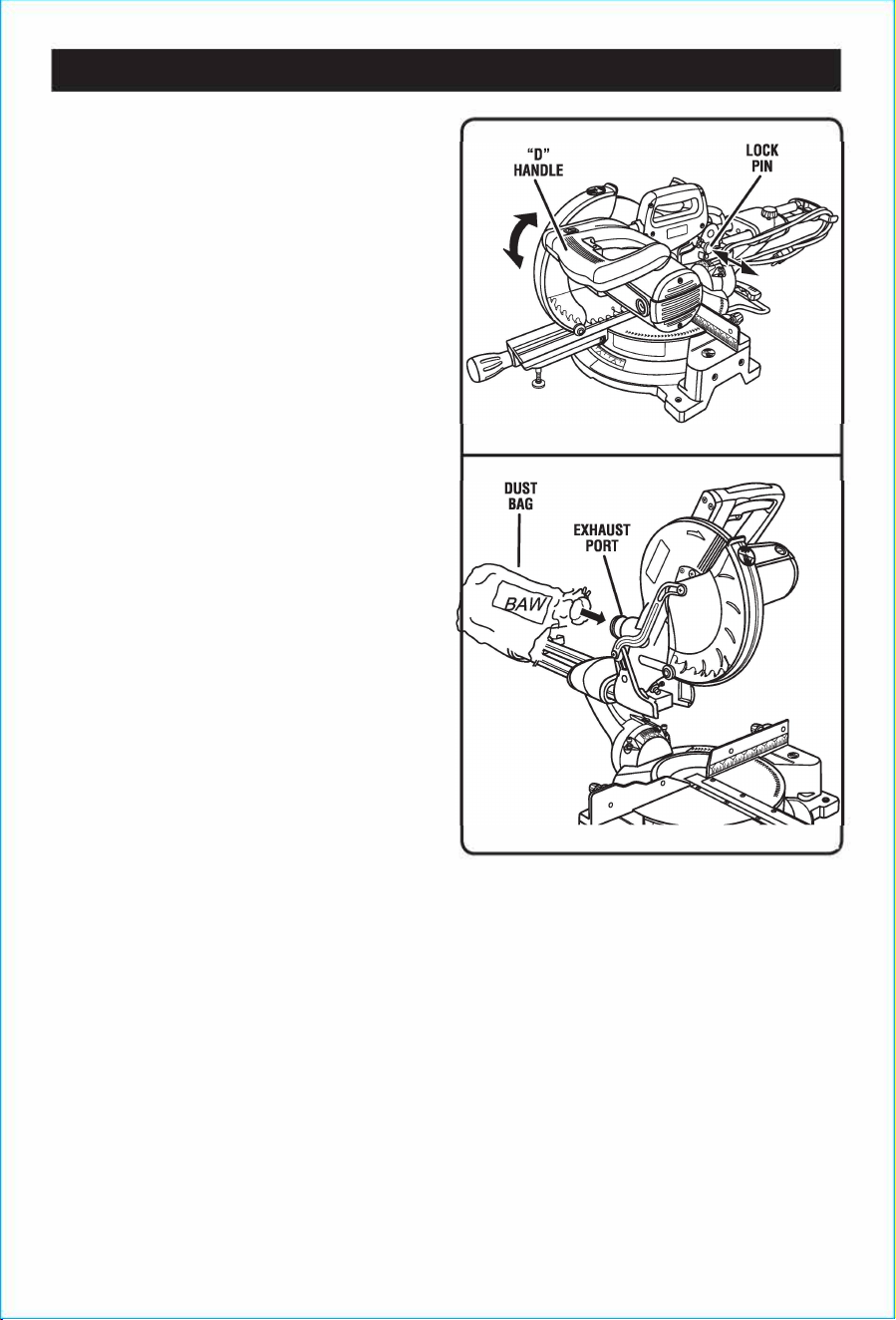
LOCKING / UNLOCKING THE SAW ARM
See Figure 9.
To unlock and raise the saw arm:
■ Firmly grasp the "D" handle and apply downward
pressure while at the same time pulling the lock pin out
and away from the saw housing. Rotate lock pin 90
°
to
lock (or unlock} the saw arm.
■
Release the lock pin and slowly raise the saw arm.
To lock the saw arm:
■ Firmly grasp the "D" handle and apply
downward
pressure while at the same time pulling the lock pin out
and
away from the saw housing.
■ Release the lock pin allowing it to lock the saw into
place.
DUST BAG
See Figure 10.
A dust bag
is
provided for use on this miter saw. It fits over
the exhaust port on the upper blade guard.
NOTE:
the
exhaust
port
also
accepts 1-1/4 in.
vacuum
hose.
To install:
■ Squeeze the two metal clips to open the mouth of the
bag
and slide
it
on
the
exhaust port.
■ Release the clips. The metal ring in the bag should lock
in between the grooves on the exhaust port.
To remove the dust bag for
emptying:
■
Reverse the above procedure.
15
Fig. 9
Fig. 10
ASSEMBLY
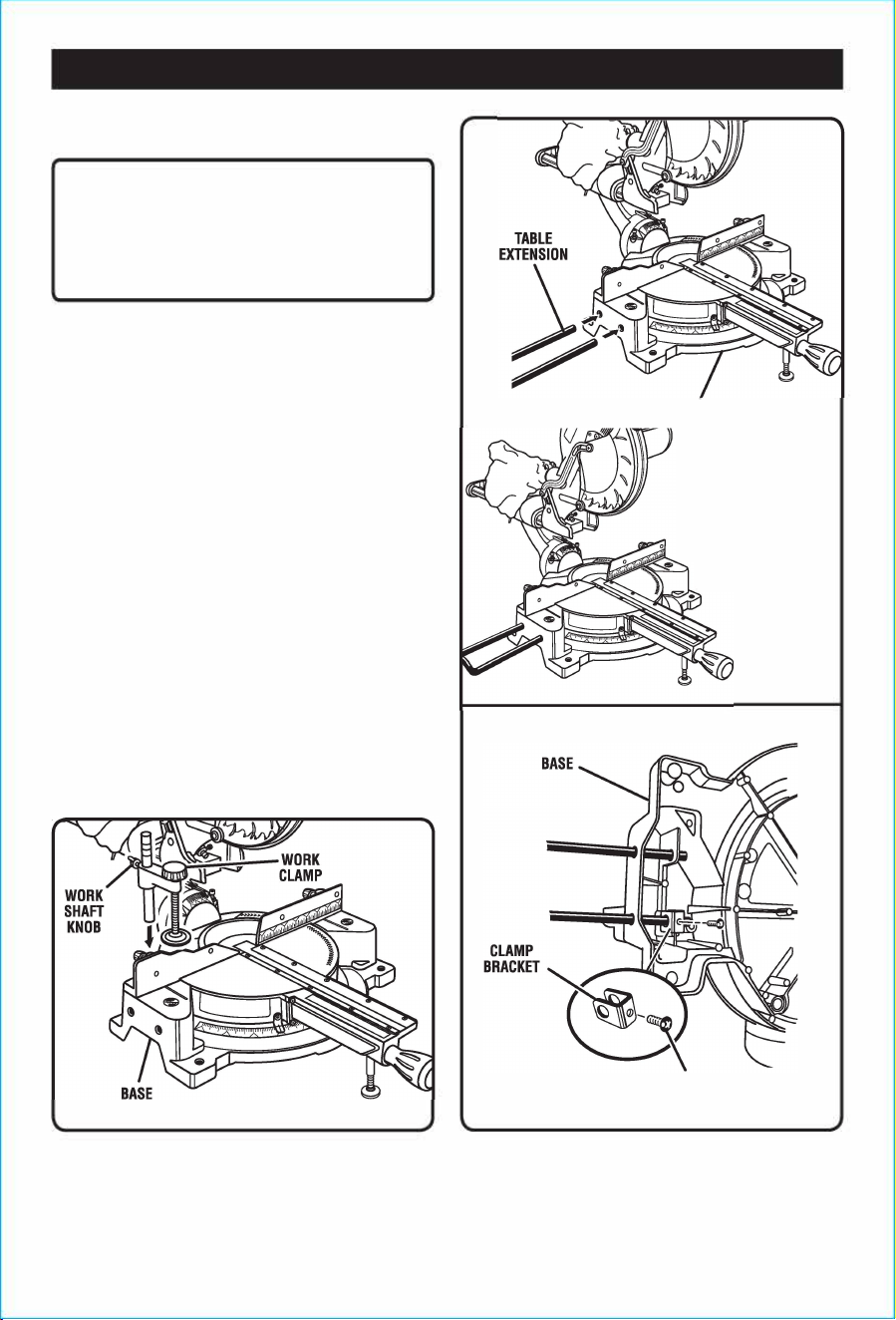
WORK CLAMP
See Figure 11.
WARNING:
In some operations, the work clamp assembly may
interfere with the operation of the blade guard assembly.
Always make sure there is no interference with the blade
guard
prior
to
beginning any
cutting
operation
to
reduce
the risk of serious personal injury.
The work clamp provides greater control by clamping the
workpiece to the fence or the saw table. It also prevents the
workpiece from creeping toward the saw blade. This is very
helpful when cutting compound miters. Depending on the
cutting operation and the size of the workpiece, it may be
necessary to use a C-clamp instead of the work clamp to
secure the workpiece prior to making the cut.
To install the work clamp:
Place the work clamp shaft in one of the holes located
behind the miter fence. Tighten work clamp knob
securely.
■
Rotate the knob on the work clamp to move it up or down
as needed.
TABLE EXTENSIONS
See Figures 12
-
13.
To install table extensions, insert the ends of extensions into
the holes in the sides of the base. Adjust the extensions to
the desired length.
Secure extensions
in
place by positioning a clamp bracket
under each table extension beneath the miter table. Orient
each clamp bracket as shown in figure 13.
Secure each clamp bracket in place with a clamp bracket
screw. The clamp bracket screw threads through the clamp
bracket and tightens against bracket support on bottom
of
miter
table,
securing
clamp bracket against table
extension.
Fig. 11
16
BASE
TABLE
EXTENSION
,,,,
SAW VIEWED FROM BOTTOM
CLAMP
BRACKET
Fig.
12
Fig. 13
ASSEMBLY
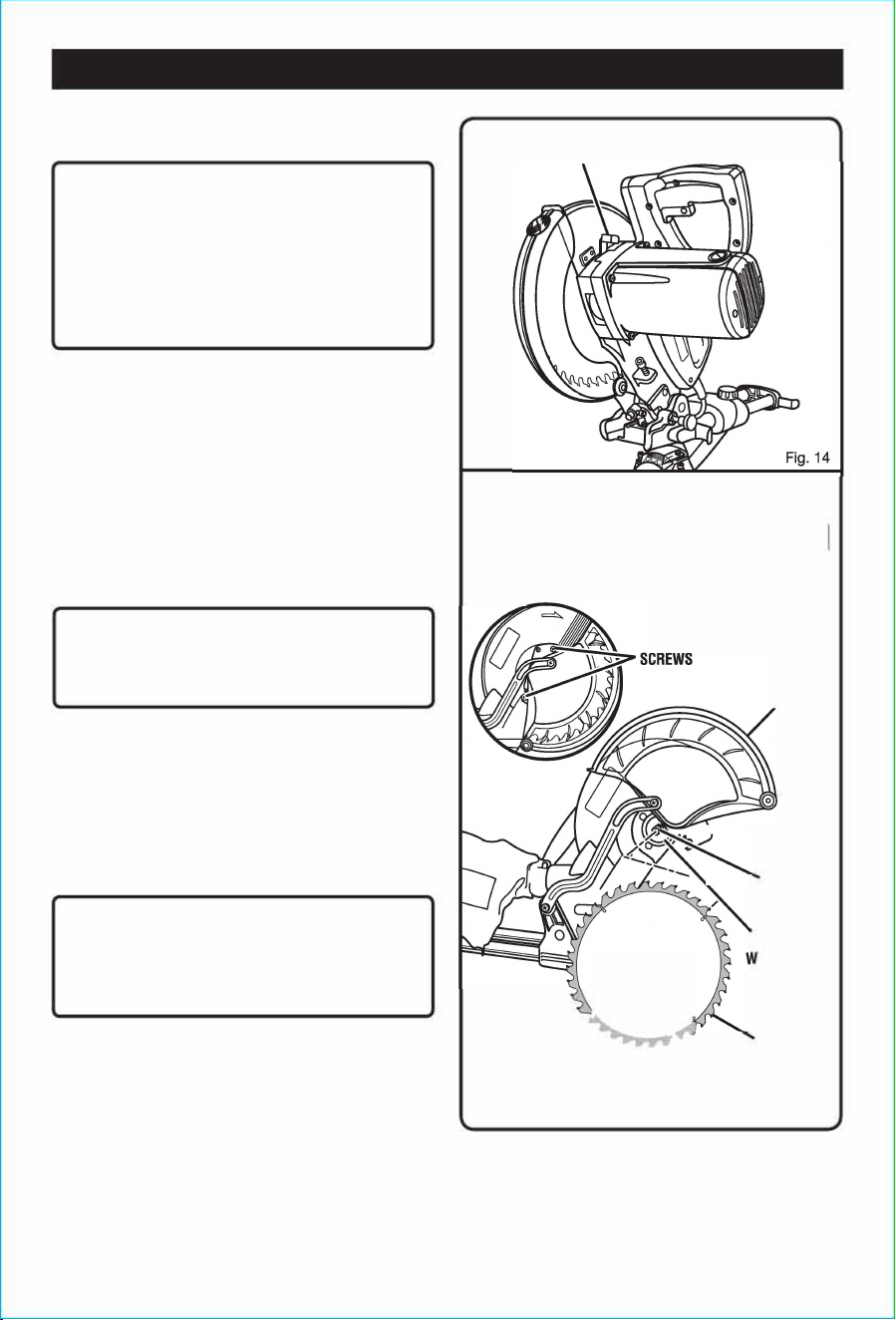
TO INSTALL/ REPLACE THE BLADE
See Figures 14
-
15.
WARNING:
A 10 in. blade is the maximum blade capacity of the saw.
Never use a blade that is too thick to allow outer blade
washer to engage with the flats on the spindle. Larger
blades will come in contact with the blade guards, while
thicker blades will prevent the blade bolt from secur-
ing the blade on the spindle. Either of these situations
could result in a serious accident and can cause serious
personal injury. Unplug the saw.
■
Remove screws. Rotate lower blade guard and blade bolt
cover up and back
to
expose the blade bolt.
Depress the spindle lock button and rotate the blade bolt
until the spindle locks.
Using the wrench provided, loosen and
remove
the blade
bolt.
NOTE:
The blade bolt has left hand threads. Turn blade
bolt clockwise to loosen.
■
Remove the flat washer and the outer blade washer. Do
not
remove the inner blade washer.
■
Wipe a drop of oil onto inner blade washer and outer
blade washer where they contact the blade.
WARNING:
If inner blade washer
has been
removed,
replace it before
placing blade on spindle. Failure to do so could cause an
accident since blade will not tighten properly.
Fit saw blade inside lower blade guard and
onto
spindle.
The blade teeth point downward at the front of saw as
shown in figure 15.
■
Replace the outer blade washer and the flat washer.
Double "D" flats on blade washers align with flats on
spindle.
■
Depress spindle lock button and replace blade bolt.
NOTE:
The blade bolt has left hand threads. Turn blade bolt
counterclockwise to tighten.
CAUTION:
Always install the blade with the blade teeth and
the arrow printed on the side of the blade pointing
down at the front of the saw. The direction of blade
rotation is also stamped with an arrow on the upper
blade guard.
■
Tighten blade bolt securely.
■
Replace the lower blade guard and blade bolt cover.
■
Replace screws and tighten securely.
17
SPINDLE LDCK
BUTTON
NOTE: BEFORE USE,
REPLACE SCREWS AND
TIGHTEN SECURELY
TO
PREVENT GUARD
MOVEMENT
\
g g:>JJ,
WASHER
BLADE
BOLT
BLADE
INNER
BLADE
WASHER
LOWER
BLADE
GUARD
BLADE
\.---- BOLT
COVER
- __
FLAT{S)
-;. ON SPINDLE
y.)
INNER BLADE
ASHER WITH
DOUBLE
"D"
FLATS
BLADE
BLADE
WASHER
WASHER
FLAT
OUTER
BLADE
TO
WITH DOUBLE
BOLT
TIGHTEN
"D"
FLATS
Fig. 15
ASSEMBLY
WARNING:
M
ake
sure
the spindle lock button is not engaged
before reconnecting saw into power source. Never
engage spindle lock button when blade is rotating.
DANGER:
Laser radiation. Avoid direct eye contact with light
source.
WARNING:
Use of controls or adjustments
or
performance of
procedures other than those specified herein may result
in hazardous radiation exposure.
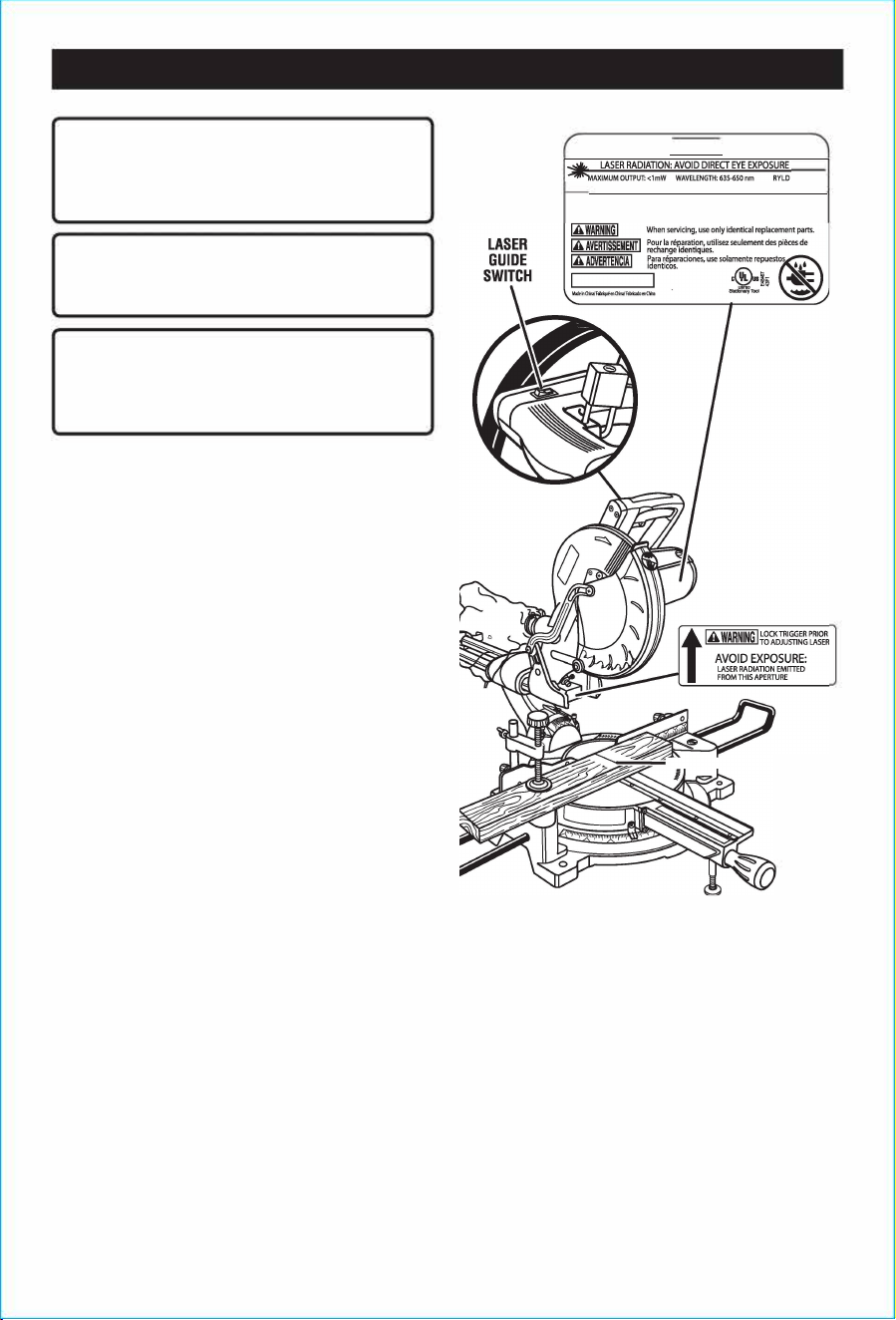
ALIGNING THE LASER GUIDE LINE
See Figure 16.
Lock the switch by installing a padlock (not included) through
the hole in the switch
trigger
and closing the shackle.
Draw a line on the workpiece. When the laser guide switch
is turned on it will generate a red line on the work surface.
This line will let you see your mark and the laser guide
line
at
the
same time, and will assist you in lining up the mark
for more accurate cutting of the workpiece.
Align the laser line and the mark with the blade at the
uppermost position. Once both lines are in alignment, do
not move the workpiece.
Remove the padlock then plug the saw into the power source.
Make several practice cuts on different styles and thickness
of material. Repeat the steps above as necessary.
Follow the directions below for using the laser guide:
Removing Your Mark:
Position the laser line near the left edge of your mark on the
work surface in order to remove the mark.
To Cut Your Mark:
Position the
laser
line
near or over your
mark
on
the work
surface in order to cut the mark.
To Leave Your Mark:
Position the laser line near the right edge of your mark on
the work surface in order to leave the mark.
After you have become familiar with using the laser guide,
you will be able to remove, cut, or leave your mark on the
work surface. Practice will teach you the correct position for
aligning the laser line with your mark.
18
IADANGERI
CLASS II LASER PRODUCT COMPLIES WITH 21 CFR PARTS 1040,10,AND 1040,11
;;a,;,.--;...-- RED
LINE
Fig. 16
ASSEMBLY
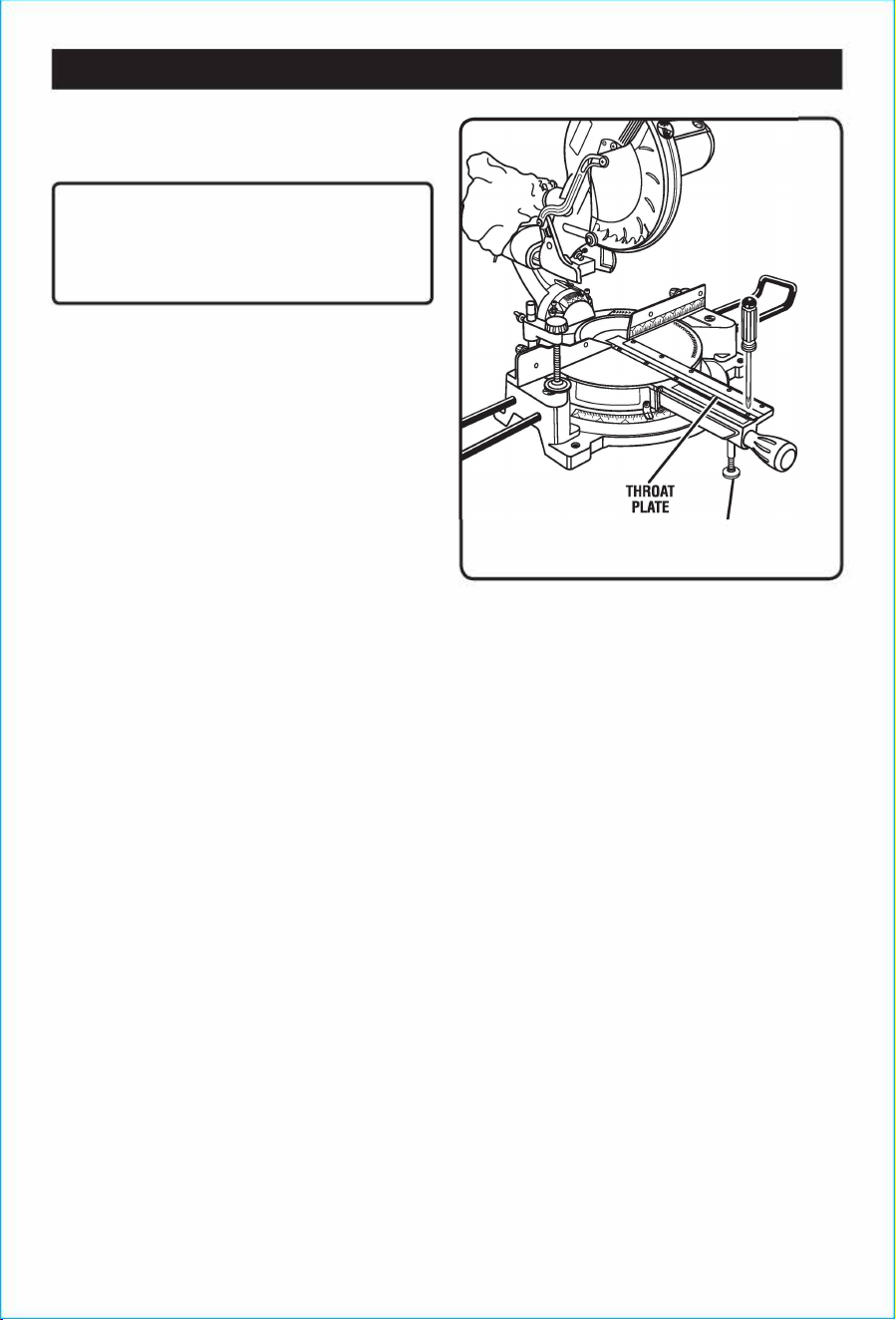
REMOVING / REPLACING THE THROAT
PLATE
See Figure 17.
WARNING:
The throat plate m
ust be below the saw table. If the throat
plate is too high or too low, the workpiece can catch on
the uneven
edges
resulting in binding which
could
result
in serious personal injury.
Never operate the saw without a throat plate installed.
To remove / replace:
■ Unplug the saw.
■
Remove the screws securing the right side of the zero
clearance throat plate.
■ Lift the throat plate from the saw. Repeat the above steps
for the left side of the throat plate.
■ To reinstall the throat plate, align the holes in the throat
plate with
the holes in the saw base.
■ Retighten the screws, being careful not to overtighten
which can cause the throat plate to bow or bend.
ADJUSTING SUPPORT FOOT
See Figure 17.
When making sliding cuts, turn the support foot clockwise
or counterclockwise depending on the amount of support
needed.
19
SUPPORT
FOOT
Fig. 17
ASSEMBLY
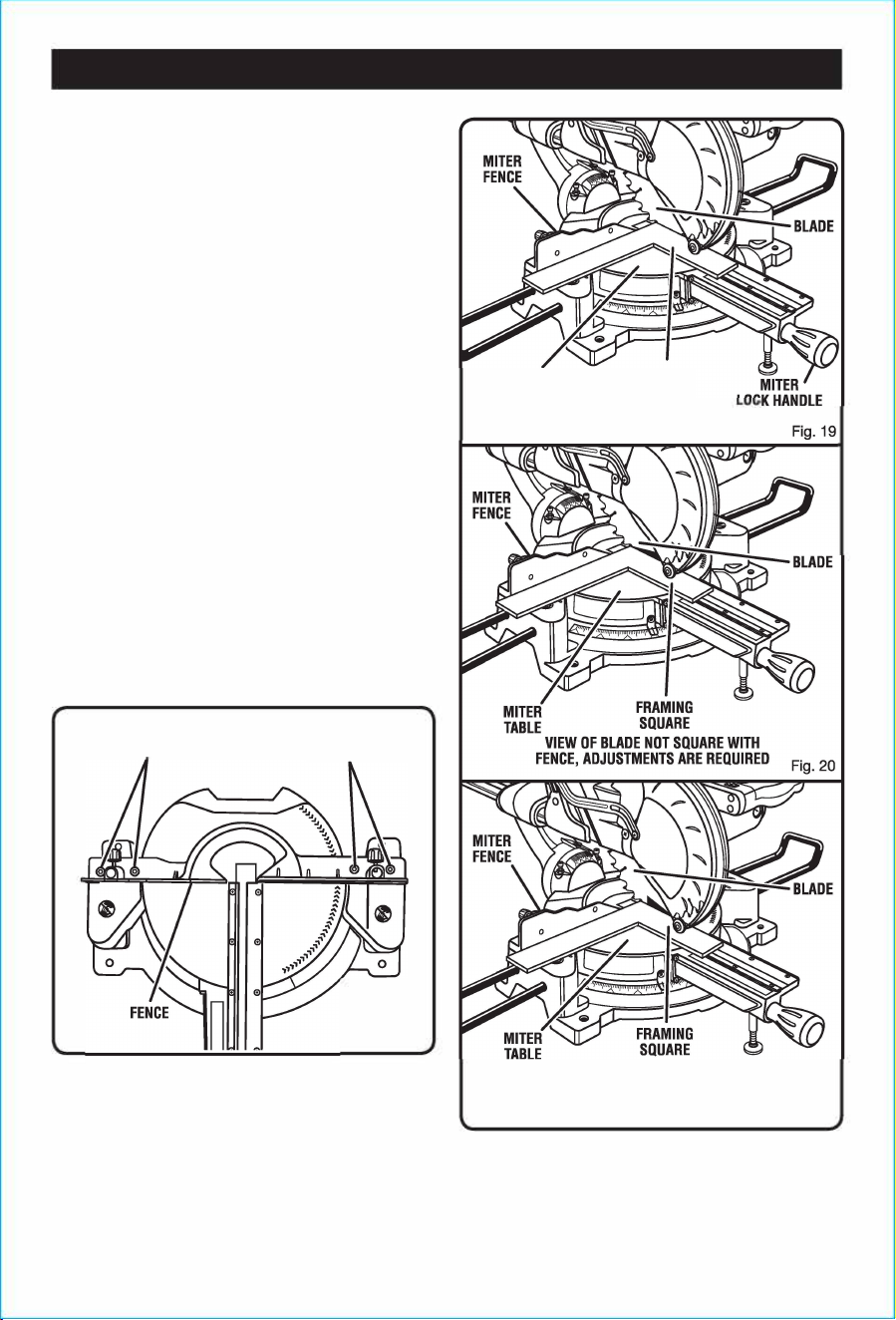
SQUARING THE BLADE TO THE FENCE
See Figures 18 -21.
■ Unplug the saw.
■ Pull the saw arm all the way down and engage the lock
pin to hold the saw arm in transport position.
■ Loosen the miter lock handle approximately one-half
turn.
■
Rotate the miter table until the pointer on the control arm
is positioned at O'.
■ Securely tighten the miter lock handle.
■ Lay a framing square flat on the miter table. Place one
leg of the square against the fence. Slide the other leg
of the square against the flat part of saw blade.
NOTE:
Make sure that the square contacts the flat part
of the saw blade, not the blade teeth.
■ The edge of the square and the saw blade should be
parallel
as shown in figure 19.
■
If the front
or back edge
of the
saw blade angles
away
from the square as shown in figures 20
-
21, adjustments
are needed.
■ Loosen the socket head screws that secure the miter
fence to the miter table.
■ Rotate the miter fence left or right until the saw blade is
parallel with the square.
■ Retighten the screws securely and recheck the blade-to-
fence alignment.
The saw has two scale indicators, one on the bevel scale
and one on the miter scale. After squaring adjustments have
been made, it may be necessary to loosen the indicators
screws and reset them to zero.
SOCKET HEAD
SCREW(S)
SOCKET HEAD
SCREW(S)
Fig. 18
20
MITER
FRAMING
TABLE
SQUARE
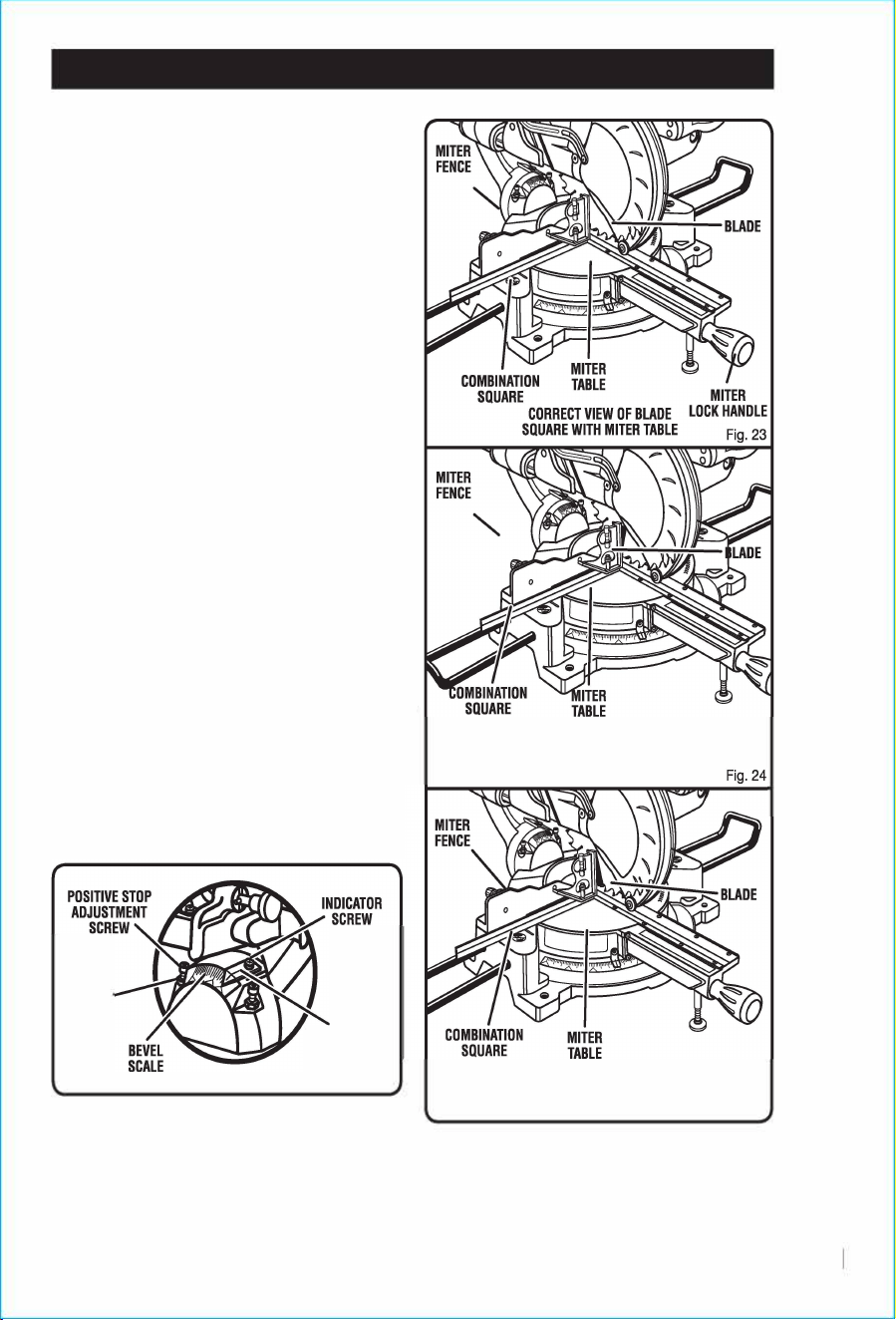
VIEW OF BLADE SQUARE WITH FENCE
VIEW OF BLADE NOT SQUARE WITH
FENCE, ADJUSTMENTS ARE REQUIRED
Fig. 21
ASSEMBLY
SQUARING THE BLADE TO THE MITER TABLE
See Figures 22
-
25.
■
Unplug the saw.
■
Pull the saw arm all the way down and engage the lock
pin to hold the saw arm in transport position.
■
Loosen the miter lock handle approximately one-half
turn.
■
Rotate the miter table until the pointer on the control
arm is positioned at 0
°
. Securely tighten the miter lock
handle.
■
Loosen the bevel lock lever and set saw arm at 0
°
bevel
(blade set 90' to miter table). Tighten bevel lock lever.
■
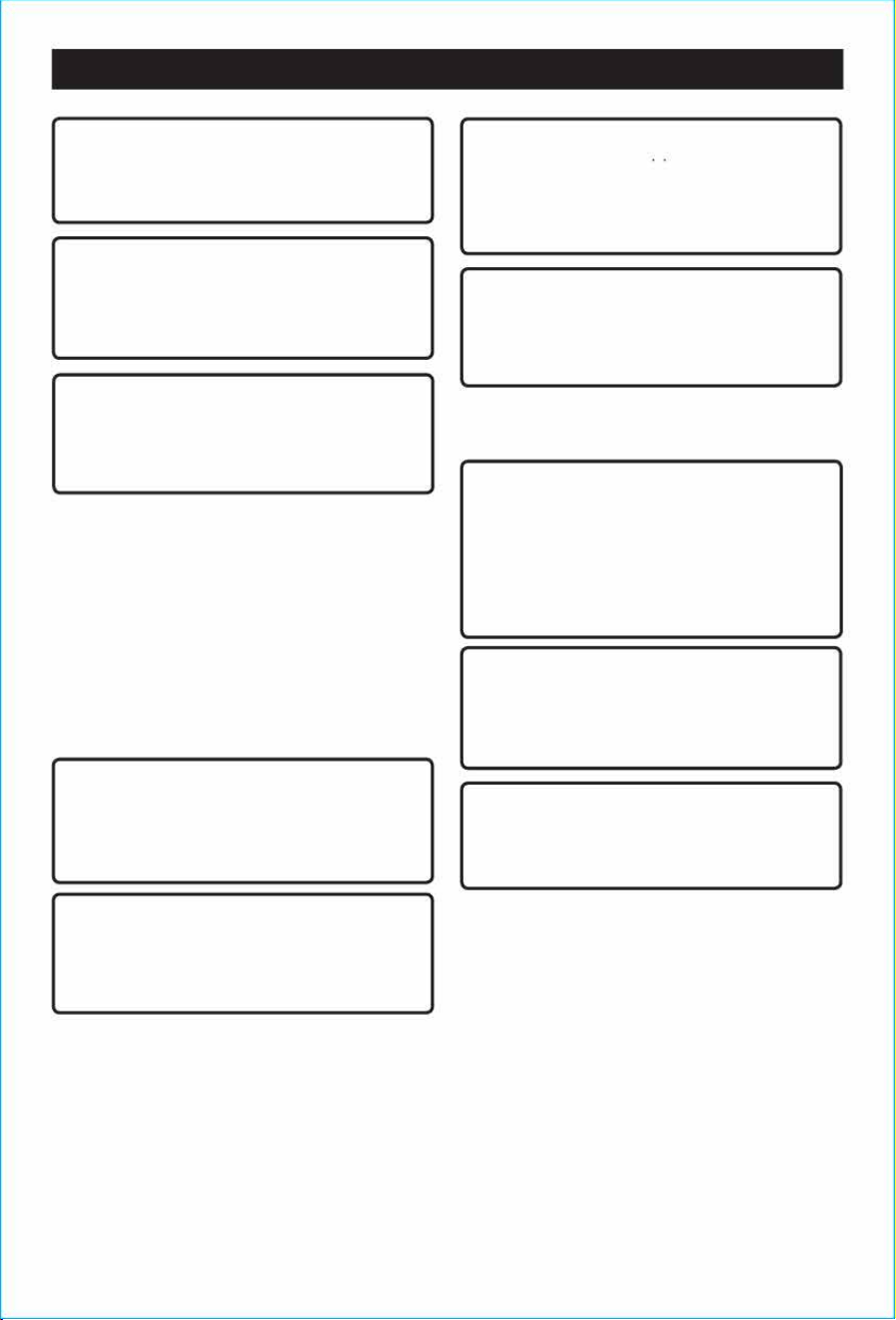
Place a combination square against the miter table and
the
flat part of saw blade.
NOTE:
Make sure that the square contacts the flat part
of the saw blade, not the blade teeth.
■
Rotate the blade by hand and check the blade-to-table
alignment at several points.
■
The
edge
of the square and the saw blade should be
parallel as shown in figure 23.
■
If
the
top
or bottom
of
the saw blade angles away
from
the square as shown in figures 24 and 25, adjustments
are needed.
■
Loosen the lock nut securing positive stop adjustment
screw. Also loosen bevel lock lever.
■
Adjust positive stop adjustment screw to bring saw blade
into alignment with the square. See
Positive Stop Adjust-
ment in the
Adjustment
section.
■
Retighten bevel lock lever. Next, retighten lock nut secur-
ing the positive stop adjustment screw. Recheck blade-
to-table alignment.
NOTE:
The above procedure can be used to check blade
squareness of the saw blade to the miter table at both
0
°
and 45' angles.
The saw has two scale indicators, one on the bevel scale
and one on the miter scale. After squaring adjustments have
been made, it may be necessary to loosen the indicator
screws and reset them to zero.
LOCK
NUT{S)
SCALE
INDICATOR
Fig. 22
21
VIEW OF BLADE NOT SQUARE WITH MITER TABLE,
ADJUSTMENTS ARE REQUIRED
VIEW OF BLADE NOT SQUARE WITH MITER TABLE,
ADJUSTMENTS ARE REQUIRED
Fig. 25
OPERATION
WARNING:
Do
not allow familiarity with tools to make you care-
less. Remember that a careless fraction of a second is
sufficient to inflict serious injury.
WARNING:
Always wear safety goggles or safety glasses with side
shields when operating power tools. Failure to do
so could result in objects being thrown into your
eyes resulting in possible serious injury.
WARNING:
Do not use any attachments or accessories not
recommended
by
the manufacturer of this tool. The use
of attachments
or
accessories
not
recommended can
result in serious personal injury.
APPLICATIONS
This product has been designed only for the purposes listed
below:
■
Cross cutting wood and plastic (do not cut metals,
ceramics or masonry products.)
■
Cross cutting miters, joints, etc., for picture frames, mold-
ings, door casings, and fine joinery
■
Bevel and compound
cutting
■
Cross cutting wide workpieces
NOTE:
The blade provided is fine for most wood cutting
operations, but for fine joinery cuts or cutting plastic, use one
of the accessory
blades
available from the Ryobi dealer.
WARNING:
Before starting any cutting operation, clamp or bolt the
compound miter saw to a workbench. Never operate the
miter saw on the floor or in a crouched position. Failure to
heed this warning can result in serious personal injury.
WARNING:
To avoid serious personal injury, always tighten the mi-
ter lock handle securely before making a cut. Failure to
do so could result in movement of the miter table while
making a
cut.
WARNING:
To avoid serious personal injury, keep hands outside
the no hands zone, at least 3 in. from the blade. Never
perform any cutting operation freehand (without holding
workpiece against the fence). The blade could grab the
workpiece if it slips or twists.
CAUTION:
Do not start the compound miter saw without checking
for interference between the blade and the miter fence.
Damage could result to the blade if it strikes the miter
fence during operation of the saw.
CUTTING WITH
THE SLIDING COMPOUND
MITER SAW
22
WARNING:
When using a work clamp or C-clamp to secure your
workpiece, clamp workpiece on one side of the blade
only. The workpiece must remain free on one side of the
blade to prevent the blade from binding in workpiece. The
workpiece binding the blade will cause motor stalling and
kickback. This
situation
could cause an accident
resulting
in possible serious personal injury.
WARNING:
NEVER move the workpiece or make adjustment to
any cutting angle while the saw is running and the
blade
is rotating. Any slip can result in contact with
the blade causing serious personal injury.
WARNING:
Do not try to cut narrow pieces using the sliding
feature. Failure to heed this warning could result in
serious per-sonal
injury.
OPERATION
TO MAKE NON-SLIDING CUTS
WARNING:
Securely tighten the s
lide lock knob when making
any non-sliding cuts. Failure to tighten the knob could
result in the saw head moving during the cutting
operation.
TO MITER CUT/ CROSS
CUT
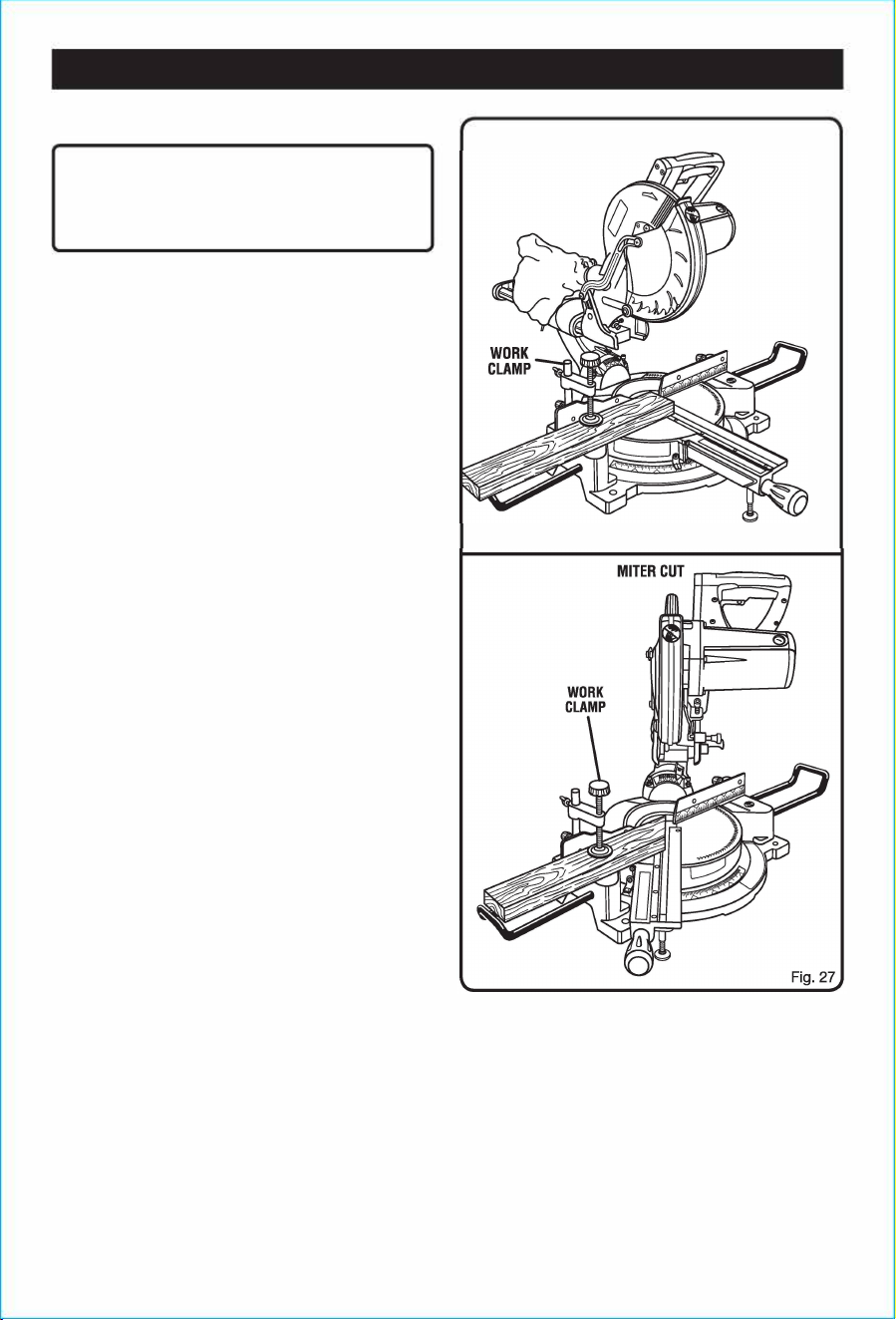
See Figures 26
-
27.
A cross cut is made by cutting across the grain of the
workpiece. A straight cross cut is made with the miter table
set at the O' position. Miter cross cuts are made with the
miter table set at some angle other than O'.
■ Raise saw arm to its full height.
■ Rotate the
miter
table until the pointer aligns with the
desired angle on the miter scale. Securely tighten
the
miter lock handle.
■
Place the workpiece flat on the miter table with one edge
securely against the fence. If the board is warped, place
the
convex
side against the
fence. If
the concave edge
of a
board
is placed against the fence, the board
could
collapse on the blade at the end
of
the cut,
jamming
the
blade. See Figures 38 - 39.
■ When cutting long pieces of lumber or molding, support
the
opposite end of the stock with a roller stand or with
a work surface level with the saw table. See Figure
32.
■ Align cutting line on the workpiece with the edge of saw
blade.
■ Grasp the stock firmly with one hand and secure it against
the fence. Use the work clamp or a C-clamp to secure
the workpiece when possible.
■ Before turning on the saw, perform a dry run of the cut-
ting operation to make sure that no problems will occur
when the cut is made.
■ Grasp the saw handle firmly. Squeeze the switch trigger.
Allow several seconds for the blade to reach maximum
speed.
■ Slowly lower the blade into and through the workpiece.
■ Release the switch trigger and allow the saw blade to
stop rotating before raising the blade out of workpiece
and removing the workpiece from the miter table.
23
CROSS CUT
Fig. 26
OPERATION
TO BEVEL CUT
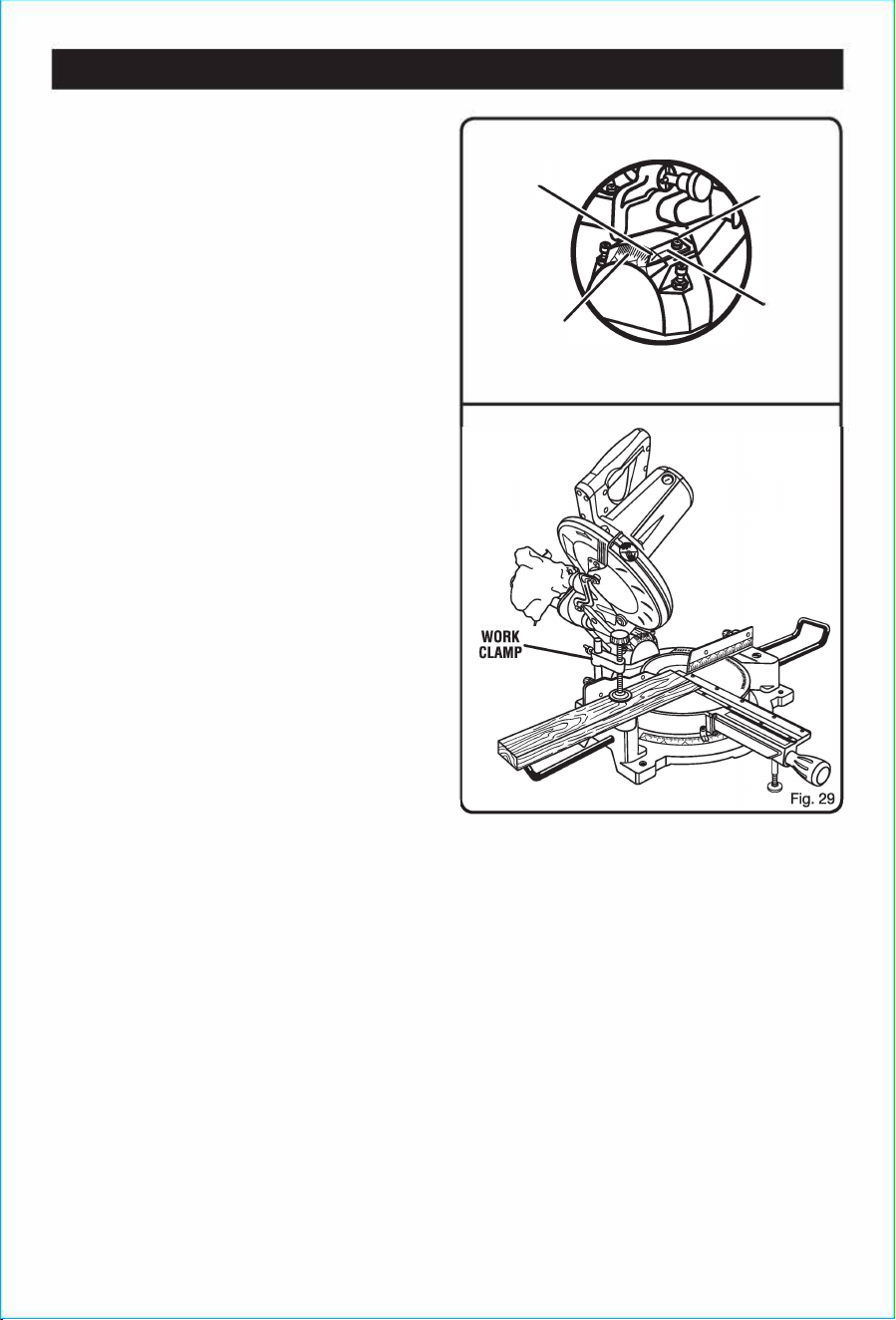
See Figures 28
-
29.
A bevel cut is made by cutting across the grain of the workpiece
with the blade angled to the workpiece. A straight bevel cut
is made with the miter table set at the zero degree position
and the blade set at an angle between 0
°
and 45
°
.
■
Pull out the lock pin and lift saw arm to its full height.
■
Loosen the miter lock handle. Rotate the miter lock handle
approximately one-half turn to the left to loosen.
■
Rotate the control arm until the pointer aligns with zero
on the miter scale.
■
Tighten the miter lock handle securely.
■
Loosen the bevel lock lever and move the saw arm to the
left to the desired bevel angle.
■
Bevel angles can be set
from
0
°
to
45
°
.
■
Align the indicator
point for
the desired angle.
■
Once the
saw
arm has been set
at
the desired angle,
securely tighten the bevel lock lever.
■
Place the workpiece
flat
on the
miter
table with one edge
securely against the
fence.
If the board is warped, place
the convex side against the fence. If the concave edge
of a board is placed against the fence, the board could
collapse on the blade
at
the end of the cut, jamming the
blade.
See Figures 38
-
39.
■
When cutting long pieces of lumber or molding, support
the opposite end of the stock with a roller stand or with
a work surface level with the saw table.
See Figure 32.
■
Align the cutting line on the workpiece with the edge of
saw blade.
■
Grasp the stockfirmlywith one hand and secure it against
the fence. Use the optional work clamp or a C-clamp to
secure the workpiece when possible.
■
Before turning on the saw, perform a dry run of the cutting
operation just to make sure that no problems will occur
when the cut is made.
■
Grasp the saw handle firmly then squeeze the switch
trigger. Allow several seconds for the blade to reach
maximum speed.
■
Slowly lower the blade into and through the workpiece.
■
Release the switch trigger and allow the saw blade to stop
rotating before raising the blade out of workpiece. Wait
until the electric brake stops blade from turning before
removing the workpiece
from miter
table.
24
INDICATOR
POINT
BEVEL SCALE
BEVEL
CUT
INDICATOR
SCREW
SCALE
INDICATOR
Fig. 28
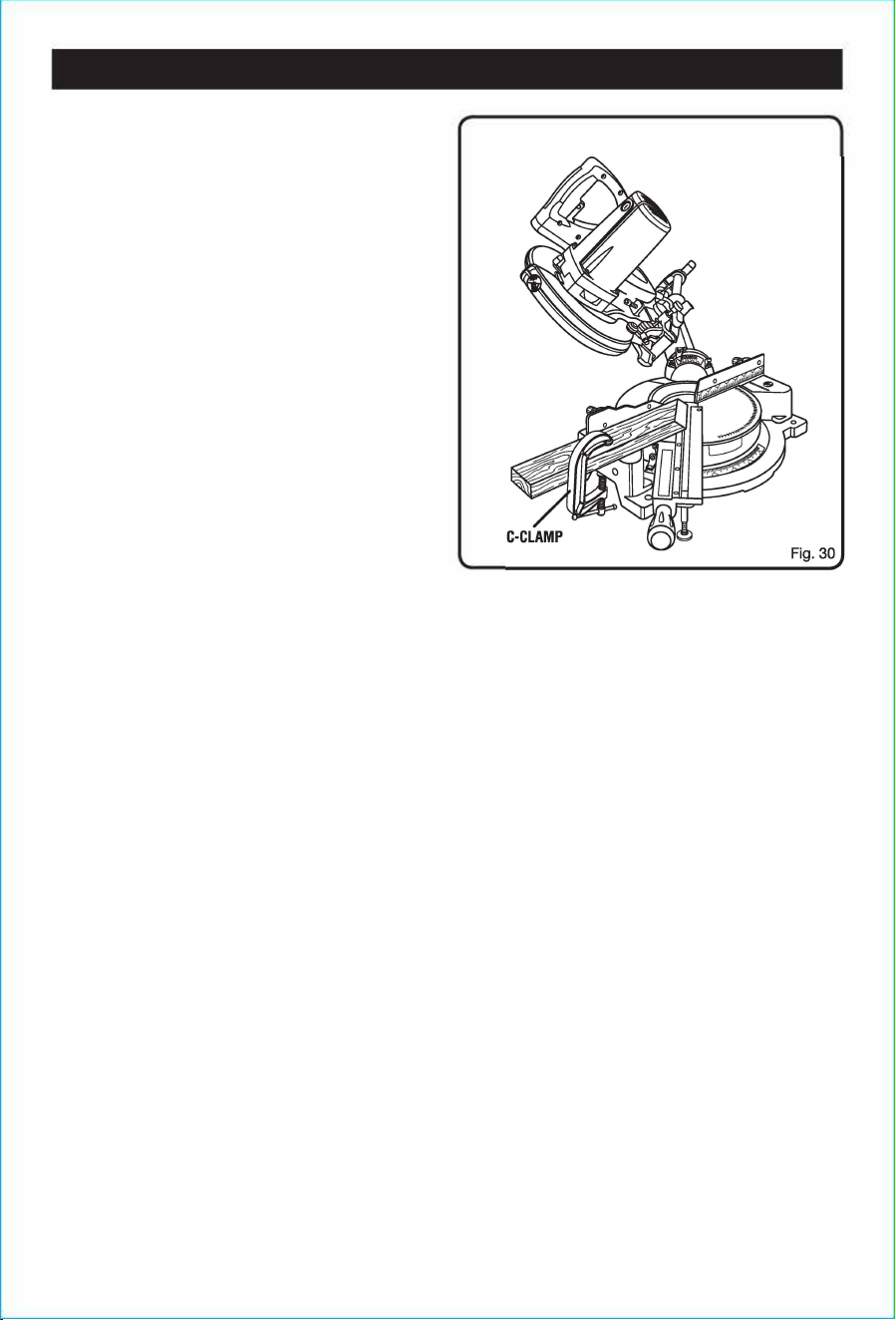
OPERATION
TO COMPOUND MITER
CUT
See Figures 30 - 31.
A compound miter cut is a cut made using a miter angle and
a bevel angle at the same time. This type of cut is used to
make picture
frames, cut
molding, make boxes
with
sloping
sides, and for certain roof framing cuts.
To make this type of cut the control arm on the miter table
must be rotated to the correct angle and the saw arm must
be
tilted to the correct bevel angle. Care should always
be taken when making compound miter
setups
due to the
interaction of the two angle settings.
Adjustments of miter and bevel settings are interdependent
with one another. Each time
you adjust
the miter setting
you
change the effect of the bevel setting. Also, each time you
adjust the bevel setting you change the effect of the miter
setting.
It may take several settings to obtain the desired cut. The
first angle setting should be checked after setting the second
angle, since adjusting the second angle affects the first.
Once the two correct settings for a particular cut have been
obtained, always make
a test
cut in
scrap
material before
making a finish cut in good material.
■
Pull out the lock pin and lift saw arm to its full height.
■
Loosen the miter lock handle. Rotate the miter lock handle
approximately one-half
turn
to the left to loosen.
■
Rotate the control
arm
until the pointer aligns
with
the
desired angle on the miter scale.
■
Tighten the
miter
lock handle securely.
■
Loosen the bevel lock lever and move the saw arm to the
left to the desired bevel angle.
■
Bevel angles can be set from 0
°
to 45
°
.
■
Once the saw arm has been set at the desired angle,
securely tighten the bevel lock lever.
■
Recheck miter angle setting. Make a test cut in scrap
material.
■
Place the workpiece flat on the miter table with one edge
securely against the fence. If the board is warped, place
the convex side against the fence. If the concave edge
of a board could collapse on the blade
at
the end of the
cut,
jamming the blade.
See Figures 38 - 39.
■
When cutting long pieces of lumber or molding, support
the opposite end of the stock with a roller stand or with
a work surface level with the saw table.
See Figure 32.
25
COMPOUND MITER CUT
■
Align the cutting line on the workpiece with the edge of
saw blade.
■
Grasp the stock firmly with one hand and secure it against
the
fence. Use
the
optional work clamp or a C-clamp to
secure the workpiece when possible.
■
Before turning on the saw, perform a dry run of the cutting
operation just to make sure that no problems will occur
when the cut is made.
■
Grasp the saw handle firmly then squeeze the switch
trigger. Allow several seconds for the blade to reach
maximum speed.
■
Slowly lower the blade into and through the workpiece.
■
Release the switch trigger and allow the saw blade to stop
rotating before raising the blade out of workpiece. Wait
until the electric brake stops blade from turning before
removing the workpiece from miter table.
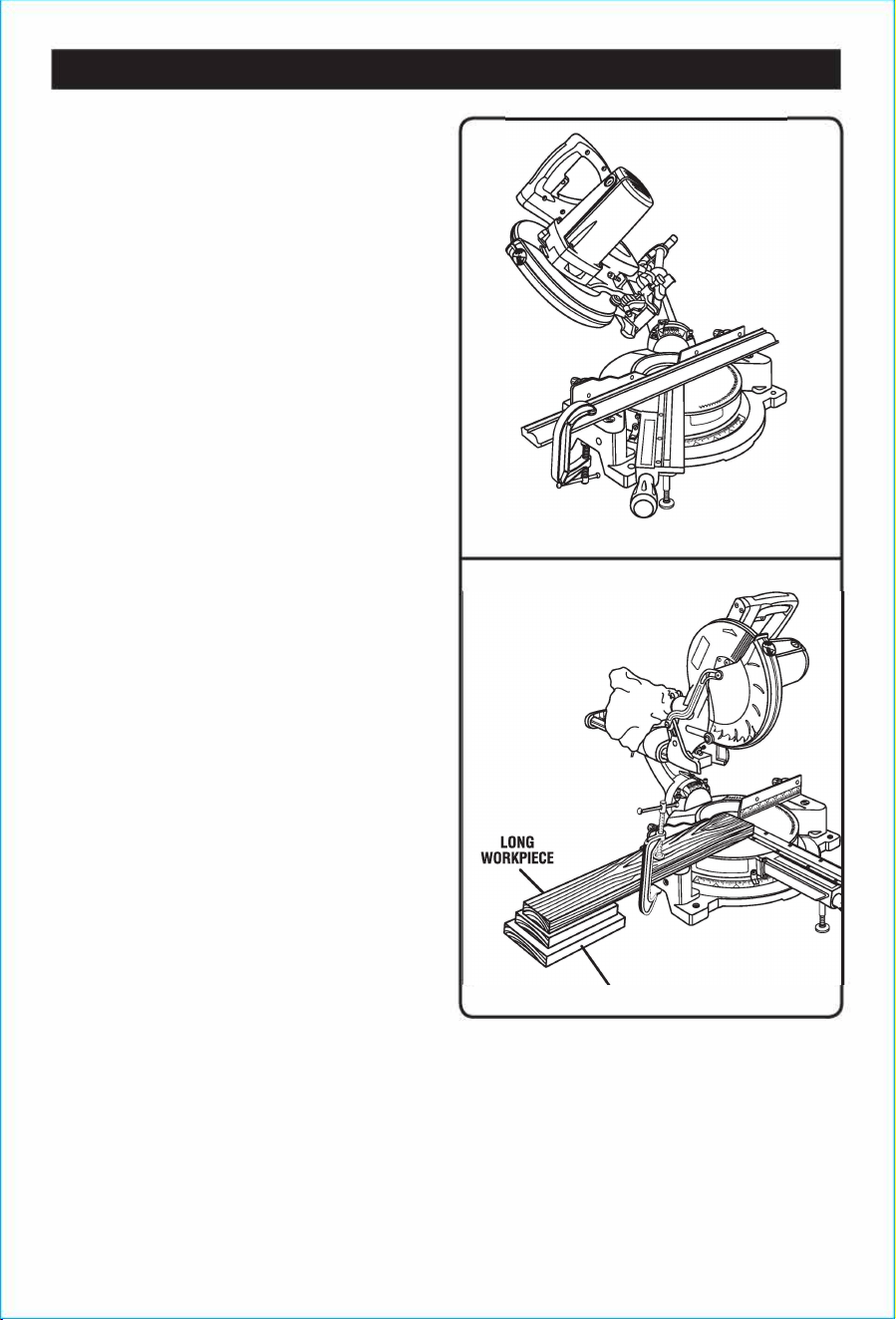
OPERATION
TO SUPPORT LONG WORKPIECES
See Figure 32.
Long workpieces need extra supports. Supports should be
placed along the workpiece so it does not sag. The support
should let the workpiece lay flat on the base of the saw and
work table
during
the cutting
operation. Use
the
optional
work clamp or
a
C-clamp to secure the workpiece.
26
45· X
45·
COMPOUND MITER
CUT
Fig.
31
WORKPIECE SUPPORTS
Fig. 32
OPERATION
WARNING:
Nev
er make a cut by pulling the saw toward you as
the blade can climb on top of the workpiece and come
toward you. Failure to heed this warning could result in
serious personal injury.
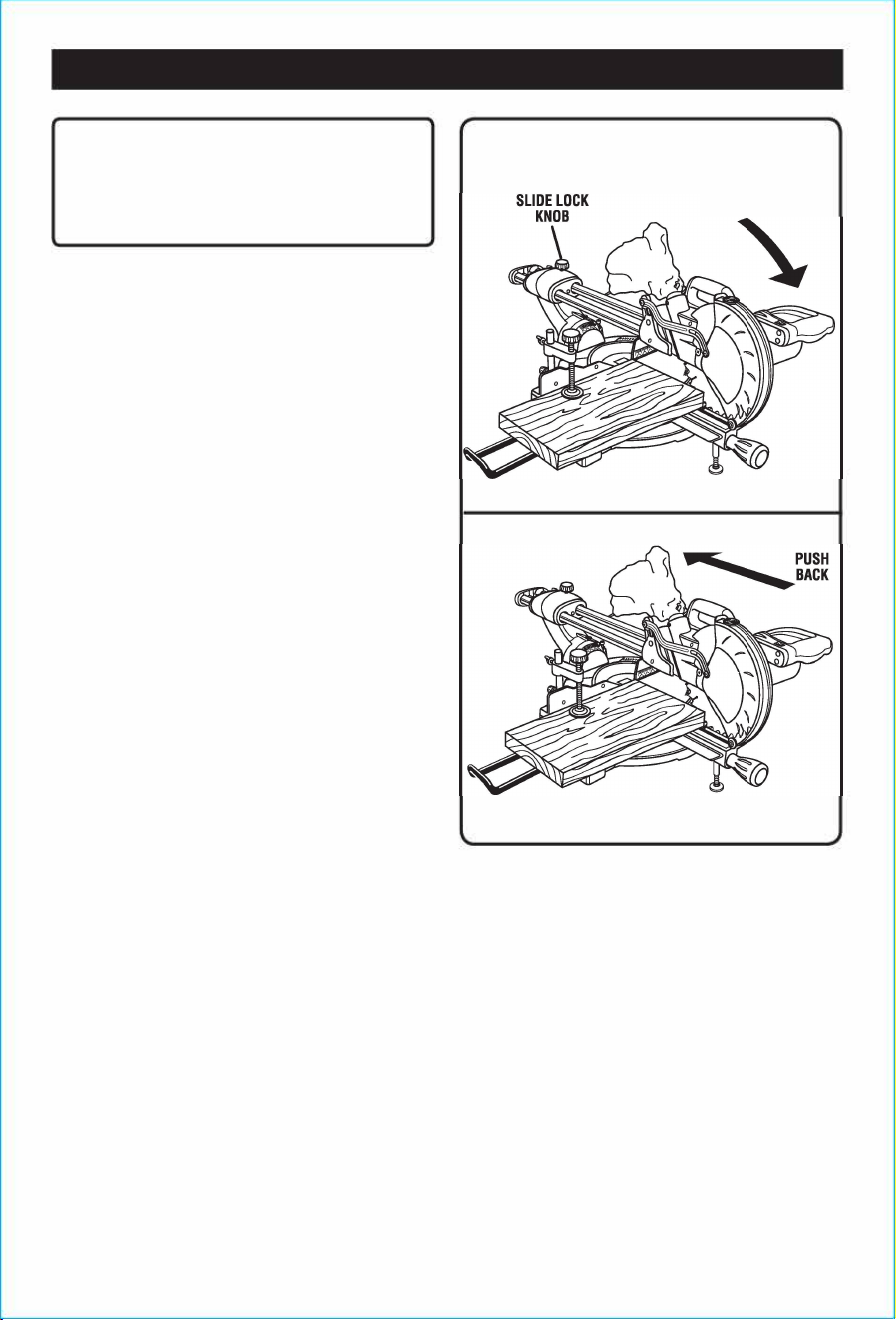
TO SLIDE CUT
See Figures 33 - 34.
The sliding feature will cut workpieces 12 in. wide by
3-1/2 in. thick. With the saw off, pull the saw arm forward.
Turn the saw on (let blade reach maximum speed), push the
blade down cutting into the workpiece then back toward the
rear of the saw to make a cut. Cuts are made by pushing
the saw blade away from you and toward the bevel scale
at the back of the saw stopping when the full rear position
has been reached
after
each
cut.
When the
saw
is running
(turned on),
NEVER
pull the saw
blade
toward
you
or toward
the front of the saw.
■
Raise saw arm to its full height.
■ Place the workpiece flat on the miter table with one edge
securely against the fence. If the board is warped, place
the convex side against the fence. If the concave edge
of a board is placed against the fence, the board could
collapse on the blade at the end of the cut, jamming the
blade.
See Figures 38 - 39.
■ When cutting long pieces of lumber or molding, support
the opposite end of the stock with a roller stand or with
a work surface level with the saw table.
See
Figure 32.
■ Align the cutting line on the workpiece with the edge of
saw blade.
■ Loosen the slide lock knob by turning the knob counter-
clockwise.
■
Grasp the stock firmly with one hand and secure it against
the fence. Use the work clamp or a C-clamp to secure
the workpiece when possible.
■ Before turning on the saw, perform a dry run of the cut-
ting operation to make sure that no problems will occur
when the cut is made.
■ With the saw off, grasp the saw handle firmly then pull
the saw forward until the blade arbor (center of the saw
blade) is over the front of the workpiece.
■
Squeeze the switch trigger. Allow several seconds for the
blade
to
reach
maximum
speed.
■ Slowly lower the blade into and through the front edge
of the workpiece.
■ Push the saw handle away from you and toward the bevel
scale at the back of the saw.
SLIDE
CUT
SLIDE
SAW ARM
FDRWARD THEN
PUSH DDWN
Fig. 33
Fig. 34
■ Release the switch trigger and allow the
saw
blade
to
stop rotating before raising the
blade
out of workpiece
and removing the workpiece from miter table.
NOTE:
A cross cut is made by cutting across the grain of
the workpiece. A straight cross cut is made with the miter
table set at the 0
°
position. Miter cross cuts are made with
the miter table set at some angle other than 0
°
.
27
OPERATION
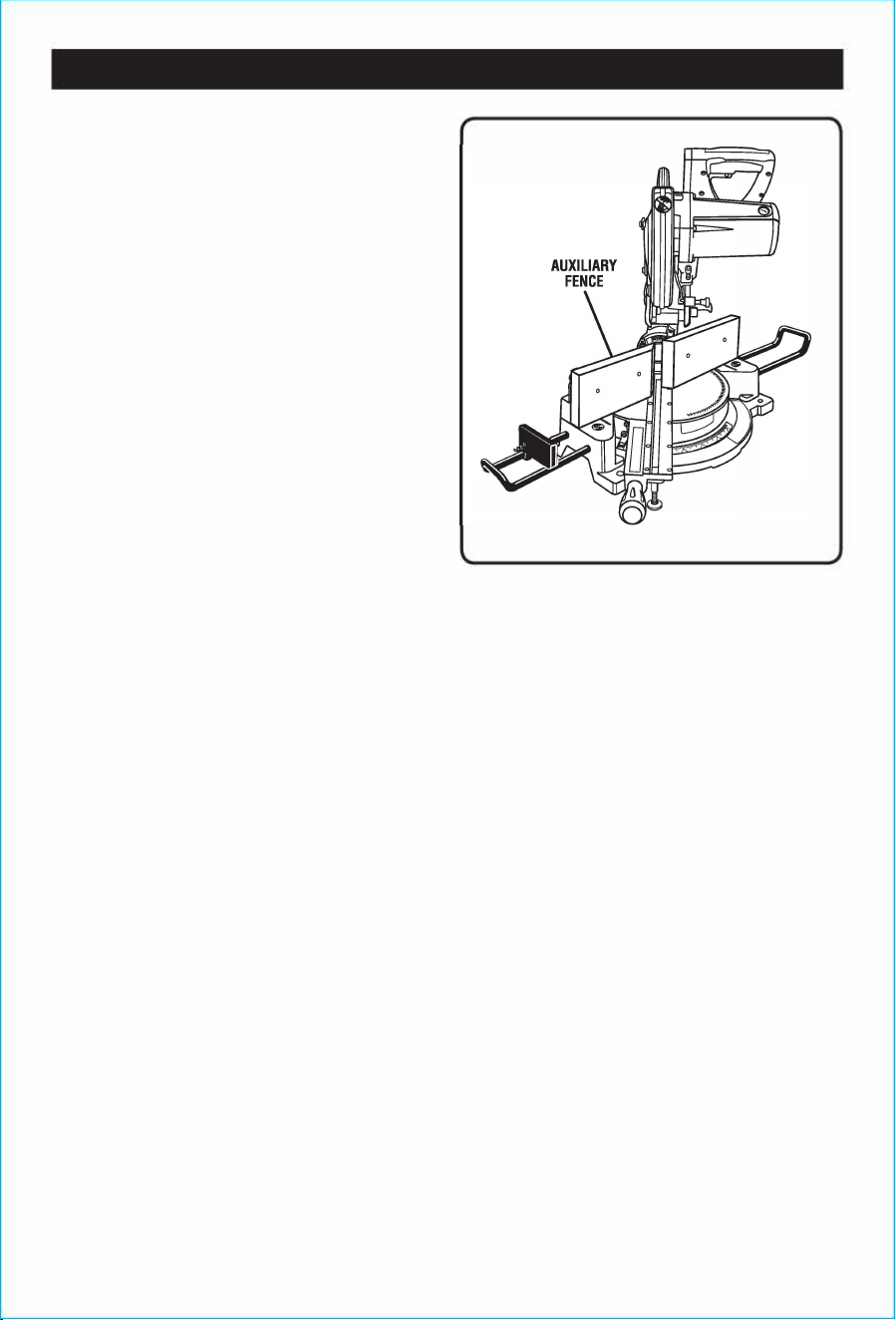
MAKING AN AUXILIARY FENCE
See Figure 35.
Certain unusual cuts may benefit from a thicker miter fence
(auxiliary fence} due to the size and position of the workpiece.
The holes provided in the miter fence are there for just this
purpose.
The
miter fence
holes
are
used to secure the
auxiliary fence which requires a piece of
wood 1/2
in. thick,
3-1/2 in. high, and 23 in. long to make.
NOTE: The auxiliary fence can only be used when the bevel
is set at 0
°
. When making a bevel cut, the auxiliary fence
MUST be removed.
To attach the auxiliary fence to the saw:
■ Place the wood against the miter fence and mark the hole
location from behind the fence using a pencil.
■ Drill holes through the wood then countersink the holes
on the front of the wood.
■
Secure the wood to the miter fence using flat head
screws.
■ With the miter table set at 0
°
, make a complete
cut
through the auxiliary fence to create the
blade
slot.
NOTE: Check for interference between the auxiliary fence
and
the lower
blade
guard. Correct
any
interference
before proceeding.
■ Make a full 45' left miter cut and a 45' right miter cut
through the completed auxiliary fence.
28
Fig.
35
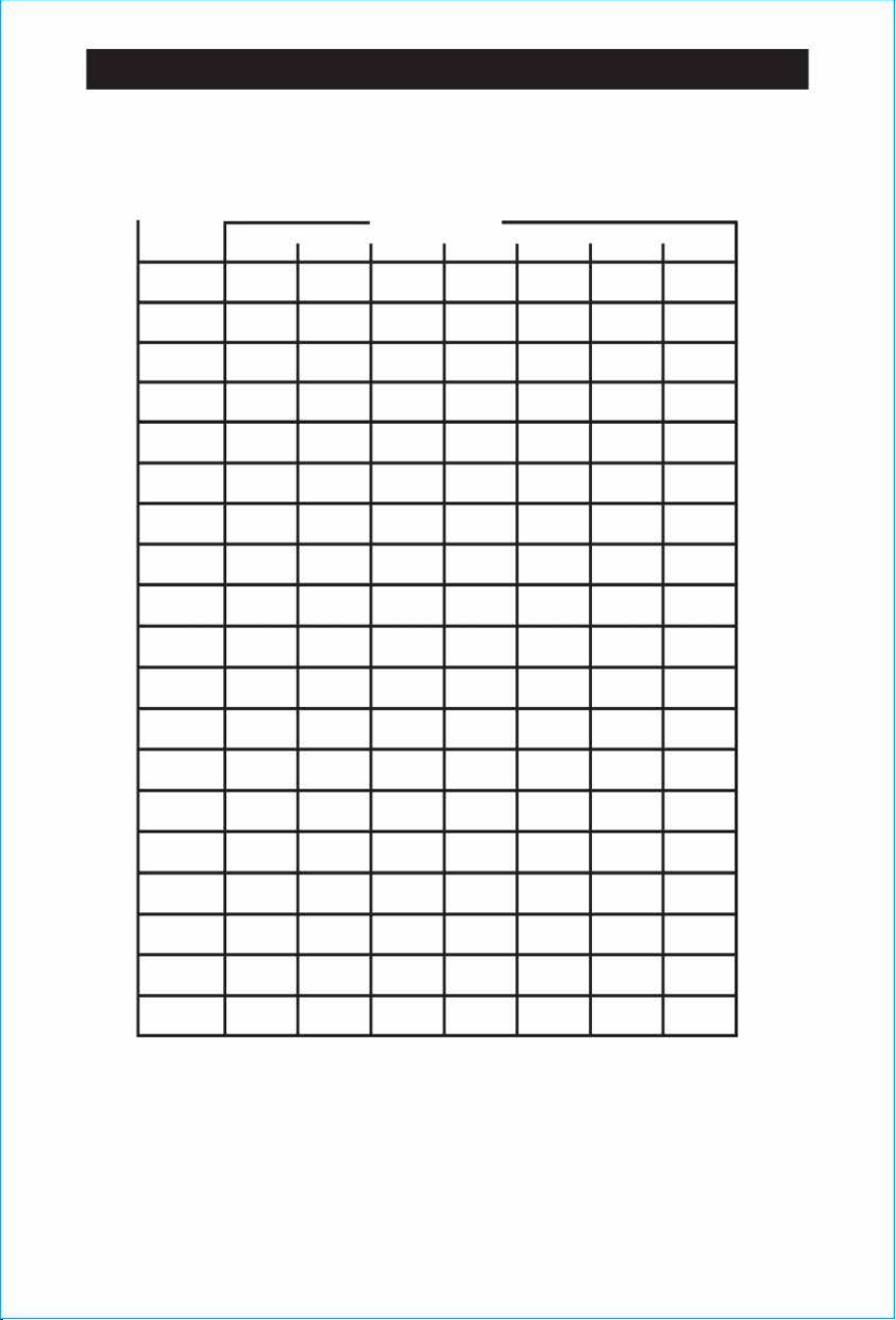
OPERATION
CUTTING COMPOUND MITERS
To aid in making the correct settings, the compound angle setting chart below has been provided. Since compound cuts
are the most difficult to accurately obtain, trial cuts should be made in scrap material, and much thought and planning
made, prior to making the required cut.
PITCH
OF
SIDE
O'
5'
10'
15'
20'
25'
30'
35'
40'
45'
50'
55'
60'
65'
70'
75'
80'
85'
90'
NUMBER OF
SIDES
4
5 6
7 8 9
M-45.00' M- 36.00'
M- 30.00'
M-25.71'
M- 22.50'
M-
20.00'
B-
0.00"
8-
0.00"
B-
0.00"
8-
0.00"
8-
0.00" 8-
0.00"
M- 44.89'
M- 35.90' M- 29.91' M-25.63'
M- 22.42'
M- 19.93'
B- 3.53'
8-
2.94'
B-
2.50'
B-
2.17'
B- 1.91'
B-
1.71'
M- 44.56' M- 35.58'
M- 29.62'
M- 25.37'
M- 22.19'
M-19.72'
B-
7.05'
B-
5.86'
8-
4.98'
8-
4.32'
8-
3.81'
8-
3.40'
M-44.01'
M- 35.06' M-29.15'
M-24.95'
M- 21.81'
M-19.37'
B- 10.55' B- 8.75' B- 7.44'
B-
6.45'
B-
5.68'
8-
5.08'
M-43.22'
M-
34.32'
M-28.48'
M- 24.35'
M-
21.27' M- 18.88'
8- 14.00'
8-
11.60'
B- 9.85'
8-
8.53'
8-
7.52'
B-
6.72'
M- 42.19'
M-33.36'
M- 27.62' M- 23.56'
M-20.58'
M-18.26'
B- 17.39'
8-
14.38'
B-12.20' B- 10.57' 8-
9.31'
B- 8.31'
M- 40.89' M-32.18'
M- 26.57'
M-22.64' M- 19.73' M- 17.50'
B- 20.70' B- 17.09'
8-
14.48' B- 12.53' B-11.03'
B-
9.85'
M-39.32'
M- 30.76'
M-25.31'
M-
21.53' M-
18.74'
M- 16.60'
B- 23.93'
8- 19.70'
8- 16.67'
B-14.41' 8-
12.68'
B-11.31'
M- 37.45' M-
29.10'
M- 23.86' M- 20.25' M-17.60' M-15.58'
8- 27.03'
B-22.20' B- 18.75'
B-16.19' 8-
14.24' 8-
12.70'
M- 35.26' M- 27.19' M- 22.21' M-18.80' M-16.32' M-14.43'
8- 30.00' B-24.56' 8- 20.70' B- 17.87' B-15.70' B- 14.00'
M- 32.73'
M-25.03'
M-20.36'
M- 17.20' M-14.91'
M-13.17'
B-32.80'
8- 26.76'
B- 22.52'
B-19.41' B-17.05' 8-
15.19'
M-29.84' M- 22.62'
M-18.32'
M- 15.44' M-13.36' M-11.79'
B- 35.40' B-28.78'
B-24.18'
8- 20.82'
8-
18.27'
8-
16.27'
M-26.57'
M- 19.96'
M-16.10'
M- 13.54' M-11.70' M-10.31'
8- 37.76'
B-30.60'
8- 25.66'
B-
22.07' B- 19.35'
8-
17.23'
M-22.91' M-
17.07'
M-13.71'
M-11.50'
M-
9.93'
M-
8.74'
8- 39.86'
8-
32.19'
B-26.95'
8- 23.16'
B-20.29' B-18.06'
M-18.88'
M-13.95'
M-11.17' M-
9.35'
M-
8.06'
M-
7.10'
B- 41.64' B-33.53' 8- 28.02' B-24.06'
B-
21.08' B-18.75'
M-14.51' M-10.65'
M- 8.50'
M-
7.10'
M-
6.12'
M-
5.38'
8- 43.08' B-34.59'
B- 28.88'
8-
24.78' 8-
21.69'
8- 19.29'
M-
9.85'
M-
7.19'
M- 5.73'
M-
4.78'
M-
4.11'
M-
3.62'
B-44.14'
8- 35.37'
B-29.50'
8- 25.30'
B-22.14' B-19.68'
M-
4.98'
M-
3.62'
M-
2.88'
M-
2.40'
M-
2.07' M- 1.82'
B- 44.78'
B-35.84' 8-
29.87'
B-25.61' B-22.41' 8- 19.92'
M-
0.00'
M- 0.00'
M-
0.00"
M-
0.00'
M-
0.00'
M-
0.00"
B- 45.00'
B-36.00'
8-
30.00'
B-25.71' B- 22.50' B- 20.00'
Each B (Bevel) and
M
(Miter) Setting is Given to the Closest 0.005'.
COMPOUND-ANGLE SETTINGS FOR POPULAR STRUCTURES
29
10
M-
18.00'
8-
0.00"
M-17.94'
B- 1.54'
M-17.74'
B-
3.08'
M-17.42'
B- 4.59'
M- 16.98'
8-
6.07'
M-16.41'
B- 7.50'
M- 15.72'
8-
8.89'
M-
14.90'
8- 10.21'
M- 13.98'
B- 11.46'
M-
12.94'
8- 12.62'
M- 11.80'
B- 13.69'
M- 10.56'
B- 14.66'
M- 9.23'
B- 15.52'
M-
7.82'
B-16.26'
M-
6.34'
B- 16.88'
M- 4.81'
B- 17.37'
M-
3.23'
B-17.72'
M-
1.62'
8- 17.93'
M-
0.00"
B-18.00'
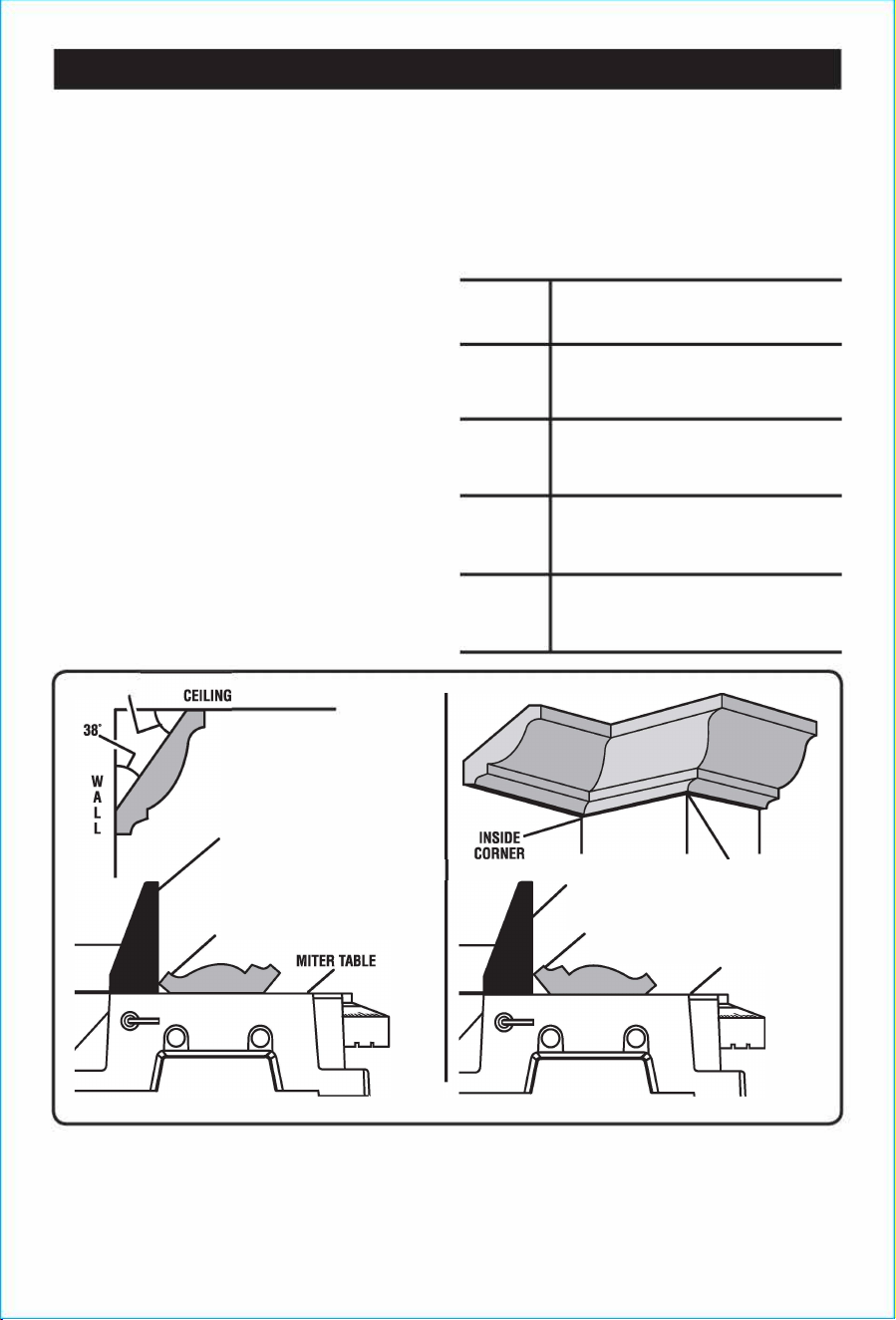
OPERATION
CUTTING
CROWN MOLDING
The compound miter saw does an excellent job of cutting crown
molding. In general, compound miter saws do a better job of
cutting crown molding than any other tool made.
In order to fit properly, crown molding must be compound
mitered with extreme accuracy.
The two contact surfaces on a piece of crown molding that fit
flat against the ceiling and the wall of a room are at angles that,
when added together, equal exactly 90
°
. Most crown molding
has a top rear angle (the section that fits flat against the ceiling)
of 52
°
and a bottom rear angle (the section that fits flat against
the wall) of 38
°
.
LAYING MOLDING FLAT ON THE MITER
TABLE
See Figure 36.
To use this method for accurately cutting crown molding for
a
90'
inside or outside corner,
lay
the molding
with
its broad back
surface flat on the miter table and against the fence.
When setting the bevel and miter angles for compound
miters, remember that the settings are interdependent;
changing one angle changes the other angle as well.
Keep in mind
that
the angles for crown molding are very precise
and difficult
to set.
Since it is
very easy
for
these
angles
to
shift,
all settings should first be tested on scrap molding. Also most
walls do not have angles of exactly 90
°
; therefore, you will need
to fine tune your settings.
52"
FENCE
TOP EDGE AGAINST FENCE =
•
LEFT SIDE, INSIDE CORNER
•
RIGHT SIDE, OUTSIDE CORNER
When cutting crown molding by this method, the bevel angle
should be set at 33.85
°
. The miter angle should be set
at
31.6
°
either right or left, depending on the desired cut for the applica-
tion. See the chart below for correct angle settings and correct
positioning of crown molding on miter table.
The settings in the chart below can be used for cutting All Stan-
dard (U.S.) crown molding with 52
°
and 38
°
angles. The crown
molding is placed flat on the miter table using the compound
features of your miter saw.
Bevel
Angle
Setting
33.85
°
33.85
°
33.85
°
33.85
°
Type
of Cut
Left side, inside corner
1. Top edge of molding against fence
2. Miter table set right 31.62
°
3. Save left end of cut
Right
side,
inside corner
1. Bottom edge of molding against fence
2. Miter table set left 31.62
°
3.
Save left end of cut
Left side, outside corner
1. Bottom edge of molding against fence
2. Miter table set left 31.62
°
3. Save right end
of
cut
Right side, outside corner
1. Top edge of molding against fence
2. Miter table set right 31.62
°
3. Save right end of cut
FENCE
OUTSIDE
CORNER
BOTTOM EDGE AGAINST
FENCE =
•
RIGHT SIDE, INSIDE CORNER
•
LEFT SIDE, OUTSIDE
CORNER
MITER TABLE
CROWN MOLDING FLAT ON MITER TABLE
Fig.
36
30
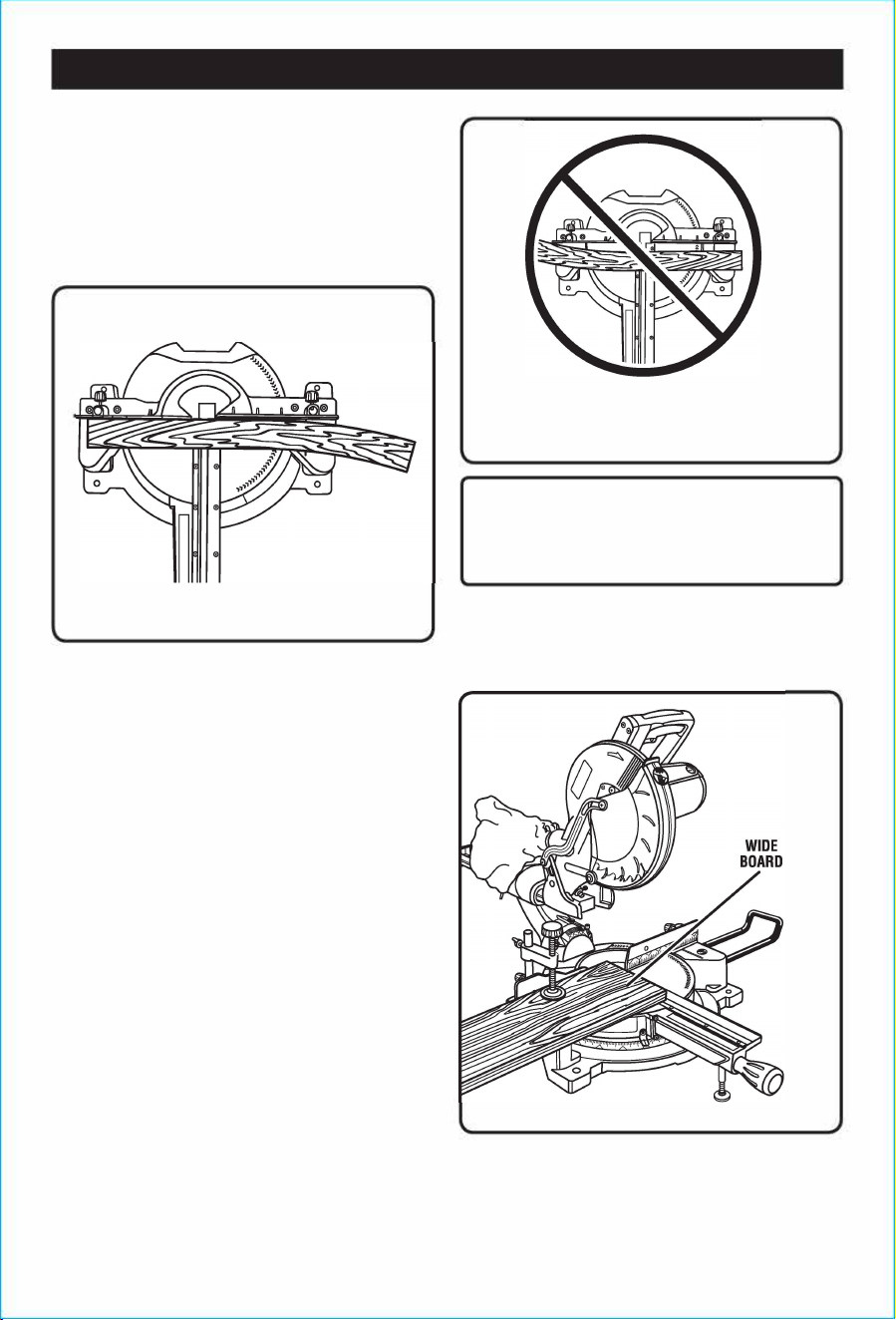
OPERATION
CUTTING WARPED MATERIAL
See Figures 37
-
38.
When cutting warped material, always make sure it is posi-
tioned on the miter table with the convex side against the
fence as shown in figure 37.
If the warped material is positioned the wrong way as shown
in figure 38, it will pinch the blade near the completion of
the cut.
RIGHT
Fig. 37
31
8
w
WRONG
Fig.
38
WARNING:
To avoid a kickback and to avoid s
erious personal injury,
never position the concave edge of bowed or
warped material against the fence.
CLAMPING WIDE
WORKPIECES
See Figure 39.
When cutting wide workpieces, such as 2 in. x 6 in., boards
should be clamped with a work clamp as shown in figure 39.
Fig.
39
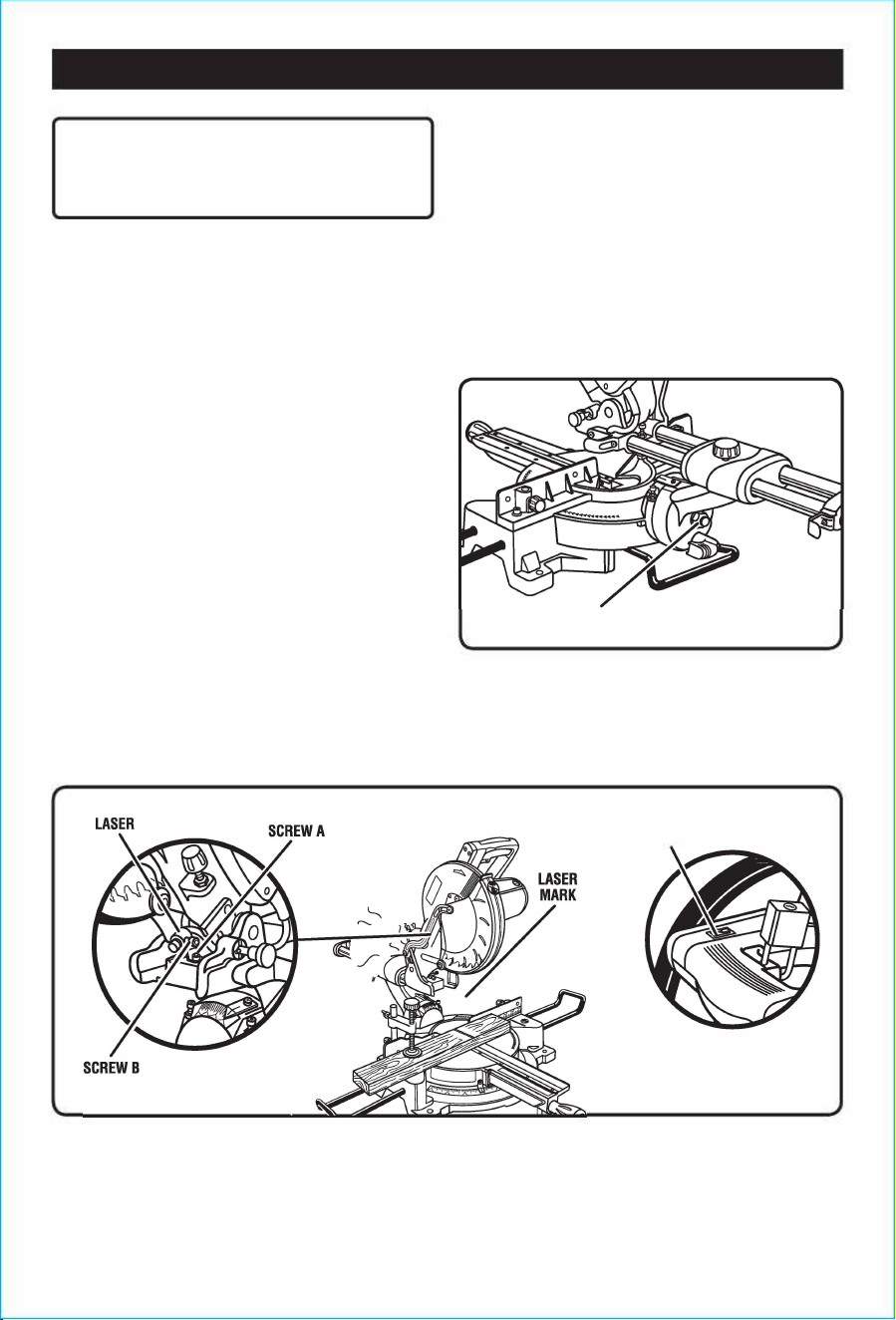
ADJUSTMENTS
WARNING:
Before performing any adjustment, make sure the tool is
unplugged from the power supply. Failure to heed this
warning could result in serious personal injury.
The compound miter saw has been adjusted at the
factory for making accurate cuts. However, some of
the components might have been jarred out of alignment
during shipping. Also, over a period of time, readjustment
will probably become necessary due to wear. After unpacking
the saw, check the following adjustments before you begin
using saw. Make
any
readjustments that are necessary and
periodically check the
parts
alignment to make sure that the
saw is cutting accurately.
TO ADJUST THE BEVEL PIVOT
See Figure 40.
The saw should smoothly pivot when the bevel lock lever is
"unlocked" and the saw is beveled. A "grating" sound
indicates that the bevel needs to be loosened slightly. If the
movement is tight, too loose, or there is play in the pivot, an
adjustment is required.
■ Unplug the saw.
■ Turn the hex nut with the blade wrench.
■ Once all adjustments have been made, lift the bevel
lock lever to relock the bevel. Recheck and readjust as
needed.
TO ADJUST THE LASER GUIDE
See Figure 41.
NOTE: Avoid direct
eye
exposure when using the laser
guide.
■
Use
the work clamp or
a
C-clamp to
secure
a piece of
scrap wood.
32
■
Plug the saw into the power source and make a slight
cut to score the wood.
■
Release the switch trigger and allow the saw blade to
stop rotating before raising the blade.
■
Raise the saw arm.
■
Lock the switch by installing a padlock (not included)
through the hole in the switch trigger.
■
To adjust the laser, loosen screw A using a hex key.
NOTE: When properly aligned, the laser should be on the
left edge of the kerf. Loosen and adjust screw B only if
adjustment of screw A fails to properly align the laser.
■
Once aligned, tighten the screws then remove and store
the hex key.
HEX NUT
LASER
ON/OFF
Fig. 40
Fig. 41
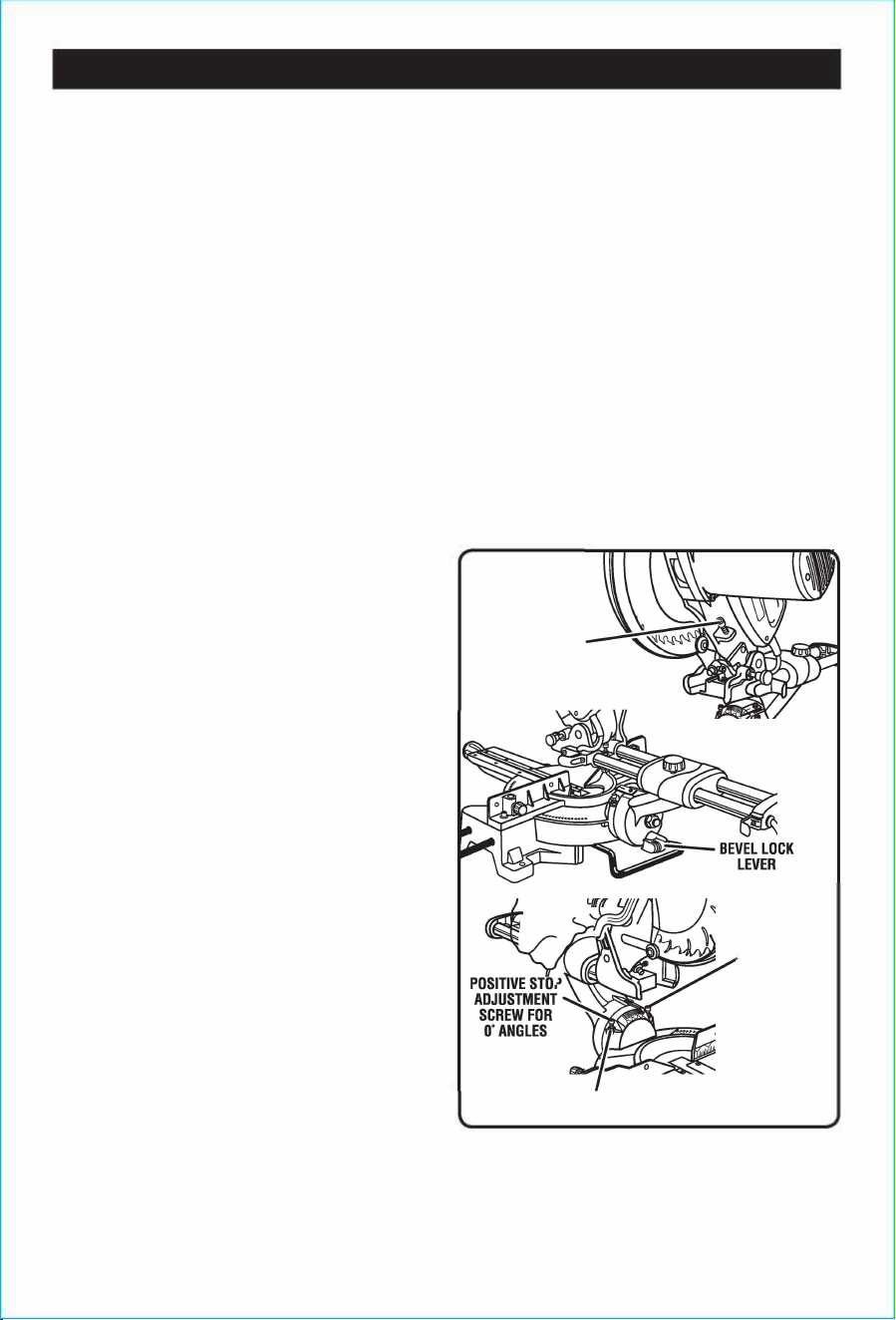
ADJUSTMENTS
TRAVEL
PIVOT ADJUSTMENT
■
The saw arm should rise completely to the up position
by itself.
■
If the saw arm does not raise by itself or if there is play
in the pivot joints, have saw repaired at the nearest
authorized service center.
DEPTH STOP
The depth
stop
limits the blade's downward travel.
It
allows the blade to go below the miter table enough to
maintain full cutting capacities. The depth stop positions
the blade 1/4 in. from the miter table support.
NOTE:
The miter table support is located inside the miter
table.
The depth stop is factory set to provide maximum cut-
ting capacity for the
10
in. blade provided with the saw.
Therefore, the saw with blade provided should never need
adjustments.
However, when the diameter of the blade has been
reduced due to sharpening, it may be necessary to
adjust the depth stop to provide maximum cutting
capacity. Also, when a new blade is installed, it is
necessary to check the clearance of the blade to the
miter table support before starting the saw. Make adjust-
ments if needed.
DEPTH STOP
ADJUSTMENTS
See Figure 42.
■
Unplug the saw.
■
To adjust the depth stop use a
10
mm wrench and loosen
the hex nut located on the top of the upper saw arm.
■
Use a 5 mm hex key wrench to adjust the depth stop
adjustment screw. The saw blade is lowered by turning
the screw counterclockwise and raised by turning the
screw clockwise.
■
Lower the blade into the miter table. Check blade clearance
and maximum cutting distance (distance from fence where
blade enters) to front of miter table slot.
■
Readjust if necessary.
■
Tighten the hex nut with a
10
mm wrench or adjustable
wrench.
■
To prevent the depth stop adjustment screw from turning
while tightening the
hex
nut, carefully
hold
it with the
hex
key wrench while tightening the hex nut.
POSITIVE STOP ADJUSTMENTS
See Figure 42.
NOTE:
These adjustments were made at the factory and
normally do not require readjustment.
To
adjust:
■
Unplug the saw.
■
Using two wrenches (one on the lock nut and one
for
the positive stop adjustment screw), loosen the lock nut
securing the positive stop adjustment screw.
■
Loosen the bevel lock lever by turning the knob
counterclockwise.
■
Square
the
blade
to the miter
table as described
in the
Assembly
section
of
this manual.
■
Retighten bevel lock lever. Next, retighten lock nut
securing the positive stop adjustment screw. Recheck
blade-to-table alignment.
NOTE:
The above procedure can be used to check blade
squareness of the saw
blade
to the miter table at
both
0
°
and 45
°
angles.
The saw has two scale indicators, one on the bevel scale
and one on the miter scale. After squaring adjustments have
been
made, it may be necessary to loosen the indicator
screws and reset them to zero.
33
DEPTH STOP
ADJUSTMENT
SCREW
LOCK NUT(S)
POSITIVE STOP
ADJUSTMENT
SCREW FDR
45· ANGLES
Fig. 42
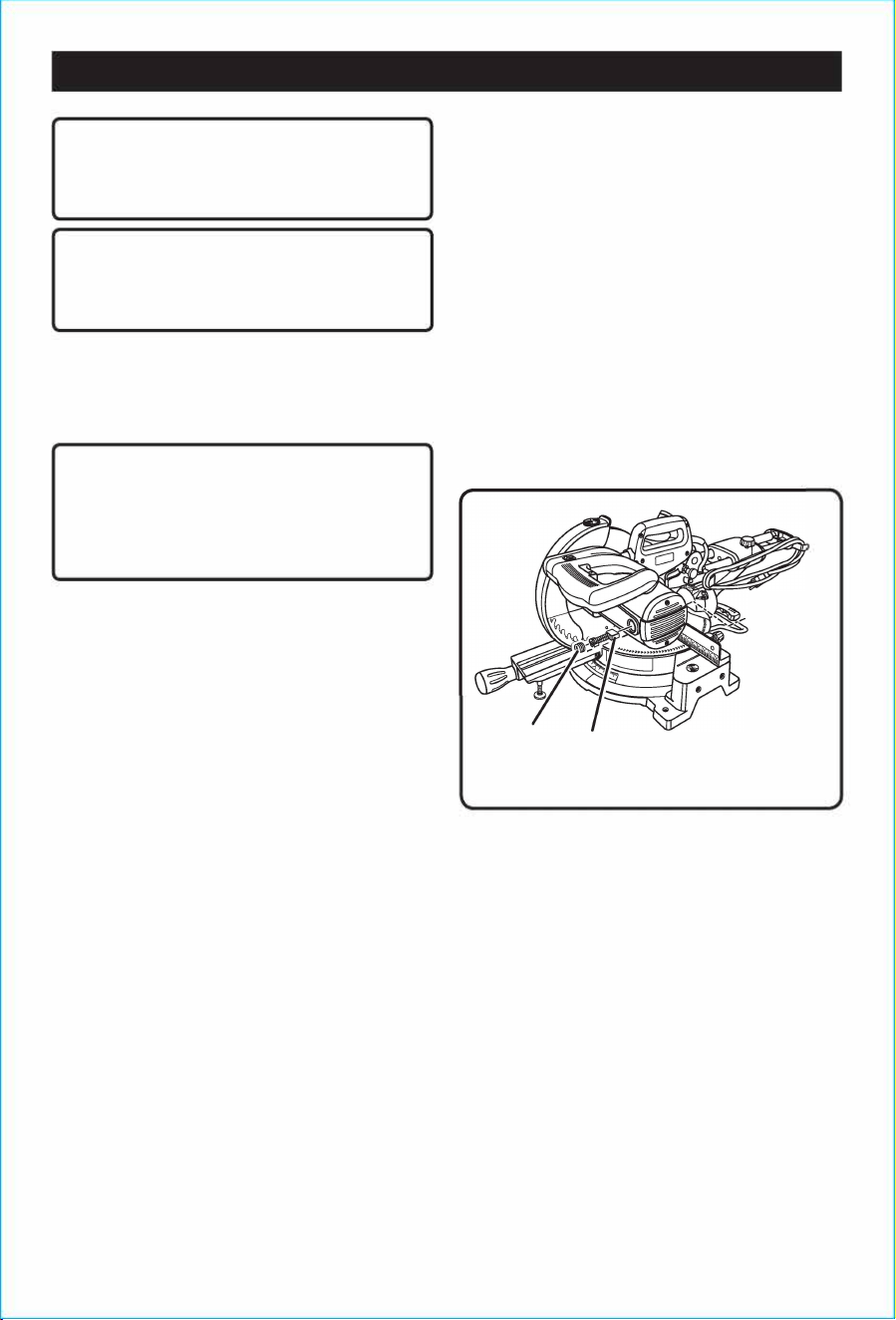
MAINTENANCE
WARNING:
When servicing, use only identical replacement parts.
Use of any other parts may create a hazard or cause
product damage.
WARNING:
Always wear safety goggles or safety glasses with side
shields during power tool operation or when blowing
dust. If operation is dusty, also wear a dust mask.
GENERAL MAINTENANCE
Avoid using solvents when cleaning plastic parts. Most
plastics are susceptible to damage from various types of
commercial solvents and may be damaged by their use. Use
clean cloths to remove dirt, dust, oil, grease, etc.
WARNING:
Do not at any time let brake fluids, gasoline, petroleum-
based products, penetrating oils, etc., come in contact
with plastic parts. Chemicals can damage, weaken or
destroy plastic which may result in serious personal
injury.
Electric tools used on fiberglass material, wallboard, spackling
compounds, or plaster are subject to accelerated wear and
possible premature failure because the fiberglass chips and
grindings are highly abrasive to bearings, brushes, commuta-
tors, etc. Consequently, we do not recommended using this
tool for extended work on these types of materials. However,
if you do work with any of these materials, it is extremely
important to clean the tool using compressed air.
LUBRICATION
All of the bearings in this tool are lubricated with a sufficient
amount of high grade lubricant for the life of the unit under
normal operating conditions. Therefore, no further lubrica-
tion is required.
BRUSH
REPLACEMENT
See Figure 43.
The saw has externally accessible brush assemblies that
should be periodically checked for wear.
Proceed as follows when replacement is required:
■
Unplug
the
saw.
■
Remove brush cap with a screwdriver. Brush assembly is
spring loaded and will pop out when you remove brush
cap.
■
Remove brush assembly.
■ Check for wear. Replace both brushes when either has
less than 1/4 in. length of carbon remaining.
Do not
replace one side without replacing the other.
■
Reassemble using
new
brush assemblies. Make sure
curvature of brush matches curvature of motor and that
brush moves freely in brush tube.
■
Make sure brush cap
is
oriented correctly
(straight)
and
replace.
■ Tighten brush cap securely.
Do not
overtighten.
34
BRUSH
CAP
BRUSH
ASSEMBLY
-\\
BRUSH
CAP
BRUSH
ASSEMBLY
Fig. 43
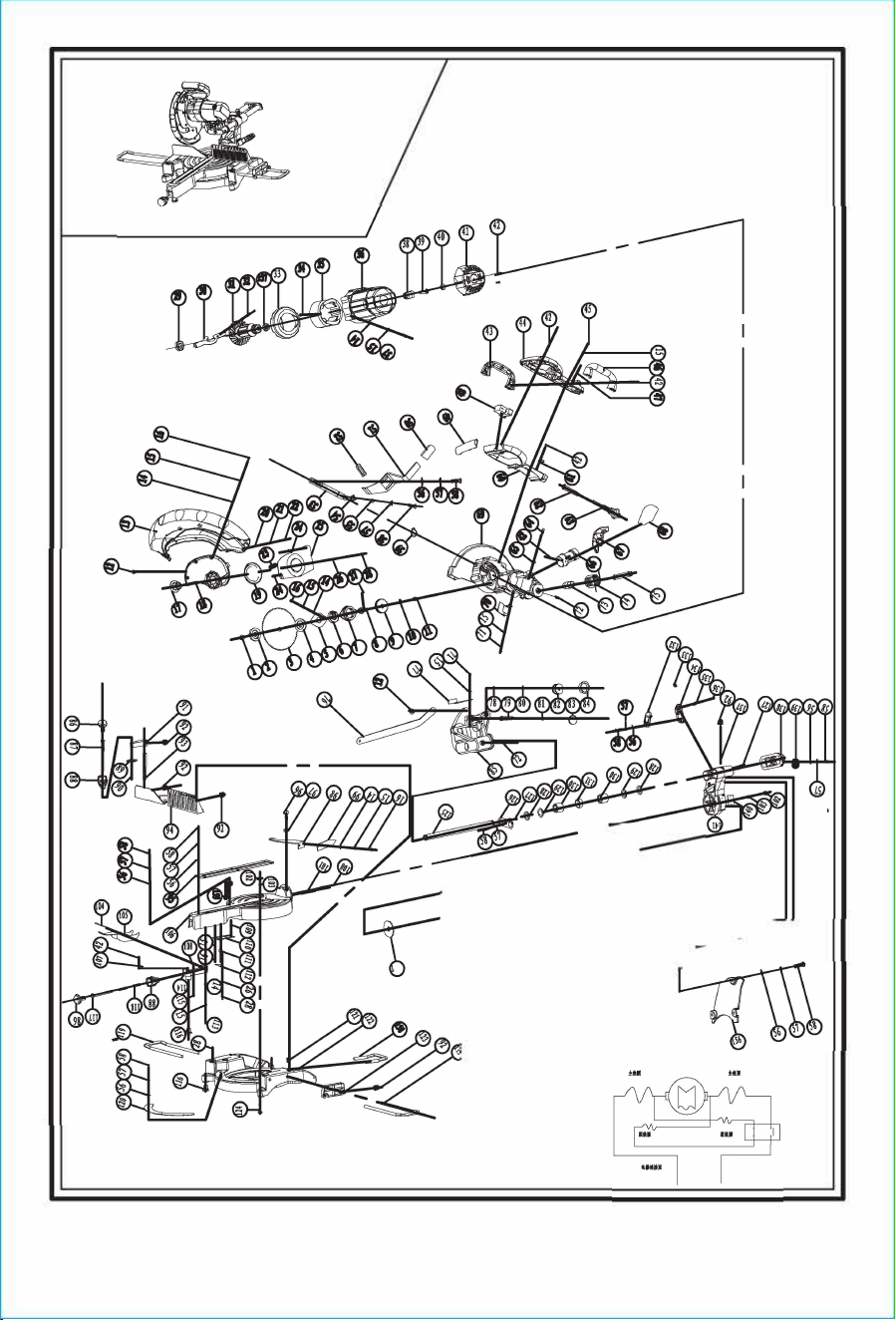
-
. -_:::::::.
-::::;:::::::::
35
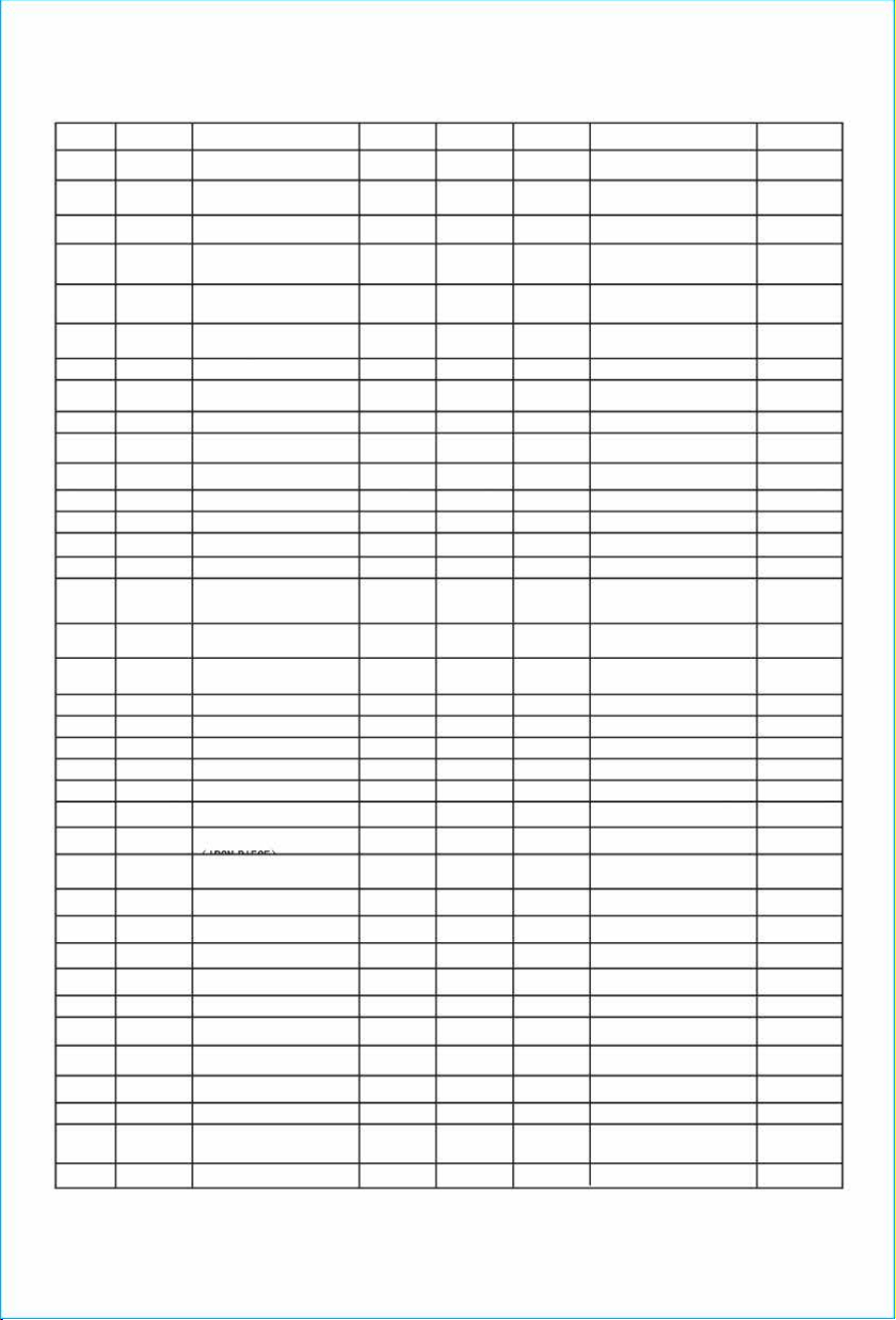
Parts Breakdown
Fig#
P/N Name/Spec i f i cat i on Qty.
Fig#
P/N Name/Spec i f i cat i on Qty.
1 2120003 HEX SCREW M8X16 1 38 4410007 CARBON BRUSH 2
2 1400005 OUTER FLANGE 1 39 4510005
CARBON BRUSH SET
6. 5X13. 5X18
2
3 BLADE 1 40 4410008
BRUSH
HOLDER CAP 2
4
1400007 I NNER FLANGE 1 41 3100044 REAR COVER 1
5 1100031 BEAR I NG RETA I NER 1 42 2200004 TAPP I NG SCREW ST 4X16 8
6 2310013
BALL
BEAR I NG
1 43 3100207 RIGHT ASSISTANT HANDLE 1
6203-2RSISYBS
7 1300039 FRONT GOVER 1
44
3100198 UPPER HANDLE 1
8 1200006 SPINDLE 1 45 2110050 CROSS SCREW M5X35 5
9 1200010 GEAR 1 46 3100208
LEFT
ASS I STANT HANDLE 1
10 2420004 RETAINER RING <1>17 1 47 2200011 TAPP I NG SCREW ST5X35 3
11 2320002 NEDDLE BEARING 1210 1 48 4310010 SWITCH 1
12 2160002 NON-STANDARD SCREW M6X8 2 49 3100200 HANDLE COVER 1
13 3100197 SAFETY GUARD 1
50
3210014 GLUE SLEEVE
1
1
14 2100023 FLAT WASHER
4>
5 15 51 1100095 SAFETY MEGHAN I SM CLAMP 1 1
15 2520001 SPRING WASHER 4> 5 25 52 3100219 GLUE SLEEVE 2 1
16 2110040 CROSS SCREW M5 XlO 8 53 2620033
SAFETY MEGHAN I SM
1
CENTRAL SP I NDLE
17 1300212 MOVABLE GUARD SP I NDLE 1 54 1100096 SAFETY MEGHAN I SM CLAMP 2 1
18
1300214
GENTER COVER
1 55 1500027
SAFETY MEGHAN I SM
1
(ALUMINUM PIECE) TORS I ONAL SPRING
19 1500026 TORS I ONAL SPRING 1 56 2510001 FLAT WASHER 4>4 25
20 2620034 ROLLER NUT 1 57 2520004 SPRING WASHER 4> 4 25
21 3100217 ROLLER ( PLASTI
G
PI EGE) 1 58 2110005 GROSS SCREW M4X12 17
22 2110037 CROSS SCREW M4X10 1 59 2430004 RETAINER RINGS 1
23 3210018 LIM I TED POST GLUE SLEEVE 1
60
3100199 LOWER HANDLE
24 2110024 CROSS SCREW M6X 10 2 61 3100006
CORD
CLAMP 1
25 1100094
GENTER GOVER
1 62 3230002 GORD SLEEVE 1
26 2520002 SPRING WASHER 4> 6 3 63 4210002
GORD 2xi
2
x2. 5
1
27 2610002
WOODRUFF KEY 4X
<1> 13 1 64 2140008 HEX SCREW M6X30 1
28 2110027 GROSS SCREW M6X16
3 65
2130004 HEX NUT M6 1
29 2310012
BALL BEAR I NG 6202-2RZ/BAW
1 66 3100204 DUST NOZZLE GUARD 1
30 1100032
SELF-LOCK
1 67 3100205 DUST NOZZLE GOVER 1
31 4100012 ROTOR 1 68 5800006
DUST
BAG 1
32 1500017 SELF -LOCK I NG SPRING 1 69 1300216 ALUMINUM BLADE GUARD 1
33 3100038 WINDSHIELD 1 70 1100097 DEFEND FENCE 1
34 2200005 TAPP I NG SCREW ST5X60 2 71 2110057 GROSS SCREW M5X 16 2
35 4100030 STATOR 1
72
2140001 HEX SCREW M5X10 4
36 3100188
MOTOR HOUS IN
1 73 2620027 SLEEVE 1
(PLASTIC PIECE)
37 2110052 GROSS SCREW M5X55
4
74 1500028 ROTARY TORSIONAL SPR I NG 1
36
75 2620031 SPINDLE 1 112 1100105 NUT CLAMP 1
76 1100098 CONNECT
I
NG ROD 1 113 2110072 CROSS SCREW M6X 1 8 3
77
1100099 PADDLE 1 114 3100201
INST
ALL BASE 1
78 2140017 CROSS SCREW M8X 16 1 115 2140018 HEX SCREW M6X10 1
79 2160004 UP LOCK PIN 1 116 3210016 RUBBER FEET
5
80
2520003 SPR I NG WASHER <I> 8 1 117 2620029 BOLT M1 OX205 1
81 3220002 0-RING <l>6X<l>1
1
118 6200013 BOLT GLUE SLEEVE 1
82 2620028 HELICAL GEAR 1 119 1100106 SUPPORT ROD 2
83 3100048
LOCK PIN NUT M6
1 120 1100107 ANGLE PLATE 1
(PLAST I
G
PI EGE)
84 3210015 RUBBER RING 1 121 2110028 CROSS SCREW M6X20 2
85 1300218 HOLDER 1 122 1300206 BASE 1
86 3100220
ANGLE TURN-KNOB LID
2 123 1300209 MOVABLE BACKUP PLATE 1
87 2620026 PRESSURE CLAMP BOLT 1 124 2160034 HEX SCREW M8X30 1
88 3100206 ANGLE TURN-KNOB 2 125 1600013 SLIDING ROD 2
89 1100035 PRESS-CLAMP <l>50X<l>6X2 1 126 1100108 CLAMP (IRONPIECE) 1
90 2160027
NON-STANDARD
1 127 3210017 LI
M
I T GLUE SCREW 2
GROSS SCREW M5X8
91 1300220 CLAMP 1 128 1100109
WASHER CI RON PIECE)
4
92 3100209 PLAST I G BOLT 4 129 6200012 SEALING FELT
4
93 2620037 CLAMPING PIN <l>16X130 1 130 2320003 LI NEAR BEAR I NG
4
94 1300205 GROSS-BAR 1 131 1500029 BEARING RETAINER 2
95
3100218
PLATE COVER
1 132 1500030 COMPRESS I ON SPRING 1
(PLASTIC PIECE)
96 2160033
HEX SCREW M8X25 2 133 1300211 FIXED HOLDER 1
97 2130014 NUT MB 2 134 3100010 CORD CLAMP PLATE 1
98
1100100 MITER ANGLE RULER SUPPORT 1 135 5100015 SCALE LABEL 1
99 1100101 MITER ANGLE
RULER
1 136 1300224 ROTORY HOLDER 2
100 2620036 NON-STANDARD SCREW MB X45 1 137 2510015 FLAT WASHER <I> 1 0 1
101 2620035
NON-STANDARD SCREW M10 X90
1 138 2620030 CLAMP NUT 1
102 2130009 LOCK I NG NUT MB 2 139 3100202 LOCK I NG WRENCH 1
103 2510012 FLAT WASHER <I> 8 2 140 1500031 LOCK I NG WRENCH SPR I NG 1
104 2620038 PIN <1>4X60 1 141 2510004 FLAT WASHER <I> 18
X
<I> 5X1 1
105 1100102 ADJUST I NG BOARD 1 142 3100203 GOVER CAP 1
106 1300222 PLATE 1 143 2110070 CROSS SCREW M4X30 1
107 1100103 BOLT CLAMP 1 144 3100216 BAFFLE 1
108 2130007 LOCK I NG NUT
M6
1 145 2310005 BALL BEAR I NG 6000-2RZ/BAW 1
109 2620032 NAIL 1 146 1100110 BACK GARR I ER BAR 1
110 1100104
POSIT ION-PLATE ASSEMBLY
1 147 3100213
PO
INTER 1
111 2620039
NON-STANDARD NUT M10
1
37
OF NOTE
PLEASE READ THE FOLLOWING CAREFULLY
THE MANUFACTURER AND/OR DISTRIBUTOR HAS PROVIDED THE PARTS LIST AND ASSEMBLY
DIAGRAM IN THIS MANUAL AS A REFERENCE TOOL ONLY NEITHER THE MANUFACTURER OR
DISTRIBUTOR MAKES ANY REPRESENTATION
OR
WARRANTY
OF
ANY KIND
TO
THE BUYER THAT
HE OR SHE IS QUALIFIED TO MAKE ANY REPAIRS TO THE PRODUCT, OR THAT HE OR SHE IS
QUALIFIED TO REPLACE ANY PARTS OF THE PRODUCT IN FACT, THE MANUFACTURER AND/OR
DISTRIBUTOR EXPRESSLY STATES THAT ALL REPAIRS AND PARTS REPLACEMENTS SHOULD BE
UNDERTAKEN BY CERTIFIED AND LICENSED TECHNICIANS, AND NOT BYTHE BUYER. THE BUYER
ASSUMES
ALL RISK AND LIABILITY ARISING
OUT OF HIS OR
HER REPAIRS
TO
THE ORIGINAL
PRODUCT OR REPLACEMENT PARTS THERETO, OR ARISING OUT OF HIS OR HER INSTALLATION
OF REPLACEMENT PARTS THERETO.
Record Product'
s
Serial Number Here: _____________ _
Note:
If product has no serial number, record month and year
of
purchase instead.
Note Some parts are listed and shown for illustration purposes only and are not available individually
as replacement parts.
SAVE THESE INSTRUCTIONS.
Questions, problems, missing parts?
Before r
e
turning to your retailer, our exceptional customer servic:e is here to help.
Call Us: 909.628.0880
Email Us: customer@Xlremepowerusa.com
Hours of Operation: 9am -4pm
(Monday
-Friday)
PRODUCT MADE IN CHINA