Read all instructions and product labels.
When using electrical tools, follow all precautions to reduce
the risk of fire, electric shock, and other personal injury.
Model: PRT0012
Read all instructions and product labels.
When using electrical tools, follow all precautions to reduce
the risk of fire, electric shock, and other personal injury.
12 VOLT ROTARY TOOL

.............................................................
...........................................................................
...................................................................................................................
...................................................................................................................
...............................................................................................................
..
...........................................................................................................
...........................................................................................................
.......................................................................................................
............................................................................
General Power Tool Safety Warnings
2-3
Rotary Tool Safety Warnings 4-6
Symbols 7
Features 8
Assembly 8
Operation 8-12
Maintenance 13
Illustrations 14-15
Parts Ordering and Service Back
MANUAL OF INSTRUCTIONES
Contents Page
WARNING: READ INSTRUCTIONS MANUAL BEFORE USING PRODUCT.

GENERAL POWER TOOL SAFETY WARNINGS
2 - English
Save all warnings and instructions for future reference.
The term “power tool” in the warnings refers to your mains-
operated (corded) power tool or battery-operated (cordless)
power tool.
WORK AREA SAFETY
Keep work area clean and well lit. Cluttered or dark
areas invite accidents.
Do not operate power tools in explosive atmospheres,
such as in the presence of flammable liquids, gases
or dust. Power tools create sparks which may ignite the
dust or fumes.
Keep children and bystanders away while operating a
power tool. Distractions can cause you to lose control.
ELECTRICAL SAFETY
Power tool plugs must match the outlet. Never modify
the plug in any way. Do not use any adapter plugs with
earthed (grounded) power tools. Unmodified plugs and
matching outlets will reduce risk of electric shock.
Avoid body contact with earthed or grounded surfaces,
such as pipes, radiators, ranges and refrigerators.
There is an increased risk of electric shock if your body
is earthed or grounded.
Do not expose power tools to rain or wet conditions.
Water entering a power tool will increase the risk of
electric shock.
Do not abuse the cord. Never use the cord for carrying,
pulling or unplugging the power tool. Keep cord away
from heat, oil, sharp edges or moving parts. Damaged
or entangled cords increase the risk of electric shock.
When operating a power tool outdoors, use an
extension cord suitable for outdoor use. Use of a cord
suitable for outdoor use reduces the risk of electric shock.
If operating a power tool in a damp location is
unavoidable, use a ground fault circuit interrupter
(GFCI) protected supply. Use of a GFCI reduces the risk
of electric shock.
Use only UL listed USB sources to charge this device.
Use of any non-UL Listed USB sources may create a risk
of fire.
PERSONAL
SAFETY
KEEP CHILDREN AWAY. Do not let children and
visitors contact tool or extension cord. All children and
visitors should be kept away from work area.
STORE IDLE TOOLS. When not in use, tools should be
stored in dry, and high or locked up place–out of reach
of children.
DON’T FORCE TOOL.
It will do the job better and safer
at the rate for which it was intended.
USE RIGHT TOOL. Don’t force small tool or attachment
to do the job of a heavy-duty tool. Don’t use tool for
purposes not intended.
DRESS PROPERLY. Do not wear loose clothing or
jewelry. They can be caught in moving parts. Heavy
duty gloves to protect hands and non-skid footwear are
recommended when working outdoors. Wear protective
hair covering to contain long hair.
Dress properly. Do not wear loose clothing or jewelry.
Keep your hair and clothing away from moving parts.
Loose clothes, jewelry or long hair can be caught in
moving parts.
USE SAFETY GLASSES AND OTHER SAFETY
EQUIPMENT. Use safety goggles or safety glasses with
side shields, complying with applicable safety standards
and, when needed, a face shield. Also use face or dust
mask if cutting operation is dusty. This applies to all
persons in the work area. Also use a hard hat, hearing
protection, gloves, safety shoes and dust collection
systems when specified or required.
DON’T ABUSE CORD. Never carry tool by cord or yank
it to disconnect from receptacle. Keep cord from heat,
oil, and sharp edges.
SECURE WORK. Use clamps or a vise to hold work. It’s
safer than using your hand and it frees both hands to
operate tool.
DON’T OVERREACH. Keep proper footing and balance
at all times.
MAINTAIN TOOLS WITH CARE. Keep tools sharp and
clean for better and safer performance. Follow
instructions for lubricating and changing accessories.
Inspect tool cords periodically and if damaged, have
repaired by authorized service facility. Inspect extension
cords periodically and replace if damaged.
WARNING:
Read all safety warnings, instructions, illustrations
and specifications provided with this power tool.
Failure to follow all instructions listed below may result
in electric shock, fire and/or serious injury.
GENERAL POWER TOOL SAFETY WARNINGS
3 - English
POWER TOOL USE AND CARE
Keep handles dry, clean, and free from oil and grease.
DISCONNECT TOOLS. Unplug the tool when not in
use, when moving tool from place to place, before
servicing, and when changing accessories (such as
blades, bits, cutters) or making adjustments.
REMOVE ADJUSTING KEYS AND WRENCHES.
Form habit of checking to see that key and adjusting
wrenches are removed from tool before turning it on.
AVOID UNINTENTIONAL STARTING. Don’t carry tool
with finger on switch. Be sure switch is off when
plugging in.
OUTDOOR USE EXTENSION CORDS. When tool is
used outdoors, use only extension cords intended for
use outdoors and so marked.
STAY ALERT. Watch what you are doing. Use
common sense. Do not operate tool when you are tired
or otherwise impaired.
CHECK DAMAGED PARTS. Before further use of the
tool, a guard or other part that is damaged should be
carefully checked to determine that it will operate
properly and perform its intended function. Check for
alignment of moving parts, binding of moving parts,
breakage of parts, mounting, and any other conditions
that may affect its operation. A guard or other part that
is damaged should be properly repaired or replaced
by an authorized service center.
Do not use tool if
switch does not turn it on and off..
REPAIRS AND SERVICE. Repairs, maintenance and
any adjustments not specified in this manual should
be performed by authorized service centers or other
qualified service organizations, always using identical
replacement parts.
USE OF ACCESSORIES AND ATTACHMENTS. The
use of any accessory or attachment not
recommended for use with the tool could be
hazardous. Note: Refer to the accessory section of
this manual for further details.
SAFETY GUIDELINES - DEFINITIONS
It is important for you to read and understand this manual.
The information it contains relates to protecting YOUR SAFETY and PREVENTING
PROBLEMS. The symbols below are used to help you recognize this information.
DANGER: Indicates an imminently hazardous situation which, if not avoided, will result in death or
serious injury.
WARNING: Indicates a potentially hazardous situation which, if not avoided, could result in death or
serious injury.
CAUTION: Indicates a potentially hazardous situation which, if not avoided, may result in minor or
moderate injury.
CAUTION: Used without the safety alert symbol indicates a potentially hazardous situation which, if
not avoided, may result in property damage.

ROTARY TOOL SAFETY WARNINGS
4 - English
SAFETY WARNINGS COMMON FOR
GRINDING, SANDING, WIRE BRUSHING,
POLISHING, CARVING OR ABRASIVE
CUTTING-OFF OPERATIONS
This power tool is intended to function as a grinder,
sander, wire brush, polisher, carving or cut-off tool.
Read all safety warnings, instructions, illustrations
and specifications provided with this power tool.
Failure to follow all instructions listed below may result
in electric shock, fire and/or serious injury.
Do not use accessories which are not specifically
designed and recommended by the tool manufacturer.
Just because the accessory can be attached to your
power tool, it does not assure safe operation.
The rated speed of accessories must be at least equal
to the operating speed setting marked on the power
tool. Accessories running faster than their rated speed
can break and fly apart.
The outside diameter and the thickness of your
accessory must be within the capacity rating of your
power tool. Incorrectly sized accessories cannot be
adequately controlled.
The arbour size of wheels, sanding drums or any other
accessory must properly fit the spindle or collet of the
power tool. Accessories that do not match the mounting
hardware of the power tool will run out of balance, vibrate
excessively and may cause loss of control.
Mandrel mounted wheels, sanding drums, cutters or
other accessories must be fully inserted into the collet
or chuck. If the mandrel is insufficiently held and/or the
overhang of the wheel is too long, the mounted wheel
may become loose and be ejected at high velocity.
Do not use a damaged accessory. Before each use
inspect the accessory such as abrasive wheels for
chips and cracks, sanding drum for cracks, tear or
excess wear, wire brush for loose or cracked wires.
If power tool or accessory is dropped, inspect for
damage or install an undamaged accessory. After
inspecting and installing an accessory, position
yourself and bystanders away from the plane of
the rotating accessory and run the power tool at
maximum no-load
speed for one minute. Damaged
accessories will normally break apart during this test time.
Wear personal protective equipment. Depending on
application, use face shield, safety goggles or safety
glasses. As appropriate, wear dust mask, hearing
protectors, gloves and workshop apron capable of
stopping small abrasive or workpiece fragments.
The eye protection must be capable of stopping flying
debris generated by various operations. The dust mask or
respirator must be capable of filtrating particles generated
by your operation. Prolonged exposure to
high intensity
noise may cause hearing loss.
Hold power tool by insulated gripping surfaces,
because the cutter may contact its own cord. Cutting
a” live” wire may make exposed metal parts of the
power tool” live” and shock the operator.
Use clamps or another practical way to secure and
support the workpiece to a stable platform. Holding
the work by your hand or against the body leaves it
unstable and may lead to loss of control.
Accessories must be rated for at least the speed
recommended on the tool warning label. Wheels and
other accessories running over rated speed can fly
apart and cause injury.
If cutting into existing walls or other blind areas
where electrical wiring may exist is unavoidable,
disconnect all fuses or circuit breakers feeding this
worksite.
Do not operate the flexible shaft with a sharp bend.
Over bending the shaft can generate excessive heat on
the jacket or hand piece. The recommended minimum
is 5" radius.
Always disconnect the power cord from the power s
ource before making any adjustments or attaching
any accessories. You may unexpectedly cause the
tool to start leading to serious personal injury.
Be aware of the switch location, when placing the
tool down or when picking the tool up. You may
accidentally activate the switch.
Always hold the hand piece firmly in your hands
during the start-up. The reaction torque of the motor,
as it accelerates to full speed, can cause the shaft to
twist.
Always wear safety goggles and dust mask. Use
only in well ventilated area. Using personal safety
devices and working in safe environment reduces risk of
injury.
Do not reach in the area of the spinning bit. The
proximity of the spinning bit to your hand may not
always be obvious.
Allow brushes to run at operating speed for at least
one minute before using wheel. During this time no
one is to stand in front or in line with the brush.
Loose
bristles or wires will be discharged during the run-in
time..
Wire and bristle brushes must never be operated at
speeds greater than 15,000/min. Direct the
discharge of the spinning wire brush away from you.
Small particles and tiny wire fragments may be
discharged at high velocity during the “cleaning” action
with these brushes and may become imbedded in your
skin. Bristles or wires will be discharged from the brush
at high speeds.

ROTARY TOOL SAFETY WARNINGS
5 - English
Wear protective gloves and face shield with wire or
bristle brushes. Apply wire or bristle brushes lightly
to the work as only the tips of the wire/bristles do
the work. “Heavy” pressure on bristles will cause the
wire or bristle to become overstressed resulting in a
wiping action and will cause the bristles/wire to be
discharged..
Carefully handle both the tool and individual
grinding wheel to avoid chipping or cracking. Install
a new wheel if tool is dropped while grinding. Do not
use a wheel that may be damaged. Fragments from a
wheel that bursts during operation will fly away at great
velocity possibly striking you or bystanders.Do not attach
a toothed saw blade.
Never use dull or damaged bits. Sharp bits must be
handled with care. Damaged bits can snap during use.
Dull bits require more force to push the tool, possibly
causing the bit to break.
Use clamps to support work piece whenever
practical. Never hold a small workpiece in one hand
and the tool in the other hand while in use. Allow
for sufficient space, at least “6”, between your hand
and the spinning bit. Round material such as dowel
rods, pipes or tubing have a tendency to roll while being
cut, and may cause the bit to “bite” or jump toward you.
Clamping a small workpiece allows you to use both
hands to control the tool.
Inspect your workpiece before cutting. When
cutting irregularly shaped workpieces, plan your
work so it will not slip and pinch the bit and be torn
from your hand. For example, if carving wood, make
sure there are no nails or foreign objects in the
workpiece. Nails or foreign objects can cause the bit to
jump.
Never start the tool when the bit is engaged in the
material. The bit ng edge may grab the material
causing loss of control of the cutter..
Avoid bouncing and snagging the wheel, especially
when working corners, sharp edges etc. This can
cause loss of control and kick-back.
The direction of feed with the bit into the material
when carving, routing or cutting is very important.
Always feed the bit into the material in the same
direction as the cutting edge is exiting from the
material (which is the same direction as the chips
are thrown). Feeding the tool in the wrong direction,
causes the cutting edge of the bit to climb out of the
work and pull the tool in the direction of this feed.
If the workpiece or bit becomes jammed or bogged
down, turn the tool “OFF” by the switch. Wait for
all moving parts to stop and unplug the tool, then
work to free the jammed material. If the switch to the
tool is left “ON” the tool could restart unexpectedly
causing serious personal injury.
SAFETY WARNINGS SPECIFIC FOR
GRINDING AND ABRASIVE CUTTING-OFF
OPERATIONS:
Use only wheel types that are recommended for your
power tool and only for recommended applications.
For example: do not grind with the side of a cut-off
wheel. Abrasive cut-off wheels are intended for peripheral
grinding, side forces applied to these wheels may cause
them to shatter.
For threaded abrasive cones and plugs use only
undamaged wheel mandrels with an unrelieved
shoulder flange that are of correct size and length.
Proper mandrels will reduce the possibility of breakage.
Do not “jam” a cut-off wheel or apply excessive
pressure. Do not attempt to make an excessive depth
of cut. Overstressing the wheel increases the loading and
susceptibility to twisting or snagging of the wheel in the
cut and the possibility of kickback or wheel breakage.
Do not position your hand in line with and behind the
rotating wheel. When the wheel, at the point of operation,
is moving away from your hand, the possible kickback
may propel the spinning wheel and the power tool directly
at you.
When wheel is pinched, snagged or when interrupting
a cut for any reason, switch off the power tool and
hold the power tool motionless until the wheel comes
to a complete stop. Never attempt to remove the cut-
off wheel from the cut while the wheel is in motion
otherwise kickback may occur. Investigate and take
corrective action to eliminate the cause of wheel pinching
or snagging.
Do not restart the cutting operation in the workpiece.
Let the wheel reach full speed and carefully re-enter
the cut. The wheel may bind, walk up or kickback if the
power tool is restarted in the workpiece.
Support panels or any oversized workpiece to minimize
the risk of wheel pinching and kickback. Large workpieces
tend to sag under their own weight. Supports must be placed
under the workpiece near the line of cut and near the edge
of the workpiece on both sides of the wheel.
Use extra caution when making a “pocket cut” into
existing walls or other blind areas. The protruding wheel
may cut gas or water pipes, electrical wiring or objects that
can cause kickback.

ROTARY TOOL SAFETY WARNINGS
6 - English
SAFETY WARNINGS SPECIFIC FOR WIRE
BRUSHING OPERATIONS:
Be aware that wire bristles are thrown by the brush
even during ordinary operation. Do not overstress the
wires by applying excessive load to the brush.
The wire
bristles can easily penetrate light clothing and/or skin.
Allow brushes to run at operating speed for at least
one minute before using them. During this time no
one is to stand in front or in line with the brush.
Loose
bristles or wires will be discharged during the run-in time.
Direct the discharge of the spinning wire brush away
from you. Small particles and tiny wire fragments may be
discharged at high velocity during the use of these brushes
and may become imbedded in your skin.
ADDITIONAL SAFETY RULES
WARNING - Some dust created by power sanding,
sawing, grinding, drilling, and other common rotary
tool activities contains chemicals known to cause
cancer, birth defects or other reproductive harm.
Some examples of these chemicals are:
•
Lead from lead-based paints,
•
Crystalline silica from bricks and cement and other
masonry products, and
•
Arsenic and chromium from chemically treated lumber.
Your risk from these exposures varies, depending on how
often y
ou do this type of work. To reduce your exposure
to these chemicals: work in a well ventilated area, and
work with approved safety equipment, such as those dust
masks that are specially designed to filter out microscopic
particles.
Always use proper guard with grinding wheel.
A guard
protects operator from broken wheel fragments.
Know your power tool. Read operator’s manual
carefully. Learn its applications and limitations, as well
as the specific potential hazards related to this tool.
Following this rule will reduce the risk of electric shock,
fire, or serious injury.
Always wear eye protection with side shields marked
to comply with ANSI Z87.1. Following this rule will
reduce the risk of serious personal injury.
Protect your lungs. Wear a face or dust mask if the
operation is dusty. Following this rule will reduce the risk
of serious personal injury.
Protect your hearing. Wear hearing protection during
extended periods of operation. Following this rule will
reduce the risk of serious personal injury.
This product is not intended for use with pet grooming,
dental work, or any human or veterinarian medical
applications.
Keep pets away while operating this tool.
Check damaged parts. Before further use of the
tool, a guard or other part that is damaged should
be carefully checked to determine that it will operate
properly and perform its intended function. Check for
alignment of moving parts, binding of moving parts,
breakage of parts, mounting, and any other conditions
that may affect its operation. A guard or other part that
is damaged should be properly repaired or replaced
by an authorized service center. Fo
llowing this rule will
reduce the risk of shock, fire, or serious injury.
Inspect for and remove all nails from lumber before
using this tool. Following this rule will reduce the risk of
serious personal injury.
Do not grind or sand heat flammable materials. Sparks
from the wheel could ignite these materials.
This product is not intended for use as a dental drill or
in human or veterinary medical applications. Serious
injury may result.
When using steel screws, cut-off wheels, high speed
cutters, or tungsten carbide cutters, always have
the work securely clamped. Never attempt to hold
the work with one hand while using any of these
accessories.
Battery tools do not have to be plugged into an
electrical outlet; therefore, they are always in
operating condition. Be aware of possible hazards
when not using your battery tool or when changing
accessories. Following this rule will reduce the risk of
electric shock, fire, or serious personal injury.
Do not place battery tools or their batteries near fire
or heat. This will reduce the risk of explosion and possibly
injury.
Do not crush, drop or damage battery pack. Do not
use a battery pack or charger that has been dropped
or received a sharp blow. A damaged battery is subject
to explosion. Properly dispose of a dropped or damaged
battery immediately.
Batteries can explode in the presence of a source
of ignition, such as a pilot light. To reduce the risk of
serious personal injury, never use any cordless product
in the presence of open flame. An exploded battery can
propel debris and chemicals. If exposed, flush with water
immediately.
Under extreme usage or temperature conditions,
battery leakage may occur. If liquid comes in contact
with your skin, wash immediately with soap and water.
If liquid gets into your eyes, flush them with clean
water for at least 10 minutes, then seek immediate
medical attention. Following this rule will reduce the risk
of serious personal injury.
For organic material, a flex shaft accessory is
required. Proper cleaning and sanitizing is required
after use. Any material including organic material cut or
altered by this tool is not intended nor suitable for human
consumption.
Save these instructions. Refer to them frequently and
use them to instruct others who may use this product.
If you loan someone this product, loan them these
instructions also.
7 - English
The following signal words and meanings are intended to explain the levels of risk associated with this product.
SYMBOL SIGNAL
DANGER:
W
ARNING:
CAU
TION:
NOTICE:
MEANING
I
ndicates a hazardous situation, which, if not avoided, will result in death or
s
erious injury.
I
ndicates a hazardous situation, which, if not avoided, could result in death or
s
erious injury.
I
ndicates a hazardous situation, that, if not avoided, may result in minor or
mode
rate injury.
(
Without Safety Alert Symbol) Indicates information considered important, but
not related to a potential injury (e.g. messages relating to property damage).
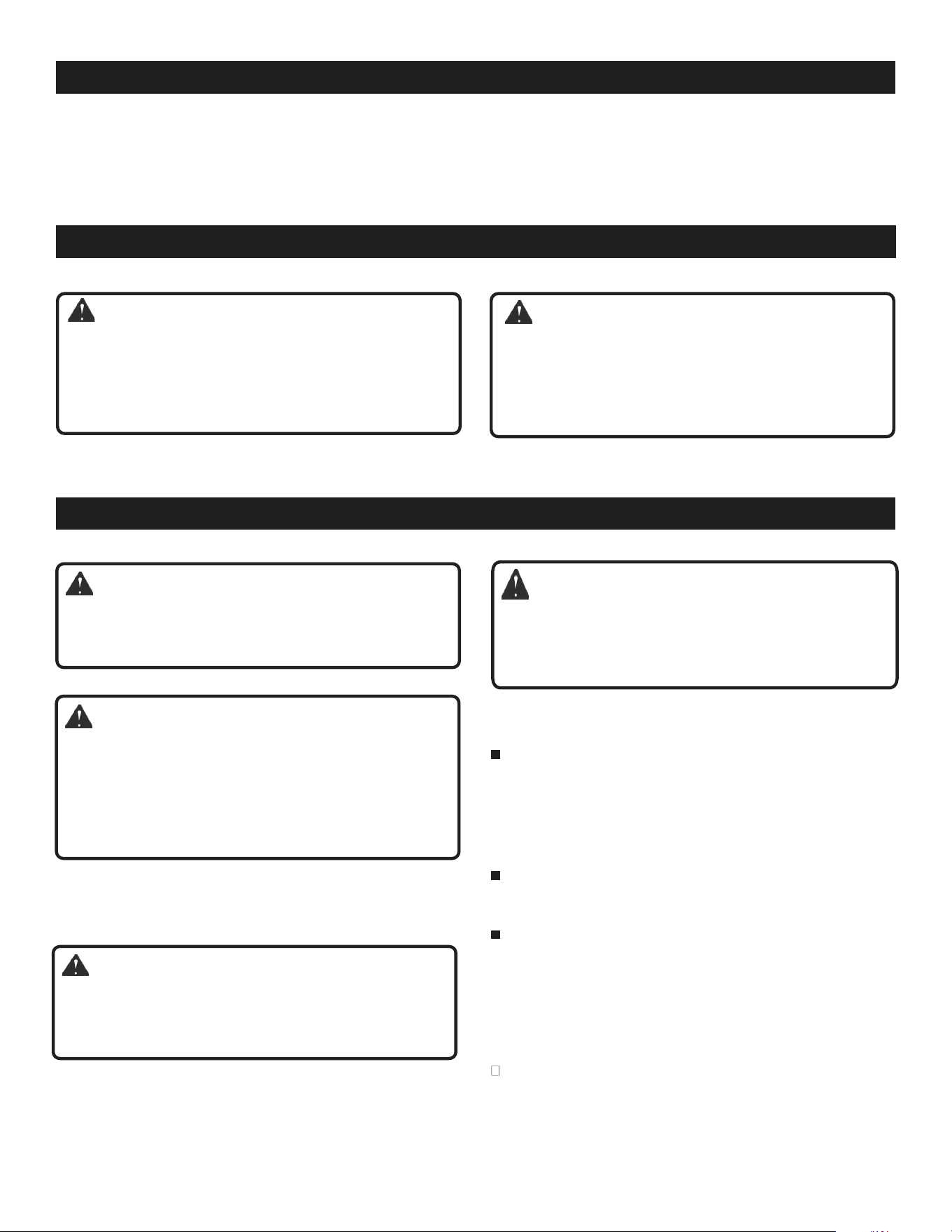
Some of the following symbols may be used on this product. Please study them and learn their meaning. Proper in-
terpretation of these symbols will allow you to operate the product better and safer.
SYMBOL NAME DESIGNATION/EXPLANATION
Safety Alert Indicates a potential personal injury hazard.
Read Operator’s
Manual
Wet Conditions
Alert
To reduce the risk of injury, user must read and understand operator’s manual
before using this product.
Do not expose to rain or use in damp locations.
Long Hair Secure long hair above shoulder level to prevent entanglement in moving parts.
V
min
n
.../min
Volts Voltage
Minutes Time
Direct Current Type or a characteristic of current
Rated Speed Rotational speed
Per Minute Revolutions, strokes, surface speed, orbits etc., per minute
SYMBOLS
FEATURES
8 - English
WARNING:
Do not use this product if it is not completely assembled
or if any parts appear to be missing or damaged. Use of
a product that is not properly and completely assembled
or with damaged or missing parts could result in serious
personal injury.
WARNING:
Do not attempt to modify this product or create
accessories or attachments not recommended for use
with this product. Any such alteration or modification is
misuse and could result in a hazardous condition leading
to possible serious personal injury.
WARNING:
Do not allow familiarity with this product to make you
careless. Remember that a careless fraction of a second
is sufficient to inflict serious injury.
WARNING:
Be sure to power off the tool before installing or over-
limiting the battery pack. Hold the tool and the battery
pack tightly. Otherwise they may slip out of your hands
causing damage to the tool and battery pack, or even
personal injury.
PRODUCT SPECIFICATIONS
Quick-Change Collet................................................................................................................................................................ Universal
Rated Speed ................................................................................................................................................... 5,000-32,000/min (RPM)
ASSEMBLY
If any parts are damaged or missing, please mail our Technical Service at service@phalanxtools.com 24/7..
OPERATION
APPLICATIONS
You may use this product for the purposes listed below:
Carving, engraving, etching, polishing, cleaning, removing
rust, sanding, cutting, grinding, sharpening, drilling, and
routing
BATTERY INSTALLATION OR REMOVAL
When removing the battery compartment, press the
buttons on both sides of the compartment while pulling it
out of the tool.
When inserting the battery compartment, take care to
align the front of the battery compartment with the
opening of the battery compartment holder and then
insert the battery compartment into place. Be sure to
insert it to the end until it clicks and locks into place,
otherwise the battery compartment will fall out of the tool
accidentally, thus causing injury to the operator or others.
Do not use excessive force when inserting the battery
compartment. If the battery compartment does not slide
smoothly, it may be caused by improper insertion.
WARNING:
Do not fail to strictly follow the relevant product safety
rules for the sake of convenience or because you are
familiar enough with the product (due to experience
gained through repeated use). Improper use or failure
to follow the safety rules in the instruction manual can
result in serious personal injury.
WARNING:
Always turn off the power to the tool and remove the
battery pack before adjusting or checking the function
of the tool.
FUNCTION DESCRIPTION
OPERATION
9 - English
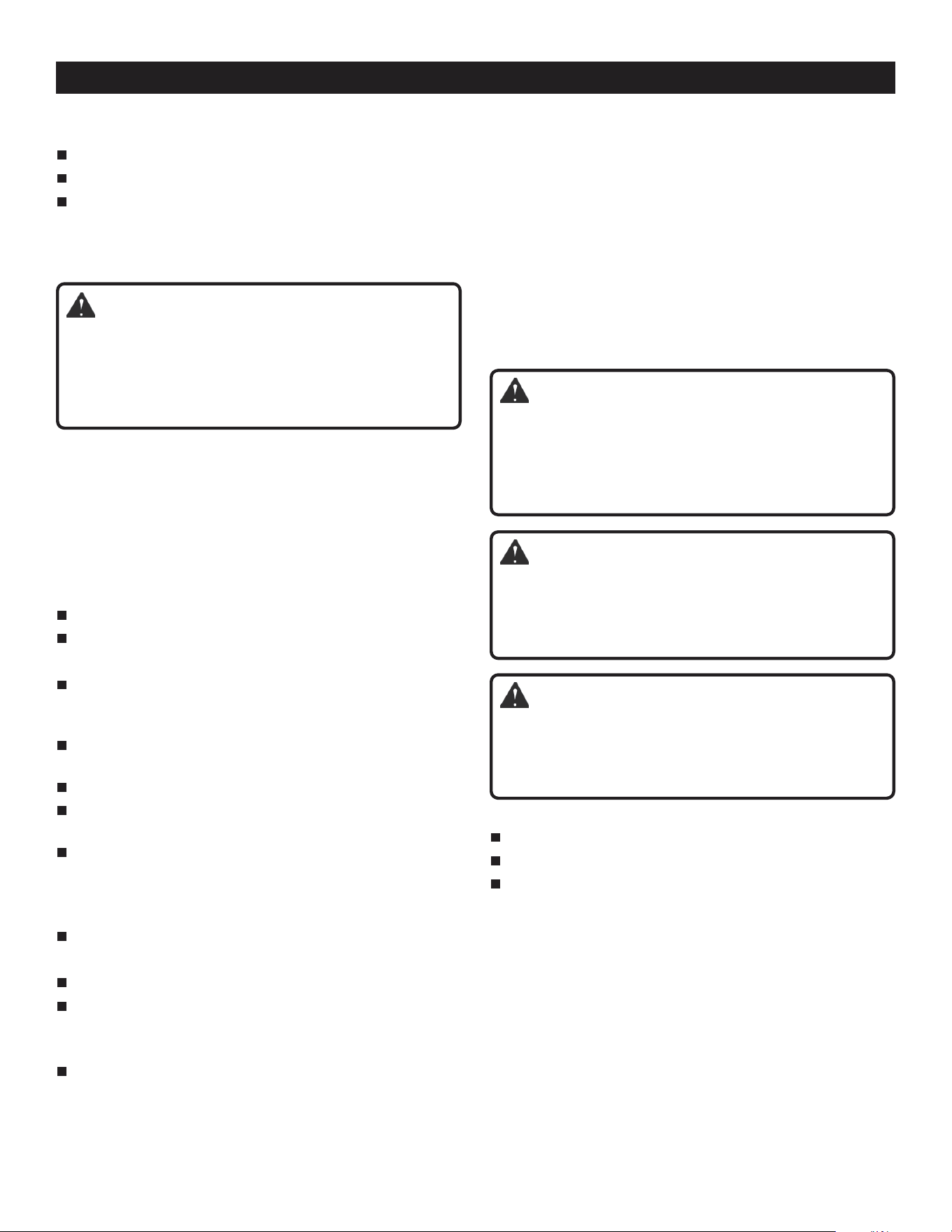
OPERATION OF THE SWITCH
Before inserting the battery compartment into the tool, be
sure to check that the switch can be in the O off position
and move the switch to the "I" (on) position when starting
the tool. To stop the tool, move the switch to the "O" (off)
position.
OPERATION OF SPEED CONTROL
This product is equipped with a speed control function,
and the speed of the power tool can be steplessly
adjusted during operation with the help of a speed
regulator.
OVERLOAD PROTECTION
When the tool is forced or the motor is overloaded, the tool
will automatically shut off. To reset the tool, wait 5 seconds,
slide the on/off switch to the OFF position and then slide it to
the ON position to resume operation. Do not force the tool.
HIGH TEMPERATURE PROTECTION
This tool is equipped with a high temperature protection
feature that automatically deactivates the tool when it is
overheated. To resume operation, allow the tool to cool and
then turn the tool on.
CHARGING THE TOOL
Turn off the rotary tool.
Make sure the power supply is normal household voltage,
120 volts, AC only, 60 Hz.
When the tool is charging, the LED will flash RED.
Do not place tool in an area of extreme heat or cold. It
will charge best at normal room temperature.
After charging is complete, the LED will stop flashing and
will remain green.
Disconnect the Plug from the power supply
QUICK-CHANGE COLLET
NOTE: The tool ships with a preinstalled collet that is
machined to precision tolerances to fit accessories with
1/8 in. diameter shanks. When installed, the quick change
collet allows the user to change accessories without tools
and without removing the collet from the shaft. The quick
change collet is not compatible with 1/16 in. shanks.
To remove/install the quick change collet:
Turn off the rotary tool.
Depress and hold the spindle lock button and rotate the
shaft by hand until the spindle lock engages the shaft,
preventing further rotation.
With the spindle lock engaged, place the included 3/8 in.
wrench on the bottom threaded end of the quick-change
collet and turn counterclockwise to loosen. Continue
turning counterclockwise to remove the collet from the
tool.
Remove the quick-change collet.
To install, engage the spindle lock. Place the quick-
change collet on the shaft and begin threading on by
hand until there is resistance. Then use the included 3/8
in. wrench on the bottom threaded end of the collet and
rotate clockwise until tightly secured.
INSTALLING/REMOVING ACCESSORIES
To install:
Turn off the rotary tool.
Choose an accessory that fits the collet and is suitable
for the application you are attempting.
Ensure the quick-change collet is securely installed on
the shaft.
While depressing the spindle lock, use your hand to
loosen the collet by rotating the sleeve counterclockwise.
Insert the shank of the accessory into the collet until the
shank bottoms out, then pull it out 1/16 in. to allow for
expansion when the accessory gets hot.
Rotate the collet sleeve clockwise until clicking stops and
the accessory shank is gripped by the collet.
NOTE: If sleeve cannot be tightened or loosened
sufficiently by hand, use the included 3/8 in. collet wrench
on the top hexed area of the collet. Turn clockwise to
tighten or counterclockwise to loosen.
WARNING:
Always use the collet which matches the shank size of the
accessory you plan to use. Never force a large diameter
shank into a collet. The accessory should fit smoothly
into the collet, but you should be able to tighten the ac-
cessory firmly and securely with the quick-change collet.
switch
governor
OPERATION
10 - English
WARNING:
This rotary tool is designed to be used only with the
attachment head models that are specified in this
Operator’s Manual. Use of other attachment heads could
cause serious personal injuries or property damage.
WARNING:
Never install, remove, or adjust any attachment head
while rotary tool is running. Failure to stop the motor can
cause serious personal injury. Never operate rotary tool
without an attachment head or the collar installed.
To remove:
Turn off the rotary tool.
Loosen the collet sleeve.
Remove the accessory.
NOTE: When trying to remove an accessory, if the quick-
change collet begins to unthread from the tool, repeat the
install process.
BALANCING
ACCESSORIES
For precision work, it is important that all accessories be
properly balanced. To balance an accessory, slightly loosen
the quick-change collet and give the accessory a 1/4 in. turn.
You should be able to tell by the sound and feel if the accessory
is running in ba
lance. Continue adjusting in this fashion until
the best balance is achieved. Replace accessories if they
become damaged or unbalanced.
INSTALLING AN ATTACHMENT HEAD TO THE
ROTARY TOOL
USING MANDRELS
See Figure 5, page 15.
The most common types of mandrel to use with this tool
include the standard mandrel which is used with grinding
wheels and emery wheels. Screw mandrels are used with
polishing wheels and polishing drums. Drum mandrels are
used
with sanding drums.
To install:
Turn off the rotary tool.
Install the mandrel.
If using the standard mandrel:
Depress and hold the spindle lock button and rotate the
mandrel by hand until the spindle lock engages preventing
further rotation.
Insert the slot end of the provided wrench into the slot
on top of the mandrel and unscrew.
Remove mandrel screw and washer.
Place desired accessory over mandrel shaft and align
accessory hole with mandrel hole.
Insert mandrel screw with washer through the accessory
and mandrel shaft holes.
NOTE: The mandrel washer should be placed between
the mandrel screw and the accessory.
Tighten using provided wrench.
If using the screw mandrel:
Align desired accessory hole with mandrel screw head.
Screw accessory onto mandrel by twisting clockwise until
secure.
If using the drum mandrel:
Align appropriate sized sanding drum over mandrel and
push down to completely cover drum end of mandrel.
NOTE: If necessary, tighten the screw on the drum
mandrel head to expand the drum and securely hold the
sanding drum in place.
To install an attachment head:
Turn off the rotary tool.
Remove accessories and quick-change collet.
Hold the collar firmly, then turn it counterclockwise to
loosen and remove.
DANGER:
If you are changing an accessory immediately after use,
be careful not to touch the collet or the accessory with
your hands or fingers. You will get burned because of
the heat build-up from operation. Always use the wrench
provided or allow the collet to cool.
WARNING:
Read and understand entire Operator’s Manual for each
optional attachment head used on this rotary tool and
follow all warnings and instructions. Failure to follow
all instructions could result in electric shock, fire and/or
serious personal injury.

OPERATION
11 - English
Follow the instructions in the PHALANX attachment
head operator’s manual to install the attachment head.
To remove an attachment head:
Turn off the rotary tool.
Remove accessories and quick-change collet.
Follow the instructions in the PHALANX attachment
head operator’s manual to remove the attachment head.
Reinstall the collar or install another attachment head.
TURNING THE ROTARY TOOL ON/OFF
To turn the rotary tool ON, slide the on/off switch to the ON
position. To turn it OFF, slide the on/off switch to the OFF
position.
SELECTING THE RIGHT SPEED
The rotary tool has a speed range of 5,000-35,000/min RPM.
To select the right speed for each job, use a practice piece of
material. Vary speed to find the best speed for the accessory
you are u
sing and the job to be done.
Use the indicator mark above the speed control dial to set the
best speed for the job. The speed control dial is numbered
1 to 6:
Speed (1-6) .............................................. 5,000-32000 RPM
Refer to the Application Speed Recommendations table
to determine the proper speed based on the material being
worked and the type of accessory being used.
SLOWER SPEEDS
Certain materials, some plastics for example, require a
relatively slow speed because the friction of the tool generates
heat and causes the plastic to melt at high speed.
Slow speeds (15,000 RPM or less
) are usually best for
polishing operations using the polishing accessories. They
may also be best for working on delicate projects, delicate
wood carving, and fragile model parts.
Higher speeds are better for carving, cutting, and shaping
wood.
APPLICATION SPEED RECOMMENDATIONS*
Type of Ac-
cessory
Soft
Wood
Hard
Wood
Laminates
Plastics
Steel
Aluminum,
Brass, Etc.
Shell/
Stone
Ceramic Glass
Cut-off Discs
15-35K
15-35K
5-15K
35K
35K
N/A
N/A
N/A
Fiberglass
Cut-off
Wheel
15-35K
15-35K
5-15K
35K
35K
N/A
N/A
N/A
Sanding
Drums
15-35K 15-35K 5-15K 15-35K 15-35K 15-35K N/A N/A
Felt
Polishing
Wheels
5-15K
5-15K
5-15K
5-15K
5-15K
5-15K
5-15K
5-15K
Aluminum
Oxide
Grinding
Stones
15-35K
15-35K
5-15K
15-35K
15-35K
N/A
N/A
N/A
Silicon
Carbide
Grinding
Stone
N/A
N/A
N/A
15-35K
15-35K
15-35K
5-35K
N/A
Drill Bit 35K 35K 15-35K 35K 35K — — —
Drywall
Cutting Bit
35K (Drywall only)
*The settings provided in the chart are recommendations for operating ranges for best performance.

OPERATION
12 - English
Hardwoods and glass require high speed operation. Drilling
should also be done at high speeds.
To determine the optimum operational speed for different
materials and accessories, refer to the Application Speed
Recommendations table. Look this table over and become
familiar with it.
The best way to determine the correct speed for work on
any material is to practice for a few minutes on a piece of
scrap, even after referring to the table. Yo
u can quickly
learn that a slower or faster speed is more effective just by
observing what happens when you make a pass or two at
different speeds.
When working with a scrap piece of plastic, start at a slow
rate of speed and increase the speed until you observe
whether the plastic is melting at the point of contact; reduce
the speed slightly to get optimum working speed without
melting the workpiece.
Plastic and materials that could melt at low temperatures
should be cut at low speeds.
Soft wood should be cut at high speed.
OPERATING THE ROTARY TOOL
Learning to use the rotary tool:
Hold the tool in your hand and get used to its weight,
balance, and the taper of the housing. This taper permits
the tool to be grasped in a “pencil grip” or in a “golf grip”
method.
Examine the rotary tool accessories carefully. Damaged
accessories can fly apart as they come up to speed and
should not be used. The use of damaged accessories
can result in serious personal injury.
Practice on scrap materials first to see how the tool
operates. Keep in mind that the work is done by the speed
of the tool and by the accessory in the collet. You should
not lean on or push the tool into the work.
It is best to make a series of passes with the tool rather than
attempt to do all the work in one pass. To make a cut, pass
the tool back and forth over the work like you would a small
paint brush. Cut a little material on e
ach pass until you reach
the desired depth. For most work, a gentle touch is best;
you will have greater control, make fewer errors, and get the
most efficient work out of the accessory.
For the best control in close work, grip the tool like a pencil
between your thumb and forefinger.
A “golf grip” method of holding the tool is used for operations
such as grinding a flat surface.
To operate the rotary tool:
Secure all work in a vise or clamp to a workbench to
prevent it from moving under the tool.
Hold the tool in front and away from you, keeping the tool
accessory clear of the workpiece.
Turn on the tool and let the motor and accessory build
up to full speed.
Lower the tool gradually until the accessory contacts the
workpiece.
Move the tool continuously at a steady, consistent pace.
Use just enough pressure to keep the tool from chattering
or bouncing.
NOTE: Heavy pressure will decrease the tool’s speed and
put a strain on the motor. The weight of the tool alone is
adequate for most jobs.
Lift the tool away from the workpiece before turning off
the tool.
MAINTENANCE
13 - English
GENERAL MAINTENANCE
Avoid using solvents when cleaning plastic parts. Most
plastics are susceptible to damage from various types of
commercial solvents and may be damaged by their use. Use
clean cloths to remove dirt, dust, oil, grease, etc.
BATTERIES
This product is equipped with a lithium-ion rechargeable
battery. Length of service from each charging will depend
on the type of work you are doing.
The battery in this product has been
designed to provide
maximum trouble-free life. However, like all batteries, it will
eventually wear out.
To obtain the longest possible battery life, we suggest
the following:
Remove the USB cable from the product once it is fully
charged and ready for use.
For product storage longer than 30 days:
Store the product where the temperature is below 80°F.
Store the product in a “discharged” condition.
BATTERY PACK DISPOSAL
This product contains lithium-ion batteries. Local, state or
federal laws may prohibit disposal of lithium-ion batteries
in ordinary trash.
WARNING:
When servicing, use only identical replacement parts.
Use of any other parts could create a hazard or cause
product damage.
WARNING:
Do not attempt to disassemble the tool, or remove
any component projecting from the tool. May result in
electric shock, fire and/or serious personal injury. Prior to
disposal, protect exposed terminals with heavy insulating
tape to prevent shorting.
WARNING:
Do not open the tool or attempt to remove the battery
from the tool. Dispose of entire tool through your local
waste removal authority.
WARNING:
Do not at any time let brake fluids, gasoline, petroleum-
based products, penetrating oils, etc., come in contact
with plastic parts. Chemicals can damage, weaken or de-
stroy plastic which could result in serious personal injury.
14
PRT0012
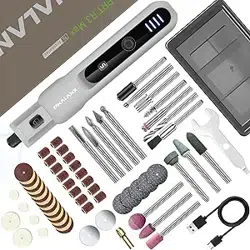
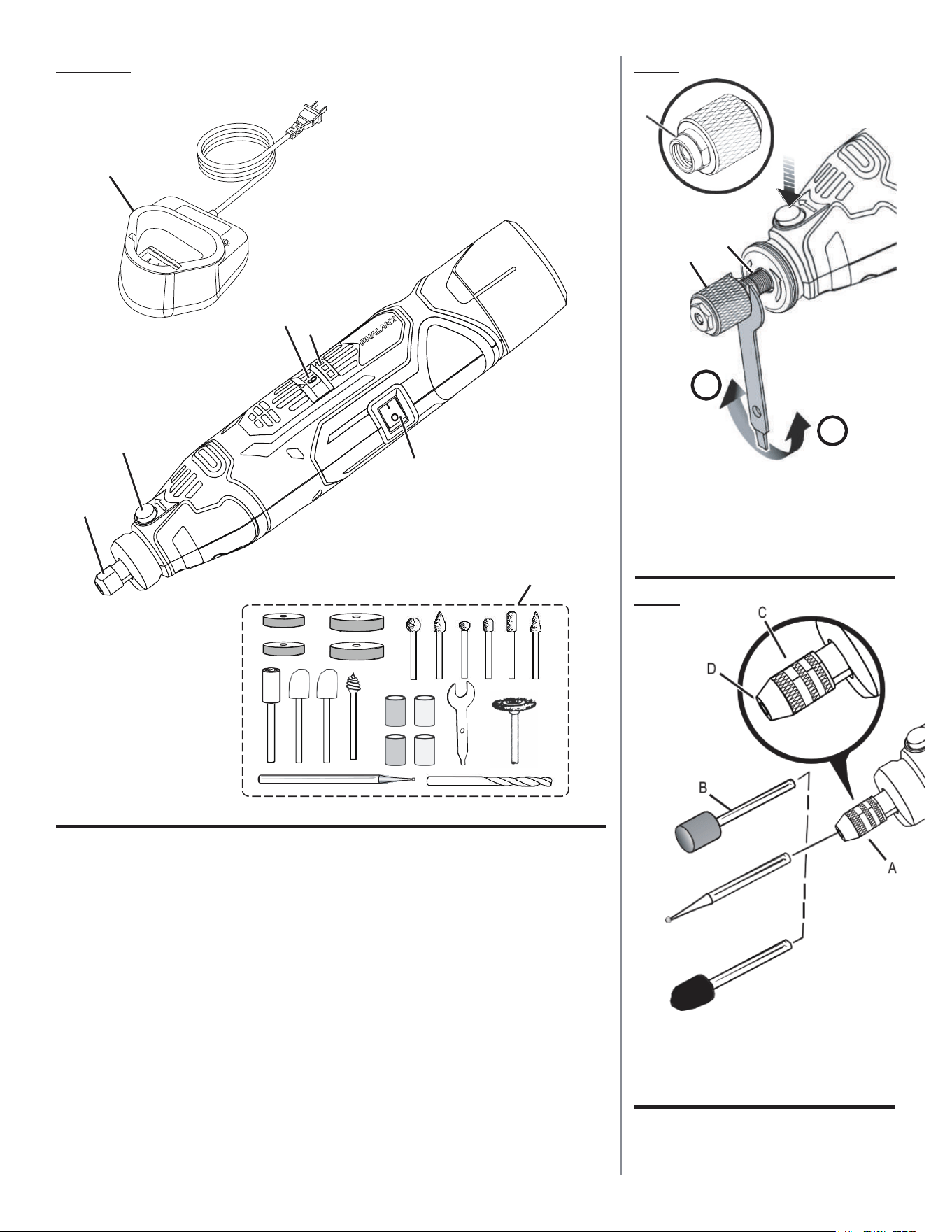
Fig. 1
D
A - Quick-change collet
B - Spindle lock button
C - On/off switch
D - Speed control dial
E - LED indicator
F - Accessories
G - Charger
A - Quick-change collet
B - Shaft
C - Spindle lock button
D - Threaded end
E - Loosen
F - Tighten
Fig. 2
A - Quick-change collet
B – Accessory
C - Sleeve
D - Hexed end
C
A
B
E
F
A
B
D
E
C
F
G
15
G
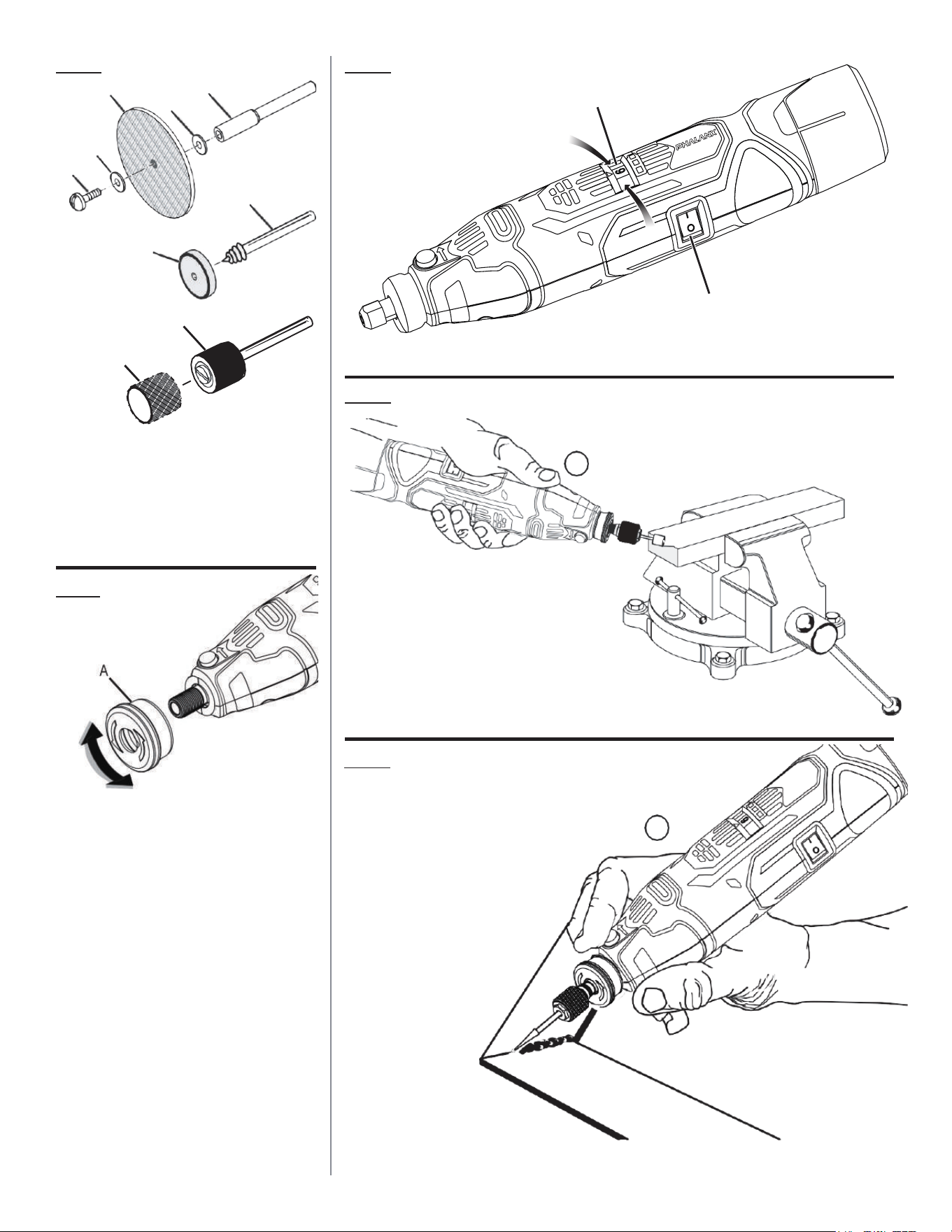
Fig. 3 Fig. 5
A
F
A - On/off switch
B - Speed control dial
C - To increase speed
D - To decrease speed
Fig. 6
A - Screw)
B - Accessory
C - Washer
D - Standard mandrel
E - Screw mandrel
F - Sanding drum
G - Drum mandrel
Fig. 7
A - Attachment head
A - “Pencil grip” meth
A
A
Fig. 4
B
D
C
C
E
B
A
B
C
D
A -
“Golf grip” method