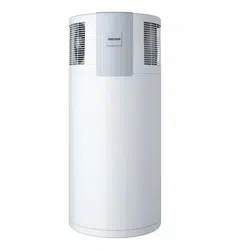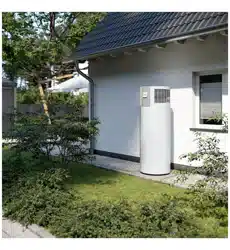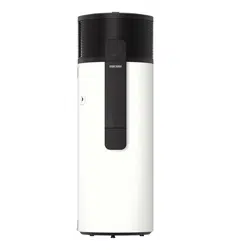
OPERATION AND INSTALLATION
DHW heat pump
» WWK222
» WWK222H
» WWK 302
» WWK 302 H

2 | WWK222-302 H www.stiebel-eltron.com
CONTENTS
SPECIAL INFORMATION
OPERATION
1. General information �����������������������������������������4
1.1 Safety instructions ����������������������������������������������� 4
1.2 Other symbols in this documentation ����������������������� 4
1.3 Units of measurement ������������������������������������������ 4
2. Safety ���������������������������������������������������������� 4
2.1 Intended use ������������������������������������������������������ 4
2.2 General safety instructions ������������������������������������ 5
2.3 Test symbols ������������������������������������������������������ 6
3. Appliance description ���������������������������������������6
3.1 Heat pump operating principle ������������������������������� 6
3.2 DHW heating ������������������������������������������������������ 6
3.3 Appliance operation outside the application limits ������� 7
3.4 Frost protection �������������������������������������������������� 7
3.5 Minimum runtime and minimum pause time �������������� 7
3.6 Connection of an external signal transmitter �������������� 8
4. Settings �������������������������������������������������������8
4.1 Emergency shutdown ������������������������������������������� 8
4.2 Weatherproof cover ��������������������������������������������� 8
4.3 Display and operating controls ������������������������������� 9
4.4 Adjusting the settings������������������������������������������ 10
4.5 "Rapid heat-up" button ���������������������������������������� 13
5. Cleaning, care and maintenance ������������������������� 14
5.1 Protective anode and battery change ���������������������� 14
6. Troubleshooting �������������������������������������������� 14
INSTALLATION
7. Safety �������������������������������������������������������� 17
7.1 General safety instructions ����������������������������������� 17
7.2 Instructions, standards and regulations ������������������� 17
8. Appliance description ������������������������������������� 17
8.1 Standard delivery ����������������������������������������������� 17
8.2 Required accessories ������������������������������������������ 17
8.3 Additional accessories ����������������������������������������� 17
8.4 Incorrect use ����������������������������������������������������� 17
9. Preparation ������������������������������������������������� 17
9.1 Transport ��������������������������������������������������������� 17
9.2 Storage ������������������������������������������������������������ 18
9.3 Installation site �������������������������������������������������� 18
9.4 Siting the appliance �������������������������������������������� 19
10. Installation �������������������������������������������������� 20
10.1 Water connection ����������������������������������������������� 20
10.2 Condensate drain ����������������������������������������������� 21
10.3 Electrical connection ������������������������������������������� 22
10.4 Assembling the appliance ������������������������������������ 24
11. Commissioning ��������������������������������������������� 25
11.1 Initial start-up ��������������������������������������������������� 25
11.2 Recommissioning ����������������������������������������������� 25
12. Settings ����������������������������������������������������� 26
13. Appliance shutdown ��������������������������������������� 28
14. Troubleshooting �������������������������������������������� 28
14.1 Fault codes ������������������������������������������������������� 29
14.2 Resetting the safety pressure limiter ����������������������� 30
14.3 WWK222H/ WWK 302H : Resetting the high limit
safety cut-out ���������������������������������������������������� 30
14.4 Motor overload relay ������������������������������������������� 30
15. Maintenance ������������������������������������������������ 30
15.1 Removing the appliance cover ������������������������������� 30
15.2 Removing the casing ring ������������������������������������� 31
15.3 Cleaning the evaporator ��������������������������������������� 31
15.4 Draining the cylinder ������������������������������������������ 31
15.5 Descaling the electric emergency/booster heater ������� 32
15.6 Valves ������������������������������������������������������������� 32
15.7 Condensate drain ����������������������������������������������� 32
15.8 Replacing the power cable ����������������������������������� 32
15.9 Fitting the casing ring ����������������������������������������� 32
15.10 Protective anode and battery change ���������������������� 32
15.11 Fitting the appliance cover ����������������������������������� 33
16. Specification ������������������������������������������������ 34
16.1 Dimensions and connections ��������������������������������� 34
16.2 Wiring diagram ������������������������������������������������� 36
16.3 Fault conditions ������������������������������������������������� 37
16.4 Data table �������������������������������������������������������� 38
16.5 Standardised output data ������������������������������������� 39
GUARANTEE
ENVIRONMENT AND RECYCLING

SPECIAL INfORmATION
www.stiebel-eltron.com WWK222-302 H | 3
SPECIAL INfORmATION
- The appliance may be used by children over 8
years of age and persons with reduced physical,
sensory or mental capabilities or a lack of ex-
perience and expertise, provided that they are
supervised or they have been instructed on how
to use the appliance safely and have understood
the potential risks. Children must never play with
the appliance. Cleaning and user maintenance
must not be carried out by children without
supervision.
- Observe all applicable national and regional reg-
ulations and instructions.
- Observe the minimum clearances (see chap-
ter "Installation/ Preparations/ Siting the
appliance").
- Observe the requirements concerning the instal-
lation room (see "Specification/ Data table").
- The appliance is supplied with a flexible power
cable without plug. In the case of a permanent
connection, the appliance must be able to be sep-
arated from the power supply by an isolator that
disconnects all poles with at least 3mm contact
separation. Contactors, circuit breakers or fuses
can be used for this. This type of isolator must be
installed in the fixed electrical installation accord-
ing to the regulations. For Australia: Ensure that
the appliance can be separated from the power
supply by a suitable isolator. Contactors, circuit
breakers, fuses or general purpose power plugs
can be used for this. This type of isolator must be
installed according to the electrical installation
regulations.
- Observe the safety measures to prevent contact
with dangerously high contact voltage.
- Observe the fuse protection required for the ap-
pliance (see chapter "Specification/ Data table").
- If the power cable is faulty, replace it with a new
one. The power cable must only be replaced (for
example if damaged) by a qualified contractor.
- The appliance is pressurised. During the heat-up
process, expansion water will drip from the safety
valve.
- Activate the valves at least every 6months to pre-
vent them from becoming blocked, e.g. by limes-
cale deposits.
- Drain the appliance as described in chapter "In-
stallation/ Maintenance and cleaning/ Draining
the cylinder".
- A T&P valve or a cold water expansion control
valve, or both, must be installed. Observe all ap-
plicable national and regional regulations and
instructions.
- The maximum pressure in the cold water supply
line must be at least 20% below the lowest re-
sponse pressure of all installed safety valves. Oth-
erwise a pressure reducing valve is required. If
this is the case, install a pressure reducing valve
in the cold water supply line. The pressure reduc-
ing valve must be set to 540kPa if a safety valve
is installed; otherwise to 700kPa.
- Fit the drain pipe of the safety valve with a con-
stant fall in a room free from the risk of frost.
- Size the drain pipe so that water can drain off un-
impeded when the safety valve is fully opened.
- The safety valve drain aperture must remain open
to atmosphere.
OPERATION
General information
4 | WWK222-302 H www.stiebel-eltron.com
OPERATION
1. General information
The chapters "Special information" and "Operation" are intended
for both users and qualified contractors. The chapter "Installation"
is intended for qualified contractors.
Note
Read these instructions carefully before using the appli-
ance and retain them for future reference. Pass on these
instructions to a new user if required.
1.1 Safety instructions
1.1.1 Structure of safety instructions
!
KEYWORD Type of risk
Here, possible consequences are listed that may result
from failure to observe the safety instructions.
f Steps to prevent the risk are listed.
1.1.2 Symbols, type of risk
Symbol Type of risk
Injury
Electrocution
Burns
(burns, scalding)
1.1.3 Keywords
KEYWORD Meaning
DANGER Failure to observe this information will result in serious
injury or death.
WARNING Failure to observe this information may result in serious
injury or death.
CAUTION Failure to observe this information may result in non-seri-
ous or minor injury.
1.2 Other symbols in this documentation
Note
General information is identified by the adjacent symbol.
f Read these texts carefully.
Symbol Meaning
Material losses
(appliance damage, consequential losses and environmen-
tal pollution)
Appliance disposal
f This symbol indicates that you have to do something. The ac-
tion you need to take is described step by step.
These symbols show you the software menu level (in
this example level3).
1.3 Units of measurement
Note
All measurements are given in mm unless stated oth-
erwise.
2. Safety
2.1 Intended use
The purpose of this appliance is to heat domestic hot water within
the application limits stated in the chapter "Specification/ Data
table".
The appliance is intended for domestic use. It can be used safely
by untrained persons. The appliance can also be used in non-do-
mestic environments, e.g. in small businesses, as long as it is
used in the same way.
Any other use beyond that described shall be deemed inappro-
priate. Observation of these instructions and of the instructions
for any accessories used is also part of the correct use of this
appliance.
!
!
OPERATION
Safety
www.stiebel-eltron.com WWK222-302 H | 5
2.2 General safety instructions
The appliance should only be operated once it is fully installed
and all safety equipment has been fitted.
!
WARNING Injury
The appliance may be used by children over 8 years of
age and persons with reduced physical, sensory or men-
tal capabilities or a lack of experience and expertise,
provided that they are supervised or they have been
instructed on how to use the appliance safely and have
understood the potential risks. Children must never play
with the appliance. Cleaning and user maintenance must
not be carried out by children without supervision.
WARNING Electrocution
Contact with live components presents a threat to life.
Damage to the cable insulation or to individual compo-
nents may result in a risk to life.
f If there is damage to the insulation, switch off the
power supply and arrange a repair.
All work on the electrical installation must be carried
out by a qualified contractor.
WARNING Burns
The water in the DHW cylinder can be heated to temper-
atures in excess of 60°C. There is a risk of scalding at
outlet temperatures in excess of 43°C.
Caution must be exercised when coming into contact
with the outflowing water.
WARNING Burns
Touching hot components can lead to burns.
f When working on hot components, always wear
protective working clothing and safety gloves.
The pipework connected to the DHW outlet of the appli-
ance can reach temperatures in excess of 60°C.
WARNING Burns
The appliance is filled with refrigerant at the factory.
In the event of refrigerant escaping due to a leak, avoid
coming into contact with the refrigerant or inhaling the
released vapours. Ventilate the rooms affected.
WARNING Electrocution
Never operate the appliance when the casing is open or
without a cover.
!
CAUTION Injury
If objects are left on the appliance, noise emissions may
increase due to resulting vibrations, and the objects
could fall and cause injury.
f Never place any objects on top of the appliance.
!
Material losses
At the factory, the appliance is fitted with rechargeable
batteries that ensure the power supply to the impressed
current anode in the case of a power failure.
In order for the impressed current anode to protect the
DHW cylinder in the appliance against corrosion, the ap-
pliance must not be disconnected from the power supply
for more than 16hours if the DHW cylinder is filled with
water and the impressed current anode is not separately
connected to a continuous power supply.
If regular interruptions to the power supply are not an-
ticipated, the batteries will not require any maintenance.
Replace the batteries for the impressed current anode
every three years in the following cases:
- The impressed current anode is not separately con-
nected to a continuous power supply and a switch-
ing contact regularly interrupts the power supply to
the appliance.
- The security of supply is inadequate.
Failure to observe this point puts the appliance at risk
of damage.
Never use batteries that cannot be charged. Only re-
chargeable nickel metal hydride batteries (NiMH) are
permissible.
Batteries may be damaged in the appliance. Without a
power supply, the impressed current anode and the cyl-
inder would not be protected against corrosion.
!
Material losses
Ensure that the appliance, water pipes and safety valves
are free from the risk of frost. If you disconnect the ap-
pliance from the power supply, it is no longer protected
against frost.
!
Material losses
Never cover the appliance. Covering the air intake or air
discharge leads to a reduced air supply. If the air supply
is restricted, the operational reliability of the appliance
cannot be guaranteed.
!
Material losses
Only operate the appliance when the DHW cylinder has
been filled. The appliance is equipped with boil-dry pro-
tection to prevent operation if the DHW cylinder is not
completely full of water.
!
Material losses
Heating liquids other than potable water is not permitted.
!
Material losses
Keep the appliance installation site free from air contam-
inated with oil or salt (chloride) and corrosive or explo-
sive substances. Avoid contaminating the installation site
with dust, hairspray or substances containing chlorine
or ammonia.
OPERATION
Appliance description
6 | WWK222-302 H www.stiebel-eltron.com
!
Material losses
Operating the appliance outside the application limits
(see chapter "Specification/ Data table") is not permitted.
The appliance may be damaged if operated continuously
outside the application limits.
Note
The appliance is pressurised. During the heat-up process,
expansion water will drip from the safety valve.
f If water continues to drip when heating is complet-
ed, please inform your qualified contractor.
2.3 Test symbols
See type plate on the appliance.
3. Appliance description
This appliance enables DHW to be supplied efficiently to several
draw-off points using renewable energy. The appliance extracts
heat from the ambient air. This heat is used, along with additional
electrical energy, to heat up the water in the DHW cylinder. The
amount of electrical energy and time required to heat up the DHW
depend on the temperature of the air drawn in and the tempera-
ture of the water in the cylinder. When the air intake temperature
drops, the heating output of the heat pump is reduced and the
heat-up time is extended.
In the case of indoor installation, the air inside the installation
room can be cooled by 1°C to 3°C due to heat extraction. The
appliance also extracts moisture from the air, which turns into
condensate. The condensate is removed from the appliance via
the condensate drain.
The appliance has an electronic control unit with LC display. The
display shows parameters of interest, such as the top hot water
temperature, mixed hot water volume, etc. It also indicates when
the unit is idle, heating or engaged in defrosting, as well as the
presence of errors and faults. Subject to the power supply and
your draw-off patterns, the water is heated automatically to the
selected set temperature.
External signal transmitters can be integrated via the built-in con-
tact input, e.g. a photovoltaic system to make use of solar power
generated on site.
When a DHW draw-off point is opened, the hot water is pushed
out of the appliance by the inflow of cold water.
The heat pump drive unit is located in the upper section of the
appliance. The DHW cylinder is located in the lower section of the
appliance. To protect against corrosion, the DHW cylinder is coated
internally with special enamel and is additionally equipped with
an impressed current anode.
Available amount of DHW
The appliance's nominal maximum available amount of DHW is
designed for the recommended number of users with average
user behaviour.
3.1 Heat pump operating principle
A closed circuit within the appliance contains refrigerant (see
"Specification/ Data table"). This refrigerant evaporates at low
temperatures. In the evaporator, which extracts heat from the
air drawn in, the refrigerant changes from a liquid into a gas-
eous state. A compressor draws in the gaseous refrigerant and
compresses it. This increase in pressure raises the refrigerant
temperature. This requires electrical energy.
The energy (motor heat) is not lost, but reaches the downstream
condenser together with the compressed refrigerant. There, the
refrigerant transfers heat to the DHW cylinder. An expansion valve
then reduces the still prevalent pressure and the cyclical process
starts again.
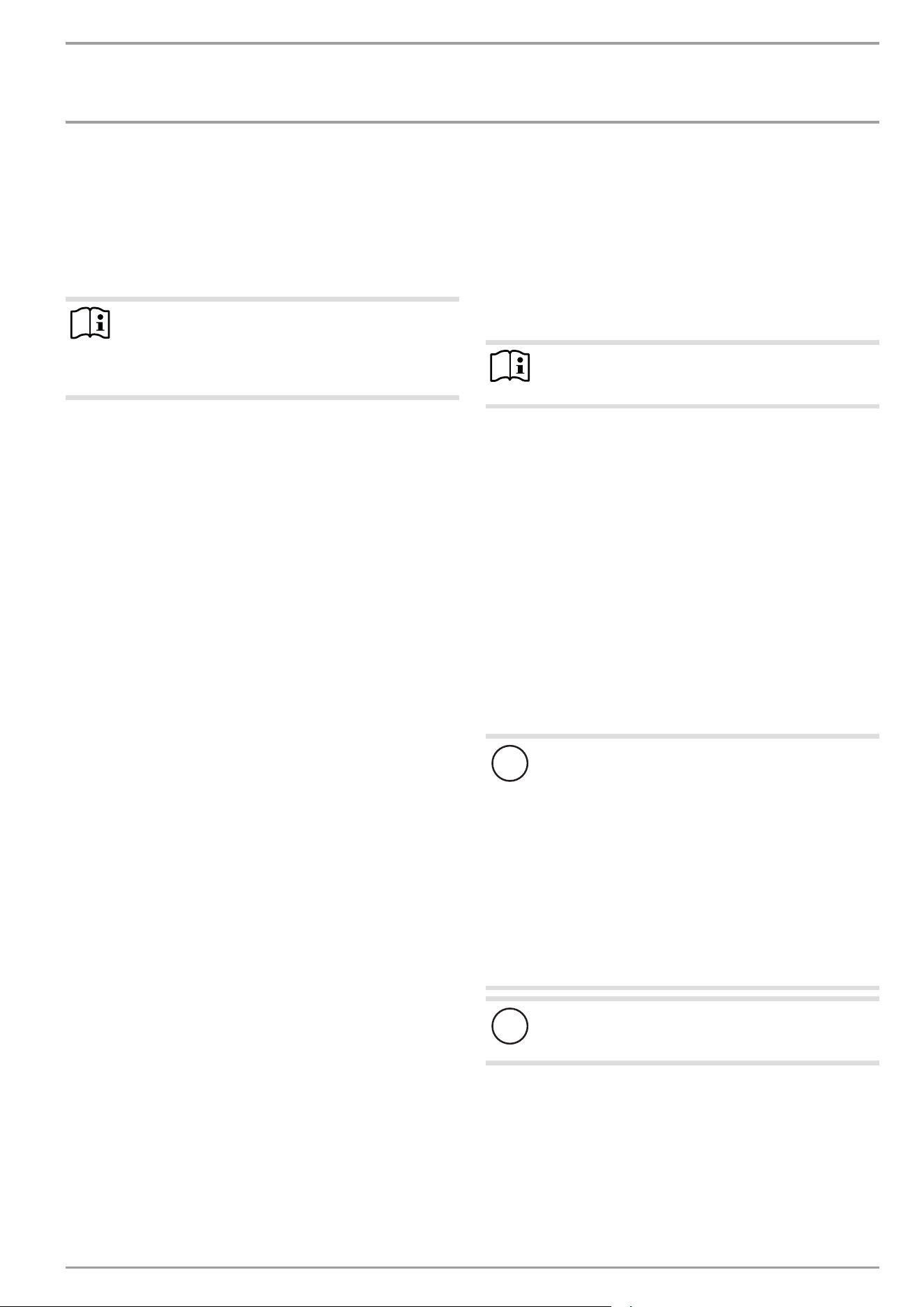
3.2 DHW heating
2
1
D0000050335
1 Cylinder top sensor
2 Integral sensor
The appliance is equipped with two temperature sensors.
- The cylinder top sensor captures the water temperature in
the upper section of the cylinder.
- The integral sensor is a temperature sensor affixed over the
entire cylinder height. The integral sensor determines the
average cylinder temperature.
The appliance display indicates the temperature in the upper sec-
tion of the cylinder, which is captured by the cylinder top sensor.
The appliance control unit uses the average cylinder temperature
captured by the integral sensor.
DHW heating is started when the available mixed water volume
decreases to the percentage of the maximum mixed water volume
set in the "Charge level" parameter.
The temperature captured by the cylinder top sensor may still
correspond to the set temperature.
OPERATION
Appliance description
www.stiebel-eltron.com WWK222-302 H | 7
For information on the heat-up time, see chapter "Specification".
The calculation of the available mixed water volume is based on
the average cylinder temperature. The mixed water volume is
only calculated if the water temperature in the upper section of
the cylinder is higher than 40°C.
DHW is normally heated by the heat pump of the appliance (see
chapter "Specification/ Data table").
Note
If the appliance has been isolated from the power supply
during operation, the compressor will only restart after
the pressure inside the refrigerant circuit has been equal-
ised. Pressure equalisation can take several minutes.
WWK 222 H | WWK 302 H : Electric emergency/booster heater
When the temperature in the upper section of the DHW cylinder
drops 12K below the selected set temperature, the appliance
automatically switches on the electric emergency/booster heater.
When the temperature in the upper section of the DHW cylinder
rises 2K above the selected set temperature, the appliance switch-
es off the electric emergency/booster heater.
In the event of an appliance fault, the electric emergency/booster
heater can be activated in emergency heating mode, provided
a flashing fault key is displayed. See chapter "Settings/ 'Rapid
heat-up' button/ Emergency heating mode".
In the event of a higher hot water demand on a single occasion,
use the "Rapid heat-up" button to activate the emergency/booster
heater manually for one-off heat-up in addition to the heat pump.
See chapter "Settings/ 'Rapid heat-up' button/ Rapid/comfort
heat-up".
3.3 Appliance operation outside the application
limits
f To guarantee fault-free operation of the appliance, make sure
you operate the appliance within its application limits (see
chapter "Specification/ Data table").
3.3.1 Ambient temperatures below the application limit
Outside the application limits, the appliance blocks the compres-
sor from operating. This could lead to reduced DHW convenience.
If the appliance has an electric emergency/booster heater, the
appliance enables this when there is a demand for water heating
and the lower application limit has been undershot.
Low ambient temperatures may result in the formation of hoar
frost on the evaporator depending on the air humidity and water
temperature.
Active defrosting
The appliance is equipped with active hot gas defrosting, which
allows quick defrosting of the evaporator when needed. During
defrosting, the appliance fan is disabled. The compressor con-
tinues to run. A solenoid valve routes the hot gas directly to the
evaporator. While this is happening, refrigerant flow to the con-
denser is disabled by another solenoid valve.
In contrast to conventional defrosting methods, the appliance
guarantees that this defrosting takes place only when needed.
Note
Heat-up times are longer while the evaporator is defrost-
ing.
3.3.2 Ambient temperatures above the application limit
Outside the application limits, the appliance blocks the compres-
sor. This could lead to reduced DHW convenience. If the appliance
has an electric emergency/booster heater, the appliance enables
this when there is a demand for water heating and the upper
application limit has been exceeded.
3.4 Frost protection
The appliance activates the frost protection function if the integral
sensor in the DHW cylinder captures a temperature below 8°C.
The appliance then heats the water by means of the heat pump
and the electric emergency/booster heater. The heat pump and
electric emergency/booster heater switch off when the tempera-
ture captured by the integral sensor reaches 16°C.
3.5 Minimum runtime and minimum pause time
!
Material losses
When operating with external switching devices that
can interrupt the power supply to the appliance, such
as time switches, energy management systems or home
automation systems, the following conditions must be
adhered to:
- The minimum ON time is 60 minutes.
- The minimum pause time following a shutdown is
20 minutes.
- The appliance should not be switched on/off more
than 10 times per day.
- The breaking capacity of the switching actuator must
meet the fuse protection requirements (see chapter
"Specification/ Data table").
!
Material losses
If you disconnect the appliance from the power supply, it
is no longer protected against frost.
OPERATION
Settings
8 | WWK222-302 H www.stiebel-eltron.com
!
Material losses
At the factory, the appliance is fitted with rechargeable
batteries that ensure the power supply to the impressed
current anode in the case of a power failure.
In order for the impressed current anode to protect the
DHW cylinder in the appliance against corrosion, the ap-
pliance must not be disconnected from the power supply
for more than 16hours if the DHW cylinder is filled with
water and the impressed current anode is not separately
connected to a continuous power supply.
If regular interruptions to the power supply are not an-
ticipated, the batteries will not require any maintenance.
Replace the batteries for the impressed current anode
every three years in the following cases:
- The impressed current anode is not separately con-
nected to a continuous power supply and a switch-
ing contact regularly interrupts the power supply to
the appliance.
- The security of supply is inadequate.
Failure to observe this point puts the appliance at risk
of damage.
Never use batteries that cannot be charged. Only re-
chargeable nickel metal hydride batteries (NiMH) are
permissible.
Batteries may be damaged in the appliance. Without a
power supply, the impressed current anode and the cyl-
inder would not be protected against corrosion.
3.6 Connection of an external signal transmitter
Note
This type of connection must only be carried out by a
qualified electrician.
External signal transmitters can be integrated via the built-in
contact input, e.g. a PV system to take advantage of electricity
generated on site.
The appliance has a second set temperature preselected at the
factory. This is activated when there is an external switching sig-
nal. Set temperature2 takes priority over the standard set tem-
perature while there is an external switching signal. Following
a one-off activation (signal is present for at least 1minute), set
temperature2 applies for at least 20minutes and takes priority
over set temperature1.
You can change set temperature2 on the appliance (see chapter
"Settings/ Settings/ Set temperature2").
4. Settings
!
Material losses
Optimum operation is achieved with the factory default
settings.
Any changes to these are strongly discouraged as they
may affect output, service life and compliance with reg-
ulations.
4.1 Emergency shutdown
In the event of an emergency, carry out the following steps:
f Disconnect the appliance from the power supply at the fuse
in the domestic distribution board or by unplugging the
power plug.
f Shut off the cold water supply.
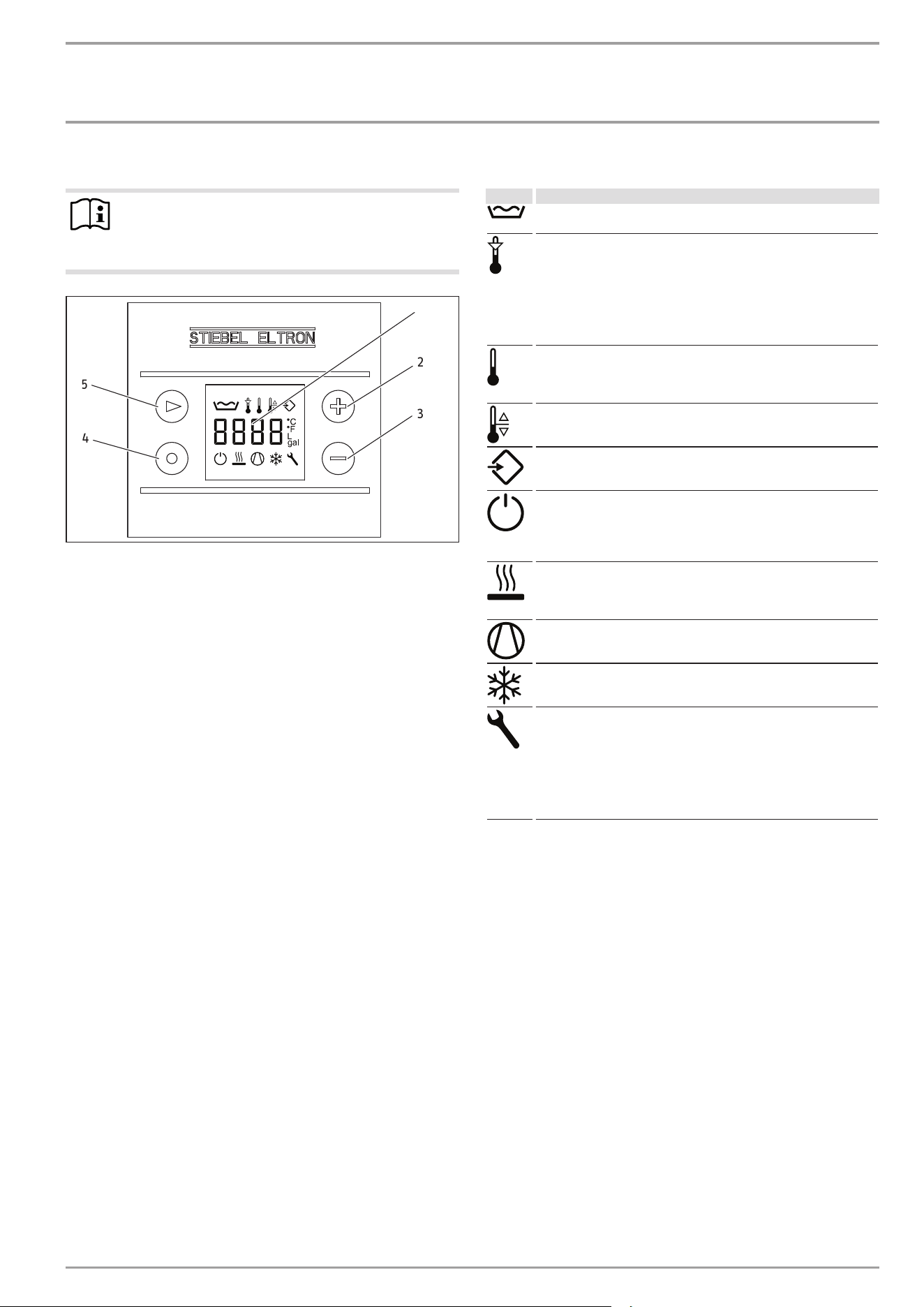
4.2 Weatherproof cover
The programming unit is equipped with a weatherproof cover to
protect it from the elements.
D0000093597
f Carefully flip up the lid of the weatherproof cover.
Two detents are provided so that you do not have to keep hold
of the lid.
To close, carefully press the lid onto the appliance until the locking
tabs at the sides lock in place.
OPERATION
Settings
www.stiebel-eltron.com WWK222-302 H | 9
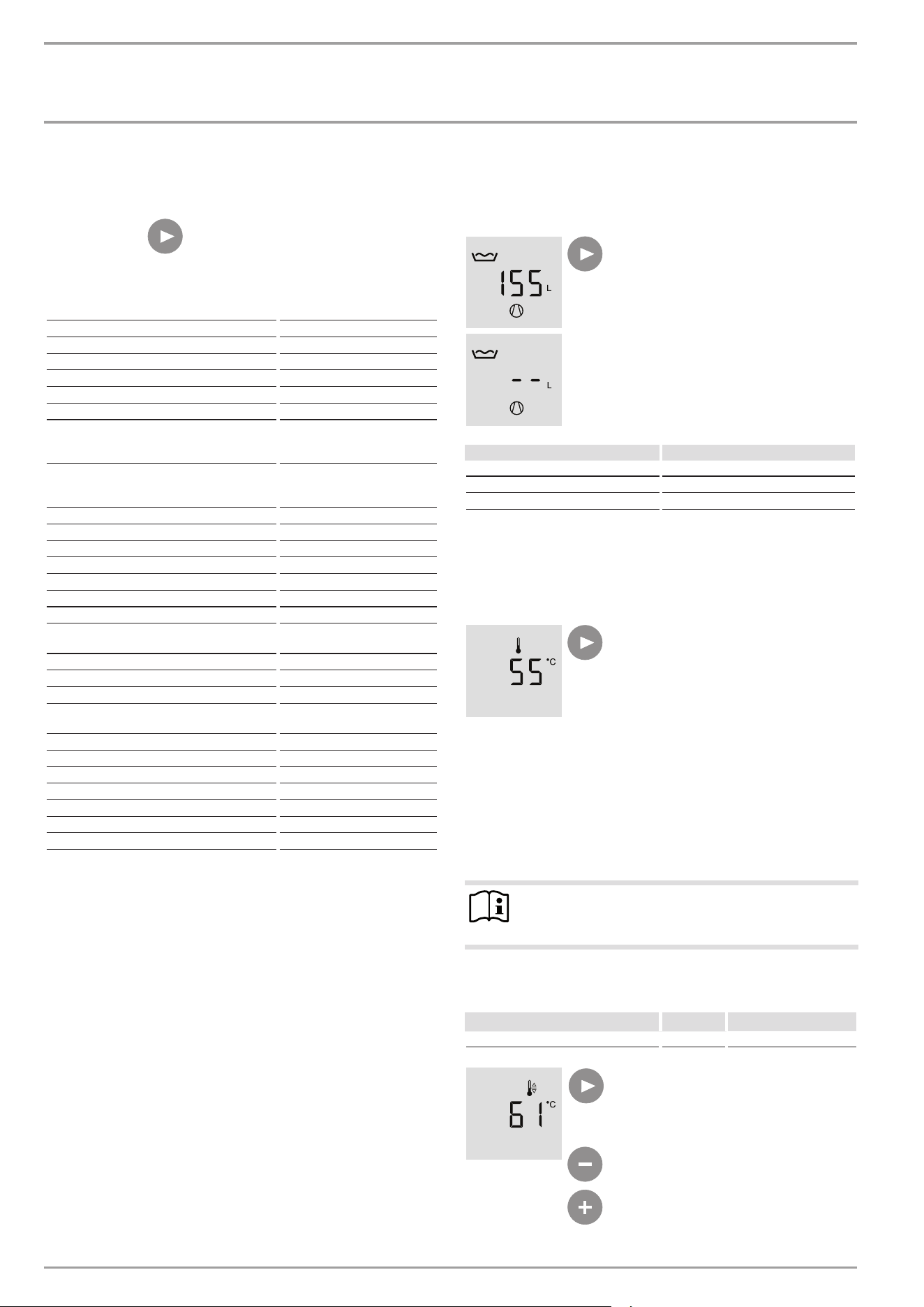
4.3 Display and operating controls
Note
15seconds after every operation, the appliance automat-
ically reverts to the default display (mixed water volume)
and saves the set value.
2
5
4
D000003788
3
1
1 Mixed water volume display (litres|40°C)/
Display of actual temperature in upper cylinder section/
Set temperature display1/
Set temperature display2/
Fault code display
2 "Plus" button
3 "Minus" button
4 "Rapid heat-up" button
5 "Menu" button
Symbols
Symbol Description
Mixed water volume: The currently available mixed water volume at
40°C and at 15°C cold water temperature is shown.
Set temperature adjustment: Subject to intake temperature and
hot gas temperature, the appliance may temporarily reduce the set
temperature to the actual value captured by the integral sensor. The
appliance displays the "Set temperature adjustment" symbol and
blocks DHW heating until the actual temperature captured by the
integral sensor is 6K below the temporary set temperature. DHW
heating is then re-enabled and the originally selected set tempera-
ture is applied again.
Actual temperature: The current actual temperature is shown. The
actual temperature indicates the temperature in the upper section
of the DHW cylinder and therefore largely corresponds to the outlet
temperature.
Set temperature
External signal transmitter: Set temperature2 is the DHW tempera-
ture to which the appliance regulates if an external signal transmit-
ter is connected and active.
Standby: The symbol flashes if the appliance PCB and load (com-
pressor) are supplied with power separately. This connection option
is required if the appliance is to be operated via switchable sockets
in an energy management system, for example (see chapter "Electri-
cal connection").
Electric emergency/booster heater: This symbol indicates the pres-
ence of a demand on this component. This symbol being displayed
does not necessarily mean that the electric emergency/booster
heater is running.
Heat pump: This symbol indicates the presence of a demand on this
component. This symbol being displayed does not necessarily mean
that the compressor is running.
Defrost active
Service/fault: Notify your qualified contractor if the "Service/fault"
symbol appears on the display. Continuous illumination of the
symbol indicates that the fault is not preventing appliance opera-
tion. A flashing "Service/fault" symbol indicates that water is not
being heated and it is essential you notify your qualified contractor.
Switching the appliance to emergency mode is a special case. The
electric emergency/booster heater will then heat the water despite
the flashing "Service/fault" symbol.
The "Electric emergency/booster heater" and "Heat pump" sym-
bols are displayed when there is a demand for these appliance
components. These symbols being displayed does not necessarily
mean that the electric emergency/booster heater and the heat
pump are running. Example: The appliance is in rapid/comfort
heat-up mode. The electric emergency/booster heater switches off
when the temperature in the upper cylinder section has reached
65°C. The heat pump has not yet heated the lower section to 65°C
and the rapid/comfort heat-up function has therefore not been
terminated yet. The electric emergency/booster heater symbol is
displayed until the rapid/comfort heat-up function has terminated.
OPERATION
Settings
10 | WWK222-302 H www.stiebel-eltron.com
4.4 Adjusting the settings
The default display shows the mixed water volume.
The "Menu" button allows you to call up
all information and adjustment options in
sequence. The relevant symbol appears.
Menu
Mixed water volume display
Actual temperature display
Set temperature 1
Set temperature 2
Fan speed
Air intake temperature display
Enable the “Runtime-dependent rapid
heat-up” function
In appliances with no electric
emergency/booster heater, this
parameter has no function.
Time set for the “Runtime-dependent
rapid heat-up” function
In appliances with no electric
emergency/booster heater, this
parameter has no function.
Change units
Charge level
Fault code
E fault code
Advanced menu (with service plug only)
Integral sensor offset
Set the cylinder volume
Compressor lockout due to evaporator
fault
Clear high pressure lockout
Clear low pressure lockout
Temperature of evaporator fins
Number of times hot gas temperature
sensor was triggered
Number of defrost faults
Number of low pressure triggers
Number of high pressure triggers
Hot gas temperature switching value
Fan lead time
Integral sensor replacement
Set value limit
Menu
Mixed water volume display
The currently available mixed water
volume at 40°C and at 15°C cold water
temperature is shown.
"--L" is shown if less than 10l mixed
water is currently available.
DHW demand for Mixed water volume at 40°C
Bath 120-150 l
Shower 30-50l
Washing hands 2-5l
The mixed water volume that can be achieved depends on the
cylinder size and the set temperature selected.
Actual temperature display
In the "Mixed water volume" menu, press
"Menu" once to access the "Actual tem-
perature" menu.
The "Actual temperature" symbol ap-
pears.
The current actual temperature is shown.
The actual temperature is the tempera-
ture in the upper section of the DHW cyl-
inder, and therefore largely corresponds
to the outlet temperature.
Set temperature1
Note
For hygiene and other reasons, only change this value if
instructed by Stiebel Eltron representative..
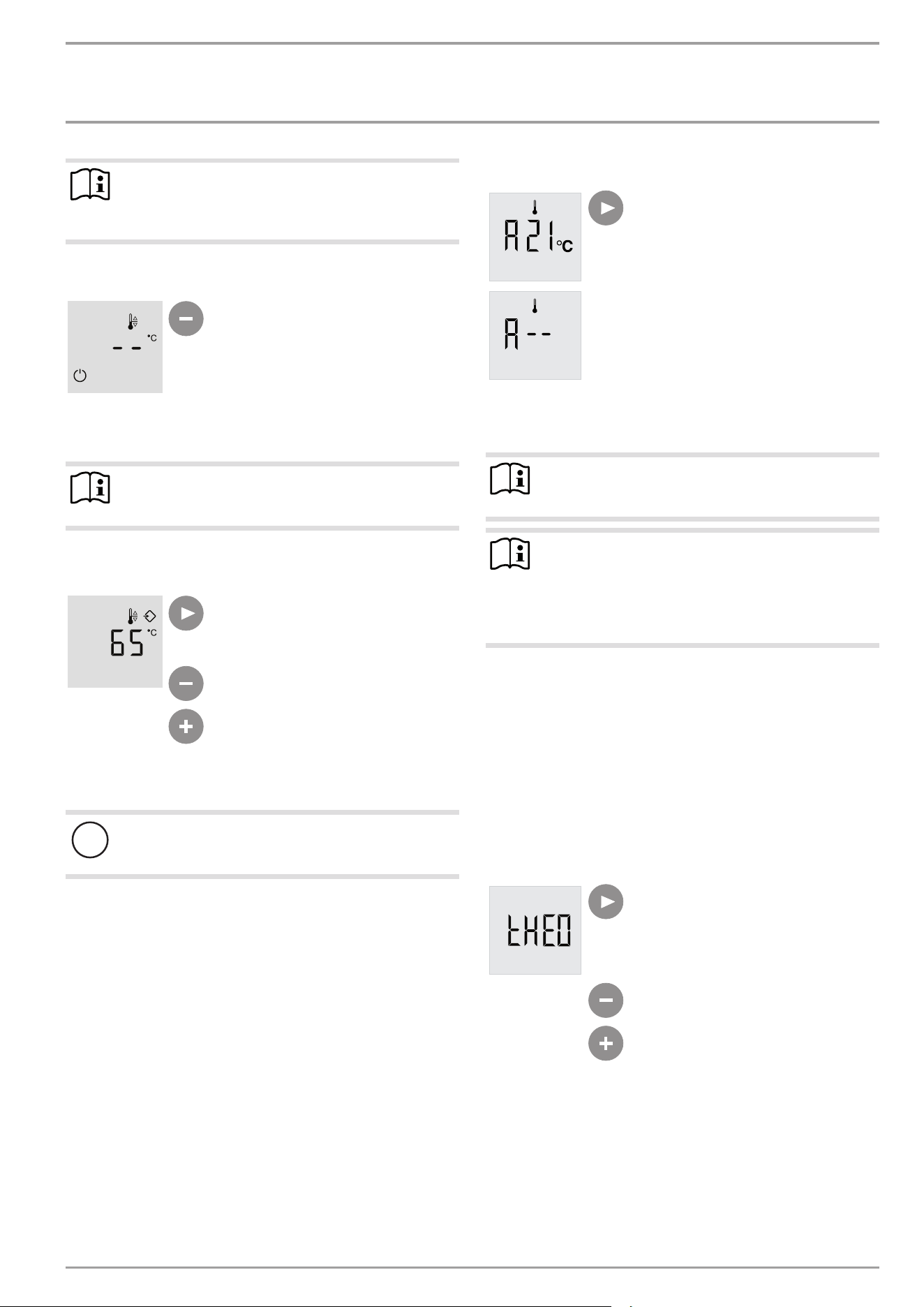
Set temperature1 is the DHW temperature to which the appliance
regulates if no external signal transmitter is connected and active.
Factory setting
Set temperature 1 °C 61
In the "Actual temperature" menu, press
"Menu" once to access the "Set temper-
ature1" menu.
The set temperature1 symbol appears.
You can change the value using the "Plus"
and "Minus" buttons. Setting range: 61
- 65 °C
OPERATION
Settings
www.stiebel-eltron.com WWK222-302 H | 11
Note
Another way to adjust set temperature1 is to press the
"Plus" or "Minus" buttons from within the default display
(mixed water volume).
Frost protection
Only frost protection remains active if you
set the set temperature to below 20°C
using the "Minus" button. The display
shows "--°C".
Set temperature2
Note
For hygiene reasons, do not set a DHW temperature of
less than 61°C.
Set temperature2 is the DHW temperature to which the appliance
regulates if an external signal transmitter is connected and active.
In the "Set temperature1" menu, press
"Menu" once to access the "Set tempera-
ture2" menu. The "External signal trans-
mitter" symbol appears.
You can change the value using the "Plus"
and "Minus" buttons. Setting range: 61
- 65 °C
Operation with external signal transmitter
!
Material losses
See "Permissible voltage range for external signal trans-
mitters" in chapter "Specification/data table".
As standard, these appliances are designed to allow you to allo-
cate a separate, individual set DHW temperature to a connected
external signal transmitter, such as a PV system or an economy
tariff transmitter. This set temperature2 is activated if the termi-
nal connected to the external signal transmitter receives a signal
(see chapter "Electrical connection/ External signal transmitter
connection option"). While activated, set temperature2 replaces
the standard set DHW temperature ("Set temperature1").
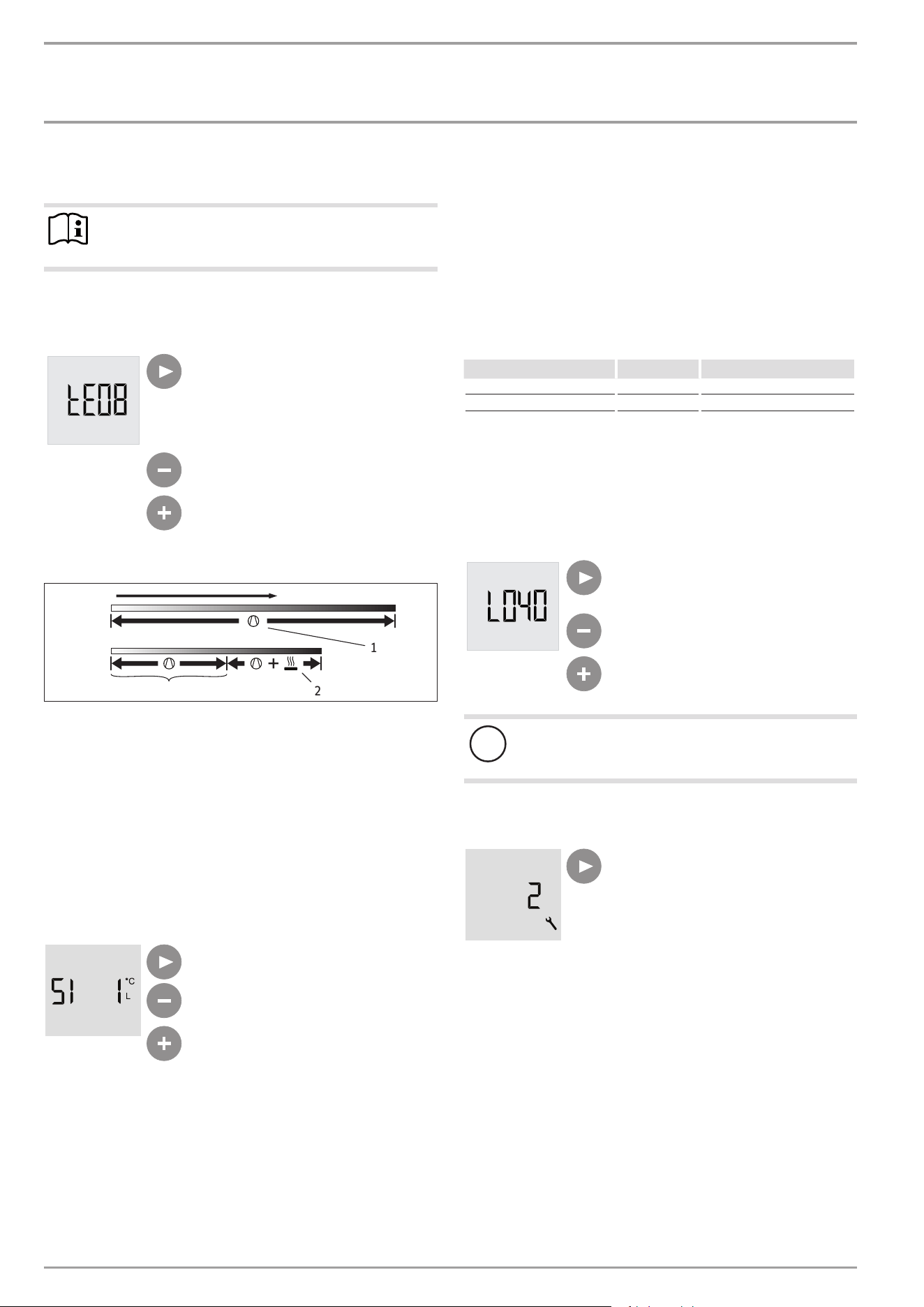
Air intake temperature display
An "A" appears as the air intake temper-
ature symbol.
The current air intake temperature is
displayed.
The air intake temperature is displayed
only while the appliance fan is running. If
it is not possible to establish an air intake
temperature, two dashes are shown.
Enabling the "Runtime-dependent rapid heat-up" function
Note
In appliances with no electric emergency/booster heater,
this parameter has no function.
Note
Only use the runtime-dependent quick heat-up if instruct-
ed by a Stiebel Eltron representative.
Enabling this function is likely to impact the efficiency of
the product and may lead to unnecessary higher energy
consumption and operational costs.
The appliance offers a runtime-dependent rapid heat-up option.
If the selected set temperature is not reached by the heat pump
after a user defined period, the appliance switches on the electric
emergency/booster heater in parallel to back up the heat pump
(subject to this function being enabled).
Once the set value has been reached, the electric emergency/
booster heater remains inactive until the set time has elapsed
again following a heat demand. This function is disabled at the
factory.
This function is set in two stages. First enable the function and set
the runtime in the second parameter.
The tHE0 setting disables the runtime-
dependent rapid heat-up function. This
function is enabled via setting tHE1. The
function is disabled at the factory.
Switch between the tHE0 and tHE1 set-
tings using the "Plus" and "Minus" but-
tons. The tHE1 setting allows the electric
emergency/booster heater to cut in if the
set temperature is not reached after expi-
ry of the runtime selected below.
OPERATION
Settings
12 | WWK222-302 H www.stiebel-eltron.com
Time set for the "Runtime-dependent rapid heat-up"
function
Note
In appliances with no electric emergency/booster heater,
this parameter has no function.
To avoid increased power consumption, only reduce the facto-
ry-set time for runtime-dependent rapid heat-up if necessary. See
chapter "Specification/ Appliance parameters".
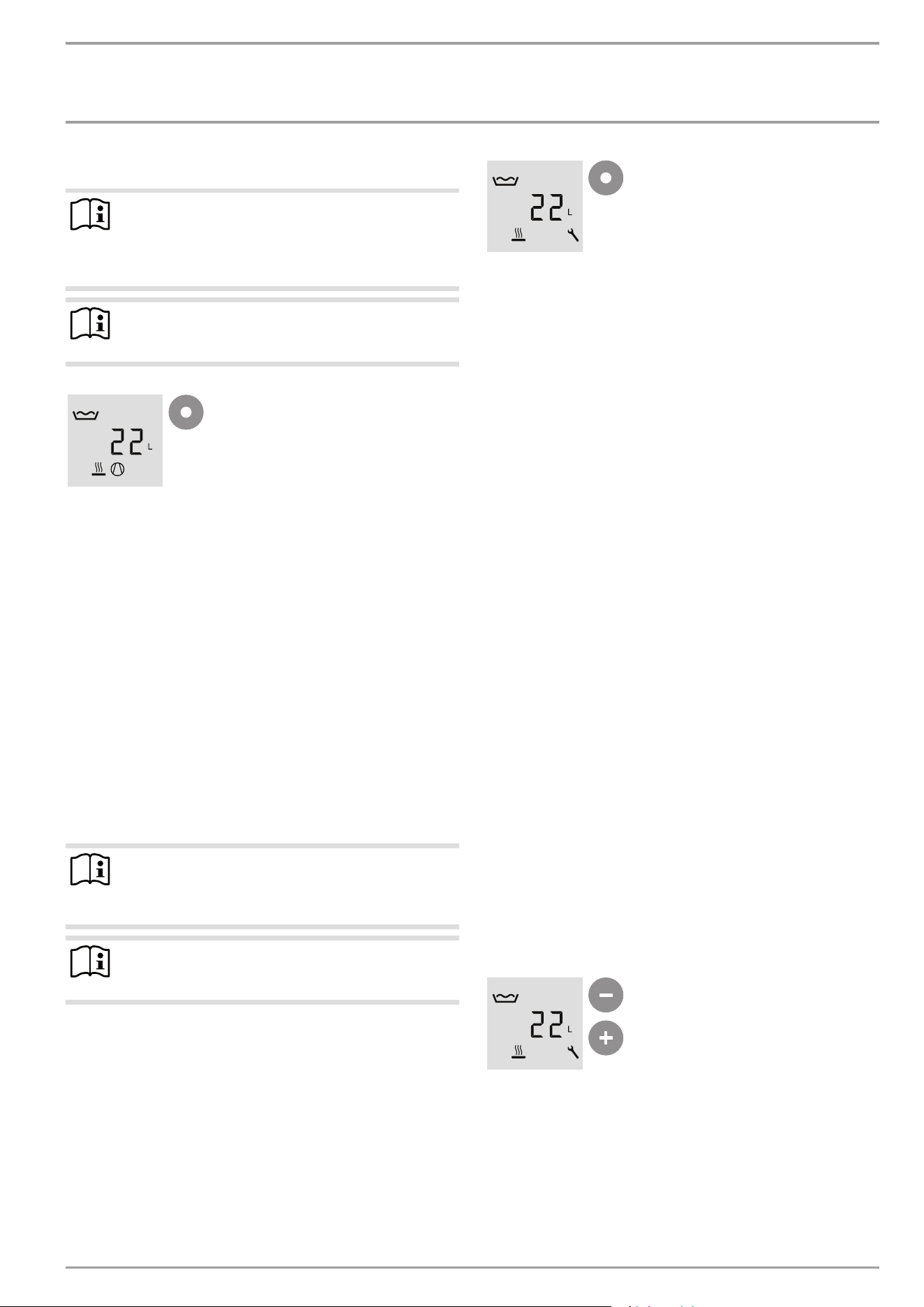
Set the runtime using the "Plus" and
"Minus" buttons. After the set number of
hours, the appliance checks whether the
set temperature has been reached. If this
is not the case, the appliance switches on
the electric emergency/booster heater.
thE1
tE08
thE0
t
D0000052266
1
2
1 "Heat pump" symbol
2 "Electric emergency/booster heater" symbol
tHE0 Runtime-dependent rapid heat-up disabled
tHE1 Runtime-dependent rapid heat-up enabled
tE08 Adjustable number of hours (e.g. 8 in this case) during
which heating is only provided by the heat pump
Change units
You can select whether the temperatures and the volume details
are displayed in SI units or US units. If you select 1, the values are
displayed in degrees Celsius and litres. If you select 0, the values
are displayed in degrees Fahrenheit and gallons.
Press the "Menu" button until "SI" ap-
pears on the display.
Using the "Plus" and "Minus" buttons, set
whether the display should use SI units
(1) or US units (0).
Charge level
Increasing this value increases the minimum available amount of
DHW. The effect corresponds to a virtual shift of the temperature
sensor downwards. This results in a faster recovery at the expense
of higher energy consumption and reduced efficiency. Reducing
this value has the opposite effect and results in a longer recovery
at the expense of DHW availability.
DHW heating is started when the available mixed water volume
decreases to the percentage of the maximum mixed water volume
set in the "Charge level" parameter.
Factory setting
Charge level WWK 222 (H) % 56
Charge level WWK 302 (H) % 64
The displayed mixed water volume is based on a mixed water
temperature of 40°C. At water temperatures below 40°C (±1K),
the mixed water volume is not calculated or displayed.
A further start condition, which overlaps with the charge level
start conditions, is the reduction of the temperature captured by
the cylinder top sensor to 6K below the active set temperature.
Press the "Menu" button until an "L" fol-
lowed by a number appears on the dis-
play.
You can change the value using the "Plus"
and "Minus" buttons. Setting range: 30
- 100 %
!
Material losses
Do not change this parameter unless instructed by a Stie-
bel Eltron representative.
Fault code
If the "Service/fault" symbol is illuminat-
ed or flashes, you can call up the fault
code using the "Menu" button. This menu
remains disabled if no fault has arisen.
See chapter "Troubleshooting/ Fault codes".
E fault code
A fault code preceded by E appears if the fault relates to the re-
frigerant circuit.
OPERATION
Settings
www.stiebel-eltron.com WWK222-302 H | 13
4.5 "Rapid heat-up" button
Note
In appliances with no electric emergency/booster heater,
this button only allows you to clear the high pressure/low
pressure lockout. You cannot start rapid/comfort heat-up
or emergency heating mode.
Note
To start rapid/comfort heat-up with the "Rapid heat-up"
button, the start screen must be displayed.
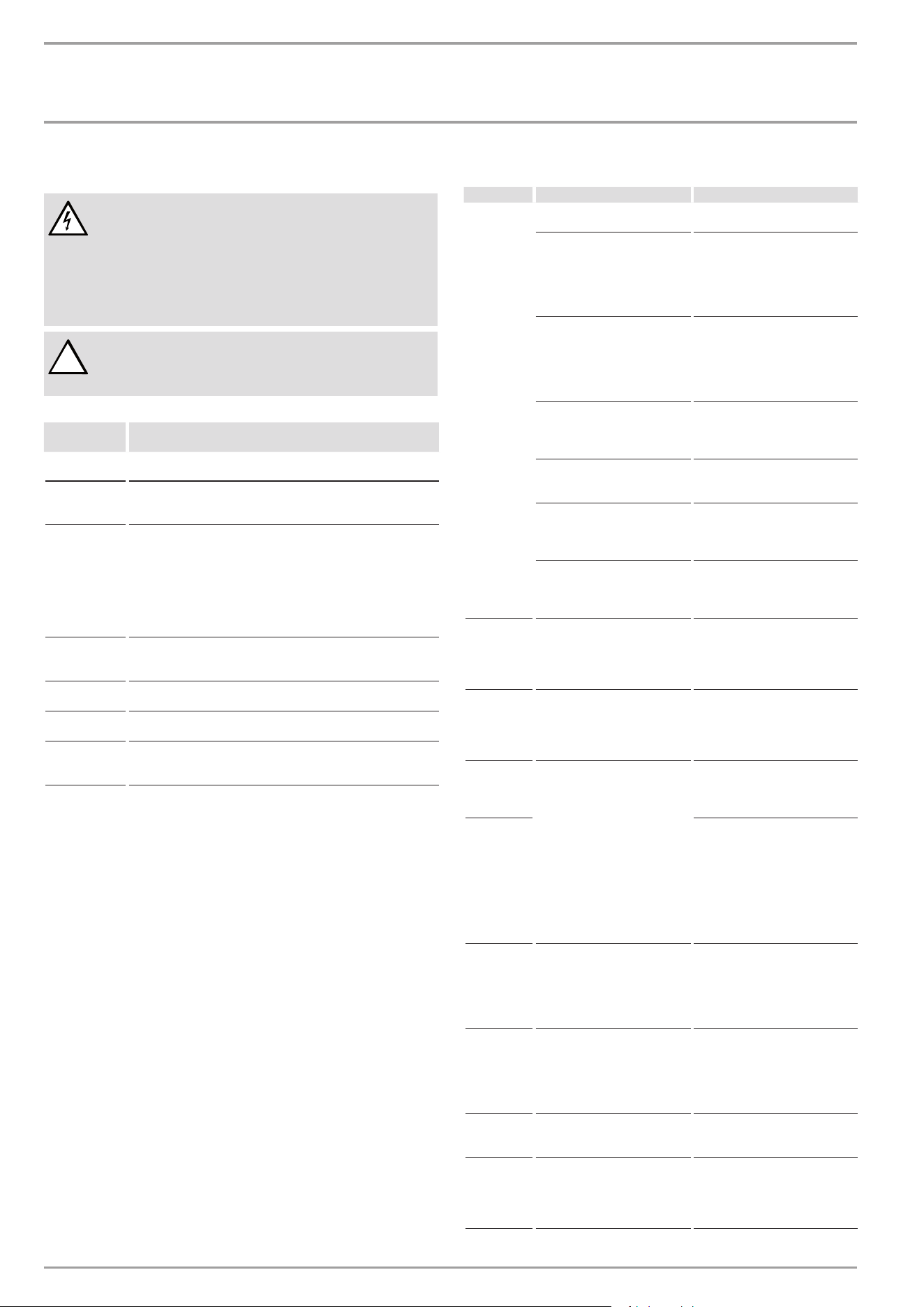
Press the "Rapid heat-up" button for two
seconds.
The heat pump and electric emergency/
booster heater symbols appear.
4.5.1 Rapid/comfort heat-up
Normally, the "Rapid heat-up" button is used to activate the rapid/
comfort heat-up function, which enables you to cover an unex-
pectedly high DHW demand without changing any of the appli-
ance's standard settings.
If rapid/comfort heat-up is activated manually by pressing the rel-
evant button, the heat pump and the electric emergency/booster
heater will start once in parallel, irrespective of the selected set
temperature, and will remain active until the DHW temperature
in the cylinder has reached 65°C. To save energy, the electric
emergency/booster heater switches off sooner, once a temper-
ature of 65°C has been achieved in the upper cylinder section
(rapid heat-up).
The rapid/comfort heat-up function remains active until a tem-
perature of 65°C has been achieved in the entire DHW cylinder
(comfort heat-up). The appliance then automatically switches back
to the previously set parameters.
Note
The electric emergency/booster heater and heat pump
symbols are displayed until the rapid/comfort heat-up
function has terminated.
Note
To end rapid/comfort heat-up, press the "Rapid heat-up"
button for two seconds.
4.5.2 Emergency mode
If the appliance is faulty, you can use emergency mode to activate
the electric emergency/booster heater.
Following a DHW demand, the appliance measures the temper-
ature rise every 15minutes. If the temperature rise was <0.25°C
within the 15minute period, this is recorded by a counter. If the
temperature rise did not reach >0.25°C in any 15minute period
over 13hours, the compressor shuts down. The fault key flashes
on the display and a fault code indicates that the appliance is not
heating the water.
Press the "Rapid heat-up" button for two
seconds.
The "Electrical emergency/booster heat-
er" symbol appears. The "Service/fault"
symbol flashes.
After the "Rapid heat-up" button has been pressed, the indicated
fault code increments by a value of 256, as the fault codes are
added together (see fault code table in chapter "Troubleshooting").
The fault key continues to flash. The electric emergency/booster
heater is activated.
The current set temperature (set temperature1 or set tempera-
ture2) is ignored.
In emergency heating mode, the appliance operates with a fixed
set temperature. In the upper cylinder section, the DHW is heated
up to 65°C by the electric emergency/booster heater.
Following one-off enabling of this function by means of the "Rapid
heat-up" button, this function remains enabled for 7days.
Following 7days of emergency operation the electric emergency/
booster heater is disabled. The fault code shown on the display
decreases by256.
If you press the "Rapid heat-up" button again for two seconds
within the 7days of emergency heating mode, the 7-day runtime
for emergency heating mode will restart.
If the 7-day runtime for emergency heating mode has expired,
you can restart emergency heating mode for a further 7days by
pressing "Rapid heat-up".
Pressing the "Rapid heat-up" button only enables emergency
mode if a fault with fault code8 occurred previously. In standard
mode, pressing the "Rapid heat-up" button only triggers one-off
heat-up of the DHW cylinder.
Emergency mode is no longer active after an interruption to the
power supply. The appliance tries again to heat with the heat
pump.
You can avoid having to wait until the temperature increase time
has elapsed (see chapter "Specification") by starting manual emer-
gency heating mode.
Manual emergency heating mode
If a fault has occurred and no fault code is displayed, you can
activate emergency heating mode.
Keep the "Plus" and "Minus" buttons
pressed. In addition, press the "Menu"
button and keep all three buttons pressed
for 5seconds.
The "Electrical emergency/booster heat-
er" symbol appears. The "Service/fault"
symbol flashes.
OPERATION
Cleaning, care and maintenance
14 | WWK222-302 H www.stiebel-eltron.com
5. Cleaning, care and maintenance
WARNING Electrocution
- Only clean the exterior of the appliance.
- Never open the appliance.
- Do not insert objects through the grille into the in-
terior of the appliance.
- Never spray the appliance with water.
- Never spray water into the appliance.
!
WARNING Injury
Maintenance work, such as checking electrical safety,
must only be carried out by a qualified contractor.
Appliance
components
Care and maintenance tips
Casing Use a damp cloth to clean the casing sections. Never use
abrasive or corrosive cleaning agents.
Air intake
grille/ air dis-
charge grille
Clean the air intake grille and air discharge grille every six
months. Cobwebs or other dirt could obstruct the air supply to
the appliance.
DHW cylinder
The DHW cylinder is equipped with a maintenance-free im-
pressed current anode to protect it against corrosion. In order
for the impressed current anode to protect the DHW cylinder
in the appliance against corrosion, the appliance must not be
disconnected from the power supply for more than 16hours
if the DHW cylinder is filled with water and the impressed
current anode is not separately connected to a continuous
power supply.
Electric emer-
gency/booster
heater
Have the electric emergency/booster heater descaled from
time to time. This will extend the service life of the electric
emergency/booster heater.
Safety equip-
ment
Activate the valves at least every 6months to prevent them
from becoming blocked, e.g. by limescale deposits.
Evaporator Have the evaporator regularly checked by a qualified contrac-
tor.
Condensate
drain
Undo the condensate drain. Check that the condensate drain
is clear and remove any dirt from the "Condensate drain"
connection.
5.1 Protective anode and battery change
The appliance is equipped with a maintenance-free impressed
current anode that protects the cylinder from corrosion when it
is connected to the power supply. At the factory, the appliance is
fitted with rechargeable batteries that ensure the power supply
to the impressed current anode in the case of a power failure.
The appliance power supply must not be interrupted for more
than 16hours.
If the power supply is regularly interrupted by a switching contact
or the security of supply is inadequate, the batteries of the im-
pressed current anode must be replaced every three years. Failure
to comply may result in damage to the appliance.
If regular interruptions to the power supply are not anticipated
and there is security of supply, no maintenance of the batteries
is required and the appliance is maintenance-free in this regard.
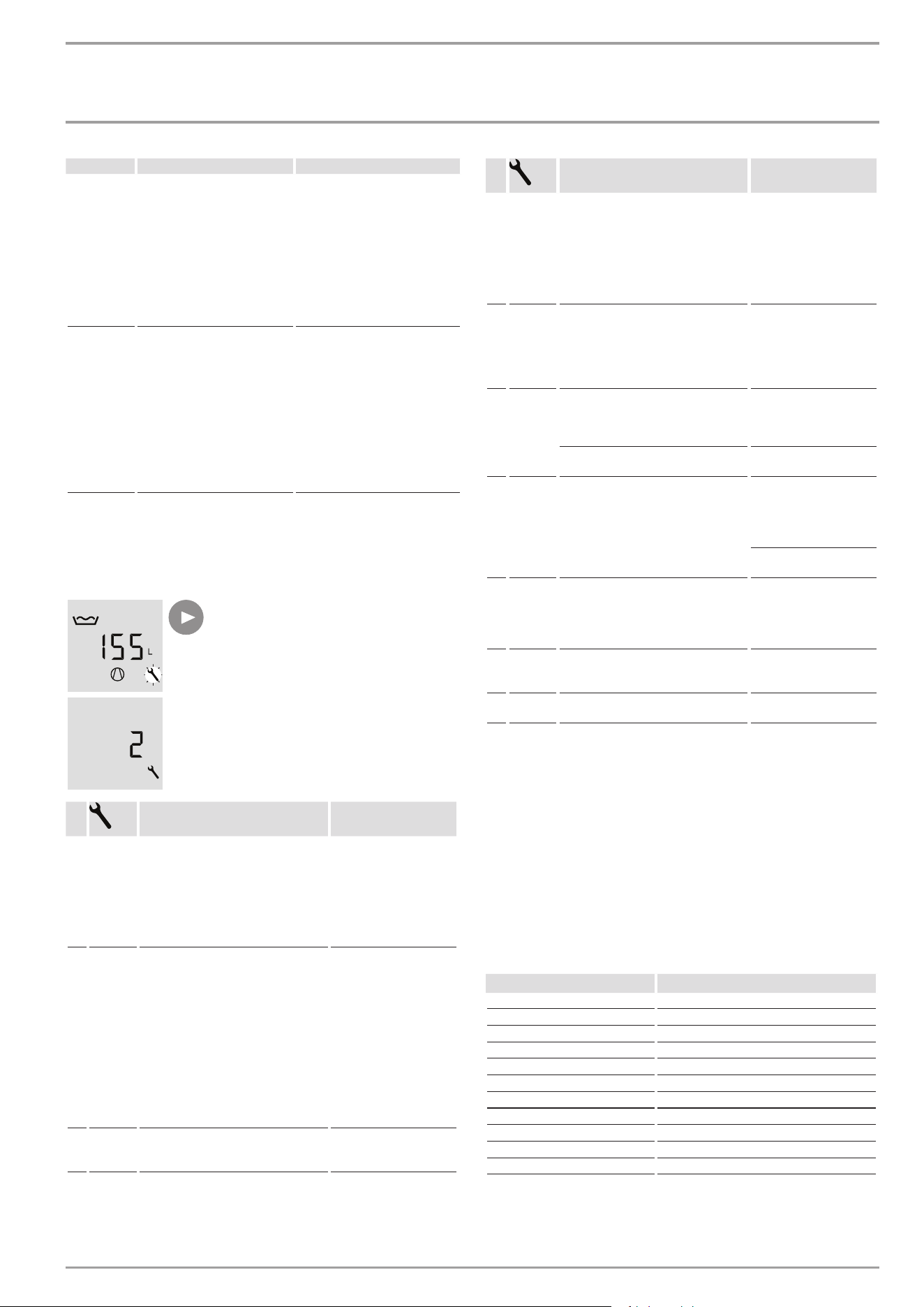
6. Troubleshooting
Problem Cause Remedy
No hot water
is available.
No power at the appliance. Check that the appliance is con-
nected to the power supply.
A fuse in the distribution board
has blown.
Check whether the fuses in your
distribution board have blown.
Contact a qualified contractor if
the fuse blows again after the
appliance is connected to the
power supply.
The air intake or air discharge
of the appliance is blocked.
Check the air intake grille and
air discharge grille for dirt.
Remove any dirt (see chapter
"Maintenance and care"). Ensure
that the supply and extract air
flow are unimpeded.
Outside the application lim-
its, the appliance blocks the
compressor. This could lead to
reduced DHW convenience.
No action required. The appli-
ance will restart the compressor
automatically within the appli-
cation limits.
The DHW cylinder is not com-
pletely filled.
The appliance restarts automati-
cally when the DHW cylinder has
been filled.
After DHW was drawn off pre-
viously, the appliance was not
able to fully heat up the cylin-
der content.
No action required. Let the ap-
pliance complete the heat-up
process.
The safety pressure limiter has
responded 5times in 5hours.
Notify a qualified contractor. The
appliance can only be unlocked
with a service programming
unit.
The com-
pressor is
operational,
but the fan
is off.
If the appliance is in defrost
mode, it may take up to an
hour for the fan to switch on
again.
No action required. However, if
this continues for more than one
hour, please consult a qualified
contractor.
A safety valve
is dripping.
The appliances are under
water mains pressure. During
the heat-up process, expan-
sion water drips from a safety
valve.
If water continues to drip when
heating is completed, please in-
form your qualified contractor.
The conden-
sate drain
drips.
The surface temperature of the
evaporator is lower than the
dew point temperature of the
ambient air. Condensate forms.
This is normal. No action re-
quired. The amount of conden-
sate depends on the humidity
level of the ambient air.
For indoor
installation:
The room
temperature
drops too
low.
Operation of the appliance can
cause the room temperature to
fall by 1 to 3°C. If the room tem-
perature falls by more than 5°C,
check the room size (see chapter
"Specification/ Data table").
Increasing the room size by
opening a door to another room
will remedy this.
The “Service/
fault” symbol
is continu-
ously illumi-
nated.
See chapter “Fault codes”.
Notify a qualified contractor.
A continuously illuminated
"Service/fault" symbol indicates
that a fault has occurred, but
the heat pump is heating nev-
ertheless.
The "Service/
fault" symbol
flashes and
the water
does not heat
up.
See chapter “Fault codes”.
It is imperative that you notify a
qualified contractor quickly. A
flashing "Service/fault" symbol
indicates that a fault has oc-
curred and the heat pump is no
longer heating.
The "Defrost"
symbol is
shown.
The appliance is in defrost
mode.
No action required.
The “Heat
pump”
symbol is
flashing.
There is a heat demand, but
the compressor is locked out.
No action required. The com-
pressor restarts automatically
after the compressor lockout
time has elapsed. The symbol
stops flashing automatically.
OPERATION
Troubleshooting
www.stiebel-eltron.com WWK222-302 H | 15
Problem Cause Remedy
The “Electric
emergency/
booster heat-
er” symbol is
flashing.
A temperature controller has
switched off the electric emer-
gency/booster heater during
rapid heat-up.
No action required. The appli-
ance continues the rapid heat-up
process using the heat pump.
The symbol stops flashing when
the controller re-enables the
electric emergency/booster
heater. The symbol goes out
when the temperature through-
out the DHW cylinder reaches
the set rapid heat-up temper-
ature.
The “Electric
emergency/
booster heat-
er” symbol
is illumi-
nated but
the electric
emergency/
booster
heater is not
operational.
The "Electric emergency/
booster heater" symbol is
illuminated when there is a
demand. The internal control-
ler of the electric emergency/
booster heater may have
ended electric heating. A pos-
sible cause may be a fault in
the electric emergency/booster
heater. A possible cause may
be that the high limit safety
cut-out has responded.
Have a qualified contractor
check whether the controller of
the electric emergency/boost-
er heater is set correctly. The
controller must be turned fully
anti-clockwise. Have a qualified
contractor check the high limit
safety cut-out.
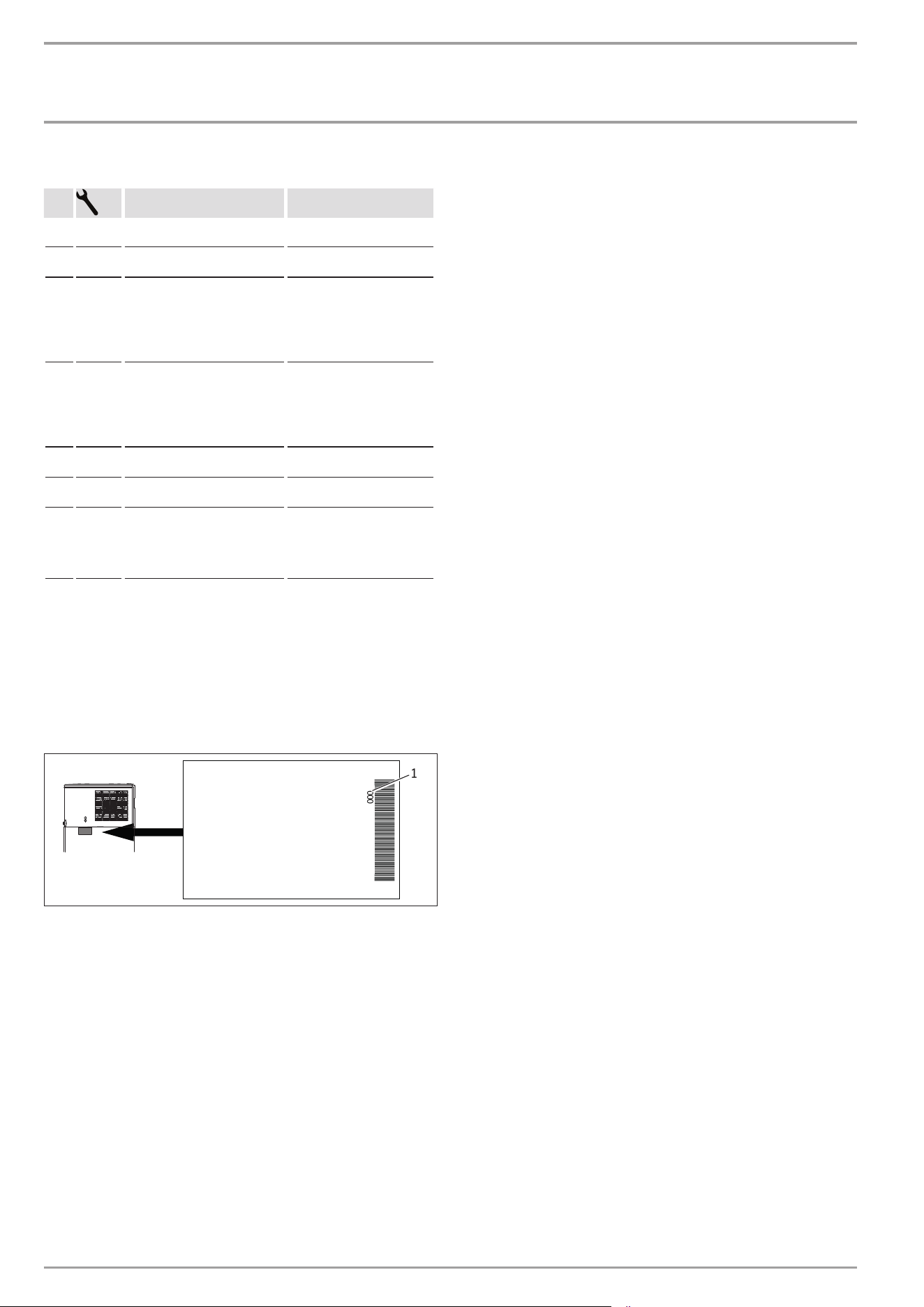
Fault code
You can call up a fault code if the "Service/fault" symbol is flashing
or continuously illuminated on the display.
Repeatedly press the "Menu" button until
the fault code is shown after set temper-
ature2.
Fault code appears
Fault description Remedy
2
Continu-
ously on
The cylinder top sensor is faulty. The
actual temperature display switch-
es from the cylinder top sensor to
the integral sensor. The appliance
continues to heat without any loss
of comfort. The mixed water volume
cannot be calculated and is displayed
as "- -".
Notify a qualified con-
tractor.
4
Continu-
ously on
The integral sensor is faulty. In the
event of a faulty integral sensor, the
integral sensor is set to the value
of the cylinder top sensor, and the
mixed water volume is calculated
using this value. The appliance con-
tinues to heat with a reduced start
hysteresis.
A mixed water volume is still cal-
culated, based on the assumption
that the cylinder top temperature is
reached throughout the DHW cyl-
inder.
Notify a qualified con-
tractor.
6
Flashing
The cylinder top sensor and the inte-
gral sensor are faulty. The appliance
no longer delivers heat.
Notify a qualified con-
tractor.
Fault description Remedy
8
Flashing
The appliance has ascertained that
the DHW cylinder has not been heat-
ed within the maximum temperature
increase time, despite there being a
demand.
You can temporarily
continue to use the
appliance by pressing
the "Rapid heat-up" key
to activate emergency
heating mode. See chap-
ter "Appliance descrip-
tion/ Emergency mode".
16
Continu-
ously on
A short circuit of the impressed
current anode has occurred or the
protective anode is faulty.
Immediately notify a
qualified contractor, as
the appliance is not pro-
tected against corrosion
if the impressed current
anode is faulty.
32
Flashing
The appliance is not being operated
with a completely filled DHW cylin-
der. The appliance is not heating.
Fill the DHW cylinder of
the appliance. The fault
code disappears and the
appliance starts.
The anode current is interrupted. The
appliance is not heating.
Notify a qualified con-
tractor.
64
Continu-
ously on
The defrost temperature has not yet
been reached after the maximum
defrost time has lapsed. The com-
pressor is faulty.
The fault is reset auto-
matically once the evap-
orator temperature has
risen to the defrost end
temperature.
Notify a qualified con-
tractor.
128
Continu-
ously on
There is no communication between
the controller and the programming
unit. The most recently selected set
values are active. The appliance con-
tinues to heat.
Notify a qualified con-
tractor.
256
Flashing
Manually activated emergency mode
(only electric emergency/booster
heater active)
See chapter "Appliance
description/ Emergency
mode".
512 Flashing A fault has occurred in the refrigerant
circuit.
Notify a qualified con-
tractor.
If several faults occur, the fault codes are added together.
Example: If both the cylinder top sensor and the integral sensor
are faulty, the display shows fault code6 (=2+4).
Application scenarios for emergency heating mode
If the appliance shows fault code8, you can manually enable
emergency heating mode. If a different fault occurred previously,
but did not cause the appliance to shut down, the display may
show a fault code that is the result of several faults added together.
Listed below are the fault codes which will allow you to enable
emergency heating mode.
Fault code displayed
8 8
10 Fault code 8 + fault code 2
12 8+4
24 8+16
26 8+2+16
28 8+4+16
138 8+2+128
140 8+4+128
152 8+16+128
154 8+2+16+128
156 8+4+16+128
When the appliance is operating in emergency heating mode, the
fault code shown is incremented by 256.
OPERATION
Troubleshooting
16 | WWK222-302 H www.stiebel-eltron.com
E fault code
Fault description Remedy
E 1 Flashing The temperature sensor on the
air inlet is faulty.
Notify a qualified contractor.
E 2 Flashing The temperature sensor on the
evaporator is faulty.
Notify a qualified contractor.
E 4
Continu-
ously on
The hot gas temperature sensor
is faulty. The appliance con-
tinues to heat. To protect the
appliance, the (possibly higher)
set temperature is reduced to
the set value for setback.
Notify a qualified contractor.
E 16
Continu-
ously on
The high pressure switch has
responded. Compressor heating
mode is temporarily blocked.
Compressor heating mode will
continue as soon as the pres-
sure has normalised.
Wait until the pressure has
normalised.
E 32 Continu-
ously on
An electrical fault has occurred. Notify a qualified contractor.
E 64 Flashing Evaporator temperature < Mini-
mum evaporator temperature
Notify a qualified contractor.
E 128
Flashing
A permanent pressure switch
fault has occurred. A pressure
fault occurred multiple times
within a defined pressure fault
evaluation time.
Notify a qualified contractor.
Notifying a qualified contractor
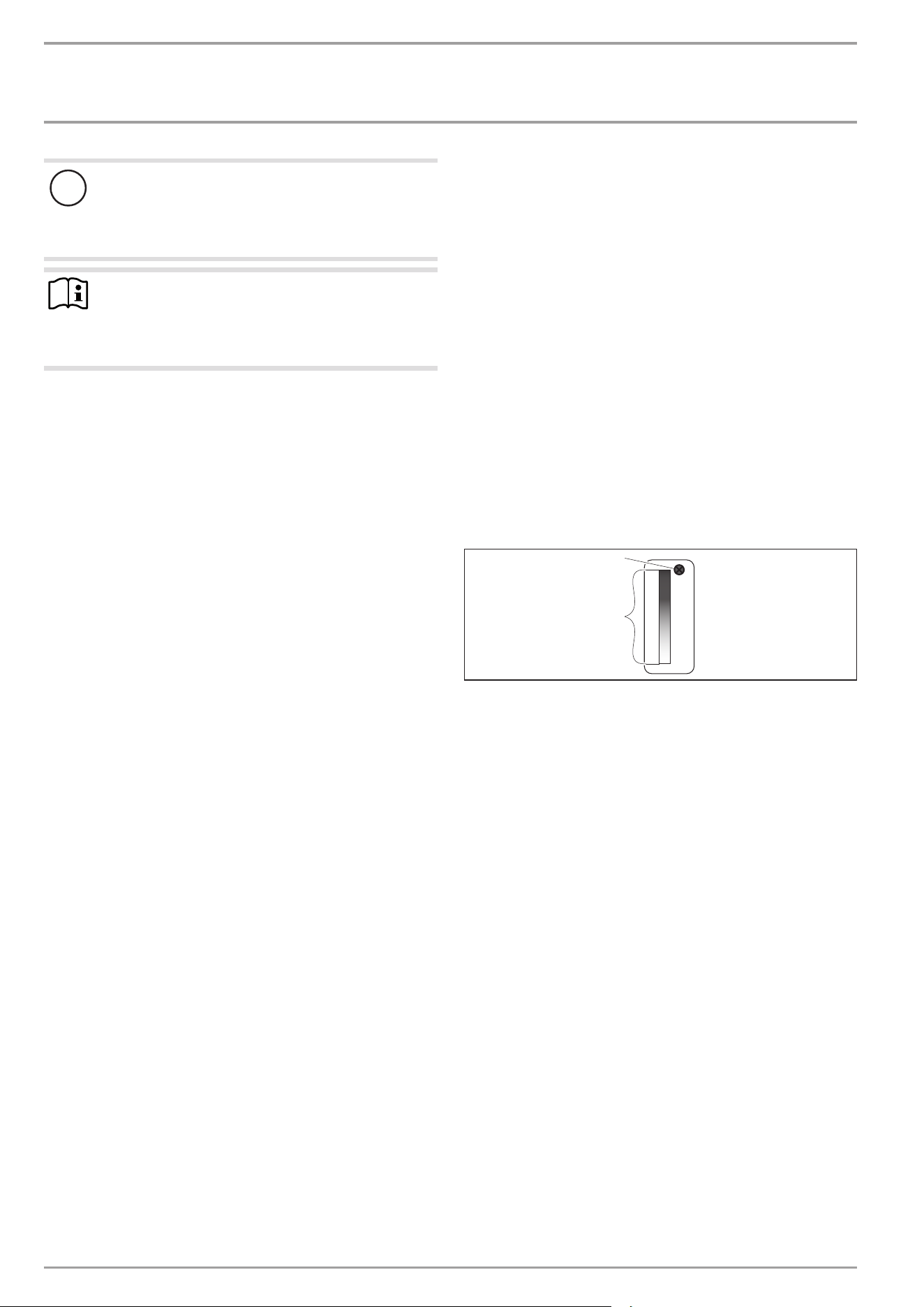
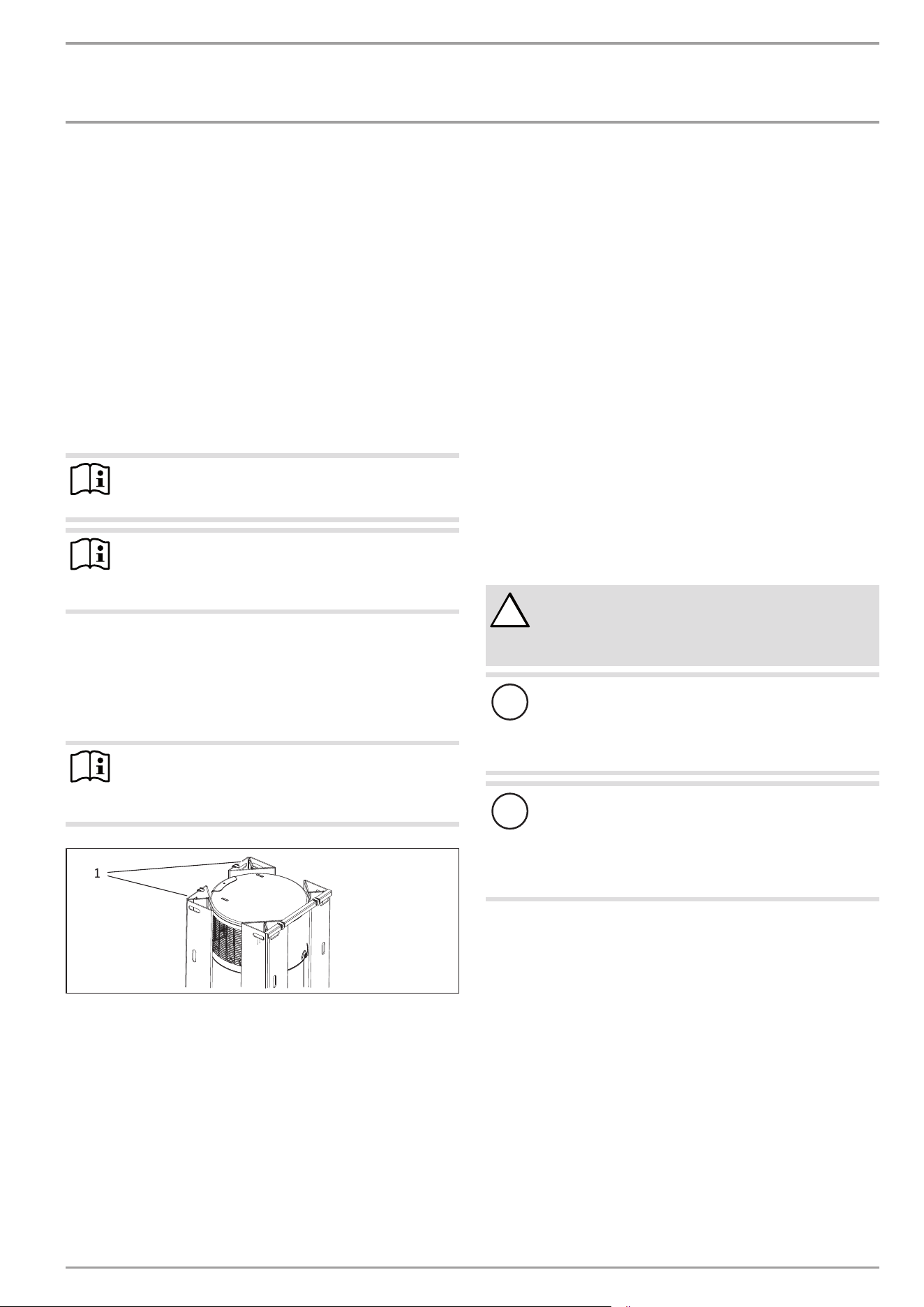
If you cannot remedy the fault, notify your qualified contractor. In
Australia, contact us directly (1800153351). To facilitate and speed
up your enquiry, please provide the serial number from the type
plate (000000-0000-000000). The type plate can be found on the
left, above the "DHW outlet" connection.
Sample type plate
000000-0000-000000
D0000035352
1
1 Number on the type plate
INSTALLATION
Safety
www.stiebel-eltron.com WWK222-302 H | 17
INSTALLATION
7. Safety
Only a qualified contractor should carry out installation, commis-
sioning, maintenance and repair of the appliance.
7.1 General safety instructions
We guarantee trouble-free function and operational reliability only
if original accessories and spare parts intended for the appliance
are used.
7.2 Instructions, standards and regulations
Note
Observe all applicable national and regional regulations
and instructions.
Note
The installation of this appliance shall conform to the
Plumbing Code of Australia (PCA), and the New Zealand
Building Code.
Take note of the appliance type plate and chapter "Specification".
8. Appliance description
8.1 Standard delivery
Note
The accessories are located in the corners of the pack-
aging. Remove the accessories before disposing of the
packaging.
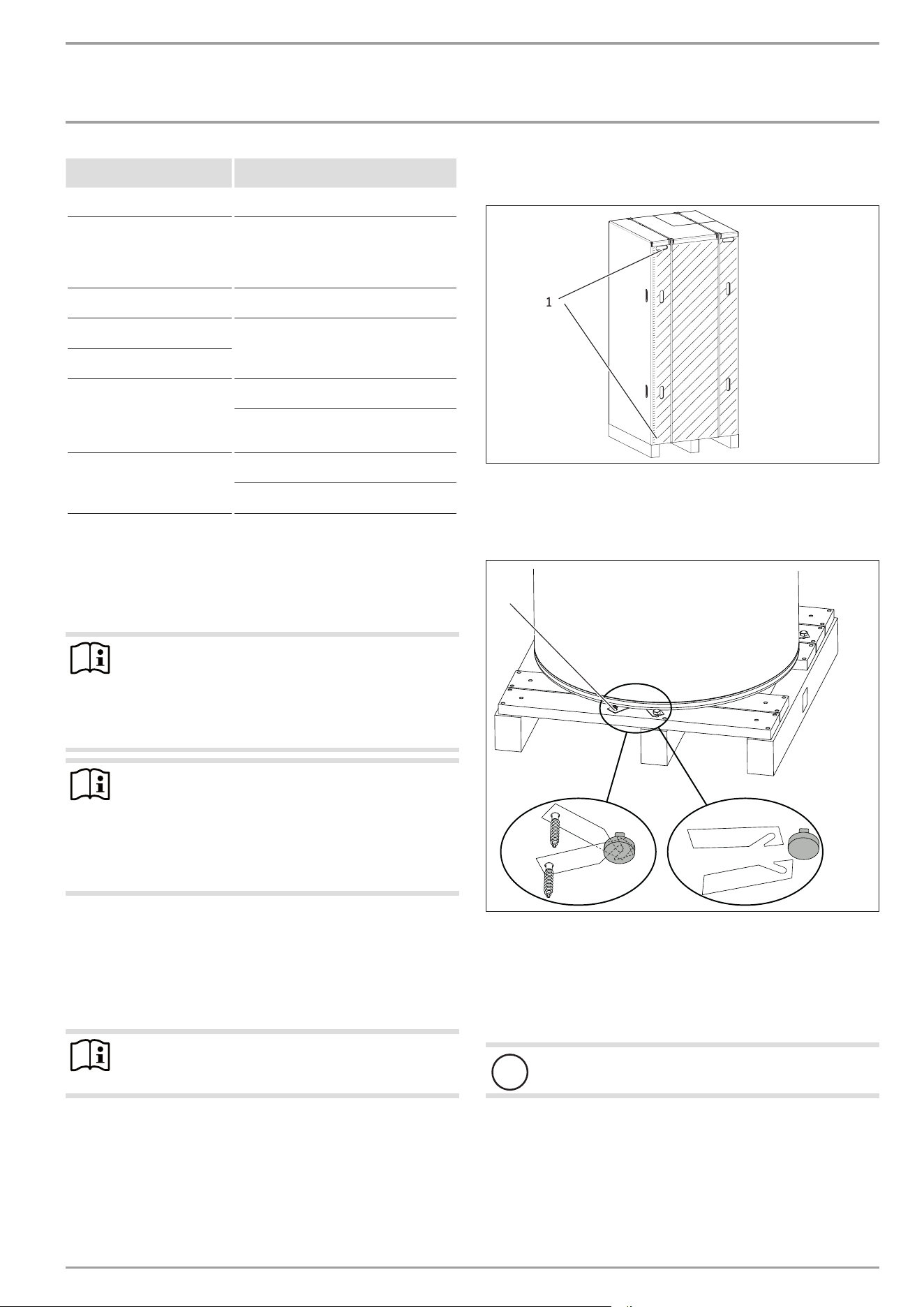
D0000061574
1
1 Corners of the packaging
The following are delivered with the appliance:
- Condensate drain bend
- 2 straight pipe adaptors from G1 to G3/4
- T&P valve G1/2
- Reducer from R3/4 male thread to G1/2 female thread
8.2 Required accessories
Various safety assemblies are available that need to be selected
subject to the static pressure. These type-tested safety assemblies
protect the appliance against unacceptable excess pressure.
For Australia: Various safety assemblies are available to protect
the appliance against unacceptable excess pressure and limit the
DHW outlet temperature.
8.3 Additional accessories
- Condensate pump (if the condensate cannot be drained off
with a naturally occurring fall)
8.4 Incorrect use
The following are not permitted:
- Operating the appliance when the casing is open
- Filling the appliance with a refrigerant other than the one
detailed in chapter "Specification/ Data table"
- Heating liquids other than potable water
Observe the list of requirements regarding the installation room
and non-permissible installation sites (see chapter "Installation
site").
9. Preparation
9.1 Transport
!
CAUTION Injury
f Observe the weight of the appliance.
f Use suitable transport aids (e.g. sack truck) and
enough personnel for transportation.
!
Material losses
The appliance has a high centre of gravity and low over-
turning moment.
f Safeguard the appliance against falling over.
f Only set the appliance down on an even base.
!
Material losses
The appliance casing is not designed to withstand strong
forces. Incorrect handling can lead to material losses of
considerable extent.
f Observe the information on the packaging.
Only remove the packaging shortly before installation.
Where possible, do not unpack the appliance until it has arrived
in the installation room.
For transport and handling leave the appliance in its packaging
and on the pallet. This enables brief horizontal transport and pro-
vides places to hold on to during transport.
If the appliance has to be unpacked before transportation, we
recommend using a sack truck. Pad the contact surfaces to avoid
damaging the appliance. Secure the appliance using a strap. Pad
the areas between the strap and the appliance, and avoid over-
tightening the strap. Where stairwells are narrow, you can carry
the appliance by the handles on the sack truck or trolley and the
foot of the appliance.
INSTALLATION
Preparation
18 | WWK222-302 H www.stiebel-eltron.com
Vehicular transport
!
Material losses
The appliance must generally be stored and transported
vertically.
On tarmac, asphalt, bitumen or otherwise paved roads you may
transport the appliance horizontally over a maximum distance of
160km. Strong shocks are not permissible.
!
Material losses
If transported horizontally, the appliance must always be
laid on the shaded side of the box.
The appliance must not remain in a horizontal position
for more than 24hours.
If the appliance was transported horizontally, leave it to
rest in a vertical position for at least one hour before
commissioning.
f Observe the information on the packaging.
D0000034797
1
1
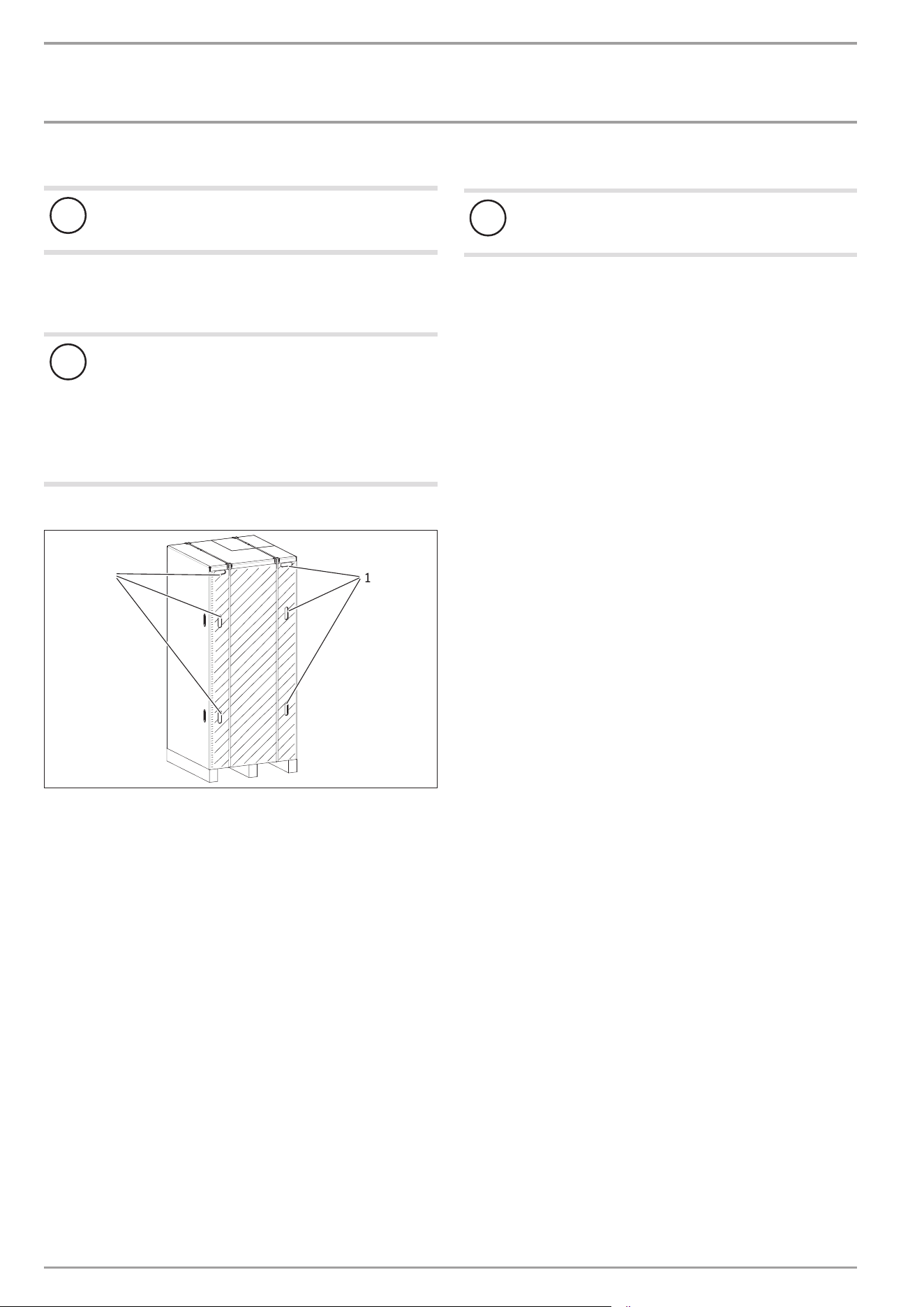
1 Recessed grips
Transport from vehicle to installation room
The cardboard box has reinforced handholds (recessed grips). You
can use these recessed grips, as well as the pallet at the lower
end, to carry the appliance into the installation room. Take note
of the weight of the appliance and ensure sufficient personnel
are available.
9.2 Storage
If it is necessary to store the appliance for a prolonged period
before installation, observe the following information:
- Only store the appliance in a vertical position. Never store
the appliance horizontally.
- Store the appliance in a location that is dry and largely
dust-free.
- Protect the appliance from coming into contact with aggres-
sive substances.
- Ensure the appliance is not subjected to shocks or vibrations.
9.3 Installation site
!
Material losses
Observe the following list of requirements regarding the
installation site.
- Install the appliance where it will be exposed as little as pos-
sible to strong direct wind, extreme rain, sun or snow, but
will still be well ventilated. Unhindered air intake and air dis-
charge must be possible. If necessary, protect the appliance
against the elements with a canopy, base and deflectors.
- The installation site must be free from flammable, highly
combustible gases and substances, as well as high levels of
dust.
- The application limits for the heat pump and DHW cylinder
must be maintained (see chapter "Specification/ Data table").
- The substrate of the installation site must be level and have
sufficient load bearing capacity. Take note of the weight of
the appliance with a full DHW cylinder (see chapter "Speci-
fication/ Data table"). A floor with insufficient load bearing
capacity is in danger of collapse. If the appliance is not level,
there may be a risk of appliance damage.
- In the case of indoor installation, the size of the installation
room must correspond to the application limits of the appli-
ance (see chapter "Specification/ Data table").
- Observe the safety clearances and protection zones.
- Always leave sufficient space to provide access for installa-
tion, maintenance and cleaning. Observe the minimum clear-
ances (see "Preparations/ Siting the appliance"). Otherwise,
the energy effiency may decrease and the service life may be
reduced.
- Never install the appliance in locations with aggressive at-
mospheres. Never draw off supply air from locations with
aggressive atmospheres. This may damage the appliance.
- Check for anything which may have adverse effects on the in-
stallation site or the air supply. This can decrease the energy
efficiency and reduce the service life, for example.
- Never install the appliance in close proximity to outdoor air
conditioning units. This can damage the fan, the compressor
or the evaporator, for example.
- Ensure the operation of other equipment in the installation
room is not impaired.
- To keep the water pipe lengths as short as possible, we
recommend installing the appliance close to the kitchen or
bathrooms.
- To prevent adverse effects from operating noise, do not in-
stall the appliance close to bedrooms.
INSTALLATION
Preparation
www.stiebel-eltron.com WWK222-302 H | 19
Examples of unacceptable
installations
Atmospheres containing am-
monia
Sewage works, pigsties
Substances which block the
evaporator
Air containing oil or fat, dust (cement, flour,
etc.). Note: If the air contains hairspray
(e.g. in hairdressing salons), the appliance
should be operated with shorter mainte-
nance intervals.
Saline environments Coastal installations (<200m from the
coast) can reduce component service life.
Atmospheres containing chlorine
or chloride
Swimming pools, salt works
Atmospheres containing thermal
water
Formaldehyde in the atmos-
phere
Certain wood-based materials (e.g. OSB
boards)
Certain insulating materials (e.g. foams
based on urea-formaldehyde (UF in-situ
foams))
Carboxylic acid in the atmos-
phere
Extract air from kitchens
Components of floor cleaners (e.g. vinegar
cleaner)
Air polluted with these substances can cause corrosion of copper
materials in the refrigerant circuit, especially the evaporator. This
corrosion can lead to failure of the appliance. Any damage to
the appliance caused in this way is not covered by the guarantee
conditions.
Note
The appliance output data is calculated according to the
relevant standards, using the intake temperature speci-
fied in the data table. Below this temperature the appli-
ance efficiency and output decrease. The heat-up time
is extended.
Note
You can improve the efficiency of the appliance by utilis-
ing the waste heat from other appliances to heat the DHW
cylinder, e.g. boilers, tumble dryers or freezers.
If, for example, a tumble dryer releases dust at the in-
stallation site, the evaporator must be cleaned more
frequently.
Sound emissions
The sound emissions are louder on the air intake and air discharge
sides of the appliance than on the closed sides.
f Do not direct the air intake or air discharge towards
noise-sensitive rooms of the house, e.g. bedrooms.
Note
For details on sounds emissions, see chapter "Specifica-
tion/ Data table".
9.4 Siting the appliance
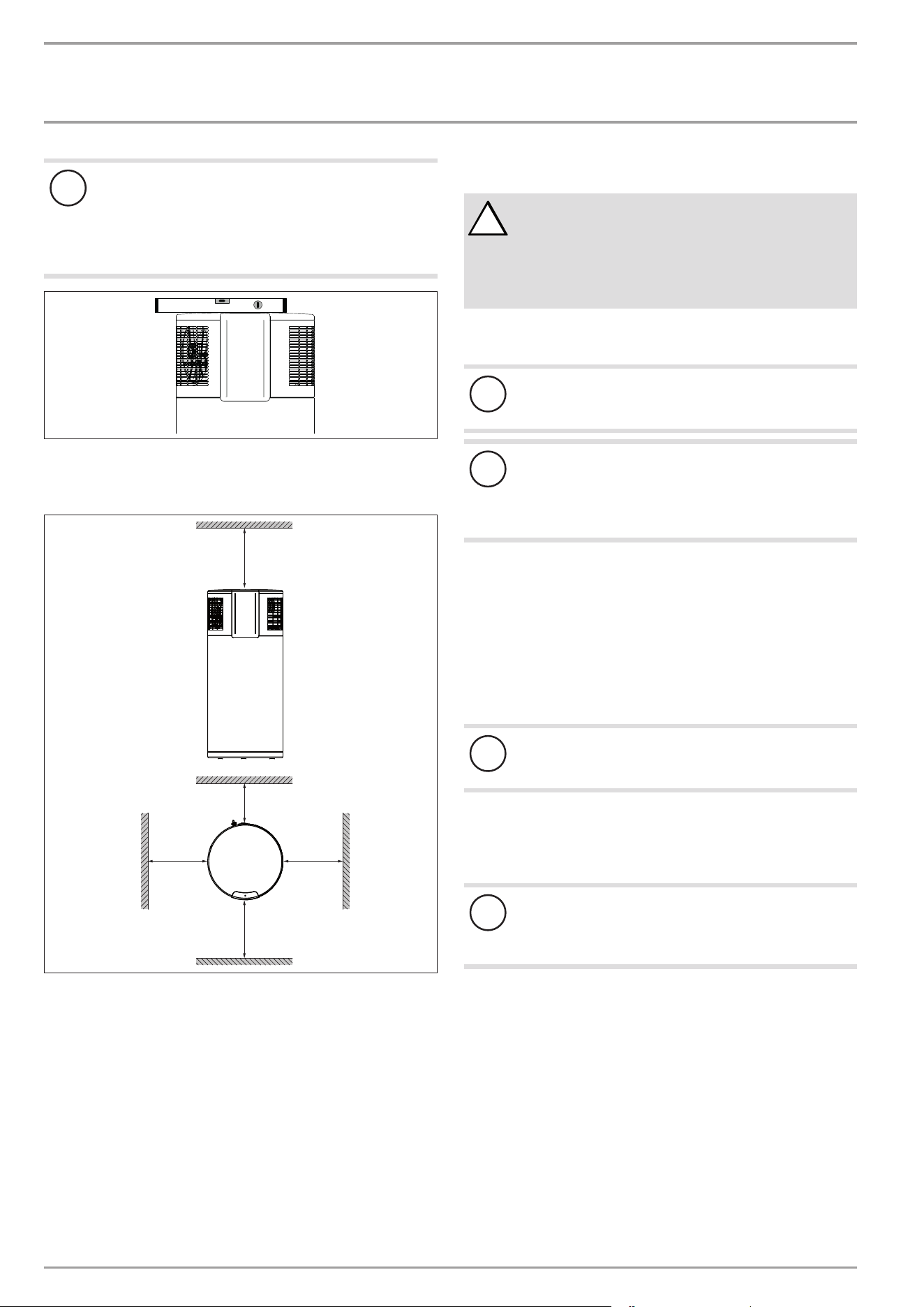
f Carefully undo the cardboard packaging at the clips.
D0000034797
1
1 Cardboard packaging clips
The appliance is secured to the pallet with metal brackets and
screws. The metal brackets are hooked onto the feet underneath
the floor plate of the appliance.
2.
1.
D0000034798
1
1 Metal bracket fixing screw
f Remove the fixing screws of the metal brackets from the
pallet.
f Push the metal brackets a little towards the cylinder centre to
unhook them from the appliance feet.
f Pull the metal brackets out from underneath the appliance.
!
Material losses
Take note of the appliance's weight and centre of gravity.
f Slightly tip the appliance and carefully roll the appliance off
the pallet.
f Position the appliance in the final installation site.
INSTALLATION
Installation
20 | WWK222-302 H www.stiebel-eltron.com
!
Material losses
The appliance must be positioned vertically to avoid
damage.
The appliance has height-adjustable feet below its base.
f Level the appliance horizontally using the height-ad-
justable feet.
D0000039043
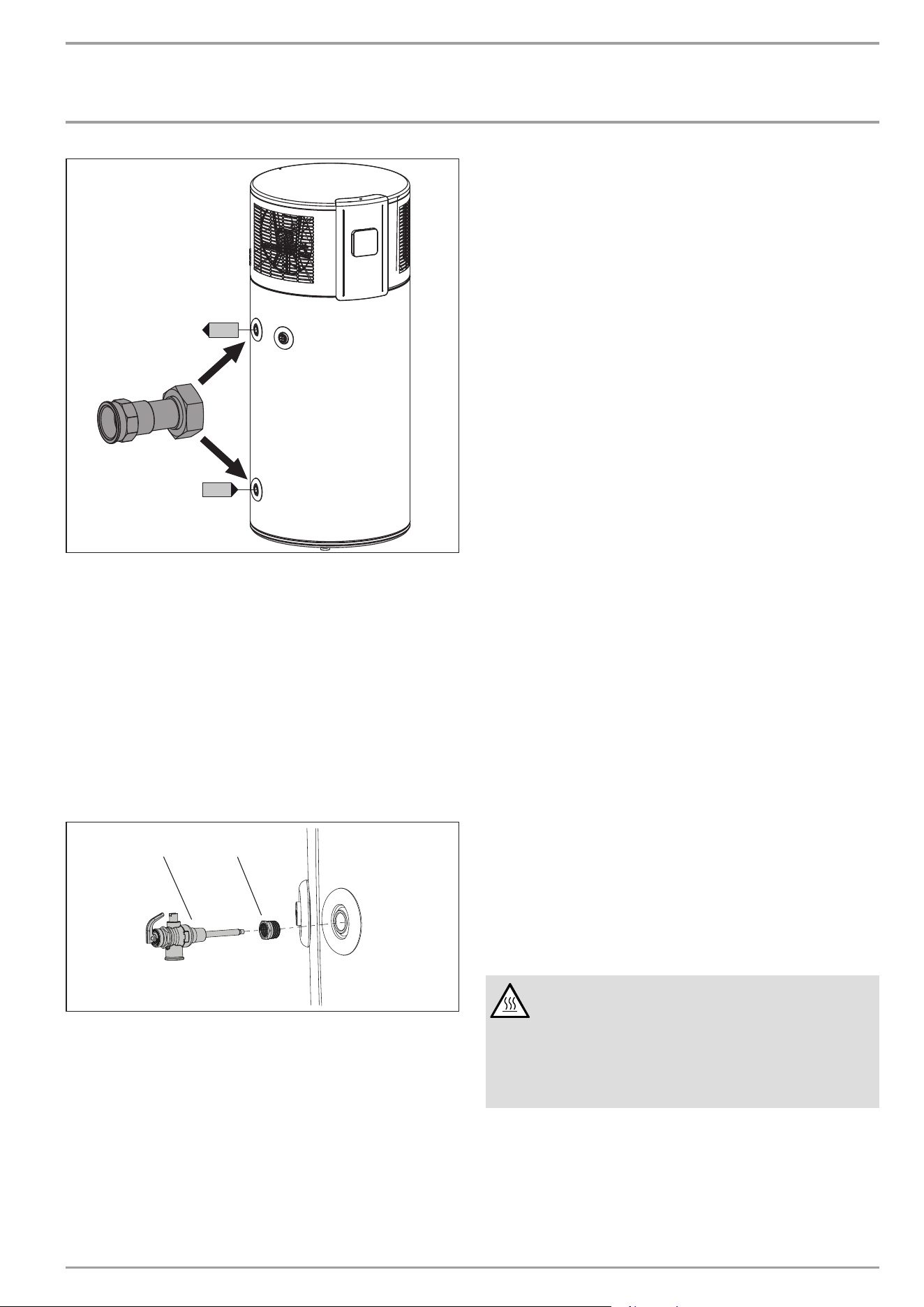
9.4.1 Minimum clearances
f Maintain the minimum clearances.
≥150
≥350
≥400
≥400
≥500
D0000029620
10. Installation
!
WARNING Injury
Incorrect installation can lead to serious injury or ma-
terial losses.
Before any work, ensure sufficient clearances for instal-
lation.
Handle sharp-edged components carefully.
10.1 Water connection
!
Material losses
Carry out all water connection and installation work in
accordance with regulations.
!
Material losses
The corrosion protection provided by the anode can only
be guaranteed when the electrical conductivity of the
potable water is within the limits stated in chapter "Spec-
ification/ Data table".
Cold water line
Galvanised steel, stainless steel, copper and plastic are approved
materials.
A safety valve is required.
DHW line
Stainless steel, copper and plastic pipework are approved.
!
Material losses
When using plastic pipework, observe the manufacturer's
data and chapter "Specification/ Fault conditions".
f Thoroughly flush the pipework before connecting the appli-
ance. Foreign bodies, such as abraded plastic or metal, rust,
sand or sealant can impair the operational reliability of the
appliance.
!
Material losses
To protect the connections against corrosion, the water
connection must be made with flat gaskets. The use of
hemp on connections is not permissible.
INSTALLATION
Installation
www.stiebel-eltron.com WWK222-302 H | 21
c06
c01
D0000110400
f Connect the adaptor that is part of the standard delivery,
with the gaskets supplied, to cold water inletc01 and DHW
outletc06.
f Check the screw fitting for tightness.
DHW circulation
DHW circulation is not permissible.
10.1.1 Safety equipment
A T&P valve or a cold water expansion control valve, or both, must
be installed. Observe local and regional regulations.
T&P valve ( 850 kPa )
D0000063547
1 2
1 T&P valve
2 Reducer from R3/4 male thread to Rp1/2 female thread
f If specified, install a type-tested T&P valve with reducer at
the "T&P valve" connection provided on the appliance.
The response pressure of the valve must be below or equal to the
permissible operating pressure of the DHW cylinder. The valve
protects the appliance against unacceptable excess pressure or
temperature. The diameter of the cold water supply line must not
be greater than the diameter of the valve.
f Ensure that the expansion water escaping from the valve can
drip into a drain, e.g. a funnel or tundish.
Ensure the drain cannot be shut off.
f Size the drain pipe so that water can drain off unimpeded
when the safety valve is fully opened.
f Ensure that the drain pipe of the safety valve is open to the
outside.
f Fit the drain pipe of the safety valve with a constant down-
ward slope and in a location free from the risk of frost.
Safety valve (cold water expansion control valve)
f If specified, install a type-tested 700kPa safety valve (expan-
sion control valve) in the cold water supply line.
The safety valve protects the appliance against unacceptable ex-
cess pressure. The diameter of the cold water supply line must not
be greater than the diameter of the safety valve.
f Ensure that the expansion water escaping from the safety
valve can drip into a drain, e.g. a tank or funnel.
Ensure the drain cannot be shut off.
f Size the drain pipe so that water can drain off unimpeded
when the safety valve is fully opened.
f Ensure that the drain pipe of the safety valve is open to the
outside.
f Fit the drain pipe of the safety valve with a constant fall in a
room free from the risk of frost.
10.1.2 Pressure reducing valve
The maximum pressure in the cold water supply line must be at
least 20% below the lowest response pressure of all installed T&P
valves. Otherwise a pressure reducing valve is required. If this is
the case, install a pressure reducing valve in the cold water supply
line. The pressure reducing valve must be set to 540kPa if a safety
valve is installed; otherwise to 700kPa.
10.1.3 Drain valve
f Install a suitable drain valve at the lowest point in the cold
water supply line.
10.1.4 Thermal insulation
f Insulate the DHW line and valves against heat loss and to im-
prove energy efficiency in accordance with locally applicable
regulations.
f Insulate the cold water supply line to prevent condensate
forming.
10.1.5 DHW outlet
WARNING Burns
The water in the DHW cylinder can be heated to temper-
atures in excess of 60°C. There is a risk of scalding at
outlet temperatures in excess of 43°C.
f Install a temperature limiter in all systems intended
for personal hygiene, e.g. balancing valve, thermo-
static mixing valve.
10.2 Condensate drain
Install a condensate drain hose in order to remove the condensate
which forms.
f Connect the condensate drain bend included in the standard
delivery to the "Condensate drain" connection.
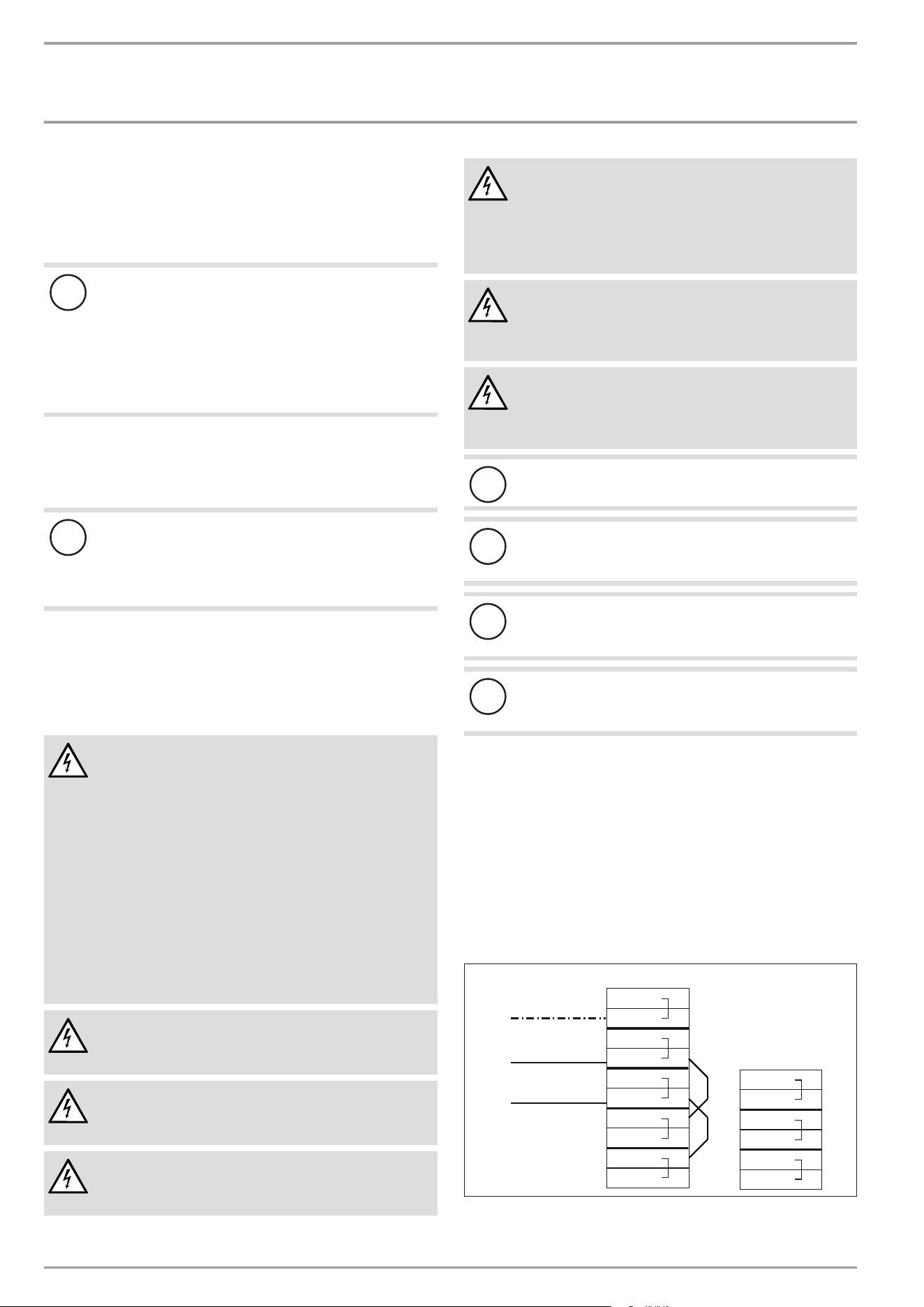
INSTALLATION
Installation
22 | WWK222-302 H www.stiebel-eltron.com
f Connect a condensate drain hose to the condensate drain
bend.
A siphon must be installed to prevent aggressive gases from the
sewer entering the appliance. The condensate drain must be in-
stalled with an outlet that opens freely above the siphon.
!
Material losses
Ensure condensate cannot back up.
f Use a condensate drain hose with a diameter great-
er than the diameter of the condensate drain bend.
f Ensure the condensate drain hose is not kinked.
f Route the condensate drain hose with a continuous
fall.
The condensate drain must be open to atmosphere.
f Use a suitable condensate pump if there is insufficient fall.
Take the building characteristics into account.
Condensate pan heater
!
Material losses
If the temperature at the installation site could continu-
ously fall below freezing (1-2 days) you should install
a condensate pan heater. The condensate pan heater is
not part of the standard delivery.
When the compressor is running, install a load-dependent relay
to switch on the condensate pan heater after a delay.
The condensate pan heater must have an external power supply.
10.3 Electrical connection
WARNING Electrocution
The appliance is supplied with a flexible power cable
without plug. In the case of a permanent connection,
the appliance must be able to be separated from the
power supply by an isolator that disconnects all poles
with at least 3mm contact separation. Contactors, circuit
breakers or fuses can be used for this. This type of iso-
lator must be installed in the fixed electrical installation
according to the regulations.
For Australia: Ensure that the appliance can be separated
from the power supply by a suitable isolator. Contac-
tors, circuit breakers, fuses or general purpose power
plugs can be used for this. This type of isolator must be
installed according to the electrical installation regu-
lations.
WARNING Electrocution
Carry out all electrical connection and installation work
in accordance with national and regional regulations.
WARNING Electrocution
Ensure that the appliance is connected to the earth con-
ductor.
WARNING Electrocution
Observe the safety measures to prevent contact with
dangerously high contact voltage.
WARNING Electrocution
Coming into contact with live components presents a
threat to life. Disconnect the appliance from the power
supply before carrying out work on its interior. Prevent
the power supply from being switched on while you are
working on the system.
WARNING Electrocution
Insufficient earthing can lead to electrocution. Ensure
the appliance is earthed according to locally applicable
requirements.
WARNING Electrocution
If the power cable is faulty, replace it with a new one.
The power cable should only be replaced by a qualified
contractor.
!
Material losses
Install a residual current device (RCD).
!
Material losses
The specified voltage must match the mains voltage. Ob-
serve the type plate.
!
Material losses
Observe the fuse protection required for the appliance
(see chapter "Specification/ Data table").
!
Material losses
Never connect the appliance to the power supply before
the DHW cylinder is filled.
The appliance is supplied with a flexible power cable without plug.
f If the power cable is not long enough, you may disconnect it
from the appliance and replace it with a longer, more suita-
ble cable. Alternatively, you may extend the cable as permit-
ted by regional and national regulations (e.g. with the use of
a junction box).
f When routing the new power cable, ensure waterproofing
where it passes through the existing cable grommet. Connect
the cable properly inside the appliance.
10.3.1 Standard connection (without external signal transmitter)
X0
2
L
L
N
N
PE
PE
1
1
2
X3
2
3
3
1
1
2
L
N
PE
GNYE
BU
BN
D0000050560
BN Brown
BU Blue
GNYE Green/yellow
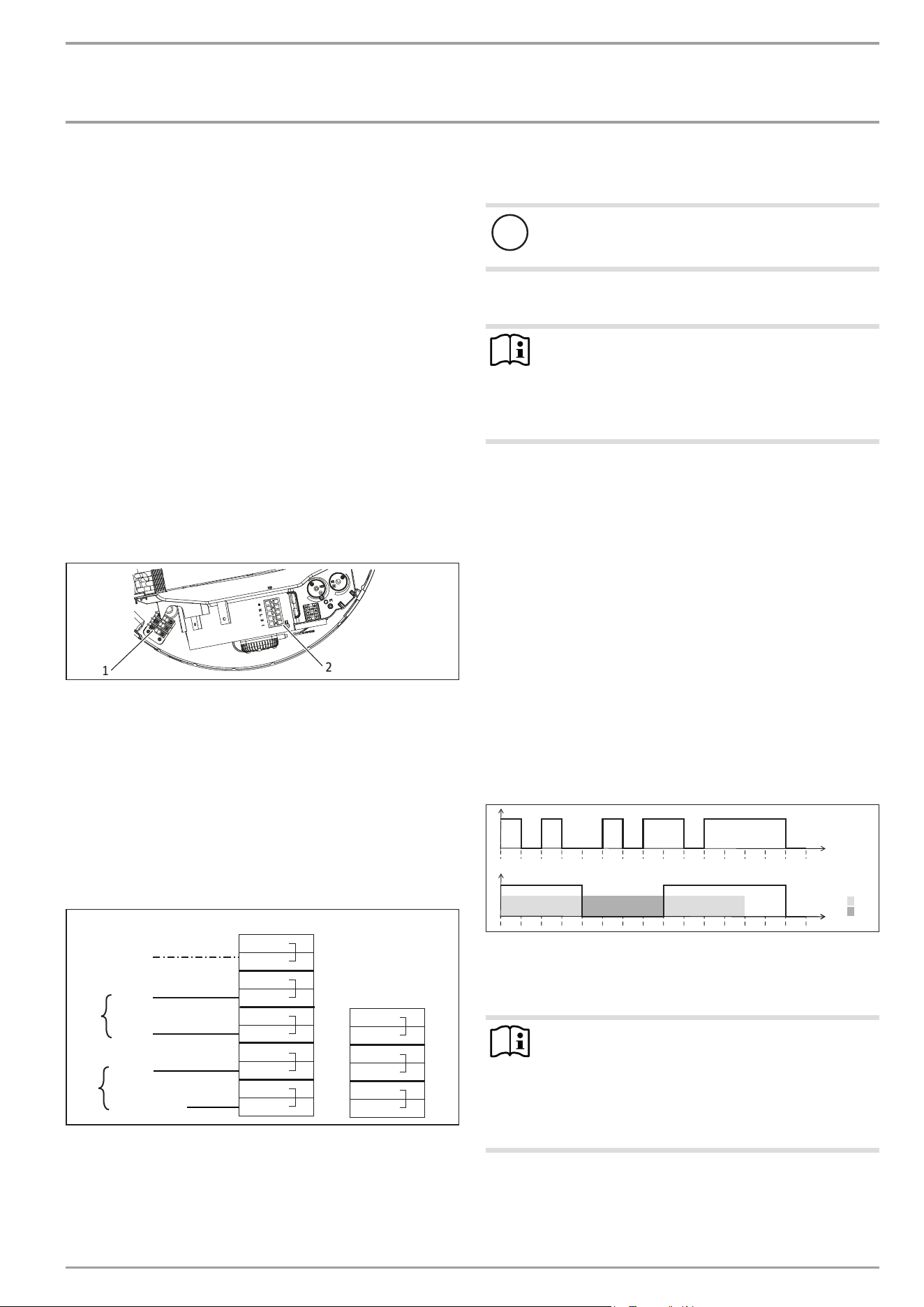
INSTALLATION
Installation
www.stiebel-eltron.com WWK222-302 H | 23
10.3.2 Separate power supply to the impressed current anode
At the factory, the appliance is fitted with rechargeable batteries
that ensure the power supply to the impressed current anode in
the case of a power failure. If regular interruptions to the power
supply are not anticipated, the batteries will not require any main-
tenance.
The rechargeable batteries for the impressed current anode must
be replaced every three years in the following cases:
- The impressed current anode is not separately connected to
a continuous power supply and a switching contact regularly
interrupts the power supply to the appliance.
- The security of supply is inadequate.
Failure to observe this point puts the appliance at risk of damage.
Replacing the batteries can be avoided by connecting the im-
pressed current anode separately to a continuous power supply.
This means the DHW cylinder continues to be protected against
corrosion if the rest of the appliance is switched off, e.g. by a
controlled power supply.
f Remove the appliance cover (see chapter "Cleaning and
maintenance/ Removing the appliance cover").
D0000056083
1
2
1 Strain relief
2 Terminal X0
f Prepare the cables in such a way that each cable terminates
with a wire ferrule.
f Push the cables through one of the cable entries in the appli-
ance casing.
f Route the cables through the strain relief.
f Remove the jumper which leads from X0/N to X0/2 in the de-
livered condition.
f Remove the jumper which leads from X0/L to X0/1 in the de-
livered condition.
X0
2
L
L
N
N
PE
PE
L
N
PE
GNYE
BU
BN
1
1
2
X3
2
3
3
1
1
2
L1 / L2 / L3
N
A
B
D0000059152
A Power supply provided by power supply utility or energy
management system for switching the load (compressor)
B Power supply to impressed current anode and PCB
BN Brown
BU Blue
GNYE Green/yellow
f Connect the cables for the separate power supply to the im-
pressed current anode to X0/1 and X0/2.
!
Material losses
The power supply to the impressed current anode must
be ensured at all times.
10.3.3 Connection with external signal transmitter
Note
The appliance has a second, higher set temperature
which is preset at the factory. This is activated when there
is an external switching signal. Set temperature2 takes
priority over the standard set temperature while there is
an external switching signal.
An external signal transmitter for switching a separate set DHW
temperature (set temperature2) can be connected to terminal
X3/1-2. In the delivered condition, terminal X3/1-2 is not assigned.
If this terminal is connected at the voltage stated in the specifica-
tion (see "Permissible voltage range, external signal transmitter")
(L to X3/1, N to X3/2), the appliance activates set temperature2.
Following a one-off activation (signal is present for at least 1min-
ute), set temperature2 applies for at least 20minutes. Set temper-
ature2 takes priority over set temperature1. When the relevant set
DHW temperature has been reached, the compressor switches off
and remains off for a minimum idle time of 20minutes.
The following diagram illustrates the connections by means of a
sample signal sequence from an external signal transmitter.
Example:
- Water temperature = 62 °C
- Set temperature1 = 61 °C
- Set temperature2 = 65 °C
A
1
0
0 5 10 15 20 25 30 35 40 45 50 55 60 65 70 75 t [min]
B
1
1
0 2
0 5 10 15 20 25 30 35 40 45 50 55 60 65 70 75 t [min]
D0000034613
A External signal
B Compressor
1 20 min. minimum runtime, set temperature2
2 20 min. minimum compressor idle time
Note
An external signal must be present for at least 60seconds
before the control unit responds to it. For example, this
will prevent a brief burst of sunshine from triggering a
heat-up process which, in the absence of further sun-
light, can no longer be covered using locally generated
PV power.
f Remove the appliance cover (see chapter "Cleaning and
maintenance/ Removing the appliance cover").
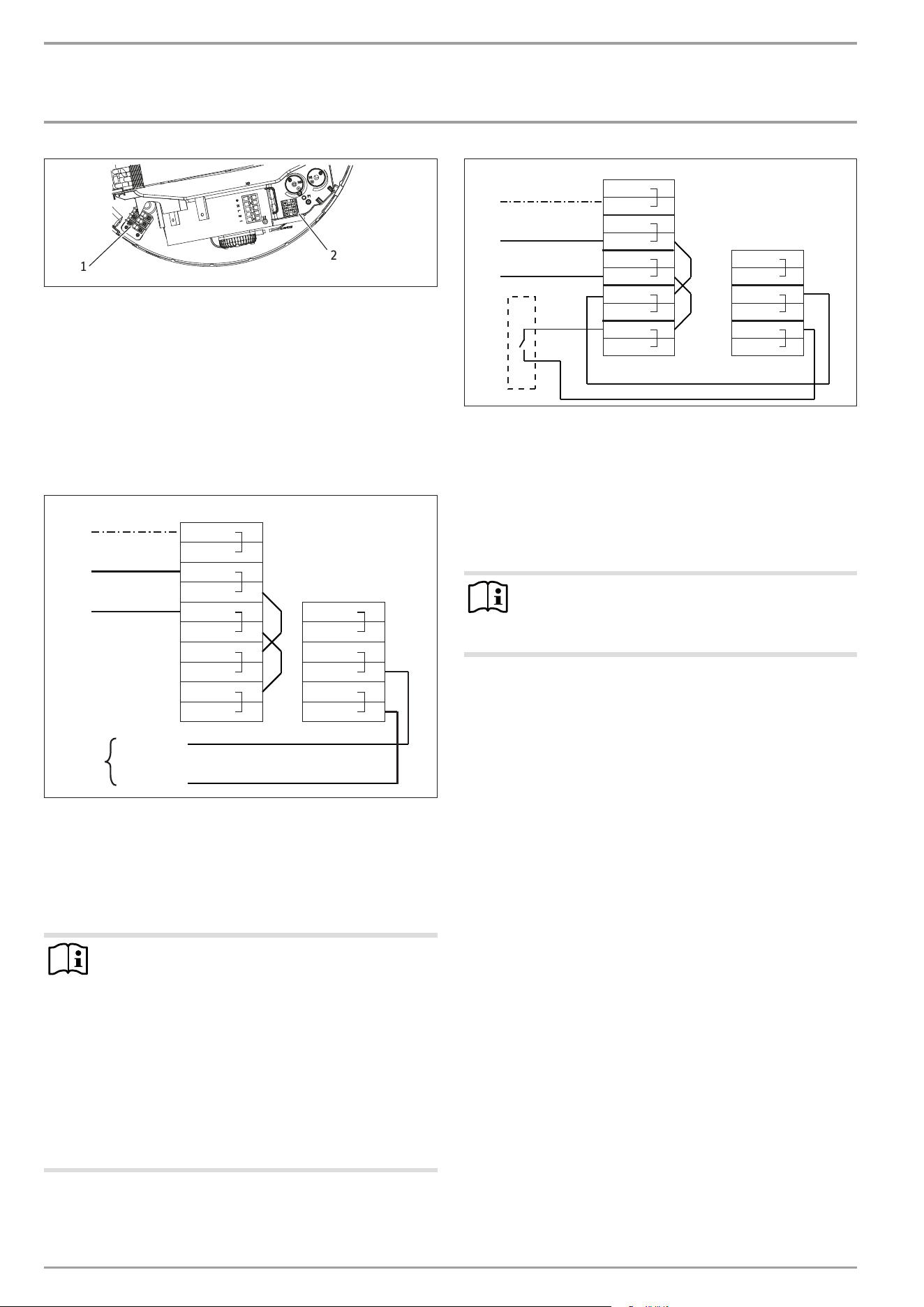
INSTALLATION
Installation
24 | WWK222-302 H www.stiebel-eltron.com
D0000056083
1
2
1 Strain relief
2 Terminal X3
f Prepare the cables in such a way that each cable terminates
with a wire ferrule.
f Push the cables through one of the cable entries in the appli-
ance casing.
f Route the cables through the strain relief.
f Connect the cables to X3.
Example 1: Power supply utility signal with its own phase
X0
2
L
L
N
N
PE
PE
L
N
PE
GNYE
BU
BN
1
1
2
X3
2
3
3
1
1
2
L1 / L2 / L3
N
EVU
D0000059154
EVU Power supply utility
BN Brown
BU Blue
GNYE Green/yellow
Example 2: Photovoltaic signal via on-site relay and phase
routed outside the appliance
Note
The relay in the inverter must meet the following re-
quirements:
- Potential-free relay (240VAC / 24VDC, 1A) with
N/O contact
- Adherence to safety regulations and standards for
safety extra low voltage
- The switching output must be able to be pro-
grammed such that the relay contact closes or opens
if certain limits are exceeded or undershot (inverter
output level).
If necessary, check with the inverter manufacturer wheth-
er the product meets the stated criteria.
X0
2
L
L
N
N
PE
PE
L
N
PE
GNYE
BU
BN
1
1
2
1
X3
2
3
3
1
1
2
D0000059155
1 Inverter (floating contact)
BN Brown
BU Blue
GNYE Green/yellow
The inverter power feed is usually located at a central distribution
point (e.g. in the main fuse box).
10.4 Assembling the appliance
Note
Refit the appliance cover after completing your work. See
chapter "Maintenance and cleaning/ Fitting the appliance
cover").
INSTALLATION
Commissioning
www.stiebel-eltron.com WWK222-302 H | 25
11. Commissioning
WARNING Electrocution
Never operate the appliance when the casing is open or
without a cover.
11.1 Initial start-up
Note
Fill the DHW cylinder before switching on the power sup-
ply to the appliance.
The appliance is equipped with boil-dry protection to
prevent operation if the DHW cylinder is not completely
full of water.
Note
Following an interruption to the power supply, compres-
sor operation remains blocked for at least one minute.
The PCB delays the electrical start-up by one minute,
during which the appliance initialises. If the compres-
sor subsequently fails to start, it may be locked out by
additional safety devices (motor overload relay and high
pressure switch). This lockout should be cleared after 1
to 10 minutes.
11.1.1 Filling the DHW cylinder
Fill the DHW cylinder and vent the pipework by following the
procedure below:
f Close the drain valve.
f Open all DHW draw-off points and the shut-off valve in the
cold water supply.
f Close the DHW draw-off points as soon as water comes out
of them.
f Check the safety valve by leaving it open until water runs out.
11.1.2 Settings / function check
f Switch the power supply ON.
f Check the appliance function.
f Check the function of the safety assembly.
After completing the function check, reducing the set DHW tem-
perature helps to save energy.
f Establish the customer's comfort requirements and adjust
the set DHW temperature accordingly. For hygiene reasons,
do not set a DHW temperature of less than 61°C (see section
"Set temperature1" on page10 and "Set temperature2" on
page10). Also ensure compliance with the legislation in force
at the installation location.
11.1.3 Appliance handover
f Explain the appliance function to users and familiarise them
with how it works.
f Make users aware of potential dangers, especially the risk of
scalding.
f Make users aware of critical environmental factors and re-
quirements concerning the installation site.
f Inform users that water may drip from the safety valve dur-
ing the heat-up process.
f Please note that the appliance is not protected against frost
and corrosion when it is disconnected from the power sup-
ply. At the factory, the appliance is fitted with rechargeable
batteries that ensure the power supply to the impressed cur-
rent anode in the case of a power failure. The batteries must
be replaced every three years if the power supply is regularly
interrupted by a switching contact or if there is inadequate
security of supply. We recommend a maintenance contract
for replacing the batteries.
f Hand over these operating and installation instructions to
users for safekeeping.
11.2 Recommissioning
Note
Following an interruption to the power supply, compres-
sor operation remains blocked for at least one minute.
The PCB delays the electrical start-up by one minute,
during which the appliance initialises.
If the compressor subsequently fails to start, it may be
locked out by additional safety devices (motor overload
relay and high pressure switch). This lockout should be
cleared after 1 to 10 minutes.
If the appliance is switched off due to an interruption to the power
supply, no specific measures for restarting are required once the
power supply has been restored.
If the "Rapid/comfort heat-up" function was active before the
power supply interruption, it is re-enabled with a set temperature
of 65°C once the power supply has been restored.
Emergency mode is not reactivated after an interruption to the
power supply.
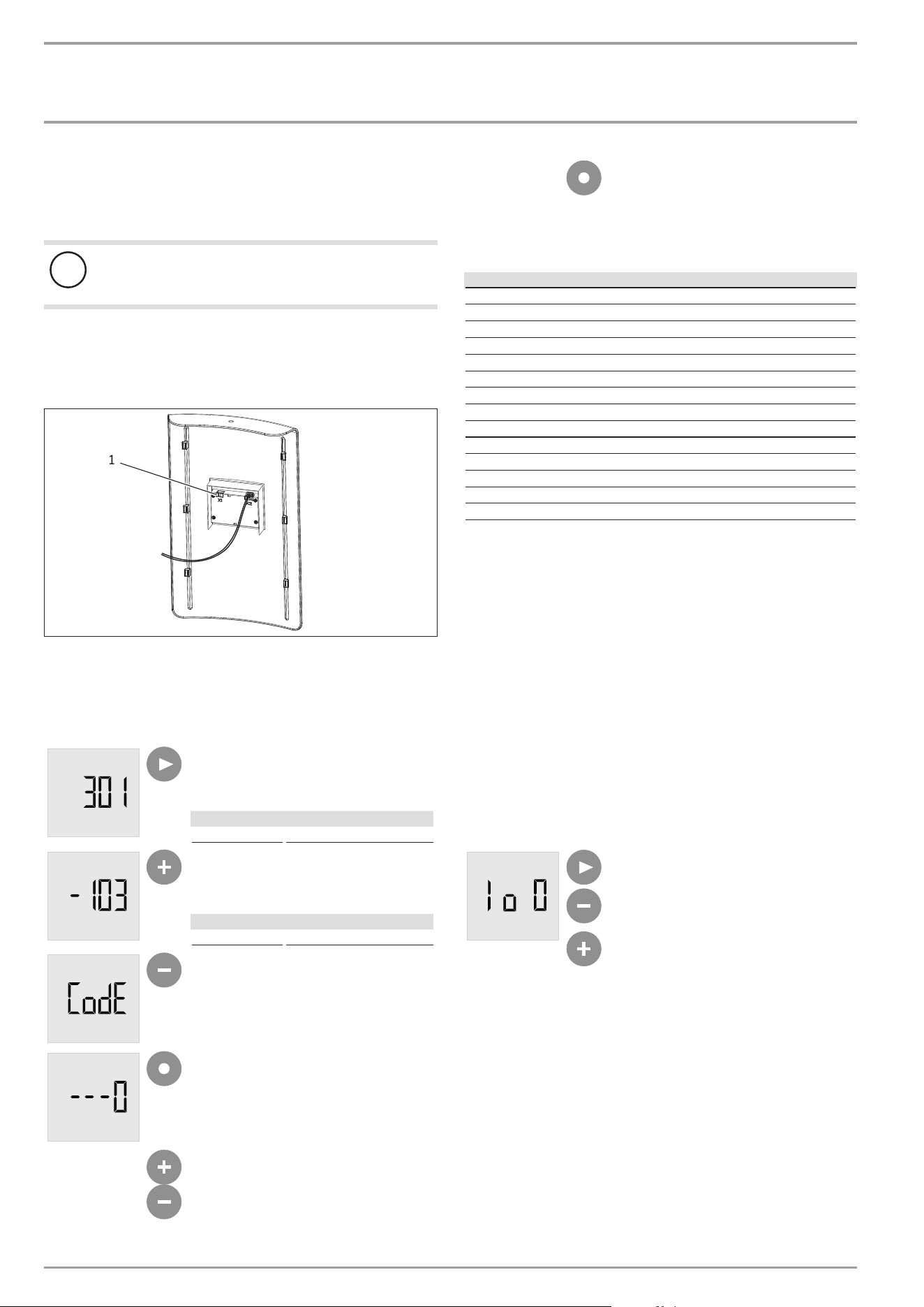
INSTALLATION
Settings
26 | WWK222-302 H www.stiebel-eltron.com
12. Settings
Service menu
!
Material losses
Service menu settings shall only be accessed with prior
approval from Stiebel Eltron.
To unlock the service menu, you need to connect a service plug
or enter a code.
Accessing the service menu with a service plug
D0000060217
1
1 Slot X1
f Plug the service plug into slot X1 on the back of the program-
ming unit.
Accessing the service menu by entering a code
Press the "Menu" button for longer than
3s. The software version number of the
controller PCB appears.
Display Version number
301 3.1.00
To display the software version number
of the programming unit PCB, press the
"Plus" button.
Display Version number
-103 1.3.00
To go to code entry, press the "Minus"
button.
To go from the software version num-
ber of the controller PCB directly to code
entry, press the "Minus" button.
To go to the code digit check, press the
"Rapid heat-up" button. The currently
active digit flashes.
Set the first digit using the "Plus" and
"Minus" buttons.
To set the next digit, press the "Rapid
heat-up" button.
To confirm the code after entering all
digits, press the "Rapid heat-up" but-
ton.
Service menu
Integral sensor offset
Set the cylinder volume
Compressor lockout due to evaporator fault
Clear high pressure lockout
Clear low pressure lockout
Temperature of evaporator fins
Number of times hot gas temperature sensor was triggered
Number of defrost faults
Number of low pressure triggers
Number of high pressure triggers
Hot gas temperature switching value
Fan lead time
Integral sensor replacement
Set value limit
The parameters in this menu are reserved for qualified contrac-
tors.
Integral sensor offset
You can manually calibrate the integral sensor with the value set.
This should only be done after the DHW cylinder has been fully
heated up, without any DHW being drawn-off.
Example: The configured, active set temperature is 55°C. The
integral sensor of the appliance checks when the set temperature
is reached. If the compressor switches off after heat-up, check the
actual temperature (detected by the cylinder top sensor) using the
programming unit. If the actual temperature is 60°C, for example,
set the integral sensor offset to 5K.
Cylinder top sensor temperature = integral sensor temperature
+ offset
Press the "Menu" button until "lo" ap-
pears on the display.
You can change the value using the "Plus"
and "Minus" buttons. Setting range: -5 - 5
Set the cylinder volume
The cylinder size is required for accurate calculation of the mixed
water volume. You can switch the cylinder size between 200 and
300l using the "Plus" and "Minus" buttons.
If the PCB has been replaced, you will need to set the cylinder size.
If you see the value 9999 in the cylinder size parameter, you must
select a suitable cylinder size for the appliance.
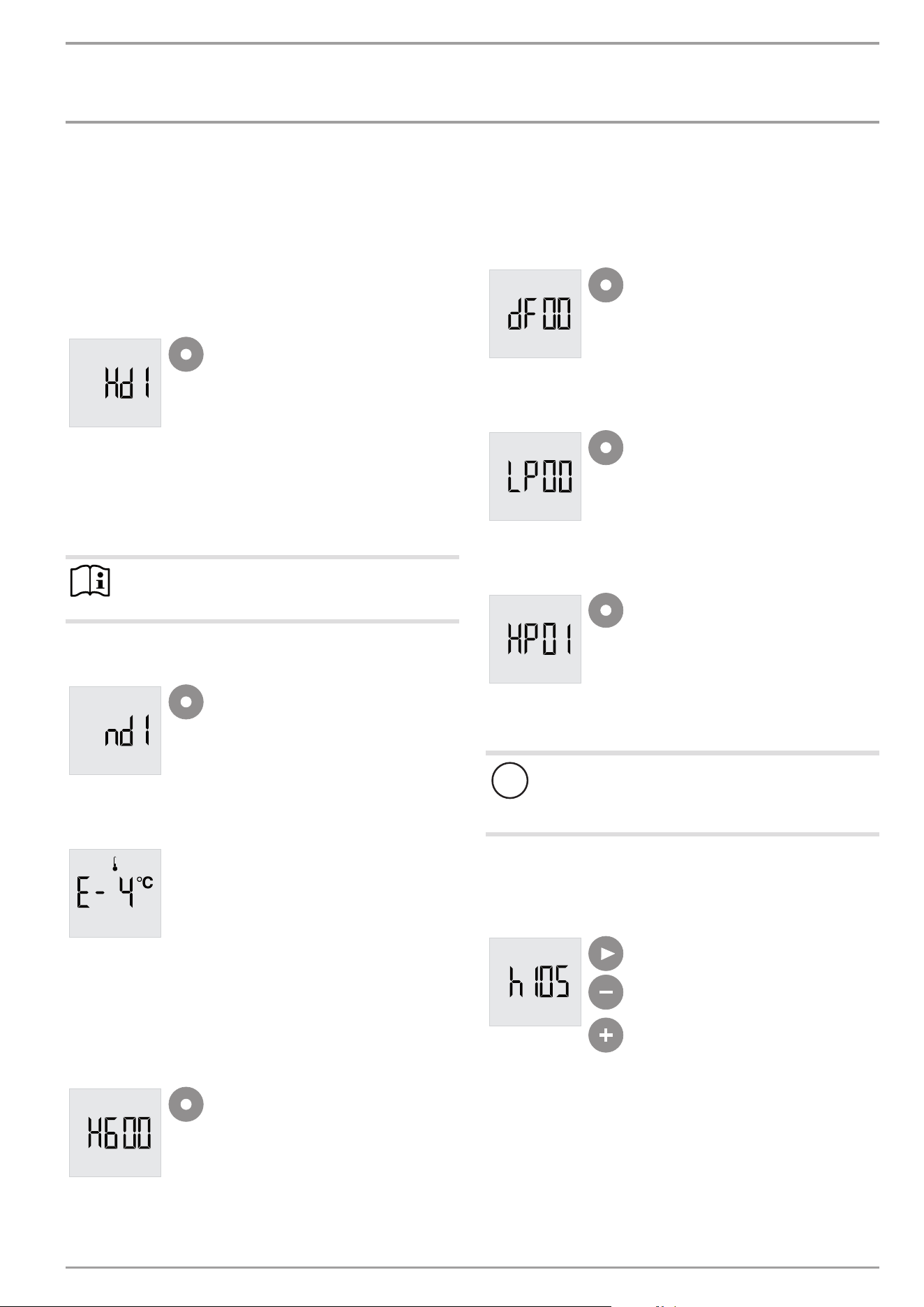
INSTALLATION
Settings
www.stiebel-eltron.com WWK222-302 H | 27
Compressor lockout due to evaporator fault
This menu item is only displayed if there is a compressor lockout
due to fault code E 64. You can clear the lockout by pressing the
"Rapid heat-up" button or performing a power ON reset.
Clear high pressure lockout
The appliance will be locked out if the high pressure sensor re-
sponds 5 times within 5 hours.
To clear the high pressure lockout, press
the "Rapid heat-up" button.
Clear low pressure lockout
The appliance will be locked out if the low pressure sensor re-
sponds 5 times within 5 hours. This menu item allows you to clear
the lockout.
Note
Currently appliances are built without low pressure sen-
sors.
f If this lockout arises, check the jumper on the PCB (X0/L –
X1/6 – A1/X2/ND).
To clear the low pressure lockout, press
the "Rapid heat-up" button.
Temperature of evaporator fins
The temperature measured by a sensor
on the evaporator fins is displayed here.
Number of times hot gas temperature sensor was
triggered
The counter indicates how often the hot gas temperature has ex-
ceeded the set hot gas temperature switching value during heat-
up.
To reset the counter to 0, press the "Rapid
heat-up" button.
Number of defrost faults
The number of defrost faults is displayed here. A defrost fault
occurs if the temperature for terminating defrosting, as measured
at the temperature sensor between the evaporator fins, has not
been reached within the specified time frame.
To reset the counter to 0, press the "Rapid
heat-up" button.
Number of low pressure triggers
To reset the counter to 0, press the "Rapid
heat-up" button.
Number of high pressure triggers
To reset the counter to 0, press the "Rapid
heat-up" button.
Hot gas temperature switching value
!
Material losses
Factory default setting: 105 °C
Only a service technician is permitted to change his pa-
rameter in line with factory instructions.
If the set hot gas temperature switching value is exceeded, the hot
gas temperature counter increments and the set temperature is
temporarily reduced to the temperature captured by the integral
sensor.
Press the "Menu" button until "h" appears
on the display.
You can change this value using the "Plus"
and "Minus" buttons. Setting range: 100
- 120 °C
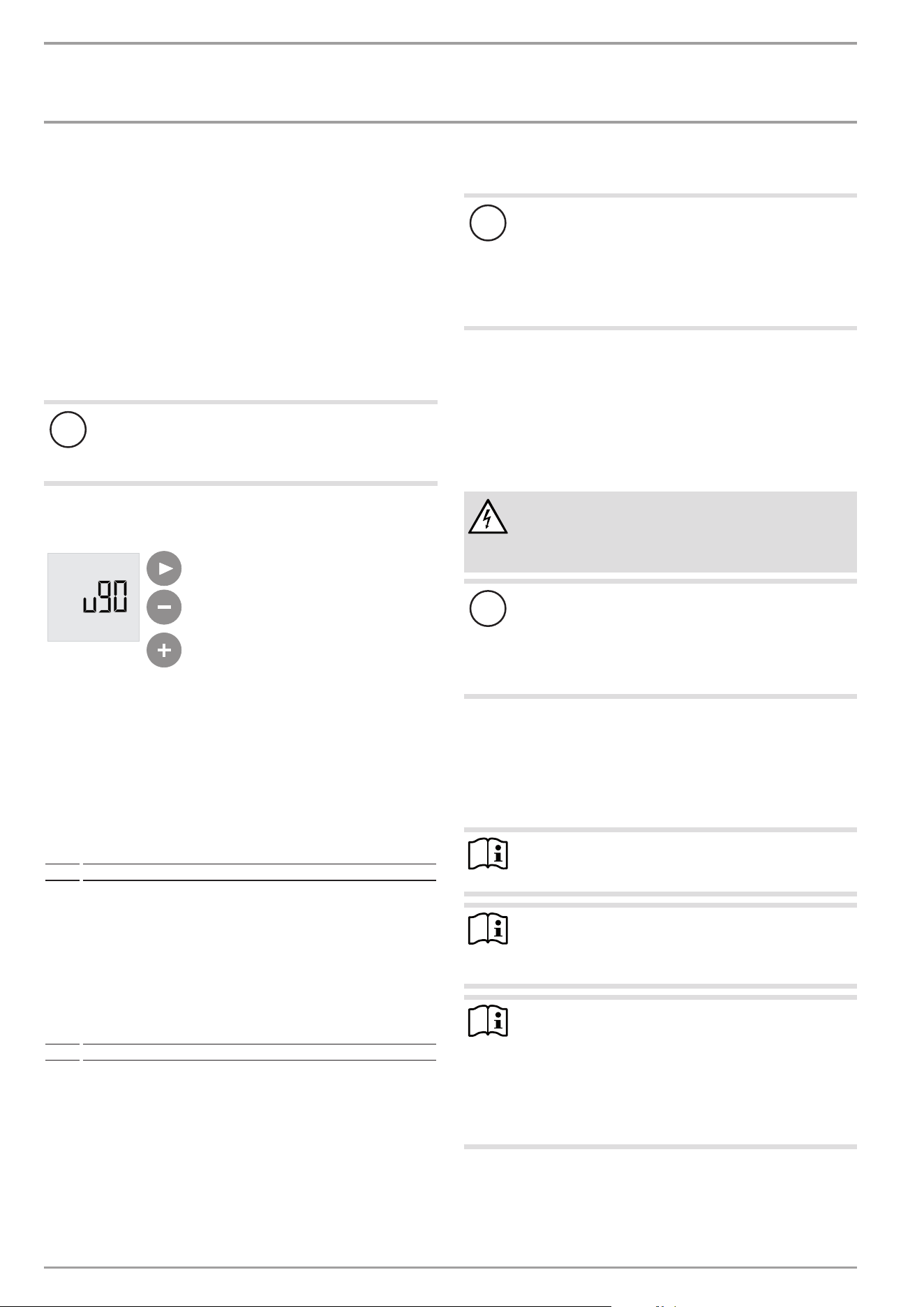
INSTALLATION
Appliance shutdown
28 | WWK222-302 H www.stiebel-eltron.com
Example: The set temperature is 65°C. At an actual temperature
of 61°C, for example due to a critical intake temperature, the
appliance detects an unacceptably high hot gas temperature. The
appliance temporarily reduces the set temperature to 61°C. The
appliance shuts down. Once the charge level has been under-
shot (this refers to the currently applicable set value, i.e. 61°C
and not 65°C), and when the hot gas temperature has dropped
again, the compressor restarts and operates with the original set
temperature (65°C). The set temperature is reduced again if the
appliance cannot reach this set temperature because the hot gas
temperature was previously too high.
Fan lead time
!
Material losses
Factory default setting: 30s
Only a service technician is permitted to change his pa-
rameter in line with factory instructions.
The set value specifies the number of seconds the fan runs before
the compressor is enabled.
Press the "Menu" button until "u" appears
on the display.
You can change this value using the
"Plus" and "Minus" buttons.
Replacement sensor
If the integral sensor is faulty, switch this parameter to replace-
ment sensor operation using the "Plus" button.
When replacement sensor operation is active, fault 4 is perma-
nently hidden. The default display shows the cylinder top temper-
ature instead of the mixed water volume.
IE0 Standard mode
IE1 Replacement sensor active
Set value limit
If set value limiting is active, the lower end of the setting range
for the set value is limited to 61°C. If set value limiting is inactive,
the set value can be adjusted to any value within the applicable
range (see Set value1/Set value2).
Lt 0 Standard mode
Lt1 Set value limiting active
13. Appliance shutdown
!
Material losses
If you disconnect the appliance from the power supply, it
is no longer protected against frost or corrosion.
f Only disconnect the appliance from the power sup-
ply for longer periods if you are also draining the
DHW cylinder. See chapter "Maintenance/ Draining
the appliance".
The appliance can only be switched off by interrupting the power
supply.
f Disconnect the appliance from the power supply at the fuse
in the distribution board or by unplugging the power plug if
the appliance is connected to a socket.
14. Troubleshooting
WARNING Electrocution
Troubleshooting must only be carried out by a qualified
contractor. Prior to all work on the appliance, isolate it
from the power supply.
!
Material losses
If you disconnect the appliance from the power supply, it
is no longer protected against frost or corrosion.
f Only disconnect the appliance from the power sup-
ply for longer periods if you are also draining the
DHW cylinder.
f For work inside the appliance, remove the appliance cover
(see chapter "Cleaning and maintenance/ Removing the ap-
pliance cover").
f If necessary, remove the upper section of the casing jacket
(see chapter "Maintenance and cleaning/ Removing the cas-
ing ring").
Note
Refit the casing ring after completing the work. See chap-
ter "Maintenance and cleaning/ Fitting the casing ring").
Note
Refit the appliance cover after completing your work. See
chapter "Maintenance and cleaning/ Fitting the appliance
cover").
Note
Following an interruption to the power supply, compres-
sor operation remains blocked for at least one minute
while the appliance initialises.
If the compressor subsequently fails to start, it may be
blocked by additional safety devices (motor overload
relay, high pressure switch). This lockout can last be-
tween 1 and 10minutes.
INSTALLATION
Troubleshooting
www.stiebel-eltron.com WWK222-302 H | 29
Fault Cause
f Remedy
No hot water is
available.
The impressed current
anode is faulty.
Replace the impressed current
anode.
The compressor
is switched off
unexpectedly.
The application limits
have been exceeded or
undershot.
No action required.
Excessive pressure in the
refrigerant circuit. The
safety pressure limiter
has responded 5times in
5hours. The compressor
has been switched off.
Eliminate the cause of the
increased pressure in the
refrigerant circuit. Wait ap-
prox.5-15minutes for the appli-
ance to equalise the pressure.
The appliance lockout can only be
cleared using a service program-
ming unit.
The heating
output of the
appliance has
reduced.
An inadequate air flow
across the evaporator is a
possible cause.
Check whether the fan is dirty.
Check whether the evaporator is
dirty. Ensure that the supply and
extract air flow are unimpeded.
14.1 Fault codes
Fault description Remedy
2
Contin-
uously
on
The cylinder top sensor is
faulty. The actual tempera-
ture display switches from
the cylinder top sensor to the
integral sensor. The appliance
continues to heat without any
loss of comfort. The mixed
water volume cannot be
calculated and is displayed
as "- -".
Check that the plug is seated
correctly.
Measure the resistance of the
sensor and compare it with the
resistance table.
Install the replacement sensor.
4
Contin-
uously
on
The integral sensor is faulty.
In the event of a faulty inte-
gral sensor, the integral sen-
sor is set to the value of the
cylinder top sensor, and the
mixed water volume is calcu-
lated using this value. The ap-
pliance continues to heat with
a reduced start hysteresis.
A mixed water volume is
still calculated, based on the
assumption that the cylinder
top temperature is reached
throughout the DHW cylinder.
Check that the plug is seated
correctly.
Measure the resistance of the
sensor and compare it with the
resistance table.
Install the replacement sensor. In
the service menu, use parameter
"IE" to switch to standby mode.
6
Flash-
ing
The cylinder top sensor and
the integral sensor are faulty.
The appliance no longer de-
livers heat.
Check that the plug is seated
correctly.
Measure the resistances of the
sensor and compare them with
the resistance table.
Install the replacement sensor. In
the service menu, use parameter
"IE" to switch to standby mode.
Fault description Remedy
8
Flash-
ing
The appliance has ascertained
that the DHW cylinder has not
been heated within the max-
imum temperature increase
time, despite there being a
demand.
Check if a DHW circulation line
is installed and whether it is in-
sulated. The total output loss is
greater than the heating output of
the appliance.
Check if a DHW circulation pump
is installed and whether it is con-
trolled according to temperature
or time. If necessary, install a
corresponding control unit.
Check the refrigerant circuit for
leaks.
16
Contin-
uously
on
A short circuit of the im-
pressed current anode has
occurred or the protective
anode is faulty.
Check the cables and relevant
plug-in connections of the im-
pressed current anode according
to the connection diagram and
replace faulty cables.
Check the impressed current
anode in the heating element/
anode assembly and replace if
necessary.
32
Flash-
ing
The appliance is not being
operated with a completely
filled DHW cylinder. The ap-
pliance is not heating.
Fill the DHW cylinder of the appli-
ance. The fault code disappears
and the appliance starts.
The anode current is inter-
rupted. The appliance is not
heating.
Check the contacts of the im-
pressed current anode.
64
Contin-
uously
on
The defrost temperature has
not yet been reached after the
maximum defrost time has
elapsed. The compressor is
not working.
Check the position of the evapora-
tor sensor in the evaporator.
The temperature of the intake
air is below the lower appli-
cation limit.
Wait for higher ambient tempera-
tures. Ensure that the application
limit is not undershot.
128
Contin-
uously
on
There is no communication
between the controller and
the programming unit. The
most recently selected set val-
ues are active. The appliance
continues to heat.
Check that the plug is seated cor-
rectly and replace the connecting
cable if necessary.
Replace the programming unit
PCB.
256
Flash-
ing
Manually activated emergen-
cy mode (only electric emer-
gency/booster heater active)
See chapter “Appliance descrip-
tion/ Emergency mode”.
E 1 Flash-
ing
The temperature sensor on
the air inlet is faulty.
Check that the plug is seated
correctly.
Measure the resistance of the
sensor and compare it with the
resistance table.
Replace the sensor.
E 2 Flash-
ing
The temperature sensor on
the evaporator is faulty.
Check that the plug is seated
correctly.
Measure the resistance of the
sensor and compare it with the
resistance table.
Replace the sensor.
E 4
Contin-
uously
on
The hot gas temperature
sensor is faulty. The appliance
continues to heat. To protect
the appliance, the (possibly
higher) set temperature is
reduced to the set value for
setback.
Check that the plug is seated
correctly.
Measure the resistance of the
sensor and compare it with the
resistance table.
Replace the sensor.
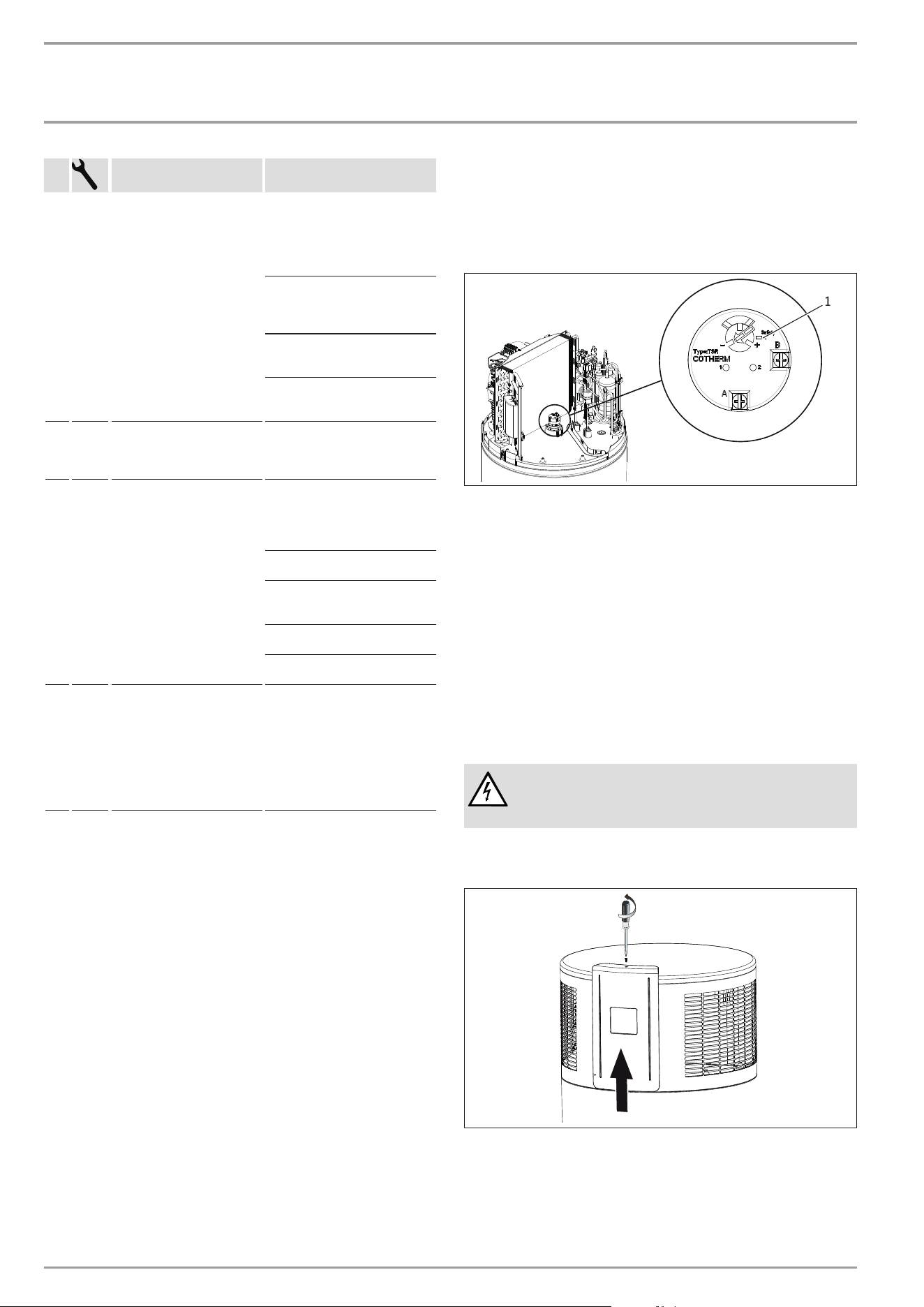
INSTALLATION
Maintenance
30 | WWK222-302 H www.stiebel-eltron.com
Fault description Remedy
E 16
Contin-
uously
on
The high pressure switch
has responded. Compressor
heating mode is temporarily
blocked. Compressor heating
mode will continue as soon as
the pressure has normalised.
No action required.
After consultation with the cus-
tomer, reduce the set temperature
if required. Increase the charge
level with the programming unit.
Check the offset of the integral
sensor to the cylinder top sensor
and adjust if necessary.
Check the high pressure switching
point and replace the high pres-
sure switch if necessary.
E 32
Contin-
uously
on
An electrical fault has oc-
curred.
A1/X2 : Check whether the power
supply has been interrupted. Then
reset the fault with the corre-
sponding menu option.
E 64
Flash-
ing
Evaporator temperature <
Minimum evaporator tem-
perature
Check whether the evaporator is
clogged with deposits. If required,
clean the evaporator with clear
water without cleaning agents or
other additives.
Check whether air can flow freely
through the appliance.
Check whether the fan is blocked
or faulty. Replace the fan if nec-
essary.
Check the function and setting of
the expansion valve.
Check whether the appliance has
defrosted.
E
128
Flash-
ing
A permanent pressure switch
fault has occurred. A pressure
fault occurred multiple times
within a defined pressure
fault evaluation time.
Check the relevant fault counter
and look up the corresponding
fault code remedy: E16 (high
pressure), E32 (electrical wiring
fault). Once the cause of the fault
has been eliminated, clear the
fault code in menu item "Hd 1"
by pressing the "Rapid heat-up"
button.
14.2 Resetting the safety pressure limiter
The safety pressure limiter responds in the event of unacceptably
high pressure in the refrigerant circuit. If the safety pressure lim-
iter responds 5 times in 5 hours, compressor operation is blocked.
f Eliminate the cause of the increased pressure in the refriger-
ant circuit.
f Wait approx.5-15minutes for the appliance to equalise the
pressure.
The appliance lockout can only be cleared using a service pro-
gramming unit.
14.3 WWK222H/ WWK 302H : Resetting the high
limit safety cut-out
If the DHW cylinder is overheated, the high limit safety cut-out
switches off the electric emergency/booster heater to protect the
appliance.
D0000039352
1
1 Reset button for high limit safety cut-out
f Once the cause of the fault has been removed, press the reset
button of the high limit safety cut-out on the rod thermostat.
To do so, remove the appliance cover.
14.4 Motor overload relay
The motor overload relay will shut down the compressor if it is
overloaded because of excessive thermal load.
f Remove the cause.
After a short cooling period, the motor overload relay will restart
the compressor automatically.
15. Maintenance
WARNING Electrocution
Prior to all work on the appliance, isolate it from the
power supply.
15.1 Removing the appliance cover
D0000040621
f Undo the screw (Torx) that secures the programming/control
cover to the appliance.
f Push the programming/control cover upwards.
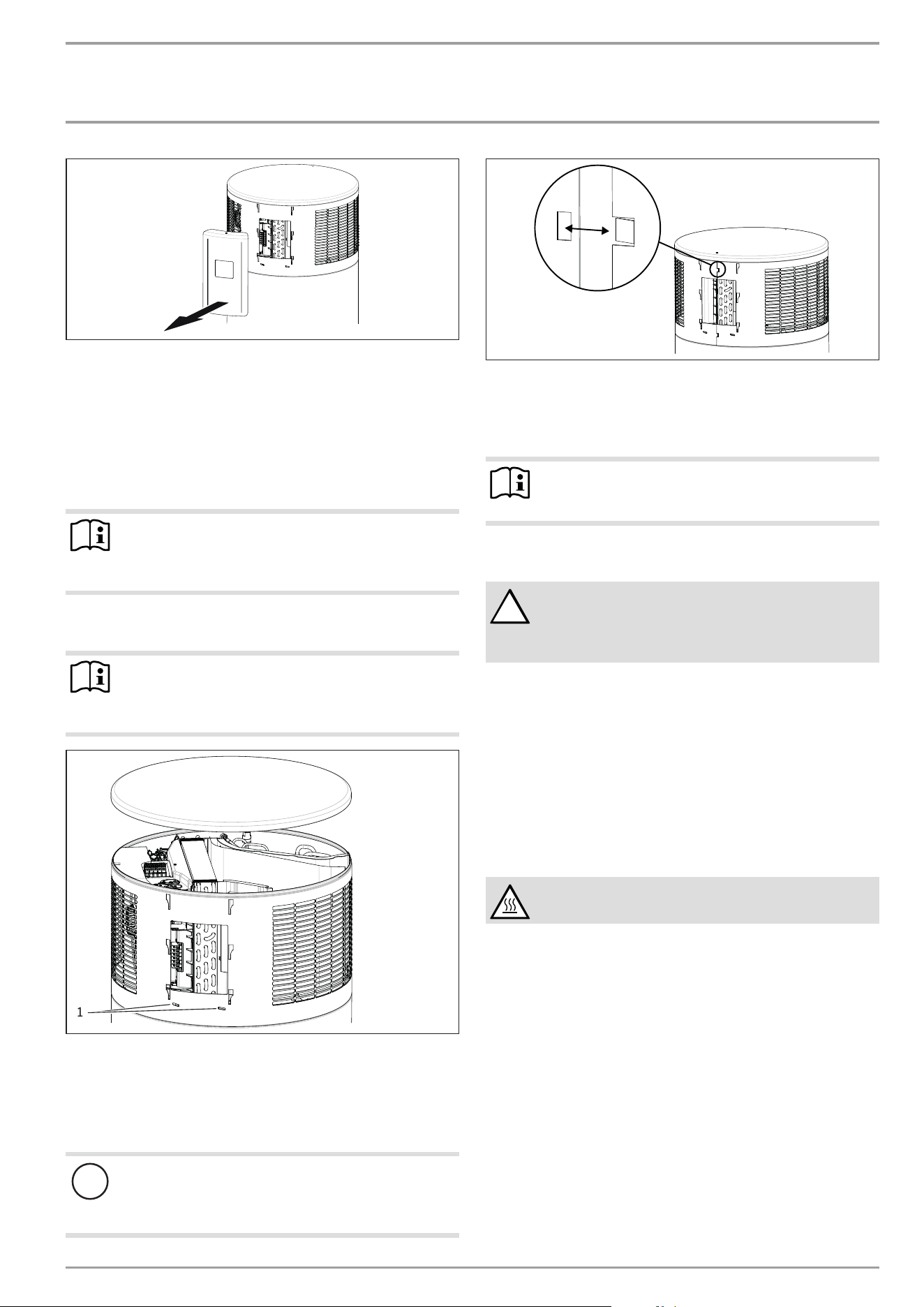
INSTALLATION
Maintenance
www.stiebel-eltron.com WWK222-302 H | 31
D0000040622
f Carefully remove the cover.
f A cable connects the operating controls to the appliance PCB.
If necessary, disconnect the plug at the back of the program-
ming/control cover to fully remove it.
f Undo the plug-in connection in the cable that runs to the
battery pack at the back of the cover.
f Carefully lift away the appliance cover and release the earth
cable that runs from the appliance control panel to the cover.
Note
Refit the appliance cover after completing your work. See
chapter "Maintenance and cleaning/ Fitting the appliance
cover").
15.2 Removing the casing ring
Note
If you require more space to work inside the appliance,
you can remove the casing ring on the upper section of
the appliance.
D0000034803
1
1 Fixing screws on casing ring
The casing ring is fastened with screws.
f Undo the fixing screws on the casing ring.
f Remove the condensate drain bend and pipe collar of the
drain. Turn anti-clockwise to release.
!
Material losses
Inside the appliance, an earth cable is connected to the
casing ring. Release the earth cable in order to be able
to remove the casing ring.
D0000034814
The casing ring overlaps along the joint. A tab on one end clips
into the recess at the other end of the casing ring.
f Ease the casing ring apart, until it can be removed or slid
downwards.
Note
Refit the casing ring after completing the work. See chap-
ter "Maintenance and cleaning/ Fitting the casing ring").
15.3 Cleaning the evaporator
!
WARNING Injury
The evaporator consists of numerous sharp-edged fins.
f Be careful when cleaning the evaporator and wear
protective clothing, especially safety gloves.
To keep the appliance performance levels as high as possible,
check and clean the appliance evaporator as often as necessary.
f Undo the screw that fastens the appliance cover to the top of
the programming/control cover.
f Remove the programming/control cover and the appliance
cover.
f Carefully clean the evaporator fins. Only use water and a soft
brush for this. Never use acidic or alkaline cleaning agents.
15.4 Draining the cylinder
WARNING Burns
Hot water may escape when draining the DHW cylinder.
To drain the DHW cylinder, e.g. when shutting the appliance down,
proceed as follows.
f Isolate the appliance from the power supply.
f Close the shut-off valve in the cold water supply line.
The DHW cylinder is drained via the cold water supply line.
f Open the drain valve installed in the cold water supply line
(see chapter "Water connection"). If no drain valve has been
installed, undo the cold water supply line at the "Cold water
inlet" connection.
f To vent the system, undo the DHW line connected to the
"DHW outlet" connection.
Some residual water will remain in the bottom of the DHW cyl-
inder.
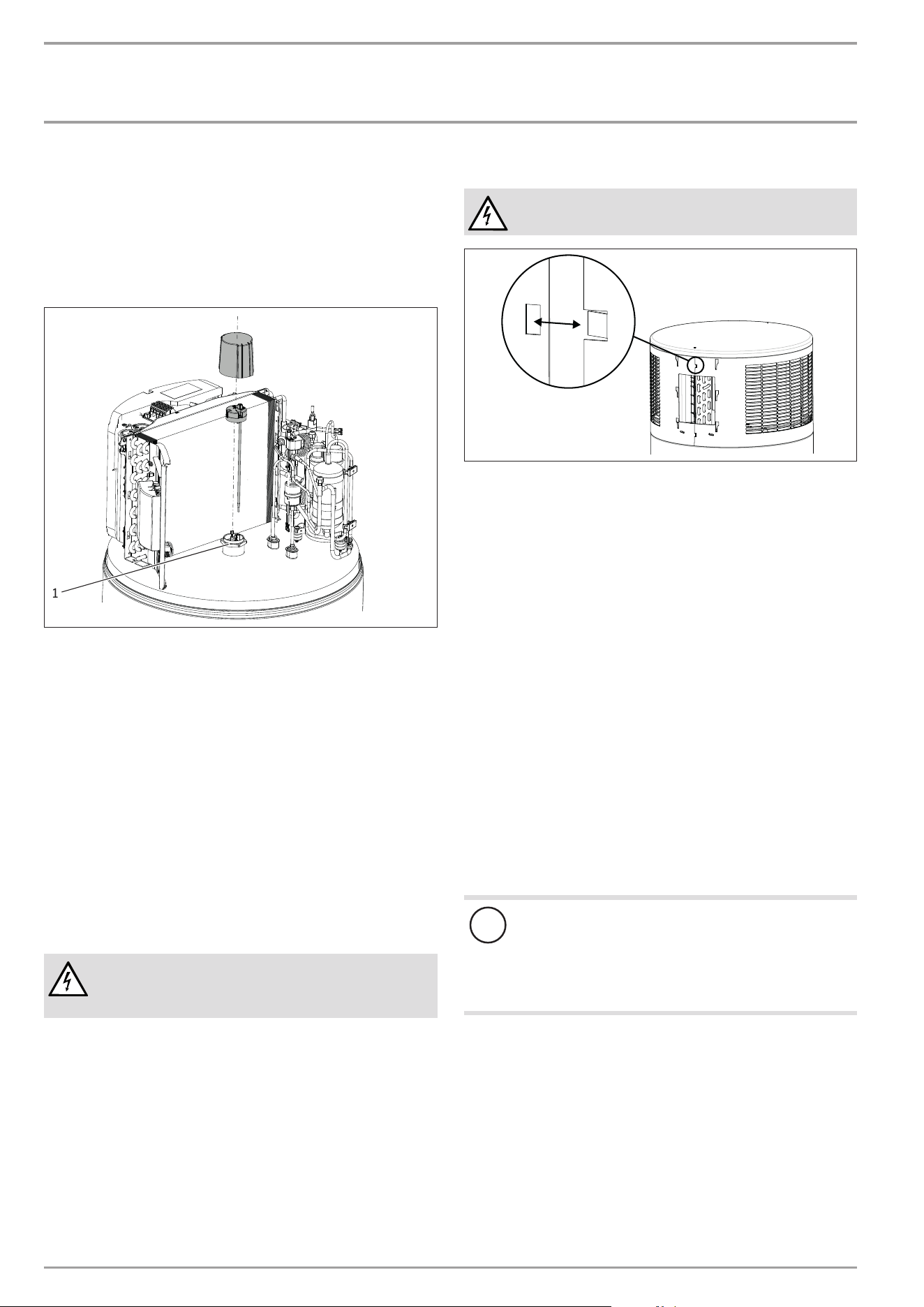
INSTALLATION
Maintenance
32 | WWK222-302 H www.stiebel-eltron.com
15.5 Descaling the electric emergency/booster
heater
Only descale the flange of the emergency/booster heater after
disassembly. Never treat the inside of the DHW cylinder or the
impressed current anode with descaling agents. The electric
emergency/booster heater is screwed into the DHW cylinder of
the appliance at a central point at the top.
D0000039351
1
1 Electric emergency/booster heater with protective anode
15.6 Valves
Regularly check the valves in the system (safety valve, pressure
reducing valve, drain valve) to ensure the operational reliability
of the appliance. The amount of limescale deposits depends on
the local water quality.
f Check all valves in the system and remove limescale deposits.
f Replace the valves if necessary.
f Check the function of the valves.
15.7 Condensate drain
f Check whether the condensate drain is clear of obstructions.
Remove any dirt.
15.8 Replacing the power cable
WARNING Electrocution
The power cable must only be replaced (for example if
damaged) by a qualified contractor.
15.9 Fitting the casing ring
WARNING Electrocution
f Reconnect the earth cable to the casing ring.
D0000034814
f Fit the upper casing ring. The casing ring overlaps along the
joint. A tab on one end clips into the recess at the other end
of the casing ring.
f Secure the casing ring with screws.
f Fit the pipe collar of the condensate drain and the conden-
sate drain bend.
15.10 Protective anode and battery change
The appliance is equipped with a maintenance-free impressed
current anode that protects the cylinder from corrosion when it
is connected to the power supply. At the factory, the appliance is
fitted with rechargeable batteries that ensure the power supply
to the impressed current anode in the case of a power failure.
The appliance power supply must not be interrupted for more
than 16hours.
If the power supply is regularly interrupted by a switching con-
tact or the security of supply is inadequate, the batteries of the
impressed current anode must be replaced every three years.
Failure to comply may result in damage to the appliance. If regular
interruptions to the power supply are not anticipated and there
is security of supply, no maintenance of the batteries is required
and the appliance is maintenance-free in this regard.
!
Material losses
Never use batteries that cannot be charged. Only re-
chargeable NiMH batteries are permissible.
Batteries may be damaged in the appliance. Without a
power supply, the impressed current anode and the cyl-
inder would not be protected against corrosion.
The batteries are secured at the back of the programming/control
cover.
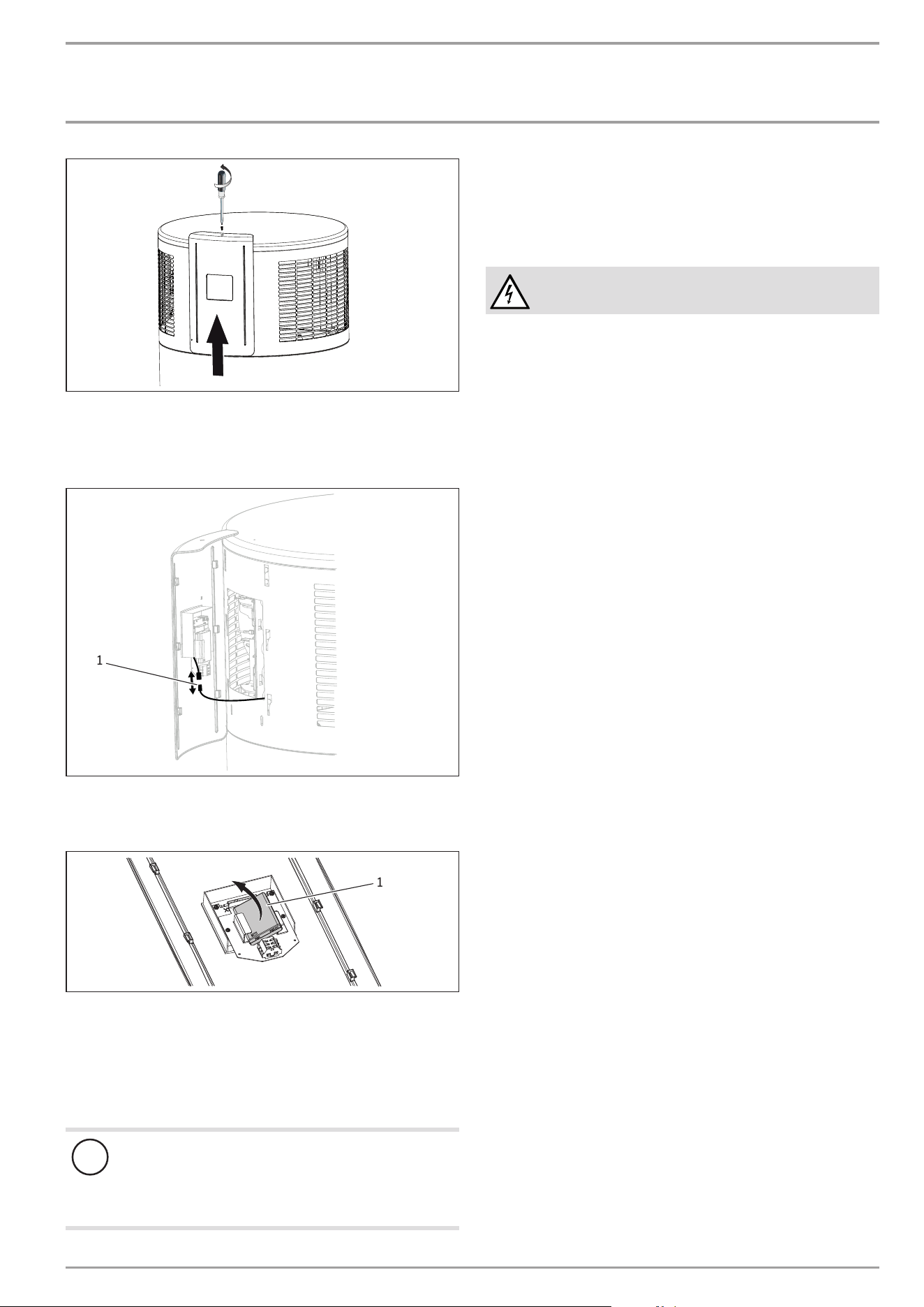
INSTALLATION
Maintenance
www.stiebel-eltron.com WWK222-302 H | 33
D0000040621
f Undo the screw securing the cover.
f Carefully remove the cover so that the cables running from
the batteries to the impressed current anode in the appliance
are not pulled out.
D0000051618
1
1 Plug-in connection
f Undo the plug-in connection by pressing the catches on both
sides.
D0000075888
1
1 Battery compartment
f Carefully pull the battery compartment on the right-hand
side forward.
f Remove the battery compartment from the retainer.
f Open the battery compartment using a screwdriver.
f Replace the batteries (NiMH, type AAA ≥800mAh).
!
Material losses
Make sure that the batteries are inserted properly and
the right way round, because otherwise there will be no
corrosion protection in the event of interruptions to the
power supply.
f Close the battery compartment using a screwdriver.
f Push the battery compartment into the retainer.
f Reconnect it to the appliance with the plug-in connection.
15.11 Fitting the appliance cover
WARNING Electrocution
f Reconnect the earth cable to the appliance cover.
f Place the cover back on the appliance.
f Press the cover into the bead around the casing ring.
f Connect the cable linking the batteries with the internal con-
trol unit at the back of the programming/control cover.
f Connect the cable linking the programming unit to the PCB
inside the appliance at the back of the programming/control
cover.
f Insert the programming/control cover.
f Use the screw to secure the programming/control cover at
the top of the appliance.
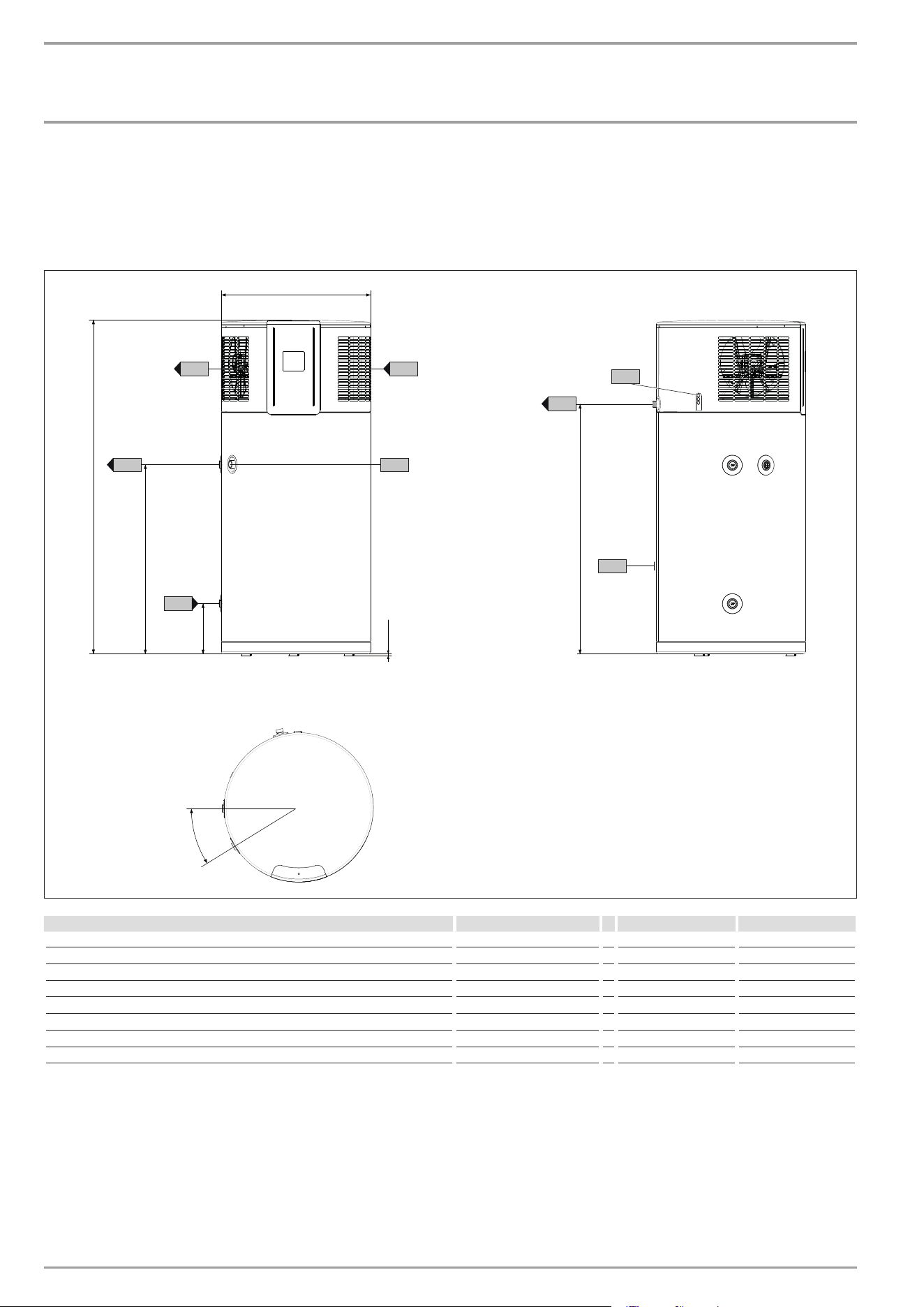
INSTALLATION
Specication
34 | WWK222-302 H www.stiebel-eltron.com
16. Specification
16.1 Dimensions and connections
16.1.1 WWK222 / WWK222H
1501
690
b01
1116
d45
g01g02
i43
30°
8-24
215
935
c01
c06 c13
D0000074176
WWK 222 WWK 222 H
b01 Entry electrical cables
c01 Cold water inlet Male thread G 1 G 1
c06 DHW outlet Male thread G 1 G 1
c13 T&P valve Female thread Rp 3/4 Rp 3/4
d45 Condensate drain Male thread G 3/4 G 3/4
g01 Air intake
g02 Air discharge
i43 Cover for manufacturing aperture
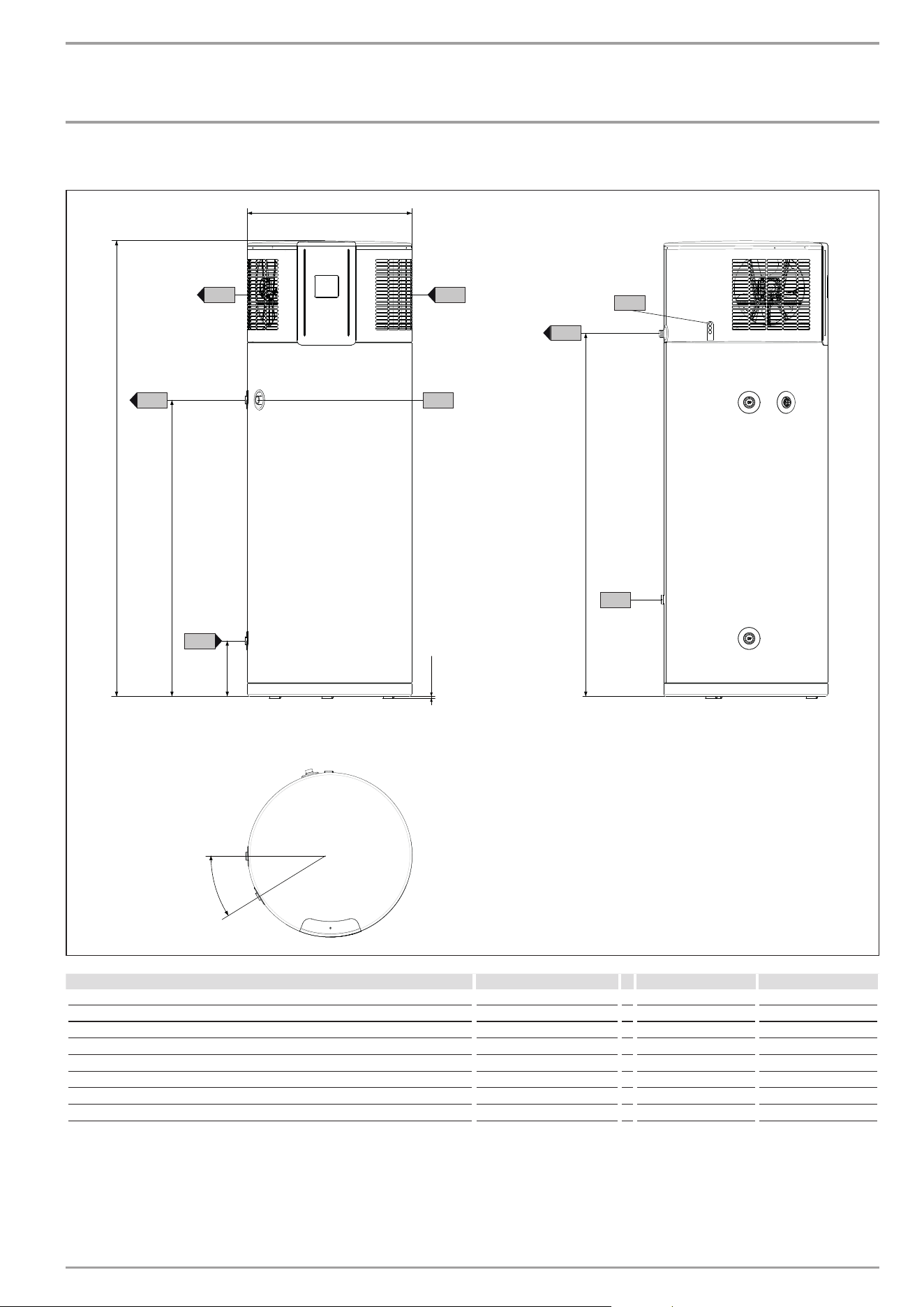
INSTALLATION
Specication
www.stiebel-eltron.com WWK222-302 H | 35
16.1.2 WWK302 / WWK302H
1502
1905
690
b01
d45
AAA A AA
30°
8-24
g01g02
i43
215
1290
c01
c06 c13
D0000074178
WWK 302 WWK 302 H
b01 Entry electrical cables
c01 Cold water inlet Male thread G 1 G 1
c06 DHW outlet Male thread G 1 G 1
c13 T&P valve Female thread Rp 3/4 Rp 3/4
d45 Condensate drain Male thread G 3/4 G 3/4
g01 Air intake
g02 Air discharge
i43 Cover for manufacturing aperture
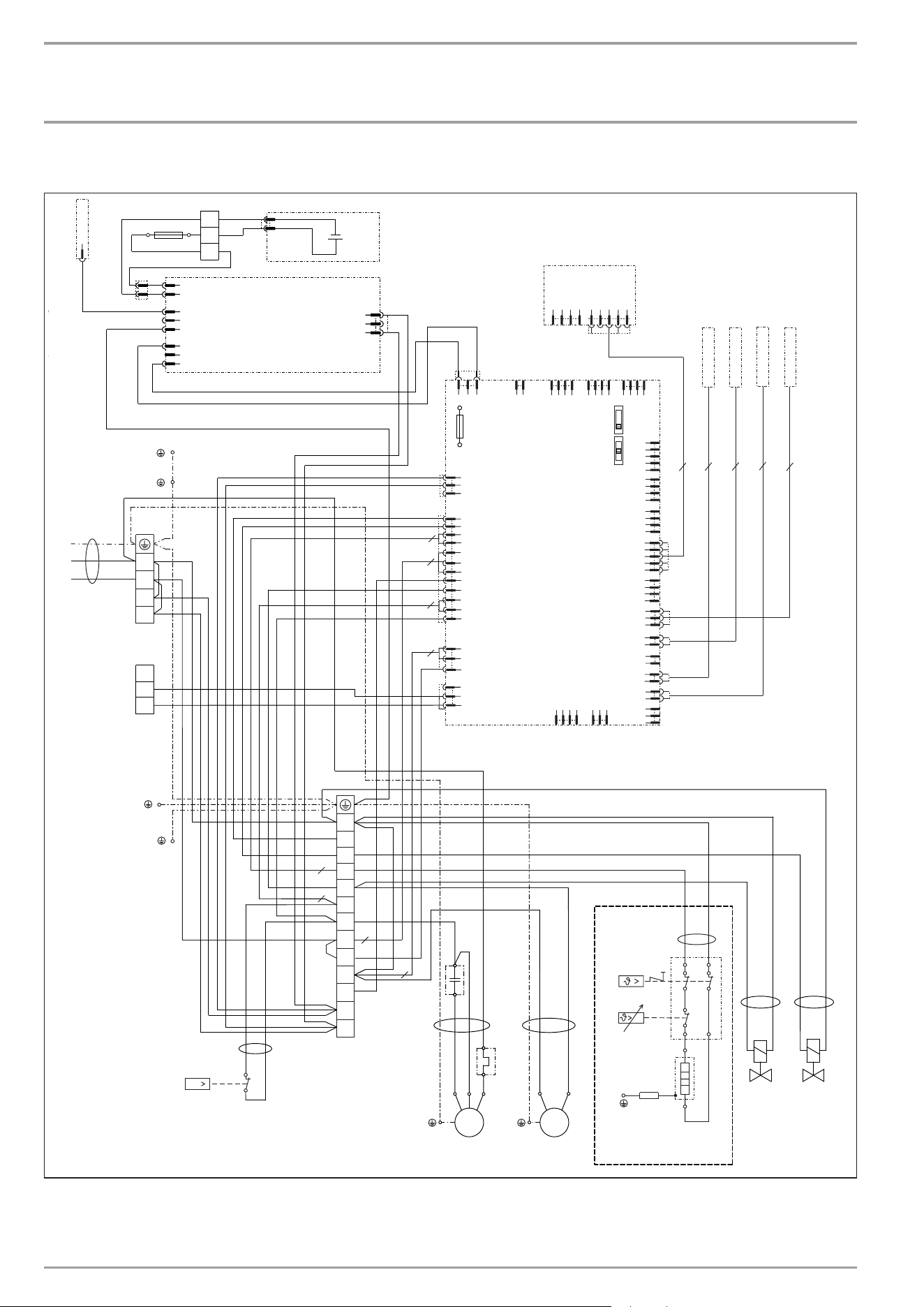
INSTALLATION
Specication
36 | WWK222-302 H www.stiebel-eltron.com
16.2 Wiring diagram
WWK 222/302 (H)
aktive Abtauung / aktive Anode
active defrost / active anode
dégivrage active / anode active
X13
L
N
M1
M
1~
C
RS
C1
M2
M
1~
X0
A1
T1
F2
1
3
BNBK BU
BNBU
L
N
PE
X1
10
9
7
6
8
BN
BU
GNYE
X1
X0
X14
V2
V1
11
LL1
N
12
13
X19
X15
X18
T2
T3
T4
X3
X2
N1
L´
N´
L
L2
L
L1
V2
L
N
V1
HD
ND
N1
X4 X11 X12 X10
X16
X9
X6
X5
X23
X20
X22
X21X17
coat
cap
storage tank
BN BU
1 2
A B
N1
F1
R1
E1
G1
5
3
2
2
2
2
1
2
2
2
4
3
2
1
5
3
L1
L1
L1
L
HZ
L
HZ
L
M1
L
M1
L
L1
2
3
2
p
F3
F4
storage tank
S1
S2
X3
X2
X4
A3
X1
C2
4,8 V
-
+
F5
X3
nur/only/seulement:
WWK 222/302 H
2
1
2
3
X4
1
2
3
F 100 mA / 250 V
housing A3
X2
A2
X1
D0000040539
INSTALLATION
Specication
www.stiebel-eltron.com WWK222-302 H | 37
A1 Electronic assembly (control unit)
A2 Electronic assembly (programming unit)
A3 Electronic assembly (electrical corrosion protection)
C1 Capacitor
C2 Battery pack
E1 Heating element
F1 High limit safety cut-out TSR
F2 Motor overload relay M1
F3 High pressure switch
F4 Fuse
F5 Fuse
G1 Impressed current anode
M1 Compressor
M2 Fan
N1 Thermostat TSR
R1 Resistor
S1 DIP switch (operating mode)
S2 DIP switch
T1 Temperature sensor cylinder top/int.
T2 Temperature sensor, hot gas
T3 Temperature sensor, air intake
T4 Temperature sensor, evaporator
V1 Solenoid valve (live in heating mode)
V2 Solenoid valve (live in defrost mode)
X0 Mains terminal
X1 Terminal
X3 Terminal
X4 Terminal, battery pack
16.3 Fault conditions
WARNING Burns
In the case of a fault, temperatures up to the high limit
safety cut-out limit can occur (see chapter "Specifica-
tion/ Data table").

INSTALLATION
Specication
38 | WWK222-302 H www.stiebel-eltron.com
16.4 Data table
WWK 222 WWK 222 H WWK 302 WWK 302 H
231209 233209 231211 232905
Hydraulic data
Nominal capacity l 220 220 302 302
Application limits
DHW temperature with heat pump °C 61 61 61 61
Max. DHW temperature with heat pump °C 65 65 65 65
Max. DHW temperature with emergency/booster heater °C 65 65 65 65
High limit safety cut-out °C 92 92 92 92
Min./max. application limits of heat source for heat pump operation °C -5/+42 -5/+42 -5/+42 -5/+42
Min./max. application limits for cylinder ambient temperature °C -5/+55 -5/+55 -5/+55 -5/+55
Min. installation room volume (recirculation air mode, general domestic
use)
m³ 13 13 13 13
Max. permissible operating pressure, cold water/DHW MPa 0.85 0.85 0.85 0.85
Min./max. conductivity, potable water μS/cm 100-1500 100-1500 100-1500 100-1500
Annual Average Coefficient of Performance (Australia)
ACOP (AS/NZS 4234 | climate zone 2 | medium load) 3.94 3.94 3.58 3.58
Values
Temperature setting range, DHW °C 61-65 61-65 61-65 61-65
Type of anode
Maintenance-free
impressed current
anode
Maintenance-free
impressed current
anode
Maintenance-free
impressed current
anode
Maintenance-free
impressed current
anode
Air flow rate m³/h 550 550 550 550
Recommended number of users ≤ 4 ≤ 4 ≤ 6 ≤ 6
Energy data
DHW heating energy efficiency class (load profile), indoor air A+ (L) A+ (L) A (XL) A (XL)
Output data to EN 16147
Nominal DHW temperature (EN 16147) °C 61 61 61 61
Nominal load profile (EN 16147) L L XL XL
Heating output
Average heating output (A15 / W10-55) kW 1.6 1.6 1.6 1.6
Power consumption
Average power consumption of heat pump (A15 / W10-55) kW 0.5 0.5 0.5 0.5
Max. heat pump power consumption (excl. start-up) kW 0.65 0.65 0.65 0.65
Power consumption, emergency/booster heater kW 1.5 1.5
Max. power consumption, heat pump + emergency/booster heater kW 2.2 2.2
Electrical data
Rated voltage V 230 230 230 230
Power supply 1/N/PE 220-240 V
50/60 Hz
1/N/PE 220-240 V
50/60 Hz
1/N/PE 220-240 V
50/60 Hz
1/N/PE 220-240 V
50/60 Hz
Permissible voltage range, external signal transmitter ~ 220-240 V 50/60
Hz
~ 220-240 V 50/60
Hz
~ 220-240 V 50/60
Hz
~ 220-240 V 50/60
Hz
Max. operating current A 3.18 9.7 3.18 9.7
Max. starting current A 15.4 23.44 15.4 23.44
Fuse protection A C10 C16 C10 C16
Sound emissions
Sound power level (EN 12102) dB(A) 60 60 60 60
Average sound pressure level at 1m distance, free field dB(A) 45 45 45 45
Versions
IP rating IP24 IP24 IP24 IP24
Refrigerant R134a R134a R134a R134a
Refrigerant charge kg 0.85 0.85 0.85 0.85
Global warming potential of the refrigerant (GWP100) 1430 1430 1430 1430
CO
2
equivalent (CO
2
e) t 1.216 1.216 1.216 1.216
Power cable length approx. mm 2000 2000 2000 2000
Dimensions
Height mm 1501 1501 1905 1905
Diameter mm 690 690 690 690
Height when tilted mm 1652 1652 2026 2026
Height when tilted incl. packaging mm 1895 1895 2230 2230
Packing unit dimensions height/width/depth mm 1740/740/740 1740/740/740 2100/740/740 2100/740/740
Weights
Weight, empty kg 120 120 135 135

INSTALLATION
Specication
www.stiebel-eltron.com WWK222-302 H | 39
WWK 222 WWK 222 H WWK 302 WWK 302 H
Connections
Condensate connection G 3/4 G 3/4 G 3/4 G 3/4
Safety valve connection Rp 3/4 Rp 3/4 Rp 3/4 Rp 3/4
Water connection G 1 (with adaptor
Rp 3/4 fem.)
G 1 (with adaptor
Rp 3/4 fem.)
G 1 (with adaptor
Rp 3/4 fem.)
G 1 (with adaptor
Rp 3/4 fem.)
The output data refers to new appliances with clean heat ex-
changers.
Nominal data to EN16147 – heat pump for recirculation air
16.5 Standardised output data
Information on determining and interpreting the specified stand-
ardised output data
Standard: EN 16147
The output data specifically mentioned in text, diagrams and
technical datasheets has been determined in line with the test
conditions described in the standard shown in the heading of
this chapter.
Generally, these standardised test conditions will not fully meet
the conditions found at the installation site of the system user.
Depending on the chosen test method and the extent to which
the selected method deviates from the conditions described in
the standard shown in the heading of this chapter, any deviations
can have a considerable impact. Additional factors that have an
influence on the test values are the measuring equipment, the
system configuration, the age of the system and the flow rates.
A confirmation of the specified output data can only be obtained
if the conditions applicable to the relevant test match those of the
standard shown in the heading of this chapter.

40 | WWK222-302 H www.stiebel-eltron.com
GUARANTEE | ENVIRONMENT AND RECYCLING
GUARANTEEGUARANTEE
ENVIRONMENT AND RECYCLINGENVIRONMENT AND RECYCLING
GUARANTEEGUARANTEE
ENVIRONmENT AND RECYCLINGENVIRONmENT AND RECYCLING
Guarantee
The guarantee conditions of our German companies do not
apply to appliances acquired outside of Germany. In countries
where our subsidiaries sell our products a guarantee can only
be issued by those subsidiaries. Such guarantee is only grant-
ed if the subsidiary has issued its own terms of guarantee. No
other guarantee will be granted.
We shall not provide any guarantee for appliances acquired in
countries where we have no subsidiary to sell our products.
This will not aect warranties issued by any importers.
Environment and recycling
We would ask you to help protect the environment. After use,
dispose of the various materials in accordance with national
regulations.
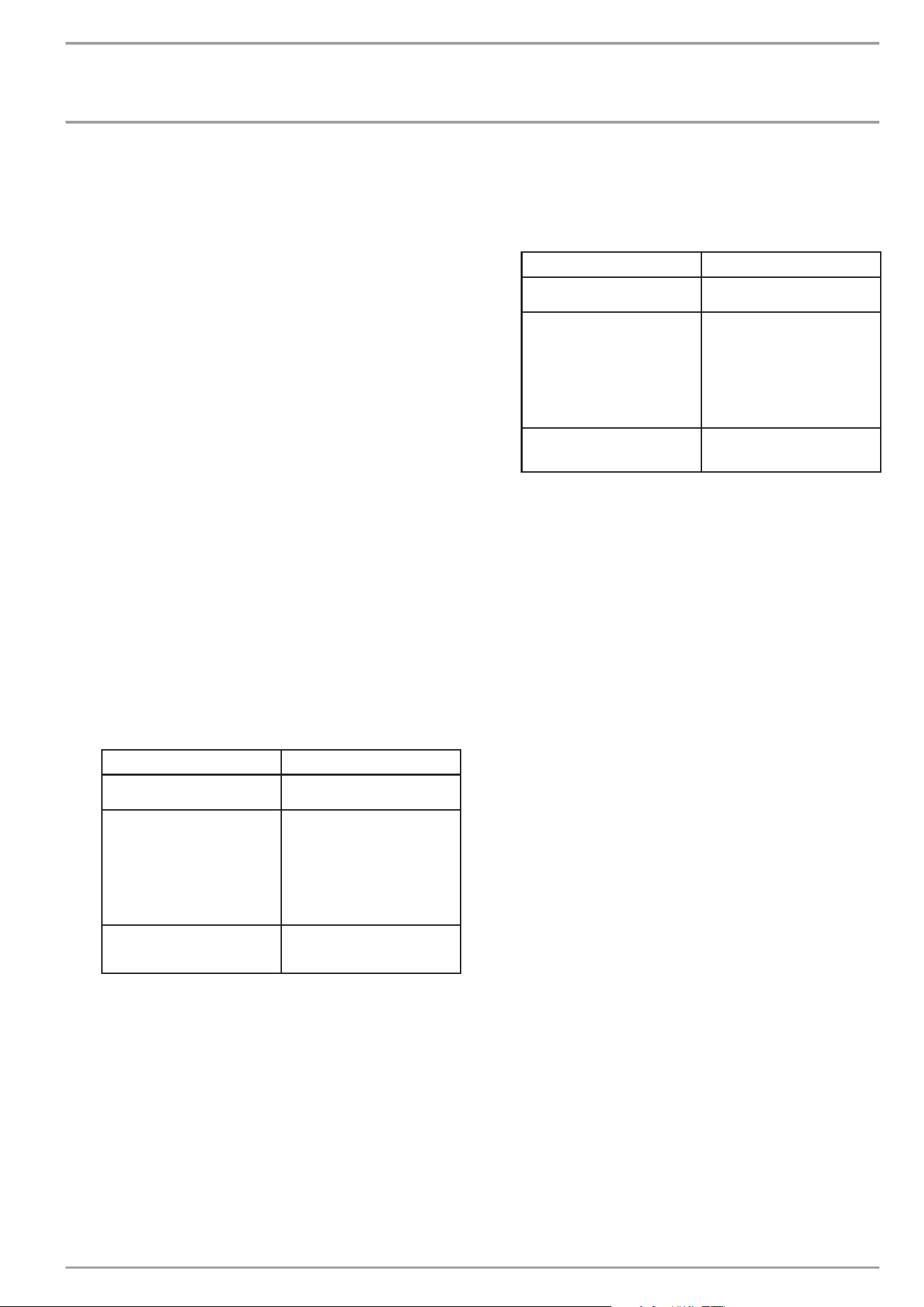
www.stiebel-eltron.com WWK222-302 H | 41
WARRANTY
Warranty Stiebel Eltron Australia Only - According to national
regulations in Australia
Warranty for Heat Pumps – Models WWK 222, WWK 222 H,
WWK302 and WWK302H
Who gives the warranty
1. The warranty is given by Stiebel Eltron (Aust) Pty Ltd
(A.B.N.82066271083) of 294 Salmon Street, Port Mel-
bourne, Victoria, 3207 (“we”, “us” or “our”).
The warranty
2. This warranty applies to Stiebel Eltron Heat Pumps – Mod-
els WWK222, WWK222H, WWK302 and WWK302H (the
“unit”) manufactured after 1 July 2015.
3. Subject to the warranty exclusions we will repair or re-
place, at our absolute discretion, a faulty component in
your unit free of charge if it fails to operate in accordance
with its specifications during the warranty period.
4. If we repair or replace a faulty component to your unit
under this warranty, the warranty period is not extended
from the time of the repair or replacement.
5. The warranty period commences on the date of completion
of the installation of the unit. Where the date of completion
of installation is not known, then the warranty period will
commence 2 months after the date of manufacture.
6. The warranty period for a unit used for domestic purposes
is shown in the table below. Domestic purposes means
that the unit is used in a domestic dwelling.
Component Warranty period
Cylinder and condenser 5 years
Sealed refrigeration sys-
tem, including compres-
sor, evaporator, valves and
associated pipe work. All
other electrical componen-
try.
2 years
T&P relief valve 1 year
7. The warranty period for a unit used for commercial pur-
poses is shown in the table below. Commercial purposes
means that the unit is used for a non-domestic purpose
and includes but not limited to being used in a motel,
hotel, mining camp or nursing home.
Component Warranty period
Cylinder and condenser 2 years
Sealed refrigeration sys-
tem, including compres-
sor, evaporator, valves and
associated pipe work. All
other electrical componen-
try.
2 years
T&P relief valve 1 year
Your entitlement to make a warranty claim
8. You are entitled to make a warranty claim if:
8.1. you own the unit or if you have the owner’s consent to rep-
resent the owner of the unit;
8.2. you contact us within a reasonable time of discovering the
problem with the unit;
How you make a warranty claim
9. To make a warranty claim you must provide us with the
following information:
9.1. The model number of the unit;
9.2. A description of the problem with the unit;
9.3. The name, address and contact details (such as phone
number and e-mail address) of the owner;
9.4. The address where the unit is installed and the location
(e.g. at side of house);
9.5. The serial number of the unit;
9.6. The date of purchase of the unit and the name of the seller
of the unit;
9.7. The date of installation of the unit;
9.8. A copy of the certificate of compliance when the unit was
installed.
10. The contact details for you to make your warranty claim
are:
Name: Stiebel Eltron (Aust) Pty Ltd
Address: 294 Salmon Street, Port Melbourne,
Victoria, 3207
Telephone: 1800 153 351 (8.00am to 5.00pm AEST
Monday to Friday)
Contact person: Customer Service Representative
E-mail: service@stiebel.com.au
11. We will arrange a suitable time with you to inspect and
test the unit.

42 | WWK222-302 H www.stiebel-eltron.com
WARRANTY
Warranty exclusions
12. We may reject your warranty claim if:
12.1. The unit was not installed by a registered and qualified
plumber.
12.2. The unit was not installed and commissioned:
a) in Australia;
b) in accordance with the Operating and Installation
Guide; and
c) in accordance with the relevant statutory and local
requirements of the State or Territory in which the unit
is installed.
12.3. The unit has not been operated or maintained in accord-
ance with the Operating and Installation Guide.
12.4. The unit does not bear its original Serial Number or Rating
Label.
12.5. The unit was damaged by any or any combination of the
following:
a) normal fair wear and tear;
b) connection to an incorrect water supply, for example,
(but not limited to) connection to water from a bore,
dam or swimming pool;
c) connection to an incorrect power supply;
d) connection to faulty equipment, such as damaged
valves;
e) insufficient air flow;
f) foreign matter in the water supply, such as sludge or
sediment;
g) corrosive or acidic elements in the water supply,
where the Langelier Saturation Index (LSI) is outside
the range -1.0 < LSI < 0.8;
h) inappropriate current impressed anode;
i) inappropriate current impressed anode battery
maintenance;
j) accidental damage;
k) uncontrollable natural phenomena, including damage
by flood, storm, fire, lightning strike and the like;
l) excessive water pressure, negative water pressure
(partial vacuum) or water pressure pulsation;
m) ingress of vermin.
12.6. The unit was damaged before it was installed e.g. it was
damaged in transit.
12.7. An unauthorised person has modified, serviced, repaired
or attempted to repair the unit without our consent.
12.8. Non genuine parts other than those manufactured or ap-
proved by us have been used on the unit.
13. We may charge you:
13.1. for any additional transport costs if the unit is installed
more than 30kilometres from our closest authorised ser-
vice technician.
13.2. for the extra time it takes our authorised service technician
to access the unit for inspection and testing if it is not sited
in accordance with the Operating and Installation Guide
and not readily accessible for inspection.
13.3. for any extra costs of our authorised service technician to
make the unit safe for inspection.

www.stiebel-eltron.com WWK222-302 H | 43
NOTES

Deutschland
STIEBEL ELTRON GmbH & Co. KG
Dr.-Stiebel-Straße 33 | 37603 Holzminden
Tel. 05531 702-0 | Fax 05531 702-480
info@stiebel-eltron.de
www.stiebel-eltron.de
Verkauf Tel. 05531 702-110 | Fax 05531 702-95108 | info-center@stiebel-eltron.de
Kundendienst Tel. 05531 702-111 | Fax 05531 702-95890 | kundendienst@stiebel-eltron.de
Ersatzteilverkauf www.stiebel-eltron.de/ersatzteile | ersatzteile@stiebel-eltron.de
Irrtum und technische Änderungen vorbehalten! | Subject to errors and technical changes! | Sous réserve
d‘erreurs et de modifications techniques! | Onder voorbehoud van vergissingen en technische wijzigingen!|
Salvo error o modificación técnica! | Excepto erro ou alteração técnica | Zastrzeżone zmiany techniczne i
ewentualne błędy | Omyly a technické změny jsou vyhrazeny! | A muszaki változtatások és tévedések jogát
fenntartjuk! | Отсутствие ошибок не гарантируется. Возможны технические изменения. | Chyby a
technické zmeny sú vyhradené! Stand 9734
Australia
STIEBEL ELTRON Australia Pty. Ltd.
294 Salmon Street | Port Melbourne VIC 3207
Tel. 03 9645-1833 | Fax 03 9644-5091
info@stiebel-eltron.com.au
www.stiebel-eltron.com.au
Austria
STIEBEL ELTRON Ges.m.b.H.
Gewerbegebiet Neubau-Nord
Margaritenstraße 4 A | 4063 Hörsching
Tel. 07221 74600-0 | Fax 07221 74600-42
info@stiebel-eltron.at
www.stiebel-eltron.at
Belgium
STIEBEL ELTRON bvba/sprl
't Hofveld 6 - D1 | 1702 Groot-Bijgaarden
Tel. 02 42322-22 | Fax 02 42322-12
info@stiebel-eltron.be
www.stiebel-eltron.be
China
STIEBEL ELTRON (Tianjin) Electric Appliance
Co., Ltd.
Plant C3, XEDA International Industry City
Xiqing Economic Development Area
300385 Tianjin
Tel. 022 8396 2077 | Fax 022 8396 2075
info@stiebeleltron.cn
www.stiebeleltron.cn
Czech Republic
STIEBEL ELTRON spol. s r.o.
Dopraváků 749/3 | 184 00 Praha 8
Tel. 251116-111 | Fax 235512-122
info@stiebel-eltron.cz
www.stiebel-eltron.cz
Finland
STIEBEL ELTRON OY
Kapinakuja 1 | 04600 Mäntsälä
Tel. 020 720-9988
info@stiebel-eltron.fi
www.stiebel-eltron.fi
France
STIEBEL ELTRON SAS
7-9, rue des Selliers
B.P 85107 | 57073 Metz-Cédex 3
Tel. 0387 7438-88 | Fax 0387 7468-26
info@stiebel-eltron.fr
www.stiebel-eltron.fr
Hungary
STIEBEL ELTRON Kft.
Gyár u. 2 | 2040 Budaörs
Tel. 01 250-6055 | Fax 01 368-8097
info@stiebel-eltron.hu
www.stiebel-eltron.hu
Japan
NIHON STIEBEL Co. Ltd.
Kowa Kawasaki Nishiguchi Building 8F
66-2 Horikawa-Cho
Saiwai-Ku | 212-0013 Kawasaki
Tel. 044 540-3200 | Fax 044 540-3210
info@nihonstiebel.co.jp
www.nihonstiebel.co.jp
Netherlands
STIEBEL ELTRON Nederland B.V.
Daviottenweg 36 | 5222 BH 's-Hertogenbosch
Tel. 073 623-0000 | Fax 073 623-1141
info@stiebel-eltron.nl
www.stiebel-eltron.nl
New Zealand
Stiebel Eltron NZ Limited
61 Barrys Point Road | Auckland 0622
Tel. +64 9486 2221
info@stiebel-eltron.co.nz
www.stiebel-eltron.co.nz
Poland
STIEBEL ELTRON Polska Sp. z O.O.
ul. Działkowa 2 | 02-234 Warszawa
Tel. 022 60920-30 | Fax 022 60920-29
biuro@stiebel-eltron.pl
www.stiebel-eltron.pl
Russia
STIEBEL ELTRON LLC RUSSIA
Urzhumskaya street 4,
building 2 | 129343 Moscow
Tel. +7 495 125 0 125
info@stiebel-eltron.ru
www.stiebel-eltron.ru
Slovakia
STIEBEL ELTRON Slovakia, s.r.o.
Hlavná 1 | 058 01 Poprad
Tel. 052 7127-125 | Fax 052 7127-148
info@stiebel-eltron.sk
www.stiebel-eltron.sk
South Africa
STIEBEL ELTRON Southern Africa (PTY) Ltd
30 Archimedes Road
Wendywood
Johannesburg, 2090
Tel. +27 10 001 85 47
info@stiebel-eltron.co.za
www.stiebel-eltron.co.za
Switzerland
STIEBEL ELTRON AG
Industrie West
Gass 8 | 5242 Lupfig
Tel. 056 4640-500 | Fax 056 4640-501
info@stiebel-eltron.ch
www.stiebel-eltron.ch
Thailand
STIEBEL ELTRON Asia Ltd.
469 Moo 2 Tambol Klong-Jik
Amphur Bangpa-In | 13160 Ayutthaya
Tel. 035 220088 | Fax 035 221188
info@stiebeleltronasia.com
www.stiebeleltronasia.com
United Kingdom and Ireland
STIEBEL ELTRON UK Ltd.
Unit 12 Stadium Court
Stadium Road | CH62 3RP Bromborough
Tel. 0151 346-2300 | Fax 0151 334-2913
info@stiebel-eltron.co.uk
www.stiebel-eltron.co.uk
United States of America
STIEBEL ELTRON, Inc.
17 West Street | 01088 West Hatfield MA
Tel. 0413 247-3380 | Fax 0413 247-3369
info@stiebel-eltron-usa.com
www.stiebel-eltron-usa.com
A 313804-45063-9775
B 303643-45063-9775
4<AMHCMO=bdiaee>