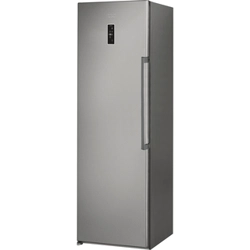
Refrigerator - Freezer
User manual
Frigorífico - Congelador
Manual de usuario
HPKS 1361 W4E
EN - PT

Please read this user manual first!
Dear Customer,
We hope that your product, which has been produced in modern plants and checked
under the most meticulous quality control procedures, will provide you an effective
service.
Therefore, read this entire user manual carefully before using the product and keep it as
a reference. If you handover the product to someone else, give the user manual as well.
The user manual will help you use the product in a fast and safe way.
z Read the manual before installing and operating the product.
z Make sure you read the safety instructions.
z Keep the manual in an easily accessible place as you may need it later.
z Read the other documents given with the product.
Remember that this user manual is also applicable for several other models. Differences
between models will be identified in the m
anual.
Explanation of symbols
Throughout this user manual the following symbols are used:
Important information or useful tips.
Warning against dangerous conditions for life and property.
Warning against electric voltage.
Please enter following websites docs.indesit.eu & parts-selfservice.europeanappliances.com
THANK YOU FOR BUYING A HOTPOINT PRODUCT
In order to receive a more complete assistance, please register
your product on www.register10.eu
PLEASE SCAN THE QR CODE ON YOUR APPLIANCE IN ORDER TO REACH
MORE INFORMATION
CONTENTS
1 Your refrigerator 4
2 Important Safety Warnings 5
Intended use.........................................
General safety.......................................
Child safety............................................
Compliance with the
WEEE Regulation
and Disposing of the Waste Product…..
Package information..............................
HCA warning..........................................
Things to be done for energy saving…..
3 Installation 9
Points to be paid attention to when the
relocation of the refrigerator....................
Before you start the refrigerator,...
.........
Electrical connection............................
Disposing of the packaging..................
Disposing of your
old refrigerator.........
Placing and Installation........................
Changing the illumination lamp ...........
Adjusting the legs................................
3
4
4
4
6
6
7
7
7
8
8
8
8
8
9
9
9
9
4 Preparation 12
5 Using your refrigerator 13
Thermostat setting button......................
Defrost ………………………………….
Freezing fresh food......................
........
Reversing the doors …………………...
Recommendations for preservation
of
frozen food......................................
Recommendations for the
fresh food compartment ……………..
6 Maintenance and cleaning
Protection of plastic surfaces ..............
7 Troubleshooting
10
11
11
11
12
13
14
14
15
15
16
02 | EN
WARNING!
In order to ensure a normal operation of your refrigerating appliance, which uses a completely
environmentally friendly refrigerant the R600a (flammable only under certain conditions) you
must observe the following rules:
Do not hinder the free circulation of the air around the appliance.
Do not use mechanical devices in order to accelerate the defrosting, others than the ones
recommended by the manufacturer.
Do not destroy the refrigerating circuit.
Do not use electric appliances inside the food keeping compartment, other than those that
might have been recommended by the manufacturer.
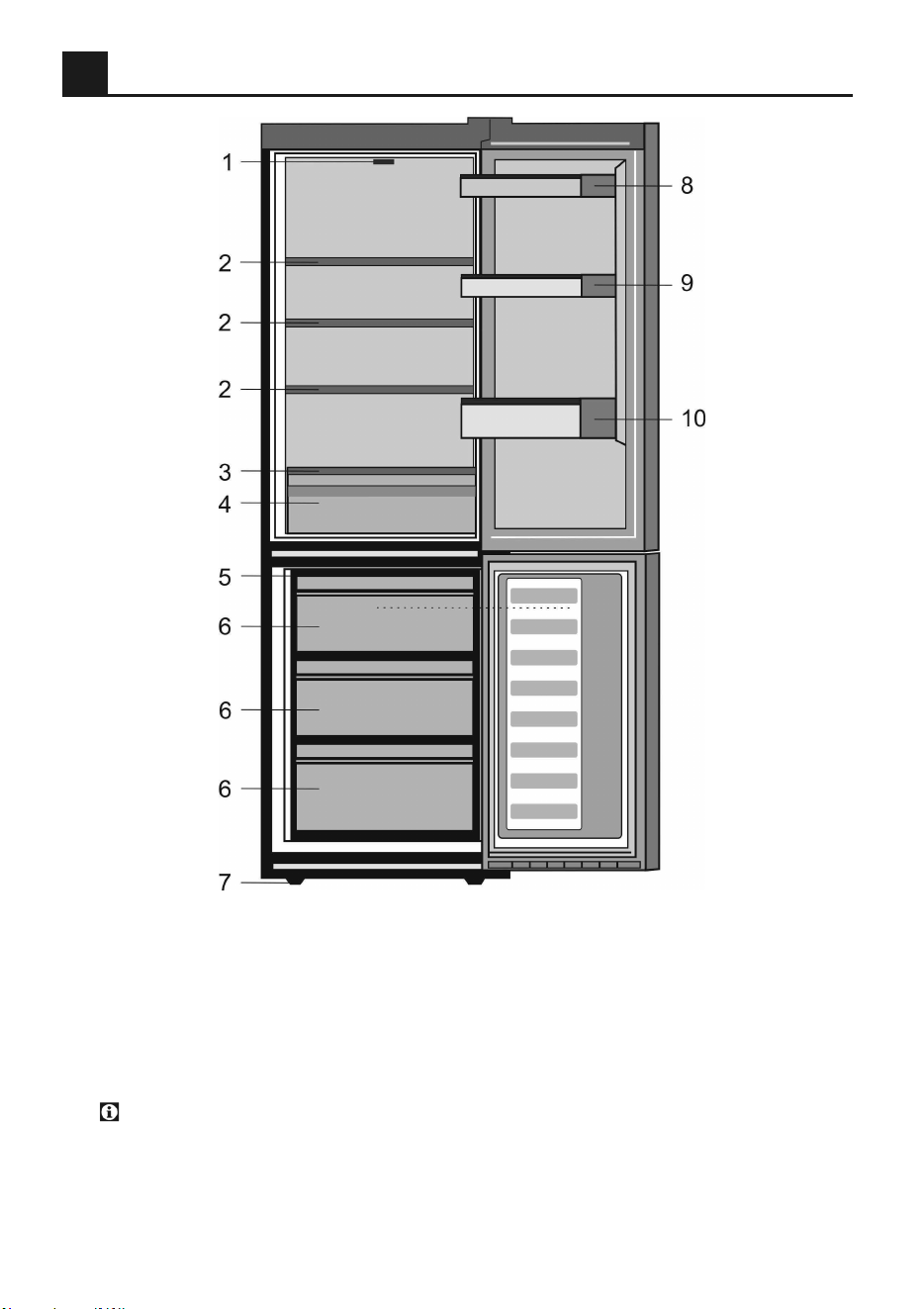
Your refrigerator
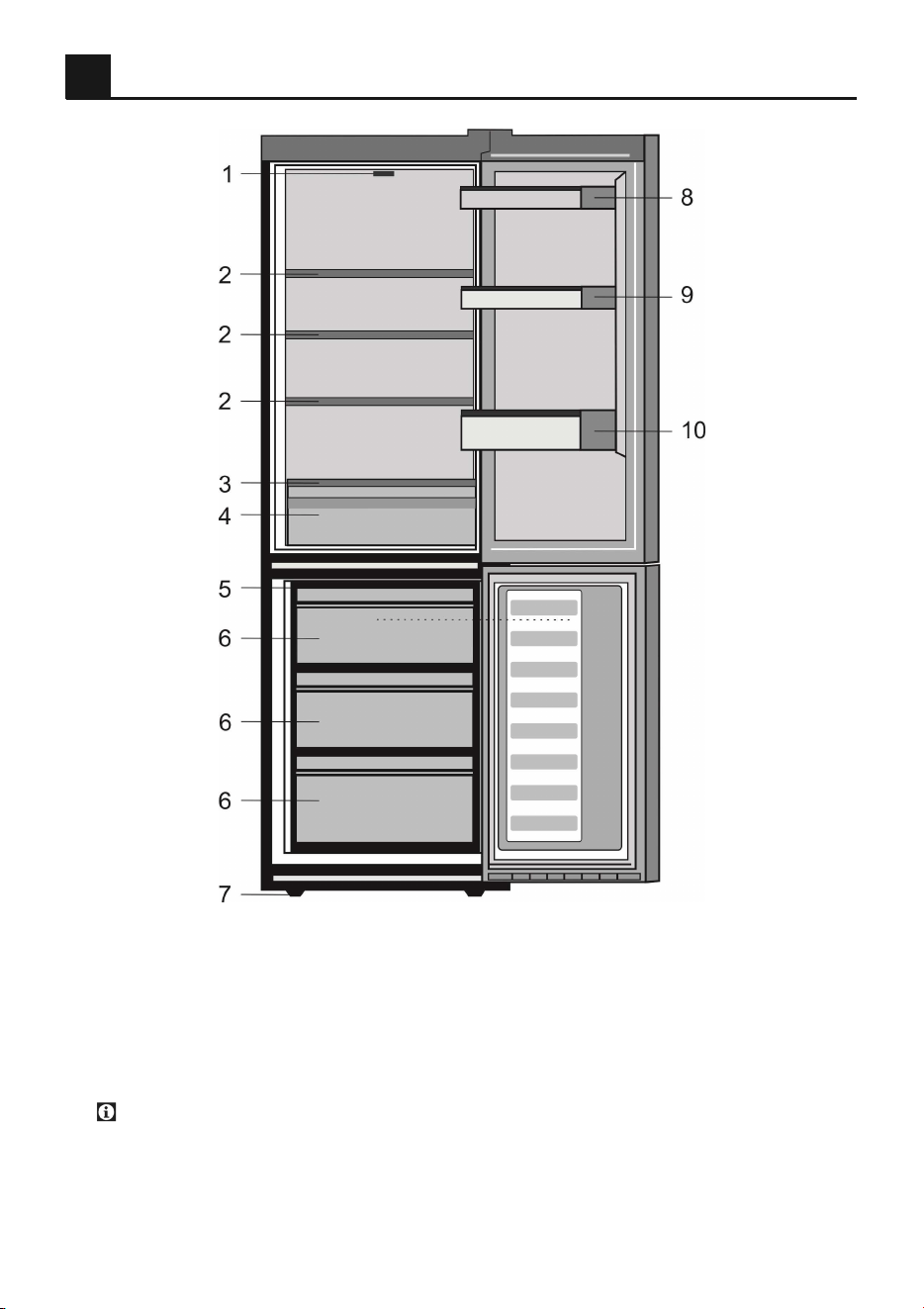
1
03 | EN
6. Compartments for frozen froods keeping
7. Adjustable front feet
8. Egg tray
9. Shelf for jars
1. Setting knob and interior light
2. Adjustable Cabinet shelves
3. Cover glass
4. Salad crispers
5. Ice tray
10. Shelf for bottles
Figures that take place in this instruction manual are schematic and may not
correspond exactly with your product. If the subject parts are not included in
the product you have purchased, then it is valid for other models.
Important Safety Warnings
2
Please review the following information.
Failure to observe this information may
cause injuries or material damage.
Otherwise, all warranty and relia
bility
commitments will become invalid.
Original Spare parts will be provided for
10 years, following the product
purchasing date.
Intended use
This product is intended to be used
z indoors and in closed areas such as
homes;
z
in closed working en
vironments such
as stores and offices;
z in closed accommodation areas such
as farm houses, hotels, pensions.
z
It should not be used outdoors.
General safety
z
When you want to dispose/scrap
the product, we recommend you
to consult the authorized service in
order to learn the required information
and authorized bodies.
z Consult your authorized service for
all your questions and problems
related to the refrigerator. Do not
intervene or let someone intervene to
the refrigerator without no
tifying the
authorised services.
z
For products with a freezer
compartment; Do not eat cone ice
cream and ice cubes immediately
after you take them out of the freezer
compartment! (This may cause
frostbite in your mouth.)
z For products with a freezer
compartment; Do not put bottled and
canned liquid beverages in the freezer
compartment. Otherwise, these may
burst.
z
Do not touch frozen food by hand;
they may stick to your hand.
z
Unplug your refrigerator before
cleaning or defrosting.
z
Vapor and vaporized cleaning
materials should never be used in
cleaning and defrosting processes of
your refrigerator. In such cases, the
vapor may get in contact with the
electrical parts and cause short circuit
or electric shock.
z
Never use the parts on your
refrigerator such as the door as a
means of support or step.
z Do not use electrical devices inside
the refrigerator.
z
Do not damage the parts, where
the refrigerant is circulating, with
drilling or cutting tools. The refrigerant
that might blow out when the gas
channels of the evaporator, pipe
extensions or surface coatings are
punctured causes skin irritations and
eye injuries.
z Do not cover or block the ventilation
holes on your refrigerator with any
material.
z
Electrical devices must be repaired
by only authorised persons. Repairs
performed by incompetent persons
create a risk for the user.
04 | EN
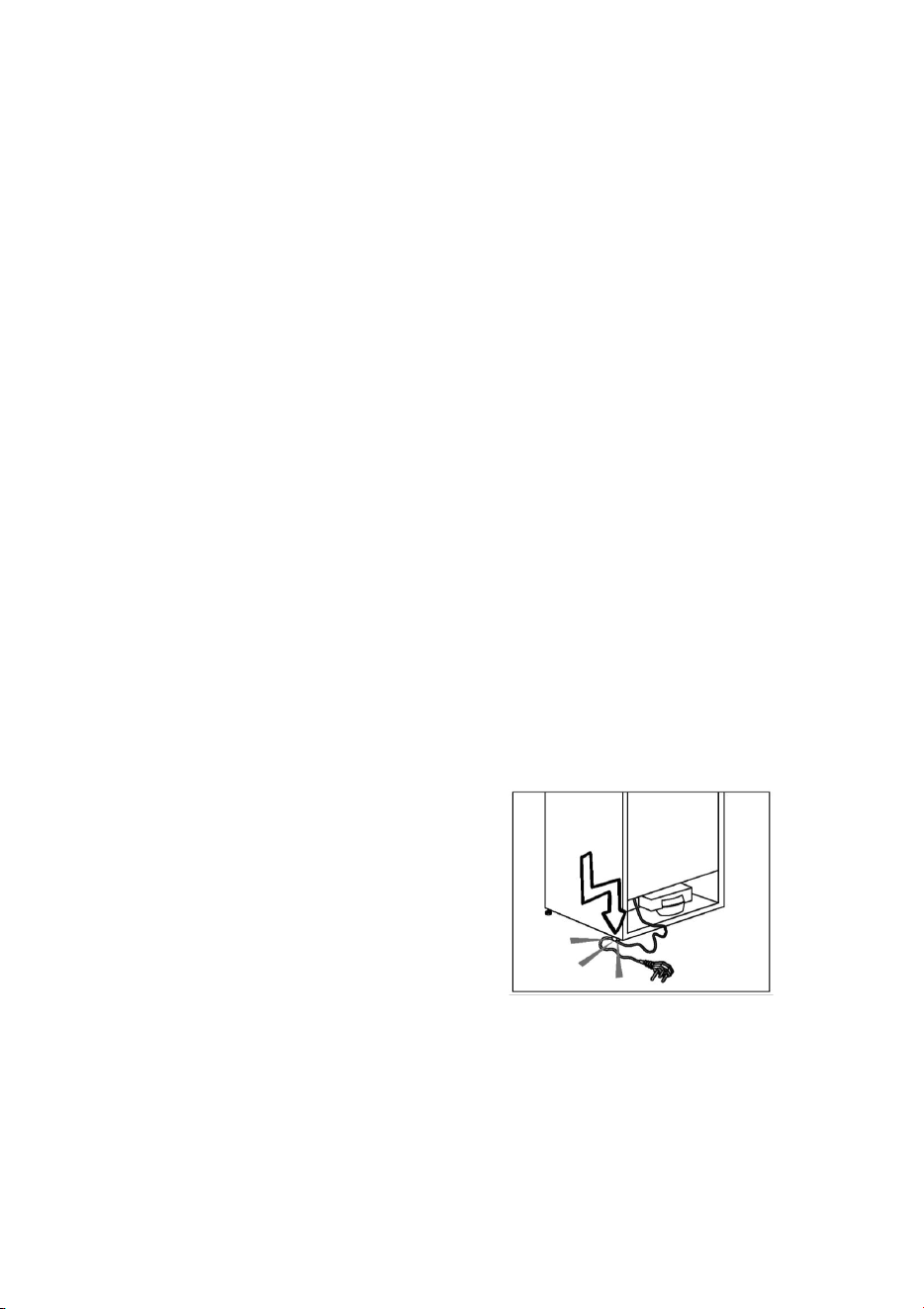
z In case of any failure or during
a maintenance or repair work,
disconnect your refrigerator’s
mains
supply by either turning off the
relevant fuse or unplugging your
appliance.
z Do not pull by the cable when pulling
off the plug.
z Place the beverage with higher proofs
tightly closed and vertically.
z Never store spray cans containing
f
lammable and explosive substances
in the refrigerator.
z Do not use mechanical devices
or other means to accelerate the
defrosting process, other than those
recommended by the manufacturer.
z This product is not intended to be
used by persons with physical,
sensory or mental disorders or
unlearned or inexperienced people
(including children) unless they are
attended by a person who will be
responsible for their safety or who will
instruct them accordingly for use of the
product.
z Do not operate a damaged
refrigerator. Consult with the service
agent if you have any concerns.
z Electrical safety of your refrigerator
shall be guaranteed only if the earth
system in your house complies with
standards.
z Exposing the product to rain, snow,
sun and wind is dangerous with
respect to electrical safety.
z Contact authorized service when
there is a power cable damage to
avoid danger.
z Never plug the refrigerator into
the wall outlet during installation.
Otherwise, risk of death or serious
injury may arise.
z This refrigerator is intended for only
storing food items. It must not be
used for any other purpose.
z Label of technical specifications is
located on the left wall inside the
refrigerator.
z Never connect your refrigerator to
electricity-
saving systems; they may
damage the refrigerator.
z If there is a blue light on the
refrigerator, do not look at the blue
light with optical tools.
z For manually controlled refrigerators,
wait for at least 5 minutes to start the
refrigerator after power failure.
z This operation manual should be
handed in to the new owner of the
product when it is given to others.
z Avoid causing damage on power
cable when transporting the
refrigerator. Bending cable may cause
fire. Never place heavy objects on
power cable.
z Do not touch the plug with wet hands
when plugging the product.
z Do not plug the refrigerator if the wall
outlet is loose.
z Water should not be sprayed on
inner or outer parts of the product for
safety purposes.
05 | EN
z Do not spray substances containing
inflammable gases such as propane
gas near the refrigerator to avoid fire
and explosion risk.
z Never place containers filled with
water on
top of the refrigerator; in the
event of spillages, this may cause
electric shock or fire.
z Do not overload the refrigerator with
food. If overloaded, the food items
may fall down and hurt you and
damage refrigerator when you open
the door.
z Never place objects on top of the
refrigerator; otherwise, these objects
may fall down when you open or
close the refrigerator's door.
z As they require a precise
temperature, vaccines, heat-
sensitive
medicine and scientific materials
and etc. should not be kept in the
refrigerator.
z If not to be used for a long time,
refrigerator should be unplugged. A
possible problem in power cable may
cause fire.
z The plug's tip should be cleaned
regularly with a dry cloth; otherwise, it
may cause fire.
z Refrigerator may move if adjustable
legs are not properly secured on the
floor. Properly securing adjustable
legs on the floor can prevent the
refrigerator to move.
z When carrying the refrigerator, do not
hold it from door handle. Otherwise, it
may be snapped.
z When you have to place your product
next to another refrigerator or freezer,
the distance between devices should
be at least 8cm. Otherwise, adjacent
side walls may be humidified.
Child safety
z If the door has a lock, the key should
be kept away from reach of children.
z Children must be supervised to
prevent them from tampering with the
product.
Compliance with the WEEE
Regulation and Disposing of the
Waste Product
The symbol on the product or on
packaging indicates that this product may
not be treated as household waste.
Instead it shall be handed over to the
applicable collection point for the
recycling of electrical and electronic
equipment. By ensuring this product is
disposed of correctly, you will help
prevent potential negative consequences
for the environment and human health,
which could otherwise be caused by
inappropriate waste handling of this
product. For more detailed information
about recycling of this product, please
contact your local city office, you
household waste disposal service or the
shop where you purchased the product.
06 | EN
Compliance with RoHS Directive:
The product you have purchased
complies with EU RoHS Directive
(2011/65/EU). It does not contain
harmful and prohibited materials
specified in the Directive.
Package information
Packaging materials of the product
are manufactured from recyclable
materials in accordance with our
National Environment Regulations. Do
not dispose of the packaging materials
together with the domestic or other
wastes. Take them to the packaging
material collection points designated
by the local authorities.
Do not forge
t...
Any recycled substance is an
indispensable matter for nature and our
national asset wealth.
If you want to contribute to the
reevaluation of the packaging materials,
you can consult to your environmentalist
organizations or the municipalities
where
you are located.
HCA warning
If your product's cooling system
contains R600a:
This gas is flammable. Therefore, pay
attention to not damaging the cooling
system and piping during usage and
transportation. In the event of damage,
keep your product away from potential
fire sources that can cause the product
catch a fire and ventilate the room in
which the unit is placed.
Type of gas used in the product is
stated in the type label which is on the
left wall inside the refrigerator.
Never throw the product in fire for
disposal.
Things to be done for energy
Saving
z Do not leave the doors of your
refrigerator open for a long time.
z Do not put hot food or drinks in your
refrigerator.
z Do not overload your refrigerator so
that the air circulation inside of it is not
prevented.
z Do not install your refrigerator
under direct sunlight or near heat
emitting appliances such as ovens,
dishwashers or radiators. Keep your
refrigerator at least 30 cm away from
heat emitting sources and at least
5 cm from electrical ovens.
z Pay attention to keep your food in
closed containers.
z For products with a freezer
compartment; You can store
maximum amount of food items in
the freezer when you remove the
shelf or drawer of the freezer. Energy
consumption value stated for your
refrigerator has been determined
by removing freezer shelf or drawer
and under maximum load. There
is no harm to use a shelf or drawer
according to the shapes and size of
food to be frozen.
z Thawing frozen food in fridge
compartment will both provide energy
saving and preserve the food quality.
In case the information which are
given in the user manual are not
taken into account, manufacturer will
not assume any liability for this.
07 | EN
Installation
3
Points to be paid attention
to wh
en the relocation of the
refrigerator
1.
Your refrigerator should be
unplugged.Before transportation of
your refrigerator, it should be emptied
and cleaned.
2.
Before it is re-packaged, shelves,
accessories, crisper, etc. inside your
refrigerator should be fixed with
adhesive tape and secured against
impacts. Package should be bound
with a thick tape or sound ropes
and the transportation rules on the
package should be strictly observed.
3.
Original packaging and foam
materials should be kept for future
transportations or moving.
Before you start the
refrigerator,
Check the following before you start
to use your refrigerator:
1. Clean the interior of the refrigerator as
recommended in the “Maintenance
and cleaning” section.
2.
Connect the p
lug of the refrigerator
to the wall socket. When the fridge
door is opened, fridge internal lamp
will turn on.
3.
When the compressor starts to
operate, a sound will be heard. The
liquid and gases sealed within the
refrigeration system may also give
rise
to noise, even if the compressor is
not running and this is quite normal.
4.
Front edges of the refrigerator may
feel warm. This is normal. These
areas are designed to be warm to
avoid condensation.
Electrical connection
Connect your product to a grounded
socket which is being protected by a
fuse with the appropriate capacity.
Important:
The connection must be in compliance
with national regulations.
z The power plug must be easily
accessible after installation.
z Electrical safety of your refrigerator
shall be guaranteed only if the earth
system in your house complies with
standards.
z The voltage stated on the label
located at left inner side of your
product should be equal to your
network voltage.
z Extension cables and multi plugs
must not be used for connection.
A damaged power cable must be
replaced by a qualified electrician.
Product must not be operated before
it is repaired! There is the risk of
electric shock!
Disposing of the packaging
The packing materials may be
dangerous for children. Keep the
packing materials out of the reach
of children or dispose of them by
classifying them in accordance with the
waste instructions stated by your local
authorities. Do not throw away with
regular house waste, throw away on
packaging pick up spots designated by
the local authorities.
The packing of your refrigerator is
produced from recyclable materials.
08 | EN
Disposing of your old
Refrigerator
Dispose of your old refrigerator without
giving any harm to the environment.
z You may consult your authorized
dealer or waste collection center of
your municipality about the disposal
of your refrigerator.
Before disposing of your refrigerator,
cut out the electric plug and, if there
are any locks on the door, make them
inoperable in order to protect children
against any danger.
Placing and Installation
If the entrance door of the room
where the refrigerator will be installed is
not wide enough for the refrigerator to
pass through, then call the authorized
service to have them remove the doors
of your refrigerator and pass it sideways
through the door.
1. Install your refrigerator to a place that
allows ease of use.
2. Keep your refrigerator away from heat
sources, humid places and direct
sunlight.
3. There must be appropriate air
ventilation around your refrigerator
in order to achieve an efficient
operation. If the refrigerator is to be
placed in a recess in the wall, there
must be at least 5 cm distance with
the ceiling and at least 5 cm with the
wall. Do not place your product on
the materials such as rug or carpet.
4.
Place your refrigerator on an even
floor surface to prevent jolts.
Changing the illumination lamp
To change the Bulb/LED used for
illumination of your refrigerator, call your
Authorized Service.
The lamp(s) used in this appliance is not
suitable for household room illumination.
The intended purpose of this lamp is to
assist the user to place foodstuffs in the
refrigerator/freezer in a safe and
comfortable way.
The lamps used in this appliance have to
withstand extreme physical conditions
such as temperatures below -20°C.
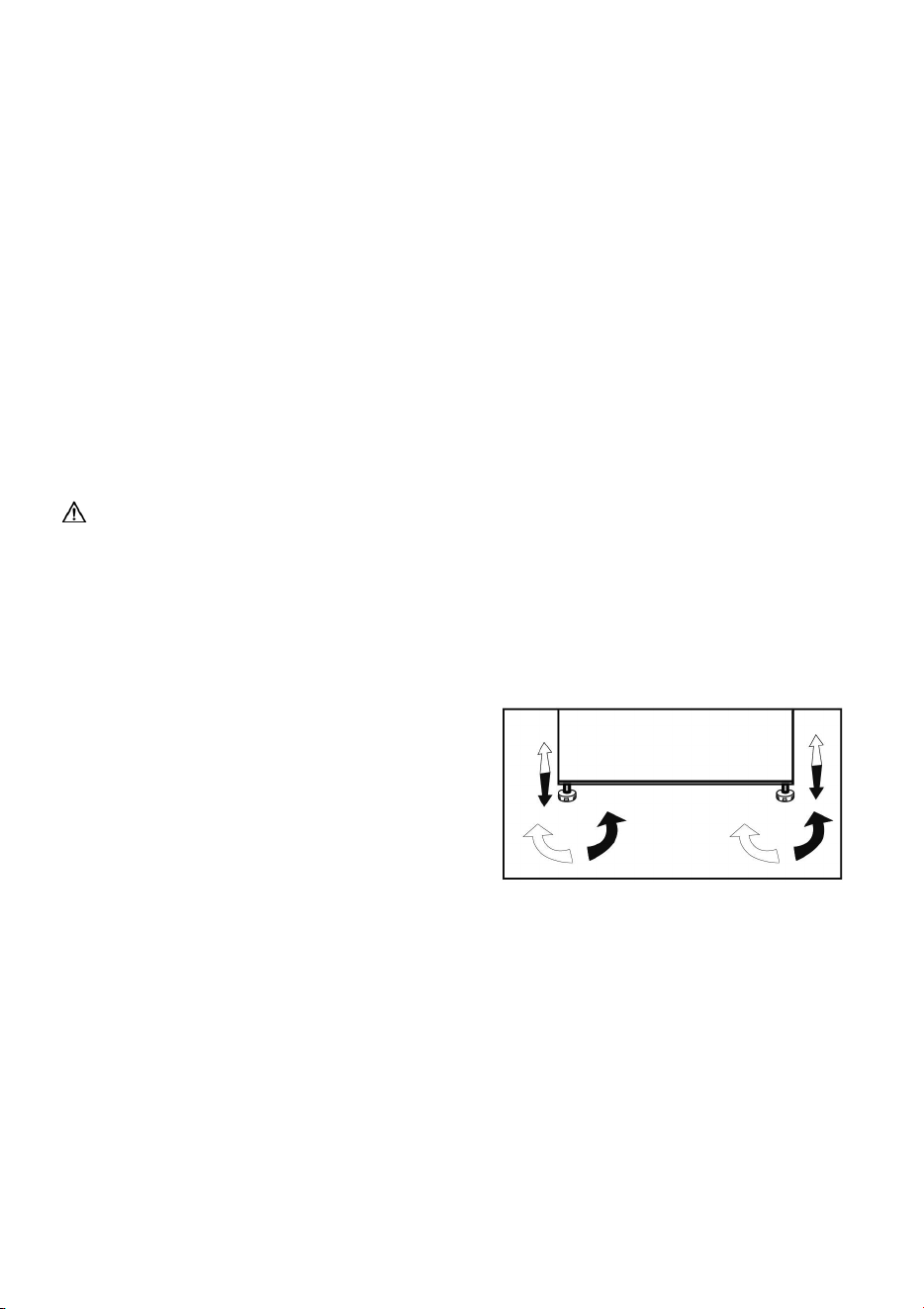
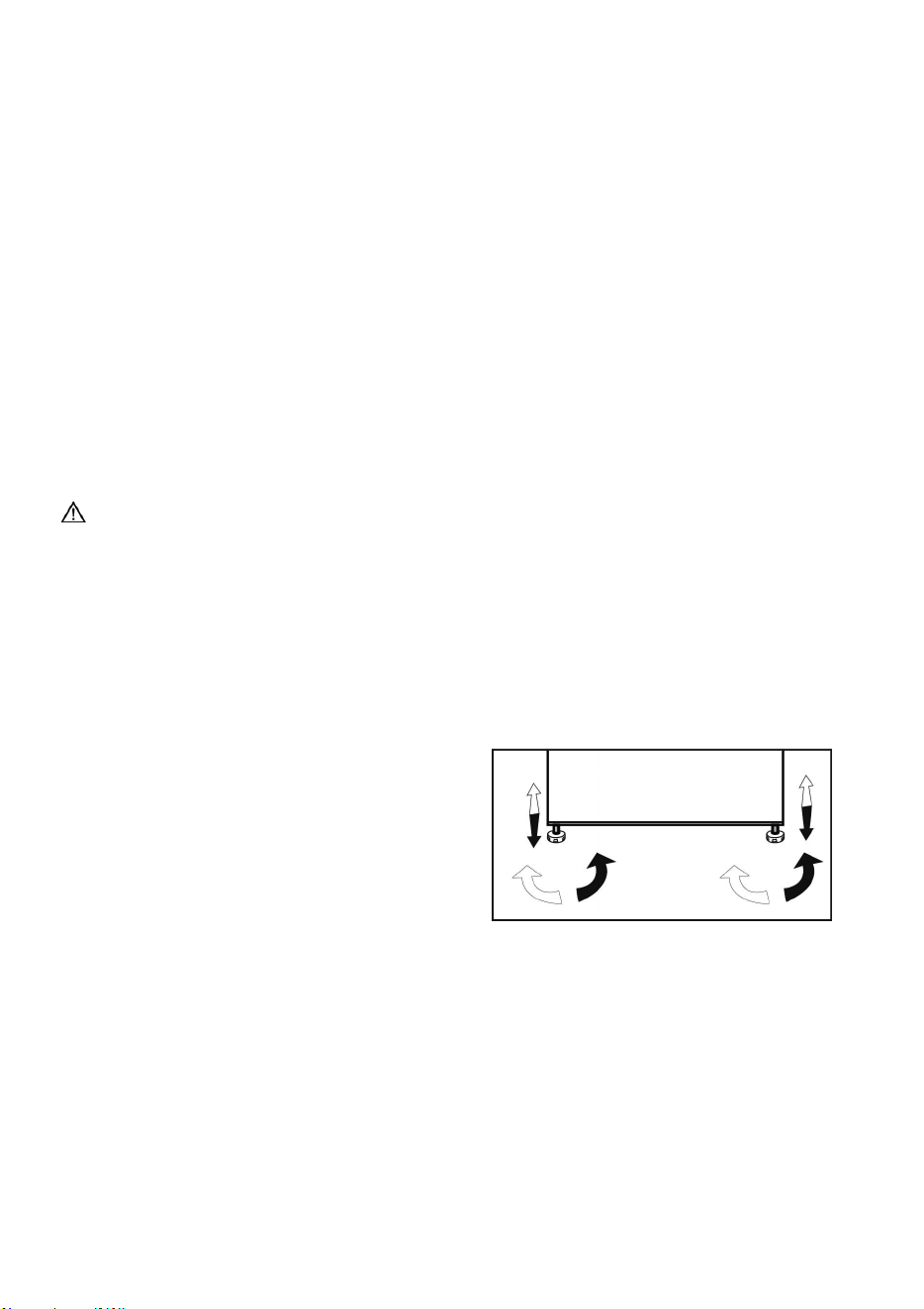
Adjusting the legs
If your refrigerator is unbalanced;
You can balance your refrigerator by
turning its front legs as illustrated in the
figure. The corner where the leg exists is
lowered when you turn in the direction of
black arrow and raised when you turn in
the opposite direction. Taking help from
someone to slightly lift the refrigerator will
facilitate this process.
09 | EN
Preparation
4
z Your refrigerator should be installed at
least 30 cm away from heat sources
such as hobs, ovens, central heater
and stoves and at least 5 cm away
from electrical ovens and should not
be located under direct sunlight.
z The ambient temperature of the room
where you install your refrigerator
should at least be 10°C. Operating
your refrigerator under cooler
conditions is not recommended with
regard to its efficiency.
z
Please make sure that the interior
of your refrigerator is cleaned
thoroughly.
z If two refrigerators are to be installed
side by side, there should be at least
2 cm distance between them.
z When you operate your refrigerator
for the first time, please o
bserve the
following instructions during the initial
six hours.
z
The door should not be opened
frequently.
z
It must be operated empty without
any food in it.
z
Do not unplug your refrigerator. If
a power failure occurs out of your
control, please see the warnings in
the “Recommended solutions for the
problems” section.
z
Original packaging and foam
materials should be kept for future
transportations or moving.
10 | EN
Using your refrigerator
5
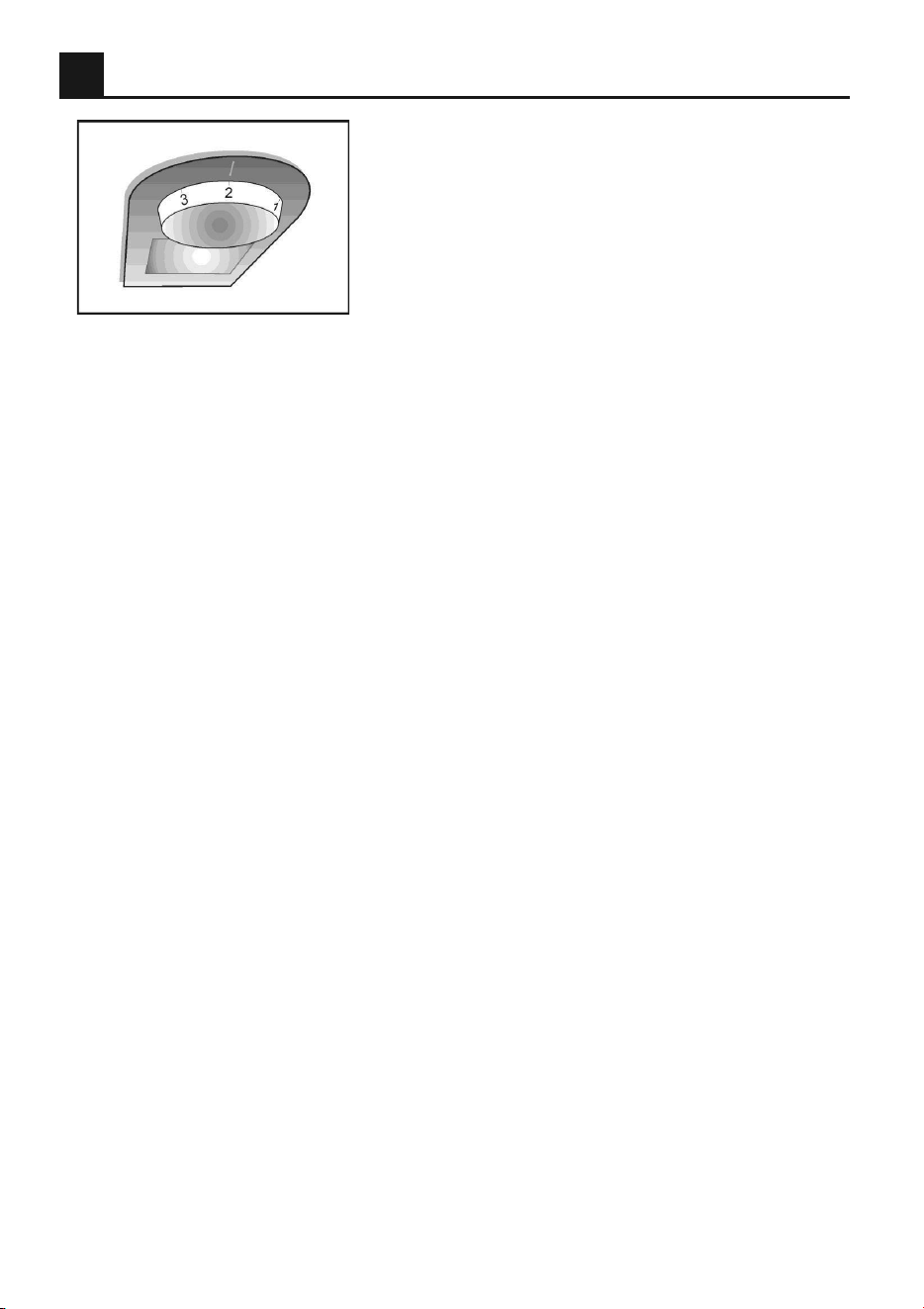
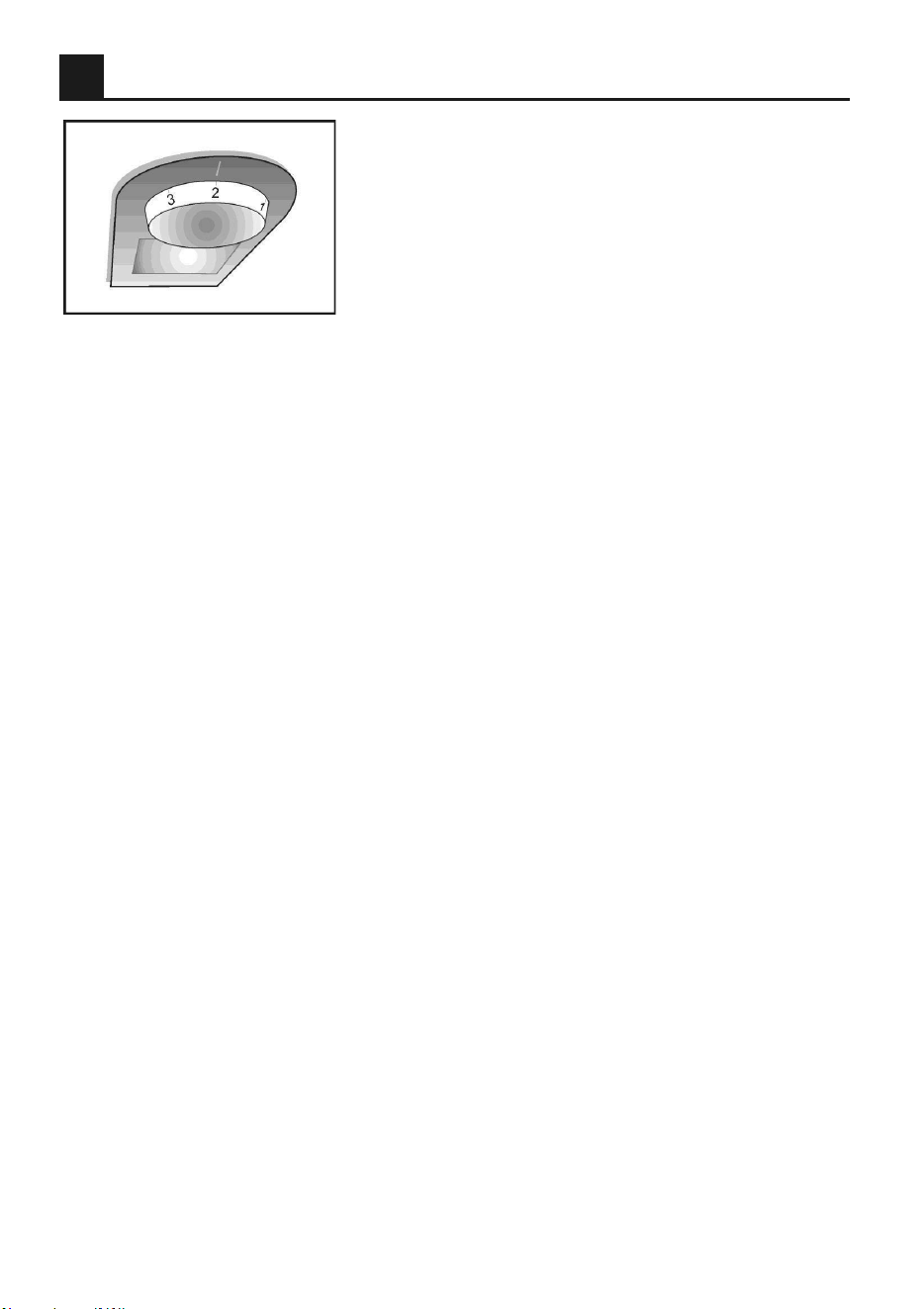
Thermostat setting button
The interior temperature of your
refrigerator changes for the following
reasons;
• Seasonal temperatures,
• Frequent opening of the door and
leaving the door open for long periods,
• Food put into the refrigerator without
cooling down to the room temperature,
• The location of the refrigerator in the
room
(e.g. exposing to sunlight).
• You may adjust the varying interior
temperature due to such reasons by
using
the thermostat.
Operating temperatures are controlled by
the thermostat knob and may be set at
any position between 0 and 5 (the
coldest position).
The average temperature inside the
fridge should be around +5°C (+41°F).
Therefore adjust the thermostat to obtain
the desired temperature. Some sections
of the fridge may be cooler or warmer
(such as salad crisper and top part of the
cabinet) which is quite normal. We
recommend t
hat you check the
temperature periodically with a
thermometer to ensure that the cabinet is
kept to this temperature. Frequent door
openings cause internal temperatures to
rise, so it is advisable to close the door
as soon as possible after use.
Defrost
A) Fridge compartment
Fridge compartment performs fu
ll-
automatic defrosting. Water drops and a
frosting up
to
7-8 mm can occur on the
inner rear wall of the fridge compartment
while your refrigerator cools down. Such
formation is normal as a result of the
cooling system. The frost formation
is defrosted by performing automati
c
defrosting with certain intervals thanks to
the automatic defrosting system of the
rear wall. User is not required to scrape
the frost or remove the water
drops
Water resulting from the defrosting
passes from the water collection groove
and flows into the evaporator through th
e
drain pipe and .evaporates here by itself.
Check regularly to see if the drain pipe is
clogged or not and clear it with the
stick
in the
hole when necessary
Deep freezer compartment does not
perform
automatic defrosting in order to
prevent
decaying of the frozen food.
B) Freezer compartment
Defrosting is very straightforward and
without mess, thanks to a special defrost
collection
basin.
Defrost twice a year or when a frost layer
of
around 7 (1/4”) mm has formed. To
start the defrosting procedure, switch off
the appliance at the socket outlet and
pull out the mains plug
.
All food should be wrapped in several
layers of newspaper and stored in a cool
place (e.g.)
fridge or larder.
Containers of warm water may be placed
carefully in the freezer to speed up the
defrosting
.
Do not use pointed or sharp-edged
objects, such as knives or forks to
remove the frost.
11 | EN

z Please observe the following
instructions to obtain the best results.
1. Do not freeze too large quantities of
food at
one time. The quality of the food
is best preserved when it is frozen right
through to the core as quick
ly as
possible.
2. Take special care not to mix already
frozen food and fresh food.
3.
Make sure raw foods are not in
contact with cooked foods in the fridge.
4. Maximum frozen food storage volume
is achieved without using the drawers
provided in the freezer compartment.
Energy consumption of your appliance is
declared while the freezer compartment
is fully loaded on shelves without the use
of the drawers
.
5. It is recommended that you place
foodstuffs on top shelf of freezer for initial
freezing.
Never use hair dryers, electrical heaters
or other such electrical appliances for
defrosting
.
Sponge out the defrost water collected in
the bottom of the freezer compartment.
After
defrosting, dry the interior
thoroughly Insert the plug into the wall
sock
et and switch on the electricity
supply.
Freezing fresh food
z Wrap or cover the food before
placing them in the refrigerator.
z Hot food must cool down to the room
temperature before putting them in the
refrigerator.
z The foodstuff that you want to freeze
must be fresh and in good quality.
z Foodstuff must be divided into portions
according to the family’s daily or meal
based consumption needs.
z Foodstuff must be packaged in an
airtight
manner to prevent them fr
om
dr
ying even if they are going to be
kept
for a short time.
z Materials to be used for packagings
must be resistant to cold and humidity
and they must be airtight. The packagin
g
material of the food must be at a
sufficient thickness and durability.
Otherwise the food hardened due
to
freezing may puncture the packaging. It
is important for the packaging to be
closed s
ecurely for safe storage of
the
food.
z Frozen food must be used immediately
after they are thawed and they should
never be re
-frozen.
z Placing warm food into the freezer
compartment causes the cooling system
to operate continuously until the food is
frozen solid.
12 | EN
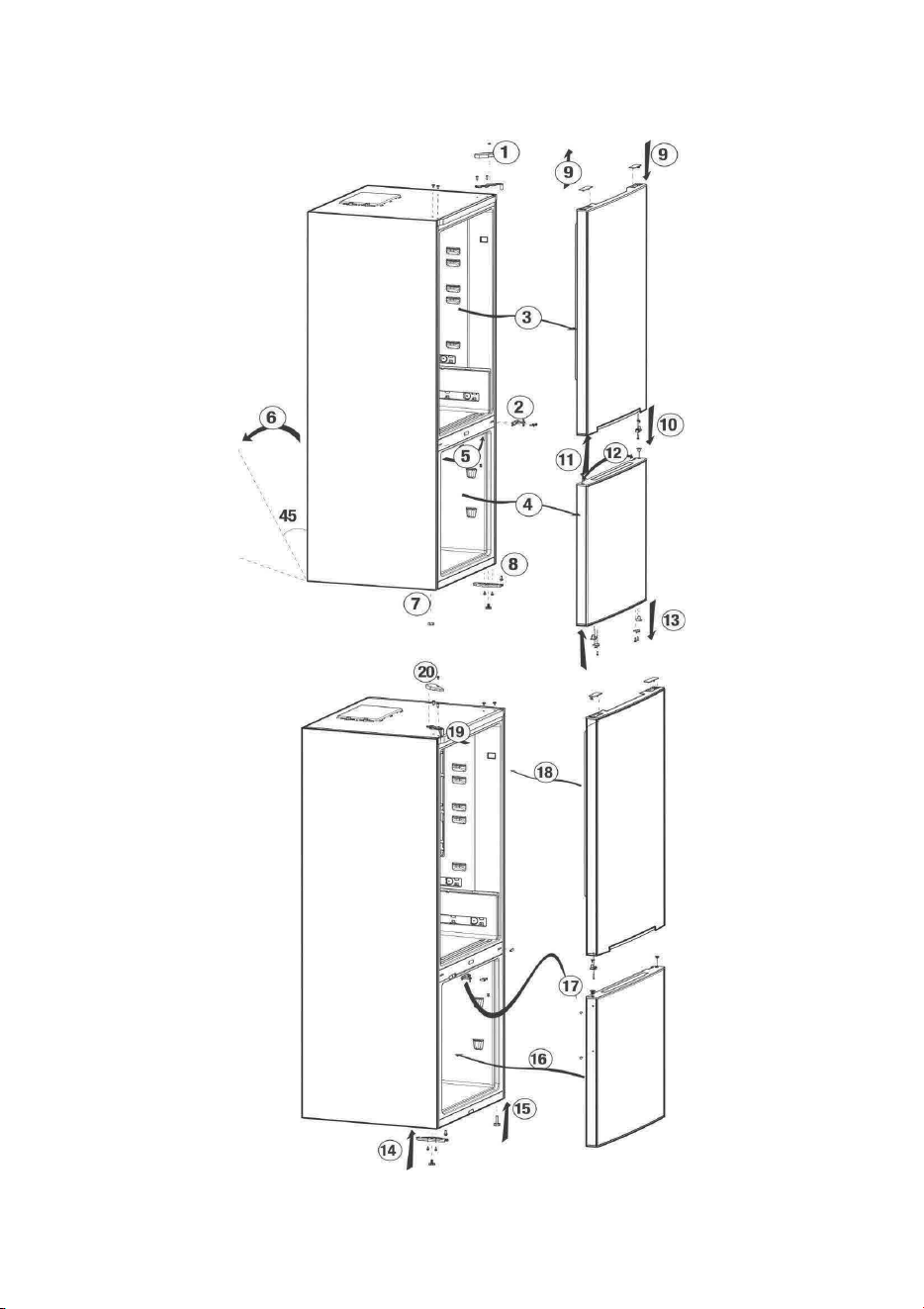
Reversing the doors
Proceed in numerical order
13 | EN
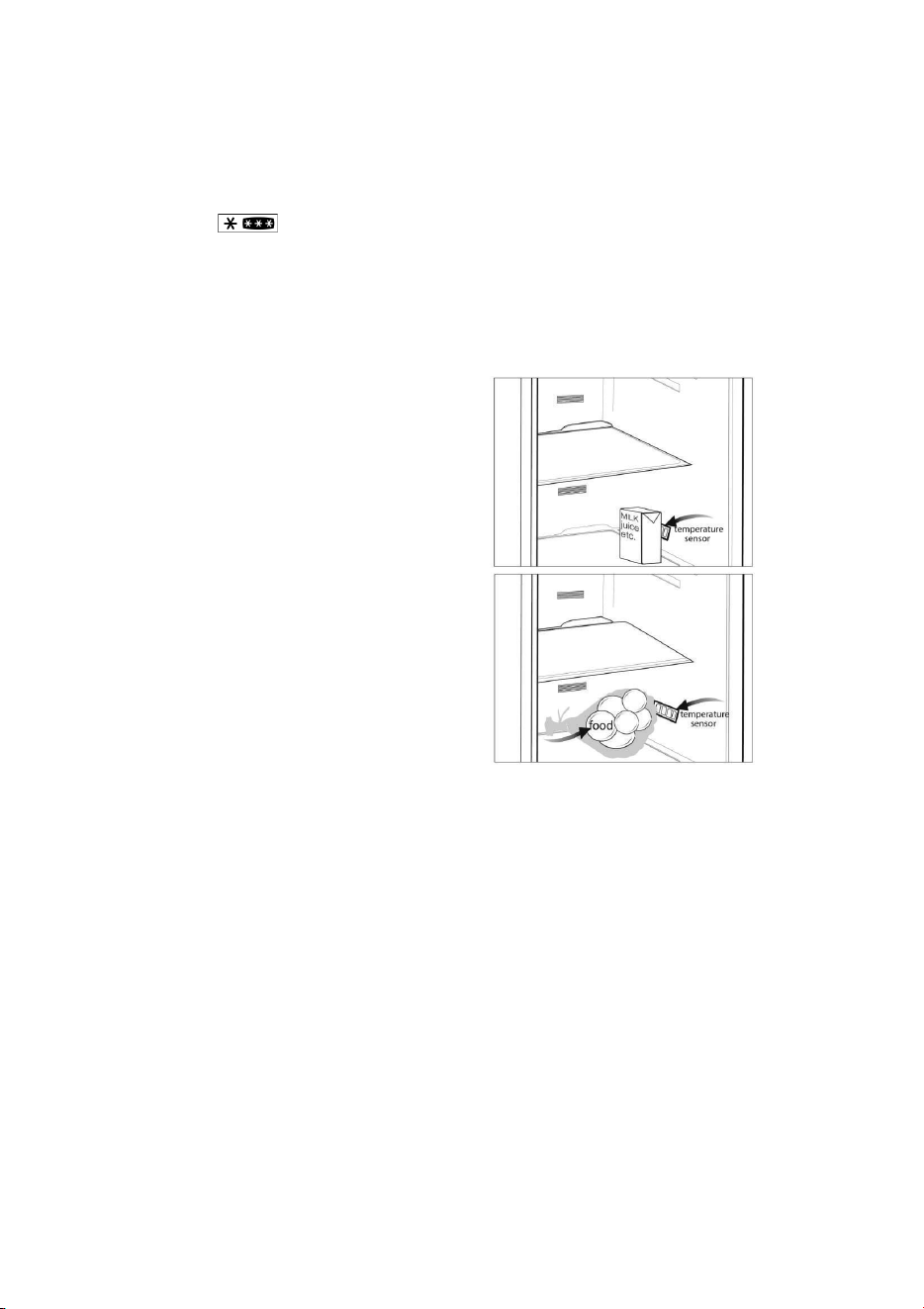
Recommendations for the
fresh food compartment
*optional
z Do not allow the food to touch the
temperature sensor in fresh food
compartment. To allow the fresh food
compartment keep its ideal storage
temperature, sensor must not be
hindered by food.
z Do not place hot foods in the product.
Recommendations for
preservation of frozen food
Prepacked c
ommercially frozen food
should be stored in accordance
with the frozen food manufacturer's
instructions for a
( 4 star)
frozen food storage compartment.
• To ensure that the high quality
achieved by the frozen food
manufacturer and the food retailer is
maintained, the following should be
remembered:
1. Put packages in the freezer as quickly
as possible after purchase.
2. Ensure that contents are labeled and
dated.
3. Do not exceed "Use By", "Best
Before" dates on the packaging.
14 | EN
Maintenance and cleaning
6
Protection of plastic
surfaces
Do not put the liquid oils or oil-cooked
meals in your refrigerator in unsealed
containers as they damage the
plastic surfaces of your refrigerator.
In case of spilling or smearing oil on
the plastic surfaces, clean and rinse
the relevant part of the surface at
once with warm water.
Never use gasoline, benzene or
similar substances for cleaning
purposes.
We recommend that you unplug the
ppliance before cleaning.
Never use any sharp abrasive
instrument, soap, household
cleaner,
detergent and wax polish for
cleaning.
Use lukewarm water to clean the
cabinet of your refrigerator and wipe
it dry.
Use a damp cloth wrung out in a
solution of one teaspoon of
bicarbonate of soda to one pint of
water to clean the interio
r and wipe it
dry.
Make sure that no water enters the
lamp housing and other electrical
items.
If your refrigerator is not going to be
used for a long period of time, unplug
the power cable, remove all food,
clean it and leave the door ajar.
Ch
eck door seals regularly to ensure
they are clean and free from food
particles.
To remove door racks, remove all the
contents and then simply push the
door rack upwards from the base.
Never use cleaning agents or water
that contain chlorine to clean the
outer surfaces and chromium coated
parts of the product. Chlorine causes
corrosion on such metal surfaces.
15 | EN
Troubleshooting
7
The refrigerator does not operate.
• The plug is not inserted into the socket correctly. >>>Insert the plug into the
socket securely.
• The fuse of the socket which your refrigerator is connected to or the main fuse
have blown o
ut. >>>Check the fuse.
Condensation on the side wall of the fridge compartment (MULTIZONE, COOL
CONTROL and FLEXI ZONE).
• Ambient is very cold. >>>Do not install the refrigerator in places where the
temperature falls below 10°C.
• Door has been opened frequently. >>>Do not open and close the door of
refrigerator frequently.
•
Ambient is very humid. >>>Do not install your refri
gerator into highly humid
places.
• Food containing liquid is stored in open containers. >>>Do not store food with
liquid content in open containers.
• Door of the refrigerator is left ajar. >>>Close the door of the refrigerator.
• Thermostat is set to a very cold level. >>>Set the thermostat to a suitable level.
Compressor is not running
• Protective thermic of the compressor will blow out during sudden power
failures or plug
-out plug-ins as the refrigerant pressure in the cooling system
of the refriger
ator has not been balanced yet. The refrigerator will start running
approximately after 6 minutes. Please call the service if the refrigerator does not
startup at the end of this period.
• The fridge is in defrost cycle. >>>This is normal for a full
-automa
tically defrosting
refrigerator. Defrosting cycle occurs periodically.
• The refrigerator is not plugged into the socket. >>>Make sure that the plug is fit
into the socket.
• Temperature settin
gs are not made correctly. >>>Select the suitable temperature
v
alue.
• There is a power outage. >>>Refrigerator returns to normal operation when the
power restores.
The operation noise increases when the refrigerator is running.
• The operating performance of the refrigerator may change due to the changes in
the ambient temperature. It is normal and not a fault.
Please review this list before calling the service. It will save your time and money. This
list includes frequent complaints that are not arising from defective workmanship or
material usage. Some of the features described here may not exist in your product.
16 | EN
The refrigerator is running frequently or for a long time.
• New product may be wider than the previous one. Larger refrigerators operate
for a longer period of time.
• The room te
mperature may be high. >>>It is normal that the product operates
for longer periods in hot ambient.
• The refrigerator might be plugged in recently or might be loaded with food.
>>>When the refrigerator is plugged in or loaded with food recently, it will t
ake
longer for it to attain the set temperature. This is normal.
• Large a
mounts of hot food might be put in the refrigerator recently. >>>Do not
put hot food into the refrigerator.
• Doors might be opened frequently or left ajar for a long time. >>>The wa
rm air
that has entered into the refrigerator causes the refrigerator to run for longer
periods. Do not open the doors frequently.
• Freezer or fridge compartment door might be left ajar. >>>Check if the doors are
closed completely.
• The refrigerator is a
djusted to a very low temperature. >>>Adjust the refrigerator
temperature to a warmer degree and wait until the temperature is achieved.
• Door seal of the fridge or freezer may be soiled, worn out, broken or not
properly seated. >>>Clean or replace the se
al. Damaged/broken seal causes
the refrigerator to run for a longer period of time in order to maintain the current
temperature.
Freezer temperature is very low while the fridge temperature is sufficient.
• The freezer temperature is adjusted to a very low value. >>>Adjust the freezer
temperature to a warmer degree and check.
Fridge temperature is very low while the freezer temperature is sufficient.
• The fridge temperature is adjusted to a very low value. >>>Adjust the fridge
temperature to a warmer degree and check.
Food kept in the fridge compartment drawers is frozen.
• The fridge temperature is adjusted to a very high value. >>>Adjust the fridge
temperature to a lower value and check.
Temperature in the fridge or freezer is very high.
• The fridge temperature is adjusted to a very high value. >>>Fridge compartment
temperature setting has an effect on the temperature of the freezer. Change the
temperatures of the fridge or freezer and wait until the relevant compartments
attain a sufficient tempe
rature.
• Doors are opened frequently or left ajar for a long time. >>>Do not open the
doors frequently.
• Door is ajar. >>>Close the door completely.
• The refrigerator is plugged in or loaded with food recently. >>>This is normal.
When the refrigerator i
s plugged in or loaded with food recently, it will take longer
for it to attain the set temperature.
• Large amounts of hot food might be put in the refrigerator recently. >>>Do not
put hot food into the refrigerator.
17 | EN
Vibrations or noise.
•The floor is not level or stable. >>> If the refrigerator rocks when moved slowly,
balance it by adjusting its feet. Also make sure that the floor is strong enough to
carry the refrigerator, and level.
• The items put onto the refrigerator may cause noise.
>>>Remove the items on
top of the refrigerator.
There are noises coming from the refrigerator like liquid flowing, spraying, etc.
• Liquid and gas flows occur in accordance with the operating principles of your
refrigerator. It is normal and not a fault.
Whistle comes from the refrigerator.
• Fans are used in order to cool the refrigerator. It is normal and not a fault.
Condensation on the inner walls of refrigerator.
• Hot and humid weather increases icing and condensation. It is normal and not a
fau
lt.
• Doors are opened frequently or left ajar for a long time. >>>Do not open the
doors frequently. Close them if they are open.
• Door is ajar. >>>Close the door completely.
Humidity occurs on the outside of the refrigerator or between the doors.
•There might be humidity in the air; this is quite normal in humid weather. When
the humidity is less, condensation will disappear.
Bad odour inside the refrigerator.
• No regular cleaning is performed. >>>Clean the inside of the refrigerator regularly
with
a sponge, lukewarm water or carbonate dissolved in water.
• Some containers or package materials may cause the smell. >>>Use a different
container or different brand packaging material.
• Food is put into the refrigerator in uncovered containers. >>>Keep t
he food in
closed containers. Microorganisms spreading out from uncovered containers
can cause unpleasant odours.
• Remove the foods that have expired best before dates and spoiled from the
refrigerator.
The door is not closing.
• Food packages are preventing the door from closing. >>>Replace the packages
that are obstructing the door.
• The refrigerator is not completely even on the floor. >>>Adjust the feet to
balance the refrigerator.
• The floor is not level or strong. >>>Make sure that the floor is l
evel and capable
to carry the refrigerator.
Crispers are stuck.
• The food is touching the ceiling of the drawer. >>>Rearrange food in the drawer.
18 | EN
DISCLAIMER / WARNING
Some (simple) failures can be adequately handled by the end-user without any safety
issue or unsafe use arising, provided that they are carried out within the limits and in
accordance with the following instructions (see the “Self-Repair” section).
Therefore, unless otherwise authorized in the “Self-Repair” section below, repairs
shall be addressed to registered professional repairers in order to avoid safety
issues. A registered professional repairer is a professional repairer that has been
granted access to the instructions and spare parts list of this product by the
manufacturer according to the methods described in legislative acts pursuant to
Directive 2009/125/EC.
However, only the service agent (i.e. authorized professional repairers) that
you can reach through the phone number given in the user manual/warranty
card or through your authorized dealer may provide service under the
guarantee terms. Therefore, please be advised that repairs by professional
repairers (who are not authorized by manufacturer / seller) shall void the
guarantee.
Self-Repair
Self-repair can be done by the end-user with regard to the following spare parts: door
handles, door hinges, trays, baskets and door gaskets (an updated list is also
available in web as of 1st March 2021).
Moreover, to ensure product safety and to prevent risk of serious injury, the
mentioned self-repair shall be done following the instructions in the user manual for
self-repair or which are available in web. For your safety, unplug the product before
attempting any self-repair.
Repair and repair attempts by end-users for parts not included in such list and/ or not
following the instructions in the user manuals for self-repair or which are available in
web, might give raise to safety issues not attributable to manufacturer / seller, and
will void the warranty of the product.
Therefore, it is highly recommended that end-users refrain from the attempt to carry
out repairs falling outside the mentioned list of spare parts, contacting in such cases
authorized professional repairers or registered professional repairers. On the
contrary, such attempts by end-users may cause safety issues and damage the
product and subsequently cause fire, flood, electrocution and serious personal injury
to occur.
By way of example, but not limited to, the following repairs must be addressed to
authorized professional repairers or registered professional repairers: compressor,
cooling circuit, main board,inverter board, display board, etc.
The manufacturer / seller cannot be held liable in any case where end-users do not
comply with the above.
Por favor, leia primeiro este manual!
Caro cliente,
Esperamos que o seu produto, que foi produzido em modernas instalações e testado
através de rigorosos controlos de qualidade, lhe venha a oferecer um serviço eficiente.
Portanto, leia este manual cuidadosamente antes de usar o produto e guarde-o como
referência. Se passar o produto a outra pessoa, passe igualmente o manual do utilizador.
O manual do utilizador ajudá-lo-á a utilizar o seu equipamento de maneira rápida e
segura.
z Leia o manual antes de instalar e de operar com o produto.
z Certifique-se de que leu as instruções sobre segurança.
z Guarde o manual num local acessível, já que poderá precisar dele mais tarde.
z Leia os outros documentos que acompanham o produto.
Lembre-se de que este manual do utilizador também é aplicável a vários outros
modelos. As diferenças entre modelos serão identificadas no manual.
Explicação dos símbolos
Ao longo deste manual do utilizador serão utilizados os seguintes símbolos:
Informações importantes ou dicas úteis.
Aviso sobre as condições de risco para a vida e a propriedade.
Aviso contra a voltagem elétrica.
OBRIGADO POR TER ADQUIRIDO UM PRODUTO HOTPOINT
Para receber uma assistência mais completa, registe o seu
produto em www.register10.eu
PARA OBTER MAIS INFORMAÇÕES, LEIA O CÓDIGO QR NO SEU APARELHO
Por favor insira os seguintes sites docs.indesit.eu
& parts-selfservice.europeanappliances.com
ÍNDİCE
1 O seu frigorífico 3
2 Avisos importantes de
segurança 5
Uso pretendido...................................... 4
5Segurança geral.....................................
Segurança com crianças........................ 6
Conformidade com a Diretiva WEEE e
Eliminação do Produto………………….. 6
Informação sobre a embalagem............. 7
Aviso HCA............................................... 7
O que se pode fazer para economizar
energia…………………………………….. 7
3 Instalação 8
Pontos a ter em atenção ao recolocar o
frigorífico................................................ 8
Antes de colocar o frigorífico em
funcionamento,....................................... 8
Ligação elétrica....................................... 8
Eliminação da embalagem...................... 8
Eliminação do seu frigorífico velho......... 9
Colocação e instalação........................... 9
Substituir a lâmpada de iluminação ....... 9
Ajuste dos pés......................................... 9
4 Preparação 10
5 Utilização do seu frigorífico 11
Botão de ajuste do termóstato.......... 11
Descongelar...................................... 11
Congelar alimentos frescos...............12
Inverter as portas …………………… 13
Recomendações para a preservação
de alimentos congelados...................14
Recomendações para o
compartimento de alimentos
frescos.............................................. 14
6 Manutenção e limpeza 15
Proteção das superfícies
plásticas ........................................... 15
7 Resolução de problemas 16
02 | PT
AVISO!
Afim de assegurar um funcionamento normal do seu aparelho de refrigeração que
utiliza um refrigerador, o R600a, completamente amigo do ambiente (inflamável
apenas sob certas condições), deve observar as seguintes normas:
Não obstrua a livre circulação do ar ao redor do aparelho.
Não utilize dispositivos mecânicos que não os recomendados pelo fabricante para
acelerar o descongelamento.
Não destrua o circuito de refrigeração.
Não utilize aparelhos eléctricos que não aqueles que devem ter sido recomendados
pelo fabricante dentro do compartimento para guardar comida.
O seu frigorífico
1
1. Botão de definições e lâmpada
interior
2. Prateleiras de armário ajustáveis
3. Tampa do recipiente para vegetais
4. Recipiente para vegetais
5. Tabuleiro para gelo
6. Compartimentos para alimentos
congelados
7. Pés frontais ajustáveis
8. Bandeja de ovos
9. Prateleira para frascos
10. Prateleira para garrafas
As figuras que aparecem neste manual de instruções são esquemáticas e
podem não corresponder exatamente ao seu produto. Se as partes referidas
não estiverem incluídas no produto que adquiriu, é porque são válidas para
outros modelos.
03 | PT
Avisos importantes de segurança
2
Por favor, reveja as informações
seguintes.
A não observância destas informações pode
causar ferimentos ou danos no material.
Caso contrário, todas as garantias e
compromissos de fiabilidade tornar
-se-
ão
inválidos.
As peças sobressalentes originais serão
fornecidas durante 10 anos a partir da data
da compra
.
Uso pretendido
z
Este produto está concebido para ser
usado
z em espaços interiores e fechados, como
casas;
z
em ambientes de trabalho fechados,
como lojas e escritórios;
z
em áreas de hospedagem fechadas,
como casas rurais, hotéis, pensões.
z
Não deve ser usado no exterior.
Segurança geral
z Quando quiser eliminar/desfazer
-se do
produto, recomendamos que consulte o
serviço de assistência
e os órgãos
autorizados para obter mais informações.
z
Consulte o seu serviço de assistência
autorizado para todas as questões e
problemas relativos ao frigorífico. Não tente
reparar o frigorífico e nem permita que
alguém o faça sem notificar os serviços de
assistência autorizados.
z
P
ara produtos com um compartimento de
congelador; Não coma cones de gelados e
cubos de gelo imediatamente após tê
-
los
retirado do compartimento do congelador!
(Isto pode provocar queimaduras de frio na
sua boca).
z Para produtos com compartimento de
congelador; Não coloque bebidas líquidas
enlatadas ou engarrafadas no
compartimento do congelador. Caso
contrário, podem rebentar.
z Não toque nos alimentos congelados
com as mãos; podem ficar presos à sua
mão.
z
Desligue o seu frigorífico da tomada
antes da limpeza ou descongelação.
z
Vapor e materiais de limpeza
vaporizados nunca deverão ser utilizados
nos processos de limpeza e
descongelação do seu frigorífico. Em tais
casos, o vapor poderá entrar em contacto
com as partes elétricas e provocar curto-
circuito ou choque elétrico.
z Nunca use partes do seu frigorífico, tal
como a porta, como meios de apoio ou
degrau.
z Não utilize dispositivos elétricos dentro
do frigorífico.
z Não danifique as partes por onde circula
a refrige
ração com ferramentas
perfurantes ou cortantes. O refrigerante,
que pode ser expulso para o exterior
quando os canais de gás do evaporador,
as extensões do tubo ou os revestimentos
da superfície são perfurados, causa
irritações na pele ou ferimentos nos olhos.
z Não cubra nem bloqueie os orifícios de
ventilação do seu frigorífico com qualquer
tipo de material.
z Os dispositivos elétricos só devem ser
reparados por pessoas autorizadas. As
reparações realizadas por pessoas
incompetentes causam riscos ao utilizador.
04 | PT
z No caso de qualquer falha ou durante a
manutenção ou trabalho de reparação,
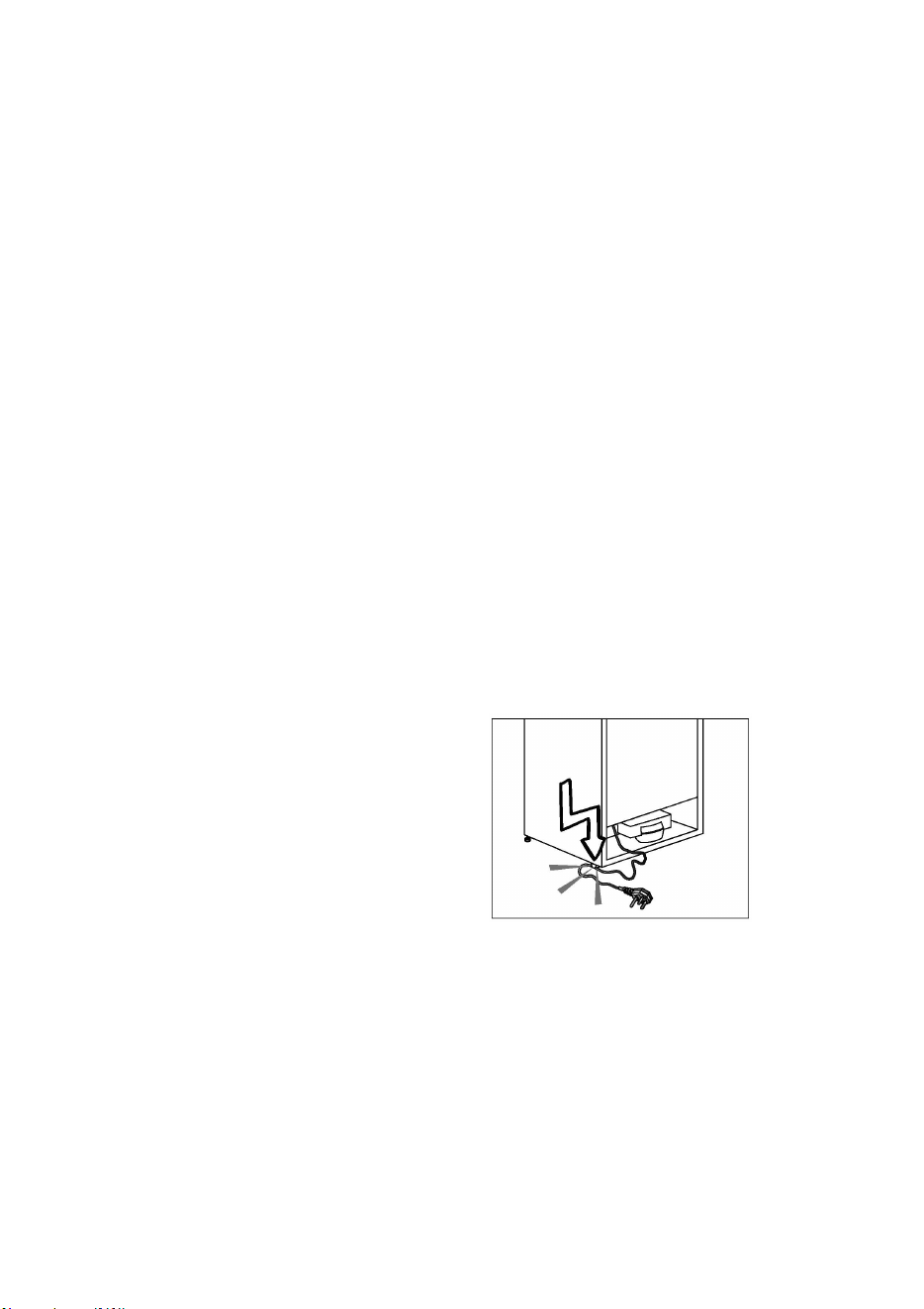
desligue a alimentação elétrica do seu
frigorífico, desligando o fusível
correspondente ou retirando a ficha da
tomada.
z Não puxe pelo cabo quando for retirar a
ficha da tomada.
zColoque as bebidas com teor alcoólico
mais elevado bem fechadas e na vertical.
z Nunca guarde latas de aerossol contendo
substâncias inflamáveis e explosivas no
frigorífico.
z Não utilize dispositivos mecânicos ou
outros para acelerar o processo de
descongelação. Siga apenas as instruções
recomendadas pelo fabricante.
z Este produto não se destina a ser usado
por pessoas com incapacidades físicas,
sensoriais ou mentais ou sem
conhecimento ou experiência (incluindo
crianças), a menos que sejam
supervisionadas por alguém responsável
pela sua segurança ou que as instrua sobre
o uso do produto.
z Não utilize um frigorífico avariado.
Consulte o agente autorizado se tiver
qualquer questão.
z A segurança elétrica do seu frigorífico
apenas poderá ser garantida se o sistema
de ligação à terra da sua casa estiver em
conformidade com as normas.
z A exposição do produto à chuva, neve,
sol e vento é perigosa no que se refere à
segurança elétrica.
z Para evitar qualquer perigo, contacte o
serviço de assistência autorizado se o cabo
elétrico estiver danificado.
z Nunca ligue o frigorífico à tomada de
parede durante a instalação.
Caso contrário, poderá ocorrer perigo de
morte ou ferimentos graves.
z Este frigorífico foi concebido
unicamente para guardar alimentos. Não
deverá ser utilizado para quaisquer
outros fins.
z A etiqueta das especificações técnicas
está localizada na parede esquerda no
interior do frigorífico.
z Nunca ligue o seu frigorífico a
sistemas de poupança de eletricidade,
pois podem danificá-lo.
z Se o frigorífico possuir uma luz azul,
não olhe para ela com dispositivos óticos.
z Para frigoríficos controlados
manualmente, aguarde pelo menos 5
minutos para voltar a ligar o aparelho
após uma falha elétrica.
z Este manual de instruções deverá ser
entregue ao novo proprietário do produto
quando for dado/vendido a outros.
z Evite causar danos no cabo elétrico
quando transportar o frigorífico. Dobrar o
cabo pode causar um incêndio. Nunca
pouse objetos pesados no cabo elétrico.
z Não toque na ficha com as mãos
molhadas quando a introduz na tomada
para ligar o produto.
z Não ligue o frigorífico à tomada, se a
tomada de parede estiver solta.
z Não deverá vaporizar água
diretamente nas partes interiores ou
exteriores do produto, por motivos de
segurança.
05 | PT
z Para evitar risco de incêndio e
explosão, não vaporize substâncias que
contenham gases inflamáveis, tais como
gás propano, etc., próximo do frigorífico.
z Não coloque recipientes que
contenham água sobre o topo do
frigorífico; em caso de derrame, tal poderá
resultar em choque elétrico ou incêndio.
z Não sobrecarregue o frigorífico com
excesso de alimentos. Se estiver
sobrecarregado, os alimentos podem cair
e feri
-lo a si e danificar o frigorífico ao abrir
a porta.
z Nunca coloque objetos no topo do
frigorífico, visto que estes podem cair
quando se abre ou fecha a porta do
mesmo.
z Como precisam de um controlo de
temperatura exata, as vacinas,
medicamentos sensíveis ao aquecimento,
materiais científicos, etc., não deverão ser
guardados no frigorífico.
z Se não for utilizado por um longo
período de tempo, o frigorífico deve ser
desligado da tomada. Qualquer possível
problema no cabo elétrico poderá resultar
em incênd
io.
z A extremidade da ficha elétrica deverá
ser limpa regularmente com um pano
seco; caso contrário, poderá provocar
incêndio.
z O frigorífico pode mover-se se os pés
não estiverem devidamente fixados ao
piso. O ajuste seguro e apropriado dos
pés ao piso impede que o frigorífico se
mova.
z Ao transportar o frigorífico, não o
segure pelo puxador da porta. Caso o
faça, ele poderá quebrar
-se.
z Se posicionar o seu frigorífico próximo
de outro frigorífico ou arca frigorífica, a
distância entre os aparelhos deve ser de,
pelo menos, 8 cm. Caso contrário, as
paredes laterais adjacentes podem
humedecer.
Segurança com crianças
z Se a porta possuir uma fechadura, a
chave deverá ser mantida afastada do
alcance das crianças.
z As crianças devem ser vigiadas para
impedir que brinquem com o produto.
Conformidade com a Diretiva
WEEE e Eliminação do Produto
O símbolo no produto ou na
embalagem indica que este produto não
pode ser tratado como lixo doméstico
normal. Ao contrário, deve ser
encaminhado para o ponto de recolha
aplicável para a reciclagem de
equipamentos elétricos e eletrónicos. Ao
assegurar que este equipamento seja
eliminado corretamente, ajudará a
prevenir potenciais efeitos negativos para
o meio ambiente e para a saúde humana
,
causados pela eliminação inadequada
deste produto. Para informações mais
detalhadas sobre a reciclagem deste
produto, contacte a câmara municipal
local, o serviço de recolha de lixo
doméstico ou a loja onde adquiriu o
produto.
Em conformidade com a Diretiva RSP:
O produto que comprou cumpre com a
Diretiva RoHS UE (2011/65/UE).
Não contém materiais nocivos e
proibidos especificados na Diretiva.
06 | PT

Informação sobre a embalagem
Os materiais de embalagem do produto
são fabricados a partir de materiais
recicláveis, de acordo com as nossas
Normas Ambientais Nacionais. Não elimine
os materiais de embalagem junto com o
lixo doméstico ou outro tipo de lixo.
Encaminhe
-os para um ponto de recolha
de materiais de embalagem indicado pelas
autoridades locais.
Não se esqueça!
Qualquer substância reciclada é uma
matéria indispensável para a natureza e
para o nosso património de recursos
nacionais.
Se quer contribuir para a reavaliação dos
materiais de embalagem, pode consultar
as suas organizações ambientalistas ou os
municípios da zona onde reside.
Aviso HCA
Se o sistema de arrefecimento do seu
prod
uto contém R600a:
Este gás é inflamável. Por isso, tenha
cuidado em não danificar o sistema de
arrefecimento e a tubagem durante o uso e
transporte. No caso de algum dano,
mantenha o seu produto longe de
potenciais fontes de fogo que possam
fazer com que o produto se incendeie e
ventile o compartimento no qual a unidade
está colocada.
O tipo de gás usado no produto está
indicado na etiqueta de características
localizada na parede esquerda no interior
do frigorífico.
Nunca elimine o seu produto no fogo.
O que se pode fazer para
economizar energia
z Não deixe as portas do seu frigorífico
abertas durante muito tempo.
z Não coloque alimentos ou bebidas
quentes no seu frigorífico.
z Não sobrecarregue o seu frigorífico
para que a circulação do ar no interior
não seja dificultada.
z Não instale o seu frigorífico sob a luz
solar direta ou próximo de aparelhos que
emitem calor, tais como fornos,
máquinas de lavar louça ou radiadores.
O seu frigorífico deverá ser instalado
com uma distância mínima de 30 cm de
quaisquer fontes de calor e, pelo menos,
a mais de 5 cm de fogões elétricos.
z Certifique-se de que mantém os seus
alimentos em recipientes fechad
os.
z Para produtos com um compartimento
de congelador; Pode armazenar uma
quantidade máxima de alimentos no
congelador se remover a prateleira ou
gaveta do congelador. O valor do
consumo de energia indicado no seu
frigorífico foi determinado removendo a
prateleira do congelador ou a gaveta e
com carga máxima. Não existe qualquer
risco em utilizar uma prateleira ou gaveta
de acordo com as formas e tamanhos
dos alimentos a serem congelados.
z Descongelar os alimentos congelados
no compartimento do frigorífico poupará
energia e preservará a qualidade dos
alimentos.
07 | PT
Instalação
3
No caso de a informação dada no
manual do utilizador não ser tida em
consideração, o fabricante não assumirá
qualquer responsabilidade por isso.
Pontos a ter em atenção ao
recolocar o frigorífico
1.
O seu frigorífico d
eve ser desligado.
Antes do transporte do seu frigorífico, ele
deverá ser esvaziado e limpo.
2.
Antes de o voltar a embalar, as
prateleiras, acessórios gaveta para frutos
e legumes, etc. que se encontram no
interior do seu frigorífico devem ser fixas
com f
ita adesiva e protegidas contra
impactos. A embalagem deve ser
fechada com uma fita grossa ou cordas
sólidas e devem ser rigorosamente
seguidas as regras de transporte da
embalagem.
3. A embalagem original e os materiais
de esponja deverão ser guardados para
transportes ou deslocações futuras.
Antes de colocar o frigorífico em
funcionamento,
Antes de iniciar a utilização do seu
frigorífico, verifique o seguinte:
1. Limpe o interior do frigorífico conforme
recomendado na secção "Manutenção e
limpeza".
2. Ligue a ficha do frigorífico à tomada da
parede. Quando a porta do frigorífico é
aberta, a luz interior acende
-se.
3.
Quando o compressor começa a
funcionar, ouvir
-se-
á um som. O líquido e
os gases no interior do sistema de
refrigeração também podem fazer algum
ruído, mesmo que o compressor não
esteja a funcionar, o que é perfeitamente
normal.
4.
As arestas da frente do frigorífico
podem ficar quentes. Isto é normal. Estas
arestas são projetadas para ficarem
quentes, a fim de evitar a condensação.
Ligação elétrica
Ligue o seu produto a uma tomada de
terra que esteja protegida por um fusível
com a capacidade apropriada.
Importante:
A ligação deve estar em concordância
com os regulamentos nacionais.
z A ficha de alimentação deverá estar
facilmente acessível após a instalação.
z A segurança elétrica do seu frigorífico
apenas poderá ser garantida se o
sistema de ligação à terra da sua casa
estiver em conformidade com as normas.
z A tensão indicada na etiqueta
localizada no lado esquerdo interior do
seu equipamento deve ser igual à tensão
da sua rede elétrica.
z Não devem ser usados cabos de
extensão e fichas multiusos para a
ligação.
Um cabo de alimentação danificado
deve ser substituído por um eletricista
qualificado.
O produto não deve ser utilizado
antes de ser reparado! Há risco de
choque elétrico!
Eliminação da embalagem
Os materiais de embalagem podem ser
perigosos para as crianças. Guarde os
materiais da embalagem fora do alcance
das crianças ou elimine-os, classificando-
os de acordo com as instruções sobre o
lixo determinadas pelas suas autoridades
locais. Não os deite fora juntamente com
o lixo doméstico, mas sim em locais de
recolha de embalagens designados pel
as
autoridades locais.
A embalagem do seu frigorífico é
produzida com materiais recicláveis.
08 | PT
Eliminação do seu frigorífico
velho
Elimine o seu frigorífico velho sem causar
qualquer perigo para o meio ambiente.
z Pode consultar o seu revendedor
autorizado ou o centro de recolha do lixo
do seu município a respeito da
eliminação do seu frigorífico.
Antes de se desfazer do seu frigorífico,
corte a ficha elétrica e, se houver trincos
nas portas, deixe
-os inutilizados, a fim de
proteger as crianças contra qualquer
perigo.
Colocação e instalação
Se a porta de entrada do
compartimento onde o frigorífico será
instalado não for suficientemente larga
para que ele passe, contacte o serviço de
assistência autorizado para que possam
remover as portas do seu frigorífico e
fazê
-lo passar de lado através da porta.
1. Instale o seu frigorífico num local que
permita fácil acesso.
2. Mantenha o seu frigorífico longe das
fontes de calor, lugares húmidos e luz
solar direta.
3.
Deve existir uma circulação de ar
adequada à volta do seu frigorífico, para
que obtenha um funcionamento eficiente.
Se o frigorífico for colocado numa
reentrância da parede, deve haver uma
distância mínima de 5 cm do teto e, pelo
menos, 5 cm da parede. Não coloque o
seu produto sobre materiais como
tapetes e carpetes.
4.
Coloque o seu frigorífico num
pavimento uniforme para evitar
solavancos.
Substituir a lâmpada de
iluminação
Para substituir a lâmpada utilizada para
a iluminação do seu frigorífico, contacte o
seu Serviço de Assistência Autorizado.
A(s) lâmpada(s) usada(s) neste aparelho
não é ou não são adequada(s) para a
iluminação do espaço. A finalidade desta
lâmpada é auxiliar o utilizador a colocar
produtos alimentares no
frigorífico/congelador, de uma forma
confortável e segura.
As lâmpadas usadas neste aparelho têm
de suportar condições físicas extremas,
tais como
temperaturas abaixo de -20ºC.
Ajuste dos pés
Se o seu frigorífico estiver desnivelado;
Pode nivelar o seu frigorífico rodando os
seus pés frontais conforme ilustrado na
figura. O canto onde está o pé é baixado
quando roda na direção da seta preta e
lev
antado quando roda na direção
oposta. Peça ajuda a alguém para erguer
ligeiramente o frigorífico, facilitará este
processo.
09 | PT
Preparação
4
z O seu frigorífico deverá ser instalado a
uma distância mínima de 30 cm de
quaisquer fontes de calor, tais
como
placas, fornos, aquecimento central e
fogões, e de 5 cm de fornos elétricos, e
não deverá ficar exposto diretamente à
luz solar.
z
A temperatura ambiente da onde
instalar o seu frigorífico não deve ser
inferior a 10 ºC. Utilizar o seu frigorífico
em condições de temperatura mais
baixas não é recomendado tendo em
vista a sua eficiência.
z Certifique
-
se de que o interior do seu
frigorífico é cuidadosamente limpo.
z Se forem instalados dois frigoríficos
lado a lado, deverá existir uma distância
míni
ma de 2 cm entre eles.
z Quando utilizar o seu frigorífico pela
primeira vez, cumpra as seguintes
instruções durante as seis horas iniciais.
z A porta não deverá ser aberta
frequentemente.
z Deve começar a funcionar vazio, sem
alimentos no interior.
z Não retire a ficha da tomada do seu
frigorífico. No caso de uma falha de
energia inesperada, consulte os avisos
na secção "Soluções recomendadas para
os problemas".
z A embalagem original e os materiais de
esponja deverão ser guardados para
transportes ou
deslocações futuras.
10 | PT
Utilizar o seu frigorífico
5
Botão de ajuste do termóstato
A temperatura interior do seu frigorífico
altera
-se pelas seguintes razões:
• Temperaturas sazonais,
• Abertura frequente da porta e deixar
porta aberta durante longos períodos,
• Alimentos guardados no frigorífico sem
que estejam arrefecidos até a
temperatura ambiente,
• A localização do frigorífico na divisão
da casa (por exemplo: exposição à luz
solar).
• Deve ajustar a variação da temperatura
interior devido a esses motivos, usando
o termóstato.
As temperaturas de funcionamento são
controladas pelo botão do termóstato e
podem ser definidas em qualquer
posição entre 0 e 5 (a posição mais fria).
A temperatura média dentro do frigorífico
deve ser cerca de +5°
C (+41°F).
Assim, ajuste o termóstato para obter a
temperatura pretendida. Algumas
secções do frigorífico podem estar mais
frias ou mais quentes (tal como a gaveta
das saladas e a parte superior do
exterior frigorífico), o que é
perfeitamente normal. Recomendamos
que verifique periodicamente a
temperatura com um termómetro, para
garantir que o frigorífico se mantém à
temperatura pretendida. Como as
aberturas frequentes da porta causam o
aumento da temperatura interior,
recomendamos que a feche logo após a
utilização.
Descongelar
A) Compartimento do frigorífico
O compartimento do frigorífico
descongela
-se automaticamente. A água
da descongelação circula até ao tubo de
drenagem através de recipiente
colocado na parte posterior do frigorífico.
Durante a desc
ongelação, podem-se
formar gotas de água na parte posterior
do frigorífico onde se encontra o
evaporador. Algumas gotas podem
permanecer no interior e recongelar
depois da descongelação estar
terminada. Não utilize objectos
pontiagudos, como facas ou garfos, para
remover as gotas que tenham
recongelado.
Se, em qualquer momento, a água da
descongelação não circular pelo canal
de recolha, verifique se o tubo de
drenagem não está obstruído com
partículas de alimentos.O tubo de
drenagem pode ser limpo com um
es
covilhão adequado ou objecto
semelhante.
B) Compartimento do congelador
A descongelação é um processo muito
fácil e sem dificuldades, devido a um
recipiente especial para recolha da água
de descongelação.
Faça a descongelação duas vezes por
ano ou quando s
e tiver formado uma
camada de gelo com, aproximadamente,
7 mm. Para iniciar o procedimento de
descongelação, desligue o frigorífico
retirando a ficha da tomada de parede.
Todos os alimentos devem envolvidos
em várias camadas de jornal e
guardados num local
fresco (por
exemplo, um frigorífico ou despensa).
Para acelerar a descongelação, podem
ser colocados cuidadosamente
recipientes com água quente.
Não utilize objectos pontiagudos, como
facas ou garfos, para remover o gelo.
11 | PT

z Para obter os melhores resultados,
tenha em conta as instruções a seguir
apresentadas.
1. Não congele grandes quantidades de
alimentos de uma só vez. A qualidade
dos alimentos é melhor preservada
quando a congelação atinge o interior no
meno
r tempo possível.
2. Tenha um cuidado especial para não
misturar alimentos já congelados com
alimentos frescos.
3.
Certifique-se de que os alimentos crus
não estão em
contacto com alimentos cozinhados no
frigorífico.
4. O volume máximo de armazenamento
de alimentos congelados é atingido sem
usar as gavetas localizadas no
compartimento do congelador.
5.
É recomendado que coloque os
alimentos na prateleira superior do
congelador para uma congelação inicial.
Para efectuar a descongelação, nunca
utilize secadores de cabelo, aquecedores
ou outros aparelhos eléctricos.
Com a ajuda de uma esponja, limpe a
água depositada na parte inferior do
compartimento do congelador. Após a
descongelação, seque completamente o
interior. Insira a ficha na tomada de parede
e ligue o interruptor.
Congelar alimentos frescos
z Envolva ou cubra os alimentos antes de
colocá
-los no frigorífico.
z Os alimentos quentes devem ser
arrefecidos à temperatura ambiente antes
de serem colocados no frigorífico.
z Os alimentos que pretende congelar
devem ser frescos e de boa qualidade.
z Os alimentos devem estar repartidos em
porções de acordo com o quotidiano
familiar ou as necessidades de consumo
de refeições.
z Os alimentos deverão ser embalados de
uma forma he
rmética para evitar que
sequem, mesmo que venham a ser
guardados durante pouco tempo.
z Os materiais a serem utilizados para
embalar os alimentos deverão resistentes
ao frio e à humidade e também devem ser
herméticos. O material das embalagens
dos alimentos deve ser durável e ter uma
espessura suficiente. Caso contrário, os
alimentos congelados podem perfurar a
embalagem. É importante que a
embalagem fique devidamente fechada
para garantir o armazenamento seguro
dos alimentos.
z Os alimentos congelados deverão ser
usados imediatamente depois de serem
descongelados e nunca deverão ser
congelados de novo.
z A colocação de alimentos quentes no
compartimento do congelador obriga o
sistema de refrigeração a um
funcionamento contínuo até à completa
congelação dos
alimentos.
12 | PT
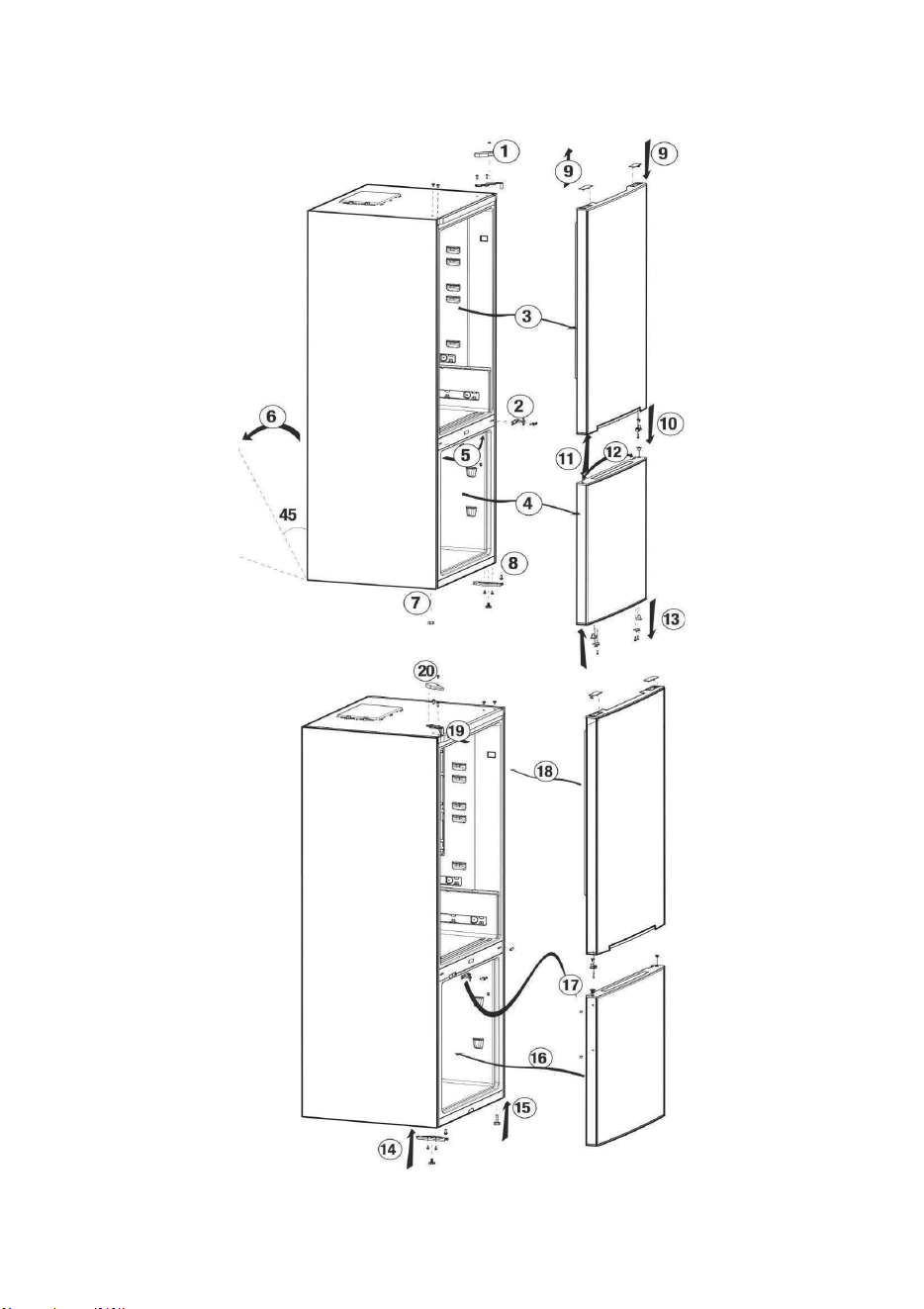
Inverter as portas
Proceda em ordem
numérica
13 | PT
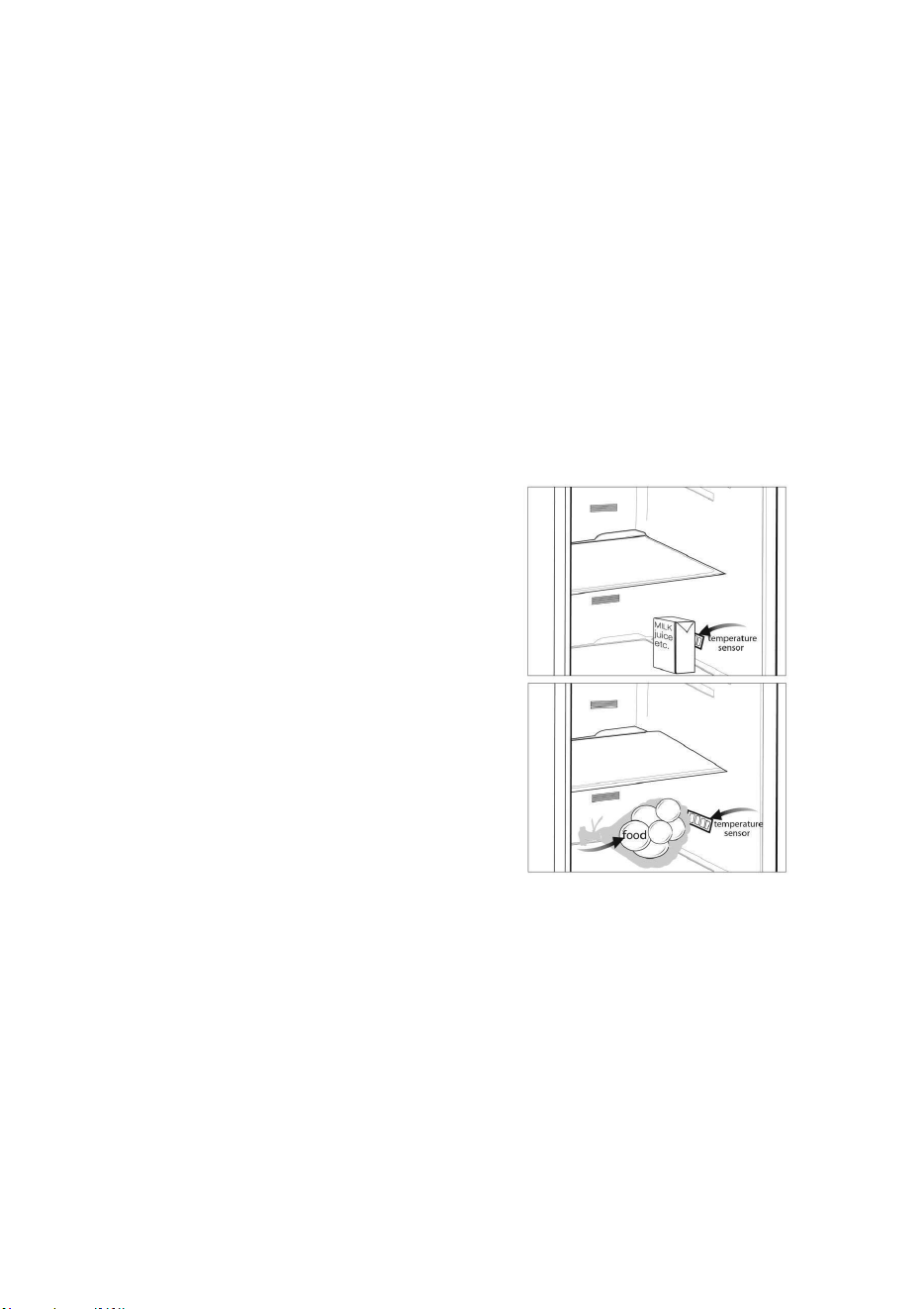
Recomendação para a
preservação de alimentos
congelados
z Os alimentos embalados pré
-
congelados devem ser armazenados de
acordo com as instruções do fabricante do
alimento num compartimento de
armazenamento de alimentos congelados.
z P
ara garantir que a alta qualidade
fornecida pelo fabricante e revendedor de
alimentos congelados seja mantida,
deverão ser observados os pontos
seguintes:
1. Coloque as embalagens no congelador
o mais rapidamente possível após a
aquisição.
2.
Certifique-
se de que o conteúdo das
embalagens se encontra etiquetado e
datado.
3. Não ultrapasse as datas de validade
mencionadas nas embalagens.
Recomendações para o
compartimento de alimentos
frescos
*opcional
zNão permita que os alimentos
toquem no sensor de temperatura no
compartimento dos alimentos
frescos. Para permitir que o
compartimento de alimentos frescos
mantenha a sua temperatura de
armazenamento ideal, o sensor não
pode ser obstruído pelos alimentos.
z Não coloque alimentos quentes no
seu equipament
o.
14 | PT
Manutenção e limpeza
6
Nunca utilize agentes de limpeza ou
água que contenha cloro para limpar as
superfícies externas e as partes
cromadas do produto. O cloro provoca a
corrosão de tais superfícies metálicas.
Proteção das superfícies
plásticas
Não coloque óleos líquidos ou
alimentos cozinhadas em óleo no seu
frigorífico, em recipientes abertos, já que
podem danificar as superfícies plásticas
do seu frigorífico. No caso de derrame
ou salpicos de óleo nas superfícies
plásticas, limpe e enxague a parte
correspondente da superfície com água
morna.
Nunca use gasolina, benzeno ou
substâncias semelhantes para a
limpeza.
Recomendamos que desligue a ficha do
equipamento da tomada antes da
limpeza.
Nunca utilize na limpeza objetos
abrasivos ou pontiagudos, sabões,
produtos de limpeza doméstica,
detergentes ou ceras abrilhantadoras.
Utilize água morna para limpar o
exterior do seu frigorífico e seque-
o com
um pano.
Utilize um pano humedecido numa
solução composta por uma colher de
chá de bicarbonato de s
oda dissolvido
em cerca de meio litro de água para
limpar o interior e depois seque-o.
Certifique-
se de que não entra água no
compartimento da lâmpada e nos outros
itens elétricos.
Se o seu frigorífico não for utilizado
durante um longo período de
tempo,
remova o cabo de alimentação, retire
todos os alimentos, limpe-
o e deixe a
porta entreaberta.
Verifique regularmente as borrachas
vedantes da porta, para se assegurar
que estão limpas e sem restos de
alimentos.
Para remover os suportes da porta,
retire todo o seu conteúdo e, em
seguida, basta empurrar
cuidadosamente o seu suporte para
cima a partir da base.
15 | PT
Resolução de problemas
7
O frigorífico não funciona.
• A ficha não está corretamente introduzida na tomada. >>> Introduza a ficha na tomada
de forma segura.
• O fusível da tomada à qual o frigorífico está ligado ou o fusível principal está
queimado. >>> Verifique o fusível.
Condensação na parede lateral do compartimento do frigorífico (MULTIZONA,
CONTROLO DE FRIO e ZONA FLEXI).
• O ambiente está muito frio. >>>Não instale o frigorífico em locais onde a temperatura
desça abaixo dos 10°C.
• A porta foi aberta frequentemente. >>>Não abra e feche frequentemente a porta do
frigorífico.
• O ambiente está muito húmido. >>>Não instale o
seu frigorífico em locais muito
húmidos.
• Os alimentos que contêm líquidos foram guardados em recipientes abertos. >>>Não
guarde alimentos que contêm líquidos em recipientes abertos.
• A porta do frigorífico foi deixada entreaberta. >>> Feche a porta do
frigorífico.
• O termóstato está ajustado para um nível muito frio. >>> Coloque o termóstato a um
nível adequado.
O compressor não está a funcionar
• A proteção térmica do compressor deixará de funcionar durante falhas elétricas
repentinas ou quando se retira ou coloca a ficha elétrica, já que a pressão refrigerante
no sistema de arrefecimento do frigorífico ainda não se encontra estabilizada. O
frigorífico voltará a funcionar aproximadamente 6 minutos depois. Contacte o serviço de
assistência se o frigo
rífico não começar a funcionar no fim deste período.
• O frigorífico está no ciclo de descongelação. >>>Isto é normal num frigorífico de
descongelação totalmente automática. O ciclo de descongelação ocorre periodicamente.
• O frigorífico não está ligado à
tomada. >>>Certifique-
se de que a ficha está encaixada
na tomada.
• As definições de temperatura não foram corretamente efetuadas. >>> Selecione um
valor de temperatura adequada.
• Houve um corte de corrente. >>>O frigorífico voltará ao funcionamento normal quando
a energia for restabelecida.
O ruído de funcionamento aumenta quando o frigorífico está a funcionar.
• O desempenho de funcionamento do frigorífico pode variar devido às alterações na
temperatura ambiente. Isso é normal e não é uma falha.
Reveja esta lista antes de contactar o serviço de assistência. Isso poupará o seu tempo
e dinheiro. Esta lista abrange as reclamações frequentes resultantes de defeitos de
fabrico ou utilização do material. Algumas das funções descritas aqui podem não existir
no seu produto.
16 | PT
O frigorífico está a funcionar frequentemente ou durante um longo período de
tempo.
• O novo produto poderá ser mais largo do que o anterior. Os frigoríficos maiores
operam por um período maior de tem
po.
• A temperatura do local poderá estar muito alta. >>>É normal que o produto funcione
durante longos períodos num ambiente quente.
• O frigorífico foi ligado à tomada há pouco tempo ou carregado com alimentos.
>>>Quando o frigorífico foi ligado ou foi c
arregado com alimentos recentemente,
demorará mais tempo a atingir a temperatura definida. Isto é normal.
• Podem ter sido colocadas recentemente grandes quantidades de alimentos quentes
no frigorífico. >>>Não coloque alimentos quentes no frigorífico.
•Asportas podem ter sido abertas frequentemente ou deixadas entreabertas durante
muito tempo. >>>O ar quente que entrou no frigorífico faz com que o mesmo tenha que
funcionar por períodos mais longos. Não abra frequentemente as portas.
• A porta do compartim
ento do frigorífico ou do congelador pode ter sido deixada
entreaberta.>>> Verifique se as portas estão completamente fechadas.
• O frigorífico está ajustado para uma temperatura muito baixa. >>>Ajuste a temperatura
do frigorífico para um grau mais quente e aguarde até que a temperatura seja atingida.
• O vedante da porta do frigorífico ou do congelador pode estar sujo, gasto, roto ou não
ajustado corretamente. >>> Limpe ou substitua o vedante. O vedante danificado/roto faz
com que o frigorífico funcione po
r um período de tempo maior para manter a
temperatura atual.
A temperatura do congelador está muito baixa, enquanto que a temperatura do
frigorífico é suficiente.
• A temperatura do congelador está ajustada para um valor muito baixo.>>>Ajuste a
temperatura do congelador para um grau mais quente e verifique.
A temperatura do frigorífico está muito baixa, enquanto que a temperatura do
congelador é suficiente.
• A temperatura do frigorífico está ajustada para um valor muito baixo.>>>Ajuste a
temperatura do frigorífico para um grau mais quente e verifique.
Os alimentos guardados nas gavetas do compartimento do frigorífico estão
congelados.
• A temperatura do frigorífico está ajustada para um valor muito alto.>>>Ajuste a
temperatura do frigorífico para um grau mais baixo e verifique.
A temperatura no frigorífico ou no congelador é muito alta.
• A temperatura do frigorífico está ajustada para um valor muito alto.>>>A definição da
temperatura do compartimento do frigorífico tem efeito sobre a temperatura do
congelador. Altere a temperatura do frigorífico ou do congelador e espere até que os
compartimentos relevantes atinjam a temperatura suficiente.
• As portas são abertas frequentemente ou foram deixadas entreabertas durante muito
tempo. >>> Não abra as port
as frequentemente.
• A porta está entreaberta. >>> Feche a porta completamente.
• O frigorífico foi ligado ou foi carregado recentemente com alimentos. >>> Isto é
normal.
Quando o frigorífico é ligado ou carregado com alimentos recentemente, demorará
basta
nte tempo para que atinja a temperatura definida.
• Podem ter sido colocadas recentemente grandes quantidades de alimentos quentes
no frigorífico. >>>Não coloque alimentos quentes no frigorífico.
17 | PT
Vibrações ou ruído.
• O chão não está nivelado ou não é estável. >>>Se o frigorífico balança quando é
movido lentamente, equilibre
-o ajustando os respetivos pés. Certifique-
se também de
que o pavimento é suficientemente forte para suportar o frigorífico e nivelado.
• Os artigos colocados sobre o frigo
rífico poderão provocar ruídos. >>> Remova os
objetos colocados em cima do frigorífico.
Há ruídos que surgem do frigorífico, como líquidos a correr ou a gotejar, etc.
• Os fluxos de gás e líquidos acontecem de acordo com os princípios de funcionamento
do seu frigorífico. Isso é normal e não é uma falha.
O frigorífico faz um assobio.
• São utilizadas ventoinhas para arrefecer o frigorífico. Isso é normal e não é uma falha.
Condensação nas paredes internas do frigorífico.
• O tempo quente e húmido aumenta a formação de gelo e de condensação. Isso é
normal e não é uma falha.
• As portas são abertas frequentemente ou foram deixadas entreabertas durante muito
tempo. >>> Não abra as portas frequentemente. Feche
-as se estiverem abertas.
• A porta está entreaberta. >>> Feche a porta completamente.
Há ocorrência de humidade no exterior do frigorífico ou entre as portas.
• Poderá existir humidade no ar; isto é bastante normal no tempo húmido. Quando a
humidade for menor, a condensação irá desaparecer.
Maus odores dentro do frigorífico.
• Não tem sido realizada uma limpeza regular. >>>Limpe regularmente o interior do
frigorífico com uma esponja, água morna ou carbonato dissolvido em água.
• Alguns recipientes ou materiais de embalagem poderão provocar o cheiro.
>>> Use
um recipiente diferente ou uma marca diferente de material de embalagem.
• Os alimentos são colocados no frigorífico em recipientes não tapados. >>>Mantenha
os alimentos em recipientes fechados. Os microrganismos que se propagam a partir de
recipi
entes não tapados poderão provocar odores desagradáveis.
• Retire do frigorífico os alimentos que atingiram as datas de validade e que se
estragaram.
A porta não fecha.
• As embalagens dos alimentos impedem que a porta feche. >>> Recoloque as
embalagens
que estão a obstruir a porta.
• O frigorífico não está totalmente nivelado sobre o pavimento.>>> Ajuste os pés para
equilibrar o frigorífico.
• O chão não está nivelado ou não é suficientemente forte. >>>Certifique
-
se de que o
piso está nivelado e que é capaz de suportar o frigorífico.
As gavetas para vegetais e fruta estão bloqueadas.
• Os alimentos estão a tocar no teto da gaveta. >>> Reorganize os alimentos dentro da
gaveta.
18 | PT
ISENÇÃO DE RESPONSABILIDADE / ADVERTÊNCIA
Algumas falhas (simples) podem ser tratadas de forma adequada pelo utilizador final
sem que surja qualquer problema de segurança ou de utilizao no segura, desde que
as mesmas sejam solucionadas dentro dos limites e de acordo com as seguintes
instruções consultar a seco “Reparao Autónoma”.
Portanto, exceto se contrariamente autorizado na seco “Reparao Autónoma” abaixo,
as reparaes devem ser realizadas por profissionais reparadores registados de modo
a evitar problemas de segurança. Um reparador profissional registado um reparador
profissional a quem o fabricante concedeu acesso s instrues e lista de peas de
substituio deste produto de acordo com os mtodos descritos na lei nos termos da
Diretiva 2009/125/CE.
No entanto, apenas o agente de reparação (ou seja, os reparadores
profissionais autorizados) com quem pode entrar em contacto através do
número de telefone fornecido no manual do utilizador/cartão da garantia ou
através do seu revendedor autorizado que pode fornecer serviços de acordo
com os termos de garantia. Portanto, deve estar ciente de que as reparações
feitas por reparadores profissionais (não autorizados por fabricante/vendedor)
anulam a garantia.
Reparação Autónoma
A reparação autónoma pode ser feita pelo utilizador final em relação à seguintes
peças de substituição: porta, manípulos, dobradiças das portas, tabuleiros, cestos e
vedantes da porta (é disponibilizada uma lista atualizada em web a partir de 1 de
março de 2021).
Além disso, para garantir a segurança do produto e evitar o risco de ferimentos
graves, a reparação autónoma referida deve ser feita seguindo as instruções do
manual do utilizador para reparação autónoma ou as que estão disponíveis em web.
Para sua segurança, deve desligar o produto antes de tentar fazer qualquer
reparação autónoma.
As tentativas de reparação feitas pelos utilizadores finais de peças não incluídas na
referida lista e/ou não seguindo as instruções nos manuais do utilizador
relativamente à mesma ou que se encontram disponíveis em web, podem levantar
questões de segurança não atribuíveis a fabricante/vendedor, e anularão a garantia
do produto.
Portanto, é altamente recomendável que os utilizadores finais evitem tentar realizar
reparações que não se enquadrem na lista mencionada de peças de substituição, e
nesse caso deverão contactar com reparadores profissionais autorizados ou
reparadores profissionais registados. Por outro lado, as referidas tentativas por parte
dos utilizadores finais podem provocar problemas de segurança e danificar o produto
e, subsequentemente, provocar incêndio, inundação, eletrocussão e ferimentos
graves. Por exemplo, mas não limitado a, as seguintes reparações devem ser
realizadas por Reparadores profissionais autorizados ou registados: compressor,
circuito de refrigeração, placa de circuitos, placa do inversor, placa do visor, etc.
O fabricante/vendedor não pode ser responsabilizado em circunstâncias em que os
utilizadores finais não cumpram com o acima referido.




4579330522 / AA
EN,PT