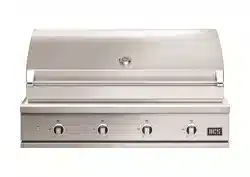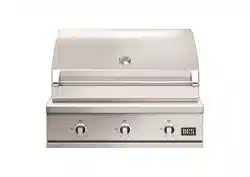

USER GUIDE
US CA
OUTDOOR GRILL
BE1-48RCI-N, BE1-48RCI-L, BE1-48RC-N, BE1-48RC-L,
BE1-36RCI-N, BE1-36RCI-L, BE1-36RC-N, BE1-36RC-L,
BE1-48C-N, BE1-48C-L, BE1-36C-N and BE1-36C-L
models
DANGER
IF YOU SMELL GAS
• Shut off gas to the appliance.
• Extinguish any open flame.
• Open lid.
• If odor continues, keep away from
the appliance and immediately
call your gas supplier or your fire
department.
WARNING!
• Do not store or use gasoline or
other flammable liquids or vapors
in the vicinity of this or any other
appliance.
• An LP cylinder not connected
for use must not be stored in
the vicinity of this or any other
appliance.

3
CONTENTS
Safety and warnings 4
Installation requirements for Natural Gas 12
Product overview 13
Control panel 14
Planning your cook 15
Setting up the grill 17
Using the grill 18
Using the sear burner (some models only) 19
Using the grates 21
Using the charcoal insert 23
Using the rotisserie (some models only) 25
Using the multi-tool 28
Accessories 29
Cleaning 30
Cleaning the grill burners 31
Cleaning the sear burner 32
Leak testing 34
Changing the gas cylinder 35
Replacing the lights 36
Resetting flow limiting device 37
Troubleshooting 38
Customer care 40
Registration
To register your product visit our website:
USA: dcsappliances.com/us/register
Canada: dcsappliances.com/ca/register
4
SAFETY AND WARNINGS
To reduce the risk of fire, electrical shock, injury to persons, or damage when using the
appliance, follow the important safety instructions listed below:
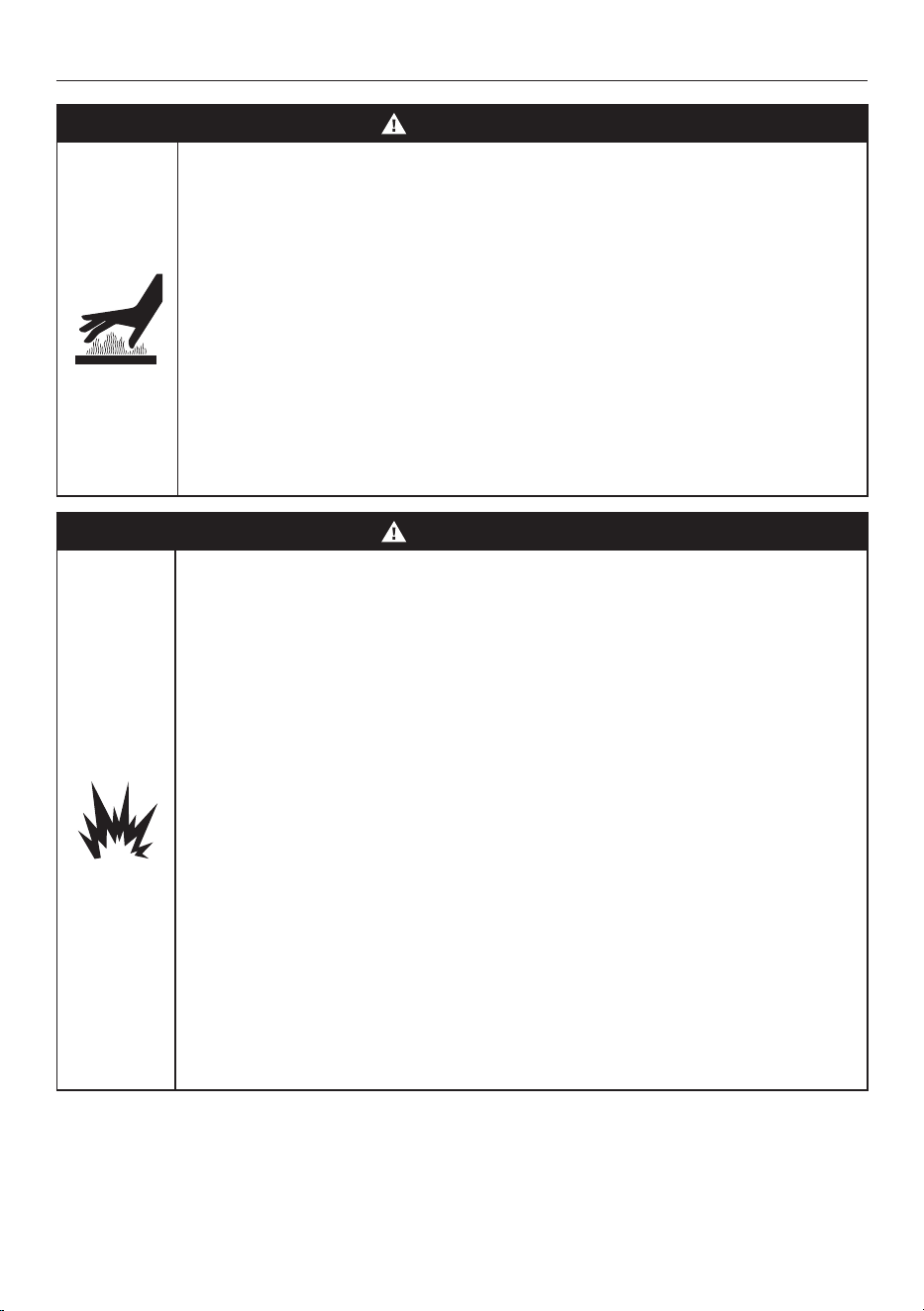
WARNING!
Hot Surface Hazard
Failure to follow this advice may result in
burns and scalds or serious injury.
• Accessible parts may become hot during use.
• Hood must be opened before lighting the grill.
• Never let clothing or other flammable materials
come in contact with or get too close to
any grate, burner or hot surface until it has
cooled. Fabric may ignite and result in fire
or personal injury. Keep outdoor cooking gas
appliance area clear and free from combustible
materials, gasoline and other flammable vapours
and liquids.
• Never lean over an open grill. When lighting a
burner, always pay close attention to what you
are doing. Be certain you are pushing the burner
knob when you attempt to light the grill.
• When using the grill, do not touch surfaces such
as grill burner, grate, or immediate surrounding
areas as these become extremely hot and could
cause burns.
• Grease is flammable. Never operate the grill
without a drip tray. Let hot grease cool before
attempting to handle it. Avoid letting grease
deposits collect in the drip pan. Clean the grill
with caution. Avoid steam burns; do not use a
wet sponge or cloth to clean the grill while it is
hot. Some cleaners produce noxious fumes or
can ignite if applied to a hot surface.
5
WARNING!
Hot Surface Hazard
Failure to follow this advice may result in
burns and scalds or serious injury.
• Use only dry pot-holders; moist or damp pot-
holders on hot surfaces may cause burns from
steam. Do not use a towel or bulky cloth in
place of pot-holders. Do not let pot-holders
touch hot portions of the grill or burner grate.
• To avoid burns when cooking, use long handled
BBQ tools.
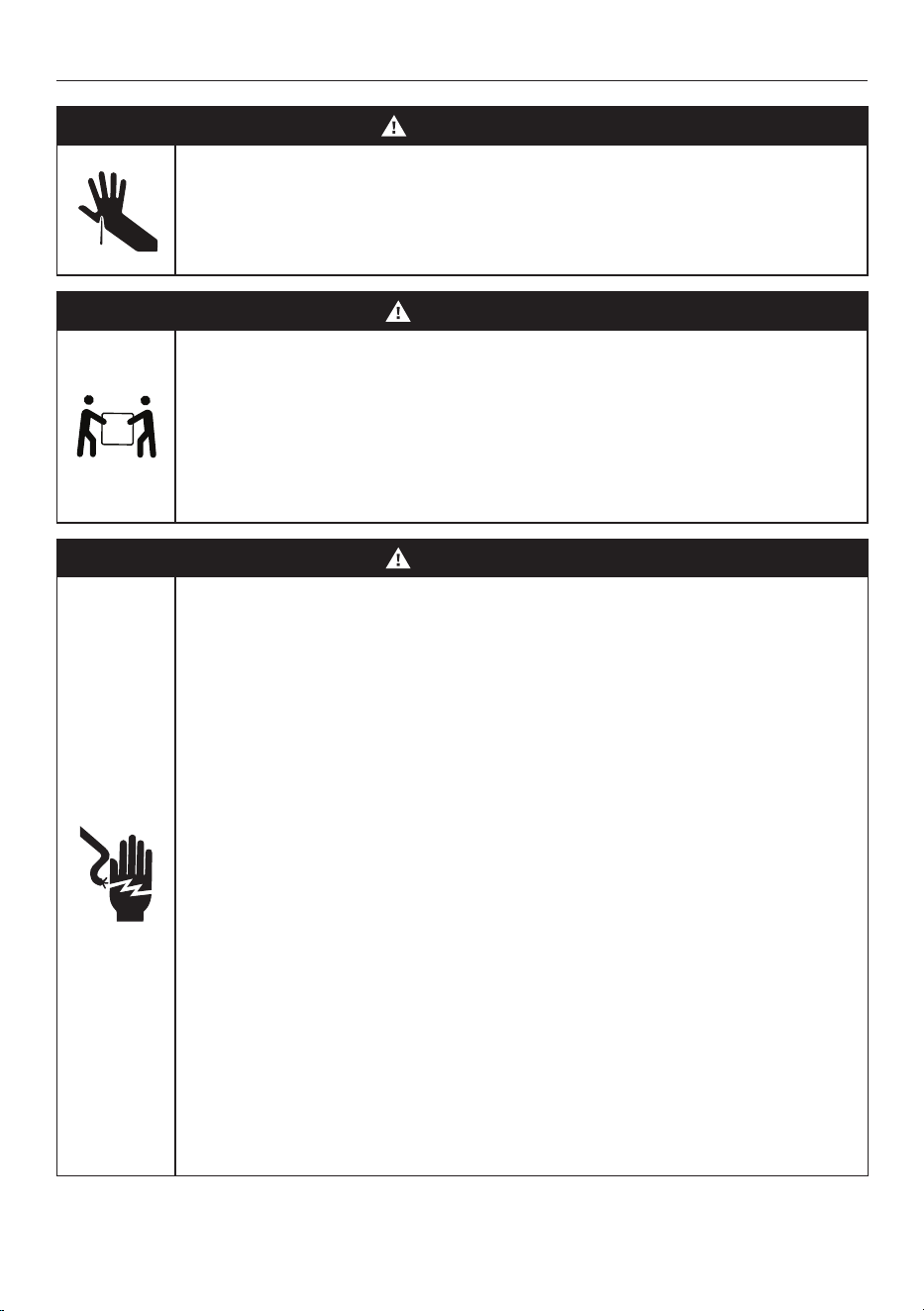
WARNING!
Explosion Hazard
Failure to follow this advice may result in
injury or death.
• If you smell gas, do not use the appliance.
• Do not use water on grease fires, a violent steam
explosion may result. Turn all burners off, then
smother fire use dry chemical or foam-type
extinguisher.
• Do not heat unopened food containers such as
cans – Build up of pressure may cause container
to burst and result in injury.
• Leaking LP gas can cause a fire or explosion if
ignited causing serious bodily injury or death.
• Contact LP gas supplier for repairs or disposal
of the cylinder or unused LP gas.
SAFETY AND WARNINGS
6
SAFETY AND WARNINGS
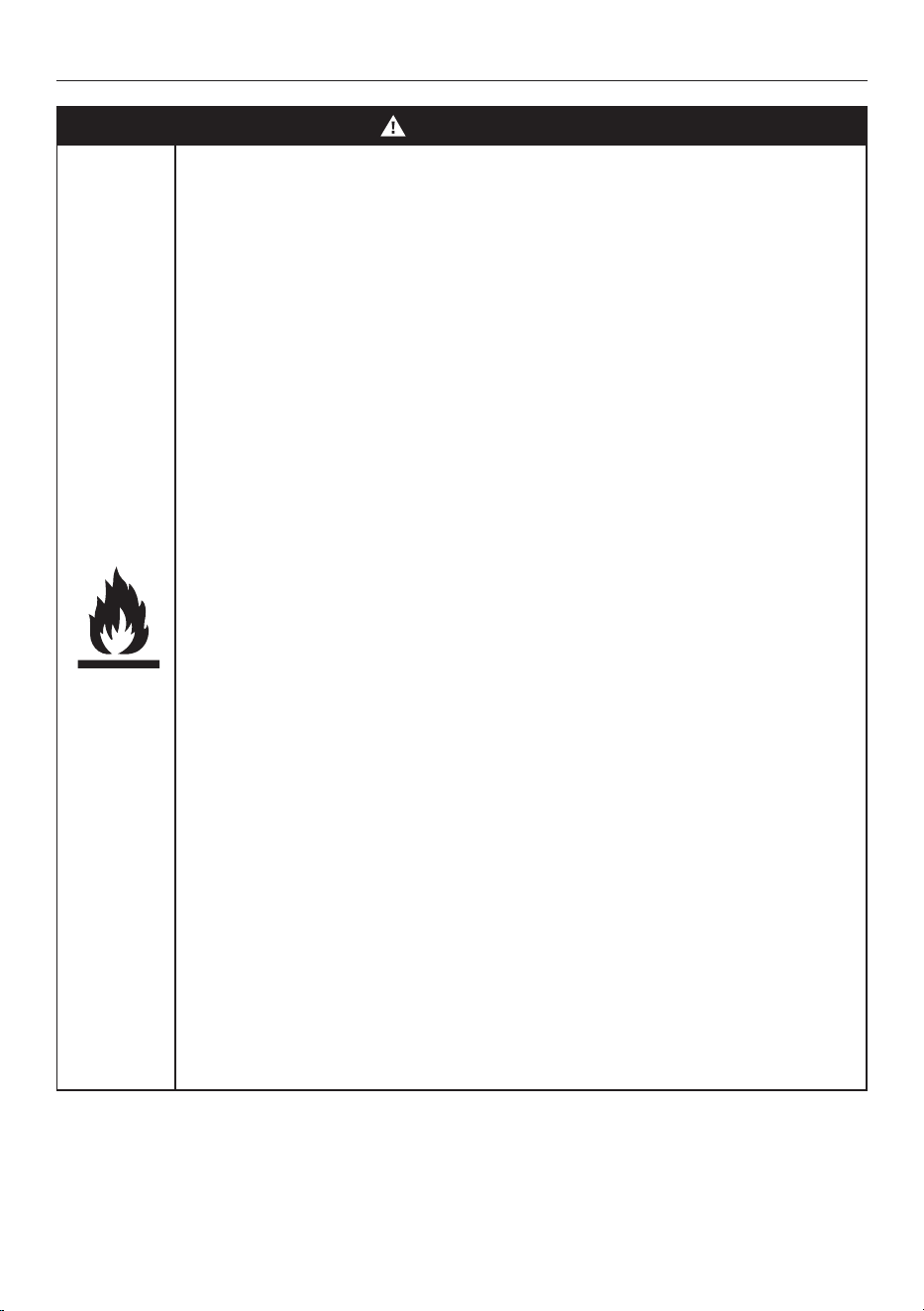
WARNING!
Cut Hazard
Failure to use caution could result in injury.
• Take care: some edges are sharp.
WARNING
Excessive Weight Hazard
Failure to follow this advice may result in
injury or death.
• Two or more people are required to move and
install this unit.
WARNING
Electrical Shock Hazard
Failure to follow this advice may result in
death or electrical shock.
• This appliance is equipped with a three-prong
grounding plug for your protection against
shock hazard and should be plugged directly
into a properly grounded power outlet.
• Use only a Ground Fault Interrupter (GFI)
protected circuit.
• Use only extension cords with a three-prong
grounding plug, rated for the power of the
equipment, and approved for outdoor use with a
W-A marking.
• Do not immerse cord or plugs in water or other
liquid.
• Do not under any circumstances cut or remove
the grounding prong from this plug.
7
SAFETY AND WARNINGS
WARNING!
Fire Hazard
Failure to follow this advice may result in
death or serious injury.
• Do not operate the grill under un protected
combustible construction. Use only in well
ventilated areas.
• Cylinders shall be stored outdoors and out of
the reach of children.
• Do not store in a building, garage or any other
enclosed area.
• An appliance is considered to be outdoors if
installed with shelter no more inclusive than
within a partial enclosure that includes an
overhead cover and three side walls, as long as
30% or more of the periphery of the enclosure is
permanently open.
• All openings must be permanently open; sliding
doors, garage doors, windows, or screened
openings are not considered as permanent
openings
• Never leave the grill unattended when in use.
• Never store a spare LP cylinder under or near
this unit.
• Never fill the cylinder beyond 80 percent full.
• If the information above is not followed
exactly, a fire causing death or serious injury
could occur.

8
To reduce the risk of fire, injury to persons or damage when using the appliance,
follow the important safety instructions listed below. Read all the guidance before
using the appliance. Do not use an outdoor cooking gas appliance for purposes
other than intended.
General Use
z
When using the appliance, be sure that all parts of the unit are firmly in place and that
everything is stable.
z
Do not locate, store, or operate the appliance on a slope.
z
Do not move the appliance during use. On cart mounted units, never move cart without
first allowing the appliance to cool, disconnecting the power cable, and ensuring that
the gas supply is turned off.
z
Children should not be left alone or unattended in an area where the product is being
used. Never allow them to sit, stand or play on or around the unit at any time. When in
use, portions of the grill are hot enough to cause severe burns.
z
Do not store items of interest to children around or below the appliance.
z
Never use the appliance in a windy area.
z
Do not obstruct the flow of combustion and ventilation air to the appliance.
z
To put out flare-ups, adjust the controls to lower the temperature.
z
Clean and perform general maintenance on the appliance regularly and after periods
without use. Always turn off gas at the source prior to inspecting.
z
Ensure all grill controls are turned off and the grill is cool before using any type of
aerosol cleaner on or around the grill. The chemical that produces the spraying action
could, in the presence of heat, ignite or cause metal parts to corrode.
z
Unplug from the outlet when not in use and before cleaning. Allow to cool before
putting on or taking off parts.
z
Before each use, inspect the gas supply piping or hose prior to turning the gas “ON”. If
there is evidence of cuts, wear, or abrasion, it must be replaced prior to use.
z
You must inspect the unit at least once a year. Check immediately if the smell of gas is
present or the burner flames appear yellow, the appliance does not reach temperature
or heats unevenly, or the unit makes popping noises.
z
When refitting each burner after cleaning, correctly center the burner onto the gas jet
and ensure it is level before lighting.
z
When connecting to a power supply, first connect plug to the appliance, then plug
appliance into the outlet.
z
Do not try lighting this appliance without reading the lighting instructions in this guide.
z
After lighting burners, make sure burners are operating normally. In sunny locations, it
may be difficult to see when the rotisserie and sear burners are lit. Use caution.
z
The sear burner is designed specifically for searing food. Do not use the griddle plate
or charcoal insert over the sear burner or cover it with any utensil type.
z
Do not place griddle plates side by side on the grill.
z
Do not operate in enclosed areas. This could result in carbon monoxide build-up which
could result in injury or death.
z
This product must be installed by a licensed plumber or gas fitter when installed within
the Commonwealth of Massachusetts.
SAFETY AND WARNINGS

9
SAFETY AND WARNINGS
Fire
z
Have an ABC rated fire extinguisher accessible – never attempt to extinguish a grease
fire with water or other liquids.
z
Never leave the product unattended when in use.
z
Always remove dust cover and open hood before lighting. Do not replace cover during
cooking or before appliance has cooled.
z
Do not use a flame to check for gas leaks.
z
Do not smoke while leak testing.
z
Do not attempt to disconnect any gas connections while your appliance is in use, or the
gas supply is on.
z
Never connect an unregulated gas line to the appliance.
Electrical Hazards
z
Do not operate with a damaged cord or plug, after the appliance malfunctions or after
the appliance has been damaged in any manner. Contact the manufacturer for repair.
z
Keep any electrical supply cord, the rotisserie motor cord and the fuel supply
hose away from the heated areas of the grill, sharp edges and water (pools,
fountains, puddles).
z
When connecting, first connect plug into the appliance and then plug appliance
into the outlet.
z
Do not let the cord hang over the edge of a table or touch hot surfaces.
Installation Warnings
z
The installation of this appliance must conform with local codes or, in the absence of
local codes, with the National Fuel Gas Code, ANSI Z223.1/NFPA 54. Installation in
Canada must be in accordance with Natural Gas and Propane Installation Code, CSA
B149.1, and/or Propane Storage and Handling Code, B149.2 and local codes.
z
This appliance must be electrically grounded in accordance with local codes, or in the
absence of local codes, with NFPA 70 or the Canadian Electrical Code, Part I.
z
This appliance must only be used outdoors and must not be used in a building, garage
or any other enclosed area.
z
An appliance is considered to be outdoors if installed with shelter no more inclusive
than within a partial enclosure that includes an overhead cover and three sidewalls, as
long as 30% or more of the horizontal periphery of the enclosure is permanently open.
All openings must be permanently open; sliding doors, garage doors, windows, or
screened openings are not considered as permanent openings.
z
If installed under overhead combustible construction, the appliance must be installed in
conjunction with a suitable UL 710- or ULC S646-approved heavy duty vent hood only.
The vent hood must be placed in operation when the appliance is in use.
z
All gas connections, installations and leak testing should be made by a
qualified technician.
z
Installation must comply with clearances to combustible materials as noted in the
Planning Guide.
z
Do not attempt to remove, repair, or replace the regulator/hose assembly. This must be
done by a qualified licensed technician only. The grill system arrives leak tested.
z
If the connections are not perfectly sealed, you can have a small leak and therefore
a faint gas smell. Some leaks can only be found with the burner control in the “ON”
position - this must be done by a qualified technician.
z
Keep the ventilation openings of the cylinder enclosure free and clear from debris.
z
This outdoor cooking gas appliance is not intended to be installed in or on recreational
vehicles, trailers and/or boats.

10
Gas Requirements
z
Do not change the regulator/hose assembly from that supplied with the unit or attempt
to use a Type 1 equipped regulator/hose assembly with a standard 510 POL cylinder/
valve assembly.
z
The cylinder pressure relief valve outlet must point away from the user when in use.
z
An installer-supplied gas shut-off valve must be installed in an easily accessible location.
z
All installer supplied parts must conform to local codes, or in the absence of local
codes, with the National Electrical Code, ANSI/NFPA 70 or the Canadian Electrical
Code, CSA C22.1, and the National Fuel Gas Code, ANSI Z223.1 or CSA-B149.1 Natural
Gas Installation Code or CSA-B149.2 Propane Installation Code.
z
In Massachusetts such shut-off valves should be approved by the Board of State
Examiners or Plumbers & Gas Fitters.
z
All pipe sealants must be an approved type and resistant to the actions of LP gases.
Never use pipe sealant on flare fittings.
z
A dented or rusty LP cylinder may be hazardous and should be checked by your
LP supplier.
z
Always check for leaks after every LP cylinder change. Check with a full cylinder.
z
Do not use the appliance until all connections have been checked and do not leak.
z
Before each use, inspect the gas supply piping or hose prior to turning the gas ON. If
there is evidence of cuts, wear, or abrasion, it must be replaced prior to use.
z
The pressure regulator and hose assembly supplied with the appliance must be used. If
replacements are needed, contact Customer Care.
Storage and maintenance
z
Ensure the gas supply is turned off at the supply cylinder when not in use.
z
Keep appliance covered when not in use.
z
Storage of the appliance indoors is permissible only if the cylinder is disconnected and
removed from the unit.
z
Cylinders must be stored outdoors, out of reach of children and must not be stored in a
building, garage, or any other enclosed area.
z
After a period of storage or non-use, the appliance should be checked for gas leaks,
deterioration, proper assembly, and burner obstructions before use.
z
Keep the outdoor gas appliance area clear and free from combustible materials,
gasoline, and other flammable vapours and liquids.
z
Clean the outdoor gas appliance, including special surfaces with recommended
cleaning agents and check burner/venturi tubes for insects and insect nests. A clogged
tube can lead to a fire beneath the grill.
LP Cylinder Cabinet Requirements
For a cylinder enclosure having four sides, a top and a bottom, and intended for
installation in a built-in enclosure:
z
At least one ventilation opening shall be provided on the exposed exterior side of the
enclosure located within 5" (127mm) of the top of the enclosure and unobstructed. The
opening(s) shall have a total free area of not less than 1"²/lb (14.2cm²/kg) of stored
fuel capacity.
z
At least one ventilation opening shall be provided on the exposed exterior side of the
enclosure 1" (25.4mm) or less from the floor level and shall have a total free area of not
less than 1/2"²/lb (7.1cm²/kg) of stored fuel capacity. The upper edge shall be no more
than 5" (127mm) above the floor level.
z
Every opening shall have a minimum dimension so as to permit the entrance of a 3/16"
(4.8mm) rod.
SAFETY AND WARNINGS

11
LP Cylinder Hazards
z
Installation must conform with local codes or with the National Fuel Gas Code ANSI
Z223.1 or the CSA-B149.2 Propane Installation Code.
z
This appliance can be used with any brand of 20 lb LP gas cylinder provided it is
compatible with a proper retention device (not supplied for built-in installations).
z
The LP gas cylinder must be:
z
Designed for use with a Type 1 system only.
z
Constructed and marked in accordance with the Specifications for LP gas
Cylinders of the U.S. Department of Transportation (D.O.T.) or the Standard
for Cylinders, Spheres and Tubes for Transportation of Dangerous Goods and
Commission, CAN/CSA-B339.
z
Provided with a listed overfilling prevention device.
z
Provided with a cylinder connection device compatible with the connection for
outdoor cooking gas appliances.
z
The cylinder must be provided with a shut-off valve terminating in an LP gas supply
cylinder valve outlet specified, as applicable, for connection Type 1.
z
Do not store a full cylinder in direct sunlight.
z
Never use a cylinder with a damaged valve. Always check for leaks after every
combustible gas cylinder change.
z
The cylinder that is used must have a collar to protect the cylinder valve.
z
If you intend to operate your built-in grill on LP gas utilizing a 20 lb Type 1 cylinder, an
installer supplied built-in LP cylinder restraint must be installed prior to initial use of
the grill.
z
Gas piping and connectors must be clamped within the enclosure to avoid contact with
moving parts and hot surfaces. Where the gas piping passes through an opening in the
enclosure, the piping must be protected for a distance of at least 2” (50 mm) either
side of the opening.
z
Connection: LP gas hose with a Type 1 quick disconnect and regulator is included.
z
Operating pressure: 11.0” W.C.
z
All gas piping and connectors must conform to the Standard for Connectors for
Outdoor Gas Appliances and Manufactured Homes, ANSI Z21.75/CSA 6.27.
z
If the appliance is stored indoors, the cylinder must be disconnected and removed from
the appliance.
z
Grills orificed for use with combustible gas come equipped with a high-capacity hose/
regulator assembly for connection to a standard 20 lb. combustible gas cylinder (Type
1). The combustible gas cylinder is not included.
z
Do not use the grill until all connections have been checked and do not leak.
z
If you own or use a spare cylinder, or have a disconnected cylinder, you should
NEVER store it near or under the grill unit or heat box, or near any other ignition or
heat source.
z
Never fill the cylinder beyond 80% full.
z
If the information above is not followed exactly, a fire causing death or serious injury
could occur.
SAFETY AND WARNINGS
12
Natural gas Installation and connection
z
Check with your local gas utility company or local codes for instructions on installing
gas supply lines. Be sure to check on type and size of run, and how deep to bury
the line. If the gas line is too small, the grill will not function properly. Any joint
or pipe sealant used must be an approved type and be resistive to the actions of
combustible gases.
z
Ensure that the regulator arrow points in the direction of gas flow away from the
gas supply.
z
The appliance and its individual shut-off valve must be disconnected from the gas
supply piping system during any pressure testing of that system at test pressures in
excess of 1.2 psi (3.5 kPa).
z
The appliance must be isolated from the gas supply piping system by closing its
individual manual shut-off valve during any pressure testing of the gas supply piping
system at test pressures equal to or less than 1/2 psi (3.5 kPa).
z
An installer-supplied gas shut-off valve must be installed in an easily
accessible location.
z
Use threading compound on male threads only.
z
Never use pipe sealant on flare fittings.
z
In Massachusetts such shut-off valves must be approved by the Board of State
Examiners or Plumbers & Gas Fitters.
z
All piping and hoses are to run away from the product and never against the
product surfaces.
z
Natural Gas: Operating pressure: 4.0” W.C. Supply Pressure 5" to 14" W.C. If in excess
of 14", a stepdown regulator supplied by installer is required.
z
All gas piping and connectors must conform to the Standard for Connectors for
Outdoor Gas Appliances and Manufactured Homes, ANSI Z21.75/CSA 6.27.
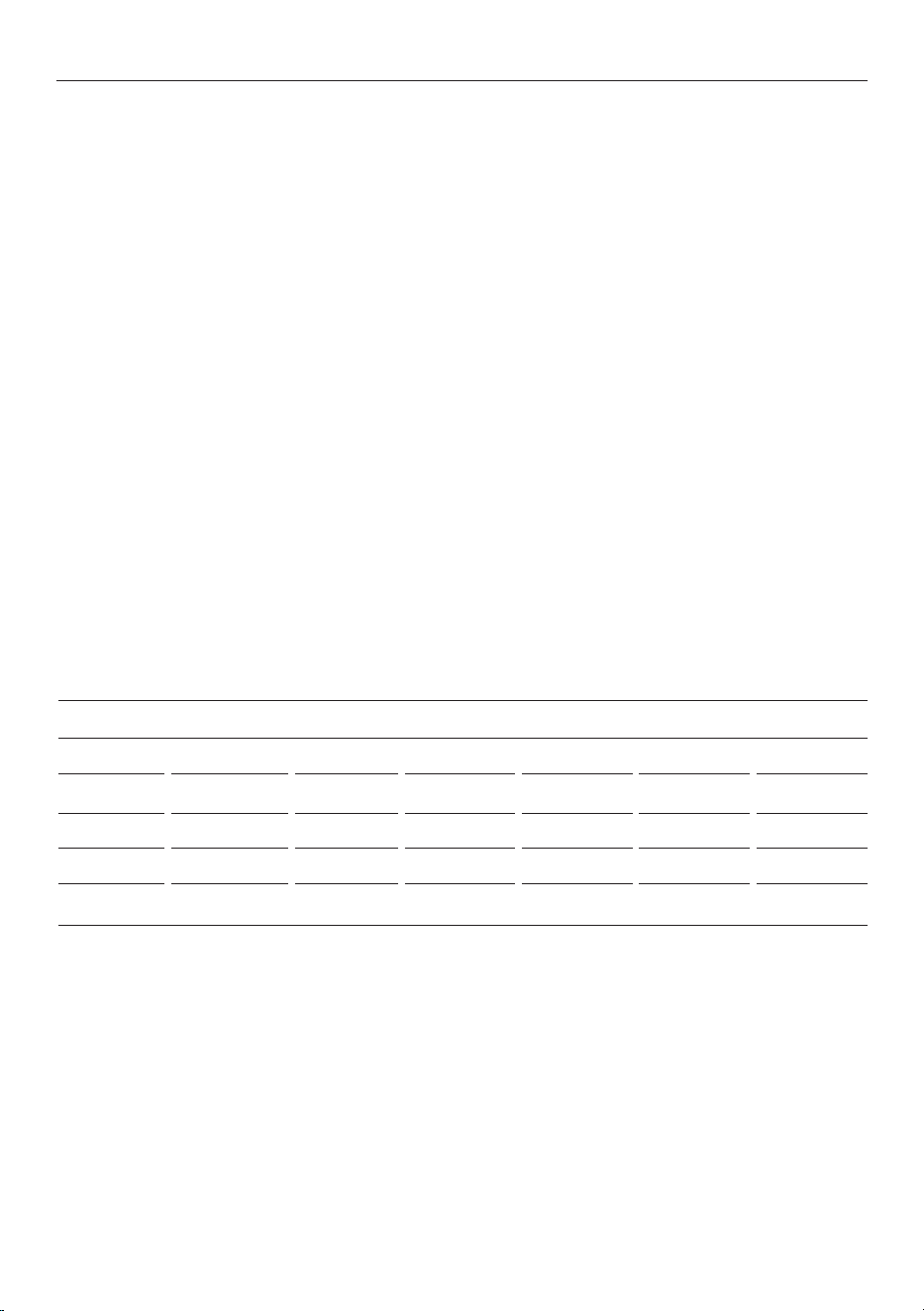
Total gas consumption of the grill with all burners on HI - Input rates BTU/hr
MODEL BE1-36RCI BE1-48RCI BE1-36RC BE1-48RC BE1-36C BE1-48C
MAXIMUM 88000 117000 89000 118000 75000 100000
GRILL 25000 25000 25000 25000 25000 25000
ROTISSERIE 14000 18000 14000 18000 N /A N/A
SEAR 24000 24000 N /A N/A N/A N/A
Servicing
z
Do not repair or replace any part of the appliance unless specifically recommended
in this guide. All other servicing should be undertaken by an authorized technician or
qualified person.
z
Only use the product with the type of gas specified on the rating plate. To change gas
type, a factory conversion kit is required.
INSTALLATION REQUIREMENTS FOR NATURAL GAS
13
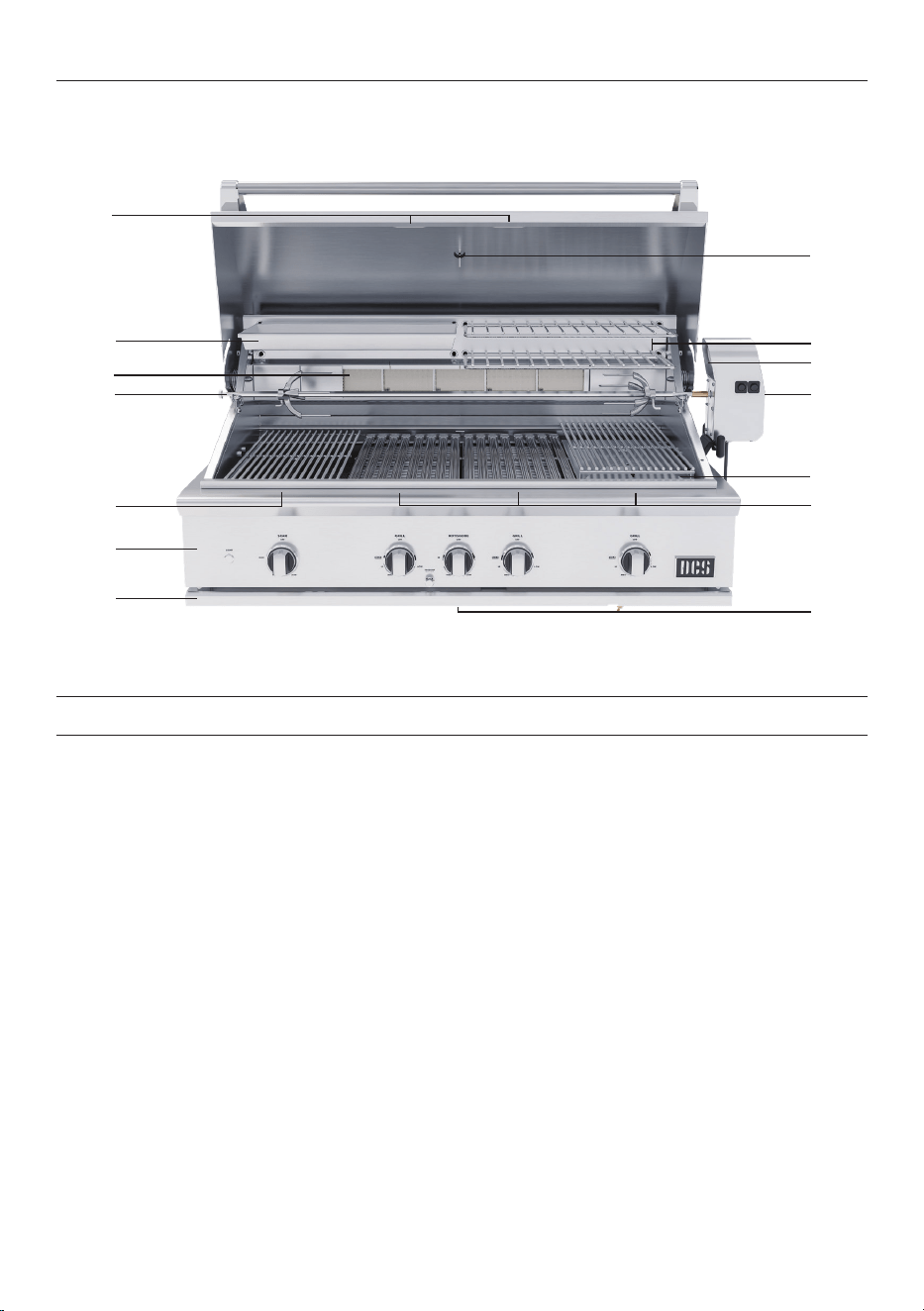
PRODUCT OVERVIEW
Features and accessories
1 Secondary cooking tray
2 Secondary cooking racks
3 Sear burner*
4 Grill burners
5 Charcoal insert
6 Control panel
7 Drip tray and removable insert
8 Temperature gauge
9 Hood lights
!0 Rotisserie rod*
!1 Rotisserie burner*
!2 Rotisserie light*
!3 Rotisserie motor*
!4 Rotisserie rod storage (below drip tray)*
1
4
!1
3
2
5
7
6
8
9
!0
!2
!3
!4
*Some models only
14
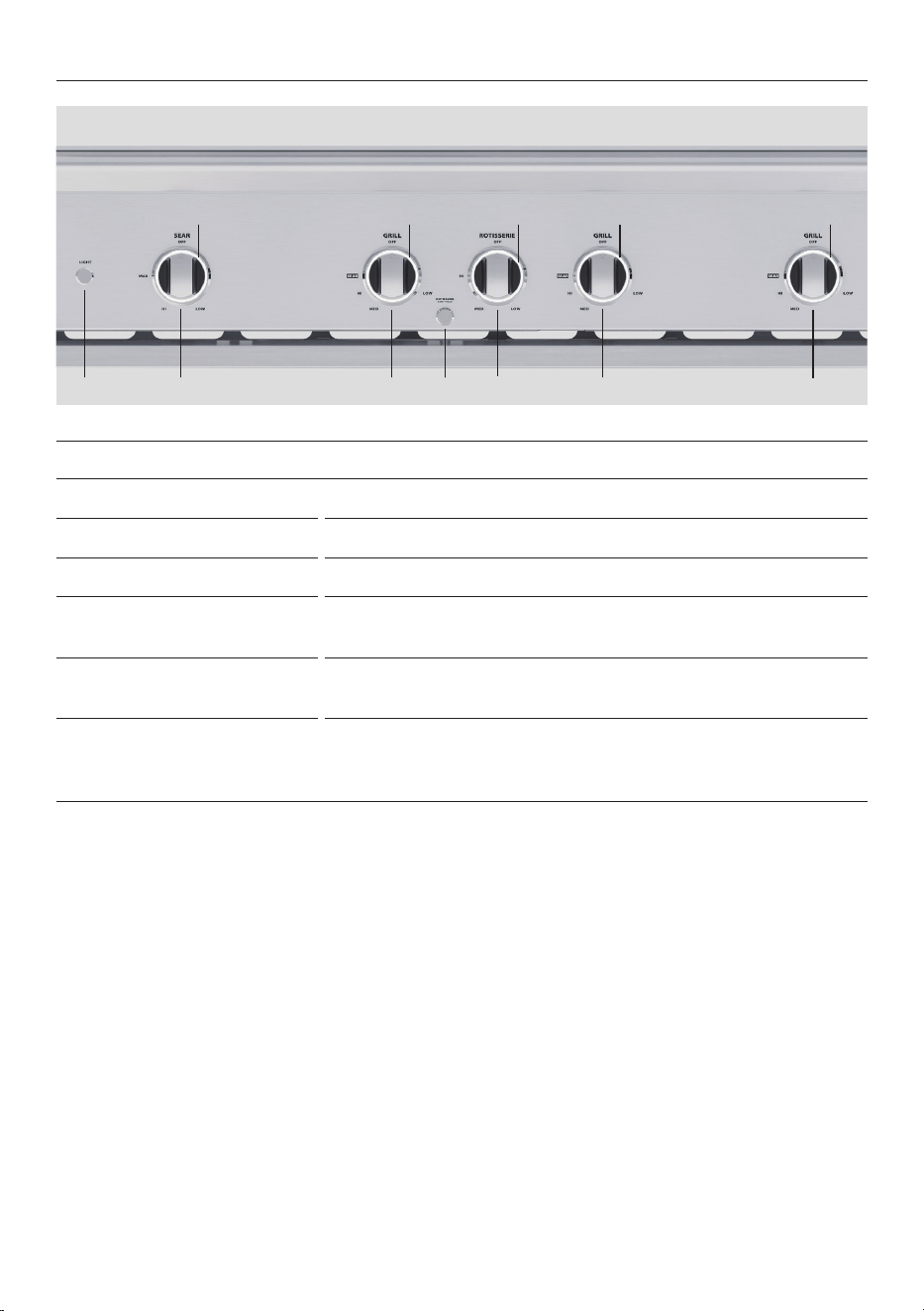
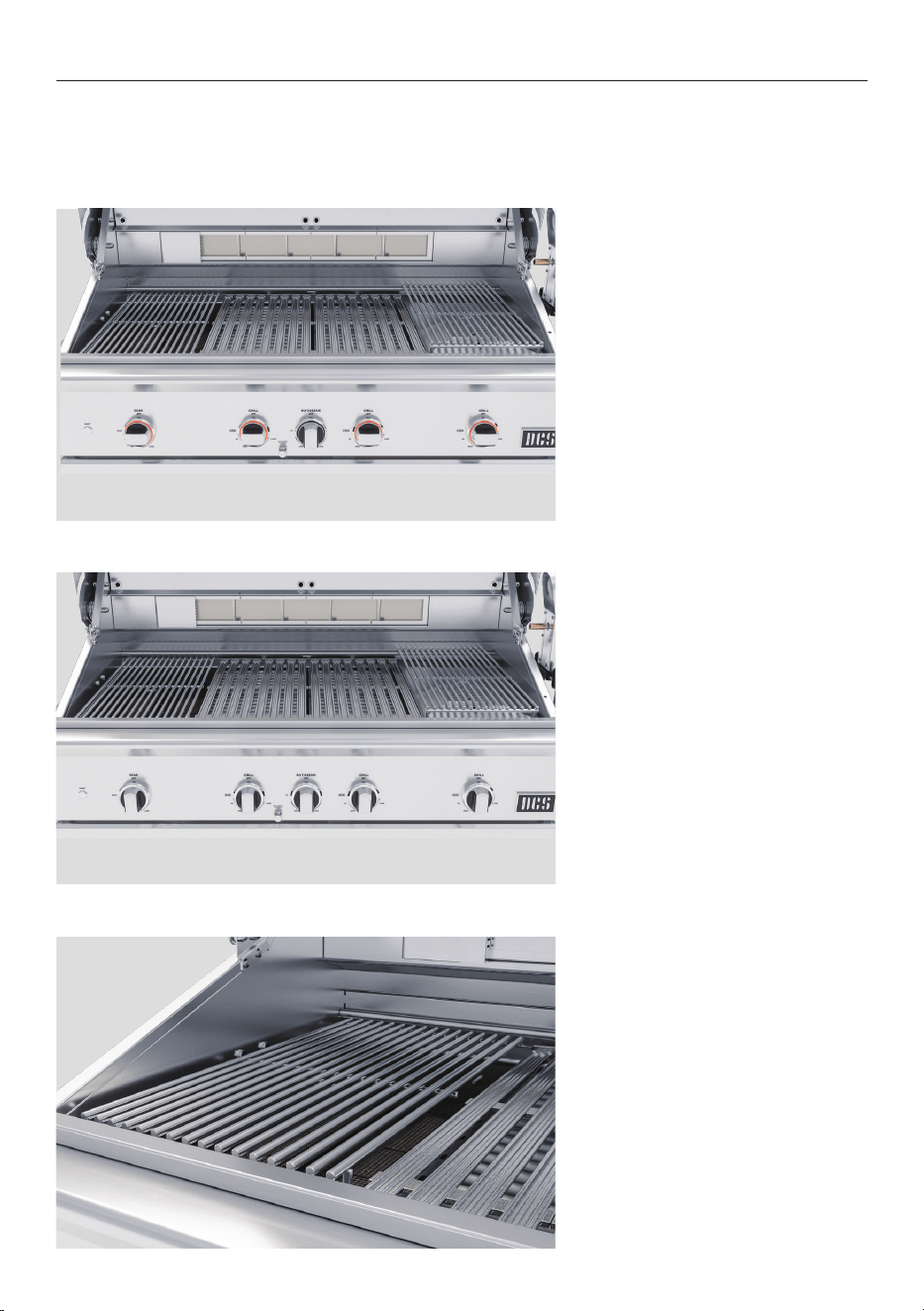
CONTROL PANEL
Control panel
1 Light button Press to turn hood lights
ON/OFF. Also activates dial lights.
2 Sear burner dial* Use to ignite sear burner and select heat setting.
3 Grill burner dials Use to ignite grill burners and select heat settings.
4 Rotisserie dial* Use with rotisserie safety valve to ignite rotisserie burner
and to select heat setting.
5 Rotisserie safety valve Allows safe gas flow to rotisserie burner while lighting. Use
with rotisserie burner dial to ignite rotisserie burner.
6 Dial lights The dial lights glow white when the hood lights are on or
another burner is in use, and orange when a burner is in
use and gas is flowing.
1 2 3
5
4
3 3
6 6 6 6 6
*Some models only
15
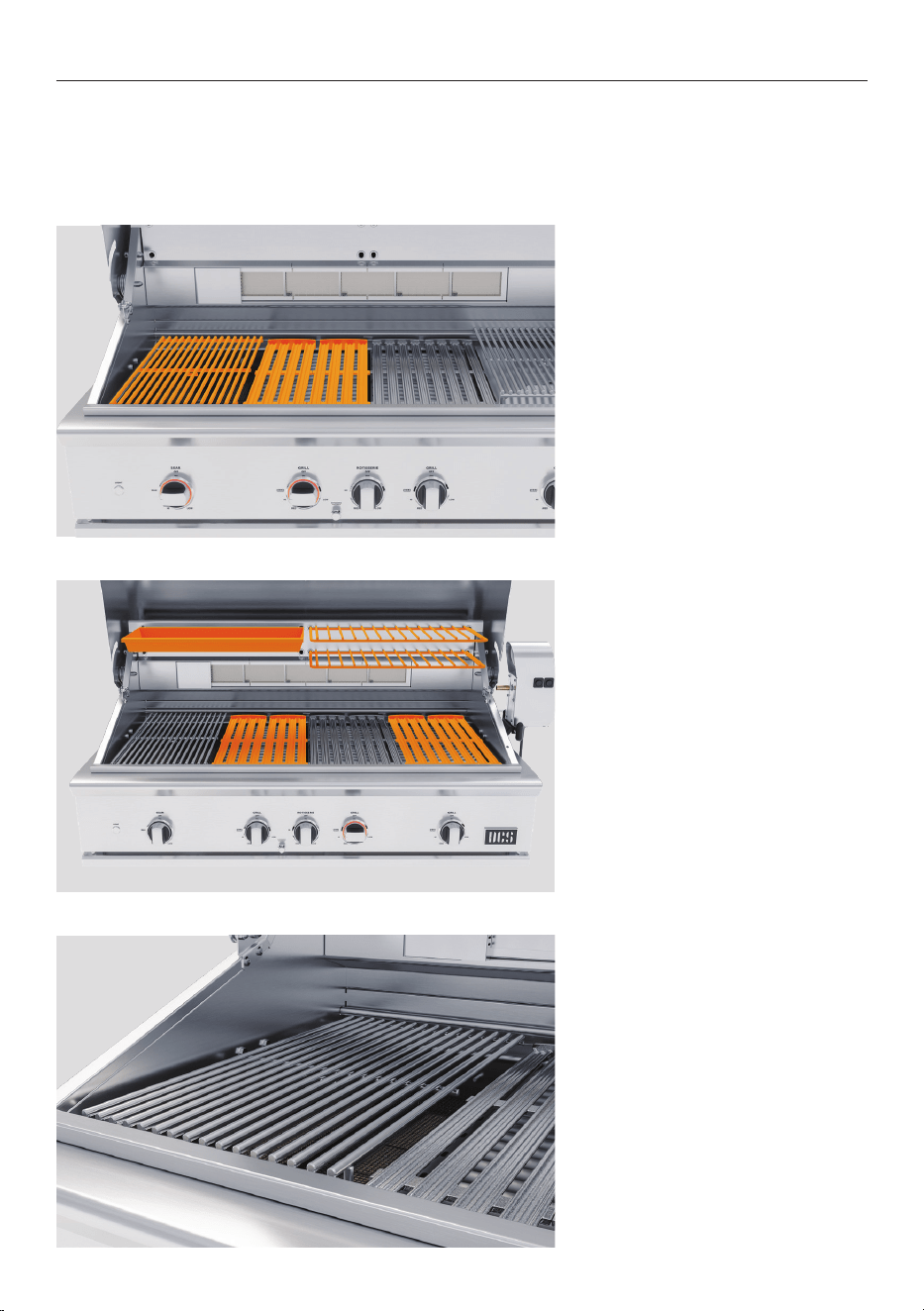
Before using the grill, plan what you want to cook and how you want to cook it.
The grill design allows you to tailor your cook with different cooking methods, areas and
grate types. For optimal results, take advantage of the entire grill to move food between
high and low heat zones at different stages of the cook.
PLANNING YOUR COOK
Direct grilling
Food is cooked on grates
directly over lit burners.
Use this method for food that
takes less than 20 minutes to
cook or for searing larger items
before indirect cooking or
further grilling at a lower heat
setting.
Indirect cooking
Food is cooked on grates
beside the heat source, or in
secondary cooking area, with
hood closed to maintain heat.
Use for food that takes longer
than 20 minutes to cook such
as bread or thicker pieces of
meat.
Sear burner
(some models only)
Delivers intense, even heat that
builds flavor and texture. Use
only with the sear burner grate
to create perfect sear lines and
surface browning.
Sear meat at a high heat, then
move to a lower heat zone
before resting to achieve
required doneness. Switch
order for reverse-sear method.
See 'Using the sear burner.'
16
PLANNING YOUR COOK
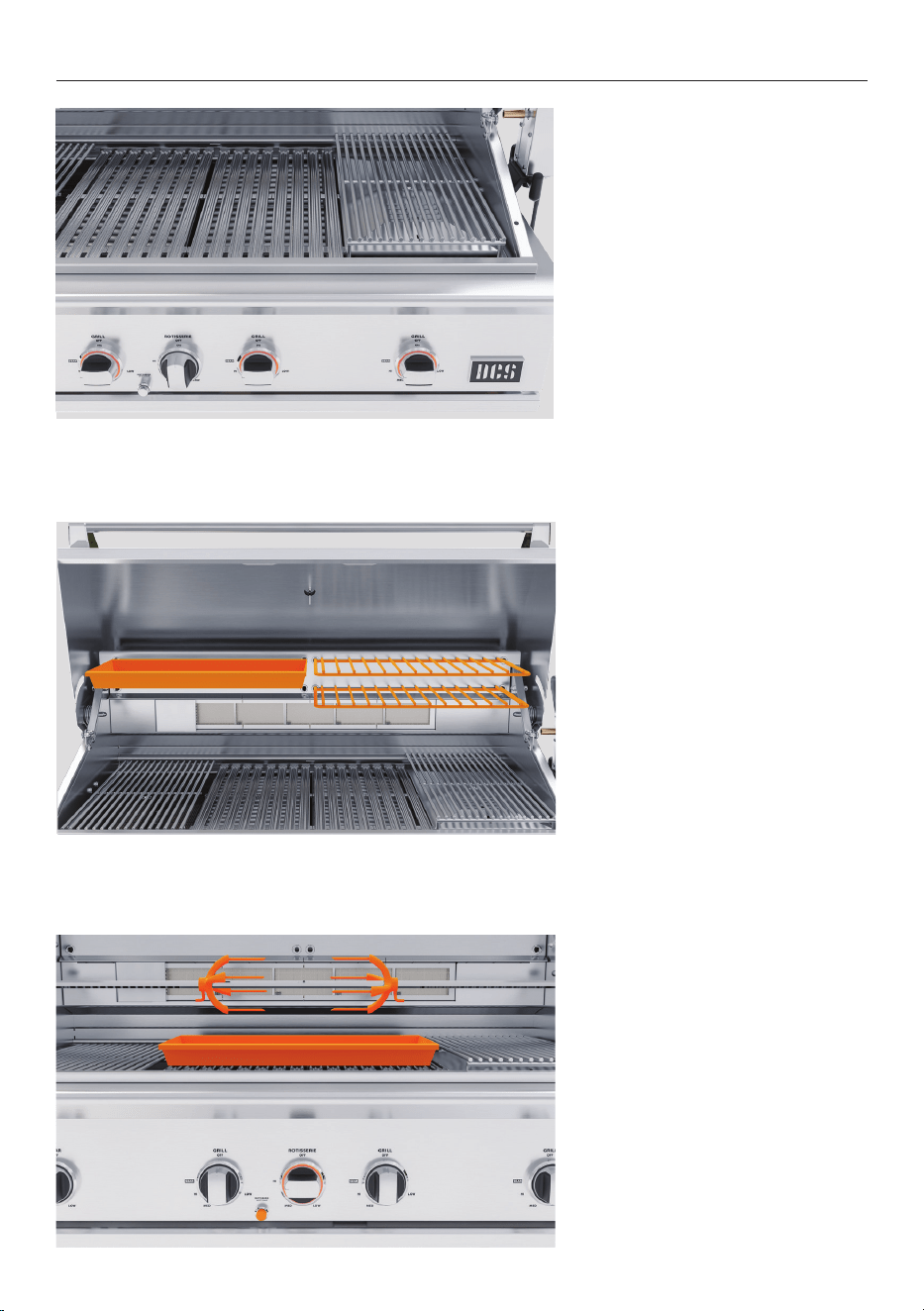
Grill burners
Deliver a range of heat
intensities. Choose cooking
zones and heat settings to
cook a variety of foods using
direct or indirect heat.
Use with radiant trays and
double-sided grates to cook
and brown food. See 'Using the
grates.' Use with the charcoal
insert and grate to grill and
add smoky flavor to food. See
'Using the charcoal insert.'
Secondary racks and trays
Use for indirect cooking like
slow cooking, baking, warming,
short-time smoking or roasting.
Can hold up to 20 lb.
Rearrange or remove as
needed. Tray can be also be
used to collect food juices or as
a water tray to keep food moist
during indirect cooking and
smoking.
Rotisserie
(some models only)
Use the rotisserie to slowly
cook food. Intense, even heat
gives roasts a crust. See 'Using
the rotisserie.'
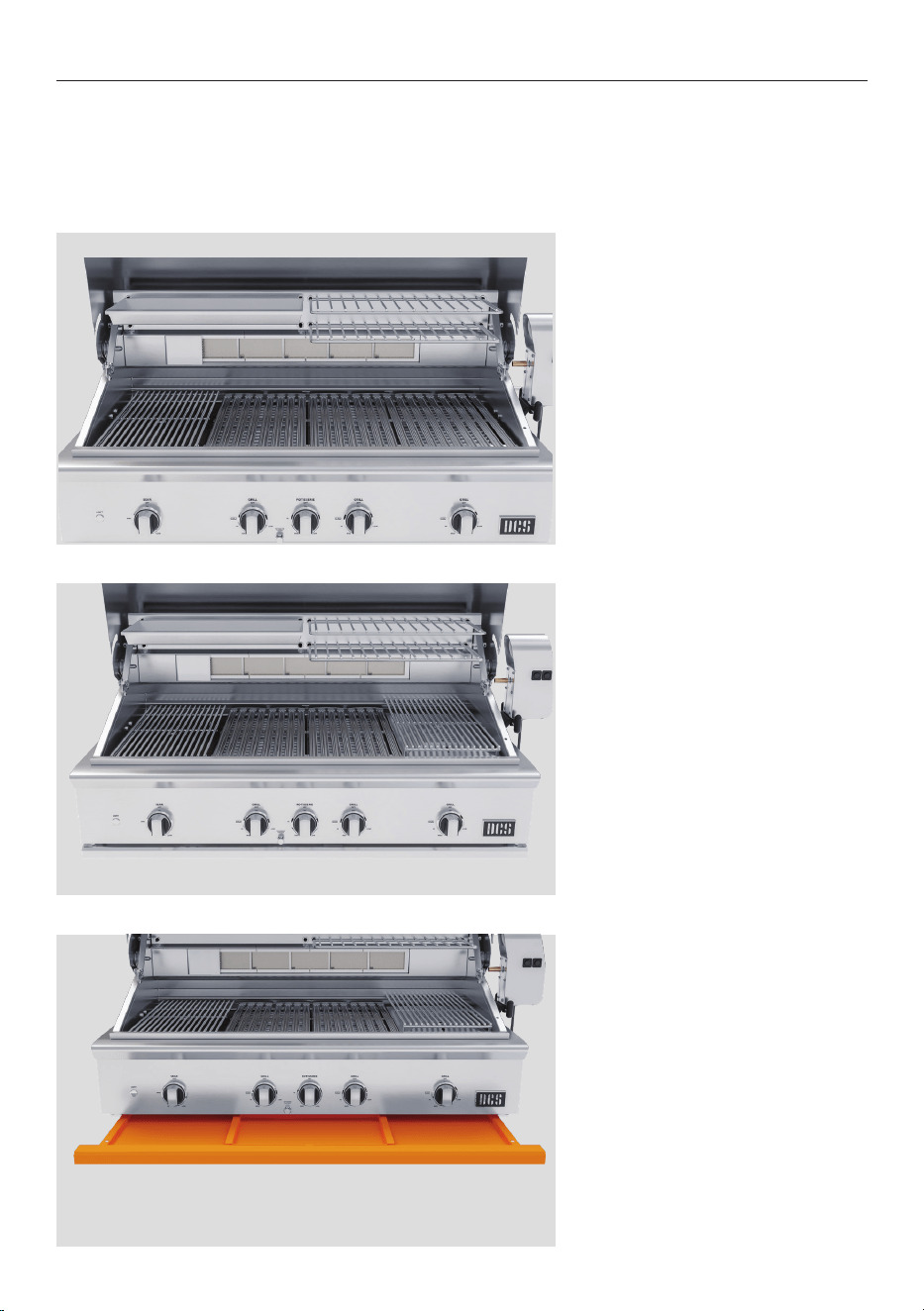
17
SETTING UP THE GRILL
Before you begin
z
Inspect the gas piping or hose for signs of cuts, wear or abrasion before each use.
Replace any damaged parts before using the grill.
z
Season the grates. See 'Using the grates.'
1. Ensure all dials are turned off,
then lift the grill hood.
3. Pull drip tray out to check
insert is clean and in place
before pushing tray back in.
Turn on the power and the
main gas supply.
2. Position the grates, tray
and racks according to your
cooking plan. If using the
rotisserie, set this up first.
See 'Using the rotisserie.'
18
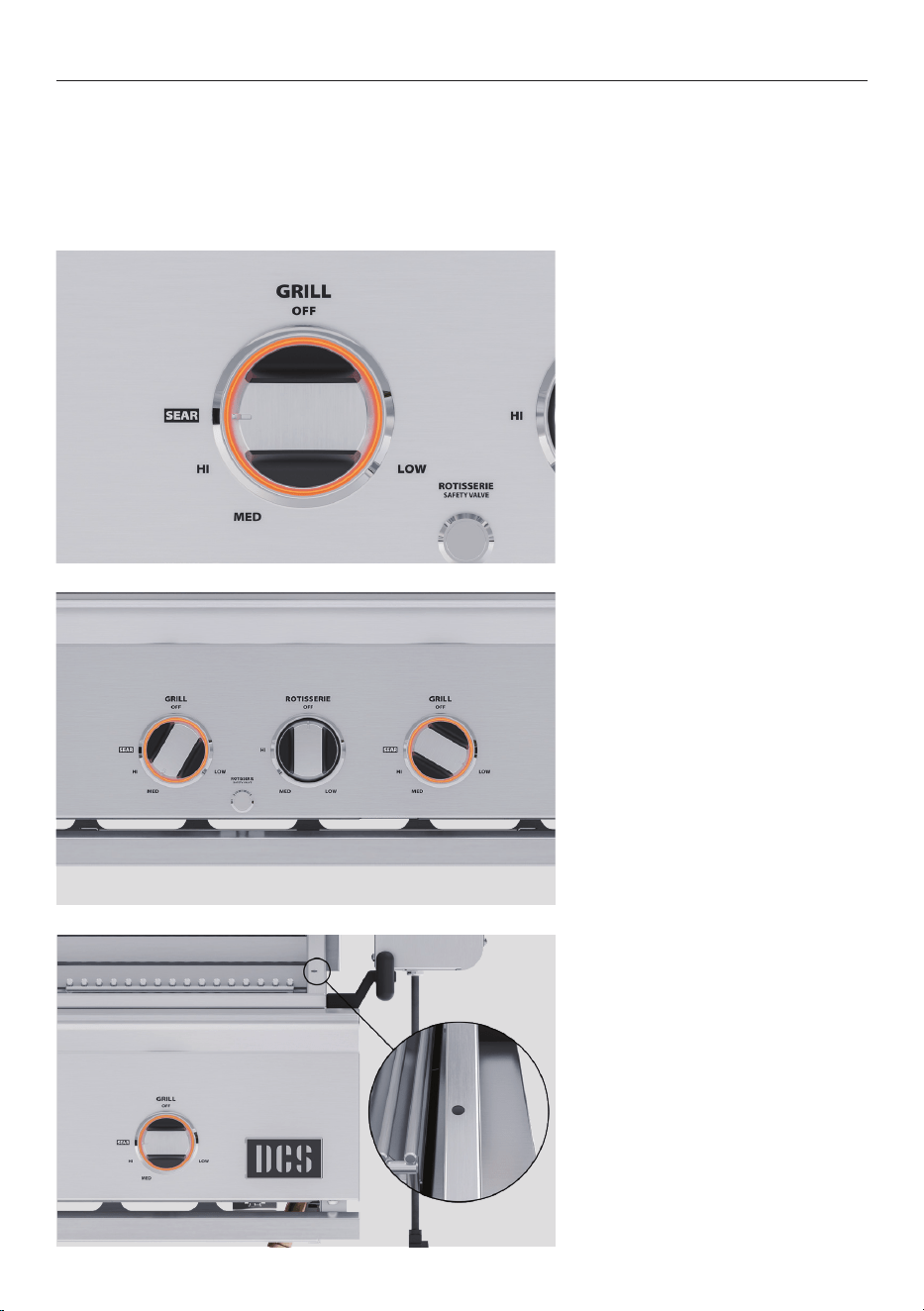
USING THE GRILL
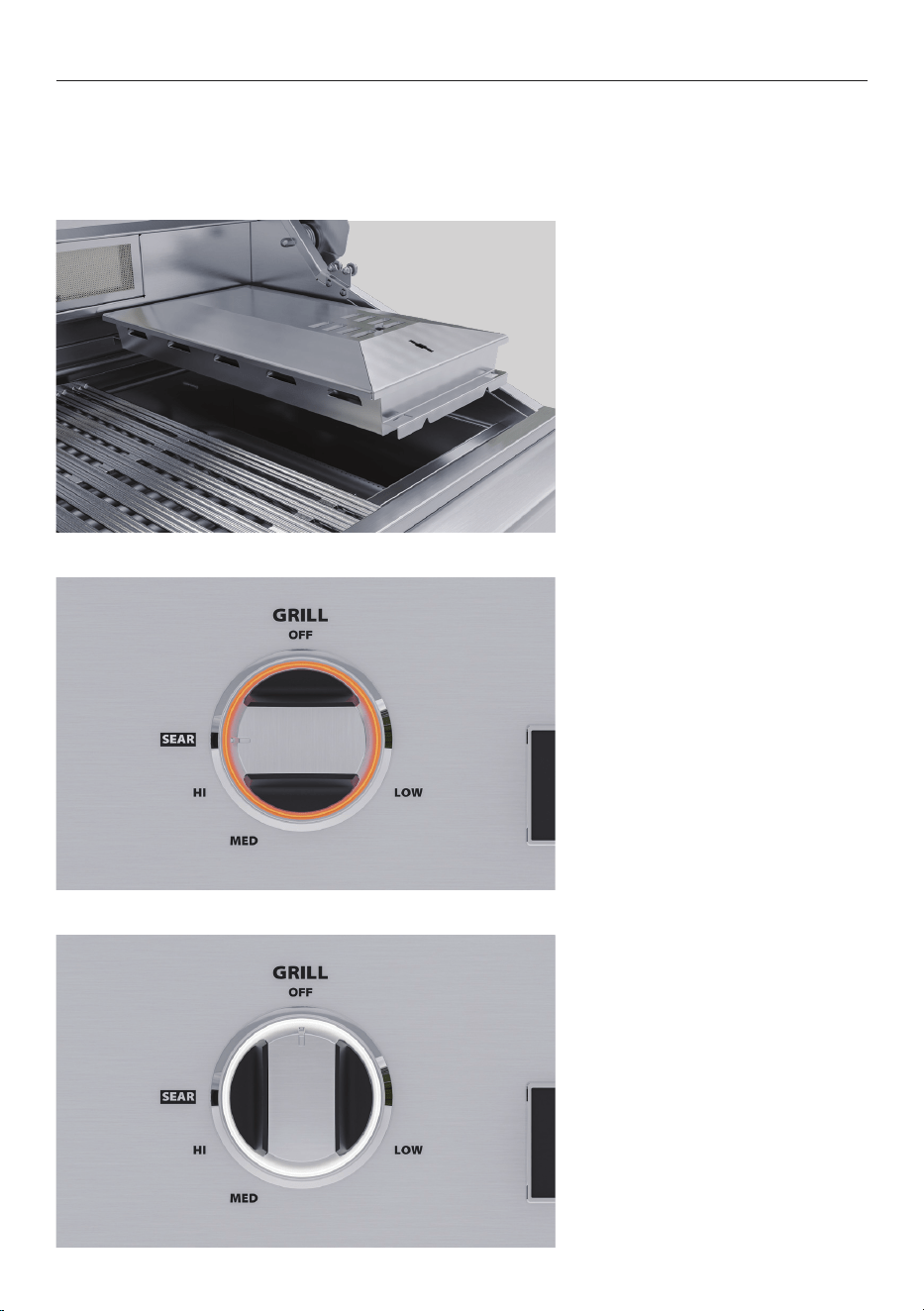
Manual lighting
Turn dial to
SEAR. At the same
time, hold a lit match or lighter
slightly below the opening on
the right-hand side of grill.
When burner ignites, turn
dial to desired heat setting
and release it. Remaining grill
burners will cross light.
Do not use lighter fluid.
Lighting the grill
1. Light one burner at a time.
Push and hold burner dial for
2 seconds. While still pushing,
turn dial to
SEAR to ignite.
You will hear the burner ignite,
but ignitor will not make a
clicking sound. Once lit, turn
dial to desired heat and release.
If burners do not light, wait
5 minutes for gas to dissipate,
then start again or light
manually.
2. Light remaining burners,
and select heat setting. Close
hood and leave grill to preheat
for 10 minutes, or longer if
preheating to low-heat setting.
If not using all burners, preheat
planned burners and any
adjacent burner at desired heat
for 10 minutes.
Preheating the grill
Preheat each zone according to the heat settings you plan to cook at. There will be minimal
heat bleed from high heat to low heat zones.
Use high heat for searing and browning, and medium, low or indirect heat to cook food
through without burning.
19
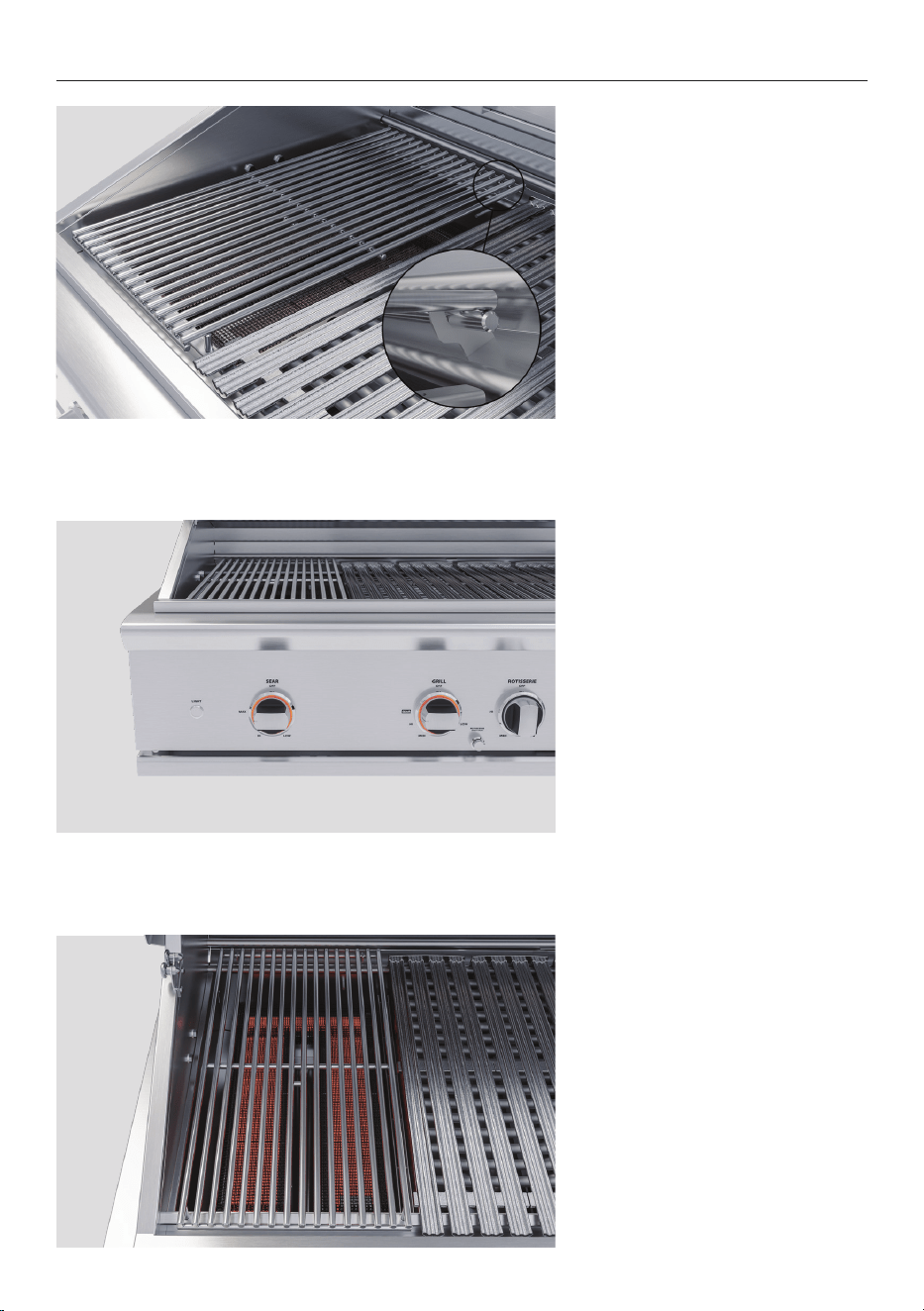
USING THE SEAR BURNER (SOME MODELS ONLY)
2. Push and hold sear burner
dial for 2 seconds, then set
to MAX. Light adjacent burner
and set to SEAR. Light and set
remaining burners as desired.
Preheat for 10 minutes with
hood down. Preheat for 5
minutes if sear burner is
already warm.
If burner does not light, wait
5 minutes for gas to dissipate,
then start again or light
manually.
3. Once burner is preheated,
place food on the grate. If
only using sear burner, turn off
adjacent burner after preheat.
The sear burner produces
intense heat. We recommend
keeping a close eye on food
and turning it frequently.
Adjust heat setting if required.
1. Make sure the sear burner
grate is secured in the hooks
at the back of the grill, with its
legs on the ledge at the front.
20
USING THE SEAR BURNER (SOME MODELS ONLY)
4. Once browned, move the
food to another area of the grill
to finish cooking, if required.
Turn sear burner dial to OFF.
Manual lighting
Turn dial to allow gas to flow.
At the same time, hold a long
match or lighter to the side
of the sear burner, in the gap
between grates.
When burner ignites, turn dial
to desired heat setting, and
release it.
21
USING THE GRATES
Seasoning the grates
Season all grates before use to protect surface from corrosion and to stop food sticking.
Repeat after cleaning or after long periods without use.
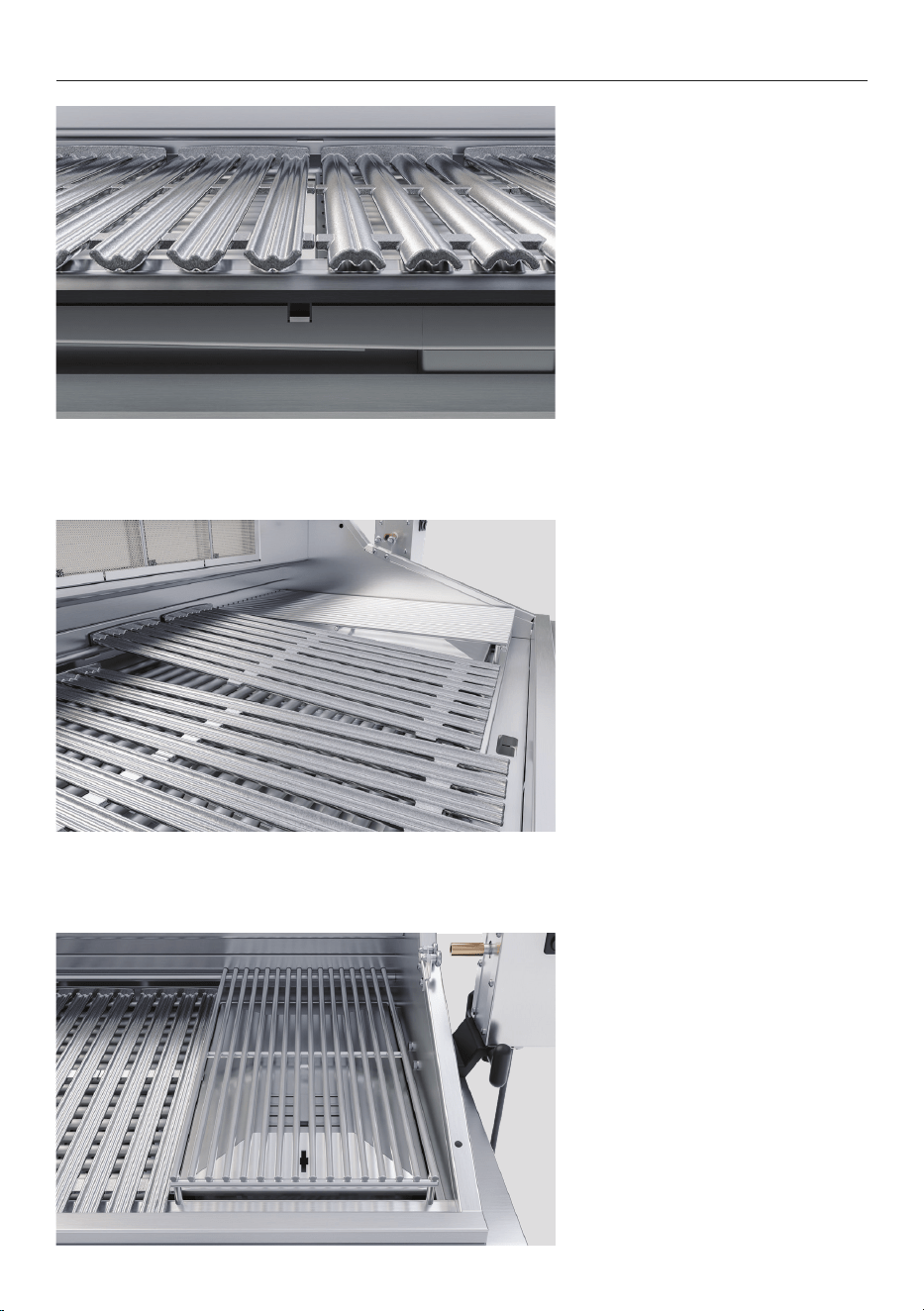
Sear burner grate
Designed for fast, even searing
and clean sear lines.
Fits flat over sear burner.
Shorter front legs than charcoal
insert grate. Rests on hooks at
rear of grill.
1. Apply a light coating of
high-heat cooking oil to all
grates, then heat on MAX/
SEAR
with the hood down. See
'Lighting the grill'.
2. Turn the dials OFF after
15 minutes, or when grates
begin to smoke. Allow to cool.
Grates will change color. This is
normal.
22
USING THE GRATES
Double-sided grates
Use W-shaped side to create
sear lines on food and channel
grease away from flame. Use
the radius side to support and
cook delicate food items like
scallops and salmon.
Double-sided grates
Fit over grill burners and
radiant trays. Can be placed flat
or at an angle, with W-shaped
side or radius side facing up.
Rest grates on low bar to sit
flat or high bar to sit at an
angle. When angled, W-shaped
side channels more grease
towards drip tray.
Charcoal insert grate
For direct grilling or to infuse
smoky flavour in food.
Fits flat over charcoal insert,
with or without the lid.
Longer front legs than sear
burner grate. Rests on high bar
at rear of grill.
23
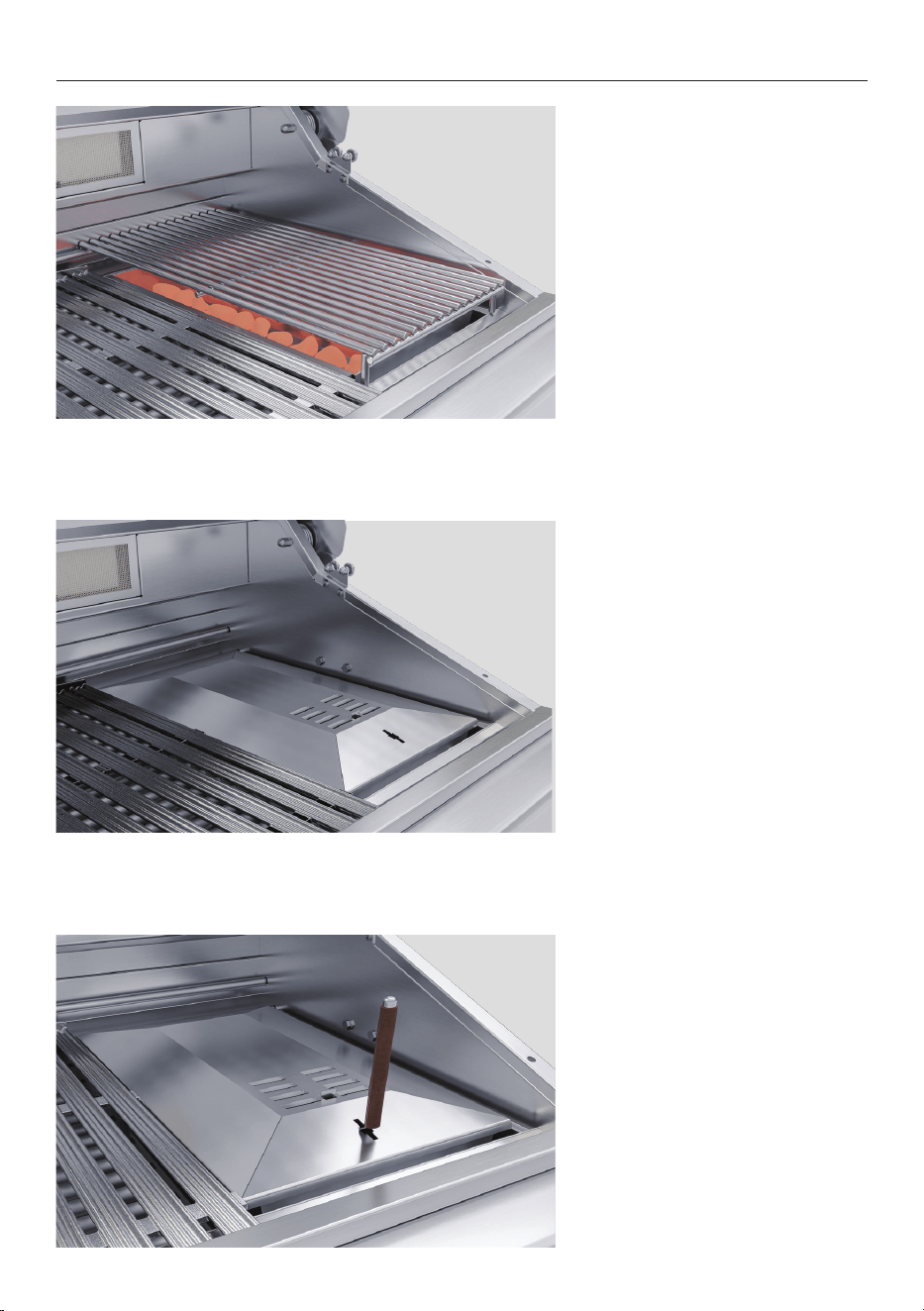
The insert is for direct grilling, short-time smoking and indirect cooking. Use charcoal or
briquettes to grill and cook, and wood chips or wood chunks to smoke.
Do not use the charcoal insert or its grate over the sear burner. If using two charcoal inserts,
keep a grill burner space between them to maintain air flow.
1. Fill the insert, taking care not
to overfill.
Remove grates and radiant tray.
Place the insert onto the front
and rear pins where the radiant
tray was located.
USING THE CHARCOAL INSERT
3. Turn the dial to OFF when
there is enough smoke, when
charcoal turns gray at the
edges or after 8 – 10 minutes.
The fuel will continue to burn
and smoke.
2. Push and hold dial for
2 seconds, then set to SEAR.
Release when the burner
ignites.
Do not use lighter fluid,
matches or a butane lighter.
24
USING THE CHARCOAL INSERT
Adjusting the charcoal insert
Use the multi-tool to move the
grate and adjust the lid or vent,
as the insert will be hot. Close
vent slightly to decrease heat
and open it to increase heat.
Direct grilling
Use the charcoal insert grate
over the charcoal insert without
the lid in place. Place food onto
grate to cook.
Short-time smoking and
indirect cooking
Place the lid on the charcoal
insert and adjust the vent as
desired to control smoke. Place
food away from charcoal to
cook.
Put a tray of water in the grill
and close hood. This moistens
food surface so smoke sticks
to it.
25
USING THE ROTISSERIE (SOME MODELS ONLY)
The rotisserie delivers intense and even heat to food to achieve a crust on roasts or to
slowly cook large food items up to 50 lb.
Do not ignite the grill burners while the rotisserie burner is lit. Avoid using the rotisserie in
windy conditions.
Tying meat and poultry
Use butcher string or dental floss to tie meat and poultry before putting them on the
rotisserie rod.
We recommend selecting a roast that is a consistent size and tying it in three areas to
ensure even cooking. For poultry, tie the wings and legs to the body to secure them while
the rotisserie is turning.
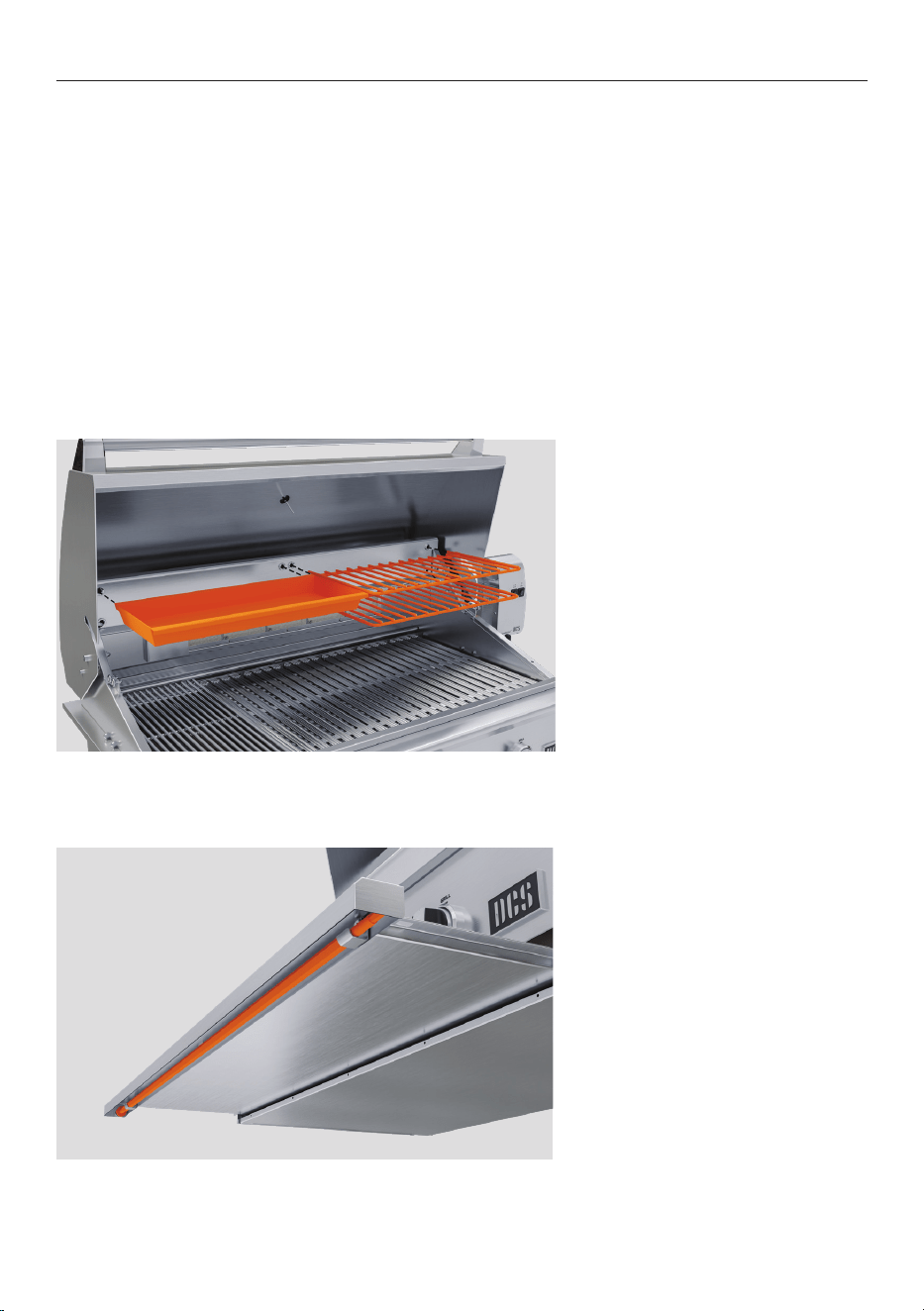
Preparing the rotisserie rod
1. Remove the racks and tray
from the secondary cooking
area.
2. Remove the rotisserie rod
from its storage under the drip
tray handle.
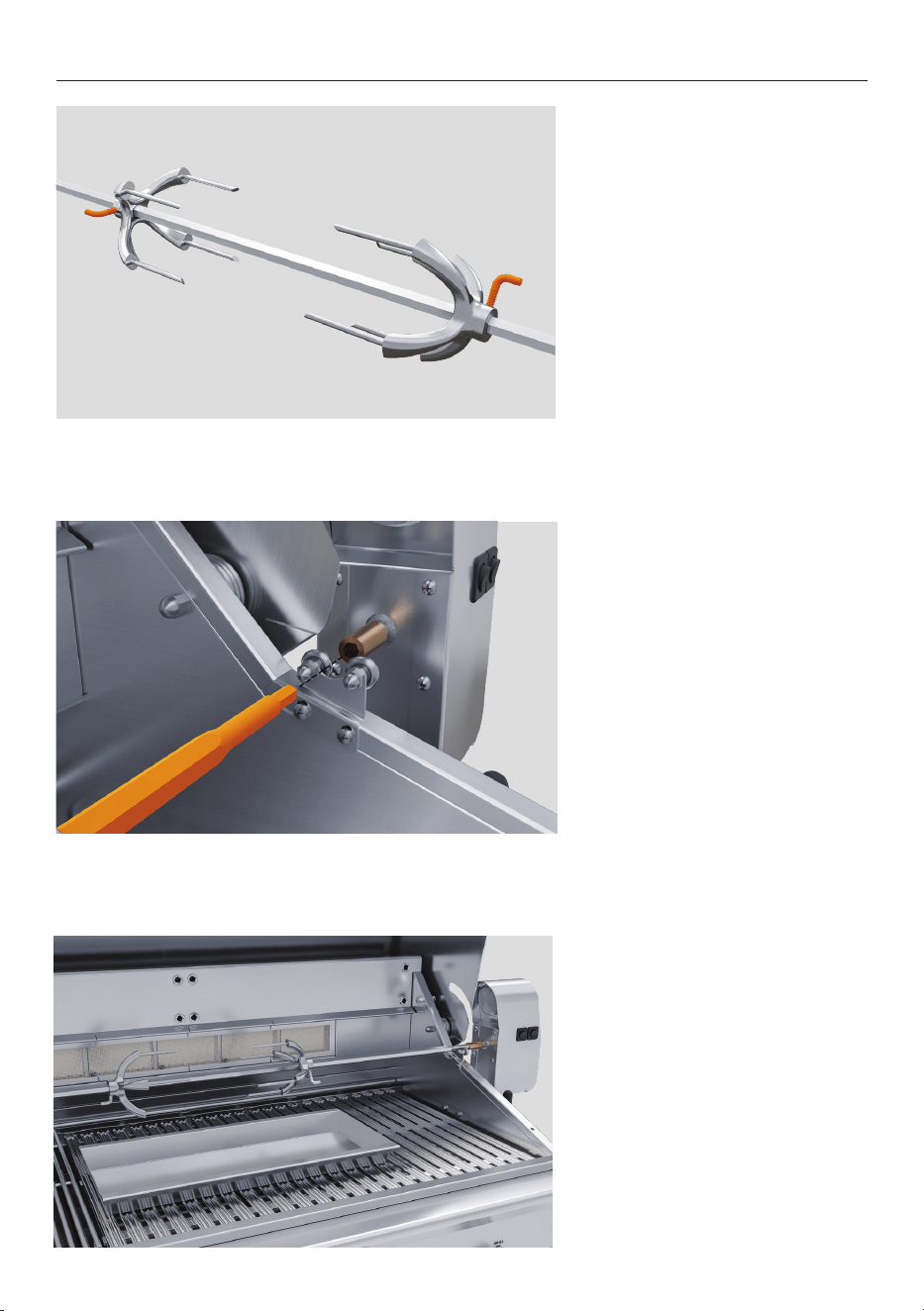
26
USING THE ROTISSERIE (SOME MODELS ONLY)
4. Insert sharp end of rod into
rotisserie motor. Rest other end
on rollers at opposite side of
grill.
Rod does not rest on rollers
next to motor.
3. Slide first fork onto rotisserie
rod far enough to allow food to
be centered. Turn the L-shaped
screw to secure it.
Slide food and second fork
onto rod, with fork tines offset.
Turn screw to secure.
Forks are sharp. Take care
when handling.
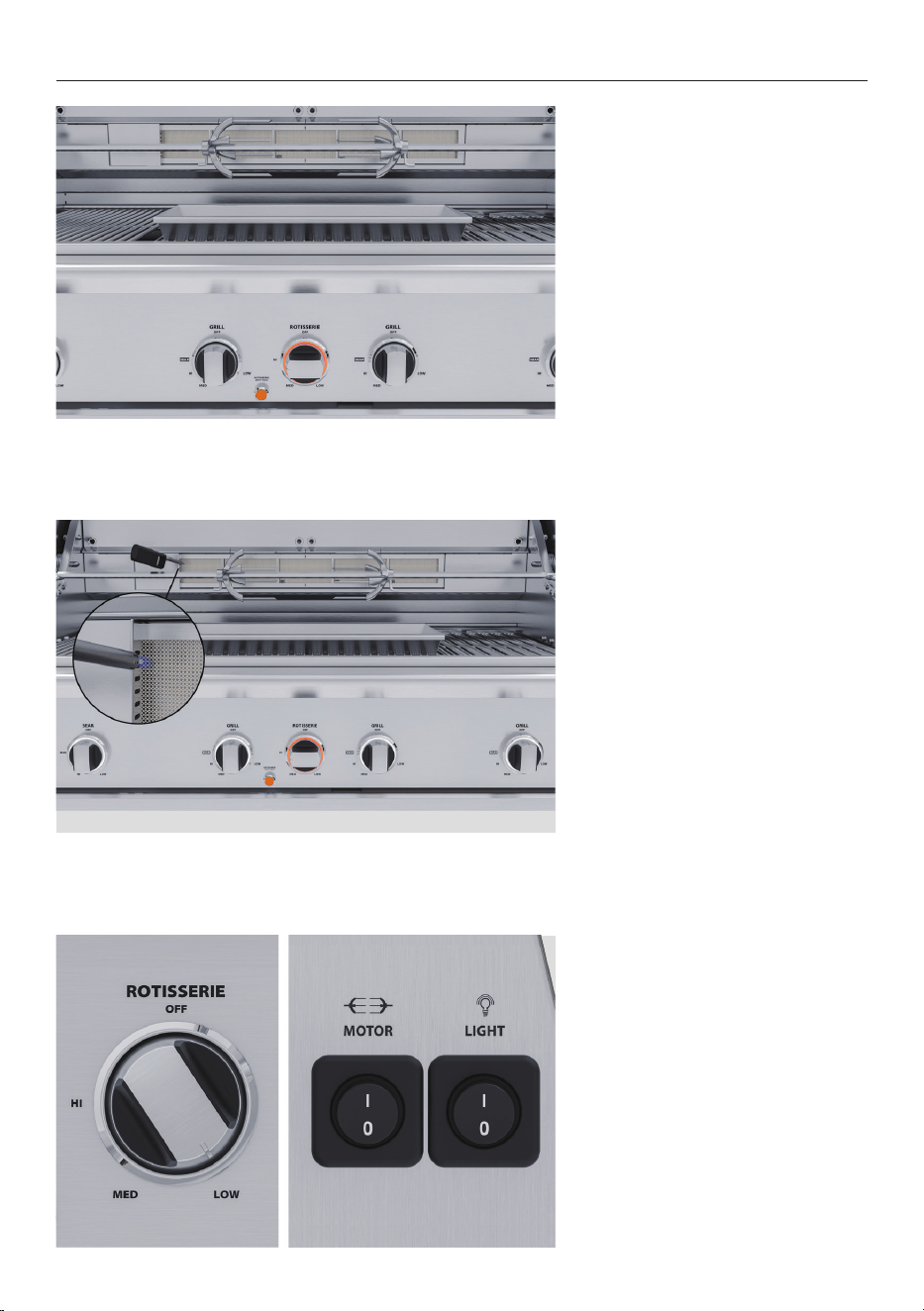
5. Place secondary cooking tray
beneath food to collect drips.
Switch on rotisserie motor.
If required, switch off to adjust
food for balance and remove
grates to create more space
between food and tray.
27
USING THE ROTISSERIE (SOME MODELS ONLY)
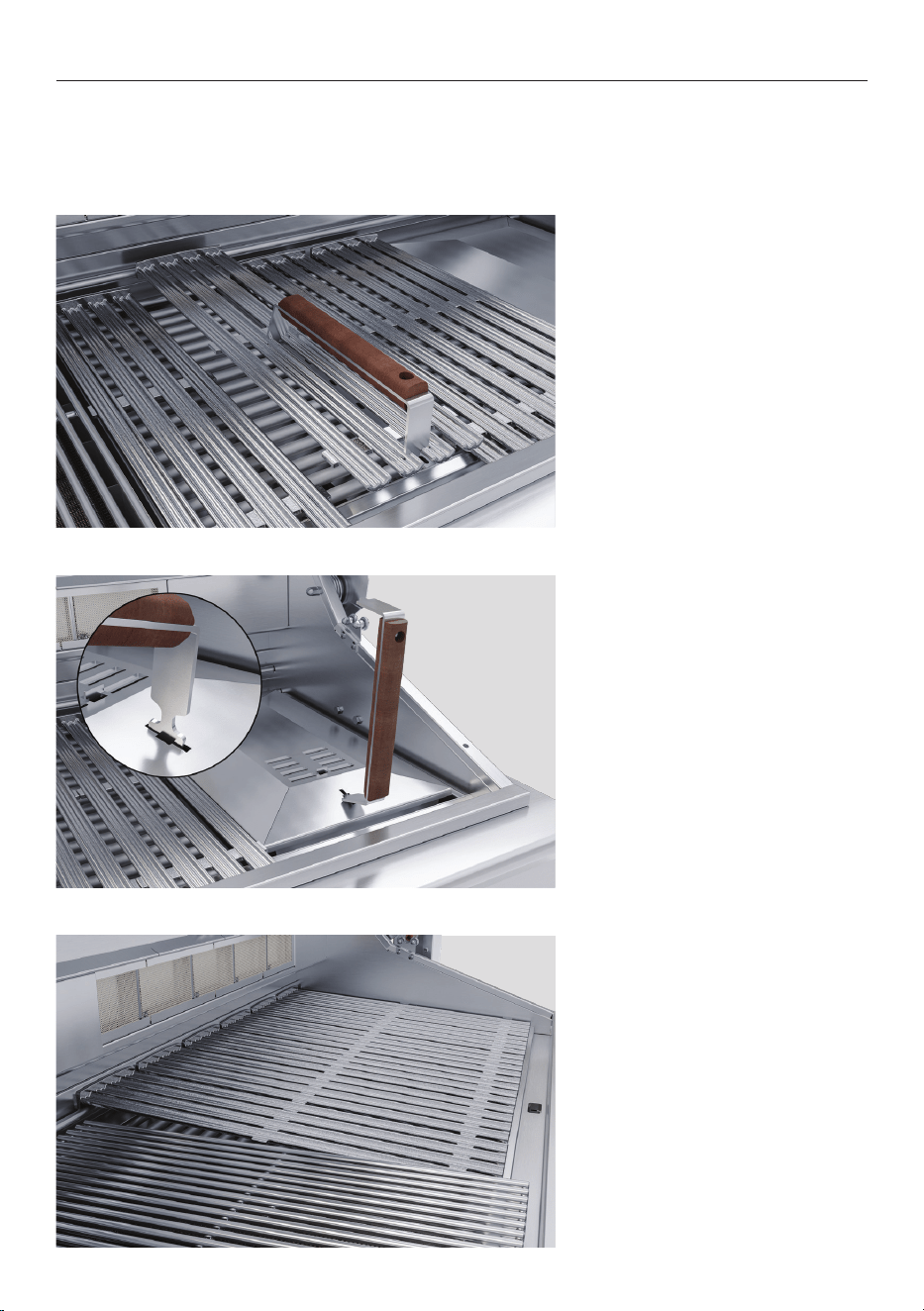
Lighting the rotisserie
Push and hold rotisserie
burner dial for 2 seconds
,
then turn to HI and press and
hold the safety valve button
for 10 seconds or until burner
remains lit.
Once lit, turn dial to desired
heat setting and release.
Manual lighting
Hold lighter to the side of the
burner, then turn dial to
HI.
Release the dial, and press
and hold the safety valve
button for 10 seconds or until
burner ignites. Turn dial to
desired heat.
Checking food temperature
Turn dial to
LOW, switch
off motor, and use a meat
thermometer. If further cooking
is required, turn dial to desired
heat and restart motor.
When food is cooked, turn dial
to
OFF, and switch off motor.
Remove rod, place food on a
tray, then remove forks. Take
care, as rod will be hot.
Cover and allow to rest.
28
USING THE MULTI-TOOL
Use the multi-tool to lift and move grates, lift the charcoal burner lid, and adjust the
charcoal burner lid vent. You can also use it to scrape grease into the drip tray and to
scrape out the bottom of the charcoal insert after use.
Adjusting grates
Allow grates to cool, then insert
flat edge of multi-tool in middle
slot of grate, in front of center
divider. Rotate 90° so tool is
straight and other end fits in
slot. Lift or reposition the grate.
Adjusting charcoal insert lid
Insert the flat edge of the
multi-tool into the slot on
the lid of the charcoal insert,
and rotate 90° so the tool is
vertical.
Clearing grease
Use flat edge of multi-tool to
scrape grease into opening at
front of grill. Grease will collect
in drip tray.

30
CLEANING
General
Clean your grill regularly to maintain performance.
Stainless steel surfaces
Clean regularly with mild detergent, kitchen spray or stainless steel cleaner to maintain
condition, especially if located near a pool or the coast. Cover when not in use.
Secondary racks and tray
Once cool, remove from grill. Clean with hot water and mild detergent or in dishwasher.
Multi-tool
Wash with hot water and mild detergent after each use, then dry. Store out of direct
sunlight.
Grates
While still hot and on grill, brush residue off with a grill brush. When cold, clean with hot
water and mild detergent, then dry with a soft, clean cloth. Re-season grates after cleaning
to prevent rust.
Drip tray
Allow to cool. Clean after each use to prevent grease build-up. Insert is dishwasher safe.
Rotisserie rod and forks
Clean with hot water and mild detergent, and dry with a soft, clean cloth. Take care when
handling forks, as they are sharp.
Charcoal insert
Do not touch or move the insert while hot. Use multi-tool to scrape off food residue and a
brush to clean the bottom of the insert. Dispose of the ash in a fireproof container.
Grease Management System
Allow grease to set, then use multi-tool to scrape grease out. Wipe as needed.
Radiant trays
Rotate ceramic rods so they burn clean when next used. If required, use a brush to remove
residue, or clean with hot water and mild detergent. For heavy soiling, heat radiant tray on
HI for 10–20 mins. Trays may smoke. This is normal. Do not take trays apart.
Rotisserie burner
Run the rotisserie burner for 10–20 minutes to burn off any residue. Do not use water.
Lights
Wipe clean with a soft cloth. If required, remove covers and clean with warm water and
mild detergent.
31
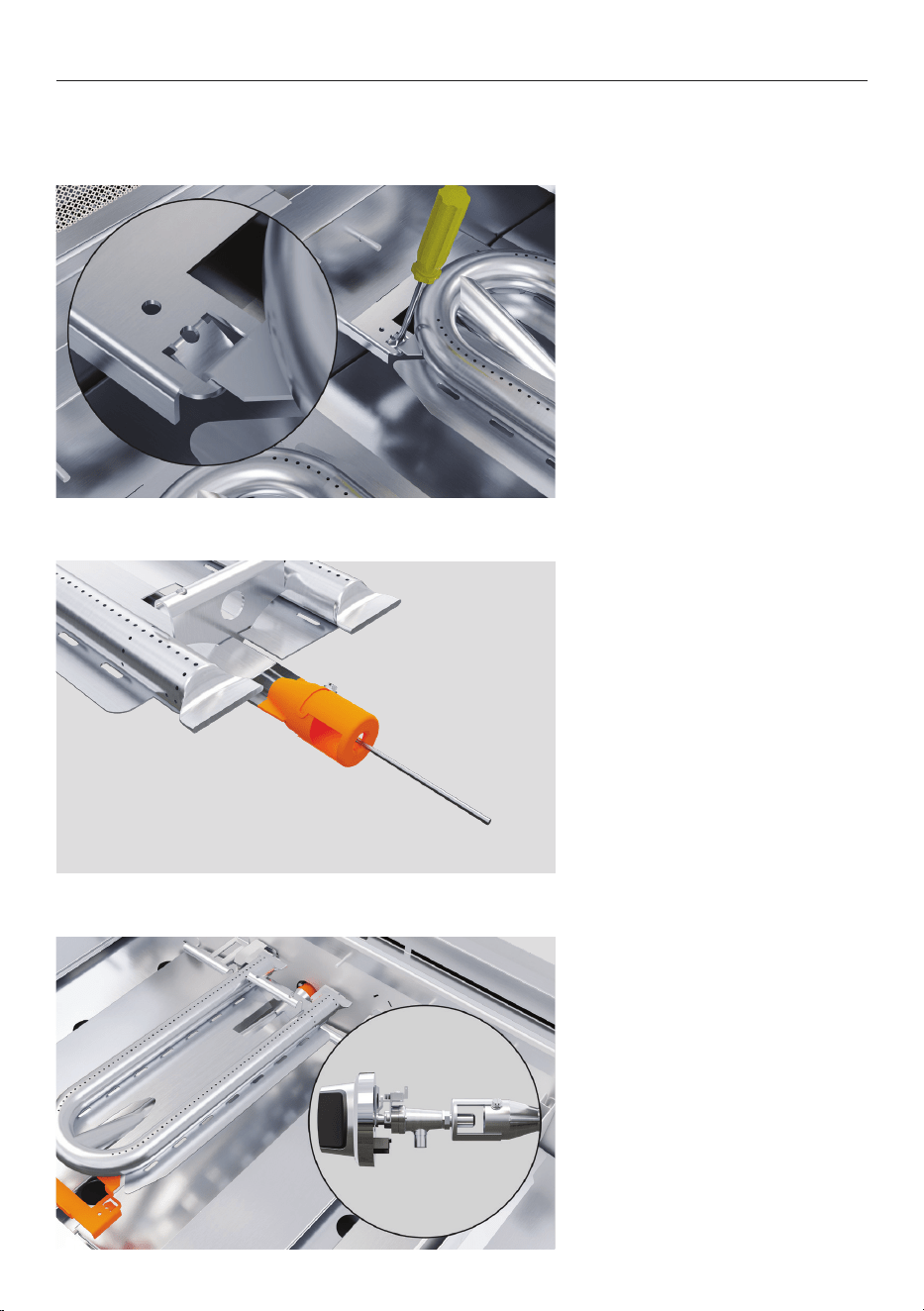
CLEANING THE GRILL BURNERS
Grill burners should be removed regularly for cleaning and to check for blockages from
food residue and insects. Always turn off gas supply before removing and cleaning burners.
1. Remove grates and
radiant trays. Use a flathead
screwdriver to loosen clamps,
then carefully lift burner up and
out of grill.
Shake gently to remove debris.
Clean exterior with a grill brush.
2. Use a flashlight to check
if the burner inlet is blocked.
If so, use a safety pin or
straightened paper clip to
unblock the inlet and the holes
along the burner tube.
You can also unblock the gas
jet inside the front of the grill
if required.
3. Refit burner so the inlet is
centered on the gas jet, then
lower burner onto mounts
at rear. Ensure it is level and
secure.
Take care not to damage
ignitor.
Burners must be properly
located to ensure safe
operation.
32
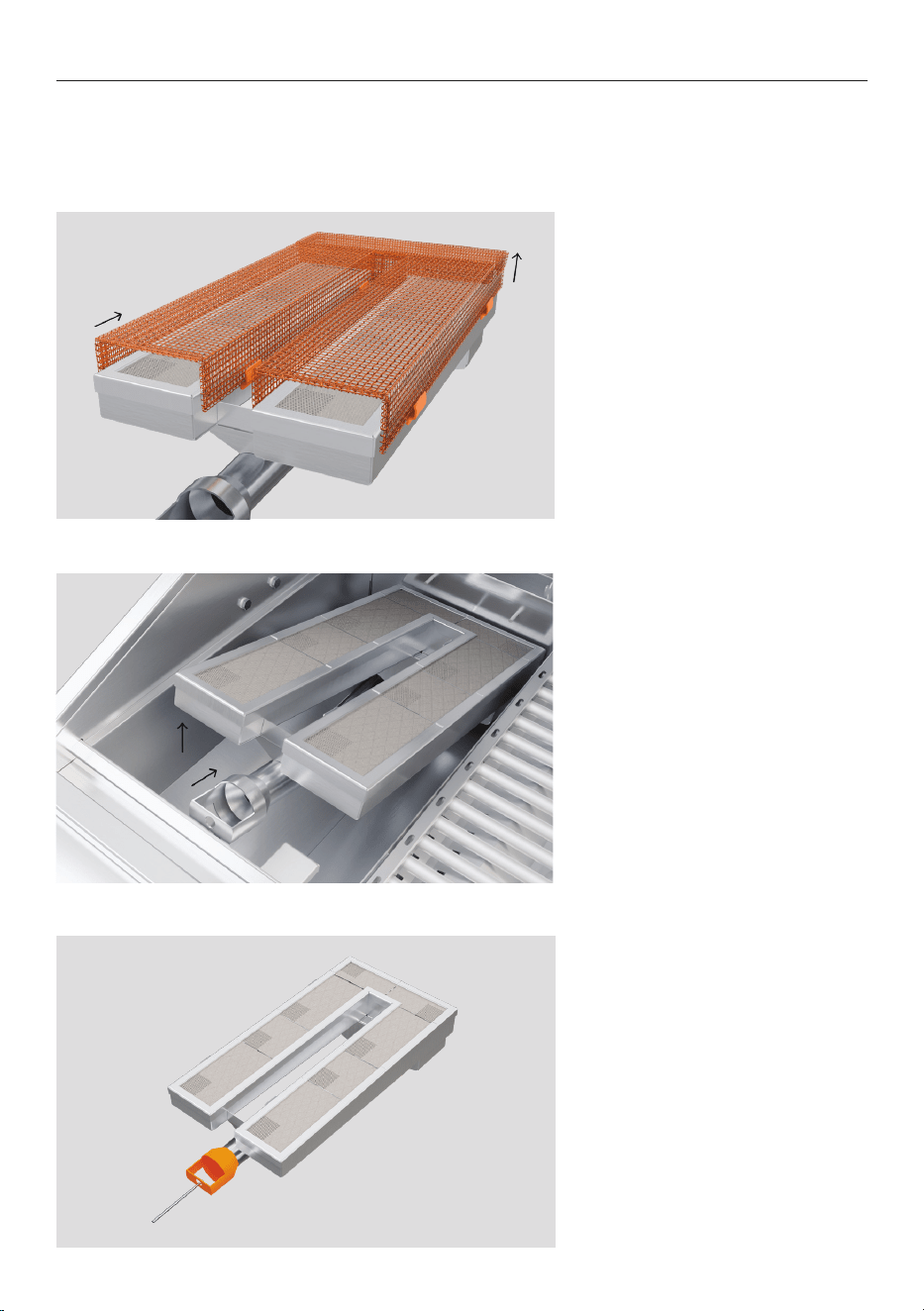
CLEANING THE SEAR BURNER
2. Hold burner at the sides and
lift at the back to remove it
from its mount.
Slide it towards rear of grill to
separate it from the opening
in the front of the grill, then lift
burner to remove.
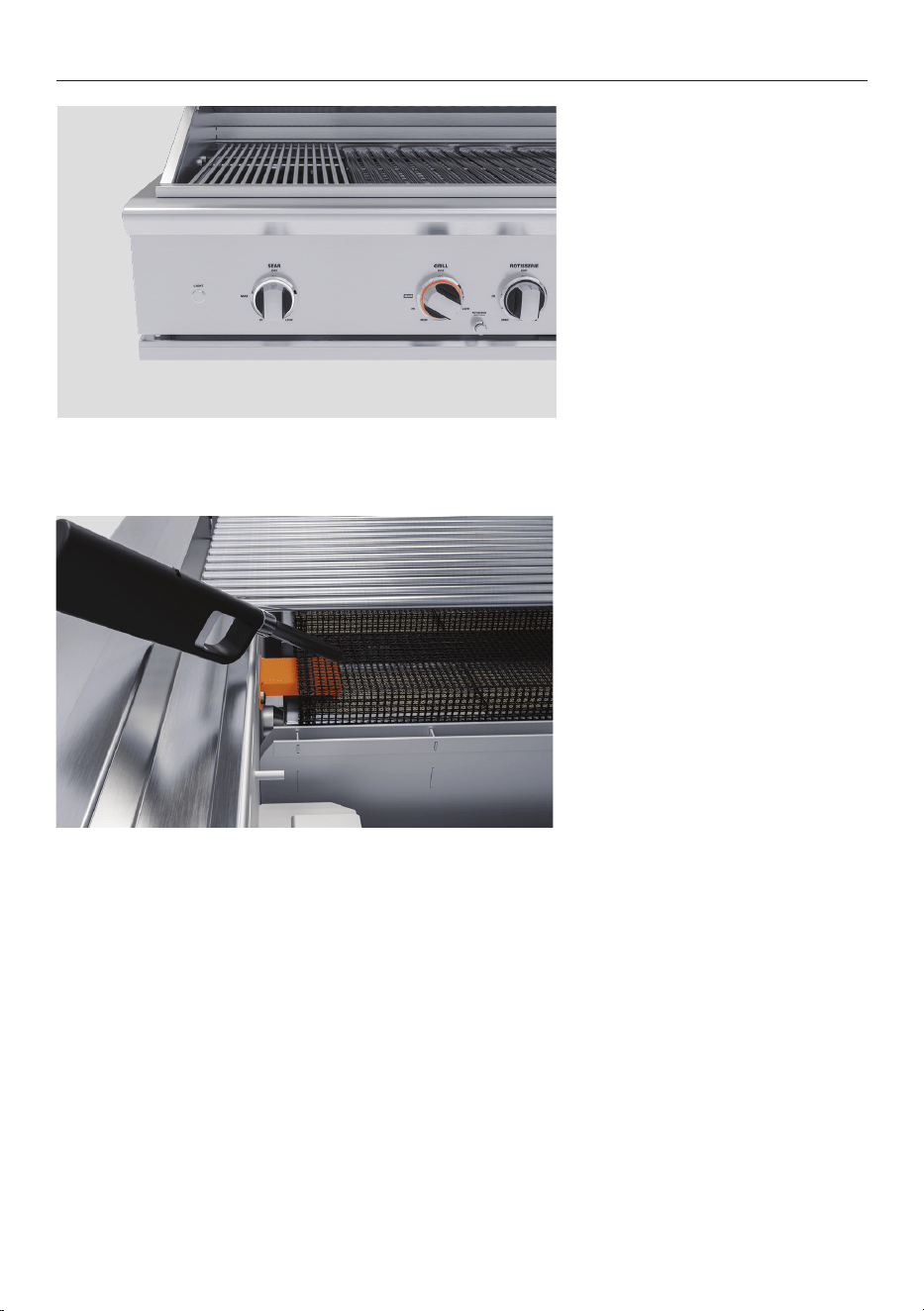
1. Unclip and remove mesh
cover from sear burner. Brush
or vacuum the mesh separately
to remove any residue.
If required, rinse the mesh in
warm water and dry thoroughly.
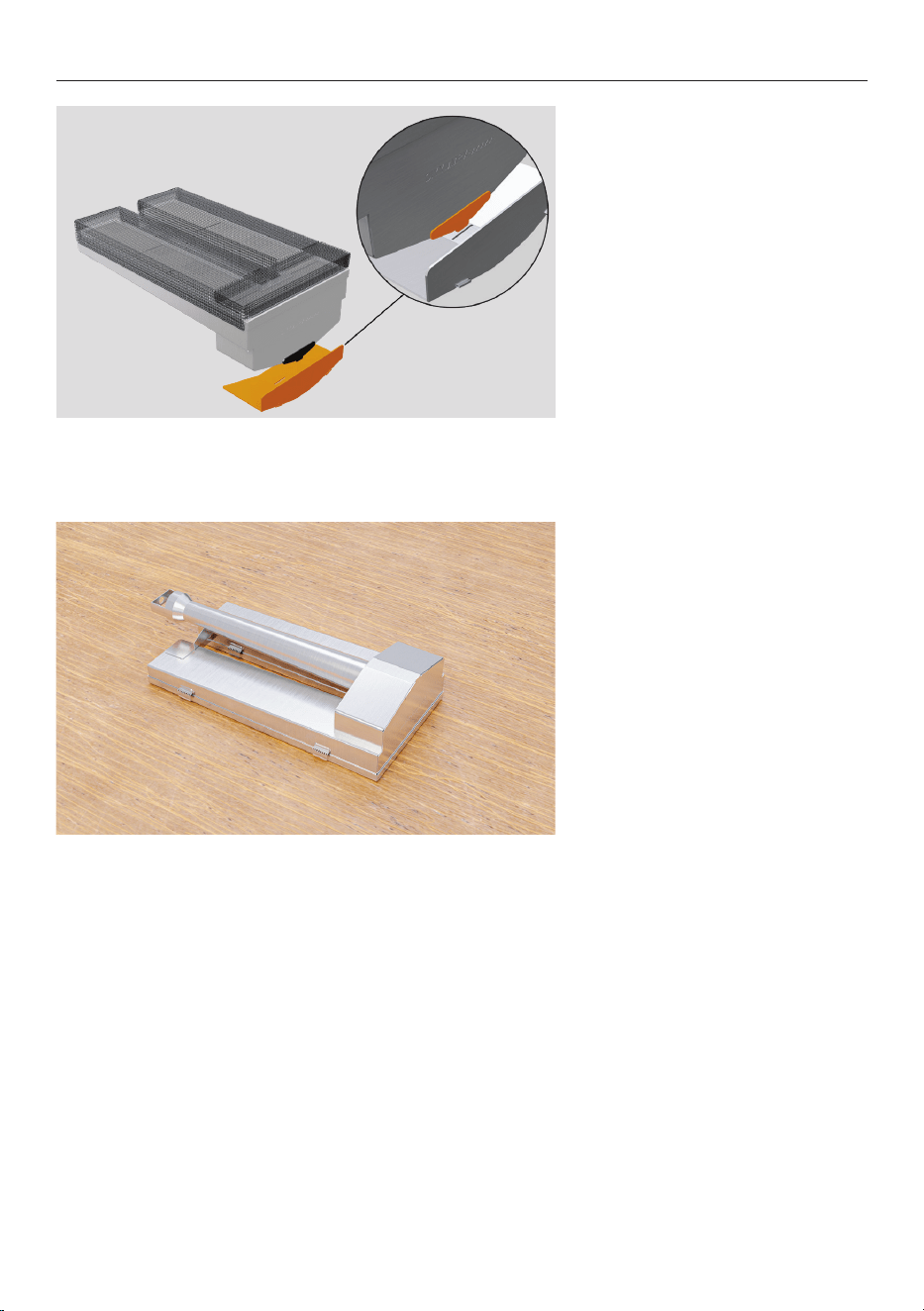
3. Check the burner inlet for
blockages. Use a safety pin or
paper clip to unblock it.
Gently shake or vacuum the
burner to remove debris. Do
not use a brush. Do not use
water.
Run the sear burner for 10–20 minutes, then allow to cool. The sear burner is self-cleaning,
but it can be removed for further cleaning if required. Do not use water as it can damage
the sear burner and affect its performance. Always turn off gas supply before removing and
cleaning burners.
33
CLEANING THE SEAR BURNER
4. Hold sear burner at the sides
and fit burner inlet back into
opening at front of grill. Ensure
it is aligned correctly on the
valve inside the opening.
Lower at rear to refit it securely
on mount. Refit mesh.
Burner must be properly
located to ensure safe
operation.
If sear burner gets wet
Remove the burner. Rest it
upside down to allow water to
drain.
Allow burner to dry completely
before reinstalling and using.
34
LEAK TESTING
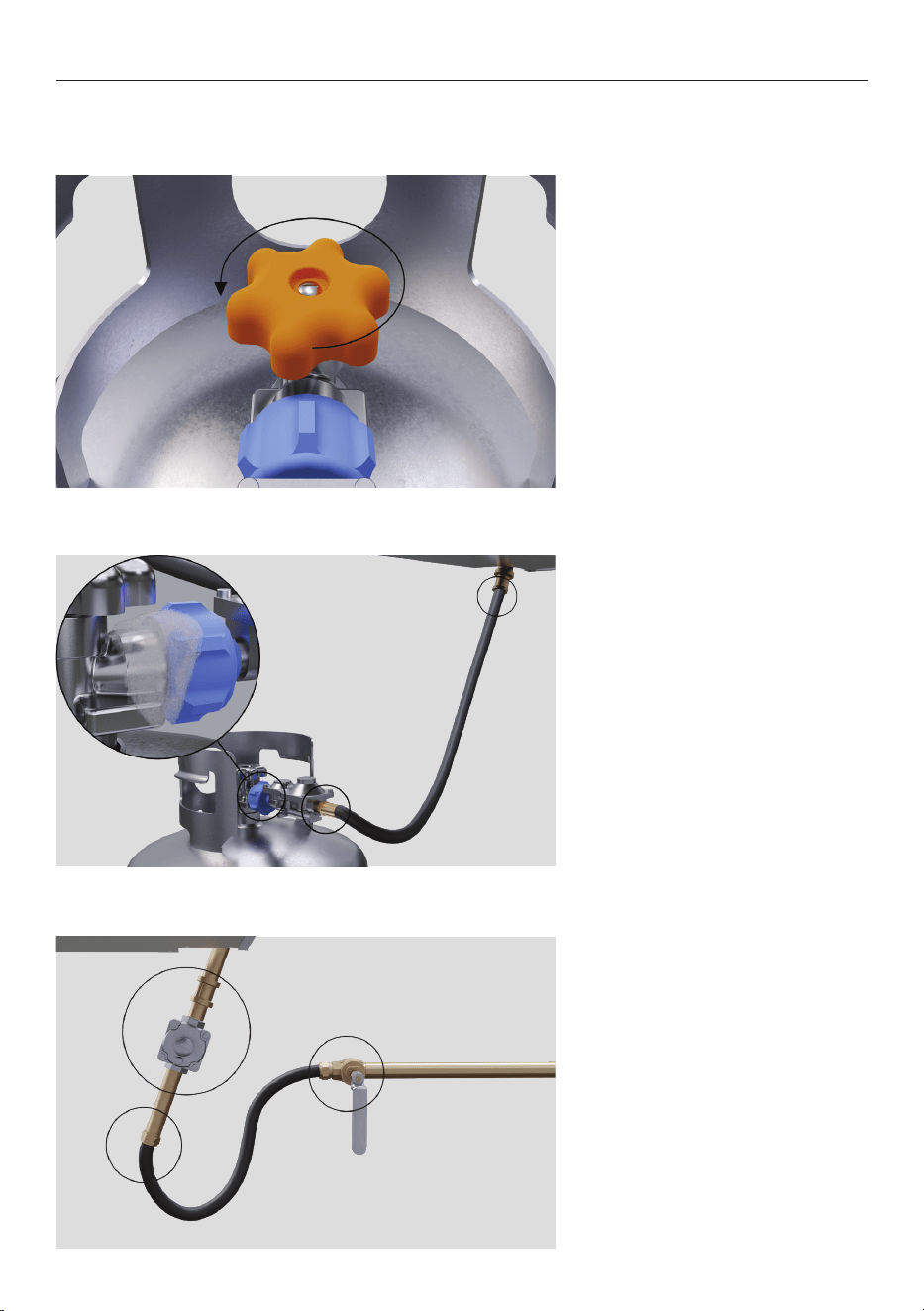
1. Open the gas cylinder valve.
Do not smoke while leak testing, and extinguish all open flames. Check with a full cylinder
and make sure all dials are OFF.
2. Apply soapy water to all
connections, hoses and fittings
from the cylinder to the
connection at the grill.
Soap bubbles will appear
where gas is escaping.
3. If leaking, turn gas off,
tighten leaking connections
and recheck.
If still leaking, turn gas off, and
call your local gas utility or the
dealer where you purchased
the grill.
35
CHANGING THE GAS CYLINDER
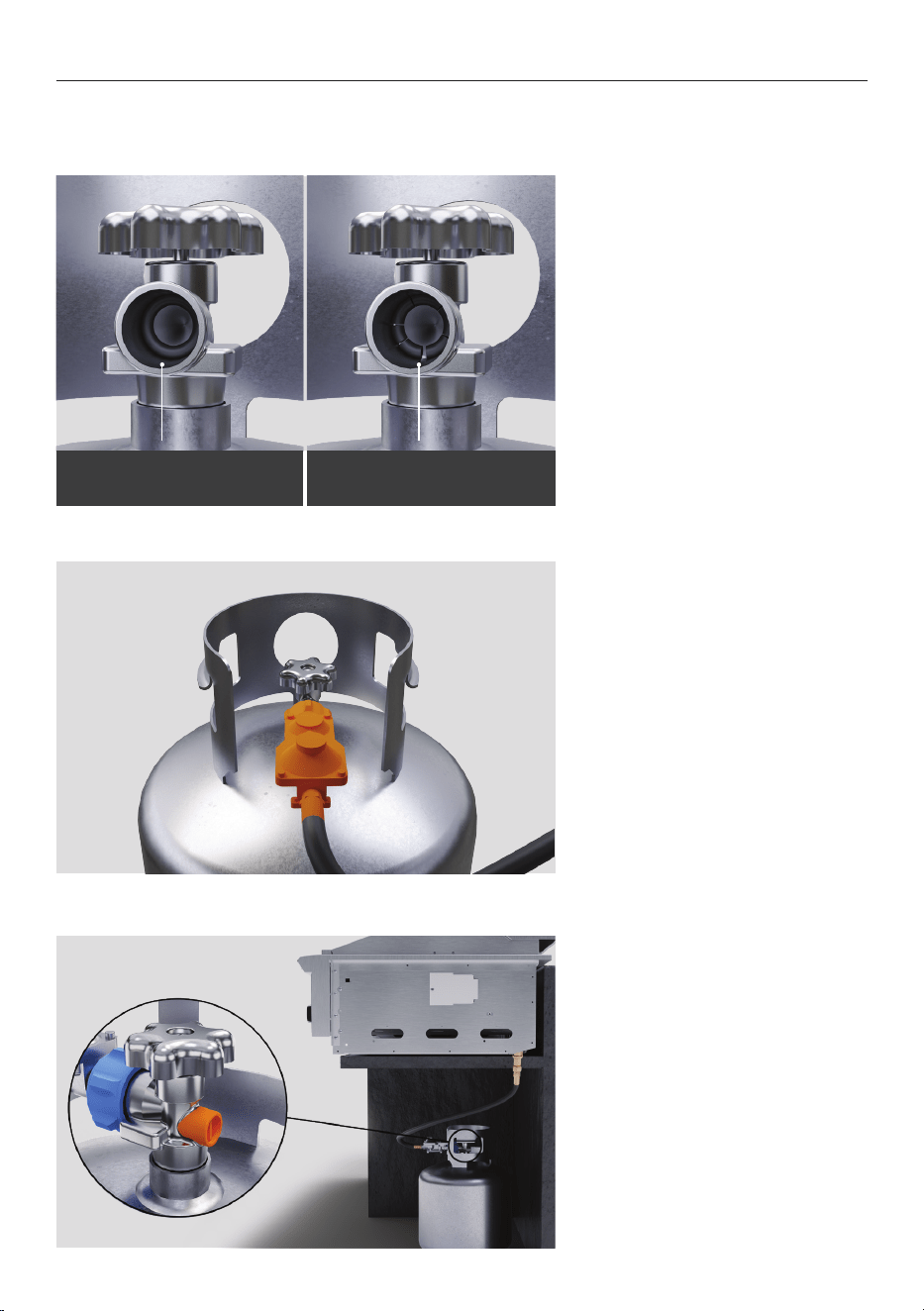
2. If O-ring is in good condition,
connect the grill regulator to
the gas cylinder valve and turn
gas on. Check for leaks. See
'Leak testing.'
Inspect the gas connection hose every time you change the gas cylinder. Replace hose if
there are any signs of damage.
3. If there is no leak, place the
cylinder into the grill cabinet
with the pressure relief valve
facing away from you.
Always close the cylinder valve
after each use.
1. Before connecting new
cylinder, check the rubber
O-ring. If O-ring is damaged,
return it to gas supplier.
Do not use damaged cylinder.
No signs of damage Signs of damage
36
REPLACING THE LIGHTS
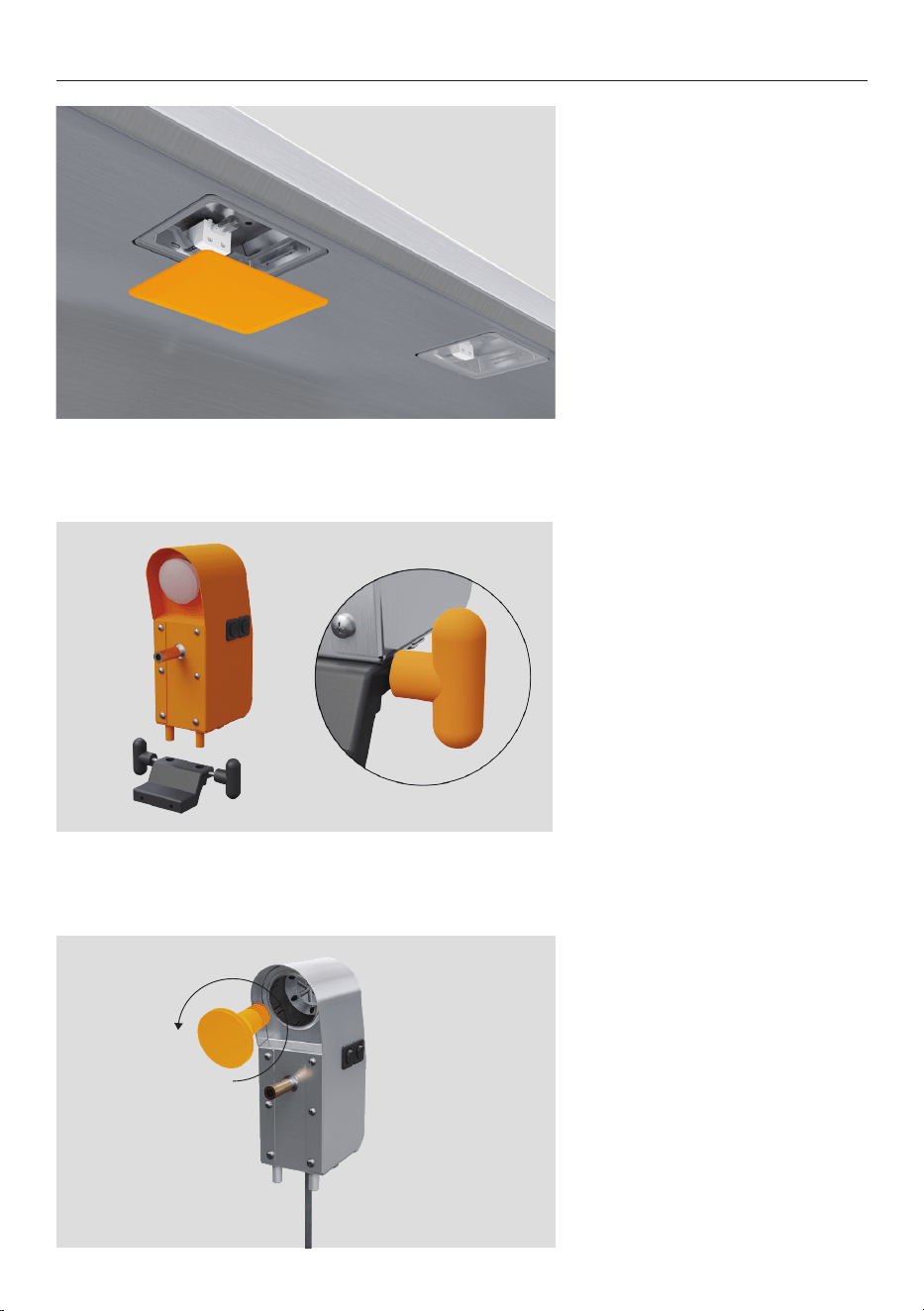
Replacing rotisserie light
1. Unplug rotisserie motor from
power supply. Loosen handles,
and lift motor off grill.
Replacing hood lights
Turn power off at outlet, and
allow grill to cool.
Use a screwdriver to unclip and
remove light cover. Use a cloth
to protect bulb from fingers,
and pull bulb to remove.
Replace with new bulb.
The grill uses G4 - 12v, 10W
max halogen bulbs with a
bi-pin base.
2. Unscrew and replace light
bulb. The rotisserie uses a 50W
(or its equivalent) Max. Halogen
Narrow bulb.
Refit motor to grill, tighten
lugs and reconnect the power
supply.
37
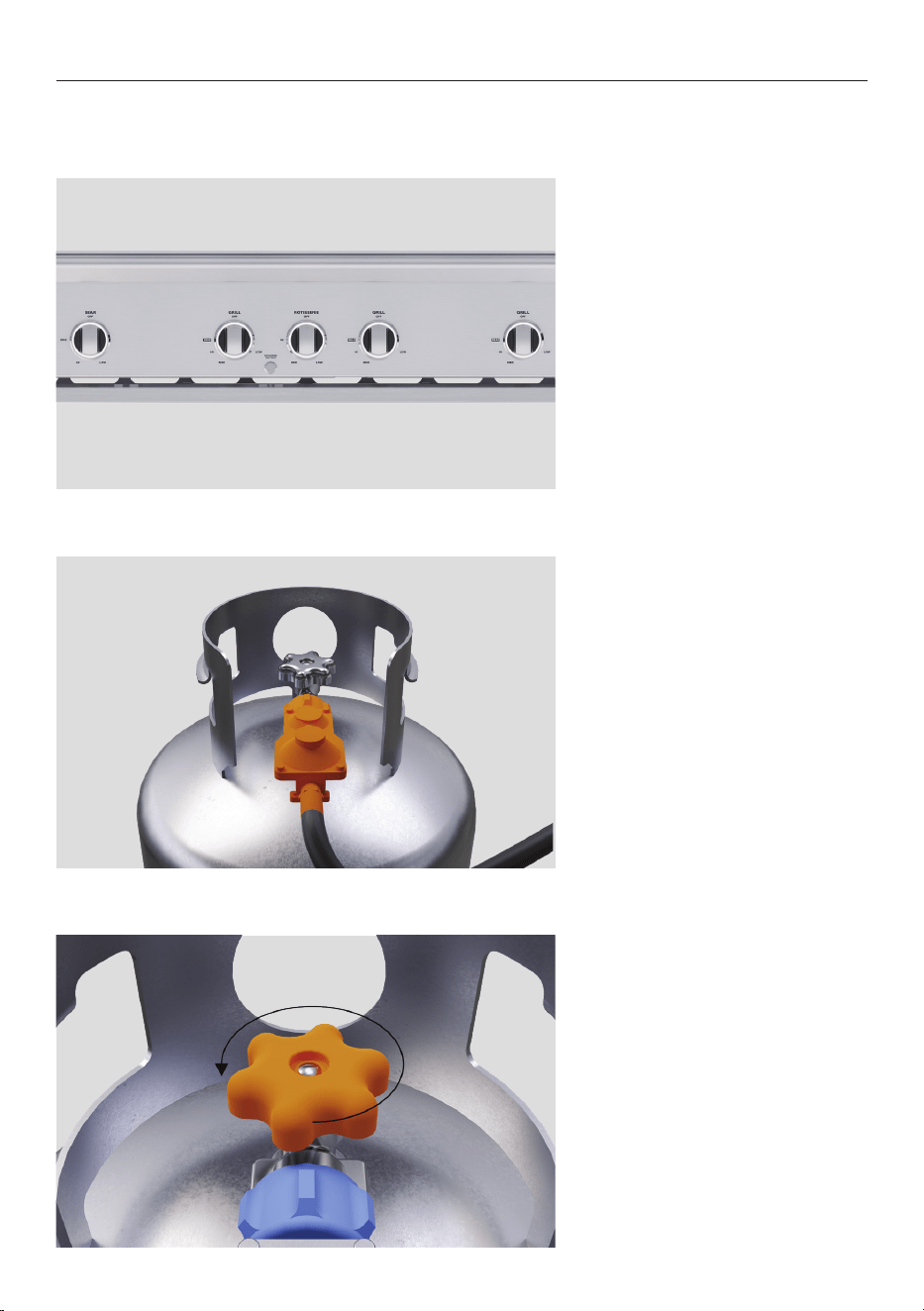
RESETTING FLOW LIMITING DEVICE
2. Disconnect regulator hose
from the gas cylinder.
3. Reconnect regulator hose.
Turn gas on with at least two
full turns, and check for leaks.
See 'Leak testing.'
The flow limiting device on the gas cylinder may activate if the cylinder gets cold or is low
on gas. This can affect gas flow and heat output and will need to be reset.
1. Turn all burner dials to
OFF.

38
TROUBLESHOOTING
Why is the burner flame yellow/orange?
Burner needs to be adjusted. See Install Guide.
Why won't the grill light when I push the dial?
z
Dial not held in when attempting to light grill. Push and hold for 2 seconds before
turning to SEAR/MAX. See 'Using the grill.'
z
Gas supply is turned off. Turn gas on.
z
Power supply is off. Check that the grill is connected to a live power source, and
check power supply fuse. Replace if blown.
z
Ground Fault Interrupter (GFI) has tripped. Check GFI and reset.
z
Burner inlet or tube may be blocked. Remove burner and check for blockages. See
'Cleaning the grill burners' or 'Cleaning the sear burner.' If problem persists, call
Customer Care or your Authorized Service Center.
z
Ignitor has failed. Call Customer Care or your Authorized Service Center.
Why does the grill keep having flare-ups?
z
Radiant trays have grease on them. Wait for trays to cool, then rotate ceramic rods
and heat on HI for 10–20 minutes. See 'Cleaning.'
z
Sear burner has grease on it. See 'Cleaning the sear burner.'
z
Rotisserie burner has grease on it. See 'Cleaning.'
Why can I smell gas?
z
Burner dial is on but burner is not lit. Check the dial is turned to OFF. Wait 5 minutes
before relighting. See 'Using the grill.'
z
Gas is leaking. See 'Leak testing.'
Why isn't grill getting hot on
HI/SEAR?
z
Grill hasn't preheated enough. Preheat for full 10 minutes before cooking.
z
Grill is being affected by wind gusts. Move to a more sheltered area if possible.
z
LP gas cylinder is empty. Check gas cylinder, and refill if empty.
z
A burner port is obstructed. See 'Cleaning the grill burners.' or 'Cleaning
the sear burner.'
z
Flow Limiting Device is activated on LP cylinder. See 'Resetting flow limiting device.'
Why is there smoke coming from the grill?
Residue or grease on the grates or radiant trays. Brush residue off the grates with a grill
brush. Residue on radiant trays should burn off during the cook. See 'Cleaning.'
39
TROUBLESHOOTING
Why isn't the rotisserie staying lit when I release the safety valve button?
Releasing button too soon. Keep pressing the safety valve button until the rotisserie burner
stays lit.
Why isn't the rotisserie rotating? (some models only)
z
Motor is off. Check that motor is switched on and plugged into a GFI outlet.
Reset if tripped.
z
Rod not inserted correctly. Check the rod is inserted correctly in the motor and
balanced on the rollers at the side of grill. See 'Using the rotisserie'.
z
Something is blocking it. Check that trays and racks are not preventing rotisserie from
turning. Check food is tied correctly and is centered and balanced on the rod. If not,
switch motor off and turn burner to LOW while you readjust the food.
Why aren't the hood lights or rotisserie light working? (some models only)
z
Bulb has blown. Replace bulb. See 'Replacing the lights.'
z
No power. Check the power supply is on. Check power supply fuse, and replace if
blown. If problem persists, call Customer Care or your Authorized Service Center.
Why aren't the dial lights working?
z
No power. Check the power supply is on. Check power supply fuse. Replace if blown.
If problem persists, call Customer Care or your Authorized Service Center.
40
CUSTOMER CARE
If you still need assistance or parts, please refer to the Service & Warranty book for
warranty details and your nearest Authorized Service Center, Customer Care, or contact us
through our website www.dcsappliances.com or email: customer.care@fisherpaykel.com.
Before you call for service or assistance
Check the things you can do yourself. Refer to the installation instructions and your user
guide and check that:
1 Your product is correctly installed.
2 You are familiar with its normal operation.
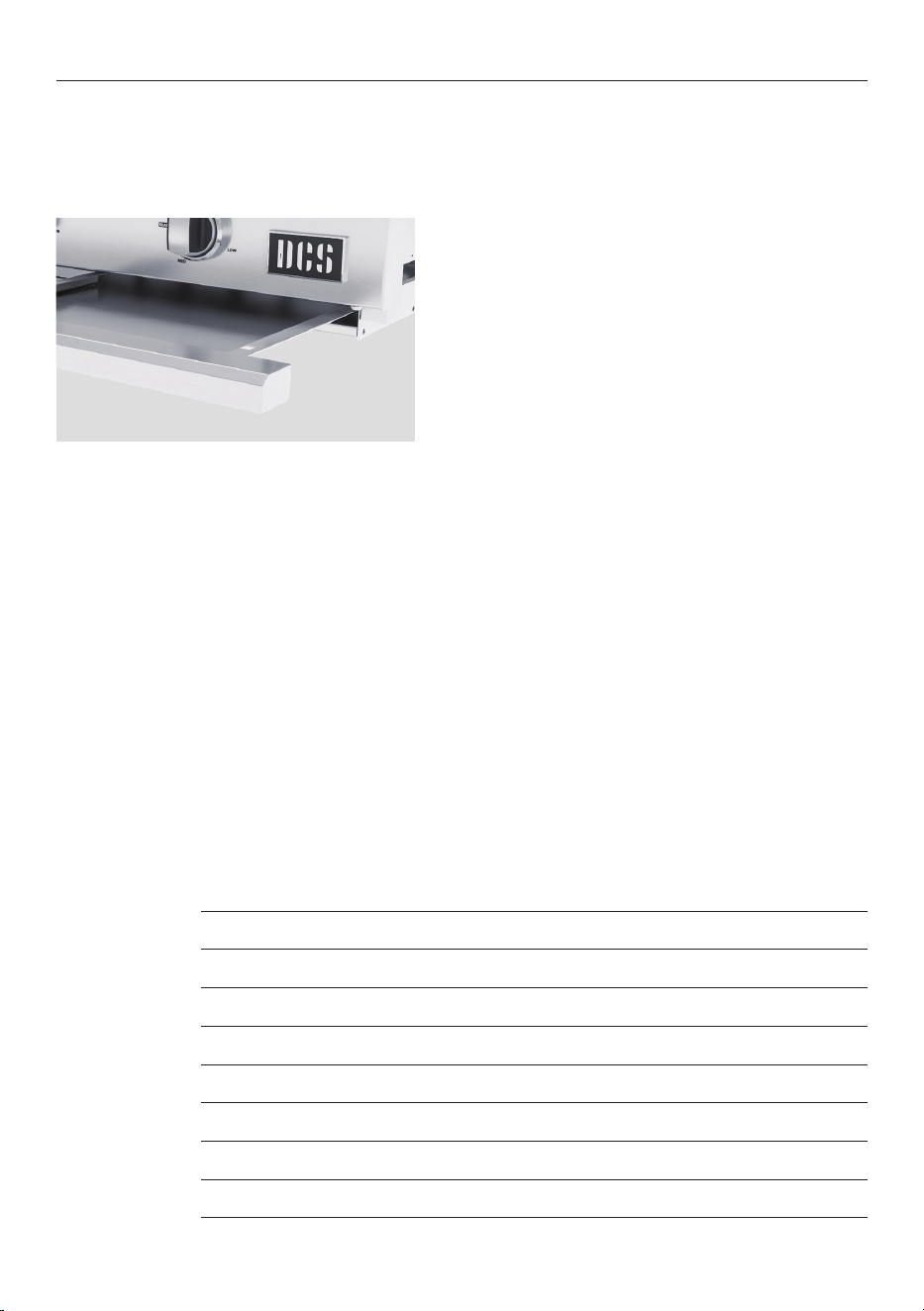
3 Model number (can be found on the inside,
right side panel behind the drip tray handle).
4 Serial number (can be found on the inside,
right side panel behind the drip tray handle).
5 Code (can be found on the inside, right side
panel behind the drip pan handle).
6 Date of installation.
Complete and keep for safe reference:
Model
Serial No.
Purchase Date
Purchaser
Dealer
City
State
Zip
Country

431823B 12.24
DCSAPPLIANCES.COM
© Fisher&Paykel Appliances 2024. All rights reserved.
Fisher & Paykel Appliances, 695 Town Center Drive
Suite 180, Costa Mesa, CA 92626, USA
The models shown in this guide may not be available in all markets
and are subject to change at any time.
The product specifications in this guide apply to the specific products and
models described at the date of issue. Under our policy of continuous product
improvement, these specifications may change at any time.
For current details about model and specification availability in your country,
please go to our website or contact your local DCS dealer.