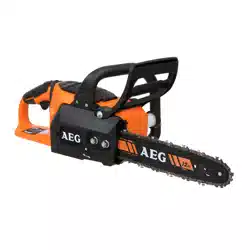

A18CHS14
ACS18B
Original instructions

2
2
I
mportant!
It is essential that you read the instructions in this manual before
assembling, operating, and maintaining the product.
Subject to technical modifications.
3
3
x 1
x 1x 1
x 1x 1 x 1
A18CHS14
4
4
BUMPER SPIKES
CHAIN
CATCHER
BAR MOUNTING
NUTS
CHAIN COVER
SCABBARD
CHAIN
GUIDE BAR
FRONT HANDLE
FRONT HAND GUARD /
CHAIN BRAKE
SCRENCH
TOOL
TRIGGER
RELEASE
REAR
HANDLE
BATTERY
PACK
BELT
HOOK
CHAIN LUBRICANT
TANK CAP
CHAIN
TENSIONING
SCREW
THROTTLE
TRIGGER
x 1
ACS18B
x 1 x 1
x 1
5
5
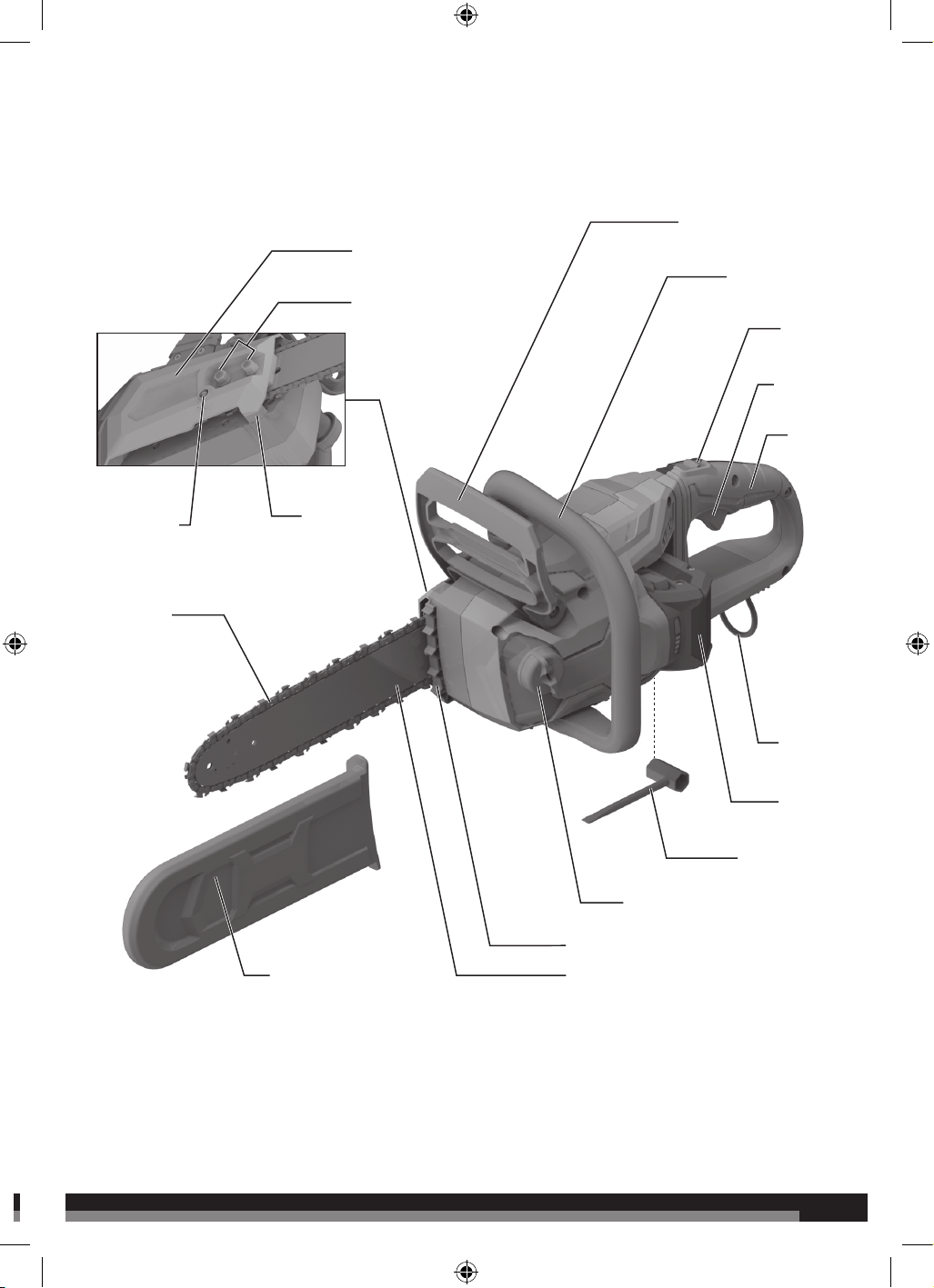
BUMPER SPIKES
CHAIN
CATCHER
BAR MOUNTING
NUTS
CHAIN COVER
SCABBARD
CHAIN
GUIDE BAR
FRONT HANDLE
FRONT HAND GUARD /
CHAIN BRAKE
SCRENCH
TOOL
TRIGGER
RELEASE
REAR
HANDLE
BATTERY
PACK
BELT
HOOK
CHAIN LUBRICANT
TANK CAP
CHAIN
TENSIONING
SCREW
THROTTLE
TRIGGER
6
6
START
STOP
8
21
20
14
15
10
22
19
12
13
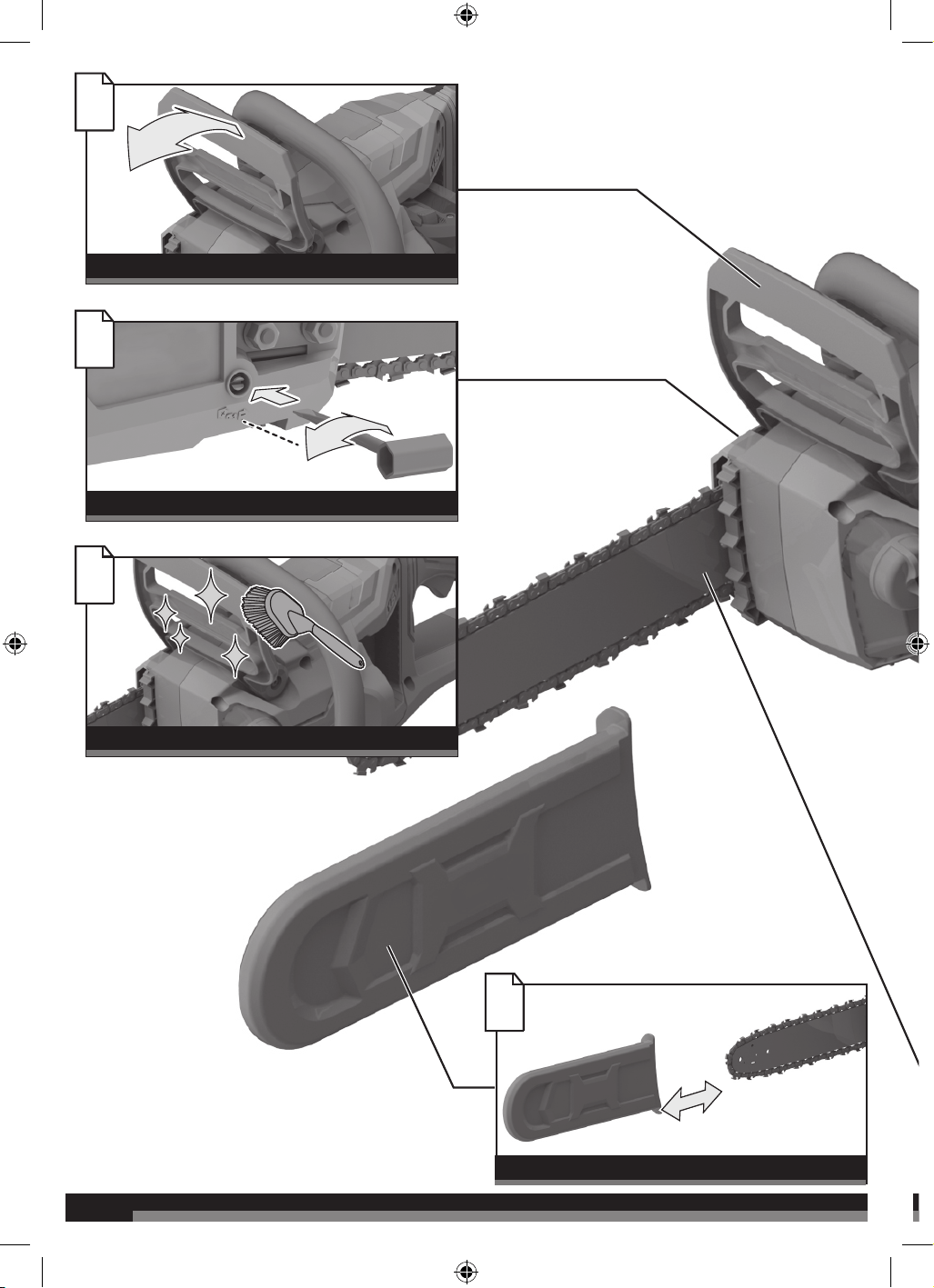
USING THE CHAIN BRAKE
INSTALLING AND REMOVING THE SCABBARD
ADJUSTING THE CHAIN TENSION
CLEANING THE PRODUCT
7
7
START
STOP
8
21
20
14
15
10
22
19
12
13
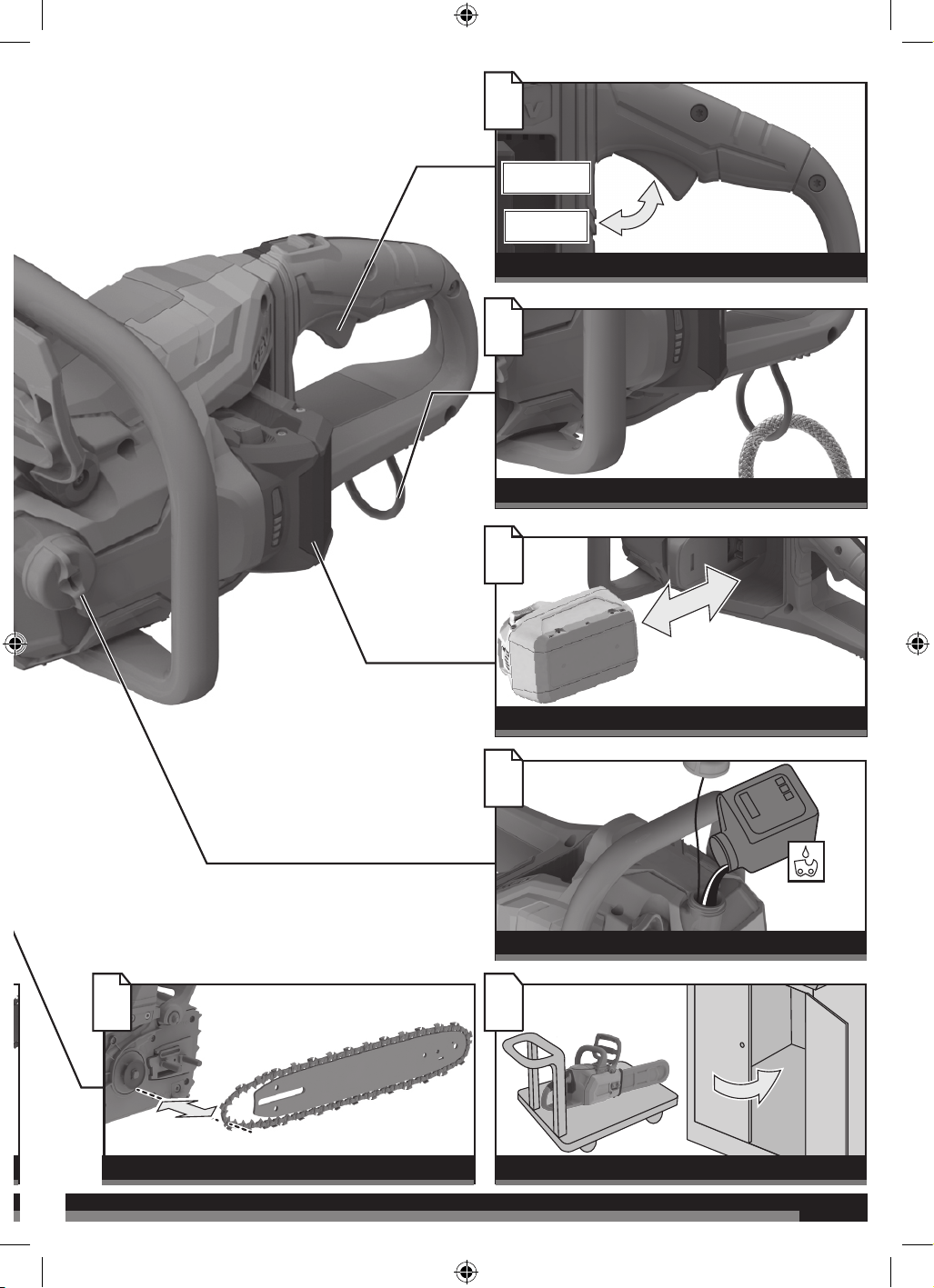
OPERATING THE PRODUCT
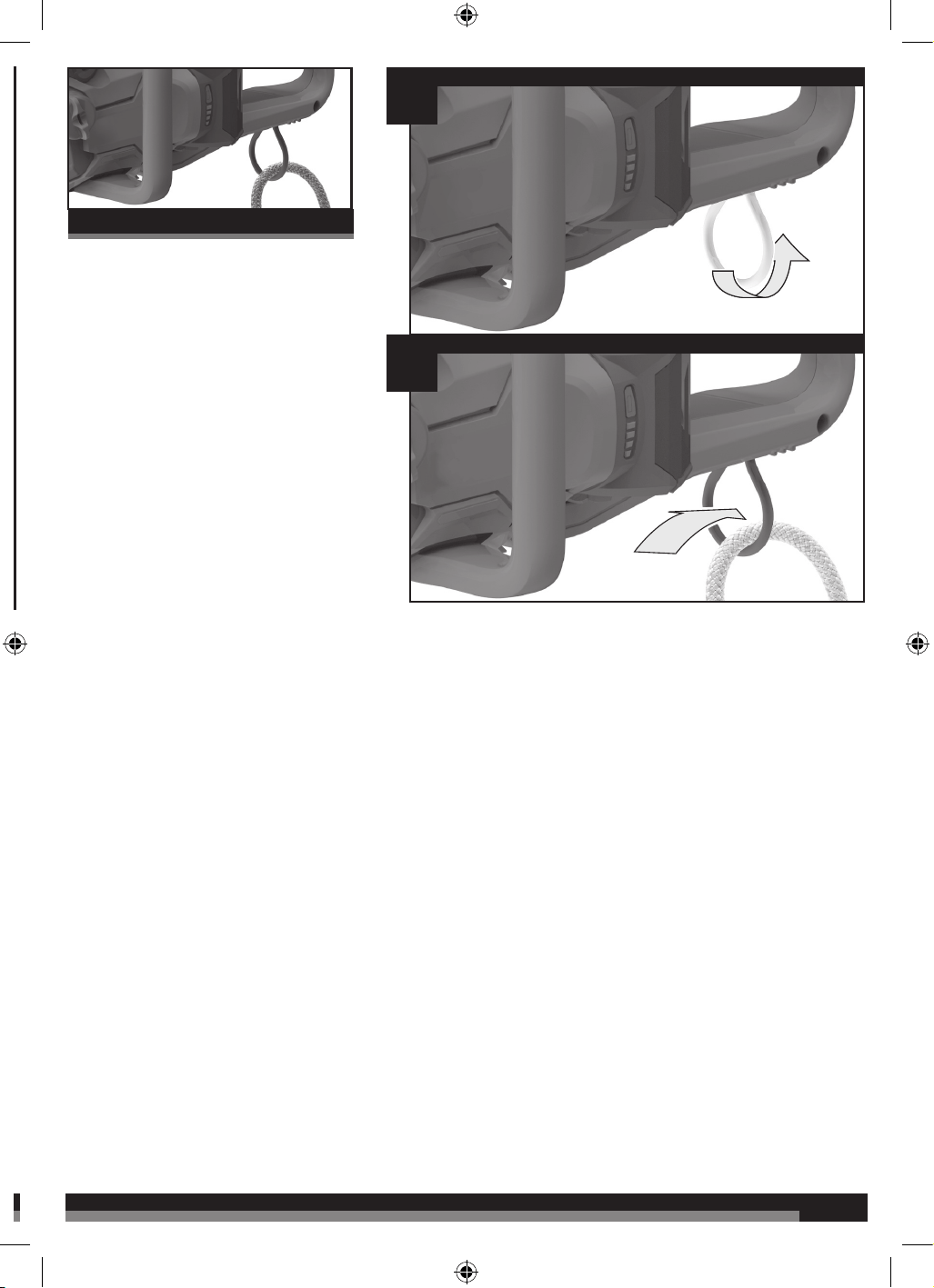
USING THE BELT HOOK
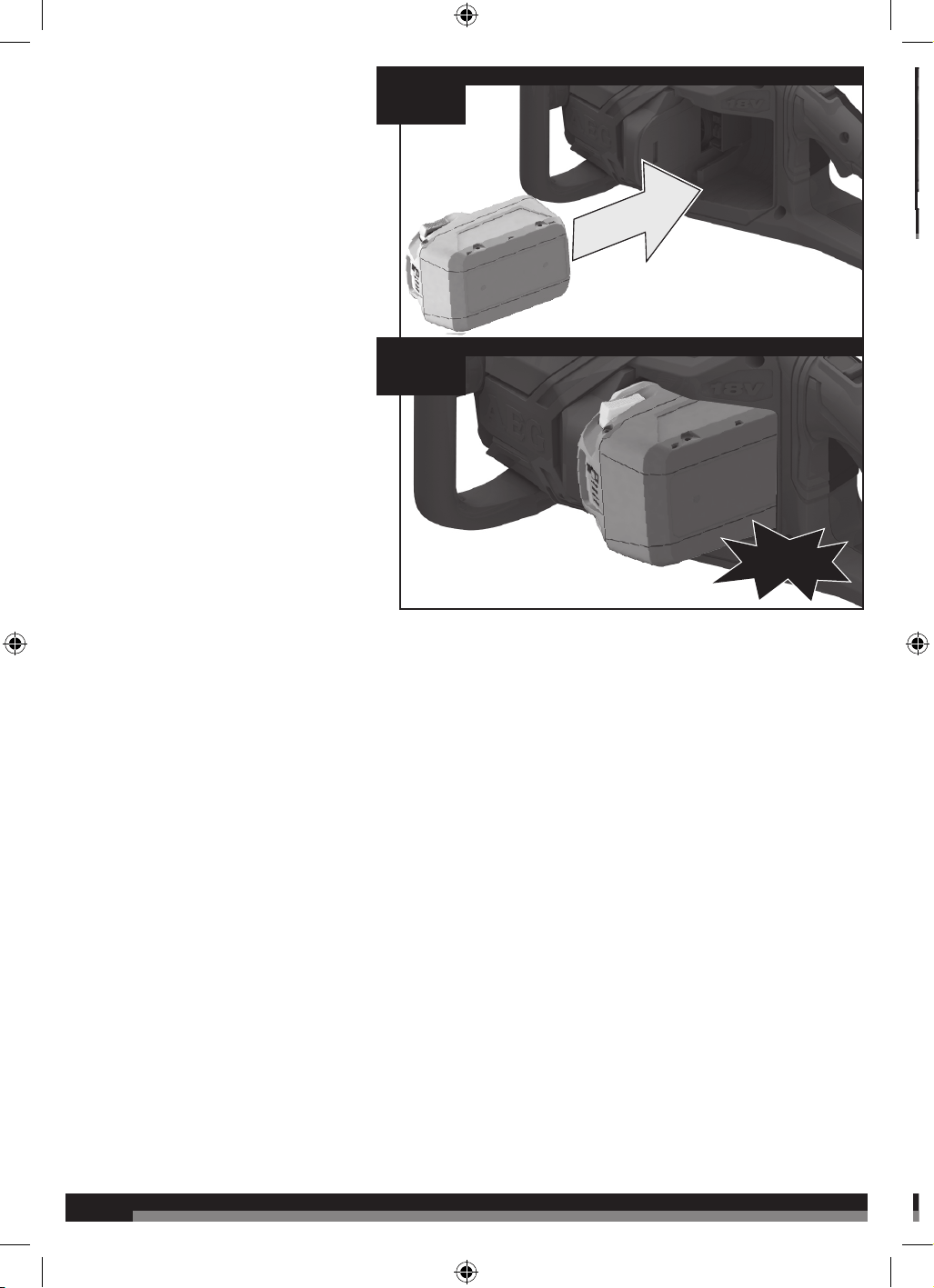
INSTALLING AND REMOVING THE BATTERY PACK
ADDING CHAIN AND BAR OIL
STORING THE PRODUCTREPLACING THE CHAIN AND BAR
INSTALLING AND REMOVING THE SCABBARD
8
8
3
4
1
2
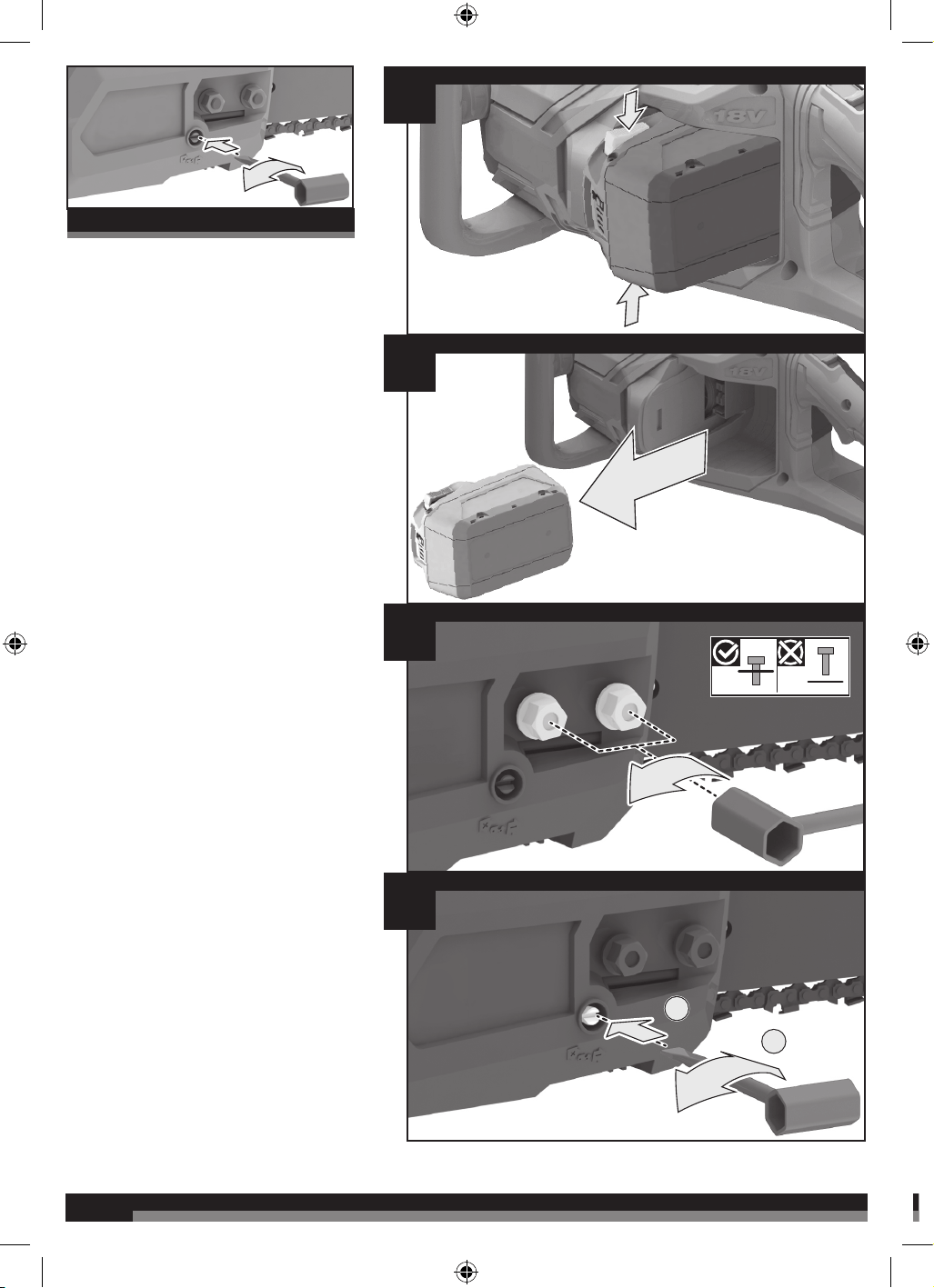
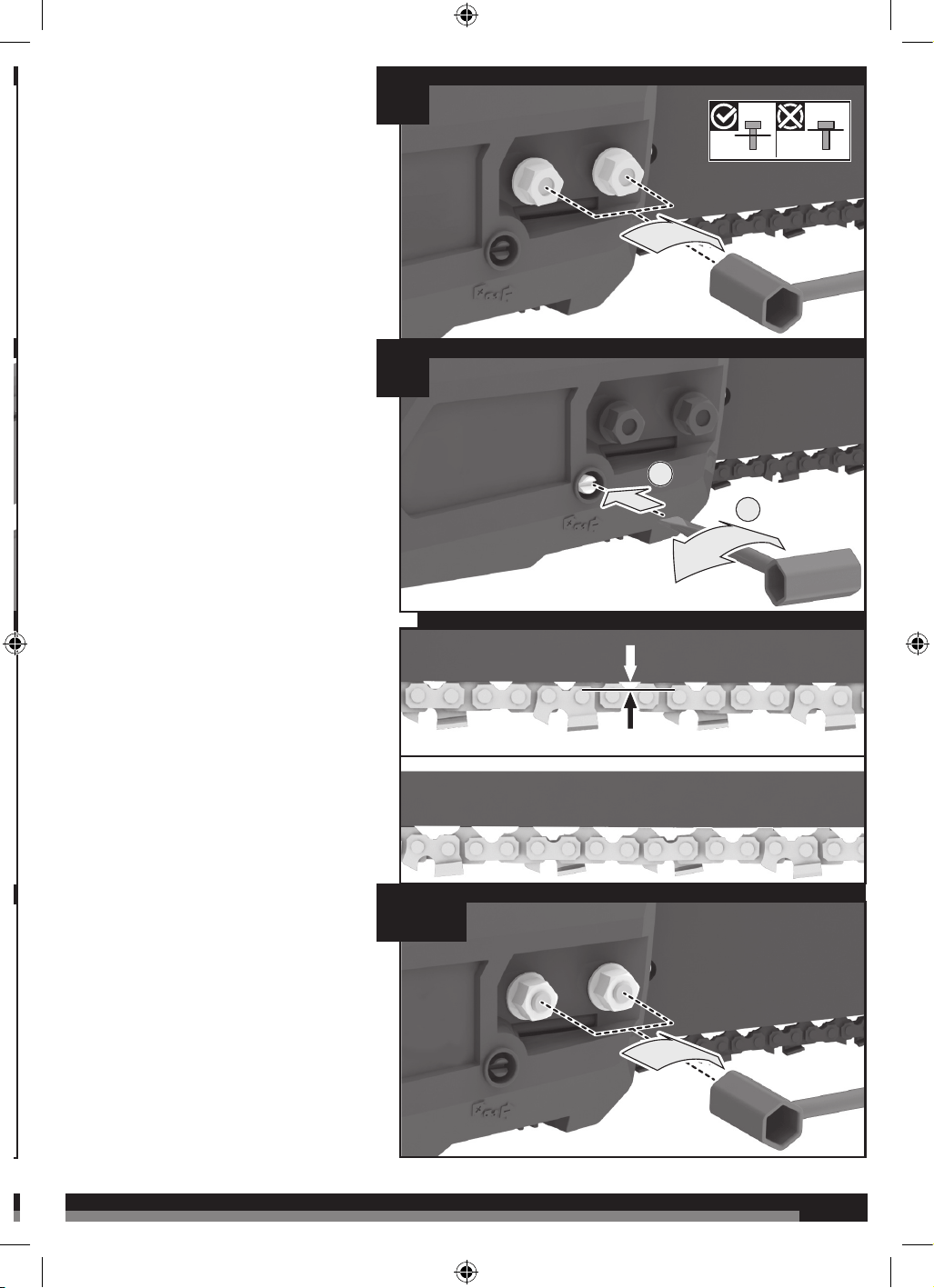
ADJUSTING THE CHAIN TENSION
NOTE: The chain tension is correct when the gap
is 3-4 mm. Check the chain tension regularly, as
the chain stretches when it heats up.
1
2
9
9
3
4
1
2
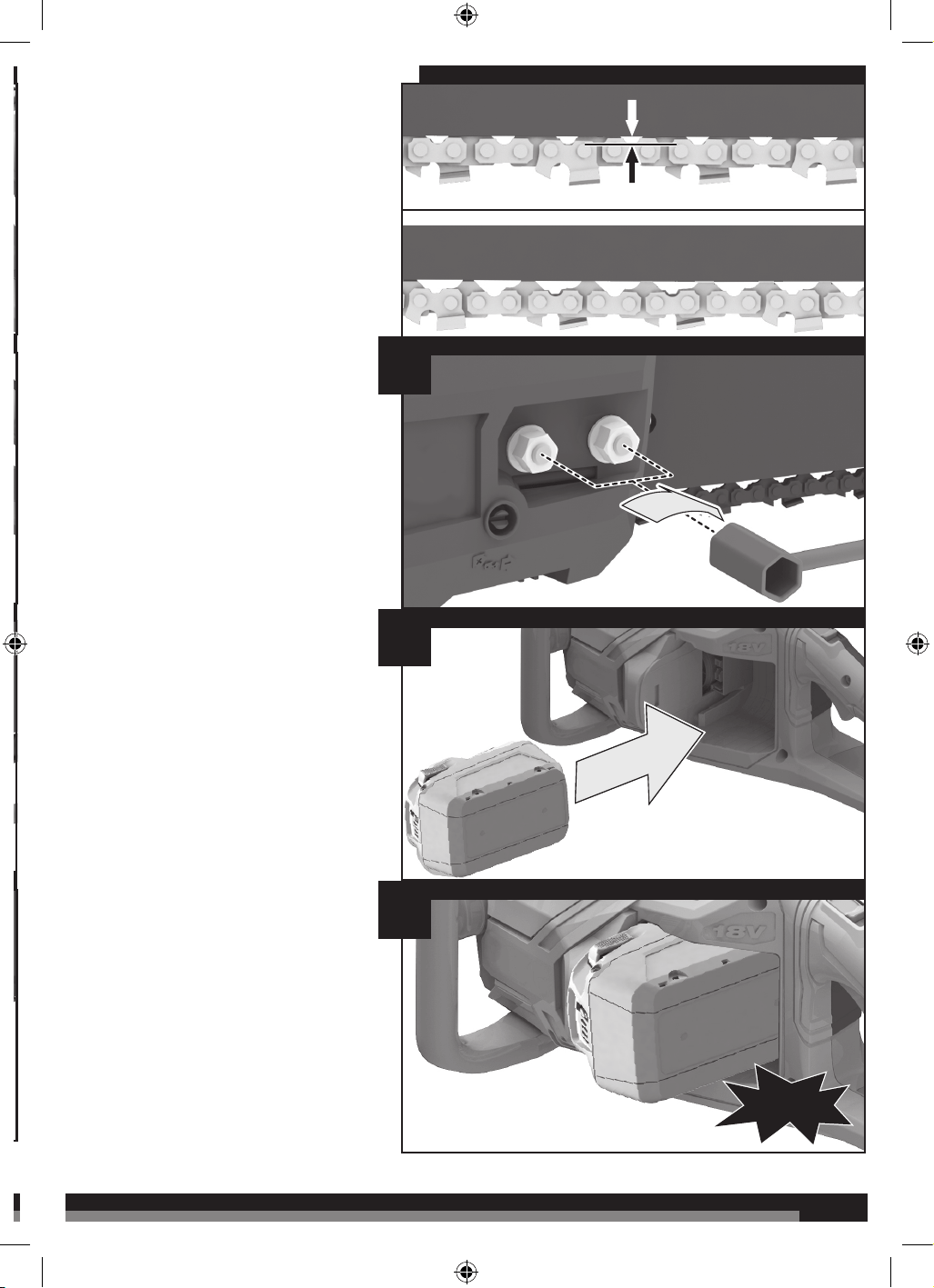
5
FLATS
APPROX. 3-4 mm
click
6
7
NOTE: The chain tension is correct when the gap
is 3-4 mm. Check the chain tension regularly, as
the chain stretches when it heats up.
10
10
3
4
1
2
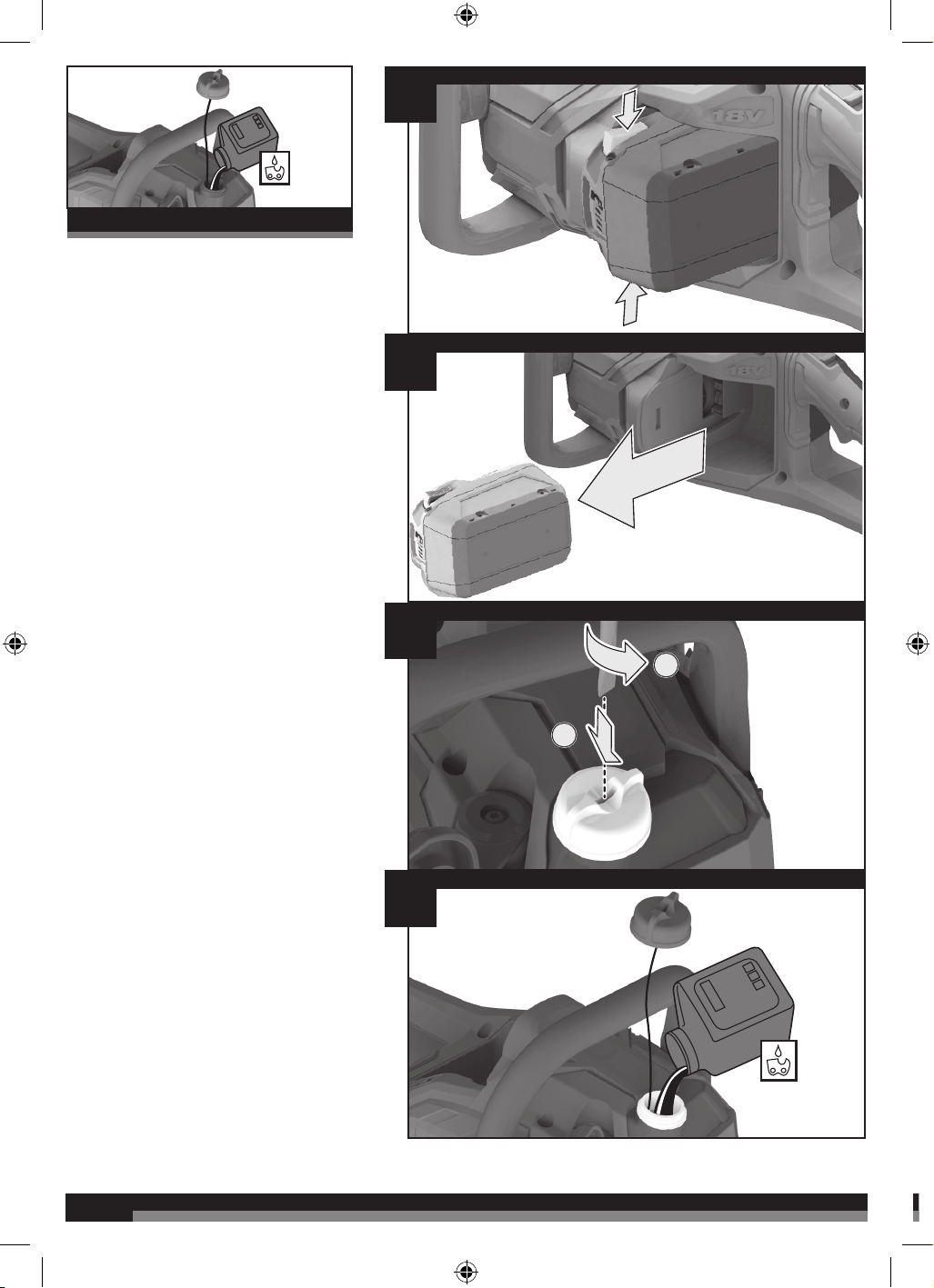
ADDING CHAIN AND BAR OIL
1
2
11
11
3
4
1
2
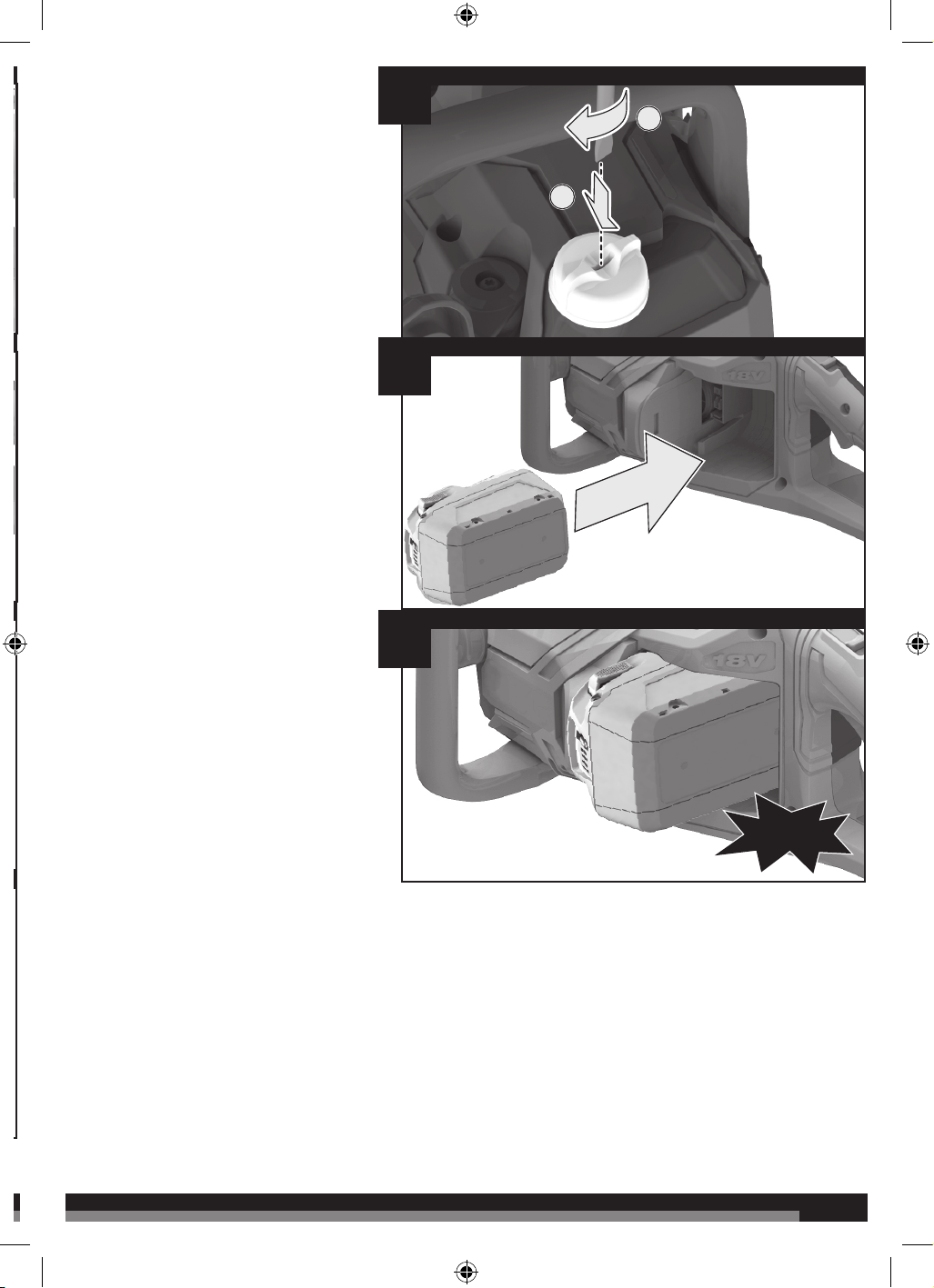
click
5
6
7
1
2
12
12
click
1
2
2
1
START
STOP
INSTALLING AND REMOVING THE
BATTERY PACK
OPERATING THE PRODUCT
13
13
click
1
2
2
1
START
STOP
OPERATING THE PRODUCT
14
14
BRAKE ON
BRAKE OFF
4
1
2
3
USING THE CHAIN BRAKE
REPLACING THE CHAIN AND BAR
NOTE: The product does not turn on while the
chain brake is engaged.
15
15
BRAKE ON
BRAKE OFF
4
1
2
3
REPLACING THE CHAIN AND BAR
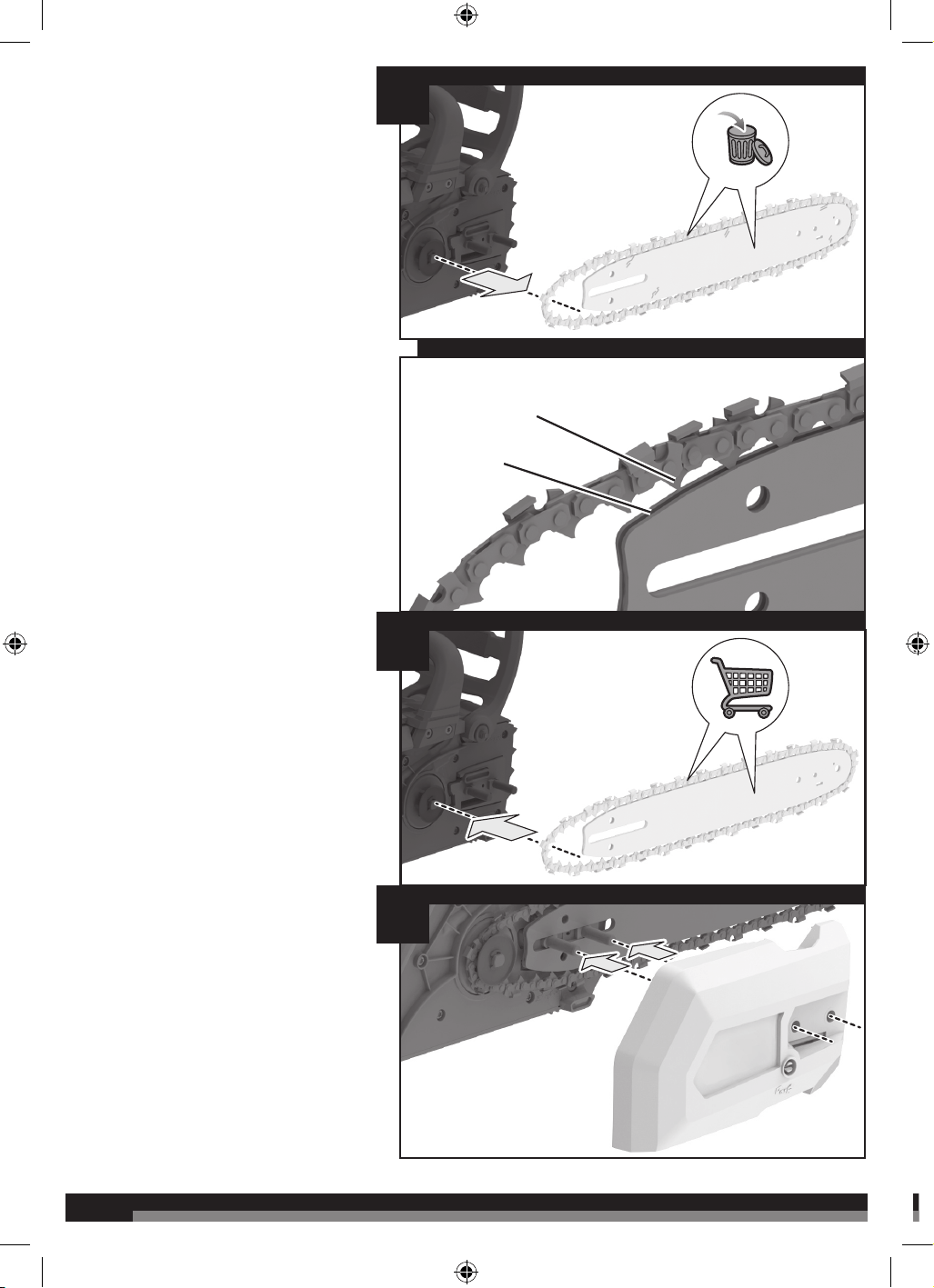
16
16
5
6
7
CHAIN DRIVE
LINKS
BAR
GROOVE
NOTE: Always properly dispose of used chain
and bar.
NOTE: For replacment chain and bar part
numbers, see page 26.
NOTE: The chain tension is correct when the gap
is 3-4 mm. Check the chain tension regularly, as
the chain stretches when it heats up.
17
17
5
6
7
CHAIN DRIVE
LINKS
BAR
GROOVE
8
9
10
APPROX. 3-4 mm
FLATS
NOTE: The chain tension is correct when the gap
is 3-4 mm. Check the chain tension regularly, as
the chain stretches when it heats up.
1
2
18
18
12
11
click
1
2
USING THE BELT HOOK
19
19
12
11
click
1
2
USING THE BELT HOOK
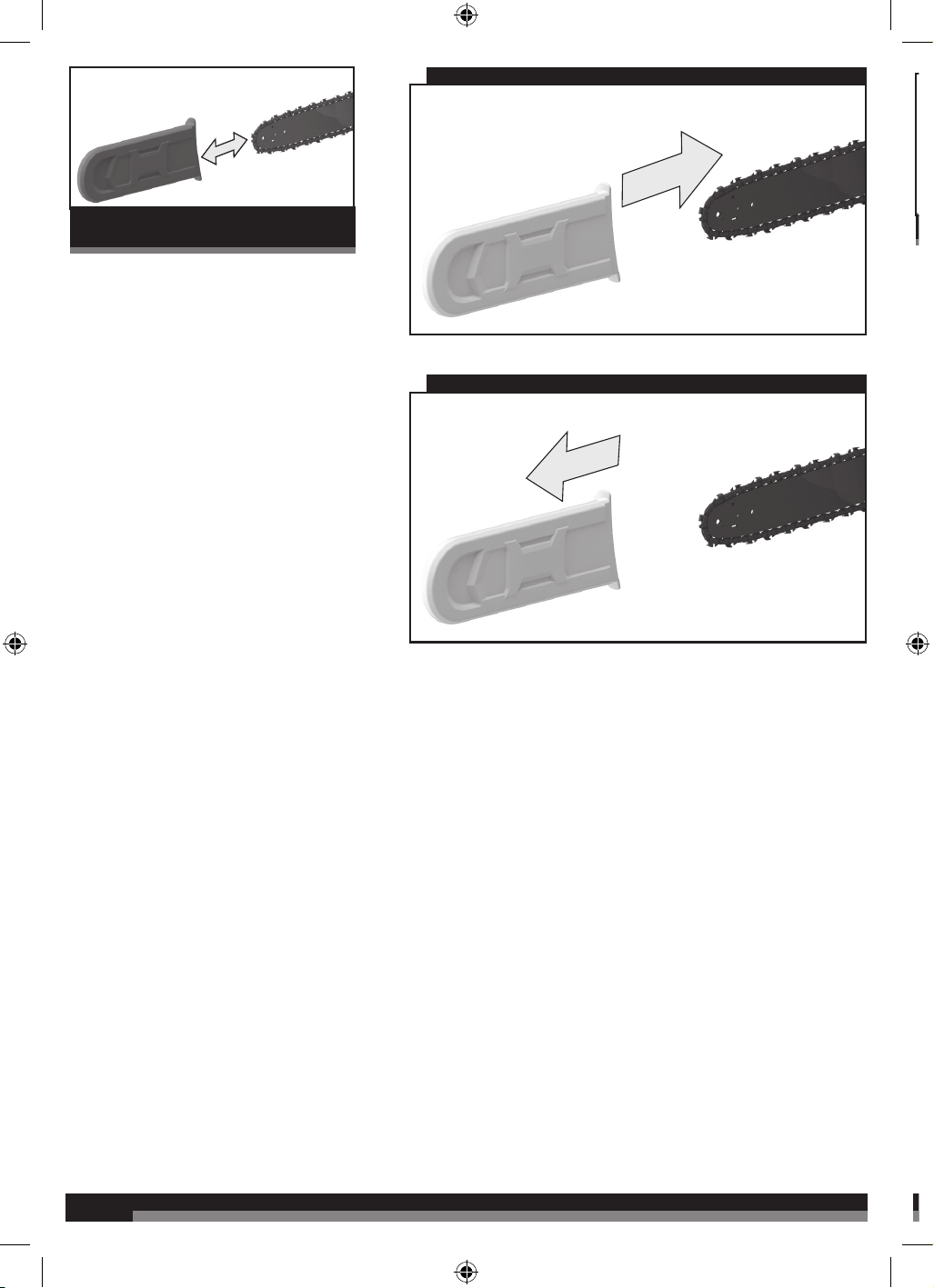
20
20
1
2
3
INSTALLING AND REMOVING THE
SCABBARD
CLEANING THE PRODUCT
NOTE: Clean the the product with a with a soft-bristle
brush or with a soft, dry cloth.
NOTE: Do not use water to clean the product.
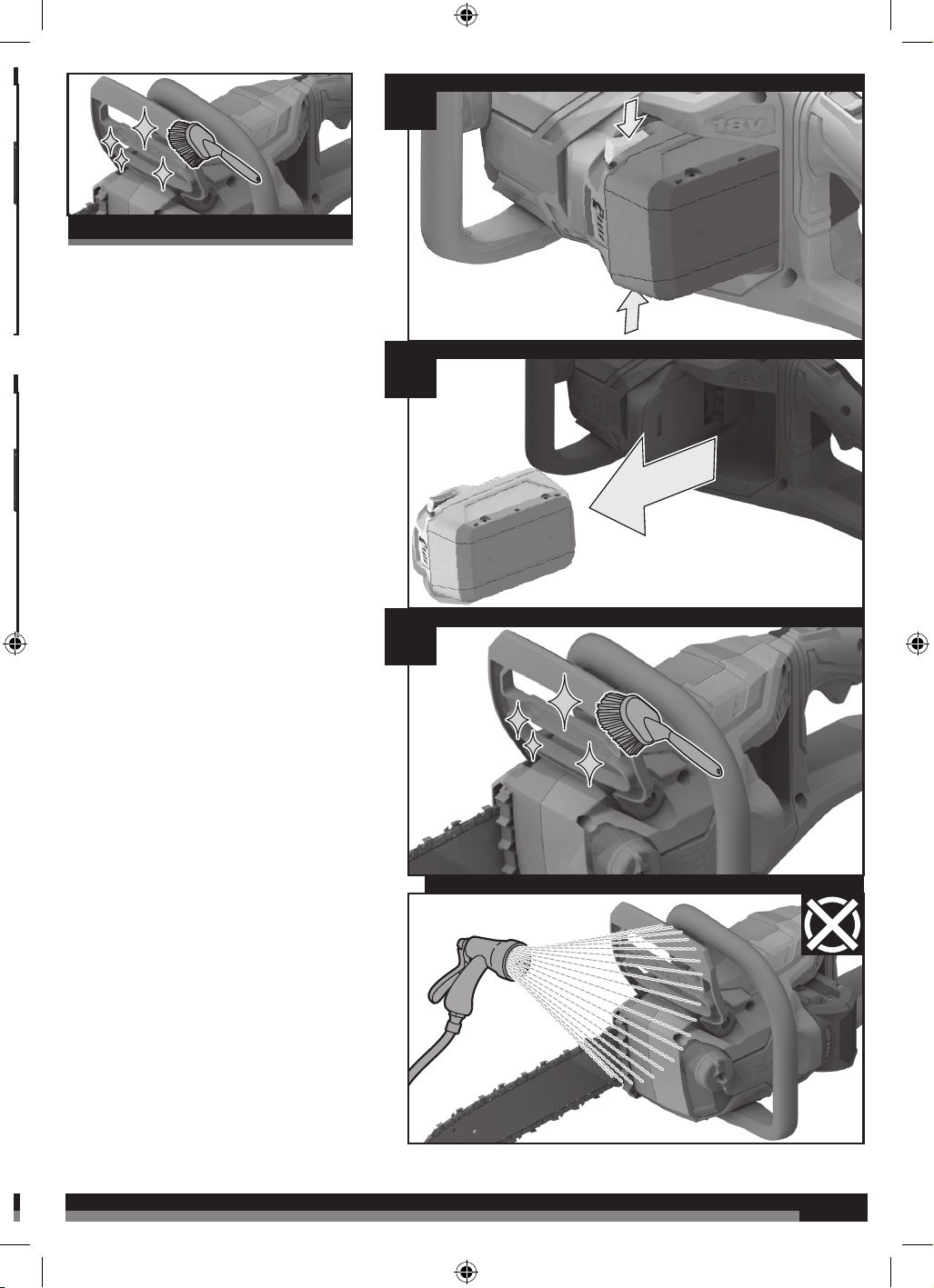
21
21
1
2
3
CLEANING THE PRODUCT
NOTE: Clean the the product with a with a soft-bristle
brush or with a soft, dry cloth.
NOTE: Do not use water to clean the product.
22
22
1
2
3
4
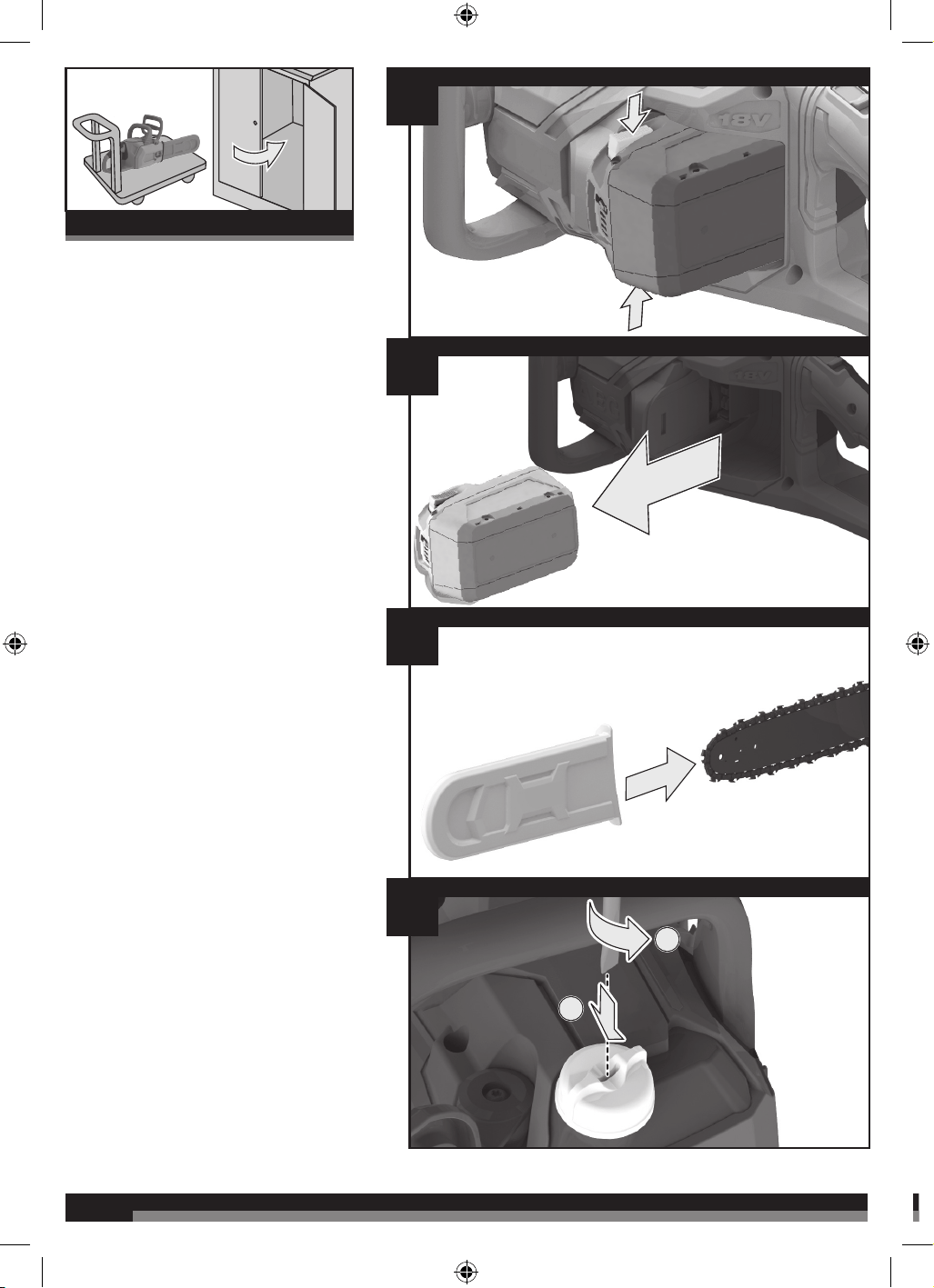
STORING THE PRODUCT
NOTE: Always remove chain and bar oil from the oil
tank before storing the product.
NOTE: Store the product in a cool, dry, and well-
ventilated area that is inaccessible to children. Keep
the product away from corrosive agents, such as
garden chemicals and de-icing salts. Do not store
the product outdoors.
1
2
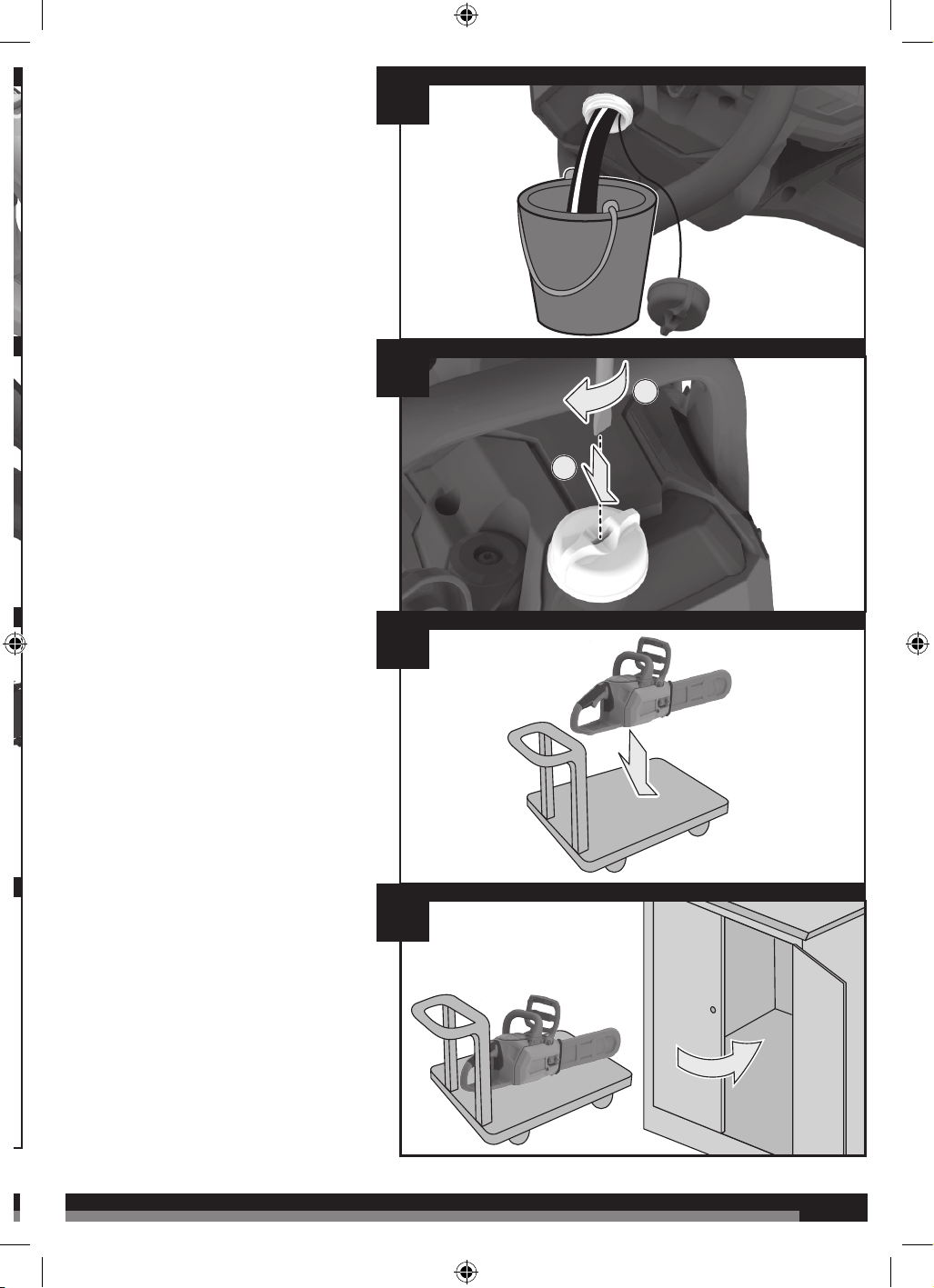
23
23
1
2
3
4
5
6
7
8
NOTE: Always remove chain and bar oil from the oil
tank before storing the product.
NOTE: Store the product in a cool, dry, and well-
ventilated area that is inaccessible to children. Keep
the product away from corrosive agents, such as
garden chemicals and de-icing salts. Do not store
the product outdoors.
1
2
24
24
2
1
1
3
2
5 cm / 2 in
5 cm / 2 in
1
2
1/3
2/3
30 30
30 30
30 30
30 30
30 30
Fig. 1 Fig. 6
Fig. 2 Fig. 7
Fig. 3 Fig. 8
Fig. 4 Fig. 9
Fig. 5 Fig. 10
2
1
2/3
1/3
30
30
30
30
25
25
2
1
1
2
1/3
2/3
2
1
2/3
1/3
30
30
30
Fig. 11
Fig. 12
Fig. 13
Fig. 14
30
26
26
TECHNICAL DATA CORDLESS CHAINSAW
A18CHS14 / ACS18B
Rated voltage 18 V d.c.
Max bar length 300 mm (12 in.)
Chain gauge 0.043 in.
Chain pitch 3/8LP
Chain drive links 45
Chain oil tank capacity 210 mL
Weight (without battery pack, with guide bar, chain, and empty tank) 3.3 kg
Usable cutting length 250 mm
No-load speed 10 m/s
Noise/vibration information
Measured values determined according to IEC 62841-1and IEC 62841-4-1
Typically, the A-weighted noise levels of the tool are:
Sound pressure level (Uncertainty K= 3.0 dB) 88.8 dB(A)
Sound power level (Uncertainty K= 3.0 dB) 96.8 dB(A)
Sound power level (in accordance with ISO 3744)
Measured sound power level 94.2 dB(A)
Guaranteed sound power level 99 dB(A)
Always wear ear protectors!
Total vibration values (vector sum in the three axes)
determined according to IEC 62841-1 and IEC 62841-4-1
Vibration emission value a
h
Rear handle 9.5 m/s
2
Front handle 6.1 m/s
2
Uncertainty K 1.5 m/s
WARNING!
The declared vibration total values and the declared noise emission values given in this instruction manual have been measured in accordance with
a standardised test and may be used to compare one tool with another. They may be used for a preliminary assessment of exposure.
The declared vibration and noise emission values represent the main applications of the tool. However, if the tool is used for dierent applications,
used with dierent accessories, or poorly maintained, the vibration and noise emission may dier. These conditions may significantly increase the
exposure levels over the total working period. An estimation of the level of exposure to vibration and noise should take into account the times
when the tool is turned o or when it is running idle. These conditions may significantly reduce the exposure level over the total working period.
Identify additional safety measures to protect the operator from the eects of vibration and noise, such as maintaining the tool and the
accessories, keeping the hands warm (in case of vibration), and organising work patterns.
Attend a professionally organised safety course in the use,
preventative actions, first-aid, and maintenance of chainsaws.
Keep these instructions safe for later use.
WARNING! Chainsaws are potentially dangerous tools.
Accidents involving the use of chainsaws often result in loss of
limbs or death. Falling branches, toppling trees, and rolling logs
can kill. Diseased or rotting timber poses additional hazards.
Assess your capability of completing the task safely. If there is
any doubt, leave it to a professional tree surgeon.
GENERAL PRODUCT SAFETY WARNINGS
WARNING! Read all safety warnings, instructions,
illustrations and specifications provided with this power tool.
Failure to follow all instructions listed below may result in electric
shock, fire, and/or serious injury.
Save all warnings and instructions for future reference.
The term “power tool” in the warnings refers to your mains-operated
(corded) product or battery-operated (cordless) product.
Work area safety
Keep work area clean and well lit. Cluttered or dark areas invite
accidents.
Do not operate power tools in explosive atmospheres, such as
in the presence of flammable liquids, gases or dust. Power tools
create sparks which may ignite the dust or fumes.
Keep children and bystanders away while operating a power
tool. Distractions can cause you to lose control.
Electrical safety
Power tool plugs must match the outlet. Never modify the
plug in any way. Do not use any adapter plugs with earthed
(grounded) power tools. Unmodified plugs and matching outlets
will reduce risk of electric shock.
Avoid body contact with earthed or grounded surfaces, such as
pipes, radiators, ranges and refrigerators. There is an increased
risk of electric shock if your body is earthed or grounded.
Do not expose power tools to rain or wet conditions. Water
entering a power tool will increase the risk of electric shock.
Do not abuse the cord. Never use the cord for carrying, pulling or
unplugging the power tool. Keep cord away from heat, oil, sharp
edges or moving parts. Damaged or entangled cords increase the
risk of electric shock.
When operating a power tool outdoors, use an extension cord
suitable for outdoor use. Use of a cord suitable for outdoor use
reduces the risk of electric shock.
If operating a power tool in a damp location is unavoidable, use
a residual current device (RCD) protected supply. Use of an RCD
reduces the risk of electric shock.
Personal safety
Stay alert, watch what you are doing and use common sense
when operating a power tool. Do not use a power tool while you
are tired or under the influence of drugs, alcohol or medication.
A moment of inattention while operating power tools may result in
serious personal injury.
BATTERY AND CHARGER
Model A18CHS14 ACS18B
Battery pack A18FB4 -
Charger BL1218 -
Compatible battery
packs
L1815R, L1815G, L1820R, L1825R, L1830R,
L1830R-X5, L1840R, L1850R, L1850R-X5,
L1860R, L1860R-X5, L1890R, L1820S,
A18FB2, A18B4, A18FB4, A18FB5
REPLACEMENT PARTS
OREGON AEG
Guide bar 591057 312413001
Chain 90PX045XTT 682117001
INTENDED USE
The product is intended for outdoor use only. For safety reasons,
the product must be adequately controlled by using a two-handed
operation at all times.
The product is designed for cutting branches, trunks, logs, and beams
of a diameter determined by the cutting length of the guide bar. It is
designed to cut wood only.
The product is to be used only in domestic applications by adults who
have received adequate training on the hazards and preventative
measures to be taken while using the product. It is not to be used
by children or by persons not wearing adequate personal protective
equipment and clothing. It is also not to be used for professional tree
services.
Do not use the product for any other purpose.
WARNING! When using the product, the safety rules must be
followed. For your safety and that of bystanders, read and fully
understand these instructions before operating the product.

27
27
TECHNICAL DATA CORDLESS CHAINSAW
A18CHS14 / ACS18B
Rated voltage 18 V d.c.
Max bar length 300 mm (12 in.)
Chain gauge 0.043 in.
Chain pitch 3/8LP
Chain drive links 45
Chain oil tank capacity 210 mL
Weight (without battery pack, with guide bar, chain, and empty tank) 3.3 kg
Usable cutting length 250 mm
No-load speed 10 m/s
Noise/vibration information
Measured values determined according to IEC 62841-1and IEC 62841-4-1
Typically, the A-weighted noise levels of the tool are:
Sound pressure level (Uncertainty K= 3.0 dB) 88.8 dB(A)
Sound power level (Uncertainty K= 3.0 dB) 96.8 dB(A)
Sound power level (in accordance with ISO 3744)
Measured sound power level 94.2 dB(A)
Guaranteed sound power level 99 dB(A)
Always wear ear protectors!
Total vibration values (vector sum in the three axes)
determined according to IEC 62841-1 and IEC 62841-4-1
Vibration emission value a
h
Rear handle 9.5 m/s
2
Front handle 6.1 m/s
2
Uncertainty K 1.5 m/s
WARNING!
The declared vibration total values and the declared noise emission values given in this instruction manual have been measured in accordance with
a standardised test and may be used to compare one tool with another. They may be used for a preliminary assessment of exposure.
The declared vibration and noise emission values represent the main applications of the tool. However, if the tool is used for dierent applications,
used with dierent accessories, or poorly maintained, the vibration and noise emission may dier. These conditions may significantly increase the
exposure levels over the total working period. An estimation of the level of exposure to vibration and noise should take into account the times
when the tool is turned o or when it is running idle. These conditions may significantly reduce the exposure level over the total working period.
Identify additional safety measures to protect the operator from the eects of vibration and noise, such as maintaining the tool and the
accessories, keeping the hands warm (in case of vibration), and organising work patterns.
Attend a professionally organised safety course in the use,
preventative actions, first-aid, and maintenance of chainsaws.
Keep these instructions safe for later use.
WARNING! Chainsaws are potentially dangerous tools.
Accidents involving the use of chainsaws often result in loss of
limbs or death. Falling branches, toppling trees, and rolling logs
can kill. Diseased or rotting timber poses additional hazards.
Assess your capability of completing the task safely. If there is
any doubt, leave it to a professional tree surgeon.
GENERAL PRODUCT SAFETY WARNINGS
WARNING! Read all safety warnings, instructions,
illustrations and specifications provided with this power tool.
Failure to follow all instructions listed below may result in electric
shock, fire, and/or serious injury.
Save all warnings and instructions for future reference.
The term “power tool” in the warnings refers to your mains-operated
(corded) product or battery-operated (cordless) product.
Work area safety
Keep work area clean and well lit. Cluttered or dark areas invite
accidents.
Do not operate power tools in explosive atmospheres, such as
in the presence of flammable liquids, gases or dust. Power tools
create sparks which may ignite the dust or fumes.
Keep children and bystanders away while operating a power
tool. Distractions can cause you to lose control.
Electrical safety
Power tool plugs must match the outlet. Never modify the
plug in any way. Do not use any adapter plugs with earthed
(grounded) power tools. Unmodified plugs and matching outlets
will reduce risk of electric shock.
Avoid body contact with earthed or grounded surfaces, such as
pipes, radiators, ranges and refrigerators. There is an increased
risk of electric shock if your body is earthed or grounded.
Do not expose power tools to rain or wet conditions. Water
entering a power tool will increase the risk of electric shock.
Do not abuse the cord. Never use the cord for carrying, pulling or
unplugging the power tool. Keep cord away from heat, oil, sharp
edges or moving parts. Damaged or entangled cords increase the
risk of electric shock.
When operating a power tool outdoors, use an extension cord
suitable for outdoor use. Use of a cord suitable for outdoor use
reduces the risk of electric shock.
If operating a power tool in a damp location is unavoidable, use
a residual current device (RCD) protected supply. Use of an RCD
reduces the risk of electric shock.
Personal safety
Stay alert, watch what you are doing and use common sense
when operating a power tool. Do not use a power tool while you
are tired or under the influence of drugs, alcohol or medication.
A moment of inattention while operating power tools may result in
serious personal injury.
Use personal protective equipment. Always wear eye protection.
Protective equipment such as a dust mask, non-skid safety shoes,
hard hat or hearing protection used for appropriate conditions will
reduce personal injuries.
Prevent unintentional starting. Ensure the switch is in the o-
position before connecting to power source and/or battery
pack, picking up or carrying the tool. Carrying power tools with
your finger on the switch or energising power tools that have the
switch on invites accidents.
Remove any adjusting key or wrench before turning the power
tool on. A wrench or a key left attached to a rotating part of the
power tool may result in personal injury.
Do not overreach. Keep proper footing and balance at all times.
This enables better control of the power tool in unexpected situations.
Dress properly. Do not wear loose clothing or jewellery. Keep
your hair and clothing away from moving parts. Loose clothes,
jewellery or long hair can be caught in moving parts.
If devices are provided for the connection of dust extraction and
collection facilities, ensure these are connected and properly
used. Use of dust collection can reduce dust-related hazards.
Do not let familiarity gained from frequent use of tools allow
you to become complacent and ignore tool safety principles. A
careless action can cause severe injury within a fraction of a second.
Power tool use and care
Do not force the power tool. Use the correct power tool for your
application. The correct power tool will do the job better and safer at
the rate for which it was designed.
Do not use the power tool if the switch does not turn it on and
o. Any power tool that cannot be controlled with switch is dangerous
and must be repaired.
Disconnect the plug from the power source and/or remove the
battery pack, if detachable, from the power tool before making
any adjustments, changing accessories, or storing power tools.
Such preventive safety measures reduce the risk of starting the power
tool accidentally.
Store idle power tools out of the reach of children and do
not allow persons unfamiliar with the power tool or these
instructions to operate the power tool. Power tools are dangerous
in the hands of untrained users.
Maintain power tools and accessories. Check for misalignment
or binding of moving parts, breakage of parts and any
other condition that may aect the power tool’s operation.
If damaged, have the power tool repaired before use. Many
accidents are caused by poorly maintained power tools.
Keep cutting tools sharp and clean. Properly maintained cutting
tools with sharp cutting edges are less likely to bind and are easier
to control.
Use the power tool, accessories and tool bits etc. in accordance
with these instructions, taking into account the working
conditions and the work to be performed. Use of the power
tool for operations dierent from those intended could result in a
hazardous situation.
Keep handles and grasping surfaces dry, clean and free from oil
and grease. Slippery handles and grasping surfaces do not allow for
safe handling and control of the tool in unexpected situations.
INTENDED USE
The product is intended for outdoor use only. For safety reasons,
the product must be adequately controlled by using a two-handed
operation at all times.
The product is designed for cutting branches, trunks, logs, and beams
of a diameter determined by the cutting length of the guide bar. It is
designed to cut wood only.
The product is to be used only in domestic applications by adults who
have received adequate training on the hazards and preventative
measures to be taken while using the product. It is not to be used
by children or by persons not wearing adequate personal protective
equipment and clothing. It is also not to be used for professional tree
services.
Do not use the product for any other purpose.
WARNING! When using the product, the safety rules must be
followed. For your safety and that of bystanders, read and fully
understand these instructions before operating the product.

28
28
Battery tool use and care
Recharge only with the charger specified by the manufacturer.
A charger that is suitable for one type of battery pack may create a
risk of fire when used with another battery pack.
Use power tools only with specifically designated battery packs.
Use of any other battery packs may create a risk of injury and fire.
When battery pack is not in use, keep it away from other metal
objects, like paper clips, coins, keys, nails, screws or other small
metal objects, that can make a connection from one terminal to
another. Shorting the battery terminals together may cause burns
or a fire.
Under abusive conditions, liquid may be ejected from the
battery; avoid contact. If contact accidentally occurs, flush with
water. If liquid contacts eyes, additionally seek medical help.
Liquid ejected from the battery may cause irritation or burns.
Do not use a battery pack or tool that is damaged or modified.
Damaged or modified batteries may exhibit unpredictable behaviour
resulting in fire, explosion or risk of injury.
Do not expose a battery pack or tool to fire or excessive
temperature. Exposure to fire or temperature above
130°C may
cause explosion.
Follow all charging instructions and do not charge the battery
pack or tool outside the temperature range specified in the
instructions. Charging improperly or at temperatures outside the
specified range may damage the battery and increase the risk of fire.
Service
Have your power tool serviced by a qualified repair person
using only identical replacement parts. This will ensure that the
safety of the power tool is maintained.
Never service damaged battery packs. Service of battery packs
should only be performed by the manufacturer or authorized service
providers.
GENERAL CHAINSAW SAFETY WARNINGS
Keep all parts of the body away from the saw chain when the
chainsaw is operating. Before you start the chainsaw, make sure
the saw chain is not contacting anything. A moment of inattention
while operating chainsaws may cause entanglement of your clothing
or body with the saw chain.
Always hold the chainsaw with your right hand on the rear
handle and your left hand on the front handle. Holding the
chainsaw with a reversed hand configuration increases the risk of
personal injury and should never be done.
Hold the chainsaw by insulated gripping surfaces only, because
the saw chain may contact hidden wiring. Saw chains contacting
a “live” wire may make exposed metal parts of the chainsaw “live” and
could give the operator an electric shock.
Wear eye protection. Further protective equipment for hearing,
head, hands, legs and feet is recommended. Adequate protective
equipment will reduce personal injury by flying debris or accidental
contact with the saw chain.
Do not operate a chainsaw in a tree, on a ladder, from a rooftop,
or any unstable support. Operation of a chainsaw in this manner
could result in serious personal injury.
Always keep proper footing and operate the chainsaw only
when standing on fixed, secure and level surface. Slippery
or unstable surfaces may cause a loss of balance or control of the
chainsaw.
When cutting a limb that is under tension, be alert for spring
back. When the tension in the wood fibres is released, the spring
loaded limb may strike the operator and/or throw the chainsaw out
of control.
Use extreme caution when cutting brush and saplings. The
slender material may catch the saw chain and be whipped toward you
or pull you o balance.
Carry the chainsaw by the front handle with the chainsaw
switched o and away from your body. When transporting or
storing the chainsaw, always fit the guide bar cover. Proper
handling of the chainsaw will reduce the likelihood of accidental
contact with the moving saw chain.
Follow instructions for lubricating, chain tensioning and
changing the bar and chain. Improperly tensioned or lubricated
chain may either break or increase the chance for kickback.
Cut wood only. Do not use chainsaw for purposes not intended.
For example: do not use chainsaw for cutting metal, plastic,
masonry or non-wood building materials. Use of the chainsaw
for operations dierent than intended could result in a hazardous
situation.
Do not attempt to fell a tree until you have an understanding of
the risks and how to avoid them. Serious injury could occur to the
operator or bystanders while felling a tree.
Follow all instructions when clearing jammed material, storing
or servicing the chainsaw. Make sure the switch is o and the
battery pack is removed. Unexpected actuation of the chainsaw while
clearing jammed material or servicing may result in serious personal
injury.
Causes and operator prevention of kickback:
Kickback may occur when the nose or tip of the guide bar touches
an object, or when the wood closes in and pinches the saw chain in
the cut.
Tip contact in some cases may cause a sudden reverse reaction,
kicking the guide bar up and back towards the operator.
Pinching the saw chain along the top of the guide bar may push the
guide bar rapidly back towards the operator.
Either of these reactions may cause you to lose control of the saw
which could result in serious personal injury. Do not rely exclusively
upon the safety devices built into your saw. As a chainsaw user, you
should take several steps to keep your cutting jobs free from accident
or injury.
Kickback is the result of chainsaw misuse and/or incorrect operating
procedures or conditions and can be avoided by taking proper
precautions as given below:
Maintain a firm grip, with thumbs and fingers encircling the
chainsaw handles, with both hands on the saw and position your
body and arm to allow you to resist kickback forces. Kickback
forces can be controlled by the operator, if proper precautions are
taken. Do not let go of the chainsaw.
Do not overreach and do not cut above shoulder height. This
helps prevent unintended tip contact and enables better control of
the chainsaw in unexpected situations.
Only use replacement guide bars and saw chains specified by
the manufacturer. Incorrect replacement guide bars and saw chains
may cause chain breakage and/or kickback.
Follow the manufacturer’s sharpening and maintenance
instructions for the saw chain. Decreasing the depth gauge height
can lead to increased kickback.
ADDITIONAL SAFETY WARNINGS
Attend a professionally organised course on the use and maintenance
of chainsaws, preventative actions, and first aid. Keep these
instructions safe for later use.
Chainsaws are potentially dangerous tools. Accidents involving
the use of chainsaws often result in loss of limbs or death. Falling
branches, toppling trees, rolling logs can all kill. Diseased or rotting
timber poses additional hazards. Assess your capability of completing
the task safely. If there is any doubt, leave it to a professional tree
surgeon.
Do not cut vines or small undergrowth (less than 75 mm in diameter).
It is recommended to practise cutting logs on a saw-horse or cradle
when operating the product for the first time.
The size of the work area depends on the job being performed and
the size of the tree or workpiece involved. For example, felling a tree
requires a larger work area than making other cuts, such as bucking
cuts. The operator needs to be aware and in control of everything
happening in the work area.
Do not cut with your body in line with the guide bar and chain. If
you experience kickback, this position helps prevent the chain from
coming into contact with your head or body.
Do not use a back-and-forward sawing motion. Let the chain do the
work. Keep the chain sharp, and do not try to push the chain through
the cut.
Do not put pressure on the saw at the end of the cut. Be ready to take
on the weight of the saw as it cuts free from the wood. Failure to do so
could result in possible serious personal injury.
Do not stop the saw in the middle of a cutting operation. Keep the saw
running until it is already removed from the cut.
To reduce the risk of injury associated with contacting moving parts,
always turn o the product, apply the chain brake, remove the battery
pack, and make sure that all moving parts have come to a complete
stop:
● before cleaning or clearing a blockage
● before leaving the product unattended
● before installing or removing attachments
● before checking, conducting maintenance, or working on
the product
Injuries may be caused, or aggravated, by prolonged use of the
product. When using the product for prolonged periods, ensure to
take regular breaks.
If the product is dropped, suers heavy impact, or begins to vibrate
abnormally, immediately stop the product and inspect for damage or
identify the cause of the vibration. Any damage should be properly
repaired or replaced by an authorised service centre.
Operate the product only in temperatures between
0°C and 40°C.
Store the product in a location where the ambient temperature is
between
-10°C and 50°C.

29
29
or unstable surfaces may cause a loss of balance or control of the
chainsaw.
When cutting a limb that is under tension, be alert for spring
back. When the tension in the wood fibres is released, the spring
loaded limb may strike the operator and/or throw the chainsaw out
of control.
Use extreme caution when cutting brush and saplings. The
slender material may catch the saw chain and be whipped toward you
or pull you o balance.
Carry the chainsaw by the front handle with the chainsaw
switched o and away from your body. When transporting or
storing the chainsaw, always fit the guide bar cover. Proper
handling of the chainsaw will reduce the likelihood of accidental
contact with the moving saw chain.
Follow instructions for lubricating, chain tensioning and
changing the bar and chain. Improperly tensioned or lubricated
chain may either break or increase the chance for kickback.
Cut wood only. Do not use chainsaw for purposes not intended.
For example: do not use chainsaw for cutting metal, plastic,
masonry or non-wood building materials. Use of the chainsaw
for operations dierent than intended could result in a hazardous
situation.
Do not attempt to fell a tree until you have an understanding of
the risks and how to avoid them. Serious injury could occur to the
operator or bystanders while felling a tree.
Follow all instructions when clearing jammed material, storing
or servicing the chainsaw. Make sure the switch is o and the
battery pack is removed. Unexpected actuation of the chainsaw while
clearing jammed material or servicing may result in serious personal
injury.
Causes and operator prevention of kickback:
Kickback may occur when the nose or tip of the guide bar touches
an object, or when the wood closes in and pinches the saw chain in
the cut.
Tip contact in some cases may cause a sudden reverse reaction,
kicking the guide bar up and back towards the operator.
Pinching the saw chain along the top of the guide bar may push the
guide bar rapidly back towards the operator.
Either of these reactions may cause you to lose control of the saw
which could result in serious personal injury. Do not rely exclusively
upon the safety devices built into your saw. As a chainsaw user, you
should take several steps to keep your cutting jobs free from accident
or injury.
Kickback is the result of chainsaw misuse and/or incorrect operating
procedures or conditions and can be avoided by taking proper
precautions as given below:
Maintain a firm grip, with thumbs and fingers encircling the
chainsaw handles, with both hands on the saw and position your
body and arm to allow you to resist kickback forces. Kickback
forces can be controlled by the operator, if proper precautions are
taken. Do not let go of the chainsaw.
Do not overreach and do not cut above shoulder height. This
helps prevent unintended tip contact and enables better control of
the chainsaw in unexpected situations.
Only use replacement guide bars and saw chains specified by
the manufacturer. Incorrect replacement guide bars and saw chains
may cause chain breakage and/or kickback.
Follow the manufacturer’s sharpening and maintenance
instructions for the saw chain. Decreasing the depth gauge height
can lead to increased kickback.
ADDITIONAL SAFETY WARNINGS
Attend a professionally organised course on the use and maintenance
of chainsaws, preventative actions, and first aid. Keep these
instructions safe for later use.
Chainsaws are potentially dangerous tools. Accidents involving
the use of chainsaws often result in loss of limbs or death. Falling
branches, toppling trees, rolling logs can all kill. Diseased or rotting
timber poses additional hazards. Assess your capability of completing
the task safely. If there is any doubt, leave it to a professional tree
surgeon.
Do not cut vines or small undergrowth (less than 75 mm in diameter).
It is recommended to practise cutting logs on a saw-horse or cradle
when operating the product for the first time.
The size of the work area depends on the job being performed and
the size of the tree or workpiece involved. For example, felling a tree
requires a larger work area than making other cuts, such as bucking
cuts. The operator needs to be aware and in control of everything
happening in the work area.
Do not cut with your body in line with the guide bar and chain. If
you experience kickback, this position helps prevent the chain from
coming into contact with your head or body.
Do not use a back-and-forward sawing motion. Let the chain do the
work. Keep the chain sharp, and do not try to push the chain through
the cut.
Do not put pressure on the saw at the end of the cut. Be ready to take
on the weight of the saw as it cuts free from the wood. Failure to do so
could result in possible serious personal injury.
Do not stop the saw in the middle of a cutting operation. Keep the saw
running until it is already removed from the cut.
To reduce the risk of injury associated with contacting moving parts,
always turn o the product, apply the chain brake, remove the battery
pack, and make sure that all moving parts have come to a complete
stop:
● before cleaning or clearing a blockage
● before leaving the product unattended
● before installing or removing attachments
● before checking, conducting maintenance, or working on
the product
Injuries may be caused, or aggravated, by prolonged use of the
product. When using the product for prolonged periods, ensure to
take regular breaks.
If the product is dropped, suers heavy impact, or begins to vibrate
abnormally, immediately stop the product and inspect for damage or
identify the cause of the vibration. Any damage should be properly
repaired or replaced by an authorised service centre.
Operate the product only in temperatures between
0°C and 40°C.
Store the product in a location where the ambient temperature is
between
-10°C and 50°C.
Personal protective equipment
Good quality personal protective equipment, as used by professionals,
helps reduce the risk of injury to the operator. The following items
should be used when operating the product:
● Safety helmet
● Hearing protection
● Eye and face protection
● Gloves
● Leg protection (chaps)
● Chainsaw safety boots
● Chainsaw jackets for upper body protection
ADDITIONAL BATTERY SAFETY WARNINGS
To reduce the risk of fire, personal injury, and product damage due
to short circuit, never immerse the tool, battery pack, or charger in
fluid or allow fluid to flow inside them. Corrosive or conductive fluids,
such as seawater, certain industrial chemicals, and bleach or bleach-
containing products, etc., can cause a short circuit.
Charge the battery pack in a location where the ambient temperature
is between
10°C and 38°C.
Store the battery pack in a location where the ambient temperature is
between
0°C and 20°C.
INSTRUCTIONS CONCERNING THE PROPER TECHNIQUES FOR
BASIC FELLING, LIMBING, AND CROSS-CUTTING
Understanding the forces within the wood
When you understand the directional pressures and stresses inside
the wood, you can reduce the pinches or at least expect them during
your cutting. Tension in the wood means the fibers are being pulled
apart, and if you cut in this area, the kerf or cut will tends to open as
the saw goes through. If a log is being supported on a saw-horse and
the end is hanging unsupported over the end, tension is created on
the upper surface due to the weight of the overhanging log stretching
the fibers. Likewise, the underside of the log is compressed, and the
fibers are being pushed together. If a cut is made in this area, the
kerf will have the tendency to close up during the cut. This cut would
pinch the blade.
Felling a tree
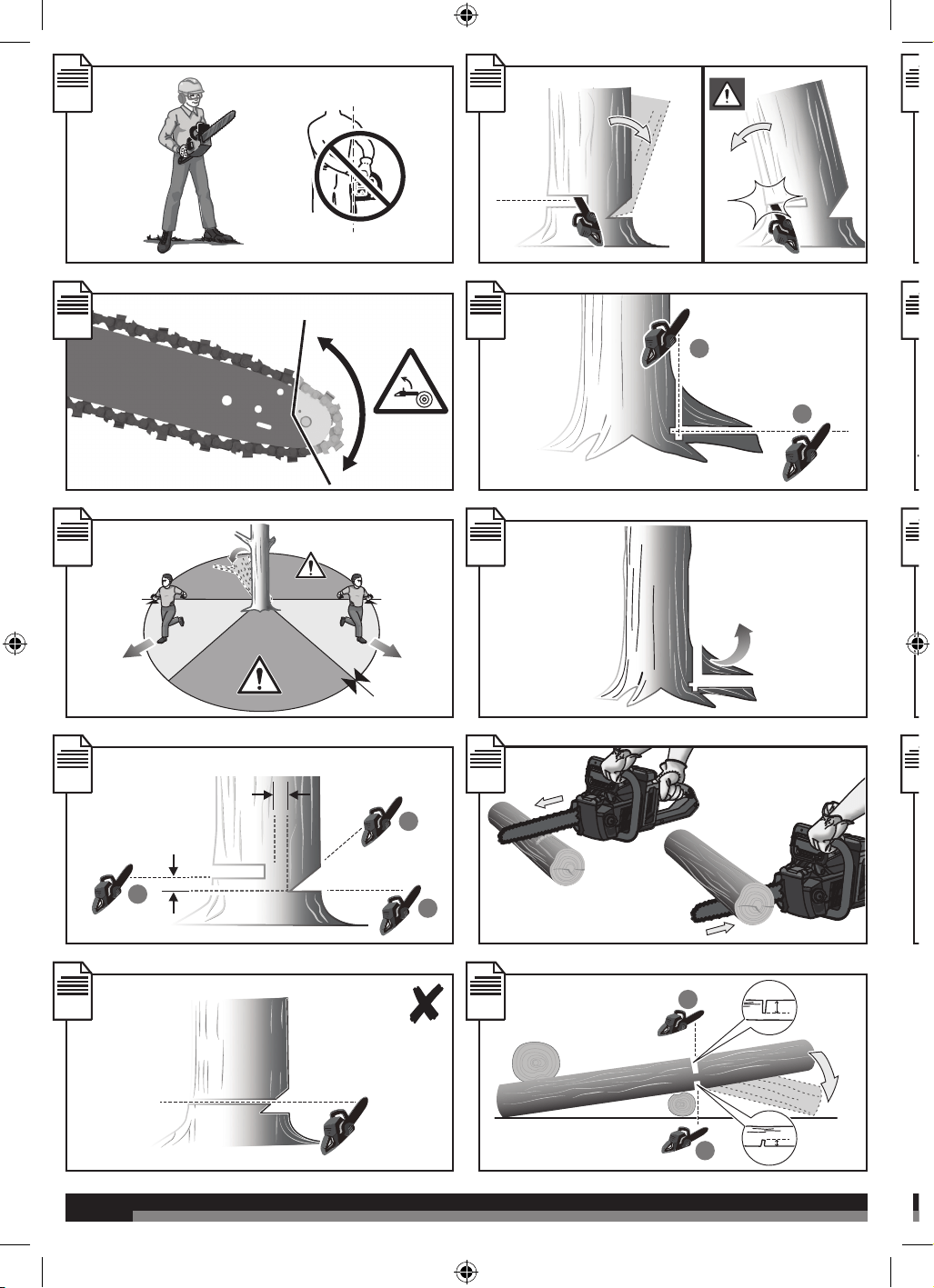
See Fig. 1 - 6.
When bucking and felling operations are being performed by two
or more persons at the same time, the felling operations should
be separated from the bucking operation by a distance of at least
twice the height of the tree being felled. Trees should not be felled
in a manner that would endanger any person, strike any utility line, or
cause any property damage. If the tree does make contact with any
utility line, the company should be notified immediately.
The chainsaw operator should keep on the uphill side of the terrain as
the tree is likely to roll or slide downhill after it is felled.
An escape path should be planned and cleared as necessary before
cuts are started. The escape path should extend back and diagonally
to the rear of the expected line of fall.
Before felling starts, consider the natural lean of the tree, the location
of larger branches, and the wind direction to judge which way the
tree will fall.
Remove dirt, stones, loose bark, nails, staples, and wire from the tree.

30
30
Do not attempt to fell trees that are rotten or have been damaged by
wind, fire, lightning, etc. This is extremely dangerous and should only
be completed by professional tree surgeons.
1. Notching undercut
See Fig. 1 - 6.
Make the notch 1/3 the diameter of the tree, perpendicular to the
direction of the fall. Make the lower horizontal notching cut first.
Cutting the horizontal notching cut first helps to avoid pinching
either the saw chain or the guide bar when the second notch is
being made.
2. Felling-back cut
See Fig. 1 - 6.
Make the felling-back cut at least 50 mm/2 in. higher than the
horizontal notching cut. Keep the felling-back cut parallel to the
horizontal notching cut. Make the felling back cut so that enough
wood is left to act as a hinge. The hinge wood keeps the tree from
twisting and falling in the wrong direction. Do not cut through
the hinge.
As the felling gets close to the hinge, the tree should begin to
fall. If there is any chance that the tree may not fall in the desired
direction or it may rock back and bind the saw chain, stop cutting
before the felling-back cut is complete and use wedges of wood,
plastic, or aluminium to open the cut and drop the tree along the
desired line of fall.
When the tree begins to fall, remove the chainsaw from the cut,
stop the motor, put the chainsaw down, and use the retreat
path planned. Be alert for falling overhead limbs and watch your
footing.
Removing buttress roots
See Fig. 7 - 8.
A buttress root is a large root extending from the trunk of the tree
above the ground. Remove large buttress roots before felling. Make
the horizontal cut into the buttress first, followed by the vertical
cut. Remove the resulting loose section from the work area. Follow
the correct tree felling procedure after you have removed the large
buttress roots.
Bucking a log
See Fig. 9 - 11.
Bucking is cutting a log into lengths. It is important to make sure your
footing is firm and your weight is evenly distributed on both feet.
When possible, the log should be raised and supported by the use
of limbs, logs or chocks. Follow the simple directions for easy cutting.
When the log is supported along its entire length, it is cut from the
top (overbuck).
When the log is supported on one end, cut 1/3 the diameter from the
underside (underbuck). Then make the finished cut by overbucking
to meet the first cut.
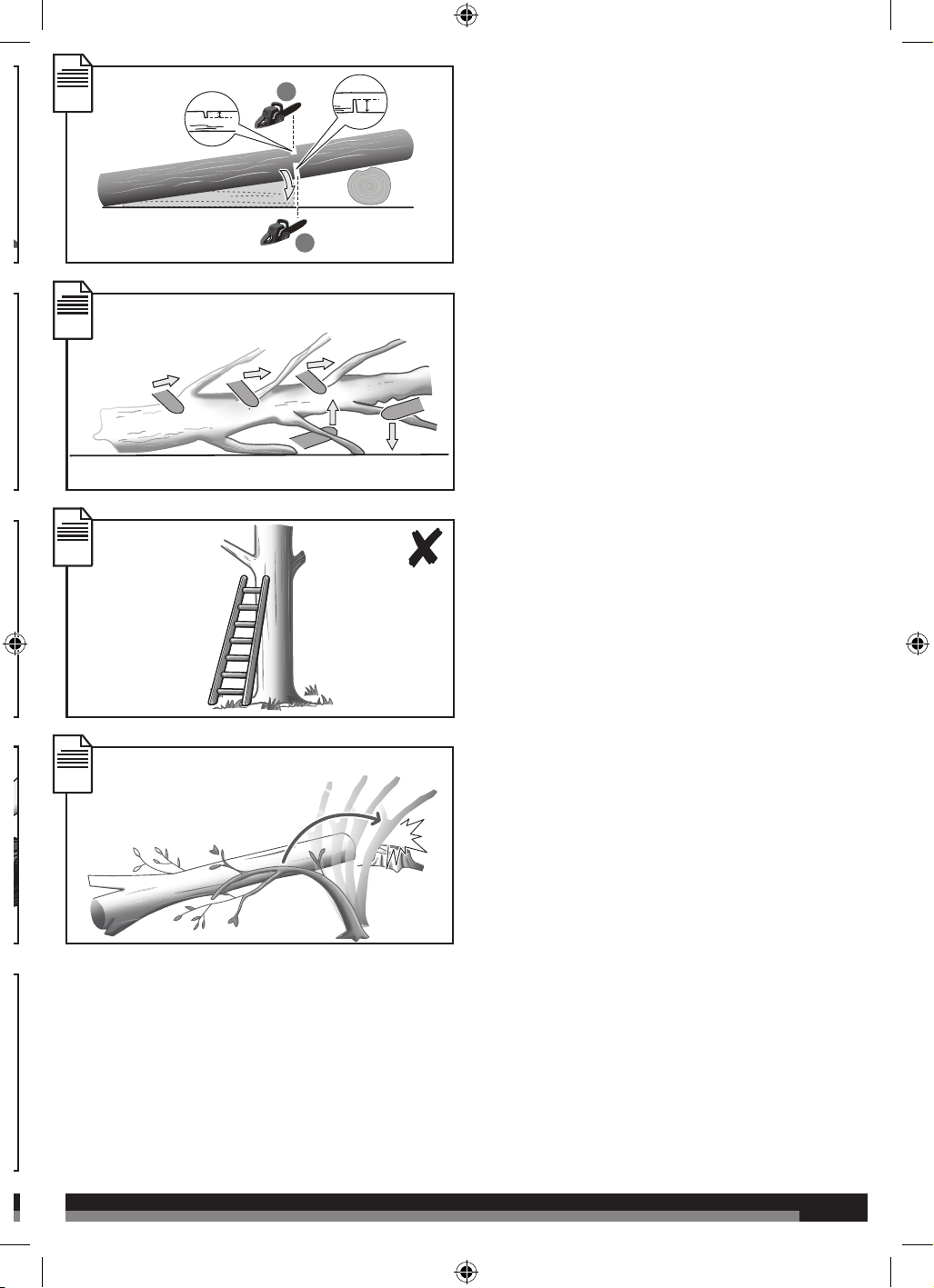
When the log is supported on both ends, cut 1/3 the diameter from
the top (overbuck). Then make the finished cut by underbucking the
lower 2/3 to meet the first cut.
When bucking on a slope, always stand on the uphill side of the log. To
maintain control when “cutting through”, release the cutting pressure
near the end of the cut without relaxing your grip on the chainsaw
handles. Don’t let the chain contact the ground. After completing the
cut, wait for the saw chain to stop before you move the chainsaw.
Always stop the motor before moving from tree to tree.
Limbing a tree
See Fig. 12 - 13.
Limbing is removing the branches from a fallen tree. When limbing,
leave larger lower limbs to support the log o the ground. Remove the
small limbs in one cut. Branches under tension should be cut from the
bottom up to avoid binding the chainsaw.
Springpoles
See Fig. 14.
A springpole is any log, branch, rooted stump, or sapling that is bent
under tension by other wood so that it springs back if the wood
holding it is cut or removed.
On a fallen tree, a rooted stump has a high potential of springing back
to the upright position during the bucking cut to separate the log
from the stump. Watch out for springpoles—they are dangerous. Do
not attempt to cut bent branches or stumps that are under tension
unless you are professionally trained and competent to do so.
WARNING! Springpoles are dangerous and could strike the
operator, causing the operator to lose control of the chainsaw.
This could result in a severe or fatal injury to the operator.
Cutting springpoles should be done by trained users.
RESIDUAL RISKS
Even when the product is used as prescribed, it is still impossible
to completely eliminate certain residual risk factors. The following
hazards may arise during use and the operator should pay special
attention to avoid the following:
● injury caused by vibration
– Always use the right tool for the job. Use designated handles.
Restrict working time and exposure.
● injury caused by to exposure to noise
– Wear hearing protection and limit exposure.
● injury caused by contact with exposed saw teeth of the
chain
● injury caused by thrown-out pieces of the workpiece (wood
chips, splinters)
● injury caused by dust and particles
● injury to the skin caused by contact with lubricants
RISK REDUCTION
It has been reported that vibrations from handheld tools may
contribute to a condition called Raynaud’s Syndrome in certain
individuals. Symptoms may include tingling, numbness, and blanching
of the fingers, usually apparent upon exposure to cold. Hereditary
factors, exposure to cold and dampness, diet, smoking, and work
practices are all thought to contribute to the development of these
symptoms. There are measures that can be taken by the operator to
possibly reduce the eects of vibration:
● Keep your body warm in cold weather. When operating the unit
wear gloves to keep the hands and wrists warm. It is reported
that cold weather is a major factor contributing to Raynaud’s
Syndrome.
● After each period of operation, exercise to increase blood
circulation.
● Take frequent work breaks. Limit the amount of exposure per
day.
● Protective gloves available from professional chainsaw retailers
are designed specifically for chainsaw use, which give protection,
good grip and also reduce the effect of handle vibration.
If you experience any of the symptoms of this condition, immediately
discontinue use and see your doctor.
WARNING! Injuries may be caused, or aggravated, by
prolonged use of a tool. When using any tool for prolonged
periods, ensure that you take regular breaks.
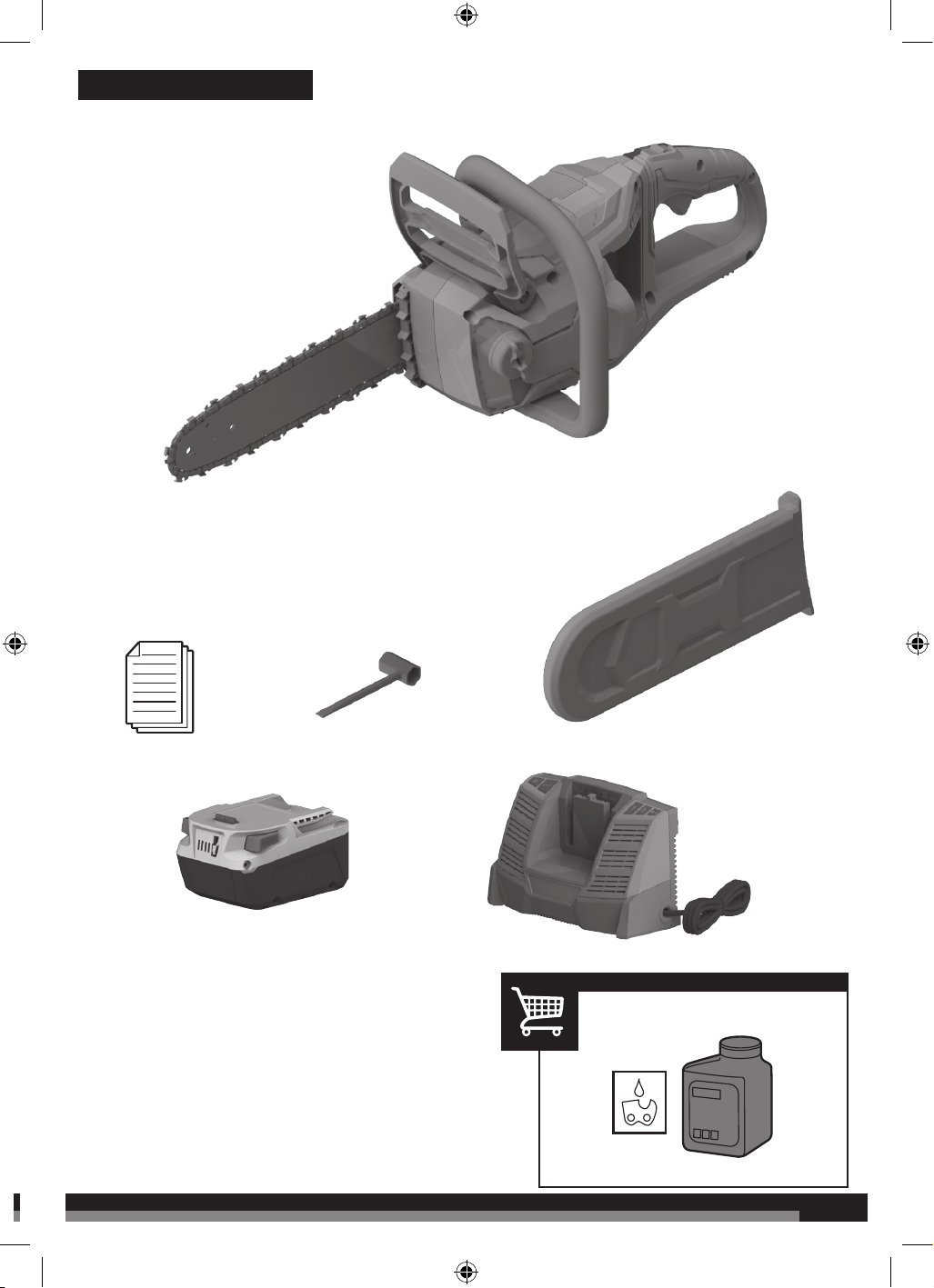
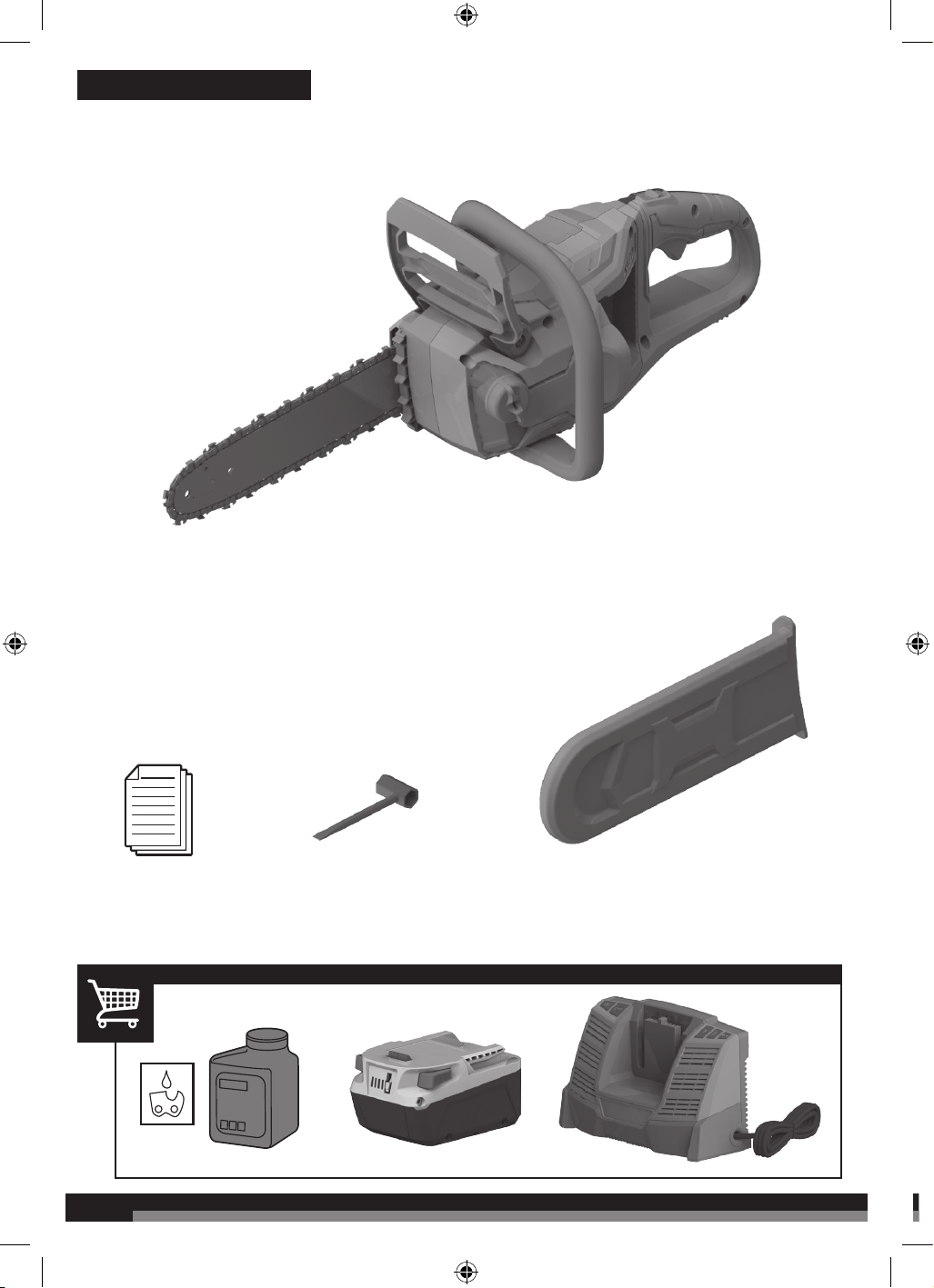
WHAT’S IN THE BOX
See pages 3-4.
● Chainsaw x 1
● Operator’s manual x 1
● Scrench tool x 1
● Scabbard x 1
● Chain and bar oil (sold separately) x 1
● Charger (sold separately for ACS18B) x 1
● Battery pack (sold separately for ACS18B) x 1
SAFETY DEVICES
Low-kickback saw chain
A low-kickback saw chain helps to reduce the possibility of a kickback
event.
The rakers (depth gauges) ahead of each cutter can minimize the
force of a kick-back reaction by preventing the cutters from digging in
too deeply. Use only replacement guide bar and chain combinations
recommended by the manufacturer.
As saw chains are sharpened, they lose some of the low-kickback
qualities and extra caution is required. For your safety, replace saw
chains when cutting performance decreases.
Spiked bumper
The integral bumper spike may be used as a pivot when making a cut.
It helps to keep the body of the chainsaw steady while cutting. When
cutting, push the machine forward until the spikes dig into the edge
of the wood, then move the rear handle up or down in the direction of
the cutting line to help ease the physical strain of cutting.
Guide bar
Generally, guide bars with small radius tips have somewhat lower
potential for kickback. Use a guide bar and matching chain which is
just long enough for the job. Longer bars increase the risk of loss
of control during sawing. Regularly check the chain tension. When
cutting smaller branches (less than the full length of the guide bar)
the chain is more likely to be thrown o if the tension is not correct.
Chain brake
Chain brakes are designed to quickly stop the chain from rotating.
When the chain brake lever is pushed towards the bar, the chain
should stop immediately. A chain brake does not prevent kickback.
It only lowers the risk of injury should the chain bar contact the
operator’s body during a kickback event. The chain brake should be
tested before each use for correct operation in both the run and brake
positions.
Chain catcher
A chain catcher prevents the saw chain from being thrown back
towards the operator if the saw chain comes loose or breaks.
31
31
small limbs in one cut. Branches under tension should be cut from the
bottom up to avoid binding the chainsaw.
Springpoles
See Fig. 14.
A springpole is any log, branch, rooted stump, or sapling that is bent
under tension by other wood so that it springs back if the wood
holding it is cut or removed.
On a fallen tree, a rooted stump has a high potential of springing back
to the upright position during the bucking cut to separate the log
from the stump. Watch out for springpoles—they are dangerous. Do
not attempt to cut bent branches or stumps that are under tension
unless you are professionally trained and competent to do so.
WARNING! Springpoles are dangerous and could strike the
operator, causing the operator to lose control of the chainsaw.
This could result in a severe or fatal injury to the operator.
Cutting springpoles should be done by trained users.
RESIDUAL RISKS
Even when the product is used as prescribed, it is still impossible
to completely eliminate certain residual risk factors. The following
hazards may arise during use and the operator should pay special
attention to avoid the following:
● injury caused by vibration
– Always use the right tool for the job. Use designated handles.
Restrict working time and exposure.
● injury caused by to exposure to noise
– Wear hearing protection and limit exposure.
● injury caused by contact with exposed saw teeth of the
chain
● injury caused by thrown-out pieces of the workpiece (wood
chips, splinters)
● injury caused by dust and particles
● injury to the skin caused by contact with lubricants
RISK REDUCTION
It has been reported that vibrations from handheld tools may
contribute to a condition called Raynaud’s Syndrome in certain
individuals. Symptoms may include tingling, numbness, and blanching
of the fingers, usually apparent upon exposure to cold. Hereditary
factors, exposure to cold and dampness, diet, smoking, and work
practices are all thought to contribute to the development of these
symptoms. There are measures that can be taken by the operator to
possibly reduce the eects of vibration:
● Keep your body warm in cold weather. When operating the unit
wear gloves to keep the hands and wrists warm. It is reported
that cold weather is a major factor contributing to Raynaud’s
Syndrome.
● After each period of operation, exercise to increase blood
circulation.
● Take frequent work breaks. Limit the amount of exposure per
day.
● Protective gloves available from professional chainsaw retailers
are designed specifically for chainsaw use, which give protection,
good grip and also reduce the effect of handle vibration.
If you experience any of the symptoms of this condition, immediately
discontinue use and see your doctor.
WARNING! Injuries may be caused, or aggravated, by
prolonged use of a tool. When using any tool for prolonged
periods, ensure that you take regular breaks.
WHAT’S IN THE BOX
See pages 3-4.
● Chainsaw x 1
● Operator’s manual x 1
● Scrench tool x 1
● Scabbard x 1
● Chain and bar oil (sold separately) x 1
● Charger (sold separately for ACS18B) x 1
● Battery pack (sold separately for ACS18B) x 1
SAFETY DEVICES
Low-kickback saw chain
A low-kickback saw chain helps to reduce the possibility of a kickback
event.
The rakers (depth gauges) ahead of each cutter can minimize the
force of a kick-back reaction by preventing the cutters from digging in
too deeply. Use only replacement guide bar and chain combinations
recommended by the manufacturer.
As saw chains are sharpened, they lose some of the low-kickback
qualities and extra caution is required. For your safety, replace saw
chains when cutting performance decreases.
Spiked bumper
The integral bumper spike may be used as a pivot when making a cut.
It helps to keep the body of the chainsaw steady while cutting. When
cutting, push the machine forward until the spikes dig into the edge
of the wood, then move the rear handle up or down in the direction of
the cutting line to help ease the physical strain of cutting.
Guide bar
Generally, guide bars with small radius tips have somewhat lower
potential for kickback. Use a guide bar and matching chain which is
just long enough for the job. Longer bars increase the risk of loss
of control during sawing. Regularly check the chain tension. When
cutting smaller branches (less than the full length of the guide bar)
the chain is more likely to be thrown o if the tension is not correct.
Chain brake
Chain brakes are designed to quickly stop the chain from rotating.
When the chain brake lever is pushed towards the bar, the chain
should stop immediately. A chain brake does not prevent kickback.
It only lowers the risk of injury should the chain bar contact the
operator’s body during a kickback event. The chain brake should be
tested before each use for correct operation in both the run and brake
positions.
Chain catcher
A chain catcher prevents the saw chain from being thrown back
towards the operator if the saw chain comes loose or breaks.
OPERATION
WARNING! If any parts are damaged or missing, do not
operate the product until the parts are replaced. Failure to heed
this warning could result in serious personal injury.
Adjusting the chain tension
See pages 8 - 9.
Remove the battery pack before you do any work on the chainsaw.
Loosen the bar mounting nuts.
To increase the chain tension, turn the chain tensioning screw
clockwise and check the chain tension frequently. To reduce the
chain tension, turn the chain tensioning screw counterclockwise and
check the chain tension frequently.
The chain tension is correct when the gap between the cutter in the
chain and the bar is about 4 - 5.5 mm. Pull the chain in the middle of
the lower side of the bar downwards (away from the bar) and measure
the distance between the bar and the chain cutters.
Tighten the bar mounting nuts by turning it clockwise.
NOTE: The temperature of the chain increases during normal
operation causing the chain to stretch. Check the chain tension
frequently and adjust as required. A chain tensioned while warm
may be too tight upon cooling. Make sure that the chain tension is
correctly adjusted as specified in these instructions.
Adding the chain and bar lubricating oil
See pages 10 - 11.
WARNING! Never work without chain and bar oil. If the saw
chain is running without lubricant, the guide bar and the saw
chain can be damaged. It is essential to frequently check the
oil level in the oil level gauge and before starting to use the
chainsaw.
Clear surface around the oil cap to prevent contamination.
Loosen and remove the cap from the oil tank.
Pour the oil into the oil tank and monitor the oil level gauge. Ensure
that no dirt enters the oil tank while filling.
Put the oil cap back on and tighten it up. Wipe away any spillage.
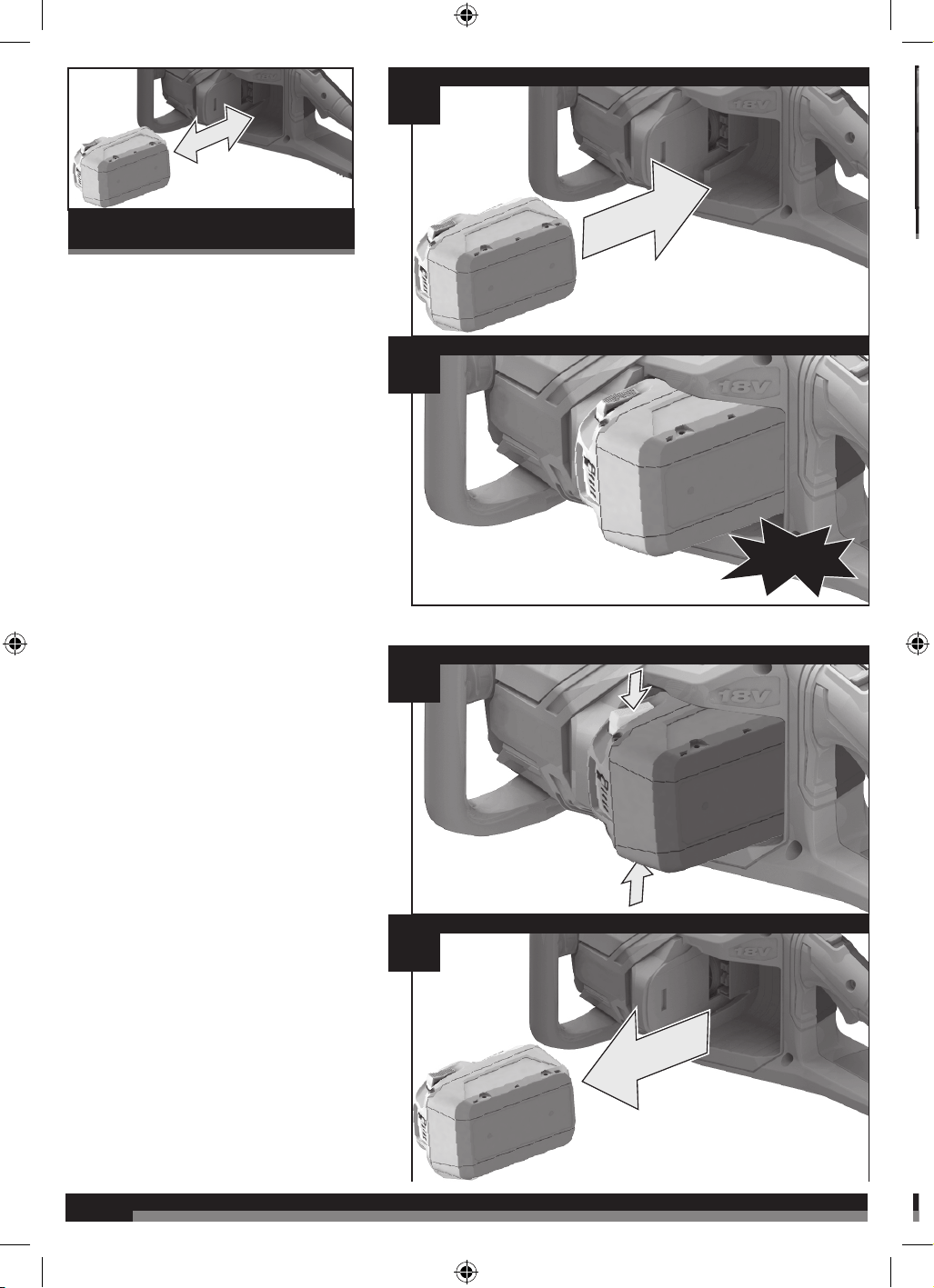
Installing the battery pack
See page 12.
Insert the battery pack into the product. Align the raised ribs on the
battery pack with grooves in the product’s battery port.
Make sure that the latch of the battery pack snaps in place and that
the battery pack is fully seated and secured in the product before
beginning operation.
Holding the chainsaw
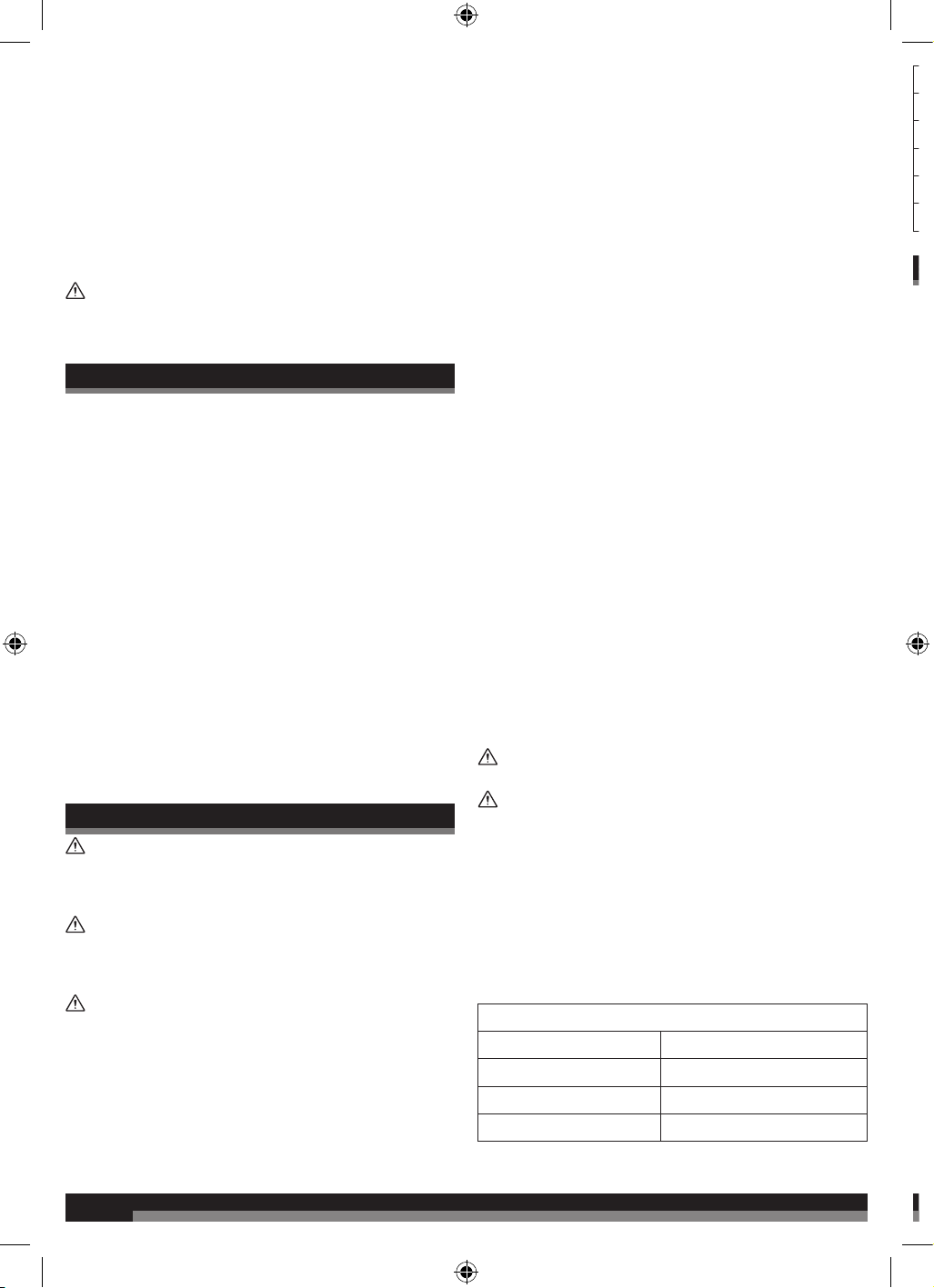
See Fig. 1.
Always hold the product with the right hand on the rear handle and
the left hand on the front handle. Grip both handles with the thumbs
and fingers encircling the handles. Ensure that the left hand is holding
the front handle so that the thumb is underneath.
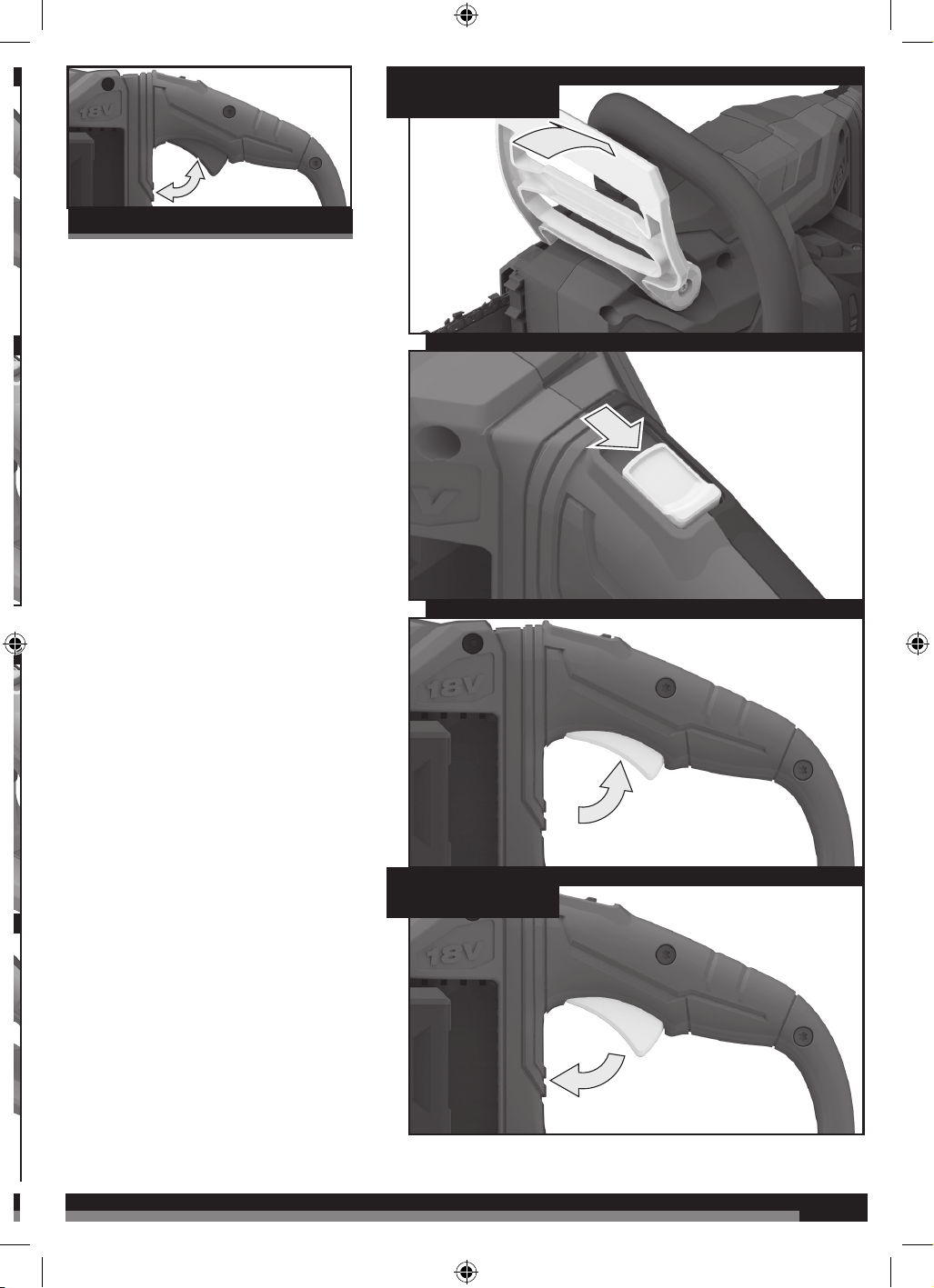
Starting the product
See pages 12-13.
Install the battery pack in the product, and make sure the chain brake
is in run position by pulling the chain brake lever towards the front
handle.
32
32
To start the product, pull the trigger release, and then press the
throttle trigger.
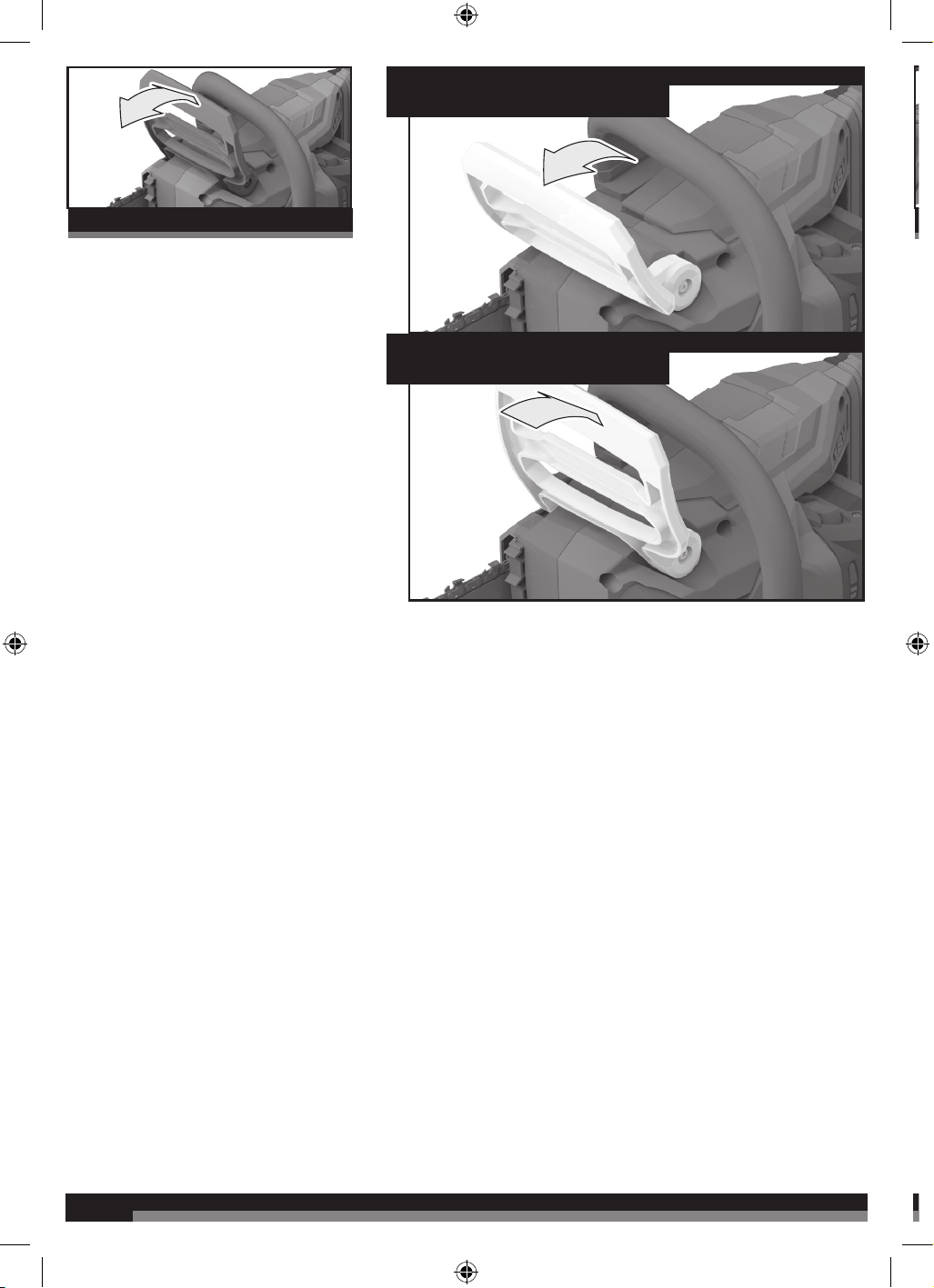
Checking and operating the chain brake
See page 14.
Engage the chain brake by rotating your left hand around the front
handle. Allow the back of your hand to push the chain brake lever
towards the bar while the chain is rotating rapidly. Be sure to maintain
both hands on the saw handles at all times.
Reset the chain brake back into the RUN position by grasping the
top of the chain brake lever and pulling towards the front handle until
you hear a click.
WARNING! If the chain brake does not stop the chain
immediately, or if the chain brake does not stay in the run
position without assistance, bring the product to an authorised
service centre for repair before use.
TRANSPORTATION AND STORAGE
Turn o the product, remove the battery pack, and allow the product
to cool down before storing or transporting. Remove all chain and bar
oil from the product.
Remove all foreign material from the product. Store the product in
a cool, dry, and well-ventilated place that is inaccessible to children.
Keep the product away from corrosive agents, such as garden
chemicals and de-icing salts. Do not store the product outdoors.
Fit the scabbard before storing the product or during transportation.
For transportation, secure the product against movement or falling to
prevent injury to persons or damage to the product.
TRANSPORTING LITHIUM BATTERIES
Transport the battery in accordance with local and national provisions
and regulations.
Follow all special requirements on packaging and labelling when
transporting batteries by a third party.
Ensure that no batteries can come in contact with other batteries
or conductive materials while in transport by protecting exposed
connectors with insulating, non-conductive caps or tape. Do not
transport batteries that are cracked or leaking. Check with the
forwarding company for further advice.
MAINTENANCE
WARNING! Use only original manufacturer’s replacement
parts, accessories, and attachments. Failure to do so can cause
possible injury, can contribute to poor performance, and may
void your warranty.
WARNING! Servicing requires extreme care and knowledge
and should be performed only by a qualified service technician.
Have the product serviced by an authorised service centre only.
When servicing, use only original replacement parts.
WARNING! Remove the battery pack before adjustment,
maintenance or cleaning. Failure to do so could result in serious
personal injury.
You may only make adjustments or repairs described in this manual.
For other repairs, contact the authorised service agent.
Consequences of improper maintenance, removal, or modification of
safety features, such as the chain brake, ignition switch, hand guard
(front and back), spiked bumper, chain catcher, guide bar, and low-
kickback saw chain may cause the safety features not to function
correctly, thus increasing the potential for serious injury. Keep the
product professionally maintained and safe.
Sharpening the chain safely is a skilled task. Therefore, the
manufacturer strongly recommends that a worn or dull chain is
replaced with a new one, available at your authorised service centre.
The part number is available in the product specification table in this
manual.
Follow instructions for lubricating and chain tension checking and
adjustment.
After each use, clean the product with a soft, dry cloth.
Check all nuts, bolts, and screws at frequent intervals for security to
ensure that the product is in safe working condition. Any part that is
damaged should be properly repaired or replaced by an authorised
service centre.
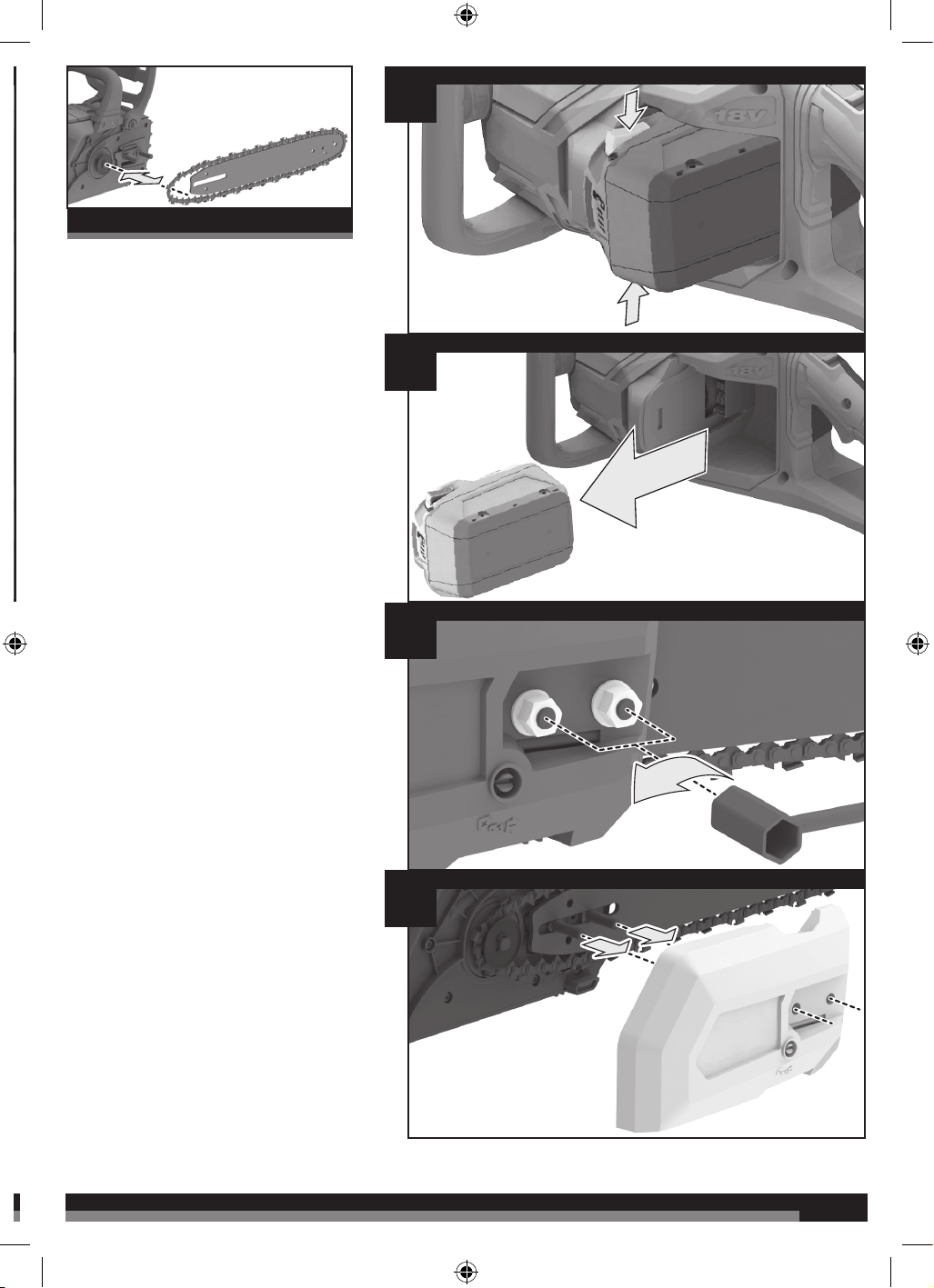
Replacing the guide bar and saw chain
See pages 15 - 18.
Remove the battery. Wear protective gloves.
Remove the bar mounting nuts using the combination wrench
provided.
Remove the guide bar cover.
Remove the bar and saw chain from the product. Properly dispose of
used chain and bar.
Put the new chain in the correct direction onto the bar, and make sure
that the drive links are aligned in the bar groove.
Attach the bar to the chainsaw and loop the chain around the drive
sprocket.
Replace the chain cover and bar mounting nuts.
Finger-tighten the bar mounting nuts. The bar must be free to move
for chain tension adjustment.
Adjust the chain tension. Refer to the “Adjusting chain tension”
section.
Hold up the tip of the guide bar, and securely tighten the bar
mounting nuts.
WARNING! Failure to replace or repair a damaged chain can
cause serious injury.
WARNING! The saw chain is sharp. Always wear protective
gloves when performing maintenance to the chain.
Inspecting and cleaning the chain brake
Always keep the chain brake mechanism clean by lightly brushing the
linkage free from dirt.
Always test the chain brake performance after cleaning. Refer to
“Checking and operating the chain brake” section in this manual for
additional information.
MAINTENANCE SCHEDULE
Daily check
Bar lubrication Before each use
Chain tension Before each use and frequently
Chain sharpness Before each use, visual check
For damaged parts Before each use
For loose fasteners Before each use
Chain brake function Before each use
Inspect and clean
Bar Before each use
Complete saw After each use
Chain brake Every 5 hours of operation.
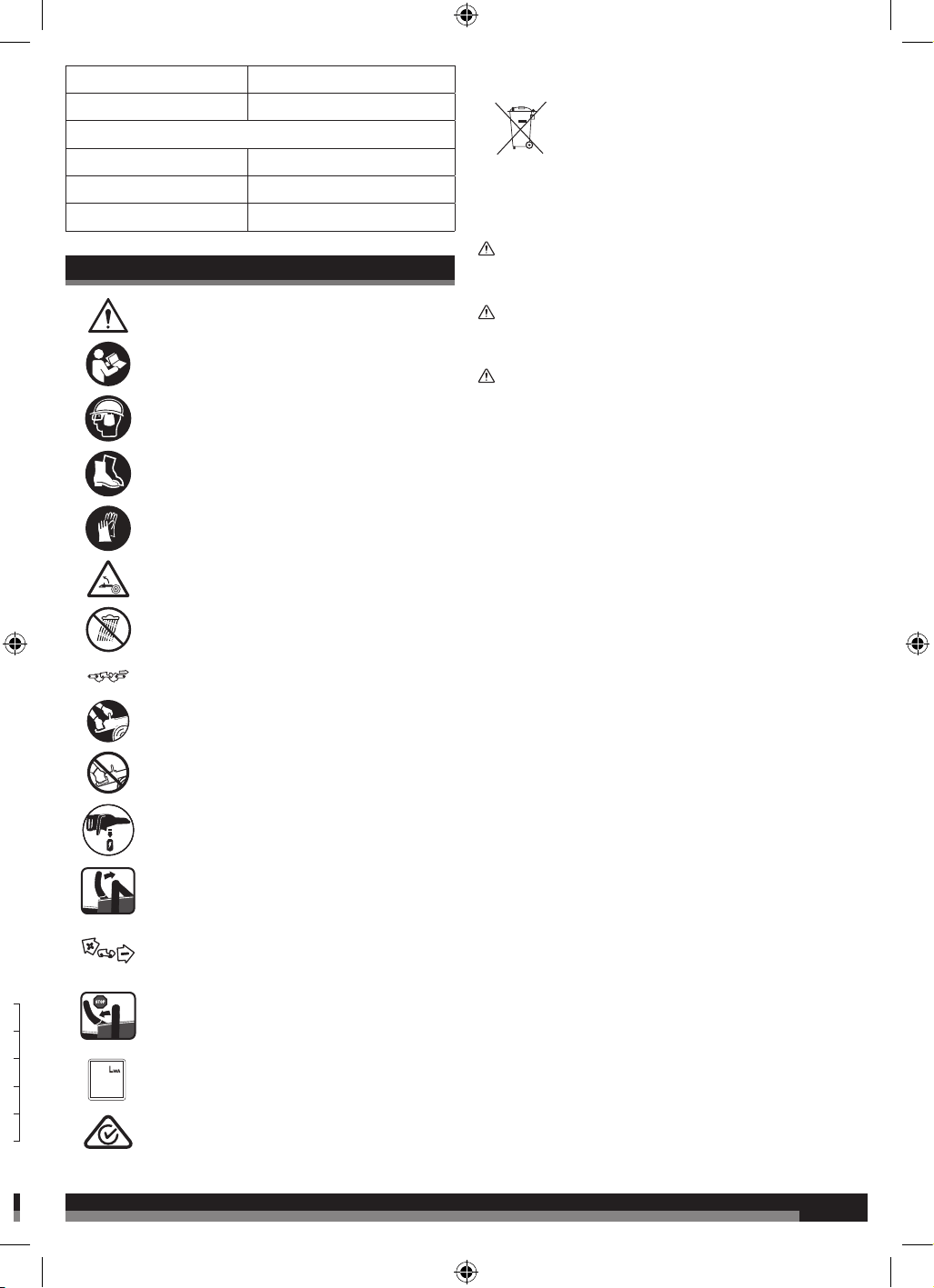
SYMBOLS
Safety alert
Read and understand all instructions before
operating the product. Follow all warnings and
safety instructions.
Wear eye, ear, and head protection.
Wear non-slip safety footwear when using the
product.
Wear non-slip, heavy-duty gloves.
Beware of chainsaw kickback and avoid contact
with bar tip.
Do not expose the product to rain or damp
conditions.
Moving direction of the chain.
(Marked under the chain cover)
Hold and operate the saw properly with both
hands.
Do not operate the saw using only one hand.
Remove the battery pack before starting any work
on the product.
Set the chain brake to the RUN position.
Rotate to adjust chain tension
+ = Tighten the chain
- = Loosen the chain
Set the chain brake to the BRAKE position.
99
Guaranteed sound power level
Regulatory Compliance Mark (RCM). Product meets
applicable regulatory requirements.
33
33
kickback saw chain may cause the safety features not to function
correctly, thus increasing the potential for serious injury. Keep the
product professionally maintained and safe.
Sharpening the chain safely is a skilled task. Therefore, the
manufacturer strongly recommends that a worn or dull chain is
replaced with a new one, available at your authorised service centre.
The part number is available in the product specification table in this
manual.
Follow instructions for lubricating and chain tension checking and
adjustment.
After each use, clean the product with a soft, dry cloth.
Check all nuts, bolts, and screws at frequent intervals for security to
ensure that the product is in safe working condition. Any part that is
damaged should be properly repaired or replaced by an authorised
service centre.
Replacing the guide bar and saw chain
See pages 15 - 18.
Remove the battery. Wear protective gloves.
Remove the bar mounting nuts using the combination wrench
provided.
Remove the guide bar cover.
Remove the bar and saw chain from the product. Properly dispose of
used chain and bar.
Put the new chain in the correct direction onto the bar, and make sure
that the drive links are aligned in the bar groove.
Attach the bar to the chainsaw and loop the chain around the drive
sprocket.
Replace the chain cover and bar mounting nuts.
Finger-tighten the bar mounting nuts. The bar must be free to move
for chain tension adjustment.
Adjust the chain tension. Refer to the “Adjusting chain tension”
section.
Hold up the tip of the guide bar, and securely tighten the bar
mounting nuts.
WARNING! Failure to replace or repair a damaged chain can
cause serious injury.
WARNING! The saw chain is sharp. Always wear protective
gloves when performing maintenance to the chain.
Inspecting and cleaning the chain brake
Always keep the chain brake mechanism clean by lightly brushing the
linkage free from dirt.
Always test the chain brake performance after cleaning. Refer to
“Checking and operating the chain brake” section in this manual for
additional information.
MAINTENANCE SCHEDULE
Daily check
Bar lubrication Before each use
Chain tension Before each use and frequently
Chain sharpness Before each use, visual check
For damaged parts Before each use
For loose fasteners Before each use
Chain brake function Before each use
Inspect and clean
Bar Before each use
Complete saw After each use
Chain brake Every 5 hours of operation.
SYMBOLS
Safety alert
Read and understand all instructions before
operating the product. Follow all warnings and
safety instructions.
Wear eye, ear, and head protection.
Wear non-slip safety footwear when using the
product.
Wear non-slip, heavy-duty gloves.
Beware of chainsaw kickback and avoid contact
with bar tip.
Do not expose the product to rain or damp
conditions.
Moving direction of the chain.
(Marked under the chain cover)
Hold and operate the saw properly with both
hands.
Do not operate the saw using only one hand.
Remove the battery pack before starting any work
on the product.
Set the chain brake to the RUN position.
Rotate to adjust chain tension
+ = Tighten the chain
- = Loosen the chain
Set the chain brake to the BRAKE position.
99
Guaranteed sound power level
Regulatory Compliance Mark (RCM). Product meets
applicable regulatory requirements.
Do not dispose of electric tools together with
household waste material! In observance of
European Directive 2002/96/EC on waste electrical
and electronic equipment and its implementation
in accordance with national law, electric tools that
have reached the end of their life must be collected
separately and returned to an environmentally
compatible recycling facility.
The following signal words and meanings are intended to explain the
levels of risk associated with this product.
DANGER
Indicates an imminently hazardous situation, which, if not avoided, will
result in death or serious injury.
WARNING
Indicates a potentially hazardous situation, which, if not avoided, could
result in death or serious injury.
CAUTION
Indicates a potentially hazardous situation, which, if not avoided, may
result in minor or moderate injury.
CAUTION
Without safety alert symbol
Indicates a situation that may result in property damage.



Techtronic Industries Australia Pty Ltd
31 Gilby Road, Mount Waverley,
VIC, 3149, Australia
Techtronic Industries N.Z. Limited
Unit C, 70 Business Parade South,
Highbrook, Auckland 2013, New Zealand
www.aegpowertools.com.au
www.aegpowertools.co.nz
AEG is a registered trade mark used under
license from AB Electrolux (publ).
OREGON is a registered trade mark of Blount, Inc.961087531-01