User Manual
Register your product and get support at
www.philips.com/support
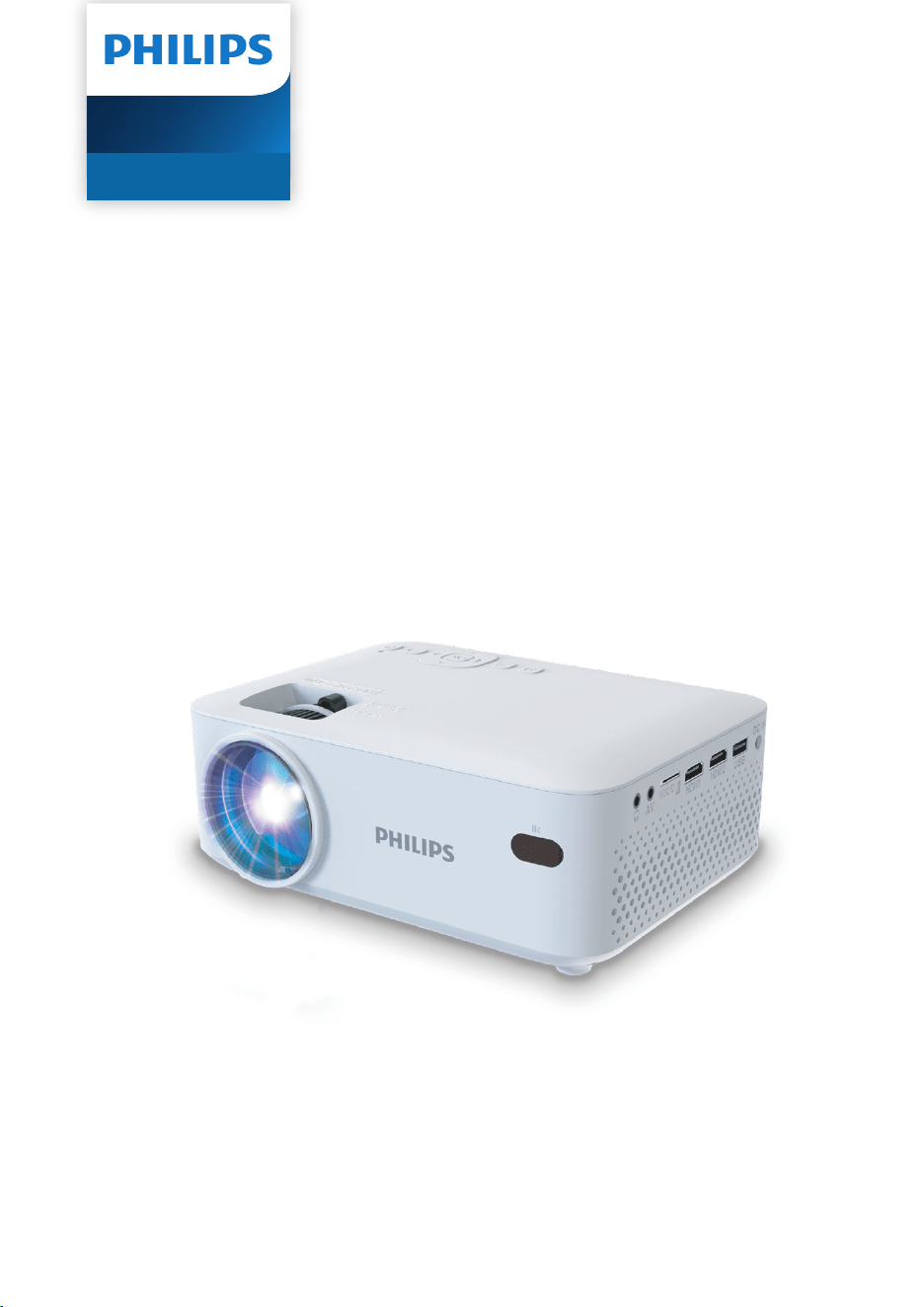
NeoPix 100
Home Projector

Introduction �������������������������������������������������3
Dear customer ...............................................................3
About this user manual ..............................................3
What’s in the box ..........................................................3
Customer service center ...........................................3
1 General safety information ��������������� 4
Setting up the product .............................................. 4
Repairs ............................................................................ 4
Power supply .................................................................5
2 Overview ������������������������������������������������5
Top view ...........................................................................5
Front view ....................................................................... 6
Side view ......................................................................... 6
Rear view ........................................................................ 6
Bottom view .................................................................. 6
Remote control..............................................................7
3 Initial setup �������������������������������������������� 7
Install the projector ...................................................... 7
Connect to power supply ......................................... 8
Prepare the remote control ..................................... 9
Power on and set up the projector ....................... 9
Select the language ...................................................10
4 Connect to other devices ������������������10
Connect to a playback device through HDMI™
...........................................................................................10
Connect to a dongle ................................................... 11
Connect to a playback device through AV .........11
Connect to a computer through VGA ...................11
Connect to wired speakers or headphones ......12
5 Play/view media from storage
devices �������������������������������������������������� 13
Connect a storage device ........................................ 13
Play videos ....................................................................13
Play audios ...................................................................13
View images .................................................................14
6 Change projector settings ����������������14
7 Maintenance����������������������������������������16
Cleaning .........................................................................16
Update software .........................................................16
8 Troubleshooting ��������������������������������� 17
9 Appendixes ������������������������������������������ 19
Technical data .............................................................19
CE statement ..............................................................20
FCC statement ............................................................20
Canada regulatory compliance ............................20
Other notice .................................................................20
Table of contents
Introduction 3
Introduction
Dear customer
Thank you for purchasing this projector.
We hope you enjoy this product and the many
functions it offers!
About this user manual
The quick start guide supplied with this product
allows you to start using this product quickly
and easily. Detailed descriptions can be found
in the following sections of this user manual.
Read the entire user manual carefully. Follow
all safety instructions in order to ensure proper
operation of this product (see General safety
information, page 4). The manufacturer
accepts no liability if these instructions are not
followed.
Symbols used
Notice
This symbol indicates tips that will help
you use this product more effectively
and easily.
DANGER!
Danger of personal injury!
This symbol gives warning of danger
of personal injury. Physical injury or
damage can result from improper
handling.
CAUTION!
Damage to the product or loss of data!
This symbol gives warning of damage
to the product and possible loss of
data. Damage can result from improper
handling.
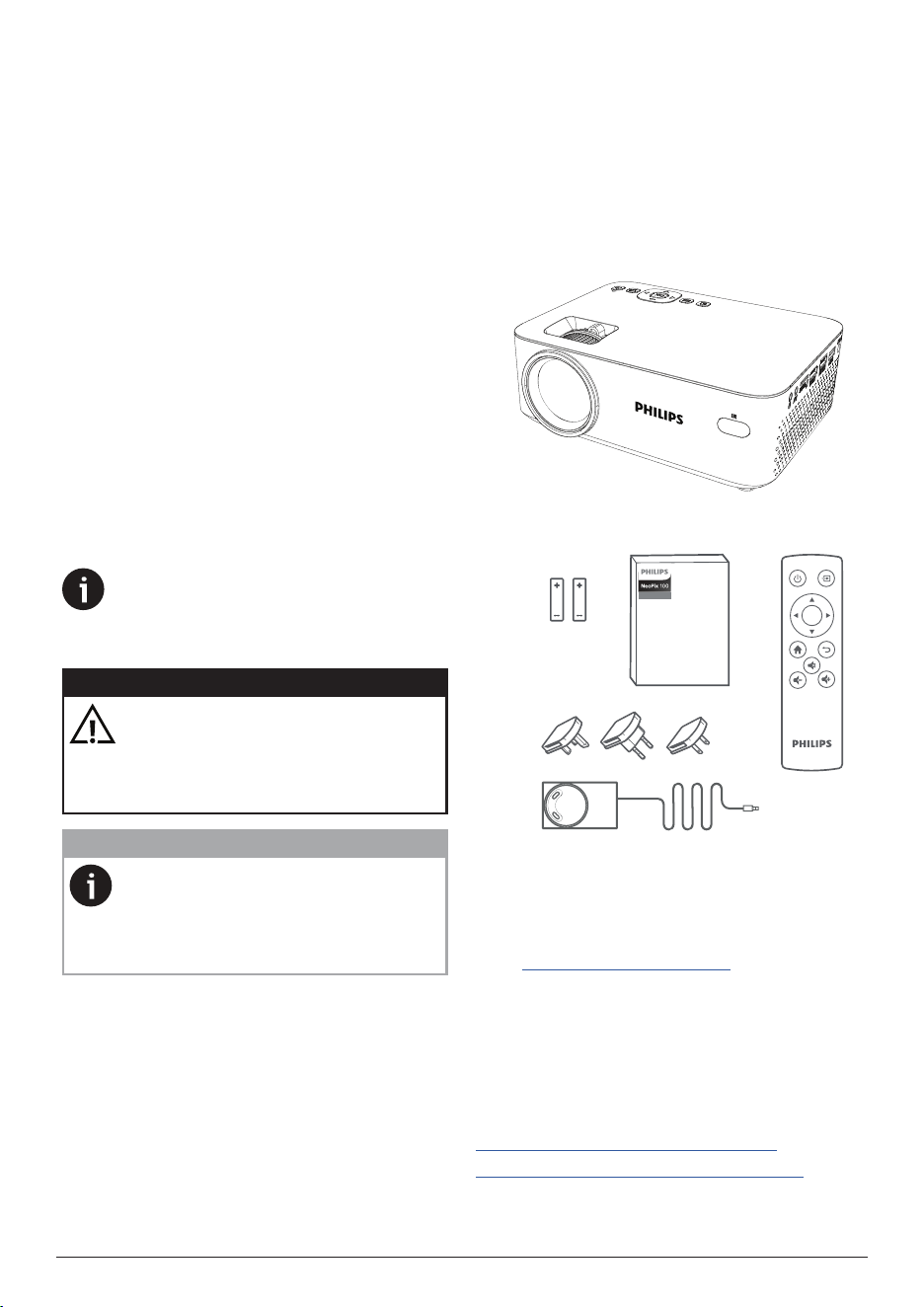
What’s in the box
a
NeoPix 100 projector
b
AAA batteries
c
Quick Start Guide with Warranty Card
d
Remote control
e
Power plug adapters
f
AC adapter
Quick Start
Guide
NPX100
OK
a
bc d
e
f
Customer service center
The Support page, warranty card, and user
manuals can be found here:
Web: www.philips.com/support
Support Contacts:
International Phone: +41 215 391 665
Please ask your provider for international call
costs!
Mail: philips.projector.eu@screeneo.com
Access our FAQ websites:
https://support.philipsprojection.com
https://community.philipsprojection.com
4 Philips · NeoPix 100
1 General safety
information
Take note of all warning and safety notes
indicated. Do not make any changes or settings
that are not described in this user manual.
Incorrect operation, and improper handling can
lead to physical injury, damage to the product
or loss of data.
Setting up the product
This product is for indoor use only. Place the
product securely on a stable, flat surface.
To help avoid possible injuries to persons or
damage to the product itself, position all cables
in such a way that no one will trip over them.
Do not operate the product in damp rooms.
Never touch the mains cable or the mains
connection with wet hands.
Never operate the product immediately after
moving it from a cold location to a hot location.
When the product is exposed to such a change
in temperature, moisture may condense on the
crucial internal parts.
The product must have sufficient ventilation
and must not be covered. Do not put the
product in closed cabinets, boxes, or other
enclosures when in use.
Protect the product from direct sunlight,
heat, intense temperature fluctuations and
moisture. Do not place the product in the
vicinity of heaters or air conditioners. Observe
the information on temperature listed in the
technical data (see Technical data, page 19).
Prolonged operation of the product causes the
surface to become hot. In case of overheating,
the product automatically switches to standby
mode.
Do not allow liquids to leak into the product.
Turn off the product and disconnect it from the
mains supply if liquids or foreign substances
leaked into the product. Have the product
inspected by an authorised service center.
Always handle the product with care. Avoid
touching the lens. Never place heavy or sharp
objects on the product or on the power cable.
If the product gets too hot or emits smoke,
shut it down immediately and unplug the
power cable. Have your product checked by
an authorised service center. Keep the product
away from open flames (e.g. candles).
DANGER!
Risk of explosion with incorrect type
of batteries!
There is a risk of explosion if the wrong
battery type is used.
Do not expose the batteries (battery pack or
embedded batteries) to excessive heat such as
sunshine, or open fire.
Under the following conditions, a layer of
moisture can appear inside the product which
can lead to malfunctions:
• if the product is moved from a cold to a
warm area;
• after a cold room is heated;
• when the product is placed in a damp
room.
Proceed as follows to avoid any moisture
buildup:
1 Seal the product in a plastic bag before
moving it to another room, in order for it to
adapt to room conditions.
2 Wait one to two hours before you take the
product out of the plastic bag.
The product should not be used in a very dusty
environment. Dust particles and other foreign
objects may damage the product.
Do not expose the product to extreme
vibrations. This may damage the internal
components.
Do not allow children to handle the product
without supervision. The packing materials
should be kept out of the hands of children.
For your own safety, do not use the product
during thunderstorms with lightning.
Repairs
Do not repair the product yourself. Improper
maintenance can result in injuries or damage to
the product. The product must be repaired by
an authorised service center.
Please find the details of authorised service
centers on the warranty card supplied with this
product.
Do not remove the type label from this product,
as this will void the warranty.
Overview 5
Power supply
Use only a power adapter which is certified for
this product (see Technical data, page 19).
Check whether the mains voltage of the power
supply matches the mains voltage available at
the setup location. This product complies with
the voltage type specified on the product.
The power outlet shall be installed near the
product and shall be easily accessible.
CAUTION!
Always use the button to turn the
projector off.
Turn off the product and unplug from the
power outlet before cleaning the surface
(see Cleaning, page 16). Use a soft, lint-
free cloth. Never use liquid, gaseous or easily
flammable cleaners (sprays, abrasives, polishes,
alcohol). Do not allow any moisture to reach
the interior of the product.
DANGER!
Risk of eye irritation!
This product is equipped with a high
power LED (Light Emitting Diode),
which emits very bright light. Do not
look directly into the projector lens
during operation. This could cause eye
irritation or damage.
2 Overview
Top view
a
b
c
d
f
e
g
hi
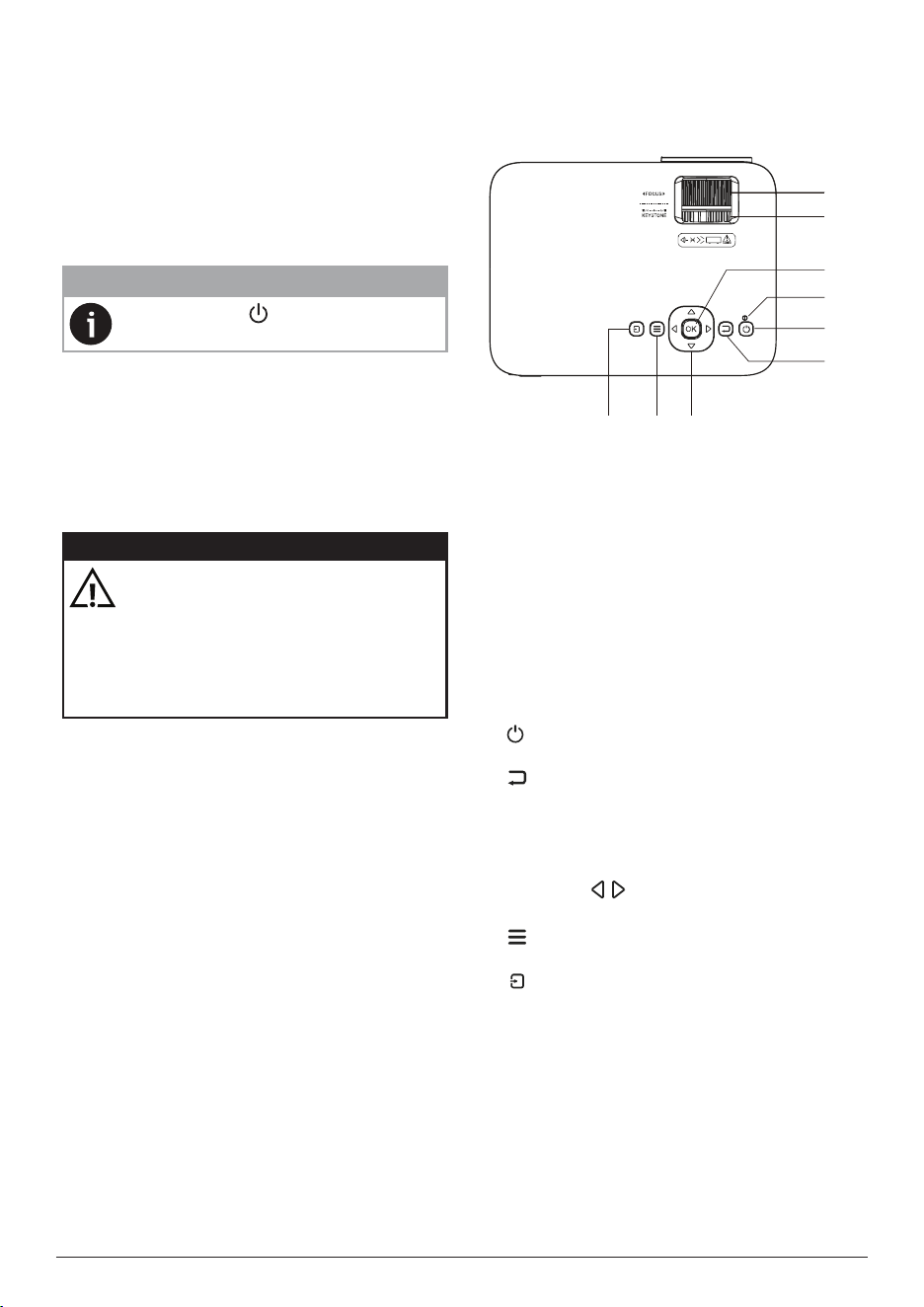
a
Focus adjustment knob
Adjust image sharpness.
b
Keystone adjustment knob
Adjust image shape.
c
OK
Confirm a selection or change the value for
the current setting.
d
Power LED
• When the projector is on, the LED lights
up in white.
• When the projector is in standby mode,
the LED lights up in red.
e
Switch the projector on or to standby mode.
f
Return to the previous screen or exit the
current screen.
g
Navigation buttons (Up, Down, Left, Right)
• Navigate items on the screen.
• Press / to change the value for the
current setting.
h
Open or close the settings menu.
i
Display all the input sources and allow you
to switch to a different input source.
6 Philips · NeoPix 100
Front view
b
a
c
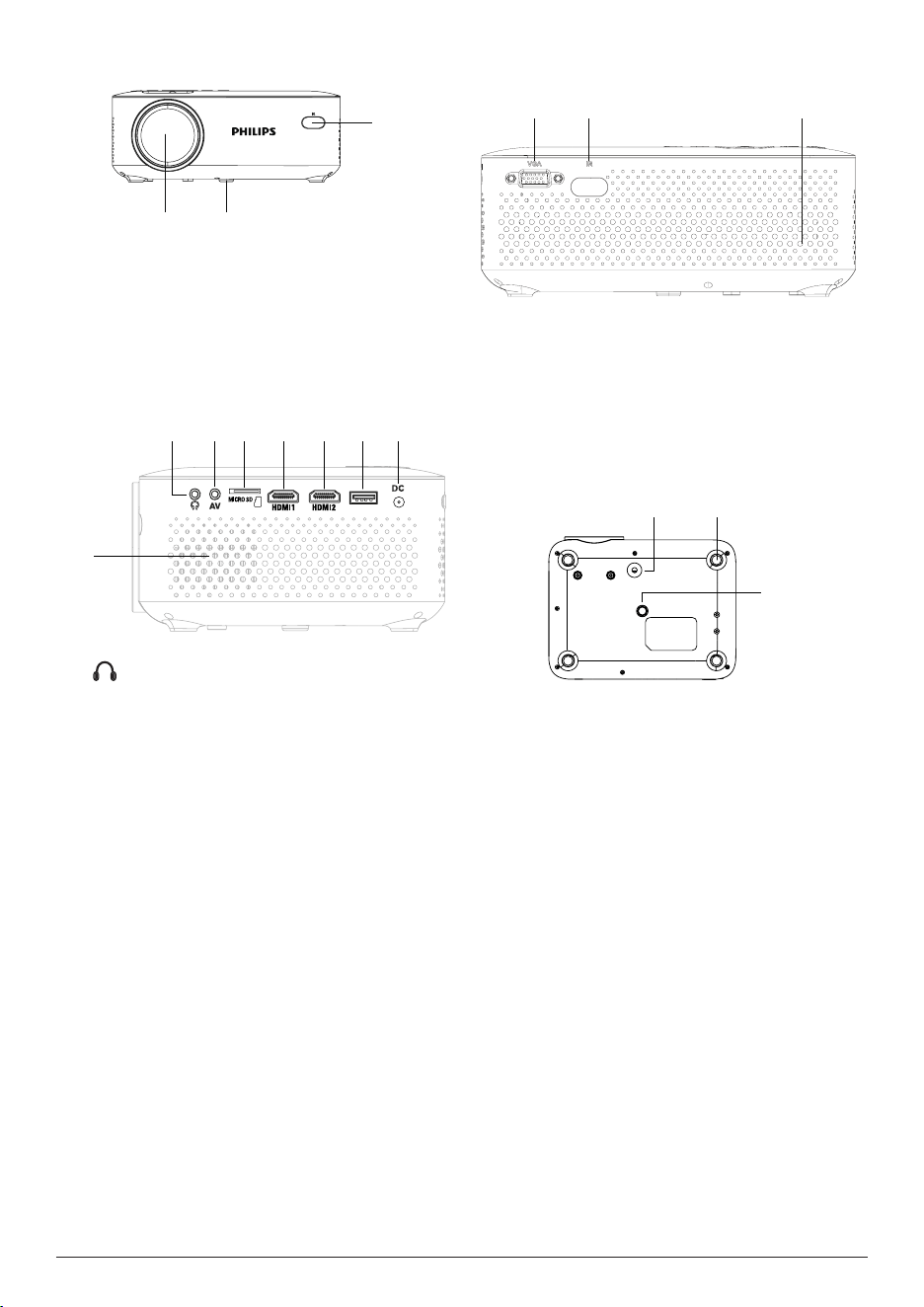
a
Front IR sensor
b
Angle adjustment knob
Turn the knob to adjust screen height.
c
Projection lens
Side view
USB
bca e fd g
h
a
3.5 mm audio output; connect to external
speakers or headphones.
b
AV
3.5 mm audio/video input; connect to the
analogue audio jacks and/or composite
video jack on a playback device.
c
MICRO SD
Connect to a microSD card for media
playback.
d
HDMI1
Connect to an HDMI™ output port on a
playback device.
e
HDMI2
Connect to an HDMI™ output port on a
playback device.
f
USB
Connect to a USB storage device/dongle.
g
DC
Connect to the supplied AC adapter.
h
Air vent
Rear view
ab c
a
VGA
Connect to the VGA port on a computer.
b
Rear IR sensor
c
Speaker
Bottom view
a
c
b
a
Angle adjustment knob
Turn the knob to adjust screen height.
b
Rubber foot
c
Screw hole for ceiling mount
Initial setup 7
Remote control
OK
a
b
c
d
h
g
f
e
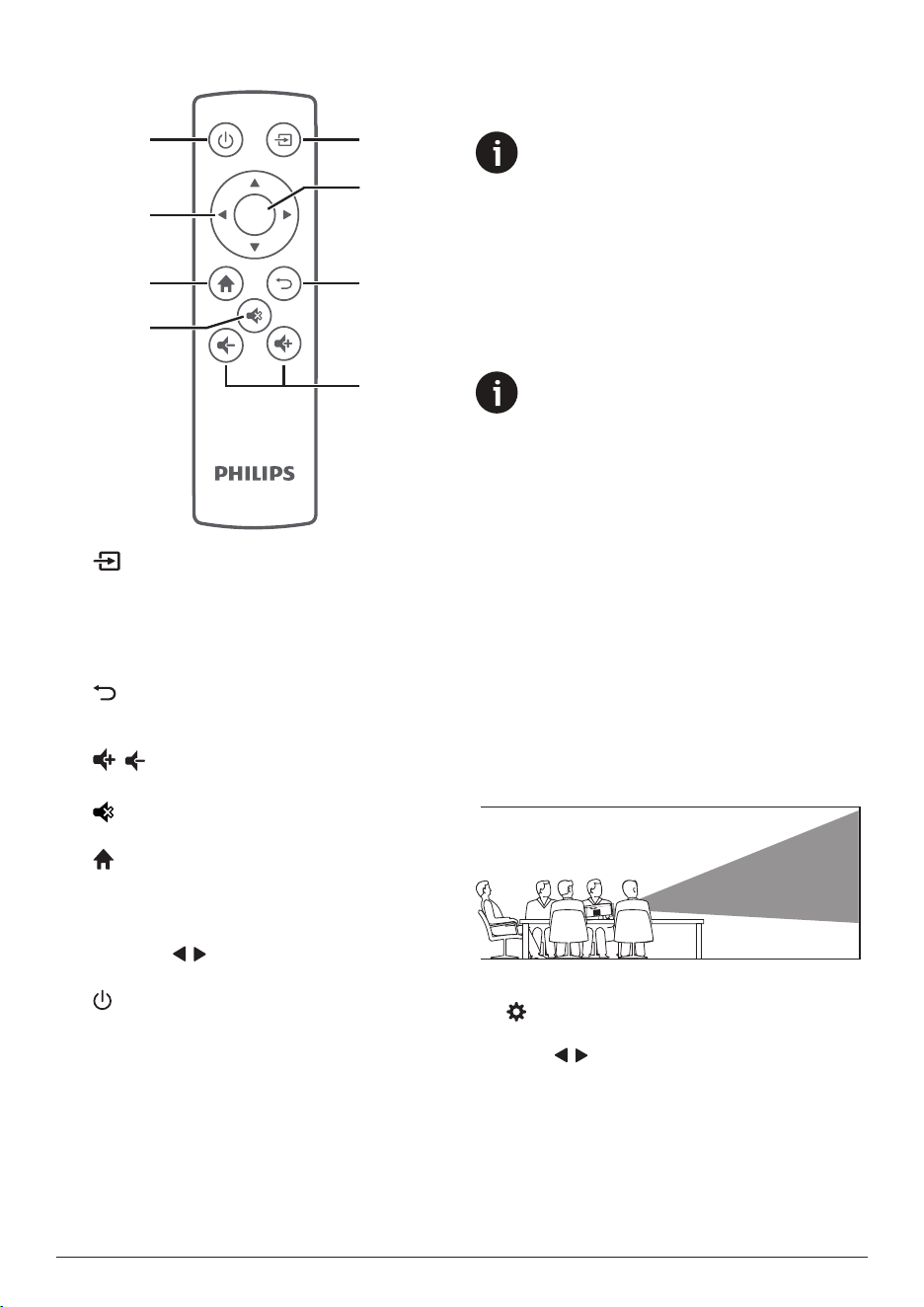
a
Display all the input sources and allow you
to switch to a different input source.
b
OK
Confirm a selection or change the value for
the current setting.
c
Return to the previous screen or exit the
current screen.
d
/
Increase or decrease the volume.
e
Mute or unmute the speaker.
f
Access the home screen.
g
Navigation buttons (Up, Down, Left, Right)
• Navigate items on the screen.
• Press / to change the value for the
current setting
.
h
Switch the projector on or to standby mode.
3 Initial setup
Notice
Make sure all devices are disconnected
from their power supplies before
establishing or changing any
connections.
Install the projector
You can install the projector in four different
ways. Follow the guidelines below to correctly
install the projector.
Notice
For overhead mounting on ceiling,
purchase a projector mount
recommended by an installation
professional and follow the instructions
that come with the mount.
Before mounting on the ceiling, make
sure the ceiling can support the weight
of the projector and mounting kit.
For ceiling installation, this product
must be securely attached to the ceiling
in accordance with the installation
instructions. An improper ceiling
installation may result in accident, injury
or damage.
Front
1 Place the projector on a flat surface such
as a table in front of the projection surface.
This is the most common way to position
the projector for quick setup and portability.
2 If the projection direction is incorrect, select
from the home screen to open the
settings menu, go to Projection mode and
press / or the OK button to select Front.
Front Ceiling
1 Mount the projector on the ceiling with
upside up in front of the projection screen.
A projector mount is required to mount the
projector on ceiling.
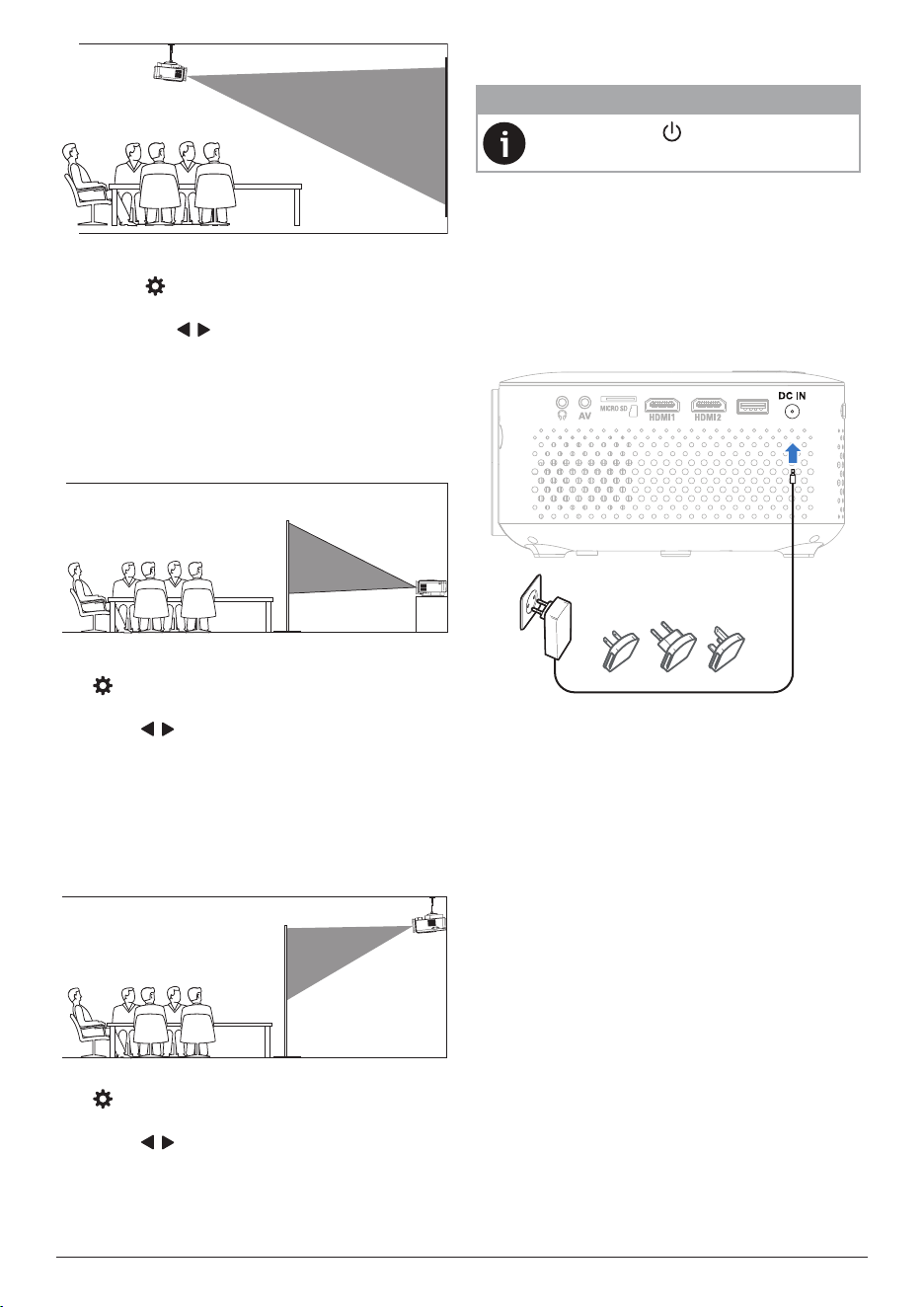
8 Philips · NeoPix 100
2 If the projection direction is incorrect,
select from the home screen to open
the settings menu, go to Projection mode
and press / or the OK button to select F/
Ceiling.
Rear
1 Place the projector on a table behind the
projection screen. A special rear projection
screen is required.
2 If the projection direction is incorrect, select
from the home screen to open the
settings menu, go to Projection mode and
press / or the OK button to select Rear.
Rear Ceiling
1 Mount the projector on ceiling with upside
up behind the projection screen. To mount
the projector on ceiling behind the screen,
a projector mount and a special rear
projection screen are required.
2 If the projection direction is incorrect, select
from the home screen to open the
settings menu, go to Projection mode and
press / or the OK button to select Rear/
Ceiling.
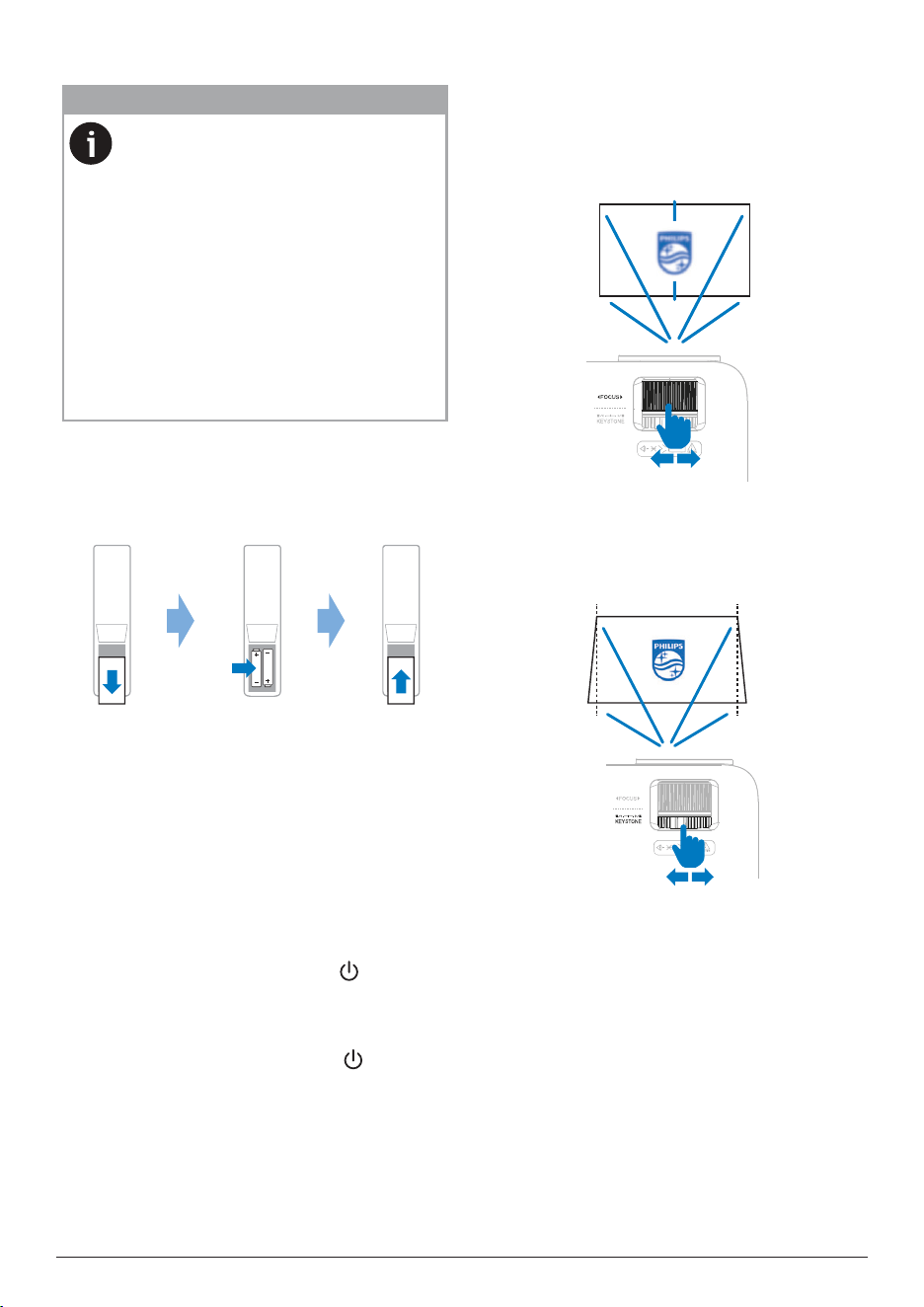
Connect to power supply
CAUTION!
Always use the button to turn the
projector on and off.
1 Connect the AC adapter to the DC power
jack on the side of the projector.
2 Attach a suitable power plug adapter to the
AC adapter and plug the AC adapter into an
electrical socket.
• The power LED on the projector lights
up in red.
USB
a
b
Initial setup 9
Prepare the remote control
CAUTION!
The improper use of batteries can
lead to overheating, explosion, risk of
fire and injury. Leaking batteries can
possibly damage the remote control.
Never expose the remote control to
direct sunlight.
Avoid deforming, dismantling or
charging the batteries.
Avoid exposure to open fire and water.
Replace empty batteries immediately.
Remove the batteries from the remote
control if not in use for long periods of
time.
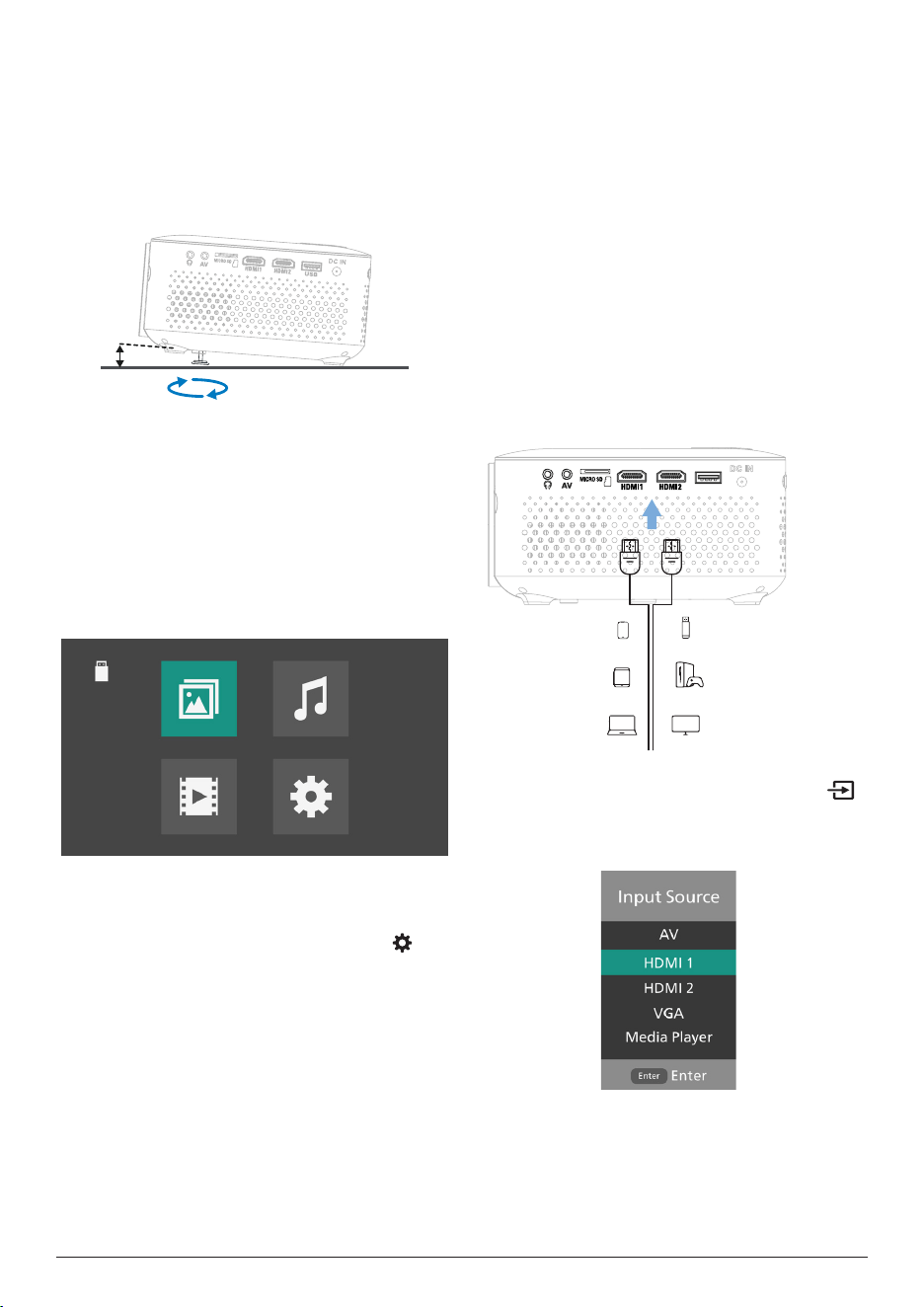
1 Open the battery compartment.
2 Insert the supplied batteries (type AAA)
with correct polarity (+/-) indicated.
3 Close the battery compartment.
• When using a remote control with infrared
signals, point the remote control at the IR
sensor on the projector, and make sure
there is no obstacle between the remote
control and the IR sensor.
Power on and set up the
projector
Power on/off the projector
• To turn on the projector, press on the
projector/remote control. The power LED
on the projector turns from red to white.
• To turn off the projector and put it into
standby mode, press and hold on the
projector/remote control for 2 seconds or
press this button twice. The power LED on
the projector turns from white to red.
• To fully shut down the projector, disconnect
the AC adapter from the electrical socket.
Image focus adjustment
To adjust the image focus (sharpness), turn the
focus adjustment knob above the projection
lens.
Tip: If you change the projection distance later,
you'll need to adjust the image focus again.
Image shape adjustment
To adjust the image shape, turn the keystone
adjustment knob above the projection lens.
Screen size adjustment
The projection screen size (or size of images) is
determined by the distance between the lens
of the projector and the projection surface.
This projector has a recommended projection
distance of 200 cm (60"), and thus creates
a maximum screen size of 65" (165 cm). The
minimum distance from the projection surface
is 80 cm (24").
10 Philips · NeoPix 100
Screen height adjustment
To adjust the screen height when placing
the projector on a flat surface, turn the angle
adjustment knob located at the bottom of the
projector.
Tip: After adjusting the screen height, use the
keystone adjustment knob to make the screen
rectangular again.
Select the language
When you turn on the projector for the first
time or after it was reset to its factory default
settings, the projector system will start and
prompt you to select the language.
Press the navigation buttons to select your
preferred display language and press the
OK button to confirm. The home screen then
appears.
After selecting the language, you can start
using the projector or continue to make other
adjustments.
Tip: To change the language later, select
from the home screen to open the settings
menu, go to OSD Language and press the OK
button.
4 Connect to other
devices
Connect to a playback
device through HDMI™
You can connect a playback device (e.g. a Blu-
ray player, gaming console, camcorder, digital
camera or PC) to the projector through HDMI™
connection. With this connection, images are
shown on the projection screen, and audio is
played on the projector.
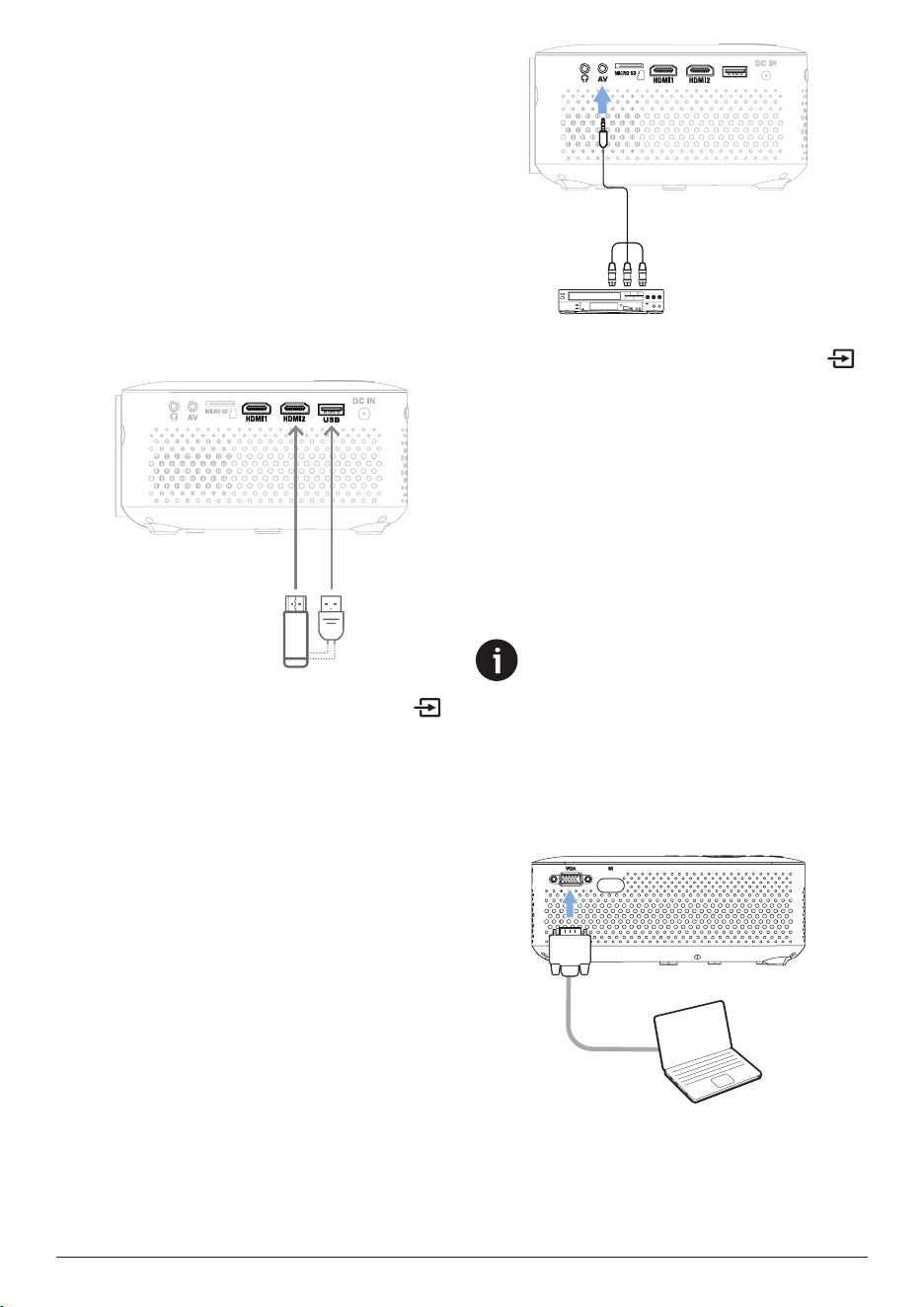
1 Using an HDMI™ cable, connect the HDMI1
or HDMI2 port on the projector to an
HDMI™ output port on a playback device.
USB
Computers
Phones
Tablets
DVD/VC
Smart Sticks
Game consoles
2 The projector should automatically switch
to the correct input source. If not, press
on the remote control to bring up the input
source list, and then select HDMI 1 or HDMI
2.
Connect to other devices 11
Connect to a dongle
You can connect a dongle (e.g. Amazon Fire
Stick, Roku Stick and Chromecast) to the
projector to easily watch videos over the
internet. With this connection, images are
shown on the projection screen, and audio is
played on the projector.
1 Connect the dongle to the projector's
HDMI1 or HDMI2 port directly or
using an
HDMI™ cable.
2 Connect the dongle to the projector's
USB port using a USB cable
. Note: The
maximum current supplied by this port is
5V1A.
External Dongle
(not included)
3 The projector should automatically switch
to the correct input source. If not, press
on the remote control to bring up the input
source list, and then select HDMI 1 or HDMI
2.
Connect to a playback
device through AV
You can connect a playback device (e.g. a DVD
player, gaming console, camcorder or digital
camera) to the projector through AV connection.
With this connection, images are shown on the
projection screen, and audio is played on the
projector.
1 Using an RCA cable with 3.5 mm plug (not
included in the box), connect the AV jack
(3.5 mm) on the projector to the analogue
audio output jacks (red and white) and/or
composite video output jack on a playback
device.
USB
2 The projector should automatically switch
to the correct input source. If not, press
on the remote control to bring up the input
source list, and then select AV.
Connect to a computer
through VGA
You can connect a computer (e.g. a desktop
or laptop) to the projector through VGA
connection. With this connection, images are
shown on the projection screen.
Notice
Many laptops do not activate the
external video output automatically
when you connect a second display such
as a projector. Check your laptop user
manual to find out how to activate the
external video output.
1 Using a VGA cable (not included in the box),
connect the VGA port on the projector to
the VGA output port on a computer.
VGA
2 Adjust your computer's screen resolution
to the correct setting and switch the VGA
signal to an external monitor. The following
resolutions are supported:
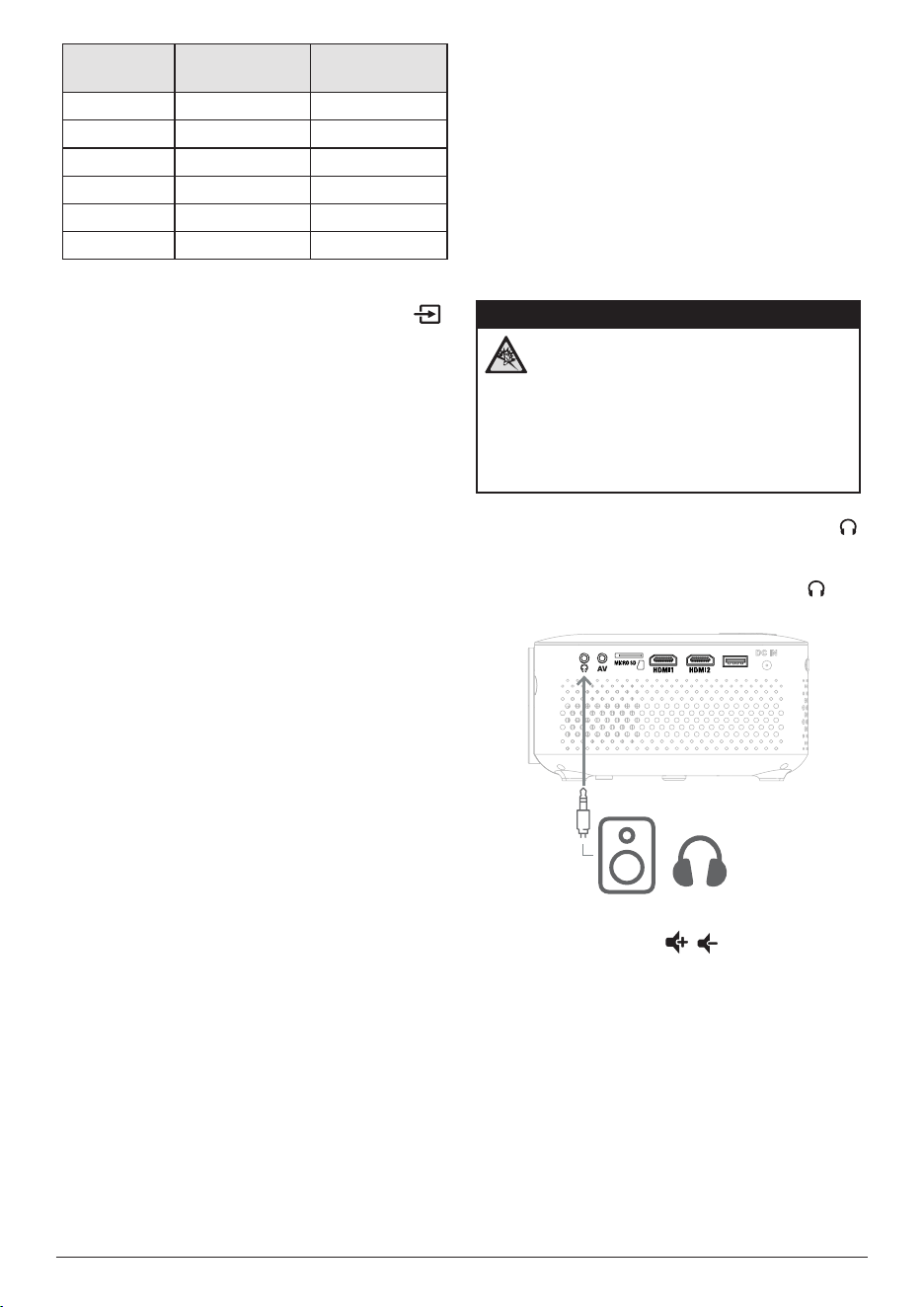
12 Philips · NeoPix 100
Resolution
Image refresh
rate
VGA 640 x 480 60 Hz
SVGA 800 x 600 60 Hz
XGA 1024 x 768 60 Hz
WXGA 1280 x 768 60 Hz
HD 1280 x 720 60 Hz
FULL HD 1920 x 1080 60 Hz
3 The projector should automatically switch
to the correct input source. If not, press
on the remote control to bring up the input
source list, and then select VGA.
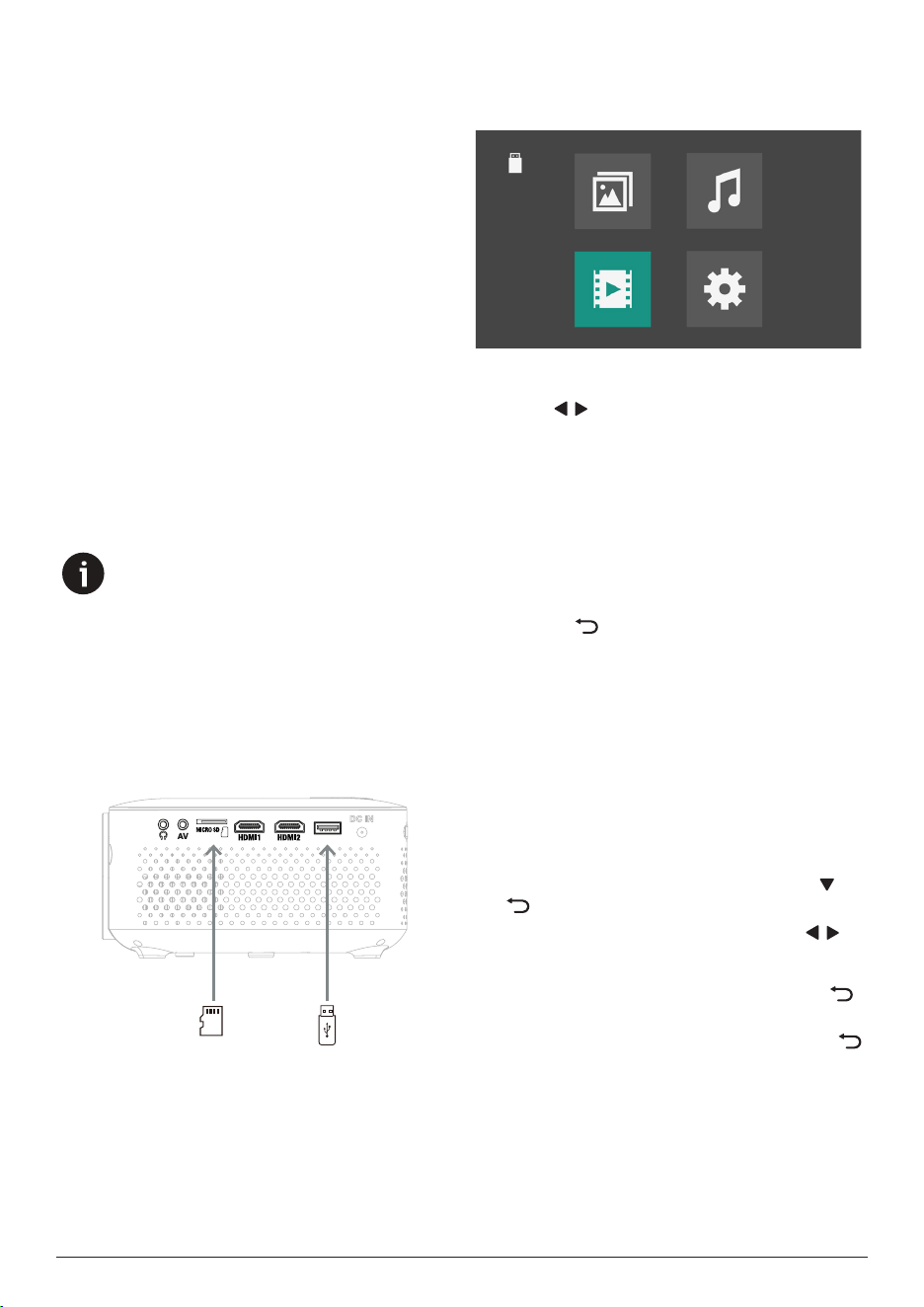
Connect to wired speakers
or headphones
You can connect wired speakers or headphones
to the projector. With this connection, audio
from the projector is played through the
external speakers or headphones.
• The internal speakers of the projector
are deactivated automatically when
external speakers or headphones are
connected to the projector.
DANGER!
Danger of hearing damage!
Before connecting the headphones,
turn down the volume on the projector.
Do not use the projector over a longer
time at high volume – especially when
using headphones. This could lead to
hearing damage.
1 Using a 3.5 mm audio cable, connect the
jack on the projector to the analogue audio
input (3.5 mm jack, or red and white jacks)
on external speakers. Or connect the jack
on the projector to headphones.
USB
2 After connecting the speakers or
headphones, press / on the remote
control to adjust the volume to the desired
level.
Play/view media from storage devices 13
5 Play/view media
from storage
devices
The projector has an integrated media player.
Using this media player, you can play/view
videos, audios, or images stored on a USB
storage device or microSD card.
Supported file formats
The integrated media player supports the
following file formats.
• Video formats: MP4, RMVB, AVI, RM, MKV
• Audio formats: MP3, WMA, OGG, AAC,
FLAC, APE, WAV
• Image formats: BMP, PNG, JPEG
Connect a storage device
Notice
The projector supports a USB storage
device that is formatted for FAT16 or
FAT32 file system.
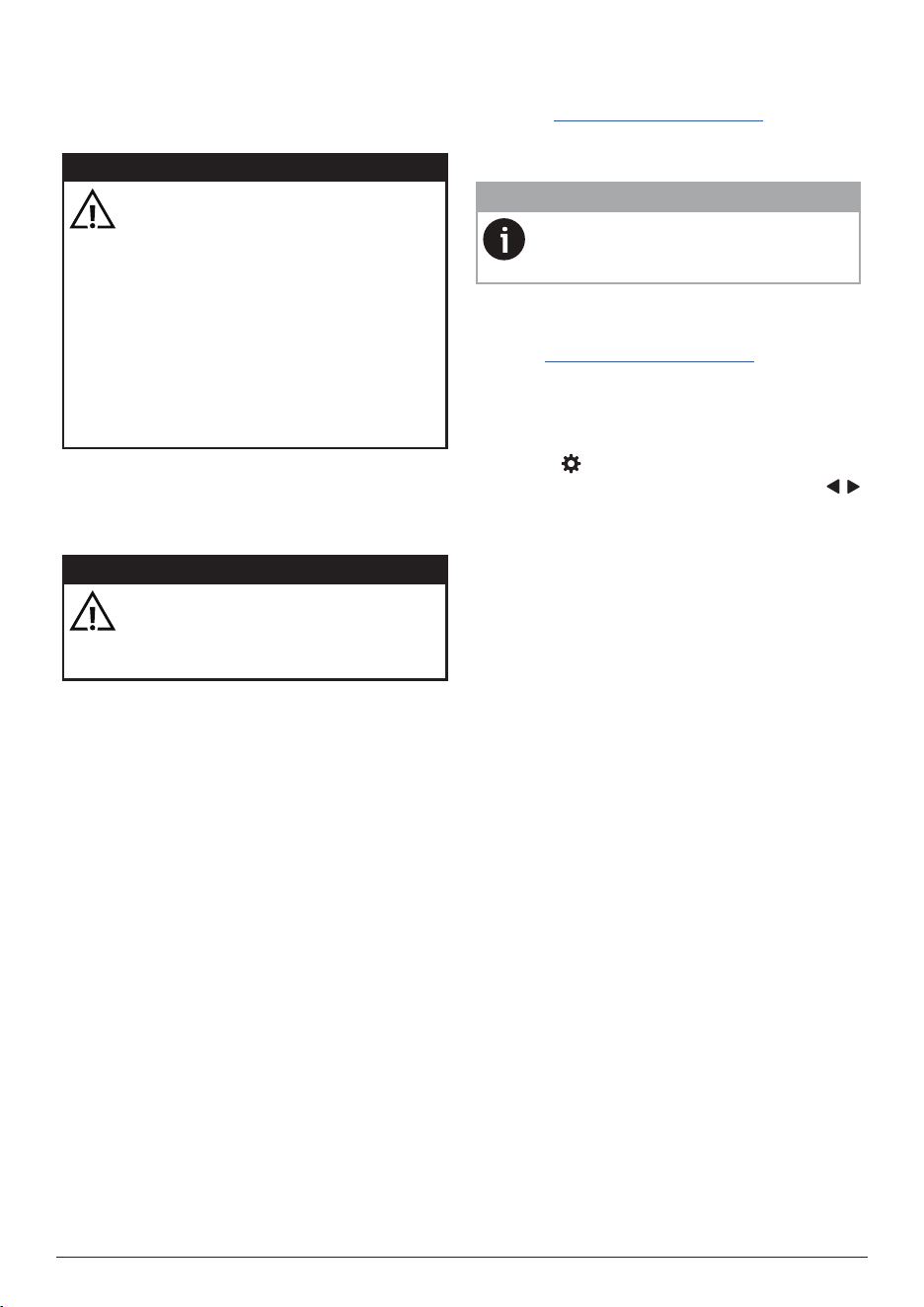
1 Make sure your storage device contains
media files supported by the integrated
media player.
2 Connect your USB storage device to the
USB port on the projector.
Or insert a microSD card into the MICRO SD
slot on the projector.
USB
Play videos
1 From the projector's home screen, select
the movie icon in the lower-left corner.
2 If you have connected both a USB storage
device and a microSD card to the projector,
press / to select your USB storage device
or microSD card.
3 Press the OK button to open the storage
device. Note: Only supported video files
are displayed on the screen. All folders and
files are ordered alphabetically by name.
4 Press the navigation buttons to select a
video file or a folder. To open a selected
folder, press the OK button. To return to the
parent folder, select Upfolder on the screen
or press . To exit the current folder and
storage device, select Return on the screen.
If you select a video file and wait more than
3 seconds, the projector will begin playing
a preview of the video from the beginning
while displaying the video information.
5 Press the OK button to start playing the
selected video file.
6 While a video file is playing, you can press
the OK button to bring up the control bar
at the bottom of the screen. The control bar
will automatically disappear in 10 seconds.
To instantly hide the control bar, press or
.
While the control bar is visible, press /
to select an option and then press OK to
confirm the action or change the value. To
close the dialog box of an option, press .
7 To stop playing a video file and return to
the list of files in the current folder, press
on the remote control.
Play audios
You can play audios in a similar way as you play
videos. The major differences are:
• In Step 1, you need to select the music icon

14 Philips · NeoPix 100
in the upper-right corner.
• When an audio is playing, you will always
see the changing sound wave on the
screen.
• While an audio is playing, you can press the
OK button on the remote control to bring
up the control bar at the bottom of the
screen. The control bar will automatically
disappear in 15 seconds. To instantly hide
the control bar, press or .
View images
1 From the projector's home screen, select
the photo icon in the upper-left corner.
2 If you have connected both a USB storage
device and a microSD card to the projector,
press / to select your USB storage device
or microSD card.
3 Press the OK button to open the storage
device. Note: Only supported image files
are displayed on the screen. All folders and
files are ordered alphabetically by name.
4 Press the navigation buttons to select an
image file or a folder. To open a selected
folder, press the OK button. To return to the
parent folder, select Upfolder on the screen
or press . To exit the current folder and
storage device, select Return on the screen.
If you select an image file and wait more
than 3 seconds, the projector will show a
preview of the image and display the image
information.
5 Press the OK button to start the slide show
of all supported images in the current folder
from the selected image.
6 During the slide show, press a navigation
button to pause the slide show and rotate
the current image. Press / to rotate it
clockwise by 270° or 90°. Press / to
rotate it by 180°.
While viewing an image, you can press the
OK button on the remote control to bring
up the control bar at the bottom of the
screen. The control bar will automatically
disappear in 15 seconds. To instantly hide
the control bar, press or .
While the control bar is visible, press /
to select an option and then press OK to
confirm the action or change the value. To
close the dialog box of an option, press .
7 To stop the slide show and return to the list
of files in the current folder, press on the
remote control.
6 Change projector
settings
This section helps you change the projector
settings using the settings menu.
1 Select from the home screen or press
on the projector to open the settings menu.
2 Press / to select a setting category and
press the OK button or to select the first
setting of the category. Press / to select
a different setting in the category. Press
to exit the category.
3 Press the OK button or / to change
a non-numerical setting. Press the OK
button or / , and then / to change a
numerical setting. The change takes effect
immediately.
4 Press one or more times, press or
wait 15 seconds to exit the settings menu.
Picture settings
You can view and change the following picture
settings.
• Picture Mode:
Select predefined color
settings for picture or video display. Select
User to customize the following settings:
• Contrast: Adjust the contrast of the
projected image.
• Brightness: Adjust the overall brightness
of the projected image.
• Color: Adjust the color saturation of the
projected image.
• Tint: Adjust the tint of the projected
image.
• Sharpness: Adjust the clarity of detail in
the projected image.
• Color Temperature: You can set the
projector to use the following color
temperature types.
• Cool: Make the picture more bluish.
• Warm: Make the picture more reddish.
• Medium: Use a moderate color
temperature.
• Noise Reduction: Select a noise reduction
level (Off, Low, Middle, High) to remove
image noise from a video signal to achieve
image clearness. The default value is
Middle.

Change projector settings 15
Sound settings
You can view and change the following sound
settings.
• Sound Mode: You can set the projector to
use the following sound modes, depending
on your environment, audio type or
preferences.
• Standard: Optimize the bass and treble
levels for general audio.
• Movie: Optimize the bass and treble
levels for movies.
• Music: Optimize the bass and treble
levels for music.
• Sports: Optimize the bass and treble
levels for sports.
• User: Define your own bass and treble
levels.
• Treble: Set the treble level. This setting is
enabled only when the sound mode is User.
• Bass: Set the bass level. This setting is
enabled only when the sound mode is User.
• Balance: Adjust the stereo balance to
compensate for volume differences
between the left and right speakers at the
listening position. The default value is 0.
• Auto Volume: Turn this on to reduce sudden
changes in volume. The default value is Off.
Timer settings
You can view and change the following timer
settings.
• Sleep Timer: Select a period of time after
which the projector turns off automatically.
The default value is Off.
• Auto Sleep: Select a period of time so that
the projector turns off automatically after
the selected period of inactivity. The default
value is Off.
Other settings
You can view and change the following
additional settings.
• OSD Language: Select your preferred
display language.
• Aspect Ratio: Select one of the available
aspect ratios. The default value is 16:9.
This setting is enabled only when you are
playing a video.
• Projection Mode: Adjust the projection to
the correct direction based on how the
projector is installed.
• Reset: Restore the projector's settings to
the factory default settings. After the factory
reset, the projector will turn off.
• Software Update(USB): Update the
projector's software offline. For more
details, see Update software offline, page
16.
• Info: View the model and software version
of this product.
16 Philips · NeoPix 100
7 Maintenance
Cleaning
DANGER!
Follow the following instructions when
cleaning the projector:
Use a soft, lint-free cloth. Never use
liquid or easily flammable cleansers
(sprays, abrasives, polishes, alcohol,
etc.). Do not allow any moisture to
reach the interior of the projector.
Do not spray the projector with any
cleaning fluids.
Wipe over the surfaces gently. Be
careful that you do not scratch the
surfaces.
Cleaning the lens
Use a soft brush or lens cleaning paper for
cleaning the lens of the projector.
DANGER!
Do not use any liquid cleaning agents!
Do not use any liquid cleaning
agents for cleaning the lens, to avoid
damaging the coating film on the lens.
Update software
The latest software for the projector can be
found on www.philips.com/support for you
to get the best features and support from the
projector.
CAUTION!
Do not turn off the projector or remove
the USB flash drive during a software
update.
Update software offline
1 Visit www.philips.com/support, find your
product (model number: NPX100, open
its support page and locate "Software &
drivers". Then check the latest software
version there.
2 Select from the home screen to open
the settings menu, go to Info and press /
or the OK button. Find the current software
version on the screen. Proceed to the next
step if the latest software version is greater
than the current software version.
3 From the support page you opened in step
1, download the software installation file to
a USB flash drive. Unzip the downloaded
file and save the resulting file in the root
directory of the USB flash drive.
4 Connect the USB flash drive to the
projector.
5 Select Software Update(USB) from the
settings menu.
6 Follow the on-screen instructions to
complete the update.
Troubleshooting 17
8 Troubleshooting
Power cycling
If a problem occurs and you cannot resolve it using the instructions in this user manual, try the
following steps to resolve the problem.
1 Turn the projector off by pressing twice.
2 Wait at least 10 seconds.
3 Turn the projector on by pressing .
4 If the problem persists, contact one of our customer service centers or your dealer.
Problem Solution
The projector cannot be turned on. • Disconnect and reconnect the power cable, and
try to turn the projector on again.
The projector cannot be turned off.
• Press and hold longer than ten seconds. If this
does not work, disconnect the power cable.
No image from the external HDMI™ device. 1. Check if you have switched the input source to
HDMI 1 or HDMI 2.
2. Disconnect the HDMI™ cable or switch off the
HDMI™ device.
3. Wait three seconds.
4. Reconnect the HDMI™ cable or switch on the
HDMI™ device again.
No sound from the external connected
device.
• Check the cables to the external device.
• Check that the sound is activated on the external
device.
• Only the original cables from the device
manufacturer may function.
No sound from external HDMI™ output
device.
• On the HDMI™ output device, set the audio
setting to Multichannel (Raw data) & Stereo (PCM).
No sound when you connect your
computer using an HDMI™ cable.
• Check that the sound is activated on the
computer.
Only the home menu appears and not the
image from the external device.
• Check if the cables are connected to the correct
sockets.
• Check that the external device is turned on.
• Check if the video output of the external device is
turned on.
Only the home menu appears and not the
image from the connected computer.
• Check that the HDMI™ output of the computer is
turned on.
• Check if the resolution of the computer is set to
1920*1080.
The projector turns itself off. • When the projector is running for a long period of
time, the surface becomes hot.
• Check that the power cable is connected correctly.
The projector cannot read the USB storage
device.
• The projector does not support the exFAT file
system.
• Format the USB storage device in FAT32 or NTFS
format, then use it.

18 Philips · NeoPix 100
Problem Solution
The projector does not react to remote
control commands.
• Check the batteries of the remote control.
The temperature of the projector’s surface
is warm.
• For this projector it is normal to generate
moderate heat during operation.
The projector does not work after I connect
it to a laptop.
• Check that the HDMI™ cable is plugged in
correctly.
• Make sure that the laptop has been switched to
projector display.
Black / White Pixels An LCD display may contain a small number of
pixels that do not function normally (also known
as “dead pixels” or “black pixels”). Your display
has been inspected and is in compliance with the
manufacturer's specifications, meaning that any
pixel defects do not affect the operation or use of
your display. Without prejudice to generality of the
foregoing, dead pixels or black pixels not exceeding
5 dots meet the factory specifications and are not
considered a defect under this warranty.
Concerning dust:
Dust may appear during the use of a projector.
Without prejudice to generality of the foregoing,
dust spots not exceeding 3 dots meet the factory
specifications and are not considered a defect
under this warranty. Please clean the lens with a
gentle specific glass tissue. You can also push dry air
into the product by the side holes in order to clean
the optical engine inside.

Appendixes 19
9 Appendixes
Technical data
Technology/optical
Display technology ...............................................LCD
Light source .............................................................LED
Resolution ...................................... 800 x 480 pixels
Resolution supported ............. 1920 x 1080 pixels
LED lifetime ................................over 30,000 hours
Contrast ratio .................................................... 3000:1
Aspect ratio .............................................................16:9
Throw ratio .............................................................1.49:1
Screen size (diagonal)..............................20" to 65"
Screen distance ...80 cm to 200 cm / 24" to 60"
Projection modes ........................................................4
Focus adjustment ...........................................manual
Keystone correction ...................................... manual
Sound
Built-in speaker ................................................ 2 x 3 W
Noise level ............................................................ 43 dB
Connection
HDMI™ in ...................................................................... x2
VGA .................................................................................. x1
AV in ................................................................................x1
USB-A (5 V/1 A out + external drive) ................... x1
MicroSD......................................................................... x1
3.5 mm audio out .......................................................x1
Power source
Power consumption ......................operating: 42 W
......................................................... standby: 0.5 W
AC adapter ........................................................................
........ Input: AC 100-240 V, 50/60 Hz, 1.0 A (Max)
............................... Output: DC 12.0 V, 3.5 A, 42.0 W
Multimedia player
Supported video formats: MP4, RMVB, AVI, RM,
MKV
Supported audio formats: MP3, WMA, OGG,
AAC, FLAC, APE, WAV
Supported photos formats: BMP, PNG, JPEG
Dimensions and weight
Unpacked (W x D x H) ............. 205 x 158 x 78 mm
Packed (W x D x H) ................. 256 x 242 x 90 mm
Net weight ............................................880 g / 1.94 lb
Gross weight ...................................... 1.72 kg / 3.79 lb
Temperature requirements
Operating temperature.......................... 5 °C - 35 °C
Storage temperature ...................................... < 60 °C
Package contents
1. NeoPix 100 projector
2. Remote control
3. AC adapter
4. Power plug adapters
5. AAA batteries for remote control
6. Quick Start Guide with Warranty Card
Model
NPX100
EAN (INT): 7640186960458
EAN (APAC): 7640186960465
UPC: 667619992944

20 Philips · NeoPix 100
CE statement
• The product shall only be connected to a
USB interface of version USB 2.0 or higher.
• Adapter shall be installed near the
equipment and shall be easily accessible.
• The operating temperature of the EUT can’t
exceed 35°C and shouldn’t be lower than
5°C.
• The plug is considered as disconnect device
of adapter.
Hereby, Screeneo Innovation SA declares that
this product is in compliance with essential
requirements and other relevant provisions of
Directive 2014/53/EU.
The Declaration of Compliance can be
consulted on the site www.philips.com.
FCC statement
15�19 Labeling requirements�
This device complies with part 15 of the FCC
Rules. Operation is subject to the following
two conditions: (1) This device may not cause
harmful interference, and (2) this device must
accept any interference received, including
interference that may cause undesired
operation.
15�21 Information to the user�
Any changes or modifications not expressly
approved by the party responsible for
compliance could void the user’s authority to
operate the equipment.
15�105 Information to user�
This equipment has been tested and found
to comply with the limits for a Class B digital
device, pursuant to Part 15 of the FCC Rules.
These limits are designed to provide reasonable
protection against harmful interference in
a residential installation. This equipment
generates, uses and can radiate radio
frequency energy and, if not installed and used
in accordance with the instructions, may cause
harmful interference to radio communications.
However, there is no guarantee that interference
will not occur in a particular installation. If this
equipment does cause harmful interference
to radio or television reception, which can be
determined by turning the equipment off and
on, the user is encouraged to try to correct the
interference by one or more of the following
measures:
• Reorient or relocate the receiving antenna.
• Increase the separation between the
equipment and receiver.
• Connect the equipment into an outlet on
a circuit different from that to which the
receiver is connected.
• Consult the dealer or an experienced radio/
TV technician for help.
FCC ID: 2ASRT-NPX100
Canada regulatory
compliance
This device complies with Industry Canada CAN
ICES-3 (B)/NMB-3(B)
RSS-Gen & RSS-247 statement: This device
complies with Industry Canada RSS standard(s).
Operation is subject to the following two
conditions:
1 This device may not cause interference, and
2 This device must accept any interference,
including interference that may cause
undesired operation of the device.
Other notice
Preservation of the environment as part
of a sustainable development plan is an
essential concern of Screeneo Innovation SA.
The desire of Screeneo Innovation SA is to
operate systems respecting the environment
and consequently it has decided to integrate
environmental performances in the life cycle
of these products, from manufacturing to
commissioning use and elimination.
Batteries: If your product contains batteries,
they must be disposed of at an appropriate
collection point.
Product: The crossed-out waste bin symbol on
the product means that the product belongs
to the family of electrical and electronic
equipment. In this respect, the European

Appendixes 21
regulations ask you to dispose of it selectively:
• At sales points in the event of the
purchase of similar equipment.
• At the collection points made available
to you locally (drop-off center ,
selective collection, etc.).
In this way you can participate in the reuse
and upgrading of Electrical and Electronic
Equipment Waste, which can have an effect on
the environment and human health.
The paper and cardboard packaging used can
be disposed of as recyclable paper. Have the
plastic wrapping recycled or dispose of it in
the non-recyclable waste, depending on the
requirements in your country.
Trademarks: The mentioned references in
this manual are trademarks of the respective
companies. The lack of the trademarks ®
and ™ does not justify the assumption that
these dedicated terminologies are free
trademarks. Other product names used herein
are for identification purposes only and may
be trademarks of their respective owners.
Screeneo Innovation SA disclaims any and all
rights in those marks.
Neither Screeneo Innovation SA nor its affiliates
shall be liable to the purchaser of this product
or third parties for damages, losses, costs, or
expenses incurred by the purchaser or third
parties as a result of accident, misuse, or abuse
of this product or unauthorised modifications,
repairs, or alterations to this product, or failure
to strictly comply with Screeneo Innovation SA
operating and maintenance instructions.
Screeneo Innovation SA shall not be liable for
any damages or problems arising from the use
of any options or any consumable materials
other than those designated as original
Screeneo Innovation SA/PHILIPS products or
Screeneo Innovation SA/PHILIPS approved
products.
Screeneo Innovation SA shall not be held liable
for any damage resulting from electromagnetic
interference that occurs from the use of any
interface cables other than those designated as
Screeneo Innovation SA/PHILIPS products.
All rights reserved. No part of this publication
may be reproduced, stored in a retrieval
system or transmitted in any form or by any
means, electronic, mechanical, photocopying,
recording, or otherwise, without the prior
written permission of Screeneo Innovation SA.
The information contained herein is designed
only for use with this product. Screeneo
Innovation SA is not responsible for any use of
this information as applied to other devices.
This user manual is a document that does not
represent a contract.
Errors, printing errors and changes are reserved.
The terms HDMI, HDMI High-Definition
Multimedia Interface, HDMI Trade Dress and
the HDMI Logos are trademarks or registered
trademarks of HDMI Licensing Administrator,
Inc.

Screeneo Innovation SA
Route de Lully 5c - 1131 Tolochenaz - Switzerland
Philips and the Philips Shield Emblem are registered trademarks of Koninklijke Philips N.V. and are
used under license. Screeneo Innovation SA is the warrantor in relation to the product with which
this booklet was packaged.
2024 © Screeneo Innovation SA. All rights reserved.
NeoPix 100
EN