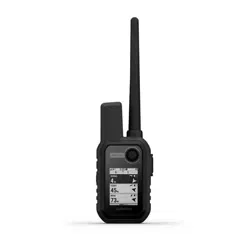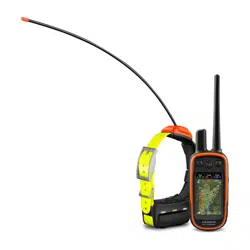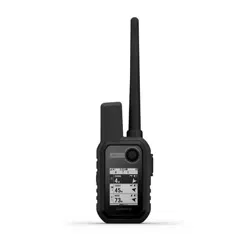
ALPHA
®
10 WITH TRAINING
Owner’s Manual

© 2021 Garmin Ltd. or its subsidiaries
All rights reserved. Under the copyright laws, this manual may not be copied, in whole or in part, without the written consent of Garmin. Garmin reserves the right to change or
improve its products and to make changes in the content of this manual without obligation to notify any person or organization of such changes or improvements. Go to
www.garmin.com for current updates and supplemental information concerning the use of this product.
Garmin
®
, the Garmin logo, Alpha
®
, and ANT+
®
are trademarks of Garmin Ltd. or its subsidiaries, registered in the USA and other countries. Garmin DriveTrack
™
, Garmin Explore
™
,
Garmin Express
™
, and Thumb Stick
™
are trademarks of Garmin Ltd. or its subsidiaries. These trademarks may not be used without the express permission of Garmin.
Apple
®
and Mac
®
are trademarks of Apple Inc., registered in the U.S. and other countries. The BLUETOOTH
®
word mark and logos are owned by the Bluetooth SIG, Inc. and any use
of such marks by Garmin is under license. Windows
®
is a registered trademark of Microsoft Corporation in the United States and other countries. Other trademarks and trade names
are those of their respective owners.

Table of Contents
Getting Started.................................1
Setting Up the System............................ 1
Alpha 10 Handheld Device..................... 2
Locking and Unlocking the
Buttons................................................ 2
Dog Collar Device....................................3
Charging the Handheld Device.............. 4
Charging the Dog Collar Device............. 5
Turning On the Device............................ 5
Turning Off the Device........................ 5
Selecting a Language............................. 5
Acquiring Satellite Signals..................... 6
Calibrating the Compass........................ 6
Dog Collar Device Setup................... 6
Methods to Add a Dog Collar Device to a
Handheld Device..................................... 6
Adding a Dog or Contact Using
Wireless Pairing.................................. 7
Sharing a Dog or Contact
Wirelessly............................................ 7
Adding a Dog Using the Track and
Control Codes..................................... 8
VHF Radio Information....................... 8
Editing Dog Information......................... 8
Fitting the Collar on Your Dog................ 9
Communication with the Collar........... 10
Connected Features....................... 10
Pairing a Smartphone with Your
Device.................................................... 10
Dog Tracking..................................10
Handheld Device Screen...................... 11
Dog Status Icons.................................. 12
Starting and Ending a Hunt.................. 12
Marking Your Truck Location...............12
Deleting Your Truck Location...........12
Dog Training.................................. 12
Selecting and Installing the Contact
Points.................................................... 13
Removing the Contact Points.......... 13
Training Methods..................................13
Choosing the Correct Intensity
Level...................................................13
Adjusting the Stimulation Level of an
Active Training Command................13
Customizing the Training Button......... 14
Collar Training.......................................14
Contact Tracking............................14
Turning On and Off the Transmitter.... 14
Sending and Receiving Messages....... 15
Finding Your Contact ID....................... 15
Changing Your Contact ID.................... 15
Customizing Your Device............... 15
System Settings.................................... 15
Setting the Device Alerts...................... 15
Remote View......................................... 16
Device Information......................... 16
Viewing E-label Regulatory and
Compliance Information...................... 16
Product Updates................................... 16
Setting Up Garmin Express.............. 16
Device Care........................................... 16
Cleaning the Device.......................... 16
Attaching the Spine Mount Adapter.... 17
Getting More Information.....................17
Alpha 10 Handheld Device
Specifications....................................... 18
Maximizing the Battery Life................. 18
Data Management................................ 19
Connecting the Handheld Device to a
Computer........................................... 19
Deleting Files..................................... 19
Disconnecting the USB Cable.......... 19
Resetting Data and Settings.............20
Purchasing Accessories...................... 20
Index..............................................21
Table of Contents i


Getting Started
WARNING
See the Important Safety and Product Information guide in the product box for product warnings and other
important information.
Setting Up the System
Before you can use the Alpha 10 system, you must set up the devices.
1 Charge the handheld device (Charging the Handheld Device, page 4).
2 Charge the dog collar device (Charging the Dog Collar Device, page 5).
3 Turn on the device (Turning On the Device, page 5).
4 Pair the dog collar device with the handheld device (Methods to Add a Dog Collar Device to a Handheld
Device, page 6).
5 Pair the handheld device with your phone (Pairing a Smartphone with Your Device, page 10).
6 Calibrate the compass (Calibrating the Compass, page 6).
Getting Started 1
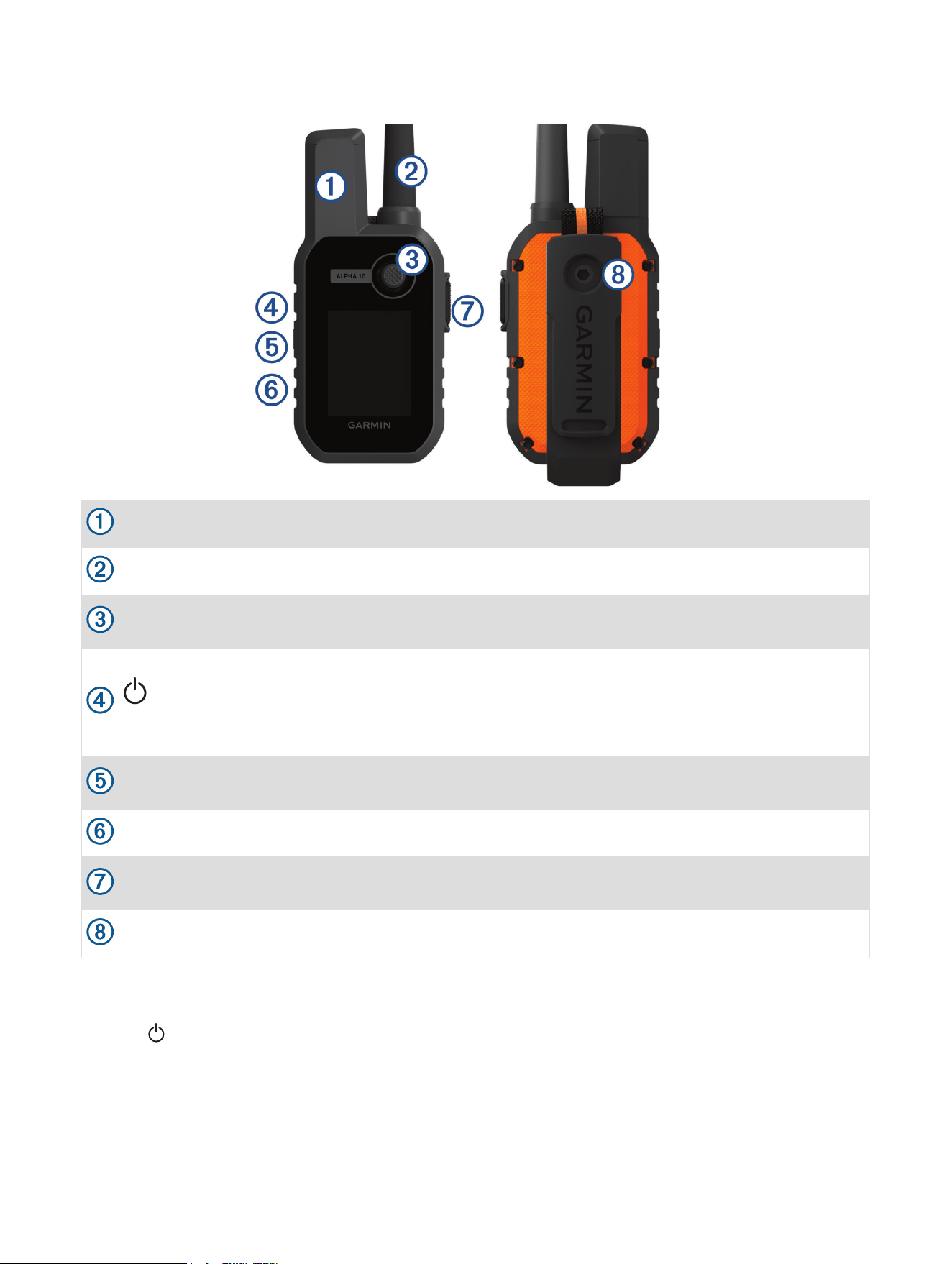
Alpha 10 Handheld Device
GPS antenna
VHF antenna
Thumb Stick
™
controller
Move directionally to scroll or highlight an item. Press to select an item.
Power button
Press to turn the backlight on or off. Hold to turn the device on or off and to lock or unlock the device
buttons.
Training button
Press to activate a training command for the selected dog.
USB port (under weather cap)
Menu button
Press to open and close the device menu. Hold to return to the tracking screen.
Mounting screw with attached carabiner loop and spine mount.
Locking and Unlocking the Buttons
You can lock the device buttons to prevent inadvertent button presses.
1 Press .
2 Select Lock.
3 Hold the menu button to unlock the buttons.
2 Getting Started
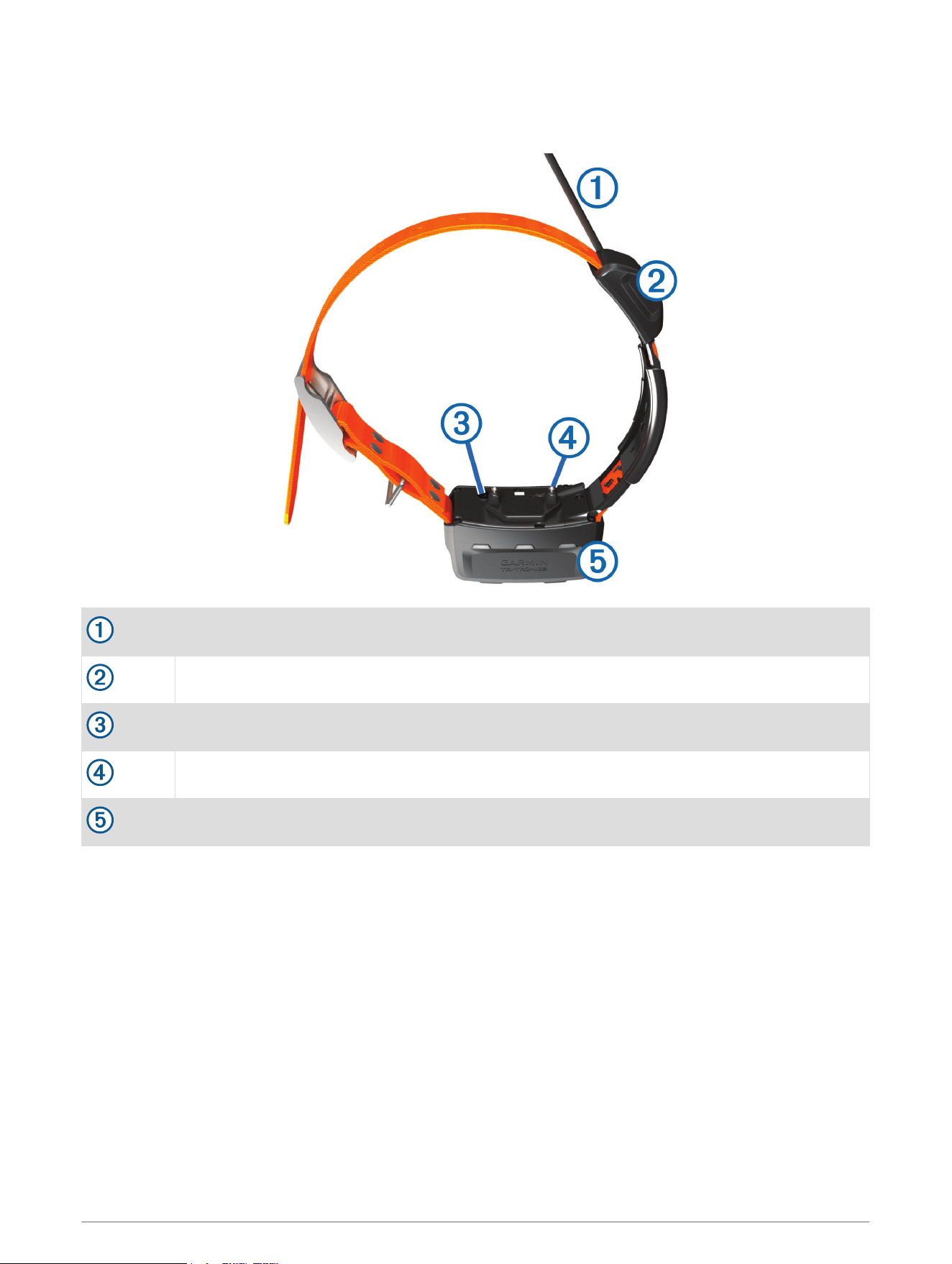
Dog Collar Device
NOTE: Your dog collar device may look different than the device pictured.
VHF antenna
GPS antenna
Power key
Contact points
Status LED and flashing beacon LEDs
Getting Started 3
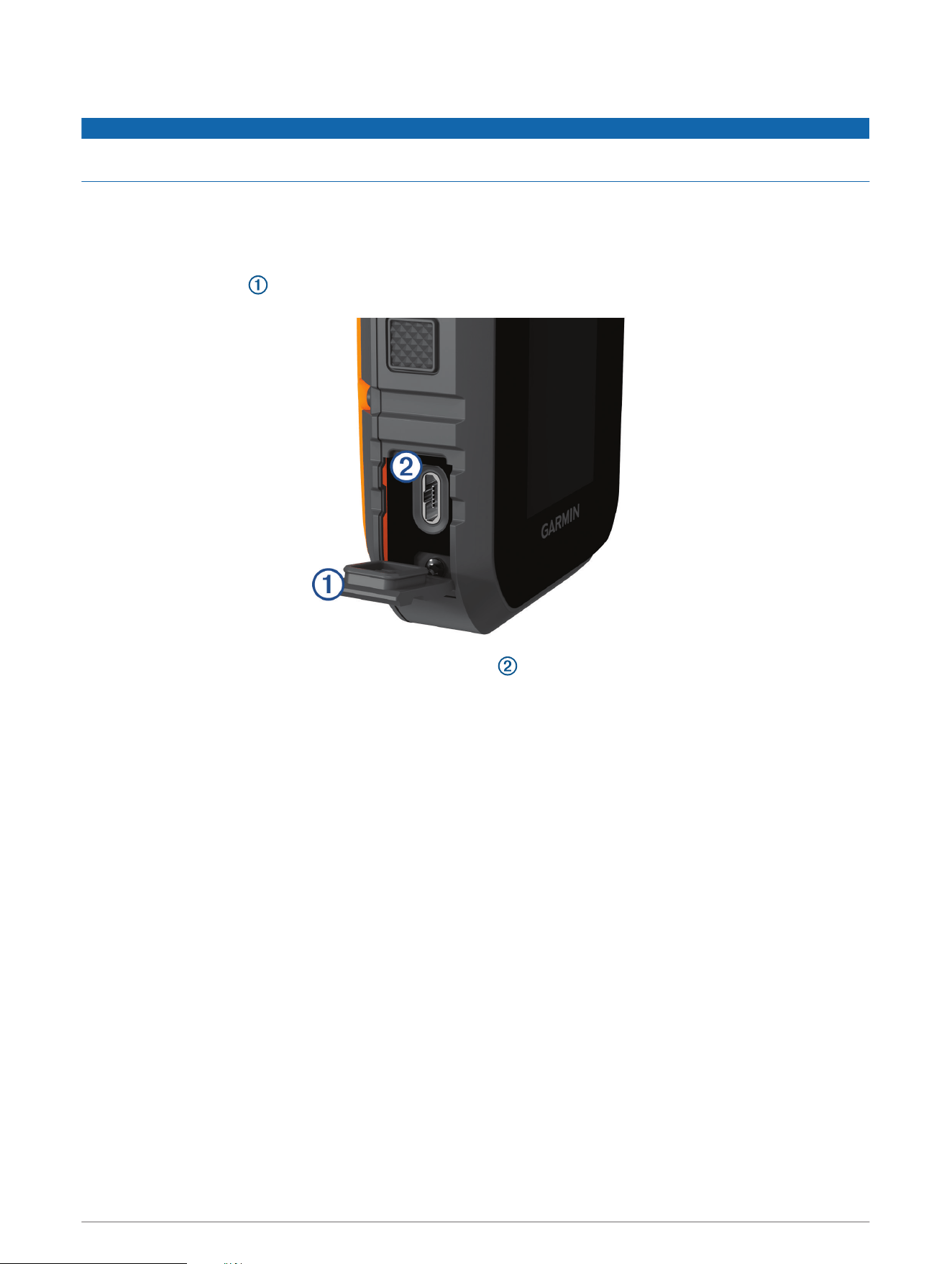
Charging the Handheld Device
NOTICE
To prevent corrosion, thoroughly dry the USB port, the weather cap, and the surrounding area before charging or
connecting to a computer.
You should fully charge the battery before you use the device for the first time. Charging a fully depleted battery
takes about 2 hours.
NOTE: The device will not charge when it is outside the charging temperature range (Alpha 10 Handheld Device
Specifications, page 18).
1 Lift the weather cap .
2 Plug the small end of the power cable into the USB port on the device.
3 Plug the other end of the power cable into a power source.
4 After the device is fully charged, unplug the power cable from the device.
4 Getting Started
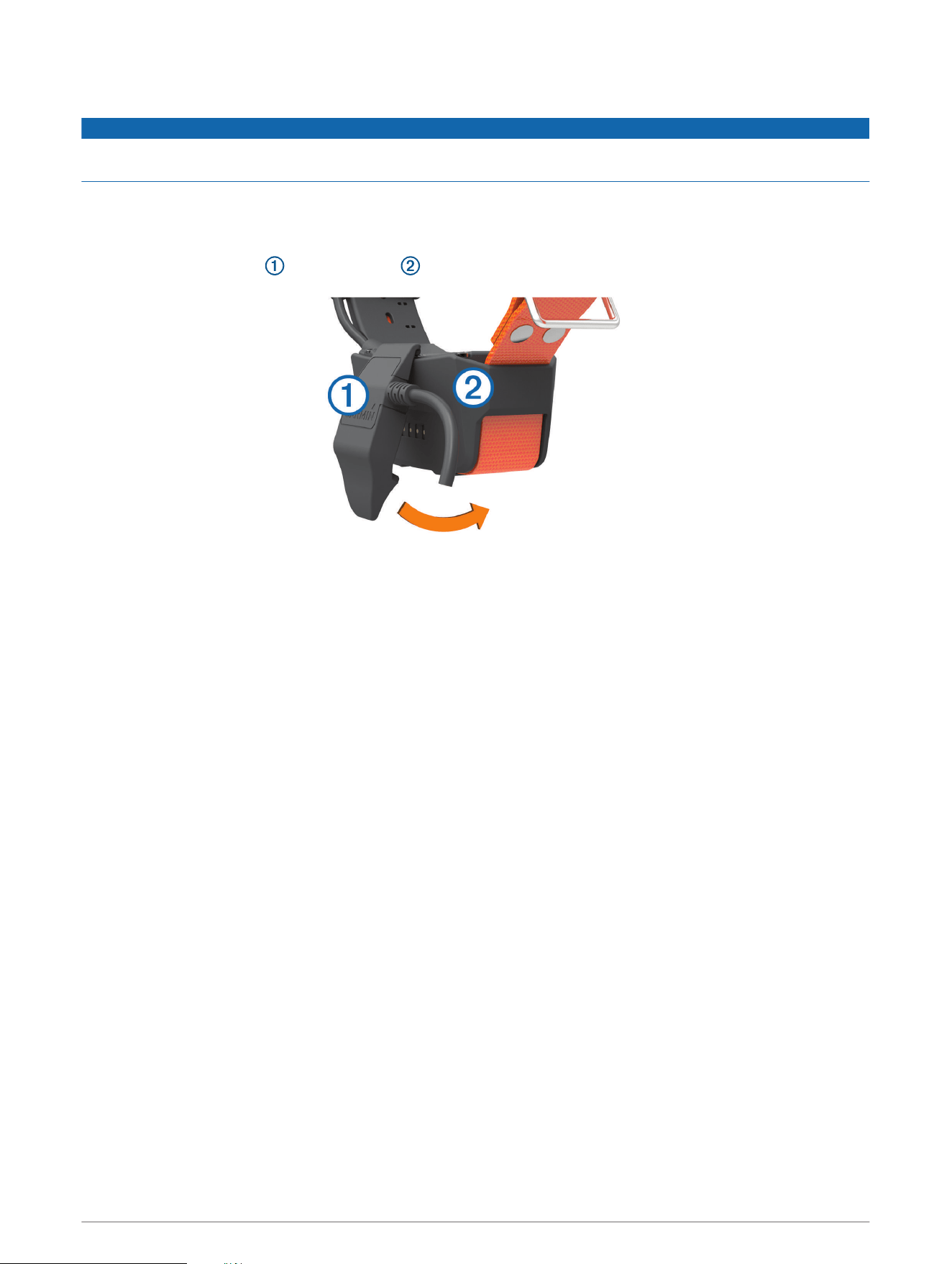
Charging the Dog Collar Device
NOTICE
To prevent corrosion, thoroughly dry the contacts on the collar and the surrounding area before connecting the
charging clip.
NOTE: Your dog collar device may look different than the device pictured.
You should fully charge the battery before you use the device for the first time. Charging a fully depleted battery
takes about five hours.
1 Snap the charging clip onto the device .
2 Plug the small end of the power cable into the mini-USB port on the charging clip cable.
3 Plug the power cable into a power source.
The status LED is solid red when the collar is charging.
4 After the status LED turns solid green, remove the charging clip from the collar.
Turning On the Device
• On the handheld device, press the power button.
• On the dog collar device, hold the power button until the status LED flashes and the collar beeps.
Turning Off the Device
• On the handheld device, hold the power button and select Power Off.
• On the dog collar device, hold the power button until the status LED turns red.
Selecting a Language
When you turn on your device for the first time, you must select the device language from a list of available
languages. You can change the language setting from the System settings.
1 Press the menu button.
2 Select Setup > System > Language.
3 Select a language.
Getting Started 5
Acquiring Satellite Signals
NOTICE
This device is intended for outdoor use only. Satellite reception requires a clear line of sight to the sky. GPS
accuracy may be affected if you use the device indoors.
Both the dog collar device and the handheld device must acquire satellite signals before you put the dog collar
device on your dog. Acquiring satellite signals can take a few minutes.
1 Go outdoors to an open area.
2 Turn on both devices (Turning On the Device, page 5).
3 On the handheld device, select a paired collar with the Thumb Stick controller.
When the dog collar device has acquired satellite signals, the status LED flashes a double-blink or triple-blink in
green. When the handheld device has acquired satellite signals and communicated with a paired dog collar
device, it displays status information for the dog collar device (Handheld Device Screen, page 11).
Calibrating the Compass
NOTICE
Calibrate the electronic compass outdoors. To improve heading accuracy, do not stand near objects that
influence magnetic fields, such as vehicles, buildings, and overhead power lines.
You should calibrate the compass after moving long distances or experiencing temperature changes.
1 Press the menu button.
2 Select Calibrate Compass.
3 Follow the on-screen instructions.
Dog Collar Device Setup
Methods to Add a Dog Collar Device to a Handheld Device
You must add the dog collar device to the handheld device. You can add up to 20 devices to one handheld
device by using MURS/VHF, entering the track and control codes, or by sharing wirelessly using ANT+
®
technology. Up to 20 devices can be active at one time.
Using MURS/VHF: Allows you to add a dog collar device after you have placed the dog collar device into pairing
mode by pressing the power key.
This method is helpful when you are adding a new accessory collar to the system prior to leaving for the
hunt (Adding a Dog or Contact Using Wireless Pairing, page 7).
Entering the track and control codes: Allows you to add a dog collar device that you do not own and that is not
in the area. The dog's owner must determine if you can only track the dog or can track and control the dog.
This method requires the dog's owner to find and communicate the codes to the person adding the dog
collar device.
This method is helpful when you would like to add a dog collar device during a hunt, but you are not near the
dog. For example, you are adding another member of your hunting party's dog collar device to your handheld
device, but you do not own the dog collar device (Adding a Dog Using the Track and Control Codes,
page 8).
NOTE: This feature varies based on dog collar device type and feature availability in your area. You may see
track codes only or track and control codes.
6 Dog Collar Device Setup

Adding a Dog or Contact Using Wireless Pairing
1 If the dog collar device is on, turn off the dog collar device (Turning Off the Device, page 5).
2 Hold the power button on the dog collar device until the device emits two series of beeps (about 2 seconds),
and then release the power button.
The status LED flashes rapidly in green. The dog collar device is now ready to be linked, or paired, with a
handheld device.
3 On the handheld device, press the menu button.
4 Select Add Device.
5 Select an option:
• If you are near the dog collar device, select Dog > Pair Collar, and follow the on-screen instructions.
• To add a contact or dog collar device by receiving the information from another handheld device, select
Receive Shared Asset.
NOTE: To successfully add the contact or dog collar device, the other handheld device must be wirelessly
sharing the information (Sharing a Dog or Contact Wirelessly, page 7).
6 After successfully adding the device, enter the name of the dog or contact, and select Done.
Adding a Contact Using the Transmission ID
1 On the handheld device, press the menu button.
2 Select Add Device > Contact.
3 Enter the transmission ID for the contact.
4 Enter the name of the contact, and select Done.
Sharing a Dog or Contact Wirelessly
Before you can share data wirelessly over ANT+, you must bring your Alpha handheld device within 3 m (10 ft.)
of the other handheld device.
1 Select the dog or contact to share or select Device Options.
2 Select Share > Share Wirelessly.
3 Select Yes to allow the other person to track your dog and correct your dog's behavior, if necessary.
To successfully share the contact or dog collar device, the other handheld device must be receiving the
device information (Adding a Dog or Contact Using Wireless Pairing, page 7).
Editing Dog Sharing Information
1 From the tracking screen, select the dog you want to edit or select Device Options.
2 Select Share.
3 Select an option:
• Select Track Code to change the track code for the dog collar device.
• Select Control Code to change the control code for the dog collar device.
• Select Share Wirelessly to share the dog collar device information with another handheld device.
• Select View Legacy Codes to view the previous track and control codes for the dog collar device.
NOTE: This feature may not be available on all devices.
Dog Collar Device Setup 7

Adding a Dog Using the Track and Control Codes
NOTE: This feature varies based on dog collar device type and feature availability in your area.
Before you can add a dog using the track and control codes, the dog owner must find the track and control
codes (Finding the Dog ID and Track and Control Codes, page 8) and tell them to you.
You can use track and control codes to authorize a handheld device to interact with your dog collar device. If
you are not near the dog you want to add or you cannot put the collar into pairing mode, you can add the dog
using the track and control codes.
1 On the handheld device, press the menu button.
2 Select Add Device > Dog > Enter Share Code.
3 Enter the track or control code for the collar, and select Done.
The dog’s track code allows you to track the dog. The dog’s control code allows you to both track and train
the dog.
4 Enter the name of the dog, and select Done.
Finding the Dog ID and Track and Control Codes
You can share a dog’s track code, which enables another person to track your dog. You can also share a dog’s
control code, which enables another person to track and train your dog.
1 Select a dog or select Device Options.
2 Select Share.
The track code and the control code are displayed under the dog's name.
VHF Radio Information
This product may be used only on specific radio frequencies, which vary depending on the country of use. See
the product packaging or go to www.garmin.com/tracking-legal for details about the radio frequency of this
product.
Editing Dog Information
1 From the tracking screen, select the dog you want to edit or select Device Options.
2 Select Edit.
3 Select an option:
• Select Collar Light to change the collar light mode.
• Select ID to change the dog collar device ID.
• Select Update Rate to change how often position data is transmitted from the dog collar device.
• Select Update Share Code to change the dog collar device share code.
• Select Dog Type to set which alerts are sent from the dog collar device.
• Select Battery Saver to turn battery saver mode on or off.
NOTE: This automatically switches to a 2 minute update rate when the collar has 25% battery remaining.
• Select Color to set the color used to identify the dog on external devices.
• Select Collar Sleep Mode to turn collar sleep mode on or off.
NOTE: When connected with the handheld device, the dog collar device can be put into sleep mode to
conserve the battery when you are not actively tracking your dog.
• Select Name to edit the name of the dog.
• Select Remove to remove the dog from your device.
8 Dog Collar Device Setup
Fitting the Collar on Your Dog
CAUTION
To prevent irritation from the contact points, remove the collar for at least eight hours out of every 24-hour
period.
This device is not intended for human use. Do not attempt to use on any person.
Do not spray the device or collar with harsh chemicals including but not limited to flea or tick spray. Always
ensure that any flea or tick spray that is applied to the dog is completely dry before placing the collar on the
dog. Small amounts of harsh chemicals can damage the plastic components and collar laminate.
In order to effectively train the dog, the collar and device must fit the dog properly. If the collar is too loose or
positioned incorrectly, stimulation may be inconsistent. This can delay or prevent successful training.
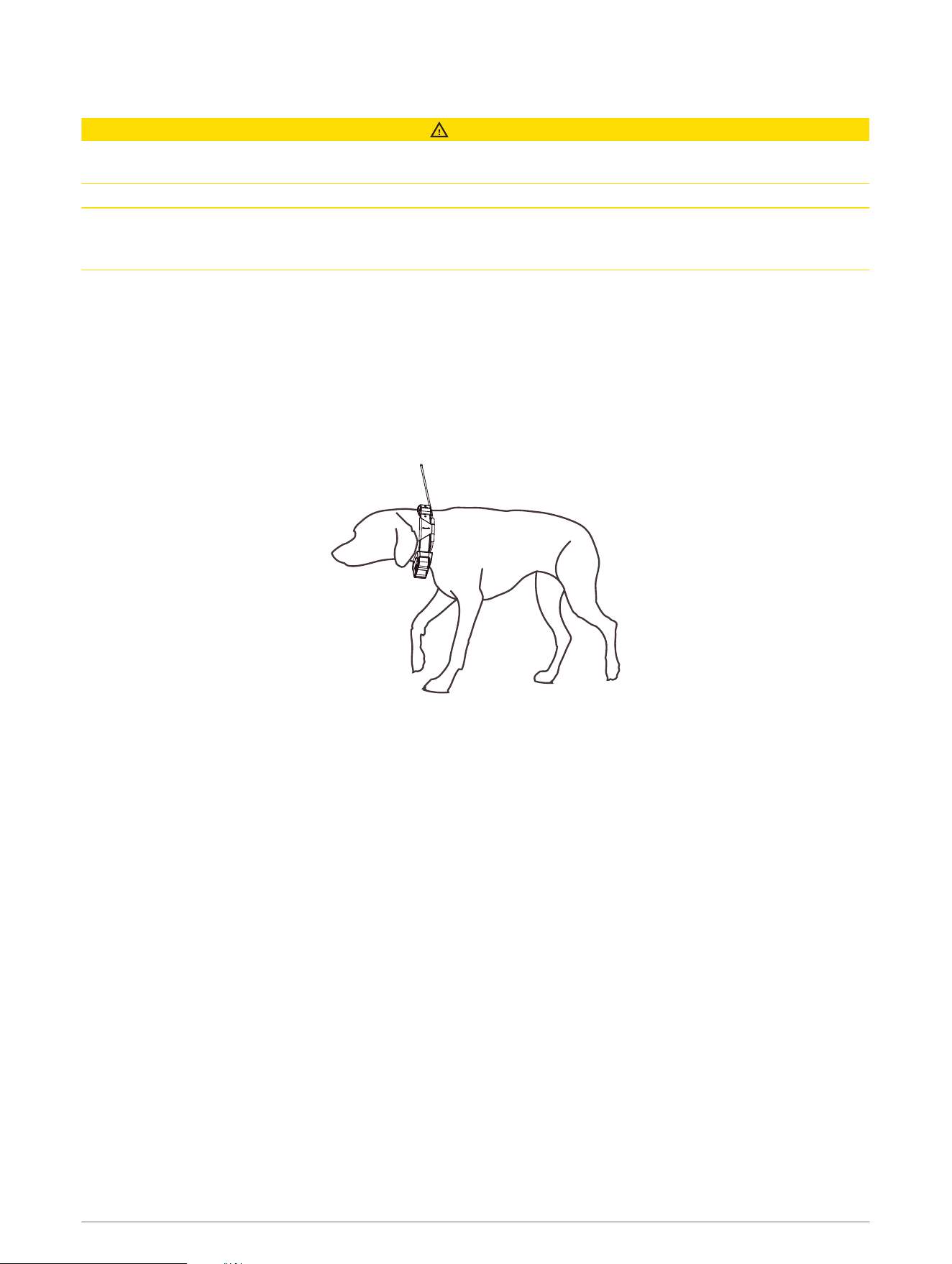
1 Position the device at the front of the dog's neck, with the status LED facing toward the dog's chin and the
contact points against the throat.
2 Tighten the strap so that it is very snug around the dog's neck, and fasten the buckle.
NOTE: The collar should fit tightly and should not be able to rotate or slide on the dog's neck. The dog must
be able to swallow food and water normally. You should observe your dog's behavior to verify that the collar
is not too tight.
3 Wiggle the device to work the contact points through the dog's coat.
NOTE: The contact points must have contact with the dog's skin to be effective.
4 If the strap is too long, cut off the excess, leaving at least 8 cm (3 in.) to spare.
TIP: You can mark the hole used to fasten the buckle for future reference.
Dog Collar Device Setup 9
Communication with the Collar
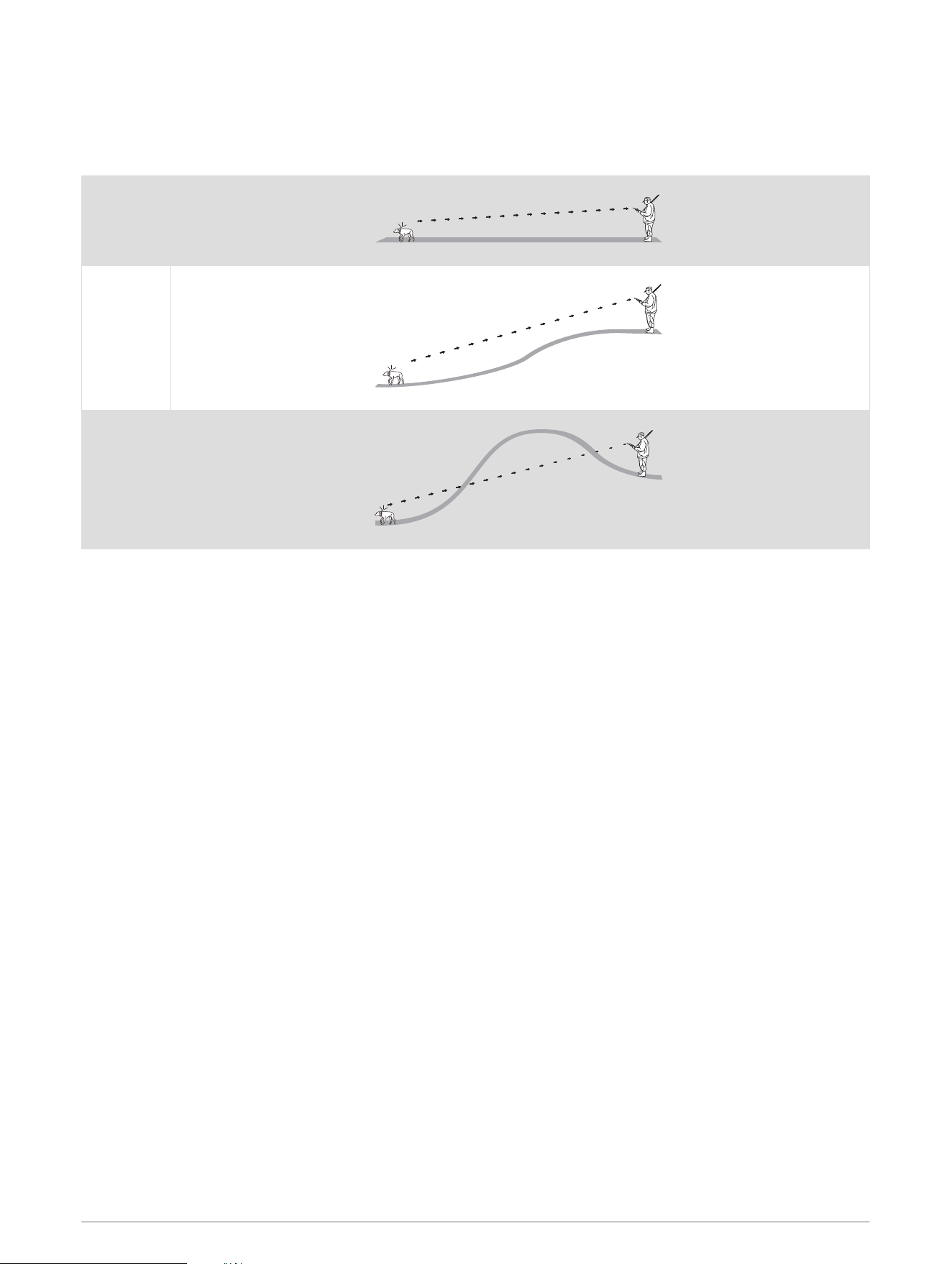
You should keep an unobstructed line of sight between your handheld device and the dog collar device to
produce the best communication signal. To achieve the best line-of-sight conditions, you should move to the
highest elevation point in your area (for example, on the top of a hill).
Best
Good
Poor
Connected Features
Connected features are available for your Alpha 10 device when you install the Garmin Explore
™
app on a
compatible smartphone and connect the handheld device to your smartphone using Bluetooth
®
technology. Go
to garmin.com/apps for more information.
Garmin Explore: The Garmin Explore app shows the dog's location and tracking information during a hunt. After
ending a hunt, you can review tracks and other information to learn more about what happened during the
hunt.
Pairing a Smartphone with Your Device
To use the connected features of the device, it must be paired directly through the Garmin Explore app, instead
of from the Bluetooth settings on your smartphone.
1 Bring your compatible smartphone within 10 m (33 ft.) of your device.
2 Press the menu button on your handheld device.
3 Select Setup > Phone.
4 If necessary, select the toggle switch to enable Bluetooth technology.
5 Select Pair Phone.
6 On your compatible smartphone, enable Bluetooth technology, and open the Garmin Explore app.
7 From the Garmin Explore app, select Devices > Pair Device.
8 Follow the on-screen instructions in the Garmin Explore app to pair your device.
Dog Tracking
The handheld device allows you to track your dog or multiple dogs, using the tracking compass. The compass
pointer indicates the direction of the dog's current location.
10 Connected Features
Handheld Device Screen
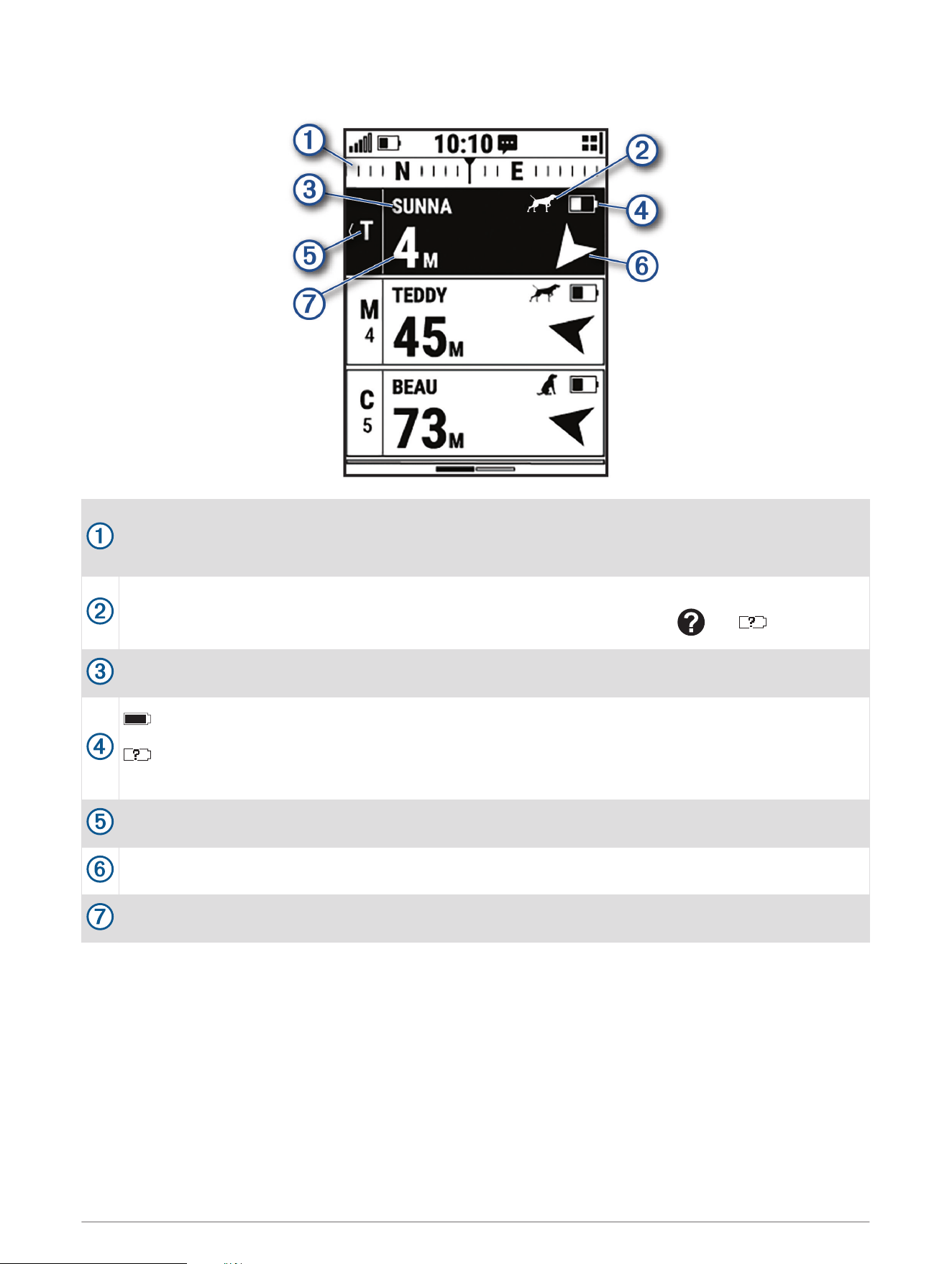
Shows the direction to which your device is currently pointing.
NOTE: If the compass does not accurately point to the current direction, you may need to calibrate the
handheld device (Calibrating the Compass, page 6).
Shows the current status of the dog (Dog Status Icons, page 12).
NOTE: If the handheld device loses communication with the dog collar device, and appear.
Indicates the dog collar device you have currently selected.
Shows the battery level of the dog collar device.
Unknown battery status. Indicates the handheld device cannot determine the battery status of the
dog collar device.
Shows the current training command for the dog.
Shows the direction to the dog collar device.
Shows the distance to the dog collar device.
Dog Tracking 11
Dog Status Icons
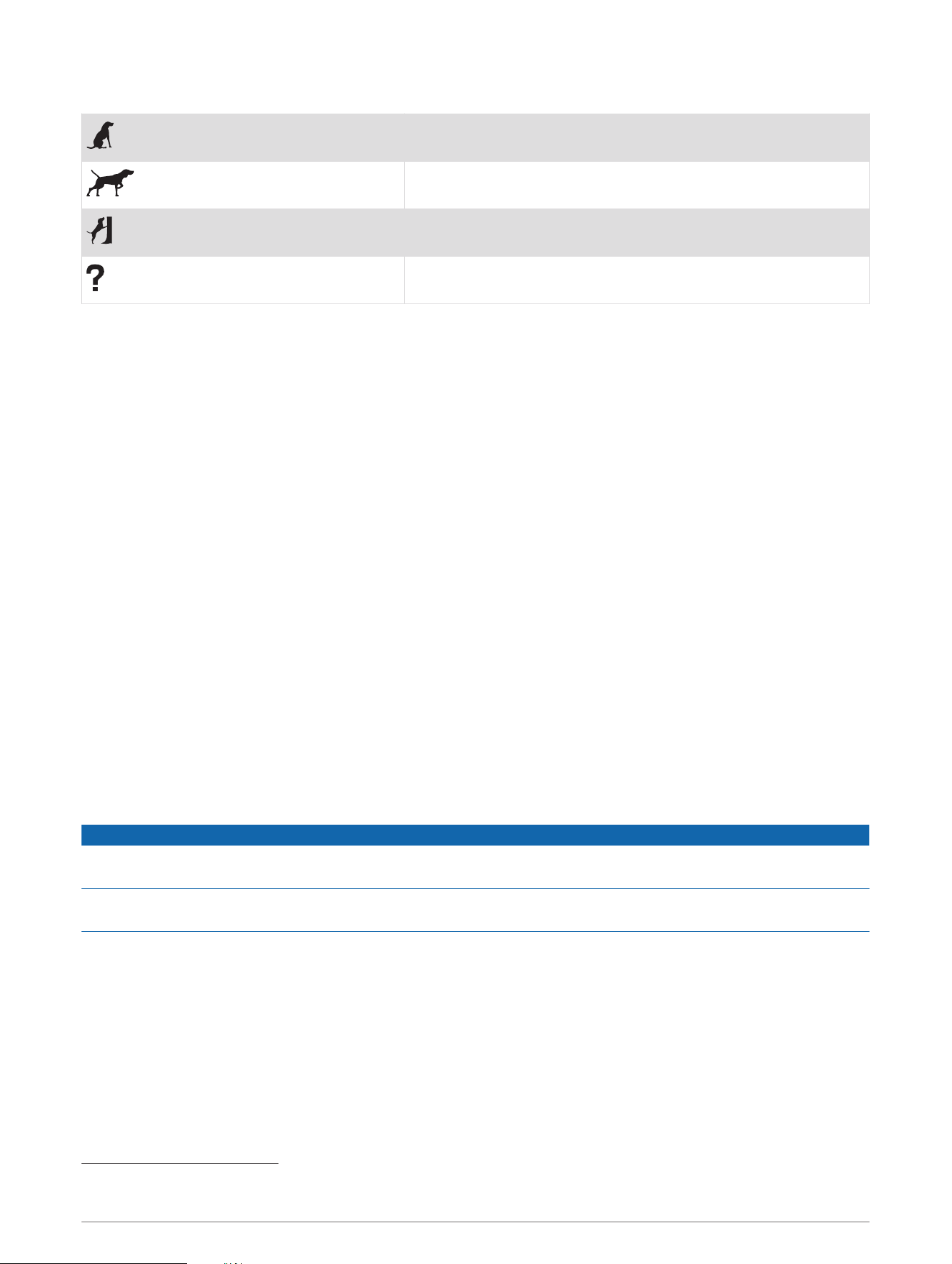
Sitting
On point
Treed
Unknown
1
Starting and Ending a Hunt
You can start and end a hunt on your handheld device.
NOTE: When your device is connected to the Garmin Explore app, the hunt data is automatically uploaded to
your Garmin Explore account when you end a hunt.
1 Press the menu button.
2 Select Start Hunt.
3 Select the hunt timer to end the hunt.
4 Select Yes.
Marking Your Truck Location
You can mark the location of the truck, so you can navigate back to your truck after the hunt.
1 Press the menu button.
2 Select Mark Truck.
Deleting Your Truck Location
You must delete the previously marked truck location before you can mark a new location.
1 Press the menu button.
2 Select the marked truck.
3 Select Delete.
Dog Training
NOTICE
You should research and investigate the training methods best suited for you, your dog, and your needs. This
manual provides some basic guidelines for training, but each dog has unique training needs.
When used properly, the Alpha 10 training system is a very effective training tool to aid your dog in reaching its
full potential. The use of the training system should be part of an overall training program.
Begin training your dog on a leash, without the Alpha 10 training system. You should train your dog how to heel,
sit, and come to you. After the dog understands these three basic commands, you can begin training with the
dog collar device and the leash. Finally, when the dog consistently obeys commands using the leash and collar,
you may be able to remove the leash to train with only the dog collar device.
1
The unknown status icon indicates that the handheld device cannot communicate with the dog collar device.
12 Dog Training

Selecting and Installing the Contact Points
CAUTION
To prevent irritation from the contact points, remove the collar for at least eight hours out of every 24-hour
period.
Do not spray the device or collar with harsh chemicals including but not limited to flea or tick spray. Always
ensure that any flea or tick spray that is applied to the dog is completely dry before placing the collar on the
dog. Small amounts of harsh chemicals can damage the plastic components and collar laminate.
For best results, select the correct contact points based on your dog's coat.
1 Select the correct contact point length for your dog's coat type:
• For dogs with thicker coats, use the longer contact points.
• For dogs with shorter coats, use the shorter contact points.
2 If necessary, use the included wrench to remove the contact points.
3 Twist the contact points into the collar.
4 Tighten with the included wrench, but do not overtighten.
When you put the collar on the dog, make sure the contact points are tight against the neck.
Removing the Contact Points
When you are not training the dog using the training keys, remove the contact points.
1 Use the included wrench to remove both contact points.
2 Place the cap over the contact point holes.
Training Methods
Momentary stimulation: Applies a brief stimulation when you press the training button, regardless of how long
the button is depressed.
Continuous stimulation: Applies stimulation to the dog the entire time you press the training button, for a
maximum of 8 seconds. Your stimulations should typically be much shorter than 8 seconds.
Tone: Activates an audible tone the entire time you press the training button.
Vibration: Applies vibration to the dog the entire time you press the training button, for a maximum of 8
seconds. The effectiveness of vibration may vary based on the dog's temperament and experience.
Choosing the Correct Intensity Level
1 Set the intensity to the lowest level (Customizing the Training Button, page 14).
2 Press the training button.
3 Observe the dog for a reaction, such as a head shake, neck movement, or just a change in expression.
Sometimes dogs will vocalize due to the surprise of the electrical stimulation. If the dog vocalizes more than
once, the intensity level is too high for beginning training.
4 If there is no reaction, increase the intensity level by one level until the dog has a slight but recognizable
reaction to the stimulation.
The intensity level that causes a slight but recognizable reaction is your dog's baseline level for beginning collar
training. You do not need to, and should not, apply this intensity selection test again.
After you begin training, the dog’s performance guides your intensity selection. As the dog advances in training,
you may need to change the level depending upon the training situation.
Adjusting the Stimulation Level of an Active Training Command
1 Select a dog.
2 Press the training button.
3 Use the Thumb Stick to scroll right or left to adjust the stimulation level.
Dog Training 13

Customizing the Training Button
When a compatible dog collar device is paired, you can add a dog training command to the training button.
1 From the tracking screen, use the Thumb Stick to scroll left.
2 Select a training command.
3 If necessary, use the Thumb Stick to choose the intensity level when selecting a stimulation training
command.
4 Press the Thumb Stick to save.
Collar Training
Begin training your dog on a leash, without using the Alpha 10 training system. After the dog shows a grasp of
the commands "heel," "sit," and "here," you can begin training with the collar and the leash.
During the initial stage of collar introduction, the dog learns that collar stimulation means the same thing as a
tug on the leash. At first, the dog may be alarmed by the electronic stimulation. The key is to be patient and
consistent and not to start off at too high of an intensity. Be fair and consistent, and use repetition and praise
when using the collar as a training tool.
If the dog does not respond to the stimulation level you have selected (Choosing the Correct Intensity Level,
page 13), increase the stimulation one level at a time until you achieve the appropriate response. After you
achieve the desired response, you can lower the stimulation level as long as the dog maintains consistency.
As the dog becomes more proficient with the commands, you can begin to introduce distractions, such as
rolling a ball in front of the dog or walking him in the presence of others.
After the dog begins to respond consistently to the command during collar training, you can remove the leash
and train with just the collar.
NOTE: You should train without a leash only when it is appropriate for your environment and your dog's
temperament. You should follow all laws and regulations for your area regarding the use of dog leashes.
Eventually in most training situations, your commands will not require stimulation to be given with the
command. You should only use stimulation when you need to repeat a command because the dog did not obey
the first one.
As the dog becomes better trained, you can decrease the use of collar training. Continue to have the dog wear
the collar until you feel certain that it is no longer needed to reinforce known commands. Abandoning the collar
too early can lead to problems in the future.
Contact Tracking
You can track other hunters so you know where they are at all times. You can also send messages to your
contacts. One Alpha 10 handheld device can track up to 20 devices, including compatible dog collar devices
and handheld devices.
Turning On and Off the Transmitter
Before you can add a contact, you must turn on the transmitter.
NOTE: In cold temperatures, if you transmit when the battery is low, the device may shut down.
1 Press the menu button.
2 Select Setup > Transmission ID > Status.
14 Contact Tracking

Sending and Receiving Messages
Before you can send a message to or receive a message from your contacts, you must turn on the transmitter
(Turning On and Off the Transmitter, page 14).
You can send and receive automated messages. When you receive a message it appears at the top of your
device screen. Pressing any button will dismiss the message. There are 18 messages you can choose from to
send your contacts, such as Help and I'm coming.
1 From the tracking screen, use the Thumb Stick to scroll right.
2 Select Send Message.
3 Select a message.
The message is sent to your contacts with your name before the message. Anyone tracking your handheld
device receives the message.
Finding Your Contact ID
1 Press the menu button.
2 Select Setup > Transmission ID.
Your contact ID is displayed under the My ID option.
Changing Your Contact ID
1 Press the menu button.
2 Select Setup > Transmission ID > My ID.
3 Select a new contact ID.
Customizing Your Device
System Settings
From the main menu, select Setup > System.
Language: Sets the text language on the device.
NOTE: Changing the text language does not change the language of user-entered data.
Auto Lock: Allows you to lock the device buttons after a specified amount of time.
Units: Sets the units of measure.
Time Format: Sets the device to display time in a 12-hr or 24-hr format.
Screen Capture: Allows you to save the image on the device screen by pressing the Thumb Stick.
Restore Defaults: Resets all settings to the default values and saves all user-entered information.
Factory Reset: Deletes all user data and resets all settings to the factory default values.
About: Displays e-label regulatory and compliance information.
Setting the Device Alerts
You can customize the type of alert received on your device for messages and warnings.
1 Press the menu button.
2 Select Setup > Alerts.
3 Select an alert type for each category.
Customizing Your Device 15
Remote View
The handheld device uses ANT+ technology to share dog locations with Garmin DriveTrack
™
devices and
compatible outdoor watches. The handheld device can transmit to multiple devices at the same time. You can
enable or disable sharing this data at any time by pressing the menu button and selecting Setup > Remote View
> Status.
NOTE: For more information about sharing dog locations with another device, refer to the owner's manual for
the device.
Device Information
Viewing E-label Regulatory and Compliance Information
The label for this device is provided electronically. The e-label may provide regulatory information, such as
identification numbers provided by the FCC or regional compliance markings, as well as applicable product and
licensing information.
1 Press the menu button.
2 From the Setup menu, select System.
3 Select About.
Product Updates
On your computer, install Garmin Express
™
(www.garmin.com/express).
This provides easy access to these services for Garmin
®
devices:
• Software updates
• Product registration
Setting Up Garmin Express
1 Connect the device to your computer using a USB cable.
2 Go to garmin.com/express.
3 Follow the on-screen instructions.
Device Care
NOTICE
Do not store the device where prolonged exposure to extreme temperatures can occur, because it can cause
permanent damage.
Avoid chemical cleaners, solvents, sunscreen, and insect repellents that can damage plastic components and
finishes.
Secure the weather cap tightly to prevent damage to the USB port.
Avoid extreme shock and harsh treatment, because it can degrade the life of the product.
Cleaning the Device
1 Wipe the device using a cloth dampened with a mild detergent solution.
2 Wipe it dry.
After cleaning, allow the device to dry completely.
16 Device Information
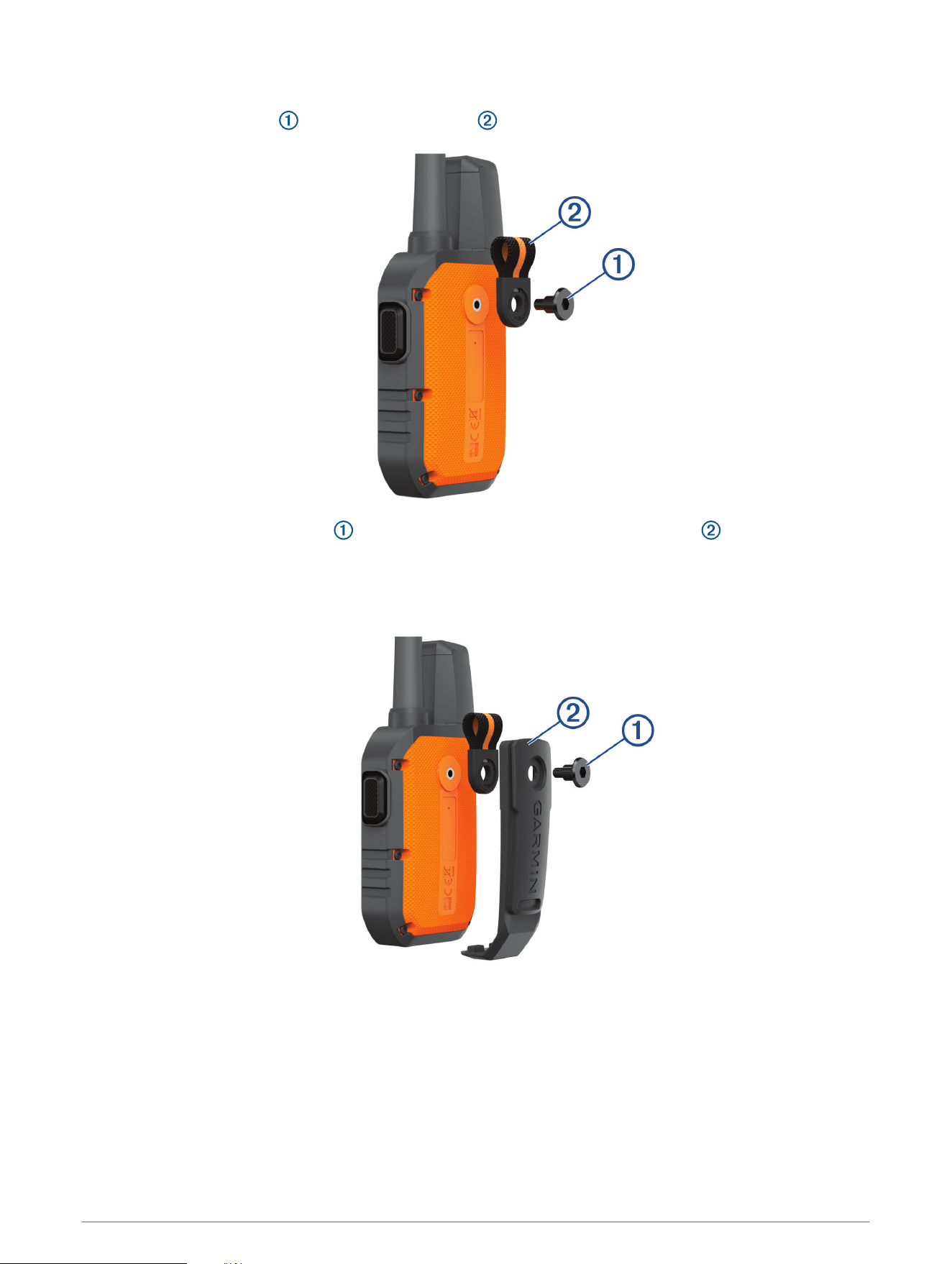
Attaching the Spine Mount Adapter
1 Remove the short screw from the carabiner strap .
2 Secure the spine mount adapter over the back of the device using the long screw included with the
device.
TIP: The spine mount adapter fits over the carabiner strap. You can attach the adapter over the strap or
remove the strap.
Getting More Information
You can find more information about this product on the Garmin website.
• Go to support.garmin.com for additional manuals, articles, and software updates.
• Go to buy.garmin.com, or contact your Garmin dealer for information about optional accessories and
replacement parts.
Device Information 17

Alpha 10 Handheld Device Specifications
Battery type Rechargeable lithium-ion
Battery life Up to 20 hr.
Operating temperature range From -20° to 60°C (from -4° to 140°F)
Charging temperature range From 0° to 40°C (from 32° to 104°F)
Long-term storage temperature range From 0° to 25°C (from 32° to 77°F)
VHF wireless range Up to 14.5 km (9 mi.)
ANT+ low power wireless range About 3 m (10 ft.)
Wireless frequencies/protocols 151-169 MHz @ 32 dBm maximum, 2.4 GHz @ 3.7 dBm maximum
Water rating IEC 60529 IPX7
1
Maximizing the Battery Life
You can do several things to extend the life of the batteries in the handheld device and collar.
• Turn off the transmitter (Turning On and Off the Transmitter, page 14).
• Turn off Remote View (Remote View, page 16).
• Turn on battery saver mode for the dog collar device (Editing Dog Information, page 8).
• Limit the number of tracked assets to 3.
1
The device withstands incidental exposure to water of up to 1 m for up to 30 min. For more information, go to www.garmin.com/waterrating.
18 Device Information
Data Management
Connecting the Handheld Device to a Computer
NOTICE
To prevent corrosion, thoroughly dry the USB port, the weather cap, and the surrounding area before charging or
connecting to a computer.
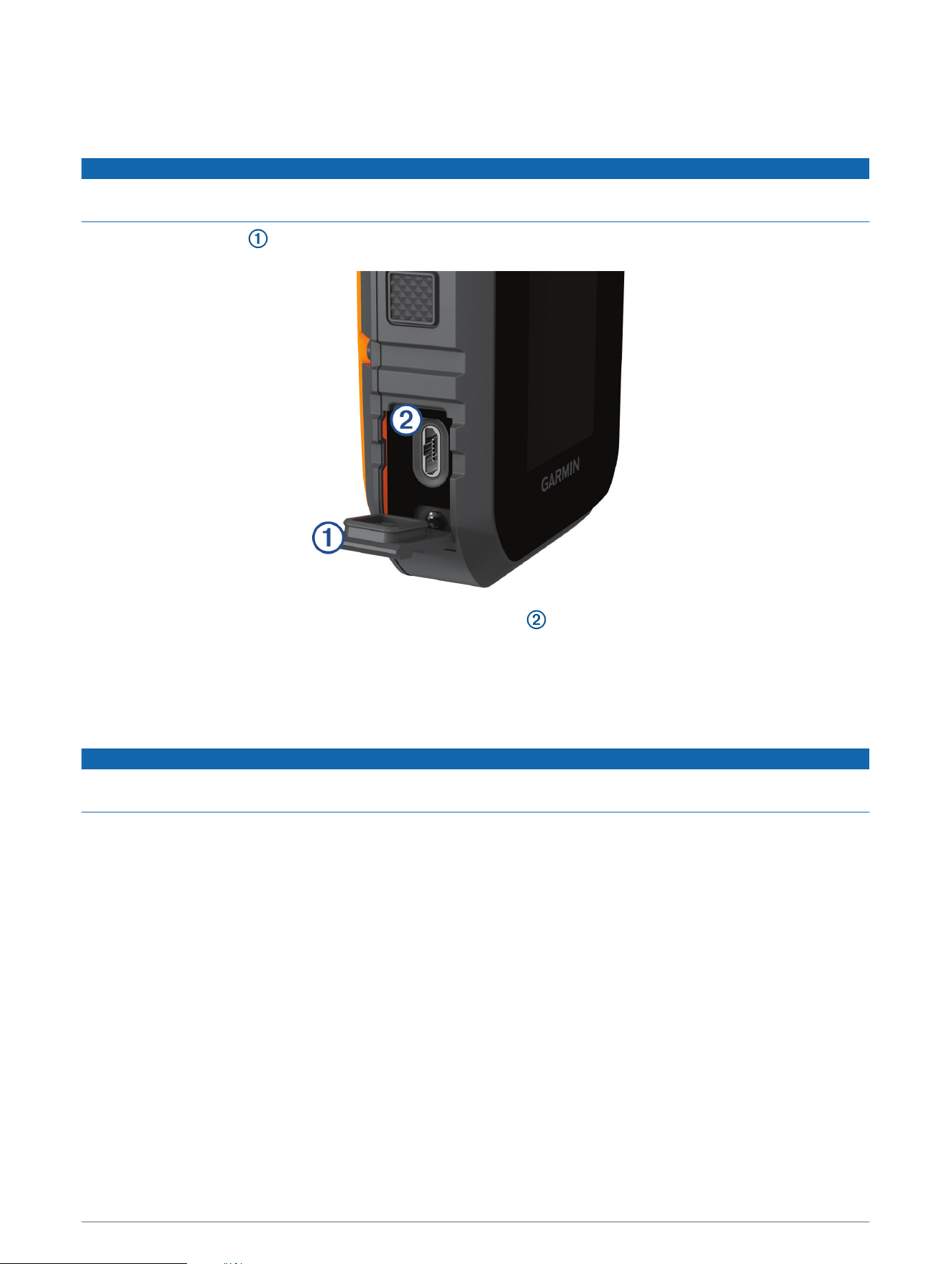
1 Lift the weather cap .
2 Plug the small end of the USB cable into the USB connector on the device.
3 Plug the other end of the USB cable into an available USB port on the computer.
Your device appears as a removable drive in My Computer on Windows
®
computers and as mounted
volumes on Mac
®
computers.
Deleting Files
NOTICE
If you do not know the purpose of a file, do not delete it. Your device memory contains important system files
that should not be deleted.
1 Open the Garmin drive or volume.
2 If necessary, open a folder or volume.
3 Select a file.
4 Press the Delete key on your keyboard.
Disconnecting the USB Cable
If your device is connected to your computer as a removable drive or volume, you must safely disconnect your
device from your computer to avoid data loss. If your device is connected to your Windows computer as a
portable device, it is not necessary to safely disconnect the device.
1 Complete an action:
• For Windows computers, select the Safely Remove Hardware icon in the system tray, and select your
device.
• For Apple
®
computers, select the device, and select File > Eject.
2 Disconnect the cable from your computer.
Device Information 19

Resetting Data and Settings
The device offers options for deleting your user data and resetting all settings to the factory default values.
1 Press the menu button.
2 Select Setup > System.
3 Select an option:
• To reset all settings to the default values and save all user-entered information, select Restore Defaults.
• To delete all user data and reset all settings to the factory default values, select Factory Reset.
Purchasing Accessories
• Optional accessories are available at garmin.com or from your Garmin dealer.
20 Device Information

Index
A
accessories 17, 20
alarms, tones 15
ANT+ 16
applications 10
B
battery
charging 4
maximizing 18
Bluetooth technology 10
C
charging
collar 5
handheld 4
cleaning the device 16
collar 10
charging 5
contact points 13
fitting 9
VHF antenna 3
compass, calibrating 6
computer, connecting 19
contact 14, 15
contact points 9, 13
D
deleting, all user data 19
device, care 16
dog
adding 6–8
ID 8
information 7, 8
track and control codes 8
tracking 10, 12
training 13, 14
training basics 12, 14
training intensity levels 13
G
Garmin Express 16
updating software 16
GPS, settings 15
H
hunter 14
I
icons 11, 12
initial setup 5
intensity level, choosing 13
K
keys 2
locking 2
training 14
L
line-of-sight radio communication 10
locking, keys 2
M
messages 15
mounts 17
P
pairing, smartphone 10
power key 5
R
radio communication 10
radio frequencies 8
resetting the device 20
S
satellite signals, acquiring 6
screen 11
settings 15
smartphone
applications 10
pairing 10
software, updating 16
specifications 18
T
tones 15
training
stimulation 13
tone 13
vibration 13
troubleshooting 17, 20
U
USB, disconnecting 19
user data 19
deleting 19
W
waypoints, tracking 12
Wi‑Fi 10
Index 21
support.garmin.com
GUID-6B52C07A-B727-49D5-834E-4362766E3F4F v1September 2021