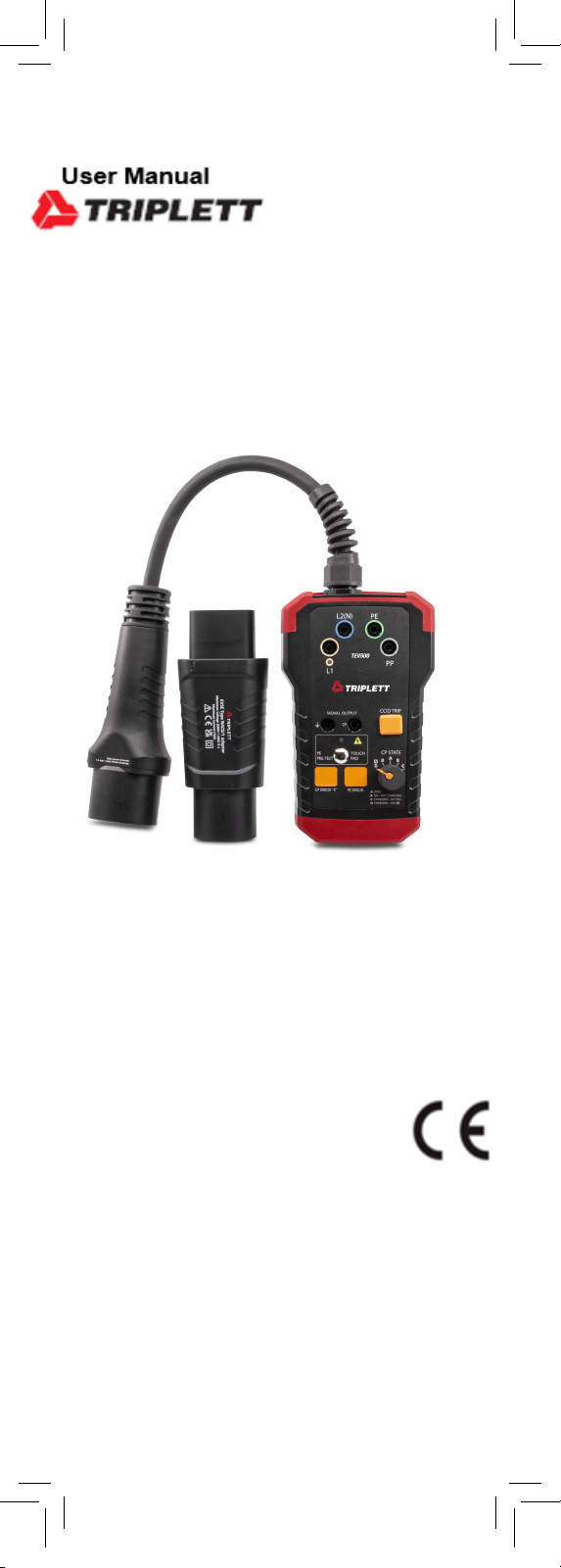
TEV500
PRO Electric Vehicle Charger Test Kit
I
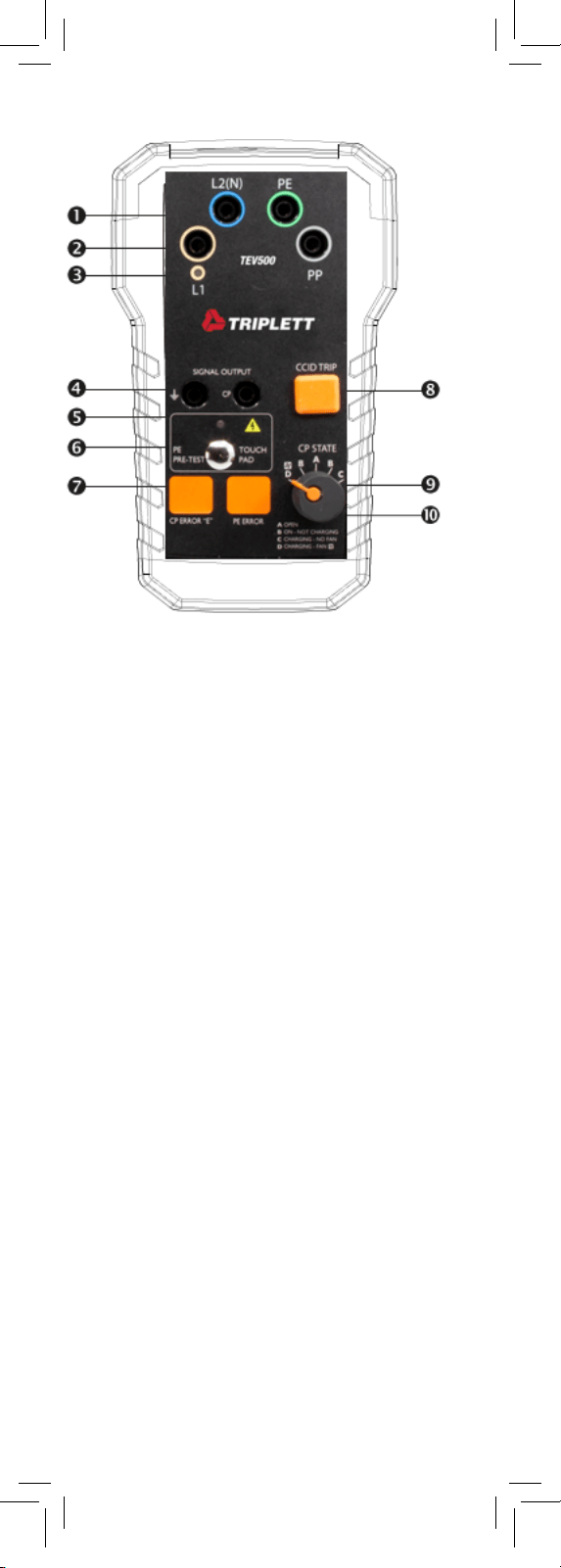
Operation Elements and Connectors
1. Measuring terminals L2 (N), PE
2.
Measuring terminals L1, PP
3.
Phase indicators LED for L1
4.
PE and CP Signal output terminals
5.
PE Pre-Test warning light indicator
6.
PE Pre-T
est touch probe
7.
“E” - CP Error simulation button
8.
CCID TRIP test button
9. CP (Control Pilot) State rotary switch selector
(A, B, C, D)
10.
PE Error (Earth Fault) simulation button
Adapter is equipped with 25 cm cable with type 1
EVSE connector.
II

ENGLSIH
Content
ENGLSIH
Content
Operation Elements and Connectors
.................... 10
References
............................................................... 12
Safety References
................................................... 13
Testing
...................................................................... 14
PE Pre-Test ........................................................ 14
T
est procedure
.................................
.................
14
Control Pilot (CP) State (V
ehicle Simu
lation)
.....
14
CP Signal output terminals ................................. 15
CP Error “E” simulation ...................................... 15
PE Error (Earth Fault) simulation .......................
15
CCID TRIP test ................................................... 15
Phase indicator .................................................. 15
Measuring termi
nals L1, L2(N), PE and PP
.......
15
Cleaning
.................................................................... 16
Specif
ications
............................................................
16
III

References
References marked on instrument or in
instruction manual
Warning of a potential danger, follow with instruc-
tion manual.
Reference! Please use utmost attention.
Caution!
Dangerous
voltage.
Danger
of
electrical
shock.
Ground terminal
Continuous double or reinforced insulation catego-
ry II IEC 536 / DIN EN 61140.
Conformity symbol, the instrument complies with
the
valid
directives.
It
complies
with
the
EMC
Direc-
tive (2014/30/EU), Standard EN 61326 is fulfilled.
It also complies with the Low Voltage Directive
(2014/35/EU) Standards EN 61010-1 and EN
61010-031.
Instrument
fulf
ils
the
standard
(2012/19/EU)
WEEE.
This marking indicates that this product should not
be disposed with other household wastes through-
out the EU. To prevent possible harm to the envi-
ronment or human health from uncontrolled waste
disposal, recycle it responsibly to promote the sus-
tainable
reuse
of
material
resources.
T
o
return
your
used device, please use the return and collection
systems or contact the retailer where the product
was purchased. They can take this product for en-
vironmental safe recycling.
IV
ENGLSIH
Safety references
References
Safety references
The respective accident prevention regulations
established by the professional associations for
electrical systems and equipment must be strictly
met at all times.
In order to avoid electrical shock, the valid safety
and
VDE
regulations
regarding
excessive
contact
voltages must receive utmost attention, when work-
ing with voltages exceeding 120V (60V) DC or 50V
(25V)rms AC. The values in brackets are valid for
limited ranges (as for example medicine and agri-
culture).
Measurements
in
dangerous
proximity
of
electrical
systems are only to be carried out in compliance
with the instructions of a responsible electronics
technician, and never alone.
If the operator’s safety is no longer ensured, the
instrument is to be put out of service and protected
against
use.
The
safety
is
no
longer
insured,
if
the
instrument:
•
shows obvious damage
• does not carry out the desired measurements
• has been stored for too long under unfavorable
conditions
•
has been subjected to mechanical stress during
transport.
The
instrument
may
only
be
used
within
the
op-
erating
ranges
as
specif
ied
in
the
technical
data
section.
Avoid any heating up of the instrument by direct
sunlight
to
ensure
perfect
functioning
and
long
in-
strument life.
The opening of the instrument for fuse replace-
ment, for example, may only be carried out by pro-
fessionals. Prior to opening, the instrument has to
be switched off and disconnected from any current
circuit.
The instrument may only be used under those con-
ditions and for those purposes for which it was con-
ceived. For this reason, in particular the safety ref-
erences, the technical data including environmental
conditions
and
the
usage
in
dry
environments
must
be followed.
When modifying or changing the instrument, the opera-
tional safety is no longer ensured.
V

Testing
T
esting of the charging station
PE Pre-T
est
Prior all other tests PE pretest must be successfully
carried out.
The PE Pre-Test allows the operator to test the PE con-
ductor for possible presence of dangerous voltage against
earth.
Normally the PE conductor is connected to earth and has
no voltage against earth.
In the case when PE conductor is not connected to earth
(mistakenly connected to phase or possibly broke) it can
bring operator or users into the life hazard situation.
Test procedure:
• Connect the test adapter to the charging station.
•
Touch the probe (no. 5 on the picture) with a bare
f
inger
.
•
If light indicator (no. 6 on the picture) is illuminated,
then dangerous voltage is present at PE conductor.
Stop further testing immediately and check for a pos-
sible wiring fault.
Do
not
wear
gloves
while
performing
this
test
and
ensure
a proper connection to earth. Never touch any metal parts
during
this
test.
In
case
of
improper
earthing
(e.g.,
oper-
ators body isolated from the earth) this test may be not
reliable.
Control Pilot (CP) State (V
ehicle Simulation)
With the CP State rotary switch selector various vehicle
states can be simulated. Vehicle states are simulated
with different resistances connected between CP and PE
conductors. Correlation between resistance and vehicle
states is shown in Table below.
Vehicle
State
State Description CP-PE
Resistance
CP terminal
voltage
A Electric vehicle
not connected
Open (∞) ±12V @
1KHz
B Electric vehicle
connected, not
ready to charge
2.74K +9V/-12V @
1KHz
C Electric vehicle
connected, ready
to charge, ventila-
tion not required
882Ω +6V/-12V @
1KHz
D Electric vehicle
connected, ready
to charge, ventila-
tion required
246Ω +3V/-12V
@ 1KHz
VI

ENGLSIH
Testing
CP Signal output terminals
CP output terminals are short connected to the CP and PE
conductors of the tested charging station via the test cable
(no.4 on the picture).
Use
an
oscilloscope
to
check
the
waveform
and
amplitude
of the CP signal.
Control
Pilot
function
uses
Pulse
Width
Modulation
(PWM)
to code communication between a vehicle and charging
station. The duty cycle of the PWM signal defines the pos-
sible
available
charging
current,
while
amplitude
def
ines
charger state.
For
details
of
communication
protocol
please
refer
to
IEC/
EN 61851-1 and the documentation of the manufacturer
of the charging station.
It is allowed to use these for measuring purposes only. It is
not
allowed
to
draw
current
trough
those
sockets
or
supply
anything else. An appropriate measurement instrument is
needed.
Important
note:
In
the
case
of
wrong
wiring
of
the
charg
-
ing
station,
low
signal
CP
test
terminals
can
get
high,
live
hazard voltage.
CP Error “E” simulation
“E”
-
CP
Error
simulation
button
(no.
7
on
the
picture).
With
pushed
button
“E”
operator
can
simulate
behavior
of
the
station when there is established a short circuit between
CP and PE through internal diode (acc. to standard IEC/
EN 61851-1). In the case of CP Error (“E” is pushed), re-
sult should be aborting of the charging process and new
charging process is prevented.
PE Error (Earth Fault) simulation
With the PE Error button (no. 10 on the picture), inter-
ruption of the PE conductor is simulated. As a result, the
pending charging process is aborted and new charging
process is prevented.
CCID TRIP test
When
the
CCID
TRIP
button
(no.
8
on
the
picture)
is
pressed,
connection
between
L1
and
PE
trough
4,7K
power resistor is established and CCID from the station
should abort charging process.
Phase indicator
The phase indicator is LED for phase (L1) (no. 3 on
the picture). When the test adapter is connected to the
charging
station
and
phase
voltage
on
L1
is
present
at
the charging connector, the LED indicator will illuminate.
•
In
the
case
neutral
(N)
conductor
is
not
present
or
it
is interrupted, LED indicator will not indicate possible
voltage presence at L1 conductor.
Measuring terminals L1, L2(N), PE and PP
Measuring terminals (no. 1 and 2
on the picture) are di-
rectly connected to L1, L2(N), PE and PP conductors of
the tested
charging station.
It is allowed to use
these
for
measuring purposes only. It is not allowed to draw current
over a longer period or supply anything else. An appropri-
ate measurement instrument is needed.
VII

Cleaning / Specifications
Cleaning
If the instrument is dirty after daily usage, it is advised
to clean it by using a humid cloth and a mild household
detergent. Prior to cleaning, ensure that instrument is
switched off and disconnected from external voltage sup-
ply and any other instruments connected (such as UUT,
control instruments, etc.).
Never use acid detergents or dissolvent for cleaning.
Specif
ications
Input voltage:
max.
130V
(single
phase),
50/60Hz
Measurement Category:
CAT II 300V
CP simulation:
States A, B, C, D
Error simulation:
CP
error
“E”,
PE
(earth
fault)
error
CCID TRIP
simulation:
Y
es (>25mA
@130V)
PE Pre-Test:
Yes
Test connector type:
IEC62196-2 Type 1 male
Test cable length:
25 Cm
W
orking temperature:
0 … +40ºC
Storage temperature:
-10 … +50ºC
Humidity:
0-80% RH
VIII