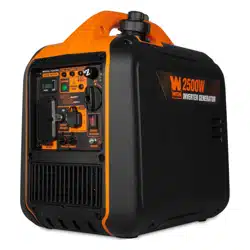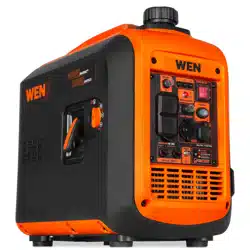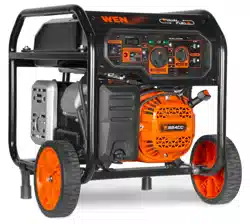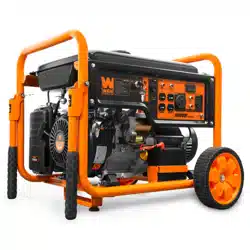
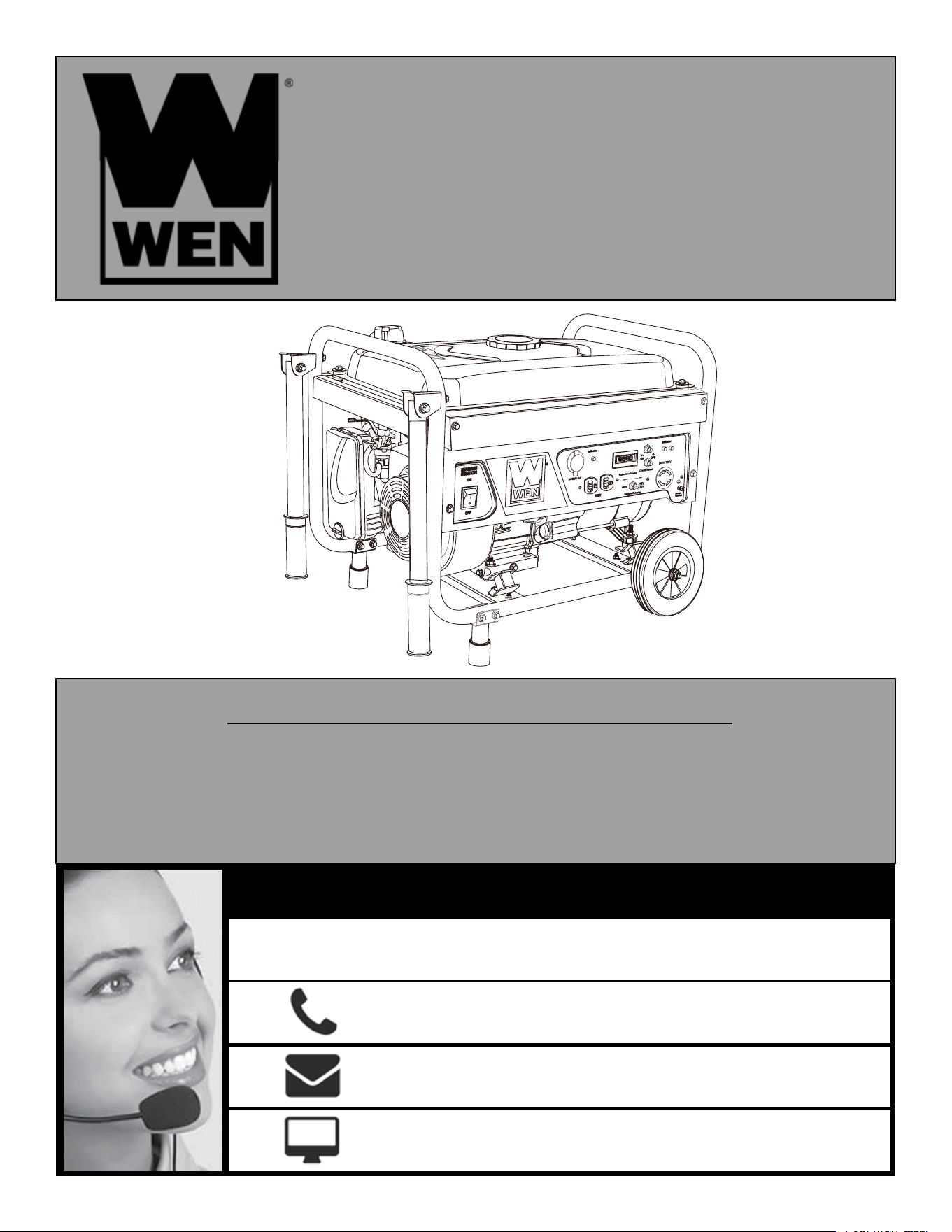
Model # 56352
3500W PORTABLE
GENERATOR
bit.ly/WENvideo
Your new tool has been engineered and manufactured to WEN’s highest standards for dependability,
ease of operation, and operator safety. When properly cared for, this product will supply you years
of rugged, trouble-free performance. Pay close attention to the rules for safe operation, warnings,
and cautions. If you use your tool properly and for intended purpose, you will enjoy years of safe,
reliable service.
IMPORTANT:
NEED HELP? CONTACT US!
Have product questions? Need technical support?
Please feel free to contact us at:
800-232-1195
WENPRODUCTS.COM
(M-F 8AM-5PM CST)

TABLE OF CONTENTS
2
Generator Identification
3
3
4
4
7
8
10
12
13
14
15
18
23
24
25
26
32
33
Service Record
Introduction
Safety Information
Know Your Generator
Assembly
Generator Preperation
Stopping the Generator
Subsequent Starting of the Generator
Using the Generator
Maintenance & Care
Storage & Transport
Specifications
Troubleshooting
Exploded View and Parts List
Wiring Diagram
Warranty Statement
Starting the Generator
3
GENERATOR IDENTIFICATION
If assistance for information or service is required, please contact the Customer Service Help Line by calling
800-232-1195; customer will be asked to provide generator information when calling.
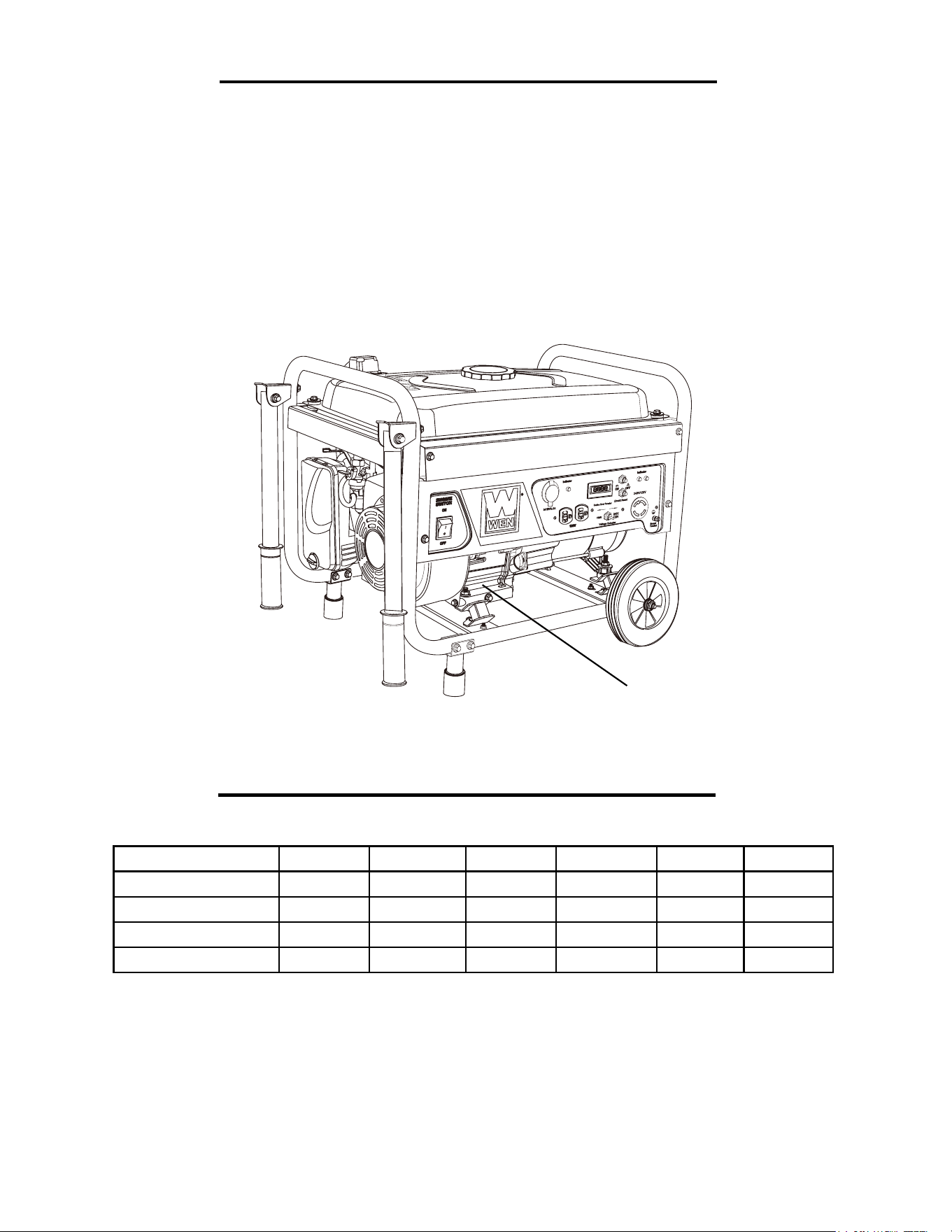
Refer to the illustration below for the location of the serial number. Record generator information in the spaces
provided below.
GENERATOR MODEL NUMBER: 56400M
DATE OF PURCHASE: ______________________________________________
PURCHASED FROM: ______________________________________________
ENGINE SERIAL NUMBER: _________________________________________
Serial Number
Date Date Date Date Date Date
Change Oil
Change Spark Plug
Clean Fuel Tank
Clean Air Filter
SERVICE RECORD
Record Service Dates:
Before operating this generator read and observe all warnings, cautions, and instructions both on the generator and
in this owner’s manual.
NOTE: The following safety information is not meant to cover all possible conditions and situations that may occur.
This safety alert symbol is used to identify safety information about hazards that can result in personal injury.
DANGER indicates a hazard, which, if not avoided, will result in death or serious injury.
WARNING indicates a hazard, which, if not avoided, could result in death or serious injury.
CAUTION indicates a hazard, which, if not avoided, might result in minor or moderate injury.
CAUTION when used without the alert symbol, indicates a situation that could result in damage to the engine or
generator.
Thank you for purchasing a WEN Generator. This manual provides information regarding the safe operation and
maintenance of this product. Every effort has been made to ensure the accuracy of the information in this manu-
al. WEN reserves the right to change this product, manual and specifications at any time without prior notice.
Please keep this manual available to all users during the entire life of the generator.
QUESTIONS? PROBLEMS?
In order to answer questions and solve problems in the most efficient and speedy manner, contact Customer
Service at (800) 232-1195, M-F 8-5 CST
NOTICE REGARDING EMISSIONS
Engines that are certified to comply with U.S. EPA emission regulations for SORE (Small Off Road Equipment),
are certified to operate on regular unleaded gasoline, and may include the following emission control systems:
(EM) Engine Modifications and (TWC) Three-Way Catalyst (if so equipped).
4
INTRODUCTION
SAFETY INFORMATION
This manual contains special messages to bring attention to potential safety
concerns and generator damage as well as helpful operating and servicing
information. Please read all the information carefully to avoid injury and
machine damage.
A signal word (DANGER, WARNING, or CAUTION) is used with the alert
symbol to indicate the likelihood and the potential severity of injury. In addition,
a hazard symbol may be used to represent the type of hazard.
For any questions regarding the hazard and safety notices listed in this manual or on the product, please
call (800) 232-1195 M-F 8-5 CST before using the generator.
DANGER: CARBON MONOXIDE
Using a generator indoors CAN KILL YOU IN MINUTES. Generator exhaust contains carbon monox-
ide (CO). This is a poison gas you cannot see or smell. If you can smell the generator exhaust, you are
breathing CO. But even if you cannot smell the exhaust, you could be breathing CO.
NEVER use a generator inside homes, garages, crawl spaces, or other partially enclosed areas. Deadly
levels of carbon monoxide can build up in these areas. Using a fan or opening windows and doors does
NOT supply enough fresh air. ONLY use a generator outside and far away from windows, doors, and
vents. These openings can pull in generator exhaust.
Even if you use a generator correctly, CO may leak into the home. ALWAYS use a battery-powered or
battery-backup CO alarm in the home. If you start to feel sick, dizzy, or weak after the generator has been
running, move to fresh air RIGHT AWAY. See a doctor. You may have carbon monoxide poisoning.
WARNING: The exhaust from this product contains chemicals known to the State of Califor-
nia to cause cancer, birth defects, or other reproductive harm.
WARNING: This generator may emit highly flammable and explosive gasoline vapors, which
can cause severe burns or even death if ignited. A nearby open flame can lead to explosion even
if it isn’t directly in contact with gasoline.
5
SAFETY INFORMATION
1) Do not operate near open flame.
2) Do not smoke near generator.
3) Always operate on a firm, level surface.
4) Always turn generator off before refueling. Allow
generator to cool for at least 2 minutes before re-
moving fuel cap. Loosen cap slowly to relieve pres-
sure in tank.
5) Do not overfill fuel tank. Gasoline may expand
during operation. Do not fill to the top of the tank.
Allow for expansion.
6) Always check for spilled fuel before operating.
7) Empty fuel tank before storing or transporting the
generator.
8) Do not use in rainy conditions.
9) Ground the generator before using it to maximize
safety (see the “Ground the Generator” portion of the
“Generator Preparation” section).
10) Generator should only be plugged into electri-
cal devices, either directly or with an extension cord.
NEVER connect to a building’s electrical system with-
out a qualified electrician. Such connections must
comply with local electrical laws and codes. Failure to
comply can create a back-feed, which may result in
serious injury or death to utility workers.
11) Use a ground fault circuit interrupter (GFCI) in
highly conductive areas such as metal decking or steel
work. GFCIs are available in-line with some extension
cords.
12) Do not touch bare wires or receptacles (outlets).
13) Do not allow children or non-qualified persons to
operate the generator.
GENERATOR SAFETY RULES:
6
SAVE THESE INSTRUCTIONS – This manual contains important instructions for the WEN
generator that
should be followed during installation and maintenance of the generator.
Generators vibrate in normal use. During and after the use of the generator, inspect both the generator as well as
extension and power supply cords for damage resulting from vibration. Have damaged items repaired or replaced
as necessary. Do not use plugs or cords that show signs of damage such as broken or cracked insulation.
For power outages, permanently installed stationary generators are better suited for providing backup power to the
home. Even a properly connected portable generator can become overloaded. This may result in overheating or
stressing of the components, possibly leading to a generator failure.
SAFETY INFORMATION
WARNING: This generator produces heat when running. Temperatures
near exhaust can exceed 150
0
F (65
0
C).
14) Do not touch hot surfaces. Pay attention to warn-
ing labels on the generator identifying hot parts of
the machine.
15) Allow generator to cool down after use before
touching engine or areas of the generator that be-
come hot during use.
16) Only use generator for its intended purposes.
17) Operate only on dry, level surfaces.
18) Allow generator to run for several minutes be-
fore connecting electrical devices.
19) Shut off and disconnect any malfunctioning de-
vices from generator.
20) Do not exceed the wattage capacity of the generator
by plugging in more electrical devices than the unit can
handle.
21) Do not turn on electrical devices until after they are
connected to the generator.
22) Turn off all connected electrical devices before stop-
ping the generator.
23) Turn the engine switch to “OFF” position when the
engine is not running.
GENERATOR SAFETY RULES (CONTINUED):
CAUTION: Misuse of this generator can
damage it or shorten its life.
WARNING: If this generator is used as a supply for a building’s wir-
ing system, the generator must be installed by a qualified electrician and
connected to a transfer switch as a separately derived system in accor-
dance with the National Electrical Code, NFPA 70. The generator shall
be connected to a transfer switch that switches all conductors excluding
the equipment grounding conductor. The frame of the generator shall
be connected to an approved grounding electrode.
7
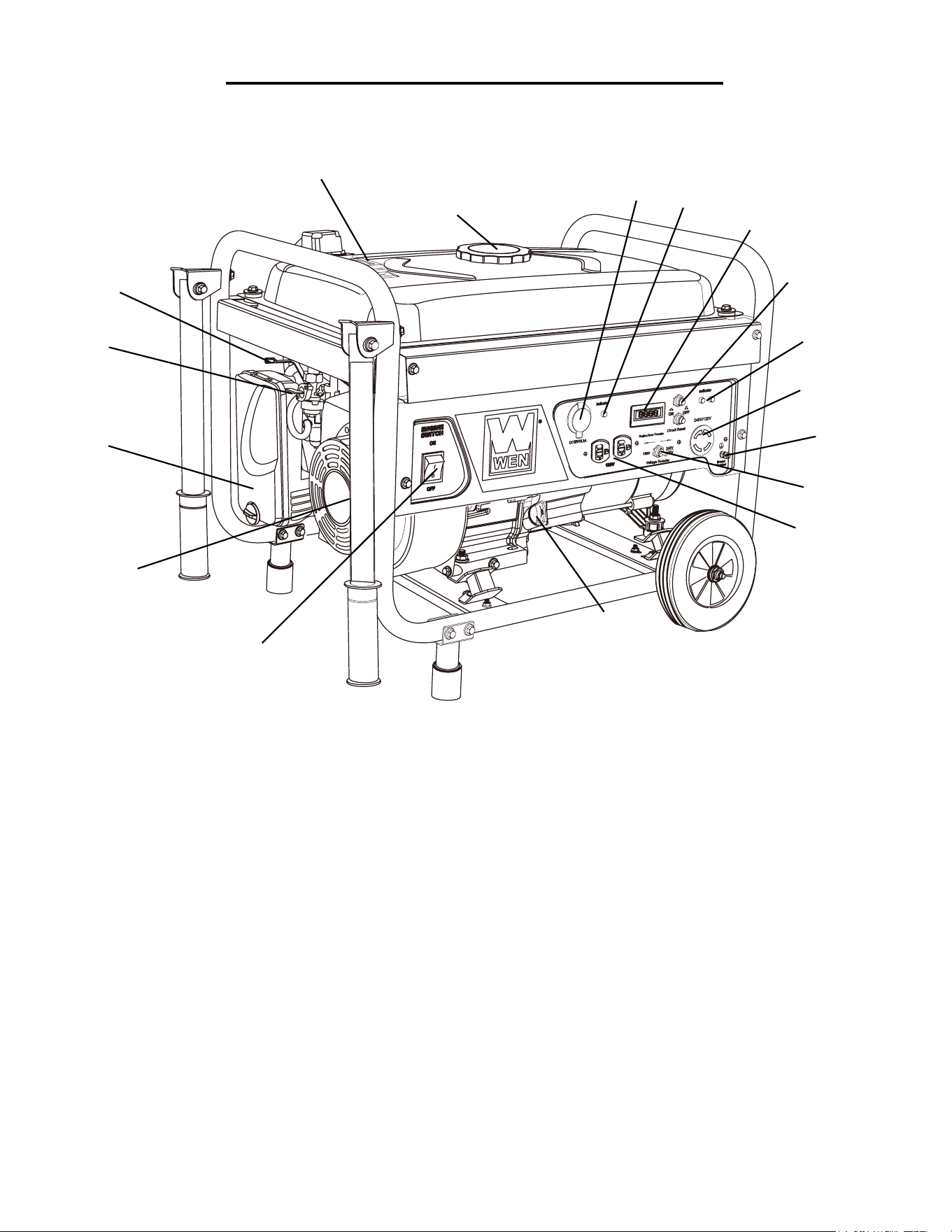
Use the illustrations below to become familiar with the locations and functions of the various
components and controls of this generator.
KNOW YOUR GENERATOR
1
2
3
4
5
6
7
9
10
11
12
14
1
2
3
4
5
6
7
8
Fuel Gauge
Fuel Cap
12V Cigarette Lighter Style DC
Receptacle
Power Indicators (3 total)
Engine Hour Counter
Circuit Reset Buttons
240/120V AC Receptacle
Ground Terminal
9
10
11
12
13
14
15
16
Voltage Selector
120V AC Duplex
Receptacle
Oil Fill and Dipstick
Engine Switch
Recoil Starter
Air Cleaner
Fuel Valve
Choke Lever
13
4
8
15
16
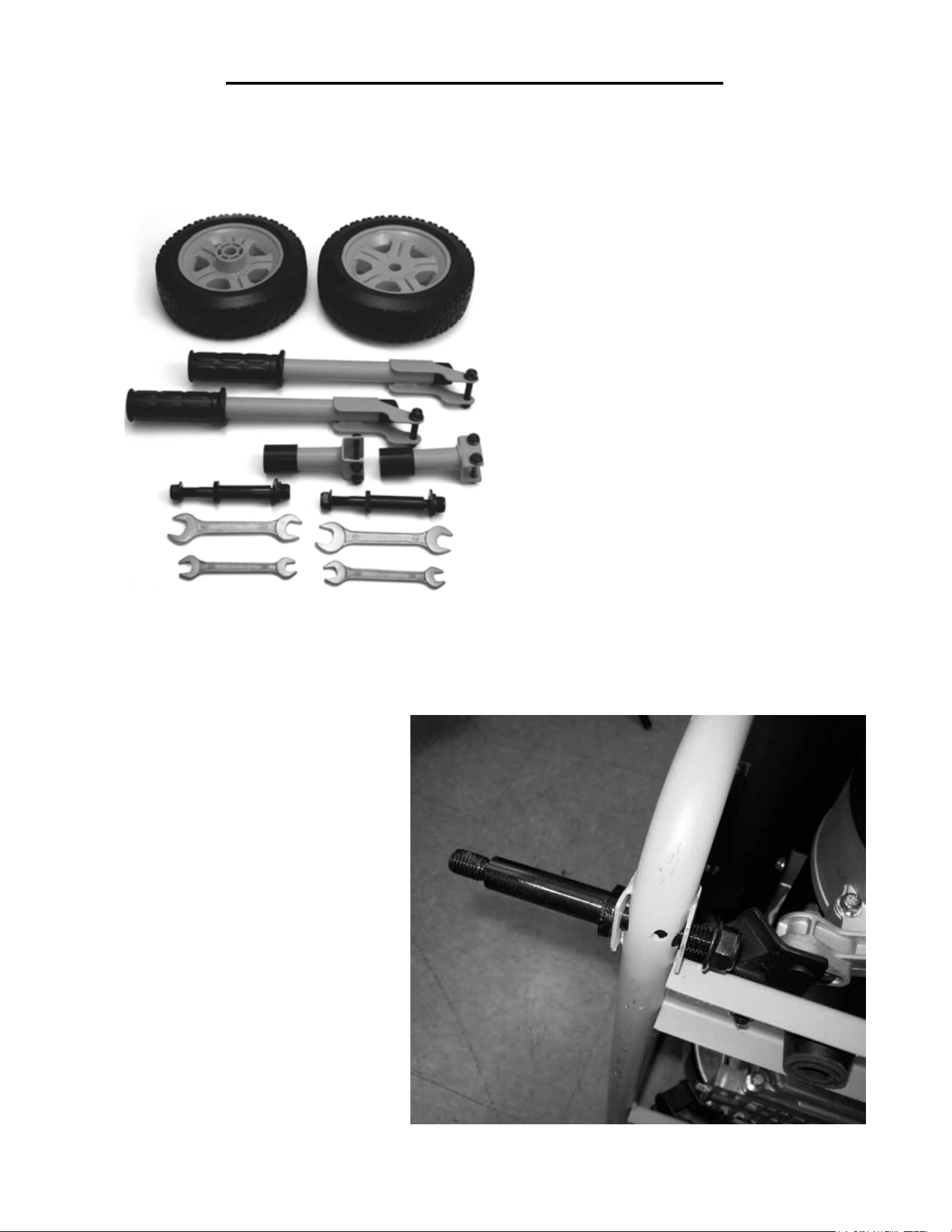
First, check to make sure your wheel kit includes all of the necessary parts. Each item comes pre-assembled with
the necessary nuts and washers already attached to the proper bolts.
INCLUDED:
A) Two Wheels
B) Two Handles (each equipped with
one washer and one bolt)
C) Two Support Legs (each equipped
with two nuts and two bolts)
D) Two Wheel Axles
E) Two 17/19 mm Wrenches
F) Two 10/12 mm Wrench
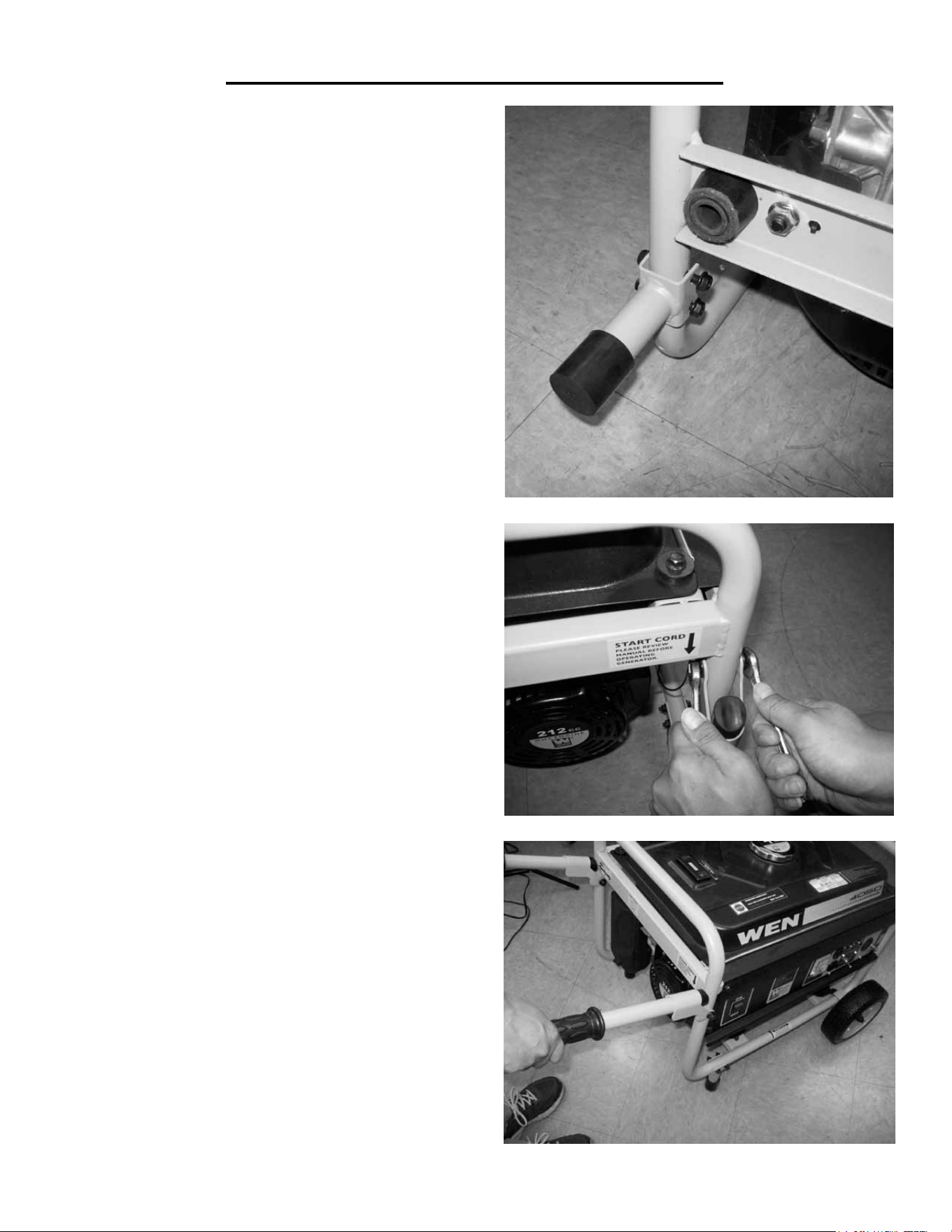
Next, tip the generator on its side to expose the holes in the frame that will accept the axles for the wheel.
(WARNING: It is only OK to tip the generator on its side if it does NOT have oil and gas in it. If it is not “dry”
you will need to do the installation with the generator right side up and on a level surface).
1) Unscrew the bolts and remove the
washers from your wheel axles. Place in a
safe area.
2) Insert the small end of the wheel axles
into the holes in the generator frame as
shown in the figure on the right. Reattach
the bolt to the inside of the axle in order
to secure it in place.
3) Next, slide the larger washer onto the
outside of the axle before putting on the
wheel. Then slide on the wheel and the
smaller washer.
4) Tighten both nuts using the two 17/19
mm wrenches. Make sure your wheel still
has the ability to spin, otherwise it may be
too tight.
ASSEMBLY
For video instructions visit bit.ly/WHEELKIT
88
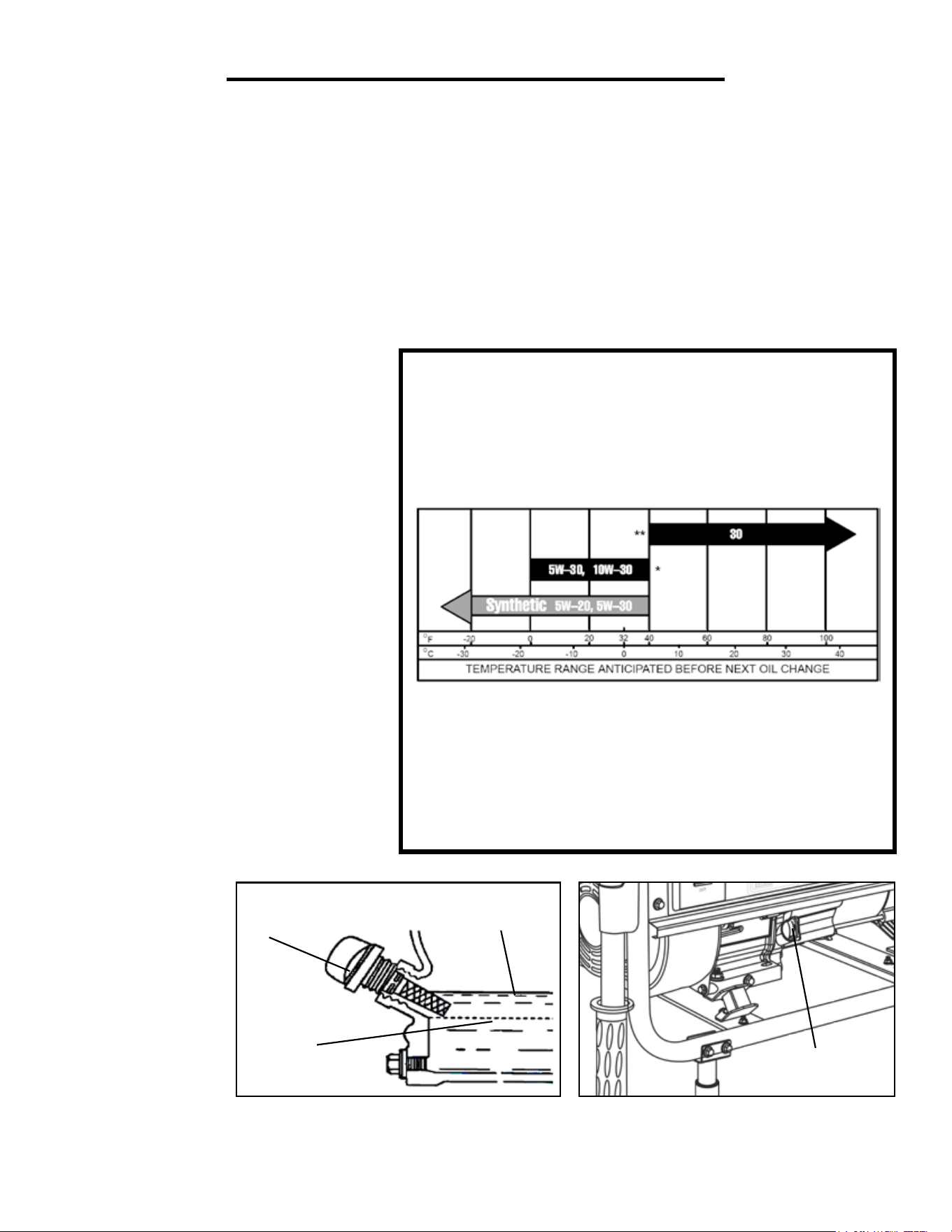
5) Once both wheels are installed, attach the
support legs to the generator as shown in Figure B.
Again, remove the bolts, slide the legs into place
and align the two holes.
6) Reattach the bolts using the 10/13 and the 10/12
mm wrenches.
7) Finally, flip the generator back to its upright
position and attach the two handles using the 10/13
and the 10/12 mm wrenches. Do not tighten the
handles too much, as this will restrict movement
and will prevent the handles from folding up and
down as needed.
8) Make sure that the cushioning on the handle
tilts upwards towards the generator when the
handles are in the relaxed position.
Now you are ready to roll. If you have any
questions, comments or concerns feel free to
contact our helpful and friendly customer service
line at 800-232-1195.
ASSEMBLY
9
1010
USING THE GENERATOR FOR THE FIRST TIME
CAUTION: The following section describes the necessary steps to prepare the generator for use. If after reading
this section, you are unsure about how to perform any of the steps please call (800) 232-1195 M-F 8-5 CST for
customer service. Failure to perform these steps properly can damage the generator or shorten its life.
STEP 1 - ADD OIL
The generator is shipped without oil. User must add the proper amount of oil before operating the generator for
the first time. The oil capacity of the engine crankcase is 20 fl. oz. For general use (above 40° F), we recommend
30W, 4-stroke engine oil.
GENERATOR PREPARATION
Oil Dipstick
Fig. 2 - Oil Fill Opening, Dipstick and Oil Level
To add oil, follow these steps:
1. Make sure the generator is on a level
surface. Tilting the generator to assist in
filling will cause oil to flow into the engine
areas and will cause damage. Keep the
generator level!
2. Remove the dipstick from the engine
(Fig. 2).
3. Add oil slowly, being careful not to
overfill the unit. Fill the crank case to the
upper fill line so the oil lands about halfway
up the dipstick threads (Fig. 2).
4. To check the oil level, wipe the dipstick
with a clean rag. Insert the dipstick into
the oil fill opening without screwing it in.
Remove the dipstick to check the oil mark.
5. Slowly add more oil and repeat step 4
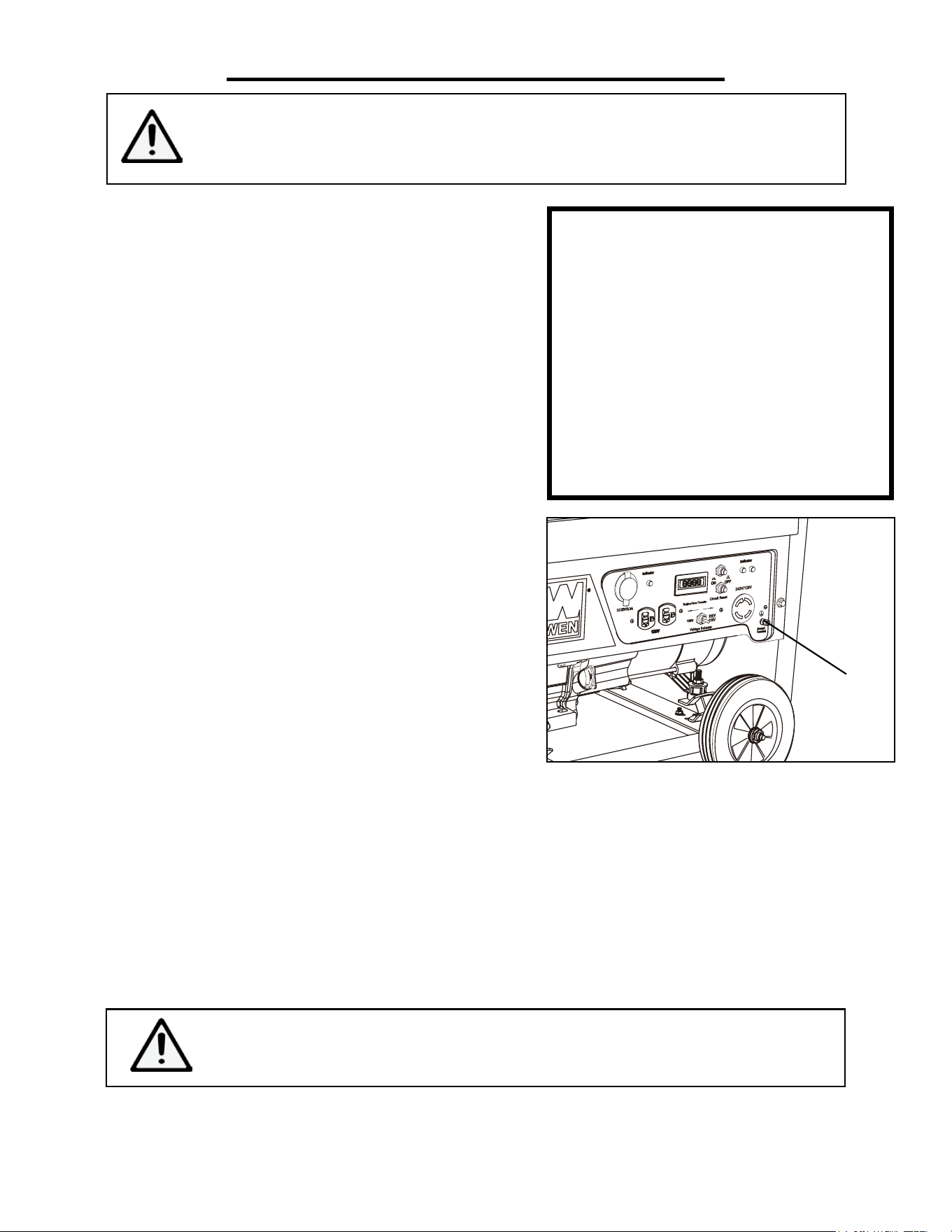
Fig. 1 - Engine Oil Temperature Recommendation
CAUTION: Air cooled engines run hotter than automotive
engines. The use of non-synthetic multi-viscosity oils (5W-30,
10W-30, etc.) in temperatures above 40° F will result in higher
than normal oil consumption. When using a multi-viscosity oil,
check the oil level more frequently than you would otherwise.
ENGINE OIL RECOMMENDATIONS
Select good quality detergent oil bearing the American Petro-
leum Institute (API) service classifications SJ, SL, or SM (syn-
thetic oils may be used). Use the ASE viscosity grade of oil from
the following chart (Fig. 1) that matches the starting temperature
anticipated before the next oil changes.
Oil
Dipstick
Lower Level
Fill Line
Upper Level
Fill Line
until the oil mark
reaches to the top
of the dipstick (Fig.
2). Do not overfill
the crankcase. The
generator is equipped
with a low-oil sensor
and will not start
without a sufficient
amount of oil.
6. Check for oil leaks
and firmly tighten the
dipstick.
NOTE: After completing the above preparation, the generator is ready to be started.
GROUND THE GENERATOR
You can ground the generator by tightening the grounding nut on the front control panel against a grounding wire
(Fig. 3). A generally acceptable grounding wire is a No. 12 AWG (American Wire Gauge) stranded copper wire.
This grounding wire should be connected at the other end to a copper, brass, or steel-grounding rod that is driven
into the earth. Wire and grounding rods are not included with the generator.
Grounding codes can vary by location. Contact a local electrician to check the area codes.
Step 2 - ADD GASOLINE
Use fresh (within 30 days from purchase), lead-free gasoline
with a minimum of 87 octane rating. Do not mix oil with gaso-
line.
To add gasoline, follow these steps:
1. Make sure the generator is on a level surface.
2. Unscrew fuel cap and set aside.
NOTE: The fuel cap may be tight and hard to unscrew.
3. Slowly add unleaded gasoline to the fuel tank. Be careful not
to overfill. The capacity of the fuel tank is 4 gallons.
NOTE: Do not fill the fuel tank to the very top. Gasoline will
expand and spill over during use even with the fuel cap in
place.
4. Reinstall fuel cap and wipe clean any spilled gasoline with a
dry cloth.
11
GENERATOR PREPARATION
Fig. 3
Grounding
Nut
WARNING: This generator may emit highly flammable and explosive gasoline vapors,
which can cause severe burns or even death if ignited. A nearby open flame can lead to
explosion even if not directly in contact with gasoline.
IMPORTANT:
• Never use an oil/gasoline mixture.
• Never use old gasoline.
• Avoid getting dirt or water into the fuel
tank.
• Gasoline can age in the tank and make
starting difficult. Never store generator
for extended periods of time with fuel
in the tank.
WARNING: Failure to properly ground the generator can result in electric shock.
ALWAYS ground the generator before using it (see the “Ground the Generator” portion of the “Generator
Preparation” section).
Generator should only be plugged into electrical devices, either directly or with an extension cord. NEVER
connect to a building electrical system without a qualified electrician. Such connections must comply with local
electrical laws and codes. Failure to comply can create a back-feed, which may result in serious injury or death to
utility workers.
Use a ground fault circuit interrupter (GFCI) in highly conductive areas such as metal decking or steel work. GF-
CIs are available in-line with some extension cords.
Do not use in rainy or wet conditions. Do not touch bare wires or receptacles (outlets). Do not allow children or
non-qualified persons to operate.
CAUTION: Disconnect all electrical loads from the generator before
attempting to start.
DANGER: CARBON MONOXIDE - USING A GENERATOR INDOORS CAN KILL
YOU IN MINUTES.
Using a generator indoors CAN KILL YOU IN MINUTES. Generator exhaust contains carbon monox-
ide (CO). This is a poison gas you cannot see or smell. If you can smell the generator exhaust, you are
breathing CO. But even if you cannot smell the exhaust, you could be breathing CO.
NEVER use a generator inside homes, garages, crawl spaces, or other partially enclosed areas. Deadly
levels of carbon monoxide can build up in these areas. Using a fan or opening windows and doors does
NOT supply enough fresh air. ONLY use a generator outside and far away from windows, doors, and
vents. These openings can pull in generator exhaust.
Even if you use a generator correctly, CO may leak into the home. ALWAYS use a battery-powered or
battery-backup CO alarm in the home. If you start to feel sick, dizzy, or weak after the generator has been
running, move to fresh air RIGHT AWAY. See a doctor. You may have carbon monoxide poisoning.
WARNING: The exhaust from this product contains chemicals known to the State of Califor-
nia to cause cancer, birth defects, or other reproductive harm.
WARNING: This generator may emit highly flammable and explosive gasoline vapors, which
can cause severe burns or even death if ignited. A nearby open flame can lead to explosion even
if it isn’t directly in contact with gasoline.
Before starting the generator, make sure you have read and performed the steps in the “Generator Preparation”
section of this manual. If you are unsure about how to perform any of the steps in this manual please call (800)
232-1195 M-F 8-5 CST for customer service.
12
STARTING THE GENERATOR
WARNING: This generator produces powerful voltage, which can
result in electrocution.
13
STARTING THE ENGINE
To start the generator, perform the following steps:
1. Unplug all electrical devices from the generator during ignition. Other-
wise it will be difficult for the engine to start.
2. Check that the generator is properly grounded (page 11).
3. Check the oil and fuel levels.
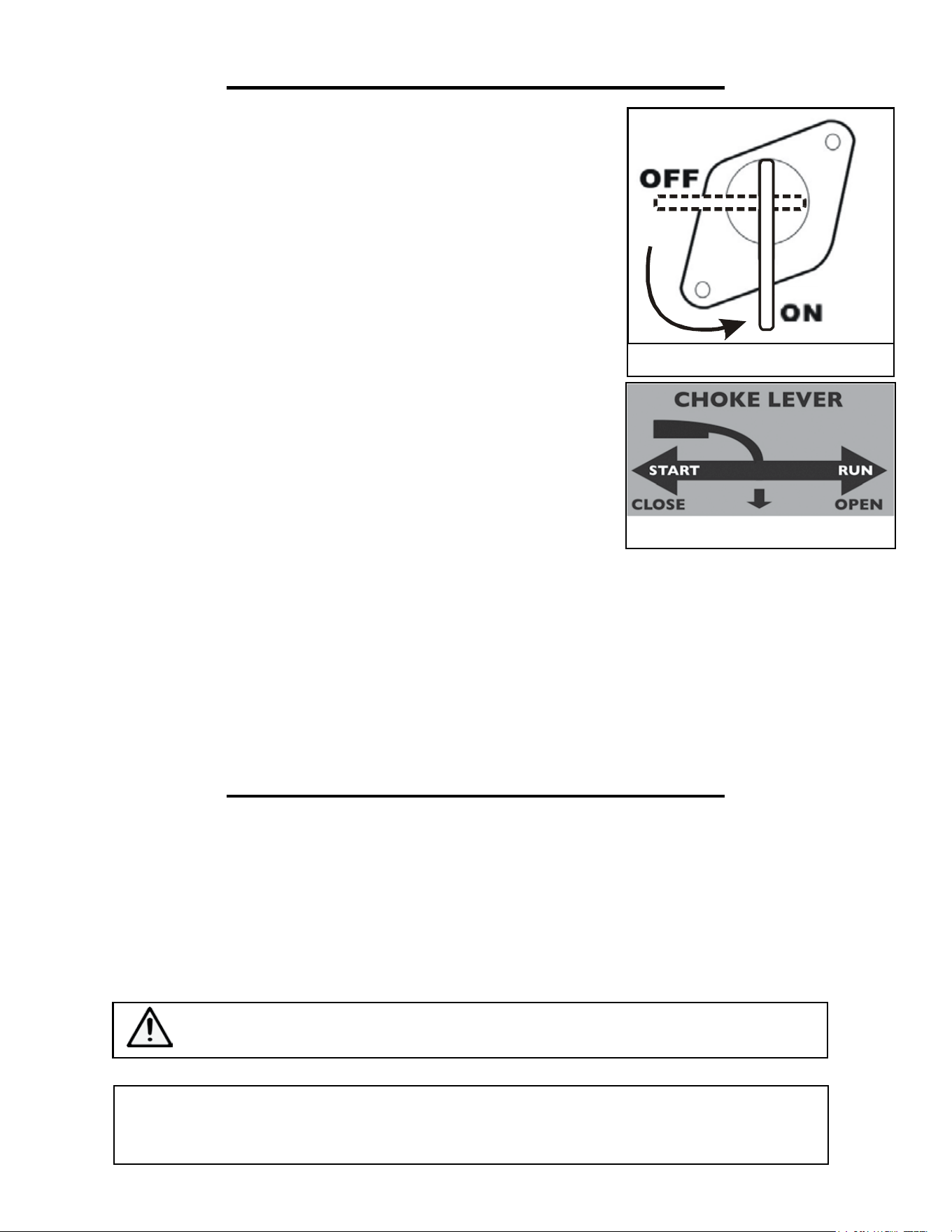
4. Turn the fuel valve to the ON position (Fig. 4).
5. Move the choke lever to the CLOSE/START position (Fig. 5).
6. Set the ON/OFF Switch to the ON position.
7. Pull on the recoil starter handle slowly until a slight resistance is felt, then
pull quickly to start the engine. Return cord gently into the recoil starter.
Never allow the cord to snap back.
STARTING THE GENERATOR
STOPPING THE GENERATOR
TO STOP THE GENERATOR
1. Turn off all electrical devices prior to unplugging them from the generator. Unplugging running devices can
cause damage to the generator.
2. Turn the “ON/OFF” switch to the “OFF” position.
3. Turn the fuel valve to the “OFF” (horizontal) position.
CAUTION: Allowing gasoline to sit in the fuel tank for long periods of time can make it diffi-
cult to start the generator in the future. Never store the generator for extended periods of time
with fuel in the fuel tank. Refer to Generator Storage Section.
WARNING: Allow the generator to cool for several minutes before touching areas
that become hot during use.
Fig. 5 Choke Lever
8. If engine fails to start, repeat step 7. NOTE: After repeated failed attempts to start the engine, please consult
the troubleshooting guide before attempting to start the generator. If problems persist please call (800) 232-1195,
M-F 8-5 CST.
9. Once the engine has started, slowly return the choke lever all the way to the OPEN/RUN position.
10. Allow the engine to run for several minutes before attempting to connect any electrical devices. This allows the
generator to stabilize its speed and temperature.
Fig. 4 - Fuel Valve
If this is not the first time using the generator, the user should take the following steps to prepare it for operation.
Step 1 - CHECK THE OIL
Oil consumption is normal during generator use. The generator is equipped with a low oil pressure shutoff to
protect it from damage. The oil level of the engine should be checked before each use to ensure that the engine
crankcase contains sufficient lubricant.
To check or add oil, follow these steps:
1. Make sure the generator is on a level surface. Clean around
oil fill.
2. Remove the oil filler/dipstick cap and check the oil level.
3. If oil level is below the second thread from the lip of the oil fill opening, slowly add oil until the engine crank-
case is filled.
4. Reinstall and tighten oil cap before starting the engine.
Step 2 - CHECK THE FUEL LEVEL
Before starting the generator, check to see that there is sufficient gasoline in the fuel tank. Add additional gasoline
as necessary but leave sufficient room in the tank for expansion.
14
SUBSEQUENT STARTING OF THE GENERATOR
IMPORTANT:
• Use only UNLEADED gasoline.
• Do not use old gasoline.
• Never use an oil/gasoline mixture.
• Avoid getting dirt or water into the fuel tank.
Step 3 - GROUND THE GENERATOR
Ground the generator by tightening the grounding nut on the front control panel against a grounding wire (Fig.
3). A generally acceptable grounding wire is a No. 12 AWG (American Wire Gauge) stranded copper wire. This
grounding wire should be connected at the other end to a copper, brass, or steel-grounding rod that is driven into
the earth. Wire and grounding rod are not included in generator contents.
Grounding codes can vary by location. Contact a local electrician for area codes.
IMPORTANT: At this point the user should be familiar with the procedures described in
the sections titled “Starting the Generator” and “Generator Preperation.” If the user has
not yet read these sections, go back and read them now.
WARNING: Failure to properly ground the generator can result in electrocution.
15
USING THE GENERATOR
WARNING: When this generator is used on a building’s wiring system, the generator must be installed by a qual-
ified electrician and connected to a transfer switch as a separately derived system in accordance with the National
Electrical Code, NFPA 70. The generator shall be connected to a transfer switch that switches all conductors
other than the equipment grounding conductor. The frame of the generator shall be connected to an approved
grounding electrode.
For power outages, permanently installed, stationary generators are better suited for providing backup power to
the home. Even a properly connected portable generator can become overloaded. This may result in overheat-
ing or stressing the machine’s components, possibly leading to a generator failure.
Before connecting electrical devices, allow the generator to run for a few minutes to stabilize the speed and voltage
output.
CAUTION: Become familiar with the markings on the panel before connecting electrical devices.
Connect electrical devices running on AC current according to their wattage requirements. The chart in Fig. 6
shows the rated and surge wattage of the generator.
The rated (running) wattage is the wattage the generator can produce on a continuous basis.
The surge wattage is the maximum amount of power the generator can produce for an extremely short period of
time (seconds). Many electrical devices such as refrigerators require short bursts of extra power in addition to the
rated wattage listed by the device to start their motors. The surge wattage ability of the generator covers this extra
power requirement.
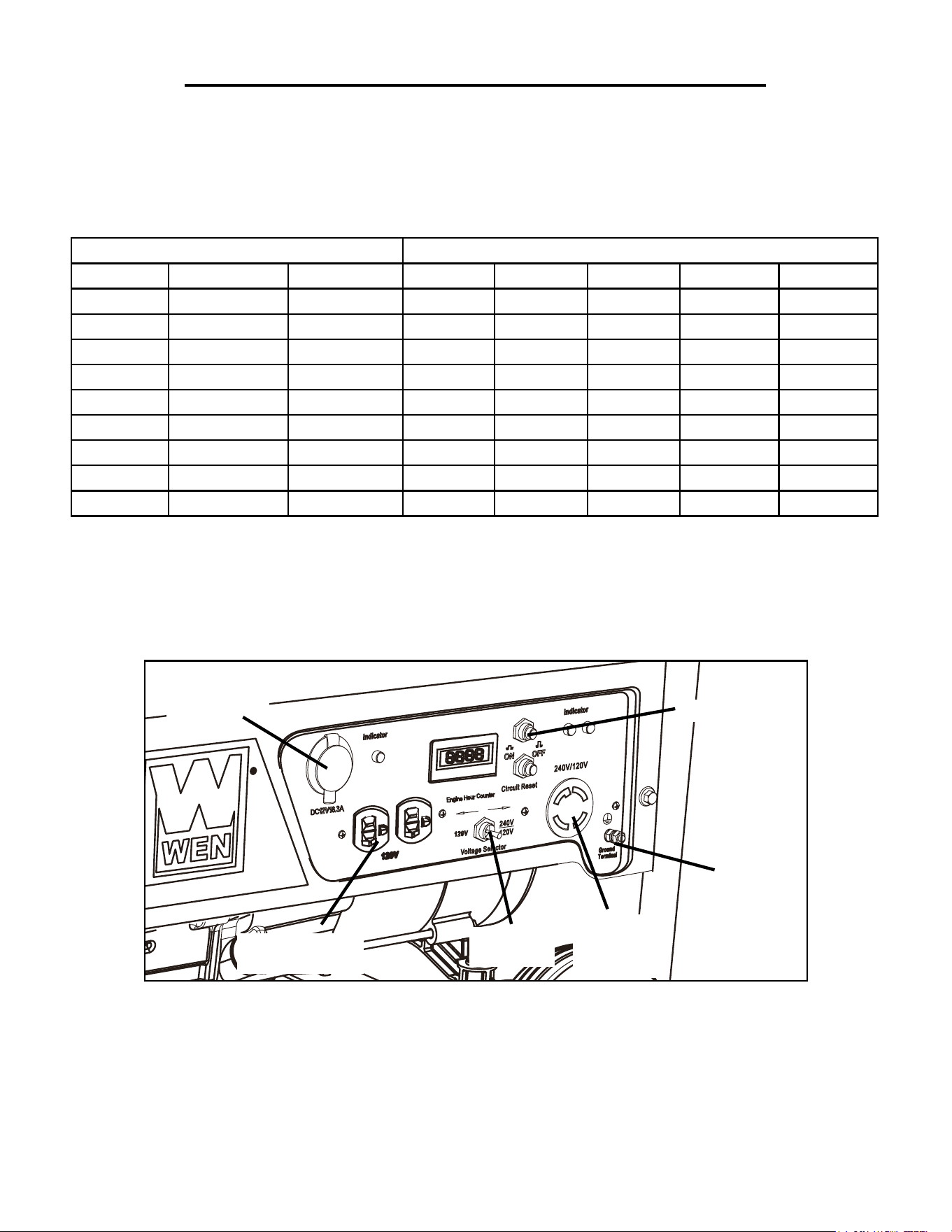
Item Rated (Running) Wattage Surge Wattage
56352 3000 3500
Fig. 6 - Generator Wattage
The total running wattage requirement of the electrical devices connected to the generator should not exceed the
rated wattage of the generator itself. To calculate the total wattage requirement of the electrical devices you plan
to connect, find the rated (or running) wattage of each device. This number should be listed somewhere on the
device or in its instruction manual. If this wattage cannot be found, calculate it by multiplying the Voltage require-
ment by the Amperage drawn: Watts = Volts x Amperes
Estimated wattages are available in Fig. 7. Do not solely rely on this chart - all electronics and appliances are built
differently. These are not standard wattages across the board, only estimations.
When the rated wattage requirement of each electrical device has been determined, add these numbers to find
the total rated wattage needed. If this number exceeds the rated wattage of the generator, DO NOT connect all
these devices. Select a combination of electrical devices, which have a total rated wattage lower than or equal to
the rated wattage of the generator.
CIRCUIT RESET BUTTONS help to prevent electrical overload. If your receptacle short circuits or becomes
overloaded by an electrical device or devices with too great a wattage rating, the circuit protector may shut off
power to the receptacle. If this happens, you will see the voltage indicator lights turn off and you will not be able
to draw power from the overloaded receptacle. In the event of such an overload, disconnect all electrical devices
from the generator and press the circuit reset buttons. If power still does not return to the receptacle, call our cus-
tomer help line at 1-800-232-1195.

16
USING THE GENERATOR
CAUTION: The generator can run at its surge wattage capacity for only a short time. Connect electrical devices
requiring a rated (running) wattage equal to or less than the rated wattage of the generator. Never connect devices
requiring a rated wattage equal to the surge wattage of the generator. This can trip the circuit protectors (circuit
breakers).
Tool or Appliance Rated (Running) Watts Surge (Starting) Watts
Electric water heater (40 Gal) 4000 0
Hot plate 2500 0
Saw - radial arm 2000 2000
Electric stove (each element) 1500-2800 0
Saw - circular 1500 1500
Air compressor (1 HP) 1500 3000
Window air conditioner 1200 1800
Saw - miter 1200 1200
Microwave 1000 0
Well water pump 1000 1000
Saw - reciprocating 960 1040
Sump pump 800 1200
Refrigerator freezer 800 1200
Furnace blower 800 1300
Computer 800 0
Electric drill 600 900
Television 500 0
Deep freezer 500 500
Garage door opener 480 0
Stereo 400 0
Box fan 300 600
Clock radio 300 0
Security system 180 0
DVD player / VCR 100 0
Common light bulb 75 0
Note: The above wattage figures are estimates. Check the wattage listed on the electrical device before consulting
this chart. Once the electrical devices that will be powered by the generator have been determined, connect these
devices according to the following procedure:
1. Plug in each electrical device, making sure that the device is turned off.
2. Check the overload light and power indicator light. If the overload light is on, remove the plugged in load, then
press the power reset button before plugging the loads back in. If the reset button does not reset, wait several min-
utes and try again. If the power light still does not come on, call the customer service number for further instruc-
tions.
Fig. 7- Estimated wattage requirements of common electrical devices
17
Device Requirements
Max. Cord Length (ft) by Wire Gauge
Amps Watts (120V) Watts (240V) #8 wire #10 wire #12 wire #14 wire #16 wire
2.5 300 600 NR NR NR 375 250
5 600 1200 NR NR 300 200 125
7.5 900 1800 NR 350 200 125 100
10 1200 2400 NR 250 150 100 50
15 1800 3600 NR 150 100 65 NR
20 2400 4800 175 125 75 50 NR
25 3000 6000 150 100 60 NR NR
30 3600 7200 125 65 NR NR NR
40 4800 9600 90 NR NR NR NR
CAUTION: Do not connect 50Hz loads to the generator.
SOME NOTES ABOUT POWER CORDS
Long or thin cords can drain the power provided to an electrical device by the generator. When using such cords,
allow for a slightly higher rated wattage requirement by the electrical device.
USING THE GENERATOR
*NR = Not Recommended
If an overload occurs, shut down the generator. Unplug all electrical devices and wait five minutes. Then, start the
unit back up again to get power back.
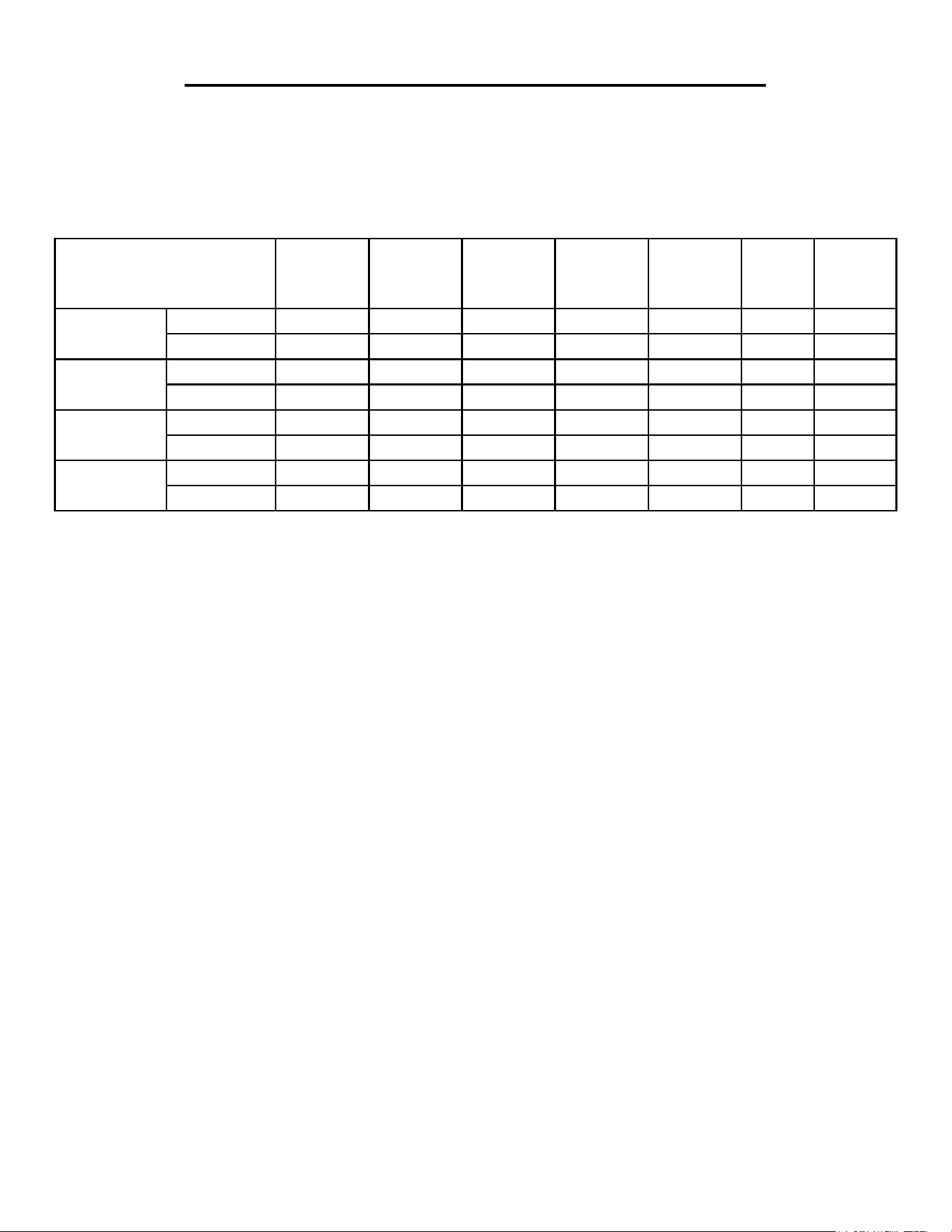
120V Duplex
Receptacle
Ground
Voltage
Selector
Fig. 8 - Control Panel
120V/240V
Receptacle
(L14-30)
DC 12V/8.3A
Receptacle
Circuit Breaker
18
MAINTENANCE
Proper routine maintenance of the generator will help prolong the life of the machine. Please perform mainte-
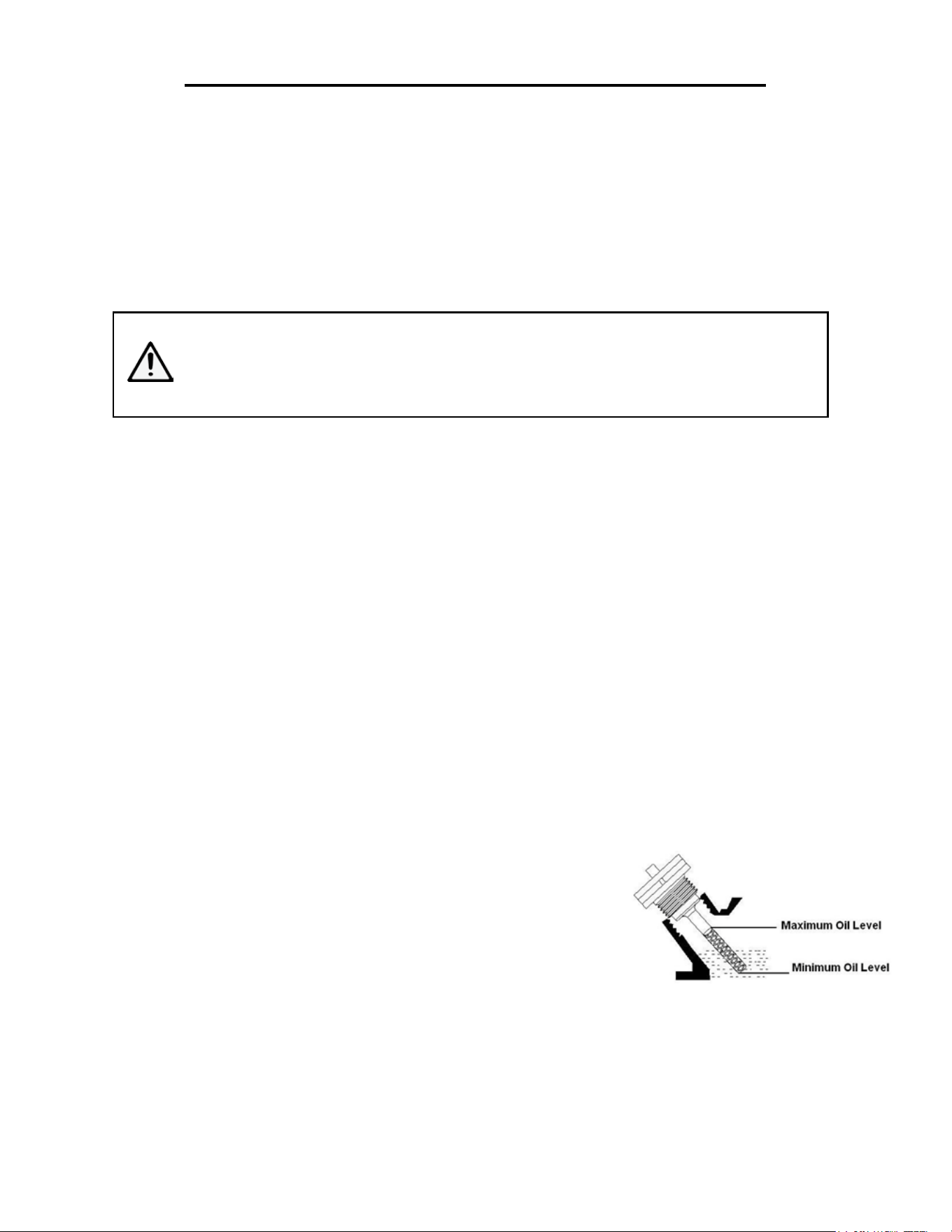
nance checks according to the schedule in Fig. 9. If there are any questions about the maintenance procedures
listed in this manual, please call (800) 232-1195 M-F 8-5CT.
CAUTION: Never perform maintenance operations while the generator is running.
Recommended
Maintenance Schedule
Each 8
hours or
daily
First 8
hours
Every 25
hours
Every 3
months or
50 hours
Every 6
months or
100 hours
Every
year
As
necessary
Engine oil
Check level x
Replace x x* x* x
Air cleaner
cartridge
Check x x
Clean x
Spark plug
Check/clean x
Change x x
Fuel tank
Check level x
Clean x
Fig. 9
* Clean/change more often under dusty conditions or operating under heavy load.
MAINTENANCE
HIGH ALTITUDE OPERATION ABOVE 3000 FEET
The fuel system on this generator may be affected by operation at high altitudes. Proper operation can be ensured
by installing an altitude kit at altitudes higher than 3000 feet above sea level. At elevations above 8000 feet, the
engine may experience a decrease in performance, even with the proper altitude kit. Operating this generator
without said kit may increase the engine’s emissions and decrease both fuel economy and performance.
The kit should be installed by a qualified mechanic. Refer to the instructions included with your altitude kit for
more information about installation.
CLEANING THE GENERATOR
Never clean the generator when it is running! Never clean with a bucket of water or a hose. Water can get inside
the working parts of the generator and cause corrosion or a short circuit.
Always try to use the generator in a cool, dry place. If the generator becomes dirty, clean the exterior with a damp
cloth, a soft brush, a vacuum or pressurized air.
CHECKING THE OIL
Check the oil level of the generator according to the Recommended Maintenance Schedule in Fig. 9. The genera-
tor is equipped with an automatic shutoff to protect it from running on low oil. The generator should be checked
before each use for proper oil level. This is a critical step for proper engine starting. To check the oil level:
1. Make sure the generator is on a level surface.
2. Open access panel. Clean around oil fill. Remove dipstick and wipe the dipstick with a clean rag. Insert the
dipstick into the oil fill opening without screwing in. Remove the dipstick to check the oil mark. Add oil if the oil
mark covers less than one half of the dipstick.
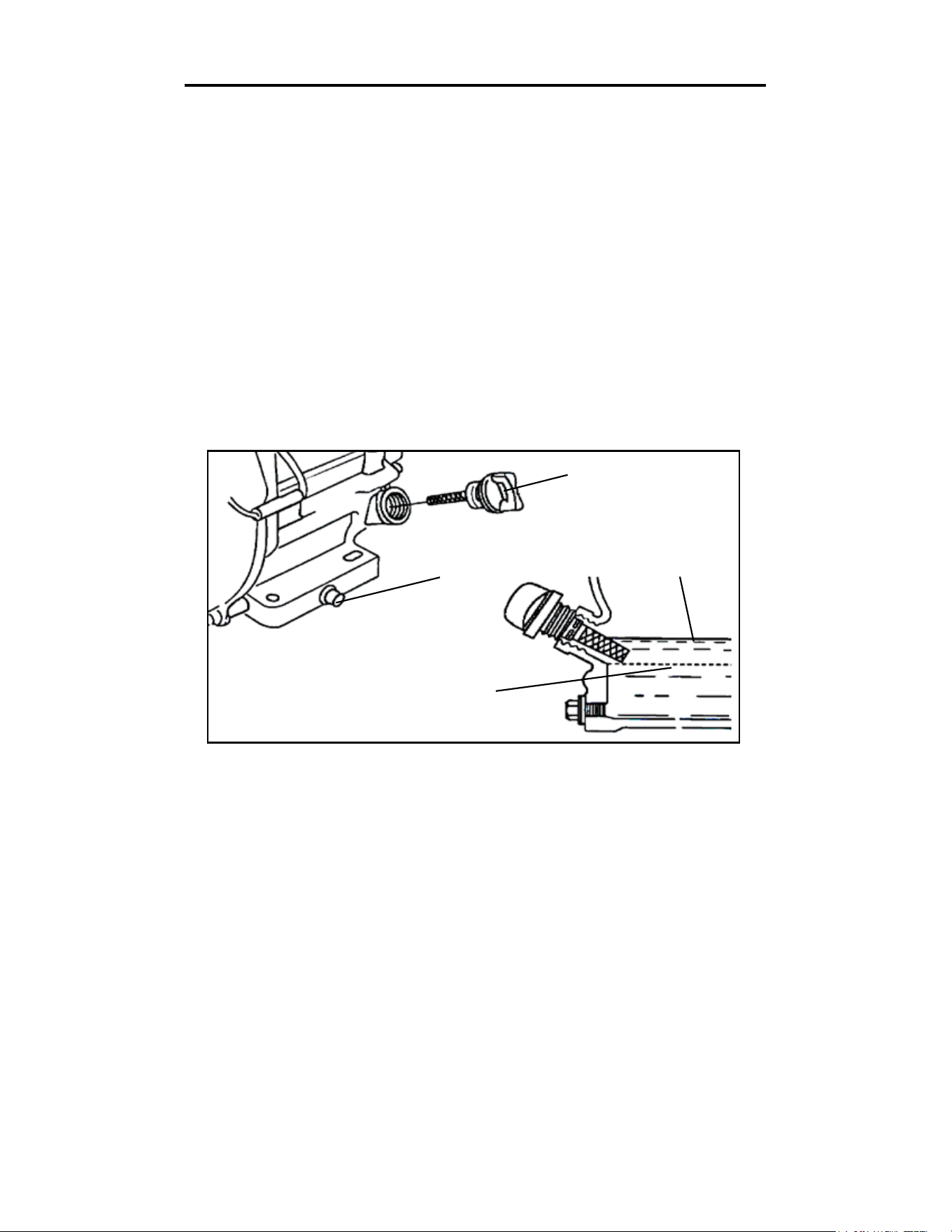
3. Slowly add more oil and repeat step 2 until the oil mark reaches to the top
of dipstick (Fig. 10). Do not over fill the crankcase.
4. Reinstall oil dipstick and access panel.
Fig. 10 - Oil Fill Opening,
Dipstick and Oil Level
19
WARNING: To prevent serious injury from fire, follow the kit installation proce-
dures in a well-ventilated area away from ignition sources. If the engine is hot from
use, shut the engine off and wait for it to cool before proceeding. Do not smoke near
the generator. Warranty will be void if adjustments are not made for high altitude use.
MAINTENANCE
CHANGING/DRAINING THE OIL
Change the oil according to the Recommended Maintenance Schedule in Fig. 9. Changing the oil when the
engine is warm allows for complete drainage. Change the oil more often if operating under heavy load or high
ambient temperatures. It is also necessary to drain the oil from the crankcase if it has become contaminated with
water or dirt. The oil capacity of the generator engine is 17 fluid ounces. Add oil when the oil level is low. For
proper type and weight of oil refer to “add oil” portion of the “Generator Preparation” section. Drain the oil from
the generator according to the following steps after removing the side panel.
1. Place a container underneath the engine to catch the oil as it drains.
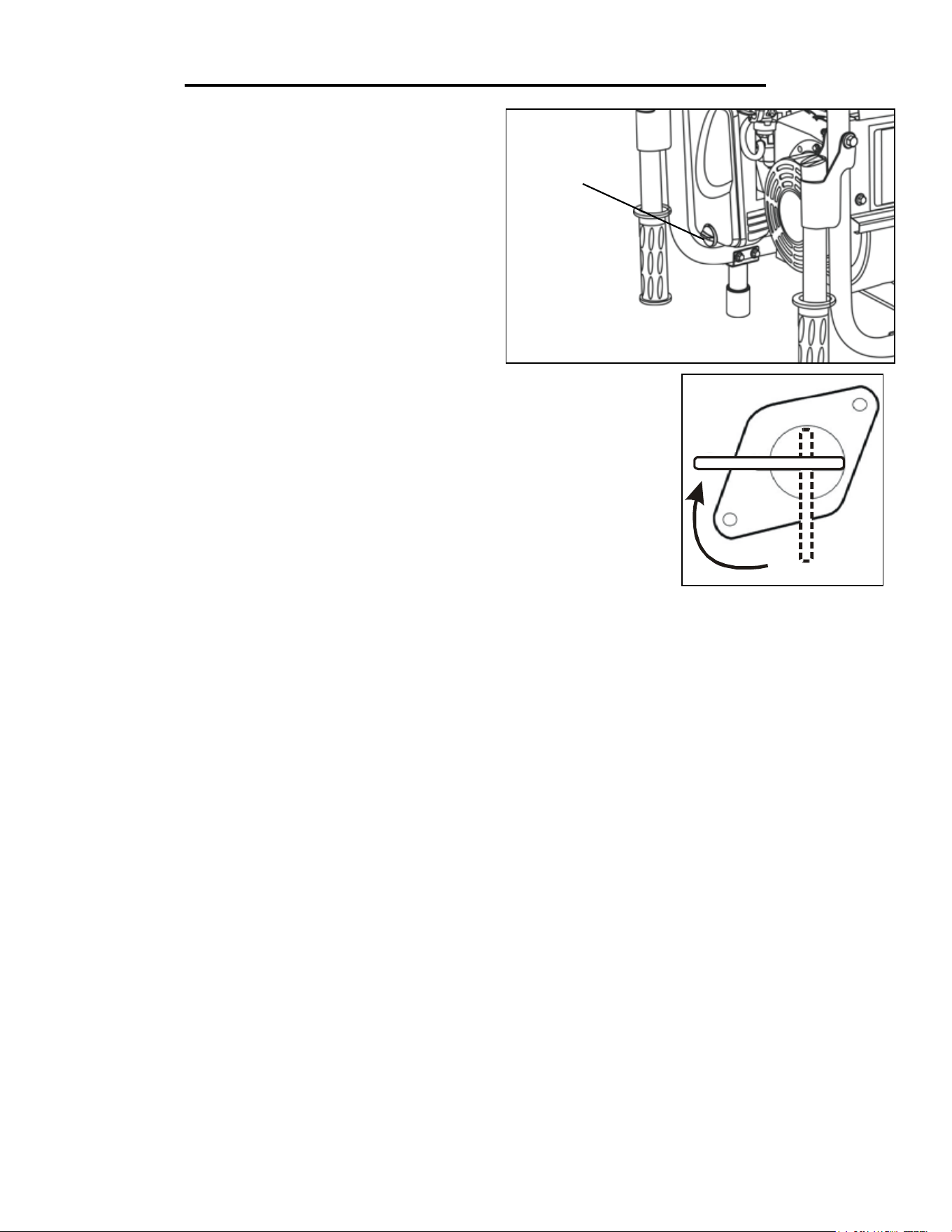
2. Using a 10 mm hex wrench, unscrew the oil drain plug (Fig. 11). Allow the oil to drain from the engine.
3. Reinstall the oil drain plug and tighten with a 10 mm hex wrench.
TO REFILL THE OIL
1. Make sure the generator is on a level surface. Tilting the generator to assist in filling will cause oil to flow into
engine areas and will cause damage. Keep generator level!
2. Remove the dipstick from the engine.
3. Using a funnel or appropriate dispenser, add the correct amount of oil into the crankcase. The engine is
equipped with a low oil pressure sensor and will not start if the amount of oil is insufficient.
4. The oil is full when it reaches halfway up the threads of the dipstick (oil upper level fill line - Fig. 11). Reinstall
dipstick.
NOTE: Never dispose of used motor oil in the trash or down a drain. Please call a local recycling center or auto
garage to arrange oil disposal.
20
Oil Drain
Plug
Oil
Dipstick
Lower Level
Fill Line
Upper Level
Fill Line
Fig. 11
MAINTENANCE
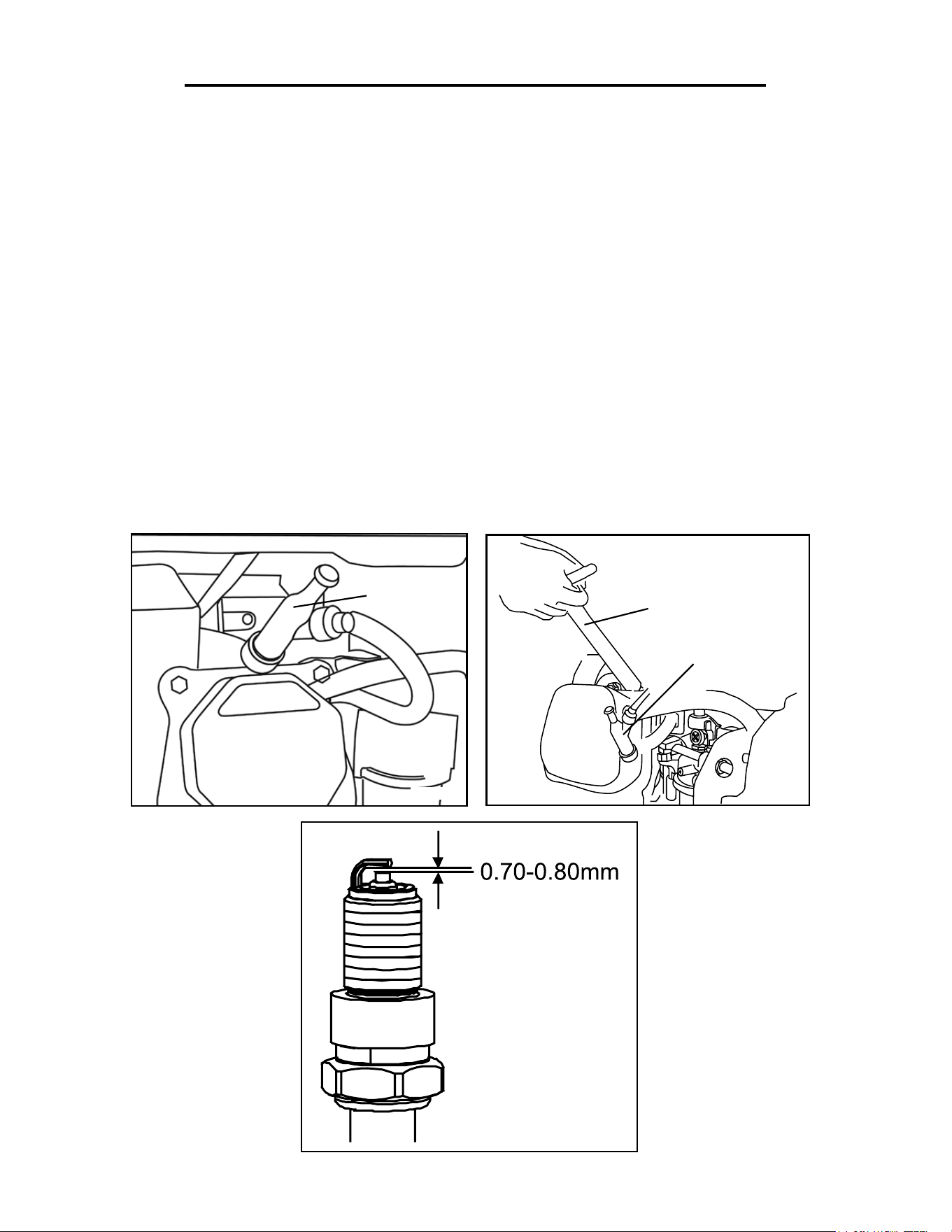
Fig. 12
FUEL FILTER CUP CLEANING
The fuel filter cup is a small well underneath the fuel valve. It helps to trap dirt and water that may be in the fuel
tank before it can enter the engine. To clean the fuel filter cup:
1. Turn the fuel valve to the “OFF” position (Fig. 13).
2. Unscrew the fuel filter cup from the fuel valve using a wrench. Turn the valve towards you and unscrew it.
3. Clean the cup of all sediments using a rag or brush.
4. Reinstall the fuel filter cup.
Cover
Bolt
AIR CLEANER MAINTENANCE
Routine maintenance of the air cleaner helps maintain
proper airflow to the carburetor. Occasionally check that
the air cleaner is free of excessive dirt. Refer to Recom-
mended Maintenance Schedule in Fig. 9. For air cleaner
detail, refer to Fig. 12.
1. Unscrew the cover bolt, then remove the air cleaner
cover.
2. Remove the air cleaner element from the casing (the
21
Fig. 13 - Fuel Valve
OFF
ON
sponge-like filter inside).
3. Check and clean the spongy filter. Replace with a new one if the element has
been damaged. Good filters can be washed in soapy water, dried and reused.
4. Wipe off excessive oil from the air cleaner case. Small amounts of oil in the ele-
ment is normal and necessary for the engine to work properly.
5. Reinstall the air cleaner element and cover.
CAUTION: running the engine with dirty, damaged or missing air cleaner element
will cause the engine to wear out prematurely.
MAINTENANCE
SPARK PLUG MAINTENANCE
Check the spark plug regularly for proper engine operation (refer to the Recommended Maintenance Schedule in
Fig. 9). A good spark plug should be intact, free of deposits, and properly gapped. To inspect the spark plug:
1. Pull on the spark plug cap to remove it. Be careful not to tear insulation or wire.
2. Unscrew the spark plug from the engine using the spark plug wrench provided. There is limited space for the
wrench to turn. Use both rows of holes in the spark plug wrench to gain leverage and loosen the plug.
3. Visually inspect the spark plug for cracks or excessive electrode wear. Replace as necessary.
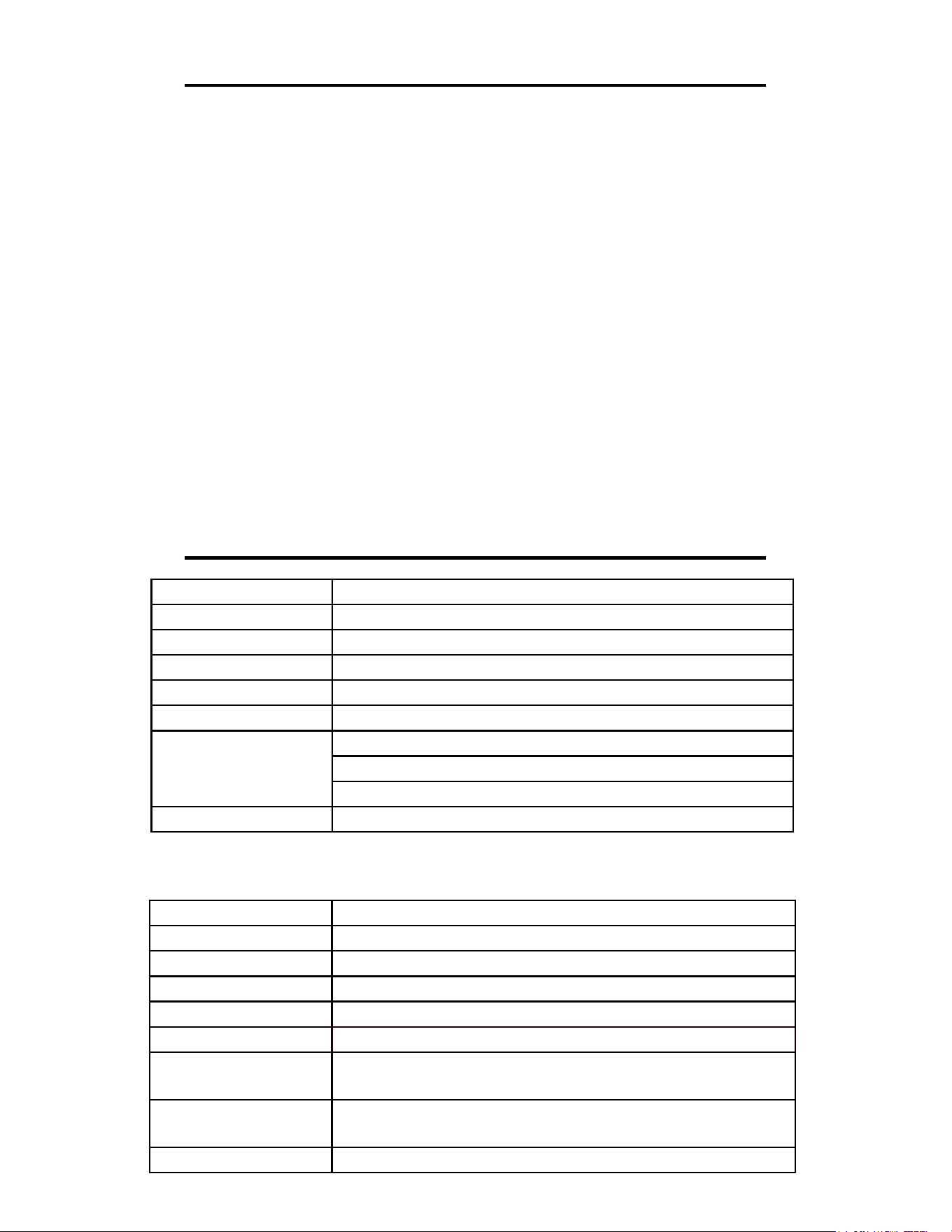
4. Measure the plug gap with a spark plug gap gauge. The gap should be 0.7 to 0.8 mm (0.028-0.031 in.) (Fig. 16).
5. If you are re-using the spark plug, use a wire brush to clean any dirt from around the spark plug base then re-
gap the spark plug.
6. Screw the spark plug back into the spark plug hole using the spark plug wrench. Do not over-tighten the spark
plug. Recommended tightening is ½ to ¾ of a turn after the spark plug gasket contacts spark plug hole. Reinstall
the spark plug cap.
Plug
Wrench
Spark Plug
Cap
Spark Plug
Cylinder
Assembly
Fig. 14
Fig. 15
Fig. 16
22

DRAINING THE FUEL TANK
Clean the fuel tank each year or before storing the generator for extended periods of time. To drain the fuel tank
and carburetor:
1. Turn the fuel valve to the “OFF” position.
2. Remove the fuel line between the fuel valve and carburetor.
CAUTION: A small amount of fuel may leak from the hose during removal.
3. Attach a fuel line (not included with the generator) to the exposed end of the fuel valve.
4. Position the fuel line into an appropriate container and open the fuel valve.
5. Once the fuel is drained, shut off the fuel valve.
6. Start and run the engine until the fuel runs out.
7. Remove the fuel filter cup (see Fuel Filter Cup Cleaning on page 21).
8. Empty the fuel filter cup of any fuel and clean.
9. Reinstall the fuel filter cup.
10. Store the emptied gasoline in a suitable place.
CAUTION: Do not store fuel for more than 3 months.
STORAGE & TRANSPORT
23
STORAGE & TRANSPORT
CAUTION: Never place any type of storage cover on the generator while it is still hot.
If the generator is being stored for short periods of time (30 to 60 days), add stabilized fuel to the fuel tank until
full. NOTE: Filling the tank reduces the amount of air in the tank and helps reduce deterioration of fuel. Run
the engine for 2 – 3 minutes allowing stabilized fuel mixture to circulate through the carburetor.
When storing the generator for extended periods of time:
• Drain the fuel tank (see Draining the Fuel Tank on page 23).
• Change oil.
• Do not obstruct any ventilation openings.
• Keep the generator in a cool dry area.
When transporting generator:
• Tighten fuel cap and vacuum relief valve. Drain the fuel tank if possible (see Draining the Fuel Tank on page
23).
• Keep the generator upright. Never place the generator side down. Doing so will make it difficult to start.
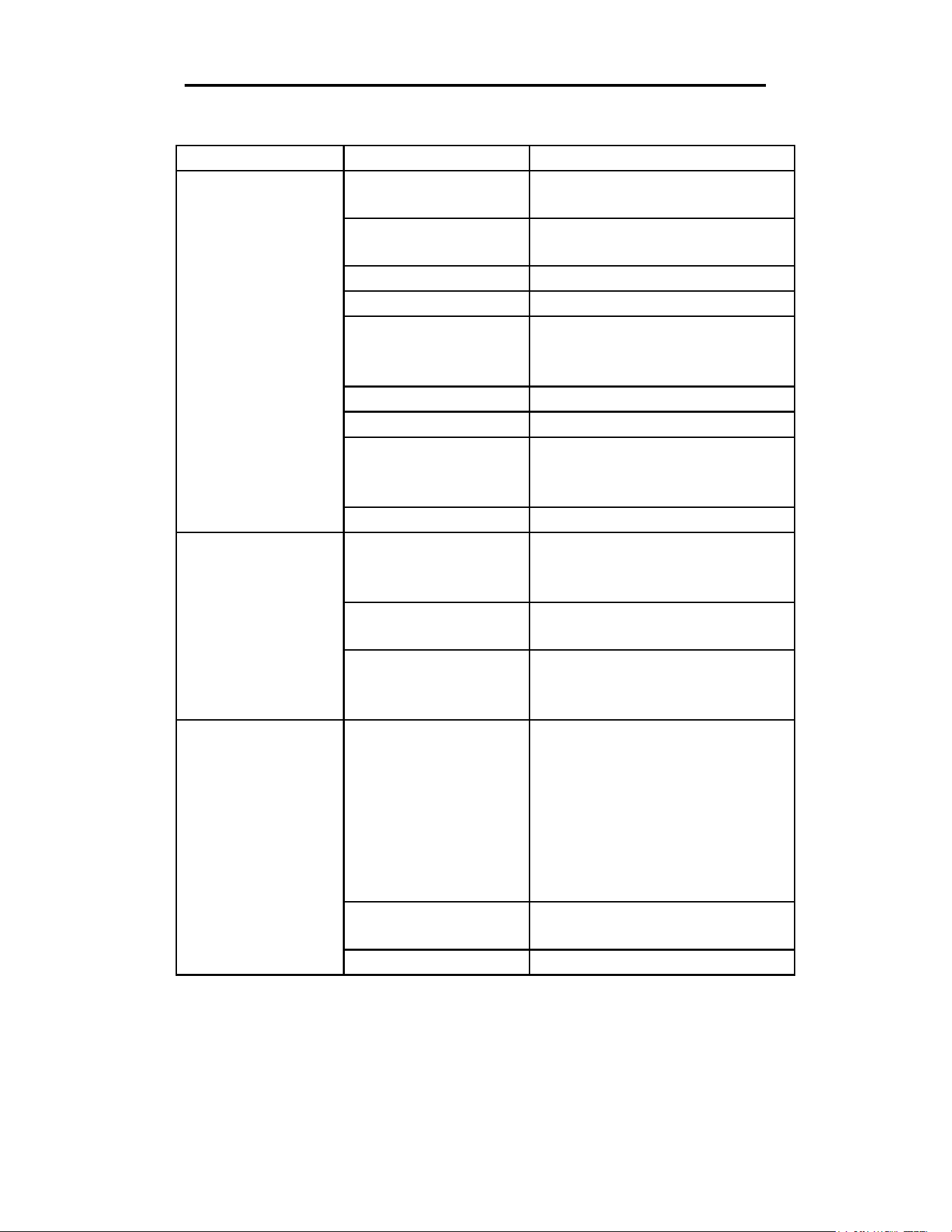
SPECIFICATIONS
Rated Wattage 3000 Watts
Surge Wattage 3500 Watts
Rated Voltage 240V/120V
Rated Amperage 12.5A/25A
Frequency 60 Hz
Phase Single
Dimensions
Length: 24.4 inches
Width: 17.7 inches
Height: 18.5 inches
Weight 111.2 lbs
Engine
Engine Type 4 stroke, OHV, single cylinder with forced air cooling system
Spark Plug Gap 0.7 - 0.8 mm (0.028 - 0.031 in)
Spark Plug Torque 1/2 - 3/4 turn after gasket contacts base or 15 ft. lb
Displacement 212 cc
Fuel Tank Capacity 4 gallons (15 L)
Oil Capacity 20 fl oz. (.6 L)
Run Time on 50%
Load
11 hours
Noise Rating
67 dB idle
74 dB fully loaded
Spark Plug NGK BP7ES
24
25
TROUBLESHOOTING
IMPORTANT: If trouble persists, please call our customer help line at (800) 232-1195 M-F 8-5 Central Time.
PROBLEM CAUSE SOLUTION
Engine will not start.
Engine switch is set to
“OFF.”
Set engine switch to “ON.”
Fuel valve is turned to
“OFF.”
Turn the fuel valve to the “ON”
position.
Choke is open. Close the choke.
Engine is out of fuel. Add gasoline.
Engine is filled with
contaminated or old
gasoline.
Change the gasoline in the gas
tank.
Spark plug is dirty. Clean spark plug.
Spark plug is broken. Replace spark plug.
Generator is not on a
level surface.
Move generator to a level surface
to prevent low oil shutdown from
triggering.
Oil is low. Add or replace oil.
Engine runs but
there is no electrical
output.
Circuit reset button is
off.
Wait for 2 minutes and push the
circuit reset button to the “ON”
position.
Bad connecting wires/
cables.
If you are using an extension
cord, try a different one.
Bad electrical device
connected to the gen-
erator.
Try connecting a different device.
Generator runs but
does not support
all electrical devices
connected.
Generator is over-
loaded.
Perform these steps:
1) Turn off all electrical devices
2) Unplug all electrical devices
3) Turn off generator
4) Wait several minutes
5) Restart generator
6) Try connecting fewer electrical
loads to the generator.
Short in one of the
connected devices.
Try disconnecting any faulty or
short-circuited electrical loads.
Air cleaner is dirty. Clean or replace air cleaner.
26
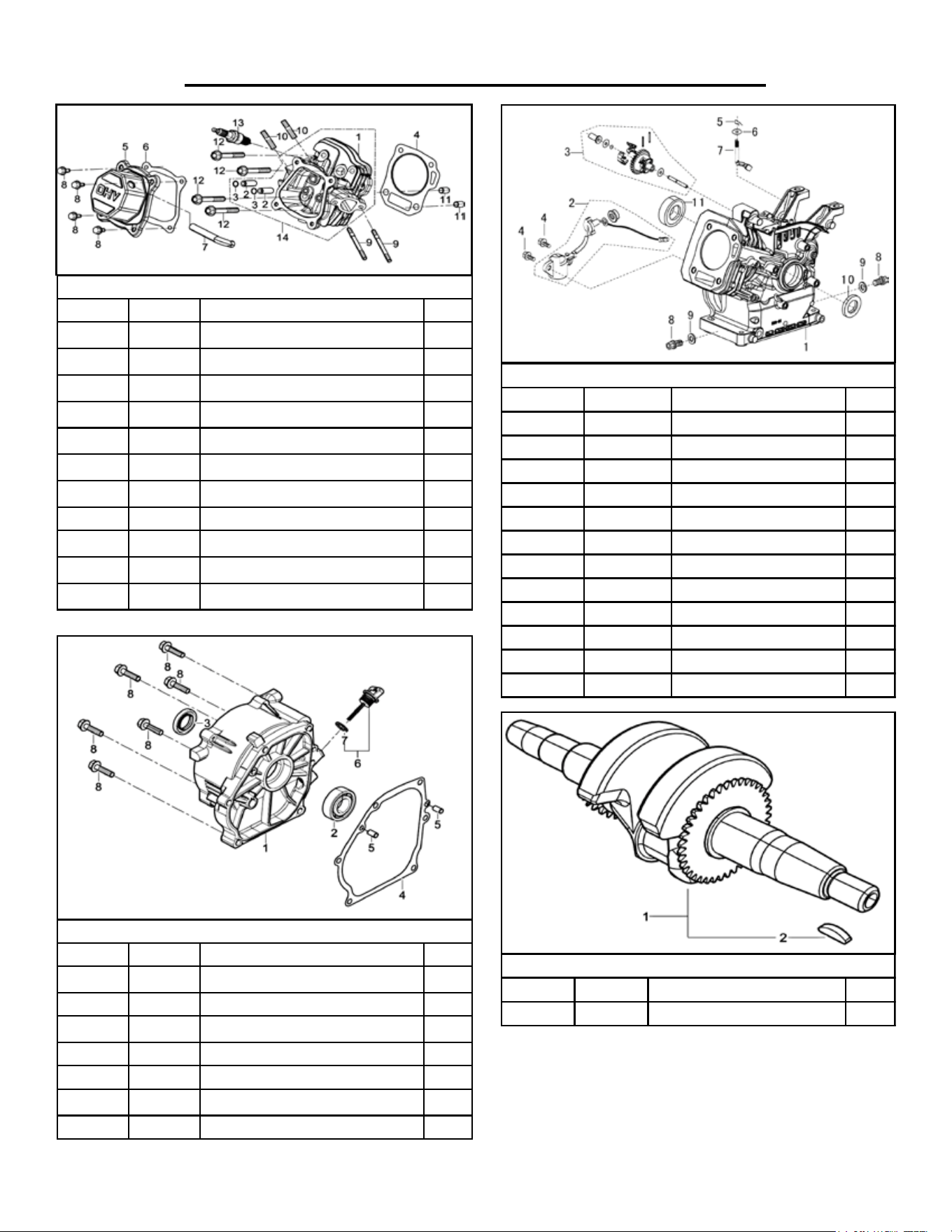
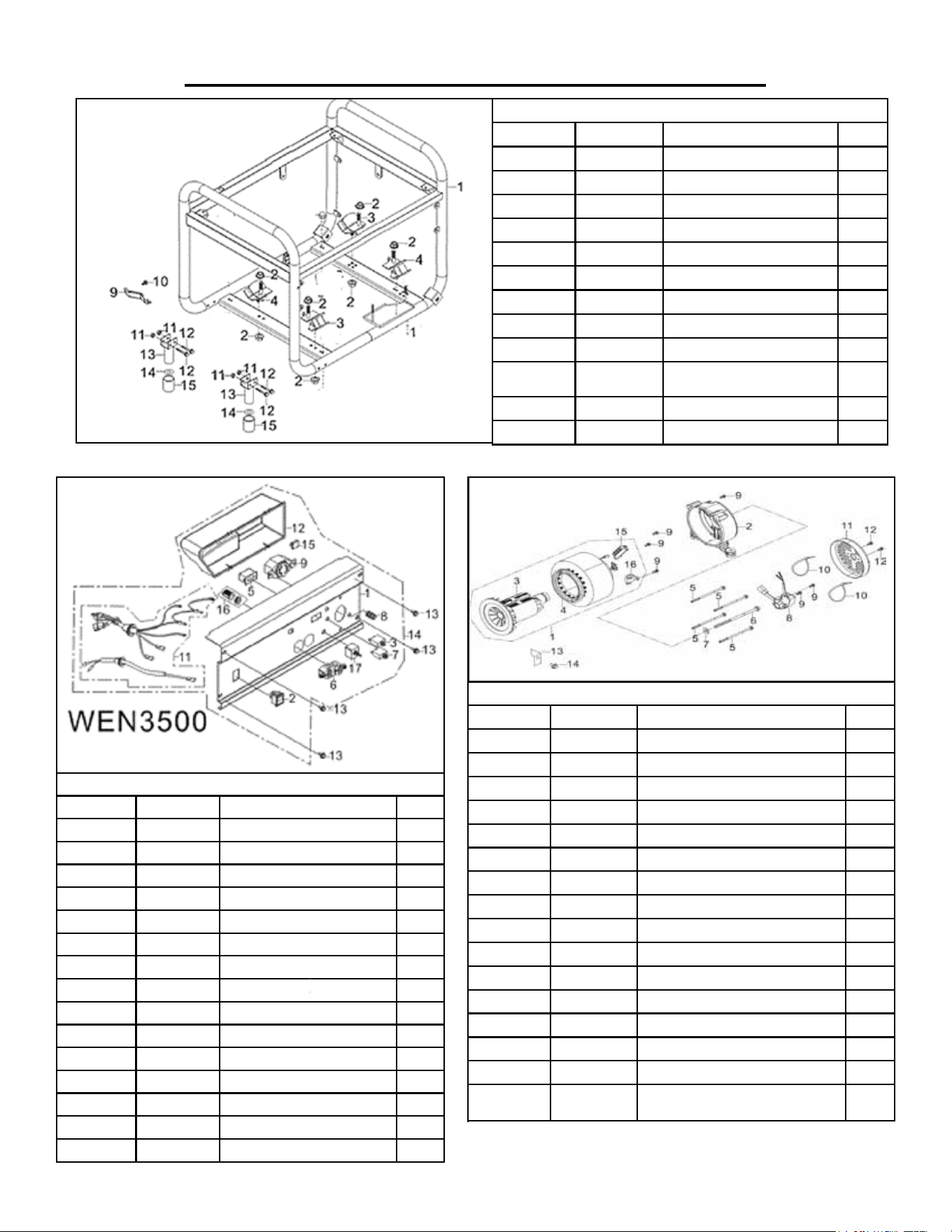
EXPLODED VIEW AND PARTS LIST
No. Part Description Qty.
Fig. 3-1 P54075 Crankcase Cover 1
Fig. 3-2 P54004 Bearing 1
Fig. 3-3 P54088 Oil Seal 1
Fig. 3-4 P54080 Crankcase Gasket 1
Fig. 3-5 P54082 Pin 2
Fig. 3-6 P54086 Oil Dipstick Assembly 1
Fig. 3-8 P54092 Bolt 6
Fig. 3 - Crankcase Cover Assembly
No. Part Description Qty.
Fig. 1-4 P54051 Cylinder Head Gasket 1
Fig. 1-5
P54066
Cylinder Head Cover Assembly 1
Fig. 1-6 P54064 Cylinder Head Cover Gasket 1
Fig. 1-7 P54043 Air Duct 1
Fig. 1-8 P54040 Bolt 4
Fig. 1-9 P54047 Stud 2
Fig. 1-10 P54058 Stud 2
Fig. 1-11 P54048 Pin 2
Fig. 1-12 P54062 Bolt 4
Fig. 1-13 P54060 Spark Plug 1
Fig. 1-14
P54054
Cylinder Head Assembly 1
Fig. 1 - Cylinder Head Assembly
No. Part Description Qty.
Fig. 4-1 P54123 Crankshaft Assembly 1
Fig. 4 - Crankshaft
No. Part Description Qty.
Fig. 2-1 P54011B Crankcase 1
Fig. 2-2 P54020 Oil Sensor 1
Fig. 2-3 P54031 Gear Assembly 1
Fig. 2-4 P54014 Governor Arm 2
Fig. 2-5 P54000 Oil Drain Plug 1
Fig. 2-6 P54002 Washer 1
Fig. 2-7 P54004 Bearing 1
Fig. 2-8 P54008 Oil Seal 2
Fig. 2-9 P54003 Nut 1
Fig. 2-10 P54016 Washer 2
Fig. 2-11 P54018 Pin 1
Fig 2-12 P54024 Bolt 1
Fig. 2 - Crankcase Assembly
27
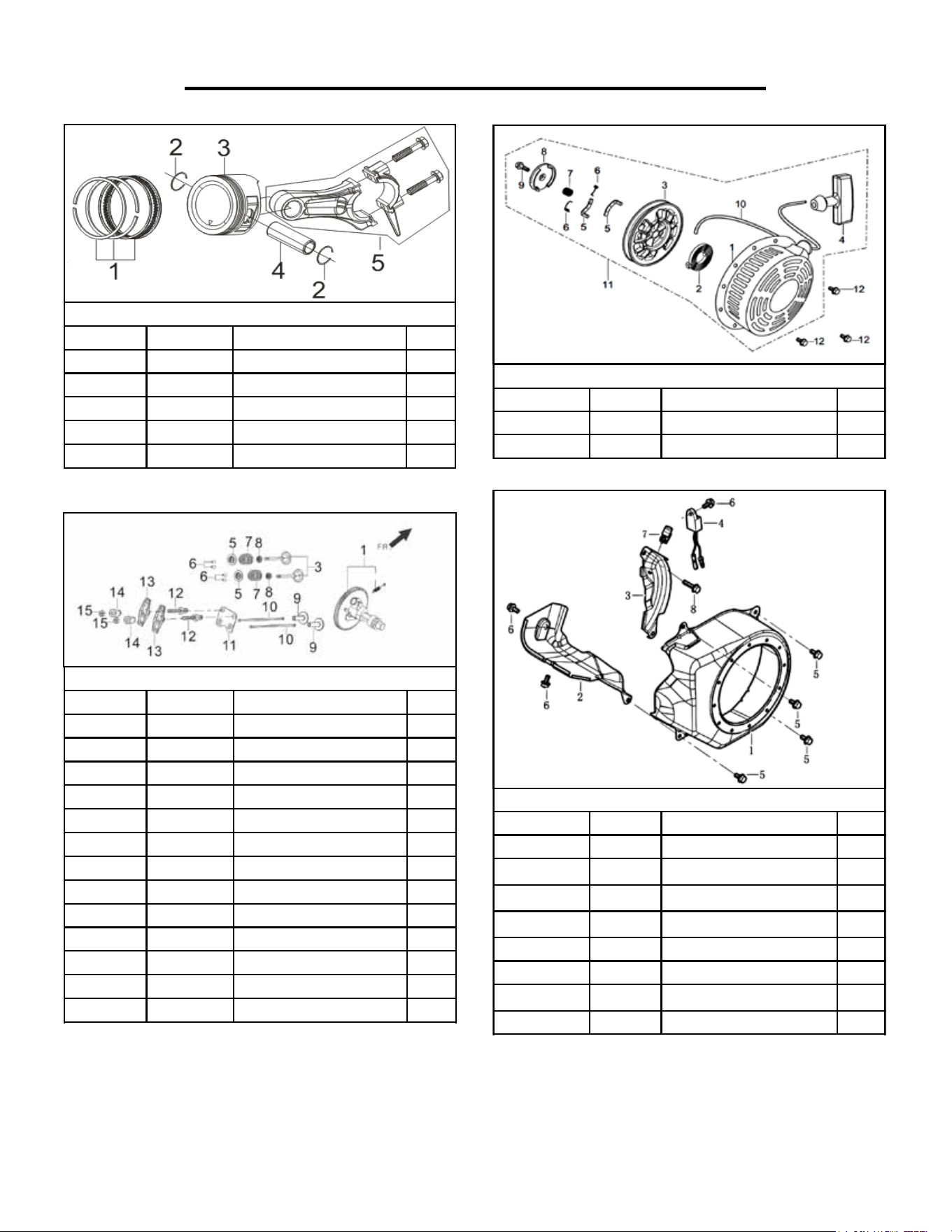
EXPLODED VIEW AND PARTS LIST
No. Part Description Qty.
Fig. 7-11 P54604 Recoil Starter Assembly 1
Fig. 7-12 P54598 Bolt 3
Fig. 7 - Recoil Starter
No. Part Description Qty.
Fig. 8-1 P54668 Fan Hood Assembly 1
Fig. 8-2 P54044 Wind Cover 1
Fig. 8-3 P54596 Lower Shield 1
Fig. 8-4 P54612 Diode 1
Fig. 8-5 P54040 Bolt 4
Fig. 8-6 P54040 Bolt 3
Fig. 8-7 P54596-1 Collar 1
Fig. 8-8 P54186 Bolt 1
Fig. 8 - Shroud
No. Part Description Qty.
Fig. 5-1 P54105 Piston Ring Assembly 1
Fig. 5-2 P54106 Piston Pin Clip 2
Fig. 5-3 P54109 Piston 1
Fig. 5-4 P54112 Piston Pin 1
Fig. 5-5
P54121
Connecting Rod 1
Fig. 5 - Piston Ring/Connecting Rod
No. Part Description Qty.
Fig. 6-1
P54146
Camshaft Assembly 1
Fig. 6-3 P54150 Valve 1
Fig. 6-5 P54158 Valve Spring Seat 1
Fig. 6-6 P54160 Valve Lock 1
Fig. 6-7 P54154 Valve Spring 1
Fig. 6-8 P54161 Guide Seal 1
Fig. 6-9 P54142 Tappet 2
Fig. 6-10 P54140 Lifter 2
Fig. 6-11 P54138 Push Guide 1
Fig. 6-12 P54134 Valve Adjusting Bolt 2
Fig. 6-13 P54132 Valve Rocker 2
Fig. 6-14 P54130 Sleeve 2
Fig. 6-15 P54128 Lock Nut 2
Fig. 6 - Valve/Camshaft Assembly
28
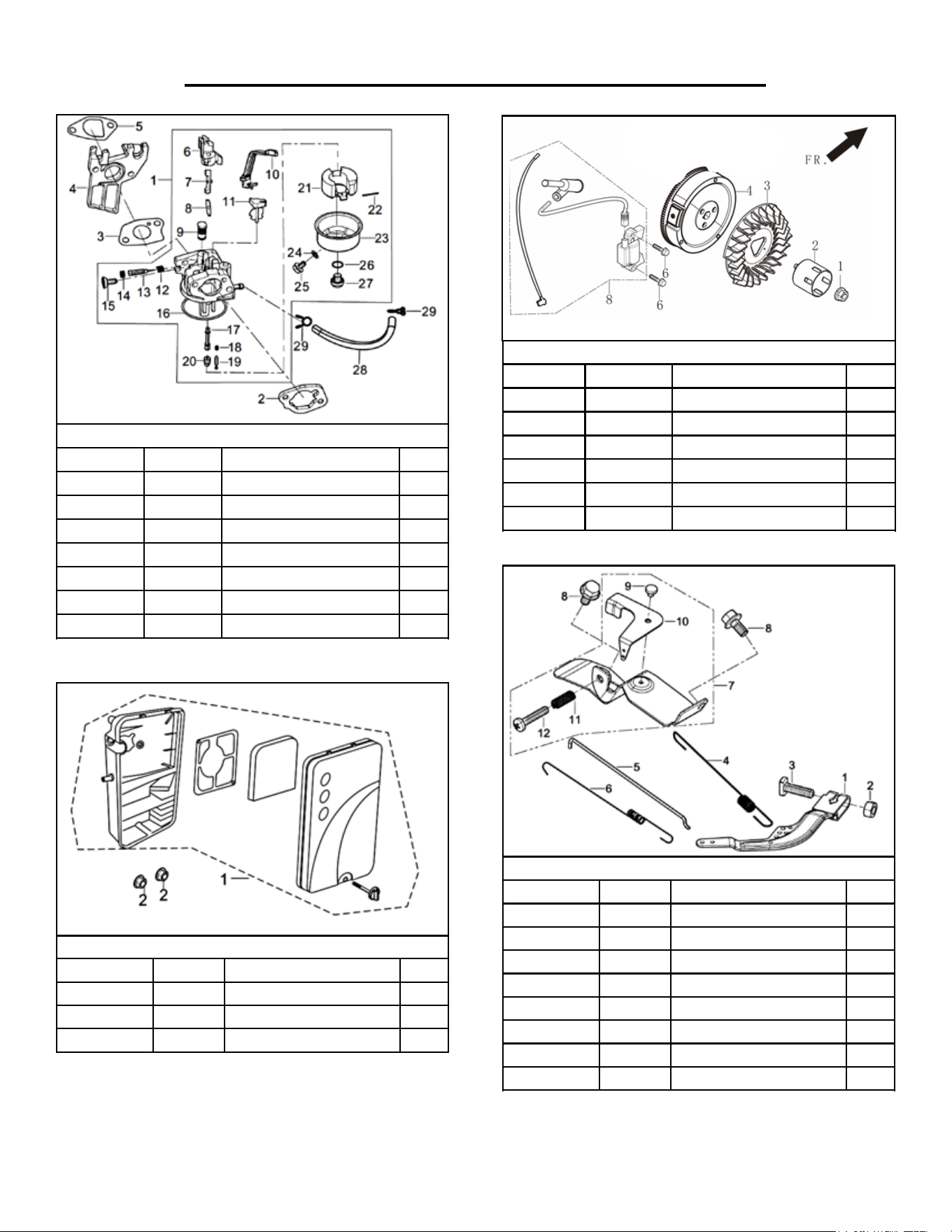
EXPLODED VIEW AND PARTS LIST
No. Part Description Qty.
Fig. 10-1 P54178 Air Cleaner Assembly 1
P54178-1 Air Cleaner Element 1
Fig. 10-2 P54179 Nut 2
Fig. 10 - Air Cleaner
No. Part Description Qty.
Fig. 12-1 P54624 Regulating Arm 1
Fig. 12-2 P54176 Nut M6 1
Fig. 12-3 P54622 Lock Bolt 1
Fig. 12-4 P54616 Back Spring 1
Fig. 12-5 P54620 Pulling Rod 1
Fig. 12-6 P54618 Regulating Spring 1
Fig. 12-7 P54617 Regulating Assembly 1
Fig. 12-8 P54619 Bolt 2
Fig. 12 - Control Assembly
No. Part Description Qty.
Fig. 9-1 P54718 Carburetor Assembly 1
Fig. 9-2 P54168 Air Cleaner Gasket 1
Fig. 9-3 P54166 Carburetor Gasket 1
Fig. 9-4 P54164 Carburetor Insulator Plate 1
Fig. 9-5 P54162
Carburetor Insulator Gasket
1
Fig. 9-28 P54388 Fuel Tube 1
Fig. 9-29 P54390 Collar 2
Fig. 9 - Carburetor Assembly
No. Part Description Qty.
Fig. 11-1 P54630 Nut M14 X 1.5 1
Fig. 11-2 P54362 Starting Flange 1
Fig. 11-3 P54634 Flywheel Fan 1
Fig. 11-4 P54636 Flywheel 1
Fig. 11-6 P54628 Bolt 2
Fig. 11-8 P54638 Ignition Coil 1
Fig. 11 - Flywheel/Ignition Coil
29
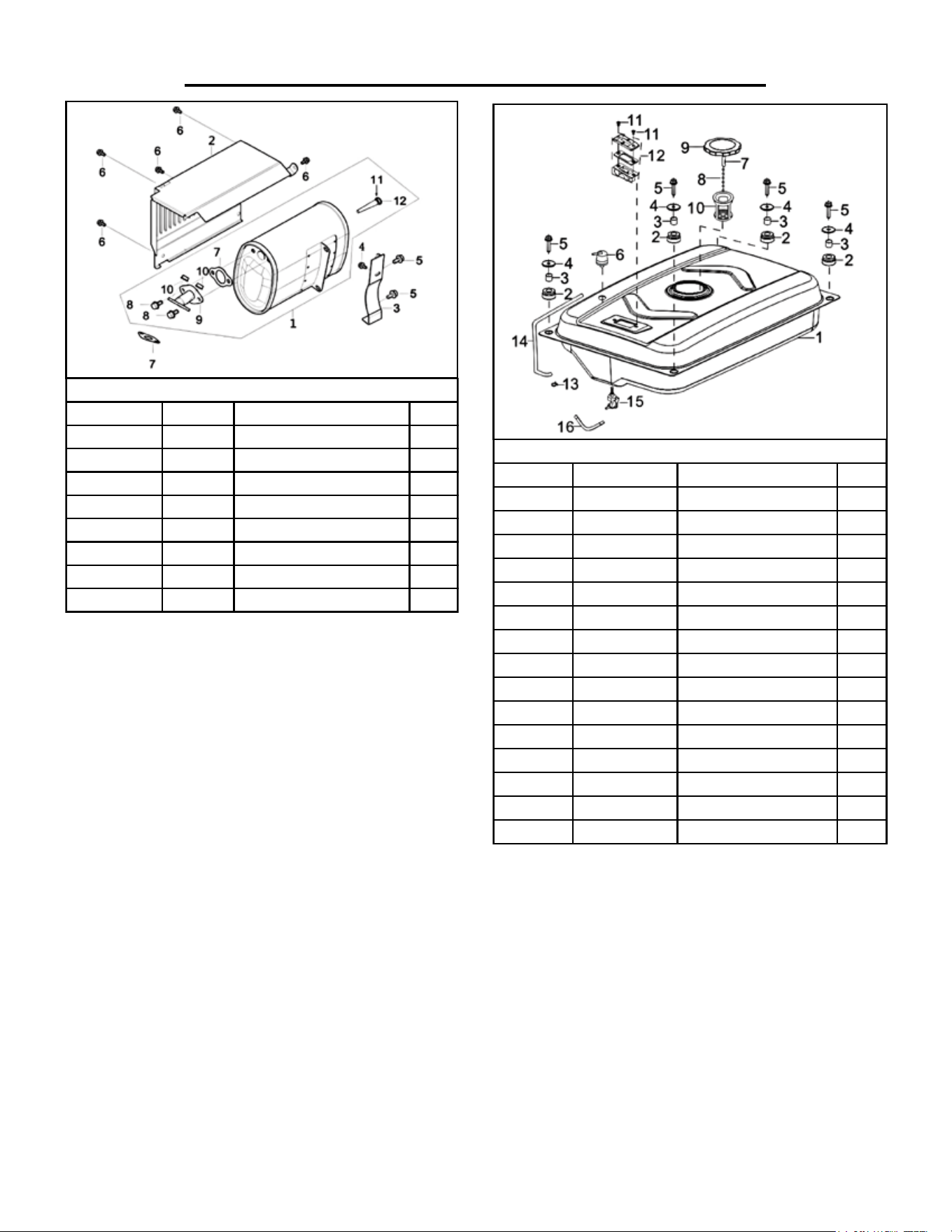
EXPLODED VIEW AND PARTS LIST
No. Part Description Qty.
Fig. 13-1 P54401
Muffler Assembly
1
Fig. 13-2 P54402
Cover, Outer Muffler
1
Fig. 13-3
P54412 Bracket, Muffler
1
Fig. 13-4
P54422 Bolt
1
Fig. 13-5
P54404 Bolt
2
Fig. 13-6
P54422 Bolt
5
Fig. 13-7 P54426
Gasket, Exhaust Outlet
1
Fig. 13-10
P54246 Nut
2
Fig. 13 - Muffler Assembly
No. Part Description Qty.
F14-1
P54371 Fuel Tank 1
F14-2
P54386
Cushion
4
F14-3
P54396
Fitting Bush
4
F14-4
P54384 Washer 4
F14-5
P54186 Bolt 4
F14-6
P54375-2 Valve 1
F14-7
P54373-1 Clip 1
F14-8
P54373 Chain 1
F14-9
P54365 Fuel Cap 1
F14-10
P54372 Fuel Filter 1
F14-11, 12
P54374 Fuel Gauge Assembly 2
F14-13
P54375-9 Clamp 1
F14-14
P54375-7 Rubber Hose 1
F14-15
P54392 Fuel Cock 1
F14-16
P54388 Fuel Tube 1
Fig. 14 - Tank, Fuel
30
EXPLODED VIEW AND PARTS LIST
No. Part Description Qty.
Fig. 15-1
P54237 Frame Comp 1
Fig. 15-2
P54246 Nut M8 2
Fig. 15-3
P54242 Bottom Rubber A 2
Fig. 15-4
P54244 Bottom Rubber B 8
Fig. 15-5
P54246 Nut M8
Fig. 15-9
56475-1720 Air Cleaner Mount 1
Fig. 15-10
56475-1711 Bolt 1
Fig. 15-11
56475-1712 Nut 4
Fig. 15-12
56475-1711 Bolt 2
Fig. 15-13
56475-1706
Front Rubber Foot
Assembly
2
Fig. 15-14
56475-1710 Washer 2
Fig. 15-15
P54871-3 Sleeve 2
Fig. 15 - Frame, Engine
No. Part Description Qty.
Fig. 16-1 P54283 Control Panel 1
Fig. 16-2 P54296 Ignition Switch 1
Fig. 16-3 56352-1603 Circuit Breaker 1
Fig. 16-5 P54826 Voltage Selector Switch 1
Fig. 16-6 P54454 120V Duplex Receptacle 1
Fig. 16-7 P54262 Grounding Terminal 1
Fig. 16-8 P54838 Circuit Breaker 2
Fig. 16-9 P54272 120/240V Receptacle 1
Fig. 16-11 56352-1611 Wiring Harness 1
Fig. 16-12 56352-1612 Rear Panel 1
Fig. 16-13 P54304 Bolt 4
Fig. 16-14 56352-1614 Control Panel Assembly
1
Fig. 16-15 P54451 Rectifier
1
Fig. 16-16 P54878 12V Socket
1
Fig. 16-17 P54826 Transfer Switch
1
Fig. 16 - Panel Subassembly, Control
No. Part Description Qty.
Fig. 17-1 P54325 Rotor Assembly 1
Fig. 17-2 P54336 Rotor Bracket 1
Fig. 17-3 P54330 Rotor 1
Fig. 17-4 P54329 Stator 1
Fig. 17-5 P54350 Bolt 4
Fig. 17-6 P54354 Rotor Bolt 1
Fig. 17-7 P54348 Washer 1
Fig. 17-8 P54342 Voltage Regulator 1
Fig. 17-9 P54360 Bolt 2
Fig. 17-10 56475-1910 Cable Tie 2
Fig. 17-11 P54337 End Cover 1
Fig. 17-12 P54340 Bolt 1
Fig. 17-13 56475-1913 Stopper 2
Fig. 17-14 P54340 Bolt 1
Fig. 17-15 56475-1915 Terminal 1
Fig. 17-16 P54332
Carbon Brush
Subassembly
1
Fig. 17 - Rotor/Stator
31
EXPLODED VIEW AND PARTS LIST
No. Part Description Qty.
Fig. 19-1 P54876-1 Rubber Seat
2
Fig. 19-2 P54876-2 Bolt
2
Fig. 19-3 P54876-3 Nut
2
Fig. 19-4 P54876-3 Steel Handle
2
Fig. 19-5 P54876-5 Rubber Handle Sleeves
2
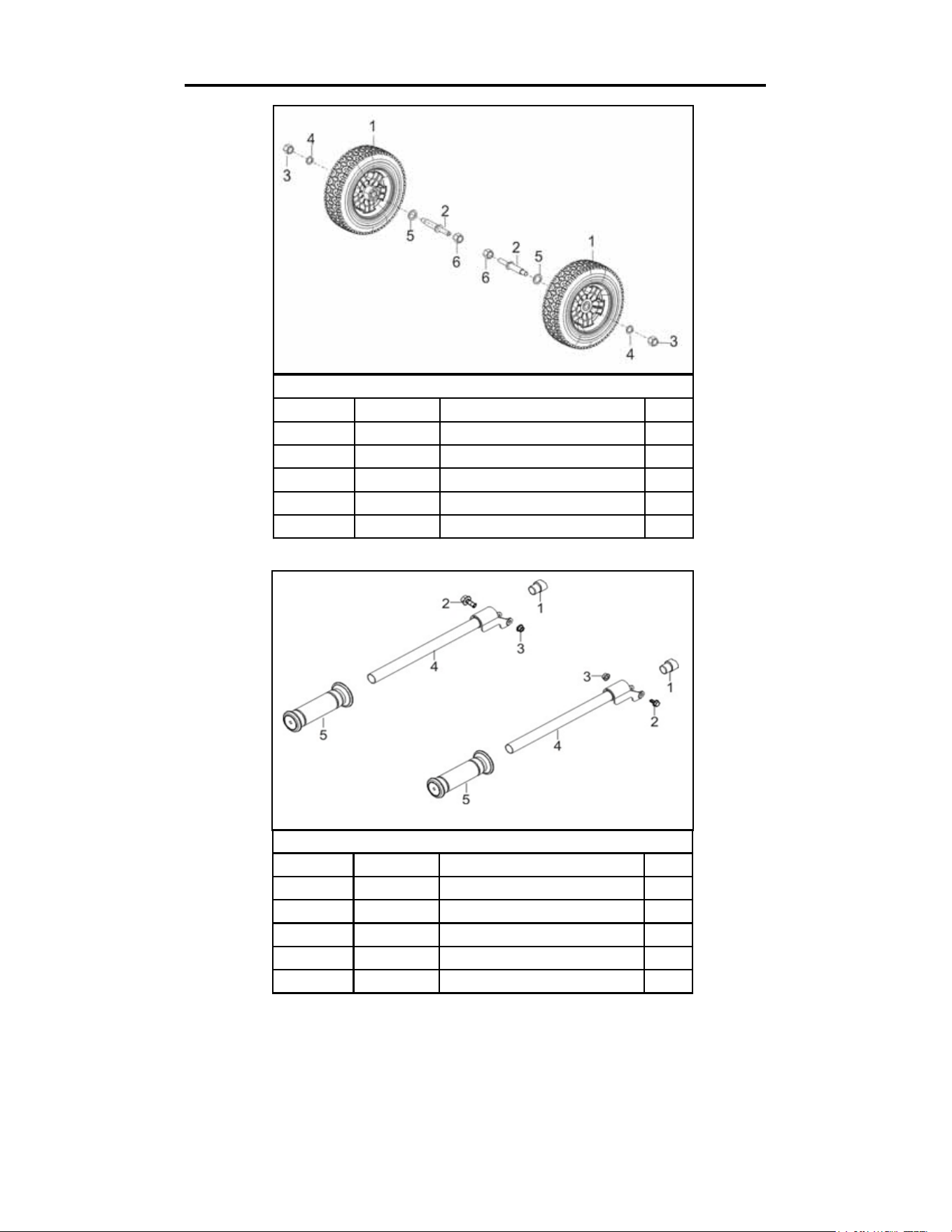
Fig. 19 - Handles
No. Part Description Qty.
Fig. 18-1
P54872-1 Wheel
2
Fig. 18-2
P54879 Wheel Shaft
2
Fig. 18-3
P54872-5 Nut
2
Fig. 18-4
P54872-3 Washer
2
Fig. 18-5
56400-1805 Washer
2
Fig. 18 - Wheel Kit Assembly
32
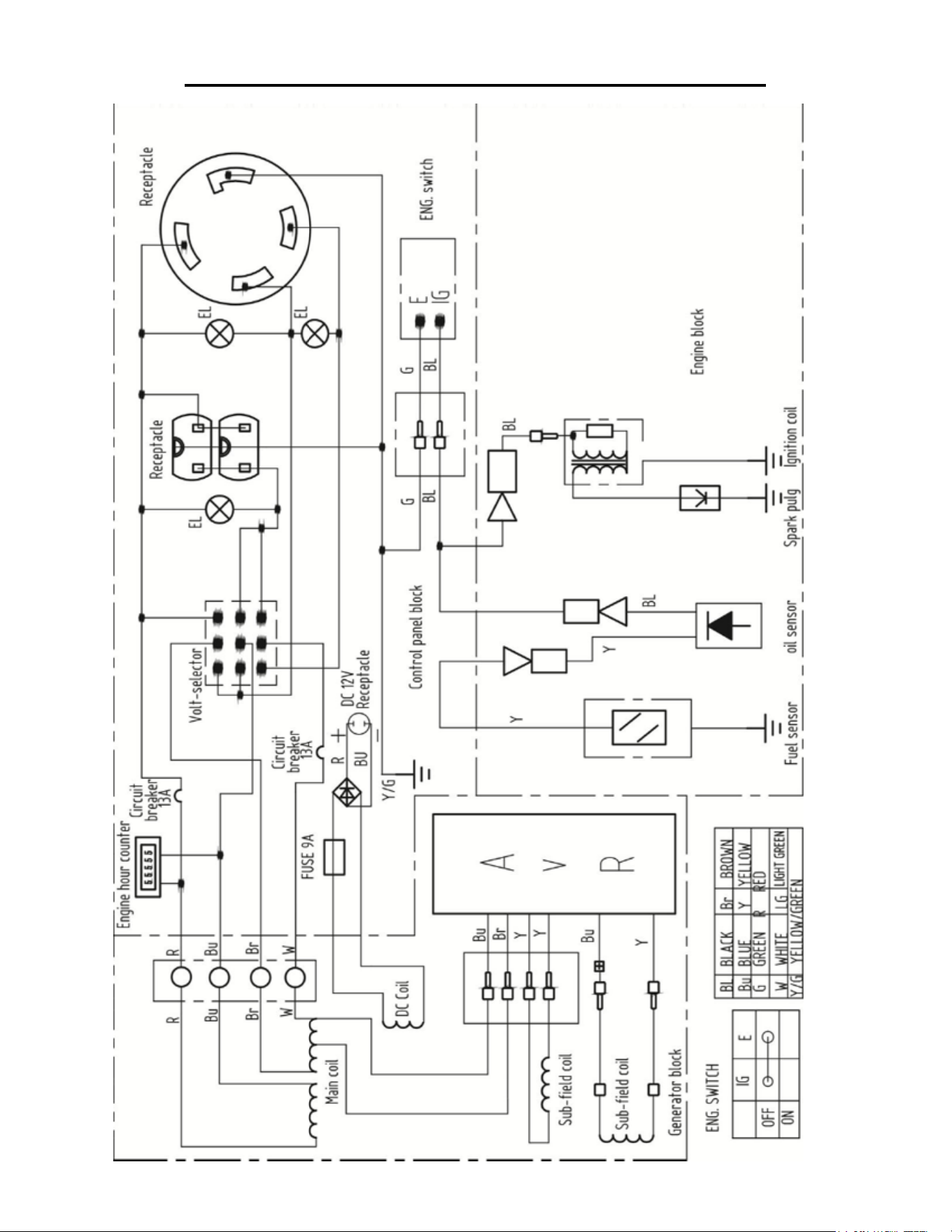
WIRING DIAGRAM

33
WARRANTY STATEMENT
Remember to save the receipt and to accurately fill out and mail the product registration card. Proof of purchase
is required for all warranty work.
WEN® Generators are under warranty to be free from defects in materials and workmanship for a period of two
(2) years from date of original purchase. Generators used for Commercial or Rental use have a warranty period of
90 days from date of original purchase. Keep purchase receipt and mail in the product registration card for proof
of purchase.
WEN® will repair or replace, at its discretion, any part that is proven to be defective in materials or workman-
ship under normal use during the two (2) years warranty period. Warranty repairs or replacements will be made
without charge for parts or labor. Parts replaced during warranty repairs will be considered as part of the original
product and will have the same warranty period as the original product.
To exercise the warranty, DO NOT RETURN TO RETAILER. Instead, call the toll free Customer Service
number at (800) 232-1195 and you will be instructed on where to take the generator for warranty service. Take
the generator and proof of purchase (the receipt) to the repair facility recommended by the Customer Service
Representative. To make a claim under this Limited Warranty, you must make sure to keep a copy of your proof
of purchase that clearly defines the Date of Purchase (month and year) and the Place of Purchase. Place of pur-
chase must be a direct vendor of Great Lakes Technologies, LLC. Third party vendors such as garage sales, pawn
shops, resale shops, or any other secondhand merchant void the warranty included with this product. Contact
[email protected] or 1-800-232-1195 to make arrangements for repairs and transportation.
When returning a product for warranty service, the shipping charges must be prepaid by the purchaser. The prod-
uct must be shipped in its original container (or an equivalent), properly packed to withstand the hazards of ship-
ment. The product must be fully insured with a copy of the warranty card and/or the proof of purchase enclosed.
There must also be a description of the problem in order to help our repairs department diagnose and fix the
issue. Repairs will be made and the product will be returned and shipped back to the purchaser at no charge.
THIS LIMITED WARRANTY DOES NOT APPLY TO ACCESSORY ITEMS THAT WEAR OUT FROM
REGULAR USAGE OVER TIME INCLUDING BELTS, BRUSHES, BLADES, ETC.
The warranty does not extend to generators damaged or affected by fuel contamination, accidents, neglect, mis-
use, unauthorized alterations, use in an application for which the product was not designed and any other modifi-
cations or abuse.
WEN® is not liable for any indirect, incidental or consequential damages from the sale or use of this product.
Any implied warranties are limited to two (2) years as stated in this written limited warranty. Some states do not al-
low the exclusion or limitation of incidental or consequential damages. Some states do not allow limitation on the
length of an implied warranty. This warranty gives you specific legal rights, and you may have other rights that vary
from state to state.

THANKS FOR
REMEMBERING