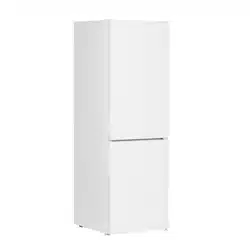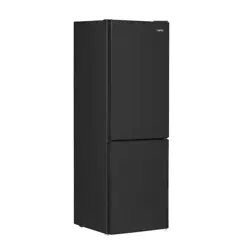
Baridi 47cm 70/30 Fridge Freezer, 157L Capacity Low Frost
White-DH252/Black - DH253
Thank you for purchasing a Dellonda product. Manufactured to a high standard, this product will,
if used according to these instructions, and properly maintained, give you years of trouble free performance.
DH252, DH253 Issue:4 29/11/24
www.dellonda.co.uk
Models: DH252, DH253
Important Information
Please read these instructions carefully. Note the safe operational requirements, warnings & cautions. Use the product correctly and with care
for the purpose for which it is intended. Failure to do so may cause damage and/or personal injury and will invalidate the warranty. Keep these
instructions safe for future use.
SAFETY
ELECTRICAL SAFETY
WARNING! It is the user’s responsibility to check the following:
Check all electrical equipment and appliances to ensure that they are safe before using. Inspect power supply leads, plugs and all electrical
connections for wear and damage. Dellonda recommend that an RCD (Residual Current Device) is used with all electrical products.
Electrical safety information: It is important that the following information is read and understood.
Ensure that the insulation on all cables and on the appliance is safe before connecting it to the power supply.
Regularly inspect power supply cables and plugs for wear or damage and check all connections to ensure that they are secure.
Important: Ensure that the voltage rating on the appliance suits the power supply to be used and that the plug is tted with the correct fuse - see
fuse rating in these instructions.
DO NOT pull or carry the appliance by the power cable.
DO NOT pull the plug from the socket by the cable.
DO NOT use worn or damaged cables, plugs or connectors.
DO NOT use with an extension cord.
Ensure that any faulty item is repaired or replaced immediately by a qualied electrician.
If the cable or plug is damaged during use, switch off the electricity supply and remove from use.
Ensure that repairs are carried out by a qualied electrician.
This product is not designed to be used with an inverter.
GENERAL SAFETY
WARNING! When positioning the appliance, ensure the supply cord is not trapped or damaged. If the supply cord is damaged, it must be replaced
by the manufacturer, its service agent or similarly qualied persons in order to avoid a hazard.
Keep ventilation openings, in the appliance enclosure or in the built-in structure, clear of obstruction.
DO NOT use mechanical devices or other means to accelerate the defrosting process, other than those recommended by the manufacturer.
DO NOT damage the refrigerant circuit.
DO NOT use electrical appliances inside the storage compartment of the appliance i.e. hair dryers, heater elements etc.
DO NOT store explosive substances such as aerosol cans with a ammable propellant in this appliance.
DO NOT remove items from the fridge freezer compartment if your hands are damp/wet, as this could cause skin abrasions or Frost/Fridge
freezer burns.
WARNING! DO NOT locate multiple portable socket-outlets or portable power supplies at the rear of the appliance.
To avoid a hazard due to instability of the appliance, it must be xed in accordance with the instructions.
This appliance is intended to be used in household and similar applications such as:
Staff kitchen areas in shops, ofces and other working environments;
Farm houses and by clients in hotels, motels and other residential type environments;
Bed and breakfast type environments;
Catering and similar non-retail applications.
Children from age 8 years and above, persons with reduced physical, sensory, or mental capabilities those with lack of experience and
knowledge can use the appliance, if they have been given supervision or instruction concerning use of the appliance in a safe way to understand
the hazards involved.
Children shall NOT play with the appliance.
Children aged from 3 to 8 years are allowed to load and unload refrigerating appliances.
To avoid contamination of foodstuffs, please respect the following instructions:
Opening the door for long periods can cause a signicant increase of the temperature in the compartment of the appliance.
Clean regularly surfaces that can come in contact with drink and accessible drainage systems.
If the appliance is left empty for long periods, switch off, defrost, clean, dry, and leave the lid ajar to prevent mould developing within the
appliance.
This refrigerant appliance is intended to be used at ambient temperatures ranging from 16°C to 38°C.
This refrigeration appliance is not intended to be used as a built-in appliance.
WARNING!
DISPOSAL
Refrigerant and cyclopentane foaming material used for the refrigerator are ammable. Therefore, when the fridge freezer is scrapped, it shall
be kept away from any re source and be recovered by a recovering company with corresponding qualications, this will prevent damage to
the environment or any other harm. When the refrigerator is scrapped, disassemble the doors, and remove door gasket's and shelves; so as to
prevent trapping children inside the fridge freezer.
Refer to
instructions
Indoor use
only
Warning:
ammable
material
SPECIFICATION
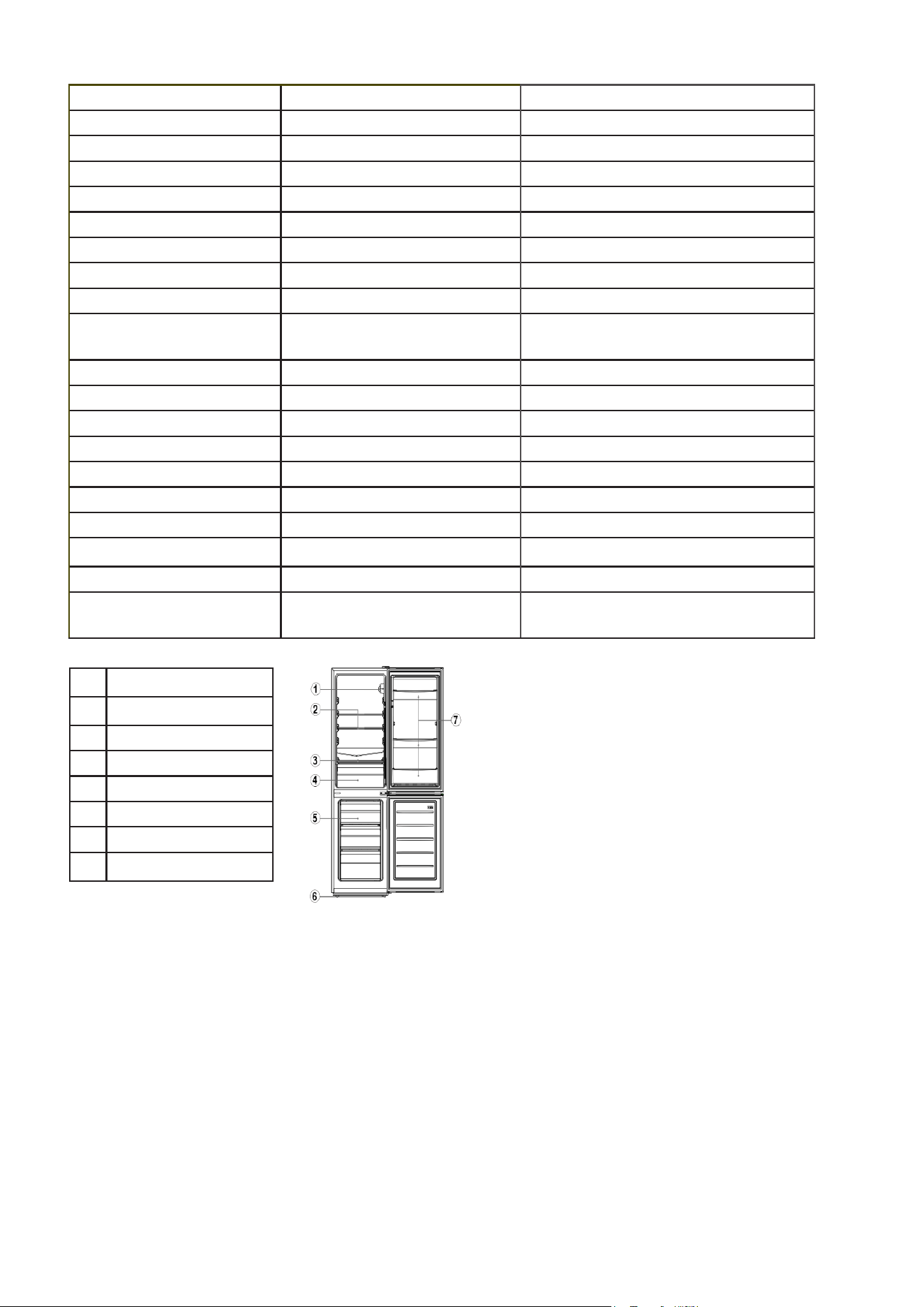
PRODUCT FEATURES
No Description
1 Thermostat
2 Fridge glass shelf
3 Tray cover
4 Fruit and veg tray
5 Freezer draws
6 Levelling feet
7 Bottle racks
MODEL NO: DH252 DH253
Capacity 157L (109L Fridge, 48L Freezer) 157L (109L Fridge, 48L Freezer)
Climate Class N/ST N/ST
Colour White Black
Defrost Method Manual Manual
Door type Reversible Reversible
Energy Efciency Class E E
Foaming Gas Cyclopentane Cyclopentane
Fuse Rating 13A 13A
Internal Dimensions (W x D x H) Fridge (W x D x H): 405 x 379 x 708mm
Freezer (W x D x H): 359 x 360 x 505mm
Fridge (W x D x H): 405 x 379 x 708mm
Freezer (W x D x H): 359 x 360 x 505mm
Number of Shelves 3 Shelves (Fridge), 3 Drawers (Freezer) 3 Shelves (Fridge), 3 Drawers (Freezer)
Nett Weight 34kg 34kg
Operating Sound Level: 39dB 39dB
Plug Type 3-Pin BS 3-Pin BS
Power Cable Length 1.8m 1.8m
Rated current 0.5A 0.5A
Refrigerant R600a (41g) R600a (41g)
Star Rating
4 4
Supply
220-240V~50Hz 220V-240V~50Hz
Temperature Range
Fridge: -3 - 10°C
Freezer: -10 - -24°C
Fridge: -3 - 10°C
Freezer: -10 - -24°C
PREPARATION
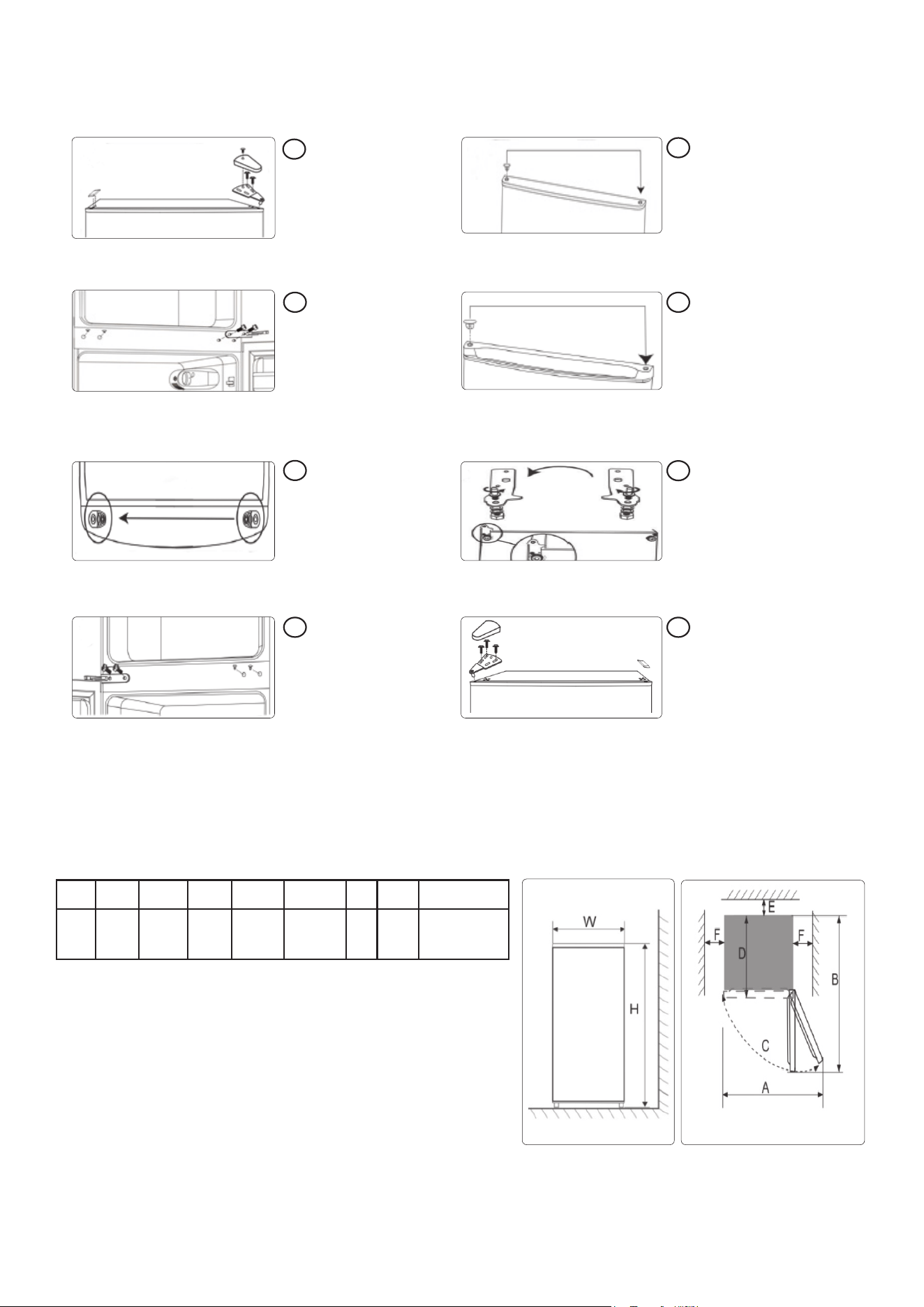
DOOR REVERSAL INSTRUCTIONS
1. Remove the hinge cover and upper hinge from the top right 2. Remove the door from the cabinet. Move the hinge plug from side
of the cabinet. Remove the screw hole cover from the the top left to the top right side of the door the top left to the top right
top left side of the cabinet. side of the door.
3. Remove the centre hinge from the right side cabinet. 4. Remove the door from the cabinet. Move the hinge plug from the top left
Remove the screw hole covers from the left side of the to the top right side of the door.
cabinet.
5. Remove the door stop from the lower right side of the 6. Remove the lower hinge from the bottom right side of the cabinet. Remove
door, and install the door stop on the lower left side of both adjustable feet. Remove the lower hinge pin from the hinge, ip the
the door. hinge over and reinstall the hinge pin on the other side. Install the lower
hinge on the bottom left side of the cabinet. Install both adjustable feet.
7. Install the fridge freezer door. Install the centre hinge on 8. Install the refrigerator door. Install the upper hinge and the hinge cover on
the left side of the cabinet. Install the screw hole the top left side of the cabinet. Install the screw hole cover on the top
covers on the right side of the cabinet. right side of the cabinet.
INSTALLATION LOCATION
VENTILATION CONDITIONS
1. The position you select for the fridge freezer installation should be well-ventilated and has less hot air. Do not locate the fridge freezer near
a heat source such as cooker, and avoid it from direct sunlight, thus guaranteeing the refrigeration effect while saving energy consumption. DO
NOT locate the fridge freezer in the damp place, so as to prevent the fridge freezer from rusting. The quantity of the refrigerant gas of the fridge
freezer being divided by the total space of the room in which the fridge freezer is installed should be less than 8g/m³.
Note: The amount of refrigerant gas for the fridge freezer can be found on the serial plate.
2.Please allow at least 30mm of free space for the top of the unit, at least 100mm for both sides of the unit and at least 50mm for the rear of the
unit.
NOTE: Figure 1, Figure 2 only illustrate the space demand of the product.3.
LEVEL GROUND
Place the fridge freezer on the solid and at ground (oor) to keep it stable, or
else, it will vibrate and be noisy. When the fridge freezer is placed on materials
such as carpet, straw mat, polyvinyl chloride, solid backing plates should be tted
underneath the unit to prevent damage to the ooring.
NOTE: Unobstructed ventilation shall be maintained around the appliance or in an
embedded structure.
PREPARATIONS FOR USE
Standing time
1. After the fridge freezer is properly installed and well cleaned, do not switch it on immediately. Leave the fridge freezer to stand for more than
4 hours to allow gases to settle, thus ensuring its normal operation.
2.Cleaning
Wipe the inside of the fridge freezer with a soft cloth.
1
2
43
5
6
7 8
W D H A B C (°) E F
474 495 1440 792 923 130+-5 50 100 DH252
DH253
3.Power-on
Insert the plug into the mains socket to start the compressor. After 1 hour, open the fridge freezer door, if the temperature inside the fridge
freezer compartment drops, it indicates the refrigeration system is working normally.
4.Storage of food
After the fridge freezer runs for a period of time, the internal temperature of the fridge freezer will be automatically controlled according to the
user’s temperature setting. After the fridge freezer is fully cooled, put in your food, which usually needs 2~3 hours to be fully cooled. In summer,
when the temperature is high, it takes more than 4 hours for the foods to be fully cooled (keep the opening of the fridge freezer door to a
minimum to avoid internal temperature drop).
NOTE: If the fridge freezer is installed in a place with moisture, make sure to check the circuit breaker operation. If vibration and noises are
produced due to the fridge freezer contacting the wall or if the wall gets blackened by air convection around the compressor, move the fridge
freezer away from the wall. Setting up the fridge freezer may cause noise or image disturbance on your mobile phone, xed-line telephone, radio
receiver, television surrounding it, so try to keep the fridge freezer as far away from these items as possible.
PRE CHECKS
1.Clean the fridge freezer with lukewarm water and detergent and wipe dry.
NOTE: Electrical components should be cleaned with a dry cloth.
2.Turn the thermostat knob to the “2” position, and plug the fridge freezer into the wall outlet. The compressor will begin to run.
3. Check, after 30 minutes of operation, to ensure that the fridge freezer is cold.
OPERATION
TEMPERATURE CONTROL
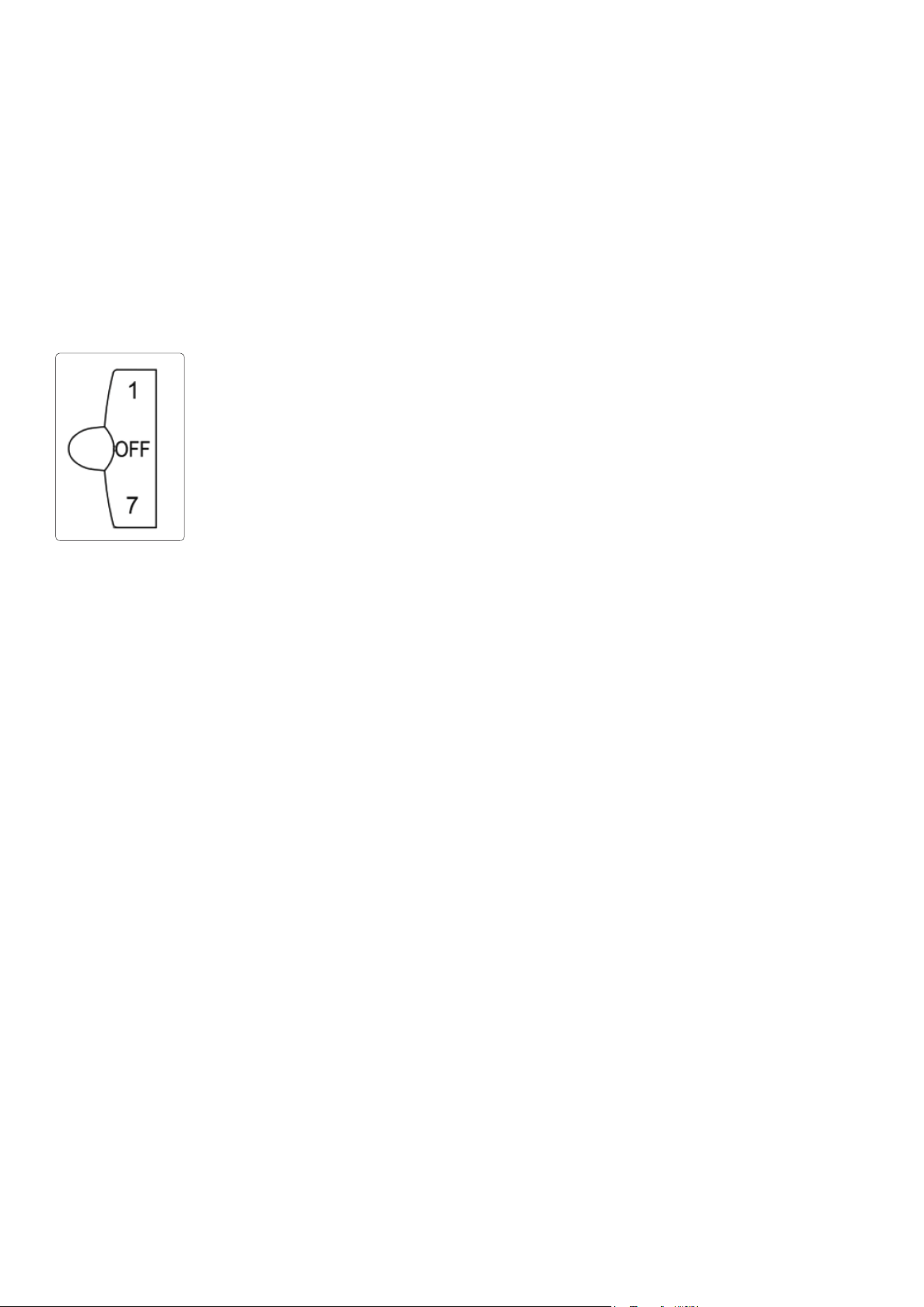
The temperature of the appliance can be adjusted by turning the temperature control switch. The thermostat can be set between 1 and 7.
• 1 is the warmest setting.
• 7 is the coldest setting.
• Set the dial to OFF to turn off the cooling function.
Under the normal operating condition (in spring and autumn), it is recommended to set the temperature at 4.
In summer when the ambient temperature is high, it is recommended to set temperature between 3-4, so as to guarantee the fridge and
freezer temperatures remain constant and reduce the refrigerator continuous running time. In winter when the ambient temperature is low, it is
recommended to set temperature between 5-6 to avoid frequent start/stop of the refrigerator.
NOTE: The temperature requirement may vary in accordance with the outside conditions.
FAST FREEZE
1. Fast freezing makes water in the food form into ne ice crystal, so as to prevent the cell membrane from being damaged and the cytoplasm
from being lost when thawing, thus preserving the original freshness and nutrition of food.
2. Fresh food and sh to be preserved for a long time should be frozen in a fast manner. To select fast freezing, adjust the knob switch to mode
"7" before adding the food.
3. After fast freezing, turn the knob back to its original mode (In general, the fast freezing time shall not exceed 4 hours).
NOTE: The control switch setting of '6' or '7' is suitable when ambient temperature is under 16 °C, but it may lead to ice formation if the
refrigerator keeps running at such setting for a long time under the normal ambient temperature. In which case, it is recommended to adjust
back the there.
TIPS FOR SHOPPING THE FROZEN FOODS
PRECAUTIONS
• The appliance might not operate consistently (there is possibility of defrosting or temperature becoming too warm in the frozen food
compartment, when sited for an extended period of time below the cold limit of the temperature range for which the refrigerating appliance is
designed.
• The information of climate type of the appliance is provided on the rating plate.
• The internal temperature could be affected by such factors as the location of refrigerating appliance, ambient temperature, and frequency of
times the door remains open etc, and if appropriate, a warning that setting of any temperature control device might have to be varied to allow
for these factors should be made.
• Effervescent drinks should not be stored in the freezer compartment or the low-temperature compartment.
FOOD STORAGE LOCATION
Due to the cold air circulation in the refrigerator, the temperature of each area in the refrigerator is different, so different kinds of food should be
placed in different areas.
The fresh food compartment is suitable for the storage of such foods as need not to be frozen, e.g. cooked food, beer, eggs, some condiments
that need cold preservation, milk, fruit juice, etc. The fruit and veg tray is suitable that don't need to be frozen for the preservation of vegetables,
fruits, etc.
The freezer compartment is suitable for the storage of ice cream, frozen food and the foods to be preserved for a long time.
USE OF THE FRESH FOOD COMPARTMENT
FRIDGE SHELF When removing the shelf, lift it up rst, and then pull it out; and when installing the shelf, place it into position before putting it
down. (For the two-section shelf, push the rst section to the rear end, and then pull the second section out). Keep the shelf rear ange upward,
to prevent foods from contact the liner wall. When taking out or putting in the shelf, hold it rmly, and handle with care to avoid damage.
FRUIT AND VEG TRAY: Pull out the fruit and veg tray for access to food. After using or cleaning the cover plate of the fruit and veg tray, be sure
to put it back onto the fruit and veg tray, so that the internal temperature of the fruit and veg tray will not be affected.

HOW TO USE THE ICE-MAKING BOX
Place the ice-making box in the upper position of the fridge freezer compartment, so that it ices up as soon as possible.
FOOD STORAGE
Rinse the food and wipe dry before storing them inside the refrigerator.
Before foods are put in the refrigerator, it is advisable to put into plastic resealable bags, so as to prevent water evaporation to keep fresh and
prevent taint or odour.
DO NOT store excessive or overweight foods, to avoid the shelf from being crushed. When storing the foods, keep a distance away from the
inner wall; and DO NOT place the water-rich foods too close to the fridge rear wall, lest they get frozen to the inner wall.
STORAGE OF FOODS
Foods should be stored by category, with the foods you eat every day placed in front of the shelf, so that the door open duration can be
shortened.
ENERGY-SAVING TIPS
Allow the hot food cool down to the room temperature before putting it in the refrigerator. Put the frozen food in the fresh food compartment to
thaw, using the low temperature of the frozen food to cool the fresh food, thus saving energy.
STORAGE OF FRUITS AND VEGETABLES
USE OF THE FROZEN FOOD STORAGE COMPARTMENT
The freezer temperature is controlled below -18 ℃, and it is advisable to store the food for long-term preservation in the freezer compartment,
but the storage duration indicated on the food packaging should be adhered to.
The freezer drawers are used to store food that needs to be frozen. Fish and meat of large block size should be cut into small pieces and packed
into fresh-keeping bags before they are evenly distributed inside the freezer drawers.
Allow the hot foods to cool down to the room temperature before putting them in the freezer compartment.
DO NOT put a glass container with liquid or the canned liquid that is sealed in the freezer compartment, so as to avoid burst due to volume
expansion after the liquid gets frozen up.
Divide the food into appropriately small portions
Pack the food up before freezing it, and the packing bag used should be dry, in-case the packing bags get frozen together. Foods should be
packed or covered by suitable materials. This will keep the food rm, retain taste, and pollution-free, to avoid cross-contamination and transfer of
odour.
TIPS FOR SHOPPING THE FROZEN FOODS
1.When you are buying frozen food, look at the Storage Guidelines on the packaging. You will be able to store each item of frozen food for the
period shown against the star rating. This is usually the period stated as “Best before date”, found on the front of the packaging.
2.Check the temperature of the frozen food cabinet in the shop where you buy the frozen foods.
3.Make sure the frozen food package is in perfect condition.
4.Always buy frozen products last on your shopping trip or visit to the supermarket.
5.Try to keep frozen food together whilst shopping and on the journey home, as this will help to keep the food cooler.
6.Don’t buy frozen food unless you can freeze it straight away. Special insulated bags can be bought from most supermarkets and hardware
shops. These keep the frozen foods cold longer.
7.For some foods, thawing before cooking is unnecessary. Vegetables and pasta can be added directly to boiling water or steam cooked. Frozen
sauces and soups can be put into a saucepan and heated gently until thawed.
8.Use quality food and handle it as little as possible. When foods are frozen in small quantities, it will take less than for them to freeze up and
thaw.
9.Estimate the amount of foods to be frozen up. When freezing large amounts of fresh food, adjust the temperature control knob to the low
mode, so, foods can be frozen up in fast manner, with the food freshness kept.
LOCATION
DO NOT place your fridge freezer near a heat source, e.g. cooker, boiler or radiator. Avoid it from direct sunlight in out-buildings or sun lounges.
MAINTENANCE AND CLEANING
WARNING! Before cleaning, unplug the plug rst; DO NOT plug in or plug out the plug with wet hands, because there is a risk of electric shock
and injury. Do not spill water directly on the fridge freezer, to avoid rust, electricity shock and accidents. DO NOT place your hands under the
bottom of the fridge freezer, since you might get scratched by sharp metal corners.
INTERNAL CLEANING AND EXTERNAL CLEANING
The food residuals in the fridge freezer are liable to produce bad odour, so the fridge freezer must be cleaned regularly.
Remove all shelves, crisper box, bottle racks, cover board, and drawers etc., and clean them with a soft towel or sponge dipped in warm water or
neutral detergent.
Clear off the dust accumulated on the rear panel and side plates of the fridge freezer on a regular basis.
After using detergent, be sure to rinse it with clean water, and then wipe it dry.
DO NOT use a bristle brush, steel wire brush, detergent, soap powder, alkaline detergent, benzene, gasoline, acid, hot water and other corrosive or
soluble items to cleanse the cabinet surface, door gasket, plastic decorative parts, etc, so as to avoid damage.
Carefully wipe dry the door gasket, clean the groove using a wooden implement wrapped with cotton. After the cleaning, x the four corners of
the door gasket rst, and then embed it segment by segment into the door groove.
INTERRUPTION OF POWER SUPPLY OR FAILURE OF THE REFRIGERATING SYSTEM
In the event of an extended non-running of the refrigerating appliance (such as interruption of power supply or failure of the refrigerating
system). To help prevent food spoilage try to open the fridge freezer door as less as possible, in this way can food safely and freshly kept for
hours even in hot summer.
IF YOU GET THE POWER OUTAGE NOTICE IN ADVANCE
1. Adjust the thermostat knob to the high mode an hour in advance, so that food gets fully frozen (Do not store new food during this time).
Restore the temperature mode to the original setting when power supply becomes normal in a timely manner.
2. You can also make ice with a watertight container, and put it in the upper part of the fridge freezer, so as to extend the time for fresh food to
be stored.
NOTE: Continuously use your fridge freezer so as not to affect the serviceable life.
DEFROSTING
After a period of use, a thin layer of frost will be formed on the fridge freezer compartment inner wall (or evaporator) surface, which may affect the
refrigeration effect if exceeding 5mm in thickness. In such case, you need to gently scrape the frost off using an ice scraper rather than the metal or
sharp hardware. Frost needs to be cleared off every 3 months or so, and if the drawers and access of foods are affected by frosting, make sure to
remove the frost in a timely manner.
FOLLOW THE FOLLOWING STEPS TO DEFROST
1. Take out the frozen foods, shut off the mains power supply, open the fridge freezer door, and gently remove the frosts from the inner wall with an
ice scraper. To speed up the thawing process, you are suggested to place a bowl of hot water inside the fridge freezer, and when the solid ice frosts
become loose, use an ice scraper to scrape them off and then take them out.
2. After defrosting, clean the fridge freezer inside, and switch on the power supply.
NOTE: When the appliance is not in use for long periods, disconnect from the electricity supply, empty all foods and clean the appliance, leaving
the door ajar to prevent unpleasant smells.
SAFETY-CHECK AFTER MAINTENANCE
Is the power cord broken or damaged?
Is the power plug rmly inserted into the socket?
Is the power plug abnormally overheated.
The appliance shall be disconnected from its power source during service and when replacing parts and, if that the removal of the plug is foreseen,
it shall be clearly indicated that the removal of the plug has to be such that an operator can check from any of the points to which he has access
that the plug remains removed. This refrigeration appliance is not intended to be used as a built-in appliance.
NOTE: Electric shock and re accident may be caused in case the power cord and plug is damaged or stained by dust. If any abnormality, please
unplug the power plug and get in contact with the vendor.
TROUBLESHOOTING
Fault Checks Solutions
No operation. Is power switched off.
Are breakers and fuses tripped or blown.
No electricity power cut.
Switch on.
Abnormal noise. Is fridge freezer stable.
Does fridge freezer touch the wall.
Adjusting fridge freezer's adjustable feet.
Pull away from wall.
Poor refrigerating efciency. Hot food or overloading.
Door closing.
Is the fridge freezer in direct sunlight or close
to central heating.
Is the fridge freezer well ventilated.
Check temperature settings
Allow food to cool and do not overload compartments.
Check the door closing times and seal.
Move appliance to a cooler area.
Clear vents to maintain good ventilation.
Set the appropriate temperature.
Peculiar smell in fridge freezer. Spoiled food.
Fridge freezer requires cleaning.
Remove offending articles.
Clean fridge freezer.
Dellonda Limited, Sole UK Distributor of Baridi
Kempson Way, Suffolk Business Park, Bury St Edmunds, Suffolk. IP32 7AR
01284 757575 suppor[email protected] www.dellonda.co.uk
Environment Protection and Waste Protection and Electrical Equipment Regulations (WEEE)
Recycle unwanted packaging materials. When this product is no longer required, or has reached the end of it’s useful life, please dispose of it in
An environmentally friendly way. Drain any uids (if applicable) into approved containers, in accordance with local waste regulations. Under the
Waste Batteries and Accumulators Regulations 2009, Dellonda would like to inform the user that this product contains one or more batteries. It
is our policy to continually improve products and we reserve the right to alter data, specications and parts without prior notice. No liability is
accepted for incorrect use of this product. Guarantee is 12 months from purchase date, proof of which is required for any claim.
• WARNING: That the appliance shall be disconnected from its power source during service and when replacing parts and, if that the removal of
the plug is foreseen, it shall be clearly indicated that the removal of the plug has to be such that an operator can check from any of the points to
which he has access that the plug remains removed.
• Cleaning and user maintenance on the appliance shall not be made by children without supervision.
• Place suitable water container under the drain cover in the lower left corner of the front panel, remove the drain cover, withdraw the drain body
and rotate it such that the drain hole is placed above the water container.
• Reverse the procedure when operation is complete.