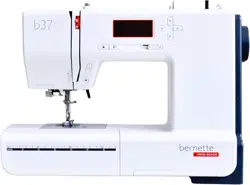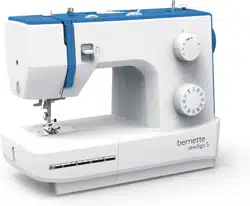
User Manual


TABLE OF CONTENTS
2024-07 EN 5020105.10A.04
3
Table of Contents
IMPORTANT SAFETY INSTRUCTIONS .................. 5
General Information ............................................ 8
1 My bernette ......................................................... 10
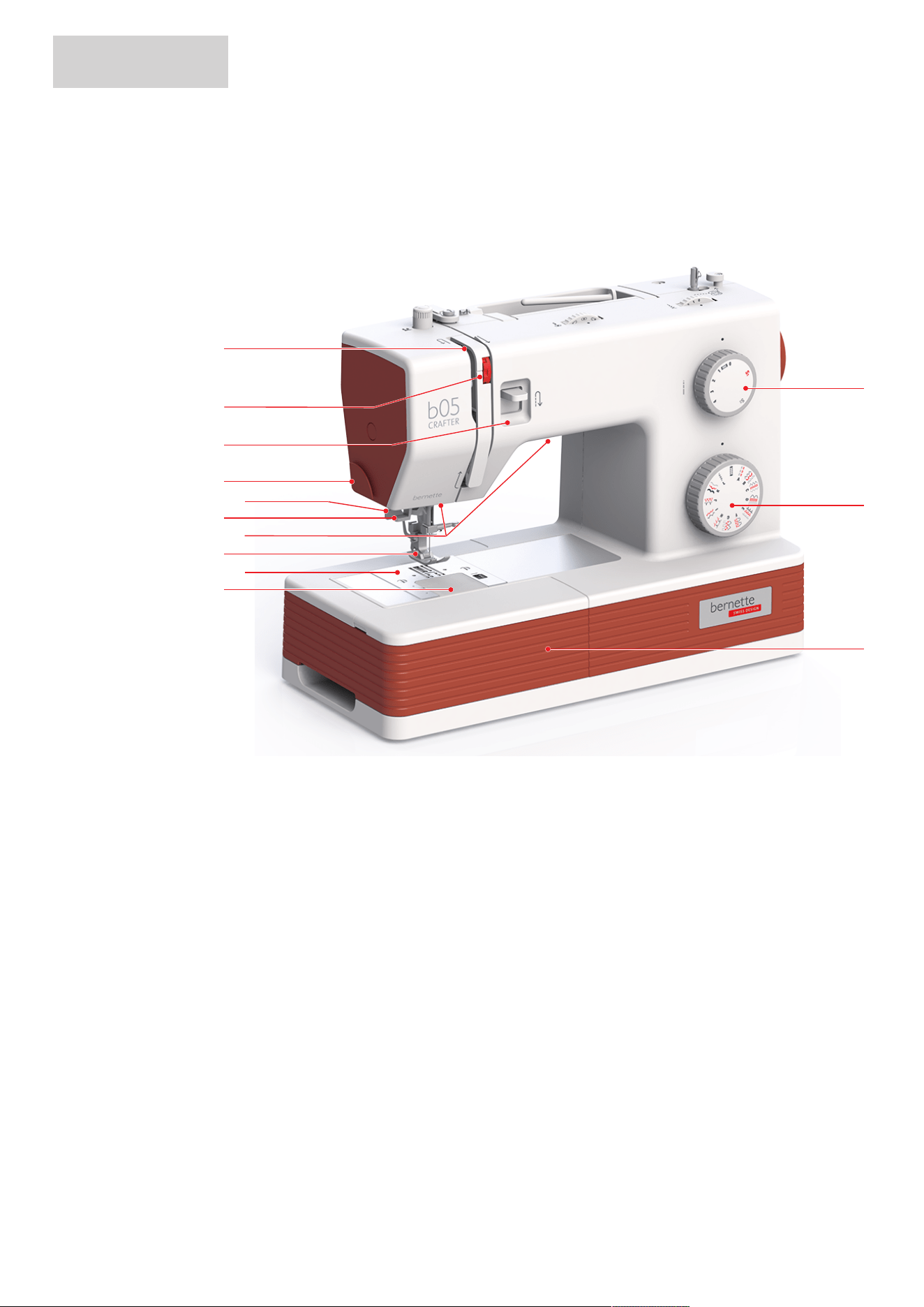
1.1 Overview Machine .................................................. 10
Overview Front ............................................................ 10
Overview Top .............................................................. 11
Overview Back ............................................................ 12
1.2 Accessory ............................................................... 12
Included Accessories ................................................... 12
Overview Presser Feet .................................................. 13
1.3 Needle, Thread, Fabric ............................................ 14
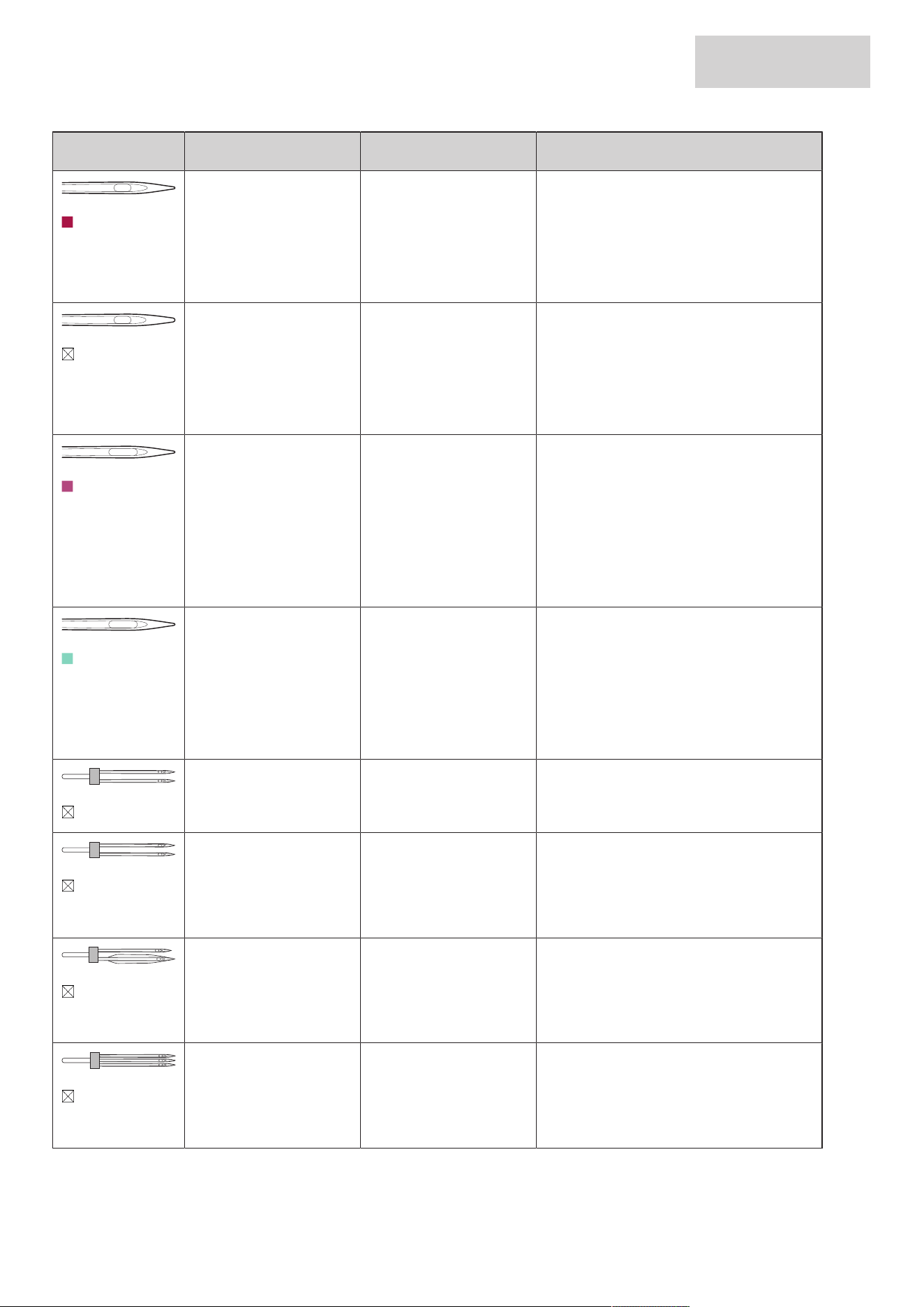
Overview Needles ........................................................ 14
Needle/Thread Combination ........................................ 16
Example for Needle Description ................................... 16
Thread Selection ......................................................... 17
2 Sewing Preparation ............................................. 18
2.1 Connection and Switching On ................................ 18
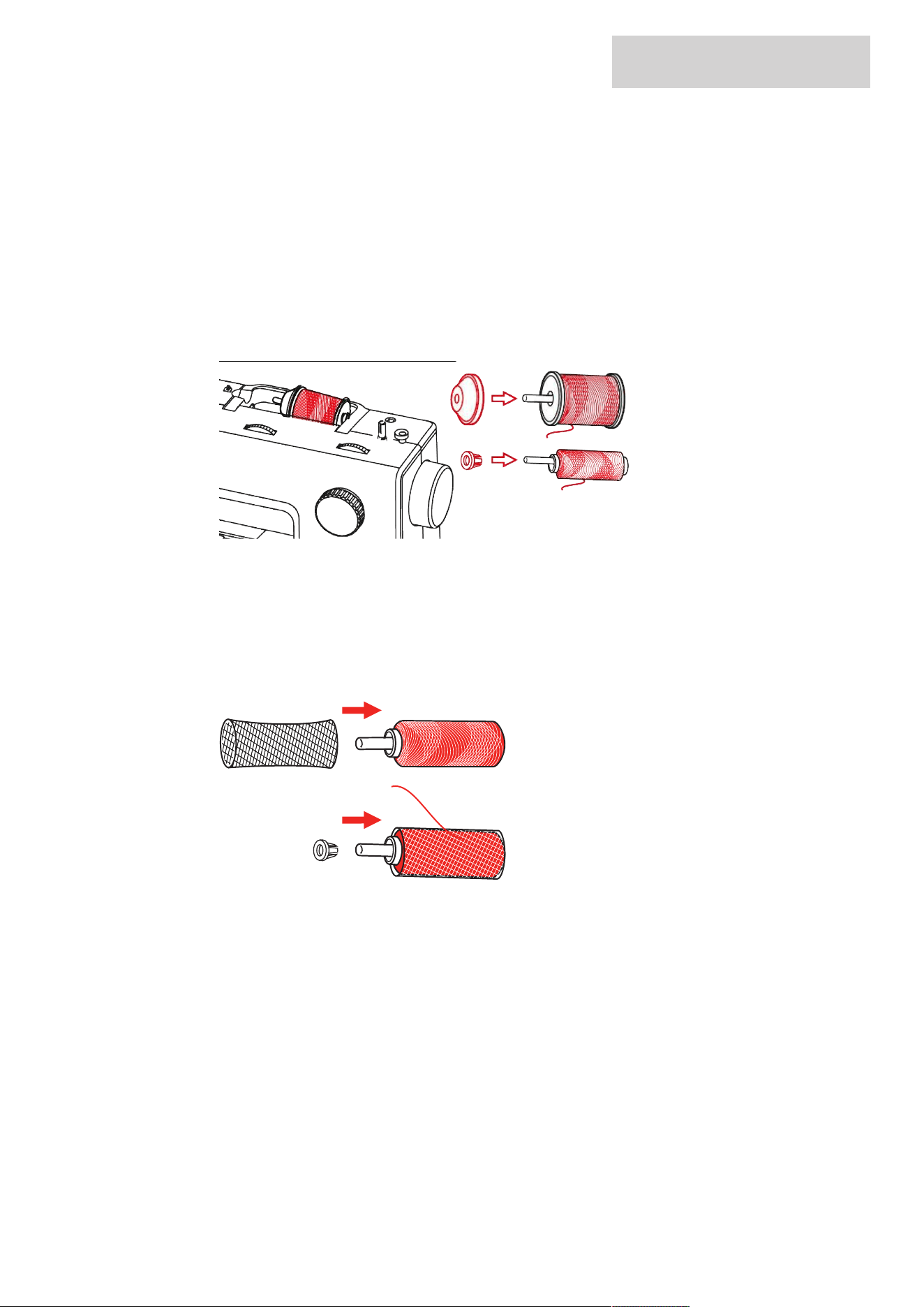
Connecting the Machine and Foot Control .................. 18
Switching the Machine On .......................................... 18
Regulating the Speed via the Foot Control .................. 18
2.2 Spool Pin ................................................................ 19
Horizontal Spool Pin .................................................... 19
Second Spool Pin ........................................................ 19
2.3 Freearm .................................................................. 20
2.4 Sewing Table with Accessory Box ............................ 20
2.5 Raising or Lowering the Feed Dog ........................... 21
2.6 Needle .................................................................... 21
Raising and Lowering the Needle ................................ 21
Changing the Needle .................................................. 21
Adjusting the Needle Position ...................................... 22
2.7 Presser Foot ............................................................ 23
Raising and Lowering the Presser Foot ......................... 23
Changing the Presser Foot .......................................... 23
Adjusting the Presser Foot Pressure ............................. 24
2.8 Threading ............................................................... 24
Threading Preparation ................................................. 24
Threading the Upper Thread ....................................... 25
Threading the Twin Needle ......................................... 28
Threading the Triple Needle ........................................ 28
Winding the Bobbin Thread ........................................ 29
Threading the Bobbin Thread ..................................... 31
Bringing up the Bobbin Thread ................................... 32
3 Creative Sewing .................................................. 33
3.1 Selecting a Stitch Pattern ....................................... 33
3.2 Editing Stitch Patterns ............................................ 34
Setting the Stitch Width ............................................. 34
Adjusting the Stitch Length ........................................ 34
Adjusting the Upper Thread Tension ........................... 35
Adjusting the Balance ................................................. 35
3.3 Quick Reverse ........................................................ 36
3.4 Securing ................................................................ 37
3.5 Sew Thick Areas .................................................... 37
3.6 Sewing Corners ..................................................... 38
3.7 Sewing Very Slippery Fabrics .................................. 38
4 Practical Stitches ................................................. 39
4.1 Overview Practical stitches ..................................... 39
4.2 Sewing Straight Stitch ............................................ 40
4.3 Sewing in the Zipper .............................................. 41
4.4 Stitching in a Concealed Zipper .............................. 42
4.5 Sewing Triple Straight Stitch .................................. 44
4.6 Sewing Triple Zigzag .............................................. 45
4.7 Super-Stretch ......................................................... 45
4.8 Sewn-Out Zigzag ................................................... 45
4.9 Manual Darning ..................................................... 46
4.10 Finishing Edges ...................................................... 47
4.11 Sewing Double Overlock ........................................ 48
4.12 Sewing Vari Overlock ............................................. 49
4.13 Narrow Edgestitching ............................................ 49
4.14 Wide Edgestitching ................................................ 49
4.15 Edgestitching Using the Seam Guide ...................... 50
4.16 Sewing Hem Edges ................................................ 50
4.17 Sewing a Narrow Hem ........................................... 51
4.18 Sewing Blind Hems ................................................ 52
4.19 Sewing Visible Hems .............................................. 53
4.20 Sewing Flat Joining Seams ..................................... 53

TABLE OF CONTENTS
4
2024-07 EN 5020105.10A.04
4.21 Sewing Basting Stitches .......................................... 53
5 Decorative Stitches .............................................. 54
5.1 Overview Decorative Stitches .................................. 54
5.2 Altering the Stitch Density ...................................... 55
5.3 Gathering Stitches .................................................. 55
Gathering ................................................................... 55
Smocking .................................................................... 55
5.4 Connecting Stitches ................................................ 56
Joining Seam with Faggot Stitch .................................. 56
Joining Seam with Double Overlock Stitch ................... 57
5.5 Edging .................................................................... 57
Shell Edging with Vari-Overlock Stitch ......................... 57
Shell Edging with Satin Stitch ...................................... 58
6 Buttonholes .......................................................... 59
6.1 Overview Buttonholes ............................................. 59
6.2 Marking Buttonholes .............................................. 59
6.3 Determining the Buttonhole Length ........................ 59
6.4 Reinforce Buttonhole .............................................. 59
6.5 Sewing a Test Sample ............................................. 60
6.6 Sewing a Buttonhole Automatically ........................ 60
6.7 Cut the Buttonhole Open ....................................... 62
6.8 Sewing On Buttons ................................................. 62
7 Quilting ................................................................. 63
7.1 Overview Quilt Stitches ........................................... 63
7.2 Appliqués ............................................................... 63
7.3 Free-Motion Quilting .............................................. 63
7.4 Sewing Patchwork .................................................. 65
8 Maintenance and Cleaning ................................. 66
8.1 Cleaning the Feed Dog ........................................... 66
8.2 Cleaning the Bobbin Case ....................................... 67
8.3 Oiling the Needle Bar .............................................. 69
9 Troubleshooting .................................................. 70
10 Technical data ...................................................... 72
11 Appendix .............................................................. 73
11.1 Overview Stitch Patterns ......................................... 73
Overview of the Stitch Patterns ................................... 73
Index ..................................................................... 74

IMPORTANT SAFETY INSTRUCTIONS
5
2024-07 EN 5020105.10A.04
IMPORTANT SAFETY INSTRUCTIONS
Please be aware of the following basic safety instructions when using your
machine. Before using this machine, read instruction manual carefully.
DANGER
To protect against electric shock, the following instructions must be observed.
• Never leave the machine unattended when it is connected to the power
supply.
• Immediately after use and before cleaning, switch off the machine and
disconnect the power cable from the outlet.
In order to protect against injury, the following instructions must be adhered to.
• Do not look directly into the LED lamp with optical instruments
(e.g.magnifying glass).
• If the LED lamp is damaged or defective, have the LED lamp checked or
repaired at your local bernette dealer.
• Switch off the machine before working in the needle area.
• Before starting the machine, close all covers.
WARNING
To reduce the risk of burns, fire, electric shock or personal injury, the following
instructions must be observed.
General Facts
• This machine may only be used for the purpose described in this instruction
manual.
Working Environment
• Do not use the machine outdoors.
• Only use the machine in dry rooms.
• Do not use the machine in a humid area.
• Do not use the machine in rooms where aerosol products (sprays) are being
used.
• Do not use the machine in rooms where oxygen is dispensed.
Technical Condition
• Never use the machine when it is damp.
• Do not use the machine if it is not working properly.

IMPORTANT SAFETY INSTRUCTIONS
6
2024-07 EN 5020105.10A.04
• Do not use the machine if a cable or the plug is damaged.
• Do not use the machine if it has been dropped, damaged or has fallen into
water.
• If the machine is damaged or does not work properly, have the machine
checked or repaired by your local bernette dealer.
• Keep all ventilation openings of the machine and the foot control free of
lint, dust and loose cloth.
• Do not use the machine if the ventilation openings are blocked.
Accessories and Supplies
• Only use the accessories recommended by the manufacturer.
• Always use an original bernette Stitch Plate.
An incorrect stitch plate can result in needle breakage.
• Use only straight needles of good quality.
Bent or damaged needles can cause needle breakage.
• The machine is double-insulated.
Only use original spare parts. See instructions for servicing of double-
insulated products.
• To lubricate the machine, only use oil recommended by bernette.
Appropriate Use
• The machine may be used, cleaned and maintained by children older than
eight or by people with reduced physical, sensory or mental capabilities or if
there is a lack of experience and knowledge.
• Furthermore, these persons must be supervised while working with the
machine, or they must know the safe operation of the machine and be
aware of resulting hazards.
• Children are not allowed to play with the machine.
• Special care should be taken when the machine is operated by or in the
presence of children.
• Only use the machine with the supplied power cable.
• USA and Canada only: Do not connect power plug NEMA 1-15 to circuits
exceeding 150volt-to-ground.
• If the machine is to be used in a country other than the country of origin,
obtain a power cable suitable for this country from a bernette dealer.
• Only use this machine with the supplied foot control of type FC-2902D/
FC-1902A.
• Do not insert any objects into the openings of the machine.
• Do not place any objects on the foot control.

IMPORTANT SAFETY INSTRUCTIONS
7
2024-07 EN 5020105.10A.04
• While sewing, guide the fabric gently. Pulling and pushing the fabric can
cause needle breakage.
• Keep fingers away from all moving parts.
• Special care is required in the needle area.
• Only lift the machine by the handle.
• For activities in the needle area – such as threading the needle, changing the
needle, threading the looper or changing the presser foot – switch off the
machine.
• To switch off, set the power switch to «0».
• When protective covers are removed, when the machine is oiled or when
other cleaning and maintenance operations mentioned in this instruction
manual are carried out, switch off the machine and disconnect the power
plug from the outlet.
• Pull the plug out of the outlet by pulling on the plug. Do not pull on the
cable.
SAFE THESE INSTRUCTIONS

GENERAL INFORMATION
8
2024-07 EN 5020105.10A.04
General Information
Availability of the Instruction Manual
The short manual is part of the machine.
• Keep the short manual of the machine in a suitable place near the machine and have it ready for
reference.
• The latest version of the detailed instruction manual can be downloaded at www.bernette.com.
• When passing on the machine to a third party, enclose the short manual of the machine.
Proper Use
Your bernette machine is conceived and designed for private household use. It is intended for sewing fabrics
and other materials as described in this instruction manual. Any other use is not considered proper. BERNINA
assumes no liability for consequences resulting from improper use.
Equipment and Scope of Delivery
Example images are used in these instructions for the purposes of illustration. The machines shown in the
images and the accessories shown therefore do not always match the actual items included with your
machine. The supplied accessory can vary depending on the country of delivery. You can acquire any
accessories mentioned or shown that are not included in the scope of delivery as optional accessories from a
specialist bernette dealer. Further accessories can be found at www.bernette.com.
For technical reasons and in order to improve the product, changes may be made to the equipment of the
machine and the scope of delivery at any time and without prior notice.
Servicing of Double-insulated Products
In a double-insulated product two systems of insulation are provided instead of grounding. No grounding
means is provided on a double-insulated product nor should a means for grounded be added to the product.
Servicing a double-insulated product requires extreme care and knowledge of the system and should only be
done by qualified service personnel. Replacement parts for a double-insulated product must be identical to
the original parts in the product. A double-insulated product is marked with the words: «Double-Insulation
»or «double-insulated».
The symbol may also be marked on the product.
Environmental Protection
BERNINA International AG is committed to environmental protection. We strive to minimize the
environmental impact of our products by continuously improving product design and our technology of
manufacturing.
The machine is labeled with the symbol of the crossed-out wastebin. This means that the machine should
not be disposed of in household waste when it is no longer needed. Improper disposal can result in
dangerous substances getting into the groundwater and thus into our food chain, damaging our health.
The machine must be returned free of charge to a nearby collection point for waste electrical and electronic
equipment or to a collection point for the reuse of the machine. Information on the collection points can be
obtained from your local administration. When purchasing a new machine, the dealer is obliged to take back
the old machine free of charge and dispose of it properly.
If the machine contains personal data, you are responsible for deleting the data yourself before returning the
machine.

GENERAL INFORMATION
9
2024-07 EN 5020105.10A.04
Explanation of Symbols
DANGER
Designates a danger with a high risk which can lead to serious injuries or even death unless it is avoided.
WARNING
Designates a medium-risk hazard which can lead to serious injuries if not avoided.
CAUTION
Designates a low-risk hazard which can lead to minor or moderate injuries if not avoided.
NOTICE
Designates a hazard which can lead to material damage if not avoided.
Tips from the BERNINA sewing experts.
MY BERNETTE
10
2024-07 EN 5020105.10A.04
1 My bernette
1.1 Overview Machine
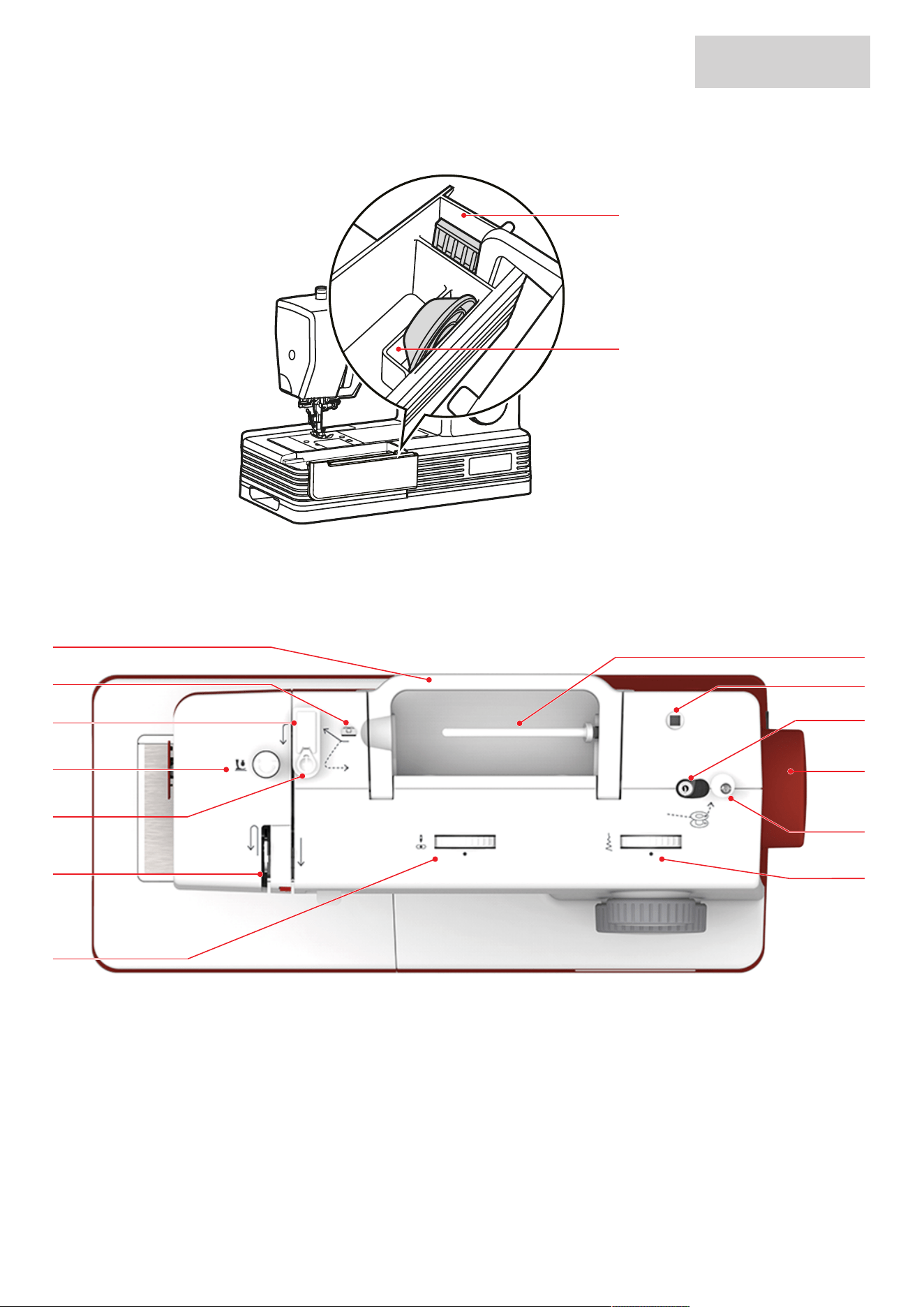
Overview Front
1
2
3
5
7
6
4
13
8
9
11
12
10
1 Bobbin Cover 8 Quick Reverse Lever
2 Stitch Plate 9 Thread Tension Dial
3 Presser Foot 10 Thread Take-up Lever
4 Sewing Light 11 Stitch length knob
5 Needle Threader 12 Stitch pattern selector knob
6 Buttonhole Lever 13 Sewing Table and Accessory Box
7 Thread Cutter
MY BERNETTE
11
2024-07 EN 5020105.10A.04
Accessories Box
1
2
1 Compartment for needle set 2 Compartment for spool cap
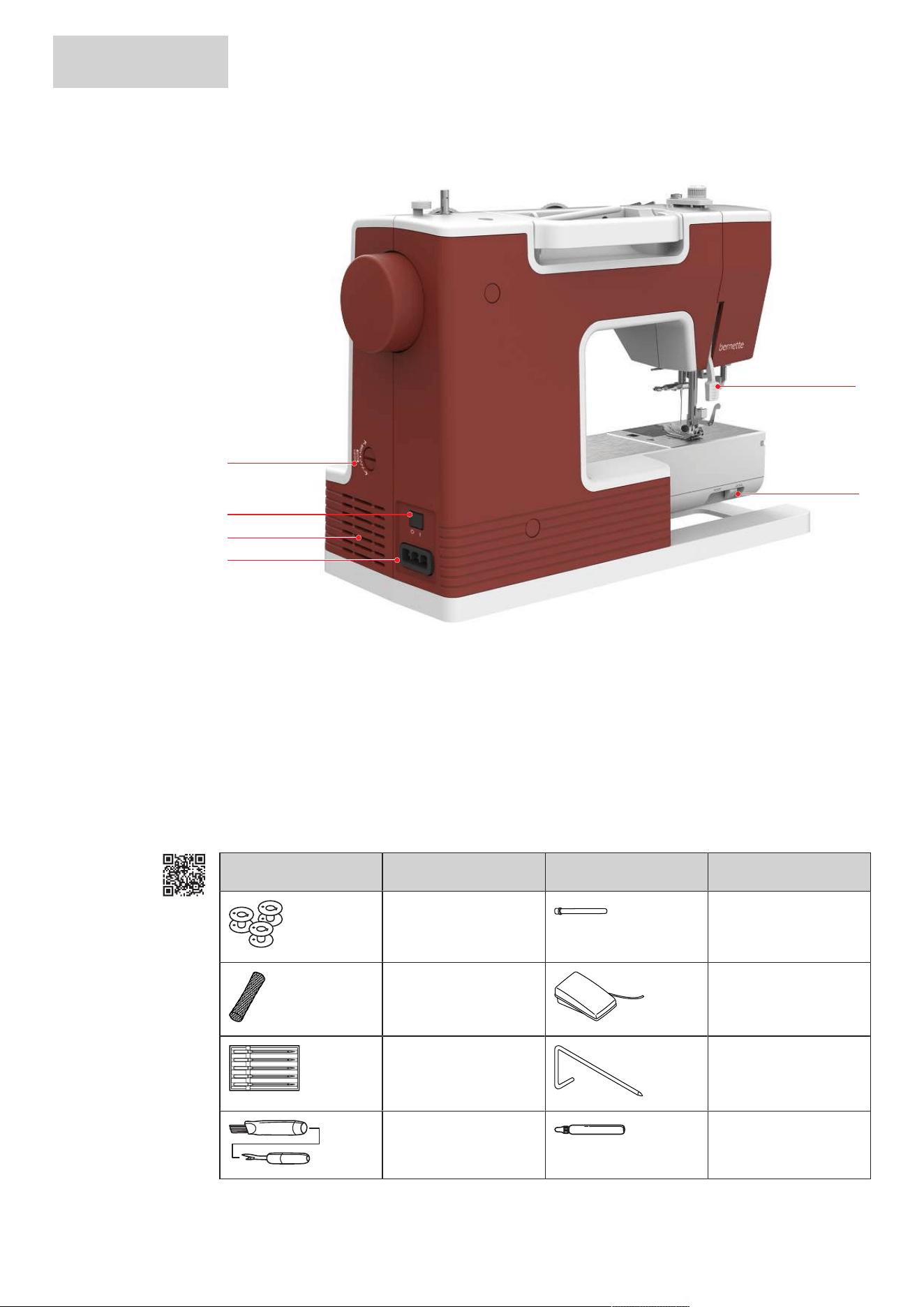
Overview Top
1
2
3
4
5
6
7
8
9
10
11
12
13
1 Needle position dial 8 Spool Pin
2 Thread Take-up Lever 9 Opening, additional spool pin
3 Bobbin Winder Pretension 10 Bobbin Winder Unit
4 Presser foot pressure adjustment knob 11 Handwheel
5 Thread Pretension 12 Stopper Bobbin Winder Unit
6 Thread Guide 13 Stitch width dial
7 Carry Handle
MY BERNETTE
12
2024-07 EN 5020105.10A.04
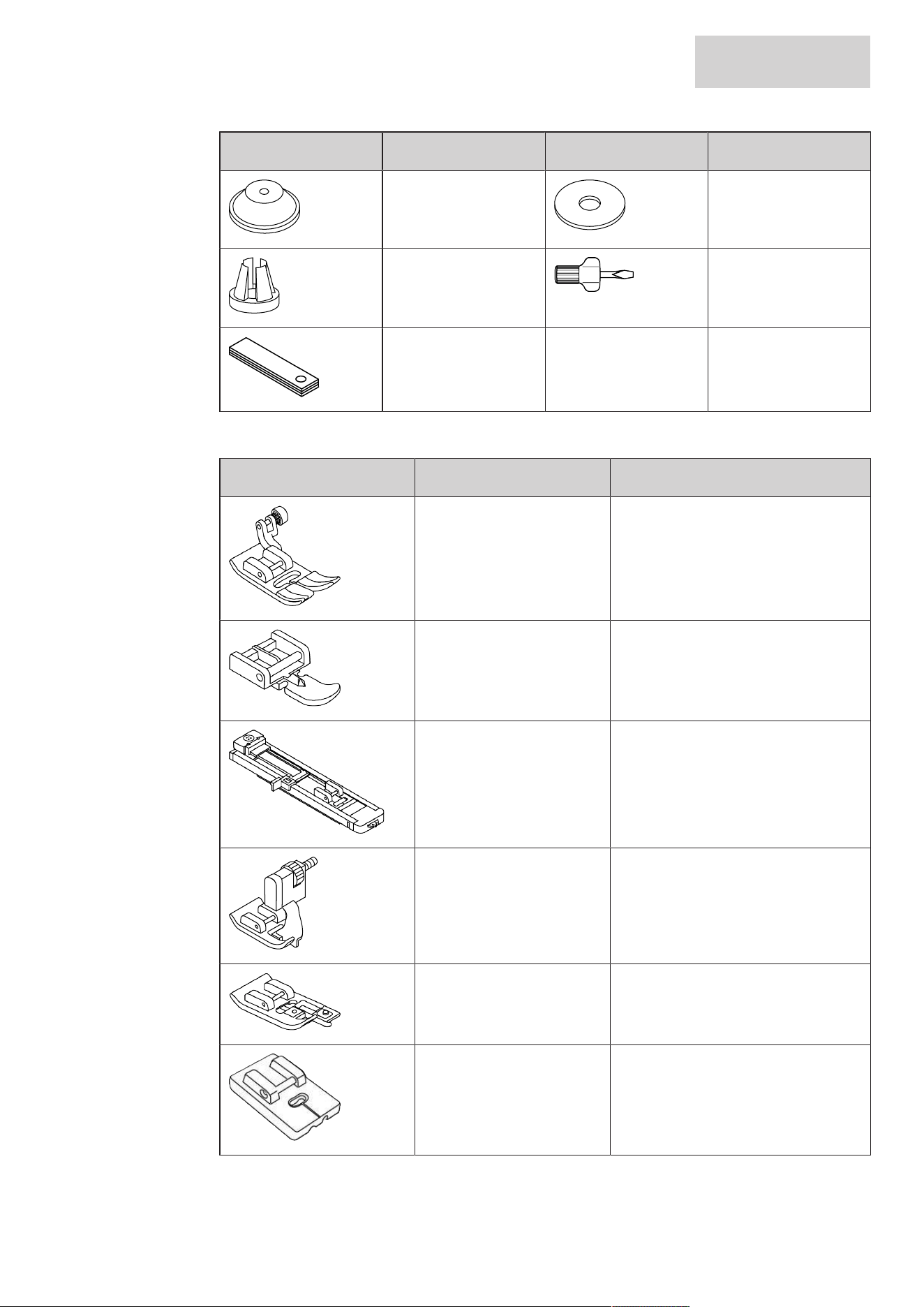
Overview Back
1
2
3
4
5
6
1 Power cable/foot control connection 4 Balance dial
2 Air vents 5 Presser foot lifter
3 Power switch 6 Feed dog lever
1.2 Accessory
Included Accessories
Visit www.mybernette.com/accessories for more accessory information.
Illustration Name Illustration Name
Bobbin (3x) Second Spool Pin
Spool Net Foot Control with
Power Cable
Needle Assortment Seam Guide
Brush and Seam Ripper Lubricator
MY BERNETTE
13
2024-07 EN 5020105.10A.04
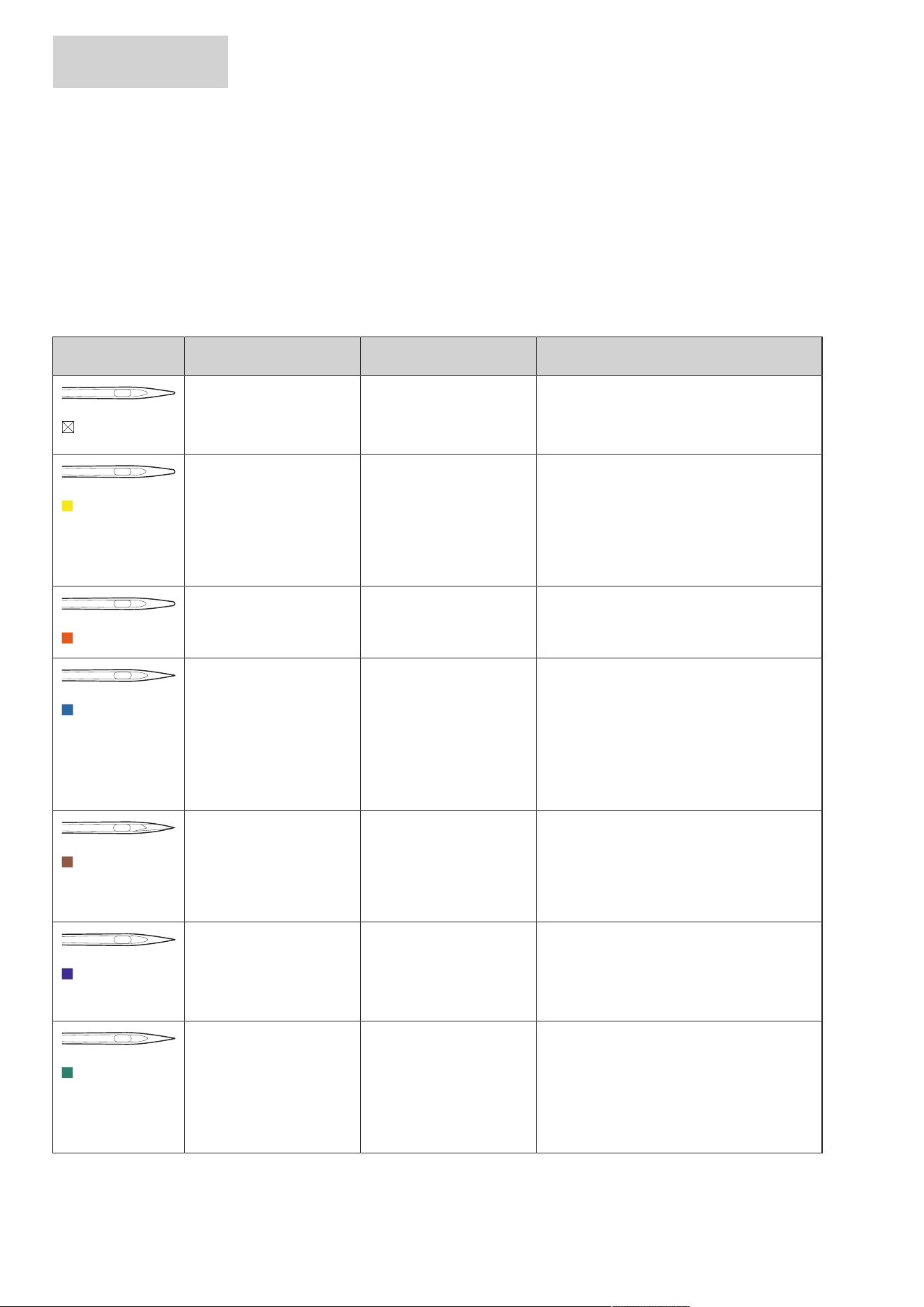
Illustration Name Illustration Name
Spool Disc, large (1x) Felt Disc
Spool Disc, small (1x) Screwdriver
Height Compensation
Tool
Overview Presser Feet
Illustration Name Purpose
Zigzag foot For sewing different practical and
decorative stitches and for sewing
hems.
Zipper foot For sewing in zippers.
Buttonhole foot with slide For sewing buttonholes with or without
filler cord.
Blindstitch foot For sewing blind-stitch hems
Overlock foot For sewing overlock-type stitches and
for finishing the edge of the fabric.
Zipper foot for concealed
zippers
For sewing in concealed zippers.
MY BERNETTE
14
2024-07 EN 5020105.10A.04
1.3 Needle, Thread, Fabric
Needles will wear down over time. Therefore, the needle should be replaced regularly. Only a perfect point
results in a good stitching result. In general, the thinner the fabric, the finer the needle. The illustrated
needles are either standard or optional accessory, depending on the machine.
• Needle sizes 70, 75: for light-weight fabrics.
• Needle sizes 80, 90: for medium fabrics.
• Needle sizes 100, 110: for heavy fabrics.
Overview Needles
Illustration Needle Name Needle Description Purpose
Universal Needle
130/705H70-110
With a slightly rounded
point.
For woven fabrics (light, medium, heavy-
weight), knitwear, leather, vinyl, jeans/
denim. For natural and synthetic fabrics.
Stretch Needle
130/705H-S
75/11 – 90/14
With a medium ball point. For knitwear (jersey, tricot, knit and stretch
material).
For general sewing, sewing on buttons and
buttonholes, zippers, hems and topstitching,
decorative sewing, embroidery.
Jersey/Embroidery Needle
130/705H-JSUK 70-100
With a slim sharp point. Woven fabrics (light, medium, heavy-
weight), leather, jeans/denim.
Jeans Needle
130/705H-J
80/12 – 110/18
With a slim sharp point. Woven fabrics (light, medium, heavy-
weight), leather, jeans/denim.
For general sewing, sewing on buttons and
buttonholes, zippers, hems and topstitching,
decorative sewing, embroidery, patchwork,
quilting.
Leather Needle
130/705HLR
90/14, 100/16
With cutting tip. For leather, imitation leather and similar
materials.
For zippers, hems and topstitching, materials
that tend to stick.
Sharp Microtex Needle
130/705H-M70-110
With a very slim sharp
point.
For woven fabrics (light, medium, heavy),
plastics, materials that are difficult to glide
such as silk, microfiber fabrics, vinyl, coated
materials.
Quilting Needle
130/705H-Q
75/11 – 90/14
With a very slim, slightly
rounded point.
For woven fabrics (light, medium and heavy-
weight).
Decorative sewing, patchwork, quilting. For
stitching/topstitching tasks, such as quilting
and patchwork.
MY BERNETTE
15
2024-07 EN 5020105.10A.04
Illustration Needle Name Needle Description Purpose
Embroidery Needle
130/705H-E
75/11 – 90/14
With a light ball point and
a particularly wide eye
and wide groove.
For woven fabrics (light, medium, heavy-
weight), knitwear. For thicker threads.
For general sewing, sewing on buttons and
buttonholes, zippers, hems and topstitching,
decorative sewing, embroidery.
Fine Fabrics Needle
130/705HSES
70/10 – 90/14
With a light ball point. For fine, delicate materials, such as velvet.
For general sewing, sewing on buttons and
buttonholes, zippers, hems and topstitching,
decorative sewing, embroidery, patchwork,
quilting.
Metafil Needle
130/705HMETAFIL
80/12
With medium ball point
and long eye (2mm).
For woven fabrics (light, medium, heavy-
weight), knitwear. For sewing with special
effects and fancy threads, especially metallic
threads.
For embroidery with metallic thread. For
hems and topstitching, decorative sewing
and embroidery.
Topstitch Needle
130/705H-N
80/12 – 100/16
With medium ball point
and long eye (2mm).
For woven fabrics (light, medium and heavy-
weight).
For hems and topstitching, decorative
sewing and embroidery. For decorative and
quilting work with several sewing threads
and also for embroidery.
Universal Twin Needle
130/705HZWI70-100
Needle distance: 1.0/ 1.6/
2.0/ 2.5/ 3.0/ 4.0/ 6.0/ 8.0
For visible hems in stretch fabrics, pintucks,
decorative sewing.
Stretch Twin Needle
130/705H-SZWI
75
Needle distance: 2.5/ 4.0 For visible hems in stretch fabrics, pintucks,
decorative sewing.
Hemstitch Twin Needle
130/705HZWIHO
100
Needle distance: 2.5 For special effects with hemstitch
embroidery.
Universal Triple Needle
130/705HDRI
80
Needle distance: 3.0 To create a triple quilting row effect or for
decorative effects.
MY BERNETTE
16
2024-07 EN 5020105.10A.04
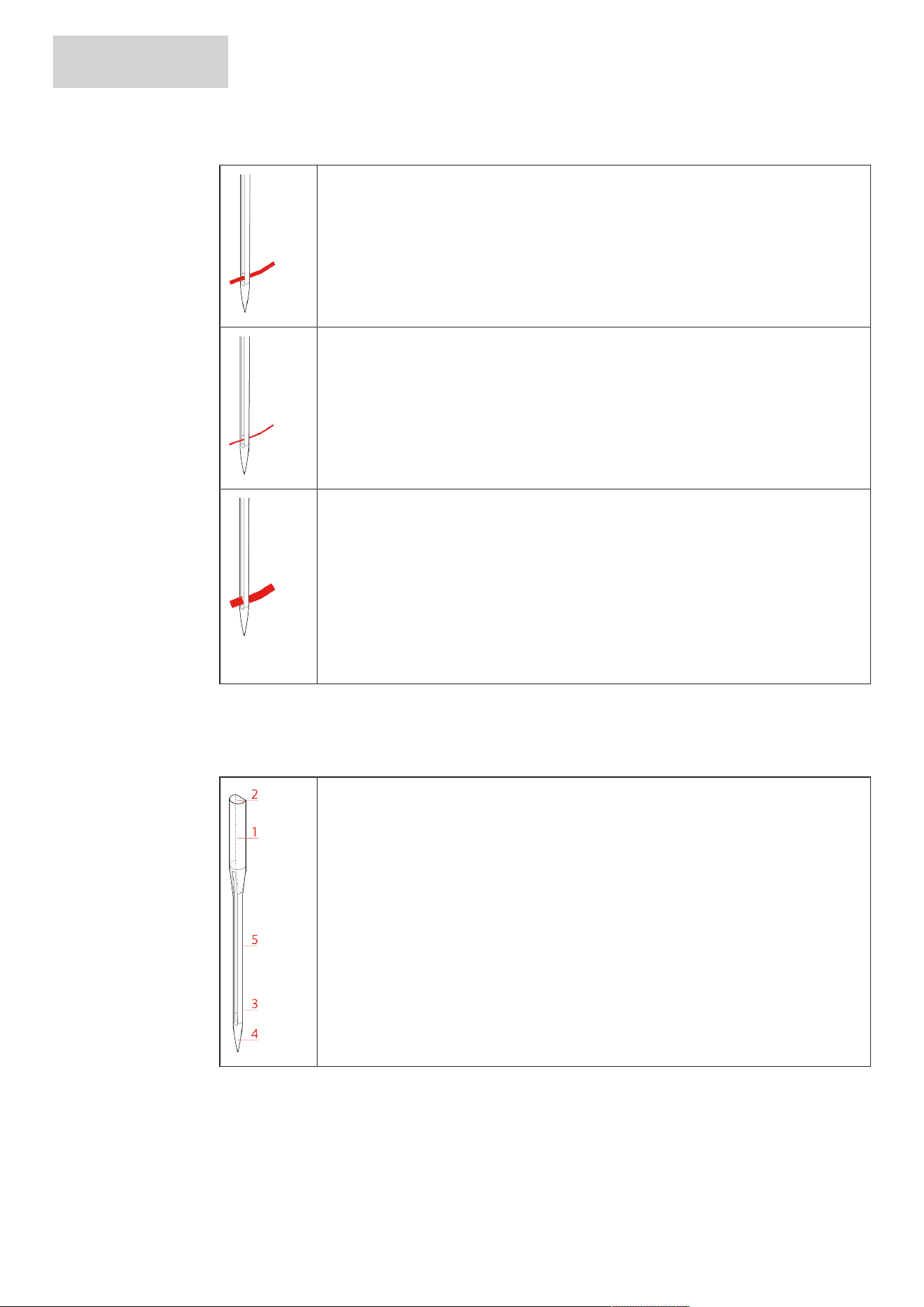
Needle/Thread Combination
The needle/thread combination is correct, when the thread fits perfectly into the long
groove and goes easily through the needle eye. This allows the thread to be stitched
optimally.
If the thread has too much room to move in the long groove and in the needle eye, this
can result in the thread breaking or missing stitches.
If the thread rubs along the edge of the long groove and cannot be guided properly
through the needle eye, this can result in the thread breaking or jamming.
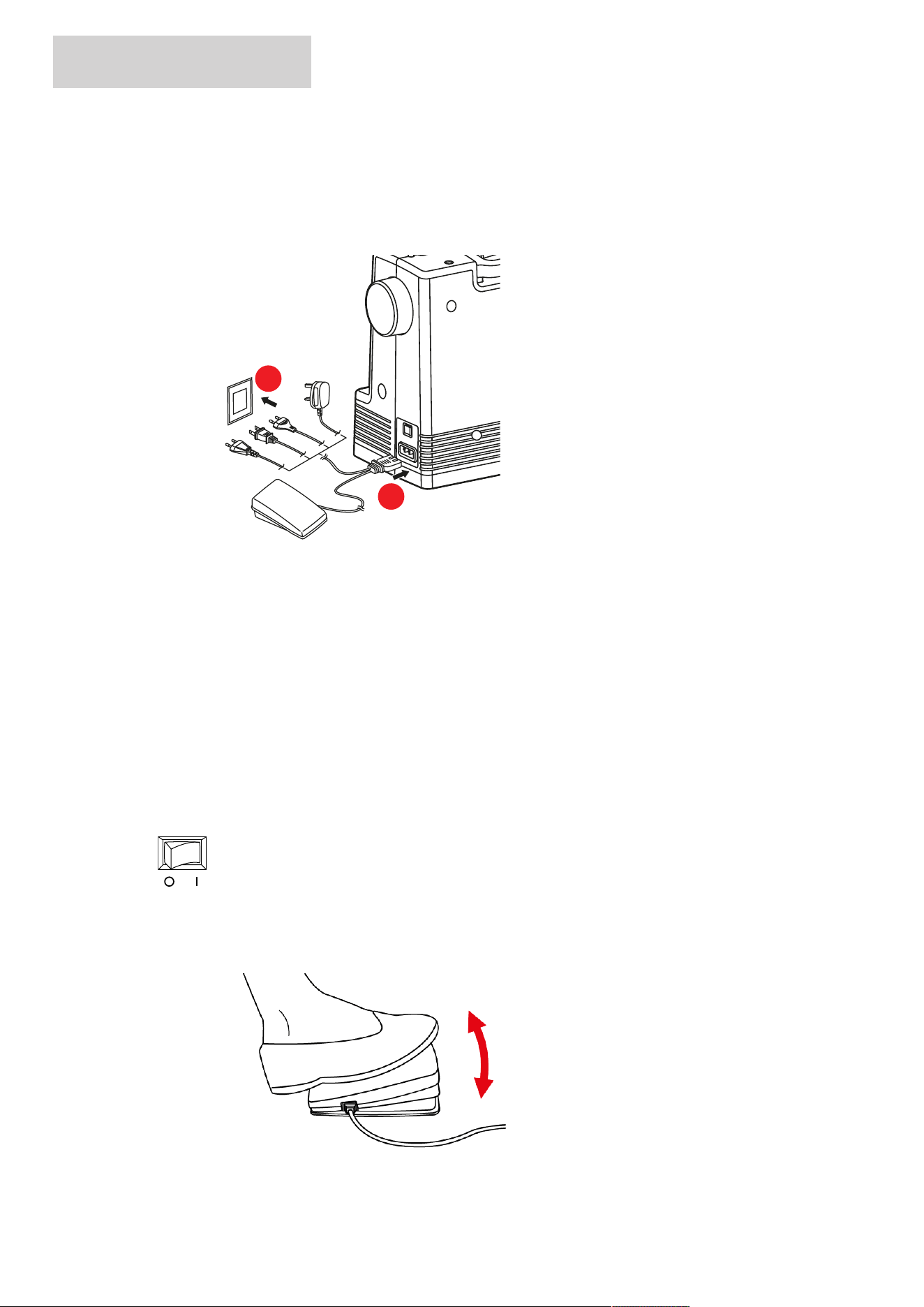
Example for Needle Description
The 130/705 system, which is the most common for household machines, is explained by the following
picture of a Jersey/Stretch needle.
130/705 H-S/70
130 = Shank length (1)
705 = Flat shank (2)
H = Needle scarf (3)
S = Needle point (here medium ball point) (4)
70= Needle size 0.7mm (5)

MY BERNETTE
17
2024-07 EN 5020105.10A.04
Thread Selection
For a perfect sewing result, thread and fabric quality play an important role.
We recommend purchasing quality threads to achieve good sewing results.
• Cotton threads have the advantage of being a natural fiber and therefore are especially suitable for
sewing cotton fabrics.
• Mercerized cotton threads have a slight sheen that remains even after washing.
• Polyester threads have a high tensile strength and are particularly colorfast.
• Polyester threads are more flexible and are recommended where a strong and elastic seam is required.
• Rayon threads are made of natural fibers and have a brilliant sheen.
• Rayon threads are suitable for decorative stitches and create a more beautiful effect.
SEWING PREPARATION
18
2024-07 EN 5020105.10A.04
2 Sewing Preparation
2.1 Connection and Switching On
Connecting the Machine and Foot Control
1
2
> Insert the device plug (1) of the foot control/power cable into the connection for the foot control/power
cable.
> Insert the power plug (2) of the foot control/power cable into the socket.
Use of the Power Cable (only USA/Canada)
The machine has a polarized plug (one contact is wider than the other). To reduce the risk of electric shock,
the plug can only be plugged into the socket in one way. If the plug does not fit into the socket, turn the
plug. If it still does not fit, an electrician needs to be called to install an appropriate outlet. Do not modify the
plug in any way.
Switching the Machine On
Prerequisite:
• The power plug is connected.
> Set the power switch to «I».
Regulating the Speed via the Foot Control
The sewing speed can be continuously varied up to the maximum possible speed via the foot control.
> Press the foot control down carefully to start the machine.
> To sew more quickly, press the foot control further down.
SEWING PREPARATION
19
2024-07 EN 5020105.10A.04
> Release the foot control to stop the machine.
2.2 Spool Pin
Horizontal Spool Pin
Placing the Thread Spool and the Spool Cap
Spool discs hold the thread spool in place for proper release of thread from the spool.
> Place the thread spool on the spool pin.
> Position the appropriate spool cap on the spool pin so that there is no space between the spool cap and
the thread spool.
Using the Spool Net
The spool net holds the thread on the thread spool and prevents the thread from knotting and breaking.
The spool net is only used with the horizontal spool holder.
> Pull the spool net over the thread spool. Ensure when doing so that the spool net does not slip off the
thread spool, e.g. double-insert the net over the thread spools or insert a part of the net into the thread
spool at the rear.
Second Spool Pin
Inserting the second spool pin
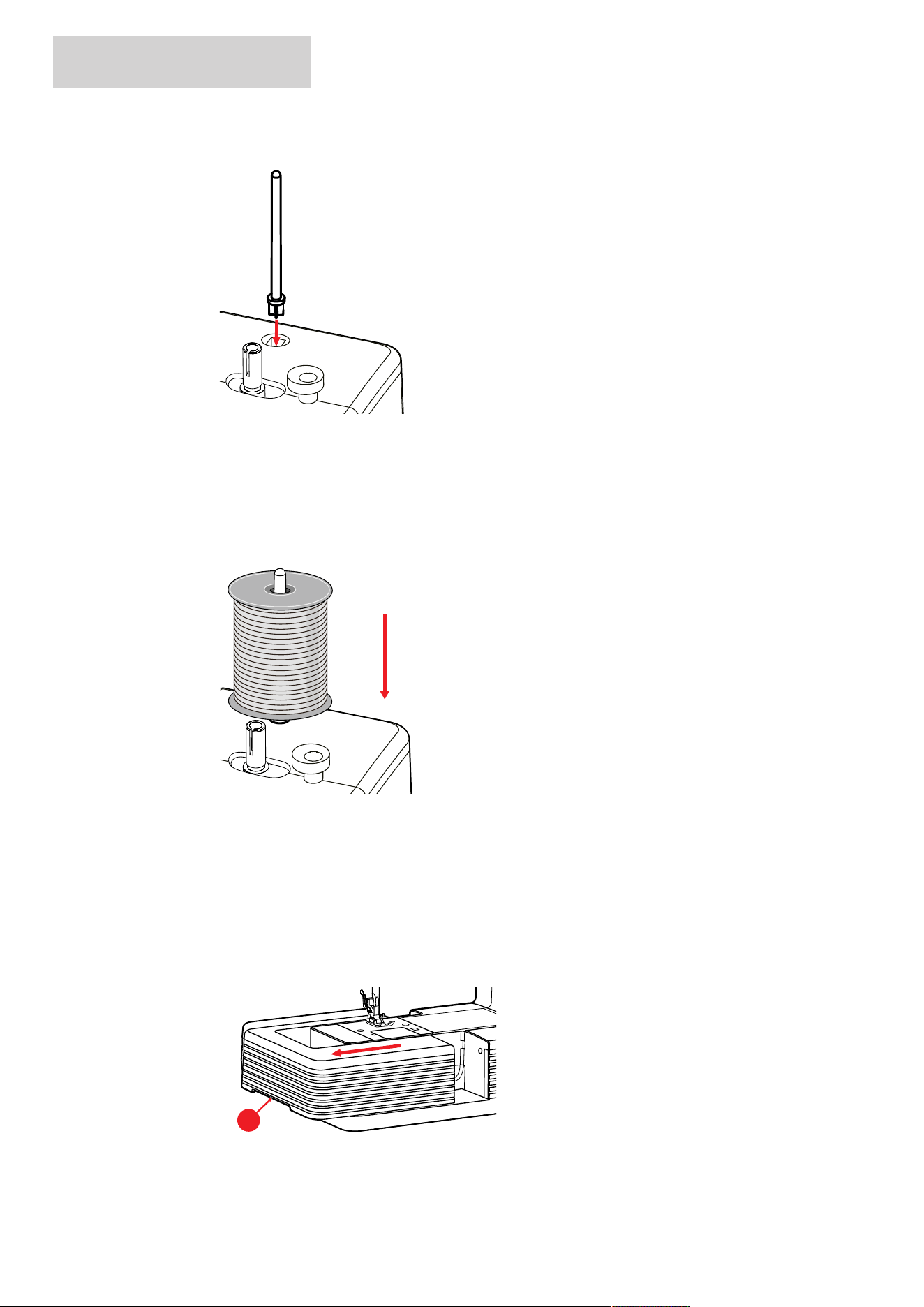
The second spool pin is required when sewing with multiple threads or for winding the bobbin thread.
SEWING PREPARATION
20
2024-07 EN 5020105.10A.04
> Insert the second spool pin in the accessories opening on the machine cover.
1
3
2
4
4
88
6
6
7
7
9
9
Inserting thread spool
> Place the felt disc on the spool pin.
– The felt disc prevents the thread from sticking to the spool pin.
> Place the thread spool on the second spool pin.
1
3
2
4
4
88
6
6
7
7
9
9
2.3 Freearm
The bernette b05 provides a solidly freearm which offers a lot of space for large project on the right of the
needle.
2.4 Sewing Table with Accessory Box
The sewing table has an integrated accessory box.
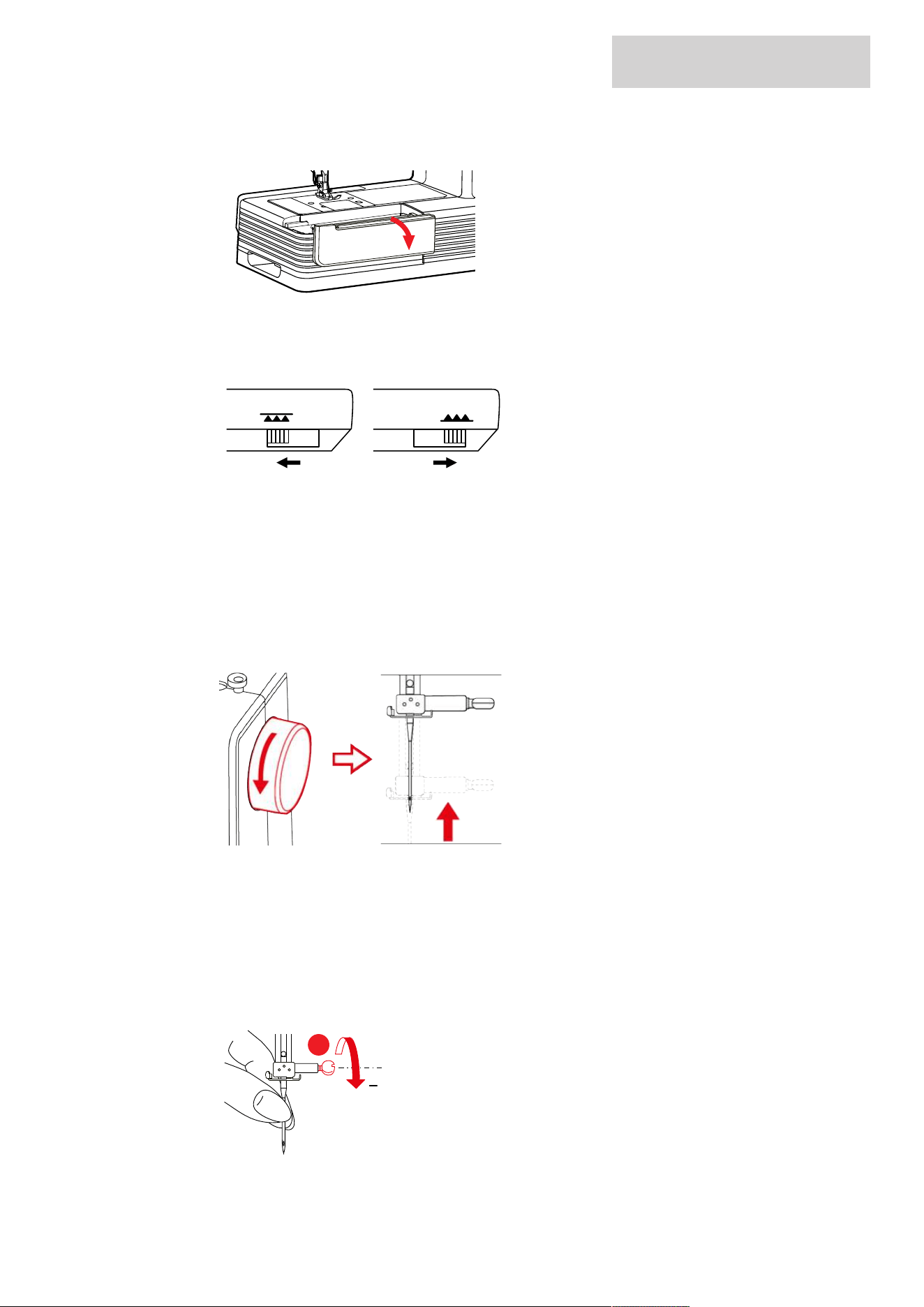
> To remove the sewing table, hold the sewing table by the handle (1) and pull it away to the left.
1
SEWING PREPARATION
21
2024-07 EN 5020105.10A.04
> To open the accessory box, tilt the cover towards you.
> To close the accessory box, fold the lid downwards at an angle.
2.5 Raising or Lowering the Feed Dog
> To raise the feed dog, push the feed dog lever to the right.
– The feed dog is raised when the first stitch is sewn.
> Slide the «Feed Dog Lever» left to lower the feed dog.
– The feed dog is lowered.
2.6 Needle
Raising and Lowering the Needle
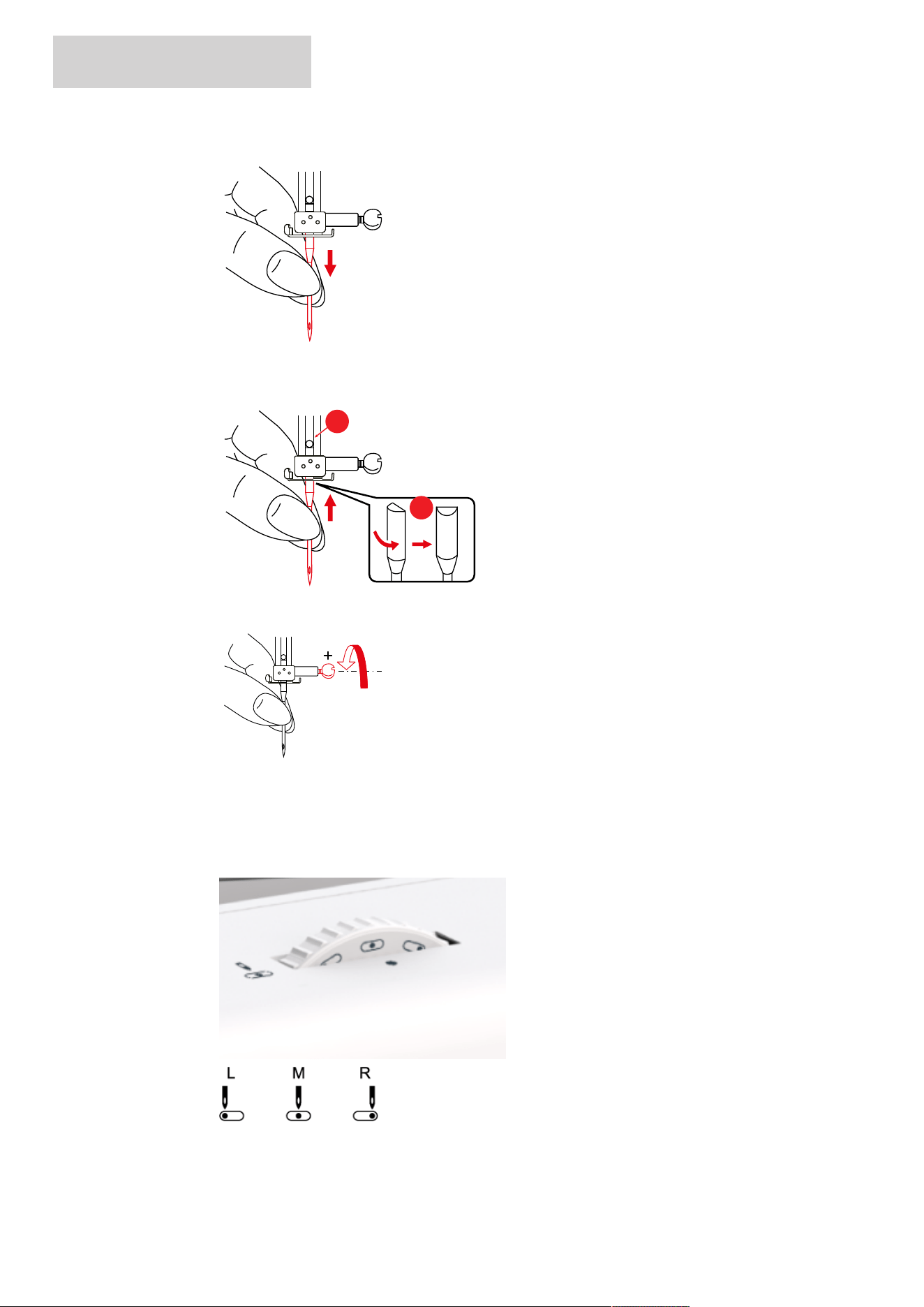
> To raise the needle, turn the handwheel counterclockwise until the needle is in the highest position.
> To lower the needle, continue turning the handwheel counterclockwise until the needle pierces the
fabric.
Changing the Needle
> Raise the presser foot.
> Raise the needle.
> Switch the machine off and disconnect it from the power supply system.
> Loosen the fixing screw (1) with the screwdriver.
1
SEWING PREPARATION
22
2024-07 EN 5020105.10A.04
> Pull the needle down to remove.
> Hold the new needle (2) with the flat side to the rear. Push the needle upwards into the needle holder as
far as it will go (3).
2
3
> Tighten the fixing screw by hand.
Adjusting the Needle Position
> Raise the needle.
> Use a recommended presser foot.
> Set the required needle position using the needle position dial.
SEWING PREPARATION
23
2024-07 EN 5020105.10A.04
2.7 Presser Foot
Raising and Lowering the Presser Foot
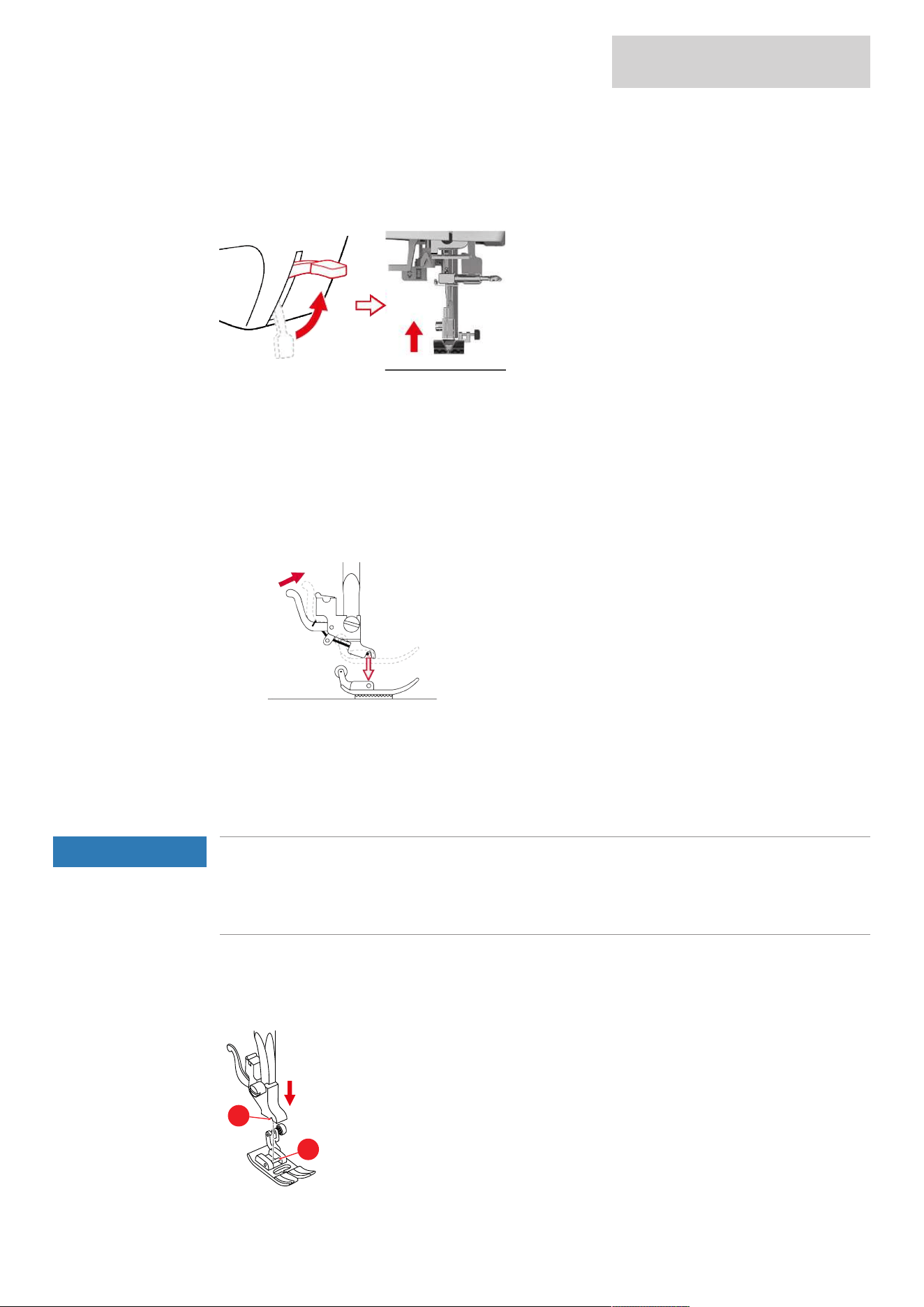
> To raise the presser foot, press the presser foot lever upwards.
> To lower the presser foot, press the presser foot lever downwards.
Changing the Presser Foot
Removing the presser foot sole
> Switch off the machine and disconnect it from the power supply.
> Raise the presser foot.
> Raise the needle.
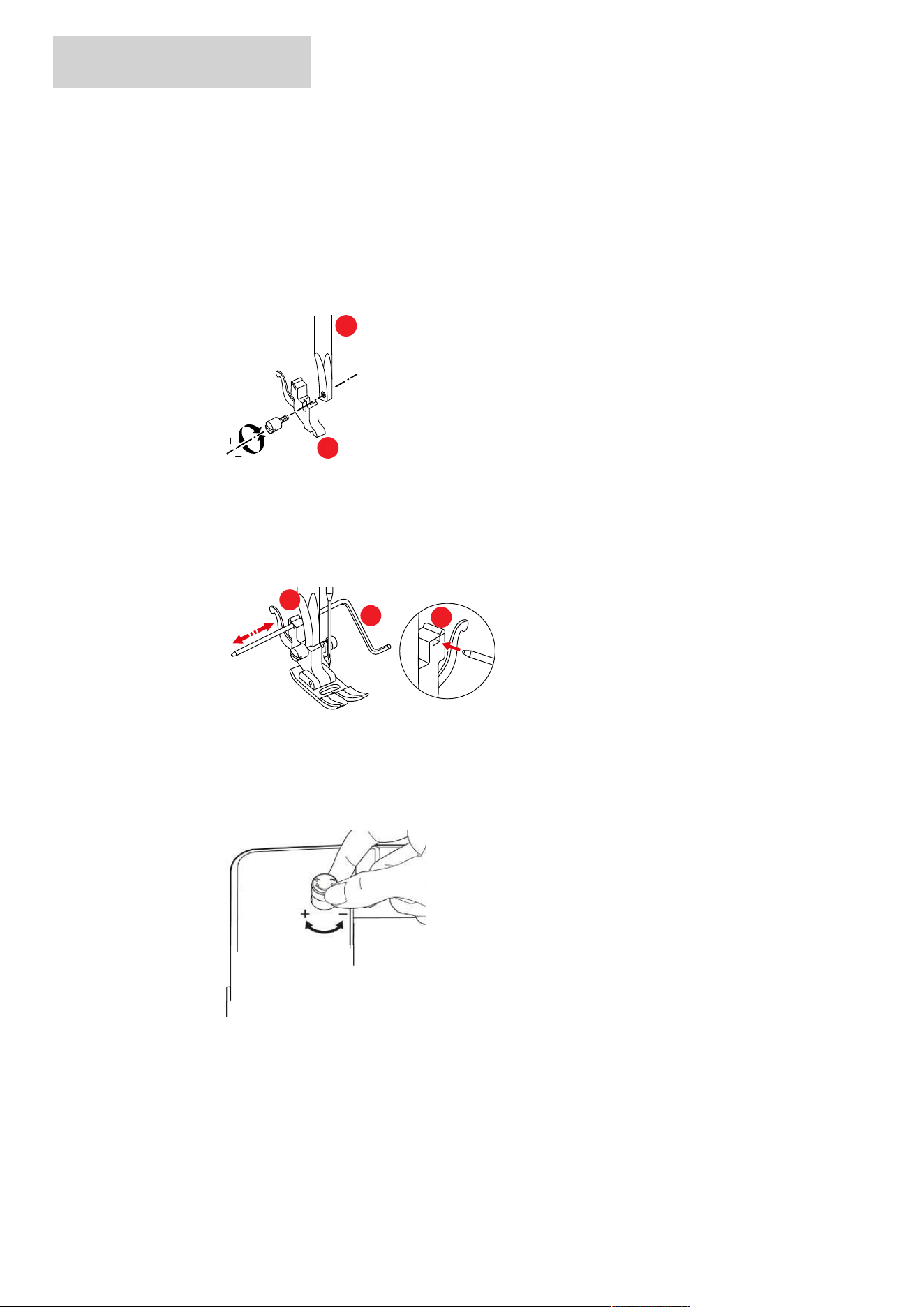
> To remove the presser foot sole, push the lever on the rear of the presser foot holder upwards.
Fitting the presser foot sole
Prerequisite:
• The presser foot sole is removed.
> Raise the presser foot.
NOTICE
Needle breakage caused by incorrect presser foot
If the presser foot is not suitable for the selected stitch, the needle may collide with the presser foot and
break.
> Always use a presser foot that is suitable for the stitch.
> Position the new presser foot sole under the notch in the shaft (1) so that the notch in the shaft is
positioned above the presser foot sole pin (2).
> Carefully lower the presser foot lifter until the notch in the shaft engages with the presser foot sole pin.
1
2
SEWING PREPARATION
24
2024-07 EN 5020105.10A.04
Removing and Inserting the Presser Foot Holder
Prerequisite:
• The presser foot sole is removed.
> Raise the presser foot.
> Align the presser foot holder (1) with the presser foot bar (2) underneath and to the left.
> Hold the presser foot holder firmly and screw in the screw by hand.
> Tighten the screw using the screwdriver.
1
2
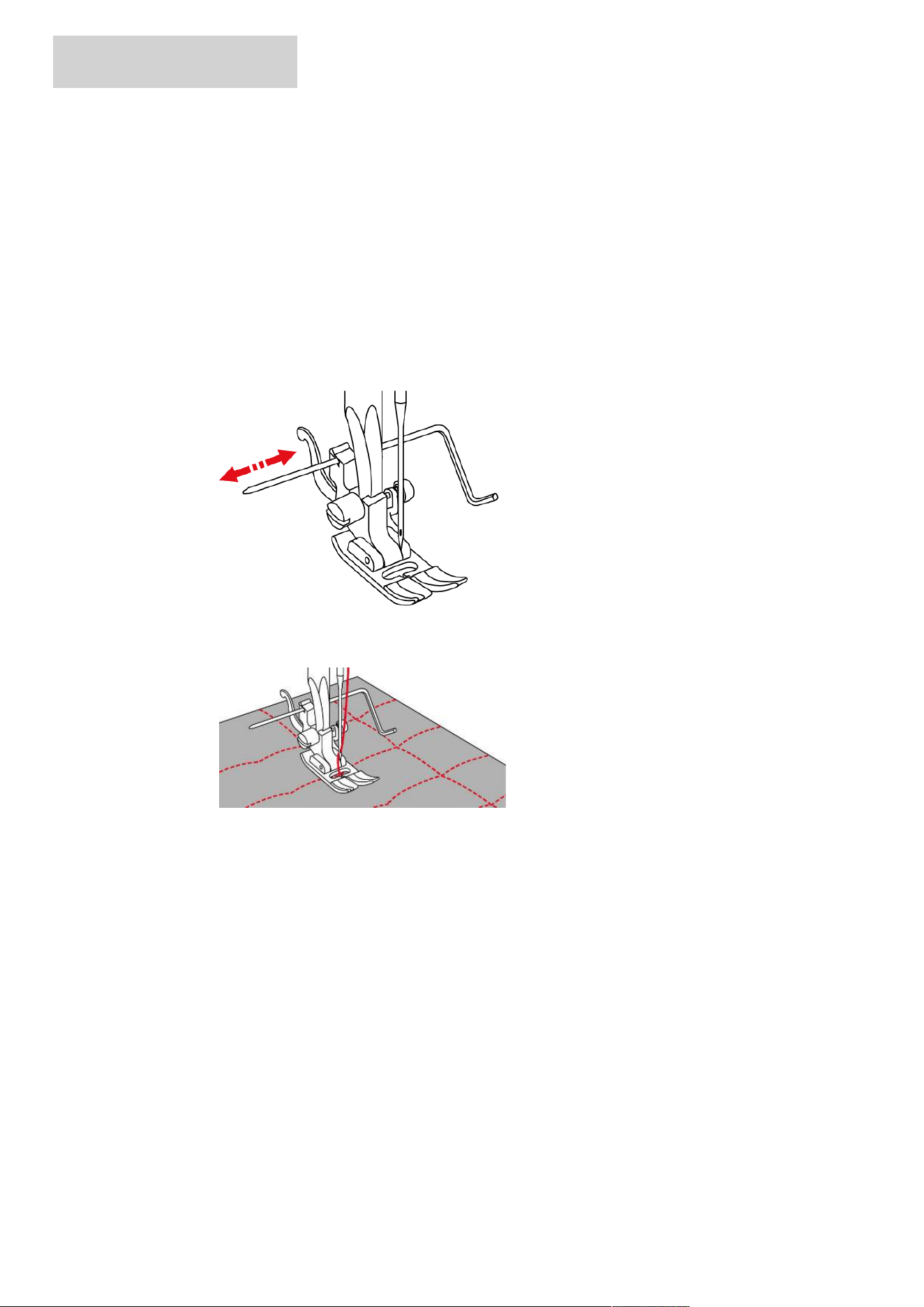
Attaching the Seam Guide
The seam guide is suitable for sewing parallel lines.
> Insert the seam guide (1) into the hole in the presser foot holder (2).
> Set the required distance to the adjacent seam.
1
2
2
Adjusting the Presser Foot Pressure
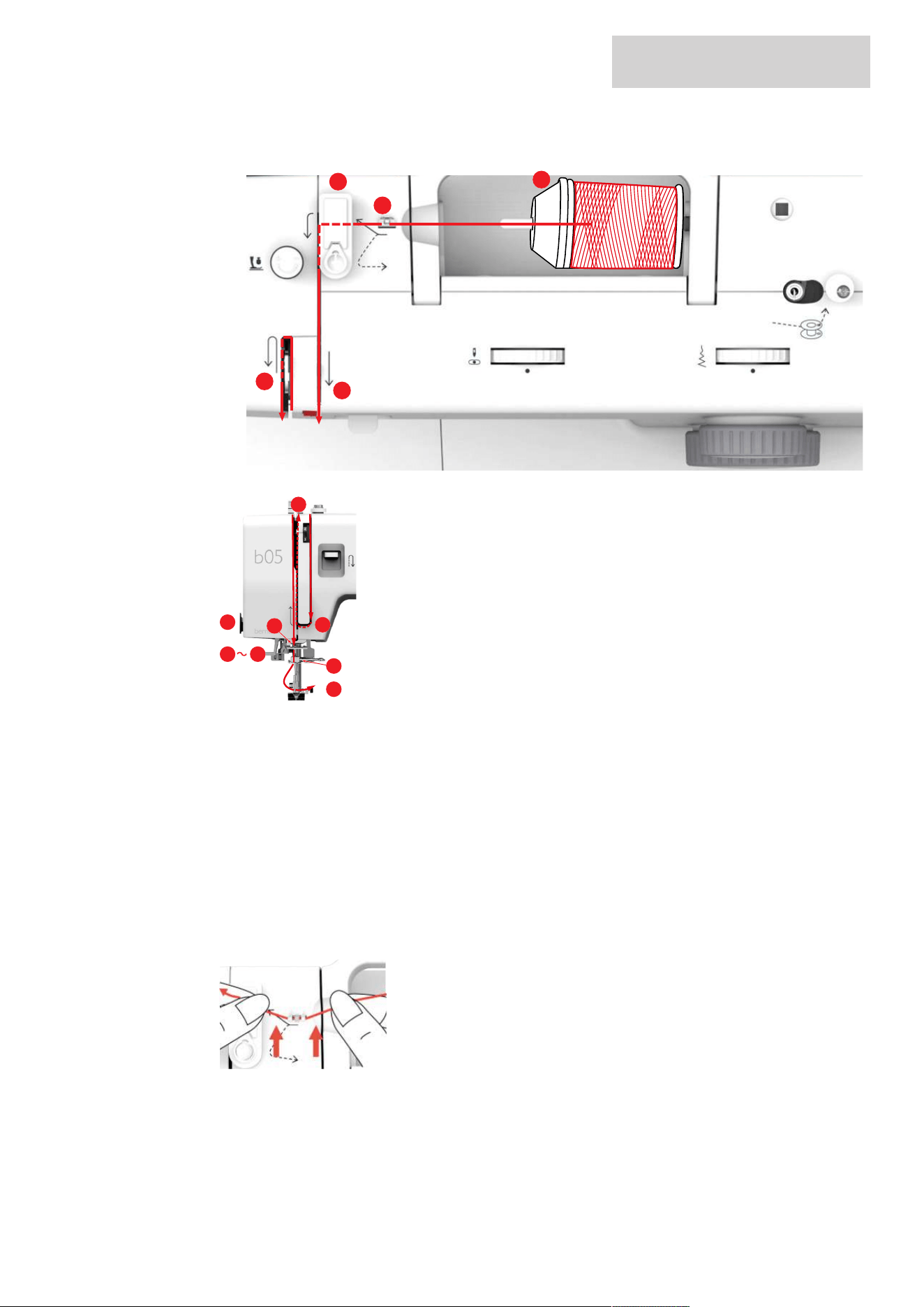
> To increase the presser foot pressure, turn the «Presser foot pressure» adjustment knob clockwise.
> To reduce the presser foot pressure, turn the adjusting dial «Presser Foot Pressure» counterclockwise.
Note: Do not reduce the presser foot pressure below «0».
2.8 Threading
Threading Preparation
> Switch the machine off.
> Raise the needle.
> Raise the presser foot.
SEWING PREPARATION
25
2024-07 EN 5020105.10A.04
Threading the Upper Thread
1
2
3
4
6
6
5
7
8
9 10
11
12
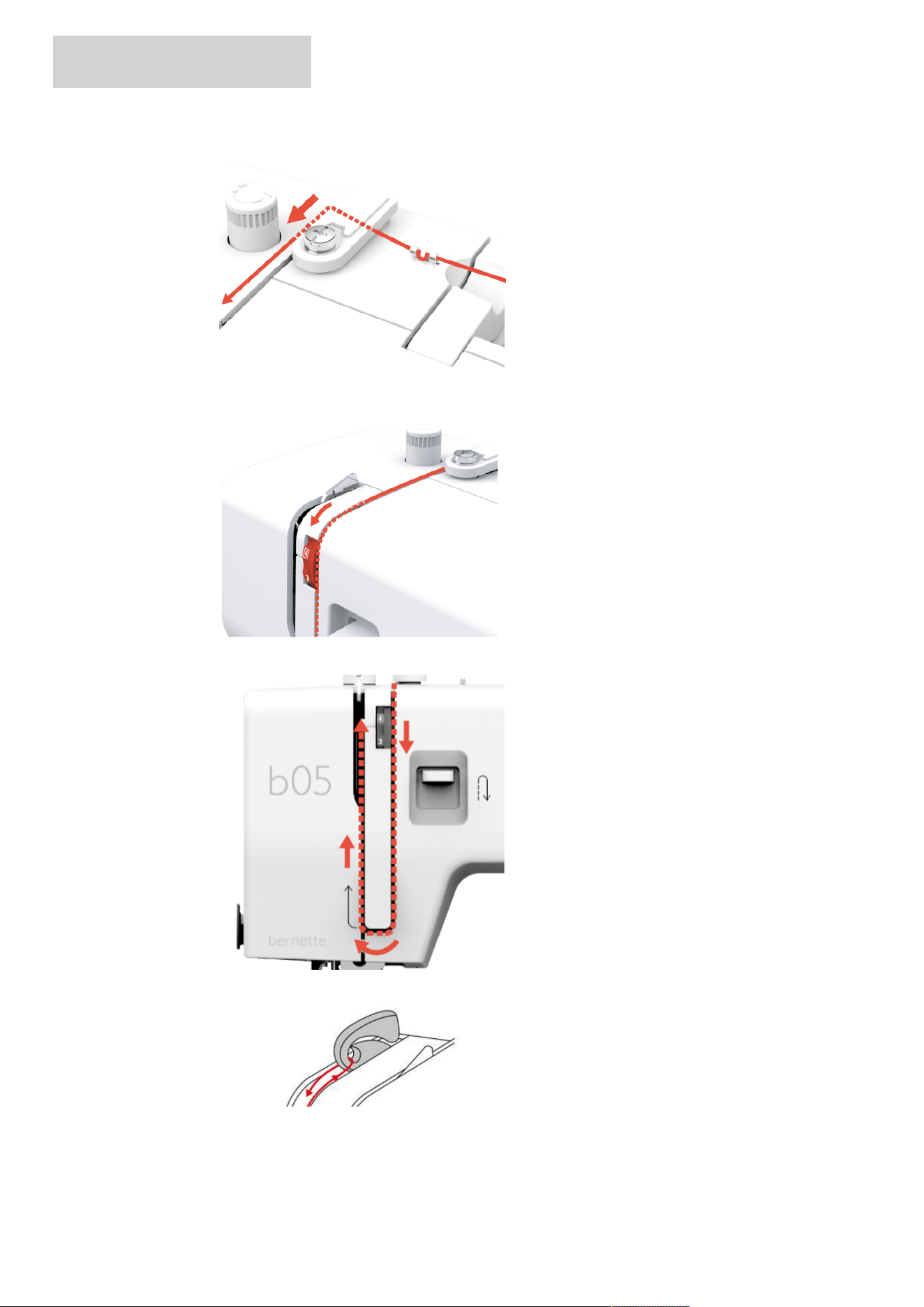
1 Spool Cap 7 Guide
2 Thread Guide 8 Guide
3 Thread Pretension 9 Thread Lever
4 Thread Tensions Discs 10 Wire Hook
5 Thread Take-up Lever Cover 11 Thread Cutter
6 Thread Take-up Lever 12 Thread
> Place the thread spool on the spool pin so that the thread unwinds clockwise.
> Fit the spool cap suitable for the spool.
> Feed the thread through the thread guide.
SEWING PREPARATION
26
2024-07 EN 5020105.10A.04
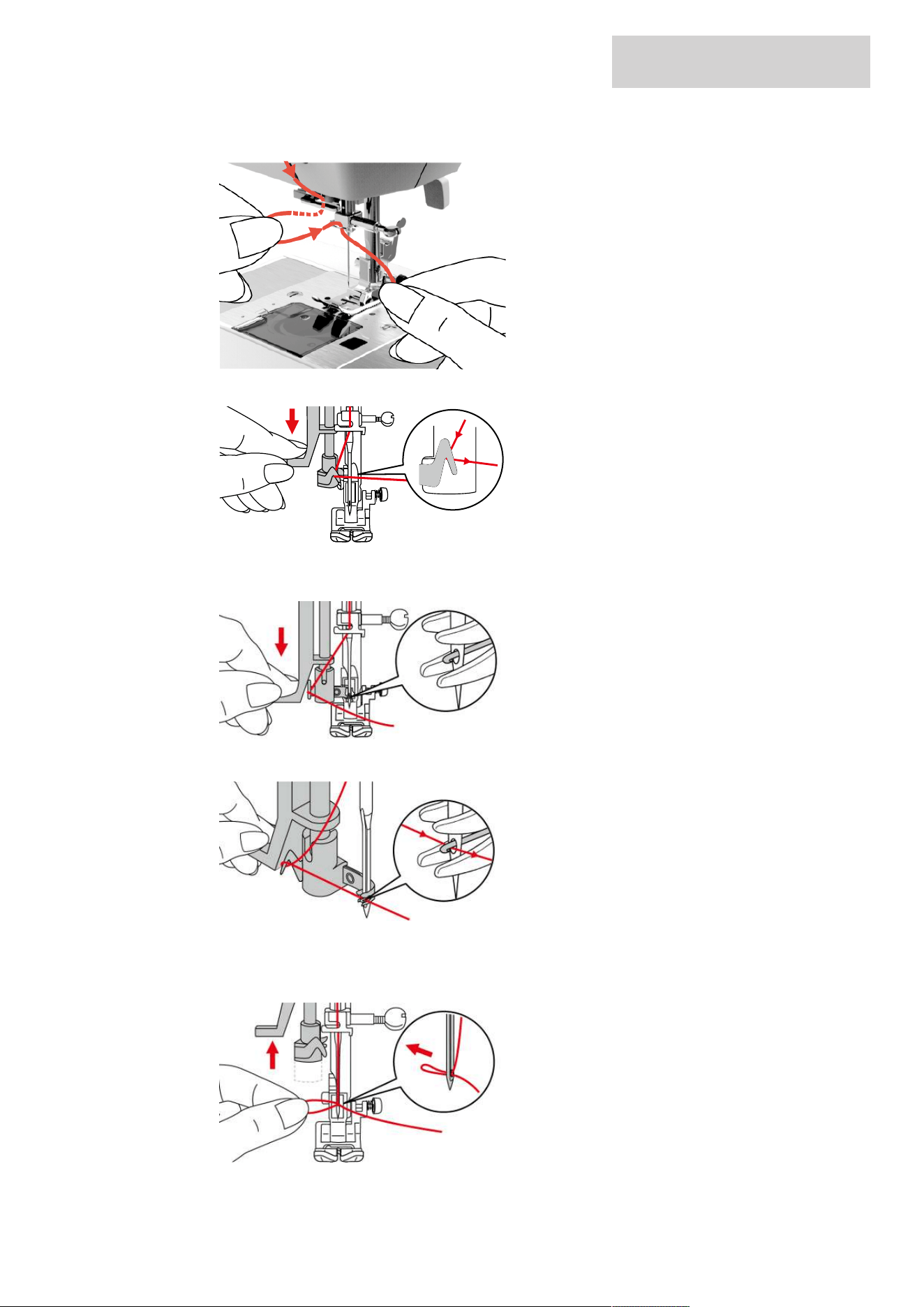
> Guide the thread through the thread pretension.
> Place the end of the thread down along the duct.
> Guide the htread downwards around the thread take-up lever cover.
> Guide the thread at the top from rigth to the left through the thread take-up lever and then down again.
> Guide the thread through the guides above the needle.
SEWING PREPARATION
27
2024-07 EN 5020105.10A.04
> Lower the presser foot.
> Press the needle-threading lever downwards slightly and guide the thread around the thread guide.
> Push the needle-threading lever down as far as it will go and hold it down.
– The wire hook goeas through the eye of the needle.
> Guide the thread in front of the needle and underneath the wire hook and hold it.
> To thread the needle, lift the needle-threading lever. Keep the thread loose when doing so.
– The wire hook moves backwards and pulls the thread through the needle eye into a loop.
> Pull the thread completely through the eye of the needle.
SEWING PREPARATION
28
2024-07 EN 5020105.10A.04
Threading the Twin Needle
Prerequisite:
• The zigzag foot is fitted.
• The twin needle is inserted.
• The second spool pin, felt disc and second spool are fitted.
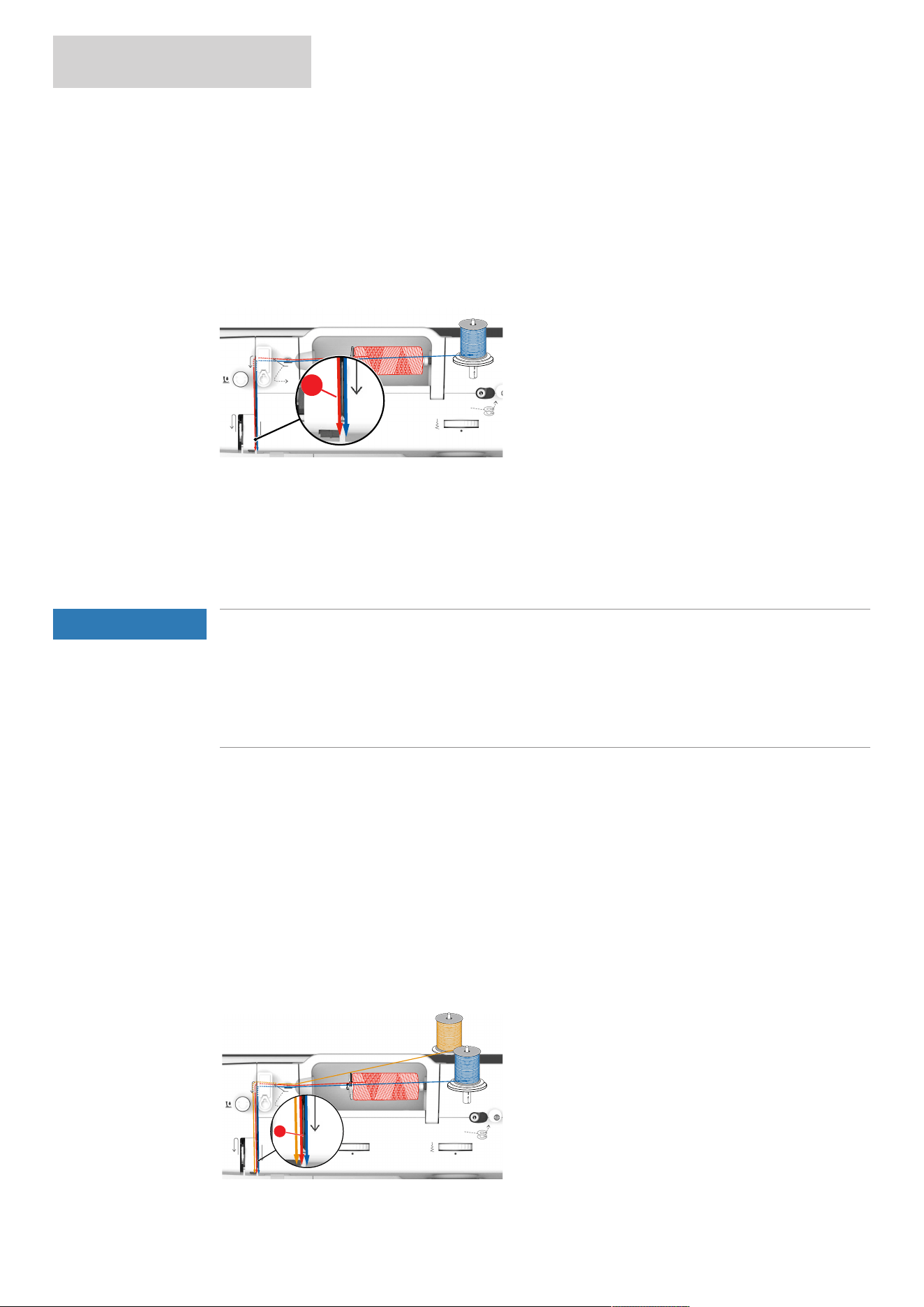
> Guide the thread from the horizontal spool pin (red) in the direction of the arrow to the left side of the
thread tension disc (1).
1
> Guide the thread to the thread guide above the needle.
> Thread the thread into the left needle manually.
> Guide the thread from the vertical spool pin (blue) in the direction of the arrow to the right side of the
thread tension disc (1).
> Guide the thread to the thread guide above the needle.
> Thread the thread into the right needle manually.
NOTICE
Needle Breakage Caused by Incorrect Presser Foot, Stitch or Needle Position
If the presser foot, stitch or needle position is incorrect, the needle can collide with the presser foot or stitch
plate and break.
> Fit the zigzag foot.
> Set a straight stitch.
> Set the needle to the center position.
Threading the Triple Needle
An external spool stand is required for the third spool when working with the triple needle.
Prerequisite:
• The zigzag foot is fitted.
• The triple needle is inserted.
> Place a spool with a felt disc and suitable spool disc on the horizontal spool pin.
> Place the second spool with a felt disc on the vertical spool pin.
> Place the third spool with a felt disc on the external spool stand.
> Guide the thread from the horizontal spool pin (red) in the direction of the arrow to the left side of the
thread tension disc (1).
1
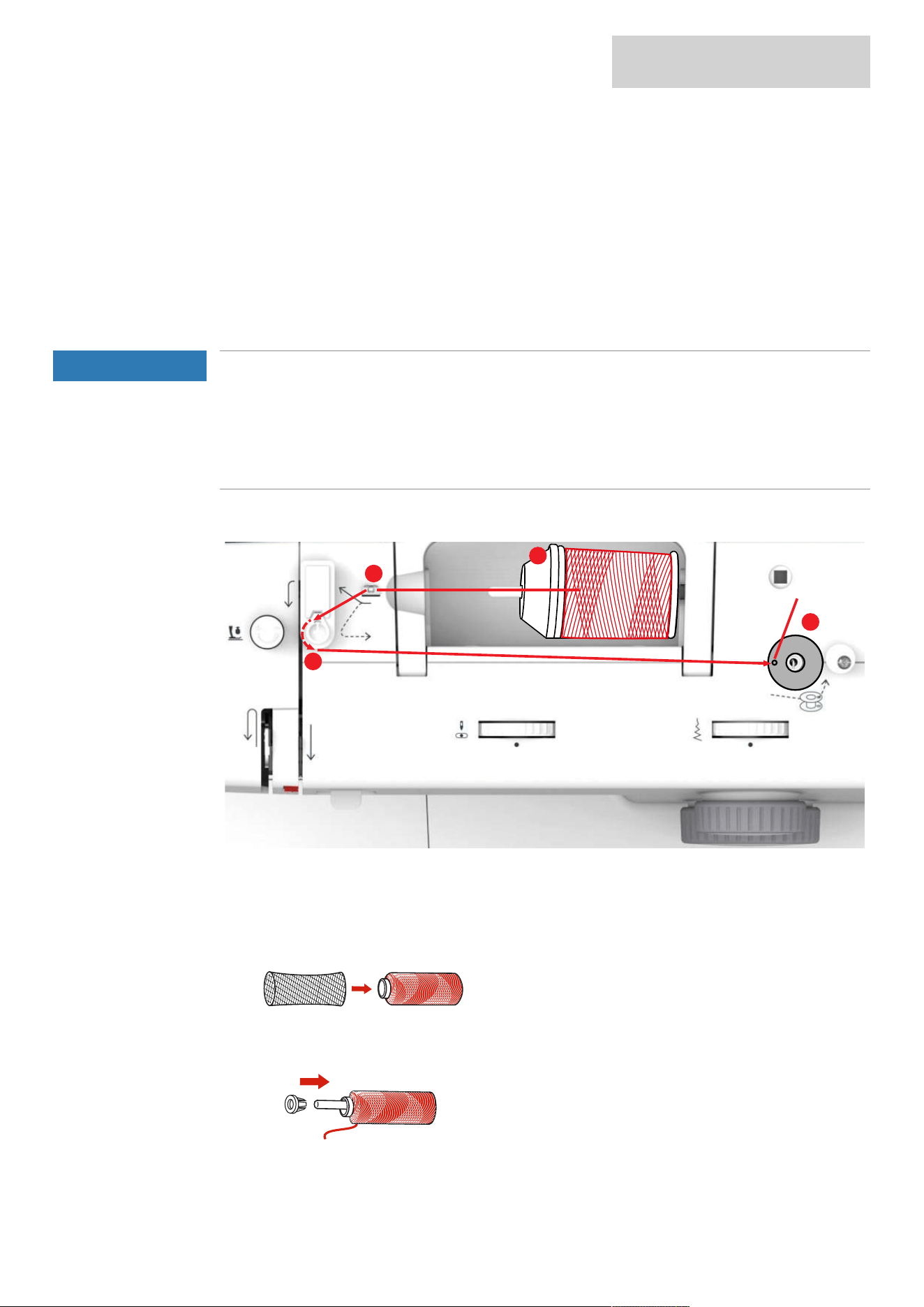
SEWING PREPARATION
29
2024-07 EN 5020105.10A.04
> Guide the thread to the thread guide above the needle.
> Thread the thread into the left needle manually.
> Guide the thread from the external spool pin (orange) in the direction of the arrow to the left side of the
thread tension disc (1).
> Guide the thread to the thread guide above the needle.
> Thread the thread into the center needle manually.
> Guide the thread from the vertical spool pin (blue) in the direction of the arrow to the right side of the
thread tension disc (1).
> Guide the thread to the thread guide above the needle.
> Thread the thread into the right needle manually.
NOTICE
Needle Breakage Caused by Incorrect Presser Foot, Stitch or Needle Position
If the presser foot, stitch or needle position is incorrect, the needle can collide with the presser foot or stitch
plate and break.
> Fit the zigzag foot.
> Set a straight stitch.
> Set the needle to the center position.
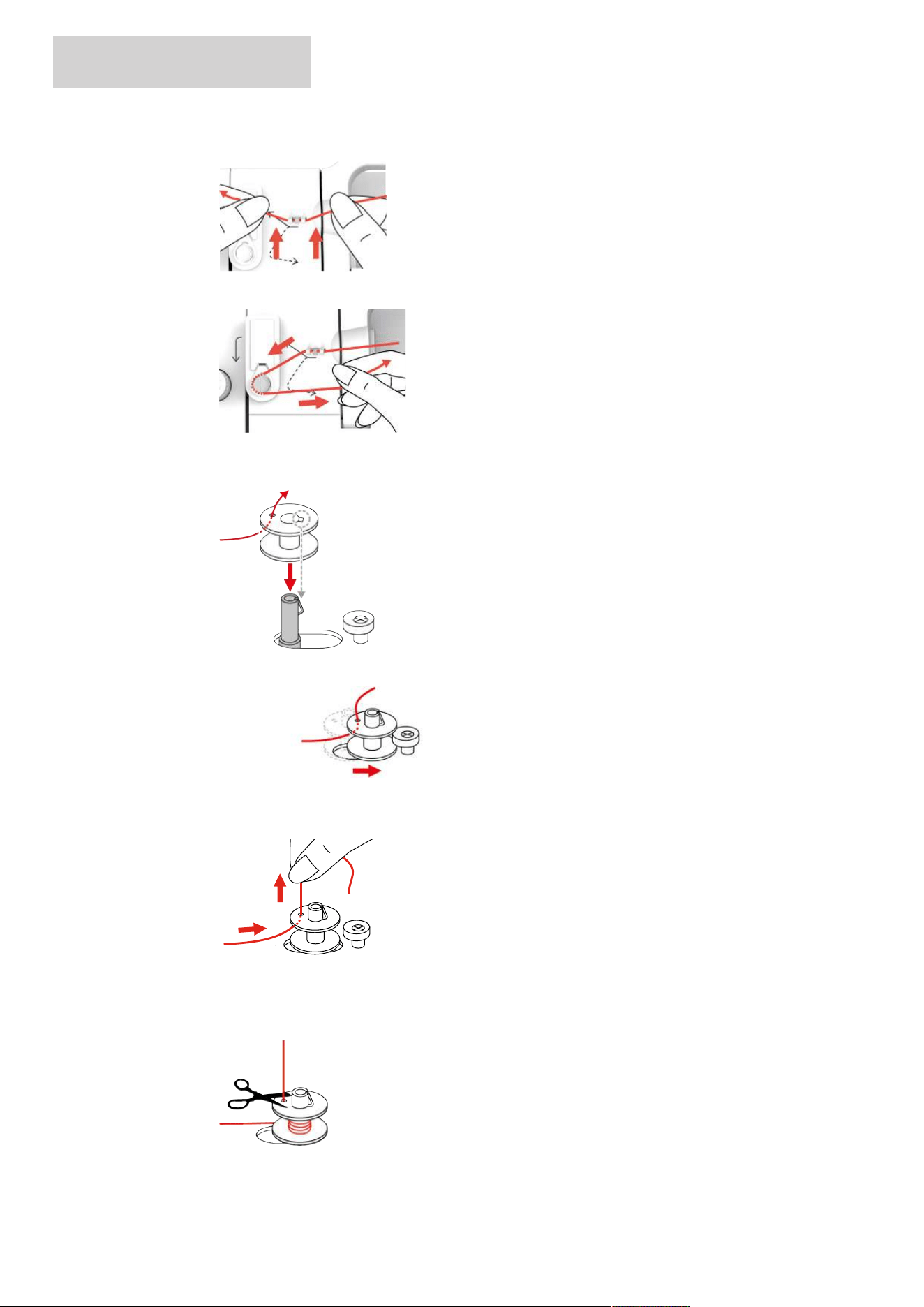
Winding the Bobbin Thread
1
2
3
4
1 Spool Cap 3 Bobbin Winder Pretension
2 Thread Guide 4 Spool Pin
> To prevent slippery threads from catching or breaking, pull the spool net over the spool.
> Place the thread spool and the appropriate spool cap on the spool holder. Use the small spool cap on the
spool holder.
SEWING PREPARATION
30
2024-07 EN 5020105.10A.04
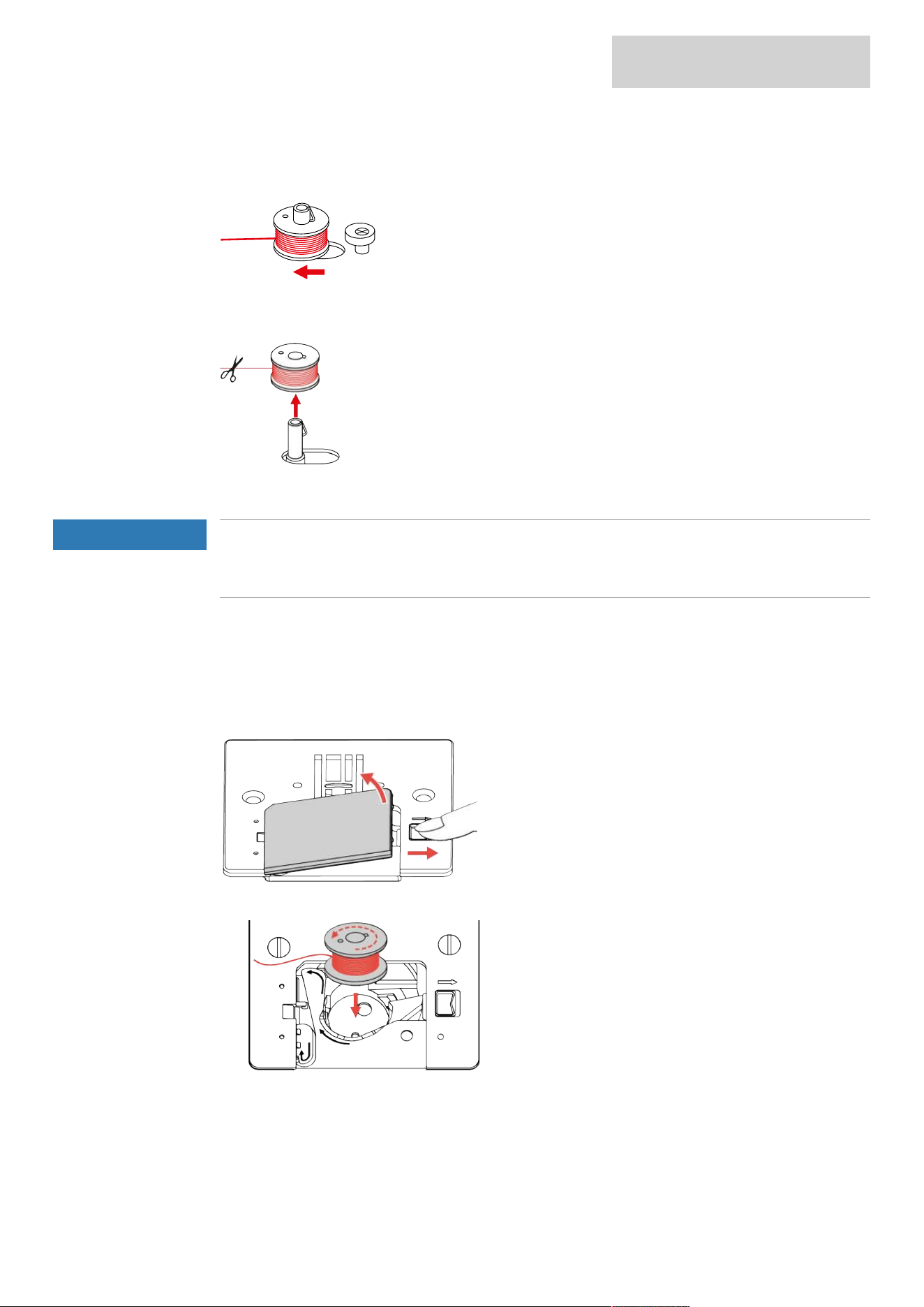
> Feed the thread through the thread guide.
> Guide the thread around the bobbin winder pre-tension in the direction of the arrow.
> Pull the end of the thread through one of the inner holes on the bobbin and place the empty bobbin on
the bobbin winding unit.
> Push the bobbin to the rigth-hand position.
– The machine switches to bobbin winding mode. Sewing is not possible.
> Hold the end of the thread tightly with one hand.
> To start the winding process for a few rotations and then stop it again, press the foot control briefly so
that the thread is firmly attached to the bobbin.
> Cut the end of the thread above the inner hole.
SEWING PREPARATION
31
2024-07 EN 5020105.10A.04
> To continue the winding process, press the foot control.
> Release the foot control to stop the winding process.
> Push the bobbin winding unit to the left into the starting position.
– The machine switches to sewing mode.
> Remove the bobbin and cut the thread.
Threading the Bobbin Thread
NOTICE
Needle Breakage Caused by Unevenly Wound Bobbins
Unevenly wound bobbins can lead to incorrect thread tension or cause needles to break.
> Only use evenly wound bobbins.
Prerequisite:
• The needle is raised.
• The presser foot is raised.
• The machine is switched off.
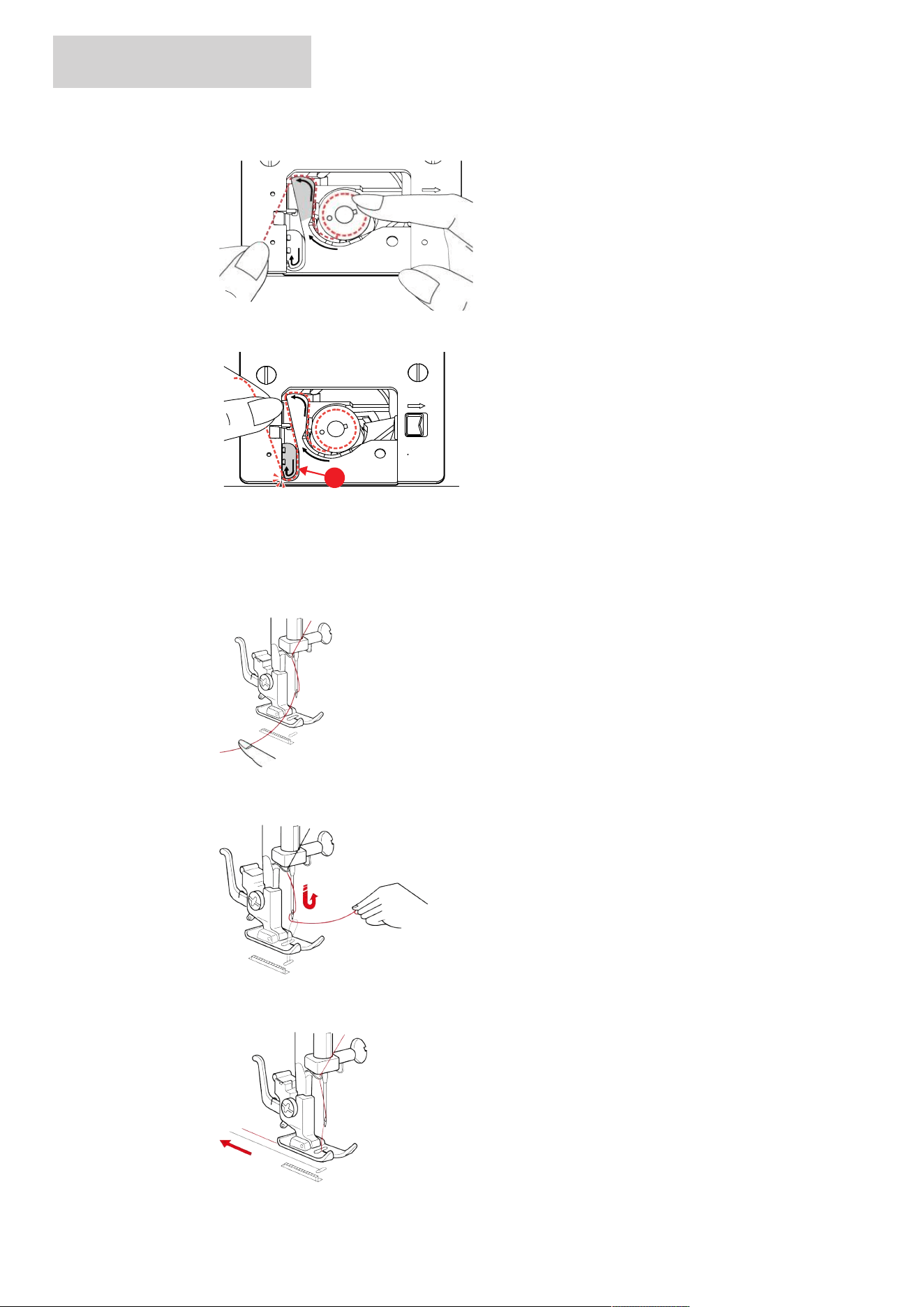
> To open the bobbin cover, push the handle to the right and remove the bobbin cover.
> Insert a new bobbin so that the thread is wound counterclockwise.
> Press gently on the bobbin.
SEWING PREPARATION
32
2024-07 EN 5020105.10A.04
> Follow the arrow markings to bring the thread into the bobbin thread guide.
> To cut off excess thread, take the end of the thread and pull it over the thread cutter (1).
1
> Attach the bobbin cover.
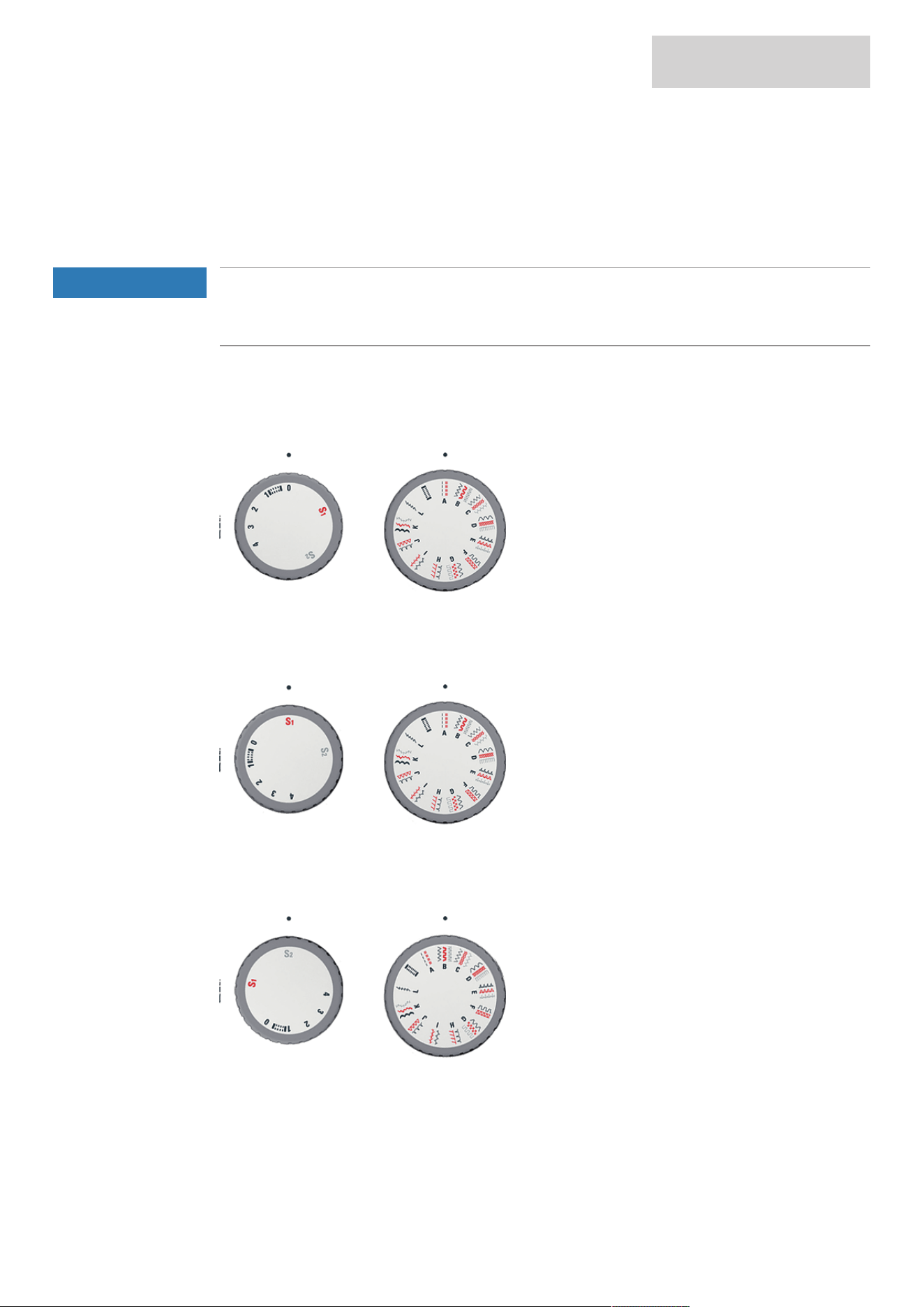
Bringing up the Bobbin Thread
> Raise the needle.
> Raise the presser foot and hold the needle thread lightly with your left hand.
> Push the button «Needle Stop Up/Down» 2x.
> Pull the upper thread upwards until the bobbin thread forms a loop.
> Pull the bobbin thread all the way up.
> Pull both threads approx. 4in (10cm) to the back and place them under the presser foot.
CREATIVE SEWING
33
2024-07 EN 5020105.10A.04
3 Creative Sewing
3.1 Selecting a Stitch Pattern
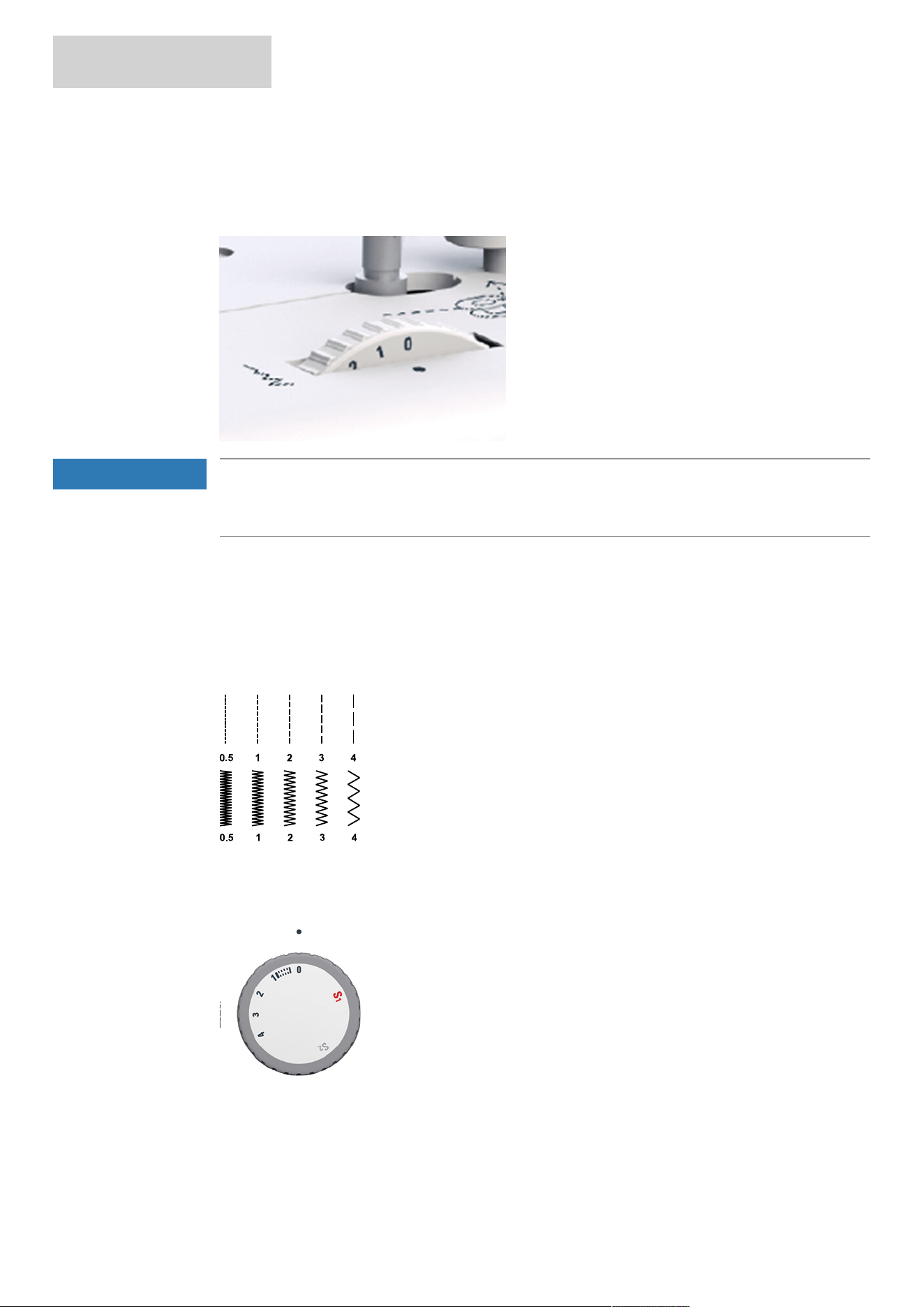
The stitch patterns are divided into categories A to L. Each category can include up to three stitch patterns,
which are indicated by the colors black, gray and red.
NOTICE
Incorrect needle position when selecting a stitch pattern
Damage to needle and fabric.
> Before turning the stitch pattern selector knob, move the needle to the topmost position.
> Raise the needle.
> To select the black stitch pattern in a category, set the stitch length knob to a value between 0 and 4,
then turn the stitch pattern selector knob to the left or right until the chosen stitch pattern category
engages in the center underneath setting position «•».
> To select the red stitch pattern in a category, set the stitch length knob to «S1», then turn the stitch
pattern selector knob to the left or right until the chosen stitch pattern category engages in the center
underneath setting position «•».
> To select the gray stitch pattern in a category, set the stitch length knob to «S2», then turn the stitch
pattern selector knob to the left or right until the chosen stitch pattern category engages in the center
underneath setting position «•».
CREATIVE SEWING
34
2024-07 EN 5020105.10A.04
3.2 Editing Stitch Patterns
Setting the Stitch Width
The stitch width can be varied from 0–6mm for each stitch using the stitch width dial.
NOTICE
Incorrect needle position when selecting a stitch width
Damage to needle and fabric.
> Before turning the stitch width dial, move the needle to the topmost position.
> Raise the needle.
> Turn the stitch width dial until the required stitch width is shown above setting position «•».
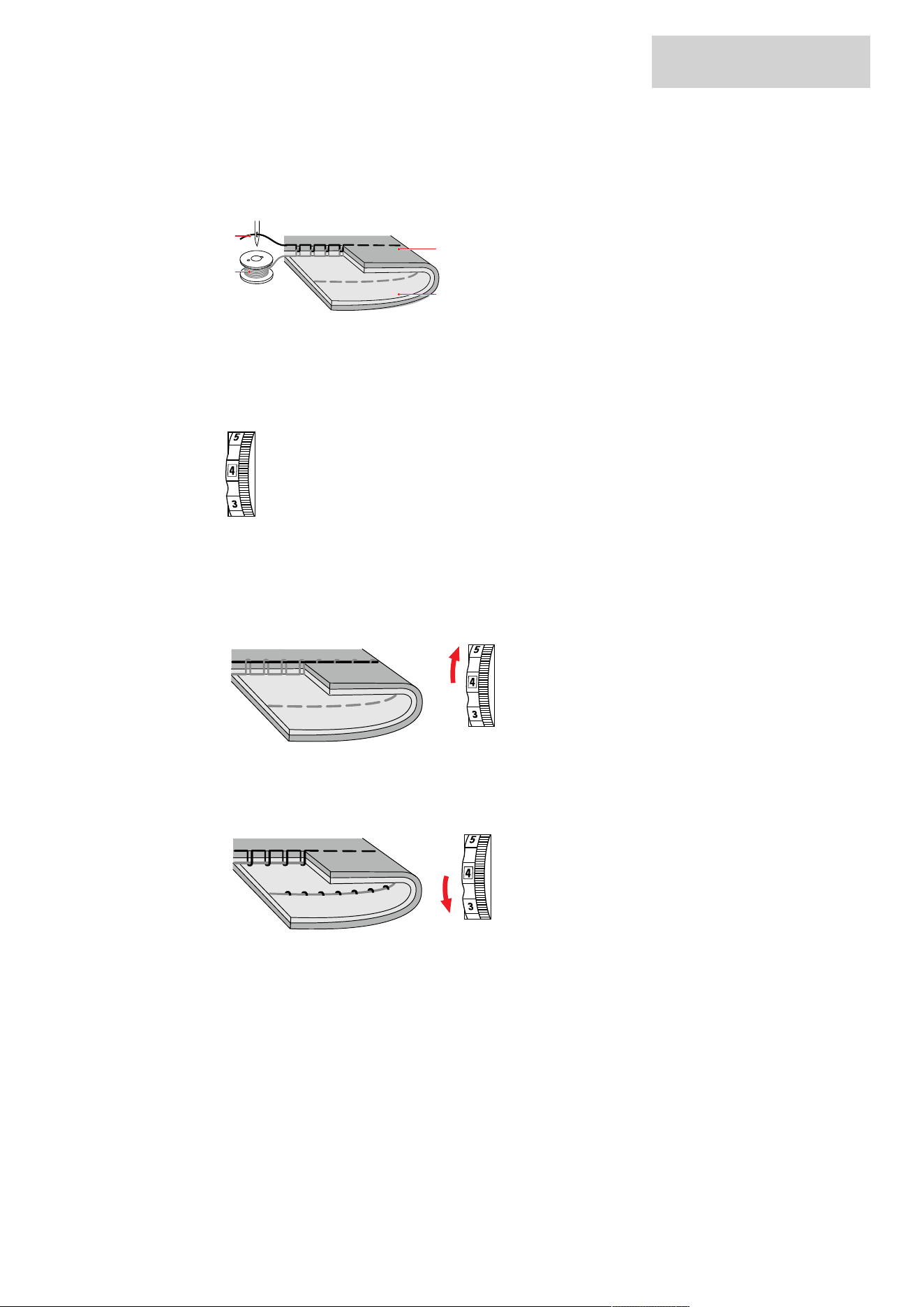
Adjusting the Stitch Length
The stitch length can be adjusted using the stitch length knob.
For black stitch patterns, the stitch length can be set to 0–4mm.
For buttonholes, the stitch length can be set within the range of the buttonhole symbol on the dial.
For red and gray stitch patterns, the stitch length is predefined and cannot be changed.
> Turn the stitch length knob until the required stitch length is shown underneath setting position «•».
CREATIVE SEWING
35
2024-07 EN 5020105.10A.04
Adjusting the Upper Thread Tension
The upper thread tension must be adjusted depending on the sewing materials, the fabric layers and the
sewing process using the «Upper thread tension» dial.
1
2
3
4
1 Upper thread 3 Right side (top side) of fabric
2 Bobbin thread 4 Wrong side (bottom side) of fabric
The base value for the upper thread tension is 4.
In perfect straight stitching, the bobbin thread is not visible on the right side of the fabric.
> To increase the upper thread tension, set the «Upper thread tension» dial to a higher value.
> To decrease the upper thread tension, set the «Upper thread tension» dial to a lower value.
> If the bobbin thread is visible on the right side of the fabric, set the upper thread tension to a lower
value.
> If the upper thread is visible on the wrong side of the fabric, set the upper thread tension to a higher
value.
Adjusting the Balance
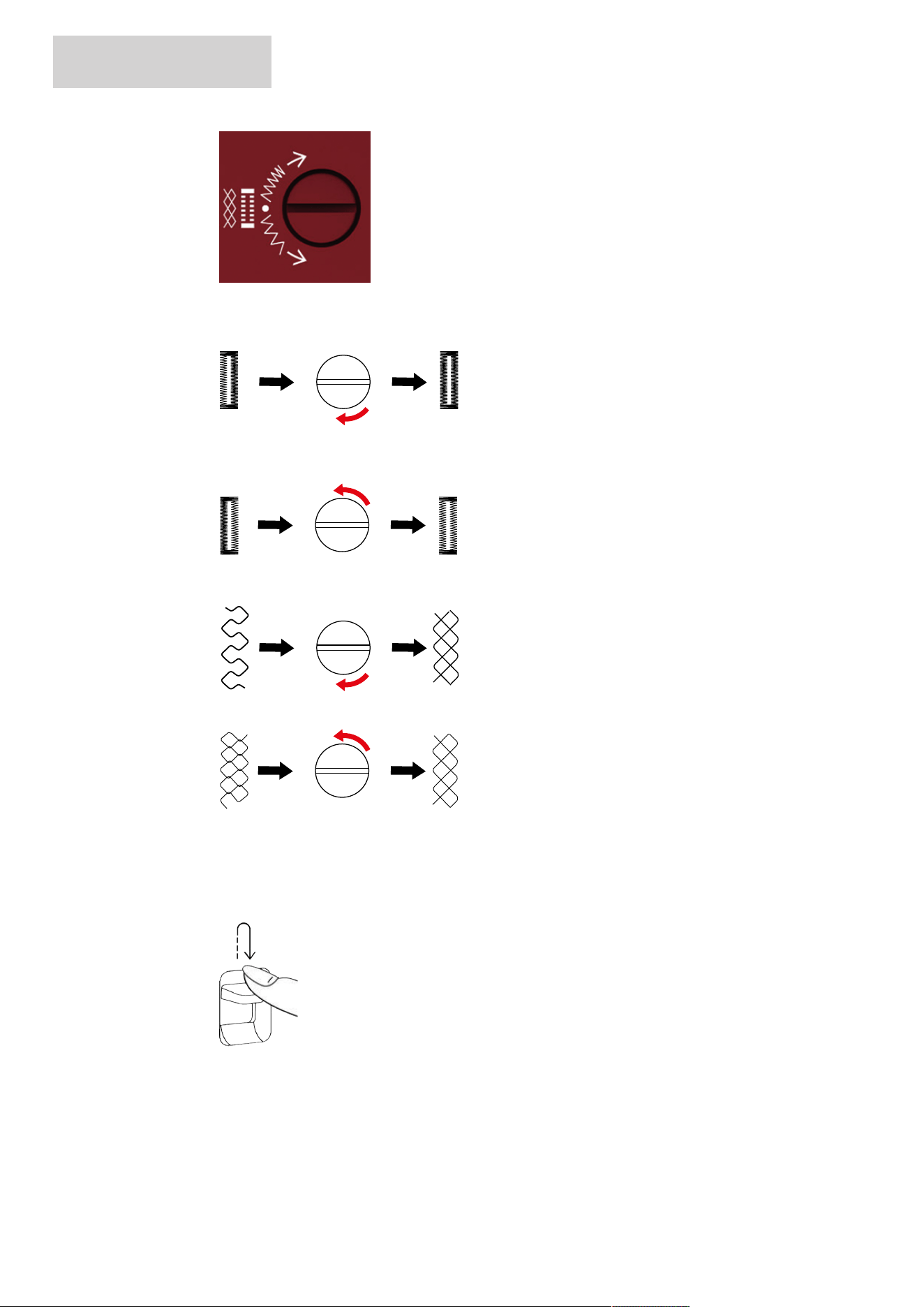
Different fabrics, threads and linings can affect stretch stitch patterns or buttonholes, causing them to be
sewn incorrectly. Mechanical balance adjustment enables these deviations to be corrected and the stitch
pattern to be optimally adjusted for the fabric to be worked with.
> Select a stretch stitch pattern or buttonhole.
> Adjust the stitch length.
> Adjust the stitch width.
> Correct the balance by using a coin to turn it.
CREATIVE SEWING
36
2024-07 EN 5020105.10A.04
> To increase the stitch density of the left satin stitch for the buttonhole, turn the balance adjustment knob
clockwise.
> To decrease the stitch density of the left satin stitch for the buttonhole, turn the balance adjustment
knob anti-clockwise.
> To increase the stitch density of the stretch stitches, turn the balance adjustment knob clockwise.
> To decrease the stitch density of the stretch stitches, turn the balance adjustment knob anti-clockwise.
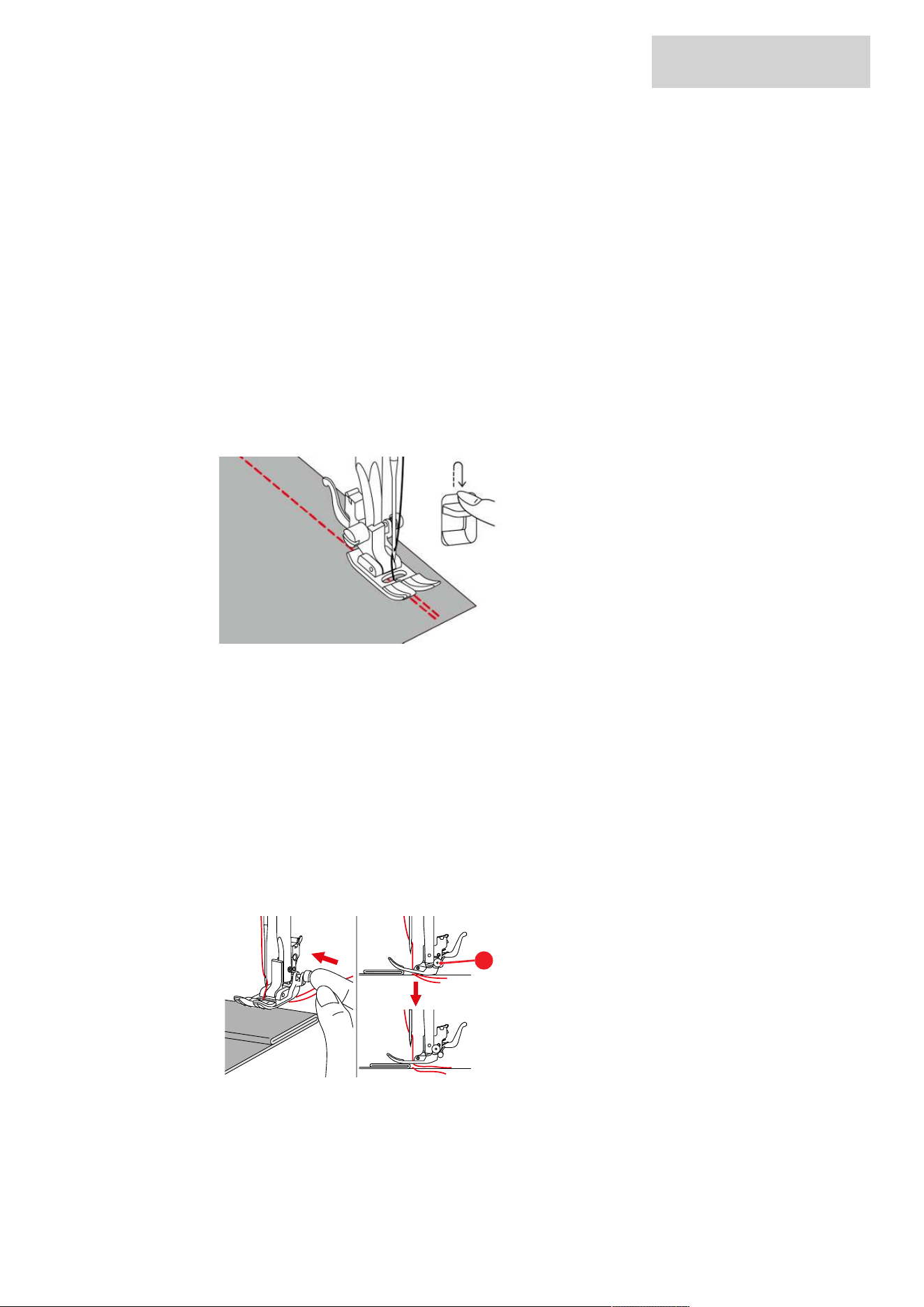
3.3 Quick Reverse
Sewing in reverse is used at the beginning and end of the seam to secure the seam.
> Press the lever «Quick Reverse» and keep it pressed.
> Press the foot control.
– The machine sews in reverse until the lever «Quick Reverse» is released.
CREATIVE SEWING
37
2024-07 EN 5020105.10A.04
3.4 Securing
Secure Seam at Seam Beginning
> Select the stitch pattern.
> Sew the seam a few stitches forward.
> Push and hold the Quick Reverse Lever.
> Sew the seam backwards to the beginning of the seam.
> Release the Quick Reverse Lever so that the machine sews forwards again.
– Seam beginning is now secured.
Secure Seam at Seam End
> Sew the selected stitch pattern forwards to the end.
> Push and hold the Quick Reverse Lever.
> Sew the seam a few stitches backwards.
> Release the Quick Reverse Lever.
> Sew the seam again up to the seam end.
– The seam end is secured.
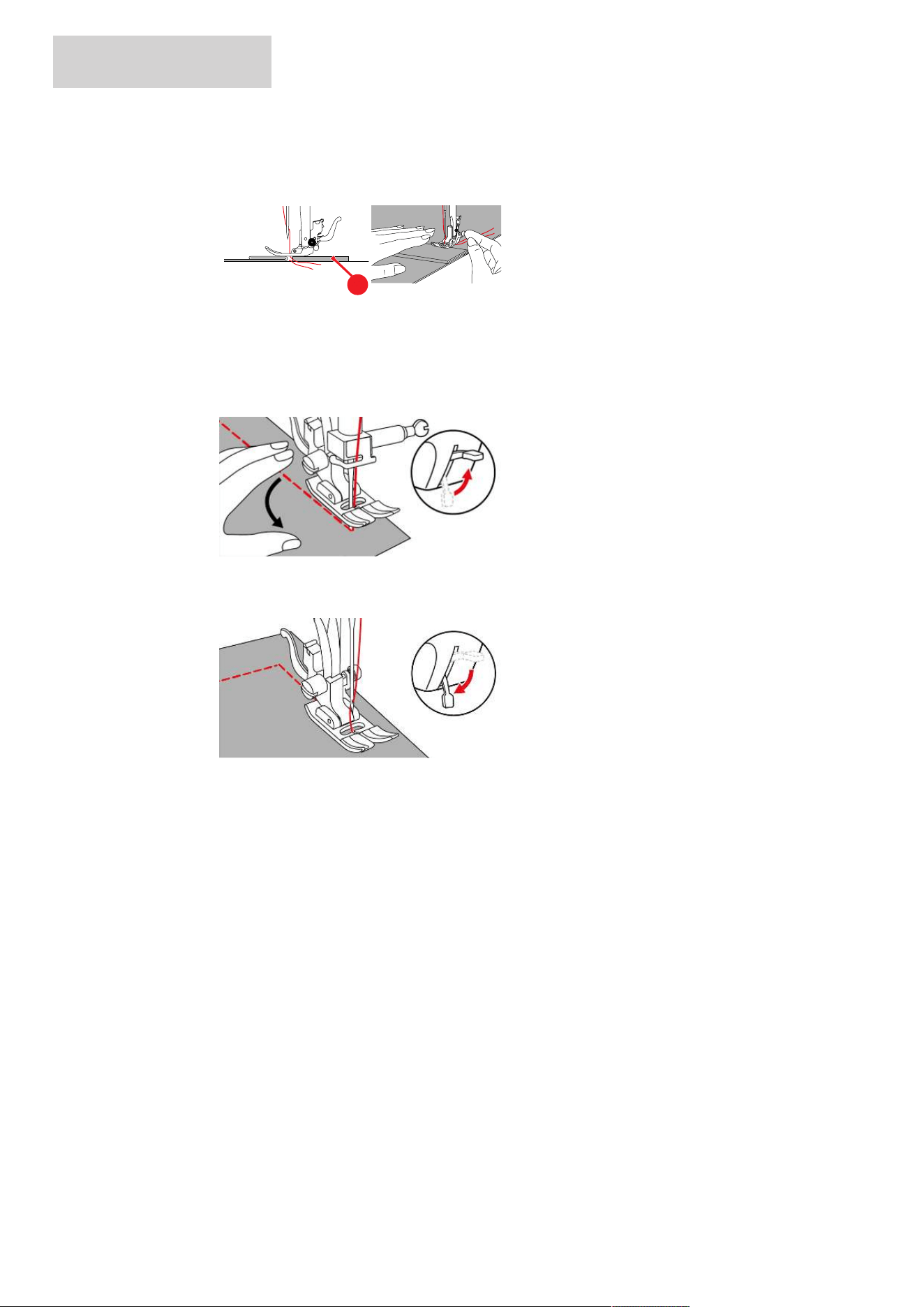
3.5 Sew Thick Areas
> Fit the zigzag foot.
– The black knob on the right-hand side of the presser foot locks the presser foot in a horizontal
position if it is pressed in before lowering the presser foot (1). This ensures even feeding at the
beginning of a seam and helps when sewing multiple layers of fabric such as sewing over seams when
hemming jeans.
> Once the highest point has been reached, lower the needle and raise the presser foot.
> Press the foot tip and the black knob, lower the presser foot and continue sewing.
– The black button releases automatically after sewing few stitches.
1
CREATIVE SEWING
38
2024-07 EN 5020105.10A.04
> To support the presser foot when manually guiding the fabric and sewing from the folded side, place
one, two or three small plates from the height compensation tool (1) behind the needle under the
presser foot.
1
3.6 Sewing Corners
> Stop the machine when the corner is reached.
> Pierce the needle into the fabric.
> Raise the presser foot.
> Use the needle as a pivot and turn the fabric.
> Lower the presser foot and continue sewing.
3.7 Sewing Very Slippery Fabrics
Very slippery materials such as leather, imitation leather, plastic or vinyl can easily be sewn using the zigzag
foot with sliding sole.
> Fit the zigzag foot with sliding sole.
> Select the required stitch pattern.
> Select the required stitch length.
> Select the required stitch width.
> Set the required needle position.
> Sew at a slow, even speed.
PRACTICAL STITCHES
39
2024-07 EN 5020105.10A.04
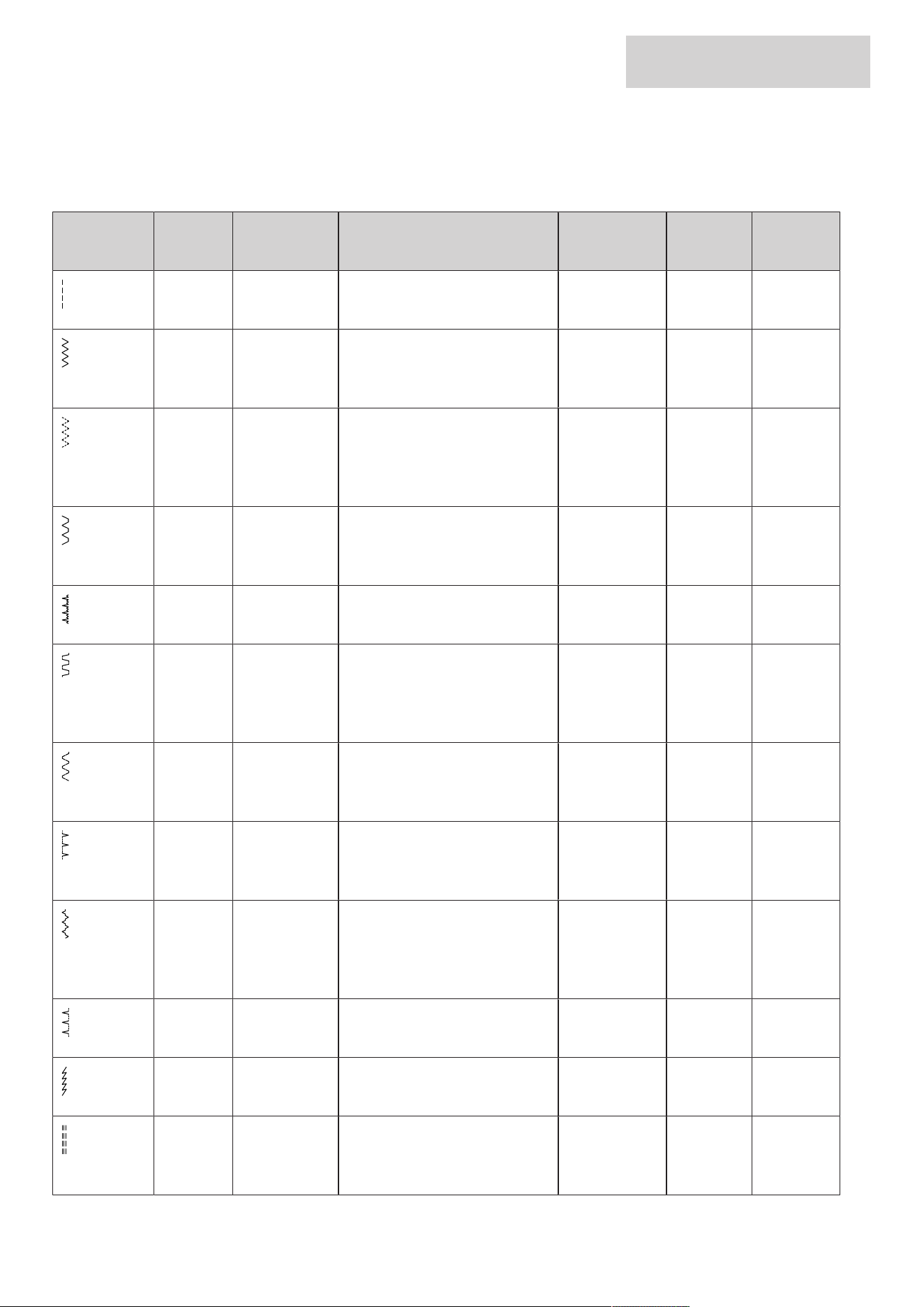
4 Practical Stitches
4.1 Overview Practical stitches
Stitch pattern Stitch
category
Name Description Recommended
presser foot
Stitch
length
Stitch
width
A Straight stitch For sewing material together and
top-stitching.
Zigzag foot 0,5–4,0 0
B Zigzag For reinforcing seams, finishing
edges, sewing elastic seams and
attaching lace inserts.
Zigzag foot 0,5–4,0 2,0–6,0
C Sewn-out Zig
zag
For finishing and reinforcing
fabric edges and attaching
rubber tape. For decorative
seams.
Zigzag foot 2,0–3,0 2,5–5,0
D Vari-Overlock
stitch
For simultaneously sewing
together and finishing elastic
fabrics.
Zigzag foot 2,0–3,0 6,0
E Elastic
blindstitch
For blind hems and decorative
seams.
Blindstitch
foot
1,0–2,0 3,0–5,0
F Universal
stitch
For firm fabrics such as felt and
leather. For flat joining seams,
visible hems and decorative
seams. For attaching rubber tape.
Zigzag foot 1,5–3,0 3,0–5,0
G Lycra stitch For flat joining seams or visible
hems on Lycra fabric. For
stitching over seams on corsetry.
Zigzag foot 1,5–3,0 6,0
H Shell edging
stitch
For blind hems, shell edging
effect on soft jerseys and fine
fabric. For decorative seams.
Zigzag foot 1,0–2,5 3,0–6,0
I Gathering
stitch
For most types of fabric. For
gathering rubber threads. For
sewing edges of fabric that meet.
For decorative seams.
Zigzag foot 2,0–3,0 3,0–5,0
J Blind stitch For blind hems and decorative
seams.
Blindstitch
foot
1,0–2,0 1,0–2,5
L Super-stretch
stitch
For highly stretch fabrics. For all
types of clothing.
Zigzag foot 1–2.5 3,0–4,0
A Triple Straight
stitch
For durable seams in strong
fabrics. For visible hems and
seams.
Zigzag foot S1 0
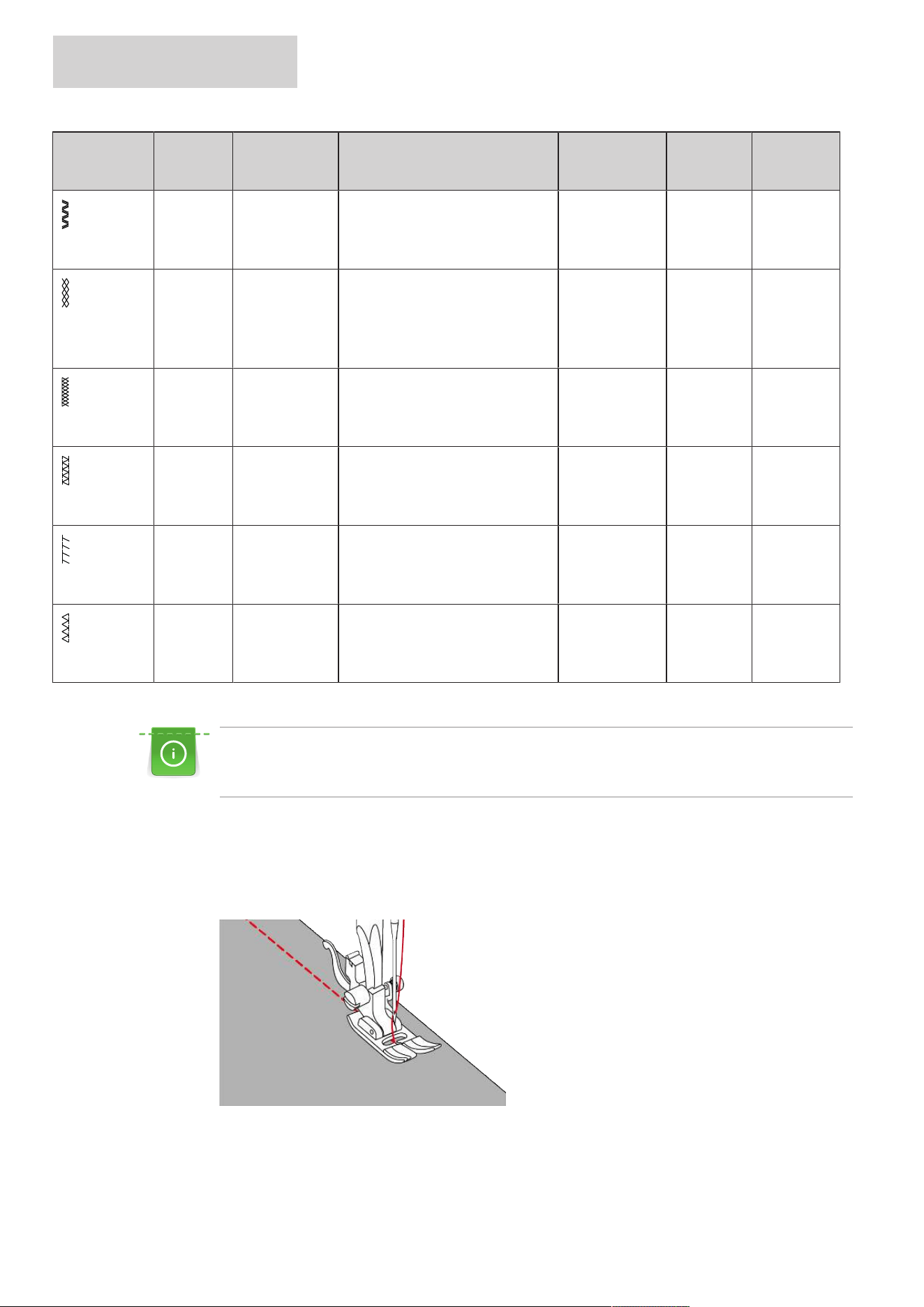
PRACTICAL STITCHES
40
2024-07 EN 5020105.10A.04
Stitch pattern Stitch
category
Name Description Recommended
presser foot
Stitch
length
Stitch
width
B Triple Zig zag For durable seams in strong
fabrics. For visible hems and
seams.
Zigzag foot S1 2,0–6,0
C Honeycomb
stitch
For sewing elastic fabrics and
hems, including with rubber
bobbin threads.
Zigzag foot or
open
embroidery
foot
S1 6,0
D Knit overlock For sewing together and finishing
hand- and machine-knitted
fabrics in one step.
Zigzag foot S1 6,0
F Double
overlock
For simultaneously sewing
together and finishing elastic
fabrics.
Zigzag foot S1 6,0
H Stretch
overlock
For simultaneously sewing
together and finishing elastic
fabrics. For flat joining seams.
Zigzag foot S1 6,0
J Reinforced
overlock
Medium-weight knits and
toweling. For overlock seams or
flat joining seams.
Zigzag foot or
overlock foot
S1 6,0
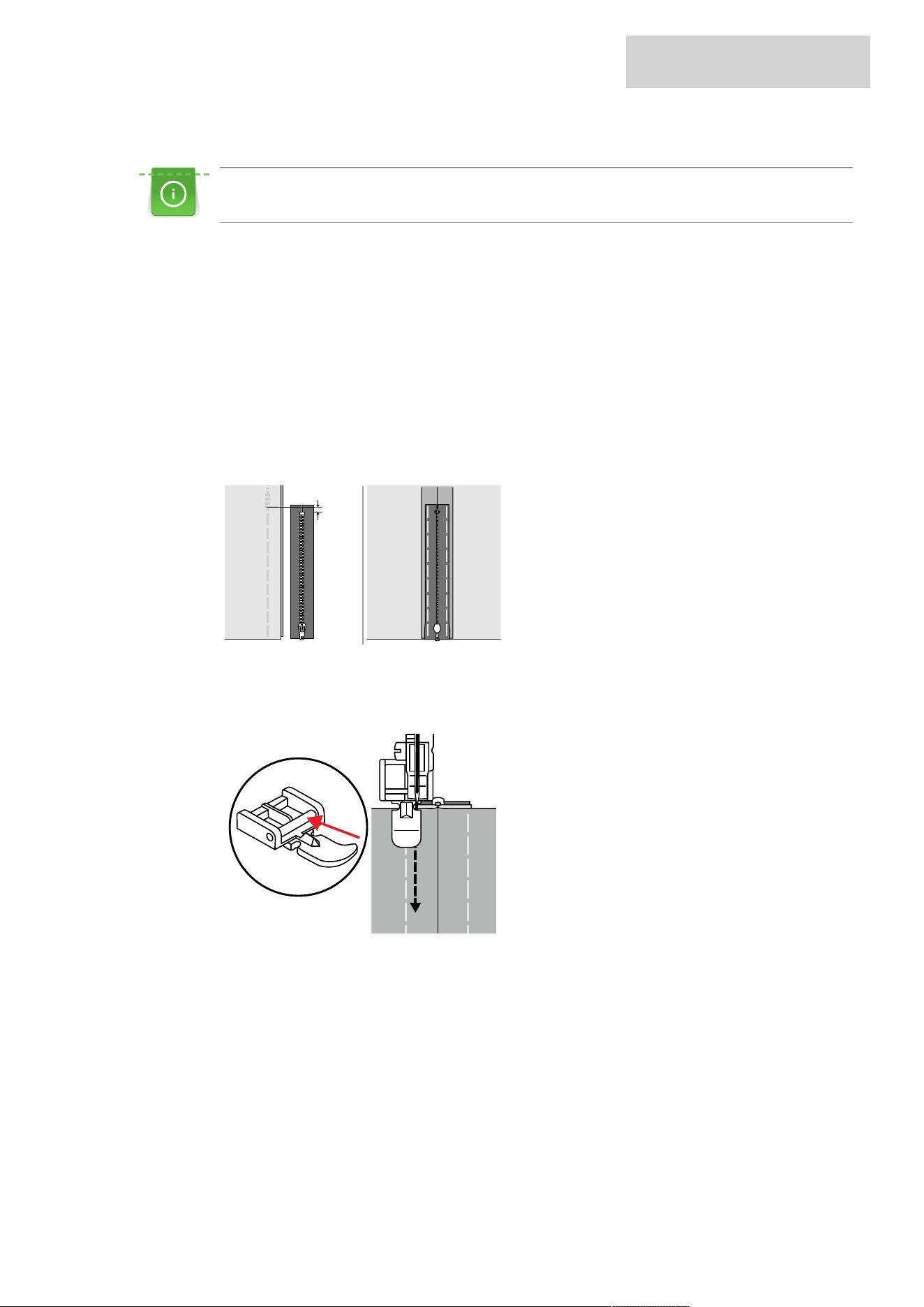
4.2 Sewing Straight Stitch
Adjust the stitch length for the sewing project, e.g. a long stitch for denim (approx. 3–4mm) and a
short stitch for delicate fabric (approx. 2–2.5mm). Adjust the stitch length depending on the thread
thickness, e.g. a long stitch (approx. 3–4mm) for top-stitching with gimp.
> Fit the zigzag foot.
> Set the stitch pattern selector knob to position «A».
> Set the required stitch length.
> Set the stitch width to «0».
> Adjust the needle position.
PRACTICAL STITCHES
41
2024-07 EN 5020105.10A.04
4.3 Sewing in the Zipper
As the fabric feed can be difficult when starting to sew, it is recommended to hold the threads firmly or
to pull the fabric slightly to the back for a few stitches or to sew 0.5 - 1in (1–2cm) reverse first.
> Finish the seam allowances individually.
> Fit the zigzag foot.
> Set the stitch pattern selector knob to position «A».
> Set the required stitch length.
> Set the stitch width to «0».
> Set the needle position to «Center».
> Close and sew the seam up to where the zipper starts.
> Set the stitch length to 4.
> Tack the zipper length with long stitches.
> Iron the seam apart.
> Unpick the tacking stitches.
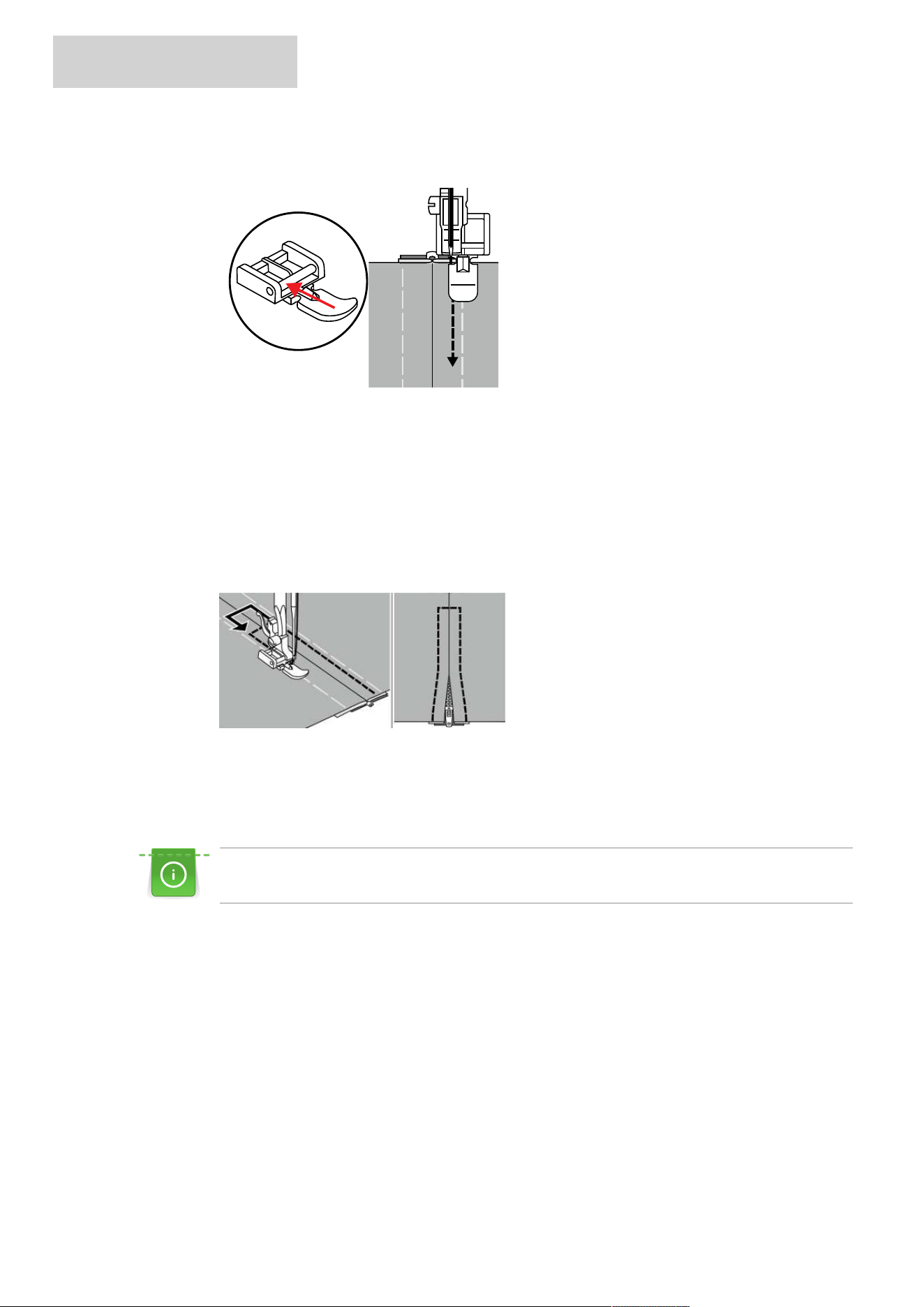
> Tack the zipper under the fabric so that the fabric edges meet over the center of the zipper.
5 mm
> Fit the zipper foot.
> When sewing the left-hand side of the zipper, secure the right-hand side of the presser foot pin using the
holder.
PRACTICAL STITCHES
42
2024-07 EN 5020105.10A.04
> When sewing the right-hand side of the zipper, secure the left-hand side of the presser foot pin using the
holder.
> Sew the left-hand side of the open zipper from top to bottom.
> Close the zipper up to approx. 5cm from the end.
> Sew over the lower end and the right-hand side of the zipper.
> Stop before the zipper slider.
> Move the needle into the lower position.
> Raise the presser foot.
> Open the zipper.
> Finish sewing the right side.
> Remoce the tacked seam.
4.4 Stitching in a Concealed Zipper
Concealed zippers are a particularly elegant solution for clothing and are very practical when used on bags
and home furnishings. As these special zippers are hidden by the seam after being sewn in, they form an
almost invisible closure.
As the fabric feed can be difficult when starting to sew, it is recommended to hold the threads firmly or
to pull the fabric slightly to the back for a few stitches or to sew 0.5 - 1in (1–2cm) reverse first.
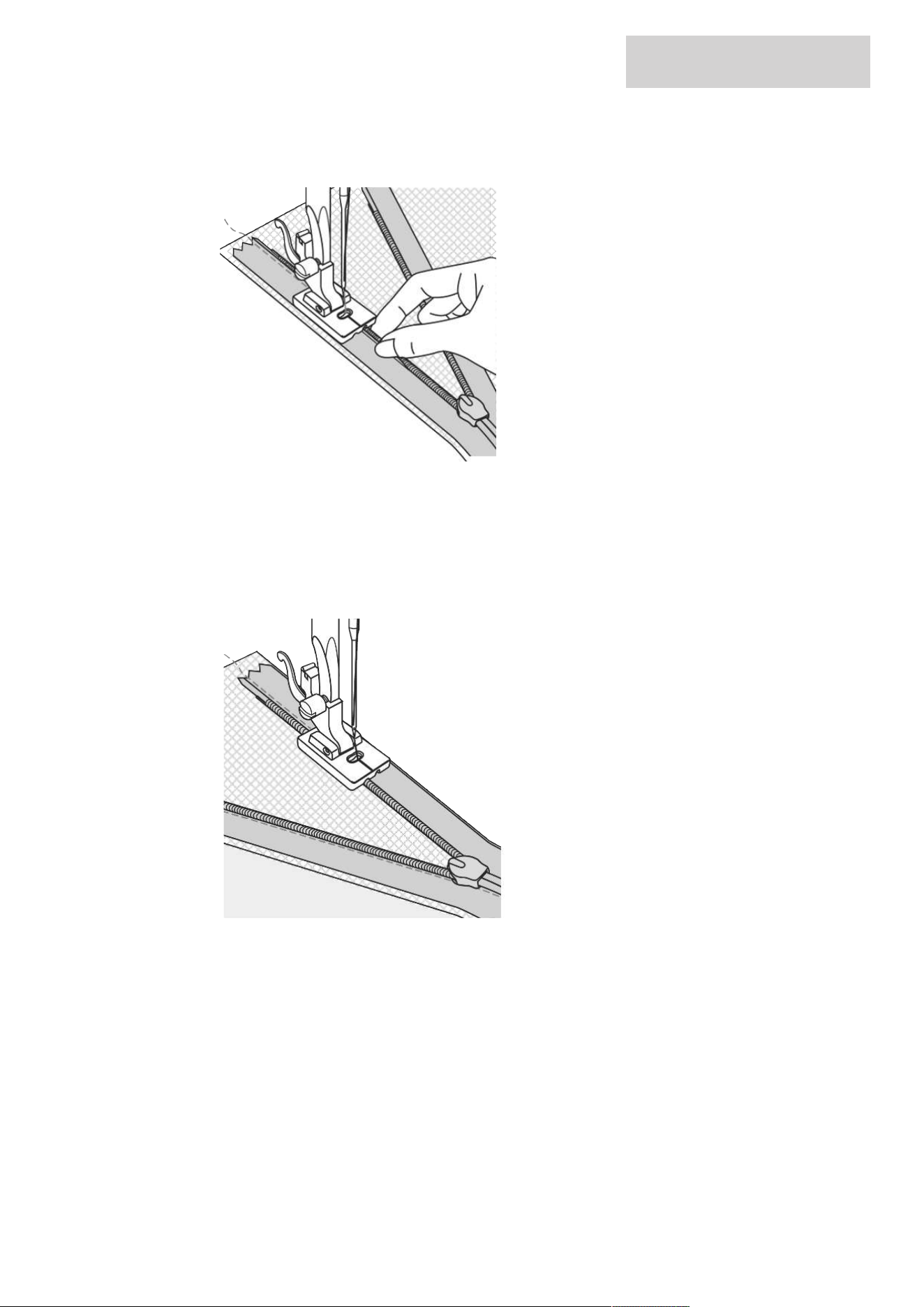
> Open zipper all the way.
> Pin the right half of the zipper right side on right side on the fabric. The spiral points away from the edge
of the fabric.
> Fit the invisible zipper foot.
> Set the stitch pattern selector knob to position «A».
> Set the required stitch length.
> Set the stitch width to «0».
> Set the needle position to «Center».
PRACTICAL STITCHES
43
2024-07 EN 5020105.10A.04
> Lower the presser foot at the start of the zipper so that the spiral is guided through the right presser foot
groove.
> Sew and close the right-hand half of the zipper from top to bottom up to the slider.
> Close the zip.
> Pin the left-hand half of the zipper with its right side against the right side of the left-hand fabric. The
spiral points away from the edge of the fabric.
> Open zipper all the way.
> Lower the presser foot at the start of the zipper so that the spiral is guided through the left presser foot
groove.
> Sew and close the left-hand half of the zipper from top to bottom up to the slider.
> Remove the sewing material from the machine.
> Close the zip.
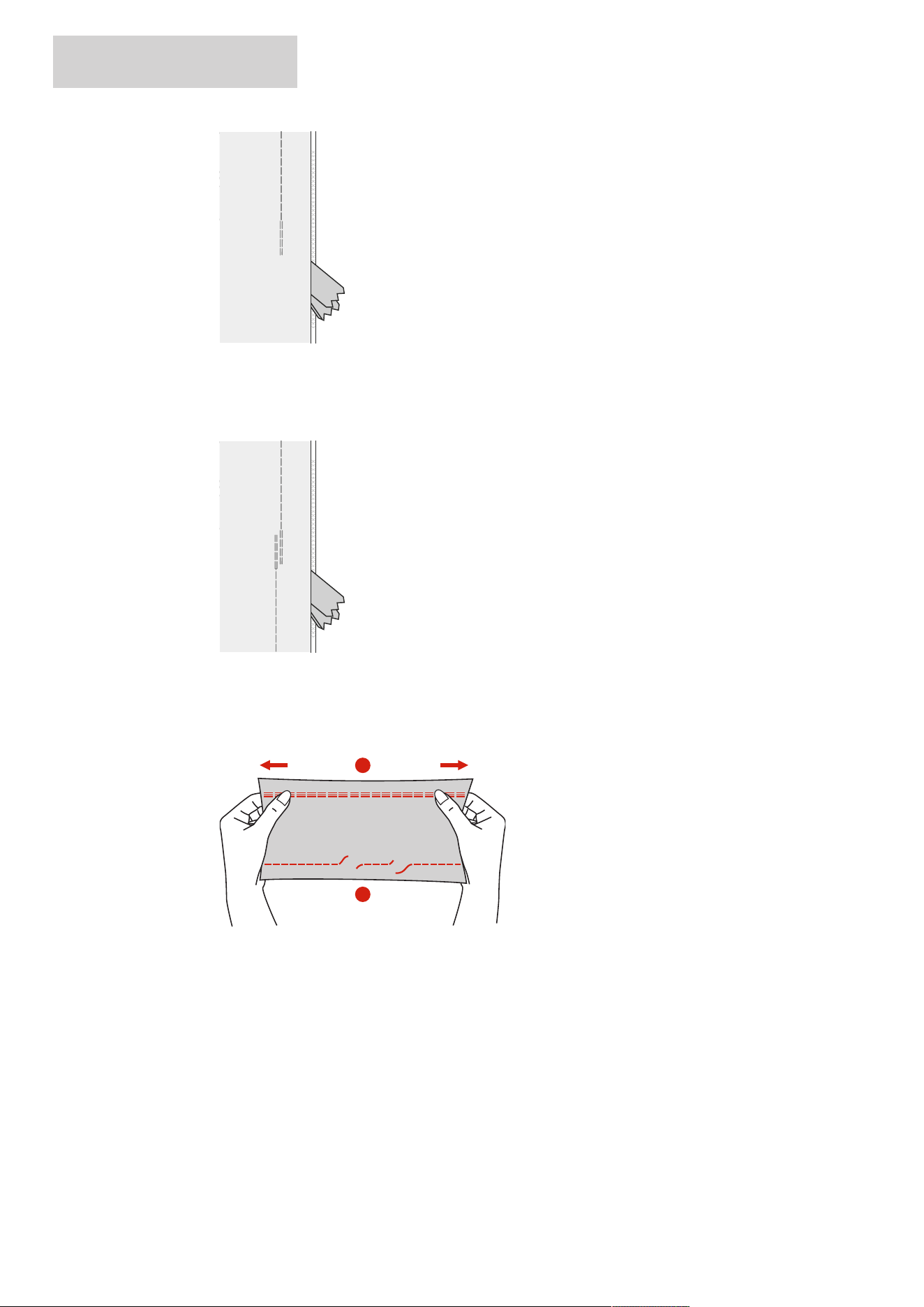
> Place the two right sides of the fabric against each other. Fold the ends of the zipper outwards as far as it
would go.
PRACTICAL STITCHES
44
2024-07 EN 5020105.10A.04
> Pin the ends of the zipper seams precisely on top of one another.
> Pin the seam together from the bottom to the zipper.
> Fit the zigzag foot.
> Close and sew the seam from the bottom to the zipper.
4.5 Sewing Triple Straight Stitch
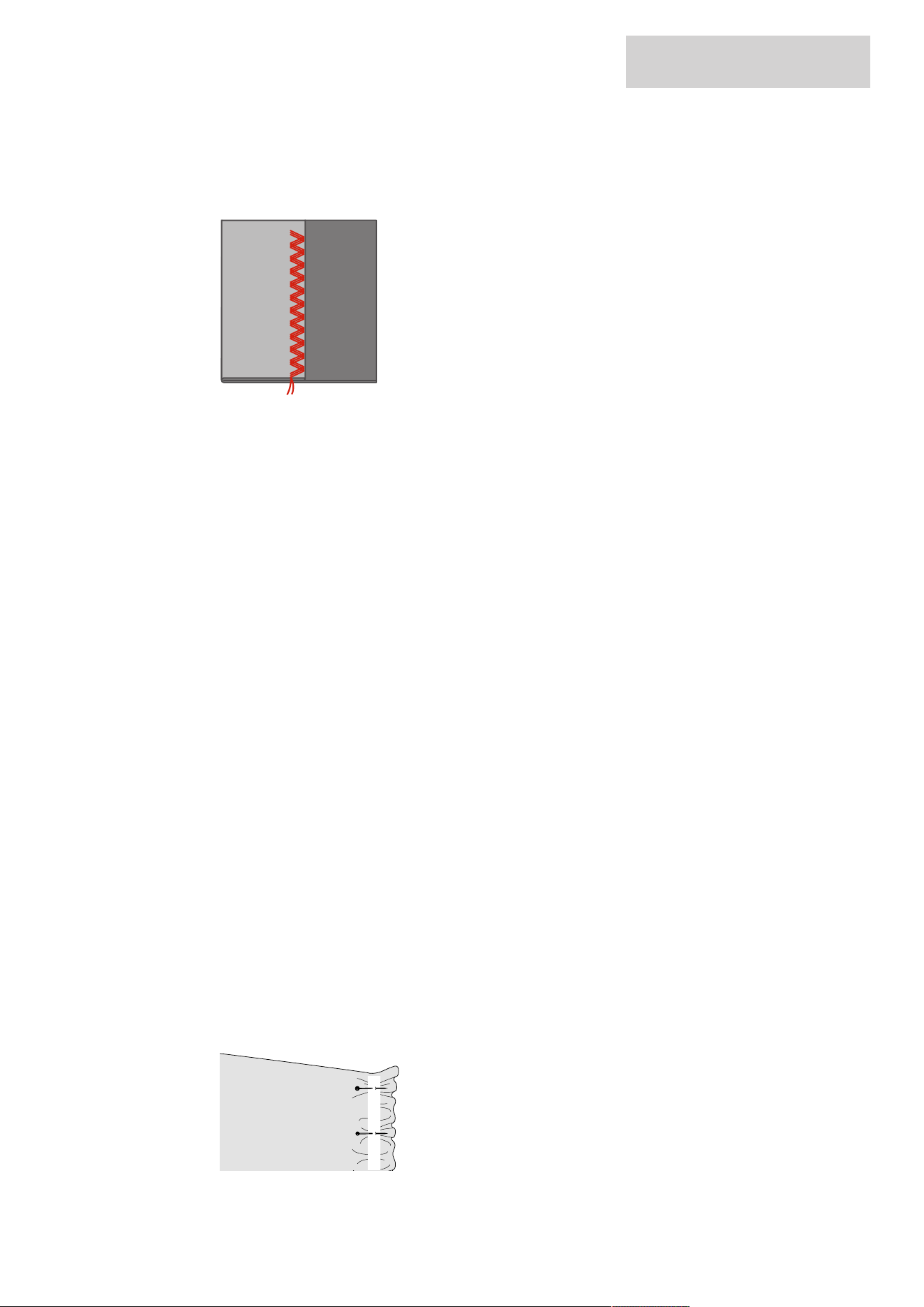
The triple straight stitch is especially suitable for durable seams and for firm, densely woven fabrics such as
denim and corduroy.
2
1
1 Straight Stitch 2 Triple Straight Stitch
> Fit the zigzag foot.
> Set the stitch length knob to «S1».
> Set the stitch pattern selector knob to «A».
PRACTICAL STITCHES
45
2024-07 EN 5020105.10A.04
4.6 Sewing Triple Zigzag
The triple zigzag is particularly suitable for firm fabrics, especially denim, deckchair fabric and awnings, and
for hems on fabrics that are washed often.
Prerequisite:
• Finish the seam edges first.
> Fit the zigzag foot.
> Set the stitch length selector knob to «S1».
> Turn the stitch selector knob to category «B».
> Set the required stitch width.
4.7 Super-Stretch
The super-stretch stitch is a narrow stretch stitch designed to eliminate puckering on knit fabrics and bias
seams, while permitting the seam to be pressed completely open flat.
> Fit the zigzag foot.
> Set the stitch pattern selector knob to «L».
> Set the stitch length and stitch width according to the stitch table.
> Sew the seam at the required distance from the fabric edge without stretching the fabric.
4.8 Sewn-Out Zigzag
The sewn zigzag is used to finish seams on synthetics and other fabrics that tend to pucker. The stitch is also
excellent for darning and mending tears, as well as for attaching elastic tape.
> Fit the zigzag foot.
> Set the stitch pattern selector knob to «C».
> Set the stitch length and stitch width according to the stitch table.
For Finishing:
> Position the fabric so that the stitch is sewn at a distance of 1.5cm from the edge of the fabric.
> Sew the seam.
> Trim the seam allowance after sewing. Be careful not to cut the stitches.
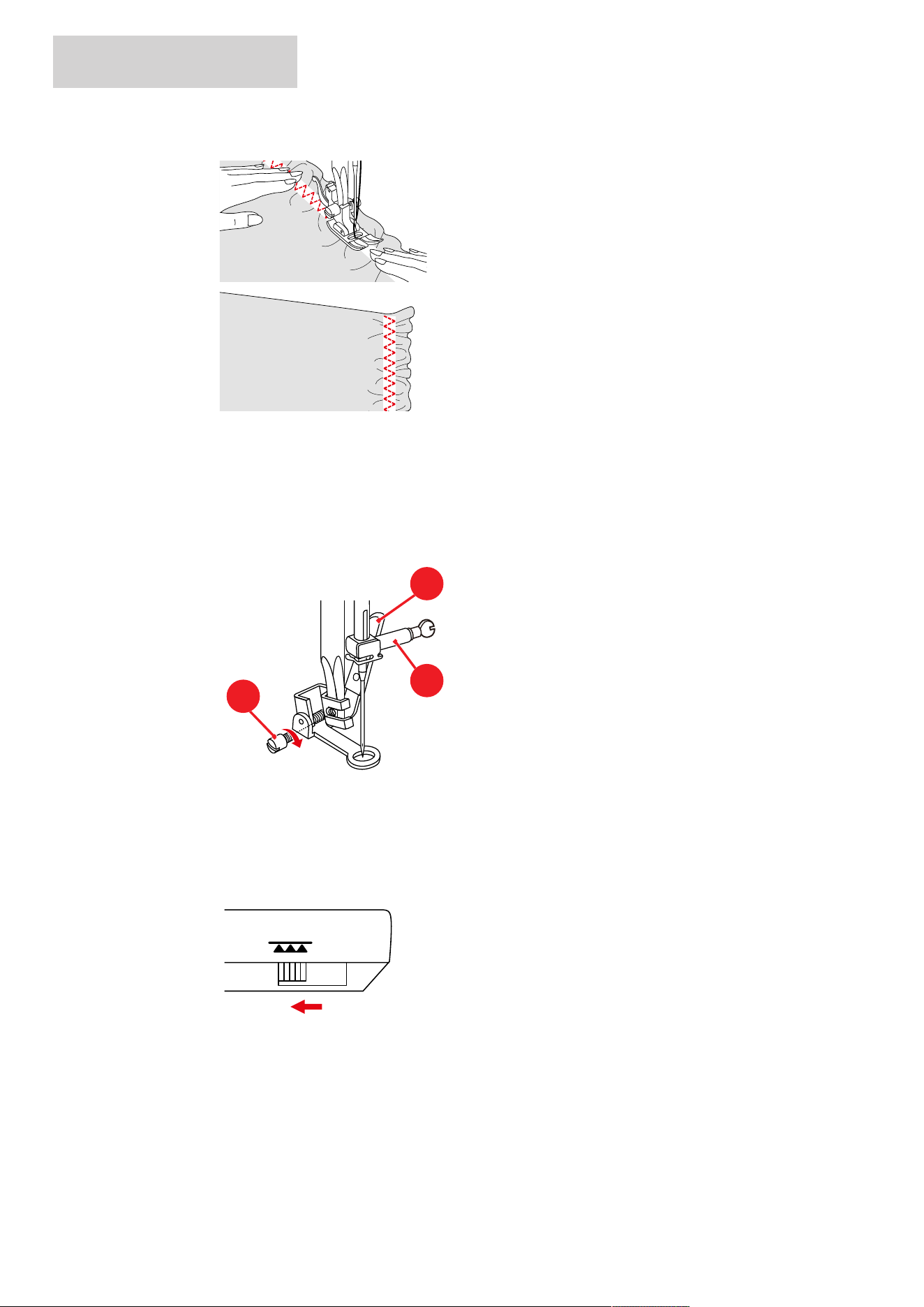
For Sewing on Elastic Tape:
> Pin the elastic tape to the left-hand side of the fabric. When doing so, stretch the tape and ensure that it
is positioned evenly on the fabric.
PRACTICAL STITCHES
46
2024-07 EN 5020105.10A.04
> To attach the elastic tape, pull it apart along the length of the gathered fabric.
4.9 Manual Darning
Used for darning holes or worn areas in all fabric types.
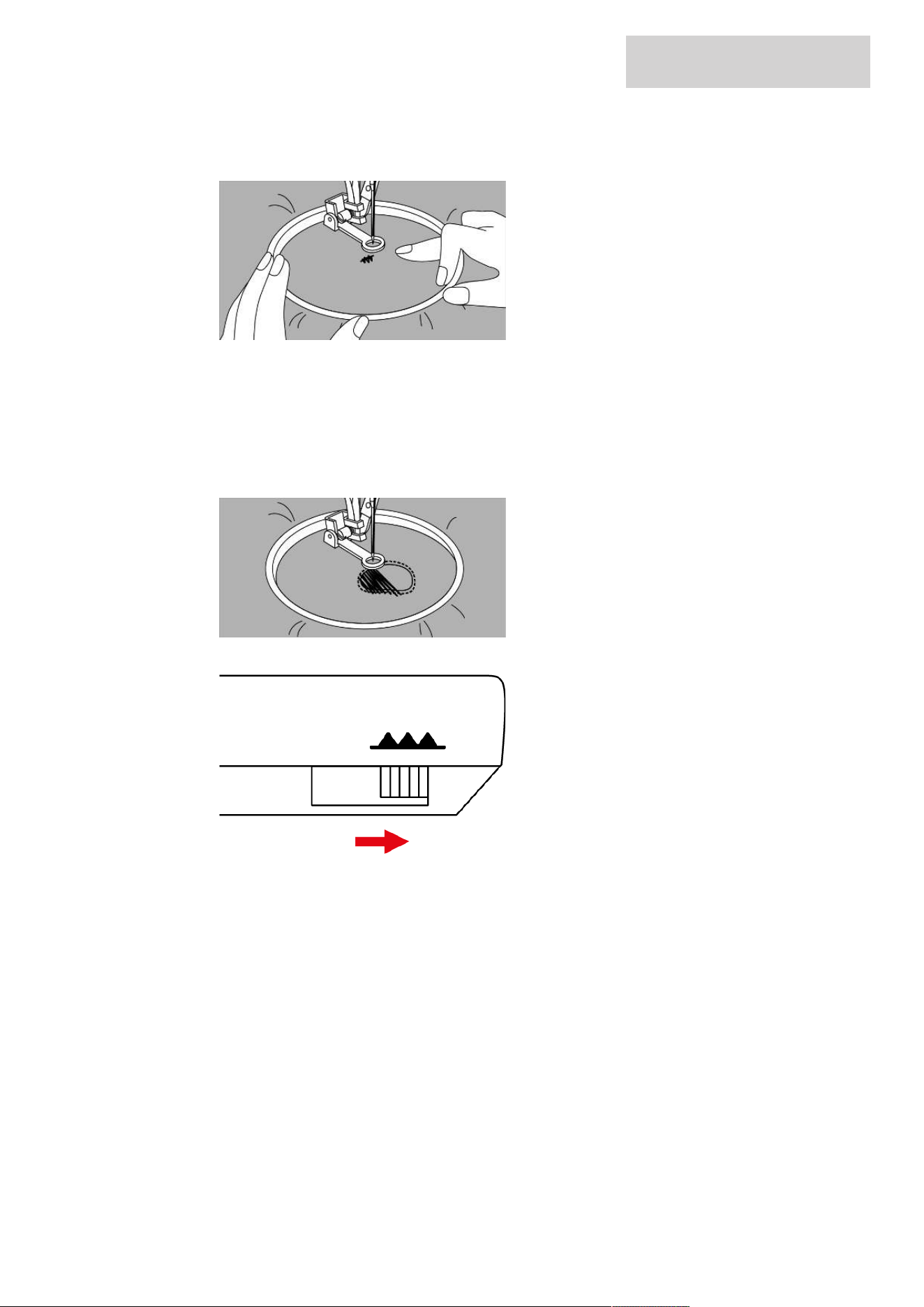
> Remove the presser foot holder and fit the darning/embroidery foot on the presser foot bar.
– The lever (1) must rest on the top of the needle clamping screw (2).
> Press the darning/embroidery foot from underneath with your finger and tighten the screw (3).
1
2
3
> Turn the stitch pattern selector knob to «A».
> Set the stitch length to «0».
> Lower the feed dog.
> Attach the Slide-on Freearm Extension Table.
> Lower the feed dog.
PRACTICAL STITCHES
47
2024-07 EN 5020105.10A.04
> Tension the sewing project in a darning hoop.
– The darning area remains evenly stretched and cannot be deformed.
> Turn the handwheel anti-clockwise to bring up the bobbin thread.
> Sew a few stitches at the start of the seam.
> Sew from the left to the right, guide the fabric evenly by hand without using pressure.
> If the thread is lying on the top, continue sewing at a slower pace.
> If knots form on the wrong side of the fabric, sew faster.
> If the thread breaks, continue sewing at a more even pace.
> Move in curves when changing the direction to avoid holes and thread breakage.
> After you have finished darning, raise the presser foot and restart the feed dog.
4.10 Finishing Edges
The zigzag stitch is suitable for finishing all types of fabric. Use darning thread for fine materials.
Prerequisite:
• The edge of the fabric should lie flat and not roll.
> Fit the zigzag foot or overlock foot.
> Do not set the stitch length too long.
> Set the stitch pattern selector knob to «B».
> Do not set the stitch width too wide.
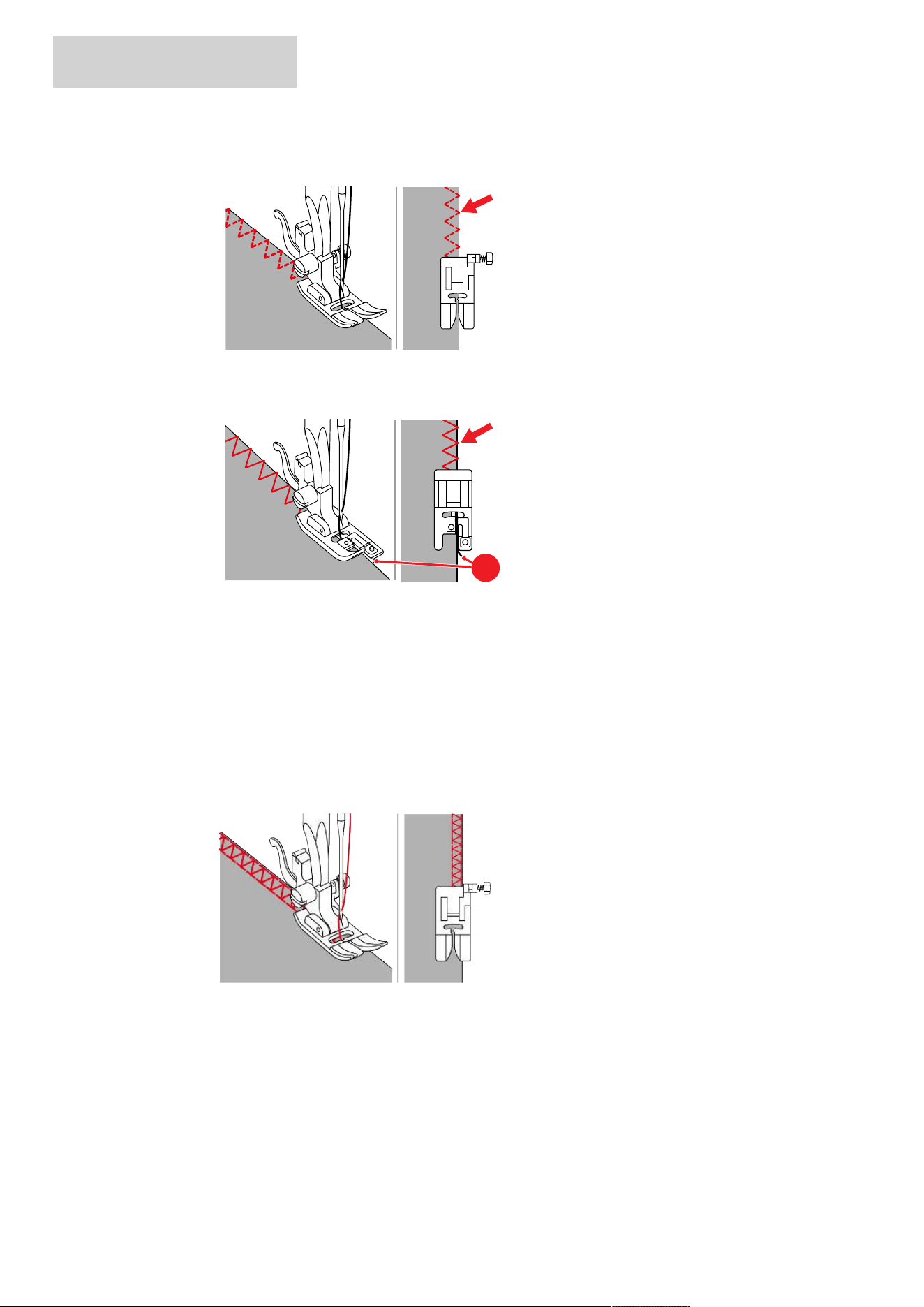
PRACTICAL STITCHES
48
2024-07 EN 5020105.10A.04
> Guide the edge of the fabric into the center of the zigzag foot so that the needle goes into the fabric on
one side and over the edge into the air on the other side.
> Guide the edge of the fabric along the guide plate on the overlock foot (1) so that the needle goes into
the fabric on one side and over the edge into the air on the other side.
1
4.11 Sewing Double Overlock
A double overlock seam is suitable for looser knit fabric and for cross seams in woven fabric. A new jersey or
stretch needle must be used for knit fabrics so that the delicate knit is not damaged.
> Fit the zigzag foot or overlock foot.
> Set the stitch pattern selector knob to «F».
> Set the stitch length knob to «S1».
> Set the stitch width according to the stitch table.
> For finishing the edge of the fabric with the zigzag foot: Position the edge of the fabric under the presser
foot so that the right-hand straight stitch is sewn close to the edge of the fabric.
> For sewing and hemming elastic fabrics and for sewing belt loops: Fold the edge of the fabric backwards
with the left-hand sides together. Sew the seam on the right-hand side of the fabric. Cut off any excess
fabric from the edge of the fabric up to the seam.
PRACTICAL STITCHES
49
2024-07 EN 5020105.10A.04
4.12 Sewing Vari Overlock
> Fit the overlock foot.
> Set the stitch pattern selector knob to «D».
> Set the stitch length and stitch width according to the stitch table.
> Sew the fabric with the edge of the fabric against the overlock foot guide.
4.13 Narrow Edgestitching
> Fit the blind stitch foot, edge stitch foot or zigzag foot.
> Set the stitch pattern selector knob to «A».
> Set the required stitch length.
> Set the stitch width to «0».
Using the blind stitch foot or edge stitch foot:
> Place the left-hand edge of the fabric against the guide of the blind stitch foot or edge stitch foot.
> Set the left-hand needle position.
Using the zigzag foot:
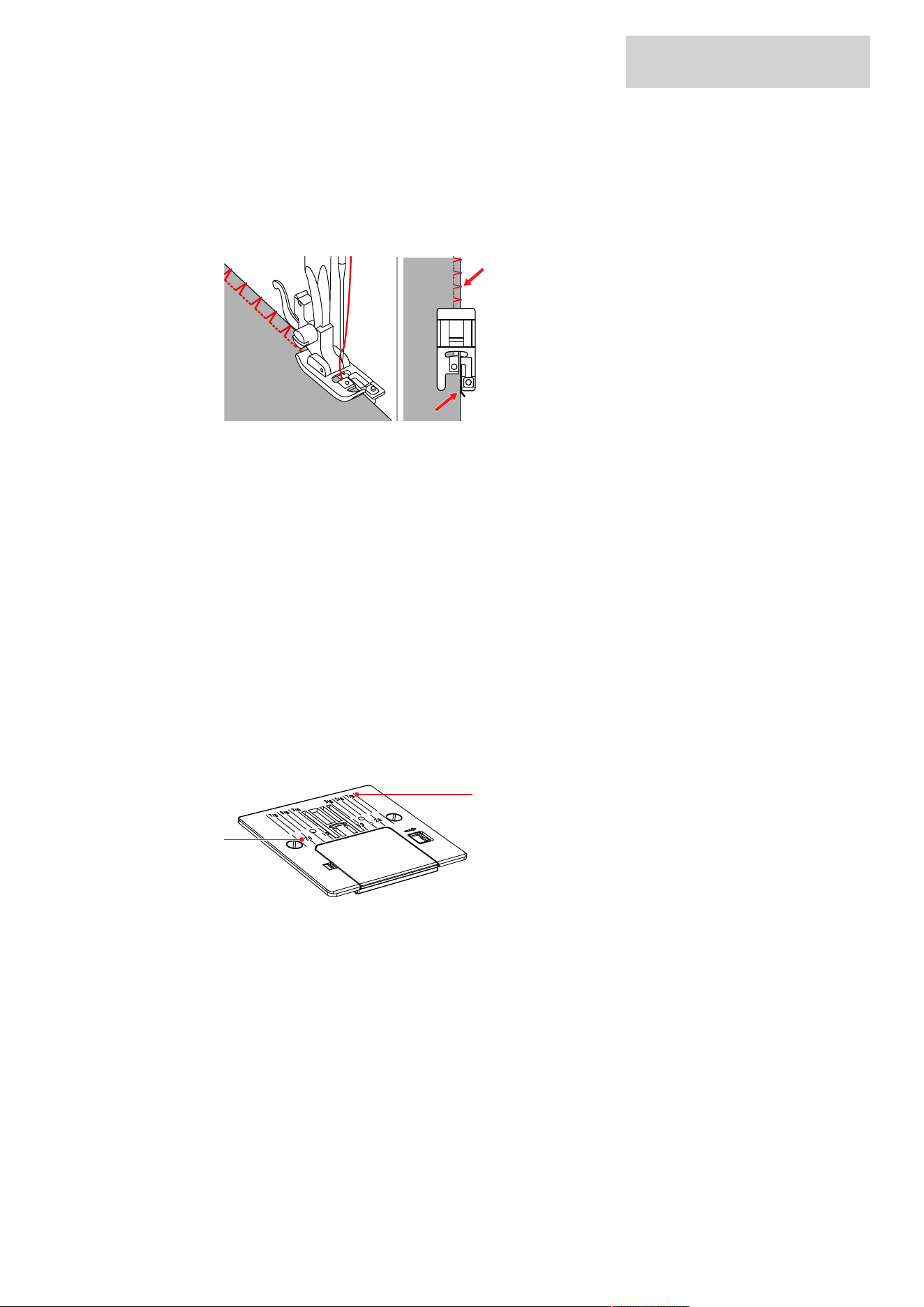
> Guide the edge of the fabric along the right-hand edge of the presser foot or the markings on the stitch
plate.
> Adjust the needle position to the right.
4.14 Wide Edgestitching
1
2
1 Distance in mm 2 Distance in inch
> Fit the blind stitch foot, edge stitch foot or zigzag foot.
> Set the stitch pattern selector knob to «A».
> Set the required stitch length.
> Set the stitch width to «0».
Using the Zigzag Foot
> Guide the edge of the fabric along either the right-hand edge of the presser foot or the markings on the
stitch plate.
The markings on the stitch plate indicate the distance between the center needle position and the guideline.
PRACTICAL STITCHES
50
2024-07 EN 5020105.10A.04
Using the Blind Stitch Foot or Edge Stitch Foot
> Place the left-hand edge of the fabric against the guide of the blind stitch foot or edge stitch foot.
> Select the left needle position at the desired distance to the edge.
4.15 Edgestitching Using the Seam Guide
When sewing parallel wide top-stitching lines, we recommend guiding the seam guide along a sewn line.
> Attach the seam guide to the zigzag foot.
> Fit the zigzag foot.
> Set the stitch pattern selector knob to «A».
> Set the required stitch length.
> Set the stitch width to «0».
> To adjust the distance, move the seam guide to the left or right.
> Sew the first row.
> Sew the following rows while guiding the seam guide along the previous seam.
4.16 Sewing Hem Edges
When using the blind stitch foot, we recommend setting the needle position all the way to the left or right.
When using the zigzag foot or edge stitch foot, all needle positions are possible.
> Fit the blind stitch foot, edge stitch foot or zigzag foot.
> Set the stitch pattern selector knob to «A».
> Set the required stitch length.
> Set the stitch width to «0».
> To sew on the top edge of the seam, select the right-hand needle position.
PRACTICAL STITCHES
51
2024-07 EN 5020105.10A.04
> Place the inside upper edge of the seam on the right-hand side against the guide on the blind stitch foot
or edge stitch foot.
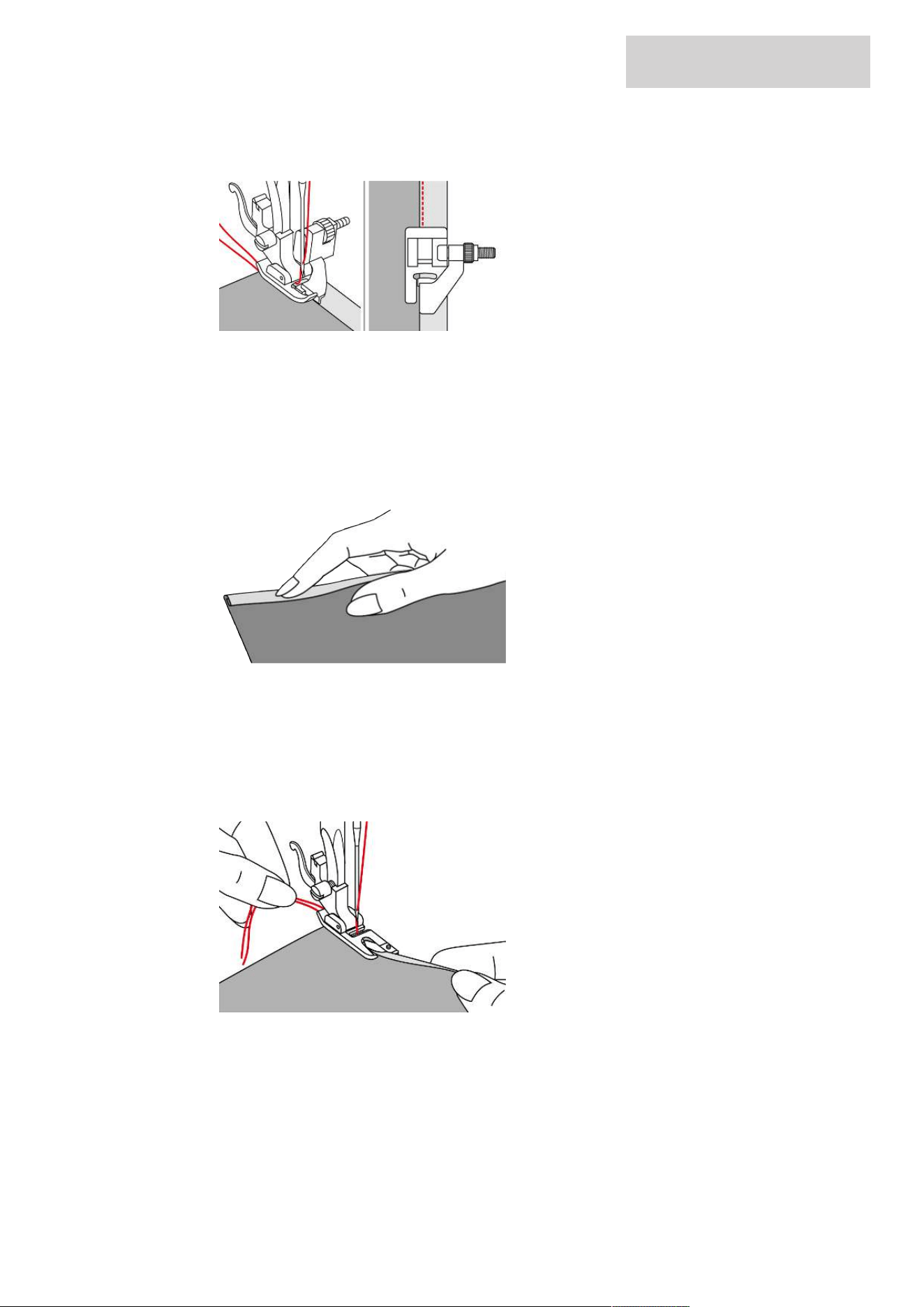
4.17 Sewing a Narrow Hem
> Fit the hemmer foot.
> Turn the stitch pattern selector knob to «A».
> Set the required stitch length.
> Set the stitch width to «0».
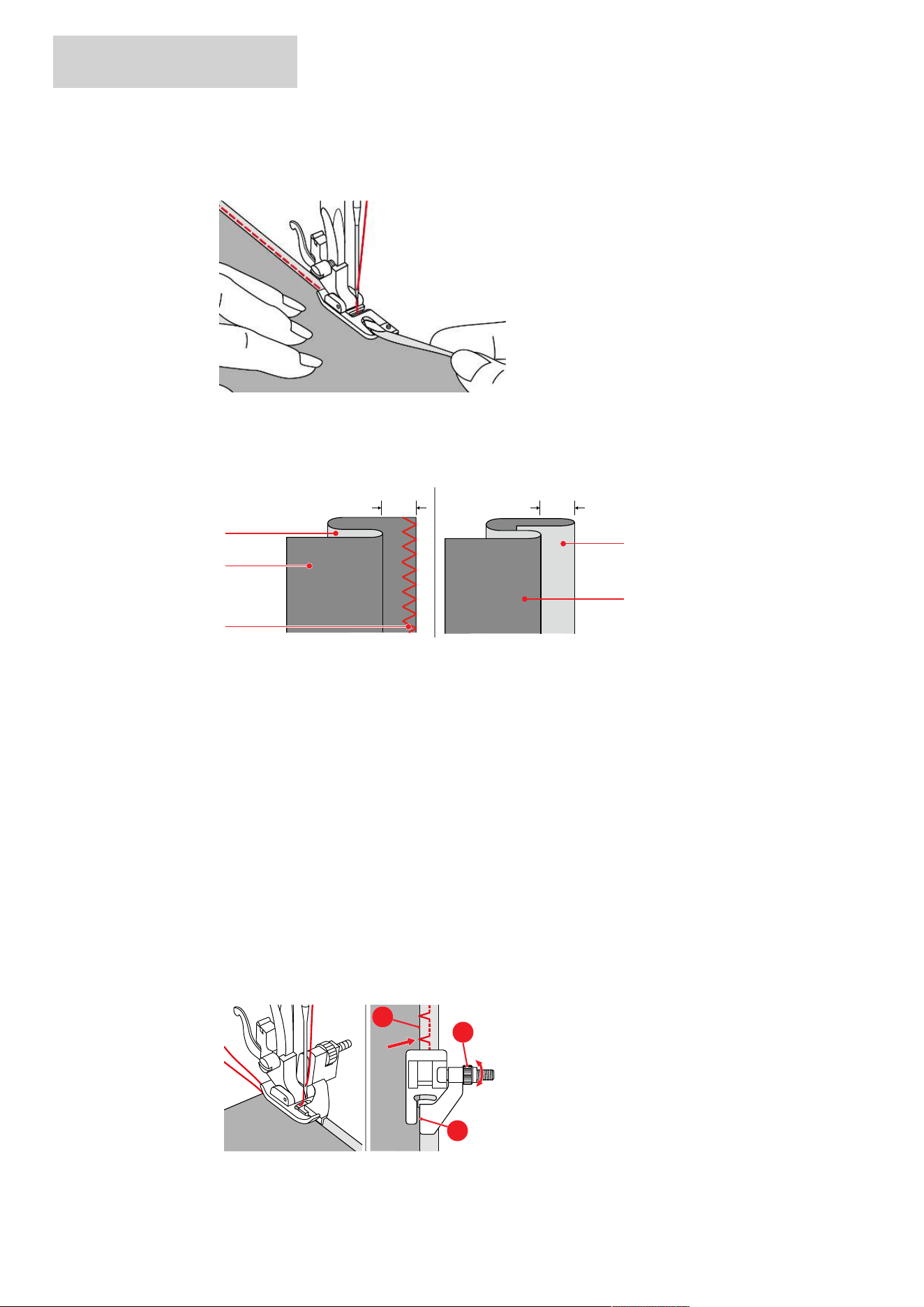
> Fold the edge of the fabric by approx. 3mm and fold it over again. Fold the first 5cm of the fabric edge
to be sewn.
> Place the edge of the fabric with the left-hand side of the fabric facing up under the presser foot. The
fabric under the presser foot should be just less than the width of the presser foot.
> Sew 4–5 stitches.
> Raise the needle and presser foot.
> Pull the fabric backwards by about 10–15cm. Do not cut the thread.
> Hold the 4 threads in your left hand. Pull the edge of the fabric into the spiral guide on the hemmer foot
using your right hand.
> Lower the presser foot.
PRACTICAL STITCHES
52
2024-07 EN 5020105.10A.04
> Continue sewing slowly while slightly folding the cut edge of the fabric in front of the hemmer foot and
holding it to the left. Guide the edge of the fabric evenly into the spiral guide on the hemmer foot and
sew.
4.18 Sewing Blind Hems
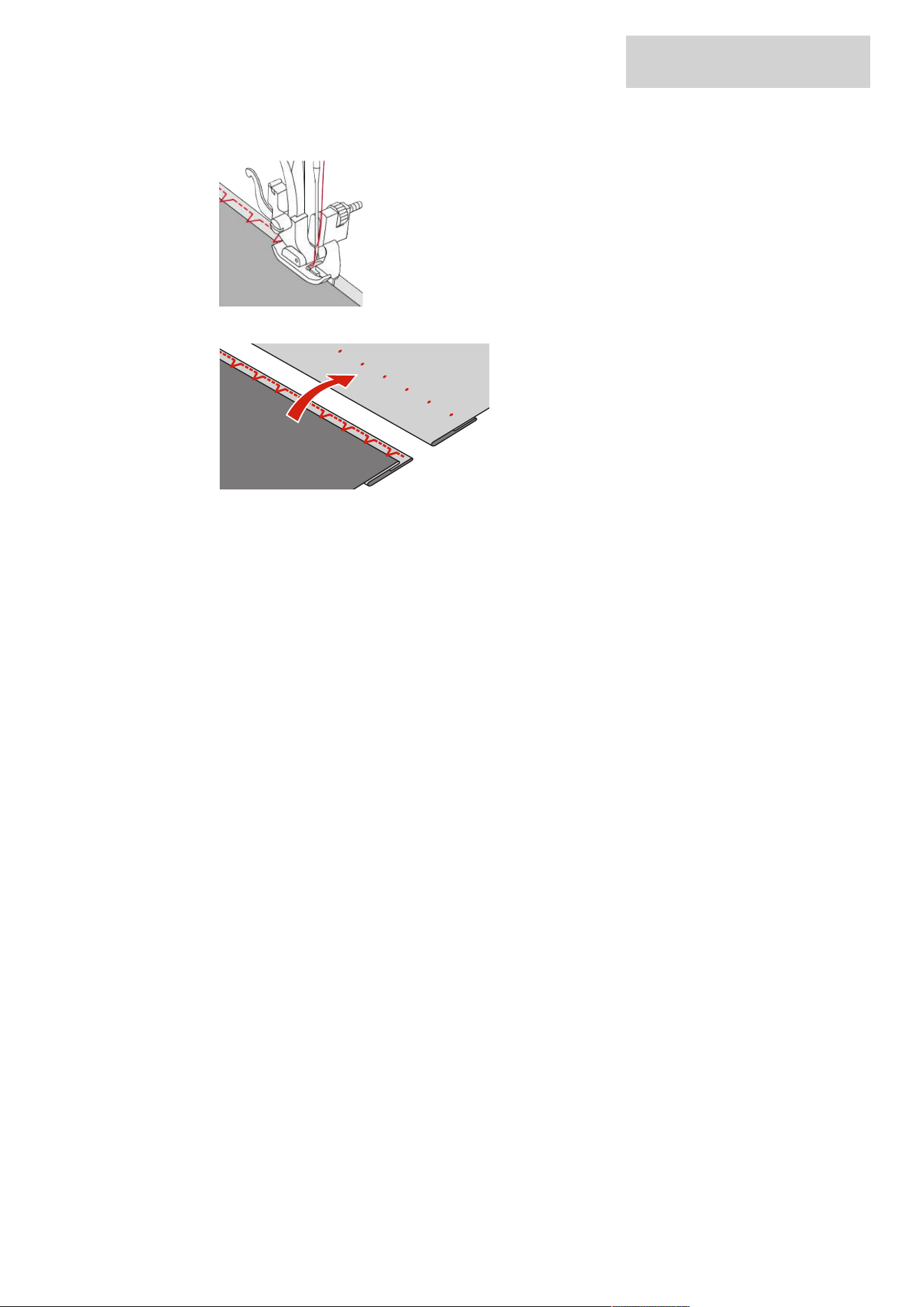
For invisible hems in medium to heavy weight cotton, wool and blended materials.
Heavy/medium-weight Fabrics Light Fabrics
5mm
5mm
2
3
1
3
2
1 Finishing Seam 3 Right-hand Fabric Side
2 Left-hand Fabric Side
A blind stitch «J» is suitable for sewing firm fabrics. The elastic blind stitch «E» is suitable for elastic fabrics.
Prerequisite:
• The edges of heavy and medium-weight fabrics are finished.
> Fit the blind stitch foot.
> Set the stitch pattern selector knob to «E» or «J».
> Set the required stitch length.
> Set the required stitch width.
> Fold the fabric as illustrated with the wrong side up.
> Place the fabric beneath the presser foot.
> Turn the handwheel counterclockwise until the needle is all the way to the left.
The needle should just pierce the fold in the fabric (3). If it does not, adjust the stitch width accordingly.
> Adjust the guide (2) by turning the dial (1) so that the guide is positioned directly against the fold.
1
2
3
PRACTICAL STITCHES
53
2024-07 EN 5020105.10A.04
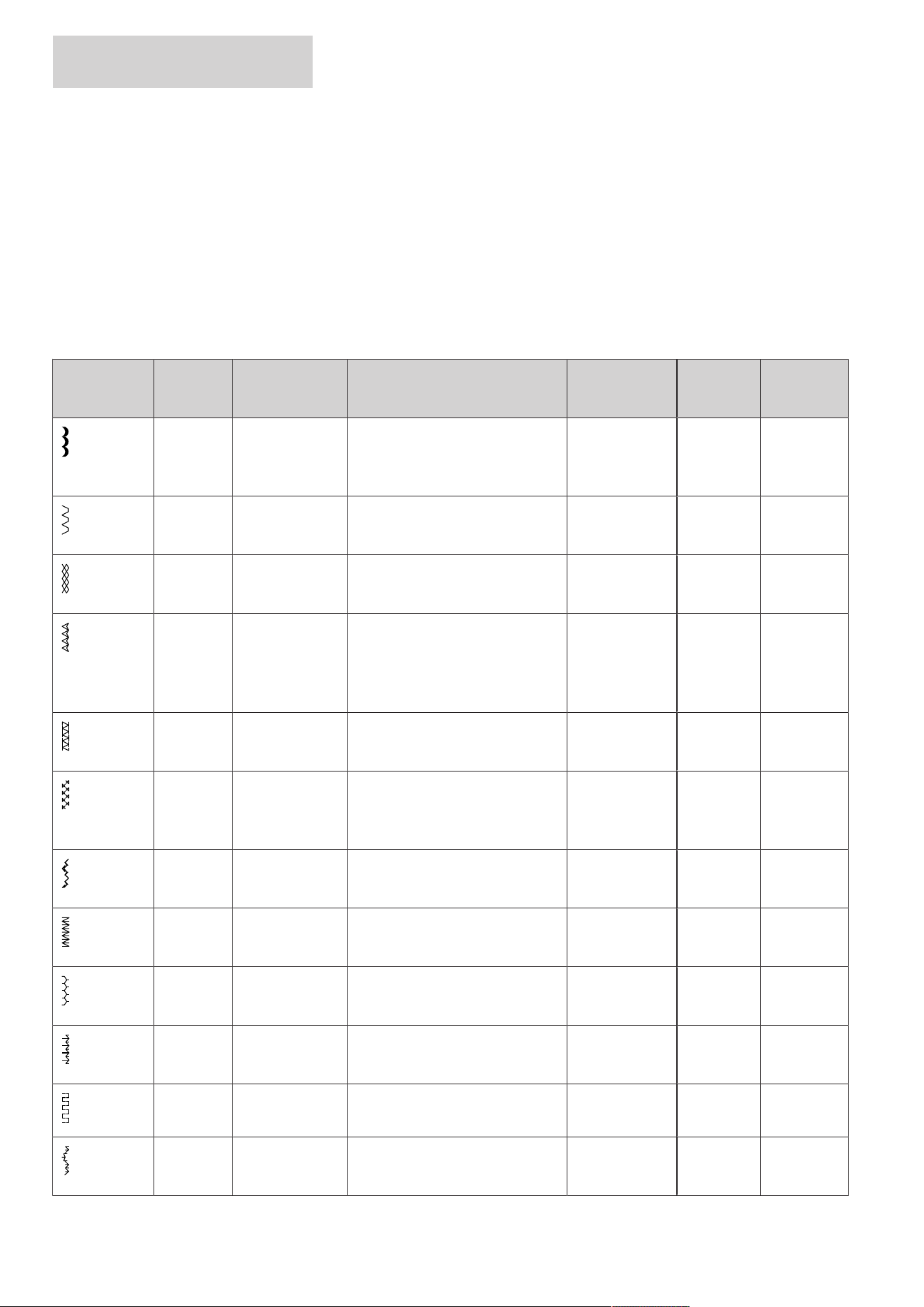
> Sew slowly while guiding the fabric carefully along the edge of the guide.
> Turn over the fabric.
4.19 Sewing Visible Hems
The visible hem is especially suitable for elastic hems in tricot fabric made of cotton, wool, synthetics and
blended fibers.
We recommend using the Lycra stitch or triple zigzag as a visible hem stitch for elastic fabrics.
We recommend using the universal stitch or triple straight stitch as a visible hem for non-elastic fabrics.
> Fit the zigzag foot or upper feed foot.
> Set the stitch pattern selector knob to the required stitch.
> Adjust the stitch length according to the stitch table.
> If required, adjust the presser foot pressure.
> Iron the hem and baste if necessary.
> Sew the hem at the required depth on the right side.
> Cut off the remaining fabric on the wrong side.
4.20 Sewing Flat Joining Seams
The flat joining seam is particularly suitable for fleecy or thick fabrics such as terry, felt or leather. Suitable
stitches are the reinforced overlock stitch, the universal stitch, the Lycra stitch and the stretch overlock stitch.
> Fit the zigzag foot.
> Set the stitch pattern selector knob to «H».
> Set the stitch length knob to «S1».
> Set the required stitch width.
> Overlap the fabric edges.
> Sew along the fabric edge. The needle stitches over the edge of the top layer on the right side into the
bottom layer to get a very flat durable seam.
4.21 Sewing Basting Stitches
When sewing basting stitches, it is recommended to use a fine darning thread. This is easier to remove. The
recommended stitch length is 3.5–4mm. The tacking stitch is suitable for tacking multiple layers of fabric.
> Fit the zigzag foot.
> Set the stitch pattern selector knob to «A».
> Set the stitch length to «4».
> Set the stitch width to «0».
> Pin the fabric layers at a right angle to basting direction to prevent the layers from slipping.
DECORATIVE STITCHES
54
2024-07 EN 5020105.10A.04
5 Decorative Stitches
5.1 Overview Decorative Stitches
Easier or more difficult decorative stitches come into their own depending on the type of fabric.
Decorative stitches that consist of simple straight stitches are particularly attractive on lightweight fabrics.
Decorative stitches made up of satin stitches look especially stylish on heavy fabrics.
For a perfect stitch formation, it is of advantage to use the same thread color for upper and bobbin thread
and a stabilizer. With pile or longfiber materials, it is recommended to use an additional water-soluble
stabilizer, which can be easily removed after sewing, on the right side of the fabric.
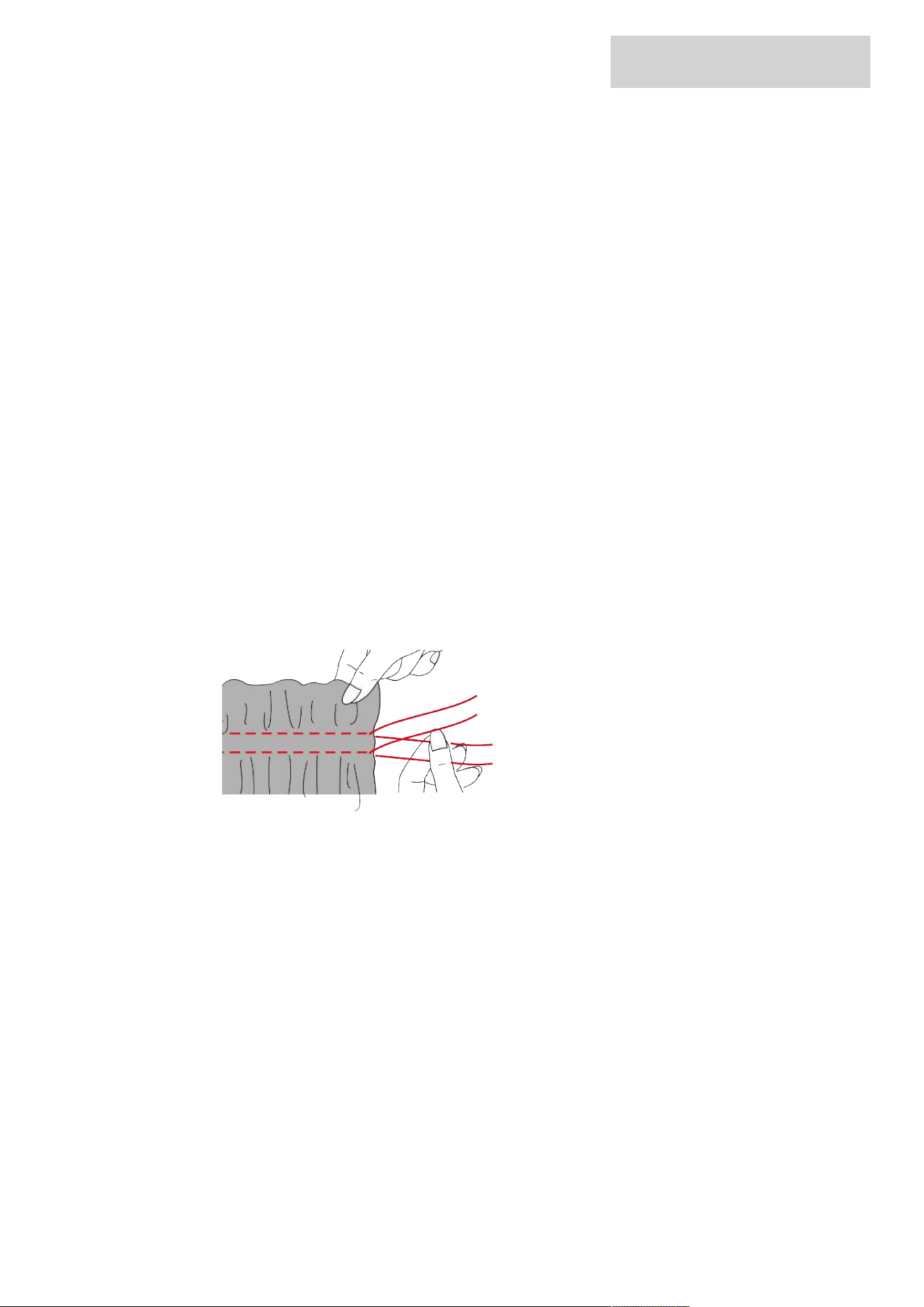
Stitch Pattern Stitch
category
Name Description Recommended
Presser Foot
Stitch
Length
Stitch
Width
K Satin stitch For decorative effects. For
embellishing and decorating
medium-weight to heavy fabrics.
Zigzag foot 0,5–1,0 6.0
D Vari overlock
stitch
For a shell edging effect on soft
jerseys and fine fabric.
Zigzag foot 2,0–3,0 6.0
C Honeycomb
Stitch
For decorative effects. For
smocking.
Zigzag foot S1 3,0–6,0
E Florentine stitch Decorative elastic stitch. For
decorating knitted or woven
fabrics. Also ideal for crazy
quilting.
Zigzag foot S1 6.0
F Double
Overlock
For stitching two fabrics together
to create a breakthrough look.
Zigzag foot S1 6.0
G Faggot stitch For stitching two fabrics together
to create a breakthrough look.
For smocking.
Zigzag foot S1 3,0–6,0
K Decorative
Stitch
For decorative effects. Zigzag foot S1 6.0
B Decorative
Stitch
For decorative effects. Zigzag foot S2 6.0
C Decorative
Stitch
For white embroidery and
decorative effects.
Zigzag foot S2 6.0
E Decorative
Stitch
For decorative effects. Zigzag foot S2 6.0
G Decorative
Stitch
For decorative effects. Zigzag foot S2 6.0
K Decorative
Stitch
For decorative effects. Zigzag foot S2 6.0
DECORATIVE STITCHES
55
2024-07 EN 5020105.10A.04
5.2 Altering the Stitch Density
When using the satin stitch, the stitch density can be adjusted by changing the stitch length. A short stitch
length means that the distance between stitches is shorter and the stitch is denser. A longer stitch length
means that the distance between stitches is greater and the stitch is less dense.
> Set the stitch selector to «K».
> Adjust the stitch length.
> Adjusting the stitch length changes the stitch density.
5.3 Gathering Stitches
Gathering
Ideal for delicate and medium-weight fabrics. For decorating clothing or decorative items.
> Fit the zigzag foot.
> Set the stitch pattern selector knob to position «A».
> Set the stitch width to «0».
> Set the stitch length to «4».
> Set the needle position to «Center».
> Set the thread tension to «2» or less.
> Pull out around 5cm of the upper thread and bobbin thread.
> Sew along the fabric edge at a distance the same as the width of the foot. At the start, make a few
reverse stitches to sew it up. Leave the protruding ends of the thread around 10–12cm long.
> Sew additional lines at a distance of approx. 5mm. At the start, make a few reverse stitches to sew it up.
Leave the protruding ends of the thread around 10–12cm long.
> Pull the bobbin threads and distribute the folds evenly.
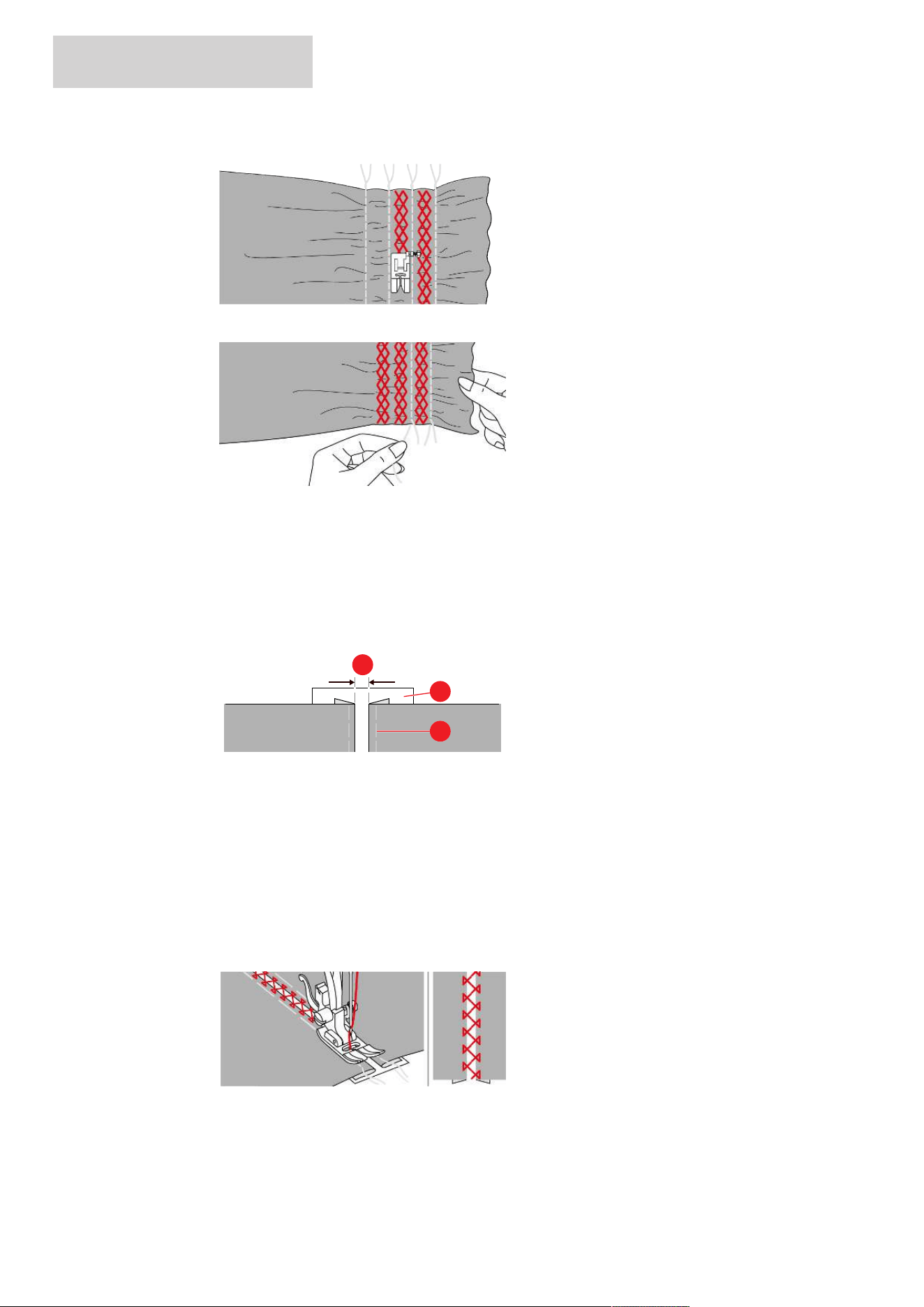
Smocking
Decorative stitches that are sewn over ruffles are referred to as smocking. This technique is used to decorate
blouses or cuffs, among other purposes. Smocking gives fabric texture and elasticity. The following stitches
are suitable for smocking:
• Honeycomb stitch (S1, C)
• Faggot stitch (S1, G)
> Fit the zigzag foot.
> Set the stitch pattern selector knob to position «A».
> Set the stitch length to «4».
> Set the thread tension to «2» or less.
> Sew a tacking stitch 1cm away.
> Tie the threads in a knot on one side.
> On the other side, pull the bobbin threads and distribute the folds evenly.
> Secure the threads.
> Select the honeycomb stitch or faggot stitch.
> Set the stitch width to «6».
> Set the thread tension to «4».
DECORATIVE STITCHES
56
2024-07 EN 5020105.10A.04
> Sew decorative stitches between the gathering seams.
> Remove the tacking threads.
5.4 Connecting Stitches
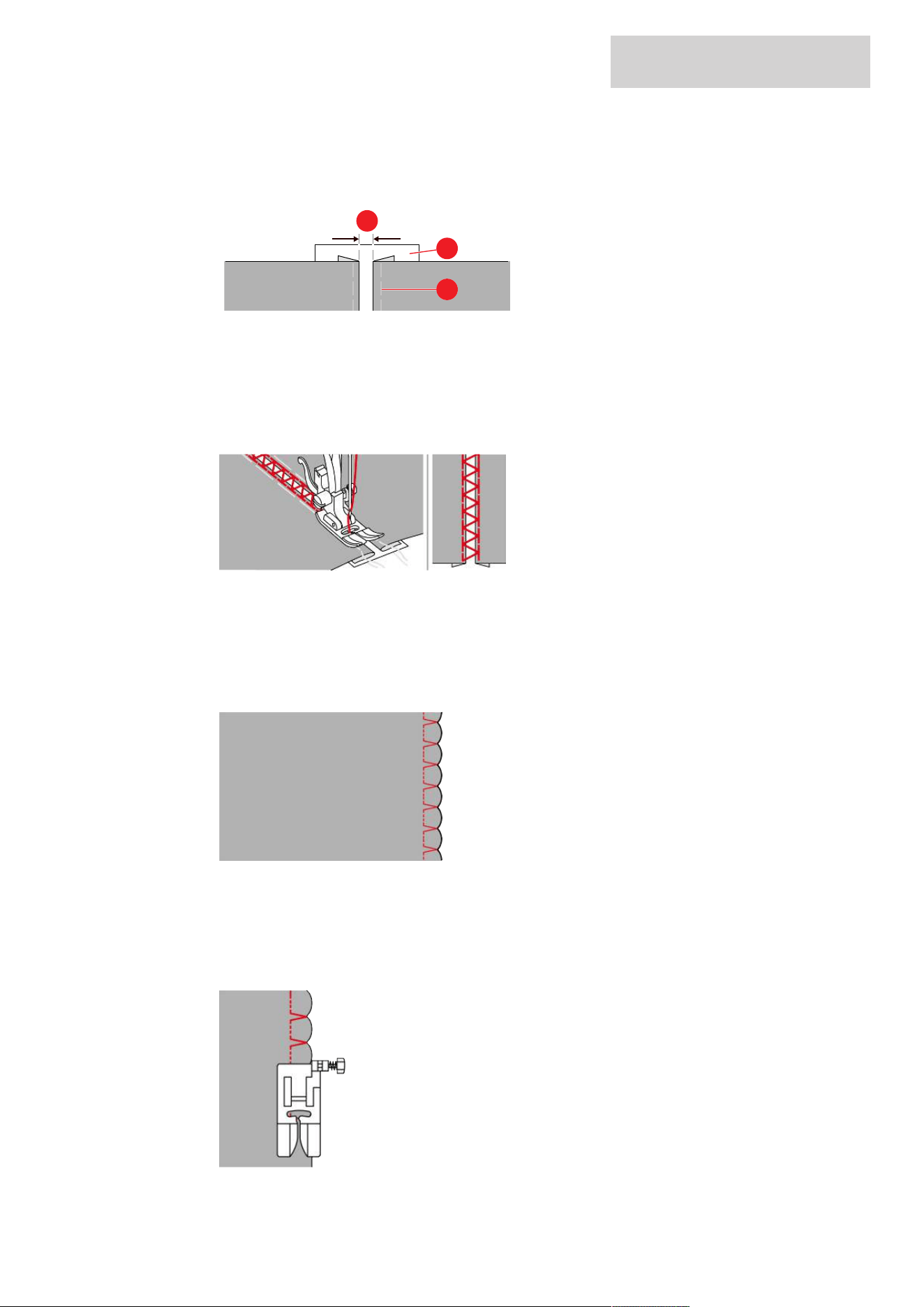
Joining Seam with Faggot Stitch
The faggot stitch can be used to sew two fabric edges together at a distance. This stitch pattern is used to
decorate blouses and children's clothing. The decorative effect of this stitch pattern is more striking if thicker
thread is used.
1
2
3
1 4mm gap 3 Tacking thread
2 Washable lining
> Fit the zigzag foot.
> Set the stitch pattern selector knob to position «G».
> Set the stitch length knob to «S1».
> Set the stitch width to «6».
> Tack the folded edges of two pieces of fabric to a piece of washable lining with a gap of 4mm.
> Lower the presser foot centrally between the edges of the fabric and sew.
> After sewing, remove the lining and tacking thread.
DECORATIVE STITCHES
57
2024-07 EN 5020105.10A.04
Joining Seam with Double Overlock Stitch
The double overlock stitch can be used to sew two fabric edges together at a distance. This stitch pattern is
used to decorate blouses and children's clothing. The decorative effect of this stitch pattern is m
1
2
3
ore striking if thicker thread is used.
> Fit the zigzag foot.
> Set the stitch pattern selector knob to position «F».
> Set the stitch length knob to «S1».
> Set the stitch width to «6».
> Tack the folded edges of two pieces of fabric to a piece of washable lining with a gap of 4mm.
> Lower the presser foot centrally between the edges of the fabric and sew.
> After sewing, remove the lining and tacking thread.
5.5 Edging
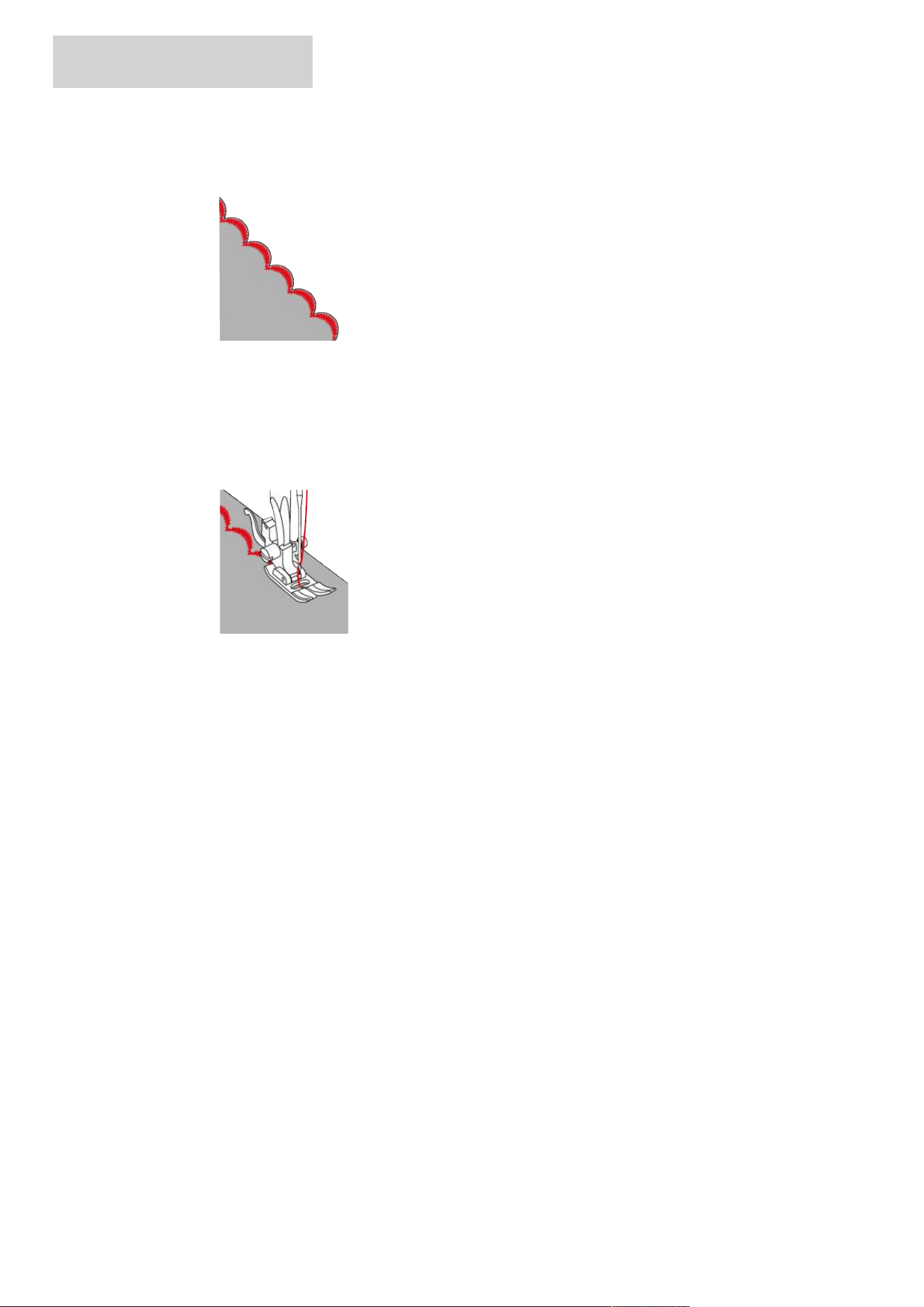
Shell Edging with Vari-Overlock Stitch
The Vari-overlock stitch can be used to create a shell edging effect on soft jerseys and fine fabric.
> Fit the zigzag foot.
> Set the stitch pattern selector knob to «H».
> Set the required stitch length.
> Set the required stitch width.
> Fold the edge of the fabric in by about 5mm. Position the fabric under the presser foot so that the
needle goes into the air just past the edge of the fabric on the right-hand side.
DECORATIVE STITCHES
58
2024-07 EN 5020105.10A.04
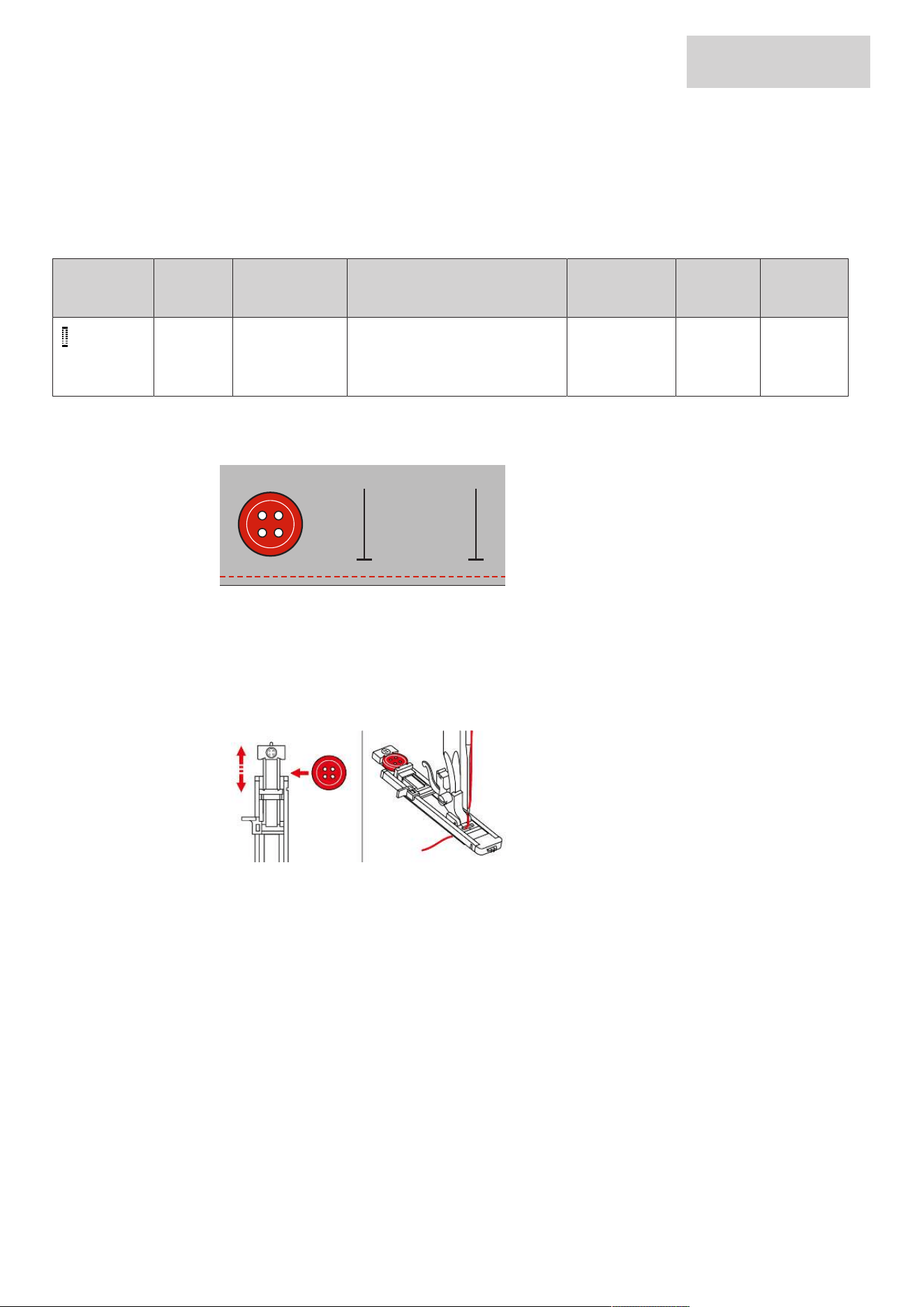
Shell Edging with Satin Stitch
A wavy hem with satin stitches can be used to decorate blouse necklines and the edges of knitted fabrics.
> Fit the zigzag foot.
> Turn the stitch pattern selector knob to position «K».
> Select the required stitch length.
> Set the required stitch width.
> Set the needle position to «Center».
> Sew along the edge of the fabric at a distance of approx. 1cm.
> Use scissors to cut the fabric carefully along the seam.
BUTTONHOLES
59
2024-07 EN 5020105.10A.04
6 Buttonholes
6.1 Overview Buttonholes
To automatically sew buttonholes, the machine features a single-step buttonhole program. The
corresponding button can be sewn on automatically.
Stitch pattern Stitch
category
Name Description Recommended
presser foot
Stitch
length
Stitch
width
– Single-step
buttonhole
stitch
For light to medium-weight
fabrics; blouses, dresses,
bedlinen.
Buttonhole
foot
0,3–0,5 4,0–6,0
6.2 Marking Buttonholes
> Mark the positions of the buttonholes on the fabric.
6.3 Determining the Buttonhole Length
The buttonhole size is automatically determined by placing a button in the foot. The maximum buttonhole
length is 3cm (1
3
/
16
"). (Total of diameter + thickness of button.)
> Fit the buttonhole foot with slide.
> Pull out the button holder plate and insert the button.
– The buttonhole is sewn to suit the button.
6.4 Reinforce Buttonhole
When sewing buttonholes on stretch fabric or coat fabric, hook a filler cord under the buttonhole foot. The
filler cord is guided along with the buttonhole foot. Mercerized yarn or fine crochet thread is suitable as a
filler cord.
> Fit the buttonhole foot with slide.
> Pull out the button holder plate and insert the button.
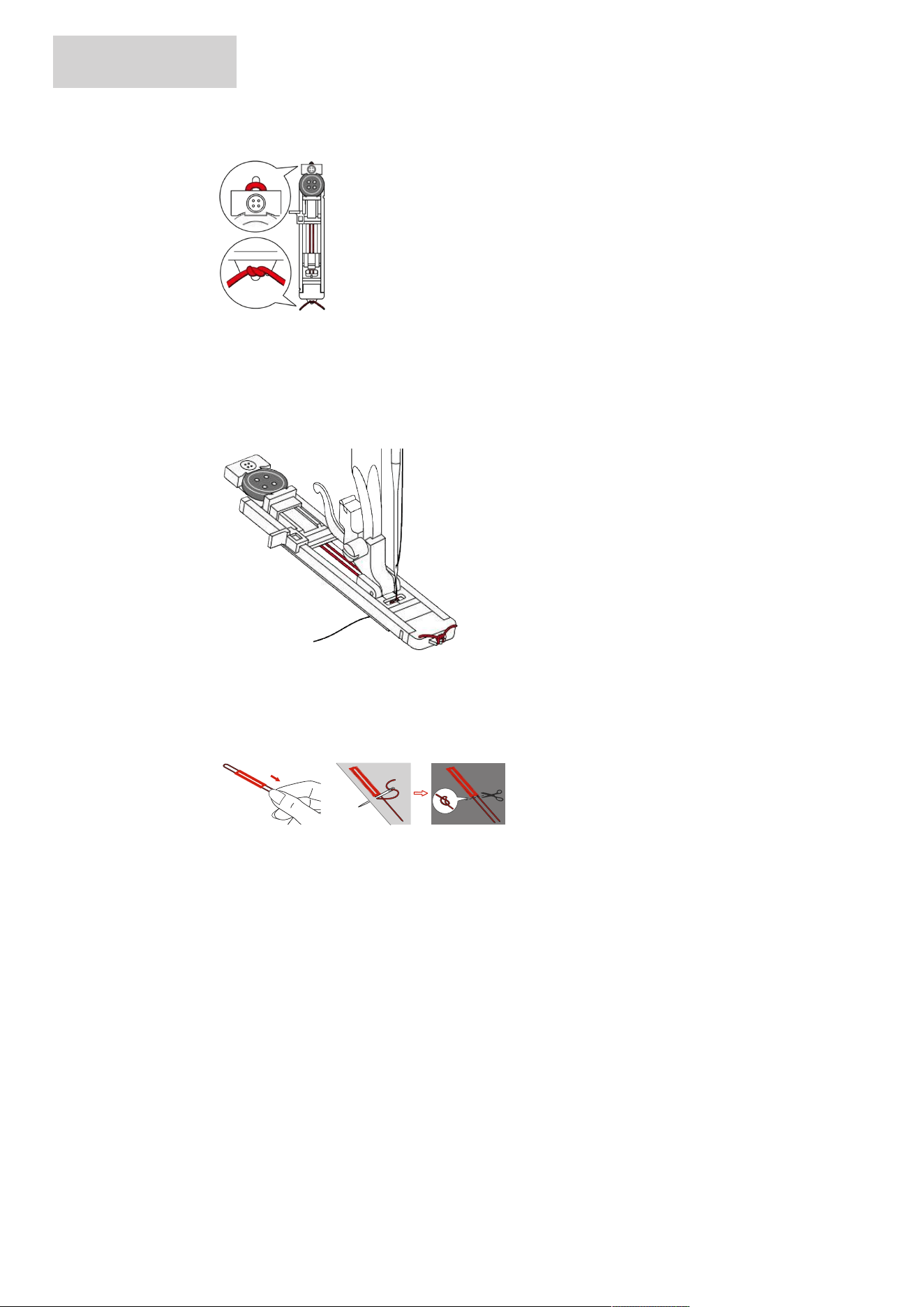
BUTTONHOLES
60
2024-07 EN 5020105.10A.04
> Hang the thread over the hook behind the presser foot and then lay it over the presser foot.
> Hook both ends of the thread on the front of the presser foot, guide them into the groove and tie them
together temporarily.
> Adjust the stitch length and stitch width.
> Lower the presser foot.
> Press the buttonhole lever all the way down and press it backwards slightly until it clicks in position.
> Use the foot control to start sewing.
– The buttonhole will sew over the cord, covering it.
> Pull the cord loop until the loop disappears in the bartack.
> Pull the ends of the cord through to the wrong side of the fabric (using a hand stitching-needle), knot or
secure with stitches.
6.5 Sewing a Test Sample
Always sew a test sample of the buttonhole on the same fabric: It is recommended to use the same stabilizer
and to select the same buttonhole. The test sample should also be sewn in the respective direction. Preparing
a sewing sample allows you to adjust the settings until the sewing result is as required.
> Sew a sample buttonhole.
> Check whether the settings are correct. If required, adjust the buttonhole length, stitch length and stitch
width.
6.6 Sewing a Buttonhole Automatically
> Fit the buttonhole foot with slide.
> Pull out the button holder plate and insert the button.
> Push the button holder plate backwards until it meets the button.
– The length of the buttonhole is determined.
> Guide the thread through the hole in the presser foot and then position it under the presser foot.
> Turn the stitch pattern selector knob to the single-step buttonhole setting.
> Set the stitch width to 4–6.
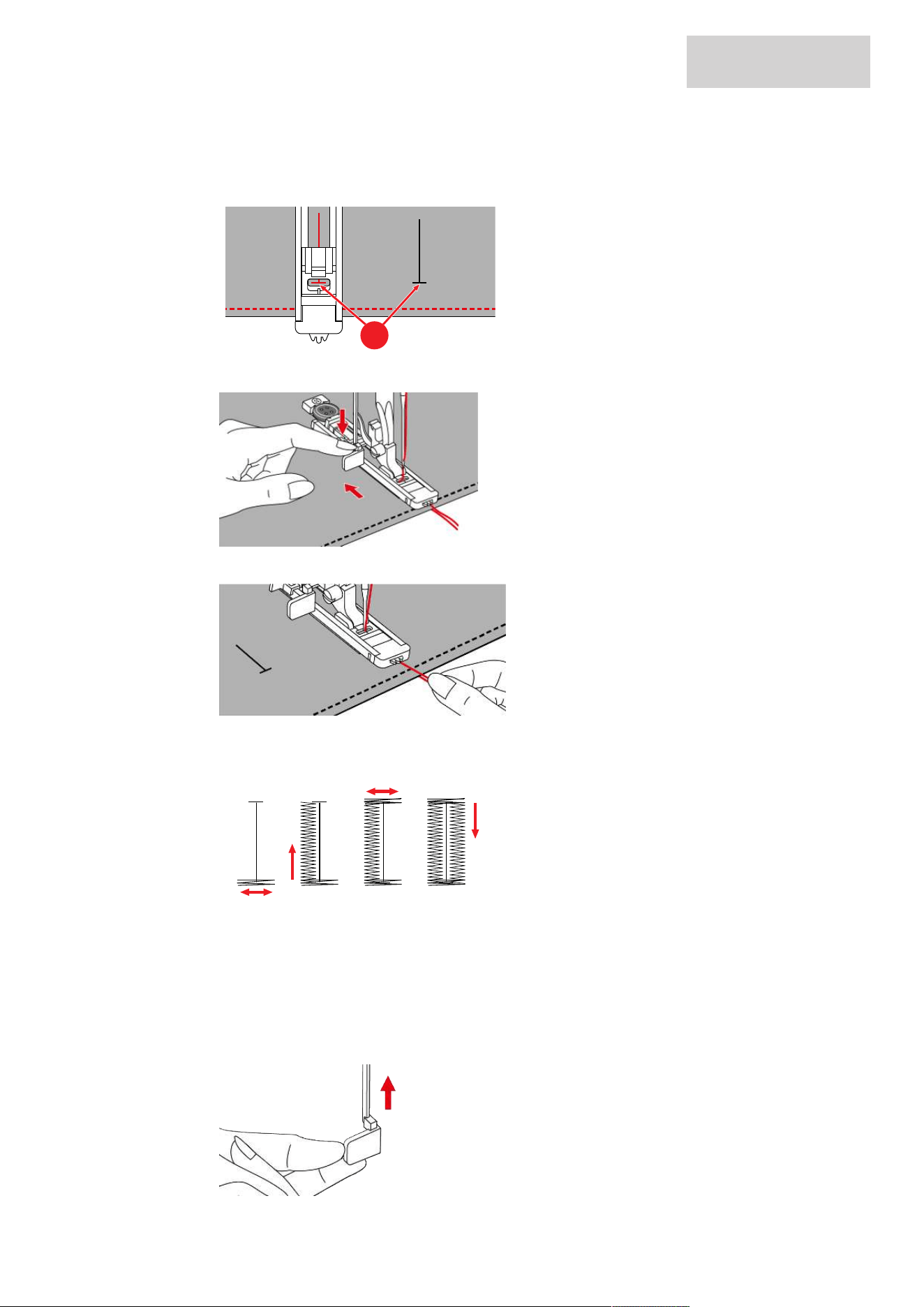
BUTTONHOLES
61
2024-07 EN 5020105.10A.04
> Set the required stitch length in the buttonhole symbol range on the dial.
> Position the fabric under the presser foot so that marking of the centerline is aligned with the starting
point (1).
1
> Press the buttonhole lever all the way down and press it backwards slightly until it clicks in position.
> Hold the upper thread perpendicular to the buttonhole foot with slide.
> Use the foot control to start sewing.
– The buttonhole is sewn from the front of the presser foot to the back.
1. 2. 3. 4.
> At the end of the buttonhole, where the bead meets the bar, stop the machine.
> Raise the presser foot, remove the fabric and cut the thread.
> Pull the upper thread downwards and tie it in a knot.
> If you must interrupt sewing a buttonhole, pull the buttonhole lever forwards and sew 2–3stitches until
the mechanism has switched over.
> To sew another buttonhole, push the buttonhole lever backwards.
> After sewing the last buttonhole, lift the buttonhole lever as far as it will go.
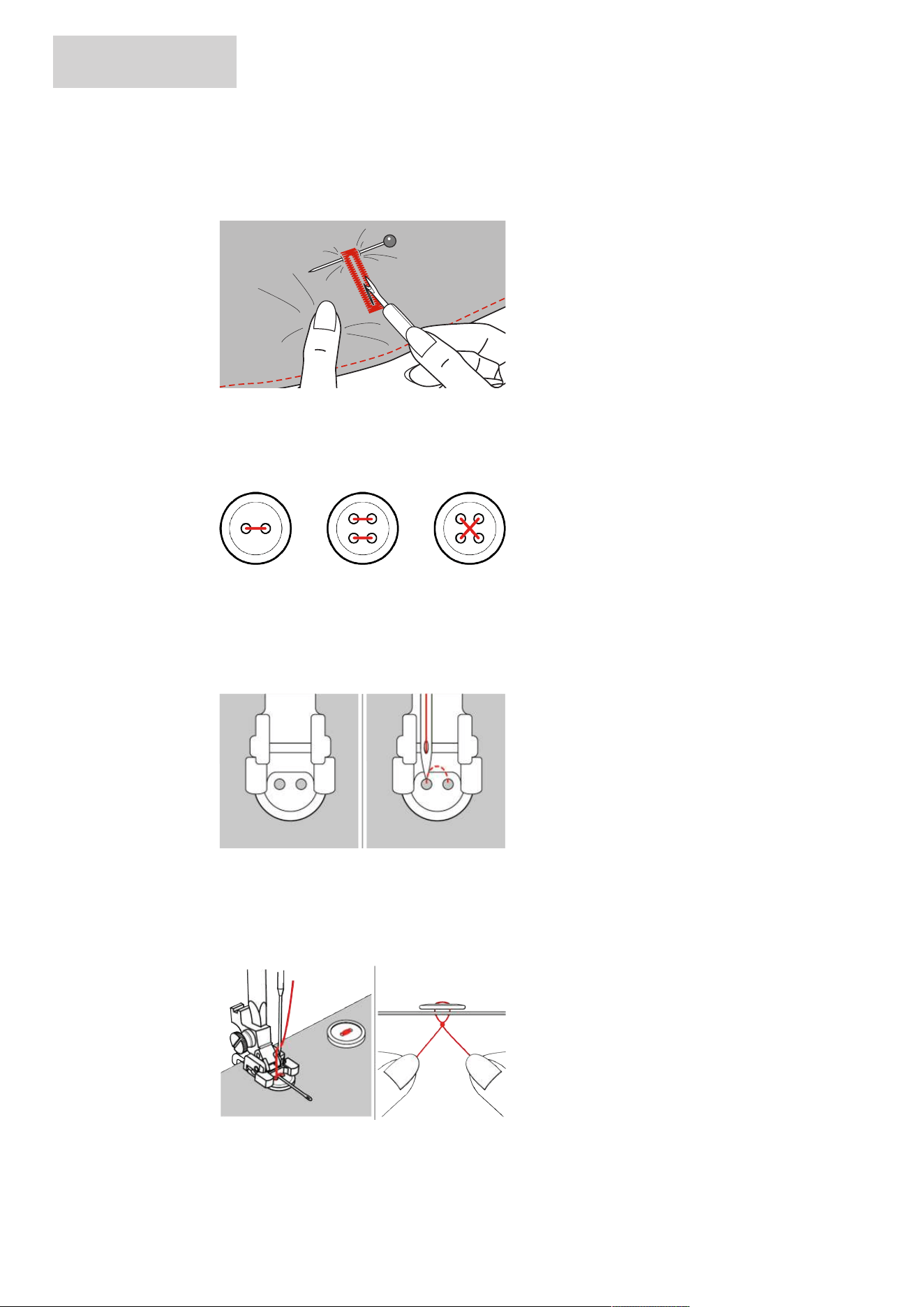
BUTTONHOLES
62
2024-07 EN 5020105.10A.04
6.7 Cut the Buttonhole Open
> Place a pin at each end directly underneath the locking stitch to prevent the stitches being cut open.
> Cut the opening with the seam ripper.
6.8 Sewing On Buttons
The Button Sew-on Program can be used to sew on buttons with two or four holes, press studs or snap
fasteners.
> Fit the zigzag foot or button-sew-on foot.
> Set the stitch pattern selector knob to «B».
> Lower the feed dog.
> Fit the button into the sewing project.
> For a button with four holes, sew the front holes first.
> Check distances between holes with the handwheel. If necessary, alter the stitch width.
> Hold the threads when starting to sew.
> Sew a few stitches using the machine. To ensure stability, sew around 10 stitches.
> To strengthen the shank, cut the threads, leaving about 10cm.
> Bring the upper thread through one of the holes in the button and wind it around the shank.
> Bring the upper thread to the wrong side of the fabric and tie it in a knot.
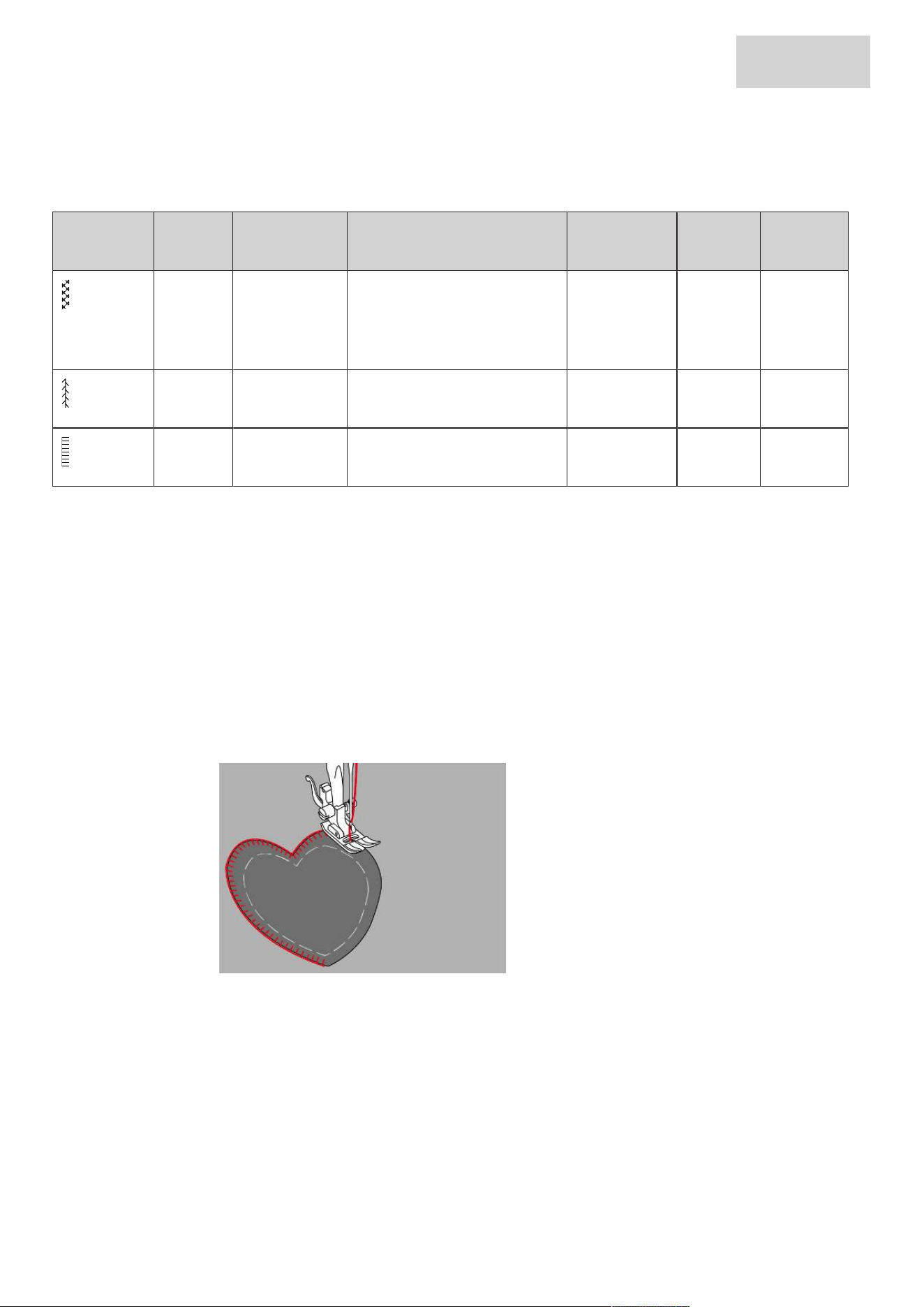
QUILTING
63
2024-07 EN 5020105.10A.04
7 Quilting
7.1 Overview Quilt Stitches
Stitch pattern Stitch
category
Name Description Recommended
presser foot
Stitch
length
Stitch
width
G Faggot stitch For stitching two fabrics together
to create a breakthrough look.
For quilting, crazy patchwork,
decorating and embellishing.
Zigzag foot S1 6,0
I Feather stitch For crazy patchwork and
embellishing.
Zigzag foot S1 6,0
D Blanket stitch For appliqué, embellishing,
finishing and sewing on ribbons
Zigzag foot S2 6,0
7.2 Appliqués
Appliqués attached using the blanket stitch look as if they have been sewn by hand.
> Place an appliqué on the fabric and baste or pin it in place, or iron it on using double-sided adhesive non-
woven material.
> Fit the zigzag foot or open embroidery foot.
> Set the stitch pattern selector knob to position «D».
> Set the stitch length knob to «S2».
> Set the required stitch width.
> Sew while guiding the fabric so the needle falls along the outer edge of the appliqué.
> When sewing around a corner, stop the machine with the needle in the lower position at the outer edge
of the appliqué. Raise the presser foot and pivot the fabric around the needle to change the sewing
direction.
7.3 Free-Motion Quilting
The quilting stitch plate (optional accessory) and the free-motion quilting foot (optional accessory) are used
for quilting work.
It is recommended to use the slide-on table. With free motion quilting, it is of advantage to quilt from the
center outwards and to guide the fabric using smooth, round movements to form the design of your choice.
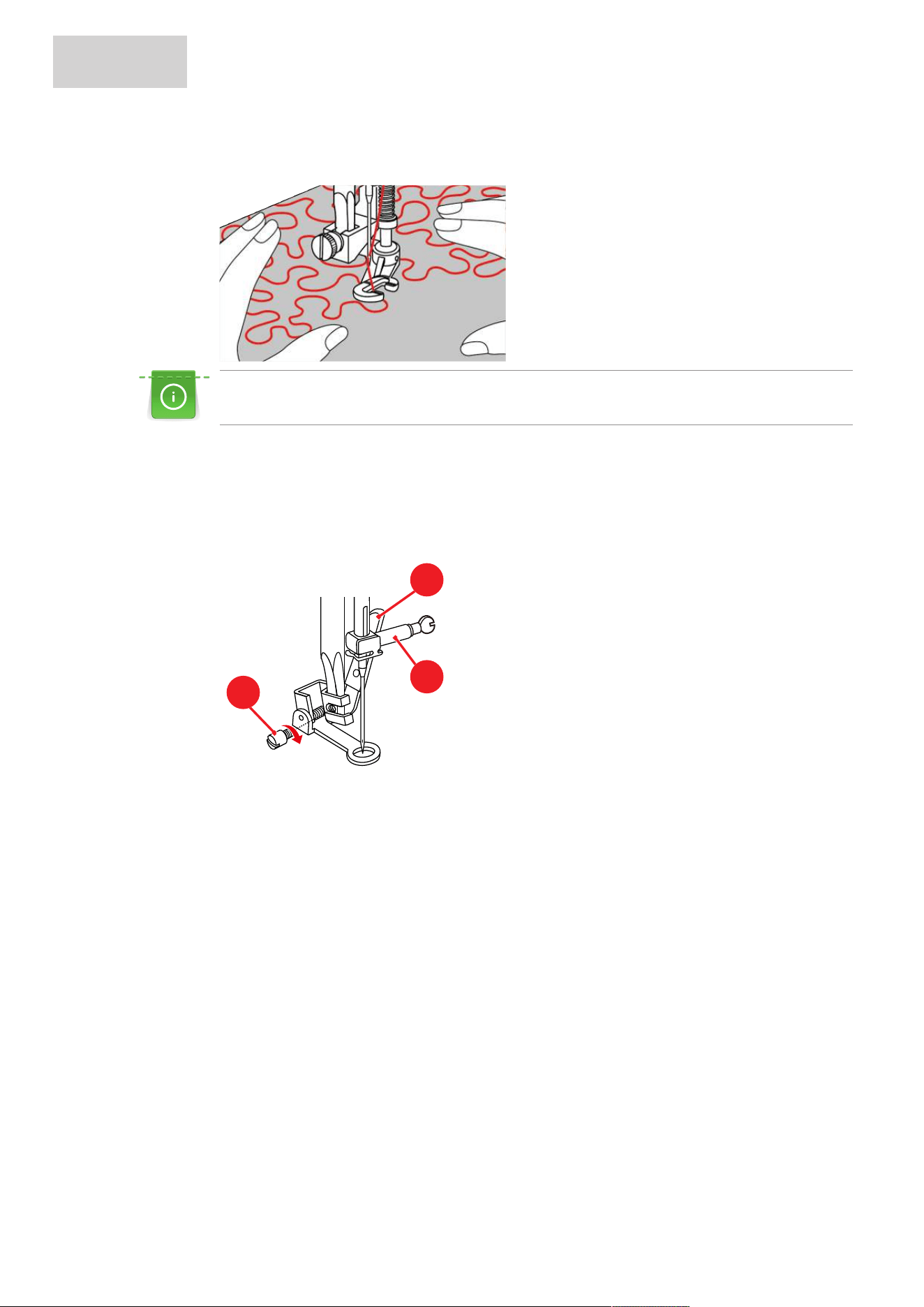
QUILTING
64
2024-07 EN 5020105.10A.04
With stipple quilting, entire surfaces of the fabric are filled with quilt stitches. The single lines of stitching are
rounded and never cross one another.
Quilting gloves with rubber nubs make it easier to guide the fabric.
Prerequisite:
• The top layer, the batting and the backing are pinned together or basted.
> Fit the quilting stitch plate.
> Remove the presser foot and fit the free-motion quilting foot to the presser foot bar.
> Tighten the free-motion quilting foot with the screw.
1
2
3
> Set the stitch length «0».
> If required, adjust the upper thread tension.
> Press the foot control.
> Hold both hands close to the presser foot like an embroidery hoop to guide the fabric.
> If the thread is lying on top of the fabric, slow down the movement of the sewing project.
> If there are knots on the wrong side of the fabric, move the sewing project faster.
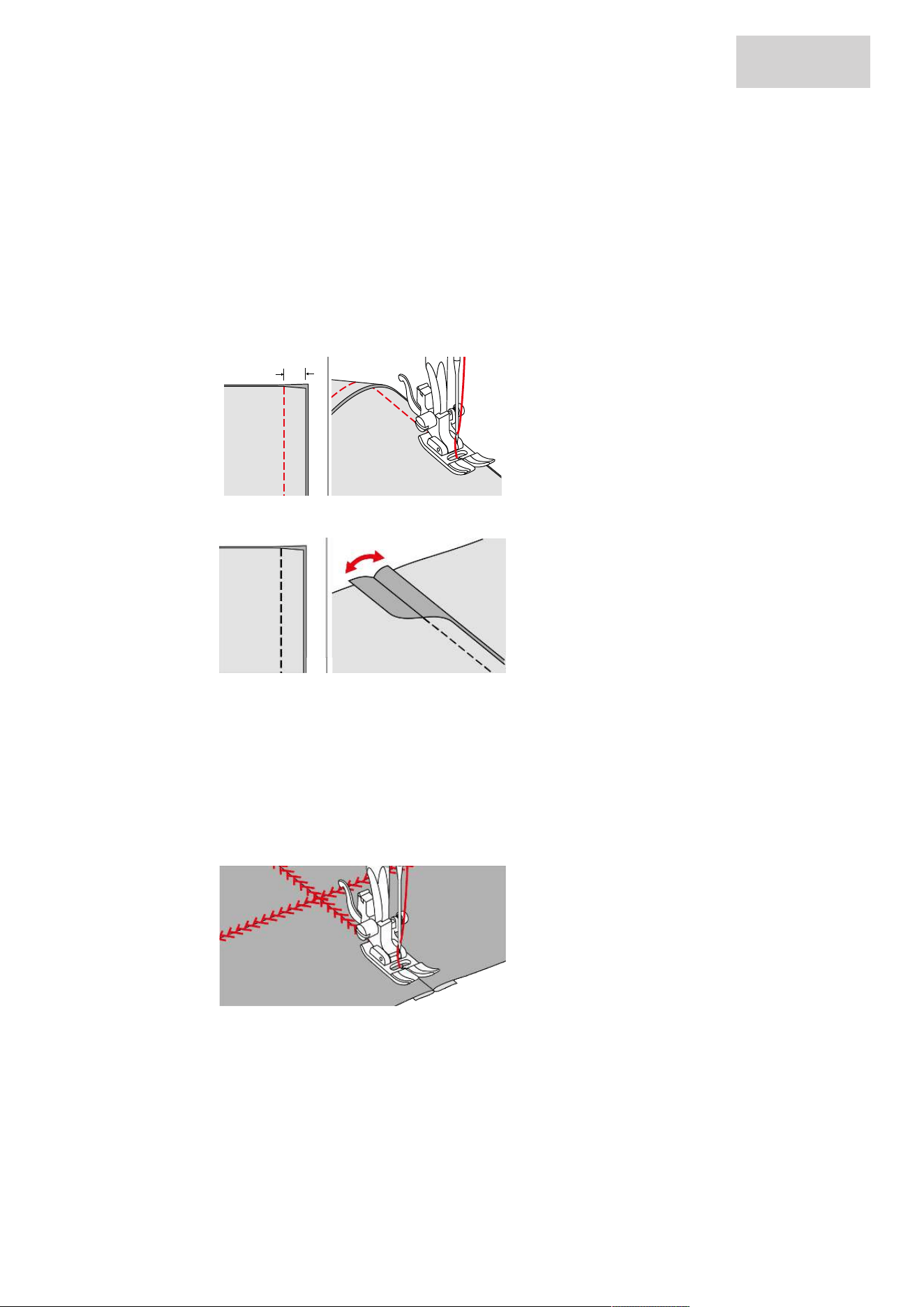
QUILTING
65
2024-07 EN 5020105.10A.04
7.4 Sewing Patchwork
Piecing
> Fit the zigzag foot or patchwork foot.
> Set the stitch pattern selector knob to «A».
> Set the stitch length knob to the required stitch length of 1–3.
> Set the needle position to «Center».
> Place 2 pieces right sides together.
> Sew the pieces together with a seam allowance of 5mm or guide them along the guide of the
patchwork foot.
5 mm
> Press the seam allowances open.
Embellishing Seams
> Fit the zigzag foot.
> Set the decorative stitch you have chosen.
> Set the required stitch width.
> Set the needle position to «Center».
> Continue to work on the right side of the fabric.
> Place the joining seam under the center of the presser foot.
> Sew over the seam using a decorative stitch.
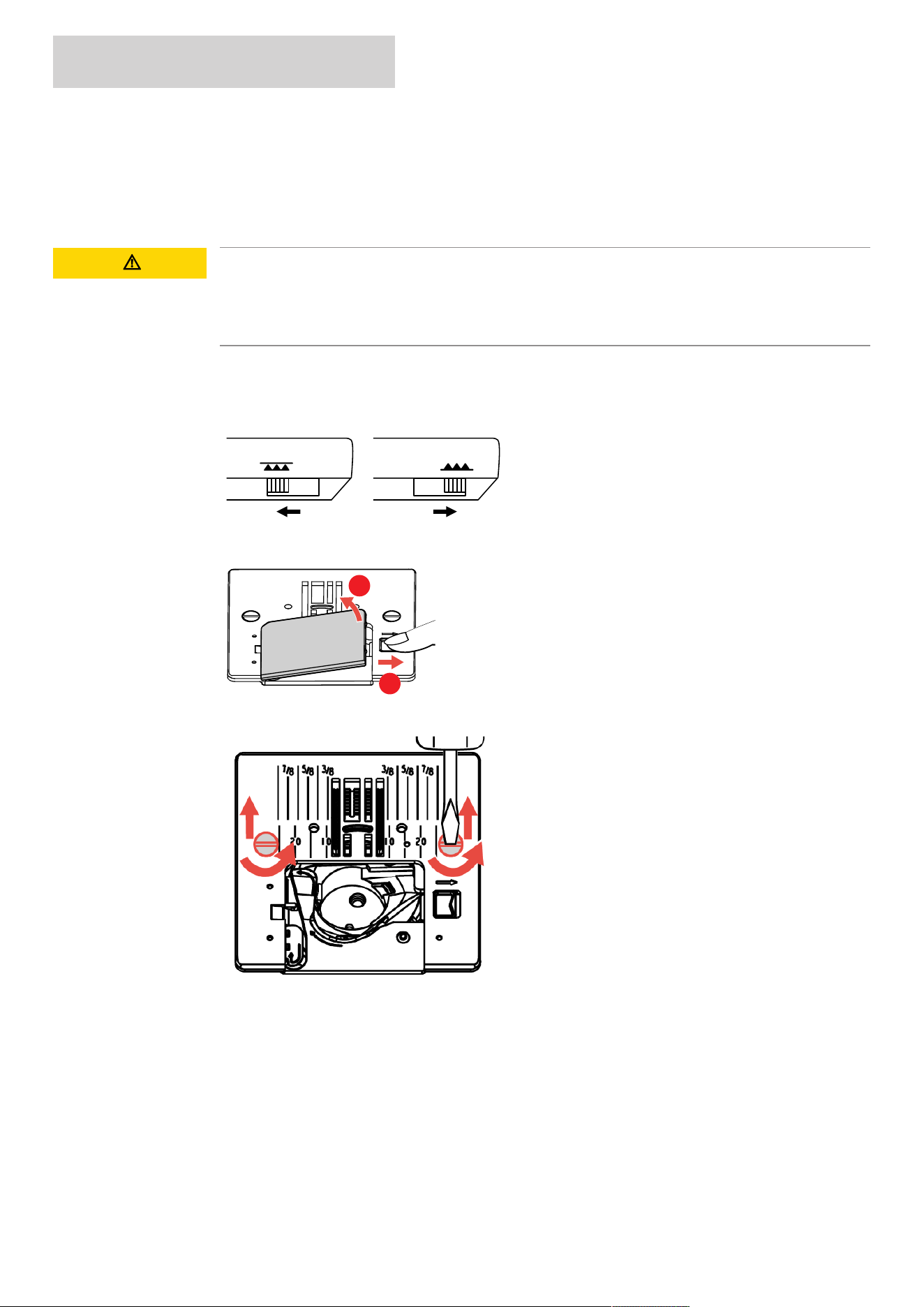
MAINTENANCE AND CLEANING
66
2024-07 EN 5020105.10A.04
8 Maintenance and Cleaning
8.1 Cleaning the Feed Dog
Remaining threads under the stitch plate must occasionally be removed.
CAUTION
Electronically Driven Components
Risk of injury near the needle and the hook.
> Raise the presser foot.
> Switch the machine off and disconnect it from the power supply.
> Switch the machine off and disconnect it from the power supply.
> Remove the presser foot and the needle.
> Lower the feed dog.
> Push the unlocking lever (1) to the right and remove the bobbin cover (2).
1
2
> Loosen both screws and remove the stitch plate.
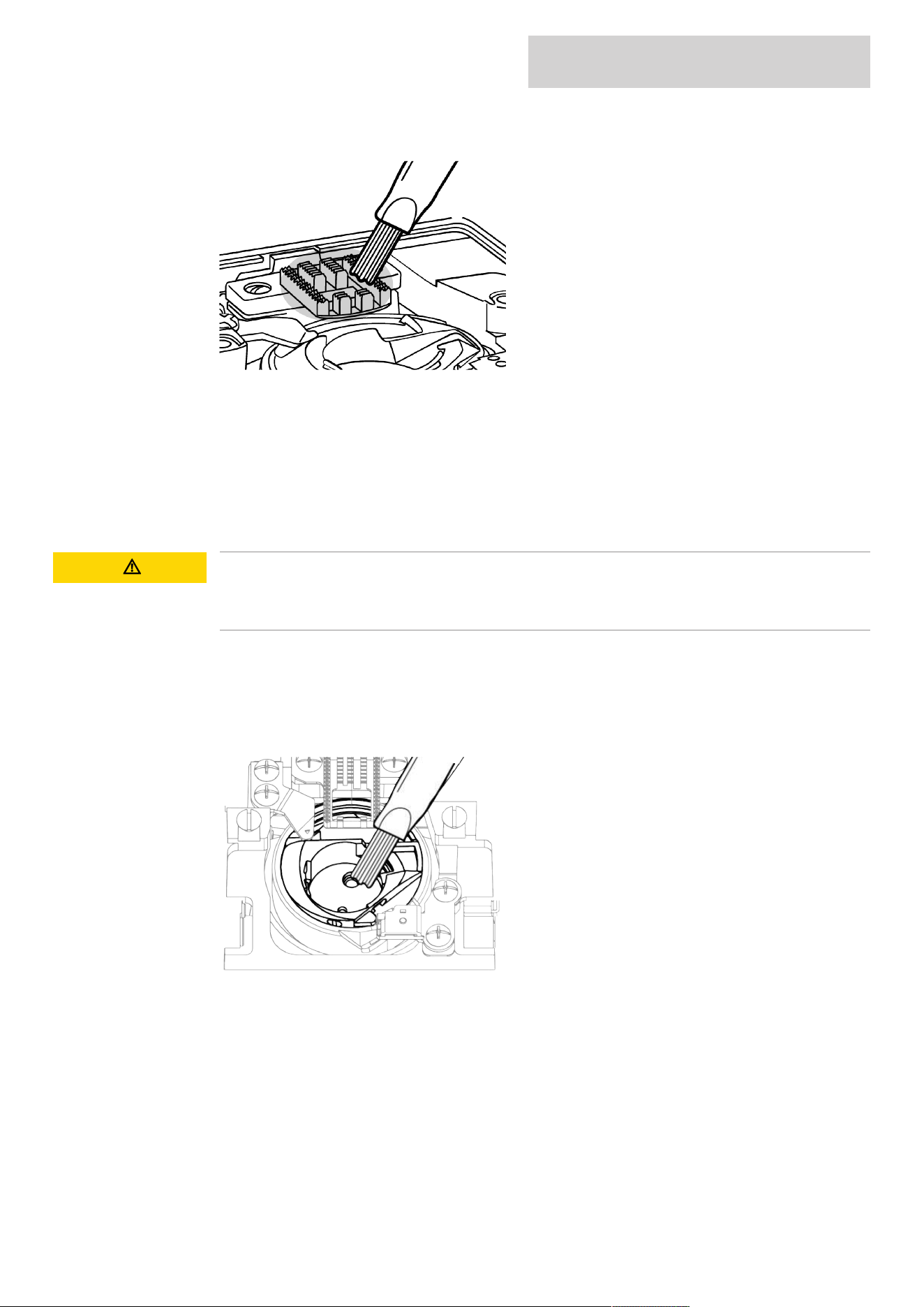
MAINTENANCE AND CLEANING
67
2024-07 EN 5020105.10A.04
> Clean the feed dog with the brush.
> Refit the stitch plate. Insert both screws and tighten them.
> Insert the bobbin cover.
> Raise the feed dog.
> Insert a needle.
> Attach the presser foot.
> Connect the machine to the mains power and switch it on.
8.2 Cleaning the Bobbin Case
CAUTION
Electronically Driven Components
Risk of injury near the needle and the hook.
> Switch the machine off and disconnect it from the power supply.
> Remove the presser foot and the needle.
> Open the bobbin cover and remove the top bobbin cover.
> Remove the stitch plate.
> Remove the bobbin from the bobbin case.
> Clean the bobbin case with the brush.
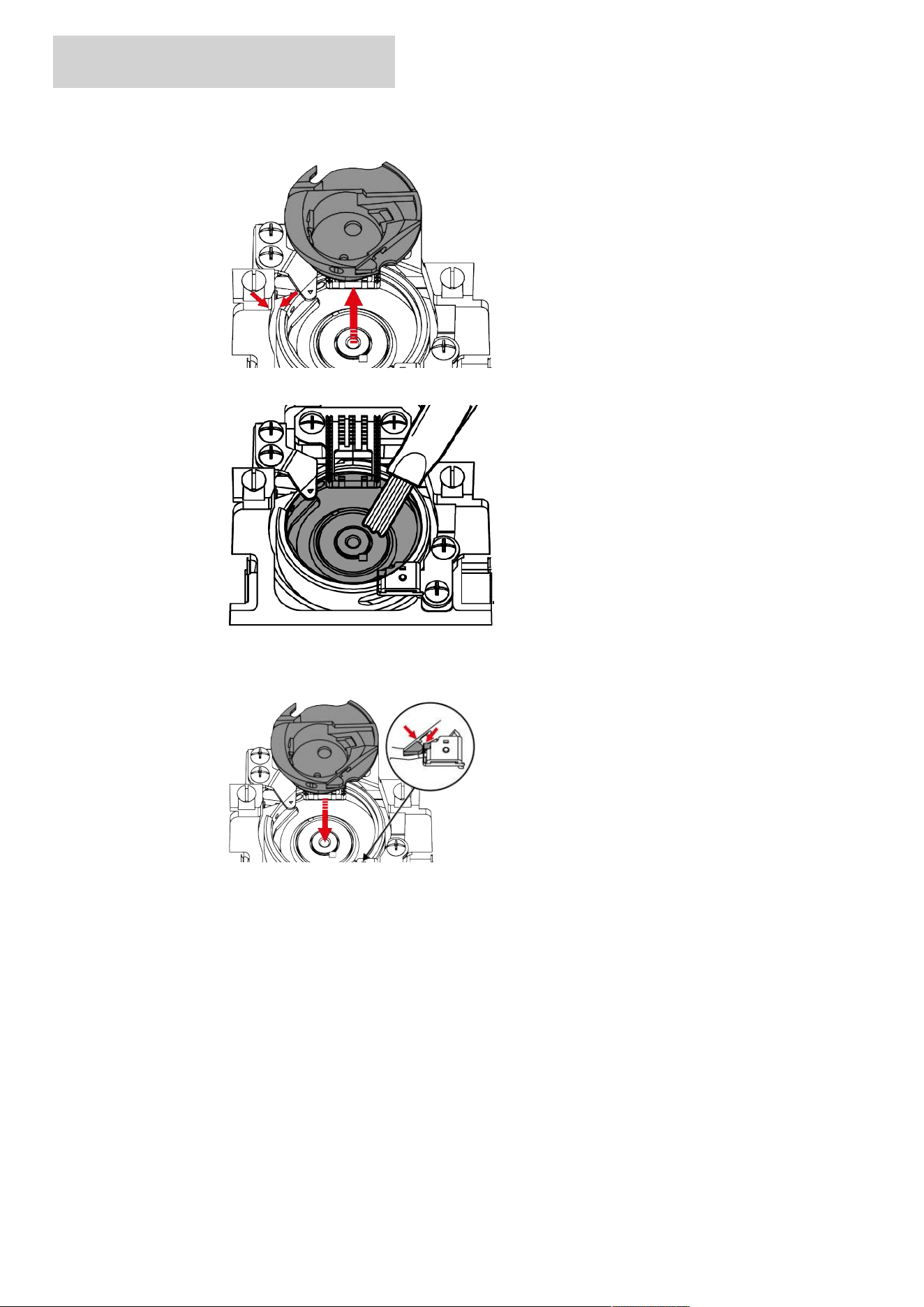
MAINTENANCE AND CLEANING
68
2024-07 EN 5020105.10A.04
> Set needle to topmost position.
> Clean the shuttle race with the brush.
> Insert the bobbin into the bobbin case.
> Fit the stitch plate.
> Attach the top bobbin cover and close the bobbin cover.
> Fit the needle and presser foot.
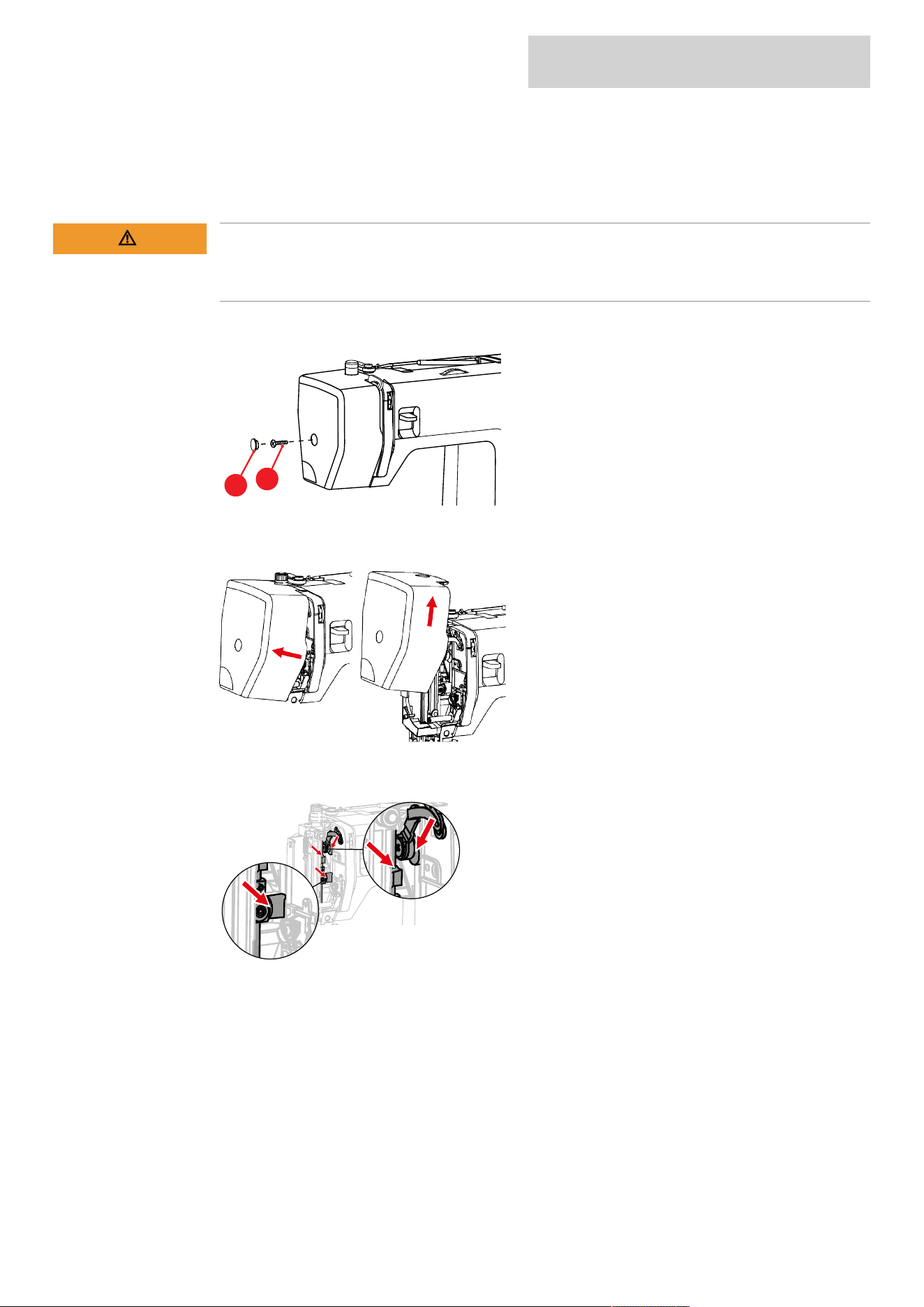
MAINTENANCE AND CLEANING
69
2024-07 EN 5020105.10A.04
8.3 Oiling the Needle Bar
The needle bar may not move smoothly without lubrication. If the machine is used frequently, the needle bar
should be oiled every 6 months to prevent blocking.
WARNING
Electronically Driven Components
Risk of injury near the needle bar.
> Switch the machine off and disconnect it from the power supply.
> Remove the protective cap (1) and screw (2).
1
2
> Remove the headframe cover (3).
– After removing the headframe cover, pay attention to the moving parts.
> Apply a drop of oil to the movement mechanism of the needle bar, including the connecting rod/needle
bar, needle bar holder and needle bar holder (apply oil to the points marked with an arrow).
> Remove the presser foot.
> Turn the handwheel a few times and remove any excess oil with a cloth.
> Attach the headframe cover again.

TROUBLESHOOTING
70
2024-07 EN 5020105.10A.04
9 Troubleshooting
Fault Cause Solution
Uneven Stitch Formation
Upper thread too tight or too
loose.
> Adjust the upper thread tension.
Needle blunt or bent. > Replace the needle, make sure that a new BERNINA
quality needle is used.
Poor quality needle. > Use a new BERNINA quality needle.
Poor quality thread. > Use quality thread.
Incorrect needle/thread
combination.
> Match the needle with the thread size.
Incorrectly threaded. > Rethread the thread.
Fabric has been pulled. > Feed the fabric evenly.
Dust or thread remnants under
the tension spring of the bobbin
case.
> Cleaning the Bobbin Case (see page67).
Skipped Stitches
Incorrect needle. > Use the needle system 130/705H.
Needle blunt or bent. > Replace the needle.
Poor quality needle. > Use a new BERNINA quality needle.
The needle is incorrectly inserted. > Insert the needle with the flat side to the back as far up
as it will go into the needle holder and tighten the
screw.
Incorrect needle point. > Match the needle point to the texture of the material.
Faulty Stitching
Thread remnants between the
thread tension discs.
> Fold a piece of thin material and slide the folded edge
(not the raw edges) between the thread tension discs.
Incorrectly threaded. > Rethread.
Thread is caught in the hook. > Remove the upper thread and the bobbin case, turn the
handwheel backwards and forwards by hand and
remove the thread remnants.
Incorrect needle/thread
combination.
> Check the needle/thread combination.

TROUBLESHOOTING
71
2024-07 EN 5020105.10A.04
Fault Cause Solution
Upper Thread Breaks
Incorrect needle/thread
combination.
> Match the needle with the thread size.
Upper thread is too tight. > Reduce the upper thread tension.
Incorrectly threaded. > Rethread.
Poor quality thread. > Use quality thread.
The stitch plate or the hook tip is
damaged.
> Contact your bernette dealer to have the damages
repaired.
> Replace the stitch plate.
Lower Thread Breaks
The bobbin is not inserted
correctly.
> Remove and reinsert the bobbin and pull on the thread.
– The thread should run easily.
The bobbin is wound incorrectly. > Check bobbin and thread correctly.
The stitch hole in the stitch plate
is damaged.
> Contact your bernette dealer to have the damages
repaired.
> Replace the stitch plate.
Needle blunt or bent. > Replace the needle.
Needle Breaks
The needle is incorrectly inserted. > Insert the needle with the flat side to the back as far up
as it will go into the needle holder and tighten the
screw.
Fabric has been pulled. > Feed the fabric evenly.
Thick fabric has been pushed. > Use a presser foot that is suitable for thick fabric.
> Use the height compensation tool when sewing over a
thick seam.
The thread is knotted. > Use quality thread.
The Machine doesn't Start
The machine is switched off. > Switch the machine on.
The machine is not connected to
the power supply.
> Connect the power plug to the supply.
The machine is defective. > Contact your bernette dealer.
Unfavorable room temperature. > Place the machine in a warm room one hour before use.
> Connect the machine and switch it on.
The presser foot is raised. > Lower the presser foot.
Neither the sewing light nor
the light on the free arm
lights up
The sewing light is defective. > Contact your bernette dealer.

TECHNICAL DATA
72
2024-07 EN 5020105.10A.04
10 Technical data
Term Value Unit
Sewign Light (LED) 200 mW
Maximum Speed 1100 Stitches per Minute
Measurements (w × d × h) 416 × 174 × 299 mm
Weight 7.0 kg
Input Voltage (Energy Consumption) 120 (0.7)
230/240 (90)
V (A)
V (W)
Sound Pressure Level 80 dB (A)
Protection Class (Electrical Engineering) Protection class II
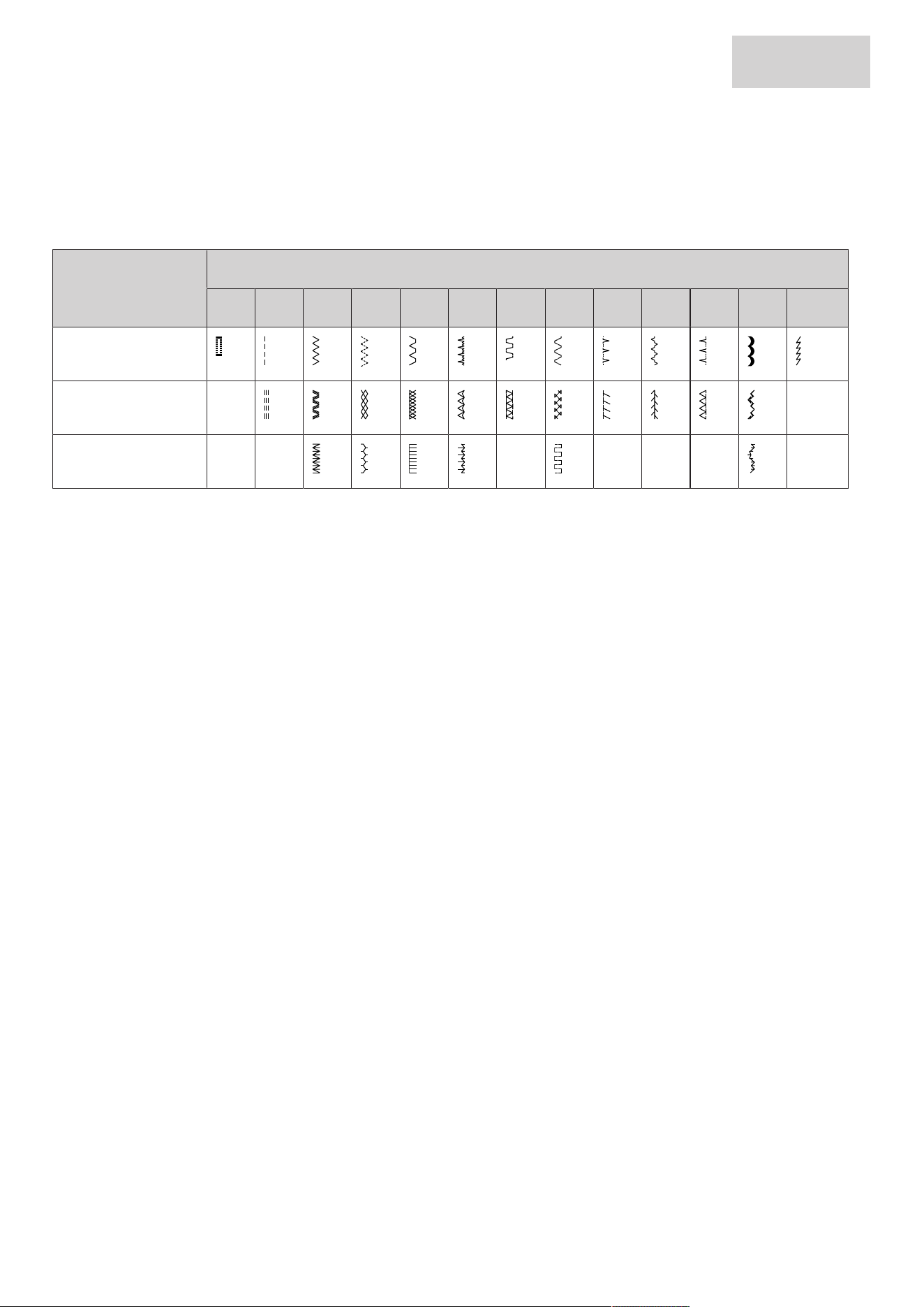
APPENDIX
73
2024-07 EN 5020105.10A.04
11 Appendix
11.1 Overview Stitch Patterns
Overview of the Stitch Patterns
Stitch length knob Stitch selector wheel
A B C D E F G H I J K L
0–4
S1
S2

INDEX
74
2024-07 EN 5020105.10A.04
Index
A
Accessory box....................................................................... 20
Attaching the Presser Foot Sole............................................. 23
Attaching the Seam Guide.................................................... 24
B
Balance dial .......................................................................... 35
Buttonholes .......................................................................... 59
C
Changing the Needle............................................................ 21
Changing the Presser Foot .................................................... 23
Changing the Presser Foot Holder......................................... 24
Cleaning the Feed Dog ......................................................... 66
Cleaning the Hook................................................................ 67
Connect the foot control ...................................................... 18
Connecting the machine....................................................... 18
D
Decorative Stitches................................................................ 54
E
Environmental Protection........................................................ 8
Explanation of Symbols........................................................... 9
F
Feed Dog Up/Down .............................................................. 21
H
Height Compensating Tool ................................................... 37
I
Inserting the spool ................................................................ 20
Inserting the Spool Cap......................................................... 19
M
Machine Overview
Front............................................................................... 10
Rear ................................................................................ 12
Top ................................................................................. 11
N
Needle position right/left....................................................... 22
Needle, Thread and Fabric .................................................... 14
Needles and threads ............................................................. 16
Needles Overview ................................................................. 14
Needles, Threads .................................................................. 16
O
Overview of Accessories........................................................ 12
P
Power Switch........................................................................ 18
Preparing the threading ........................................................ 24
Presser feet overview ............................................................ 13
Presser Foot Up/Down .......................................................... 23
Removing the presser foot sole ............................................. 23
Q
Quick Reverse ....................................................................... 36
Quick Reverse Lever .............................................................. 36
R
Regulating the Speed............................................................ 18
S
Safety Instructions .................................................................. 5
Second spool pin .................................................................. 19
Securing ............................................................................... 37
Setting the Presser Foot Pressure........................................... 24
Sewing Corners .................................................................... 38
Sewing difficult fabrics.......................................................... 38
Sewing table......................................................................... 20
Stitch length ......................................................................... 34
Stitch pattern selector knob .................................................. 33
Stitch selection ..................................................................... 33
Stitch width .......................................................................... 34
T
Technical Specifications ........................................................ 72
Threading the Bobbin Thread................................................ 31
Threading the triple needle ................................................... 28
Threading the Twin Needle ................................................... 28
Threading the Upper Thread ................................................. 25
Troubleshooting ................................................................... 70

INDEX
75
2024-07 EN 5020105.10A.04
U
Upper thread tension............................................................ 35
Upper/Lower Needle Position ................................................ 21
Using the Spool Net.............................................................. 19
Utility stitches ....................................................................... 39
W
Winding the Bobbin Thread .................................................. 29
© BERNINA International AG
Steckborn CH, www.bernina.comwww.bernette.com/b05CRAFTER
2024-07 EN
5020105.10A.04