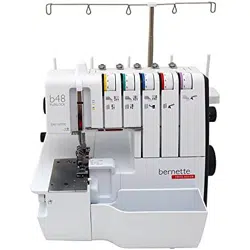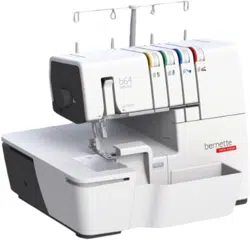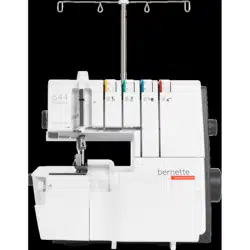
Instruction Manual


3
TABLE OF CONTENTS
NAME OF PARTS 7
Details of machine 7
ACCESSORIES 9
Standard 9
Needle Information 9
HOW TO OPEN LOOPER COVER 10
Principal Parts behind the Looper Cover 10
PREPARATION TO SEWING 10
Power Switch 10
Foot Controller 10
Cut-offs Bin 11
PREPARATION FOR THREADING 12
Setting up the Retractable thread stand 12
Spool net 12
Spool Cap 12
HOW TO DISENGAGE UPPER KNIFE 13
UPPER LOOPER CONVERTER (ULC) 14
Use the upper looper converter 14
Disengage To Upper Looper 14
STANDARD OVERLOCK AND ROLLED HEM
STITCHING 14
Sew Standard Overlock 14
Sew Rolled Hem 15
HOW TO REMOVE AND INSERT NEEDLES 15
Needle Position 15
To Remove Needle(s) 16
To Insert Needle(s) 16
SELECTION OF STITCHES 17
THREADING THE MACHINE 19
Threading Diagram 19
Tension Color Code 19
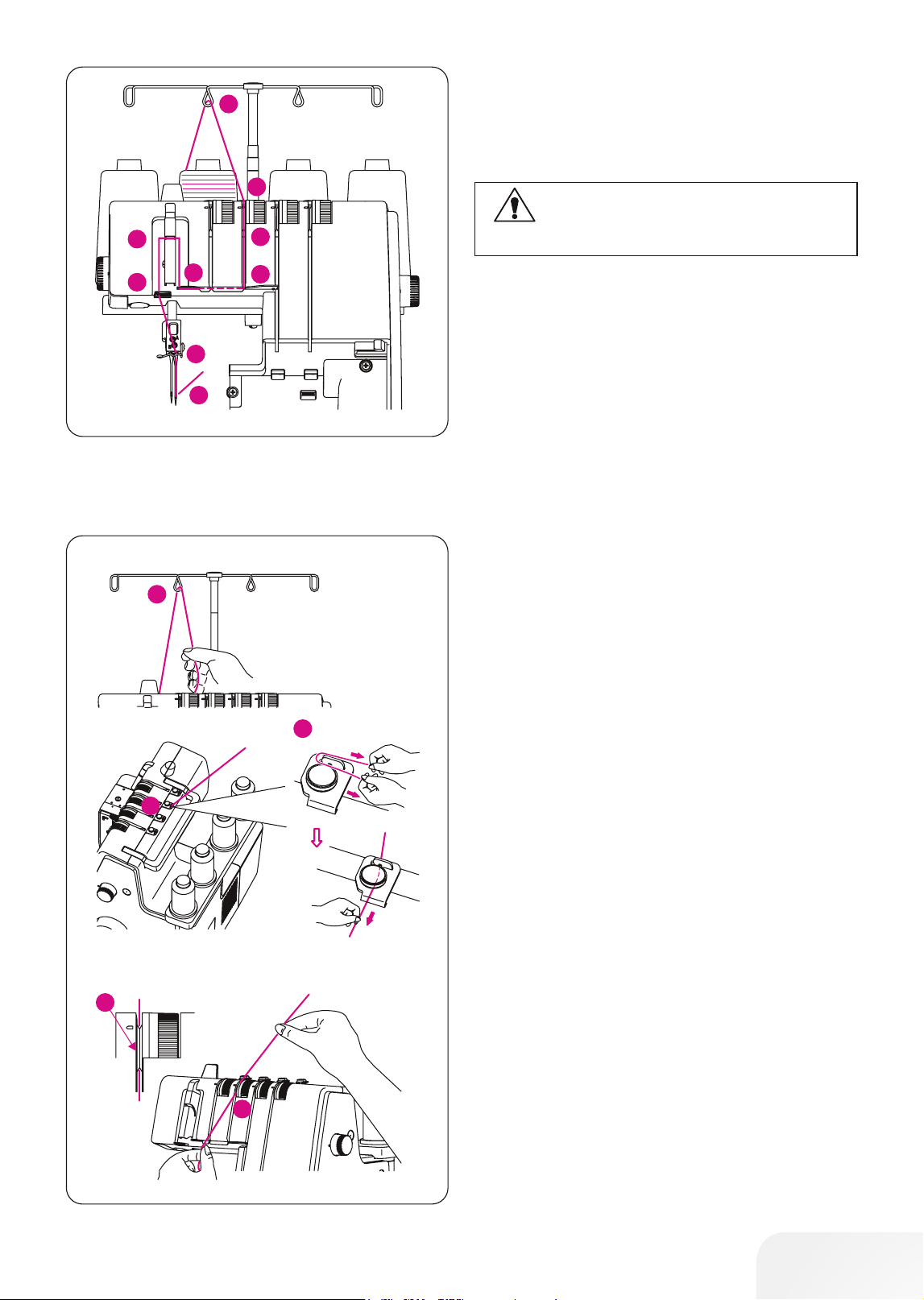
Threading the Upper Looper (Blue) 20
Threading the Lower Looper (Red) 21
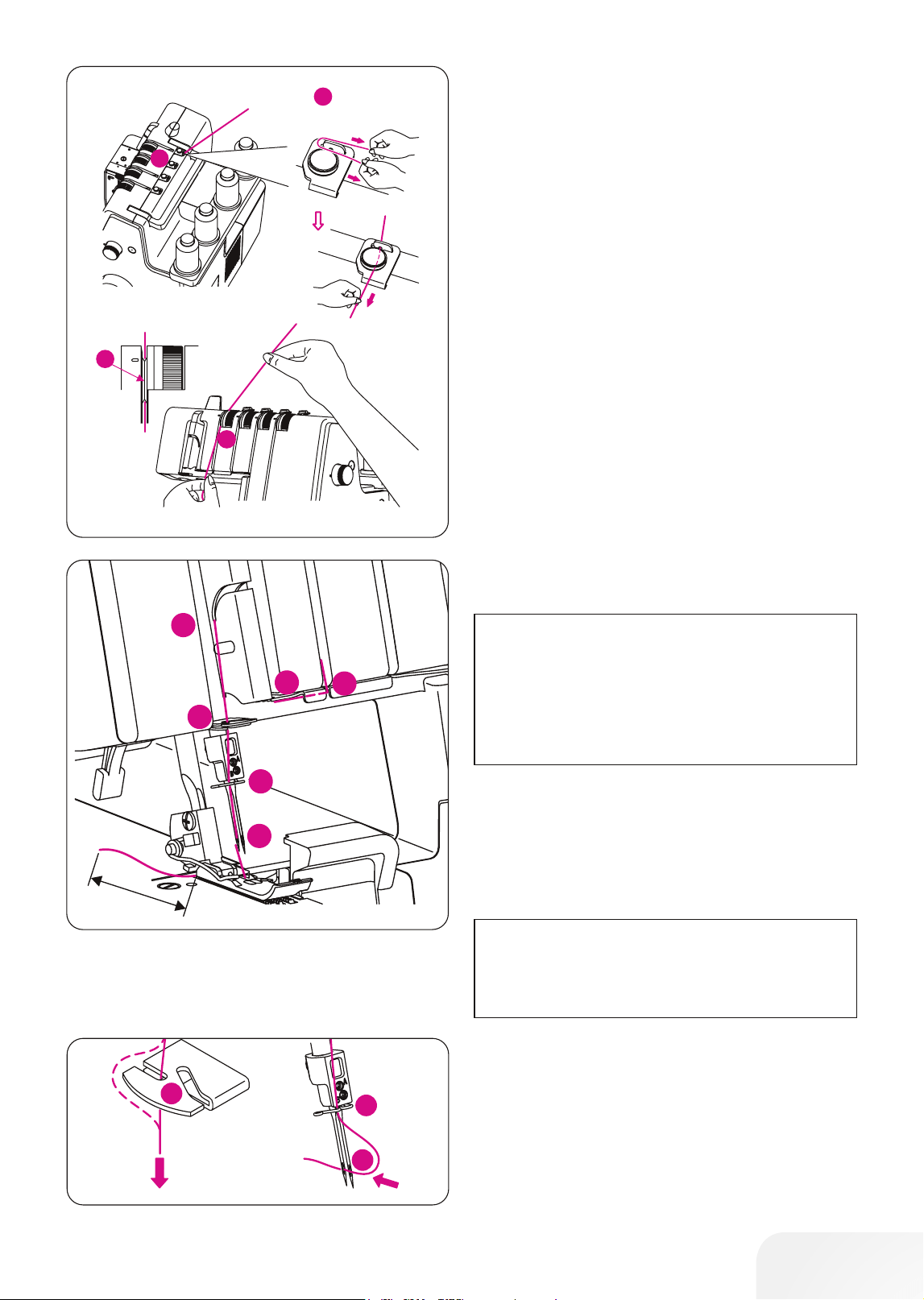
Threading the Overlock Right Needle (Green) 23
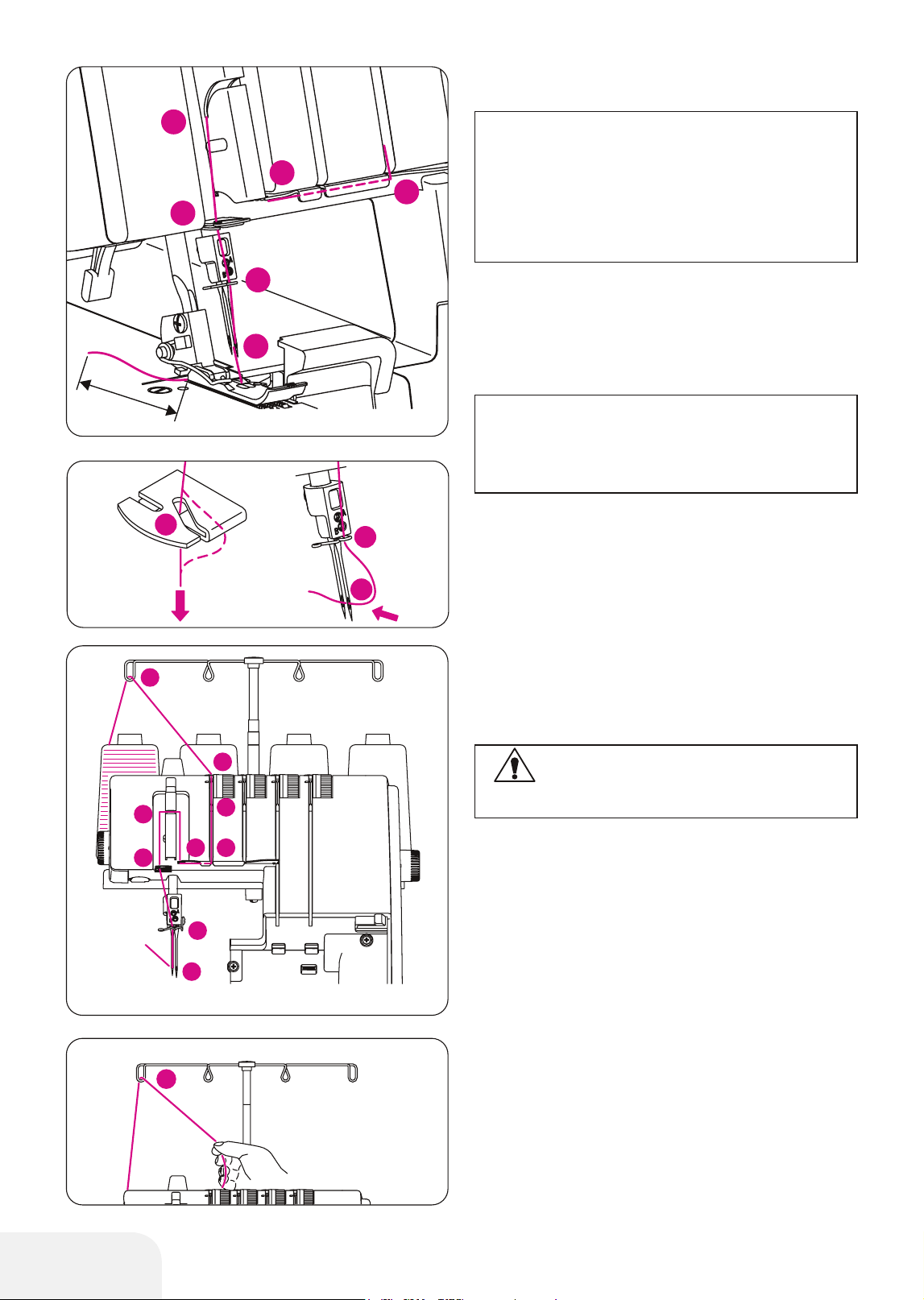
Threading the Overlock Left Needle (Yellow) 24
HOW TO CHANGE THREADS 26
Tie on method 26
HOW TO ADJUST 27
Stitch lenght dial 27
Seam Width 27
The presser foot pressure 28
DIFFERENTIAL FEED 29
Gathered Overlock (1–2.0) 29
Stretch Overlock (1
–0.6) 30
CHAINING OFF AND TEST SEWING 31
HOW TO SEW AN OVERLOCK STITCH 32
2–Thread Wrapped Overlock (9/10) 32
2–Thread Overlock (14/15) 33
3–Thread Overlock (3/4) 34
3–Thread Flatlock (5/6) 35
2–Thread Flatlock (11/12) 36
3–Thread Super Stretch (2) 37
4–Thread Overlock with integrated safety
seam (1) 38
HOW TO SEW A ROLLED HEM 39
Machine set up 39
Additional information about rolled hemming 40
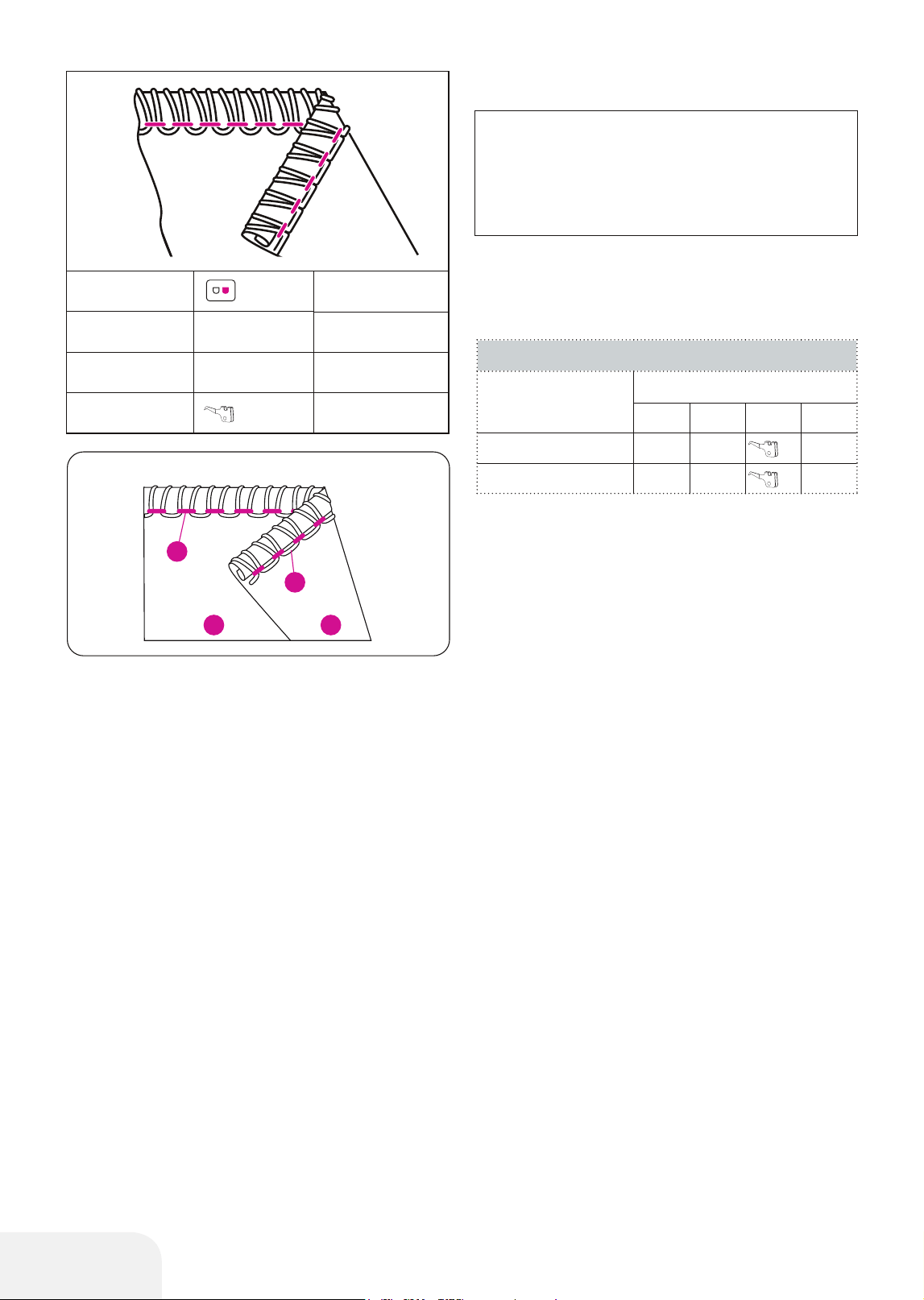
3–Thread Narrow Seam (7) 41
3–Thread Rolled Hem (8) 41
2–Thread Rolled Hem (13) 42
STITCH VARIATIONS AND SEWING
TECHNIQUES 43
How To Sew a Flatlock Decorative Seam 43
Machine Set Up 43
Flatlocking a Seam 43

4
IMPORTANT
WARNING!
DANGER!
As a protection against burns, fire, elec-
tric shock or injury to persons:
1. Use this machine only for purposes
as described in this manual. Use
only attachments, accessories and
parts recommended by the manu
-
facturer.
2. Do not allow this machine to be
used as a toy. Close attention is
necessary when this machine is
used by or near children. The
machine is not intended for use by
persons (and children) with reduced
physical, sensory or mental capa
-
bilities or lack of experience and
knowledge. Unless they have been
given supervision or instruction con
-
cerning use of the machine by a
person responsible for their safety.
To ensure children do not play with
Precautions should always be followed,
including the following:
Read all the instructions before using this
machine.
In general when the machine is not in
use, it should be disconnected from
the electricity supply.
As a protection against electrical shock:
1. The machine should never be left
unattended when plugged in.
2. Always unplug this machine from
the electrical outlet after using and
before cleaning.
3. LED Radiation. Do not view directly
with optical instruments. Class 1M
LED product.
Decorative Flatlocking 44
Additional Information about Flatlocking 44
How to sew an Overlock Blind Hem 45
How to sew Pin Tucks 45
How to turning Square Corners 46
MACHINE MAINTENANCE 48
Cleaning The Machine 48
Oiling The Machine 48
Replace the Upper Knife 49
OPTIONAL ACCESSORIES 50
Snap–On Type Presser Foot 50
Optional Presser Foot 51
TROUBLESHOOTING 52
FABRIC, THREAD AND NEEDLE CHART 53
SPECIFICATION 54
Technical Summary 54

5
12. Do not use bent needles.
13. Always use the original BERNINA
stitch plate. The wrong stitch plate
can cause needle breakage.
14. This machine is provided with dou
-
ble insulation (except for USA and
Canada). Use only original spare
parts. See instructions for servicing
of double–insulated products.
15. Use only foot controller provided
with this machine. (Type 4C–316B
for USA & CANADA only).
the machine they must be super
-
vised.
Never operate this machine if:
⦁
the cord or the plug are damaged,
⦁
it is not working properly,
⦁
it has been dropped or damaged,
⦁
it has fallen into water.
3. Return the machine to your local
authorized BERNINA dealer for
examination or repair.
4. Never operate the machine with any
air openings blocked. Keep ventila
-
tion openings of the machine free
from the accumulation of lint, dust
and loose cloth.
5. Keep fingers away from all moving
parts. Special care is required
around the sewing needle and the
knife.
6. Never insert any objects into any
openings on the machine.
7. Do not use the machine outdoors.
8. Do not operate the machine where
aerosol products (sprays) or oxygen
are being used.
9. Do not pull or push the fabric while
stitching. This can result in needle
breakage.
10. Switch the machine off «0» when
making any adjustments in the nee
-
dle area, such as threading the
needle, changing the needle, thread
-
ing the looper, or changing the
presser foot.
11. Always unplug the machine from the
electrical outlet when removing cov
-
ers, when covers are opened to
raise the knife or thread the loopers,
when lubricating or when making
any other user servicing adjust
-
ments mentioned in the instruction
manual.

6
In a double–insulated product two sys-
tems of insulation are provided instead of
grounding. No grounding means is pro
-
vided on a double–insulated product, nor
should a means for grounding be added
to the product. Servicing a double–insu
-
lated product requires extreme care and
knowledge of the system and should be
done only by qualified service personnel.
Replacement parts for a double–insu
-
lated product must be identical to the
original parts in the product. A double–
insulated product is marked with the
words: «Double insulation» or «Double
insulated».
The symbol
may also mark such a
product.
All rights reserved
For technical and product improvement rea-
sons, the machine‘s features, parts and
accessory are subject to unannounced
changes and alterations at any time. The
accessory included can differ from country
to country.
SERVICING OF
DOUBLE–INSULATED
PRODUCTS
Europe only: This appliance may only be
used by children over eight and by per-
sons with reduced physical, sensory or
mental capabilities or by persons who
lack experience and knowledge of how to
operate the machine under supervision,
after instruction on how to use the equip-
ment safely and once they have under-
stood the potential dangers. Children
shall not play with the appliance. Cleaning
and user maintenance shall not be made
by children without supervision.
Outside of Europe (except for the USA
and Canada): This appliance may only be
used by persons (including children) with
reduced physical, sensory or mental
capabilities or by persons who lack expe-
rience and knowledge of how to operate
the machine under supervision and after
instruction on how to use the equipment
safely by a person responsible for their
safety. Children should be supervised to
ensure that they do not play with the
appliance.
SAVE THESE
INSTRUCTIONS!
PLEASE NOTE:
If the machine is stored in a cold room, it
should be brought to a warm room about
one hour before use.
WARNING:
This machine is intended for household
use only. If used intensively or commer-
cially, regular cleaning and especially
attentive care is required.
Signs of wear and tear owing to intensive
or commercial use are not covered auto-
matically, even if they occur within the
warranty period. The decision on how to
deal with any such cases rests with the
local authorised servicing staff.
7
1
2
4
8
9
10
11
15
16
3
5
6
7
14
12
13
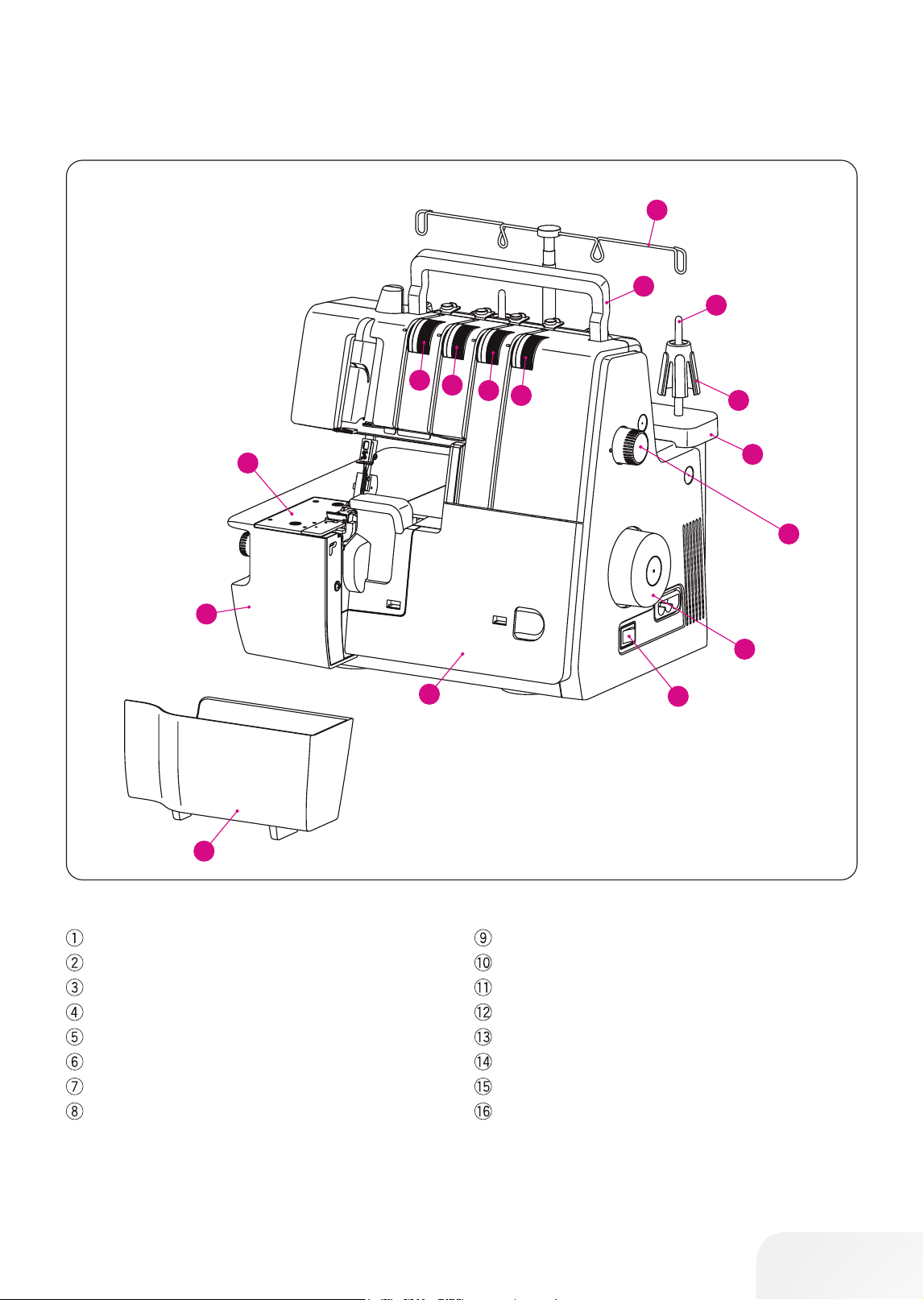
NAME OF PARTS
Details of machine
Retractable thread stand
Carrying handle
Thread Tension Adjustment dial (yellow)
Thread Tension Adjustment dial (green)
Thread Tension Adjustment dial (blue)
Thread Tension Adjustment dial (red)
Spool pin
Stitch plate
Sewing table
Looper cover
Power / Light switch
Stitch length dial
Handwheel
Thread stand
Spool stabilizer
Cut-offs Bin
8
17
18
19
20
21
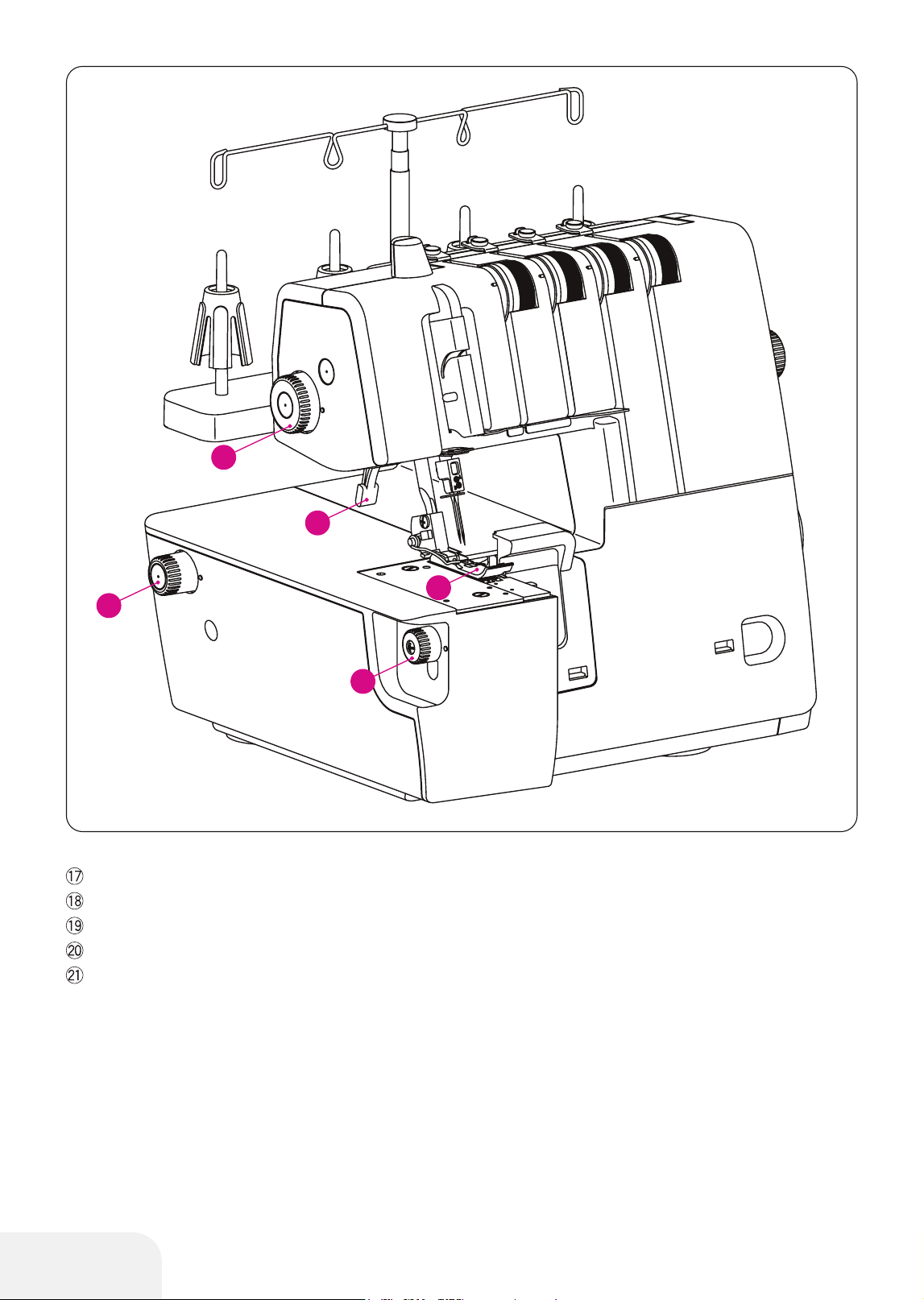
Presser foot lifter
Differential feed dial
Cutting width dial
Presser foot pressure regulator
Standard presser foot Overlock
9
13
1412
7
11
10
6
98
12
3
5
4
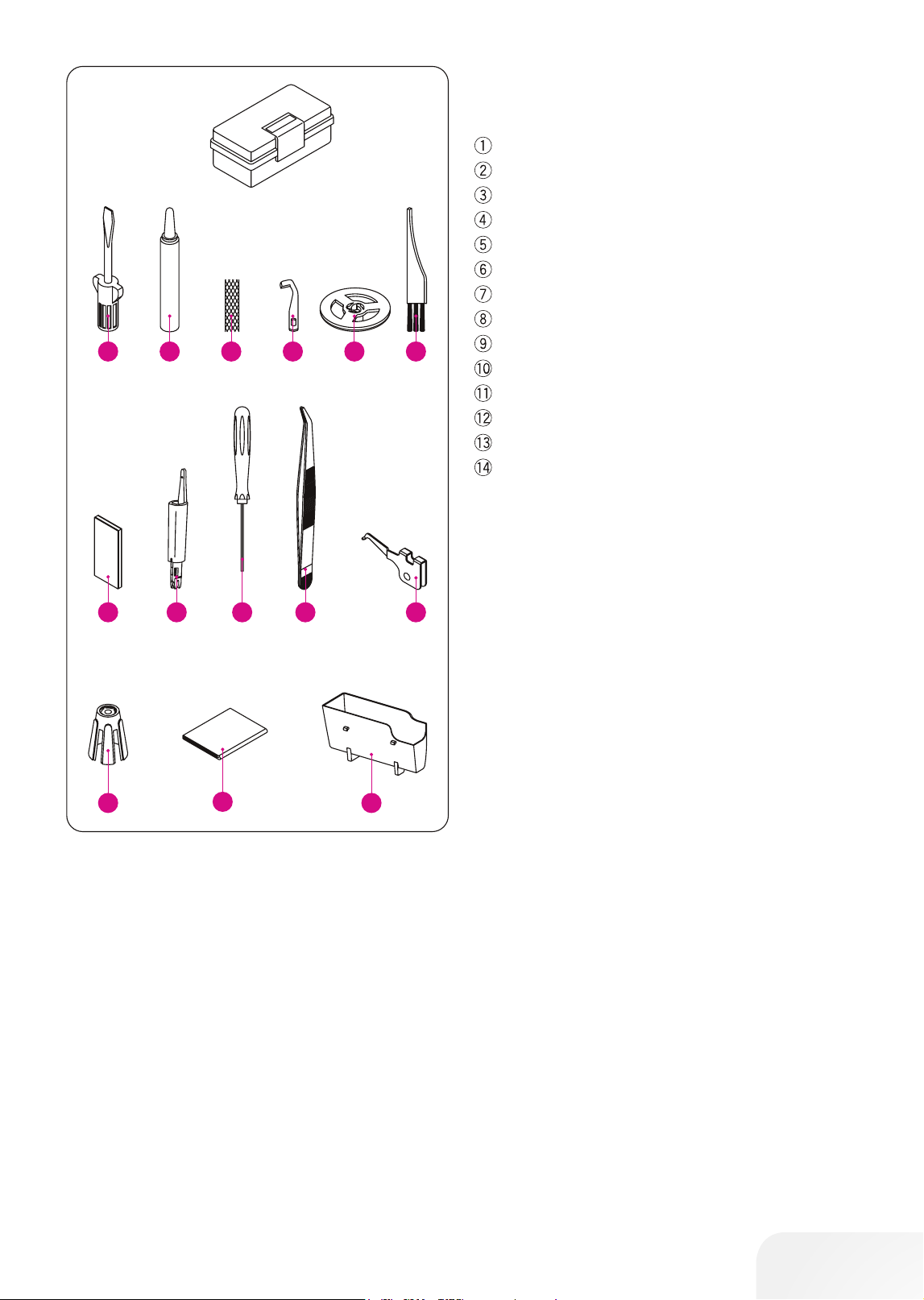
ACCESSORIES
Standard
Needle Information
Screw driver (large size)
Oiler
Spool net (4x)
Spare upper knife
Spool cap (4x)
Brush
Needle set (ELx705)
Needle Threader / inserter
Allen screw driver (small)
Tweezers
Upper looper converter (ULC)
Spool stabilizer (4x)
Dust cover
Cut-offs Bin
This overlock uses a flat shank industrial needle
(ELx705).
Do not attempt to use a standard household
sewing machine needle of any size or type in
this overlock.
Needle ELx705 size 80/12 is furnished with the
machine.
Only use needles of system ELx705 sizes 70/10
- 90/14.
10
OFF
ON
2
1
2
3
6
4
5
1
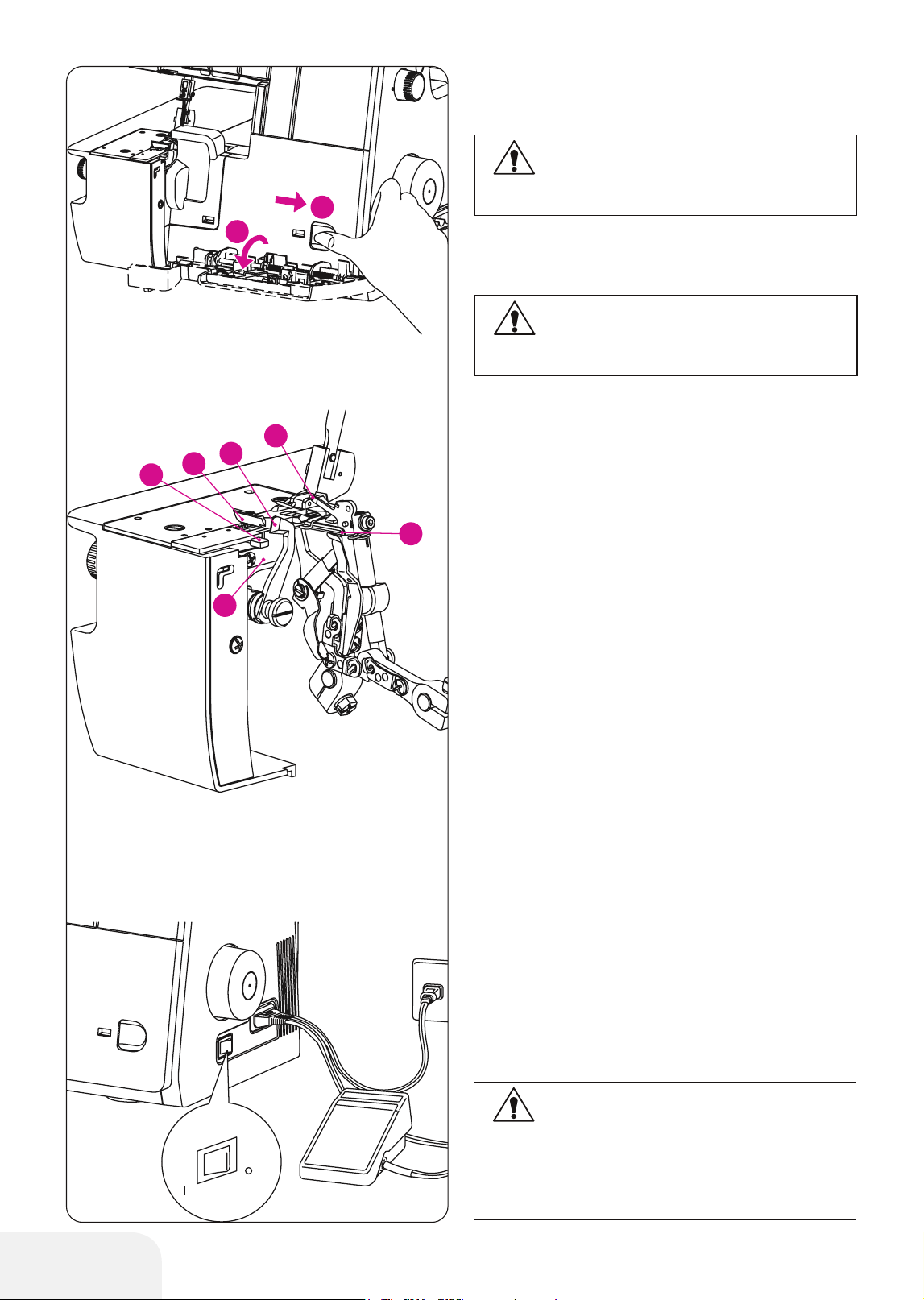
Principal Parts behind the Looper
Cover
PREPARATION TO SEWING
HOW TO OPEN LOOPER
COVER
(1) Upper looper
(2) Upper knife (moveable)
(3) Standard presser foot
(4) Fixed position lower knife
(5) Lower looper
(6) Rolled Hem lever
Power Switch
– Connect the controller/electric plug to the
machine receptacle.
– Plug power line into electric outlet.
– Push " l " mark side to turn "ON"
– Push "O" mark side to turn "OFF"
1. Push the cover to the right as far as it will go.
2. Pull cover down toward you.
CAUTION:
Be sure to turn off power switch.
CAUTION:
Be sure looper cover is closed when sewing.
CAUTION:
Use only foot controller provided with this
machine. (Type 4C–316B for USA & CANADA
only). Be sure to make reference to “Warning”
on following Page.
Foot Controller
– To run the machine and control the speed,
press the controller.
– The harder you press, the faster the machine
will sew.
– To stop the machine from sewing, remove your
foot from the controller
11
• Polarized plug information
(FOR USA & CANADA ONLY)
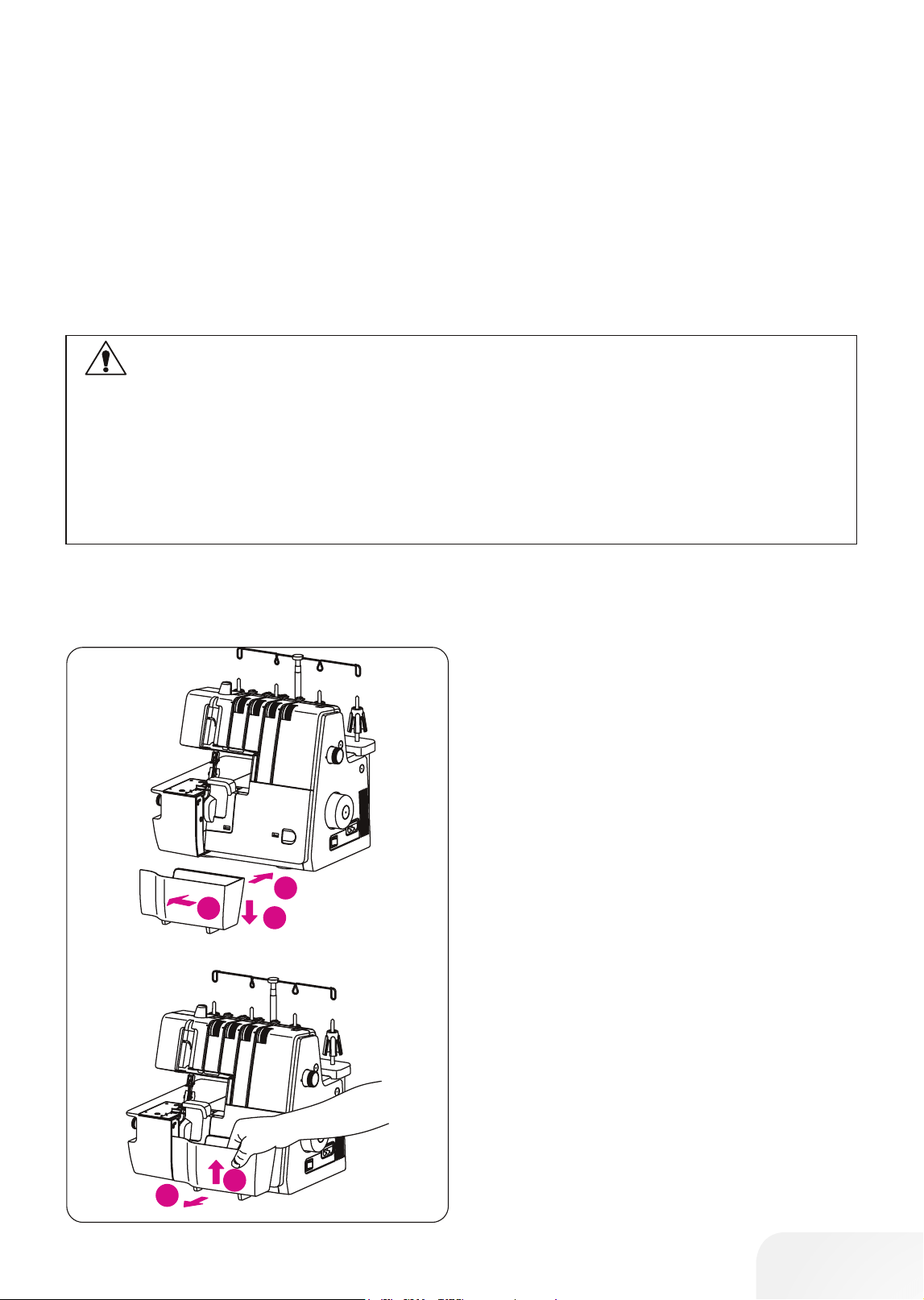
Cut-os Bin
This appliance has a polarized plug (one blade wider
than the other). To reduce the risk of electric shock,
this plug is intended to fit in a polarized outlet only way.
If the plug does not fit fully in the outlet, reverse the
plug.
If it still does not fit contact a qualified electrician to
install the proper outlet. Do not modify the plug in any
way.
CAUTION:
– Be sure that the electrical voltage of the electric outlet (wall receptacle) is the same as the rated voltage
of the motor.
– Handle the foot controller with care and avoid dropping it on the floor. Be sure not to place anything on
top of it when not in use.
– Disconnect the power line plug from the electric outlet when changing needles, presser feet or when
leaving the machine unattended. This eliminates the possibility of starting the machine by accidentally
pressing the controller.
• To attach
– Insert the Cut-offs Bin (1) in the looper cover.
– Be sure to press the Cut-offs Bin downward
(2).
– Be sure the left side of Cut-offs Bin
(3) is
mounted near the cutter where the scraps drop.
• Removal
– Pull the Cut-offs Bin upward as the instruction
(4).
– To remove
(5), hold the Cut-offs Bin as shown
and pull it outward.
5
1
3
4
2
12
PREPARATION FOR THREAD-
ING
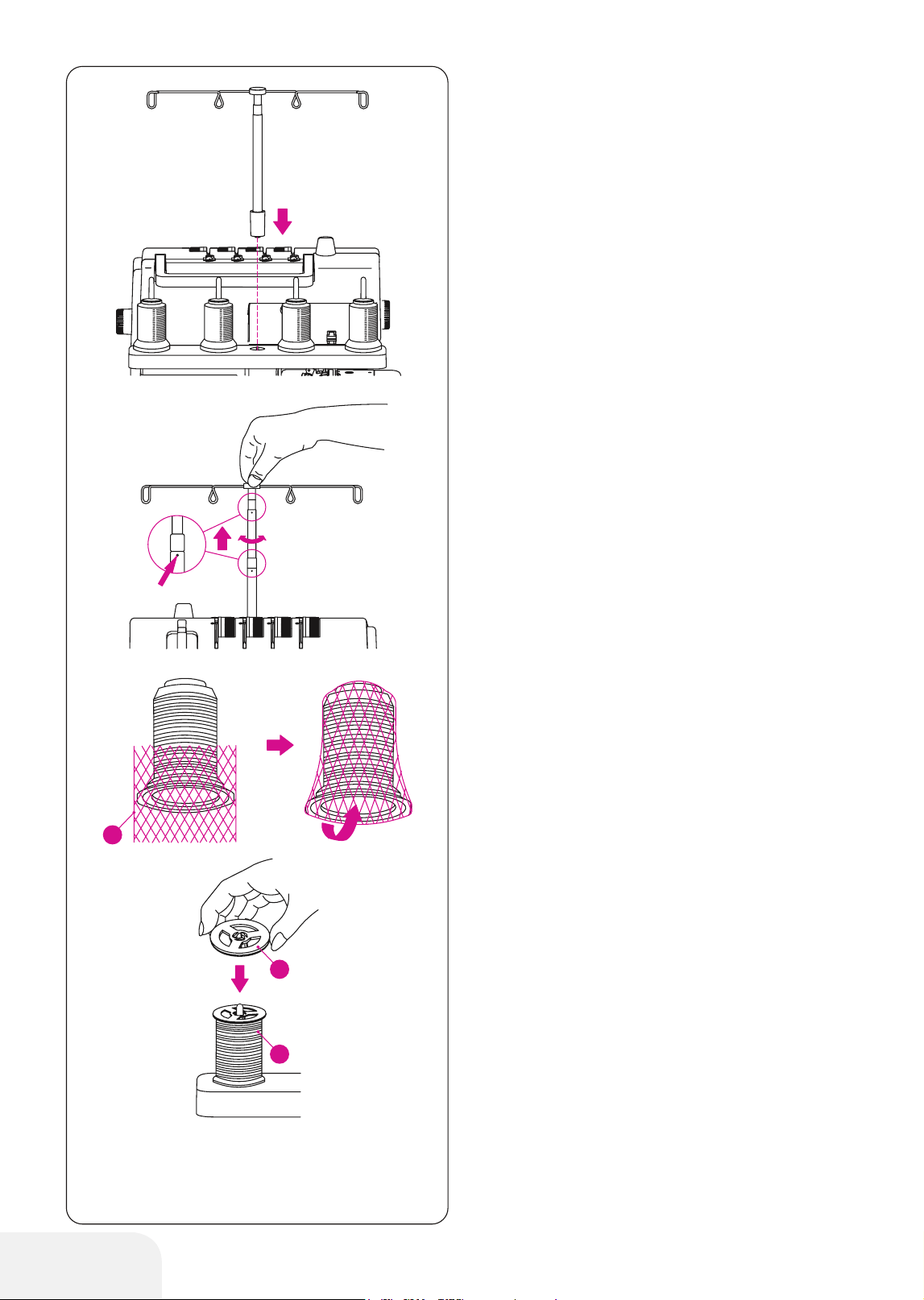
Setting up the Retractable thread
stand
– Take out the retractable thread stand from the
top of Styrofoam, and insert it as shown on the
left illustration.
– This machine is shipped with the retractable
thread stand on the top of styrofoam.
– Fully extend the retractable thread stand.
– The two joints on the telescope will click into
place when they are correctly positioned.
– Center the retractable thread stand above the
spool pins.
– Place thread over the cone adapters on the
spool pins.
Spool net
When using synthetic threads that easily spill off the
cone, slip the spool net
(1) furnished with the machine
over the thread from the bottom of the cone leaving
the thread end hanging free at the top the spool net.
Spool Cap
When using a regular thread spool, fit the spool cap
(2) supplied with the machine onto the thread spool
(3).
3
2
1
13
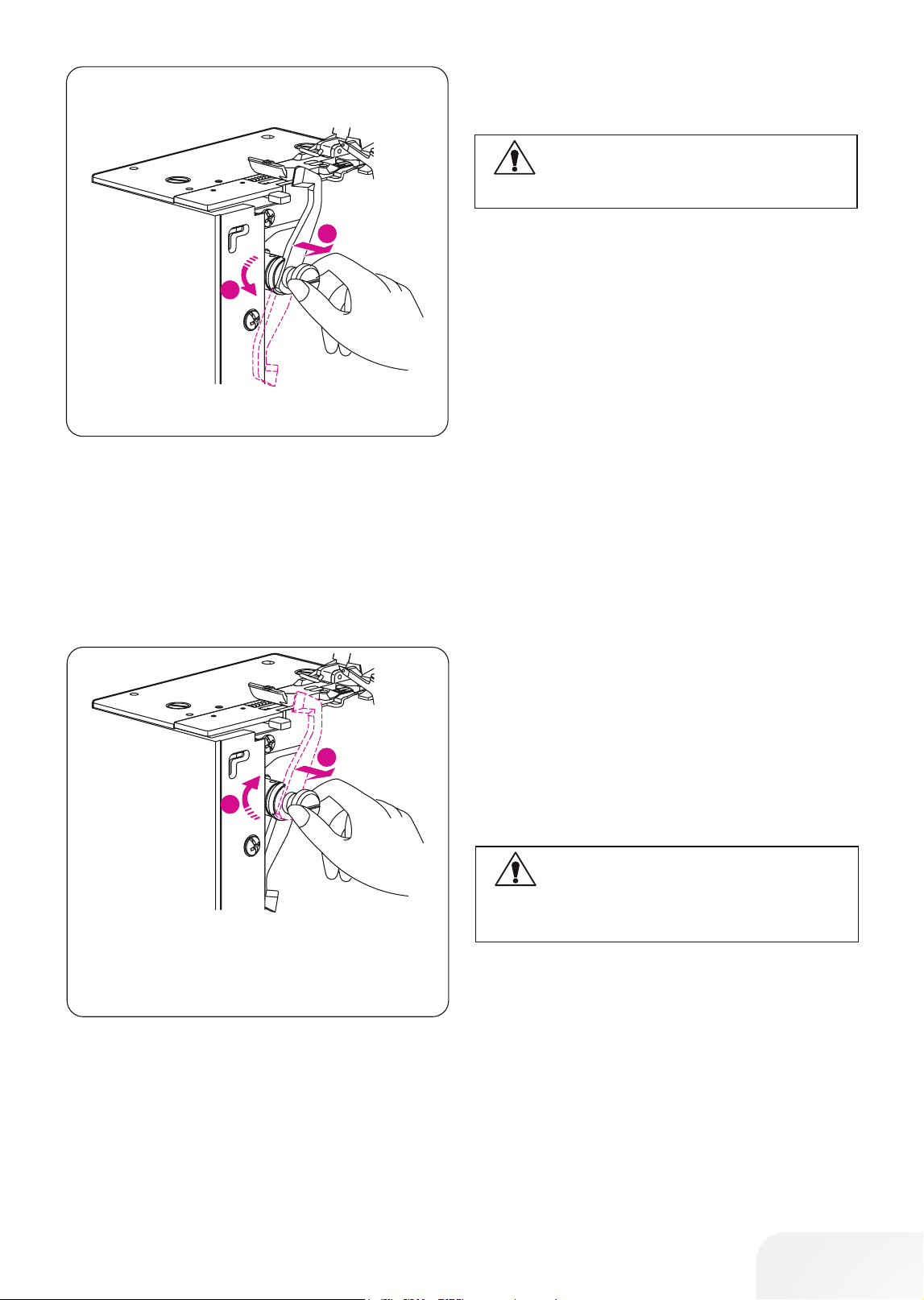
HOW TO DISENGAGE UPPER
KNIFE
• To place upper knife in nonworking
position
– Open looper cover (refer page 10).
– Pull the upper knife holder (1) to the right as far
as it will go.
– Turn the holder
(2) toward counter clockwise
until the knife clicks into a lock position.
• To place upper knife in working position
– Open looper cover.
– Pull the upper knife holder (1) to the right as far
as it will go.
– Turn the holder
(2) clockwise until the knife
clicks into the working position.
2
1
1
2
2
1
1
2
CAUTION:
Be sure to turn off power switch.
CAUTION:
Always close looper cover before operating
machine.
14
UPPER LOOPER CONVERTER
(ULC)
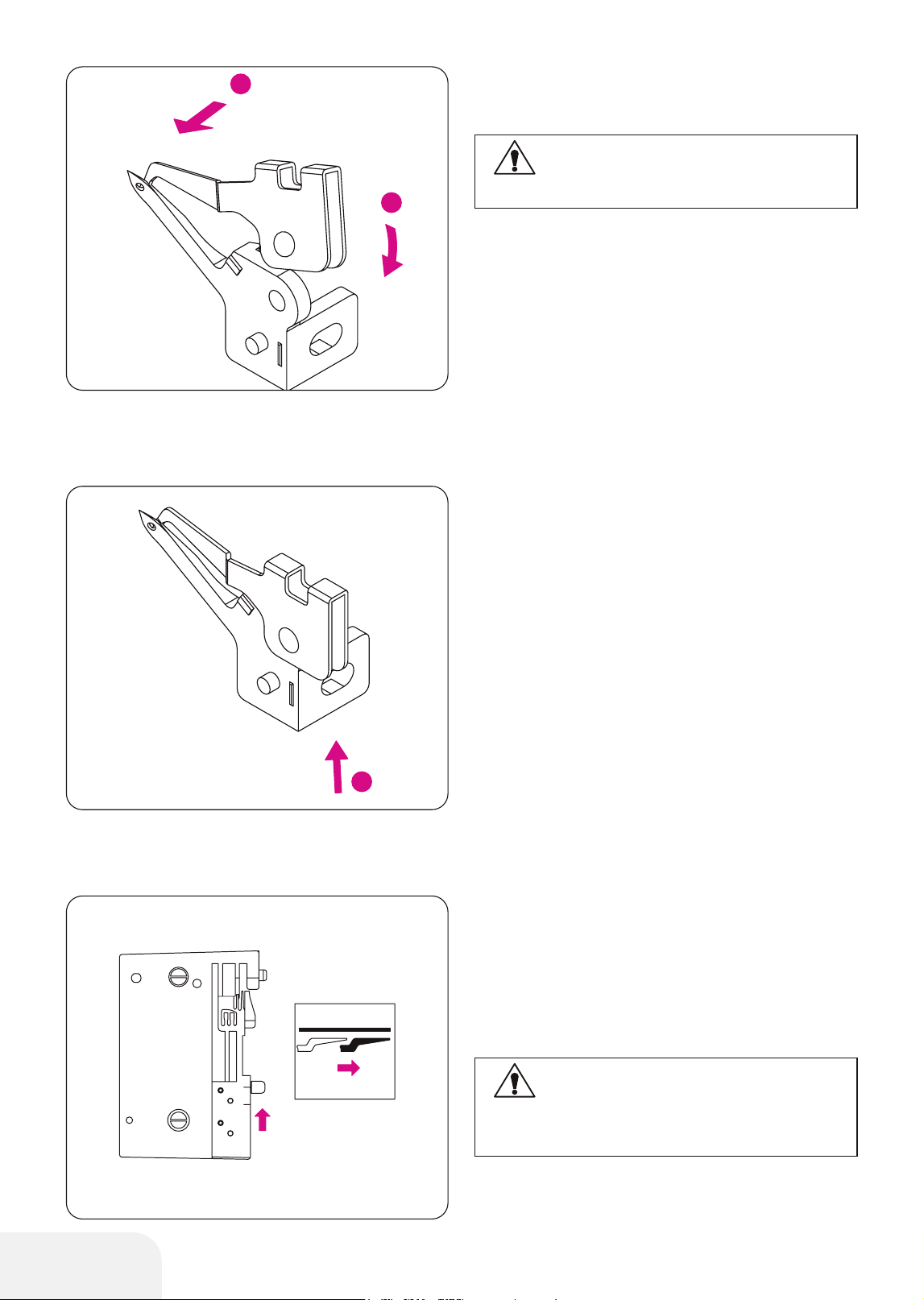
When not threading the upper looper, the upper
looper converter must be engaged into the upper
looper eye.
Attach the Upper Looper Converter
– To engage the upper looper converter, insert
the sharp part (1) into the eye of upper looper.
– A raised point located in the trough of upper
looper converter must be inserted and fixed
(2)
in the eye of the upper looper converter.
1
2
3
1
2
3
CAUTION:
Be sure to turn off power switch.
Remove the Upper Looper Converter
When using the upper looper, the upper looper con-
verter must be disengaged.
– To disengage the upper looper converter, raise
the handle
(3) of upper looper according to
picture.
STANDARD OVERLOCK AND
ROLLED HEM STITCHING
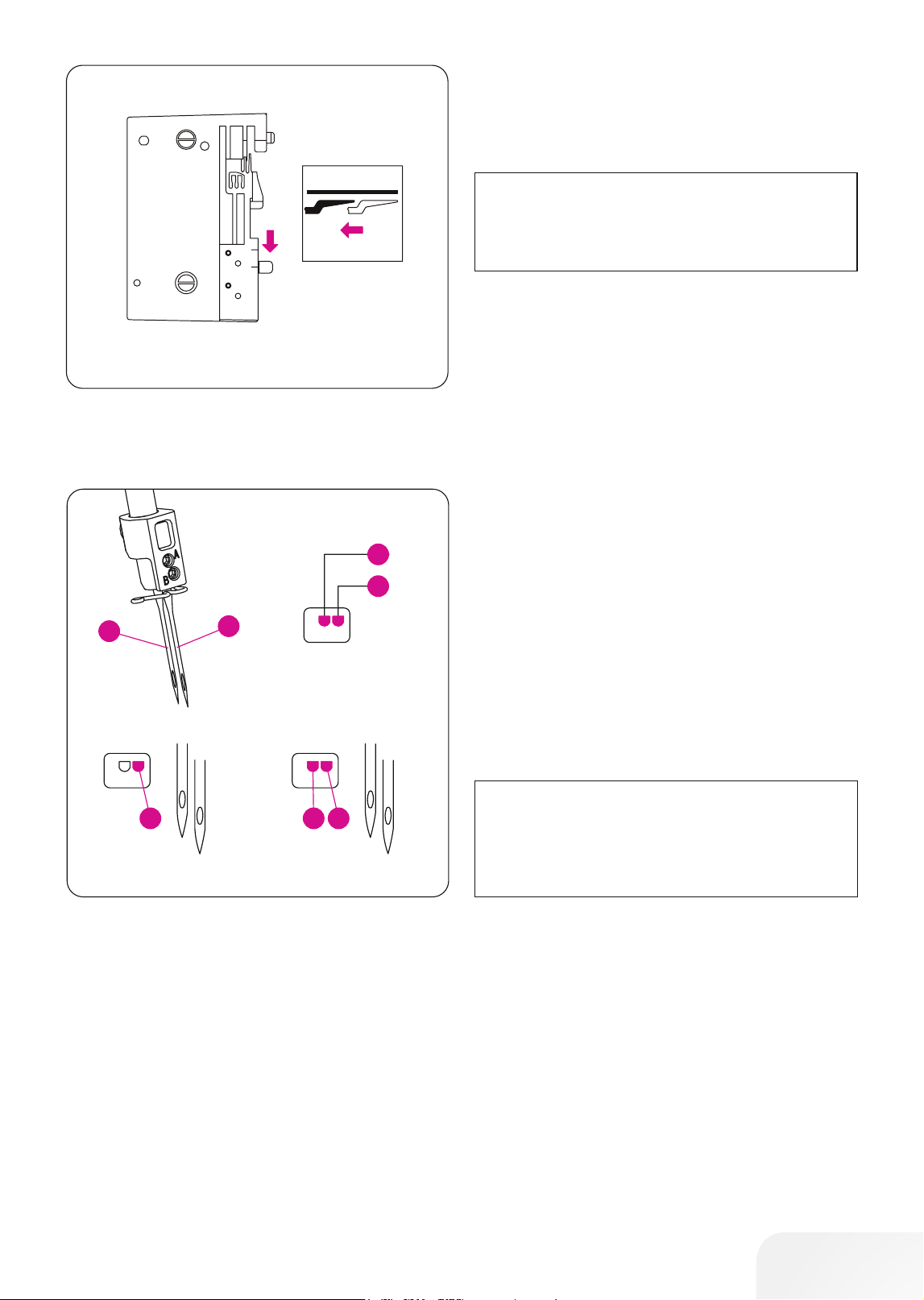
Sew Standard Overlock
Set seam width finger knob to "N" to move seam width
finger to standard overlock sewing position.
R
N
R
N
PLEASE NOTE:
Be sure to push seam width finger knob as far as
it will go in the direction of setting "N".
15
Sew Rolled Hem
Set seam width finger knob to "R" to retract the seam
width finger and set it for rolled hem.
R
N
R
N
PLEASE NOTE:
Be sure to push seam width finger knob as far as
it will go in the direction of setting "R".
HOW TO REMOVE AND INSERT
NEEDLES
Needle Position
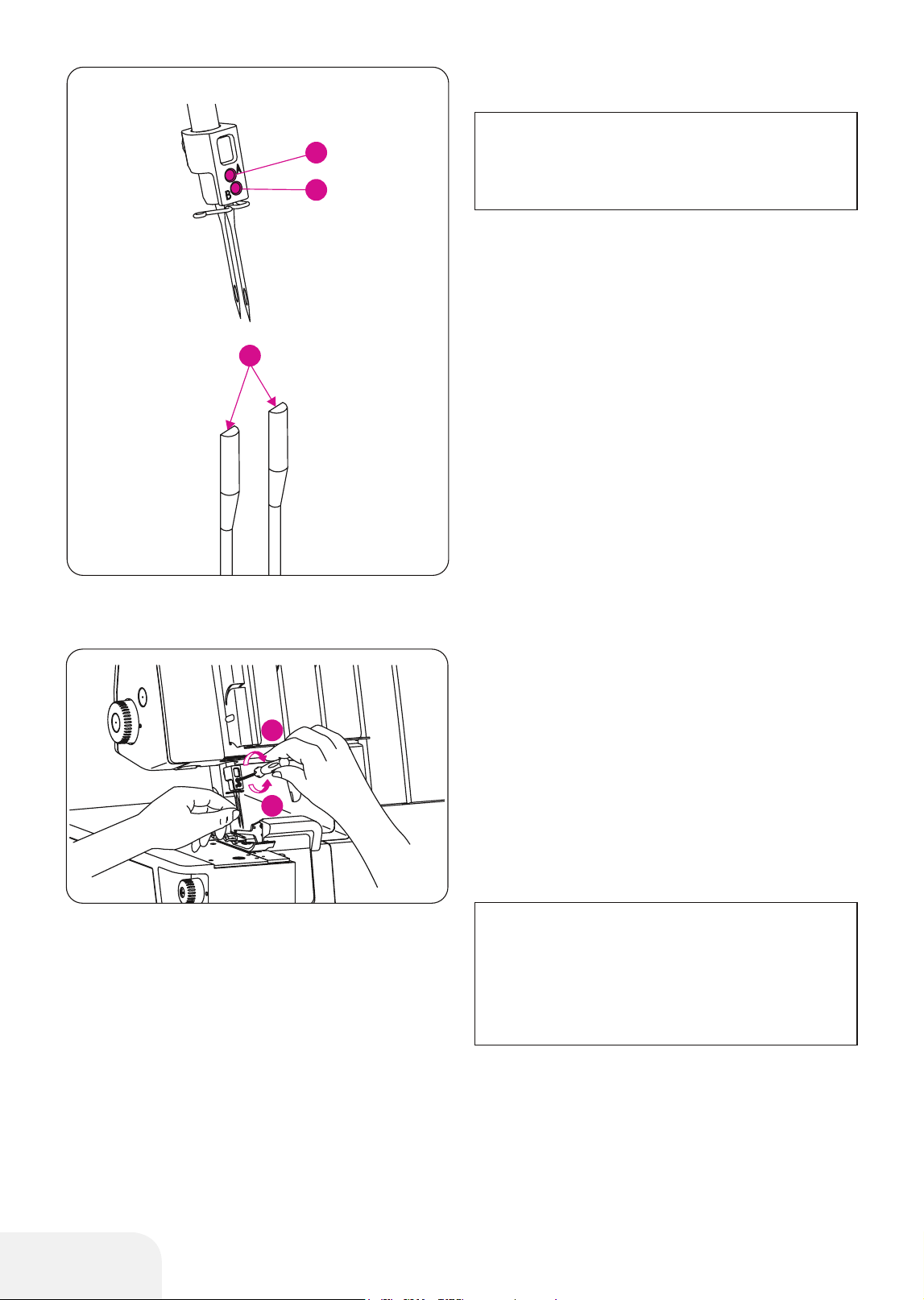
– With this machines, two needles can be inserted
to the needle clamp.
– The Stitch overview refers to different needle
positions by illustrating the needle clamp.
B
A
1
2
3
A
B
B
A
BAB
PLEASE NOTE:
When both the left and right overlock needles are
inserted, the left needle will be slightly higher
than the right.
(A) Left Needle (LN)
(B) Right Needle (RN)
16
To Remove Needle(s)
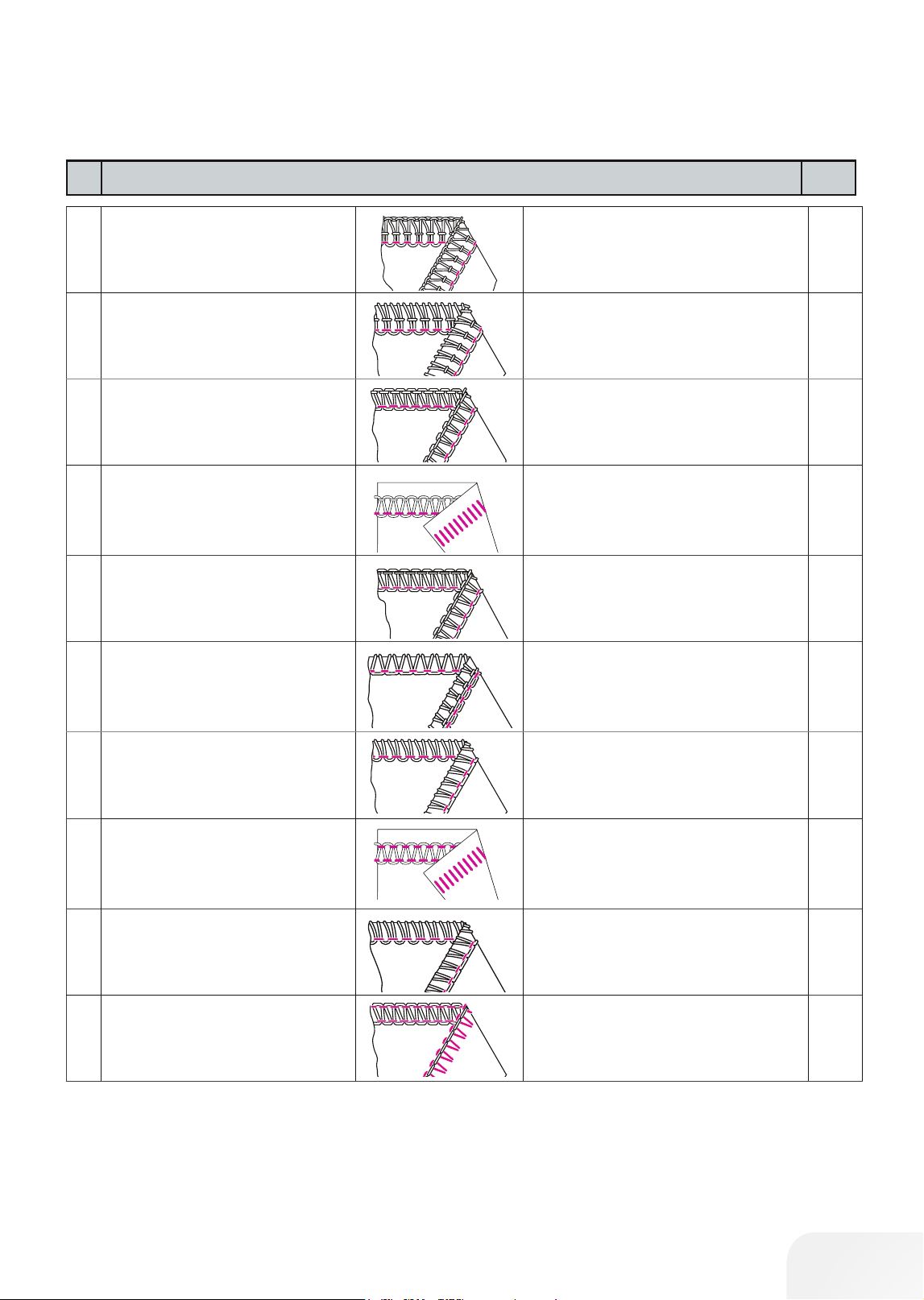
– Turn the hand wheel counterclockwise until the
needles are at their highest position.
– Hold the needle to be removed with the needle
holder (stored in the looper cover).
– Loosen the setscrew and remove the needle.
(A) Left needle (LN)
(B) Right needle (RN)
To Insert Needle(s)
– Hold the needle with the flat surface (1) to the
back.
– Insert the needle into the needle socket as far
as it will go.
– When inserting a needle, if you first lower it
down into the hole in the stitch plate it will line
up with the needle socket. Then direct it
upwards.
B
A
1
2
3
A
B
B
A
BAB
B
A
1
2
3
A
B
B
A
BAB
PLEASE NOTE:
Be sure to disconnect the machine from the elec-
tric outlet before removing needle(s).
PLEASE NOTE:
When inserting needles into the (A) or (B) sock-
ets it is necessary to loosen
(3) both (A) and
(B) Allen Screws.
After inserting the needles equally tighten both
Screws
(2).
17
STITCH OVERVIEW
This machine is capable of producing various types of stitches according to the combination of needle positions,
threading methods, tension adjustment and the use of upper looper converter ULC.
# Stitch Type Use
Page
1
4–Thread Overlock with integrated
safety seam
2–needle 4–Thread stitch that is ideal for medium
to heavyweight stretchy fabrics such as double
knits and swim wear.
38
2
3–Thread Super Stretch
2–needle 3–Thread stitch that is ideal for light
weight, extremely stretchy fabrics such as tricot
and spandex.
37
3
4
3–Thread Overlock wide
3–Thread Overlock narrow
1–needle 3–Thread stitch is used for overedging
and seaming on common fabrics.
A 4 mm and 6 mm overlock seam width can be
obtained by changing the needle position.
34
5
6
3–Thread Flatlock wide
3–Thread Flatlock narrow
6
5
1
3
4
2
6
5
1
3
4
2
6
5
1
3
4
2
1–needle 3–Thread stitch is used for butted or
lapped seams and ornamental stitching with
decorative thread.
Also a 4 mm and 6 mm flatlock width can be
obtained by changing the needle position.
35
7
3–Thread Narrow Seam
1–needle 3–thread stitch is for edging light
weight fabrics.
41
8
3–Thread Rolled Hem
1–needle 3–thread stitch is used for sewing nar-
row rolled hems.
For a beautiful rolled hem, thread the upper
looper with decorative thread and the needle and
lower looper with light weight regular thread.
41
9
10
2–Thread Wrapped Overlock wide
2–Thread Wrapped Overlock narrow
1–needle 2–Thread stitch is used for seaming
light weight or stretch fabrics.
A 4 mm and 6 mm overlock seam width can be
obtained by changing the needle position.
32
11
12
2–Thread Flatlock wide
2–Thread Flatlock narrow
2
3
4
6
5
2
3
4
6
5
1–needle 2–Thread stitch is used for butted or
lapped seams and ornamental stitching with
decorative thread.
Also a 4 mm and 6 mm flatlock width can be
obtained by changing the needle position.
36
13
2–Thread Rolled Hem
1–needle 2–thread stitch is used for fine rolled
hems.
42
14
15
2–Thread Overlock wide
2–Thread Overlock narrow
1–needle 2–Thread stitch is used for overedging
common fabrics.
A 4 mm and 6 mm overlock seam width can be
obtained by changing the needle position.
33
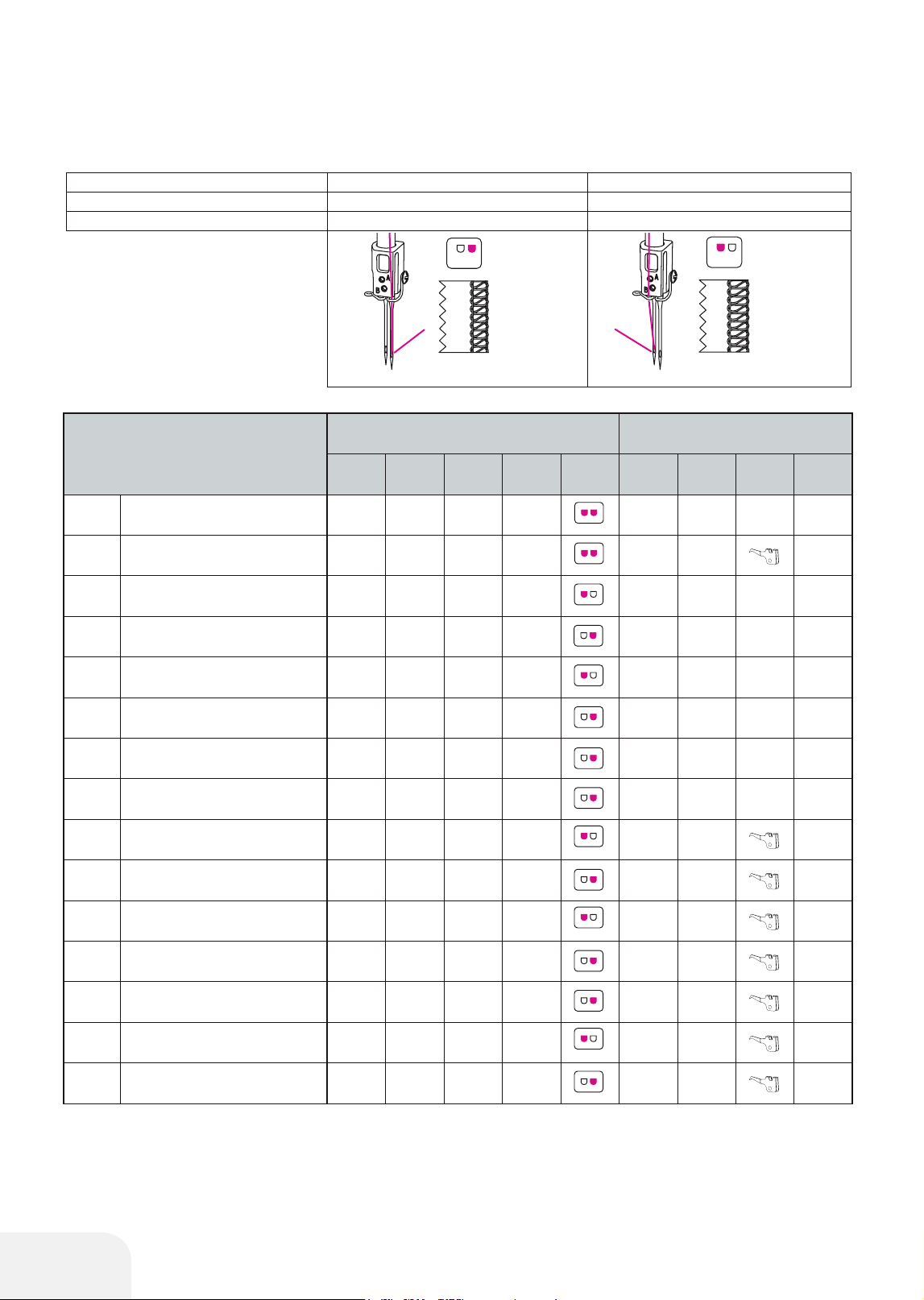
18
Depending on the needle positions used, this machine can sew 2-/3- and 4-Thread Overlock Stitches at a width
of 4mm and 6 mm.
Also, for overedging heavyweight fabrics, the seam width can be increased still more by turning the cutting width
dial. (Refer page 27).
Overlock width 4.0 mm (narrow) 6.0 mm (wide)
Needle used Overlock right needle Overlock left needle
Needle thread tension dial Green Yellow
SL = Stitchlength
DF = Differential feed dial
CW = Cutting Width
RHP = Rollhemlever position
NP = Needle Position
LN = Left Needle
RN = Right Needle
UL = Upper Looper
LL = Lower Looper
Stitch Type
Suggested Machine Settings Thread Tension
SL DF CW RHP NP Yellow Green Blue Red
1
4–Thread Overlock with integrated
safety seam
2.5 1 6 N 4.0 4.0 4.0 4.0
2 3–Thread Super Stretch
2.5 1 6 N 4.0 4.0 3.5
3 3–Thread Overlock wide
2.5 1 6 N 3.0 – 4.0 3.5
4 3–Thread Overlock narrow
2.5 1 6 N – 4.0 4.0 4.0
5 3–Thread Flatlock wide
2.5 1 6 N 0.0 – 4.0 7.5
6 3–Thread Flatlock narrow
2.5 1 6 N – 0.0 4.5 7.5
7 3–Thread Narrow Seam
1.5 1 5 R – 4.0 5.0 4.5
8 3–Thread Rolled Hem
1 1 5 R – 4.0 4.5 6.5
9 2–Thread Wrapped Overlock wide
2.5 1 6 N 2.5 – 3.0
10 2–Thread Wrapped Overlock narrow
2.5 1 6 N – 4.5 3.5
11 2-Thread Flatlock wide
2.5 1 6 N 0.0 – 4.0
12 2-Thread Flatlock narrow
2.5 1 6 N – 0.0 4.5
13 2–Thread Rolled Hem
1 1 5 R – 4.5 4.0
14 2–Thread Overlock wide
2.5 1 6 N 0.0 – 4.0
15 2–Thread Overlock narrow
2.5 1 6 N – 0.0 4.5
The thread tension becomes tighter as the dials are tumed to higher numbers. The tension settings shown on this page as well as throughout
the Instruction book are suggested default settings.
Adjust thread tensions to suit the fabric and size of thread of thread used. For best results make tension adjustments in small increments of no
greater than half a number at a time.
19
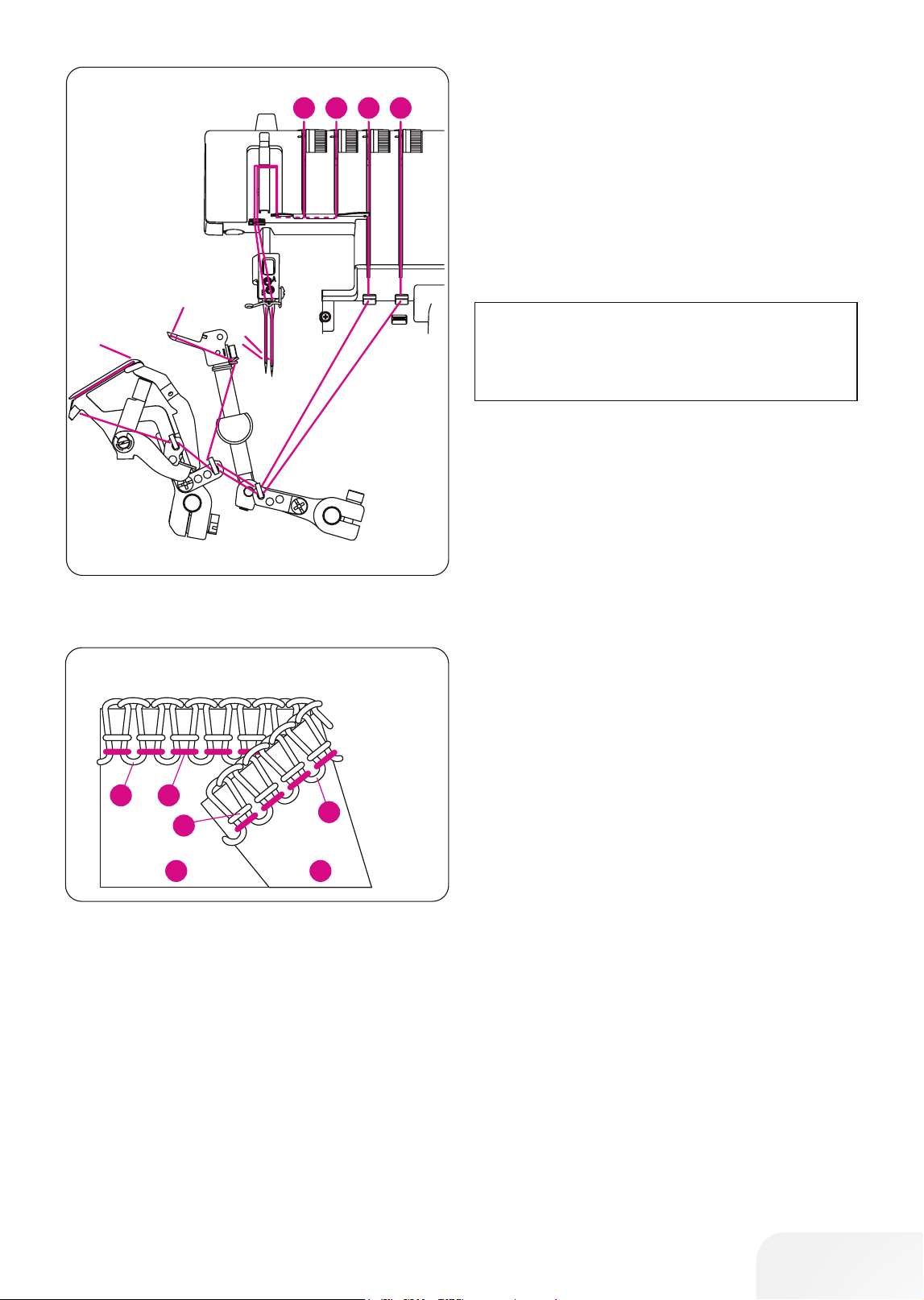
THREADING THE MACHINE
Threading Diagram
• Overlock Stitches
– A color coded threading diagram is located
inside the looper cover for quick reference.
– Thread the machine in the order
(1)–(4).
Tension Color Code
• Overlock Stitches
(1)
Upper looper thread (Blue)
(2) Lower looper thread (Red)
(3) Right needle thread (Green)
(4) Left needle thread (Yellow)
(5) Topside of fabric
(6) Underside of fabric
21
4
3
1
2
5
6
4
3
21
4
3
1
2
5
6
4
3
PLEASE NOTE:
Threads go through the take–up lever cover for
Overlock as shown.
20
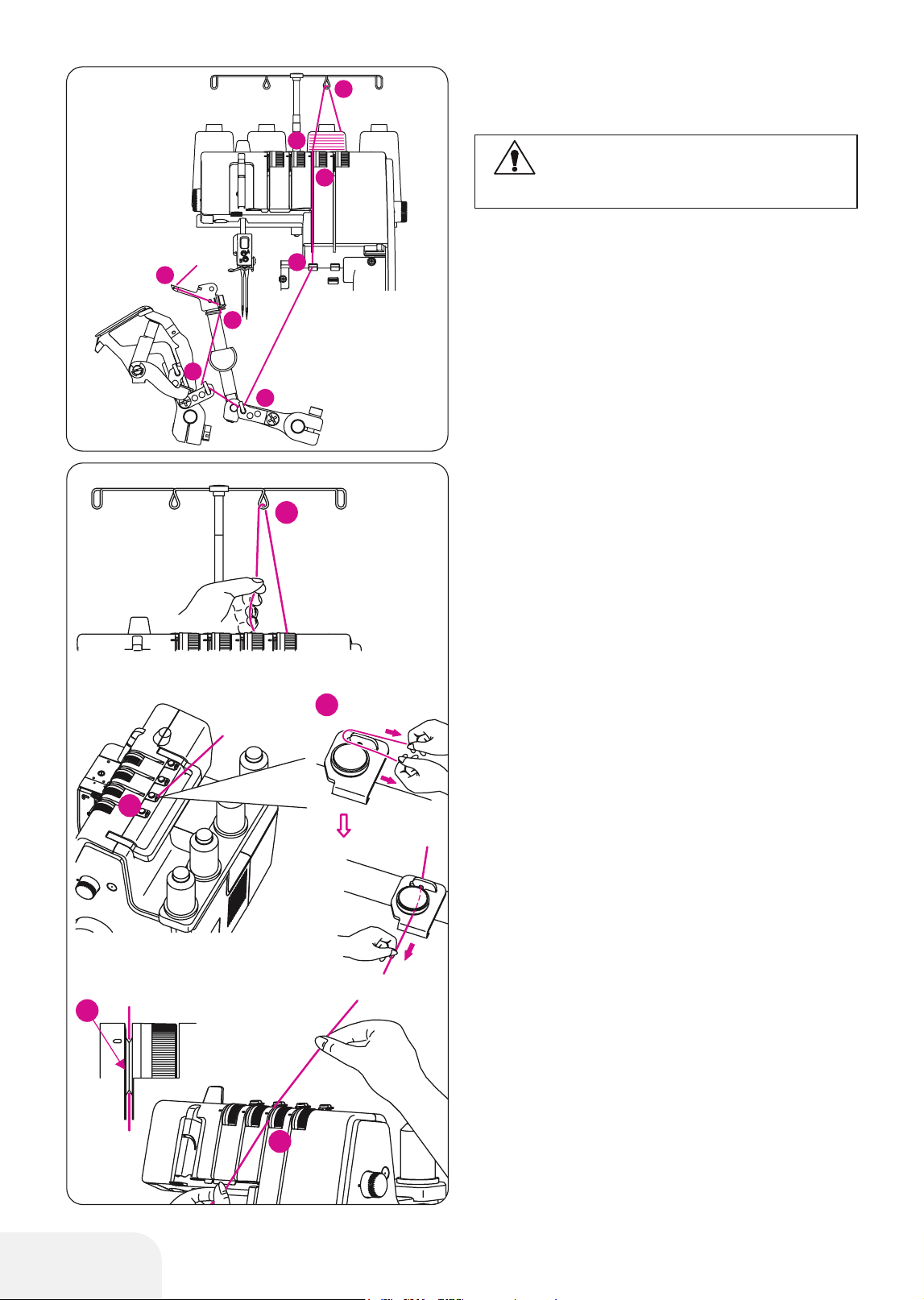
Threading the Upper Looper (Blue)
– Raise the presser foot to open the tension
discs.
– Thread the upper looper as indicated
(1)–(8).
1
2
3
8
6
4
5
7
1
2
2
3
3
1
2
3
8
6
4
5
7
1
2
2
3
3
CAUTION:
Be sure to turn off power switch.
– Pass thread from back to the front through the
thread guide
(1).
– Thread the pre-tension guide by pulling the
thread towards the left until it slips under guide
(2). Then pull thread along the right side of pre-
tension as illustrated.
– While holding thread with fingers, pass it
between the tension discs and pull thread down
to make certain it is properly located in between
the tension discs
(3).
21
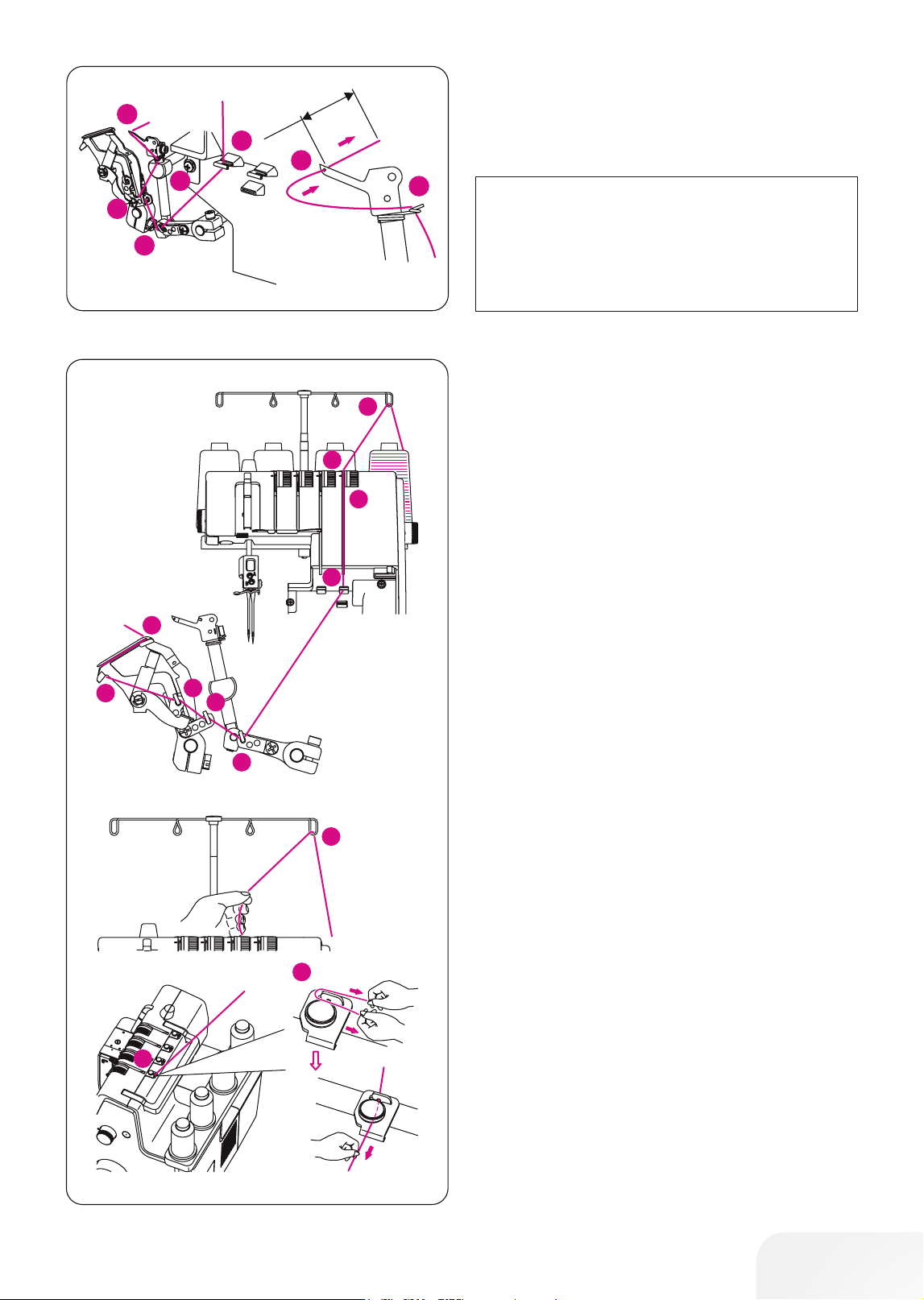
Threading the Lower Looper (Red)
– Raise the presser foot to open the tension
discs.
– Thread the lower looper as indicated
(1)–(9).
– Pass thread from back to the front through the
thread guide
(1).
– Thread the pre-tension guide by pulling the
thread towards the left until it slips under guide
(2). Then pull thread along the right side of pre-
tension as illustrated.
– Thread the looper area of the machine following
the blue color coded thread guides
(4)–(8).
– Thread the upper looper eye from front to back
(8).
10cm
(4")
7
8
2
3
9
6
4
5
7
1
8
1
2
2
6
7
8
4
5
10cm
(4")
7
8
2
3
9
6
4
5
7
1
8
1
2
2
6
7
8
4
5
PLEASE NOTE:
Make sure thread passes behind lower looper.
Use tweezers provided in the accessory case to
aid in threading the looper.
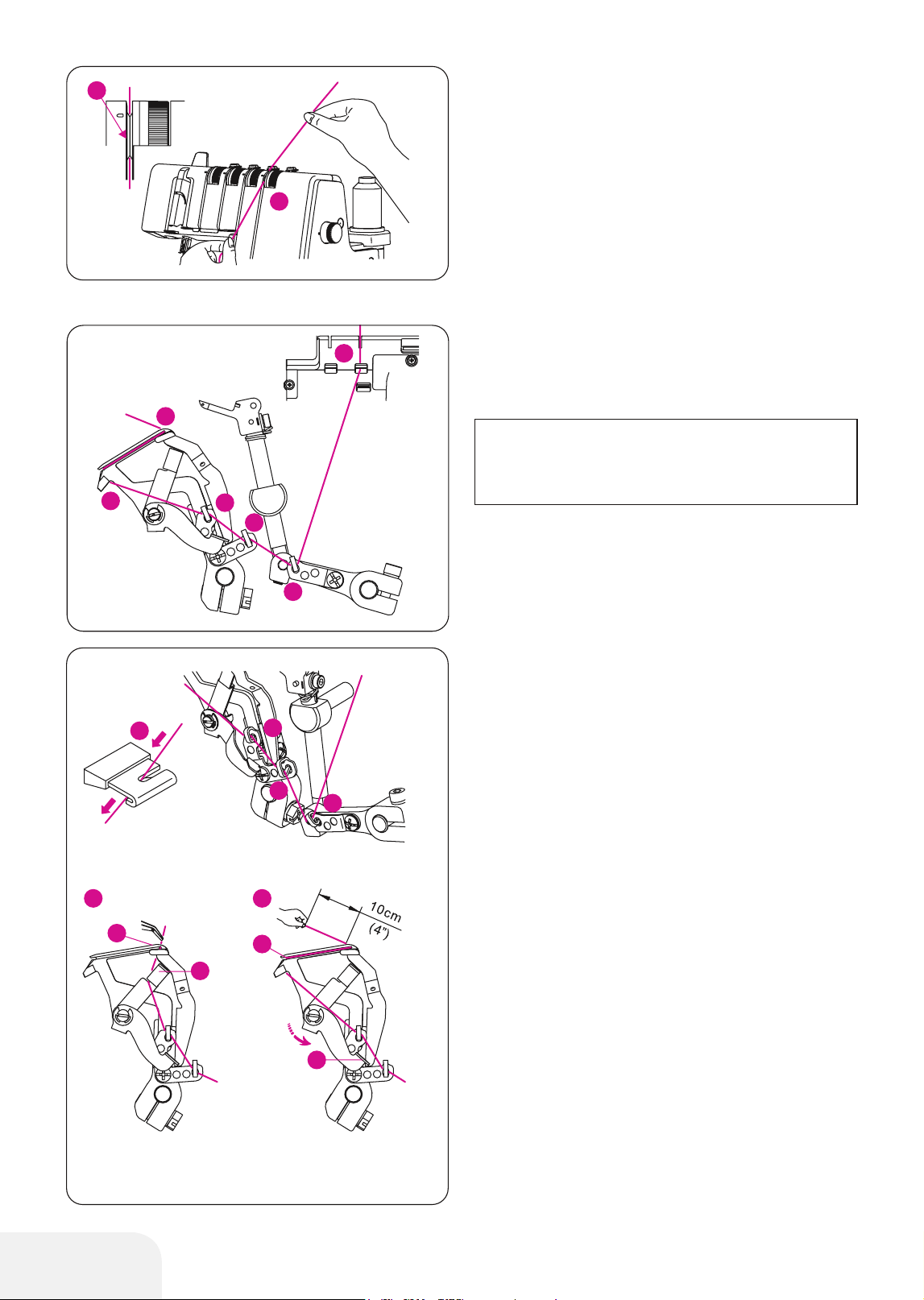
22
– While holding thread with finger, pass it between
the tension discs and pull thread down to make
certain it is properly located in between the ten-
sion discs
(3).
– Turn the handwheel anticlockwise until the
lower looper extends out 5–10 mm from the
stitch plate edge.
– Thread the looper area of the machine following
the red color coded thread guides
(4)–(9).
– Place the thread with the point of the tweezers
slightly from left and to the right of threading
guide
(4).
– Thread the looper eye
(A) from front to back.
– Pull about 4“ (10 cm) of thread.
– Position thread into V cutout
(B) on threader.
– Firmly hold thread tail with left hand and pull
Threader lever
(C) up into place (D).
3
9
6
4
5
7
8
5
6
7
4
C
98
D
B
A
3
3
9
6
4
5
7
8
5
6
7
4
C
98
D
B
A
3
3
9
6
4
5
7
8
5
6
7
4
C
98
D
B
A
3
PLEASE NOTE:
Use tweezers provided in the accessory case to
aid in threading the looper.
23
Threading the Overlock Right Needle
(Green)
(B On Needle Clamp)
– Raise the presser foot to open the tension
discs.
– Thread the right needle as indicated
(1)–(9).
3
2
3
4
1
1
2
2
5
6
7
8
9
3
3
2
3
4
1
1
2
2
5
6
7
8
9
3
CAUTION:
Be sure to turn off power switch.
– Pass thread from back to the front through the
thread guide
(1).
– Thread the pre-tension guide by pulling the
thread towards the left until it slips under guide
(2). Then pull thread along the right side of pre-
tension as illustrated.
– While holding thread with fingers, pass it
between the tension discs and pull thread down
to make certain it is properly located in between
the tension discs
(3).
24
Threading the Overlock Left Needle
(Yellow)
(A On Needle Clamp)
– Continue to thread points
(4)–(9).
– Raise the presser foot to open the tension
discs.
– Thread the left needle as indicated
(1)–(9).
– The position of the thread must be behind the
thread guide.
– Draw about 4" (10 cm) of thread through needle
eye towards the rear of machine.
– Place the thread to the back, under the presser
foot.
Before threading eye of needle, slip thread behind
thread guide located on the bottom of the needle
clamp.
– Thread the eye of the right needle
(9).
1
9
7
8
1
2
3
4
5
7
6
8
9
4
5
6
7
8
9
10cm
(4”)
1
9
7
8
1
2
3
4
5
7
6
8
9
4
5
6
7
8
9
10cm
(4”)
1
9
7
8
1
2
3
4
5
7
6
8
9
4
5
6
7
8
9
10cm
(4”)
1
9
7
8
1
2
3
4
5
7
6
8
9
4
5
6
7
8
9
10cm
(4”)
CAUTION:
Be sure to turn off power switch.
PLEASE NOTE:
Slip thread into the rear slot on the thread guide
(5) and bottom slot of take–up lever cover (6).
Then slip thread into the right slot on the thread
guide
(7), and into the right slot on the thread
guide
(8).
PLEASE NOTE:
Use of tweezers in the accessory case will make
needle eye threading easy.
– Pass thread from back to the front through the
thread guide
(1).
25
– Thread the pre-tension guide by pulling the
thread towards the left until it slips under guide
(2). Then pull thread along the right side of pre-
tension as illustrated.
– While holding thread with fingers, pass it
between the tension discs and pull thread down
to make certain it is properly located in between
the tension discs
(3).
– Continue to thread points
(4)–(9).
Before threading eye of needle, slip thread behind
thread guide located on the bottom of the needle
clamp.
– The position of the thread must be behind the
thread guide.
– Draw about 4" (10 cm) of thread through needle
eye towards the rear of machine.
– Place the thread to the back, under the presser
foot.
– Thread the eye of the left needle
(9).
PLEASE NOTE:
Slip thread into the front slot on the thread guide
(5) and bottom slot of take–up lever cover (6).
Then slip thread into the left slot on the thread
guide
(7), and into the left slot on the thread
guide
(8).
PLEASE NOTE:
Use of tweezers in the accessory case will make
needle eye threading easy.
10cm
(4”)
2
2
3
3
9
7
8
7
6
5
4
8
9
10cm
(4”)
2
2
3
3
9
7
8
7
6
5
4
8
9
10cm
(4”)
2
2
3
3
9
7
8
7
6
5
4
8
9
26
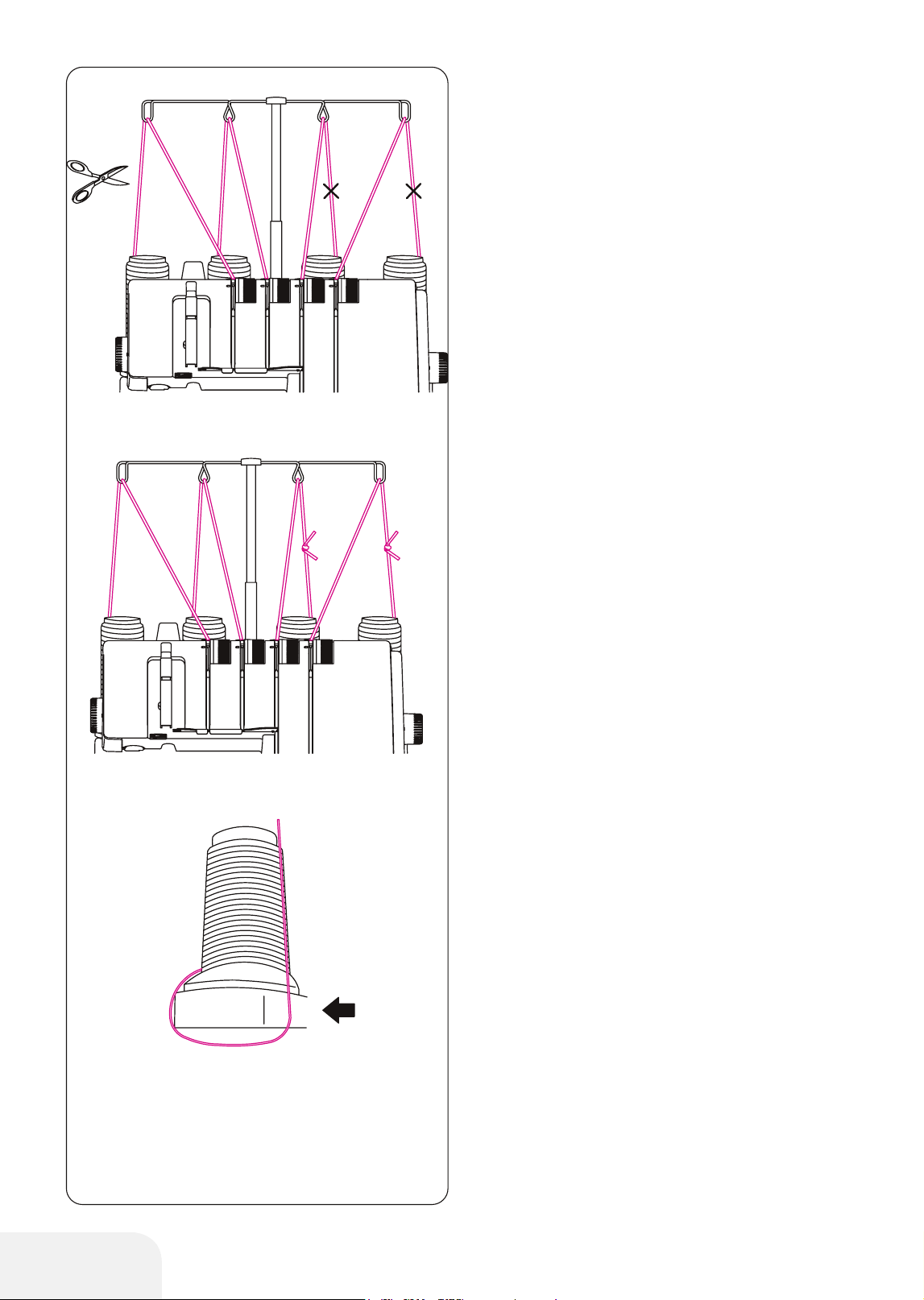
HOW TO CHANGE THREADS
Tie on method
– To change thread type or color, clip thread near
the spool.
– Place new thread on stand.
– Tie new thread and old thread ends together
with a square knot. Clip thread tails to 2–3cm
(1") length. If clipped too short, threads may
come untied.
– Firmly pull both thread to test knot security.
– Raise the presser foot to open the tension
discs.
– Pull the threads through the machine once at a
time.
– If threads do not pull easily, check for tangles on
thread guides or looping under thread stand.
– When pulling thread through the needles,
STOP when the knot is in front of the needle.
– Cut the knot and thread the needle eye.
27
(13/64")
7 mm
(17/64")
5 mm
3 mm
(1/8")
5 mm
(3/16")
(10/64")
(15/64")
6.0 mm
4.0 mm
1
2
●
3
b
a
b
a
(13/64")
7 mm
(17/64")
5 mm
3 mm
(1/8")
5 mm
(3/16")
(10/64")
(15/64")
6.0 mm
4.0 mm
1
2
●
3
b
a
b
a
(13/64")
7 mm
(17/64")
5 mm
3 mm
(1/8")
5 mm
(3/16")
(10/64")
(15/64")
6.0 mm
4.0 mm
1
2
●
3
b
a
b
a
HOW TO ADJUST
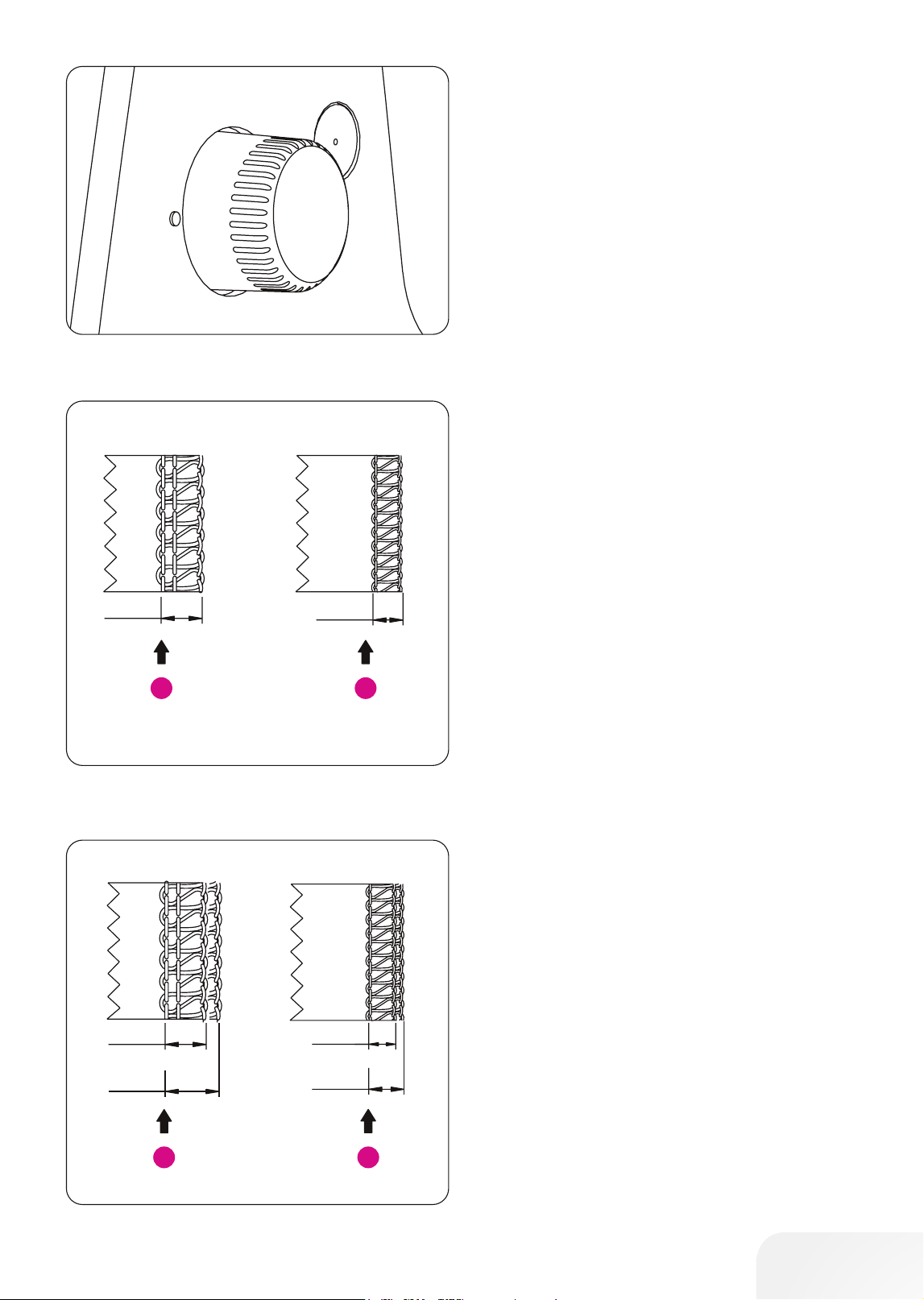
Seam Width
• Cutting width dial
Stitch lenght dial
– The stitch length dial should be set on the • =
2.5 setting for most sewing conditions.
– Adjust the stitch length to 2.5
– 4 when sewing
heavy weight fabrics.
– For rolled hems and narrow seams set the
stitch length between 1 and 2.
– A shorter stitch length can be used to avoide
fabric from puckering.
Overlock seam width can be achieved by repositioning
the needle position and also with the cutting width dial.
• Width adjustment by changing needle
position
Overlock seam width can be adjusted by changing the
needle position.
(a) When using left needle
6 mm (15/64")
(b) When only right needle is used
4 mm (10/64")
Use of cutting width dial will permit further adjustment
within the width range shown below.
(a) When using left needle
5–7 mm (13/64"–17/64")
(b) When only right needle is used
3–5 mm (1/8"–17/64")
28
6.5
N
5.5
6.5
N
5.5
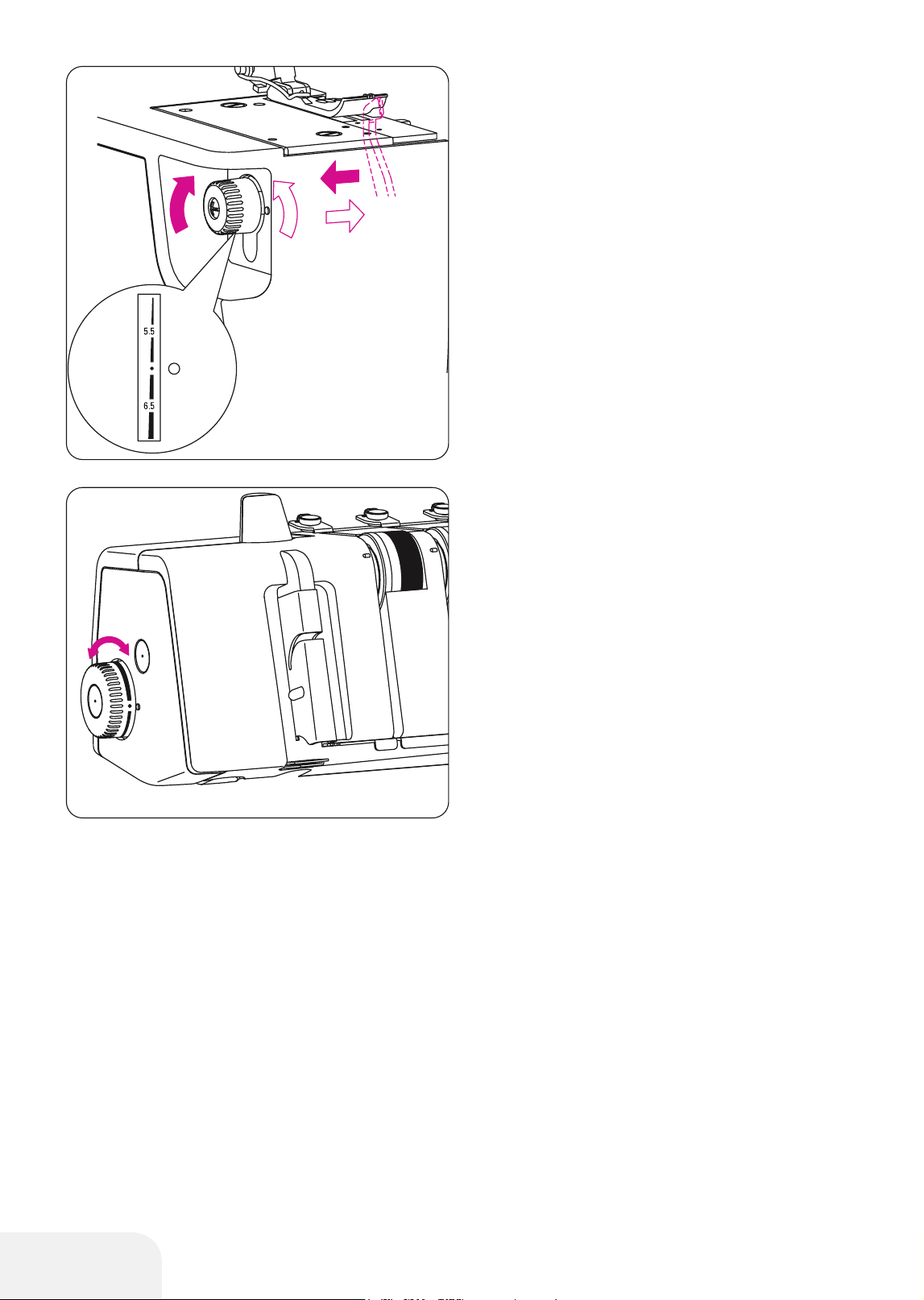
The presser foot pressure
The presser foot pressure of this machine is pre–
adjusted at the factory to suit the sewing of medium
weight fabrics.
Most of the materials do not require adjustment of
presser foot pressure. However, there are some
instances where adjustment is necessary, such as
when sewing light weight and heavyweight fabrics.
In such case, use "
•" for normal, "L" for the lightest
pressure, and "H" for the heaviest.
– For light weight fabric Decrease the pressure.
– For heavy weight fabric Increase the pressure.
– Testsew to define the optimal pressure for your
sewing project.
– Turn the cutting width dial counter clockwise to
increase width of cutting, and clockwise to
decrease width of cutting.
29
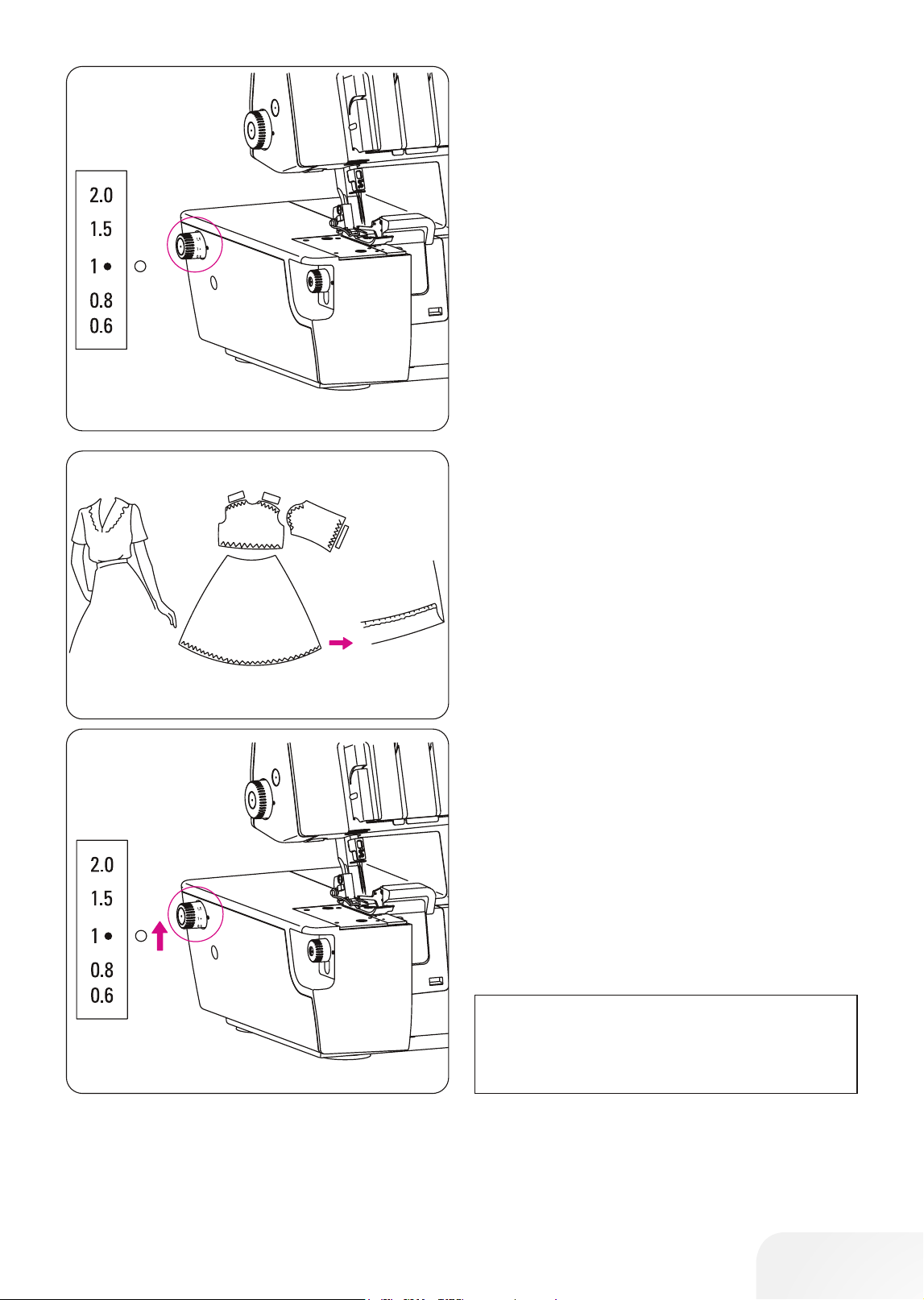
DIFFERENTIAL FEED
Gathered Overlock (1–2.0)
– Differential feed is a system which "stretches"
or "gathers" the fabric, when the amount of feed
of front feed dogs in relation to the rear feed
dogs is changed.
– The differential feed ratio ranges from 0.6–2.0.
Adjustment is made by means of the differential
feed dial pictured at left.
– Use of differential feed is very effective in over-
edging stretch fabrics and fabrics cut on the
bias.
– Setting "1" is differential feed dial setting for
ratio 1:1.
Gathered overlock is most suited for shirring sleeves,
yokes, front and back bodices, skirt hems, etc. in
stretch fabrics such as well as knits and jersey before
assembling into garment.
• To set the dierential feed dial for gath-
ering
– Set differential feed dial above setting "1".
– Setting of adjusting dial depends on material
being sewn as well as the amount of desired
gather.
– Therefore set dial to suit the fabric and test sew
before sewing your garment.
PLEASE NOTE:
For normal overlock stitching, set differential
feed dial to graduation “1”.
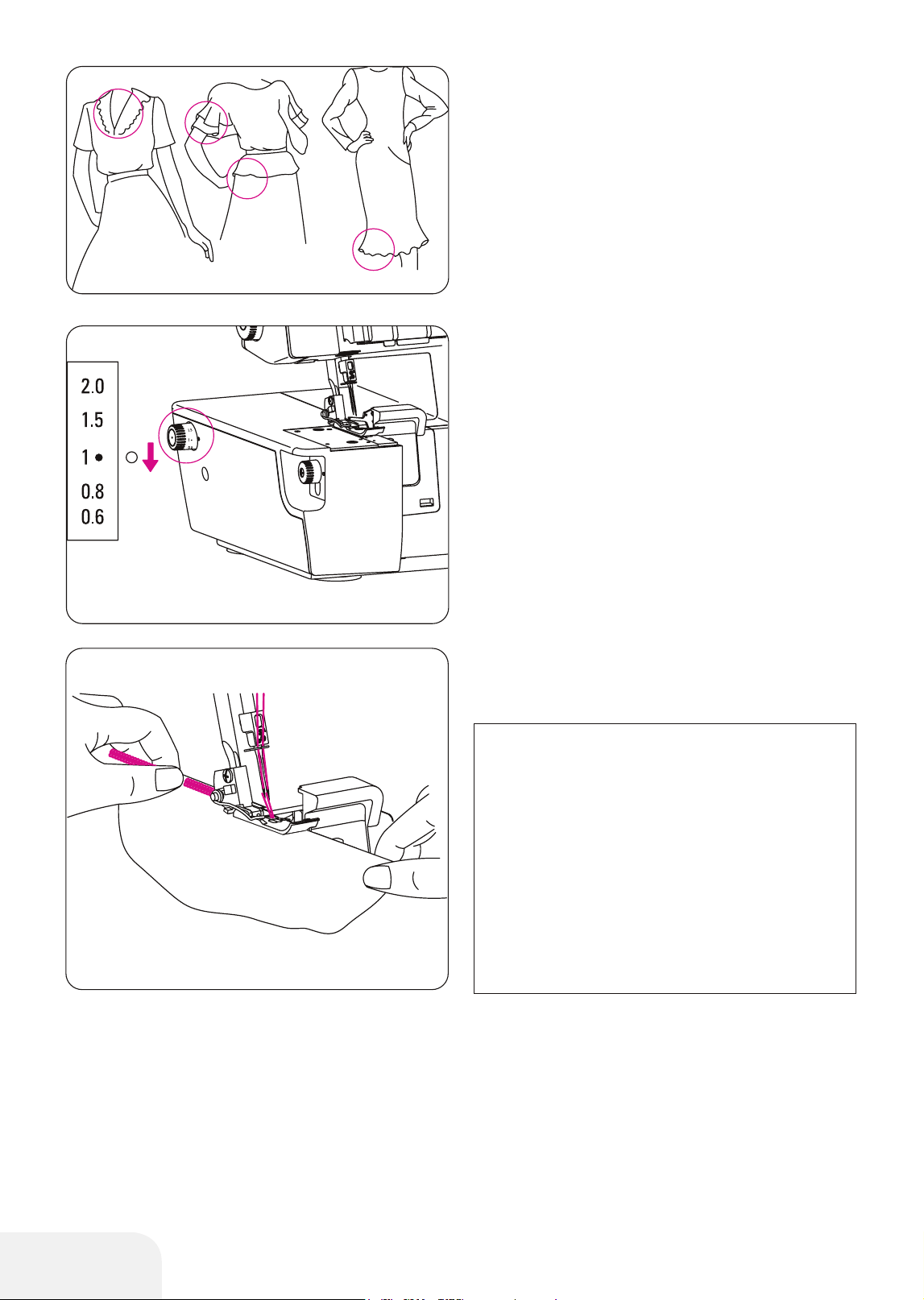
30
Stretch Overlock (1–0.6)
Stretch overlock is ideal for sewing decorative collars,
sleeves, skirt hems, etc. on loosely knit and woven
fabrics. It is also used to prevent seam puckering in
fine fabrics.
• To set the dierential feed dial for
stretch
– To stretch, set the differential feed between 1
and 0.6.
– To sew a seam, apply gentle tension to the fab-
ric by holding the seam lightly in front and back
of the presser foot.
PLEASE NOTE:
If amount of “stretch” is not correctly set in rela-
tion to the fabric being sewn, the fabric is apt to
shift away from the needle resulting in improp-
erly sewn overlock seam.
In such case, reset differential feed dial closer to
the center mark.
Be sure to reset the differential feed dial to
graduation “1” for normal overlock stitching.
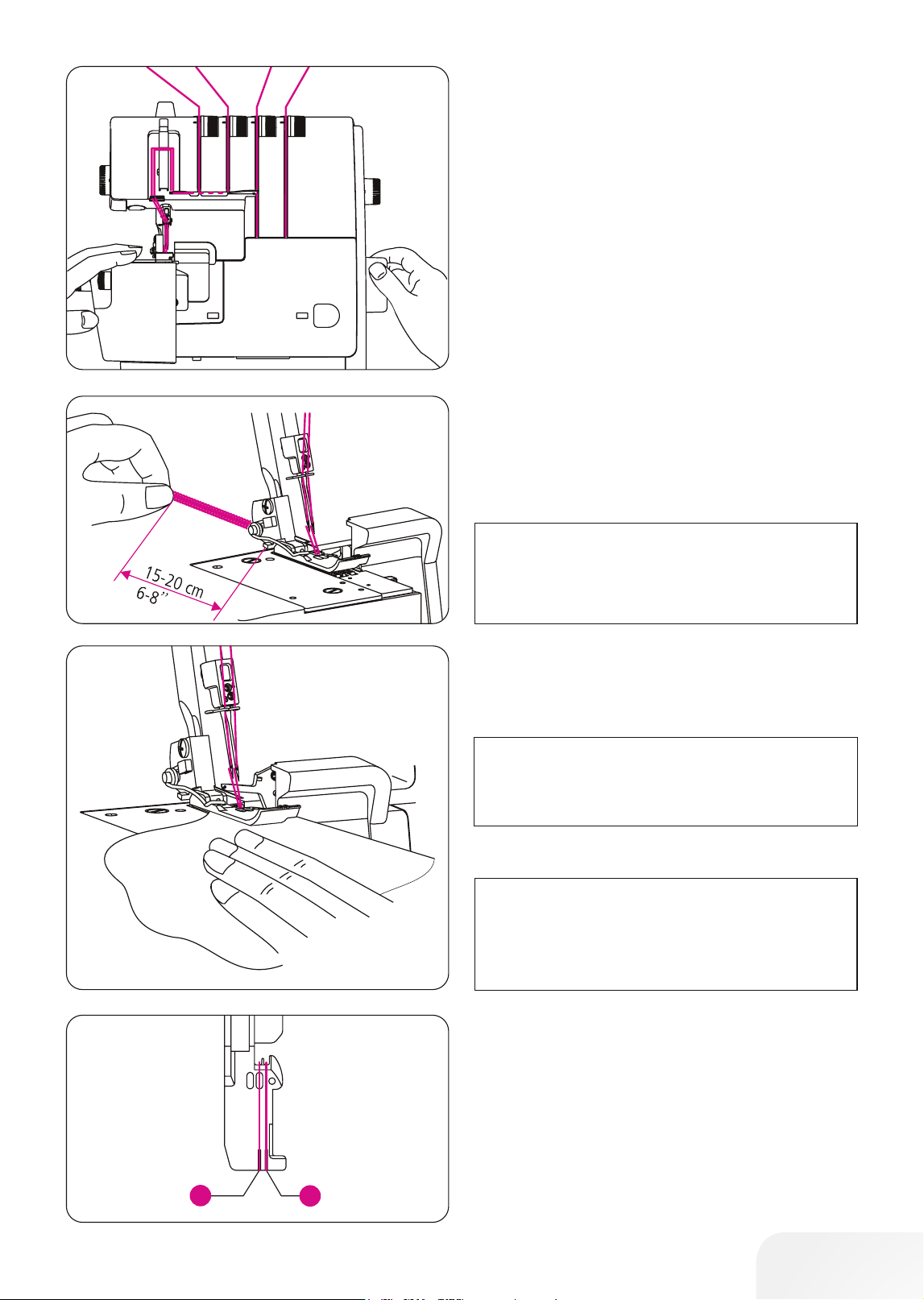
31
1
1
1
1
1
1
1
1
– When the machine is completely threaded,
bring all of the threads across the stitch plate
and slightly to the left under the presser foot.
– Lower the presser foot to activate the thread
tensions.
– Hold the threads and apply a slight tension.
– Turn the handwheel toward you 2 or 3 complete
turns to start the thread chain.
– Continue holding the chain and press on the
foot controller until the chain is 5–7.5 cm (2–3")
in length.
– Place fabric under the front of the presser foot
and sew a test sample.
– At the end of the sample, continue to run the
machine with the presser foot down until the
chain reaches 15–20 cm (6–8") in length.
– Cut threads.
PLEASE NOTE:
Do not pull on the fabric while sewing as this
may deflect the needle, causing it to break.
PLEASE NOTE:
In case it is difficult to chain off and pull the fab-
ric lightly backward.
PLEASE NOTE:
Anytime you have rethreaded the machine
always chain off and sew a text sample to test
tensions and make adjustments as necessary.
Information
A mark
(1) to indicate the needle location is provided
on the presser foot fitted on this machine. Use this
mark as a guide when sewing.
CHAINING OFF AND TEST
SEWING
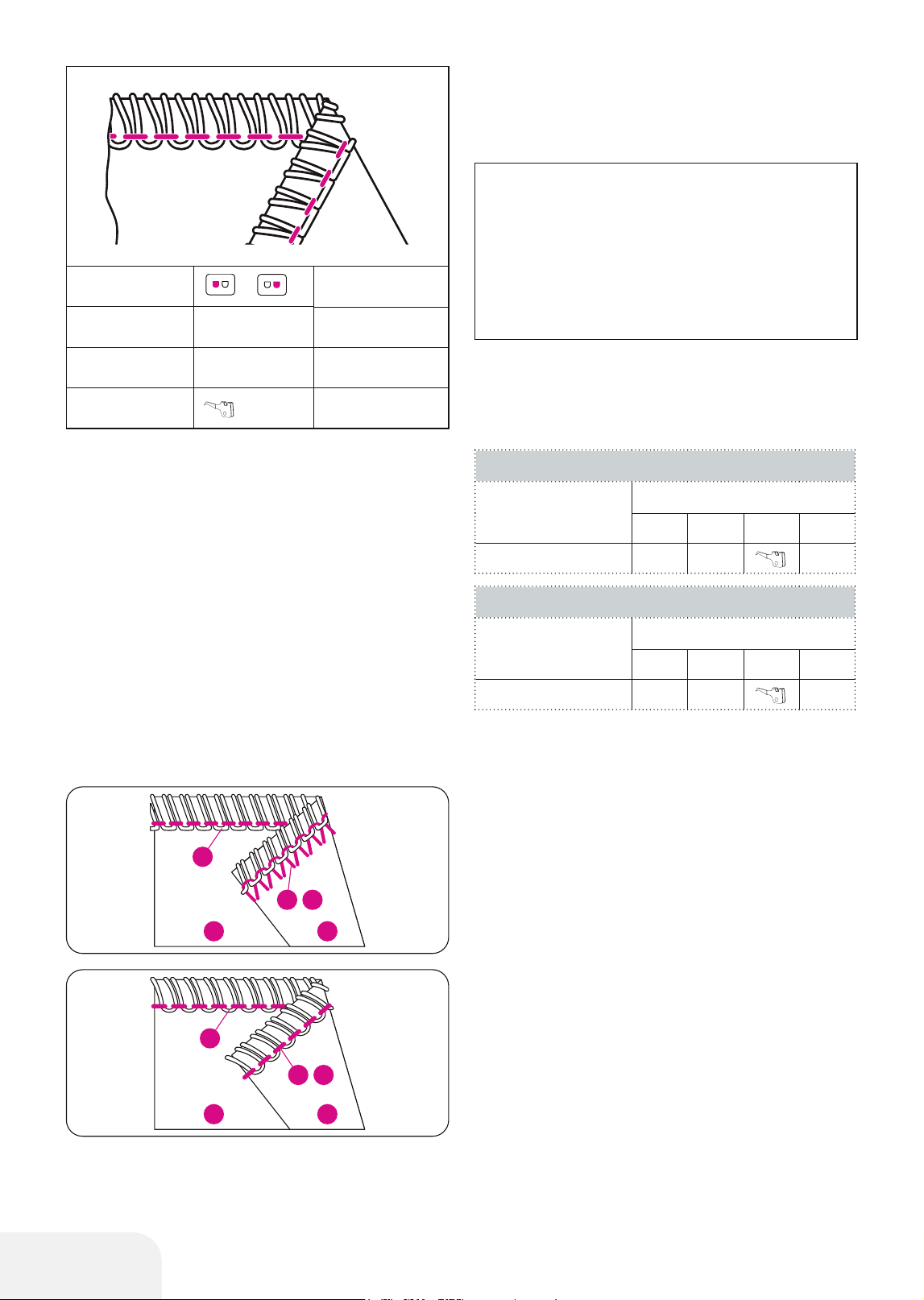
32
HOW TO SEW AN OVERLOCK
STITCH
2–Thread Wrapped Overlock (9/10)
• Correct balance
– Set each tension dial to recommended setting
and test sew on a sample of your fabric.
• How to balance the thread tension
When the lower looper thread tension is too tight or
needle thread tension is too loose;
– Turn the lower looper thread tension dial (red)
toward a lower number.
– Or, turn the needle thread tension dial (yellow
or green) toward a higher number.
When the lower looper thread tension is too loose;
– Turn the lower looper thread tension dial (red)
toward a higher number.
PLEASE NOTE:
– These are suggested tension settings only.
– Tension settings are effected by;
1. Type and thickness of fabric
2. Needle size
3. Size, type and fiber content of thread
Thread Color Code refer page 19.
2–Thread Wrapped Overlock wide 9
Medium weight
fabric
Thread tension
Yellow Green Blue Red
2.5 3.0
2–Thread Wrapped Overlock narrow 10
Medium weight
fabric
Thread tension
Yellow Green Blue Red
4.5 3.5
NP
/
Refer page 15
RHP
N
Refer page 14/15
SL
2.5–4
Refer page 27
ULC
Refer page 14
2
3
4
6
5
2
3
4
6
5
2
3
4
6
5
2
3
4
6
5
2
3
4
6
5
2
3
4
6
5
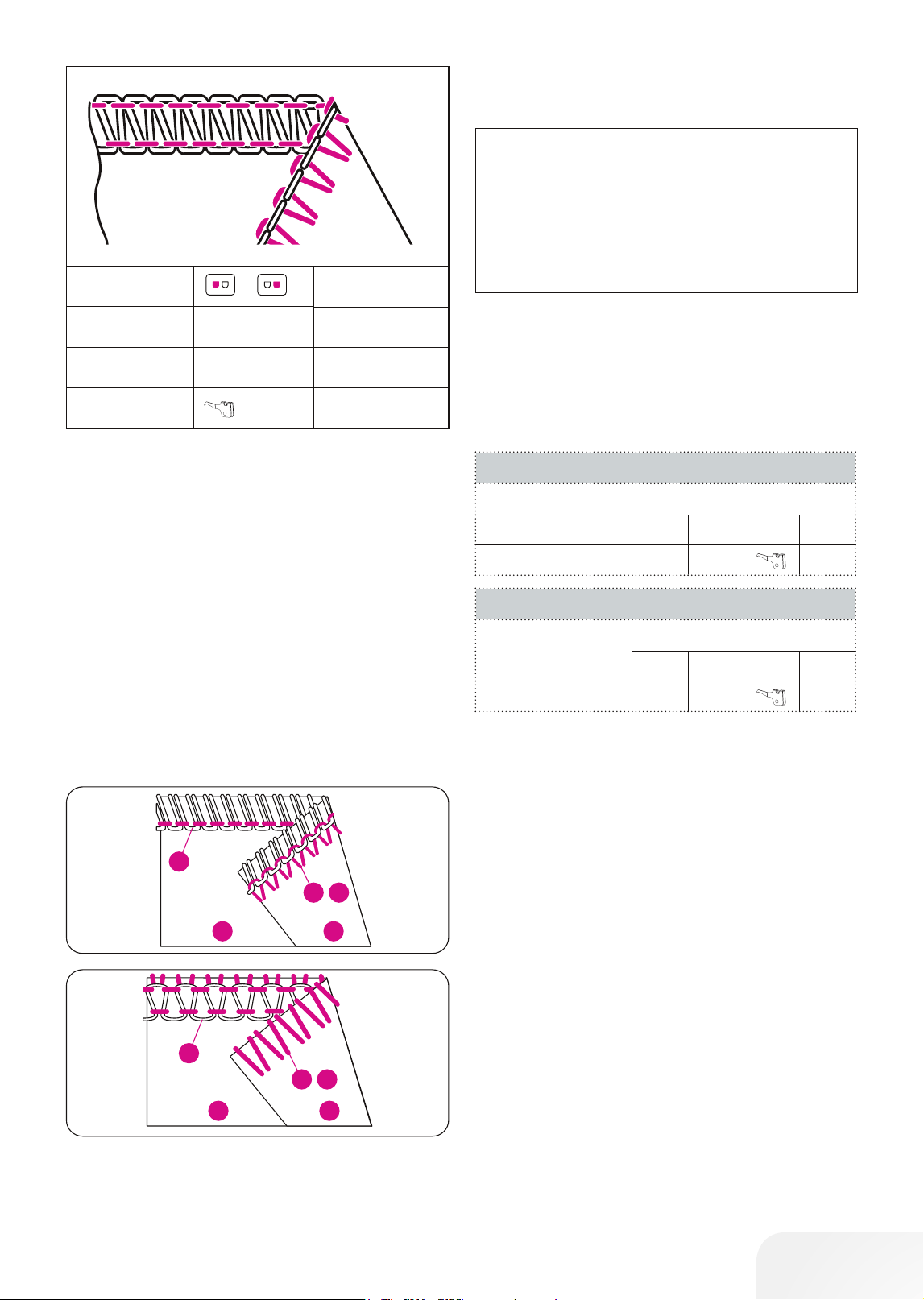
33
2–Thread Overlock (14/15)
• Correct balance
– Set each tension dial to recommended setting
and test sew on a sample of your fabric.
• How to balance the thread tension
When the lower looper thread lies on the underside of
the fabric;
– Turn the lower looper thread tension dial (red)
toward a higher number.
When the needle thread tension is too loose;
– Turn the needle thread tension dial (yellow or
green) toward a higher number.
– Or, turn the lower looper thread tension dial
(red) toward a lower number.
PLEASE NOTE:
– These are suggested tension settings only.
– Tension settings are effected by;
1. Type and thickness of fabric
2. Needle size
3. Size, type and fiber content of thread
Thread Color Code refer page 19.
2–Thread Overlock wide 14
Medium weight
fabric
Thread tension
Yellow Green Blue Red
0.0 4.0
2–Thread Overlock narrow 15
Medium weight
fabric
Thread tension
Yellow Green Blue Red
0.0 4.5
NP
/
Refer page 15
RHP
N
Refer page 14/15
SL
2.5–4
Refer page 27
ULC
Refer page 14
6
5
2
3
4
6
5
2
3
4
6
5
2
3
4
6
5
2
3
4
6
5
2
3
4
6
5
2
3
4
34
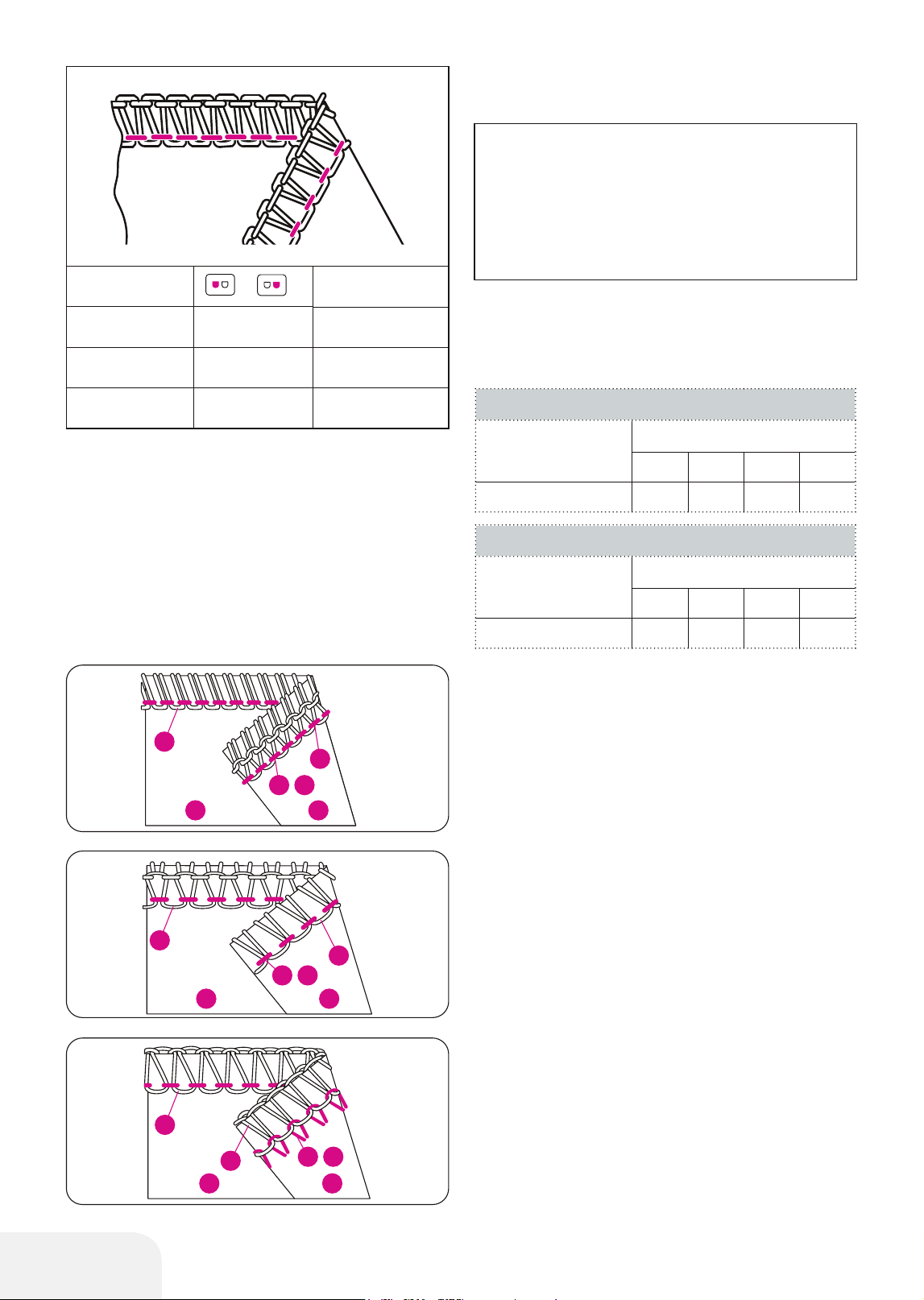
3–Thread Overlock (3/4)
• Correct balance
– Set each tension dial to recommended setting
and test sew on a sample of your fabric.
• How to balance the thread tension
When the upper looper thread lies on the underside of
the fabric;
– Turn the upper looper thread tension dial (blue)
to a higher number.
– Or, turn the lower looper thread tension dial
(red) to a lower number
PLEASE NOTE:
– These are suggested tension settings only.
– Tension settings are effected by;
1. Type and thickness of fabric
2. Needle size
3. Size, type and fiber content of thread
3–Thread Overlock wide 3
Medium weight
fabric
Thread tension
Yellow Green Blue Red
3.0 4.0 3.5
3–Thread Overlock narrow 4
Medium weight
fabric
Thread tension
Yellow Green Blue Red
4.0 4.0 4.0
Thread Color Code refer page 19.
NP
/
Refer page 15
RHP
N
Refer page 14/15
SL
2.5–4
Refer page 27
ULC
– Refer page 14
1
2
6
5
1
3
4
2
6
5
3
4
1
2
6
5
3
4
1
2
6
5
3
4
1
2
6
5
1
3
4
2
6
5
3
4
1
2
6
5
3
4
1
2
6
5
3
4
1
2
6
5
1
3
4
2
6
5
3
4
1
2
6
5
3
4
1
2
6
5
3
4
When the lower looper thread appears on the top of
the fabric;
– Turn the lower looper thread tension dial (red)
toward a higher number.
– Or, turn the upper looper thread tension dial
(blue) to a lower number.
When the needle thread is too loose;
– Turn the needle tension dial (yellow or green) to
a higher number.
35
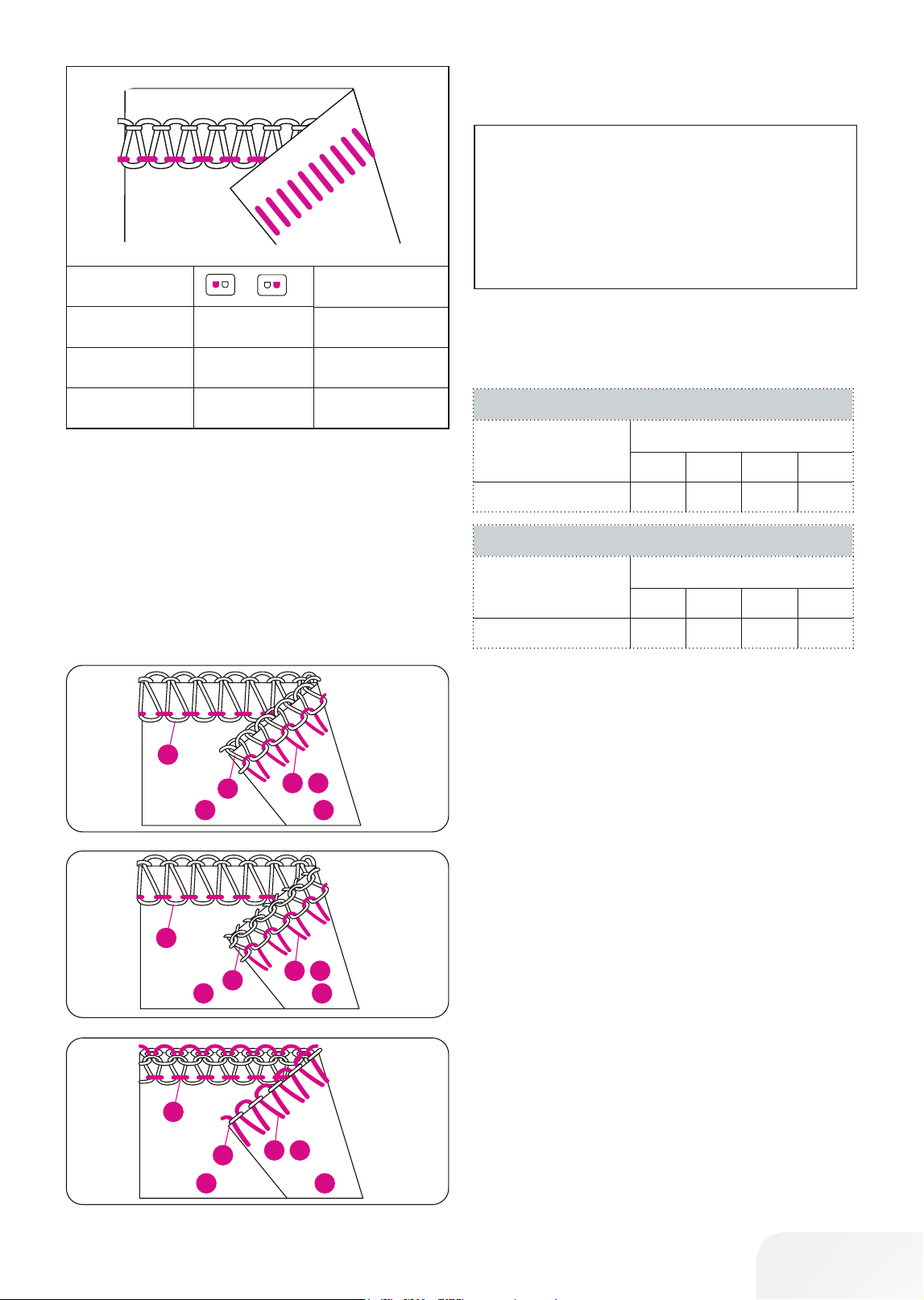
3–Thread Flatlock (5/6)
• Correct balance
– Set each tension dial to recommended setting
and test sew on a sample of your fabric.
• How to balance the thread tension
When the upper looper thread lies on the underside of
the fabric;
– Turn the lower looper thread tension dial (red) to
a higher number.
PLEASE NOTE:
– These are suggested tension settings only.
– Tension settings are effected by;
1. Type and thickness of fabric
2. Needle size
3. Size, type and fiber content of thread
3–Thread Flatlock wide 5
Medium weight
fabric
Thread tension
Yellow Green Blue Red
0 4.0 7.5
3–Thread Flatlock narrow 6
Medium weight
fabric
Thread tension
Yellow Green Blue Red
0 4.5 7.5
When the upper looper thread tension is too loose;
– Turn the upper looper thread tension dial (blue)
toward a higher number.
– Turn the lower looper thread tension dial (red)
toward a higher number.
When the needle thread tension is too loose;
– Turn the needle thread tension dial (yellow or
green) toward a higher number.
– Or, turn the upper looper thread tension dial
(blue) toward a lower number.
Thread Color Code refer page 19.
6
5
1
3
4
2
6
5
1
3
4
2
6
5
1
3
4
2
NP
/
Refer page 15
RHP
N
Refer page 14/15
SL
2.5–4
Refer page 27
ULC
– Refer page 14
6
5
1
3
4
2
6
5
1
3
4
2
6
5
1
3
4
2
6
5
1
3
4
2
6
5
1
3
4
2
6
5
1
3
4
2
6
5
1
3
4
2
6
5
1
3
4
2
6
5
1
3
4
2
36
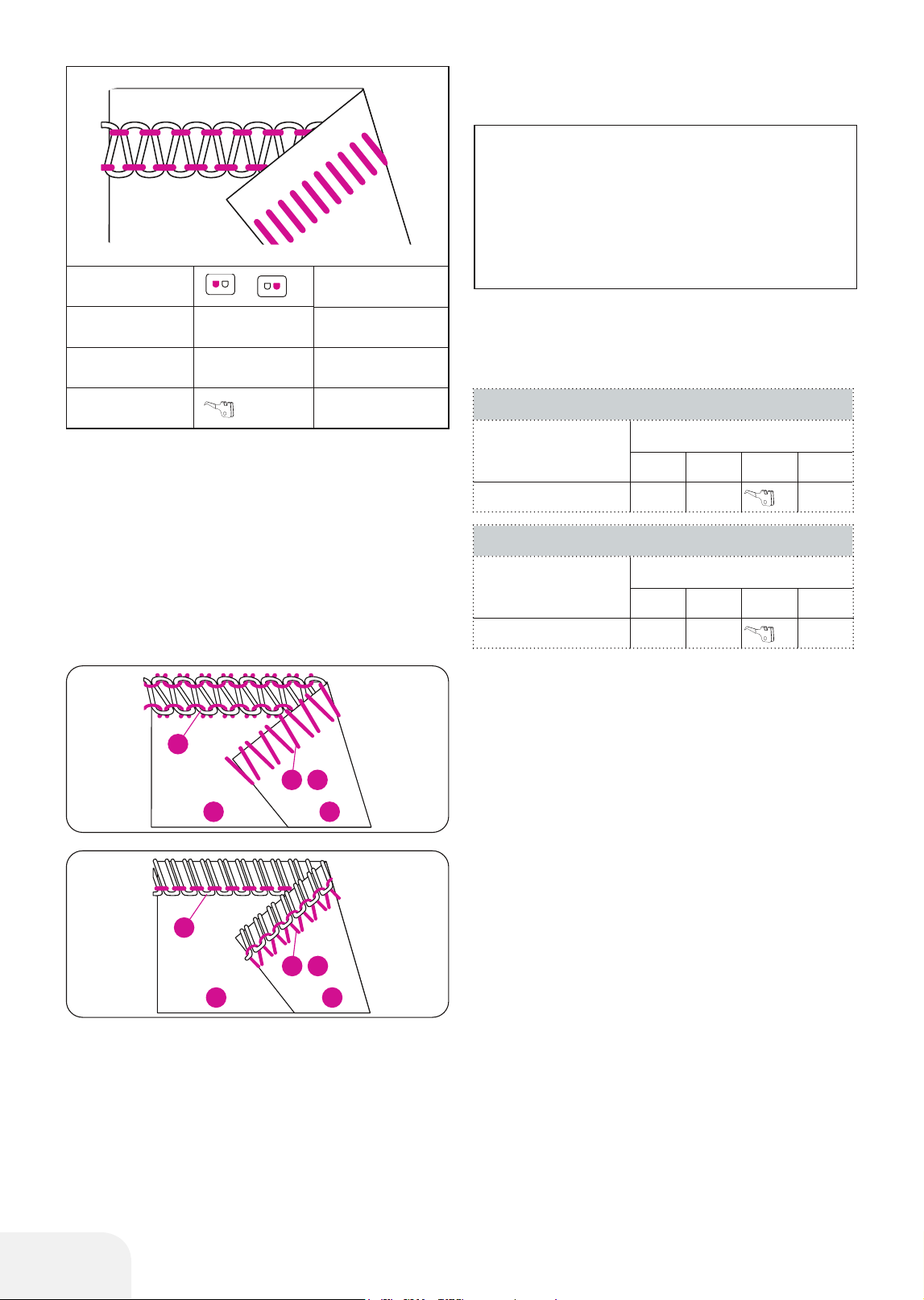
2–Thread Flatlock (11/12)
• Correct balance
– Set each tension dial to recommended setting
and test sew on a sample of your fabric.
• How to balance the thread tension
When the lower looper thread tension is too tight or
needle thread tension is too loose;
– Turn the lower looper thread tension dial (red)
toward a lower number.
– Or, turn the needle thread tension dial (yellow
or green) toward a higher number.
PLEASE NOTE:
– These are suggested tension settings only.
– Tension settings are effected by;
1. Type and thickness of fabric
2. Needle size
3. Size, type and fiber content of thread
2–Thread Flatlock wide 11
Medium weight
fabric
Thread tension
Yellow Green Blue Red
0 4.0
2–Thread Flatlock narrow 12
Medium weight
fabric
Thread tension
Yellow Green Blue Red
0 4.5
When the lower looper thread tension is too loose;
– Turn the lower looper thread tension dial (red)
toward a higher number.
Thread Color Code refer page 19.
2
3
4
6
5
2
3
4
6
5
NP
/
Refer page 15
RHP
N
Refer page 14/15
SL
2.5–4
Refer page 27
ULC
Refer page 14
2
3
4
6
5
2
3
4
6
5
2
3
4
6
5
2
3
4
6
5
37
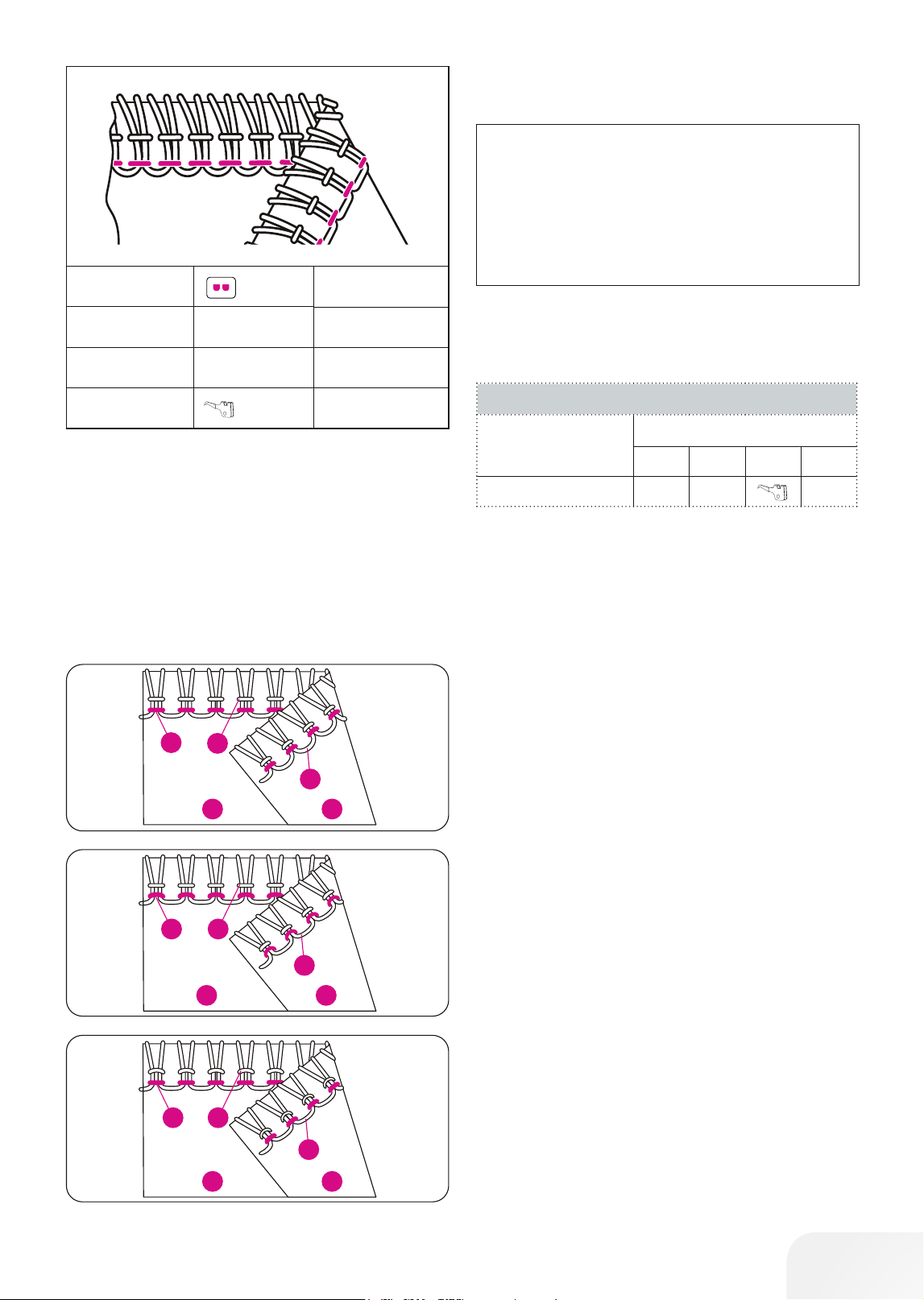
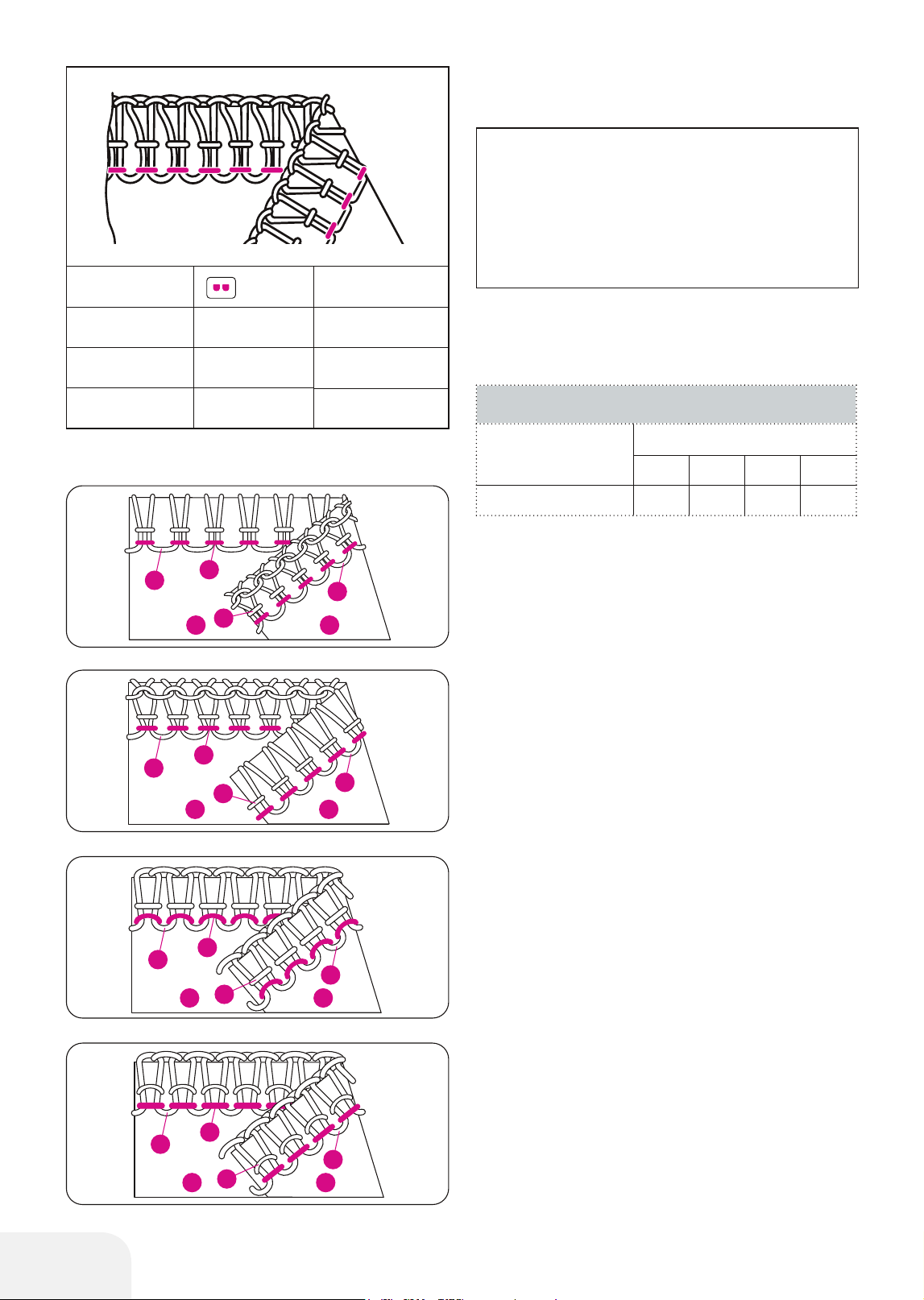
3–Thread Super Stretch (2)
• Correct balance
– Set each tension dial to recommended setting
and test sew on a sample of your fabric.
• How to balance the thread tension
When the lower looper thread tension is too loose;
– Turn the lower looper thread tension dial (red)
toward a higher number.
PLEASE NOTE:
– These are suggested tension settings only.
– Tension settings are effected by;
1. Type and thickness of fabric
2. Needle size
3. Size, type and fiber content of thread
3–Thread Super Stretch 2
Medium weight
fabric
Thread tension
Yellow Green Blue Red
4.0 4.0 3.5
When the left needle thread tension is too loose;
– Turn the left needle thread tension dial (yellow)
toward a higher number.
When the right needle thread tension is too loose;
– Turn the needle thread tension dial (green)
toward a higher number.
Thread Color Code refer page 19.
4
3
4
4
3
3
2
6
5
2
6
5
2
6
5
4
3
2
6
5
4
3
4
4
3
3
2
6
5
2
6
5
2
6
5
4
3
2
6
5
4
3
4
4
3
3
2
6
5
2
6
5
2
6
5
4
3
2
6
5
NP
Refer page 15
RHP
N
Refer page 14/15
SL
2.5–4
Refer page 27
ULC
Refer page 14
38
4–Thread Overlock with integrated
safety seam (1)
• Correct balance
– Set each tension dial to recommended setting
and test sew on a sample of your fabric.
• How to balance the thread tension
When the upper looper thread lies on the underside of
the fabric;
– Turn the upper looper thread tension dial (blue)
toward a higher number.
– Or, turn lower looper thread tension dial (red) to
a lower number.
PLEASE NOTE:
– These are suggested tension settings only.
– Tension settings are effected by;
1. Type and thickness of fabric
2. Needle size
3. Size, type and fiber content of thread
4–Thread Overlock with integrated safety
seam 1
Medium weight
fabric
Thread tension
Yellow Green Blue Red
4.0 4.0 4.0 4.0
When the lower looper thread appears on the top of
the fabric;
– Turn the lower looper thread tension dial (red)
toward a higher number.
– Or, turn the upper looper thread tension dial
(blue) toward a lower number
When the left needle thread tension is too loose;
– Turn the needle thread tension dial (yellow)
toward a higher number.
When the right needle thread tension is too loose;
– Turn the right needle thread tension dial (green)
toward a higher number.
Thread Color Code refer page 19.
NP
Refer page 15
RHP
N
Refer page 14/15
SL
2.5–4
Refer page 27
ULC
– Refer page 14
1
3
6
5
4
2
1
3
6
5
4
2
1
3
6
5
4
2
1
3
6
5
4
2
1
3
6
5
4
2
1
3
6
5
4
2
1
3
6
5
4
2
1
3
6
5
4
2
1
3
6
5
4
2
1
3
6
5
4
2
1
3
6
5
4
2
1
3
6
5
4
2
1
3
6
5
4
2
1
3
6
5
4
2
1
3
6
5
4
2
1
3
6
5
4
2
1
3
6
5
4
2
1
3
6
5
4
2
1
3
6
5
4
2
1
3
6
5
4
2
39
1
2
●
3
R
R
N
1
2
●
3
R
R
N
1
2
●
3
R
R
N
1
2
●
3
R
R
N
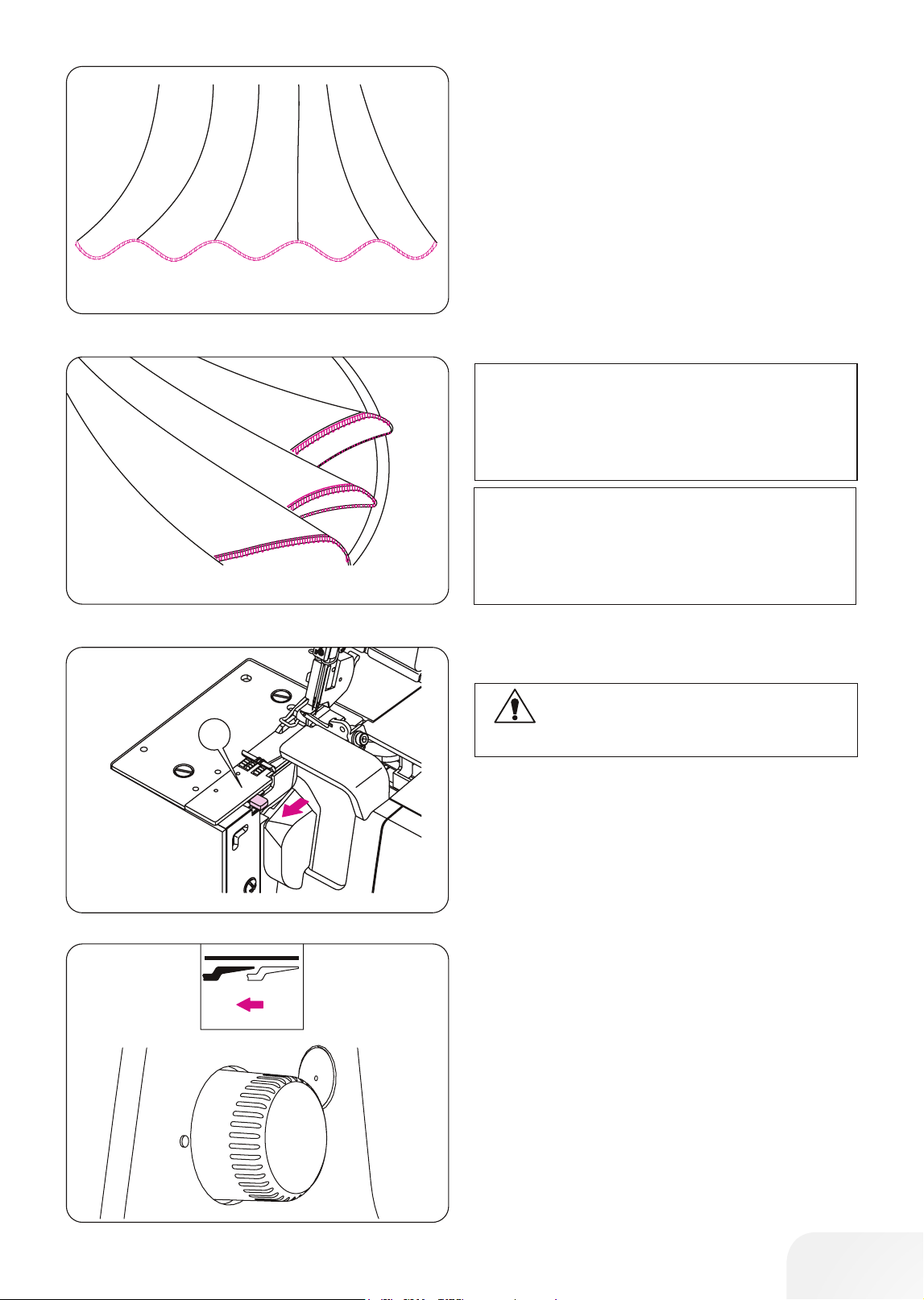
HOW TO SEW A ROLLED HEM
– This machine can sew three types of rolled
hems.
– Rolled hemming is done by rolling and overedg-
ing the fabric edge.
– Light weight fabrics such as lawn, voile, organdy,
crepe, etc. perform the best.
– Rolled hemming is not suited for heavy or stiff
fabrics.
Machine set up
– Remove the overlock left needle.
– Move seam width finger knob to setting R.
– Set a cutting width between 5 and 6.
– Set stitch length dial to 1–2 and a fine seam will
be sewn.
Needle:
ELx705
Thread:
A variety of thread combinations can be used for rolled
hemming.
PLEASE NOTE:
Rolled hemming can only be performed with the
overlock right needle.
PLEASE NOTE:
For a beautiful rolled hem thread the upper
looper with wooly nylon and the needle and
lower looper with lightweight regular thread.
CAUTION:
Be sure to turn off power switch.
40
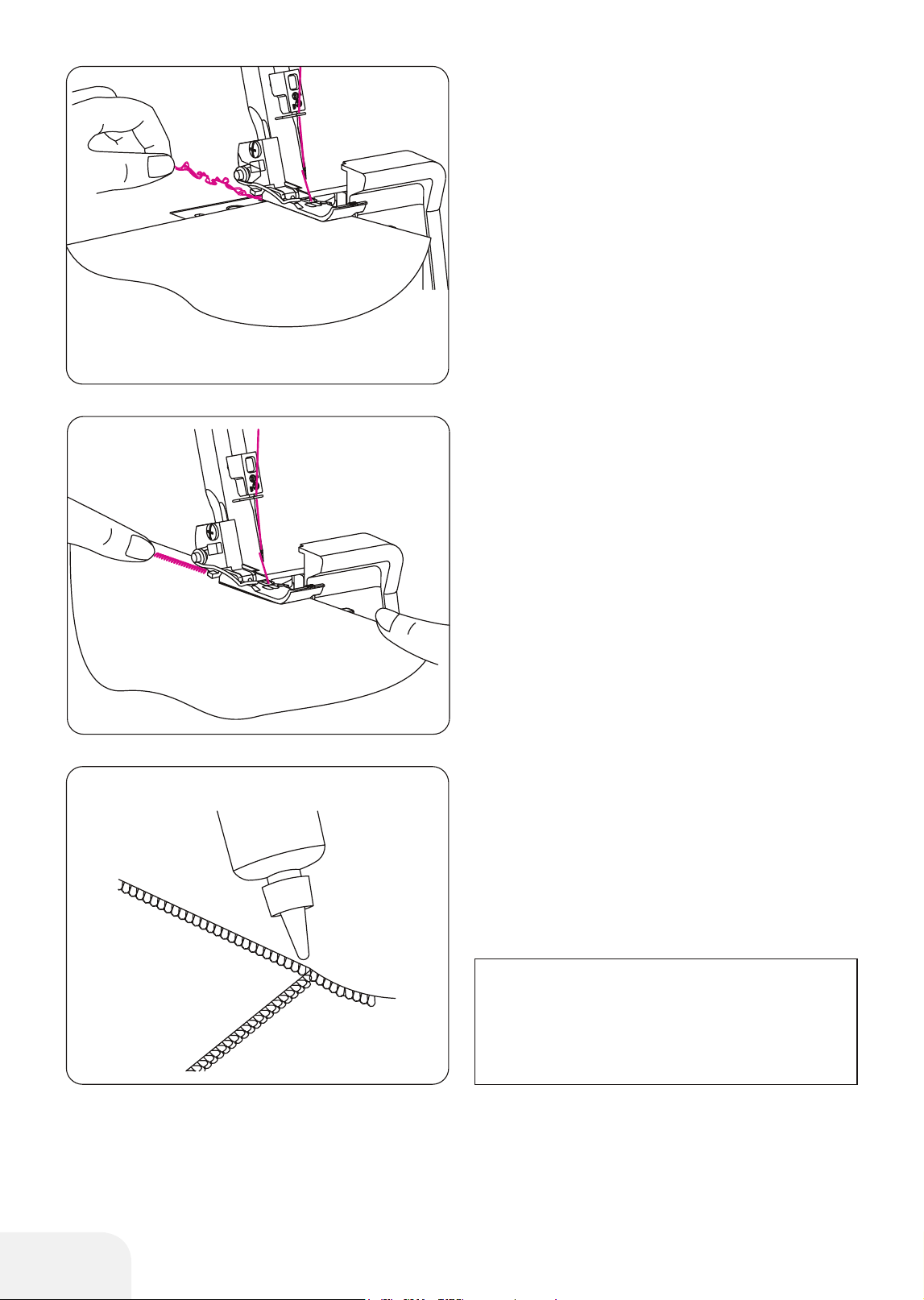
• To secure the rolled hem thread chain
– Apply a small drop of liquid seam sealant to the
end of the seam. Allow to dry, then cut the chain
close to the stitches.
Additional information about rolled
hemming
– Hold the thread chain when you begin sewing to
keep it from curling into the seam.
– Place a slight tension on the material in the
sewing direction and a finer seam finish can be
obtained.
– The minimum overlock stitch width that can be
obtained for rolled hemming is approximately
1/16" (1.5 mm) since the cutting width cannot
be set below 9/64" (3.5 mm).
PLEASE NOTE:
Test the liquid seam sealant for color fastness
before use.
41
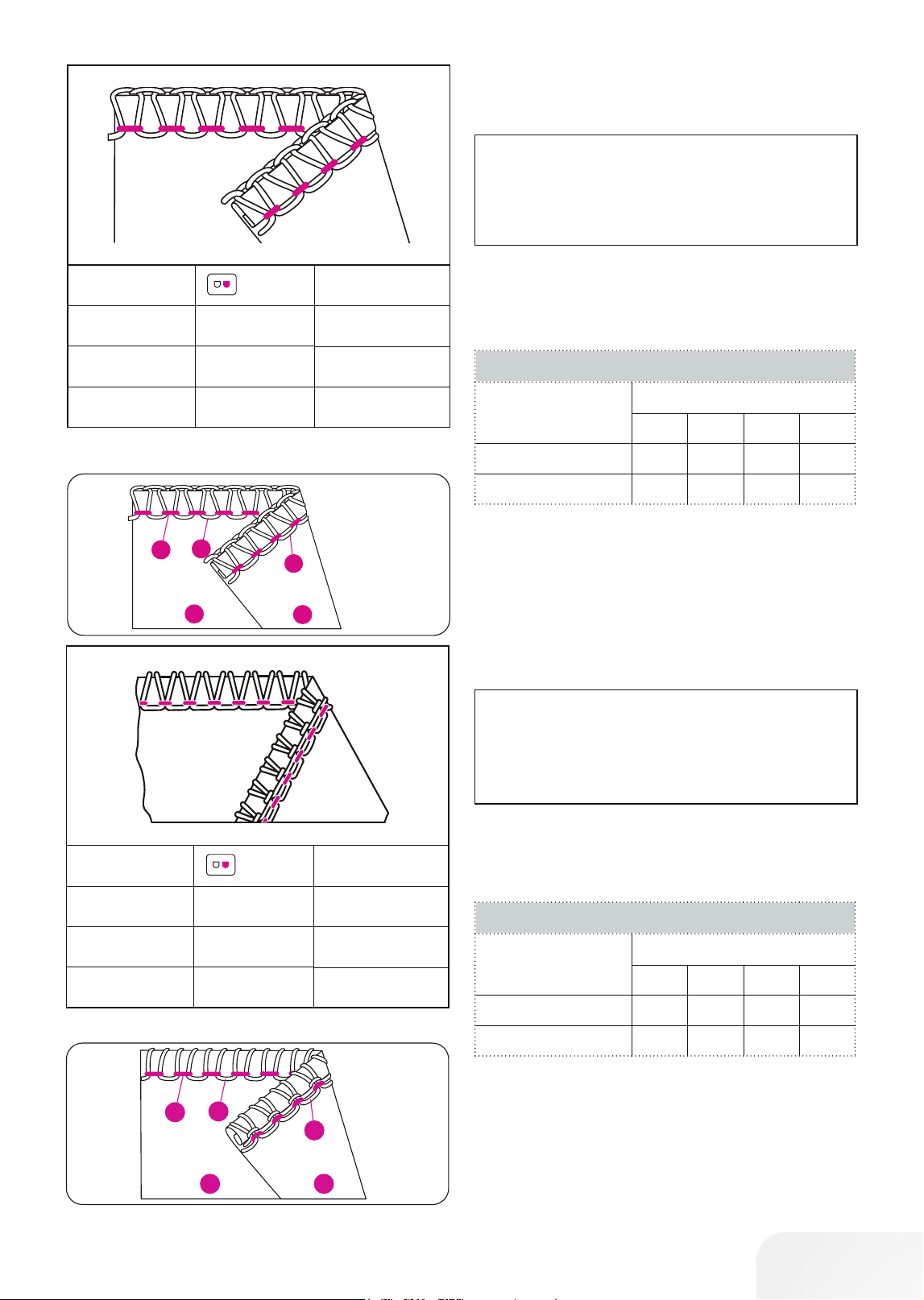
3–Thread Narrow Seam (7)
3–Thread Rolled Hem (8)
• Correct balance
– Set each tension dial to recommended setting
and test sew on a sample of your fabric
• Correct balance
– Set each tension dial to recommended setting
and test sew on a sample of your fabric
PLEASE NOTE:
For a beautiful narrow seam thread the upper
and lower looper with wooly nylon and the nee-
dle with fine normal overlock thread.
PLEASE NOTE:
For a beautiful rolled hem thread the upper
looper with wooly nylon and the needle and
lower looper with light weight regular thread.
3–Thread Narrow Seam 7
Light weight fabric
Thread tension
Yellow Green Blue Red
Polyester
4.0 5.0 4.5
Woolly nylon
4.0 3.0 4.0
3–Thread Rolled Hem 8
Light weight fabric
Thread tension
Yellow Green Blue Red
Polyester
4.0 4.5 6.5
Woolly nylon
4.5 0 6.5
Thread Color Code refer page 19.
1
6
5
3
2
NP
Refer page 15
RHP
R
Refer page 14/15
SL
1–2
Refer page 27
ULC
– Refer page 14
NP
Refer page 15
RHP
R
Refer page 14/15
SL
1–2
Refer page 27
ULC
– Refer page 14
4
4
3
3
5
5
6
6
1
1
2
2
1
6
5
3
2
1
6
5
3
2
42
2–Thread Rolled Hem (13)
• Correct balance
– Set each tension dial to recommended setting
and test sew on a sample of your fabric
PLEASE NOTE:
For a beautiful rolled hem thread the lower
looper with wooly nylon and the needle with light
weight regular thread.
2–Thread Rolled Hem 13
Light weight fabric
Thread tension
Yellow Green Blue Red
Polyester
4.5 4.0
Woolly nylon
4.0 3.5
NP
Refer page 15
RHP
R
Refer page 14/15
SL
1–2
Refer page 27
ULC
Refer page 14
6
5
3
2
Thread Color Code refer page 19.
43
3
4
1
2
5
6
3
4
1
2
5
6
3
4
1
2
5
6
3
4
1
2
5
6
STITCH VARIATIONS AND
SEWING TECHNIQUES
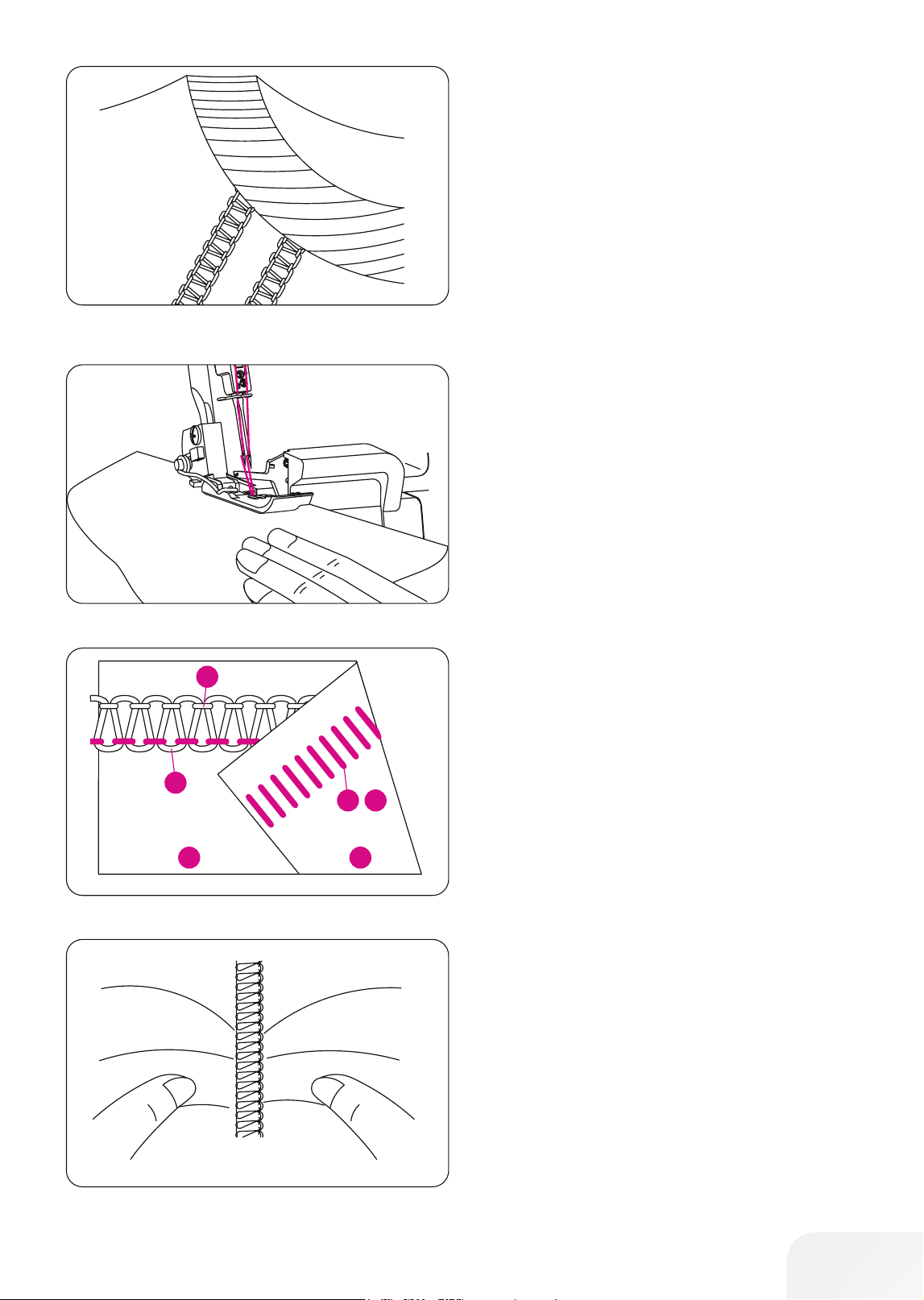
How To Sew a Flatlock Decorative
Seam
A flatlock stitch is achieved by adjusting the tension of
the 2–thread or 3–thread overlock stitch, sewing the
seam, and then pulling the fabric apart to flatten the
seam.
The flatlock stitch can be used as a construction and
decorative stitch or for ornamentation only.
Machine Set Up
– Use either overlock right needle or overlock left
needle.
– Begin with the machine threaded and tension
balanced for the 2–thread flatlock (page 36) or
3–thread flatlock stitch (page 35).
Flatlocking a Seam
– Place the fabric wrong sides together to sew a
decorative stitch on the right side of the gar-
ment.
– Sew the seam, trimming the excess fabric.
– The needle thread (yellow or green) will form a
V on the underside of the fabric.
– In the 3-thread flatlock, the lower looper thread
will form a straight line on the fabric edge. The
upper looper thread will lie on top of the stitch.
– In the 2-thread flatlock, the lower looper thread
will lie on top of the stitch.
– Pull on opposite sides of the seam to pull the
stitches flat.
Thread Color Code refer page 19.
44
A
1
2
6
5
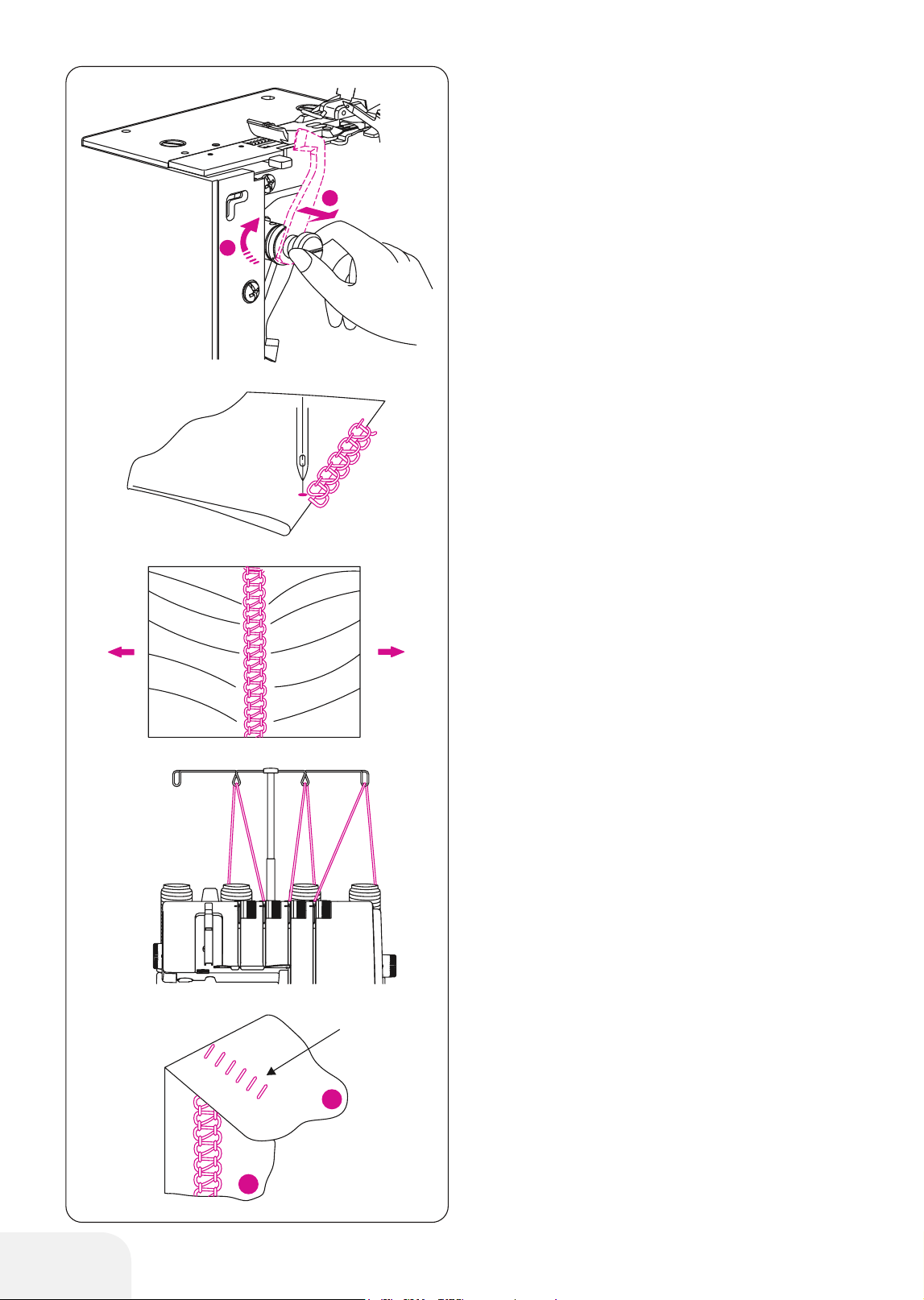
Decorative Flatlocking
– Disengage the upper knife (page 13). The fabric
is not trimmed on this stitch.
Additional Information about Flat-
locking
– The tensions must be correctly adjusted for the
fabric to pull flat.
– The upper looper thread is the prominent thread
in a 3-thread flatlock.
– The lower looper thread is the prominent thread
in a 2-thread flatlock.
– Thread decorative yarn in the prominent thread-
ing path accordingly.
– For a ladder stitch, sew seam with right sides
together.
– The needle thread will be the prominent thread
that creates the ladder
(A).
– Fold fabric wrong sides together.
– Position the fabric so the seam is sewn with part
of the stitch extending off the fabric.
– Pull on opposite sides of the stitch to flatten
45
1
2
●
3
1
2
1
2
●
3
1
2
1
2
●
3
1
2
1
2
●
3
1
2
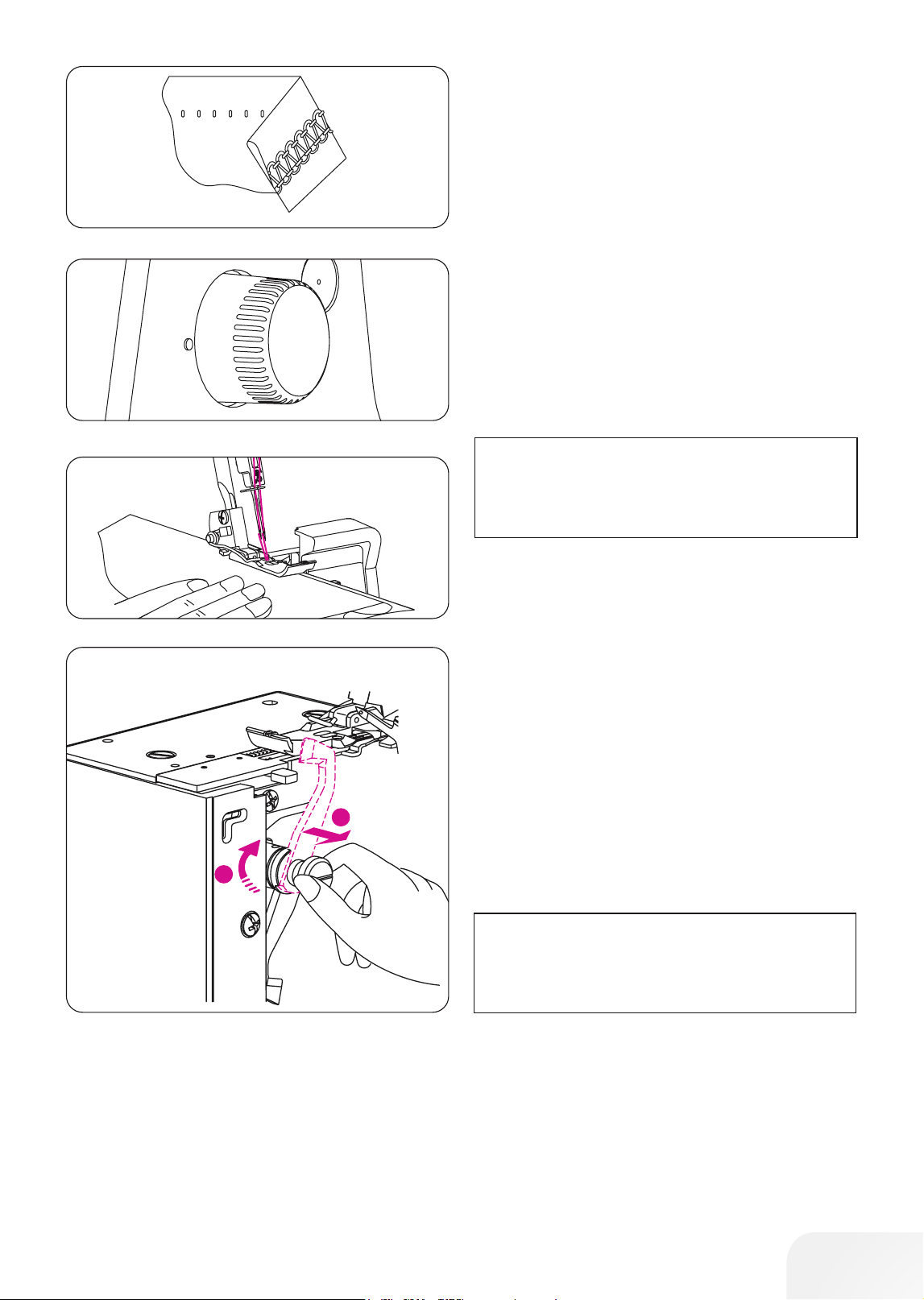
How to sew an Overlock Blind Hem
The excess fabric is trimmed and the hem is sewn and
the raw edges are overlocked in one operation.
The overlock blind hem is best suited for sewing knit
wear. It provides a durable finish that is almost invisi-
ble.
Use overlock right needle and adjust machine for a
narrow 3–thread overlock stitch. (Refer page 34)
– Set the stitch length dial at 4.
– Fold the hem to the wrong side of the fabric,
then back to the right side with 1/4" (6 mm)
beyond the fold.
– Stitch on the extended hem edge, allowing the
machine needle to barely catch the edge of the
fold.
PLEASE NOTE:
For this technique also a 3-thread rolled hm or a
3-thread narrow seam can be used.
PLEASE NOTE:
An optional blindstitch foot is available (Refer
page 51).
How to sew Pin Tucks
– Sew decorative pin tucks on the fabric before
cutting out the garment.
– Use overlock right needle and adjust machine
for a narrow 3–thread overlock stitch. (Refer
page 34)
– Place the movable upper knife in the nonwork-
ing position. (Refer page 13)
– Mark the fabric with the desired number of pin
tucks using a water–soluble fabric marker.
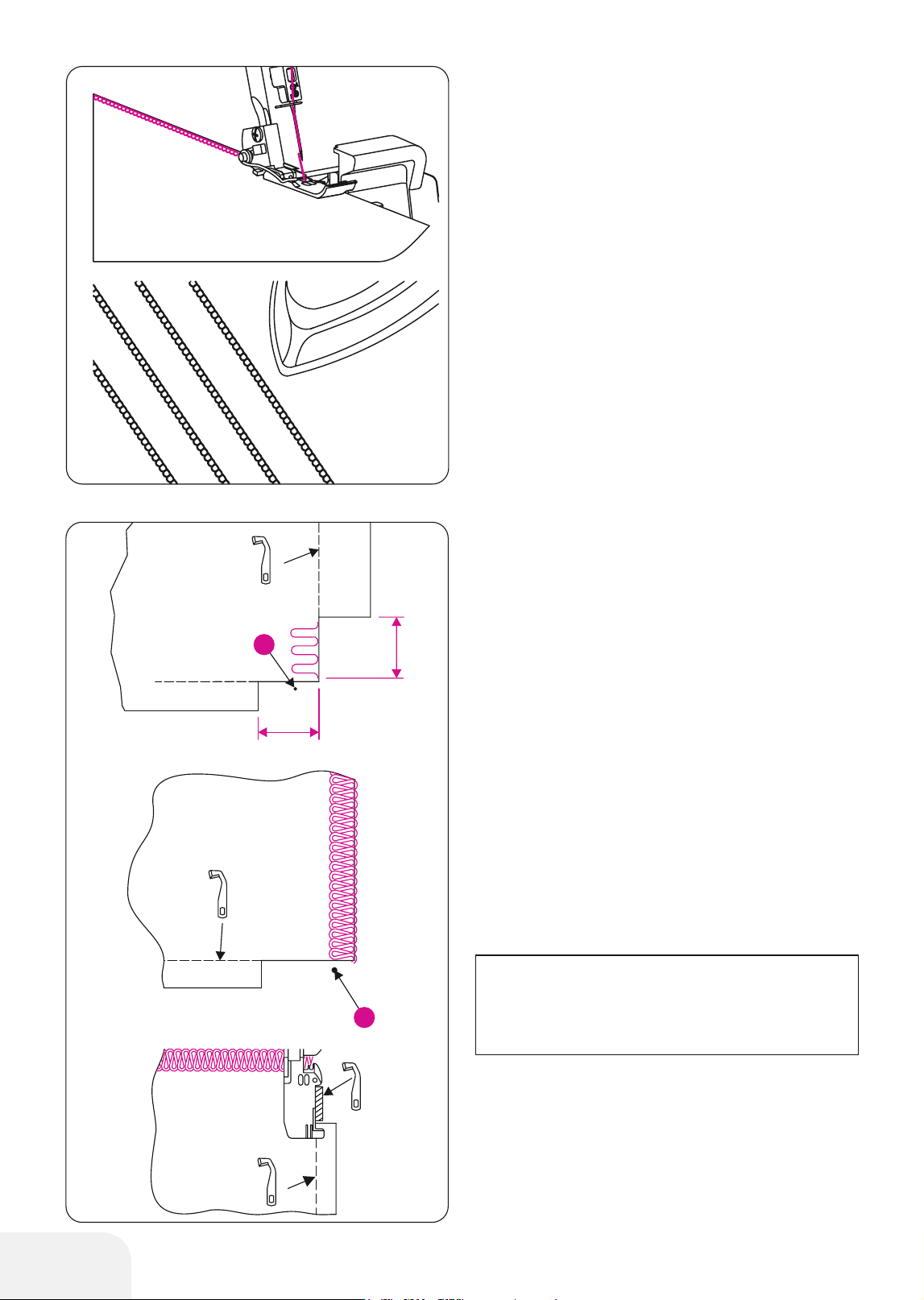
46
2 cm
2 cm
A
A
2 cm
2 cm
A
A
– Fold the fabric with the wrong sides together
and sew.
– Press the pin tucks in the same direction.
PLEASE NOTE:
Presser foot has been removed to show detail.
How to turning Square Corners
• Outside Corner
– Cut out approximately 2 cm (51/64") from the
corner, in line with the overlock seam edge.
– Turn the fabric and lower the presser foot so
that the upper knife is positioned in line with the
cut edge.
– Pull slack threads up, then start to sew.
– Sew one stitch beyond point
(A) and stop.
– Raise needle and presser foot.
– Pull the fabric to the rear of the machine just
enough to release the thread caught on the
finger of the stitch plate.
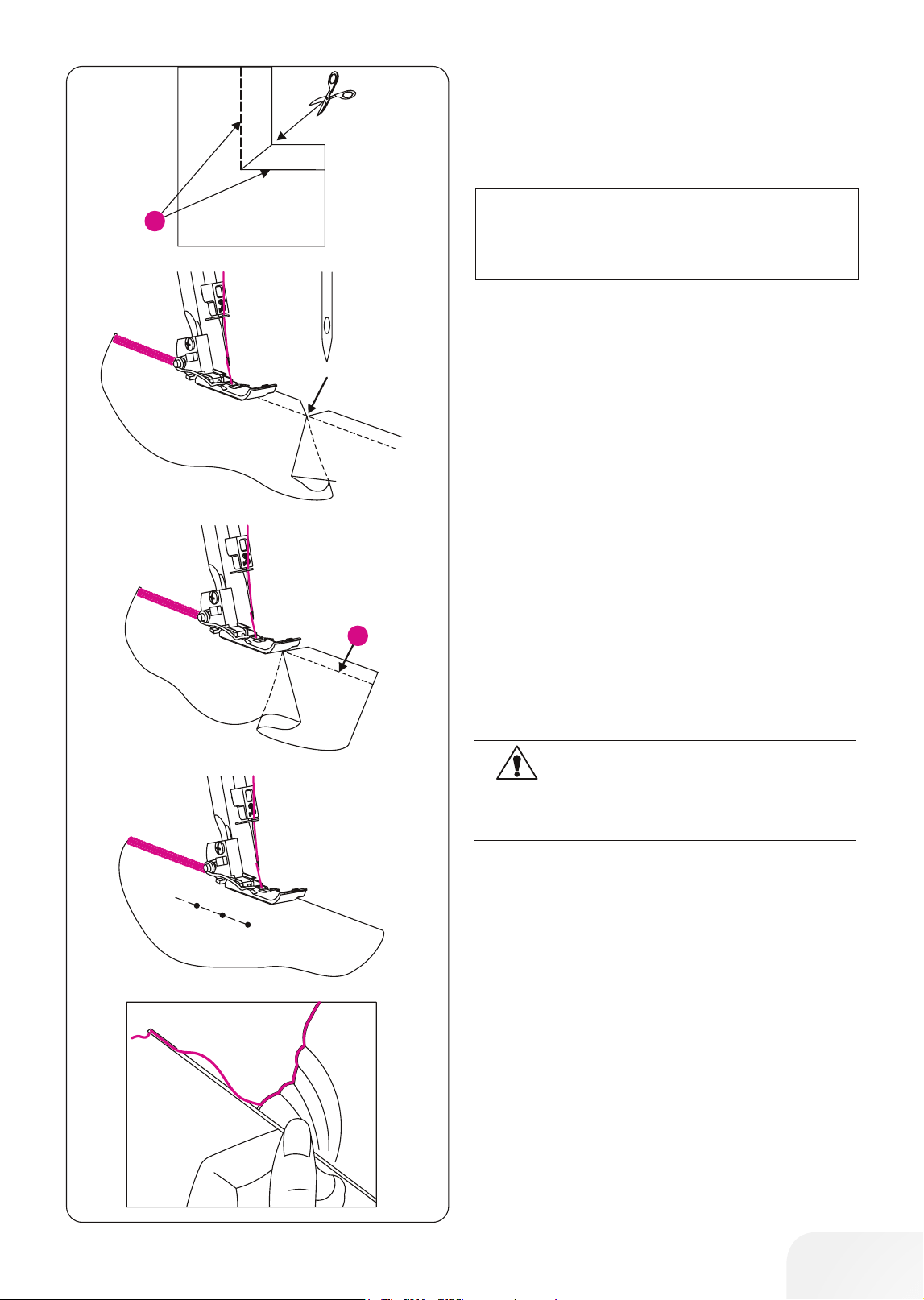
47
1
1
PLEASE NOTE:
Presser foot has been removed to show detail.
• Inside Corner
– Cut inside corner up to seam line (1) as shown.
– Sew along seam line.
– Sew up to end of fold. (Leave needle in fabric)
• Pin Placement
– Insert pins to the left of the presser foot. The
pins will be easy to remove and are away from
the cutting action of the knives.
– Turn the fabric and lower the presser foot so
that the upper knife is positioned in line with the
cut edge.
– Pull slack threads up, then start to sew.
CAUTION:
Sewing over pins will damage and /or destroy
the cutting edge of the knives.
• Securing The Thread Chain
– Thread a large eye, hand sewing needle (such
as a tapestry needle) with the thread chain.
– Pull the thread chain into the overlock stitches
or between two layers of fabric.
– Raise presser foot. (Leave needle in fabric)
– Spread fold and re–fold so that seam line is
straight
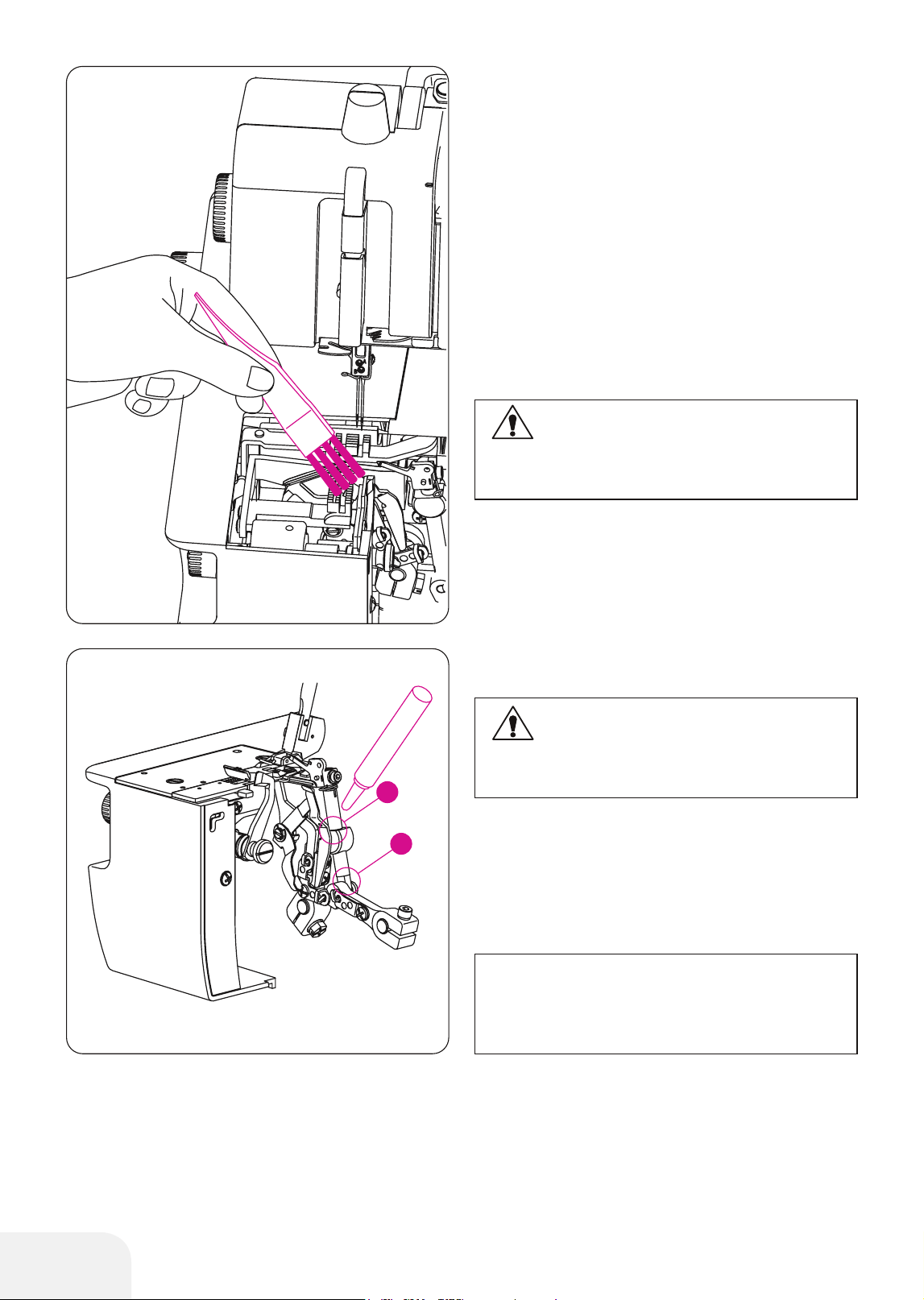
48
Oil
B
A
Oil
B
A
MACHINE MAINTENANCE
An overlock machine requires more maintenance than
a conventional machine for two reasons:
1. A lot of lint is produced due to the cutting action
of the knives.
2. An overlock runs at a very high speed and needs
to be oiled frequently to lubricate the internal
working parts.
Cleaning The Machine
Oiling The Machine
– Clean the lint from the looper and knife area
often with a dry lint brush.
– The oiling points shown in the diagram, should
be oiled periodically.
CAUTION:
Before cleaning your machine, disconnect
power line plug from the wall receptacle.
CAUTION:
Before lubricating your machine, disconnect
power line plug from the wall receptacle.
PLEASE NOTE:
Use only sewing machine oil. Do not use any
other oil or damage could result.
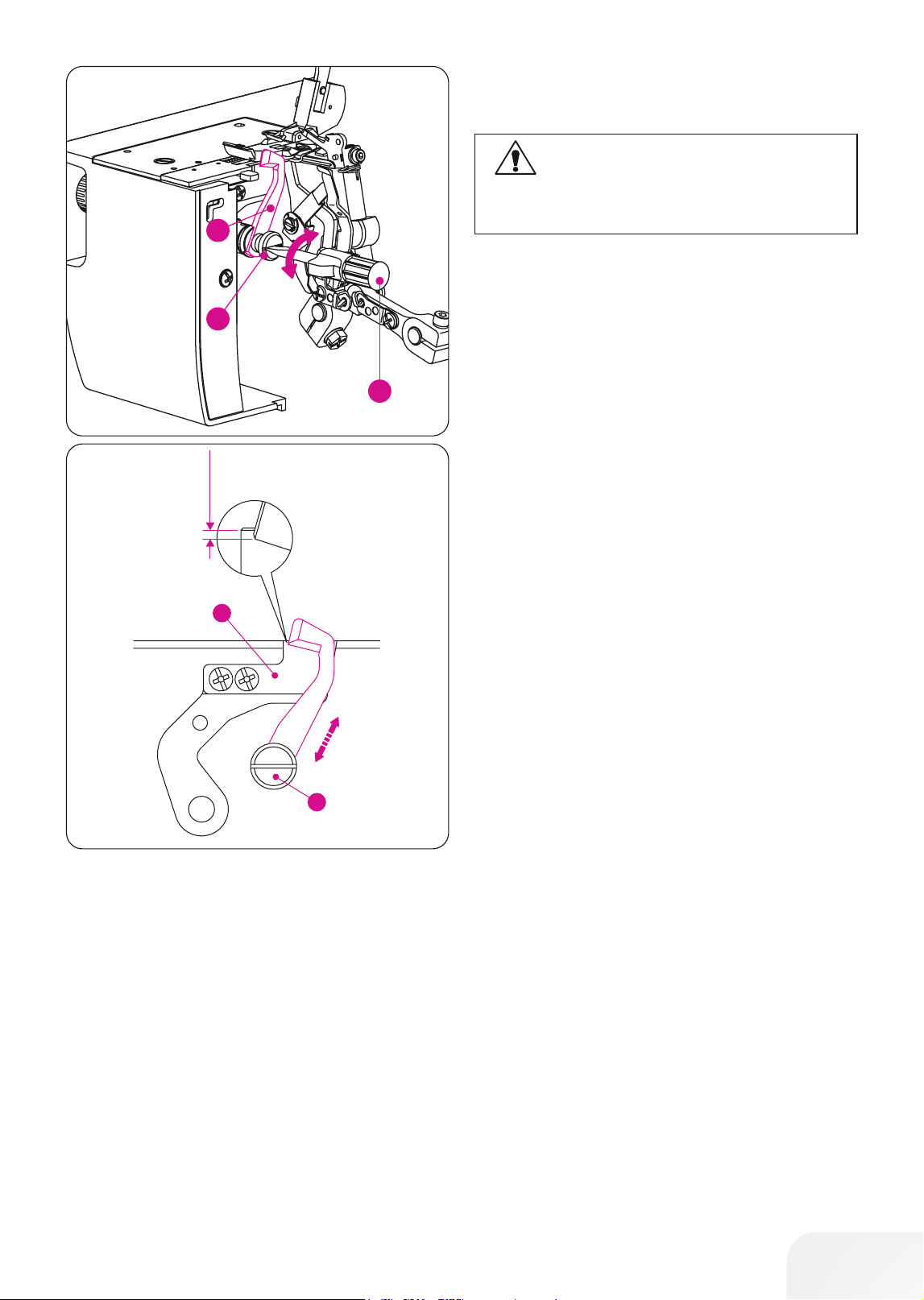
49
CAUTION:
Before replacing the upper knife, disconnect
power line plug from the wall receptacle.
mm1~5.0
c
b
a
b
d
mm1~5.0
c
b
a
b
d
Replace the Upper Knife
– The upper knife should be changed when it
becomes dull.
– The upper knife can be replaced according to
the directions provided, however if there are any
difficulties experienced, consult your dealer
representative to make the replacement.
– Be sure that the power line plug is disconnected
from the electric source.
(a) Open the looper cover and set the upper knife
in the working position.
(b) Loosen the upper knife set screw
(c) Remove the upper knife and turn the handwheel
to lower the upper knife holder to its lowest posi-
tion.
(d) In this position, put a new upper knife in the
groove of the upper knife holder, making sure
that the edge of the upper knife is approximately
0.5–1.0 mm below the surface of the fixed cut-
ting blade.
(b) Tighten upper knife set screw.
50
OPTIONAL ACCESSORIES
The following optional presser feet specially prepared
for this machine are available at extra–charge.
The snap–on type presser foot of this machine per-
mits easy removal and replacement.
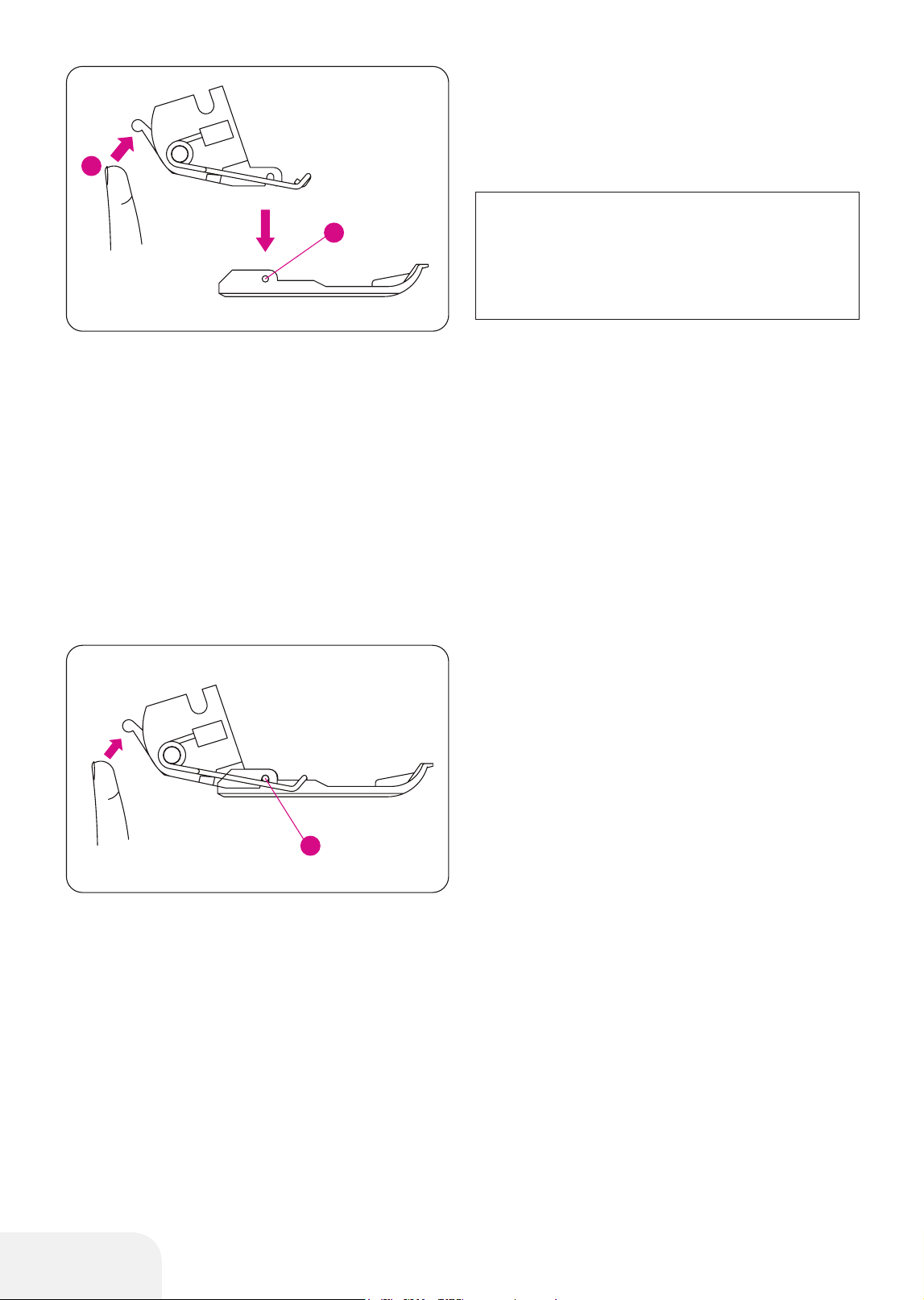
Snap–On Type Presser Foot
• Removal
– Turn the handwheel to raise the needles to the
highest position.
– Raise the presser foot.
– Press red colored lever (A) located on back of
clamp under the presser foot shank, raise
presser foot shank to its High Lift position and
while holding the presser foot shank in this posi-
tion, remove the presser foot sole.
• Replacement
– Place presser foot sole on stitch plate under
presser foot shank so that hinge pin
(C) will fit
in slot
(B) of the shank. Then lower presser foot
shank.
– If presser foot sole can not be placed under
presser foot shank easily, raise presser foot
shank to its High Lift position and while holding
it in this position, place presser foot sole under
presser foot shank. Then lower presser foot
shank.
– Raise presser foot shank and make sure the
presser foot sole is properly attached to the
presser foot shank.
PLEASE NOTE:
Do not use presser foot made for other machines.
Use of such presser foot may result in interfer-
ence with the needle and knife and can be haz-
ardous.
A
C
B
A
C
B
51
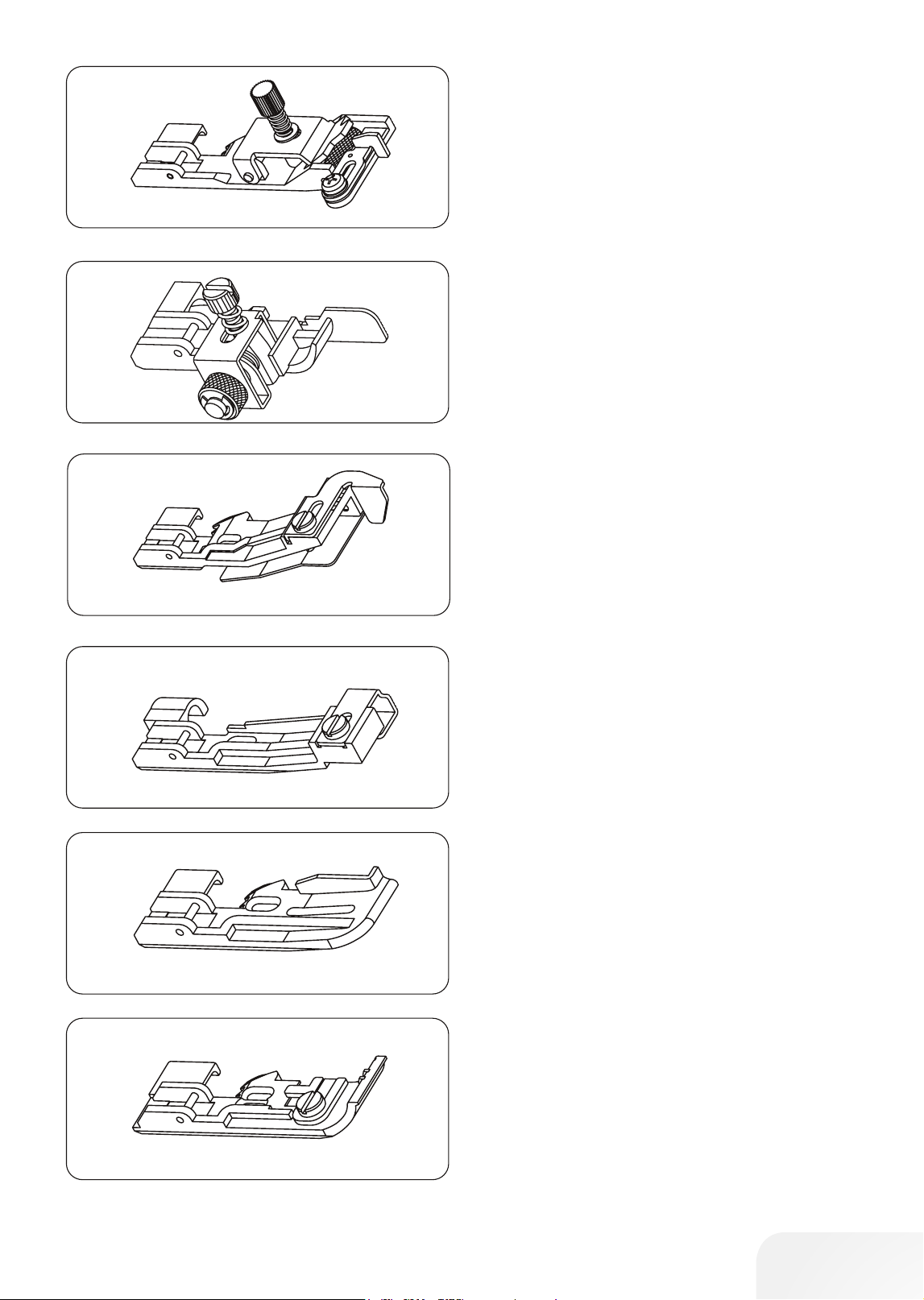
Optional Presser Feet
• Elasticator Foot
– This foot is used for attaching elastic tape to the
garment and the amount of contraction of the
elastic tape can be adjusted as required.
• Blind stitch Foot
– This foot is ideal for sewing blindstitch and
blindhem.
• Gathering Foot
– This foot is most suited for gathering when sew-
ing tiered skirts, yokes, cuffs and frills on skirts,
etc.
– This foot is also suited for sewing two fabrics
together and gathering the bottom fabric in one
operation.
• Beading/Sequins Foot
– This foot is used for sewing on strands of beads
and pearls.
• Piping Foot
– This foot is ideal to produce and sew in piping.
• Ribbon–couching Foot
– This sewing foot is suited for sewing on tapes,
etc.
52
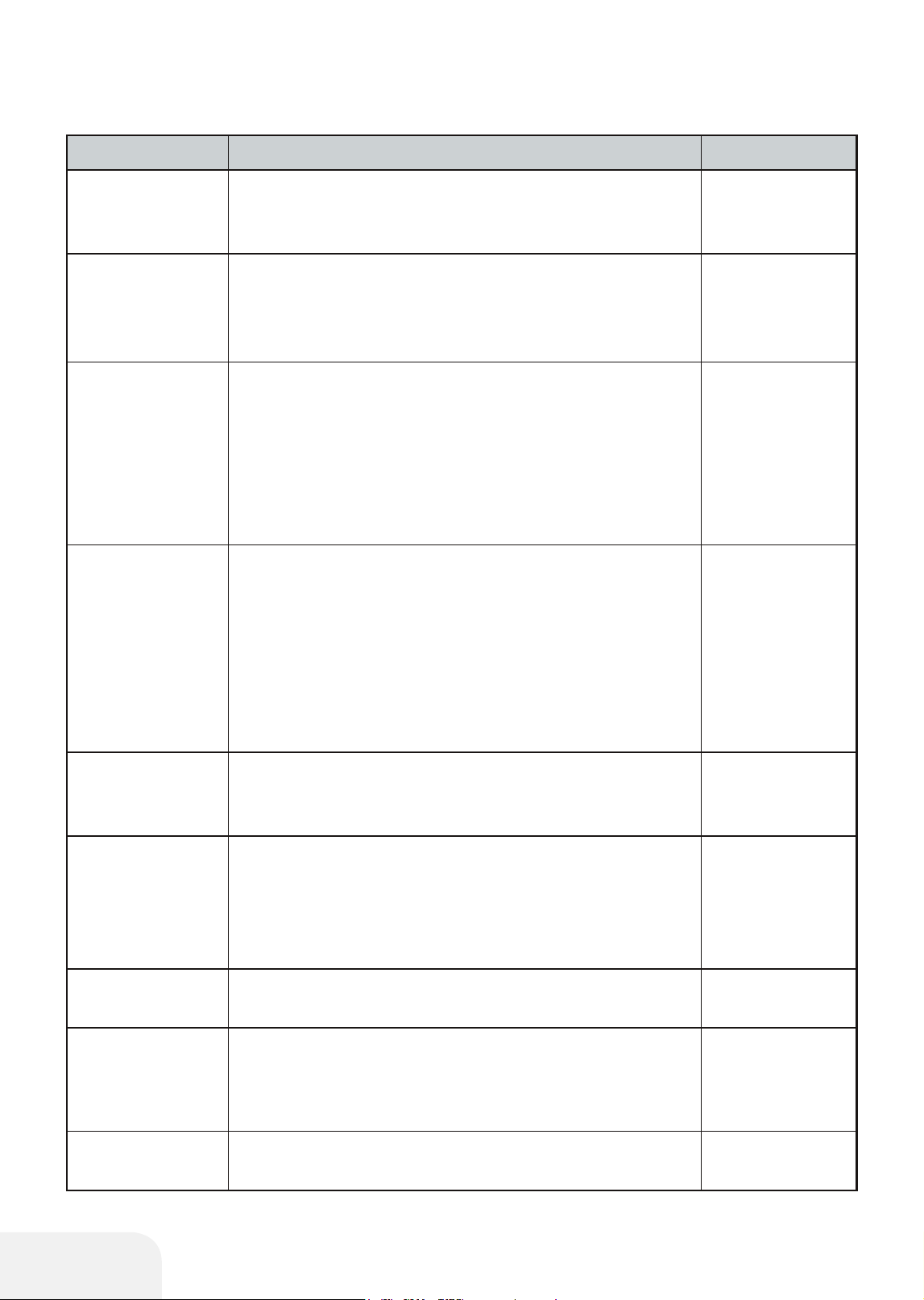
TROUBLESHOOTING
Condition Cause Remedy Page
Fabric does not
feed well.
1. Lengthen stitch length.
2. Increase presser foot pressure for heavy weight fabric.
3. Decrease presser foot pressure for light weight fabric.
27
28
28
Needle breaks.
1. Insert needle correctly.
2. Do not pull fabric while sewing.
3. Tighten needle set screw.
4. Use a larger needle on heavy fabrics.
16
31
16
16
Thread breaks.
1. Check threading.
2. Check for tangled or caught thread.
3. Insert needle correctly.
4. Insert new needle, current needle may be bent or have a
blunt point.
5. Use only high quality thread.
6. Loosen thread tension.
19–25
26
16
9
53
31–38
Stitch skip.
1. Insert new needles, current needles may be bent or have
a blunt point. Use only ELx705 overlock needles.
2. Tighten needle set screw.
3. Insert needles correctly.
4. Change type or size of needles.
5. Check threading.
6. Increase presser foot pressure.
7. Use a high quality thread.
9
16
16
16
19–25
28
53
Irregular stitches.
1. Balance thread tension.
2. Check for tangled or caught thread.
3. Check threading.
31–38
26
19–25
Fabric puckers.
1. Loosen thread tension.
2. Check for tangled or caught thread.
3. Use high quality light weight thread.
4. Shorten stitch length.
5. Decrease presser foot pressure for light weight fabrics.
31–38
26
53
27
28
Irregular trimming.
1. Check alignment of knives.
2. Replace one or both knives.
49
49
Fabric jams.
1. Close looper cover before sewing.
2. Check for tangled or caught thread.
3. Compress thick layers of fabric with conventional machine
before sewing with overlock.
10
26
Machine does not
operate.
1. Connect machine to power source and switch it on.
2. Close the looper cover.
10

53
FABRIC, THREAD AND NEEDLE CHART
Woven
Fabric Thread Needle ELx705
Light weight
Lawn
Organdy
Voile
Crepe
Cotton: #100
Silk/ Rayon: #100
Spun: #80 – #90
Polyester: #80 – #100
#80/12
Medium weight
Muslin
Seersucker
Satin
Gabardine
Broadcloth
Cotton: #60 – #80
Silk/ Rayon: #50
Spun: #60 – #80
Polyester: #60 – #80
#90/14, #80/12
Heavy weight
Oxford
Denim
Tweed
Serge
Corduroy
Cotton: #40 – #60
Silk/ Rayon: #40 – #60
Spun: #60 – #80
Polyester: #50 – #80
#90/14
Knit
Fabric Thread Needle ELx705
Light weight Tricot
Spun: #80 – #90
Polyester: #60 – #80
#80/12
Medium weight Jersey
Spun: #60 – #80
Polyester: #60 – #80
Cotton: #60 – #80
#90/14, #80/12
Heavy weight
Wool (woven,
knit)
Spun: #60 – #80
Polyester: #50 – #60
Woolly nylon
Woolly Polyester
#90/14, #80/12
54
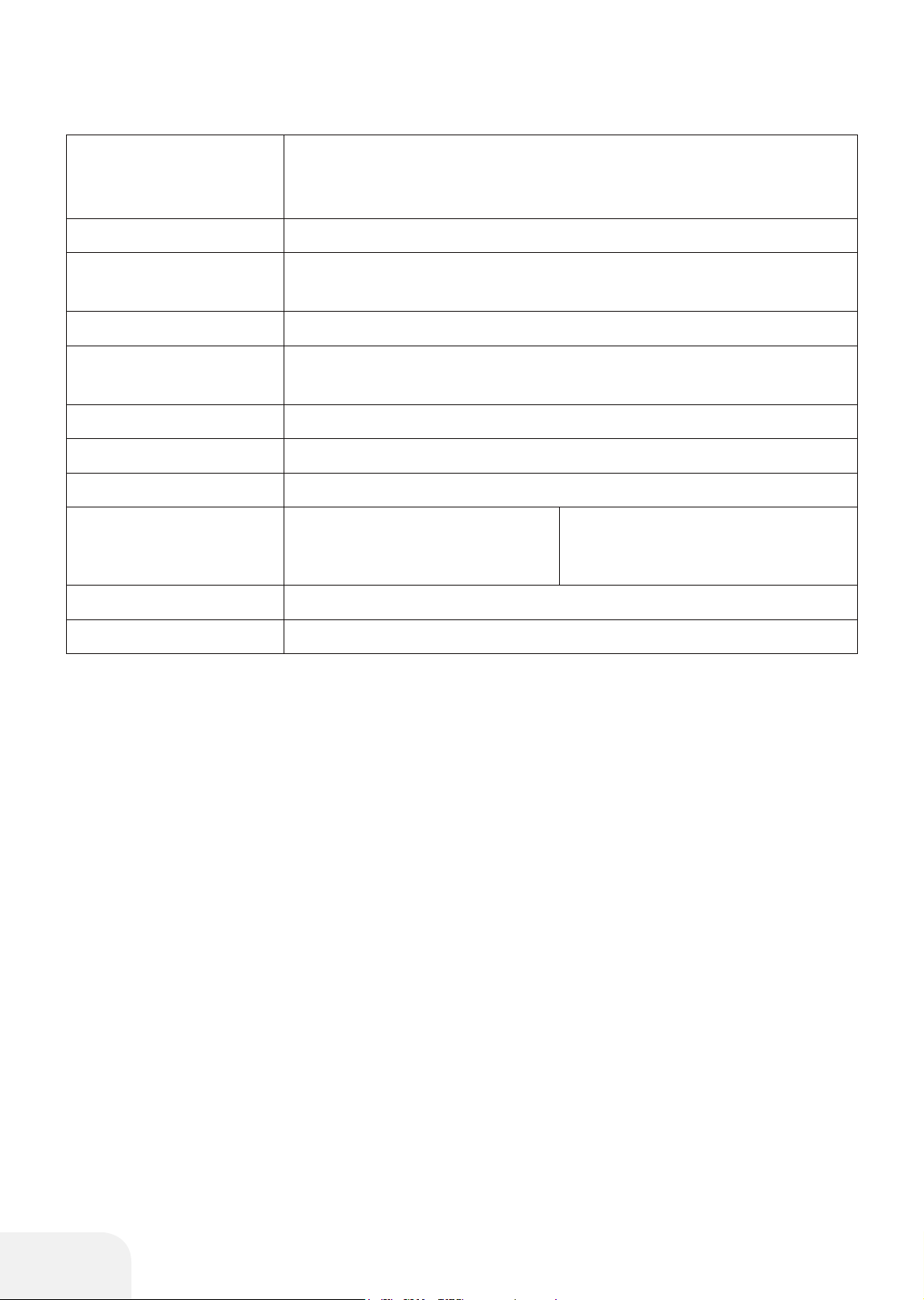
SPECIFICATION
Technical Summary
Stitch Formations 15 stitches
1–2 needles
2 loopers
Needle system ELx705
Cutting width 5–7 mm from the left needle
3–5 mm from the right needle
Stitch length 1–4 mm (standard: rolled hemming 1–2, standard: overlock 2.5)
Differential feed stretching 1–0.6
gathering 1–2
Presser foot lift 4.5 mm
Sewing light LED
Sewing speed 1300 stitches/minutes.
Foot control Type 4C–316B
for (USA/Canada)
Type 4C–316C / 4C–326C / 4C–326G /
4C–345G
for other countries
Dimensions (L x B x H) mm 336 x 263 x 294
Weight (kg) 7.2 kg
EN – 03/2023 – 5th Edition
5040005.0.04 / G8P01
© BERNINA International AG
Steckborn CH, www.bernina.com

www.mybernette.com/yellow-shirt
EN – 03/2023 – 5th Edition
5040005.0.04 / G8P02
© BERNINA International AG
Steckborn CH, www.bernina.com