Operating and installation
instructions
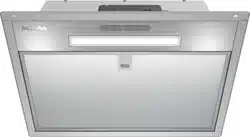
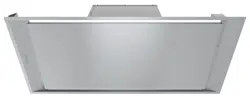
Ventilation hood
To prevent accidents and damage to the appliance, you must read
these instructions before installing the appliance and using it for the
first time.
en-US M.-Nr. 12 574 570

Contents
2
IMPORTANT SAFETY INSTRUCTIONS................................................................... 4
Sustainability and environmental protection.......................................................... 12
Familiarization................................................................................................................ 13
Guide to the ventilation hood.......................................................................................
13
Components ...................................................................................................................
14
Grease filters and panel........................................................................................... 14
Charcoal filter ............................................................................................................ 14
Overhead lighting...................................................................................................... 14
Functions.........................................................................................................................
15
Blower power levels ................................................................................................. 15
Delayed shutdown function .................................................................................... 15
Operating hours counter.......................................................................................... 15
Miele@home............................................................................................................. 16
Con@ctivity............................................................................................................... 16
Power management ................................................................................................. 16
Commissioning.............................................................................................................. 17
Selecting extraction mode or recirculation mode......................................................
17
Setting up Miele@home...............................................................................................
18
Performing Scan & Connect................................................................................... 18
Signing off Wi-Fi and remote control..................................................................... 19
Setting up Con@ctivity .................................................................................................
19
Activating Con@ctivity3.0 via the home Wi-Fi network................................... 19
Activating Con@ctivity3.0 via a direct Wi-Fi connection ................................. 19
Reattempting the connection ................................................................................. 20
Preparing the remote control........................................................................................
20
Signing on the remote control......................................................................................
20
Signing off the remote control ................................................................................ 20
Operation (automatic).................................................................................................. 21
Cooking with Con@ctivity over an electric cooktop.................................................
21
Cooking with Con@ctivity over a gas cooktop..........................................................
21
Temporarily exiting Automatic mode...........................................................................
22
Operation (manual)....................................................................................................... 23
Cooking without Con@ctivity (Manual mode) ..........................................................
23
Turning on the blower ....................................................................................................
23
Selecting the power level..............................................................................................
23
Selecting the delayed shutdown time.........................................................................
23
Turning off the blower....................................................................................................
23
Delayed shutdown in Plug&Play operation .......................................................... 23
Turning the overhead lighting on/off............................................................................
23

Contents
3
Customizing settings.................................................................................................... 24
Intervals for the grease filter operating hours counter..............................................
24
Changing the intervals for the grease filter operating hours counter................ 24
Intervals for the charcoal filter operating hours counter ..........................................
24
Altering or deactivating the charcoal filter operating hours counter intervals . 24
Safety shut-off........................................................................................................... 25
Energy-saving tips......................................................................................................... 26
Cleaning and care ......................................................................................................... 27
Cleaning the casing........................................................................................................
27
Grease filters and edge extraction panel ....................................................................
27
Condensation on the panel ..................................................................................... 28
Inserting the panel.................................................................................................... 30
Resetting the grease filter operating hours counter ............................................ 30
Replacing the grease filters..................................................................................... 30
OdorFree Charcoal Filter...............................................................................................
30
Resetting the charcoal filter operating hours counter......................................... 31
Disposing of charcoal filters.................................................................................... 31
Remote control ...............................................................................................................
31
Inserting/replacing batteries .................................................................................. 31
Cleaning the remote control ................................................................................... 31
Customer Service ......................................................................................................... 32
Contact in the event of a fault......................................................................................
32
Location of the data plate .............................................................................................
32
Appliance warranty and product registration .............................................................
32
Installation...................................................................................................................... 33
Before installation ..........................................................................................................
33
Removing the protective film........................................................................................
33
Coating the panel ...........................................................................................................
33
Installation materials......................................................................................................
33
Appliance dimensions....................................................................................................
34
Distance between cooktop and ventilation hood (S)................................................
37
Installation notes............................................................................................................
38
Plug&Play mode.............................................................................................................
38
Air venting........................................................................................................................
39
Non-return flap.......................................................................................................... 39
Condensate ............................................................................................................... 40
Reducing Collar ........................................................................................................ 40
Electrical connection .....................................................................................................
41
Technical data............................................................................................................... 42
Optional accessories for recirculation mode..............................................................
42
IMPORTANT SAFETY INSTRUCTIONS
4
READ AND SAVE THESE INSTRUCTIONS
This appliance complies with current safety requirements.
Improper use of the appliance can lead to personal injury and
material damage.
Read all instructions before installing or using the appliance for the
first time. Only use the appliance for its intended purpose.
Keep these operating instructions in a safe place and pass them on
to any future user.
Appropriate use
CAUTION: For General Ventilating Use Only. Do Not Use To
Exhaust Hazardous Or Explosive Materials And Vapors.
This appliance is intended for residential use only. Use only as
described in these operating instructions.
This ventilation hood is not intended for outdoor use.
It must only be used to extract and clean vapors produced during
cooking. Any other use occurs at the owner's own risk.
Where a recirculation ventilation hood is installed above a gas
cooktop, please check that all local codes are observed to insure an
adequate supply of fresh air.
This appliance is suitable for installation above gas or electric
cooking surfaces. Please refer to cooktop instructions.
Persons who lack physical, sensory or mental abilities, or
experience with the appliance should not use it without supervision
or instruction by a responsible person.
Safety with children
Children must be kept away from the ventilation hood unless they
are constantly supervised.
Children must not be allowed to clean or service the hood.
Please supervise children in the vicinity of the hood and do not let
them play with it.
The LED ClearView lighting is very intense.
Avoid looking directly into the light for prolonged periods of time.

IMPORTANT SAFETY INSTRUCTIONS
5
Danger of suffocation. While playing, children may become
entangled in packaging material (such as plastic wrapping) or pull it
over their head, presenting the risk of suffocation. Keep packaging
material away from children.
Keep the battery for the remote control out of the reach of children.
Technical safety
WARNING: TO REDUCE THE RISK OF FIRE, ELECTRIC SHOCK,
OR INJURY TO PERSONS, OBSERVE THE FOLLOWING:
- Use this appliance only in the manner intended by the
manufacturer. If you have questions, contact Miele.
- Before servicing or cleaning the appliance, switch power off at the
service panel and lock the service disconnecting means to prevent
power from being switched on accidentally. If the service
disconnecting means cannot be locked, securely fasten a
prominent warning device, such as a tag, to the service panel.
- Do not use replacement parts that have not been recommended
by the manufacturer (e.g. parts made at home using a 3D printer).
Unauthorized installation, maintenance, and repairs can cause
considerable danger for the user. Installation, maintenance, and
repairs should only be carried out by a Miele authorized technician.
A damaged ventilation hood can be dangerous. Always check for
visible signs of damage. Never use a damaged ventilation hood.
Be certain your appliance is properly installed and grounded by a
qualified technician. To guarantee the electrical safety of this
appliance, continuity must exist between the appliance and an
effective grounding system. It is imperative that this basic safety
requirement be met. If there is any doubt, have the electrical system
of the house checked by a qualified electrician.
Do not use a power bar or extension cord to connect the
ventilation hood to electricity. These are a fire hazard and do not
guarantee the required level of appliance safety.

IMPORTANT SAFETY INSTRUCTIONS
6
Temporary or permanent operation on an autonomous power
supply system or a power supply system that is not synchronized
with the grid power supply (e.g., island networks, back-up systems) is
possible. A prerequisite for operation is that the power supply system
complies with national and local codes.
The function and operation of the protective measures provided in
the domestic electrical installation and in this Miele product must
also be maintained in isolated operation or in operation that is not
synchronized with the grid power supply, or these measures must be
replaced by equivalent measures in the installation.
To avoid damaging the ventilation hood, make sure that the
connection data (voltage and frequency) on the data plate correspond
to the building's power supply before connecting the appliance.
If in doubt, consult a qualified electrician.
To ensure safe operation, only use the ventilation hood after it has
been properly installed.
This ventilation hood may not be used in non-stationary locations
(e.g. on a ship).
Adequate ventilation must be provided when the hood is operated
simultaneously with devices that burn gas or other fuels.
Only open the housing as described in the enclosed “Installation
diagram” and in the “Cleaning and care” section of this manual. Under
no circumstances should any other parts of the housing be opened.
Tampering with electrical connections or components and mechanical
parts is highly dangerous to the user and can cause operation faults.
During installation, maintenance, and repair work, the ventilation
hood must be disconnected from the electrical supply. It is only
completely isolated from the electricity supply if one of the following
applies:
- The circuit breakers on the electrical service panel are tripped.
- The screw-type fuses on the electrical service panel have been
removed.
- The power cord (if present) has been unplugged from the socket
(pull the plug not the cord).
While the ventilation hood is under warranty, repairs should be
undertaken by a service technician authorized by Miele Service.
Otherwise the warranty may be invalidated.

IMPORTANT SAFETY INSTRUCTIONS
7
If the power cord is damaged, it must only be replaced by a
qualified service technician.
The bulbs are a built-in component of the lighting. Replacement
bulbs should only be installed by a Miele authorized technician or by
Miele Service.
Important information on handling the remote control battery:
- Do not short circuit or recharge the battery, or throw it into a fire.
Danger of explosion!
- Do not throw old batteries away with your general household
waste. Please dispose of them in a designated battery collection
and recycling system.
Correct use
WARNING: TO REDUCE THE RISK OF A COOKTOP GREASE FIRE:
- a) Never leave surface units unattended. Boilovers cause smoking
and greasy spillovers may ignite. Heat oils slowly on low or
medium settings.
- b) Always turn the hood on when cooking at a high heat.
- c) Clean the ventilation hood frequently. Grease should not be
allowed to accumulate on the fan or filter.
- d) Use the proper pan size. Always use cookware appropriate for
the size of the cooking area.
Open flames are a fire hazard.
The use of an open flame under the ventilation hood is not permitted.
To avoid the danger of fire, do not flambé or grill over an open flame.
When switched on, the ventilation hood could draw flames into the
filter. Fat deposits could ignite, presenting a fire hazard.
Overheated oil and fat can ignite, causing fire damage to the
ventilation hood.
Do not leave cookware, pans, and deep-fat fryers unattended when
cooking with oil or fat. Similarly, never leave an open flame
unattended when grilling.

IMPORTANT SAFETY INSTRUCTIONS
8
WARNING: TO REDUCE THE RISK OF INJURY TO PERSONS IN
THE EVENT OF A COOKTOP GREASE FIRE, OBSERVE THE
FOLLOWING*:
- a) SMOTHER FLAMES with a close fitting lid, cookie sheet, or
metal tray then turn off the burner. BE CAREFUL TO PREVENT
BURNS. If the flames do not go out immediately, EVACUATE AND
CALL THE FIRE DEPARTMENT.
- b) NEVER PICK UP A FLAMING PAN - You may be burned.
- c) DO NOT USE WATER, including wet dishcloths or towels - a
violent steam explosion will result.
- d) Use a fire extinguisher ONLY if:
– 1) You have a class ABC extinguisher, and you know how to operate it.
– 2) The fire is small and contained in the area where it started.
– 3) The fire department is being called.
– 4) You can fight the fire with your back to an exit.
*Based on “Kitchen Fire Safety Tips” published by NFPA.
The ventilation hood may become damaged if exposed to
excessive heat from a gas cooktop.
- When using the ventilation hood over a gas cooktop, ensure that
any burners in use are always covered by cookware. Turn burners off
when removing the cookware, even if doing so for just a short time.
- Select cookware that is suitable for the size of the burner.
- Adjust the flame so that it never extends up the sides of the cookware.
- Avoid overheating the cookware (e.g., when cooking with a wok).
Always turn the ventilation hood on whenever a burner is in use to
prevent damage from condensation.
Fat and debris deposits impair the proper functioning of the
ventilation hood.
To ensure that cooking vapors are properly cleaned, never use the
ventilation hood without the grease filters in place.
Please note that the heat rising from the stovetop during cooking
can cause the ventilation hood to become very hot.
Do not touch the housing or the grease filters until the ventilation
hood has cooled down.

IMPORTANT SAFETY INSTRUCTIONS
9
Proper installation
WARNING: TO REDUCE THE RISK OF FIRE, ELECTRIC SHOCK,
OR INJURY TO PERSONS, OBSERVE THE FOLLOWING:
- a) Installation work and electrical wiring must be done by qualified
person(s) in accordance with all applicable codes and standards,
including fire-rated construction.
- b) Sufficient air is needed for combustion and exhausting of gases
through the flue (chimney of fuel burning equipment to prevent
back drafting. Follow the heating equipment manufacturer’s
guideline and safety standards such as those published by the
National Fire Protection Association (NFPA) and the American
Society for Heating, Refrigeration and Air Conditioning Engineers
(ASHRAE), and the local code authorities.
- c) When cutting or drilling into the wall or ceiling, do not damage
electrical wiring and other hidden utilities.
- d) Ducted hoods must always be vented to the outdoors.
- e) Do not use this hood with any solid-state speed control device.
To determine whether a ventilation hood may be operated above
your cooking appliance, please refer to the information provided by
the appliance’s manufacturer.
Safety regulations prohibit the installation of a ventilation hood
over solid fuel stoves.
An insufficient safety distance between the cooktop and the
ventilation hood can result in damage to the ventilation hood.
The minimum safety distances between the top of the cooktop and
the bottom of the ventilation hood given in the “Installation” section
of this manual must be observed, unless the cooktop manufacturer
states that a greater safety distance is required.
If more than one cooking appliance is installed beneath the
ventilation hood, and they have different minimum safety distances
to the ventilation hood, select the greater distance.
The information provided in “Installation” must be observed when
installing the ventilation hood.
Components can have sharp edges which may cause injury.
Wear gloves to protect your hands.

IMPORTANT SAFETY INSTRUCTIONS
10
When installing the exhaust duct, only use pipes or tubes made of
non-flammable material. These can be obtained from your Miele
dealer or from Miele Technical Service. Always observe local building
code requirements when selecting duct material.
Exhaust air should not be vented into a chimney or vent flue which
is otherwise in use and should not be channeled into ducting which
ventilates rooms with fuel-burning installations.
If exhaust air is to be extracted into a chimney or ventilation duct
no longer used for other purposes, seek professional advice.
WARNING: TO REDUCE THE RISK OF FIRE USE ONLY METAL
DUCTWORK.
Cleaning and maintenance
There is a risk of fire if cleaning is not completed according to the
instructions in this manual.
Never use a steam cleaner to clean the ventilation hood.
The steam can reach the electrical components and cause a short
circuit.
Accessories and parts
Use only genuine original Miele parts. If parts or accessories from
other manufacturers are used, the warranty may become void.
Defective components should be replaced by Miele original parts
only. Only with these parts can safety of the appliance be assured as
intended by the manufacturer.
FCC Declaration of Conformity
These devices comply with FCC Rules Part 15. This equipment has
been tested and found to be in compliance with the limits for a Class
B digital device, pursuant to Part 15 of the FCC Rules of Operation
and is subject to the following conditions:
These devices may not cause harmful interference.
These devices must accept any interference received, including
interference that may cause undesired operation.

IMPORTANT SAFETY INSTRUCTIONS
11
FCC Radiation Exposure Statement
This equipment complies with FCC radiation exposure limits set
forth for an uncontrolled environment. This equipment should be
installed and operated with minimum distance 8" (20cm) between
the radiator and your body.
Industry Canada Statement
This digital apparatus does not exceed the Class B limits for Radio
Noise Emissions from digital apparatus set out in the Radio
Interference Regulations of the Canadian Department of
Communications.
Complies with Canadian ICES-003 Class B specifications.
Sustainability and environmental protection
12
Disposal of the packing material
The cardboard box and packing
materials protect the appliance during
shipping. They have been designed to
be biodegradable and recyclable.
Ensure that any plastic wrappings, bags,
etc. are disposed of safely and kept out
of the reach of children. Danger of
suffocation!
Disposal of your old appliance
Electrical and electronic appliances
contain valuable materials. They also
contain certain substances, compounds
and components which were essential
for the proper functioning and safe use
of the equipment. Handling these
materials improperly by disposing of
them in your household waste can be
harmful to your health and the
environment. Therefore, please do not
dispose of your old appliance with
regular household waste and follow
local regulations on proper disposal.
Consult with local authorities, dealers or
Miele in order to dispose of and recycle
electrical and electronic appliances.
Miele assumes no responsibility for
deleting any personal data left on the
appliance being disposed. Please
ensure that your old appliance is kept
away from children until removal.
Observe safety requirements for
appliances that may tip over or pose an
entrapment hazard.
Disposal of old batteries and
power packs
Electrical and electronic appliances
often contain batteries and power packs
which must not go into household
waste after use. Please remove all
accessible batteries and take them to a
suitable collection site where they can
be collected free of charge. Batteries
and power packs may contain
substances which are harmful to your
health and the environment.
The labeling on the battery or power
pack gives further information. The
crossed-out trash can means that
batteries and power packs must not be
disposed of with the household waste.
If the crossed-out has one or more of
the listed chemical symbols, it contains
lead (Pb), cadmium (Cd) and/or mercury
(Hg).
3E&G+J
Old batteries and power packs contain
important raw materials and can be
recycled. Separately collecting old
batteries and power packs facilitates
handling and recycling.
Familiarization
13
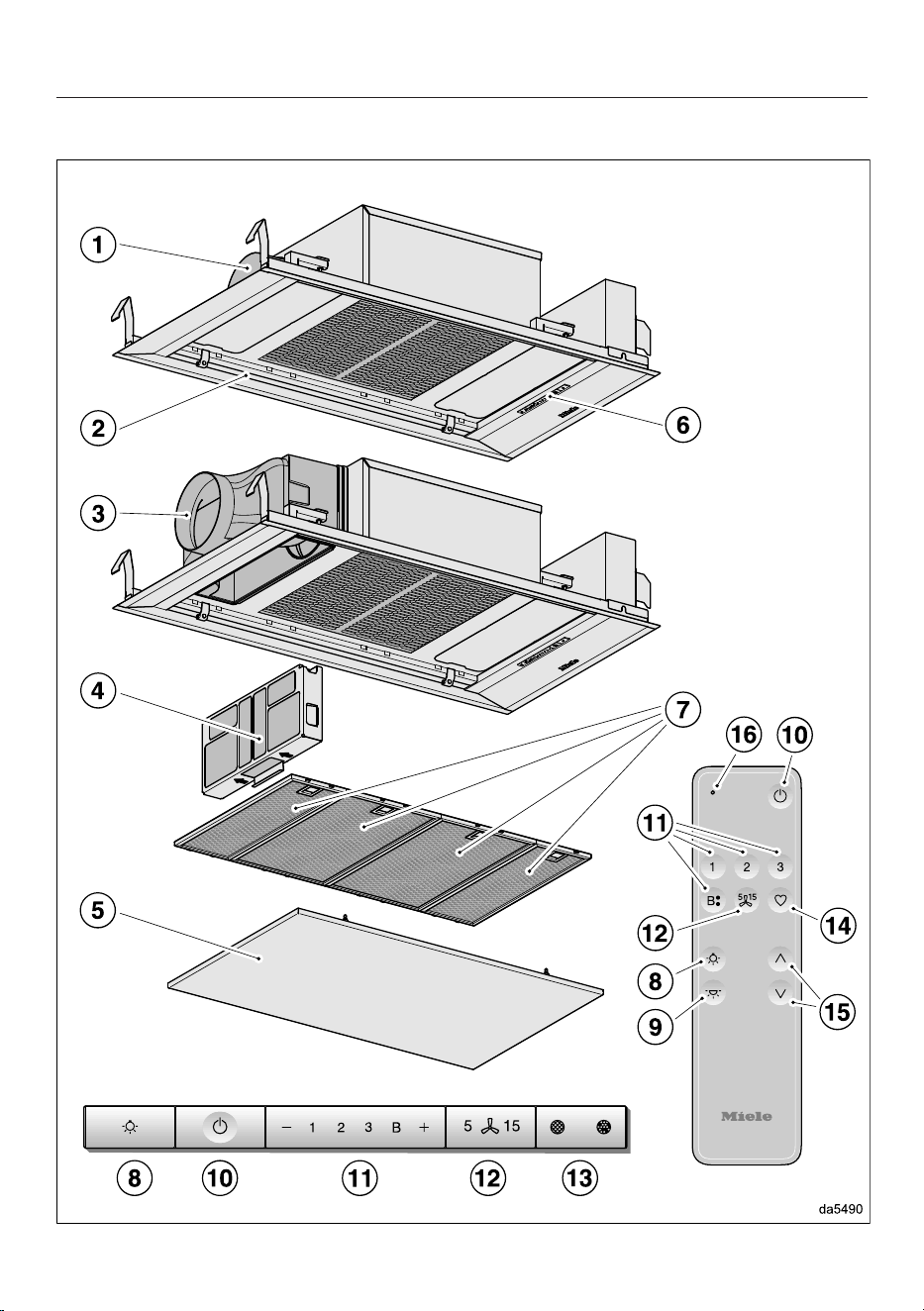
Guide to the ventilation hood

Familiarization
14
a
Exhaust duct
Exhaust air can be directed to the
left-hand side, to the rear, or to the
front.
b
Overhead lighting
c
Ventilation grille for recirculation
mode
d
Charcoal filters
Optional accessories for recirculation
mode
e
Edge extraction panel
f
Controls
g
Grease filter
h
Button for switching the lighting on
and off
i
Inoperative control
j
Control for switching the blower on
and off
k
Controls for setting the blower
power
l
Control for the delayed shutdown
function
m
Control for the filter saturation
indicator
n
Model specific control
o
Model specific controls
p
Indicator light
Components
Grease filters and panel
The edge extraction panel and the re-
usable metal grease filters in the
appliance remove solid particles
(grease, dust, etc.) from the kitchen
vapors, preventing soiling of the
ventilation hood.
Risk of fire
Oversaturated grease filters are a fire
hazard.
Clean the grease filters at regular
intervals.
Heavily soiled grease filters hinder the
extraction power and will lead to
increased levels of soiling in the
ventilation hood and in the kitchen.
Charcoal filter
With recirculation mode and Plug&Play
recirculation mode, a charcoal filter
must be installed in addition to the
grease filters. This filter is designed to
absorb cooking odors.
The charcoal filter is available as an
optional accessory. It can be reactivated
at the end of its operating time.
Overhead lighting
The overhead lighting can be turned on
and off separately from the blower.
Familiarization
15
Functions
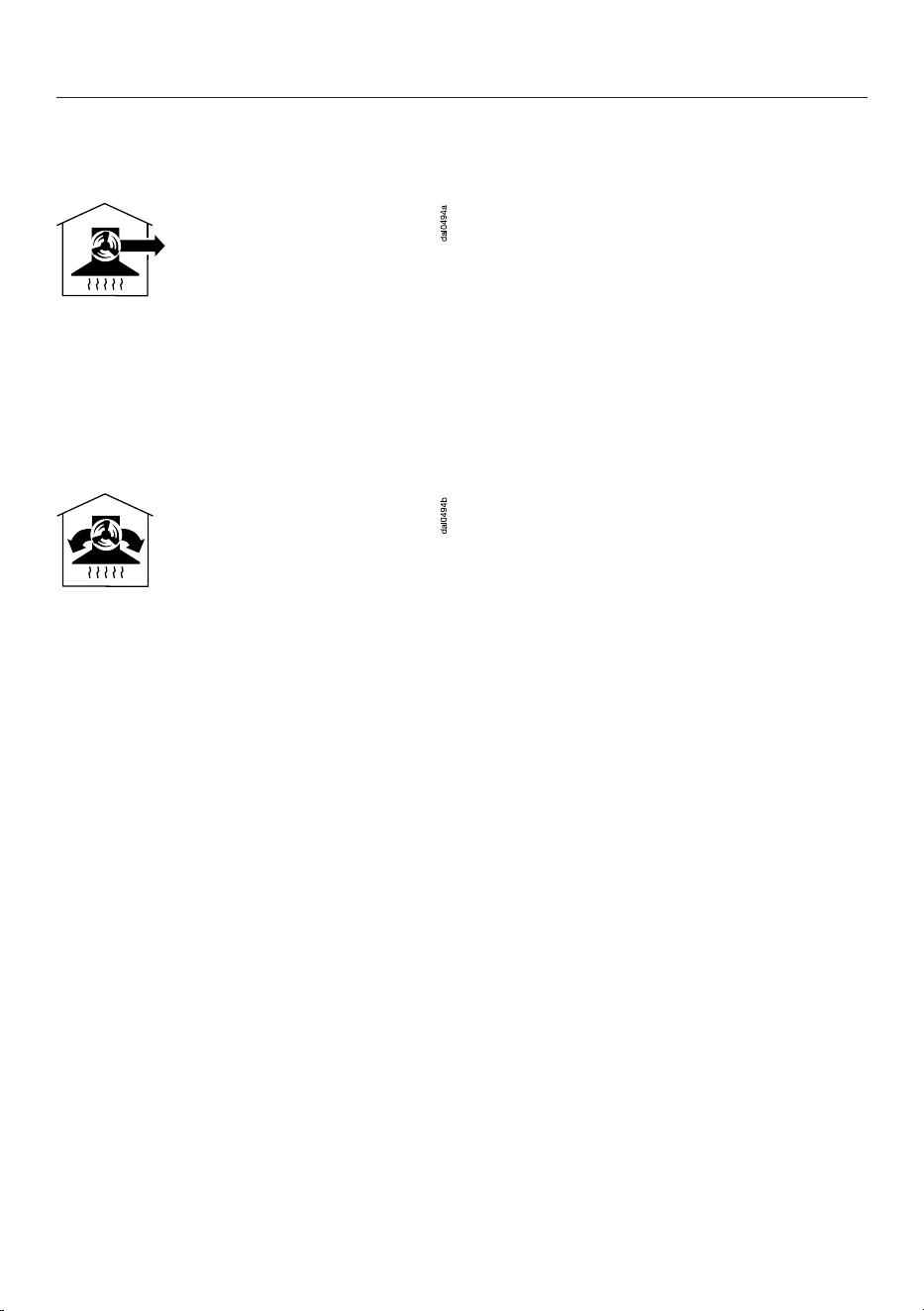
Extraction mode
The air is drawn in and cleaned by the
grease filters and directed outside.
Recirculation mode
(A charcoal filter is required. Please
purchase separately. See “Technical
data”.)
The air is drawn in and cleaned first by
the grease filters and then by a charcoal
filter. The air is then circulated back into
the kitchen.
Plug&Play recirculation mode
The air is drawn in and cleaned first by
the grease filters and then by a charcoal
filter. Without an air duct through the
ceiling, the air is then circulated back
into the kitchen. Please follow the
instructions in “Installation”.
Kitchen ventilation
Ensure that the kitchen is well ventilated
when operating the ventilation hood.
In vented mode, the efficiency of the
ventilation hood is improved by the
incoming air.
In recirculation mode, the moisture
produced during cooking remains in the
kitchen. Ventilation helps to dissipate
moisture.
Blower power levels
Select power levels 1 to 3 for light to
heavy cooking vapors, odors, or heat.
Increase the power level as the level of
vapors, odors, or heat increases.
For short periods of cooking food with
intensive vapors, odors, or heat, e.g.,
when searing meat, select Booster level
B. The blower will automatically switch
back from the Booster level after
5minutes.
Delayed shutdown function
The delayed shutdown function enables
the blower to continue running for a pre-
determined time before switching itself
off automatically.
This helps to remove any lingering
vapors and odors from the air after
cooking. It also reduces the risk of
residues accumulating in the ventilation
hood and any resulting odors.
Operating hours counter
The ventilation hood registers the length
of time for which it has been operated.
When the grease filter symbol lights
up, the grease filters must be cleaned.
When the charcoal filter symbol
lights up, the charcoal filter must be
replaced or reactivated (if suitable for
reactivating).
You can set the operating hours counter
intervals to suit the type of cooking you
do.
Deactivate the operating hours counter
for the charcoal filter if you are operating
the ventilation hood in vented mode.

Familiarization
16
Miele@home
You can connect the ventilation hood to
your home Wi-Fi network and operate it
using the Miele app on your mobile
device.
If your Miele cooktop is also connected
to your Wi-Fi network, the Con@ctivity
function will be activated automatically.
Con@ctivity
With the Con@ctivity function, the
ventilation hood is automatically
controlled in conjunction with the
cooktop. The ventilation hood and Miele
cooktop must be connected to the
home Wi-Fi network or have a direct
Wi-Fi connection.
The ventilation hood can also be
operated manually at any time during
automatic operation.
Power management
The ventilation hood is equipped with a
power management system. Power
management helps to save energy. It
ensures that the blower power level is
reduced automatically and that the
lighting is switched off.
- If the booster level is selected, the
blower automatically switches to level
3 after 5 minutes.
- If the blower is set to level 3, 2, or 1, it
switches back one blower setting
after 2 hours and then in 30-minute
intervals until the blower eventually
switches off.
- The overhead lighting will switch off
automatically after 12hours.
Commissioning
17
Settings are made via the ventilation
hood control panel, not via the remote
control.
Selecting extraction mode or
recirculation mode
The ventilation hood can be operated
with either extraction mode or
recirculation mode. The power of the
blower is adapted to suit the selected
mode of operation. The ventilation
hood is set up at the factory for
recirculation mode. The ventilation
hood has to be reset for extraction
mode.
To reset it for extraction mode, the filter
saturation indicator for the charcoal
filter(s) has to be deactivated.
Switch off the blower and the lighting.
Press the control and the
operating-hours control at the
same time.
The charcoal filter symbol and one of
the blower power level indicators will
flash.
Press and hold the control until the
B indicator starts to flash.
Confirm the selection by pressing the
operating-hours control.
All the indicator lights will go out.
Extraction mode has now been set.
If the selection is not confirmed within
4minutes, the system will revert to the
previous setting.
Activating/deactivating
Plug&Play
Switch off the blower and the lighting.
Press the delayed shutdown
control for approx. 10seconds
until 1 lights up.
Then press, in turn:
- the control
- the lighting control and
- the lighting control again
When Plug&Play is deactivated, 1 and 3
will flash.
When Plug&Play is activated, 1 and 3
will light up constantly.
Press the control to activate.
1 and 3 will light up constantly.
Press the control to deactivate.
1 and 3 will flash.
Confirm the setting by pressing the
delayed shutdown control.
All the indicator lights will go out.
Commissioning
18
Setting up Miele@home
Prerequisites:
- A Wi-Fi network
- The Miele app
- A Miele user account. You can
create a user account via the Miele
app.
Before installing the ventilation hood
in its final location, ensure that the
signal of your WiFi network is strong
enough.
Miele@home availability
The ability to use the Miele app
depends on the availability of the
Miele@home service in your country.
The Miele@home service is not
available in every country.
For information about availability, please
visit www.miele.com.
Performing Scan & Connect
Scan the QR code.
If you have installed the Miele app and
have a user account, you will be taken
directly to the networking steps.
If you have not yet installed the Miele
app, you will be taken to the Apple App
Store
®
or the Google Play Store™.
Install the Miele app and set up a user
account.
Scan the QR code again.
The Miele app will guide you through
the setup process.
Commissioning
19
Signing off Wi-Fi and remote control
To set up a new Wi-Fi connection or a
connection with a remote control, the
existing connections must be
disconnected first.
The sign-off process will always sign
off the Wi-Fi and a connected remote
control at the same time.
Switch the ventilation hood off.
Press and hold the control.
Touch the lighting control at the
same time.
With an existing Wi-Fi connection, 2
and 3 will light up constantly.
If a remote control is signed on, B will
also light up.
Touch the control.
2 will light up constantly, 3 will flash on
and off.
After a few seconds, 2 and 3 will flash
on and off. The connection has now
been disconnected.
Quit disconnection mode on the
ventilation hood by pressing the
delayed shutdown control.
Press the B and controls on the
remote control at the same time.
All connections have been
disconnected. You can establish a new
connection.
Setting up Con@ctivity
Activating Con@ctivity3.0 via the
home Wi-Fi network
Prerequisites:
- Home Wi-Fi network
- Wi-Fi-enabled Miele cooktop
Connect the ventilation hood and
cooktop to your home Wi-Fi network
(see “Setting up Miele@home”).
The Con@ctivity function will be
activated automatically.
Activating Con@ctivity3.0 via a direct
Wi-Fi connection
Rather than connecting to the home
network, you can establish a direct
connection between the cooktop and
the ventilation hood.
Prerequisite:
- Wi-Fi-enabled Miele cooktop
Switch the ventilation hood off.
Press and hold the control.
Press the control at the same time.
2 will light up constantly, 3 will flash on
and off.
The ventilation hood will be ready for
connection for the next 2minutes.
Start the Wi-Fi connection on the
cooktop. For more details, see the
cooktop operating instructions.
When successfully connected, 2 and 3
will light up constantly.
Quit connection mode on the
ventilation hood by pressing the
delayed shutdown control.
Con@ctivity has now been activated.

Commissioning
20
With a direct Wi-Fi connection, it is
not possible to connect the cooktop
and the ventilation hood to a home
network. Should this be required at a
later date, the direct Wi-Fi connection
between the cooktop and the
ventilation hood must be disconnected
first (see “Signing out of Wi-Fi”).
Reattempting the connection
If it is not possible to connect, 2 and 3
flash or the ventilation hood cancels the
process.
Disconnect the connection to the
ventilation hood (see “Signing out of
Wi-Fi”) and to the cooktop.
Attempt to make the connection
again.
Preparing the remote control
Insert the batteries into the remote
control; see “Cleaning and care –
Inserting/replacing batteries”.
Signing on the remote control
Press and hold the control on the
ventilation hood for approx.
10seconds.
2 will light up constantly, 3 will flash on
and off.
Press the 1 and 3 controls on the
remote control at the same time until
the indicator starts flashing red.
The sign-on process starts.
The indicator light will briefly flash green
if the sign-on process is successful.
2 and 3 will light up constantly on the
ventilation hood.
Confirm the setting on the ventilation
hood with the delayed shutdown
control.
If the sign-on process was not
successful, 2 and 3 will flash.
In this case, repeat the process.
Signing off the remote control
For information about the sign-off
process, see “Commissioning –
Signing off Wi-Fi and remote control”.
Operation (automatic)
21
Cooking with Con@ctivity over
an electric cooktop
Switch on a cooking zone at any
power level.
The overhead lighting will come on.
After a few seconds, the blower will
come on, briefly operating at power
level 2 before switching to level 1.
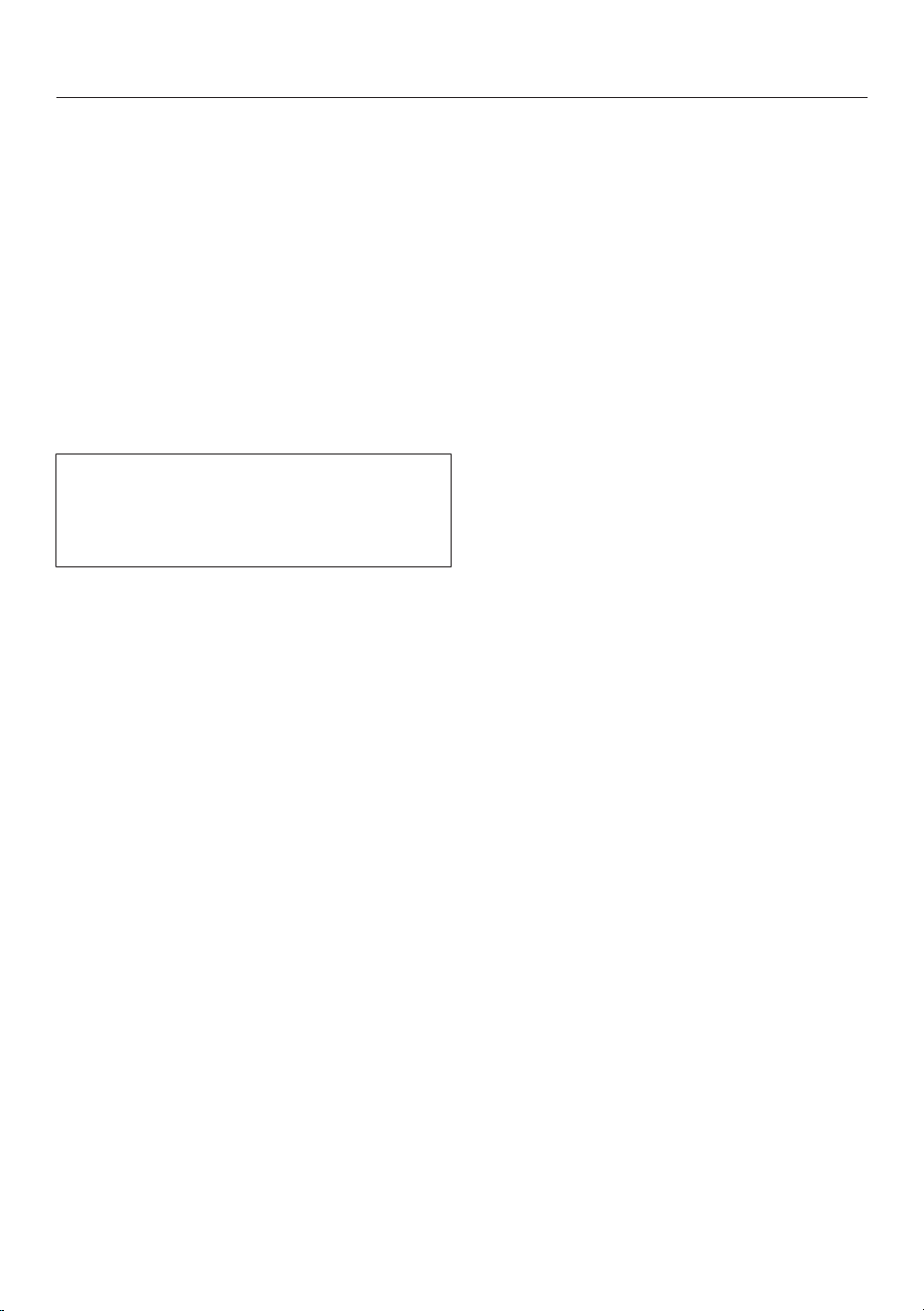
The ventilation hood selects the
required blower power level
automatically during cooking. The power
level selected by the ventilation hood
depends on the number of cooking
zones being used and their power
levels.
The ventilation hood responds with a
delay. This takes into account the fact
that changing the power level at the
cooktop does not increase or decrease
the cooking vapors straight away.
Examples for blower levels 1 to B
Switch off all cooking zones after
cooking.
Over the next few minutes, the
ventilation hood blower setting will
decrease one level at a time until the
hood eventually turns off.
This helps to neutralize any lingering
vapors and odors in the air.
After another 30seconds, the overhead
lighting turns off.
Frying with Con@ctivity
For example, you switch on a cooking
zone at the highest power level to
heat cookware for frying. You reduce
the power level after approx.
10seconds to 4minutes (60seconds
to 5minutes for a HiLight cooktop).
The ventilation hood recognizes a
cooking process.
The ventilation hood turns itself on and
when the cooktop power level has been
reduced, the ventilation hood switches
to power level 3 and remains at that
level for approx. 5minutes.
After this, the blower level is once again
determined by the Con@ctivity
function.
You can also manually select a different
blower level before then.
Cooking with Con@ctivity over
a gas cooktop
Switch on a burner at any power level.
The overhead lighting will come on.
After a few seconds, the blower will
come on at power level 2.
Regardless of the selected cooking
level, the blower remains at power level
2.
Switch off all burners after cooking.
The delayed shutdown function is
activated. The 5 on the delayed
shutdown control will light up.
After 5minutes, the blower and the
overhead lighting will switch off.
This helps to neutralize any lingering
vapors and odors in the air.
Operation (automatic)
22
Temporarily exiting Automatic
mode
To exit Automatic mode temporarily:
Manually select a different blower
power level, or
Manually switch the ventilation hood
off, or
Activate the delayed shutdown
function, or
Operate the overhead lighting (only in
combination with a gas cooktop)
If you switch off the blower manually in
Plug&Play mode, it continues to run at
level 1 (see “Operation (Manual mode)
– Switching off the blower”).
Resuming Automatic mode
In combination with an electric cooktop:
- If the ventilation hood has not been
used for a period of approx. 5minutes
after the manual selection of a blower
level; or
- If the manually selected blower level
once again matches the automatic
setting; or
- The ventilation hood blower and the
cooktop have been switched off for at
least 30seconds.
Automatic mode will resume next
time the cooktop is switched on.
In combination with a gas cooktop:
- The ventilation hood blower and the
cooktop have been switched off for at
least 30seconds.
Automatic mode will resume next
time the cooktop is switched on.
Exiting Automatic mode for the entire
cooking process
Switch the blower on before the
cooktop.
Con@ctivity is deactivated until the
ventilation hood is switched off.
If the ventilation hood and the cooktop
have been switched off for at least
30seconds after cooking, Automatic
mode will resume next time the cooktop
is switched on.

Operation (manual)
23
Cooking without Con@ctivity
(Manual mode)
The ventilation hood can be operated
manually if:
- The Con@ctivity function is not
activated.
- You have temporarily deactivated the
Con@ctivity function (see “Operation
(Automatic mode) – Temporarily
exiting Automatic mode”).
Turning on the blower
Press the On/Off control.
The blower switches on at power level
2.
Selecting the power level
Use the and controls on the
ventilation hood or the 1, 2, 3, and B
controls on the remote control to
select the power level required.
Reducing power down from the
Booster level
The blower automatically switches back
to power level 3 after 5minutes.
Selecting the delayed shutdown
time
After you have finished cooking, press
the delayed shutdown control
while the blower is still running:
- Once: The blower switches off after
5minutes (5 lights up).
- Twice: The blower switches off after
15minutes (15 lights up).
- If you touch the delayed shutdown
control again, the blower will
remain switched on ( will go out).
Turning off the blower
Press the On/Off control to turn
the blower off.
The symbol will go out.
Delayed shutdown in Plug&Play
operation
If you switch off the blower in
Plug&Play mode, it will run on at level1.
Delayed shutdown ensures that the
ceiling is ventilated after cooking.
Depending on the last active blower
level, delayed shutdown lasts between
2 and 30minutes.
You can switch off the blower
immediately during delayed shutdown
by pressing 1 or the On/Off switch.
This function is independent of the
delayed shutdown function.
Turning the overhead lighting
on/off
Press the lighting control to switch
it on or off.

Customizing settings
24
Settings are made via the ventilation
hood control panel, not via the remote
control.
Intervals for the grease filter
operating hours counter
The factory default setting is a cleaning
interval of 30hours.
- Select a shorter interval of 20hours if
you fry food regularly.
- A shorter cleaning interval is also
recommended if you only cook
occasionally. This will prevent grease
buildup from hardening and making
cleaning more difficult.
- Select a longer interval of 40 or
50hours if you use very little fat for
cooking.
Changing the intervals for the grease
filter operating hours counter
Switch off the blower and the lighting.
Press the delayed shutdown
control and the operating hours
control at the same time.
The grease filter symbol and one of
the blower power level indicators will
flash.
The indicators 1 to B show the current
time setting:
Indicator 1................................... 20hours
Indicator 2 .................................. 30hours
Indicator 3 .................................. 40hours
Indicator B.................................. 50hours
Press the button for a shorter
duration, or for a longer duration.
Confirm the selection by pressing the
operating hours control.
All the indicator lights will go out.
If the selection is not confirmed within
4minutes, the system will revert to the
previous setting.
Intervals for the charcoal filter
operating hours counter
The factory default setting is an interval
of 180hours.
- If you frequently cook dishes with
strong odors, it is recommended to
shorten the interval to 120hours.
- If you rarely cook dishes with strong
odors, you can extend the interval to
240hours.
Altering or deactivating the charcoal
filter operating hours counter intervals
Switch off the blower and the lighting.
Press the control and the operating
hours control at the same time.
The charcoal filter symbol and one of
the blower power level indicators will
flash.
The indicators 1 to B show the current
time setting:
Indicator 1................................. 120hours
Indicator 2 ................................ 180hours
Indicator 3 ................................ 240hours
Indicator B............................. deactivated
Press the or control to select the
required duration.
Confirm the selection by pressing the
operating hours control.
All the indicator lights will go out.
If the selection is not confirmed within
4minutes, the system will revert to the
previous setting.

Customizing settings
25
Activating/deactivating power
management
Keep in mind that deactivating this
function may increase energy
consumption.
Switch off the blower and the lighting.
Press the delayed shutdown
control for approx. 10seconds
until 1 lights up.
Then press, in turn:
- the lighting control
- the control, and then
- the lighting control
When power management is activated,
1 and B light up constantly.
When it is deactivated, 1 and B flash.
Press the control to deactivate
power management.
1 and B will flash.
Press the control to activate power
management.
1 and B will light up constantly.
Confirm the setting by pressing the
delayed shutdown control.
Safety shut-off
If power management has been
deactivated, the ventilation hood will
switch itself off automatically after
12hours if it has been left on (blower
and overhead lighting).
To switch it back on, press the On/
Off control or the lighting
control.

Energy-saving tips
26
This hood operates in a very efficient
and energy-saving manner. The
following will help you to save even
more energy when using it:
- Ensure that there is sufficient
ventilation in the kitchen when
cooking. If there is insufficient air flow
during extraction mode, the hood
cannot operate efficiently, causing
increased operating noise levels.
- Always cook with the lowest possible
setting. This produces fewer cooking
vapors so that you can use a lower
hood power level and therefore
benefit from reduced energy
consumption.
- Clean or change the filters at regular
intervals. Heavily soiled filters reduce
performance, increase the risk of fire
and are unhygienic.
- Use the Con@ctivity function. The
ventilation hood will switch on and off
automatically. The ventilation hood
will select the optimum power level
for the cooking you are doing, which
ensures low energy consumption.
- If you are operating the ventilation
hood manually, please note the
following:
– Check the power level selected on
the ventilation hood. A low power
level is usually sufficient. Only use
the Booster setting when
necessary.
– When a large volume of cooking
vapors are being produced, switch
to a high power level in good time.
This is more efficient than
operating the hood for longer to try
to capture cooking vapors that
have already been distributed
throughout the kitchen.
– Make sure that you switch off the
hood after use.
If cooking vapors and odors still
need to be removed from the
kitchen air after cooking, use the
delayed shutdown function. The
blower will switch off automatically
after the selected delayed
shutdown time.
Cleaning and care
27
Before proceeding with any
maintenance or cleaning task, the
ventilation hood must be
disconnected from the power supply,
see “IMPORTANT SAFETY
INSTRUCTIONS”.
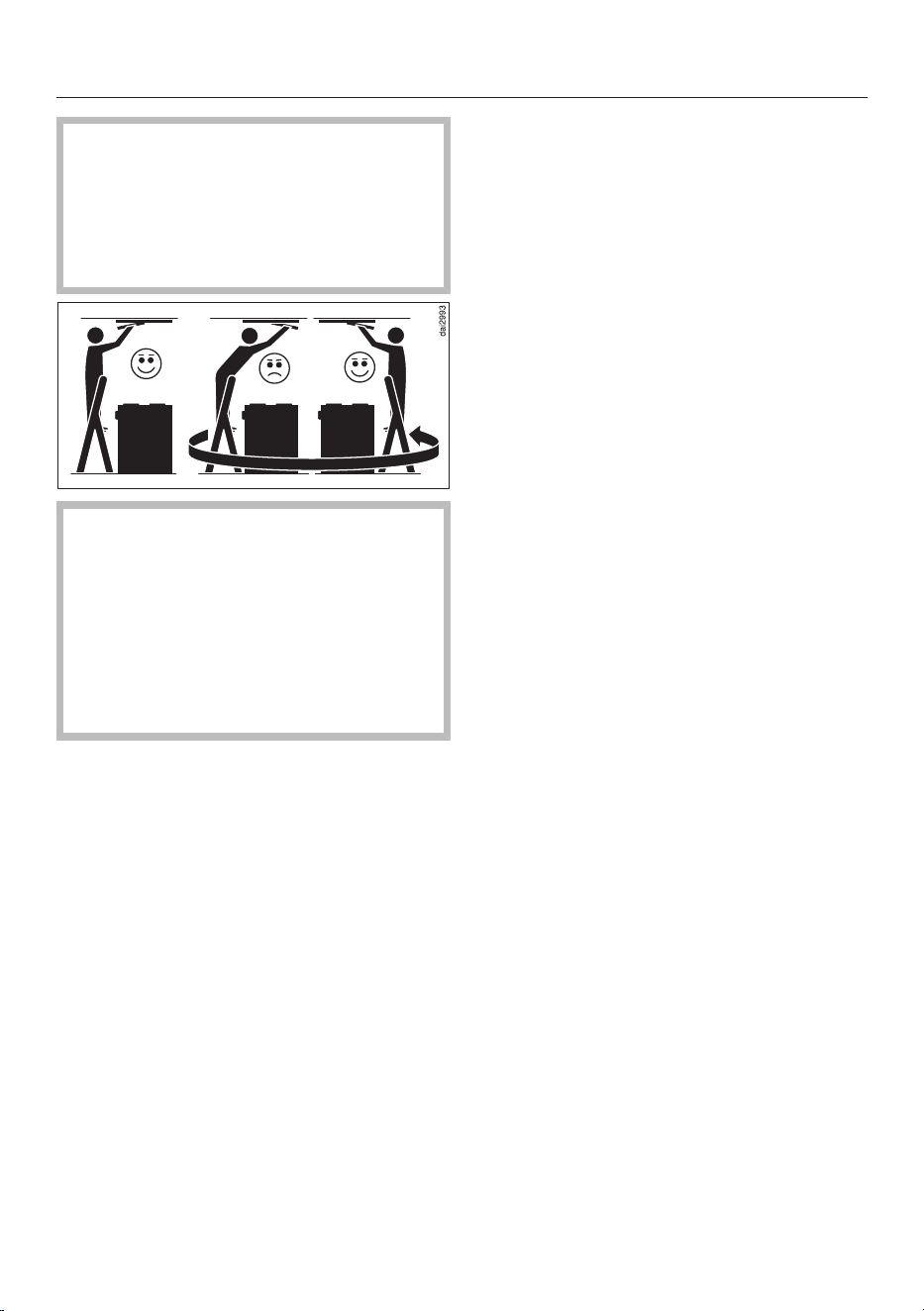
When cleaning the ventilation
hood, please note the following:
Use a stable ladder.
Make sure that you have a secure
footing on the ladder.
Do not lean over the cooktop.
Do not stand on the countertop or
the cooktop.
Cleaning the casing
Clean all surfaces and control
elements with a sponge cloth and a
solution of warm water and liquid dish
soap.
Remove the grease filters and clean
any grease residues from the
accessible parts of the casing. Doing
so will prevent a fire hazard.
After cleaning, wipe the surfaces dry
using a soft cloth.
In addition, stainless steel surfaces
can be cleaned using a non-abrasive
stainless steel cleaner (not suitable
for the controls).
To prevent the surfaces from quickly
becoming dirty again, it is
recommended to treat them with a
stainless steel care product (available
from Miele).
Important information on
cleaning the casing
Unsuitable cleaning agents can damage
the surfaces.
Do not use any of the following cleaning
agents:
- cleaning agents containing soda,
acids, chlorides, or solvents
- abrasive cleaning agents, e.g., powder
cleaners, cream cleaners, and
abrasive sponges, as well as pot
scourers or sponges which have been
used previously with abrasive cleaning
agents
Minor scratches on the surface are
inevitable when cleaning colored parts
of the casing; they may be visible
depending on the lighting in the kitchen.
Grease filters and edge
extraction panel
Cleaning interval for grease filters and
panel
After a preset operating time, the grease
filter symbol will light up to remind
you to clean the grease filters and the
panel.
Clean the grease filters and the panel
every 3 to 4weeks at the latest, even if
the grease filter symbol has not lit up
yet. Accumulated grease solidifies over
a longer period of time and makes
cleaning more difficult.
Cleaning and care
28
Condensation on the panel
Condensation forms on the panel during
cooking and evaporates once cooking is
complete. Wait approximately 2hours
after finishing cooking before removing
the panel. This will allow time for the
condensation to evaporate and avoid
dripping water.
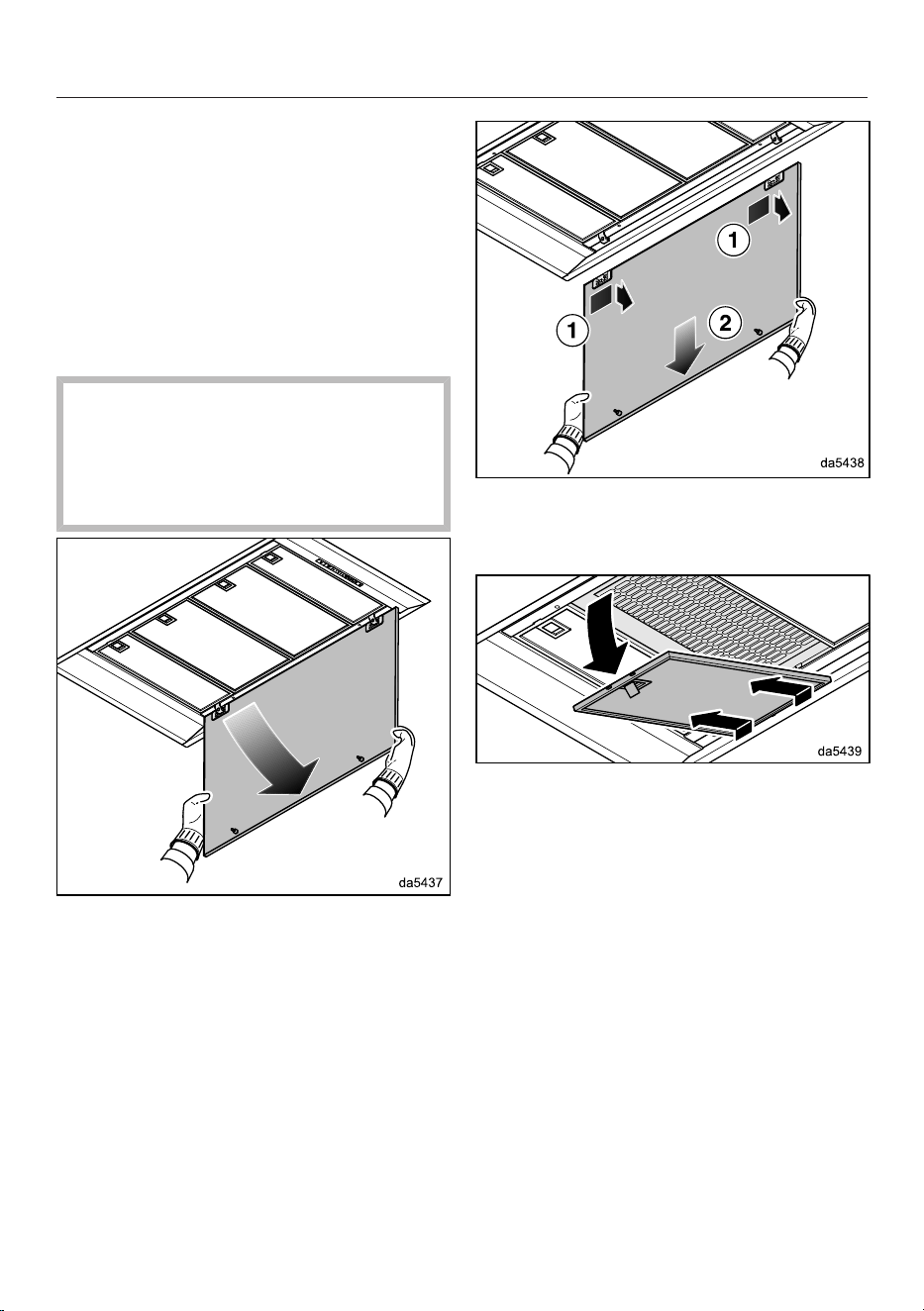
Removing the panel and grease filters
If the panel or a grease filter falls
down, this can result in damage.
Make sure you hold the panel and
filters securely at all times when
handling them.
Pull the front edge of the panel down
out of the locking clip and lower it.
Push the panel slightly to the right,
then remove it by pulling it out to the
rear.
Release the locking clip on the grease
filter and lower the filter by approx.
45°. Unhook the grease filter and
remove it.
Cleaning the panel
For cleaning purposes, follow the
instructions provided under “Cleaning
the casing”.
Cleaning and care
29
Cleaning the grease filters by hand
Clean the grease filters with a soft
nylon brush in a mild solution of hot
water and a little liquid dish soap. Do
not use concentrated dish soap.
After cleaning, place the filters on a
towel to air dry.
Important information on cleaning by
hand
Unsuitable cleaning agents may damage
the filter surfaces if used regularly.
Do not use any of the following cleaning
agents:
- cleaning agents containing descaling
agents
- powder cleaners and cream cleaners
- aggressive all-purpose cleaners and
degreasing sprays
- oven sprays
Cleaning the grease filters in the
dishwasher
Place the grease filters upright or
slightly inclined in the lower basket.
Ensure the spray arm is not
obstructed.
Use a standard household cleaning
agent.
Select a program with a maximum
wash temperature of 150°F (65°C).
Important information on cleaning in a
dishwasher
Excessively high temperatures can
render the grease filters unusable (due
to being warped out of shape, for
example). Select a program that does
not exceed the recommended
temperature.
Also follow the information provided in
the operating instructions for the
dishwasher.
Depending on the cleaning agent used,
the internal filter surfaces may become
discolored. However, this will not affect
the functioning of the grease filters in
any way.
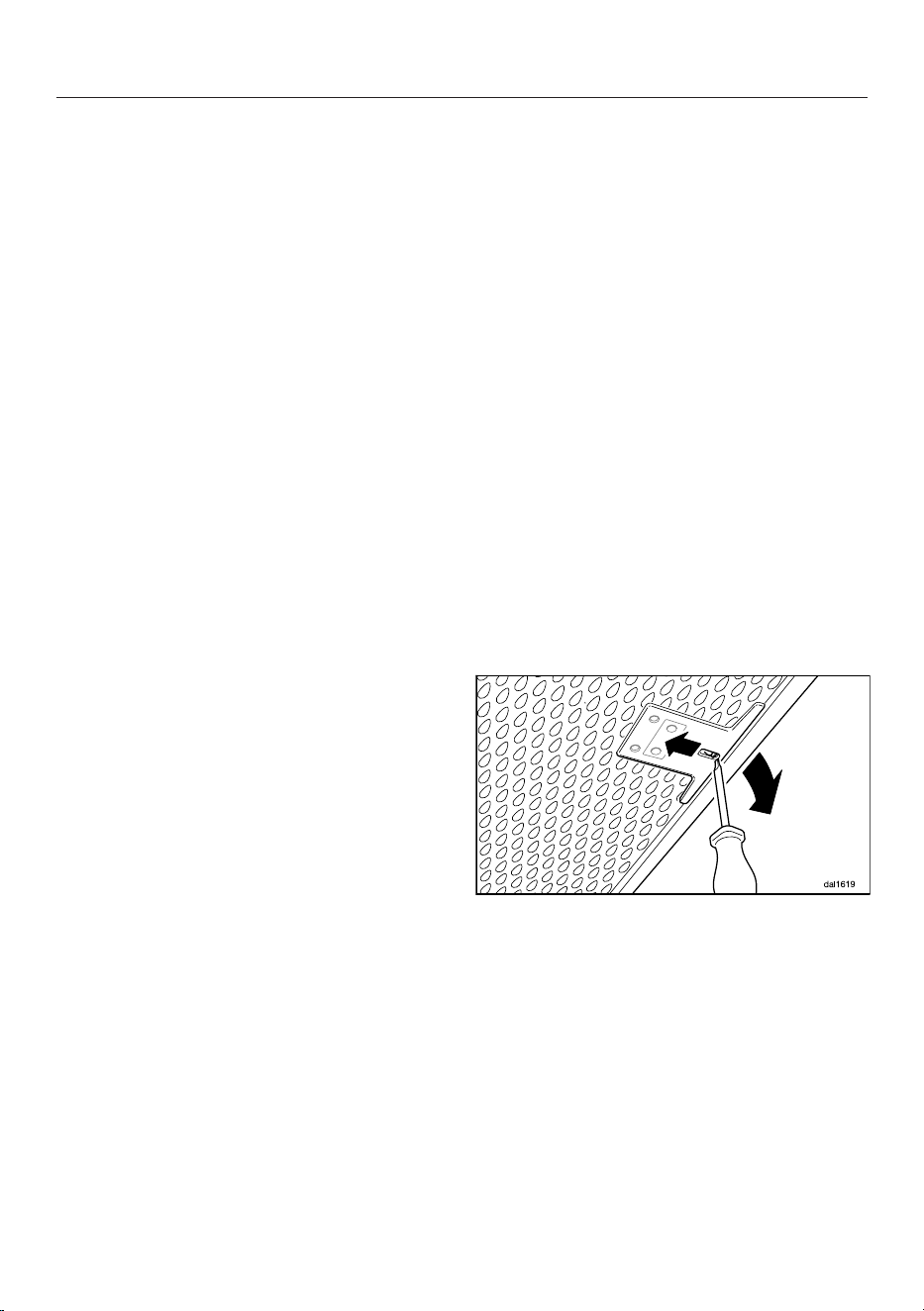
Inserting the grease filters
Insert the grease filters. When
inserting the grease filters, make sure
that the locking clip is facing outward.
If the grease filters were inadvertently
inserted upside down, insert a small
screwdriver blade into the slit to
disengage the clip.
Cleaning and care
30
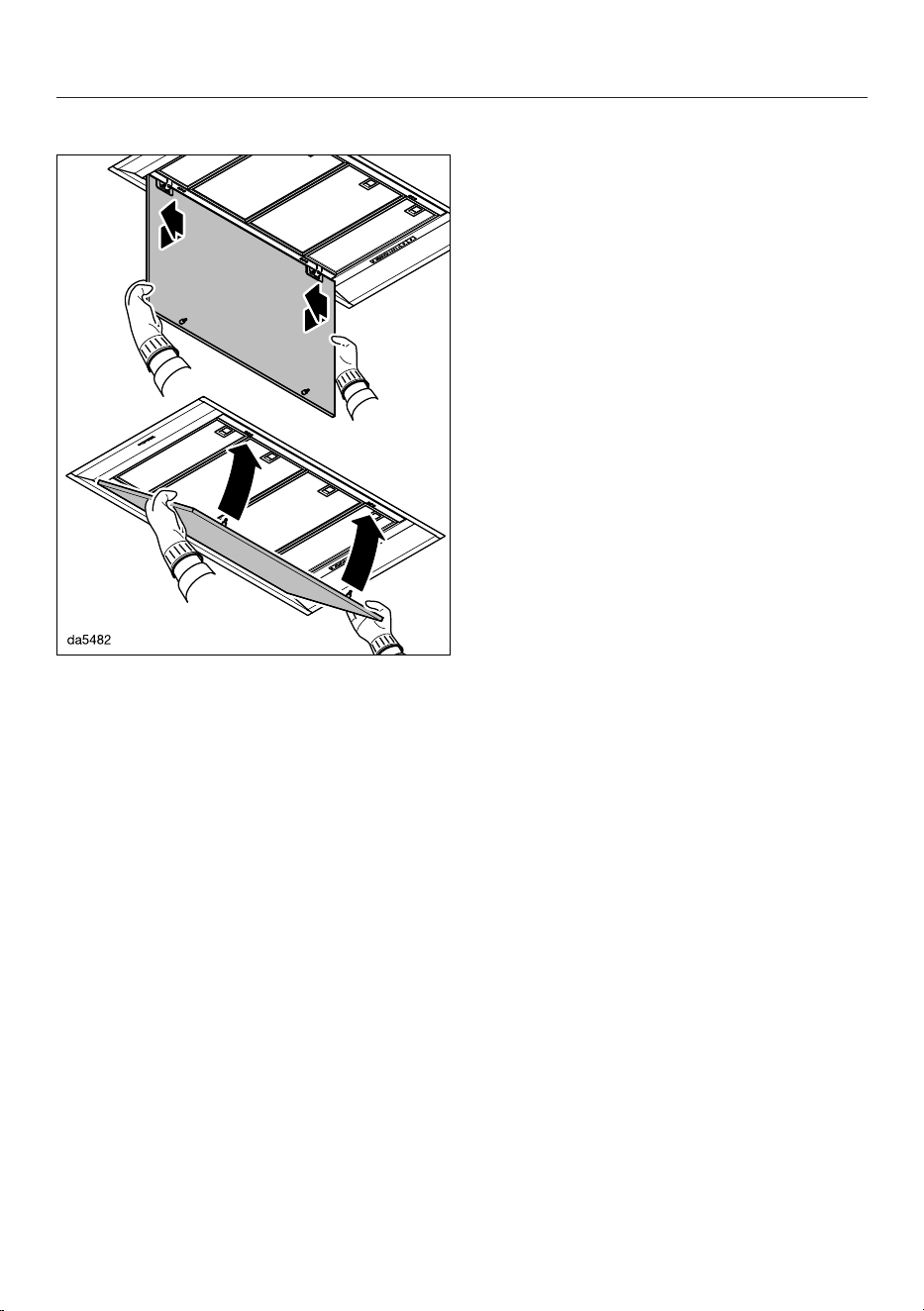
Inserting the panel
Hook the panel into the hinges from
behind and slide the panel to the left.
Lift the panel upward and press it into
the locking clips.
Resetting the grease filter operating
hours counter
After cleaning, the operating hours
counter needs to be reset via the
controls on the ventilation hood.
With the blower switched on, press
the operating hours control for
approximately 3seconds until only 1
is flashing.
The grease filter symbol goes out.
When cleaning the grease filters before
the full operating time has elapsed:
Press the operating hours
control for approximately
6seconds until only 1 is flashing.
Replacing the grease filters
Regular usage and cleaning can cause
the filter surfaces to become worn or
brittle.
If you identify any damage, replace the
grease filters.
Grease filters are available to order via
Miele Service (see end of these
operating instructions for contact
details) or from your Miele dealer.
OdorFree Charcoal Filter
Reactivation interval for the charcoal
filter
Keep in mind that only charcoal filters
with the model number Miele DKF...-R
are reactivatable.
Reactivate the charcoal filter when it no
longer absorbs kitchen odors effectively.
After an operating time of 180hours,
the charcoal filter symbol will light up
to remind you to reactivate the charcoal
filter.
It is recommended to reactivate the
charcoal filter after 6months at the
latest.
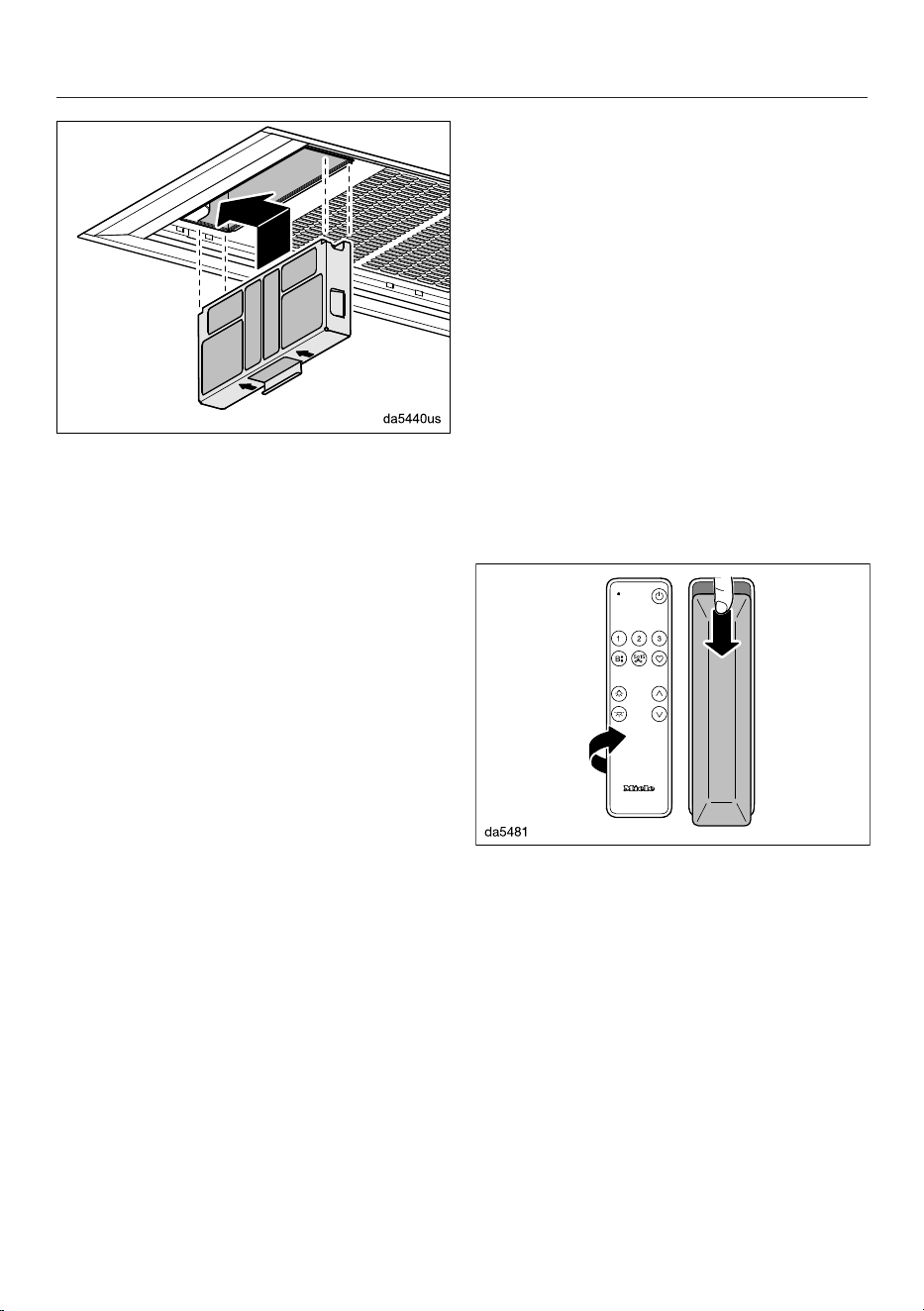
Installing/replacing the charcoal filter
Remove the panel and the grease
filters.
Remove the charcoal filter from its
packaging.
Cleaning and care
31
Insert the charcoal filter into its
compartment and push it to the left
into the holder.
Reinsert the grease filters and the
panel.
Resetting the charcoal filter operating
hours counter
After changing or reactivating the
charcoal filter, the operating hours
counter needs to be reset.
To do this, with the blower switched
on, press the operating hours
control twice, then hold it for
approx. 3seconds, until only 1 is
flashing.
The charcoal filter symbol will go out.
If you want to replace or reactivate the
charcoal filter before the full operating
time elapses:
Press the operating hours
control twice and hold it for
approximately 6seconds until only 1
is flashing.
Disposing of charcoal filters
Used charcoal filters can be disposed
of with normal household waste.
Remote control
Inserting/replacing batteries
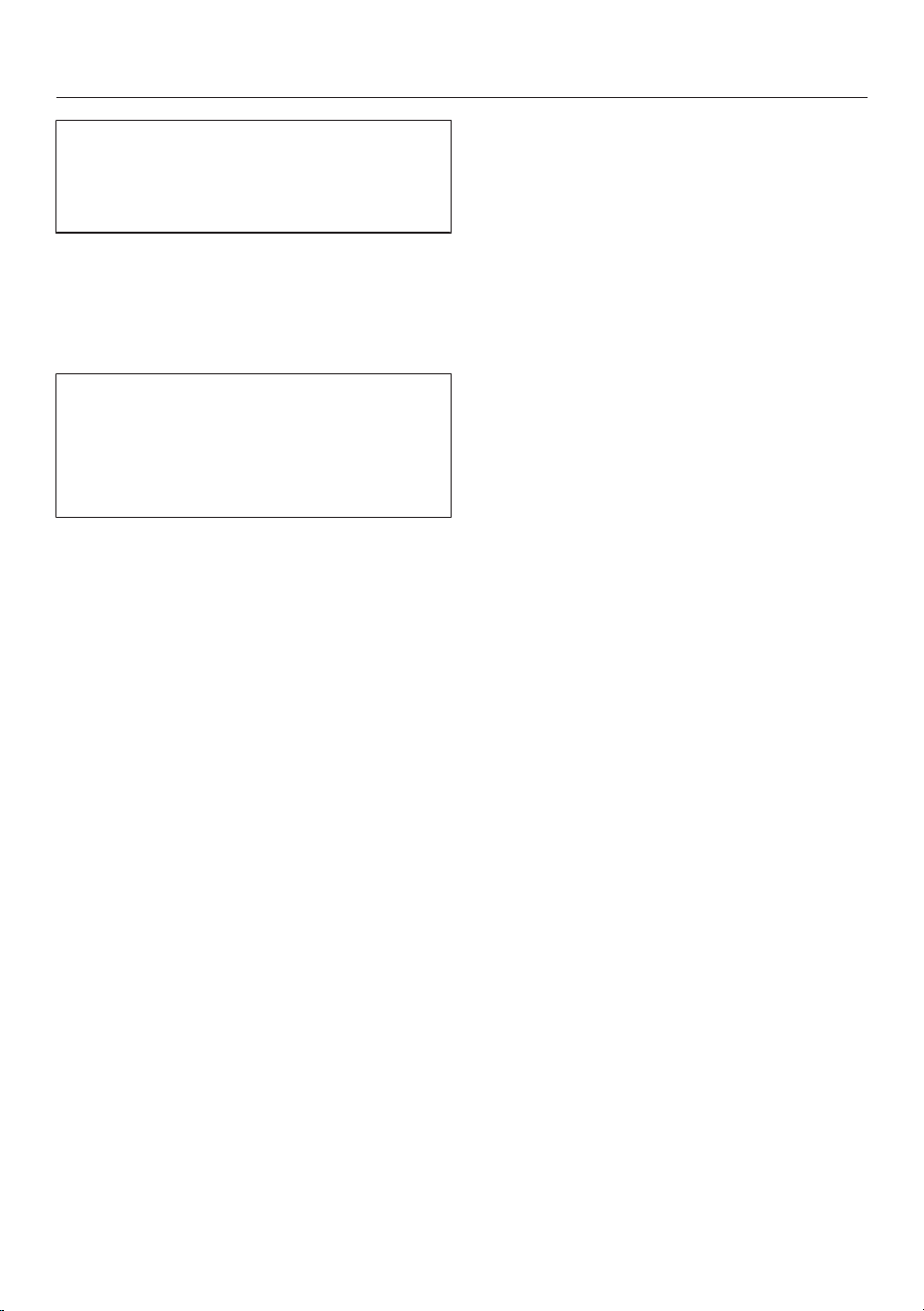
The remote control requires 2batteries,
1.5V, type AAA. The batteries are
supplied with the remote control and
must be inserted before using for the
first time.
The batteries must be replaced if
ventilation hood functions can no longer
be selected using the remote control.
The indicator light on the remote control
no longer lights up or only lights up
weakly when a button is pressed.
Ventilation hood functions can still be
selected using the controls on the
ventilation hood.
Slide the cover on the back down
slightly and remove it.
Insert the batteries. Make sure the
polarity is correct.
Replace the cover and slide it upward.
Cleaning the remote control
The surface should only be wiped
with a damp cloth. Do not use too
much water to prevent moisture
getting into the casing.
Customer Service
32
Information to help you rectify faults
yourself and about Miele spare parts
can be found at www.miele.com/
service.
Contact in the event of a fault
In the event of a fault which you cannot
remedy yourself, please contact your
Miele dealer or Miele Customer Service.
You can book a Miele Service Call
online at www.miele.com/service.
Contact information for Miele
Customer Service can be found at the
end of this document.
Please quote the model identifier and
serial number of your appliance (SN)
when contacting Miele Customer
Service. Both pieces of information can
be found on the data plate.
Location of the data plate
The data plate is visible once you have
removed the grease filters.
Appliance warranty and product
registration
You can register your product and/or
view the manufacturer´s warranty terms
and conditions for Miele appliances and
vacuum cleaners at www.mieleusa.com.
Installation
33
Before installation
Before installation, it is important
to read the information contained in
this chapter and in the “IMPORTANT
SAFETY INSTRUCTIONS” chapter.
Information is subject to change. Please
refer to our website to obtain the most
current product specification, technical
& warranty information.
Removing the protective film
The housing components are covered
by a protective film to prevent them
from damage during transport.
Please remove this film before
installing the housing components. It
can be peeled off easily without any
additional tools.
Coating the panel
The visible surfaces of the edge
extraction panel can be coated for
decoration.
The surfaces can be laminated,
varnished, or painted.
When selecting the coating, keep in
mind that the panel is exposed to heat,
moisture, and soiling from the rising
vapors.
Coatings are not recommended when
the panel is installed over a gas cooktop
due to the high temperatures involved.
Have specialists carry out the coating
process.
Clean the panel at regular intervals.
Follow the cleaning instructions
provided by the manufacturer of the
coating used.
Miele does not guarantee the durability
of the coating.
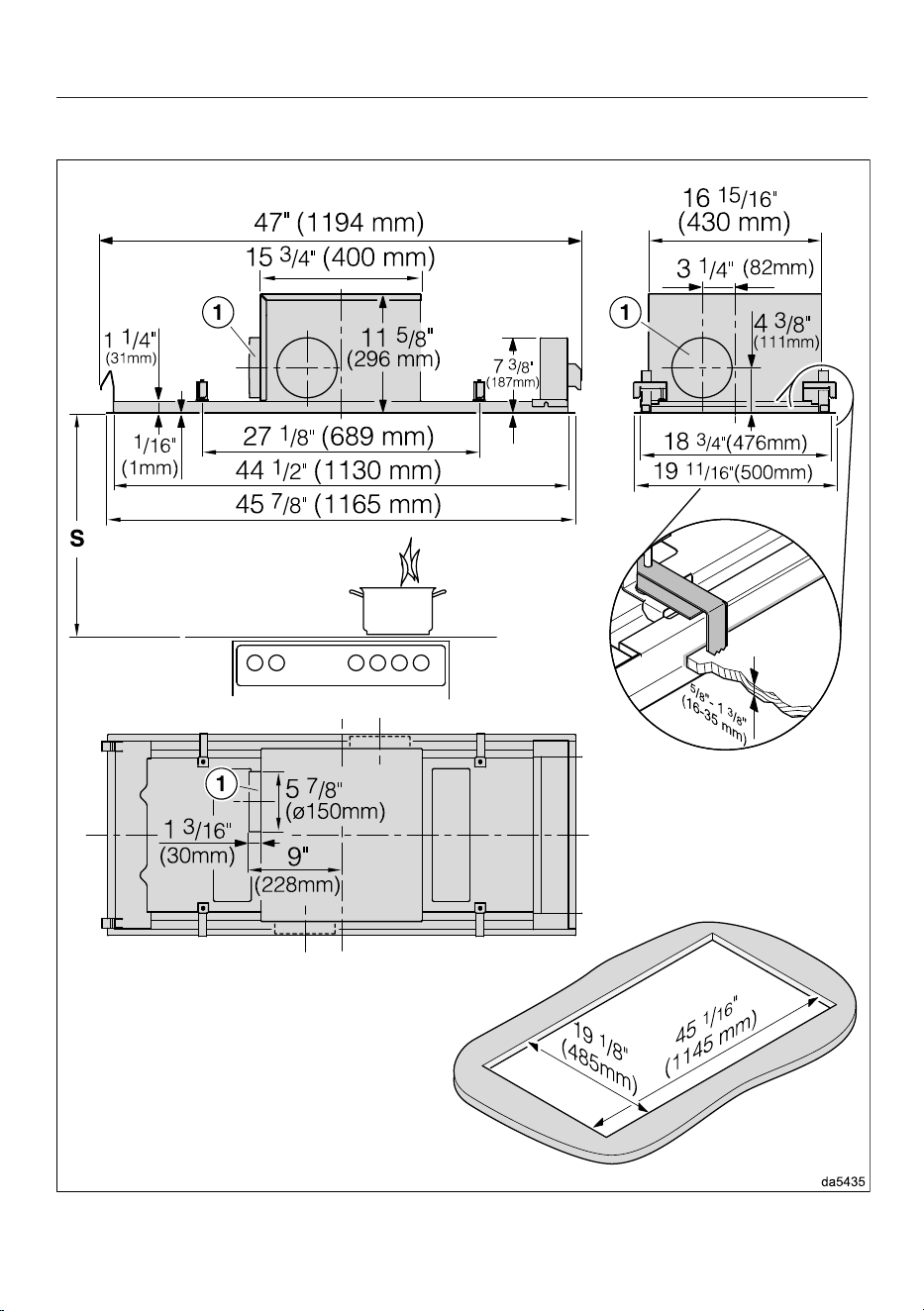
Installation materials
1vent collar
for exhaust ducting 6" (150mm)
1non-return flap
for installing into the exhaust vent on
the motor (not needed for recirculation
mode).
2 lids
8rivets
for securing the lids.
Installation
34
Appliance dimensions
DAC2247 in vented mode
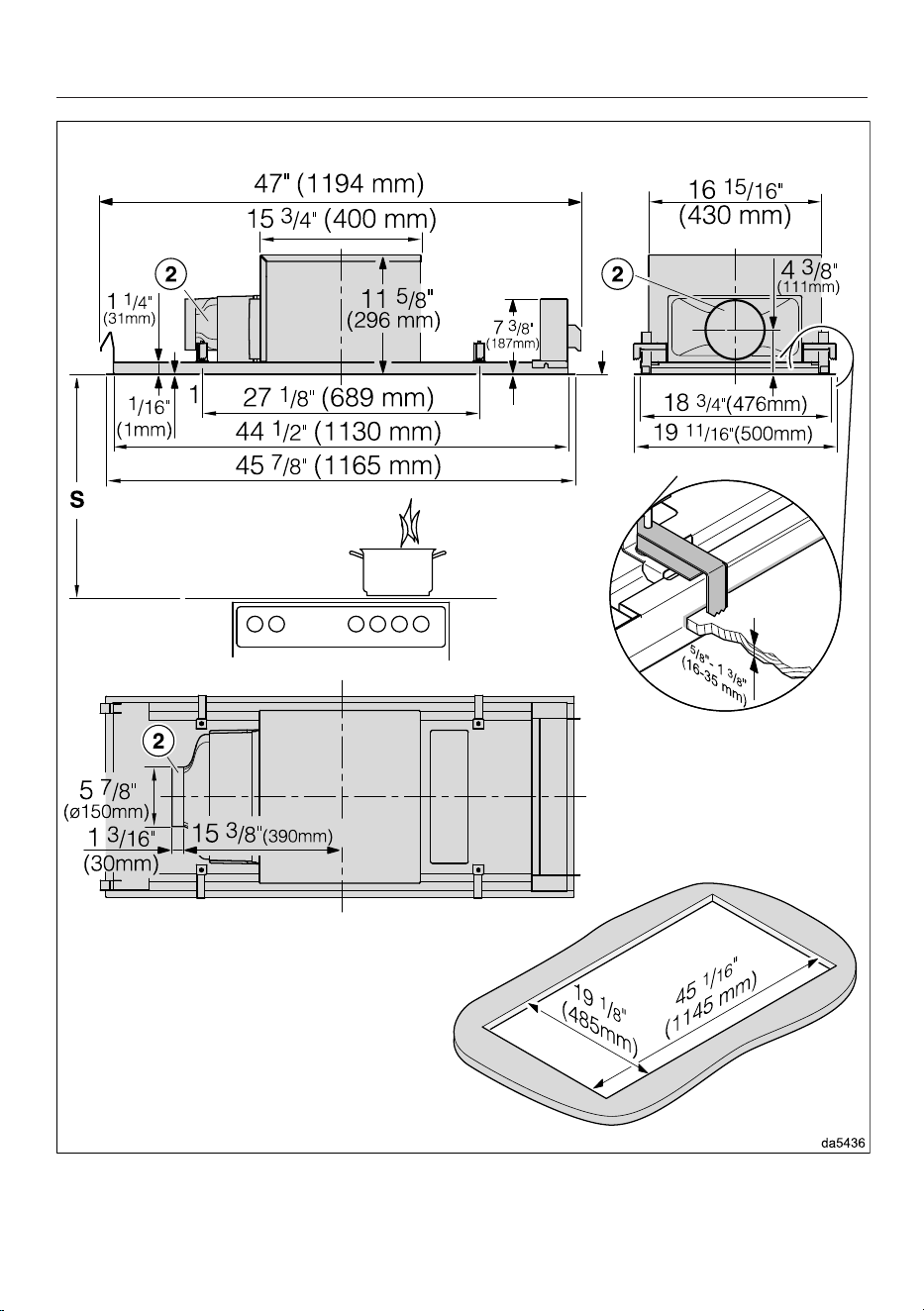
Installation
35
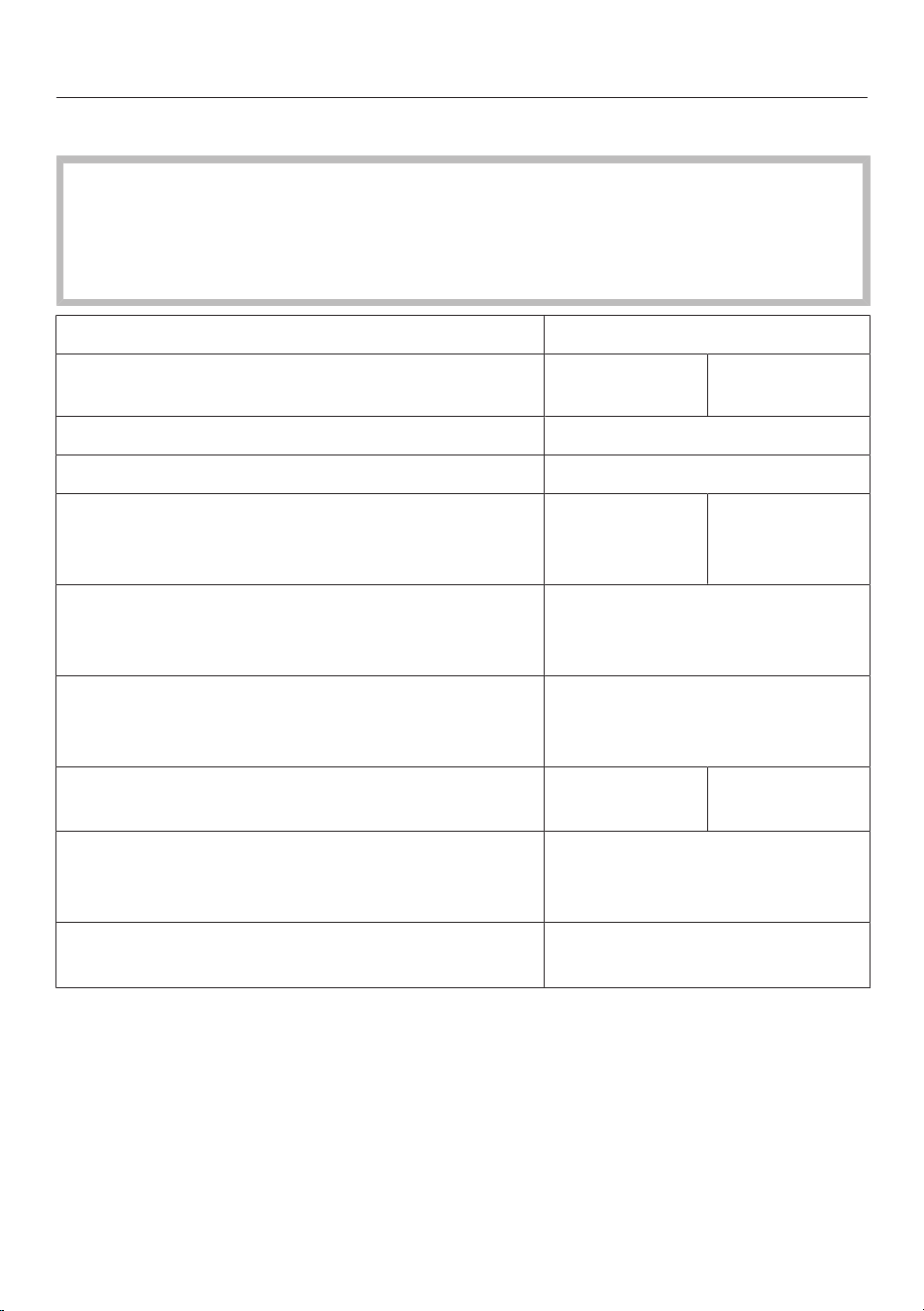
DAC2247 in recirculation mode and Plug&Play recirculation mode

Installation
36
a
Exhaust duct 6"(150mm)
The duct is installed on the left-hand side at the factory.
– If you want to install the duct at the front or rear, you can rotate the blower
casing by 90° during installation. To rotate the casing, there must be a
clearance of 4"(100mm) in the ceiling in front of and behind the ceiling cut-
out.
– If you want to install the duct on the right-hand side, rotate the ventilation
hood by 180° during installation. To ensure that the panel still opens to the
front, you must convert the panel hinges.
b
Duct 6"(150mm), as air vent in Plug&Play mode or for the connection of an
air duct in ducted recirculation mode
The duct is installed on the left-hand side at the factory.
– It is not possible to convert the duct to the front or rear.
– If you want to install the duct on the right-hand side, rotate the ventilation
hood by 180° during installation. To ensure that the panel still opens to the
front, you must convert the panel hinges.
The required installation steps are described in the installation sheet.
Installation
37
Distance between cooktop and ventilation hood (S)
Provided a larger distance is not given by the manufacturer of the cooktop,
follow the minimum safety distances between a cooktop and the bottom of the
hood.
Please also observe the information contained in the “IMPORTANT SAFETY
INSTRUCTIONS” section.
Minimum distance S
Cooking appliance Miele
appliance
Non-Miele
appliance
Electric Cooktops 24" (610mm)
Electric Barbeques and Fryers 26" (660mm)
Multiburner Gas Cooktops
≤ 43,000 BTU/hr (12.6kW),
no burner > 15,000 BTU/hr (4.5 kW).
26" (660mm) 30" (760mm)
Multiburner Gas Cooktops
≤ 73,800 BTU/hr (21.6kW),
no burner > 16,500 BTU/hr (4.8 kW)
30" (760mm)
Multiburner Gas Cooktops
> 73,800 BTU/hr (21.6kW),
or one of the burners > 16,500 BTU/hr (4.8 kW)
Not possible
Single Burner Gas Cooktops
≤ 20,500 BTU/hr (6 kW)
26" (660mm) 30" (760mm)
Single Burner Gas Cooktops
> 20,500 BTU/hr (6 kW)
≤ 27,600 BTU/hr (8.1 kW)
30" (760mm)
Single Burner Gas Cooktops
> 27,600 BTU/hr (8.1 kW)
Not possible
Installation
38
Installation notes
- A minimum distance of 27 ⁹/₁₆"
(700mm) and a maximum distance of
51 ³/₁₆" (1,300mm) is recommended
between the cooktop and the
ventilation hood.
Please be aware that if positioned too
high, vapor extraction will be
inefficient.
- To achieve optimum vapor extraction,
the ventilation hood must be centered
over the cooktop, not to the side or
behind it.
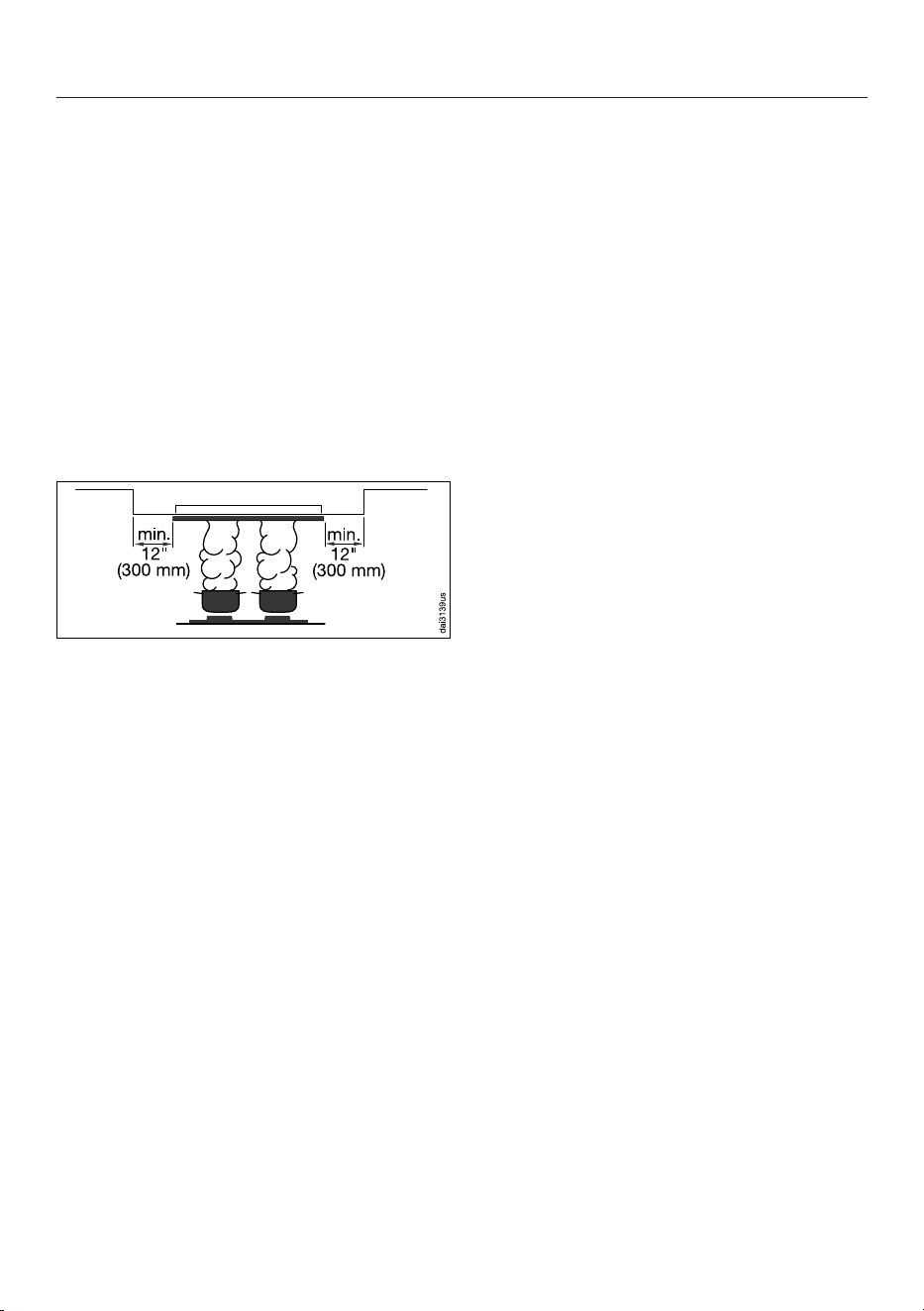
- If the ventilation hood is being
installed in a suspended ceiling, the
installation surface all around the
ventilation hood must be at least 12"
(300mm) larger than the ventilation
hood itself.
- As far as possible, the cooktop should
be narrower than the ventilation hood.
At a maximum, the cooktop should be
the same width.
- The ventilation hood must also be
freely accessible and located such
that it can be dismantled in the event
of future service requirements. This
should be taken into consideration
when planning the position of
cupboards, shelves, ceilings, or
decorative features in the vicinity of
the ventilation hood.
- The ventilation hood is fastened in the
cut-out using clamps. A solid
installation surface, e.g., made of
wood, is required. Make sure that the
structure can support the load.
Around the clamps, components such
as supports and ducting must be at
least 1" (25mm) from the cut-out.
- If you install the appliance in a place
that is used on a daily basis, e.g., in a
cabinet, the top of the appliance must
not be accessible. Close the
installation space in the cabinet, e.g.,
with additional walls and shelves.
Plug&Play mode
- The air must be able to circulate freely
into the ceiling. Components in the
ceiling must be at least 12" (300mm)
away from the exhaust ducting.
- Ensure sufficient ventilation of the
ceiling area, e.g., through exhaust
grilles, gaps, or shadow gaps. The
cross-section of the openings must be
at least 600cm² in total.
- The ceiling and adjacent walls that
come into contact with the exhaust air
must not exceed a heat transfer
coefficient of 0.5W/(m²K).
- The electronic for vapor extraction
must be switched to Plug&Play mode;
see “Commissioning”, “Activating/
Deactivating Plug&Play”.
Installation
39
Air venting
WARNING: Danger of toxic fumes.
Gas cooking appliances release
carbon monoxide that can be harmful
or fatal if inhaled.
To reduce the risk of fire and to
properly exhaust air, the exhaust
gases extracted by the hood should
be vented outside of the building
only.
Do not vent exhaust air into spaces
within walls or ceilings or in attics,
crawl spaces or garages.
To reduce the risk of fire, only use
metal ductwork.
Please read and follow the
“IMPORTANT SAFETY
INSTRUCTIONS” to reduce the risk
of personal injury. Follow all local
building codes when installing the
hood.
Only use smooth pipes or flexible
ducting made from approved non-
flammable materials for ducting.
To achieve the most efficient air
throughput with the lowest noise levels,
please note the following:
- The diameter of the vent ducting must
not be smaller than the cross-section
of the vent collar (see “Appliance
dimensions”). This applies in
particular when using flat ducting.
- The ducting should be as short and
straight as possible.
- Only use wide radius bends.
- The ducting must not be kinked or
compressed.
- All connections must be strong and
airtight.
- If the ducting has flaps, these must be
opened whenever the ventilation hood
is switched on.
Any constriction of the air throughput
will reduce extraction performance
and increase operating noise.
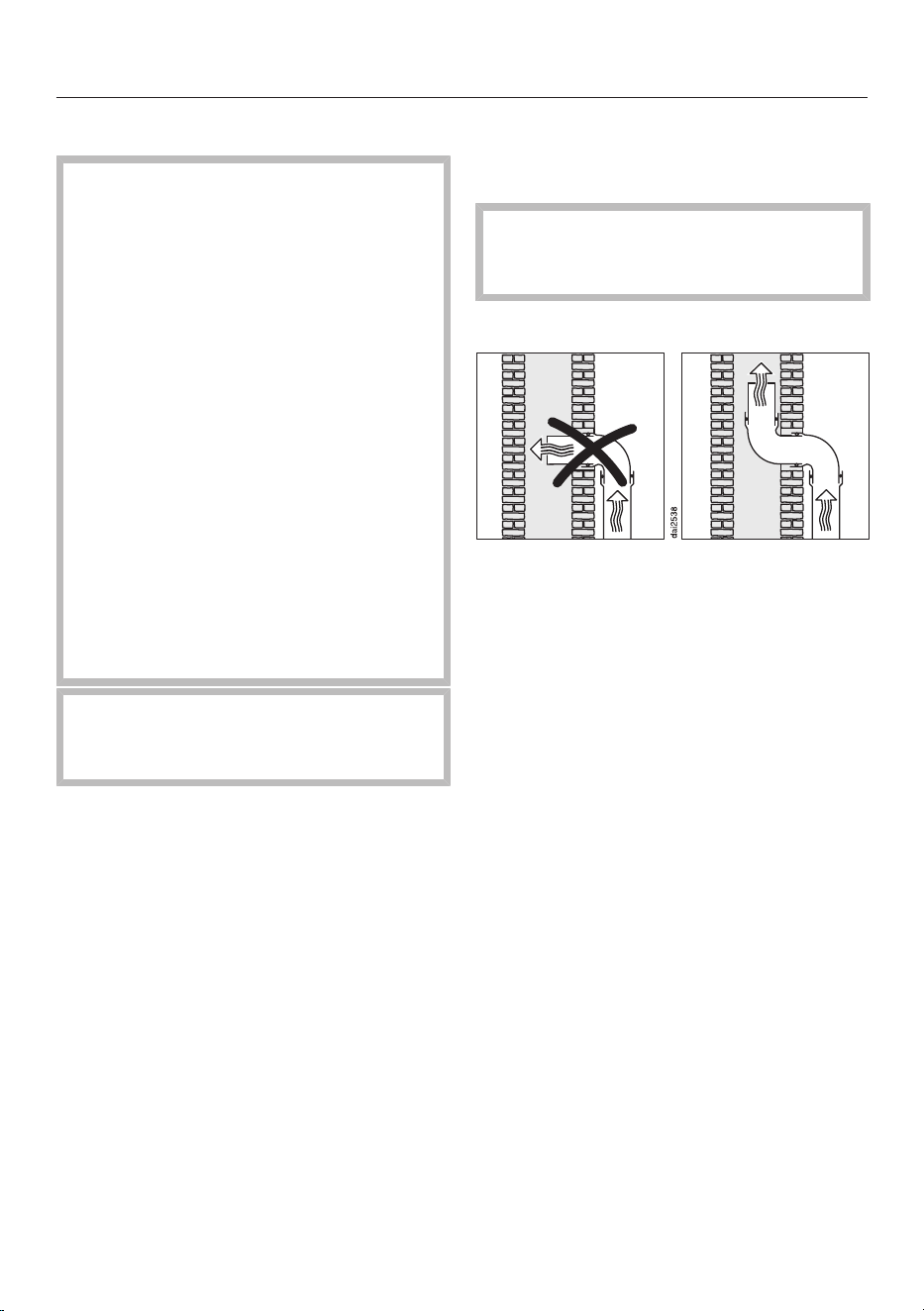
Ventilation stack
If the exhaust air is to be ducted into a
flue, the ducting must be directed in the
flow direction of the flue.
If the flue is used by several ventilation
units, the cross-section of the flue must
be large enough.
Non-return flap
Use a non-return flap in the vent
system.
A non-return flap ensures that when the
ventilation hood is not in operation, the
duct is closed to prevent unwanted
exchange of room air and outside air.
If the exhaust is ducted through an
outside wall, a Miele wall vent or roof
vent (available as an optional accessory)
is recommended. Both of these have a
built-in non-return flap.
If the on-site vent system does not have
a non-return flap, one is supplied with
the ventilation hood.
The non-return flap is installed in the
exhaust socket of the fan.
Installation
40
Condensate
If the ducting is to run through cool
rooms or ceiling space, for example, the
significant variations in temperature
between the different areas can cause
condensate to form. Insulate the
ducting to reduce temperature
variations.
If the ducting is to be laid horizontally, it
must be laid with a downwards sloping
gradient of at least ³/₈" (1cm) per
meter. This is to ensure that condensate
cannot drain back into the ventilation
hood.
Miele will not accept warranty claims
for any functional defects or damage
caused by inadequate ducting.
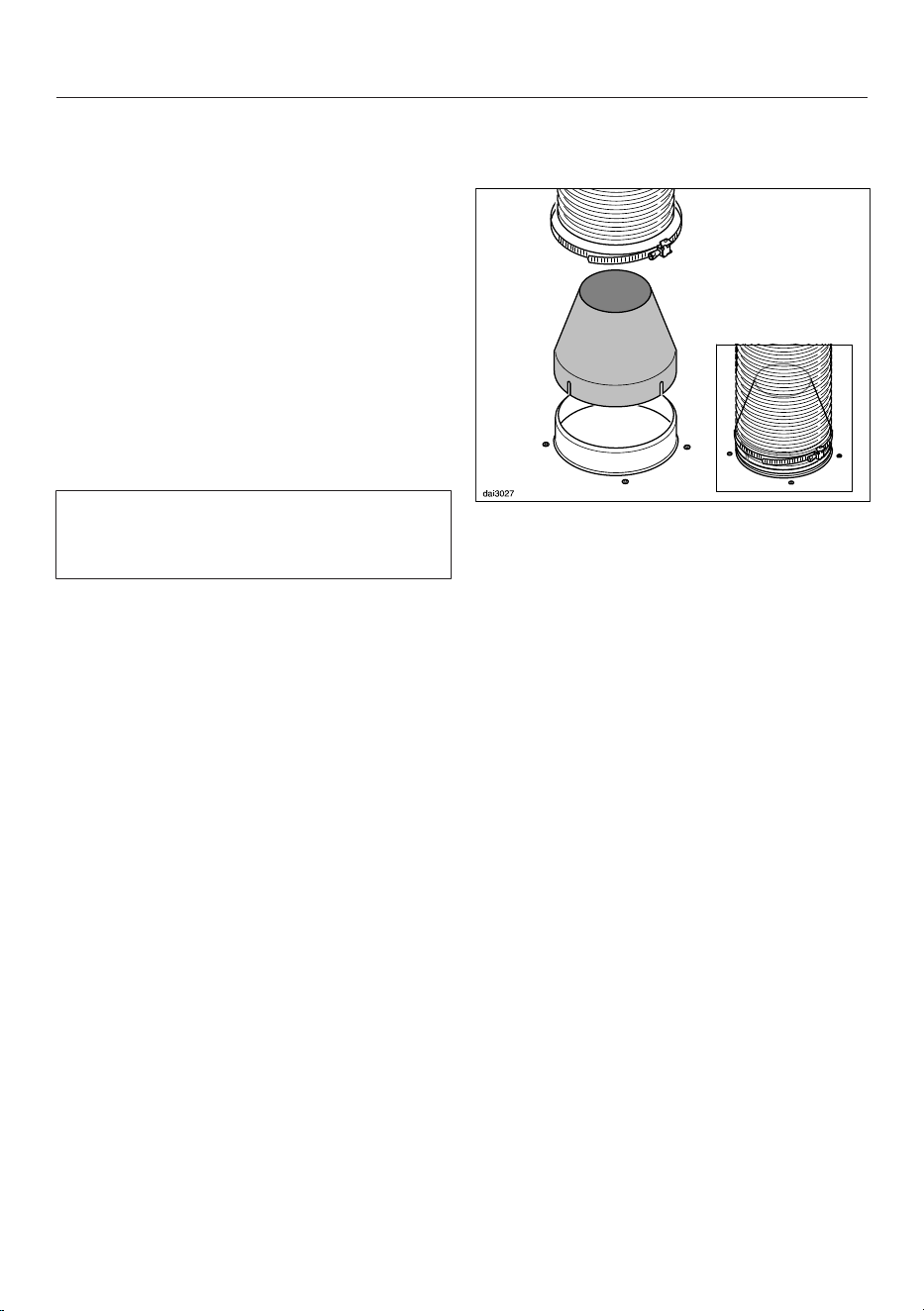
Reducing Collar
(optional accessory)
If you would like to reduce the
environmental impact of your ventilation
system by limiting the CFM output the
Reducing Collar can be installed. It
reduces the air flow to less than
400CFM. Check local building codes
for max. CFM requirements.
Push the Reducing Collar on the
exhaust port of the blower.
Push the exhaust hose over it.
Secure both with a hose clamp.
Installation
41
Electrical connection
WARNING: TO REDUCE THE RISK
OF FIRE, ELECTRIC SHOCK, OR
INJURY TO PERSONS, OBSERVE
THE FOLLOWING:
All electrical work should be
performed by a qualified electrician in
strict accordance with national
regulations (for USA: ANSI-NFPA
70) and local safety regulations.
Installation, repairs and other work by
unqualified persons could be
dangerous.
Ensure that power to the appliance is
OFF while installation or repair work
is performed.
Verify that the voltage, load and
circuit rating information found on
the data plate (see "Technical
Service"), match the household
electrical supply before installing the
hood.
Use only with ventilation hood cord-
connection kits that have been
investigated and found acceptable for
use with this model hood.
If there is any question concerning
the electrical connection of this
appliance to your power supply,
please consult a licensed electrician
or call Miele’s Technical Service
Department.
WARNING: THIS APPLIANCE
MUST BE GROUNDED
Grounding Instructions
WARNING - Improper grounding can
result in a risk of electric shock.
This appliance must be grounded. In the
event of an electrical short circuit,
grounding reduces the risk of electric
shock by providing a path of least
resistance. This appliance is equipped
with a cord having a grounding wire with
a grounding plug.
If there is any doubt, have the electrical
system of the house checked by a
qualified electrician.
Do not use an extension cord. If the
power supply cord is too short, have a
qualified electrician install an outlet near
the appliance.
The plug must be plugged into an
outlet that is properly installed and
grounded.
WARNING - Grounding instructions
(Canada)
The grounding-type attachment plug
shall be connected to a grounding-
type receptacle installed in
accordance with CSA C22.1-12,
Canadian Electrical Code, Part I.
Technical data
42
Blower motor 180W
Overhead lighting 2x7.2W
Total rated load 194.4W
Light temperature for the overhead lighting 3,500K
Voltage, frequency 120VAC, 60Hz
Fuse rating 10A
Power supply cord length 2.3ft (0.7m)
Weight 49.1lbs (22.3kg)
WiFi module
Frequency range 2.400–2.4835GHz
Maximum transmission power < 100mW
Optional accessories for recirculation mode
DKF40-R charcoal filter (reactivatable)
WiFi module EK058
FCC ID: 2AC7Z-EK058
IC: 21098-EK058
This device complies with Part 15 of the FCC Rules and with Industry Canada
licence-exempt RSS standard(s). Operation is subject to the following two
conditions: (1) this device may not cause harmful interference, and (2) this device
must accept any interference received, including interference that may cause
undesired operation.

9 Independence Way
Princeton, NJ 08540
www.mieleusa.com
U.S.A.
Miele, Inc.
National Headquarters
Please have the model and serial number
of your appliance available when
contacting Customer Service.
Canada
Importer
Miele Limited
Headquarters and Miele Centre
Customer Support
Phone: 888-99-MIELE (64353)
161 Four Valley Drive
Vaughan, ON L4K 4V8
www.miele.ca
Customer Care Centre
Phone:
1-800-565-6435
905-532-2272
International Headquarters
Miele & Cie. KG
Carl-Miele-Straße 29
33332 Gütersloh
Germany

M.-Nr. 12 574 570 / 01en-US
DAC2247