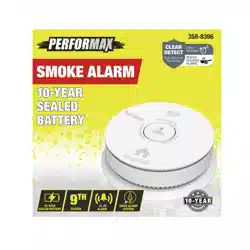
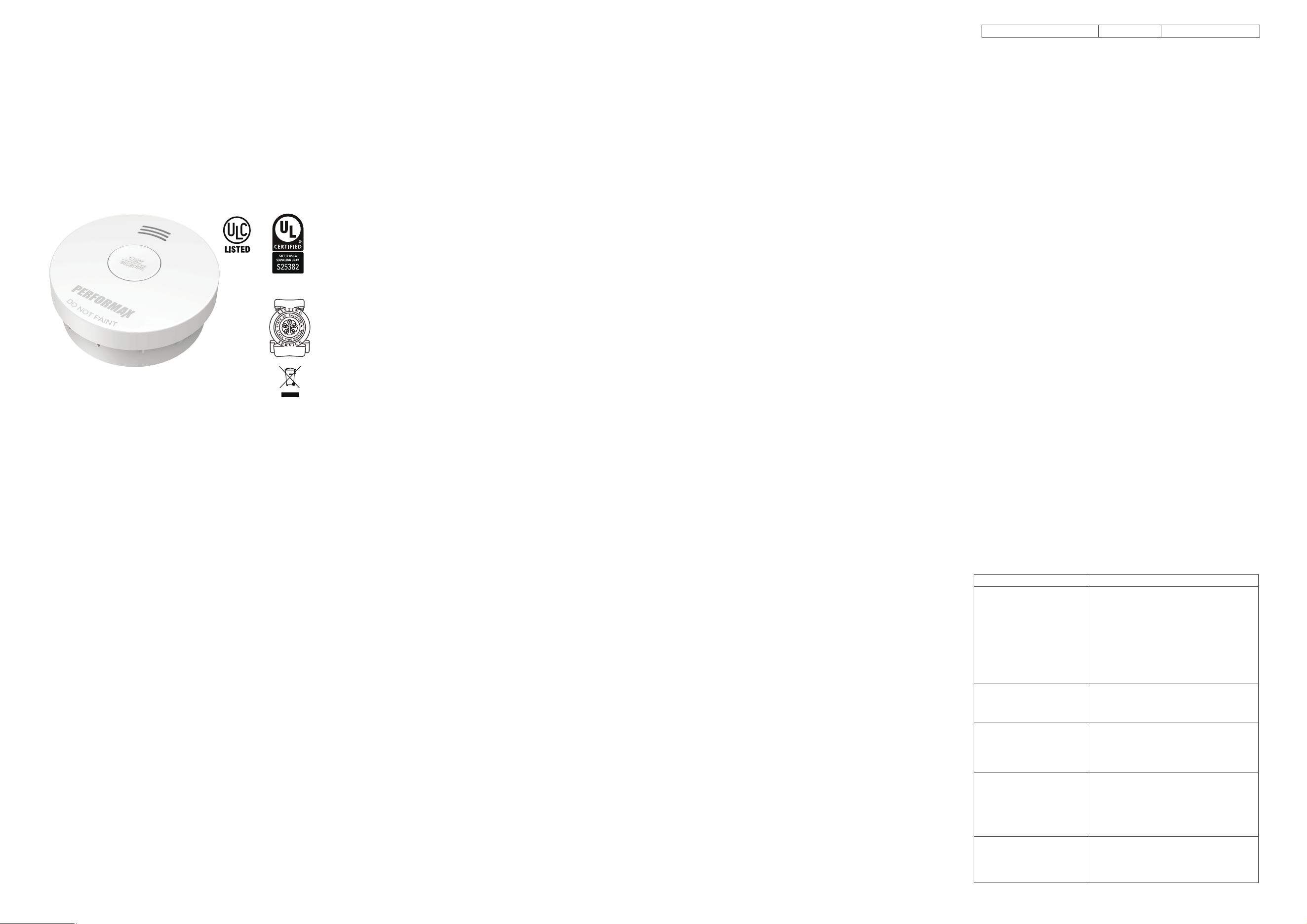
Smoke Alarm
GS525A User Manual
Thank you for purchasing our smoke alarm. Please take a few minutes to read the
user's manual thoroughly and save the document for future reference and to pass
on to any subsequent owner.
Teach children how to respond to the alarm, and they should never play with the
unit . This alarm was designed for residential environment. lt is not designed for us
in a recreational vehicle(RV) or boat.
The National Fire Protection Association (NFPA) and the manufacturer recommend
replacing this alarm ten years from the date code on back of alarm.
Product Specifications
● POWER: Built-in DC3V(CR-2/3AZ) Lithium battery (battery not replaceable)
● OPERATION CURRENT: <10uA (standby),<80mA (alarm)
● ALARM VOLUME: >85 dB (A) at 3 meters.
● ALARM SENSITIVITY: 1.59-2.80%/ft.
● SILENCE PERIOD: Approx. 8 minutes.
● SMOKE ALARM SOUND PATTERN: Temporal 3 Bl 0.5s - pause 0.5s - Bl 0.5s
-pause 0.5s-Bl0.5s-pause 1.5s, with the red LED flash, repeat this alarm pattern.
● COMPLY WITH: UL217-9th &CAN/ULC-S531
Description
This unit is a photoelectric smoke alarm. Meets the testing requirements of
UL217-9
th
. The photoelectric technology, it is more sensitive in detecting slow
smoldering fires which generate light smoke, little heat and may smolder for hours
before bursting into flames. This smoke alar
m does not contain any radioactive
material. Smoke alarms should be installed in every room (except the bathroom
and kitchen), finished attics and basements, making sure the people in the home
will be able to hear and respond to the alarm sound. For minimum protection, you
should install an alarm on every level of the home particularly outside sleeping
rooms. Each alarm should be placed in the middle of the ceiling of each room to be
protected. Typical single story dwelling installation recommendations: Install a
smoke alarm on the ceiling or wall inside each bedroom and in the hallway outside
each separate sleeping area.
If there is a basement: install a smoke alarm on the basement ceiling at the bottom
of the stairwell. Typical multi-story dwelling installation recommendations: Install a
minimum of one smoke alarm on each occupiable level of the home. Install a
smoke alarm on the ceiling or wall inside each bedroom
and in the hallway outside
each separate sleeping area. If a bedroom area hallway is more than 30 feet long,
install a smoke alarm at each end, install a smoke alarm at the top of a first – to-
second floor stairwell.
Important Safety Information
l.The test button accurately tests smoke alarm functions. Do not use any other test
method. Test smoke alarm weekly to ensure proper operation.
2.If you're sure it isn't a really alarm, open windows or fan the air around smoke
alarm to test and silence it.
3.User to install this product in compliance with all local and national electrical
installation and building codes.
4.This smoke alarm is designed to be used inside a single family home only. In
multifamily buildings, each individual living unit should have its own smoke alarms.
Do not install in non-residential buildings as this smoke alarm is not a substitute for
a complete alarm system.
5.Install a smoke alarm in every room and on every level of the home. Smoke may
not reach the smoke alarm for many reasons. For example, if a fire s
tarts in a
remote part of the home, on another level, in a chimney, wall, roof, or on the other
side of a closed door, smoke may not reach the smoke alarm in time to alert
household members. A smoke alarm will not promptly detect a fire except in the
area or room in which it is installed.
6.Smoke alarm may not alert every household member every time. The alarm horn
is loud in order to alert individuals to a potential danger. However, there may be
some circumstances where a household member may not hear the alarm (i.e.
outdoor or indoor noise, sound sleepers, drug or alcohol usage, the hard of
hearing, etc.). If you suspect that this smoke alarm may not alert a household
member, install and maintain specialty smoke alarms. Household member must
hear the alarm's warning sound and quickly respond to it to reduce the risk of injury,
or death that may result from fire, if a household member is hard of hearing, install
special smoke alarms with lights or vibrating devices to alert occupants.
7.Smoke alarms can only sound their alarms when they detect smoke or detect
combustion particles in the air. They do not sense heat, flame, or gas. This smoke
alarm is designed t
o give audible warning of a developing fire. However, many fires
are fast - burning, explosive, or intentional, and others are caused by carelessness
or safety hazards. In such circumstances, Smoke may not reach the alarm QUICK-
LY ENOUGH to ensure safe escape. Therefore the installation of smoke alarms is
not a substitute for practicing fire safety in the home.
8.Smoke alarms have limitations. This smoke alarm is not foolproof and is not
warranted to protect lives or property from fire. Smoke alarms are not a substitute
for insurance. Homeowners and renters should have adequate insure to protect
their lives and property. In addition, it is possible for the smoke alarm to fail at any
time. For this reason, you must test the smoke alarm weekly and replace them
every 10 years.
Locations to avoid
• In the garage. Products of combustion are present when you start your automo-
bile.
• Less than 4" (10cm) from the peak of an "A" frame type ceiling.
•In an area where the temperature may fall below 40℉ or rise abo
ve 100℉, such
as garages and unfinished attics.
• In dusty areas. Dust particles may cause nuisance alarm or failure to alarm. In
very humid areas (greater than 85% R.H.). Moisture or steam can cause nuisance
alarms.
• In insect-infested areas.
•Smoke alarms should not be installed within 3 ft (.9m) of the following: the door to
a kitchen, the door to a bathroom containing a tub or shower, forced air supply
ducts used for heating or cooling, ceiling or whole house ventilating fans, or other
high airflow areas.
• Kitchens. Normal cooking may cause nuisance alarms. If a kitchen alarm is
desired, it should have an alarm silence feature or be a photoelectric type. •Near
fluorescent lights. Electronic "noise" may cause nuisance alarms.
Operation
Testing
Test the unit weekly to ensure proper operation by pressing the test button. The
alarm will sound if the electronic circuitry, horn, and battery are working properly. If
no alarm sounds, the battery may be depleted or another problem, refer to "Trouble
shooting" section for a solution.
CAUTION: DO NOT use an open flame to test your
alarm, you could damage the
alarm or ignite combustible materials and start a structure fire.
CAUTION: Due to the loudness (85 decibels) of the alarm, Always stand an
arms-length away from the unit when testing. Test the alarm weekly to ensure
proper operation. Erratic or low sound coming from your alarm may indicate a
defective alarm. Refer to "Trouble shooting" section for a solution.
NOTE: WEEKLY TESTING IS REQUIRED
LED indicators: This smoke alarm is equipped with red LED indicators.
Standby Condition: The red LED will flash every 48 seconds to indicate that the
smoke alarm is operating properly.
Alarm Condition: When the alarm senses products of combustion and goes into
alarm, the red LED will flash rapidly (one flash per second).The rapid flashing LED
and pulsating alarm will continue until the air is cleared or the test button is
released.
Silence Condition: The red LED will flash every 8 seconds as long as the alarm is
in Hush mode.
Low battery trouble indication: An intermittent "chirp" accompanied by a red LED
flash every 48 seconds indicates a low battery, you may press the test button to
silence the trouble indication for 10 hours, but it will reset au
tomatically after 10
hours. During this condition the unit will continue to operate normally and detect
smoke and sound an alarm. This action only temporarily silences the chirp.
NOTE: As the battery in this unit is not replaceable, a low battery signal is an
indication of end of life. Therefore the alarm MUST be replaced as soon as
possible!
Fault indication: This chirp will occur between the flashes of the red LED indicator
light.
Battery discharge Condition: The red LED will be on.
NOTE: When the unit chirps once every 48 seconds, pressing the test button
temporarily silences this warning tone for 10 hours, Refer to "Trouble shooting"
section for solutions, if the fault signal reactivates, you MUST replace the unit with
a new alarm at once or contact you retailer during warranty.
Smoke sensing chamber operation: This alarm will "chirp" if any of the compo-
nents in the smoke sensing chamber fail. This chirp will occur between the flashes
of the red LED indicator light. (If the chirp occurs at the same time as the red LED
flash, indicating a low battery information).
Alarm silence
When the alarm sounds check for a fire first, After verifying that it is not a fire the
alarm can be silenced by pushing the test button. This will silence the alarm for
approximately 8 minutes. The red LED will flash once every 8 seconds indicating
the smoke alarm is in the silence mode. Smoke alarms are designed to minimize
nuisance alarms, but combustion particles from cooking may set off the alarm if the
alarm is located close to the cooking area. To minimize the occurrence of false
alarms, smoke alarms must be installed a minimum of 10 feet(3 meters) from the
nearest cooking appliance. If you accidentally let some smoke into the alarm
causing an alarm, you can open the doors and windows. Use a fan to clear the
smoke.The silence featue is extremely useful in a ki
tchen area or other areas
prone to nuisance alarms. The silence feature is to be used only when a known
alarm condition, such as smoke from cooking activates the alarm.
The smoke alarm is desensitized by push the alarm silence (silence mode) on the
smoke alarm cover, the al arm will s ilence to i ndicate that the al arm is in a
temporarily desensitized condition. The smoke alarm will automatically reset after
approximately 8 minutes, if after this period, particles of combustion are still
present, the alarm will sound again. The alarm silencer (silence mode) can be
repeatedly used until the air has been cleared of the condition causing the alarm.
NOTE: Dense smoke will override the alarm silencer and sound a continuous
alarm.
CAUTION: Before using the alarm silence (silence), identify the source of the
smoke and be certain a safe condition exists.
DANGER: If the alarm sounds, and it is not being tested, it means the unit is
sensing
smoke, THE SOUND OF THE ALARM REQUIRES YOUR IMMEDIATE
ATTENTION AND ACTION.
Low Battery status:
An intermittent "chirp" accompanied by a flashing red LED once every 48 seconds
indicates that the battery has reached a low voltage discharge state. As this is a
non-replaceable battery, you need to replace smoke alarm with a new alarm within
7 days, to avoid interruption of protection. The audible chirp can be temporarily
silenced to avoid night time sleeping, by pressing the test button.
This action temporarily silences this warning tone for 10 hours, the chirp will again
prompt you to replace the alarm after 10 hours.
Maintenance and Cleaning
In addition to weekly testing, the alarm requires periodiccleaningto remove dust,
dirt, and debris. Clean the alarm at least once a year to remove dust, dirt, or debris.
Use a vacuum cleaner with a soft brush, vacuum all sides and covers of smoke
alarm. This alarm has a low battery monitor which will cause the alarm to "chirp"
approximately every 48 seconds and the red LED flash once at the same time for a
minimum of thirty days when the battery gets low. If there is a defective batter
y or
other failures, you can refer to "Trouble shooting" for solution, if there are still
failures during warranty, you can return to your retailer.
WARNING: The battery is sealed and is not replaceable. Please replace with new
alarm if the low battery chirp occurs.
IMPORTANT: Do not attempt to remove the cover to clean inside. This will void the
warranty.
WHAT TO DO WHEN THE ALARM SOUNDS
1. Alert small children in the home
As well as anyone else that might have difficulty leaving the area without help.
2. Leave immediately by your escape plan. Every second counts, so don't waste
time getting dressed or picking up valuables.
3. While In leaving, don't open any inside door without first feeling its surface. If
hot, or if you see smoke seeping through cracks, don't open that door! Instead, use
your alternate exit. If the inside of the door is cool, place your shoulder against it,
open it slightly and be ready to slam it shut if heat and smoke rush in.
4. Stay close to the floor if the air is smoky. Breathe shallowly through a cloth, wet
if possible.
5. Once outside, go to your selected meeting place and make sure everyone is
there.
6. Call the fire department from your neighbor's home -not from yours!
7. Don't return to your
home until the fire officials say that it is all right to do so.
There are situations where a smoke alarm may not be effective to protect against
fire as stated in the NFPA Standard 72.
8. For instance:
a) Smoking in bed
b) Leaving children home alone
c) Cleaning with flammable liquids, such as gasoline
Note: These guidelines will assist you in the event of a fire, however, to reduce the
chance that fires will start, practice fire safety rules and prevent hazardous
situations.
Repair:
Caution: Do not attempt to repair the alarm. This will void your warranty. If the
alarm is not operating properly, and is still under warranty, return it to the original
place of purchase. Pack it in a well-padded carton, and ship to the original place of
purchase. If the alarm is no longer under warranty, have a licensed electrician
replace it immediately with a comparable alarm.
Trouble shooting:
Trouble condition
Action
Smoke alarm does not
sound when tested.
An intermittent "chirp"
accompanied by a red LED
flash every 48 seconds.
Smoke alarm chirp occurs
every 48 seconds only
(alarm goes into fault mode )
Smoke alarm sounds
unwanted alarms intermit-
tently or when residents are
cooking, taking showers, etc.
Smoke alarm double chirp
every 48 seconds (alarm
goes into End-of-life mode )
Remove, discharge and replace as soon as
possible.
1. Press test button to silence alarm.
2. Clean smoke alarm. Please refer to the
"maintenance and cleaning" section.
3. Move smoke alarm to new location and
press test button.
Clean smoke alarm. Please refer to the
"maintenance and cleaning" section. Replace
smoke alarm if the problem persists.
The battery is depleted, please replace the
smoke alarm.
1. Activate alarm before installation.
2. Clean smoke alarm. Please refer to the
"maintenance and cleaning" section.
3. If problems persist and the unit is still under
warranty, you can return to your retailer.
4. if the unit is out of warranty, please replace
another new alarm.
Helps Reduce Cooking
Nuisance Alarms
UL 217 9
th
Ed.
7275-2313:0500
Diagram 1
1 2 3 4
Document nr.: GS525A_Manual Revision nr.: G Revision date: 2024.12.31
Ref: 358-8395
The alarm sounds different
from it is used to. It starts
and stops.
1. Clean smoke alarm. Please refer to the
"maintenance and cleaning" section.
2. If the problem persists during warranty,
you can return to your retailer.
3. If the unit is out of warranty, please replace
another new alarm.
DEVELOP AND PRACTICE A PLAN OF ESCAPE
•Install and maintain fire extinguishers on every level of the home and in the kitchen,
basement and garage. Know how to use a fire extinguisher prior to an emergency.
•Make a floor plan indicating all doors and windows and at least two (2) escape
routes from each room. Second story windows may need a rope or chain ladder.
•Have a family meeting and discuss your escape plan, showing everyone what to do
in case of fire.
•Determine a place outside your home where you all can meet if a fire occurs.
•Familiarize everyone with the sound of the smoke alarm and train them to leave
your home when they hear it.
•Practice a fire drill at least every six months, including fire drills at night. Ensure
that small children hear the alarm and wake when it sounds. They must wake up in
order to execute the escape plan. Practice allows all occupants to test your plan
before an emergency. You may not be able to reach your children. It is important
they know what to do.
• Current studies have shown smoke alarms may not awaken all sleeping individu-
als, and that it is the responsibility of individuals in the household that are capable of
assisting others to provide assistance to those who may not be awakened by the
alarm sound, or to those who may be incapable of safely evacuating the area
unassisted.
RECOMMENDED LOCATIONS FOR ALARMS
This equipment should be installed in accordance with the National Fire Protection
Association's 72 (National Fire Protection Association, Battery march Park, Quincy,
MA 02269).
Typical installation drawing layouts for the unit(s) indicating recommended locations
which shall be in accordance with the applicable requirements outlined in the
following:
1) CAN/ULC-S553, Standard for Installation of Smoke Alarms.
2) National Fire Alarm and Signaling Code, NFPA 72, Single- and Multiple-Station
Alarms and Household Fire Alarm Systems for US requirement.
•Locate the first alarm in the immediate area of the bedrooms. Try to monitor the
exit path as the bedrooms are usually farthest from the exit. If more than one
sleeping area exists, locate additional alarms in each sleeping area.
•Locate additional alarms to monitor any stairway as stairways act like chimneys for
smoke and heat.
• For mobile home installation, select locations carefully to avoid thermal barriers
that may form a
t the ceiling. For more details, see MOBILE HOME INSTALLATION
below.
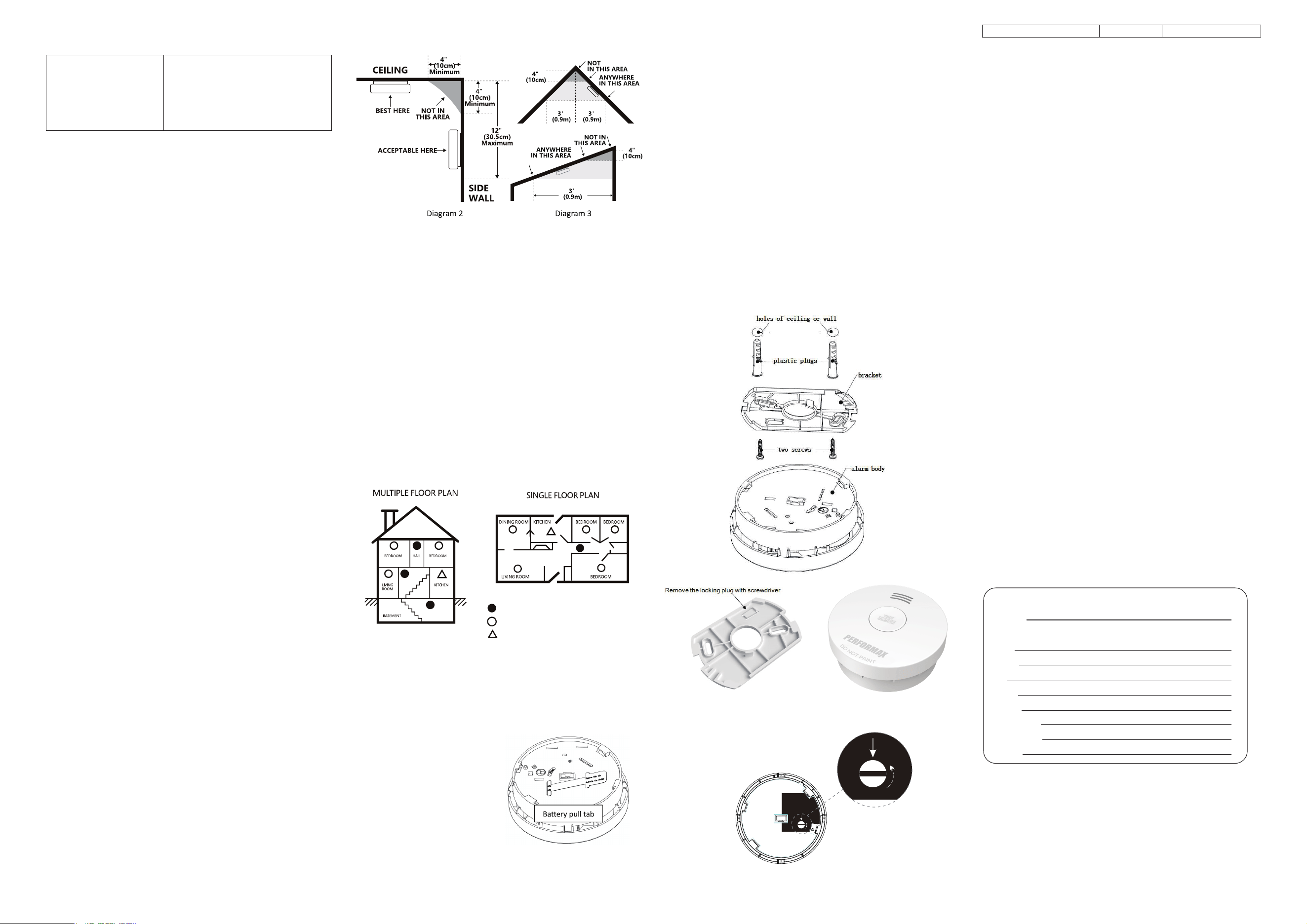
•When mounting an alarm on the ceiling, locate it at a minimum of 4" (10cm) from
the side wall (Refer to Diagram 2).
•When mounting the alarm on the wall, use an inside wall with the top edge of the
alarm at a minimum of 4" (10cm) and a maximum of 12" (30.5cm) below the ceiling
(Refer to Diagram2).
•Put smoke alarms at both ends of a bedroom hallway or large room if the hallway
or room is more than 30 ft (9.1 m) long.
•Install Smoke Alarms on sloped, peaked or cathedral ceilings at or within 3 ft
(0.9m) of the highest point (measured horizontally). NFPA 72 states: "Smoke alarms
in rooms with ceiling slopes greater than 1 ft in 8 ft (.3m in 2.4m) horizontally shall
be located on the high side of the room." NFPA 72 states: "A row of alarms shall be
spaced and located within 3 ft (0.9m) of the peak of the ceiling measured horizontal-
ly" (Refer to Diagram 3).
For your information, the National Fire Protection
Association's Standard 72 reads: Where required by other governing laws, codes,
or standards for a specific type of occupancy, approved single and multiple-station
smoke alarms shall be installed as follows:
1. In all sleeping rooms and guest rooms
2. Outside of each separate dwelling unit sleeping area, within 21 ft (6.4 m) of any
door to a sleeping room, with the distance measured along a path of travel
3. On every level of a dwelling unit, including basements
4. On every level of a residential board and care occupancy (small facility), including
basements and excluding crawl spaces and unfinished attics
5. In the living area(s) of a guest suite
6. In the living area(s) of a residential board and care occupancy (small facility)
MOBILE HOME INSTALLATION
Modern mobile homes have been designed and built to be energy efficient. Install
smoke alarms as recommended above (refer to RECOMMENDED LOCATIONS
and diagram 2 and 3).
In older mobile homes that are not well insulated compared to present standards,
extreme heat or cold can be transferred from the outside to the inside through
poorly insulated walls and roof. This may create a thermal barrier which can prevent
the smoke from reaching an alarm mounted on the ceiling. In such units, install the
smoke alarm on an inside wall with the top edge of the alarm at a minimum of 4"
(10cm) and a maximum of 12" (30.5cm) below the ceiling (see Diagram 2 ).
If you are not sure about the insulation in your mobile home, or if you notice that the
outer walls and ceiling are either hot or cold, install the alarm on an inside wall. Fo
r
minimum protection, install at least one alarm close to the bedrooms. For additional
protection, see SINGLE FLOOR PLAN in Diagram 4 and MULTIPLE FLOOR PLAN
in Diagram 5.
HOME VEHICLE HAS BEEN IN STORAGE, BEFORE EACH TRIP AND AT LEAST
ONCE A WEEK DURING USE.
ATTENTION: Test your smoke detector after removing your caravan or mobile
home from storage, before each journey and at least once a week during use.
ATTENTION: Smoke alarms are not to be used with smoke alarm guards unless
the combination has been evaluated and found suitable for that purpose.
Installation:
Activation: Pull out the battery tab to
activate your smoke alarm. (Refer to
Diagram 6).
CAUTION: this unit must be activated
prior to installation. Failure to properly
install and activate this alarm will prevent
proper operation of this alarm and will
prevent its response to fire hazards.
CAUTION: This device requires a continuous supply of electrical power from a
healthy battery or AC connection, depending on the model. lt will not work without
power.
•Turn the alarm body counter clockwise and take off the bracket.
•Hold the bracket in the installation position as specified in the Recommended
Locations, mark installation holes of the bracket with pencil.
•Drill the two marked installation holes with a 3/16 inch (5mm) drill bit. Tap the two
plastic grommets into holes with hammer.
•Remove locking plug from the bracket with screwdriver if necessary (Refer to
Diagram 8). This is an optional additional locking in place feature.
• Mount the bracket to the ceiling by inserting and tightening the supplied screws
into plastic grommets. (Refer to Diagram 7).
•Fit the alarm on the bracket and turn the alarm body clockwise, until fully inserted
on the bracket.
Optionally insert locking plug into the gap between bracket and bottom cover for
locking alarm in place (Refer to Diagram 9).
•Press the button to test the unit. The alarm should then sounds 3 beeps - 1.5
seconds pause, and will repeat until the button is released, if no sound, it indicates
a defective alarm, refer to the "Trouble shooting" section
for a solution or return to
your retailer during warranty.
WARNING:
To prevent injury, this unit must be securely attached to the wall or ceiling in
accordance with the installation instructions.
Scrap and disposal:
When the device enters the end-of-life warning state in the first 30 days, press the
button to reset the end-of-life. At this point, if the device is still available. it will enter
the normal standby state for 10 hours, after 10 hours, the device will return to the
end-of-life warning state. After 30 days of the first end-of-life warning state, the
device can no longer be reset and needs to be replaced in a timely manner.
•Counterclockwise remove the product from bracket.
Take out the screws with a screwdriver and remove the bracket.
•Insert a screwdriver into red plastic part on the base cover (Refer to Diagram 10).
• Rotate a screwdriver from the ON position to the OFF position counterclockwise.
• At this time, a red LED light up and indicating that the battery is discharging.
• Wait for at least One day allow that the battery inside the product is fully exhaust-
ed. You can scrap and dispose it according to the local law.
Note:
1. When a red LED is off, it does not mean that the battery is fully exhausted,
rather, it is necessary to also allow the battery to fully discharge for at least Seven
days.
2. Use this method to scrap the alarm if the is the end of life during out of warranty.
3. Please return to retailer and exchange another alarm durin
g the Warranty
period.
4. Cannot install the smoke alarm again once the battery is discharged.
California State Fire Marshal
Early warning fire detection is best achieved by the installation of fire detection
equipment in all rooms and areas of the household as follows: A smoke alarm
installed in each separate sleeping area (in the vicinity, but outside the bedrooms),
heat or smoke detectors in the living rooms, dining rooms, bedrooms, kitchens,
hall-ways, attics, furnace rooms, closets, utility and storage rooms, basements and
attached garages.
Last Name:
First Name:
Phone:
Address:
City:
Country:
Zip Code:
Fault description:
Date of purchase:
Signature:
Service information
Warranty information
Warranty card
Diagram 4
Diagram 5
Smoke Alarms for Minimum Protection
Smoke Alarms for Additional Protection
Ionisation Type Smoke Alarm with Alarm
Silencer or Photoelectric Type
Diagram 6
Diagram 7
Diagram 8 Diagram 9
Diagram 10
There are various situations against which the smoke alarm may not be effective,
for example:
1) Fires where the victim is intimate with a flaming initiated fire; for example, when a
person's clothes catch fire while cooking;
2) Fires where the smoke is prevented from reaching the smoke alarm due to a
closed door or other obstruction;
3) Incendiary fires where the fire grows so rapidly that an occupant's egress is
blocked even with properly located smoke alarms.
5 6 7 8
Document nr.: GS525A_Manual Revision nr.: G Revision date: 2024.12.31
N
OFF
O
N
OFF
O
Manufactured by:
SITERWELL ELECTRONICS CO.,LIMITED
No.666 Qingfeng Road, Jiangbei District, Ningbo, Zhejiang, China.
Distributed by:
Menard, Inc.
Eau Claire, WI 54703 U.S.A.
Visit MENARDS.COM
10-YEAR LIMITED WARRANTY
If this PERFORMAX
TM
product fails to perform to your satisfaction under normal use within the
10-year limited warranty period, return the product to a Menards® retail store for a replacement of
the same or similar PERFORMAX
TM
product.