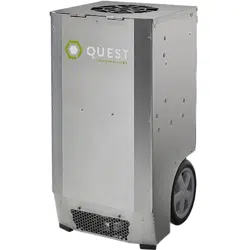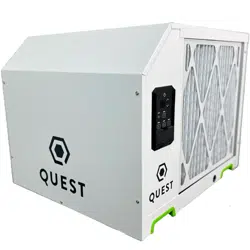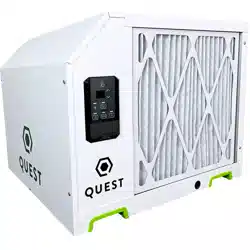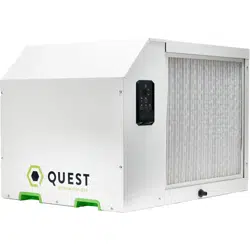
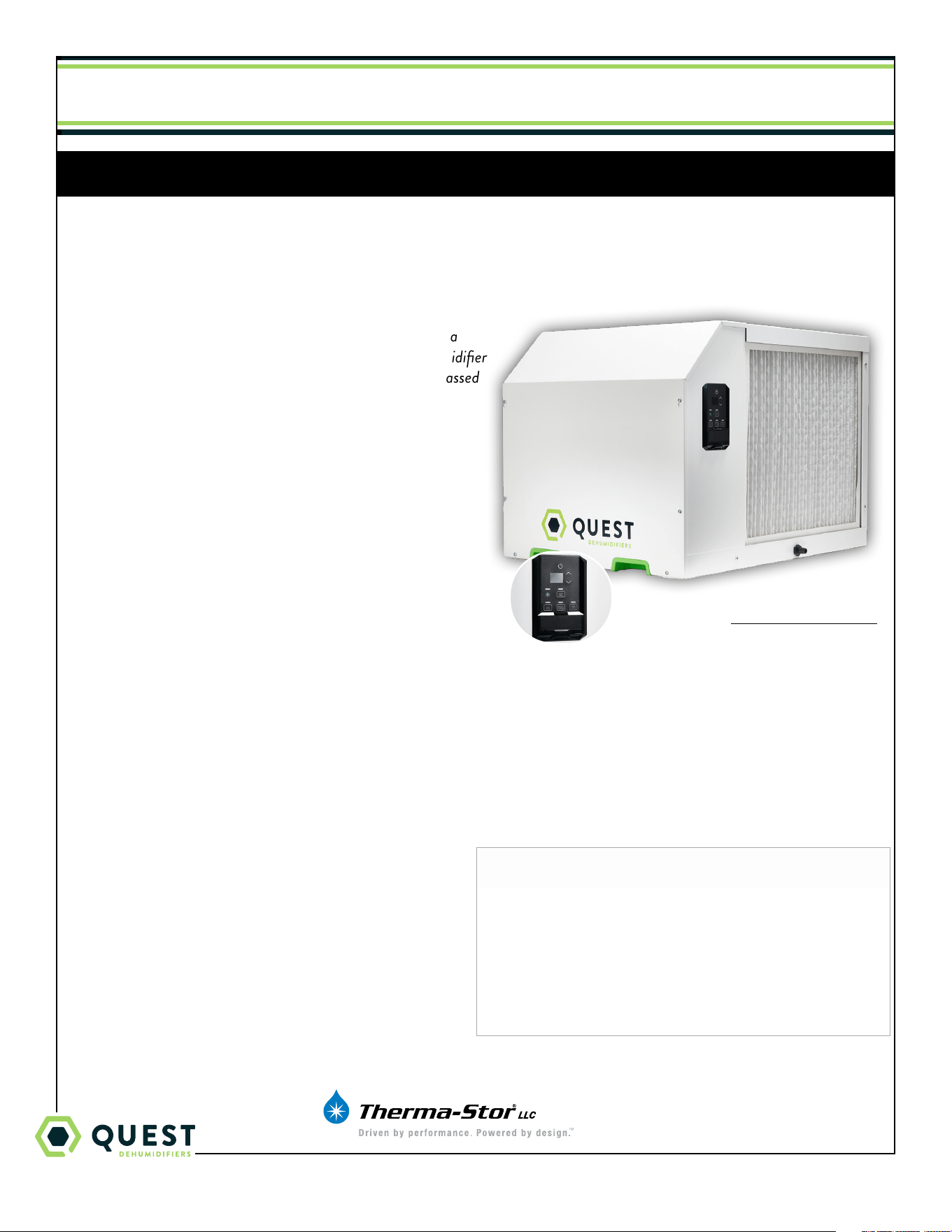
Quest 215 Dual
Quest Dry
Quest 335
Installation, Operation and Maintenance Instructions
This manual is provided to acquaint you with the
dehumidifier so that installation, operation and
maintenance can proceed successfully. Ultimate
satisfaction depends on the quality of installation and a
thorough understanding of this equipment. The dehumidifier
is built around tested engineering principles and has passed
a thorough inspection for quality of workmanship and
function.
Installation, Operation and Maintenance Instructions
4201 Lien Rd
Madison, WI 53704 Toll-Free 1-877-420-1330
www.QuestClimate.com info@QuestClimate.com
– Read and Save These Instructions –
Specifications subject to change without notice.
1
Water Removal Rates (Pints/Day) @ 80°F 60% (RH)
Dehumidifier Pints Removed Gallons/Liters
335 335 42/158
Features:
• 208V and 230V 60Hz
• Industry-leading efficiency
• Patented, multi-coil refrigeration system
• High-efficiency, variable-speed impeller
• Quiet operation
• Superior air filtration (MERV-13 standard)
• Auto-restart after loss of power
• Environmentally friendly R410A refrigerant
• Low voltage external control
• On-Board digital controls
TS-1196
09/21 Rev. A
Patent: thermastor.com/patents

1-877-420-1330
Quest 335 Installation, Operation and Maintenance Instructions
2
www.QuestClimate.com
Table of Contents
Safety Precautions .................................................................... 3
1. Intended Application .............................................................4
2. Registrations ........................................................................4
3. Specifications .......................................................................4
4. Installation ........................................................................ 5
4.1 Location ........................................................................ 5
4.2 Electrical Requirements ............................................... 5
4.3 Condensate Water Removal ........................................6
4.4 Hanging Diagram ......................................................... 7
4.5 Hard-Wiring Instructions .............................................8
4.6 Supply & Return Duct Kit ...........................................11
5. Control Options ................................................................... 12
5.1A On Board Dehumidistat ...................................12
5.1B External Control Options .................................13
5.2 External Control ......................................................... 14
6. Maintenance ...................................................................... 14
6.1 Standard Air Filter ....................................................... 14
6.2 Impeller Fan Oiling ..................................................... 14
7. Service .......................................................................15
7.1 Warranty .......................................................................15
7.2 Technical description ....................................................15
7.3 Troubleshooting ............................................................15
7.4 Refrigerant Charging ..................................................17
7.5 Impeller Fan Replacement .........................................17
7.6 Compressor/Capacitor Replacement ........................17
7.6A Checking Compressor Motor Circuits ..........17
7.6B Replacing Burned Out Compressor ..............18
7.6C Replacing Compressor-Nonburn Out ...........19
7.7 Remote Controls ..........................................................19
7.7A Humidity Control .............................................19
7.8 Defrost Thermostat .....................................................19
7.9 Condensate Pump Kit .................................................19
8. Error Codes ..................................................................... 20
Wiring Diagram .......................................................................21
Service Parts List .................................................................... 22
Optional Parts List .................................................................22
Warranty ......................................................................24

1-877-420-1330
Quest 335 Installation, Operation and Maintenance Instructions
3
www.QuestClimate.com
Safety Precautions
Read the installation, operation and maintenance instructions carefully before installing and operating this device. Proper
adherence to these instructions is essential to obtain maximum benefit from your Quest Dehumidifier.
READ AND SAVE THESE INSTRUCTIONS
• The device is designed to be installed INDOORS IN A SPACE THAT IS
PROTECTED FROM RAIN AND FLOODING.
• Install the unit with space to access the back or side panels for
maintenance and service. DO NOT INSTALL UNIT WITH THE
SERVICE PANELS INACCESSIBLE.
• Avoid directing the discharge air at people, or over the water in pool areas.
• If used near a pool, spa or water; be certain there is NO chance the unit
could fall into the water, be splashed and that it is plugged into an outlet
that is a GROUND FAULT INTERRUPT protected circuit.
• DO NOT use the device as a bench or table.
• DO NOT place the device directly on structural members. Provide
vibration isolation in order to minimize operational vibration and/or noise.
• A drain pan MUST be placed under the unit if installed above a living area
or above an area where water leakage could cause damage
• Never operate a unit with a damaged power cord. If the power cord is
damaged it must be replaced by the manufacturer, its service agent, or
similarly qualified person in order to avoid a hazard.
• Make all electrical connections in accordance with the current edition of
the NEC ANSI/NFPA 70 and any national and local codes or ordinances
that may apply.
• Maintain a minimum 1ft. (.3m) clearance to avoid obstructing the air
return and supply.
• This appliance is not intended for use by persons (including children) with
reduced physical, sensory or mental capabilities, or lack of experience
and knowledge, unless they have been given supervision or instruction
concerning use of the appliance by a person responsible for their safety.
Children should be supervised to ensure that they do not play with the
appliance.
• Not intended for use at altitudes over 2000M
1-877-420-1330
Quest 335 Installation, Operation and Maintenance Instructions
4
www.QuestClimate.com
1. Intended Application for Quest Dehumidifier
The Quest 335 Dehumidifier is designed to operate in temperatures between 56° and 95°F.
In order to eciently control humidity levels, the area in which the dehumidifier is to be operated must be free of water
intrusion or excessive fresh (outside) air infiltration. Before installing the Quest 335 Dehumidifier, water intrusion and air
infiltration problems should be addressed or noted in calculations.
2. Registrations
The Quest 335 Dehumidifier units conform to unified standard UL 60335-2-40, CSA C22,2#60335-2-40.
US Patents: D570,988 / 8,069,681 / 9,052,132
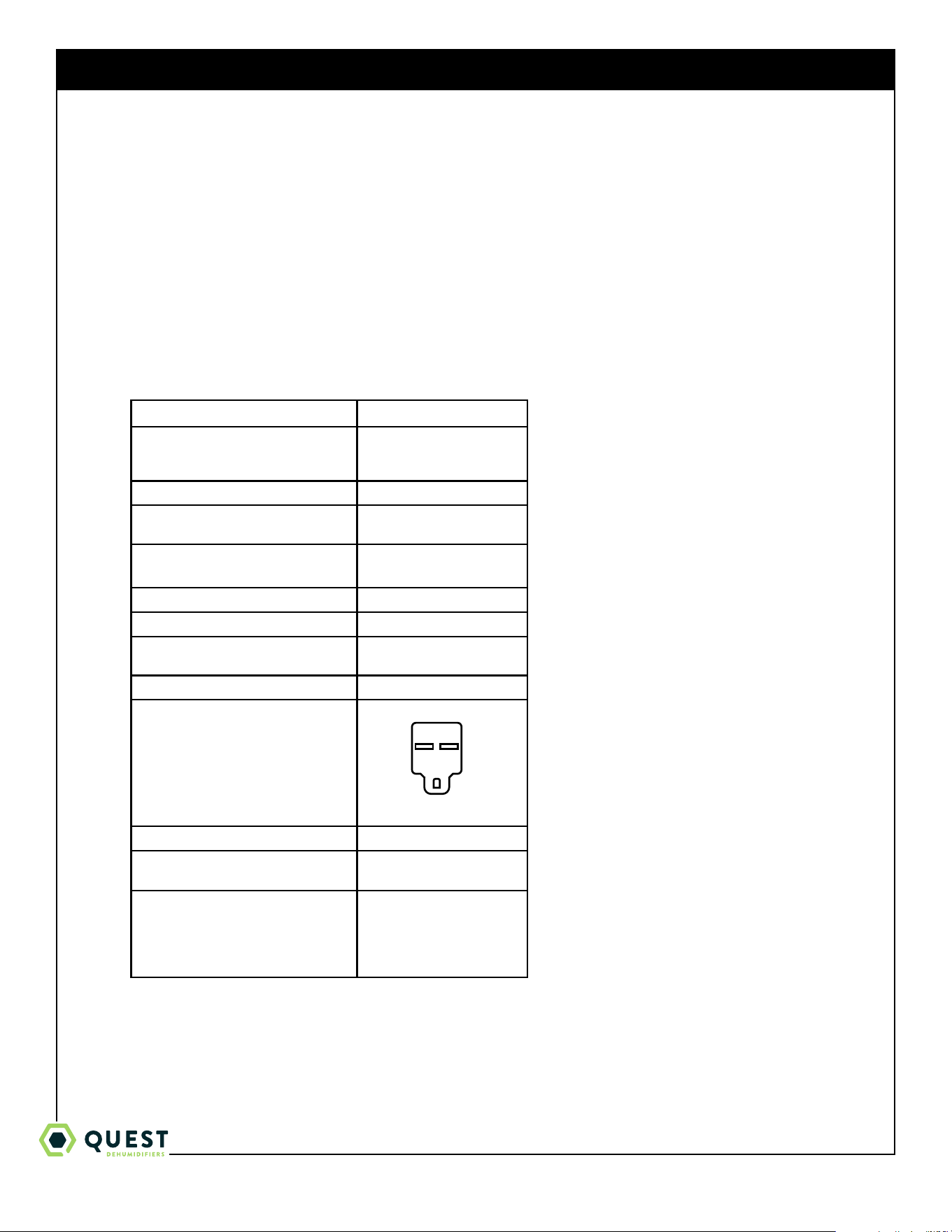
3. Specifications @ 80°F/60% RH
Unit: 4042500 Quest 335
Blower:
(Tested with duct collars on)
1000 CFM @ 0.0” WG
1000 CFM @ 0.2” WG
1000 CFM @ 0.4” WG
Power (Watts):
1565
Supply voltage:
208V and 230V -
1 Phase - 60 Hz.
Current Draw (Amps):
6.9A @ 230V
7.9A @ 208V
Energy Factor: (L/kWh)
4.4
Operating Temp:
56°F - 95°F
Water Removal (Pints/Day):
Eciency (Pints/kWh):
335
9.3
Air Filter (MERV-11 Nominal):
Size: 22” x 20” x 2”
Power Cord:
10’ 14/3 SJTW
NEMA 6-15P
Drain Connection:
3/4” Threaded NPT
Refrigerant Type:
Refrigerant Amount:
R410A
4lb. 12oz.
Dimensions:
Width:
Height:
Length:
Weight:
Unit Shipping
32.88” 36”
24.38” 30”
23.5” 28”
215 lbs 255 lbs

1-877-420-1330
Quest 335 Installation, Operation and Maintenance Instructions
5
www.QuestClimate.com
4. Installation
4.1 Location
The Quest 335 Dehumidifier can be installed in a variety of locations to meet the owner’s needs as listed below. In all
cases keep the following cautions in mind:
• Place the Quest 335 Dehumidifier on supports that raise the base of the unit 6” above the secondary drain pan so a
P-trap can be installed. See Section 4.3.
• The Quest 335 Dehumidifier may be suspended with steel hanger, straps, or a suitable alternative from structural
members, unit must be supported from underneath. Don’t hang from sides or ends. See section 4.4
• If installing on ground, use included plugs to cover hanging locations on top of the machine.
• If hanging machine in air, use included plugs to cover holes in base pan for leveling feet.
4.2 Electrical Requirements
The Quest 335 Dehumidifier plugs into NEMA rated receptacles. The amp draws for each unit under normal operating
conditions are listed on page 4. A ground fault interrupter protected circuit is required.
Install the remote hygrostat in a central area of the structure where it will sense the relative humidity of the structure
accurately. Do not install the hygrostat where it may not accurately sense the relative humidity such as near HVAC
supply registers, near exterior doors, or near a pool or spa. The installer must supply the wiring between the Quest 335
Dehumidifier and the hygrostat. Be sure to safely route the control wiring to prevent damage during installation. Be
careful not to cross the wires when connecting the Quest 335 Dehumidifier and the remote hygrostat.
The remote controls of the Quest 335 Dehumidifier are powered by a low voltage circuit (24 VAC) and must NEVER
contact or be connected to a high voltage circuit. The control terminals and remote control are labeled and numbered to
prevent confusion. Be sure to consult the electrical schematic in this manual or inside the access panel of the Quest 335
Dehumidifier before making the control connections.
CAUTION! Always disconnect the Quest 335 from a power source when working with the low
voltage control wires.
1-877-420-1330
Quest 335 Installation, Operation and Maintenance Instructions
6
www.QuestClimate.com
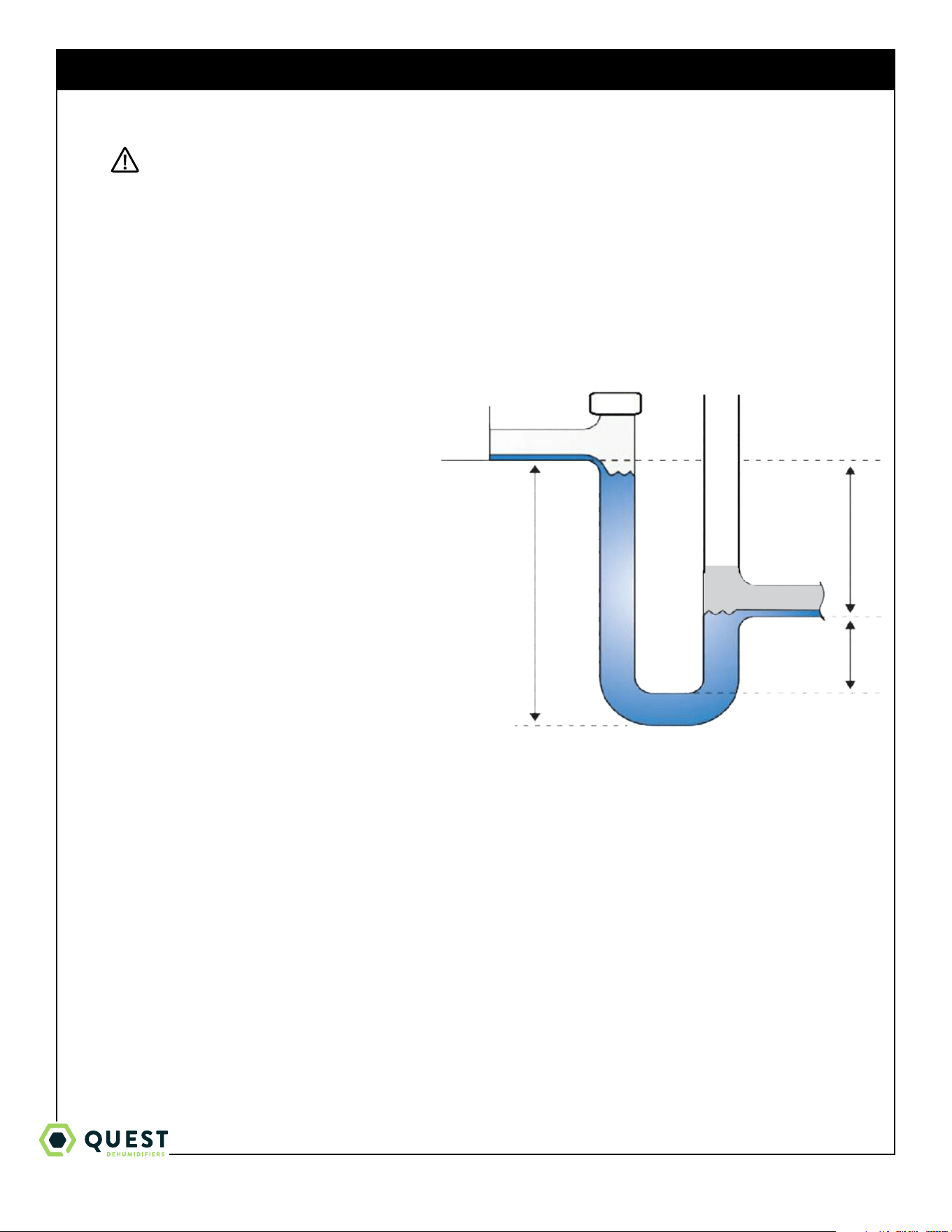
CAUTION! For proper drainage, the unit must be mounted so the drain outlet is at least 4”
above the floor drain, and must be fully supported under the base.
4.3 Condensate Water Removal
Condensate drains by gravity via the drain port. Use 3/4” male NPT PVC pipe. An optional condensate pump kit may be
installed if a lift is required to dispose of the condensate. Optional parts list for information on the kit.
Follow Diagram:
L
H
J
Drain Trap Configuration
VENT OPEN
CAP
H = 4”
J = 2”
L = 6.75”
Vent:
• Place vent after the trap.
• Vent should be open.
• Height of vent should be higher than drain outlet.
Cap:
• A clean out can be placed before trap but must be
sealed with a cap.
Drain Line:
• Drain line should go in a downward slope to the
drain.
• 1/4” drop per foot.
Quest 335
1-877-420-1330
Quest 335 Installation, Operation and Maintenance Instructions
7
www.QuestClimate.com
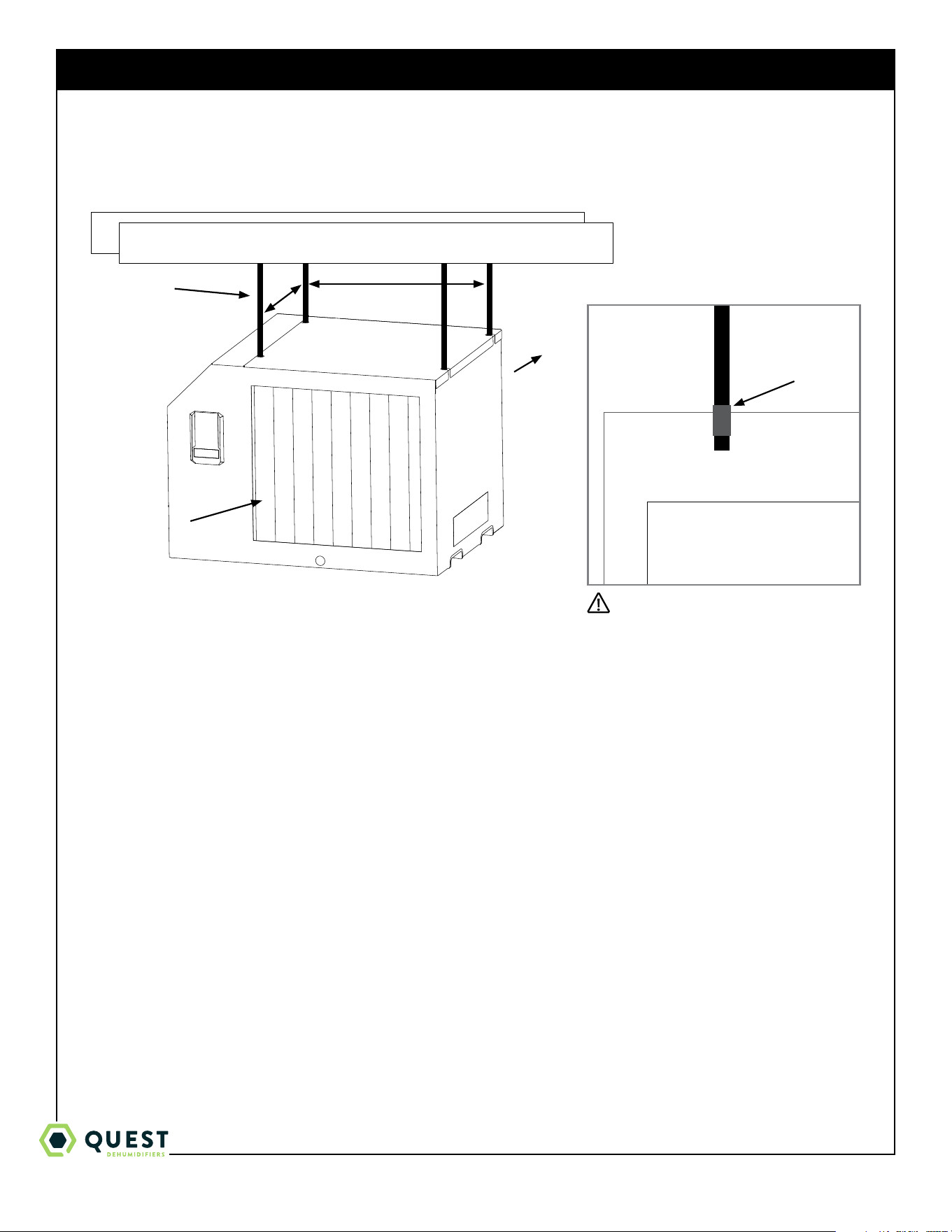
4.4 Hanging Diagram
Quest 335
Parts Needed: 4 pieces 3/8” threaded rod (not included)
4 - 3/8” threaded jam nuts (not included)
22.216.6
3/8” threaded rod
Intake Air
Treated Air
3/8” Jam Nuts
Threaded rods should be engaged
no less than 2” into machine.
1-877-420-1330
Quest 335 Installation, Operation and Maintenance Instructions
8
www.QuestClimate.com
UNIT.
Tools Required
- T25 Torx Driver
- 11/32” Driver
Following all local and national electrical codes and standards, route electrical service to the location that the
dehumidifier will be installed.
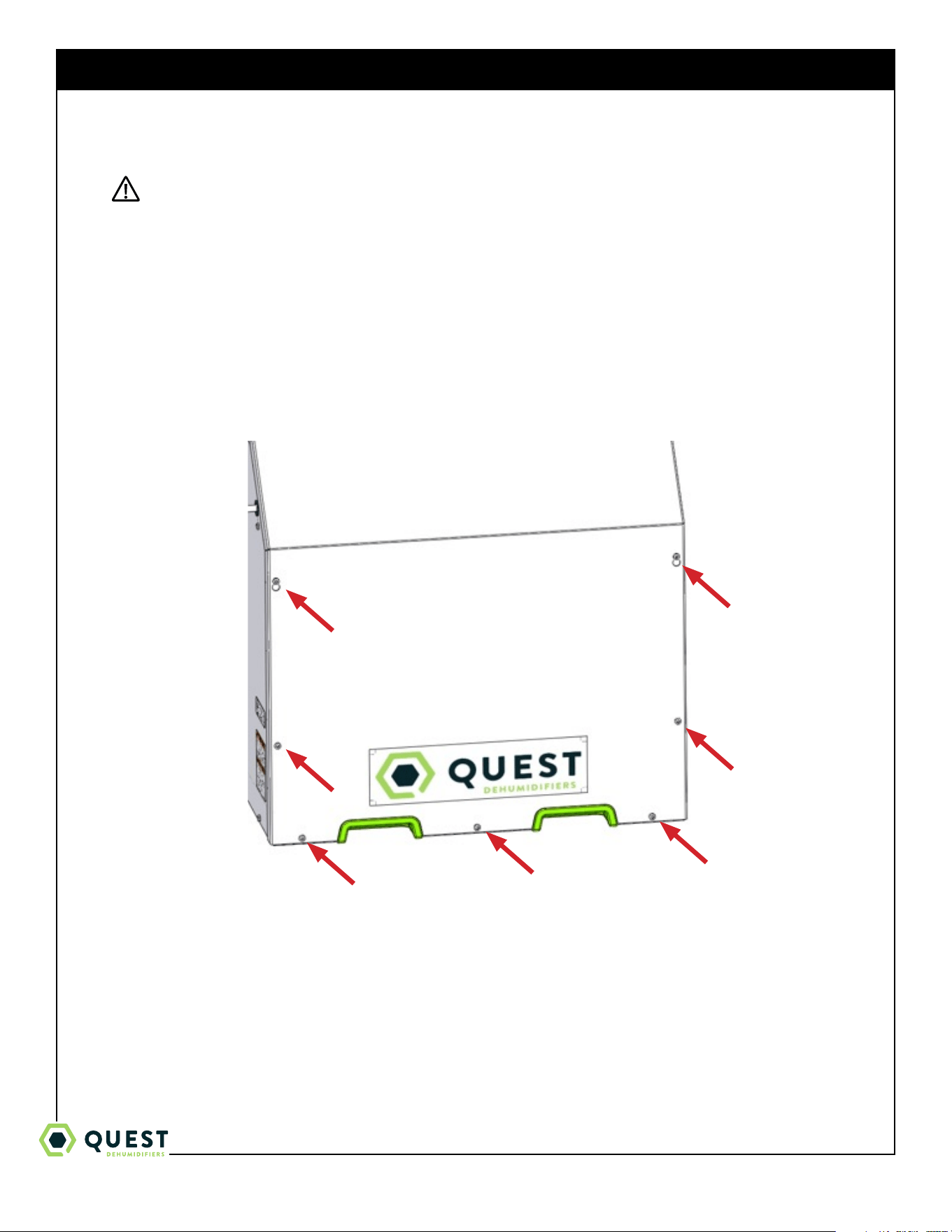
Remove 7 screws on access panel using T25 Torx driver, remove panel.
4.5 Hard-Wiring Instructions
WARNING! SERVICING THE QUEST 335 DEHUMIDIFIER, WITH ITS HIGH
PRESSURE REFRIGERANT SYSTEM AND HIGH VOLTAGE CIRCUITRY PRESENTS A
HEALTH HAZARD WHICH COULD RESULT IN DEATH, SERIOUS BODILY INJURY, AND/
OR PROPERTY DAMAGE. ONLY QUALIFIED SERVICE PEOPLE SHOULD SERVICE THIS
1-877-420-1330
Quest 335 Installation, Operation and Maintenance Instructions
9
www.QuestClimate.com
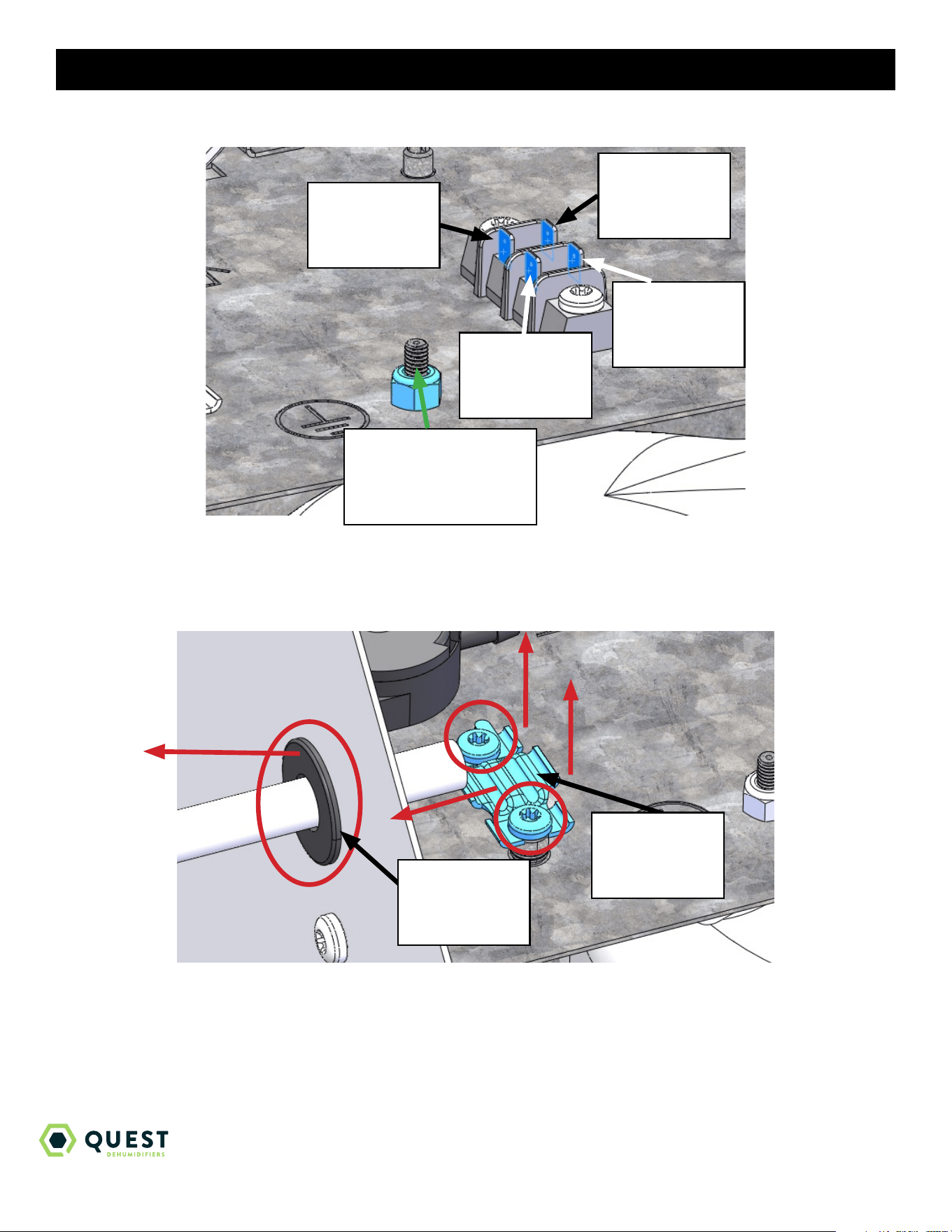
Disconnect POWER CORD BLACK wire from terminal
Disconnect POWER CORD WHITE wire from terminal.
Use 11/32” driver to remove nut from ground stud and disconnect POWER CORD GREEN wire from ground stud.
Remove the 2 screws holding the cord retention bracket using T25 Torx driver and remove retention bracket.
Remove power cord and black bushing.
Route incoming power service wires through 7/8” hole and secure using clamps intended for the conduit or cable used.
Disconnect
power cord
black wire
Wire harness
black wire
Wire harness
white wire
Disconnect
power cord
white wire
Disconnect
power cord green wire
from ground stud
Remove cord
retention
bracket
Remove
bushing from
7/8” hole
1-877-420-1330
Quest 335 Installation, Operation and Maintenance Instructions
10
www.QuestClimate.com
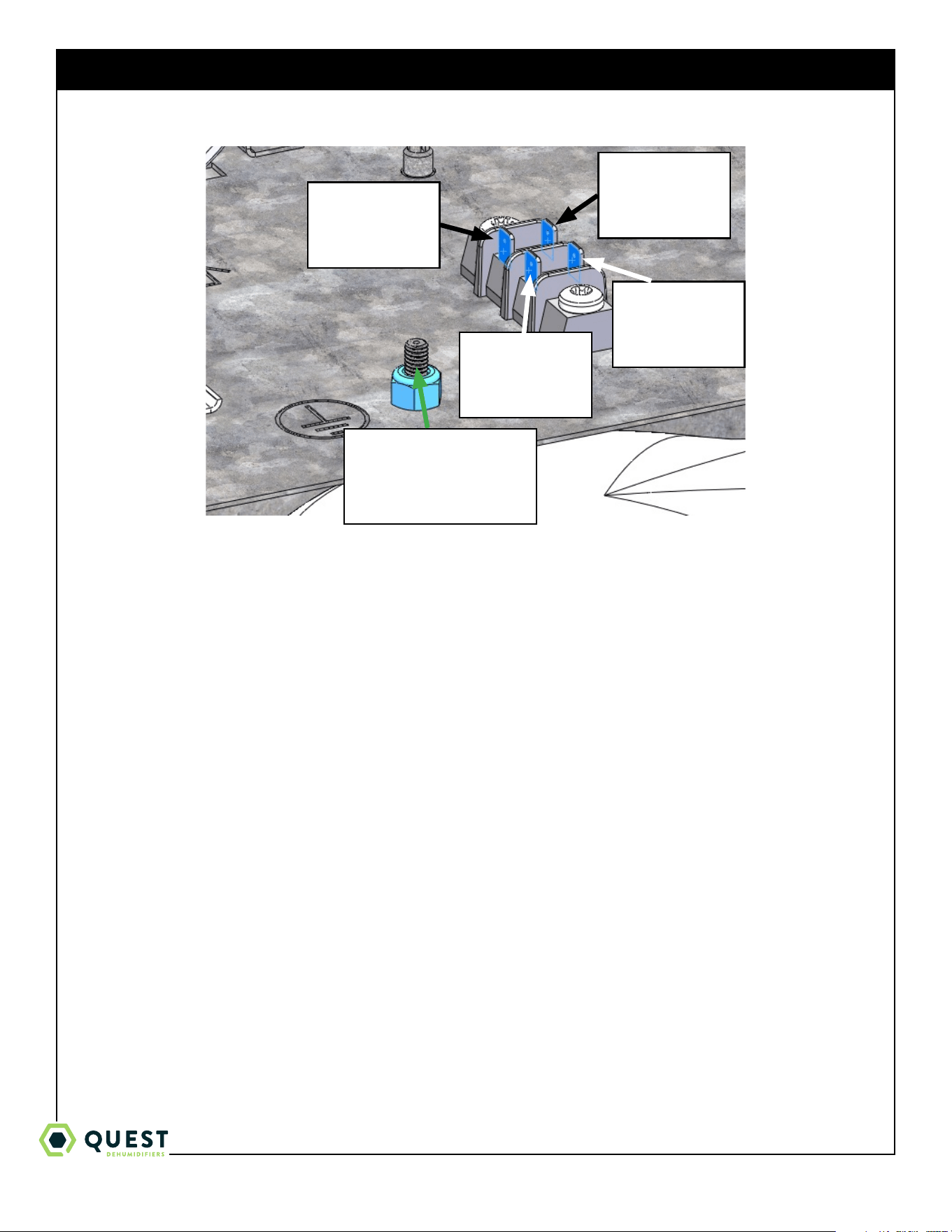
Connect BLACK and WHITE jumper wires to terminal block as shown.
Place GREEN jumper wire ring terminal on ground stud and use 11/32” driver to secure nut to stud.
Attach incoming service LINE 1 wire to BLACK jumper wire with the provided wirenut.
Attach incoming service LINE 2 wire to WHITE jumper wire with the provided wirenut.
Attach incoming service GROUND wire to GREEN jumper wire with the provided wirenut.
Connect black
jumper wire
Wire harness
Black wire
Wire harness
white wire
Connect white
jumper wire
Green jumper wire to
ground stud
1-877-420-1330
Quest 335 Installation, Operation and Maintenance Instructions
11
www.QuestClimate.com
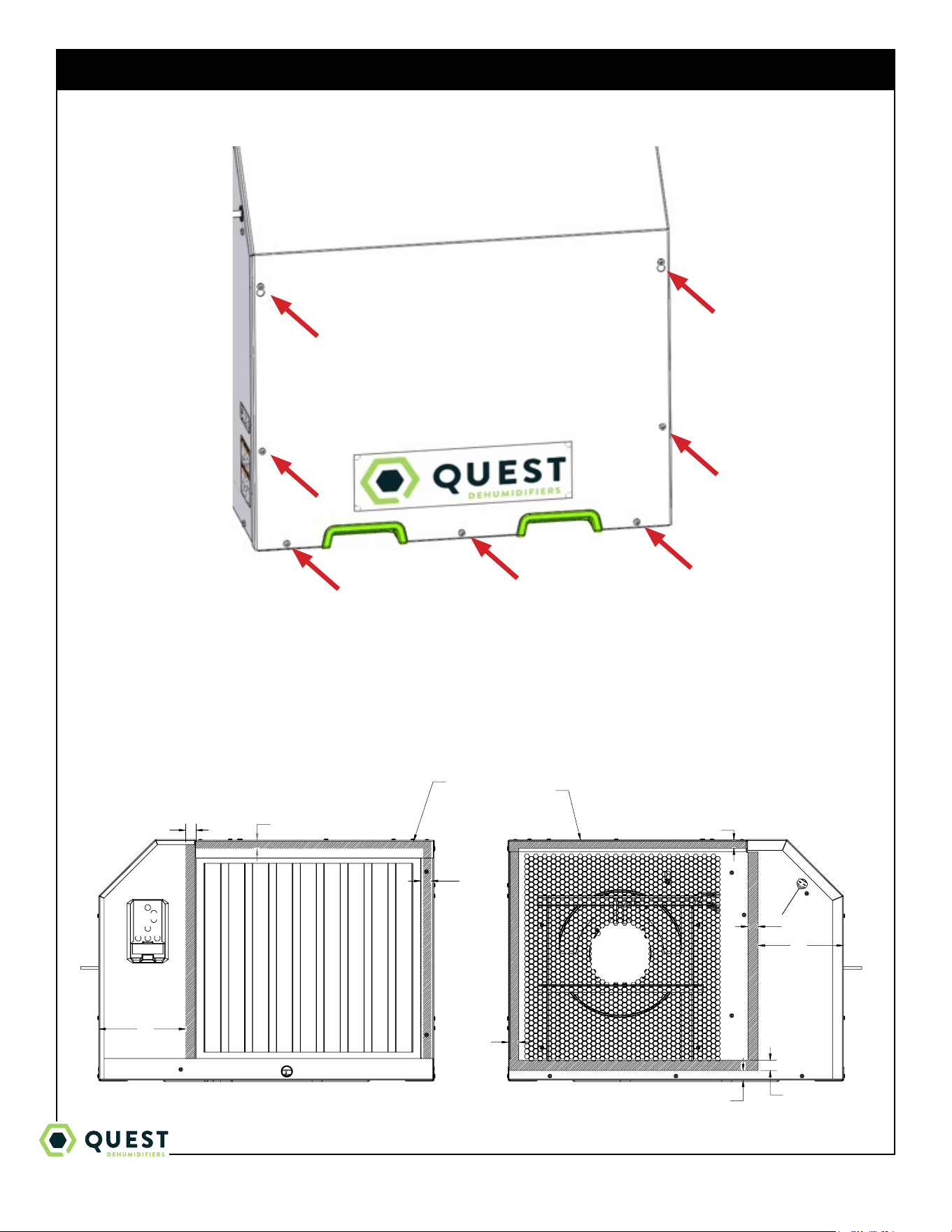
Replace access panel using T25 Torx driver to secure 7 screws.
4.6 Quest 335 Supply and Return Duct Kit (P/N 4042685)
If factory duct kit accessory was purchased, follow instructions included with duct kit.
If owner chooses to have a licensed HVAC contractor fabricate a duct kit, please follow the drawing below for safe zones for self
tapping screws.
.8
1.0
1.0
8.5
.8
1.0
8.4
1.0
1.0
.9
HATCH AREA REPRESENTS
SAFE ZONE FOR FASTENERS
1-877-420-1330
Quest 335 Installation, Operation and Maintenance Instructions
12
www.QuestClimate.com
5. Control Options
The Quest 335 Dehumidifier can be controlled by its on board dehumidistat or with an external control using its low
voltage terminal block.
5.1A Quest 335 On Board Dehumidistat
O Mode: Fan, Compressor, Display and all LEDs are o
To Turn Unit On: Press the power button
On Mode: Display is on and shows the set point (Initial set point: 55% RH)
To Change Set Point:
- Press the up or down arrow once, the 2-digit display will begin to blink.
- Adjust to desired RH. Each push of the button will change the SP 1% RH.
- After 6 seconds without a button being pushed the number showing will become the new SP
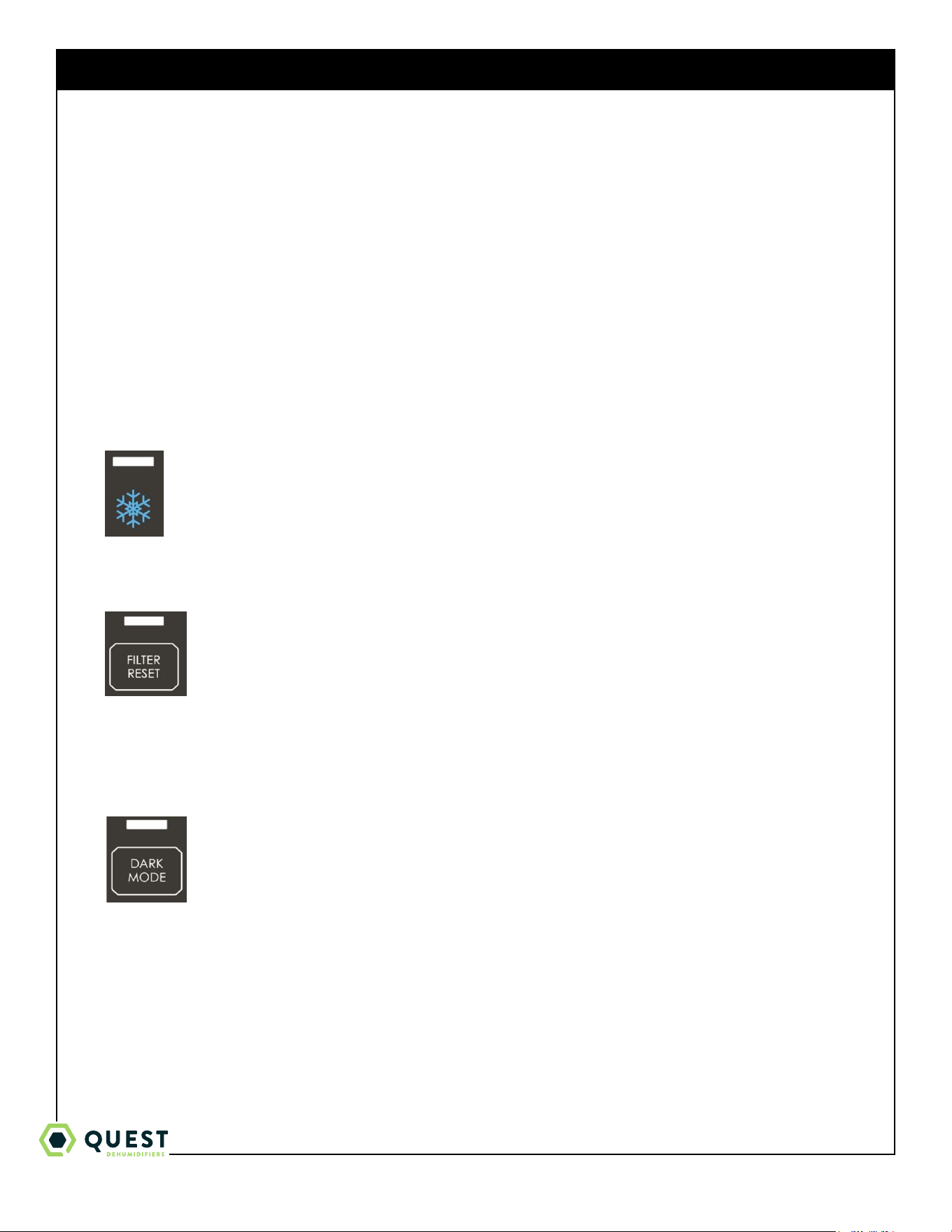
Defrost Light
- The light over the snowflake will light up when defrost is occurring (ice is detected on coils). The fan will be on, and the
compressor will be o during defrost.
Filter Reset
- Filter reset button will light up after the fan has been running for 2,000 hours, or if the pressure switch detects excessive
pressure build-up indicating that the filter must be changed.
- After changing the filter, press and hold the filter reset button to reset the 2,000-hour timer. Light flashes while button is
held.
Dark Mode
- Press the Dark Mode button to activate Dark Mode.
- Once Dark Mode is activated, lights will remain on for 20 seconds before the unit’s hygrostat will go dark. Dark Mode
light will flash for 3 seconds before unit goes dark.
- Unit will temporarily leave dark mode when any button is pushed and will go dark 20 seconds after the last button is
pushed.
- To turn o Dark Mode, press the Dark Mode button and ensure light above Dark Mode button is o.
- This mode is for applications where the user would like the unit to operate without emitting any light.
1-877-420-1330
Quest 335 Installation, Operation and Maintenance Instructions
13
www.QuestClimate.com
Fan
Pressing the Fan button alternates the unit between 3 fan speeds:
- (Hi)gh: Increased fan speed to be used exclusively in ducted applications. Deactivates filter-life compensation mode.
- (Au)to: Default fan speed. Filter-life compensation mode active.
- (Lo)w: Decreased fan speed that lowers the volume and performance of the unit. Deactivates filter-life compensation mode.
Filter-life compensation mode measures the static pressure increase due to the filter particulate build-up and increases fan speed to
maintain optimum airflow and performance.
Terminal Control
- When the Terminal Control button is pressed, the display will show “tc”.
- The Terminal Control button is used to activate the “DEHUM” input on the terminal block. (see section 5.1B)
- This must be activated when an external control is used to control RH. When Terminal Control is active, the internal RH sensor
is disabled.
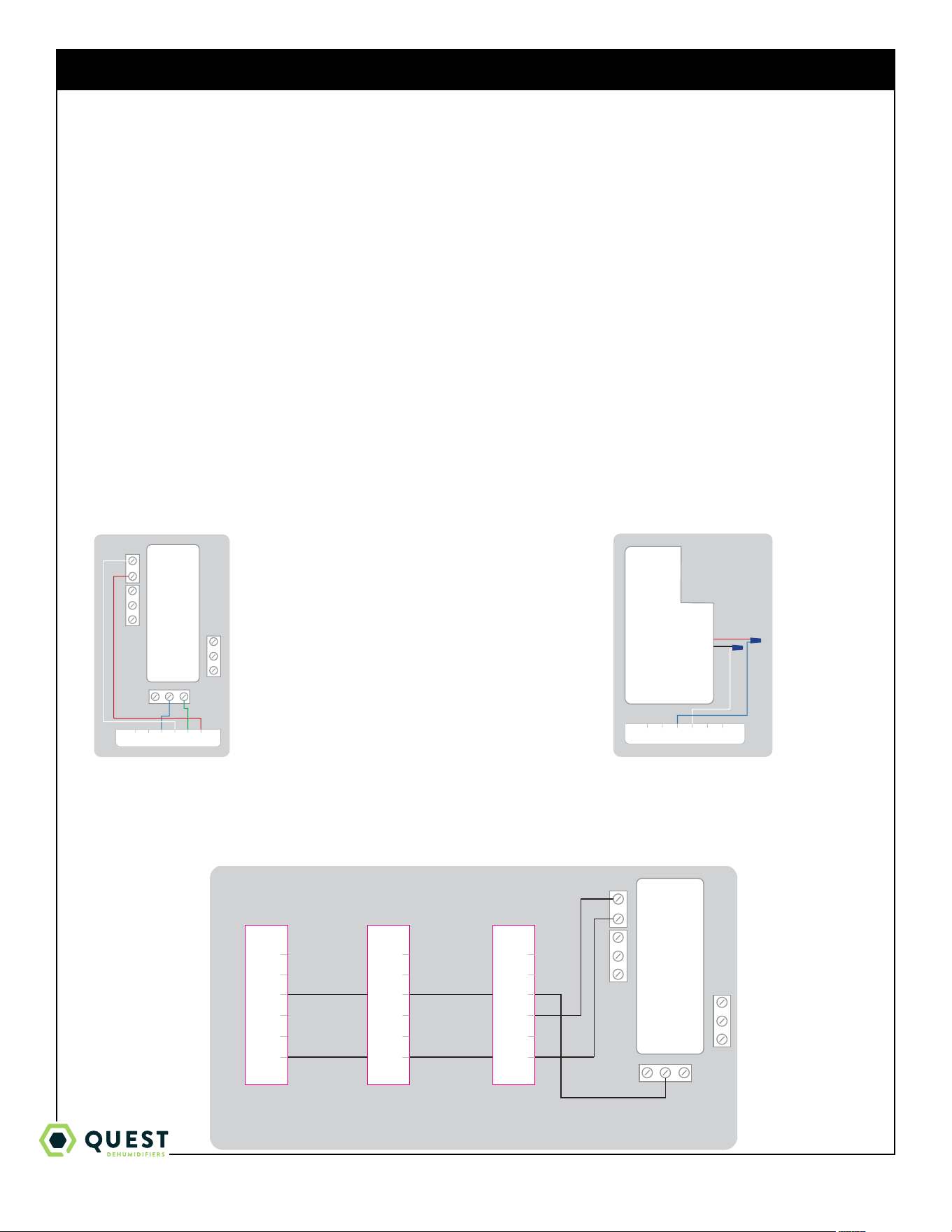
5.1B Quest 335 External Control Options
Quest oers two external control options
DEH 3000R Honeywell Remote Humidistat
NOTE: 22 ga wire needed for sensor
Contact your dealer or call 1-877-420-1330 to order or go to www.questclimate.com/product-category/accessories.
Daisy Chain
I
I
I
I
I
I
I
I
I
I
I
I
I
I
I
H
U
M
I
D
N
O
R
M
A
L
D
R
I
E
R
OFFON
BEFORE TURNING ON UNIT:
1. CUT AND REMOVE ZIP TIE
2. PLUG HOLES USING
INCLUDED PLUGS
COM
FAN
24V
DEHU
*
DMPR
COM
FAN
24V
DEHU
*
DMPR
24VAC
COMP FAN
HONEYWELL REMOTE HUMIDISTAT
WIRING DIAGRAM
QUEST DEH 3000R CONTROL
WIRING DIAGRAM
4028531
I
I
I
I
I
I
I
I
I
I
I
I
I
I
I
H
U
M
I
D
N
O
R
M
A
L
D
R
I
E
R
OFFON
BEFORE TURNING ON UNIT:
1. CUT AND REMOVE ZIP TIE
2. PLUG HOLES USING
INCLUDED PLUGS
COM
FAN
24V
DEHU
*
DMPR
COM
FAN
24V
DEHU
*
DMPR
24VAC
COMP FAN
HONEYWELL REMOTE HUMIDISTAT
WIRING DIAGRAM
QUEST DEH 3000R CONTROL
WIRING DIAGRAM
4020175
24VAC
COMP FAN
QUEST DEH 3000R CONTROLER
COM
FAN
24V
DEHU
FLOAT
FLOAT
COM
FAN
24V
DEHU
FLOAT
FLOAT
COM
FAN
24V
DEHU
FLOAT
FLOAT
QUEST 6 SERIES -
UNIT#2
QUEST 6 SERIES -
UNIT#3
QUEST 6 SERIES -
UNIT#1
*NOTE - DO NOT WIRE IN “FAN” TERMINAL WITH THIS APPLICATION
1-877-420-1330
Quest 335 Installation, Operation and Maintenance Instructions
14
www.QuestClimate.com
5.2 Quest 335 External Control
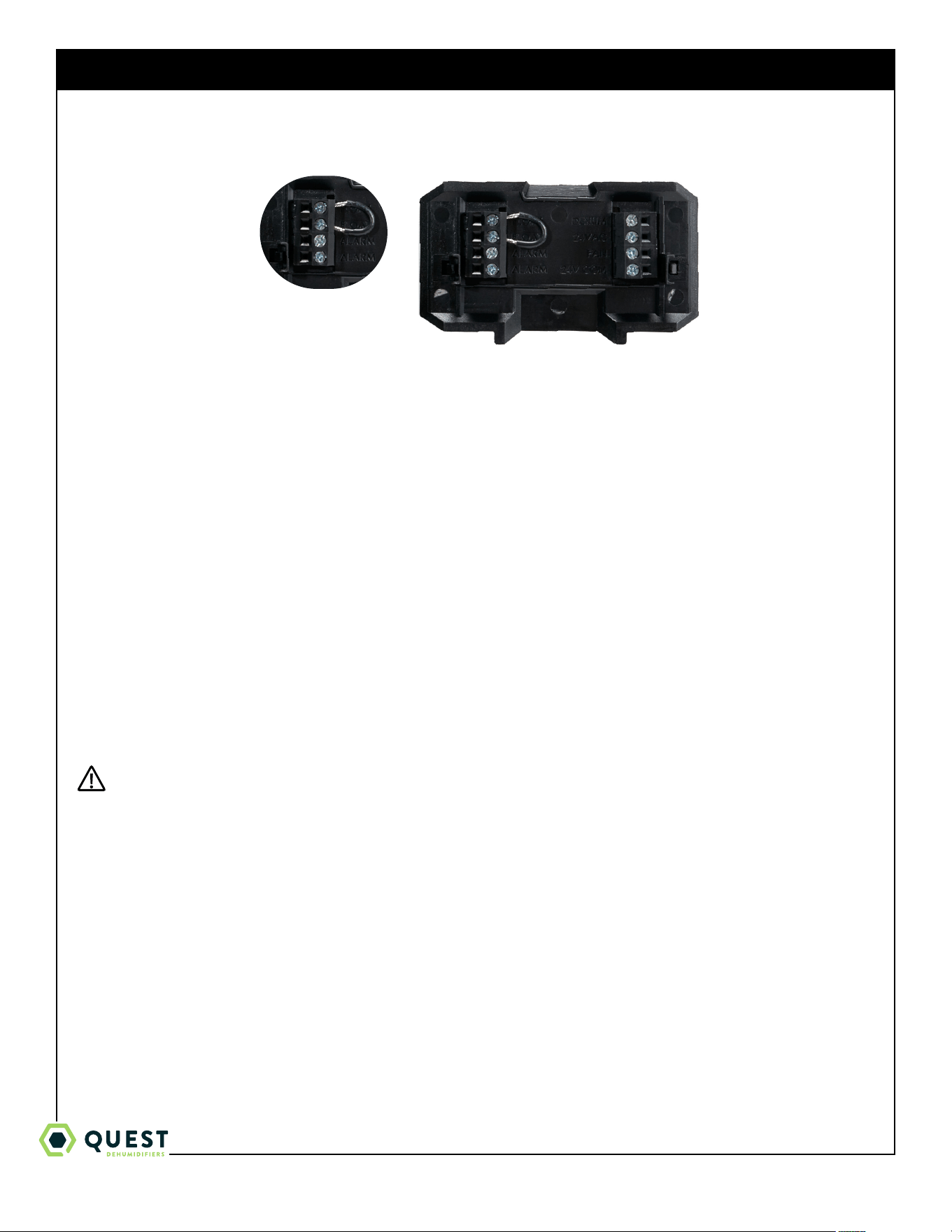
- Remove the cover from the user interface to expose the terminal block inputs & outputs.
Quest 335 Terminal Block Control Operations:
DEHUM: Dehumidification (Fan and Compressor) Control Input.
24VAC: Transformer High Side Output to External Control.
FAN: Fan Control Input.
24V COM: 24VAC Power Transformer Neutral Side Output to External Control.
FLOAT: External Low Voltage Float Switch or Water Sensor Input (Use Normally Closed Switch).
FLOAT: External Low Voltage Float Switch or Water Sensor Input (Use Normally Closed Switch).
ALARM: Normally Closed Relay Output - Indicates when dehumidifier is in an alarm state.
ALARM: Normally Closed Relay Output - Indicates when dehumidifier is in an alarm state.
Changing Max Fan Speed
- Hold the FAN button for 3 seconds, the 2-digit display will begin to flash.
- Once the display is flashing, the maximum fan speed can be adjusted 1% at at time (in the range of 20-99%).
- The new maximum fan speed can be locked by not pressing any buttons for 6 seconds or by pressing the FAN button.
- This will disable filter life compensation functionality.
6. Maintenance
WARNING! NOTE: Do not operate the unit without the filter or with a less eective filter. The
heat exchange coils inside the unit could become clogged and require disassembly to clean. Filter non-
compliance invalidates the product warranty.
6.1 Standard Air Filter
The Quest 335 Dehumidifier ships with a standard MERV 13 ecient pleated fabric filter. This filter should be checked every six
months. Operating the unit with a dirty filter will reduce dehumidifier capacity and eciency and may cause the compressor to
cycle o and on unnecessarily on the defrost control.
To access the air filter, remove the filter access panel from the end of the Quest 335 Dehumidifier. The filter should be readily
visible and can be removed by pulling it straight out of the Quest 335 Dehumidifier.
We recommend changing the filter at least every 6 months. For agriculture we recommend changing the filter with every grow
cycle.
6.2 Impeller Fan Oiling
The impeller fan motor is factory lubricated for many years of normal operation, and no further oiling is required.

1-877-420-1330
Quest 335 Installation, Operation and Maintenance Instructions
15
www.QuestClimate.com
7. Service
WARNING! Servicing the Quest 335 with its high pressure refrigerant system and high voltage
circuitry presents a health hazard which could result in death, serious bodily injury, and/or property
damage. Only qualified service people should service this unit.
7.1 Warranty
A warranty certificate has been enclosed with this unit; read it before any repair is initiated. If a warranty repair is required, call the
factory first at 1-877-420-1330 for warranty claim authorization and technical assistance.
7.2 Technical Description
The Quest 335 Dehumidifier uses a refrigeration system similar to an air conditioner's to remove heat and moisture from incoming
air, and add heat to the air that is discharged.
Hot, high-pressure refrigerant gas is routed from the compressor to the condenser coil. The refrigerant is cooled and condensed
by giving up its heat to the air that is about to be discharged from the unit. The refrigerant liquid then passes through a filter/
drier and capillary tubing which causes the refrigerant pressure and temperature to drop. It next enters the evaporator coil
where it absorbs heat from the incoming air and evaporates. The evaporator operates in a flooded condition, which means that all
the evaporator tubes contain liquid refrigerant during normal operation. A flooded evaporator should maintain nearly constant
pressure and temperature across the entire coil, from inlet to outlet.
The compressor collects the cool refrigerant gas and compresses it to a high pressure and temperature to repeat the process.
7.3 Troubleshooting
Neither fan nor compressor running. Dehumidification is being called for. No fan call.
1. Unit unplugged or no power to outlet.
2. Humidity control set too high.
3. Loose connection in internal or control wiring.
4. Defective Compressor relay.
5. Defective control transformer.
Compressor is not running. Dehumidification is being called for. No fan call.
1. Defective compressor run capacitor.
2. Loose connection in compressor circuit.
3. Defective compressor overload.
4. Defective compressor.
5. Defrost thermostat open.

1-877-420-1330
Quest 335 Installation, Operation and Maintenance Instructions
16
www.QuestClimate.com
Compressor cycles on and o. Dehumidification is being called for. No fan call.
1. Low ambient temperature and/or humidity causing unit to cycle through defrost mode.
2. Defective compressor overload.
3. Defective compressor.
4. Defrost thermostat defective.
5. Dirty air filter(s) or air flow restricted.
Fan is not running. Dehumidification or fan is being called for.
1. Loose connection in fan circuit.
2. Obstruction prevents fan impeller rotation.
3. Defective fan.
4. Defective fan relay.
Low dehumidification capacity (evaporator is frosted continuously). Dehumidification is being called for
1. Defrost thermostat loose or defective.
2. Low refrigerant charge.
3. Dirty air filter(s) or air flow restricted.
4. Excessively restrictive ducting connected to unit.
No ventilation. Ventilation is being called for.
1. Loose connection in ventilation control circuit.
2. Loose connection in damper power circuit.
3. Defective fresh air damper.
Unit removes some water, but not as much as expected.
1. Air temperature and/or humidity have dropped.
2. Humidity meter and or thermometer used are out of calibration.
3. Unit has entered defrost cycle.
4. Air filter dirty.
5. Defective defrost thermostat.
6. Low refrigerant charge.
7. Air leak (eg. loose cover or ducting leaks).
8. Defective compressor.
9. Restrictive ducting.
10. Optional Condensate Pump Safety Switch open.
11. Unit is in (Lo)w fan mode

1-877-420-1330
Quest 335 Installation, Operation and Maintenance Instructions
17
www.QuestClimate.com
Unit Test to determine problem:
1. Detach field control wiring connections from main unit.
2. Connect the 24V and FAN from the main unit together; only the impeller fan should run. Disconnect the wires.
3. Connect the 24V and DEHU from the main unit together; the compressor and impeller fan should run.
4. If these tests work, the main unit is working properly. You should check the hygrostat and field control wiring for
problems next.
5. Remove the hygrostat from the mounting box and detach it from the field installed control wiring. Connect the
DEHU, 24V, and FAN terminals from the hygrostat directly to the corresponding locations on the main unit. Leave
the, FLOAT and COM terminals disconnected!
6. Turn on the fan switch; the impeller fan should run. Turn o the fan switch.
7. Turn on the humidity control; the compressor and impeller fan should run.
8. If these tests work, the problem is most likely in the field control wiring.
Filter Change Light Illuminated (Too Frequently):
1. Change filter if dirty.
2. Hold filter change button.
3. Conditions causing rapid cycling, disable filter change light.
7.4 Refrigerant Charging
If the refrigerant charge is lost due to service or a leak, a new charge must be accurately weighed in. If any of the old
charge is left in the system, it must be recovered before weighing in the new charge. Refer to the unit nameplate for the
correct charge weight and refrigerant type.
7.5 Impeller Fan Replacement
The motorized impeller fan is a unitary assembly consisting of the motor and impeller fan. If defective, the complete
assembly must be replaced.
1. Unplug the power cord.
2. Remove the access panel, and top panel.
3. Remove the screws attaching the impeller fan support bracket to the base.
4. Disconnect the impeller fan leads inside the electric box.
5. Remove fan/bracket assembly by removing 3 screws from the bracket and inlet ring assembly.
6. Remove the defective impeller fan from the bracket and replace with it with the new impeller fan.
7. Reassemble the new impeller fan by reversing the above procedure. Note: There are two pins on the backside of the
cabinet that must align with the two holes in the impeller fan support bracket.
7.6 Compressor/Capacitor Replacement
This compressor is equipped with a two terminal external overload and a run capacitor, but no start capacitor or relay
(See Figure 4).
7.6A Checking Compressor Motor Circuits
Perform the following tests if the impeller fan runs but the compressor does not with the fan switch and ventilation timer
OFF and the humidity control ON.

1-877-420-1330
Quest 335 Installation, Operation and Maintenance Instructions
18
www.QuestClimate.com
1. Unplug the unit; remove the cabinet side and the electrical connection cover on the compressor top.
2. Plug in the unit and turn the humidity control to ON. Check for volts from compressor terminal R to overload
terminal 3 using an AC voltmeter. If correct voltage is present, go to step 3. If no voltage, there may be a loose
connection in the compressor circuit. Test each component for continuity. See the appropriate section if a defect is
suspected.
3. Unplug the unit, and then disconnect the red and yellow wires from compressor terminals R & S. Using an ohmmeter
check continuity between the points listed below.
4. Compressor terminals C and S: No continuity indicates an open start winding. The compressor must be replaced.
Normal start winding resistance is 3 to 7 ohms.
5. Compressor terminals C and R: No continuity indicates an open run winding. The compressor must be replaced.
Normal run winding resistance is .5 to 2 ohms.
6. Compressor terminal C and overload terminal 1: No continuity indicates a defective overload lead.
7. Overload terminals 1 and 3: If there is no continuity, the overload may be tripped. Wait 10 minutes and try again. If
there is still no continuity, it is defective and must be replaced.
8. Compressor terminal C and compressor case: Continuity indicates a grounded motor. The compressor must be
replaced.
9. Disconnect the wires from the run capacitor. Set the ohmmeter to the Rx1 scale. The capacitor is shorted and must
be replaced if continuity exists across its terminals. If there is no needle movement with the meter set on the
Rx100000 scale, the capacitor is open and must be replaced.
10. Reconnect the wires to the compressor and capacitor. Plug in and turn on the unit. If the compressor fails to start,
replace the run capacitor.
11. If the unit still does not start, adding a hard-start kit (relay & capacitor) will provide greater starting torque. If this
doesn't work, the compressor has an internal mechanical defect and must be replaced.
7.6B Replacing a Burned Out Compressor
The refrigerant and oil mixture in a compressor is chemically very stable under normal operating conditions. However,
when an electrical short occurs in the compressor motor, the resulting high temperature arc causes a portion of the
refrigerant oil mixture to break down into carbonaceous sludge, a very corrosive acid, and water. These contaminants
must be carefully removed otherwise even small residues will attack replacement compressor motors and cause failures.
The following procedure is eective only if the system is monitored after replacing the compressor to insure that the
clean up was complete.
1. This procedure assumes that the previously listed compressor motor circuit tests revealed a shorted or open winding.
2. Remove and properly dispose of the system charge. DO NOT vent the refrigerant or allow it to contact your eyes or
skin.
3. Remove the burned out compressor. Use rubber gloves if there is any possibility of contacting the oil or sludge.
4. To facilitate subsequent steps, determine the type of burn out that occurred. If the discharge line shows no evidence
of sludge and the suction line is also clean or perhaps has some light carbon deposits, the burn out occurred while
the compressor was not rotating. Contaminants are therefore largely confined to the compressor housing. A single
installation of liquid and suction line filter/driers will probably clean up the system.
If sludge is evident in the discharge line, it will likely be found in the suction line. This indicates the compressor burned
out will running. Sludge and acid have been pumped throughout the system. Several changes of the liquid and suction
filter/driers will probably be necessary to cleanse the system.
5. Correct the system fault that caused the burn out. Consult the factory for advice.

1-877-420-1330
Quest 335 Installation, Operation and Maintenance Instructions
19
www.QuestClimate.com
6. Install the replacement compressor with a new capacitor and an oversized liquid line filter.
In a running burn out, install an oversized suction line filter/drier between the accumulator and compressor.
Thoroughly flush the accumulator with refrigerant to remove all trapped sludge and to prevent the oil hole from
becoming plugged. A standing burn out does not require a suction line filter/drier.
7. Evacuate the system with a good vacuum pump and accurate vacuum gauge. Leave the pump on the system for at
least an hour.
8. Operate the system for a short period of time, monitoring the suction pressure to determine that the suction filter
is not becoming plugged. Replace the suction filter/drier if pressure drop occurs. If a severe running burn out has
occurred, several filter/driers may have to be replaced to remove all of the acid and moisture.
NOTE: NEVER use the compressor to evacuate the system or any part of it.
7.6C Replacing a Compressor, Non burn Out
Remove the refrigerant from the system. Replace the compressor and liquid line filter/drier. Charge the system to 50
PSIG and check for leaks. Remove the charge and weigh in the refrigerant quantity listed on the nameplate. Operate the
system to verify performance.
7.7 Remote Controls
The Quest 335 Dehumidifier is controlled by devices mounted on a panel that is remote from the unit. You may or may
not have the devices listed below depending on the model of the remote hygrostat you purchased. If the Quest 335
Dehumidifier fails to operate as desired, always check the settings of the controls to insure that they are correct. Check
that the controls are receiving 24VAC from the Quest 335 Dehumidifier. Check the connections between the Quest
335 Dehumidifier, the hygrostat, and the field control wiring.
7.7A Humidity Control
The humidity control is an adjustable switch that closes when the relative humidity of the air in which it is located rises to
the set point. It opens when the RH drops 4 to 6% below the set point. If the Quest 335 Dehumidifier does not run, try
turning the humidity control Down using arrow on control pad. If it then runs, the humidity control is out of calibration or
the RH is below setpoint.
The Quest 335 Dehumidifier is equipped with an automatic defrost mechanism. If the Quest 335 Dehumidifier
operates in conditions that develop frost on the evaporator, it will sense the frost build-up and automatically defrost the
evaporator. The Quest 335 Dehumidifier may not appear to be operating correctly during the defrost sequence, but
once the defrost sequence is completed, the Quest 335 Dehumidifier will resume dehumidifying.
7.8 Defrost Thermostat
The defrost thermostat is attached to the refrigerant suction tube between the accumulator and the compressor. It will
automatically shut the compressor o if the low side refrigerant temperature drops due to excessive frost formation on
the evaporator coil. The impeller fan will continue to run, causing air to flow through the evaporator coil and melt the ice.
When the ice has melted, the evaporator temperature will rise and the thermostat will restart the compressor.
7.9 Condensate Pump Kit
An optional condensate pump kit is available from the factory for use with the Quest 335 Dehumidifier. Condensate is
automatically pumped to a remote location when the water level in the pump's reservoir rises to close the float switch.
The pump also contains a safety float switch. The white leads from this switch extend from beneath the pump cover. This
switch should be installed in series with the field wire that connects the 24V from the Quest 335 Dehumidifier to the
hygrostat.

1-877-420-1330
Quest 335 Installation, Operation and Maintenance Instructions
20
www.QuestClimate.com
If the pump fails, this switch opens the compressor control circuit and stops water production before the reservoir
overflows. The Quest 335 Dehumidifier will continue to ventilate or circulate air as normal, but will not dehumidify until
this switch closes.
8. Quest 335 Error Codes
1
RH Sensor
Error
No valid RH reading for ~ 22
seconds
Disregard for terminal control
display “--”
Valid RH reading
Error Code: “E1”
Circulate: 1 minute
Dehumidistat: 15 minutes
Dehu mode: 15 minutes
Repeat
Detected on power board, error
communicated to UI
3
Out of
Refrigerant
Evaporator doesn’t get at least
5°F below ambient after being
in dehumidification mode for
10 minutes or more
Lock-out for 1 hour
Re-start and see if
evaporator gets cold
again
Error Code: “E3”
Compressor off (during lock-out)
Fan off (during lock-out)
Goes to circulate mode
4
Normally
Closed (NC)
Float Switch
Tripped
The FLOAT terminals on the
UI are in error state. If it is
open for ~ 6 seconds this alert
will trigger. This should happen
in all states (not just when in
Terminal control)
Float inputs are open
Error code: “E4”
Compressor off, fan off
Use command Set:
Dehu_state:off
5
Evaporator
Sensor Error
Invalid reading (above 200°F
or below -20°F) from the
evaporator sensor for ~ 12
seconds or more
Valid evaporator sensor
reading for ~ 12 seconds
or more
Error code: “E5”
Dehu Mode: 15 minutes
Defrost Mode: 30 Minutes
Repeat
6
Temperature
too High
Either the evaporator or the
ambient sensor is reading
above 120°F
Lock-Out for 1 hour
temperatures drop
below threshold
Error Code: “E6”
Fan off
Compressor off
7
Temperature
too Low
Ambient sensor reading
was under 40°F when the
dehumidifier was either in
dehu or circulate mode: The
unit will enter dehumidistat
mode and stay there for at
least 15 minutes
Temperature rises
above threshold when
the unit exits out of
dehumidistat mode
Error Code: “E7”
Fan off
Compressor off
8 Comm Error
Communication from power
board is not being received
Valid communication
received from power
board
Error Code: “E8”
Power board continues to run unit.
UI board would not be able to
make changes to operation until
communication is restored.
1-877-420-1330
Quest 335 Installation, Operation and Maintenance Instructions
21
www.QuestClimate.com
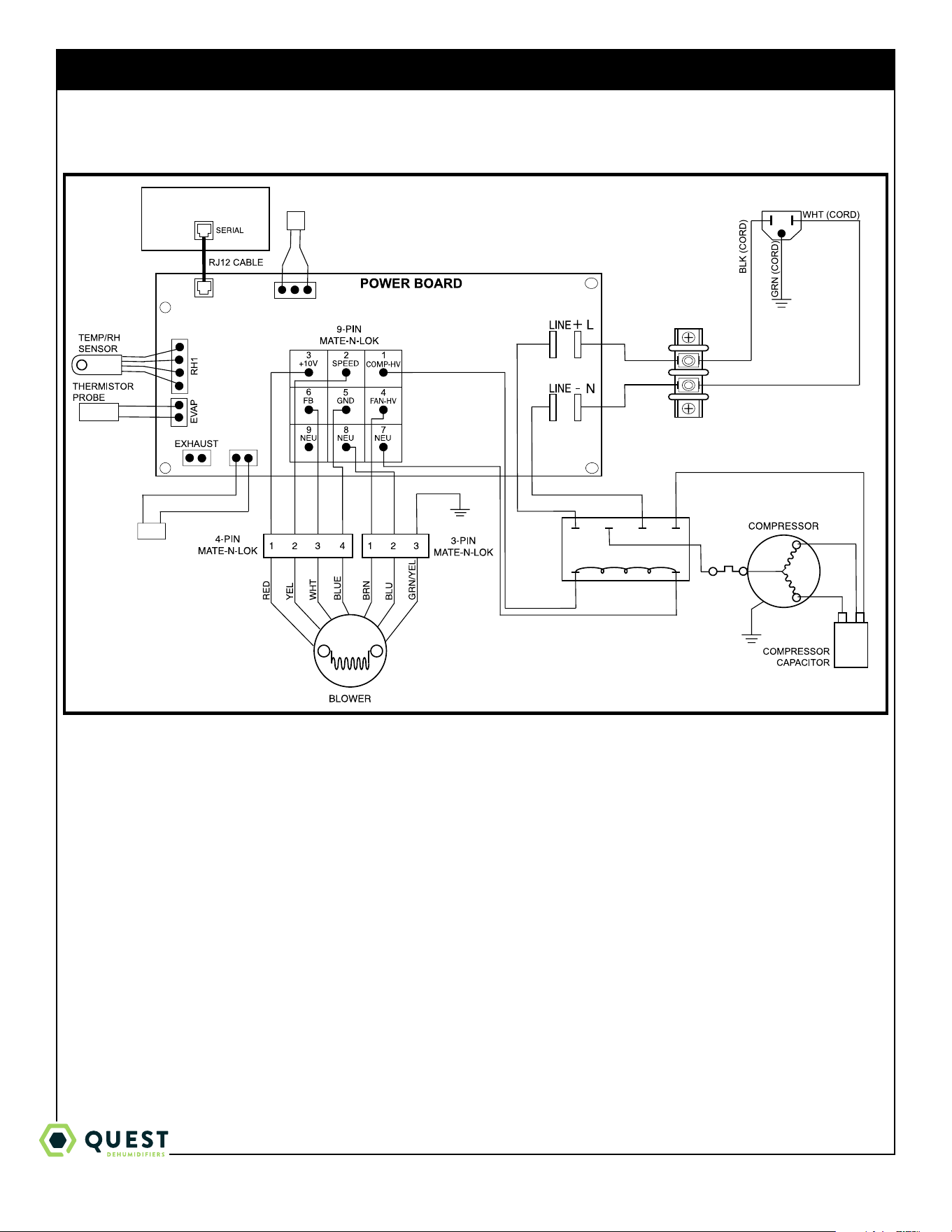
Wiring Diagram of the Quest 335 Dehumidifier
P/N 4042576
Rev. A
BLU-3
BLK-5
YEL-12
YEL-11
BLK-8
SERIAL
SWITCH
PRESSURE
SWITCH
BLU-1
BLU-2
( )
( )
DISPLAY BOARD
WHT- 6
WHT- 9
YEL-3
GRN-1
RED-2
WHT- 10
BLK-4
ORG-4
FILTER
AIR
PRESSURE
SWITCH
COMPRESSOR RELAY
RED-18
YEL-17
GRY-16
BLU-15
VIO-13
WHT- 14
GRN-7
2 POSITION
TERMINAL BLOCK

1-877-420-1330
Quest 335 Installation, Operation and Maintenance Instructions
22
www.QuestClimate.com
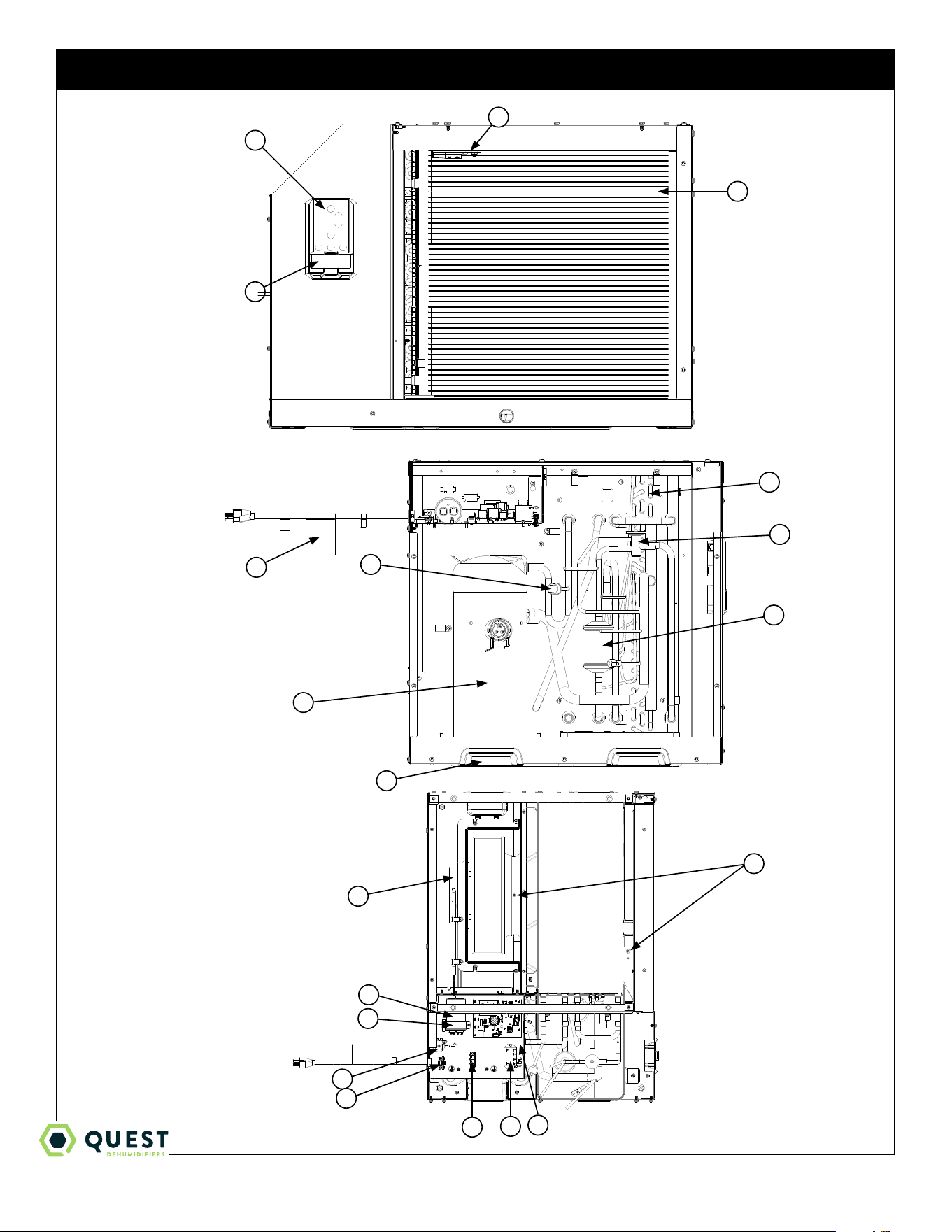
Service Parts List for Quest 335
Item Part No Qty Description
1 4041909 UI Control Board
2 4042009 Cover, UI, 24VAC
3 4042531-02 Coil Condenser
4 4042061 Sensor, Temp & RH, Digital
5 4042545-01 Filter (Not Shown)
6 4042529-01 Coil, Evap
7 4042469 TXV
8 4042468 Filter, Drier
9 4029507 Control, High Pressure
10 4042482 CPRSR
11 4042528 Handle, Pocket
12 4028459 Pressure Tap
13 4042291 Control Board
14 4042467 Relay
Item Part No Qty Description
15 4042505 Block, Wiring
16 4041892 Clip, Cord Retention
17 4042486 Switch, Pressure
18 4022160 Clamp, Capacitor
19 4035949-03 Capacitor
20 4042483 Fan, Motorized Impeller
21 4036494 Cord
PART NO. QTY. DESCRIPTION
4022220 1 Pump Kit (110-120V)
4028607 1 Supply Duct Kit
4028610 1 Return Duct Kit
PART NO. QTY. DESCRIPTION
4028531 1 DEH 3000R Control, Remote
4020175 1 Controller, Humidity
4036668 2 Bracket, Hanging (2 Required)
Optional Parts List
1-877-420-1330
Quest 335 Installation, Operation and Maintenance Instructions
23
www.QuestClimate.com
2
3
4
8
9
10
11
1
6
7
12
21
20
19
18
17
16
15
14
13
(5)

1-877-420-1330
Quest 335 Installation, Operation and Maintenance Instructions
24
www.QuestClimate.com
Quest 335 Dehumidifier Limited Warranty
WARRANTOR:
Therma-Stor LLC
4201 Lien Rd
Madison, WI 53704
Telephone: 1-800-533-7533
WHO IS COVERED: This warranty extends only to the original end-user of the Quest 335 Dehumidifier, and may not
be assigned or transferred.
FIRST YEAR WARRANTY: Therma-Stor LLC warrants that, for one (1) year the Quest Dehumidifier will operate free
from any defects in materials and workmanship, or Therma-Stor LLC will, at its option, repair or replace the defective
part(s), free of any charge.
SECOND THROUGH FIFTH YEAR WARRANTY: Therma-Stor LLC further warrants that for a period of five (5)
years, the condenser, evaporator, and compressor of the Quest Dehumidifier will operate free of any defects in material
or workmanship, or Therma-Stor LLC, at its option, will repair or replace the defective part(s), provided that all labor and
transportation charges for the part(s) shall be borne by the end-user.
END-USER RESPONSIBILITIES: Warranty service must be performed by a Servicer authorized by Therma-Stor LLC.
If the end-user is unable to locate or obtain warranty service from an authorized Servicer, he should call Therma-Stor
LLC at the above number and ask for the Therma-Stor LLC Service Department, which will then arrange for covered
warranty service. Warranty service will be performed during normal working hours.
The End-user must present proof of purchase (lease) upon request, by use of the warranty card or other reasonable and
reliable means. The end-user is responsible for normal care. This warranty does not cover any defect, malfunction, etc.
resulting from misuse, abuse, lack of normal care, corrosion, freezing, tampering, modification, unauthorized or improper
repair or installation, accident, acts of nature or any other cause beyond Therma-Stor LLC's reasonable control.
LIMITATIONS AND EXCLUSIONS: If any Quest Dehumidifier part is repaired or replaced, the new part shall be
warranted for only the remainder of the original warranty period applicable thereto (but all warranty periods will be
extended by the period of time, if any, that the Quest 335 Dehumidifier is out of service while awaiting covered warranty
service).
UPON THE EXPIRATION OF THE WRITTEN WARRANTY APPLICABLE TO THE QUEST DEHUMIDIFIER OR
ANY PART THEREOF, ALL OTHER WARRANTIES IMPLIED BY LAW, INCLUDING MERCHANTABILITY AND
FITNESS FOR A PARTICULAR PURPOSE, SHALL ALSO EXPIRE. ALL WARRANTIES MADE BY THERMA-
STOR LLC ARE SET FORTH HEREIN, AND NO CLAIM MAY BE MADE AGAINST THERMA-STOR LLC
BASED ON ANY ORAL WARRANTY. IN NO EVENT SHALL THERMA-STOR LLC, IN CONNECTION WITH
THE SALE, INSTALLATION, USE, REPAIR OR REPLACEMENT OF ANY QUEST DEHUMIDIFIER OR PART
THEREOF BE LIABLE UNDER ANY LEGAL THEORY FOR ANY SPECIAL, INDIRECT OR CONSEQUENTIAL
DAMAGES INCLUDING WITHOUT LIMITATION WATER DAMAGE (THE END-USER SHOULD TAKE
PRECAUTIONS AGAINST SAME), LOST PROFITS, DELAY, OR LOSS OF USE OR DAMAGE TO ANY REAL
OR PERSONAL PROPERTY.
Some states do not allow limitations on how long an implied warranty lasts, and some do not allow the exclusion or
limitation of incidental or consequential damages, so one or both of these limitation may not apply to you.
LEGAL RIGHTS: This warranty gives you specific legal rights, and you may also have other rights which vary from state
to state.