1
PROFESSIONAL WEATHER STATION
Operation Manual
Model: WN1900
Table of Contents
1. Introduction ......................................................................... 3
2. Warnings and Cautions ......................................................... 3
3. Quick Start Guide .................................................................3
4. Pre-Installation Checkout and Site Survey .............................. 4
4.1 Pre Installation Checkout ................................................... 4
4.2 Site Survey ....................................................................... 4
5. Setting Started ..................................................................... 5
5.1 Contents ...........................................................................5
5.2 Sensor Array Set Up .......................................................... 5
5.2.1 Install U-bolts and mounting pole ................................. 6
5.2.2 Install wind vane ......................................................... 7
5.2.3 Install wind speed ........................................................8
5.2.4 Install Rain Gauge ....................................................... 8
5.2.5 Install Batteries ........................................................... 9
5.2.6 Mount assembled outdoor sensor package ................. 10
5.2.6.1 Before you mount ....................................10
5.2.6.2 Mounting ................................................10
5.2.7 Reset Button and Transmitter LED .............................. 11
5.3 Optional sensors .............................................................. 11
5.4 Indoor/Outdoor Thermo-Hygrometer, 8 Channel (optional) . 14
5.5 Best Practices for Wireless Communication ....................... 15
5.6 Display console ...............................................................16
6. Display Console Operation ..................................................18
6.1 Screen Display ................................................................ 18
6.2 Initial Display Console Set Up ..........................................18
6.2.1 Key function ............................................................. 19
6.3 Setting mode ...................................................................20
6.4 Barometric Pressure Display ............................................ 22
6.4.1 Viewing Absolute vs. Relative Pressure ....................... 22
6.4.2 Rate of Change of Pressure Graph ...............................23

2
6.4.3 Relative Pressure Calibration Discussion ..................... 23
6.5 Rain Display ...................................................................24
6.5.1 Rain Increments of Measure ....................................... 24
6.5.2 Increments of Rain Definitions ................................... 24
6.6 Wind Display ..................................................................24
6.7 Temperature Display ........................................................25
6.7.1 Wind Chill, Dew Point and Heat Index Display ............ 25
6.8 Alarms ........................................................................... 25
6.8.1 Viewing High and Low Alarms ................................... 25
6.8.2 Setting High and Low Alarms ..................................... 26
6.9 Max/Min Mode ...............................................................30
6.9.1 Viewing Max/Min Values ........................................... 30
6.9.1.1 Display Wind Chill, Heat Index vs. Dew Point
Max/Min Values .................................................30
6.9.1.2 Display Wind Speed vs. Wind Gust Max
Values ............................................................... 30
6.9.1.3 Display Hourly Rain, Rain Rate ................ 31
6.9.1.4 Display Absolute and Relative Pressure Min
and Max Values ..................................................31
6.10 Resynchronize Wireless Sensor .......................................31
6.11 Backlight Operation .......................................31
6.11.1 With USB cable (included) ....................................... 32
6.11.2 Without USB Power supplied ....................................32
6.12 Tendency Arrows ...........................................................32
6.13 Wireless Signal Quality Indicator .................................... 32
6.14 Weather Forecasting ...................................................... 33
6.14.1 Storm Alert ............................................................. 33
6.14.2 Weather Forecasting Description and Limitations ....... 33
7. Specification: ..................................................................... 34
8. Live Internet Publishing ...................................................... 35
8.1 Configure Wi-Fi via BLE to connect the Weather Station
Console ............................................................................... 36
8.1.1 Download mobile application ..................................... 38
8.1.2 Configure Wi-Fi via BLE ........................................... 38
8.1.2.1 ...............................................................38
8.2 Ecowitt Weather .......................................................... 39
9. Registering WeatherUnderground.com through the PC or Mac 42
11 Maintenance ..................................................................... 49
3
12. Troubleshooting Guide ......................................................50
1. Introduction
Thank you for your purchase of the Wireless Wi-Fi Weather Station, which is
designed with the latest low power Wi-Fi technology, which can be operated
with 2pcs AA batteries, and it works up to 6 months. The following user guide
provides step by step instructions for installation, operation and
troubleshooting.
HELP
Our product is continuously changing and improving, particularly online
services and associated applications. To download the latest manual and
additional help, please contact us at support@ecowitt.com
or [email protected] (EU/UK).
2. Warnings and Cautions
Warning: Any metal object may attract a lightning strike, including your
weather station mounting pole. Never install the weather station in a storm.
Warning: Installing your weather station in a high location may result
in injury or death. Perform as much of the initial check and operation on the
ground and inside a building or home. Only install the weather station on a
clear, dry day.
3. Quick Start Guide
Although the manual is comprehensive, much of the information contained
may be intuitive. In addition, the manual does not flow properly because the
sections are organized by components.
The following Quick Start Guide provides only the necessary steps to install,
operate the weather station, and upload to the internet, along with references
to the pertinent sections.
Required
Step
Description
Section
1
Assemble and power up the integrated sensor
array
5.2.1–5.2.3
2
Power up the display console and synchronize
5.6
4
Table 1: Quick Start Guide
4. Pre-Installation Checkout and Site Survey
4.1 Pre Installation Checkout
Before installing your weather station in the permanent location, we
recommend operating the weather station for one week in a temporary location
with easy access. This will allow you to check out all of the functions, insure
proper operation, and familiarize you with the weather station and calibration
procedures. This will also allow you to test the wireless range of the weather
station.
4.2 Site Survey
Perform a site survey before installing the weather station. Consider the
following:
1. You must clean the rain gauge every few months and change the
batteries every 2-3 years. Provide easy access to the weather station.
2. Avoid radiant heat transfer from buildings and structures. In general,
install the sensor array at least 5’ from any building, structure, ground,
or roof top.
3. Avoid wind and rain obstructions. The rule of thumb is to install the
sensor array at least four times the distance of the height of the tallest
obstruction. For example, if the building is 20’ tall, and the mounting
pole is 6’ tall, install 4 x (20 – 6)’ = 56’ away.
4. Wireless Range. The radio communication between receiver and
transmitter in an open field can reach a distance of up to 100 meters,
providing there are no interfering obstacles such as buildings, trees,
vehicles, high voltage lines. Wireless signals will not penetrate metal
buildings. Under most conditions, the maximum wireless range is
100’.
5. Radio interference such as PCs, radios or TV sets can, in the worst
case, entirely cut off radio communication. Please take this into
with sensor array
3
Set date and time on console
6.4.5
4
Calibrate the relative pressure to sea-level
conditions (local airport) on console
6.4.3
5
Mount the sensor array
5.2.6
6
Reset the rain to zero on console
6.4.8
Optional
7
Configure Wi-Fi via BLE
8.1
8
Register and upload to Weather Server
9
5
consideration when choosing console or mounting locations. Make
sure your display console is at least five feet away from any electronic
device to avoid interference.
5. Setting Started
If only the original sensor array is paired with the display, the console can be
operated with 2pcs AA batteries, it doesn’t need to be powered by DC power!
2 AA batteries will last 6 months when data published to www.ecowitt.net
weather service at 5 minutes interval.
5.1 Contents
QT
Y
Item Description
1
Display Console
1
Outdoor Sensor with built-in: Thermo-hygrometer / Rain Gauge /
Wind Speed Sensor/ Wind Direction Sensor
1
Wind speed cups (to be attached to outdoor sensor body)
1
Wind vane (to be attached to outdoor sensor body)
2
U-Bolts for mounting on a pole
4
Threaded nuts for U-Bolts (M6 size)
1
Metal mounting plate to be used with U-Bolts
1
Wrench for M6 bolts
1
USB to 2.5*0.7mm DC 5V power plug connector cable
1
User manual (this manual)
Table 2: Package content
If components are missing from the package, or broken, or any problem
during the operation, please contact customer service at
the issue.
5.2 Sensor Array Set Up
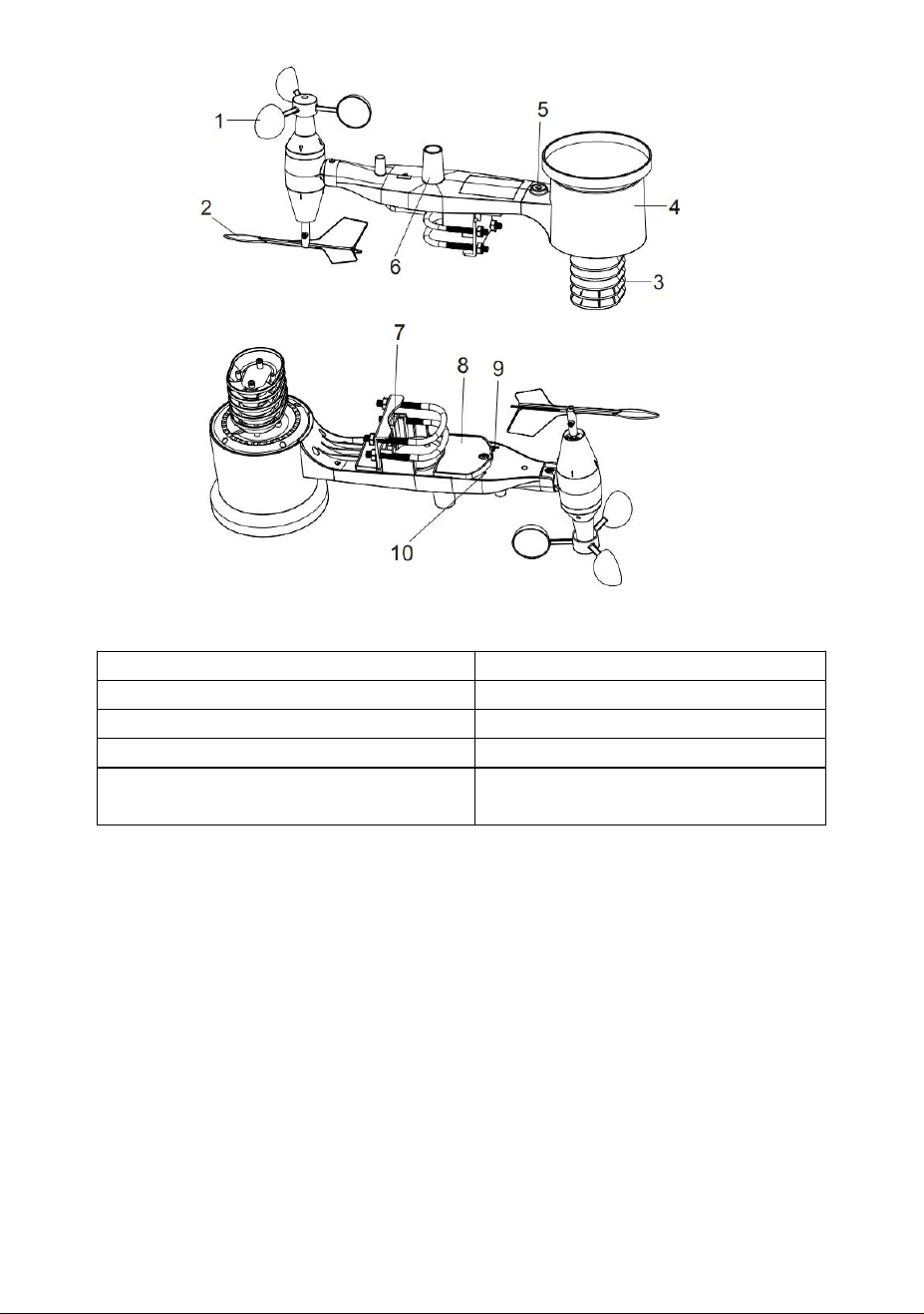
6
Figure 1: Sensor assembly components
1 Wind speed cups
6 Antenna
2 Wind vane
7 U-Bolts
3 Thermo- and hygro-meter sensors
8 Battery compartment door
4 Rain collector
9 Reset button
5 Bubble level
10 LED (red) to indicate data
transmission
Table 3: Sensor assembly detailed items
5.2.1 Install U-bolts and mounting pole
Installation of the U-bolts, which are in turn used to mount the sensor package
on a pole, requires installation of an included metal plate to receive the U-bolt
ends. The metal plate, visible in Figure 2, has four holes through which the
ends of the two U-Bolts will fit. The plate itself is inserted in a groove on the
bottom of the unit. Note that one side of the plate has a straight edge (which
goes into the groove), the other side is bent at a 90-degree angle and has a
curved profile (which will end up “hugging” the mounting pole). Once the
metal plate is inserted, remove nuts from the U-Bolts and insert both U-bolts
through the respective holes of the metal plate as shown in Figure 2.
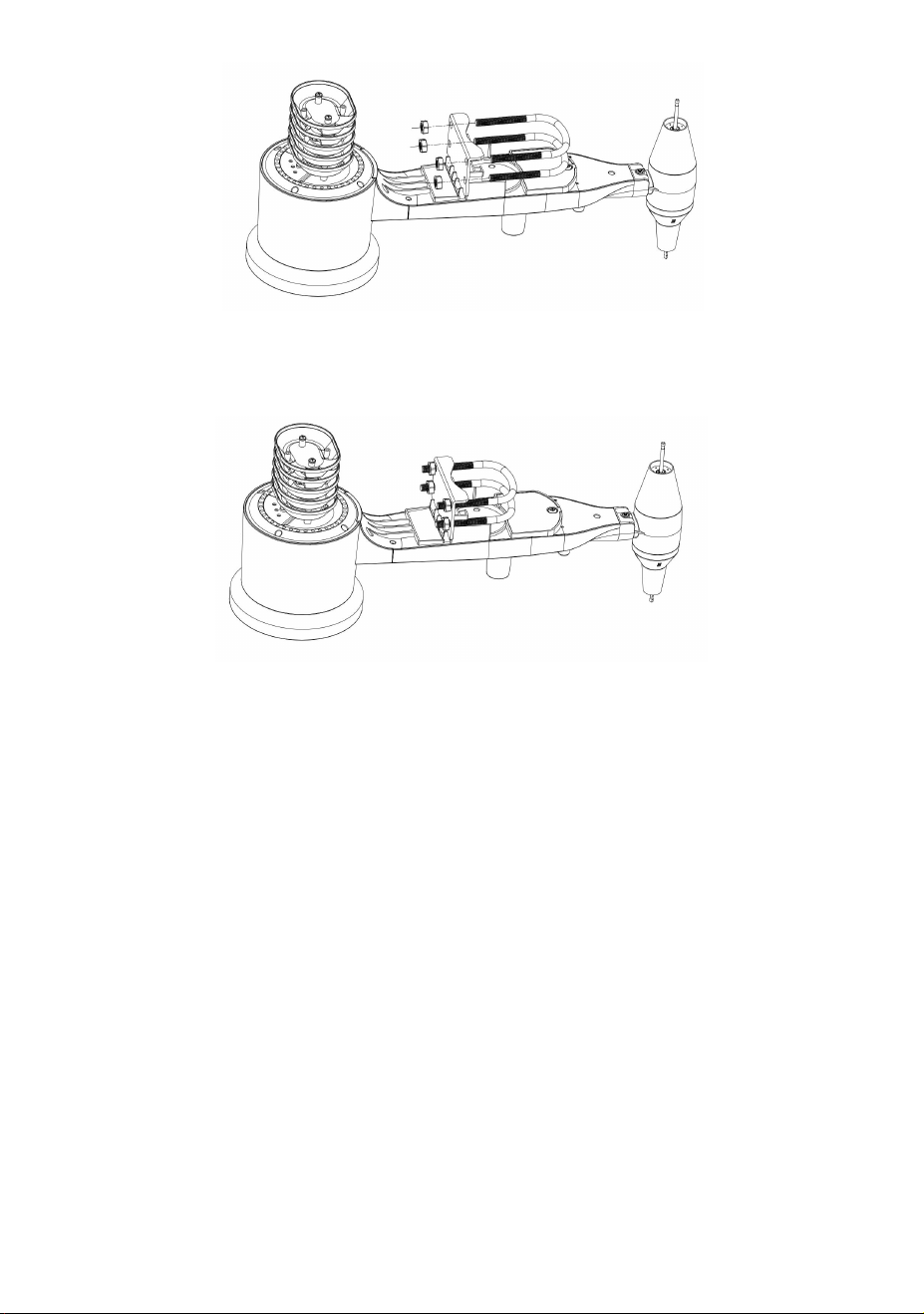
7
Figure 2: U-Bolt installation
Loosely screw on the nuts on the ends of the U-bolts. You will tighten these
later during final mounting. Final assembly is shown in Figure 3.
Figure 3: U-Bolts and nuts installed
The plate and U-Bolts are not yet needed at this stage but doing this now may
help avoid damaging wind vane and wind speed cups later on.
5.2.2 Install wind vane
Push the wind vane onto the shaft on the bottom of the sensor, until it stops
moving further, as shown in figure 4.
Tighten the set screw, with a Philips screw driver (size PH0), until the wind
vane cannot be removed from the axle, as shown in figure 4. Make sure the
wind vane spin freely. The wind vane’s movement has a small amount of
friction, which is helpful in providing steady wind direction measurements.
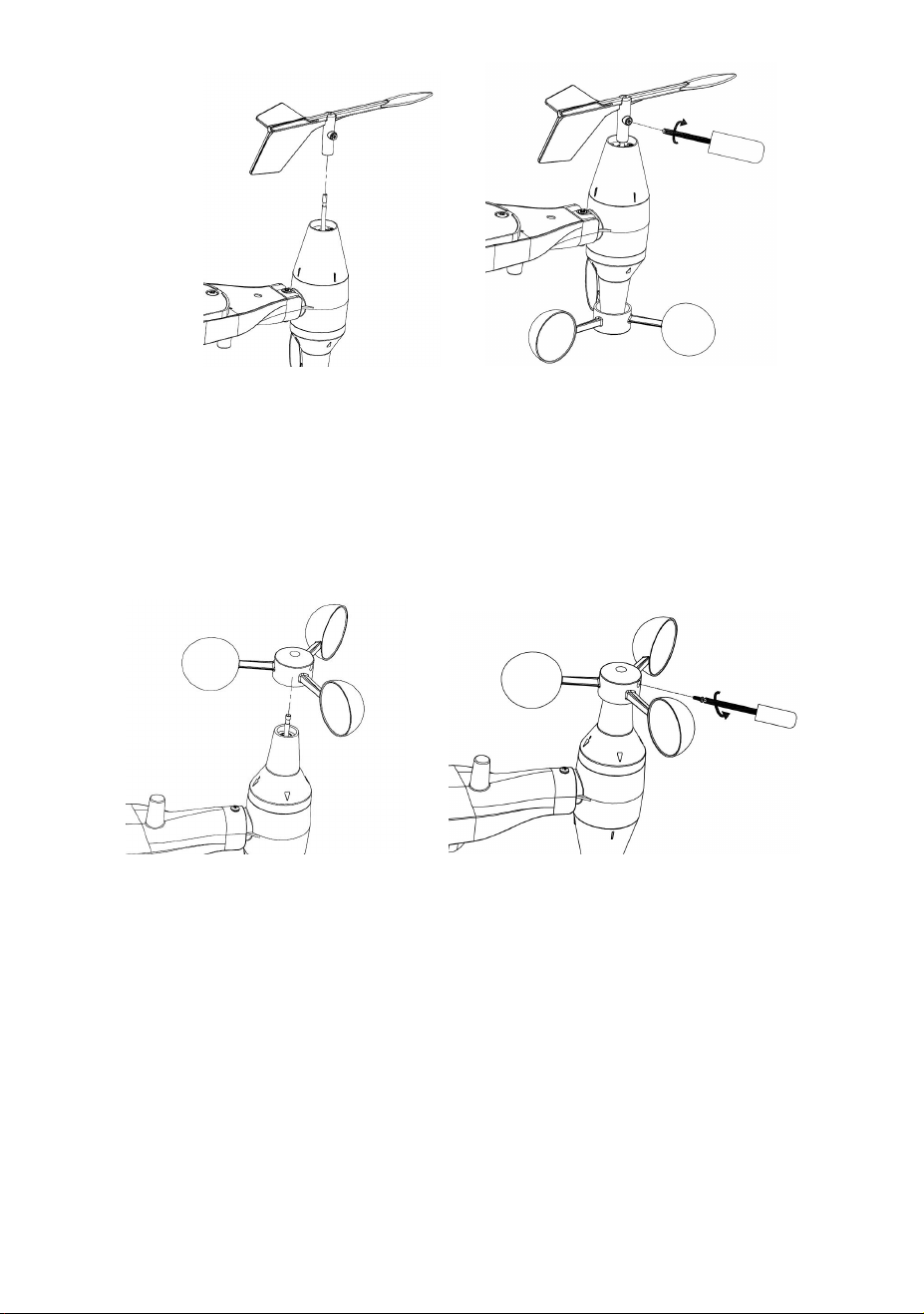
8
Figure 4: Wind vane installation diagram
5.2.3 Install wind speed
Push the wind speed cups into the shaft as shown in figure 5.
Tighten the set screw with screw driver. Make sure the wind speed cups can
spin freely.
Figure 5: Wind speed cup installation diagram
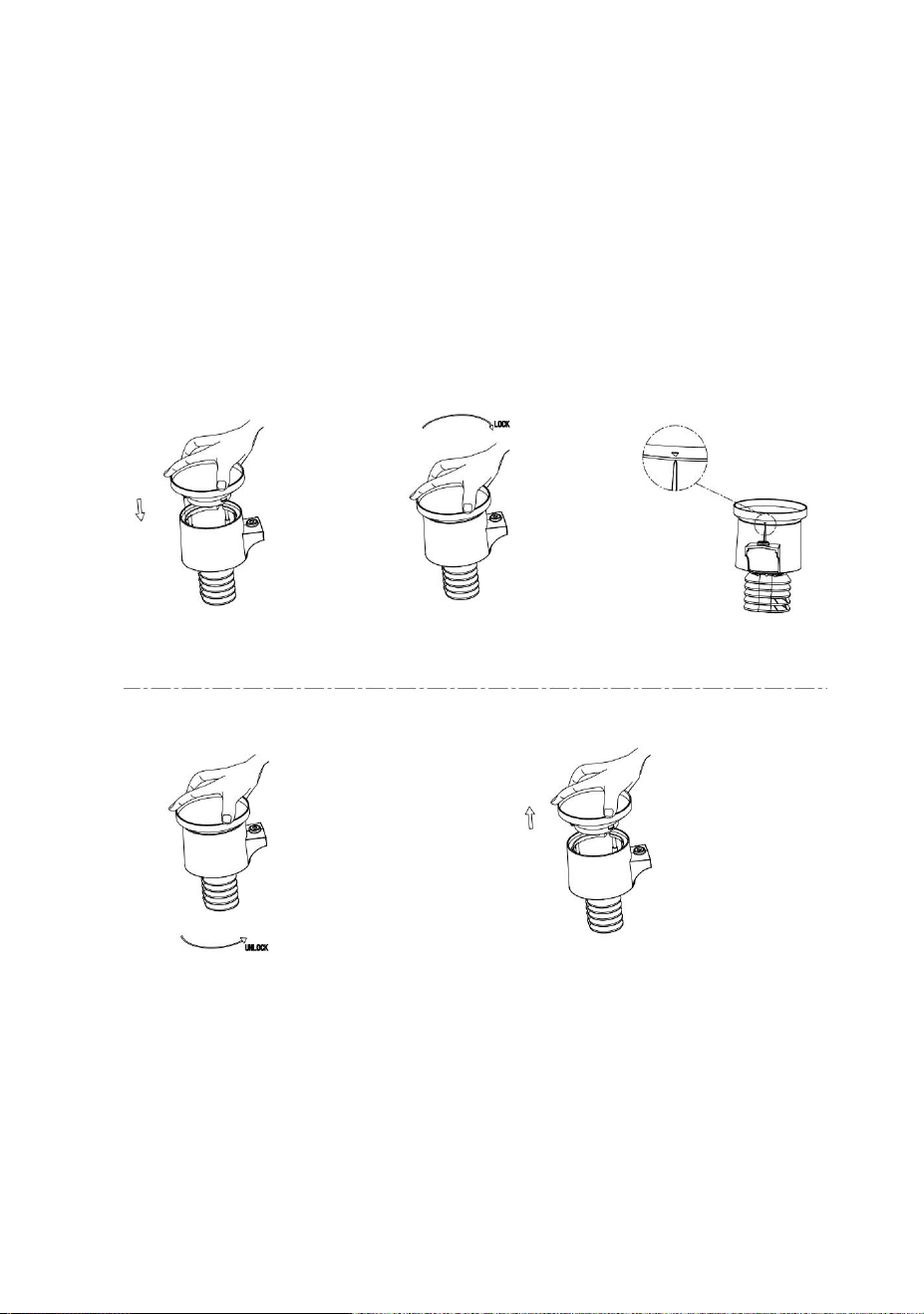
5.2.4 Install Rain Gauge
Install the rain gauge funnel. Rotate clockwise to attach the funnel to the
outdoor sensor.
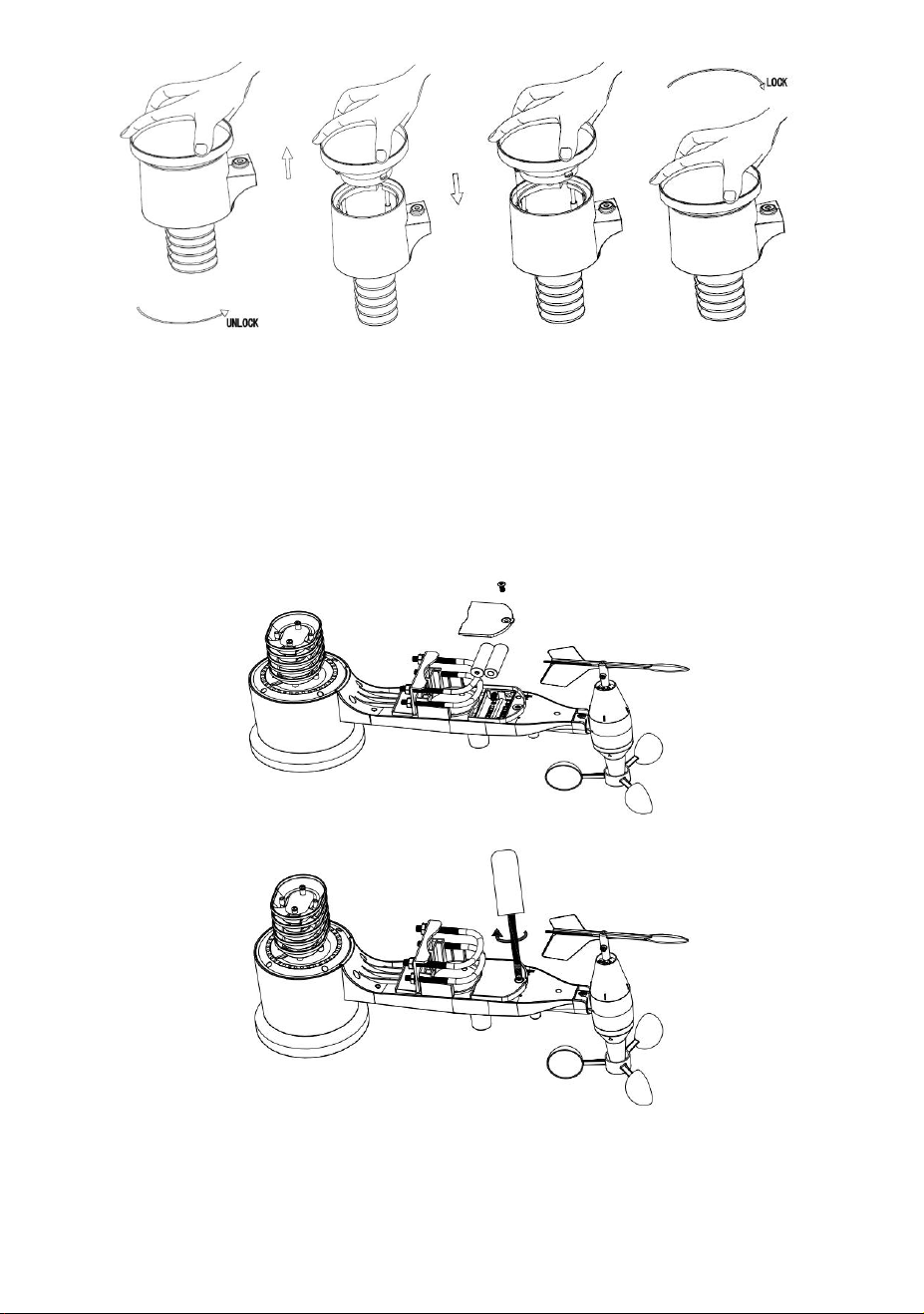
9
Figure 6: Rain gauge installation and maintenance
5.2.5 Install Batteries
Insert 2XAA batteries in the battery compartment. The LED indicator on the
back of the transmitter will turn on for four seconds and normally flash once
every 16 seconds (the sensor transmission update period).
Figure 7: Battery installation diagram
Note: If no LED light up or is permanently on, make sure the batteries are
inserted the correct way or a proper reset has happened. Do not install the
10
batteries backwards. You can permanently damage the outdoor sensor.
Note: We recommend 1.5V lithium batteries for cold weather climates, but
alkaline batteries are enough for most climates. We do not recommend
rechargeable batteries. They have lower voltages, they do not operate well at
wide temperature ranges, and do not last as long, resulting in poorer reception.
5.2.6 Mount assembled outdoor sensor package
5.2.6.1 Before you mount
Before proceeding with the outdoor mounting detailed in this section, you may
want to skip to setup instructions in section 6.2 and onwards first, while you
keep the assembled outdoor sensor package nearby (although preferably not
closer than 5 ft. from the console). This will make any troubleshooting and
adjustments easier and avoids any distance or interference related issues from
the setup.
After setup is complete and everything is working, return here for outdoor
mounting. If issues show up after outdoor mounting they are almost certainly
related to distance, obstacles etc.
5.2.6.2 Mounting
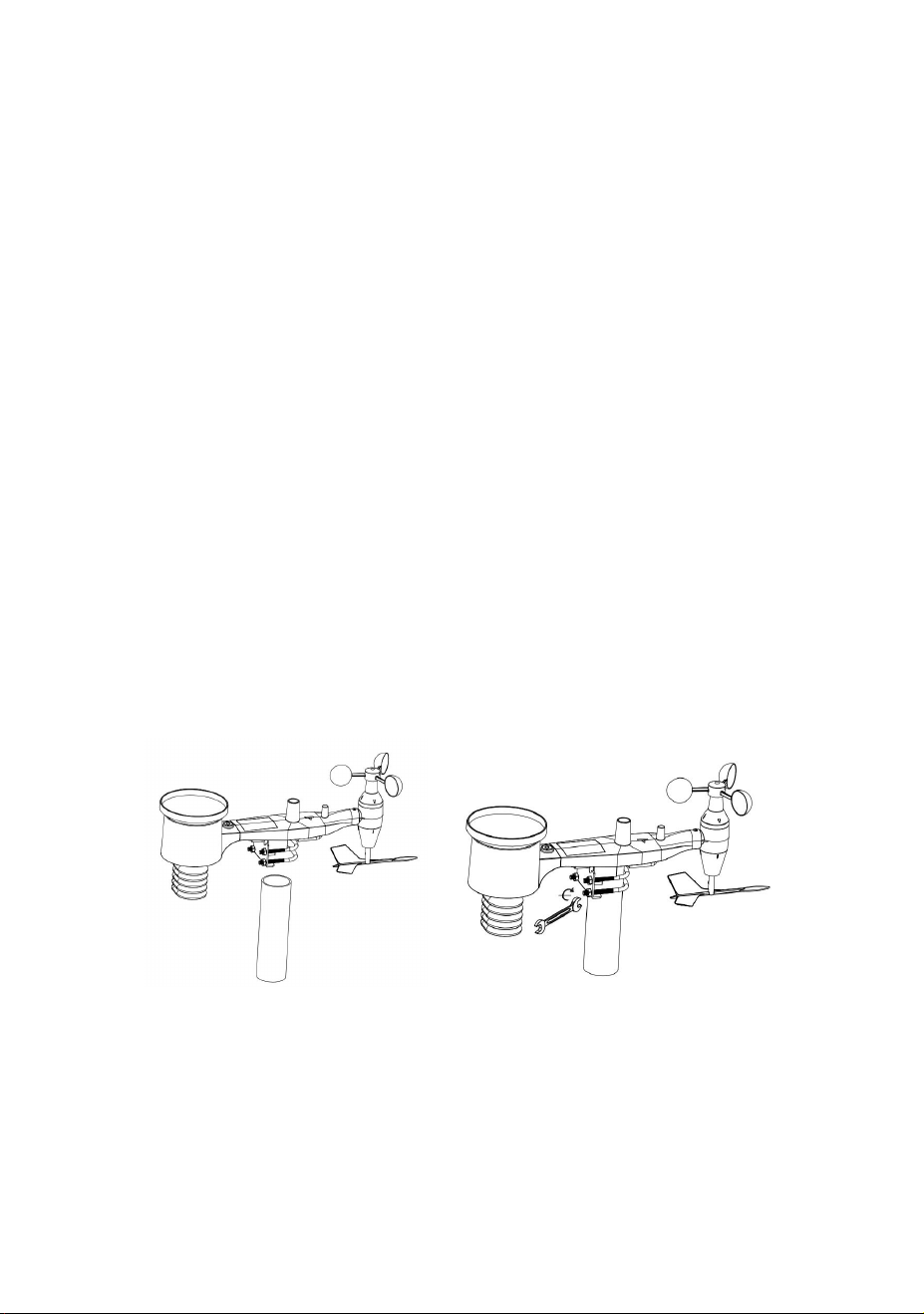
You can attach a pipe to a permanent structure and then attach the sensor
package to it (see Figure 8). The U-Bolts will accommodate a pipe diameter of
1-2 inches (pipe not included).
Figure 8: Sensor package mounting diagram
Finally, place the sensor package on top of the prepared mounting pipe.The U-
Bolts should be loose enough to allow this but loosen the nuts as necessary.
Once placed, hand tightens all four nuts, taking care to do so evenly.
Now you will need to align the whole package in the proper direction by
rotating it on top of the mounting pipe as needed. Locate the arrow
labeled “WEST” that you will find on top of the sensor package right next
11
to the light sensor. You must rotate the whole sensor package until this arrow
points due West. To achieve proper alignment, it is helpful to use
a compass (many cell phones have a compass application).
Once rotated in the correct orientation, lightly tighten the bolts a little more
(use a wrench) to prevent further rotation.
Note: Use the bubble level next to the rain sensor to make sure the sensor
array is completely level. If the sensor is not level then the rain gauge will
measure inaccurately.
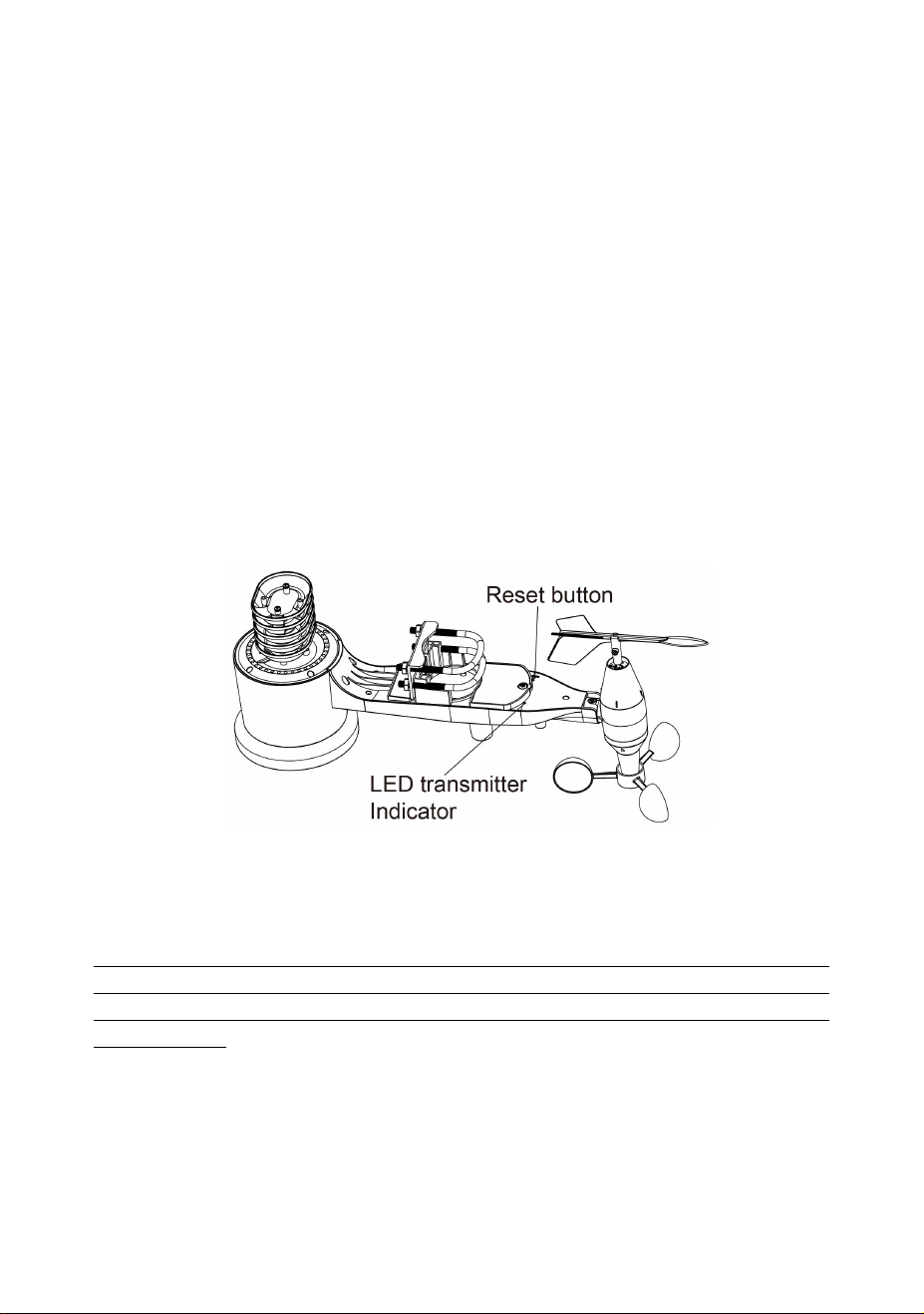
5.2.7 Reset Button and Transmitter LED
In the event that the sensor array is not transmitting, reset the sensor array.
With an open ended paperclip, press and hold the RESET BUTTON for three
seconds and resynchronize with console by powering down and up the console.
Please put the console with the sensor array about 3 meters away.
Figure 9: Reset button and Transmitter LED location
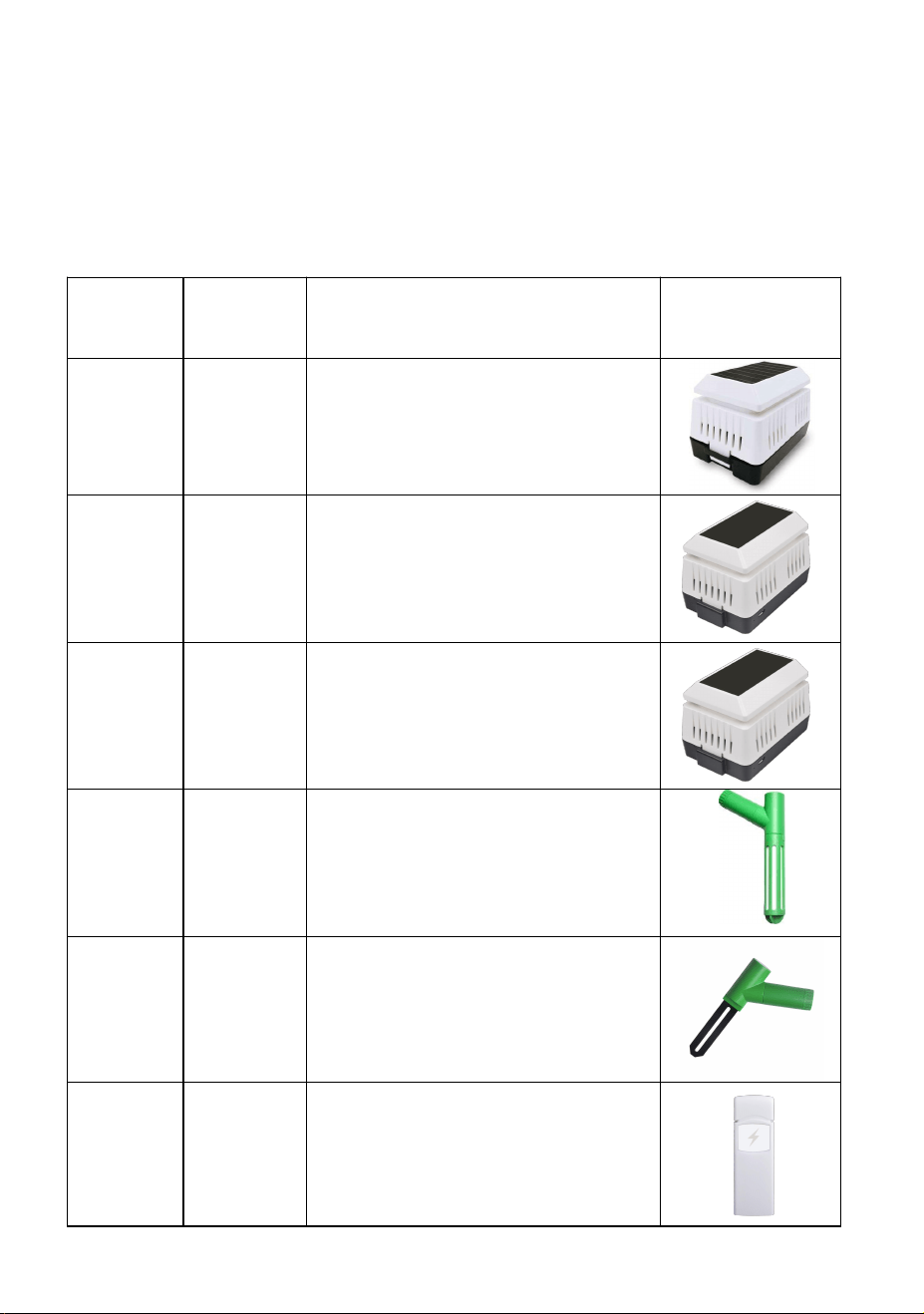
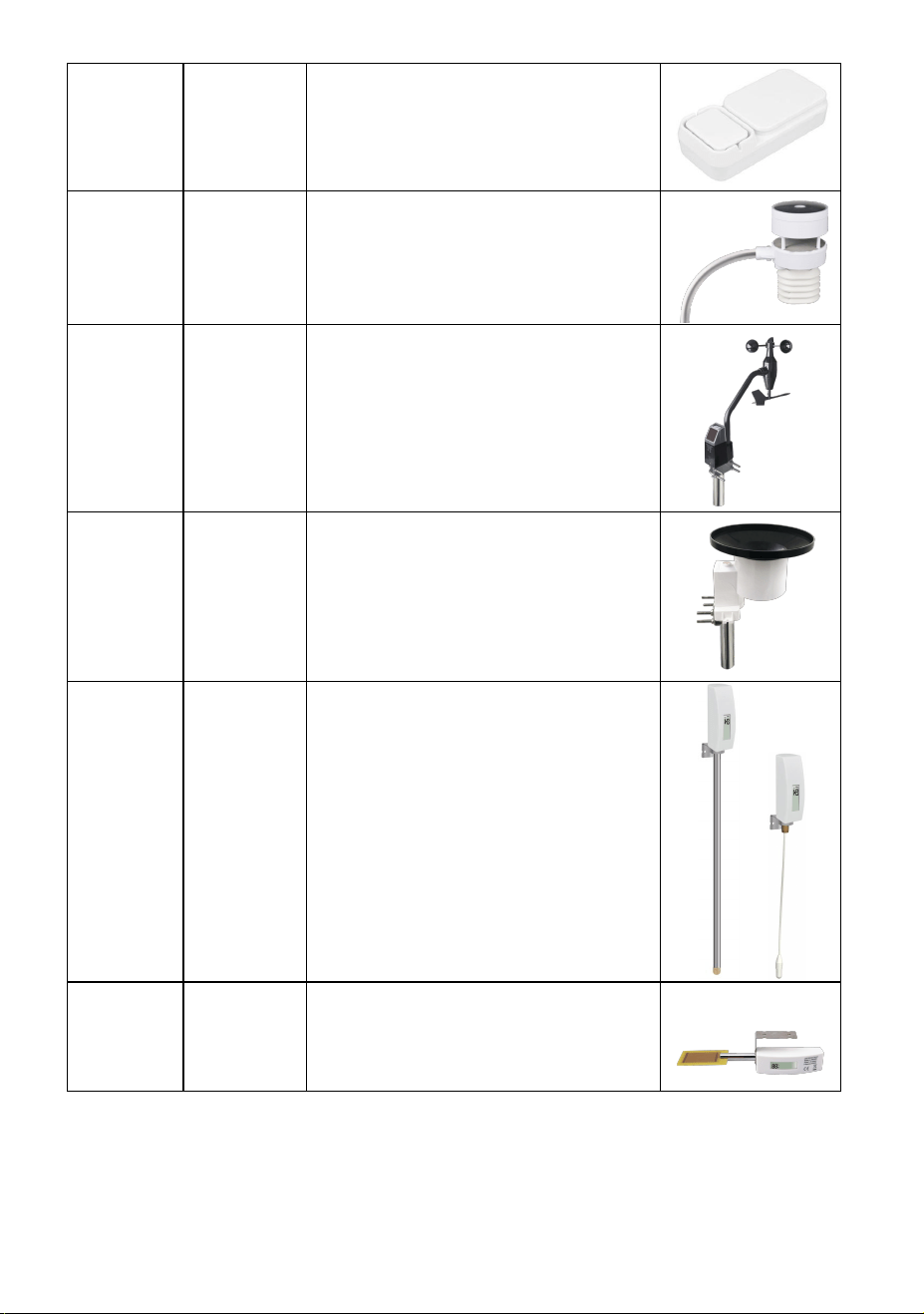
5.3 Optional sensors
Important: When more sensors, excluding the original sensor array, to be
paired with the display, DC power supply must be applied as console will turn
on its RF receiver permanently, which increases the current consumption
significantly.
Note: When optional sensor (s) added, it requires that the console must be
powered by USB connection. When no optional sensor added, the console can
work up to 6 months with battery (not included) .
12
Item
Number
Number
of
Channels
Description
Image
WH41
4*
PM2.5 Wireless Outdoor
Particulate Monitor
WH43
4*
PM2.5 Wireless Indoor Particulate
Monitor
WH45
1
PM2.5, PM10 and CO
2
Wireless
Indoor Particulate Monitor
WN51
8
Soil Moisture Sensor
WH51
8
Soil Moisture Sensor
WH57
1
Lightning Detector
13
WH55
4
Leak Detector
WS80
1
Ultrasonic Anemometers with
Temp & Humidity sensor
WH68
1
4-in-1 sensor
Indoor temperature, indoor
humidity, wind direction and wind
speed
WH40
1
Rain sensor
WN34
8*
WN34S stainless-steel probe therm
ometer for soil
WN34L wire probe thermometer
for water
WN35
8
Leaf wetness sensor
(*) The WH41 and WH43 share the same 4-channels.
The WN51 and WH51 share the same 8-channels.
The WN34S and WN34L share the same 8-channels.
The WS68 could not be used with the WS80 at the same time.
Table 4: Optional sensors list
14
5.4 Indoor/Outdoor Thermo-Hygrometer, 8 Channel (optional)
This device supports up to 8 additional thermo-hygrometer sensors (WH31),
the data will scroll display on the console and sends the data to Ecowitt.net
(requires to set the console uploading to ecowitt.net first).
Note: Do not use rechargeable batteries. We recommend fresh alkaline
batteries for outdoor temperature ranges between -4 °F and 140 °F and fresh
lithium batteries for outdoor temperature ranges between -40 °C and 60 °C.
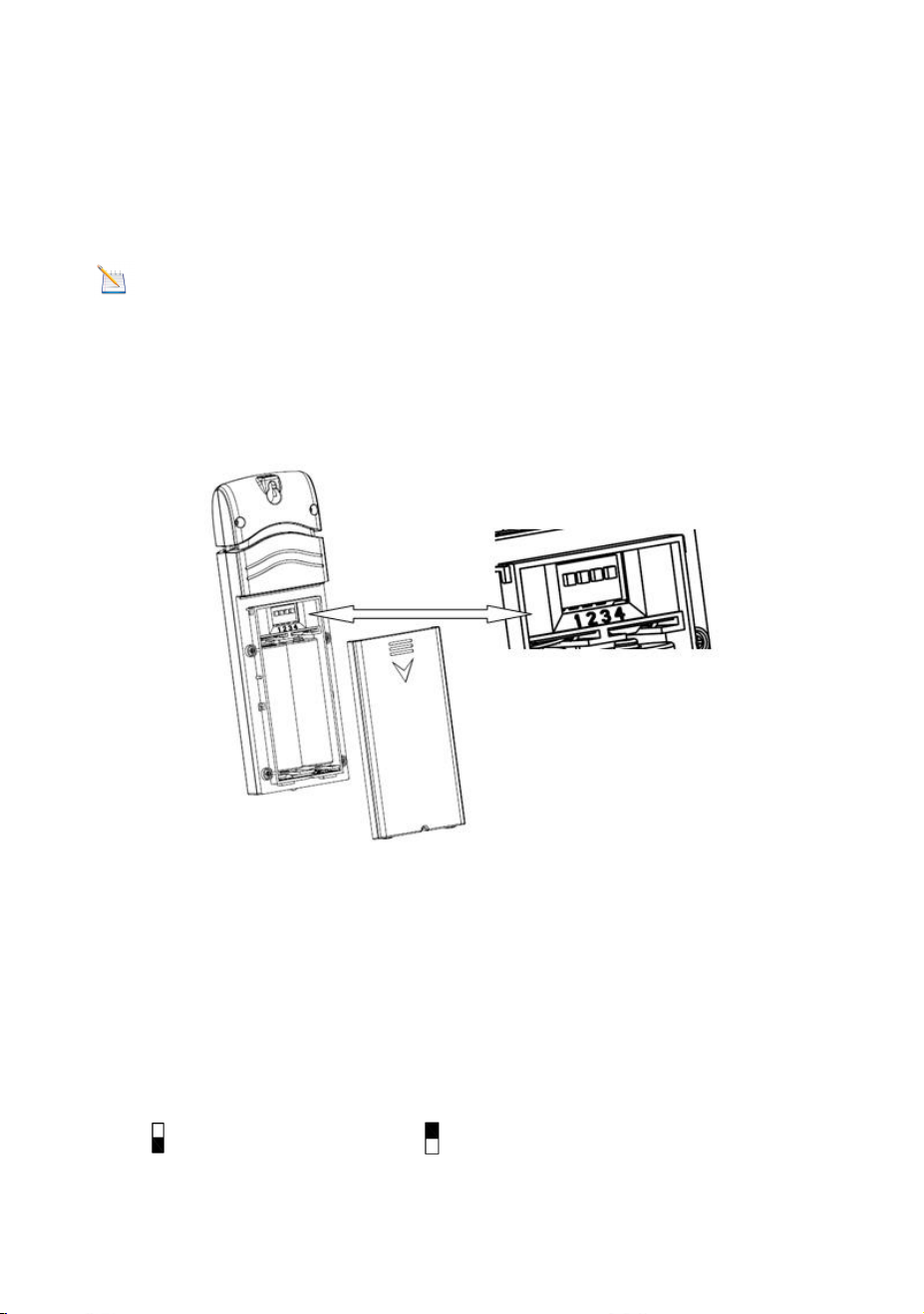
1. Remove the battery door on the back of the transmitter(s) by sliding
down the battery door, as shown in Figure 13.
Figure 10: Battery installation for Multi-channel sensor
2. BEFORE inserting the batteries, locate the dip switches on the inside
cover of the lid of the transmitter.
3. Channel Number: This item supports up to eight transmitters. To set
each channel number (the default is Channel 1), change Dip Switches 1,
2 and 3, as referenced in Figure 11.
4. Temperature Units of Measure: To change the transmitter display units
of measure (°F vs. °C), change Dip Switch 4, as referenced in Figure 11.
5.
6. Switch in down position. Switch in up position.
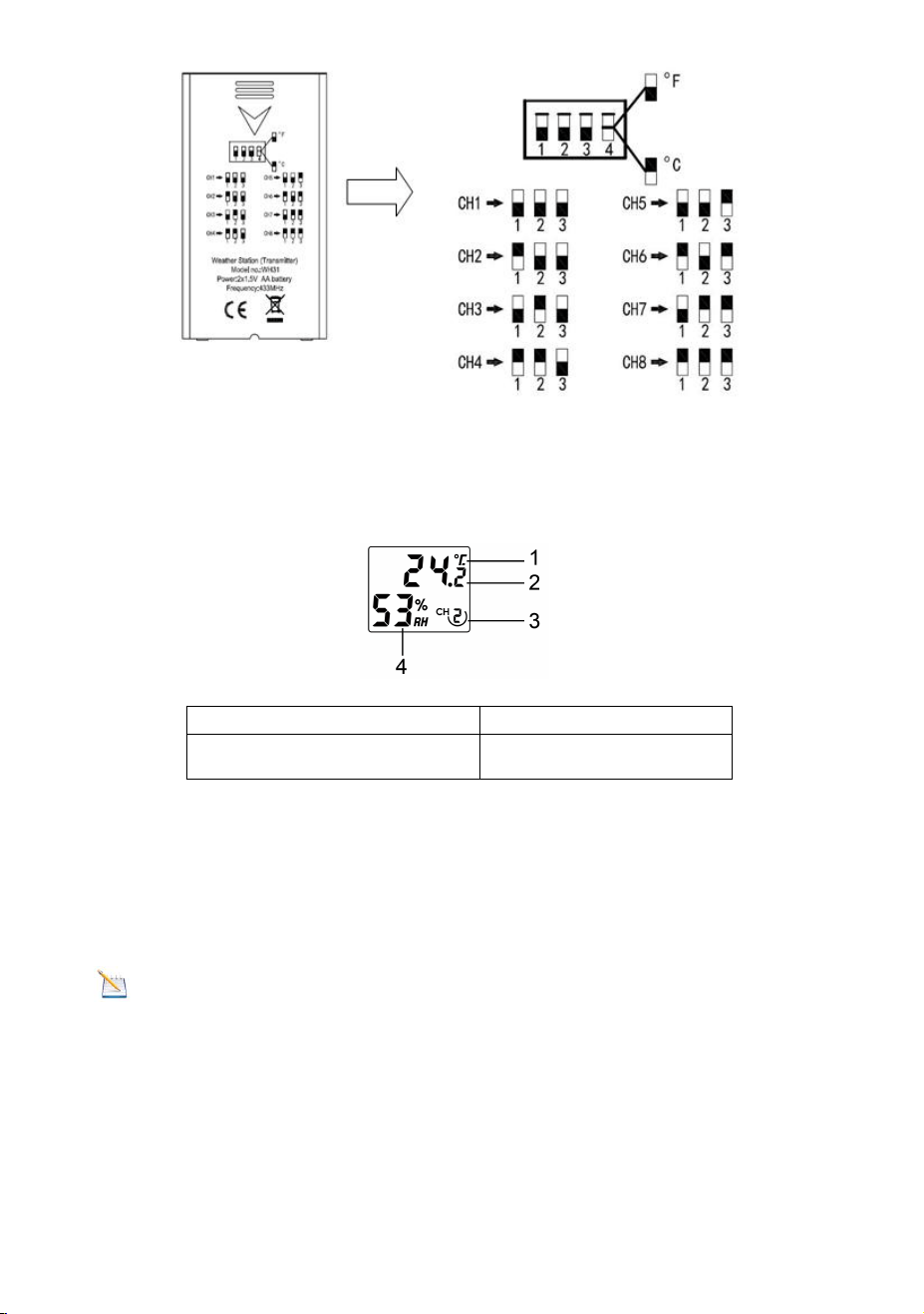
15
Figure 11: Dip Switch diagram
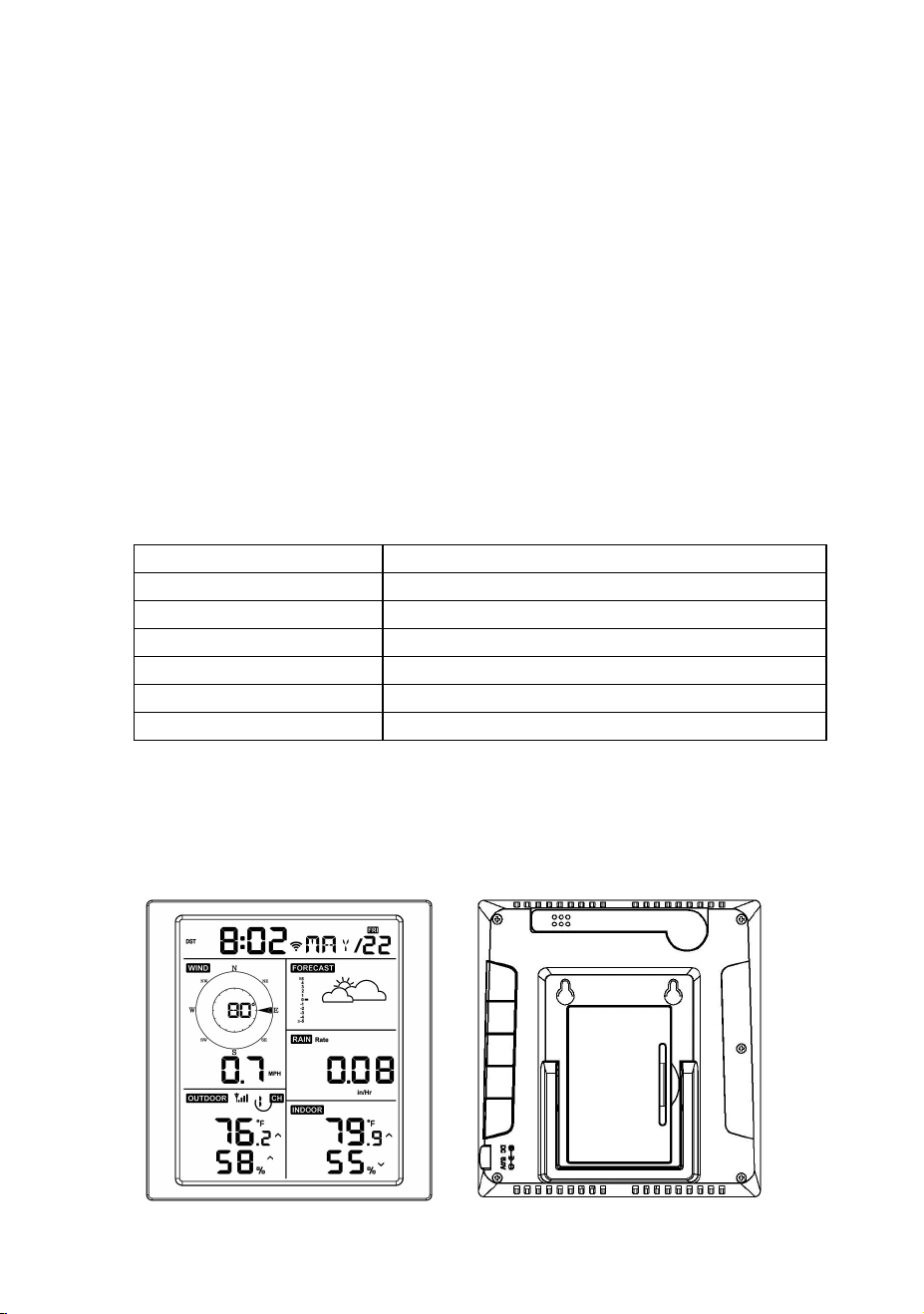
7. Insert two AA batteries.
8. Verify the correct channel number (CH) and temperature units of
measure (°F / °C) are on the display, as shown in Figure 12.
Figure 12: sensor LCD display
1.Temperature units (°C/°F )
3. Channel number
2.Temperature
4. Relative humidity
9. Close the battery door.
10. Repeat for the additional remote transmitters, verifying each remote is
on a different channel.
5.5 Best Practices for Wireless Communication
Note: To insure proper communication, mount the remote sensor(s)
upright on a vertical surface, such as a wall. Do not lay the sensor flat.
Wireless communication is susceptible to interference, distance, walls and
metal barriers. We recommend the following best practices for trouble free
wireless communication.
Electro-Magnetic Interference (EMI). Keep the console several feet away
from computer monitors and TVs.
Radio Frequency Interference (RFI). If you have other devices operating on
the same frequency band as your indoor and/or outdoor sensors and
16
experience intermittent communication between sensor and console, try
turning off these other devices for troubleshooting purposes. You may need to
relocate the transmitters or receivers to avoid the interference and establish
reliable communication. The frequencies used by the sensors are one of
(depending on your location): 433, 868, or 915 MHz (915 MHz for United
States).
1. Line of Sight Rating. This device is rated at 300 feet line of sight (no
interference, barriers or walls) but typically you will get 100 feet
maximum under most real-world installations, which include passing
through barriers or walls.
2. Metal Barriers. Radio frequency will not pass through metal barriers
such as aluminum siding. If you have metal siding, align the remote
and console through a window to get a clear line of sight.
The following is a table of reception loss vs. the transmission medium.
Each “wall” or obstruction decreases the transmission range by the factor
shown below.
Medium
RF Signal Strength Reduction
Glass (untreated)
5-15%
Plastics
10-15%
Wood
10-40%
Brick
10-40%
Concrete
40-80%
Metal
90-100%
Table 5: RF Signal Strength reduction
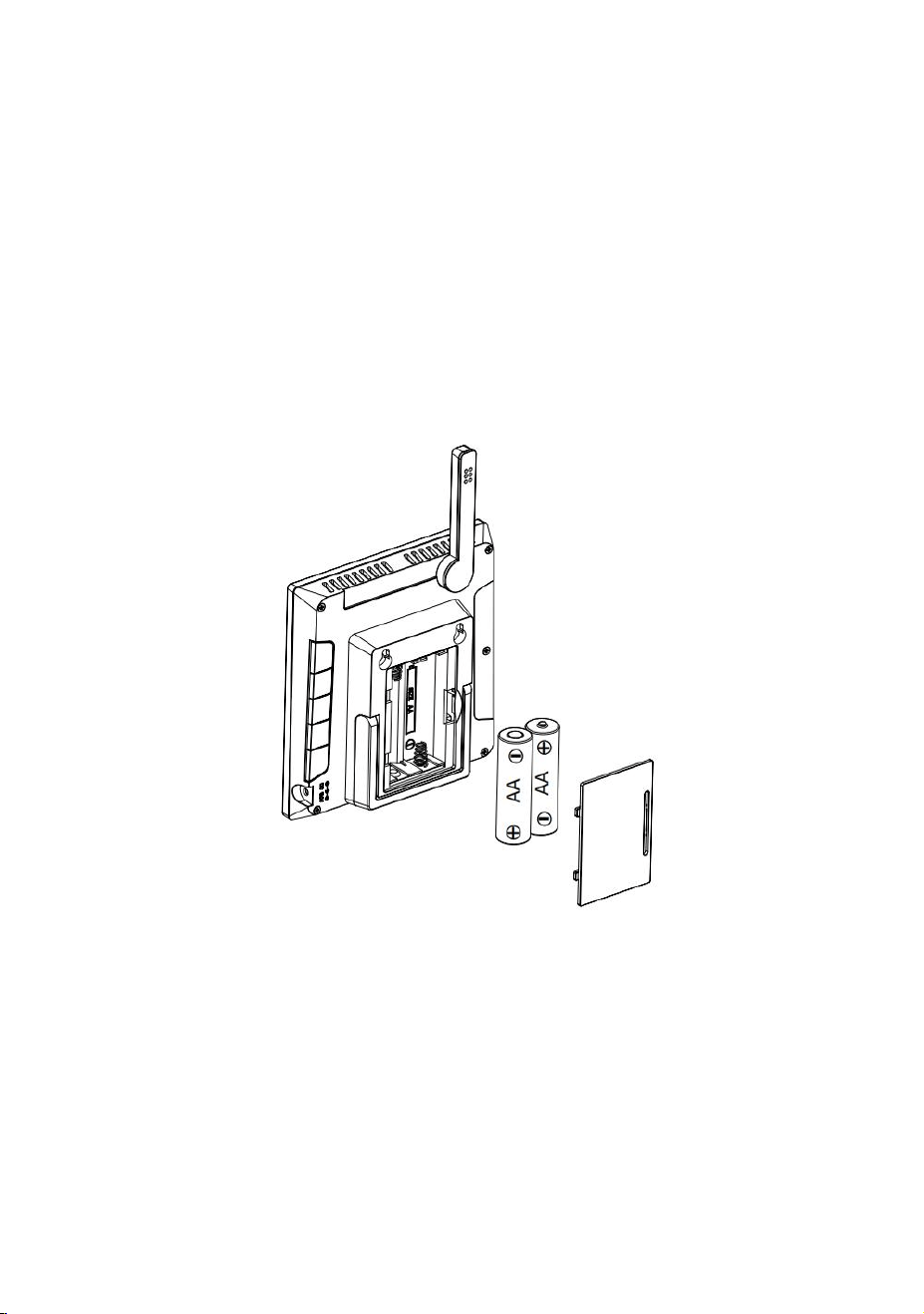
5.6 Display console
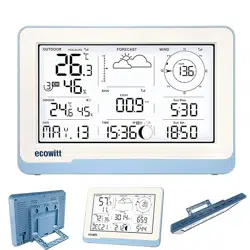
The front and back of the display console is shown in Figure13.
Figure 13: Display console front and back
17
Reference Figure 14.
(1) Unfold the desk stand and place the console 5 to 10 feet away from the
outdoor sensor.
(2) Remove the battery door on the back of the console and insert 2 x AA
good quality Alkaline or Lithium batteries per Figure 14.
(3) Wait several minutes for the remote sensors to synchronize with the
display console.
(4) In order to prevent the display console's own temperature rising from
affecting the accurate reading of temperature and humidity, the
temperature and humidity sensor is placed at the antenna end, away from
the station body. Orient the console antenna straight up for accurate
indoor temperature and humidity reading.
Figure 14: Battery installation for display console
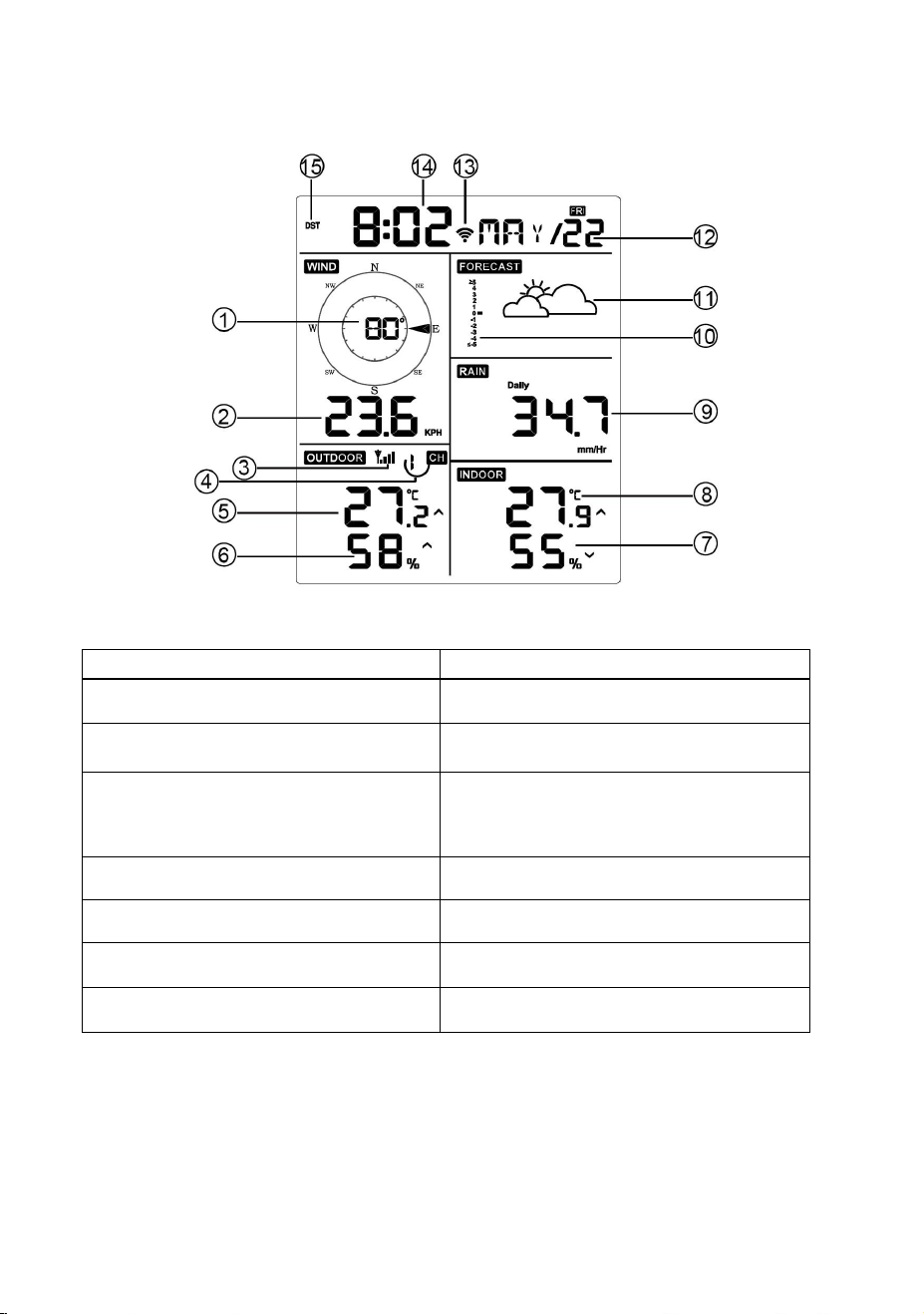
18
6. Display Console Operation
6.1 Screen Display
Figure 15: Display Console Screen Layout
1.Wind direction
9. Rainfall
2. Wind speed
10. Barometric Pressure graphic
3. RF signal icon
11. Weather forecast
4. 8 Channel Indoor/Outdoor
Thermo-Hygrometer recycle icon
(optional)
12. Date
5. Outdoor temperature
13. WIFI signal icon
6. Outdoor humidity
14. Time
7. Indoor humidity
15. Daylight Savings Time (DST)
8. Indoor temperature
Table 6: Display console detailed items
6.2 Initial Display Console Set Up
Insert the batteries to power up the display console.
The unit will show software version and frequency information 2 seconds after
power reset.
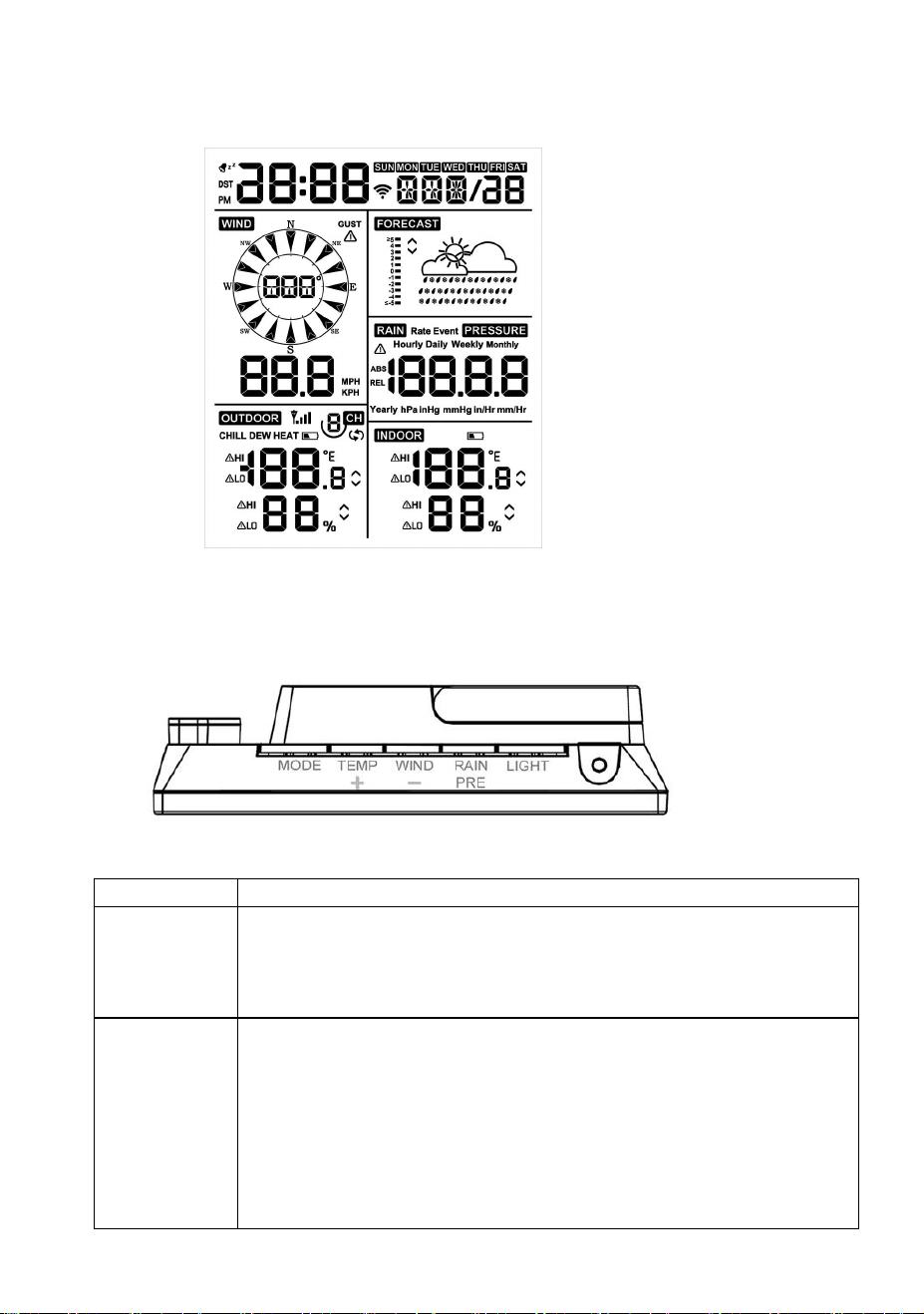
19
The unit will turn on all segments of the LCD for 3 seconds after power reset,
then the unit will start to register the outdoor channel for 3 minutes.
Figure 16
6.2.1 Key function
The console has five keys for easy operation
Figure 17
Key
Description
MODE
Press and hold for two seconds to enter the Set Mode.
Press to switch between Normal Mode, Max Mode, Min
Mode, High Alarm Mode, Low Alarm Mode, MAC
address display Mode
TEMP+
TEMP(+2s)
While the console using battery supply only, press this button
to switch display between Outdoor Temperature, Wind Chill,
Dew Point, Heat Index. While using DC supply, press the
button to switch display between Outdoor Temperature, Chill,
Dew Point, Heat Index, 8 channel temperature and humidity
(optional), Circle Mode.
Press and hold 2s will force console to search sensor
manually
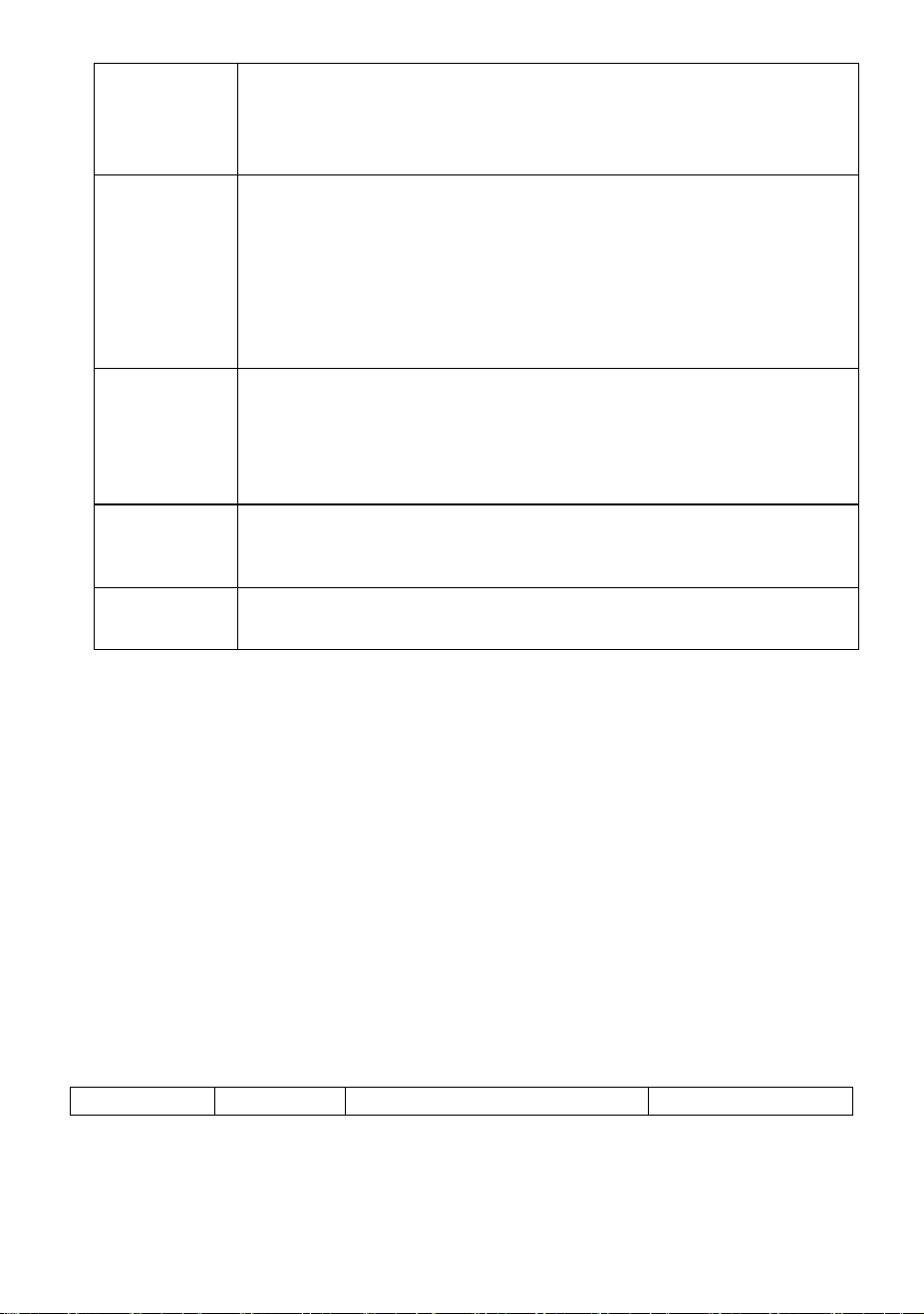
20
WIND -
Press to switch between average wind speed and, wind
gust.
Press and hold for two seconds to switch the wind
direction to display in degrees or in letters.
RAIN/PRE
Press and hold for two seconds switch between Rain and
Pressure.
While in Rain mode, press to switch between Rain Rate,
Rain Events, Hourly Rain, Daily Rain, Weekly Rain,
Monthly Rain and Yearly Rain
While in Pressure mode, press to switch between Relative
pressure and Absolute pressure
LIGHT
LIGHT(+2S)
Press to adjust the LCD backlight brightness (high, medium
and off); only available when powered by USB connection
Press to exit the SET mode at any time.
Wake up WiFi listening when battery powered only
TEMP+
(and)
RAIN PRE
Press this two buttons at the same time for 4 seconds to
activate BLE function for Wi-Fi configuration (refer to
section 8.1.2)
[MODE] +
[LIGHT] + 5s
Press Mode and Light button for 5s to make factory
default reset.
Table 7: Key function
6.3 Setting mode
Press and hold the MODE button for two seconds to enter the Set Mode. To
proceed to the next setting, press (do not hold) the MODE button.
To exit the SET mode at any time, press the LIGHT button.
Table 8 summarizes the set mode sequence and commands.
Command
Mode
Settings
Image
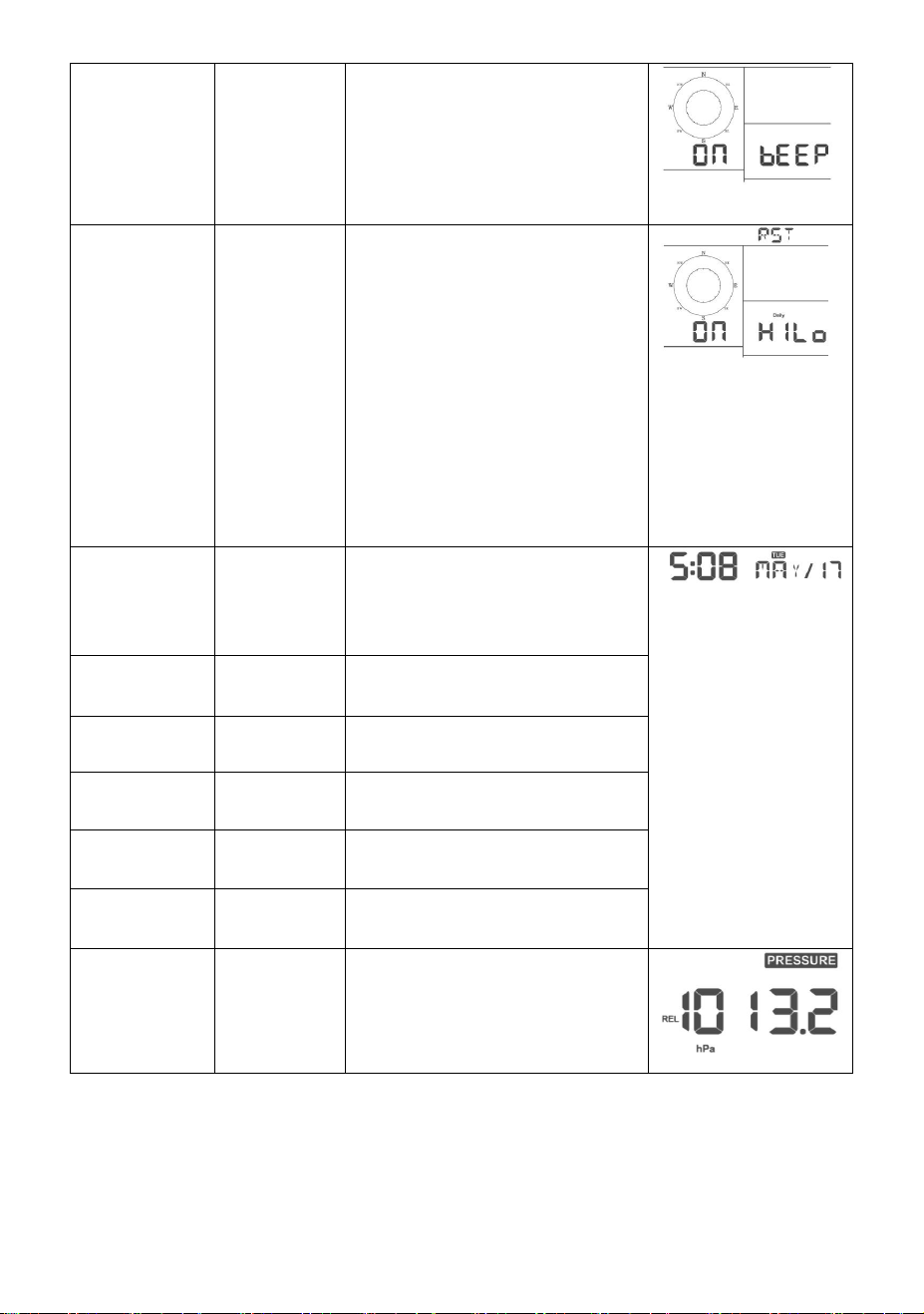
21
[MODE] +
2 seconds
Enter Set
Mode,
Beep On
or Off
Press [TEMP +] or [WIND -]
to switch OFF and ON.
This will prevent the beep
from sounding when pressing
any button.
[MODE]
Clear
Max/Min
Press [TEMP +] or [WIND -]
to switch OFF and ON.
When set to ON, the
minimum and maximum
values reset every day at
midnight (00:00).
When set to OFF, the
minimum and maximum
values must be reset
manually.
[MODE]
12 hour /
24 Hour
Format
Press [TEMP +] or [WIND -]
to switch hour format
between 12 hour and 24-hour
format.
[MODE]
Hour
Press [TEMP +] or [WIND -]
to adjust hour up or down.
[MODE]
Minute
Press [TEMP +] or [WIND -]
to adjust minute up or down.
[MODE]
Year
Press [TEMP +] or [WIND -]
to adjust year up or down
[MODE]
Month
Press [TEMP +] or [WIND -]
to adjust month up or down
[MODE]
Day
Press [TEMP +] or [WIND -]
to adjust day up or down
[MODE]
Pressure
Units of
Measure
Press [TEMP +] or [WIND -]
to change units of measure
between hap, mmHg or inHg.
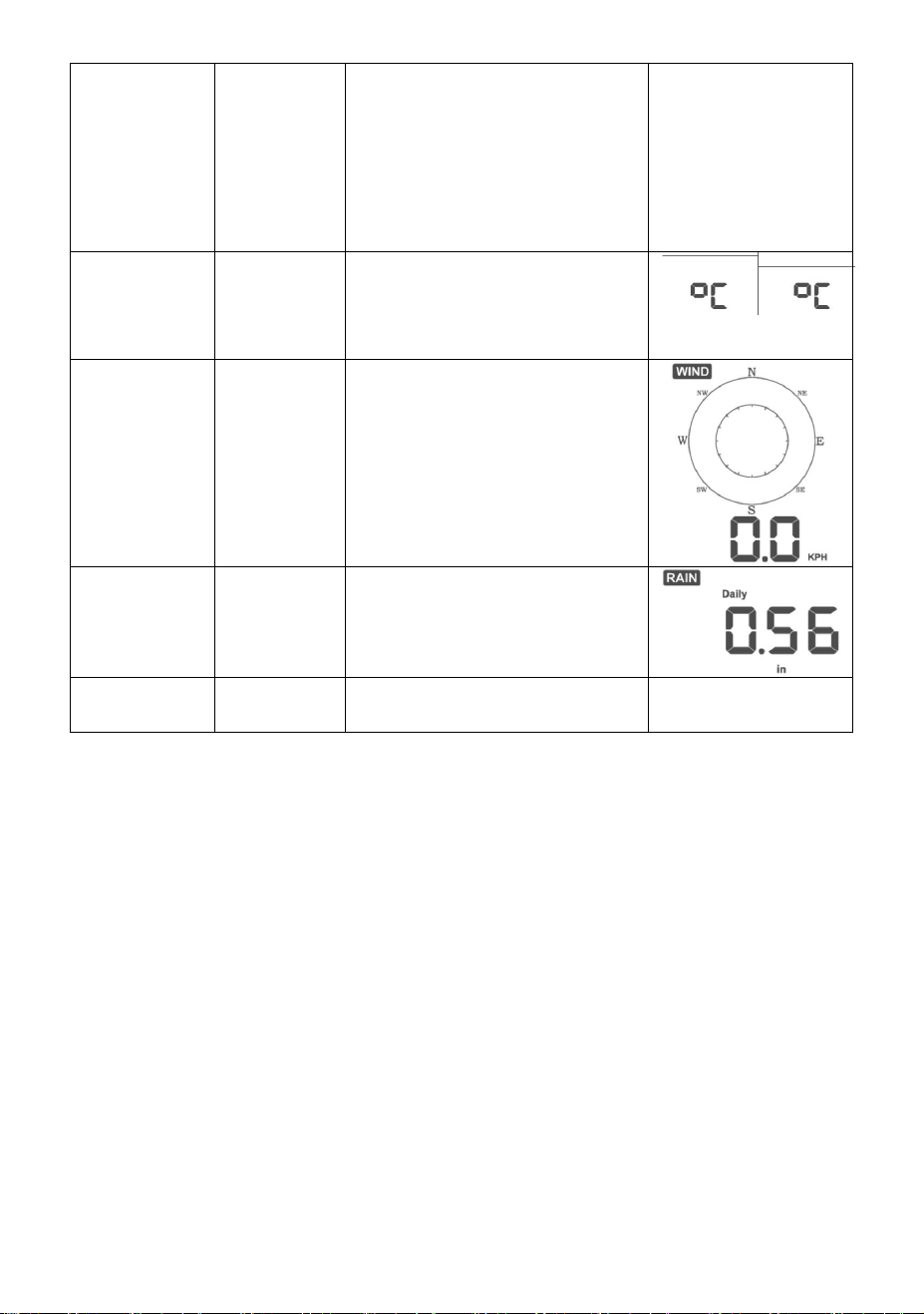
22
[MODE]
Relative
Pressure
Calibration
Press [TEMP +] or [WIND -]
to adjust relative pressure up
or down
Reference Section 6.4.3 for
details on calibration of
relative pressure.
[MODE]
Temperatu
re Units of
Measure
Press [TEMP +] or [WIND -]
to change temperature units
of measure between °F
and °C.
[MODE]
Wind
Units of
Measure
Press [TEMP +] or [WIND -]
to change wind units of
measure between km/h, mph,
knots, m/s and bft.
[MODE]
Rain Units
of Measure
Press [TEMP +] or [WIND -]
to change rain units of
measure between in and mm.
[MODE]
Exit Set
Mode
[MODE] + 2 seconds means to press and hold the MODE button for two
seconds.
[MODE] means to press the MODE button.
Table 8: Set mode sequence and commands summarization
6.4 Barometric Pressure Display
6.4.1 Viewing Absolute vs. Relative Pressure
Press and hold [RAIN/PRE] for two seconds switch between Rain and
Pressure. While in Pressure mode Press [RAIN/PRE] to switch between
absolute and relative pressure
Absolute pressure is the measured atmospheric pressure, and is a function of
altitude, and to a lesser extent, changes in weather conditions.
Absolute pressure is not corrected to sea-level conditions.
23
Relative pressure is corrected to sea-level conditions. For further discussion of
relative pressure and calibration, reference Section 6.4.3.
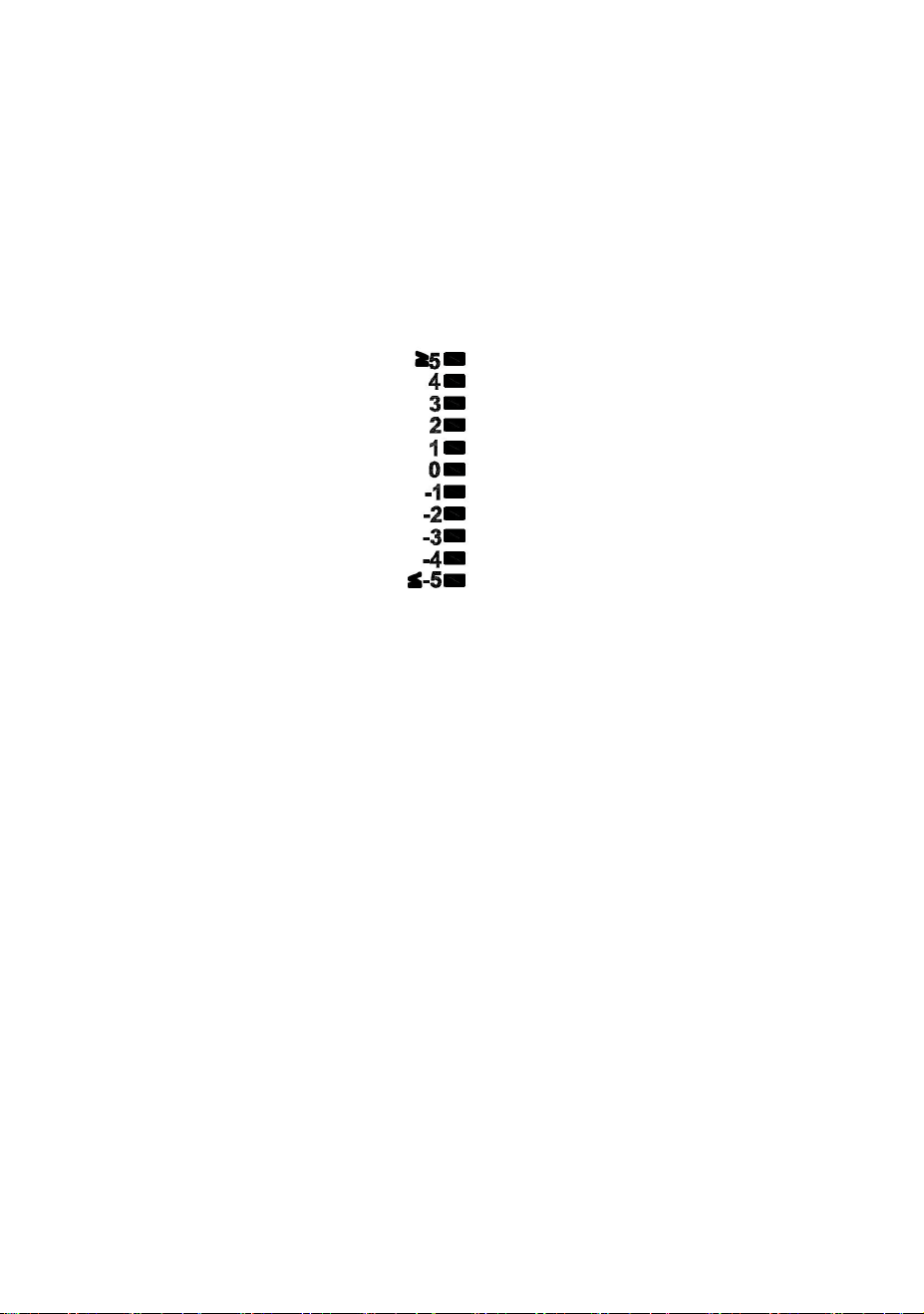
6.4.2 Rate of Change of Pressure Graph
The rate of change of pressure graphic is shown to the left of the weather
forecast icons and signifies the difference between the daily average pressure
and the 30-day average (in hPa).
Figure 18
6.4.3 Relative Pressure Calibration Discussion
The calibration was set on ecowitt app. To compare pressure conditions from
one location to another, meteorologists correct pressure to sea-level conditions.
Because the air pressure decreases as you rise in altitude, the sea-level
corrected pressure (the pressure your location would be at if located at
sea-level) is generally higher than your measured pressure.
Thus, your absolute pressure may read 28.62 inHg (969 mb) at an altitude of
1000 feet (305 m), but the relative pressure is 30.00 inHg (1016 mb).
The standard sea-level pressure is 29.92 inHg (1013 mb). This is the average
sea-level pressure around the world. Relative pressure measurements greater
than 29.92 inHg (1013 mb) are considered high pressure and relative pressure
measurements less than 29.92 inHg are considered low pressure.
To determine the relative pressure for your location, locate an official
reporting station near you (the internet is the best source for real time
barometer conditions, such as Weather.com or Wunderground.com), and set
your weather station to match the official reporting station.

24
6.5 Rain Display
6.5.1 Rain Increments of Measure
Press and hold [RAIN/PRE] for two seconds switch between Rain and
Pressure. While in Rain mode press the [RAIN/PRE] to switch between
Rain Rate (in/hr), Rain Event, Rain Hourly, Daily Rain, Weekly Rain,
Monthly Rain and Yearly Rain.
6.5.2 Increments of Rain Definitions
Rain rate or hourly rain is defined as the last 10 minutes of rainfall,
multiplied by six (10 minutes x 6 = 1 hour). This is also referred to as
instantaneous rain per hour.
Rain event is defined as continuous rain, and resets to zero if rainfall
accumulation is less than 1 mm (0.039 in) in a 24-hour period.
Daily Rain is defined as the rainfall since midnight (00:00).
Weekly Rain is defined as the calendar week total and resets on
Sunday morning at midnight (Sunday thru Saturday).
Monthly Rain is defined as the calendar month total and resets on the
first day of the Month.
Yearly Rain is defined as the total rainfall from January 1 to
December 31.
6.6 Wind Display
Press the [WIND -] button to switch between average wind speed and, wind
gust.
Press and hold the [WIND -] button for two seconds to switch the wind
direction to display in degrees or in letters.
Wind speed is defined as the average wind speed in the 16 seconds
update period.
Wind gust is defined as the peak wind speed in the 16 seconds update
period.

25
6.7 Temperature Display
If temperature is lower than minimum range, the temperature field will display
dashes (--.-).
If temperature is higher than maximum range, the temperature field will
display dashes (--.-).
6.7.1 Wind Chill, Dew Point and Heat Index Display
Press the [TEMP] button to switch between Outdoor Temperature, Wind Chill,
Dew Point, Heat Index.
The device supports up to 8 additional thermo-hygrometer sensors (WH31). If
you have the extra sensors, press the [TEMP +] button to switch between
Outdoor Temperature, Wind Chill, Dew Point, Heat Index, 8 channel
temperature and humidity, Circle Mode
6.8 Alarms
6.8.1 Viewing High and Low Alarms
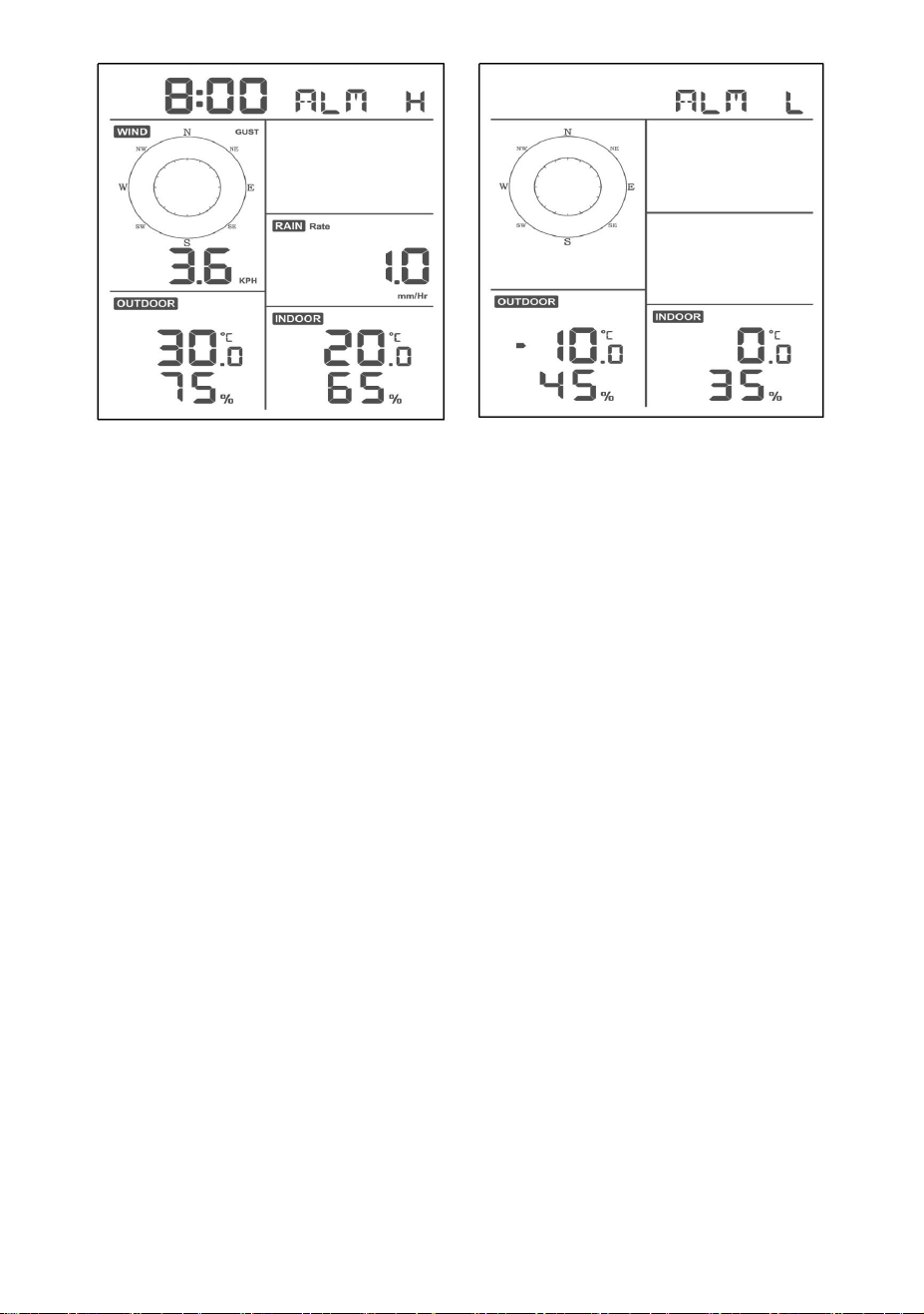
To view the high alarm settings, press MODE button a third time, and the high
alarms will be displayed, as shown in Figure 19 (a).
To view the low alarm settings, press the MODE button a fourth time, and the
low alarms will be displayed, as shown in Figure 19 (b).
To return to normal mode, press the LIGHT button again.
26
(a)
(b)
Figure 19
6.8.2 Setting High and Low Alarms
While the High Alarm is displayed (reference Section 6.8.1), press and hold
the MODE button for 2 seconds to enter the High Alarm Set Mode.
While the Low Alarm is displayed (reference Section 6.8.1), press and hold
the MODE button for 2 seconds to enter the Low Alarm Set Mode.
To save and proceed to the next alarm setting, press the Mode button.
To exit the High Alarm Set Mode at any time, press the LIGHT button.
Table 9 summarizes the alarm mode sequence and commands.
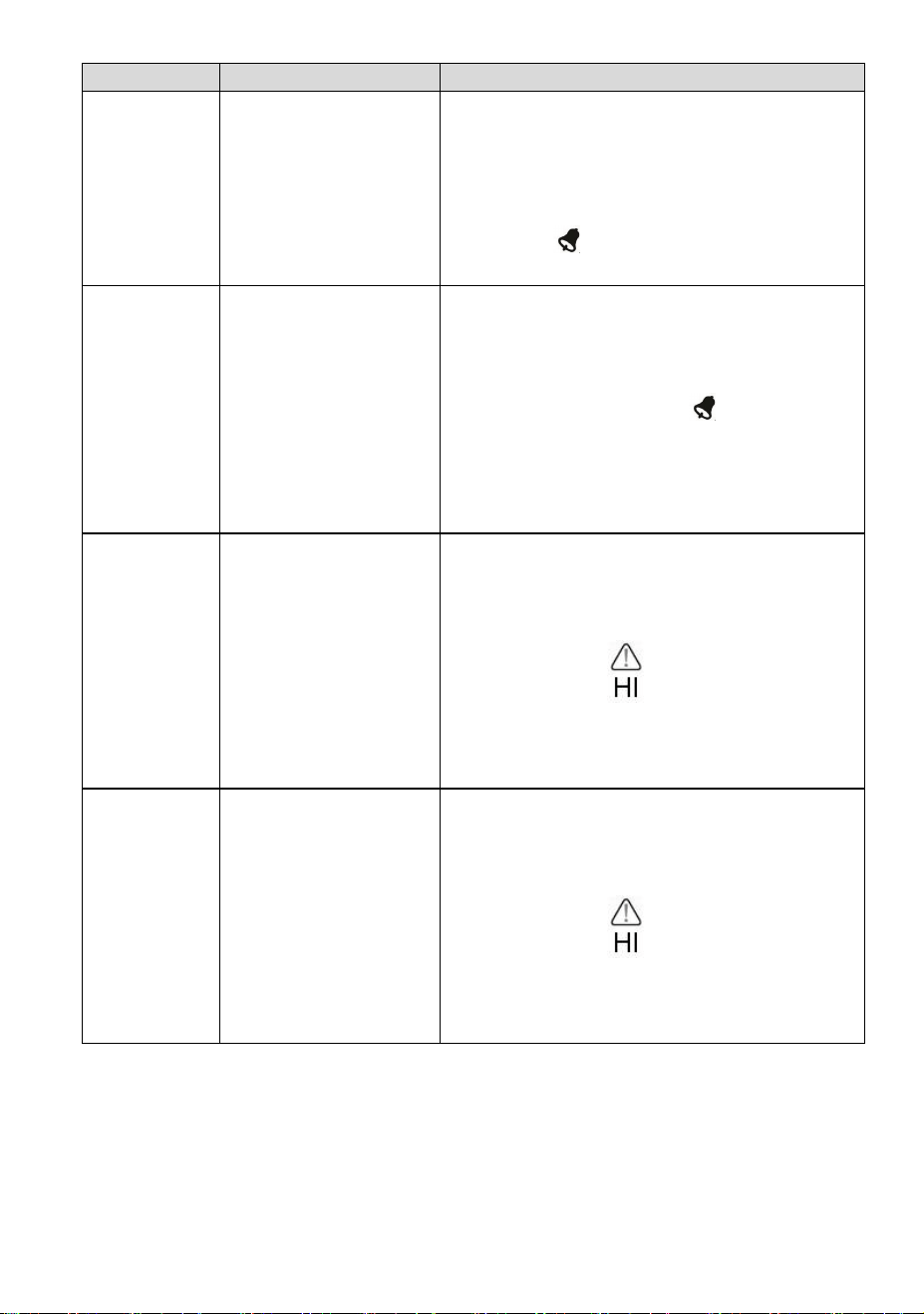
27
Command
Mode
Settings
[MODE] +
2 seconds
Enter High Alarm
Set Mode, Alarm
Hour
Press [TEMP +] or [WIND -] to adjust
alarm hour up or down.
Press [RAIN/PRE] to turn the time alarm
on or off. When the alarm is on, the alarm
time icon will appear.
[MODE]
Alarm Minute
Press[TEMP +] or [WIND -] to adjust
alarm minute up or down.
Press [RAIN/PRE] to turn the time alarm
on. The alarm time icon will appear.
Press [RAIN/PRE] again to turn the time
alarm off. The alarm time icon will
disappear.
[MODE]
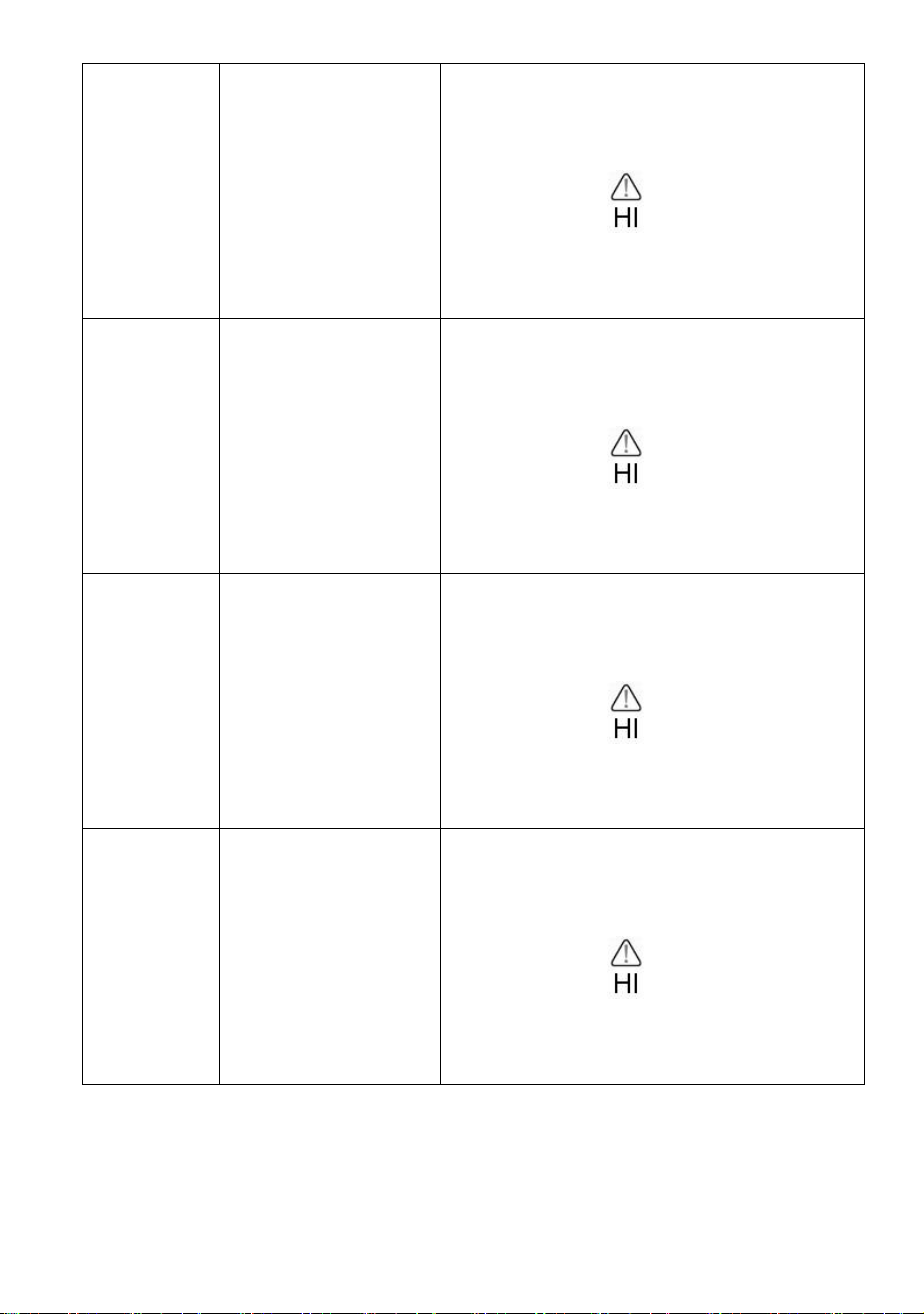
Alarm High Indoor
Temperature
Press [TEMP +] or [WIND - ]to adjust
alarm value up or down.
Press [RAIN/PRE] to turn the alarm on.
The alarm icon will appear.
Press [RAIN/PRE] to turn the alarm off.
The alarm icon will disappear.
[MODE]
Alarm High Indoor
Humidity
Press [TEMP +] or [WIND -] to adjust
alarm value up or down.
Press [RAIN/PRE] to turn the alarm on.
The alarm icon will appear.
Press [RAIN/PRE] to turn the alarm off.
The alarm icon will disappear.
28
[MODE]
Alarm High Outdoor
Temperature
Press[TEMP +] or [WIND -] to adjust
alarm value up or down.
Press [RAIN/PRE] to turn the alarm on.
The alarm icon will appear.
Press [RAIN/PRE] to turn the alarm off.
The alarm icon will disappear.
[MODE]
Alarm High Outdoor
Humidity
Press [TEMP +] or [WIND -] to adjust
alarm value up or down.
Press [RAIN/PRE] to turn the alarm on.
The alarm icon will appear.
Press [RAIN/PRE] to turn the alarm off.
The alarm icon will disappear.
[MODE]
Alarm High Wind
Gust
Press [TEMP +] or [WIND -] to adjust
alarm value up or down.
Press [RAIN/PRE] to turn the alarm on.
The alarm icon will appear.
Press [RAIN/PRE] to turn the alarm off.
The alarm icon will disappear.
[MODE]
Alarm High Rain
Rate
Press [TEMP +] or [WIND -] to adjust
alarm value up or down.
Press [RAIN/PRE] to turn the alarm on.
The alarm icon will appear.
Press [RAIN/PRE] to turn the alarm off.
The alarm icon will disappear.
29
[MODE]
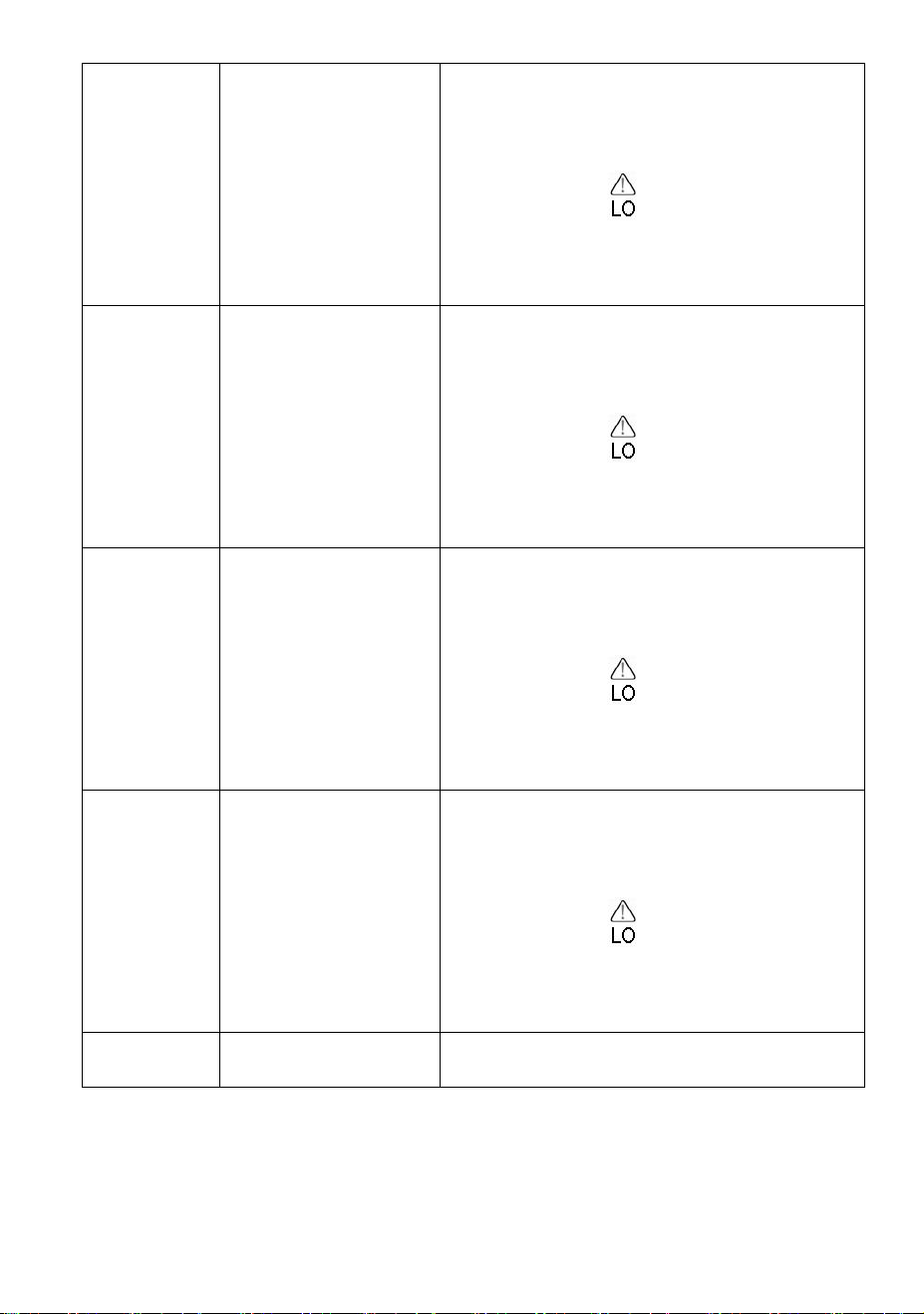
Alarm Low Indoor
Temperature
Press [TEMP +] or [WIND - ]to adjust
alarm value up or down.
Press [RAIN/PRE] to turn the alarm on.
The alarm icon will appear.
Press [RAIN/PRE] to turn the alarm off.
The alarm icon will disappear.
[MODE]
Alarm Low Indoor
Humidity
Press [TEMP +] or [WIND -] to adjust
alarm value up or down.
Press [RAIN/PRE] to turn the alarm on.
The alarm icon will appear.
Press [RAIN/PRE] to turn the alarm off.
The alarm icon will disappear.
[MODE]
Alarm Low Outdoor
Temperature
Press[TEMP +] or [WIND -] to adjust
alarm value up or down.
Press [RAIN/PRE] to turn the alarm on.
The alarm icon will appear.
Press [RAIN/PRE] to turn the alarm off.
The alarm icon will disappear.
[MODE]
Alarm Low Outdoor
Humidity
Press [TEMP +] or [WIND -] to adjust
alarm value up or down.
Press [RAIN/PRE] to turn the alarm on.
The alarm icon will appear.
Press [RAIN/PRE] to turn the alarm off.
The alarm icon will disappear.
[MODE]
Exit alarm settings
mode.
[MODE] + 2 seconds means to press and hold the MODE button for 2
seconds.
[MODE] means to press the MODE button.
Table 9: Alarm mode sequence and commands summarization
30
6.9 Max/Min Mode
6.9.1 Viewing Max/Min Values
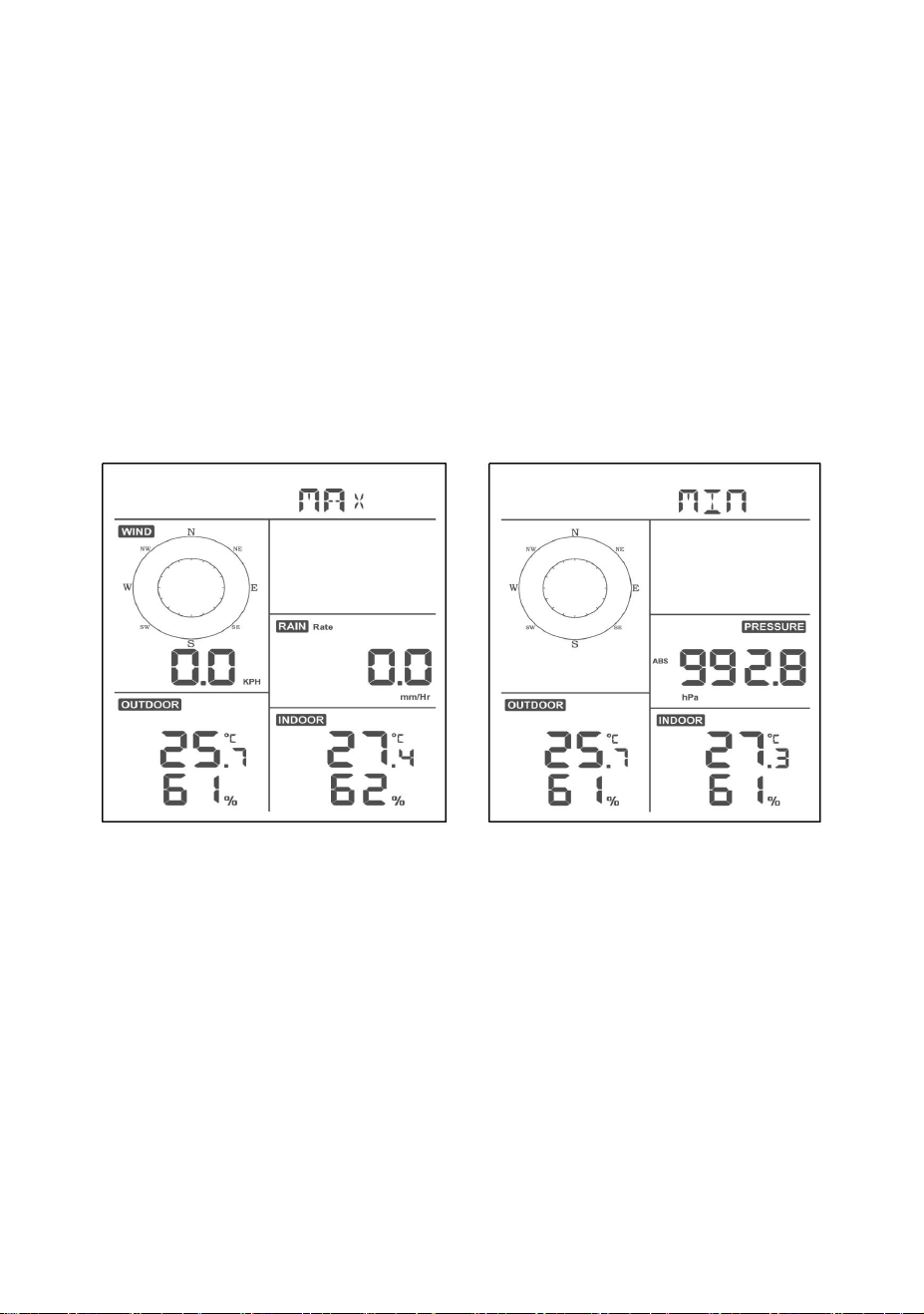
To view the max value, press the MODE button, and the max values will be
displayed, as shown in Figure 20 (a). To clear the max values, press and hold
the MODE button while the max values are displayed.
To view the min value, press the MODE button again, and the min values will
be displayed, as shown in Figure 20 (b). To clear the min values, press and
hold the MODE button while the min values are displayed.
To return to normal mode, press the LIGHT button.
(a)
(b)
Figure 20
6.9.1.1 Display Wind Chill, Heat Index vs. Dew Point Max/Min Values
While the max values are displayed as outlined in Section 6.9.1, press the
TEMP+ button once to view the wind chill, twice to view the dew point, third
to view the heat index and a fourth time to return to outdoor temperature.
While the min values are displayed as outlined in Section 6.9.1, press the
TEMP+ button once to view the wind chill, twice to view the dew point, third
to view the heat index and a fourth time to return to outdoor temperature.
6.9.1.2 Display Wind Speed vs. Wind Gust Max Values
While the max values are displayed as outlined in Section 6.9.1, press the
31
WIND- button once to view the max wind gust, and twice to return to wind
speed.
6.9.1.3 Display Hourly Rain, Rain Rate
While the max values are displayed as outlined in Section 6.9.1, press the
RAIN button once to view the max hourly rain, twice to view the rain rate.
6.9.1.4 Display Absolute and Relative Pressure Min and Max Values
While the max values are displayed as outlined in Section 6.9.1, press and
hold the RAIN/PRE button for two seconds to enter pressure display, press
RAIN/PRE button to switch between Relative pressure and Absolute
pressure.
While the min values are displayed as outlined in Section 6.9.1, press and
hold the RAIN/PRE button for two seconds to enter pressure display, press
RAIN/PRE button to switch between Relative pressure and Absolute pressure
To return to normal mode, press the LIGHT button.
6.10 Resynchronize Wireless Sensor
While in outdoor TH/wind chill/dew point/heat index display mode press
TEMP+ button for 5 seconds, and the console will re-register the outdoor
sensor array
While in 1-8 channel Thermo-hygro sensor display mode press TEMP+
button for 5 seconds, and the console will re-register the current channel
outdoor sensor.
While in Circle Mode press TEMP+ button for 5 seconds, and the console
will re-register the sensor array and 1-8 channel sensors.
6.11 Backlight Operation
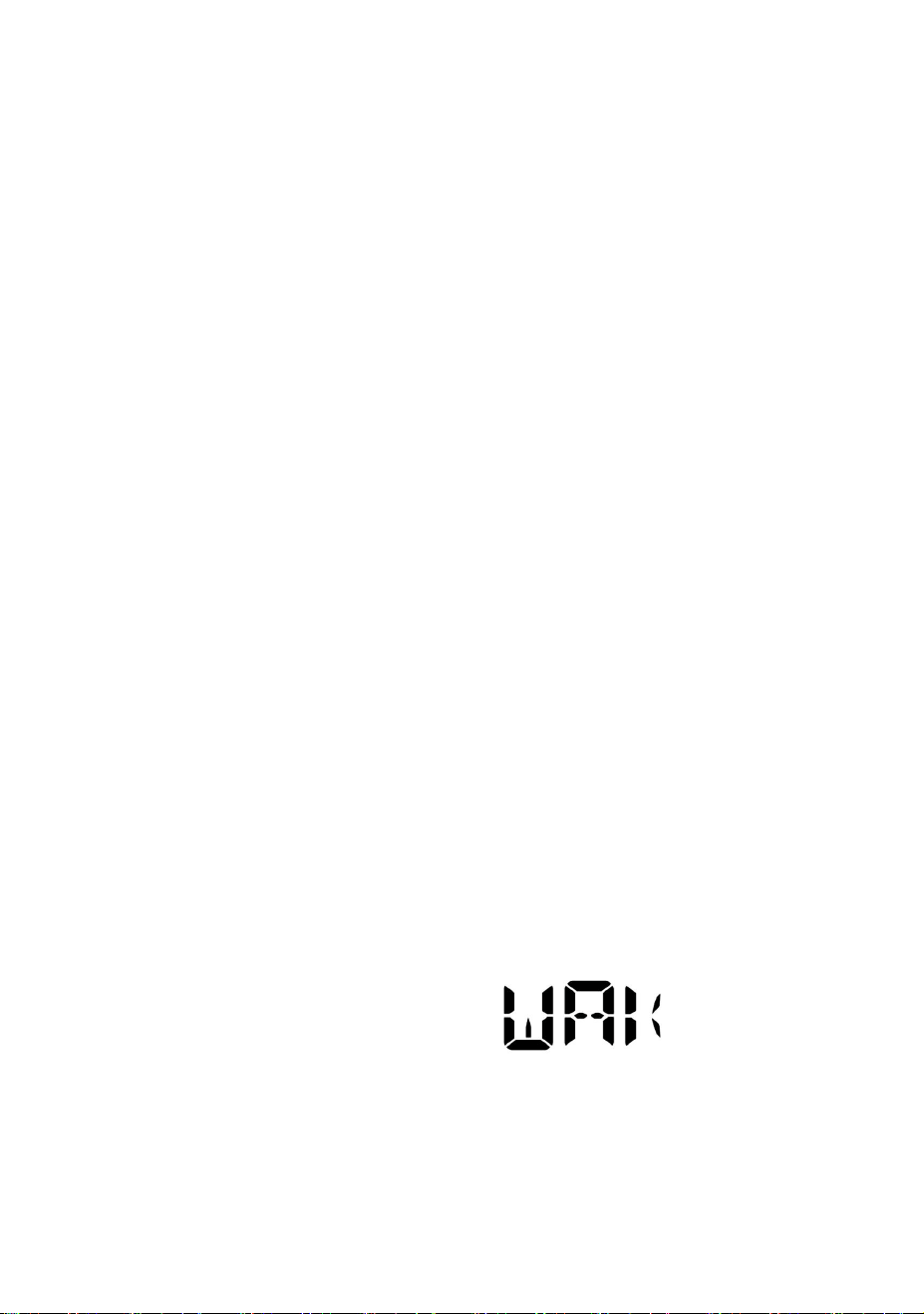
Press LIGHT button for 2s, will wake up Wi-Fi chip from power saving state,
the date display will turn to show “WAK” , saying that at battery power
supply state, the Wi-Fi existed power saving mode, as during Wi-Fi power
saving mode, the system is not responding to ecowitt app commands quickly.
32
6.11.1 With USB cable (included)
The backlight can only be continuously on when the console display is
powered on with the USB cable.
Press the LIGHT button to adjust the brightness between High, Middle, Low
and Off.
6.11.2 Without USB Power supplied
Press any button briefly to turn on the backlight temporarily for 15 seconds.
6.12 Tendency Arrows
Tendency arrows allow you to quickly determine of temperature or pressure
are rising and falling in a three-hour update period, updated every 30 minutes.
Table 10 defines the conditions for rising and falling pressure every 3 hours.
Tendency
indicators
Condition
Humidity Change
per 3 Hours
Temperature Change
per 3 Hours
︿
Rising
Rising > 3%
Rising > 1º C / 2 ºF
None
Steady
Change ≤ ±3%
Change ≤ ± 1 º C /
2 º F
﹀
Falling
Falling > 3%
Falling > 1º C / 2 ºF
Table 10: Tendency indicators summarization
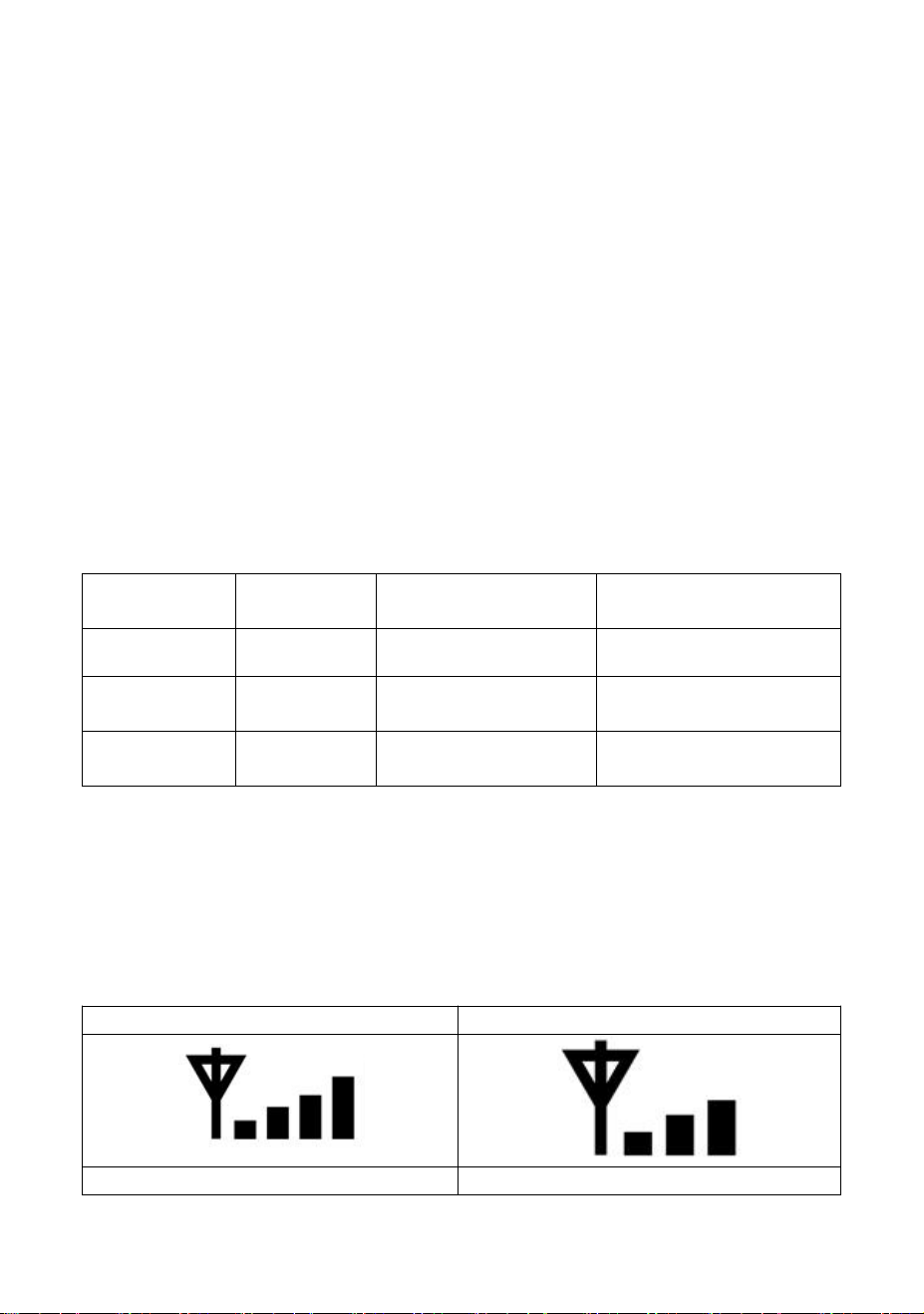
6.13 Wireless Signal Quality Indicator
The wireless signal strength displays reception quality. If no signal is lost, the
signal strength indicator will display four bars. If the signal is lost once, three
bars will be displayed, as shown in Figure 26.
Four Bars
Three Bars
No signal loss
Lost signal once
Table 11
33
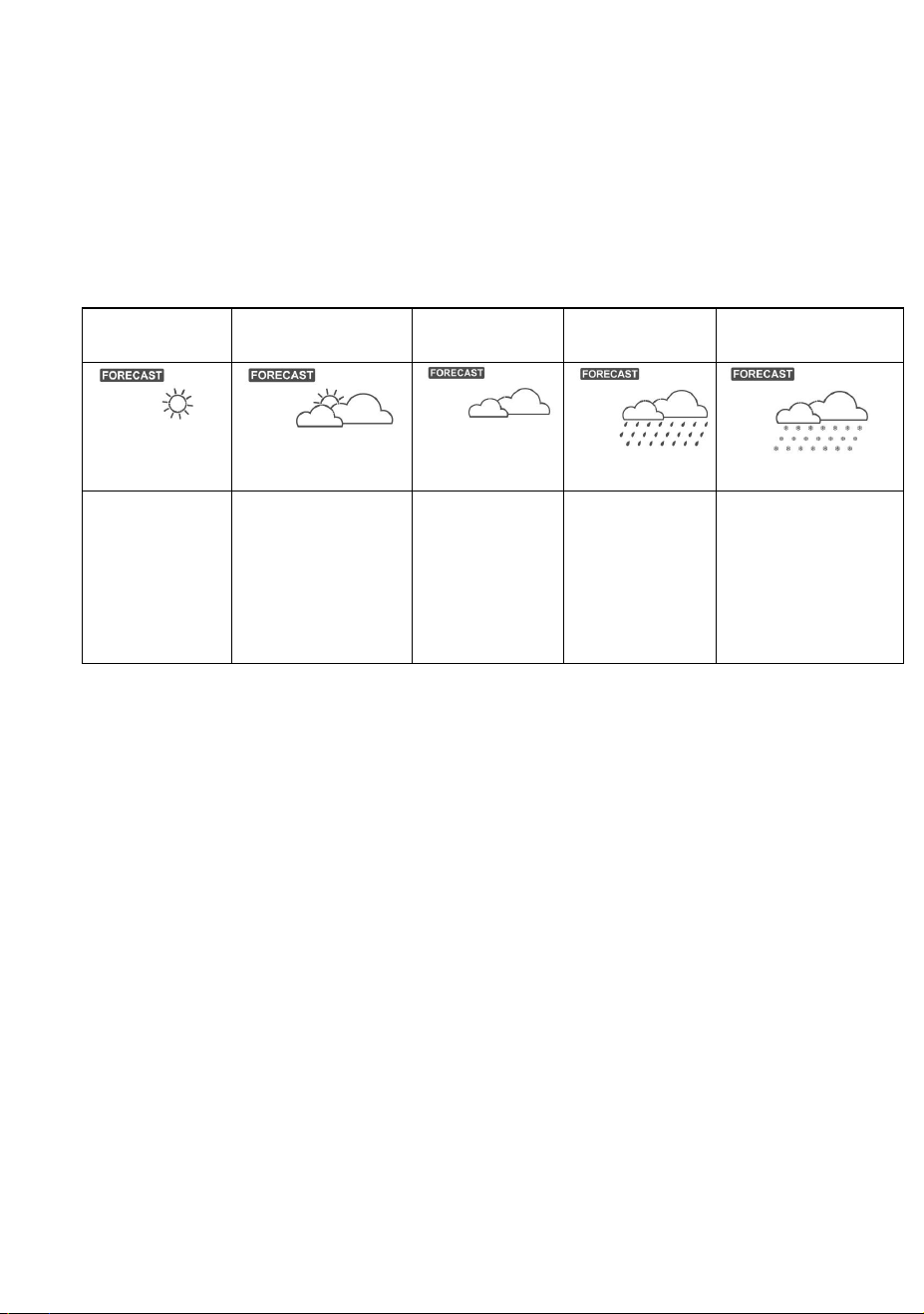
6.14 Weather Forecasting
The five weather icons are Sunny, Partly Cloudy, Cloudy, Rainy, Stormy and
Snowy.
The forecast icon is based on the rate of change of barometric pressure. Please
allow at least one month for the weather station to learn the barometric
pressure over time.
Sunny
Partly Cloudy
Cloudy
Rainy
Snowy
Pressure
increases for
a sustained
period of
time
Pressure
increases
slightly, or
initial power up
Pressure
decreases
slightly
Pressure
decreases for
a sustained
period of
time
Pressure
decreases for a
sustained period
of time and
temperature is
below freezing
Table 12: Weather forecasting summarization
Note:
When the pressure decreases dramatically, the rainy icon will flash
to indicate stormy.
When the pressure decreases dramatically and the temperature is
below freezing, the snowy icon will flash to indicate blizzard.
6.14.1 Storm Alert
If there is a rapid drop in barometric pressure, the forecast icon will flash.
6.14.2 Weather Forecasting Description and Limitations
In general, if the rate of change of pressure increases, the weather is generally
improving (sunny to partly cloudy). If the rate of change of pressure decreases,
the weather is generally degrading (cloudy, rainy). If the rate of change is
relatively steady, it will read partly cloudy.

34
The reason the current conditions do not match the forecast icon is because the
forecast is a prediction 24-48 hours in advance. In most locations, this
prediction is only 70% accurate and it is a good idea to consult the National
Weather Service for more accurate weather forecasts. In some locations, this
prediction may be less or more accurate. However, it is still an interesting
educational tool for learning why the weather changes.
The National Weather Service (and other weather services such as
Accuweather and The Weather Channel) have many tools at their disposal to
predict weather conditions, including weather radar, weather models, and
detailed mapping of ground conditions.
7. Specification:
Outdoor data
Transmission distance in open field
: 100M/300FT
Frequency
: 915/868/433MHz depending on
location
(North American: 915MHz; Europe:
868MHz; Other areas: 433MHz)
Temperature range
: -40˚C--60˚C (-40˚F to +140˚F)
Accuracy
: + / - 1 °C
Resolution
: 0.1˚C
Measuring range rel. humidity
: 1%~99%
Accuracy
: +/- 5%
Rain volume display
: 0 – 9999mm
(show --- if outside range)
Accuracy
: + / - 10%
Resolution
: 0.1mm (if rain volume < 1000mm)
1mm (if rain volume > 1000mm)
Wind speed
: 0-50m/s (0~100mph)
(show --- if outside range)
Accuracy
: +/- 1m/s (wind speed< 5m/s)
+/-10% (wind speed > 5m/s)
Measuring interval thermo-hygro sensor
: 16 s
Indoor data
Indoor temperature range
: 0˚C--50˚C (32˚F to + 122˚F)
(show --- if outside range)
35
Resolution
: 0.1˚C
Measuring range rel. Humidity
: 1%~99%
Resolution
: 1%
Measuring range air pressure
: 700-1100hPa (20.67-32.5inHg)
Accuracy
: +/-3hpa
Resolution
: 0.1hPa (0.01inHg)
Alarm duration
: 120s
Measuring interval indoor data
: 60s
Power consumption
Base station : 5V DC (USB to 2.5*0.7mm DC 5V power plug connector
cable included)
Base station : 2 x AA batteries (not included)
Remote sensor: 2x AA batteries (not included)
8. Live Internet Publishing
Your console is capable of sending your sensor data to select
internet-based weather services. The supported services are shown in the
table below:
Hosting
Service
Website
Description
Ecowitt
Weather
https://www.ecowitt.
net
Ecowitt is a new weather server that
can host a bunch of sensors that
other services don’t support.
Weather
Underground
WeatherUndeground.
com
Weather Underground is a free
weather hosting service that allows
you to send and view your weather
station data real-time, view graphs
and gauges, import text data for
more detailed analysis and use
iPhone, iPad and Android
applications available at
Wunderground.com. Weather
Underground is a subsidiary of The
Weather Channel and IBM.
Weather
Cloud
WeatherCloud.net
Weathercloud is a real-time weather
social network formed by observers
36
from around the world
Weather
Observation
Website
(WOW)
http://wow.metoffice.
gov.uk/
WOW is a UK based weather
observation website. WOW allows
anyone to submit their own weather
data, anywhere in the world.
Customized
Website
Supports uploading to your
customized website, if the website
has the same protocol with
Wunderground or Ecowitt
Table 13: Supported weather services
8.1 Configure Wi-Fi via BLE to connect the Weather Station
Console
To send weather data to these services you must configure console to be
connected to your Wi-Fi router for internet access.
During console credentials setting up, firmware updating, the communication
between your phone and console is based on Blue Tooth (BLE), so your phone
needs to be 16 feet/5 meter within the console radius. When the device has
connected to your network which also your phone is connected, then further
setup like live data, calibration, date, time zone etc will be based on your
WLAN and it is not so distance sensitive.
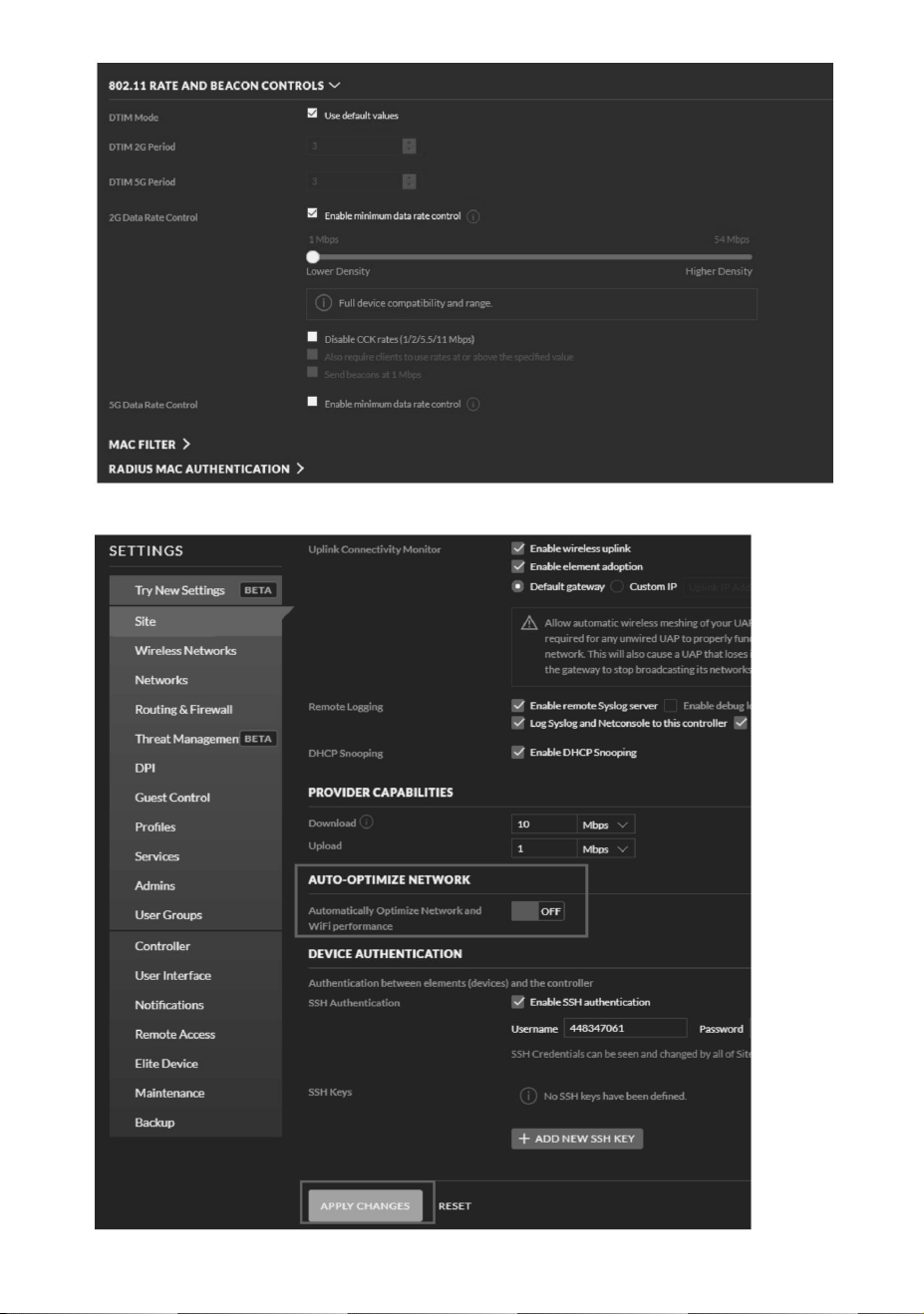
Note1: The Wi-Fi chip equipped on this console supports 802.11b mode only
with 2.0 MHz CLK rate. Thus, some latest Wi-Fi routers or AP has to be
manually turned on 802.11b mode and even need to enable the latency mode
to host this device. Those known router or AP devices is:
Ubiquiti UAP-PRO
37
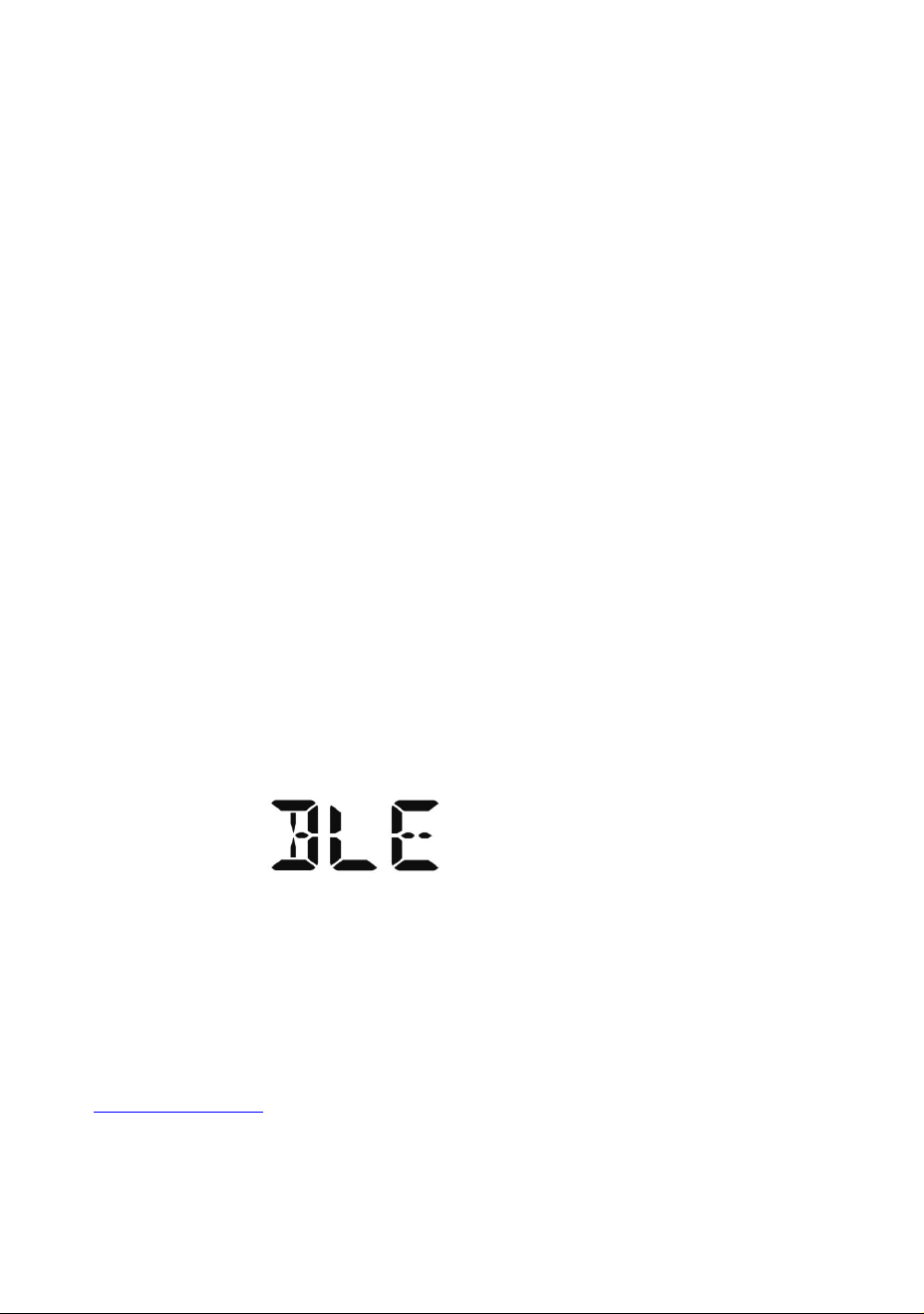
Or it is necessary even to switch this option off:
38
Please check your Wi-Fi router or AP devices setting and contact us if you
still have problem in connecting the console to your Wi-Fi network.
Note: If you are testing the setup with the outdoor sensor package nearby
and indoor, you may want to consider connecting to Wi-Fi, but not
yet configuring any of the weather services. The reason is that while
indoor the temperatures and humidity recorded by the outdoor sensor,
and as reported to the weather service(s) will reflect indoor conditions,
and not outdoor conditions. Therefore, they will be incorrect.
Furthermore, the rainfall bucket may be tripped during handling,
causing rain to register while it may not actually have been raining.
One way to prevent this is to follow all instructions, except to use an
incorrect password, on purpose! Then, after final outdoor installation,
come back and change the password after clearing console history.
That will start uploading to the services with a clean slate.
8.1.1 Download mobile application
Wi-Fi configuration is done using your mobile device, either iOS or Android.
Start by downloading the ecowitt application from the Apple App Store or
Google Play store, as appropriate for your device.
8.1.2 Configure Wi-Fi via BLE
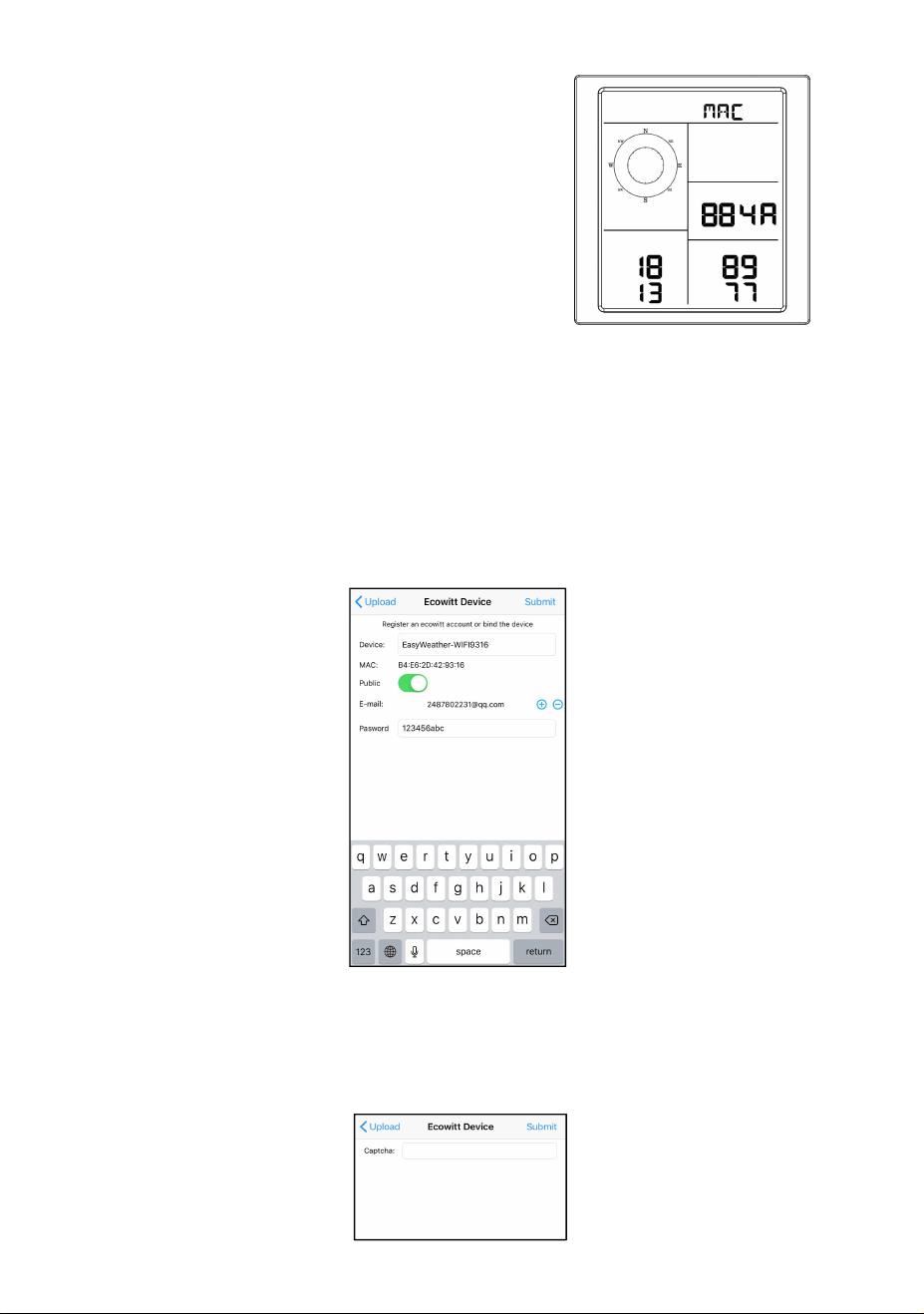
Press button “TEMP/+” and “LIGHT” button at the same time and hold for 2s
will activate configuration mode. The following display will be on at the Date
section on LCD:
Please make sure ecowitt app installed on your phone has its location and
WiFi access allowed. Otherwise the APP will lead to error result.
8.1.2.1
Run the ecowitt app from your mobile device’s home screen.
For detailed ecowitt APP operation, please refer the product page on
www.ecowitt.com and view the ecowitt APP operation instruction accordingly.
39
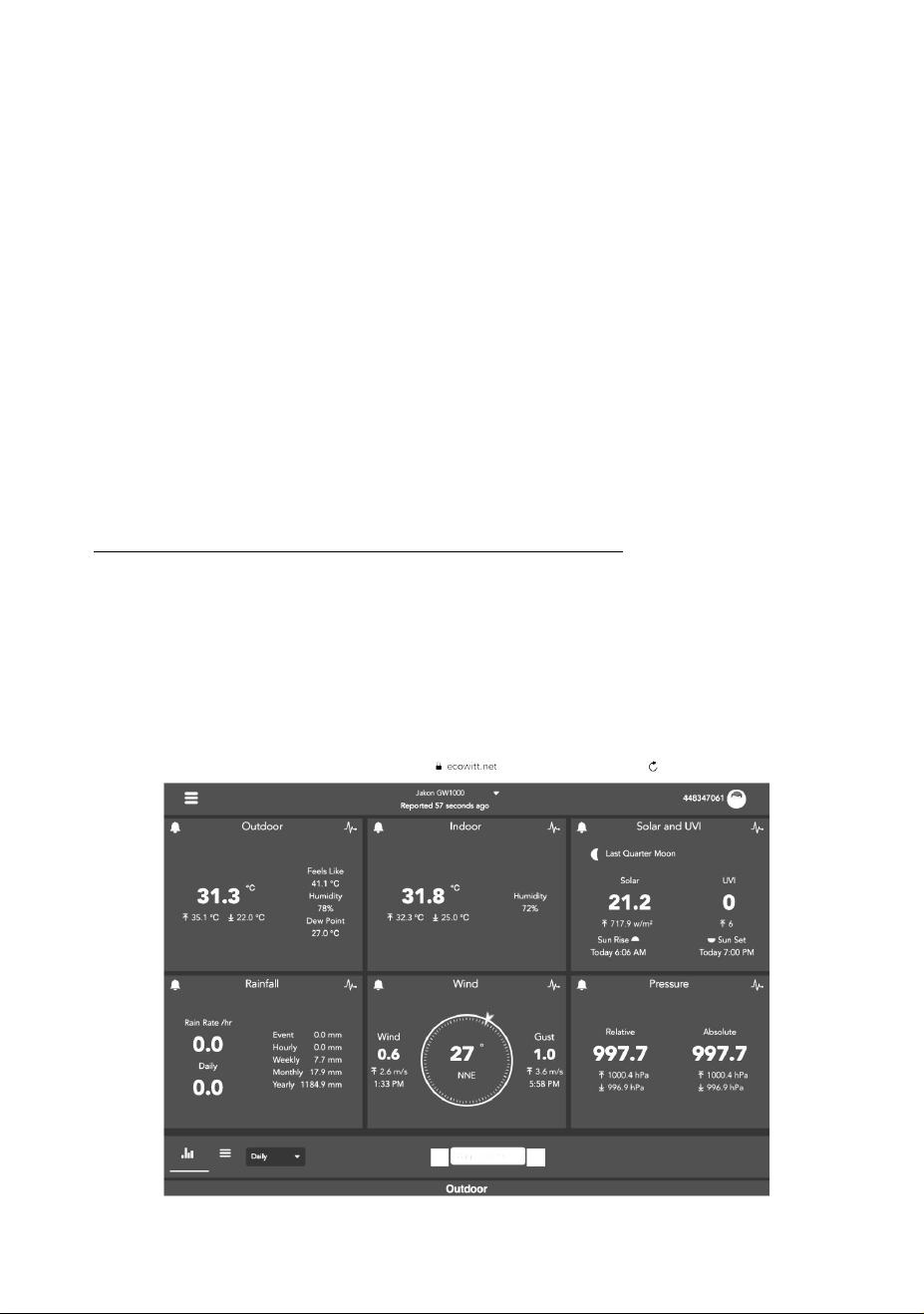
How to view the MAC address of device
In normal mode press the MODE button five times to
view the MAC address.
For example, the MAC address as shown in Figure
30 is 88:4A:18:13:89:77
8.2 Ecowitt Weather
It’s recommended to use the Ecowitt Weather server to monitor and
record your sensors’ data. Configure as follows:
On the ecowitt.net uploading page, enable the ON button (displayed
blue) and set the uploading interval time.
Press Save on the page.
Press “Register at ecowitt.net” and finish the registration on the page.
Press the “+” button and select enter your email address.
Set a password for your ecowitt account
Press Submit. Enter the captcha you received from your email box and
press submit.
40
It will jump to the ecowitt.net dashboard and display the sensor data
within several minutes.
Note:
If you could not receive the captcha from your email box, please
check the spam.
It only supports setting the units and language on the ecowitt app. To
use the full settings, please visit the ecowitt website on your browser
or on a computer.
If you could not register on the ecowitt app, please go to the website
to register and add the device.
Viewing data on ecowitt.net
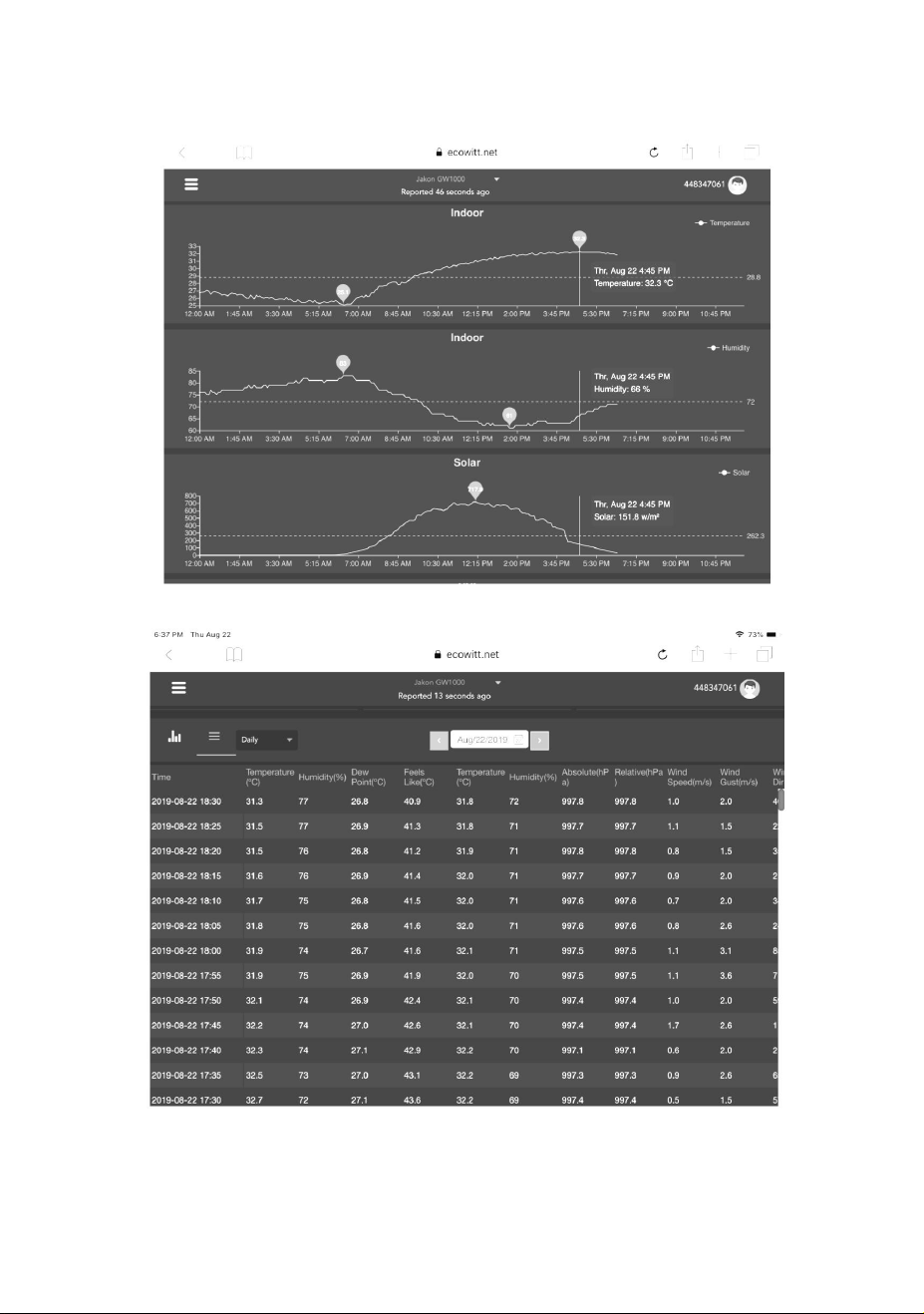
You can observe your sensor’s data by using the ecowitt.net web site. You
will use a URL like this one, where your station ID replaces the text
“STATIONID”.
https://www.ecowitt.net/home/index?id=STATIONID
Note: If you want to share your station data with other users, you may use
the Share option under the Menu to create a share link.
It will show a page such as this, where you can look at today’s data and
historical data as well.
Dashboard
41
Graph display
List display
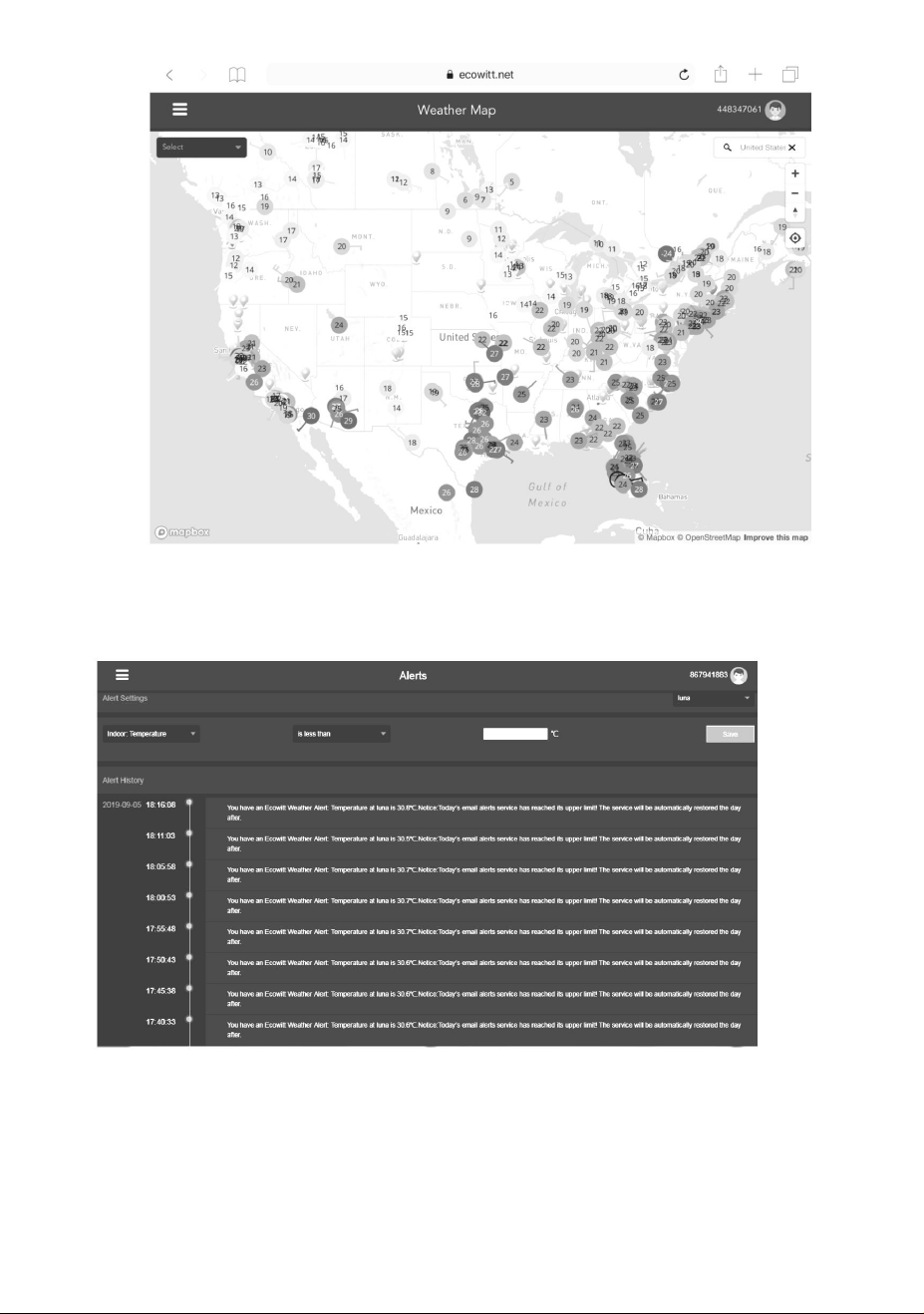
Weather Map
42
Email Alerts
9. Registering WeatherUnderground.com through the
PC or Mac
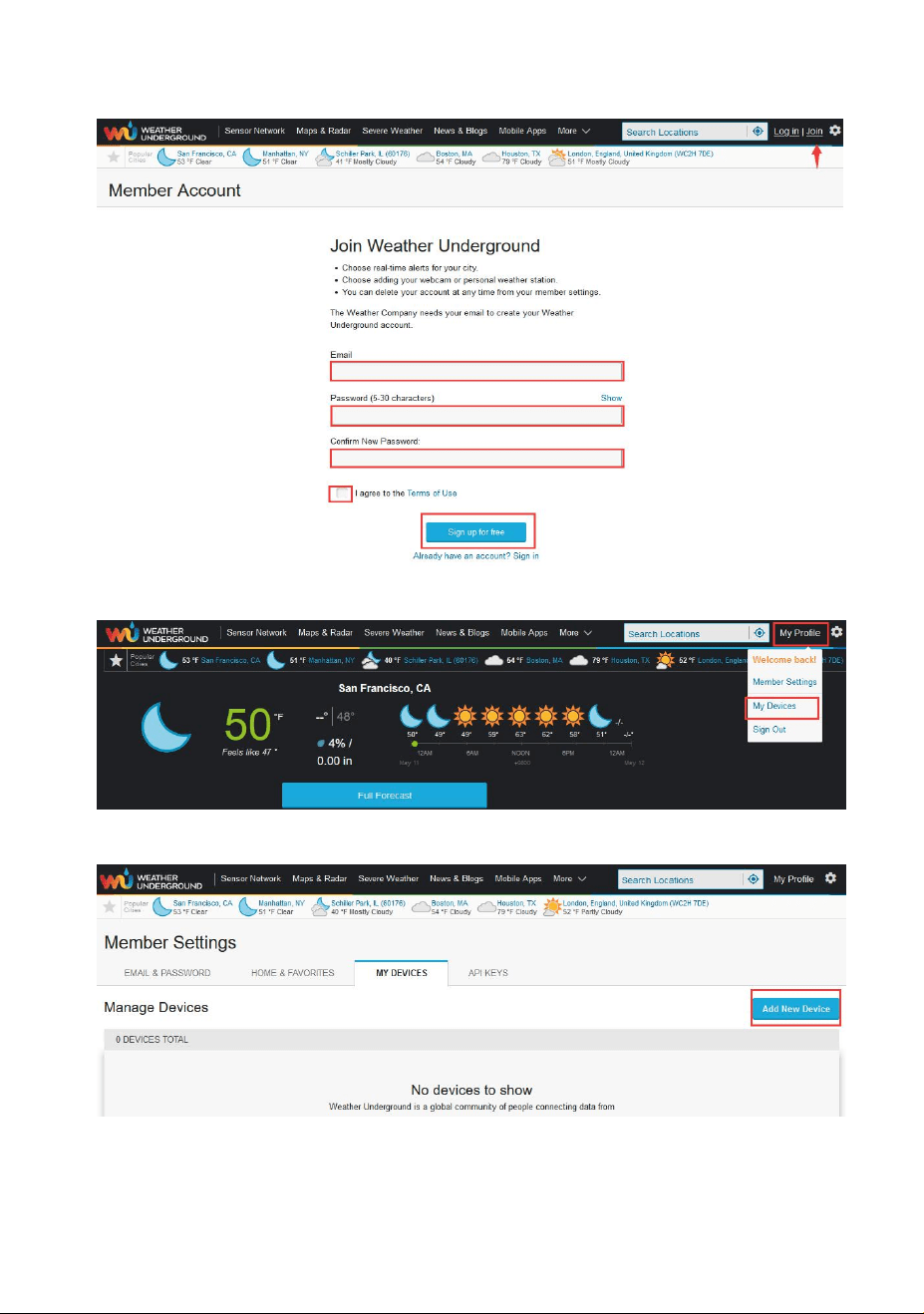
If you have not already done setup for wunderground.com during the Wi-Fi
setup, you can do so later. Perform the following steps:
43
1. Visit Wunderground.com and select the Join link at the top of the
page and sign up.
2. Click My Profile and select My Devices to register your station
3. Select Add New Device.
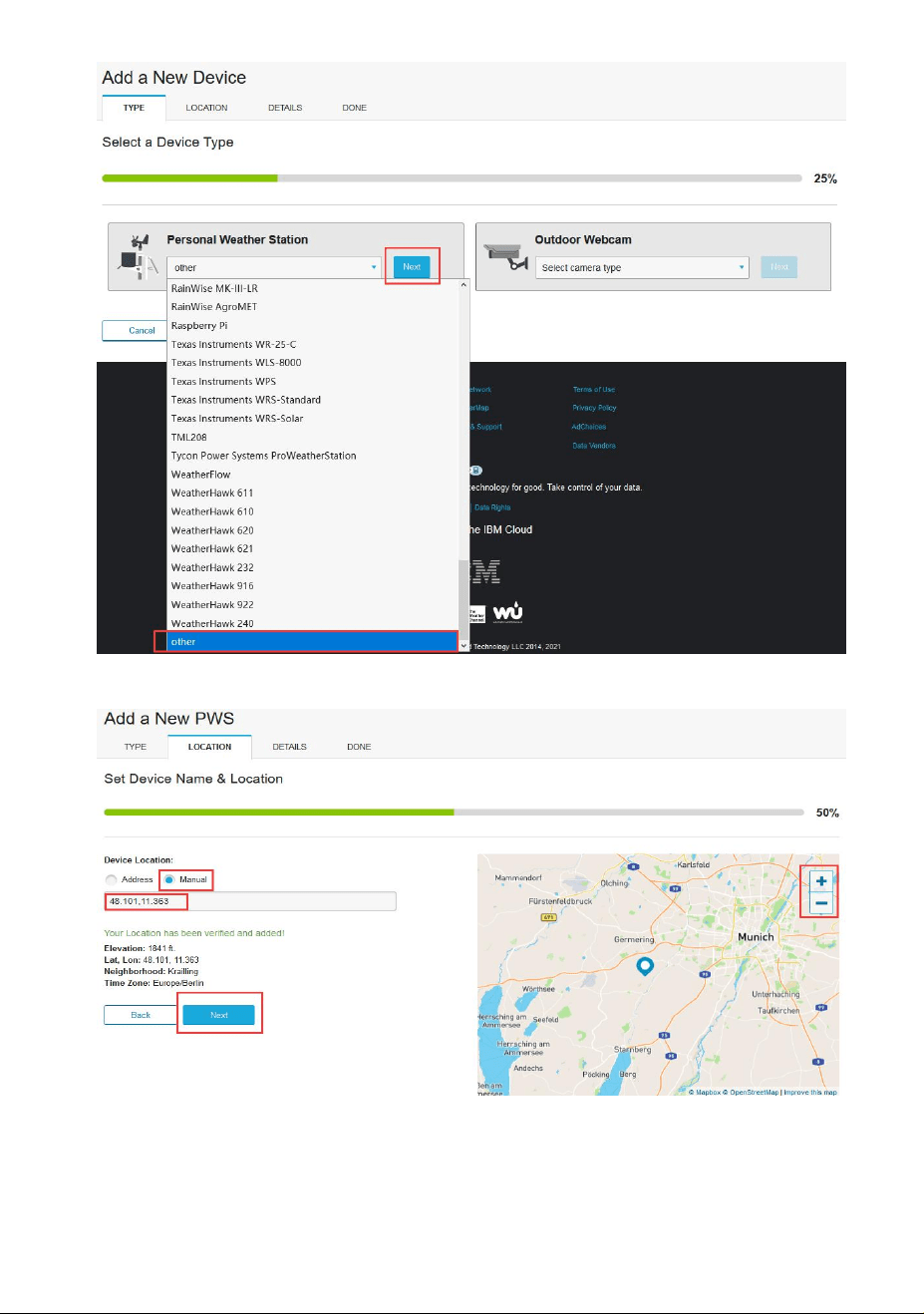
4. Find Personal Weather Station. Select ‘other’ and click ‘Next’.
44
5. Select ‘Address’ or ‘Manual’ option, and find your local position.
Press ‘Next’.
6. This time you will be asked details about your weather station. Go
ahead and fill out the form.
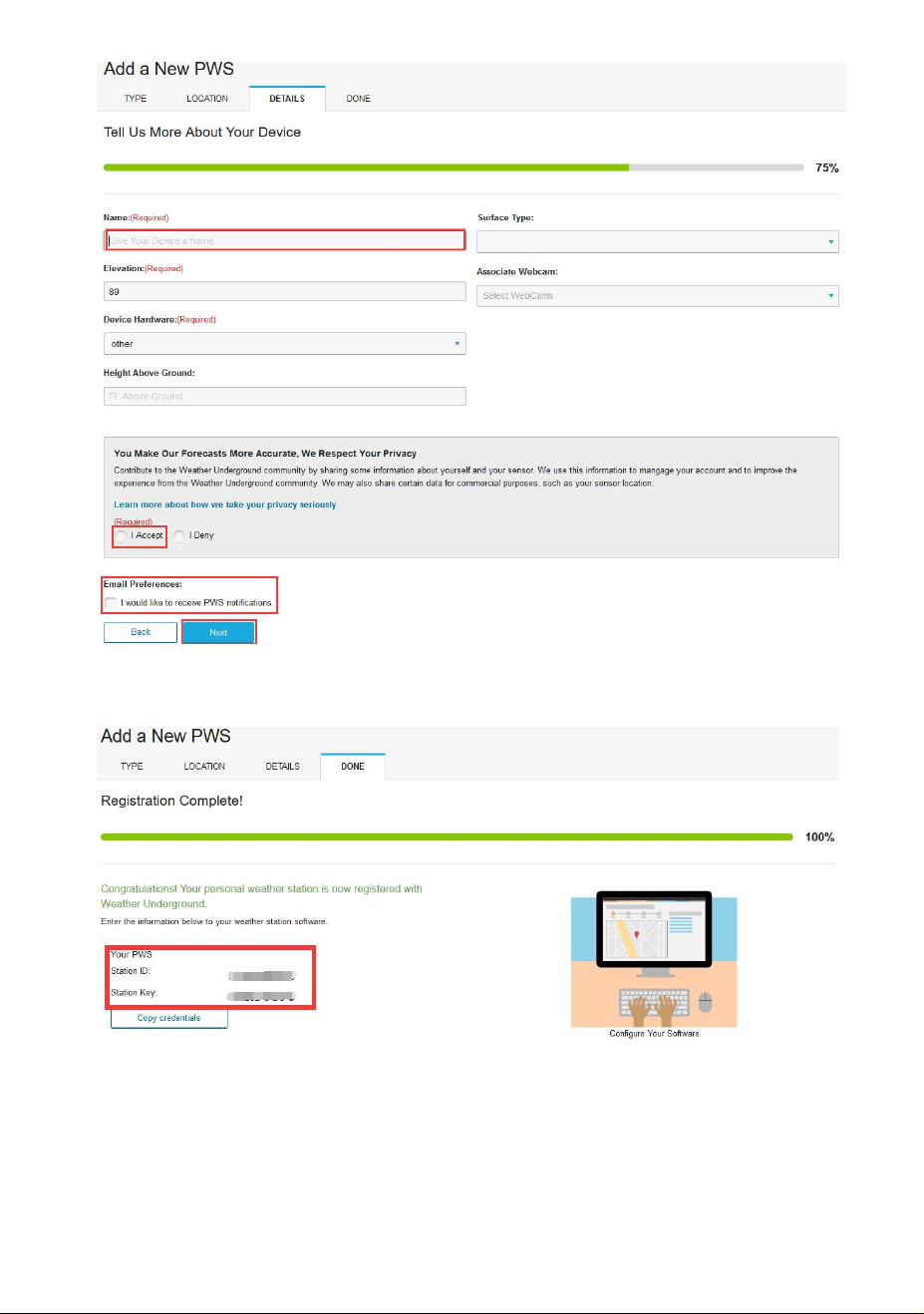
45
7. After completing the weather station, you will see station ID and
key/password.
Note: Your station ID will have the form: KSSCCCC###, where K is for USA
station (I for international), SS is your state, CCCC is your city and ### is the
station number in that city.
In the example above, KAZPHOEN424 is in the USA (K), State of Arizona
(AZ), City of Phoenix (PHOEN) and #424.
46
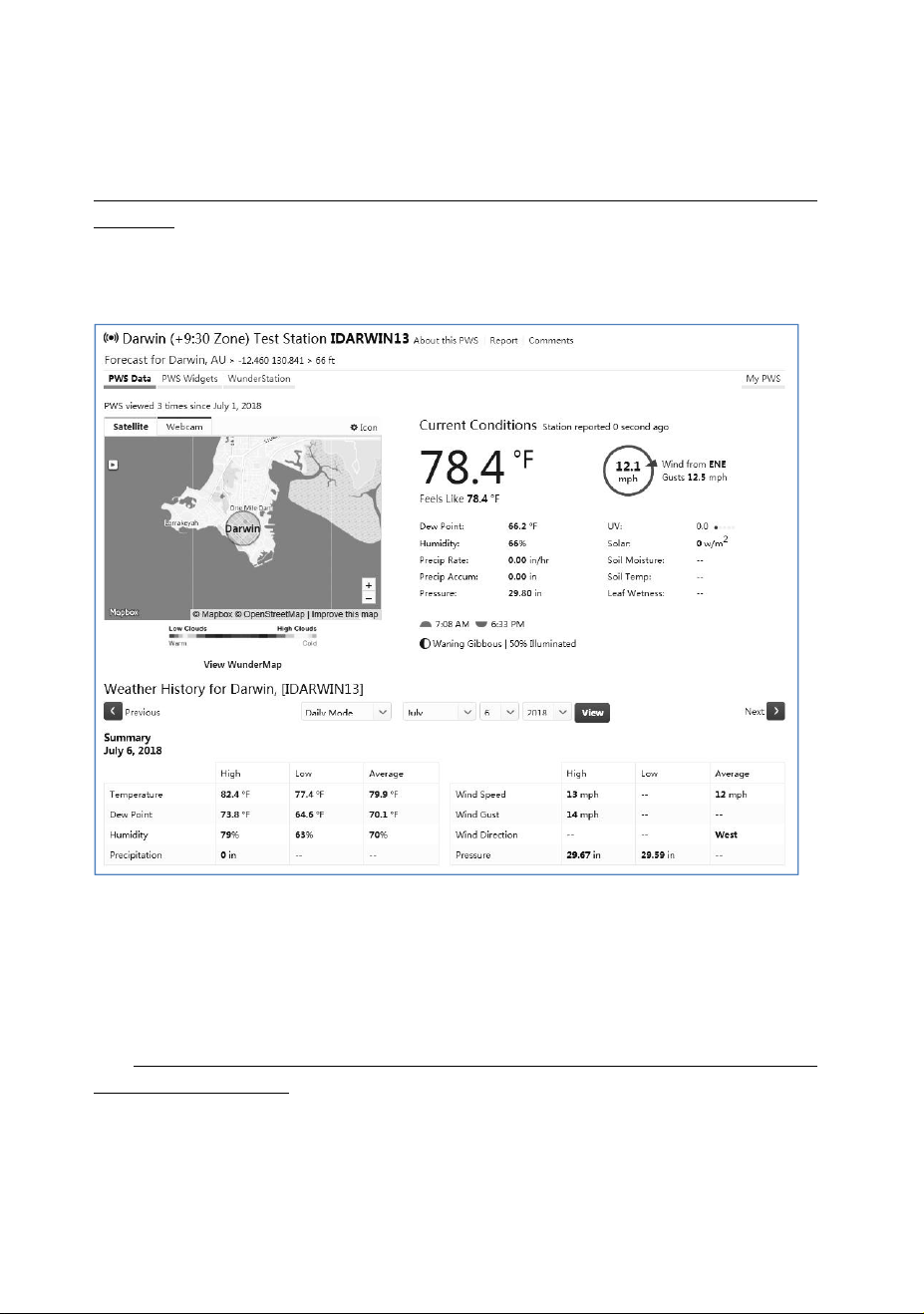
Viewing your Data on Wunderground.com
You can also observe your weather station’s data by using the
wunderground.com web site. You will use a URL like this one, where your
station ID replaces the text “STATIONID”:
http://www.wunderground.com/personal-weather-station/dashboard?ID=STA
TIONID
It will show a page such as this, where you can look at today’s data and
historical data as well:
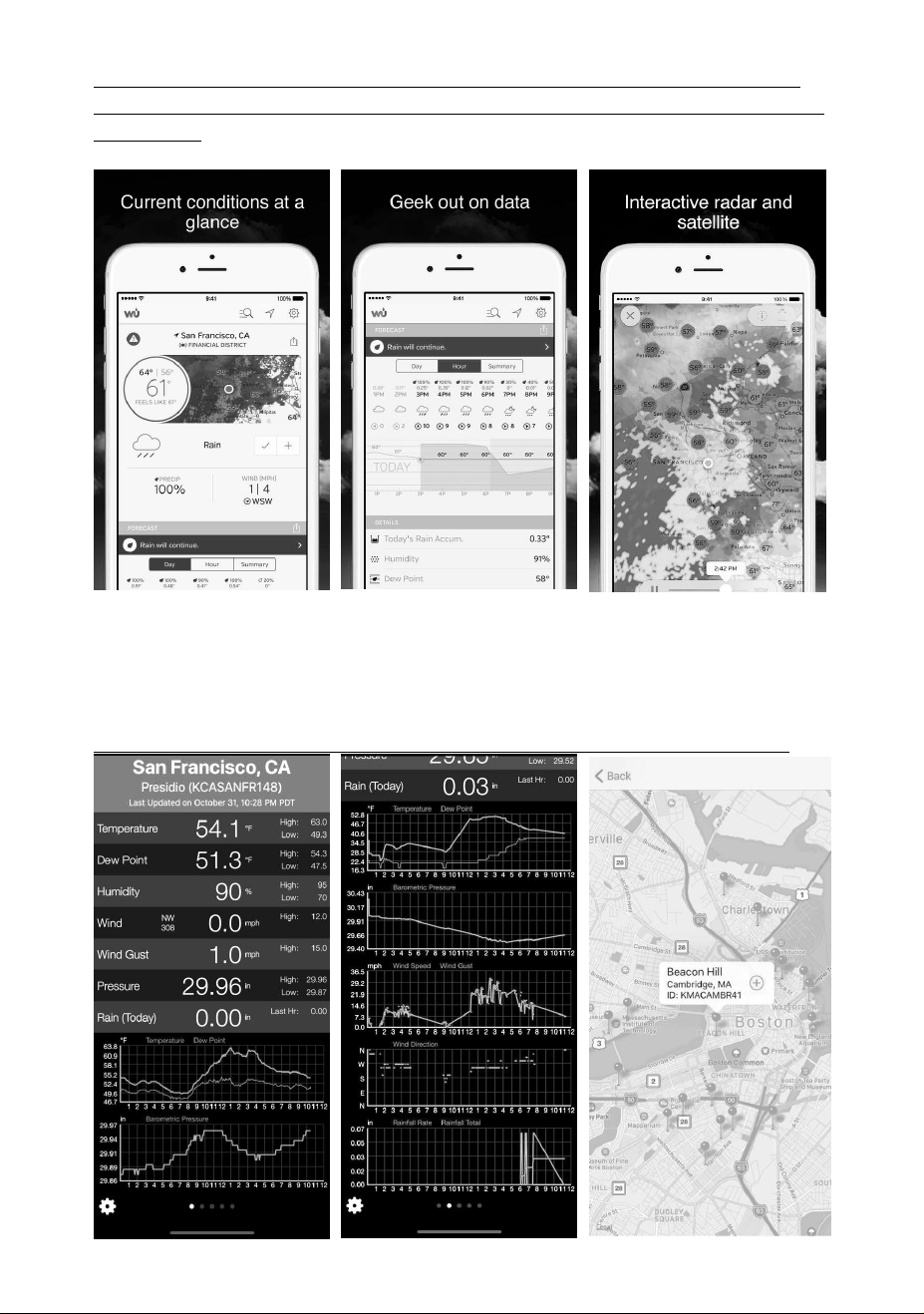
There are also some very useful mobile apps. The URLs provided here go to
the Web version of the application pages. You can also find them directly
from the iOS or Google Play stores:
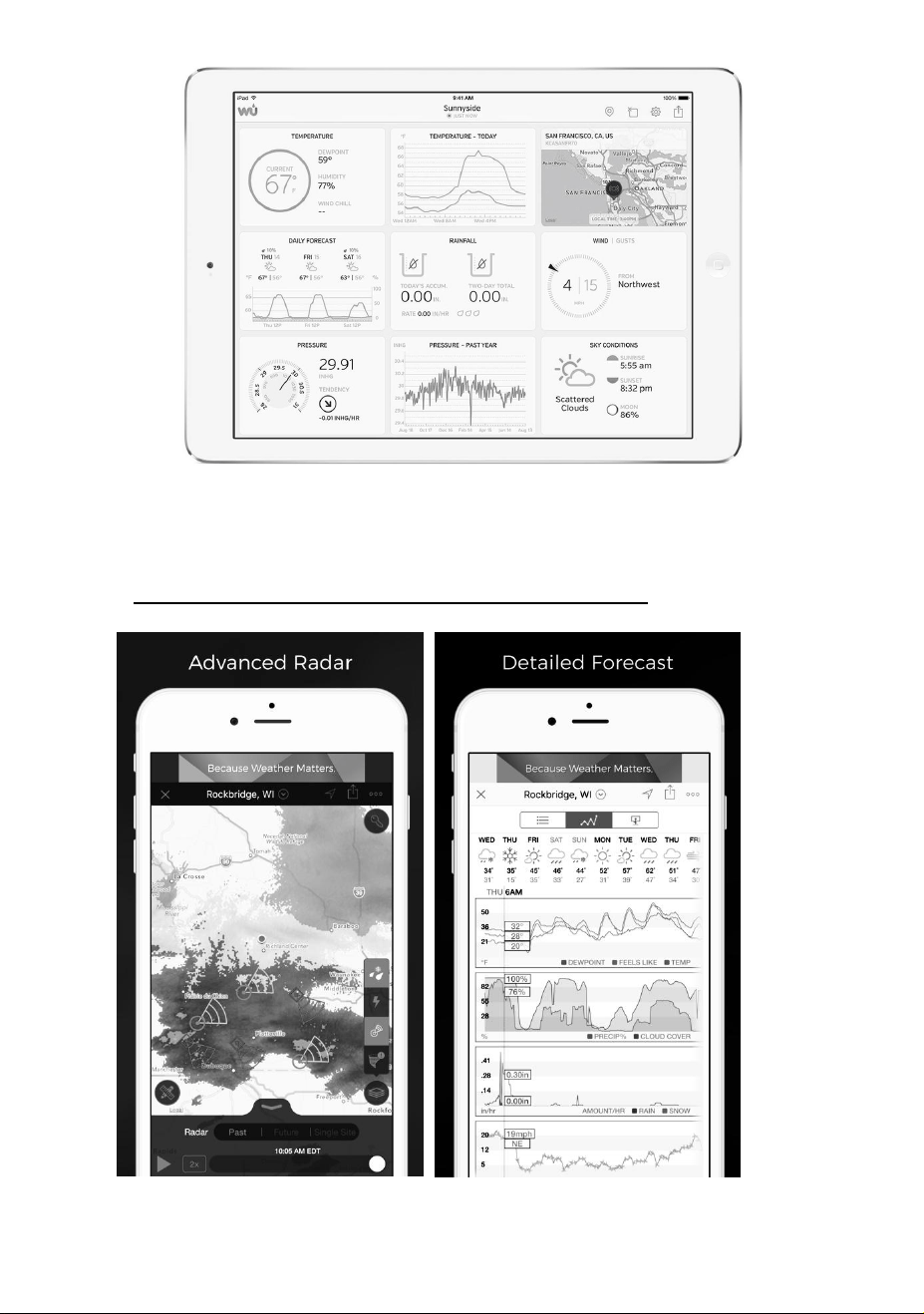
WunderStation: iPad application for viewing your station’s data and
graphs
https://itunes.apple.com/us/app/wunderstation-weather-from-your-neighb
orhood/id906099986
48
https://itunes.apple.com/us/app/weather-underground-forecast/id486154808
https://play.google.com/store/apps/details?id=com.wunderground.android.wea
ther&hl=en
PWS Weather Station Monitor: View weather conditions in your
neighborhood, or even right in your own backyard. Connects to
wunderground.com
https://itunes.apple.com/us/app/pws-weather-station-monitor/id713705929
49
11 Maintenance
The following steps should be taken for proper maintenance of your
station
1. Clean the rain gauge once every 3 months. Rotate the funnel
counter-clockwise and lift to expose the rain gauge mechanism, and
clean with a damp cloth. Remove any dirt, debris and insects. If bug
infestation is an issue, spray the array lightly with insecticide.
Figure: Rain gauge installation and maintenance
3. Clean the solar radiation sensor and solar panel every 3 months
with a non-abrasive slightly damp cloth.
4. Replace batteries every 1-2 years. If left in too long, the
batteries may leak due to environmental challenges. In harsh
environments, inspect the batteries every 3 months (while
cleaning the solar panel).
50
5. When replacing the batteries, apply a corrosion preventing
compound on the battery terminals, available at Amazon and
most hardware stores.
6. In snowy environments, spray the top of the weather station
with anti-icing silicon spray to prevent snow build up.
12. Troubleshooting Guide
Problem
Solution
Outdoor sensor array
does not
communicate to the
display console.
The sensor array may have initiated properly and the data
is registered by the console as invalid, and the console
must be reset. Press the reset button as described in
Section 5.2.
With an open ended paperclip, press the reset button for 3
seconds to re-sync the console with the sensor array
about 10 feet away.
The LED next to the battery compartment will flash
every 16 seconds. If the LED is not flashing every 16
seconds…
Replace the batteries in the outside sensor array.
If the batteries were recently replaced, check the polarity.
If the sensor is flashing every 16 seconds, proceed to the
next step.
There may be a temporary loss of communication due to
reception loss related to interference or other location
factors, or the batteries may have been changed in the
sensor array and the console has not been reset. The
solution may be as simple as powering down and up the
console (remove AC power and batteries, wait 10
seconds, and reinsert AC power and batteries).
51
Problem
Solution
Temperature sensor
reads too high in the
day time.
Make certain that the sensor array is not too close to heat
generating sources or strictures, such as buildings,
pavement, walls or air conditioning units.
Use the calibration feature to offset installation issues
related to radiant heat sources. Reference Section 10.6.
Relative pressure
does not agree with
official reporting
station
You may be viewing the absolute pressure, not the
relative pressure.
Select the relative pressure. Make sure you properly
calibrate the sensor to an official local weather station.
Reference Section 6.4.3 for details.
Rain gauge reports
rain when it is not
raining
An unstable mounting solution (sway in the mounting
pole) may result in the tipping bucket incorrectly
incrementing rainfall. Make sure you have a stable, level
mounting solution.
Data not reporting to
Wunderground.
com
1. Confirm your password or key is correct. It is
the password you registered on
Wunderground.com. Your Wunderground.com
password cannot begin with a non-alphanumeric
character (a limitation of Wundeground.com, not
the station). Example, $oewkrf is not a valid
password, but oewkrf$ is valid.
2.
3. Confirm your station ID is correct. The station
ID is all caps, and the most common issue is
substituting an O for a 0 (or visa versa).
Example, KAZPHOEN11, not KAZPH0EN11
4.
5. Make sure the date and time is correct on the
console. If incorrect, you may be reporting old
data, not real time data.
6.
7. Make sure your time zone is set properly. If
incorrect, you may be reporting old data, not real
time data.
52
Problem
Solution
8. Check your router firewall settings. The console
sends data via Port 80.
No Wi-Fi connection
1. Check for Wi-Fi symbol on the display. If
wireless connectivity is successful the Wi-Fi
icon will be displayed in the time field.
2.
3. Make sure your modem Wi-Fi settings are
correct (network name, and password).
4.
5. The console only supports and connects to 2.4
GHz routers. If you own a 5 GHz router, and it is
a dual band router, you will need to disable the 5
GHz band, and enable the 2.4 GHz band.
6.
7. The console does not support guest networks.