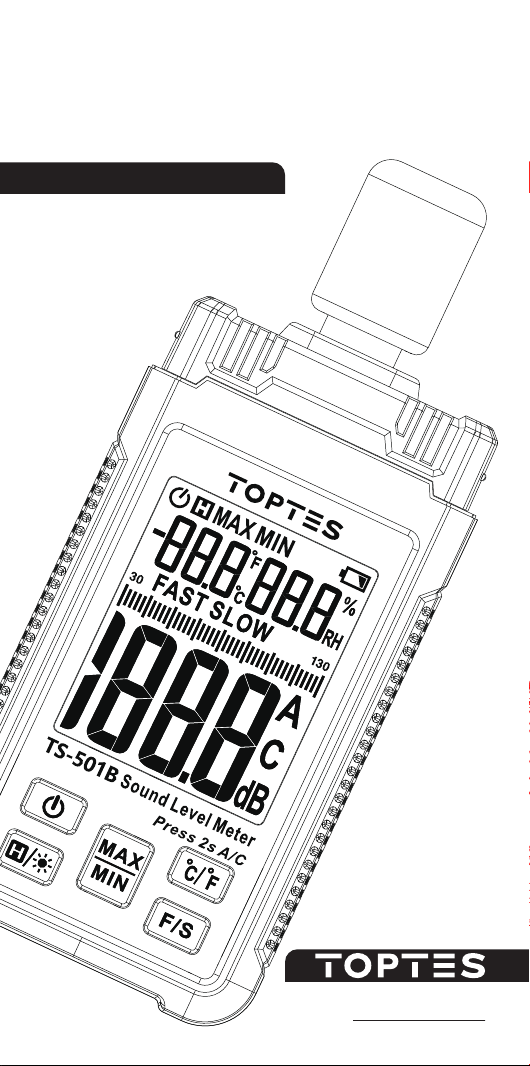
Sound Level Meter
TS-501 B
USER MANUAL
Please read this manual before operating the product, and keep it properly for future use.
If you have questions, please contact us:

TS-501 B
USER MANUAL
ENGLISH
DEUTSCH
FRANÇAIS
ITALIANO
ESPAÑOL
日本語
1 - 14
15 - 28
29 - 42
43 - 56
57 - 70
71 - 84

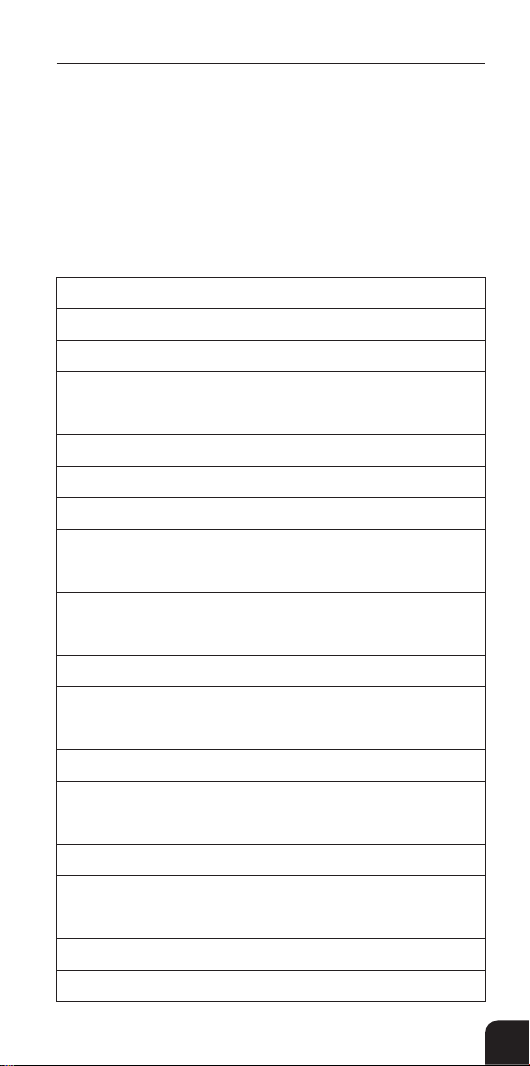
CONTENTS
Specications
Product Overview
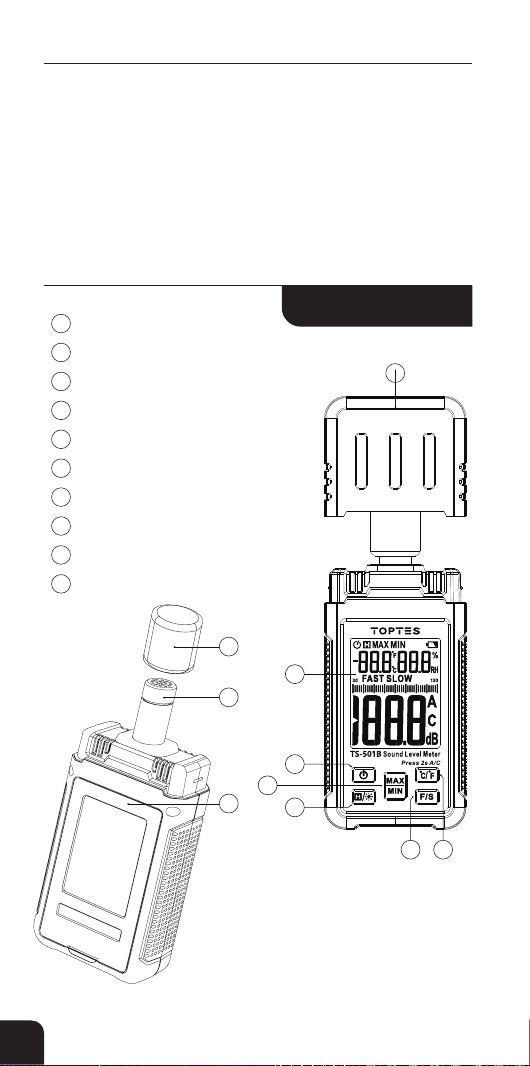
Product Details
Display Description
Operation
Battery Installation
Power On/Off
Testing
Data Hold
Turn On/Off Backlight
Max/Min Value
Temperature Unit Switching
A/C Weighting Switching
Fast/Slow Time Weighting
Automatic Power Off
Low-Battery Indication
Battery Replacement
User Safety
Working Area
Friendly Reminders
Sound Level
Maintenance
Cleaning
Storage
Disposal / Recycle
Support
Warranty
Contact Information
Thank you for purchasing your TopTes TS-501B Sound Level Meter. Please
read the following instructions carefully before using your instrument. By
following the steps outlined in this manual, you will be provided years of
reliable service by your meter.
1
3
5
10
13
2
14
SPECIFICATIONS
The TopTes TS-501B Decibel Meter also known as a "sound pressure level
(SPL) meter" is portable and run on batteries. It is easy to use, providing
you accurate readings on a 2.25-inch screen that measure the sound
level from 30 to 130 dB at an accuracy of +/-1.5 dB with a 0.1 dB
resolution.
Microphone
Screen Type
*Frequency Weighting
Sound Measuring Range
Frequency
Response Time
Time Weighting
Temperature Measuring
Range
Temperature Measuring
Accuracy
Humidity Measuring Range
Humidity Measuring Accuracy
Operating Conditions
Storage Conditions
(remove the battery)
Product Certications
Dimensions
Weight
(battery included)
Power Source
CE, RoHs
1/2-inch electric condenser
LCD
A, C
30~130dBA
30~130dBC
30~8,000Hz
0.5 second
Fast/Slow (125ms and 1s)
-20.0~60.0°C
(-4.0~140.0°F)
5.51" x 2.17" x 0.98"
(140 x 55 x 25 mm)
0.0%~99.9%RH
20%~80%: ±5.0% RH
Others: ±6.0% RH
0~50°C, <80%RH
-10~50°C, <80%RH
5.29 oz. (150 g)
3 x 1.5V alkaline batteries
0.0~45.0°C (32~113°F): ±1.0°C/2.0°F
Others: ±1.5°C/3.0°F
2
2
9
10
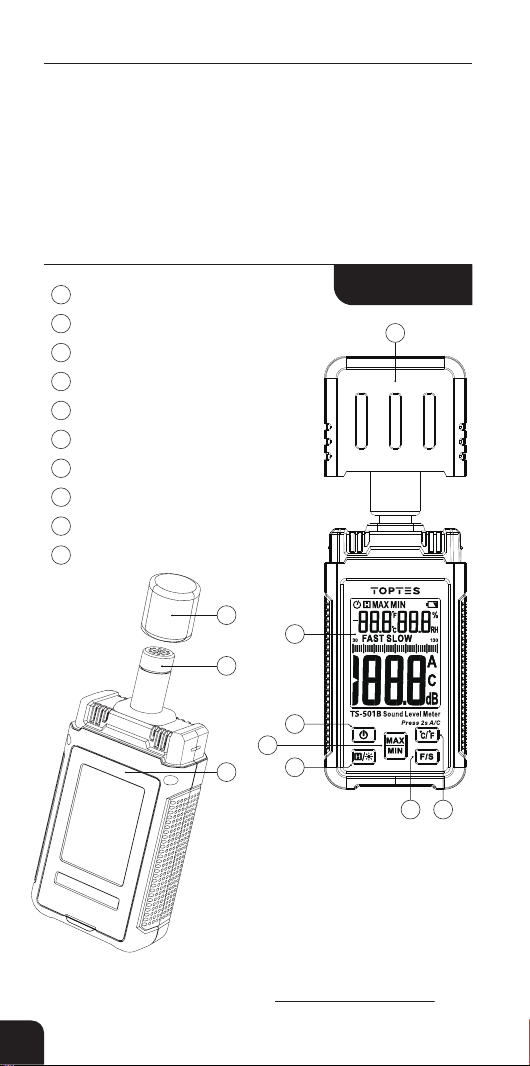
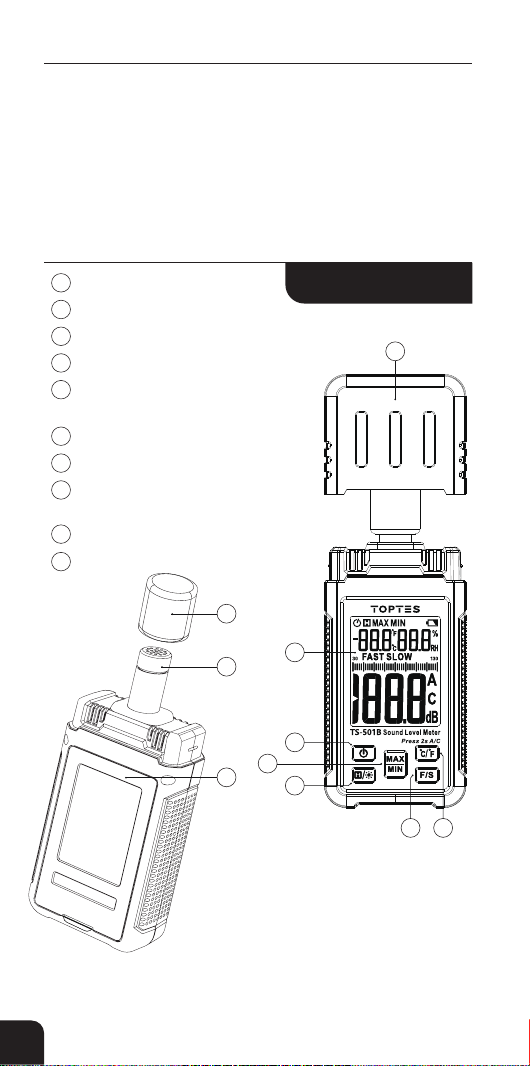
Product Detail
PROTECTION COVER
WINDSHIELD BALL
LCD DISPLAY SCREEN
POWER BUTTON
HOLD/BACKLIT BUTTON
MAX/MIN VALUE BUTTON
°C/°F TEMP BUTTON
FAST/SLOW SPEED BUTTON
MICROPHONE
BATTERY COMPARTMENT
1
2
3
4
5
6
7
10
8
9
NOTE: Never attempt to repair or modify your
instrument. Dismantling your product, other
than for the purpose of replacing batteries,
may cause damage that will not be covered
under the manufacturer's warranty.
For service on this or any other TopTes products or information on other
TopTes products, please contact us at [email protected]
PRODUCT OVERVIEW
Sound level meters are useful for measuring, monitoring, and controlling
noise levels. A decibel meter is a sound pressure measuring instrument
for standardized measurements that uses the decibel scale. For this
reason, the decibel meter is also known as a sound pressure level (SPL)
meter. Other common names or this instrumentation include noise meter
and sound level meter.
7
8
4
6
5
3
1
3
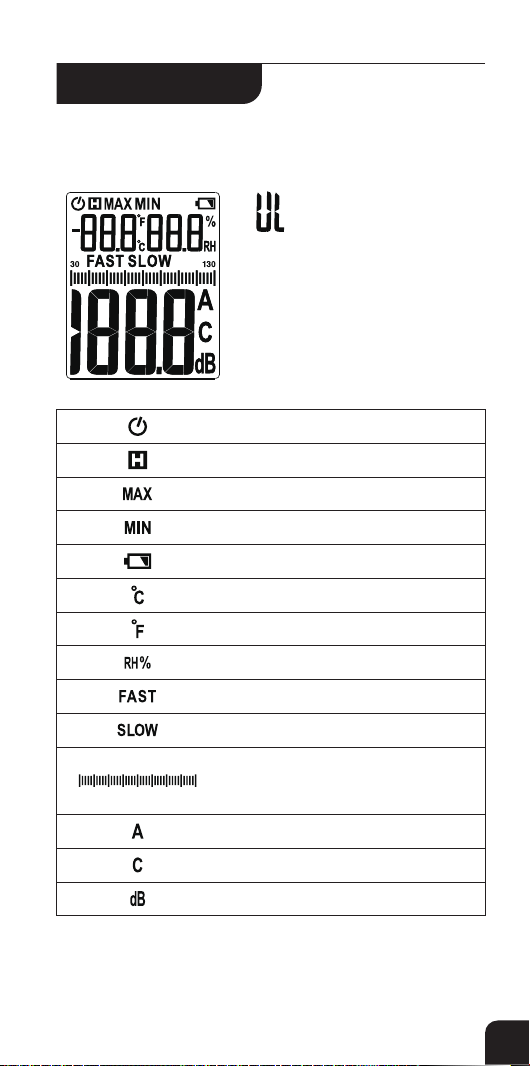
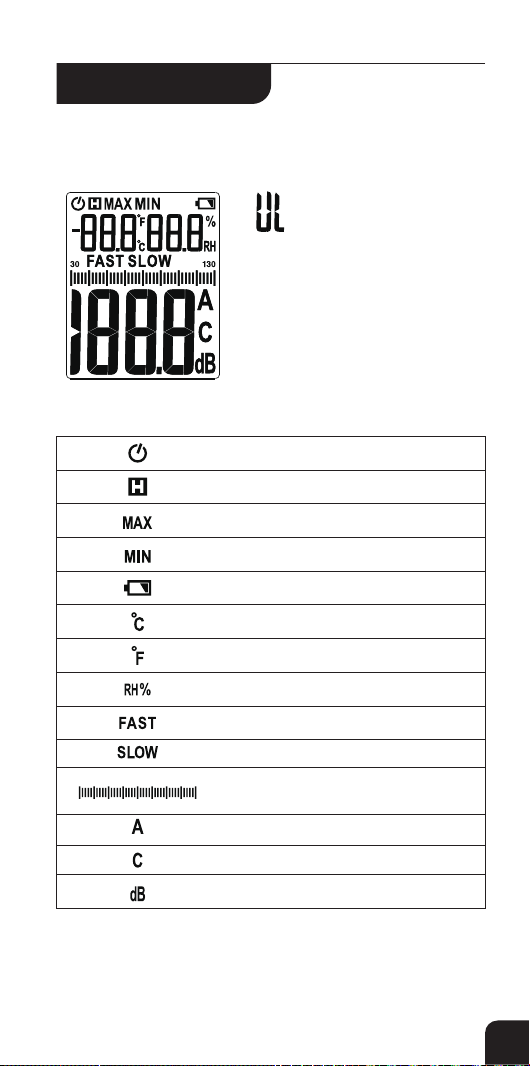
Display Description
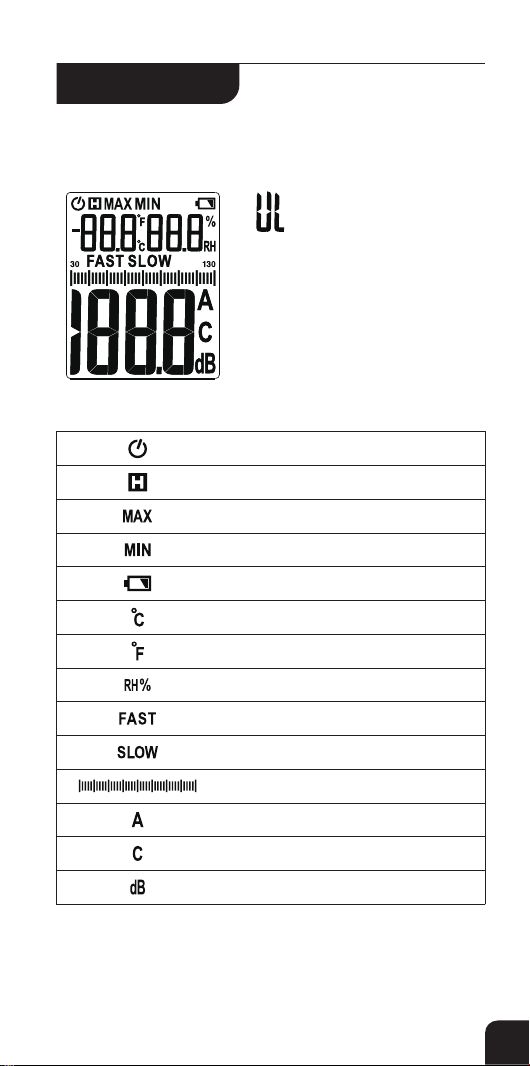
The following definitions describe what the symbols and values
displayed on the sound meter screen represent.
The TS-501B has a measurement
range of 30 to 130 decibels (dB).
When the measured sound level
falls below 30dB, the screen will
display the symbol "UL".
* A frequency-weighting mode is for measuring the sound level within the human audible
range, while the test range is 30-130 dBA. This accounts for the relative loudness
perceived by the human ear. The reading value of the meter will fluctuate according to
different distances and sound sources.
Auto Power-Off Indicator
Data hold Indicator
Maximum Value Indicator
Minimum Value Indicator
Low-Battery Indicator
Centigrade Unit Indicator
Fahrenheit Unit Indicator
Slow Weighted Indicator
Analog Bar Display (40 bars in total)
Humidity Indicator
Fast Weighted Indicator
A Frequency Weighting Indicator
C Frequency Weighting Indicator
Measured dB Value
4
Battery Installation
Power On/Off
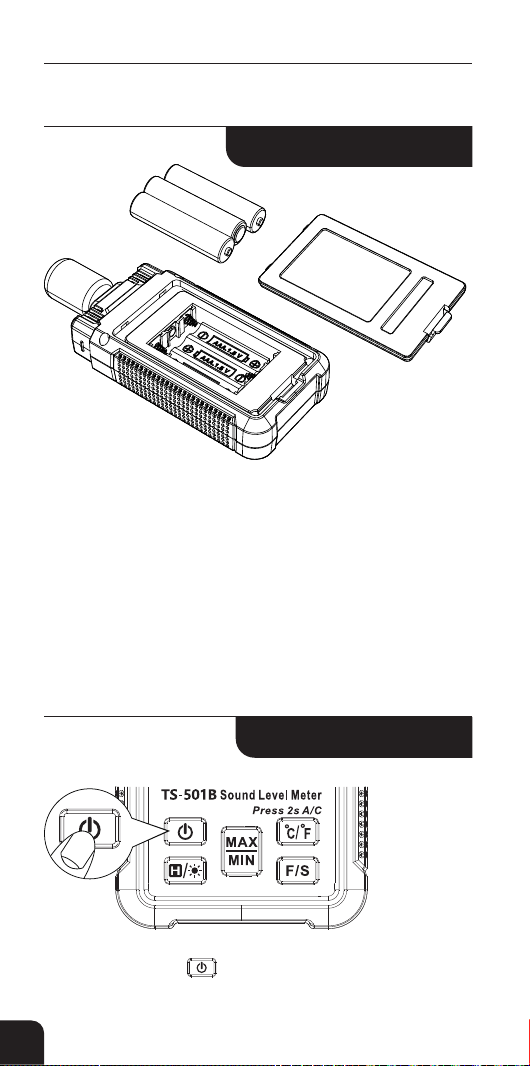
OPERATION
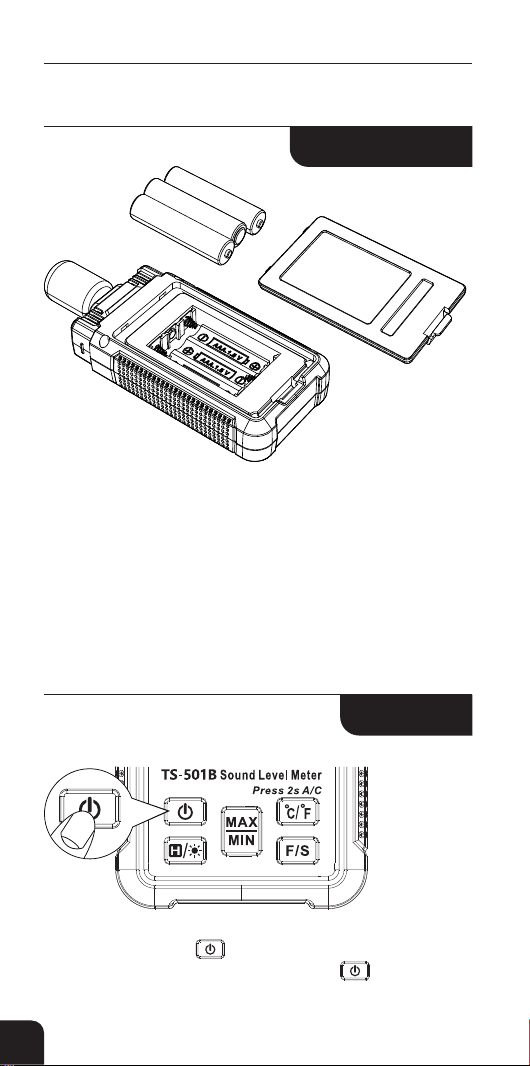
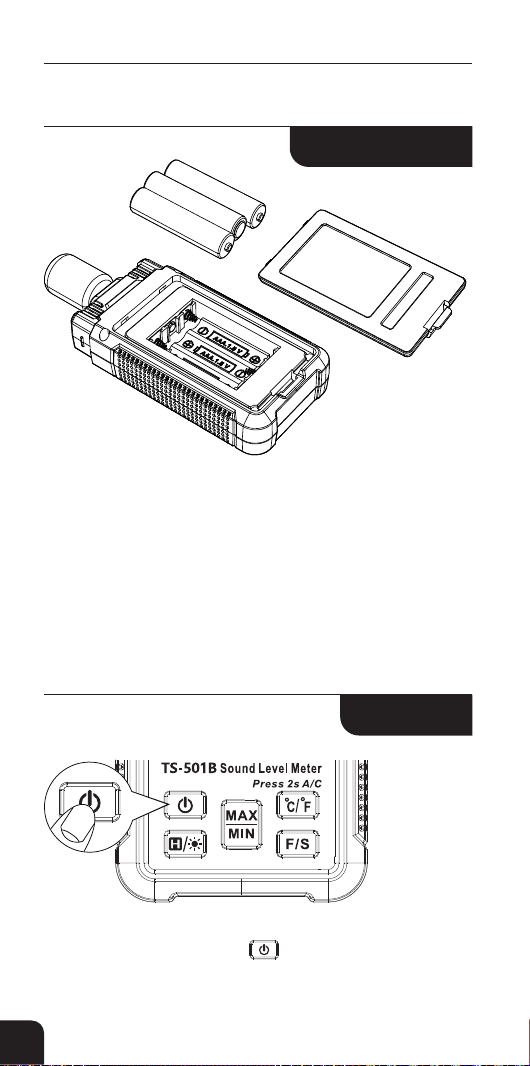
Step 1. Look for a small groove on the battery cover. Press gently on
the groove while pushing towards the bottom of the product
to open the battery cover.
Step 2. Install 3 AAA batteries (included in the box) into the cartridge,
according to the positive and negative marks inside the battery
compartment.
Step 3. Align the notch and snap on the battery cover.
Press the power button for 1 second to turn the tester on, and
enter the measurement mode. Press the button again to turn
off the tester.
5
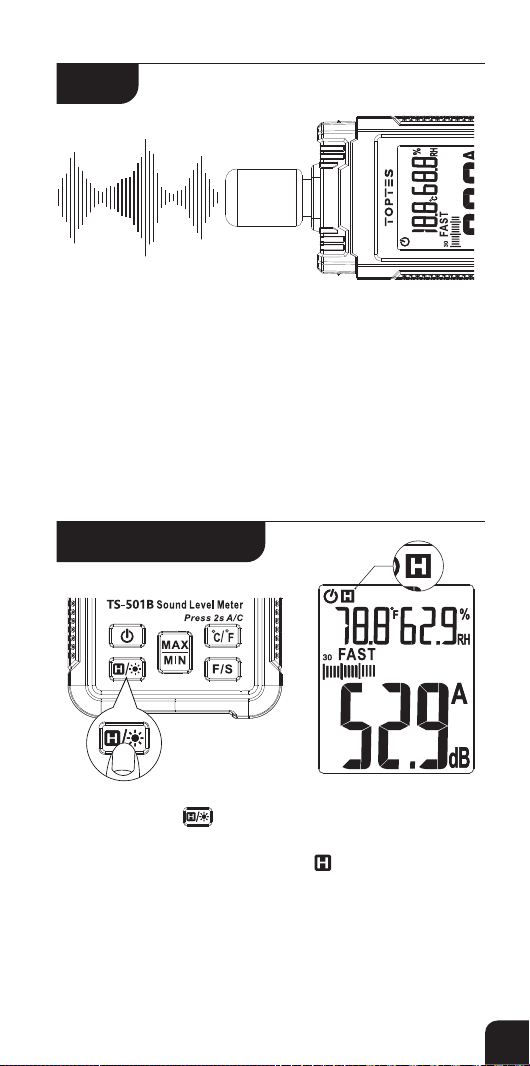
Testing
Data Hold
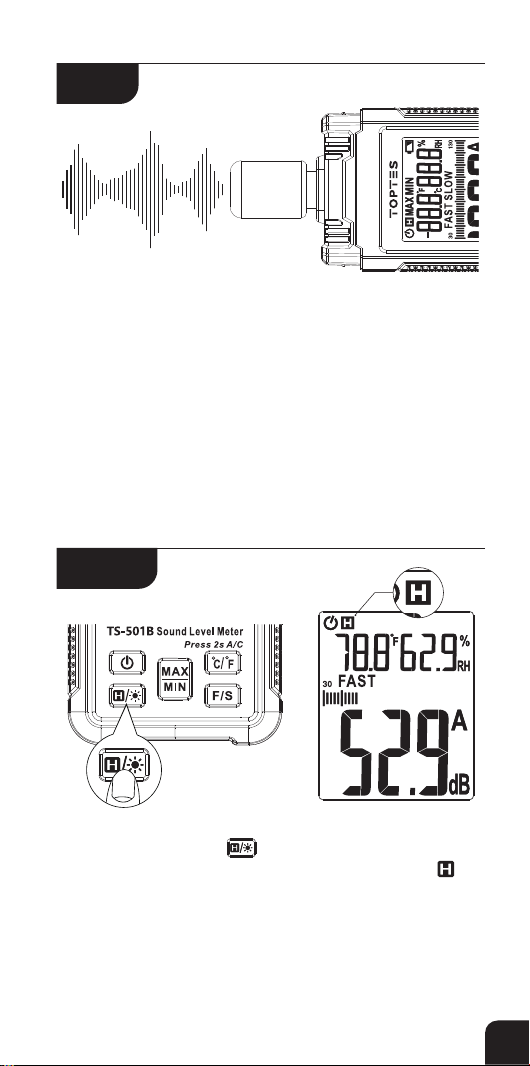
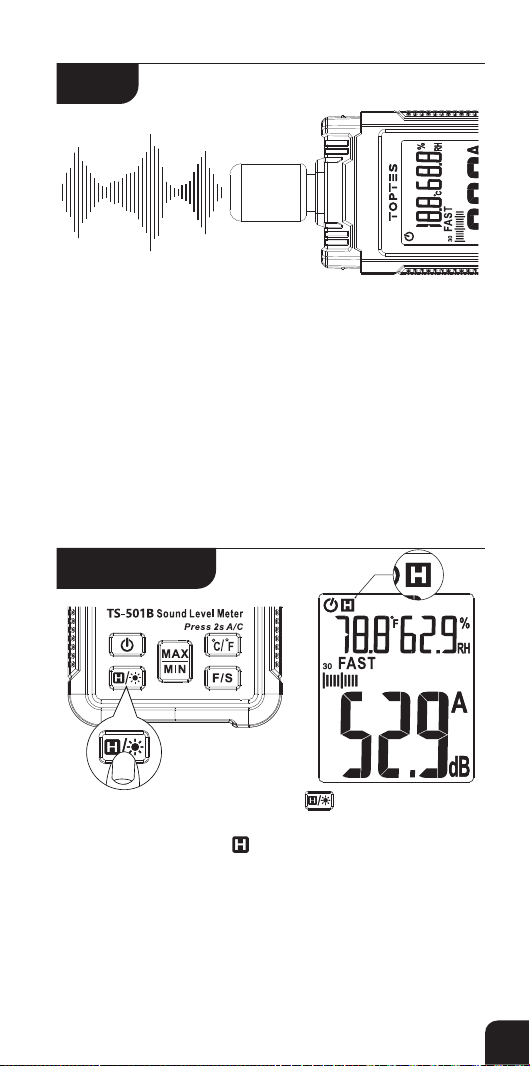
Hold the sound level meter comfortably in one hand (away from your
body) or place it on a at object for long-term monitoring. Power on
the sound level meter, then pointing the microphone toward the noise
source will give you a higher reading than placing the mic toward you,
and the sound pressure level reading will be displayed on the screen.
NOTE: The position of the microphone or device will change the sound
level meter reading. Pointing the microphone toward the source of the
noise will give you a higher reading than placing the mic toward you.
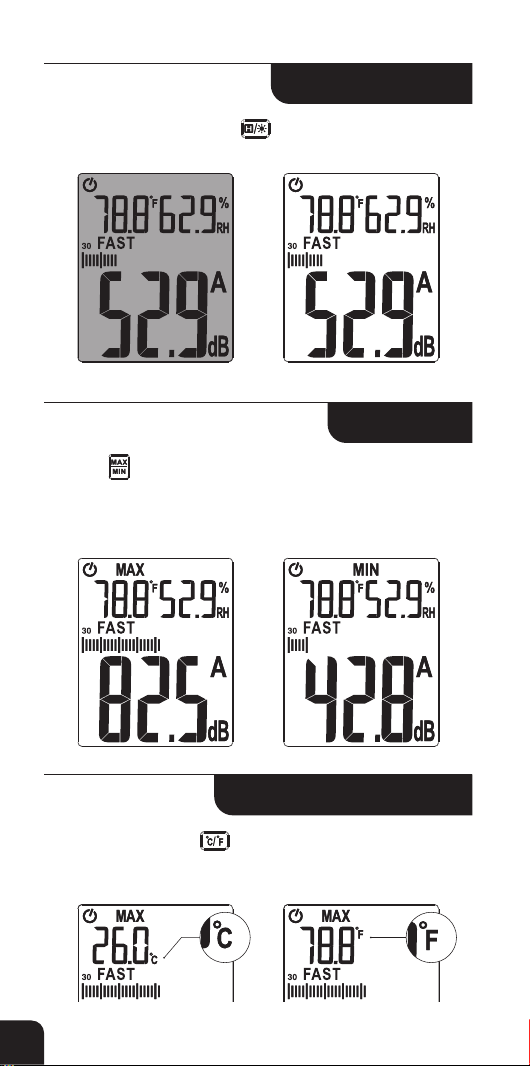
Press the Data Hold Button for 1 second to turn on the data hold
function, and capture the measurement reading/data. The icon will
appear on the screen, then press the button again for 1 second to return
to normal measurement function.
NOTE: The sound level meter comes with the a function to hold its value
when it is in MAX and MIN value modes, so there is no need to press the
Hold button again.
6
Turn On/Off Backlight
MAX/MIN Value
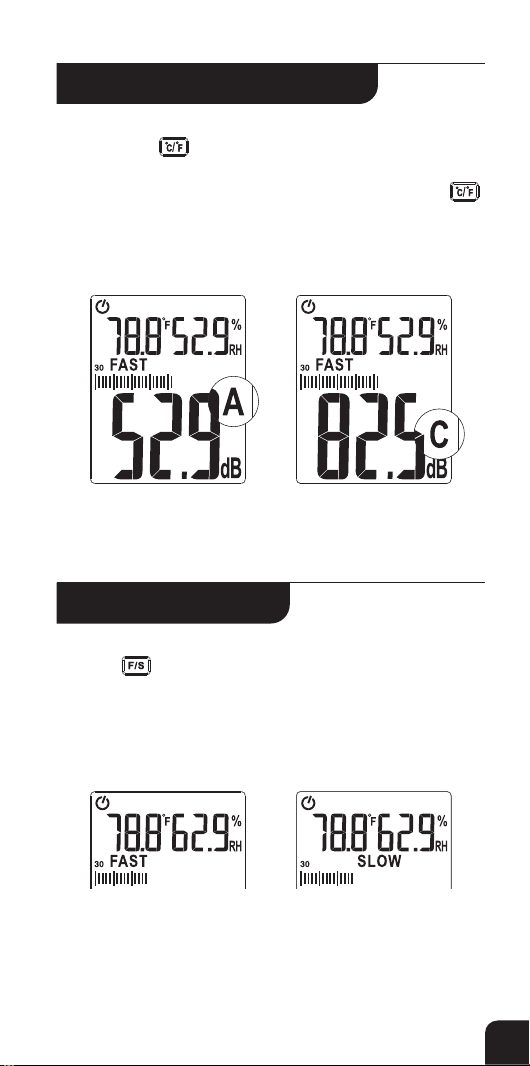
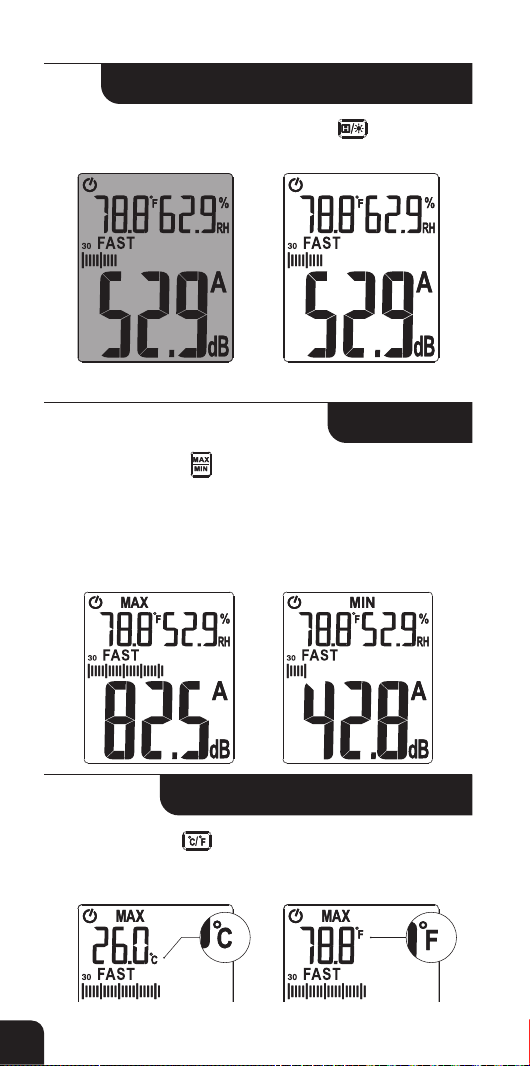
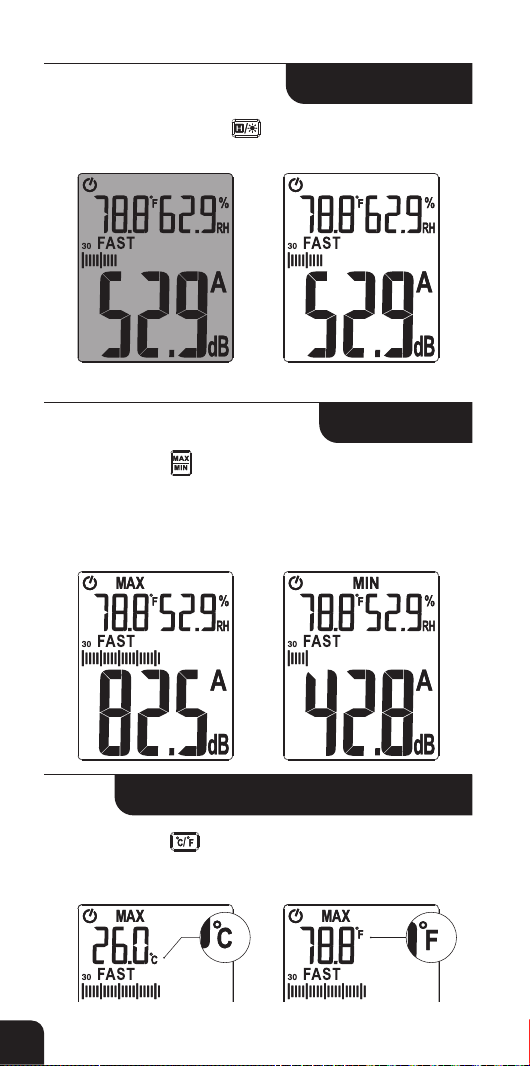
Long press the Backlight Button for >2 seconds to turn on/off the
backlight.
Screen without backlight on
Screen with backlight on
Press the button for 1 second to display the maximum and minimum
values. While in this mode, the meter will only refresh the reading when a
higher/lower measurement than the one currently displayed is detected.
Press the button again for 2 seconds to exit and resume normal operation.
Temperature Unit Switching
Press the °C or °F button to switch the temperature unit between
°C or °F. Once the temperature unit is switched, it will save for the next
time.
7
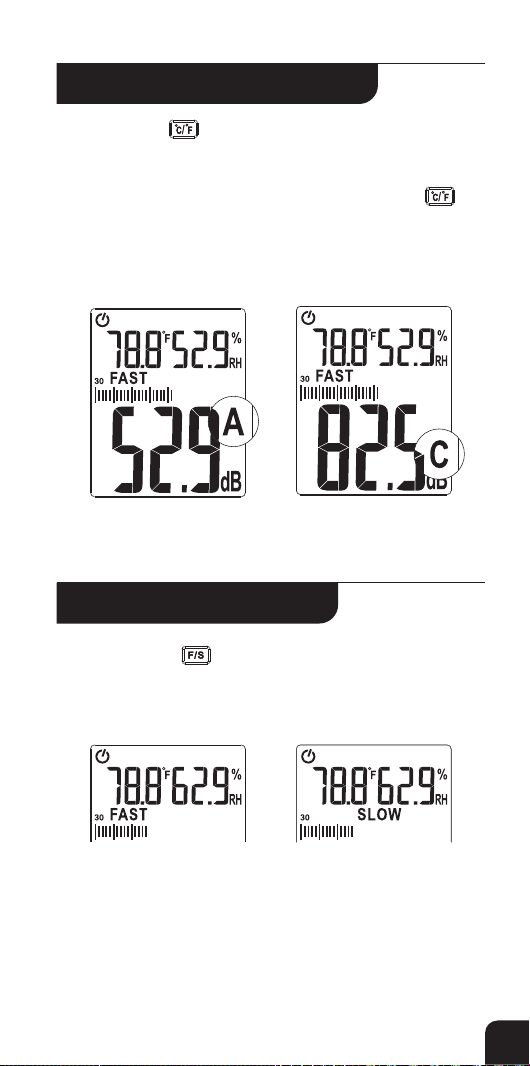
Fast/Slow Time Weighted
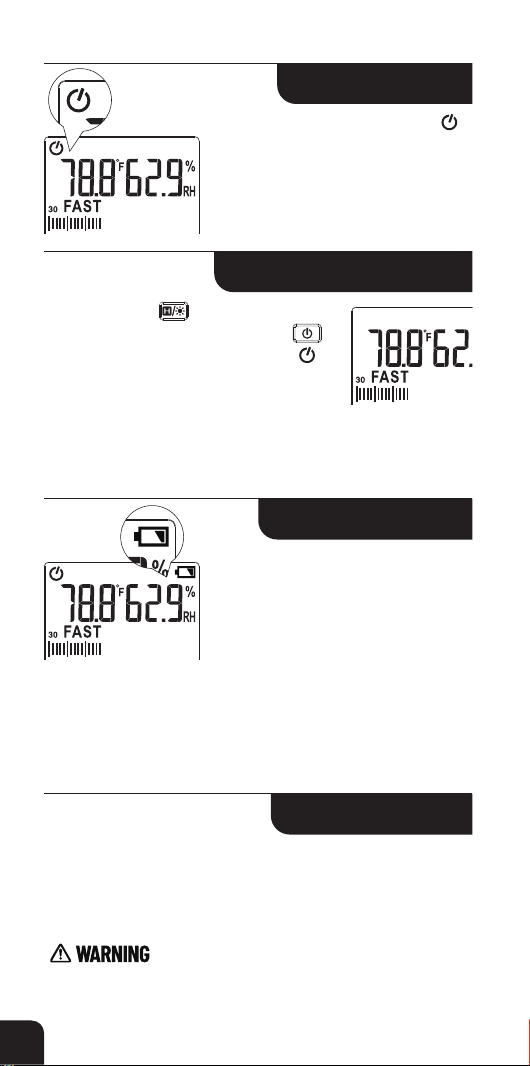
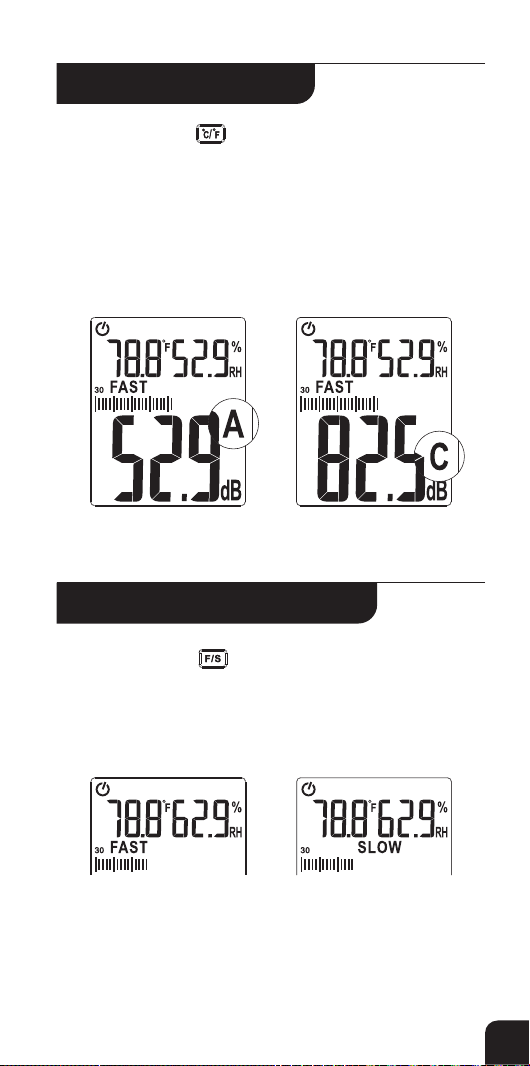
Press the button switch the desired response time. The default is
FAST response. If the sound source consists of short bursts, set the
response to FAST (125ms), “FAST” appears on the display. To measure
average sound levels, select SLOW (1s), “SLOW” appears on the display.
Most applications can set the response to FAST for detection.
Under FAST, the reading will move quickly to show fast varying noise,
while under SLOW, the reading will be dampened to smooth the noise
out and be easier to read.
Slow corresponds to a 1-second
time constant.
Fast corresponds to a 125ms
time constant.
A/C Frequency Weighting Switching
Press the button to select the Frequency Weighting. The default is
A frequency weighting; when the meter is turned on, “A” appears on
display. "A" Weighting for a general noise sound level. Long press the
button
to set “C” Weighting for measuring high-level noise. "C" Weighting is a
standard weighting of the audible frequencies commonly used to
measure Peak Sound Pressure levels.
If the "C" Weighted level is much higher than the "A" Weighted level,
8
Battery Replacement
Low-Battery Indication
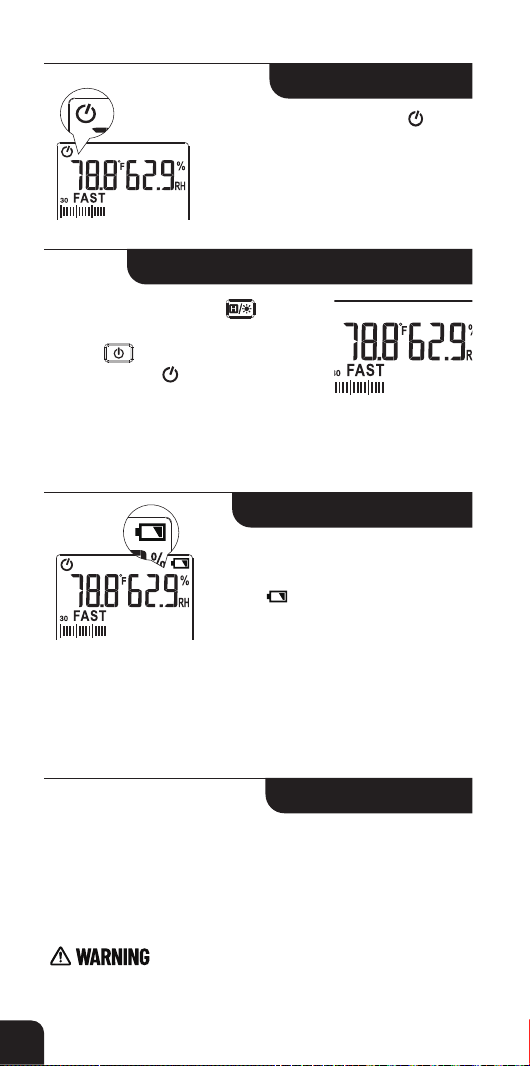
Automatic Power Off
Cancel Automatic Shutdown
Remove the batteries when the tester is not in use for a prolonged period of time.
Do not expose to high temperatures or humidity.
To replace the battery, turn the meter over and open the battery com-
partment by using a Phillips screwdriver to remove the screw. Install 3
new AAA batteries into the cartridge, noting proper polarity. Place the
battery cover back and tighten the screw.
NOTE: Measurements will still remain valid for several times after the
icon rst appears.
When the battery voltage is lower than
the working voltage, the icon appears
in the upper right of the LCD screen.
This means it’s time to put in 3 fresh
1.5V batteries.
When the meter is turned on, the icon
appears in the upper left of the LCD screen.
The automatic shutdown function is turned
on by default. If there is no operation for 10
minutes, the meter will automatically shut
down.
NOTE: Restart the meter after shutdown to restore the automatic
shutdown function.
Press and hold the button before turning
on the meter, then press the power button
to turn on the power of the meter. The icon
will now NOT appear in the upper left of the
LCD, so the user needs to manually turn off the
power.
The low battery indicator will appear when the voltage drops below
the working voltage (approximately 3.5V). Please replace the
battery promptly.
9

USER SAFETY
The TopTes TS-501B sound level meter accumulates sound level data for
noise dosimetry and can be used as a noise monitor to test sound
intensity to nd noise pollution, or to avoid the risk of hearing damage.
• Relative Humidity: 20~80% RH non-condensing
• Operating Temp: 32° to 122°F (0° to 50°C)
Working Area
• Do NOT use the meter in hot, humid environment.
• Do NOT store or operate the instrument in high areas.
• Wind blowing across the microphone increases the noise measurement.
When measuring noise outside, please use the supplied windscreen on
the head of the microphone.
• Normally, you do NOT need to calibrate the instrument, since it has been
calibrated at the factory. If the meter has not been used for a long period
of time, it requires a primary standard sound source and acoustic envi-
ronment to calibrate, and we recommend it be calibrated by a profe-
ssional engineer, a third testing facility, or a reputable laboratory.
• Please do NOT vibrate or shake the meter strongly during use to avoid a
false signal on the instrument screen.
• Measurements will also depend on your distance from the sound source.
It will deliver a reading of the overall sound level around the user. To put
this quantitatively, the sound level drops by 6 dB each time you double
your distance from the source.
• When measuring sound with a meter, the position of the microphone will
also inuence the sound level reading. Pointing it toward the source of
the noise will give you a higher reading than placing the mic toward you.
• If the meter is NOT to be used for a long time, remove the batteries to
avoid electrolyte leakage damaging the instrument.
Friendly Reminders
10

* The time estimates listed in the “Typical Response” column are based on the NIOSH
exchange rate of 3 dB. For more information, visit NIOSH’s website.
Common Sources of Noise and Decibel Levels
Sound is measured in decibels (dB). A whisper is about 30 dB, normal
conversation is about 60 dB, and a motorcycle engine running is about
95 dB. Noise above 70 dB over a prolonged period of time may start to
damage your hearing. Loud noise above 120 dB can cause immediate
harm to your ears.
How Do We Know the Sound Level is Safe?
The effect of lower noise levels over long periods is the same as louder
noise levels over a shorter period. You can use the TopTes sound level
meter (SLM) TS-501B to measure the noise around you.
The table below shows dB levels and how noise from everyday sources
can affect our hearing.
Testing
Everyday Sounds
and Noises
Normal breathing
Ticking watch
Soft whisper
Refrigerator hum
Normal conversation
air conditioner
Washing machine,
dishwasher
City trac
(inside the car)
Gas-powered lawnmowers
and leaf blowers
Motorcycle
Approaching subway train,
car horn at 16 feet
(5 meters)
The maximum volume level
for personal listening devices
Shouting or barking
in the ear
80-85
Average Sound Level
(measured in decibels)
0
10
20
30
40
60
70
80-85
95
100
105-110
110 -120
Typical
Response
Silence
Silence
Quiet
Whispering
Normal
Noise
Noise
Very Noisy
Damage to hearing
possible after 2 hours
of exposure
Damage to hearing
after about 50 minutes
of exposure
Hearing loss possible
after 15 minutes
Hearing loss possible
in less than 5 minutes
Hearing loss possible
in less than 2 minutes
11

The U.S. Environmental Protection Agency (EPA) and the World Health
Organization (WHO) recommend maintaining environmental noises
below 70 dBA over 24 hours (75 dBA over 8-hours) to prevent noise-in-
duced hearing loss.
The EPA also specied limits for speech interference and annoyance
at 55 dBA for outdoor activities and 45 dBA for indoor activities.
More details about this topic can be found on the NIOSH Science Blog
—Understanding Noise Exposure Limits:
Occupational vs. General Environmental Noise.
(https://www.cdc.gov/niosh/topics/noise/preventhearingloss/
hearlosspreventprograms.html)
Most noise-induced hearing loss is a result of accumulated damage
from repeated exposures to hazardous noise. In addition, the risk of
noise damage depends on several factors: how loud the noise is, for
how long you listen to it, how much rest your ears get between
exposures, and your individual susceptibility to noise.
How loud something sounds to you is not the same as the actual
intensity of that sound. Sound intensity is the amount of sound energy
in a conned space. It is measured in decibels (dB). The decibel scale
is logarithmic, which means that loudness is not directly proportional
to sound intensity. Instead, the intensity of a sound grows very
quickly. This means that a sound at 20 dB is 10 times more intense
than a sound at 10 dB.
Average Sound Exposure Levels Needed to Reach
the Maximum Allowable Daily Dose of 100%
8 hours
4 hours
2 hours
60 minutes
30 minutes
15 minutes
85 dB (A)
88 dB (A)
91 dB (A)
94 dB (A)
97 dB (A)
100 dB (A)
Time to reach 100% noise dose
Exposure level per NIOSH REL
12
Storage
• Remove the batteries when the meter is not in use for a prolonged
period of time.
• Do not expose to high temperatures or humidity.
• After a period of storage in extreme conditions exceeding the limits
mentioned in the Specications section, allow the meter to return to
normal operating conditions before use.
Cleaning
Ensure the tester is turned off and wipe with a clean, dry lint-free cloth.
Do not use aggressive cleaning products or solvents.
MAINTENANCE
Disposal / Recycle
Do NOT place equipment and its accessories in the trash. Items must
be properly disposed of in accordance with local regulations. Please
see www.epa.gov or www.erecycle.org for additional information.
13

© 2022 TopTes. All Rights Reserved.
Any unauthorized copying or reproduction of this manual is strictly
prohibited without prior written permission from TOPTES.
Or
TopTes provide a 36-Month after-sale service
and lifetime technical support.
For further details on warranty coverage and warranty repair
information, contact us on our ocial website:
www.toptestools.com/pages/warranty
Contact us at: support@toptestools.com
SUPPORT
Three-Year Warranty
14

Spezikatione
Produktübersicht
Details zum Produkt
Anzeige Beschreibung
Betrieb
Einbau der Batterie
Gerät ein/aus
Messgerät testen
Daten speichern
Hintergrundbeleuchtung ein-/ausschalten
Max/Min-Wert
Umschaltung der Temperatureinheit
A/C Frequenz Umschaltung
Schnell/Langsam Zeitgewichtet
Automatisches Ausschalten
Anzeige eines niedrigen Batteriestands
Auswechseln der Batterie
Benutzersicherheit
Arbeitsbereich
Freundliche Hinweise
Geräuschpegel
Wartung
Reinigung
Lagerung
Entsorgung/Recycling
Support
Garantie
Kontaktinformationen
INHALT
Vielen Dank für den Kauf des TopTes TS-501B Schallpegelmessers. Bitte
lesen Sie die folgenden Anweisungen sorgfältig durch, bevor Sie Ihr Messgerät
benutzen. Wenn Sie die in diesem Handbuch beschriebenen Schritte befolgen,
wird Ihnen Ihr Messgerät jahrelang zuverlässige Dienste leisten.
17
19
24
27
16
28
15
SPEZIFIKATIONEN
Das TopTes TS-501B Dezibel-Messgerät, auch bekannt als "Schalldruck-
pegelmesser", ist tragbar und wird mit Batterien betrieben. Es ist
einfach zu bedienen und liefert genaue Messwerte auf einem
2,25-Zoll-Bildschirm zur Messung des Schallpegels von 30 bis 130 dB mit
einer Genauigkeit von +/-1,5 dB und einer Auösung von 0,1 dB.
Mikrofon
Bildschirm
*Frequenzgewichtung
Schallmessbereich
Frequenz
Reaktionszeit
Zeitgewichtung
Temp. Messbereich
Temperatur-Genauigkeit
Luftfeuchtigkeit Messbereich
Luftfeuchtigkeit Genauigkeit
Betriebsbedingungen
Lagerungsbedingungen
( die Batterie entfernen )
Produktzertizierungen
Abmessungen
Gewicht
(inklusive Batterie)
Stromquelle
CE, RoHs
1/2-Zoll-Elektrokondensator
LCD
A, C
30~130dBA
30~130dBC
30~8,000Hz
0,5 Sekunden
Fast/Slow (125ms and 1s)
-20.0~60.0°C
140 x 55 x 25 mm
0.0%~99.9%RH
20%~80%: ±5.0% RH
Andere: ±6.0% RH
0~50°C, <80%RH
-10~50°C, <80%RH
150 g
3 x 1.5V Alkaline-Batterien
0.0~45.0°C : ±1.0°C
Andere: ±1.5°C
16
2
9
10
Details zum Produkt
SCHUTZABDECKUNG
WINDSCHUTZINDSHIELD
LCD-BILDSCHIRM
EINSCHALTTASTE
HALTE-
/HINTERGRUNDBELEUCHTUNGSTASTE
MAX/MIN-WERT-TASTE
°C/°F TEMP-TASTE
TASTE FÜR SCHNELLE
/LANGSAME GESCHWINDIGKEIT
MIKROFON
BATTERIEFACH
1
2
3
4
5
6
7
8
9
10
HINWEIS: Versuchen Sie niemals, Ihr Gerät zu repa-
rieren oder zu modizieren. Wenn Sie Ihr Gerät aus
anderen Gründen als dem Batteriewechsel zerlegen,
kann dies zuSchäden führen, die von der Hersteller-
garantie nicht abgedeckt werden. Bitte zögern Sie nicht, uns zu kontaktie-
ren, wenn Sie irgendwelche Fragen oder Probleme haben.
Produktübersicht
Schallpegelmesser helfen bei der Messung, Überwachung und Kontrolle
von Lärmpegeln. Ein Dezibelmeter ist ein Schalldruckmessgerät für stand-
ardisierte Messungen, das die Dezibel-Skala verwendet. Aus diesem
Grund wird der Dezibelmesser auch als Schalldruckpegelmesser (SPL)
bezei-chnet. Andere gebräuchliche Bezeichnungen sind Lärmmesser und
Schall- pegelmesser.
7
8
4
6
5
3
1
17
Anzeige Beschreibung
* A*Ein Frequenzbewertungsmodus misst den Schallpegel innerhalb des für den Menschen
hörbaren Bereichs, und der Testbereich beträgt 30-130 dBA. Es erklärt die relative Laut-
stärke, die vom menschlichen Ohr wahrgenommen wird. Der Messwert des Messgeräts
schwankt je nach Schallquelle in unterschiedlicher Entfernung.
Automatische Abschaltanzeige
Datenhalte-Indikator
Maximalwert-Indikator
Minimalwert-Indikator
Anzeige für niedrigen Batteriestand
Anzeige der Celsius-Einheit
Anzeige der Fahrenheit-Einheit
Langsam gewichteter Indikator
Analoge Balkenanzeige
(insgesamt 40 Balken)
Anzeige der Luftfeuchtigkeit in Prozent
Schnellgewichteter Indikator
A Frequenzgewichtung
C Frequenzgewichtung
Gemessener dB-Wert
Die folgenden Definitionen beschreiben die Symbole und Werte, die auf
dem Bildschirm des Schallmessers angezeigt werden.
Der TS-501B hat einen
Messbereich von 30 bis 130
Dezibel (dB). Wenn der
gemessene Schallpegel unter
30 dB liegt, zeigt das Display
das Symbol "UL" an.
18
Einbau der Batterie
Gerät ein/aus
BETRIEB
Schritt 1. Suchen Sie nach einer kleinen Rille auf der Batterieabdeck-
ung. Drücken Sie sanft auf die Rille und schieben Sie die
Abdeckung zum Boden des Produkts, um sie zu öffnen.
Schritt 2. Legen Sie 3 AAA-Batterien (im Lieferumfang enthalten)
entsprechend der positiven und negativen Markierungen im
Batteriefach ein.
Schritt 3. Richten Sie die Kerbe aus und setzen Sie die Batterieabdeck-
ung ein.
Drücken Sie die Einschalttaste 1 Sekunde, um das Prüfgerät
ein- oder auszuschalten.
19
Testen
Daten Speichern
Halten Sie das Schallpegelmessgerät bequem in einer Hand (vom
Körper weg) oder legen Sie es zur Langzeitüberwachung auf einen
achen Gegenstand. Richten Sie das Mikrofon zur Messung in die
Richtung des Geräuschs. Wenn Sie das Mikrofon auf die Lärmquelle
richten, erhalten Sie einen höheren Messwert als wenn Sie das
Mikrofon auf sich selbst richten.
HINWEIS: Die Position des Mikrofons oder des Geräts verändert die
Anzeige des Schallpegelmessers.
Drücken Sie die Daten Speichern-Taste 1 Sekunde lang, um die
Daten Speicherfunktion zu aktivieren und die Messwerte/Daten zu
speichern. Wenn das Symbol auf dem Bildschirm erscheint, drücken
Sie die Taste erneut für 1 Sekunde, um zur Standardmessfunktion
zurückzukehren.
HINWEIS: Der Schallpegelmesser hat die Funktion, den Wert zu halten,
wenn er sich im MAX- und MIN-Modus bendet, so dass es nicht
notwendig ist, die Hold-Taste erneut zu drücken.press the Hold button
again.
20
Drücken Sie die Hintergrundbeleuchtungstaste länger als 2
Sekunden, um die Hintergrundbeleuchtung ein- oder auszuschalten.
Hintergrundbeleuchtung ein-/ausschalten
MAX/MIN-Wert
Bildschirm ohne Hintergrundbeleuchtung
Bildschirm mit Hintergrundbeleuchtung
PDrücken Sie die Taste 1 Sekunde lang, um die Höchstund Mindes-
twerte anzuzeigen. In diesem Modus aktualisiert das Messgerät den
Messwert nur, wenn ein höherer/geringerer Messwert als der aktuell ange-
zeigte festgestellt wird. Drücken Sie die Taste erneut für 2 Sekunden, um
den Modus zu verlassen und den normalen Betrieb wieder aufzunehmen.
Umschalten der Temperatureinheit
Drücken Sie die Taste , um die Temperatureinheit auf °C oder °F
umzustellen. Sobald die Temperatureinheit geändert wurde, wird sie für
die nächste Verwendung gespeichert.
21
Drücken Sie die Taste , um die gewünschte Reaktionszeit einzu-
stellen. Die Standardeinstellung ist eine schnelle Reaktion.
Wenn die Schallquelle aus kurzen Bursts besteht, stellen Sie die Reak-
tionszeit auf FAST (125 ms). Um den durchschnittlichen Schallpegel zu
messen, wählen Sie SLOW (1s).
Schnelle/Langsame Zeitgewichtung
Bei der Einstellung FAST würde sich der Messwert schnell bewegen,
um unterschiedliche Geräusche schnell anzuzeigen. Bei SLOW wird
der Messwert gedämpft, damit das Rauschen leichter zu erkennen ist.
Für die meisten Anwendungen können Sie die FAST-Reaktion wählen.
Langsam entspricht einer Zeitkonstante
1 Sekunden.
Schnell entspricht einer Zeitkonstante
von 125 ms.
A/C Frequenz Umschaltung
Drücken Sie die Taste , um die Frequenzbewertung auszuwählen.
Die Standardeinstellung ist die Frequenzbewertung A; beim Einschalten
des Messgeräts erscheint "A" in der Anzeige. "A" Gewichtung für einen
allgemeinen Geräuschpegel.
Drücken Sie die Taste lange, um die "C"-Bewertung für die Messung von
starkem Lärm einzustellen. "C" Bewertung ist eine Standardbewertung
der hörbaren Frequenzen, die üblicherweise zur Messung von Spitzens-
challdruckpegeln verwendet wird.
Wenn der "C" bewertete Pegel viel höher ist als der "A" bewerteten Pegels,
gibt es einen hohen Anteil an tieffrequentem Lärm.
22
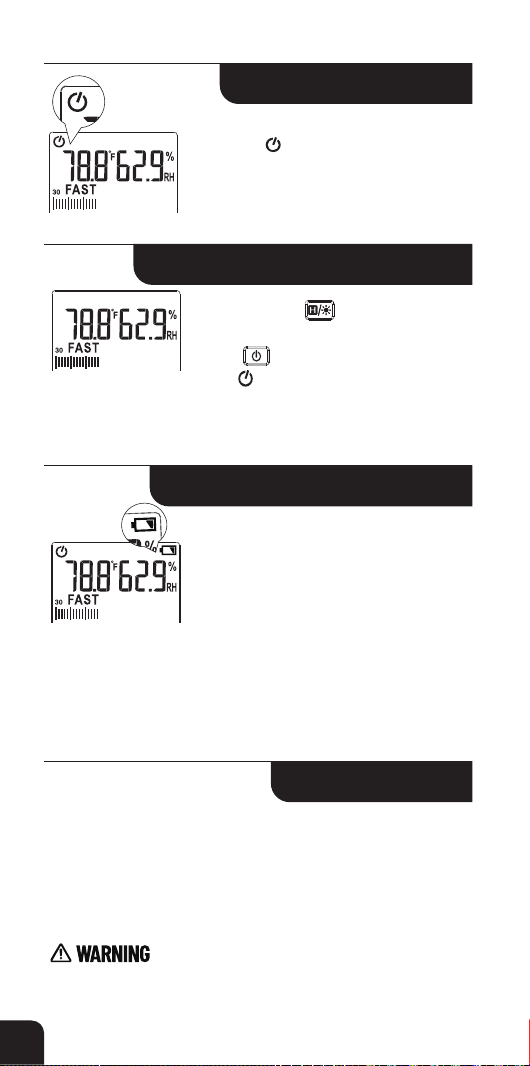
Battery Replacement
Anzeige für niedrigen Batteriestand
Automatisches Ausschalten
Automatische Abschaltung abbrechen
Nehmen Sie die Batterien heraus, wenn das Prüfgerät über einen längeren
Zeitraum nicht benutzt wird.
Drehen Sie das Messgerät um und öffnen Sie das Batteriefach mit
einem Kreuzschlitzschraubendreher, um die Schraube zu entfernen.
Legen Sie drei neue AAA-Batterien in das Batteriefach ein und achten
Sie dabei auf die richtige Polarität. Bringen Sie die Batterieabdeckung
wieder an und ziehen Sie die Schraube fest.
HINWEIS: Nachdem das Symbol auf dem Bildschirm erscheint, arbeitet
der Feuchtigkeitsmesser mehrere Male, bis der Strom ausfällt.
Wenn die Batteriespannung niedriger als die
Arbeitsspannung ist, erscheint das Symbol
oben rechts auf dem LCD-Bildschirm; es ist
an der Zeit, drei frische 1,5-V-Batterien zu
ersetzen.
Wenn das Messgerät eingeschaltet wird, erscheint
das Symbol oben links auf der LCD-Anzeige.
Die automatische Abschaltfunktion ist standard-
mäßig aktiviert. Das Messgerät schaltet sich
automatisch ab, wenn innerhalb von 10 Minuten
keine Bedienung erfolgt.
HINWEIS: Starten Sie das Messgerät nach dem Abschalten neu, um
die automatische Abschaltfunktion wiederherzustellen.
Halten Sie die Taste ge drückt, bevor Sie das
Messgerät einschalten, und drücken Sie dann die
Netztaste , um das Messgerät einzuschalten. Das
Symbol erscheint NICHT oben links auf der
LCD-Anzeige.
Wenn die Batteriespannung niedriger als die Betriebsspannung
(ca. 3,5 V) ist, erscheint der Indikator für niedrige Batteriespan-
nung, bitte tauschen Sie die Batterie rechtzeitig aus.
23

BENUTZERSICHERHEIT
TopTes TS-501B Schallpegelmesser akkumuliert Schallpegelwertdaten
für Lärmdosimeter. Es kann als Lärmmessgerät verwendet werden, das
die Schallintensität prüft, um Lärmbelästigung festzustellen und das
Risiko von Gehörschäden zu vermeiden. Finden Sie Ihre lokalen
Verordnungen über Lärmpegel für Messrichtlinien, und messen Sie die
Lärmpegel in Ihrer Umgebung, ob Sie die Polizei rufen sollten oder nicht.
• Relative Luftfeuchtigkeit: 20~80% RH nicht kondensierend
• Betriebstemperatur: 0°~ 50°C
Arbeitsbereich
• Verwenden Sie das Messgerät nicht in einer heißen, feuchten
Umgebung.
• Lagern oder betreiben Sie das Gerät nicht in Höhenlagen.
• Wind, der über das Mikrofon weht, erhöht die Geräuschmessung. Wenn
Sie den Lärm im Freien messen, verwenden Sie bitte den mitgelieferten
Windschutz am Kopf des Mikrofons.
• Normalerweise brauchen Sie das Gerät nicht zu kalibrieren, da es
bereits ab Werk kalibriert wurde. Angenommen, das Messgerät wurde
über einen längeren Zeitraum nicht benutzt. In diesem Fall benötigt es
zur Kalibrierung eine primäre Standardschallquelle und eine akustische
Umgebung. Wir empfehlen, das Gerät von einem professionellen
Ingenieur, einer dritten Prüfstelle oder einem angesehenen Labor
kalibrieren zu lassen.
• Bitte schütteln und rütteln Sie das Messgerät während des Gebrauchs
nicht stark, um ein falsches Signal auf dem Bildschirm zu vermeiden.
• Die Messwerte hängen auch von der Entfernung zur Schallquelle ab. Das
Gerät zeigt den Gesamtschallpegel in der Umgebung des Benutzers an.
Mathematisch gesehen sinkt der Schallpegel um 6 dB, wenn Sie den
Abstand zur Schallquelle verdoppeln.
• Bei der Schallmessung mit einem Messgerät beeinusst auch die
Position des Mikrofons die Schallpegelanzeige. Wenn Sie das Mikrofon
auf die Lärmquelle richten, erhalten Sie einen höheren Messwert als
wenn Sie das Mikrofon auf sich selbst richten.
Freundliche Hinweise
24

* Die Zeitschätzungen in der Spalte "Typische Reaktion" basieren auf dem
NIOSH-Wechselkurs von 3 dB. Weitere Informationen finden Sie auf der Website von NIOSH.
Häuge Lärmquellen und Dezibel-Pegel
Schall wird in Dezibel (dB) gemessen. Ein Flüstern liegt bei etwa 30 dB,
eine normale Unterhaltung bei etwa 60 dB und ein laufender Motorrad-
motor bei etwa 95 dB. Lärm über 70 dB über einen längeren Zeitraum
hinweg kann Ihr Gehör schädigen. Lauter Lärm über 120 dB kann Ihr
Gehör sofort schädigen.
Woher wissen wir, dass der Schallpegel sicher ist?
Geringere Lärmpegel über längere Zeiträume haben die gleiche
Wirkung wie höhere Lärmpegel über einen kürzeren Zeitraum. Mit dem
TopTes Schallpegelmesser (SLM) TS-501B können Sie den Lärm in Ihrer
Umgebung messen.
Die folgende Tabelle zeigt dB-Pegel und wie Lärm aus alltäglichen
Quellen unser Gehör beeinträchtigen kann.
Schallpegel
Alltägliche Klänge
und Geräusche
Normale Atmung
Tickende Uhr
Flüstern
Kühlschrank brummen
Normales Gespräch
Klimagerät
Waschmaschine,
Geschirrspüler
Stadtverkehr (im Auto)
Benzinbetriebene Rasenmäher
und Laubbläser
Motorrad
Herannahender U-Bahn-Zug,
Autohupe in 5 m Entfernung
Der maximale Lautstärkepegel
für persönliche Hörgeräte
Schreien oder Bellen i
n das Ohr
80-85
Durchschnittlicher Schallpegel
(gemessen in Dezibel)
0
10
20
30
40
60
70
80-85
95
100
105-110
110 -120
Typische
Reaktion
Stille
Stille
Flüstern
Normal
Normal
Geräusch
Geräusch
Lautes Geräusch
Hörschäden sind nach
2 Stunden
Exposition möglich
Schädigung des Gehörs
nach etwa
50 Minuten Exposition
Hörverlust ist nach
15 Minuten möglich
Hörverlust ist in weniger als
5 Minuten möglich
Hörverlust ist in weniger als
2 Minuten möglich
25

Die US-Umweltschutzbehörde (EPA) und die Weltgesundheitsorganisa-
tion (WHO) empfehlen, den Umgebungslärm über 24 Stunden unter 70
dBA (75 dBA über 8 Stunden) zu halten, um lärmbedingten Hörverlust
zu vermeiden.
Die EPA hat außerdem Grenzwerte für Sprachstörungen und
Belästigung von 55 dBA für Aktivitäten im Freien und 45 dBA für
Aktivitäten in Innenräumen festgelegt.
Die meisten lärmbedingten Hörverluste sind das Ergebnis einer
kumulativen Schädigung durch wiederholte Exposition gegenüber
gefährlichem Lärm. Darüber hinaus hängt das Risiko von Lärmschäden
von mehreren Faktoren ab: wie laut der Lärm ist, wie lange Sie ihm
ausgesetzt sind, wie viel Ruhe Ihre Ohren zwischen den Expositionen
bekommen und Ihre Anfälligkeit für Lärm.
Wie laut etwas für Sie klingt, ist nicht dasselbe wie die tatsächliche
Intensität dieses Schalls. Die Schallintensität ist die Menge der
Schallenergie in einem begrenzten Raum. Sie wird in Dezibel (dB)
gemessen. Die Dezibel-Skala ist logarithmisch, d. h. die Lautstärke ist
nicht direkt proportional zur Schallintensität. Stattdessen nimmt die
Intensität eines Schalls sehr schnell zu. Das bedeutet, dass ein
Geräusch mit 20 dB zehnmal intensiver ist als ein Geräusch mit 10 dB.
Durchschnittliche Lärmexpositionspegel, die zum Erreichen
der Maximal zulässige Tagesdosis von 100% nötig sind
8 Stunden
4 Stunden
2 Stunden
60 Minuten
30 Minuten
15 Minuten
85 dB (A)
88 dB (A)
91 dB (A)
94 dB (A)
97 dB (A)
100 dB (A)
Zeit bis zum Erreichen der
100%igen Geräuschdosis
Expositionsniveau gemäß
NIOSH REL
26

Lagerung
• Entfernen Sie die Batterien, wenn das Messgerät längere Zeit nicht
benutzt wird.
• Nicht hohen Temperaturen oder Feuchtigkeit aussetzen.
• Nach einer Lagerung unter extremen Bedingungen, die die im
Abschnitt "Technische Daten" genannten Grenzwerte überschreiten,
muss das Messgerät vor der Verwendung wieder in den normalen
Betriebszustand versetzt werden.
Reinigung
Vergewissern Sie sich, dass das Prüfgerät ausgeschaltet ist, und
wischen Sie es mit einem sauberen, trockenen, fusselfreien Tuch ab.
Verwenden Sie keine aggressiven Reinigungsmittel oder Lösungsmittel.
WARTUNG
Entsorgung/Recycling
Werfen Sie das Gerät und sein Zubehör nicht in den Hausmüll. Sie
müssen gemäß den örtlichen Vorschriften ordnungsgemäß entsorgt
werden.
27

© 2022 TopTes. All Rights Reserved.
Das unerlaubte Kopieren oder Vervielfältigen dieses Handbuchs ohne
vorherige schriftliche Genehmigung von TOPTES ist strengstens
untersagt.
Oder
TopTes bietet einen 36-monatigen Kundendienst und lebenslangen
technischen Support.
Für weitere Details zur Garantieabdeckung und Informationen zur
Reparatur besuchen Sie bitte unsere ozielle Website:
www.toptestools.com/pages/warranty
Kontaktieren Sie uns unter: [email protected]
SUPPORT
Drei Jahre Garantie
28

SOMMAIRE
Spécications
Aperçu du produit
Détails du produit
Description de l'écran
Opération
Installation de la pile
Mise en marche/arrêt
Essais
Maintien des données
Allumer/éteindre le rétro-éclairage
Valeur Max/Min
Commutation de l'unité de température
Pondération de Fréquence A/C
Temps rapide/lent pondéré
Arrêt automatique
Indication de pile faible
Remplacement de la pile
Sécurité des utilisateurs
Espace de travail
Petits rappels
Niveau sonore
Maintenance
Nettoyage
Stockage
Élimination / Recyclage
Assistance
Garantie
Informations sur les Contacts
Nous vous remercions d'avoir acheté votre sonomètre TopTes TS-501B.
Veuillez lire attentivement les instructions suivantes avant d'utiliser votre
instrument. En suivant les étapes décrites dans ce manuel, votre sonomètre
vous fournira des années de service fiable.
31
33
38
41
30
42
29
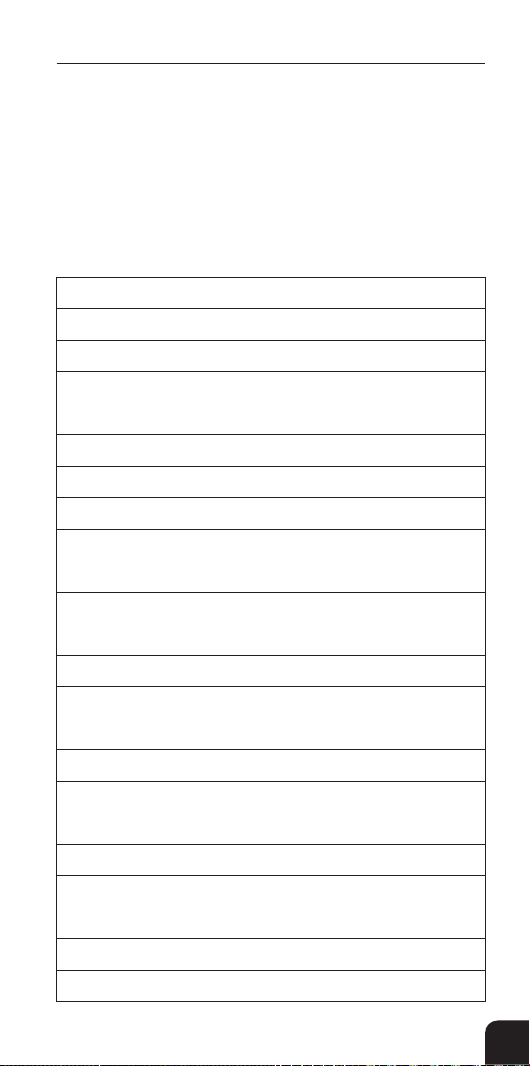
SPECIFICATIONS
Le décibelmètre TopTes TS-501B, également connu sous le nom de
"sonomètre", un appareil de mesure du niveau de pression acoustique
(SPL), est portable et fonctionne sur piles. Il est facile à utiliser tout en
fournissant des lectures précises sur un écran de 2,25 pouce pour
mesurer le niveau sonore de 30 à 130 dB avec une précision de +/-1,5 dB
avec une résolution de 0,1 dB.
Microphone
Écran d'achage
*Pondération des fréquences
Plage de mesure du son
Fréquence
Temps de réponse
Pondération du temps
Plage de mesure de la température
Précision de la température
Plage de mesure de l'humidité
Précision de l'humidité
Conditions de fonctionnement
Conditions de stockage
(retirer la pile)
Certications du produit
Dimensions
Poids ( pile incluse )
Source d'alimentation
CE, RoHs
Condenseur électrique de 1/2 pouce
LCD
A, C
30~130dBA
30~130dBC
30~8,000Hz
0,5 seconde
Fast/Slow (125ms et 1s)
-20.0~60.0°C
140 x 55 x 25 mm
0.0%~99.9%RH
20%~80%: ±5.0% RH
Autres: ±6.0% RH
0~50°C, <80%RH
-10~50°C, <80%RH
150 g
3 x 1.5V piles alcalines
0.0~45.0°C : ±1.0°C
Others: ±1.5°C
30
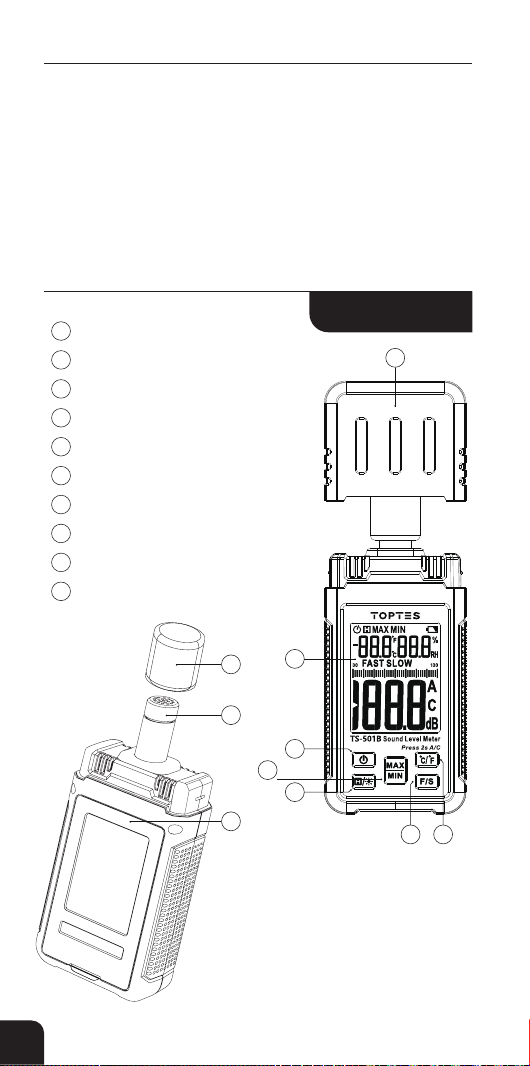
2
9
10
COUVERTURE DE PROTECTION
BOULE DE PARE-BRISE
ÉCRAN D'AFFICHAGE LCD
BOUTON D'ALIMENTATION
BOUTON MAINTIEN/ÉCLAIRAGE
BOUTON DE VALEUR MAX/MIN
BOUTON DE TEMPÉRATURE °C/°F
BOUTON VITESSE RAPIDE/LENTE
MICROPHONE
COMPARTIMENT À PILES
1
2
3
4
5
6
7
10
8
9
Détails du Produit
NOTE: N'essayez jamais de réparer ou de
modier votre instrument. Le démontage
de votre produit pour d'autres raisons que
le remplacement des piles peut causer des
dommages qui ne seront pas couverts par
la garantie du fabricant.
APERÇU DU PRODUIT
Les sonomètres permettent de mesurer, de surveiller et de contrôler les
niveaux de son. Un décibelmètre est un instrument de mesure de la
pression acoustique pour les mesures normalisées qui utilise l'échelle
des décibels. Pour cette raison, le décibelmètre est également connu
sous le nom d'appareil de mesure du niveau de pression acoustique
(SPL). D'autres noms communs incluent le sonomètre et l'appareil de
mesure du niveau sonore.
7
8
4
6
5
3
1
31
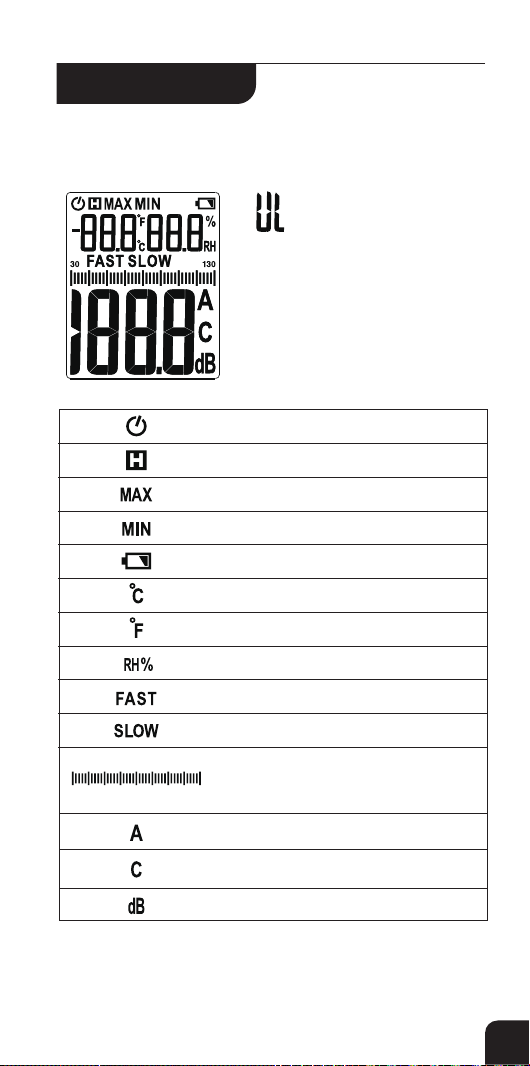
Description de l'écran
*Un mode de pondération en fréquence mesure le niveau sonore dans la gamme audible
par l'homme, et la gamme de test est de 30 à 130 dBA. Il tient compte de l'intensité
sonore relative perçue par l'oreille humaine. La valeur de lecture de l'appareil fluctue
en fonction de la distance de la source sonore.
Indicateur d'arrêt automatique
Indicateur de maintien des données
Indicateur de valeur maximale
Indicateur de valeur minimale
Indicateur de pile faible
Indicateur d'unité centigrade
Indicateur d'unité Fahrenheit
Temps Lent Pondéré
Achage analogique à barres
(40 barres au total)
Indicateur de pourcentage d'humidité
Temps Rapide Pondéré
A pondération de fréquence
C pondération de fréquence
Valeur de dB mesurée
Les définitions suivantes décrivent les symboles et les valeurs achés
sur l'écran du sonomètre.
Le TS-501B a une plage de
mesure de 30 à 130 décibels
(dB). Lorsque le niveau sonore
mesuré est inférieur à 30 dB,
l'écran ache le symbole "UL".
32
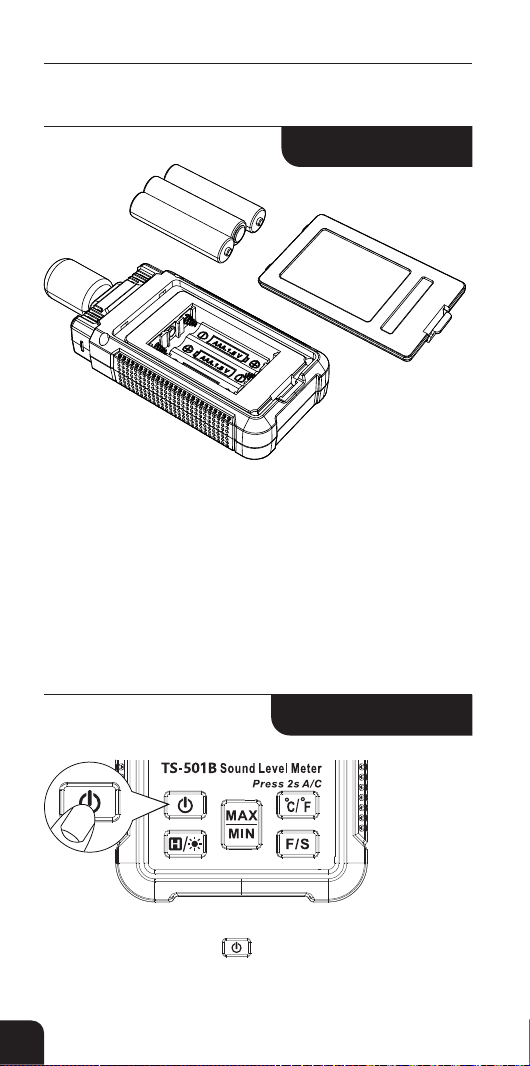
Installation de la pile
Mise en marche/arrêt
OPERATION
Étape 1. Cherchez une petite rainure sur le couvercle de la batterie.
Appuyez doucement sur la rainure tout en poussant vers le
bas du produit pour ouvrir le couvercle de la batterie.
Étape 2. Installez 3 piles AAA (incluses dans la boîte) dans la
cartouche, selon les indications positives et négatives à
l'intérieur du compartiment à piles.
Étape 3. Alignez l'encoche et couvrez le couvercle de la batterie.
Appuyez sur le bouton d'alimentation pendant une
seconde pour allumer ou éteindre le testeur.
33
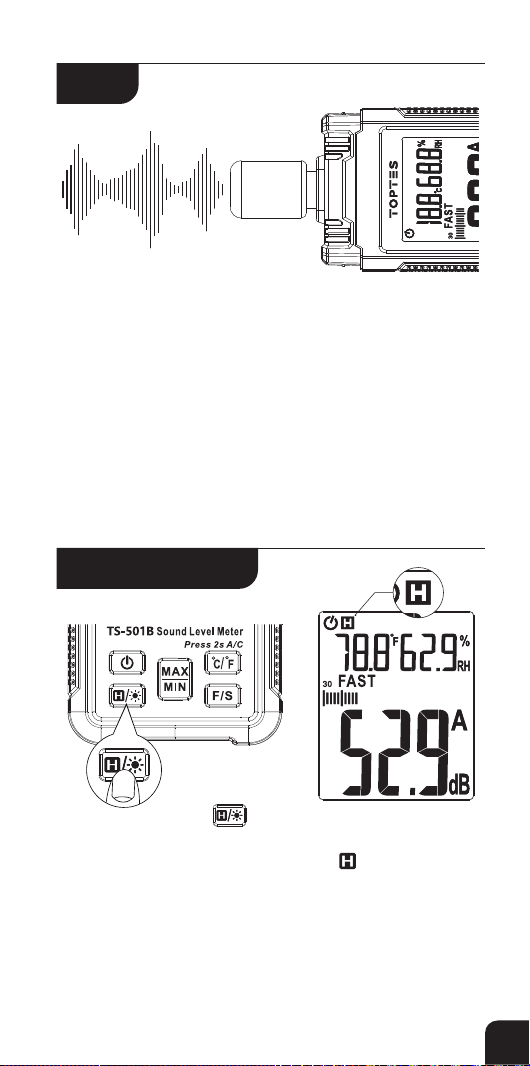
Essais
Maintien des données
Tenez le sonomètre confortablement dans une main (loin de votre
corps) ou placez-le sur un objet plat pour une surveillance à long
terme. Dirigez le microphone dans la direction du bruit pour prendre
une mesure. Si vous dirigez le microphone vers la source de bruit,
vous obtiendrez une mesure plus élevée que si vous le placez vers
vous.
REMARQUE: la position du microphone ou de l'appareil modiera la
lecture du sonomètre.
Appuyez sur le bouton de maintien des données pendant 1
seconde pour activer la fonction de maintien des données et capturer
les lectures/données de mesure. Si l'icône apparaît à l'écran,
appuyez à nouveau sur le bouton pendant 1 seconde pour revenir à la
fonction de mesure standard.
NOTE: Le sonomètre a la fonction de maintenir la valeur lorsqu'il est en
mode de valeur MAX et MIN, il n'est donc pas nécessaire d'appuyer à
nouveau sur le bouton de Maintien.
34
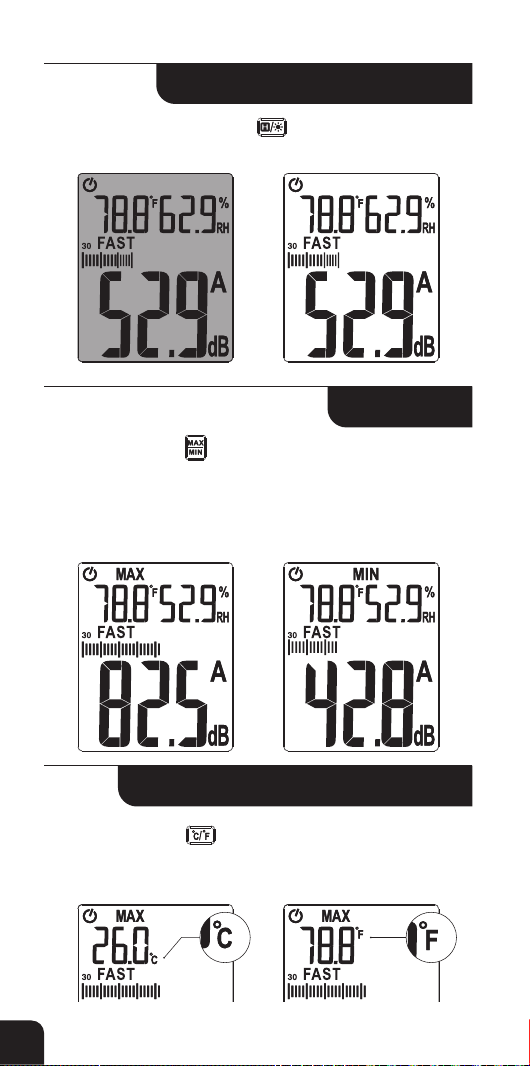
Allumer/éteindre le rétro-éclairage
Appuyez longuement sur le bouton de rétro-éclairage pendant >2
secondes pour allumer/éteindre la fonction de rétro-éclairage.
Écran sans le rétro-éclairage
Écran avec le rétro-éclairage
Valeur MAX/MIN
Appuyez sur le bouton pendant 1 seconde pour acher les valeurs
maximale et minimale. Dans ce mode, le compteur ne rafraîchit la lecture
que lorsqu'une mesure supérieure/inférieure à celle qui est actuellement
achée est détectée. Appuyez à nouveau sur le bouton pendant 2
secondes pour quitter le mode et reprendre le fonctionnement normal.
Commutation de l'Unité de Température
Appuyez sur le bouton pour changer l'unité de température en °C
ou °F. Une fois l'unité de température modiée, elle sera enregistrée
pour la prochaine utilisation.
35
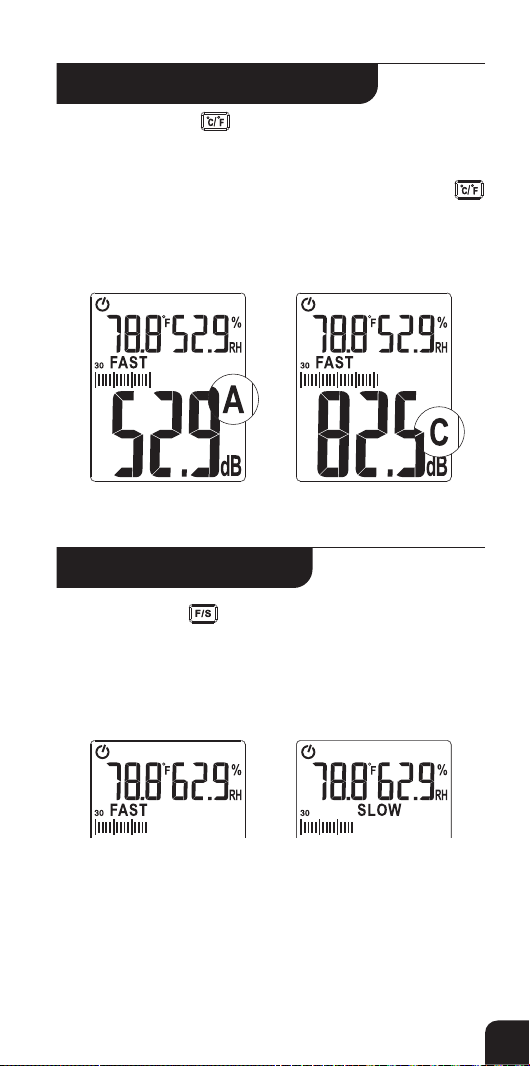
Appuyez sur le bouton pour sélectionner la Pondération de Fré-
quence. La valeur par défaut est la pondération de fréquence A;
lorsque le lecteur est allumé, "A" apparaît à l'écran. Pondération "A"
pour un niveau sonore de bruit général. Appuyez longuement sur le
bouton
pour régler la pondération "C" pour mesurer le bruit de niveau élevé. La
pondération "C" est une pondération standard des fréquences audibles
couramment utilisée pour mesurer les niveaux de pression acoustique
de crête.
Si le niveau pondéré "C" est beaucoup plus élevé que le niveau
Temps Rapide/Lent Pondéré
Appuyez sur le bouton pour commuter le temps de réponse
souhaité. La réponse par défaut est une réponse RAPIDE.
Si la source sonore est constituée de courtes rafales, réglez la réponse
sur RAPIDE (FAST - 125ms).
Pour mesurer le niveau sonore moyen, sélectionnez LENT (SLOW - 1s).
Sous le mode FAST, la lecture évolue rapidement pour faire apparaître
rapidement les variations du bruit. Sous le mode SLOW, la lecture est
amortie pour rendre le bruit plus facile à lire.
Vous pouvez sélectionner la réponse FAST pour la plupart des app-
lications.
Lent correspond à une
constante de temps de 1 seconde.
Rapide correspond à une
constante de temps de 125 ms.
Pondération de Fréquence A/C
36
Remplacement des piles
Indication de pile faible
Arrêt Automatique
Retirez les piles lorsque le testeur n'est pas utilisé durant une période prolongée.
Pour remplacer la pile, retournez le lecteur et ouvrez le compartiment
à piles en utilisant un tournevis cruciforme pour retirer la vis. Installez
trois piles AAA neuves dans la cartouche, en respectant la bonne
polarité. Replacez le couvercle du compartiment à piles et serrez la vis.
Lorsque la tension de la batterie est inférieure à la tension de
fonctionnement (environ 3,5 V), l'indicateur de batterie faible s'ache ;
veuillez remplacer la batterie à temps.
NOTE: Après l'apparition de l'icône sur l'écran, l'humidimètre fonctionne
plusieurs fois jusqu'à ce que l'alimentation soit coupée.
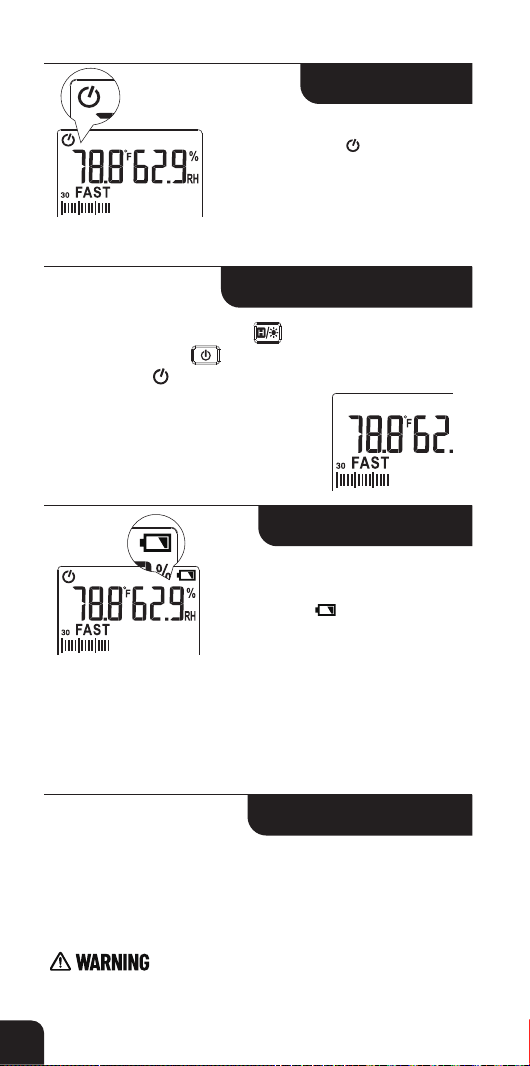
Lorsque le lecteur est allumé, l'icône
apparaît dans le coin supérieur gauche
de l'écran LCD. La fonction d'arrêt
automatique est activée par défaut. Le
compteur s'éteint automatiquement si
aucune opération n'est effectuée dans les
10 minutes.
NOTE: Redémarrez le compteur après
l'arrêt pour rétablir la fonction d'arrêt
automatique.
Annuler l'arrêt automatique
Appuyez et maintenez le bouton avant d'allumer le lecteur, puis
appuyez sur le bouton d'alimentation pour mettre le lecteur sous
tension. L'icône N'apparaîtra PAS dans le coin supérieur gauche de
l'écran LCD.
Lorsque la tension des piles est
inférieure à la tension de fonctionne-
ment, l'icône apparaît en haut à
droite de l'écran LCD; il est temps de
remplacer trois piles neuves de 1,5V.
37

SÉCURITÉ DE L'UTILISATEUR
Le sonomètre TopTes TS-501B accumule les données de valeur de
niveau sonore pour le dosimètre de bruit. Il peut être utilisé comme un
moniteur de bruit testant l'intensité sonore pour trouver la pollution
sonore, évitant ainsi le risque de dommages auditifs. Trouvez les
ordonnances locales sur les niveaux de bruit pour les consignes de
mesure, et mesurez les niveaux de bruit autour de vous avec le code
local pour déterminer si vous devez appeler la police ou non.
• Humidité relative: 20~80% RH non-condensing
• Température de fonctionnement: 0° to 50°C
Espace de Travail
• N'utilisez pas le compteur dans un environnement chaud et humide.
• Ne rangez pas et n'utilisez pas l'instrument dans des endroits en
hauteur.
• Le vent qui soue sur le microphone augmente la mesure du bruit.
Lorsque vous mesurez le bruit à l'extérieur, veuillez utiliser la bonnette
anti-vent fournie sur la tête du microphone.
• En général, vous n'avez pas besoin de l'étalonner puisqu'il a été étalonné
en usine. Supposons que le compteur n'ait pas été utilisé pendant une
période prolongée. Dans ce cas, il faut une source sonore standard
primaire et un environnement acoustique pour l'étalonner. Nous
recommandons qu'il soit étalonné par un ingénieur professionnel, une
structure d'essai tierce ou un laboratoire réputé.
• Veuillez ne pas vibrer et secouer vigoureusement le compteur pendant
son utilisation an d'éviter un faux signal sur l'écran de l'instrument.
• Les mesures dépendront également de la distance qui vous sépare de la
source. L'appareil fournira une lecture du niveau sonore global autour
de l'utilisateur. En termes mathématiques, le niveau sonore diminue de
6 dB chaque fois que vous doublez la distance par rapport à la source.
• Lors de la mesure du son avec un appareil de mesure, la position du
microphone inuence également la lecture du niveau sonore. Si vous le
pointez vers la source de bruit, vous obtiendrez une lecture plus élevée
que si vous le placez vers vous.
Petits Rappels
38
* Les estimations de temps dans la colonne "Réponse Typique" sont basées sur le taux
de change du NIOSH de 3 dB. Pour plus d'informations, visitez le site Web du NIOSH.
Sources Communes de Bruit et Niveaux de Décibels
Le son est mesuré en décibels (dB). Un chuchotement correspond à
environ 30 dB, une conversation normale à environ 60 dB et un moteur
de moto en marche à environ 95 dB. Un bruit supérieur à 70 dB sur une
période prolongée peut endommager votre audition. Un bruit fort
supérieur à 120 dB peut causer des dommages immédiats à vos
oreilles.
Comment Sait-on Que Le Niveau De Son est Sans Danger ?
L'effet de niveaux sonores faibles sur de longues périodes est le même
que celui de niveaux sonores plus forts sur une période plus courte.
Vous pouvez utiliser le sonomètre TopTes (SLM) TS-501B pour mesurer
le bruit autour de vous.
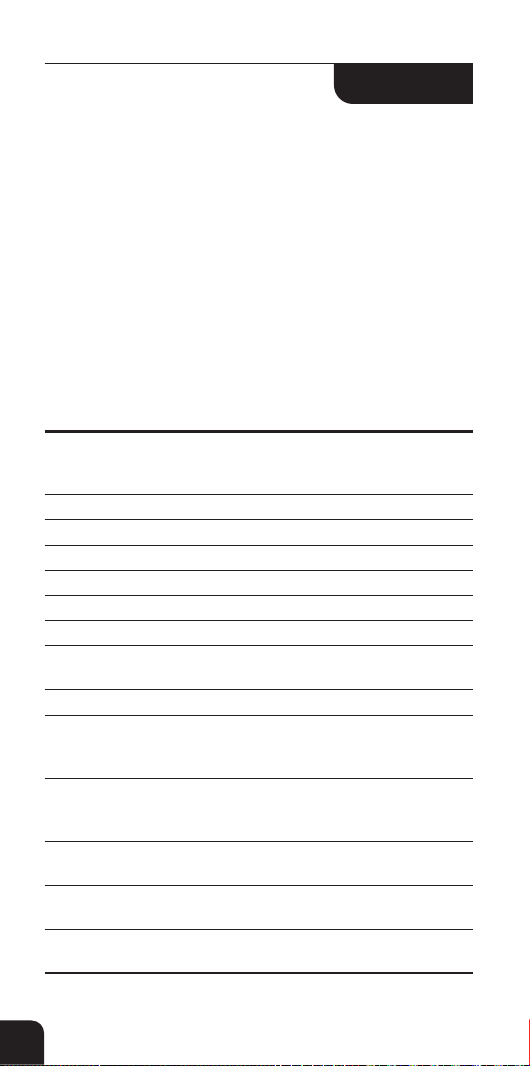
Le tableau ci-dessous montre les niveaux en dB et comment le bruit
provenant de sources quotidiennes peut affecter notre audition.
Niveau de Son
Sons et Bruits de
Tous les Jours
Respiration normale
Tic-tac d'une montre
Chuchotement
Bourdonnement d'un réfrigérateur
Conversation normale
Climatiseur
Machine à laver,
lave-vaisselle
Trafic urbain (dans la voiture)
Tondeuses à gazon et soueuses
de feuilles à moteur à essence
Motocyclette
Train de métro en approche,
klaxon de voiture à 5 mètres (16 pieds)
Le niveau de volume
maximal des appareils
d'écoute personnels
80-85
Niveau de Son Moyen
(mesuré en décibels)
0
10
20
30
40
60
70
80-85
95
100
105-110
110 -120
Réponse
Typique
Silence
Silence
Chuchotement
Whispering
Normal
Bruit
Bruit
Très Bruyant
L'audition peut être
endommagée après
2 heures d'exposition.
L'audition peut être
endommagée après environ
50 minutes d'exposition.
Perte auditive possible
après 15 minutes
Perte auditive possible
en moins de 5 minutes
Perte auditive possible
en moins de 2 minutes
39

L'Agence américaine de protection de l'environnement (EPA) et
l'Organisation mondiale de la santé (OMS) recommandent de
maintenir les bruits ambiants en dessous de 70 dBA sur 24 heures (75
dBA sur 8 heures) pour prévenir la perte auditive due au bruit.
La EPA a également xé des limites pour les interférences vocales et
la gêne à 55 dBA pour les activités extérieures et 45 dBA pour les
activités intérieures.
La plupart des pertes auditives dues au bruit résultent de dommages
accumulés à la suite d'expositions répétées à des bruits dangereux.
En outre, le risque de lésions dues au bruit dépend de plusieurs
facteurs : l'intensité du bruit, la durée d'écoute, le temps de repos de
vos oreilles entre les expositions et votre sensibilité au bruit.
L'intensité sonore d'un bruit n'est pas la même que l'intensité réelle de
ce bruit. L'intensité sonore est la quantité d'énergie sonore dans un
espace conné. Elle est mesurée en décibels (dB). L'échelle des
décibels est logarithmique, ce qui signie que l'intensité sonore n'est
pas directement proportionnelle à l'intensité du son. Au contraire,
l'intensité d'un son croît très rapidement. Cela signie qu'un son de 20
dB est dix fois plus intense qu'un son de 10 dB.
Niveaux d'Exposition au Son Moyens Nécessaires pour Atteindre la
Dose Journalière Maximum Admissible de 100%.
8 heures
4 heures
2 heures
60 minutes
30 minutes
15 minutes
85 dB (A)
88 dB (A)
91 dB (A)
94 dB (A)
97 dB (A)
100 dB (A)
Temps nécessaire pour atteindre
une dose de bruit de 100%.
Niveau d'exposition selon
le REL de NIOSH
40
Stockage
• Retirez les piles lorsque le compteur n'est pas utilisé pendant une
période prolongée.
• Ne l'exposez pas à des températures élevées ou à l'humidité.
• Après une période de stockage dans des conditions extrêmes
dépassant les limites mentionnées dans la section Spécications,
laissez le compteur revenir à des conditions de fonctionnement
normales avant de l'utiliser.
Nettoyage
Assurez-vous que le testeur est éteint, et essuyez-le avec un chiffon
propre, sec et non pelucheux. N'utilisez pas de produits de nettoyage
ou de solvants agressifs.
ENTRETIEN
Fin d’Usage / Recyclage
Ne pas jeter l'équipement et ses accessoires à la poubelle. Les
articles doivent être éliminés de manière appropriée, conformément
aux réglementations locales.
41

© 2022 TopTes. All Rights Reserved.
Toute copie ou reproduction non autorisée de ce manuel sans
l'autorisation écrite préalable de TOPTES est strictement interdite.
Ou
TopTes offre un service après-vente de 36 mois et une assistance
technique à vie.
Pour plus de détails sur la couverture de la garantie et les informa-
tions sur les réparations sous garantie, veuillez consulter notre site
ociel:
www.toptestools.com/pages/warranty
Contactez-nous à l'adresse: [email protected]
SUPPORT
Trois Ans de Garantie
42

INDICE
Speciche
Panoramica del prodotto
Dettagli del prodotto
Descrizione del display
Funzionamento
Installazione della batteria
Accensione/spegnimento
Test
Mantenimento dei dati
Accensione/spegnimento della Retroilluminazione
Valore massimo/minimo
Commutazione dell'unità di temperatura
Ponderazione di frequenza A/C
Tempo veloce/lento ponderato
Spegnimento automatico
Indicazione di batteria scarica
Sostituzione della batteria
Sicurezza dell'utente
Area di lavoro
Suggerimenti caldi
Livello sonoro
Manutenzione
Pulizia
Immagazzinamento
Smaltimento / Riciclaggio
Supporto
Garanzia
Informazione di contatto
Grazie per aver acquistato il fonometro TopTes TS-501B. Prima di
utilizzare lo strumento, leggere attentamente le seguenti istruzioni. Seguendo
le istruzioni riportate in questo manuale, il fonometro vi fornirà anni di
servizio adabile.
45
47
52
55
44
56
43
SPECIFICHE
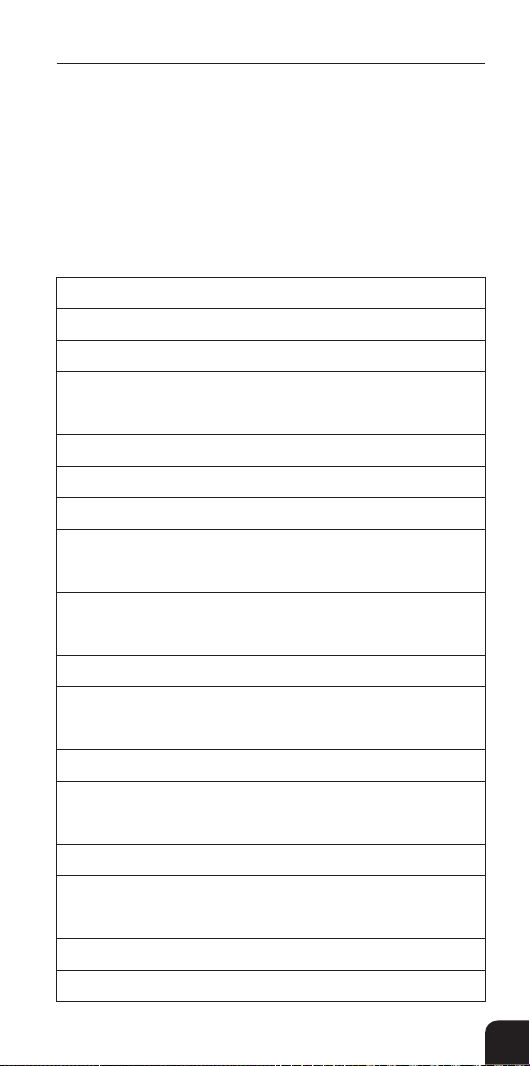
Il misuratore di decibel TopTes TS-501B, noto anche come "misuratore
del livello di pressione sonora (SPL)", è portatile e funziona a batterie. È
facile da usare e fornisce letture accurate su uno schermo da 1,85
pollici per misurare il livello sonoro da 30 a 130 dB con una precisione di
+/-1,5 dB e una risoluzione di 0,1 dB.
Microfono
Schermo di visualizzazione
*Ponderazione della frequenza
Campo di misura del suono
Frequenza
Tempo di risposta
Ponderazione del tempo
Campo di misura
della temperatura
Precisione della
temperatura
Campo di misura dell'umidità
Precisione dell'umidità
Condizioni operative
Condizioni di conservazione
(rimuovere la batteria)
Certicazioni di prodotto
Dimensioni
Peso
(batteria inclusa)
Fonte di alimentazione
CE, RoHs
Condensatore elettrico da 1/2 pollice
LCD
A, C
30~130dBA
30~130dBC
30~8,000Hz
0,5 secondi
Veloce/Lento (125ms e 1s)
-20.0~60.0°C
140 x 55 x 25 mm
0.0%~99.9%RH
20%~80%: ±5.0% RH
Altri: ±6.0% RH
0~50°C, <80%RH
-10~50°C, <80%RH
150 g
3 batterie alcaline da 1,5 V
0.0~45.0°C: ±1.0°C
Altri: ±1.5°C
44
2
9
10
1
2
3
4
5
6
7
10
8
9
7
8
4
6
5
3
1
Dettagli del prodotto
COPERCHIO DI PROTEZIONE
SFERA DEL PARABREZZA
SCHERMO LCD
PULSANTE DI ACCENSIONE
TASTO HOLD/BACKLIT
PULSANTE VALORE MASSIMO/MINIMO
PULSANTE TEMPERATURA °C/°F
PULSANTE VELOCITÀ VELOCE/LENTA
MICROFONO
VANO BATTERIA
NOTA: Non tentare mai di riparare o modicare
lo strumento. Lo smontaggio del prodotto per
motivi diversi dalla sostituzione delle batterie
può causare danni non coperti dalla garanzia
del produttore.
PANORAMICA DEL PRODOTTO
I fonometri aiutano a misurare, monitorare e controllare i livelli di
rumore. Un misuratore di decibel è uno strumento di misurazione della
pressione sonora per misure standardizzate che utilizza la scala dei
decibel. Per questo motivo, il misuratore di decibel è noto anche come
misuratore del livello di pressione sonora (SPL). Altri nomi comuni sono
misuratore di rumore e misuratore di livello sonoro.
45
Descrizione del display
* La modalità di ponderazione in frequenza misura il livello sonoro all'interno della
gamma udibile dall'uomo e l'intervallo di prova è 30-130 dBA. Questo metodo tiene
conto dell'intensità relativa percepita dall'orecchio umano. Il valore di lettura del
misuratore fluttua in base alla diversa distanza della sorgente sonora.
Indicatore di spegnimento automatico
Indicatore di mantenimento dei dati
Indicatore del valore massimo
Indicatore di batteria scarica
Indicatore di batteria scarica
Indicatore di unità centigrada
Indicatore di unità Fahrenheit
Indicatore ponderato lento
Display analogico a barre
(40 barre in totale)
Indicatore di percentuale di umidità
Indicatore ponderato veloce
A di ponderazione della frequenza
C di ponderazione della frequenza
Valore dB misurato
Le seguenti definizioni descrivono i simboli e i valori visualizzati sullo
schermo del fonometro.
Il TS-501B ha un intervallo di
misurazione da 30 a 130 decibel
(dB). Quando il livello del suono
misurato scende al di sotto dei
30 dB, lo schermo visualizzerà il
simbolo "UL".
46
Installazione della batteria
Accensione/spegnimento
FUNZIONAMENTO
Passo 1. Cerca uno scanalatura piccola sul coperchio della batteria.
Premere delicatamente sulla scanalatura mentre si spinge
verso il fondo del prodotto per aprire il coperchio della
batteria.
Passo 2. Installare 3 batterie AAA (incluse nella confezione) nella
cartuccia, seguendo i segni positivi e negativi all'interno
del vano batterie.
Passo 3. Allineare la tacca e agganciare il coperchio della batteria.
Premere il pulsante di accensione per di 1 secondo per
accendere o spegnere il tester.
47
Test
Mantenimento dei Dati
Tenere il fonometro comodamente in una mano (lontano dal corpo) o
appoggiarlo su un oggetto piatto per un monitoraggio a lungo termine.
Puntare il microfono in direzione del rumore per effettuare la
misurazione. Puntando il microfono verso la fonte di rumore si otterrà
una lettura più alta rispetto a quella che si ottiene posizionando il
microfono verso di sé.
NOTA: la posizione del microfono o del dispositivo modica la lettura
del fonometro.
Premere il pulsante di mantenimento dei dati per 1 secondo per
attivare la funzione di mantenimento dei dati e acquisire la lettura/dati
di misura. Se sullo schermo appare l'icona , premere nuovamente il
pulsante per 1 secondo per tornare alla funzione di misurazione
standard.
NOTA: il fonometro ha la funzione di mantenere il valore quando è in
modalità valore MAX e MIN, quindi non è necessario premere
nuovamente il pulsante Hold.
48
Retroilluminazione
Valore MAX/MIN
Premere a lungo il pulsante della retroilluminazione per >2
secondi per attivare/disattivare la funzione di retroilluminazione.
Schermo senza retroilluminazione accesa
Schermo con retroilluminazione accesa
Premere il pulsante per 1 secondo per visualizzare i valori massimo
e minimo. In questa modalità, lo strumento aggiorna la lettura solo
quando viene rilevata una misura superiore o inferiore a quella
attualmente visualizzata. Premere nuovamente il pulsante per 2 secondi
per uscire e riprendere il funzionamento regolare.
Commutazione dell'unità di Temperatura
Premere il pulsante per passare all'unità di temperatura °C o °F.
Una volta cambiata l'unità di temperatura, questa viene memorizzata
per il successivo utilizzo.
49
Tempo Veloce/Lento Ponderato
Premere il pulsante per cambiare il tempo di risposta desiderato.
L'impostazione predenita è una risposta FAST. Se la sorgente sonora
è costituita da brevi esplosioni, impostare la risposta su FAST (125 ms).
Per misurare il livello sonoro medio, selezionare SLOW (1s).
In FAST, la lettura si sposta velocemente per mostrare rapidamente le
variazioni del rumore. In SLOW, la lettura viene smorzata per facilitare
la lettura del rumore.
È possibile selezionare la risposta FAST per la maggior parte delle
applicazioni.
Slow corrisponde a una costante
di tempo di 1 secondo
Fast corrisponde a una costante
di tempo di 125 ms
Ponderazione di Frequenza A/C
Premi il pulsante per selezionare la ponderazione di frequenza.
L'impostazione predenita è la ponderazione di frequenza A; quando lo
strumento è acceso, sul display appare "A". La ponderazione "A" indica
un livello sonoro generale del rumore. Premi a lungo il pulsante per
impostare la ponderazione "C" per misurare il rumore di alto livello. La
ponderazione "C" è una ponderazione standard delle frequenze udibili
comunemente, utilizzata per misurare i livelli di Picco di Pressione
Sonora.
Se il livello "C" è molto più alto del livello ponderato "A". ponderato, ci
sarà una grande quantità di rumore a bassa frequenza".
50
Sostituzione della Batteria
Indicazione di Batteria Scarica
Spegnimento Automatico
Annullamento dello Spegnimento Automatico
Rimuovere le batterie quando il tester non viene utilizzato per un periodo
prolungato.
Per sostituire la batteria, capovolgere lo strumento e aprire il vano
della batteria utilizzando un cacciavite a croce per rimuovere la vite.
Installare tre nuove batterie AAA nella cartuccia, rispettando la
corretta polarità. Riposizionare il coperchio del vano batterie e serrare
la vite.
NOTA: Le misurazioni rimarranno comunque valide per diverse volte
dopo la prima apparizione dell'icona.
Quando la tensione della batteria è inferiore alla tensione di lavoro
(circa 3,5 V), verrà visualizzato l'indicatore di batteria scarica, sostituire
la batteria in tempo.
Quando la tensione della batteria è
inferiore alla tensione di lavoro, appare
l'icona in alto a destra del display
LCD; è il momento di sostituire tre
batterie fresche da 1,5V.
Quando lo strumento è acceso, l'icona appare
in alto a sinistra sul display LCD. La funzione di
spegnimento automatico è attiva per impostazi-
one predenita.
Lo strumento si spegne automaticamente se non
viene eseguito alcun intervento entro 10 minuti.
NOTA: riavviare lo strumento dopo lo spegnimento per ripristinare la
funzione di spegnimento automatico.
Tenere premuto il pulsante prima di
accendere lo strumento, quindi premere il
pulsante di accensione per accendere lo
strumento. L'icona NON apparirà in alto a
sinistra del display LCD, quindi l'utente deve
spegnere manualmente l'alimentazione.
51

SICUREZZA DELL'UTENTE
Il fonometro TopTes TS-501B accumula i dati del valore del livello sonoro
per il dosimetro del rumore. Può essere utilizzato come monitor del
rumore per vericare l'intensità del suono e individuare l'inquinamento
acustico, evitando il rischio di danni all'udito. Per trovare le linee guida
per la misurazione, cercate le ordinanze locali sui livelli di rumore e
misurate i livelli di rumore intorno a voi con il codice locale per
determinare se è necessario chiamare la polizia o meno.
• Umidità relativa: 20~80% RH senza condensa
• Temperatura di Funzionamento: 0° to 50°C
Area di Lavoro
• Non utilizzare lo strumento in un ambiente caldo e umido.
• Non conservare o utilizzare lo strumento in aree elevate.
• Il vento che attraversa il microfono aumenta la misurazione del rumore.
Quando si misura il rumore all'esterno, utilizzare il paravento in
dotazione sulla testa del microfono.
• In genere, non è necessario calibrarlo perché è stato calibrato in
fabbrica. Supponiamo che lo strumento non sia stato utilizzato per un
lungo periodo. In questo caso, la calibrazione richiede una sorgente
sonora standard primaria e un ambiente acustico. Si consiglia di farlo
calibrare da un ingegnere professionista, da un centro di collaudo terzo
o da un laboratorio adabile.
• Si prega di non vibrare o scuotere vigorosamente lo strumento durante
l'uso per evitare un falso segnale sullo schermo dello strumento.
• Le misurazioni dipendono anche dalla distanza dalla sorgente. Fornirà
una lettura del livello sonoro complessivo intorno all'utente. In termini
matematici, il livello sonoro diminuisce di 6 dB ogni volta che si
raddoppia la distanza dalla sorgente.
• Quando si misura il suono con un misuratore, anche la posizione del
microfono inuisce sulla lettura del livello sonoro. Puntando il microfono
verso la fonte di rumore si otterrà una lettura più alta rispetto a quella
che si ottiene posizionando il microfono verso di sé.
Ricordi Amichevoli
52

I tempi stimati nella colonna "Risposta Tipica" si basano sul tasso di cambio NIOSH di 3
dB. Per ulteriori informazioni, visitare il sito web del NIOSH.
Fonti comuni di rumore e livelli di decibel
Il suono si misura in decibel (dB). Un sussurro corrisponde a circa 30
dB, una normale conversazione a circa 60 dB e il motore di una
motocicletta acceso a circa 95 dB. Un rumore superiore a 70 dB per un
periodo prolungato può danneggiare l'udito. Un rumore forte, superiore
a 120 dB, può causare danni immediati all'udito.
Come facciamo a sapere che il livello sonoro è sicuro?
L'effetto di livelli di rumore più bassi per lunghi periodi è lo stesso di
livelli di rumore più elevati per un periodo più breve. Per misurare il
rumore intorno a voi, potete utilizzare il fonometro (SLM) TopTes
TS-501B.
La tabella seguente mostra i livelli di dB e il modo in cui il rumore
proveniente da fonti quotidiane può inuire sul nostro udito.
Livello Sonoro
Suoni e Rumori
Quotidiani
Respirazione normale
Orologio con ticchettio
Sussurro
Ronzio del frigorifero
Conversazione normale
Condizionatore d'aria
Lavatrice, lavastoviglie
Traco cittadino
(all'interno dell'auto)
Rasaerba e soatori
di foglie alimentati a gas
Moto
Treno della metropolitana in avvicinamento,
clacson della vettura a 5 metri di distanza
Il livello massimo di volume per
i dispositivi di ascolto personali
Gridare o abbaiare
nell'orecchio
80-85
Livello Sonoro Medio
(misurato in decibel)
0
10
20
30
40
60
70
80-85
95
100
105-110
110 -120
Risposta
Tipica
Il silenzio
Il silenzio
Sussurri
Normale
Normale
Rumore
Rumore
Molto rumoroso
I danni all'udito sono
possibili dopo
2 ore di esposizione.
Danni all'udito dopo circa
50 minuti di esposizione
La perdita dell'udito è
possibile dopo 15 minuti
La perdita dell'udito è
possibile in meno di 5 minuti
La perdita dell'udito è
possibile in meno di 2 minuti
53

L'Agenzia statunitense per la protezione dell'ambiente (EPA) e
l'Organizzazione Mondiale della Sanità (OMS) raccomandano di
mantenere i rumori ambientali al di sotto di 70 dBA nelle 24 ore (75
dBA nelle 8 ore) per prevenire la perdita dell'udito causata dal rumore.
L'EPA ha anche specicato i limiti di interferenza vocale e di fastidio
a 55 dBA per le attività all'aperto e a 45 dBA per le attività al chiuso.
La maggior parte della perdita dell'udito indotta dal rumore deriva da
danni accumulati in seguito a ripetute esposizioni a rumori pericolosi.
Inoltre, il rischio di danni da rumore dipende da diversi fattori: il
volume del rumore, la durata dell'ascolto, il riposo delle orecchie tra
un'esposizione e l'altra e la predisposizione al rumore.
Il volume di un suono non corrisponde all'intensità effettiva del suono
stesso. L'intensità sonora è la quantità di energia sonora in uno
spazio limitato. Si misura in decibel (dB). La scala dei decibel è
logaritmica, il che signica che il volume non è direttamente
proporzionale all'intensità del suono. Al contrario, l'intensità di un
suono cresce molto velocemente. Ciò signica che un suono a 20 dB
è dieci volte più intenso di un suono a 10 dB.
Livelli medi di esposizione al suono necessari per
raggiungere il Dose massima giornaliera consentita del 100%
8 ore
4 ore
2 ore
60 minuti
30 minuti
15 minuti
85 dB (A)
88 dB (A)
91 dB (A)
94 dB (A)
97 dB (A)
100 dB (A)
Tempo per raggiungere
il 100% di dose di rumore
Livello di esposizione
secondo NIOSH REL
54
Immagazzinamento
• Rimuovere le batterie quando lo strumento non viene utilizzato per un
periodo prolungato.
• Non esporre a temperature o umidità elevate.
• Dopo un periodo di immagazzinamento in condizioni estreme oltre i
limiti indicati nella sezione Speciche, lasciare che il misuratore torni
alle normali condizioni operative prima dell'uso.
Pulizia
Assicurarsi che il tester sia spento e pulirlo con un panno pulito e
asciutto che non lasci pelucchi. Non utilizzare prodotti di pulizia
aggressivi o solventi.
MANUTENZIONE
Smaltimento / Riciclaggio
Non gettare l'apparecchiatura e i suoi accessori nella spazzatura. Gli
articoli devono essere smaltiti correttamente secondo le normative
locali.
55

© 2022 TopTes. All Rights Reserved.
È severamente vietata qualsiasi copia o riproduzione non
autorizzata del presente manuale senza previa autorizzazione
scritta da parte di TOPTES.
Or
TopTes fornisce un servizio post-vendita di 36 mesi e un'assisten-
za tecnica a vita.
Per ulteriori dettagli sulla copertura della garanzia e sulle informazi-
oni relative alla riparazione in garanzia, visitare il nostro sito web
uciale:
www.toptestools.com/pages/warranty
Contattateci su: [email protected]
SUPPORTO
Garanzia di Tre Anni
56

CONTENIDO
Especicaciones
Descripción General del Producto
Detalles del Producto
Descripción del Visor
Funcionamiento
Instalación de la Pila
Encendido/Apagado
Realización de Pruebas
Retención de Datos
Encendido/Apagado de la Retroiluminación
Valor MAX/MIN
Switch de Unidad de Temperatura
Ponderación de frecuencia de A/C
Tiempo Ponderado Rápido/Lento
Apagado Automático
Aviso de Batería Baja
Reemplazo de las Pilas
Seguridad del Usuario
Área de Operación
Consejos
Nivel de Sonido
Mantenimiento
Limpieza
Almacenamiento
Eliminación / Reciclaje
Soporte
Garantía
Información de Contacto
Gracias por comprar el Medidor de Nivel de Sonido TopTes TS-501B. Lee
atentamente las siguientes instrucciones antes de usar el instrumento. Al
seguir los pasos descritos en este manual, el medidor te proporcionará años
deservicio confiable.
59
61
66
69
58
70
57
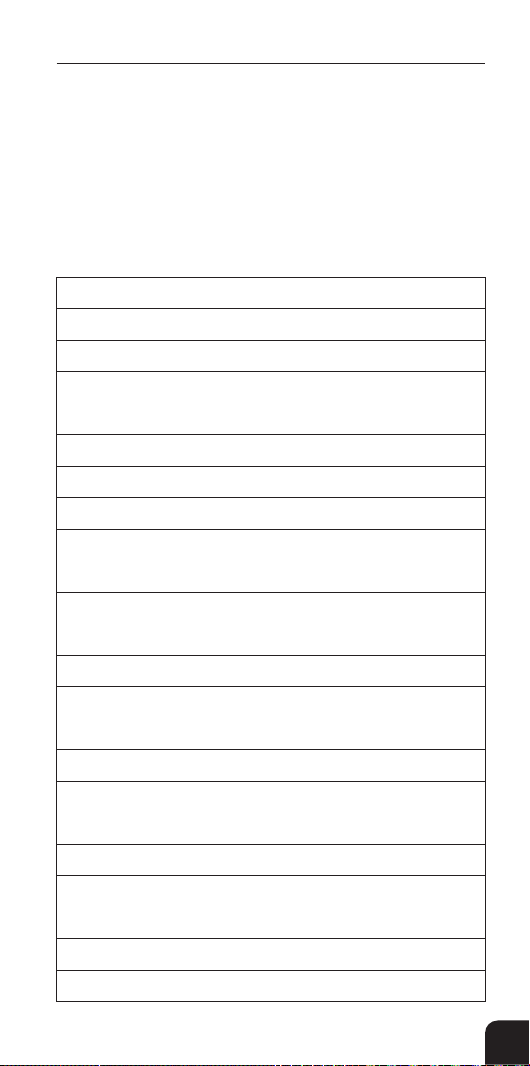
ESPECIFICACIONES
El Medidor de Decibelios TopTes TS-501B, también conocido como
"medidor de nivel de presión acústica (SPL)", es portátil y funciona con
pilas. Es fácil de usar al mismo tiempo que proporciona lecturas
precisas en una pantalla de 2,25”, midiendo el nivel de sonido de 30 a
130 dB con una precisión de +/-1,5 dB y una resolución de 0,1 dB.
Micrófono
Pantalla de Visualización
*Ponderación de Frecuencia
Rango de Medición del Sonido
Frecuencia
Tiempo de Respuesta
Ponderación de Tiempo
Rango de Medición de Temperatura
Precisión de Temperatura
Rango de Medición de Humedad
Precisión de Humedad
Condiciones de Funcionamiento
Condiciones de Almacenamiento
(remoción de las pilas)
Certicaciones del Producto
Dimensiones
Peso
(incluida las pilas)
Fuente de Poder
CE, RoHs
Condensador eléctrico de ½”
LCD
A, C
30~130dBA
30~130dBC
30~8,000Hz
0,5 segundos
Fast/Slow (125ms and 1s)
-20.0~60.0°C
140 x 55 x 25 mm
0.0%~99.9%RH
20%~80%: ±5.0% RH
Otros: ±6.0% RH
0~50°C, <80%RH
-10~50°C, <80%RH
150 g
3 pilas alcalinas de 1,5 V
0.0~45.0°C : ±1.0°C
Otros: ±1.5°C
58
2
9
10
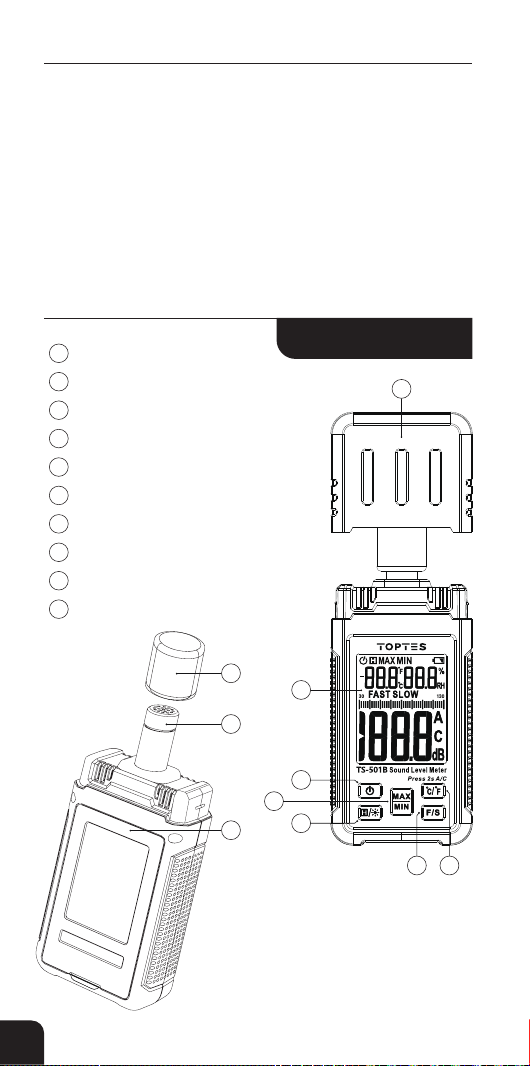
Detalles del producto
1
2
3
4
5
6
7
10
8
9
CUBIERTA DE PROTECCIÓN
PROTECTOR DE MICRÓFONO
PANTALLA LCD
BOTÓN DE ENCENDIDO
BOTÓN DE RETENCIÓN/RETROILUMINACIÓN
BOTÓN DE VALOR MAX/MIN
BOTÓN DE TEMPERATURA EN °C/°F
BOTÓN DE VELOCIDAD RÁPIDA/LENTA
MICRÓFONO
COMPARTIMIENTO DE PILAS
NOTA: Nunca intentes reparar o modicar el
instrumento. El desmontaje del producto por
otras razones que no sean reemplazar las
pilas puede causar daños que la garantía del
fabricante no cubrirá.
DESCRIPCIÓN GENERAL DEL
PRODUCTO
Los medidores de nivel de sonido ayudan a medir, monitorear y controlar
los niveles de ruido. Un medidor de decibelios es un instrumento de medi-
ción de presión acústica para mediciones estandarizadas que utiliza la
escala de decibelios. Por esta razón, el medidor de decibelios también se
conoce como medidor de nivel de presión acústica (SPL). Otros nombres
comunes incluyen medidor de ruido y medidor de nivel de sonido.
7
8
4
6
5
3
1
59
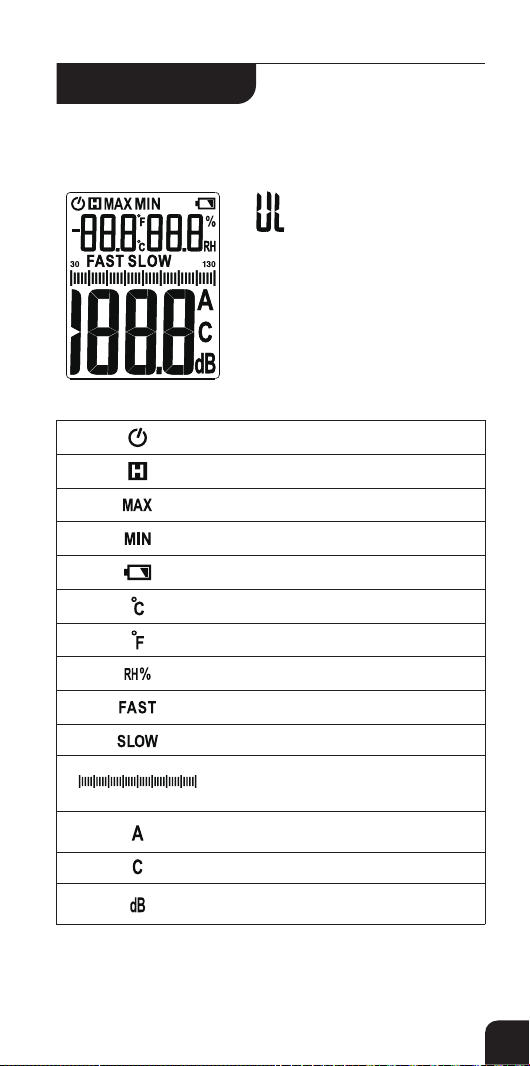
Descripción del Visor
* A frequency-weighting mode is for measuring the sound level within the human audible
range, while the test range is 30-130 dBA. This accounts for the relative loudness
perceived by the human ear. The reading value of the meter will fluctuate according to
different distances and sound sources.
Indicador de Apagado Automático
Indicador de Batería Baja
Indicador de valor máximo
Indicador de valor mínimo
Indicador de Retención de Datos
Indicador de Unidad de Centígrados
Indicador de Unidad de Fahrenheit
Indicador de Ponderación Lenta
Pantalla de barra analógica
(40 barras en total)
Indicador de Porcentaje de Humedad
Indicador de Ponderación Rápida
Ponderación de Frecuencia C
Ponderación de Frecuencia A
Valor dB Medido
Las siguientes definiciones describen los símbolos y valores que se
muestran en la pantalla del medidor de sonido.
El TS-501B tiene un rango de
medición de 30 a 130 decibelios
(dB). Cuando el nivel de sonido
medido cae por debajo de los 30
dB, la pantalla mostrará el
símbolo "UL".
60
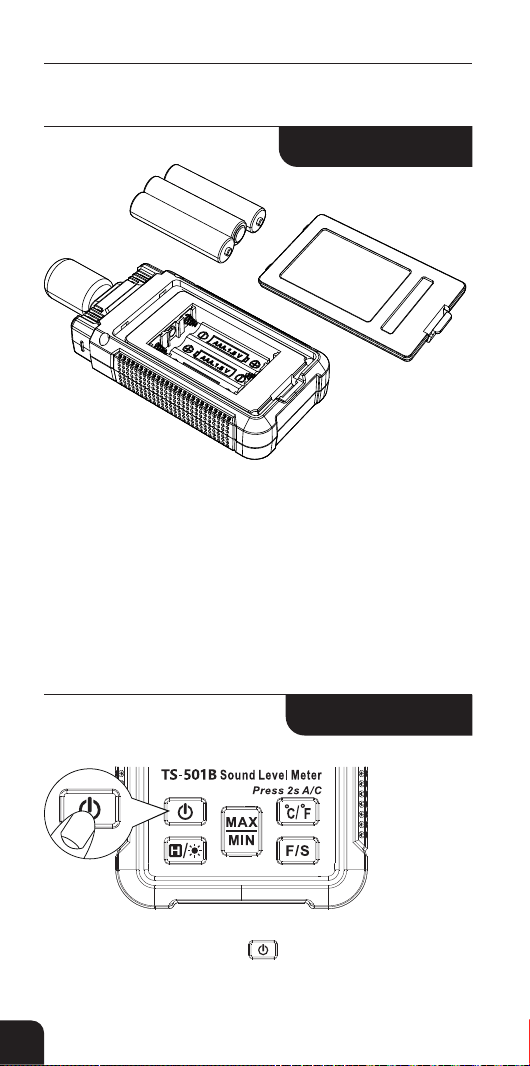
Instalación de la Pila
Encendido/Apagado
FUNCIONAMIENTO
Paso 1. Busque una pequeña ranura en la tapa de la batería.
Presione suavemente la ranura mientras empuja hacia la
parte inferior del producto para abrir la tapa de la batería.
Paso 2. Instala 3 pilas AAA (incluidas en la caja) en el compartimien-
to respectivo, de acuerdo con las polaridades positivas y
negativas establecidas en dicho compartimiento.
Paso 3. Alinee la muesca y encaje la tapa de la batería.
Pulsa el botón de encendido durante de 1 segundo para
encender o apagar el detector.
61
Realización de Pruebas
Retención de Datos
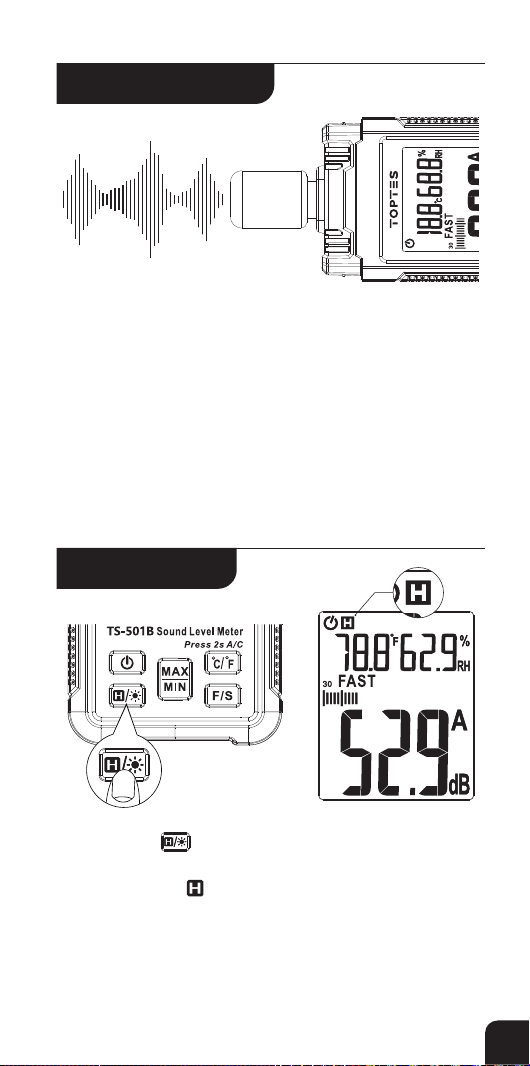
Mantén el medidor de nivel de sonido cómodamente en una mano
(lejos de tu cuerpo) o colócalo en un objeto plano para un monitoreo a
largo plazo. Apunta el micrófono en la dirección del ruido para realizar
una medición. El apuntar el micrófono hacia la fuente de ruido te dará
una lectura más alta que colocar el micrófono hacia ti.
NOTA: La posición del micrófono o dispositivo cambiará la lectura del
medidor de nivel de sonido
Pulsa el botón de retención de datos durante 1 segundo para
activar la función de retención de datos y capturar la lectura/datos de
medición. Si el icono aparece en la pantalla, pulsa el botón de nuevo
durante 1 segundo para volver a la función de medición estándar.
NOTA: El medidor de nivel de sonido tiene la función de mantener el
valor cuando está en los modos de valor MAX y MIN, por lo que no es
necesario presionar el botón de Retención nuevamente.
62
Retroiluminación
Valor MAX/MIN
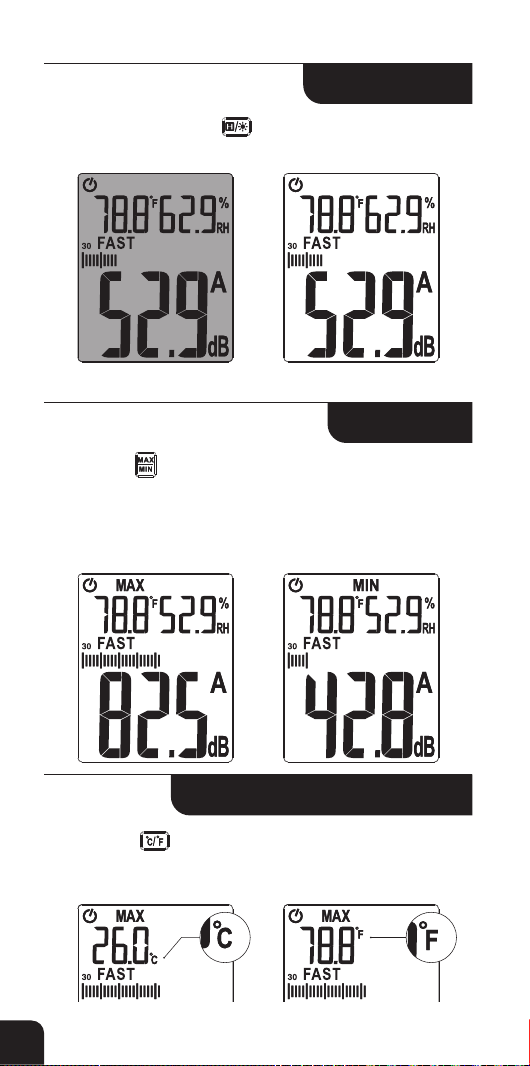
Mantén presionado el botón de retroiluminación durante > 2
segundos para encender/apagar la función de retroiluminación.
Pantalla sin retroiluminación
Pantalla con retroiluminación
Pulsa el botón durante 1 segundo para mostrar los valores máximo y
mínimo. Mientras esté en este modo, el instrumento solo actualizará la
lectura cuando se detecte una medición más alta/baja que la que se
muestra actualmente. Pulsa de nuevo el botón durante 2 segundos para
salir y reanudar el funcionamiento normal.
Switch de Unidad de Temperatura
Pulsa el botón la tecla para cambiar la unidad de temperatura a
°C o a °F. Una vez que se cambia la unidad de temperatura, se guardará
para la próxima vez que se use.
63
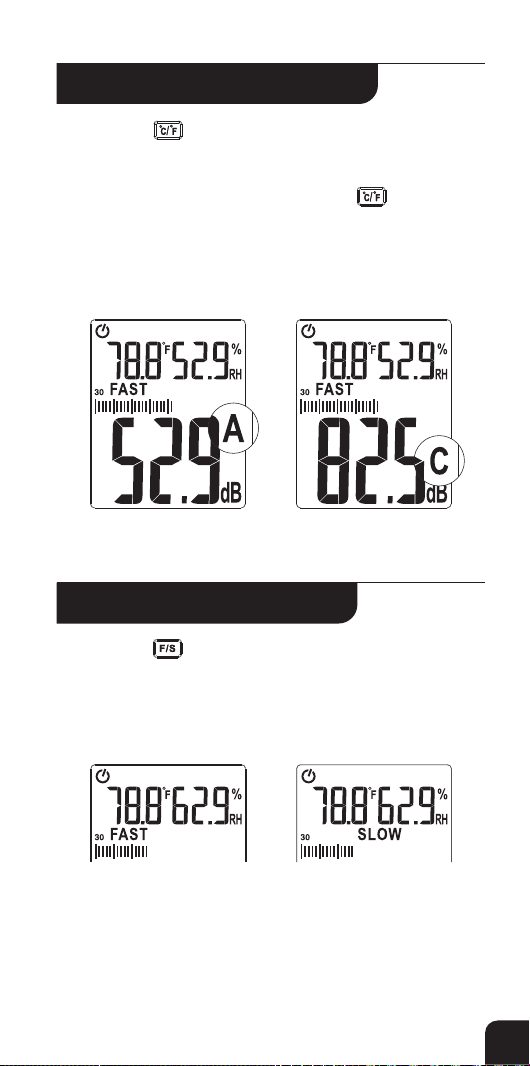
Tiempo Ponderado Rápido/Lento
Pulsa el botón para cambiar el tiempo de respuesta deseado. El
valor predeterminado es una respuesta RÁPIDA (FAST).
Si la fuente de sonido consiste en ráfagas cortas, congura la respues-
ta a RÁPIDO. Para medir el nivel de sonido medio, selecciona LENTO
(SLOW).
En FAST, la lectura se movería rápido para mostrar ruido variable
rápidamente. En SLOW, la lectura se amortiguaría para hacer que el
ruido sea más fácil de leer.
Puedes seleccionar FAST para la mayoría de las aplicaciones.
Lento corresponde a una c
onstante de tiempo de 1 segundo.
Rápido corresponde a una
constante de tiempo de 125 ms.
Ponderación de frecuencia de A/C
Pulsa el botón para seleccionar la ponderación de frecuencia. El
valor predeterminado es una ponderación de frecuencia; cuando se
enciende el medidor, aparece "A" en la pantalla. Ponderación "A" para un
nivel de ruido general. Mantén pulsado el botón para ajustar la
ponderación "C" con el n de medir el ruido de alto nivel. La ponderación
"C" es una ponderación estándar de las frecuencias audibles
comúnmente utilizadas para medir los niveles de presión acústica
máxima.
Si el nivel de ponderación "C" es mucho más alto que el nivel "A", habrá
una gran cantidad de ruido de baja frecuencia.
64
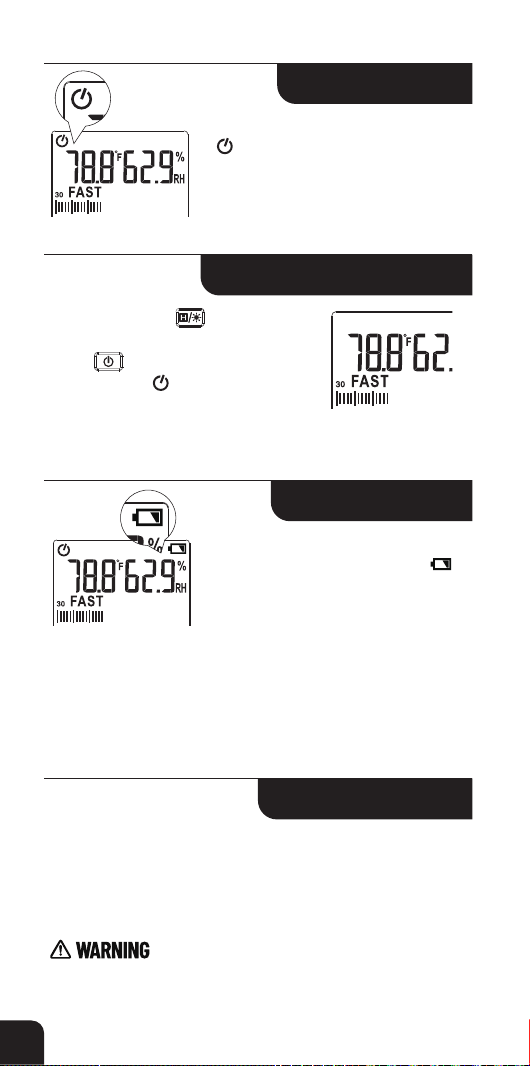
Reemplazo de las Pilas
Aviso de Batería Baja
Apagado Automático
Cancelar Apagado Automático
Retira las pilas cuando el detector no esté en uso durante un período prolongado
de tiempo.
Para reemplazar las pilas, gira el medidor y abre el compartimento
con un destornillador Phillips para retirar el tornillo. Coloca tres pilas
AAA nuevas en el compartimiento, teniendo en cuenta la polaridad
adecuada. Vuelve colocar la tapa y ajusta el tornillo.
NOTA: Las mediciones seguirán siendo válidas varias veces después de
que aparezca el icono por primera vez.
Cuando el voltaje de la pila es inferior al voltaje de funcionamiento
(aproximadamente 3,5 V), aparecerá el indicador de batería baja,
reemplaza la batería a tiempo.
Cuando el voltaje de la pila es inferior al
voltaje de funcionamiento, el icono
aparece en la parte superior derecha de la
pantalla LCD; aquí, ya es hora de
reemplazar por tres pilas nuevas de 1,5 V.
Cuando el medidor está encendido, el icono
aparece en la parte superior izquierda
de la pantalla LCD. La función de apagado
automático se activa de forma predetermina-
da. El medidor se apagará automáticamente
si no hay ninguna operación en 10 minutos.
NOTA: reinicia el medidor después del apagado para restaurar la
función de apagado automático.
Mantén pulsado el botón antes de
encender el medidor y, a continuación, pulsa el
botón de encendido para encender el
medidor. El icono NO aparecerá en la parte
superior izquierda de la pantalla LCD.
65

SEGURIDAD PARA EL USUARIO
El medidor de nivel de sonido TopTes TS-501B acumula datos de valor de
nivel de sonido para el dosímetro de ruido. Se puede utilizar como
monitor de ruido probando la intensidad del sonido y así detectar la
contaminación acústica, evitando el riesgo de daños auditivos.
Encuentra tus ordenanzas locales sobre niveles de ruido para medir las
pautas y mide los niveles de ruido a tu alrededor con el código local, y así
determinar si debes llamar a la policía o no.
• Humedad relativa: 20~80% RH non-condensing
• Temperatura de Funcionamiento: 0° to 50°C
Área de Operación
• No utilices el medidor en un ambiente cálido y húmedo.
• No almacene ni opere el instrumento en áreas altas.
• El viento que sopla a través del micrófono aumenta la medición del
ruido. Al medir el ruido exterior, utiliza el parabrisas suministrado en la
cabeza del micrófono.
• Por lo general, no es necesario calibrarlo, ya que ha sido calibrado en la
fábrica. Supongamos que el medidor no se ha utilizado durante un
periodo prolongado. En ese caso, requiere una fuente de sonido
estándar primario y un entorno acústico para calibrar. Recomendamos
que sea calibrado por un ingeniero profesional, un tercer centro de
pruebas o un laboratorio de buena reputación.
• No hagas vibrar o agites el medidor vigorosamente durante el uso para
evitar una señal falsa en la pantalla del instrumento.
• Las mediciones también dependerán de la distancia de la fuente de
sonido. Ofrecerá una lectura del nivel de sonido general alrededor del
usuario. En términos matemáticos, el nivel de sonido cae en 6 dB cada
vez que se duplica la distancia de la fuente.
• Al medir el sonido con un medidor, la posición del micrófono también
inuye en la lectura del nivel de sonido. El apuntar el micrófono hacia la
fuente de ruido te dará una lectura más alta que colocar el micrófono
hacia ti.avoid electrolyte leakage damaging the instrument.
Consejos
66

* Las estimaciones de tiempo en la columna "Respuesta típica" se basan en el tipo de
cambio NIOSH de 3 dB. Para obtener más información, visita el sitio web de NIOSH.
Fuentes comunes de niveles de ruido y decibelios
La intensidad del sonido se mide en decibelios (dB). Un susurro es de
unos 30 dB, una conversación normal es de unos 60 dB, y un motor de
motocicleta en funcionamiento es de unos 95 dB. El ruido por encima
de 70 dB durante un periodo prolongado puede dañar tu audición. El
ruido fuerte por encima de 120 dB puede causar daños inmediatos a tus
oídos.
¿Cómo sabemos que el nivel de sonido es seguro?
El efecto de los niveles de ruido más bajos durante largos períodos es
el mismo que los niveles de ruido más altos durante un período más
corto. Puedes utilizar el medidor de nivel de sonido (SLM) TopTes
TS-501B para medir el ruido a tu alrededor.
La siguiente tabla muestra los niveles de dB y cómo el ruido de fuentes
cotidianas puede afectar nuestra audición.
Nivel de Sonido
Sonidos y Ruidos
Cotidianos
Respiración normal
Tictac del Reloj
Susurro
Zumbido del Frigorífico
Conversación normal
Aire acondicionado
Lavadora, lavavajillas
Tráfico de la ciudad
(dentro del coche)
Cortadoras de césped y sopladoras
de hojas de combustible
Motocicleta
Acercándose al tren del metro,
bocina de coche a 5 metros
Nivel de volumen máximo para
dispositivos personales de escucha
Gritar o ladrar en el oído
80-85
Nivel Sonoro Medio
(medido en decibelios)
0
10
20
30
40
60
70
80-85
95
100
105-110
110 -120
Respuesta
Habitual
Silencio
Silencio
Susurro
Normal
Normal
Ruido
Ruido
Muy ruidoso
El daño a la audición es
posible después de
2 horas de exposición
El daño a la audición es
posible después de unos
50 minutos de exposición
La hipoacusia es posible
después de 15 minutos
La hipoacusia es posible
en menos de 5 minutos
La hipoacusia es posible
en menos de 2 minutos
67

La Agencia de Protección Ambiental de los Estados Unidos (EPA) y la
Organización Mundial de la Salud (OMS) recomiendan mantener los
ruidos ambientales por debajo de 70 dBA durante 24 horas (75 dBA
durante 8 horas) para evitar la pérdida de audición inducida por el
ruido.
La EPA también especicó límites para la interferencia y molestia
del habla en 55 dBA para actividades al aire libre y 45 dBA para
actividades en interiores.
La mayoría de las pérdidas auditivas inducidas por el ruido son el
resultado de daños acumulados por exposiciones repetidas al ruido
peligroso. Además, el riesgo de daños por ruido depende de varios
factores: qué tan fuerte es el ruido, cuánto tiempo se escucha, cuánto
descansan los oídos entre las exposiciones y la susceptibilidad al
ruido.
Qué tan fuerte te suena algo no es lo mismo que la intensidad real de
ese sonido. La intensidad del sonido es la cantidad de energía del
sonido en un espacio connado. La cual se mide en decibelios (dB). La
escala de decibelios es logarítmica, lo que signica que la sonoridad
no es directamente proporcional a la intensidad del sonido. En
cambio, la intensidad de un sonido crece muy rápido. Es decir que un
sonido a 20 dB es diez veces más intenso que un sonido a 10 dB.
Niveles medios de exposición al sonido necesarios para
alcanzar la dosis Diaria Máxima Permitida del 100%
8 horas
4 horas
2 horas
60 minutos
30 minutos
15 minutos
85 dB (A)
88 dB (A)
91 dB (A)
94 dB (A)
97 dB (A)
100 dB (A)
Tiempo para alcanzar
el 100% de la dosis de ruido
Nivel de exposición
por cada rel en NIOSH
68
Almacenamiento
• Retira las pilas cuando el medidor no se utilice durante un período
prolongado.
• No exponer a altas temperaturas o humedad.
• Después de un período de almacenamiento en condiciones extremas
que excedan los límites mencionados en la sección Especicaciones,
permite que el detector vuelva a las condiciones normales de
funcionamiento antes de su uso.
Limpieza
Asegúrate de que el detector esté apagado y limpia con un paño limpio,
seco y sin pelusas. No utilices nunca productos de limpieza o
disolventes.
MANTENIMIENTO
Eliminación / Reciclaje
No coloques el dispositivo ni sus accesorios en la basura. Deben
desecharse adecuadamente siguiendo las regulaciones locales.
69

© 2022 TopTes. All Rights Reserved.
Cualquier copia o reproducción no autorizada de este manual sin el
permiso previo por escrito de TOPTES está estrictamente prohibida.
O
TopTes proporciona un servicio posventa de 36 meses y soporte
técnico de por vida.
Para obtener más información sobre la cobertura de la garantía y la
información de reparación por garantía, visita nuestro sitio web
ocial:
www.toptestools.com/pages/warranty
SOPORTE
Garantía de Tres Años
70

目次
仕様
製品概要
製品詳細
ディスプレイに関する説明
操作方法
電池の取り付け
電源のオン/オフ
テスト
データホールド
バックライトのオン/オフ
オートパワーオフ
最大/最小値
温度単位切替
A/C周波数重み付け切替
ファスト/スロー時間荷重式
電池残量表示
電池交換
ユーザーの安全性
作業領域
ヒント
サウンドレベル
メンテナンス
クリーニング
ストレージ
廃棄 / リサイクル
サポート
保証
お問い合わせ先
この度はサウンドレベルメーターTS-501Bをお買い上げいただ
き、誠にありがとうございます。ご使用の前に以下の説明書をよくお
読みください。本取扱説明書に記載されている事項をお守りいただく
ことで、末永くご愛用いただけます。
73
75
80
83
72
84
71
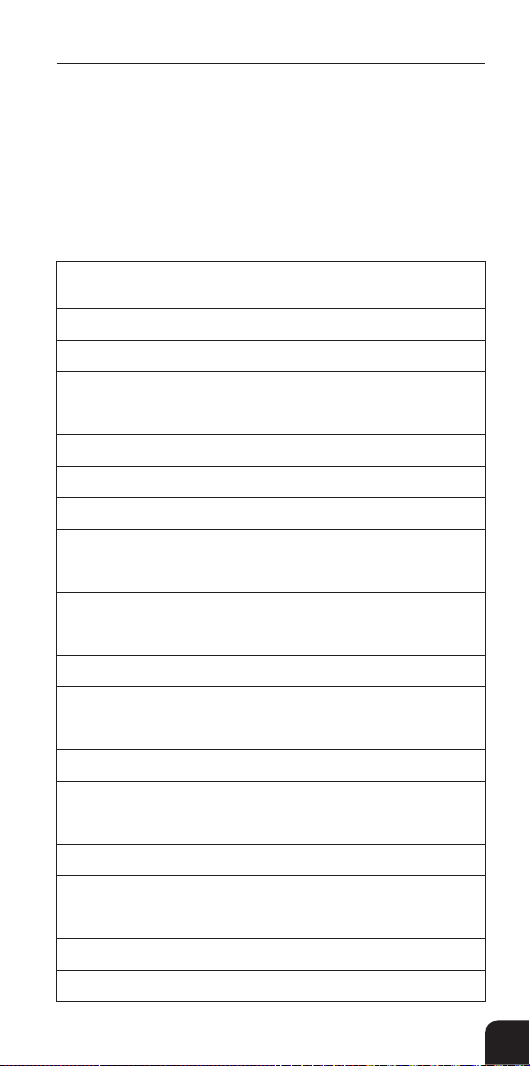
仕様
当社のTS-501Bデジベルメーターは「デジベル (SPL) メー
ター」として知られ、携帯可能で電池で動作します。2.25
インチのスクリーンで30〜130dBのサウンドレベルを
0.1dBの分解能で±1.5dBAの精度で正確に読み取り、簡単
にご使用いただけます。
マイクロホン
ディスプレイスクリーン
*周波数重み付け特性
音響測定範囲
周波数
応答時間
時間重み付け特性
温度測定範囲
温度精度
湿度測定範囲
湿度精度
操作条件
保存条件
(バッテリーを取り外す)
製品認証
寸法
重量 (バッテリーを含む)
電源
CE, RoHs
エレクトリックコ
ンデンサー 1/2インチ
LCD
A,C
30~130dBA
30~130dBC
30~8,000Hz
0.5秒
ファスト/スロー(125ms and 1s)
-20.0~60.0°C
140 x 55 x 25mm
0.0%~99.9%RH
20%~80%: ± 5.0% RH
その他: ± 6.0% RH
0~50°C, <80%RH
-10~50°C, <80%RH
150 g
1.5Vアルカリ乾電池×3
0.0~45.0°C: ±1.0°C
その他: ±1.5°C
72
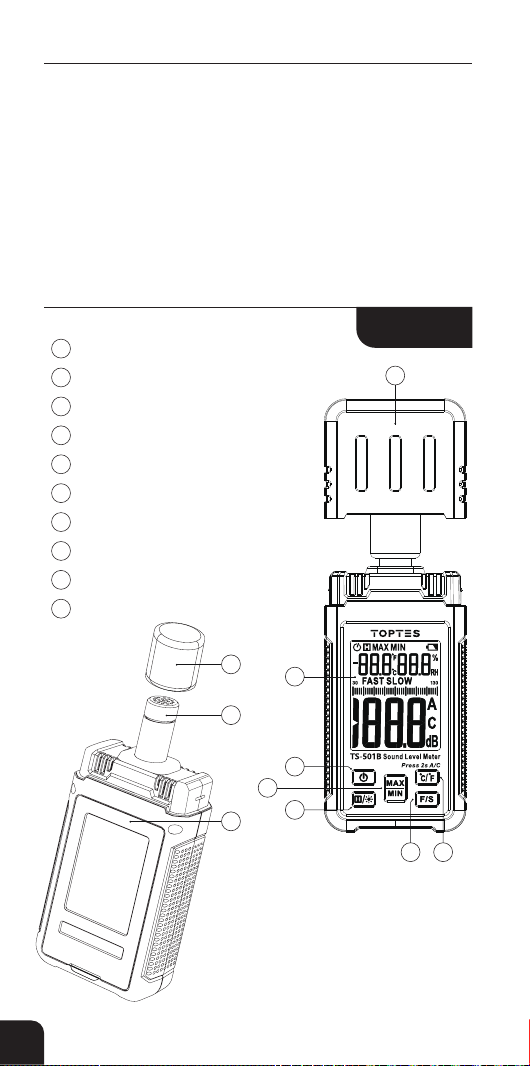
2
9
10
製品詳細
保護カバー
ウインドシールドボール
LCD表示画面
電源ボタン
ホールド/バックライトボタン
最大値・最小値ボタン
°C/°F 温度ボタン
高速/低速ボタン
マイク
電池室
1
2
3
4
5
6
7
8
9
10
注意:測定器の修理や改造は絶対
に行わないでください。電池交換
以外の理由で製品を分解すると、
メーカー保証の対象外となる破損
を引き起こす可能性があります。
製品概要
サウンドレベルメーターは、騒音レベルの測定、監視、制
御に役立ちます。デシベルメーターは、デシベルスケール
を使用した標準的な測定のための音圧測定器です。このた
め、デシベルメーターは音圧レベル(SPL)メーターとも
呼ばれます。その他の一般的な名称として、ノイズメータ
ー、サウンドレベルメーター等があります。
7
8
4
6
5
3
1
73
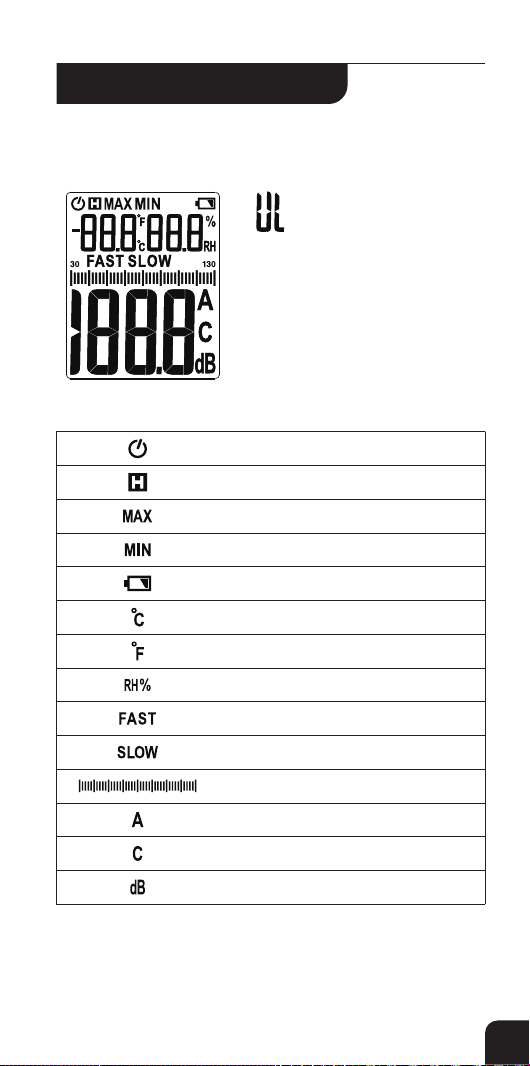
ディスプレイに関する説明
*周波数重み付けモードは、人間の可聴範囲内のサウンドレベルを測定
するためのもので、テスト範囲は30 ~ 130dBAです。これは、人間
の耳が知覚する相対的なラウドネスを説明します。メーターの読み取
り値は、距離や音源によって変動します。
オートパワーオフ表示
データホールド表示
最大値表示
最小値表示
電池残量低下表示
摂氏単位表示
華氏単位表示
スローウェイト表示
アナログバー表示(計40本)
湿度パーセンテージ表示
ファストウェイト表示
A周波数重み付け表示
C周波数重み付け表示
測定されたdB値
サウンドメーターの画面に表示される記号や数値に関し
て、以下のように定義しています。
TS-501Bは、30から130デ
シベル(dB)の測定範囲
を持っています。測定さ
れた音量が30dB以下に
なると、画面には「UL」と
いうシンボルが表示され
ます。
74
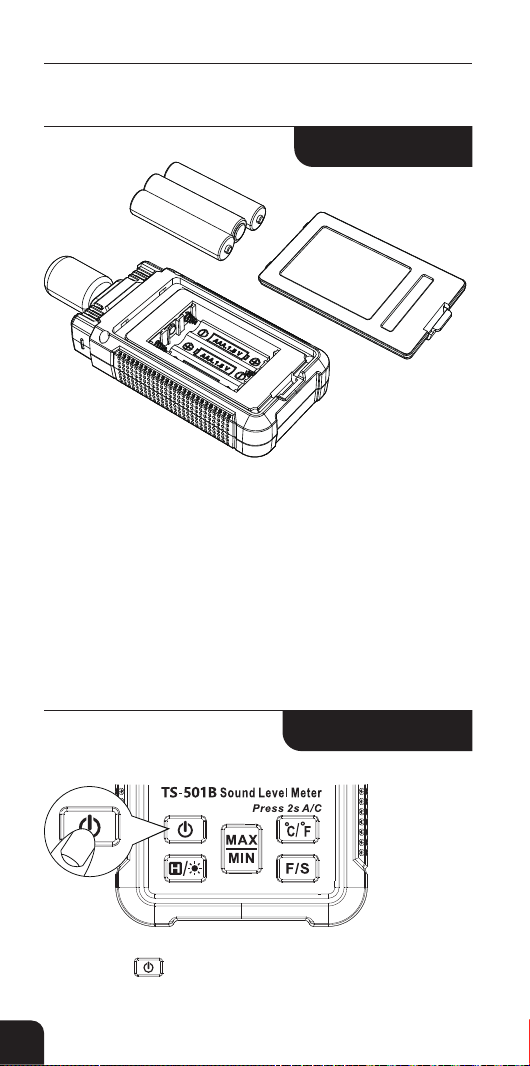
電池の取り付け
電源のオン/オフ
操作方法
ステップ 1. バッテリーカバーに小さな溝があるので、製品
の底に向けて軽く溝を押しながらバッテリーカ
バーを開けます。
ステップ 2. 電池ボックス内のプラスとマイナスのマークに
従って、単4形電池3本(同梱)をカートリッジ
にセットします。
ステップ 3. ノッチを合わせてバッテリーカバーをはめます。
電源ボタン を1秒押すと、テスターの電源がオン/オフ
に切り替わります。
75
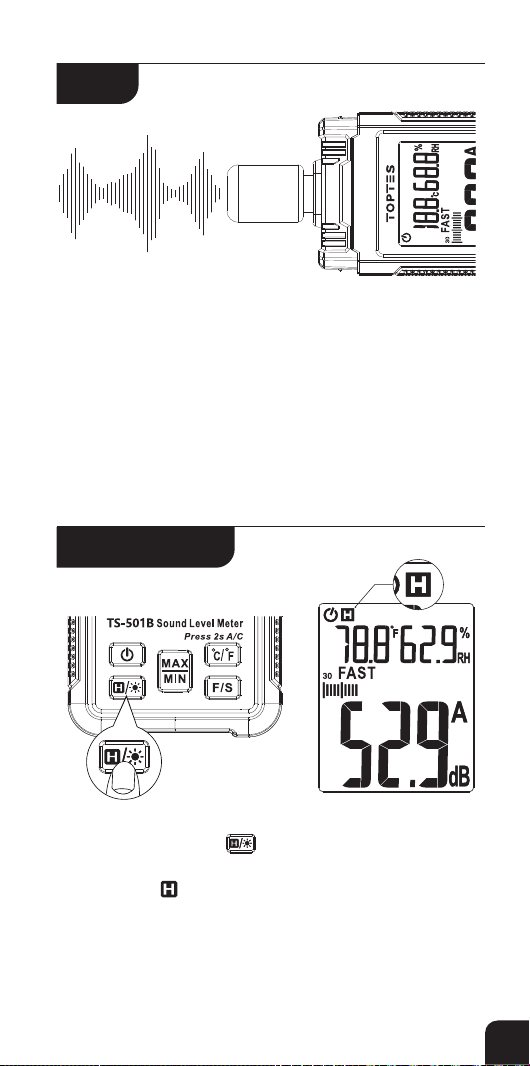
テスト
データホールド
サウンドレベルメーターを片手で楽に持ち(体から離す)、
あるいは平らな物の上に置いて、長期間のモニタリングを
行います。マイクロホンを騒音の方向に向け、測定を行い
ます。マイクロホンを騒音源の方向に向けると、自分の方
に向けるよりも高い測定値が得られます。
注: マイクロホンやデバイスの位置によって、サウンドレベ
ルメーターの読み取り値は変化します。
データホールドボタン を1秒間押すと、データホール
ド機能がオンになり、測定値/データを取り込むことができ
ます。画面に アイコンが表示された場合は、もう一度ボ
タンを1秒間押すと、標準の測定機能に戻ります。
注: サウンドレベルメーターは、最大・最小値モードでは値
を保持する機能があるので、再度ホールドボタンを押す必
要はありません。
76
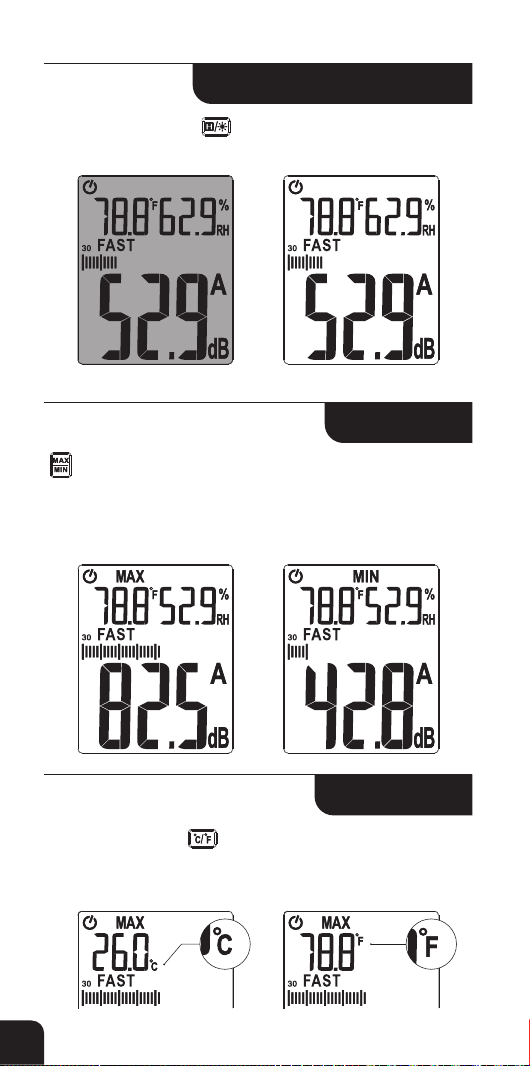
バックライトのない画面
バックライトのある画面
バックライトのオン/オフ
最大/最小値
バックライトボタン を2秒以上長押すと、バックライ
ト機能のオン/オフ切り替えを行います。
ボタンを 1 秒間押すと、最大値と最小値が表示されます。
このモードで は、現在表示されている値よりも高い/低い測定
値が検出された場合のみ、メーターの測定値が更新されます。
ボタンを再度2秒間押すと終了し、通常の動作に戻ります。
温度単位切替
°Cまたは °F ボタン を押して、温度単位を °C または °F
に切り替えます。一度、温度単位を変更すると、次回使用
時に保存されます。
77
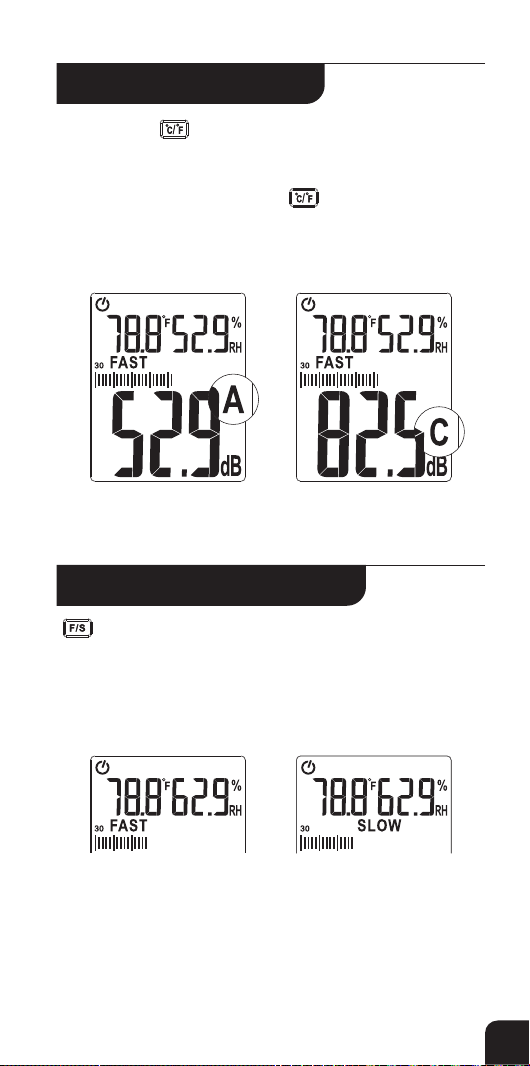
Slow は1秒
の時定数に相当します
Fast は125ms
の時定数に相当します
ファスト/スロー 時間荷重式
ボタンを押して、希望の応答時間を切り替えます。デ
フォルトはファストレスポンスです。
音源が短いバーストで構成されている場合は、ファスト
“FAST” に設定します。平均的なサウンドレベルを測定す
る場合は、スロー “SLOW” を選択します。
FAST では、読み取り値が高速で移動し、変化するノイズ
を素早く表示します。スローでは、読みはノイズを読みや
すくするために減衰されます。
大半の用途ではファストを選択することになります。
A/C周波数重み付け切替
ボタンを押す をクリックして周波数加重を選択します。
デフォルトは A 度数加重です。 メーターをオンにすると、
ディスプレイに “A” が表示されます。“A” 一般的な騒音レ
ベルの重み付け。 ボタン長押し 高レベルのノイズを測
定するための “C” 重み付けを設定します。“C” 重み付けは、
ピーク音圧レベルの測定に一般的に使用される可聴周波数
の標準的な重み付けです。
“C” 加重レベルが “A” 加重レベルよりはるかに高い場合、
大量の低周波ノイズが発生します。
78
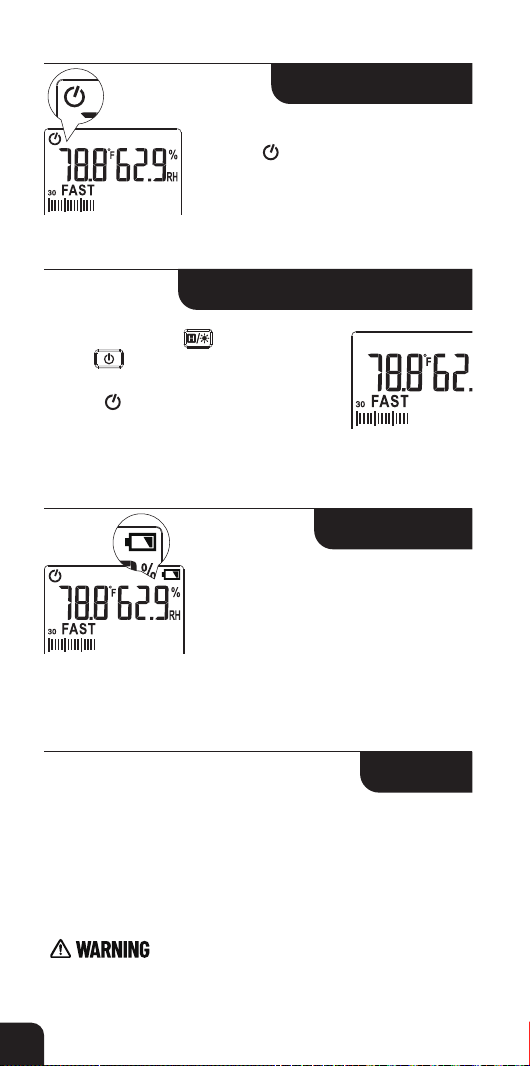
電池交換
電池残量表示
オートパワーオフ
自動シャットダウンの解除
テスターを長期間使用しない場合は、電池を取り外してく
ださい。 高温多湿にさらさないでください。
電池を交換するには、メーターを裏返し、プラスドライバ
ーを使用してネジを取り外して電池コンパートメントを開
きます。 適切な極性に注意して、3 つの新しい AAA 電池を
カートリッジに取り付けます。 電池カバーを元に戻し、ネ
ジを締めます。
電池の電圧が使用電圧より低くなると
、液晶ディスプレイの右上に アイコン
が表示されます。(ただし、このアイコ
ンが表示されてから数時間は測定が有
効です。
電圧が作動電圧(約3.5V)以下になると、ローバッテリー表
示が表示されます。早めにバッテリーを交換してください。
メーターの電源を入れると、液晶画面
の左上に アイコンが表示されます。
初期設定では、オートパワーオフ機能
がオンになっています。10分以内に操
作がない場合、メーターは自動的にシ
ャットダウンします。
注: シャットダウン後、メーターを再起動すると、自動シャ
ットダウン機能が復活します。
電源を入れる前に タンを長押
しし、 ボタンを押してメーター
の電源を入れます。すると、LCDの
左上に アイコンが表示されなく
なります。
79

ユーザーの安全性
サウンドレベルメーターTS-501Bは、騒音値データを蓄積
し、騒音計として使用することができます。音の強さを測
定して騒音公害を発見し、聴覚障害のリスクを回避するノ
イズモニターとして使用することができます。騒音レベル
を測定するためのガイドラインとして、地域の条例を検索
し、警察を呼ぶべきかどうかを判断するために、地域の条
例で周りの騒音レベルを測定してください。
• 相対湿度: 20~80% 非凝縮性
• 作動温度: 0° から 50°C
作業領域
• 高温、多湿の環境でメーターを使用しないでください。
• 高所で装置を保管または操作しないでください。
• マイクロホンを横切る風は、ノイズ測定を増加させます。屋
外で騒音を測定する場合は、付属のウィンドスクリーンを
マイクロホンのヘッドに装着してご使用ください。
• 通常、工場でキャリブレーションされているため、キャリブ
レーションの必要はありません。長期間使用しない場合、
キャリブレーションを行うためには一次標準音源と音響環
境が必要です。専門の技術者、第三の試験場、または信頼
できる研究所で行うことをお勧めします。
• 測定器の画面上に誤った信号が表示されるのを防ぐため、使
用中は振動を与えたり、激しく揺すったりしないでください。
• 測定値は、ソースからの距離にも依存します。ユーザーの周
囲の全体的なサウンドレベルの読み取り値を配信します。
数学的な用語で言うと、音源からの距離が2倍になるたびに
サウンドレベルが6dBずつ下がります。
• サウンドレベルメーターで音を測定する場合、マイクロホン
の位置もサウンドレベルの測定値に影響します。マイクを
音源の方に向けると、自分の方に向けるよりも高い測定値
が得られます。
ヒント
80

平均音圧レベル
(デシベルで測定)
*典型的な反応欄の推定時間は、NIOSH交換率3dBに基づくものです。
詳しくは、NIOSHのウェブサイトをご覧ください。
一般的な騒音源とデシベルレベル?
音はデシベル(dB)単位で測定されます。目安として、さ
さやき声は約30dB、通常の会話は約60dB、オートバイのエ
ンジン音は約95dBとなります。70dB以上の騒音が長時間続
くと、聴力に損傷を与える可能性があります。120dBを超
える大きな音は、即座に耳に害を及ぼす可能性があります。
どのようにして安全な騒音レベルが分かりますか?
長期間にわたる低度の騒音レベルの影響は、短期間にわた
る大きな騒音レベルの影響と同じです。当社のサウンドレ
ベルメーター(SLM)TS-501Bを使用することで、周りの騒
音を測定することができます。
下の表は、dBレベルと日常的な音源からの騒音が聴力に与
える影響を示しています。
サウンドレベル
日常的な
音と騒音
聞こえる限り最も小さな音
通常の呼吸音
時計の音
囁き声
冷蔵庫の音
普通の会話、エアコン
洗濯機、食器洗い機
代表的
な反応
無音
静寂な音
静寂な音
囁き声
普通
普通
騒音
0
10
20
30
40
60
70
80-85
80-85
95
100
105-110
110 -120
都市交通(車内)
ガス式芝刈り機、
リーフブロワー
モーターサイクル
地下鉄の列車の接近、
16フィート(5メートル)
の距離での車のクラクション
パーソナルリスニング
機器の最大音量レベル
耳元で大声を出す、
吠える
非常にうるさい
2時間鳴り響くと聴覚に
損傷を与える可能性あり
50分程度聞き続けると
聴覚に損傷を与える
15分後に聴力
喪失の可能性あり
5分以内に聴力喪
失の可能性あり
2分以内に難聴にな
る可能性あり
81

米国環境保護庁(EPA)と世界保健機関(WHO)は、騒音によ
る聴覚障害を防ぐために、環境騒音を24時間で70 dBA(8時
間で75 dBA)未満に維持することを推奨しています。
また、EPAは、会話妨害と迷惑行為に関する制限値を、屋
外活動では55dBA、屋内活動では45dBAと定めています。
騒音性難聴の多くは、有害な騒音に繰り返しさらされるこ
とによるダメージの蓄積によって生じます。さらに、騒音
障害のリスクは、騒音の大きさ、騒音にさらされている時
間、騒音にさらされている間に耳を休める時間、そして騒
音に対する感受性など、いくつかの要因に左右されます。
音の大きさと実際の音の強さは同じではありません。音の
強さとは、限られた空間における音のエネルギー量のこと
です。音の強さは、デシベル(dB)という単位で表されます。
デシベルスケールは対数であり、音の大きさは音の強さに
正比例しません。その代わり、音の強さは非常に速く増加
します。つまり、20 dBの音は10 dBの音の10倍の強さとな
ります。
一日の最大許容量を100%とするために必要
な平均音響暴露レベ
8 時間
4 時間
2 時間
60 分
30 分
15 分
85 dB (A)
88 dB (A)
91 dB (A)
94 dB (A)
97 dB (A)
100 dB (A)
100%に達するまでの時間
NIOSH RELによる暴露レベル
82
ストレージ
• 長期間使用しない場合は、電池を取り出してください。
• 高温多湿の場所に保管しないでください。
• 仕様に記載された制限を超える過酷な条件で保管した場合
は、通常の使用状態に戻してから使用してください。
クリーニング
テスターの電源がオフになっていることを確認し、清潔な
乾いた糸くずの出ない布で拭いてください。強力な洗浄剤
や溶剤は使用しないでください。
メンテナンス
廃棄・リサイクル
機器や付属品をゴミ箱に捨てないでください。地域の規制
に従って適切に廃棄する必要があります。
83

© 2022 TopTes. All Rights Reserved.
本書の内容について、当社に無断で複写、複製することは堅く禁じら
れています。
あるいは
本製品は、36ヶ月のアフターサービスと生涯テクニカルサ
ポートを提供します。
保証範囲と保証修理情報の詳細については、当社の公式ウ
ェブサイトをご覧ください:
www.toptestools.com/pages/warranty
[email protected] までご連絡ください。
サポート
3年保証
84
FR


TS-501 B
Sound Level Meter