![PWM 908 [EL DP-1] photo](https://manualsfile.com/images/appliances/k5/bl/k5blwsg0njp_0_1756265522269_thumbnail.webp)
Operating and Installation
Instructions
Washing Machine
Always read the operating instructions before setting up, installing,
and commissioning the machine. This prevents both personal injury
and damage to the appliance.
en-US M.-Nr. 12 805 440

Contents
2
Caring for the environment......................................................................................... 6
IMPORTANT SAFETY INSTRUCTIONS................................................................... 7
Operating the washing machine................................................................................ 11
Control panel...................................................................................................................
11
Sensor controls and touch display with sensor controls..........................................
12
Main menu ......................................................................................................................
12
Examples of how to operate the appliance ................................................................
13
Operating a laundromat machine ................................................................................
15
Initial commissioning ................................................................................................... 16
Setting the display brightness......................................................................................
17
Setting the date..............................................................................................................
17
1. Preparing the laundry ............................................................................................... 21
2. Loading the washing machine ............................................................................... 22
3. Selecting a program................................................................................................. 23
4. Selecting program settings.................................................................................... 24
5. Adding detergent...................................................................................................... 25
Adding fabric softener or liquid starch separately ............................................... 26
Adding starch separately ......................................................................................... 26
6. Starting a program – end of a program................................................................ 29
Timer................................................................................................................................ 30
Program chart ................................................................................................................ 31
Extra options .................................................................................................................. 49
Pre-wash...................................................................................................................
49
Pre-rinse ...................................................................................................................
49
Rinse plus.................................................................................................................
49
Soak...........................................................................................................................
49
Intensive.....................................................................................................................
49
Water plus ................................................................................................................
49
SoftSteam..................................................................................................................
49
Rinse hold.................................................................................................................
49
Starch stop ...............................................................................................................
49
Special features in the program sequence.............................................................. 50
Spinning...........................................................................................................................
50
Anti-crease ......................................................................................................................
50
Changing the program sequence .............................................................................. 51
Changing a program.......................................................................................................
51
Canceling a program......................................................................................................
51
Adding or removing laundry..........................................................................................
51
Cleaning and care ......................................................................................................... 52
Cleaning the housing and control panel......................................................................
52
Cleaning the detergent dispenser drawer ..................................................................
52
Cleaning the drum, suds container, and drainage system........................................
54
Cleaning the sealing ring ...............................................................................................
54

Contents
3
Cleaning the water intake filters...................................................................................
55
Frequently asked questions....................................................................................... 56
The wash program will not start...................................................................................
56
Program cancellation and error message ...................................................................
57
A fault message appears in the display
1
......................................................................
58
Unsatisfactory wash results .........................................................................................
59
General problems with the washing machine............................................................
60
The door will not open ...................................................................................................
62
Opening the door in the event of a blocked drain outlet and/or power outage ....
63
Technical Service .......................................................................................................... 65
Contact in the event of a fault......................................................................................
65
Optional accessories .....................................................................................................
65
Maintenance ...................................................................................................................
65
Installation and connection ........................................................................................ 67
Front view........................................................................................................................
67
Rear view .........................................................................................................................
68
Installation locations......................................................................................................
69
Installation notes............................................................................................................
69
Transporting the washing machine to its installation site ........................................
70
Installation surface.........................................................................................................
71
Removing the shipping struts.......................................................................................
71
Installing the shipping struts ........................................................................................
73
Leveling the washing machine......................................................................................
74
Holding bracket for toe-kick ................................................................................... 75
External control equipment...........................................................................................
76
Payment system ....................................................................................................... 76
Water connection...........................................................................................................
77
Cold water connection ............................................................................................ 77
Hot-water connection*............................................................................................ 78
Water drainage................................................................................................................
78
Drain pump................................................................................................................ 78
Electrical connection .....................................................................................................
79
Technical data................................................................................................................ 80
Supervisor level............................................................................................................. 81
Opening the Supervisor level........................................................................................
81
Code-based access .......................................................................................................
81
Changing the PIN code .................................................................................................
81
Closing the settings menu ............................................................................................
81

Contents
4
Operation/display...........................................................................................................
82
Language.................................................................................................................... 82
Language menu......................................................................................................... 82
Set languages............................................................................................................ 82
Display brightness .................................................................................................... 82
Clock display ............................................................................................................. 83
Date.............................................................................................................................. 83
Volume ....................................................................................................................... 83
Visibility parameters................................................................................................. 83
Display off status...................................................................................................... 84
Machine off status.................................................................................................... 84
Delay start ................................................................................................................. 84
Memory...................................................................................................................... 84
Temperature unit....................................................................................................... 85
Weight unit ................................................................................................................ 85
Logo ............................................................................................................................ 85
Supervisor code ........................................................................................................ 85
Program selection ..........................................................................................................
85
Controls...................................................................................................................... 85
Program packages .................................................................................................... 86
Favorite programs..................................................................................................... 86
Special programs...................................................................................................... 87
Sort programs ........................................................................................................... 87
Program color allocation.......................................................................................... 87
Hygiene ...................................................................................................................... 87
Expert code................................................................................................................ 87
Process technology........................................................................................................
88
Anti-crease ................................................................................................................ 88
Water level Min. iron ................................................................................................ 88
Water level Cottons.................................................................................................. 88
Pre-wash temp Cottons .......................................................................................... 88
Wash time.................................................................................................................. 88
Pre-rinse Cottons ..................................................................................................... 89
Pre-rinse Minimum iron........................................................................................... 89
Pre-wash Cotton/M-iron......................................................................................... 89
Cottons rinses........................................................................................................... 89
Minimum iron rinses ................................................................................................ 89
Disinfection rinse...................................................................................................... 89
Auto load control....................................................................................................... 89
Controlled energy cons............................................................................................ 90
Service .............................................................................................................................
90
Clean drain pump (LP) ............................................................................................. 90
Service interval.......................................................................................................... 90

Contents
5
External applications......................................................................................................
91
Empty sensor ............................................................................................................ 91
Early warning counter............................................................................................... 91
Automatic dispensing .............................................................................................. 91
Adjustment value dispensing 1–6 .......................................................................... 91
Peak load signal ........................................................................................................ 92
Peak load prevention................................................................................................ 92
Availability of Miele digital products...................................................................... 92
Select KOM module................................................................................................. 92
Area of application.................................................................................................... 92
Wi-Fi/LAN.................................................................................................................. 93
Network time............................................................................................................. 93
Remote....................................................................................................................... 93
RemoteUpdate.......................................................................................................... 94
SmartGrid .................................................................................................................. 94
Machine parameters......................................................................................................
95
Suds cooling .............................................................................................................. 95
Water intake .............................................................................................................. 95
Temperature reduction............................................................................................. 96
Low water pressure .................................................................................................. 96
CapDosing ................................................................................................................. 96
Legal Information...................................................................................................... 96
Payment device ..............................................................................................................
97
Settings for payment systems................................................................................ 97
Payment system lock ............................................................................................... 97
Program abort ........................................................................................................... 98
Feedback sig. to pay system ................................................................................... 98
FOC programs........................................................................................................... 98
Clear paid signal........................................................................................................ 98
Debounce time.......................................................................................................... 98
Caring for the environment
6
Disposal of the packing material
The cardboard box and packing materi-
als protect the appliance during ship-
ping. They have been designed to be
biodegradable and recyclable.
Ensure that any plastic wrappings, bags,
etc. are disposed of safely and kept out
of the reach of children. Danger of suffo-
cation!
Disposal of your old appliance
Electrical and electronic appliances con-
tain valuable materials. They also con-
tain certain substances, compounds
and components which were essential
for the proper functioning and safe use
of the equipment. Handling these mate-
rials improperly by disposing of them in
your household waste can be harmful to
your health and the environment. There-
fore, please do not dispose of your old
appliance with regular household waste
and follow local regulations on proper
disposal.
Consult with local authorities, dealers or
Miele in order to dispose of and recycle
electrical and electronic appliances.
Miele assumes no responsibility for
deleting any personal data left on the
appliance being disposed. Please en-
sure that your old appliance is kept
away from children until removal. Ob-
serve safety requirements for appli-
ances that may tip over or pose an en-
trapment hazard.

IMPORTANT SAFETY INSTRUCTIONS
7
WARNING
To reduce the risk of fire, electric shock or injury to persons while
using your appliance follow basic safety precautions, including the
following:
Read all instructions before using the appliance.
GROUNDING INSTRUCTIONS
This appliance must be grounded. In the event of a malfunction or
breakdown, grounding will reduce the risk of electric shock by provid-
ing a path of least resistance for electric current. This appliance is
equipped with a cord having an equipmentgrounding conductor and a
grounding plug. The plug must be plugged into an appropriate outlet
that is properly installed and grounded in accordance with all local
codes and ordinances.
WARNING - Improper connection of the equipment-grounding
conductor may result in a risk of electric shock. Check with a quali-
fied electrician if you are in doubt as to whether the appliance is
properly grounded.
Do not modify the plug provided with the appliance - if it will not fit
the outlet, have a proper outlet installed by a qualified electrician.
Do not install or use a washer with visible damage.
Do not install or store this appliance where it will be exposed to
the weather.
Do not install your washing machine where temperatures below
freezing may occur. Frozen hoses may burst under pressure. The reli-
ability of the electronic control unit may be impaired at temperatures
below freezing.
Before connecting the machine, ensure that the connection data
on the data plate (fusing, voltage and frequency) match the mains
electrical supply. If in doubt contact an electrician.
Do not use an extension cord to connect this appliance to the
power supply. Extension cords do not guarantee the required safety
of the appliance (e.g. danger of overheating).
This appliance is not designed for maritime use or for use in mobile
installations such as recreational vehicles or aircraft. However, under
certain conditions it may be possible for an installation in these appli-
cations. Please contact the Miele Technical Service Dept. with spe-
cific requirements.

IMPORTANT SAFETY INSTRUCTIONS
8
Do not repair or replace any part of the appliance or attempt any
servicing unless specifically recommended in these operating in-
structions.
If the power cord is damaged it must only be replaced by a Miele
Service technician with a genuine Miele power cord.
Under certain conditions, hydrogen gas may be produced in a hot
water system that has not been used for 2 weeks or more. HYDRO-
GEN GAS IS EXPLOSIVE. If the hot water system has not been used
for such a period, turn on all hot water faucets and let the water flow
from each for several minutes before using the washing machine.
This will release any built-up hydrogen gas. Do not smoke or use an
open flame during this time, the gas is flammable.
Before the appliance is removed for service or discarded, remove
the door.
Use
Do not allow children to play on or in the appliance. Close supervi-
sion is necessary when the appliance is used near children.
The drum door glass will be hot when washing at very high temper-
atures. Do not touch the glass. Danger of burns! Keep children away
from the washer when in use.
Only use the washing machine to wash items which are specified
by the manufacturer to be machine washable on the fabric care label.
Any other applications may be dangerous.
Do not wash articles that have been previously cleaned, washed,
soaked or spotted with gasoline, dry-cleaning solvents or other
flammable substances. These articles give off vapors that could ignite
or explode. Do not add these items to the wash load.
Do not add gasoline, dry-cleaning solvents, or other flammable or
explosive substances to the wash water. These substances give off
vapors which could ignite or explode.
Do not use cleaning solvents on or near the machine or the con-
trols. Contact with cleaning solvents will damage the surface..
Do not reach into the appliance if the drum is moving.
Do not tamper with the controls.

IMPORTANT SAFETY INSTRUCTIONS
9
SAVE THESE INSTRUCTIONS
Miele Tumble Dryers and Miele Washing Machines can be in-
stalled as a washer-dryer stack. This requires a Miele Washer-Dryer
Stacking Kit which can be purchased separately. Please ensure that
the washer-dryer stacking kit is suitable for the Miele Tumble Dryer
and the Miele Washing Machine.
If installing the machine on a Miele Plinth (available as an optional
accessory), please make sure you order the correct one for this wash-
ing machine.
If detergent has come into contact with the eyes, rinse out imme-
diately with plenty of lukewarm water. If detergent has accidentally
been ingested, seek medical advice immediately. People with dam-
aged or sensitive skin should avoid contact with detergent.
When adding or removing laundry during the main wash, your skin
may come into contact with detergent, particularly if the detergent is
dispensed externally. Take care when placing your hands inside the
drum. If suds have come into contact with the skin, rinse off immedi-
ately with lukewarm water.
This washing machine is supplied with a special lamp to cope with
particular conditions (e.g., temperature, moisture, chemical resis-
tance, abrasion resistance, and vibration). This special lamp must
only be used for the purpose for which it is intended. It is not suitable
for room lighting. Replacement lamps should only be installed by a
Miele authorized technician or by Miele Technical Service.
The maximum dry laundry weight is 19.8lb (9kg). See the “Pro-
gram chart” for the maximum recommended loads for individual pro-
grams.
FCC Declaration of Conformity
These devices comply with FCC Rules Part15. This equipment has
been tested and found to be in compliance with the limits for a
ClassB digital device, pursuant to Part15 of the FCC Rules of Opera-
tion and is subject to the following conditions:
These devices may not cause harmful interference.
These devices must accept any interference received, including inter-
ference that may cause undesired operation.

IMPORTANT SAFETY INSTRUCTIONS
10
FCC Radiation Exposure Statement
This equipment complies with FCC radiation exposure limits set
forth for an uncontrolled environment. This equipment should be in-
stalled and operated with minimum distance 8“ (20cm) between the
radiator and your body.
Industry Canada Statement
This digital apparatus does not exceed the ClassB limits for Radio
Noise Emissions from digital apparatus set out in the Radio Interfer-
ence Regulations of the Canadian Department of Communications.
Complies with Canadian ICES-003 ClassB specifications.
Operating the washing machine
11
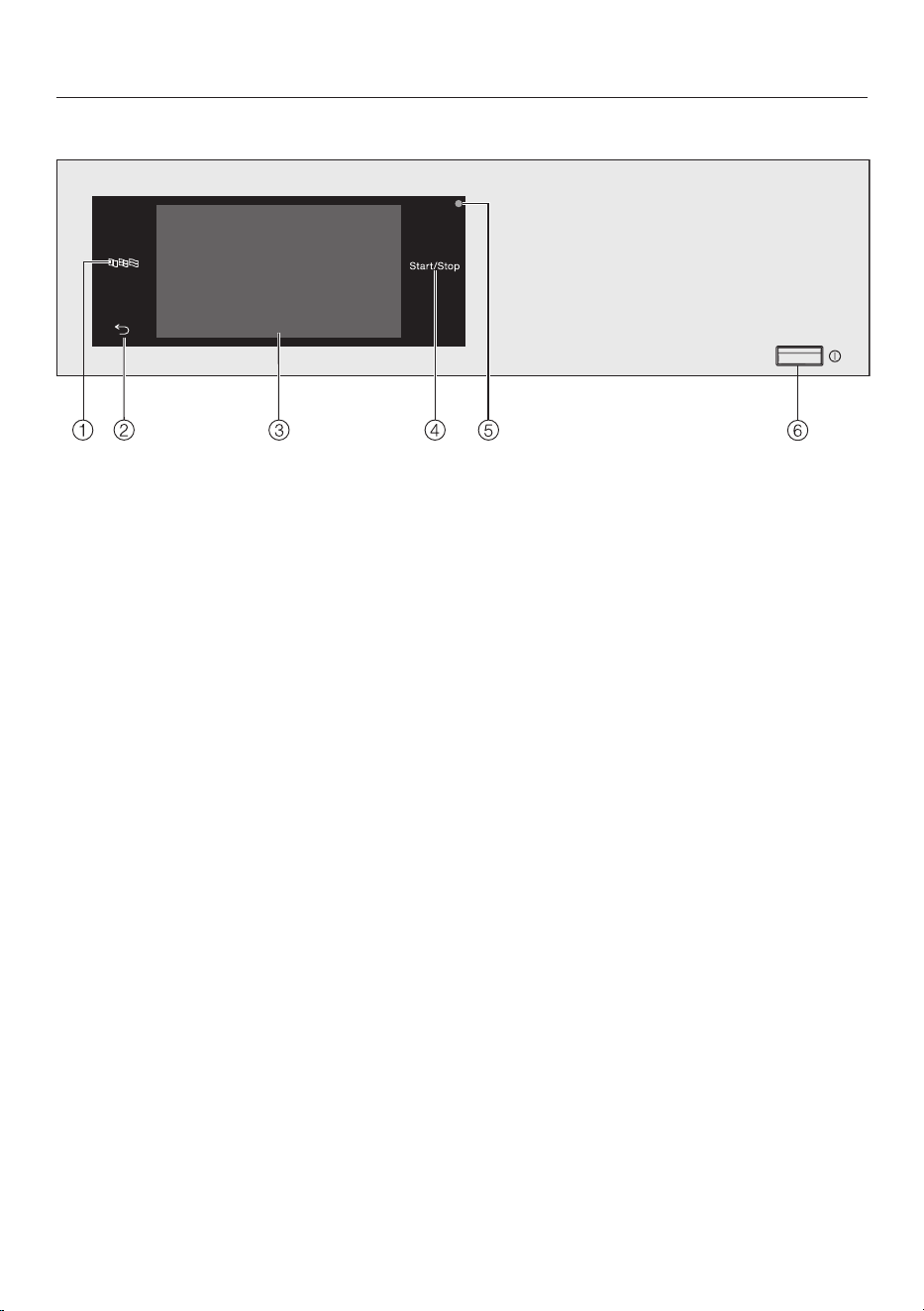
Control panel
a
Language sensor control
For selecting the current user lan-
guage.
The operating language is displayed
again at the end of the program.
b
Back sensor control
Takes you back one level in a menu.
c
Touch display
d
Sensor control Start/Stop
For starting the program selected and
canceling a program once it has
started. The program selected can be
started as soon as the sensor control
starts flashing.
e
Optical interface
For Technical Service.
f
button
For switching the washing machine
on and off. To save energy, the wash-
ing machine will switch off automati-
cally. It is switched off 15minutes af-
ter the end of the program/anti-
crease phase, or after being switched
on if no further selection is made.

Operating the washing machine
12
Sensor controls and touch dis-
play with sensor controls
The,, andStart/Stopsensor
controls and the sensor controls in the
display react to finger-tip contact. Every
touch of a sensor control is confirmed
with an audible keypad tone. You can
adjust the volume of the keypad tone or
switch it off (see “Supervisor level”).
The control panel with sensor con-
trols and the touch display can be
scratched by pointed or sharp ob-
jects, e.g., pens.
Only touch the display with your fin-
gers.
Main menu
After switching on the washing ma-
chine, the main menu will appear in the
display.
You can access all the important sub-
menus from the main menu.
Touch the sensor control at any time
to return to the main menu. Values set
previously are not saved.
11:02
Programs Favorites Supervisor
Help
Programs
For selecting the wash program.
Favorites
For selecting one of 12 favorite wash
programs which can be set up and
saved by the supervisor (see “Favorite
programs” under “Supervisor level”).
Supervisor
You can alter the washing machine’s
electronics to suit changing require-
ments in the Supervisor level (see “Su-
pervisor level”).

Operating the washing machine
13
Examples of how to operate the
appliance
Option lists
Program menu (single-option list)
11:02
Whites
Minimum Iron
ExpressNormal
Delicates
Programs
Cottons Plus
You can scroll to the right or the left by
swiping your finger across the screen.
To do this, place your finger on the
touch display and swipe it in the direc-
tion you want.
The orange bar under the pictures
shows that there are further options to
choose from.
Touch a program name to select the
wash program.
The display will change to the standard
menu for that program.
Extras menu (multiple selection)
11:02
Pre-wash
Soak
Rinse plus
Intensive
Extras
OK
Touch one or several extra options to
select it/them.
Currently selected extra options are
highlighted in orange.
To deselect an extra option, simply
touch the extra option again.
Use the OKsensor control to activate all
selected extra options.
Setting numerical values
You can set numerical values in some
menus.
OK
Time of Day
12 00
11 59
10 58
01 01
02 02
pm
Enter the numbers by swiping upward or
downward. Place your finger on the
number that you want to change and
move your finger in the direction you
want. Use the OKsensor control to ac-
cept the set numerical value.
Tip: A numerical keypad may also ap-
pear to adjust the value for some set-
tings.

Operating the washing machine
14
OK
Time of Day
12 00
11 59
10 58
01 01
02 02
pm
Briefly touching a number between the
two lines will bring up the numerical
keypad.
OK
12:00
3
4
21
Time of Day
5 6
7
8
0
9
Once a valid number has been entered,
the OKsensor control will be high-
lighted in green.
Pull-down menu
The pull-down menu can be used to dis-
play information, e.g., about a wash pro-
gram.
11:02
Denim
Status
Time left
h0:27
Main wash
Add laundry
If an orange bar appears at the top of
the screen in the middle of the display,
you can open the pull-down menu.
Touch the bar and drag down with your
finger.
Exiting a menu
Tap the sensor button to return to
the previous screen.
Entries made before this which have not
been confirmed withOK will not be
saved.
Help display
With some menus, Helpappears along
the bottom line of the display.
Touch the Helpsensor control to dis-
play the text.
Touch the Closesensor control to re-
turn to the previous screen.

Operating the washing machine
15
Operating a laundromat ma-
chine
The main menu will vary depending on
the programming status (see “Supervi-
sor level – Controls”).
Shortcuts are the easiest way to oper-
ate the machine. Operating staff are un-
able to change pre-set programs.
Laundromat, basic
11:02
Whites
WoolensWhites
Normal
Help
195°F
170°F
105°F
140°F
A maximum of 12 programs can be se-
lected.
Depending on the setting at Supervisor
level, the programs can be displayed
with or without a border.
Laundromat Logo
11:02
Whites NormalWhites
Help
The first 3programs can be selected di-
rectly. Up to 9 more programs can be
selected from the list.
Initial commissioning
16
Damage resulting from incorrect
installation and connection.
Installing and connecting the wash-
ing machine incorrectly will cause se-
rious property damage.
See “Installation and connection”.
Emptying the drum
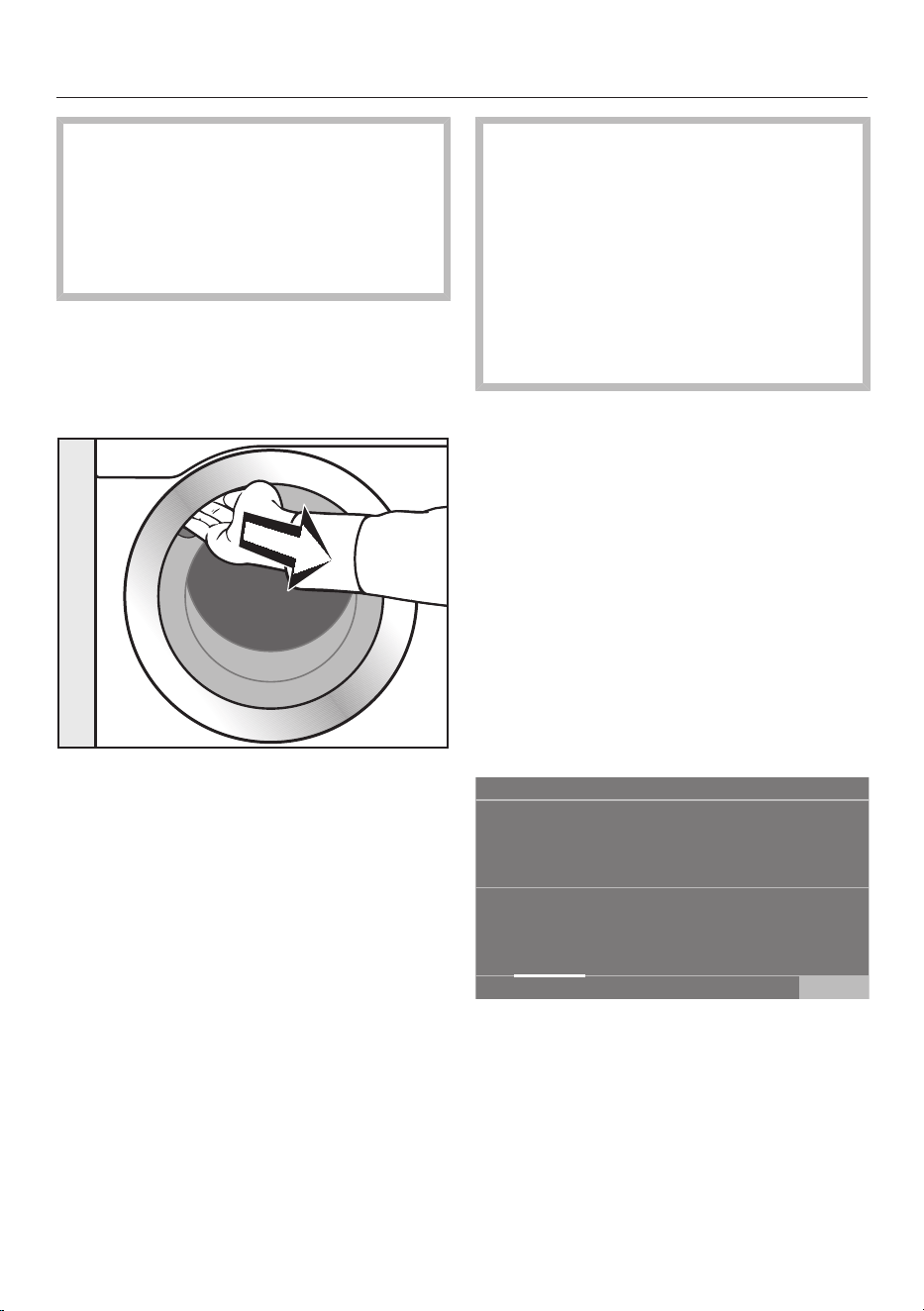
A swivel elbow for the drain hose and/or
assembly material may be stored in the
drum.
Pull open the door.
Remove the swivel elbow and assem-
bly material.
Shut the door gently.
Switching on the washing ma-
chine
Press the button.
The welcome screen will light up.
When commissioning the washing
machine for the first time, you will
have to define settings for daily use
of the appliance. Some settings can
only be configured during the initial
commissioning process. After that,
they should be changed by Miele
Technical Service.
Complete the initial commissioning
process.
These settings are also described under
“Supervisor level”.
Tip: During initial commissioning, you
can go back to the previous screen if
you need to correct an entry you have
already made.
Touch the sensor control to go
back to the previous screen.
Setting the display language
You will be asked to select the display
language. You can change the language
at any time (see “Language” under “Su-
pervisor level”).
deutsch
Language
OK
english
(AU)
english
(CA)
english
(GB)
english (US)
español
Scroll to the left or the right until the
language you want appears.
Touch the sensor control for the lan-
guage you want.
The selected language will be high-
lighted in orange and the display will
change to the next setting.

Initial commissioning
17
Reference to external appli-
ances
A reference to external hardware ap-
pears.
Confirm with the OKsensor control.
Before initial commissioning, connect
the XCI box or adapter or slide a com-
munication module into the slot on the
back of the machine. The washing ma-
chine must be disconnected from the
power supply. Then start the commis-
sioning process.
Setting the display brightness
You will be asked to select the bright-
ness of the display.
Display brightness
Darker
Brighter
OK
Touch the segment bars until you
reach the required level of brightness.
The selected brightness level will be
highlighted in orange.
Confirm with OK.
The display will change to the next set-
ting.
Setting the date
OK
Date
2021
2020
2019
25
24
22
21
23July
August
September
June
May
2018
2017
Place your finger on the value that you
want to change and move your finger
in the direction you want.
Once all values have been selected,
confirm with the OKsensor control.
The display will change to the next set-
ting.
Confirming the time request
The following question appears in the
display:
Remove the clock display?
Touch the Yes or Nosensor control.
If you select Yes, the system will skip
the Clock displaysetting.
If you select No, the display will switch
to the Clock displaysetting.

Initial commissioning
18
Setting the time
OK
Time of Day
12 00
11 59
10 58
01 01
02 02
pm
Place your finger on the number that
you want to change and move your
finger in the direction you want.
Confirm with the OKsensor control.
The display will change to the next set-
ting.
Selecting program packages
You can select various programs from
the program packages. Any programs al-
ready active are highlighted in orange.
11:02
Normal Sportswear Sneakers
Sport-
Microfiber
Hard Items
Program packages
Label Sport
OK
Scroll right until you reach a program
that is not highlighted in orange.
Touch the sensor control for the re-
quired program.
The selected program is highlighted in
orange.
You can select additional programs.
Tip: You can disable a selected program
by touching the program’s sensor con-
trol again.
If you do not want to select any more
programs, confirm with the OKsensor
control.
The display will change to the next set-
ting.
Switching on automatic dis-
pensing
11:02
Off
Automatic dispensing
OK
XCI box
KOM module
Touch the COM module or XCI box sen-
sor control if you want to dispense
detergent externally.
Confirm with the OKsensor control.
The display will change to the next set-
ting.

Initial commissioning
19
Setting up a payment system
If you wish to set up a payment system,
read the “Payment system” section of
the “Supervisor level” chapter.
These settings can only be changed dur-
ing the initial commissioning process. If
you wish to change the settings after
the commissioning process, please con-
tact Miele Technical Service.
If you do not wish to set up a payment
system, you can skip this stage.
11:02
No payment
system
Payment system
OK
Program
control
Timed
operation
KOM module
Touch the No payment systemsensor
control.
The display will change to the next set-
ting.
Selecting the communication
module
11:02
Off
Select KOM module
OK
Internal
module
external
module
Touch the Internal module sensor con-
trol if you want to use the internal
communication module.
Touch the external module sensor con-
trol if you want to use the external
communication module.
The display will change to the next set-
ting.
Selecting the field of application
11:02
Commercial
area
Area of application
OK
Domestic area
Touch the Commercial area sensor con-
trol if you want to connect to
MieleMOVE.
Touch the Domestic area sensor con-
trol if you want to connect to the
Mieleapp.
Setting successfully adopted will appear in
the display.
Confirm with the OKsensor control.
The display will change to the next set-
ting.

Initial commissioning
20
Selecting pre-wash water
11:02
Cold
Pre-wash
OK
Hot
Touch the coldsensor control if the
washing machine is only connected to
a cold water supply, or touch hotif the
washing machine is connected to
cold and hot water.
The display will change to the next set-
ting.
Selecting main wash water
11:02
Cold
Main wash
OK
Hot
Touch the coldsensor control if the
washing machine is only connected to
a cold water supply, or touch hotif the
washing machine is connected to
cold and hot water.
Further information will appear on the
display.
Removing the shipping struts
The display will remind you to remove
the shipping struts.
Risk of damage due to failure to
remove the shipping struts.
Failure to remove the shipping struts
can result in damage to the washing
machine and to adjacent cabinetry or
appliances.
Remove the shipping struts as de-
scribed in “Installation”.
Confirm that the shipping struts have
been removed with the OKsensor
control.
To complete commissioning, start the
“Commissioning” program without laun-
dryappears in the display.
Confirm the message with the
OKsensor control.
Completing the commissioning
process
To complete commissioning, the com-
missioning program must be run with-
out laundry and without detergent.
If the power is interrupted (e.g., if the
appliance is switched off with the
sensor control), the initial commis-
sioning process can be completed
again.
If the commissioning program has run
through to the end, the initial commis-
sioning process does not have to be
performed again.
Turn on the faucets.
Touch the flashing Start/Stopsensor
control.
Once the program has finished,
switch the washing machine off
briefly and then switch it back on
again.
Initial commissioning is now complete.
1. Preparing the laundry
21
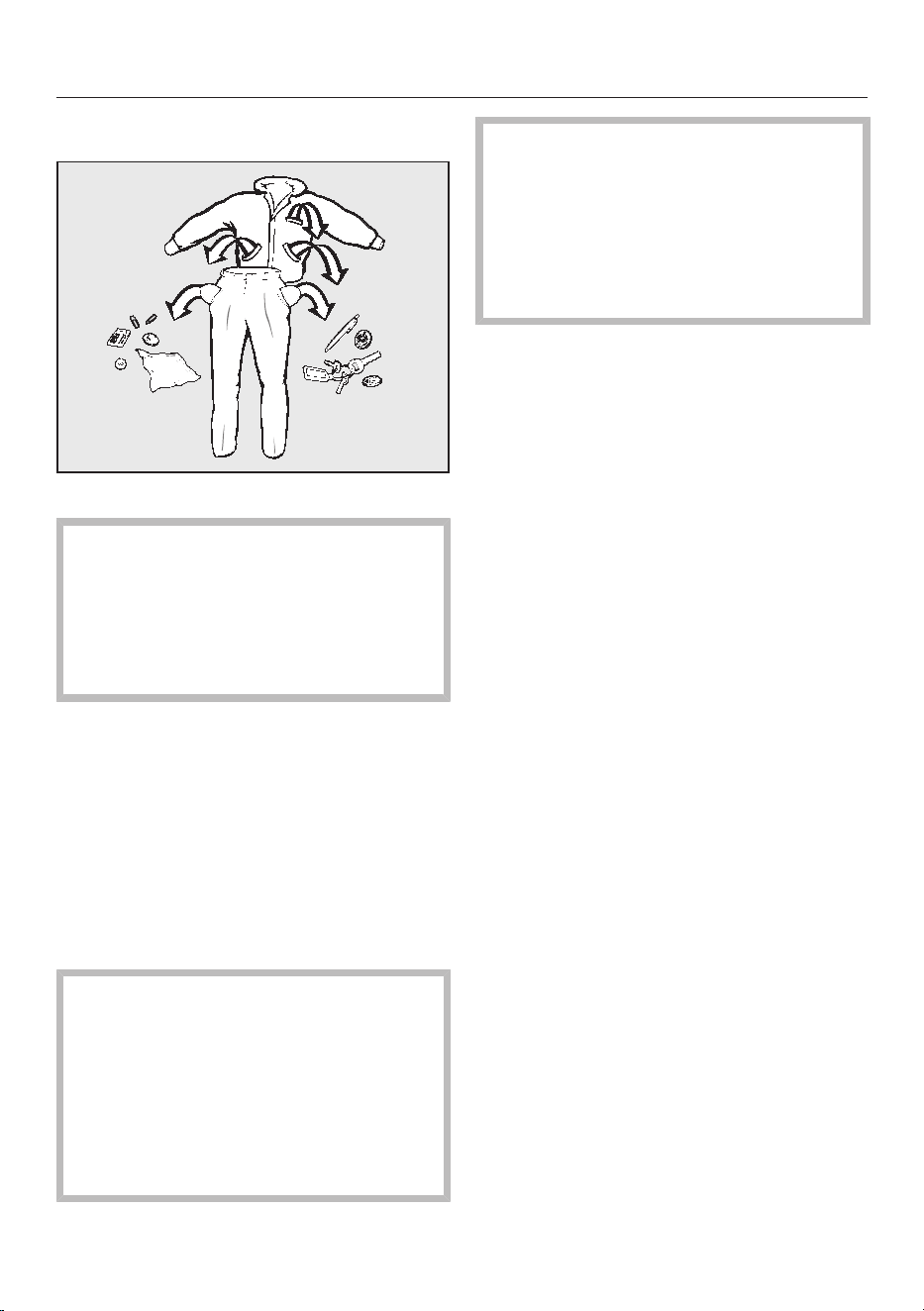
Emptying pockets
Empty all pockets.
Damage due to foreign objects.
Nails, coins, paper clips, and so on
can cause damage to garments and
components in the machine.
Check the laundry before washing
and remove any such foreign objects.
Sorting the laundry
Sort the laundry according to color
and the garment care label.
Pre-treating stains
Badly soiled areas and stains should
be cleaned as soon as possible.
Stains should be carefully dabbed off
using a soft, colorfast cloth.
Damage due to solvent-based
cleaning agents.
Cleaning agents containing benzine,
stain remover, etc., can damage plas-
tic parts.
When pre-treating a stain, make sure
that plastic parts do not come into
contact with cleaning agents.
Risk of explosion due to solvent-
based cleaning agents.
When using solvent-based cleaning
agents, an explosive mixture may de-
velop.
Never use solvent-based cleaning
agents in the washing machine.
General tips
- Do not machine wash items which
are specified by the manufacturer as
not washable on the care label().
- Curtains: Remove rollers and lead
weights or place in a laundry bag.
- Sew in or remove any loose under-
wiring in bras.
- Turn garments inside out, if recom-
mended by the manufacturer.
- Zip up or close any jackets with Velcro
or hook and eye fastenings before
washing.
- Fasten duvet covers and pillow cases
to prevent small items from becoming
rolled up inside them.
- Please refer to the “Program chart”
for more tips and tricks.
2. Loading the washing machine
22
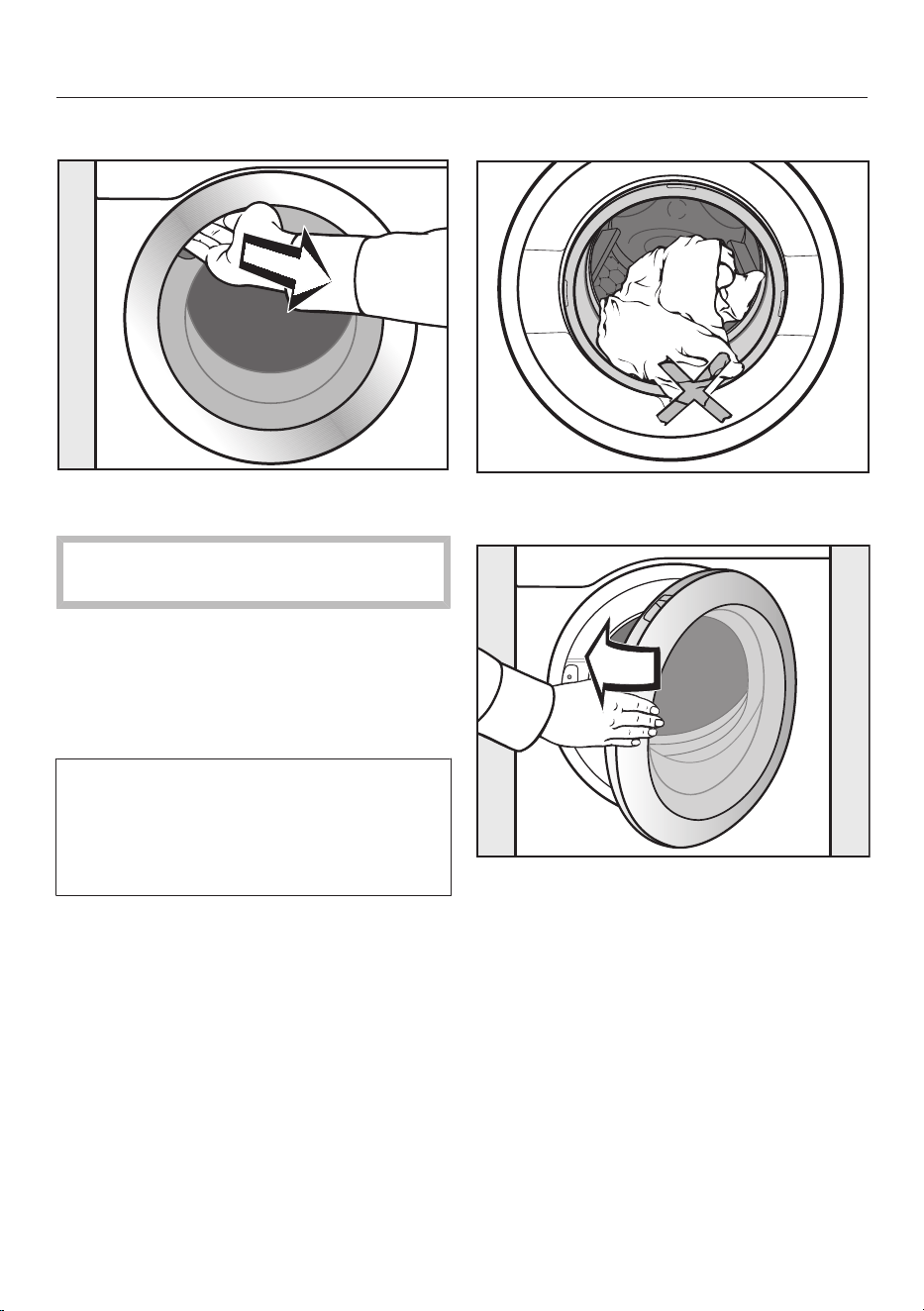
Opening the door
Reach under the door grip and pull
the door open.
Check the drum for foreign objects
before loading it with laundry.
Unfold the laundry and load loosely
into the drum.
Mixing both large and small items gives
better wash results and also helps dis-
tribute the load evenly during spinning.
The most efficient use of energy and
water is achieved when a full load is
washed. However, do not overload as
this reduces cleaning efficiency and
causes creasing.
Closing the door
Make sure that no items are caught
between the door and the seal.
Shut the door gently.

3. Selecting a program
23
Switching on the washing ma-
chine
Press the button.
The drum lighting will come on.
The drum lighting will go out automati-
cally after 5minutes or when the pro-
gram starts.
Selecting a program
11:02
Programs Favorites Supervisor
Help
There are different ways to select a pro-
gram.
You can select a program from the Pro-
gramsmenu.
Touch the Programssensor control.
11:02
Whites
Minimum Iron
ExpressNormal
Delicates
Programs
Cottons Plus
Scroll to the right in the display until
the program you want appears.
Touch the sensor control for that pro-
gram.
The display will change to the standard
menu for that wash program.
Alternatively, you can select a program
from the Favoritesmenu.
The programs under Favorites can be
changed by the supervisor (see “Fa-
vorite programs” under “Supervisor
level”).
Touch the Favoritessensor control.
11:02
Whites
Whites
Normal
Woolens
Favorites
Scroll to the right in the display until
the program you want appears.
Touch the sensor control for that pro-
gram.
The display will change to the standard
menu for that wash program.
In the case of Favorite programs, the
majority of the program settings are al-
ready fixed and cannot be changed.
4. Selecting program settings
24
Selecting a load
To enable load-specific dispensing,
you can specify the load for some pro-
grams.
Touch the Weightsensor control.
Enter a valid value for the load quan-
tity.
The display will switch to the Over-
viewmenu.
Selecting a temperature
You can alter the preset temperature of
a wash program.
Touch the Temperaturesensor control.
Select the desired temperature.
The display will switch to the Over-
viewmenu.
Selecting a spin speed
You can alter the preset spin speed of
a wash program.
Touch the Spin speedsensor control.
Select the spin speed you want.
The display will switch to the Over-
viewmenu.
Selecting extra options
You can select extra options for some
wash programs.
Touch the Extrassensor control.
Select one or more extra options.
Confirm with the OKsensor control.
The display will switch to the Over-
viewmenu.
See “Extras” for further information.
Activating CapDosing
You can use CapDosing for some wash
programs.
Touch the CapDosingsensor control.
The types of caps which can be used
with the program will appear in the dis-
play.
Select the type of cap you want.
CapDosing is now active.
The display will switch to the Over-
viewmenu.
See “CapDosing” under “5.Adding de-
tergent” for more information.
5. Adding detergent
25
There are several options for adding de-
tergent to the washing machine.
Detergent dispenser drawer
You can use any detergent that is suit-
able for washing machines.
Detergent dispensing
Please follow the detergent manufac-
turer’s instructions in relation to dosage.
Adding too much detergent will lead
to excessive foaming.
Avoid adding excess detergent.
The amount to dispense will depend on:
- the amount of laundry
- how dirty the laundry is
- the water hardness
Hardness
range
Hardness
inmmol/l
Degree of
German hardness
°dH
Soft (I) 0–1.5 0–8.4
Medium (II) 1.5–2.5 8.4–14
Hard (III) Above 2.5 Above 14
Check with your local water supplier if
you do not know the water hardness in
your area.
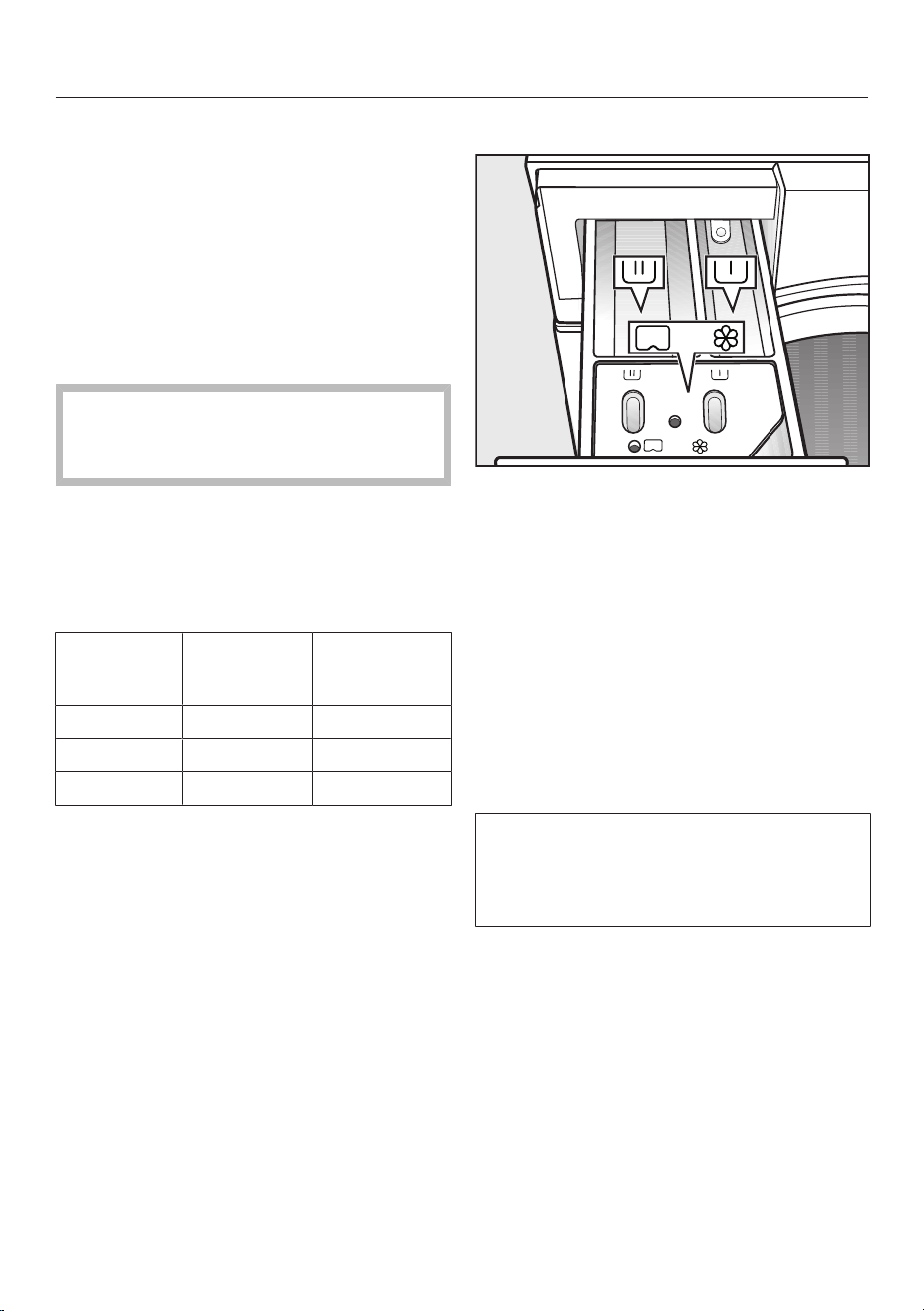
Filling with detergent
Pull out the detergent dispenser
drawer and add detergent to the com-
partments.
Detergent for the pre-wash (di-
vide the total recommended
amount as follows: ⅓ to com-
partment and ⅔ to compart-
ment)
Detergent for the main wash
/
Fabric softener, liquid starch, or
caps
For disinfection programs, the
andcompartments can be
filled with detergent for the main wash
if you have not selected Pre-wash.
5. Adding detergent
26
Adding fabric softener or liquid starch
separately
Select the Separate Rinseprogram.
Change the spin speed if necessary.
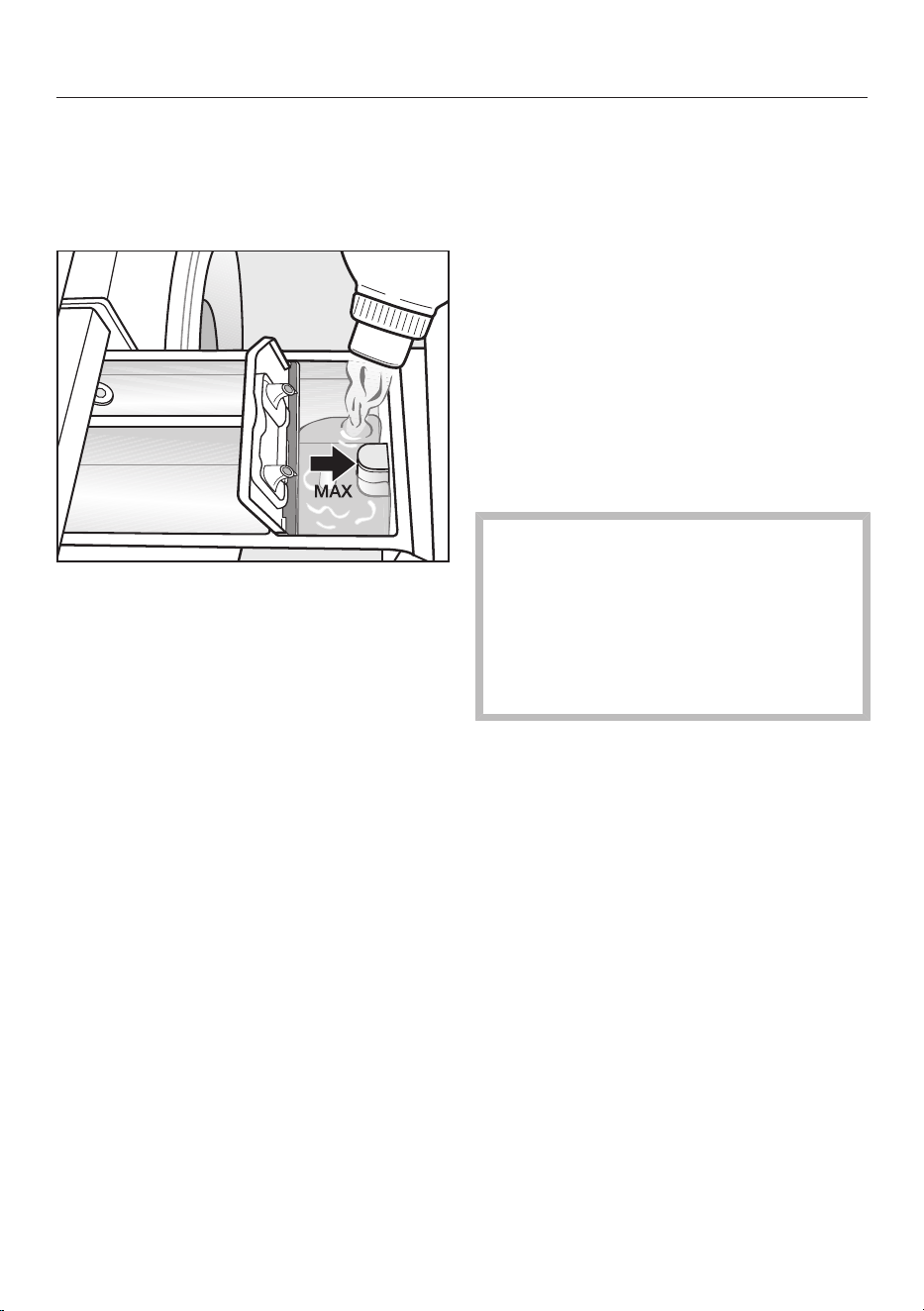
Add the fabric softener or the liquid
starch to the compartment. Do not
exceed the maximum level mark.
Touch the Start/Stopsensor control.
This will be automatically dispensed in
the final rinse. At the end of the pro-
gram, a small amount of water remains
in the compartment.
Adding starch separately
Prepare the starch solution in accor-
dance with the manufacturer’s in-
structions on the packaging.
Select the Starchprogram.
Add the prepared starch to the
compartment.
Touch the Start/Stopsensor control.
Tip: If starching separately or automati-
cally, thoroughly clean the detergent
dispenser drawer, especially the siphon,
regularly.
Dye removers and dyes
Damage due to color run/dye re-
movers.
Color run and dye removers can
cause corrosion in the washing ma-
chine.
Do not use color run or dye removers
in the washing machine.
Only use dyes suitable for use in a
washing machine. The manufacturer’s
instructions on the packaging must be
observed.
5. Adding detergent
27
CapDosing
3 different types of cap are available:
= Fabric care (e.g., fabric soft-
ener, proofing agent)
= Additives (e.g., detergent en-
hancers)
= Detergent (for the main wash
only)
Only one cap can be selected per wash
program.
Depending on the setting selected, the
detergent, additive, or fabric care agent
will be dispensed via the cap for this
wash program.
Each cap contains the correct amount
for one wash cycle.
Caps are available to order from Miele’s
online store, Miele Technical Service, or
from your Miele dealer.
Caps pose a health risk.
The ingredients of caps can be haz-
ardous to health if they are swal-
lowed or come into contact with skin.
Keep caps out of the reach of chil-
dren.
Activating CapDosing
Touch the CapDosingsensor control.
The types of caps which can be used
with the program will appear in the dis-
play.
Select the type of cap you want.
CapDosing is now active.
The display switches to the default dis-
play and shows the selected cap.
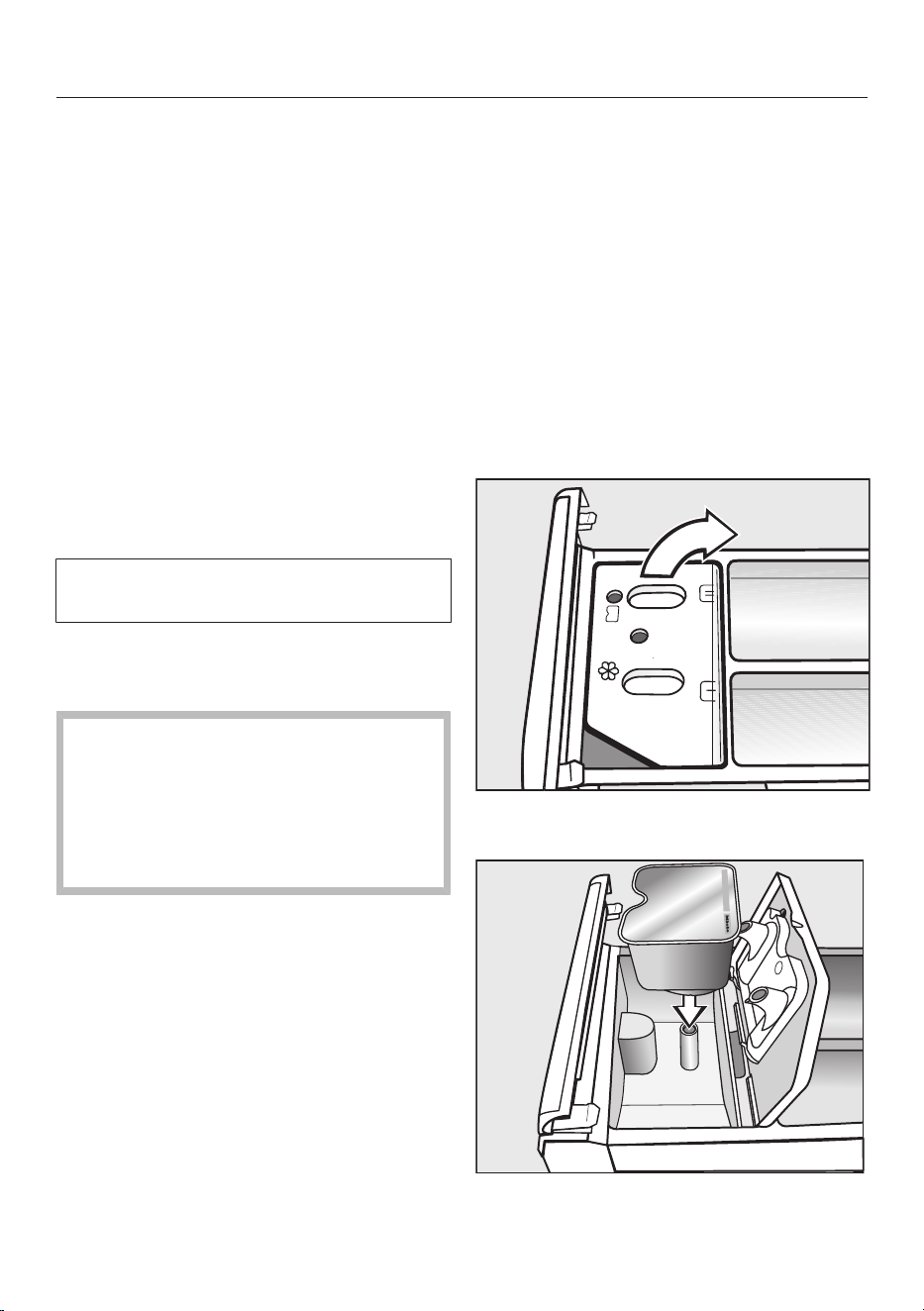
Inserting a cap
Open the detergent dispenser drawer.
Open the lid of the /compart-
ment.
Press the cap in firmly.
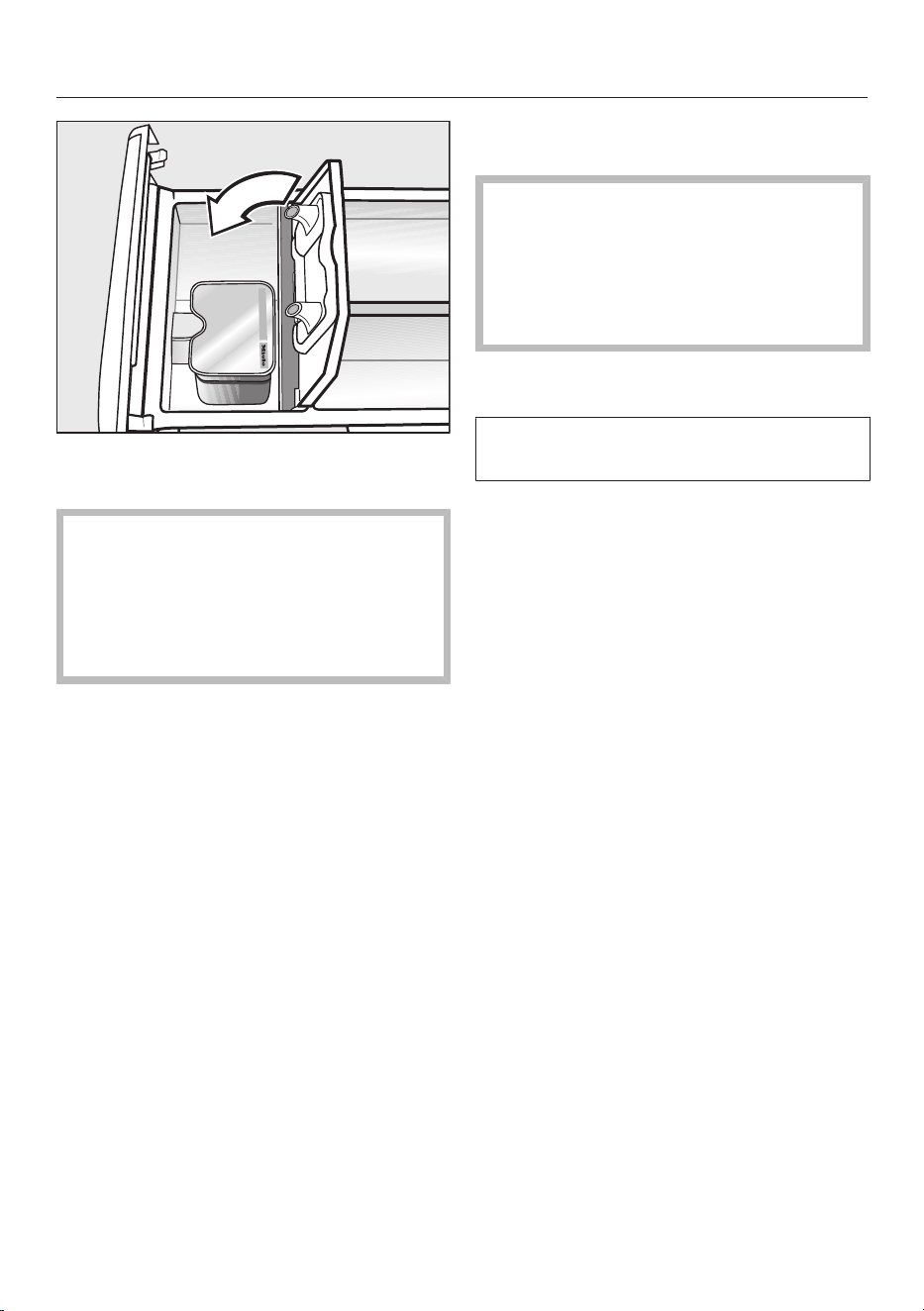
5. Adding detergent
28
Close the lid and press it firmly shut.
Close the detergent dispenser drawer.
The cap is opened by the act of in-
serting it in the detergent dispenser
drawer. The contents can run out of
the cap if you then remove it from the
drawer before it is used.
Dispose of opened caps.
The wash program will dispense the
contents of the cap at the correct time.
When using CapDosing, water intake
to the compartment takes place
solely via the cap.
When using caps, do not add extra
fabric softener to the compart-
ment.
Remove the empty cap at the end of
the program.
For technical reasons, a small amount
of water will remain in the cap.
Deactivating or changing CapDosing
CapDosing can only be deactivated or
changed prior to the program start.
Touch the CapDosingsensor control
and disable the selected cap option.
External dispensing
The washing machine is pre-equipped
for connecting to external detergent dis-
pensing systems. A separate conversion
kit for external dispensing systems is re-
quired. This must be installed by Miele
Technical Service or by a Miele Service
dealer.

6. Starting a program – end of a program
29
Payment system
If your machine is connected to a pay-
ment system, the amount of payment
required will appear in the display.
Do not cancel the program once it has
started. Depending on the settings,
money may be lost in the payment
system.
Starting a program
The program can be started as soon as
the Start/Stopsensor control is flashing
on and off.
Touch the Start/Stopsensor control.
The door will lock (symbol) and the
program will start.
If a delay-start period has been se-
lected, this will appear in the display.
The program duration will appear in the
display either straight away or once the
delay-start period has elapsed. The pro-
gram sequence is also shown in the dis-
play.
Tip: You can use the pull-down menu to
display the selected temperature, spin
speed, and any selected extra options.
End of program
The door remains locked during the anti-
crease phase. However, the washing
machine door can be unlocked at any
time by touching the Start/Stopsensor.
Removing the laundry
Pull open the door.
Remove the laundry.
Items left in the drum could discolor
other items in the next wash or be-
come discolored themselves.
Remove all items from the drum.
Check the folds in the door seal for
any foreign objects.
Tip: Leave the door slightly open to al-
low the drum to dry.
Switch the washing machine off with
the button.
If applicable, remove the used cap
from the detergent dispenser drawer.
Tip: Leave the detergent dispenser
drawer slightly open to allow it to dry.

Timer
30
Before the program starts, the timer can
be used to select a program start time
or program end time.
Setting the timer
Touch the Timersensor control.
Select theFinish at, Start in, orStart
atoption.
Set the hours and the minutes and
confirm your entry with the OKsensor
control.
Changing the timer
The selected delay-start period can be
changed before the program starts.
Touch the,, or sensor con-
trol.
If required, change the specified time
and confirm with the OKsensor con-
trol.
Deleting the timer
The selected delay-start period can be
canceled before the program starts.
Touch the,, or sensor con-
trol.
The selected delay-start period will ap-
pear in the display.
Touch the Deletesensor control.
Confirm with the OKsensor control.
The selected delay-start period is
deleted.
Starting the timer
Touch the Start/Stopsensor control.
The door will lock and the time until the
program starts will appear in the display.
After the program start, the selected
delay-start period can only be changed
or canceled by interrupting the pro-
gram.
The program can be started immedi-
ately at any time.
Touch the Start immediatelysensor
control.
Program chart
31
Program packages
You can select various programs from the program packages. The programs will ap-
pear in the program list.
Label
Normal Cold to 140°F (60°C) Max. load 17.6lb
(8kg)
Items Cotton, linen, and mixed fiber textiles made of both cotton and
linen
1,500rpm Extra options: Pre-wash, Rinse hold Rinses: 2
USA test program in accordance with: DOE Federal Register 10 CFR Part 430
Appendix J2 to subpart B
Canada test program in accordance with: CAN/CSA-C360-13
Program chart
32
Standard programs
Cottons Plus 120°F to 140°F (50°C to 60°C) Max. load 19.8 lb
(9kg)
Items Heavily soiled textiles made from cotton and linen, e.g. bed linen,
baby clothes, underwear
Tip An additional Pre-rinse can be programmed in.*
1,600rpm Extra options: Pre-wash, Intensive, Water plus,
Rinse hold, Starch stop
Rinses: 2–5*
Whites 165°F to 195°F (75°C to 90°C) Max. load 17.6lb
(8kg)
Items Textiles made from cotton and linen, e.g., bed linen, baby clothes,
underwear
Tip An additional Pre-rinse can be programmed in.*
1,500rpm Extra options: Pre-wash, Intensive, Water plus,
Rinse hold, Starch stop
Rinses: 1–5*
Colored items sensitive Cold to 195°F (90°C) Max. load 17.6lb
(8kg)
Items Cotton or mixed fiber textiles
Tip Colors program for all temperature ranges with particularly good
rinsing efficiency.
1,600rpm Extra options: Pre-wash, Intensive, Water plus,
Rinse hold, Rinse plus, Starch stop
Rinses: 2
Minimum iron Cold to 140°F (60°C) Max. load 8.8lb
(4kg)
Items Synthetic and mixed fiber textiles and easy care cotton
Tip - Reduce the spin speed for fabric which creases easily.
- An additional Pre-rinse can be programmed in.*
1,200rpm Extra options: Pre-wash, Intensive, Water plus,
SoftSteam, Rinse hold
Rinses: 2–4*
* Settings can be altered in the Supervisor level.
Program chart
33
Delicates Cold to 140°F (60°C) Max. load 6.6lb
(3kg)
Items Delicate garments made from synthetic fiber, mixed fiber, and vis-
cose
Tip - Deselect the final spin speed for fabric that creases easily.
600rpm Extra options: Pre-wash, Rinse plus, Soft-
Steam, Rinse hold
Rinses: 2
Express 85°F (30°C) Max. load 8.8lb
(4 kg)
Items Cotton garments that have hardly been worn or are only very lightly
soiled
1,400rpm Rinses: 2
Woolens Cold to 105°F (40°C) Max. load 6.6lb
(3 kg)
Items Machine-washable woolens and woolen blends
Tip Use detergent formulated for woolens.
1,200rpm Extra options: Rinse hold Rinses: 2
Toweling 104°F to 140°F (40°C to 60°C) Max. load 17.6lb
(8 kg)
Items Towels and bathrobes made from terrycloth
Tip Use a color detergent for dark textiles.
1,400rpm Extra options: Pre-wash, Rinse hold Rinses: 2
Dress Shirts Cold to 140°F (60°C) Max. load 6.6lb
(3 kg)
Items Shirts and blouses
Tip - Pre-treat collars and cuffs depending on the level of soiling.
- Wash silk shirts and blouses in the Silks program.
- Reduce the maximum load quantity by half if you have selected
the SoftSteamextra option.
800rpm Extra options: Soak, Rinse plus, SoftSteam,
Rinse hold, Starch stop
Rinses: 2
Program chart
34
Dark Garments 85°F to 140°F (30°C to 60°C) Max. load 8.8lb
(4 kg)
Items Black and dark items made of cotton or mixed fibers
Tip Wash inside out.
1,000rpm Extra options: Soak, Rinse plus, SoftSteam,
Rinse hold
Rinses: 3
Denim 85°F to 140°F (30°C to 60°C) Max. load 8.8lb
(4 kg)
Items Denim shirts, blouses, trousers, and jackets
Tip - Wash denim inside-out.
- Denim often contains excess dye and may run during the first
few washes. Wash light and dark colored items separately.
1,000rpm Extra options: Rinse hold Rinses: 3
Silks Cold to 85°F (30°C) Max. load 6.6lb
(3 kg)
Items Silks and all hand-washable textiles which do not contain wool
Tip - Observe the instructions on the wash care label.
- Place tights, bras, etc., in a laundry bag.
600rpm Extra options: Rinse plus, Rinse hold Rinses: 2
Separate rinse Max. load 17.6lb
(8kg)
Items Items which only need to be rinsed and spun
Tip - Observe the spin speed for items which crease easily.
1,400rpm Extra options: Rinse hold Rinses: 2
Starch Cold to 105°F (40°C) Max. load 8.8lb
(4 kg)
Items Table cloths, serviettes, and workwear that need starching
Tip - Laundry that is to be starched should be washed but not treated
with fabric softener.
- Observe the spin speed for items which crease easily.
1,200rpm Rinses: 1
Program chart
35
Clean Machine 160°F (70°C) No load
For cleaning the suds container and the drainage system.
- Add universal detergent to the compartment.
- Use the Clean Machineprogram regularly if you frequently use
disinfection programs.
Drain/Spin Max. load 17.6lb
(8 kg)
Tip - Make sure you select the appropriate spin speed.
- Drain only: Select 0rpm for the spin speed.
- Select the Rinse plus extra option for one rinse.
1,500rpm Extra options: Rinse plus
Maintenance wash hygiene No load
- If a program at a temperature below 140°F (60°C) has been
used, a request to start the Maintenance Wash Hygieneprogram
appears in the display. The Hygienesetting must be switched on
for this purpose (see “Supervisor level”).
- Add universal detergent to the compartment.
Sport
Sportswear 85°F to 140°F (30°C to 60°C) Max. load 7.7lb
(3.5 kg)
Items Sports and leisure wear, such as shirts and trousers made from
synthetic fibers or mixed blends
Tip - Do not use fabric softener.
- Observe the manufacturer’s care label.
1,000rpm Extra options: Pre-wash, Soak, Rinse hold Rinses: 2
SportMicrofiber 85°F to 140°F (30°C to 60°C) Max. load 7.7lb
(3.5 kg)
Items Sportswear such as jerseys and leggings, as well as microfiber and
fleece garments
Tip - Do not use fabric softener.
- Observe the manufacturer’s care label.
800rpm Extra options: Rinse plus, Rinse hold Rinses: 2
Program chart
36
Sneakers 85°F to 140°F (30°C to 60°C) Max. 2 pairs
Items Sneakers (no leather shoes), shin pads, elbow protectors, and sim-
ilar items
Tip - Do not use fabric softener.
- Coarse soiling should be brushed off first.
- Observe the manufacturer’s care label.
- Use the dryer basket for tumble drying.
- Close Velcro fasteners.
400rpm Extra options: Pre-wash, Pre-rinse Rinses: 3
Hard items Cold to 105°F (40°C) Max. load 7.7lb
(kg)
Items Washable plastic items, e.g., toy building blocks or casino chips, or
even chain link safety gloves, etc.
Tip - Put the item in a laundry bag.
- Use detergent for delicates.
– Extra options: Pre-rinse, Pre-wash, Rinse plus Rinses: 2
Outdoor
Downs 85°F to 140°F (30°C to 60°C) Maximum of
1 article
Items Outdoor jackets, sleeping bags, and other down-filled items
Tip - Observe the manufacturer’s care label.
- Do not use fabric softener.
- Remove any air before washing. To do this, either push the items
into a narrow laundry bag to compress them or tie the items to-
gether with a washable strap.
- The items are spun after wetting to remove any air.
1,000rpm Extra options: Pre-rinse, Rinse plus, Rinse hold Rinses: 2
Program chart
37
Outdoor Cold to 105°F (40°C) Max. load 7.7lb
(3.5 kg)
Items Performance outerwear (e.g., outdoor jackets and trousers) made
from membrane fabrics such as Gore-Tex
®
, SYMPATEX
®
, WIND-
STOPPER
®
, etc.
Tip - Zip up or close any Velcro fasteners before washing.
- Do not use fabric softener.
- Use the Proofingprogram to treat outdoor textiles at regular in-
tervals. Reproofing after each wash cycle is not recommended.
- Wash down-filled items with the Downsprogram.
1,000rpm Extra options: Pre-wash, Soak, Rinse plus,
Rinse hold
Rinses: 2
Proofing Cold to 105°F (40°C) Max. load 7.7lb
(3.5kg)
Items Treating microfiber fabric, skiwear, and table linens/drapes made
from mainly synthetic fibers
Tip - Add proofing agent to the compartment.
- The items should be freshly laundered and spun or dried before
proofing.
- For best results, apply a thermal treatment to the items by drying
in a tumble dryer or ironing.
1,000rpm Extra options: Rinse hold Rinses: 1
Program chart
38
Wellness/Hair salons
Towels Cold to 105°F (40°C) Max. load 13.2lb
(6 kg)
Items Lightly soiled cotton toweling
Tip Use a color detergent for dark textiles.
1,400rpm Rinses: 2
Towels plus 105°F to 175°F (40°C to 80°C) Max. load 13.2lb
(6 kg)
Items Heavily soiled cotton toweling
Tip Use a color detergent for dark textiles.
1,400rpm Extra options: Pre-wash Rinses: 2
Capes Cold to 85°F (30°C) Max. load 5.5lb
(2.5 kg)
Items Lightly soiled hairdressers’ capes made from synthetic fibers
Tip Select the Rinse plusextra option for particularly good wash re-
sults
600rpm Extra options: Rinse plus Rinses: 2
Program chart
39
Hotel
Bed linens 105°F to 195°F (40°C to 90°C) Max. load 17.6lb
(8kg)
Items Cotton or mixed fiber bed linens
Tip - The items are always soaked after the start.
- Use a color detergent for colored textiles.
1,400rpm Extra options: Pre-wash, Soak, Rinse plus, Soft-
Steam
Rinses: 2
Table linens 105 to 165°F (40 to 75°C) Max. load 8.8lb
(4kg)
Items Tablecloths and napkins made from cotton, linen, and mixed fibers
Tip - Select Pre-wash for stubborn stains. Use detergent with en-
zymes for the pre-wash.
- The items are always soaked after the start.
1,000rpm Extras: Pre-wash, Rinse plus, Soak, Intensive,
Pre-ironing, Rinse hold, Starch stop
Rinses: 2
Kitchen laundry 140°F to 185°F (60°C to 85°C) Max. load 17.6lb
(8kg)
Items Cotton or linen kitchen laundry, e.g., chef’s jackets and trousers,
chef’s hats, cleaning cloths
Tip - Select Pre-wash for stubborn stains. Use detergent with en-
zymes for the pre-wash.
- A Pre-rinse cycle is carried out before the main wash.
1,200rpm Extra options: Pre-wash, Soak, Intensive Rinses: 3
Home textiles
Lightweight curtains Cold to 105°F (40°C) Max. load 6.6lb
(3 kg)
Items Curtains specified as machine-washable by the manufacturer
Tip For curtains which crease easily, deselect the spin speed function.
600rpm Optional extras: Pre-wash, Rinse plus, Rinse
hold
Rinses: 3
Program chart
40
Curtains Cold to 105°F (40°C) Max. load 6.6lb
(3 kg)
Items Curtains specified as machine-washable by the manufacturer
Tip For curtains which crease easily, reduce the spin speed or deselect
the spin.
800rpm Extra options: Pre-wash, Pre-rinse, Rinse hold Rinses: 3
Down bedding 105°F to 165°F (40°C to 75°C) 1 duvet
Items Down-filled duvets
Tip - Observe the instructions on the wash care label.
- Remove any air before washing. To do this, either push the items
into a narrow laundry bag to compress them or tie the items to-
gether with a washable strap.
- The items are spun after wetting to remove any air.
1,400rpm Extra options: Rinse hold Rinses: 3
Synthetic bedding 105°F to 170°F (40°C to 75°C) Max. 17.6lbs
(8 kg)
or 1 duvet
Items Bed linen made from microfiber and duvets with a synthetic filling
Tip - Observe the instructions on the wash care label.
- Use liquid detergent.
800rpm Extra options: Pre-wash, Soak, Rinse plus,
Rinse hold
Rinses: 2
Pillows Cold to 140°F (60°C) 1–2 pillows*
Items Washable pillows with a down or synthetic filling
Tip - Observe the instructions on the wash care label.
- Remove any air before washing. To do this, either push the items
into a narrow laundry bag to compress them or tie the items to-
gether with a washable strap.
- The items are spun after wetting to remove any air.
1,400rpm Extra options: Pre-wash Rinses: 3
Program chart
41
Bedspreads 105°F to 170°F (40°C to 75°C) Max. load 8.8lb
(4 kg)
Items Synthetic or woollen bedspreads, e.g., day blankets
Tip Gentle wash program for covers with delicate fillings.
800rpm Extra options: Pre-rinse, Rinse hold Rinses: 3
* 1 pillow (31 1/2" x 31 1/2" (80 x 80 cm)) or 2 pillows (15 3/4" x 31 1/2"
(40x80cm))
Workwear
Oil/fat special 140°F to 195°F (60°C to 90°C) Max. load 17.6lb
(8 kg)
Items Work coats, jackets, hats, cleaning cloths made from cotton or
mixed fibers
Tip - Activate Pre-wash for heavy contamination.
- Use special detergent to improve the wash results.
1,400rpm Extra options: Pre-wash, Soak, Intensive, Rinse
plus, Rinse hold
Rinses: 3
Dust/flour special 105°F to 195°F (40°C to 90°C) Max. load 17.6lb
(8 kg)
Items Cotton or mixed fiber workwear, table cloths, or cleaning cloths
soiled with dust or flour
Tip - Select Pre-rinse for very heavy levels of soiling.
- Activate pre-wash for stubborn soiling.
1,400rpm Extra options: Pre-wash, Pre-rinse, Soak, Inten-
sive, Rinse plus, Rinse hold
Rinses: 2
Intensive wash 105°F to 195°F (40°C to 90°C) Max. load 17.6lb
(8 kg)
Items Heavily soiled workwear made from cotton, linen, and mixed fibers
Tip You can achieve particularly good wash and rinse results with a
high water level.
1,400rpm Extra options: Pre-wash, Soak, Rinse plus,
Rinse hold
Rinses: 2
Program chart
42
Disinfection/Robert Koch Institute
Dis. RKI 185°F (85°C)/15min Max. load 17.6lb
(8 kg)
Items Cotton, linen, and mixed fiber textiles
Tip - Thermal disinfection with a 15-minute holding time at 185°F
(85°C).
- Single-bath disinfection process.
- No water intake via the fabric softener compartment.
1,400rpm Extra options: Soak Rinses: 2
Dis. RKI 160°F (70°C)/10min Max. load 17.6lb
(8 kg)
Items Cotton or mixed fiber textiles, sorted by color, provided they are
suitable for disinfection
Tip - Chemo-thermal disinfection with a 10-minute holding time at
160°F (70°C).
- Single-bath disinfection process.
- Use a detergent approved by the Robert Koch Institute.
- No water intake via the fabric softener compartment.
1,400rpm Extra options: Soak Rinses: 3
Dis. RKI 140°F (60°C)/20min Max. load 17.6lb
(8 kg)
Items Cotton or mixed fiber textiles, sorted by color, provided they are
suitable for disinfection
Tip - Chemo-thermal disinfection with a 20-minute holding time at
140°F (60°C).
- Single-bath disinfection process.
- Use a detergent approved by the Robert Koch Institute.
- No water intake via the fabric softener compartment.
1,400rpm Extra options: Soak Rinses: 3
Program chart
43
Dis. RKI 105°F (40°C)/20min Max. load 17.6lb
(8 kg)
Items Cotton or mixed fiber textiles, sorted by color, provided they are
suitable for disinfection
Tip - Chemo-thermal disinfection with a 20-minute holding time at
105°F (40°C).
- Single-bath disinfection process.
- Use a detergent approved by the Robert Koch Institute.
- No water intake via the fabric softener compartment.
1,400rpm Extra options: Soak Rinses: 3
Disinfection I
Disinfection 185°F (85°C)/15min Max. load 17.6lb
(8 kg)
Items Cotton, linen, and mixed fiber textiles
Tip - Thermal disinfection with a 15-minute holding time at 185°F
(85°C).
- No water intake via the fabric softener compartment.
1,400rpm Extra options: Pre-wash, Pre-rinse, Rinse plus Rinses: 2
Disinfection 160°F (70°C)/10min Max. load 17.6lb
(8 kg)
Items Cotton or mixed fiber textiles, sorted by color, provided they are
suitable for disinfection
Tip - Chemo-thermal disinfection with a 10-minute holding time at
160°F (70°C).
- No water intake via the fabric softener compartment.
1,400rpm Extra options: Pre-wash, Pre-rinse, Rinse plus Rinses: 2
Disinfection 140°F (60°C)/20min Max. load 17.6lb
(8 kg)
Items Cotton or mixed fiber textiles, sorted by color, provided they are
suitable for disinfection
Tip - Chemo-thermal disinfection with a 20-minute holding time at
140°F (60°C).
- No water intake via the fabric softener compartment.
1,400rpm Extra options: Pre-wash, Pre-rinse, Rinse plus Rinses: 2
Program chart
44
Disinfection 105°F (40°C)/20min Max. load 17.6lb
(8 kg)
Items Cotton or mixed fiber textiles, sorted by color, provided they are
suitable for disinfection
Tip - Chemo-thermal disinfection with a 20-minute holding time at
105°F (40°C).
- No water intake via the fabric softener compartment.
- An extra gentle wash rhythm allows you to wash even more sen-
sitive textiles.
1,400rpm Extra options: Pre-wash, Pre-rinse, Rinse plus Rinses: 2
Disinfection II
Disinfection 175°F (80°C)/10min Max. load 17.6lb
(8 kg)
Items Cotton, linen, and mixed fiber textiles
Tip - Thermal disinfection with a 10-minute holding time at 175°F
(80°C).
- No water intake via the fabric softener compartment.
1,400rpm Extra options: Pre-wash, Pre-rinse Rinses: 2
Disinfection 165°F (75°C)/10min Max. load 17.6lb
(8kg)
Items Cotton, linen, and mixed fiber textiles
Tip - Thermal disinfection with a 10-minute holding time at 165°F
(75°C).
- No water intake via the fabric softener compartment.
1,400rpm Extra options: Pre-wash, Pre-rinse, Rinse plus Rinses: 2
Disinfection 160°F (70°C)/17min Max. load 17.6lb
(8kg)
Items Cotton or mixed fiber textiles
Tip - Thermal disinfection with a 17-minute holding time at 160°F
(70°C).
- No water intake via the fabric softener compartment.
1,400rpm Extra options: Pre-wash, Pre-rinse, Rinse plus Rinses: 2
Program chart
45
Dental surgery garments 140°F (60°C)/60min Max. load 17.6lb
(8 kg)
Items Cotton or mixed fiber textiles, sorted by color, provided they are
suitable for disinfection
Tip - Chemo-thermal disinfection with a 60-minute holding time at
140°F (60°C).
- No water intake via the fabric softener compartment.
1,400rpm Extra options: Pre-wash, Pre-rinse, Rinse plus Rinses: 2
Disinfection 71°C 161°F (71°C) Max. load 9.9lb
(4.5 kg)
Items Cotton or mixed fiber textiles, sorted by color, provided they are
suitable for disinfection
Tip - Disinfection with a 3-minute holding time at 161°F (71°C).
- The spin speed cannot be modified.
- No water intake via the fabric softener compartment.
1,400rpm Extra options: Pre-wash, Pre-rinse Rinses: 3
Disinfection 65°C 150°F (65°C) Max. load 9.9lb
(4.5 kg)
Items Cotton or mixed fiber textiles, sorted by color, provided they are
suitable for disinfection
Tip - Disinfection with a 10-minute holding time at 150°F (65°C).
- The spin speed cannot be modified.
- No water intake via the fabric softener compartment.
1,400rpm Extra options: Pre-wash, Pre-rinse Rinses: 3
MRSA 105°F (40°C) Max. load 9.9lb
(4.5 kg)
Items Minimum-iron textiles, sorted by color, provided they are suitable
for disinfection
Tip - Add MRSA disinfectants to the fabric softener compartment.
- The spin speed cannot be modified.
1,000rpm Rinses: 3
Program chart
46
WetCare
WetCare sensitive Cold to 85°F (30°C) Max. load 9.9lb
(4.5 kg)
Items Outerwear that cannot be washed, e.g., suits, smart dresses
marked with the care symbol
Tip - A finishing bath is applied after washing.
- Use a liquid finishing agent for impregnation; add the detergent
to the fabric softener compartment.
1,100rpm Extra options: Rinse hold Rinses: 1
WetCare Silks Cold to 85°F (30°C) Max. load 7.7lb
(3.5 kg)
Items Textiles or silk items that cannot be washed and are prone to
creasing
Tip - A finishing bath is applied after washing.
- Use a liquid finishing agent for impregnation; add the detergent
to the fabric softener compartment.
600rpm Extra options: Rinse hold Rinses: 1
WetCare Intensive 85°F to 105°F (30°C to 40°C) Max. load 9.9lb
(4.5 kg)
Items Heavily soiled outerwear that cannot be washed
Tip - A finishing bath is applied after washing.
- Use a liquid finishing agent for impregnation; add the detergent
to the fabric softener compartment.
1,100rpm Extra options: Pre-wash, Rinse hold Rinses: 2
WetCare Disinfection 105°F (40°C) Max. load 9.9lb
(4.5 kg)
Items Outerwear that cannot be washed and that is marked with the care
symbol
Tip - Textiles are washed and disinfected (105°F/40°C for 20 min-
utes).
1,100rpm Extra options: Pre-wash Rinses: 2

Program chart
47
WetCare Hygiene 65°F to 85°F (20°C to 30°C) Max. load 9.9lb
(4.5 kg)
Items Sensitive textiles, e.g., outerwear
Tip - Textiles are washed and disinfected following the addition of a
disinfectant during the rinse phase.
1,100rpm Extra options: Rinse hold Rinses: 2
Program chart
48
Special programs
You can put together 5 special programs
and assign your own program names.
Enter these into the tables.
Load: max. 17.6lb (8kg)
Example: Intensive Plus
- Pre-wash intensive
- Intensive wash, 195°F (90°C)
- Rinse 1
- Rinse 2
- Rinse 3
- Pre-treat
- Spin, 1,400rpm
(1)
-
-
-
-
-
-
-
(2)
-
-
-
-
-
-
-
(3)
-
-
-
-
-
-
-
(4)
-
-
-
-
-
-
-
(5)
-
-
-
-
-
-
-
The 5 special programs are pre-pro-
grammed at the factory; see “Supervi-
sor level”.

Extra options
49
You can add extra options to the wash
programs.
Not all extra options can be selected
with every program. If an extra option is
not listed, it is not permitted for use
with the wash program in question.
Selecting extra options
Touch the Extrassensor control.
Select one or more of the extra op-
tions available.
Confirm with the OKsensor control if
several extra options are available.
Pre-wash
A pre-wash can be added for heavily
soiled laundry. Coarse soiling is loos-
ened and removed before the main
wash.
Pre-rinse
The laundry is rinsed before the main
wash to remove larger quantities of soil-
ing, e.g., dust, sand.
Rinse plus
An extra rinse can be activated to
achieve a more thorough wash result.
Soak
For heavily soiled and stained items
with protein stains. The soak duration is
10minutes.
Intensive
For hard-wearing laundry that is very
heavily soiled. Cleaning efficiency is in-
creased through more intense mechani-
cal action and the application of more
heat energy.
Water plus
The water level in the main wash and
the rinses will be increased.
SoftSteam
In order to reduce creasing, the laundry
undergoes a smoothing process at the
end of the program. Reducing the maxi-
mum load by 50% will achieve a better
result. Small loads achieve a better re-
sult.
The textiles must be suitable for drying
in a tumble dryerand suitable for
ironing.
Rinse hold
The laundry is not spun after the final
rinse and remains in the rinse water.
This helps prevent creasing if the laun-
dry is not going to be removed from the
drum immediately after the end of the
program.
Starch stop
Water is drained out of the machine be-
fore the last rinse and the program
stops. The prepared starch is added di-
rectly to the drum. The program is con-
tinued with the Start/Stopsensor con-
trol.

Special features in the program sequence
50
Spinning
Final spin speed
When a program is selected, the maxi-
mum spin speed for this wash program
is shown in the display.
You can reduce the final spin speed.
However, you cannot select a final spin
speed higher than that shown in the
chart.
Rinse-spin
There is a spin cycle after the main wash
and between the rinse cycles. A reduc-
tion in the final spin speed will also re-
duce the rinse-spin speed as appropri-
ate.
Deselecting the rinse-spin and final
spin
Select the program setting Spin
speed 0.
After the last rinse cycle, the water will
be pumped away and the anti-crease
phase will switch on.
Anti-crease
At the end of the program, the drum
continues to turn at intervals for up to
30minutes to help prevent creasing.
The washing machine can be opened at
any time.
There is no anti-crease phase at the
end of some programs.

Changing the program sequence
51
A program cannot be canceled or
changed when operating a payment
system.
Changing a program
After a program has started, it is no
longer possible to select a different pro-
gram.
You will need to cancel the current pro-
gram before you can select a new one.
Canceling a program
You can cancel a wash program at any
time after it has started.
Touch the Start/Stopsensor control.
The following will appear in the display:
Cancel the program?
Selectyes.
The following will appear in the display:
Program cancelled.
The suds are pumped away.
Wait until the door unlocks.
Pull open the door.
Remove the laundry.
Adding or removing laundry
You can add or remove items during the
first few minutes after the program has
started.
11:02
Denim
Status
Time left
h0:37
Main wash
Add laundry
Touch the Add laundrysensor control.
If the messageAdd laundry is not visible
in the display then it is no longer possi-
ble to add items of laundry.
The program will stop and the door will
unlock.
Risk of chemical burns from de-
tergent.
When adding or removing laundry,
your skin may come into contact with
detergent, particularly if the deter-
gent is dispensed externally.
Take care when placing your hands
inside the drum.
If suds have come into contact with
the skin, rinse off immediately with
plenty of lukewarm water.
Pull open the door.
Add laundry or remove individual
items.
Close the door.
Touch the Start/Stopsensor control.
The wash program will continue.
The safety lock will remain activated if
the temperature in the drum is above
131°F (55°C). The lock will not deacti-
vate until the temperature has dropped
to below 131°F (55°C).
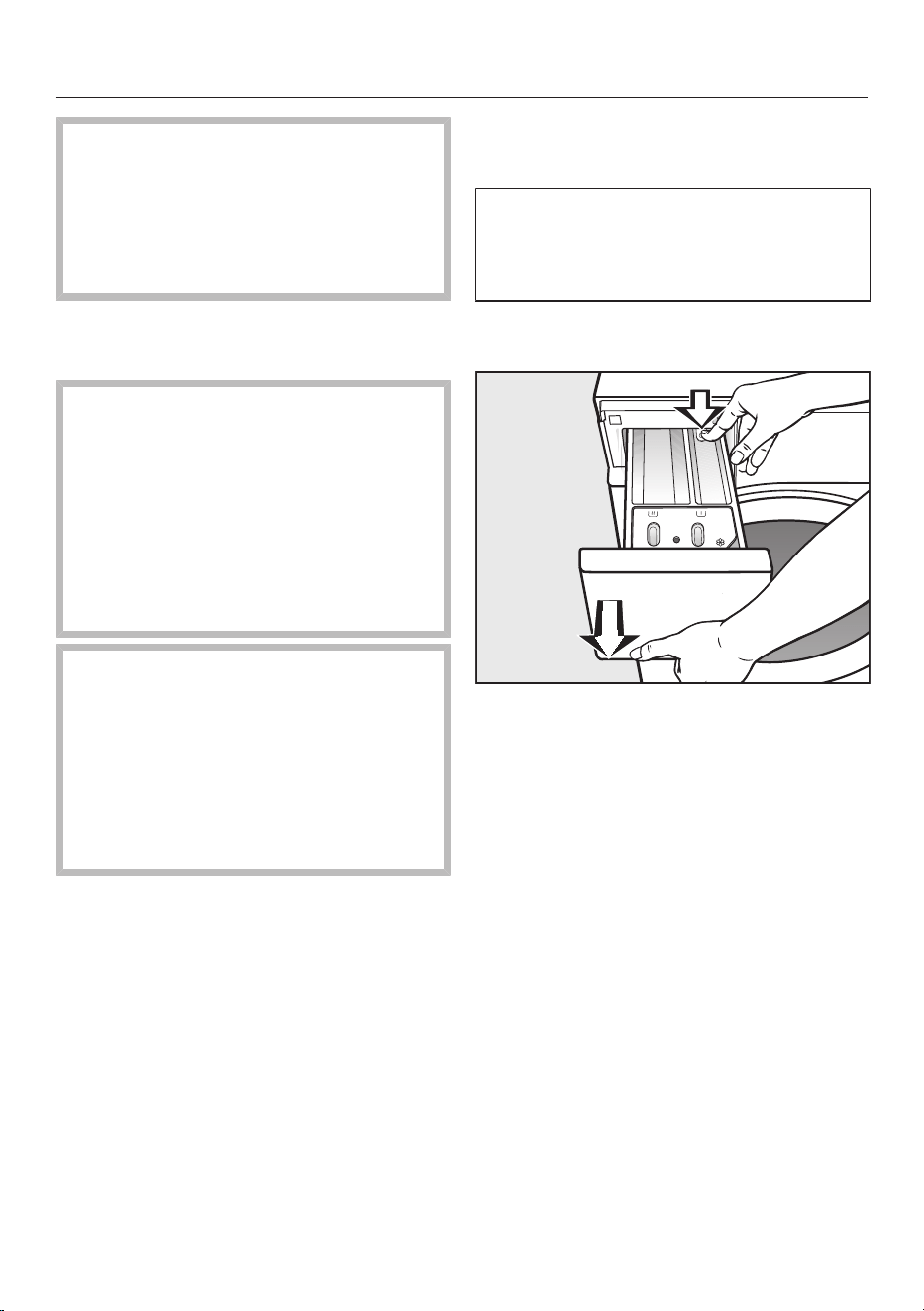
Cleaning and care
52
Risk of electric shock.
Only ever perform cleaning and main-
tenance work when the appliance is
disconnected from the power.
Disconnect the washing machine
from the power supply.
Cleaning the housing and con-
trol panel
Damage caused by cleaning
agents.
Solvent-based cleaning agents, abra-
sive cleaners, glass cleaners, or
multi-purpose cleaning agents can
cause damage to plastic surfaces and
other parts.
Do not use any of these cleaning
agents.
Risk of damage due to ingress of
water.
The pressure of a water jet can cause
water to get into the washing ma-
chine, resulting in damage to compo-
nents.
Do not spray the washing machine
with a water jet when hosing down.
Clean the housing and control panel
with a mild cleaning agent or soap
and water and dry both with a soft
cloth.
The drum and any other stainless
steel components can be cleaned us-
ing a suitable stainless-steel cleaning
agent.
Cleaning the detergent dis-
penser drawer
Washing at low temperatures and the
use of liquid detergent can lead to a
build-up of bacteria in the detergent
dispenser drawer.
For hygiene reasons, clean the entire
drawer at regular intervals.
Pull out the detergent dispenser
drawer until a resistance is felt. Press
down the release button and at the
same time pull the drawer right out of
the machine.
Clean the detergent dispenser drawer
with warm water.
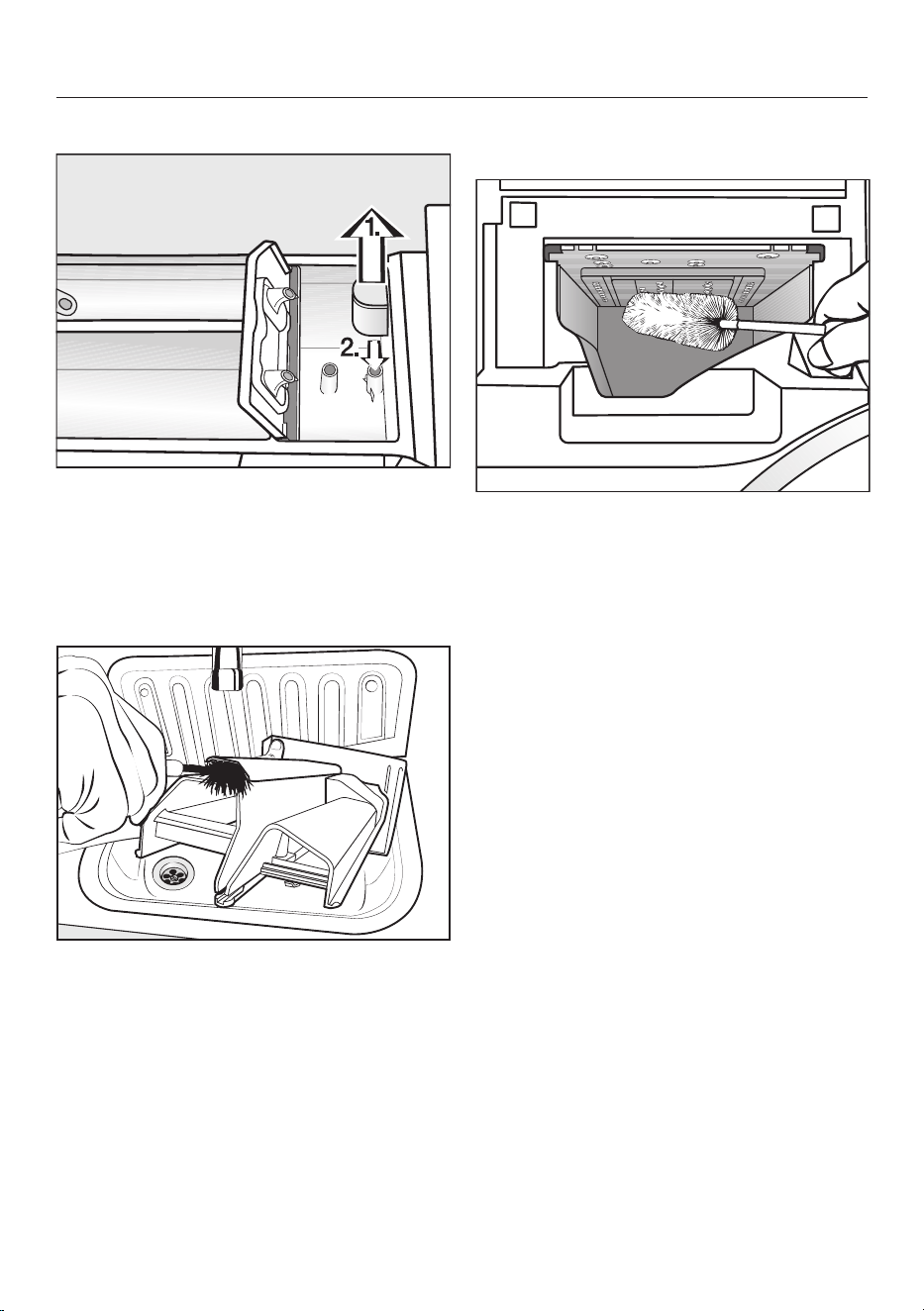
Cleaning and care
53
Cleaning the siphon and the channel
Pull the siphon out of the compart-
ment.
Clean the siphon under warm running
water. Clean the siphon tube in the
same way.
Re-install the siphon.
Clean the fabric softener channel with
a brush and warm water.
Cleaning the detergent dispenser
drawer housing
Use a bottle brush to remove deter-
gent residues and limescale from the
jets inside the detergent dispenser
drawer.
Replace the detergent dispenser
drawer.
Tip: Leave the detergent dispenser
drawer slightly open to allow it to dry.
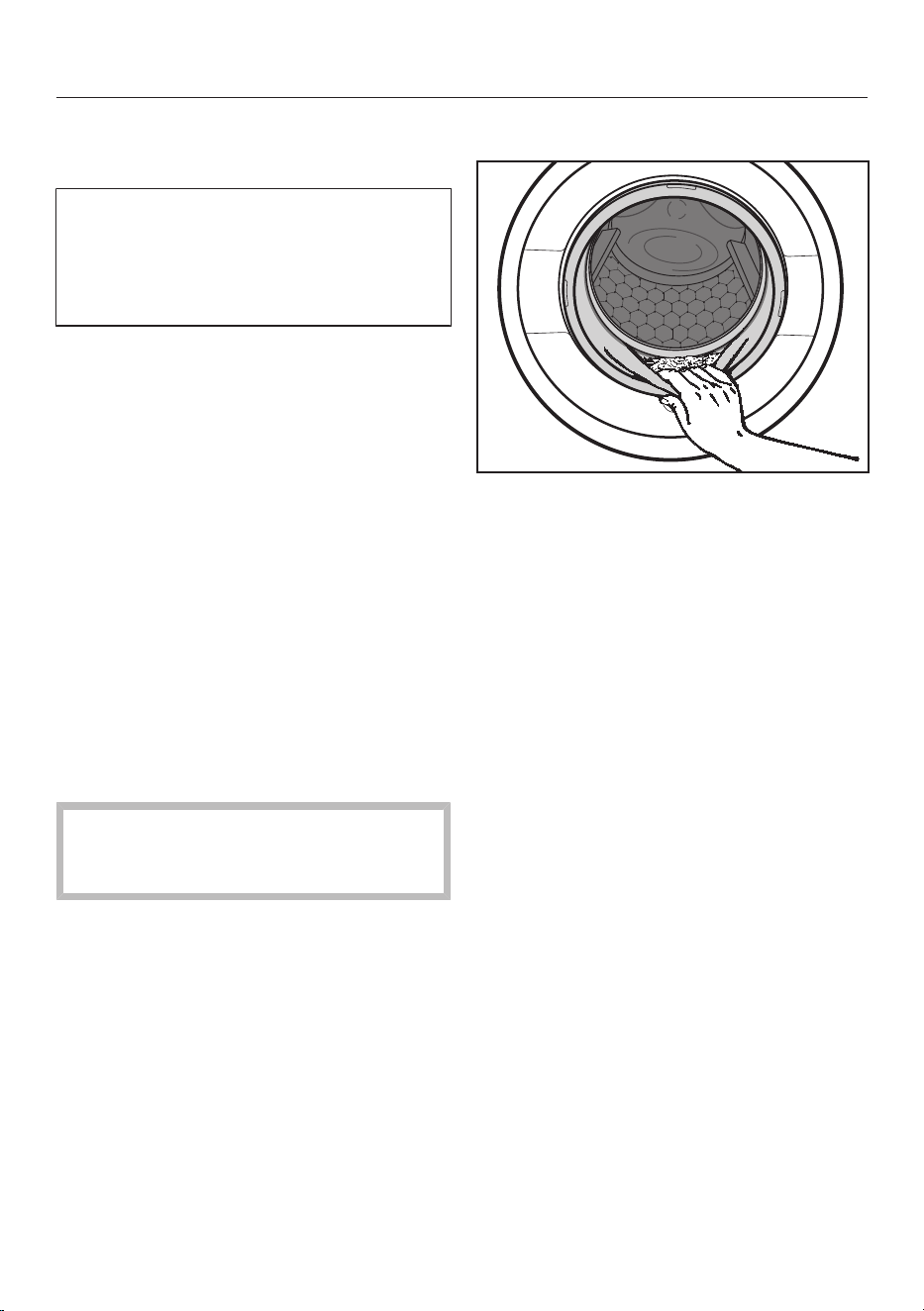
Cleaning and care
54
Cleaning the drum, suds con-
tainer, and drainage system
By using wash programs with temper-
atures of 140°F (60°C) or higher on a
regular basis and using a multi-pur-
pose detergent, you can avoid a build-
up of bacteria in the washing machine.
Use the Clean Machine program regu-
larly, especially if you frequently use
wash programs with low temperatures.
Optimum results can be achieved by us-
ing a machine cleaner. Alternatively, a
multi-purpose powder detergent can be
used.
Start the Clean machine program.
Dispense the machine cleaner or
multi-purpose detergent directly into
the drum.
Do not load any laundry. The drum
must be empty for the Clean Machine
program.
At the end of the program, check the
inner drum and remove any coarse
residues.
Use the Clean Machineprogram reg-
ularly if you frequently use disinfec-
tion programs.
Cleaning the sealing ring
Check the fold in the sealing ring for
foreign objects.
Clean the sealing ring and the inner
fold of the sealing ring with a damp
cloth.
Tip: Leave the door slightly open to al-
low the drum to dry.
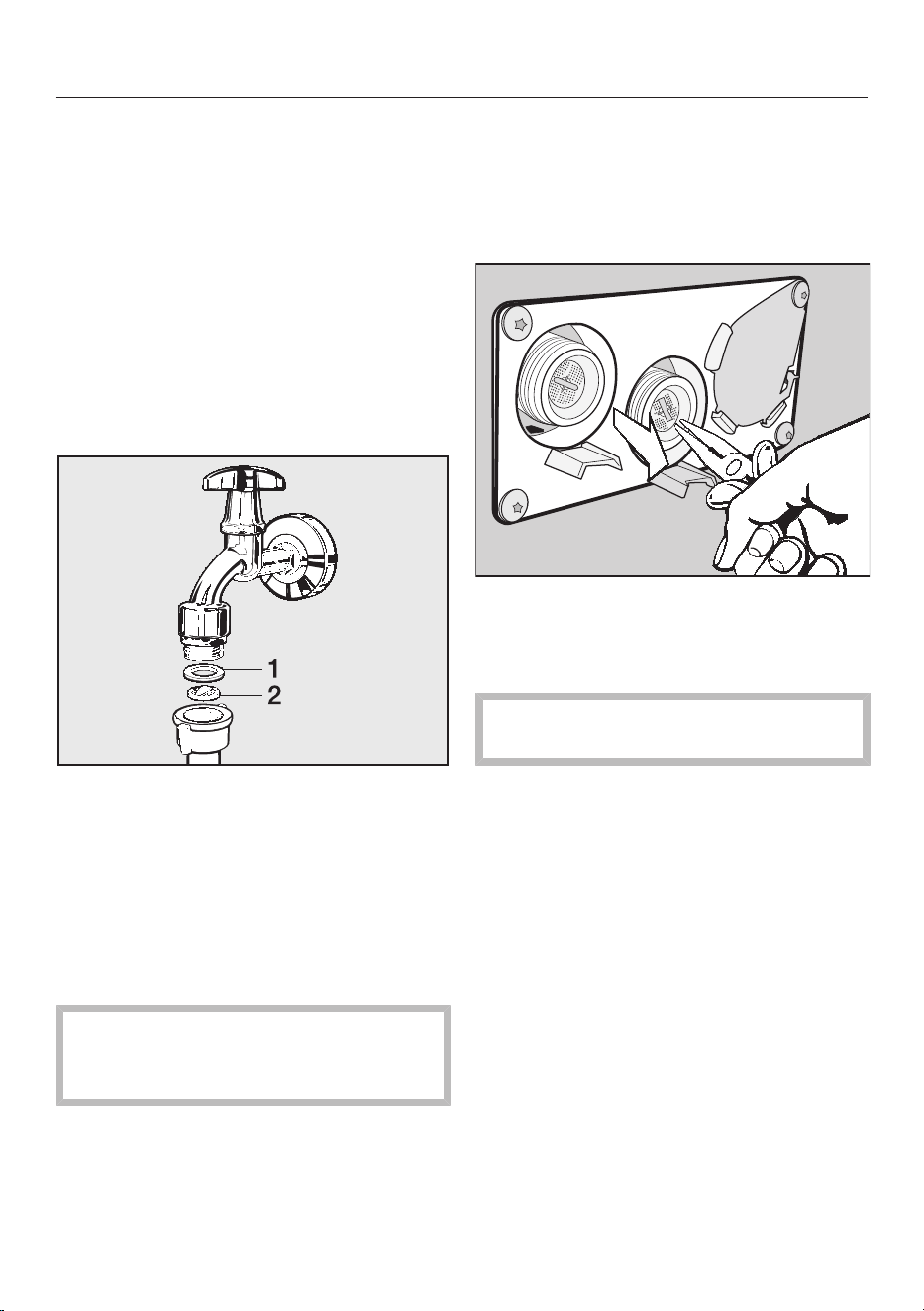
Cleaning and care
55
Cleaning the water intake filters
The washing machine has filters to pro-
tect the water intake valves. Check
these filters every 6 months or so.
Check the filters more often if there are
frequent interruptions to the external
water supply.
Cleaning the filters in the intake hoses
First turn off the faucet.
Unscrew the intake hose from the
faucet.
Remove the rubber seal 1 from the
connector.
Using pointed pliers, take hold of the
plastic filter bar 2 and pull it through
the filter.
Clean the plastic filter.
Reassemble the appliance in reverse
order.
Make sure there is no water leaking
from the screw thread.
Tighten the screw thread.
Cleaning the filters in the water intake
valves
Using pliers, carefully loosen the
ribbed plastic nut on the intake valve
and unscrew.
Use pointed pliers to grip the bar and
pull out the filter; then clean the filter.
Reassemble the appliance in reverse
order.
The filters must be put back in place
after cleaning.
Frequently asked questions
56
You are able to correct the majority of faults and problems that arise during day-to-
day use without external assistance. You can save time and money in many cases,
as you do not need to contact Miele Technical Service.
The following tables are designed to help you to find the cause of a malfunction or a
fault and to resolve it.
The wash program will not start.
Problem Possible cause and solution
The display remains
dark, and the Start/
Stopsensor control
does not light up or
flash.
There is no power to the machine.
Check whether the washing machine is switched on.
Check whether the washing machine is connected
to the power supply.
Check whether the circuit breaker has tripped.
The washing machine has switched off automatically
to save energy.
Switch the washing machine back on with the
button.
The following appears in
the display:
Door will not lock. Contact
Service..
The door is not closed properly. The door lock could
not engage.
Close the door again.
Start the program again.
If the fault message appears again, contact Techni-
cal Service.
The program does not
start when Spin has
been selected.
You have not yet completed the initial commissioning
process.
Perform the Initial commissioning process as de-
scribed in these instructions.
The display is dark and
the Start/Stopsensor
control is flashing
slowly.
The display has switched off automatically to save en-
ergy.
Touch any of the controls. The display switches back
on.
Frequently asked questions
57
Program cancellation and error message
Problem Possible cause and solution
Drainage fault. Clean
drain filter and pump.
Check the drain
hose.
The drain is blocked or restricted.
The drain hose has been fixed too high.
Clean the drain filter and the drain pump.
The maximum drain height is 3' 3 3/8" (1m).
Water intake fault.
Open the water sup-
ply.
The water intake is blocked or restricted.
Check whether the water supply is turned on prop-
erly.
Check whether the intake hose is kinked.
The water pressure is too low.
Switch on the Low water pressuresetting (see “Low
water pressure” under “Supervisor level”).
The filters in the water intake are blocked.
Clean the filters (see “Cleaning the filters” under
“Cleaning and care”).
Waterproof system
activated.
The water protection system has reacted.
Turn off the water supply.
Contact Technical Service.
Disinfection temper-
ature not reached
The required temperature was not reached during the
disinfection program.
The washing machine has not carried out the disin-
fection cycle correctly.
Start the program again.
Fault F. If restart
fails, contact Ser-
vice.
There is a fault.
Disconnect the washing machine from the power
supply.
Wait at least 2minutes before reconnecting the
washing machine to the power supply.
Switch the washing machine on again.
Start the program again.
If the fault message appears again, contact Techni-
cal Service.
Frequently asked questions
58
A fault message appears in the display
1
Problem Possible cause and solution
Container empty
One of the external detergent containers is empty.
Refill the detergent container.
Hygiene info: run the
Maintenance hy-
giene program, or a
program of at least
60°C
During the last wash, a wash program with a tempera-
ture below 140°F (60°C) or the Drain/Spinprogram
was selected.
Start a program with a minimum temperature of
140°F (60°C) or the Maintenance Wash Hygienepro-
gram.
Check hot water in-
take
The hot water supply is blocked or restricted.
Check whether the hot water supply has been
turned on properly.
Check whether the intake hose is kinked.
Machine can no
longer be networked.
Please contact Miele
Service.
Miele@home is not available.
Switch the washing machine off.
Then switch the washing machine on again.
If the message appears again, contact Miele Ser-
vice.
The washing machine can continue to be used.
Touch the OKsensor control.
Align the machine.
Laundry not properly
spun
The selected spin speed was not reached during the
final spin due to excessive imbalance.
Check that the washing machine is level.
Start the spin cycle again.
Machine is leaking
The washing machine or drain valve is leaking.
Turn off the water supply.
Contact Technical Service.
1
The messages will appear at the end of the program and when the washing ma-
chine is switched on and needs to be confirmed with the OKsensor control.
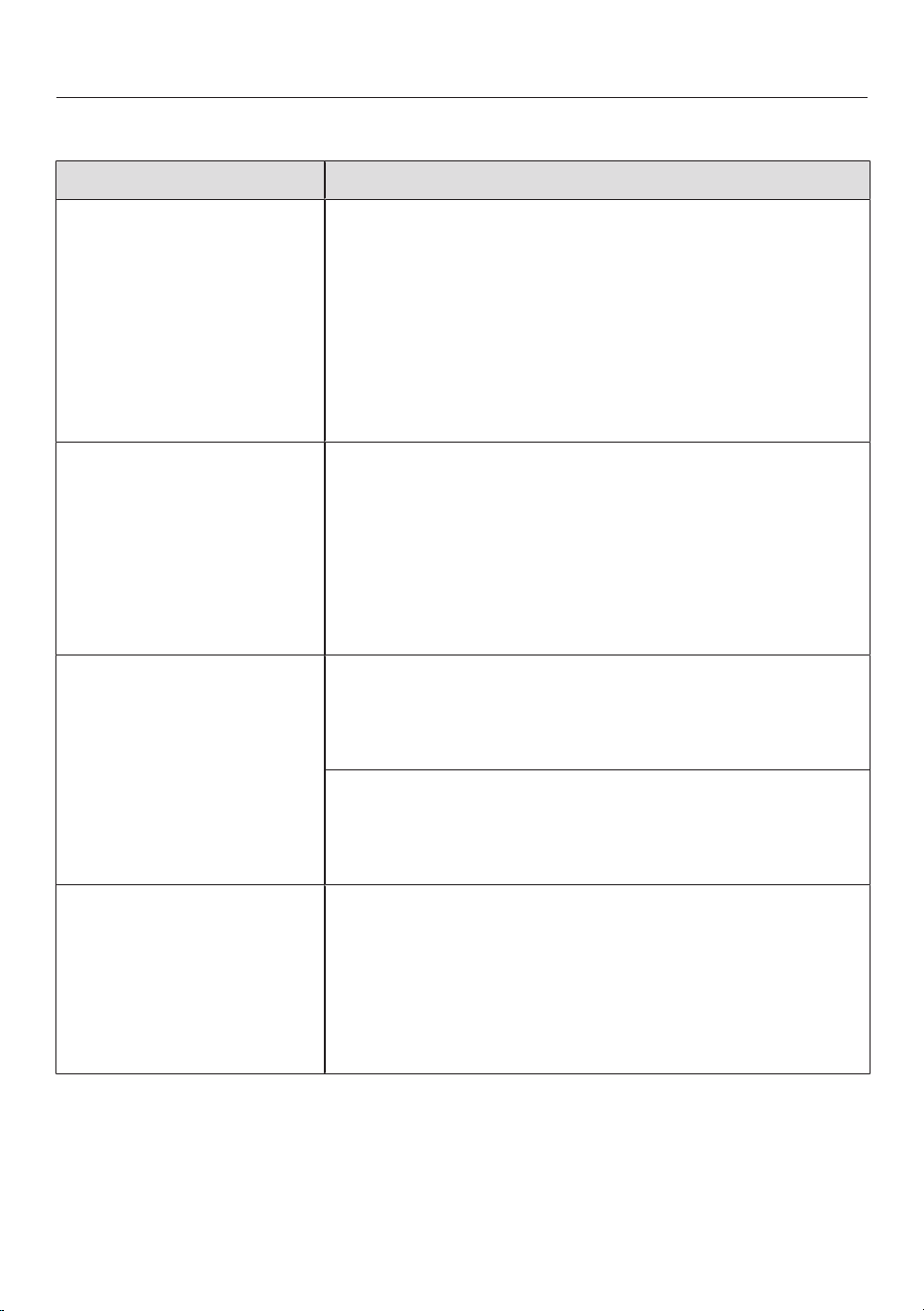
Frequently asked questions
59
Unsatisfactory wash results
Problem Possible cause and solution
Liquid detergent is not
achieving the required
results.
Liquid detergents do not usually contain bleaching
agents. They do not remove fruit, coffee, and tea
stains.
Use powder detergent containing a bleaching agent.
Pour stain removers into the drawer in the dis-
penser compartment and liquid detergent into a dis-
penser ball.
Never put stain removers and liquid detergent to-
gether in the detergent dispenser drawer.
White residues which
look like powder deter-
gent are seen on dark
textiles after washing.
The detergent contained compounds (zeolites) to aid
water softening which are not soluble in water. These
have ended up on the laundry.
Try and brush off the residues with a soft brush once
the laundry is dry.
In the future, wash dark textiles using a detergent
which contains no zeolites. Liquid detergents do not
usually contain zeolites.
Textiles that were very
greasy are not properly
clean.
Select a program with pre-wash. Use liquid deter-
gent for the pre-wash.
Use an industrially available powder detergent for
the main wash.
The use of heavy-duty detergent is recommended in
the main wash for very heavily soiled work clothing.
Please seek advice from the detergent and cleaning
agent manufacturer.
There are gray, oily parti-
cles clinging to washed
laundry.
Insufficient amounts of detergent were used. The
laundry was heavily soiled with grease (oils, oint-
ments).
Use more detergent or use liquid detergent with this
type of soiled laundry.
Before washing the next load, run a 140°F (60°C)
program with liquid detergent and no load.
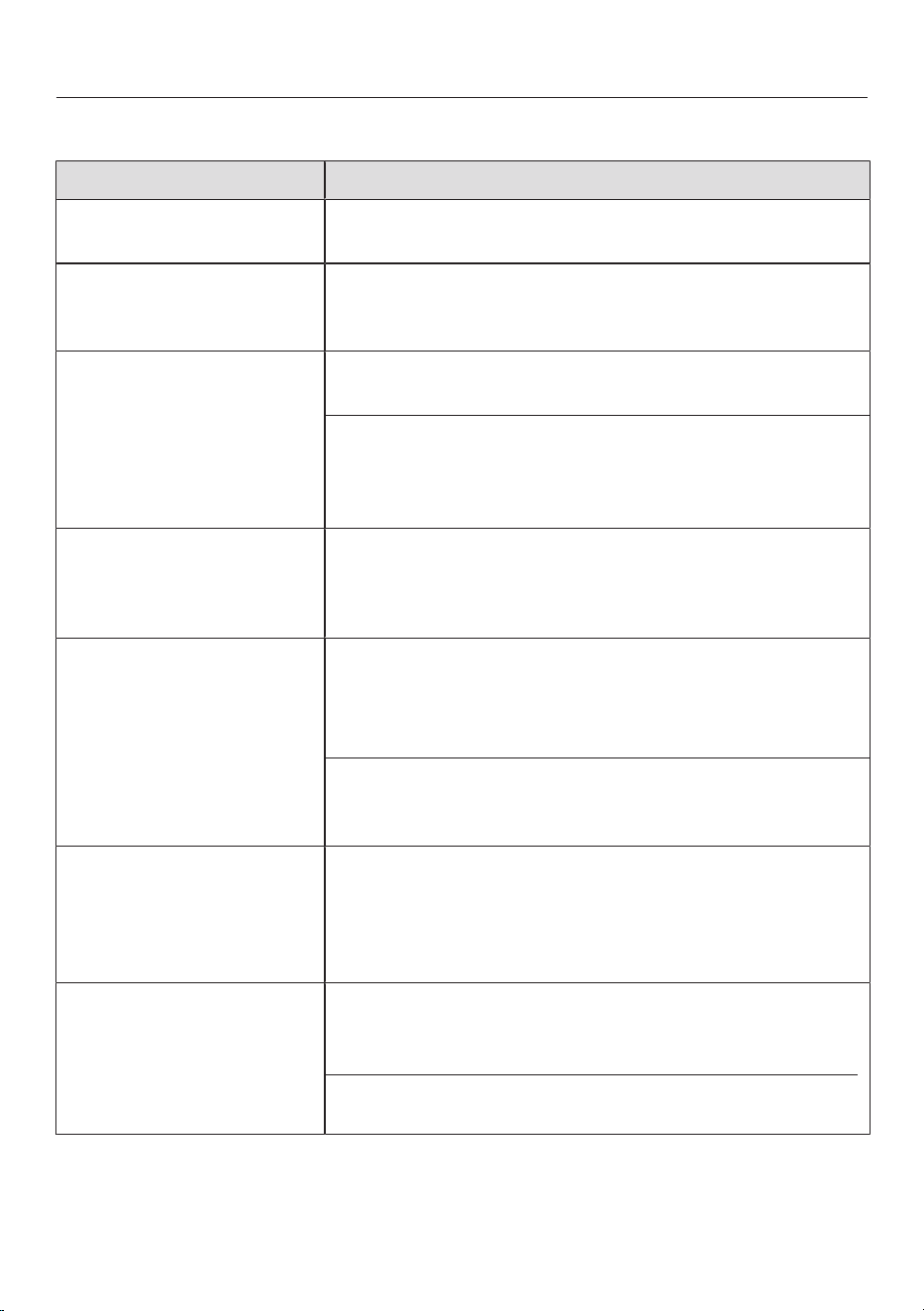
Frequently asked questions
60
General problems with the washing machine
Problem Possible cause and solution
The machine shakes dur-
ing the spin cycle.
The machine feet are not level and not secured.
Level the machine and adjust the feet correctly.
Strange pump noises
can be heard.
This is not a fault. These slurping noises occur at the
start and end of a pump sequence as a normal part of
the operation.
Large amounts of deter-
gent residue remain in
the detergent dispenser
drawer.
The water pressure is too low.
Clean the filters in the water intake.
Powder detergent used in conjunction with water
softeners tends to become sticky.
Clean the detergent dispenser drawer and in future,
add detergent first and then the water softener.
Fabric softener is not
completely dispensed or
too much water remains
in the compartment.
The siphon is not correctly positioned or is clogged up.
Clean the siphon (see “Cleaning the detergent dis-
penser drawer” under “Cleaning and care”).
The display is in a differ-
ent language.
A different language has been selected.
Switch the washing machine off and on again.
The selected supervisor language appears in the dis-
play.
The supervisor language has been changed.
Select the language you require (see “Language” un-
der “Supervisor level”).
The laundry has not
been spun properly. The
laundry is still wet.
The machine detected a high level of imbalance during
the final spin and reduced the spin speed automati-
cally.
Include both large and small items in the load as this
will achieve better distribution.
At the end of the pro-
gram there is still liquid
in the cap.
The small pipe in the detergent dispenser drawer
onto which the cap is placed is blocked.
Clean the small pipe.
This is not a fault. For technical reasons, a small
amount of water will remain in the cap.

Frequently asked questions
61
Problem Possible cause and solution
There is water next to
the capsule in the fabric
softener compartment.
The CapDosingsensor control was not activated or an
empty capsule was not removed at the end of the last
wash program.
Activate the CapDosingsensor control when a cap-
sule is next used.
Remove and then dispose of the empty capsule at
the end of each wash cycle.
The small pipe in the detergent drawer onto which the
capsule is placed is blocked.
Clean the small pipe.
The drum remains sta-
tionary but the program
keeps running.
Switch the washing machine off and then back on
with the button.
Note the message in the display.
Touch the Start/Stopsensor control.
The drum continues to spin and the program contin-
ues.

Frequently asked questions
62
The door will not open
Problem Possible cause and solution
The door cannot be
pulled open during a
program.
The door is locked during the wash program.
Touch the Start/Stopsensor control.
Select Cancel programor Add laundry.
The door will unlock and you will be able to pull it
open.
There is still water in the drum and the machine is un-
able to drain.
Clean the drainage system as described under
“Opening the door in the event of a blocked drain
outlet and/or power outage”.
At the end of a program
or when a program is
canceled, the following
appears in the display:
Cooling down or Comfort
cooling.
To protect the user against scalding, the door cannot
be opened if the suds temperature is higher than
130°F (55°C).
Wait until the temperature in the drum has de-
creased and the message has gone out in the dis-
play.
The following appears in
the display:
The door lock is jammed.
Contact Service.
The door lock has jammed.
Contact Technical Service.
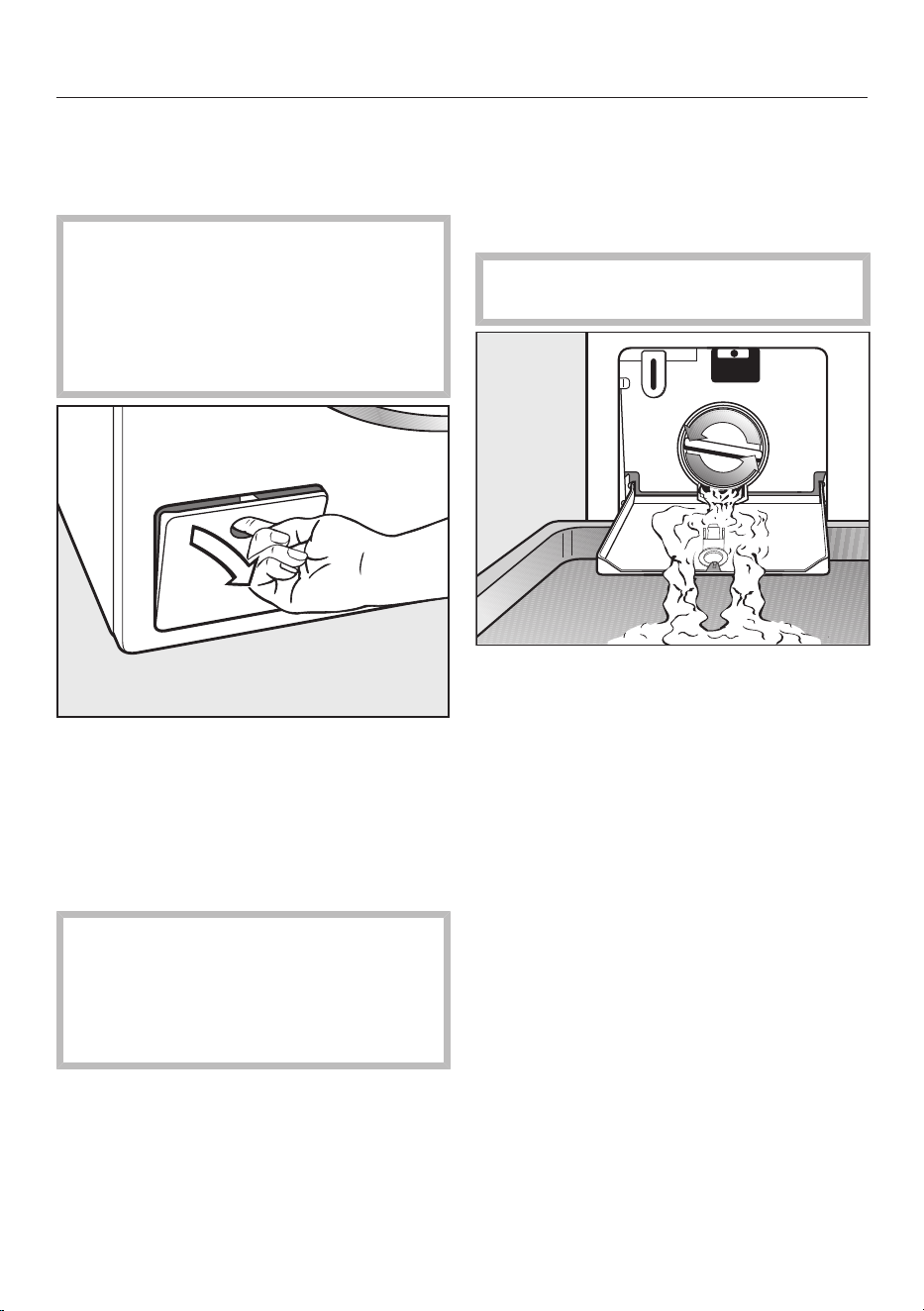
Frequently asked questions
63
Opening the door in the event
of a blocked drain outlet and/or
power outage
Risk of electric shock.
Only ever perform cleaning and main-
tenance work when the appliance is
disconnected from the power.
Disconnect the washing machine
from the power supply.
Open the access flap to the drain sys-
tem.
Blocked drain outlet
If the drain outlet is blocked, there may
be a large quantity of water (max. 30l)
left behind in the washing machine.
Risk of scalding due to hot suds.
Escaping suds will be hot if laundry
has been washed at high tempera-
tures.
Carefully allow all suds to drain off.
Emptying the drum
...For machines with a drain filter
Place a suitable container under the
access flap.
Remove the drain filter, though not
completely.
Slowly unscrew the drain filter to let
the water out.
Tighten the drain filter back up again if
you need to interrupt the flow of wa-
ter.
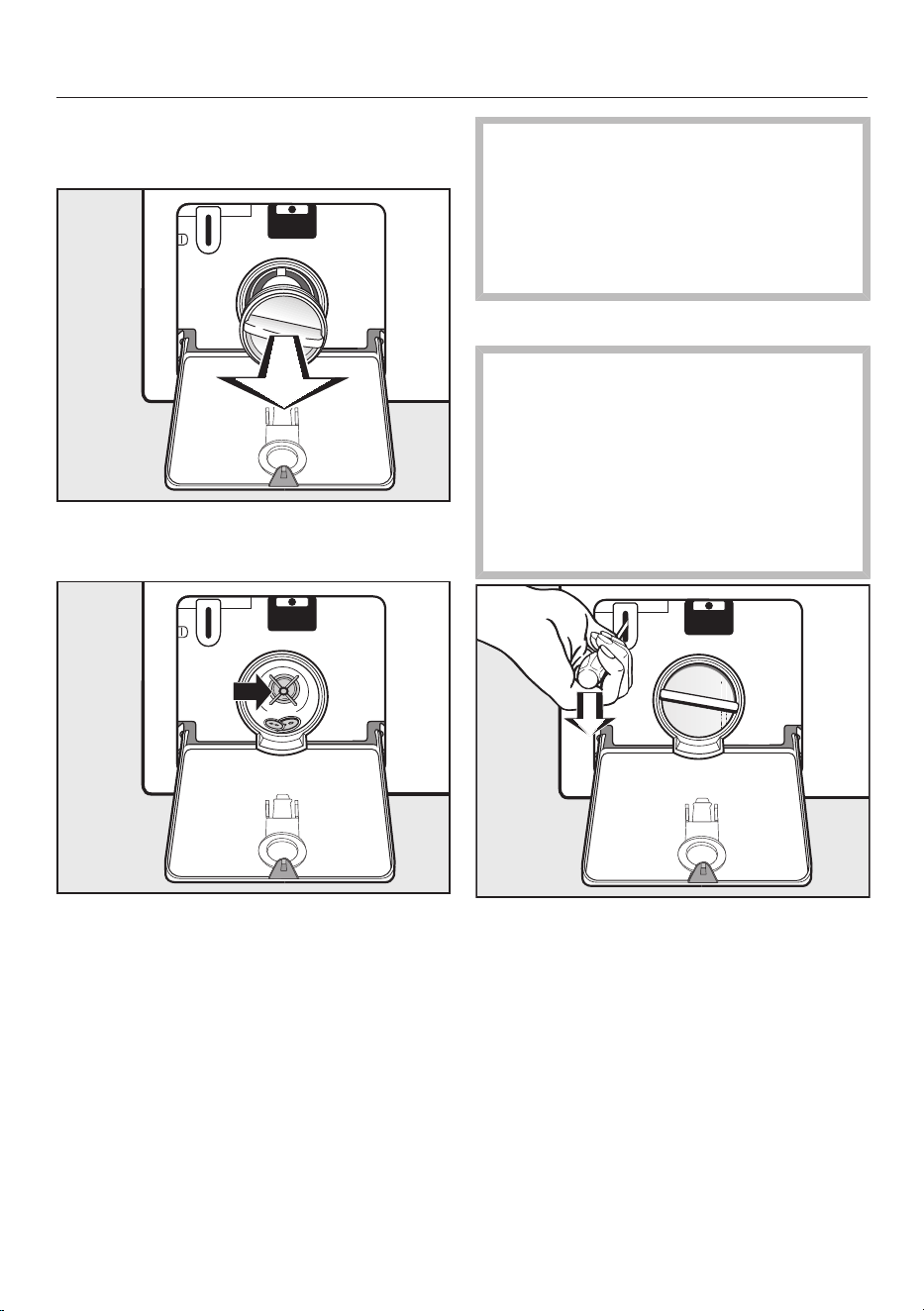
Frequently asked questions
64
Cleaning the drain filter
Once the flow of water ceases:
Remove the drain filter completely.
Clean the drain filter thoroughly.
Check the drain pump impellers to
make sure they can rotate freely.
Remove any foreign objects (e.g., but-
tons, coins, etc.) and clean the inte-
rior.
Put the drain filter back in place and
secure it.
Risk of damage from leaking wa-
ter.
Water will escape from the machine
if you forget to replace the drain filter.
Replace the drain filter correctly and
tighten it securely.
Opening the door
Danger of injury due to rotating
drum.
Reaching into a rotating drum is ex-
tremely dangerous and may result in
injury.
Always make sure that the drum is
stationary before reaching in to re-
move laundry.
Use a screwdriver to unlock the door.
Pull open the door.
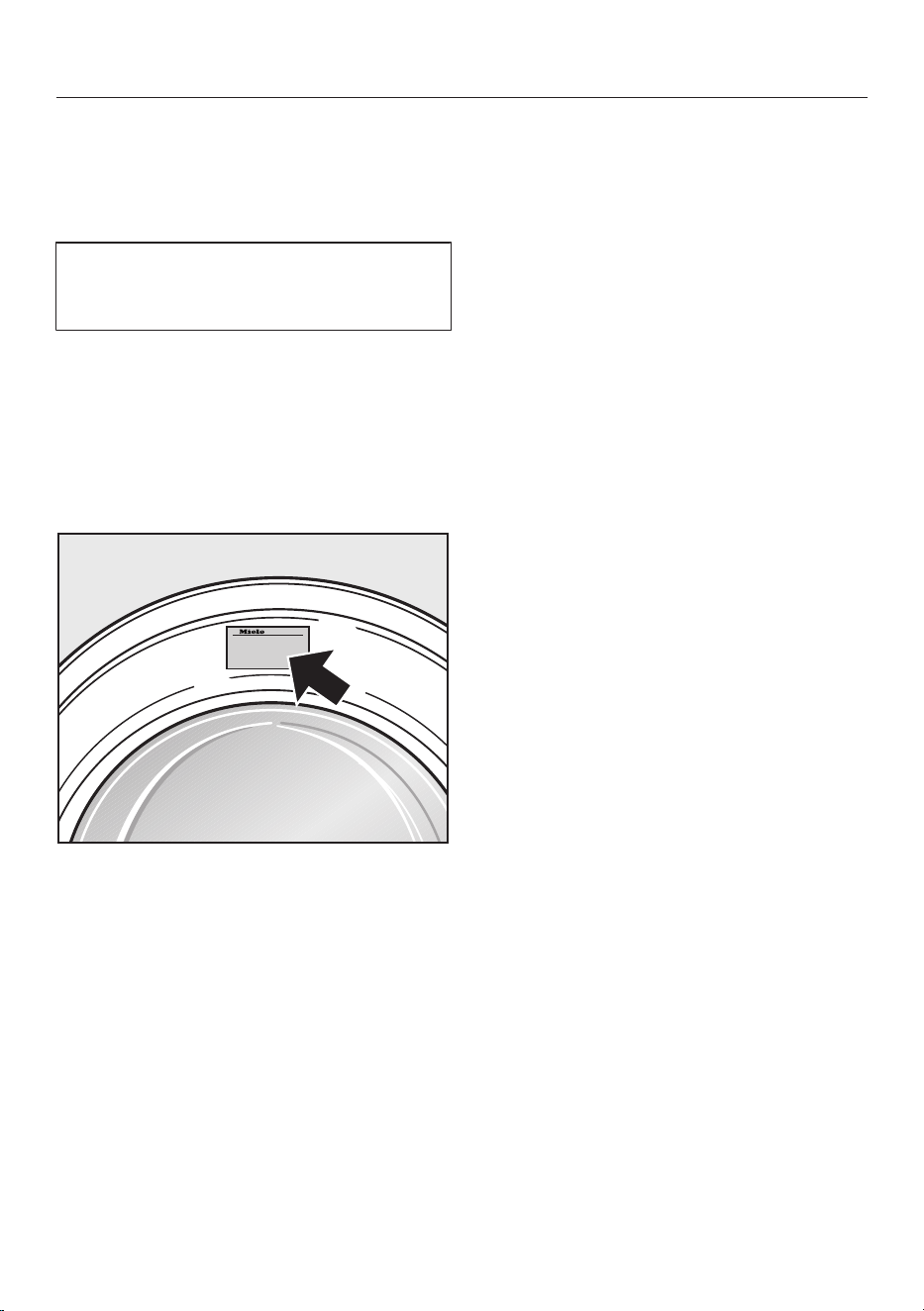
Technical Service
65
Contact in the event of a fault
In the event of a fault which you cannot
remedy yourself, please contact your
Miele dealer or Miele Technical Service.
Contact information for Miele Techni-
cal Service can be found at the end of
this document.
Please quote the model and serial num-
ber of your appliance when contacting
Miele. Both pieces of information can
be found on the data tag.
The data tag is found above the porthole
glass when the washing machine door is
opened:
Optional accessories
Optional spare parts and accessories for
this washing machine are available from
your Miele dealer or Miele Technical
Service.
Maintenance
Preventive maintenance supports fault-
free operation and prevents unneces-
sary repairs.
Miele recommends regular maintenance
by Miele Service.
66
Installation instructions
Alteration rights reserved.
Visit our website for all the current product specifications, technical appliance
information, and warranty information.
To avoid accidents or damage to the appliance, please read these instructions
before installing and/or using it.
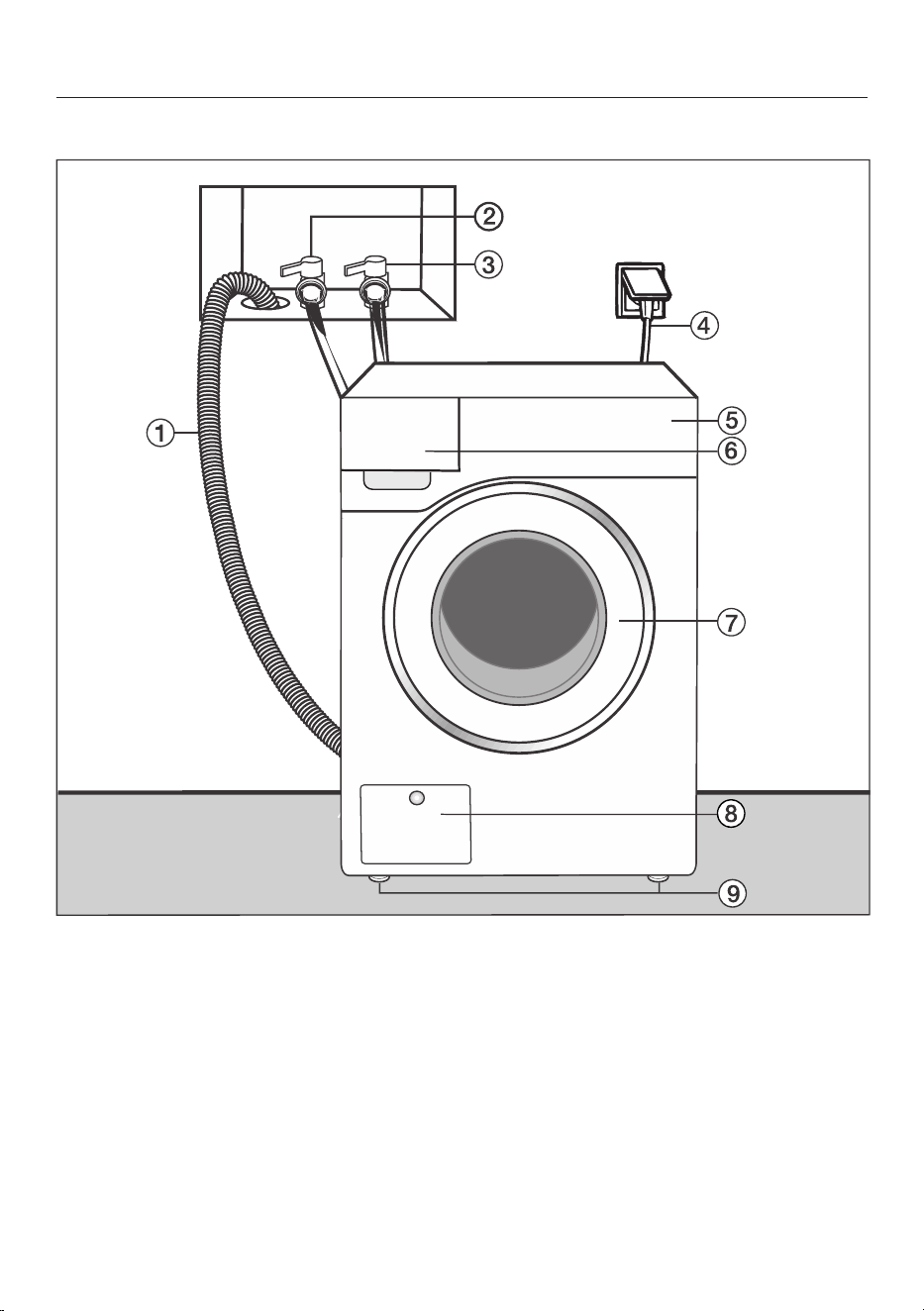
Installation and connection
*INSTALLATION*
67
Front view
a
Drain hose
b
Intake hose (cold water)
c
Intake hose (hot water), if attached
d
Electrical connection
e
Control panel
f
Detergent dispenser drawer
g
Door
h
Access flap to drain filter and drain
pump
i
Height-adjustable feet
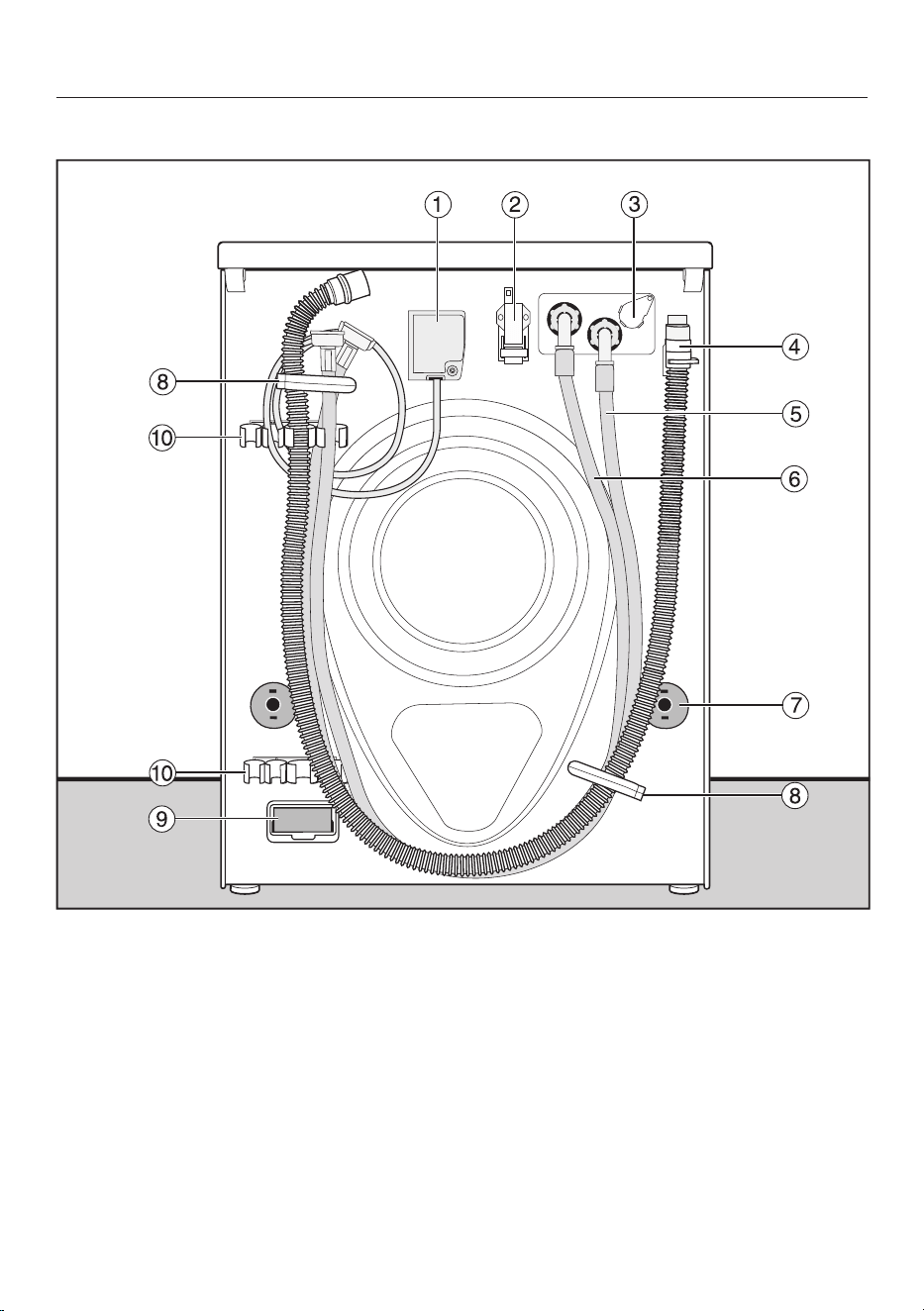
Installation and connection
*INSTALLATION*
68
Rear view
a
Electrical connection
b
Interface for communicating with ex-
ternal appliances
c
Socket for external dispensing
d
Drain hose
e
Intake hose (cold water)
f
Intake hose (hot water), if attached
g
Safety caps for shipping struts
h
Transport clips for hoses
i
Module slot (for external communi-
cation module)
j
Holder for removed shipping struts
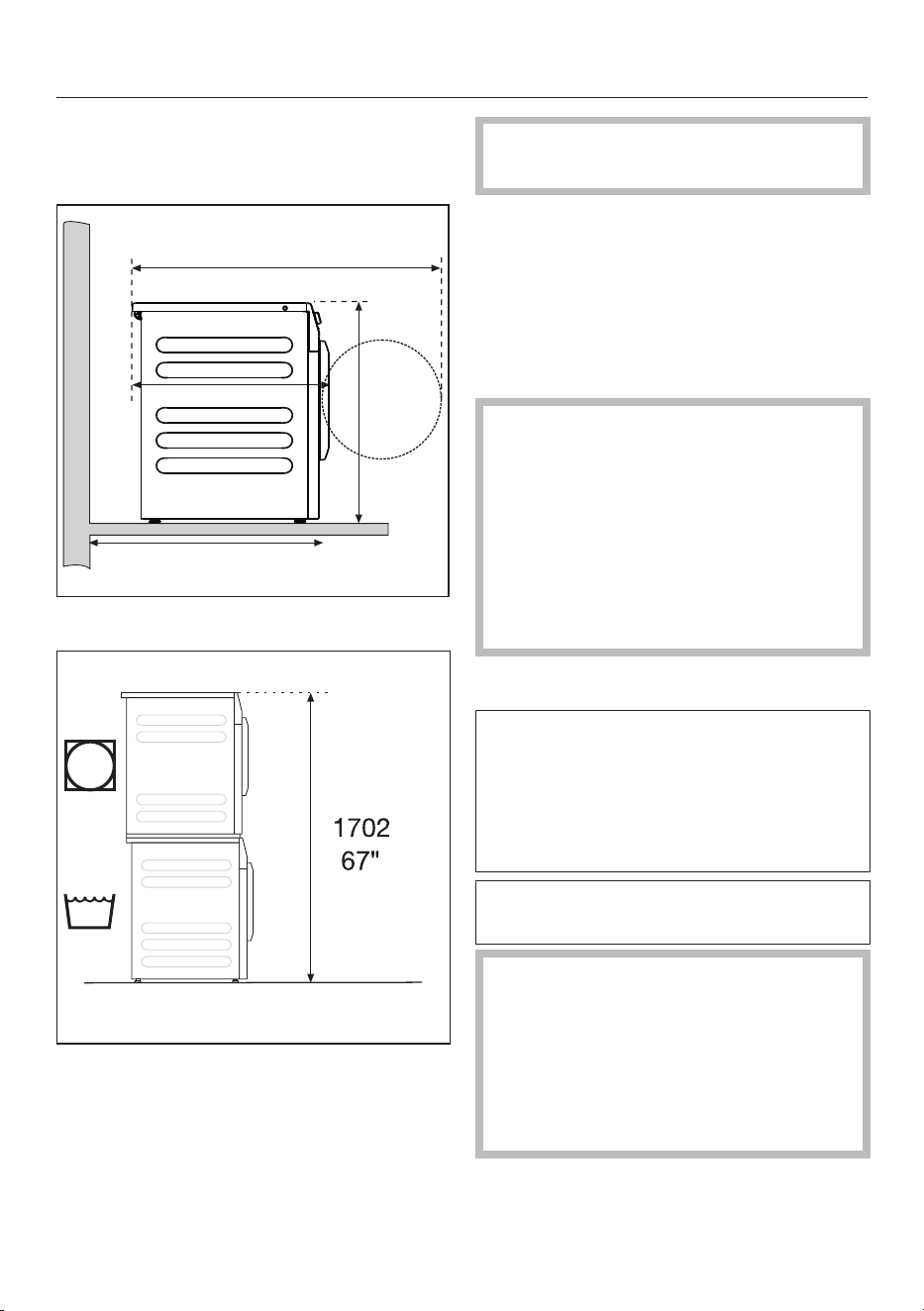
Installation and connection
*INSTALLATION*
69
Installation locations
Side view
44 9/16" (1,132 mm)
33 7/16" (850 mm)
43 1/3" (1,000 mm)
28 1/8" (714 mm)
Washer-dryer stack
The washing machine can be installed
as a washer-dryer stack together with a
Miele Tumble Dryer. This requires a
washer-dryer stacking kit which can be
purchased separately.
Installing the washer-dryer stack
on a Miele base is not permitted.
Installation on a plinth
The washing machine can be installed
on a steel plinth (open or closed, e.g.
APCL 002, APCL 003, APCL 005,
APCL 007, APCL 011 or APCL 012,
available as an optional Miele acces-
sory) or on a concrete plinth.
Injury can occur if the washing
machine has not been adequately se-
cured.
When installing the machine on a
plinth, there is the danger of the
washing machine falling off the plinth
during spinning.
Secure the washing machine using
the clamps supplied.
Installation notes
The distances between the machine
and the wall are recommendations to
help make it easier to carry out service
work. If installation space is limited,
the washing machine can also be
pushed up against the wall.
This washing machine is not suitable
for building under.
Risk of damage due to moisture
ingress.
Moisture can damage electrical com-
ponents.
Do not install the machine near or di-
rectly above an open gully or floor
drain.
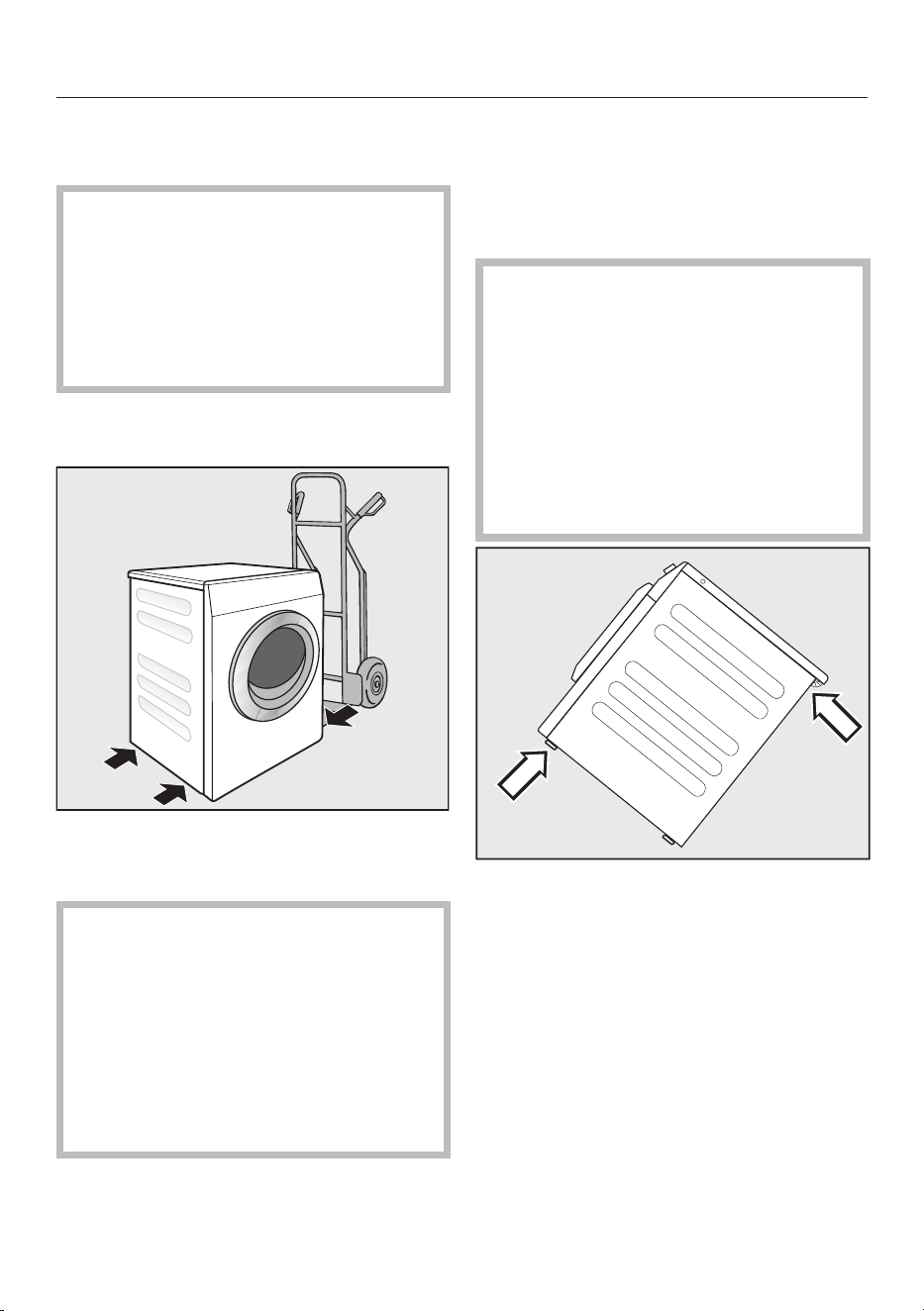
Installation and connection
*INSTALLATION*
70
Transporting the washing ma-
chine to its installation site
Danger of injury from incorrect
transport.
If the washing machine tips up there
is a danger of injury to people and
damage to property.
Make sure the washing machine is
stable during transportation.
Transporting the washing machine
with a sack truck
If transporting the washing machine
with a sack truck, make sure its left or
right side is resting on the truck.
Risk of damage from incorrect
transport.
The front or back of the washing ma-
chine may be damaged if the ma-
chine is transported with a sack
truck.
Always insert the sack truck under
one of the sides of the washing ma-
chine.
Transporting the washing machine to
its installation site
The protruding lid at the back can be
used to hold the machine when trans-
porting.
Danger of injury due to insecure
lid.
The fixings at the back of the lid may
become brittle due to external cir-
cumstances. There is a danger of the
lid being pulled off when carrying the
appliance.
Before carrying the appliance, check
that the lid is secure where it pro-
trudes at the back of the appliance.
Carry the washing machine by the
front feet and by the lid where it pro-
trudes at the back of the appliance.
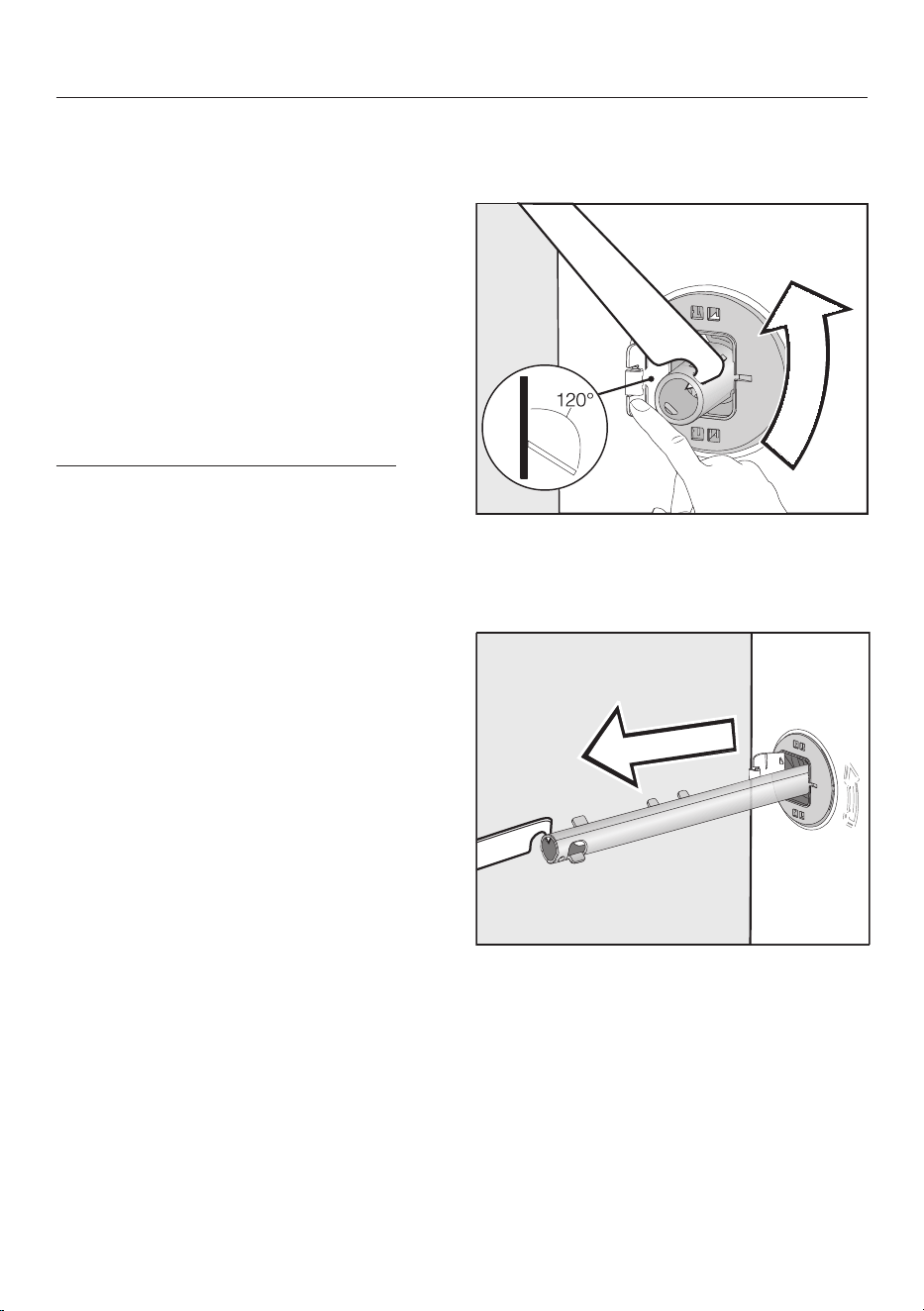
Installation and connection
*INSTALLATION*
71
Installation surface
A concrete floor is the most suitable in-
stallation surface for this machine. It is
far less prone to vibration during the
spin cycle than wooden floorboards or a
carpeted surface.
The machine must be level and se-
curely positioned.
To avoid vibrations during spinning,
the machine should not be installed
on soft floor coverings.
If installing on a wooden joist floor:
Install the machine on a plywood
base (at least 2' 3 9/16" x 1' 11 5/8" x
1 3/16" (70x60x3cm)). The base
should span several joists and be
bolted to the joists and not only to the
floorboards.
Tip: If possible, install the machine in a
corner of the room. This is usually the
most stable part of the floor.
Removing the shipping struts
Removing the left-hand shipping strut
Open out the cover and use the
wrench supplied with the washing
machine to turn the shipping strut
90°.
Pull out the shipping strut.
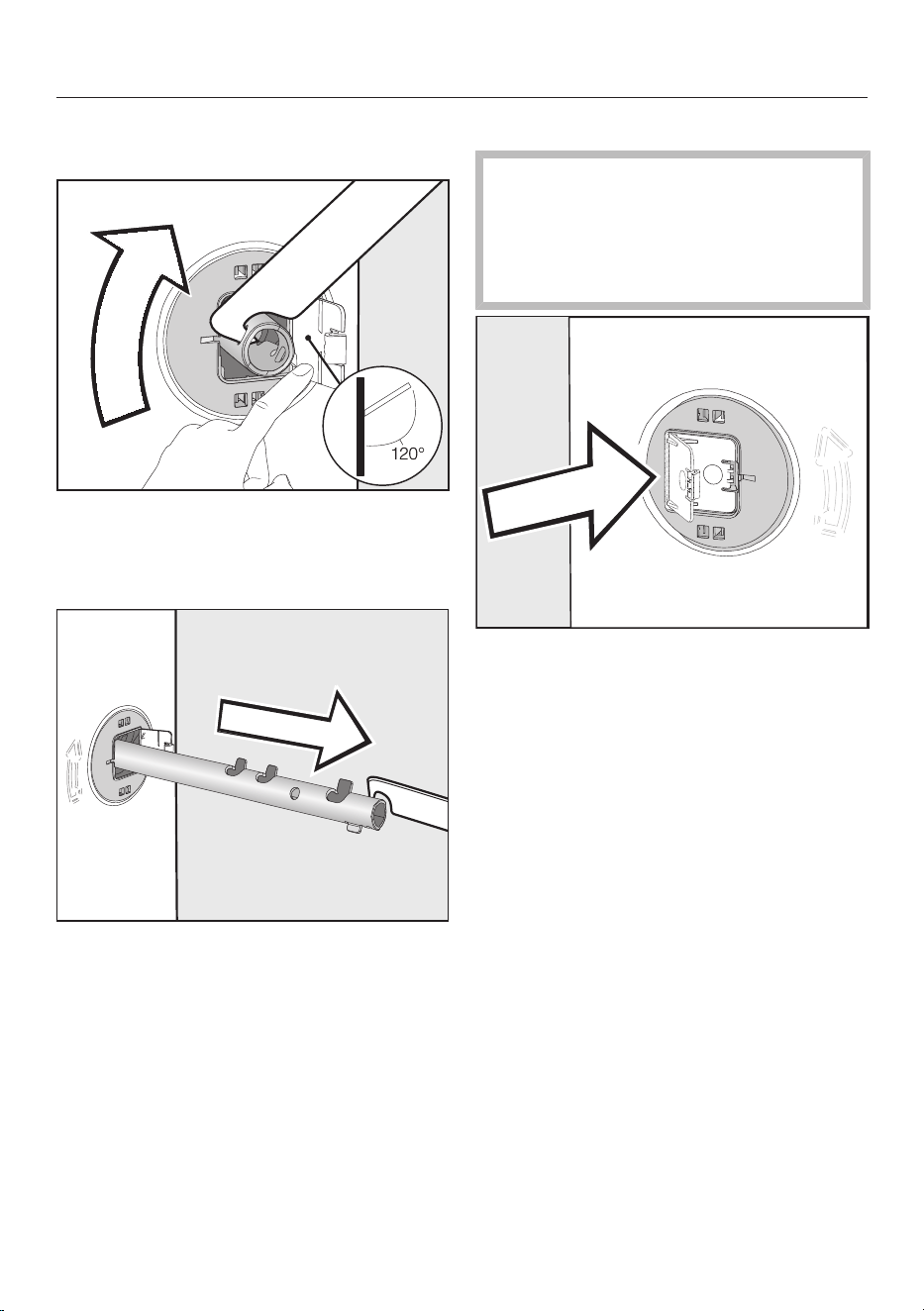
Installation and connection
*INSTALLATION*
72
Removing the right-hand shipping
strut
Open out the cover and use the
wrench supplied with the washing
machine to turn the shipping strut
90°.
Pull out the shipping strut.
Covering the holes
Risk of injury from sharp edges.
There is a risk of injury from reaching
into holes that are not covered.
Cover the holes for the shipping
struts after they have been removed.
Press the covers firmly shut until they
click into place.
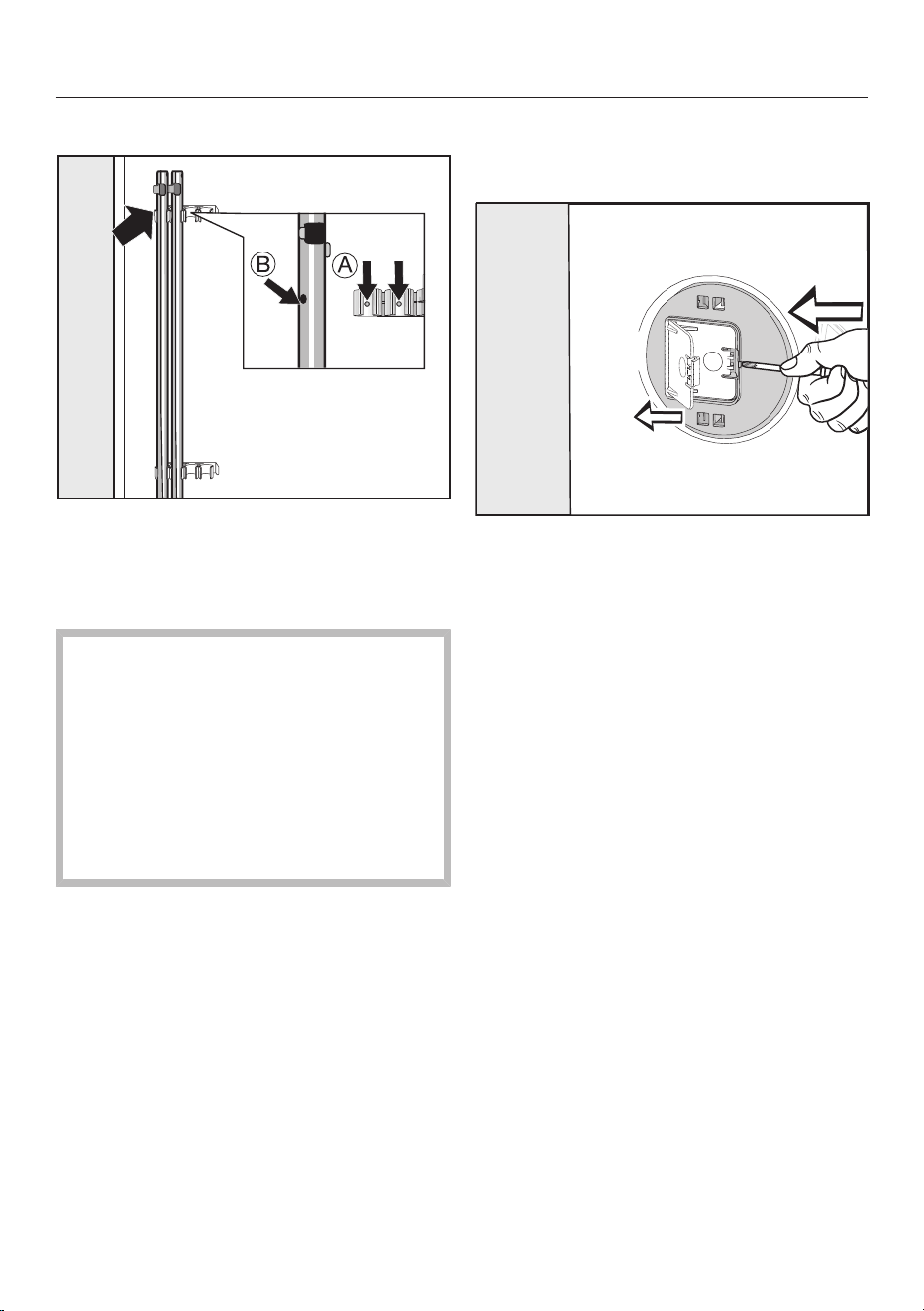
Installation and connection
*INSTALLATION*
73
Securing the shipping struts
Secure the shipping struts to the back
of the washing machine.
Tip: Make sure that the holes are
placed over the retainers.
Risk of damage from incorrect
transport.
The washing machine may become
damaged if moved without the ship-
ping struts in place.
Keep the struts in a safe place. Install
them again if the washing machine is
to be moved (e.g., when moving to a
new house).
Installing the shipping struts
Opening the covers
Press against the catch with a thin
object (a narrow screwdriver, for ex-
ample).
The cover opens.
Installing the shipping struts
Install the shipping struts by following
the instructions for their removal in
reverse order.
Tip: The struts will slide in more easily if
you lift the drum slightly.
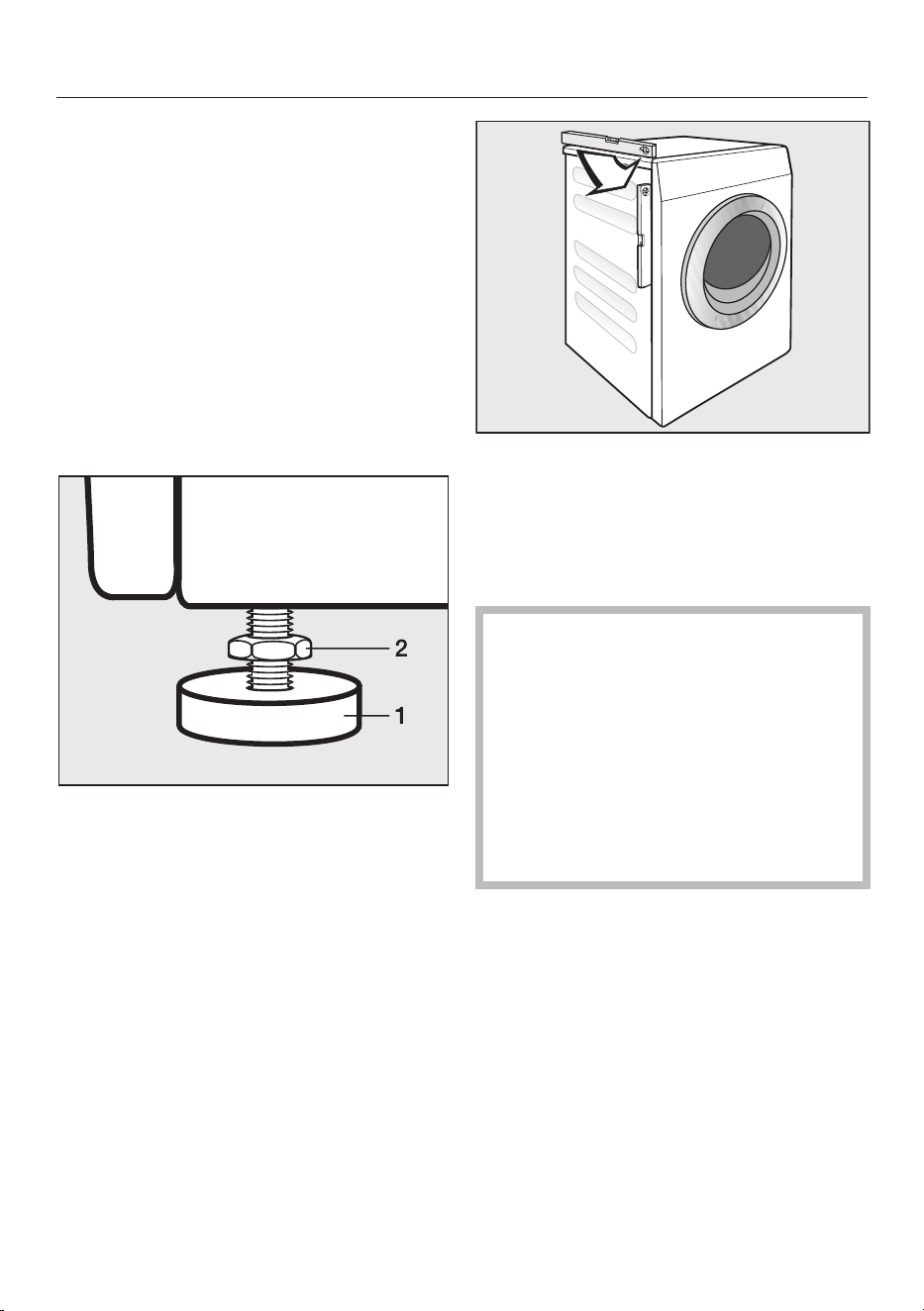
Installation and connection
*INSTALLATION*
74
Leveling the washing machine
The washing machine must stand per-
fectly level on all four feet to ensure safe
and proper operation.
Incorrect installation may increase elec-
tric and water consumption and may
cause the machine to move about.
Unscrewing and adjusting the feet
The 4 adjustable screw feet are used to
level the washing machine. All four feet
are screwed in when the machine is de-
livered.
Using the wrench supplied, turn
counter nut 2 in a clockwise direction.
Then turn counter nut 2 together with
foot 1 to unscrew.
Use a spirit level to check that the
washing machine is standing level.
Hold foot 1 securely with a pipe
wrench. Turn counter nut 2 again us-
ing the wrench supplied until it sits
firmly up against the housing.
Risk of damage due to incorrectly
aligned washing machine.
There is a danger of the washing ma-
chine moving about if the feet are not
secured.
Turn all 4 counter nuts for the feet
until they sit firmly up against the
housing. Please also check this for
the feet which did not need adjust-
ment.
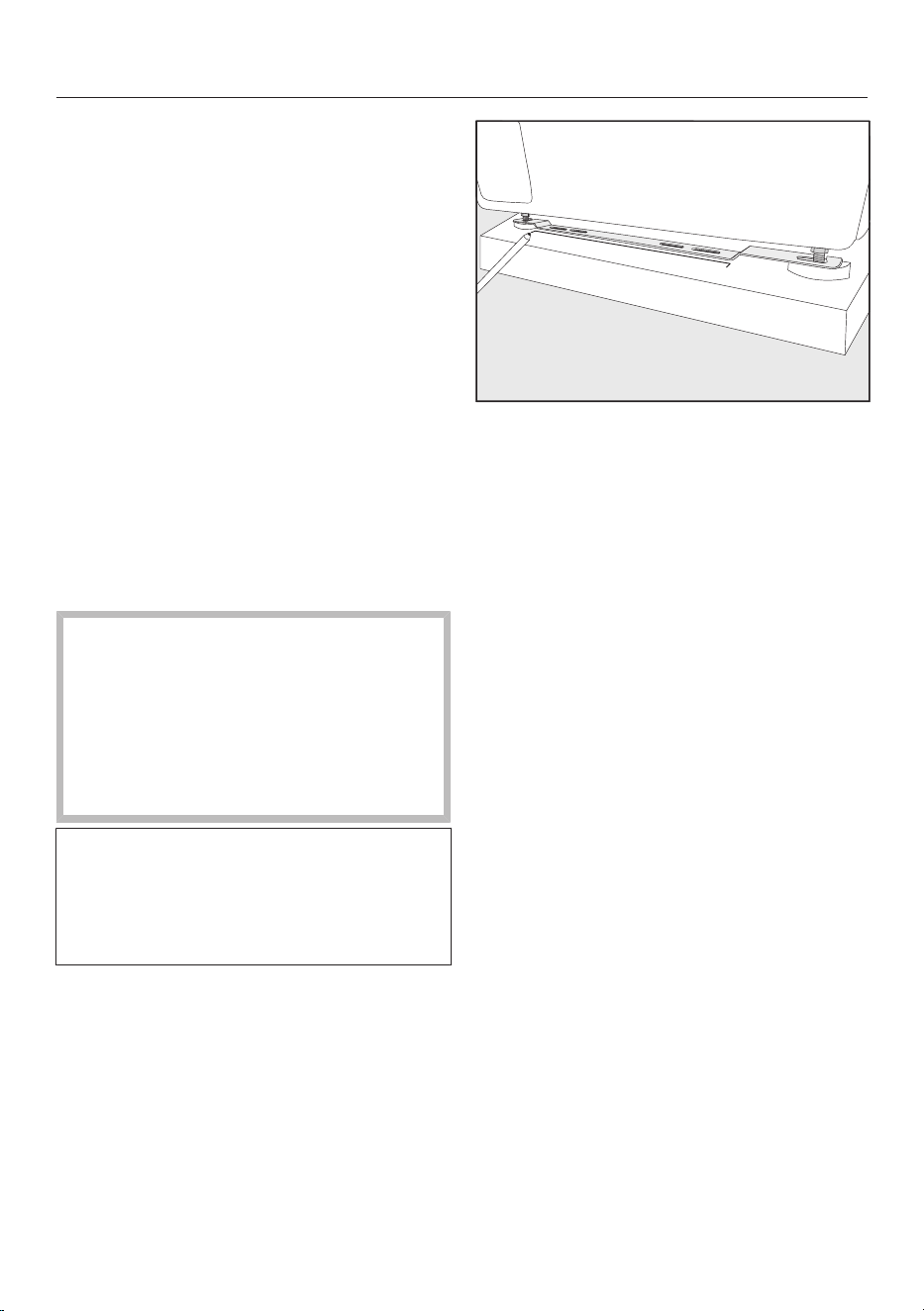
Installation and connection
*INSTALLATION*
75
Holding bracket for toe-kick
The holding bracket prevents the wash-
ing machine from falling off the toe-kick
during operation.
Fastening with the holding bracket is
only intended for toe-kicks made from
concrete. The toe-kick must be flat and
level. The surface below the toe-kick
must be able to withstand the physical
loads.
Prior to installation, check whether the
toe-kick complies with the minimum di-
mensions.
Height: 2 3/8" (6cm)
Width: 23 5/8" (60cm)
Depth: 25 9/16" (65cm)
Positioning the holding bracket
Risk of injury from sharp edges.
The holding bracket has sharp edges.
You could cut yourself on the edges.
Take care when handling the holding
bracket.
Wear gloves while installing the hold-
ing bracket.
The front appliance feet must protrude
by at least 1/8" (3mm). The washing
machine must already be aligned (see
“Installation – Aligning the washing
machine”)
Place the holding bracket on the front
appliance feet.
Mark the position of the front edge of
the holding bracket with a pencil.
Remove the holding bracket from the
feet.
Carefully move the washing machine
until you have enough space to install
the holding bracket.
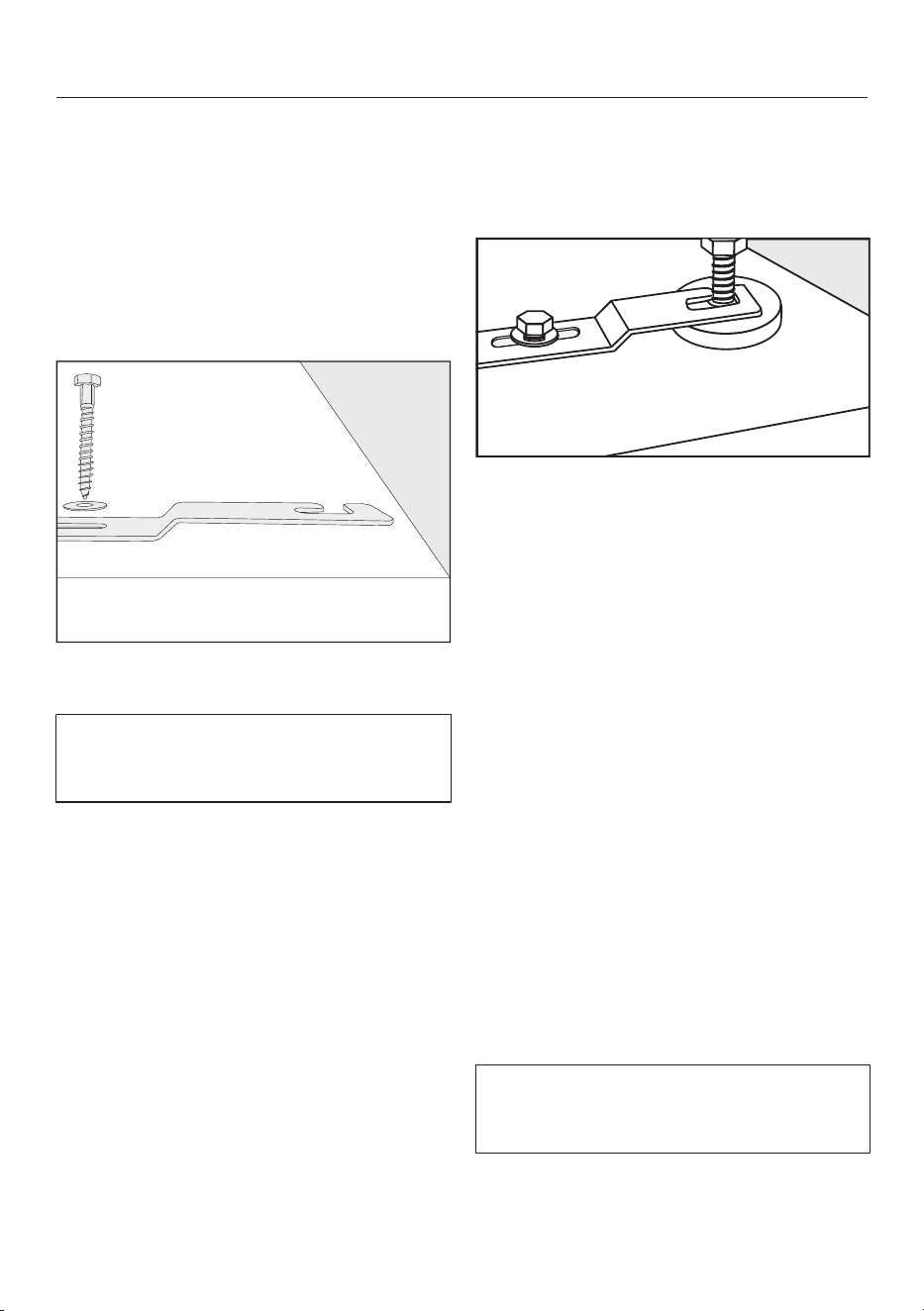
Installation and connection
*INSTALLATION*
76
Installing the holding bracket
Place the holding bracket on the
marking on the toe-kick.
In the middle of the two outer slotted
holes, mark a point for each drill hole.
Drill 2holes 5/16" (8mm) with a
depth of approx. 2 3/16" (55mm).
Insert the plugs in the holes.
Install the holding bracket with the
hex screws and the washers.
Do not tighten the screws yet – this
will allow the holding bracket to be
moved sideways.
Securing the washing machine with
the holding bracket
Push the washing machine back on to
the installed holding bracket.
Insert the appliance feet (the part be-
tween the foot and the locknut) into
the openings in the holding bracket.
Push the holding bracket to the right
as far as it will go.
Tighten the hex screws using a
wrench.
The washing machine is secured in the
holding bracket.
External control equipment
The XCI box accessory is needed to
connect external control equipment,
such as payment systems, dispensing
systems or peak load control units.
Payment system
This washing machine can be fitted with
a payment system (optional accessory).
The necessary reprogramming must al-
ways be carried out by Miele Technical
Service or a Miele Service Dealer.
Coins/tokens must be removed from
the coin box regularly. Otherwise, the
payment system will become blocked.

Installation and connection
*INSTALLATION*
77
Water connection
Cold water connection
The washing machine should be con-
nected to a domestic water supply in
accordance with current local and na-
tional safety regulations. The German
authorities do not require it to have a
non-return valve as the washing ma-
chine has been designed to comply with
DIN regulations.
The flow pressure must amount to a
minimum of 14.5 psi (100kPa) and
must not exceed 145 psi (1,000kPa). If
the pressure exceeds 145 psi
(1,000kPa), a pressure reducing valve
must be installed.
For the connection, a faucet with a ¾
inch screw thread is required. If this
type of faucet is not available, only a
qualified installer may connect the
washing machine to the domestic water
supply.
The connection point is subject to
domestic water pressure.
You should therefore open the faucet
slowly and check for leaks. Correct
the position of the washer and screw
thread if appropriate.
The intake hose for cold water is not
suitable for connection to a hot water
supply.
Switching to cold water operation
If the washing machine is not con-
nected to a hot water point, you will
have to configure the settings Main
wash water, Pre-wash water, and Rinse
water to cold (see “Supervisor level”).
Unscrew the hot water hose.
Screw on the stopper provided.
Maintenance
Only use genuine Miele hoses that have
been tested to withstand pressure of at
least 1,015 psi (7,000kPa) should you
ever need a replacement.
A filter is located in the open end of
the intake hose and another in the in-
take point to protect the water intake
valves.
Neither filter may be removed.
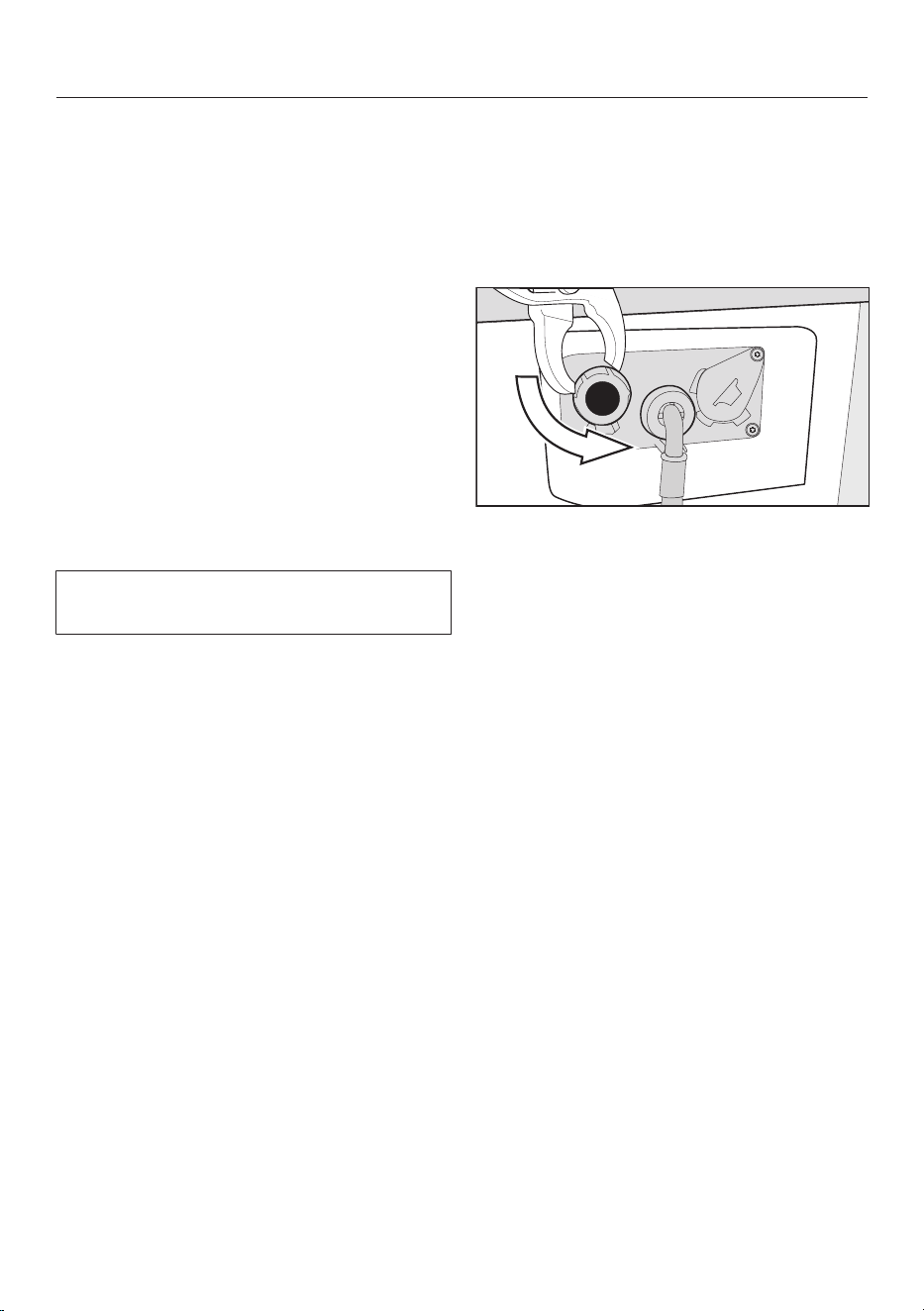
Installation and connection
*INSTALLATION*
78
Hot-water connection*
The hot water temperature must not ex-
ceed 158°F (70°C).
To minimize energy consumption during
operation with hot water, the washing
machine should be connected to a suit-
able hot water ring circuit. So-called
“transmission pipes” (single pipes to
hot water generators) can result in any
water remaining in the pipes cooling
down if not in constant use. More en-
ergy would then be consumed to heat
the liquid up again.
The same connection requirements as
for cold water also apply to hot water.
The intake hose (hot = red stripes) is
connected to the faucet.
The washing machine cannot only be
connected to a hot water connection.
* Some machine versions do not come
with a hot water hose.
Switching to hot water operation
If the washing machine is due to be
connected to a hot water point, you can
configure the settings Main wash water,
Pre-wash water, and Rinse water to hot
(see “Supervisor level”).
Unscrew the stopper from the hot
water valve.
Screw on the hot water hose.
Water drainage
Drain pump
The suds are drained through a drain
pump with a 1m delivery head. For the
water to drain freely, the hose must be
installed free of kinks. The swivel elbow
(accessory) can be hooked onto the end
of the hose.
Drainage options
1. Connected securely to a plastic drain
pipe with a rubber nipple (there is no
need to use a non-return valve).
2. Connected securely to a sink with a
plastic nipple.
3. Connected securely to a floor drain.
If required, the hose can be extended to
a length of up to 16.4ft (5m). Acces-
sories are available from your Miele
dealer or Miele Technical Service.

Installation and connection
*INSTALLATION*
79
Electrical connection
This description applies to washing
machines both with and without a
power plug.
The following applies to washing ma-
chines with a power plug:
- The washing machine is ready to be
connected.
- The power plug must be easily acces-
sible after installation so that the ma-
chine can be disconnected from the
power supply if necessary.
Damage caused by incorrect
supply voltage.
The data tag indicates the nominal
power consumption and the appro-
priate fuse rating.
Compare the specifications on the
data tag with those of the domestic
electrical supply and make sure that
they match.
The washing machine may only be con-
nected to a permanent electrical system
that conforms to the national and local
codes and regulations.
Do not connect the machine to an ex-
tension lead or multi-socket adapter as
they do not guarantee the required
safety of the appliance (e.g., danger of
overheating).
If the machine is hard-wired, a dual cir-
cuit breaker must be provided on-site.
When switched off there must be an all-
pole contact gap of at least 3mm in the
isolator switch (including circuit break-
ers, breakers, and relays according to
IEC/EN60947). This connection
process must be performed by a quali-
fied electrician.
The plug connector or isolator switch
should be easily accessible at all times.
Risk of electric shock.
If the washing machine is discon-
nected from the power supply, pro-
tective measures should be taken to
ensure that the point of disconnec-
tion cannot accidentally be switched
on again.
Make sure the isolator is lockable or
the point of disconnection is moni-
tored at all times.
New connections, modifications to the
system, or servicing of the ground con-
ductor, including determining the cor-
rect fuse rating, must be carried out by a
qualified electrician, as they are familiar
with the pertinent regulations and the
specific requirements of the electric
utility company.
If converting the washing machine to
an alternative voltage, observe the in-
structions in the wiring diagram. Con-
version must be performed by Miele
Technical Service or by an authorized
Miele dealer.

Technical data
80
Height 33 7/16" (850mm)
Width 23 7/16" (596mm)
Width (for machines with a stainless steel
lid)
23 13/16" (605mm)
Depth 28 1/8" (714mm)
Depth with door open 44 9/16" (1,132mm)
Weight Approx. 220 lb (100kg)
Maximum floor load in operation 3,000Newton
Capacity 19.8lb (9kg) dry laundry
Connection voltage See data tag on back of machine
Rated load See data tag on back of machine
Fuse rating See data tag on back of machine
A-rated sound emissions L
pA
in accordance
with ENISO11204/11203
<70dB re 20µPa
Minimum water flow pressure 14.5 psi (100kPa /1bar)
Maximum water flow pressure 145 psi (1,000kPa /10bar)
Water intake hose length 5' 1" (1.55m)
Power cord length 5' 10 7/8" (1.80m)
Maximum delivery head (drain pump) 3' 3 3/8" (1.00m)
LEDs Class 1
Test certificates awarded See data tag
Frequency range of the WiFi module 2.4000–2.4835GHz
Maximum transmission power of the WiFi
module
< 100mW
Supervisor level
81
Opening the Supervisor level
Switch on the washing machine.
11:02
Programs Favorites Supervisor
Help
Touch the Supervisorsensor con-
trol.
The display will switch to the Supervisor
levelmenu.
Code-based access
The Supervisor level is accessed using
a code.
The code is 000(factory default).
Changing the PIN code
You can alter the Supervisor level ac-
cess code to protect the washing ma-
chine from unauthorized access.
Please inform Miele Technical Ser-
vice if you have forgotten your new
code. Technical Service will have to
reset the code.
Make a note of your new code and
store it in a safe place.
Closing the settings menu
Touch the sensor control.
The display will then go back to the pre-
vious menu level.
Touch the sensor control.
The display will change to the main
menu.

Supervisor level
82
Operation/display
Language
The display can be set to appear in one
of several different languages. To se-
lect the permanent supervisor lan-
guage you want, go to the Languages
sub-menu.
When a program is running, you can
change the user language using the
sensor.
Language menu
The display can be set to one of sev-
eral different user languages. This set-
ting allows you to determine how lan-
guages can be selected.
International
6 languages are available. The
sensor control is not active. Note
the settingSet languages.
Language setting
The sensor control can be used to
select a language. All languages are
available (factory default).
You can change the order of the first 4
languages. These slots are allocated to
the most commonly used languages.
Standard language
The user language cannot be changed.
The user language is the same as the
supervisor language. The sensor
control is not active.
Set languages
The languages for the setting Language
entry International can be changed.
32 languages are available. 6 languages
can be selected to appear in the lan-
guage menu display at one time.
If you wish to add a new language to the
language menu:
First select the language you want to
replace.
All available languages are displayed.
Select and confirm the language to
replace the previous language.
The new language appears instead of
the old one.
Display brightness
The brightness of the display can be
altered. The setting depends on the
various lighting conditions in the place
of installation.
It can be set to one of 10 different lev-
els.
Supervisor level
83
Clock display
After selecting the clock format, you
can set the time of day.
Clock format
- 24h clock
- 12h clock
- No clock
Set
- The time can be set.
Date
The date can be set after selecting the
date format.
Date format
- DD.MM.YYYY
- YYYY.MM.DD
- MM.DD.YYYY
Date
- The date can be set.
Volume
The volume for various sounds can be
changed.
- Finish tone
- Keypad tone
- Welcome tone
It can be set to one of 7 different lev-
els or switched off altogether.
- Fault alarm
The fault alarm can be activated or
deactivated.
Visibility parameters
Various parameters, such as the tem-
perature, spin speed, extra options,
etc., are displayed when a program is
selected. You can decide which param-
eters should not be displayed. These
parameters can then not be edited
during program selection.
Factory default: All parameters are visi-
ble (marked in orange)
Sort extras
Under the setting Visibility parameters,
Sort Extras appears in the bottom line.
Touch the sensor control to change the
sequence of extra options (see “Ar-
ranging programs” under “Supervisor
level”).
Supervisor level
84
Display off status
The display switches off to save en-
ergy. The Start/Stopsensor control
flashes slowly.
Changing this setting leads to increased
energy consumption.
Off
The display does not switch off.
On (10 min.) Not curr.prog.
The display will remain on while the pro-
gram is running but will go out 10min-
utes after the end of the program.
Logo (10 min.) Not curr.prog.
The display stays switched on while the
program is running. The logo lights up
10minutes after the end of the program.
On after 10 min.
The display will go out after 10minutes.
On (30 min.) Not curr.prog.
The display will remain on while the pro-
gram is running but will go out 30min-
utes after the end of the program.
Logo (30 min.) Not curr.prog.
The display stays switched on while the
program is running. The logo lights up
30minutes after the end of the pro-
gram.
On after 30 min.
The display will go out after 30minutes.
Machine off status
In order to save energy, the washing
machine will switch off automatically
after the end of the program or if no
further selection is made. You can
change this setting.
Changing this setting leads to increased
energy consumption.
- No switch off
- Switch off after 15minutes (factory
default)
- Switch off after 20minutes
- Switch off after 30minutes
Delay start
The delay start (timer) display can be
switched on or off.
Factory default: On
Memory
The washing machine will save the
settings (temperature, spin speed, and
some of the options) which have been
selected for a program after the pro-
gram has started.
When the program is chosen again, the
saved settings will appear on the dis-
play.
Factory default: Off
Supervisor level
85
Temperature unit
You can select the unit for the temper-
ature display.
Factory default: °F
Weight unit
You can decide whether load quanti-
ties are displayed in “kg” or “lbs”. You
can also switch this information off al-
together.
Factory default: lbs
Logo
Some appliance models have an addi-
tional logo. You can choose whether
the “Miele Professional” logo or an-
other logo appears in the display.
The option Laundromat Logo must be se-
lected for the setting Controls.
Supervisor code
You can alter the access code to the
Supervisor level.
Enter the current code.
Enter a new code.
Program selection
Controls
You can select whether the washing
machine is operated as a laundromat
machine. Shortcuts are the easiest
way to operate the machine. Operating
staff are unable to change pre-set pro-
grams.
Tip: Start by configuring all necessary
settings and changes to the washing
machine before selecting any of the op-
tions below.
If “Laundromat, basic” or “Laundromat,
Logo” are selected, the Supervisor level
can no longer be opened from the dis-
play after the Supervisor level is closed.
Please follow the instructions below if
you wish to change any other settings.
Opening the Supervisor level (laundro-
mat version)
Switch on the washing machine and
open the door.
Touch the Start/Stopsensor control
and hold it down whilst carrying out
steps –.
Close the washing machine door.
The Start/Stop sensor control will
now be flashing quickly; wait until it
lights up constantly.
Release the Start/Stopsensor con-
trol when the Start/Stopsensor con-
trol lights up constantly.
Supervisor level
86
Control options
Standard (factory default).
All functions and programs can be dis-
played.
Laundromat, basic
Up to 12programs are available. Go to
Favorite programs to select which pro-
grams are to be listed.
Laundromat Logo
Up to 12programs are available. Go to
Favorite programs to select which pro-
grams are to be listed.
External program selection
Programs are selected using a commu-
nication module, e.g., an external termi-
nal.
Program packages
The selection of programs can be ex-
panded by activating single programs
from the target group program pack-
ages.
The programs selected from the pro-
gram packages (marked in orange) are
displayed under program selection.
Favorite programs
You can save up to 12 of your own cus-
tomized wash programs as Favorites.
The saved programs will be displayed
under Favorites.
All programs from the Favorites list are
displayed with the control option Laun-
dromat, basic and Laundromat Logo.
You can specify the control option under
Controls.
Tip: You can assign a different color to
each program. In this case, the Program
color allocationsetting must be set to On.
Changing Favorite programs
Select the program you wish to
change or replace.
Touch the program icon or setting to
be changed.
Another menu opens, enabling you to
select a new program or change the pa-
rameters.
Touch the Savesensor control.
Your selection is now active.
Reducing the number of Favorite pro-
grams
You can reduce the number of Favorite
programs by “deactivating” each one in-
dividually.
Select the program you wish to deac-
tivate.
Confirm the program.
Select <empty> from the list instead of
a program.
The selection in theFavorites and the
selection in the Laundromat, basic and
Laundromat Logo control option is re-
duced.
Once a program has been deacti-
vated,<empty> is displayed in its
place. You can add a program back in at
any time.
The number of Favorite programs can be
reduced to 0 if you “deactivate” all pro-
grams. In this case, the Favorites se-
lection is no longer displayed in the
main menu.
Do not reduce the number of Fa-
vorites to 0 if you want to set the
Laundromat, basic or Laundromat Logo
control option afterward.
Supervisor level
87
Changing the sequence of Favorite pro-
grams
You can change the sequence of Fa-
vorite programs by moving the programs
around.
Touch the program that you wish to
move.
An orange border appears around the
selected program.
Touch the program with your finger
and keep your finger pressed down.
Drag the program to the required
place.
Special programs
You can put together 5 special pro-
grams and save them as your own
wash programs with your own program
names.
You must have already activated Special
programs under Program packages.
Enter the name of your special program
and its basic settings into the “Special
programs” table under the “Program
chart”.
- Temperature: You can select a tem-
perature in multiple increments from
cold to 195°F (90°C).
- Wash block: You can select one or
more wash blocks.
- Spin speed: You can select a spin
speed in increments from 0rpm to
1,400rpm.
Sort programs
Programs can be moved within the
program list and in the Favorites list.
Factory default: Off
Moving programs
Touch the sensor control for the pro-
gram you want to move.
Press and hold the sensor control un-
til the frame changes.
Drag the program to the required
place.
Program color allocation
You can assign a color to a Favorite
program. In the list of Favorites, each
Favorite program is given a colored
frame, which can be adjusted.
Factory default: On
Hygiene
The Maintenance Wash Hygiene program
is shown in the list of special pro-
grams.
If a program at a temperature below
140°F (60°C) has been used, a request
to start the Maintenance Wash Hygiene
program appears in the display.
Factory default: Off
Expert code
A code has to be entered to cancel a
disinfection program. The code can be
modified.
The code is: 000
Make a note of your new code if you
ever change it.
Supervisor level
88
Process technology
Anti-crease
The Anti-crease function helps prevent
creasing after the end of the program.
At the end of the program, the drum
continues to turn for up to 30minutes.
The door can be opened at any time
during the Anti-crease phase.
Factory default: On
Water level Min. iron
You can increase the water level for the
main wash in the Minimum ironpro-
gram.
- + 0mmwc (factory default)
- + 10mmwc
- + 20mmwc
- + 30mmwc
Water level Cottons
You can increase the water level for the
main wash in the Cottonsprogram.
- + 0mmwc (factory default)
- + 10mmwc
- + 20mmwc
- + 30mmwc
Pre-wash temp Cottons
You can select the temperature for the
pre-wash in the Cottonsprogram.
- 86°F (30°C) (factory default)
- 95°F (35°C)
- 104°F (40°C)
- 113°F (45°C)
Wash time
Cottons pre-wash
You can increase the duration for the
pre-wash in the Cottonsprogram.
- + 0min (factory default)
- + 6min
- + 9min
- + 12min
Cottons
You can increase the duration for the
main wash in the Cottonsprogram.
- + 0min (factory default)
- + 10min
- + 20min
- + 30min
- + 40min
Supervisor level
89
Minimum iron
You can increase the duration for the
main wash in the Minimum ironpro-
gram.
- + 0min (factory default)
- + 5min
- + 10min
- + 15min
- + 20min
Pre-rinse Cottons
A pre-rinse can be activated in the
Cottonsprogram.
Factory default: Off
Pre-rinse Minimum iron
A pre-rinse can be activated in the
Minimum ironprogram.
Factory default: Off
Pre-wash Cotton/M-iron
In the programs Cottons and Minimum
iron, you can choose whether a pre-
wash is permanently activated or
whether it can be selected during pro-
gram selection.
Factory default:Menu selection
Cottons rinses
You can alter the number of rinses car-
ried out in the Cottonsprogram.
- 1rinse
- 2 rinses (factory default)
- 3 rinses
- 4 rinses
- 5 rinses
Minimum iron rinses
You can alter the number of rinses car-
ried out in the Minimum ironprogram.
- 2 rinses (factory default)
- 3 rinses
- 4 rinses
Disinfection rinse
Additional rinses can be activated in
disinfection programs with a tempera-
ture of at least 140°F (60°C).
Rinsing is carried out with hot water.
The program cycle time is longer.
The laundry may feel hot at the end
of the program.
Take care when removing items.
Factory default: Off
Auto load control
This washing machine comes with au-
tomatic load control. In some pro-
grams, the water levels and the pro-
gram cycle times are adapted to the
load.
If the automatic load control is deacti-
vated, the machine will always carry out
the program sequence based on a full
load.
Supervisor level
90
Factory default: On
Controlled energy cons.
With this option selected, the machine
will optimize the energy it uses in the
Whites, Cottons, and Minimum iron
programs.
Factory default: On
Service
Clean drain pump (LP)
The user sees a message when the
drain pump filter has to be cleaned.
The message is displayed every 500 op-
erating hours.
The message appears at the end of the
program.
Factory default: Off
Service interval
Service information can appear in the
display. You can configure whether a
date or the number of operating hours
is displayed.
You can select up to 3 messages with
their own text.
Your message is displayed at the end of
the program and can be acknowledged
with OK. The same message appears at
the end of the next program.
Settings
This setting allows you to determine the
interval (by hours or date) at which the
message appears.
- Factory default: Off
- By time
You can then select a time interval
from 1–9999hours.
- By date
You can then enter a date.
Message text
Enter your message for your planned
maintenance work.
Resetting the display
The message appears until the display is
permanently reset. The message then
appears again once the next interval is
reached.
Supervisor level
91
External applications
Empty sensor
External hardware is connected via the
Miele XCI Box.
A siphon contact can be used to de-
tect whether external detergent con-
tainers are empty. A message appears
if a container is empty.
- Off (factory default)
- Normally open contact
The siphons are equipped with a nor-
mally open contact.
- Normally closed contact
The siphons are equipped with a nor-
mally closed contact.
Early warning counter
External hardware is connected via the
Miele XCI Box.
An internal counter reports when an
external dispenser container is almost
empty. The counter in question then
has to be reset.
Automatic dispensing
Automatic dispensing via an external
dispensing system can be activated
Factory default: Off
Adjustment value dispensing 1–6
To address the tolerances that occur in
the pump system over time, the dis-
pensing amount (ml/min) for the
pumps can be corrected.
The calibration value can be reduced by
3increments or increased by 3incre-
ments.
The calibration value is increased or re-
duced by 1, 2 or 3 times the adjustment
value based on the selected incremental
setting.
The calibration value and the adjust-
ment value must be added to the data
for the dispenser pumps by Miele Cus-
tomer Service.
Supervisor level
92
Peak load signal
External hardware is connected via the
Miele XCI Box.
The peak-load negotiation function en-
ables the washing machine to be con-
nected to an energy management sys-
tem. When a signal is registered, the
washing machine’s heater is switched
off for a short period.
The washing machine may only be oper-
ated with a peak-load system if this sys-
tem is connected to the washing ma-
chine via the Miele XCI Box.
- No function (factory default)
- Peak load with 230V
- Peak load with 0V
- Com module
Peak load prevention
The peak-load negotiation function can
be deactivated with disinfection pro-
grams. When a signal is registered, the
washing machine’s heater is not
switched off.
Factory default: Off
Availability of Miele digital products
The ability of Miele digital products de-
pends on the availability of the services
in your country.
The different services are not available
in all countries.
For information about availability, please
visit www.miele.com.
Select KOM module
This washing machine is equipped
with an integrated WiFi module. How-
ever, the washing machine can also be
equipped with an external module.
- Off
- Internal module (factory default)
The internal WiFi module is used.
- External module
An XKM module or RS232 module is
inserted into the module slot.
Area of application
After selecting the communication
module, the field of application must
be selected.
- Commercial environment
A connection to MieleMOVE is es-
tablished.
- Private environment
A connection to the Mieleapp is es-
tablished.

Supervisor level
93
Wi-Fi/LAN
Control the networking of your wash-
ing machine.
- Setup
This message only appears if the
washing machine has not yet been
connected to a Wi-Fi network.
- Deactivate (visible if the network is
activated)
The network remains set up; the Wi-
Fi function is switched off.
- Activate (visible if the network is de-
activated)
The Wi-Fi function is reactivated.
- Connection status (visible if the net-
work is activated)
– the quality of Wi-Fi reception
– the network name
– the IP address
- Set up again (visible if already set up)
Resets the Wi-Fi login (network) to
immediately re-establish a new con-
nection.
- Reset (visible if already set up)
The network is no longer set up. A
new connection has to be estab-
lished in order to use the network
again.
– The Wi-Fi is switched off
– The Wi-Fi connection will be reset
to the factory default
WiFi setup
There are 2 possible connection meth-
ods.
WPS
Activate the WPS function on your
router within 2minutes.
Tip: If the connection has not been set
up when the timeout has finished
counting down, repeat the process.
Soft AP
Activate the function with the Miele
app on your smart device within
10minutes.
Tip: The app will guide you through the
remaining steps.
Network time
The date and time can be synchronized
over the network.
- Off
The date and time are not synchro-
nized over the network.
- As master
The machines are in a network but
are not connected to the Internet. A
machine is declared as the master
and sends data to the slave appli-
ances.
- As slave
The machines are in a network and
are connected to the Internet. All ma-
chines are configured as slaves. Data
is synchronized over the Internet.
Remote
Programs are selected on an external
terminal.
Factory default: On
Supervisor level
94
RemoteUpdate
The RemoteUpdate function updates
the software in your washing machine.
Factory default: on
If you do not install a RemoteUpdate,
you can continue to use your washing
machine in the usual way. However,
Miele recommends installing Remote-
Updates.
Activation
The RemoteUpdate menu option is
only displayed and can only be se-
lected if you have added your washing
machine to your WiFi network.
Some software updates can only be car-
ried out by Miele Customer Service.
Running a RemoteUpdate
If a RemoteUpdate is available for your
washing machine, it will be displayed
automatically when the Supervisor level
is open.
You can choose to start the RemoteUp-
date immediately or wait until later. If
you select “Start later”, the prompt to
run the RemoteUpdate will be displayed
again the next time you switch on your
washing machine.
The RemoteUpdate can take a few
minutes.
Please note the following information
about the RemoteUpdate function:
- You will only receive a message when
a RemoteUpdate is available.
- Once a RemoteUpdate has been in-
stalled, it cannot be undone.
- Do not switch off the washing ma-
chine during a RemoteUpdate. Other-
wise, the RemoteUpdate will be
aborted and will not be installed.
SmartGrid
The SmartGridsetting is only visible if a
WiFi network has been set up and ac-
tivated. This function can be used for
starting your tumble dryer automati-
cally at a time when your energy sup-
plier’s energy costs are most economi-
cal.
Activating SmartGrid gives the timer sen-
sor control a new function. Use the
“Timer” sensor control to configure
SmartStart. The washing machine will
then start within the timeframe speci-
fied by you when it receives a signal
from your energy supplier. If a signal has
not been received from the energy sup-
plier by the latest start time set, the
washing machine will start automati-
cally.
Factory default: Off
Supervisor level
95
Machine parameters
Suds cooling
Additional water flows into the drum at
the end of the main wash to cool the
suds down.
Suds cooling takes place when a pro-
gram with a temperature of 158°F
(70°C) or higher is selected.
Suds cooling should be activated:
- To prevent the danger of scalding if
the drain hose is hooked over the
edge of a sink or basin.
- Where the drainage pipes do not
comply with DIN1986.
Factory default: On
Water intake
Pre-wash
You can select the water type for the
pre-wash.
- Cold
Only cold water is used for the pre-
wash.
- Hot
Hot water is also added for the pre-
wash.
Hot water can only be added if the
wash temperature is above 86°F
(30°C).
Main wash
You can select the water type for the
main wash.
- Cold
Only cold water is used for the main
wash.
- Hot
Hot water is also added for the main
wash.
Hot water can only be added if the
wash temperature is above 86°F
(30°C).
Program cycle times will be longer if the
machine is not connected for hot water;
this may mean that the “Time left” dis-
play is incorrect.
First rinse
You can select the water type for the
first rinse in some programs.
- Cold (factory default)
Only cold water is used for the first
rinse.
- Hot
Hot water is also added for the first
rinse.
Final rinse
You can select the water type for the
last rinse in some programs.
- Cold (factory default)
Only cold water is used for the final
rinse.
- Hot
Hot water is also added for the final
rinse (only possible for programs with
a temperature of at least 140°F/
60°C).
Supervisor level
96
Temperature reduction
The suds temperature can be reduced
to prevent the suds from boiling too
early in high-altitude locations.
Factory default: Off
Low water pressure
If the water pressure is below 14.5 psi
(100 kPa), the program will be can-
celed and the fault messageCheck wa-
ter intake will appear.
If the on-site water pressure cannot be
increased, activating the settingLow wa-
ter pressure will prevent the program
from being canceled.
Factory default: No
CapDosing
You can choose whether CapDosing is
displayed in the program settings.
Factory default: On
Legal Information
Open Source Licenses
You can view information here.
Copyrights and licenses for operator
and control software
Miele uses their own and third party
software which is not subject to any so-
called open source license for the oper-
ation and control of the machine. This
software/these software components
are protected by copyright. The copy-
right powers of Miele and third parties
have to be respected.
Furthermore, this machine contains
software components which are distrib-
uted under open source license condi-
tions. Please refer to the menu item Set-
tings| Machine parameters| Legal informa-
tion| Open source licenses in the machine
for the Open Source components con-
tained therein, together with the corre-
sponding copyright notices, copies of
the licensing conditions valid at the
time, and any further information. The li-
ability and warranty provisions of the
open source licensing conditions as
stated therein apply only in relation to
the respective rights holders.
Supervisor level
97
Payment device
The XCI-AD or XCI box accessory unit
is required to connect a payment de-
vice.
If you wish to change the settings after
the commissioning process, please con-
tact Miele Service.
Settings for payment systems
You would like to connect a payment
system.
- No payment system
The next settings are skipped and ini-
tial commissioning can be completed.
- Program operation
The machine is operated using a coin
box. The user purchases a wash pro-
gram.
- Timed operation
The machine is operated using a coin
box. The user purchases a time-con-
trolled program.
- Timed operation with pulse counter
For payment systems where the us-
age time is increased each time a
coin is inserted.
- COM module
The machine is operated by a central
control unit.
Payment system lock
To avoid tampering, a program lock can
be set up in program operation. If the
lock is applied, the program is inter-
rupted and payment credit is lost as
soon as the door is opened.
The time for the lock can be adjusted to
prevent laundry being added.
- Off
- As soon as the program starts
- 1minute after the start of the program
- 2minutes after the start of the pro-
gram
- 3minutes after the start of the pro-
gram (factory default)
- 4minutes after the start of the pro-
gram
- 5minutes after the start of the pro-
gram
Supervisor level
98
Program abort
A program that is currently running can
be interrupted even if it is locked.
- On, without code (factory default)
- On, with code
(Code from Expert code setting)
- Do not cancel
Feedback sig. to pay system
Setting the feedback signal for the coin
box.
- Factory default: Off
- End of program
The feedback signal is sent at the end
of the program.
- Release of the start button
The feedback signal is sent when the
start button is released.
- Start and end of program
The feedback signal is sent at the
start and end of the program.
- Program running
The feedback signal is sent constantly
between the start and end of the pro-
gram.
FOC programs
In coin-box mode, you can decide
whether the Drain/Spin program can be
used for free.
Factory default: Off
Clear paid signal
The “Paid” signal in coin-box mode
can be applied until the end of the pro-
gram or discarded if the program is not
started after 5minutes.
Factory default: Off
Debounce time
The debounce time for the payment
signal can be adjusted.
- Short
For coin boxes. (Factory default)
- Long
For central control units.

Please have the model and serial number
of your machine available when
contacting Technical Service.
U.S.A.
Miele, Inc.
National Headquarters
9 Independence Way
Princeton, NJ 08540
Phone: 800-991-9380
www.mieleusa.com/professional
Technical Service & Support
Phone: 800-991-9380
Importer
Miele Limited
Professional Division
161 Four Valley Drive
Vaughan, ON L4K 4V8
Phone: 1-888-325-3957
www.mieleprofessional.ca
Miele Professional Technical Service
Phone: 1-888-325-3957
serviceprofes[email protected]
Canada
Manufacturer: Miele & Cie. KG
Carl-Miele-Straße 29, 33332 Gütersloh, Germany

M.-Nr. 12 805 440 / 00en-US
PWM 908