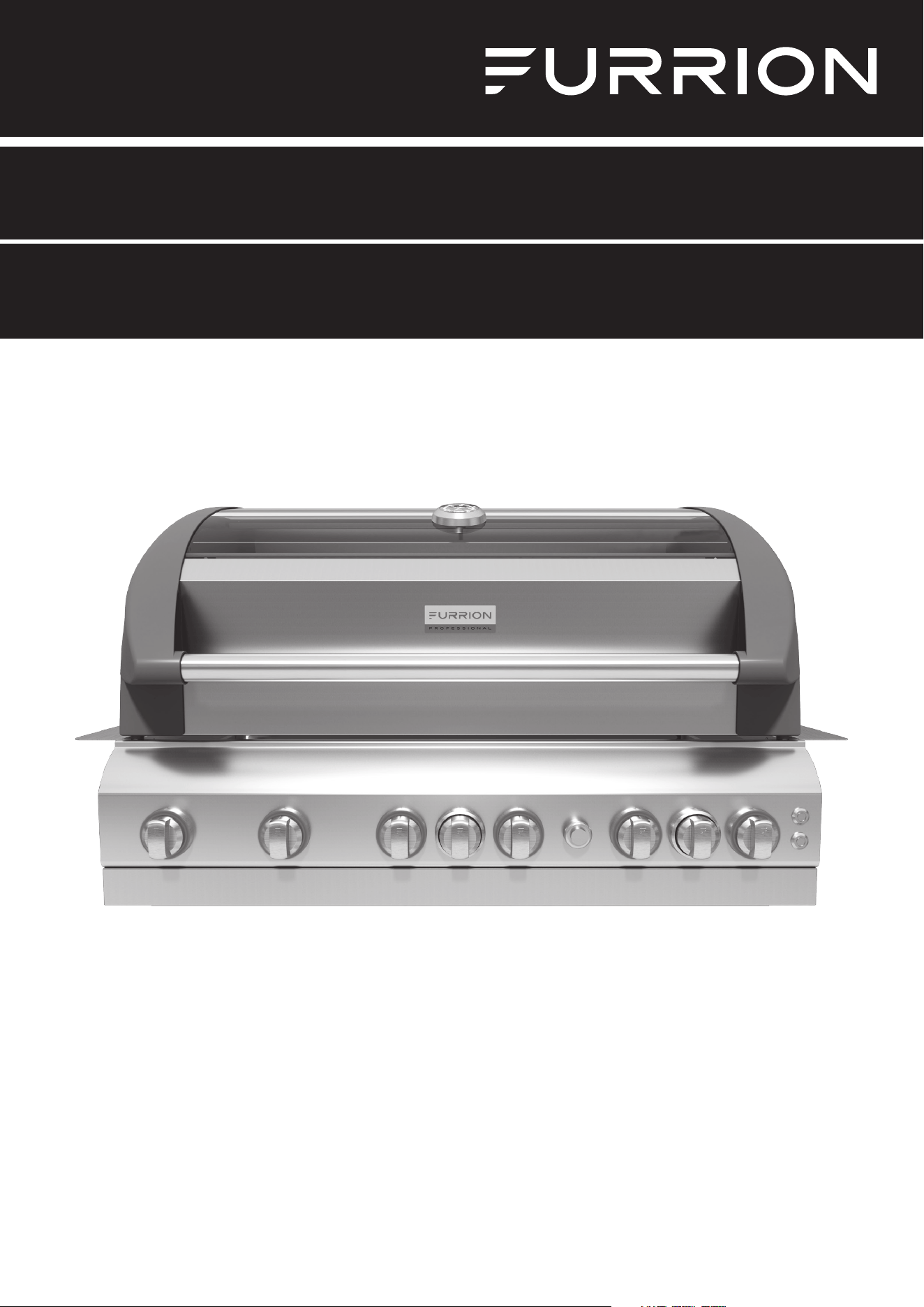
Model: FGL3328R-SS
FGL335BR-SS
* Picture shown here is for reference only.
BBQ Built-in
Instruction Manual

1
English
Thank you for purchasing this Furrion
®
BBQ Built-in. Before operating your new product, please read these instructions
carefully. This will ensure safe use and reduce the risk of injury. This instruction manual contains information for installation,
maintenance of the product and safe use.
Please keep this instruction manual in a safe place for future reference. Be sure to pass on this manual to any new owners
of this product.
The manufacturer does not accept responsibility for any damages due to not observing these instructions.
If you have any questions regarding our products, please contact us at: support@furrion.com
Welcome ................................................................................................................1
Contents ................................................................................................................1
Important Safety Instructions .............................................................................2
Introduction .................................................................................................................................... 2
Safety Precautions
........................................................................................................................ 2
Symbols in Instruction Manual
....................................................................................................2
Important Safety Information .....................................................................................................3
What's in the Box ...................................................................................................5
BBQ Built-in for 4 burners ...........................................................................................................5
BBQ Built-in for 6 burners ...........................................................................................................7
Before Installation ................................................................................................9
Assembly ........................................................................................................................................ 9
Installation .............................................................................................................12
Cutout Dimension ..........................................................................................................................12
Inbuilt Installation .......................................................................................................................... 15
Operation ...............................................................................................................16
Leak Testing ...................................................................................................................................16
Troubleshooting .................................................................................................... 19
Care and Maintenance ..........................................................................................20
Warranty.................................................................................................................22
Welcome
Contents
CCD-0005862 Rev. 02.27.2023
2
English
Introduction
This product has many features for making its use more pleasant and enjoyable. Safety, high performance and reliability
have been given top priority in the design of this product making it easy to maintain and operate.
This product is only intended for use outdoors.
Safety Precautions
When using electrical appliances basic safety precautions should be followed, including the following:
Keep the instructions in a safe place for future use.
These instructions are served as a general guide.
Do not supersede national or local codes in any way.
Contact local authorities for clarity of laws relating to the operation of this appliance.
WARNING
Do not operate this BBQ before it has been assembled correctly and you have read and understood these instructions.
Symbols in Instruction Manual
Possible hazard or hazardous situation.
Not observing this instruction can lead to injuries or cause damage to property.
Important information on proper handling.
Not observing this instruction can lead to faults in the BBQ.
NOTE
User information. This information helps you to use all the functions correctly.
Failure to follow these instructions could result in fire or explosion which could cause property damage, personal injury or
death.
Accessible parts may be very hot. Keep young children away from the hot appliance at all times (even while cooling down).
Some parts of this grill, especially those mentioned in this manual, may have sharp edges! Wear suitable protective gloves
if necessary.
Assembled parts sealed by the manufacturer must not be altered by the user. Any modification of the appliance by
unauthorized persons may be dangerous.
WARNING
● FOR OUTDOOR USE ONLY
To reduce the risk of fire, burn hazard or other injury, read the instructions carefully and be sure your appliance is properly
assembled and installed.
● DANGER!
If you smell gas:
− Shut off gas to the appliance;
− Extinguish any open flame:
− Open lid;
− If odor continues, keep away from the appliance and immediately call your gas supplier or your fire department.
● TO INSTALLER:
Test operation of the appliance and instruct the user before leaving. Ensure the appliance is commissioned correctly before
handing over to the user.
● The grill head is heavy and will require two or more people to lift and position onto the grill cart when assembly.
● Do not try lighting this appliance without first reading the “LIGHTING INSTRUCTION” section of this manual.
● Conversion to natural gas only done by authorized persons. Always keep the electrical components in dry situation.
Important Safety Instructions
CCD-0005862 Rev. 02.27.2023

3
English
Important Safety Information
Please read and understand this manual fully before assembly and use.
● The Manufacturer’s Warranty may be voided by the incorrect use of this product.
● The Manufacturer or their Agents shall accept no liability for the unsuitability of, or any damage to, food that is cooked
on this appliance.
● Use the correctly specified fuel with this barbecue. Check with your dealer for the specific fuel for which this barbecue
has been designed.
Instruction Manual
● The operator must understand all the safety requirements detailed in this manual before using the barbecue.
● If you have any queries regarding these instructions, contact your local dealer for clarification before you use your
barbecue.
● The unit must be correctly assembled before use. Failure to follow the manual’s instructions could result in serious
damage, injury, or even death.
Personal Safety
● The use of alcohol, prescription or non-prescription drugs may impair the consumer’s ability to properly assemble or
safely operate this barbecue.
● The barbecue should be carefully checked every time before use.
● Never try to move the barbecue when it is in use, or before it has had time to cool down.
● The person operating this barbecue should pay constant attention to the food being cooked.
● Do not leave the barbecue unattended when it is alight. The person should remain at the barbecue at all times when it is
alight/cooking.
Third Party Safety
● The operator is responsible for the safety of all third parties while the barbecue is in use.
● Onlookers should be kept a safe distance away from the barbecue when it is in use.
● Keep children and animals well away while the barbecue is in use or cooling down.
Location
● Do not use indoors. Barbecue units are designed for OUTDOOR USE ONLY.
● Use in a weather-protected area, preferably under shelter.
● Ensure that the barbecue is on an even and secure surface before operating. Use the castor locks if fitted to lock the
wheels in place.
● Do not use within inch of any flammable surfaces of structure.
Burn Awareness
● Parts of the barbecue do get extremely hot and could cause serious burns – touch test the surface before applying a
firm grip.
● The hood handle can become hot! Always wear cooking gloves and long sleeves when handling hot components.
● If cooking with the hood closed, please be very careful that there would be a sudden rush of hot vapor coming out
when opening the hood, which could get unprotected arms burn.
Gas Awareness
● Do not spray aerosols in the vicinity of this appliance while it is in operation.
● Do not use of store flammable materials in or near this appliance.
● Do not place articles on or against this appliance.
● Do not modify this appliance.
● Ensure all gas couplings and hoses are in good condition and have been correctly fitted.
● Leak test all gas lines and connections before use.
● Do not store flammable materials near this barbecue.
● Do not store spare LPG cylinders under or near this barbecue.
● Do not place or use aerosols near this barbecue.
● Do not store or use gasoline or other flammable vapours or liquids in the vicinity of this barbecue.
● Ensure that the gas is turned OFF at the cylinder valve after use or while the barbecue is unattended.
● When turning off the barbecue, shut off the gas at the supply source before turning off all the burner controls.
● Do not lean over appliance when lighting.
● Do not use appliance with any covers on.
Important Safety Instructions
CCD-0005862 Rev. 02.27.2023

4
English
● Do not use plastic or glass utensils on the appliance.
● Do not dismantle control valves.
● Do not test for gas leaks with a naked flame.
● Do not modify the constructions of the appliance or the size of any burners, injector orifices or any other components
● Do not obstruct any ventilations of the appliance.
● Do not allow the flexible gas supply hose or any electrical cord to come in contact with any heated surfaces of the
appliance.
● Do not use charcoal or any other solid fuels in this appliance.
● Do not disconnect any gas fittings while the appliance is in use.
● Do not use a rusty or dented gas cylinder with a damaged gas valve.
● Do not fill the gas cylinder beyond 80% capacity.
● Do not store gas cylinders below ground level. ULPG is heavier than air. Should a leak occur, the gas would collect and
be ignited due to presence of a flame or electric spark.
● Do not place articles on or against this appliance in Page 12.
Electrical Awareness
● Symbol IEC 60417 - 5172 (2003-2) Class II equipment.
● This appliance is not intended for use by persons (including children) with reduced physical, sensory or mental
capabilities, or lack of experience and knowledge, unless they have been given supervision or instruction concerning
use of the appliance by a person responsible for their safety.
● Children should be supervised to ensure they do not play with the appliance.
● If the supply cord is damaged, it must be replaced by the manufacturer, service agent or similar qualified persons in
order to avoid a hazard.
● BBQs with Grill Lights parts run on AC power.. It is IMPORTANT to ensure the care is taken to the location of the BBQ.
See section in this manual which refers to “Location” in Page 8.
● Turn power OFF when not in use.
● Avoid using in wet conditions.
● If an external lead is being used, ensure that it is correctly rated and meets current safety certification requirements.
● Ensure the power is turned OFF before connecting and disconnecting any components on the BBQ.
● Ensure power leads are kept away from any hot parts of the BBQ.
● Do not place the power lead where hot oil or fat can drip onto the lead.
For Your Safety and Others
If you smell gas:
● Shut off the gas supply to the barbecue.
● Extinguish any open flame (candles, cigarettes, etc.)
● Clear the area to allow the unburned gas to dissipate.
● Be aware of the reason for the gas smell, address this before continuing. Should the gas odour come from the LPG
cylinder, immediately contact the fire department from an elevated safe distance.
● Connect the gas cylinder to the barbecue, refer to that section in the manual.
● Leak testing, refer to that section in the manual in Page 12.
Safety Equipment
● When cooking with oil/grease, fire extinguishing materials should be readily accessible.
● In the event of an oil/grease fire do not attempt to extinguish with water or alcohol. Use type BC dry chemical fire
extinguisher or smother the fire with dirt, sand or baking soda.
Rain Hazard
In the event of rain while cooking with oil/grease, turn off the gas supply and all burners, cover the barbecue as soon as
possible. Get people/ animals away from around the barbecue. Do not attempt to move the barbecue until it has cooled
down and can be safely moved.
Warranty
Refer to the warranty supplied with this BBQ. Should any part fail due to defective workmanship or faulty materials within
the specified period from the date of purchase, Furrion will replace or repair the defective part free of charge. Refer to the
warranty for details. Do not use a BBQ that is unsafe.
Save these instructions for future reference!
Important Safety Instructions
CCD-0005862 Rev. 02.27.2023
5
English
What's in the Box
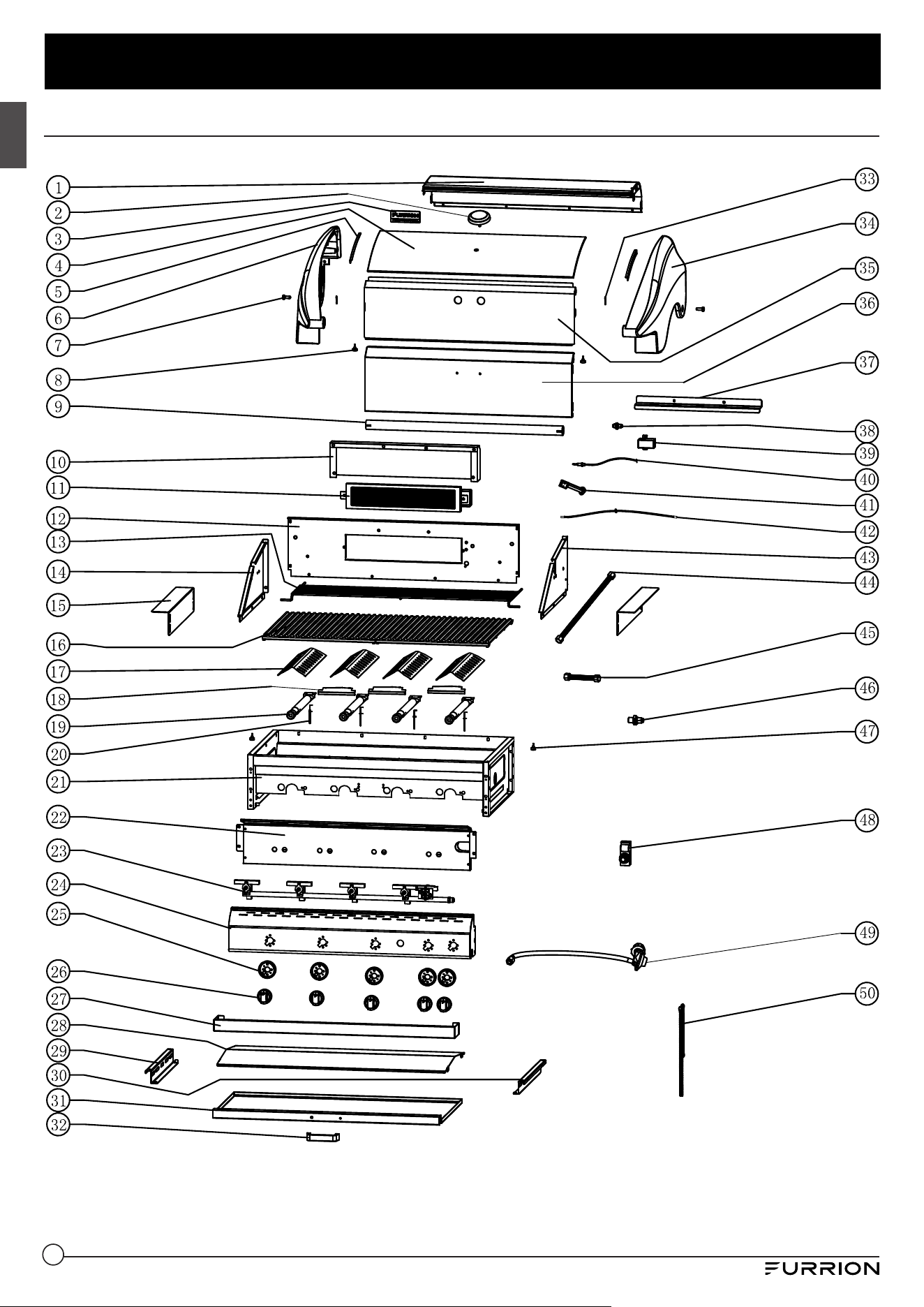
BBQ Built-in for 4 burners
CCD-0005862 Rev. 02.27.2023
6
English
What's in the Box
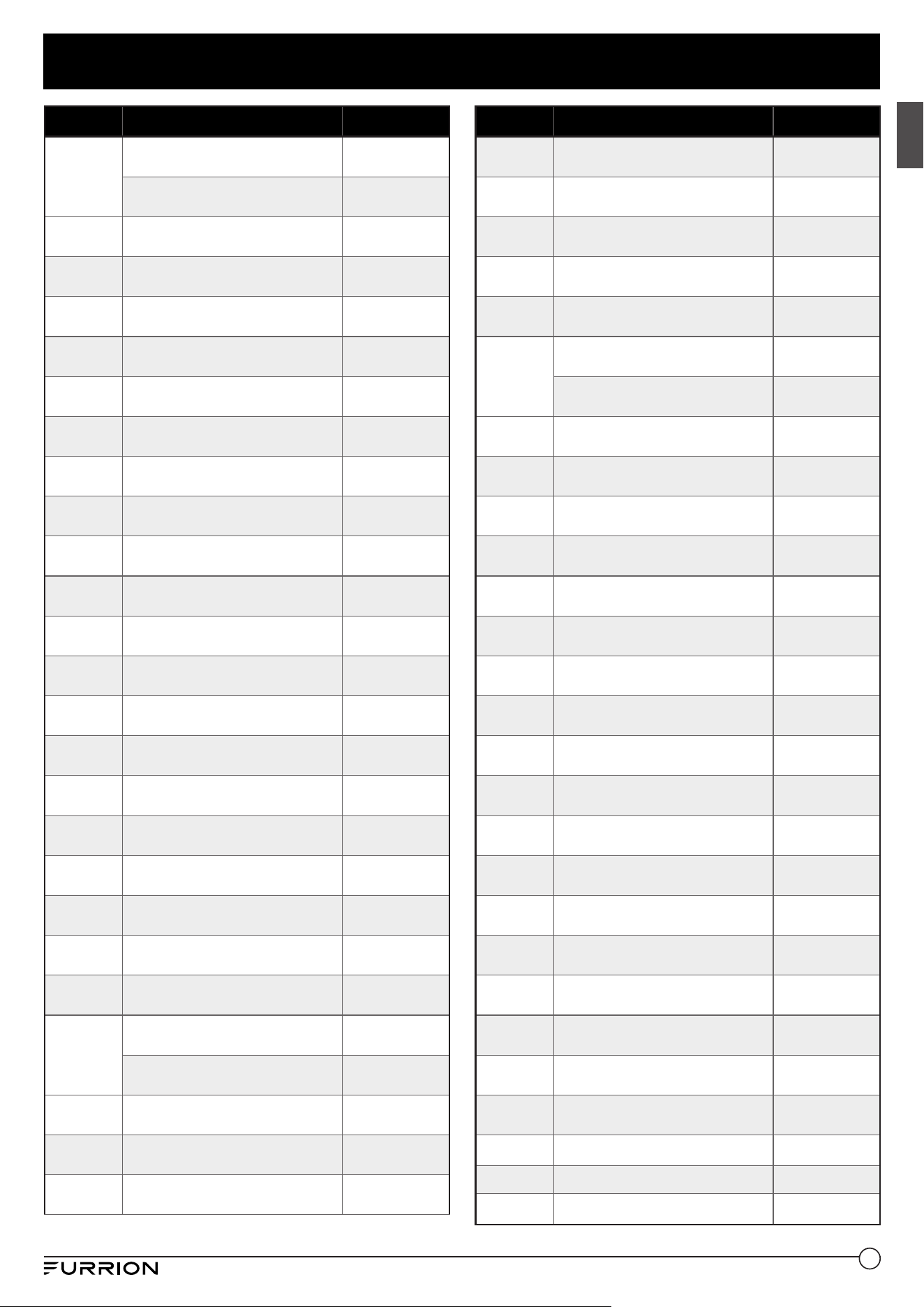
No. Part Name Qty
1
Back outer board for lid 1
Back inner board for lid 1
2 Temperature gauge 1
3 Logo 1
4 Glass for lid 1
5 Press board for glass 2
6 Left board for lid 1
7 Out side pin 2
8 Plastic pad for lid 2
9 Handle for lid 1
10 Rear infrared burner rear lid 1
11 Infrared rear burner assembly 1
12 Lid back holder 1
13 Warming rack 1
14 Lid left holder 1
15 Fire box bracket 2
16 Cooking grate 2
17 Heat tent 4
18 Leading fire box 5
19 Tube burner 4
20 Ignition pin 4
21 Fire box assembly 1
22
Inner insulation board 1
Outer insulation board 1
23
Main hose valve regulation
assembly
1
24 Panel assembly 1
25 Knob holder 5
No. Part Name Qty
26 Knob 5
27 Fire box panel welding assembly 1
28 Grease box insulation 1
29 Grease box left bracket 1
30 Grease box right bracket 1
31
Grease box 1
Grease panel 1
32 Lid handle 1
33 R shape pin 2
34 Right board for lid 1
35 Front inner board for lid 1
36 Front outter board for lid 1
37 Wind shield 1
38 Injector assembly 1
39 Thermocouple fixed box 1
40 Thermocouple 1
41 Ignition pin 1
42 Electronic wire 1
43 Lid right holder 1
44 Wave tube 1
45 Side burner wave tube 1
46 Valve connector 1
47 Plastic pad 2
48 Electronic ignition 1
49 Regulator assembly 1
50 Ignition assembly 1
51 Instruction Manual (Not shown ) 1
52 Warning Card (Not shown) 1
CCD-0005862 Rev. 02.27.2023
7
English
What's in the Box
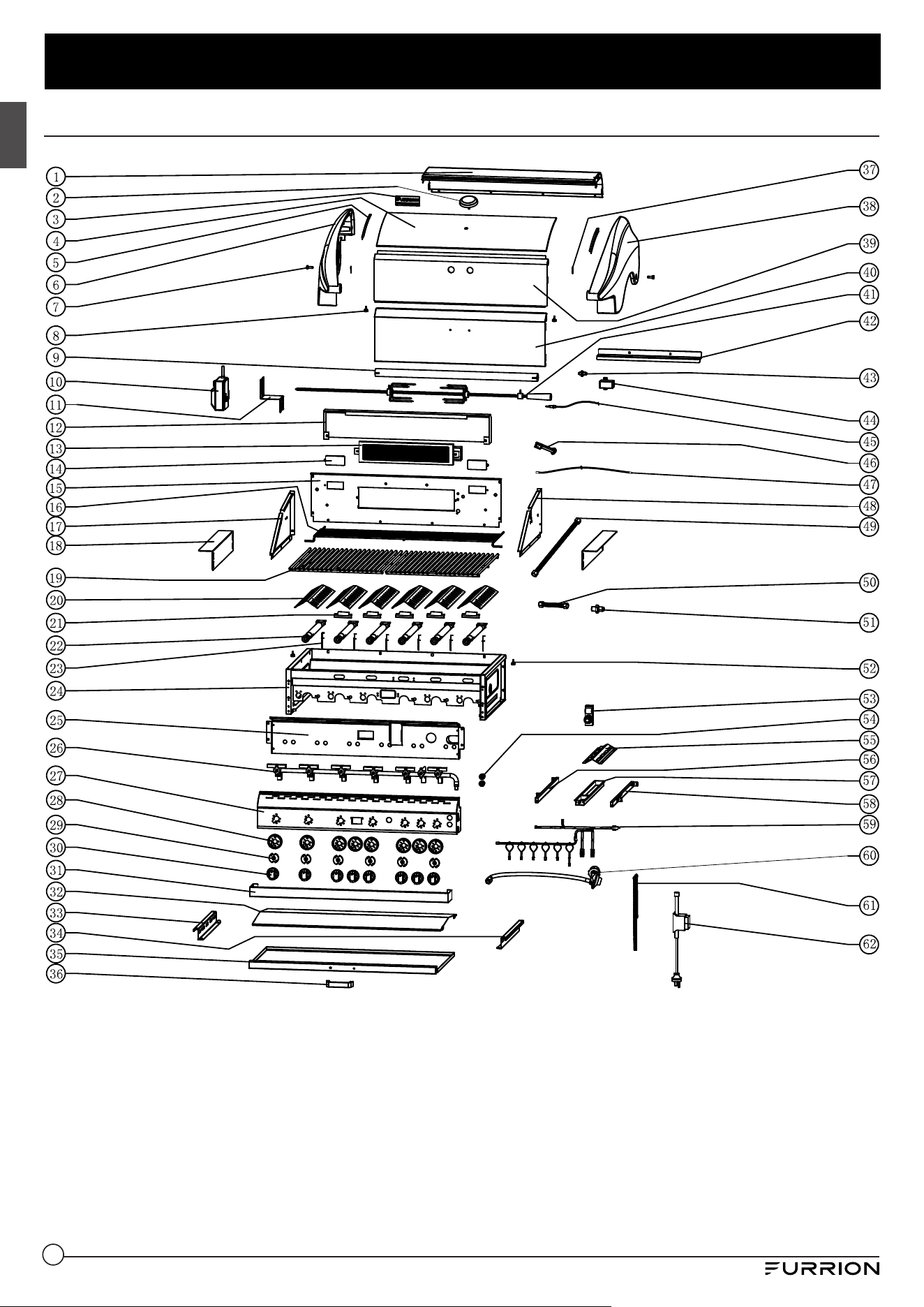
BBQ Built-in for 6 burners
CCD-0005862 Rev. 02.27.2023
8
English
What's in the Box
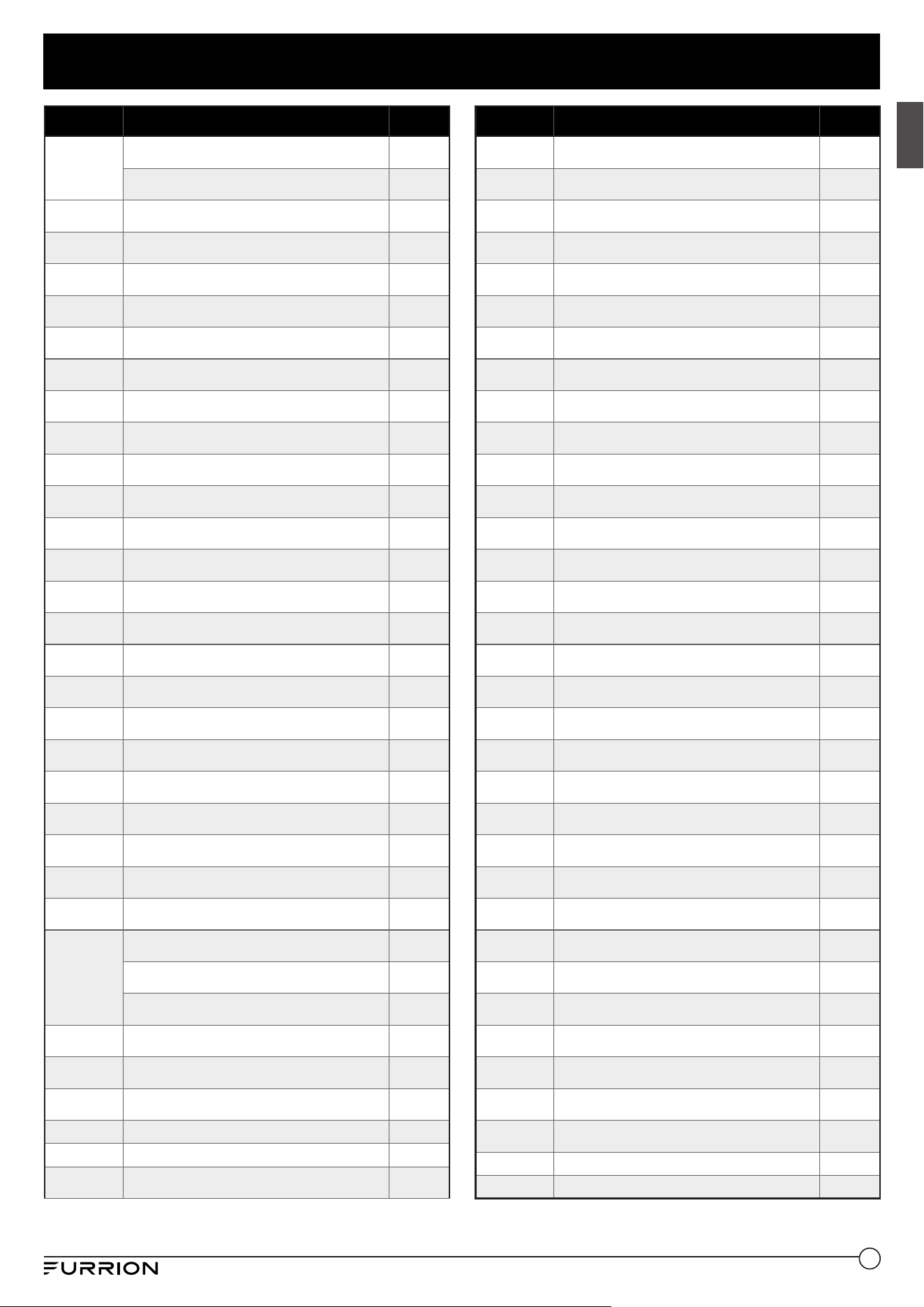
No. Part Name Qty
1
Back outer board for lid 1
Back inner board for lid 1
2 Temperature gauge 1
3 Logo 1
4 Glass for lid 1
5 Press board for glass 2
6 Left board for lid 1
7 Out side pin 2
8 Plastic pad for lid 2
9 Handle for lid 1
10 Motor 1
11 Motor bracket 1
12 Rear lid cover 1
13 Infrared rear burner assembly 1
14 Rear lid light assembly 2
15 Lid back holder 1
16 Warming rack 1
17 Lid left holder 1
18 Fire box bracket 2
19 Cooking grate 2
20 Heat tent 6
21 Leading fire box 5
22 Tube burner 6
23 Ignition pin 6
24 Fire box assembly 1
25
Inner insulation board 1
Outer insulation board 1
Electronic insulation cover 1
26 Main hose valve regulation assembly 1
27 Panel assembly 1
28 Knob holder 8
29 Light holder 6
30 Knob 8
31 Fire box panel welding assembly 1
No. Part Name Qty
32 Grease box insulation 1
33 Grease box left bracket 1
34 Grease box right bracket 1
35 Grease box 1
Grease panel 1
36 Lid handle 1
37 R shape pin 2
38 Right board for lid 1
39 Front inner board for lid 1
40 Front outer board for lid 1
41 Turning rotisserie assembly 1
42 Wind shield 1
43 Injector assembly 1
44 Thermocouple fixed box 1
45 Thermocouple 1
46 Ignition pin 1
47 Electronic wire 1
48 Lid right holder 1
49 Wave tube 1
50 Side burner wave tube 1
51 Valve connector 1
52 Plastic pad 2
53 Electronic ignition 1
54 Light switch 2
55 Smoking box lid 1
56 Smoking box left holder tube assembly 1
57 Smoking box assembly 1
58 Smoking box right holder tube assembly 1
59 Adapter output assembly 1
60 Regulator assembly 1
61 Ignition assembly 1
62 Adapter assembly 1
63 Instruction Manual (Not shown ) 1
64 Warning Card (Not shown) 1
CCD-0005862 Rev. 02.27.2023
9
English
Assembly
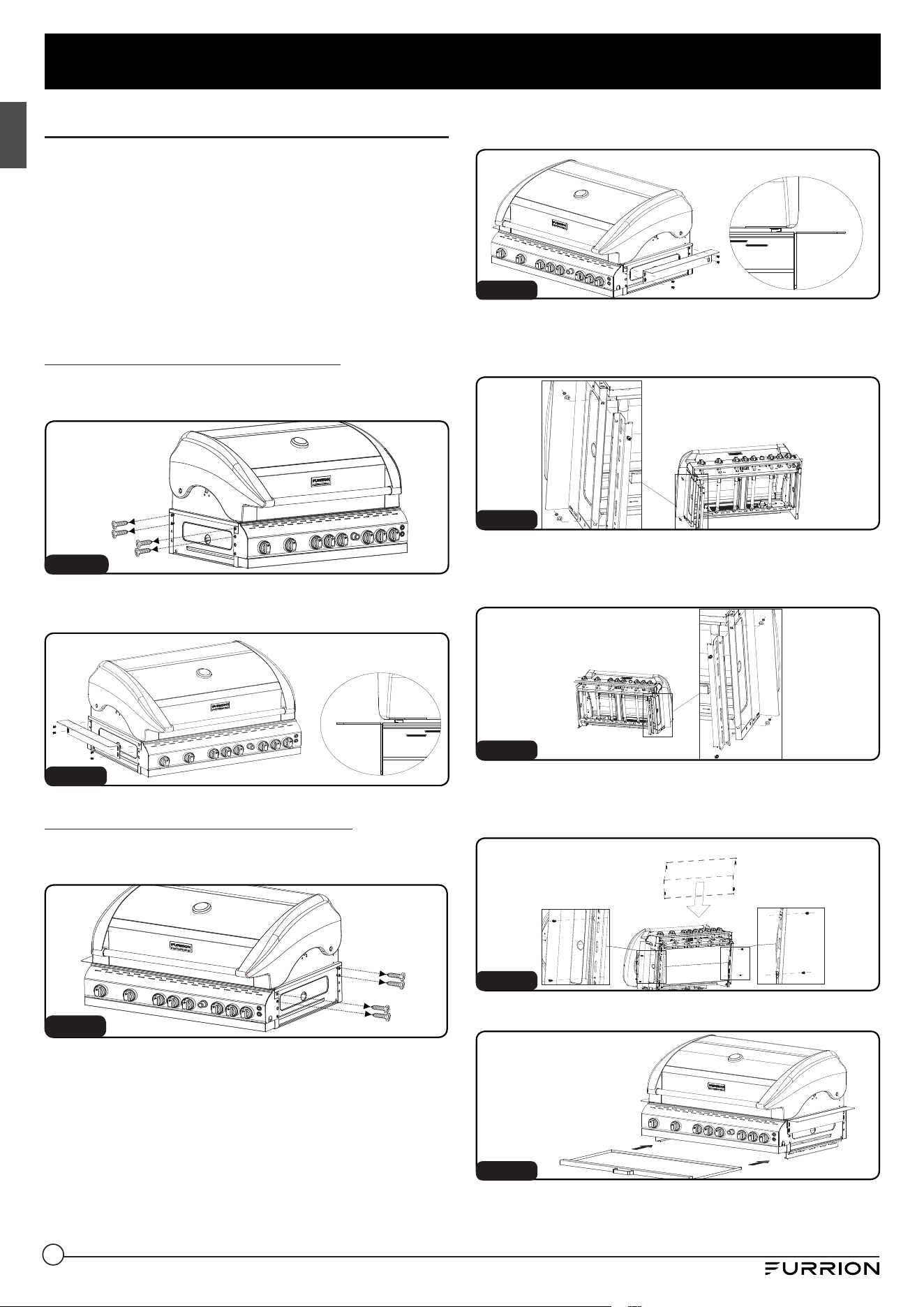
When you prepare to assemble the BBQ appliance, please
open the carton and unpack all the components of the
appliance and lay them on the floor or flat surface. And then
follow the instructions to assemble this appliance.
NOTE:
● Please do not assemble and install the appliance alone
due to some parts, such as the hood/grill, are too large
and heavy for one person to assemble safely.
● Unless otherwise stated, the screws used are included
in the fastener kit in the package.
BBQ Left Body Bracket Assembly
1. Loosen the 4 pcs screws M4 x 12mm on the left side of
the BBQ body. (Fig. 1)
Fig. 1
2. Install the left body bracket, then tighten the screws M4
x 12mm. (Fig. 2)
Panel is aligned with
oven after installation
Fig. 2
BBQ Right Body Bracket Assembly
3. Loosen the 4 pcs screws M4 x 12mm on the right side
of the BBQ body. (Fig. 3)
Fig. 3
4. Install the right body bracket, then tighten the screws
M4 x 12mm. (Fig. 4)
Panel is aligned with
oven after installation
Fig. 4
5. Locate the drip tray left bracket as shown, using 2 pcs
screws M6 x 12mm through drip tray - fiber washer - nut
in turn, then tighten the screws. (Fig. 5)
(M6 x 12) Screw x 2
(M6) Nut x 2
(Φ14.5 x 6.4) Fibre washer x 2
Fig. 5
6. Locate the drip tray right bracket as show, using 2pcs
screws M6 x 12mm through drip tray - fiber washer - nut
in turn, then tighten the screws. (Fig. 6)
(M6 x 12) Screw x 2
(M6) Nut x 2
(Φ14.5 x 6.4)
Fibre washer x 2
Fig. 6
7. Locate the drip tray insulation as shown, using 4pcs
screws M5 x 12mm through drip tray bracket, then
tighten the screws. (Fig. 7)
(M5 x 12) Screw x 4
Fig. 7
8. Insert drip tray as shown. (Fig. 8)
Fig. 8
Before Installation
CCD-0005862 Rev. 02.27.2023
10
English
Before Installation
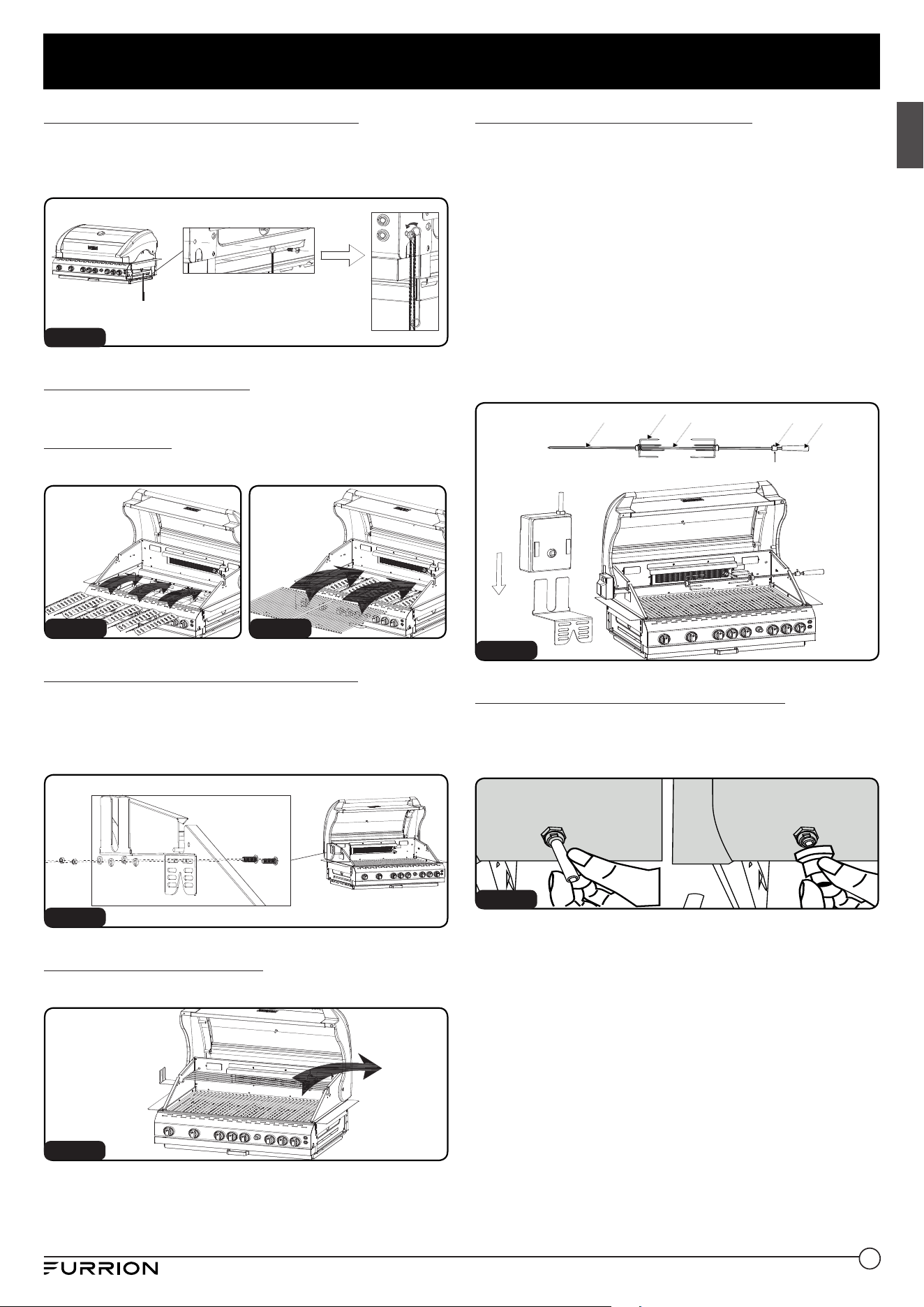
Ignition Assembly on the BBQ Body
9. Locate the ignition assembly as shown and tighten one
half tooth screw M6 x 20mm, then hang up the ignition
assembly on the screw head. (Fig. 9)
Fig. 9
Flame Tamer Assembly
10. Put flame tamers into the BBQ body as shown. (Fig.10)
Grill Assembly
11. Put the grill into body as shown. (Fig. 11)
Fig. 10
Fig. 11
Motor Bracket Assembly (Optional)
12. Locate the motor bracket on the left holder of the lid as
shown, using screws M5 x 12mm through fiber washer
- lid left holder - fiber washer - nut in turn, then tighten
the screws (Fig. 12)
(M5 x 12) Screw x 2
(M5) Nut x 2
(Φ5) Fibre washer x 4
Fig. 12
Warming Rack Assembly
13. Put the warming rack into BBQ body as show. (Fig. 13)
Fig. 13
Rotisserie Assembly (Optional)
● If need rotisserie, remove the warming rack at first; next,
locate the rotisserie, and insert the motor into motor
bracket as shown, make sure the locating ring is at the
inside of the grill, and then tighten the screw.
(Fig. 14)
NOTE:
– The rotisserie function is only allowed to be available
for either the model provided with a rotisserie or the
model without rotisserie but allowed to use one.
– The motor is powered by an independent line of
120VAC, 60Hz.
– Rotisserie Rod 26 is threaded LH, assemble by
turning rod anti-clockwise. Tighten with 8mm A/F
Spanners. This connection must remain spanner tight.
Place inside of grill
Rod
Rod
Guide
Rotisserie
handle
Prong
Fig. 14
Battery Insertion and Replacement
14. Unscrew the pulse cap. Insert 1x AA battery (included in
the package) as shown, then screw back the pulse cap.
(Fig. 15)
-
+
Fig. 15
CCD-0005862 Rev. 02.27.2023
11
English
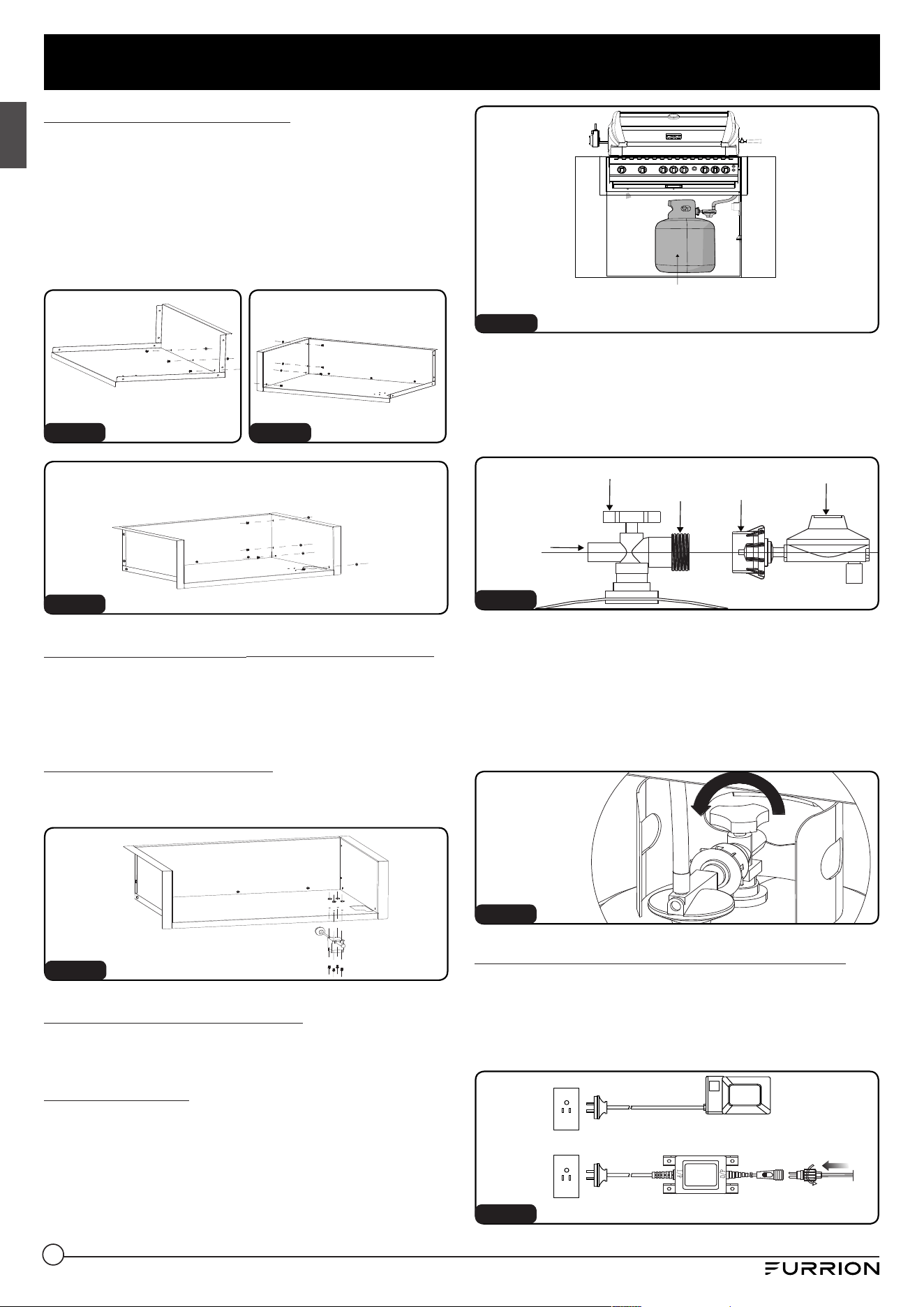
Jacket Assembly (Optional)
NOTE:
Jacket is not included, it is sold separately as accessory. If
you don’t want to install a jacket for your BBQ, please skip
this step.
15. Assemble rear plate and bottom plate as shown, then
tighten the 3pcs screws M6×10mm with nuts. (Fig. 16)
16. Assemble left plate as shown (Fig. 17), then tighten the
4pcs screws with nuts. (Fig. 18)
(M6 x 10) Screw x 3
(M6) Nut x 3
(M6 x 10) Screw x 4
(M6) Nut x 4
Fig. 16
(M6 x 10) Screw x 3
(M6) Nut x 3
(M6 x 10) Screw x 4
(M6) Nut x 4
Fig. 17
(M6 x 10) Screw x 4
(M6) Nut x 4
(M4 x 10) Screw x 4
(M4) Nut x 4
Fig. 18
Transformer Assembly (For FGL335BR-SS only)
Put the jacket into the cavity as shown, make sure the front
edge is aligned to the cabinet. (Optional)
NOTE: If you don't plan to install a jacket, please skip this
step.
For the BBQ with a Jacket
Assemble transformer under the jacket bottom as shown,
then tighten the 4pcs screws with nuts. (Fig. 19)
(M6 x 10) Screw x 4
(M6) Nut x 4
(M4 x 10) Screw x 4
(M4) Nut x 4
Fig. 19
For the BBQ without a Jacket
Please refer to the section of Cutout Dimension of
BBQ Built-in without jacket in Page 13.
Gas connection:
This barbecue is designed to connect directly to a standard
9 kg (20 lb.) LP cylinder(not included). (Fig. 20)
LP tank
NOTE: Only can put one LP tank under the BBQ, and
make sure the tank stand on the horizontal.
Fig. 20
NOTE:
● Make sure the tank valve is in the OFF position.
● Check the tank valve to ensure it has proper external
mating threads to fit the hose and regulator assembly
provided (Type 1 connection per ANS Z21.89b-2012).
(Fig. 21)
External
Thread
Thermally
Sensitive Nut
Type I Valve
Hand Wheel
Propane
Regulator
Fig. 21
● Inspect the valve connection port of the regulator
assembly. Look for damage or debris. Remove any
debris. Inspect hose for damage. Never use damaged
or plugged equipment.
● Make sure all burner knobs are in the OFF position.
● Connect the hose and regulator assembly to the tank
valve. Hand tighten the quick coupling nut clockwise to
a full stop. (Fig. 22)
External
Thread
Thermally
Sensitive Nut
Type I Valve
Hand Wheel
Propane
Regulator
Fig. 23
Electric Connection (For FGL335BR-SS only)
Connect the male connector of battery wire from product
to the female connector from 120VAC, 60Hz transformer.
Connect plug to electrical mains. If use outdoor, the GFCI
receptacle must be a weather-proof in-use covered one.
(Fig. 24)
Electrical supply
120VAC, 60Hz
Electrical supply
120VAC, 60Hz
Moter
Transformer Cable from BBQ
Fig. 24
Before Installation
CCD-0005862 Rev. 02.27.2023
12
English
Installation
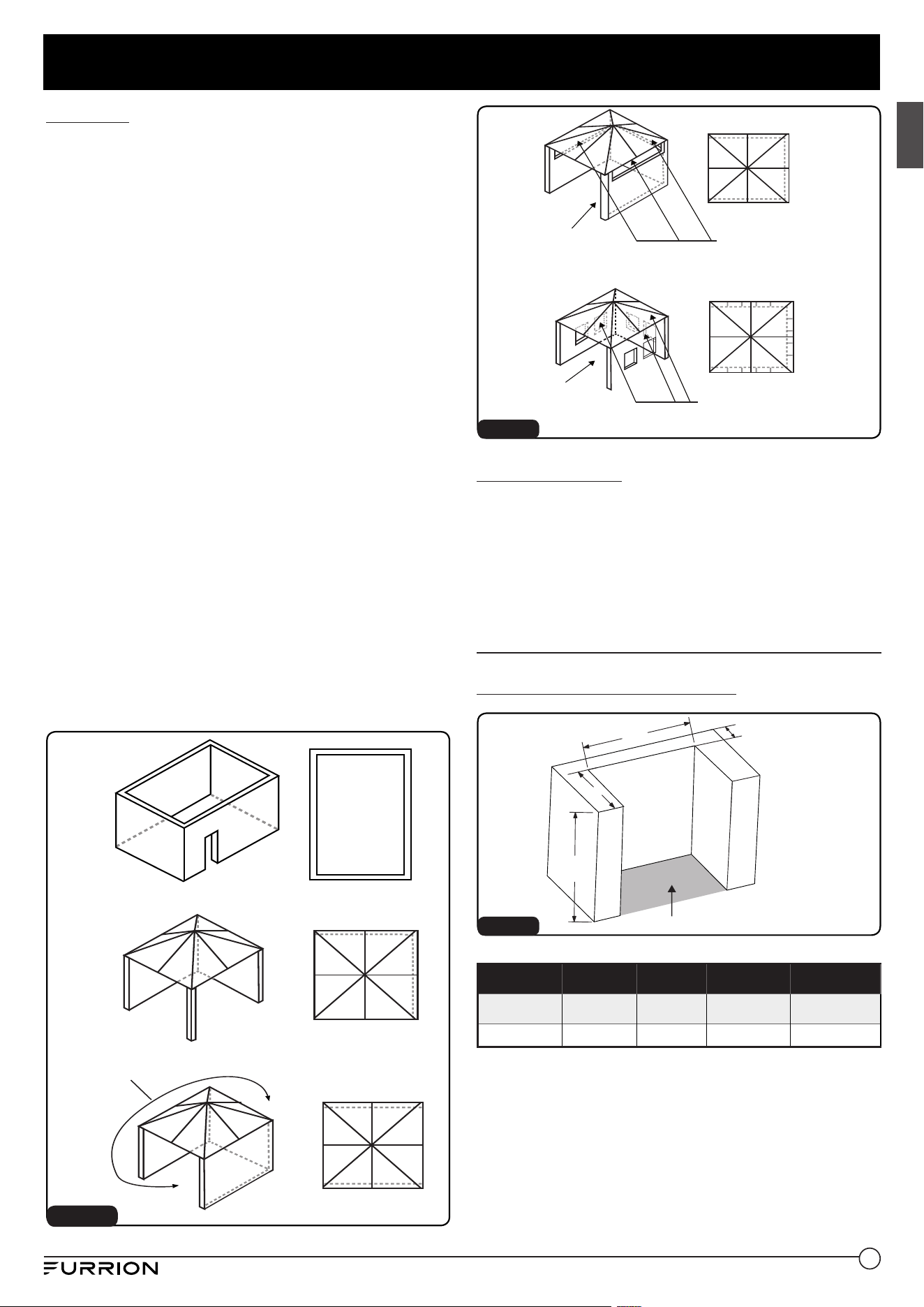
Location
This barbecue is for outdoor use only and should be placed
in a well-ventilated area. Take care to ensure that the
minimum clearances guidelines are followed:
Minimum clearances:
From sides: 36"(915mm) ; From back: 36"(915mm)
From above (vertical): 36"(915mm)
Keep this barbecue away from any flammable materials!
This appliance shall only be used in an above ground open-
air situation with natural ventilation, without stagnant areas,
where gas leakage and products of combustion are rapidly
dispersed by wind and natural convection. This barbecue is
not designed for marine use.
Any enclosure in which the appliance is used shall comply
with one of the following:
1. An enclosure with walls on all sides, but at least one
permanent opening at ground level and no overhead
cover.
2. Within a partial enclosure that includes an overhead
cover and no more than two walls.
3. Within a partial enclosure that includes an overhead
cover and more than two walls, the following shall
apply:
– At least 25% of the total wall area is completely open
and unrestricted.
– At least 30% of the remaining wall area is open and
unrestricted
4. In the case of balconies, at least 20% of the total of the
side, back and front wall areas shall be and remain open
and unrestricted.
See following diagrams for further illustration:
(Fig. 25 & Fig. 26)
FIGURE F1-OUTDOOR AREA-EXAMPLE 1
FIGURE F2-OUTDOOR AREA-EXAMPLE 2
Both ends open
FIGURE F3-OUTDOOR AREA-EXAMPLE 3
FIGURE F3-OUTDOOR AREA-EXAMPLE 3
Fig. 25
FIGURE F4-OUTDOOR AREA-EXAMPLE 4
Open side at
least 25% of total
wall area
30 percent or more in total
of the remaining wall area is
open and unrestricted
FIGURE F5-OUTDOOR AREA-EXAMPLE 5
Open side at
least 25% of total
wall area
30 percent or more in total
of the remaining wall area is
open and unrestricted
Fig. 26
Site Preparation
This barbecue is for outdoor use only and should be
placed in a well-ventilated area, this appliance must not
be installed under or on any combustible material, we
recommend that it is positioned in a masonry structure.
Minimum clearance from combustible construction
materials to all sides of the appliance is 36" (915mm).
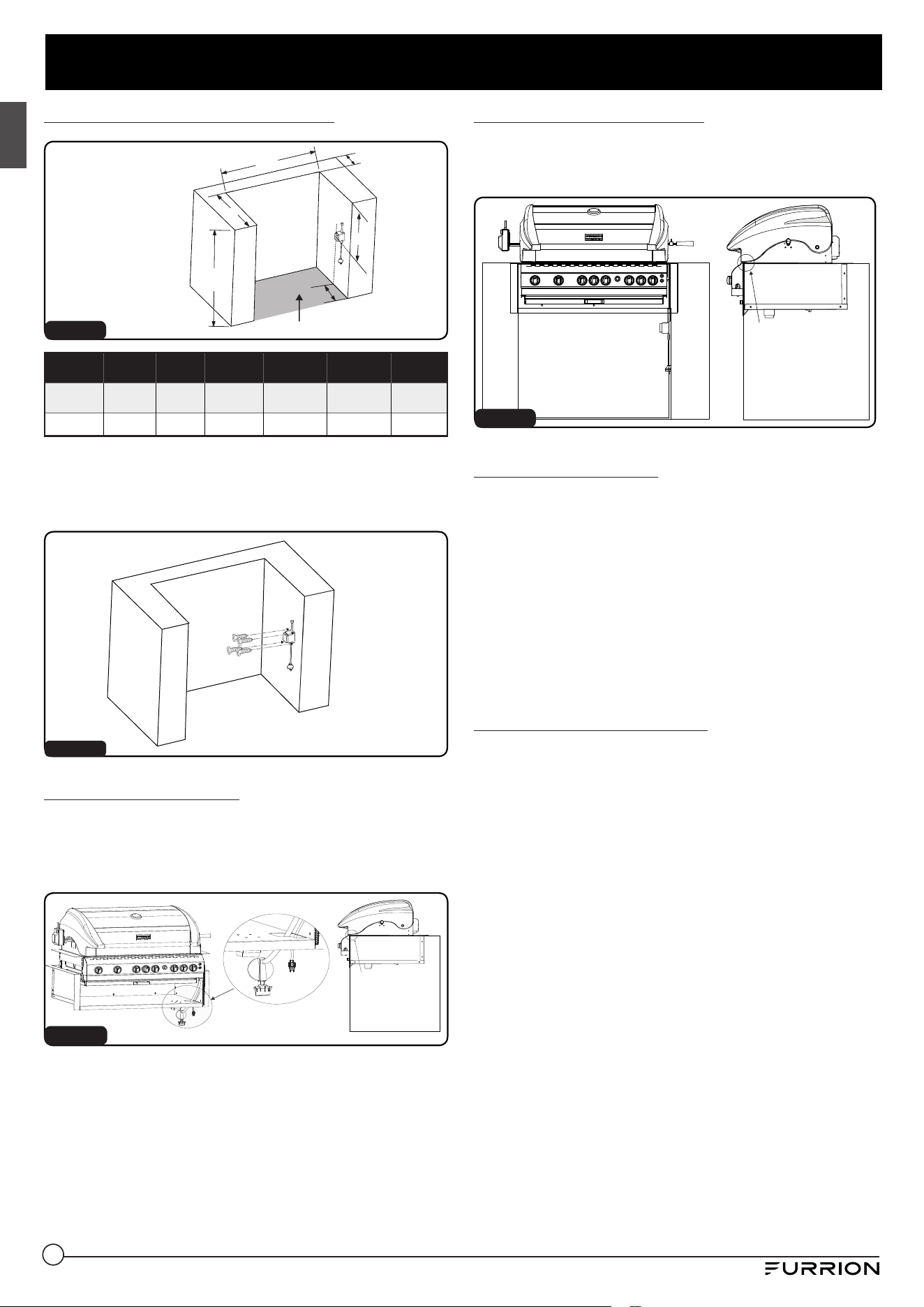
Cutout Dimension
For BBQ with Jacket (Fig. 27)
NOTE: This side need to keep open and
ventilated, not to closed with wall or door.
NOTE: This side need to keep open and
ventilated, not to closed with wall or door.
A
C
B
E
F
D
A
C
B
D
Fig. 27
Unit A B C D
inch 35
1
/
4
23 36
7
/
8
3
mm 895 584 937 76
CCD-0005862 Rev. 02.27.2023
13
English
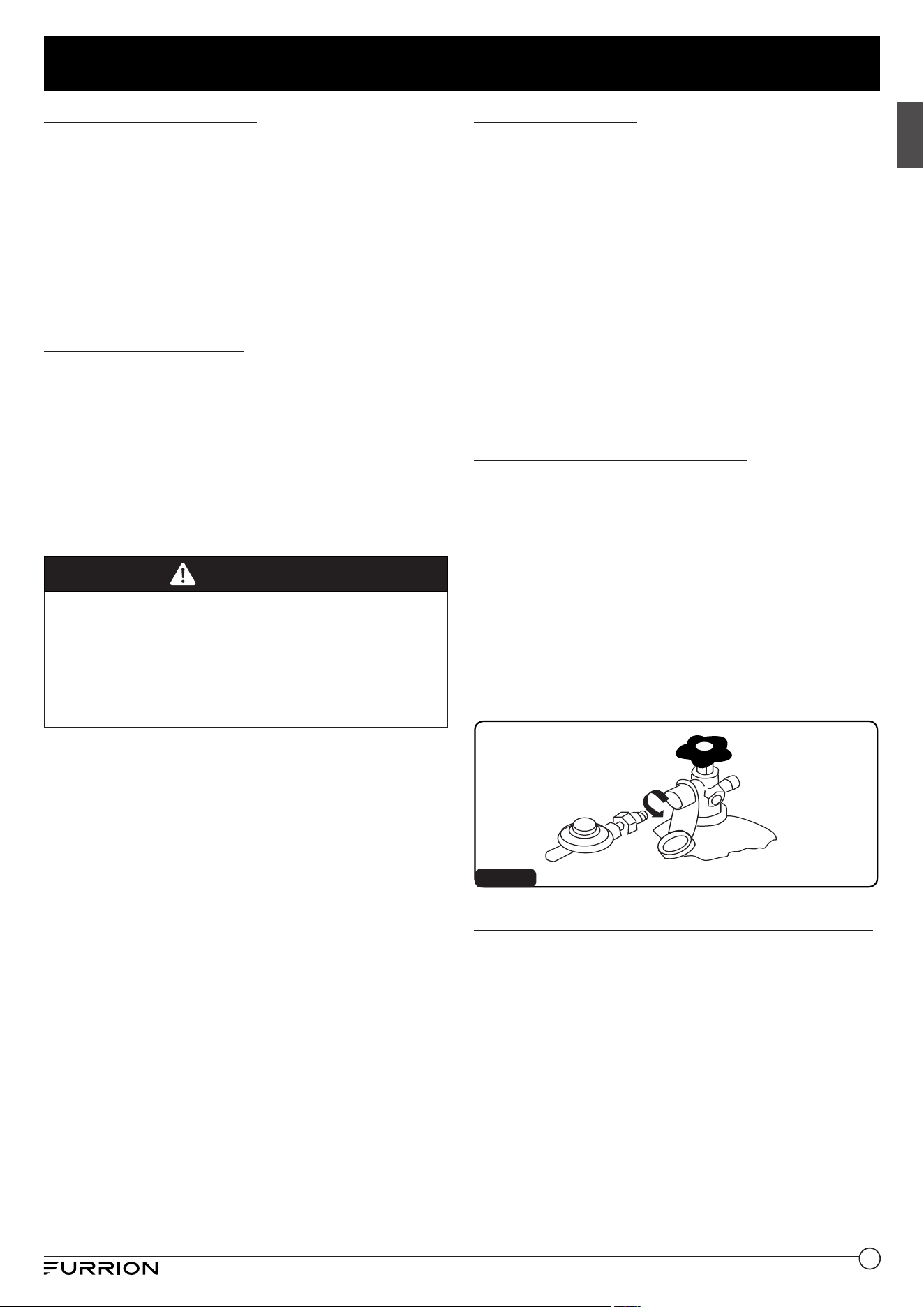
For BBQ without a Jacket
Put BBQ into the cabinet as shown, make sure the front
edge of body bracket is aligned with the front cabinet.
(Fig. 31)
vertical alignment
Fig. 31
Natural Gas or ULPG
Before beginning installation or assembly, check that the
gas type which the barbecue is designed for is correct
for the gas available to you. In most countries the choices
are natural gas or ULPG. You will find the gas type label
on the side of your barbecue. If your barbecue uses the
incorrect gas type, or if you are unsure, consult your dealer
before going any further. Using the wrong type of gas for a
barbecue is extremely dangerous.
Natural Gas Conversion: Most newly purchased
barbecues are made for ULPG. A natural gas conversion kit
is available to allow your barbecue to run on natural gas.
Fixed (Piped) Installations
Piped Natural Gas: Although installation costs are
higher, this is typically the least expensive way to run your
barbecue. Natural gas is delivered via pipeline to a gas
meter near the perimeter of your home. From the gas meter,
gas is taken by a further series of pipes to each appliance
that uses natural gas.
Piped ULPG: Some properties do not have natural gas
available to them. In these cases, the local gas supply
company may be able to provide two 45 Kg (100 lb)
cylinders permanently installed on the outside of your
home. These are refilled for you by the gas company based
on your usage patterns. Copper pipe is then run from these
cylinders to each appliance that uses ULPG.
There are two methods of connecting the gas to your
barbecue, both of which require the services of a
licensed gas fitter:
● For built-in (ie non-mobile) installations, the barbecue
inlet can be connected directly to copper piping. From
here the barbecue cannot be moved.
● The copper piping might be terminated in a “bayonet
point” on a wall or other structures. A special hose
and terminator allows the barbecue to be connected
and disconnected from the bayonet point safely and
conveniently. This allows the barbecue to be moved if
necessary.
Installation
For BBQ without Jacket (Fig. 28)
NOTE: This side need to keep open and
ventilated, not to closed with wall or door.
NOTE: This side need to keep open and
ventilated, not to closed with wall or door.
A
C
B
E
F
D
A
C
B
D
Fig. 28
Unit A B C D E F
inch 34
5
/
8
22
5
/
8
36
7
/
8
3 15 5
mm 879 575 937 76 381 127
Drill 4 pcs hole diameter 15/64", and insert the wall plug
(included), then assemble the transformer on the wall by
using 4 pcs M4X25mm self-tapping screws (included).
(Fig. 29)
Fig. 29
For BBQ with a Jacket
Put BBQ into jacket as shown, make sure the valve
connection ports of the regulator and battery line go
through the hole on the jacket, and separately connect to
tank and transformer. (Fig. 30)
vertical alignment
Fig. 30
CCD-0005862 Rev. 02.27.2023
14
English
Portable ULPG Cylinder
The most flexible arrangement is a portable ULPG gas
cylinder attached by a special hose and regulator to your
barbecue. Although the cylinder needs to be refilled or
exchanged when empty, this installation has the advantage
of being more mobile, and not requiring the services of a
licensed gas fitter.
Built-in
Whatever gas option you choose, your barbecue can be
permanently built-in.
General Requirements
We recommend that this installation be done in a masonry
structure and carried out by a professional tradesperson.
Other non-combustible material such as Hardiplank,
Villaboard with metal studs may also be used. The installer
must test the appliance and instruct the user regarding the
operation of the appliance.
This appliance must not be installed under or on
any combustible material. Minimum clearance from
combustible construction materials to all sides of the
appliance is (18") 450mm.
WARNING
Contact your local municipality for any building
codes regulating the installation of outdoor barbecue
appliances. Outdoor installations must conform to local
codes or, in the absence of local codes, with:
AUST: Australian Standards Code AS/NZS 5601 as well
as the requirements of any local council, gas, electricity
authority or other statutory regulations.
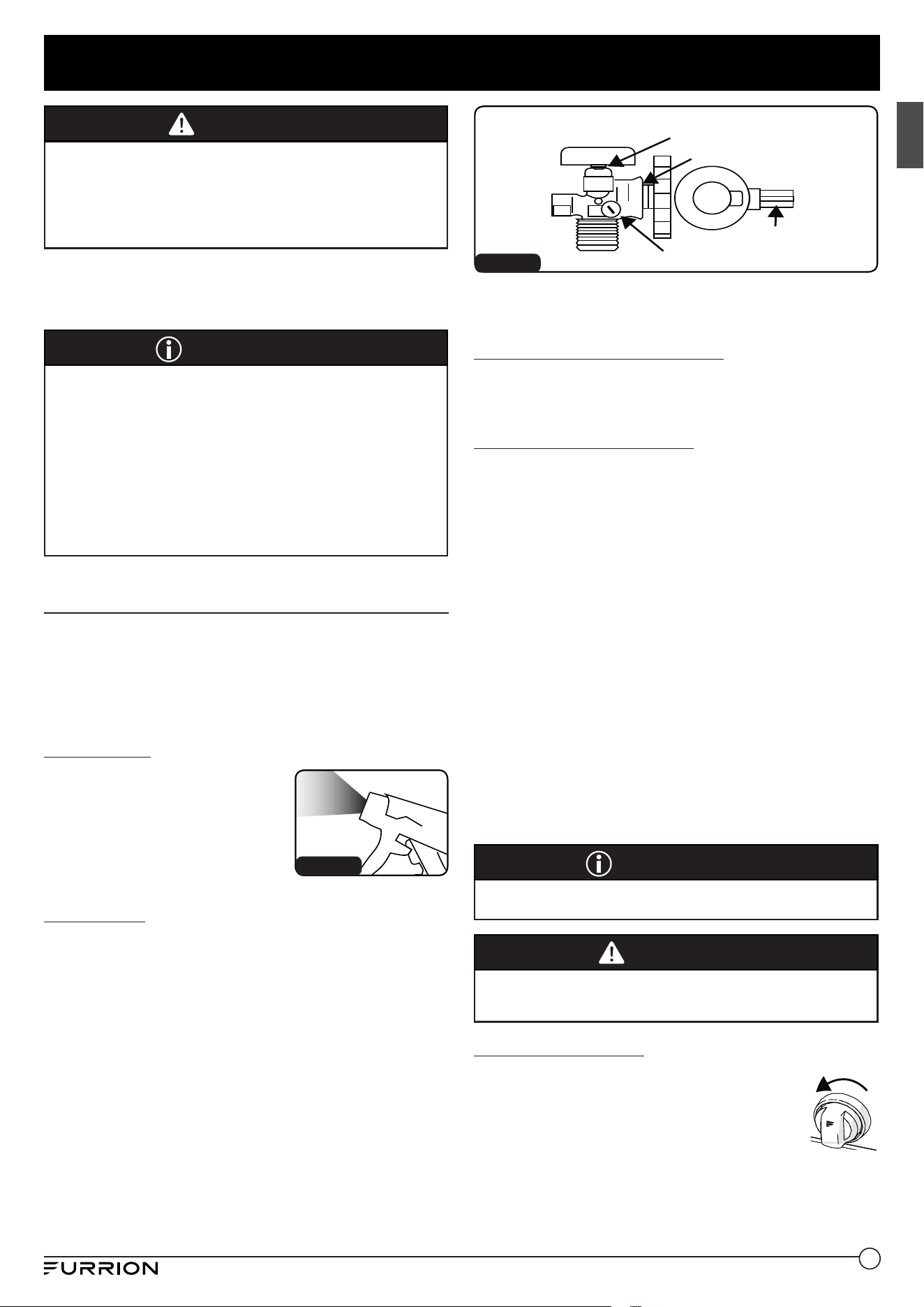
The Barbecue Cavity
Your barbecue is designed to sit into a cavity or cutout
rather than be placed directly onto a flat surface. It is
important that the dimensions of the cavity conform exactly
to those shown (pg 15). This will ensure the barbecue sits
correctly in the cavity, and that the barbecue has sufficient
ventilation to operate efficiently and safely. It also allows
room for any roasting hood to open freely,
In creating the cavity, you should ensure that you have
convenient access to the gas connection point and
associated hardware:
● If the gas for your barbecue is supplied by a portable
gas bottle, you will need access to the gas connection
point, the gas hose and the gas cylinder at all times.
● If the gas for your barbecue is supplied by a fixed piped
gas supply (either natural gas or 45kg LPG cylinders),
you will need access to the gas connection point, the
piping and the shutoff valve.
Other Precautions
Do not obstruct any of the ventilation openings in the
barbecue body. Should you need to change the gas
cylinder, confirm that the cylinder is off, and that there are
no sources of ignition (cigarettes, open flame, sparks, etc.)
near before proceeding. Be sure to inspect the gas hose
and ensure it is free of any twisting or tension. The hose
should hang freely with no bends, folds, or kinks, which
could obstruct free flow of gas. Apart from the connection
point, no part of the hose should touch any hot barbecue
parts. Inspect the hose before use. If the hose is damaged,
it must be replaced with a hose suitable for use with ULPG
and meet the national standards for the country of use.
The length shall not exceed 59" (1.5m). Should minimum
clearances not be adhered to , a severe flare-up may be
experienced due to lack of airflow around the barbecue,
thus voiding manufacturer’s warranty.
Gas and Regulator Information
This barbecue is designed for LP gas use only. Bottle sizes
of 4.5kg or greater are recommended for use with this
barbecue. Suitable LPG regulators must have an outlet
pressure of 2.75 kPa. Proper regulator and gas bottle are
required for the barbecue to operate safely and efficiently.
Please consult your local gas dealer for the most suitable
gas cylinders. Please note the regulator supplied with this
barbecue is an approved type.
The manifold thread type is ⅝” x 18.
For more information on pipe sizing, please refer to AS/
NZS 5601 /AG601 for details.
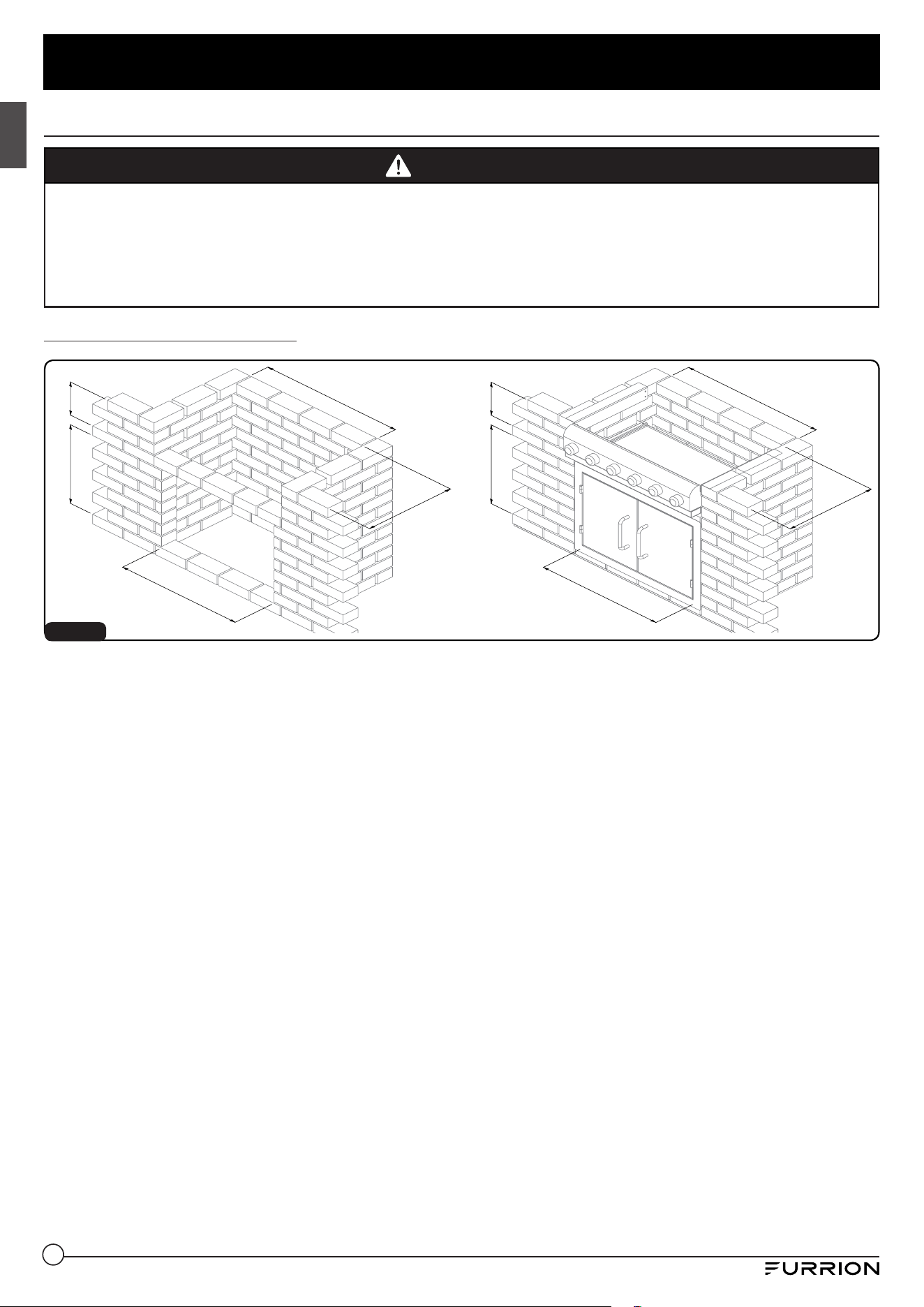
The gas cylinder must always be stored or used in an
upright position. (Fig.32)
Gas Cylinder
Bleeder Valve Screw
Gas Shutoff Valve
Tighten in this direction
POL regulator
and hose
Protector Cap
Fig. 32
Fixing the POL Gas Regulator to the Cylinder
Confirm all barbecue control knobs are in the off position.
Hand tighten the regulator supplied with this barbecue to
the gas cylinder by screwing in an anti-clockwise direction.
DO NOT OVERTIGHTEN!
As the regulator is fitted with a soft nose, it should only be
tightened a further 1/4 turn after resistance is first felt.
Installation
CCD-0005862 Rev. 02.27.2023
15
English
Installation
Inbuilt Installation
WARNING
● Prior to starting any construction, check with your local council for any building codes regulating the installation of outdoor
barbecue appliances. Outdoor installations must conform to the local codes or, in the absence of local codes, refer to the
Australian Gas Standard: AS 4557-2004 (Amdt2)
● ULPG is highly explosive and can cause serious bodily injury or even death if allowed to accumulate in a confined area. Adequate
ventilation must be included in the design stage to allow any un-burnt gas to escape safely.
● Should the design allow the sitting of the ULPG bottle directly below the BBQ, then a permanent separation must be included
between the BBQ base and the ULPG bottle.
Illustration of an installation (Fig.33)
535mm
540mm
225mm
870mm
750mm
535mm
540mm
225mm
750mm
870mm
Fig. 33
CCD-0005862 Rev. 02.27.2023
16
English
Most Likely Leak Areas
Valve Stem
Main Connection
Gas Hose
Bleed Screw
Fig. 35
Do not turn back on or attempt to use the BBQ if a gas
leak has been detected, contact your local BBQ Dealer for
repair.
Preparation Before Cooking
To prevent food from sticking to the cookware, please use
a long handled brush to apply a light coat of cooking or
vegetable oil before each barbequing session.
Using the Rotary Ignition
Main Burner Lighting Illustration:
1. Open valve at tank fully by turning counterclockwise.
2. Open lid Check that the control knobs are in the OFF
position.
3. Open lid during lighting.
4. From the “OFF” position, turn the control knob
anticlockwise to the “HI” position until you hear a “click”
sound
5. Repeat step 4, 3-4 times until the burner is lit
6. If the burner fails to light, turn on and wait for 5 minutes,
then begin from step 4
7. Once a burner is lit, similarly light the remaining
burners.
8. Turn the knob anticlockwise to adjust the heat from
High – Medium – Low to your heat requirement.
9. The first time you light the grill you may have to turn the
control knob to the "HI" position for up to 30 seconds to
purge the gas lines of any air.
10. If ignition does not take place within 5 seconds,
immediately turn the control knob to the OFF position.
Wait 5 minutes and repeat step 4 above or refer to
match lighting instructions in manual.
IMPORTANT
Keep a spray bottle of soapy water near the gas supply valve
and check the connections before each use.
WARNING
1. Do not light the grill if odour of gas is present
2. It is important to ensure that all control valves,including that of the
gas cylinder, are turned off after use.
For Manual Ignition
1. Light a 90mm barbecue match or lighter and
Anti-clockwise
hold adjacent to the burner.
2. Turn the right hand gas control knob to the
HI position. The burner will light from the
match.
3. Once the right burner is lit, the burner next
to it can be turned on and will light off the lit burner.
Repeat till all burners are alight.
4. Each burner can be adjusted to provide a low setting by
turning the gas control to the “LO” position.
Operation
WARNING
● Before proceeding, be certain you have understood the
safety information contained in this manual.
● This barbecue is not designed to be used with more than
66% of the cooking area as a solid plate. Full coverage of
plates will cause excessive build-up of heat and damage the
barbecue.
NOTE: Before using the barbecue for the first time, the
barbecue must be lit and burning for 30 minutes on the
“low” setting.
IMPORTANT
● The regulator supplied with this BBQ may incorporate
an Excess Flow Control Safety Device. The Excess Flow
Control will activate to prevent gas flow should a regulator
malfunction occur. It is important that the BBQ operator
understands that all gas valves on the BBQ are closed in the
OFF position prior to opening the gas cylinder valve.
● If the BBQ valves are open prior to opening the cylinder
valve, the Excess Flow Control will be activated and prevent
the BBQ from being lit. To reset, close the BBQ valves and
gas cylinder valve, wait for 1 minute and use correct lighting
procedure as detailed below.
Leak Testing
When to Test: The BBQ gas bottle, regulator & hose
assembly should be checked for leaks, using the soapy
water leak test, every time you reconnect your regulator
to the BBQ gas bottle. You should also test after any long
period of non-use, such as at the beginning of BBQ season.
What to Use
You will need a soapy water solution
Fig. 34
to check for any leaks. Mixing
proportion of soap and water will
work fine (do not use any other
household cleaning products).
(Fig. 34)
How to Test
● First, put some soapy water in a spray bottle or a dish.
● Next, turn on the gas bottle but do not turn on the BBQ.
● Then, spray the entire valve, regulator and hose
assembly with the soapy water including where the
hose connects to the BBQ.
● Last, alternatively, you can apply the soapy water with a
paint brush, basting brush.
Bubbles will form if there is a gas leak and you may also
smell the gas. If you find a leak, turn off the gas bottle
immediately! (Fig. 35)
CCD-0005862 Rev. 02.27.2023
17
English
Grill Cooking
The burners heat up the flame tamers underneath the grill
which in turn heats the food on the grill. The natural juices
produced during cooking fall onto the flame tamers below
and vaporise. The subsequent rising smoke bastes the
food, as it travels upwards, imparting that unique barbecue
flavour.
GRIDDLE PLATE / FLAT-FREE PLATE (where supplied)
The burners heat the griddle plate directly, which then
cooks the food on contact. These allow for the cooking of
smaller items, such as seafood, which could fall through the
spaces of a grill. They are also suitable for cooking items
that require high-temperature/short-duration cooking, such
as vegetables and smaller cuts of fish. Similarly, these can
be used in exactly the same way as a griddle in the kitchen,
for searing steaks, cooking eggs, etc.
Roasting Hood Cooking
Barbecues equipped with a roasting hood give the option
of cooking with hood closed to form an ‘oven’ for roasting
food, such as joints of meat, whole chickens, etc.
WARNING
Cooking with the hood closed and the burners on high setting
creates a fire risk.
When the hood is closed, a large amount of heat is trapped
inside the barbecue. Thus, it is IMPORTANT to make sure
that all the burners are turned to the low position to prevent
burning of the food and damaging the barbecue. Avoid
lifting the hood unnecessarily as heat is lost every time the
hood is opened. Use the temperature gauge to check the
heat of the barbecue. DO NOT ALLOW YOUR BARBECUE
TO OVERHEAT. A BARBECUE SHOULD NEVER BE LEFT
UNATTENDED WHILE COOKING!
Warming Rack
Warming racks are a convenient way to keep cooked food
warm or to warm items such as bread rolls. Always check
that your warming rack is properly fitted before use.
Rotisserie Cooking (optional)
1. Carefully remove the grates and the warming rack from
the barbecue.
2. Place the flame tamers to the center of the barbecue
body. It is over this area that the meat will be cooked.
3. Slide one of the spit forks onto the spit rod and tighten
its thumb screw to secure it into place. Insert the
pointed end of the spit rod into the meat being cooked
and slide the meat towards the center of the rod. Make
sure the fork is fully into the meat. Slide the other fork
onto the rod into the meat, and tighten the thumb screw
once in place. For optimal rotisserie cooking, food must
be placed securely onto the middle of the spit rod and
balanced so that the rotisserie can rotate freely without
interference from any barbecue surfaces. Any loose
sections of meat should be secured so they do not
hang down and interfere with the rotation of the spit
rod.
4. Insert the pointed end of the spit rod into the motor. Lay
the other end of the spit rod onto the opposite bracket.
5. Light the barbecue.
6. Turn on the rotisserie motor to begin rotisserie cooking.
The hood has been designed so that it may be closed
during rotisserie cooking.
7. Always cook foods on the lowest flame setting to avoid
burning or overcooking.
8. DO NOT ALLOW YOUR BARBECUE TO OVERHEAT.
BARBECUE SHOULD NEVER BE LEFT UNATTENDED
WHILE COOKING!
9. If cooking with rotisserie by using indirect heat (not
using burners directly under meat - oven style cooking),
a baking dish (not supplied) can be placed under the
food to catch fats and drippings.
Infrared Rear Burner & Rotisserie
PREPARING YOUR BBQ:
1. You will need to grates also the flame tamers & warming
rack. Place these in a safe place for later re-assembly.
Place a baking dish (not supplied) onto the burners, the
dish should be large and deep enough to capture the
excess grease as it falls from the food.
2. Centrally secure the food with the rotisserie prongs,
turning the rotisserie rod by hand to test for balance,
adjust the food position if required. Insert pointed end
of rod into the motor, test that everything is running
correctly.
Rear Burner electronic Lighting Illustration:
1. Check that the control knobs are in the OFF position.
2. Open valve at tank fully by turning counterclockwise.
3. Open lid during lighting.
4. Push the Electronic Ignition down for 3 to 4 seconds
while turning the Rear Burner electronic control knob
to the HI position and HOLDING IT DOWN. The burner
should ignite.
5. Once it is lit, release electronic igniter and keep pushing
the knob for another 15 seconds to ensure the burner
stays lit.
6. The first time you light the grill you may have to turn
the control knob to the HIGH position and HOLDING IT
DOWN for up to 30 seconds to purge the gas lines of
any air.
7. If ignition does not take place within 5 seconds,
immediately turn the control knob to the OFF position.
Wait 5 minutes and repeat step 4 above or refer to
match lighting instructions in manual.
IMPORTANT
● When the rear burner is lit for the first time, both the rear
burner and the gas pipe going from the valve to the burner
(from the front to the rear of the BBQ) need to be charged
with gas for a successful ignition. Push the Rear Burner
knob in and slowly turn anti-clockwise to high, keeping the
knob depressed (in) for approximately 10 seconds to allow
the gas to flow to the rear burner, then manually depress the
rear burner ignition. Lighting the rear burner may not occur
in the first instance, repeat if the first ignition fails.
● The rear burner is fitted with a ‘thermocouple’ as a safety
device. The thermocouple is activated by the heat when the
rear burner is operating. A “hot” thermocouple allows the
gas to flow through the valve, while a “cold” thermocouple
stops the gas flow. Therefore, when the rear burner flame
has ignited it is still necessary to hold the valve open by
keeping the Rear Burner knob depressed until the Ceramic
Tiles start to glow red with the heat. This takes between 20
to 30 seconds.
Operation
CCD-0005862 Rev. 02.27.2023
18
English
Occasionally the rear burner on your Furrion BBQ may
need resetting to provide reliable ignition. In most cases
following the lighting instructions correctly will determine
if any adjustment is required. So please check that
the lighting procedure is followed exactly before any
adjustments are made. If your BBQ rear burner will light but
does not stay alight, it is likely that the thermocouple has
not reached the correct temperature to activate the valve
that controls the constant flow of gas. Please follow the
lighting procedure exactly as instructed. If the rear burner
still does not continue to keep burning then please contact
your local Furrion agent. If your BBQ rear burner does not
light at all while the lighting procedures have been followed
exactly, then some adjustment may be necessary to reset
the electrode gap.
WARNING
● DO NOT use the rear burner in combination with main
burners on high heat setting when the hood is closed.
● Caution/Danger: Extreme care is required when cooking
with hood in closed position. Frequent checks must be
undertaken for the heat and temperature to ensure safe
cooking.
● Too much heat can cause fire.
Cooking with the rear burner allows the food to “self baste”
as it is turned, any excess juices will fall into the baking dish.
Your BBQ is safe to use with the hood is closed however
the internal temperature must be checked. Cooking with
the rear burner is designed to be a slow cooking process,
this allows the food to be succulent. External temperatures
and breeze will effect the internal temperatures, as a guide
this should be around 165°C to 180°C.
Vegetables and herbs can be placed into the baking dish,
these items will cook/flavour the food at the same time.
Flare-up Control
Flare-ups occur when meat is barbecued, and its fats and
juices fall upon the flame tamers. The smoke from some
flare-up helps give cooked meat its barbecued flavour,
but excessive flare-up will result in meat being burned.
To control flare-up, it is advisable to trim away excess fat
from meat and poultry before grilling. Also, the burners
should always be turned on the low setting during cooking.
Finally, extinguish flare-up by applying baking soda or salt
directly onto the flame tamers. Always protect your hands
when handling anything near the cooking surface of the
barbecue.
If a fat fire should occur in the drip tray, turn all knobs to
the off position, turn off the gas at the bottle, and wait for
the fire to go out. Do not pull out the drip tray or douse with
water.
End of the Cooking Session
After each cooking session, turn the BBQ burners to the
“HIGH” position and burn off for 5 minutes. This procedure
will burn off food residue, thus making cleaning easier.
Turning off Your Barbecue
When you have finished using your barbecue, turn off
the gas at the bottle and turn all the control valves fully
clockwise to the “OFF” position. Wait until the barbecue
is sufficiently cool before replacing the barbecue lid or
closing its hood.
Operation
CCD-0005862 Rev. 02.27.2023
19
English
Spider and Insect Warning!
Spiders and insects can nest in the burners of the grill and
cause the gas to flow from the front of the burner. This is a
very dangerous condition which can cause a fire to occur,
thereby damaging the grill and making it unsafe to operate.
Before Calling for Service
If the grill does not function properly, use the following
checklist before contacting your dealer for service.
When to Look for Spiders
You should inspect the burners for spiders and insects at
least once a year or immediately after any of the following
conditions occur:
1. The smell of gas in conjunction with the burner flames
appearing yellow.
2. The BBQ does not reach the temperature it could
reach.
3. The BBQ heats unevenly.
4. The burners make popping noises.
Before Calling for Service
If the grill does not function properly, use the following
checklist before contacting your dealer for service.
Appliance Approved Outdoor Use Only
USE ONLY THE 5/8” x 18 GAS CONNECTION HOSE AND
REGULATOR PROVIDED!
● If a replacement is necessary, please contact either
our Furrion Customer Service Department or your local
dealer.
● The use of unauthorised parts can create unsafe
conditions and environment.
● Refer to your Furrion warranty card for warranty
information.
Storage of the Grill
1. Clean the BBQ.
2. Store the BBQ outdoors in a dry, well ventilated area
and out of reach of children when LP tank is connected
to the grill.
3. Store the BBQ indoors ONLY after the LP tank is turned
off and removed, the LP tank must be stored outdoors,
out of reach of children, NEVER store the tank in a
building, garage or any other enclosed areas.
4. If using a cover for your barbecue, check your BBQ
every few weeks.
Checklist
Problems Possible Cause Solutions
Burner won’t light after
pushing in and turning
the knobs
Electrode deposited with cooking residue Use clean swab and alcohol to clean
Electrode damaged Replace
Electrode wires are loose or discounted
Reconnect or replace with new Electrode assembly with
wires
Orifice blocked Check the orifice for blockage
Wire is shorting
Ensure connections are tight
Replace with new Electrode assembly with wires
Open the LP tank valve
No gas Open the LP tank valve
Gas flow is not smooth Clear burner tubes
Incorrect assembly between burner and valve Re-assemble
Yellow or orange
flames, with gas odour
Yellow or orange flames, with gas odour
1. Check the burner inlet for obstruction such as spiders
2. Check air shutter for correct adjustment
3. Check for the source
Low heat with knob in
“high” position
Gas hose bent or kinked Straighten
Burner or orifice blocked Clear
Low gas pressure Check Cylinder/ Regulator (refer to pg. 15)
Grill not preheated Preheat the grill for 15 minutes
Flare up
Excessive meat fat Cut off fat before grilling
Over high temperature Adjust
Grease deposit Clean
Flame out
Over high winds Find a less windy place, or add wind shields
Flame lifting
Over high gas pressure Call the gas dealer
Flashback
Burner port blocked Clean
Grease fire
Grease accumulated in food
Turn off knobs, LP tank valve, leave lid open, let fire burn
out. Clean the grill when cools down.
Troubleshooting
CCD-0005862 Rev. 02.27.2023

20
English
● Regularly clean your barbecue between uses and
especially after extended periods of storage. Ensure
the barbecue and its components are sufficiently cool
before cleaning. Do not leave the barbecue exposed
to outside weather conditions or stored in damp, moist
areas.
– Never douse the barbecue with water when its
surfaces are hot.
– Never handle hot parts with unprotected hands.
● Whilst our products are made to the highest standards
and all care is taken to make them as weather proof
as possible, we cannot accept responsibility for rust
occurring on exposed metal parts unless this is a result
of faulty manufacture of parts.
● In order to extend the lifespan and maintain the
condition of your barbecue, we strongly recommend
that the unit is covered when not in use, especially
during the winter months.
Stainless Steel Care and Cleaning Advice
● Cleanliness and stainless steel are closely related.
Stainless steel performs best when it's clean -
cleanliness is essential for maximum resistance to
corrosion and to maintain the good looks and lifespan
of your BBQ.
Types of Surface Contaminants
Fingerprints and Stains
● Fingerprints and mild stains resulting from normal use
are the most common surface contaminates. They can
be removed with a glass cleaner or with a soft rag. This
should be followed by a thorough warm water rinse.
Dirt
● Like any surface that is exposed to the environment
especially in coastal areas, stainless steel can get dirty.
Cleaning with warm water with or without a gentle
detergent is sufficient. Next in order are mild
non-scratching abrasive powders such as typical
household cleaners.
● These can be used with warm water, nylon bristle
brushes, sponges, or clean cloths. Carbon steel
brushes or steel wool should be avoided as they may
leave particles embedded on the surface which can
lead to RUSTING. Cleaning should always be followed
by rinsing in clean hot water.
Grease
● Grease may soil stainless steel surfaces in food
preparation. These soils may be mildly corrosive if left
or may not allow the surface to maintain passivity, and
so regular removal is a necessity for the appearance.
Types of Cleaners and Methods
● Consider the possibility of scratching and the potential
for post-cleaning corrosion caused by incompletely
removed cleaners. Avoid using abrasive cleaners
unless absolutely necessary.
Clean Water and Wipe
● A soft cloth and clean warm water should always be
the first choice for mild stains and loose dirt and soils. A
final rinse with clean water and a dry wipe will complete
the process and eliminate the possibility of water stains.
Household Cleaners
● Household cleaners fall into two categories: detergent
(non-abrasive) and abrasive cleaners. Abrasive
cleaners are more effective but introduce the possibility
of scratching the surface. A neutral cleaner low in
chloride is essential. The cleaning method generally
employed with these cleaners is to apply them to the
stainless surface and follow by cloth wiping in the
direction of the grain or polish lines (not across them).
The cleaned surface should be thoroughly rinsed with
clean water and wiped dry with a soft cloth if water
streaking is a consideration.
Care of Stainless Steel in Your BBQ
● Your BBQ features stainless steel components. All
stainless steel grades require a level of care and
protection to retain their appearance. Stainless steels
are neither immune to corrosion nor maintenance-free,
contrary to popular public perception. Even the highest
marine grades of stainless steel require frequent
cleaning to avoid oxidation and other corrosive issues.
● Modern tastes dictate that your BBQ features stainless
steel with a brushed finish. This brushed finish is
attained by running Stainless Steel sheets through an
abrasive process that removes the mirror finish and
leaves the brushed finish. Brushed-finish stainless
steel requires frequent cleaning and care to maintain
its quality of appearance. Without adequate care it is
realistic to expect that it will show signs of corrosion in
time.
● Stainless steel is definitely not a maintenance-free
material. Cleanliness and stainless steel are closely
related.
● The cleaner stainless steel can be kept while in storage
or during use, the greater the assurance of optimum
corrosion resistance is. In order to maintain the good
looks and lifespan of your BBQ, follow these summary
tips on the care of stainless steel:
– When new or when cleaned and dried, we
recommend the owner apply a thin coat of olive oil
to stainless steel surfaces which should then be
polished in. The olive oil will help greatly in protecting
the stainless steel from corrosive contaminants and
assisting removal of finger prints and other marks,
keeping the appearance of the stainless steel in new
condition. The olive oil coating also makes further
polishing easier.
– Use clean, soft cloths or sponges to clean your grill.
– Carbon steel brushes or steel wool should never be
used.
– Do routine cleaning of exposed surfaces.
– After cleaning, rinse thoroughly with water and wipe
dry.
– Cleaning with chloride-containing detergents must be
avoided.
– On polished finishes, rubbing or wiping should be
done in the direction of the polish lines, NOT across
them.
– Care must be taken when cleaning the fascia. Printed
information may be erased with heavy cleaning.
Care and Maintenance
CCD-0005862 Rev. 02.27.2023
21
English
Cast Iron Cooking Surfaces
● Before cooking with the grill, flat plate or deep dish (if
supplied with your BBQ) clean these with hot soapy
water to remove any oil or residue from the packaging
or manufacturing process. Wash with clean water and
let the plates dry naturally. Prior to lighting your BBQ
place them back into the BBQ. Then after lighting your
BBQ, let the plates warm up slowly over a period of 30
minutes, during this time increasing the heat.
● You will notice slight vapors rise from the plates, this is
natural as residues are burned off. Turn off your BBQ
to allow the plate to cool down slightly. The plates can
now be prepared with the addition of cooking oil. Take
care that the plates are not at a temperature where that
adding the oil will cause a hazard. Brush the oil over the
plate, allowing the oil to be absorbed into the surface.
Allow the plate to fully cool down, then remove any
excess oil. The BBQ is now ready. Repeat the above
steps to keep the plate and grill in a ready condition
after each BBQ session.
Porcelain Enamel Cooking Surfaces
● Porcelain Enamel surfaced items should be treated
with care and not be cleaned with an abrasive cleaner
or scratchy cleaning item.
● Surfaces will crack or chip if hit or dropped. Porcelain
Enamel surfaces should NOT be regarded as ‘Non-
stick’, use of cooking oil is required as normal. Food
will likely stick to an overheated or un-oiled enamel
surface.
● The surface will be more easily cleaned by first soaking
overnight.
Burner Maintenance
● Provided that they are operating correctly, in normal
usage, burning off the residue after cooking will keep
the burners clean. The burners should be removed
and cleaned annually, or whenever heavy build-up is
found, to ensure that there are no signs of blockage
(debris, insects) in the burner portholes, the primary
air inlet, or the neck of the stainless steel burners. Use
a pipe cleaner to clear obstructions. When refitting the
burners, be careful to check they are positioned as:
The neck of the burner fits over the valve outlet, the top
flaps of the gas collector boxes fit over the top surfaces
of the burners.
Air Combustion Openings
● The neck of the burner includes the combustion air
opening.
● On the rear of the appliance there can be found the
secondary air combustion vents. Ensure that these
vents are not obstructed. (Fig. 36)
Fig. 36
Electrode Testing (Fig. 37)
Rear Burner knob
Electrodes should have a
sparking gap of approximately
4 - 5mm. The distance away from
the face of the rear burner
should be less than 9mm.
Rear Burner
Take care not to damage the
ceramic insulation around the
positive electrode
Remove wind
shield to adjust
4 - 5mm Gap
Fig. 37
NOTE:
● Cooking with the rear burner allows the food to “self
baste” as it is turned, any excess juices will fall into the
baking dish.
● Your BBQ is safe to use with the hood closed , however,
the internal temperature must be checked. Cooking
with the rear burner is designed to be a slow cooking
process, this allows the food to be succulent.
● External temperature and breeze will effect the internal
temperature, as a guide this should be around 165°C to
180°C.
● Vegetables and herbs can be placed into the baking
dish, these items will cook/flavour the food at the same
time.
● When using the rear burner and rotisserie use 1 or 2 of
the main burners at the low heat setting if a little extra
heat is required.
Drip tray
● After every use, check the drip tray for fat build-up.
Failure to maintain these areas could result in a fat fire
or excessive flare-up. This can severely damage your
barbecue and is not covered by the warranty.
Barbecue Body
WARNING
Not cleaning the barbecue can pose a fire risk!
Regularly remove excess grease or fat from the barbecue
body with a soft plastic or wooden scraper. It is not
necessary to remove all the grease from the body. If you
need to clean fully, use hot soapy water and a cloth, or
nylon-bristled brush only. Remove cooking surfaces and
burners before full cleaning. Do not immerse the gas
controls or manifold in water. Check burner operation after
being carefully refitted into body.
Fixings
All screws and bolts, etc. should be checked and tightened
on a regular period.
Care and Maintenance
CCD-0005862 Rev. 02.27.2023

FURRION WARRANTS FOR A PERIOD OF 1 YEAR FROM DATE OF RETAIL PURCHASE BY THE ORIGINAL END-USE
PURCHASER, THAT THIS PRODUCT, WHEN DELIVERED TO YOU IN NEW CONDITION, IN ORIGINAL PACKAGING,
FROM A FURRION AUTHORIZED RESELLER AND USED IN NORMAL CONDITIONS, IS FREE FROM ANY DEFECTS
IN MANUFACTURING, MATERIALS, AND WORKMANSHIP. IN CASE OF SUCH DEFECT, FURRION SHALL REPLACE
OR REPAIR THE PRODUCT AT NO CHARGE TO YOU. THIS WARRANTY DOES NOT COVER: PRODUCTS WHERE
THE ORIGINAL SERIAL NUMBERS HAVE BEEN REMOVED, ALTERED OR CANNOT READILY BE DETERMINED;
DAMAGE OR LOSS CAUSED BY ACCIDENT, MISUSE, ABUSE, NEGLECT, PRODUCT MODIFICATION, FAILURE
TO FOLLOW INSTRUCTIONS IN OWNER’S MANUAL, COMMERCIAL OR INDUSTRIAL USE; DAMAGE OR LOSS
CAUSED TO THE DECORATIVE SURFACE OF PRODUCT; TO ANY DATA, SOFTWARE OR INFORMATION; AND
NORMAL WEAR AND TEAR. THIS WARRANTY ONLY PROTECTS THE ORIGINAL END-USER (“YOU”) AND IS NOT
TRANSFERRABLE; ANY ATTEMPT TO TRANSFER THIS WARRANTY SHALL MAKE IT IMMEDIATELY VOID. THIS
WARRANTY IS ONLY VALID IN THE COUNTRY OF PURCHASE.
THIS WARRANTY AND REMEDIES SET FORTH ABOVE ARE EXCLUSIVE AND IN LIEU OF ALL OTHER WARRANTIES,
REMEDIES AND CONDITIONS, WHETHER ORAL OR WRITTEN, EXPRESS OR IMPLIED. FURRION SPECIFICALLY
DISCLAIMS ANY AND ALL IMPLIED WARRANTIES, INCLUDING, WITHOUT LIMITATION, WARRANTIES OF
MERCHANTABILITY AND FITNESS FOR A PARTICULAR PURPOSE. IF FURRION CANNOT LAWFULLY DISCLAIM
IMPLIED WARRANTIES UNDER THIS LIMITED WARRANTY, ALL SUCH WARRANTIES, INCLUDING WARRANTIES OF
MERCHANTABILITY AND FITNESS FOR A PARTICULAR PURPOSE ARE LIMITED IN DURATION TO THE DURATION OF
THIS WARRANTY.
No Furrion reseller, agent, or employee is authorized to make any modification, extension, or addition to this warranty.
FURRION IS NOT RESPONSIBLE FOR DIRECT, INDIRECT, SPECIAL, INCIDENTAL OR CONSEQUENTIAL DAMAGES
RESULTING FROM ANY BREACH OF WARRANTY OR CONDITION, OR UNDER ANY OTHER LEGAL THEORY,
INCLUDING BUT NOT LIMITED TO LOST PROFITS, DOWNTIME, GOODWILL, DAMAGE TO OR REPLACEMENT OF ANY
EQUIPMENT OR PROPERTY, ANY COSTS OF RECOVERING, REPROGRAMMING, OR REPRODUCING ANY PROGRAM
OR DATA STORED IN OR USED WITH FURRION PRODUCTS. FURRION’S TOTAL LIABILITY IS LIMITED TO THE REPAIR
OR REPLACEMENT OF THIS PRODUCT PURSUANT TO THE TERMS OF THIS WARRANTY.
SOME STATES DO NOT ALLOW THE EXCLUSION OR LIMITATION OF INCIDENTAL OR CONSEQUENTIAL DAMAGES
OR EXCLUSIONS OR LIMITATIONS ON THE DURATION OF IMPLIED WARRANTIES OR CONDITIONS, SO THE ABOVE
LIMITATIONS OR EXCLUSIONS MAY NOT APPLY TO YOU. THIS WARRANTY GIVES YOU SPECIFIC LEGAL RIGHTS,
AND YOU MAY ALSO HAVE OTHER RIGHTS THAT VARY BY STATE OR (WHERE APPLICABLE IN THE COUNTRIES
WHERE FURRION HAS NON-US/CANADIAN AUTHORIZED DEALERS) COUNTRY. NO ACTION OR CLAIM TO
ENFORCE THIS WARRANTY SHALL BE COMMENCED AFTER THE EXPIRATION OF THE WARRANTY PERIOD.
Keep your receipt, delivery slip, or other appropriate payment record to establish the warranty period. Service under this
warranty must be obtained by contacting Furrion at warranty@furrion.com
Product features or specifications as described or illustrated are subject to change without notice.
Warranty
Care and Maintenance
Storage
● Store your barbecue in a cool and dry place. Cover
the burners with aluminium foil in order to prevent
insects or other debris from collecting in burner holes.
A protective cover should always be fitted to the
barbecue to protect your investment from the elements
when not in use. If the barbecue is to be stored indoors,
the gas bottle must be disconnected and left outside.
The gas bottle should always be stored outside in a dry,
well-ventilated area, and away from any sources of heat
or ignition. Do not let children tamper with the bottle.
● To protect your investment it is recommended that
BBQs are protected by a suitable BBQ cover. But
please note that prior to using a protective cover,
the BBQ should always be cool, clean of any surface
contaminant or dirt and be thoroughly dry. Failure to
follow this information can lead to a BBQ cover being
a corrosion breeder rather than serving as a protective
tool.
NOTE: If leaving your BBQ covered for long periods,
occasionally check for corrosion and insect habitation. Oil
surfaces for extra protection.
CCD-0005862 Rev. 02.27.2023

IM-
FHA00048 V1.0
CCD-0005862 Rev. 02.27.2023
The contents of this manual are proprietary and copyright protected by Lippert. Lippert prohibits the copying or
dissemination of portions of this manual unless prior written consent for an authorized Lippert representation
has been provided. Any unauthorized use shall void any applicable warranty. The information contained in this
manual is subject to change without notice and at the sole discretion of Lippert. Revised editions are available
for free download from lippert.com.
Please recycle all obsolete materials.
For all concerns or questions, please contact Lippert