239-1578
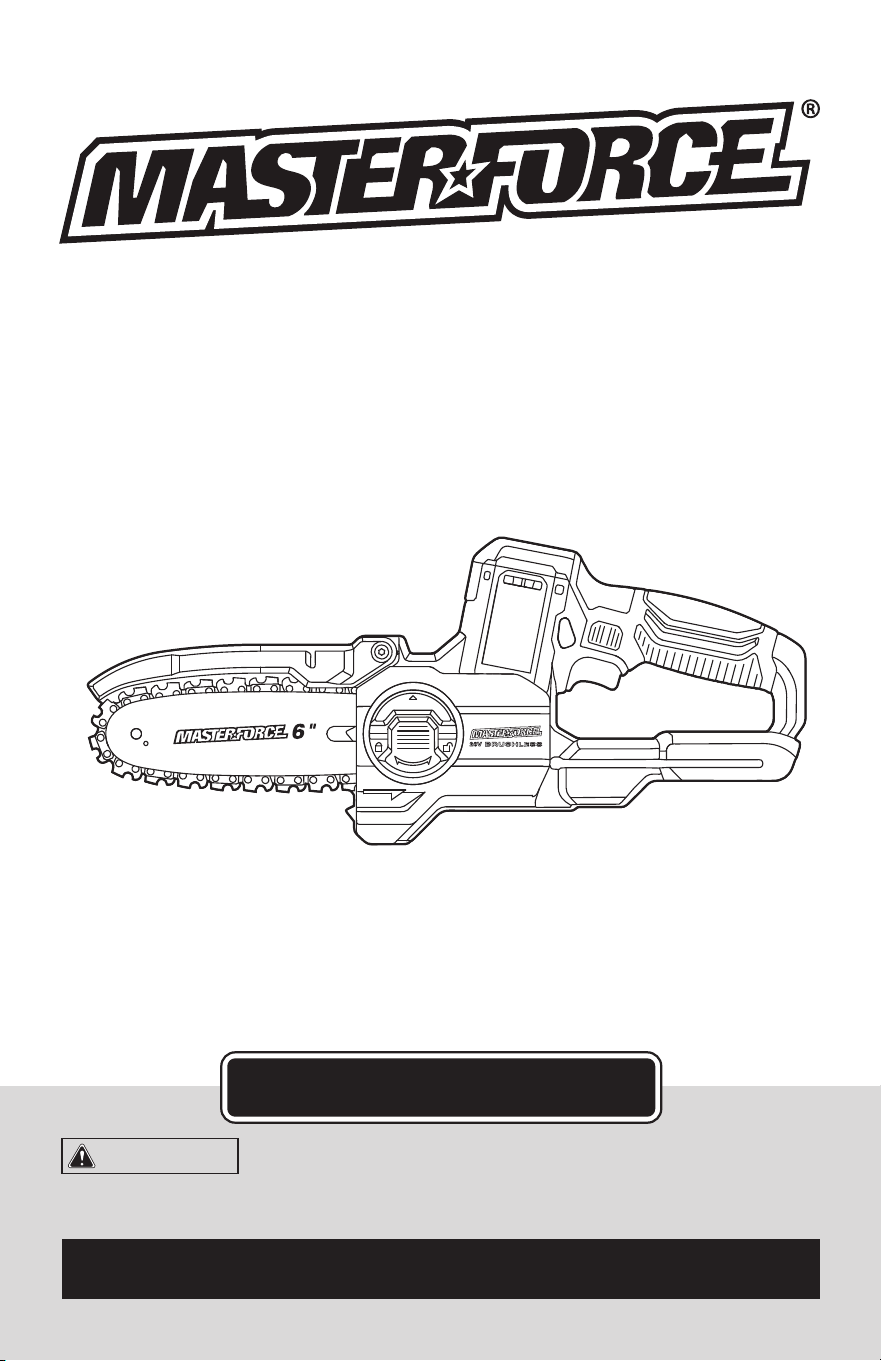
6’’ PRUNING SAW
OPERATOR’S MANUAL
CAUTION:
To Reduce the Risk of Injury, User Must
Read and Understand the Operator’s Manual. Save These
Instructions For Future Reference.
For questions / comments, technical assistance or repair parts –
Please Call Toll Free: 1-866-917-4374 (M-F 8:30am-5:00pm EST).

TABLE OF CONTENTS
Safety Symbols ......................................................... Page 2
Safety Instructions ...................................................... Page 3
Overview ............................................................. Page 10
Specications ......................................................... Page 11
Assembly ............................................................ Page 12
Operation ............................................................ Page 12
Maintenance .......................................................... Page 19
Troubleshooting ....................................................... Page 27
Parts List ............................................................. Page 28
Schematic Drawing .................................................... Page 29
Warranty .............................................................Page 30
Page 2
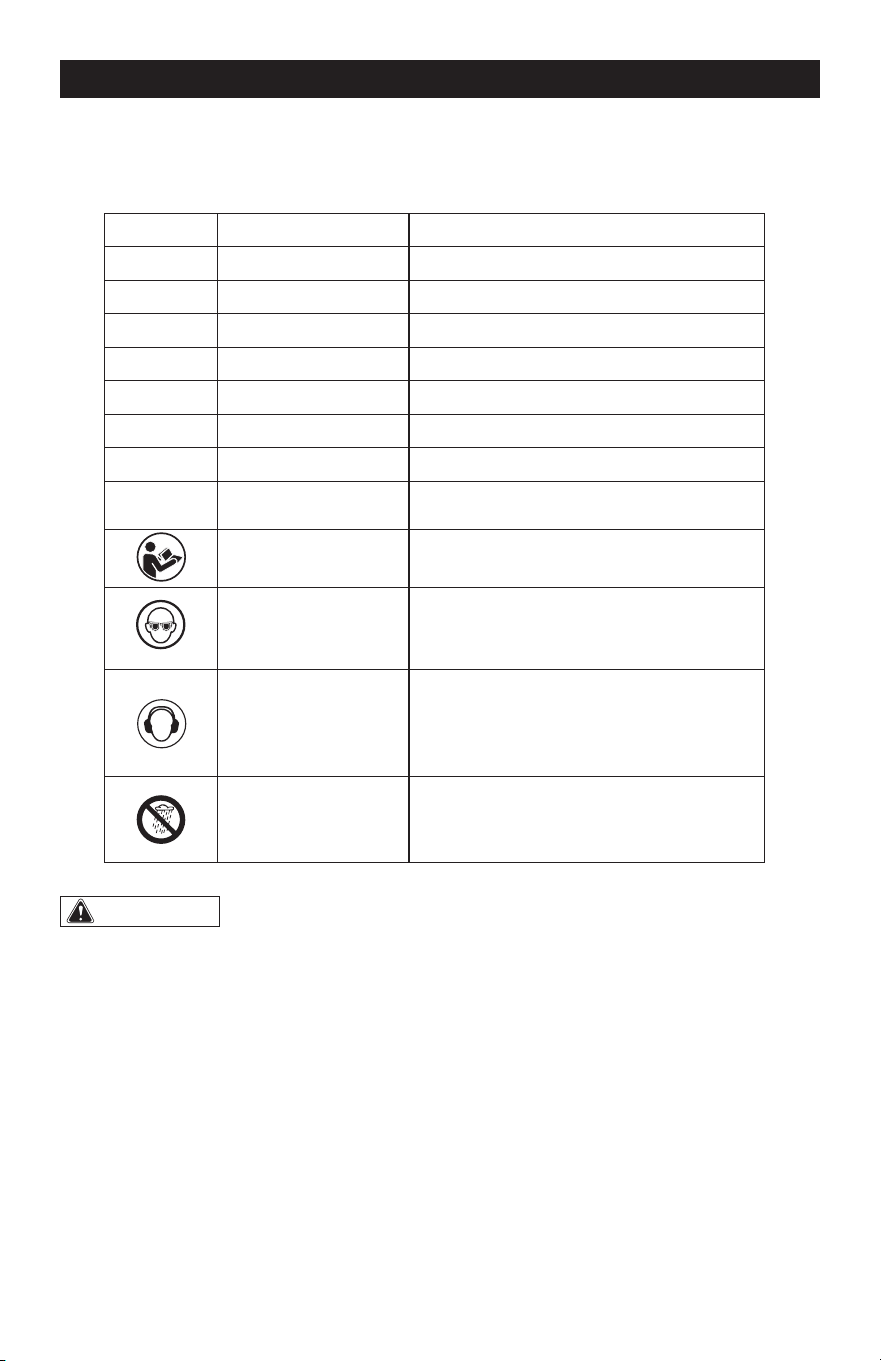
SAFETY SYMBOLS
Some of these following symbols may be used on this machine. Please study them and learn
their meaning. Proper interpretation of these symbols will allow you to operate the machine
better and more safely.
Symbol
Name
Designation / Explanation
V Volts Voltage
in. Inch Length or size
mm Millimeter Length or size
.oz Fluid Ounce Volume
ml Milliliter Volume
kg Kilogram Weight
lbs Pounds Weight
�
or d.c.
Direct current Type of characteristic of current
Read instruction
manual
To reduce the risk of injury, user must
read instruction manual.
Wear eye protection
Always wear safety goggles or safety
glasses with side shields and a full face
shield when operating this product.
Wear ear protection
Pruning saw noise may damage your
hearing. Always wear sound barriers (ear
plugs or ear mufers) to protect your
hearing.
Do not expose to
rain.
The machine can’t be used in rain or let
outside under raining.
WARNING:
To ensure safety and reliability, all repairs should be performed by a
qualied service technician.
Page 3
The purpose of safety symbols is to attract your attention to possible dangers. The safety
symbols, and the explanations with them, deserve your careful attention and understanding.
The symbol warnings do not, by themselves, eliminate any danger. The instructions and
warnings they give are no substitutes for proper accident prevention measures.
WARNING:
Be sure to read and understand all safety instructions in this manual,
including all safety alert symbols such as “DANGER”, “WARNING” and “CAUTION” before
using this machine. Failure to follow all instructions listed below may result in electric
shock, fire, and/or serious personal injury.
SYMBOL MEANING
SAFETY ALERT SYMBOL: Indicates DANGER, WARNING, OR CAUTION. May be used
in conjunction with other symbols or pictographs.
DANGER:
Indicates an imminently hazardous situation, which, if not avoided, will
result in death or serious injury.
WARNING:
Indicates a potentially hazardous situation, which, if not avoided,
could result in death or serious injury.
CAUTION:
Indicates a potentially hazardous situation, which, if not avoided, could
result in minor or moderate injury.
NOTICE: (Without Safety Alert Symbol) Indicates a situation that may result in property
damage.
SAVE THESE INSTRUCTIONS!
SAFETY INSTRUCTIONS

Page 4
GENERAL MACHINE SAFETY
WARNINGS
WARNING:
Read all safety
warnings, instructions, illustrations and
specifications provided with this machine.
Failure to follow all instructions listed below
may result in electric shock, re and/or
serious injury.
SAVE ALL WARNINGS AND INSTRUCTIONS
FOR FUTURE REFERENCE.
The term “machine” in the warnings refers
to your mains-operated (corded) machine
or battery-operated (cordless) machine.
WORK AREA SAFETY
1. Keep work area clean and well lit.
Cluttered or dark areas invite accidents.
2. Do not operate machines in explosive
atmospheres, such as in the presence of
ammable liquids, gases or dust. Machines
create sparks which may ignite the dust or
fumes.
3. Keep children and bystanders away
while operating a machine. Distractions
can cause you to lose control.
ELECTRICAL SAFETY
1. Machine plugs must match the outlet.
Never modify the plug in any way. Do
not use any adapter plugs with earthed
(grounded) machines. Unmodied plugs
and matching outlets will reduce risk of
electric shock.
2. Avoid body contact with earthed
or grounded surfaces, such as pipes,
radiators, ranges and refrigerators. There
is an increased risk of electric shock if your
body is earthed or grounded.
3. Do not expose machines to rain or wet
conditions. Water entering a machine will
increase the risk of electric shock.
4. Do not abuse the cord. Never use the
cord for carrying, pulling or unplugging
the machine. Keep cord away from heat,
oil, sharp edges or moving parts. Damaged
or entangled cords increase the risk of
electric shock.
5. When operating a machine outdoors,
use an extension cord suitable for outdoor
use. Use of a cord suitable for outdoor use
reduces the risk of electric shock.
6. If operating a machine in a damp
location is unavoidable, use a ground fault
circuit interrupter (GFCI) protected supply.
Use of an GFCI reduces the risk of electric
shock.
PERSONAL SAFETY
1. Stay alert, watch what you are doing
and use common sense when operating
a machine. Do not use a machine while
you are tired or under the inuence of
drugs, alcohol or medication. A moment of
inattention while operating machines may
result in serious personal injury.
2. Use personal protective equipment.
Always wear eye protection. Protective
equipment such as a dust mask, non-skid
safety shoes, hard hat or hearing protection
used for appropriate conditions will reduce
personal injuries.
3. Prevent unintentional starting. Ensure
the switch is in the off-position before
connecting to power source and/or battery
pack, picking up or carrying the machine.
Carrying machines with your nger on the
switch or energizing machines that have the
switch on invites accidents.
4. Remove any adjusting key or wrench
before turning the machine on. A wrench or
a key left attached to a rotating part of the
machine may result in personal injury.
5. Do not overreach. Keep proper footing
and balance at all times. This enables
better control of the machine in unexpected
situations.
SAFETY INSTRUCTIONS

Page 5
SAFETY INSTRUCTIONS
6. Dress properly. Do not wear loose
clothing or jewelry. Keep your hair and
clothing away from moving parts. Loose
clothes, jewelry or long hair can be caught
in moving parts.
7. If devices are provided for the
connection of dust extraction and
collection facilities, ensure these are
connected and properly used. Use of dust
collection can reduce dust-related hazards.
8. Do not let familiarity gained from
frequent use of machines allow you to
become complacent and ignore machine
safety principles. A careless action can
cause severe injury within a fraction of a
second.
MACHINE USE AND CARE
1. Do not force the machine. Use the
correct machine for your application. The
correct machine will do the job better and
safer at the rate for which it was designed.
2. Do not use the machine if the switch
does not turn it on and off. Any machine
that cannot be controlled with the switch is
dangerous and must be repaired.
3. Disconnect the plug from the power
source and/or remove the battery pack,
if detachable, from the machine before
making any adjustments, changing
accessories, or storing machines. Such
preventive safety measures reduce the risk
of starting the machine accidentally.
4. Store idle machines out of the reach
of children and do not allow persons
unfamiliar with the machine or these
instructions to operate the machine.
Machines are dangerous in the hands of
untrained users.
5. Maintain machines and accessories.
Check for misalignment or binding of
moving parts, breakage of parts and
any other condition that may affect the
machine’s operation. If damaged, have
the machine repaired before use. Many
accidents are caused by poorly maintained
machines.
6. Keep cutting machines sharp and clean.
Properly maintained cutting machines with
sharp cutting edges are less likely to bind
and are easier to control.
7. Use the machine, accessories and
machine bits etc. in accordance with
these instructions, taking into account
the working conditions and the work to
be performed. Use of the machine for
operations different from those intended
could result in a hazardous situation.
8. Keep handles and grasping surfaces
dry, clean and free from oil and grease.
Slippery handles and grasping surfaces do
not allow for safe handling and control of the
machine in unexpected situations.
BATTERY MACHINE USE AND
CARE
1. Recharge only with the charger
specied by the manufacturer. A charger
that is suitable for one type of battery pack
may create a risk of re when used with
another battery pack.
2. Use machines only with specically
designated battery packs. Use of any other
battery packs may create a risk of injury and
re.
3. When battery pack is not in use, keep
it away from other metal objects, like
paper clips, coins, keys, nails, screws or
other small metal objects, that can make a
connection from one terminal to another.
Shorting the battery terminals together may
cause burns or a re.
4. Under abusive conditions, liquid may
be ejected from the battery; avoid contact.
If contact accidentally occurs, ush with
water. If liquid contacts eyes, additionally
seek medical help. Liquid ejected from the
battery may cause irritation or burns.
5. Do not use a battery pack or machine
that is damaged or modied. Damaged or
modied batteries may exhibit unpredictable
behavior resulting in re, explosion or risk of
injury.

Page 6
SAFETY INSTRUCTIONS
6. Do not expose a battery pack or
machine to re or excessive temperature.
Exposure to re or temperature above
265 °F (130 °C) may cause explosion.
7. Follow all charging instructions and
do not charge the battery pack or machine
outside the temperature range specied in
the instructions. Charging improperly or at
temperatures outside the specied range
may damage the battery and increase the
risk of re.
SERVICE
1. Have your machine serviced by a
qualied repair person using only identical
replacement parts. This will ensure that the
safety of the machine is maintained.
2. Never service damaged battery
packs. Service of battery packs should
only be performed by the manufacturer or
authorized service providers.
SAFETY INSTRUCTIONS FOR
PRUNING SAW
1. Keep all parts of the body away
from the saw chain when the pruning
saw is operating. Before you start the
pruning saw, make sure the saw chain
is not contacting anything. A moment of
inattention while operating pruning saws
may cause entanglement of your clothing or
body with the saw chain.
2. Do not reach underneath the lumber.
The guard cannot protect you from the saw
chain below the lumber.
3. Check the chain guard for proper
closing before each use. Do not operate
the pruning saw if the guard does not move
freely and close instantly. Never clamp or
tie the chain guard into the open position.
If the pruning saw is accidentally dropped,
the guard may be bent. Raise the guard
and make sure it moves freely and does not
touch the saw chain or any other part, in all
angles.
4. Check the operation of the chain guard
spring. If the guard and the spring are not
operating properly, they must be serviced
before use. Chain guard may operate
sluggishly due to damaged parts, gummy
deposits, or a build-up of debris.
5. Do not at any time point the lower
part or the tip of the pruning saw towards
anyone or anything other than the wood to
be cut. The saw chain on the bottom part
of the guide bar is not covered by a guard,
which may cause serious damage or injury if
it points to something or someone.
6. Always hold the pruning saw rmly with
one hand. Holding the pruning saw with two
hands increases the risk of personal injury
and should never be done.
7. Hold the pruning saw by insulated
gripping surfaces only, because the saw
chain may contact hidden wiring. Saw
chains contacting a “live” wire may make
exposed metal parts of the pruning saw
“live’” and could give the operator an
electric shock.
8. Wear safety glasses and hearing
protection. Further protective equipment
for hearing, head, hands, legs and feet
is recommended. Adequate protective
equipment will reduce personal injury from
ying debris or accidental contact with the
saw chain.
9. Do not operate a pruning saw on a
ladder, from a rooftop, or any unstable
support. Operation of a pruning saw in this
manner could result in serious personal
injury.
10. Always keep proper footing and operate
the pruning saw only when standing on
xed, secure and level surface. Slippery
or unstable surfaces may cause a loss of
balance or control of the saw.
11. When cutting a limb that is under
tension, be alert for spring back. When the
tension in the wood bers is released, the
spring-loaded limb may strike the operator
and/or throw the pruning saw out of control.
Page 7
12. Use extreme caution when cutting
brush and saplings. The slender material
may catch the saw chain and be whipped
toward you or pull you off balance.
13. Carry the pruning saw by the handle
with the pruning saw switched off and
away from your body. When transporting
or storing the pruning saw, always t the
guide bar cover. Proper handling of the
pruning saw will reduce the likelihood of
accidental contact with the moving saw
chain.
14. Follow instructions for lubricating,
chain tensioning and changing
accessories. Improper tension or lubrication
may cause the chain to break.
15. Keep handles dry, clean, and free from
oil and grease. Greasy, oily handles are
slippery, causing loss of control.
16. Cut wood only. Do not use pruning saw
for purposes not intended. For example:
do not use pruning saw for cutting plastic,
masonry, or non-wood building materials.
Use of the pruning saw for operations
different than intended could result in a
hazardous situation.
CAUSES AND OPERATOR
PREVENTION OF KICKBACK
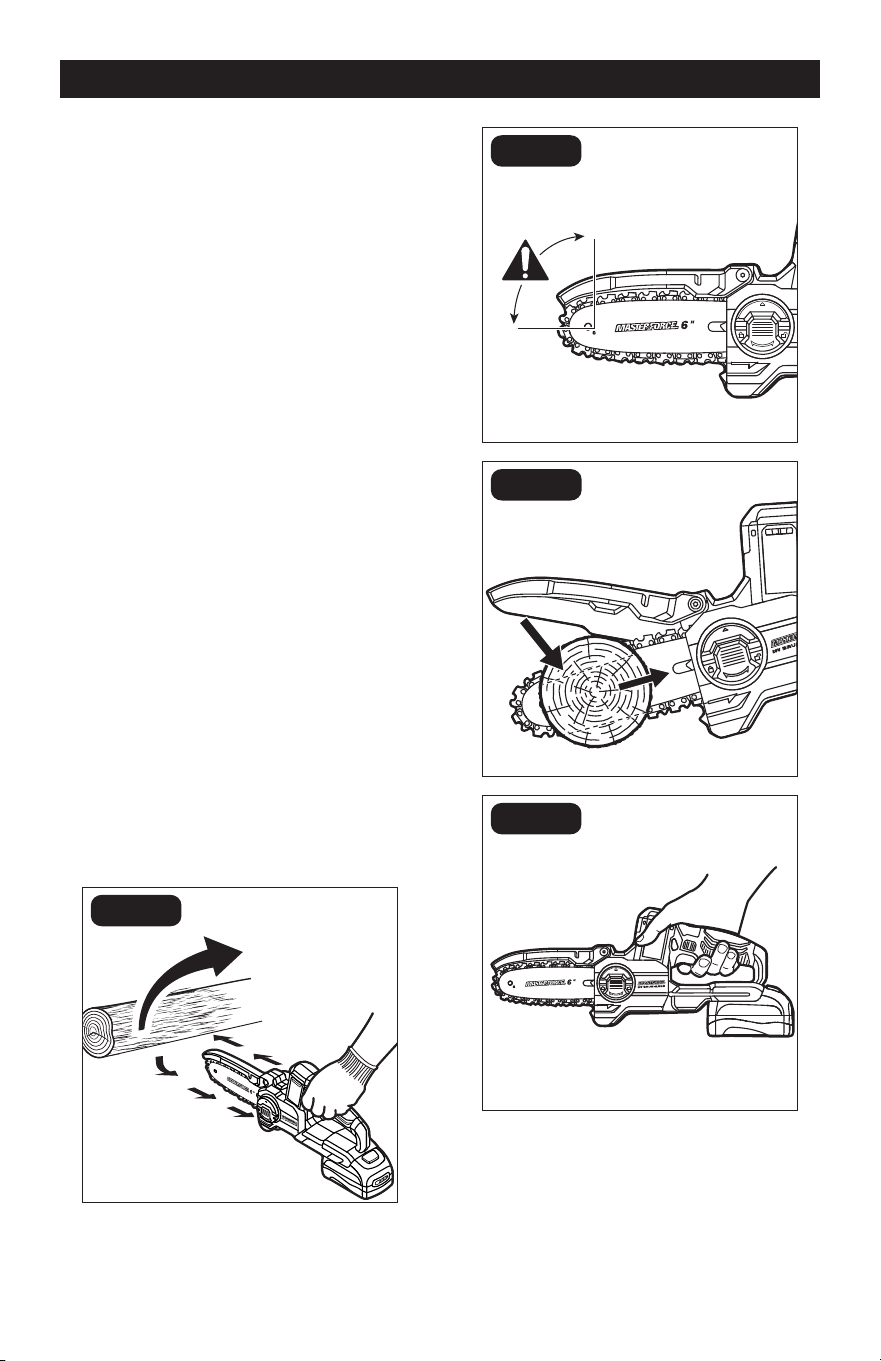
(FIG. 1a, 1b, 1c):
FIG. 1a
Rotational
Kickback
SAFETY INSTRUCTIONS
FIG. 1b
Kickback
Danger Zone
注意:机器部分同figb
FIG. 1d
FIG. 1c
Pinch
Kickback
Kickback may occur when the nose or tip of
the guide bar touches an object, or when the
wood closes in and pinches the saw chain
in the cut.
Page 8
SAFETY INSTRUCTIONS
Tip contact in some cases may cause a
sudden reverse reaction, kicking the guide
bar up and back towards the operator.
Pinching the saw chain along the top of the
guide bar may push the guide bar rapidly
back towards the operator.
Either of these reactions may cause you
to lose control of the saw, which could
result in serious personal injury. Do not rely
exclusively upon the safety devices built into
your saw. As a pruning saw user, you should
take several steps to keep your cutting jobs
free from accident or injury.
Kickback is the result of machine misuse
and/or incorrect operating procedures or
conditions and can be avoided by taking
proper precautions as given below:
• Maintain a firm grip with only one hand
on the saw and position your body and
arm to allow you to resist kickback forces
(FIG. 1d). Kickback forces can be controlled
by the operator, if proper precautions are
taken. Do not let go of the pruning saw.
• Do not overreach and do not cut
above shoulder height. This helps prevent
unintended tip contact and enables better
control of the saw in unexpected situations.
• Only use replacement bars and chains
specified by the manufacturer. Incorrect
replacement bars and chains may cause
chain breakage and/or kickback.
• Follow the manufacturer’s sharpening
and maintenance instructions for the saw
chain. Decreasing the depth gauge height
can lead to increased risk of injury.
CAUSES AND OPERATOR
PREVENTION OF PULL-IN
(FIG. 1e):
注意:机器部分同figb
FIG. 1e
Bumper
WARNING:
Pull-in occurs when the chain on the
bottom of the bar is suddenly stopped or
significantly slowed when it is pinched,
caught or encounters a foreign object
in the wood. The reaction of the chain
pulls the saw forward and may cause the
operator to lose control, which, in turn,
may cause serious or fatal injury.
Pull-in usually occurs when the bumper
of the saw is not held securely against the
branch or limb and the chain is not rotating
at full speed before it contacts the wood.
To reduce the risk of pull-in:
- Cut with a sharp, properly tensioned
chain.
- Always start a cut with the chain rotating
at full speed and with the bumper in contact
with the wood.
- Use caution when cutting small-size
brush, branches and saplings which may
easily catch the chain, spring towards you
or pull you off balance.
- Do not use the saw with a damaged or
missing guard.
Page 9
SAFETY INSTRUCTIONS
ADDITIONAL SAFETY WARNINGS
注意:机器部分线图同figb,把figb平面旋转下
FIG. 1f
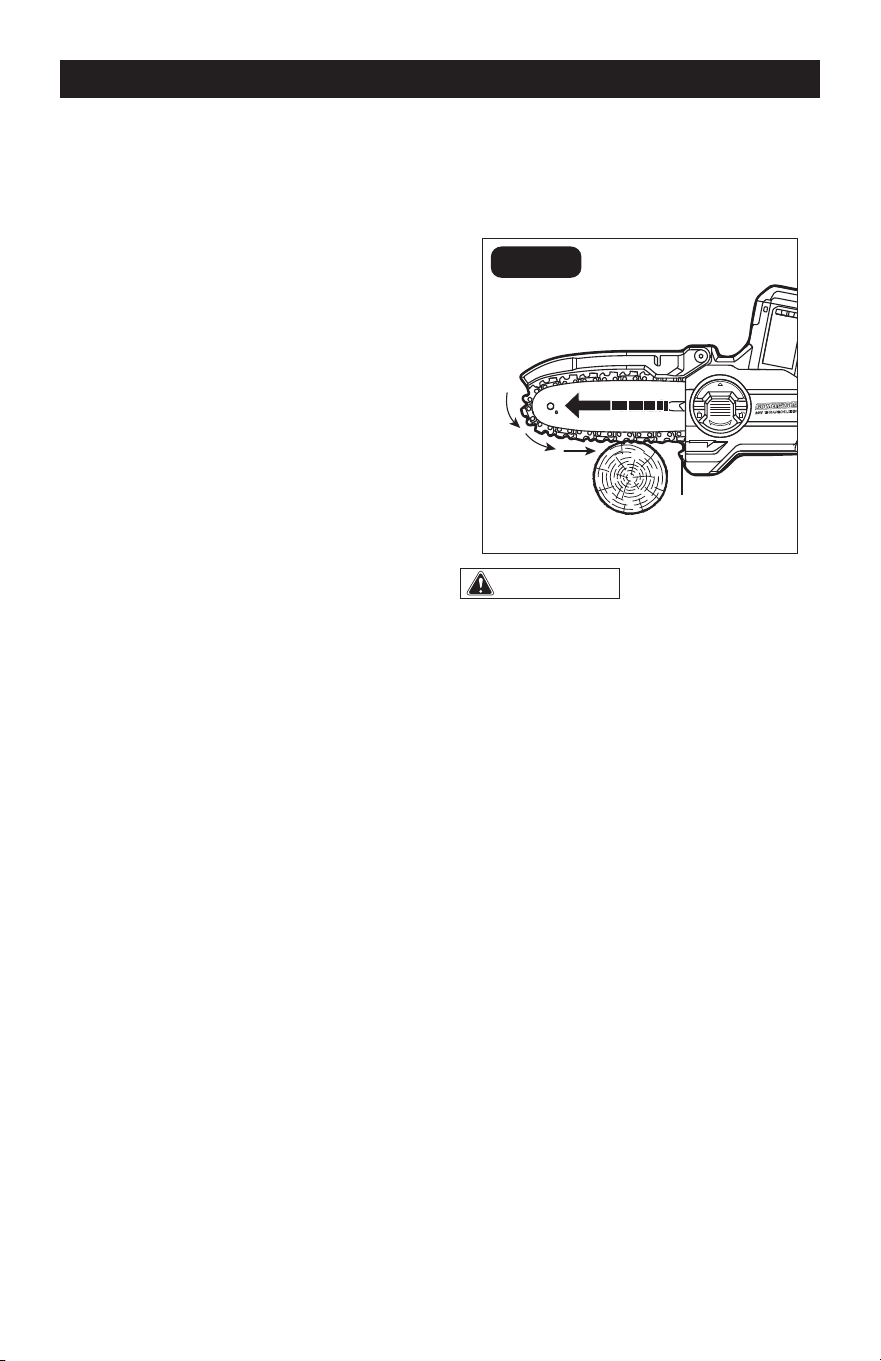
Pull (FIG. 1f) – The reaction force is always
opposite to the direction the chain is
moving where wood contact is made. Thus,
the operator must be ready to control the
PULL when cutting with the bottom edge
of the bar.
IMPORTANT SAFETY INSTRUC-
TIONS
1. To reduce the risk of electric shock or
damage to the chargers and batteries, use
only with the MASTERFORCE
®
20V battery
packs and chargers listed.
Battery pack Charger
252-8029 (1.5Ah)
252-8031 (2.0Ah)
252-8030 (2.5Ah)
252-8003 (2.5Ah)
252-8034 (4.0Ah)
252-8013 (4.0Ah)
252-8035 (5.0Ah)
252-8005 (5.0Ah)
252-8007 (7.5Ah)
252-8014 (8.0Ah)
252-8025
252-8037
252-8026
252-8043
2. For best results, your battery and
machine should be stored, charged and
used in a location where the temperature
is more than 41°F (5°C) but less than 104°F
(40°C). Do not store outside or in vehicles.
DANGER:
People with electronic
devices, such as pacemakers, should
consult their physician(s) before using this
product. Operation of electrical equipment
in close proximity to a heart pacemaker
could cause interference or failure of the
pacemaker.
WARNING:
Some dust created by power sanding,
sawing, grinding, drilling, and other
construction activities contains chemicals
known to the state of California to
cause cancer, birth defects, or other
reproductive harm. Some examples of
these chemicals are:
- Lead from lead-based paints
- Crystalline silica from bricks, cement,
and other masonry products
- Arsenic and chromium from chemically-
treated lumber
Your risk from these exposures varies,
depending upon how often you do this
type of work. To reduce your exposure to
these chemicals:
- Work in a well-ventilated area.
- Work with approved safety equipment,
such as dust masks that are specially
designed to filter out microscopic particles.
- Avoid prolonged contact with dust from
power sanding, sawing, grinding, drilling,
and other construction activities. Wear
protective clothing and wash exposed
areas with soap and water. Allowing dust
to get into your mouth or eyes or to lie
on the skin may promote absorption of
harmful chemicals.
SAVE THESE INSTRUCTIONS!
Page 10
OVERVIEW
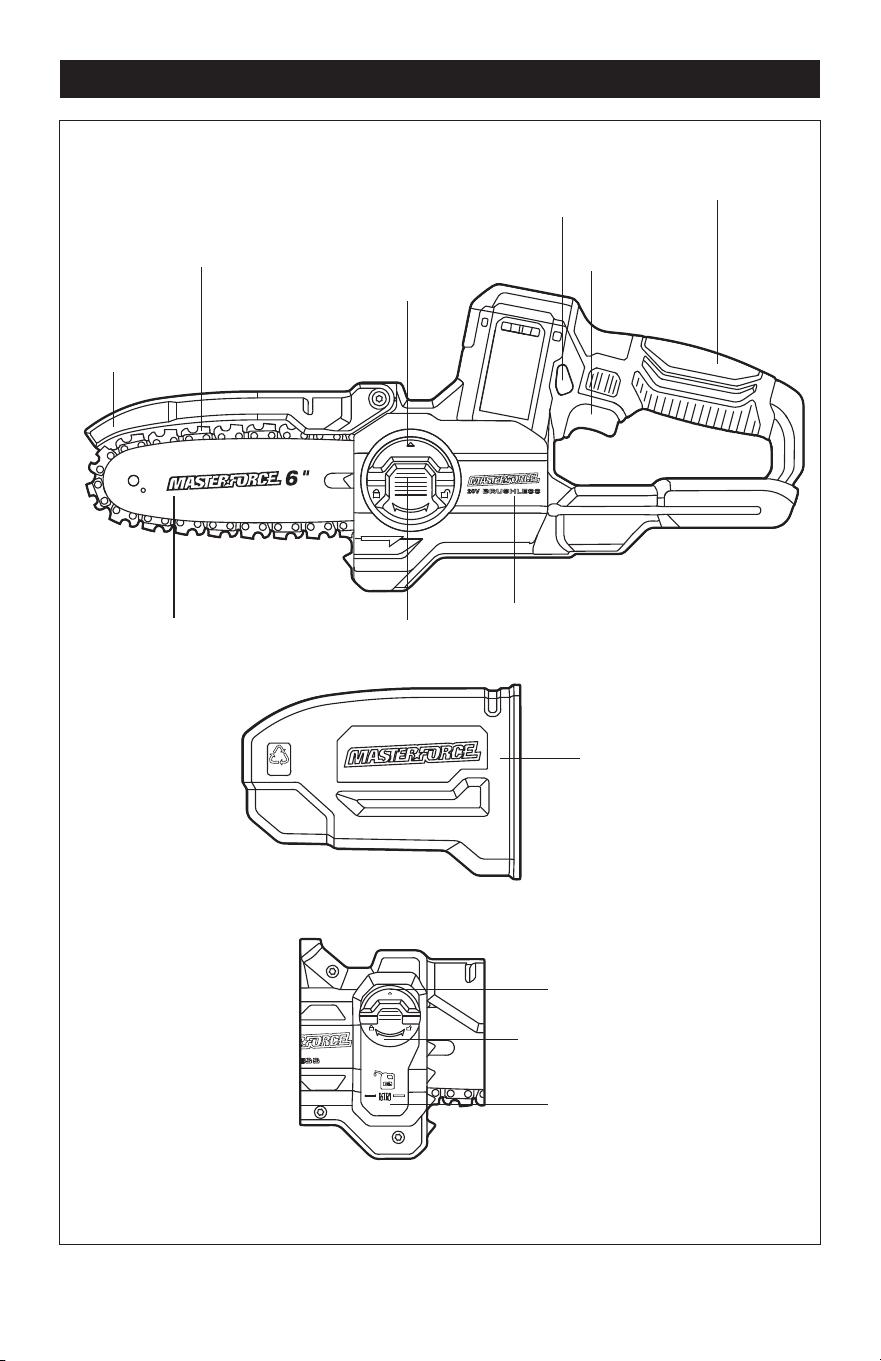
02
HDPE
Chain Sheath
Side Cover
Lock-off Button
Knob Tab
Trigger Switch
Handle
Saw Chain
Chain
Guard
Guide Bar
Side-cover Knob
Cap Tab
Oil-tank Cap
Oil Tank

Page 11
SPECIFICATIONS
Rated voltage 20 V d.c.
Bar length 6 in.
Cutting capacity width 5.5 in.
Chain pitch 3/8 in.
Chain gauge 0.043 in.
Drive links 28
Oil-tank capacity 1.7 . oz
Weight (without battery) 3.1 lbs.
TriLink
®
(included)
Guide Bar M1430628-1041KB
Saw Chain CL14328FPB
Oregon Replacement Chain
(sold separately)
R28
Page 12
ASSEMBLY
WARNING:
If any part is broken or
missing, DO NOT attach the battery pack
or operate the machine until the broken or
missing part is replaced. Failure to do so
could result in possible serious injury.
WARNING:
Do not attempt
to modify this machine or create
accessories not recommended for use
with this machine. Any such alteration or
modification is misuse and could result in
a hazardous condition leading to possible
serious injury.
WARNING:
Your machine should
never be connected to the battery pack
when you are assembling parts, making
adjustments, cleaning, or when it is not
in use. Disconnecting the machine will
prevent accidental starting, which could
cause serious personal injury.
OPERATION
PACKING LIST
Pruning saw
UNPACKING
1. Carefully remove the machine and any
accessories from the carton. Make sure
that all items listed in the packing list are
included.
2. Inspect the machine carefully to make
sure that no breakage or damage
occurred during shipping.
3. Do not discard the packing material
until you have carefully inspected and
satisfactorily operated the machine.
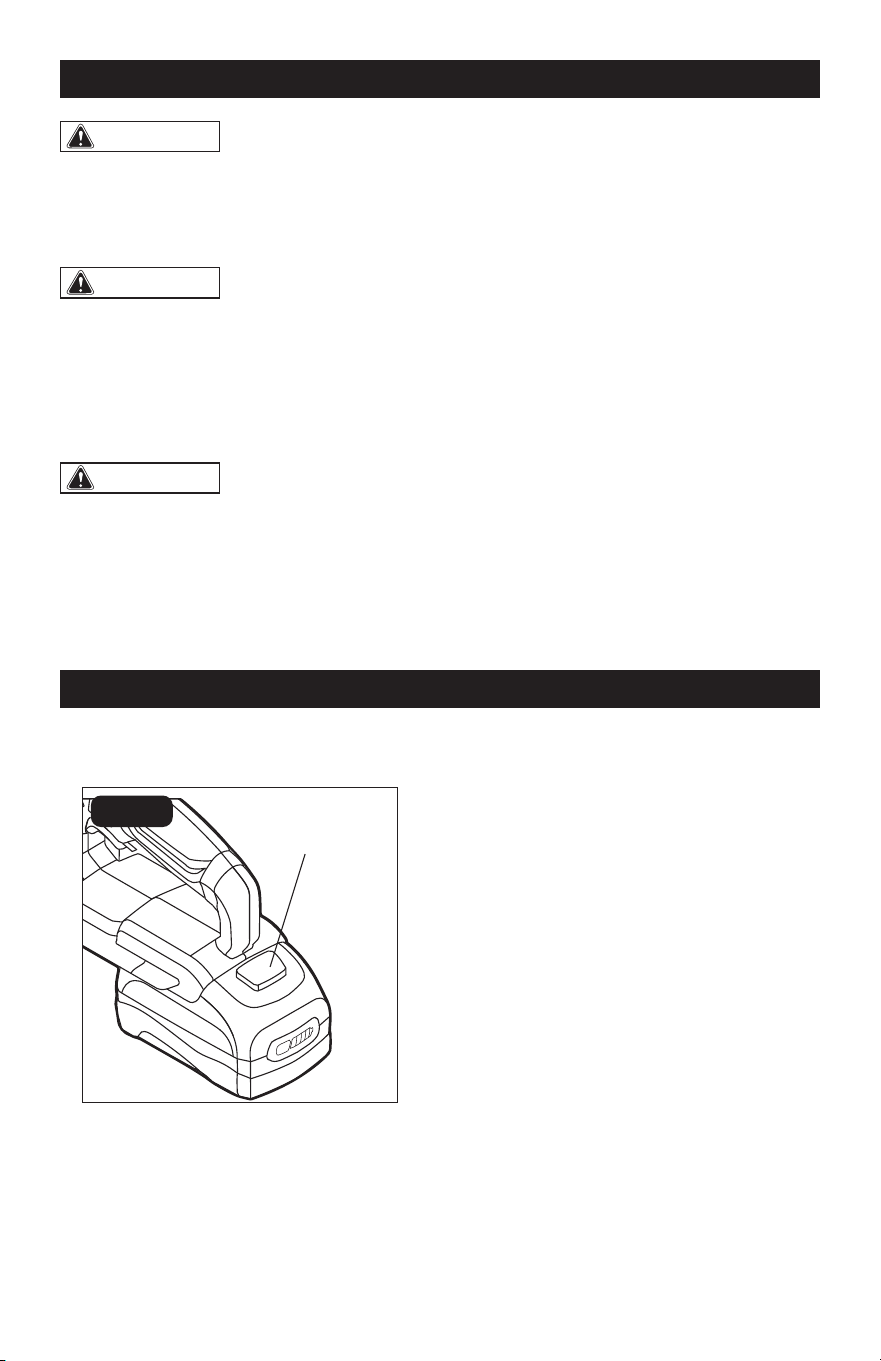
ATTACH THE BATTERY PACK
(FIG. 2)
FIG. 2
Battery-release
Button
1. Align the raised ribs on the battery pack
with the grooves on the bottom of the
machine, then slide the battery pack
onto the machine.
2. Ensure that the battery-release button
on the battery pack snaps into place
and the battery pack is secured to the
machine before beginning operation.
NOTICE: When placing the battery pack on
the machine, be sure that the raised ribs on
the battery pack align with the grooves on
the machine and the latches snap into place
properly. Improper assembly of the battery
pack can cause damage to internal compo-
nents.
DETACH THE BATTERY PACK
(FIG. 2)
1. Press the battery-release button to
release the battery pack.
2. Pull the battery pack to remove it from
the machine.
Page 13
OPERATION
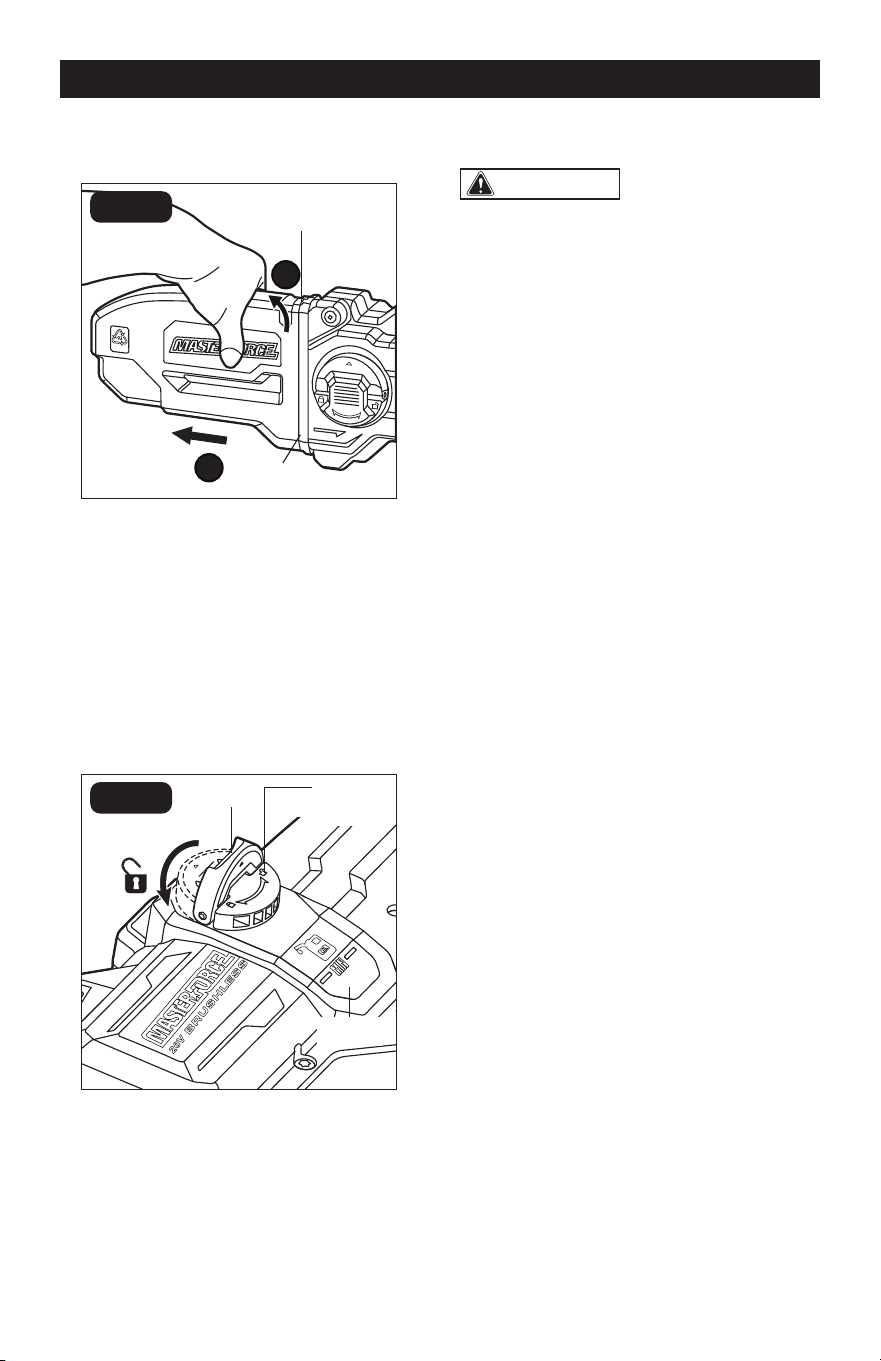
REMOVING THE CHAIN SHEATH
(FIG. 3)
HDPE
1
2
FIG. 3
Upper End
Lower End
1. Remove the battery pack from the
pruning saw.
2. With the lower end of the sheath as a
pivot, slightly rotate up the upper end of
the sheath, then remove the sheath from
the pruning saw.
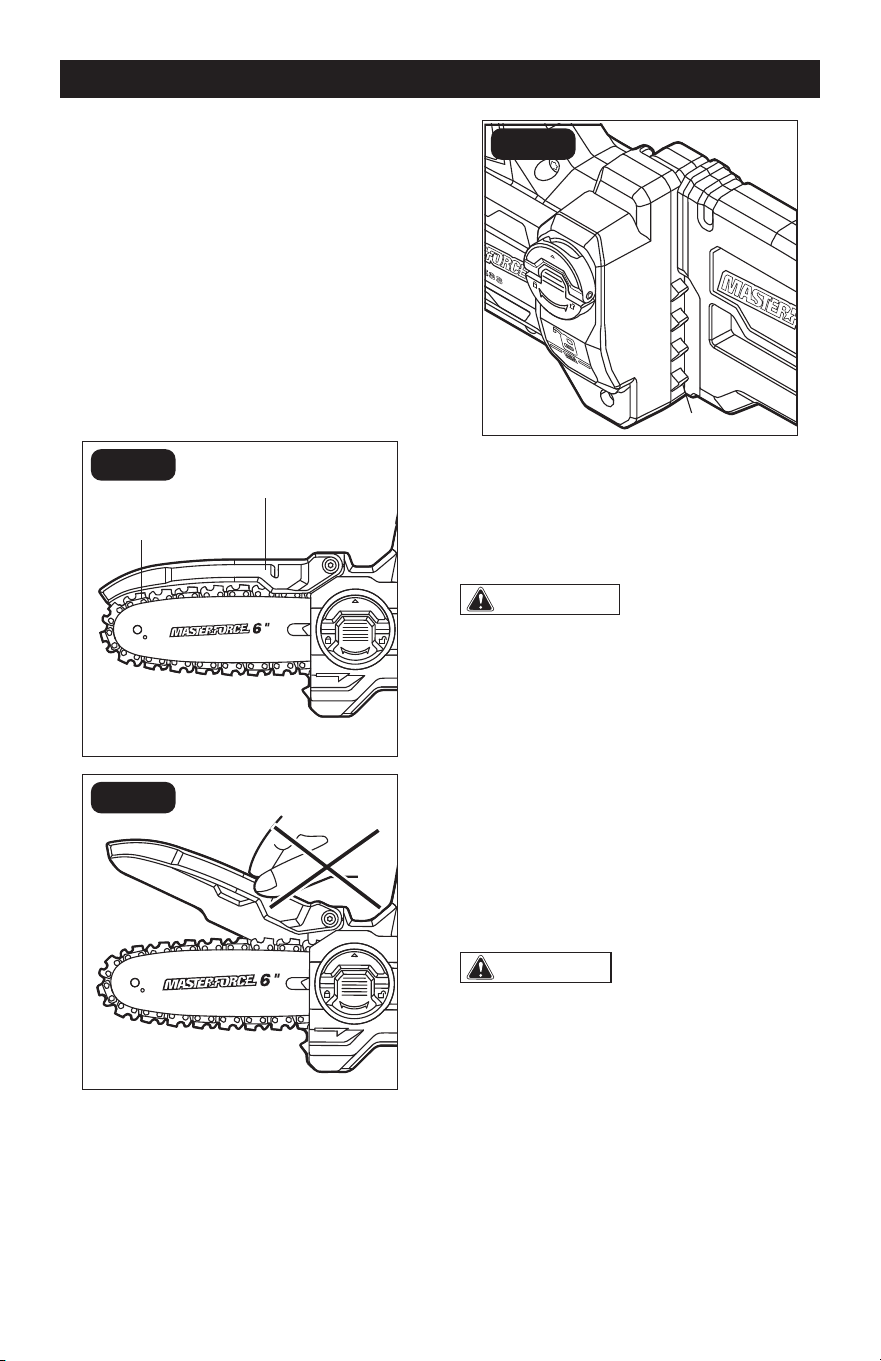
FILLING OIL TANK WITH BAR
AND CHAIN LUBRICANT (FIG. 4)
FIG. 4
Oil-tank
Cap
Oil Tank
Cap Tab
The pruning saw is not lled with oil at the
time of purchase. It is essential to ll the
tank with oil before use. Operating the saw
without chain oil or when the oil level is be-
low the minimum mark will result in damage
to the saw. Chain life and cutting capacity
depend on optimum lubrication.
The chain is automatically lubricated with
chain oil during operation.
WARNING:
Do not smoke or
bring any fire or flame near the oil or the
pruning saw. Oil may spill and cause a fire.
1. Remove the battery pack from the
pruning saw.
2. Clean the oil-tank cap and the area
around it to ensure that no dirt falls into
the oil tank.
3. Position the pruning saw on its side on a
rm, at surface, so that the oil-tank cap
is facing up. Lift the cap tab and rotate it
counterclockwise to remove the cap.
4. Carefully pour the bar and chain oil into
the tank. Fill to the bottom of the ll
neck. Wipe off any excess oil.
5. Replace and tightly secure the cap. Fold
the cap tab.
6. Place the saw upright and examine the
oil level through the translucent plastic
oil tank.
NOTICE:
We recommend using environmentally-
friendly biodegradable chain oil specically
intended to be used with pruning saws.
Never use oil or other lubricants not
specically designed for use on the bar and
chain. This can lead to a clogged oil system,
which may cause premature wear of the bar
and chain.
Check the oil level frequently and ll
the tank when the oil level falls below the
minimum line. Never operate the pruning
saw if the oil is not visible.
Do not use dirty, used, or otherwise
contaminated oil. Damage may occur to the
bar or chain.
It is normal for oil to seep from the saw
when it is not in use. To prevent seepage,
empty the oil tank after each use and then
run the saw for one minute. When storing
the machine for a long period of time, be
Page 14
sure that the chain is lightly lubricated.
This will prevent rust on the chain and bar
sprocket.
To preserve natural resources, please recy-
cle or dispose of oil properly. Consult your
local waste authority for information regard-
ing available recycling and disposal options.
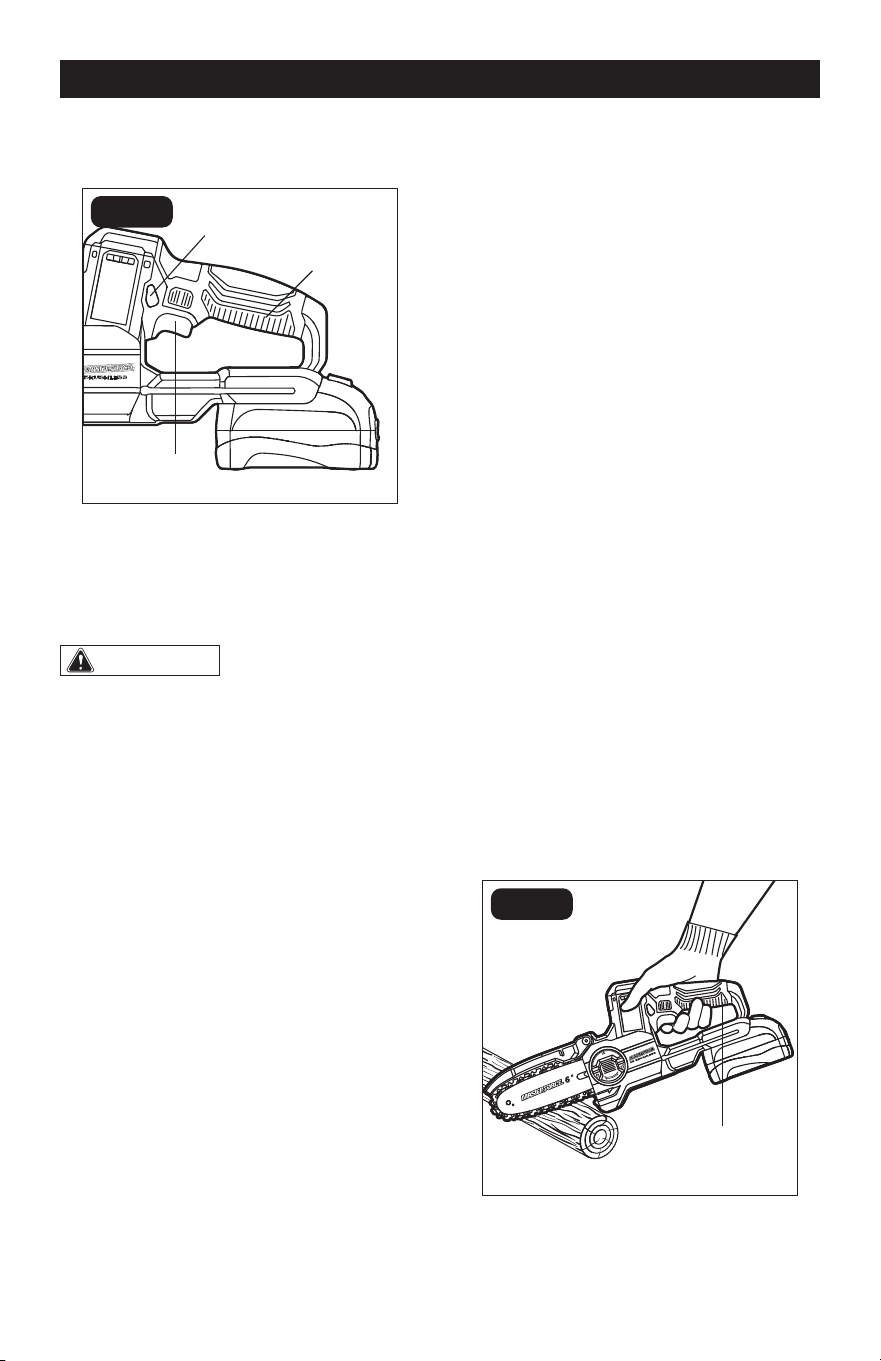
KICKBACK AND PULL-IN SAFETY
DEVICES ON THIS PRUNING SAW
(FIG. 5)
FIG. 5a
FIG. 5b
Saw Chain
Chain Guard
OPERATION
FIG. 5c
Bumper
1. The pruning saw is equipped with a
chain guard to lower risk of injury from
kickback (FIG. 5a) by preventing access
to the saw chain.
WARNING:
To avoid injury, keep all parts of
your body away from the guard during
operation.
For your safety, never clamp or tie the
chain guard in the open position. Do not
attempt to cut with the top edge of the bar
(FIG. 5b).
2. The bumper beside the chain guard is
designed to provide greater control of
the saw while cutting. It helps hold the
saw steady against the branch or limb
during cutting (FIG. 5c).
CAUTION:
Always press the
bumper against the material being cut to
maintain better control of the saw.
3. The saw is also equipped with an
electric brake, when the trigger switch
is released, the electric brake engages
automatically to quickly stop the chain
rotation.
Page 15
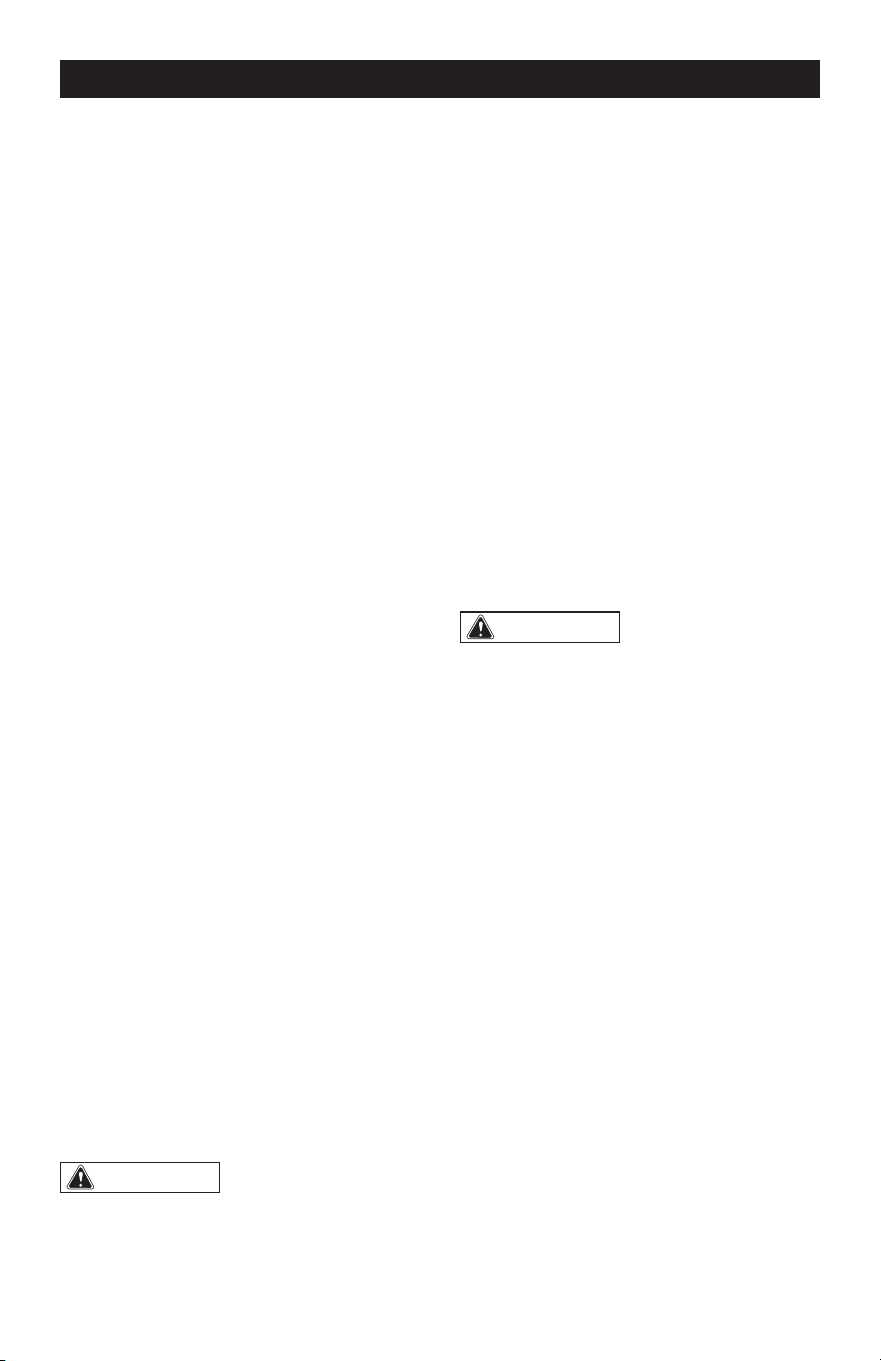
TO START/STOP THE PRUNING
SAW (FIG. 6)
FIG. 6
Handle
Lock-off Button
Trigger Switch
1. To turn the saw ON, grasp the handle
rmly with one hand.
2. Press the lock-off button, and then
squeeze the trigger switch.
WARNING:
Make sure no objects
or obstructions, which could come in
contact with the bar and chain, are in the
immediate vicinity.
3. To turn the saw OFF, release the trigger
switch and allow the chain to come to a
complete stop.
BEFORE USING THE PRUNING
SAW
1. Remove the battery pack.
2. Conrm that the chain guard is
undamaged and functioning properly.
3. Make sure that the chain is properly
mounted and correctly tensioned: Lift
the tip of the guide bar up to check for
any sagging in the saw chain. The saw
chain is correctly tensioned when there
is no sag on the underside of the guide
bar and the saw chain is snug, but it can
be turned by hand without binding. If
the tension requires adjustment, refer
to the chapter “REPLACING THE BAR
AND CHAIN” in the “MAINTENANCE”
section of this manual for instructions.
4. Check the tightness of the side-cover
knob before use. If it is loose, securely
tighten the side-cover knob by turning it
clockwise.
5. Check the oil level and ll the tank as
needed.
6. Check the sharpness of the cutting
teeth of the saw chain.
7. Make sure the saw chain is well
lubricated.
8. Stand upright and hold the pruning saw
in a relaxed position.
9. Make sure the saw chain is not touching
the ground or any other objects.
10. Hold the saw with one hand.
11. Make sure that you have a secure
and balanced footing. Watch out for
obstacles such as tree stumps, roots,
and ditches, which could cause you to
trip or stumble.
12. Always make a trial cut in scrap material
before making an accurate cut.
PREPARATION FOR CUTTING
(FIG. 7)
注意:机器部分线图同figb,把figb平面旋转下
FIG. 7
Handle
Refer to “SAFETY INSTRUCTION” earlier in
this manual for appropriate safety
equipment.
OPERATION
Page 16
OPERATION
Work Area Precautions
Cut only wood or materials made from
wood. Do not cut sheet metal, plastics,
masonry, or non-wood building materials.
Never allow children to operate the
pruning saw.
Allow no person, who has not read this
Operator’s Manual or received adequate
instructions for the safe and proper use of
this saw, to use this saw.
During bucking operations, keep a
minimum distance of 15 feet between
workers. Trees should not be felled in a
manner that would endanger any person,
strike any utility line, or cause any property
damage. If a tree does make contact with
any utility line, stay clear of the tree and
the line and notify the utility company
immediately.
Always operate the saw with both feet
on solid ground to prevent being pulled off
balance.
Do not cut above shoulder height, as a
saw held higher is difcult to control against
kickback forces.
Do not fell trees near electrical wires or
buildings.
Cut only when visibility and light are
adequate for you to see clearly.
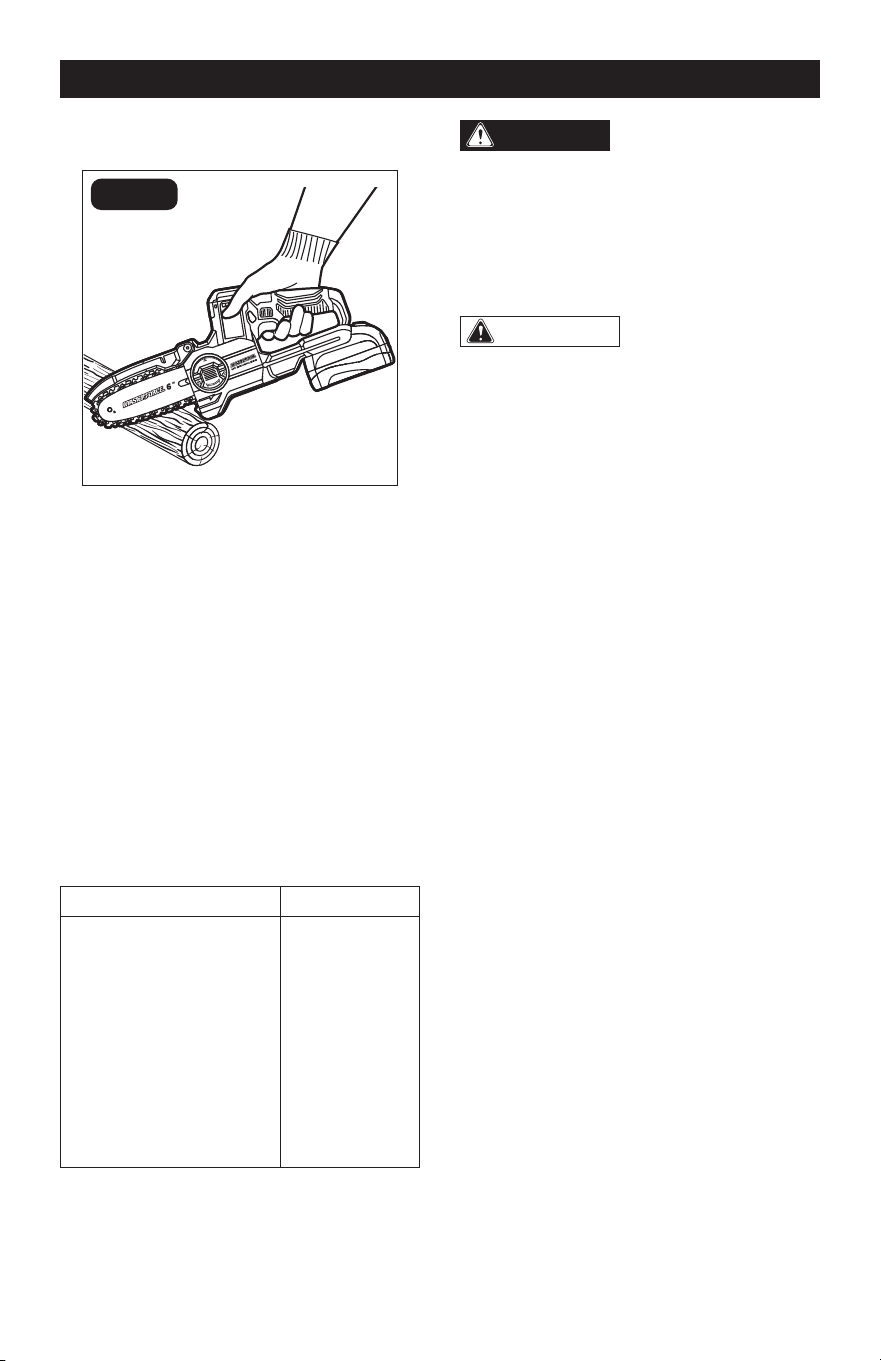
Proper Grip on Handle
Wear non-slip gloves for maximum grip and
protection. With the saw on a rm, at sur-
face, hold the saw rmly with one hand. The
ngers should encircle the handle (FIG. 7).
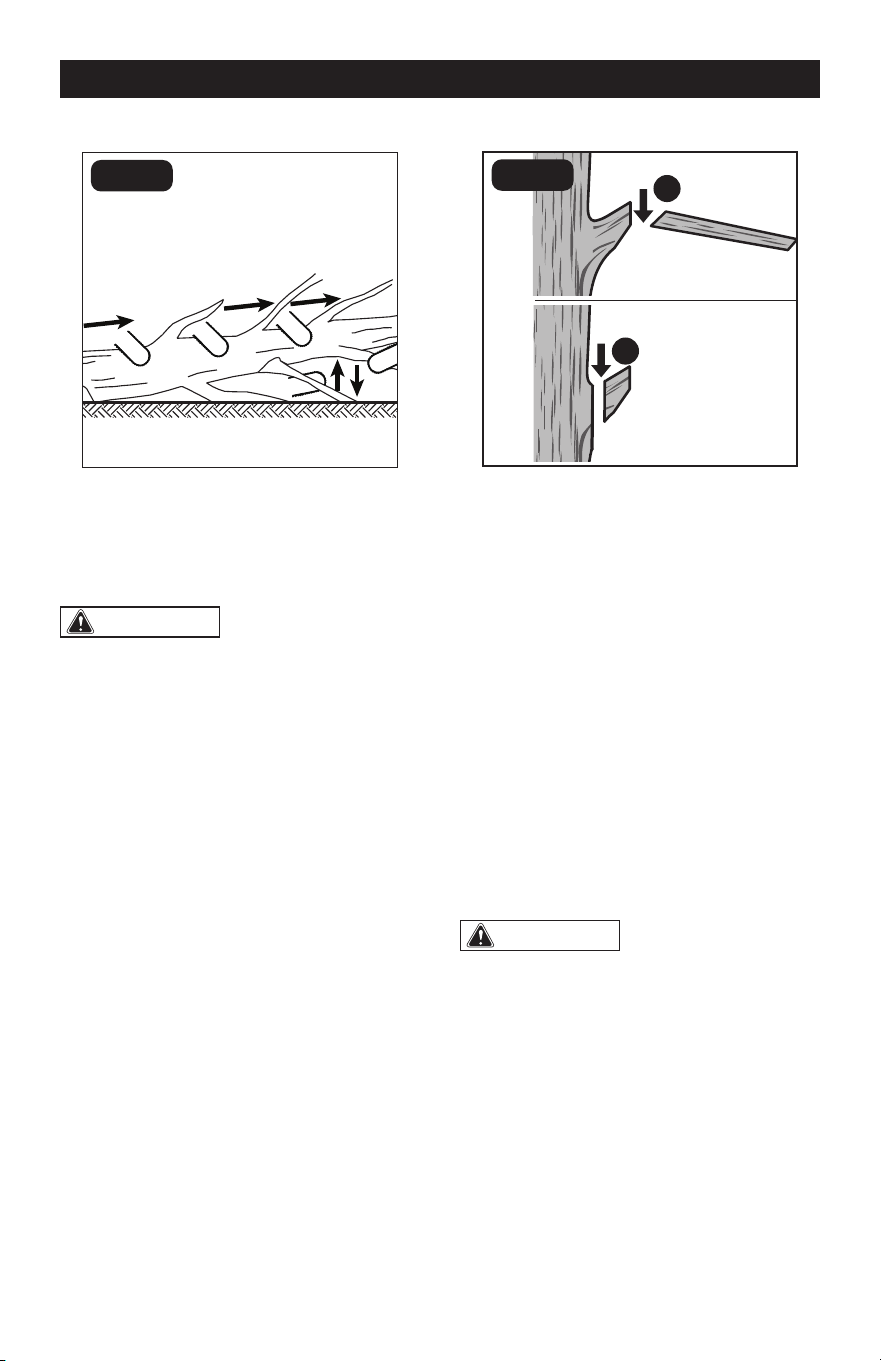
BASIC CUTTING
WARNING:
Always be sure of your
footing and hold the pruning saw firmly
with one hand while the motor is running.
Practice cutting a few small logs using the
following technique to get the “feel” of
using your saw before you begin a major
sawing operation.
1. Take the proper stance in front of the
wood with the saw off.
2. Press the lock-off button and squeeze
the trigger to start the saw. Let the
saw chain reach the full speed before
beginning the cut.
3. Begin cutting by lightly pressing the
guide bar against the wood. Use only
light pressure, letting the saw do the
work.
4. Maintain a steady speed throughout the
cut, releasing pressure just before the
end of the cut.
5. Release the trigger as soon as the cut
is completed, allowing the saw chain to
stop.
WARNING:
When the saw chain is stopped due to
pinching during cutting, release the trigger
switch; remove the saw chain and guide
bar from the wood, then restart the pruning
saw.
Do not pull the saw chain with your
hand when it is bound by the sawdust.
Serious injury could result if the saw starts
accidentally. Press the saw chain against
the wood, move the saw back and forth to
discharge the debris. Always remove the
battery pack before cleaning. Wear heavy
protective gloves when handling the saw
chain.
Never start the pruning saw when it is
in contact with the wood. Always allow the
saw to reach full speed before applying the
saw to the wood.
NOTICE: For better performance, do not cut
a branch with a diameter greater than 5.5 in. .
Page 17
OPERATION
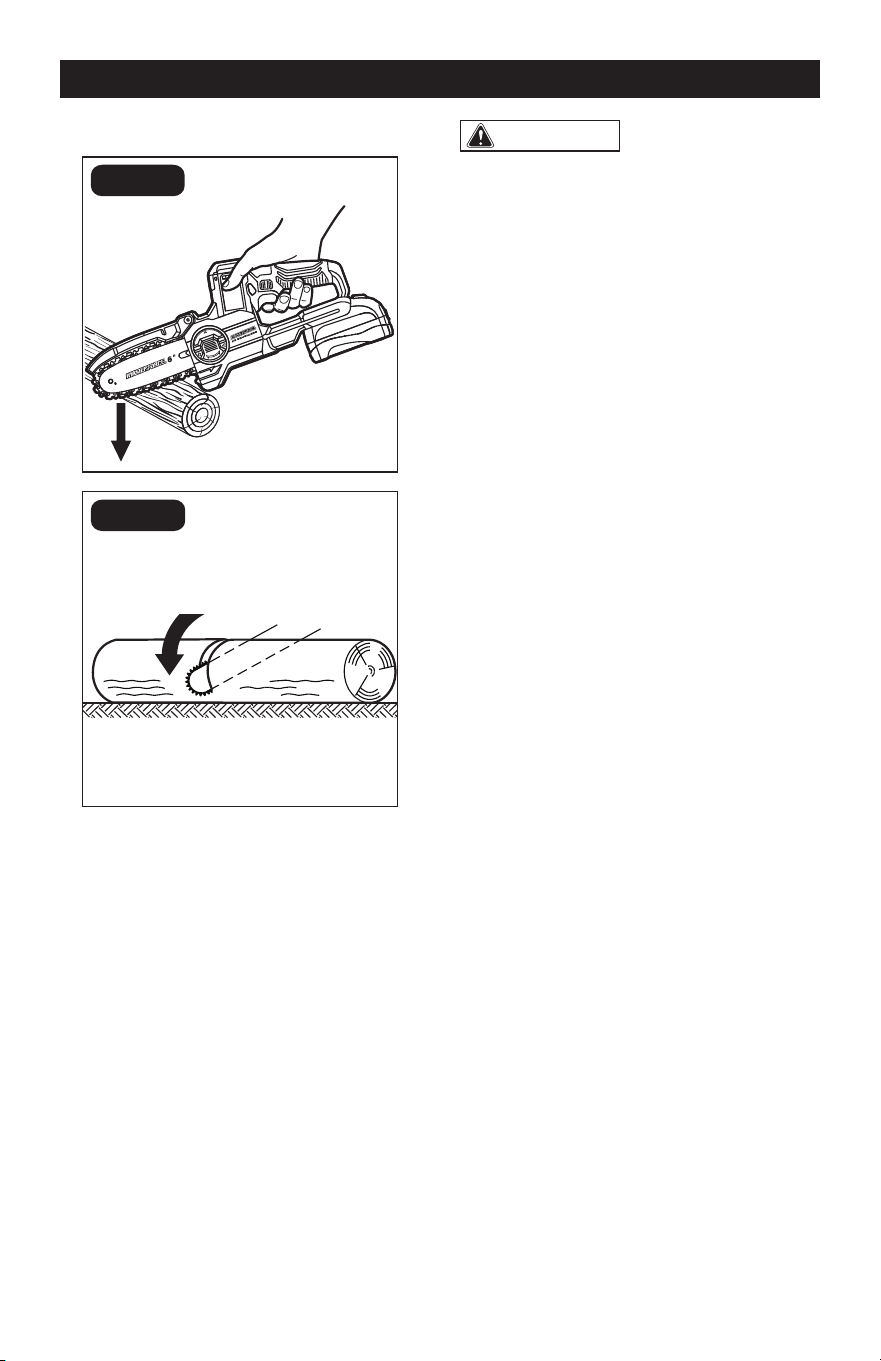
LIMBING (FIG. 8)
FIG. 8
Limb Cut
Limbing is removing branches from a fallen
tree. When limbing, leave larger limbs to
support the log off the ground. Use the
pruning saw to remove the small limbs in
one cut as illustrated in FIG. 8.
WARNING:
There is an extreme danger of kickback
during the limbing operation. Be extremely
cautious and avoid contacting the log or
other limbs with the tip of the guide bar.
The saw is not suitable for bottom-up
cutting as its chain guard mustn’t be lifted
during operation. Never use it to cut the
support branches under tension.
NOTICE: For better performance, do not cut
a branch with a diameter greater than 5.5 in..
PRUNING (FIG. 9)
1
2
First cut to
reduce load
Final Cut
FIG. 9
Pruning is trimming limbs from a live tree.
• Work slowly, keeping your hand on the
pruning saw with a rm grip. Always make
sure your footing is secure and your weight
is distributed evenly on both feet.
• Do not cut from a ladder, this is
extremely dangerous. Leave this operation
for professionals.
• Do not cut above shoulder height as a
saw held higher is difcult to control against
kickback.
• When pruning trees, be aware of the risk
of stripping the bark from the main limb or
trunk when the cut is made next to the main
limb or trunk.
WARNING:
If the limbs to be
pruned are above shoulder height, hire a
professional to perform pruning. Failure
to do so could result in serious personal
injury.
NOTICE: For better performance, do not cut
a branch with a diameter greater than
5.5 in.
.
Page 18
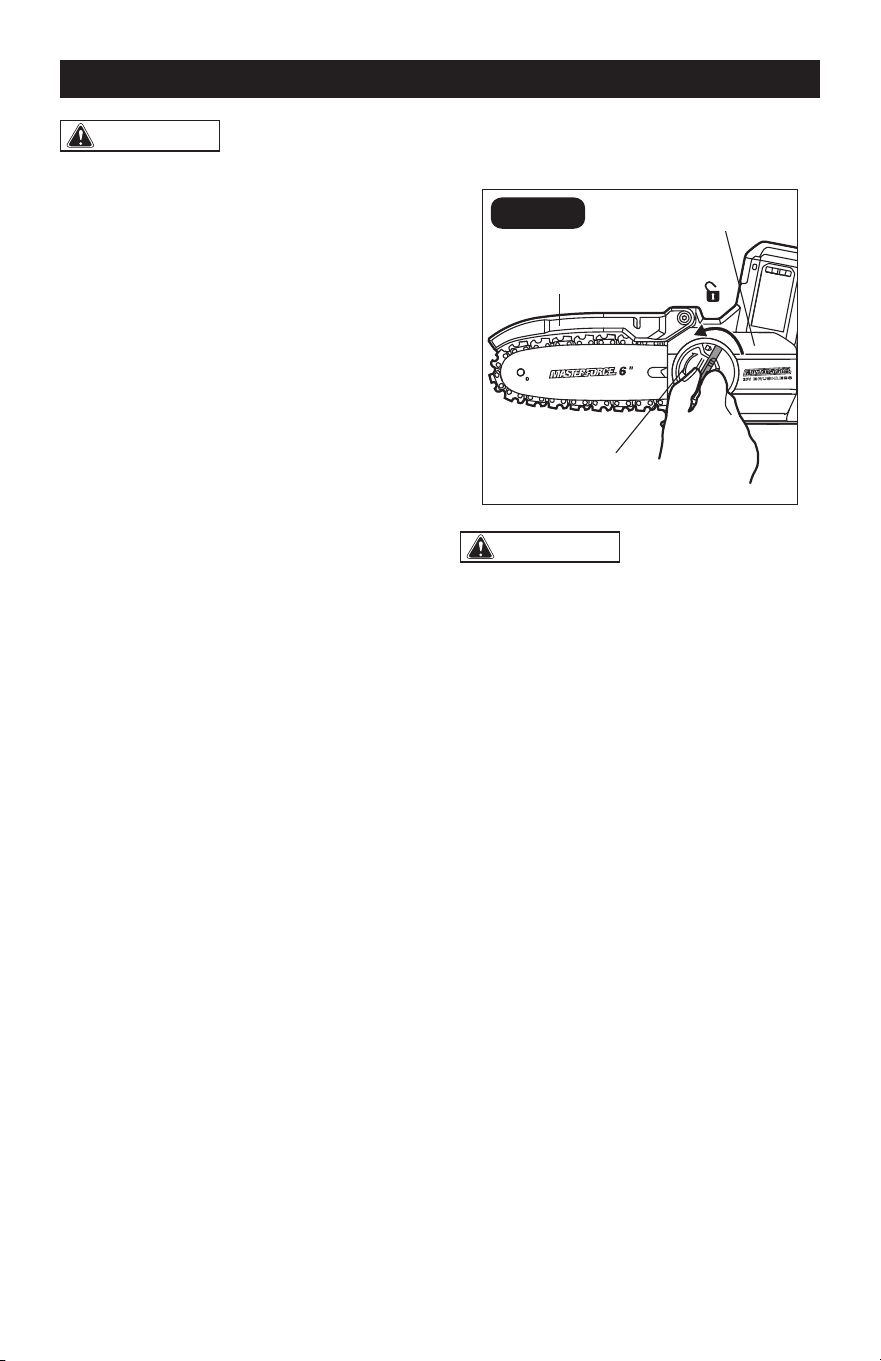
BUCKING A LOG (FIG. 10)
注意:整张图和figf的差异就是多了一个向下的箭头
FIG. 10a
Overbucking
FIG. 10b
Log supported along the
entire length
Cut from Top (Overbuck).
Aviod Cutting Earth.
Bucking is cutting a log into lengths. It is im-
portant to make sure your footing is rm and
your weight is evenly distributed on both
feet. The log should be supported along its
entire length. Follow these simple directions
for easy cutting.
OPERATION
WARNING:
Keep the cutting area
clear. Make sure that no objects can
contact the guide bar nose and chain
during cutting. This can cause kickback.
Overbucking (FIG. 10a).
Begin on the top side of the log with the bot-
tom of the saw against the log, exert light
pressure downward. Note that the saw will
tend to pull away from you. Engage the
pruning saw bumper against the log when-
ever possible.
Make sure that the log is supported
along its entire length before you make a cut
from the top (overbucking) (FIG. 10b).
NOTICE: For better performance, do not cut
a log with a diameter greater than
5.5 in.
.
When bucking on a slope, always stand
on the uphill side of the log.
To maintain complete control when
cutting through, release the cutting pressure
near the end of the cut without relaxing
the grip on the pruning saw handle. Don’t
allow the chain to contact the ground. After
completing the cut, wait for the saw chain to
stop before you move the saw. Always stop
the motor before moving from tree to tree.
Page 19
WARNING:
All maintenance should only be carried
out by a qualified service technician.
Before cleaning or performing any
maintenance, remove the battery pack.
For safe and proper operation, always
keep the machine and its ventilation slots
clean.
When servicing, use only identical
replacement parts. Use of any other parts
may create a hazard or cause product
damage.
Always wear safety goggles or safety
glasses with side shields during machine
operation or when blowing dust. If the
operation is dusty, also wear a dust mask.
When cleaning the pruning saw, DO
NOT immerse it in water or other liquids.
Do not at any time let brake fluids,
gasoline, petroleum-based products,
penetrating oils, etc., come in contact
with plastic parts. Chemicals can damage
, weaken, or destroy plastic, which may
result in serious personal injury.
CLEANING
After each use, clean debris from the saw
chain, guide bar and chain guard with a soft
brush. Wipe the pruning saw surface with a
clean cloth moistened with a mild soap so-
lution.
Remove the side cover, and then use a soft
brush to remove debris from the guide bar,
saw chain, sprocket and side cover.
Always clean out wood chips, saw dust, and
dirt from the guide bar groove when replac-
ing the saw chain.
MAINTENANCE
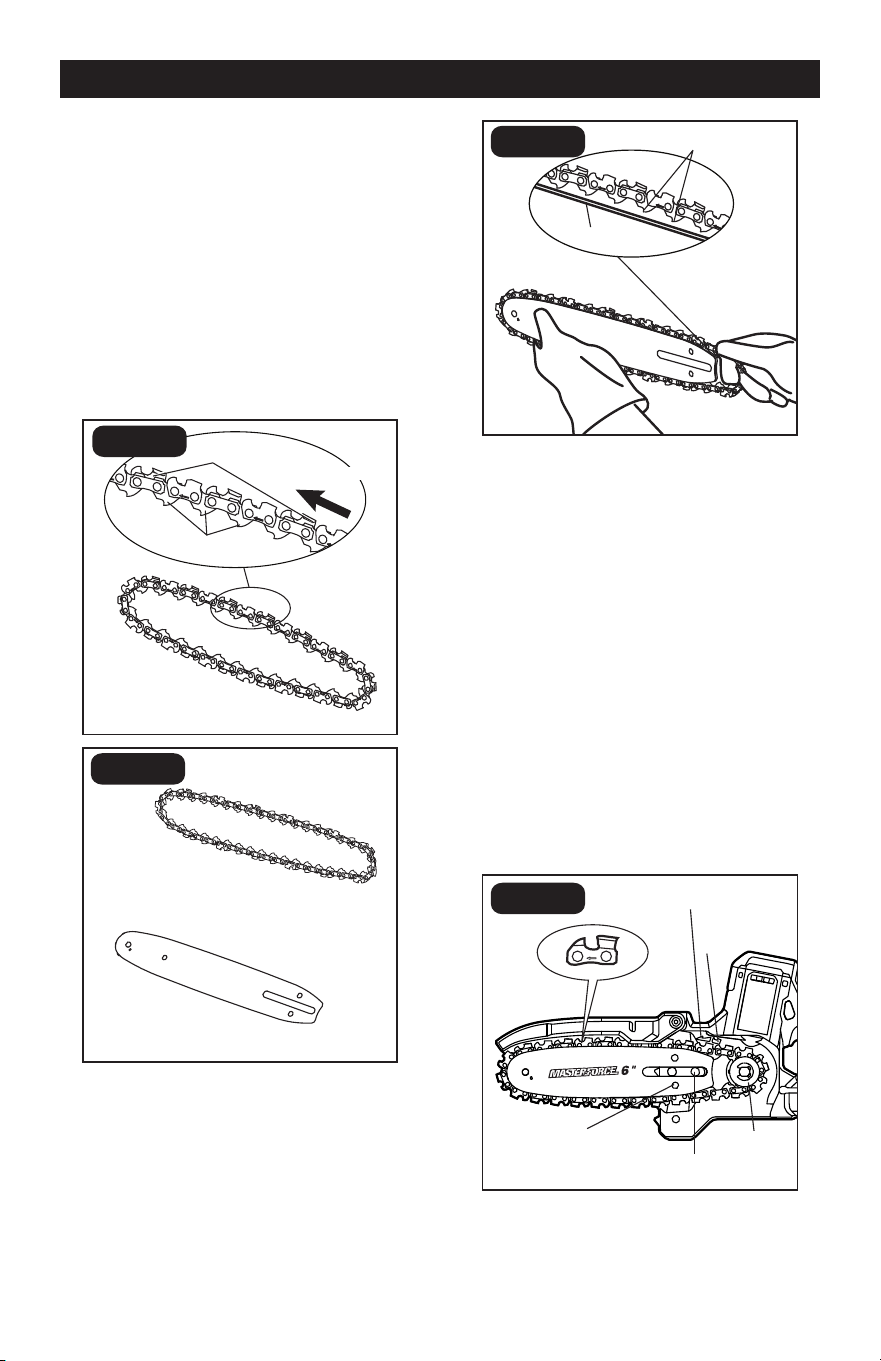
REPLACING THE BAR AND
CHAIN (FIG. 11)
注意:角度同封面,区别在于旋钮把手是打开状态
FIG. 11a
Side-cover Knob
Side Cover
Chain Guard
WARNING:
Always wear protective gloves when
handling the bar and chain. These
components are sharp and may contain
burrs.
Never touch or adjust the chain while
the motor is running.
NOTICE: When replacing the guide bar and
chain, always use the specied bar and
chain combination listed in this manual.
Disassembling the Worn Bar and Chain
1. Remove the battery, allow the saw to
cool, then tighten the oil-tank cap.
2. Position the pruning saw on its side on a
rm, at surface, so that the side cover
is facing up.
3. Lift the tab and rotate the side-cover
knob counterclockwise, then remove
the side cover. Clean the side cover with
a dry cloth (FIG. 11a).
4. Lift the chain guard. Remove the bar and
saw chain from the mounting surface.
Remove the worn chain from the bar.
Page 20
NOTICE: This is a good time to inspect the
drive sprocket for excessive wear or dam-
age.
Assembling the New Bar and Chain
1. Remove the battery, allow the saw to
cool, then tighten the oil-tank cap.
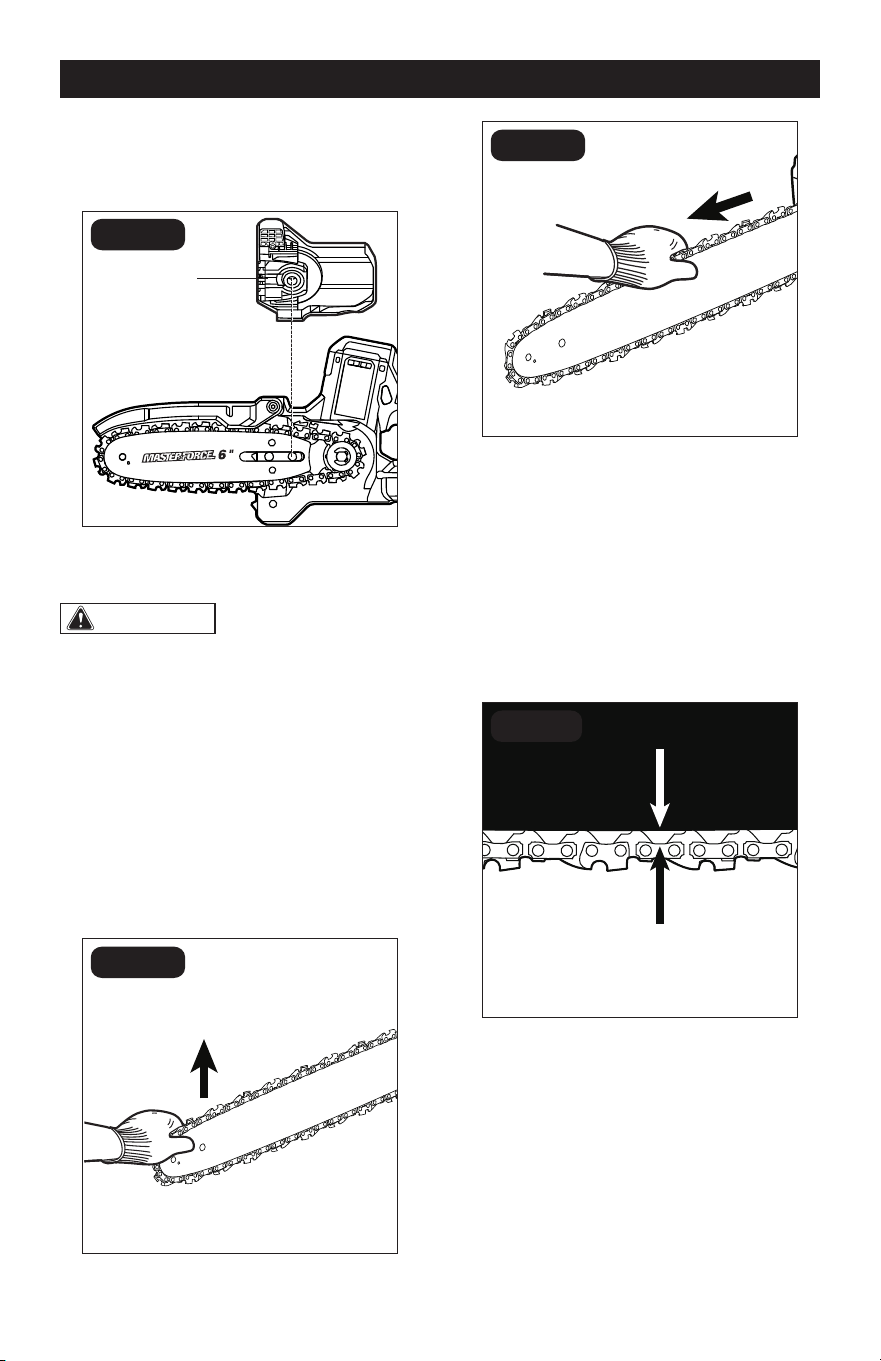
2. Lay the new saw chain in a loop on a at
surface and straighten any kinks. The
cutters should face in the direction of
chain rotation, if they face backwards,
turn the loop over (FIG. 11b & 11c).
Cutters
Chain-drive Links
FIG. 11b
Chain Rotation
FIG. 11c
3. Place the chain-drive links into the
guide-bar groove. Position the chain so
there is a loop at the back of the guide
bar (FIG. 11d).
MAINTENANCE
FIG. 11d
Bar groove
Chain-drive
links
4. Place the loop around the sprocket.
NOTICE: Small directional arrows are en-
graved in the saw chain. Another directional
arrow is molded into the saw housing. When
looping the saw chain onto the sprocket,
make sure that the direction of the arrows on
the saw chain match the rotation direction
arrow on the housing. If they face in oppo-
site directions, turn over the saw chain and
guide bar assembly.
5. Lift the chain guard. Place the guide bar
on the mounting surface by sliding the
guide-bar slot over the screw, and then
slightly rotate and press the guide bar to
let the tension pin enter into the hole on
the guide bar (FIG. 11e).
FIG. 11e
Tension Pin
Screw
Rotation Direction Arrow
Cutter
Pattern
Sprocket
Page 21
MAINTENANCE
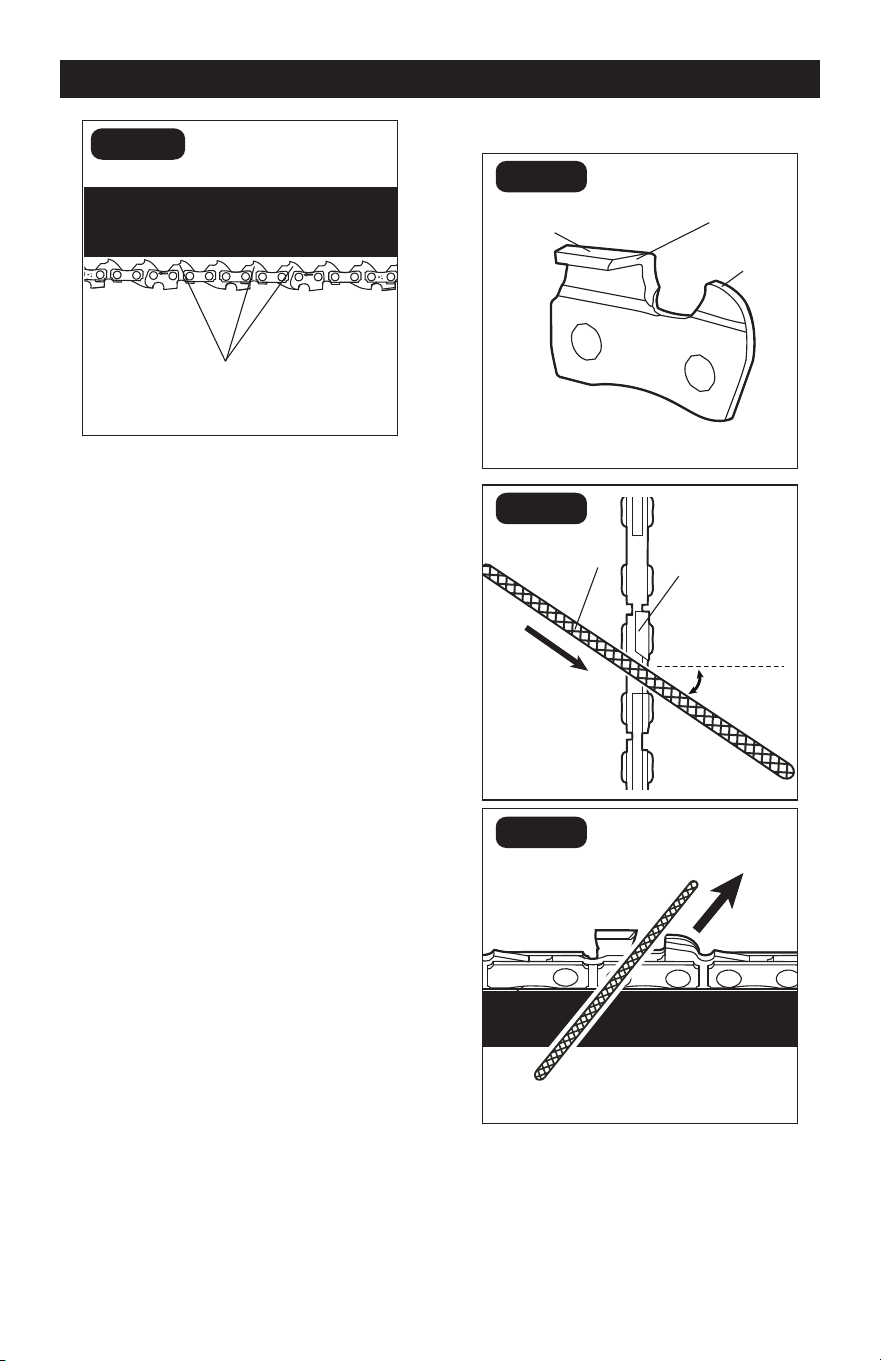
6. Replace the side cover and lightly
tighten the side-cover knob by turning
it clockwise, but do not fully tighten it
(FIG. 11f).
FIG. 11f
Side Cover
NOTICE: To extend the guide bar life, invert
the bar occasionally.
CAUTION:
The saw chain must be
properly tensioned before using.
7. Lift the tip of the guide bar up to check
for sag. Hold the tip of the guide bar
up and tighten the side-cover knob
securely and fold the tab. The chain is
automatically tensioned now. The chain
is correctly tensioned when there is
no sag on the underside of the guide
bar and the chain is snug, but it can
be turned by hand without binding
(FIG. 11g & 11h).
FIG. 11g
FIG. 11h
NOTICE: If chain is too tight, it will not ro-
tate. Loosen the side-cover knob slightly.
Lift the tip of the guide bar up and retighten
the side-cover knob securely. Assure that
the chain will rotate without binding.
ADJUSTING THE CHAIN
TENSION (FIG. 11 & FIG. 12)
Approximately 0.050”
FIG. 12a
Page 22
MAINTENANCE
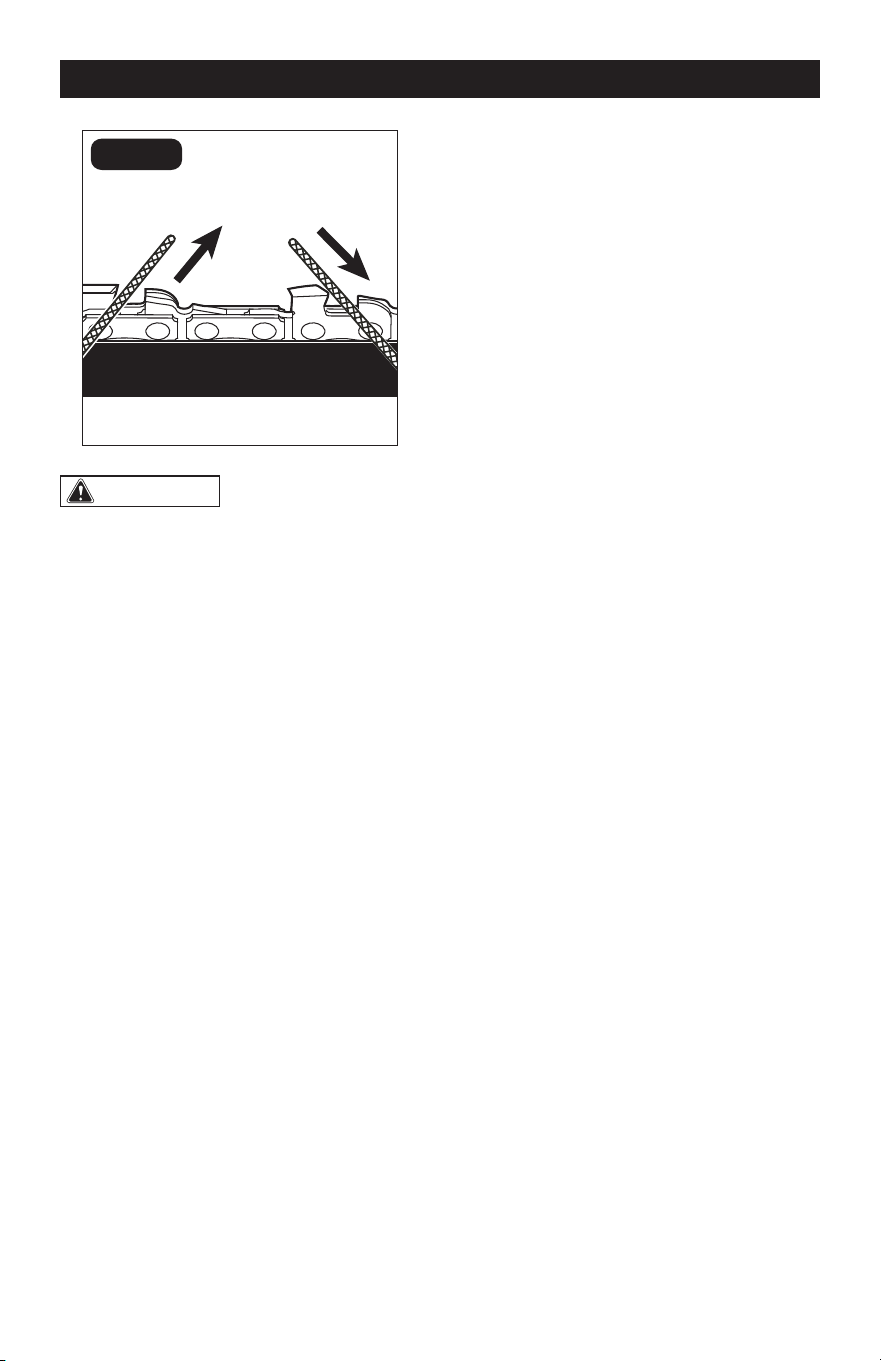
FIG. 12b
Flat of Drive Links
1. Stop the saw and remove the battery
pack before adjusting the chain tension.
2. Loosen the side-cover knob. This will
release the tension pin (shown in FIG.
11e) and loosen the chain tension. Lift,
pull and push the guide bar to help
adjust chain tension, then retighten the
side-cover knob securely. Assure that
the chain will rotate without binding.
During normal saw operation, the
temperature of the chain will increase. The
drive links of a correctly tensioned warm
chain will hang approximately 0.050 in.
out of the bar groove (FIG. 12a).
A cold chain is correctly tensioned when
there is no slack on the underside of the
guide bar and the chain is snug, but it can
be turned by hand without binding. The
chain must be re-tensioned whenever the
ats of the drive links do not sit in the bar
groove (FIG. 12b).
NOTICE:
New chains tend to stretch; check chain
tension frequently and tension as required.
A chain tensioned while it is warm may
be too tight upon cooling. Check the cold
tension before next use.
CHAIN MAINTENANCE (FIG. 13)
Side Plate
Top Plate
Depth
Guage
FIG. 13a
Sharpening
Angle:30°
Filing
Direction
Cutter Tooth
5/32” Round
File
FIG. 13b
FIG. 13c
Page 23
MAINTENANCE
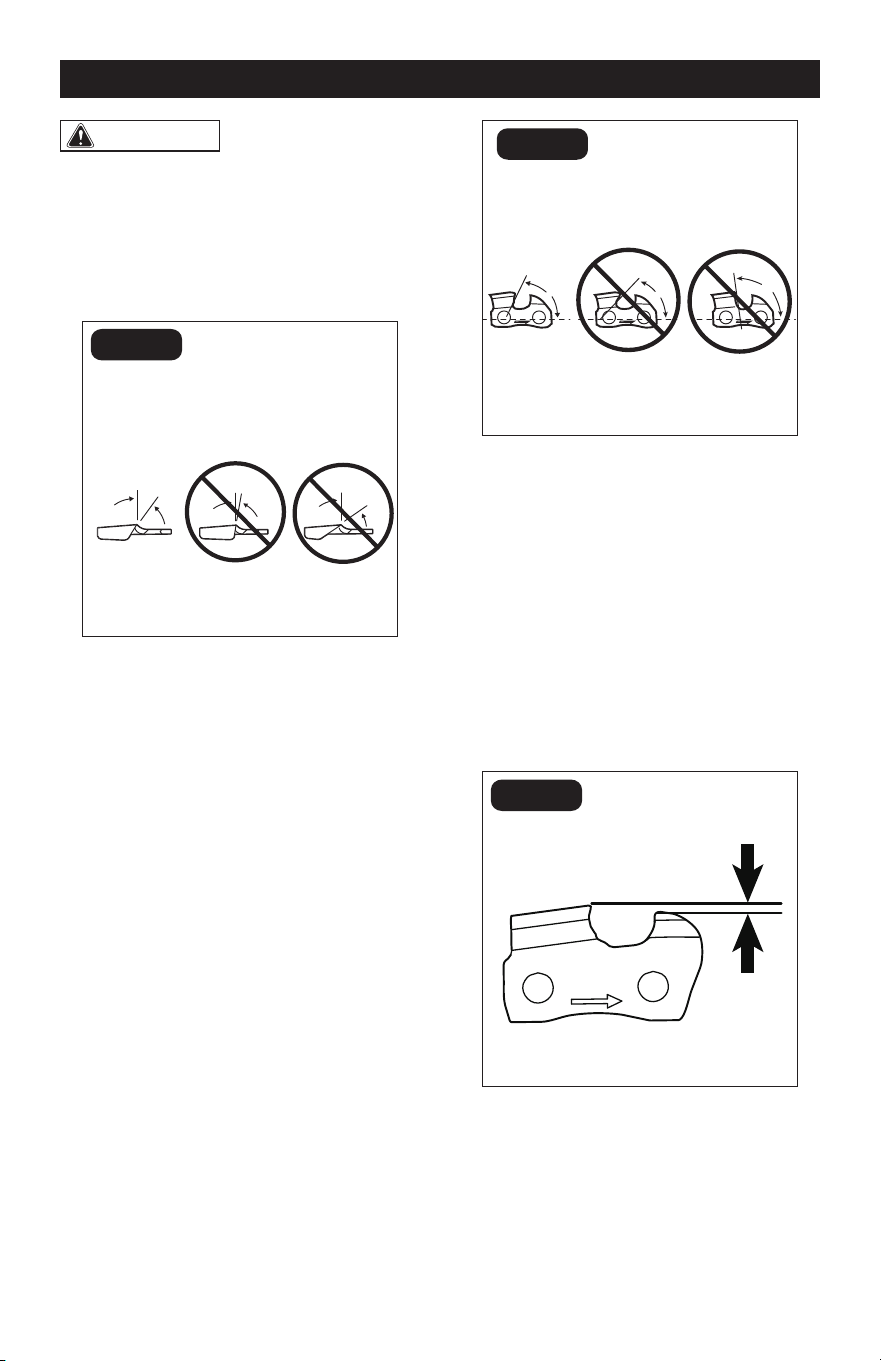
Left-hand
Cutters
Right-hand
Cutters
FIG. 13d
WARNING:
Remove the battery pack before
performing any maintenance. Failure to
heed this warning could result in serious
personal injury.
Always wear gloves when handling the
saw chain. The chain is sharp and may
contain burrs.
Use only low-kickback chains on this saw.
This fast-cutting chain will provide kickback
reduction when properly maintained.
A properly sharpened saw chain cuts
through wood effortlessly, even with very
little pressure.
Never use a dull or damaged saw chain.
A dull saw chain cutter leads to increased
physical strain, increased vibration load,
unsatisfactory cutting results and increased
wear.
For smooth and fast cutting, the saw chain
needs to be maintained properly. When the
wood chips are small and powdery, the
chain must be forced through the wood dur-
ing cutting, or the chain cuts to one side are
the indicators that the chain requires sharp-
ening. During maintenance of your saw
chain, consider the following:
Improper ling angle of the side plate
can increase the risk of a severe kickback.
Raker (depth gauge) clearance. Too low
increases the potential for kickback. Not low
enough decreases cutting ability.
If cutter teeth have hit hard objects, such
as nails and stones, or have been abraded
by mud or sand on the wood, have the chain
sharpened by a qualied service technician.
NOTICE: Inspect the drive sprocket for
wear or damage when replacing the chain.
If signs of wear or damage are present in
the areas indicated, have the drive sprocket
replaced by qualied service technician.
Sharpen the Cutters
Be sure to le all cutters (FIG. 13a) to the
specied angles and to the same length, as
fast cutting can be obtained only when all
cutters are uniform.
1. Remove the battery pack. Wear gloves
for protection.
2. Properly tension the chain prior to
sharpening. Refer to the section:
“ADJUSTING THE CHAIN TENSION”
earlier in this manual.
3. Use a 5/32ʺ diameter round le and
holder (available separately). Do all of
your ling at the middle position of the
guide bar.
4. Keep the le level with the top plate of
the tooth. Do not let the le dip or rock.
5. Keep a correct sharpening angle of 30°
between the le and the saw chain (see
FIG. 13b & 13c). Always use a le holder
(available separately) when sharpening
saw chains by hand. File holders have
markings for the sharpening angle.
6. Using light but rm pressure, perform a
stroke towards the front corner of the
tooth. Lift the le away from the steel on
each return stroke.
7. Make a few rm strokes on every tooth.
File all left hand cutters in one direction.
Then move to the other side and le
the right-hand cutters in the opposite
direction. Occasionally remove lings
from the le with a wire brush (FIG. 13d).
Page 24
MAINTENANCE
WARNING:
Improper chain sharpening increases
the potential of kickback.
Failure to replace or repair a damaged
chain can cause serious injury.
Top Plate Sharpening Angle
30°
Top Plate Sharpenging Angle
Less Than
30°
Correct Incorrect Incorrect
More Than
30°
FIG. 13e
CORRECT 30°- This optimal angle can be
obtained only when the specied les and
proper setting are used. File holders are
marked with guide marks to align the le
properly to produce the correct top plate
angle.
LESS THAN 30°- The tooth is too dull for
cutting.
MORE THAN 30°- The edge of the cutting
tooth is feathered and dulls quickly.
Side Plate Angle
60°
Correct
Hook
Backward
Slope
Side Plate Angle
Incorrect Incorrect
FIG. 13f
CORRECT 55° - The optimal angle can
be produced automatically if the correct
diameter le is used in the le holder.
HOOK - “Grabs” and dulls quickly.
Increases potential of KICKBACK. Results
from using a le with a diameter that is too
small, or a le held too low.
BACKWARD SLOPE - Needs too much feed
pressure, causes excessive wear to bar
and chain. Results from using a le with a
diameter too large, or a le held too high.
Depth-Gauge Clearance
FIG. 13g
Depth Gauge Clearance
0.025”
Page 25
MAINTENANCE
Flat
File
FIG. 13h
Depth Gauge Jointer
1. The depth gauge should be maintained
at a clearance of 0.025 in., as shown in
FIG. 13g. Use a depth gauge machine
(available separately) to check the
depth gauge clearances.
2. Check the depth-gauge clearance every
time the chain is led.
Use a at le and a depth-gauge jointer
(both available separately) to lower all
gauges uniformly (FIG. 13h). Use a 0.025 in.
depth-gauge jointer.
Depth-gauges must be adjusted with the
at le in the same direction the adjoining
cutter was led with the round le. Use care
not to contact the cutter face with the at
le when adjusting depth gauges.
GUIDE BAR MAINTENANCE
(FIG. 14)
FIG. 14
Lubricating Hole
Sprocket in
Guide-bar Tip
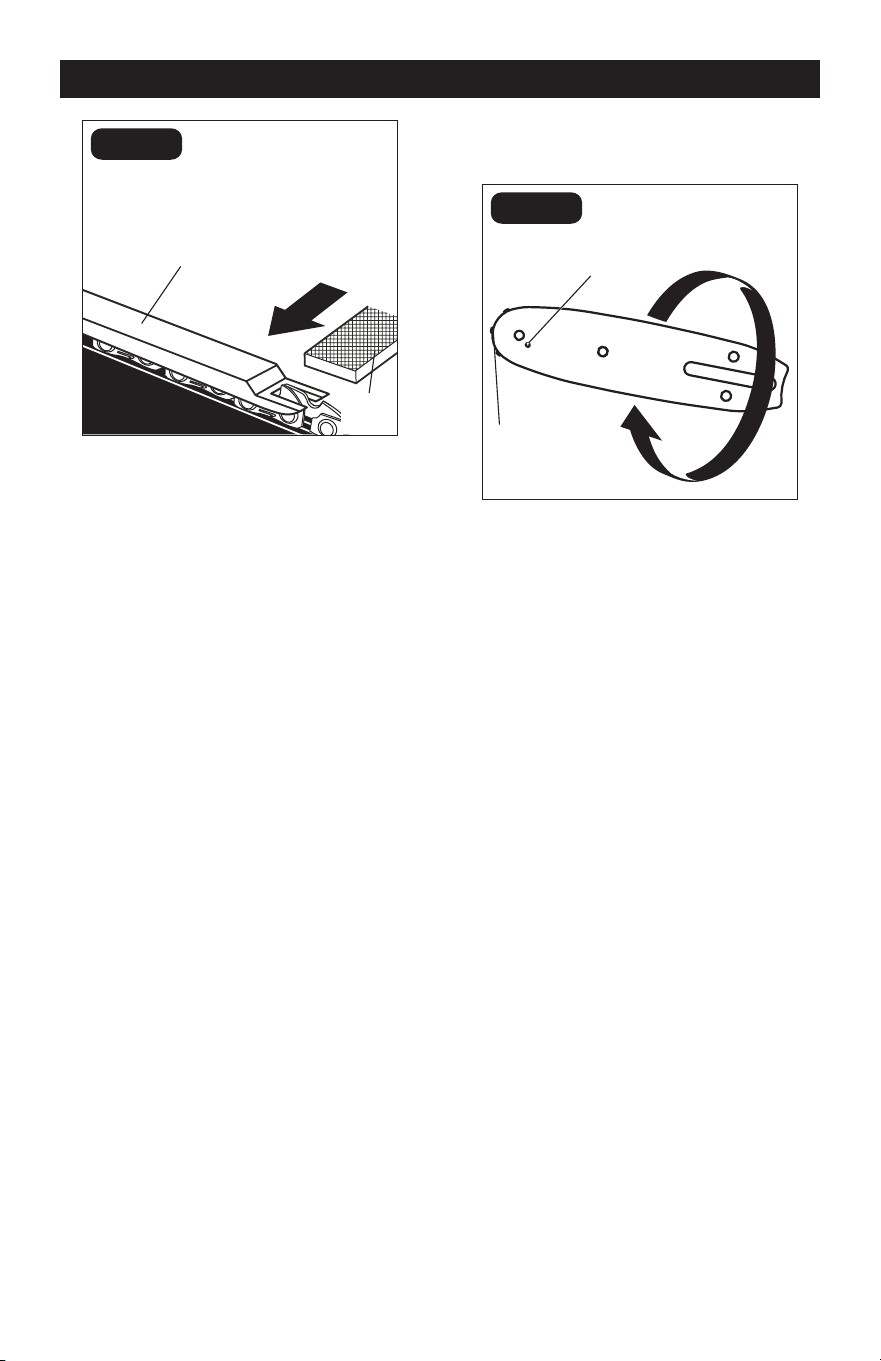
The bar should be cleaned every day of
use and checked for wear and damage.
Feathering or burring of the bar rails is a
normal process of bar wear. Such faults
should be smoothed with a le as soon as
they occur. A bar with any of the following
faults should be replaced:
Wear inside the bar rails that permits the
saw chain to lay over sideways.
Bent guide bar.
Cracked or broken rails.
Spread rails.
In addition, the guide bar has a sprocket
at its tip. The sprocket must be lubricated
weekly with a grease syringe to extend
the guide bar life. Use a grease syringe to
lubricate weekly with chain oil by means of
the lubricating hole (FIG. 14) on each side
of the bar. Turn the guide bar and check
that the lubrication holes and chain groove
are free from impurities.

Page 26
MAINTENANCE
When the guide bar shows signs of wear,
reverse it on the saw to distribute the wear
for maximum bar life.
1. Remove the guide bar and chain from
the pruning saw, following the section
“REPLACING THE BAR AND CHAIN”.
2. Turn the guide bar over. The bottom of
the bar will be on the top (Fig. 14).
3. Adjust the chain tension, following
the section “ADJUSTING THE CHAIN
TENSION”.
TRANSPORTING AND STORING
Do not store or transport the pruning
saw when it is running. Always remove
the battery pack before storing or
transporting.
Always place the chain sheath on the
guide bar and chain before storing
or transporting the pruning saw. Use
caution to avoid the sharp teeth of the
chain.
Clean the pruning saw thoroughly before
storing. Store the saw indoors, in a dry
place that is locked and/or inaccessible
to children.
Keep away from corrosive agents such
as garden chemicals and de-icing salts.

Page 27
TROUBLESHOOTING
PROBLEM POSSIBLE CAUSE SOLUTION
The pruning saw does
not start.
Battery charge is
depleted.
Charge the battery.
Battery or the machine is
overheated.
Allow the battery or the machine
to cool down.
Motor runs, but chain
does not rotate.
Chain does not engage
drive sprocket
.
Reinstall the chain, making sure
that the drive links on the chain
are fully seated on the sprocket.
Chain tension too tight.
Re-tension the chain. Refer to
the “ADJUSTING THE CHAIN
TENSION” chapter in this manual
.
Motor runs, chain rotates
but does not cut.
Dull chain.
Replace or sharpen the chain
.
Chain is on backwards.
Reinstall the chain to reverse the
direction of the chain

Page 28
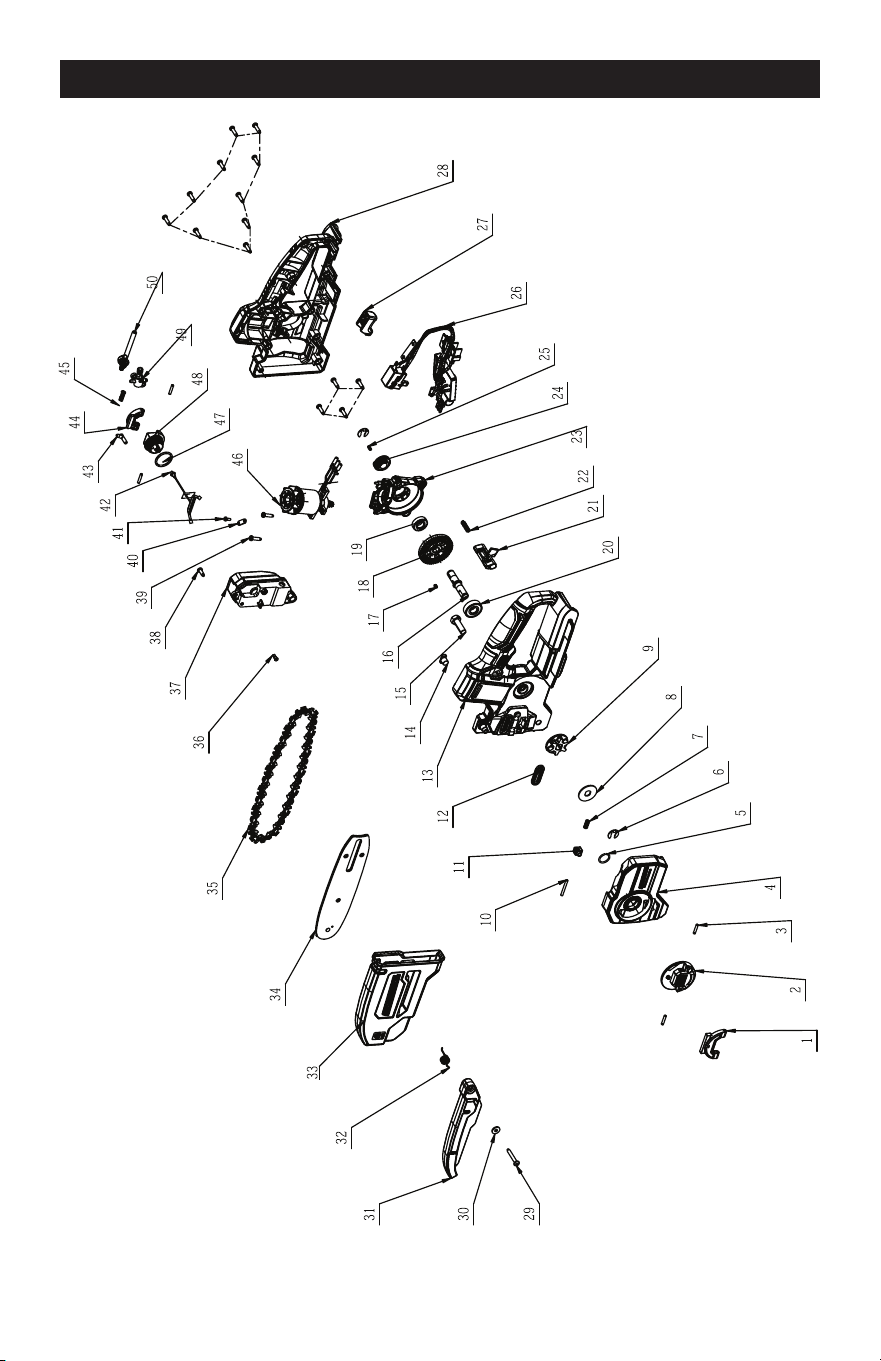
PARTS LIST
No. Part Name No. Part Name
1 Knob Cover 26 Electric Assembly
2 Knob 27 Switch Trigger
3 Pin 28 Right Houing
4 Chain Cover Plate 29 Hexagon Lobular Tapping Screw
5 C Ring 30 Plain Washer
6 E Ring 31 Guard
7 Compression Spring 32 Torsion Spring
8 Gasket 33 Sheath
9 Chain Wheel 34 Guide Plate
10 Pin 35 Chain Saw Chain
11 Tension Pin 36 Valve
12 Rubber Gasket 37 Kettle Assembly
13 Left Housing 38 Hexalobular Socket Tapping Screw
14 Pin Shaft 39 Hexagon Lobular Screw
15 Bolt 40 Cord Anchorage
16 Output Shaft 41 Hexagon Lobuar Screw
17 Key 42 Tether
18 Bevel Gear Wheel 43 Nozzle
19 Ball Bearing 44 Knob Cover
20 Ball Bearing 45 Spring
21 Lock off Button 46 DC Motor
22 Spring 47 O Ring
23 Gear Case 48 Kettle Cover
24 Worm 49 Pump ASSY
25 Key 50 Tube
Page 29
SCHEMATIC DRAWING

6’’ PRUNING SAW

11/2024
© 2024 Menard, Inc., Eau Claire, WI 54703