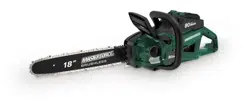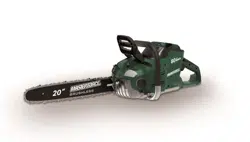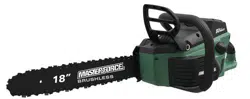
OPERATOR’S MANUAL
80V BRUSHLESS
CHAINSAW
2000094ME
239-1523
CSB401
To Reduce The Risk Of Injury, User Must Read
CAUTION
And Understand Operator’s Manual. Save These Instructions For
Future Reference.

TABLE OF CONTENTS
Safety Symbols ........................................................................................................... Page 2
Safety Instructions ...................................................................................................... Page 3
Overview ..................................................................................................................... Page 8
Assembly .................................................................................................................. Page 10
Operation .................................................................................................................. Page 11
Maintenance ............................................................................................................. Page 14
Troubleshooting ........................................................................................................ Page 17
Notes ........................................................................................................................ Page 19
Warranty ................................................................................................................... Page 22
Page 2
SAFETY SYMBOLS
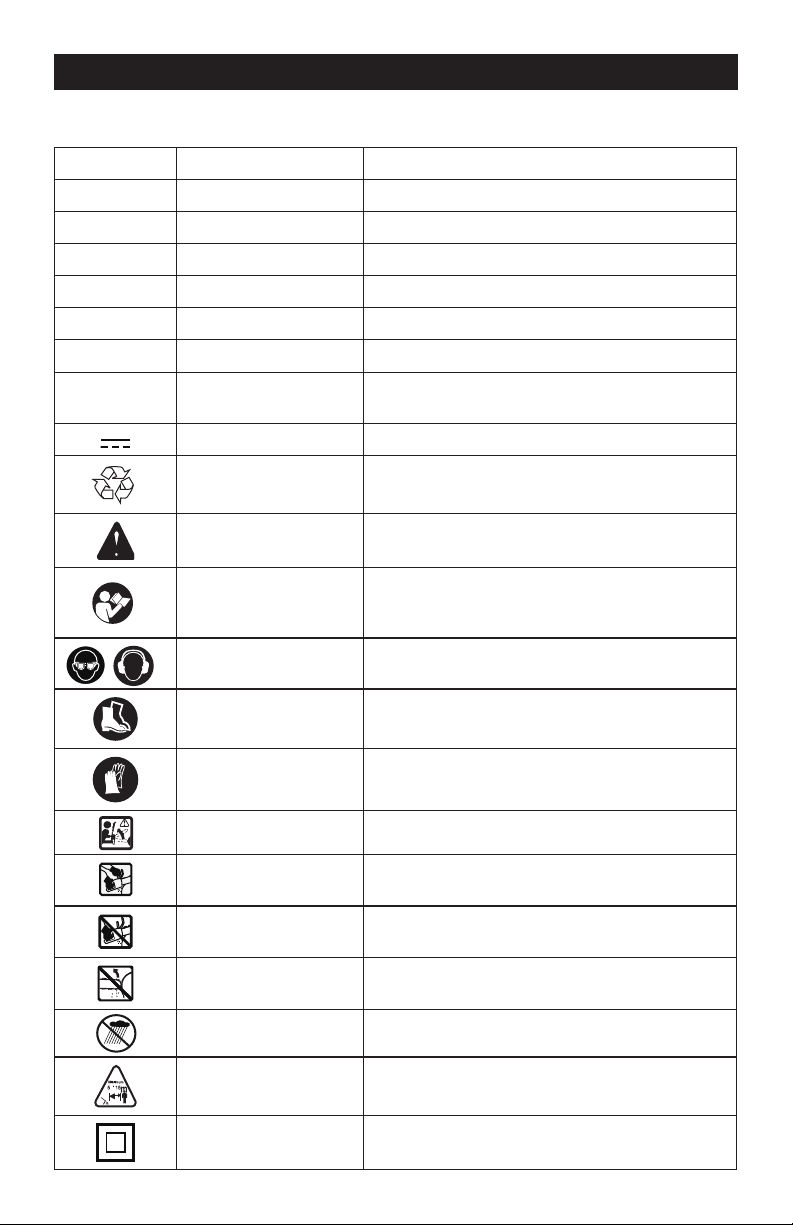
Some of the following symbols may be used on this product. Please study them and learn their
meaning. Proper interpretation of these symbols will allow you to operate the product better and safer.
Symbol Name Designation / Explanation
V Volts Voltage
A Amperes Current
Hz Hertz Frequency (cycles per second)
W Watts Power
hrs Hours Time
n
o
No Load Speed Rotational speed, at no load
/ min Per Minute
Revolutions, strokes, surface speed, orbits etc.,
per minute.
Direct Current Type or a characteristic of current
Lithium-ion Battery
Recycling
Designates that this tool is in compliance with
lithium-ion battery recycling program requirements.
Safety Alert Symbol
Precautions that involve your safety.
Read the Instruction
Manual
To reduce the risk of injury, user must read and
understand the Instruction manual before using
this product.
Wear eye and ear
protection.
Wear eye and ear protection when operating this
equipment.
Safety Footwear
Wear non-slip safety footwear when using this
equipment.
Gloves
Wear non-slip, heavy-duty protective gloves when
handling the chainsaw and the blade.
Kickback DANGER! Beware of kickback.
Operate With Two
Hands
Hold and operate the saw properly with both
hands.
One Handed Do not operate the saw using only one hand.
Bar Nose Contact Avoid bar nose contact.
Wet Conditions Alert Do not expose to rain or use in damp locations.
Keep Bystanders
Away
Keep all bystanders at least 50' (15m) away.
Class II Construction Double-insulated construction.
Page 3
SAFETY INSTRUCTIONS
The purpose of safety symbols is to attract our attention to possible dangers. The safety
symbols, and the explanations with them, deserve your careful attention and understanding.
The symbol warnings do not by themselves eliminate any danger. The instructions and
warnings they give are no substitutes for proper accident prevention measures.
Failure to obey this safety warning CAN result in death or serious
injury to yourself or to others. Always follow the safety precautions to reduce the risk of
re, electric shock and personal injury.
WARNING
Failure to obey this safety warning MAY result in personal injury
to yourself or others or property damage. Always follow the safety precautions to
reduce the risk of re, electric shock and personal injury.
CAUTION
Failure to obey this warning WILL result in death or serious injury
to yourself or to others. Always follow the safety precautions to reduce the risk of fire,
electric shock and personal injury.
DANGER
Be sure to read and understand all safety insructions in this
manual, including all safety alert symbols such as “DANGER”, “WARNING” and
“CAUTION”, before using this power tool. Failure to follow all instructions listed below
may result in electric shock, re and/or serious personal injury.
WARNING
SYMBOL MEANING
SAFETY ALERT SYMBOL: Indicates DANGER, WARNING, OR CAUTION. May be used
in conjuntion with other symbols or pictographs

Page 4
SAFETY INSTRUCTIONS
IMPORTANT SAFETY
INSTRUCTIONS
READ ALL INSTRUCTIONS
BEFORE USING (THIS POWER
TOOL)
WARNING
Read and
understand all instructions before using
this product. Failure to follow all
instructions listed below may result in
electric shock, re, and/or serious
personal injury. When using an electrical
appliance, basic precautions should
always be followed, including the
following:
WORK AREA SAFETY
• Keep work area clean and well lit.
Cluttered or dark areas invite accidents.
• Do not operate power tools in explosive
atmospheres, such as in the presence
of flammable liquids, gases or dust.
Power tools create sparks which may ignite
the dust or fumes.
• Keep children and bystanders
away while operating a power tool.
Distractions can cause you to lose control.
ELECTRICAL SAFETY
• Do not expose power tools to rain or
wet conditions.
Water entering a power
tool will increase the risk of electric shock.
PERSONAL SAFETY
• Stay alert, watch what you are
doing and use common sense when
operating a power tool. Do not use
a power tool while you are tired or
under the influence of drugs, alcohol
or medication.
A lapse of attention while
operating power tools may result in serious
personal injury.
• Use personal protection. Always wear
eye protection.
Protective products such
as dust mask, non-skid safety shoes,
hard hat or hearing protection used
appropriately will reduce personal injuries.
• Prevent unintentional starting. Ensure
the switch is in the off position before
connecting to power source and/or
battery pack and when picking up or
carrying the tool.
Carrying power tools
with your finger on the switch or energizing
power tools that have the switch on invites
accidents.
• Remove any adjusting key or wrench
before turning the power tool on.
A
wrench or a key left attached to a rotating
part of the power tool may result in
personal injury.
• Do not over-reach. Keep proper
footing and balance at all times.
This
enables better control of the power tool in
unexpected situations.
• Dress properly. Do not wear loose
clothing or jewellery. Keep your hair,
clothing and gloves away from moving
parts.
Loose clothes, jewellery or long hair
can be caught in moving parts.
• If devices are provided for the
connection of dust extraction and
collection facilities, ensure these are
connected and properly used.
Use of
dust collection can reduce dust related
hazards.
• Use only Masterforce Batteries: BAB726 or
other BAB series
.
• Use only Masterforce Charger: CAB809 or
other CAB series.
POWER TOOL USE AND CARE
• Do not force the power tool. Use the
correct power tool for your application.
The correct power tool will do the job
better and safer at the rate for which it was
designed.
• Do not use the power tool if the switch
does not turn it on and off.
Any power
tool that cannot be controlled with the
switch is dangerous and must be repaired.
• Disconnect the plug from the power
source and/or the battery pack from
the power tool before making any
adjustments, changing accessories,
or storing power tools.
Such preventive
safety measures reduce the risk of starting
the power tool accidentally.

Page 5
• Store idle power tools out of the reach
of children and do not allow persons
unfamiliar with the power tool or these
instructions to operate the power tool.
Power tools are dangerous in the hands of
untrained users.
• Maintain power tools. Check for
misalignment or binding of moving
parts, breakage of parts and any other
condition that may affect the power
tool’s operation. If damaged, have the
power tool repaired before use.
Many
accidents are caused by poorly maintained
power tools.
• Keep cutting tools sharp and clean.
Properly maintained cutting tools with
sharp cutting edges are less likely to bind
and are easier to control.
• Use the power tool, accessories and
tool bits etc. in accordance with these
instructions, taking into account the
working conditions and the work to
be performed.
Use of the power tool for
operations different from those intended
could result in a hazardous situation.
BATTERY TOOL USE AND CARE
• Recharge only with the charger
specied by the manufacturer.
A charger
that is suitable for one type of battery pack
may create a risk of fire when used with
another battery pack.
• Use power tools only with specifically
designated battery packs.
Use of any
other battery packs may create a risk of
injury and fire.
• When battery pack is not in use, keep
it away from other metal objects like
paper clips, coins, keys, nails, screws,
or other small metal objects that can
make a connection from one terminal
to another.
Shorting the battery terminals
together may cause burns or fire.
• Under abusive conditions, liquid may
be ejected from the battery; avoid
contact. If contact accidentally occurs,
flush with plenty of soap and water. If
liquid contacts eyes, immediately seek
medical help.
Liquid ejected from the
battery may cause irritation or burns.
SAFETY INSTRUCTIONS
SERVICE
• Have your power tool serviced by a
qualified repair person using only
identical replacement parts.
This will
ensure that the safety of the power tool is
maintained.
CHAINSAW SAFETY
WARNINGS
• Keep all parts of the body away from
the saw chain when the chainsaw
is operating. Before you start the
chainsaw, make sure the saw chain is
not in contact with anything.
A moment
of inattention while operating chainsaws
may cause entanglement of your clothing
or body with the saw chain.
• Hold the power tool by insulated
gripping surfaces only, because the
saw chain may contact hidden wiring.
Saw chains contacting a “live” wire may
make exposed metal parts of the power
tool “live” and could give the operator an
electric shock.
• Always hold the chainsaw with your
right hand at the rear handle and your
left hand at the front handle.
Holding
the chainsaw with a reversed hand
configuration increases the risk of personal
injury and should never be done.
• Wear safety glasses and hearing
protection. Further protective product
for head, hands, legs and feet is
recommended.
Adequate protective
clothing will reduce personal injury from
flying debris or accidental contact with the
saw chain.
• Do not operate a chainsaw in a tree.
Operation of a chainsaw while up in a tree
may result in personal injury.
• Always keep proper footing and operate
the chainsaw only when standing on
xed, secure and level surface.
Slippery
or unstable surfaces such as ladders may
cause loss of balance or control of the
chainsaw.
• When cutting a limb that is under
tension, be alert of spring back.
When
the tension in the wood is released, the
spring loaded limb may strike the operator

Page 6
SAFETY INSTRUCTIONS
and/or throw the chainsaw out of control.
• Use extreme caution when cutting
brush and saplings.
The slender material
may catch the saw chain and be whipped
toward you or pull you off balance.
• Carry the chainsaw by the front
handle with the chainsaw switched
off and away from your body. When
transporting or storing the chainsaw,
always fit the guide bar cover.
Proper
handling of the chainsaw will reduce the
likelihood of accidental contact with the
moving saw chain.
• Follow instructions for lubricating,
chain tensioning and changing
accessories.
Improperly tensioned or
lubricated chain may either break or
increase the chance for kickback.
• Keep handles dry, clean, and free from
oil and grease.
Greasy, oily handles are
slippery, causing loss of control.
• Cut wood only. Do not use chainsaw for
purposes not intended. For example:
do not use chainsaw for cutting
plastic, masonry or non-wood building
materials.
Use of the chainsaw for
operations other than intended could result
in a hazardous situation.
PREVENT OPERATOR
KICKBACK
Kickback may occur when the nose or tip of
the guide bar touches an object, or when the
wood closes in and pinches the saw chain in
the cut.
Tip contact in some cases may cause a
sudden reverse reaction, kicking the guide
bar up and back towards the operator.
Pinching the saw chain along the top of the
guide bar may push the guide bar rapidly
back towards the operator.
Either of these reactions may cause you to
lose control of the saw which could result
in serious personal injury. Do not rely
exclusively upon the safety devices built into
your saw. As a chainsaw user, you should
take several steps to keep your cutting jobs
free from accident or injury.
Kickback is the result of tool misuse and/or
incorrect operating procedures or conditions
and can be avoided by taking proper
precautions as given below:
• Maintain a firm grip, with thumbs
and fingers encircling the chainsaw
handles, with both hands on the saw
and your body and arm positioned to
allow you to resist kickback forces.
Kickback forces can be controlled by the
operator, if proper precautions are taken.
Do not let go of the chainsaw.
• Do not overreach and do not cut above
shoulder height. This helps prevent
unintended tip contact and enables better
control of the chainsaw in unexpected
situations.
• Only use replacement bars and chains
specied by the manufacturer. Incorrect
replacement bars and chains may cause
chain breakage and/or kickback.
• Follow the manufacturer’s sharpening
and maintenance instructions for the
saw chain. Decreasing the depth gauge
height can lead to increased kickback.
PROPOSITION 65
This product contains a chemical known to
the state of California to cause cancer, birth
defects or other reproductive harm. Some dust
created by power sanding, sawing, grinding,
drilling, and other construction activities
contains chemicals known to cause cancer,
birth defects or other reproductive harm. Some
examples of these chemicals are:
• Lead from lead-based paints;
• Crystalline silica from bricks and cement
and other masonry products;
• Arsenic and chromium from chemically
treated lumber.
Your risk of exposure to these chemicals
varies depending on how often you do this
type of work. To reduce your exposure to these
chemicals, work in a well-ventilated area, and
work with approved safety equipment, such as
dust masks that are specially designed to lter
out microscopic particles.
CHILD SAFETY
Tragic accidents can occur if the operator is
not aware of the presence of children.
• Keep children out of the working

Page 7
area and under the watchful care of a
responsible adult.
• Do not allow children under the age of
14 to operate this chainsaw. Children
who are 14 years of age and older must
read and understand the operating
instructions and safety rules in this
manual and must be trained and
supervised by a parent.
• Stay alert, and turn the chainsaw off if
a child or any other person enters the
working area.
• Use extreme care when approaching
blind corners, doorways, shrubs, trees,
or other objects that may obscure your
view of a child who may run into the
path of the chainsaw.
SAVE THESE INSTRUCTIONS
SAFETY INSTRUCTIONS
Page 8
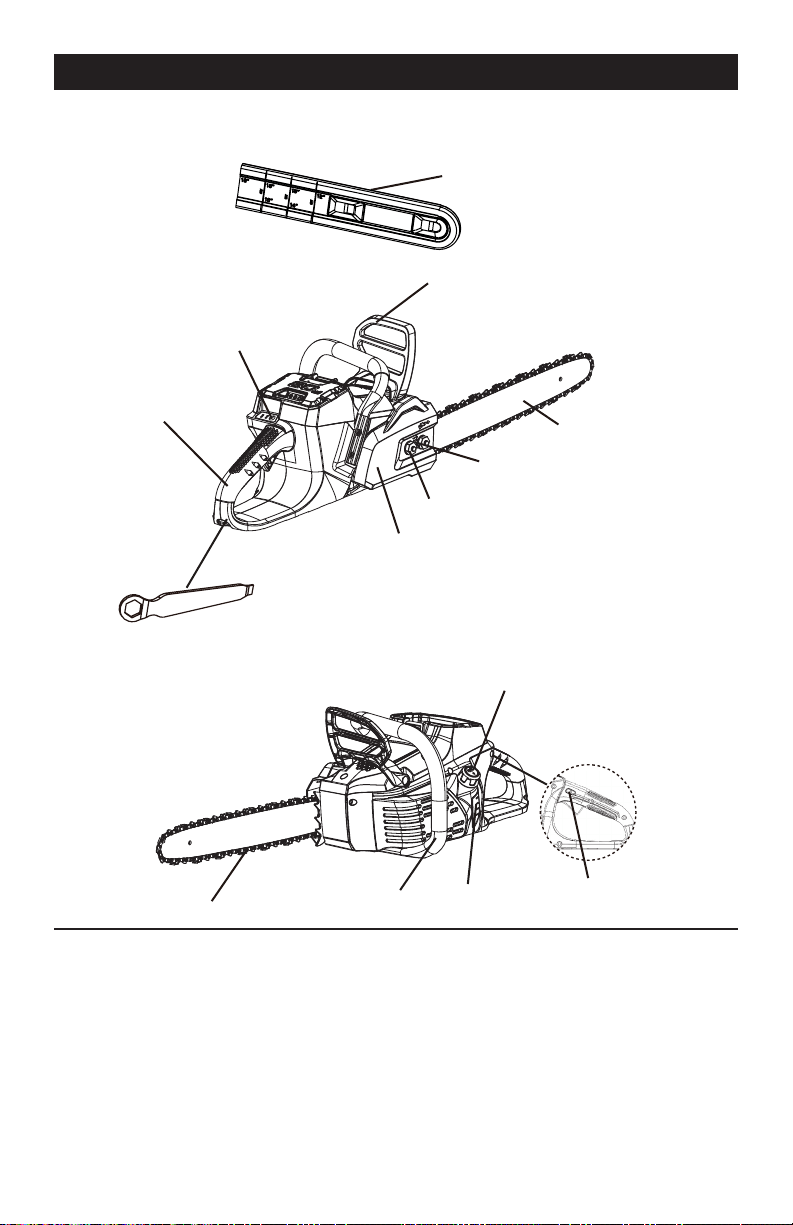
OVERVIEW
Guide Bar
Chain Tension Screw
Chain Cover Nuts
Chain Cover
On-Board Wrench
Storage
Oil tank cap
Oil Indicator
Front Handle
Saw Chain
Lock out button
Scabbard
On/Off Switch
Rear Handle
Front hand guard / Chain Brake

Page 9
SPECIFICATIONS
Type Cordless, battery operated
Motor 80V Brushless
No load speed
11 m/s
Guide bar length 18'' (458 mm)
Chain pitch 3/8” (9.5 mm)
Chain gauge 0.05” (1.27 mm)
Drive links 62
Chain oil capacity 200 ml
Weight ((without battery pack)
11 lbs (4.98 kg)
Chain 91P062X
Guide bar 180SDEA041
Page 10
ASSEMBLY
UNPACKING
This product requires assembly.
• Carefully remove the product and any
accessories from the box. Make sure that all
items listed in the package contents section
are included.
• Inspect the product carefully to make sure
no breakage or damage occurred during
shipping.
• Do not discard the packing material until you
have carefully inspected and satisfactorily
operated the product.
• If any parts are damaged or missing, please
call 1-844-MSTR4CE (844-678-7423) for
assistance.
ADD THE BAR AND CHAIN OIL
WARNING
To prevent accidental
starting that could cause serious personal
injury, always remove the battery pack from
the tool when assembling parts.
Examine the amount of oil in the machine. If
the oil level is low, add the bar and chain oil as
follows.
IMPORTANT: Use bar and chain oil that is
only for chains and chain oilers.
NOTE: The machine comes from the factory
without bar and chain oil.
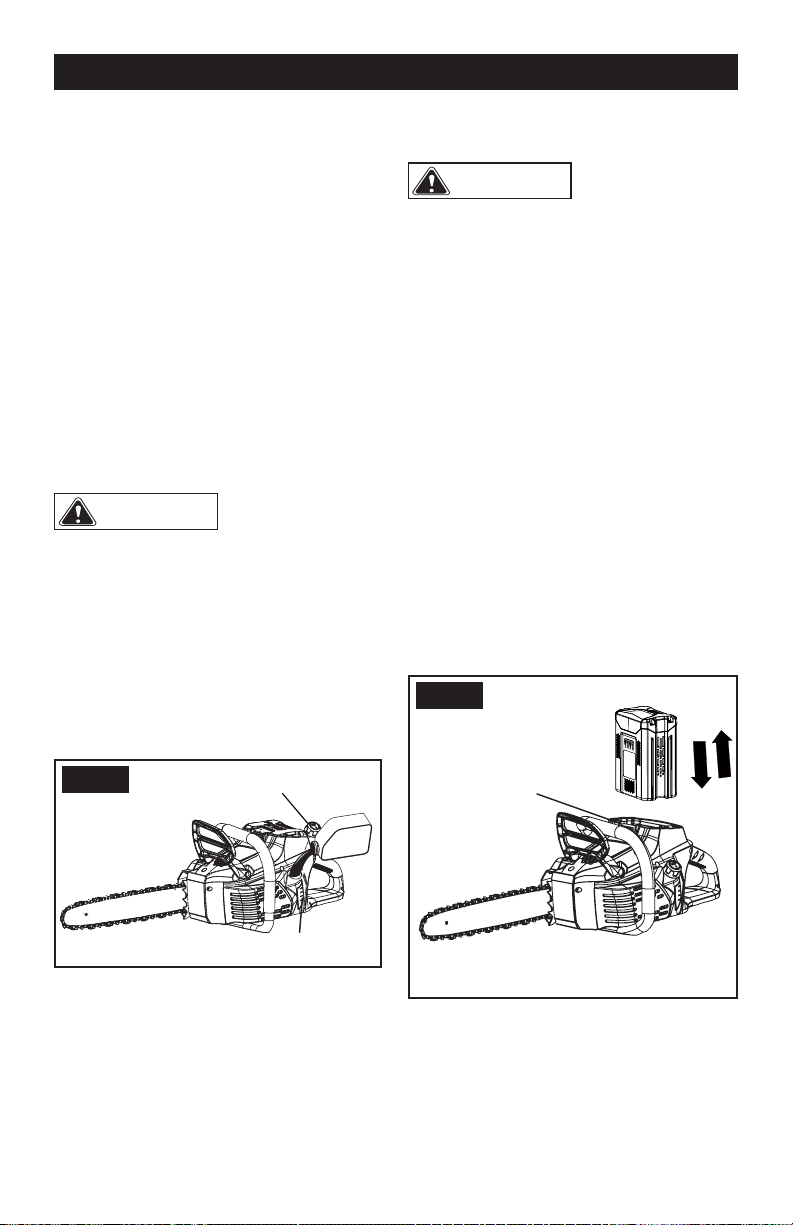
1. Loosen and remove the cap (A) from the oil
tank.
2. Put the oil into the oil tank.
3. Monitor the oil indicator (B) to make sure that
no dirt gets into the oil tank while you add
the oil.
4. Put the oil cap on.
5. Tighten the oil cap.
6. The whole oil tank will last for approximately
20- 40 minutes.
A
B
C
H
A
I
N
L
U
BRICAN
T
INSTALL THE BATTERY PACK
WARNING
Follow these instruc-
tions in order to avoid injury and to reduce the
risk of electric shock or re:
• If the battery pack or charger is damaged,
replace the battery pack or the charger.
• Stop the machine and wait until the motor
stops before you install or remove the
battery pack.
• Read and understand the instructions in the
battery and charger manual.
To install the battery pack
1. Align the lift ribs on the battery pack with the
grooves in the battery compartment.
2. Push the battery pack into the battery
compartment until the battery pack locks
into place.
3. When you hear a click, the battery pack is
installed.
To remove the battery pack
1. Push and hold the battery release button.
2. Remove the battery pack from the machine.
Battery release button
FIG. 1
FIG. 2
Page 11
EXAMINE THE CHAIN OIL
NOTE: Do not use the machine without
sufcient chain oil.
1. Examine the oil level of the machine from
the oil indicator.
2. Add the oil if it is necessary.
HOLD THE MACHINE
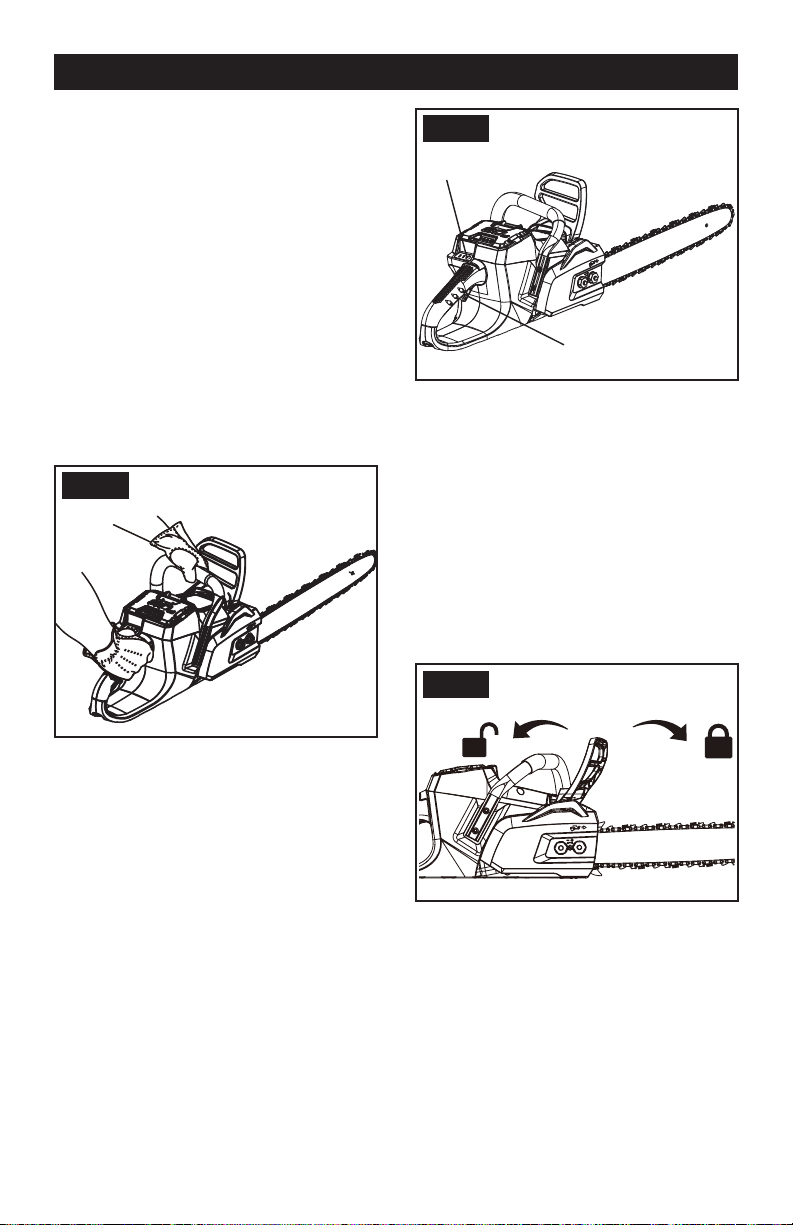
1. Hold the chainsaw with your right hand on
the rear handle and left hand on the front
handle.
2. Hold the handles with the thumbs and the
ngers around them.
3. Make sure that your left hand holds the front
handle and your thumb is below the handle.
START / STOP THE MACHINE
To start
1. Press the On/Off switch.
2. Press the lock-out button.
3. Press the trigger while you hold the lock-out
button.
4. Release the lock-out button.
To stop
1. Release the trigger to stop the machine.
OPERATION
BRAKE ON
OPERATE THE CHAIN BRAKE
1. Start the machine.
2. Push the guard forward to to engage the
chain brake.
3. Pull the handle guard / chain brake
backwards to disengage the chain brake.
4. Call approved service center for repair
before use if
• The chain brake does not stop the chain
immediately.
• The chain brake does not stay in the
disengaged position without aid.
FELL A TREE
Recommendation that the first-time user
should, as a minimum practice, start cutting
logs on a saw-horse or cradle.
Before you start to fell a tree, make sure that
• The minimum distance between the areas
of bucking and felling is two times the
height of the tree.
• The operation does not
1. Cause injury to personnel.
FIG. 3
Trigger
On/Off switch
FIG. 4
BRAKE OFF
FIG. 5
Page 12
OPERATION
2. Hit utility lines. If the tree touches
utility lines, immediately tell the utility
company.
3. Cause losses in property.
• The user is not in the danger area (B), for
example, the downhill side of the area.
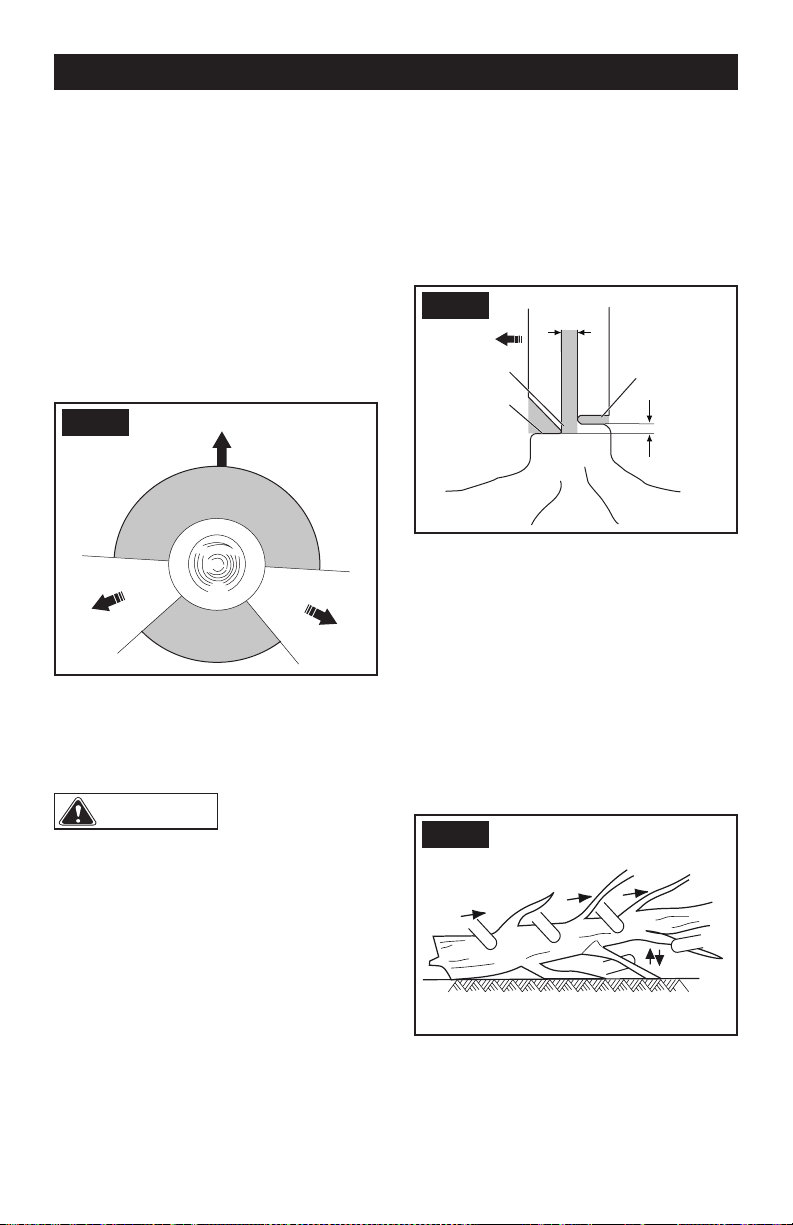
• The escape paths (C) that extend back and
diagonally behind the felling direction (A)
are clear. The felling direction is controlled
by
1. The natural lean of the tree.
2. The location of larger branches.
3. The wind direction.
• Ensure there is no dirt, stones, loose bark,
nails, and staples on the tree.
1. Make a lower level notching cut (D). Make
sure that this cut is
• 1/3 wide of the diameter of the tree.
• Perpendicular to the felling direction.
CAUTION
The level notching
cut helps prevent pinching of the saw chain
or the guide bar when you make the second
notch.
2. Make the felling cut no less than 2 in. (50
mm) and higher than the level notching cut.
Make sure that this cut
• Is parallel to the level notching cut.
• Keeps sufcient wood to become a hinge
(F) which prevents the tree from twisting
and felling in the wrong direction.
When the felling cut (E) gets near the hinge
(F), the tree falls. Stop the felling cut if the
tree
• Does not fall in the correct direction or
• Moves backwards, causing the cutting bar
and chain to become stuck in the cut.
3. Use felling wedge to open the cut and let
the tree fall in the correct direction.
4. When the tree starts to fall,
• Remove the chainsaw from the cut.
• Stop the machine.
• Put the machine down.
• Move away from the tree via the escape
path (C). Always keep watching the tree
to see it's direction of fall, be careful with
overhead branches and your footing.
LIMB A TREE
Limbing is the removal of the branches from a
fallen tree.
• Keep the larger lower branches to hold the
log off the ground (H).
• Remove the small limbs (G) in one cut.
• Limb the branches with tension from the
bottom to top.
• Keep the larger lower branches as a
support until the log is limbed.
A
B
B
C
C
FIG. 6
2’’(50mm)
2’’(50mm)
D
E
F
FIG. 7
G
H
FIG. 8
Page 13
BUCK A LOG
To buck is to cut a log into lengths.
CAUTION
Do not let the chain
saw touch the ground.
It is important to make sure your footing is se-
cure and your weight is evenly distributed. If
possible, lift the log and hold it with branches,
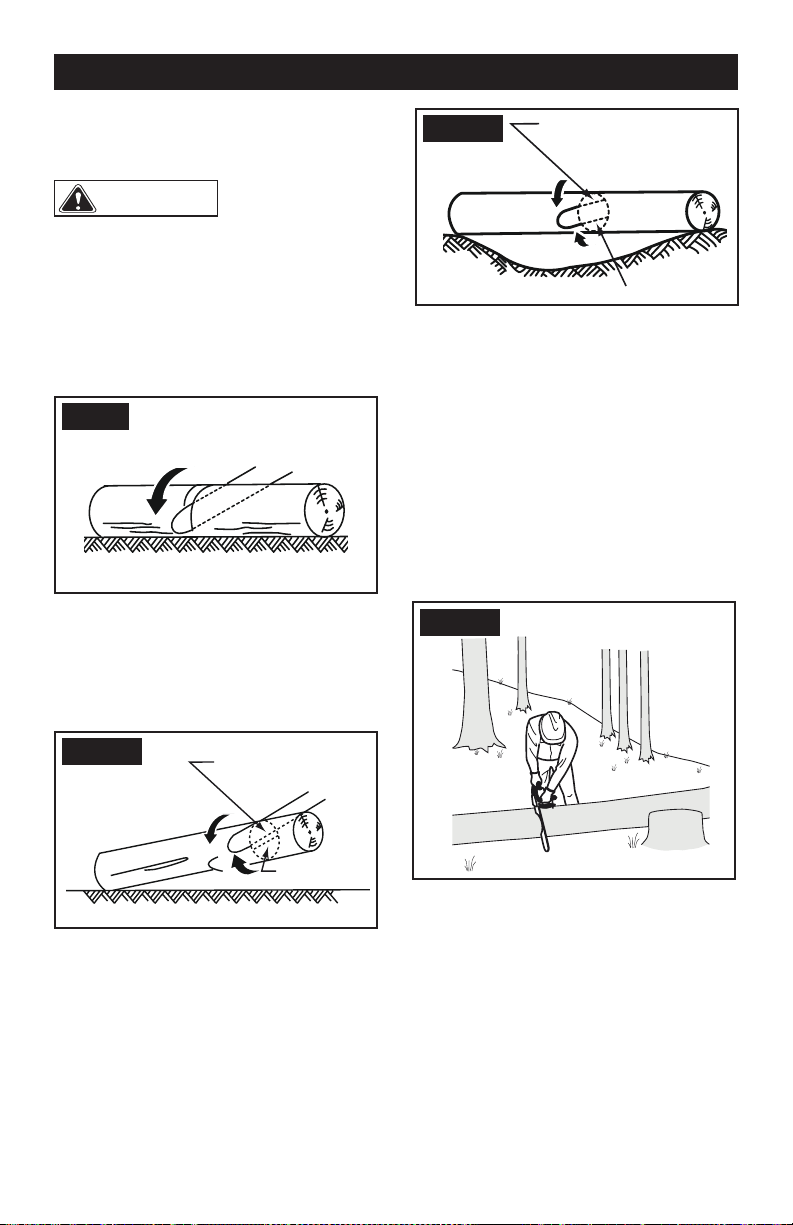
logs or chock. Obey the instructions below:
When the log is held along the full length (I),
cut it from the top (J).
When the log is held on one end (K),
1. Cut the rst time 1/3 of the diameter from
the bottom (L).
2. Cut the second time from the top (M) to
complete the bucking.
When the log is held on two ends (N),
1. Cut the rst time 1/3 of the diameter from
the top (M).
2. Cut the second time lower 2/3 from the
bottom to complete the bucking (L).
When the log is on a slope,
1. Stand on the uphill side.
2. Control the chain saw completely.
3. Hold the chain saw handles tightly.
4. Release the cutting pressure near the end
of the cut.
When bucking is complete (O),
1. Wait for the chain to stop (P).
2. Ensure the chainsaw is turned off.
3. Check for hazards before you move to
another tree.
OPERATION
I
J
FIG. 9
K
L
M
FIG. 10
N
L
M
FIG. 11
O
P
FIG. 12
Page 14
MAINTENANCE
CAUTION
Do not let brake
fuids, gasoline, petroleum-based materials
touch the plastic parts. Chemicals can
cause damage to the plastic, and make the
plastic unserviceable.
CAUTION
Do not use strong
solvents or detergents on the plastic
housing or components.
CAUTION
Remove the battery
pack from the machine before maintenance.
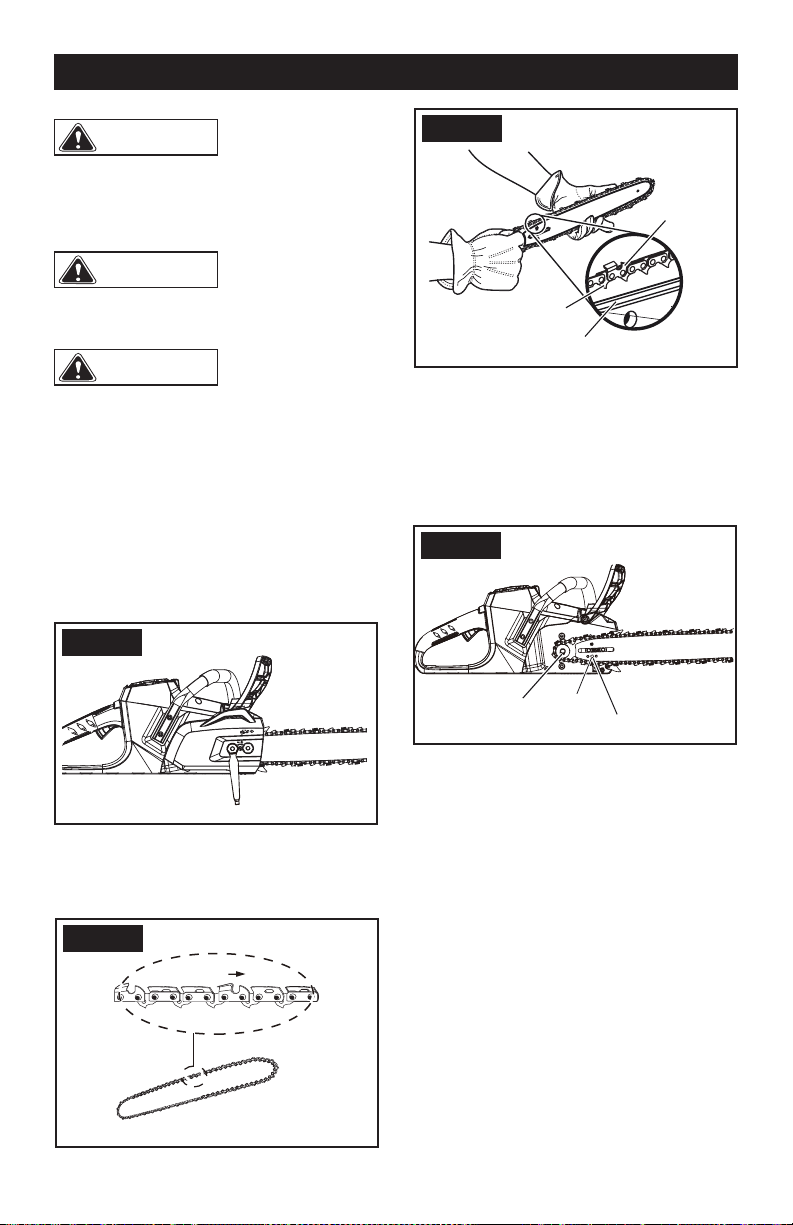
REPLACE THE GUIDE BAR AND
THE CHAIN
1. Remove the chain cover nuts with the
wrench.
2. Remove the chain cover.
3. Put the chain drive links into the bar groove.
4. Put the chain cutters in the direction of the
chain operation.
5. Put the chain in position and make sure that
the loop is behind the guide bar.
6. Hold the chain and bar.
7. Put the chain loop around the sprocket.
8. Make sure the chain tension pin hole on the
guide bar ts correctly with the bolt.
9. Install the chain cover.
10. Tighten the chain. Refer to Adjust the
chain tension.
11. Tighten the nuts when the chain is cor-
rectly tensioned.
NOTE: If you start the chain saw with a new
chain, have a test for 2-3 minutes. A new chain
gets longer after the rst use, examine the
tension and tighten the chain if necessary.
FIG. 13
FIG. 14
Chain drive links
Bar groove
Chain cutters
FIG. 15
Sprocket
Bolt
Pin hole
FIG. 16
Page 15
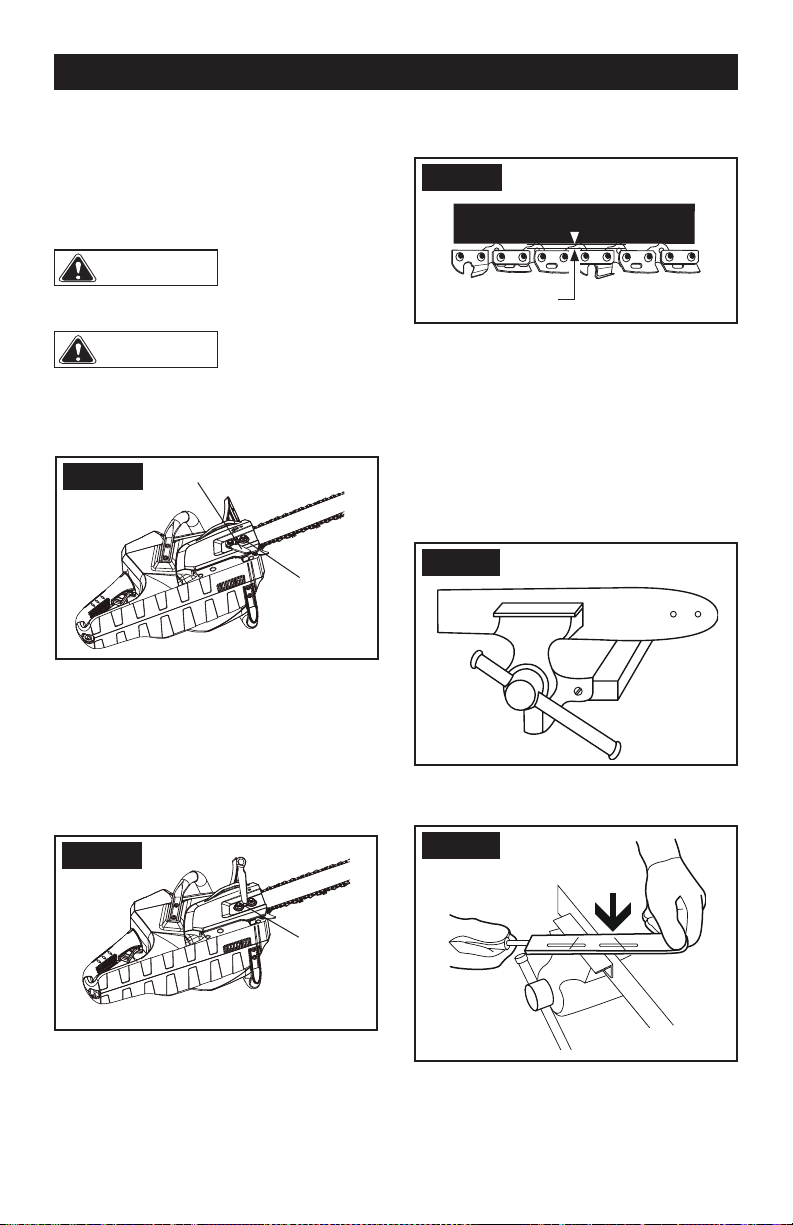
ADJUST THE CHAIN TENSION
The more you use a chain the longer it be-
comes. It is therefore important to adjust the
chain regularly to take up the slack.
Tension the chain so that it can only just be
pulled away from the bar at its centre point.
WARNING
A slack chain may
jump off and cause serious or even fatal injury
CAUTION
Wear protective
gloves if you touch the chain, bar or areas
around the chain.
1. Stop the machine.
2. Loosen the lock nuts with the wrench.
NOTE: It is not necessary to remove the
chain cover to adjust the chain tension.
3. Turn the chain adjustment screw clockwise
to increase the chain tension.
4. Turn the chain adjustment screw
counterclockwise to decrease the chain
tension.
5. When the chain is at the wanted tension,
tighten the lock nuts.
NOTE: During normal saw operation, the
temperature of the chain increases. The drive
links of a correctly tensioned warm chain will
hang approximately 1/16 in. (1,58 mm) out of
the bar groove.
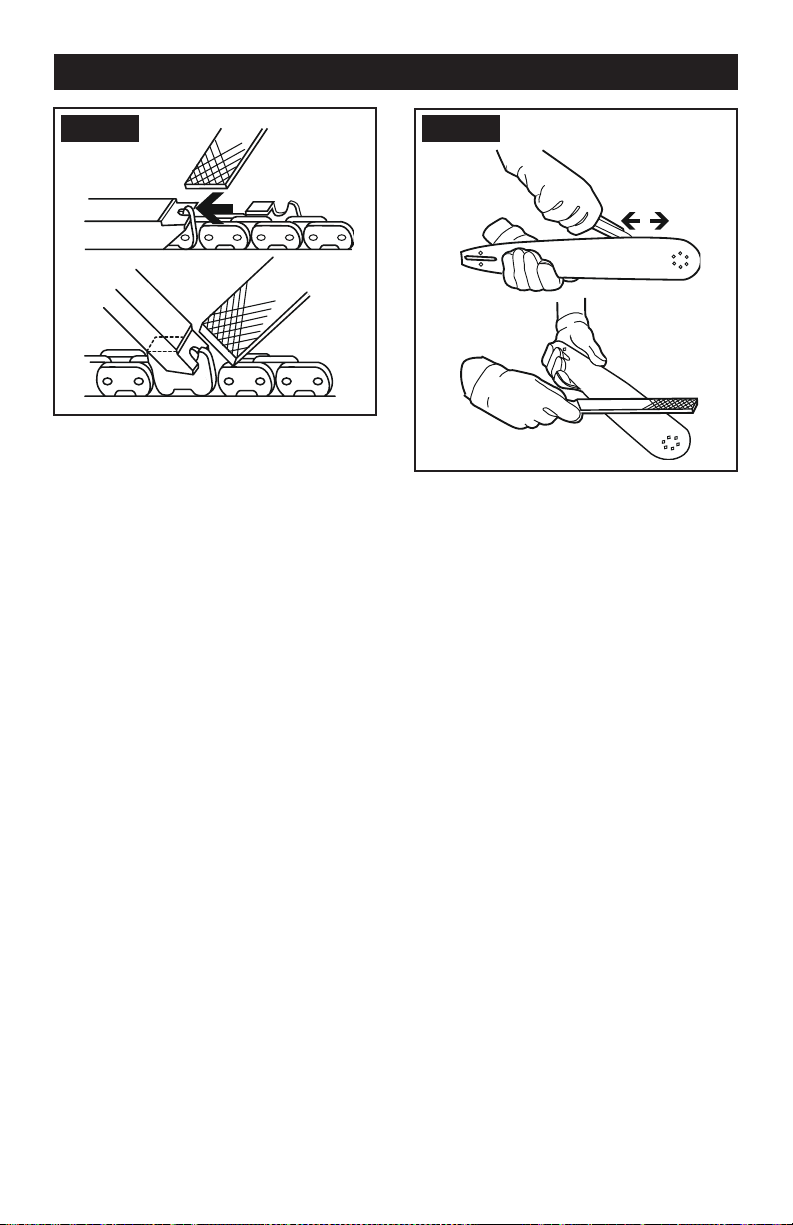
SHARPEN THE CUTTERS
Sharpen the cutters if it is not easy for the
chain to go into the wood.
NOTE: We recommend that a service center,
which has an electric sharpener, perform
important sharpening work.
1. Tensioning chain.
2. Sharpen the cutters corner with a 5/32 in. (4
mm) diameter round le.
3. Sharpen the top plate, side plate and
depth gauge with a at le.
MAINTENANCE
Wrench
Nut
FIG. 17
Screw
FIG. 18
1/16 in. (1.58 mm)
FIG. 19
FIG. 20
FIG. 21
Page 16
4. File all the cutters to the specied angles
and the same length.
NOTE: During the process,
• Keep the le at with the surface to be
sharpened.
• Use the midpoint of the le bar.
• Use light but rm pressure when
sharpening the surface.
• Lift the le away on each return stroke.
• Sharpen the cutters on one side and then
move to the other side.
Replace the chain if:
• The length of the cutting edges is less than
5 mm.
• There is too much space between the drive
links and the rivets.
• The cut speed is slow.
• Sharpening the chain many times but it
does not increase the cutting speed. The
chain is worn.
GUIDE BAR MAINTENANCE
NOTE: Make sure that it is turned over
periodically to keep symmetrical wear on the
bar.
1. Lubricate the bearings on the nose
sprocket (if present) with the syringe (not
included).
2. Clean the bar groove with the scraping
hook (not included).
3. Clean the lubrication holes.
4. Remove burr from the edges and level
the cutters with a at le.
Replace the bar if:
• the groove does not t with the height of
the drive links (which must never touch the
bottom).
• the inside of the guide bar is worn and
makes the chain lean to one side.
TRANSPORTATION AND
STORAGE
Before you move the machine, always
• Remove the battery pack from the machine.
• Keep hands clear of the lock-out button.
• Put the scabbard on the guide bar and the
chain.
Before you put the machine into storage,
always
• Remove the battery pack from the machine.
• Clean all unwanted material from the
machine.
• Make sure that the storage area is
• Not available to children.
• Away from agents which can cause
corrosion, such as garden chemicals
and de-icing salts.
MAINTENANCE
FIG. 22
FIG. 23

Page 17
TROUBLESHOOTING
PROBLEM POSSIBLE CAUSE SOLUTION
The guide bar and
the chain become
hot and release
smoke.
The chain is too tight. Adjust the chain tension.
The oil tank is empty. Add oil.
Contamination causes a
blockage of the discharge
port.
Remove the guide bar and clean the
discharge port.
Contamination causes a
blockage of the oil tank.
Clean the oil tank.
Add new oil.
Contamination causes a
blockage of the guide bar
and the oil tank cap.
Clean the guide bar and the oil
tank cap.
Contamination causes a
blockage of the sprocket
or guide wheels.
Clean the sprocket and the guide
wheels.
The motor runs
but the chain does
not rotate.
The chain is too tight. Adjust the chain tension.
The guide bar and
the chain are damaged.
Replace the guide bar and the chain
if it is necessary.
The motor is damaged. 1. Remove the battery pack from the
machine.
2. Remove the guide bar cover.
3. Remove the bar and saw chain.
4. Clean the machine.
5. Install battery pack and operate the
machine.
If the sprocket rotates, it means the motor
works properly. If not, call service center.
The motor runs
and the chain rotates,
but the chain
does not cut.
The chain is blunt. Sharpen or replace the saw chain.
The chain is in the
incorrect direction.
Turn the chain loop to the other direction.
The chain is tight or loose. Adjust the chain tension.
The machine does
not start.
The chain brake is
engaged.
Pull the chain brake in the direction of the
user to disengage it.
The machine and
battery are not
connected correctly.
Make sure that the battery release
button clicks when you install the battery
pack.
The battery level is low. Charge the battery pack.
The lock out button and
the trigger are not pushed
at the same time.
1. Push the lockout button and hold it.
2. Push the trigger to start the machine.
The battery is too hot or
too cold.
Refer to battery and charger manual.

Page 18
TROUBLESHOOTING
PROBLEM POSSIBLE CAUSE SOLUTION
The motor runs,
but the chain does
not cut correctly,
or the motor stops
after around 3
seconds.
The machine is in the
protection mode to protect
the PCB.
Release the trigger and start the machine
again. Do not force the machine to cut.
The battery is not charged. Charge the battery. Refer to the battery
and charger manual for correct charging
procedures.
The chain is not lubricated. Lubricate the chain to decrease the
friction. Do not let the guide bar and the
chain operate without sufcient oil.
Incorrect battery
storage temperature
Cool the battery pack until it decreases
to the ambient temperature.
Page 19
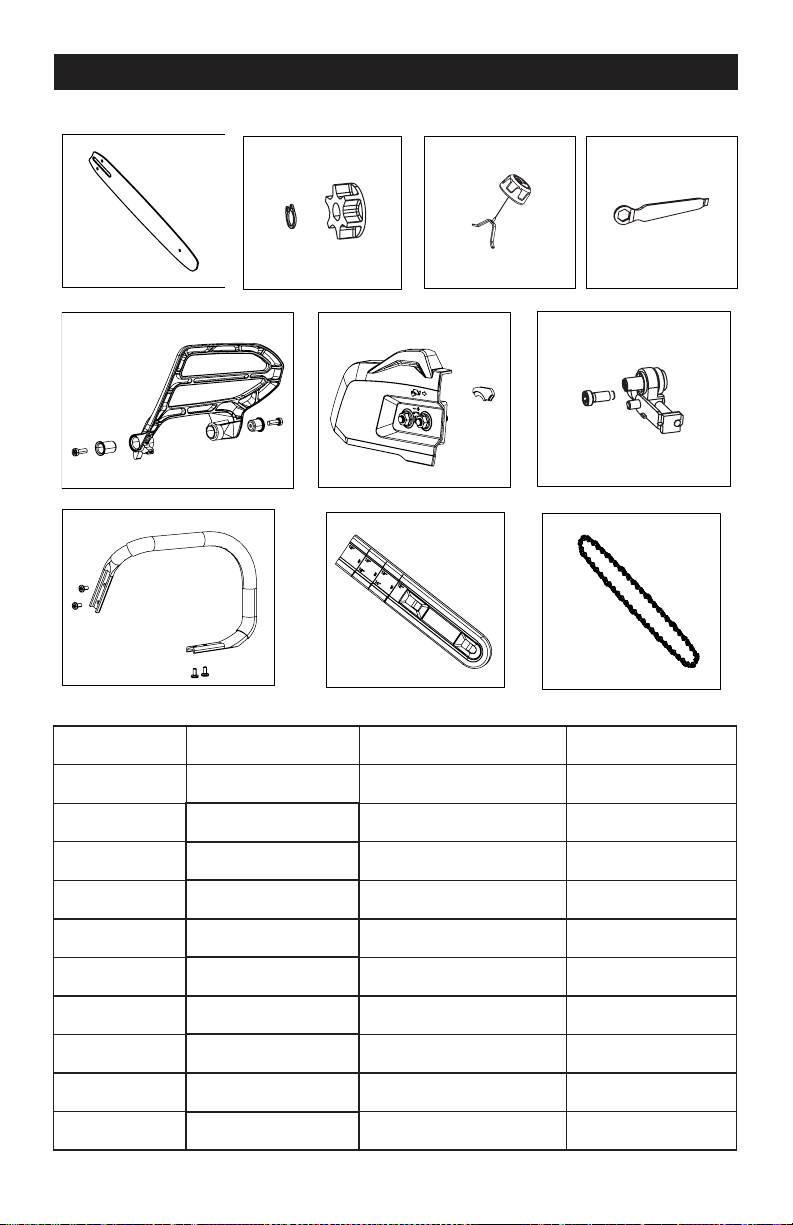
EXPLODED VIEW
ITEM NO. PART NO. DESCRIPTION QTY
1 R0201688-00 Bar 1
2 R0200049-00 Sprocket Kit 1
3 R0201689-00 Oil Cap Assembly 1
4 R0200016-00 Wrench 1
5 RB341041075 Front hand guard 1
6 R0201690-00 Side Cover Assembly 1
7 R0200881-00 Tension Block Assembly 1
8 R0201691-00 Auxiliary Handle Kit 1
9 RB341182031B Scabbard 1
10 R0201616-00 Chain 1
2
3
5
1
6 7
8
9 10
4

Page 20
NOTES

Page 21
NOTES

Page 22
SAVE YOUR RECEIPTS
THIS WARRANTY IS VOID WITHOUT THEM
80V BRUSHLESS CHAINSAW
WARRANTY
4-YEAR LIMITED WARRANTY
This MASTERFORCE™ brand power tool carries our famous No Hassle 4-Year Limited
Warranty to the original purchaser. If, during normal use, this MASTERFORCE™ power
tool breaks or fails due to a defect in material or workmanship within four (4) years from
the date of original purchase, simply bring the tool with the original sales receipt back
to your nearest MENARDS
®
retail store. At its discretion, MASTERFORCE™ agrees
to have the tool or any defective part(s) repaired or replaced with the same or similar
MASTERFORCE™ product or part free of charge, within the stated warranty period,
when returned by the original purchaser with original sales receipt. Not withstanding the
foregoing, this limited warranty does not cover any damage that has resulted from abuse
or misuse of the Merchandise. This warranty: (1) excludes expendable parts including
but not limited to blades, brushes, belts, bits, light bulbs, and/or batteries; (2) shall be
void if this tool is used for commercial and/or rental purposes; and (3) does not cover any
losses, injuries to persons/property or costs. This warranty does give you specific legal
rights and you may have other rights, which vary from state to state. Be careful, tools
are dangerous if improperly used or maintained. Seller’s employees are not qualified
to advise you on the use of this merchandise. Any oral representation(s) made will not
be binding on seller or its employees. The rights under this limited warranty are to the
original purchaser of the merchandise and may not be transferred to any subsequent
owner. This limited warranty is in lieu of all warranties, expressed or implied including
warranties or merchantability and fitness for a particular purpose. Seller shall not be
liable for any special, incidental, or consequential damages. The sole exclusive remedy
against the seller will be for the replacement of any defects as provided herein, as long
as the seller is willing or able to replace this product or is willing to refund the purchase
price as provided above. For insurance purposes seller is not allowed to demonstrate
any of these power tools for you.
For questions / comments, technical assistance or repair parts -
Please call toll free at: 1-844-678-7423 (M-F 8am - 6pm)

Page 23
© 2019 Menard, Inc., Eau Claire, WI 54703 12/2019