Operating and installation
Instructions
Washing machine
It is essential to read these operating instructions before installing
and using the appliance. This prevents both personal injury and
damage to the appliance.
en-AU M.-Nr. 12 549 790

Contents
2
Caring for the environment .............................................................................. 5
Warning and Safety instructions...................................................................... 6
Operating the washing machine ...................................................................... 14
Control panel....................................................................................................... 14
How the control panel works .............................................................................. 15
Using for the first time ...................................................................................... 17
Washing environmentally and economically .................................................. 21
1. Preparing the laundry.................................................................................... 22
2. Loading the washing machine ..................................................................... 23
3. Selecting the programme and settings....................................................... 24
4. Adding detergent........................................................................................... 26
5. Starting the programme - the end of the programme ............................... 28
Delay start/SmartStart................................................................................. 29
Programme chart .............................................................................................. 31
Extras.................................................................................................................. 34
Pre-wash ............................................................................................................. 34
Water+ ........................................................................................................... 34
Rinse+ ........................................................................................................... 34
Special features in the programme sequence................................................ 35
Spinning .............................................................................................................. 35
Anti-crease .......................................................................................................... 35
Changing the programme sequence............................................................... 36
Changing a programme....................................................................................... 36
Cancelling a programme ..................................................................................... 36
Adding or removing laundry ................................................................................ 36
Detergent ........................................................................................................... 37
The correct detergent.......................................................................................... 37
Cleaning and care ............................................................................................. 38
Cleaning the external casing and fascia panel.................................................... 38
Cleaning the detergent dispenser drawer ........................................................... 38
Cleaning the drum, suds container and drainage system................................... 40

Contents
3
Cleaning the sealing ring ..................................................................................... 40
Cleaning the filters in the water inlet ................................................................... 41
Problem solving guide ..................................................................................... 42
The programme does not start............................................................................ 42
Programme cancellations and fault messages ................................................... 43
Symbols in the time display ................................................................................ 44
Fault indicator light at the end of a programme .................................................. 45
An unsatisfactory wash result ............................................................................. 46
General problems with the washing machine ..................................................... 47
The door will not open......................................................................................... 48
Opening the door in the event of a blocked drain outlet and/or power cut ........ 49
After sales service............................................................................................. 51
Contact in case of fault ....................................................................................... 51
Optional accessories........................................................................................... 51
Installation.......................................................................................................... 52
Front view ............................................................................................................ 52
Rear view............................................................................................................. 53
Installation locations............................................................................................ 54
Installation notes ................................................................................................. 54
Transporting the washing machine to its installation site.................................... 55
Installation surface .............................................................................................. 56
Removing the transit bars ................................................................................... 56
Fitting the transit bars ......................................................................................... 58
Aligning the washing machine............................................................................. 59
Fixing bracket for plinth ................................................................................. 60
Installing under a continuous worktop ........................................................... 62
Water connection ................................................................................................ 63
Drainage .............................................................................................................. 63
Drain pump..................................................................................................... 63
Electrical connection ........................................................................................... 64
Technical data.................................................................................................... 65
Programmable functions .................................................................................. 66
Choosing and selecting programmable functions .............................................. 66
Editing and saving the programmable function .................................................. 67
Exiting the programming level............................................................................. 67
Buzzer duration...............................................................................................
68
Buzzer............................................................................................................
68
Keypad tone...................................................................................................
68
PIN code........................................................................................................
68

Contents
4
Control panel switch-off status ....................................................................
69
Memory ........................................................................................................
69
Longer pre-wash Cottons ............................................................................
69
Gentle action ................................................................................................
70
Temperature reduction .................................................................................
70
Water plus.....................................................................................................
70
Maximum rinse level.....................................................................................
70
Suds cooling .................................................................................................
71
Anti-crease ...................................................................................................
71
Low water pressure......................................................................................
71
Backlight brightness dimmed ......................................................................
71
Welcome tone...............................................................................................
72
Operating hours ...........................................................................................
72
Factory default setting..................................................................................
72
Networking .......................................................................................................... 73
Resetting the network configuration .............................................................. 73
Remote control .............................................................................................
73
SmartGrid (only functional in selected countries) ........................................
74
RemoteUpdate.............................................................................................
74
Copyright and licences for the communication module ..................................... 75
Caring for the environment
5
Disposal of the packing
material
The transport and protective packaging
has been selected from materials which
are environmentally friendly for
disposal, and can normally be recycled.
Recycling the packaging reduces the
use of raw materials in the
manufacturing process and also
reduces the amount of waste in landfill
sites. Ensure that any plastic
wrappings, bags etc. are disposed of
safely and kept out of the reach of
babies and young children. Danger of
suffocation.
Disposing of your old
appliance
Electrical and electronic appliances
often contain valuable materials. They
also contain specific materials,
compounds and components, which
were essential for their correct function
and safety. These could be hazardous
to human health and to the environment
if disposed of with your domestic waste
or if handled incorrectly. Please do not,
therefore, dispose of your old appliance
with your household waste.
Please dispose of it at your local
community waste collection / recycling
centre for electrical and electronic
appliances. You are also responsible for
deleting any personal data that may be
stored on the appliance prior to
disposal. Please ensure that your old
appliance poses no risk to children
while being stored prior to disposal.

Warning and Safety instructions
6
This washing machine complies with all current local and national
safety requirements. However, inappropriate use can lead to
personal injury and damage to property.
Read the operating instructions carefully before using the washing
machine. They contain important information on safety,
installation, use and maintenance of the appliance. This prevents
both personal injury and damage to the washing machine.
In accordance with standard IEC60335-1, Miele expressly and
strongly advises that you read and follow the instructions in
“Installation”, as well as in the “Warning and Safety instructions”.
Miele cannot be held liable for injury or damage caused by non-
compliance with these instructions.
Keep these operating instructions in a safe place and pass them
on to any future owner.
When instructing other people how to use the washing machine,
they must be made aware of these Warning and Safety
instructions.
Correct application
The washing machine is only suitable for washing fabrics with a
care label stating that they are suitable for machine washing. Any
other applications may be dangerous. The manufacturer cannot be
held liable for damage resulting from incorrect or improper use or
operation of the machine.
This washing machine must be used as described in the operating
instructions and must be checked on a regular basis to make sure it
is functioning correctly. Maintenance must be carried out when
necessary.

Warning and Safety instructions
7
The washing machine is not suitable for outdoor use.
This washing machine is intended for commercial use in small
businesses, care homes, sports clubs, hospitals and other similar
commercial environments. This machine may also be operated by
lay persons in public areas such as laundrettes, communal laundry
rooms or similar commercial environment.
This washing machine is not intended for use by persons
(including children) with reduced physical, sensory or mental
capabilities, or lack of experience and knowledge, unless they have
been given supervision or instruction concerning its use by a person
responsible for their safety.
Young children must not be allowed to use this appliance.
Older children may only use the appliance when its operation has
been clearly explained to them and they are able to use it safely.
They must be able to understand and recognise the possible
dangers caused by incorrect operation.
Cleaning or maintenance on the washing machine may only be
carried out by older children under the supervision of an adult.
Always supervise any children in the vicinity of the washing
machine. Never allow children to play with the washing machine.

Warning and Safety instructions
8
Technical safety
Before installing and operating the washing machine, check it for
any visible exterior damage. Do not set up or use a damaged
washing machine.
The electrical safety of this washing machine can only be
guaranteed when continuity is complete between it and an effective
earthing system which complies with current local and national
safety regulations.
It is most important that this basic safety requirement is present and
regularly tested and, when there is any doubt, the on-site wiring
system should be inspected by a qualified electrician.
Miele cannot be held liable for the consequences of an inadequate
earthing system (e.g. electric shock).
Unauthorised repairs could result in unforeseen dangers for the
user, for which the manufacturer cannot accept liability. Repairs
must only be carried out by a Miele authorised service technician,
otherwise any subsequent damage will not be covered by the
warranty.
Do not make any alterations to the machine, unless authorised to
do so by Miele.
In the event of a fault or for cleaning purposes, the washing
machine must be isolated from the electricity supply. It is only
completely isolated if:
- it is switched off at the wall socket and the plug is withdrawn, or
- the mains fuse is disconnected, or
- it is switched off at the mains circuit breaker.
For further information see “Installation - Electrical connection”.

Warning and Safety instructions
9
If the electrical connection cable is faulty, it must only be replaced
by a Miele authorised service technician to protect the user from
danger.
The washing machine must be connected to the water supply
using the new hose set supplied with the appliance. Old hose sets
should not be re-used. Check the hose regularly for signs of wear.
Replace it in good time to avoid the risk of leaks and water damage.
Faulty components must only be replaced by genuine Miele
original spare parts. Miele can only guarantee the safety standards of
the machine when Miele replacement parts are used.
Do not connect the machine to the mains electricity supply by a
multi-socket adapter, extension lead or similar. These do not
guarantee the required safety of the machine (fire hazard due to the
risk of overheating).
The machine must not be installed and operated in mobile
locations (e.g. on a ship).
Please observe the instructions in “Installation” and “Technical
data”.
If the washing machine is equipped with a mains plug, it must be
easily accessible after installation so that the machine can be
disconnected from the electricity supply if necessary.
If the appliance is hard wired, an on-site dual circuit breaker must
be accessible at all times in order to disconnect the washing
machine from the mains supply. The means of disconnection must
be incorporated in the fixed wiring in accordance with the wiring
rules.

Warning and Safety instructions
10
Temporary or permanent operation with a self-sufficient or non-
mains synchronous energy supply system (e.g. isolated networks,
back-up systems) is possible. A requirement for the operation is that
the energy supply system complies with all current local and national
requirements that apply to stand-alone, solar and/or battery
systems.
The protective measures provided in the building installation and in
this Miele product must also be assured in their function and
operation in isolated operation or in non-mains synchronous
operation, or replaced with equivalent measures in the installation.
For example, as described in the current publication of VDE-AR-E
2510-2.
The manufacturer's warranty will be invalidated if the appliance is
not repaired by a Miele approved service technician.
Correct use
The maximum load is 8,0kg (dry laundry). See the “Programme
chart” for the maximum recommended loads for individual
programmes.
Do not install your washing machine in a room where there is a
risk of frost. Frozen hoses may burst or split, and the reliability of the
electronic control unit may be impaired at temperatures below
freezing point.
Before using the machine for the first time, check that the transit
bars at the rear of the washing machine have been removed (see
“Installation and connection – Removing the transit bars”). During
spinning, transit bars which are still in place can cause damage to
both the machine and adjacent furniture or appliances.
Turn off the tap if the machine is to be left for any length of time
(e.g. while on holiday), especially if there is no floor drain (gully) in the
immediate vicinity.

Warning and Safety instructions
11
If the ventilation openings are in the base of the washing
machine, ensure that they are not obstructed by deep-pile carpet or
similar.
Danger of flooding! If hooking the drain hose into a laundry
washtub, check that the water can drain away fast enough to
prevent the laundry tub from overflowing. Secure the drain hose
against slipping. The force of the water flowing out of the hose can
dislodge it.
Make sure that no foreign objects (e.g. nails, pins, coins, paper
clips) find their way into the machine with the laundry. Foreign
objects can damage components of the machine (e.g. suds
container, drum). Damaged components can, in turn, result in
damage to the laundry.
If the correct amount of detergent is dispensed, the machine
should not need to be descaled. If, however, you do wish to descale
it, only use special non-corrosive descaling agents and strictly
observe the instructions on the packaging. Special descaling agent
is available from your Miele dealer or from Miele. Strictly observe the
instructions for the packaging.
For textiles that have been treated with solvent-based cleaning
agents, always check whether they can be washed in a washing
machine. To check whether this is possible, refer to safety notes,
information concerning the product's environmental compatibility,
and other information.
Never use solvent-based detergents, e.g. those containing
benzine, in this washing machine. This may result in damage to
component parts and create toxic fumes. Risk of fire and explosion!
Gasoline, petroleum, kerosene, paraffin, or any easily flammable
liquid must not be stored or used near the washing machine. Risk of
fire and explosion!
Only use dyes suitable for use in a washing machine. Always
observe the manufacturer's instructions carefully.

Warning and Safety instructions
12
Dye removers contain sulphur compounds which can cause
damage such as corrosion. Dye removers must not be used in the
washing machine.
Avoid contact between stainless steel surfaces (front, lid, casing)
and liquid detergents or disinfecting agents which contain chlorine or
sodium hypochlorite. These agents can cause corrosion on stainless
steel. Aggressive vapours containing chlorine can also be corrosive.
Do not store open containers of these agents near the machine.
Do not use a high-pressure cleaner or water jet to clean the
washing machine.
It is particularly important to observe the manufacturer's
instructions when using a combination of cleaning agents and
special application products. Products must only be used for
applications approved by the manufacturer to avoid any material
damage or the occurrence of strong chemical reactions.
If detergent has come into contact with the eyes, rinse out
immediately with plenty of lukewarm water. If detergent has
accidentally been ingested, seek medical advice immediately. People
with damaged or sensitive skin should avoid contact with detergent.
When adding or removing laundry during the main wash, your skin
may come into contact with detergent, particularly if the detergent is
dispensed externally. Take care when placing your hands inside the
drum. If suds have come into contact with the skin, rinse off
immediately with lukewarm water.

Warning and Safety instructions
13
Accessories
Only use original Miele accessories. If other parts are used,
warranty, performance and product liability claims will be invalidated.
Miele tumble dryers and Miele washing machines can be installed
as a washer-dryer stack. This requires a Miele washer-dryer stacking
kit which can be purchased separately. Please ensure that the
washer-dryer stacking kit is suitable for your Miele tumble dryer and
your Miele washing machine.
If installing the machine on a Miele plinth (available as an optional
accessory), please make sure you order the correct one for this
washing machine.
Miele will guarantee to supply functional spare parts for 15years
following the discontinuation of your washing machine.
Miele cannot be held liable for damage caused by non-compliance
with these Warning and Safety instructions.
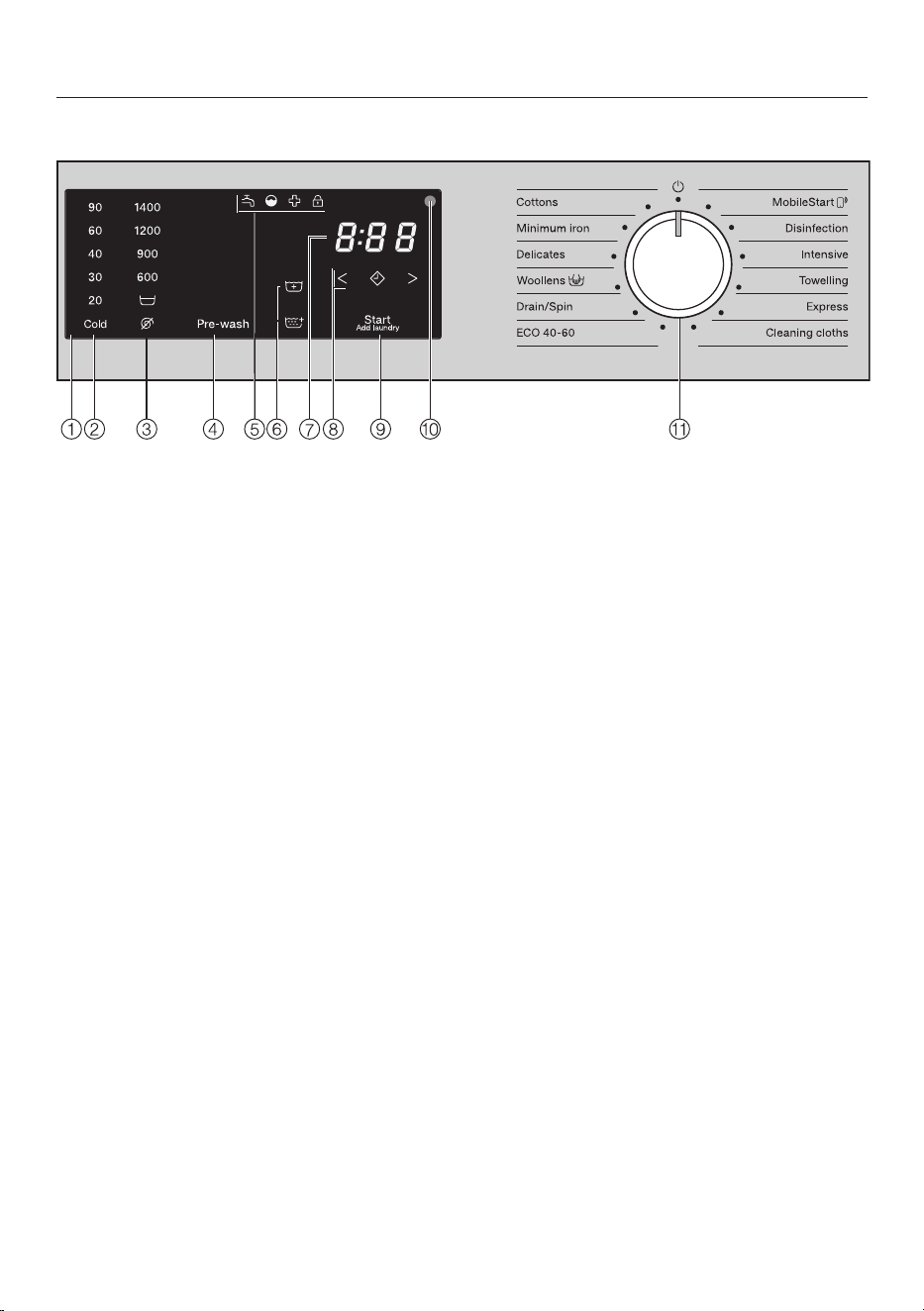
Operating the washing machine
14
Control panel
a
Control panel
b
Temperature sensors
For selecting the temperature
c
Spin speed sensors
For selecting the spin speed
d
Pre-wash sensor
For selecting the Pre-wash Extra
e
Indicator lights
light up when necessary
f
Extras sensors
For selecting the Water+ and
Rinse+ Extras
g
Time display
For the programme running time
h
Sensors
For the Delay start function
i
Start/Add laundry sensor
starts the selected programme and
allows you to add laundry
j
Optical interface
For service technicians
k
Programme selector
For selecting programmes and for
switching off the appliance
The washing machine is switched on
when you select a programme and
switched off by turning the
programme selector to the
position.
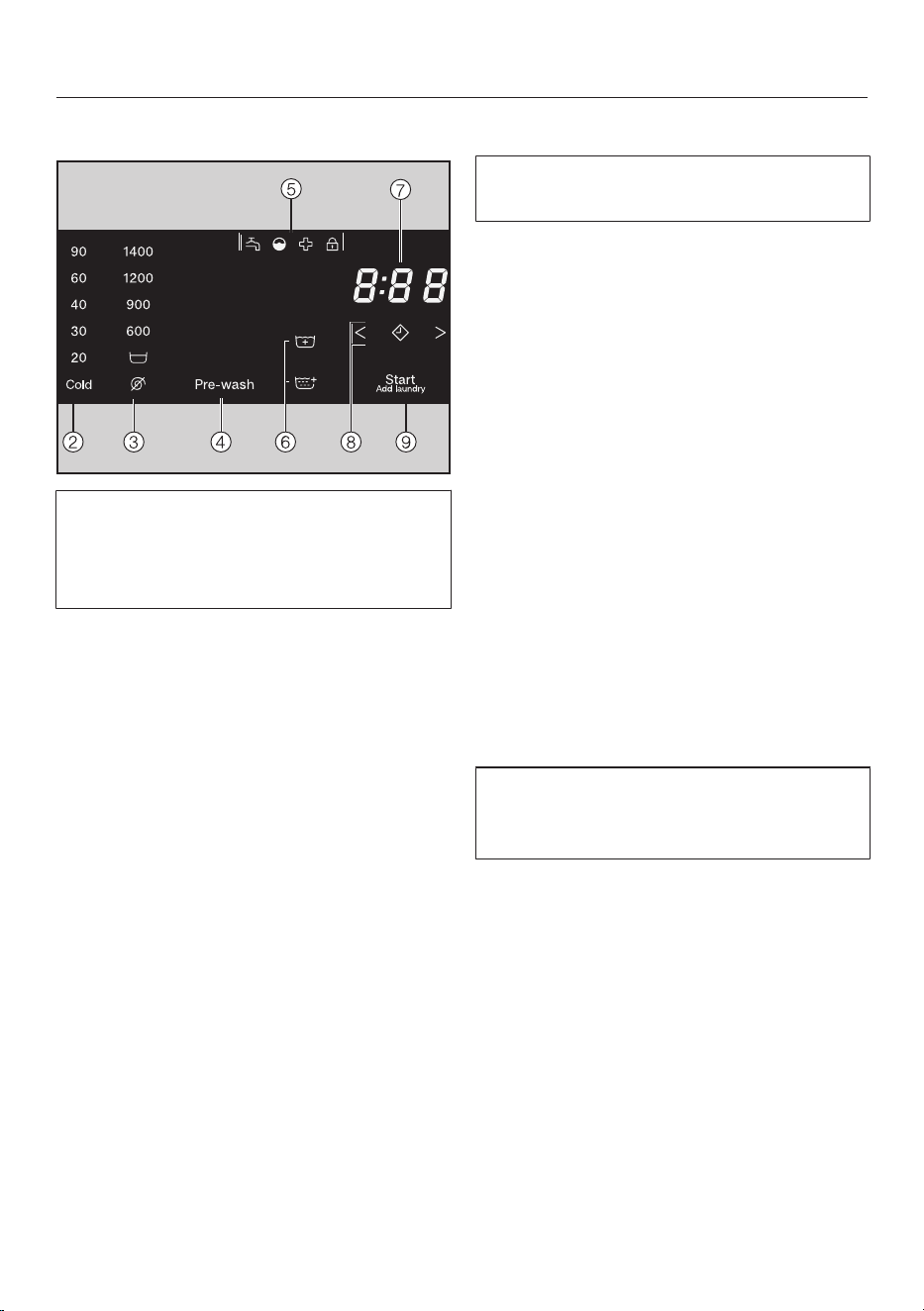
Operating the washing machine
15
How the control panel works
The, , , , and sensors
react to fingertip contact. Selection is
possible as long as the respective
sensor is illuminated.
If a sensor is brightly lit, this means it is
currently selected.
If a sensor is dimly lit, this means it can
be selected.
andsensors for temperature
and spin speed
After selecting a wash programme with
the programme selector, the
recommended temperature (in °C) and
spin speed (in rpm) light up brightly.
Selectable temperatures and spin
speeds light up dimly.
Pre-wash sensor
You can supplement certain wash
programmes with the Pre-wash Extra.
If an Extra can be selected for the wash
programme, the sensor for the Extra
lights up dimly.
Indicator lights
-
lights up if there are faults with the
water inlet and drainage.
-
lights up if excess detergent was
used.
-
lights up as a reminder about hygiene
information.
-
lights up if the door of the washing
machine is locked
Extras sensors
You can select the Water+ and
Rinse+ Extras to augment some
wash programmes.
If an Extra can be selected for the wash
programme, the sensor for the Extra
lights up dimly.

Operating the washing machine
16
Time display
After the programme has started, the
programme duration will appear in the
display in hours and minutes.
When Delay start is being used, the
programme duration will appear after
the Delay start time has elapsed.
sensors
-
After touching the sensor, a later
start time for the programme (Delay
start) can be selected. Once
selected, lights up brightly.
-
The duration of the Delay start period
is selected by touching the or
sensor.
The Delay start time selected will
appear in the time display.
After the programme has started, the
Delay start time will begin to count
down.
Once the Delay start time has elapsed,
the programme begins. The estimated
programme duration appears in the
time display.
Start/Add laundry sensor
- The programme can be started as
soon as the sensor is flashing on and
off. Touching the Start/Add laundry
sensor starts the selected
programme. The sensor lights up
constantly.
- Once the programme has been
started, touching the Start/Add
laundry sensor allows you to add
laundry.
Using for the first time
17
Damage resulting from incorrect
installation and connection.
Installing and connecting the
washing machine incorrectly will
cause serious damage to property.
Please observe the instructions in
“Installation and connection”.
Removing the protective foil
and stickers
Remove:
- the protective foil from the door
- any stickers from the front and the lid
Please do not remove any labels
(e.g. the data plate) which are visible
when you open the door.
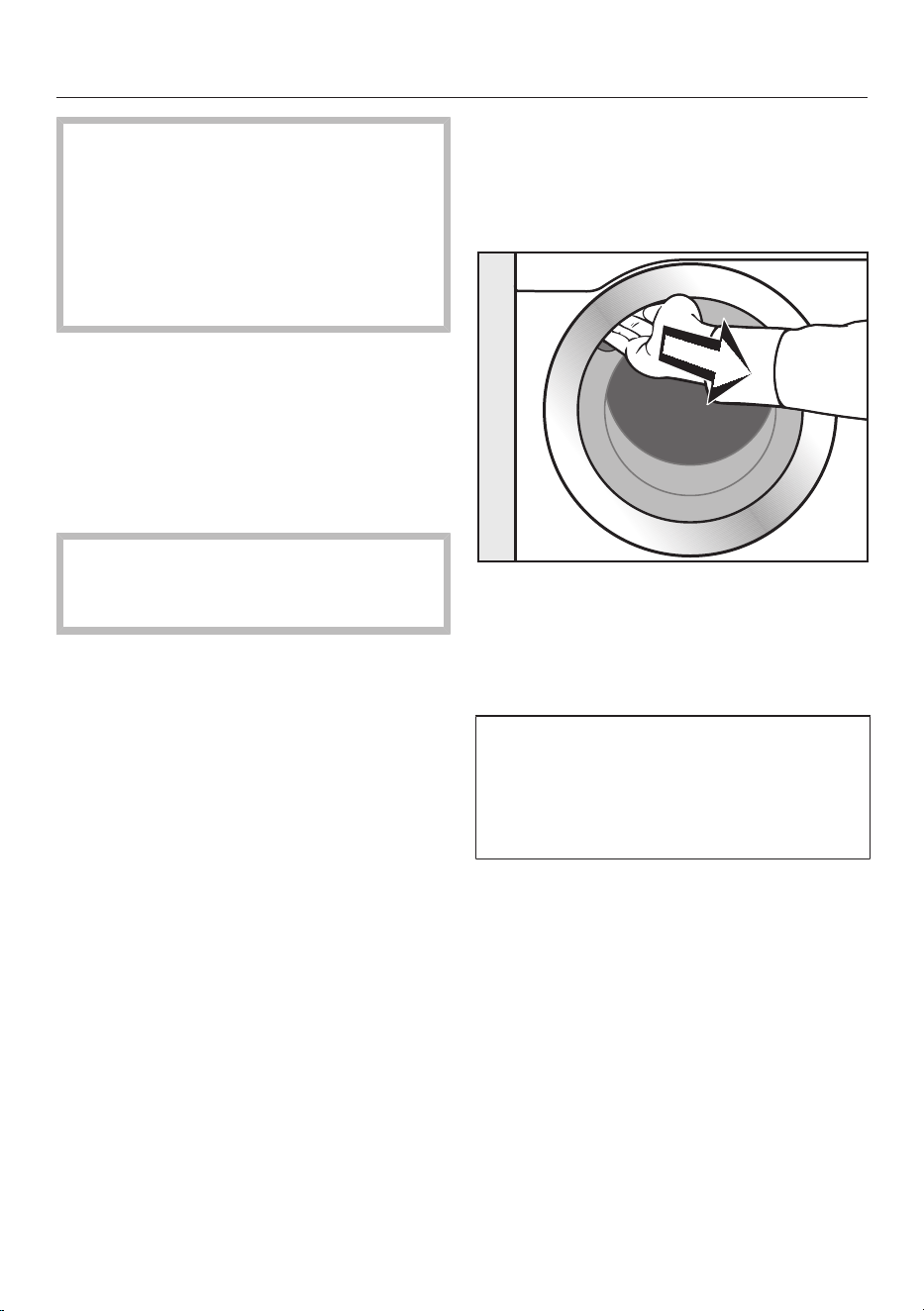
Emptying the drum
A swivel elbow for the drain hose and/
or assembly material may be stored in
the drum.
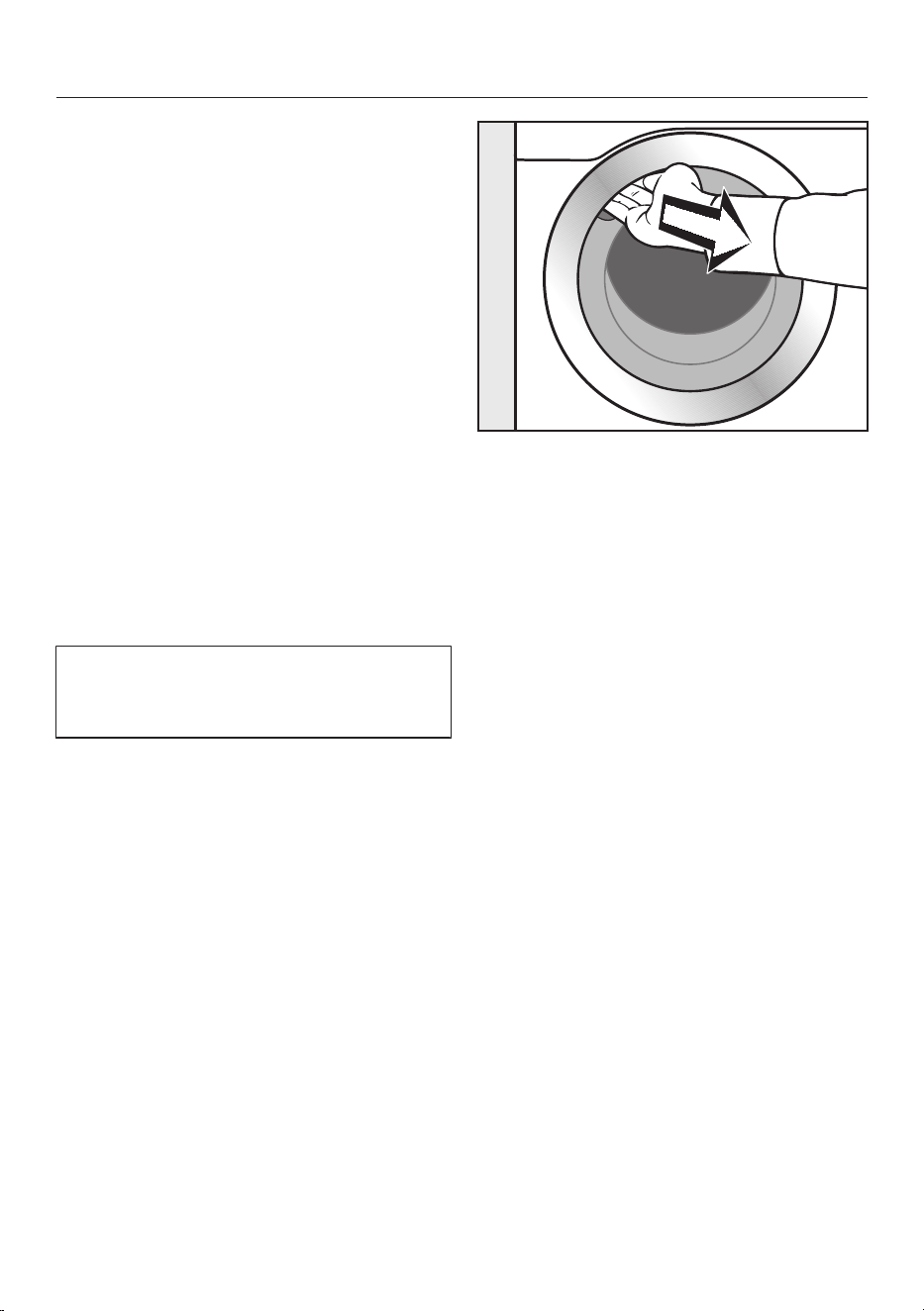
Pull open the door.
Remove the swivel elbow and
assembly material.
Shut the door with a gentle swing.
This washing machine has undergone
a complete functional test at the
factory. Some residual water will
therefore remain in the drum from this
process.
Using for the first time
18
Miele@home
Your washing machine is equipped
with an integrated Wi-Fi module.
To use this feature, you will need:
- a Wi-Fi network
- the Miele App
- a Miele user account. You can create
a user account via the Miele App.
The Miele App will guide you as you
connect your washing machine to your
home Wi-Fi network.
Once your washing machine is
connected to your Wi-Fi network, you
can use the App, for example, to carry
out the following activities:
- Operate your washing machine
remotely
- Access information about the
operating status of your washing
machine
- Access information about a
programme sequence on your
washing machine
Connecting your washing machine to
your Wi-Fi network will increase energy
consumption, even when the washing
machine is switched off.
Before installing the washing
machine in its final location, ensure
the signal strength is sufficient for
your Wi-Fi network.
Availability of the Wi-Fi connection
The Wi-Fi connection shares a
frequency range with other appliances
(including microwave ovens and remote
control toys). This may result in
sporadic or even complete connection
failures. Therefore, a constant
availability of featured functions cannot
be guaranteed.
Miele@home availability
The ability to use the Miele App
depends on the availability of the
Miele@home service in your country.
The Miele@home service is not
available in every country.
For information about availability,
please visit www.miele.com.
Miele App
You can download the Miele App from
the Apple App Store
®
or the Google
Play Store™ free of charge (only
functional in selected countries).
Using for the first time
19
Setting up Miele@home
There are 2 ways of connecting:
1. Via the Miele App (default)
2. Via WPS
Signing on via the Miele App
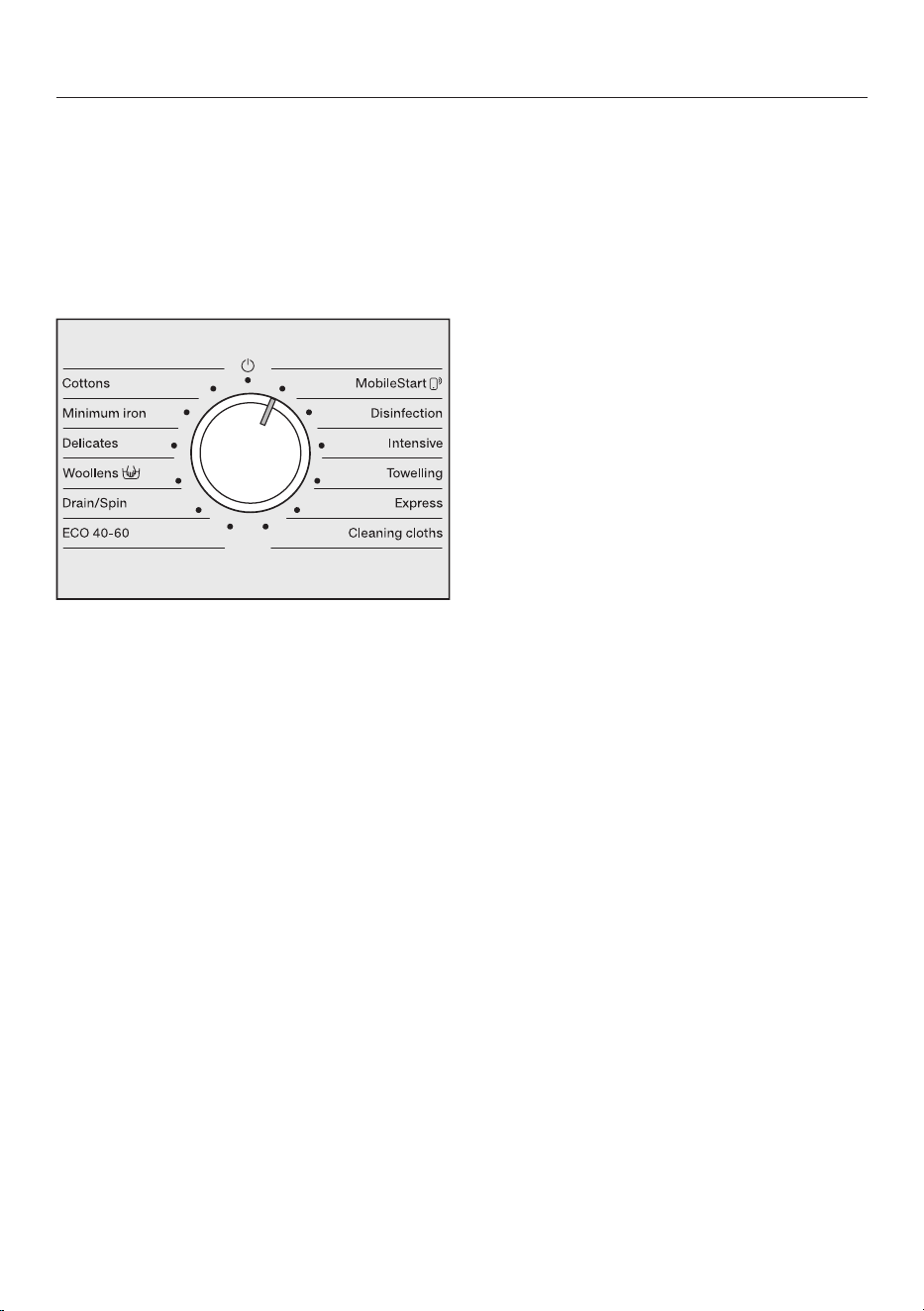
Turn the programme selector to the
MobileStart
programme.
appears in the time display and the
timeout starts to count down from
10minutes. The Miele App will guide
you through the remaining steps.
When you have successfully connected,
will appear in the time display.
Signing on via WPS
Turn the programme selector to the
MobileStart
programme.
Touch thesensor repeatedly
untilappears in the time display.
The timeout time then starts to count
down from 2minutes in the time
display.
Activate the WPS function on your
router within 2minutes.
When you have successfully connected,
will appear in the time display.
Useful tip: If the connection has not
been set up when the timeout has
finished counting down, repeat the
process.
Using for the first time
20
Running the first wash
programme
For safety reasons, spinning is not
possible until the machine has been
prepared for use for the first time. To
activate the spinning function, you must
run a wash programme without laundry
and without detergent.
Using detergent could result in an
excessive build-up of foam.
Turn on the tap.
Turn the programme selector
toCottons.
The washing machine is switched on.
Touch the Start/Add laundry sensor.
The wash programme will start.
After 10minutes, the indicators dim
and the Start/Add laundrysensor
starts flashing.
Opening the door at the end of the
programme
The door remains locked during the
Anti-crease phase. The control panel
lights up for the first 10minutes. The
control panel then goes out and
theStart/Add laundry sensor flashes.
Turn the programme selector to the
position.
The door will unlock.
Useful tip: After the Anti-crease phase,
the washing machine will have switched
off and the door unlocked
automatically. The control panel is
completely dark.
Reach under the door grip and pull
the door open.
Useful tip: For safety reasons, close the
door when the machine is not in use.
Otherwise there is a danger of objects
being placed inadvertently in the drum.
If these remain unnoticed and were
washed in the next load, they could
damage the laundry. An open door is
also a danger to pets and children.
The appliance is now ready for use.

Washing environmentally and economically
21
Energy and water consumption
- Use the maximum load size for the
current programme. The energy and
water consumption will then be the
lowest in relation to the size of the
load.
- Programmes that are more efficient
with regard to energy and water
consumption generally have a longer
programme running time. By
extending the programme running
time, the wash temperature that is
actually reached can be reduced
while still providing the same wash
results.
For example, the ECO40-60
programme has a longer running time
than the Cottons40°C or 60°C
programme. The ECO40-60
programme, however, is more
efficient in terms of energy and water
consumption.
- Use the Express programme for
small, lightly soiled loads.
- Modern detergents make it possible
to wash at lower temperatures (e.g.
20°C). Using lower temperature
settings will save energy.
- To maintain the hygiene of the
machine, carry out a hot wash (above
60°C) at regular intervals. The
indicator will come on to remind you
to carry out a hot wash.
Detergent consumption
- Do not exceed the amounts of
detergent recommended by the
manufacturer on the packaging.
- Adjust the dosage to the degree of
soiling of the laundry.
- Reduce the amount of detergent with
smaller loads (e.g. reduce the amount
of detergent by ⅓ when washing a
half load).
Information about subsequent
tumble drying
The spin speed selected affects the
residual moisture in the laundry and the
sound emissions of the washing
machine.
The higher the spin speed, the lower
the residual moisture in the laundry.
However, the sound emissions of the
washing machine will increase.
Select the highest possible spin speed
for the wash programme to save energy
in the subsequent tumble dryer cycle.
1. Preparing the laundry
22
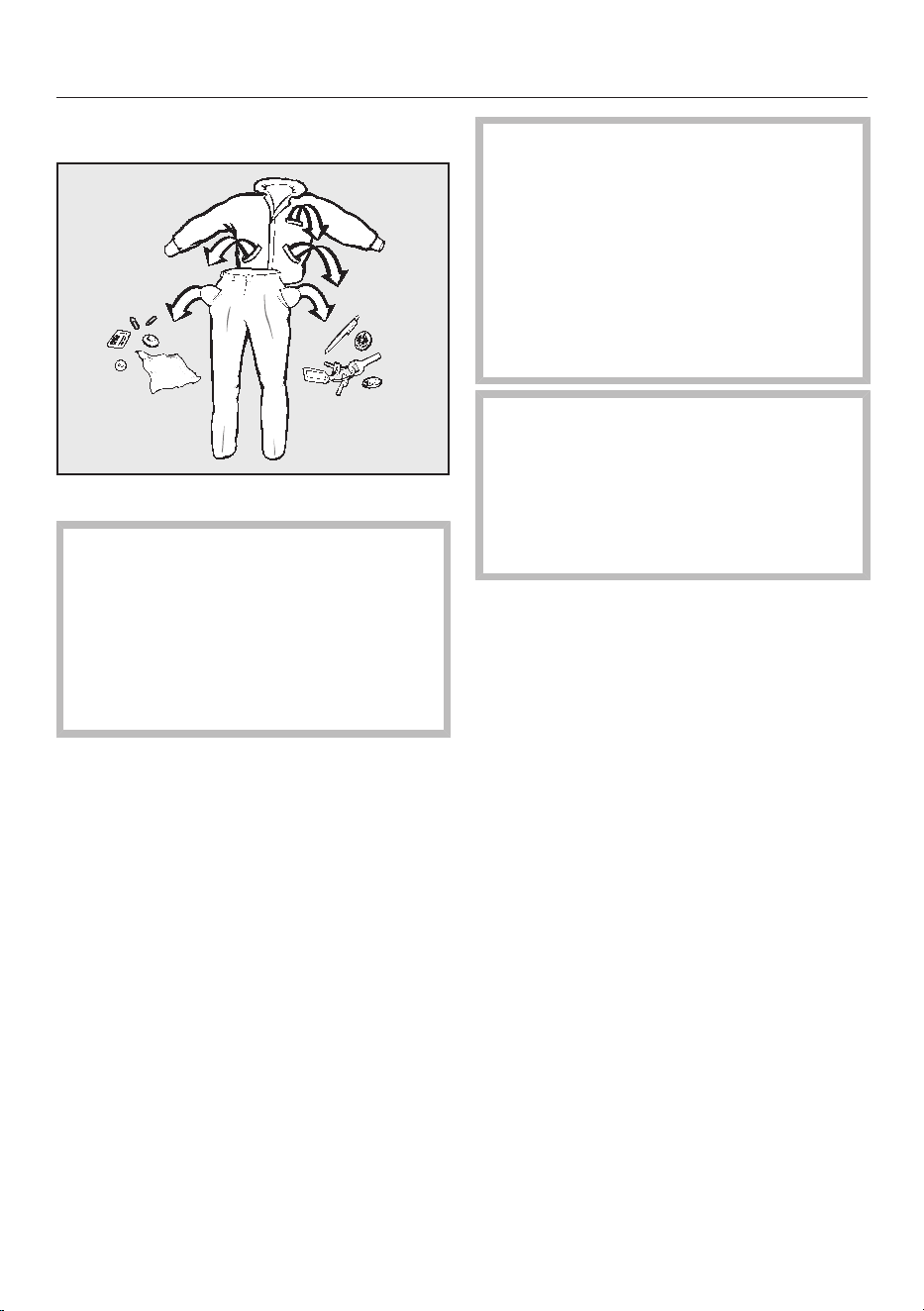
Emptying all pockets
Empty all pockets.
Damage due to foreign objects.
Foreign objects (e.g. nails, coins,
paper clips etc.) can cause damage
to garments and to components in
the machine.
Check the laundry before washing
and remove any foreign objects.
Sorting the laundry
Sort the laundry by colour and by
care label. Most garments have a
textile care label in the collar or side
seam.
Pre-treating stains
Clean badly soiled areas and stains
on the textiles before washing.
Spillages should be carefully dabbed
off using a soft, colourfast cloth.
Damage due to solvent-based
cleaning agents.
Cleaning agents containing benzine,
stain remover, etc., can damage
plastic parts.
When pre-treating garments, make
sure that any plastic parts (e.g.
buttons) do not come into contact
with cleaning agent.
Risk of explosion due to solvent-
based cleaning agents.
If solvent-based cleaning agents are
used, an explosive mixture can form.
Never use solvent-based cleaning
agents in the washing machine.
General tips
- Do not wash any items in this
machine which are specified by the
manufacturer as not washable on
the care label ( symbol).
- Curtains: Remove lead weights first
or place in a laundry bag.
- Remove or sew in any loose
underwiring in bras or shirt collar
stiffeners.
- Turn garments inside out, if
recommended by the manufacturer.
- Close any zips and Velcro fasteners
before washing.
- Fasten duvet covers and pillow cases
to prevent small items from being
rolled up inside them.
- Please refer to the Programme chart
for more tips.
2. Loading the washing machine
23
Opening the door
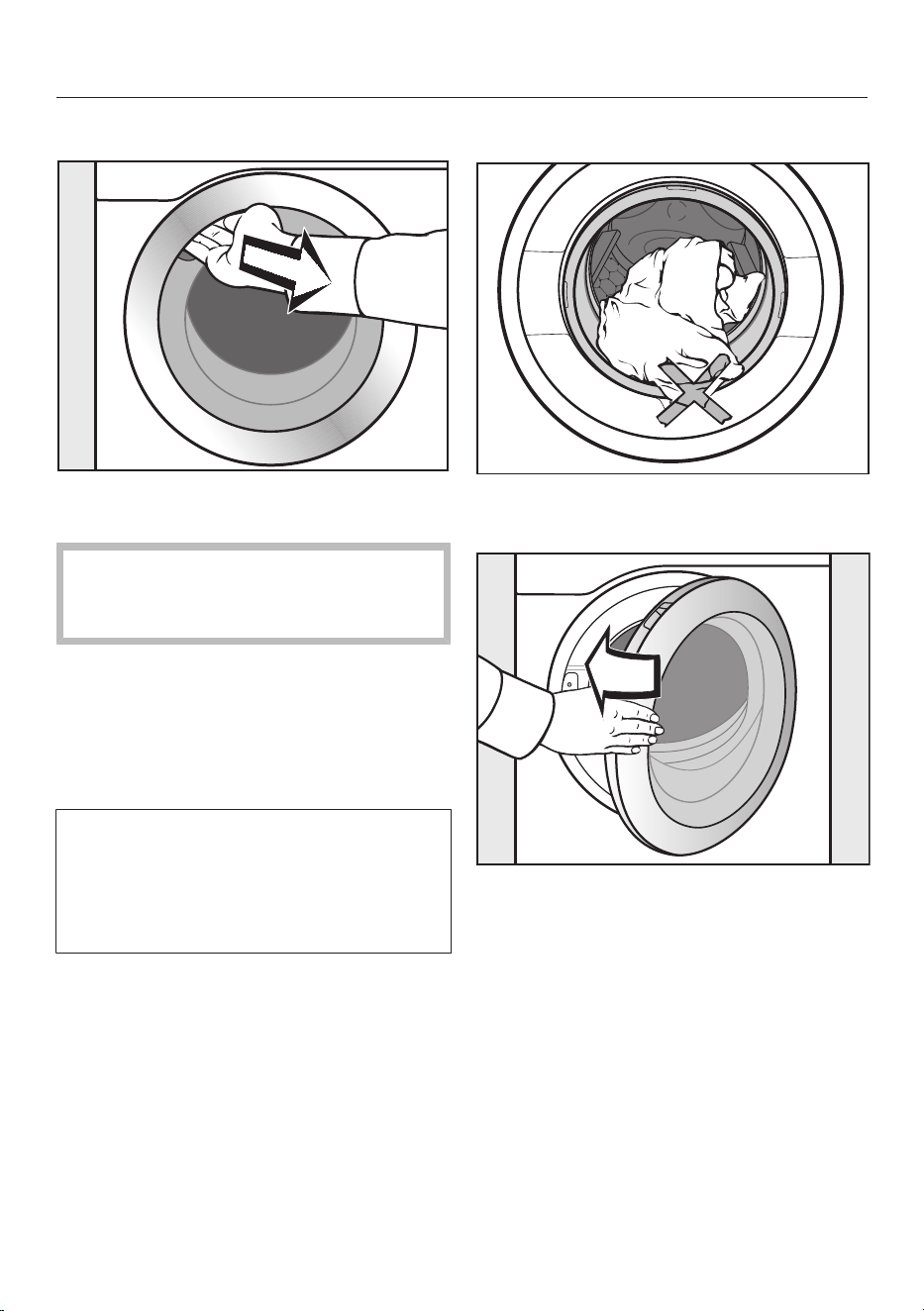
Reach under the door grip and pull
the door open.
Check the drum for pets or foreign
objects before loading it with
laundry.
Unfold the laundry and load loosely in
the drum.
Mixing both large and small items gives
better wash results and helps distribute
the load evenly during spinning.
The most efficient use of energy and
water is achieved when a full load is
washed. However, do not overload as
this reduces cleaning efficiency and
causes creasing.
Closing the door
Make sure that no items are caught
between the door and the seal.
Shut the door with a gentle swing.
3. Selecting the programme and settings
24
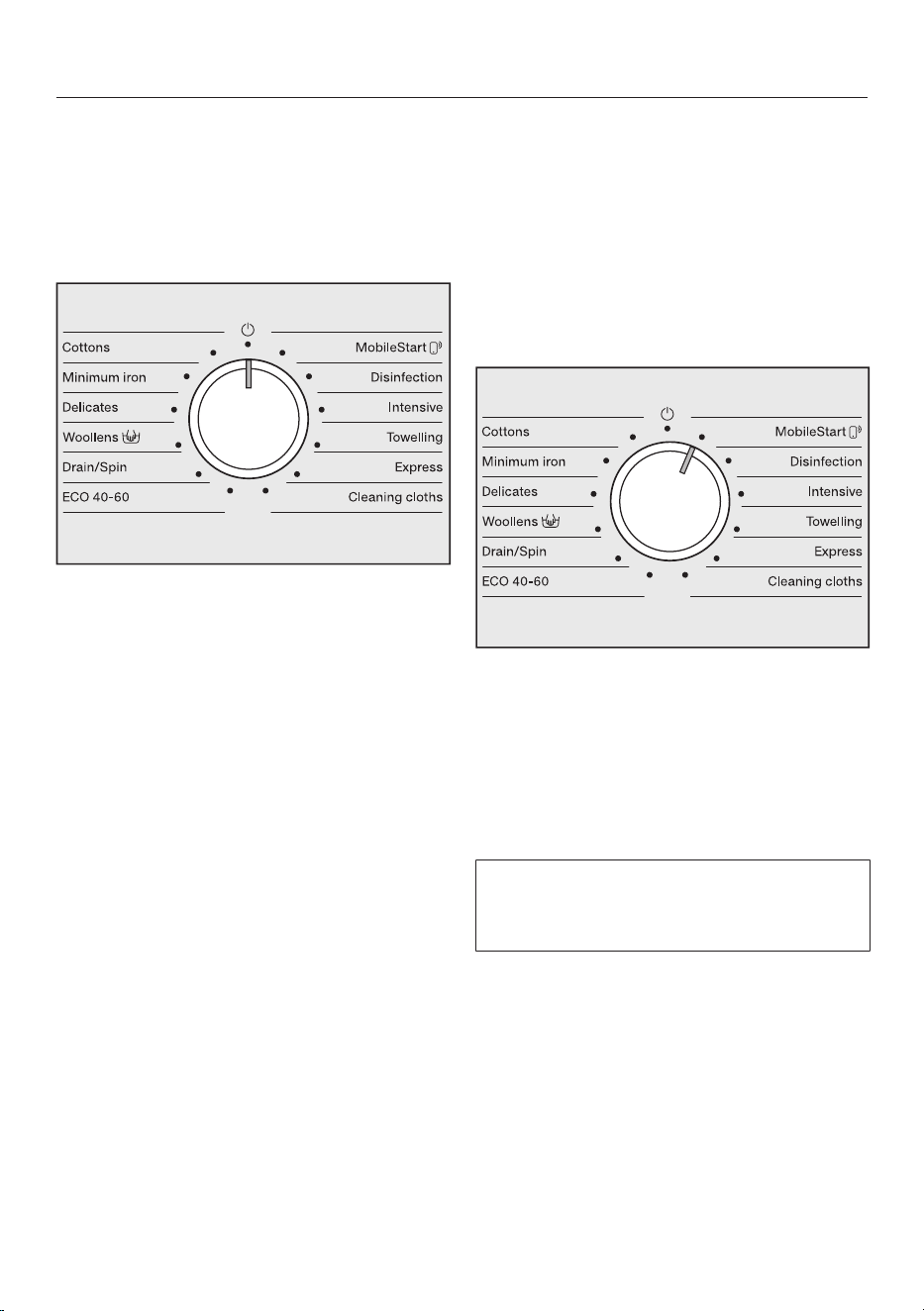
1. Selecting wash programmes
using the programme selector
The washing machine is switched on by
turning the programme selector to a
wash programme.
Turn the programme selector to the
required programme.
The likely wash time is shown in the
time display and the preset temperature
and spin speed light up on the control
panel.
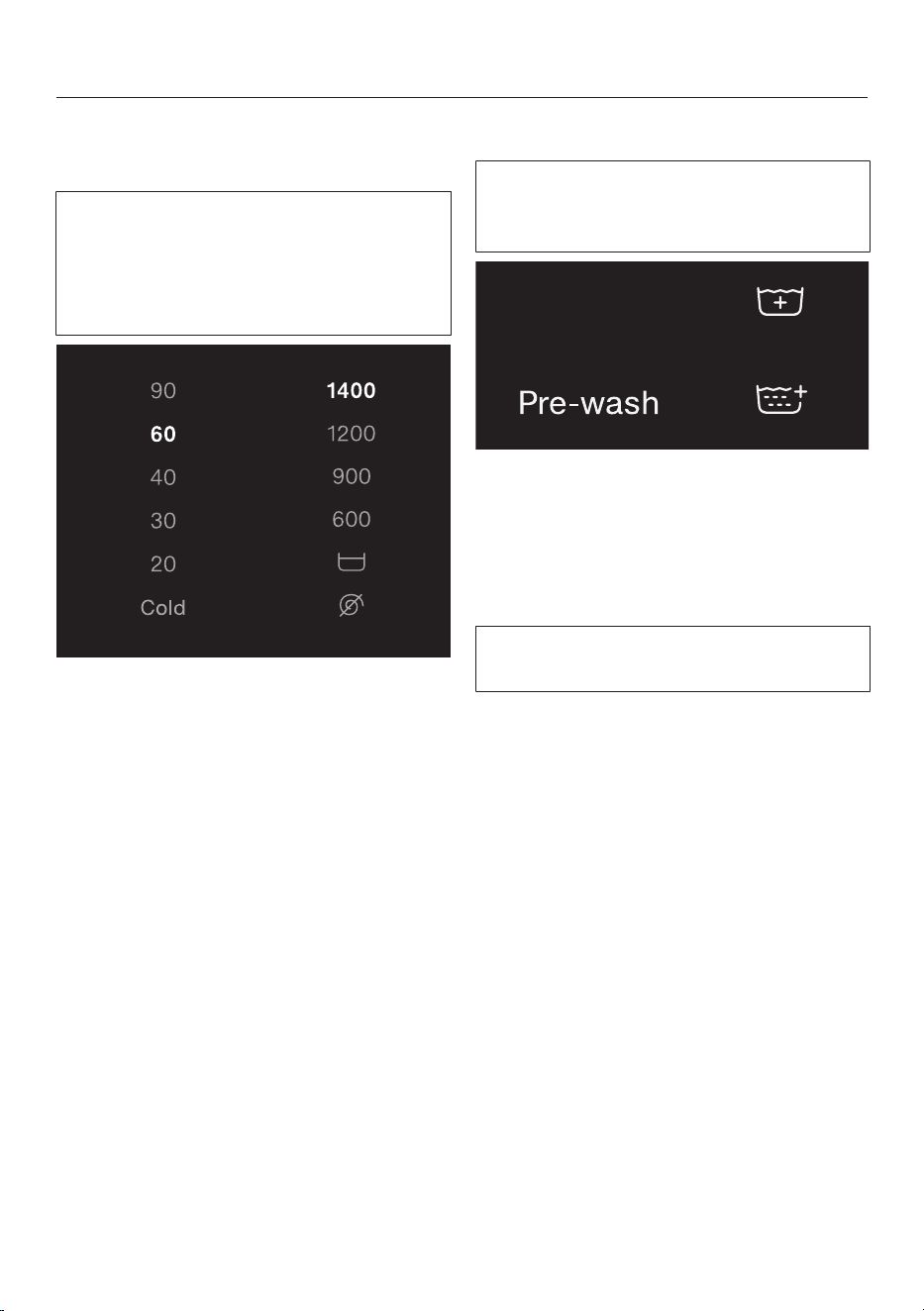
2. Selecting programmes using
the MobileStart programme
selector position and Miele
App
Useful tip: To use MobileStart, the
washing machine must be logged on to
the Wi-Fi network and Remote control
must be switched on.
Turn the programme selector to the
MobileStart position.
appears in the time display.
Once the programme has started, the
washing machine can be operated with
the Miele App.
You must touch the Start/Add laundry
sensor to enable operation via the
Miele App.
3. Selecting the programme and settings
25
Selecting the temperature and
spin speed
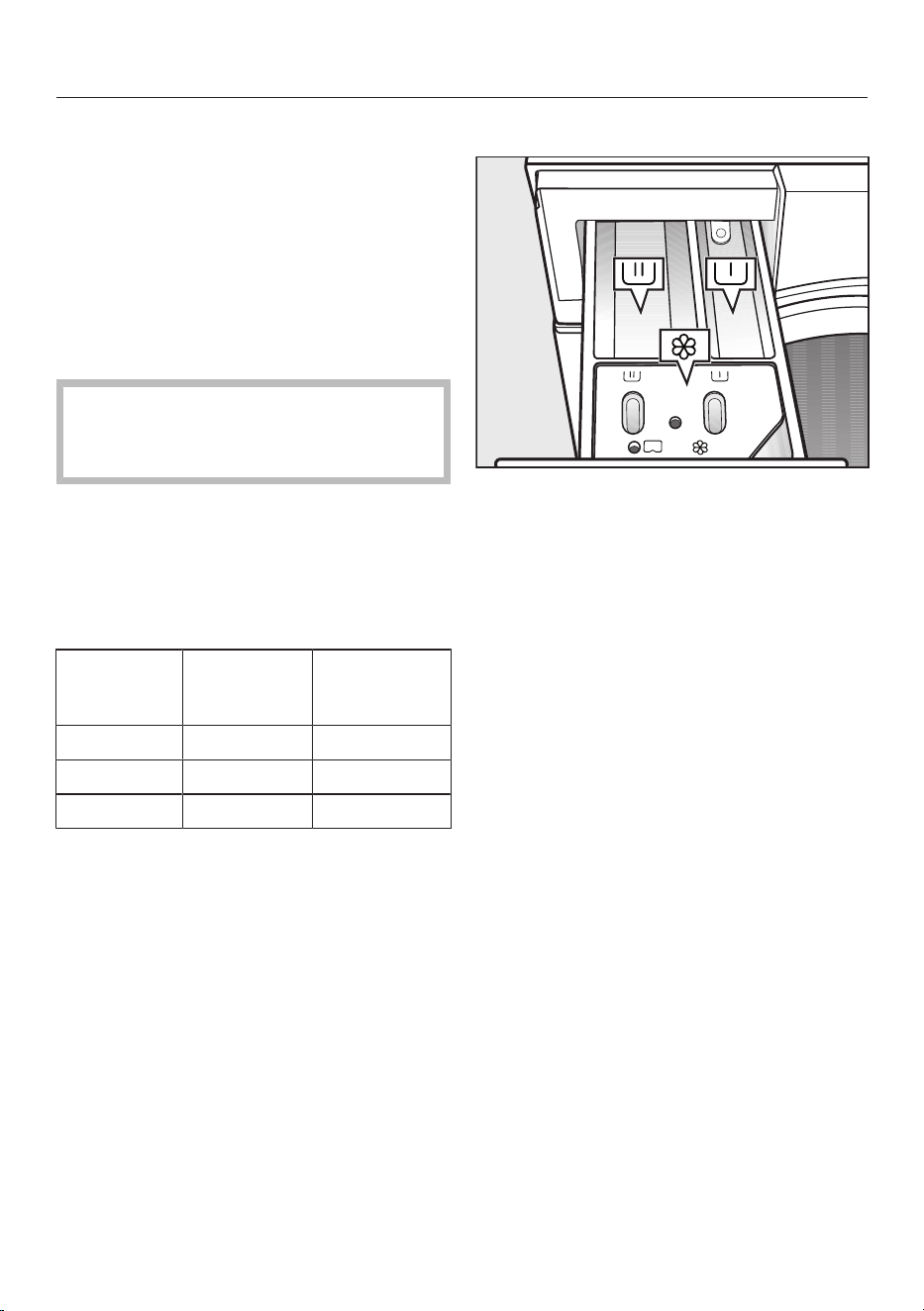
The wash programme's pre-set
temperature and spin speed light up
brightly. The choice of temperatures
and spin speeds selectable for the
wash programme light up dimly.
Touch the sensor for the temperature
you want.
The sensor lights up brightly.
Touch the sensor for the spin speed
you want.
The sensor lights up brightly.
Selecting Extras
If an Extra can be selected for the
wash programme, the sensor for the
Extra lights up dimly.
Touch the sensor for the Extra you
want.
The sensor lights up brightly.
You can select multiple Extras for a
wash programme.
Please refer to “Extras” for more
information.
4. Adding detergent
26
Detergent dispenser drawer
Any detergent suitable for automatic
front loading washing machines can be
used with this appliance.
Detergent dispensing
Please follow the detergent
manufacturer's instructions in relation
to dosage.
Adding too much detergent will lead
to excessive foaming.
Avoid adding excess detergent.
The amount to dispense will depend on:
- the amount of laundry
- the degree of soiling of the laundry
- the water hardness
Water
hardness
range
Hardness in
mmol/l
German scale
°dH
soft (I) 0-1.5 0-8.4
medium (II) 1.5-2.5 8.4-14
hard (III) above 2.5 above 14
Check with your local water supplier if
you do not know the water hardness in
your area.
Adding detergent
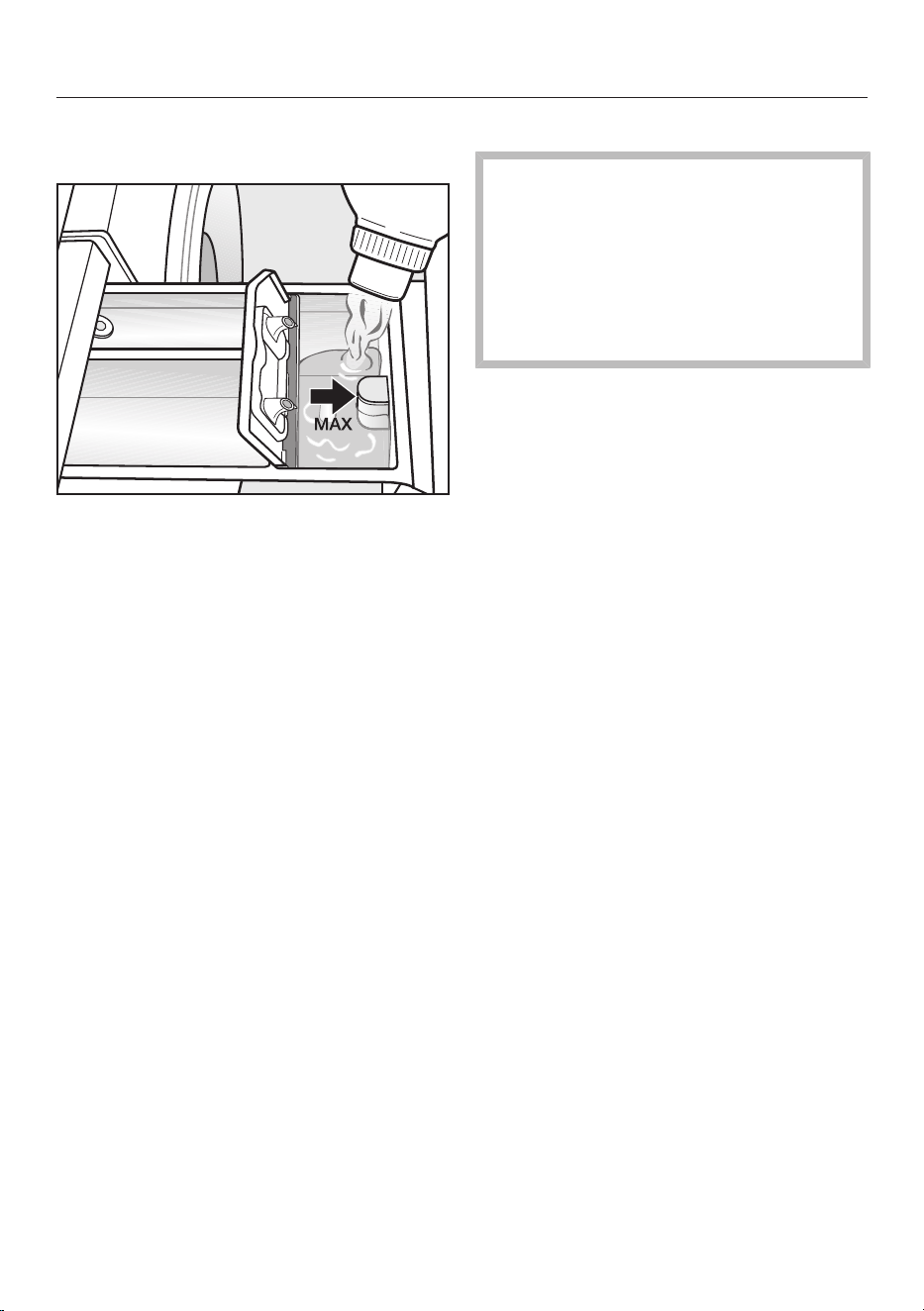
Pull out the detergent dispenser
drawer and add detergent to the
compartments.
Detergent for the pre-wash
(divide the total recommended
amount as follows: ⅓ to
compartment and ⅔ to
compartment )
Detergent for the main wash
Fabric softener or liquid starch
4. Adding detergent
27
Automatic dispensing of fabric
softener or liquid starch
Add the fabric softener or the liquid
starch to the compartment. Do not
exceed the maximum level mark.
This will be automatically dispensed in
the final rinse. At the end of the wash
programme a small amount of water
remains in the compartment.
Useful tip: If starching frequently,
thoroughly clean the dispenser
compartment, especially the siphon
tube, regularly.
Dye removers and dyes
Damage due to colour run/dye
removers.
Colour run and dye removers can
cause corrosion in the washing
machine.
Do not use colour run or dye
removers in this washing machine.
Only use dyes suitable for use in a
washing machine. The manufacturer's
instructions on the packaging must be
observed.

5. Starting the programme - the end of the programme
28
Starting a programme
Touch the flashing Start/Add laundry
sensor.
The door will lock and the programme
will start.
- When the symbol lights up
constantly, the door is locked until
the end of the programme.
If a Delay start time has been selected,
this counts down in the time display. At
the end of the Delay start period or
immediately after the programme has
started, the programme running time
will appear the time display.
Energy savings
After 10 minutes, the indicators will dim.
The Start/Add laundry sensor flashes
slowly.
You can reactivate the indicators:
Touch the Start/Add laundry sensor
(this does not have any effect on a
programme that is running).
At the end of the programme
The door remains locked during the
Anti-crease phase. The control panel
lights up for the first 10minutes. The
control panel then goes out and
theStart/Add laundry sensor flashes.
Turn the programme selector to the
position.
The door will unlock.
Useful tip: After the Anti-crease phase,
the door will unlock automatically.
Pull open the door.
Remove the laundry.
Items left in the drum could discolour
other items in the next wash or
become discoloured themselves.
Remove all items from the drum.
Check the door sealing ring for any
foreign objects.
Useful tip: For safety reasons, close the
door when the machine is not in use.
Otherwise there is a danger of objects
being placed inadvertently in the drum.
If these remain unnoticed and were
washed in the next load, they could
damage the laundry. An open door is
also a danger to pets and children.
Useful tip: Leave the detergent
dispenser drawer slightly open to allow
it to dry.
Delay start/SmartStart
29
Selecting Delay start
Delay start cannot be selected in the
Drain/Spin programme.
Select the required programme.
Touch the sensor.
The sensor lights up brightly.
Touch the or sensor repeatedly
until the required Delay start time
appears in the time display.
- For less than 10 hours, the Delay
start time changes in increments of
30 minutes.
- For more than 10 hours, the Delay
start time changes in increments of 1
hour.
Starting Delay start
Touch the flashing Start/Add laundry
sensor.
The Delay start process starts and
counts down in the time display.
The symbol will flash.
Altering Delay start
Touch the Start/Add laundry sensor
until the door unlocks and the
symbol goes out.
The Delay start process stops.
Touch the or sensor repeatedly
until the required Delay start time
appears in the time display.
Touch the flashing Start/Add laundry
sensor.
Cancelling Delay start
Touch the Start/Add laundry sensor
until the door unlocks and the
symbol goes out.
The Delay start process stops.
Touch the brightly lit sensor.
The Delay start time is deleted. The
programme duration appears in the
time display.
Touch the flashing Start/Add laundry
sensor in order to start the wash
programme.

Delay start/SmartStart
30
SmartStart
You can set your washing machine to
start automatically based on an
external signal within a certain time
period.
This function is active when the
SmartGrid programmable function is
switched on.
The timeframe can be defined between
30minutes and 24hours. The washing
machine will then start within the time
period specified by you when it receives
an external signal. If it has not received
an external signal by the latest start
time set, the washing machine will start
automatically.
Setting the timeframe
If the SmartGrid programmable
function is activated, the function of
the sensor changes. The time
display no longer shows the Delay
start period, and instead shows the
time period in which your washing
machine can be started automatically
(see “Programmable functions -
SmartGrid”).
The procedure for setting this is the
same as for setting the time for Delay
start.
Touch the sensor.
Set the time period you want using
the or sensor.
Touch the Start/Add laundry sensor.
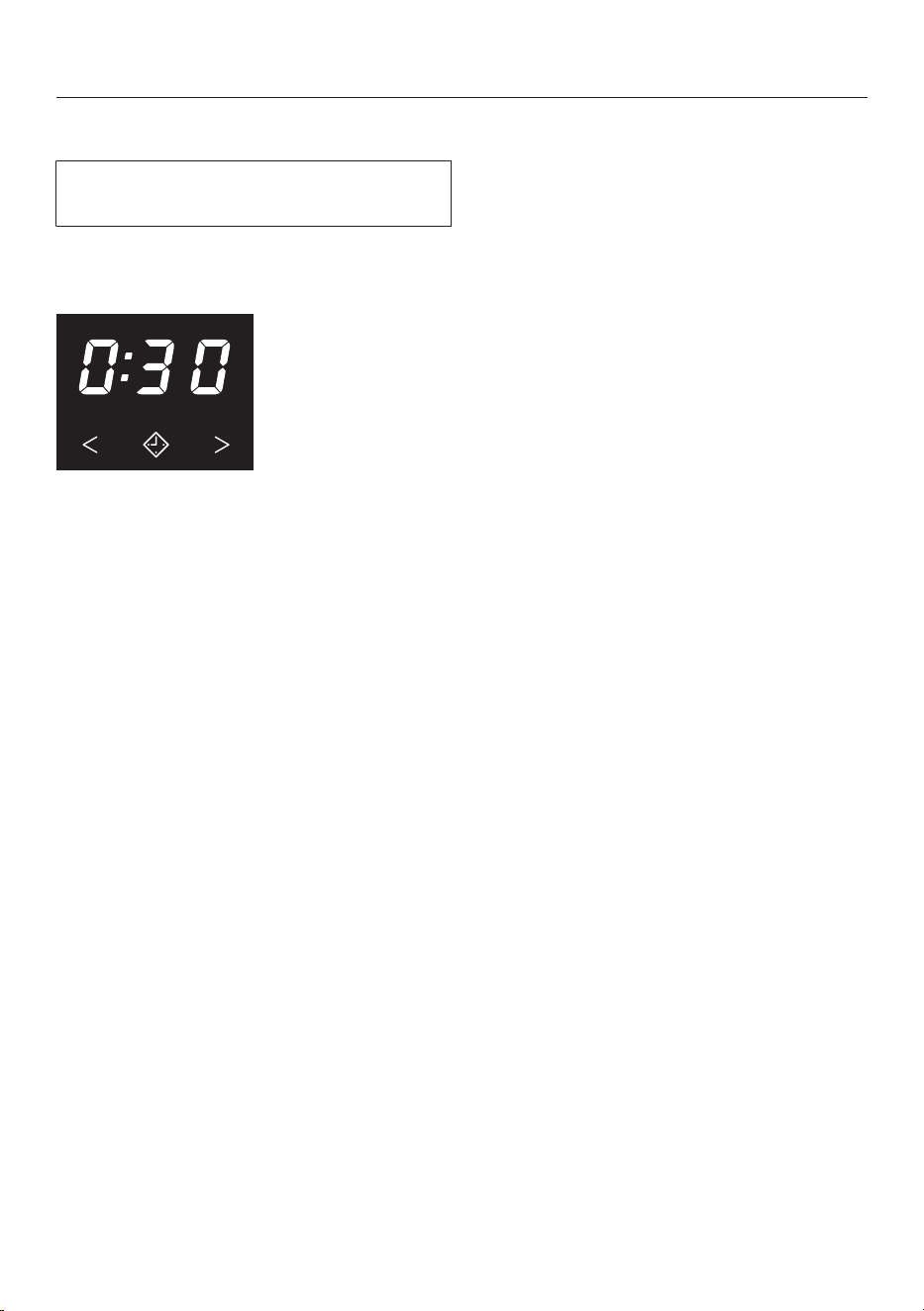
appears in the time display.
Programme chart
31
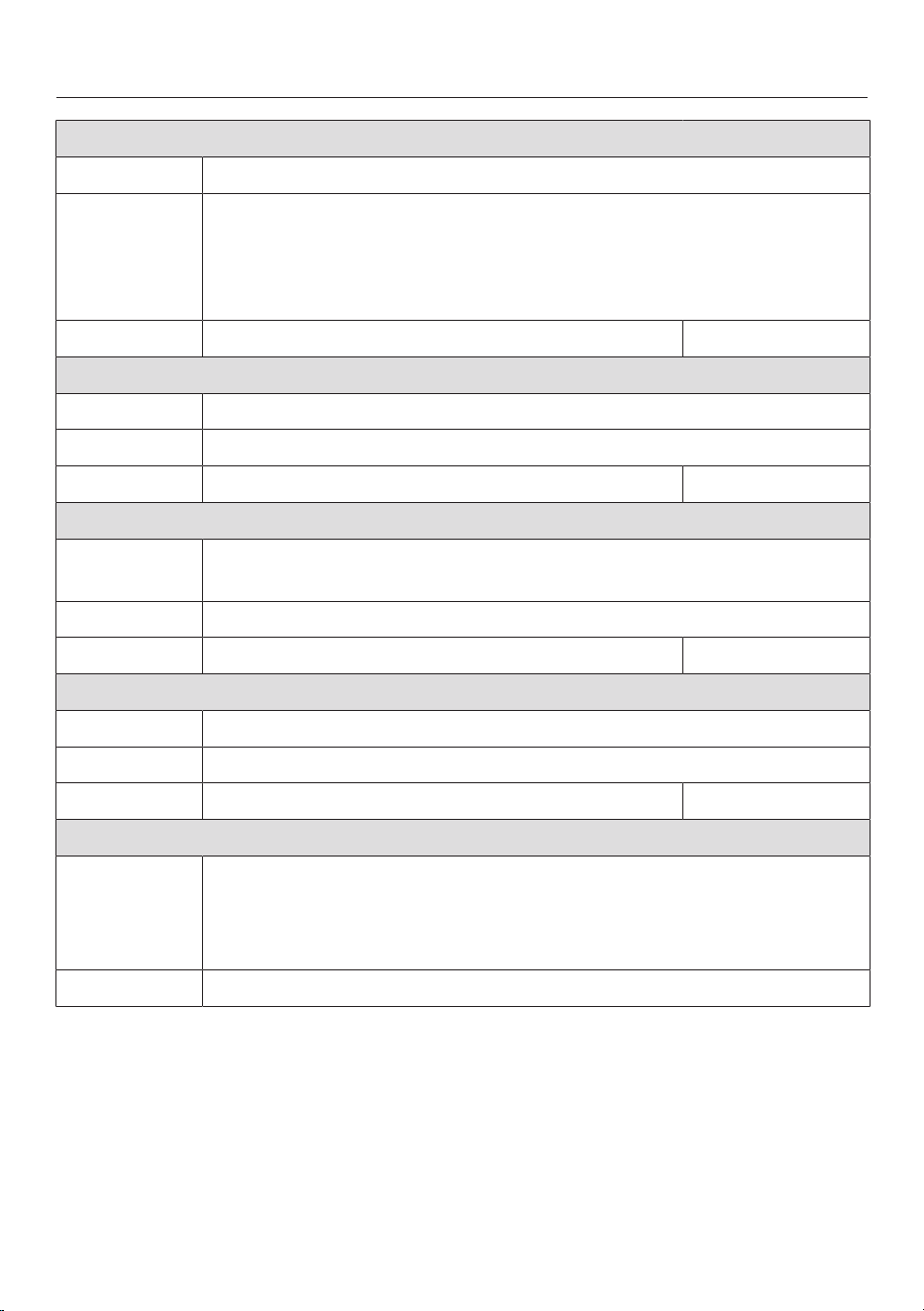
Cottons Cold to 90°C Max. load 8,0kg
Items Cotton, linen, and mixed fibre textiles
Tip - Select the temperature according to the instructions on the care
label, the detergent, the type of soiling and the hygiene
requirements.
- Use the 20°C programme for lightly soiled cotton garments.
1400 rpm Extras: Pre-wash, Water+, Rinse+ Rinse cycles: 2
Minimum iron Cold to 60°C Max. load 4,0kg
Items Synthetic, mixed fibre and easy-care cotton
Tip - Reduce the final spin speed for fabrics which crease easily.
1200 rpm Extras: Pre-wash, Water+, Rinse+ Rinse cycles: 2
Delicates Cold to 40°C Max. load 3,0kg
Items Delicate garments made from synthetic fibre, mixed fibre, rayon
and viscose.
Tip - Deselect the final spin speed for fabrics which crease easily.
600 rpm Extras: Pre-wash, Water+, Rinse+ Rinse cycles: 2
Woollens Cold to 30°C Max. load 3,0kg
Items Machine-washable woollens and woollen blends
Tip - Use detergent formulated for woollens.
1200 rpm Rinse cycles: 2
Drain/Spin Max. load 8,0kg
Tip - Select the Rinse+Extra for an additional rinse cycle.
- Make sure you select the appropriate spin speed.
- Drain only: Set spin speed to.
1400 rpm Extras: Rinse+
Programme chart
32
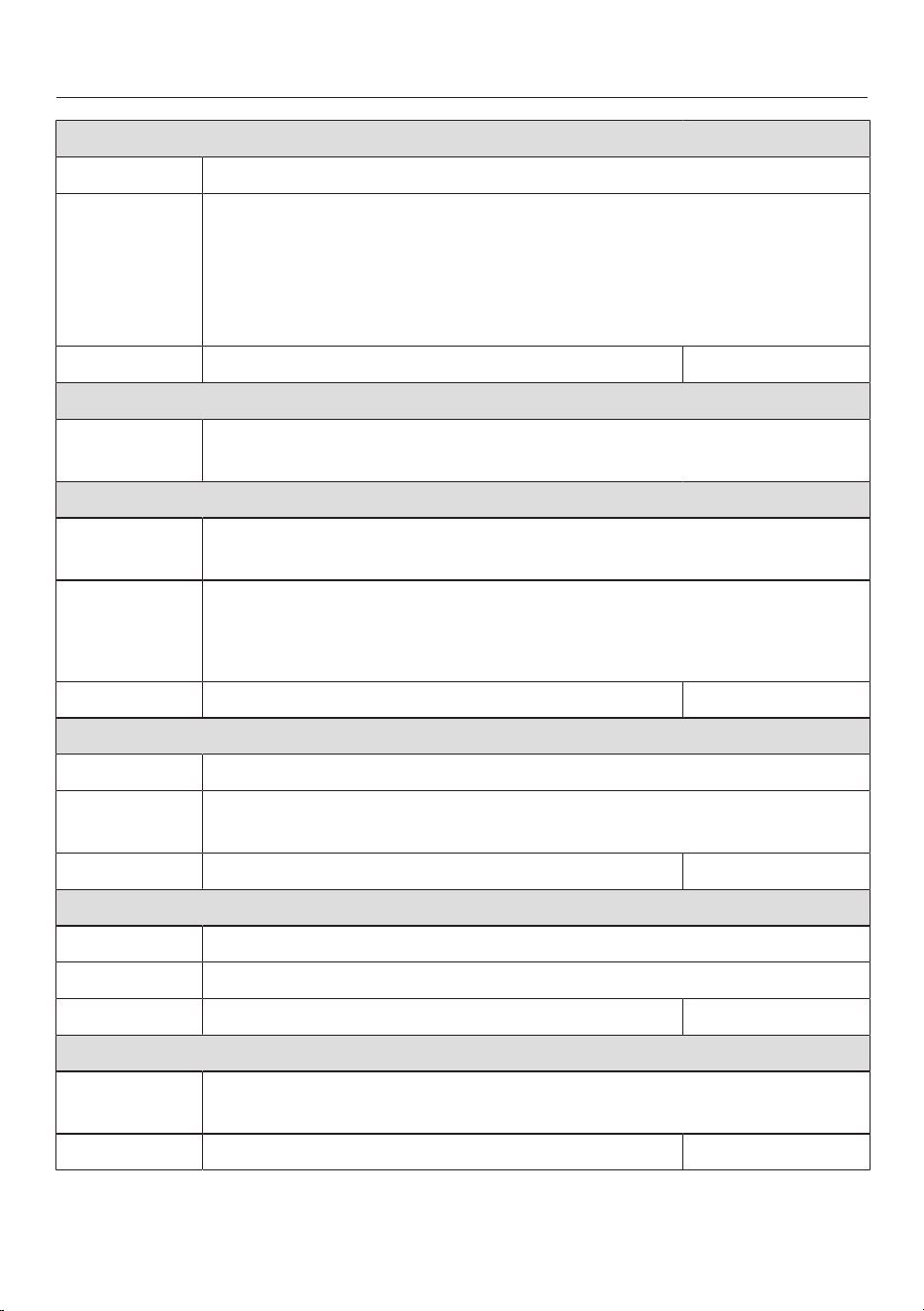
ECO40-60 Max. load 8,0kg
Items Normally soiled cotton garments
Tip - A laundry load consisting of mixed cottons that are intended for
washing at 40°C or 60°C can be washed in the same wash
cycle.
- This programme is the most efficient in terms of energy and
water consumption for washing cottons.
1400 rpm Extras: Pre-wash Rinse cycles: 2
MobileStart
Tip The Miele App is used to select programmes and operate the
appliance.
Disinfection 60°C Max. load 5.5kg
Items Cotton or mixed fibre textiles, sorted by colour, provided they are
suitable for disinfection
Tip - Chemo-thermal disinfection with a 30-minute holding time at
60°C.
- Use specialist detergents.
1400 rpm Extras: Pre-wash, Rinse+ Rinse cycles: 2
Intensive 40°C to 90°C Max. load 8,0kg
Items Heavily soiled workwear made from cotton, linen, and mixed fibres
Tip - A particularly good wash and rinse result is achieved by a high
water level.
1400 rpm Extras: Pre-wash, Rinse+ Rinse cycles: 2
Bedding and towelling 40°C to 60°C Max. load 6,0kg
Items Towels and bathrobes made from terrycloth
Tip - Use a colour detergent for dark textiles.
1400 rpm Extras: Pre-wash, Water+, Rinse+ Rinse cycles: 2
Express Cold to 40°C Max. load 3,5kg
Items Cotton garments that have hardly been worn or are only very
lightly soiled.
1400 rpm Rinse cycles: 1
Programme chart
33
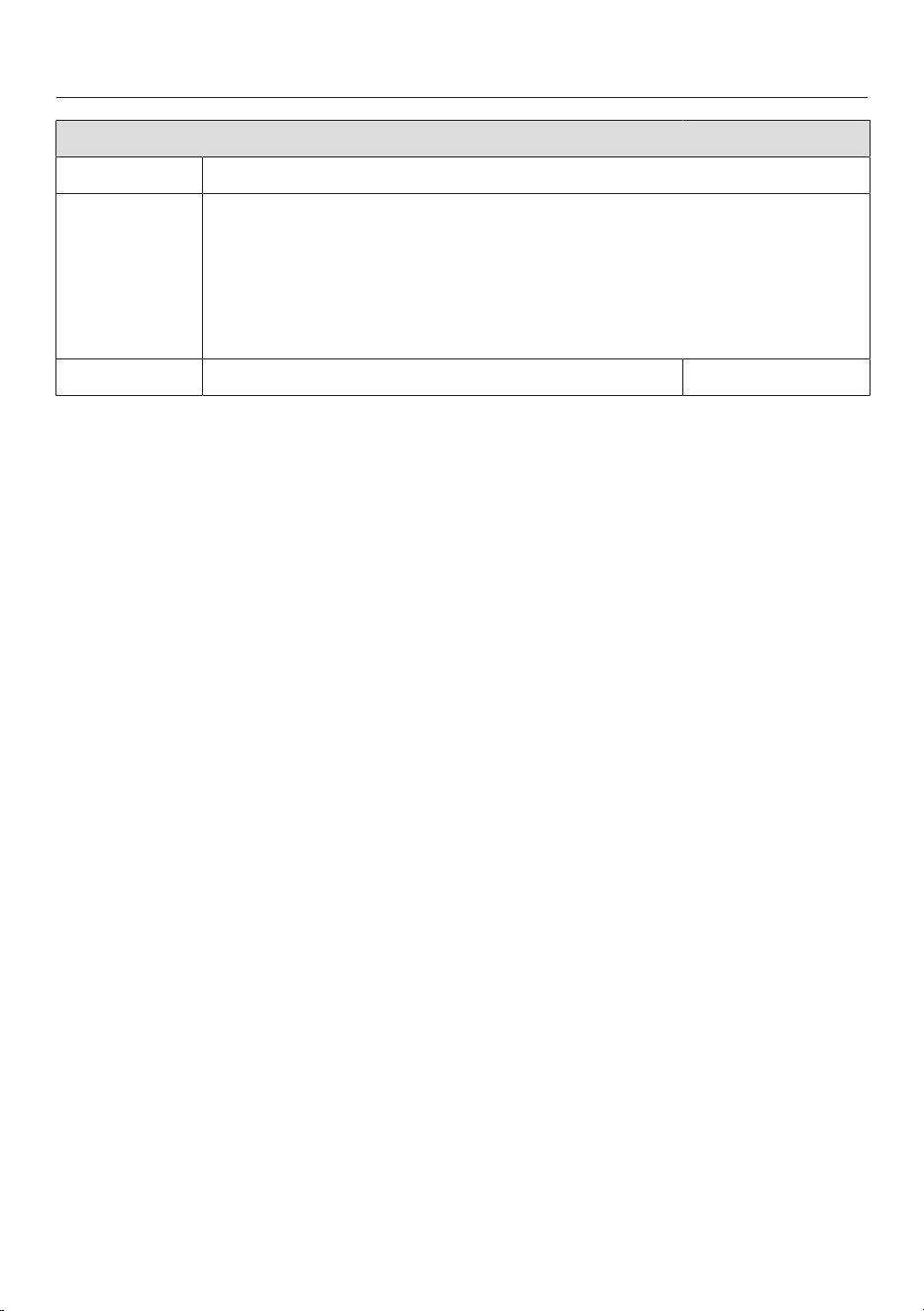
Mops & cloths 40°C to 90°C Max. load 4,0kg
Items Mops or cloths made from cotton, mixed fibre or microfibre
Tip - The programme is designed for washing mops and cleaning
cloths.
- Use specialist detergents.
- A pre-spin and a pre-rinse cycle are carried out before the main
wash.
1400 rpm Rinse cycles: 2
Extras
34
You can supplement the wash
programmes with Extras.
Selecting Extras
Extras are selected and deselected
using the sensors on the control panel.
Touch the sensor for the Extra you
want.
The relevant sensor will light up brightly.
Not all Extras can be selected with
every programme.
If the sensor lighting is switched off, this
means the Extra cannot be selected.
The Extra cannot be activated by touch.
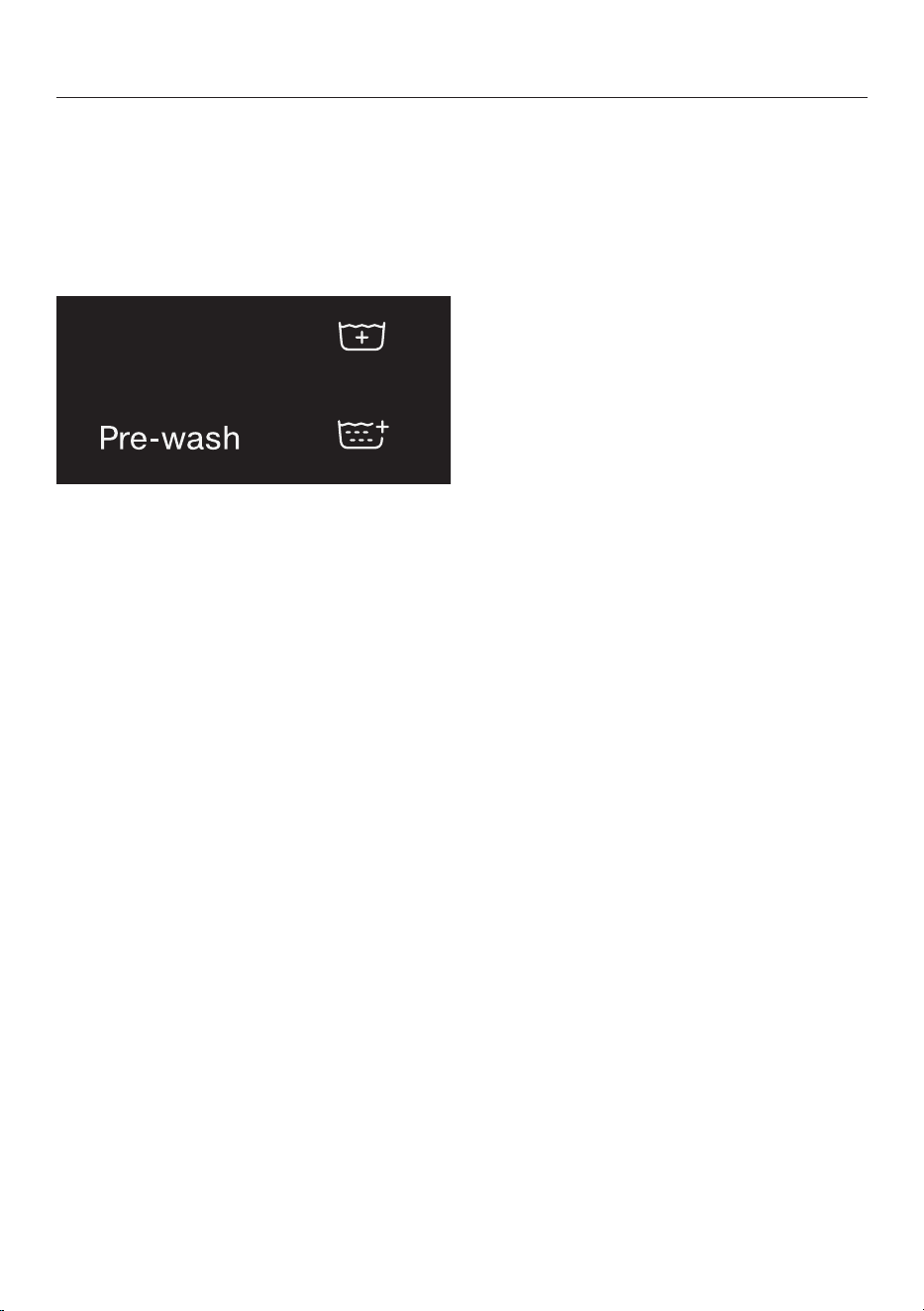
Pre-wash
A pre-wash can be added for heavily
soiled laundry. Coarse soiling is
loosened and removed before the main
wash.
Water+
The water level in the main wash and
the rinse cycles is increased.
Rinse+
An extra rinse can be activated to
achieve a better wash result.

Special features in the programme sequence
35
Spinning
Final spin speed
When a programme is selected, the
maximum spin speed for this wash
programme is shown in the display.
You can reduce the final spin speed.
However, you cannot select a final spin
speed higher than that shown in the
chart.
Interim spin
There is a spin cycle after the main
wash and between the rinses. A
reduction in the final spin speed will
also reduce the interim spin speed
accordingly.
Deselecting the interim spin and the
final spin
Touch the sensor.
After the last rinse cycle, the water will
be pumped away and the anti-crease
phase will switch on.
Omitting the final spin (Rinse hold)
Touch the sensor (Rinse hold).
The laundry is not spun after the final
rinse and remains in the rinse water.
This helps prevent creasing if the
laundry is not going to be removed from
the drum immediately after the end of
the programme.
Starting the final spin after Rinse
hold.
The sensor for the optimum spin speed
lights up on the control panel. You can
change the spin speed. The Start/Add
laundry sensor flashes slowly.
Touch the flashing Start/Add laundry
sensor.
The final spin is carried out.
Ending the programme after Rinse
hold
Reduce the spin speed to .
Touch the Start/Add laundry sensor.
The suds will be pumped away. The
programme is finished.
Anti-crease
At the end of the programme, the drum
continues to turn at intervals for up to
30minutes to help prevent creasing.
The door can be opened at any time
during the anti-crease phase.
There is no anti-crease phase at the
end of some programmes.

Changing the programme sequence
36
Changing a programme
After the start of a programme, it is no
longer possible to select a different
programme.
You will need to cancel the current
programme before you can select a
different one.
If the programme selector is moved,
will appear in the display. Turn the
programme selector back to the
original position.
If the washing machine is switched off
during active programme operation,
the standby function does not switch
the washing machine off completely
after 15minutes. Safety functions
continue to be active because there
may still be water inside the drum.
Cancelling a programme
You can cancel a programme at any
time after it has started.
Turn the programme selector to the
position.
Turn the programme selector to any
position.
Rotating bars ... ... or
are shown in the time display.
The water is pumped away and the
door lock is released.
Selecting a new programme
Turn the programme selector to the
required programme.
Check that there is still detergent in
the dispenser drawer. Add more
detergent if necessary.
Touch the Start/Add laundry sensor.
Adding or removing laundry
Laundry can be added or removed at
any time, provided that the symbol
is not illuminated in the control panel.
Touch the Start/Add laundry sensor.
Rotating bars ...... are
shown in the time display.
If the word appears in the time
display, the door can be opened.
Open the door.
Add or remove laundry.
Close the door.
Touch the Start/Add laundry sensor.
The wash programme will continue.
Detergent
37
The correct detergent
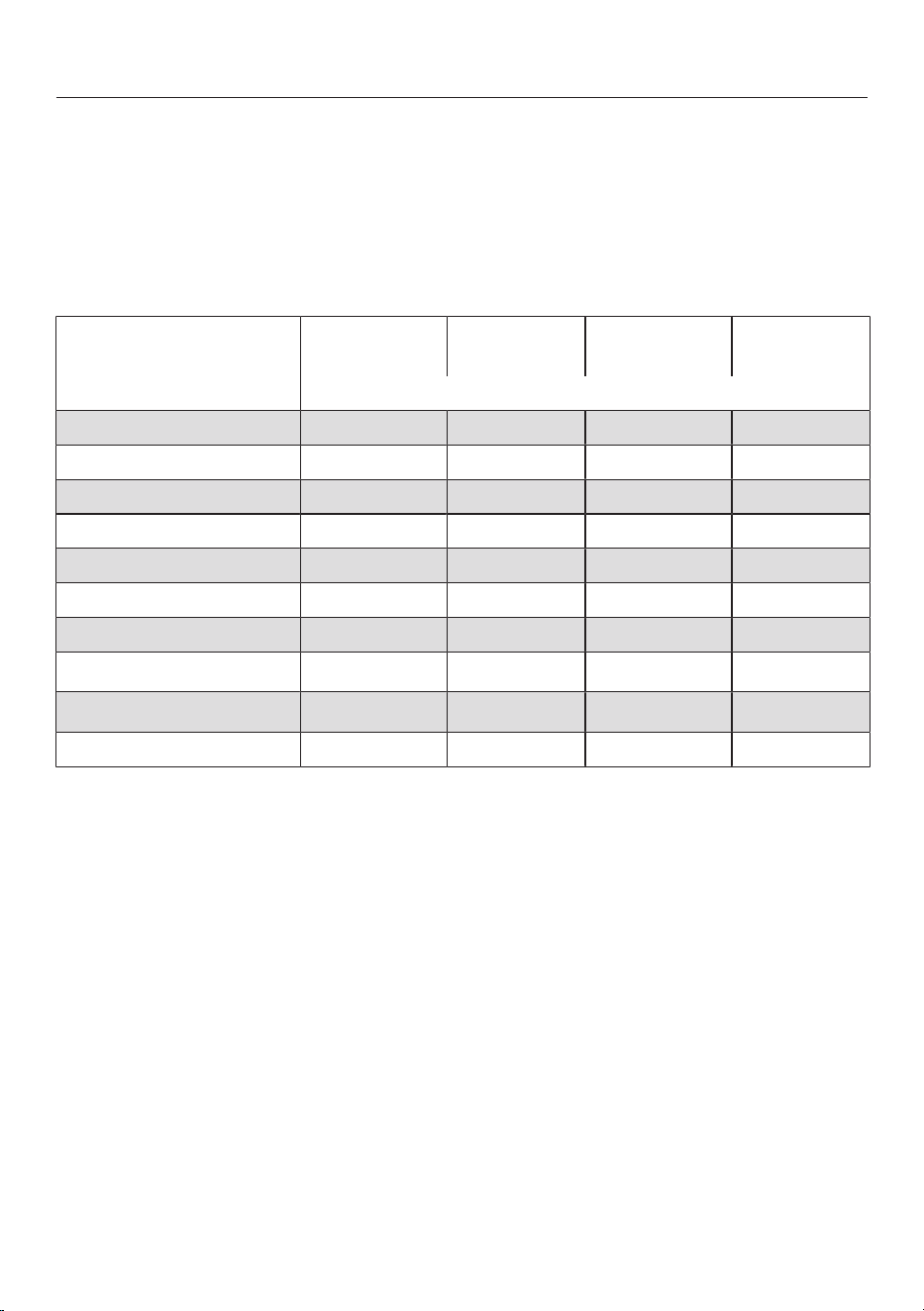
Any detergent suitable for automatic front loading washing machines can be used
with this appliance. Follow the manufacturer's instructions and dosage
recommendations on the packaging.
The recommendations apply to the temperature ranges given in the Programme
chart.
Universal Colour Delicates and
woollens
Special
Detergent
Cottons – –
Minimum iron – – –
Delicates – – –
Woollens – –
ECO40-60 – –
Mops & cloths – – –
Intensive – –
Bedding and towelling
1
– –
Express –
1
– –
Mops & cloths – – –
Recommended
– not recommended
1
Liquid detergent
Cleaning and care
38
Risk of electric shock!
Only ever perform cleaning and
maintenance work when the
appliance is disconnected from the
power.
Disconnect the washing machine
from the mains electricity supply.
Cleaning the external casing
and fascia panel
Damage caused by cleaning
agents.
Solvent based cleaning agents,
abrasive cleaners, glass cleaners or
multi-purpose cleaning agents can
cause damage to plastic surfaces
and other parts.
Do not use any of these cleaning
agents.
Risk of damage due to ingress of
water.
The pressure of a water jet can
cause water to get into the washing
machine, resulting in damage to
components.
Do not spray the washing machine
with a water jet.
Clean the casing and control panel
with a mild cleaning agent or soap
and water and dry both with a soft
cloth.
The drum and other stainless steel
parts can be cleaned using a suitable
stainless steel cleaning agent.
Cleaning the detergent
dispenser drawer
Washing at low temperatures and the
use of liquid detergent can lead to a
build-up of mould and bacteria in the
detergent dispenser drawer.
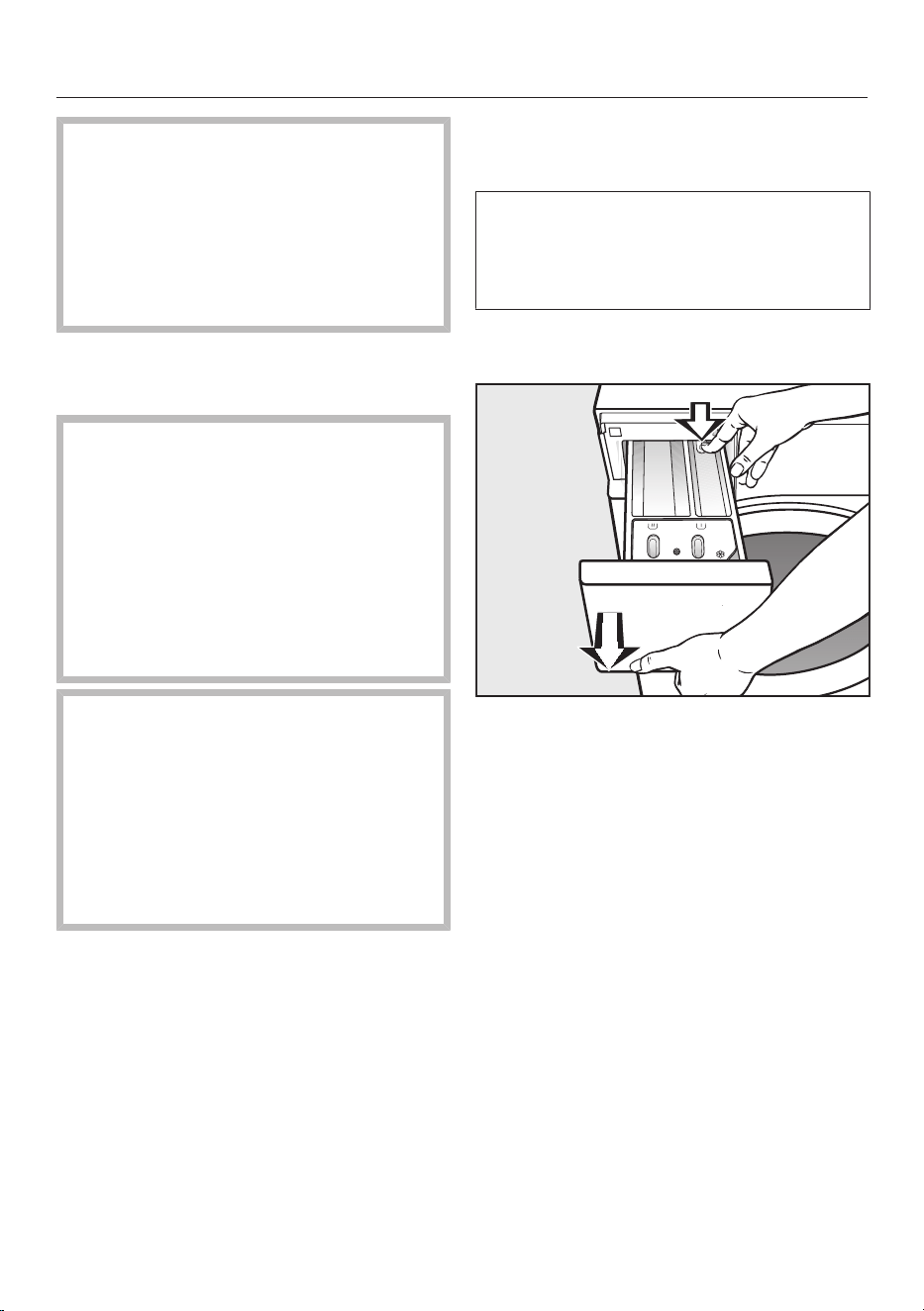
For hygiene reasons, clean the entire
drawer at regular intervals.
Pull out the detergent dispenser
drawer until a resistance is felt. Press
down the release button and at the
same time pull the drawer right out of
the machine.
Clean the detergent dispenser drawer
with warm water.
Cleaning and care
39
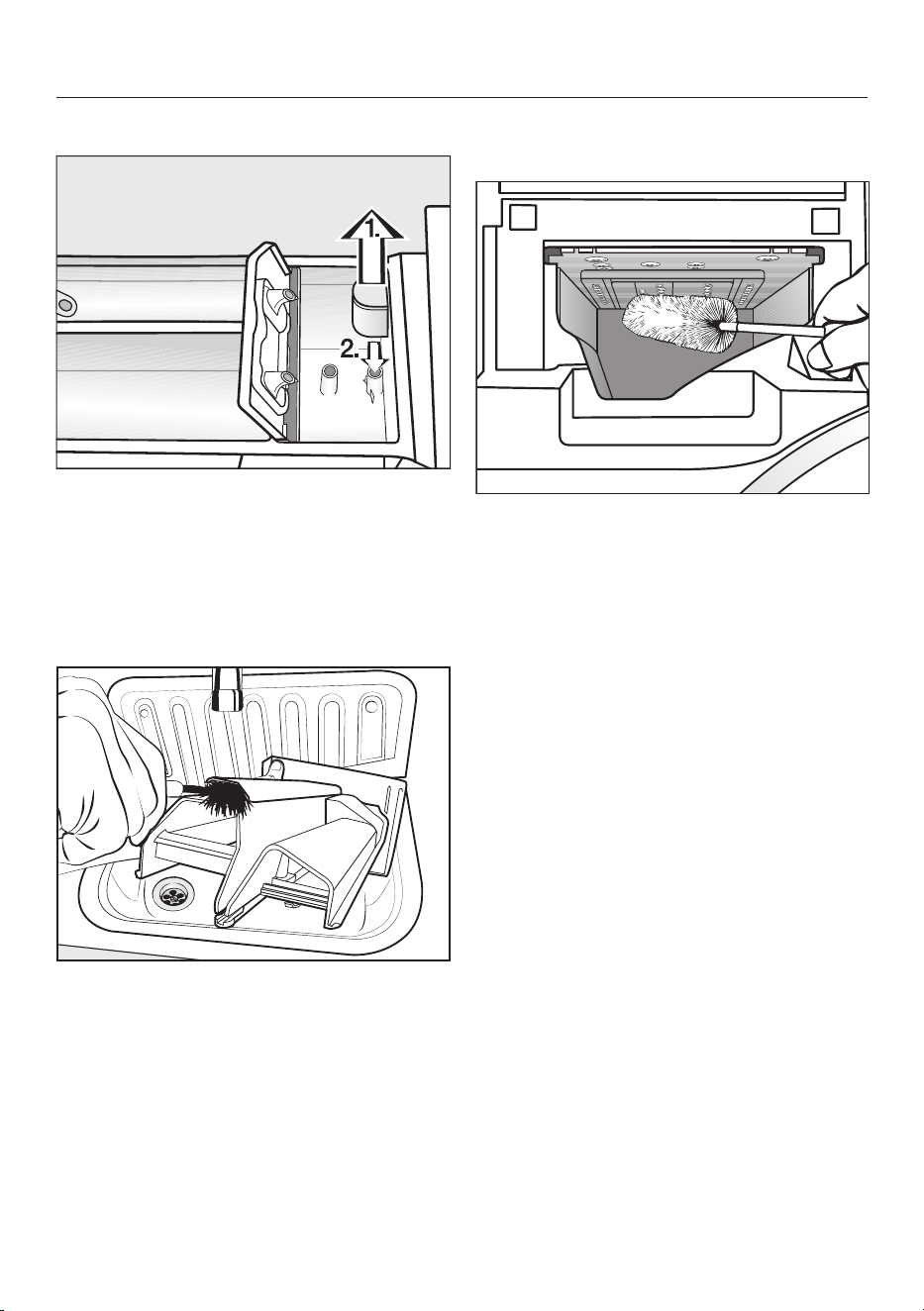
Cleaning the siphon and the channel
Pull the siphon out of the
compartment.
Clean the siphon under warm running
water. Clean the siphon tube in the
same way.
Refit the siphon.
Clean the fabric softener channel
using a brush and warm water.
Cleaning the detergent dispenser
drawer housing
Use a bottle brush to remove
detergent residues and limescale
from the jets inside the detergent
dispenser drawer housing.
Replace the detergent dispenser
drawer.
Useful tip: Leave the detergent
dispenser drawer slightly open to allow
it to dry.
Cleaning and care
40
Cleaning the drum, suds
container and drainage system
By using wash programmes of 60°C or
more on a regular basis and using a
multi-purpose detergent, you can
avoid the build-up of bacteria in the
washing machine.
The drum, suds container, and drainage
system can be cleaned whenever the
indicator light lights up or when
required.
Optimum results can be achieved by
using a machine cleaner. Alternatively, a
multi-purpose powder detergent can be
used.
Start the Cottons 90°C programme
without a load.
Dispense the machine cleaner or
multi-purpose detergent directly into
the drum.
Do not load any laundry. The drum
must be empty for the cleaning
process.
At the end of the programme, check
the inner drum and remove any
coarse residues.
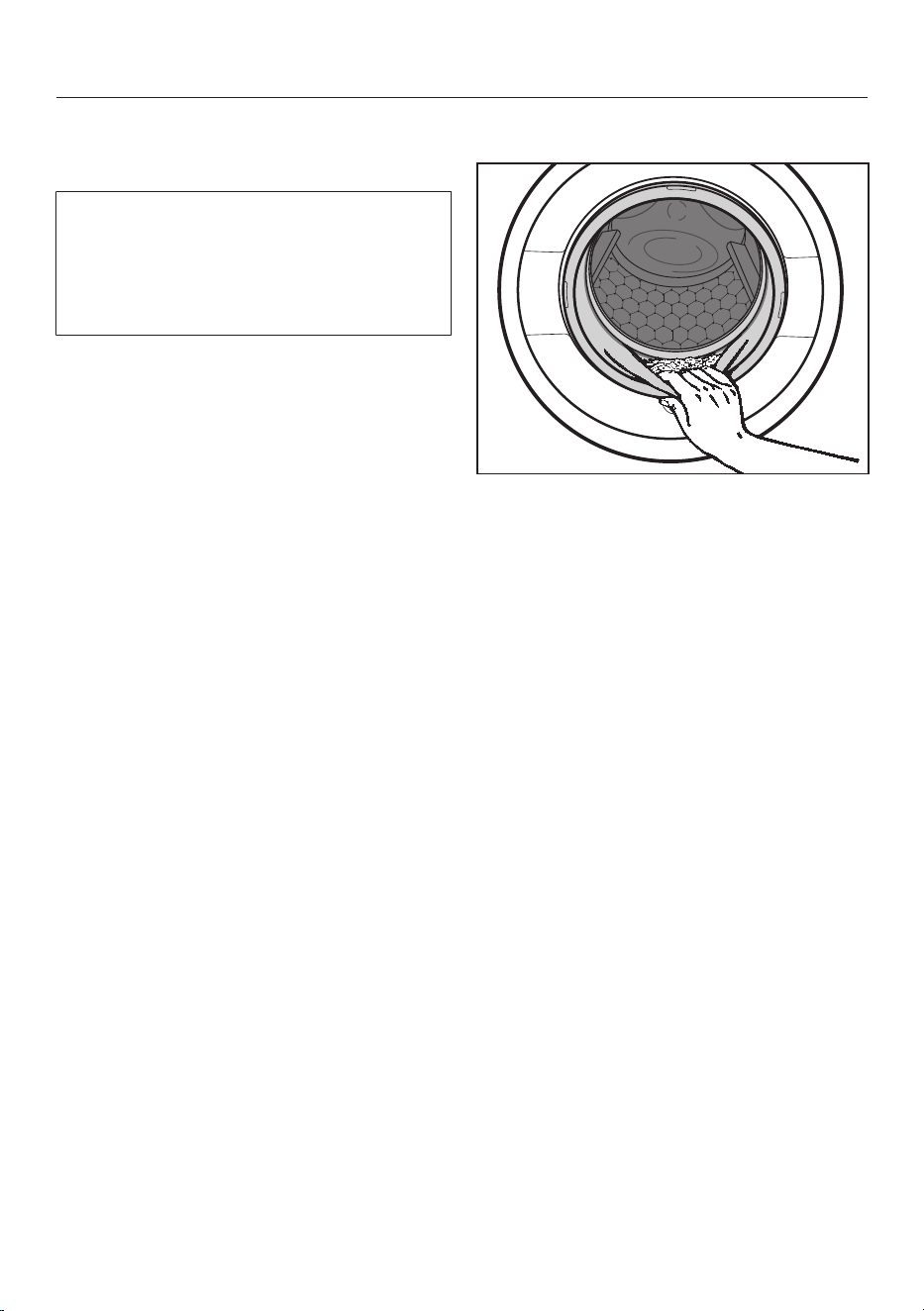
Cleaning the sealing ring
Check the fold in the sealing ring for
foreign objects.
Clean the sealing ring and the inner
fold of the sealing ring with a damp
cloth.
Useful tip: For safety reasons, close the
door when the machine is not in use.
Otherwise there is a danger of objects
being placed inadvertently in the drum.
If these remain unnoticed and were
washed in the next load, they could
damage the laundry. An open door is
also a danger to pets and children.
Cleaning and care
41
Cleaning the filters in the water
inlet
The washing machine has filters to
protect the water inlet valves. Check
these filters about every 6 months.
Perform this check more often if there
are frequent interruptions to the external
water supply.
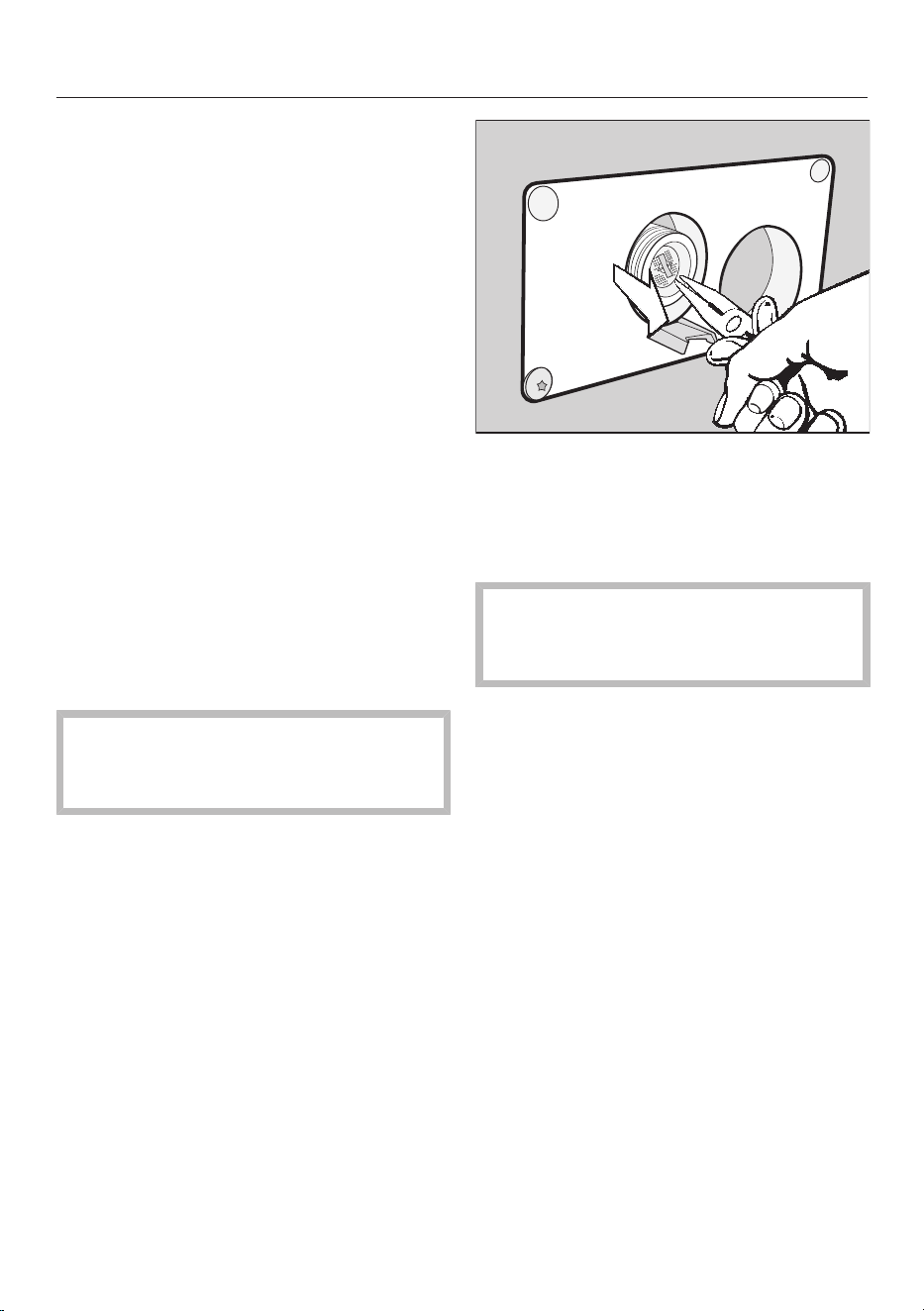
Cleaning the filter in the inlet hose
First turn off the tap.
Unscrew the inlet hose.
Remove the rubber seal from the
recess.
Using combination or pointed pliers,
take hold of the plastic filter bar and
remove it.
Clean the plastic filter.
Reassemble in reverse order.
Make sure there is no water leaking
from the threaded union.
Tighten the threaded union.
Cleaning the filter in the inlet valve
Using pliers, carefully loosen the
ribbed plastic nut on the inlet valve
and unscrew.
Use pointed pliers to withdraw the
plastic filter by the bar.
Clean the filter.
Reassemble in reverse order.
The filters protect the water inlet
valve.
Replace the filters after cleaning.
Problem solving guide
42
With the help of the following guide, minor faults in the performance of the
appliance, some of which may result from incorrect operation, can be remedied
without contacting Miele. This will save you time and money because you will not
need a service call.
Please note, however, that a call-out charge will be applied to unnecessary service
visits where the problem could have been rectified as described in these operating
instructions.
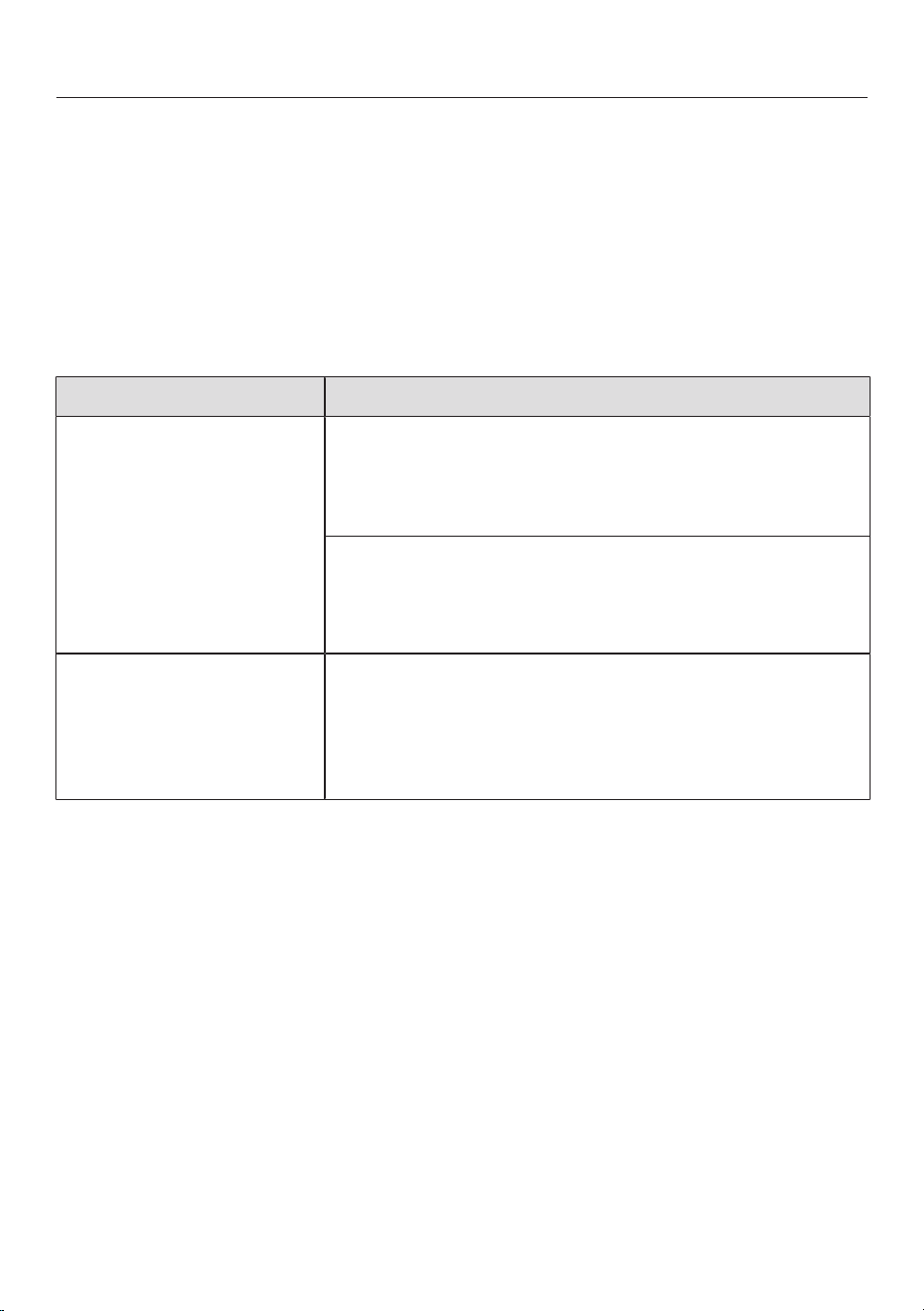
The programme does not start
Problem Possible cause and remedy
The control panel
remains dark.
There is no power to the machine.
Check whether the mains plug is plugged in and
switched on.
Check whether the circuit breaker has tripped.
The washing machine has switched off automatically
to save energy.
Switch the washing machine back on by turning
the programme selector.
and alternately
appear in the time
display.
The door is not closed properly. The door lock could
not engage.
Close the door again.
Restart the programme.
If the fault message appears again, contact Miele.
Problem solving guide
43
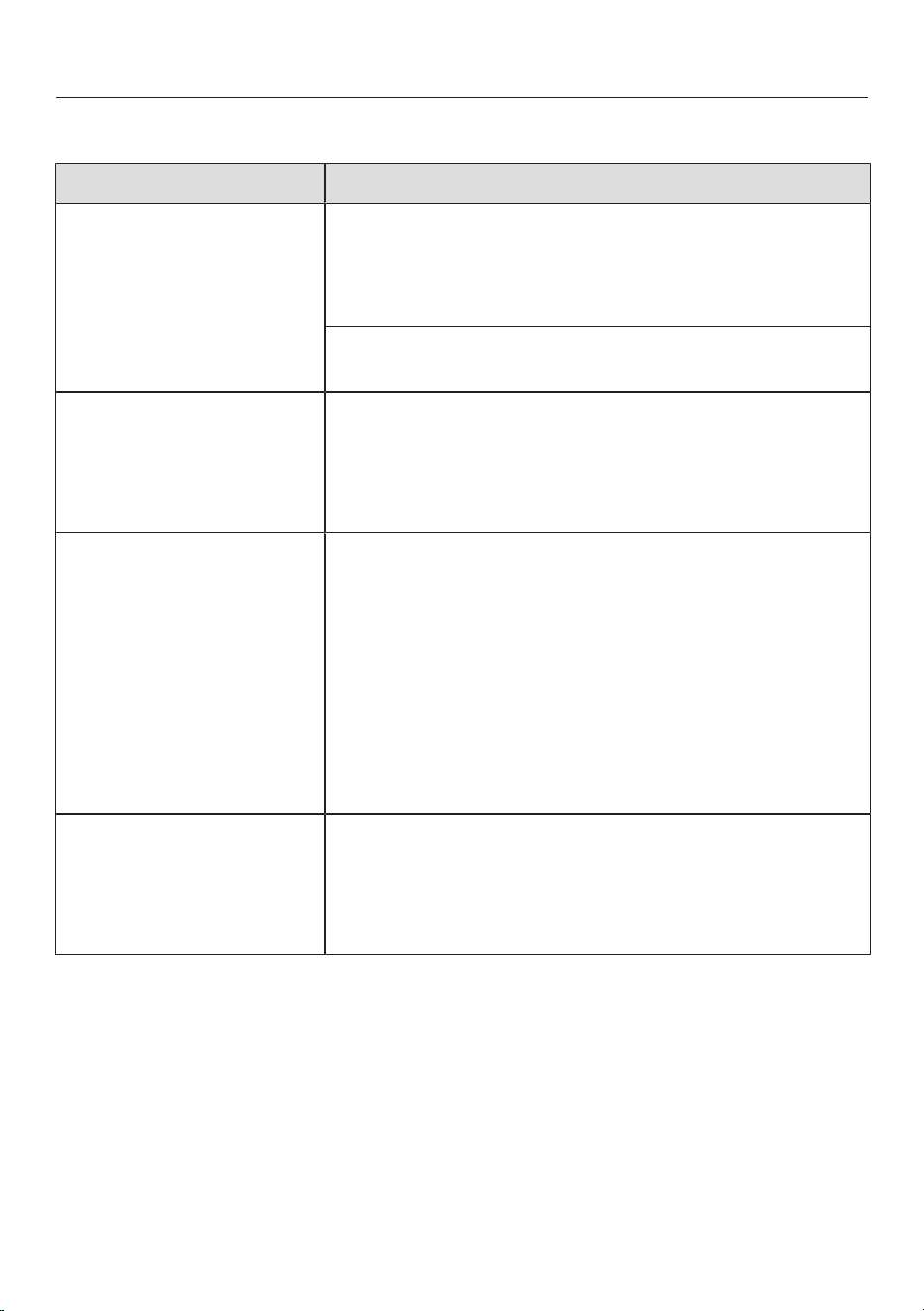
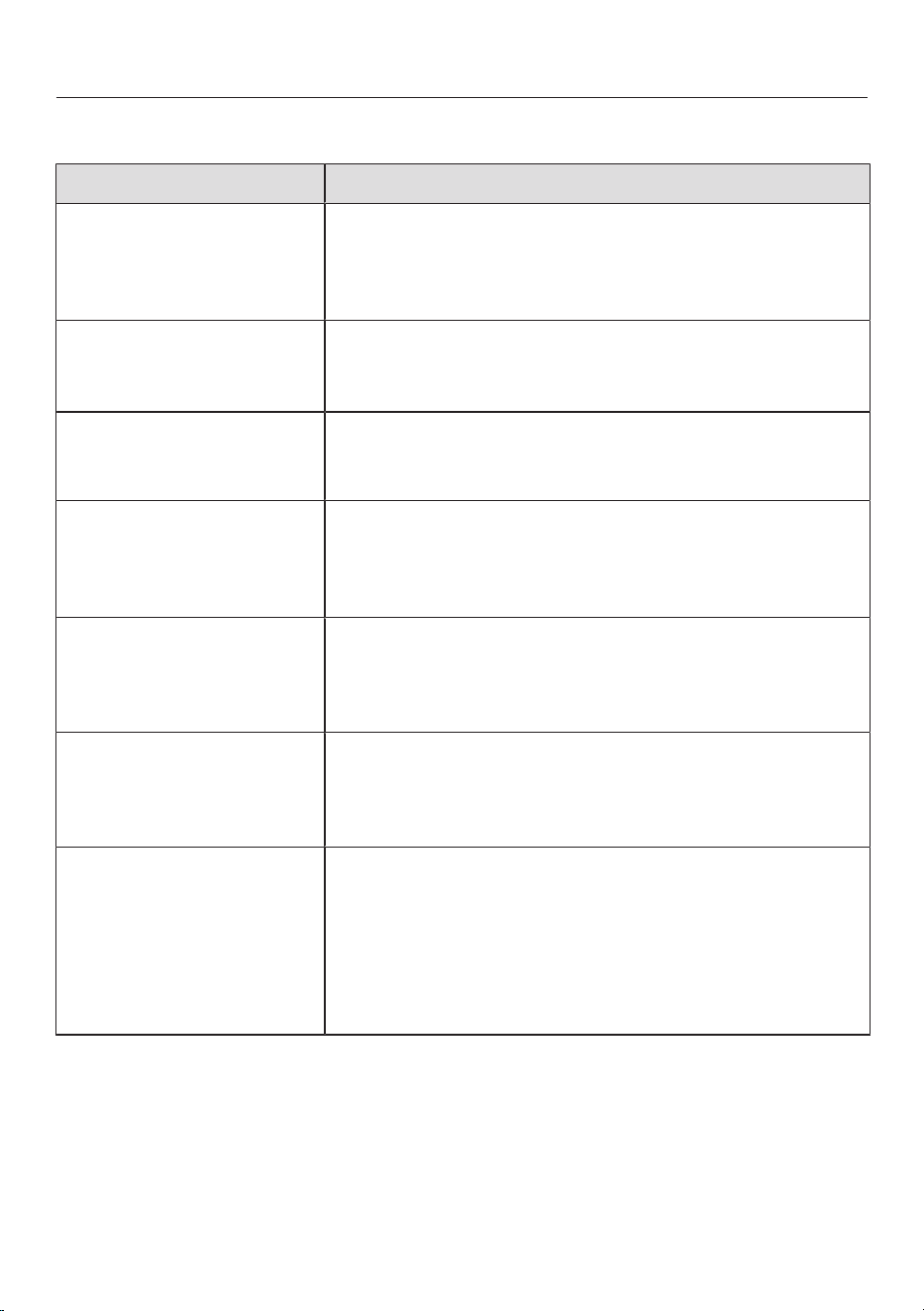
Programme cancellations and fault messages
Problem Possible cause and remedy
The fault indicator light
lights up, and
appear alternately in the
time display and the
buzzer sounds.
The water inlet is blocked or restricted.
Check whether the tap is turned on properly.
Check whether the inlet hose is kinked.
Check whether there is sufficient water pressure.
The filter in the water inlet is blocked.
Clean the filter.
The fault indicator light
lights up. and
alternately appear in the
time display and the
buzzer sounds.
The water outlet is blocked or restricted.
The drain hose has been fixed too high.
Clean the drain filter and the drain pump.
The maximum drain height is 1m.
and alternately
appear in the time
display and the buzzer
sounds.
There is a fault.
Disconnect the washing machine from the mains
electricity supply, either by switching it off at the
wall socket and withdrawing the plug, or by
disconnecting it at the circuit breaker.
Wait at least 2minutes before reconnecting the
washing machine to the electricity supply.
Then switch the washing machine back on.
Restart the programme.
If the fault message appears again, contact Miele.
The fault indicator light
lights up, and
appear alternately in the
time display and the
buzzer sounds.
The water protection system has reacted.
Turn off the tap.
Call Miele.
Problem solving guide
44
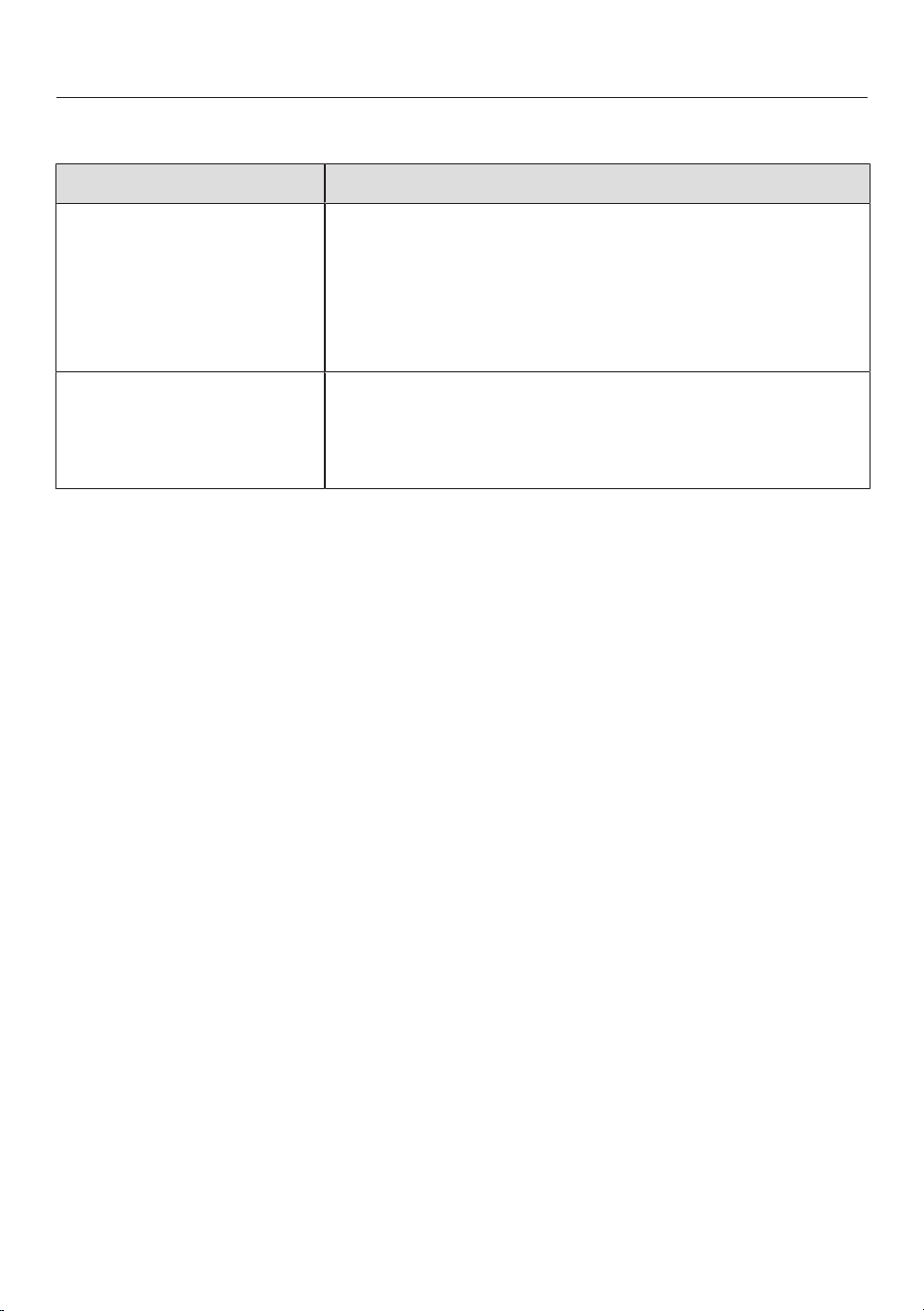
Symbols in the time display
Message Possible cause and remedy
is lit up in the time
display.
The programme selector was moved to a different
position after the programme had started.
Turn the programme selector back to the original
position.
lights up when the
washing machine is
switched on.
An update is available for the washing machine. See
“Programmable functions – RemoteUpdate” for
more information.
lights up briefly in
the time display when a
programme is selected.
indicates that the washing machine is
networked.
lights up when the
MobileStart
programme is
selected.
The remote control function is switched off.
Activate the remote control programmable
function to operate the washing machine via
the App.
lights up when the
MobileStart
programme is
selected.
The washing machine is networked and can be
operated via the App.
lights up when the
MobileStart
programme is
selected.
Miele@home is not set up.
Network the washing machine (see “Before using
for the first time – Setting up Miele@home”).
lights up when the
washing machine is
switched on.
Miele@home is not available.
Switch off the washing machine.
Then switch the washing machine on again.
If appears again, contact Miele.
The washing machine can continue to be used.
Touch the illuminated sensor.
Problem solving guide
45
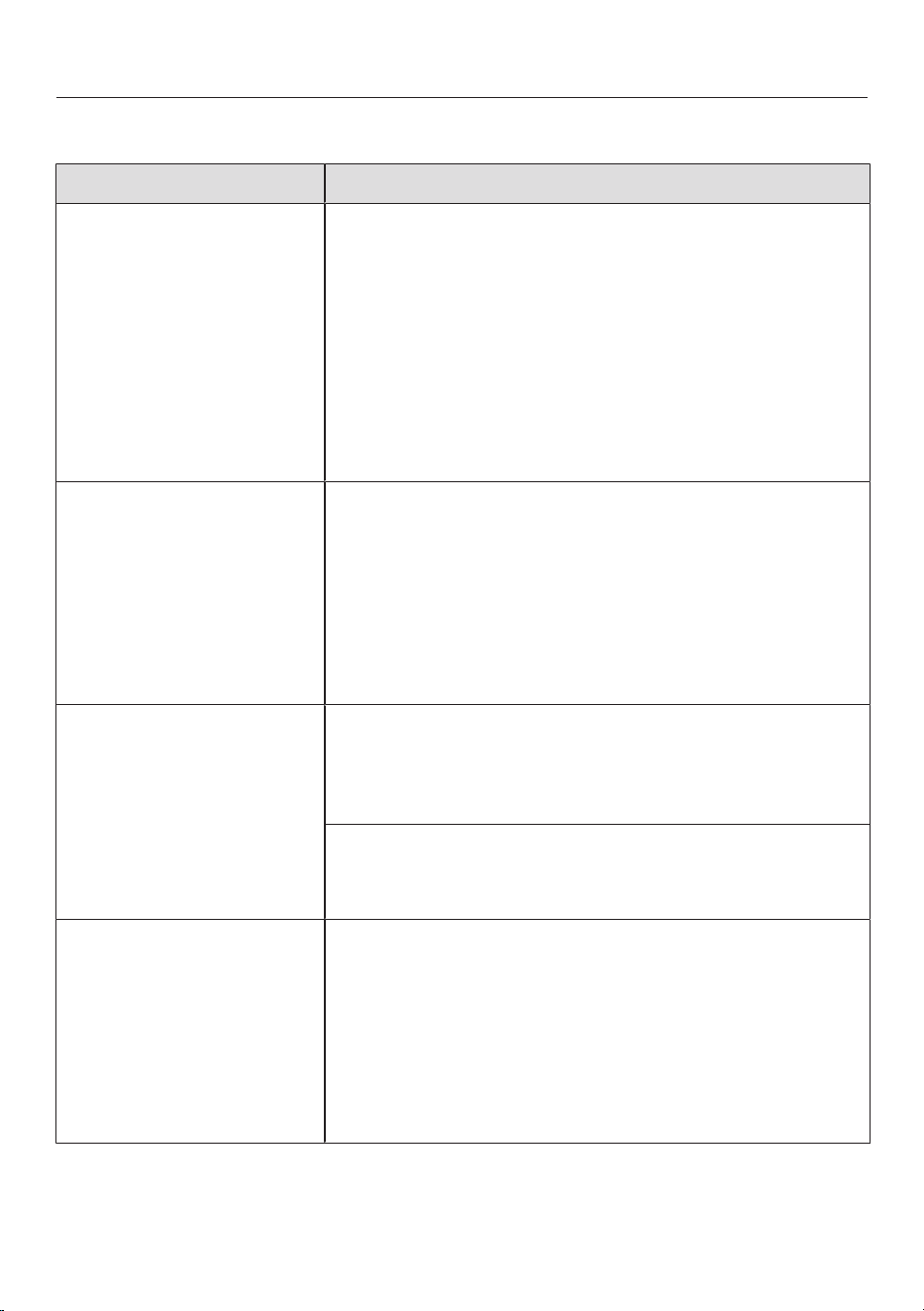
Fault indicator light at the end of a programme
Problem Possible cause and remedy
The indicator light
lights up.
A wash programme using a temperature above 60°C
has not been run for a long time.
In order to prevent bacteria and unpleasant odours
building up in the machine, run the Cottons 90°C
programme using the Miele washing machine
cleaner or a universal powder detergent.
The indicator light
lights up.
Excessive foam has built up during washing.
Use less detergent next time and follow the
manufacturer's instructions on dosage given on
the packaging.
Problem solving guide
46
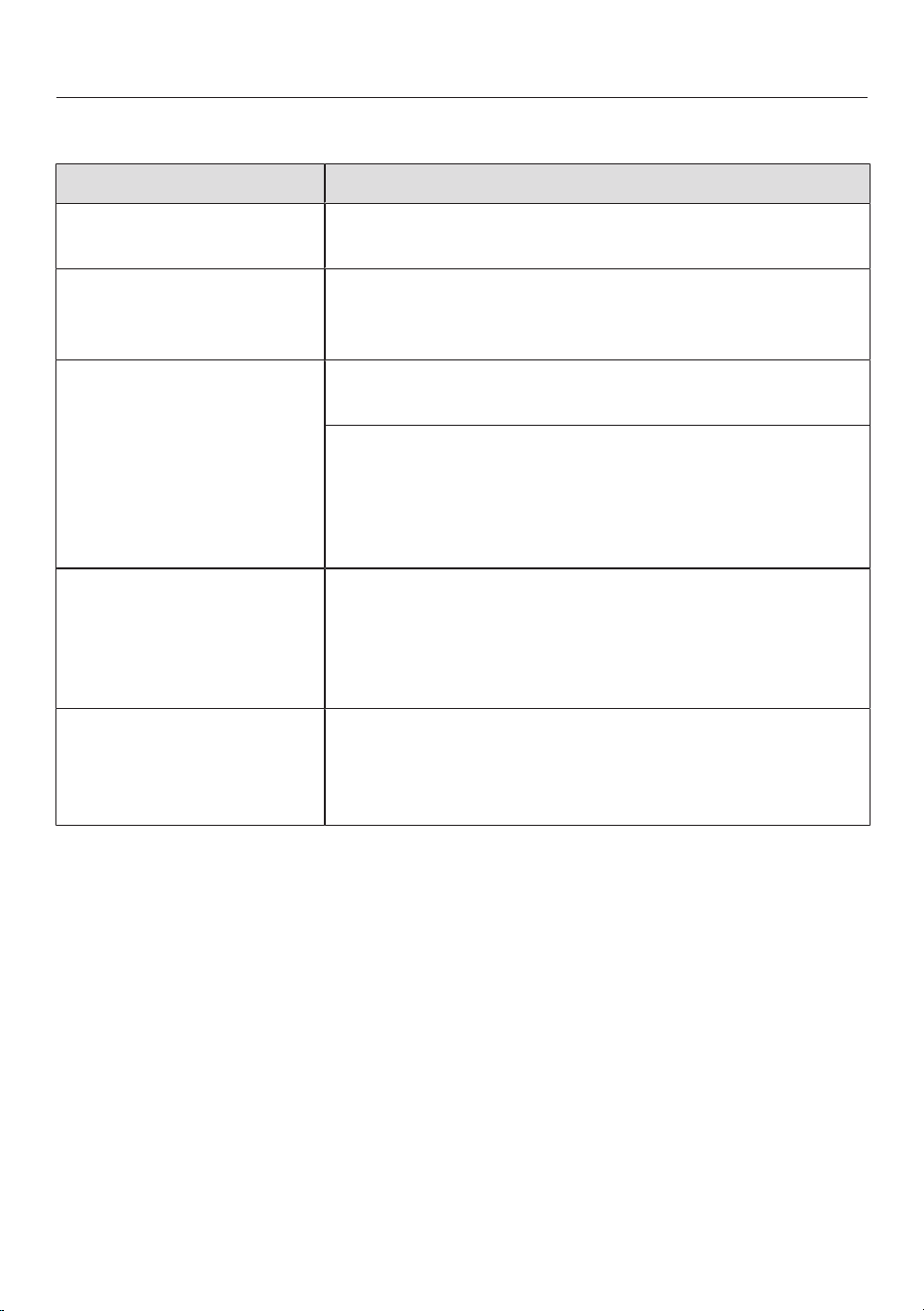
An unsatisfactory wash result
Problem Possible cause and remedy
Liquid detergent does
not give the required
result.
Liquid detergents usually contain no bleaching
agents. They do not remove fruit, coffee and tea
stains.
Use a general purpose powder detergent
containing a bleaching agent.
Add stain removers to compartment of the
detergent dispenser drawer and fill liquid detergent
into a dispenser ball.
Never put stain removers and liquid detergent
together in the dispenser drawer.
White residues which
look like powder
detergent are seen on
dark textiles after
washing.
The detergent contains compounds (zeolites) to aid
water softening which are not soluble in water. These
have ended up on the laundry.
Try to brush off the residues with a soft brush once
the laundry is dry.
Wash dark textiles using a detergent which
contains no zeolites. Liquid detergents do not
usually contain zeolites.
Textiles that were very
greasy are not properly
clean.
Select a programme with pre-wash. Use liquid
detergent for the pre-wash.
Continue to use universal powder detergent for the
main wash.
The use of heavy-duty detergent is recommended in
the main wash for very heavily soiled work clothing.
Please seek advice from the detergent manufacturer.
Grey, greasy particles
cling to washed laundry.
Insufficient amounts of detergent were used. The
laundry was heavily soiled with grease (oils,
ointments).
Use more detergent or liquid detergent with this
type of soiled laundry.
Before washing the next load, run a 60°C
programme with liquid detergent but without a
load.
Problem solving guide
47
General problems with the washing machine
Problem Possible cause and remedy
The machine shakes
during the spin cycle.
The machine feet are not level.
Level the machine and adjust the feet correctly.
The pump makes
strange noises.
This is not a fault. Slurping noises occur at the end
of the pump sequence as a normal part of
operation.
Large amounts of
detergent residue
remain in the detergent
dispenser drawer.
The water pressure is too low.
Clean the filters in the water inlet.
Powder detergent used in conjunction with water
softeners tends to become sticky.
Clean the detergent dispenser drawer and, in the
future, add washing powder to the dispensing
drawer first, and then add the water softener.
Fabric softener is not
completely dispensed
or too much water
remains in the
compartment.
The siphon tube is not correctly positioned or
clogged.
Clean the siphon (see “Cleaning and care -
Cleaning the detergent dispenser drawer”).
The washing machine
did not spin the laundry
as usual. The laundry is
still wet.
The machine detected an imbalance during the final
spin and reduced the spin speed automatically.
Include both large and small items in the load as
this will give better distribution.
Problem solving guide
48
The door will not open
Problem Possible cause and remedy
The door cannot be
pulled open during a
programme.
The door is locked during the washing process.
Touch the Start/Add laundry sensor to cancel the
programme.
The programme is cancelled, the door unlocks and
you can pull it open.
There is still water in the drum and the machine is
unable to drain.
Clean the drain filter and drain pump as described
in “Problem solving guide – Opening the door in
the event of a blocked drain outlet and/or power
failure”.
After the programme is
cancelled, flashing bars
......... appear
in the time display.
For safety reasons, the door cannot be opened if the
suds temperature is higher than 55°C.
Wait until the temperature in the drum has
decreased and the bars have stopped flashing in
the display.
and alternately
appear in the time
display.
The door lock has jammed.
Call Miele.
Problem solving guide
49
Opening the door in the event
of a blocked drain outlet and/
or power cut
Risk of electric shock!
Only ever perform cleaning and
maintenance work when the
appliance is disconnected from the
power.
Disconnect the washing machine
from the mains electricity supply.
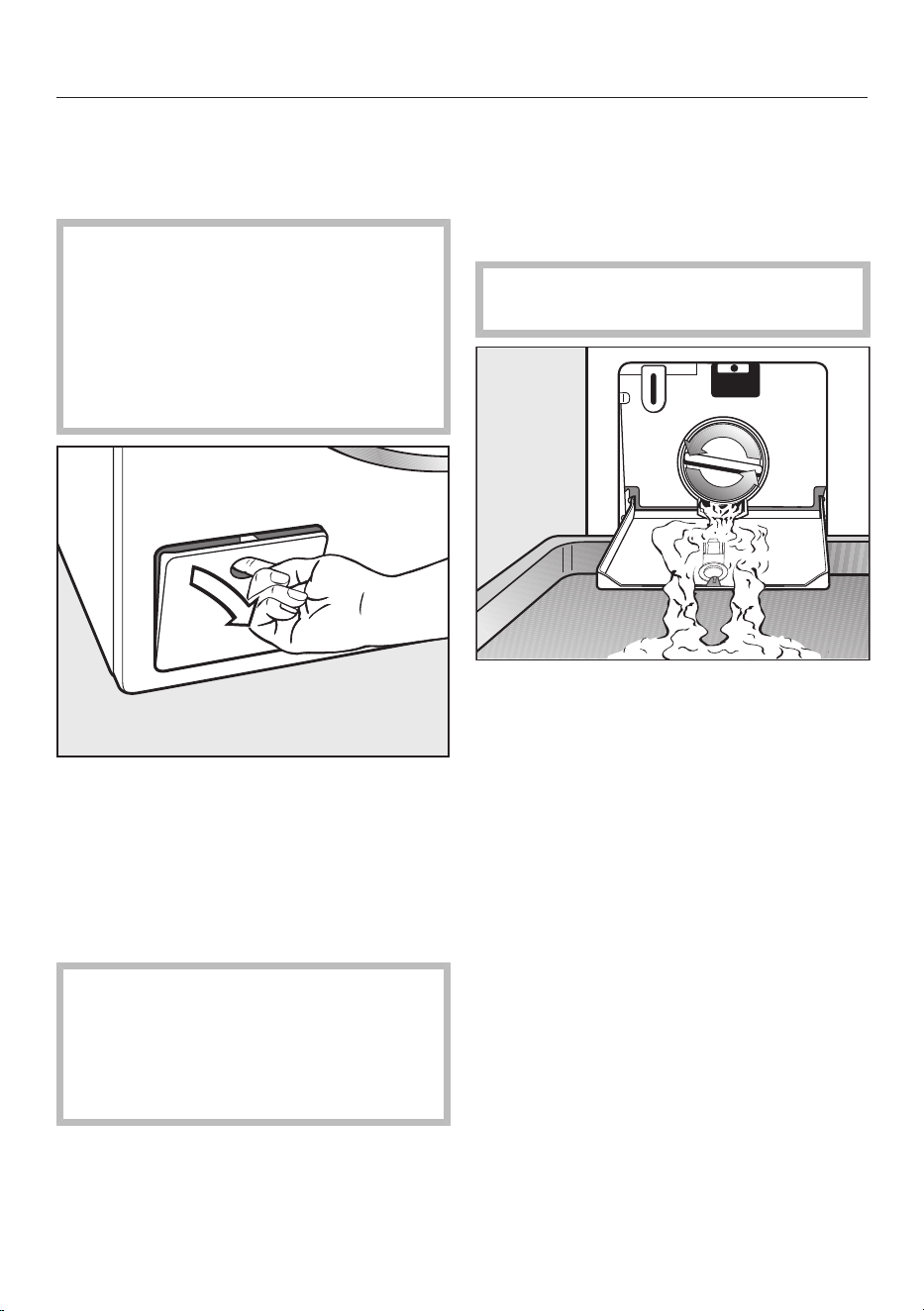
Open the access panel to the drain
system.
Blocked drain outlet
If the drain outlet is blocked, a larger
quantity of water (max. 30 l) can remain
in the washing machine.
Risk of scalding due to hot suds.
Escaping suds will be hot if laundry
has been washed at high
temperatures shortly before.
Drain the suds carefully.
Emptying the drum
....in machines with a drain pump
Place a suitable container under the
access flap.
Remove the drain filter, though not
completely.
Slowly and carefully unscrew the filter
to let the water out. Be careful not to
release too much water at once. If the
flow of water is too strong, some
water can seep into the washing
machine base and activate the water
protection float switch. This will
prevent the washing machine from
functioning.
Tighten the drain filter back up again
if you need to interrupt the flow of
water.
Problem solving guide
50
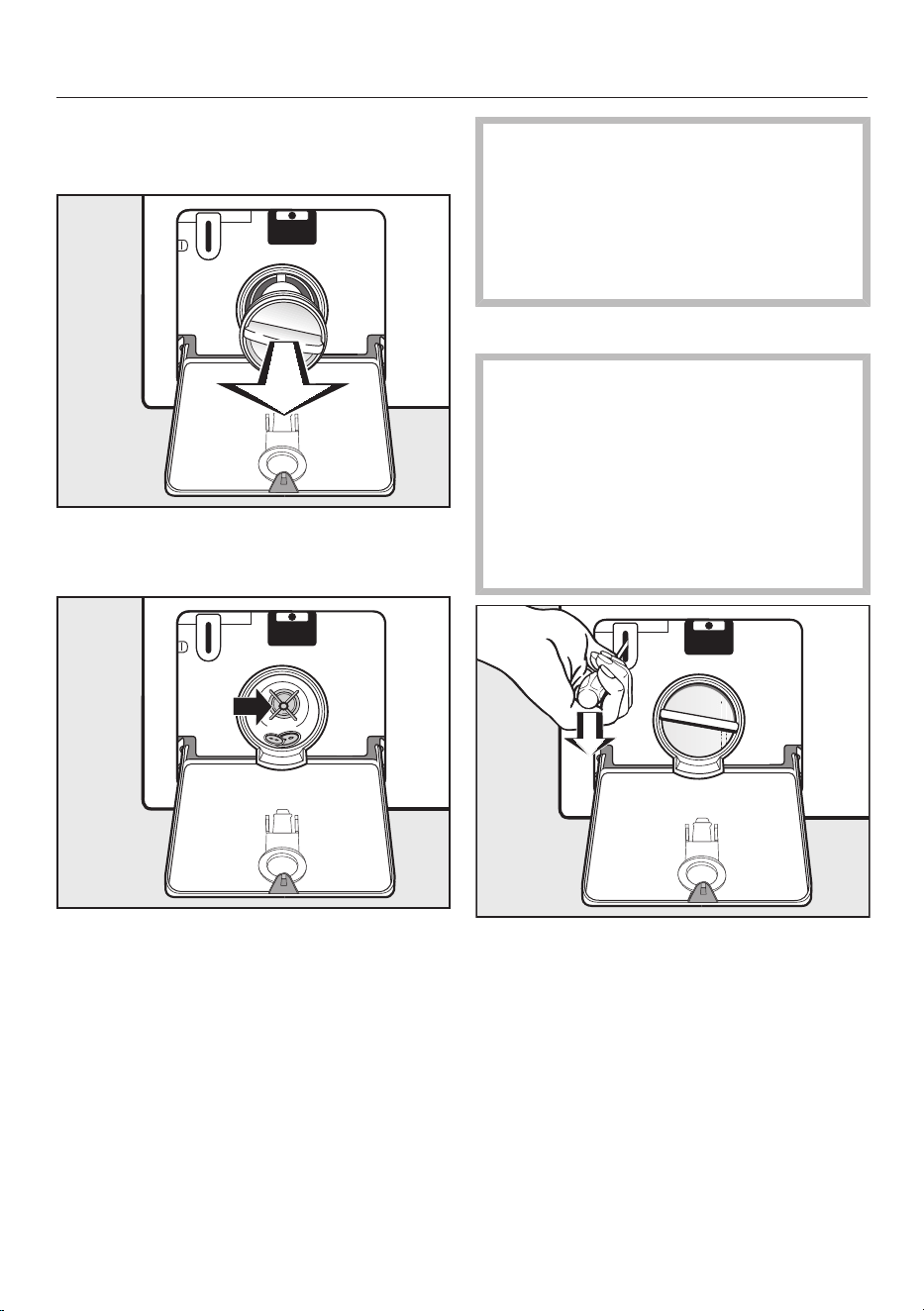
Cleaning the drain filter
Once the flow of water ceases:
Remove the drain filter completely.
Clean the drain filter thoroughly.
Check the drain pump impellers to
make sure they can rotate freely.
Remove any foreign objects (e.g.,
buttons, coins etc.) and clean the
interior.
Put the drain filter back in place and
secure it.
Risk of water damage.
Make sure the drain filter is securely
tightened. Otherwise there is a risk of
water leakage during use.
Replace the drain filter correctly and
tighten it securely.
Opening the door
Danger of injury due to rotating
drum!
Reaching into a moving drum is
extremely dangerous. Danger of
injury!
Always make sure that the drum is
stationary before reaching in to
remove laundry.
Use a screwdriver to unlock the door
of the washing machine as shown.
Pull open the door.
After sales service
51
Contact in case of fault
In the event of any faults which you
cannot remedy yourself, please contact
Miele.
Contact information for Miele can be
found at the end of this booklet.
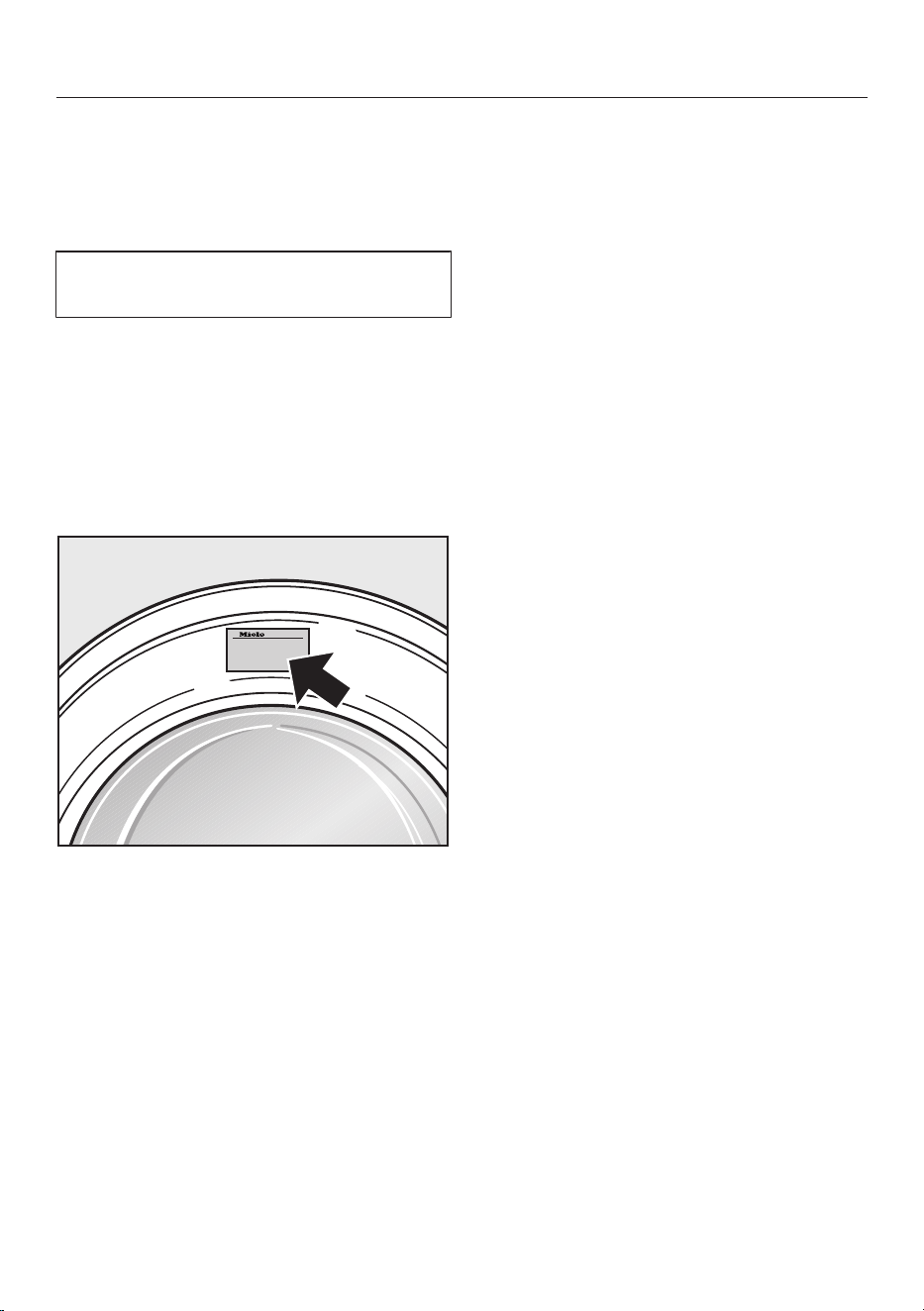
Please quote the model and serial
number of your appliance when
contacting Miele. This information can
be found on the data plate.
The data plate is found above the
porthole glass when the washing
machine door is opened:
Optional accessories
Optional spare parts and accessories
for this washing machine are available
from Miele.
Installation
*INSTALLATION*
52
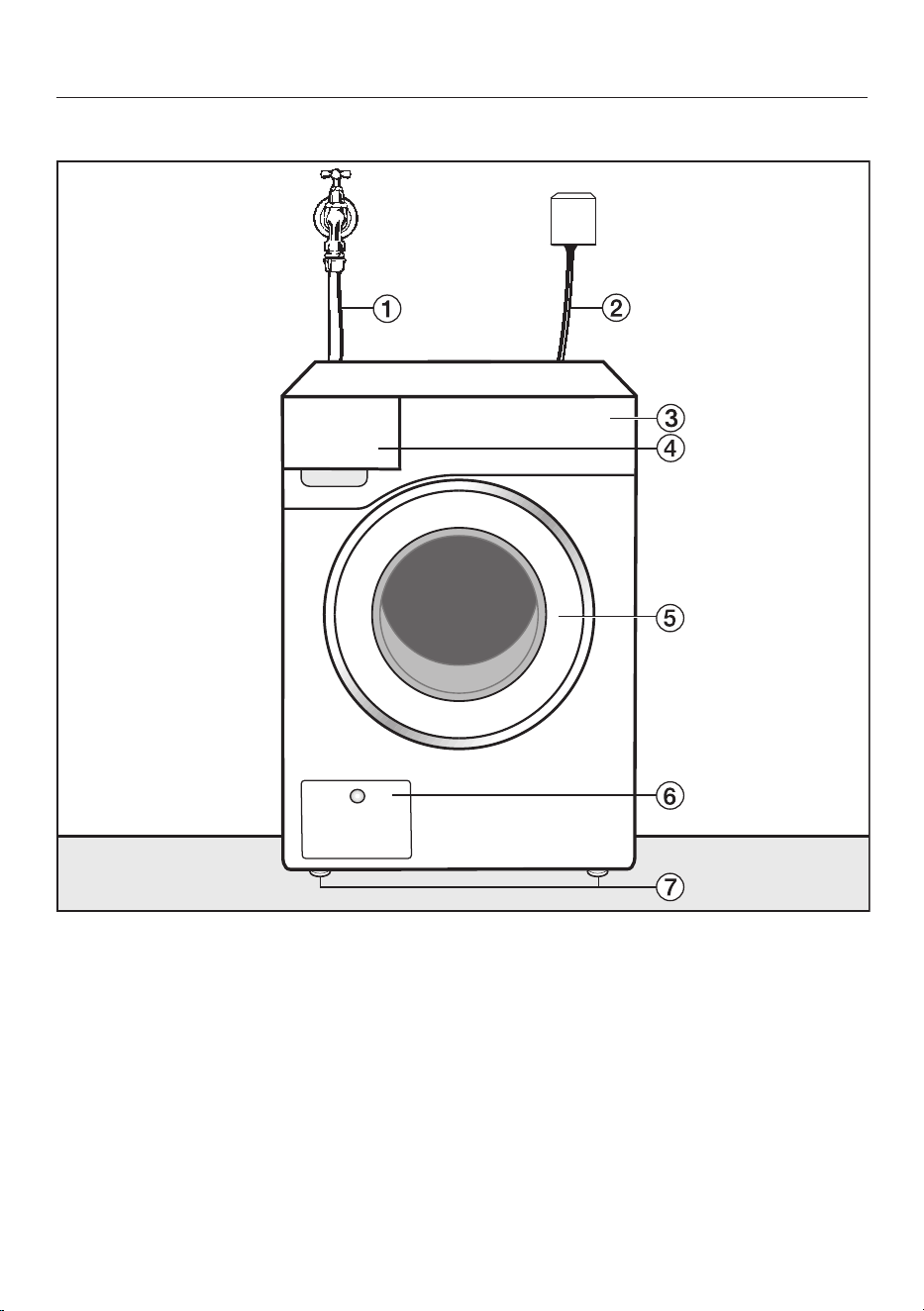
Front view
a
Cold water inlet hose
b
Electrical connection
c
Control panel
d
Detergent dispenser drawer
e
Door
f
Flap for the drain filter and the drain
pump
g
Height-adjustable feet
Installation
*INSTALLATION*
53
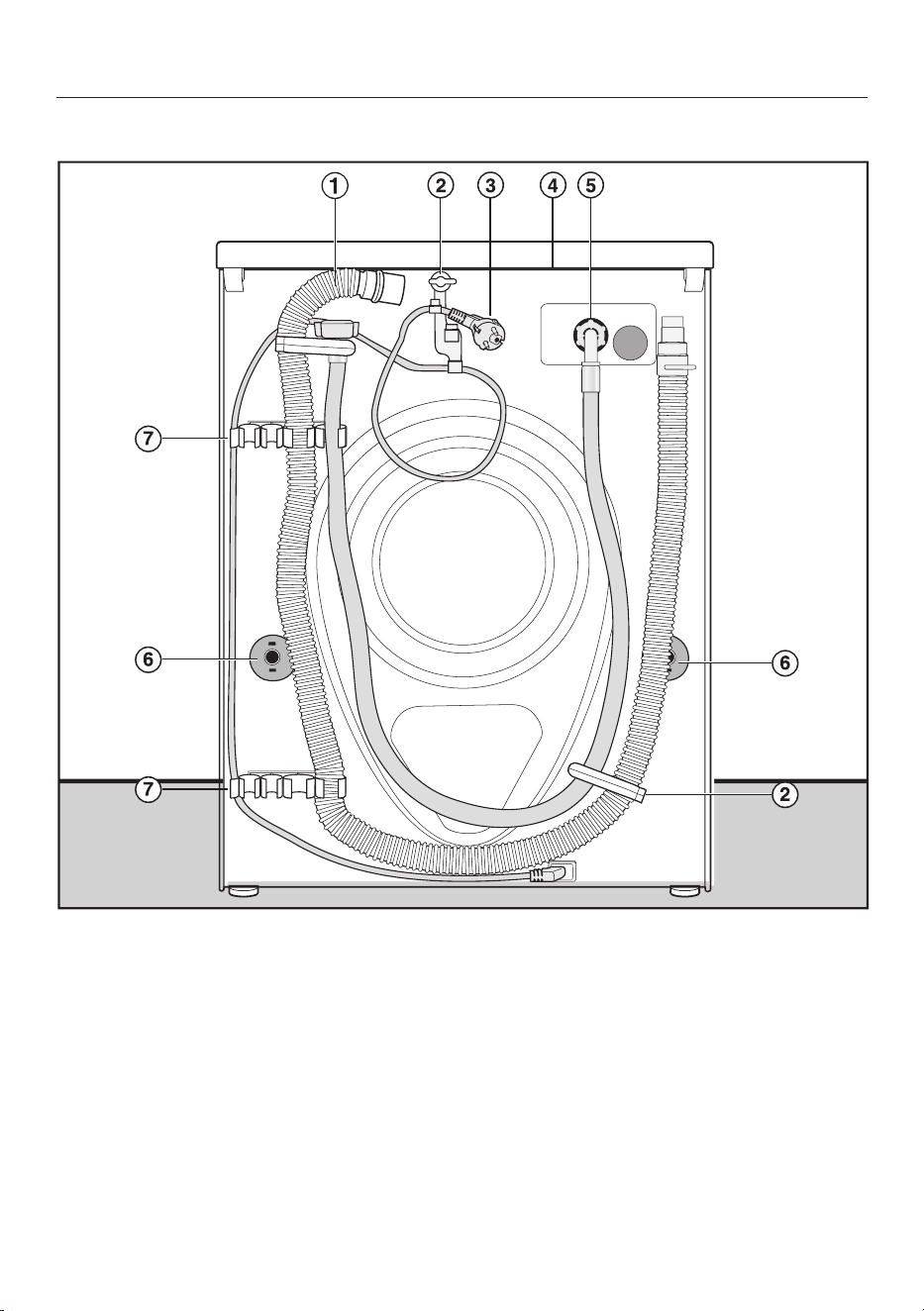
Rear view
a
Drain hose
b
Transport clips for inlet and drain
hoses
c
Electrical connection
d
Protruding lid for holding when
moving the machine
e
Cold water inlet hose
f
Safety caps for transit bars
g
Transport clips for inlet and drain
hoses and for storing transit bars
when not in use
Installation
*INSTALLATION*
54
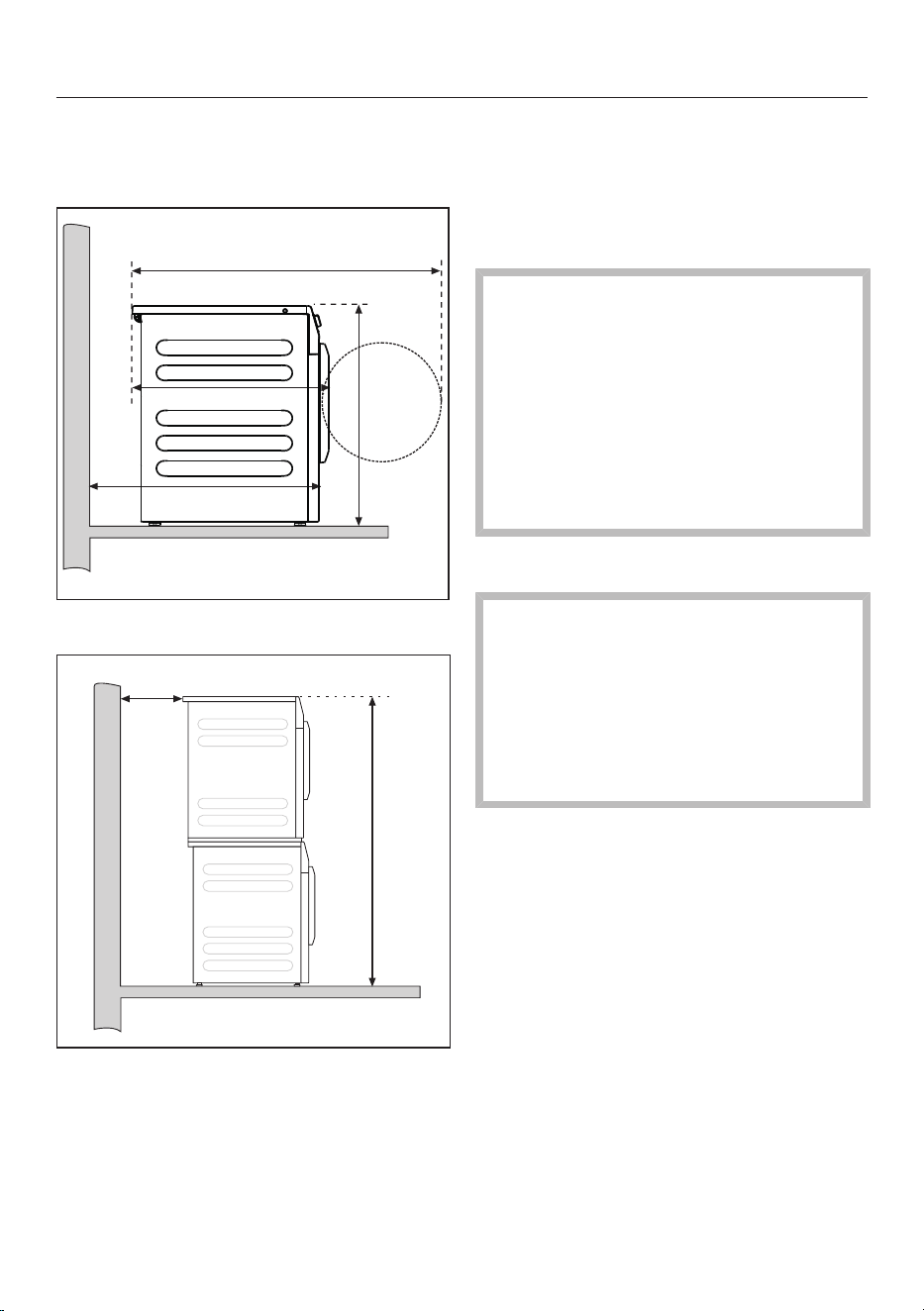
Installation locations
Side view
1054
850
1100
636
Washer-dryer stack
min. 300
1702
This washing machine can be installed
with a Miele tumble dryer on top of it.
This requires a Miele washer-dryer
stacking kit which can be purchased
separately.
Installation on a raised plinth
The washing machine can be installed
on a steel plinth (open or closed,
available as an optional Miele
accessory) or on a concrete plinth.
Injury can occur if the washing
machine has not been adequately
secured.
When installed on a plinth, there is a
risk that the washing machine will
move and fall from the plinth during
spinning.
Secure the washing machine using
the clamps supplied.
Installation notes
Risk of damage due to moisture
ingress.
Moisture can damage electrical
components.
Do not install the machine near or
directly above an open gully or floor
drain.
Installation
*INSTALLATION*
55
Transporting the washing
machine to its installation site
Danger of injury from incorrect
transport.
If the washing maching tips over,
there is a danger of injury to people
and damage to property.
When transporting the machine,
make sure that it is stable.
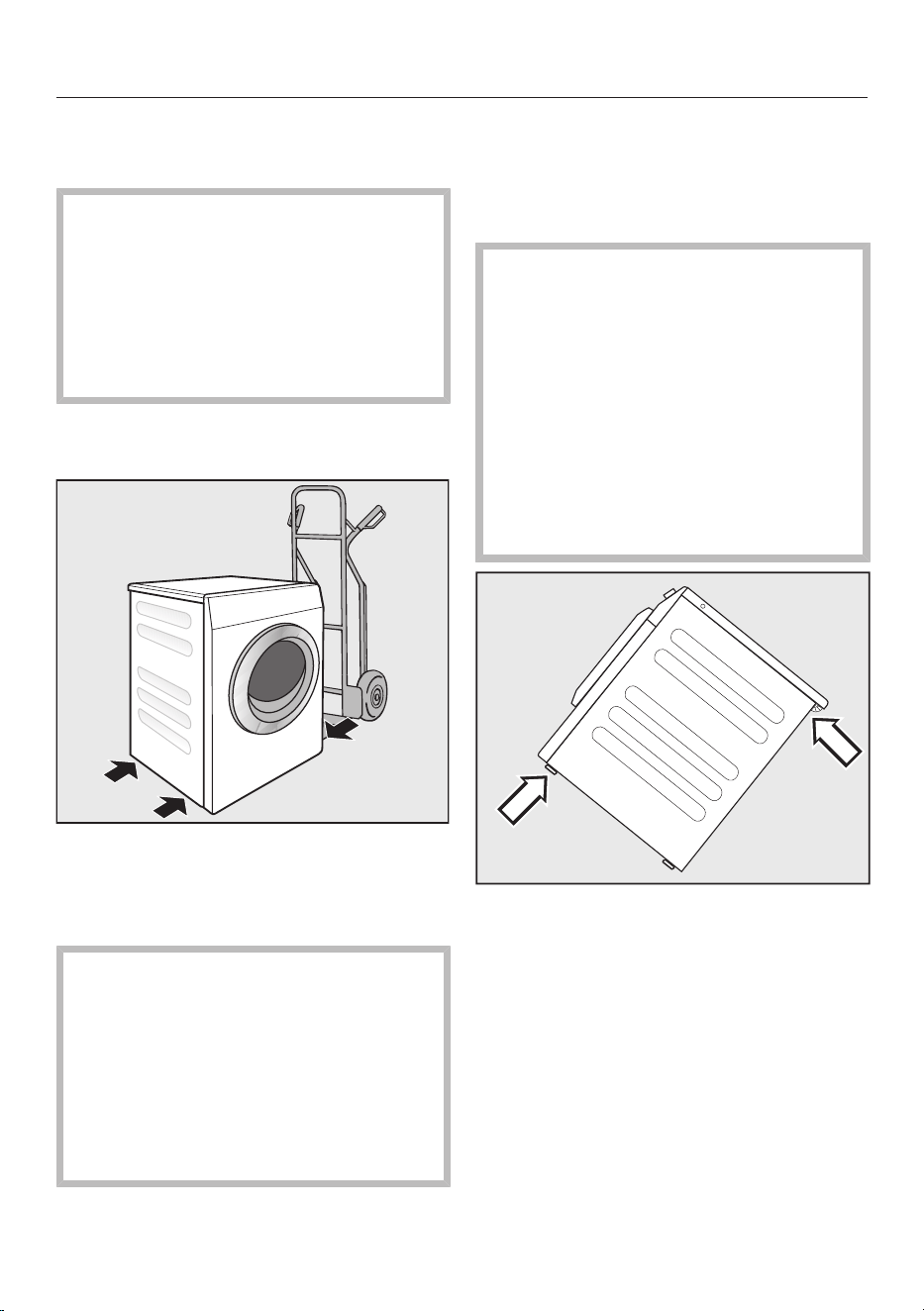
Transporting the washing machine
with a hand trolley
If transporting the washing machine
with a hand trolley, make sure only its
left or right side is resting on the
trolley.
Risk of damage from incorrect
transport.
The front or back of the washing
machine may be damaged if the
machine is transported on a hand
trolley.
Always transport the washing
machine on its side on a hand trolley.
Transporting the washing machine to
its installation site
The protruding lid can be used for
holding the machine during transport.
Danger of injury due to
unsecured lid.
Make sure the fixings at the back of
the lid are secure. They may become
brittle due to external circumstances.
There is a danger of the lid being
pulled off when carrying the
appliance.
Before carrying the appliance, check
that the lid is secure where it
protrudes at the back.
Carry the washing machine by the
front feet and by the lid where it
protrudes at the back of the
appliance.
Installation
*INSTALLATION*
56
Installation surface
A concrete floor is the most suitable
installation surface. It is far less prone
to vibration during the spin cycle than
wooden floorboards or a carpeted
surface.
The machine must be level and
securely positioned.
To avoid vibrations during spinning,
the machine should not be installed
on soft floor coverings.
If installing on a wooden joist floor:
Install the machine on a plywood
base (at least 70x60x3cm). The
base should span several joists and
be bolted to the joists and not only to
the floorboards.
Useful tip: If possible, install the
machine in a corner of the room. This is
usually the most stable part of the floor.
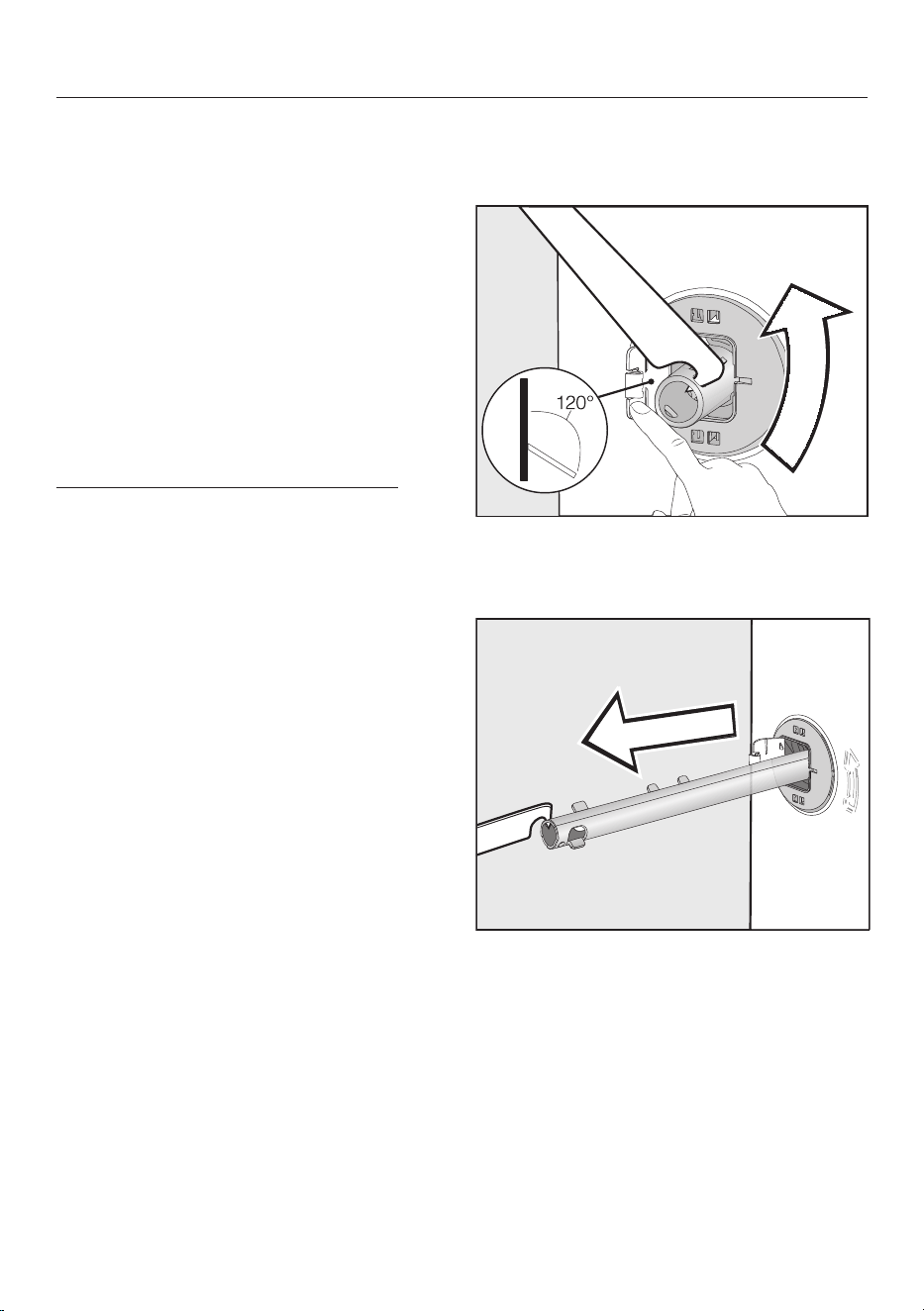
Removing the transit bars
Removing the left transit bar
Push the flap outwards and turn the
transit bar 90° using the enclosed
spanner.
Then pull the transit bar out.
Installation
*INSTALLATION*
57
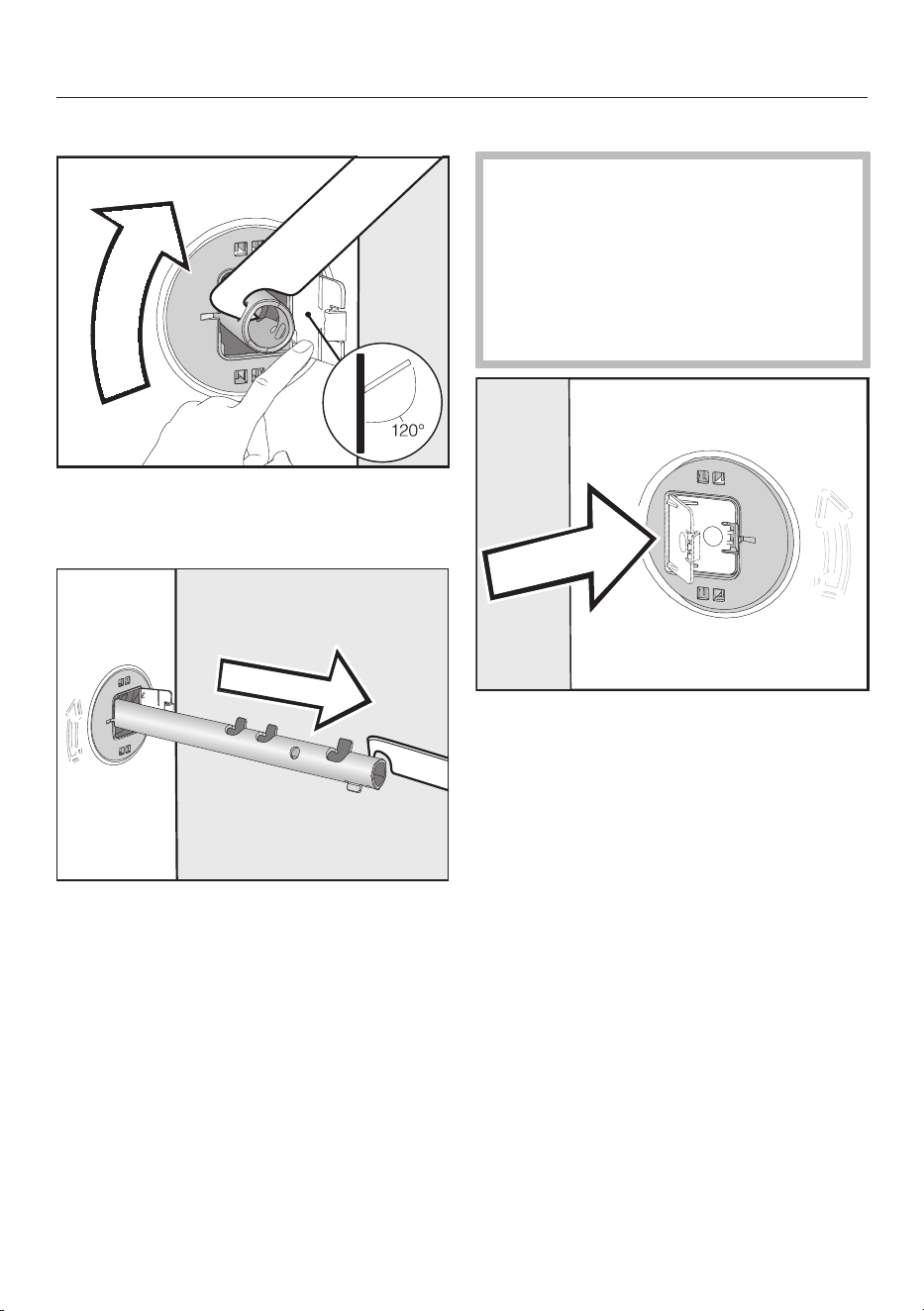
Removing the right transit bar
Push the flap outwards and turn the
transit bar 90° using the enclosed
spanner.
Then pull the transit bar out.
Covering the holes
Risk of injury from sharp edges!
There is a risk of injury from reaching
into holes that are not covered.
To avoid the risk of injury, the holes
for the transit bars must be covered
after the transit bars have been
removed.
Press the flaps firmly shut until they
click into place.
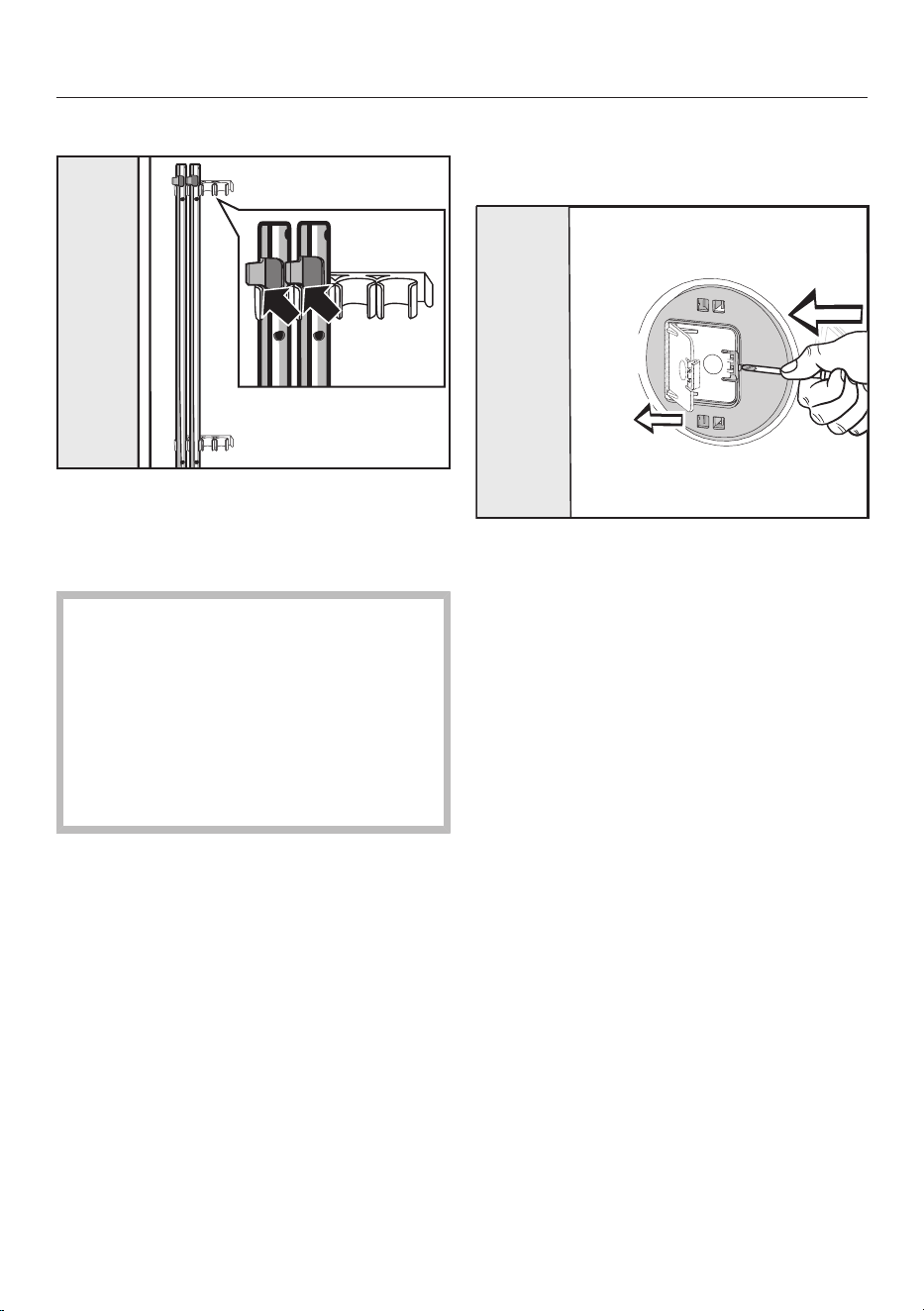
Installation
*INSTALLATION*
58
Securing the transit bars
Secure the transit bars to the back of
the washing machine. Make sure that
the top catch is located above the
holder.
Risk of damage from incorrect
transport.
The washing machine may become
damaged if moved without the transit
bars in place.
Keep the transit bars in a safe place.
Fit them again if the machine is to be
moved (e.g. when moving house).
Fitting the transit bars
Opening the flaps
Push against the catch with a pointed
object, e.g. a narrow screwdriver.
The flap will open.
Fitting the transit bars
Install the transit bars in reverse order
to their removal.
Useful tip: If you lift the drum slightly,
the transit bars can be pushed in more
easily.
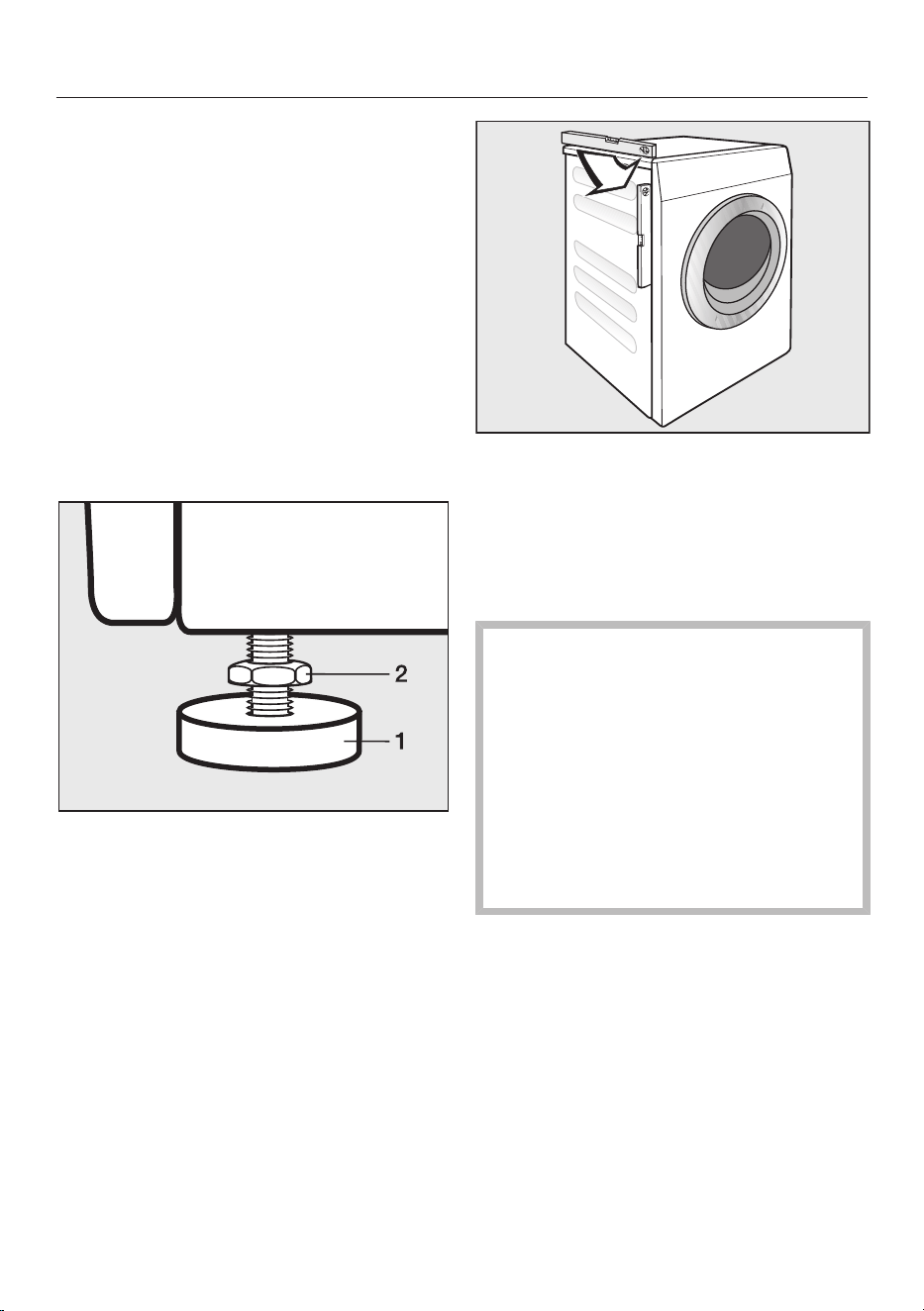
Installation
*INSTALLATION*
59
Aligning the washing machine
The washing machine must stand
perfectly level on all four feet to ensure
safe and proper operation.
Incorrect installation may increase
electricity and water consumption and
may cause the machine to move about.
Screwing out and adjusting the feet
The four adjustable screw feet are used
for levelling the washing machine. All
four feet are screwed in when the
appliance is delivered.
Using the spanner supplied, turn
counter nut 2 in a clockwise direction.
Then turn counter nut 2 together with
foot 1 to unscrew.
Use a spirit level to check that the
washing machine is standing level.
Hold foot 1 securely with a pipe
wrench. Turn counter nut 2 again
using the spanner supplied until it sits
firmly up against the housing.
Risk of damage due to
incorrectly aligned washing machine.
There is a danger of the washing
machine moving about if the feet are
not secured.
Turn all four counter nuts for the feet
until they sit firmly up against the
housing. Please also check this for
the feet which did not need
adjustment.
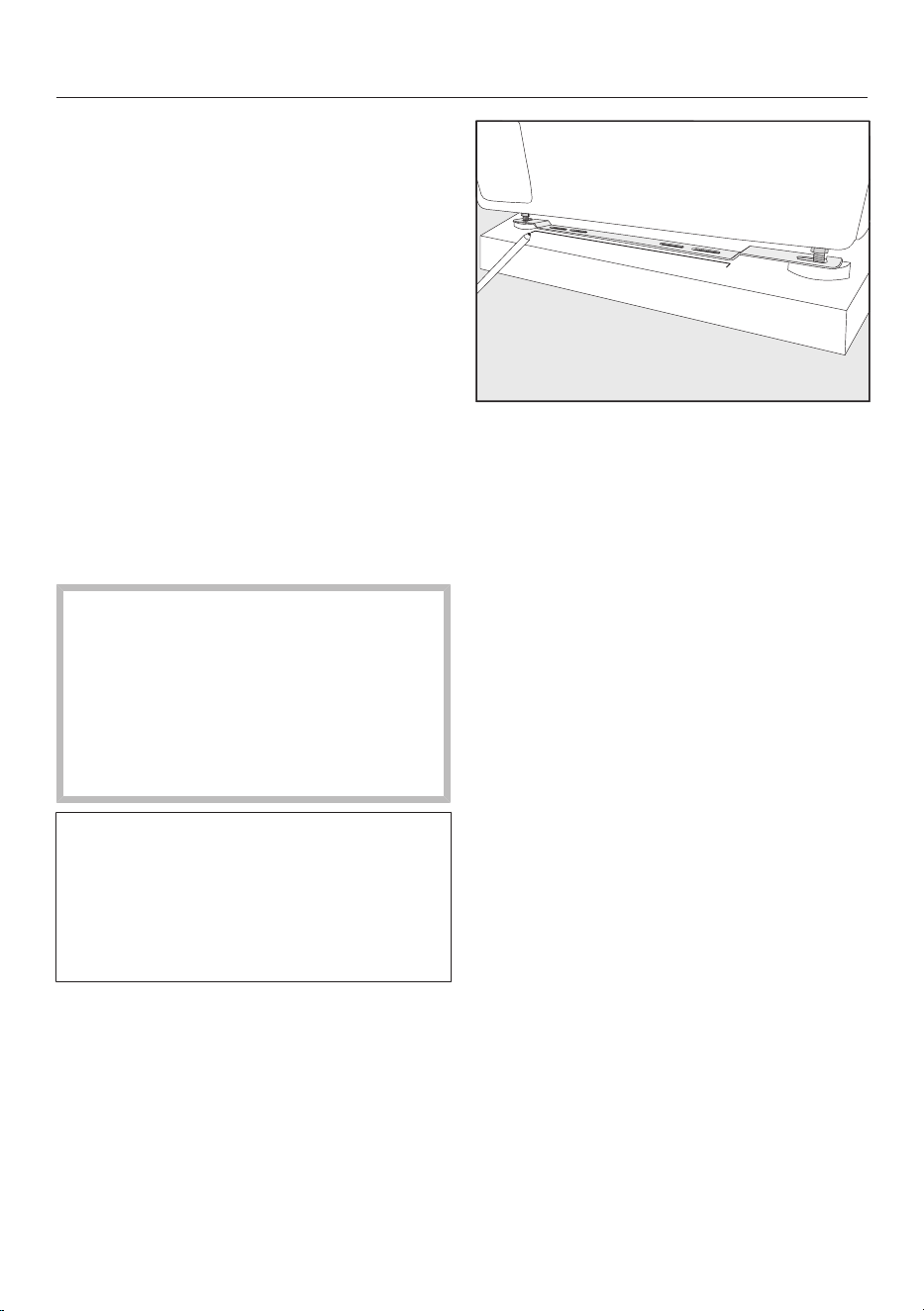
Installation
*INSTALLATION*
60
Fixing bracket for plinth
The fixing bracket prevents the washing
machine from falling off a plinth during
operation.
Fastening with the fixing bracket is only
intended for plinths made from
concrete. The plinth must be flat and
level. The surface below the plinth must
be able to withstand the physical loads.
Prior to installation, ensure the plinth
complies with the minimum dimensions.
Height: 6cm
Width: 60cm
Depth: 65cm
Positioning the fixing bracket
Risk of injury from sharp edges!
The fixing bracket has sharp edges.
You could cut yourself on the edges.
Take care when handling the fixing
bracket.
Wear gloves while installing the fixing
bracket.
The front appliance feet must protrude
by at least 3mm from the bottom of
the locknut. The washing machine
must already be aligned (see
“Installation – Aligning the washing
machine”).
Place the fixing bracket on the front
appliance feet.
Mark the position of the front edge of
the fixing bracket with a pencil.
Remove the fixing bracket from the
feet.
Carefully move the washing machine
until you have enough space to install
the fixing bracket.
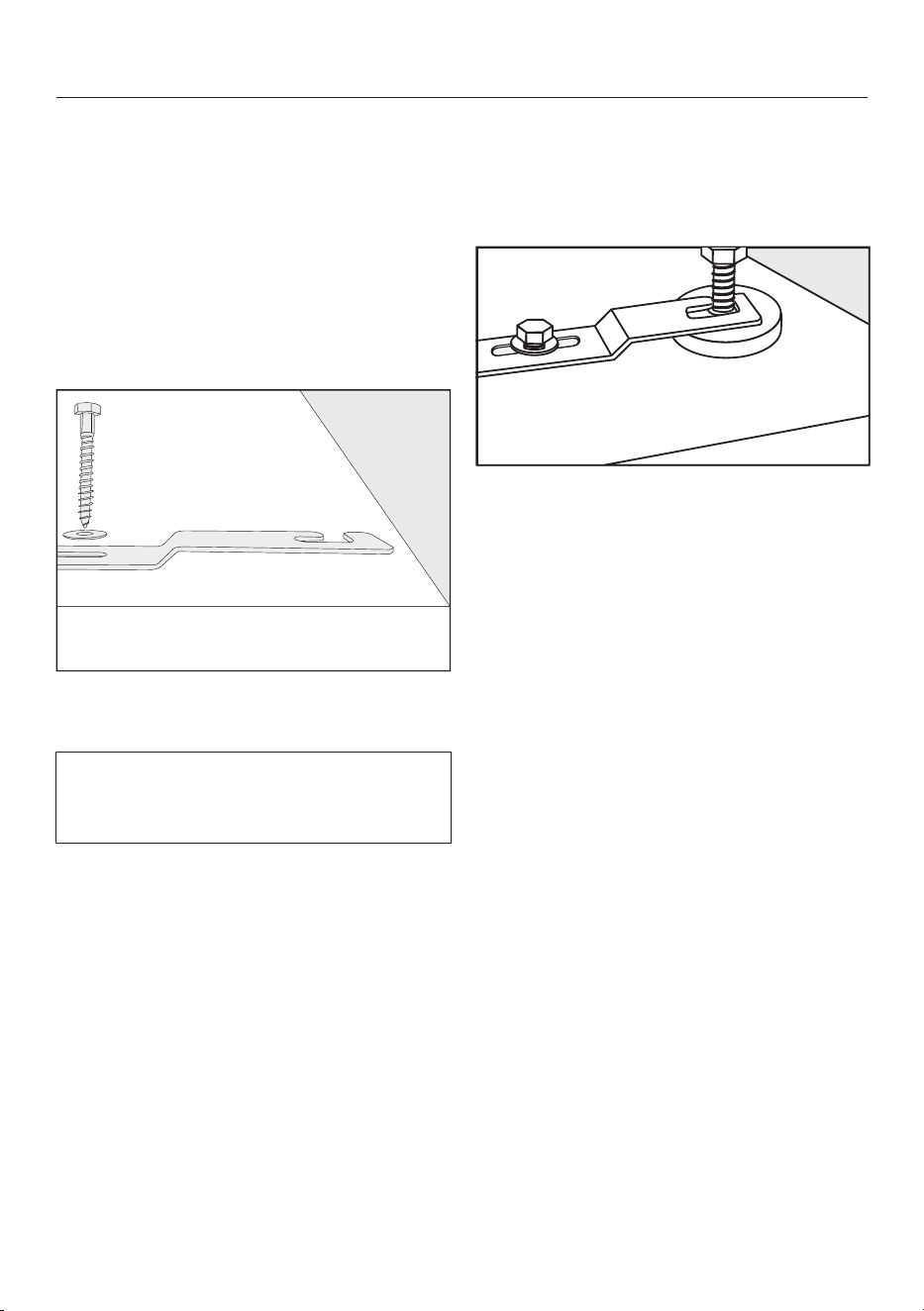
Installation
*INSTALLATION*
61
Installing the fixing bracket
Place the fixing bracket on the
marking on the plinth.
In the middle of the two outer slotted
holes, mark a point for each drill hole.
Drill 2holes (8mm) with a depth of
approx. 55mm.
Insert the plugs in the holes.
Install the fixing bracket with the
hexagonal screws and the washers.
Do not tighten the screws yet – this
will allow the fixing bracket to be
moved sideways.
Securing the washing machine with
the fixing bracket
Push the washing machine back on
to the installed fixing bracket.
Insert the appliance feet (the part
between the foot and the locknut)
into the openings in the fixing
bracket.
Push the fixing bracket to the right as
far as it will go.
Tighten the hexagonal screws using a
spanner.
The washing machine is secured in the
fixing bracket.

Installation
*INSTALLATION*
62
Installing under a continuous
worktop
Risk of electric shock due to
exposed cables.
There is a risk of coming into contact
with live parts while the lid is
removed.
Do not remove the washing machine
lid.
This washing machine (with lid intact)
can be pushed under a worktop if there
is space to do so.
Installation
*INSTALLATION*
63
Water connection
Cold water connection
The flow pressure must amount to a
minimum of 100kPa (1bar) and must
not exceed an overpressure of
1000kPa (10bar). If the pressure
exceeds 1000kPa, a pressure reducing
valve must be installed.
Connection to the mains water supply
should incorporate a water tap with a
¾" threaded union. If this is not
available, only a qualified plumber may
connect the washing machine to the
mains water supply.
The connection point is subject to
mains water pressure.
Check that the connection is
leakproof. Slowly turn on the tap.
Correct the position of the seal and
union if necessary.
The water inlet hose for cold water is
not intended to be used with a hot
water connection.
Maintenance
Only use a genuine Miele hose should
you ever need a replacement.
A filter is located in the open end of
the inlet hose and another in the
intake point to protect the inlet valve.
Neither filter may be removed.
Hose extension
Longer hoses 2.5m or 4.0m in length
are available from Miele as optional
accessories.
Drainage
Drain pump
The suds are drained through a drain
pump with a 1m delivery head. For the
water to drain freely, the hose must be
free of kinks. An elbow piece
(accessory) can be hooked onto the
end of the hose.
Drain hose connection options
1. Connected securely to a trapped
waste pipe.
2. Connected over the rim of the
laundry trough or into the sud-saver
pipe of the laundry trough.
3. Connected securely to a floor drain
(gully).
If required, the hose can be extended to
a length of up to 5m. The necessary
parts can be ordered from Miele
(depending on country).
For a delivery head of more than 1 m
(up to a max. of 1.6 m) a replacement
drain pump will need to be fitted.
Please contact Miele for advice.
Waste water discharge from
commercial clothes washing machines
may require pre-treatment as
determined by the utility operator.
Installation
*INSTALLATION*
64
Electrical connection
This description applies to washing
machines both with and without a
mains plug.
The following applies to washing
machines with a mains plug:
- The washing machine is ready to be
connected.
- The electrical socket must be easily
accessible after installation so that
the machine can be disconnected
from the electricity supply if
necessary.
Damage caused by incorrect
supply voltage.
The data plate indicates the nominal
power consumption and the
appropriate fuse rating.
Compare the specifications on the
data plate with those of the mains
electricity supply.
The washing machine may only be
connected to a permanent electrical
system that conforms to the national
and local codes and regulations.
Do not connect the machine to an
extension lead or multi-socket adapter
as they do not guarantee the required
safety of the appliance (e.g. danger of
overheating).
If the appliance is hard wired, a dual
circuit breaker must be provided on
site. When switched off, there must be
an all-pole contact gap of at least 3mm
in the isolator switch (including circuit
breakers, fuses, and relays according to
AS/NZS 3000). This connection must
be carried out by a qualified and
competent electrician.
The plug connector or isolator switch
should be easily accessible at all times.
Risk of electric shock!
If the washing machine is
disconnected from the power supply,
protective measures must be taken
to ensure that the point of
disconnection cannot accidentally be
switched on again.
Make sure the isolator is lockable or
the point of disconnection is
monitored at all times.
New connections, modifications to the
system, or servicing of the protective
earthing conductor, including
determining the correct fuse rating,
must be carried out by a qualified and
competent electrician, as they are
familiar with the pertinent regulations
and the specific requirements of the
electric utility company.

Technical data
65
Height 850mm
Width 596mm
Width (machines with a stainless steel lid) 605mm
Depth 636mm
Depth with door open 1054mm
Weight Approx. 100kg
Maximum floor load in operation 3000Newton
Capacity 8,0kg dry laundry
Supply voltage See data plate on back of machine
Rated load See data plate on back of machine
Fuse rating See data plate on back of machine
A-rated sound emissions L
pA
in accordance
with ENISO11204/11203
<70dB re 20µPa
Minimum water flow pressure 100 kPa (1 bar)
Maximum water flow pressure 1000 kPa (10 bar)
Water inlet hose length 1.55m
Drain hose length 1.50m
Mains connection cable length 2.00m
Product safety standard EN 50571, AS/NZS 60335
Test certifications awarded see data plate
Power consumption when switched off 0,40 W
Programmable functions
66
The programmable functions are used
to alter the machine's electronics to
suit changing requirements.
Programmable functions can be
altered at any time.
Programming is carried out in 9 steps
(, , ...) using the sensors.
Opening the programming level
Before you begin, ensure the following:
- The washing machine is switched on
(the programme selector is pointing
to a wash programme).
- The washing machine door is open.
Touch the Start/Add laundry sensor
and hold it down whilst carrying out
steps –.
Close the washing machine door.
Wait until the Start/Add laundry
sensor lights up constantly...
...and then release the Start/Add
laundry sensor.
After a few seconds, will light up in
the time display.
Choosing and selecting
programmable functions
The number of the programmable
function will appear in the display as
and a number: e.g. .
Touch the or sensor to scroll to
the next or previous programmable
function:
Programmable functions
Buzzer duration
Buzzer
Keypad tone
PIN code
Display switch-off status
Memory
Additional pre-wash time
Gentle action
Temperature reduction
Water plus
Maximum rinse level
Suds cooling
Anti-crease
Low water pressure
Backlight brightness dimmed
Welcome tone
Operating hours
* Remote control
* SmartGrid
* RemoteUpdate
Factory default setting
*only visible after networking
Confirm the selected programmable
function by touching the Start/Add
laundry sensor.
Programmable functions
67
Editing and saving the
programmable function
You can switch a programmable
function on/off or select different
options.
Touch the or sensor to switch a
programmable function on/off or to
select an option.
Programmable function
Available options
to
Confirm the chosen selection with
the Start/Stopsensor.
The number of the programmable
function, e.g. , will light up again.
Exiting the programming level
Turn the programme selector to the
position.
The settings have been changed. You
can alter the settings again at any time.
Programmable functions
68
Buzzer duration
The buzzer sounds to let you know the
programme has finished. You can
decide how long the buzzer should
sound for.
Options
= The buzzer sounds 3times at
the end of the programme.
= The buzzer sounds until the
washing machine switches off
automatically (max. 1hour).
Buzzer
The buzzer sounds to let you know the
programme has finished.
Options
= Buzzer is deactivated.
= Buzzer volume is set to normal.
= Buzzer volume is set to loud.
Keypad tone
Each touch of a sensor is confirmed
with an audible tone.
Options
= Keypad tone is switched off
= Keypad tone is set to loud
volume
= Keypad tone is set to loud
volume
PIN code
The PIN code prevents the washing
machine being used without your
knowledge.
When the code has been activated, you
have to enter a code after switching the
washing machine on. Otherwise the
washing machine cannot be operated.
Options
= PIN code is switched off
= PIN code is switched on
Using the washing machine with a
PIN code
The code is 125 and cannot be altered.
Switch on the washing machine.
appears in the time display and
the and sensors light up.
Touch the sensor once.
appears in the time display.
Confirm the number with the Start/
Add laundry sensor.
The first number was saved and you
can now enter the second number
using the and sensors.
Enter the second and third numbers
and confirm the numbers with the
Start/Add laundry sensor.
The lock is released and a wash
programme can now be selected and
started.
Programmable functions
69
Control panel switch-off
status
To save energy, the time display and
sensors will go out after 10minutes,
and only the Start/Add laundry sensor
will flash slowly.
Options
= Off
The time display and sensors
will remain lit up while the
washing machine is switched
on
= On
The time display and sensors
will switch off after 10minutes
if a programme has started.
However, the time display and
sensors will remain lit up for 10
minutes after a Delay start time
has elapsed, after the end of a
programme, or at the end of
the Anti-crease phase.
Memory
The washing machine will save the
last settings (temperature, spin speed
and some of the Extras) selected for a
programme after the programme has
started.
When the programme is selected again,
the saved settings will appear in the
display.
Options
= Memory is switched off
= Memory is switched on
Longer pre-wash Cottons
If you require a longer pre-wash, you
can extend the pre-wash time.
Options
= no increase in the pre-wash
time
= + 6minutes increase in the
pre-wash time
= + 9minutes increase in the
pre-wash time
= + 12minutes increase in the
pre-wash time
Programmable functions
70
Gentle action
With Gentle action activated, drum
agitation is reduced. In this way, lightly
soiled items can be washed more
gently.
Gentle action can be activated for the
Cottons and the Minimum iron
programmes.
Options
= Gentle action is switched off
= Gentle action is switched on
Temperature reduction
At high altitudes water has a lower
boiling point. Miele recommends
activating the Temperature reduction
setting at altitudes of 2000m or above
to prevent water from boiling.
Options
= The Temperature reduction
setting is switched off
= The Temperature reduction
setting is switched on
Water plus
You can determine the amount of
water used if the Water+ Extra is
selected.
Options
= The water level is increased in
the wash and rinse stages.
= An extra rinse is carried out
= The water level in the wash
and rinse stages is increased
and an extra rinse is carried
out
Maximum rinse level
The water level in the rinse can be
permanently set to the highest value.
This function is important for allergy
sufferers as it achieves excellent rinse
results. The water consumption will be
increased.
Options
= Maximum rinse level is
switched off
= Maximum rinse level is
switched on

Programmable functions
71
Suds cooling
Additional water flows into the drum at
the end of the main wash to cool the
suds down. Hot suds can damage
plastic drainage pipes.
Suds cooling takes place when a
Cottons programme with a temperature
of 70°C or higher is selected.
Suds cooling should be activated:
- to prevent the danger of scalding if
the drain hose is hooked over the
edge of a sink or basin.
- where the drainage pipes are rated
less than 70°C.
Options
= Suds cooling is switched off
= Suds cooling is switched on
Anti-crease
The Anti-crease function helps prevent
creasing if laundry is not going to be
removed immediately after the end of
the programme.
The drum continues to turn at intervals
for up to 30minutes at the end of the
programme. The door can be opened at
any time during the Anti-crease phase.
Options
= The Anti-crease function is
switched off
= The Anti-crease function is
switched on
Low water pressure
If the water pressure is below 100kPa
(1bar), the washing machine cancels
the programme and the fault
message appears.
If the water pressure cannot be
increased, activating this function will
prevent the programme from being
cancelled.
Options
= Low water pressure is
switched off
= Low water pressure is
switched on
Backlight brightness
dimmed
The brightness of the dimmed sensors
in the control panel can be set to one
of 7 different levels.
The brightness will change as soon as a
different setting is chosen.
Options
= Darkest level
= Brightest level

Programmable functions
72
Welcome tone
The welcome tone sounds whenever
the washing machine is switched on.
You can switch the welcome tone on or
off.
Options
= Welcome tone is switched off
= Welcome tone is switched on
at normal volume
= Welcome tone is switched on
at loud volume
Operating hours
You can read off how many hours the
washing machine has been in
operation for.
The total washing time is shown in the
time display in single digits. The
washing machine has been in operation
for 1234hours, for example. The figure
shown in the time display will start with
an followed by a, then a and after
this a and a. The letter is
displayed again after this.
Factory default setting
All programmable functions except
Operating hours are reset to the
factory default settings.
Options
= Go back (without reset to
factory default settings)
= Reset programmable functions
to the factory default settings.
Programmable functions
73
Networking
The , and programmable
functions are only displayed if the
requirements for using Miele@home
have been met (see “Before using for
the first time - Miele@home”).
Resetting the network configuration
The network configuration should be
reset whenever a washing machine is
being disposed of or sold, or if a used
washing machine is being put into
operation. This is the only way to
ensure that you have removed all
personal data and, in the case of the
latter, the previous owner can no
longer access the washing machine.
Turn the programme selector to the
MobileStart programme.
appears in the time display.
Touch and hold the sensor
until the countdown in the time
display has finished.
appears in the time display.
The network configuration has been
deleted.
A new connection set-up has to be
carried out in order to use Miele@home
again.
Remote control
You can use the Miele App to check
the status of your washing machine
from anywhere and start it remotely.
You can also control it remotely via the
MobileStart programme.
You can switch off the
programmable function if you do not
want to operate the washing machine
with your mobile device.
If the programmable function is not
switched on, the App can still be used
to cancel the programme.
Use the sensor to set a time period
within which you want to start the
washing machine and start the Delay
start function (see “Delay start/
SmartStart”). The washing machine will
then start within the time period
specified when it receives your signal. If
it has not received a start signal by the
latest start time set, the washing
machine will start automatically.
Options
= Remote control function is
switched off
= The remote control function is
switched on
Programmable functions
74
SmartGrid (only functional
in selected countries)
You can set your washing machine to
start automatically based on an
external signal within a certain time
period.
If you have activated SmartGrid, the
sensor will have the new
“SmartStart” function instead of the
“Delay start” function.
Use the sensor to set a SmartStart
time period. The washing machine will
then start within the time period
specified by you when it receives an
external signal. If an external signal has
not been received by the latest start
time set, the washing machine will start
automatically (see “Delay start”).
Options
= SmartGrid is switched off
= SmartGrid is switched on
RemoteUpdate
The RemoteUpdate function is used for
updating the software in your washing
machine. If an update is available for
your washing machine, it will
automatically download it. Updates will
not be installed automatically. They
must be initiated manually.
If you do not install an update, you can
continue to use your washing machine
in the usual way. However, Miele
recommends installing updates.
Running a RemoteUpdate
Information about the content and
scope of an update is provided in the
Miele App.
The message will appear in the time
display if an update is available.
You can install the update immediately
or postpone this until later. When the
washing machine is switched on again,
you will be reminded about the update.
Switch off RemoteUpdate if you do not
want to install any updates.
The update may take several minutes.
Please note the following information
about the RemoteUpdate function:
- You will only receive a message when
an update is available.
- Once an update has been installed, it
cannot be undone.
- Do not switch off the washing
machine during an update.
Otherwise, the update will be aborted
and will not be installed.
- Some software updates can only be
carried out by a Miele service
technician.
Activating/Deactivating
The RemoteUpdate function is
activated as standard. Available
updates will be downloaded
automatically but will only be installed if
you initiate the installation manually.
Deactivate RemoteUpdate if you do not
want any updates to be downloaded
automatically.
Options

Programmable functions
75
= RemoteUpdate is deactivated
= RemoteUpdate is activated
(factory default setting)
Starting the update
After the washing machine is switched
on, appears in the time display.
Touch the Start/Add laundry sensor.
starts to flash in the time display.
The update starts.
Bars in the time display show the
progress of the update:
= 0%
= 100%
Postponing the update
After the washing machine is switched
on, appears in the time display.
Touch the sensor.
The running time of the selected
programme appears in the time display.
The next time you switch on the
appliance, you will be prompted to start
the update again.
Copyright and licences for the
communication module
For the purpose of operating and
controlling the communication module,
Miele uses proprietary or third-party
software that is not covered by open
source licensing terms. These items of
software/software components are
protected by copyright. The copyright
powers of Miele and third parties must
be respected.
In addition, the communication module
contains software components which
are distributed under open source
licensing terms. The open source
components contained in the appliance
along with the corresponding copyright
notices, copies of the licensing terms
valid at the time, and any further
information can be accessed locally via
IP using a web browser (http://<IP
address>/Licenses), where <IP
address> is the IP address of the
appliance. The liability and warranty
arrangements for the open source
licences displayed in this location only
apply in relation to the respective rights
holders.




Miele Australia Pty. Ltd.
ACN 005 635 398
ABN 96 005 635 398
Level 4, 141 Camberwell Road
Hawthorn East, VIC 3123
Telephone: 1300 731 411
Melbourne:
www.miele.com.au/professional
Miele New Zealand Limited
IRD 98 463 631
8 College Hill
Freemans Bay
Auckland 1011
New Zealand
Telephone:
www.miele.com.au/professional
0800 4 MIELE
(0800 464 353)
Miele Global Headquarters: Miele & Cie. KG
Carl-Miele-Straße 29, 33332 Gütersloh, Germany

M.-Nr. 12 549 790 / 00en-AU
PWM 1108