Operating instructions
for washing machines
To avoid the risk of accidents or damage to the machine, it is essen-
tial to read these instructions before it is installed and used for the
first time.
en-GB M.-Nr. 12 727 710

Contents
2
Caring for the environment......................................................................................... 5
Washing environmentally and economically .......................................................... 6
Warning and Safety instructions .............................................................................. 7
Operating the washing machine................................................................................ 12
Control panel...................................................................................................................
12
How the sensor controls work................................................................................ 13
Before using for the first time..................................................................................... 14
Removing the open spanner.........................................................................................
14
1. Prepare the laundry .................................................................................................. 16
2. Load the washing machine..................................................................................... 17
3. Select a programme................................................................................................. 18
4. Add detergent ........................................................................................................... 19
Detergent dispenser drawer.........................................................................................
19
CapDosing.......................................................................................................................
20
5. Start the programme ............................................................................................... 22
Adding laundry during a programme sequence (AddLoad)......................................
22
6.End of programme.................................................................................................... 23
Spinning .......................................................................................................................... 24
Delay start ...................................................................................................................... 25
Programme chart .......................................................................................................... 26
Extra options .................................................................................................................. 29
Short.................................................................................................................................
29
Water + ............................................................................................................................
29
Soak..................................................................................................................................
29
Pre-wash..........................................................................................................................
29
The following extra options can be selected in addition to the programmes........
29
Programme sequence.................................................................................................. 30
Changing the programme sequence ........................................................................ 32
Changing a programme (safety lock)...........................................................................
32
Cancelling a programme................................................................................................
32
Garment care label symbols....................................................................................... 33
Detergent........................................................................................................................ 34
The correct detergent ....................................................................................................
34
Water softeners..............................................................................................................
34
Dispensing aids ..............................................................................................................
34

Contents
3
Fabric conditioner and liquid starch ............................................................................
35
Detergent recommendations (according to Ecodesign no. 2019/2023) .............
36
Cleaning and care ......................................................................................................... 37
Cleaning the external casing and the control panel ..................................................
37
Cleaning the detergent dispenser drawer ..................................................................
37
Hygiene info(Cleaning the drum) .................................................................................
39
Cleaning the water inlet filter........................................................................................
39
Troubleshooting............................................................................................................. 40
The programme does not start.....................................................................................
40
The programme is cancelled and a fault indicator light lights up
in the control panel ........................................................................................................
40
During the programme, a symbol appears in the time display ................................
41
At the end of the programme, an indicator light lights up in the control panel.....
41
General problems with the washing machine............................................................
42
An unsatisfactory wash result ......................................................................................
43
The door will not open ...................................................................................................
44
Opening the door in the event of a blocked drain outlet and/or power cut...........
45
Service............................................................................................................................. 47
Contact in the event of a fault......................................................................................
47
Optional accessories .....................................................................................................
47
EPREL database .............................................................................................................
47
Warranty ..........................................................................................................................
47
Installation...................................................................................................................... 48
Front view........................................................................................................................
48
Rear view .........................................................................................................................
49
Installation surface.........................................................................................................
50
Transporting the washing machine to its installation site ........................................
50
Removing the transport safety device ........................................................................
50
Fitting the transit bars ...................................................................................................
51
Screwing out and adjusting the feet ...................................................................... 000
Additional installation requirements ...................................................................... 000
Levelling the machine ....................................................................................................
52
Screwing out and adjusting the feet ...................................................................... 52
Additional installation requirements ...................................................................... 53
Installing under a continuous worktop .................................................................. 53
Washer-dryer stack .................................................................................................. 53
The water protection system........................................................................................
54
Connection to the water supply...................................................................................
54
Water drainage................................................................................................................
55
Connecting the hoses to the drain adapter .......................................................... 57
Electrical connection ....................................................................................................
58

Contents
4
Consumption data ........................................................................................................ 59
Technical data................................................................................................................ 60
Programmable functions............................................................................................. 61
Opening the programming level...................................................................................
61
Choosing and selecting a programmable function....................................................
61
Editing and saving a programmable function .............................................................
62
Exit programming level ..................................................................................................
62
Keypad tone ..............................................................................................................
62
Lock code..................................................................................................................
63
Indicator switch-off behaviour..............................................................................
63
Memory....................................................................................................................
63
Longer pre-wash Cottons......................................................................................
64
Soak duration...........................................................................................................
64
Gentle action...........................................................................................................
64
Reduce temperature ..............................................................................................
64
Water plus................................................................................................................
65
Water plus level........................................................................................................
65
Maximum rinse level...............................................................................................
65
Suds cooling.............................................................................................................
65
Anti-crease...............................................................................................................
66
Low water pressure................................................................................................
66
Caring for the environment
5
Disposing of the packaging ma-
terial
The packaging material is used for hand-
ling and protects the appliance from
transport damage. The packaging ma-
terial used is selected from materials
which are environmentally friendly for
disposal and can generally be recycled.
Recycling the packaging material re-
duces the use of raw materials. Use ma-
terial-specific collection points for valu-
able materials and take advantage of re-
turn options. Your Miele dealer will take
the packaging material away.
Disposing of your old appliance
Electrical and electronic appliances con-
tain many valuable materials. They also
contain certain materials, compounds
and components which were essential
for their correct functioning and safety.
These could be hazardous to human
health and to the environment if dis-
posed of with household waste or if
handled incorrectly. Please do not,
therefore, dispose of your old appliance
with household waste.
Instead, please make use of officially
designated collection and disposal
points to dispose of and recycle elec-
trical and electronic appliances in your
local community, with your dealer or
with Miele, free of charge. By law, you
are solely responsible for deleting any
personal data from the old appliance
prior to disposal. You are legally obliged
to remove any old batteries which are
not securely enclosed by the appliance
and to remove any lamps without des-
troying them, where this is possible.
These must be taken to a suitable col-
lection point where they can be handed
in free of charge. Please ensure that
your old appliance poses no risk to chil-
dren while being stored for disposal.

Washing environmentally and economically
6
Energy and water consumption
- To get the most out of your machine,
load the maximum dry load size for
the wash programme you are using.
This will keep the energy and water
consumption to a minimum in relation
to the size of the load.
- Programmes that are more efficient
with regard to energy and water con-
sumption generally have a longer run-
ning time. By extending the pro-
gramme running time, the wash tem-
perature that is actually reached can
be reduced while still providing the
same wash results.
For example, the ECO 40-60pro-
gramme has a longer running time
than the Cottons40°C or 60°C pro-
gramme. The ECO 40-60programme
is more efficient in terms of energy
and water consumption but has a
longer running time.
- Use the Express 20programme for
small, lightly soiled loads.
- Modern detergents make it possible
to wash at lower temperatures (e.g.
20°C). Using lower temperature set-
tings will save energy.
Hygiene in the washing ma-
chine
Washing at low temperatures and/or us-
ing liquid detergents can cause bacteria
and odours to build up in the washing
machine. Miele therefore recommends
cleaning the washing machine once
every month.
When the indicator light appears in
the control field, the washing machine
must be cleaned.
Information about subsequent
tumble drying
The spin speed selected affects the re-
sidual moisture in the laundry and the
sound emissions of the washing ma-
chine.
The higher the spin speed, the lower the
residual moisture in the laundry. How-
ever, the sound emissions of the wash-
ing machine will increase.
Select the highest possible spin speed
for the wash programme to save energy
in the subsequent tumble dryer cycle.
Detergent
- Do not exceed the amounts of deter-
gent recommended by the manufac-
turer on the packaging.
- Adjust the dosage to the degree of
soiling of the laundry.
- Reduce the amount of detergent with
smaller loads (approx. ⅓ less than the
amount recommended can be used
when washing a half load).

Warning and Safety instructions
7
This washing machine complies with all current local and national
safety requirements. However, inappropriate use can lead to per-
sonal injury and damage to property.
Read the operating instructions carefully before using the washing
machine. They contain important information on safety, installation,
use and maintenance. This prevents both personal injury and dam-
age to the washing machine.
In accordance with standard IEC60335-1, Miele expressly and
strongly advises that you read and follow the instructions in the
chapter on installing the washing machine as well as the safety in-
structions and warnings.
Miele cannot be held liable for damage caused by non-compliance
with these instructions.
Keep these operating instructions in a safe place and pass them on
to any future owner.
Correct application
This washing machine is intended for use in domestic households
and similar working and residential environments.
The washing machine is not intended for outdoor use.
It must be used only as a domestic appliance to wash items which
are specified by the manufacturer as being washable on the wash
care label. Miele cannot be held liable for damage resulting from in-
correct or improper use or operation.
The washing machine can only be used by people with reduced
physical, sensory or mental capabilities, or lack of experience or
knowledge, if they are supervised whilst using it or have been shown
how to use it safely and recognise and understand the consequences
of incorrect operation.
Safety with children
Children under 8 years of age must be kept away from the washing
machine unless they are constantly supervised.
Children must not be allowed to clean or maintain the washing
machine unsupervised.
Children 8 years and older may only use the washing machine un-
supervised if they have been shown how to use it safely and recog-
nise and understand the consequences of incorrect operation.

Warning and Safety instructions
8
Please supervise children in the vicinity of the washing machine
and do not let them play with it.
Technical safety
Please observe the instructions in “Installation” and “Technical
data”.
Before setting up the washing machine, check it for any externally
visible damage. Do not install or use a damaged machine.
Before connecting the washing machine, ensure that the connec-
tion data on the data plate (fuse rating, voltage and frequency) match
the mains electricity supply. If in any doubt, consult a qualified elec-
trician.
The electrical safety of this washing machine can only be guaran-
teed when correctly earthed.
It is essential that this standard safety requirement is met. If in any
doubt, please have the wiring system of the building tested by a qual-
ified electrician.
Miele cannot be held liable for the consequences of an inadequate
earthing system (e.g. electric shock).
Do not connect the washing machine to the mains electricity sup-
ply by a multi-socket adapter, extension lead or similar. These do not
guarantee the required safety of the machine (fire hazard due to the
risk of overheating).
Faulty components must only be replaced by genuine Miele ori-
ginal spare parts. Only when these parts are fitted can Miele guaran-
tee the safety standards of the machine.
The electrical socket must be easily accessible after installation so
that the machine can be disconnected from the electricity supply if
necessary.
If the electrical connection cable is faulty it must only be replaced
by a Miele authorised service technician to protect the user from
danger.
While the washing machine is under warranty, repairs should only
be undertaken by a Miele authorised service technician. Otherwise
the warranty will be invalidated.

Warning and Safety instructions
9
Unauthorised repairs could result in unforeseen dangers for the
user, for which the manufacturer cannot accept liability. Repairs
should only be undertaken by a Miele authorised service technician,
otherwise any subsequent damage will not be covered by the war-
ranty.
In areas which may be subject to infestation by cockroaches or
other vermin, pay particular attention to keeping the machine and its
surroundings in a clean condition at all times. Any damage which may
be caused by cockroaches or other vermin will not be covered by the
warranty.
The machine must not be used in a non-stationary location (e.g. on
a ship).
Do not make any alterations to the machine, unless authorised to
do so by Miele.
The machine must be isolated from the electricity supply when
cleaning and maintaining the machine and in the event of a fault.
The machine must only be connected to the on-site water supply
using a new hose kit. Old hose kits must not be re-used. Check the
condition of the hoses regularly so that you can replace them in good
time and avoid the risk of any water damage.
The water flow pressure must be at least 100kPa and should not
exceed 1000kPa.
Temporary or permanent operation on an autonomous power sup-
ply system or a power supply system that is not synchronised with
the mains power supply (e.g. island networks, back-up systems) is
possible. A prerequisite for operation is that the power supply system
complies with the specifications of EN50160 or an equivalent stand-
ard.
The function and operation of the protective measures provided in
the domestic electrical installation and in this Miele product must
also be maintained in isolated operation or in operation that is not
synchronised with the mains power supply, or these measures must
be replaced by equivalent measures in the installation. As described,
for example, in the current version of BS OHSAS 18001–2 ISO
45001.

Warning and Safety instructions
10
Correct use
Do not install the washing machine in a room where there is a risk
of frost. Frozen hoses may burst or split. The reliability of the elec-
tronic control unit may be impaired at temperatures below freezing
point.
Before using the machine for the first time, check that the transit
bars at the rear of the machine have been removed (see “Installation
- Removing the transit bars”). During spinning, a transit bar which is
still in place may result in damage to both the machine and adjacent
furniture or appliances.
Turn off the stopcock if the machine is to be left for any length of
time (e.g. holiday), especially if there is no floor drain (gully) in the im-
mediate vicinity.
Flooding danger.
If hooking the drain hose into a wash basin, check that the water can
drain off quickly enough to prevent the sink from overflowing. Make
sure the drain hose is secure, so that the force of the water flowing
out of the hose does not dislodge it.
Take care to ensure that foreign objects (e.g. nails, pins, coins, pa-
per clips) do not find their way into the machine with the laundry.
These may damage components of the machine (e.g. suds container,
drum), which in turn can result in damage to the laundry.
Take care when opening the drum door after using the steam func-
tion. Danger of burning due to escaping steam and the high temper-
ature of the surface of the drum as well as the porthole glass. Stand
back away from the machine and wait until the steam has dissipated.
The maximum load for this washing machine is 8,0 kg (dry weight).
See the “Programme chart” for the maximum recommended loads
for individual programmes.
Do not use solvent based cleaning agents, e.g. those containing
benzine, in this machine, as this may result in damage to component
parts and create toxic fumes. Such agents also pose a fire and explo-
sion hazard.
Textiles which have been pre-treated in solvent based cleaning
agents must be thoroughly rinsed in clean water before being washed
in the machine.

Warning and Safety instructions
11
If the correct amount of detergent is dispensed, the machine
should not need to be descaled. If, however, you do wish to descale
it, only use a proprietary natural citric acid based descaling agent.
Miele recommends using Miele descaling agent which is available to
order online at www.miele.co.uk or from Miele. Strictly observe the
instructions on the packaging.
Do not use solvent based cleaning agents, e.g. those containing
benzine, to clean the surfaces of the machine. They can cause dam-
age to plastic surfaces.
Only use dyes specified by the manufacturer as being suitable for
use in a domestic washing machine. Always observe the manufac-
turer's instructions carefully.
Colour run and dye removers contain sulphur compounds which
can cause damage such as corrosion. Do not use these products in
this machine.
If detergent comes into contact with the eyes, rinse them thor-
oughly with lukewarm water immediately. If swallowed, seek medical
assistance immediately and retain the packaging or label for refer-
ence. Those with skin problems or sensitive skin should avoid their
skin coming into contact with detergent.
Accessories and spare parts
Only use original Miele accessories. If other parts are used, war-
ranty, performance and product liability claims will be invalidated.
A Miele tumble dryer can be stacked on top of a Miele washing
machine using the appropriate stacking kit (available as an optional
accessory). Please make sure you order the correct one for the Miele
washing machine and Miele tumble dryer.
If installing the machine on a Miele plinth, (available as an optional
accessory, depending on country), please make sure you order the
correct one for this washing machine.
Miele will guarantee to supply functional spare parts for a min-
imum of 10years and up to 15years following the discontinuation of
your washing machine.
Miele cannot be held liable for damage caused by non-compliance
with these Warning and Safety instructions.
Operating the washing machine
12
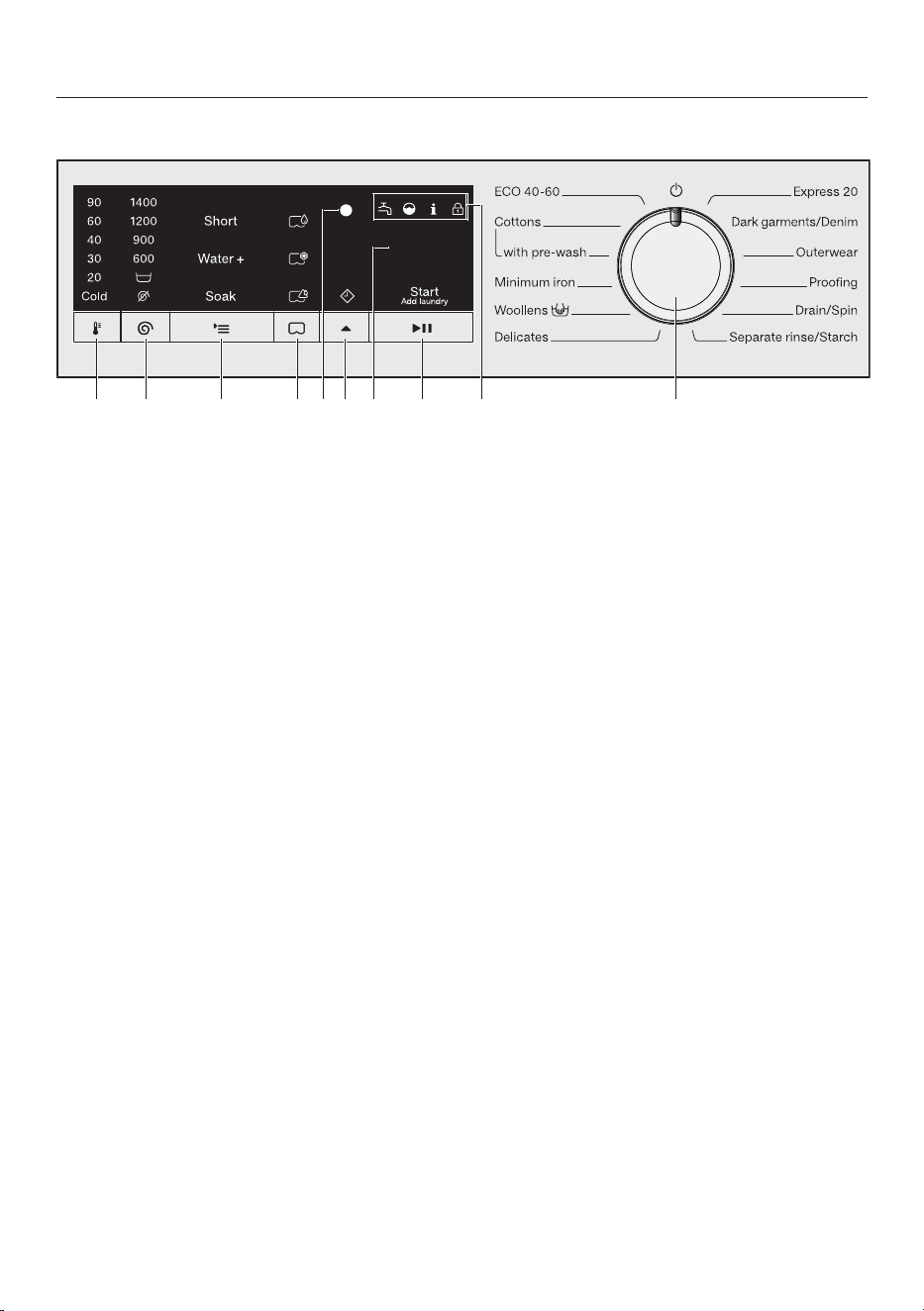
Control panel
a
Sensor control (temperature)
for selecting the temperature
b
Sensor control (spin speed)
for selecting the spin speed
c
Sensor control (extra options)
for selecting the extra options
d
Sensor control (CapDosing)
for activating detergent dispensing
via a capsule
e
Optical interface
This is used by the Service depart-
ment as a transmission point.
f
Sensor control (Delay start)
for activating the Delay start func-
tion. With the Delay start function,
you can delay the start of the pro-
gramme. The start of the programme
can be delayed from 30minutes up
to a maximum of 24hours. This al-
lows you to make use of night-time
economy electricity rates, for ex-
ample.
g
Time display
After the programme has started, the
programme duration will appear in
the display in hours and minutes.
When Delay start is being used, the
programme duration will appear after
the Delay start time has elapsed.
h
Sensor control (start/add laun-
dry)
The programme can be started
as soon as Start/Add laundry is
flashing on and off. Touching
the sensor control starts
the selected programme. Start/
Add laundry lights up con-
stantly.
Once the programme has been
started, the sensor control
allows you to add laundry.
i
Indicator lights
lights up if there are faults af-
fecting the water inlet and
drainage
lights up if excess detergent
was used
lights up as a reminder about
hygiene information
The Add laundryfunction can-
not be selected.

Operating the washing machine
13
j
Programme selector
for selecting programmes and for
switching off the appliance. The
washing machine is switched on
when you select a programme, and
switched off by turning the pro-
gramme selector to the position.
How the sensor controls work
The sensor controls control the values
located above them.
The,,,,andsensor con-
trols react to fingertip contact.
When a programme is selected, values
are pre-set for the and sensor con-
trols. Touching the sensor control de-
creases the value. After the smallest
value is reached, the display returns to
the maximum value.
Before using for the first time
14
Damage resulting from incorrect
installation and connection.
Installing and connecting the wash-
ing machine incorrectly will cause
serious property damage.
See “Installation”.
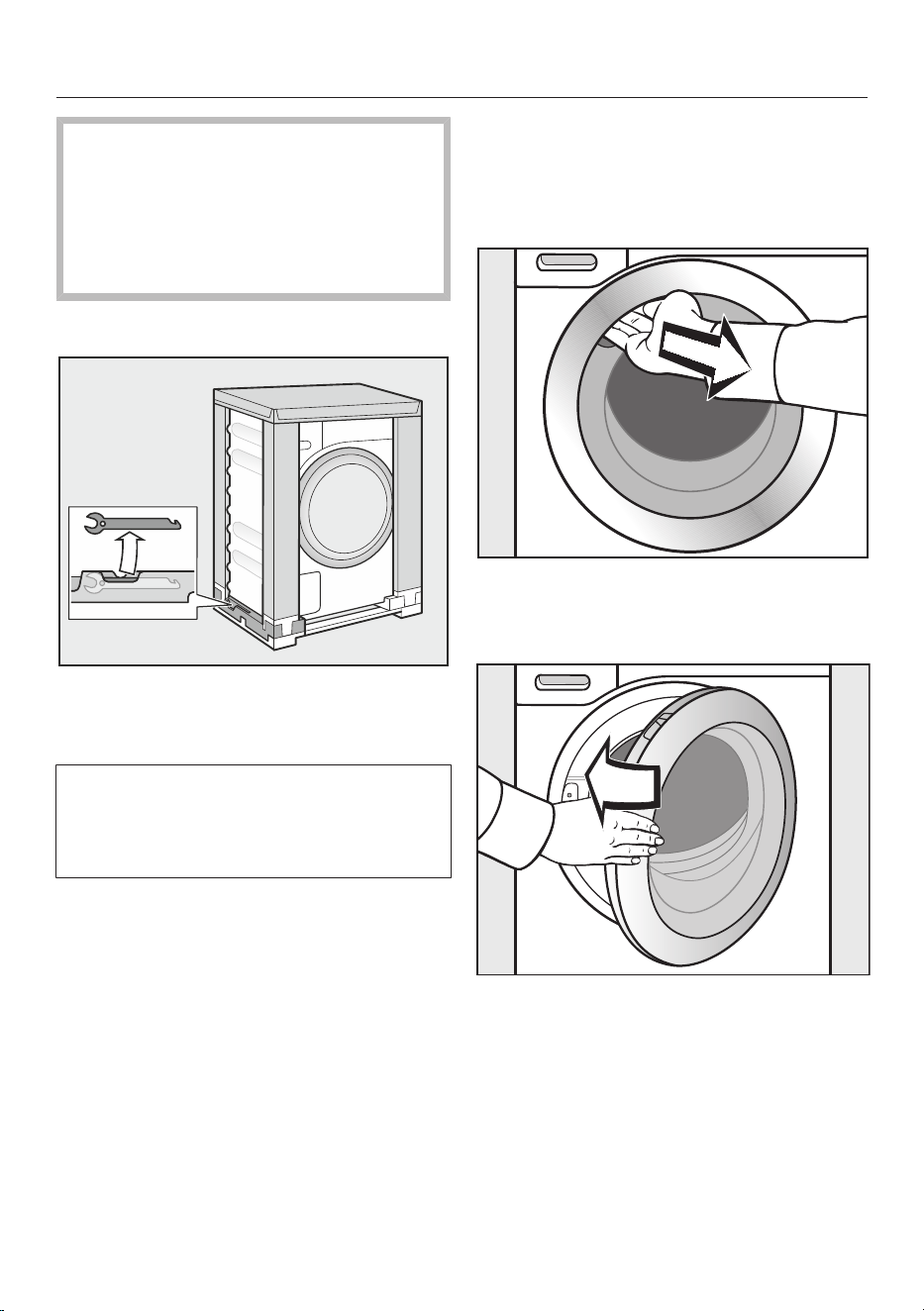
Removing the open spanner
Take out the open spanner for remov-
ing the transit bars from the bottom
left of the transport packaging.
This washing machine has undergone
a complete functional test at the fact-
ory and there will be some residual
water in the drum from this process.
Remove the drain hose elbow
from the drum
An elbow piece for the drain hose is
stored in the drum.
Reach under the door grip and pull
the door open.
Remove the elbow piece.
Shut the door with a gentle swing.
Before using for the first time
15
Removing the protective foil
and stickers
Remove:
- Any protective film from the door
- Any stickers from the front and the lid
Please do not remove any labels (e.g.
the data plate) which are visible
when you open the door.
Running the first programme
For optimum water and energy con-
sumption and excellent wash results, it
is important to calibrate the washing
machine.
To do this, the Cottonsprogramme
must be run without laundry and
without detergent.
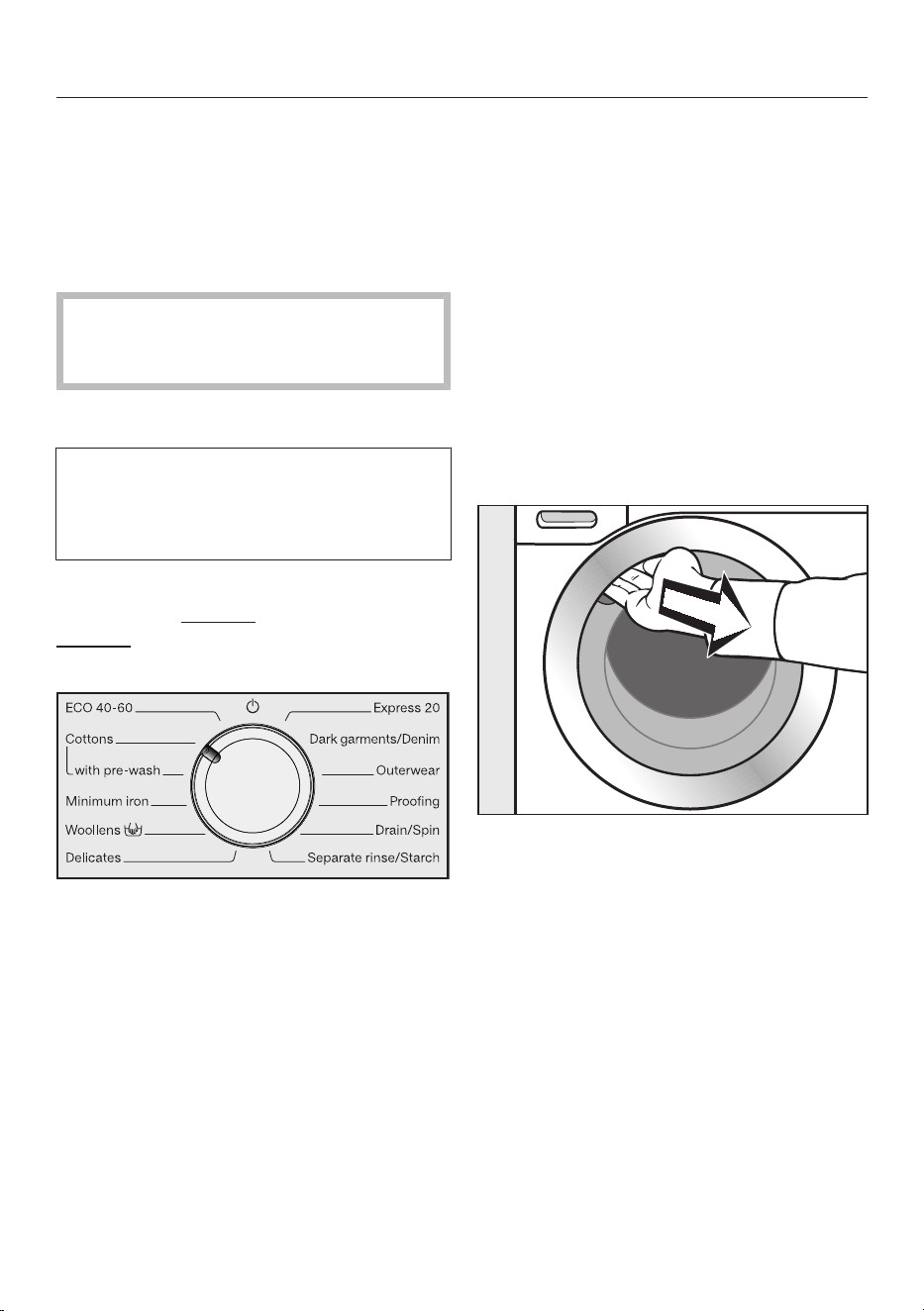
Open the stopcock.
Turn the programme selector to the
Cottons position.
The washing machine is now switched
on and the temperature 40 and spin
speed 1400 lights up.
Touch the sensor control.
The programme will start.
Opening the door at the end of
the programme
The door remains locked during the anti-
crease phase. The indicators light up for
the first 15minutes.
Turn the programme selector to the
position.
appears on the time display and the
indicator light goes out.
The door will unlock.
Tip: After the anti-crease phase, the
washing machine will have switched off
and the door unlocked automatically.
Reach under the recessed grip and
pull the door open.
Tip: Leave the door slightly open to al-
low the drum to dry.
Initial commissioning is now complete.
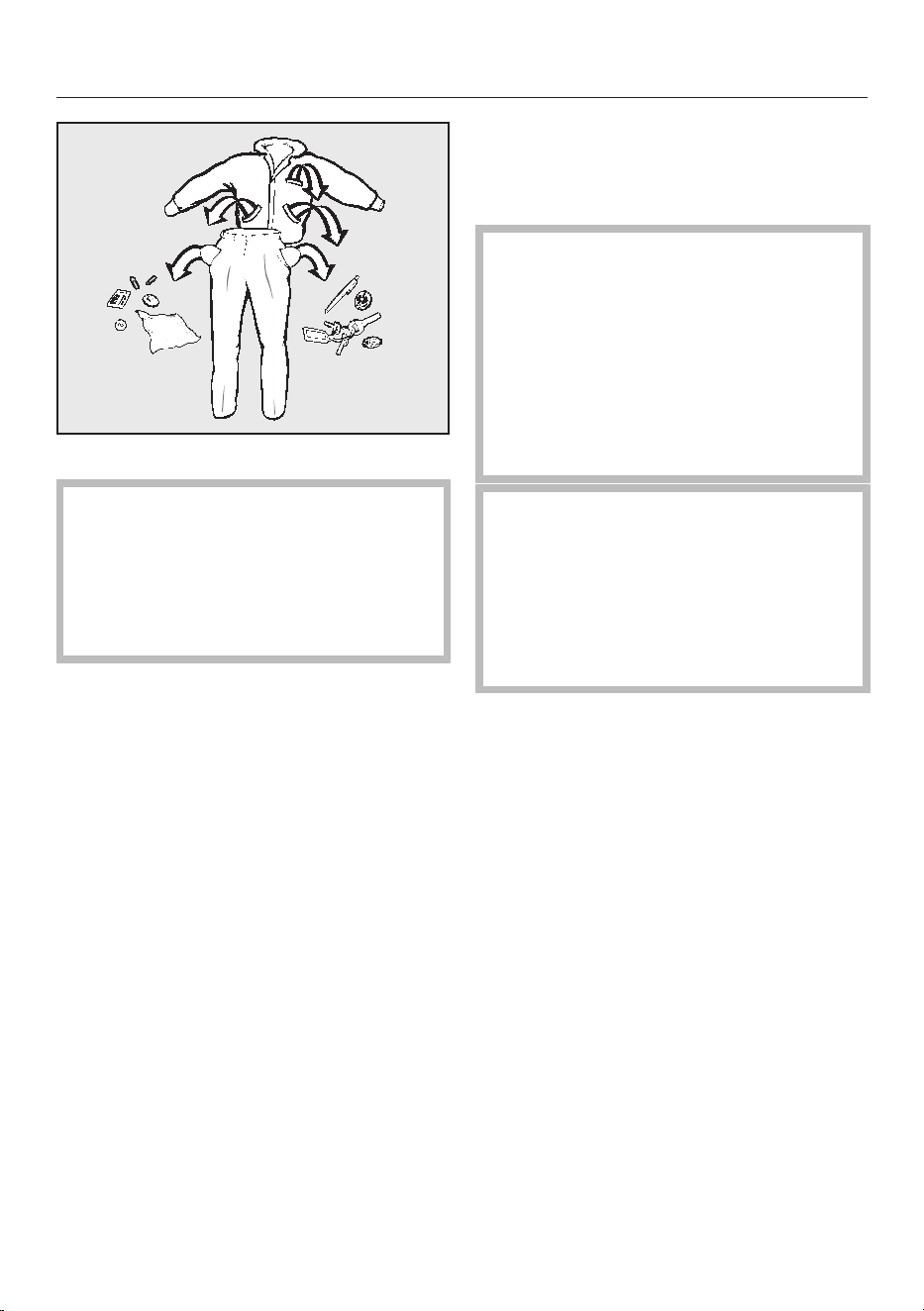
1. Prepare the laundry
16
Empty all pockets.
Damage due to foreign objects.
Nails, coins, paper clips, and so on
can cause damage to garments and
components in the machine.
Check the laundry before washing
and remove any foreign objects.
Sort the laundry
Sort the laundry by colour and by care
label. Most garments have a textile
care label in the collar or side seam.
Tip: Dark textiles often contain excess
dye and should be washed separately
several times before being included in a
mixed load. Always wash whites and
coloureds separately.
Pre-treating stains
Badly soiled areas and stains should
be cleaned as soon as possible,
preferably whilst still fresh. Spillages
should be carefully dabbed off using a
soft, colourfast cloth. Do not rub.
Tip: Stains (e.g. blood, egg, coffee, tea)
can be pre-treated using some handy
tricks which can be found in the Miele
guide to laundry care.
Damage due to solvent-based
cleaning agents
Cleaning agents containing benzine,
stain remover, etc., can damage
plastic parts.
When pre-treating textiles, make sure
that any plastic parts (e.g. buttons)
do not come into contact with clean-
ing agent.
Risk of explosion due to solvent-
based cleaning agents.
When using solvent-based cleaning
agents, an explosive mixture may de-
velop.
Never use solvent-based cleaning
agents in the washing machine.
General tips
- Curtains: remove rollers and lead
weights or place in a laundry bag.
- Sew in or remove any loose underwir-
ing in bras.
- Close any zips, attach velcro fasten-
ers, fasten hooks and eyes, etc. be-
fore washing.
- Fasten duvet covers and pillow cases
to prevent small items from becoming
rolled up inside them.
Do not wash items which are specified
by the manufacturer as not washable
according to the symbol on the care la-
bel (symbol).
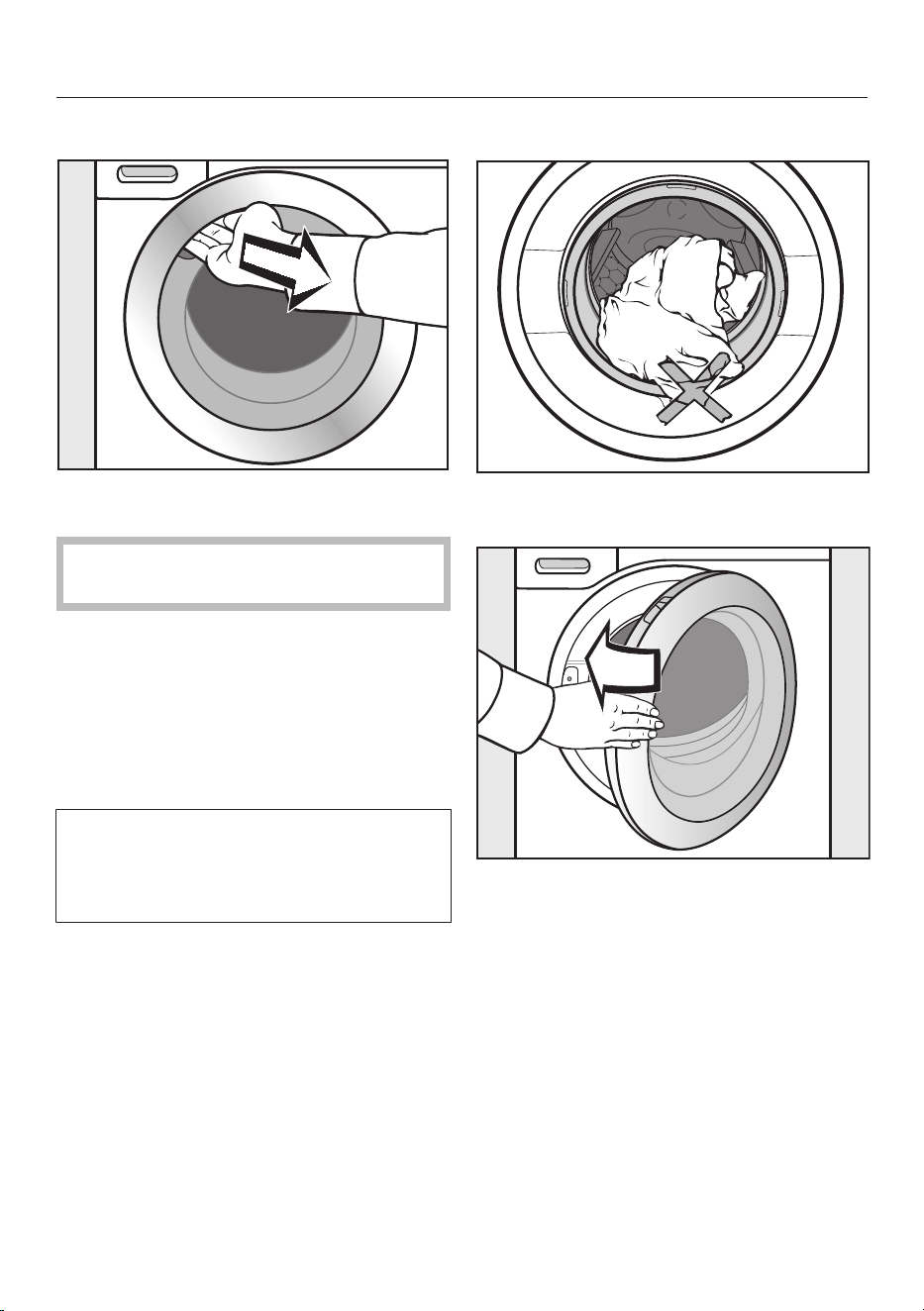
2. Load the washing machine
17
Open the door
Reach under the door grip and pull
the door open.
Check the drum for pets or foreign
objects before loading it with laundry.
The most efficient use of energy and
water is achieved when a full load is
washed. However, do not overload as
this makes cleaning less effective and
causes creases.
Unfold the laundry and load loosely
into the drum.
Mixing both large and small items
gives better wash results and also
helps to distribute the load evenly dur-
ing spinning.
Tip: Please note the maximum load size
for different wash programmes.
Close the door
Make sure that no items are caught
between the door and the seal.
Shut the door with a gentle swing.
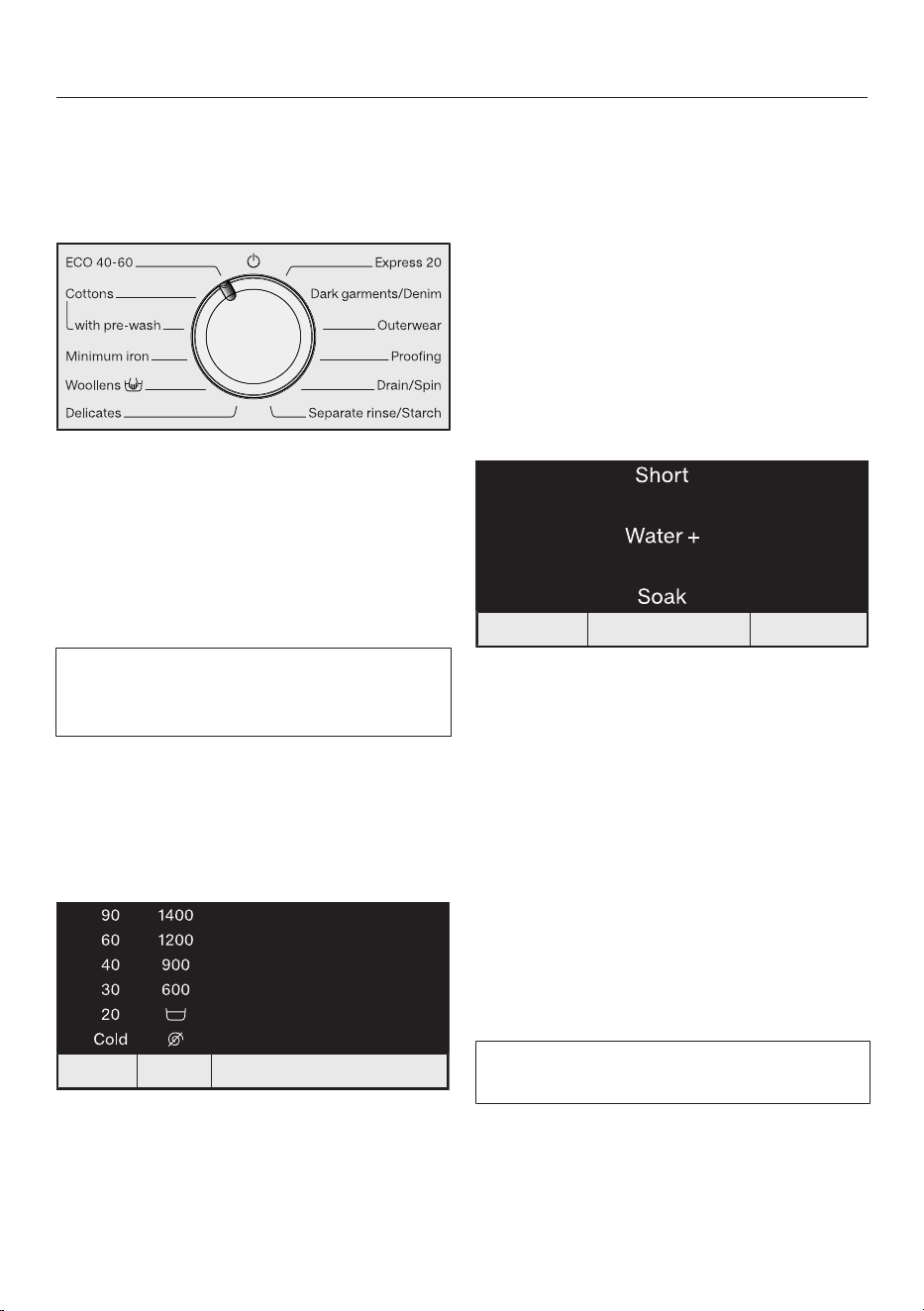
3. Select a programme
18
Programme selection
The washing machine is switched on by
turning the programme selector to a
wash programme.
Turn the programme selector to the
required programme.
The estimated wash time is shown on
the time display and the pre-set tem-
perature and spin speed light up.
Selecting a temperature and spin
speed
The wash programme’s pre-set tem-
perature and spin speed light up
brightly.
The temperatures reached inside the
washing machine might not be the
same as the temperatures selected.
Perfect wash results are achieved
through a combination of energy use
and wash duration.
Touch the sensor control to change
the pre-set temperature. Touching the
sensor control decreases the value.
After the smallest value is reached,
the display jumps to the maximum
value.
Touch the sensor control to
change the pre-set spin speed.
Touching the sensor control de-
creases the value. After the smallest
value is reached, the display jumps to
the maximum value.
Selecting extra options
In some programmes, you can combine
2extra options.
In other programmes, you can only se-
lect 1extra option or there are no avail-
able extra options.
Touch the sensor control:
- Once: the Short extra option is selec-
ted and lights up.
- 2times: the Water + extra option is
selected and lights up.
- 3times: the Soak extra option is se-
lected and lights up.
- 4times: the Short and Water + extra
options are selected and light up.
- 5times: the Water + and Soak extra
options are selected and light up.
- 6times: all the extra options are
switched off.
Please refer to “Extra options” for
more information.
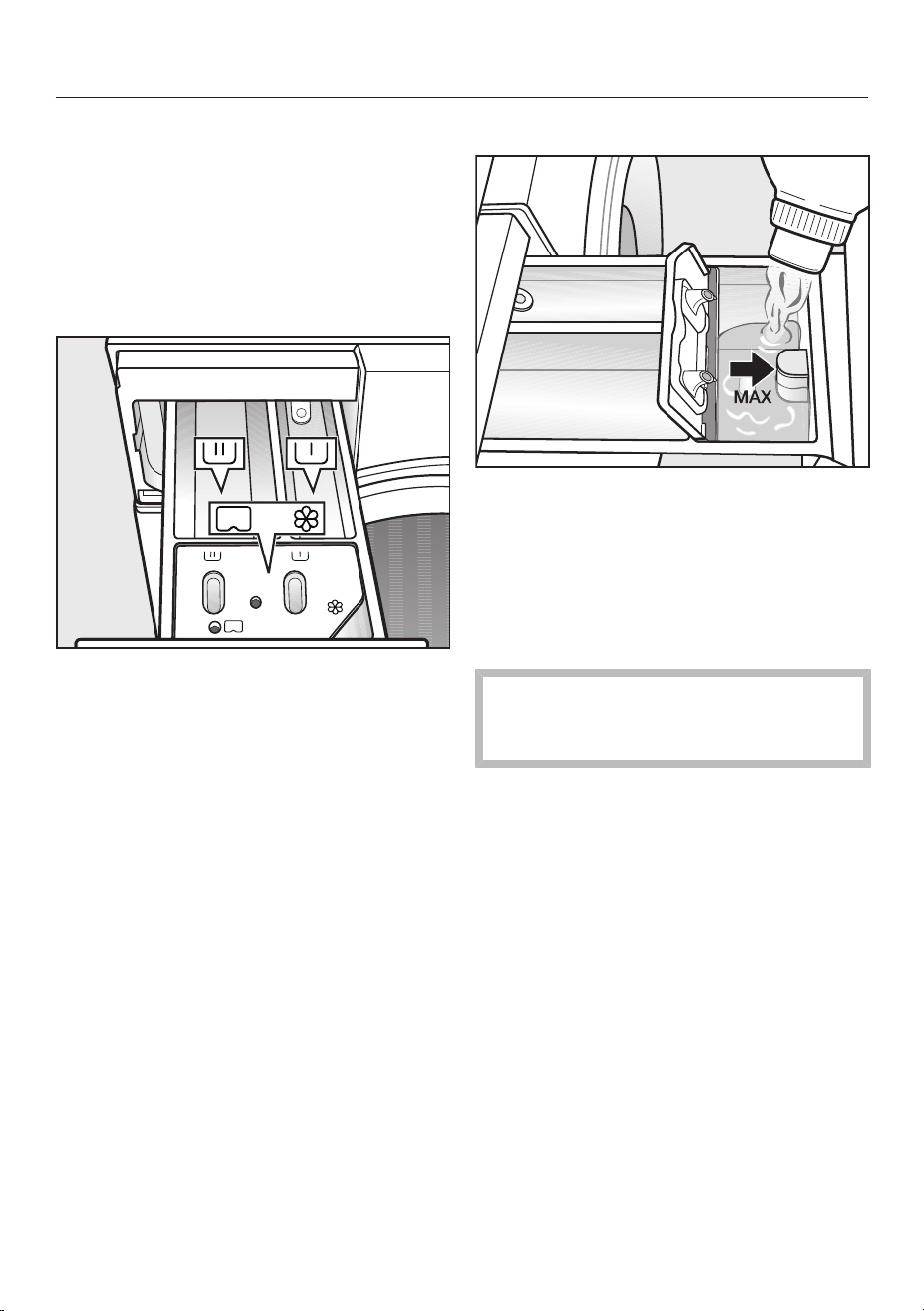
4. Add detergent
19
Detergent dispenser drawer
Any detergent suitable for automatic
front loading washing machines can be
used. Please observe the instructions
for use and dosage on the detergent
packaging.
Adding detergent
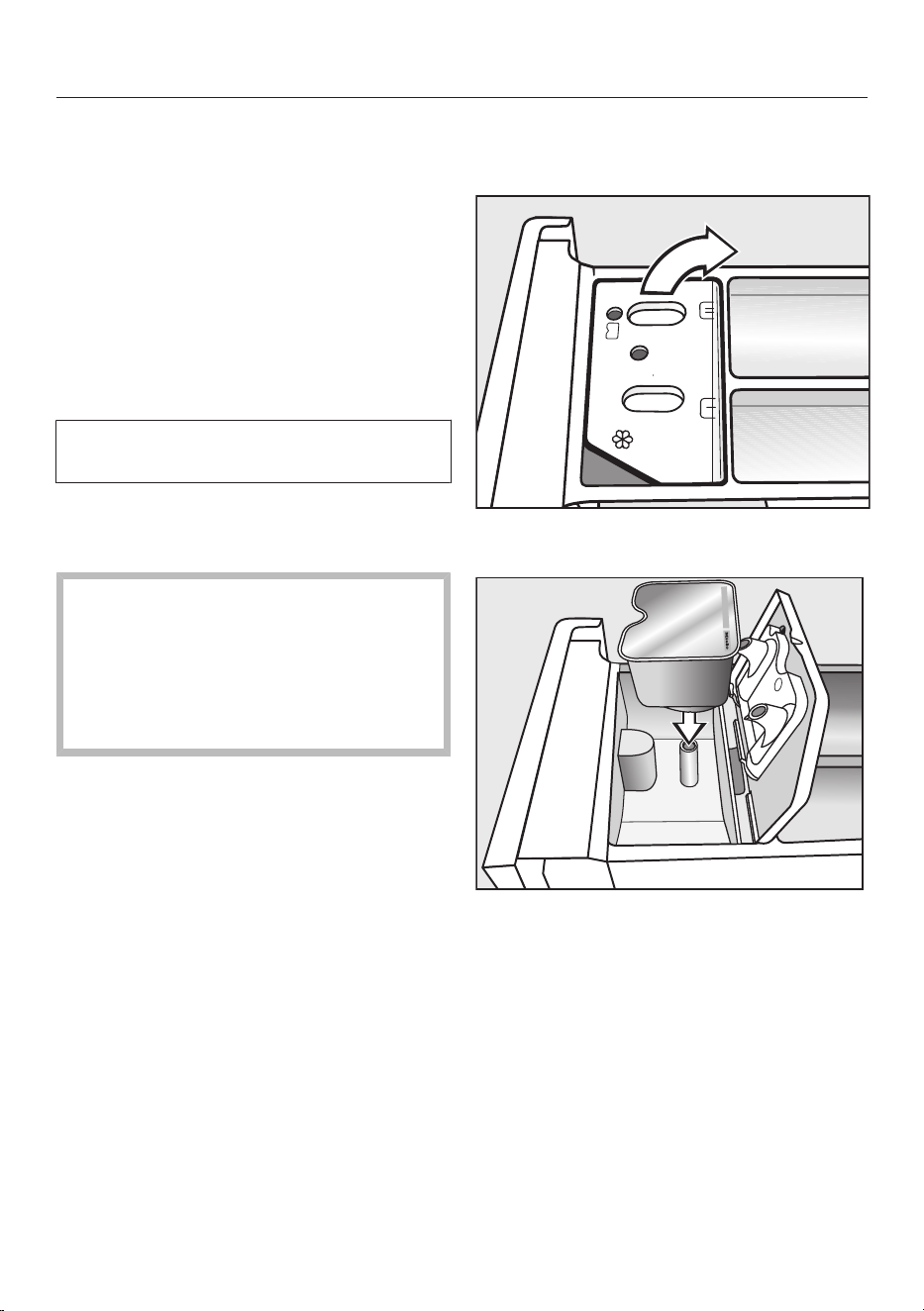
Pull out the detergent drawer and add
detergent to the compartments.
Detergent for the pre-wash
Detergent for the main wash and
soaking
Fabric softener, liquid starch, or
capsules
Using liquid detergent with a pre-wash
Liquid detergent cannot be used for the
main wash if the pre-wash has been se-
lected.
Use powder detergent for the main
wash.
Adding fabric conditioner
Add fabric conditioner or liquid starch
to the compartment. Do not ex-
ceed the maximum level mark.
It will be automatically dispensed in the
final rinse. At the end of the programme
a small amount of water remains in the
compartment.
If starching frequently, thoroughly
clean the dispenser compartment,
especially the siphon tube, regularly.
4. Add detergent
20
CapDosing
Three different types of capsule are
available:
= Fabric care (e.g. fabric condi-
tioner, proofing agent)
= Additives (e.g. detergent en-
hancer)
= Detergent (for the main wash
only)
Each capsule contains the correct
amount for one wash cycle.
Caps are available to order from Miele
or from the Miele online shop (see the
end of this booklet for contact details).
Capsules pose a health risk.
The ingredients of capsules can be
hazardous to health if they are swal-
lowed or come into contact with skin.
Keep capsules out of the reach of
children.
Activating CapDosing
Touch the sensor control:
- Once: the symbol is selected and
lights up.
- 2times: the symbol is selected
and lights up.
- 3times: the symbol is selected
and lights up.
- 4times: CapDosing is switched off.
Inserting a capsule
Open the detergent dispenser drawer.
Open the lid of the / compart-
ment.
Press the capsule in firmly.
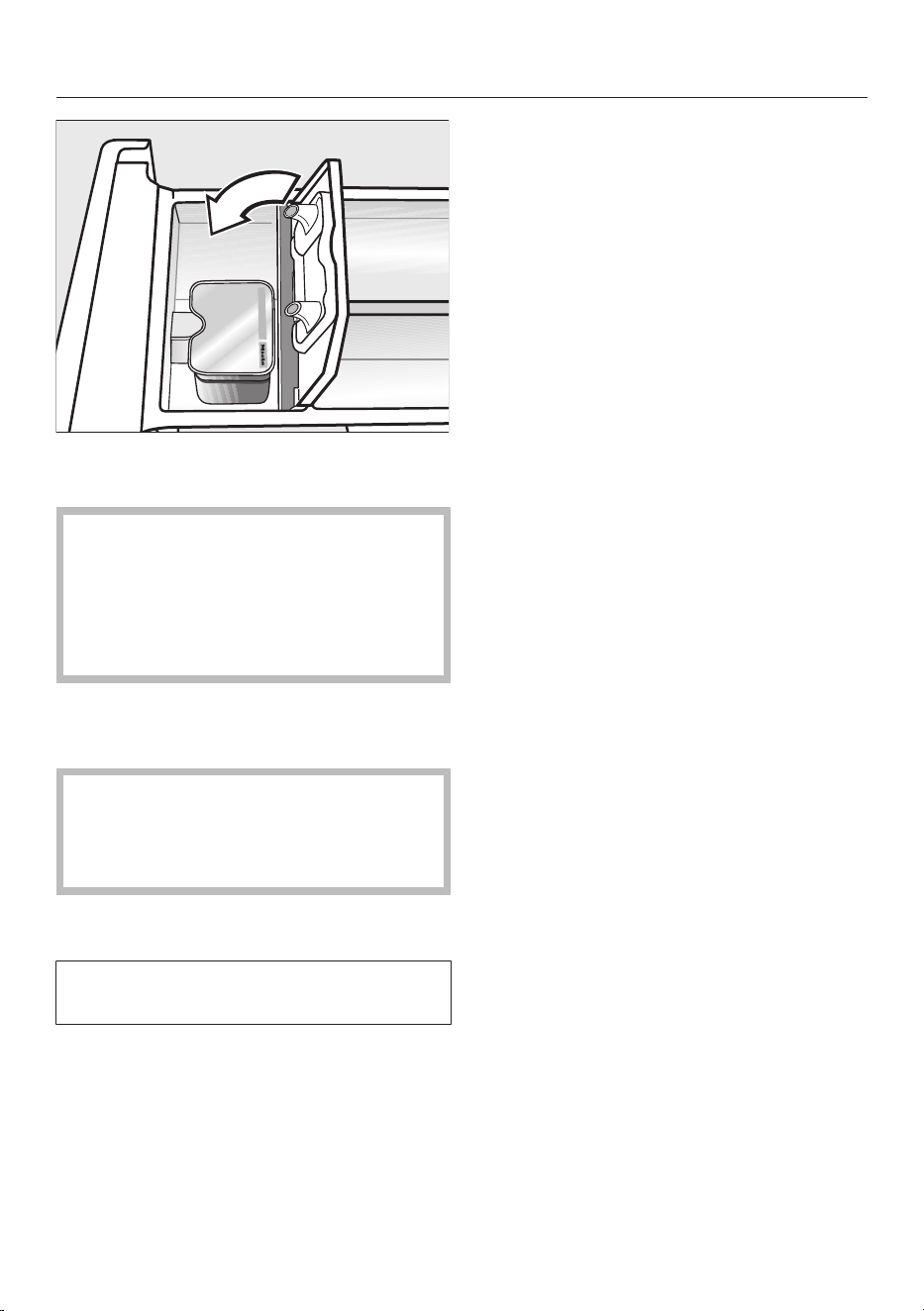
4. Add detergent
21
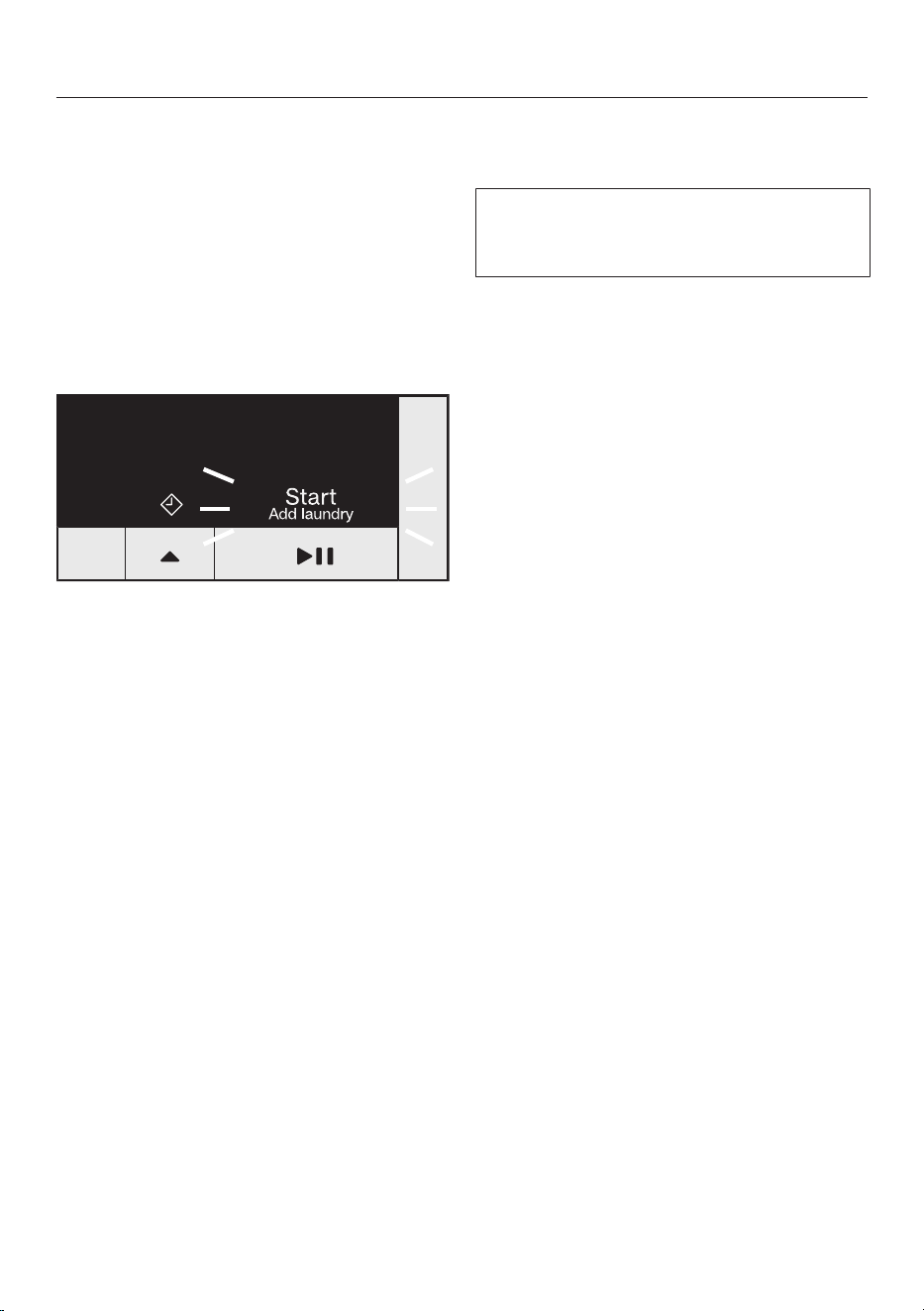
Close the lid and press it firmly shut.
Close the detergent dispenser drawer.
The capsule is opened by the act of
inserting it in the detergent dispenser
drawer. The contents can run out of
the capsule if you then remove it
from the drawer before it is used.
Dispose of opened capsules.
The wash programme will dispense the
contents of the capsule at the correct
time.
Water intake to the compartment
is solely via the capsule.
Do not add any additional fabric con-
ditioner to the compartment.
Remove the empty capsule at the end
of the programme.
For technical reasons a small amount
of water will remain in the capsule.
Tips on dosing
Adjust the detergent dosage to the level
of soiling of the laundry and the size of
the load. Reduce the amount of deter-
gent with smaller loads (e.g. reduce the
amount of detergent by ⅓ when wash-
ing a half load).
Too little detergent:
- Results in laundry not being cleaned
properly and may cause it to become
grey and hard to the touch over time.
- Can lead to a build-up of mould in the
washing machine.
- Results in grease not being com-
pletely removed from the laundry.
- Can lead to limescale deposits on the
heater elements.
Too much detergent
- Causes poor wash, rinse, and spin
results.
- Causes higher water consumption as
an extra rinse cycle is automatically
activated.
- Is a greater burden on the environ-
ment.
5. Start the programme
22
Switching on Delay start/
SmartStart
The start of the programme can be
delayed from 30minutes up to
24hours. This allows you to make use
of night-time economy electricity rates,
for example (see the “Delay start/
SmartStart” chapter).
Starting a programme
Touch the sensor control.
The door will lock and the programme
will start.
If a Delay start time has been selected,
this counts down on the time display. At
the end of the Delay start time or imme-
diately after the programme has started,
the programme duration appears on the
time display.
Adding laundry during a pro-
gramme sequence (AddLoad)
Laundry can be added or removed at
any time, provided that the symbol
is not illuminated in the display.
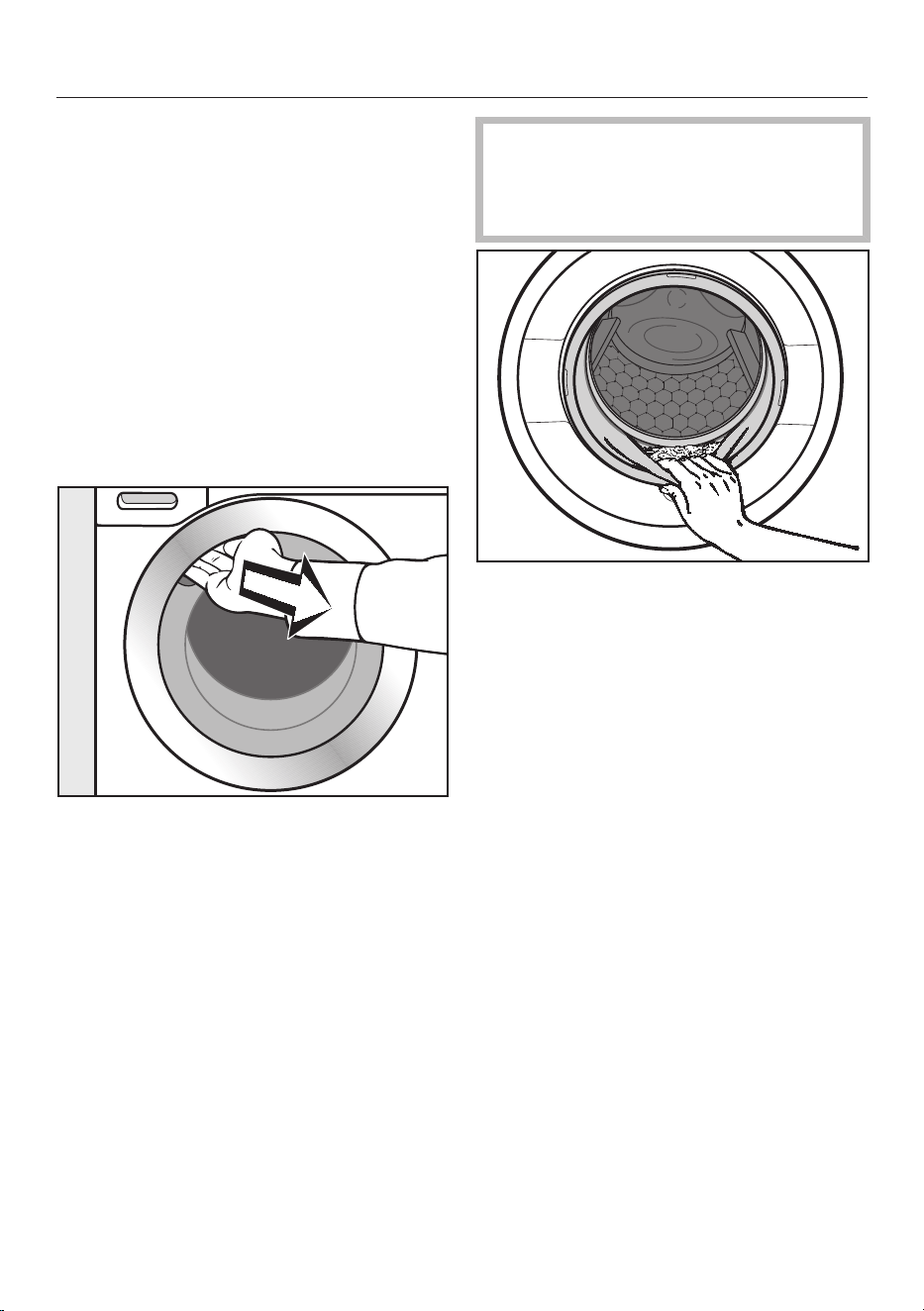
Touch the sensor control.
Rotating bars ...... are
shown on the time display.
If the word appears on the time dis-
play, the door can be opened.
Open the door. Add or remove laun-
dry.
Close the door.
Touch the sensor control.
The programme will continue.
Laundry cannot usually be added or re-
moved if:
- The suds temperature is above 55°C
- The water inside the drum is above a
certain level
6.End of programme
23
Opening the door and removing
the laundry
The door remains locked during the anti-
crease phase. The indicators light up for
the first 15minutes.
appears on the time display.
Turn the programme selector to the
position.
The indicator light will go out.
The door will unlock.
Tip: After the anti-crease phase, the
door will have unlocked automatically.
Reach under the recessed grip and
pull the door open.
Remove the laundry.
Items left in the drum could discolour
other items in the next wash or be-
come discoloured themselves.
Remove all items from the drum.
Check the door sealing ring for any
foreign objects.
Tip: Leave the door slightly open to al-
low the drum to dry.
If applicable, remove the used cap-
sule from the detergent drawer.
Tip: Leave the detergent drawer slightly
open to allow it to dry.
Spinning
24
Final spin speed in wash pro-
grammes
When a programme is selected, the
sensor control for the optimum spin
speed for that programme will be
brightly lit up in the control field.
A faster spin speed can be selected for
certain wash programmes.
The highest selectable spin speed is in-
dicated in the table.
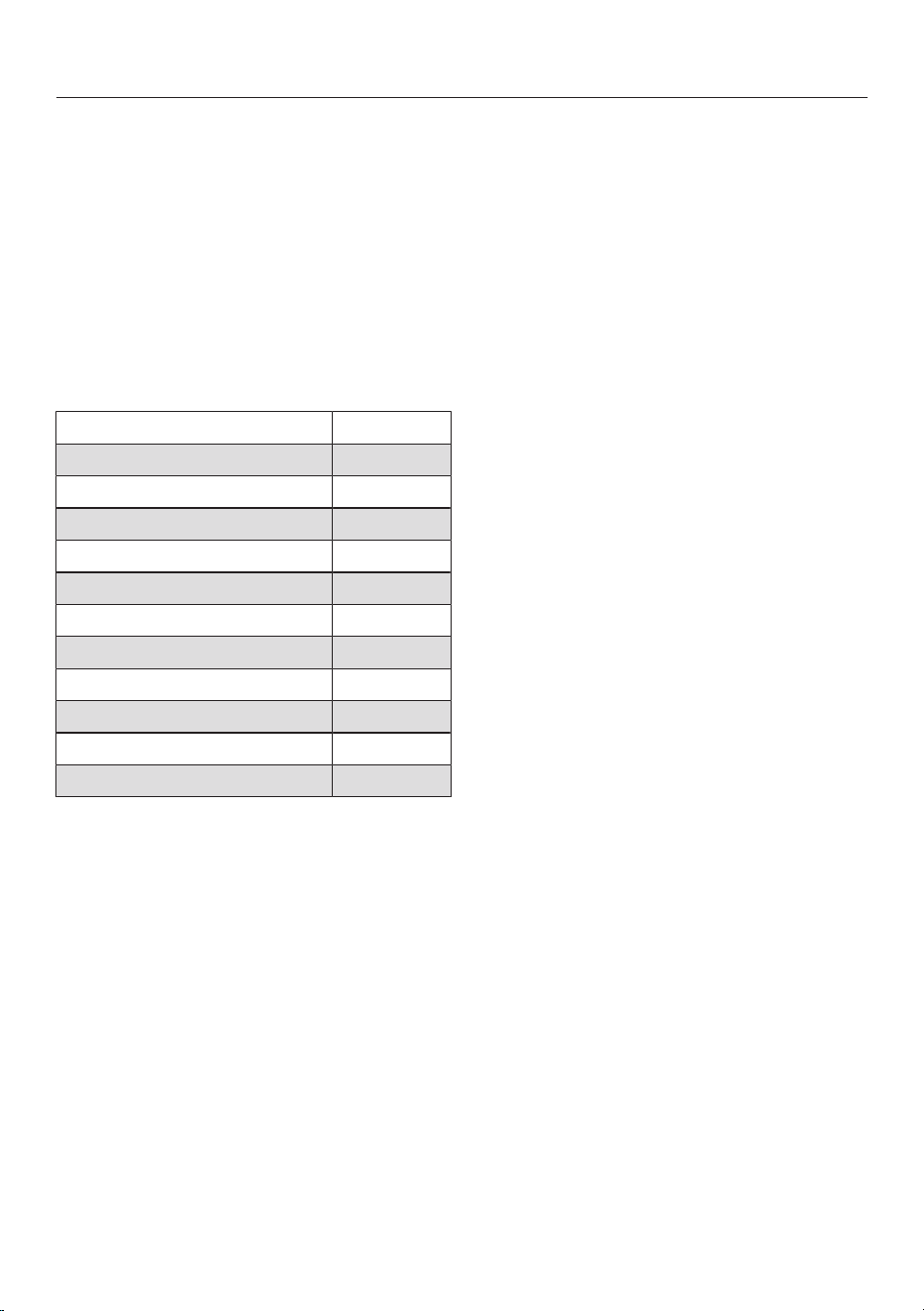
Programme rpm
ECO 40-60 1400
Cottons 1400
Minimum iron 1200
Woollens 1200
Delicates 900
Express 20 1200
Dark garments/Denim 1200
Outerwear 900
Proofing 1200
Drain/Spin 1400
Separate rinse/Starch 1400
Rinse and interim spin
There is a spin after the main wash and
between the rinses. A reduction in the
final spin speed will also reduce the in-
terim spin speed. If a spin speed of less
than 700 rpm is selected for the Cot-
tons programme, an additional rinse is
introduced.
Selecting Rinse hold (final spin)
Touch the sensor control re-
peatedly until the indicator (Rinse
hold) lights up.
The laundry is not spun after the final
rinse cycle and remains in the rinse wa-
ter. This helps to prevent creasing if the
laundry is not going to be removed from
the washing machine immediately after
the end of the programme.
Ending a programme with a spin cycle
The indicator with the ideal spin speed
lights up. You can change the spin
speed with the sensor control.
Touch the sensor control.
Ending a programme without a spin
cycle
Touch the sensor control re-
peatedly until the indicator
(without spin) lights up.
Touch the sensor control.
Omitting the rinse-spin and the
final spin
Touch the sensor control re-
peatedly until the indicator
(without spin) lights up.
After the last rinse, the water will be
pumped away and the anti-crease
phase will switch on.
In some programmes, an extra rinse is
introduced with this setting.
Delay start
25
With Delay start you can choose when
you want the programme to start. You
can delay the start of the programme by
30minutes up to a maximum of 24
hours, allowing you to make use of
night-time economy electricity rates, for
example.
Selecting the Delay start function
Delay start is not possible in the
Drain/Spin and Proofingprogrammes.
Select the programme required.
Touch the sensor control.
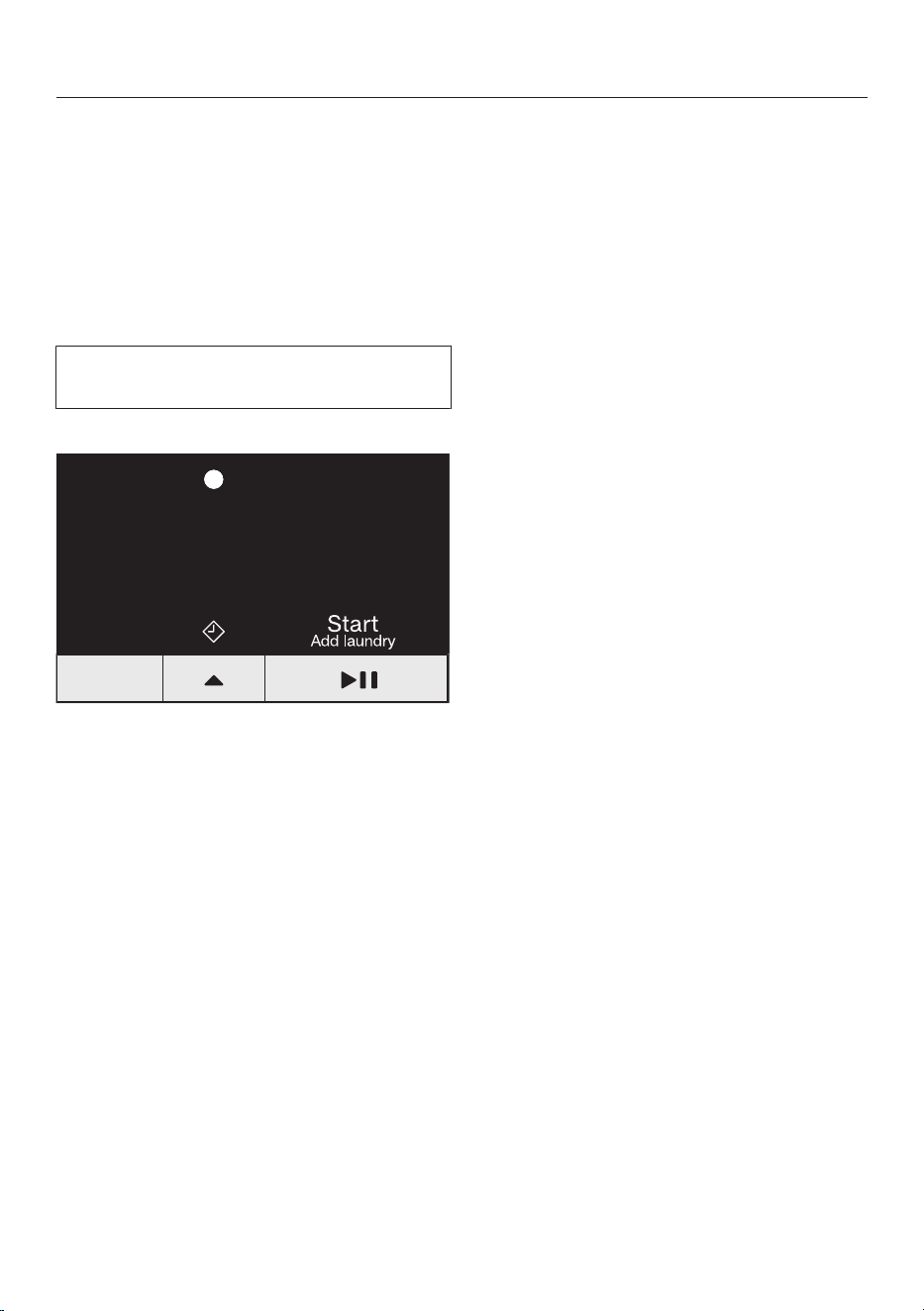
The symbol lights up brightly and the
first 30minutes of the Delay start time
appear on the time display.
Touch the sensor control re-
peatedly until the required Delay start
time lights up on the time display.
- In the case of settings below 3hours,
the Delay start time changes in incre-
ments of 30minutes.
- In the case of settings above 3hours,
the Delay start time changes in incre-
ments of 1hour.
Tip: If you press and hold the sensor
control, the time automatically counts
up to 24hours.
Starting Delay start
Touch the sensor control.
The Delay start process starts and
counts down on the time display.
Changing or cancelling a started Delay
start
If the selected Delay start function has
started, it is no longer possible to
change the time.
Turn the programme selector to the
position.
Turn the programme selector to any
programme.
Rotating bars ...... are
shown on the time display.
The door lock is released.
Select a programme and a new Delay
start time.
Programme chart
26
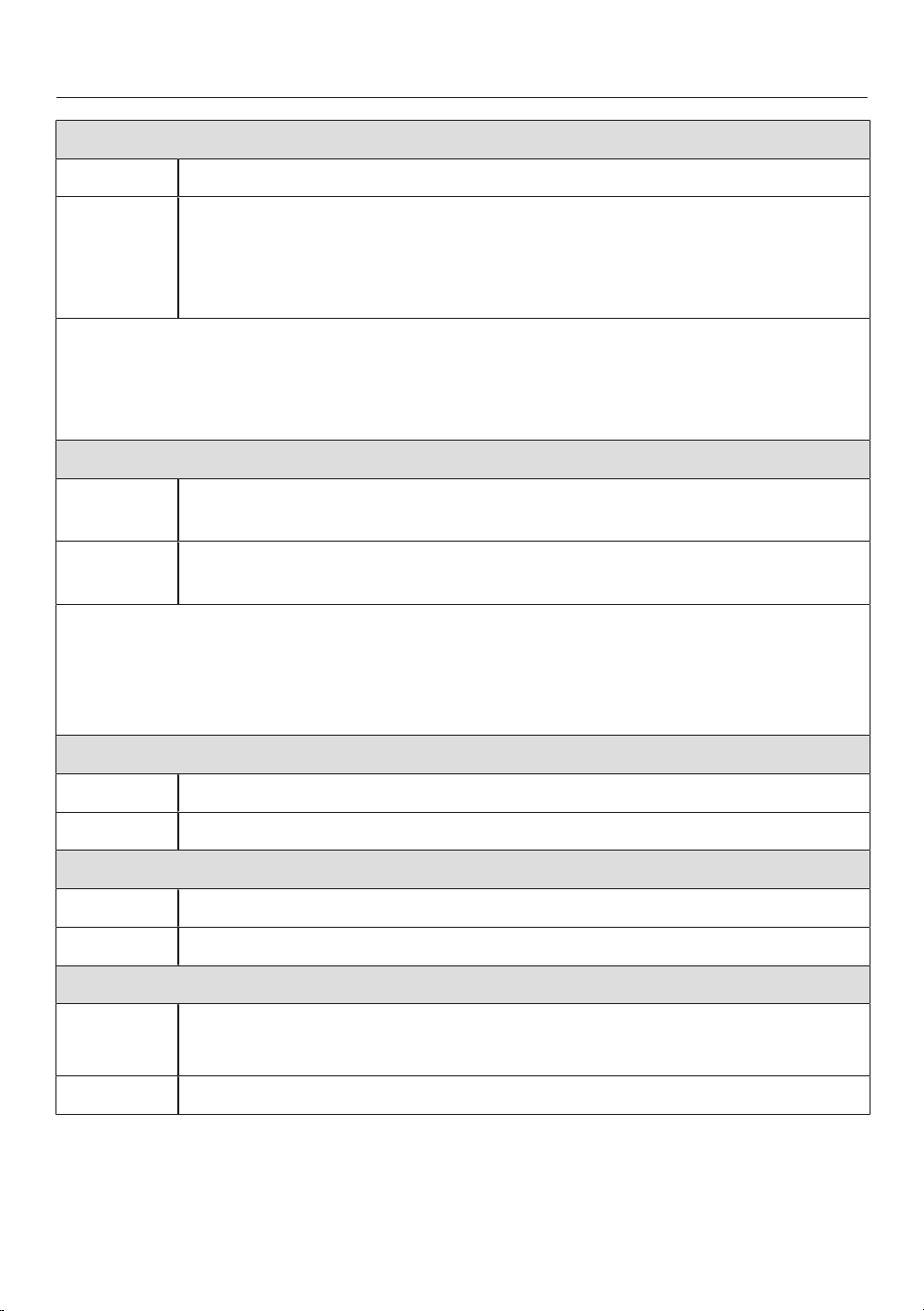
ECO 40-60 Max. load 8,0kg
Items For normally soiled cotton garments
Tip A laundry load consisting of mixed cottons that are intended for
washing at 40°C or 60°C can be washed in the same wash cycle.
This programme is the most efficient in terms of energy and water
consumption for washing cottons.
Note for test institutes:
Test programme for compliance with EU legislation regarding ecodesign
No. 2019/2023 and energy labelling in accordance with Regulation
No. 2019/2014.
Cottons 90°C to cold Max. load 8,0kg
Items Cotton, linen or mixed fibre fabric, e.g. table linen, underwear, T-
shirts, etc.
Tip Where particularly high levels of hygiene are required, please select a
temperature of 60°C or higher.
Note for test institutes:
Cottons 20°C: programme for lightly soiled cotton garments
Test programme for compliance with EU legislation regarding ecodesign
No. 2019/2023.
Minimum iron Cold to 60°C Max. load 4,0kg
Items Synthetic and mixed fibre textiles as well as easy care cotton
Tip Reduce the spin speed for fabric that creases easily.
Woollens Cold to 40°C Max. load 2,0kg
Items Wool or wool blend fabric
Tip Reduce the spin speed for fabric that creases easily.
Delicates Cold to 40°C Max. load 3,0kg
Items Delicate garments made from synthetic fibre, mixed fibre and viscose
Curtains specified as machine-washable by the manufacturer
Tip - Deselect the spin for items which crease easily.
Programme chart
27
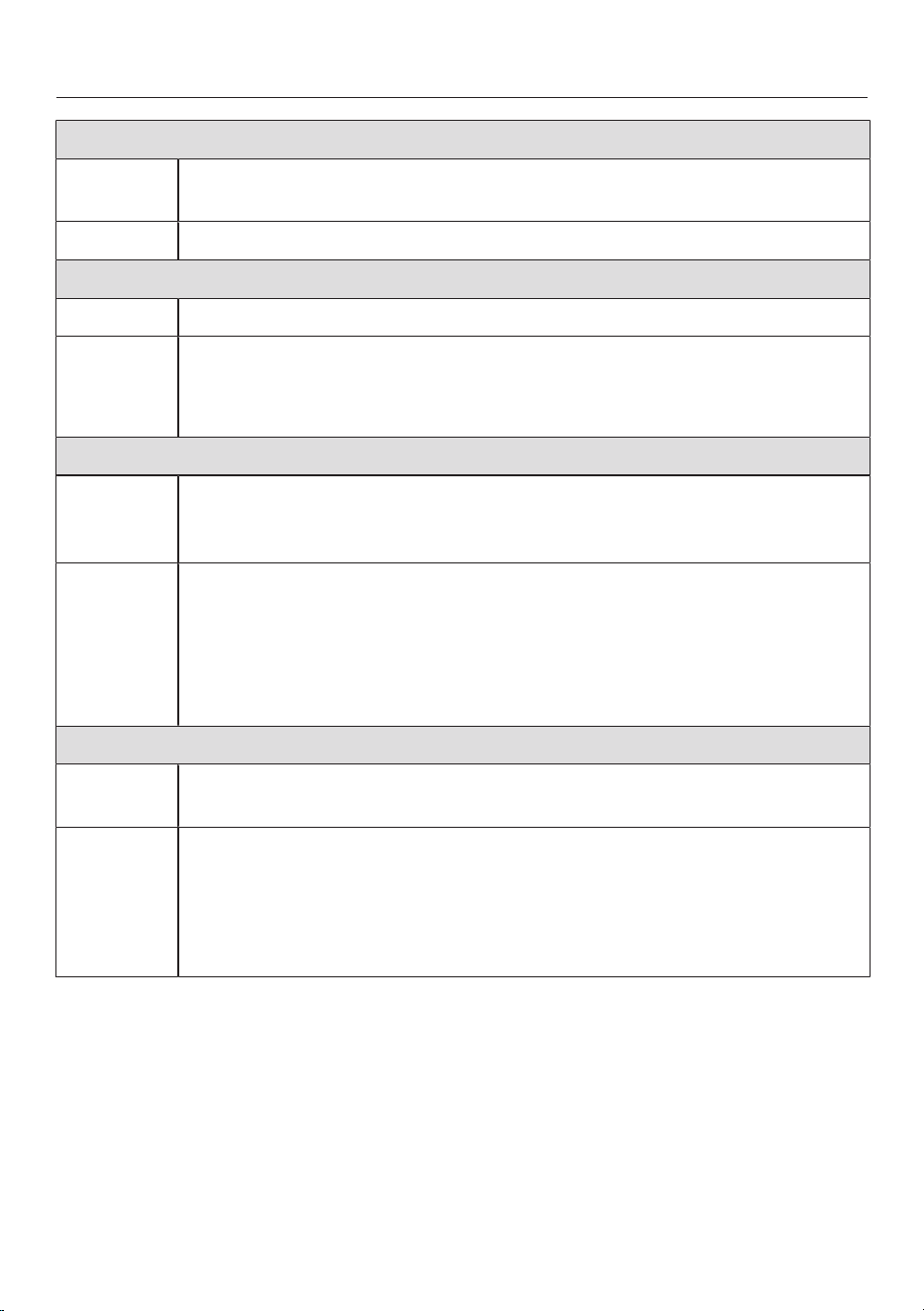
Express 20 Cold to 40°C Max. load 3,5kg
Items Cotton garments that have hardly been worn or are only very lightly
soiled
Tip The Shortextra option is activated automatically.
Dark garments/Denim Cold to 60°C Max. load 3.0kg
Items Black and dark items made of cotton, mixed fibre or denim
Tip - Wash inside out.
- Denim often contains excess dye and may run during the first few
washes. Therefore, wash light and coloured items separately.
Outerwear Cold to 40°C Max. load 2.5kg
Items Performance outerwear (e.g. jackets and trousers) made from mem-
brane fabric such as Gore-Tex®, SYMPATEX®, WINDSTOPPER®,
etc.
Tip - Zip up or close any jackets with Velcro before washing.
- Do not use fabric conditioner.
- If required, these items can also be re-proofed using the Proof-
ingprogramme. Proofing after each wash cycle is not recommen-
ded.
Proofing 40°C Max. load 2.5kg
Items Treating microfibre fabric, ski wear or table linen made from mainly
synthetic fibres to provide a finish which is resistant to water and dirt
Tip - The items must be freshly laundered and spun or dried before
proofing.
- For best results, the items should be heat-treated afterwards. This
can be achieved by drying them in the tumble dryer or ironing
them.
Programme chart
28
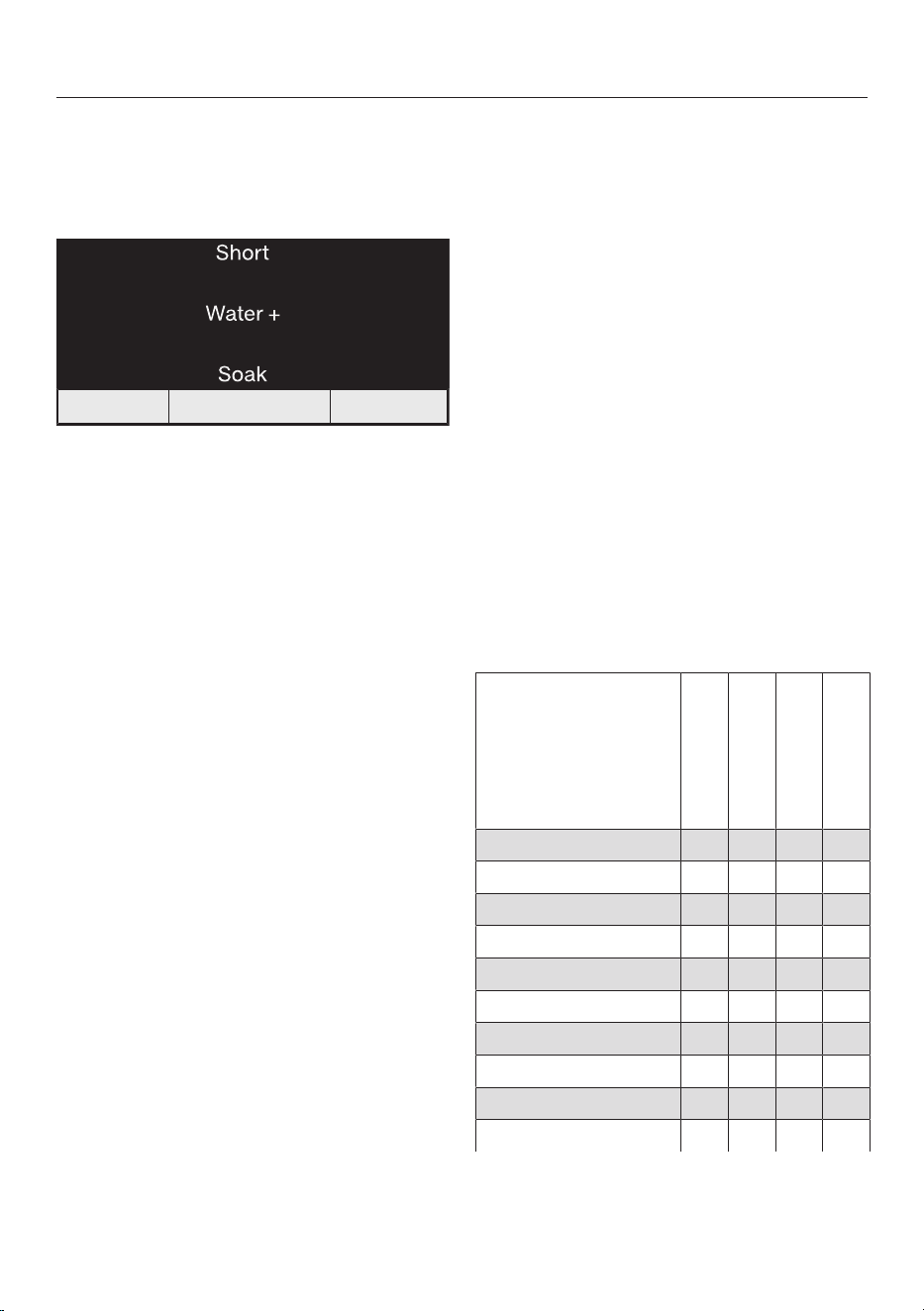
Drain/Spin –
Tip - Drain only: Set spin speed to.
- Make sure you select the appropriate spin speed.
Separate rinse/Starch Max. load 7.0kg
Items - Rinsing hand-washed items
- Table cloths, serviettes and workwear requiring starching
Tip - Reduce the final spin speed for fabric that creases easily.
- Laundry that is to be starched should be washed but not treated
with fabric conditioner.
- Items will be rinsed very effectively with 2rinses by activating the
Water + extra option.
Extra options
29
You can use the extra options buttons to
augment the wash programmes.
Use the sensor control to select or
deselect extra options.
Touch the sensor control:
- Once: the Short extra option is selec-
ted and lights up.
- 2times: the Water + extra option is
selected and lights up.
- 3times: the Soak extra option is se-
lected and lights up.
- 4times: the Short and Water + extra
options are selected and light up.
- 5times: the Water + and Soak extra
options are selected and light up.
- 6times: all the extra options are
switched off.
Short
For textiles with light soiling with no vis-
ible staining.
The wash duration is reduced.
Water +
The water level in the main wash and
the rinses will be increased. A second
rinse cycle is carried out in the Separate
rinse/Starchprogramme.
You can select other functions for the
Water +sensor control. These are de-
scribed under “Programmable func-
tions”.
Soak
For cleaning heavily soiled and stained
items with protein stains.
- A duration of between 30minutes
and 2hours can be programmed in
30minute increments for the soak
process.
- The factory default setting is
30minutes.
See “Programmable functions – Soak”
for instructions on how to programme a
different soak period.
Pre-wash
For laundry with large amounts of dirt,
e.g. dust and sand.
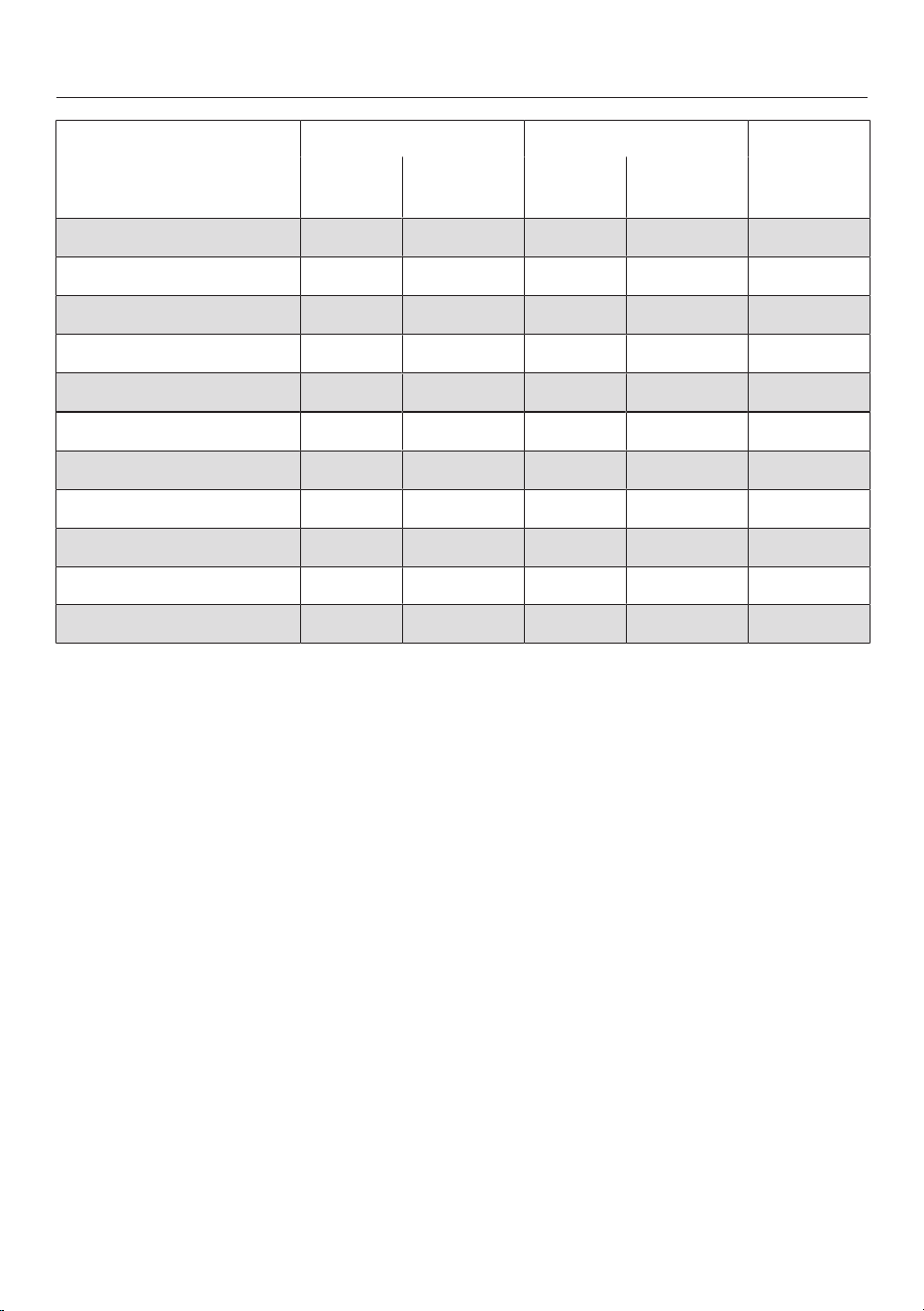
The following extra options can
be selected in addition to the
programmes
Short
Water +
Soak
Pre-wash
ECO 40-60 – – – –
Cottons
Minimum iron –
Woollens – – – –
Delicates –
Express 20 – – –
Dark garments/Denim –
Outerwear –
Proofing – – – –
Separate rinse/Starch – – –
= can be selected
= activated automatically
– = cannot be selected
Programme sequence
30
Main wash Rinse Spin
Water
level
Wash
rhythm
Water
level
Rinse
cycles
ECO 40-60 2–3
2
Cottons 2-5
1,2,3
Minimum iron 2-4
2,3
Woollens 2
Delicates 2-4
2,3
Express 20 1
Dark garments/Denim 3-5
2,3
Outerwear 3-4
3
Proofing – 1
Drain/Spin – – – –
Separate rinse/Starch 0-1
5
Please see the next page for a description of the symbols.

Programme sequence
31
= low water level
= medium water level
= high water level
= intensive rhythm
= normal rhythm
= sensitive rhythm
= handwash rhythm
= carried out
– = not carried out
This washing machine has fully elec-
tronic controls with automatic load con-
trol. The washing machine takes in the
right amount of water required for the
programme depending on the amount of
laundry and its absorbency rate.
The programme sequences outlined in
the chart are based on the basic pro-
gramme with a full load.
Special features in the pro-
gramme sequence
Anti-crease:
At the end of the programme, the drum
continues to turn at intervals for up to
30minutes to help prevent creasing.
Exception: there is no anti-crease phase
in the Woollensprogramme.
The washing machine can be opened at
any time.
1
If a temperature of 60°C or higher is
selected, two rinses are carried out. If
a temperature of less than 60°C is
selected, three rinses are carried out.
2
An additional rinse is carried out if:
- there is too much foam in the drum
- a spin speed lower than 700rpm has
been selected.
3
An additional rinse is carried out if:
- the Water +extra option has been se-
lected and the optionsor have
been activated in Programmable func-
tions.
5
An additional rinse is carried out if:
theWater +extra option has been se-
lected.

Changing the programme sequence
32
Changing a programme (safety
lock)
A programme, temperature, spin speed
or selected options cannot be changed
once the machine has been successfully
started. This prevents the machine be-
ing operated unintentionally, e.g. by chil-
dren.
If the washing machine is switched off
during active programme operation,
the standby function does not switch
the washing machine off completely
after 15minutes. Safety functions con-
tinue to be active because there may
still be water inside the drum.
Cancelling a programme
You can cancel a wash programme at
any time after it has started.
Turn the programme selector to the
position.
Turn the programme selector to any
position.
Rotating bars ...... are
shown on the time display.
The water is pumped away and the door
lock is then released.
Selecting a new programme
Turn the programme selector to the
required wash programme.
Check that there is still sufficient de-
tergent in the detergent drawer. Add
more detergent if necessary.
Touch the sensor control.
Garment care label symbols
33
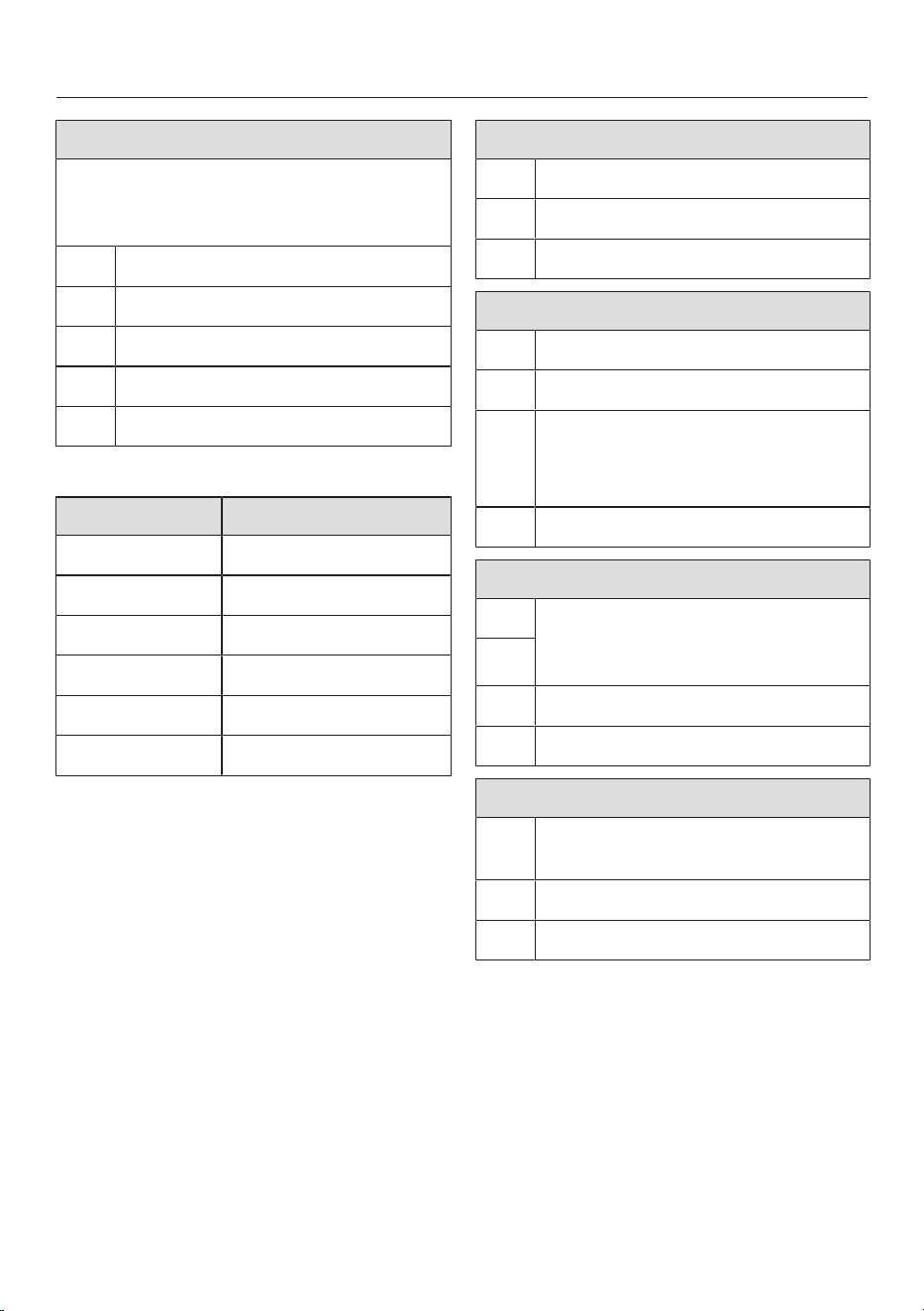
Washing
The figure quoted in the bucket is the
maximum temperature at which the
garment can be washed.
Normal agitation
Reduced agitation
Much reduced agitation
Hand wash
Do not wash
Programme selection examples
Programme Care label symbols
ECO 40-60
Cottons
Minimum iron
Delicates
Woollens
Express 20
Drying
Normal temperature
Low temperature
Do not tumble dry
Ironing
Approx. 200°C
Approx. 150°C
Approx. 110°C
Ironing with steam can cause ir-
reversible damage.
Ironing/rotary ironing prohibited
Professional cleaning
Dry clean only. The letters indic-
ate the type of cleaning agent
required.
Wet cleaning
Dry cleaning prohibited
Bleaching
Any oxidation bleach can be
used
Use oxygen bleach only
Do not bleach

Detergent
34
The correct detergent
All detergents produced for automatic
washing machines are suitable. Follow
the manufacturer's instructions and
dosage recommendations on the pack-
aging.
For users in Asia:
please use a low foaming detergent
suitable for use in front-loading ma-
chines
The right amount to dispense
will depend on the following:
- the soiling level of the load
- the quantity of the laundry
- the water hardness level.
Check with your local water supplier if
you do not know the hardness level in
your area.
Water softeners
A water softener can be used to cut
down on the use of detergents in areas
with water hardness levels II and III.
Dispense according to the amount spe-
cified on the packaging. First add deter-
gent and then the water softener.
You can then use the recommended
amount of detergent for water hardness
level I.
Water hardness levels
Hardness
scale
Hardness level
in mmol/l
German scale
°d
I (soft) 0 – 1.5 0 – 8.4
II (medium) 1.5 – 2.5 8.4 – 14
III (hard) above 2.5 above 14
Dispensing aids
Use dispensing aids, (e.g. balls) if these
are supplied with the detergent, particu-
larly when using liquid detergent.
Refill packs of detergent
When purchasing detergent buy refill
packs wherever possible. This helps re-
duce the amount of waste packaging.
Colour run and dye removers/
dyes
Damage due to colour run/dye
removers.
Colour run and dye removers can
cause corrosion in the washing ma-
chine.
Do not use colour run or dye re-
movers in this washing machine.
Dyes suitable for use in domestic wash-
ing machines can be used. However,
please note that the salt used in the
dyeing process can cause corrosion to
stainless steel components in the ma-
chine if you use dye frequently. Always
follow the dye manufacturer’s instruc-
tions carefully.

Detergent
35
Using detergent tablets or pods
Always put detergent tablets or pods
directly in the drum with the laundry.
They cannot be added via the detergent
dispenser drawer.
Fabric conditioner and liquid
starch
Fabric conditioner
makes garments soft to handle and
helps prevent static cling when tumble
drying.
Starch
stiffens and gives body to items of laun-
dry, e.g. shirts, tablecloths and bed
linen.
Detergent
36
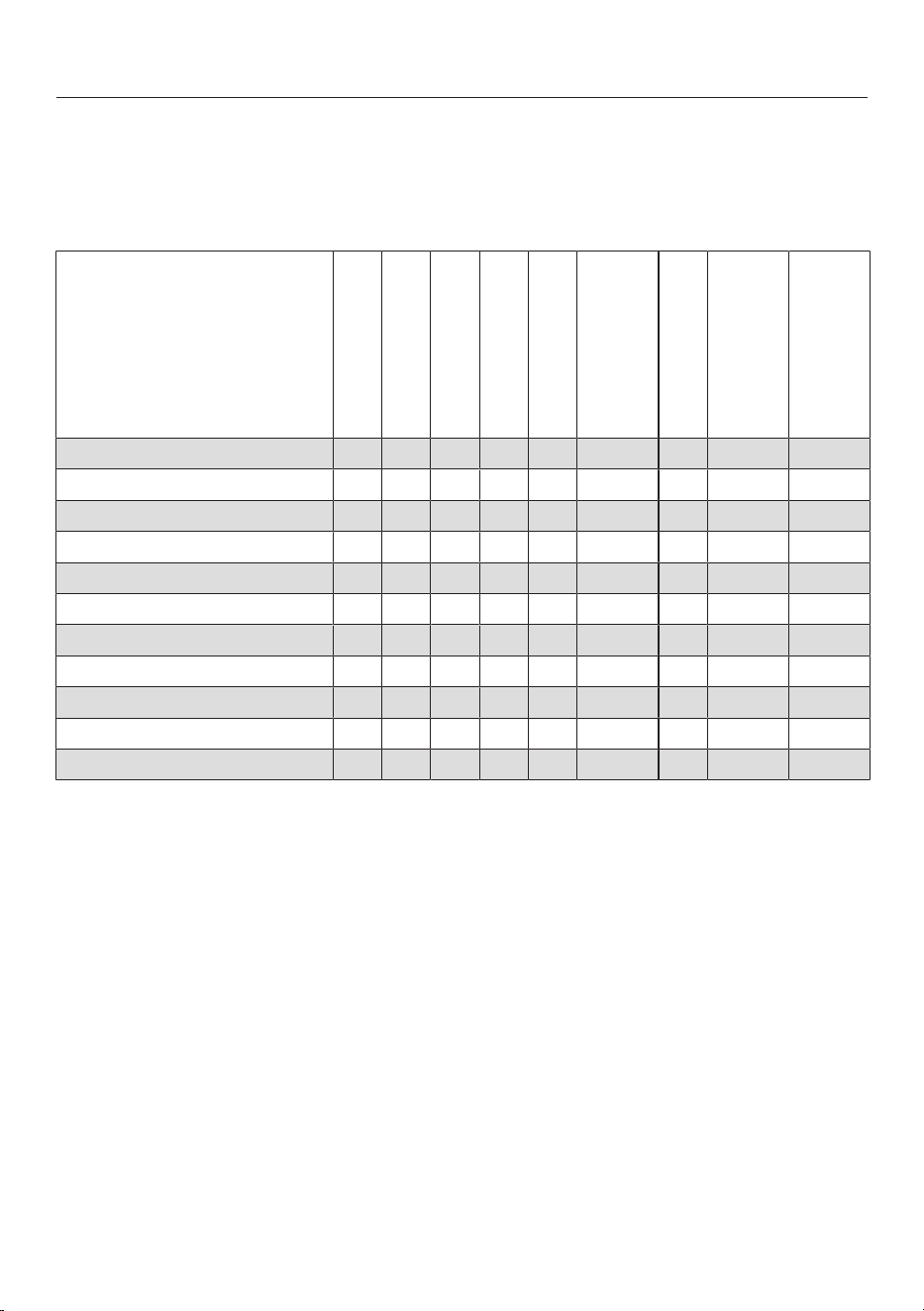
Detergent recommendations (according to Ecodesign no.
2019/2023)
The recommendations apply across the entire temperature range of the wash pro-
grammes.
UltraWhite
UltraColor
Miele Caps
Miele Caps
Miele Caps
Multi-purpose
detergent
Colour detergent
Detergent for
delicates and
woollens
Special-purpose
detergent
ECO 40-60
Cottons
Minimum iron
Delicates
Woollens
Shirts
QuickPowerWash
Express 20
1
Dark garments/Denim
1
Proofing
Drain/Spin
Recommendation Specialist detergents (e.g. WoolCare)
1
Liquid detergent Fabric care (e.g. fabric conditioner)
2
Powder detergent Additive (e.g. booster)
Cleaning and care
37
Cleaning the external casing
and the control panel
Risk of electric shock!
Mains voltage is present when the
washing machine is switched off
Disconnect the machine from the
electricity supply before cleaning or
maintenance.
Risk of damage due to ingress of
water.
The pressure of a water jet can cause
water to get into the washing ma-
chine, resulting in damage to com-
ponents.
Do not spray the washing machine
with a water jet.
Clean the casing and control panel
with a mild cleaning agent or soap
and water and dry both with a soft
cloth.
The drum can be cleaned using a suit-
able stainless steel cleaning agent fol-
lowing the manufacturer's instruc-
tions on the packaging.
Damage caused by cleaning
agents.
Solvent based cleaning agents, ab-
rasive cleaners, glass cleaners or
multi-purpose cleaning agents can
cause damage to plastic surfaces and
other parts.
Do not use any of these cleaning
agents.
Cleaning the detergent dis-
penser drawer
Washing at low temperatures and the
use of liquid detergent can lead to a
build-up of mould and germs in the de-
tergent drawer.
For hygiene reasons, clean the entire
detergent drawer at regular intervals.
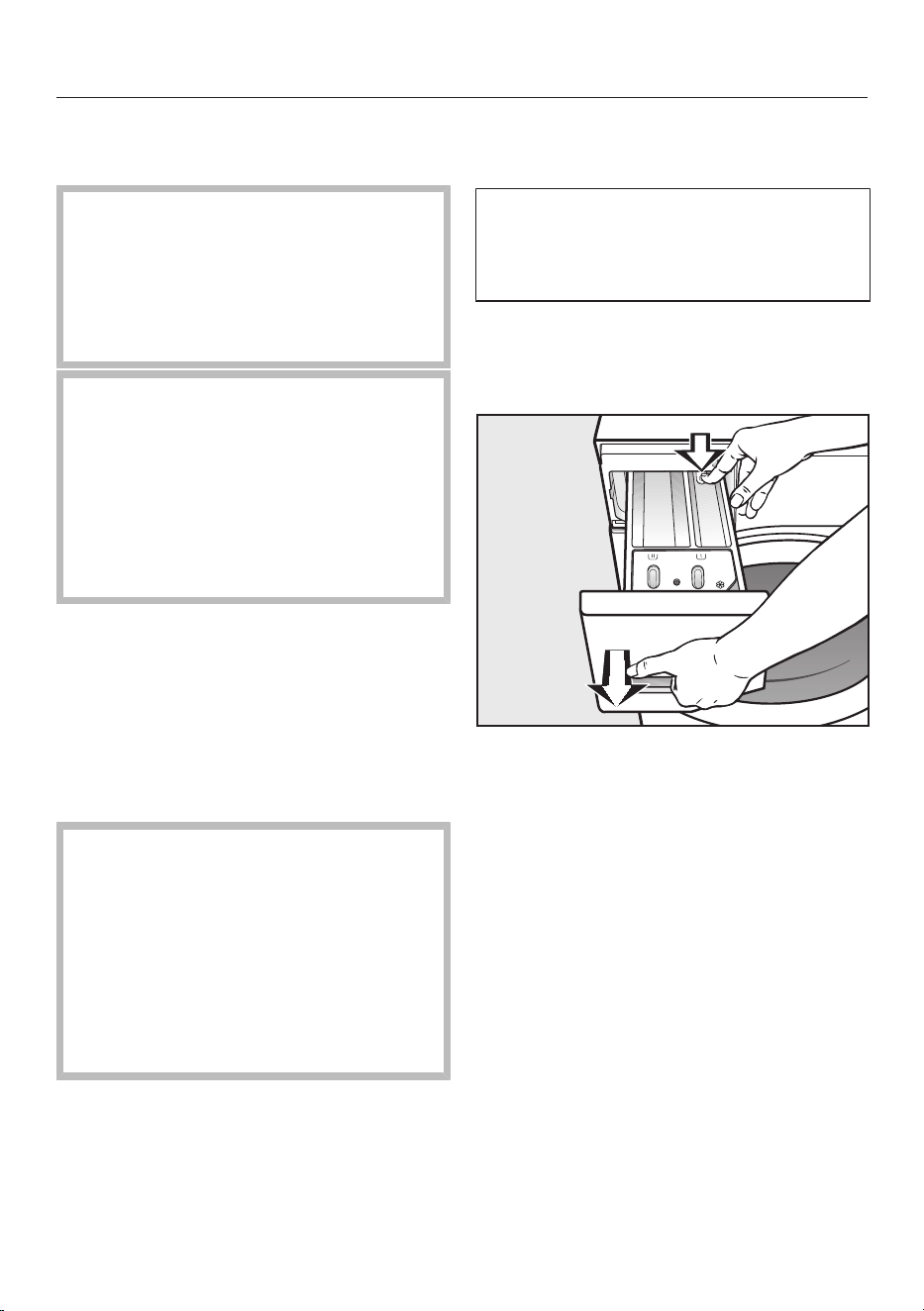
Removing the dispenser drawer
Pull out the detergent dispenser
drawer until a resistance is felt. Press
down the release button and at the
same time pull the drawer right out of
the machine.
Clean the detergent drawer with
warm water.
Cleaning and care
38
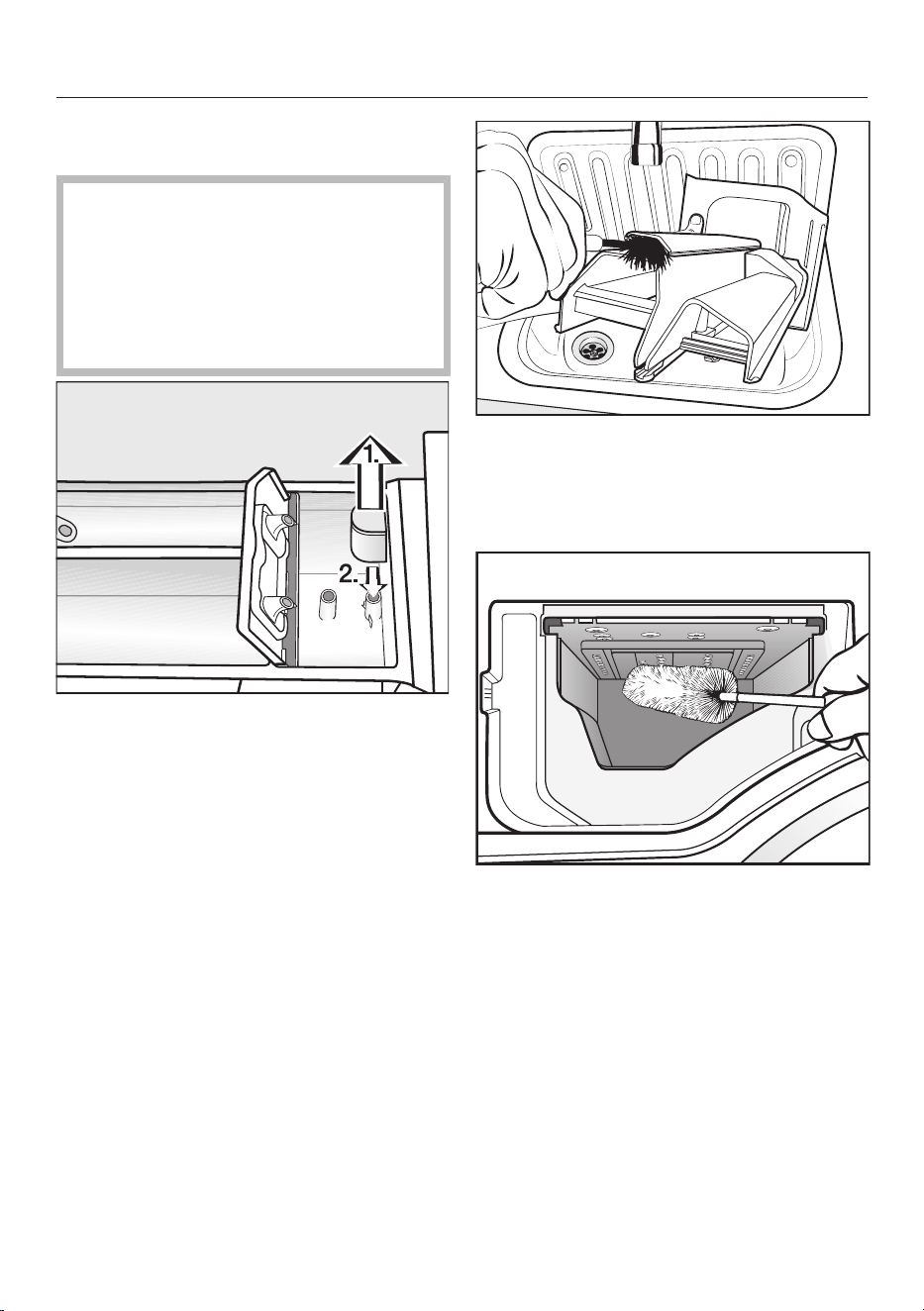
Cleaning the siphon and the /
compartment channel
Liquid starch results in clogging. If
clogged, the siphon in the /
compartment will not work and the
compartment can overflow.
Clean the siphon particularly thor-
oughly after using liquid starch a few
times.
1. Remove the siphon from compart-
ment and clean under warm running
water. Clean the siphon tube in the
same way.
2. Replace the siphon.
Clean the fabric conditioner channel
using a brush and warm water.
Cleaning the detergent dispenser
drawer compartment
Use a bottle brush to remove deter-
gent residues and limescale from the
jets inside the detergent dispenser
drawer compartment.
Refit the detergent drawer.
Tip: To assist drying, leave the detergent
drawer slightly open.
Cleaning and care
39
Hygiene info
(Cleaning the drum)
Washing at low temperatures and/or us-
ing liquid detergent can cause bacteria
and unpleasant odours to build up in the
washing machine. Use the Cottons
90°C programme to clean the washing
machine. Clean the drum at the latest
when the indicator light comes on.
Cleaning the water inlet filter
The washing machine has 2 filters to
protect the inlet valve. Check these fil-
ters every 6 months or so. Perform this
check more often if there are frequent
interruptions to the external water sup-
ply.
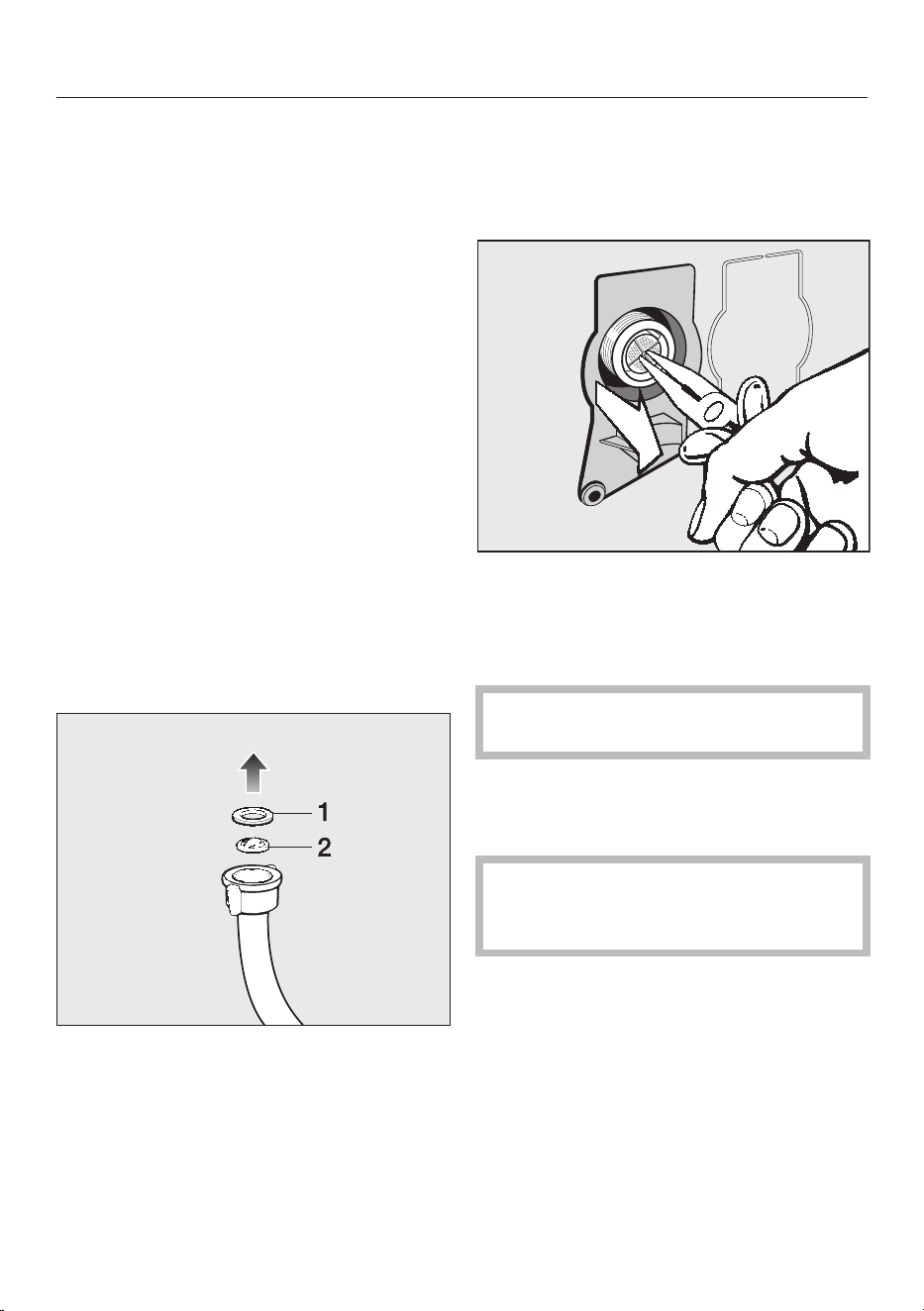
Cleaning the filter in the inlet hose
First turn off the stopcock.
Unscrew the inlet hose from the stop-
cock.
Remove the rubber seal 1 from the re-
cess.
Using pointed pliers, take hold of the
plastic filter slat 2 and remove the
plastic filter.
Clean the filter.
Reassemble in reverse order.
Cleaning the filter in the inlet valve
Using pliers, carefully loosen the
ribbed plastic nut on the inlet valve
and unscrew it.
Use pointed pliers to withdraw the
plastic filter by the slat.
Clean the filter.
Reassemble in reverse order.
The two filters must be put back in
place after cleaning.
Screw the screw connection securely
back onto the stopcock.
Open the stopcock.
Make sure there is no water leaking
from the threaded union.
Tighten the threaded union.
Troubleshooting
40
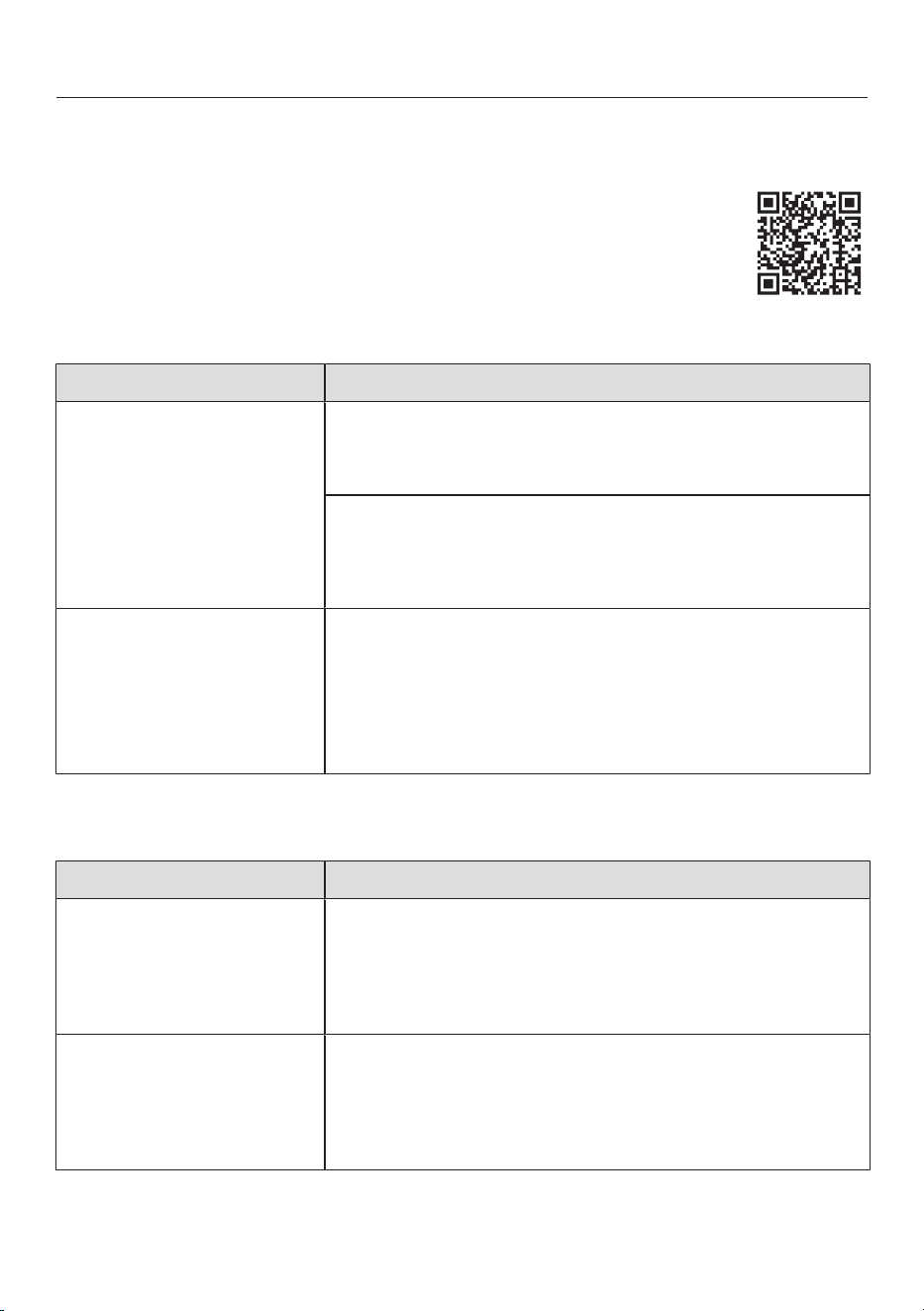
Many malfunctions and faults can be easily remedied. You can save time and
money in many cases, as you do not need to contact Customer Service.
More information to help you remedy faults yourself can be found at
www.miele.co.uk/support/customer-assistance.
The programme does not start
Problem Cause and remedy
The control panel re-
mains dark.
There is no power to the washing machine.
Check whether the plug is plugged in.
Check whether the fuse has tripped.
The washing machine has switched off automatically
to save energy.
Turn the programme selector to switch the washing
machine back on.
and alternately ap-
pear in the time display.
The door is not closed properly. The door lock could
not engage.
Close the door again.
Start the programme again.
If the fault message appears again, contact the Ser-
vice Department.
The programme is cancelled and a fault indicator light lights up in
the control panel
Problem Cause and remedy
The fault indicator light
lights up, and
appear alternately in the
time display and the
buzzer sounds.
The water protection system has reacted.
Close the stopcock.
Call the Service Department.
The fault indicator light
lights up, and ap-
pear alternately in the
time display and the
buzzer sounds.
The water outlet is blocked or restricted.
The drain hose has been fixed too high.
Clean the drain filter and the drain pump.
The maximum delivery head is 1m.
Troubleshooting
41
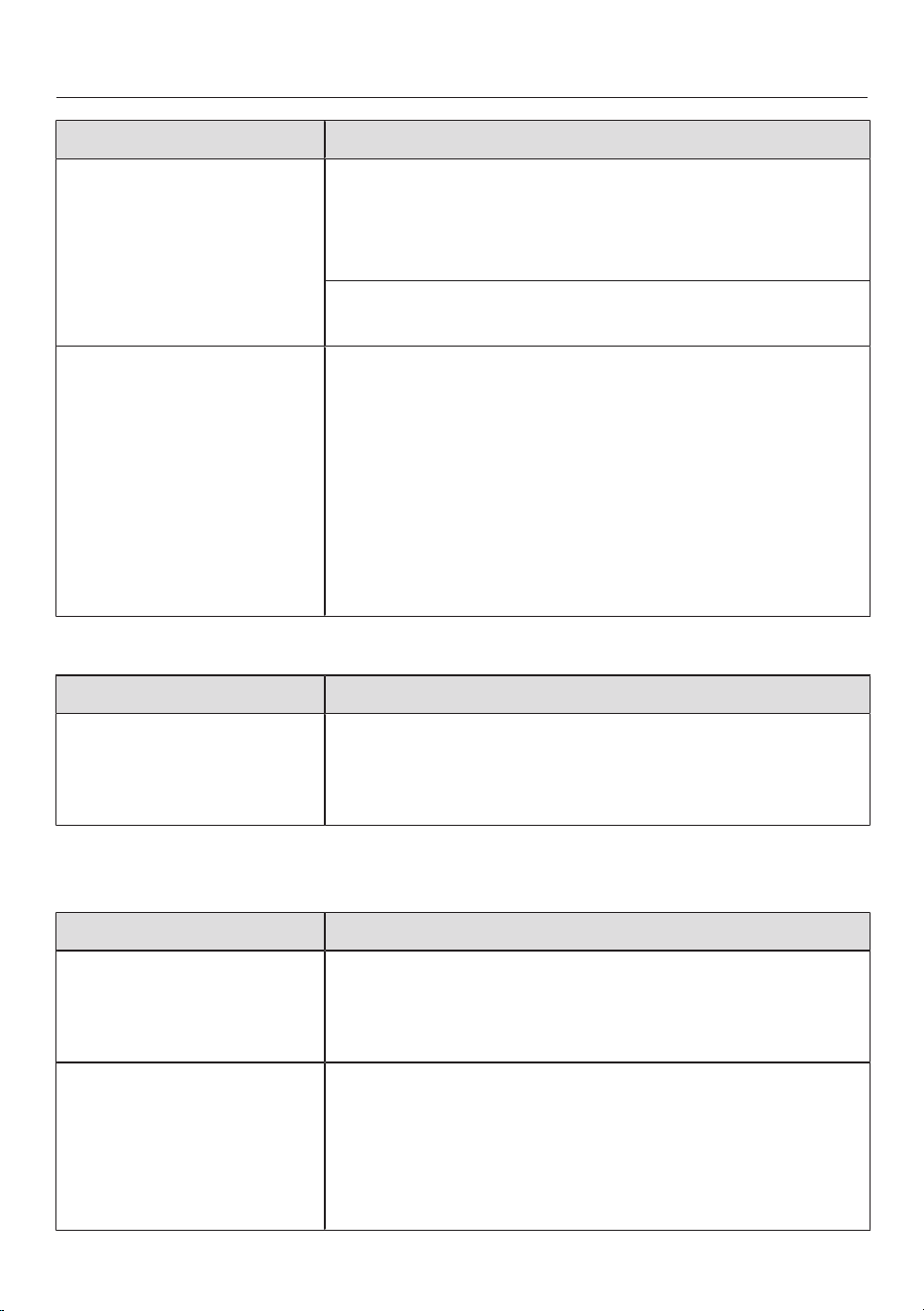
Problem Cause and remedy
The fault indicator light
lights up, and ap-
pear alternately in the
time display and the
buzzer sounds.
The water inlet is blocked or restricted.
Check whether the stopcock is opened properly.
Check whether the inlet hose is kinked.
Check whether the water pressure is too low.
The filter in the water inlet is blocked.
Clean the filter.
and appear altern-
ately on the time display
and the buzzer sounds.
There is a fault.
Disconnect the washing machine from the electri-
city supply. Switch off at the wall and withdraw the
plug from the socket, or disconnect the fuse.
Wait at least 2minutes before reconnecting the
washing machine to the electricity supply.
Switch the washing machine on again.
Restart the programme.
If the fault message appears again, contact the
Miele Customer Service Department.
During the programme, a symbol appears in the time display
Message Cause and remedy
lights up The programme selector was moved to a different po-
sition after the programme had started.
Turn the programme selector back to the original po-
sition.
At the end of the programme, an indicator light lights up in the
control panel
Problem Cause and remedy
The indicator light
lights up.
Excessive foam has built up during washing.
Use less detergent next time and follow the manu-
facturer’s instructions on dosage given on the pack-
aging.
The indicator light
lights up and appears
in the time display.
When washing, a wash programme using a temperat-
ure above 60°C has not been run for a long time.
Run the Cottons90°C programme using Miele ma-
chine cleaner or a multi-purpose powder detergent.
This will clean the washing machine and prevent a
build-up of germs and odours.
Troubleshooting
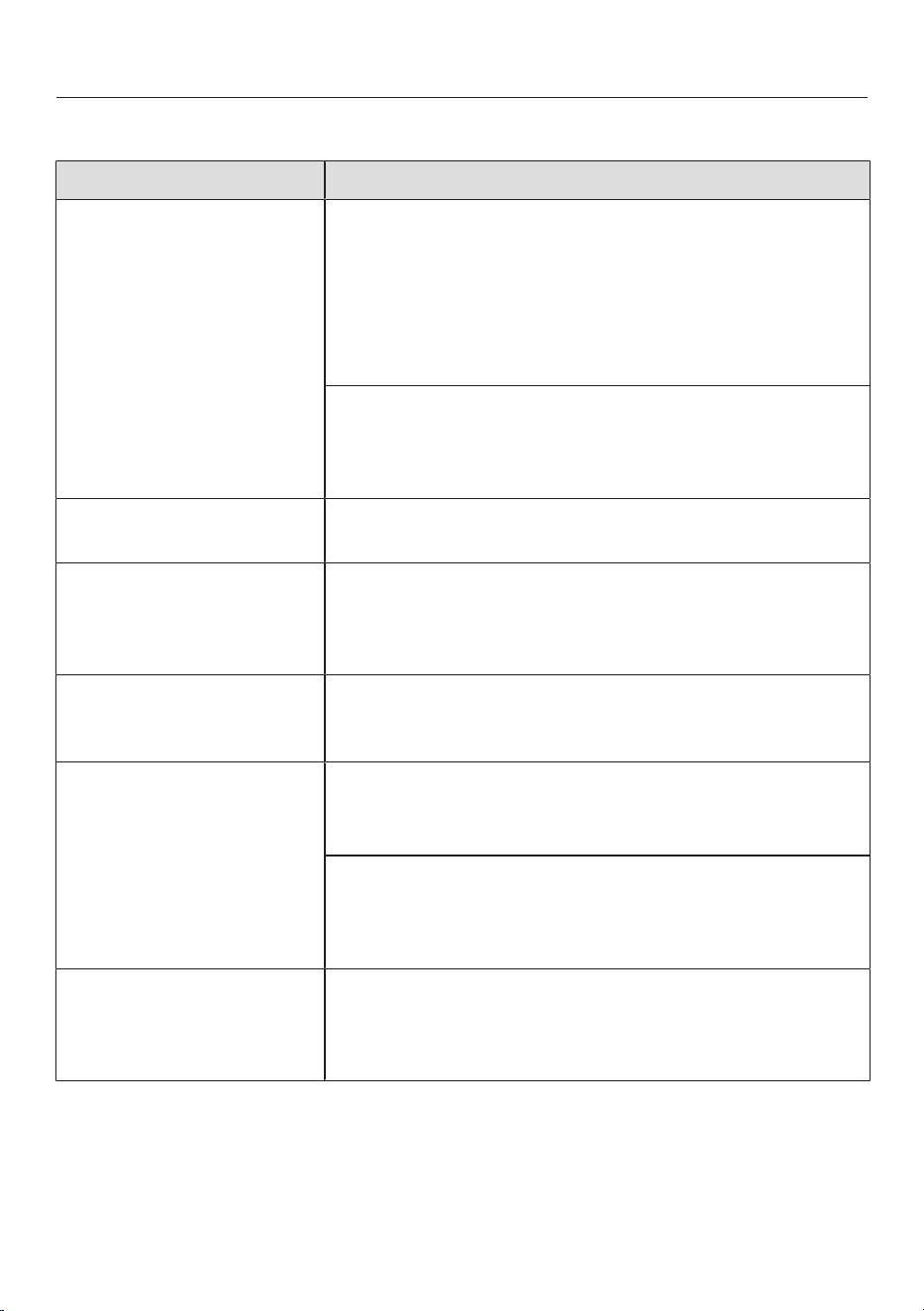
42
General problems with the washing machine
Problem Cause and remedy
The washing machine
smells.
The indicator light was ignored. When washing, a
wash programme using a temperature above 60°C
has not been run for a long time.
In order to prevent bacteria and unpleasant odours
building up in the washing machine, run the Cottons
90°C programme using Miele machine cleaner or a
universal powder detergent.
The door and the detergent drawer were closed after
washing.
Leave the door and the detergent drawer slightly
open to allow them to dry.
The machine shakes dur-
ing the spin cycle.
The machine feet are not level.
Level the machine and adjust the feet correctly.
The laundry has not
been spun properly and
is still wet.
The machine detected an imbalance during the final
spin cycle and reduced the spin speed automatically.
Include both large and small items in the load as this
will give better distribution during spinning.
Strange pump noises
can be heard.
This is not a fault.
These slurping noises occur at the end of the pump
sequence as a normal part of operation.
Large amounts of deter-
gent residue remain in
the detergent dispenser
drawer.
The water pressure is too low.
Clean the water inlet filter.
It may be useful to select the Water + extra option.
Powder detergent used in conjunction with water
softeners tends to become sticky.
In future, add washing powder into the dispenser
drawer first, and then add the water softener.
Fabric conditioner is not
completely dispensed or
too much water remains
in the compartment.
The siphon tube is not correctly positioned or is
clogged.
Clean the siphon, see “Cleaning and care - Cleaning
the detergent dispenser drawer”.
Troubleshooting
43
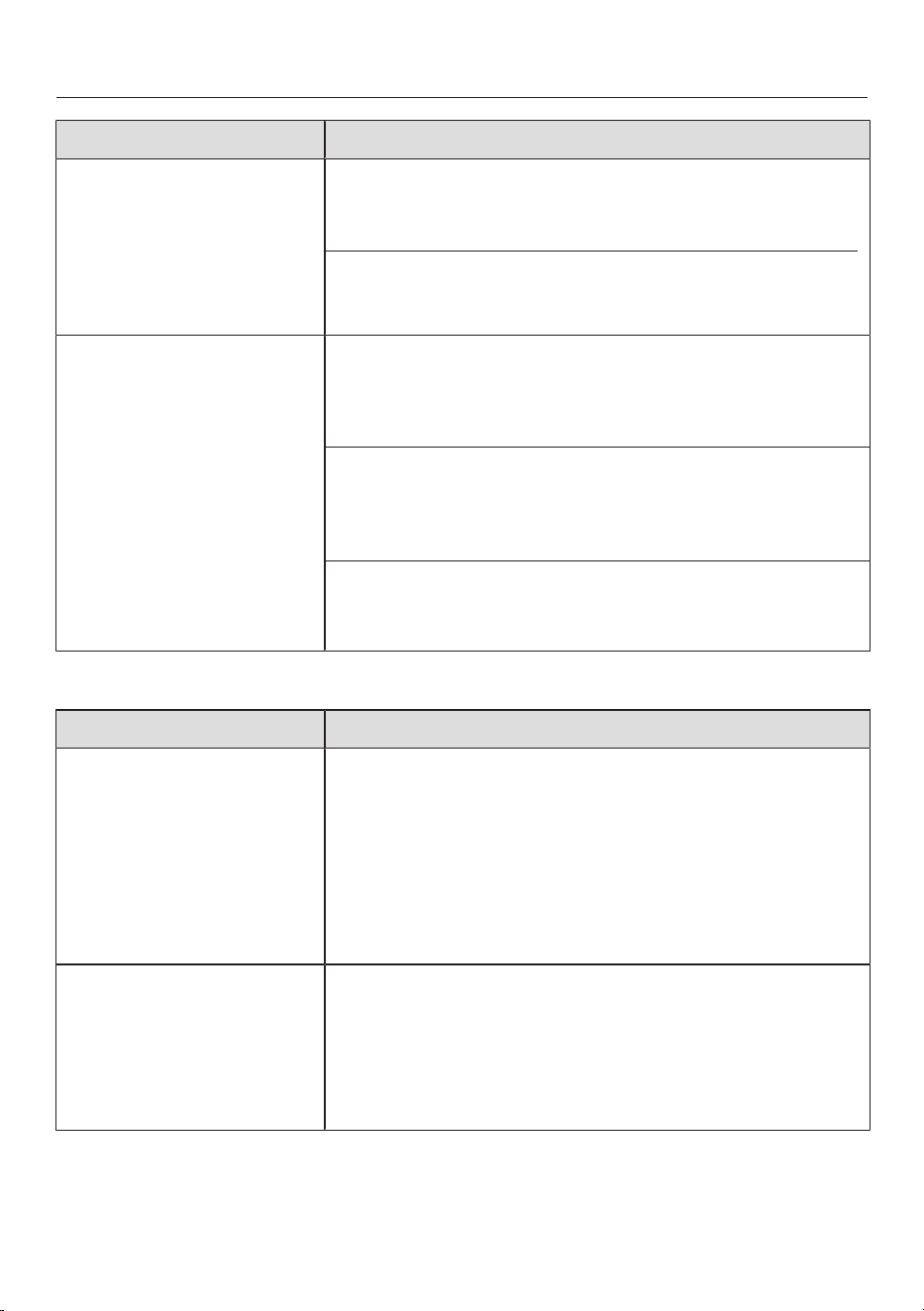
Problem Cause and remedy
At the end of the pro-
gramme there is still li-
quid in the capsule.
The small pipe in the detergent dispenser drawer
onto which the capsule is placed is blocked.
Clean the small pipe.
This is not a fault.
For technical reasons a small amount of water will re-
main in the capsule.
There is water next to
the capsule in the
compartment.
CapDosing has not been activated.
Make sure that you remember to activate CapDos-
ing with the sensor control the next time you in-
sert a capsule.
An empty capsule was not removed at the end of the
last wash programme.
Remove and dispose of the empty capsule at the
end of each programme.
There is a blockage in the small pipe in the detergent
drawer onto which the capsule is placed.
Clean the small pipe.
An unsatisfactory wash result
Problem Cause and remedy
Liquid detergent does
not give the required
result.
Liquid detergents usually contain no bleaching agents.
They do not remove fruit, coffee and tea stains.
Use a general purpose powder detergent containing
a bleaching agent.
Use the appropriate capsule or add stain removers
to the compartment.
Never put stain removers and liquid detergent to-
gether in the dispenser drawer.
Grey, greasy particles
cling to washed laundry.
Insufficient amounts of detergent were used to break
down the particles of grease in heavily soiled laundry.
Use more detergent.
Before washing the next load run a Cottons 60°C
programme with powder detergent but without a
load.
Troubleshooting
44
Problem Cause and remedy
White residues which
look like powder deter-
gent are seen on dark
textiles after washing.
The detergent contained compounds (zeolites) to aid
water softening which are not soluble in water. These
have ended up on the laundry.
Try and brush off the residues with a soft brush once
the laundry is dry.
Wash dark textiles using a detergent which contains
no zeolites. Liquid detergents usually contain no
zeolites.
Use the Dark garments/Denim programme for dark
coloured laundry.
The door will not open
Problem Cause and remedy
The door cannot be
pulled open during a
programme.
The drum is locked during a programme.
Follow the description in “5. Starting a programme –
Adding or removing laundry”.
After the programme is
cancelled, flashing bars
......... appear
in the time display.
For safety reasons the drum door cannot be opened if
the suds temperature is higher than 55°C.
Wait until the temperature in the drum has de-
creased and the bars have stopped flashing in the
display.
and alternately ap-
pear in the time display.
The door lock has jammed.
Call the Service Department.
Troubleshooting
45
Opening the door in the event
of a blocked drain outlet and/or
power cut
Switch off the washing machine.
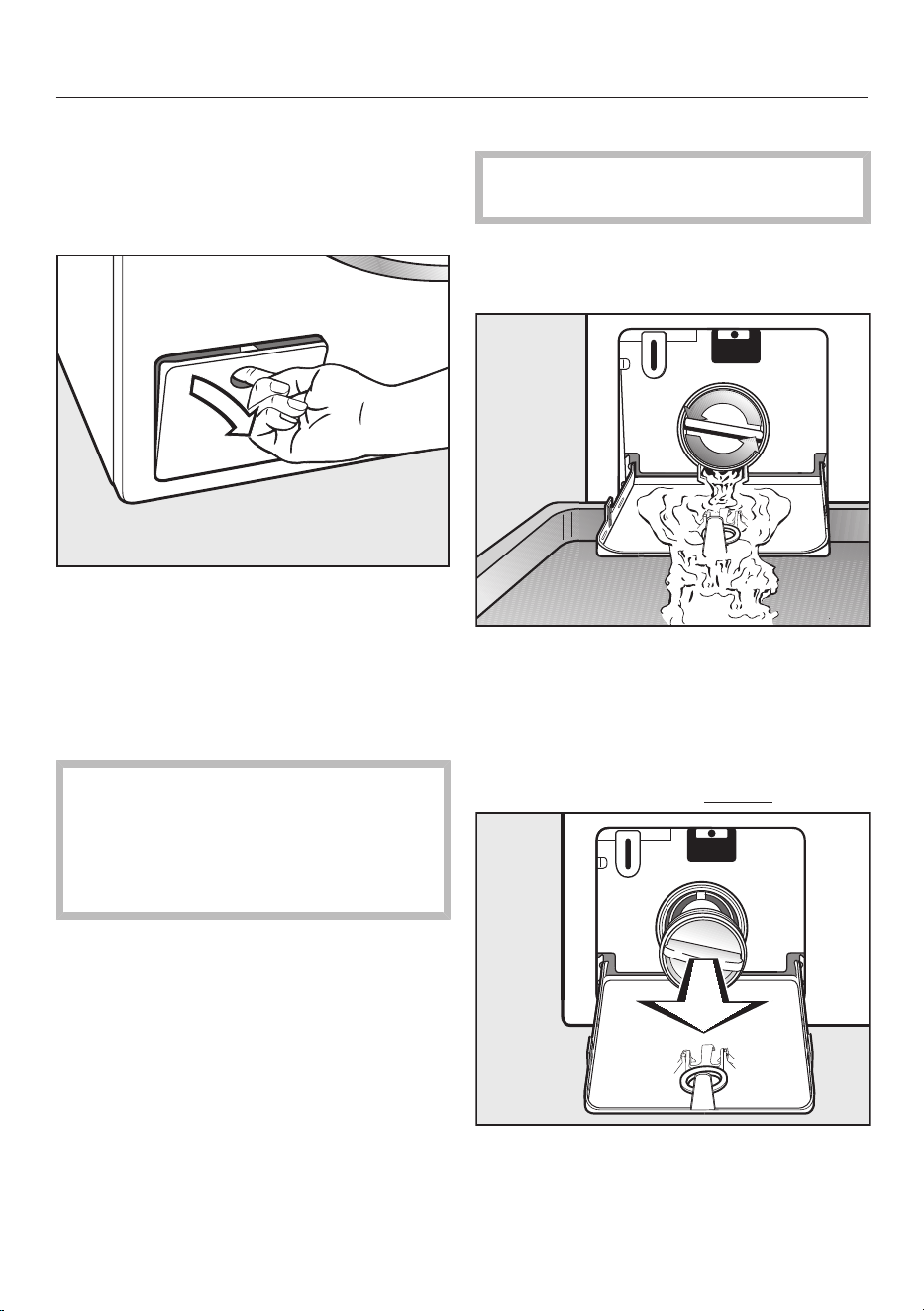
Open the access panel for the drain
pump.
Blocked drain outlet
If the drain outlet is blocked, there may
be a large quantity of water left behind
in the washing machine.
Risk of scalding due to hot suds.
Escaping suds will be hot if laundry
has been washed at high temperat-
ures!
Carefully allow all suds to drain off.
Draining the washing machine
Remove the drain filter, though not
completely.
Place a suitable container under the
access panel, e.g. a universal oven
tray.
Slowly unscrew the drain filter to let
the water out.
Tighten the drain filter back up again if
you need to interrupt the flow of wa-
ter.
Once the flow of water ceases:
Remove the drain filter completely.
Troubleshooting
46
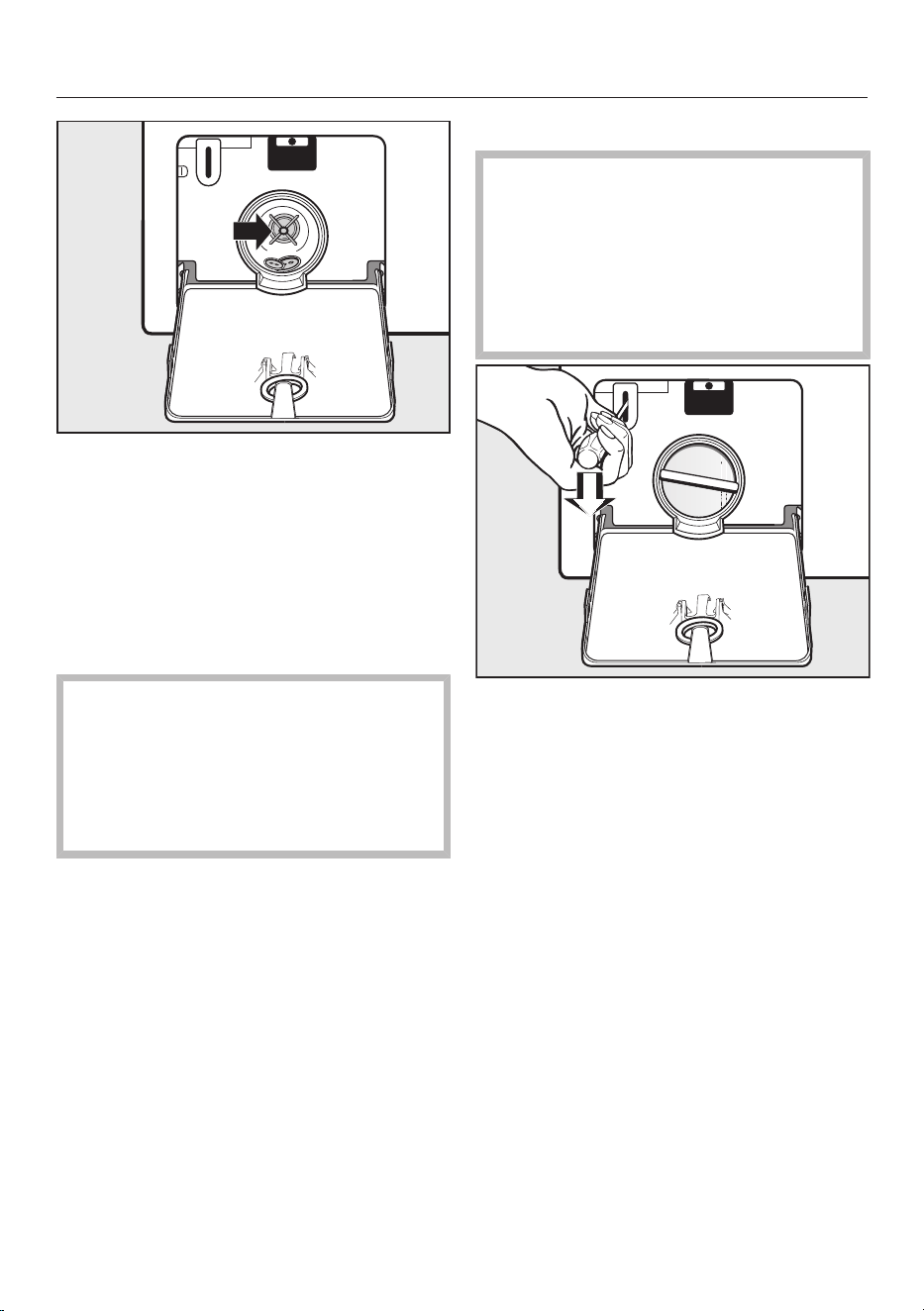
Clean the drain filter thoroughly.
Remove any foreign objects (e.g., but-
tons, coins etc.) and clean the interior.
Turn the impellers by hand to check
that they rotate freely.
Replace the drain filter correctly and
tighten it securely.
Close the drain pump access panel.
Risk of water damage.
Make sure the drain filter is securely
tightened. Otherwise there is a risk of
water leakage during use.
Replace the drain filter correctly and
tighten it securely.
Open the door
Danger of injury due to rotating
drum!
Reaching into a moving drum is ex-
tremely dangerous.
Always make sure that the drum is
stationary before reaching in to re-
move laundry.
Use a screwdriver to unlock the door.
Pull open the door.
Service
47
Information to help you rectify faults
yourself and about Miele spare parts can
be found at www.miele.com/service.
Contact in the event of a fault
In the event of any faults which you can-
not remedy yourself, please contact
your Miele dealer or the Miele Cus-
tomer Service Department.
You can book a Miele Customer Ser-
vice Department call-out online at
www.miele.com/service.
Contact information for the Miele Cus-
tomer Service Department can be
found at the end of this document.
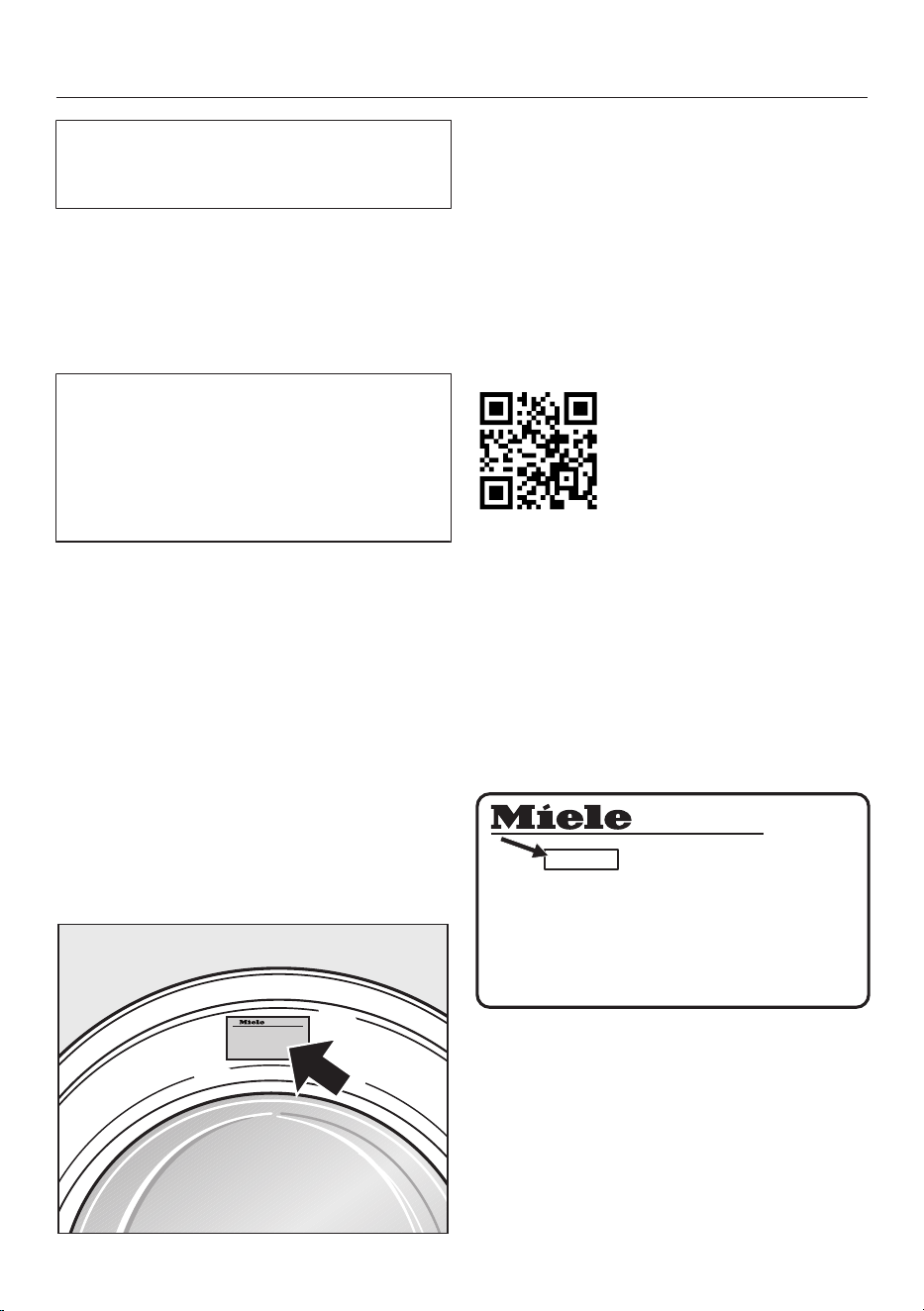
Please quote the model identifier and
serial number of your appliance (Fabr./
SN/Nr.) when contacting the Miele
Customer Service Department. This in-
formation can be found on the data
plate.
Please note that telephone calls may be
monitored and recorded for training pur-
poses and that a call-out charge will be
applied to service visits where the prob-
lem could have been resolved as de-
scribed in this booklet.
The data plate is found above the
porthole glass when the door is opened.
Optional accessories
Products specially tailored to your
washing machine – such as detergent,
fabric care products, additives, appli-
ance care products and accessories –
are available from the Miele online shop,
from Miele Customer Service or from
your Miele dealer.
You can access the Miele online shop
via the following QR code:
EPREL database
From 1 March 2021, information on en-
ergy labelling and ecodesign require-
ments will be available in the European
Product Database (EPREL). You can find
the product database at the following
link https://eprel.ec.europa.eu/. You will
be asked to enter the model identifier.
The model identifier can be found on the
data plate.
Made in xxx
Mod.: XXXxxx
Miele Service
www.miele.com/service
M-Nr.: xxxxxxxx
Type: XXxx-X
Nr.:/ xxxxxxxxx
Warranty
For information on the appliance warranty
specific to your country please contact
Miele. See back cover for address.
In the UK, your appliance warranty is
valid for 2 years from the date of pur-
chase. However, you must activate your
cover by calling 0330 160 6640 or re-
gistering online at www.miele.co.uk.
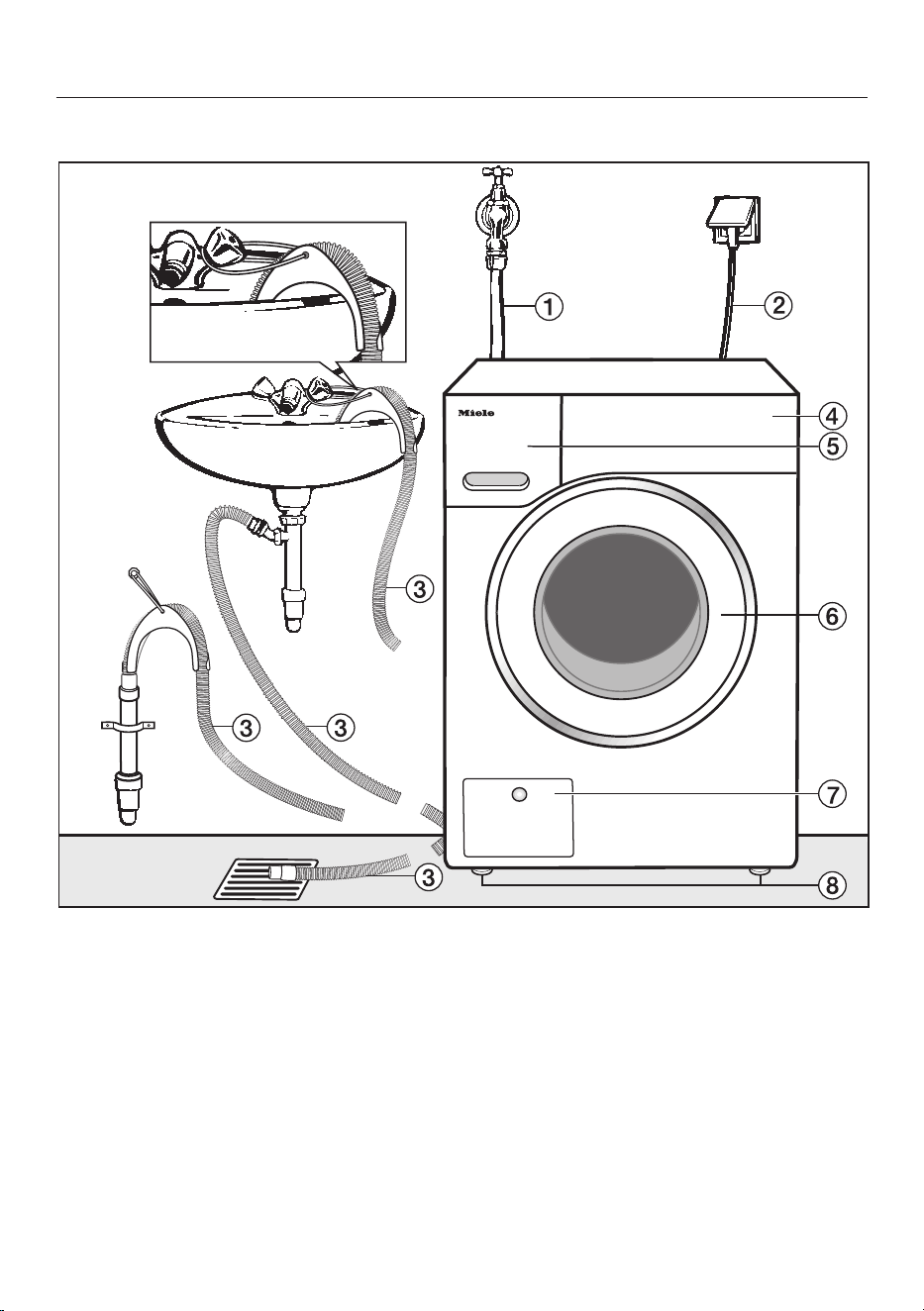
Installation
*INSTALLATION*
48
Front view
a
Water inlet hose (pressure tested to
7000kPa)
b
Mains connection cable
c
Flexible drain hose (with detachable
swivel elbow)
d
Control panel
e
Detergent dispenser drawer
f
Door
g
Access to drain filters, drain pumps
and emergency release
h
Four height-adjustable feet
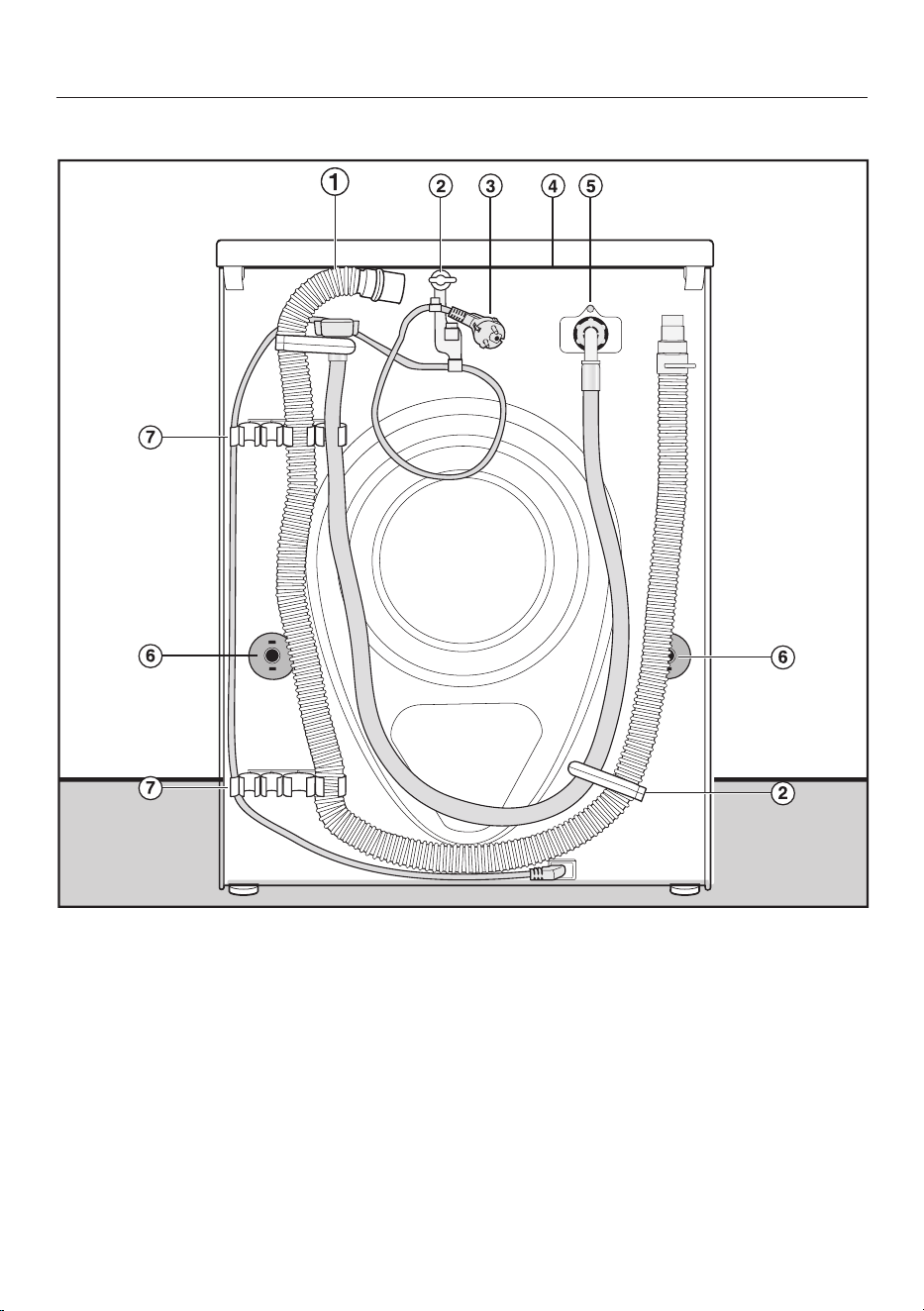
Installation
*INSTALLATION*
49
Rear view
a
Drain hose
b
Transport clips for inlet and drain
hoses and mains connection cable
c
Mains connection cable
d
Protruding lid for holding when mov-
ing the machine
e
Water inlet hose (pressure tested to
7000kPa)
f
Safety caps for transit bars
g
Transport clips for inlet and drain
hoses and for storing transit bars
when not in use
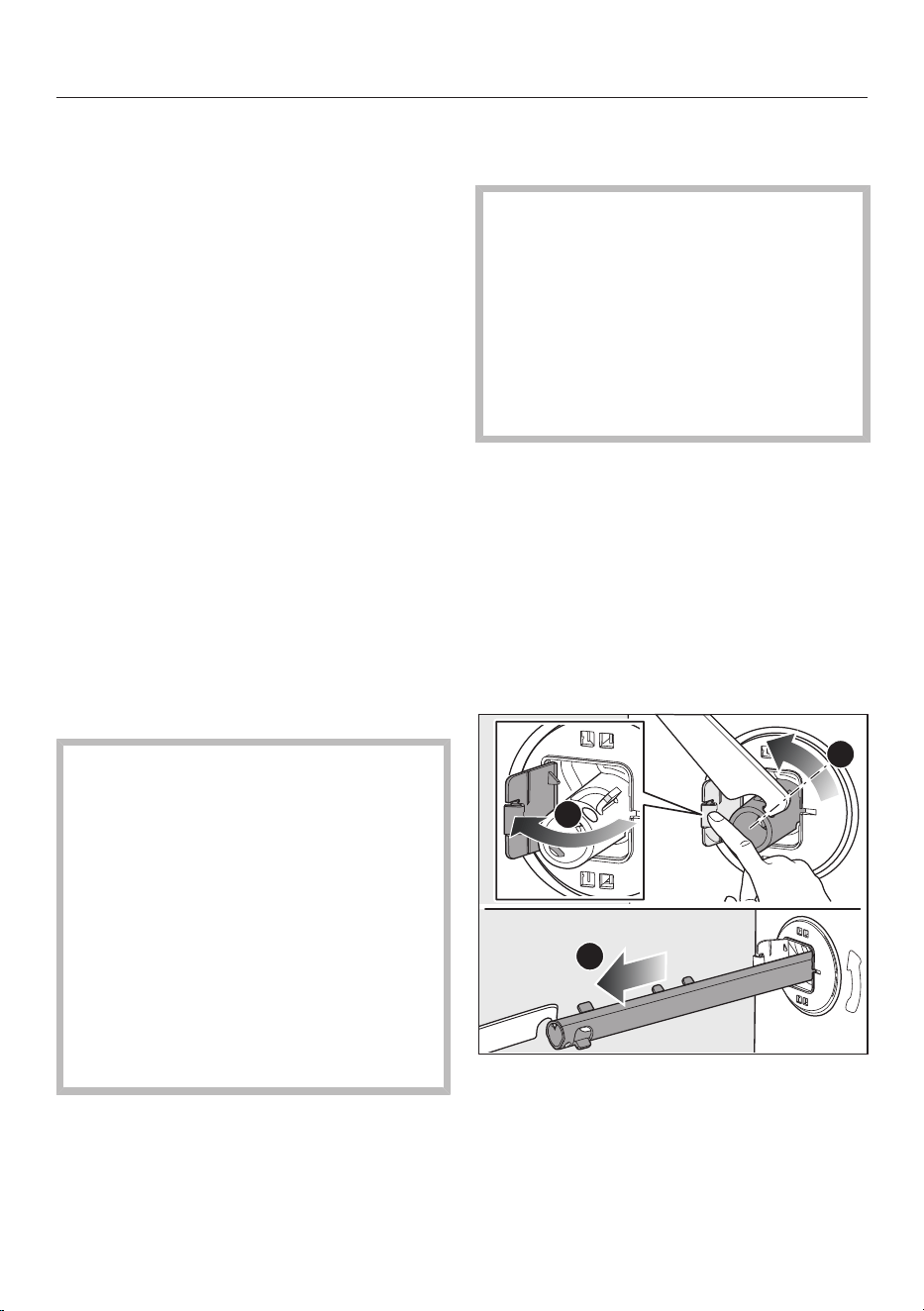
Installation
*INSTALLATION*
50
Installation surface
A concrete floor is the most suitable in-
stallation surface. It is far less prone to
vibration during the spin cycle than
wooden floorboards or a carpeted sur-
face.
Please note:
The machine must be level and se-
curely positioned.
To avoid vibrations during spinning,
the machine should not be installed
on soft floor coverings.
If installing on a wooden joist floor:
Install the machine on a plywood
base (at least 59x52x3cm). The
base should span several joists and
be bolted to the joists and not only to
the floorboards. Check for the pres-
ence of pipes and cables first.
Tip: If possible, install the machine in a
corner. This is usually the most stable
part of the floor.
Injury can occur if the washing
machine has not been adequately se-
cured.
During installation, the washing ma-
chine must be secured on a plinth to
be made available on site (concrete
or brick), in order to ensure it cannot
fall or slip.
Secure the washing machine using a
clamp/fastening bracket (MTS floor
mounting kit – available from your
Miele dealer or Miele spare parts de-
partment).
Transporting the washing ma-
chine to its installation site
Danger of injury due to unsecure
lid.
Make sure the fixings at the back of
the lid are secure. Otherwise there is
a danger of the lid being pulled off
when carrying the machine.
Before carrying the machine check
that the lid is secure where it pro-
trudes at the back of the machine.
Carry the washing machine by the
front feet and by the lid where it pro-
trudes at the back of the appliance.
Removing the transport safety
device
Removing the transit bars
Remove the left-hand transit bar first,
followed by the right-hand transit bar.
3
2
1
Push the cover out.
Using the open spanner supplied,
turn the transit bar 90°.
Pull out the transit bar.
Remove the right-hand transit bar in
the same way.
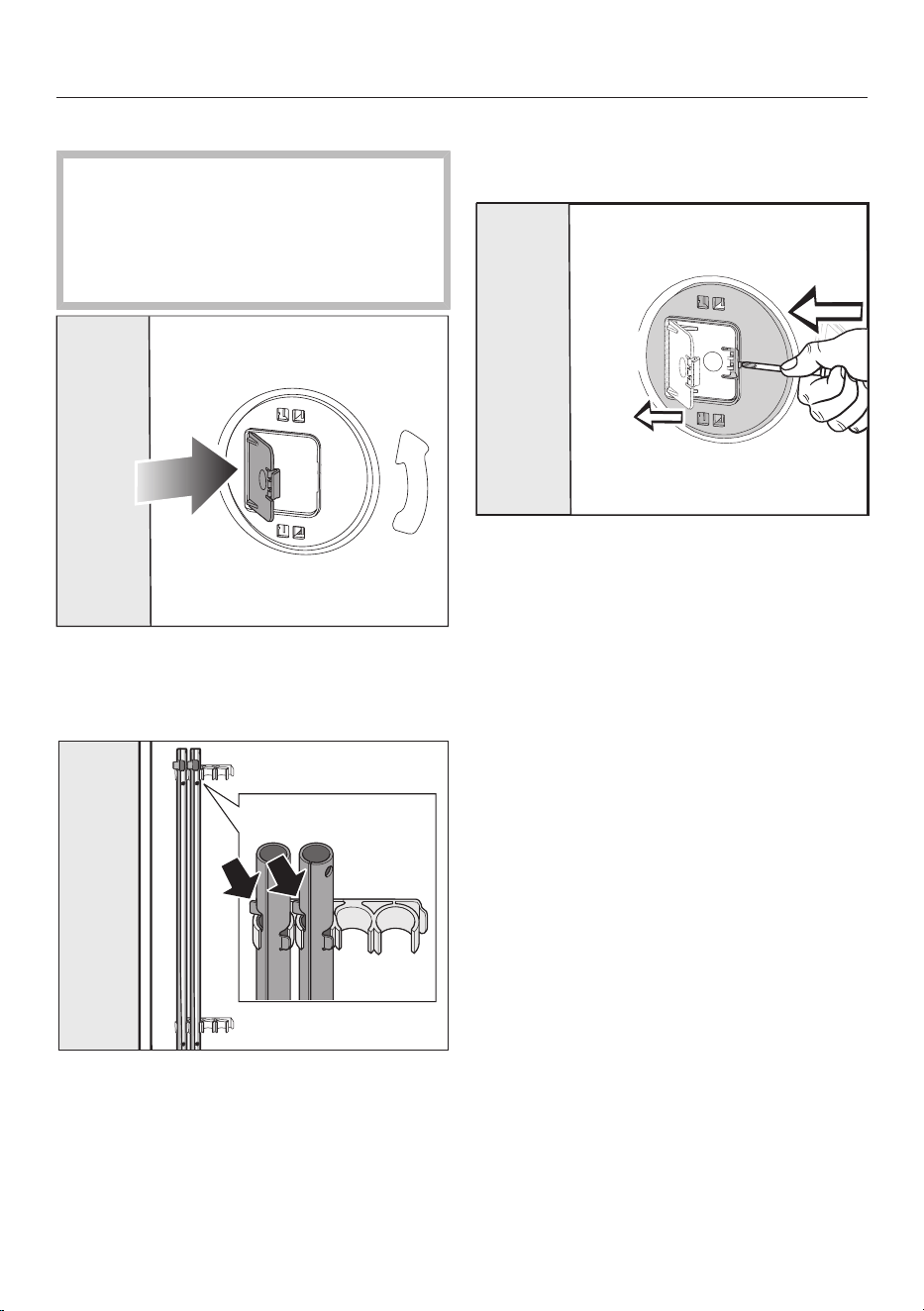
Installation
*INSTALLATION*
51
Covering the holes
Risk of injury from sharp edges.
There is a risk of injury from reaching
into holes that are not covered.
After removing the transport safety
device, cover the exposed holes.
Push the covers in firmly until they
engage in position.
Securing the transit bars
Secure the transit bars to the rear
panel of the washing machine. Make
sure that the top retainer is located
above the holder.
Fitting the transit bars
Opening the covers
Press against the retainer with a
sharp object (a narrow screwdriver,
for example).
The cover opens.
Fitting the transit bars
To fit the bars, follow the instructions
for removing them in reverse order.
Tip: The bars will slide in more easily if
you lift the drum slightly.
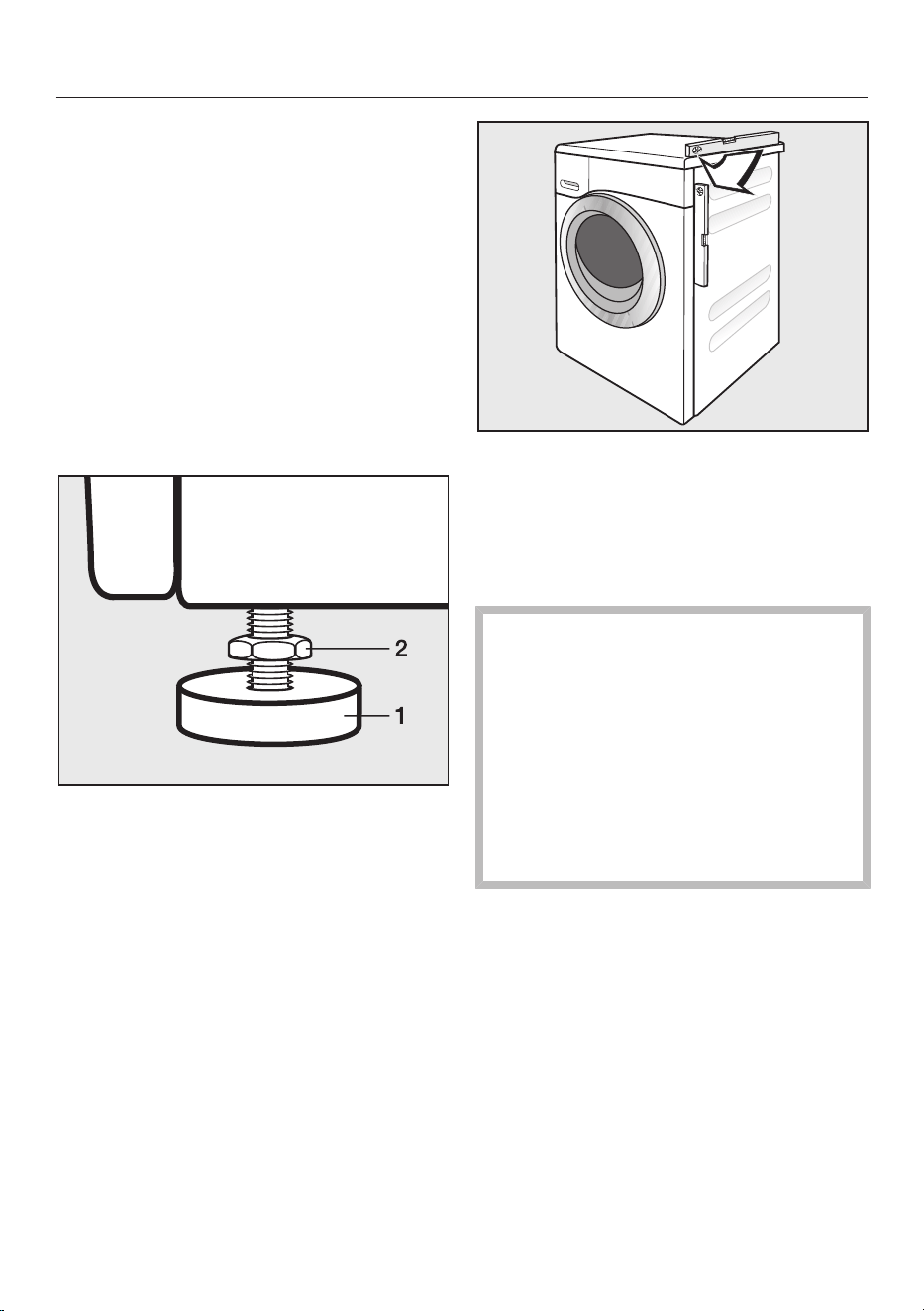
Installation
*INSTALLATION*
52
Levelling the machine
The washing machine must stand per-
fectly level on all four feet to ensure safe
and proper operation.
Incorrect installation may increase elec-
tricity and water consumption and may
cause the machine to move about.
Screwing out and adjusting the feet
The four adjustable screw feet are used
for levelling the washing machine. The
machine is supplied with all four feet are
screwed in.
Using the spanner supplied, turn
counter nut 2 in a clockwise direction.
Then turn counter nut 2 together with
foot 1 to unscrew.
Use a level to check that the washing
machine is standing level.
Hold foot 1 securely with a pipe
wrench. Turn counter nut 2 again us-
ing the spanner supplied until it sits
firmly up against the housing.
Risk of damage due to incorrectly
aligned washing machine.
There is a danger of the washing ma-
chine moving about if the feet are not
secured.
Turn all four counter nuts for the feet
until they sit firmly up against the
housing. Please also check this for
the feet which did not need adjust-
ment.
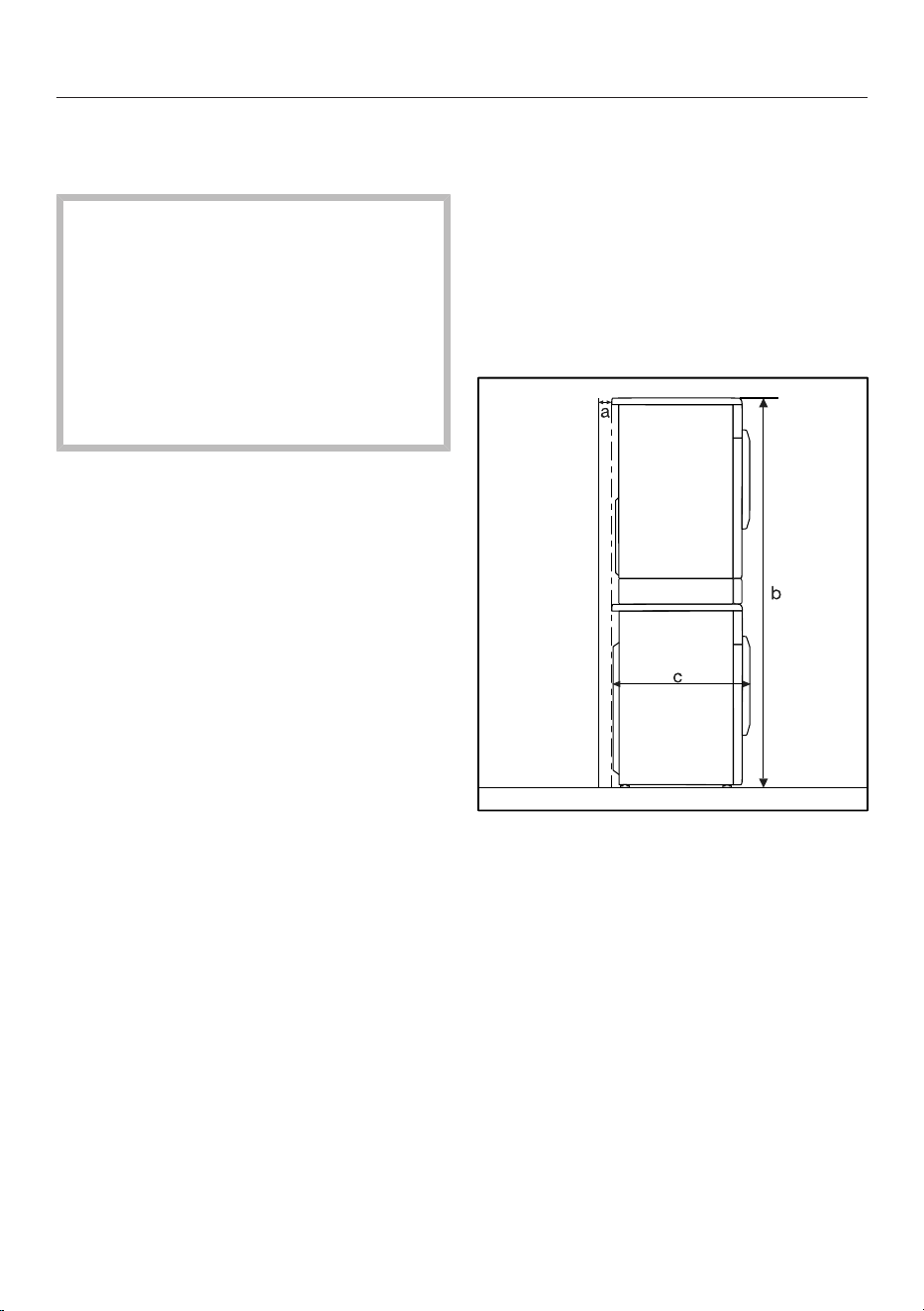
Installation
*INSTALLATION*
53
Additional installation requirements
Installing under a continuous worktop
Risk of electric shock due to ex-
posed cables
There is a risk of coming into contact
with live parts while the lid is re-
moved.
Building under kits* must only be in-
stalled/dismantled by a suitably qual-
ified fitter in accordance with the in-
structions supplied.
- A special building under kit* is re-
quired. The cover plate supplied with
the building under kit is used to re-
place the machine lid. It is necessary
to fit the coverplate for electrical
safety reasons.
- Connections for electricity, water and
drainage should be installed in such a
way that they remain accessible when
the machine is in its final position.
Fitting instructions are supplied with the
building-under kit.
Washer-dryer stack
The washing machine can be combined
with a Miele tumble dryer in a washer-
dryer stack. The appropriate “WTV”
stacking kit* to match your dryer is re-
quired.
All parts marked* are available from
your Dealer or Miele.
Please note:
a = at least 2cm
b = WTV without drawer: 172cm
WTV with drawer: 181cm
c = 64cm

Installation
*INSTALLATION*
54
The water protection system
The Miele water protection system pro-
tects all parts of the washing machine
from water damage.
The system consists of three main com-
ponents:
- the inlet hose
- the electronic unit and drainage and
overflow protection
- the drain hose
Inlet hose
- Protection against bursting
The inlet hose is tested to withstand
pressure of at least 7,000kPa.
Electronic module and housing
- Floor tray: any leaking water from the
washing machine is collected in the
floor tray. There is a float switch to
close the water intake valve. The wa-
ter inlet is shut off and any water in-
side the suds container is drained
away.
- Leak protection: any leaking water that
is not collected in the floor tray is de-
tected. The water inlet is shut off and
any water inside the suds container is
drained away.
- Overflow protection: this prevents the
washing machine from taking in too
much water and overflowing. If the
water level exceeds a certain level, the
drain pump switches on and pumps
the excess water away.
Drain hose
The drain hose is protected by a ventila-
tion system which prevents the washing
machine from being emptied com-
pletely.
Connection to the water supply
Health risk and risk of damage
due to contaminated incoming water.
The quality of the incoming water
must correspond to the drinking wa-
ter specification of the country in
which the washing machine is being
operated.
Always connect the washing machine
to the mains water supply.
The water connection pressure needs to
be between 100 and 1000kPa. If the
water connection pressure exceeds
1000kPa, a pressure reducing valve
must be installed.
A stopcock with a ¾inch threaded
union is required for the connection. If
this is not available, only a qualified in-
staller may connect the washing ma-
chine to the mains water supply.
The washing machine is not suitable
for connection to a hot water supply.
The washing machine must not be
connected to a hot water supply.
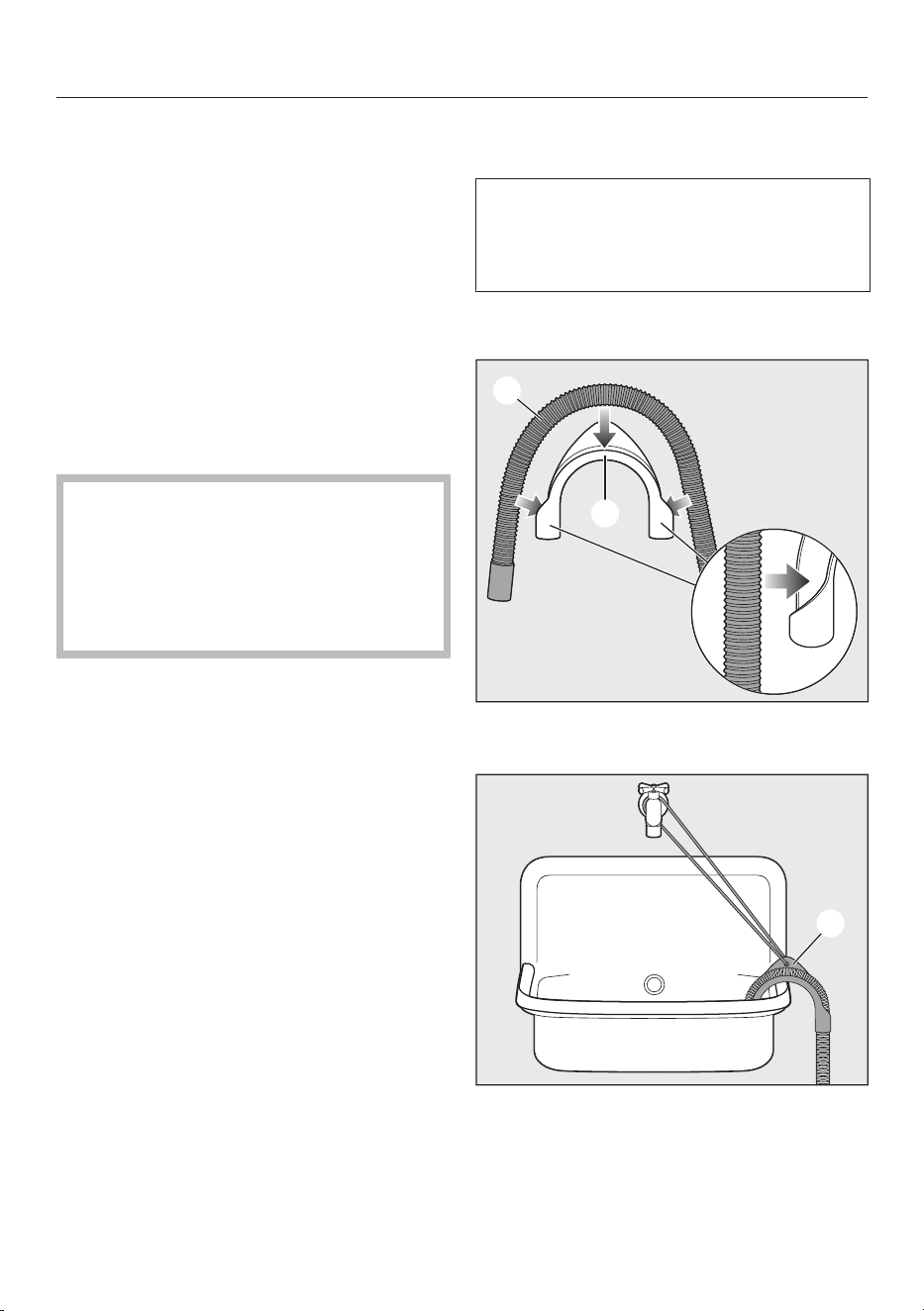
Installation
*INSTALLATION*
55
Connecting the water inlet hose
Screw the water inlet hose onto the
thread of the water inlet with the nut.
Slowly open the stopcock and check
the connection for leaks.
Correct the position of the seal and
screw thread if necessary.
Maintenance
Only use a genuine Miele hose that has
been pressure tested to withstand at
least 7,000kPa should you ever need a
replacement.
Damage caused by dirty water.
A filter is located in the open end of
the inlet hose and another in the in-
take point to protect the inlet valve in
the washing machine.
These filters must not be removed.
Water drainage
The suds are drained through a drain
pump with a 1m high delivery head. For
the water to drain freely, the hose must
be free of kinks.
If required, the hose can be extended to
a length of up to 5m. Accessories are
available from your Miele dealer or from
the Miele Customer Service Depart-
ment.
For drain heights of more than 1m (up
to a maximum delivery head of 1.8m), a
replacement drain pump will need to be
fitted. Please contact Miele for advice.
For a drain height of 1.8m, the hose can
be extended to a length of up to 2.5m.
Accessories are available from your
Miele dealer or from the Miele Cus-
tomer Service Department.
Hanging the drain hose in the sink or
slops basin
If drainage is via the sink, rapid drain-
age must be guaranteed. Otherwise
there is a risk of flooding or backsi-
phonage into the washing machine.
Tip: Use the swivel elbow supplied to
stop the drain hose from slipping.
Insert the drain hose into the
swivel elbow.
Place the end of the drain hose in a
sink.
Use a strap and the eye to stop the
swivel elbow from slipping.
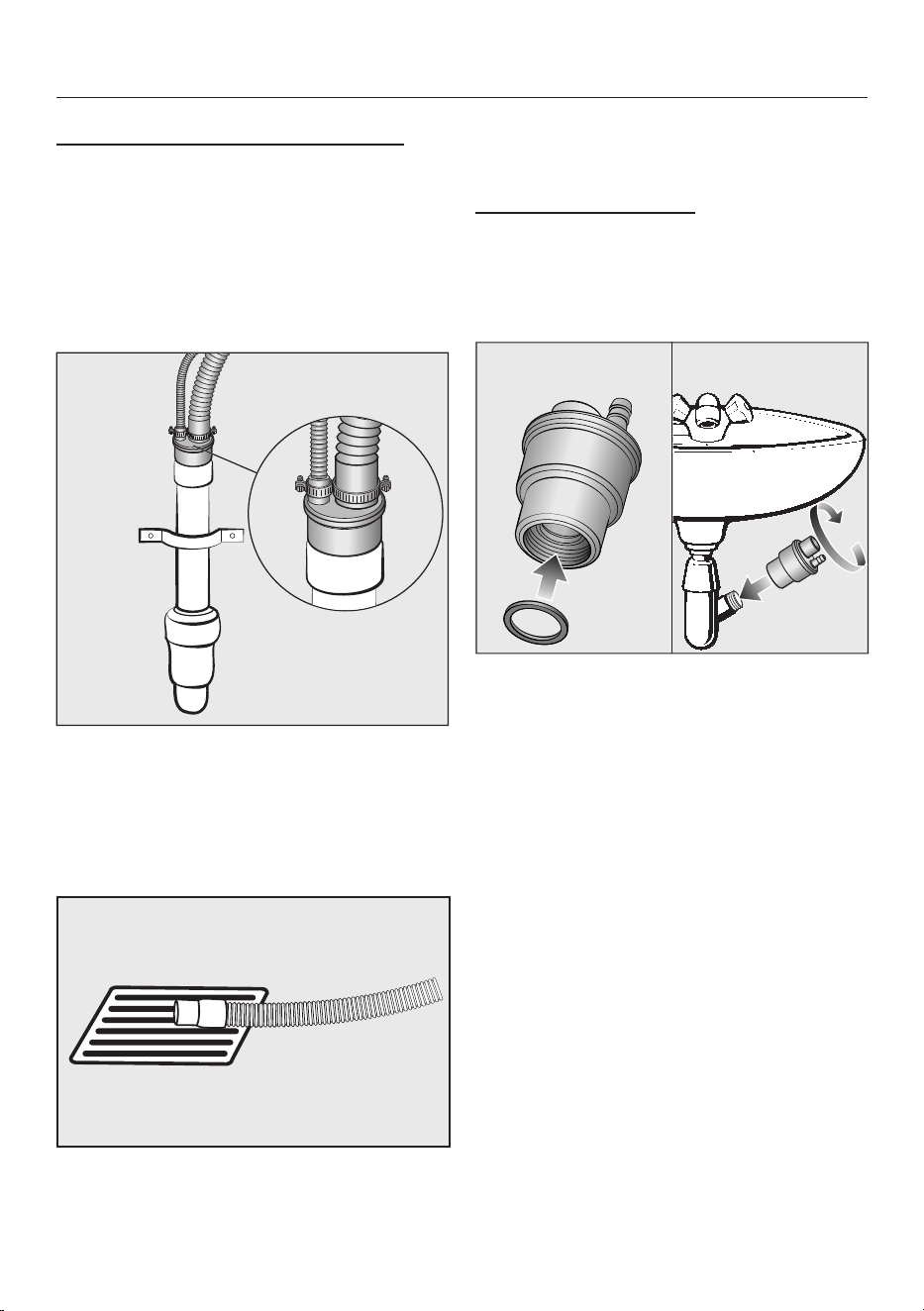
Installation
*INSTALLATION*
56
Connecting to the plastic drain pipe
The drain adapter fits onto a standpipe
with a diameter of DN40 or DN50.
The maximum delivery head of the
washing machine is 1m. The length of
the drain hose must not exceed 2.5m.
Tip: The sealing ring supplied with the
drain adapter must not be used.
Insert the drain adapter into the
plastic drain pipe.
Routing the drain hose to a floor drain
(gully)
Tip: The maximum drain length is 5m.
Place the drain hose on the floor
drain.
If necessary, secure the hose to pre-
vent it from slipping.
Connecting to the sink
It is possible to connect to a sink drain
outlet using a 1¹/₂" thread.
Tip: Ensure that the seal is inserted in
the adapter.
1. 2.
Insert the seal into the drain adapter.
Screw the adapter onto the sink drain
outlet.
Drain adapter
Miele offers a drain adapter for connec-
tion to a plastic drain pipe or sink as an
optional accessory. The drain adapter
offers the option of connecting only the
washing machine or the washing ma-
chine together with the tumble dryer.
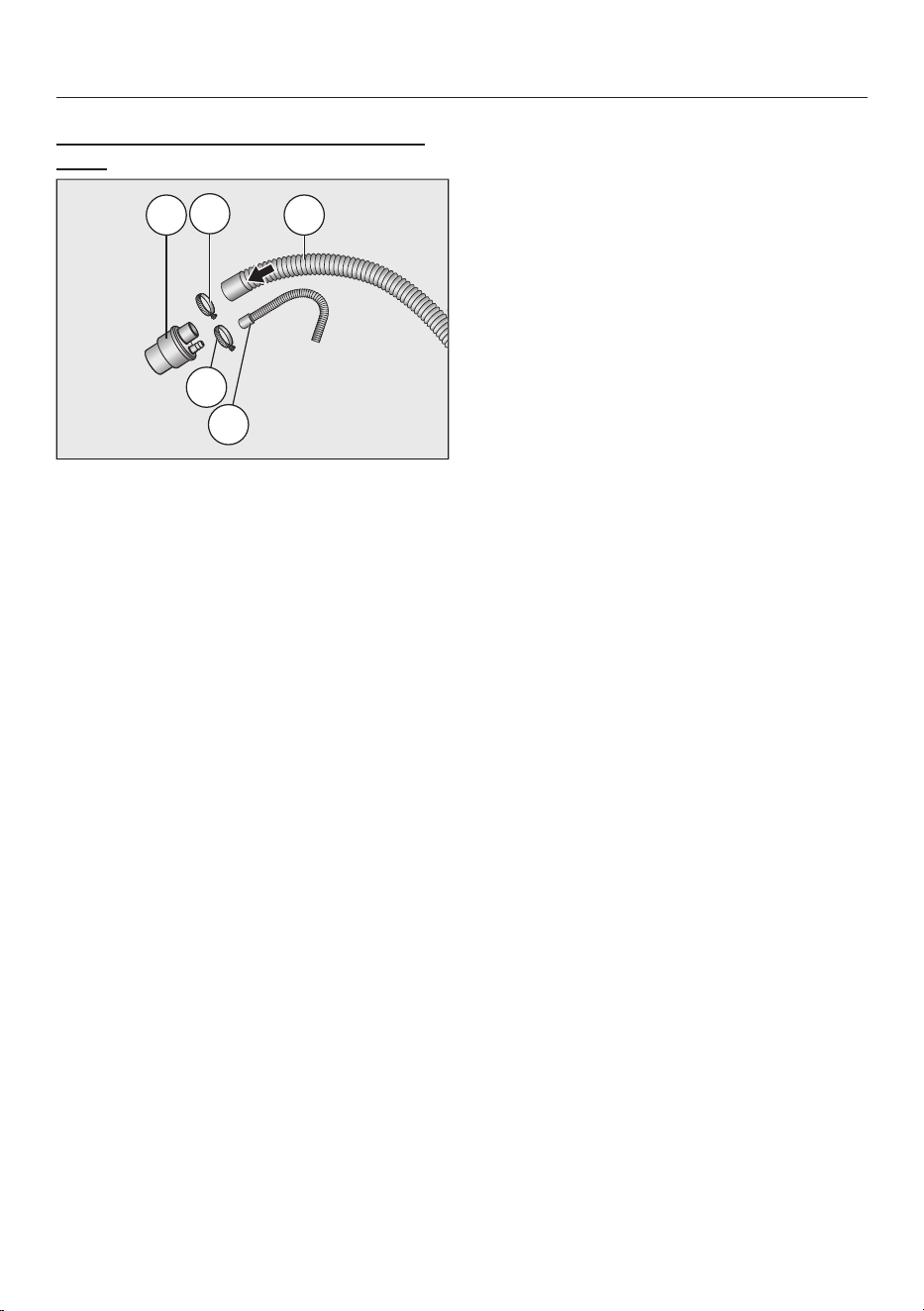
Installation
*INSTALLATION*
57
Connecting the hoses to the drain ad-
apter
5
4
3
2
1
a
Drain adapter
b
Hose clip
c
Washing machine drain hose
d
Hose clip
e
Tumble dryer drain hose
Connect the hoses to the drain ad-
apter as shown in the image.
Secure the hoses with hose clips.

Installation
*INSTALLATION*
58
Electrical connection
The washing machine is supplied with
an electrical connection cable with
moulded plug ready for connection to a
switched socket.
The socket must be easily accessible
after the washing machine has been in-
stalled. If that is not possible, ensure
that a suitable means of disconnection
is provided on the installation side for
each pole.
Risk of fire from overheating.
Connecting the washing machine to
a multi-socket plug adapter or to an
extension lead can overload the
cable.
Do not use an extension lead or
multi-socket plug adapter.
The electrical system must comply with
local and national safety regulations
(BS7671 in the UK). We recommend
the use of a suitable RCD .
If the connection cable is damaged, it
must only be replaced with a specific
connection cable of the same type
(available from the Miele Customer Ser-
vice Department). For safety reasons,
such replacement may only be carried
out by a qualified technician or the
Miele Customer Service Department.
The data plate indicates the nominal
power consumption and the appropriate
fuse rating. Compare the specifications
on the data plate with those of the elec-
tricity supply and make sure that they
match.
If in any doubt, consult a qualified elec-
trician.
Temporary or permanent operation on
an autonomous power supply system or
a power supply system that is not syn-
chronised with the mains power supply
(e.g. island networks, back-up systems)
is possible. A prerequisite for operation
is that the power supply system com-
plies with the specifications of
EN50160 or an equivalent standard.
The function and operation of the pro-
tective measures provided in the do-
mestic electrical installation and in this
Miele product must also be maintained
in isolated operation or in operation that
is not synchronised with the mains
power supply, or these measures must
be replaced by equivalent measures in
the installation. As described, for ex-
ample, in the current version of BS OH-
SAS 18001–2 ISO 45001.
Consumption data
59
Programme Load Energy Water
Running
time Temperature
1
Residual
moisture Speed
kg kWh Litres h:min °C % rpm
ECO 40-60* 8,0 0,664 62,30 3:39 35 52,50 1400
4,0 0,396 53,70 2:48 29 51,60 1400
2,0 0,190 28,20 2:29 25 57,30 1400
Cottons 60 8,0 1,650 60,00 2:59 60 53,00 1400
20
3
8,0 0,420 66,00 3:09 23 53,00 1400
Minimum iron 30 4,0 0,600 58,00 2:29 34 30,00 1200
Express 20
2
30 3,5 0,230 30,00 0:20 30 60,00 1200
Woollens 30 2,0 0,230 35,00 0:39 30 30,00 1200
*
Test programme for compliance with EU legislation regarding ecodesign 2019/2023 and energy labelling in accordance with Regulation
No. 2019/2014
1
Maximum laundry temperature reached in main wash.
2
Shortextra activated
3
20°C programme for lightly soiled cotton garments
Information for customers
Consumption data can vary from the nominal values given depending on water pressure, water hardness, water inlet temperature, room tem-
perature, type and volume of load, fluctuations in the mains voltage and any extra options selected.

Technical data
60
Height 850mm
Width 596mm
Depth 636mm
Depth with door open 1054mm
Height for building under 820 (+8/-2)mm
Width for building under 600mm
Depth for building under 600mm
Weight Approx. 85kg
Capacity 8,0kg dry laundry
Supply voltage See data plate
Rated load See data plate
Fuse rating See data plate
Consumption data See “Consumption data”
Minimum water flow pressure 100kPa (1bar)
Maximum water flow pressure 1000kPa (10bar)
Water inlet hose length 1.60m
Drain hose length 1.50m
Connection cable length 2.00m
Maximum delivery head 1.00m
Maximum drainage length 5.00m
LEDs Class1
Test certifications awarded See data plate
Power rating in off mode 0,30W
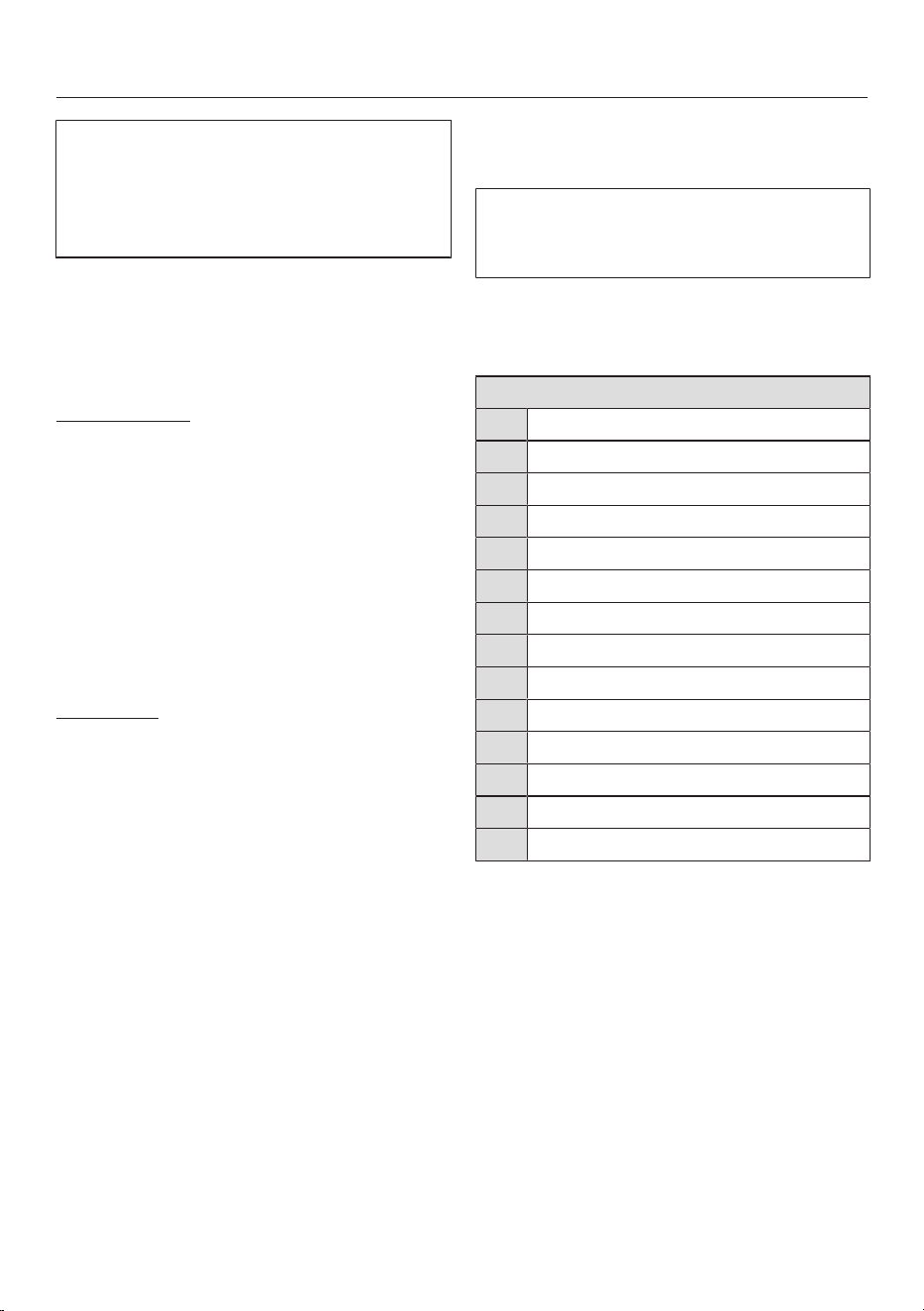
Programmable functions
61
The programmable functions are used
to alter the washing machine’s elec-
tronics to suit changing requirements.
Programmable functions can be
altered at any time.
Opening the programming level
Programming is carried out in 8 steps
(, ,...) using the sensor con-
trols.
Prerequisites:
- The washing machine is switched on
(the programme selector is pointing to
a wash programme).
- The washing machine door is open.
Touch the sensor control and hold
it down whilst carrying out steps
and .
Close the washing machine door.
Wait until Start/Add laundrylights up
constantly...
...and then release the sensor
control.
will light up in the time display.
Choosing and selecting a pro-
grammable function
The number of the programmable
function will appear in the time display
as and a number: e.g. .
Touch the sensor control to select
the other programmable functions
one by one:
Programmable functions
Keypad tone
PIN code
Indicator switch-off behaviour
Memory
Additional long pre-wash – Cottons
Soak duration
Gentle action
Reduced temperature
Water plus
Water plus level
Maximum rinse level
Suds cooling
Anti-crease
Low water pressure
Confirm the selected programmable
function by touching the sensor
control.
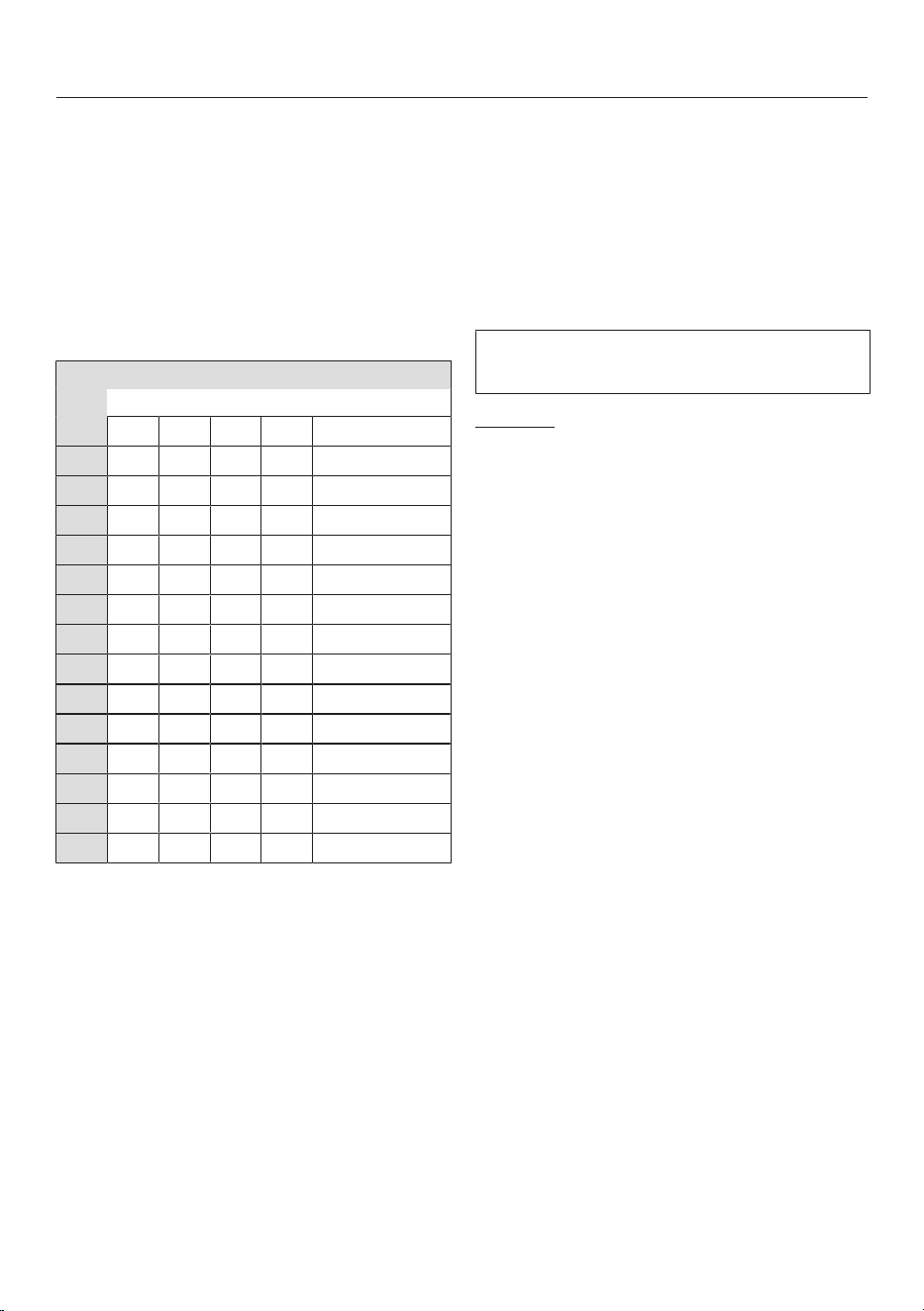
Programmable functions
62
Editing and saving a program-
mable function
You can either switch a programmable
function on/off or select different op-
tions.
Touch the sensor control to
switch the programmable function
on/off or to select an option:
Programmable function
Available options
= Can be selected
= Factory default setting
Touch the sensor control to con-
firm your selection.
The number of the programmable func-
tion, e.g., will then light up again.
Exit programming level
Turn the programme selector to .
The option you have selected is now
stored in memory. You can change it
again at any time.
Keypad tone
Each touch of a sensor is confirmed
with an audible tone.
Options
= Keypad tone switched off
= Keypad tone switched on (fact-
ory default setting)

Programmable functions
63
Lock code
The lock code prevents the washing
machine being used without your
knowledge.
When the code has been activated, you
have to enter a code after switching the
washing machine on. Otherwise the
washing machine cannot be operated.
Options
= Lock code switched off (fact-
ory default setting)
= Lock code is switched on
Using the washing machine with a PIN
code
The code is 125 and cannot be altered.
Switch on the washing machine.
The time display shows and
flashes to prompt you to enter the code.
Touch the sensor control.
appears on the time display.
Confirm the number with the
sensor control.
The first number has been saved and
you can now enter the second number
using the sensor control.
Enter the second and third numbers
and confirm the numbers with the
sensor control.
The lock function is deactivated. A wash
programme can now be selected and
started.
Indicator switch-off behaviour
The indicators will switch off after
10minutes to save energy.
Options
= Off (factory default setting)
The indicators will remain lit up
while the washing machine is
switched on.
= On
The indicators will switch off
after 10minutes if the pro-
gramme is started.
However, the indicators will re-
main lit up for 10minutes after
a Delay start time has elapsed,
after the end of a programme
or at the end of the anti-crease
phase.
Memory
The washing machine will save the last
settings (temperature, spin speed and
some of the extras) selected for a pro-
gramme after the programme has star-
ted.
When this programme is chosen again,
these saved settings will appear in the
display.
Options
= Memory is switched off (fact-
ory default setting)
= Memory is switched on
Programmable functions
64
Longer pre-wash Cottons
If you require a longer pre-wash you
can extend the pre-wash time.
Options
= No increase in the pre-wash
time (factory default setting)
= + 6minutes increase in the
pre-wash time
= + 9minutes increase in the
pre-wash time
= + 12minutes increase in the
pre-wash time
Soak duration
You can set a duration for the soak
process of between 30minutes and
twohours.
You can select the duration in
30minute increments. When the Soak
Extra option is selected the laundry will
be soaked for the duration selected.
Options
= 30minutes soak duration
(factory default setting)
= 1 hour soak duration
= 1 hour 30minutes soak dura-
tion
4 = 2 hours soak duration
Gentle action
Activating gentle action reduces the
drum action and is suitable for wash-
ing lightly soiled items more gently.
Gentle action can be activated for the
Cottons and Minimum iron pro-
grammes.
Options
= Gentle action is switched off
(factory default setting)
= Gentle action rhythm is
switched on
Reduce temperature
The boiling point for water is lower at
high altitudes. In order to avoid water
boiling, Miele recommend activating
the reduce temperature setting at alti-
tudes of more than 2000m above sea
level. The maximum temperature is re-
duced to 80°C even when a higher
temperature is selected.
Options
= The reduce temperature setting
is switched off (factory default
setting)
= The reduce temperature setting
is turned on

Programmable functions
65
Water plus
You can determine the amount of wa-
ter used if the Water + extra is selec-
ted.
Selection
= More water is used in the wash
and rinse stages (factory de-
fault setting)
= An extra rinse is carried out
= The water level in the wash and
rinse stages is increased and
an extra rinse is carried out
Water plus level
There are three different water levels
which can be selected by activating
the Water + extra.
Options
= No higher water level (factory
default setting)
= Water level increase by 1level
when washing and rinsing
= Water level increase by 2levels
when washing and rinsing
= Water level increase by 3levels
when washing and rinsing
Maximum rinse level
The water level in the rinse cycle can
be permanently set to the highest
value.
This function is useful for allergy suffer-
ers as it achieves an excellent rinse res-
ult. Water consumption will increase.
Options
= Maximum rinse level is
switched off (factory default
setting)
= Maximum rinse level is
switched on
Suds cooling
When this is activated, additional wa-
ter flows into the drum at the end of
the main wash to cool the suds down.
Hot suds can damage plastic drainage
pipes.
Suds cooling takes place when a tem-
perature of 70°C or higher is selected
for the Cottons programme.
Suds cooling should be activated:
- to prevent the danger of scalding if the
drain hose is hooked over the edge of
a sink or basin.
- where drainage pipes do not comply
with DIN 1986.
Options
= Suds cooling is switched off
(factory default setting)
= Suds cooling is switched on

Programmable functions
66
Anti-crease
The anti-crease function helps prevent
creasing if laundry is not going to be
removed immediately after the end of
the programme.
The drum continues to turn at intervals
for up to 30minutes at the end of the
programme. The door can be opened at
any time.
Options
= The anti-crease function is
switched off
= The anti-crease function is
switched on (factory default
setting)
Low water pressure
If the water pressure is below 100kPa
(1bar), the washing machine cancels
the programme and the fault mes-
sage appears.
If the water pressure cannot be in-
creased, activating this function will pre-
vent the programme from being can-
celled.
Options
= Low water pressure is switched
off
= Low water pressure is switched
on (factory default setting)

United Kingdom
Miele Co. Ltd., Fairacres, Marcham Road, Abingdon, Oxon, OX14 1TW
Tel: 0330 160 6600, Internet: www.miele.co.uk, E-mail: [email protected]
Australia
Miele Australia Pty. Ltd.
ACN 005 635 398
ABN 96 005 635 398
Level 4, 141 Camberwell Road
Hawthorn East, VIC 3123
Tel: 1300 464 353
E-mail: [email protected]
Internet: www.miele.com.au
Miele Electrical Appliances Co. Ltd.
No. 82, Shimenyi Road, JingAn District
Shanghai, China, P.R.C
Post Code: 200040
Phone: +86 21 6157 3500
Fax: +86 21 6157 3511
E-mail: info@miele.cn
Internet: www.miele.cn
China Mainland
Miele (Hong Kong) Ltd.
41/F - 4101, Manhattan Place
23 Wang Tai Road
Kowloon Bay, Hong Kong
Tel: (852) 2610 1025
Fax: (852) 3579 1404
E-mail:
Website: www.miele.hk
Hong Kong, China
Miele India Pvt. Ltd.
1st Floor, Copia Corporate Suites,
Commercial Plot 9, Mathura Road,
Jasola, New Delhi - 110025
E-mail: customercare@miele.in
Website: www.miele.in
India
Miele Ireland Ltd.
2024 Bianconi Avenue
Citywest Business Campus
Dublin 24
Tel: (01) 461 07 10
Fax: (01) 461 07 97
E-mail: [email protected]
Internet: www.miele.ie
Ireland
Malaysia
Miele Sdn Bhd
Suite 12-2, Level 12
Menara Sapura Kencana
Petroleum
Solaris Dutamas No. 1
Jalan Dutamas 1
50480 Kuala Lumpur, Malaysia
Phone: +603-6209-0288
Fax: +603-6205-3768
Miele New Zealand Limited
IRD 98 463 631
8 College Hill
Freemans Bay, Auckland 1011
Tel: 0800 464 353
Internet: www.miele.co.nz
New Zealand
Miele Pte. Ltd.
29 Media Circle
#11-04 ALICE@Mediapolis
Singapore 138565
Tel: +65 6735 1191
Fax: +65 6735 1161
E-mail: [email protected]
Internet: www.miele.sg
Singapore
Miele (Pty) Ltd.
63 Peter Place, Bryanston 2194
Tel: (011) 875 9000
Fax: (011) 875 9035
E-mail: [email protected]
Internet: www.miele.co.za
South Africa
Miele Appliances Ltd.
Showroom 1, Eiffel 1 Building
P.O. Box 114782 - Dubai
Tel. +971 4 3044 999
Fax. +971 4 3418 852
800-MIELE (64353)
E-mail: [email protected]
Website: www.miele.ae
United Arab Emirates
Manufacturer: Miele & Cie. KG, Carl-Miele-Straße 29, 33332 Gütersloh, Germany
Thailand
Miele Appliances Ltd.
BHIRAJ TOWER at EmQuartier
43rd Floor Unit 4301-4303
689 Sukhumvit Road
North Klongton Sub-District
Vadhana District
Bangkok 10110, Thailand
Sheikh Zayed Road, Umm Al Sheif
E-mail: customercare@miele.co.nz
P.O. Box 69434, Bryanston 2021

M.-Nr. 12 727 710 / 01 / 002en-GB
WEA 125