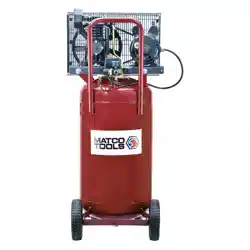

For questions concerning this air compressor, please call
866-869-3114
Rev: 001 Part# 1312101631

TABLE OF CONTENTS
PAGE
1 Safety Guidelines - Definitions
Before Using the Air Compressor
2 When Installing or Moving the Compressor
Before Each Use
3 Follow Safety Precautions for Electrical Connection
Plan Ahead to Protect Your Eyes, Hands, Face & Ears
When Operating
4 Spraying Precautions
Perform These Maintenance Operations
5 Typical Compressor Installation
Glossary
6-7
Wiring
8 Starting the Compressor
9-10 Troubleshooting
11
Pump and Tank Specs
12 Tank Warranty
Back Warranty Statement

SAFETY GUIDELINES - DEFINITIONS
Safety is a combination of common sense, staying alert and knowing how your compressor works.
Read this manual to understand this compressor.
DANGER
means if safety information is not followed someone will be seriously injured or killed
WARNING
means if safety information is not followed someone could be seriously injured or killed
CAUTION
means if safety information is not followed someone may be seriously injured or killed
IMPORTANT SAFETY INSTRUCTIONS
Improper operation or maintenance of this product could result in serious injury and property
damage. Read and understand all warnings and operation instructions before using this compressor.
Things you should know
Air compressors are utilized in a variety of air
system applications. Because air compressors
and other components (hoses, connectors, air
tools, spray guns, etc.) make up a high
pressure pumping system, the following safety
precautions should be observed at all times.
Only persons familiar with these rules of
safe operation should use the air
compressor.
1. Read the instruction manual carefully before
attempting to assemble, disassemble or
operate your system. Be thoroughly familiar
with the controls and the proper use of the
equipment.
2. Review and understand all safety instructions
and operating procedures in this manual.
3. Review the maintenance methods for this
compressor (See “Maintaining Your
Compressor” section).
Inspect your work area
1. Keep work area clean.
2. Cluttered areas and benches invite accidents.
Floors must not be slippery from wax or dust.
Inspect your compressor
1. To reduce the risk of injury from accidental
starting, turn switch off and disconnect the
power before checking it.
2. If any part is missing, bent or broken in any
way, or any electrical part does not work
properly, keep the compressor off and
disconnected.
3. Check hoses for weak or worn condition before
each use, making certain all connections are
secure. Do Not use if defect is found.
Do not operate compressor if damaged during
shipping, handling or use. Damage may result
in bursting and cause injury or property
damage.
This compressor is Not designed for and should
not be used in breathing air applications.
Save these instructions
Before using the air compressor
WARNING
DANGER
Page 1
WARNING
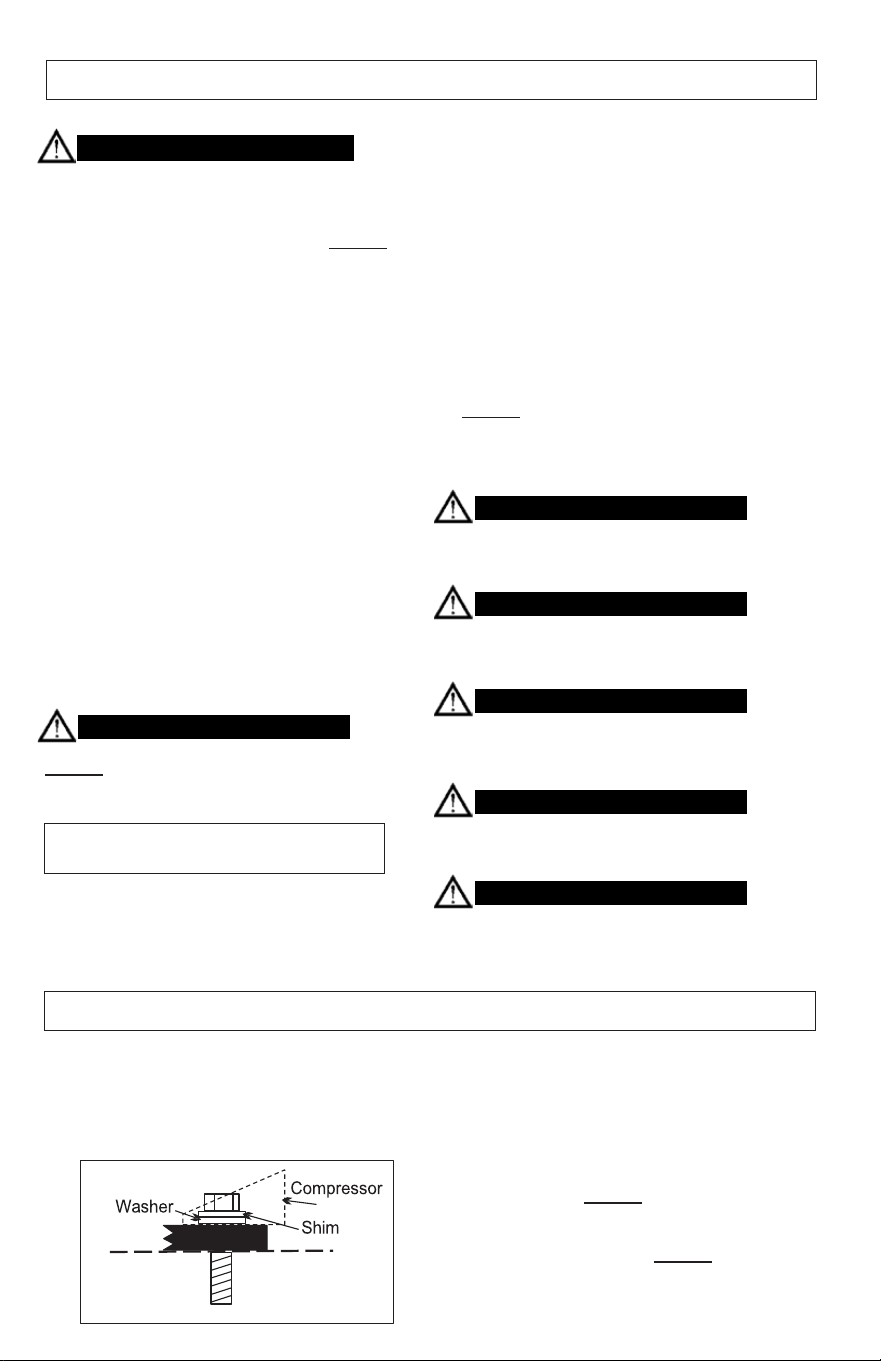
This compressor is extremely top heavy. The
compressor must be bolted to the floor with
vibration pads before operating to prevent
equipment damage, injury or death. Do Not
tighten bolts completely as this may cause
stress to the tank welds. Chart 1a.
To reduce the risk of a dangerous
environment
1. Keep work area well lit.
2. Operate compressor in a well-ventilated
area free from flammable liquids and vapors.
3. Operate compressor in a ventilated area so
that compressor may be properly cooled
and the surrounding air temperature will not
be more than 100°F.
4. Never use a compressor in a wet
environment.
5. Protect material lines and air lines from
damage or puncture. Keep hose and
wires away from sharp objects, chemical
spills, oil, solvents and wet floors.
Do Not secure compressor with toggle bolts
into drywall. Drywall sheeting or plaster will not
support the weight of the compressor.
6. A minimum clearance of 18 inches between
the compressor and a wall is required
because objects could obstruct airflow.
7. The compressor should be located where it can
be directly wired to a circuit breaker. The
compressor should be wired by a qualified
electrician.
8. Never store flammable liquids or gases in
the vicinity of an operating compressor.
9. Do Not locate the compressor air inlet near
steam, paint spray, sandblasting areas or
any other source of contamination. The
debris could damage the motor and pump.
Never use plastic (PVC) pipe for compressed
air. Serious injury or death could result.
Never use the shipping skid for mounting the
compressor.
Electric Compressors are not suitable for
outdoor installation.
Gasoline Compressors must be operated
outdoors, sheltered from the weather.
Never install a shut off valve between the
compressor pump and tank. Personal injury
and/or equipment damage could occur.
Inspect your work area
1. Keep work area clean. Cluttered areas and
benches invite accidents.
2. The floor must not be slippery from wax or
dust.
Inspect your compressor
1. To reduce the risk of injury from accidental
starting, turn the switch off and disconnect
power.
2. If any part is missing, bent or broken in any
way, or any electrical part does not work
properly, keep the compressor off and dis-
connect power. Do Not use if defect is found.
3. Check hoses for weak or worn condition
before each use, making certain all
connections are secure. Do Not use if defect
is found.
When installing or moving the compressor
WARNING
WARNING
CAUTION
NOTICE
NOTICE
WARNING
Before each use
Always Shut Off Gas Valve before
moving Gas Drive Compressors
Flat
Floor
Leg
Vibration Pad
(If
Necessary)
Lag Bolt
Chart 1a
Page 2
1. Follow all local electrical and safety codes,
as well as the National Electric Code (NEC)
and the Occupational Safety and Health
Act (OSHA).
2. Wiring and fuses should follow electrical
codes, current capacity and be properly
grounded.
3. Protect wires from contact with sharp objects.
All electrical connections should be made by
a qualified electrician.
Dress for safety
1. Wear safety glasses (meeting ANSI Z87.1 or
in Canada CSA Z94.3-99) and use hearing
protection when operating the unit. Everyday
glasses are not safety glasses.
2. Wear shoes to prevent shock hazards.
3. Tie back long hair.
Keep fingers away from running compressor.
Fast moving and hot parts may cause injury
and/or burns.
Be careful when touching the exterior of
compressor, pump, motor and air lines; they
may become hot enough to cause injury.
Never operate the compressor without a
beltguard. The compressor can start
automatically without warning. Personal injury
or property damage could occur from contact
with moving parts.
The compressor may be hot even if the unit is
stopped.
Use of a mask or respirator per chemical
manufacturers’ instructions may be necessary if
there is a chance of inhaling toxic fumes. Read
mask and respirator instructions carefully.
Consult a safety expert if you are not sure
about the use of certain masks or respirators.
1. Do not exceed the pressure rating of any
component of the system.
2. Release pressure within the system
slowly to prevent flying dust and debris.
3. If the equipment starts to abnormally vibrate,
STOP the compressor immediately and
check for the cause.
Never change the safety valve or pressure
switch settings. Keep safety valve free from
paint and other accumulations. See compressor
specification decal for maximum operating
pressure. Do not operate with the pressure
switch set higher than the maximum operating
pressure.
Follow the safety precautions for electrical connections
CAUTION
Plan ahead to protect your eyes, hands, face and ears
Pay attention to your hands
WARNING
WARNING
WARNING
CAUTION
WARNING
When operating
WARNING
Page 3

Never point a spray gun at yourself or any
other person or animal. Accidental discharge
may result in serious injury.
Reduce the risk of dangerous
environment
Extreme caution should be taken when
spraying flammable liquids as the spark from
a motor or pressure switch may cause a fire
or explosion. Ample ventilation must be
provided.
Spray in a well ventilated area to keep fumes
from collecting and causing serious injury and
fire hazards.
1. Do Not spray in the vicinity of open flames
or other places where a spark can cause
ignition. Do Not smoke when spraying
paint, insecticides, or other flammable
substances.
Be informed about the materials you use
1. When spraying with solvents or toxic
chemicals, follow the instructions provided
by the chemical manufacturer. Consult a
safety expert if unsure about the use of
masks or respirators.
2. If the material you intend to spray contains
trichloreoethane and methylene chloride, do
not use accessories that contain aluminum or
galvanized materials, as these chemicals can
react with galvanized components causing
corrosion and weakening equipment. Use
stainless steel accessories.
1. Do regular maintenance; keep all nuts, bolts,
and screws tight, to be sure equipment is in
safe working condition.
2. Inspect tank yearly for rust, pin holes or any
other imperfections that could cause it to
become unsafe.
NEVER attempt to repair or modify a tank!
Welding, drilling or any other modification will
weaken the tank resulting in damage from
rupture or explosion. Always replace worn,
cracked or damaged tanks.
3. Clean electrical equipment with an approved
cleaning agent, such as a dry, non-
flammable cleaning solvent.
Daily
Check oil level at sight glass. Oil level should
be 1/2 to slightly higher in the oil sight glass.
Drain moisture from tank.
Verify the pressure switch unloader is
working by listening for a brief hissing sound
when the compressor shuts off.
Visually check the compressor for loose parts,
excessive noise or vibration. Tighten any
necessary part.
4. Drain tanks of moisture after each day’s use.
If unit will not be used for awhile, it is best to
leave the drain cock open until such time as it
is to be used. This will allow moisture to
completely drain out and help prevent
corrosion of inside of tank.
5. Always disconnect from power source before
working on or near a motor, or its connected
load. If power disconnect point is out-of-sight,
secure it in the “OFF” position and tag it to
prevent unexpected application of power.
Disconnect power and depressurize system
before servicing air compressor. Slightly open
the drain cock after shutting off compressor.
Monthly
(Make sure the main power is off.) Check the belts
for tension. Belts should not move up and down
when the compressor runs and when stopped,
should not have more than ½ in of play when
depressed. Be careful not to over tighten belts
during adjustment.
Remove and check air filter, replace if necessary.
Change oil every 3 months or 300 hours. A
compressor grade 30 wt non-detergent oil should
be used. 40 wt non-detergent for single stage.
Spraying precautions
WARNING
WARNING
WARNING
Perform these maintenance operations
WARNING
WARNING
Page 4
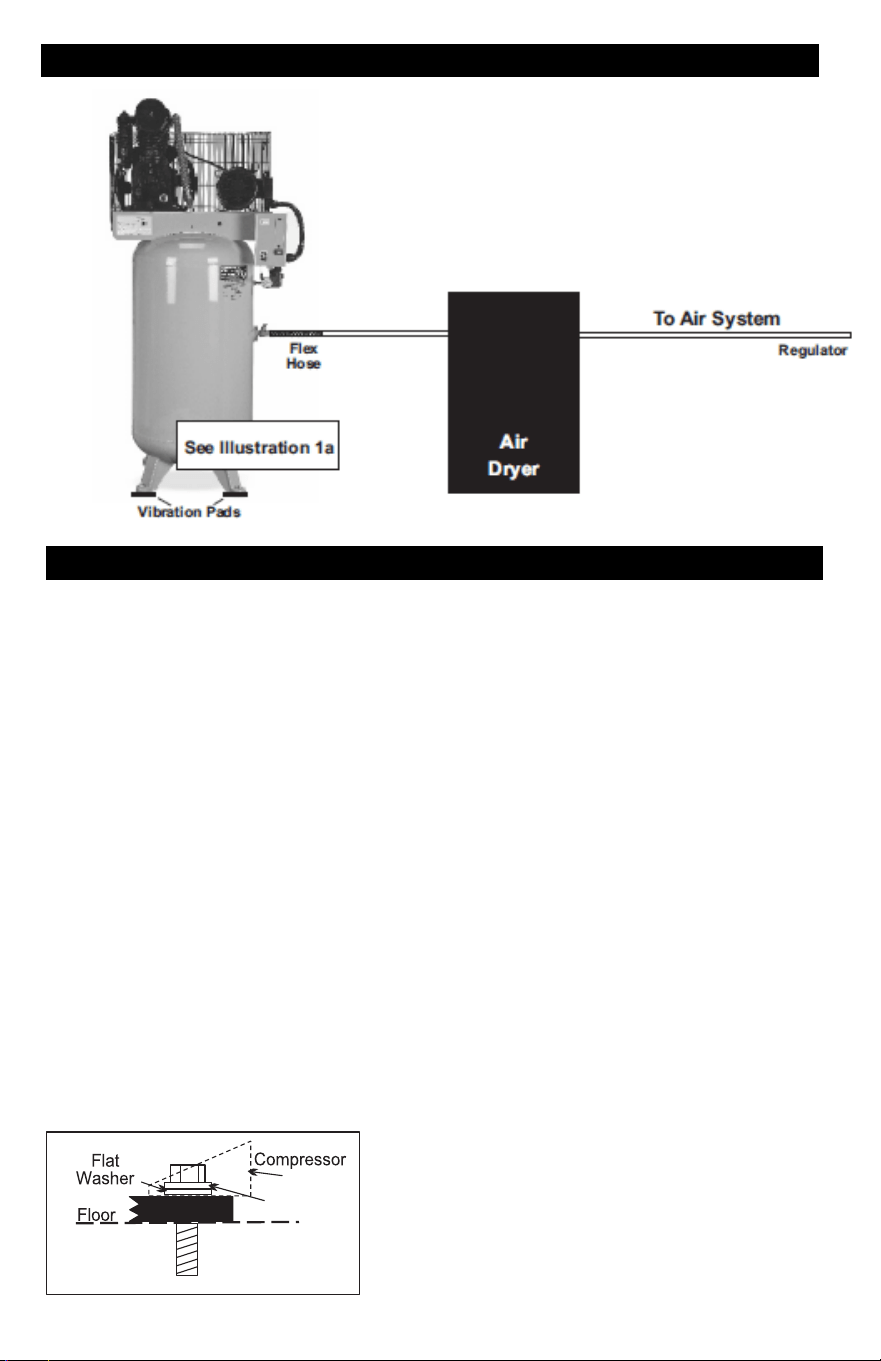
TYPICAL COMPRESSOR INSTALLATION
GLOSSARY OF TERMS
Air Filter
Porous element contained within a metal or
plastic housing attached to the compressor
cylinder head which removes impurity from the
intake air of the compressor.
Air Tank
Cylindrical component which contains the
compressed air.
Check Valve
Device which prevents compressed air from
flowing back from the air tank to the
compressor pump.
Electric Motor
Device which provides the rotational force
necessary to operate the compressor pump.
Pressure Gauge
Device which shows the tank or regulated
pressure of the compressed air.
Pressure Switch
Device which automatically controls the on/off
cycling of the compressor. It stops the
compressor when the cut-off pressure in the tank
is reached and starts the compressor when the
air pressure drops below the cut-in pressure.
PSI (Pounds per Square Inch)
Measurement of the pressure exerted by the
force of air. The actual psi is measured by a
pressure gauge on the compressor.
Pump
Device which produces the compressed air
with a reciprocating piston contained within a
cylinder.
Safety Valve
Device which prevents air pressure in the air
tank from rising over a predetermined limit.
Thermal Overload Switch
Device, integrated into the electric motor winding,
which automatically “shuts off” the compressor if
the temperature of the electric motor exceeds a
predetermined limit.
Vibration Pad
Shim
(If Necessary)
Lag Bolt
Chart 1a
Page 5
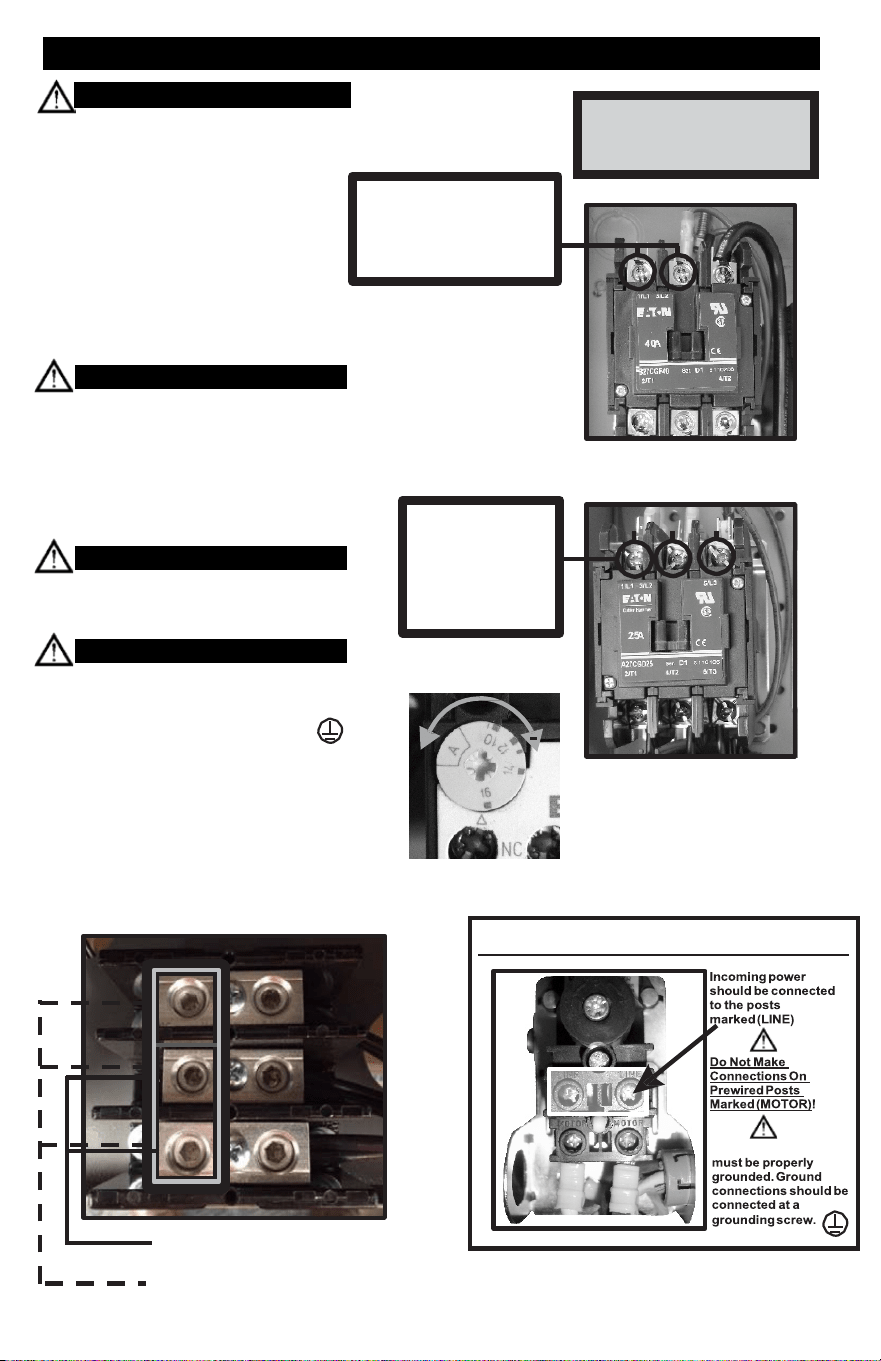
WIRING
WARNING
ALL ELECTRICAL WIRING SHOULD BE DONE
BY A QUALIFIED ELECTRICIAN
General Information
Adequate wiring and motor protection
should be provided for all stationary
compressors. Wiring used for other
machinery should not be used. A
qualified electrician familiar with local
electrical codes in your area should be
used. Size supply wiring per NEC
(National Electric Code) requirements.
Single Phase
Incoming power should be
connected to L1 and L2 at
the Top of the Magnetic
Starter.
To reduce the risk of electrical hazards, fire
hazards or damage to the compressor, use
proper circuit protection. Your compressor is
wired at the factory for operation using the
voltage shown. Connect the compressor to
a power source with the correct breaker
size.
Overheating, short circuiting and fire
damage will result from inadequate wiring.
Electrical connections must be properly
grounded. Ground connections should be
connected at the grounding screw.
Three Phase
Duplex Wiring
(Inside Controller on the Bottom)
WARNING
CAUTION
WARNING
+
Incoming power
should be
connected to L1,
L2 & L3 at the Top
of the Magnetic
Starter.
Overload
Adjustment
DO NOT MAKE CONNECTIONS
AT THE PRESSURE SWITCH
(Units with Magnetic Starters)
For Models Without Magnetic Starter
Electrical connections
Single Phase
Three Phase
Page 6
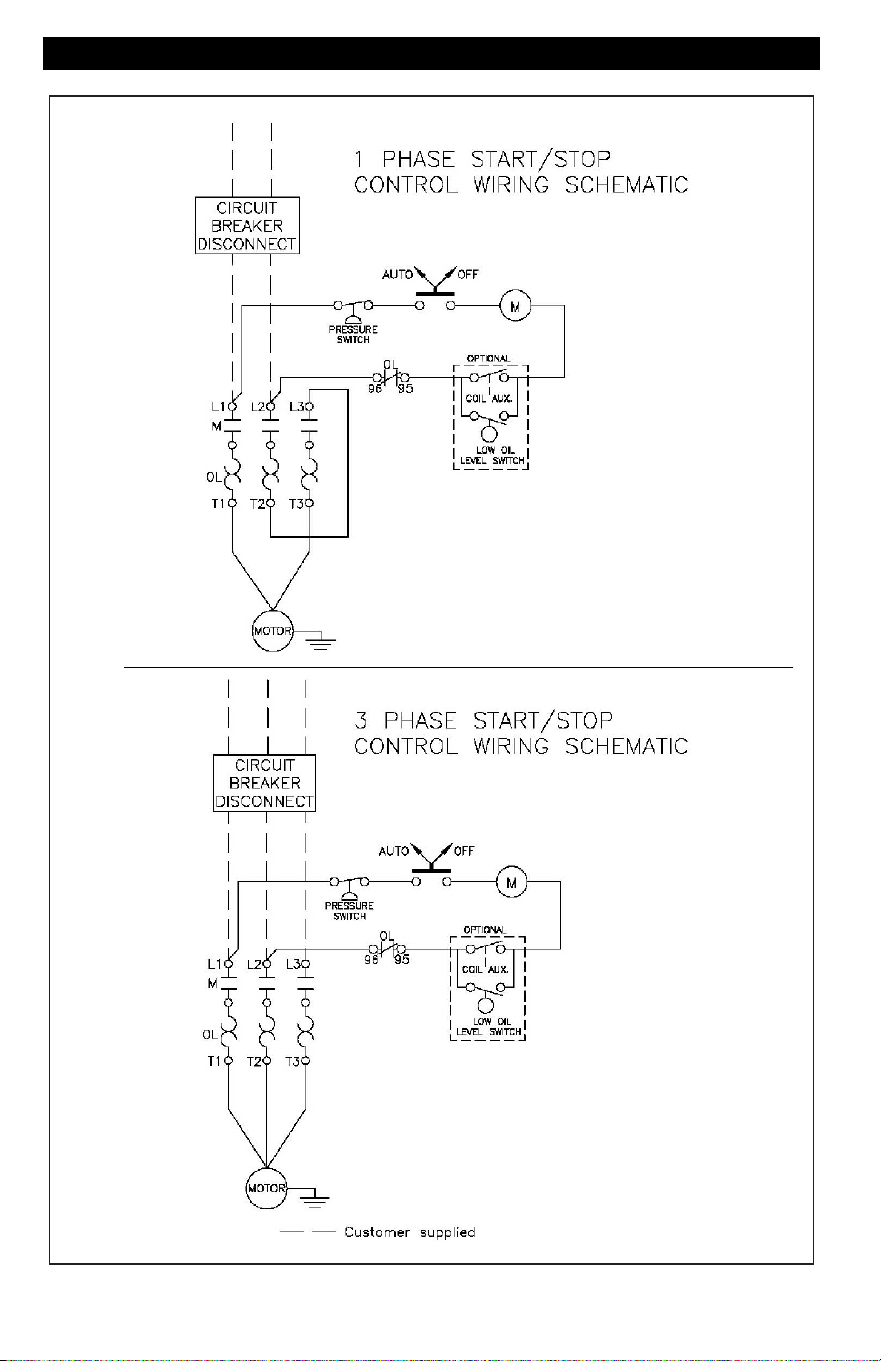
WIRING
Single and Three Phase
With Mag Starter
1 PHASE START/STOP CONTROL
WIRING SCHEMATIC
3 PHASE START/STOP CONTROL
WIRING SCHEMATIC
CIRCUIT
BREAKER
DISCONNECT
CIRCUIT
BREAKER
DISCONNECT
AUTO
OFF
AUTO
OFF
PRESSURE
SWITCH
OPTIONAL
OPTIONAL
PRESSURE
SWITCH
COIL
AUX.
LOW OIL
LEVEL SW ITCH
LOW OIL
LEVEL SW ITCH
COIL
AUX.
MOTOR
MOTOR
Customer supplied
OL
OL
Page 7

STARTING THE COMPRESSOR
Prior to actually running the compressor,
check the following items:
Crankcase oil - Make sure the sight glass
shows ½ full or slightly above.
Make sure all rags, tools, oil, etc. are away
from the unit.
Open the air system to free it of any pressure.
Switch the compressor on for a few
revolutions to make sure the rotation is
correct. Correct rotation is clockwise
when facing the sight glass on the pump.
Operate the compressor for a few minutes
unloaded (air system open) then allow the
compressor to pump up. Make sure the
electrical pressure switch properly switches
off the compressor according to the setting
desired. 175 for Two Stage.
(135 psi - Single Stage or 165 psi)
Make sure the pressure in the tank does not
exceed its rating. Single Stage units - 135 psi
Two Stage units at a maximum of 175 psi.
(135 psi - Single Stage or 165 psi)
If the pressure gauge indicates a pressure that
is higher than these maximum pressures, shut
off compressor immediately and call your
distributor.
CAUTION
Page 8
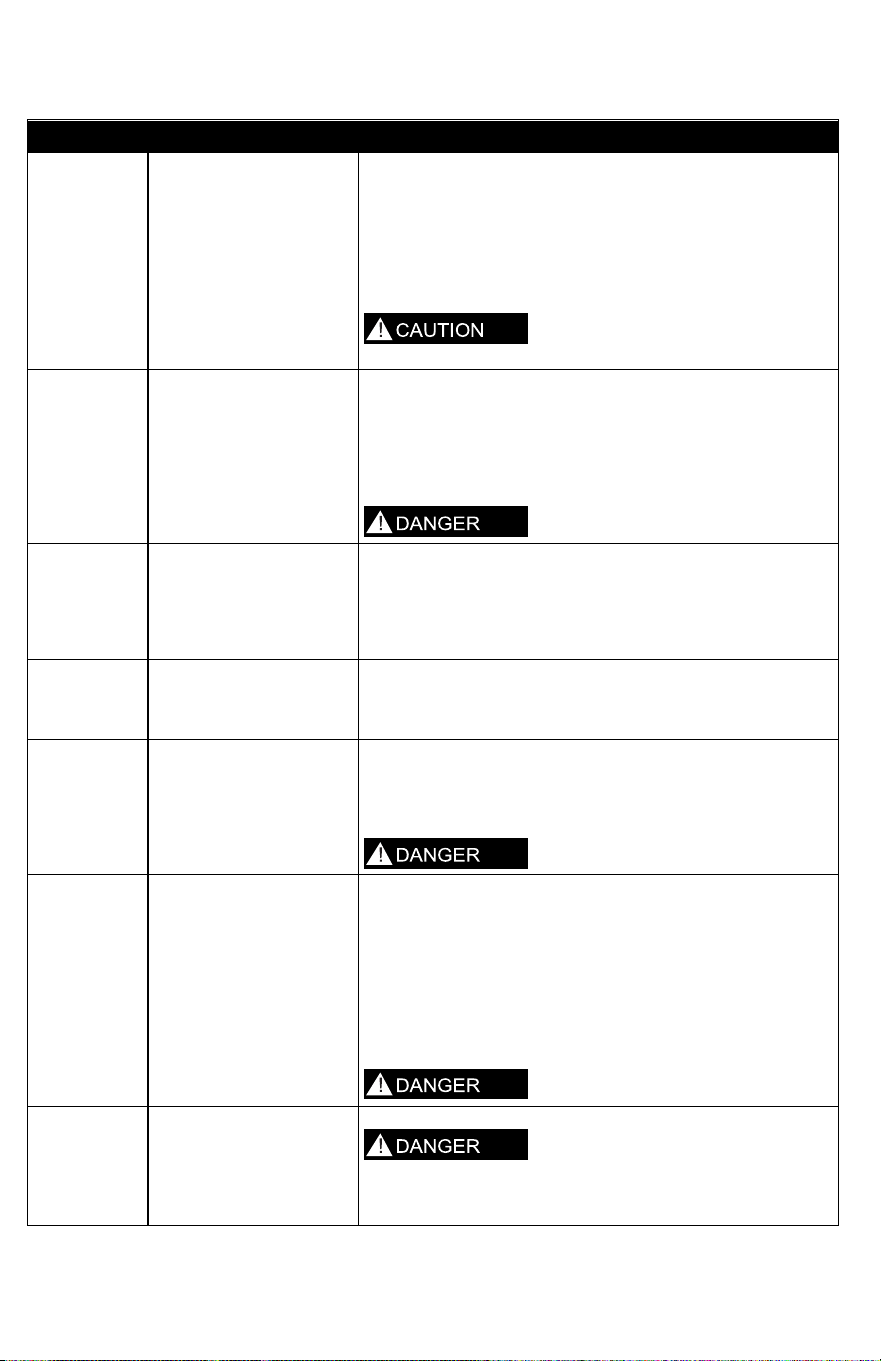
TROUBLESHOOTING GUIDE
Low discharge
pressure
1. Compressor too small
for application
2. Air leaks
3. Restricted intake air
4. Blown gasket(s)
5. Broken or misaligned
valves
1. Reduce air demand or use a compressor with more air
capacity.
2. Listen for air leaks. Apply a soap solution to all fittings and
connections. Bubbles will form at points of leakage. Tighten
or replace fittings or connections.
3. Clean or replace air filter.
4. Replace necessary gaskets.
5. Remove head and inspect for broken or misaligned valves.
Replace valves, if necessary.
Install a new head gasket each time
head is removed
Excessive
noise
“knocking”
1. Loose drive pulley or
flywheel
2. Low on oil
3. Worn connecting rod or
connecting rod bearing
4. Noisy check valve
1. Tighten drive pulley or flywheel bolt.
2. Check for proper oil level. Low or dirty oil may cause bearing
damage.
3. Replace connecting rod and/or connecting rod bearings.
4. Replace check valve.
Do not remove check valve with air
pressure in tank
Excessive oil
carryover
1. Worn piston rings
2. Restricted intake air
3. Too much oil in
compressor
4. Incorrect oil viscosity
1. Replace with new piston rings.
2. Clean or replace air filter.
3. Drain oil to proper oil level.
4. Use a quality non-detergent 30 or 40wt oil specified for each
model (Page 4).
Water in tank
and/or
discharge line
1. Normal. Amount of
water will increase as
humidity in the air
increases.
1. Drain tank at least once per day.
2. Add an inline filter to reduce moisture in the air line.
Will not run or
motor hums
1. Low voltage
2. Malfunctioning pressure
switch
3. Malfunctioning check
valve
1. Check voltage with volt meter across both legs of incoming
power. Check reset button on motor.
2. Repair or replace pressure switch.
3. Replace check valve or pressure switch.
Do not remove check valve with air
pressure in tank
Breaker or
reset
repeatedly
trips
1. Incorrect breaker size
2. Low voltage
3. Malfunctioning motor
4. Loose electrical
connections
5. Malfunctioning pressure
switch
6. Malfunctioning check
valve
1. Make sure the breaker is sized properly. See page 6 in this
manual.
2. Check voltage with volt meter across both legs of incoming
power.
3. Replace motor.
4. Check all electrical connections.
5. Adjust or replace pressure switch.
6. Replace check valve.
Do not remove check valve with air
pressure in tank
Tank does not
hold pressure
when not
running and
shut off valve
is closed
1. Malfunctioning check
valve
2. Loose fittings or
connections
3. Crack or pin hole in tank
1. Replace check valve.
Do not remove check valve with air
pressure in tank
2. Tighten or replace fittings or connections.
3. Replace tank. Do not attempt to repair tank.
Page 9

TROUBLESHOOTING GUIDE (Continued)
Pressure switch
unloader constantly
leaking air
1. Malfunctioning check valve
1. Replace check valve if unloader bleeds
constantly.
Do not remove check
valve
with air pressure in
tank
Pressure switch not
unloading
1. Malfunctioning pressure
switch
1. Replace pressure switch if it does not release
air pressure briefly when unit shuts off.
Do not remove pressure
switch with air pressure
in tank
Excessive vibration
1. Improper installation
2. Loose belts
3. Misaligned flywheel or
drive pulley
1. Make sure unit is mounted on a level surface
with vibration pads.
2. Replace belts. Align and tighten properly.
3. Align flywheel and drive pulley.
Overheating
1. Compressor too small for
application
2. Cooling surfaces dirty
3. Improper cooling
1. Reduce air demand or use a compressor
with more air capacity.
2. Clean all cooling surfaces of dirt and dust.
3. Install compressor in an area with adequate
cool dry air.
Page 10
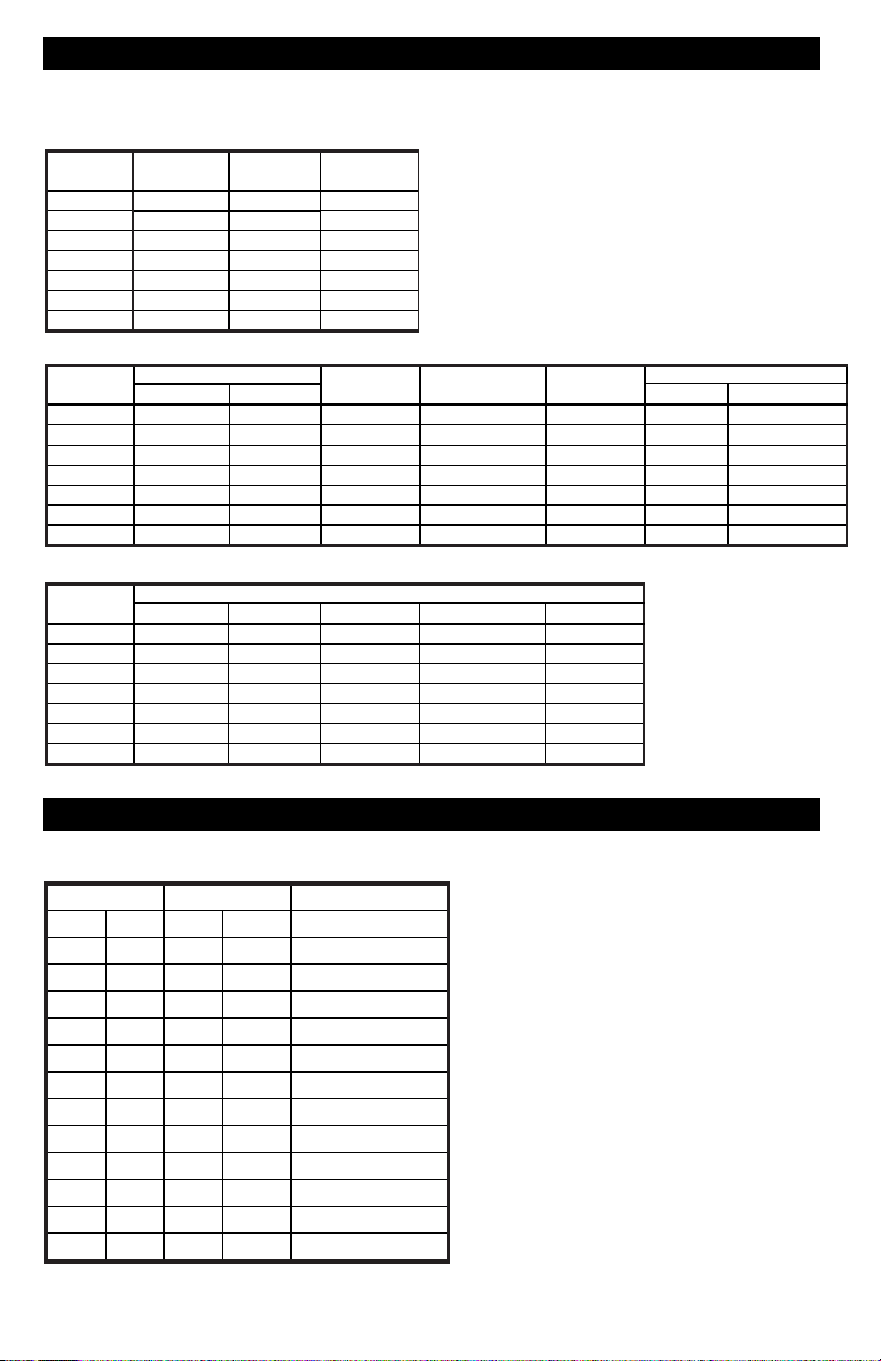
Pump Specifications
Pump
Model
Pump P/N
Cyl. No.
Stages
PAT24
4116091136
2
1
PAT38
4116091337
2
1
T39
4116090019
2
2
T29S
4116090112
2
2
B5900
4116090137
2
2
C1
1312202800
2
2
C2
1312202700
4
2
Pump
Model
Cyl. Diam. In. (mm)
Stroke in.
(mm)
Max rpm
Oil Cap.
Qt. (L)
Displacement @ max RPM
1st Stg
2nd Stg
CFM
L/M
PAT24
2.48 (63)
N/A
1.50 (38)
1400
.56 (0.53 )
11.71
331.59
PAT38
2.48 (63)
N/A
2.36 (60)
1400
.91 (.86)
18.49
523.58
T39
4.13 (105)
2.05 (52)
2.95 (60)
1400
1.09 (1.03)
32.02
906.63
T29S
3.74 (85)
1.97 (45)
1.97 (45)
1400
1.44 (1.36)
17.53
496.50
B5900
4.13 (105)
2.16 (55)
2.16 (55)
1400
1.72 (1.63)
23.44
663.84
C1
4.13 (105)
2.16 (55)
3.5 (89)
1000
1.31 (1.24)
27.13
768.33
C2
4.13 (105)
2.16 (55)
3.5 (89)
900
1.5 (1.42)
48.84
1382.99
Pump
Model
Bolt Torque Ft.-Lbs. (NM)
Conrod
Head
Cylinder
Bearing Housing
Flywheel
PAT24
N/A
18-20 (24-27)
18-20 (24-27)
5-7 (7-10)
18-20 (24-27)
PAT38
N/A
18-20 (24-27)
18-20 (24-27)
5-7 (7-10)
18-20 (24-27)
T39
20-22 (27-30)
30-33 (40-45)
16-19 (22-26)
19-22 (26-30)
34-37 (46-50)
T29S
18-20 (24-27)
18-20 (24-27)
18-20 (24-27)
5-7 (7-10)
18-20 (24-27)
B5900
18-20 (24-27)
18-20 (24-27)
18-20 (24-27)
5-7 (7-10)
18-20 (24-27)
C1
34-37 (46-50)
34-37 (46-50)
19-27 (26-37)
14-19 (19-26)
47-57 (64-77)
C2
34-37 (46-50)
34-37 (46-50)
19-27 (26-37)
14-19 (19-26)
47-57 (64-77)
Tank Specifications
Volume
Max Pressure
Discharge Conn.
Gal.
Liter
PSI
Bar
NPT
20H
76
150
10.345
1/4"
26V
99
150
10.345
1/4"
60V
228
170
11.724
1/2'
2X4
2X15.2
200
13.793
3/8"
2X5
2X19
200
13.793
3/8"
80H
228
200
13.793
3/4"
80V
300
200
13.793
3/4"
30H
114
200
13.793
3/4"
120V
456
200
13.793
3/4"
120H
456
200
13.793
3/4"
120D
456
200
13.793
3/4"
200D
760
200
13.793
3/4"
Page 11
WARNING
Oil and moisture residue must be drained from the air receiver
daily or after each use. Accumulations of oil residue in the receiver
can be ignited by embers of carbon created by the heat of
compression - causing an explosion, damage to property and
injury to personnel.
WARNING
Do not open a manual tank drain valve on any air tank containing
more than 30 PSIG of air pressure!
WARNING
Never attempt to relieve an air tank by removing a pipe plug or
any other system component!
Manually Draining an Air Tank:
Step 1)
Disconnect & lockout the compressor from the power source
(electric models) or disconnect the spark plug wire from the spark
plug
(gas engine models).
Step 2)
Tank(s) subjected to freezing temperatures may contain ice. Store
the compressor in a heated area before attempting to drain
moisture from the tank(s). Reduce the air pressure in the tank to
30
PSIG by pulling the pressure relief valve ring (refer to
Fig. 3-4,
Checking Pressure Relief Valves & Relieving System Pressure
).
Step 3)
Slowly open the drain valve and allow the moisture and air
mixture
to drain from the tank.
Step 4)
Once the moisture has been completely drained, close the drain
valve.
Air Tank Inspection
The factory recommends that all air
tanks be inspected at scheduled
intervals. Refer to Recommended Air
Tank Inspection Intervals Table for
relative information.
Refer to federal, state or
provincial,
or local codes for
mandatory air tank
maintenance
information.
Recommended Air Tank Inspection Intervals
Tank Capacity
Horizontal
or
Vertical
Minimum
Allowable Wall
Visually
Inspect
Hydrostatically
Inspect
HEAD
SHELL
8 Gal.
Horizontal
0.096
0.094
Yearly
10 Years
8 Gal.
Twin Horiz.
0.098
0.098
Yearly
10 Years
10 Gal.
Twin Horiz.
0.118
0.118
Yearly
10 Years
20 Gal.
Horizontal
0.094
0.094
Yearly
10 Years
26 Gal.
Vertical
0.094
0.094
Yearly
10 Years
30 Gal.
Horizontal
0.109
0.098
Yearly
10 Years
60 Gal.
Vertical
0.094
0.094
Yearly
10 Years
80 Gal.
Vertical
0.149
0.133
Yearly
10 Years
80 Gal.
Horizontal
0.109
0.133
Yearly
10 Years
120 Gal.
Vertical
0.163
0.199
Yearly
10 Years
120 Gal. & Duplex
Horizontal
0.131
0.159
Yearly
10 Years
200 Gal. Duplex
Horizontal
0.163
0.199
Yearly
10 Years
Page 12


SERIAL NUMBER: _____________________
NOTES:
__________________________________________________________________
__________________________________________________________________
__________________________________________________________________
__________________________________________________________________
__________________________________________________________________
__________________________________________________________________
__________________________________________________________________
__________________________________________________________________
__________________________________________________________________
__________________________________________________________________
__________________________________________________________________
__________________________________________________________________
__________________________________________________________________
__________________________________________________________________
__________________________________________________________________
__________________________________________________________________
__________________________________________________________________
__________________________________________________________________
__________________________________________________________________
__________________________________________________________________
__________________________________________________________________
__________________________________________________________________
__________________________________________________________________
__________________________________________________________________
__________________________________________________________________
__________________________________________________________________
__________________________________________________________________
__________________________________________________________________
__________________________________________________________________
__________________________________________________________________
__________________________________________________________________
__________________________________________________________________
__________________________________________________________________
__________________________________________________________________
__________________________________________________________________
__________________________________________________________________
__________________________________________________________________


Warranty Statement
The Company warrants that the Equipment manufactured by it and delivered hereunder shall be free from defects in material and
workmanship for a period of twelve (12) months from the date of initial start-up, or eighteen (18) months from the date of shipment
from the manufacturer, whichever occurs first. The foregoing warranty period shall apply to all Equipment, except for the following: (A)
all two stage reciprocating stationary models are warranted for the earlier of twenty-four (24) months from the date of initial operation
or thirty (30) months from date of shipment from the manufacturer. (B) Replacement parts will be warranted for three (3) months from
the date of shipment from the manufacturer. Should the failure to conform to this warranty be reported in writing to the Company within
said period, the Company shall, at its option, correct such non-conformity by suitable repair to such Equipment, or furnish a replacement
part F.O.B point of shipment, provided that the Purchaser has installed, maintained, and operated such Equipment in accordance with
good industry practices, and has complied with specific recommendations of the Company. Accessories and equipment furnished by
the Company, but manufactured by others, shall carry whatever warranty the manufacturer conveyed to the Company and which can
be passed on to the Purchaser. The Company shall not be liable for any repairs, replacements, or adjustments to the Equipment, or
any costs of labor performed by the Purchaser without the Company’s prior written approval.
The Company makes no performance warranty unless specifically stated within its proposal, and the effects of corrosion, erosion, and
normal wear and tear are specifically excluded from the Company’s warranty. In the event performance warranties are expressly
included, the Company’s obligation shall be to correct in the manner and for the period of time provided above.
THE COMPANY MAKES NO OTHER WARRANTY OR REPRESENTATION OF ANY KIND WHATSOEVER,
EXPRESSED OR IMPLIED, EXCEPT THAT OF TITLE, AND ALL IMPLIED WARRANTIES OF
MERCHANTABILITY AND FITNESS FOR A PARTICULAR PURPOSE, ARE HEREBY DISCLAIMED. THIS
WARRANTY SUPERSEDES ALL PREVIOUS WARRANTY STATEMENTS.
Correction by the Company of non-conformities, whether patent or latent, in the manner and for the period of time provided above,
shall constitute fulfillment of all liabilities of the Company and its distributors for such non-conformities with respect to, or arising out
of such Equipment.
LIMITATION OF LIABILITY
THE REMEDIES OF THE PURCHASER SET FORTH HEREIN ARE EXCLUSIVE, AND THE TOTAL LIABILITY
OF THE COMPANY, ITS DISTRIBUTORS AND SUPPLIERS WITH RESPECT TO CONTRACT OR THE
EQUIPMENT AND SERVICES FURNISHED IN CONNECTION WITH THE PERFORMANCE OR BREACH
THEREOF, OR FROM THE MANUFACTURE, SALE, DELIVERY, INSTALLATION, REPAIR OR TECHNICAL
DIRECTION COVERED OR FURNISHED UNDER CONTRACT, WHETHER BASED ON CONTRACT,
WARRANTY, NEGLIGENCE, INDEMNITY, STRICT LIABILITY OR OTHERWISE, SHALL NOT EXCEED THE
PURCHASE PRICE OF THE EQUIPMENT UPON WHICH SUCH LIABILITY IS BASED.
THE COMPANY, ITS DISTRIBUTORS AND ITS SUPPLIERS SHALL IN NO EVENT BE LIABLE TO THE
PURCHASER, ANY SUCCESSORS IN INTEREST, OR ANY BENEFICIARY OR ASSIGNEE OF THE
CONTRACT FOR ANY CONSEQUENTIAL, INCIDENTAL, INDIRECT, SPECIAL OR PUNITIVE DAMAGES
ARISING OUT OF THIS CONTRACT OR ANY BREACH THEREOF, OR ANY DEFECT IN, OR FAILURE OF,
OR MALFUNCTION OF THE EQUIPMENT, WHETHER OR NOT BASED ON LOSS OF USE, LOST PROFITS
OR REVENUE, INTEREST, LOST GOODWILL, WORK STOPPAGE, IMPAIRMENT OF OTHER GOODS,
LOSS BY REASON OF SHUTDOWN OR NON-OPERATION, COST OF PURCHASE OF REPLACEMENT
POWER, OR CLAIMS OF PURCHASER OR CUSTOMERS OF PURCHASER FOR SERVICE INTERRUPTION,
WHETHER OR NOT SUCH LOSS OR DAMAGE IS BASED ON CONTRACT, WARRANTY, NEGLIGENCE,
INDEMNITY, STRICT LIABILITY OR OTHERWISE.
866-869-3114 (Parts and Technical)