Visit our website at: http://www.harborfreight.com
Visit our website at: http://www.harborfreight.com
Email our technical support at: [email protected]
Owner’s Manual & Safety Instructions
Save This Manual Keep this manual for the safety warnings and precautions, assembly, operating,
inspection, maintenance and cleaning procedures. Write the product’s serial number in the back of the manual
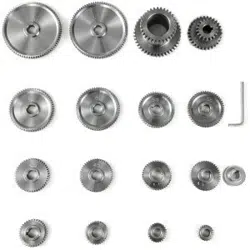
near the assembly diagram (or month and year of purchase if product has no number). Keep this manual and
the receipt in a safe and dry place for future reference. 18i
When unpacking, make sure that the product is intact
and undamaged. If any parts are missing or broken,
please call 1-888-866-5797 as soon as possible.
Copyright
©
2006 by Harbor Freight Tools
®
. All rights reserved.
No portion of this manual or any artwork contained herein may be reproduced in
any shape or form without the express written consent of Harbor Freight Tools.
Diagrams within this manual may not be drawn proportionally. Due to continuing
improvements, actual product may differ slightly from the product described herein.
Tools required for assembly an d se rv ic e may n ot b e in cl uded.
Read this material before using this product.
Failure to do so can result in serious injury.
SAVE THIS MANUAL.

Page 2 For technical questions, please call 1-888-866-5797. Item 93212
CONTENTS
IMPORTANT SAFETY
INFORMATION .................................3
GENERAL TOOL SAFETY WARNINGS . 3
GROUNDING INSTRUCTIONS ..........4
110-120 VAC GROUNDED TOOLS:
TOOLS WITH THREE PRONG PLUGS 4
MINI LATHE SAFETY WARNINGS ......... 5
SPECIFICATIONS ...............................8
PACKING LIST ........................................ 8
GENERAL MINI LATHE
COMPONENTS ................................9
POWER CONTROLS OVERVIEW ...10
CONTROLS ON THE FRONT OF THE
LATHE ................................................. 10
CONTROLS ON THE BACK OF THE
LATHE ................................................. 10
LATHE COMPONENTS OVERVIEW 11
ASSEMBLY INSTRUCTIONS ...........12
ATTACHING RUBBER FEET OR
INSTALLING TO WORKBENCH ........ 12
INSTALLING HANDWHEEL HANDLES 12
INSTALLING GUARDS ......................... 13
SET UP ..............................................14
INITIAL TEST RUN ................................ 14
REPLACEMENT OF CHUCK ................ 15
REPLACEMENT OF JAWS ................... 15
COMPOUND REST ADJUSTMENT ...... 17
TAILSTOCK ADJUSTMENTS ............... 17
TOOL POST ADJUSTMENT ................. 18
AUTOMATIC FEEDING ......................... 18
THREADING DIAL ................................ 19
OPERATION .....................................20
START UP ............................................. 20
TO STOP THE LATHE ........................... 21
BASIC OPERATIONS ........................... 22
THREADING GEARS ............................ 23
THREAD SIZE GEAR SETTINGS ......... 23
AUTOMATIC FEED AND THREADING
DIAL .................................................... 24
MAINTENANCE AND SERVICING ...25
CLEANING, MAINTENANCE, AND
LUBRICATION .................................... 25
BELT INSPECTION AND TENSIONING 25
GIB ADJUSTMENTS ............................. 26
TAILSTOCK ALIGNMENT ..................... 27
REPLACEMENT OF CARBON
BRUSHES ........................................... 27
REPLACING THE FUSE ....................... 28
TROUBLESHOOTING ........................... 29
PARTS LIST ......................................32
ASSEMBLY DIAGRAM .....................34
WIRING DIAGRAM ...........................35
LIMITED 90 DAY WARRANTY .........36
Page 3For technical questions, please call 1-888-866-5797.Item 93212
IMPORTANT SAFETY
INFORMATION
In this manual, on the labeling,
and all other information
provided with this product:
This is the safety alert
symbol. It is used to alert
you to potential personal
injury hazards. Obey all
safety messages that
follow this symbol to avoid
possible injury or death.
DANGER indicates a
hazardous situation
which, if not avoided, will result
in death or serious injury.
WARNING indicates a
hazardous situation
which, if not avoided, could
result in death or serious injury.
CAUTION, used with
the safety alert
symbol, indicates a hazardous
situation which, if not avoided,
could result in minor or moderate
injury.
NOTICE is used to
address practices not
related to personal injury.
CAUTION, without the
safety alert symbol, is
used to address practices not
related to personal injury.
General Tool Safety Warnings
WARNING Read all safety warnings
and instructions. Failure to follow the
warnings and instructions may result
in electric shock, fire and/or serious
injury.
Save all warnings and instructions
for future reference.
1. KEEP GUARDS IN PLACE
and in working order.
2. REMOVE ADJUSTING KEYS
AND WRENCHES. Form habit
of checking to see that keys and
adjusting wrenches are removed
from tool before turning it on.
3. KEEP WORK AREA CLEAN. Cluttered
areas and benches invite accidents.
4. DON’T USE IN DANGEROUS
ENVIRONMENT. Don’t use power tools
in damp or wet locations, or expose them
to rain. Keep work area well lighted.
5. KEEP CHILDREN AWAY. All
visitors should be kept safe
distance from work area.
6. MAKE WORKSHOP KID PROOF
with padlocks, master switches,
or by removing starter keys.
7. DON’T FORCE TOOL. It will do
the job better and safer at the
rate for which it was designed.
8. USE RIGHT TOOL. Don’t force
tool or attachment to do a job for
which it was not designed.
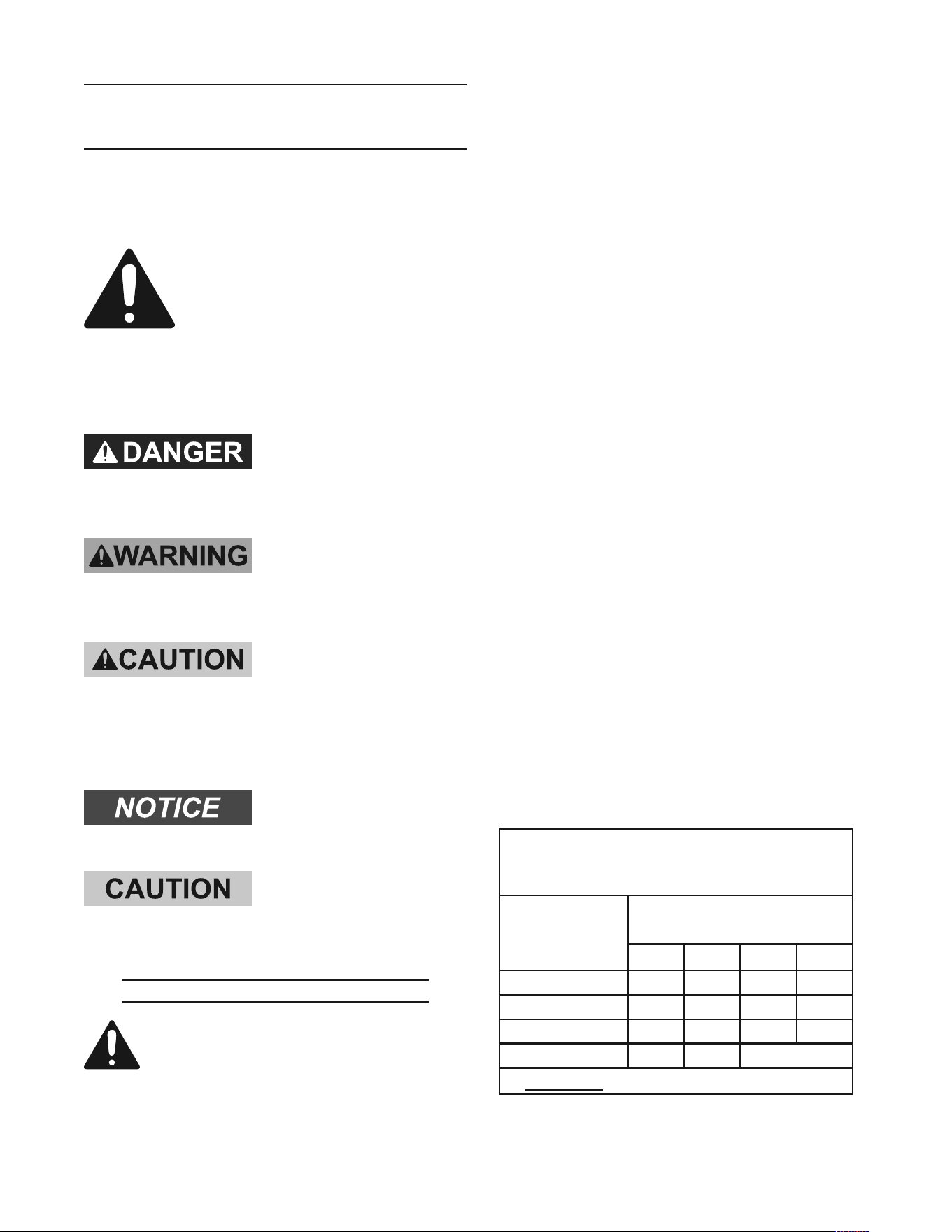
RECOMMENDED MINIMUM WIRE
GAUGE FOR EXTENSION CORDS
(120 VOLT)
NAMEPLATE
AMPERES
(at full load)
EXTENSION CORD
LENGTH
25’ 50’ 100’ 150’
0 – 6 18 16 16 14
6.1 – 10 18 16 14 12
10.1 – 12 16 16 14 12
12.1 – 16 14 12 Do not use.
TABLE A

Page 4 For technical questions, please call 1-888-866-5797. Item 93212
9. USE PROPER EXTENSION CORD.
Make sure your extension cord is in good
condition. When using an extension cord,
be sure to use one heavy enough to
carry the current your product will draw.
An undersized cord will cause a drop in
line voltage resulting in loss of power and
overheating. Table A shows the correct
size to use depending on cord length
and nameplate ampere rating. If in doubt,
use the next heavier gauge. The smaller
the gauge number, the heavier the cord.
10. WEAR PROPER APPAREL. Do not wear
loose clothing, gloves, neckties, rings,
bracelets, or other jewelry which may get
caught in moving parts. Nonslip footwear
is recommended. Wear protective
hair covering to contain long hair.
11. ALWAYS USE SAFETY GLASSES.
Also use face or dust mask if cutting
operation is dusty. Everyday eyeglasses
only have impact resistant lenses,
they are NOT safety glasses.
12. SECURE WORK. Use clamps or a
vise to hold work when practical. It’s
safer than using your hand and it
frees both hands to operate tool.
13. DON’T OVERREACH. Keep proper
footing and balance at all times.
14. MAINTAIN TOOLS WITH CARE. Keep
tools sharp and clean for best and safest
performance. Follow instructions for
lubricating and changing accessories.
15. DISCONNECT TOOLS before servicing;
when changing accessories, such as
blades, bits, cutters, and the like.
16. REDUCE THE RISK OF
UNINTENTIONAL STARTING.
Make sure switch is in off
position before plugging in.
17. USE RECOMMENDED ACCESSORIES.
Consult the owner’s manual for
recommended accessories. The
use of improper accessories may
cause risk of injury to persons.
18. NEVER STAND ON TOOL.
Serious injury could occur if the
tool is tipped or if the cutting tool
is unintentionally contacted.
19. CHECK DAMAGED PARTS. Before
further use of the tool, a guard or other
part that is damaged should be carefully
checked to determine that it will operate
properly and perform its intended
function – check for alignment of moving
parts, binding of moving parts, breakage
of parts, mounting, and any other
conditions that may affect its operation.
A guard or other part that is damaged
should be properly repaired or replaced.
20. NEVER LEAVE TOOL RUNNING
UNATTENDED. TURN POWER
OFF. Don’t leave tool until it
comes to a complete stop.
GROUNDING INSTRUCTIONS
TO PREVENT
ELECTRIC SHOCK
AND DEATH FROM INCORRECT
GROUNDING WIRE
CONNECTION
READ AND FOLLOW THESE
INSTRUCTIONS:
110-120 VAC Grounded Tools:
Tools with Three Prong Plugs
1. In the event of a malfunction or
breakdown, grounding provides a
path of least resistance for electric
current to reduce the risk of electric
shock. This tool is equipped with an
electric cord having an equipment-

Page 5For technical questions, please call 1-888-866-5797.Item 93212
grounding conductor and a grounding
plug. The plug must be plugged into
a matching outlet that is properly
installed and grounded in accordance
with all local codes and ordinances.
2. Do not modify the plug provided – if it
will not fit the outlet, have the proper
outlet installed by a qualified electrician.
3. Improper connection of the equipment-
grounding conductor can result in a
risk of electric shock. The conductor
with insulation having an outer surface
that is green with or without yellow
stripes is the equipment-grounding
conductor. If repair or replacement of
the electric cord or plug is necessary,
do not connect the equipment-
grounding conductor to a live terminal.
4. Check with a qualified electrician or
service personnel if the grounding
instructions are not completely
understood, or if in doubt as to whether
the tool is properly grounded.
5. Use only 3-wire extension cords that
have 3-prong grounding plugs and 3-pole
receptacles that accept the tool’s plug.
6. Repair or replace damaged or
worn cord immediately.
125 VAC 3-Prong
Plug and Outlet
(for up to 125 VAC and up to 15 A)
Grounding
Pin
7. This tool is intended for use on a
circuit that has an outlet that looks
like the one illustrated above in 125
VAC 3-Prong Plug and Outlet. The
tool has a grounding plug that looks
like the plug illustrated above in 125
VAC 3-Prong Plug and Outlet.
8. The outlet must be properly installed
and grounded in accordance with
all codes and ordinances.
9. Do not use an adapter to connect
this tool to a different outlet.
Mini Lathe Safety Warnings
1. FOR YOUR OWN SAFETY,
READ AND UNDERSTAND
THIS INSTRUCTION MANUAL
BEFORE OPERATING LATHE.
2. Wear ANSI-approved eye protection.
3. Do not wear gloves, necktie, or loose
clothing while operating the Lathe.
4. Tie back long hair. Long hair in a
ponytail needs to be secured so
there is no risk of entanglement.
5. Tighten all locks before operating.
6. DO NOT OPERATE WITH ANY
GUARD DISABLED, DAMAGED, OR
REMOVED. Moving guards must
move freely and close instantly.
7. Rotate workpiece by hand
before applying power.
8. Rough out workpiece before
installing on faceplate.
9. Do not mount split workpiece
or one containing knot.
10. Use lowest speed when
starting new workpiece.
11. Do not reverse motor direction
while the lathe is in motion.

Page 6 For technical questions, please call 1-888-866-5797. Item 93212
12. Do not clear chips by hand or when
lathe is running. Use a brush to
sweep chips away after the tool
has come to a complete stop.
13. Select the proper tool for the
job. Using the correct tool for the
job produces a better finish and
minimizes strain on the lathe.
14. The use of accessories or attachments
not recommended by the manufacturer
may result in a risk of injury to
persons. When servicing, use only
identical replacement parts.
15. Support pieces extending beyond the
headstock so they cannot cause injury to
the operator, bystanders or lathe. Turn
supported long stock at slower RPM’s.
16. Use a chuck cradle or piece of plywood
to protect the precision ground ways
and your hands when servicing chucks.
17. Check that the workpiece, tool, tool post,
chuck and saddle all have adequate
clearance before starting the lathe.
18. Check that no part of the tool, tool holder,
compound slide, cross slide, or carriage
will contact the chuck during operation.
19. Use the appropriate feed and
speed rates for the project.
20. Allow the lathe to reach its full
speed before beginning a cut.
21. Only use safety equipment that has
been approved by an appropriate
standards agency. Unapproved safety
equipment may not provide adequate
protection. Eye protection must be
ANSI-approved and breathing protection
must be NIOSH-approved for the
specific hazards in the work area.
22. Industrial applications must
follow OSHA guidelines.
23. Maintain labels and nameplates
on the tool. These carry important
safety information. If unreadable or
missing, contact Harbor Freight Tools
for a replacement.
24. Avoid unintentional starting. Prepare to
begin work before turning on the tool.
25. People with pacemakers should
consult their physician(s) before
use. Electromagnetic fields in close
proximity to heart pacemaker could
cause pacemaker interference
or pacemaker failure.
26. The warnings, precautions, and
instructions discussed in this instruction
manual cannot cover all possible
conditions and situations that may
occur. It must be understood by the
operator that common sense and
caution are factors which cannot
be built into this product, but must
be supplied by the operator.
Vibration Safety
This tool vibrates during use. Repeated
or long-term exposure to vibration
may cause temporary or permanent
physical injury, particularly to the
hands, arms and shoulders. To reduce
the risk of vibration-related injury:
1. Anyone using vibrating tools regularly
or for an extended period should first
be examined by a doctor and then have
regular medical check-ups to ensure
medical problems are not being caused
or worsened from use. Pregnant
women or people who have impaired
blood circulation to the hand, past hand
injuries, nervous system disorders,
diabetes, or Raynaud’s Disease
should not use this tool. If you feel any
medical or physical symptoms related to
vibration (such as tingling, numbness,

Page 7For technical questions, please call 1-888-866-5797.Item 93212
and white or blue fingers), seek
medical advice as soon as possible.
2. Do not smoke during use. Nicotine
reduces the blood supply to the
hands and fingers, increasing the
risk of vibration-related injury.
3. Wear suitable gloves to reduce the
vibration effects on the user.
4. Use tools with the lowest
vibration when there is a choice
between different processes.
5. Include vibration-free periods
each day of work.
6. When cutting do not apply too
much pressure to the workpiece.
Let the tool do the work.
7. To reduce vibration, maintain
the tool as explained in this
manual. If any abnormal vibration
occurs, stop use immediately.
SAVE THESE INSTRUCTIONS.
Page 8 For technical questions, please call 1-888-866-5797. Item 93212
SPECIFICATIONS
Motor
120 VAC / 60
Hz / 3/4 HP
Speed Ranges
0 - 1100 RPM (Low)
0 - 2500 RPM (High)
Fuse Type
Fast Acting 4 amp mini
glass (F4AL250VP)
Belt
Lx136
Pitch: 1.5mm
Teeth: 70
Drive Gear and Belt
Swing Over Bed 7″
Dist. Between Centers 10″
Swing Over Cross Slide 2-1/8″
Swing Over Saddle 4-1/2″
Swing Over Gap 7″
Max. Tool Bit Size 5/16″
Compound Travel 2-3/4″
Carriage Travel 6-1/2″
Cross Slide Travel 2-3/4″
Work Tolerance 0.005″
Bed Dimensions 15-7/8″ L x 3-1/4″ W
Tailstock Taper MT#2
Threads
18 threads from
12 - 52 TPI
Through Chuck Capacity 5/8″
Chuck Dia.
(mm)
Internal Jaws
External
Jaws
80
A - A1 B - B1 C - C1
5/64″ - 1-1/8″ 1″ - 2-3/4″ 7/8″ - 2-1/2″
A
A1
B
C
B1
C1
Packing List
Description Qty
Part
#(s)
1 Main unit 1
2 External Chuck Jaw Set 3 jaws 166
3 Chip Tray 1 126
4 Chuck Key 1 167
5 4 A Fuse 1 314
6 Gear: 30, 35, 40, 40,
45, 50, 55, 57, 60, 65 T
10
gears
157-
165
7 Spanner Wrench:
8-10, 14-17
2
wrenches
312,
313
8 Hex Key Wrench
Set: 3, 4, 5, 6
4
wrenches
311
9 Oil can 1 310
10 MT:2 Live Center 1 143
11 Rubber Foot 4 125
12 Rubber Foot
Mounting Screw
4 67
13 Knob 2 85
14 Manual 1 317
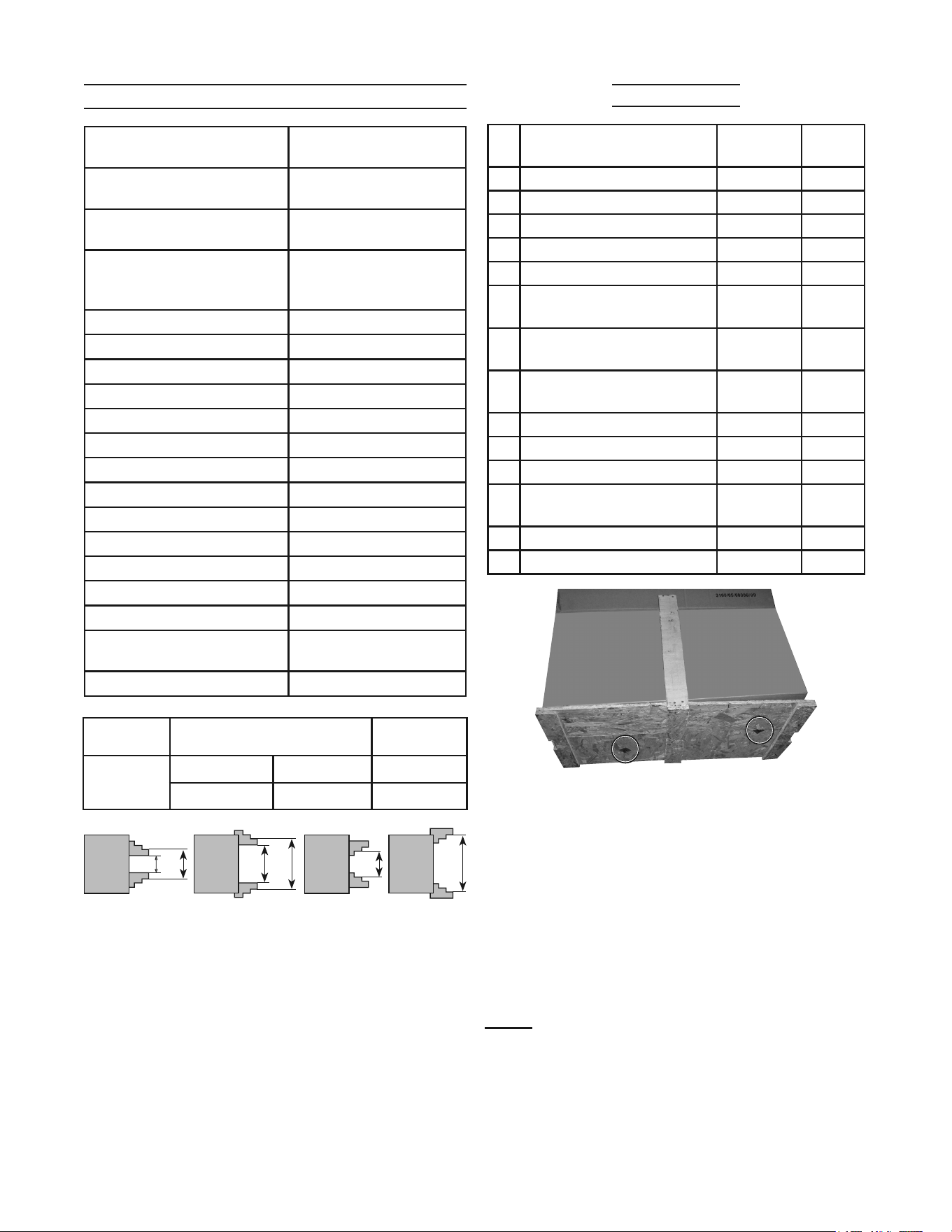
Shipping Bolt Locations
To remove the lathe from the
packing crate, remove both bolts on
the crate bottom as shown above.
Many components need to be
installed before use. It is ESSENTIAL
that both guards (found in separate
boxes within the main box) are
installed before connecting power.
Note: Wipe off protective grease
from the lathe before using.
Page 9For technical questions, please call 1-888-866-5797.Item 93212
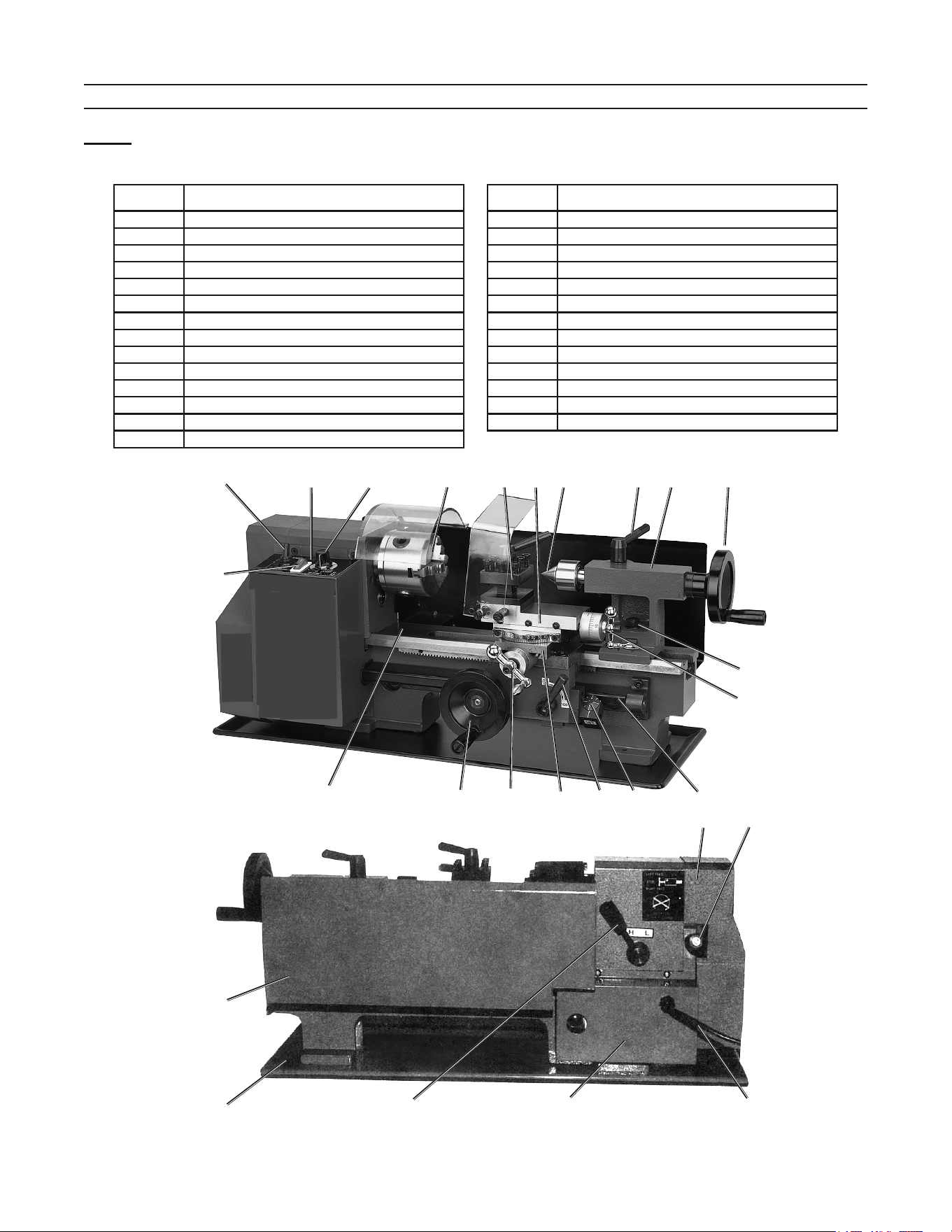
GENERAL MINI LATHE COMPONENTS
Note: Refer to the parts list and diagram at the end of this manual for complete part number
listings and locations. See the following page for a description of the major components.
Part Description
1 Bed Way
2 Chuck
33 H/L Speed Gear Shift Lever
35 Feed Direction Selector
53 Gear Drive Cover
79 Automatic Feed Handle
84a Tailstock Quill Control Wheel
84b Feed Control Wheel
86a Cross Slide Crank
86b Compound Rest Crank
100 Cross Slide
105/108 Compound Rest (A and B)
112 Tool Post
124 Power Cord
Part Description
126 Chip Tray
129 Lead Screw
138 Tailstock
143 Live Center
146 Tailstock Quill Fix Holder
151 Motor Cover
153 Rear Splash Guard
178 Power Switch
179 Fuse Holder
180 Speed Control Knob
181 Forward-Off-Reverse Switch
268 Tailstock Set Screw
302 Thread Dial Indicator
178
181 179 180 2 112 105 143 146 138 84(a)
268
86(b)
129302100 7984(b) 86(a)1
153
126 33 151 124
3553
Figure 1
Page 10 For technical questions, please call 1-888-866-5797. Item 93212
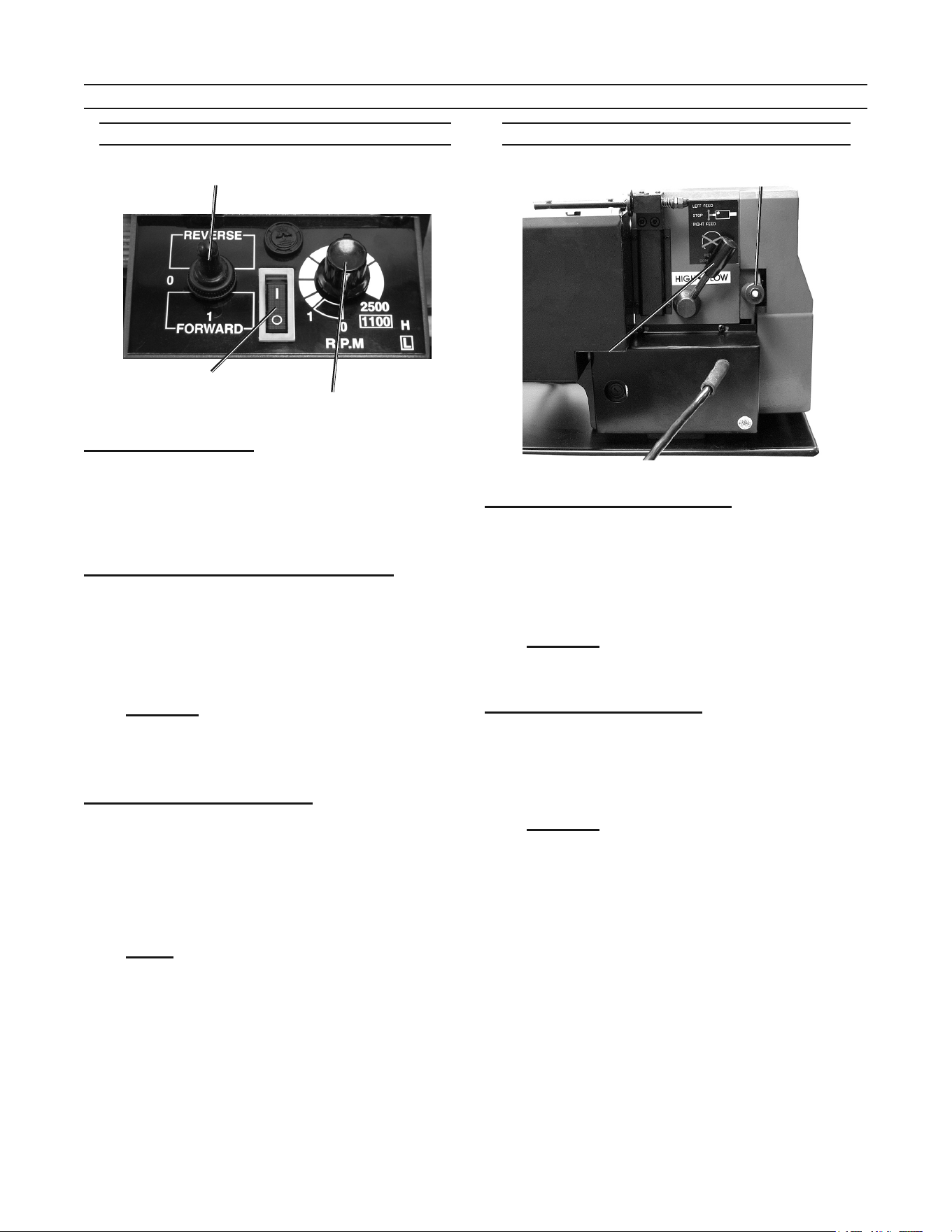
Controls on the Front of the Lathe
Forward-OFF-Reverse Switch (181)
Power Switch (178)
Speed Control Knob (180)
Figure 2
Power Switch (178)
Turns on and off power to the
motor. When the Power Switch
is lit, the motor is on.
Forward-OFF-Reverse Switch (181)
Changes the Spindle (3)
(Chuck (2)) rotation from Forward
(clockwise), to OFF (no rotation),
to Reverse (counterclockwise).
DO NOT change the Forward-
OFF-Reverse Switch direction
while the lathe is running.
Speed Control Knob (180)
Adjusts the Spindle (3) speed
from 0 to 2500 RPM.
Check that this knob is at 0
before turning on the Lathe.
Note: The Speed Control Knob (180)
is dependant on the H/L Gear Shift
Lever (33). When the H/L Gear Shift
Lever is in the Low setting, the Speed
Control Knob runs from 0 to 1100 RPM.
When the H/L Gear Shift Lever is in
the High setting, the Speed Control
Knob runs from 0 to 2500 RPM.
Controls on the Back of the Lathe
Figure 3
H/L Gear Shift Lever (33)
Feed Direction Selector (35)
Feed Direction Selector (35)
Changes the Lead Screw (129)
rotation from Forward (toward the
Chuck) to Neutral (no rotation), to
Reverse (away from the Chuck).
DO NOT Change the Feed Direction
Selector while the Lathe is running.
H/L Gear Shift Lever (33)
Changes the spindle speed
range from High (0 - 2500 RPM)
to Low (0-1100 RPM).
DO NOT adjust the H/L Gear Shift
Lever while the Lathe is running.
POWER CONTROLS OVERVIEW

Page 11For technical questions, please call 1-888-866-5797.Item 93212
Bed Way (1) - The Bed Way is the base of
the work area under the Chuck and
Tailstock. It is where the Tailstock
and Compound Rest are attached
and what they slide along.
Chuck (2) - The Chuck holds the three
Jaws (two sets included) which
clamp the work piece in place.
Compound Rest (105/108) - The Compound
Rest and Compound Slide (100) work
together to adjust the position of the
Cutting Tool to the desired location.
Jaws (166 & 168) - The Jaws fit into the
Chuck (2) and hold the workpiece
in place. There are a set of internal
Jaws (168), which fit inside the
workpiece and External Jaws (166)
which fit on the outside of the workpiece.
Lead Screw (129) - The Lead Screw controls
automatic feeding. In thread cutting or
when you want to cut into the workpiece
automatically, you engage the Lead
Screw with the Feeding Direction
Selector (35) and use the Automatic
Feed Handle (79). Keep track of the cut
with the Thread Dial Indicator (302).
Live Center (143) - The Live Center fits
into the Tailstock Quill (142) on the
Tailstock (138) and helps to hold the end
of the workpiece that is opposite from
the Chuck (2). A live center spins with
the workpiece and chuck, while a dead
center (sold separately) does not spin.
Tailstock (138) - The Tailstock holds
the Tailstock Quill (142) which is
used to hold various tools (sold
separately) or a Live Center (143).
Thread Indicator Dial (302) - The Threading
Dial is used to measure the number
of rotations of the Lead Screw when
thread cutting. It eliminates the need
to reverse the lathe and return the
carriage to the starting point each time
a successive threading cut is taken.
You must adjust the Threading Dial
so that it engages the Lead Screw
(129) in order for it to function.
Threading Gears (45,50, 59, 157-165) - The
Threading Gears are positioned under
the Gear Drive Cover (53) on the far
left side of the Lathe. They are used in
various configurations for thread cutting.
Tool Post (112) - The Tool Post sits on the
top of the Compound Rest (105/108)
and is used to hold various cutting
tools by clamping them in place
with Tool Post Bolts (110).
LATHE COMPONENTS OVERVIEW
Following are brief descriptions of major components of the Mini Lathe.
Page 12 For technical questions, please call 1-888-866-5797. Item 93212
ASSEMBLY INSTRUCTIONS
Note: For additional information regarding
the parts listed in the following pages,
refer to the Assembly Diagram
near the end of this manual.
1. WARNING! Make sure the Power
Switch of the tool is in its “OFF” position
and that the tool is unplugged from
its electrical outlet before making
any adjustments to the tool.
2. Clean off the protective grease
on the Mini Lathe.
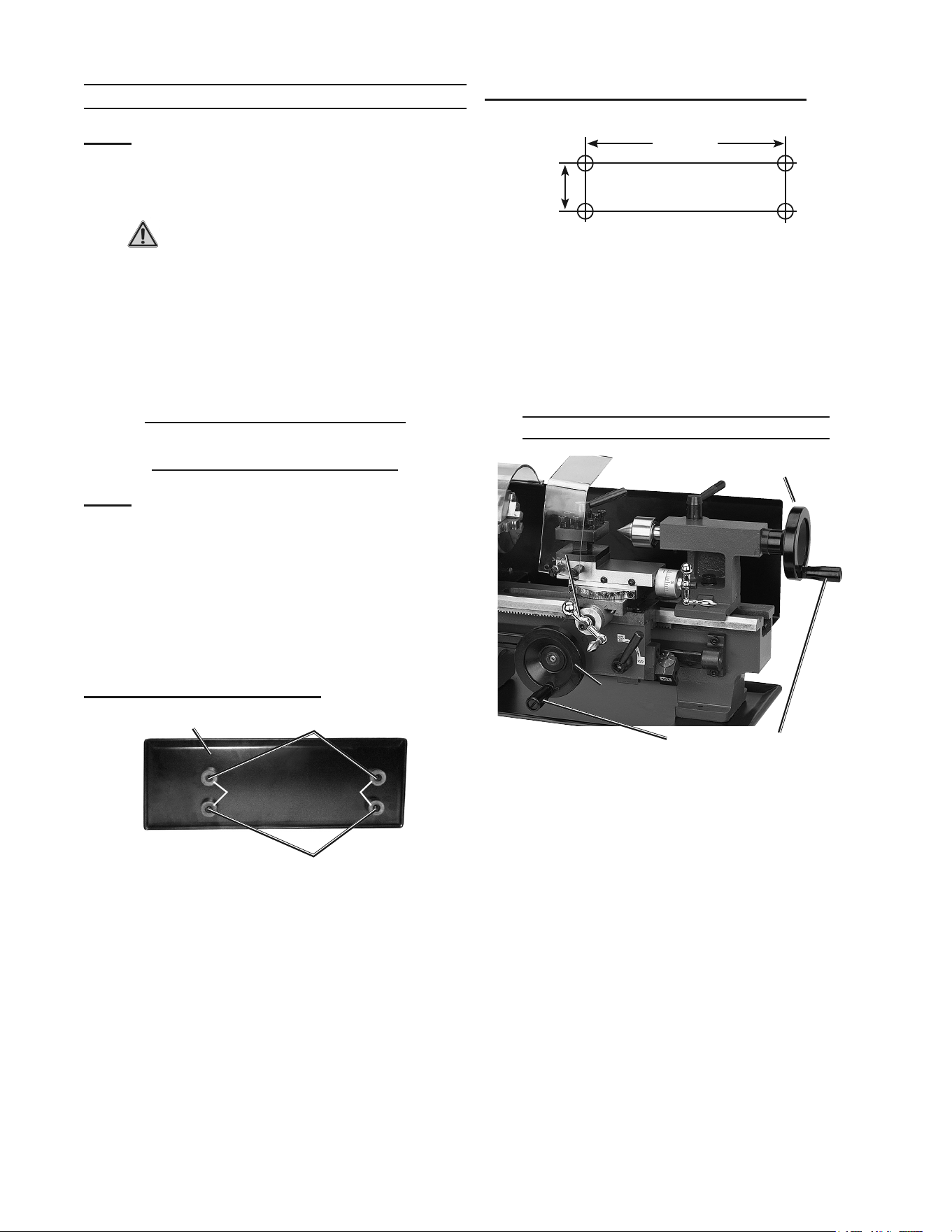
Attaching Rubber Feet or
Installing to Workbench
Note: Mount or place the Lathe on a
sturdy workbench or table, with good
lighting, at a height that allows you to
comfortably work without back strain.
The Lathe can be mounted permanently
to a workbench or used with it’s included
Rubber Feet (125) on a tabletop.
To Attach the Rubber Feet:
Figure 4
Rubber Feet (125)
Chip Tray (126) Bolts (67)
Bolts (67)
To attach the Rubber Feet to the
bottom of the Lathe, unthread the
Bolts (67) from the bottom of the
Chip Tray (126). Slide the Rubber Feet
onto the Bolts and re-thread them into
the bottom of the Lathe through the
Chip Tray holes. Tighten securely.
To Mount the Lathe to a Workbench:
Figure 5
14-7/8″
Drill holes for permanent mounting:
2-7/8″
Unthread the Bolts (67) from the bottom
of the unit. Measure and drill holes
in the workbench. Use appropriate
length M6-1 bolts and washers (sold
separately) to secure the Lathe and
Chip Tray to the workbench.
Installing Handwheel Handles
1.
Figure 6
Handwheel Handles
Tailstock Quill Control Wheel (84a)
Feed Control Wheel (84b)
Cross Slide
Crank (86a)
To install the Handwheel Handles on
the Tailstock Quill Control Wheel (84a)
and the Feed Control Wheel (84b),
use a flathead screwdriver and a
14mm open end wrench to thread
the handles onto the wheels.
2. For packaging purposes, the Cross
Slide Crank (86a) is shipped from the
factory facing backwards. Adjust the
Cross Slide Crank (86a) to face forward
using a 5mm Hex Wrench (part of 311)
to unthread the Cap Screw (52) and
turn the Cross Slide Crank around.
Tighten the Cap Screw securely.
Page 13For technical questions, please call 1-888-866-5797.Item 93212
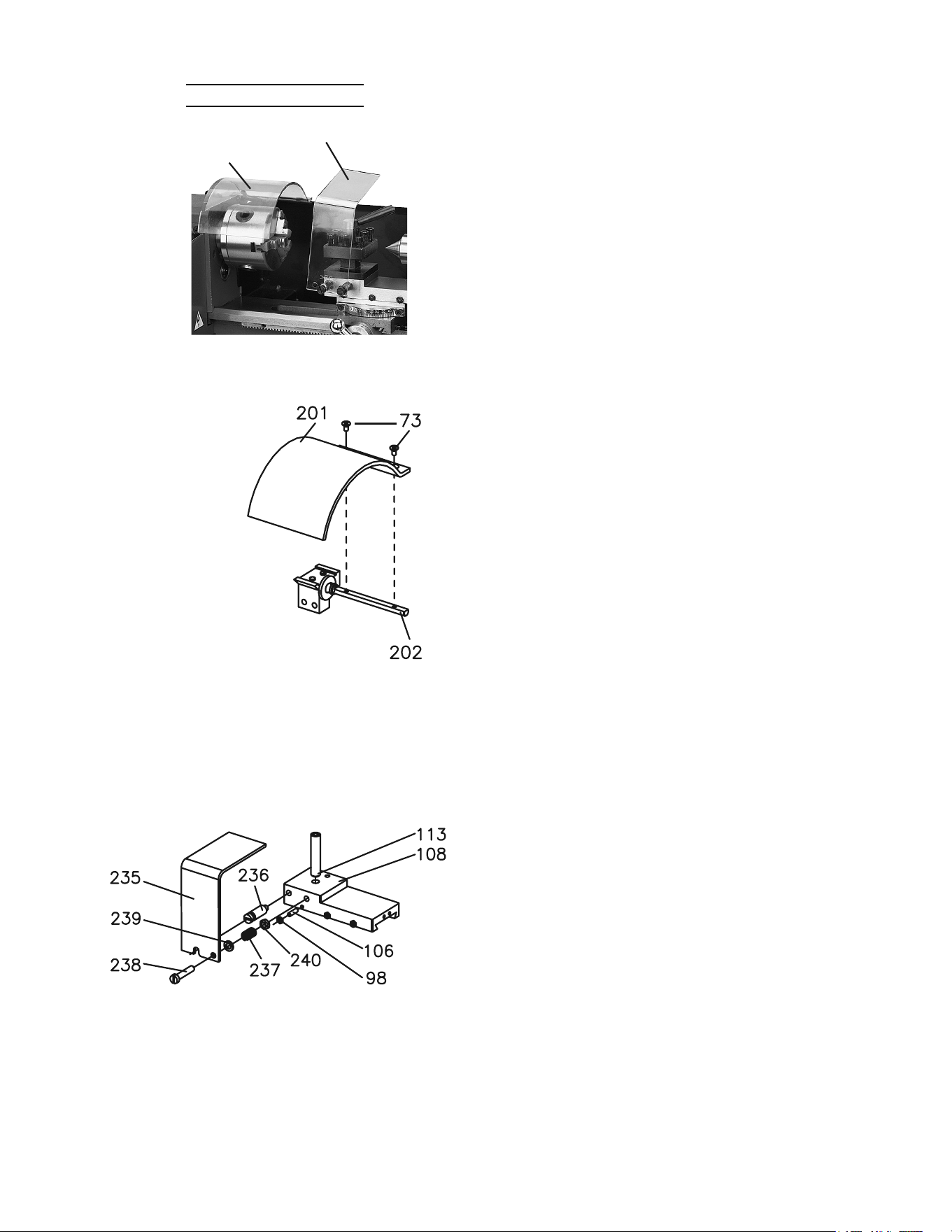
Installing Guards
Figure 7
Protective Cover (235)
Chuck Guard (201)
1.
Figure 8
To install the Chuck Guard (201), remove
the two Screws (73) on the Hinge (202).
Attach the Chuck Guard (201) to the
Hinge using the Screws. The Chuck
Guard should be aligned so that it covers
the Chuck (2) when swung down over it.
2.
Figure 9
To install the Protective Cover (235),
remove the Screw (238) from the
Compound Rest (108). Slide the
Screw (238) through the Protective
Cover (235), Washer (239), Spring (237),
and Nut (240). Then, thread the
Screw (238) into the Compound
Rest (108). Slide the notch in the
Protective Cover (235) over the
end of the Slotted Screw (236).
Page 14 For technical questions, please call 1-888-866-5797. Item 93212
SET UP
Initial Test Run
Before further set-up of the Lathe,
check that the power components
are working properly by performing
the following test run.
1. Check that all loose parts and tools are
out of the way and nothing will interfere
with the Chuck (2) when it rotates.
2.
Figure 10
Nuts (6)
Spindle (3)
Chuck (2)
Turn the Chuck by hand and
check that it rotates freely.
3. Check that the three Nuts (6)
on the Chuck are tight.
4.
Figure 11
H/L Gear Shift Lever (33)
Feeding Direction Selector (35)
On the back of the Lathe, set the
H/L Gear Shift Lever (33) to low and
the Feeding Direction Selector (35)
to the middle (Neutral).
5. On the front of the Lathe,
Figure 12
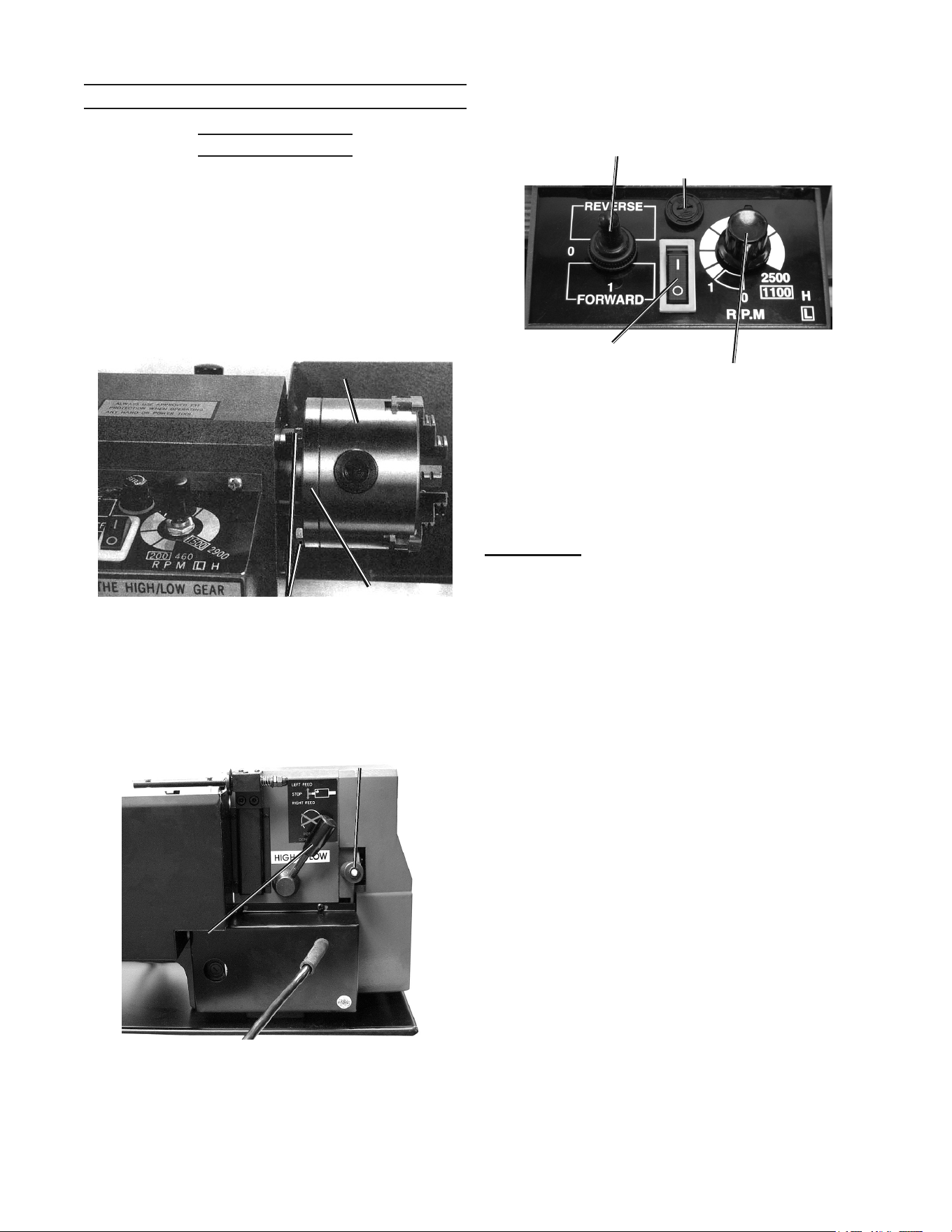
Forward/OFF/Reverse Switch (181)
Fuse Holder (179)
Power Switch (178)
Speed Control Knob (180)
make sure
the Forward/OFF/Reverse Switch
(181) is set to the OFF position.
6. Turn the Speed Control
Knob (180) to zero.
WARNING: BEFORE TURNING ON THE
MINI LATHE EACH TIME IT IS TO BE
USED, THE SPEED CONTROL KNOB
(180) MUST BE SET TO ZERO.
7. Plug in the electrical cord
and turn the Forward/OFF/
Reverse Switch to Forward.
8. Turn the Power Switch (178)
to the ON position.
9. Gently rotate the Speed Control
Knob clockwise past the 1 to the first
setting. The speed will increase the
further the Knob is turned. The Lathe
should run smoothly with little or no
vibration or friction sounds when it
starts. If you notice unusual sounds or
vibrations, turn off the Power Switch,
turn the Speed Control Knob to 0,
unplug the machine and have the
problem corrected before further use.
10. If the Lathe is running smoothly,
continue running it for several minutes,
gradually increasing the Speed
Page 15For technical questions, please call 1-888-866-5797.Item 93212
Control Knob setting, and letting it run
for several minutes at each setting
before increasing to the next level.
Continue until you’ve run the Lathe
all the way up to the highest setting.
11. Turn the Power Switch OFF and wait for
the Lathe to come to a complete stop.
12. Repeat the process with the H/L Gear
Shift Lever at the High setting. Then
repeat at both the Low, then High
setting with the Forward/OFF/Reverse
Switch in the Reverse position.
WARNING: THE MINI LATHE MUST BE
COMPLETELY STOPPED BEFORE
CHANGING THE FORWARD/OFF/
REVERSE SWITCH (181), THE FEED
DIRECTION SELECTOR (35), OR
THE GEAR SHIFT LEVER (33).
13. Turn the Power Switch off, the Speed
Control Knob to 0 and unplug the Lathe.
14. Check the Compound Rest Crank (86b)
and the Cross Slide Crank (86a) to see
that the Compound Rest (105/108)
and Cross Slide work properly. If they
are too tight or too loose, adjust the
Gibs (94/107) located at both crank
sides (See Gib Adjustments in the
Maintenance Section of this manual).
Replacement of Chuck
1.
Figure 13
Nut (6)
Spindle (3)
Chuck (2)
When replacing the Chuck, place a cloth
or a piece of wood on the bedway at the
bottom of the chuck. This step will help
avoid damage to the bedway caused
by accidentally dropping the chuck.
2. To replace the chuck, loosen the
3 Nuts (6) as shown in Figure 13, remove
the old Chuck and replace with a new
chuck. Replace and tighten the Nuts.
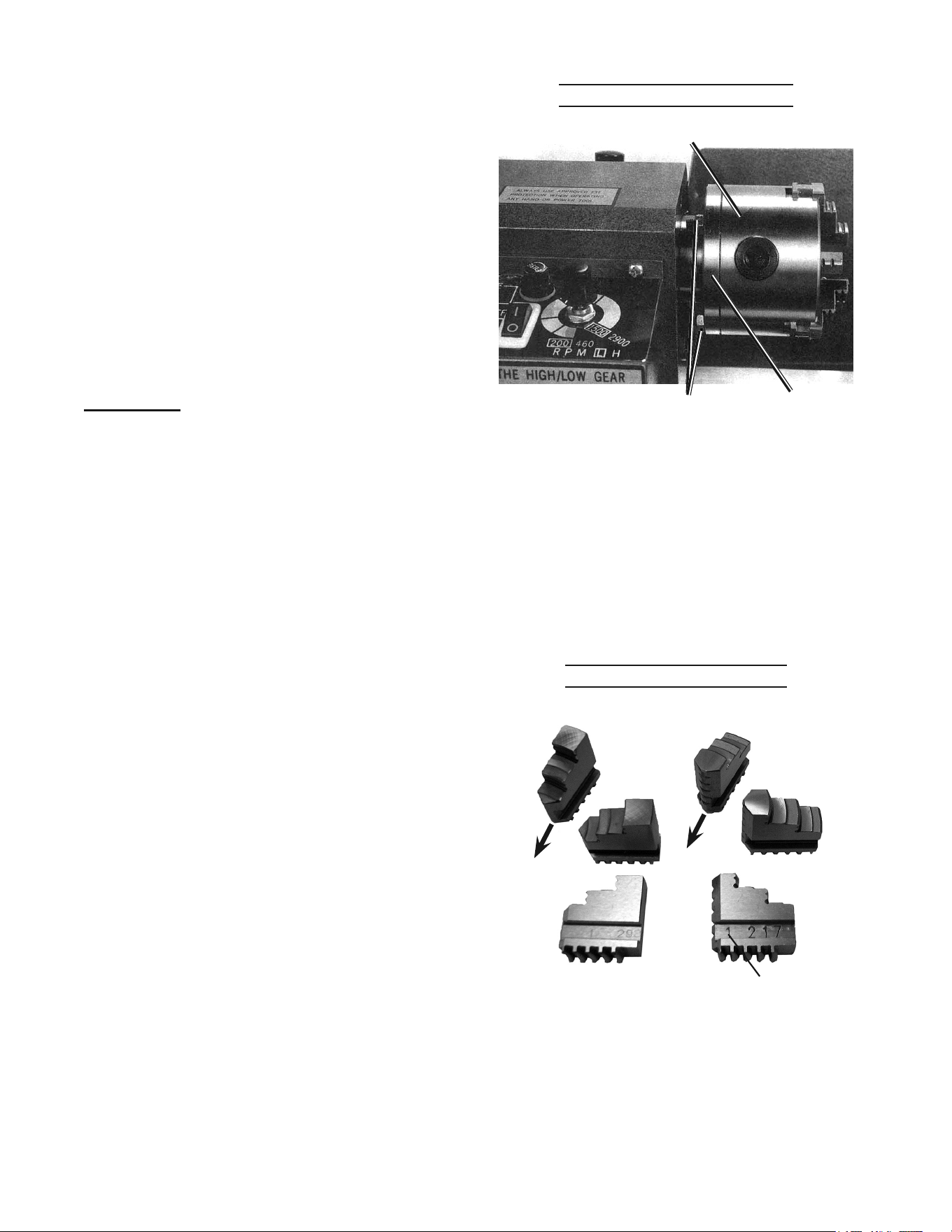
Replacement of Jaws
Figure 14
Internal Jaw Set (168)External Jaw Set (166)
Insert this
end first
Number
The Lathe comes with two sets of
Jaws: an External Jaw Set (166) and
an Internal Jaw Set (168). Each piece
is numbered and fits into the Chuck
grooves with the corresponding number
Page 16 For technical questions, please call 1-888-866-5797. Item 93212
in the Chuck groove. The Jaws are
designed to work as complete sets.
Do not mix pieces from one set with the
other set when installing in the Chuck.
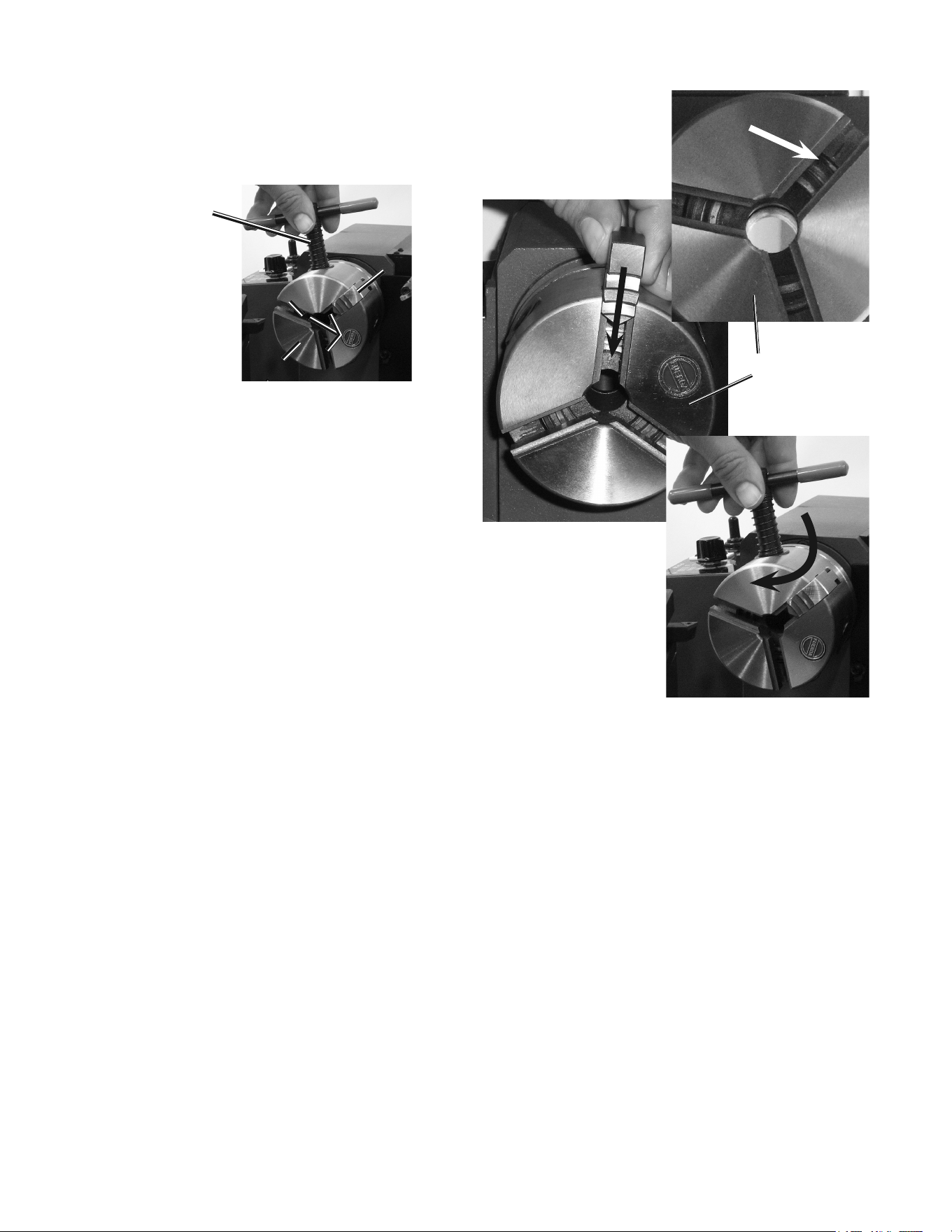
Figure 15
Chuck (2)
Chuck
Key
(167)
Scroll
Grooves
Jaw
The jaws are held in place by a
spiralled scroll inside the Chuck
which rotates around the center of
the chuck with the Chuck Key. As the
scroll rotates, it hooks into the jaw
ridges, then pulls each Jaw toward the
center of the Chuck as the spiral of
the scroll rotates around the Chuck.
Figure 16
Lead thread of Scroll
Chuck (2)
Insert Chuck
Key (167),
Turn Clockwise
A
Insert Jaw #1
B
C
To replace the Jaws:
a. Unplug the Lathe.
b. Place a towel under the Chuck
to protect the Bed Way (1) from
any Jaws that may be dropped.
Carefully remove any Jaws by
inserting the Chuck Key (167) into
the side of the Chuck, turning it
counterclockwise, and sliding each
Jaw out of it’s slot as it becomes free.
c. Look at the Chuck so you can see into
the grooves, and find the groove marked
#1. Rotate the Chuck Key clockwise
until you see the lead thread of the
Scroll in groove #1 (A in Figure 16).
d. Slide Jaw #1 into the groove and
rotate the Chuck Key counterclockwise
Page 17For technical questions, please call 1-888-866-5797.Item 93212
slightly, then clockwise, to
engage the lead thread into the
Jaw (B and C in Figure 16).
e. Slide Jaw #2 into the next groove
and continue turning the Chuck Key
clockwise to advance the lead thread
into the next Jaw. Slide Jaw #3 with
the same procedure as Jaw #2.
Note: When mounting a workpiece, it is
recommended that all three jaws
are loosened at the same time. This
will protect the threads inside.
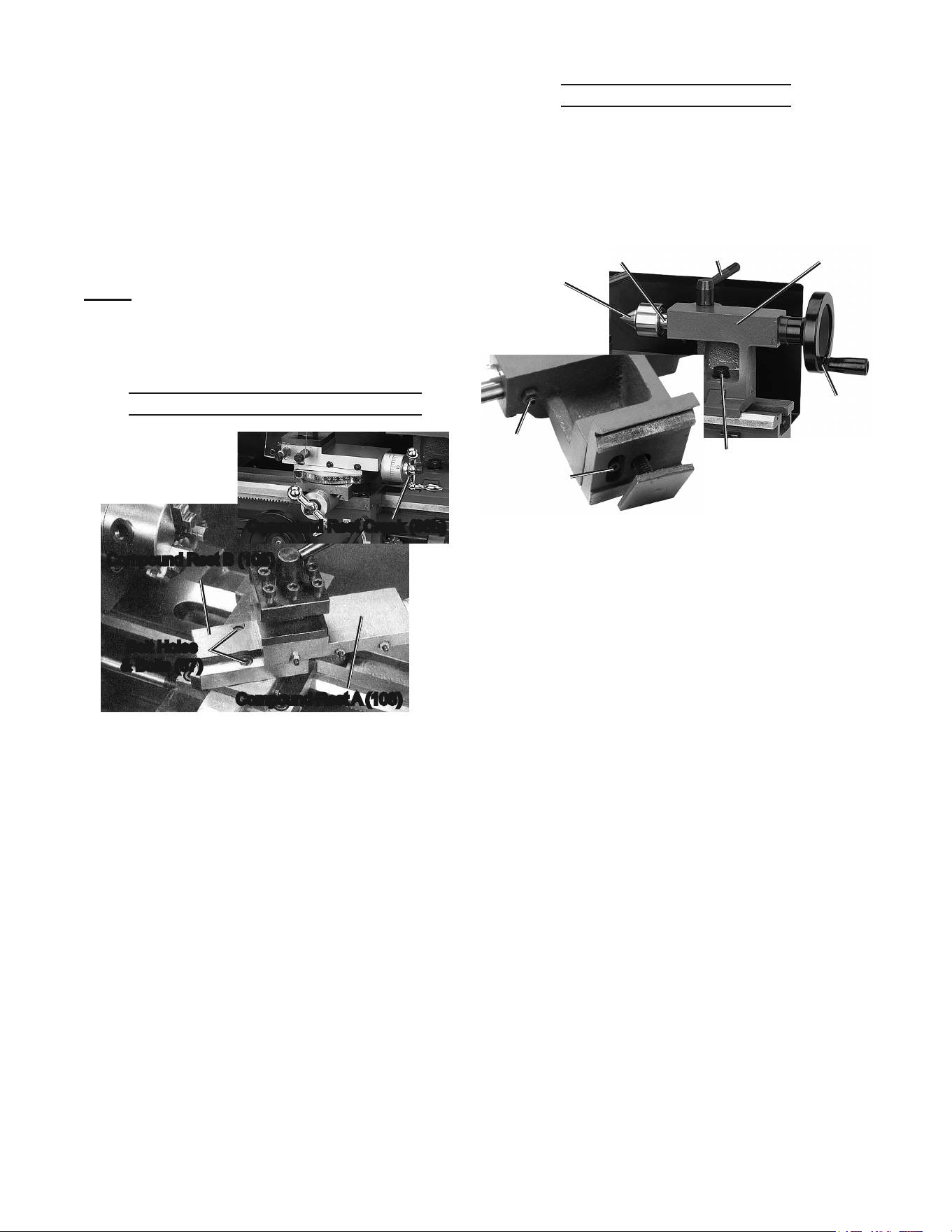
Compound Rest Adjustment
Figure 17
Compound Rest Crank (86b)
Compound Rest A (108)
Compound Rest B (105)
Bolt Holes
& Bolts (67)
To adjust the angle of Compound Rest:
a. Turn the Compound Rest Crank (86b)
counterclockwise to slide the top
section of the Compound Rest
(Compound Rest A (108)) so that
the two screw holes are exposed on
the lower section of the Compound
Rest (Compound Rest B (105)).
b. Turn the two Bolts (67)
counterclockwise to loosen them.
c. Swivel the Compound Rest
to the desired angle.
d. Tighten the two Screws.
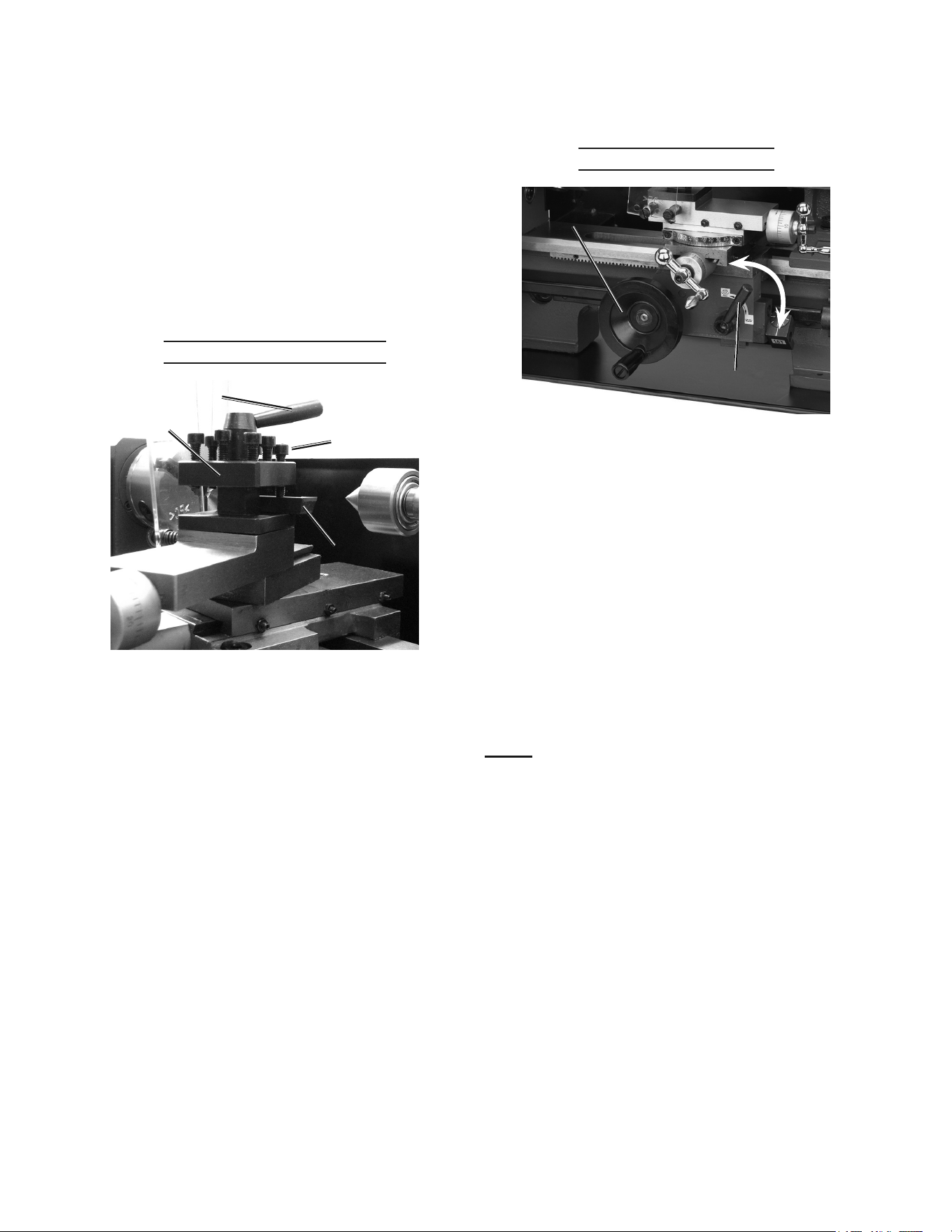
Tailstock Adjustments
The Tailstock (138) holds tools, such
as the Live Center (143), which are
used with the Chuck Jaws (168)
to hold work pieces in place.
1.
Tailstock
Nut
(268)
Tailstock
(138)
Tailstock Quill
Fix Holder (146)
Live Center
(143)
Tailstock
Quill (142)
Tailstock
Quill
Control
Wheel
(84a)
Figure 18
Nut (6)
Screw (197)
Underside
of
Tailstock
Use the Tailstock Quill Control Wheel
(84a) to position the Live Center.
Turning the Wheel counterclockwise
slides the Live Center away from
the Chuck, turning it clockwise
slides it toward the Chuck. It can be
adjusted up to approximately 2″.
2. The Tailstock Quill (142) holds the
Live Center in place. To remove or
replace the Live Center, continue
turning the Tailstock Quill Control
Wheel counterclockwise until the Live
Center begins to slide out of the Quill.
Insert the Live Center or other tool
(sold separately) into the Quill and
turn the Tailstock Quill Control Wheel
clockwise to lock the tool in place.
3. You may need to slide the Tailstock
closer to, or further away from, the
Chuck before adjusting the Live Center.
To do so, loosen the Tailstock Nut (268),
adjust the Tailstock as needed, then
re-tighten the Nut. Use this method
when replacing the Tailstock as well.
Page 18 For technical questions, please call 1-888-866-5797. Item 93212
4. The Tailstock Quill is locked in place
with the Tailstock Quill Fix Holder (146).
Turn it clockwise to lock the Quill in
place and counterclockwise to loosen it.
Tighten the Nut (6) underneath the
Quill to eliminate any play in the Quill.
5. To adjust the Tailstock slightly to
the right or left of center, loosen the
Screw (197) on the bottom of the
Tailstock. Adjust, then tighten.
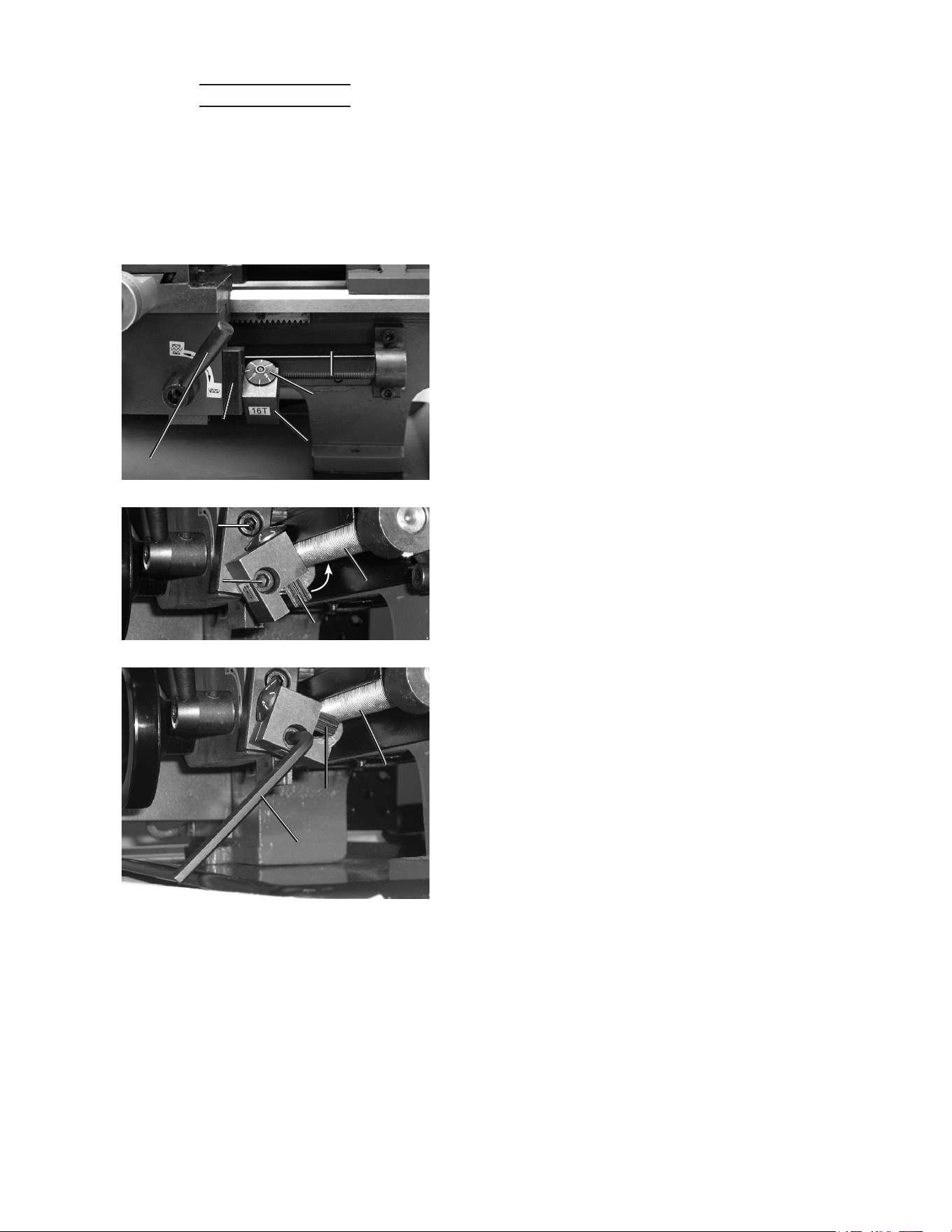
Tool Post Adjustment
Figure 19
Cutter
(Sold separately)
Tool Post Lever (111)
Tool Post Bolt (110)
Tool Post (112)
To adjust the position of
the Tool Post (112):
a. Turn the Tool Post Lever (111)
counterclockwise to loosen
the Tool Post.
b. Rotate the Tool Post as needed.
c. Hold the Tool Post in position while
turning the Tool Post Lever clockwise,
tightening the Tool Post in place.
To install a cutting tool (Sold separately):
a. Use the 1/4″ Hex Wrench (part of 311)
to raise enough Tool Post Bolts (110)
to hold the tool. Use at least two Tool
Post Bolts to hold the tool in place
(Turn counterclockwise to raise).
b. Slide the tool under the raised
screws and hold it while lowering
the screws until they are securely
holding the tool in place.
Automatic Feeding
Feed Control
Wheel (84b)
Automatic Feel Lever (79)
Figure 20
ON
OFF
The Automatic Feed Lever (79)
controls whether the Carriage (93)
moves automatically, or manually.
When the Lever is Up, the Lathe
is in Manual mode. Use the Feed
Control Wheel (84b) to slide the
Carriage to the right or left.
When the Lever is Down, the Lathe
is in automatic mode. The carriage
will automatically move to the right
or left depending on whether it
is set to forward or reverse.
Note: The Feed Control Wheel (84b) is
locked when the automatic feed is ON.
Page 19For technical questions, please call 1-888-866-5797.Item 93212
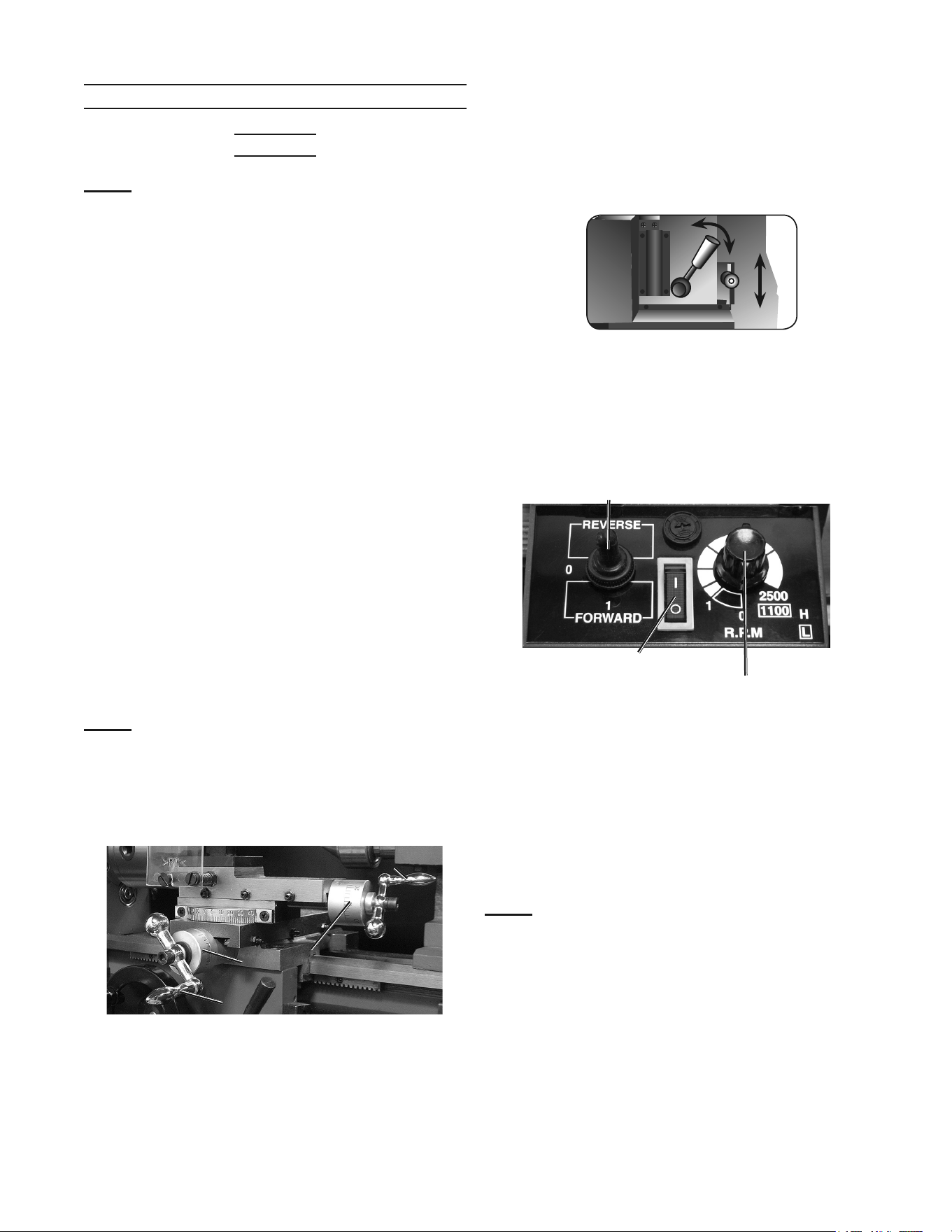
Threading Dial
The Threading Dial (65) is used to
align and track the threads cut in a
threading project. It can only be used
when the Lathe is set to automatic feed
(See previous section on Automatic
Feeding). To set up the Threading Dial:
a.
Threading Dial (65)
Threading Dial Body (68)
Automatic Feel Lever (79)
Loosen here
and here
Lead Screw (129)
Plate (303)
Lead Screw
(129)
Lead Screw
(129)
Pinion (66)
Pinion (66)
Hex Wrench (311)
(Remove before using Lathe)
Dial Engaged:
Dial Disengaged - Rotate up to engage:
Figure 21
Adjust the dial to line up with one
of the numbers or lines as needed
(Consult advanced information about
cutting threads with mini-lathes
to determine where to line up the
dial for your threading project).
b. Use the 5mm Hex Wrench (part of
311) to loosen the Plate (303) and
the Threading Dial Body (68).
c. Rotate both pieces so the Pinion (66)
on the back side of the Threading
Dial Body makes contact with the
Lead Screw (129) (“Dial Engaged”
in Figure 21, bottom photo).
d. Tighten both pieces in place
and remove the Wrench.
e. To dis-engage the Threading Dial Body
when not in use, loosen the Plate and
rotate the Dial away from the Lead
Screw (129), then retighten the Plate.
Page 20 For technical questions, please call 1-888-866-5797. Item 93212
OPERATION
Start up
Note: Not following this start-up procedure
will cause the Lathe to immediately
shutdown. This is an overload protection
feature for the circuit board and motor.
1. Begin with the Lathe unplugged.
2. Install the required Jaws (166 or 168)
into the Chuck (2).
3. Set up the work area as needed for
your project. You will need to:
a. Secure the workpiece in place.
b. Install the cutting tool (sold
separately) in the Tool Post (112).
c. Set the Automatic Feed Lever (79)
to manual or automatic.
d. If threading, engage the
Threading Dial (65) and set it
as needed for the project.
e. Move the cutting tool in place using
the Cross Slide (100) and Compound
Rest (105/108) Cranks (86a and 86b).
Note: Before beginning any machining
process, remove backlash from the
Cross Slide (100) and/or Compound
Rest (105/108) Cranks (86a and 86b)
and reset the Dials (87) to zero.
Figure 22
Cross Slide Crank (86a)
Dials (87)
Compound Rest Crank (86b)
To do this, begin rotating the Crank
in the desired direction until all play
is gone. Hold the Crank in place with
one hand and rotate the Dial (87) to
zero. Repeat each time before using
a Crank in either direction when you
need precise measurements.
4. Adjust the Controls:
a.
H
L
L
N
R
Figure 23
On the back of the Lathe, set the
Spindle Speed with the H/L Gear Shift
Lever (33) and the feed direction with
the Feed Direction Selector (35).
b.
Forward-OFF-Reverse Switch (181)
Power Switch (178)
Speed Control Knob (180)Figure 24
On the front of the Lathe, make sure
that the Main Power Switch (178),
Forward/OFF/Reverse Switch (181)
and the variable Speed Control
Knob (180) are in their off positions.
The variable Speed Control Knob has
an actual “0/Off” position and will “click”
when placed in the “Off” position.
Note: The Lathe will not start-up unless
the Variable Speed Control Knob
is turned to the “0/Off” position
before restarting. Attempting
to start the lathe with the Speed
Control Knob (180) set at any speed
other then “0/Off” or attempting
to start the lathe out of sequence,
will cause the fuse to blow.
Page 21For technical questions, please call 1-888-866-5797.Item 93212
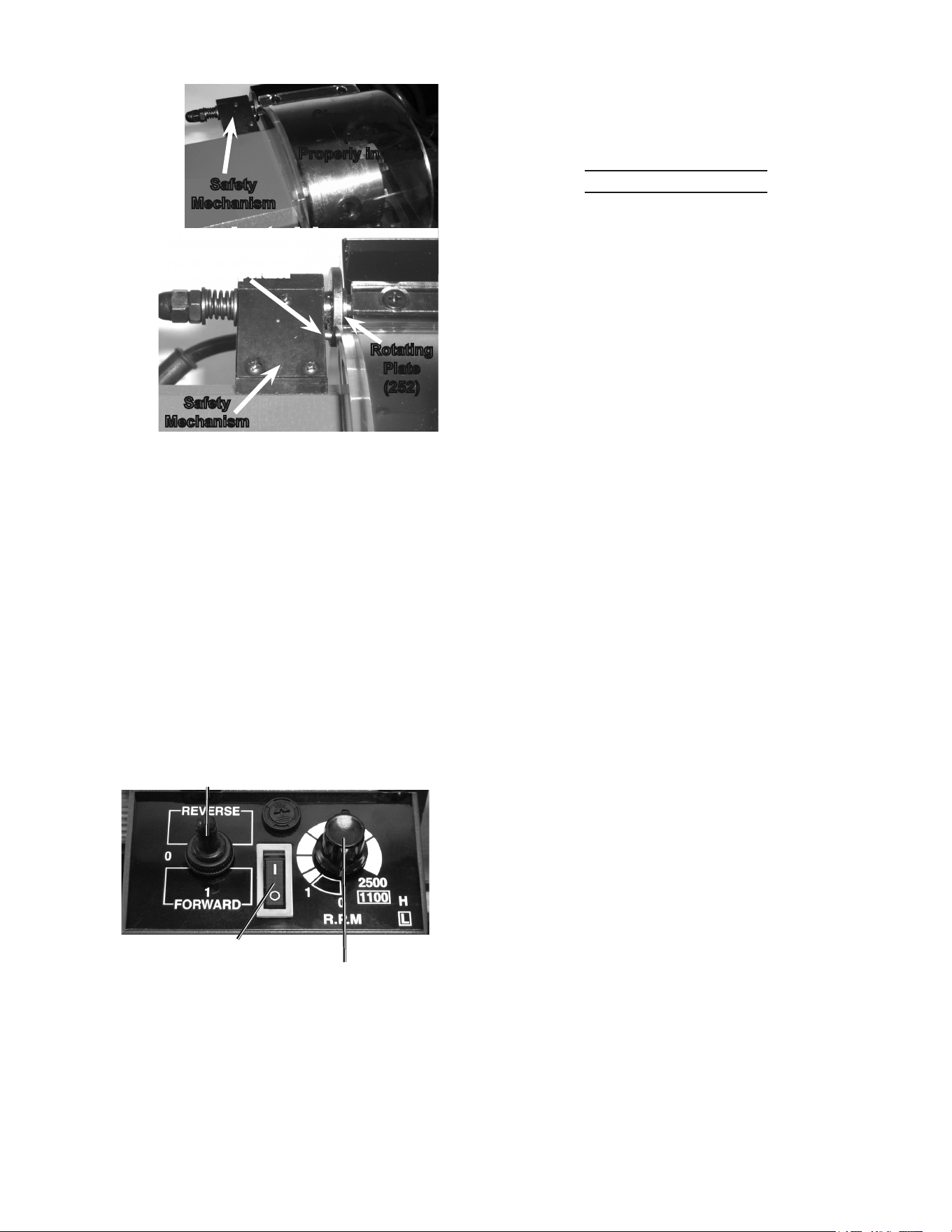
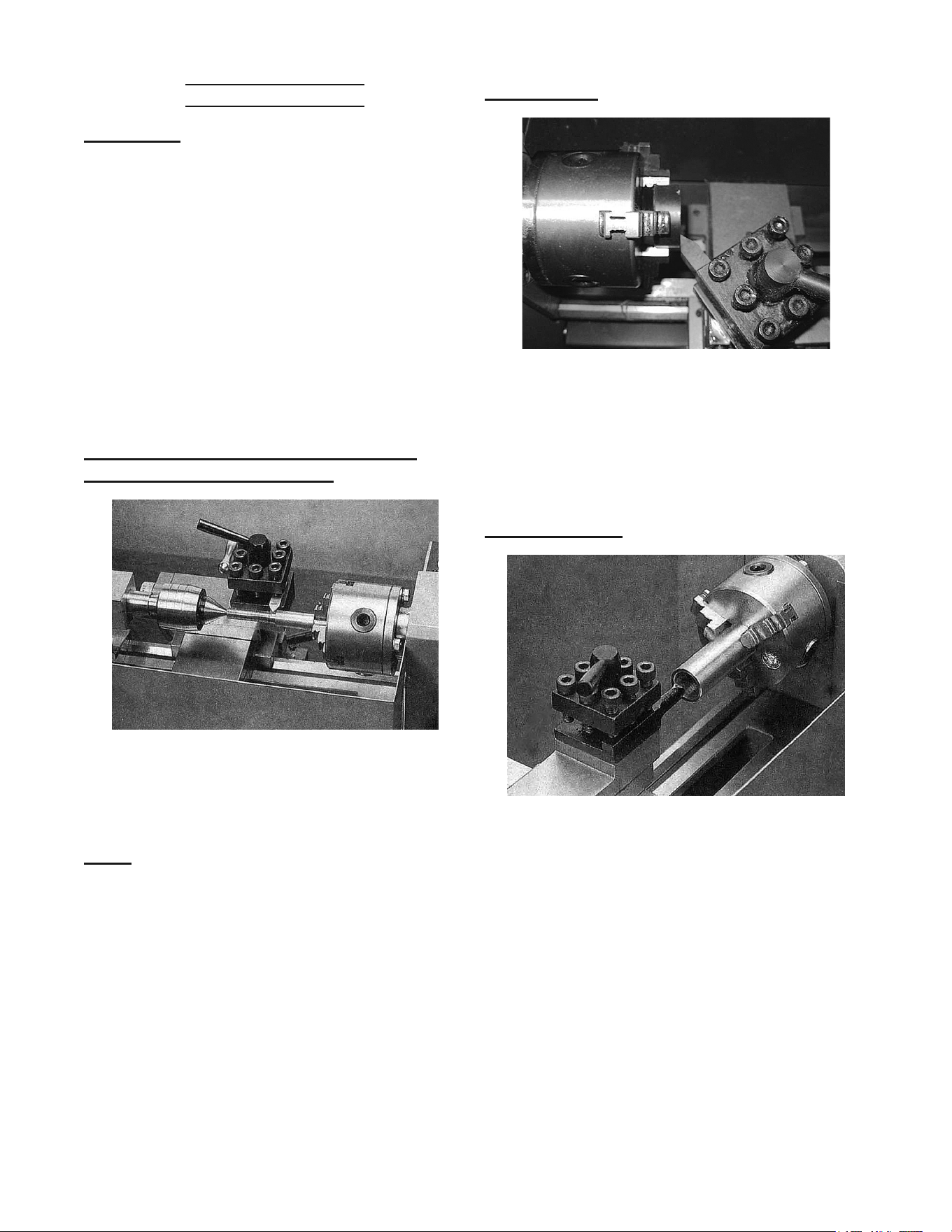
5. The Chuck Guard (201) has a
safety interlock and the Lathe will
not operate unless the guard is
properly in place. Install the guard
if not already done so. Check to
ensure that the Guard (201) is in its
operating position over the Chuck (2).
The Pin (251) must be correctly
seated in the recess in the Rotating
Plate (252) for the Lathe to work.
6. Plug in the Lathe.
7.
Forward-OFF-Reverse Switch (181)
Power Switch (178)
Speed Control Knob (180)Figure 26
Move the Power Switch (178) to the
“On” position (switch will turn Red)
and place the Forward-Off-Reverse
Switch (181) in the direction needed.
8. Move the Variable Speed Control
Knob (180) to the needed operating
speed to start the Lathe.
To Stop the Lathe
1. Turn the Speed Control Knob (180) to 0.
2. Move the Forward-OFF-
Reverse Switch to OFF.
3. Turn the Power Switch (178) OFF.
4. Unplug the Lathe when not in use.
Chuck Guard
(201)
Properly in place
Safety
Mechanism
Safety
Mechanism
Pin (251) properly extended
into the recess, allowing
the lathe to operate.
Rotating
Plate
(252)
Figure 25
Page 22 For technical questions, please call 1-888-866-5797. Item 93212
Basic Operations
WARNING: Make sure the Lathe power
is off and the Lathe is unplugged
before setting up a project or
working near the Chuck (2).
Following are some of the basic
operations used with the Lathe. It is
recommended that you become familiar
with mini lathe techniques before
using this tool. Consult books on the
subject and/or web page resources for
your project before using this tool.
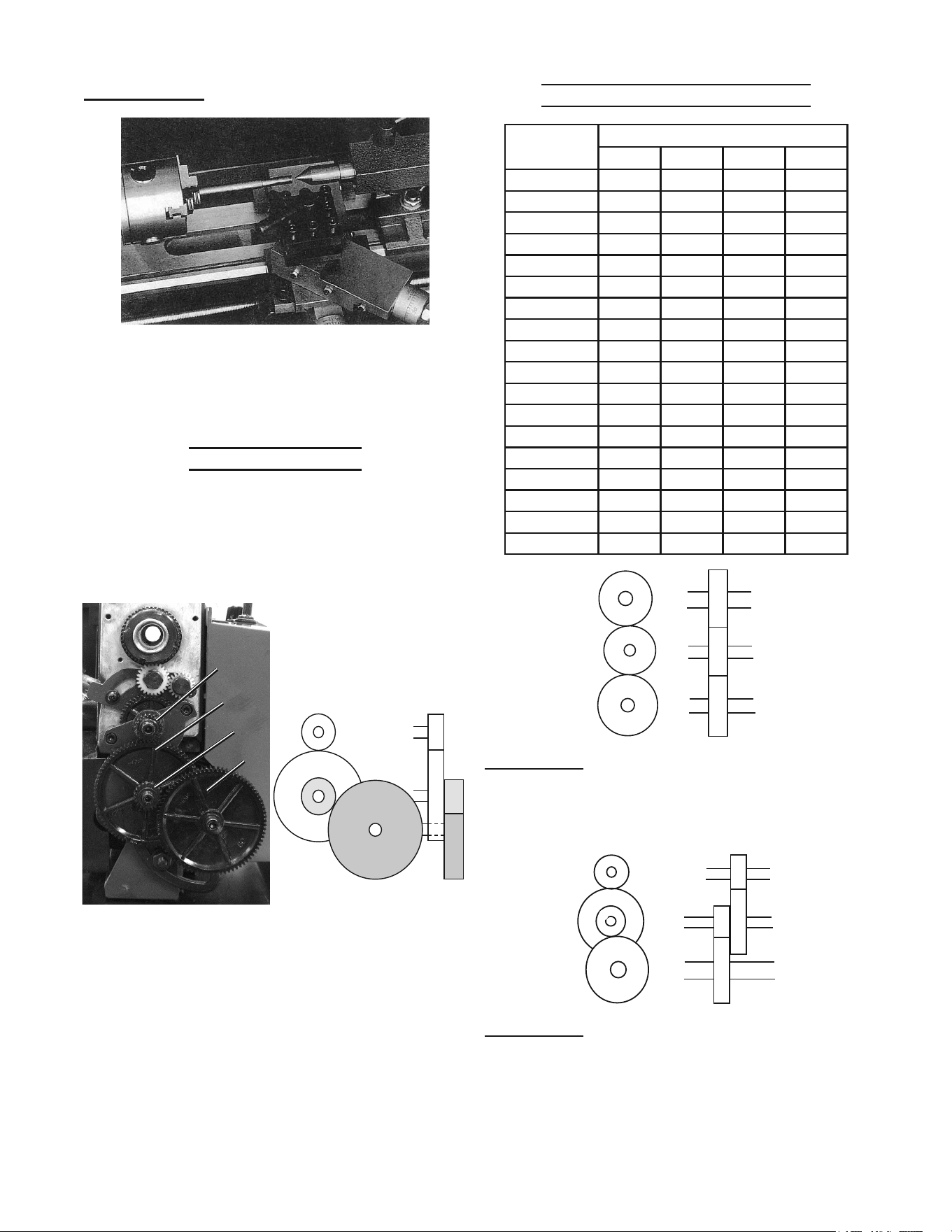
Holding a project between the Chuck
(2) and the Live Center (143)
1.
Figure 27
(As seen from back of Lathe to show detail)
Use the chuck to hold the workpiece
firmly. Then, use the Live Center
(143) to fix the other end.
Note: If you change the Live Center to a
drilling chuck (sold separately), you
start your drilling immediately.
Face Cutting
2.
Figure 28
Use the chuck to hold the workpiece
firmly, and the cutter positioned as
shown above for face cutting. The
edge of the cutter must be at the
same height as the center.
Internal Cutting
3.
Figure 29
By changing the tool post angle
and adjusting the compound rest,
you can make internal cuts.
Page 23For technical questions, please call 1-888-866-5797.Item 93212
Bevel Cutting
4.
Figure 30
After adjusting the angle
of the compound rest, you
can make bevel cuts.
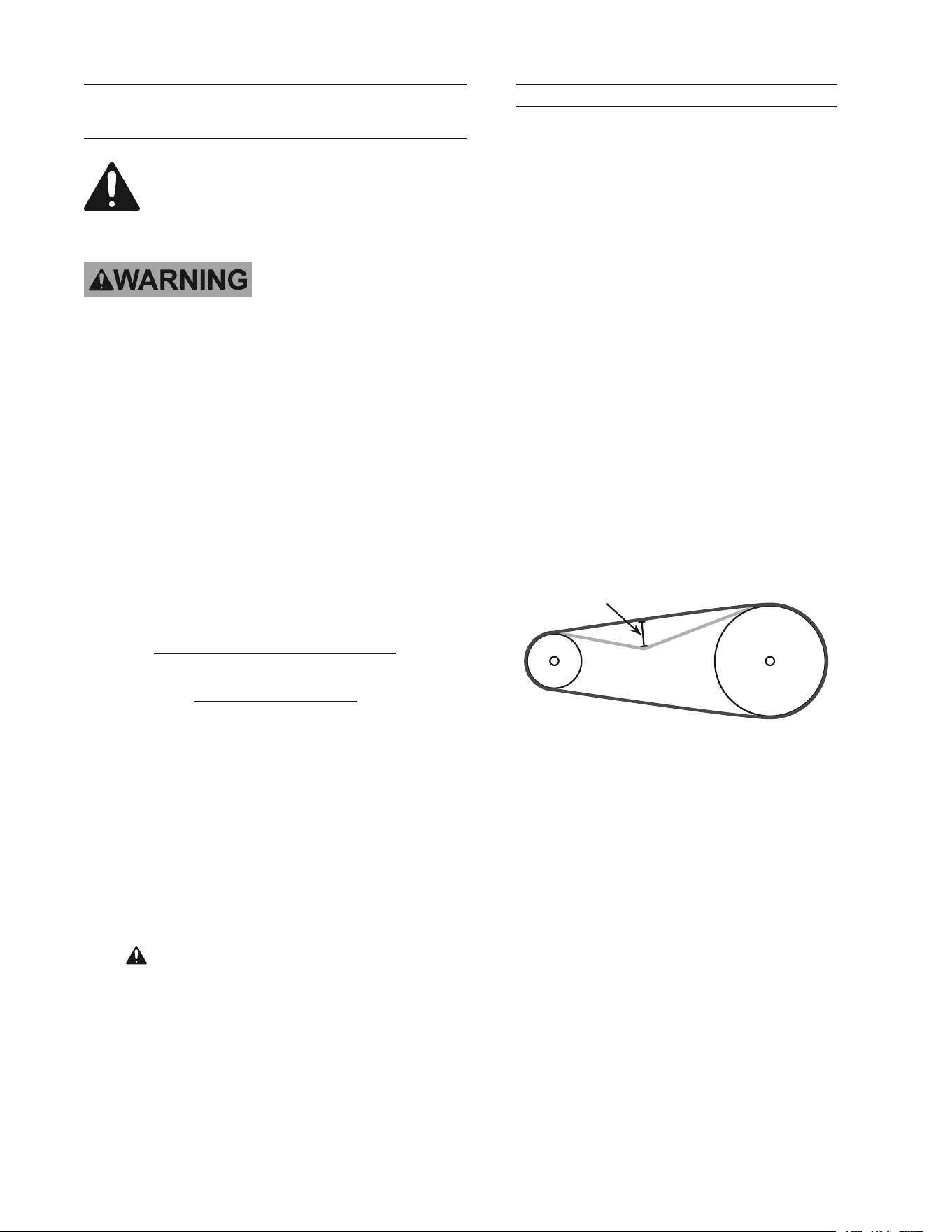
Threading Gears
By changing the gear set-up it is
possible to cut any thread size. The factory
set-up for Mini Lathe gears is as follows:
D
B
A
C
A
B
C
D
D
A
B
C
Motor end view of Lathe with
Gear Drive Cover (53) removed:
Positions A and C= 20T
Positions B & D= 80T
To change the thread size, use
the gear box settings shown
on the table that follows.
Thread Size Gear Settings
Threads
Per Inch
Gear Box Stud
A B C D
12 40 30
13 40 65 60 30
14 40 35
16 40 40
18 40 45
19 40 50 60 57
20 40 50
22 40 55
24 40 60
26 40 65
28 20 35
32 20 40
36 20 45
38 20 50 60 57
40 20 50
44 20 55
48 20 60
52 20 65
A
B
D
A
B
D
Example 1: To cut 12 threads per inch (see
illustration above), use 40T in position
A, 30T in position D, and put any other
gear is position B to connect A and D.
A
B
C
D
A
C
B
D
Example 2: To cut 38 threads per inch
(see illustration above), use 20T in
position A, 57T in position D, 50T in
position B, and 60T in position C.

Page 24 For technical questions, please call 1-888-866-5797. Item 93212
Automatic Feed and Threading Dial
Once the gears are set up, you will need
to engage the Threading Dial (65) so you
can monitor the number of threads cut.
Set up the Threading Dial as
described in the SET UP section
under Threading Dial.
Set the direction for the lathe with
the Forward/OFF/Reverse Switch.
Turn the Power Switch on
(the switch will light up).
Adjust the speed needed to cut the
threads (consult advanced information
about cutting threads with mini-lathes).
Use the following table, also located on
the front of the Lathe, to determine what
number to start threading:
Indicator Table
16T
T.P.I. SCALE T.P.I. SCALE
12 1, 3, 5, 7 26 1, 5
13 1 28 1, 3, 5, 7
14 1, 5 32 1 ~ 8
16 1 ~ 8 36 1, 3, 5, 7
18 1, 5 38 1, 5
19 1 40 1 ~ 8
20 1, 3, 5, 7 44 1, 3, 5, 7
22 1, 5 48 1 ~ 8
24 1 ~ 8 52 1, 3, 5, 7
Move the cutting blade to the
proper position. Pull down the
Automatic Feed Lever (79) to
start threading automatically.
To stop the automatic setting, pull
up on the Automatic Feed Lever.
Remember: After thread cutting
operation is complete, change back
to the factory set-up gear setting:
Position A= 20T
Position B= 80T
Position C= 20T
Position D= 80T
Page 25For technical questions, please call 1-888-866-5797.Item 93212
MAINTENANCE AND
SERVICING
Procedures not specifically
explained in this manual
must be performed only by
a qualified technician.
TO PREVENT
SERIOUS INJURY
FROM ACCIDENTAL
OPERATION:
Turn the Power Switch of the tool
to its “OFF” position and unplug
the tool from its electrical outlet
before performing any
inspection, maintenance, or
cleaning procedures.
TO PREVENT SERIOUS INJURY
FROM TOOL FAILURE:
Do not use damaged equipment.
If abnormal noise or vibration
occurs, have the problem
corrected before further use.
Cleaning, Maintenance,
and Lubrication
1. BEFORE EACH USE, inspect the
general condition of the tool. Check
for loose hardware, misalignment
or binding of moving parts, cracked
or broken parts, damaged electrical
wiring, and any other condition that
may affect its safe operation.
2. AFTER USE, wipe external surfaces
of the tool with clean cloth.
3. WARNING! If the supply cord
of this power tool is damaged,
it must be replaced only by a
qualified service technician.
Belt Inspection and Tensioning
1. Remove belt cover, if equipped.
2. Examine belt for cracks, tears in the
backing, or other damage. Replace belt
if damaged according to steps below:
a. Loosen the motor mounting bolts
and slide the motor towards the
other pulley as far as possible.
b. Slide the old belt off of the smallest
pulley first, then remove it.
c. Put the new belt around the larger pulley
first, then around the smaller pulley.
d. Move the motor away from the other
pulley until it is properly tensioned
according to the directions below.
Tighten the motor mounting bolts.
3. Check and adjust belt tension
according to the steps below:
Deflection
Distance
a. Press on the center of the longest
span on the belt with moderate
finger pressure. Then measure the
deflection distance, the distance
that the belt moved. The belt
should deflect about 1/4″.
b. If the belt deflects too much, tighten
belt by loosening the motor mounting
bolts and moving the motor away from
the other pulley slightly. Secure motor
mounting bolts and retest tension. If
the belt is too long to be properly
tensioned, it must be replaced.
c. If the belt deflects too little, loosen
belt by loosening the motor mounting
bolts and moving the motor towards the
Page 26 For technical questions, please call 1-888-866-5797. Item 93212
other pulley very slightly. Secure motor
mounting bolts and retest tension.
4. Before use, replace belt
cover if equipped.
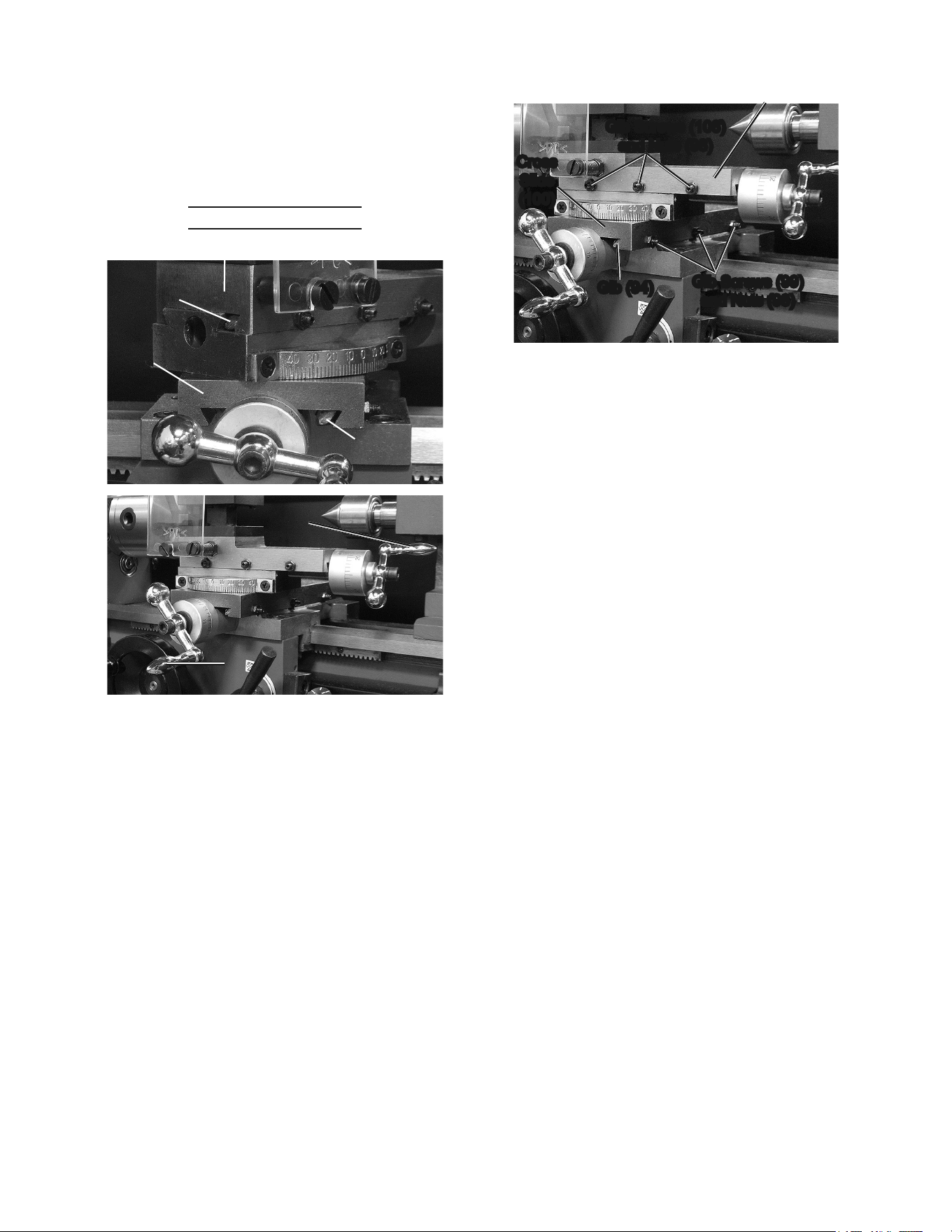
Gib Adjustments
Cross Slide
Crank (86A)
Compound Rest
Crank (86B)
Compound Rest A (108)
Gib (94)
Gib (107)
Cross
Slide
(100)
Figure 31
Adjusting the metal strips, or
Gibs (94/107) on the underside of
the Compound Rest A (108) and the
Cross Slide (100) helps to snug up
those units so they slide smoothly
along the lathe. The goal is to tighten
them enough so that the Compound
Rest and Cross Slide do not have any
unnecessary movement, but not so tight
that they bind. It should not be difficult
to turn the hand Cranks (86A/86B).
The Gibs become loose with use, so
the Compound Rest A and Cross Slide
should be checked periodically for any
play. Readjust the Gibs as needed.
Compound Rest A (108)
Gib Screws (106)
and Nuts (98)
Gib Screws (99)
and Nuts (98)
Gib (94)
Cross
Slide
(100)
Figure 32
To make the adjustment:
1. Unplug the Lathe.
2. Working one set of three gib Screws and
Nuts at a time, loosen the three Nuts (98)
with a wrench (sold separately).
3. Holding the center Nut with the
wrench, loosen or tighten the Center
Screw (99 or 106) with a flat head
screw driver (sold separately) and
check the sliding movement. It should
be even and smooth while removing
any play. Adjust as needed, then,
holding the Screw with the screw driver,
tighten the Nut with the wrench.
4. Repeat step 3 for the two
side Screw/Nut sets.
Page 27For technical questions, please call 1-888-866-5797.Item 93212
Tailstock Alignment
The Tailstock (138) needs to be
adjusted for offset, then re-aligned
before first use and any time the
tool in the Tailstock is changed.
To align the Tailstock:
1. Center drill both ends of a 6″ long piece
of round cold rolled stock. Set aside.
2. Turn a 60° point on a piece of scrap
metal to make a dead center.
3. Place the dead center in the Tailstock.
4. Attach a Lathe Dog (part of 3448 -
sold separately) the to 6″ piece from
step 1 and mount between centers.
5. Turn approximately 0.010″ off of the
diameter of the mounted workpiece.
6. Measure the workpiece with a
micrometer at the Tailstock end and
the Chuck end. Divide any difference
by two. If it is thicker at the Chuck (2)
end, move the tailstock away from you
by the resulting amount. If it is thicker
at the Tailstock end, move the Tailstock
closer to you by the resulting amount.
7. Turn another 0.010″ off of the workpiece.
8. Repeat steps 5 and 6 as needed until
there is no taper and/or the desired
amount of accuracy is achieved.
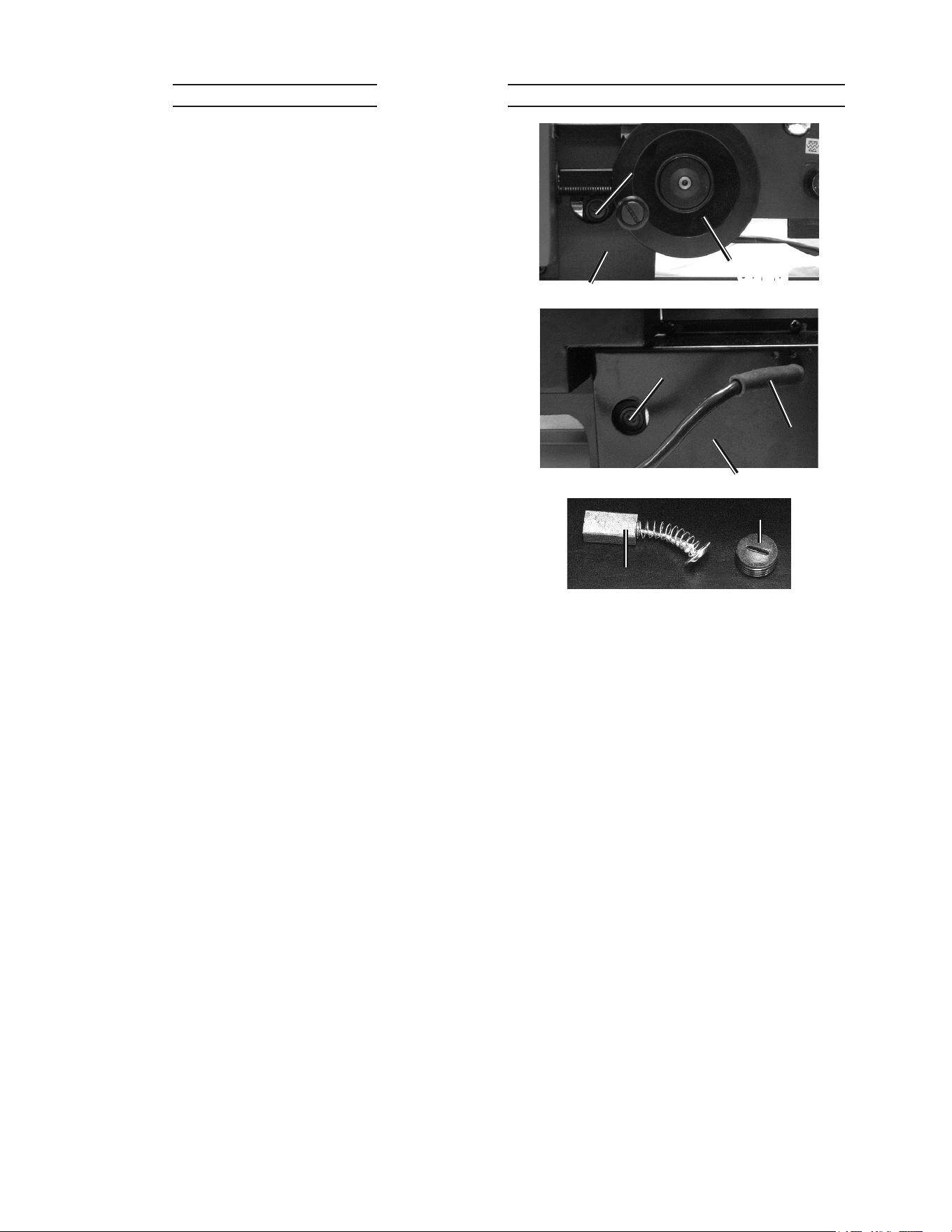
Replacement of Carbon Brushes
1.
Carbon Brush (318)
Carbon Brush Cover
Back - Motor Cover (151)
Front - Bed Way (1)
Plug
Carbon Brush Cover
Carbon Brush Cover
Feed
Control
Wheel (84b)
Figure 33
Unscrew the Brush Covers on the front
and back of the machine using a flat
head screwdriver (sold separately).
2. Pull the Brush out, noting the orientation
of the old Carbon Brushes to prevent
needless wear if they will be reinstalled.
3. The Carbon Brushes are approximately
5/8″ long. If either one is worn down by
more than 1/2, replace both Brushes.
4. To clean old Carbon Brushes, rub the
contact areas with a pencil eraser.
5. Carefully, without forcing them, insert
the Carbon Brushes. Make sure the
carbon portions of the brushes contact
the motor armature and that the
springs operate freely. If reinserting
a used brush make sure it is in the
same orientation to reduce wear.
6. Replace the Brush Covers.

Page 28 For technical questions, please call 1-888-866-5797. Item 93212
Replacing the Fuse
The Fuse (314) is located in the Fuse
Holder (179) on the Control Panel (122).
The Fuse Holder is spring fitted.
1.
Figure 34
To remove Fuse Holder (179)
Press down, then turn counterclockwise.
Fuse Holder (179)
Control
Panel (122)
Fuse Holder (179)
Fuse Holder Socket
Fuse (314)
To Remove the Fuse Holder:
a. Insert a flathead screwdriver
(sold separately) into the
slot in the Fuse Holder.
b. Press down and turn
counterclockwise 1/4 turn.
c. Release pressure. Pull the Fuse
Holder and Fuse out of the socket.
d. Replace with a new 250V
4 amp mini glass fuse.
2. To Replace the Fuse Holder, slide
it into the Fuse Holder Socket and
press in with the screw driver, turning
clockwise until the Fuse Holder clicks
into place. Release pressure. The
Fuse Holder will be flush with the
rim of the Fuse Holder Socket.
Page 29For technical questions, please call 1-888-866-5797.Item 93212
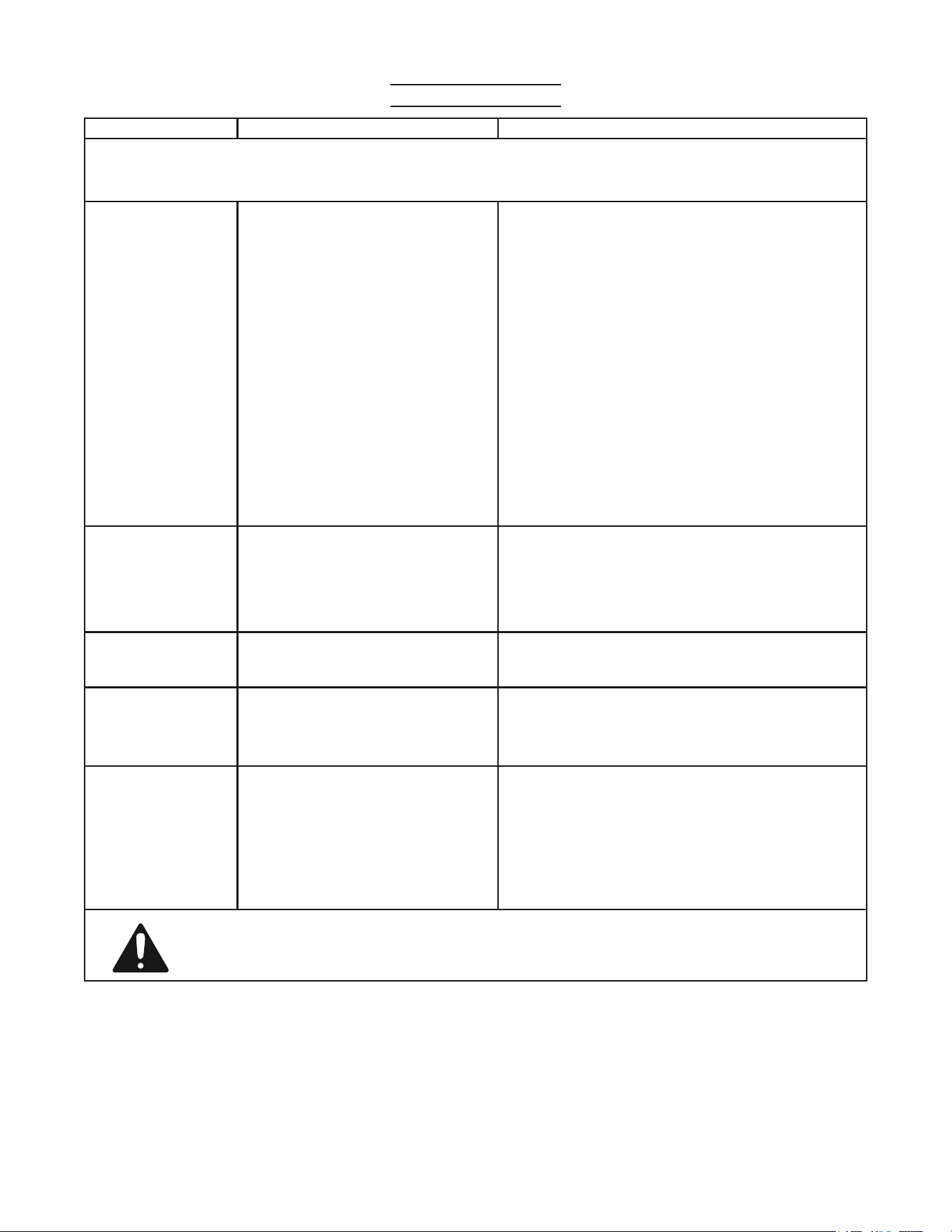
Troubleshooting
Problem Possible Causes Likely Solutions
Motor and Electrical
Lathe will not
start or a breaker
trips on startup.
1. Cord not connected.
2. No power at outlet.
3. Fuse has blown.
4. Chuck Guard safety
interlock not in place.
5. PC Board (182) faulty.
6. Power Switch (178), Forward/
OFF/Reverse Switch (181)
and/or Speed Control
Knob (180) not working.
7. Internal damage or wear
(such as wiring or motor.)
1. Check that cord is plugged in.
2. Check power at outlet. If outlet is unpowered,
turn off tool and check circuit breaker. If breaker
is tripped, make sure circuit is right capacity
for tool and circuit has no other loads.
3. Check for short, replace fuse (see
Maintenance section of this manual).
4. Rotate Pin (251) so it seats in Plate (252).
5. Inspect PC Board, have replaced if needed.
6. Check and replace as needed.
7. Have technician service tool.
Lathe stalls. 1. Incorrect workpiece
material (metal).
2. Drive Pulleys slipping on shaft.
3. Removing too much
material per pass.
1. Use metal suited for Lathe.
2. Tighten or Replace Pulleys (27,148).
3. Remove less material per pass.
Lathe operates
slowly.
Extension cord too long or
wire size too small.
Eliminate use of extension cord. If an extension
cord is needed, use shorter/heavier gauge cord.
See Extension Cords in GROUNDING section.
Performance
decreases over time.
1. Accessory dull or damaged.
2. Carbon Brushes (318)
worn or damaged.
1. Keep cutting accessories sharp.
Replace as needed.
2. Replace Carbon Brushes (see
Maintenance section of this manual).
Excessive noise
or rattling.
1. Pulley setscrews
missing or loose.
2. Motor fan hitting cover.
3. Belt (if equipped) too
loose (slipping) or too tight
(bearing damage).
4. Internal motor damage or wear.
1. Check Pulley keys and setscrews.
Replace or tighten as needed.
2. Tighten fan cover or replace as needed.
3. Properly tension belt.
4. Have technician service tool.
Follow all safety precautions whenever diagnosing or servicing
the tool. Disconnect power supply before service.

Page 30 For technical questions, please call 1-888-866-5797. Item 93212
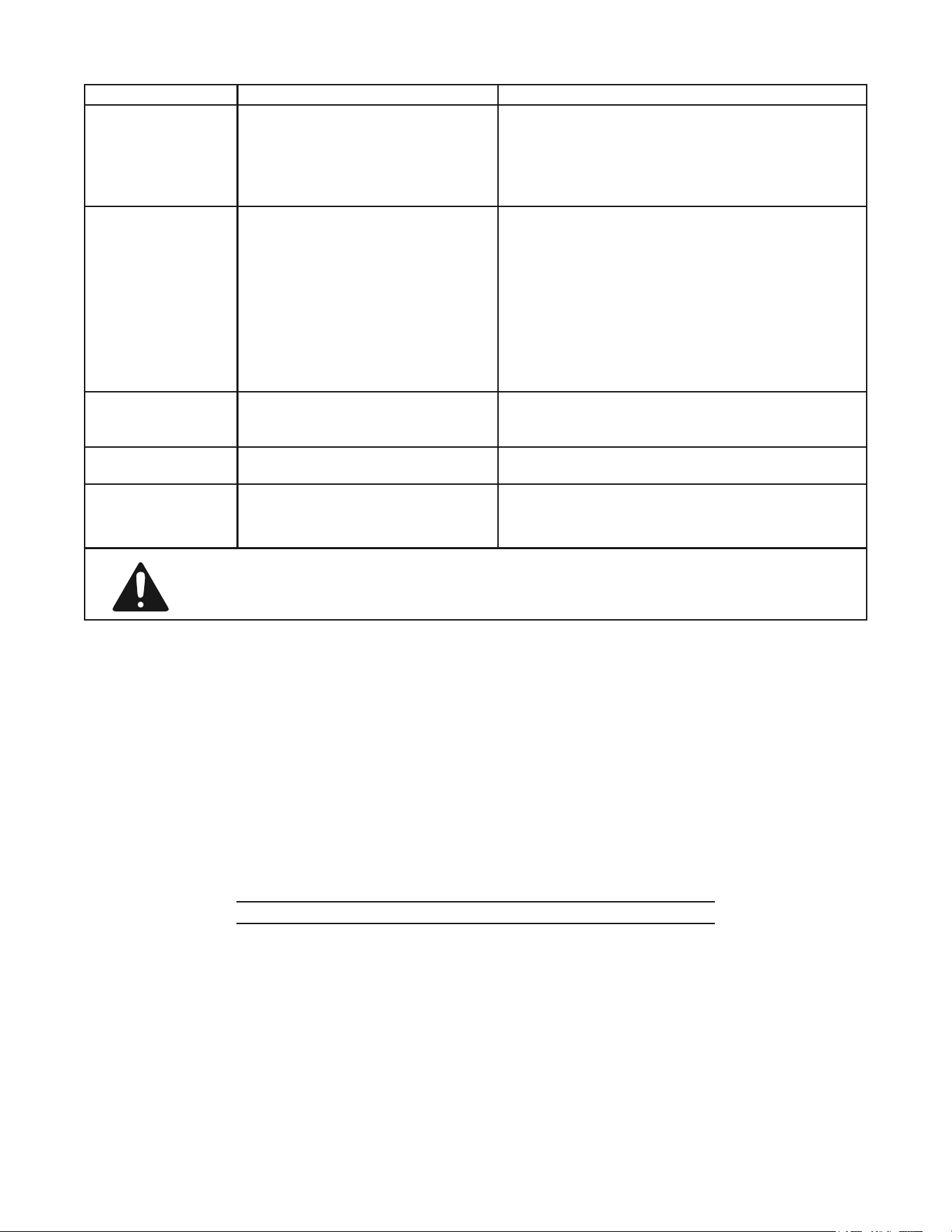
Problem Possible Causes Likely Solutions
Overheating. 1. Motor overloaded.
2. Forcing machine to work too fast.
3. Accessory dull or damaged.
4. Incorrect RPM or feed rate.
5. Gear setup is too tight, gears
bind.
6. Blocked motor housing vents.
7. Motor being strained by long or
small diameter extension cord.
1. Reduce load on motor. Loosen drive Belt
(see Maintenance section of this manual).
2. Allow machine to work at its own rate.
3. Keep cutting accessories sharp.
Replace as needed.
4. Check that RPM feed rate chart for
appropriate rates for operation.
5. Adjust gears so there is a small amount of
play and the gears move freely and smoothly
when the Chuck is rotated by hand.
6. Wear ANSI-approved safety goggles and NIOSH-
approved dust mask/respirator while blowing
dust out of motor using compressed air.
7. Eliminate use of extension cord. If an
extension cord is needed, use one with the
proper diameter for its length and load. See
Extension Cords in GROUNDING section.
Tool Performance
Whole unit vibrates
excessively
while in use.
1. Workpiece unbalanced.
2. Loose or damaged belt(s).
3. Drive Pulleys not aligned.
4. Worn or broken gear.
5. Chuck loose or unbalanced.
6. Spindle bearings worn.
1. Re-center workpiece.
2. Tighten or replace the belt.
3. Align Drive Pulleys (27, 148).
4. Inspect gears and replace if needed.
5. Tighten Nuts (6) or have a qualied
technician rebalance Chuck.
6. Have a qualied technician replace bearings.
Uneven surface
nish.
1. Incorrect RPM or
feed rate for job.
2. Dull or incorrect tool for job.
3. Gibs need adjustment.
4. Tool positioned too high.
1. Adjust RPM and/or feed rate.
2. Sharpen and/or change tool.
3. Tighten Gibs (99 and/or 106) (See Gib
Adjustment in Maintenance Section).
4. Lower position of tool.
Unable to remove
tapered tool
from Tailstock.
Quill not fully seated in Tailstock
or taper was inserted without
rst removing debris.
Turn quill handwheel until taper is forced out
of quill. In the future make sure that the quill
is fully seated in the tailstock and that the tool
is wiped free of debris before installing.
Cross Slide,
Compound Slide
and/or carriage
feed do not move
smoothly.
1. Gibs need adjusting.
2. Handwheel or crank
handles are too loose.
3. Leadscrew worn or
needs adjustment.
1. Loosen or tighten the Gib screws (99 and/or 106)
(See Gib Adjustment in Maintenance Section).
2. Tighten Handwheel and/or crank handle.
3. Tighten Leadscrew fasteners or have lead
screw replaced by a qualied technician.
Follow all safety precautions whenever diagnosing or servicing
the tool. Disconnect power supply before service.
Page 31For technical questions, please call 1-888-866-5797.Item 93212
PLEASE READ THE FOLLOWING CAREFULLY
THE MANUFACTURER AND/OR DISTRIBUTOR HAS PROVIDED THE PARTS LIST AND ASSEMBLY
DIAGRAM IN THIS MANUAL AS A REFERENCE TOOL ONLY. NEITHER THE MANUFACTURER OR
DISTRIBUTOR MAKES ANY REPRESENTATION OR WARRANTY OF ANY KIND TO THE BUYER THAT HE
OR SHE IS QUALIFIED TO MAKE ANY REPAIRS TO THE PRODUCT, OR THAT HE OR SHE IS QUALIFIED
TO REPLACE ANY PARTS OF THE PRODUCT. IN FACT, THE MANUFACTURER AND/OR DISTRIBUTOR
EXPRESSLY STATES THAT ALL REPAIRS AND PARTS REPLACEMENTS SHOULD BE UNDERTAKEN BY
CERTIFIED AND LICENSED TECHNICIANS, AND NOT BY THE BUYER. THE BUYER ASSUMES ALL RISK
AND LIABILITY ARISING OUT OF HIS OR HER REPAIRS TO THE ORIGINAL PRODUCT OR REPLACEMENT
PARTS THERETO, OR ARISING OUT OF HIS OR HER INSTALLATION OF REPLACEMENT PARTS THERETO.
Problem Possible Causes Likely Solutions
Difculty moving
Cranks of Cross
Slide, Compound
Slide and/or
Carriage Handwheel.
1. Debris jammed around Gibs.
2. Gibs adjusted too tight.
3. Bedways need lubrication.
1. Remove Gibs, clean Gibs and all adjacent
areas. Re-lubricate, then reinstall Gibs.
2. Loosen Gib screws (99 and/or
106) and lubricate bedways.
3. Lubricate bedways.
Cutting Tool
or machine
components
vibrate excessively
during operation.
1. Tool Post (112) too loose.
2. Cutting tool jutting too far out of
Tool Post or not secure.
3. Gibs need adjustment.
4. Cutting tool need sharpening.
5. RPM or feed rate incorrect for job.
1. Clean any debris around Tool Post,
then securely tighten Tool Post.
2. Remove and reinstall cutting tool so that at least
two screws hold it securely in place and no more
than 1/3 of the tool extends beyond the Tool Post.
3. Adjust Gib screws (99 and/or 106).
4. Sharpen or replace tool.
5. Check and adjust for recommended
RPM and/or feed rate.
Finished piece
uneven from one
end to the other.
Chuck and Tailstock are not aligned. Realign Tailstock following Tailstock
Alignment instructions in the maintenance
section of this manual.
Difculty moving
Chuck Jaws.
Debris lodged between
Jaws and Chuck.
Remove Jaws. Clean and lubricate
Chuck threads, then reinstall Jaws.
Carriage will
not feed.
1. Gear or gears not engaged.
2. Damaged gears.
3. Feed Handle screw loose.
1. Check gears and adjust positions.
2. Check and replace damaged gears.
3. Tighten feed handle screw.
Follow all safety precautions whenever diagnosing or servicing
the tool. Disconnect power supply before service.

Page 32 For technical questions, please call 1-888-866-5797. Item 93212
PARTS LIST
Part Description Qty
1 Bed way 1
2 Chuck 1
3 Spindle 1
4 Stud M6 x 25 3
6 Nut M6 5
7 Key 5 x 40 1
8 Key 4 x 8 2
9 Set Screw M5 x 12 6
10 Cover 2
11 Ball bearing 80206 2
12 Spacer 2
13 Headstock casting 1
14 H/L gear 21T/29T 1
15 Spacer 1
16 Spur gear 45T 1
17 Nut M27 x 1.5 2
18 Set screw M5 x 8 1
19 Steel ball 5 2
20 Compression spring 3
21 Set screw M6 x 8 3
22 Retaining ring 12 2
23 Ball bearing 6201Z 2
24 H/L gear 12T/20T 1
25 Parallel key 4 x 45 1
26 H/L gear shaft 1
27 Pulley 1
28 Retaining ring 10 2
29 Timing belt L136 1
30 Shifting fork 1
31 Shifting arm 1
32 Shifting knob 1
33 H/L Speed Gear Shift Lever 1
34 Shifting grip 1
35 Feed Direction Selector 1
36 Handle mount 1
37 Spring 1
38 Indicator 1
39 Pinion 25T 1
40 Support screw 2
41 Pinion 20T 1
42 Fixed cover 1
43 Screw M6 x 20 2
45 Gear 45T 1
46 Shaft 1
47 Parallel key 3 x 8 1
48 Mount 1
49 Screw M5 x 18 2
50 Gear 20T 2
51 Washer M6 6
52 Cap Screw M6 x 8 2
53 Gear Drive Cover 1
54 Screw M5 x 45 2
55 Thread cutting chart 1
56 Screw M5 x 8 12
57 Washer M4 2
58 Bushing w/key 1
59 Gear 80T 2
60 Shaft 1
61 Support plate 1
62 Washer 8 3
63 Nut M8 3
64 Shaft 1
Part Description Qty
65 Threading Dial 1
66 Pinion 16T 1
67 Bolt M6 x 16 10
68 Threading Dial Body 1
69 Set screw M4 x 10 3
70 Apron 1
71 Gib strip 1
72 Washer 2
73 Screw M4 x 8 2
74 Shaft 1
75 Half nut base 1
76 Angle block 1
77 Screw M4 x 10 2
78 Groove cam 1
79 Automatic Feed Lever 1
80 Shaft 1
81 Feeding gear 11T/54T 1
82 Feeding gear 24T 1
83 Screw M6 x 10 4
84a Wheel (Tailstock Quill Control) 1
84b Wheel (Feed Control) 1
85 Knob 2
86A Cross Slide Crank 1
86B Compound Rest Crank 1
87 Dial 2
88 Bracket 1
89 Feeding screw 1
90 Nut M5 4
91 Screw M6 x 12 6
92 Slide plate 2
93 Carriage 1
94 Gib strip 1
95 Feeding nut imperial 1
96 Swivel disk 1
97 Screw M8 x 20 6
98 Nut M4 6
99 Screw M4 x 16 3
100 Cross slide 1
101 Screw M5 x 10 2
102 Screw M4 x 8 1
105 Compound rest (B) 1
106 Screw M4 x 14 3
107 Gib strip 1
108 Compound rest (A) 1
109 Position pin 1
110 Tool Post Bolt M6 x 25 8
111 Tool Post lever 1
112 Tool Post 1
113 Stud M10 x 65 1
114 Cross feed screw 1
115 Bracket 1
116 Screw M4 x 12 2
119 Nut M18 2
120 Model label 1
121 Dial indicator label 1
122 Control Panel 1
123 Control box 1
124 Power Cord 1
125 Rubber foot 4
126 Chip tray 1
127 Bracket 1
*Not shown on Assembly Diagrams.

Page 33For technical questions, please call 1-888-866-5797.Item 93212
PARTS LIST (Continued)
Part Description Qty
128 Key M3 x 16 1
129 Lead screw 1
131 Bracket 1
133 Screw M3 x 10 3
134 Rack 1
135 Clamp plate 1
136 Washer M10 1
137 Screw M5 x 16 1
138 Tailstock 1
139 Tailstock screw 1
140 Bracket 1
141 Screw M4 x 10 2
142 Tailstock quill 1
143 Live Center 1
144 Stud M8 x 40 1
145 Clamp 1
146 Tailstock Quill Fix Holder 1
148 Pulley 1
150 Motor 1
151 Motor Cover 1
152 Cable Roller 1
153 Rear splash guard 1
157* Gear 30T 1
158* Gear 35T 1
159* Gear 40T 2
160* Gear 45T 1
161* Gear 50T 1
162* Gear 55T 1
163* Gear 57T 1
164* Gear 60T 1
165* Gear 65T 1
166* External Jaw Set 1
167* Chuck Key 1
168* Internal Jaw Set 1
170 Screw M4 x 8 1
171 Clamp block 1
172 Check ring 8 1
173 Screw M5 x 10 4
174 Protector 1
175 Screw M5 x 10 2
176 Nut M6 2
177 Screw M6 x 25 2
178 Power switch 1
179 Fuse Holder 1
180 Speed Control Knob 1
181 Forward/OFF/Reverse Switch 1
182 PC board 1
184 Screw M5 x 10 1
185 Spring washer 5 1
186 Washer 5 1
187 Key 3*16 1
188 Spacer 1
190 Spring 2
191 Washer 8 1
Part Description Qty
192 Spring washer 2
193 Screw M8 x 55 2
194 Screw M4 x 38 1
195 Nut M4 1
196 Tailstock plate 1
197 Screw M5 x 16 1
198 Flange 1
199 Screw M5 x 25 1
200 Key 3 x 12 1
201 Chuck Guard 1
202 Hinge 1
205 Spring washer 6 1
206 Big washer 6 1
207 Spring 1
208 Washer 6 1
209 Screw M3 x 4 4
210 Switch cover 1
211 Screw M5 x 16 2
212 Fixed cover 1
235 Protective cover 1
236 Slotted screw 1
237 Compression spring 1
238 Screw M6 x 30 1
239 Small washer 6 1
240 Hexagon nut M6 1
251 Pin 1
252 Rotate plate 1
253 Screw 2.9 x 4.5 2
254 Cover 1
255 Micro Switch 1
256 Dustproof sleeve 1
257 Protective Cover for Leadscrew 1
258 Screw M5 x 8 3
265 Spring Washer 6 2
266 Big Washer 6 2
267 Screw M6 x 25 2
268 Tailstock Nut M10 1
269 Screw M5 x 14 1
270 Leadscrew Support 1
271 Nut M4 2
272 Protective Cover 1
273 Screw M4 x 6 2
300 Screw 1
301 Label 1
302 Thread Dial Indicator 1
303 Plate 1
304 Screw M6 x 12 1
310* Oil can 1
311* L hex wrench set S: 3,4,5,6 1
312* Double end wrench 8-10 1
313* Double end wrench 14-17 1
314* Fuse 1
318* Carbon brush set 1
*Not shown on Assembly Diagrams.
Record Product’s Serial Number Here:
Note: If product has no serial number, record month and year of purchase instead.
Note: Some parts are listed and shown for illustration purposes only,
and are not available individually as replacement parts.
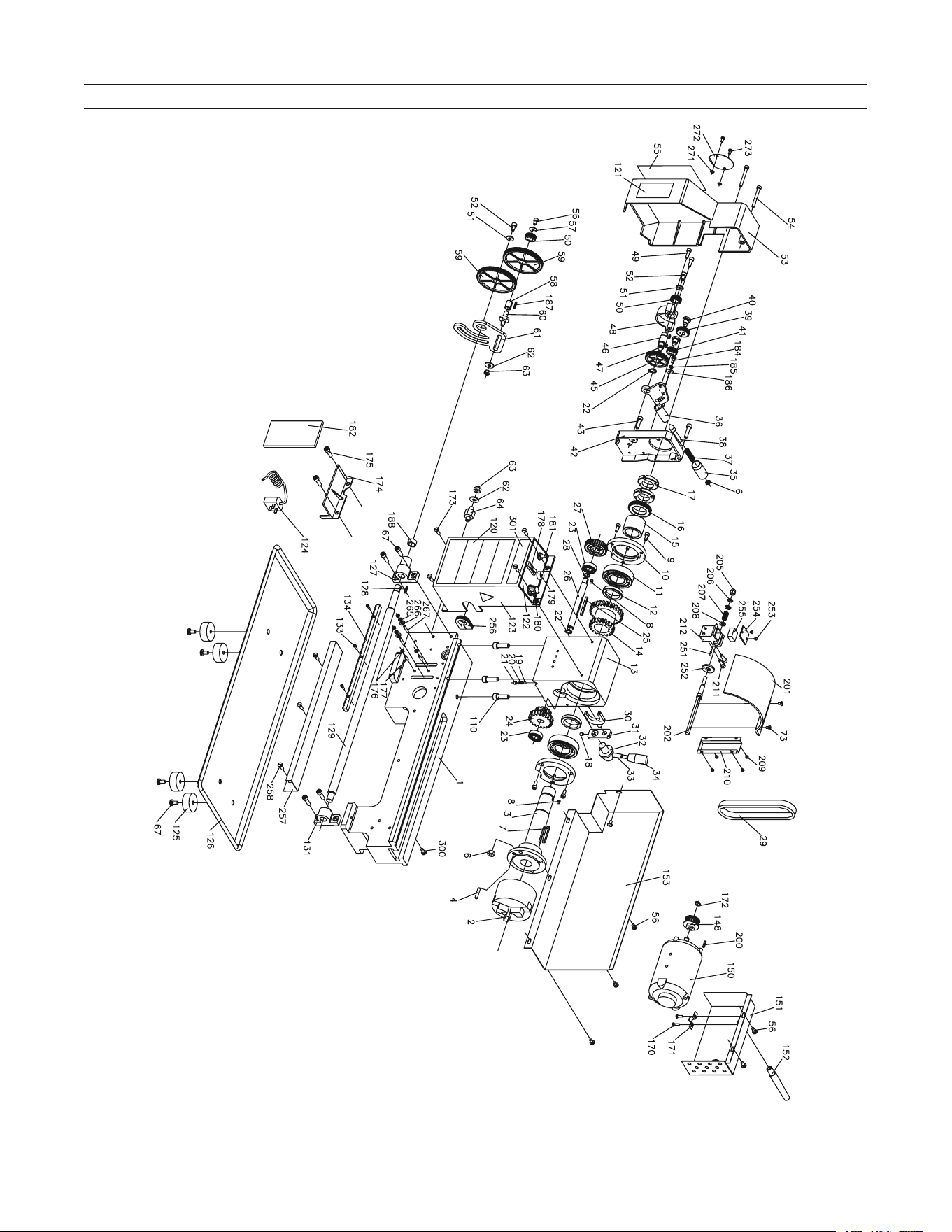
Page 34 For technical questions, please call 1-888-866-5797. Item 93212
ASSEMBLY DIAGRAM
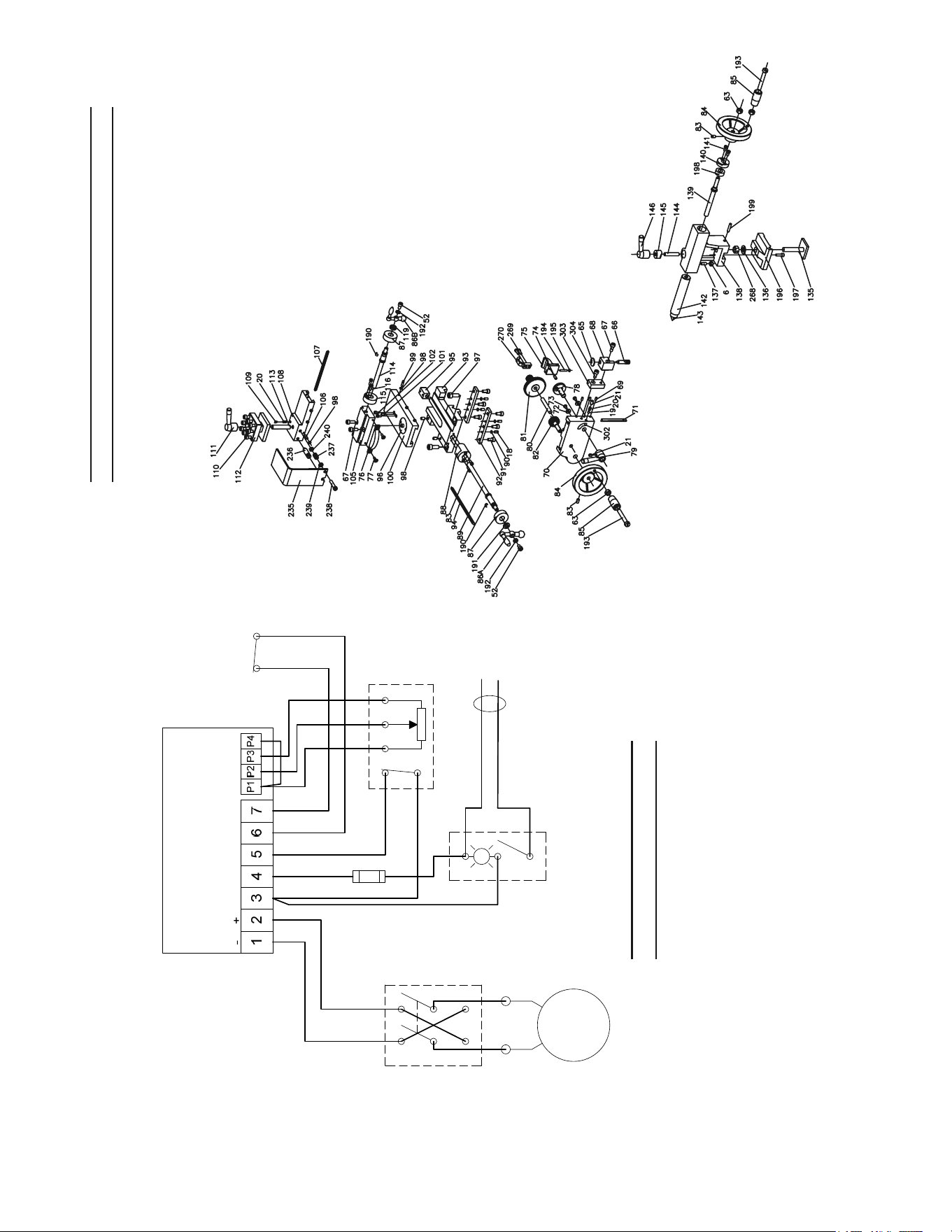
Page 35For technical questions, please call 1-888-866-5797.Item 93212
ASSEMBLY DIAGRAM (cONTINUED)
a
b
MOTOR
FUSE
POWER
SWITCH
SAFETY
SWITCH
FC250BJ/110V
CONTROLLER
POTENTIOMETER
F/O/R
SWITCH
POWER
CORD
DC
Output
AC
Input
WhiteBlack
Rev
Off
For
WIRING DIAGRAM

LIMITED 90 DAY WARRANTY
Harbor Freight Tools Co. makes every effort to assure that its products meet high quality
and durability standards, and warrants to the original purchaser that this product is free from
defects in materials and workmanship for the period of 90 days from the date of purchase. This
warranty does not apply to damage due directly or indirectly, to misuse, abuse, negligence or
accidents, repairs or alterations outside our facilities, criminal activity, improper installation,
normal wear and tear, or to lack of maintenance. We shall in no event be liable for death,
injuries to persons or property, or for incidental, contingent, special or consequential damages
arising from the use of our product. Some states do not allow the exclusion or limitation of
incidental or consequential damages, so the above limitation of exclusion may not apply to
you. THIS WARRANTY IS EXPRESSLY IN LIEU OF ALL OTHER WARRANTIES, EXPRESS
OR IMPLIED, INCLUDING THE WARRANTIES OF MERCHANTABILITY AND FITNESS.
To take advantage of this warranty, the product or part must be returned to us with
transportation charges prepaid. Proof of purchase date and an explanation of the complaint
must accompany the merchandise. If our inspection verifies the defect, we will either repair or
replace the product at our election or we may elect to refund the purchase price if we cannot
readily and quickly provide you with a replacement. We will return repaired products at our
expense, but if we determine there is no defect, or that the defect resulted from causes not
within the scope of our warranty, then you must bear the cost of returning the product.
This warranty gives you specific legal rights and you may
also have other rights which vary from state to state.
3491 Mission Oaks Blvd. • PO Box 6009 • Camarillo, CA 93011 • 1-888-866-5797