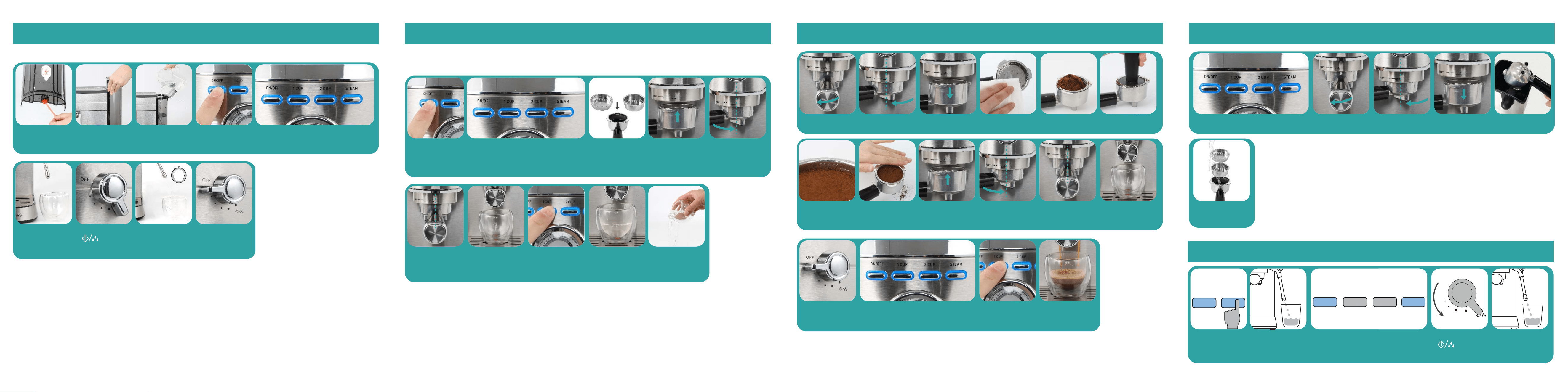
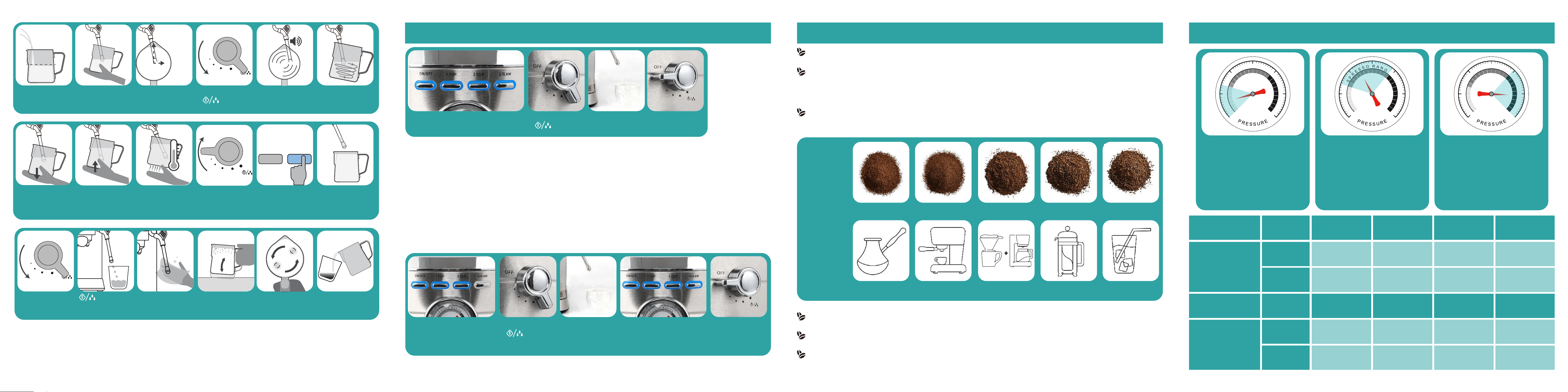
1. Press the STEAM
button. The machine
will start to preheat.
2. Water may come out
of the Steam Wand.
3. The STEAM button stops flashing and is fully
illuminated = Ready.
5. When only steam is
out of the Steam Wand,
turn the Steam Knob to
the “OFF” position.
Frothing milk
ON/OFF 1 CUP STEAM2 CUP
ON/OFF 1 CUP STEAM2 CUP
16. Rotate the Portafilter and remove it from the Brew Head. 17. Remove the Espresso
Puck from the Portafilter.
7-9g for CUP
13-15g for CUP
8. Press the 1 CUP or
2 CUP button to run a
brew cycle. Repeat this
step if needed.
9. Let the hot water
spout out.
1. Rotate the Portafilter and remove it from Brew Head.
A cold brew head, portafilter, filter, and cup can reduce the extraction temperature. For the optimal
coee temperature, preheat the coee maker at least once before brewing.
1. Turn on the machine.
The machine will start
to preheat.
2. All buttons are fully illuminated = Ready. 3. Insert the Single Filter
or Double Filter without
any coee grounds in
the Portafilter.
4. Keep the Portafilter
level and insert it into
the Brew Head.
5. Rotate the Portafilter to
the right.
1. Remove the orange
plug on the bottom of
the reservoir.
3. Fill the reservoir with
room-temperature water.
2. Install the reservoir. 4. Turn on the machine.
The machine will start to
preheat.
5. All buttons are fully illuminated = Ready.
6. Place a cup on the
countertop and position
Steam Wand towards the
cup.
8. Let the hot water
spout out for 10 seconds.
7. Turn the Steam Knob
to position.
9. Return the knob to the
"OFF" position.
2. Wipe the Filter Basket
with a dry cloth.
3. Fill the Filter with
coee grounds.
4. Evenly and firmly tamp
the coee grounds.
11. Make sure the Steam
Knob is set to the "OFF"
position.
12. All buttons are fully illuminated = Ready.
13. Press the
1
CUP or
2
CUP button to start
brewing.
14. Start brewing.
15. Once brewing is complete, all buttons are
fully illuminated = Ready.
5. Make sure the coee
ground reaches the
MAX line after tamping.
6. Wipe edges to remove
any coee residue.
7. Keep the Portafilter
level and insert it into
the Brew Head.
8. Rotate the Portafilter
to the right.
9. The Portafilter should
be in the center position.
10. Place a cup on the Drip
Tray under the Portafilter.
Pre-heat the brewing system Making espressoMaking espressoFirst-time use cycle
42 31
NOTE: There will be a loud noise and a little shake when you run the machine for the first time.
This is normal for the 20-bar pump. The noise will decrease with further use.
Rinse and get your machine ready to operate. This is only required for the first time use out of the box.
6. The Portafilter should
be in the center position.
7. Place a cup on the
Drip Tray under Filter
Holder.
20
Sec
18. Wash all the parts with
warm water.
Do not use a dishwasher.
10. Empty the hot water
from cup.
10
Sec
or
Single Double
TURN
CENTER
TURN
TURN
CENTER
TURN
4. Turn the Steam Knob
to position and
let the residual water
drain.
OFF
You can check INSTRUCTIONAL VIDEO about this machine via this link:
https://www.amazon.com/stores/page/1A32D3C8-D3CD-4744-A238-D6126F90099F
4. Turn the knob back to
“OFF” position when
done.
3. Hot water will spout
out of the Steam Wand.
1. All buttons are fully illuminated = Ready. 2. Turn the Steam Knob
to position.
The pressure gaugeUser Tips
20. Tap the Pitcher to
release larger air bubbles.
4. All buttons are fully illuminated=the
boiler is cool. when the boiler is cool,
the pump stops operating and no
more water is delivered.
5. Return knob to the
"OFF" position. Now the
coee maker is ready for
the next brew.
3. Let hot water come out
of the steam wand for
about 8 seconds.
1. When in over-heating protection.
n'
22. Pour the milk in a one
steady stream.
MAX
COLD
WHOLE MILK
12
0’CLOCK
3
0’CLOCK
6. Fill the Pitcher with
cold milk just below the
bottom of the spout.
7. Insert the Steam
Wand Tip just below
the surface of the milk.
8. Steam Wand position:
- Arm at 12 o'clock
- Tip at 3 o'clock
15. Return the Knob to
the "OFF" position.
16. Press the STEAM
button again to exit the
steam mode.
21. Swirl the Pitcher to
blend the milk and
create a silky texture.
17. Remove the Pitcher
from the Steam Wand.
10. The Frother will make
a soft hissing noise.
11. Check to see if the
milk is swirling.
12. As milk level rises,
lower the Pitcher to keep
the Tip just below the
milk surface.
13. When the desired foam
is achieved, immerse the
Steam Wand half way into
the milk.
14. Milk is ready when
the Pitcher is too hot to
touch for 3 secs.
5 6
ATTENTION: OVER-HEATING PROTECTION
Do not brew coee immediately after frothing milk. The boiler must be cooled down first, otherwise the
temperature and the pressure inside the machine will be too high, and the machine will go into the
over-heating protection mode. When in over-heating protection mode, the machine will not brew coee,
and the 1 CUP and 2 CUP buttons will flash alternately when pressed.
Making hot water
9. Turn the Steam Knob
to position.
OFF
OFF
ON/OFF 1 CUP STEAM2 CUP
OFF
18. Turn the Steam Knob to position, let the
steam come out of the wand for 1-2 seconds. Then
return the Steam Knob to the “OFF” position.
2. Turn the Steam Knob
to position.
Proceed as follows to cool down the machine:
19. Wipe the Steam
Wand and Tip with a
damp cloth.
The taste of espresso depends on the amount and type of coee grounds used.
The particular taste of a coee bean depends on several factors, but its taste and aroma are the result of
the roasting process. Coee beans roasted for a longer time and at higher temperatures are darker in color.
Darker coee beans release more flavor than lighter ones.
Espresso machines require a finely ground blend. We recommend using a grinder mill rather than a
blade mill.
Fresh, quality coee beans will give you the best possible flavor extraction.
We recommend storing the coee in an airtight container, in a cool, dry place, away from heat sources.
Serve espresso coee immediately after preparing it.
Grind
Setting:
Best for:
Turkish Coee Espresso Pour Over & Drip Cold BrewFrench Press
Powdered Sugar Table Salt Sea Salt ChunkyLess Chunky
R
A
O
N
S
G
S
E
E
R
P
S
E
R
A
O
N
S
G
S
E
E
R
P
S
E
R
A
O
N
S
G
S
E
E
R
P
S
E
Under-Extracted Zone Ideal Espresso Zone Over-Extracted Zone
When the gauge needle is positioned
in the lower zone during extraction
this indicates that the espresso has
been extracted with insucient
pressure.
When the gauge needle is positioned
anywhere within the solid gray zone
during extraction, this indicates the
espresso has been extracted at the
ideal pressure.
When the gauge needle is positioned
in the upper zone during extraction,
this indicates that the espresso has
been extracted with too much
pressure.
Extraction Quality
OVER EXTRACTED
Crema very dark and not
uniformed
IDEAL EXTRACTION
UNDER EXTRACTED
Light and pale Crema
PROBABLE
CAUSE
SOLUTION
PROBABLE
CAUSE
SOLUTION
Grind finer
Increase the
amount
Increase the
tamping pressure
TOO COARSE TOO LITTLE TOO LIGHT
25-45!SEC
OPTIMUM
7-9g (1 CUP)
13-15g (2 CUP)
20-33lbs
(9-15kg)
UNDER 20 SEC
Grind coarser
Decrease the
amount
Decrease the
tamping pressure
TOO FINE TOO MUCH TOO HEAVY
OVER 50 SEC
GRIND
Amount of
Coee Ground
TAMP SHOT TIME